Skip to content

High-quality research proteins.

  • 1-800-805-6531

  • Mon - Sat 8.00-18.00, Sun - Closed

  • info@prospecbio.com

  • PO Box 6591 East Brunswick NJ 08816

  • Products
    • Cytokines
    • Growth factors
    • Chemokines
    • Cd antigens
    • Neurotrophins
    • Hormones
    • Enzymes
    • Viral antigens
    • Recombinant proteins
    • Natural proteins
    • Monoclonal antibodies
    • Polyclonal antibodies
    • Thermal Packaging
  • About
    • Company
    • Founder
    • Contribution
  • Customers
    • Eastern Asia
    • Eastern Europe
    • North America
    • South America
    • South East Asia
    • Southern Asia
    • Western Europe
  • Ordering
    • Ordering Method
    • Ordering - Credit Card
    • Ordering - PO
    • Shipping Fees
    • FAQs
  • Services
    • DNA Cloning
    • Protein Expression
    • Monoclonal Antibody
    • Fermentation
    • Technology License
  • Contact us
Log in

Country/region

  • USD $ | Albania
  • USD $ | Andorra
  • USD $ | Argentina
  • USD $ | Armenia
  • USD $ | Australia
  • USD $ | Austria
  • USD $ | Azerbaijan
  • USD $ | Belarus
  • USD $ | Belgium
  • USD $ | Bolivia
  • USD $ | Brazil
  • USD $ | Bulgaria
  • USD $ | Cambodia
  • USD $ | Canada
  • USD $ | Chile
  • USD $ | China
  • USD $ | Colombia
  • USD $ | Costa Rica
  • USD $ | Croatia
  • USD $ | Cyprus
  • USD $ | Czechia
  • USD $ | Denmark
  • USD $ | Estonia
  • USD $ | Finland
  • USD $ | France
  • USD $ | Georgia
  • USD $ | Germany
  • USD $ | Greece
  • USD $ | Hong Kong SAR
  • USD $ | Hungary
  • USD $ | Iceland
  • USD $ | India
  • USD $ | Ireland
  • USD $ | Israel
  • USD $ | Italy
  • USD $ | Japan
  • USD $ | Kazakhstan
  • USD $ | Latvia
  • USD $ | Liechtenstein
  • USD $ | Lithuania
  • USD $ | Madagascar
  • USD $ | Malta
  • USD $ | Mexico
  • USD $ | Moldova
  • USD $ | Monaco
  • USD $ | Netherlands
  • USD $ | New Zealand
  • USD $ | North Macedonia
  • USD $ | Norway
  • USD $ | Panama
  • USD $ | Paraguay
  • USD $ | Peru
  • USD $ | Philippines
  • USD $ | Poland
  • USD $ | Portugal
  • USD $ | Romania
  • USD $ | Singapore
  • USD $ | Slovakia
  • USD $ | Slovenia
  • USD $ | South Africa
  • USD $ | South Korea
  • USD $ | Spain
  • USD $ | Sri Lanka
  • USD $ | Sweden
  • USD $ | Switzerland
  • USD $ | Taiwan
  • USD $ | Thailand
  • USD $ | Türkiye
  • USD $ | Ukraine
  • USD $ | United Kingdom
  • USD $ | United States
  • USD $ | Uruguay
  • USD $ | Vatican City
  • USD $ | Venezuela
  • USD $ | Vietnam
  • Facebook
  • Instagram
logoProSpec - Recombinant Protein Manufacturer for academic and R&D industry
Become a distributor
Account Log in
Wishlist
Cart Cart(0)
  • Products
    +
    • Cytokines
    • Growth factors
    • Chemokines
    • Cd antigens
    • Neurotrophins
    • Hormones
    • Enzymes
    • Viral antigens
    • Recombinant proteins
    • Natural proteins
    • Monoclonal antibodies
    • Polyclonal antibodies
    • Thermal Packaging
  • About
    +
    • Company
    • Founder
    • Contribution
  • Customers
    +
    • Eastern Asia
    • Eastern Europe
    • North America
    • South America
    • South East Asia
    • Southern Asia
    • Western Europe
  • Ordering
    +
    • Ordering Method
    • Ordering - Credit Card
    • Ordering - PO
    • Shipping Fees
    • FAQs
  • Services
    +
    • DNA Cloning
    • Protein Expression
    • Monoclonal Antibody
    • Fermentation
    • Technology License
  • Contact us

Item added to your cart

View cart
View All
  • Cytokines
  • Growth factors
  • Chemokines
  • Cd antigens
  • Neurotrophins
  • Hormones
  • Enzymes
  • Viral antigens
  • Recombinant proteins
  • Natural proteins
  • Monoclonal antibodies
  • Polyclonal antibodies
  • Thermal Packaging
  • Tumor Necrosis Factor

    Tumor Necrosis Factor

    View All
  • 4-1BB

    4-1BB

    View All
  • Adiponectin

    Adiponectin

    View All
  • AIF1

    AIF1

    View All
  • Other Cytokines

    Other Cytokines

    View All
  • AITRL

    AITRL

    View All
  • Angiopoietin

    Angiopoietin

    View All
  • Apolipoprotein

    Apolipoprotein

    View All
  • B-Cell Activating Factor

    B-Cell Activating Factor

    View All
  • Beta Defensin

    Beta Defensin

    View All
  • Bone Morphogenetic Protein

    Bone Morphogenetic Protein

    View All
  • B type Natriuretic Peptide

    B type Natriuretic Peptide

    View All
  • BST

    BST

    View All
  • Betacellulin

    Betacellulin

    View All
  • Cardiotrophin

    Cardiotrophin

    View All
  • Activin

    Activin

    View All
  • Fibroblast Growth Factor

    Fibroblast Growth Factor

    View All
  • Other Growth Factors

    Other Growth Factors

    View All
  • CSF

    CSF

    View All
  • CTGF

    CTGF

    View All
  • IGFBP

    IGFBP

    View All
  • VEGF Protein

    VEGF Protein

    View All
  • EGF

    EGF

    View All
  • Epigen

    Epigen

    View All
  • Erythropoietin

    Erythropoietin

    View All
  • Insulin-Like Growth Factor

    Insulin-Like Growth Factor

    View All
  • Growth Hormone

    Growth Hormone

    View All
  • HDGF

    HDGF

    View All
  • Hepatocyte Growth Factor

    Hepatocyte Growth Factor

    View All
  • Insulin

    Insulin

    View All
  • BCA-1/ BLC (CXCL13)

    BCA-1/ BLC (CXCL13)

    View All
  • BRAK (CXCL14)

    BRAK (CXCL14)

    View All
  • C-10 (CCL6)

    C-10 (CCL6)

    View All
  • Other Chemokines

    Other Chemokines

    View All
  • MEC (CCL28)

    MEC (CCL28)

    View All
  • LD78-beta (CCL3L1)

    LD78-beta (CCL3L1)

    View All
  • CTACK (CCL27)

    CTACK (CCL27)

    View All
  • CXCL16

    CXCL16

    View All
  • CXCL17

    CXCL17

    View All
  • Platelet Factor-4 (CXCL4)

    Platelet Factor-4 (CXCL4)

    View All
  • ENA-78 (CXCL5)

    ENA-78 (CXCL5)

    View All
  • Eotaxin (CCL11,24,26)

    Eotaxin (CCL11,24,26)

    View All
  • Exodus-2 (CCL21)

    Exodus-2 (CCL21)

    View All
  • Fractalkine (CX3CL1)

    Fractalkine (CX3CL1)

    View All
  • CXCL6

    CXCL6

    View All
  • Other CD Antigens

    Other CD Antigens

    View All
  • CD14

    CD14

    View All
  • CD164

    CD164

    View All
  • CD1

    CD1

    View All
  • CD2

    CD2

    View All
  • CD200

    CD200

    View All
  • CD207

    CD207

    View All
  • CD226

    CD226

    View All
  • CD23

    CD23

    View All
  • CD244

    CD244

    View All
  • CD247

    CD247

    View All
  • CD27

    CD27

    View All
  • CD274

    CD274

    View All
  • CD300

    CD300

    View All
  • CD33

    CD33

    View All
  • Other Neurotrophins

    Other Neurotrophins

    View All
  • Beta-NGF

    Beta-NGF

    View All
  • BDNF

    BDNF

    View All
  • CDNF

    CDNF

    View All
  • CNTF

    CNTF

    View All
  • GDNF

    GDNF

    View All
  • Glia Maturation Factor

    Glia Maturation Factor

    View All
  • MANF

    MANF

    View All
  • Midkine

    Midkine

    View All
  • Neuroglobin

    Neuroglobin

    View All
  • Neurotrophic factors

    Neurotrophic factors

    View All
  • Neuregulin

    Neuregulin

    View All
  • Neuropilin

    Neuropilin

    View All
  • Pigment Epithelium-Derived Factor

    Pigment Epithelium-Derived Factor

    View All
  • Pleiotrophin

    Pleiotrophin

    View All
  • Peptide Hormones

    Peptide Hormones

    View All
  • Other Hormones

    Other Hormones

    View All
  • HCG

    HCG

    View All
  • Endothelin

    Endothelin

    View All
  • Exendin

    Exendin

    View All
  • FSH

    FSH

    View All
  • Glucagon

    Glucagon

    View All
  • GHRP

    GHRP

    View All
  • GLP

    GLP

    View All
  • Thyrostimulin

    Thyrostimulin

    View All
  • Inhibin A

    Inhibin A

    View All
  • LHRH

    LHRH

    View All
  • Melanotan

    Melanotan

    View All
  • Procalcitonin

    Procalcitonin

    View All
  • PTH

    PTH

    View All
  • Peroxiredoxin

    Peroxiredoxin

    View All
  • Peptidase

    Peptidase

    View All
  • Synthetase

    Synthetase

    View All
  • Transferase

    Transferase

    View All
  • Hydrolase

    Hydrolase

    View All
  • Dehydrogenase

    Dehydrogenase

    View All
  • ACE2

    ACE2

    View All
  • Esterase

    Esterase

    View All
  • Protein Kinases

    Protein Kinases

    View All
  • Other Enzymes

    Other Enzymes

    View All
  • Phosphatase

    Phosphatase

    View All
  • Deaminase

    Deaminase

    View All
  • Oxygenase

    Oxygenase

    View All
  • Adenylate Kinase

    Adenylate Kinase

    View All
  • Lyase

    Lyase

    View All
  • Chagas

    Chagas

    View All
  • SARS

    SARS

    View All
  • Influenza

    Influenza

    View All
  • ASFV

    ASFV

    View All
  • Astrovirus

    Astrovirus

    View All
  • Borrelia

    Borrelia

    View All
  • Helicobacter Pylori

    Helicobacter Pylori

    View All
  • Chikungunya

    Chikungunya

    View All
  • Chlamydia

    Chlamydia

    View All
  • Cytomegalo

    Cytomegalo

    View All
  • Dengue

    Dengue

    View All
  • EBV

    EBV

    View All
  • Ebola

    Ebola

    View All
  • Feline Leukemia Virus

    Feline Leukemia Virus

    View All
  • Hepatitis A

    Hepatitis A

    View All
  • Other

    Other

    View All
  • Actin

    Actin

    View All
  • ADAM

    ADAM

    View All
  • Complement Component

    Complement Component

    View All
  • Ag85

    Ag85

    View All
  • Eukaryotic Translation Initiation Factor

    Eukaryotic Translation Initiation Factor

    View All
  • Anterior Gradient Protein

    Anterior Gradient Protein

    View All
  • Heat Shock Protein

    Heat Shock Protein

    View All
  • Alpha-2-HS-Glycoprotein

    Alpha-2-HS-Glycoprotein

    View All
  • Hemoglobin

    Hemoglobin

    View All
  • Allergy

    Allergy

    View All
  • Anaplasma

    Anaplasma

    View All
  • Angiogenin

    Angiogenin

    View All
  • Ankyrin Repeat Domain

    Ankyrin Repeat Domain

    View All
  • Annexin

    Annexin

    View All
  • Other Natural Proteins

    Other Natural Proteins

    View All
  • Aprotinin

    Aprotinin

    View All
  • Transferrin

    Transferrin

    View All
  • Avidin

    Avidin

    View All
  • Anti Coagulation Factors

    Anti Coagulation Factors

    View All
  • Natural Albumin

    Natural Albumin

    View All
  • Natural Coagulation Factors

    Natural Coagulation Factors

    View All
  • Fibronectin

    Fibronectin

    View All
  • Thrombin

    Thrombin

    View All
  • Anti Human Enzyme

    Anti Human Enzyme

    View All
  • Other Monoclonal Antibodies

    Other Monoclonal Antibodies

    View All
  • Anti Human Cytokine

    Anti Human Cytokine

    View All
  • Anti Human Heat Shock Protein

    Anti Human Heat Shock Protein

    View All
  • Anti Mouse Lymphocyte

    Anti Mouse Lymphocyte

    View All
  • Anti Human Chemokine

    Anti Human Chemokine

    View All
  • Anti Human Lymphocyte

    Anti Human Lymphocyte

    View All
  • Anti Viral Monoclonal

    Anti Viral Monoclonal

    View All
  • Anti Mouse Cytokine

    Anti Mouse Cytokine

    View All
  • Anti-GST Monoclonal

    Anti-GST Monoclonal

    View All
  • Other Polyclonal Antibodies

    Other Polyclonal Antibodies

    View All
  • Anti Viral

    Anti Viral

    View All
  • Anti-GST Monoclonal

    Anti-GST Monoclonal

    View All
Back

Search results

1000 results found for “uromodulin”

Name

Description

Product #

Price

Quantity

Shipping Method

  • View Data Sheet

    Name :

    IGFLR1 Human

    Description:

    IGF-Like Family Receptor 1 Human Recombinant

    TMEM149, U2AF1L4, IGF-like family receptor 1, Transmembrane protein 149, U2 small nuclear RNA auxiliary factor 1-like 4, IGFLR1. 

    Product # :

    PRO-1432

    Price :

    Quantity :

    Shipping Method :

    Ice Icon

    Shipped with Ice Packs

    Add To Cart

    More Info

    • description
    • source
    • formulation
    • purity
    • More Info

    Description

    IGFLR1 Human Recombinant produced in E. coli is a single polypeptide chain containing 164 amino acids (23-163) and having a molecular mass of 17.5kDa. IGFLR1 is fused to a 23 amino acid His-tag at N-terminus & purified by proprietary chromatographic techniques.

    Source

    E.coli.

    Formulation

    The IGFLR1 solution (0.25mg/ml) contains 20mM Tris-HCl buffer (pH 7.5), 0.2M NaCl, 50% glycerol and 2mM DTT.

    Purity

    Greater than 90% as determined by SDS-PAGE.

    More Info

    • Introduction

      GF-like family receptor 1 (IGFLR1) is encoded by a gene mapping to human chromosome 19. IGFLR1 which is cell membrane receptor for the IGF-like family proteins binds IGFL1 and IGFL3 with a higher affinity and may as well bind IGFL2.

    • Synonyms

      TMEM149, U2AF1L4, IGF-like family receptor 1, Transmembrane protein 149, U2 small nuclear RNA auxiliary factor 1-like 4, IGFLR1.

    • Physical Appearance

      Sterile Filtered colorless solution.

    • Stability

      Store at 4°C if entire vial will be used within 2-4 weeks. Store, frozen at -20°C for longer periods of time. For long term storage it is recommended to add a carrier protein (0.1% HSA or BSA).Avoid multiple freeze-thaw cycles.

    • Amino Acid Sequence

      MGSSHHHHHH SSGLVPRGSH MGSSQYCGRL EYWNPDNKCC SSCLQRFGPP PCPDYEFREN CGLNDHGDFV TPPFRKCSSG QCNPDGAELC SPCGGGAVTP TPAAGGGRTP WRCRERPVPA KGHCPLTPGN PGAPSSQERS SPASSIAWRT PEPVPQQAWP NFLP.

    ProSpec's products are furnished for LABORATORY RESEARCH USE ONLY. The product may not be used as drugs, agricultural or pesticidal products, food additives or household chemicals.

    Igflr1 Human
  • View Data Sheet

    Name :

    OSM Rat

    Description:

    Oncostatin-M Rat Recombinant

    Oncostatin-M, OSM, OncoM.

    Product # :

    CYT-169

    Price :

    Quantity :

    Shipping Method :

    Room Temp Icon

    Shipped at Room temp

    Add To Cart

    More Info

    • description
    • source
    • formulation
    • purity
    • biological activity
    • More Info

    Description

    OSM Rat Recombinant produced in E.coli is a single, non-glycosylated polypeptide chain containing 214 amino acids and having a molecular mass of 24.3kDa.The OSM is purified by proprietary chromatographic techniques.

    Source

    Escherichia Coli.

    Formulation

    OSM protein was lyophilized from a 0.2µm filtered concentrated solution in 1xPBS, pH 7.4.

    Purity

    Greater than 95.0% as determined by:
    (a) Analysis by RP-HPLC.
    (b) Analysis by SDS-PAGE.

    Biological Activity

    The ED50 as determined by the dose-dependent stimulation of the proliferation of rat C6 cells is < 5.0 µg/ml, corresponding to a specific activity of > 200 units/mg.

    More Info

    • Introduction

      Oncostatin M is a member of a cytokine family that includes leukemia-inhibitory factor, granulocyte colony-stimulating factor, and interleukin 6. This gene encodes a growth regulator which inhibits the proliferation of a number of tumor cell lines. It regulates cytokine production, including IL-6, G-CSF and GM-CSF from endothelial cells.

    • Synonyms

      Oncostatin-M, OSM, OncoM.

    • Physical Appearance

      Sterile Filtered White lyophilized (freeze-dried) powder.

    • Stability

      Lyophilized Oncostatin M although stable at room temperature for 3 weeks, should be stored desiccated below -18°C. Upon reconstitution Oncostatin should be stored at 4°C between 2-7 days and for future use below -18°C.For long term storage it is recommended to add a carrier protein (0.1% HSA or BSA).Please prevent freeze-thaw cycles.

    • Solubility

      It is recommended to reconstitute the lyophilized Oncostatin M in sterile 18MΩ-cm H2O not less than 100µg/ml, which can then be further diluted to other aqueous solutions.

    • Amino Acid Sequence

      KRGCSSSSPK LLSQLKSQAN ITGNTASLLE PYILHQNLNT LTLRAACTEH PVAFPSEDML RQLSKPDFLS TVHATLGRVW HQLGAFRQQF PKIQDFPELE RARQNIQGIR NNVYCMARLL HPPLEIPEPT QADSGTSRPT TTAPGIFQIK IDSCRFLWGY HRFMGSVGRV FEEWGDGSRR SR RHSPLWAW LKGDHRIRPS RSSQSAMLRS LVPR.

    ProSpec's products are furnished for LABORATORY RESEARCH USE ONLY. The product may not be used as drugs, agricultural or pesticidal products, food additives or household chemicals.

    Osm Rat
  • View Data Sheet

    Name :

    ERCC1 Human

    Description:

    Excision Repair Cross-Complementing 1 Human Recombinant

    Excision Repair Cross-complementing rodent repair deficiency complementation group 1 (includes overlapping antisense sequence), RAD10, COFS4, UV20, DNA excision repair protein ERCC-1.

    Product # :

    PRO-1106

    Price :

    Quantity :

    Shipping Method :

    Ice Icon

    Shipped with Ice Packs

    Add To Cart

    More Info

    • description
    • source
    • formulation
    • purity
    • More Info

    Description

    ERCC1 Human Recombinant produced in E. coli is a single polypeptide chain containing 297 amino acids (1-273) and having a molecular mass of 32.5kDa.ERCC1 is fused to a 24 amino acid His-tag at N-terminus & purified by proprietary chromatographic techniques.

    Source

    E.coli.

    Formulation

    The ERCC1 solution (0.5mg/1ml) contains 20mM Tris-HCl buffer (pH 8.0), 100mM NaCl, 1mM DTT and 20% glycerol.

    Purity

    Greater than 90% as determined by SDS-PAGE.

    More Info

    • Introduction

      ERCC1 polypeptide is essential for nucleotide excision repair (NER) of damaged DNA and is homologous to Saccharomyces cerevisiae RAD10, which takes part in repair and mitotic intra-chromosomal recombination. NER mechanism includes dual incisions on both sides of the damage catalyzed by two nucleases. In mammalian cells XPG cleaves 3' of the DNA lesion while the ERCC1-XPF complex makes the 5' incision.

    • Synonyms

      Excision Repair Cross-complementing rodent repair deficiency complementation group 1 (includes overlapping antisense sequence), RAD10, COFS4, UV20, DNA excision repair protein ERCC-1.

    • Physical Appearance

      Sterile Filtered colorless solution.

    • Stability

      Store at 4°C if entire vial will be used within 2-4 weeks. Store, frozen at -20°C for longer periods of time. For long term storage it is recommended to add a carrier protein (0.1% HSA or BSA).Avoid multiple freeze-thaw cycles.

    • Amino Acid Sequence

      MGSSHHHHHH SSGLVPRGSH MGSHMDPGKD KEGVPQPSGP PARKKFVIPL DEDEVPPGVA KPLFRSTQSL PTVDTSAQAA PQTYAEYAIS QPLEGAGATC PTGSEPLAGE TPNQALKPGA KSNSIIVSPR QRGNPVLKFV RNVPWEFGDV IPDYVLGQST CALFLSLRYH NLHPDYIHGR LQSLGKNFAL RVLLVQVDVK DPQQALKELA KMCILADCTL ILAWSPEEAG RYLETYKAYE QKPADLLMEK LEQDFVSRSL EQLIAASRED LALCPGLGPQ KARRLFDVLH EPFLKVP

    ProSpec's products are furnished for LABORATORY RESEARCH USE ONLY. The product may not be used as drugs, agricultural or pesticidal products, food additives or household chemicals.

    Ercc1 Human
  • View Data Sheet

    Name :

    UNG E.Coli

    Description:

    Uracil DNA Glycosylase E.Coli Recombinant

    UDG, b2580, JW2564, EC 3.2.2.27, DGU, UNG15, HIGM5, Uracil-DNA Glycosylase 1, EC 3.2.2, HIGM4, UNG2.

    Product # :

    ENZ-752

    Price :

    Quantity :

    Shipping Method :

    Ice Icon

    Shipped with Ice Packs

    Add To Cart

    More Info

    • description
    • source
    • formulation
    • purity
    • More Info

    Description

    UNG E.Coli Recombinant produced in E.Coli is a single, non-glycosylated polypeptide chain containing 252 amino acids (1-229 a.a) and having a molecular mass of 28.1kDa.UNG is fused to a 23 amino acid His-tag at N-terminus & purified by proprietary chromatographic techniques.

    Source

    Escherichia Coli.

    Formulation

    UNG protein solution (0.5mg/ml) containing 20mM Tris-HCl buffer (pH8.0) and 10% glycerol.

    Purity

    Greater than 90.0% as determined by SDS-PAGE.

    More Info

    • Introduction

      UNG is a member of the Uracil-DNA glycosylase family. One of his functions is to prevent mutagenesis by eliminating uracil from DNAmolecules by cleaving the N-glycosylic bond and initiating the base-excision repair (BER) pathway. Uracil basesare formed as a result of cytosine deamination or misincorporation of dUMP residues. After a mutation is formed, the mutagenicthreat of uracil propagates through any subsequent DNA replication steps. Among the diseases associated with UNG are: congenital rubella, and immunodeficiency with hyper igm type 4.

    • Synonyms

      UDG, b2580, JW2564, EC 3.2.2.27, DGU, UNG15, HIGM5, Uracil-DNA Glycosylase 1, EC 3.2.2, HIGM4, UNG2.

    • Physical Appearance

      Sterile Filtered clear solution.

    • Stability

      Store at 4°C if entire vial will be used within 2-4 weeks. Store, frozen at -20°C for longer periods of time. For long term storage it is recommended to add a carrier protein (0.1% HSA or BSA).Avoid multiple freeze-thaw cycles.

    • Amino Acid Sequence

      MGSSHHHHHH SSGLVPRGSH MGSMANELTW HDVLAEEKQQ PYFLNTLQTV ASERQSGVTI YPPQKDVFNA FRFTELGDVK VVILGQDPYH GPGQAHGLAF SVRPGIAIPP SLLNMYKELE NTIPGFTRPN HGYLESWARQ GVLLLNTVLT VRAGQAHSHA SLGWETFTDK VISLINQHRE GVVFLLWGSH AQKKGAIIDK QRHHVLKAPH PSPLSAHRGF FGCNHFVLAN QWLEQRGETP IDWMPVLPAE SE

    ProSpec's products are furnished for LABORATORY RESEARCH USE ONLY. The product may not be used as drugs, agricultural or pesticidal products, food additives or household chemicals.

    Ung Ecoli
  • View Data Sheet

    Name :

    USP15 Human

    Description:

    Ubiquitin Specific Peptidase 15 Human Recombinant

    Ubiquitin Specific Peptidase 15, Ubiquitin Carboxyl-Terminal Hydrolase 15, Deubiquitinating Enzyme 15, Ubiquitin-Specific-Processing Protease 15, Ubiquitin Specific Protease 15, Ubiquitin Thiolesterase 15, KIAA0529, UNPH4, UNPH-2, EC 3.4.19.12, EC 3.1.2.15.

    Product # :

    PRO-1622

    Price :

    Quantity :

    Shipping Method :

    Ice Icon

    Shipped with Ice Packs

    Add To Cart

    More Info

    • description
    • source
    • formulation
    • purity
    • More Info

    Description

    USP15 Human Recombinant produced in E.coli is a single, non-glycosylated polypeptide chain containing 258 amino acids (1-235) and having a molecular mass of 29.5kDa.USP15 is fused to a 23 amino acid His-tag at N-terminus & purified by proprietary chromatographic techniques.

    Source

    Escherichia Coli.

    Formulation

    The USP15 solution contains 20mM Tris-HCl buffer (pH 8.0), 0.15M NaCl, 1mM DTT and 10% glycerol.

    Purity

    Greater than 90% as determined by SDS-PAGE.

    More Info

    • Introduction

      USP15 belongs to the ubiquitin specific protease (USP) family of deubiquitinating enzymes which has a vital role in ubiquitin-dependent processes through polyubiquitin chain disassembly and hydrolysis of ubiquitin-substrate bonds. USP15 connects with the COP9 signalosome, and takes part in transforming growth factor beta signalling through deubiquitination of receptor-activated SMAD transcription factors. Alternatively spliced transcript variants encoding multiple isoforms of this gene are known, and a pseudo gene of USP15 is sited on the long arm of chromosome 2.

    • Synonyms

      Ubiquitin Specific Peptidase 15, Ubiquitin Carboxyl-Terminal Hydrolase 15, Deubiquitinating Enzyme 15, Ubiquitin-Specific-Processing Protease 15, Ubiquitin Specific Protease 15, Ubiquitin Thiolesterase 15, KIAA0529, UNPH4, UNPH-2, EC 3.4.19.12, EC 3.1.2.15.

    • Physical Appearance

      Sterile filtered colorless solution.

    • Stability

      Store at 4°C if entire vial will be used within 2-4 weeks. Store, frozen at -20°C for longer periods of time. For long term storage it is recommended to add a carrier protein (0.1% HSA or BSA).Avoid multiple freeze-thaw cycles.

    • Amino Acid Sequence

      MGSSHHHHHH SSGLVPRGSH MGSMAEGGAA DLDTQRSDIA TLLKTSLRKG DTWYLVDSRW FKQWKKYVGF DSWDKYQMGD QNVYPGPIDN SGLLKDGDAQ SLKEHLIDEL DYILLPTEGW NKLVSWYTLM EGQEPIARKV VEQGMFVKHC KVEVYLTELK LCENGNMNNV VTRRFSKADT IDTIEKEIRK IFSIPDEKET RLWNKYMSNT FEPLNKPDST IQDAGLYQGQ VLVIEQKNED GTWPRGPSTP KKPLEQSC

    ProSpec's products are furnished for LABORATORY RESEARCH USE ONLY. The product may not be used as drugs, agricultural or pesticidal products, food additives or household chemicals.

    Usp15 Human
  • View Data Sheet

    Name :

    Omentin 298 a.a. Human

    Description:

    Omentin 298 a.a. Human Recombinant

    Intelectin-1, HL1, LFR, HL-1, INTL, ITLN, hIntL.

    Product # :

    CYT-061

    Price :

    Quantity :

    Shipping Method :

    Ice Icon

    Shipped with Ice Packs

    Add To Cart

    More Info

    • description
    • source
    • formulation
    • purity
    • More Info

    Description

    Omentin Human Recombinant produced in E.coli is a single, non-glycosylated polypeptide chain containing 298 amino acids (17-313) and having a molecular mass of 33.2 kDa.The Omentin is purified by proprietary chromatographic techniques.

    Source

    Escherichia Coli.

    Formulation

    Omentin protein (1mg/ml) is supplied in 20mM Tris-HCL, pH-8, 0.4M Urea and 10% Glycerol.

    Purity

    Greater than 90.0% as determined by SDS-PAGE.

    More Info

    • Introduction

      Omentin is a recently recognized gene highly localized to the mental tissue (visceral adipose tissue). Omentin is present in the stromal vascular cells in the adipose tissue rather than in the adipocytes. Omentin is predominantly expressed in the visceral adipose tissue than the subcutaneous tissue, with the omentin mRNA being 150 times higher in the visceral adipose tissue. Omentin has also been detected in human blood using western blot analysis, and seems to increase insulin-stimulated glucose uptake in 3T3-L1 adipocytes in mice. Omentin seems to increase Akt phosphorylation irrespective of insulin presence. Its role in glucose metabolism and obesity remains to be described; an insulin-sensitizing action is possible.Differences in Omentin expression has been noted in adipose tissue from normals and patients with inflammatory bowel disease although its significance is unknown.

    • Synonyms

      Intelectin-1, HL1, LFR, HL-1, INTL, ITLN, hIntL.

    • Physical Appearance

      Sterile Filtered colorless solution.

    • Stability

      Store at 4°C if entire vial will be used within 2-4 weeks. Store, frozen at -20°C for longer periods of time. For long term storage it is recommended to add a carrier protein (0.1% HSA or BSA).Avoid multiple freeze-thaw cycles.

    • Amino Acid Sequence

      MWSTDEANTY FKEWTCSSSP SLPRSCKEIK DECPSAFDGL YFLRTENGVI YQTFCDMTSG GGGWTLVASV HENDMRGKCT VGDRWSSQQG SKAVYPEGDG NWANYNTFGS AEAATSDDYK NPGYYDIQAK DLGIWHVPNK SPMQHWRNSS LLRYRTDTGF LQTLGHNLFG IYQKYPVKYG EGKCWTDNGP VIPVVYDFGD AQKTASYYSP YGQREFTAGF VQFRVFNNER AANALCAGMR VTGCNTEHHC IGGGGYFPEA SPQQCGDFSG FDWSGYGTHV GYSSSREITE AAVLLFYR

    ProSpec's products are furnished for LABORATORY RESEARCH USE ONLY. The product may not be used as drugs, agricultural or pesticidal products, food additives or household chemicals.

    Omentin 298 Aa Human
  • View Data Sheet

    Name :

    USP14 Human

    Description:

    Ubiquitin Specific Peptidase 14 Human Recombinant

    TGT, Ubiquitin thioesterase 14, Deubiquitinating enzyme 14, Ubiquitin thioesterase 14, Ubiquitin-specific-processing protease 14.

    Product # :

    PRO-016

    Price :

    Quantity :

    Shipping Method :

    Ice Icon

    Shipped with Ice Packs

    Add To Cart

    More Info

    • description
    • source
    • formulation
    • purity
    • More Info

    Description

    USP14 Human Recombinant produced in E.Coli is a single, non-glycosylated polypeptide chain containing 517 amino acids (1-494 a.a) and having a molecular mass of 58.5kDa. USP14 is fused to a 23 amino acid His-tag at N-terminus & purified by proprietary chromatographic techniques.

    Source

    Escherichia Coli.

    Formulation

    USP14 protein solution (1mg/ml) containing 20mM Tris-HCl buffer (pH 8.0), 0.2M NaCl, 20% glycerol and 1mM DTT.

    Purity

    Greater than 90.0% as determined by SDS-PAGE.

    More Info

    • Introduction

      USP14 belongs to the ubiquitin-specific processing (UBP) family of proteases which is a deubiquitinating enzyme (DUB) containing His and Cys domains. USP14 placed in the cytoplasm and cuts the ubiquitin from ubiquitin-fused precursors and ubiquitinylated proteins.a mutation which results in reduced expression of the ortholog of USP14 in mice inhibits growth, develop severe tremors by 2 to 3 weeks of age followed by paralysis and death by 6 to 10 weeks of age.

    • Synonyms

      TGT, Ubiquitin thioesterase 14, Deubiquitinating enzyme 14, Ubiquitin thioesterase 14, Ubiquitin-specific-processing protease 14.

    • Physical Appearance

      Sterile Filtered colorless solution.

    • Stability

      Store at 4°C if entire vial will be used within 2-4 weeks. Store, frozen at -20°C for longer periods of time. For long term storage it is recommended to add a carrier protein (0.1% HSA or BSA).Avoid multiple freeze-thaw cycles.

    • Amino Acid Sequence

      MGSSHHHHHH SSGLVPRGSH MGSMPLYSVT VKWGKEKFEG VELNTDEPPM VFKAQLFALT GVQPARQKVM VKGGTLKDDD WGNIKIKNGM TLLMMGSADA LPEEPSAKTV FVEDMTEEQL ASAMELPCGL TNLGNTCYMN ATVQCIRSVP ELKDALKRYA GALRASGEMA SAQYITAALR DLFDSMDKTS SSIPPIILLQ FLHMAFPQFA EKGEQGQYLQ QDANECWIQM MRVLQQKLEA IEDDSVKETD SSSASAATPS KKKSLIDQFF GVEFETTMKC TESEEEEVTK GKENQLQLSC FINQEVKYLF TGLKLRLQEE ITKQSPTLQR NALYIKSSKI SRLPAYLTIQ MVRFFYKEKE SVNAKVLKDV KFPLMLDMYE LCTPELQEKM VSFRSKFKDL EDKKVNQQPN TSDKKSSPQK EVKYEPFSFA DDIGSNNCGY YDLQAVLTHQ GRSSSSGHYV SWVKRKQDEW IKFDDDKVSI VTPEDILRLS GGGDWHIAYV LLYGPRRVEI MEEESEQ.

    ProSpec's products are furnished for LABORATORY RESEARCH USE ONLY. The product may not be used as drugs, agricultural or pesticidal products, food additives or household chemicals.

    Usp14 Human
  • View Data Sheet

    Name :

    AGO2 Human

    Description:

    Argonaute 2 Human Recombinant

    Protein argonaute-2, Argonaute2, hAgo2, Argonaute RISC catalytic component 2, Eukaryotic translation initiation factor 2C 2, eIF-2C 2, eIF2C 2, PAZ Piwi domain protein, PPD, AGO2, EIF2C2, Protein slicer.

    Product # :

    PRO-2577

    Price :

    Quantity :

    Shipping Method :

    Ice Icon

    Shipped with Ice Packs

    Add To Cart

    More Info

    • description
    • source
    • formulation
    • purity
    • More Info

    Description

    AGO2 Human Recombinant produced in E.Coli is a single, non-glycosylated, polypeptide chain (a.a 1-859) containing 869 amino acids including a 10 a.a N-terminal His tag. The total molecular mass is 98.4kDa (calculated).

    Source

    Escherichia Coli.

    Formulation

    AGO2 filltered solution in 50mM acetate buffer, pH 4.0 and 20% (w/v) glycerol.

    Purity

    Greater than 90.0% as determined by SDS-PAGE.

    More Info

    • Introduction

      The Argonaute protein is part of the RISC or RNA-induced silencing complex, as so, the protein has a key part in the slicing processes of RNA. The RNA interference (RNAi) is being held by RISC. Small non-coding RNA fragments bond to the Argonaute proteins, through base pairing, eventually leads to the cleavage of messenger RNA or translation suppression.

    • Synonyms

      Protein argonaute-2, Argonaute2, hAgo2, Argonaute RISC catalytic component 2, Eukaryotic translation initiation factor 2C 2, eIF-2C 2, eIF2C 2, PAZ Piwi domain protein, PPD, AGO2, EIF2C2, Protein slicer.

    • Physical Appearance

      Filtered colorless solution.

    • Stability

      Store at 4°C if entire vial will be used within 2-4 weeks. Store, frozen at -20°C for longer periods of time. For long term storage it is recommended to add a carrier protein (0.1% HSA or BSA). Avoid multiple freeze-thaw cycles.

    • Amino Acid Sequence

      MKHHHHHHAS MYSGAGPALA PPAPPPPIQG YAFKPPPRPD FGTSGRTIKL QANFFEMDIP KIDIYHYELD IKPEKCPRRV NREIVEHMVQ HFKTQIFGDR KPVFDGRKNL YTAMPLPIGR DKVELEVTLP GEGKDRIFKV SIKWVSCVSL QALHDALSGR LPSVPFETIQ ALDVVMRHLP SMRYTPVGRS FFTASEGCSN PLGGGREVWF GFHQSVRPSL WKMMLNIDVS ATAFYKAQPV IEFVCEVLDF KSIEEQQKPL TDSQRVKFTK EIKGLKVEIT HCGQMKRKYR VCNVTRRPAS HQTFPLQQES GQTVECTVAQ YFKDRHKLVL RYPHLPCLQV GQEQKHTYLP LEVCNIVAGQ RCIKKLTDNQ TSTMIRATAR SAPDRQEEIS KLMRSASFNT DPYVREFGIM VKDEMTDVTG RVLQPPSILY GGRNKAIATP VQGVWDMRNK QFHTGIEIKV WAIACFAPQR QCTEVHLKSF TEQLRKISRD AGMPIQGQPC FCKYAQGADS VEPMFRHLKN TYAGLQLVVV ILPGKTPVYA EVKRVGDTVL GMATQCVQMK NVQRTTPQTL SNLCLKINVK LGGVNNILLP QGRPPVFQQP VIFLGADVTH PPAGDGKKPS IAAVVGSMDA HPNRYCATVR VQQHRQEIIQ DLAAMVRELL IQFYKSTRFK PTRIIFYRDG VSEGQFQQVL HHELLAIREA CIKLEKDYQP GITFIVVQKR HHTRLFCTDK NERVGKSGNI PAGTTVDTKI THPTEFDFYL CSHAGIQGTS RPSHYHVLWD DNRFSSDELQ ILTYQLCHTY VRCTRSVSIP APAYYAHLVA FRARYHLVDK EHDSAEGSHT SGQSNGRDHQ ALAKAVQVHQ DTLRTMYFA.

    ProSpec's products are furnished for LABORATORY RESEARCH USE ONLY. The product may not be used as drugs, agricultural or pesticidal products, food additives or household chemicals.

    Ago2 Human
  • View Data Sheet

    Name :

    NRG1 A Human

    Description:

    Neuregulin-1/Heregulin Alpha (EGF Domain) Human Recombinant

    Neuregulin-1, Heregulin Alpha, NRG1-A, NRG1 A.

    Product # :

    CYT-736

    Price :

    Quantity :

    Shipping Method :

    Room Temp Icon

    Shipped at Room temp

    Add To Cart

    More Info

    • description
    • source
    • formulation
    • purity
    • biological activity
    • More Info

    Description

    Recombinant Human Neuregulin-1/Heregulin Alpha (EGF Domain) produced in E.Coli is a single, non-glycosylated, polypeptide chain containing 65 amino acids and having a total molecular mass of 7.4kDa. NRG1-A is purified by proprietary chromatographic techniques.

    Source

    Escherichia Coli.

    Formulation

    Lyophilized from a 0.2µm filtered solution in 20mM PB, pH 6.0 and 150mM NaCl.

    Purity

    Greater than 97.0% as determined by:
    (a) Analysis by RP-HPLC.
    (b) Analysis by SDS-PAGE.

    Biological Activity

    The ED50 was determined by the dose-dependent stimulation of the proliferation of human MCF-7 cells is less than 40 ng/ml, corresponding to a specific activity of > 2.5×10⁴ units/mg.

    More Info

    • Introduction

      Neuregulin/Heregulin is a family of structurally related polypeptide growth factors which are stemmed from alternatively spliced genes (NRG1, NRG2, NRG3 and NRG4). Thus far, there are more than 14 soluble and transmembrane proteins derived from the NRG1 gene. Proteolytic processing of the extracellular domain of the transmembrane NRG1 isoforms release soluble growth factors. These isoforms contain the heregulins (HRGs), glial growth factors (GGFs) and sensory and motor neuron-derived factor (SMDF). All these factors have the Ig and EGF-like domain, and are able to bind to ErbB3 and ErbB4 receptor tyrosin kinases. This binding stimulates erb3 and erb4 heterodimerization with erb2, promoting intrinsic kinase activity, which results in tyrosine phosphorylation. NRG1 isoforms act to induce the growth and differentiation of epithelial, neuronal, glial, and other types of cells.

    • Synonyms

      Neuregulin-1, Heregulin Alpha, NRG1-A, NRG1 A.

    • Physical Appearance

      Sterile Filtered White lyophilized (freeze-dried) powder.

    • Stability

      Lyophilized NRG1-A although stable at room temperature for 3 weeks, should be stored desiccated below -18°C. Upon reconstitution NRG1-A should be stored at 4°C between 2-7 days and for future use below -18°C. Please prevent freeze-thaw cycles.

    • Solubility

      It is recommended to reconstitute the lyophilized NRG1-A in sterile 18M-cm H2O not less than 100µg/ml, which can then be further diluted to other aqueous solutions.

    • Amino Acid Sequence

      SHLVKCAEKE KTFCVNGGEC FMVKDLSNPS RYLCKCQPGF TGARCTENVP MKVQNQEKAE ELYQK.

    ProSpec's products are furnished for LABORATORY RESEARCH USE ONLY. The product may not be used as drugs, agricultural or pesticidal products, food additives or household chemicals.

    Nrg1 A Human
  • View Data Sheet

    Name :

    UBE2G Human

    Description:

    Ubiquitin-Conjugating Enzyme E2G Human Recombinant

    E217K, UBC7, UBE2G, Ubiquitin-conjugating enzyme E2 G1, E2 ubiquitin-conjugating enzyme G1, E217K, UBC7, Ubiquitin carrier protein G1, Ubiquitin-protein ligase G1.

    Product # :

    ENZ-838

    Price :

    Quantity :

    Shipping Method :

    Ice Icon

    Shipped with Ice Packs

    Add To Cart

    More Info

    • description
    • source
    • formulation
    • purity
    • More Info

    Description

    UBE2G Human Recombinant produced in E.Coli is a single, non-glycosylated polypeptide chain containing 193 amino acids (1-170 a.a) and having a molecular mass of 21.9kDa.UBE2G is fused to a 23 amino acid His-tag at N-terminus & purified by proprietary chromatographic techniques.

    Source

    Escherichia Coli.

    Formulation

    UBE2G protein solution (0.5mg/ml) containing Phosphate buffered saline, (pH7.4) 30% glycerol and 1mM DTT.

    Purity

    Greater than 95.0% as determined by SDS-PAGE.

    More Info

    • Introduction

      Protein modification with ubiquitin is an essential cellular mechanism for targeting abnormal or short-lived proteins for degradation. Ubiquitination involves at least 3 classes of enzymes: ubiquitin-activating enzymes (E1s) ubiquitin-conjugating enzymes (E2s) and ubiquitin-protein ligases (E3s). Ubiquitin-Conjugating Enzyme E2G (UBE2G1) belongs to the E2 ubiquitin-conjugating enzyme family and catalyzes the covalent attachment of ubiquitin to other proteins. UE2G1 protein is involved in degradation of muscle-specific proteins.

    • Synonyms

      E217K, UBC7, UBE2G, Ubiquitin-conjugating enzyme E2 G1, E2 ubiquitin-conjugating enzyme G1, E217K, UBC7, Ubiquitin carrier protein G1, Ubiquitin-protein ligase G1.

    • Physical Appearance

      Sterile Filtered colorless solution.

    • Stability

      Store at 4°C if entire vial will be used within 2-4 weeks. Store, frozen at -20°C for longer periods of time. For long term storage it is recommended to add a carrier protein (0.1% HSA or BSA).Avoid multiple freeze-thaw cycles.

    • Amino Acid Sequence

      MGSSHHHHHH SSGLVPRGSH MGSMTELQSA LLLRRQLAEL NKNPVEGFSA GLIDDNDLYR WEVLIIGPPD TLYEGGVFKA HLTFPKDYPL RPPKMKFITE IWHPNVDKNG DVCISILHEP GEDKYGYEKP EERWLPIHTV ETIMISVISM LADPNGDSPA NVDAAKEWRE DRNGEFKRKV ARCVRKSQET AFE.

    ProSpec's products are furnished for LABORATORY RESEARCH USE ONLY. The product may not be used as drugs, agricultural or pesticidal products, food additives or household chemicals.

    Ube2G Human
  • View Data Sheet

    Name :

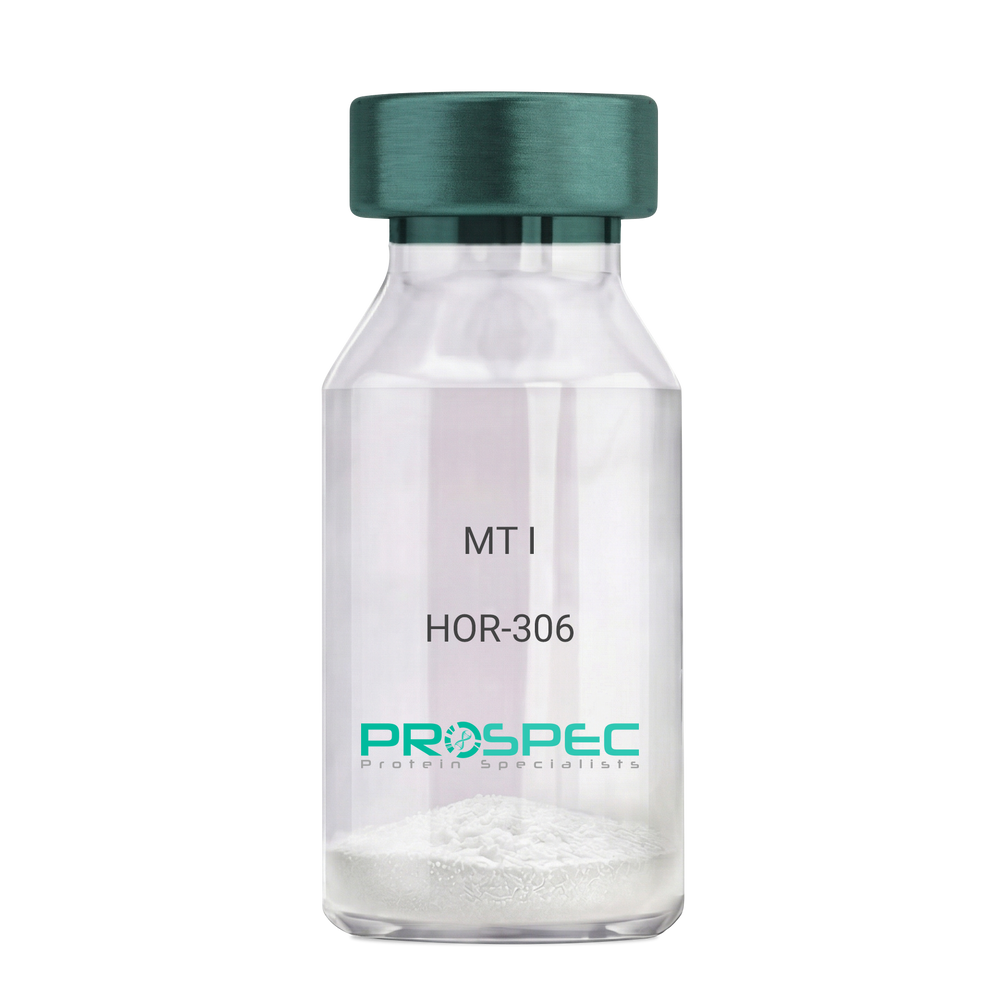
    MT I

    Description:

    Melanotan-I

    Melanotan-I, MT-I, Melanotan-1.

    Product # :

    HOR-306

    Price :

    Quantity :

    Shipping Method :

    Room Temp Icon

    Shipped at Room temp

    Add To Cart

    More Info

    • description
    • formulation
    • purity
    • More Info

    Description

    Melanotan-I has the amino acid sequence of Ser-Tyr-Ser-Nle-Glu-His-D-Phe-Arg-Trp-Gly-Lys-Pro-Val and a molecular weight of 1647.4 Dalton.

    Formulation

    The protein (1mg/ml) was lyophilized with no additives.

    Purity

    Greater than 98.0% as determined by RP-HPLC.

    More Info

    • Synonyms

      Melanotan-I, MT-I, Melanotan-1.

    • Physical Appearance

      Sterile Filtered off-White lyophilized (freeze-dried) powder.

    • Stability

      Lyophilized Melanotan-I although stable at room temperature for 3 weeks, should be stored desiccated below -18°C. Upon reconstitution MT-I should be stored at 4°C between 2-7 days and for future use below -18°C.For long term storage it is recommended to add a carrier protein (0.1% HSA or BSA).Please prevent freeze-thaw cycles.

    • Solubility

      It is recommended to reconstitute the lyophilized Melanotan-I in sterile 1% acetic acid not less than 100 µg/ml, which can then be further diluted to other aqueous solutions.

    ProSpec's products are furnished for LABORATORY RESEARCH USE ONLY. The product may not be used as drugs, agricultural or pesticidal products, food additives or household chemicals.

    Melanotan I
  • View Data Sheet

    Name :

    TPGS2 Human

    Description:

    Tubulin Polyglutamylase Complex Subunit 2 Human Recombinant

    Tubulin polyglutamylase complex subunit 2, C18orf10; HMFN0601, HsT3006, L17, PGs2, TPGS2.

    Product # :

    PRO-1668

    Price :

    Quantity :

    Shipping Method :

    Ice Icon

    Shipped with Ice Packs

    Add To Cart

    More Info

    • description
    • source
    • formulation
    • purity
    • More Info

    Description

    TPGS2 Human Recombinant produced in E.coli is a single, non-glycosylated polypeptide chain containing 323 amino acids (1-300) and having a molecular mass of 35.7kDa.TPGS2 is fused to a 23 amino acid His-tag at N-terminus & purified by proprietary chromatographic techniques.

    Source

    Escherichia Coli.

    Formulation

    The TPGS2 solution (0.25mg/ml) contains 20mM Tris-HCl buffer (pH 8.0), 0.2M NaCl, 50% glycerol, 2mM DTT and 2mM EDTA.

    Purity

    Greater than 85.0% as determined by SDS-PAGE.

    More Info

    • Introduction

      Tubulin Polyglutamylase Complex Subunit 2 (TPGS2) is a component of the neuronal polyglutamylase complex, which takes part in post-translational addition of glutamate residues to C-terminal tubulin tails. Alternatively spliced transcript variants encoding multiple isoforms have been monitored for TPGS2.

    • Synonyms

      Tubulin polyglutamylase complex subunit 2, C18orf10; HMFN0601, HsT3006, L17, PGs2, TPGS2.

    • Physical Appearance

      Sterile Filtered colorless solution.

    • Stability

      Store at 4°C if entire vial will be used within 2-4 weeks. Store, frozen at -20°C for longer periods of time. For long term storage it is recommended to add a carrier protein (0.1% HSA or BSA).Avoid multiple freeze-thaw cycles.

    • Amino Acid Sequence

      MGSSHHHHHH SSGLVPRGSH MGSMEEEASS PGLGCSKPHL EKLTLGITRI LESSPGVTEV TIIEKPPAER HMISSWEQKN NCVMPEDVKN FYLMTNGFHM TWSVKLDEHI IPLGSMAINS ISKLTQLTQS SMYSLPNAPT LADLEDDTHE ASDDQPEKPH FDSRSVIFEL DSCNGSGKVC LVYKSGKPAL AEDTEIWFLD RALYWHFLTD TFTAYYRLLI THLGLPQWQY AFTSYGISPQ AKQWFSMYKP ITYNTNLLTE ETDSFVNKLD PSKVFKSKNK IVIPKKKGPV QPAGGQKGPS GPSGPSTSST SKSSSGSGNP TRK.

    ProSpec's products are furnished for LABORATORY RESEARCH USE ONLY. The product may not be used as drugs, agricultural or pesticidal products, food additives or household chemicals.

    Tpgs2 Human
  • View Data Sheet

    Name :

    MAGED1 Human

    Description:

    Melanoma Antigen Family D, 1 Human Recombinant

    MAGED1, Melanoma Antigen Family D 1, Neurotrophin Receptor-Interacting, MAGE Homolog, NRAGE, MAGE Tumor Antigen CCF, MAGE-D1 Antigen, DLXIN-1, Melanoma-Associated Antigen D1.

    Product # :

    PRO-1796

    Price :

    Quantity :

    Shipping Method :

    Ice Icon

    Shipped with Ice Packs

    Add To Cart

    More Info

    • description
    • source
    • formulation
    • purity
    • More Info

    Description

    MAGED1 Human Recombinant produced in E.Coli is a single, non-glycosylated polypeptide chain containing 280 amino acids (504-760 a.a) and having a molecular mass of 31.7kDa.MAGED1 is fused to a 23 amino acid His-tag at N-terminus & purified by proprietary chromatographic techniques.

    Source

    E.coli.

    Formulation

    MAGED1 protein solution (0.25mg/ml) containing 20mM Tris-HCl buffer (pH8.0), 20% glycerol and 1mM DTT.

    Purity

    Greater than 85% as determined by SDS-PAGE.

    More Info

    • Introduction

      Melanoma-associated antigen D1 (MAGED1) belongs to the melanoma antigen gene (MAGE) family and expressed in virtually all normal adult tissues. MAGED1 is involved in the p75 neurotrophin receptor mediated programmed cell death pathway. MAGED1 is involved in Prader-Willi syndrome including hyperphagia, repetitive and compulsive behaviors, and cognitive impairment. MAGED1 is involved in the apoptotic response following NGF (nerve growth factor) binding in neuronal cells. MAGED1 hinders cell cycle progression, and facilitates NGFR-mediated apoptosis. MAGED1 functions as a regulator of the function of DLX family members. MAGED1 has a role in the circadian rythm regulation.

    • Synonyms

      MAGED1, Melanoma Antigen Family D 1, Neurotrophin Receptor-Interacting, MAGE Homolog, NRAGE, MAGE Tumor Antigen CCF, MAGE-D1 Antigen, DLXIN-1, Melanoma-Associated Antigen D1.

    • Physical Appearance

      Sterile Filtered colorless solution.

    • Stability

      Store at 4°C if entire vial will be used within 2-4 weeks. Store, frozen at -20°C for longer periods of time. For long term storage it is recommended to add a carrier protein (0.1% HSA or BSA).Avoid multiple freeze-thaw cycles.

    • Amino Acid Sequence

      MGSSHHHHHH SSGLVPRGSH MGSLRPSPNS RASQNPGAAQ PRDVALLQER ANKLVKYLML KDYTKVPIKR SEMLRDIIRE YTDVYPEIIE RACFVLEKKF GIQLKEIDKE EHLYILISTP ESLAGILGTT KDTPKLGLLL VILGVIFMNG NRASEAVLWE ALRKMGLRPG VRHPLLGDLR KLLTYEFVKQ KYLDYRRVPN SNPPEYEFLW GLRSYHETSK MKVLRFIAEV QKRDPRDWTA QFMEAADEAL DALDAAAAEA EARAEARTRM GIGDEAVSGP.

    ProSpec's products are furnished for LABORATORY RESEARCH USE ONLY. The product may not be used as drugs, agricultural or pesticidal products, food additives or household chemicals.

    Maged1 Human
  • View Data Sheet

    Name :

    Lamin-A Human

    Description:

    Lamin-A Human Recombinant

    Prelamin-A/C, LMNA, LMN1, Lamin-A/C, 70 kDa lamin, Renal carcinoma antigen NY-REN-32, FPL, IDC, LFP, CDDC, EMD2, FPLD, HGPS, LDP1, LMNC, PRO1, CDCD1, CMD1A, FPLD2, LMNL1, CMT2B1, LGMD1B.

    Product # :

    PRO-690

    Price :

    Quantity :

    Shipping Method :

    Ice Icon

    Shipped with Ice Packs

    Add To Cart

    More Info

    • description
    • source
    • formulation
    • purity
    • More Info

    Description

    Recombinant Human Lamin A produced in E.Coli is a single, non-glycosylated polypeptide chain containing 645 amino acids and having a molecular mass of 70 kDa. Lamin-A protein is fused to a 6xHis tag at N-terminus and purified by conventional chromatography techniques.

    Source

    Escherichia Coli.

    Formulation

    The Lamin-A Protein solution (0.9mg/ml) contains 20mM phosphate buffer pH 7.0, 500mM NaCl, 1mM DTT, 1.5mM EDTA and 20% (v/v) Glycerol.

    Purity

    Greater than 90.0% as determined by SDS-PAGE.

    More Info

    • Introduction

      Lamin-A is a major component of the nuclear lamina, a dynamic meshwork located just under the nuclear envelope and it is encoded by lamin A/C gene (LMNA).
      Lamin-A is synthesized as Prelamin A, a longer precursor that in vivo goes through a serial post-translational modifications that lead to mature Lamin A.
      Diverse mutations in the Lamin A/C gene are associated with different diseases that are collectively called laminophaties, including Emery-Dreifuss muscular dystrophy, familiar partial lipodystrophy, limb girdle muscular dystrophy, dilated cardiomyopathy, Charcot-Marie-Tooth disease, and Hutchinson-Gilford progeria syndrome.

    • Synonyms

      Prelamin-A/C, LMNA, LMN1, Lamin-A/C, 70 kDa lamin, Renal carcinoma antigen NY-REN-32, FPL, IDC, LFP, CDDC, EMD2, FPLD, HGPS, LDP1, LMNC, PRO1, CDCD1, CMD1A, FPLD2, LMNL1, CMT2B1, LGMD1B.

    • Physical Appearance

      Sterile filtered colorless solution.

    • Stability

      Store at 4°C if entire vial will be used within 2-4 weeks. Store, frozen at -20°C for longer periods of time. Avoid multiple freeze-thaw cycles.

    • Amino Acid Sequence

      HHHHHH-METPSQRRATRSGAQASSTPLSPTRITRLQEKEDLQELNDRLAVYIDRVHSLETENAGLRLRITES
      EEVVSREVSGIKAAYEAELGDARKTLDSVAKERARLQLELSKVREEFKELKARNTKKEGDLIAAQA
      RLKDLEALLNSKEAALSTALSEKRTLEGELHDLRGQVAKLEAALGEAKKQLQDEMLRRVDAENRL
      QTMKEELDFQKNIYSEELRETKRRHETRLVEIDNGKQREFESRLADALQELRAQHEDQVEQYKKE
      LEKTYSAKLDNARQSAERNSNLVGAAHEELQQSRIRIDSLSAQLSQLQKQLAAKEAKLRDLEDSLA
      RERDTSRRLLAEKEREMAEMRARMQQQLDEYQELLDIKLALDMEIHAYRKLLEGEEERLRLSPSP
      TSQRSRGRASSHSSQTQGGGSVTKKRKLESTESRSSFSQHARTSGRVAVEEVDEEGKFVRLRN
      KSNEDQSMGNWQIKRQNGDDPLLTYRFPPKFTLKAGQVVTIWAAGAGATHSPPTDLVWKAQNT
      WGCGNSLRTALINSTGEEVAMRKLVRSVTVVEDDEDEDGDDLLHHHHGSHCSSSGDPAEYNLRS
      RTVLCGTCGQPADKASASGSGAQVGGPISSGSSASSVTVTRSYRSVGGSGGGSFGDNLVTRS

    ProSpec's products are furnished for LABORATORY RESEARCH USE ONLY. The product may not be used as drugs, agricultural or pesticidal products, food additives or household chemicals.

    Lamin A
  • View Data Sheet

    Name :

    ESR2 Human

    Description:

    Estrogen Receptor 2 Human Recombinant

    Estrogen Receptor Beta.

    Product # :

    PRO-2838

    Price :

    Quantity :

    Shipping Method :

    Room Temp Icon

    Shipped at Room temp

    Add To Cart

    More Info

    • description
    • source
    • formulation
    • purity
    • More Info

    Description

    The ESR2 Human is created as a recombinant protein with a 4kda N-terminal fusion of His Tag. The ESR2 His-Tagged Fusion Protein, produced in E. coli, is a 10kDa protein containing 101 amino acid residues of the ESR2 Human, 216-316 amino acids.

    Source

    Escherichia Coli.

    Formulation

    Each mg was lyophilized with 1xPBS, 0.4% SDS and 4mM DTT.

    Purity

    Greater than 90% as determined by SDS-PAGE.

    More Info

    • Synonyms

      Estrogen Receptor Beta.

    • Physical Appearance

      Filtered White lyophilized (freeze-dried) powder.

    • Stability

      Store lyophilized ESR2 at -20°C. Aliquot the product after reconstitution to avoid repeated freezing/thawing cycles. Reconstituted protein can be stored at 4°C for a limited period of time; it does not show any change after two weeks at 4°C.

    • Solubility

      It is recommended to add deionized water to prepare a working stock solution of approximately 0.5mg/ml and let the lyophilized pellet dissolve completely. Product is not sterile! Please filter the product by an appropriate sterile filter before using it on cell culture.

    • Amino Acid Sequence

      CGSR RERCGYRLVR RQRSADEQLH CAGKAKRSGGHAPRVRELLL DALSPEQLVL TLLEAEPPHV LISRPSAPFTEASMMMSLTKLADKELVHMI SWAKKI.

    • Background

      Estrogen Receptor 2 also known as ESR2 takes part in mediating the biological effects of estrogen, influencing various physiological and pathological processes. ESR2 is found in different tissues including the brain, reproductive organs, bones, cardiovascular system, and immune cells and has distinct functions. ESR2 is involved in various biological processes by responding to estrogen which is an important hormone in regulating reproductive and metabolic functions.

    ProSpec's products are furnished for LABORATORY RESEARCH USE ONLY. The product may not be used as drugs, agricultural or pesticidal products, food additives or household chemicals.

    Esr2 Protein
  • View Data Sheet

    Name :

    Cagrilintide

    Description:

    Cagrilintide

    Product # :

    HOR-059

    Price :

    Quantity :

    Shipping Method :

    Room Temp Icon

    Shipped at Room temp

    Add To Cart

    More Info

    • description
    • formulation
    • purity
    • More Info

    Description

    Cagrilintide is a synthetic single, non-glycosylated polypeptide chain containing 37 amino acids, having a molecular mass of 4409 Dalton and a Molecular formula of C194H312N54O59.

    Formulation

    The protein was lyophilized with no additives.

    Purity

    Greater than 97.0% as determined by analysis by RP-HPLC.

    More Info

    • Physical Appearance

      Sterile Filtered White lyophilized (freeze-dried) powder.

    • Stability

      Lyophilized Cagrilintide although stable at room temperature for 3 weeks, should be stored desiccated below -18°C. Upon reconstitution Cagrilintide should be stored at 4°C between 2-7 days and for future use below -18°C.
      For long term storage it is recommended to add a carrier protein (0.1% HSA or BSA).
      Please prevent freeze-thaw cycles.

    • Solubility

      It is recommended to reconstitute the lyophilized Cagrilintide in sterile 18MΩ-cm H2O not less than 100 µg/ml, which can then be further diluted to other aqueous solutions.

    • Amino Acid Sequence

      (Eicosanedioic acid-γ-Glu)-Lys-CysAsn-Thr-Ala-Thr-Cys-Ala-Thr-Gln-Arg-Leu-Ala-Glu-Phe-Leu-Arg-HisSer-Ser-Asn-Asn-Phe-Gly-Pro-Ile-Leu-Pro-Pro-Thr-Asn-Val-Gly-SerAsn-Thr-Pro-NH2 (Disulfide bridge:Cys3-Cys8).

    • Background

      Cagrilintide plays a role as a pioneering long-acting amylin analogue and integrates into the fixed-dose combination CagriSema (Cagrilintide + Semaglutide). Unlike GLP-1 agonists, Cagrilintide mimics amylin, a hormone co-secreted with insulin takes part in regulating satiety and slows gastric emptying through brainstem pathways.

    ProSpec's products are furnished for LABORATORY RESEARCH USE ONLY. The product may not be used as drugs, agricultural or pesticidal products, food additives or household chemicals.

    Cagrilintide
  • View Data Sheet

    Name :

    UNG Antibody

    Description:

    Uracil DNA Glycosilase, Mouse Anti Human

    Uracil DNA Glycosilase, Uracil DNA Glycosylase, UNG.

    Product # :

    ANT-374

    Price :

    Quantity :

    Shipping Method :

    Ice Icon

    Shipped with Ice Packs

    Add To Cart

    More Info

    • formulation
    • More Info

    Formulation

    1mg/ml containing PBS, pH-7.4, & 0.1% Sodium Azide.

    More Info

    • Introduction

      E.Coli Uracil DNA Glycosilase (UNG) catalyses the release of free Uracil from Uracil-containing DNA. UNG efficiently hydrolyzes uracil from signle-stranded or double-stranded DNA, but not from oligomers (6 fewer bases).

    • Synonyms

      Uracil DNA Glycosilase, Uracil DNA Glycosylase, UNG.

    • Physical Appearance

      Sterile Filtered clear solution.

    • Immunogen

      Anti-human UNG mAb is derived from hybridization of mouse SP2/O myeloma cells with spleen cells from BALB/c mice immunized with recombinant human UNG amino acids 1-313 purified from E. coli.

    • Ig Subclass

      Mouse IgG2b heavy chain and κ light chain.

    • Clone

      Pk1C12AT.

    • Applications

      UNG antibody has been tested by ELISA and Western blot analysis to assure specificity and reactivity. Since application varies, however, each investigation should be titrated by the reagent to obtain optimal results. Recommended dilution range for Western blot analysis is 1:1,000 ~ 2,000. Recommended starting dilution is 1:1,000.

    • Type

      Mouse Anti Human Monoclonal.

    • Storage Procedures

      For periods up to 1 month store at 4°C, for longer periods of time, store at -20°C. Prevent freeze thaw cycles.

    • Purification Method

      UNG antibody was purified from mouse ascitic fluids by protein-G affinity chromatography.

    ProSpec's products are furnished for LABORATORY RESEARCH USE ONLY. The product may not be used as drugs, agricultural or pesticidal products, food additives or household chemicals.

    Ung Antibody
  • View Data Sheet

    Name :

    SMAD2 Human

    Description:

    SMAD Family Member 2 Human Recombinant

    JV18, MADH2, MADR2, JV18-1, hMAD-2, hSMAD2, MGC22139, MGC34440, SMAD2, Mothers against decapentaplegic homolog 2, Mothers against DPP homolog 2, Mad-related protein 2, SMAD 2, SMAD family member 2.

    Product # :

    PRO-691

    Price :

    Quantity :

    Shipping Method :

    Ice Icon

    Shipped with Ice Packs

    Add To Cart

    More Info

    • description
    • source
    • formulation
    • purity
    • More Info

    Description

    SMAD2 Human Recombinant produced in E.Coli is a single, non-glycosylated polypeptide chain containing 487 amino acids (1-467) and having a molecular mass of 54.4 kDa. SMAD2 is fused to 20 amino acid His-Tag at N-Terminus and purified by standard chromatography techniques.

    Source

    Escherichia Coli.

    Formulation

    The SMAD2 protein solution contains 20mM Tris-HCl pH-8, and 100mM NaCl.

    Purity

    Greater than 95.0% as determined by SDS-PAGE.

    More Info

    • Introduction

      SMAD2 is part of the SMAD family of proteins that mediate signal transduction by the TGF-beta/BMP-2/4 cytokine superfamily from receptor Ser/Thr protein kinases at the cell surface to the nucleus. Phosphorylated SMAD2 is then able to form a complex with SMAD4 or SARA. These complexes accumulate in the cell nucleus, where they are directly participating in the regulation of gene expression. SMAD2 mediates the signal of the TGF-beta, and therefore regulates multiple cellular processes, such as cell proliferation, apoptosis, and differentiation. SMAD2 is recruited to the TGF-beta receptors through its interaction with the SMAD anchor for receptor activation (SARA) protein.
      TGF-beta 1 acts on adjacent stromal cells to turn on SMAD2 signalling that could lead to stromal decidualization. SMAD2 is the downstream signal transducers of TGF-beta-1 in human dental pulp cells.

    • Synonyms

      JV18, MADH2, MADR2, JV18-1, hMAD-2, hSMAD2, MGC22139, MGC34440, SMAD2, Mothers against decapentaplegic homolog 2, Mothers against DPP homolog 2, Mad-related protein 2, SMAD 2, SMAD family member 2.

    • Physical Appearance

      Sterile Filtered colorless solution.

    • Stability

      Store at 4°C if entire vial will be used within 2-4 weeks. Store, frozen at -20°C for longer periods of time. For long term storage it is recommended to add a carrier protein (0.1% HSA or BSA).Avoid multiple freeze-thaw cycles.

    • Amino Acid Sequence

      MGSSHHHHHH SSGLVPRGSH MSSILPFTPP VVKRLLGWKK SAGGSGGAGG GEQNGQEEKW CEKAVKSLVK KLKKTGRLDE LEKAITTQNC NTKCVTIPSTCSEIWGLSTP NTIDQWDTTG LYSFSEQTRS LDGRLQVSHR KGLPHVIYCR LWRWPDLHSH HELKAIENCE YAFNLKKDEV CVNPYHYQRV ETPVLPPVLVPRHTEILTEL PPLDDYTHSI PENTNFPAGI EPQSNYIPET PPPGYISEDG ETSDQQLNQS MDTGSPAELS PTTLSPVNHS LDLQPVTYSE PAFWCSIAYYELNQRVGETF HASQPSLTVD GFTDPSNSER FCLGLLSNVN RNATVEMTRR HIGRGVRLYY IGGEVFAECL SDSAIFVQSP NCNQRYGWHP ATVCKIPPGCNLKIFNNQEF AALLAQSVNQ GFEAVYQLTR MCTIRMSFVK GWGAEYRRQT VTSTPCWIEL HLNGPLQWLD KVLTQMGSPS VRCSSMS.

    ProSpec's products are furnished for LABORATORY RESEARCH USE ONLY. The product may not be used as drugs, agricultural or pesticidal products, food additives or household chemicals.

    Smad2 Human
  • View Data Sheet

    Name :

    NPM2 Human

    Description:

    Nucleophosmin 2 Human Recombinant

    Nucleophosmin/nucleoplasmin 2, nucleoplasmin-2.

    Product # :

    PRO-1182

    Price :

    Quantity :

    Shipping Method :

    Ice Icon

    Shipped with Ice Packs

    Add To Cart

    More Info

    • description
    • source
    • formulation
    • purity
    • More Info

    Description

    NPM2 Human Recombinant produced in E. coli is a single polypeptide chain containing 237 amino acids (1-214) and having a molecular mass of 26.6 kDa.NPM2 is fused to a 23 amino acid His-tag at N-terminus & purified by proprietary chromatographic techniques.

    Source

    E.coli.

    Formulation

    The NPM2 solution (0.5mg/1ml) contains 20mM Tris-HCl buffer (pH 8.0), 200mM NaCl, 2mM DTT and 20% glycerol.

    Purity

    Greater than 85% as determined by SDS-PAGE.

    More Info

    • Introduction

      NPM2 is a member of nucleoplasmin family. NPM2 is a core histones chaperone which takes part in chromatin reprogramming, particularly throughout fertilization and early embryonic development. NPM2 also takes part in sperm DNA decondensation during fertilization.

    • Synonyms

      Nucleophosmin/nucleoplasmin 2, nucleoplasmin-2.

    • Physical Appearance

      Sterile Filtered colorless solution.

    • Stability

      Store at 4°C if entire vial will be used within 2-4 weeks. Store, frozen at -20°C for longer periods of time. For long term storage it is recommended to add a carrier protein (0.1% HSA or BSA).Avoid multiple freeze-thaw cycles.

    • Amino Acid Sequence

      MGSSHHHHHH SSGLVPRGSH MGSMNLSSAS STEEKAVTTV LWGCELSQER RTWTFRPQLE GKQSCRLLLH TICLGEKAKE EMHRVEILPP ANQEDKKMQP VTIASLQASV LPMVSMVGVQ LSPPVTFQLR AGSGPVFLSG QERYEASDLT WEEEEEEEGE EEEEEEEDDE DEDADISLEE
      QSPVKQVKRL VPQKQASVAK KKKLEKEEEE IRASVRDKSP VKKAKATARA KKPGFKK

    ProSpec's products are furnished for LABORATORY RESEARCH USE ONLY. The product may not be used as drugs, agricultural or pesticidal products, food additives or household chemicals.

    Npm2 Human
  • View Data Sheet

    Name :

    TPM3 Human

    Description:

    Tropomyosin-3 Human Recombinant

    Tropomyosin alpha-3 chain, Gamma-tropomyosin, Tropomyosin-3, Tropomyosin-5, hTM5, TPM3, TM3, TM5, TRK, CFTD, NEM1, TM-5, TM30, TM30nm, TPMsk3, hscp30, OK/SW-cl.5.

    Product # :

    PRO-1020

    Price :

    Quantity :

    Shipping Method :

    Ice Icon

    Shipped with Ice Packs

    Add To Cart

    More Info

    • description
    • source
    • formulation
    • purity
    • More Info

    Description

    TPM3 Human Recombinant produced in E.Coli is a single, non-glycosylated polypeptide chain containing 272 amino acids (1-248 a.a.) and having a molecular mass of 31.6kDa. TPM3 is fused to a 24 amino acid His-tag at N-terminus & purified by proprietary chromatographic techniques.

    Source

    Escherichia Coli.

    Formulation

    TPM3 protein solution (0.5mg/ml) containing 20mM Tris-HCl buffer (pH 8.0), 1mM DTT, 10% glycerol, 0.1M NaCl.

    Purity

    Greater than 90% as determined by SDS-PAGE.

    More Info

    • Introduction

      Tropomyosin alpha-3 chain (TPM3) belongs to the tropomyosin family of actin-binding proteins involved in the contractile system of striated and smooth muscles and the cytoskeleton of non-muscle cells. Tropomyosins are dimers of coiled-coil proteins which polymerize end-to-end along the major groove in most actin filaments. Tropomyosins give stability to the filaments and regulate access of other actin-binding proteins. In muscle cells, tropomyosins regulate muscle contraction by controlling the binding of myosin heads to the actin filament. Mutations in the TPM3 gene cause autosomal dominant nemaline myopathy, and oncogenes formed by chromosomal translocations involving this locus are linked with cancer.

    • Synonyms

      Tropomyosin alpha-3 chain, Gamma-tropomyosin, Tropomyosin-3, Tropomyosin-5, hTM5, TPM3, TM3, TM5, TRK, CFTD, NEM1, TM-5, TM30, TM30nm, TPMsk3, hscp30, OK/SW-cl.5.

    • Physical Appearance

      Sterile Filtered clear solution.

    • Stability

      Store at 4°C if entire vial will be used within 2-4 weeks. Store, frozen at -20°C for longer periods of time. For long term storage it is recommended to add a carrier protein (0.1% HSA or BSA).Avoid multiple freeze-thaw cycles.

    • Amino Acid Sequence

      MGSSHHHHHH SSGLVPRGSH MGSHMAGITT IEAVKRKIQV LQQQADDAEE RAERLQREVE GERRAREQAE AEVASLNRRI QLVEEELDRA QERLATALQK LEEAEKAADE SERGMKVIEN RALKDEEKME LQEIQLKEAK HIAEEADRKY EEVARKLVII EGDLERTEER AELAESRCRE MDEQIRLMDQ NLKCLSAAEE KYSQKEDKYE EEIKILTDKL KEAETRAEFA ERSVAKLEKT IDDLEDKLKC TKEEHLCTQR MLDQTLLDLN EM.

    ProSpec's products are furnished for LABORATORY RESEARCH USE ONLY. The product may not be used as drugs, agricultural or pesticidal products, food additives or household chemicals.

    Tpm3 Human
  • View Data Sheet

    Name :

    PSMB5 Human

    Description:

    Proteasome Subunit Beta Type 5 Human Recombinant

    Proteasome subunit beta type-5, Macropain epsilon chain, Multicatalytic endopeptidase complex epsilon chain, Proteasome chain 6, Proteasome epsilon chain, Proteasome subunit MB1, Proteasome subunit X, PSMB5, LMPX, MB1, X, MGC104214.

    Product # :

    ENZ-050

    Price :

    Quantity :

    Shipping Method :

    Ice Icon

    Shipped with Ice Packs

    Add To Cart

    More Info

    • description
    • source
    • formulation
    • purity
    • More Info

    Description

    PSMB5 Human Recombinant fused with a 36 amino acid His tag at N-terminus produced in E.Coli is a single, non-glycosylated, polypeptide chain containing 241 amino acids (60-263 a.a.) and having a molecular mass of 26.7kDa. The PSMB5 is purified by proprietary chromatographic techniques.

    Source

    Escherichia Coli.

    Formulation

    The PSMB5 solution (0.25mg/ml) contains 20mM Tris-HCl buffer (pH 8.0), 20% glycerol, 5mM DTT and 0.2M NaCl.

    Purity

    Greater than 90.0% as determined by SDS-PAGE.

    More Info

    • Introduction

      PSMB5 belongs to the proteasome B-type family that has a 20S core beta subunit in the proteasome. This catalytic subunit is not present in the immunoproteasome and is substituted by catalytic subunit 3i (proteasome beta 8 subunit). A fundamental function of a modified proteasome, the immunoproteasome, is the processing of class I MHC peptides. PSMB5 exhibits an ATP dependent proteolytic activity and is involved in an ATP/ubiquitin dependent non lysosomal proteolytic pathway.

    • Synonyms

      Proteasome subunit beta type-5, Macropain epsilon chain, Multicatalytic endopeptidase complex epsilon chain, Proteasome chain 6, Proteasome epsilon chain, Proteasome subunit MB1, Proteasome subunit X, PSMB5, LMPX, MB1, X, MGC104214.

    • Physical Appearance

      Sterile Filtered colorless solution.

    • Stability

      Store at 4°C if entire vial will be used within 2-4 weeks. Store, frozen at -20°C for longer periods of time. For long term storage it is recommended to add a carrier protein (0.1% HSA or BSA).Avoid multiple freeze-thaw cycles.

    • Amino Acid Sequence

      MRGSHHHHHH GMASMTGGQQ MGRDLYDDDD KDRWGSMTTT LAFKFRHGVI VAADSRATAG AYIASQTVKK VIEINPYLLG TMAGGAADCS FWERLLARQC RIYELRNKER ISVAAASKLL ANMVYQYKGM GLSMGTMICG WDKRGPGLYY VDSEGNRISG ATFSVGSGSV YAYGVMDRGY SYDLEVEQAY DLARRAIYQA TYRDAYSGGA VNLYHVREDG WIRVSSDNVA DLHEKYSGST P.

    ProSpec's products are furnished for LABORATORY RESEARCH USE ONLY. The product may not be used as drugs, agricultural or pesticidal products, food additives or household chemicals.

    Psmb5 Human
  • View Data Sheet

    Name :

    SMAD3 Human

    Description:

    Mothers Against Decapentaplegic Homolog 3 Human Recombinant

    MADH3, JV15-2, HSPC193, HsT17436, MGC60396, DKFZp586N0721, DKFZp686J10186, SMAD3, Mothers against decapentaplegic homolog 3, Mothers against DPP homolog 3, MAD homolog 3, Mad3, hMAD-3, SMAD family member 3, SMAD 3, hSMAD3.

    Product # :

    PRO-751

    Price :

    Quantity :

    Shipping Method :

    Ice Icon

    Shipped with Ice Packs

    Add To Cart

    More Info

    • description
    • source
    • formulation
    • purity
    • More Info

    Description

    SMAD3 Human Recombinant produced in E.Coli is a single, non-glycosylated polypeptide chain containing 445 amino acids (1-425) and having a molecular mass of 50.2 kDa. SMAD3 is fused to a 20 amino acid His-Tag at N-Terminus and purified by standard chromatography techniques.

    Source

    Escherichia Coli.

    Formulation

    The SMAD3 protein solution contains 20mM Tris-HCl pH-8, 0.1M NaCl, 0.1mM DTT and 20% glycerol.

    Purity

    Greater than 90.0% as determined by SDS-PAGE.

    More Info

    • Introduction

      SMAD3 is part of the SMAD family of proteins that mediate signal transduction by the TGF-beta/activin/BMP-2/4 cytokine superfamily from receptor Ser/Thr protein kinases at the cell surface to the nucleus. SMAD3 has a role as a transcriptional modulator activated by TGF-Beta and is involved in the regulation of carcinogenesis. SMAD3 mutations are related with the pathogenesis of human osteoarthritis. SMAD3 expression take part in tumor suppression in the premature stages of gastric carcinogenesis. SMAD3 is involved in nuclear translocation of beta-catenin.

    • Synonyms

      MADH3, JV15-2, HSPC193, HsT17436, MGC60396, DKFZp586N0721, DKFZp686J10186, SMAD3, Mothers against decapentaplegic homolog 3, Mothers against DPP homolog 3, MAD homolog 3, Mad3, hMAD-3, SMAD family member 3, SMAD 3, hSMAD3.

    • Physical Appearance

      Sterile Filtered colorless solution.

    • Stability

      Store at 4°C if entire vial will be used within 2-4 weeks. Store, frozen at -20°C for longer periods of time. For long term storage it is recommended to add a carrier protein (0.1% HSA or BSA).Avoid multiple freeze-thaw cycles.

    • Amino Acid Sequence

      MGSSHHHHHH SSGLVPRGSH MSSILPFTPP IVKRLLGWKK GEQNGQEEKW CEKAVKSLVK KLKKTGQLDE LEKAITTQNV NTKCITIPRS LDGRLQVSHR KGLPHVIYCR LWRWPDLHSH HELRAMELCE FAFNMKKDEV CVNPYHYQRV ETPVLPPVLV PRHTEIPAEF PPLDDYSHSI PENTNFPAGI EPQSNIPETP PPGYLSEDGE TSDHQMNHSM DAGSPNLSPN PMSPAHNNLD LQPVTYCEPA FWCSISYYEL NQRVGETFHA SQPSMTVDGF TDPSNSERFC LGLLSNVNRN AAVELTRRHI GRGVRLYYIG GEVFAECLSD SAIFVQSPNC NQRYGWHPAT VCKIPPGCNL KIFNNQEFAA LLAQSVNQGF EAVYQLTRMC TIRMSFVKGW GAEYRRQTVT STPCWIELHL NGPLQWLDKV LTQMGSPSIR CSSVS.

    ProSpec's products are furnished for LABORATORY RESEARCH USE ONLY. The product may not be used as drugs, agricultural or pesticidal products, food additives or household chemicals.

    Smad3 Human
  • View Data Sheet

    Name :

    SRI Human

    Description:

    Sorcin Human Recombinant

    Sorcin, 22 kDa protein, CP-22, CP22, V19, SRI, SCN, FLJ26259.

    Product # :

    PRO-166

    Price :

    Quantity :

    Shipping Method :

    Ice Icon

    Shipped with Ice Packs

    Add To Cart

    More Info

    • description
    • source
    • formulation
    • purity
    • More Info

    Description

    SRI Human Recombinant fused with a 23 amino acid His tag at N-terminus produced in E.Coli is a single, non-glycosylated, polypeptide chain containing 221 amino acids (1-198 a.a.) and having a molecular mass of 24.1kDa. The SRI is purified by proprietary chromatographic techniques.

    Source

    Escherichia Coli.

    Formulation

    The SRI solution (0.5 mg/ml) contains 20mM Tris-HCl buffer (pH8.0), 40% glycerol, 0.2M NaCl, 1mM DTT and 0.1mM PMSF.

    Purity

    Greater than 90.0% as determined by SDS-PAGE.

    More Info

    • Introduction

      Sorcin (SRI) which is a 22kDa calcium-binding protein was originally identified in multidrug-resistant cells. Sorcin, which modulates excitation-contraction coupling in the heart, contributes to calcium homeostasis in the heart sarcoplasmic reticulum.

    • Synonyms

      Sorcin, 22 kDa protein, CP-22, CP22, V19, SRI, SCN, FLJ26259.

    • Physical Appearance

      Sterile Filtered colorless solution.

    • Stability

      Store at 4°C if entire vial will be used within 2-4 weeks. Store, frozen at -20°C for longer periods of time. For long term storage it is recommended to add a carrier protein (0.1% HSA or BSA). Avoid multiple freeze-thaw cycles.

    • Amino Acid Sequence

      MGSSHHHHHH SSGLVPRGSH MGSMAYPGHP GAGGGYYPGG YGGAPGGPAF PGQTQDPLYG YFAAVAGQDG QIDADELQRC LTQSGIAGGY KPFNLETCRL MVSMLDRDMS GTMGFNEFKE LWAVLNGWRQ HFISFDTDRS GTVDPQELQK ALTTMGFRLS PQAVNSIAKR YSTNGKITFD DYIACCVKLR ALTDSFRRRD TAQQGVVNFP YDDFIQCVMS V.

    ProSpec's products are furnished for LABORATORY RESEARCH USE ONLY. The product may not be used as drugs, agricultural or pesticidal products, food additives or household chemicals.

    Sri Human
  • View Data Sheet

    Name :

    OMP Human

    Description:

    Olfactory Marker Protein Human Recombinant

    Olfactory neuronal-specific protein, Olfactory marker protein, OMP.

    Product # :

    PRO-1412

    Price :

    Quantity :

    Shipping Method :

    Ice Icon

    Shipped with Ice Packs

    Add To Cart

    More Info

    • description
    • source
    • formulation
    • purity
    • More Info

    Description

    OMP Human Recombinant produced in E.Coli is a single, non-glycosylated polypeptide chain containing 186 amino acids (1-163 a.a) and having a molecular mass of 21.3kDa. OMP is fused to a 23 amino acid His-tag at N-terminus & purified by proprietary chromatographic techniques.

    Source

    E.coli.

    Formulation

    OMP protein solution (0.5mg/ml) containing 20mM Tris-HCl buffer (pH 8.0), 0.1M NaCl, 10% glycerol and 1mM DTT.

    Purity

    Greater than 95% as determined by SDS-PAGE.

    More Info

    • Introduction

      Olfactory marker protein (OMP) which is expressed in the cytoplasm of olfactory chemosensory neurons in the nasal neuroepithelium, is associated in a unique way with the mature olfactory receptor neurons in numerous vertebrate species. OMP have a modulatory part in the odor detection/signal transduction cascade ant its expression is a sign of mature vertebrate olfactory receptor neurons (ORNs). OMP is also a potent enhancer of mitosis in fetal olfactory epithelial cells and it promotes an increase in uptake of tritiated thymidine in liver.

    • Synonyms

      Olfactory neuronal-specific protein, Olfactory marker protein, OMP.

    • Physical Appearance

      Sterile Filtered colorless solution.

    • Stability

      Store at 4°C if entire vial will be used within 2-4 weeks. Store, frozen at -20°C for longer periods of time. For long term storage it is recommended to add a carrier protein (0.1% HSA or BSA).Avoid multiple freeze-thaw cycles.

    • Amino Acid Sequence

      MGSSHHHHHH SSGLVPRGSH MGSMAEDRPQ QPQLDMPLVL DQGLTRQMRL RVESLKQRGE KRQDGEKLLQ PAESVYRLNF TQQQRLQFER WNVVLDKPGK VTITGTSQNW TPDLTNLMTR QLLDPTAIFW RKEDSDAIDW NEADALEFGE RLSDLAKIRK VMYFLVTFGE GVEPANLKAS VVFNQL.

    ProSpec's products are furnished for LABORATORY RESEARCH USE ONLY. The product may not be used as drugs, agricultural or pesticidal products, food additives or household chemicals.

    Omp Human
  • 1
  • …
  • 7
  • 8
  • 9
  • 10
  • 11
  • …
  • 42
Your browser does not support the video tag.

Products

  • Cytokines
  • Growth Factors
  • Chemokines
  • CD Antigens
  • Neurotrophins
  • Hormones
  • Enzymes
  • Viral Antigens
  • Recombinant Proteins
  • Natural Proteins
  • Monoclonal Antibodies
  • Polyclonal Antibodies
  • Thermal Packaging

About

  • Company
  • Founder
  • Contribution
  • Contact Us
  • My Account

Ordering

  • Ordering Method
  • Ordering - Credit Card
  • Ordering PO
  • Shipping Fees
  • FAQ's

Legal

  • Terms & Conditions
  • Privacy
  • Site Map
  • info@prospecbio.com
  • Facebook
  • Instagram
  • Linkedin Profile

© 2026 ProSpec-Tany TechnoGene Ltd. All Rights Reserved.

  • Choosing a selection results in a full page refresh.
  • Opens in a new window.