Skip to content

High-quality research proteins.

  • 1-800-805-6531

  • Mon - Sat 8.00-18.00, Sun - Closed

  • info@prospecbio.com

  • PO Box 6591 East Brunswick NJ 08816

  • Products
    • Cytokines
    • Growth factors
    • Chemokines
    • Cd antigens
    • Neurotrophins
    • Hormones
    • Enzymes
    • Viral antigens
    • Recombinant proteins
    • Natural proteins
    • Monoclonal antibodies
    • Polyclonal antibodies
    • Thermal Packaging
  • About
    • Company
    • Founder
    • Contribution
  • Customers
    • Eastern Asia
    • Eastern Europe
    • North America
    • South America
    • South East Asia
    • Southern Asia
    • Western Europe
  • Ordering
    • Ordering Method
    • Ordering - Credit Card
    • Ordering - PO
    • Shipping Fees
    • FAQs
  • Services
    • DNA Cloning
    • Protein Expression
    • Monoclonal Antibody
    • Fermentation
    • Technology License
  • Contact us
Log in

Country/region

  • USD $ | Albania
  • USD $ | Andorra
  • USD $ | Argentina
  • USD $ | Armenia
  • USD $ | Australia
  • USD $ | Austria
  • USD $ | Azerbaijan
  • USD $ | Belarus
  • USD $ | Belgium
  • USD $ | Bolivia
  • USD $ | Brazil
  • USD $ | Bulgaria
  • USD $ | Cambodia
  • USD $ | Canada
  • USD $ | Chile
  • USD $ | China
  • USD $ | Colombia
  • USD $ | Costa Rica
  • USD $ | Croatia
  • USD $ | Cyprus
  • USD $ | Czechia
  • USD $ | Denmark
  • USD $ | Estonia
  • USD $ | Finland
  • USD $ | France
  • USD $ | Georgia
  • USD $ | Germany
  • USD $ | Greece
  • USD $ | Hong Kong SAR
  • USD $ | Hungary
  • USD $ | Iceland
  • USD $ | India
  • USD $ | Ireland
  • USD $ | Israel
  • USD $ | Italy
  • USD $ | Japan
  • USD $ | Kazakhstan
  • USD $ | Latvia
  • USD $ | Liechtenstein
  • USD $ | Lithuania
  • USD $ | Madagascar
  • USD $ | Malta
  • USD $ | Mexico
  • USD $ | Moldova
  • USD $ | Monaco
  • USD $ | Netherlands
  • USD $ | New Zealand
  • USD $ | North Macedonia
  • USD $ | Norway
  • USD $ | Panama
  • USD $ | Paraguay
  • USD $ | Peru
  • USD $ | Philippines
  • USD $ | Poland
  • USD $ | Portugal
  • USD $ | Romania
  • USD $ | Singapore
  • USD $ | Slovakia
  • USD $ | Slovenia
  • USD $ | South Africa
  • USD $ | South Korea
  • USD $ | Spain
  • USD $ | Sri Lanka
  • USD $ | Sweden
  • USD $ | Switzerland
  • USD $ | Taiwan
  • USD $ | Thailand
  • USD $ | Türkiye
  • USD $ | Ukraine
  • USD $ | United Kingdom
  • USD $ | United States
  • USD $ | Uruguay
  • USD $ | Vatican City
  • USD $ | Venezuela
  • USD $ | Vietnam
  • Facebook
  • Instagram
logoProSpec - Recombinant Protein Manufacturer for academic and R&D industry
Become a distributor
Account Log in
Wishlist
Cart Cart(0)
  • Products
    +
    • Cytokines
    • Growth factors
    • Chemokines
    • Cd antigens
    • Neurotrophins
    • Hormones
    • Enzymes
    • Viral antigens
    • Recombinant proteins
    • Natural proteins
    • Monoclonal antibodies
    • Polyclonal antibodies
    • Thermal Packaging
  • About
    +
    • Company
    • Founder
    • Contribution
  • Customers
    +
    • Eastern Asia
    • Eastern Europe
    • North America
    • South America
    • South East Asia
    • Southern Asia
    • Western Europe
  • Ordering
    +
    • Ordering Method
    • Ordering - Credit Card
    • Ordering - PO
    • Shipping Fees
    • FAQs
  • Services
    +
    • DNA Cloning
    • Protein Expression
    • Monoclonal Antibody
    • Fermentation
    • Technology License
  • Contact us

Item added to your cart

View cart
View All
  • Cytokines
  • Growth factors
  • Chemokines
  • Cd antigens
  • Neurotrophins
  • Hormones
  • Enzymes
  • Viral antigens
  • Recombinant proteins
  • Natural proteins
  • Monoclonal antibodies
  • Polyclonal antibodies
  • Thermal Packaging
  • Tumor Necrosis Factor

    Tumor Necrosis Factor

    View All
  • 4-1BB

    4-1BB

    View All
  • Adiponectin

    Adiponectin

    View All
  • AIF1

    AIF1

    View All
  • Other Cytokines

    Other Cytokines

    View All
  • AITRL

    AITRL

    View All
  • Angiopoietin

    Angiopoietin

    View All
  • Apolipoprotein

    Apolipoprotein

    View All
  • B-Cell Activating Factor

    B-Cell Activating Factor

    View All
  • Beta Defensin

    Beta Defensin

    View All
  • Bone Morphogenetic Protein

    Bone Morphogenetic Protein

    View All
  • B type Natriuretic Peptide

    B type Natriuretic Peptide

    View All
  • BST

    BST

    View All
  • Betacellulin

    Betacellulin

    View All
  • Cardiotrophin

    Cardiotrophin

    View All
  • Activin

    Activin

    View All
  • Fibroblast Growth Factor

    Fibroblast Growth Factor

    View All
  • Other Growth Factors

    Other Growth Factors

    View All
  • CSF

    CSF

    View All
  • CTGF

    CTGF

    View All
  • IGFBP

    IGFBP

    View All
  • VEGF Protein

    VEGF Protein

    View All
  • EGF

    EGF

    View All
  • Epigen

    Epigen

    View All
  • Erythropoietin

    Erythropoietin

    View All
  • Insulin-Like Growth Factor

    Insulin-Like Growth Factor

    View All
  • Growth Hormone

    Growth Hormone

    View All
  • HDGF

    HDGF

    View All
  • Hepatocyte Growth Factor

    Hepatocyte Growth Factor

    View All
  • Insulin

    Insulin

    View All
  • BCA-1/ BLC (CXCL13)

    BCA-1/ BLC (CXCL13)

    View All
  • BRAK (CXCL14)

    BRAK (CXCL14)

    View All
  • C-10 (CCL6)

    C-10 (CCL6)

    View All
  • Other Chemokines

    Other Chemokines

    View All
  • MEC (CCL28)

    MEC (CCL28)

    View All
  • LD78-beta (CCL3L1)

    LD78-beta (CCL3L1)

    View All
  • CTACK (CCL27)

    CTACK (CCL27)

    View All
  • CXCL16

    CXCL16

    View All
  • CXCL17

    CXCL17

    View All
  • Platelet Factor-4 (CXCL4)

    Platelet Factor-4 (CXCL4)

    View All
  • ENA-78 (CXCL5)

    ENA-78 (CXCL5)

    View All
  • Eotaxin (CCL11,24,26)

    Eotaxin (CCL11,24,26)

    View All
  • Exodus-2 (CCL21)

    Exodus-2 (CCL21)

    View All
  • Fractalkine (CX3CL1)

    Fractalkine (CX3CL1)

    View All
  • CXCL6

    CXCL6

    View All
  • Other CD Antigens

    Other CD Antigens

    View All
  • CD14

    CD14

    View All
  • CD164

    CD164

    View All
  • CD1

    CD1

    View All
  • CD2

    CD2

    View All
  • CD200

    CD200

    View All
  • CD207

    CD207

    View All
  • CD226

    CD226

    View All
  • CD23

    CD23

    View All
  • CD244

    CD244

    View All
  • CD247

    CD247

    View All
  • CD27

    CD27

    View All
  • CD274

    CD274

    View All
  • CD300

    CD300

    View All
  • CD33

    CD33

    View All
  • Other Neurotrophins

    Other Neurotrophins

    View All
  • Beta-NGF

    Beta-NGF

    View All
  • BDNF

    BDNF

    View All
  • CDNF

    CDNF

    View All
  • CNTF

    CNTF

    View All
  • GDNF

    GDNF

    View All
  • Glia Maturation Factor

    Glia Maturation Factor

    View All
  • MANF

    MANF

    View All
  • Midkine

    Midkine

    View All
  • Neuroglobin

    Neuroglobin

    View All
  • Neurotrophic factors

    Neurotrophic factors

    View All
  • Neuregulin

    Neuregulin

    View All
  • Neuropilin

    Neuropilin

    View All
  • Pigment Epithelium-Derived Factor

    Pigment Epithelium-Derived Factor

    View All
  • Pleiotrophin

    Pleiotrophin

    View All
  • Peptide Hormones

    Peptide Hormones

    View All
  • Other Hormones

    Other Hormones

    View All
  • HCG

    HCG

    View All
  • Endothelin

    Endothelin

    View All
  • Exendin

    Exendin

    View All
  • FSH

    FSH

    View All
  • Glucagon

    Glucagon

    View All
  • GHRP

    GHRP

    View All
  • GLP

    GLP

    View All
  • Thyrostimulin

    Thyrostimulin

    View All
  • Inhibin A

    Inhibin A

    View All
  • LHRH

    LHRH

    View All
  • Melanotan

    Melanotan

    View All
  • Procalcitonin

    Procalcitonin

    View All
  • PTH

    PTH

    View All
  • Peroxiredoxin

    Peroxiredoxin

    View All
  • Peptidase

    Peptidase

    View All
  • Synthetase

    Synthetase

    View All
  • Transferase

    Transferase

    View All
  • Hydrolase

    Hydrolase

    View All
  • Dehydrogenase

    Dehydrogenase

    View All
  • ACE2

    ACE2

    View All
  • Esterase

    Esterase

    View All
  • Protein Kinases

    Protein Kinases

    View All
  • Other Enzymes

    Other Enzymes

    View All
  • Phosphatase

    Phosphatase

    View All
  • Deaminase

    Deaminase

    View All
  • Oxygenase

    Oxygenase

    View All
  • Adenylate Kinase

    Adenylate Kinase

    View All
  • Lyase

    Lyase

    View All
  • Chagas

    Chagas

    View All
  • SARS

    SARS

    View All
  • Influenza

    Influenza

    View All
  • ASFV

    ASFV

    View All
  • Astrovirus

    Astrovirus

    View All
  • Borrelia

    Borrelia

    View All
  • Helicobacter Pylori

    Helicobacter Pylori

    View All
  • Chikungunya

    Chikungunya

    View All
  • Chlamydia

    Chlamydia

    View All
  • Cytomegalo

    Cytomegalo

    View All
  • Dengue

    Dengue

    View All
  • EBV

    EBV

    View All
  • Ebola

    Ebola

    View All
  • Feline Leukemia Virus

    Feline Leukemia Virus

    View All
  • Hepatitis A

    Hepatitis A

    View All
  • Other

    Other

    View All
  • Actin

    Actin

    View All
  • ADAM

    ADAM

    View All
  • Complement Component

    Complement Component

    View All
  • Ag85

    Ag85

    View All
  • Eukaryotic Translation Initiation Factor

    Eukaryotic Translation Initiation Factor

    View All
  • Anterior Gradient Protein

    Anterior Gradient Protein

    View All
  • Heat Shock Protein

    Heat Shock Protein

    View All
  • Alpha-2-HS-Glycoprotein

    Alpha-2-HS-Glycoprotein

    View All
  • Hemoglobin

    Hemoglobin

    View All
  • Allergy

    Allergy

    View All
  • Anaplasma

    Anaplasma

    View All
  • Angiogenin

    Angiogenin

    View All
  • Ankyrin Repeat Domain

    Ankyrin Repeat Domain

    View All
  • Annexin

    Annexin

    View All
  • Other Natural Proteins

    Other Natural Proteins

    View All
  • Aprotinin

    Aprotinin

    View All
  • Transferrin

    Transferrin

    View All
  • Avidin

    Avidin

    View All
  • Anti Coagulation Factors

    Anti Coagulation Factors

    View All
  • Natural Albumin

    Natural Albumin

    View All
  • Natural Coagulation Factors

    Natural Coagulation Factors

    View All
  • Fibronectin

    Fibronectin

    View All
  • Thrombin

    Thrombin

    View All
  • Anti Human Enzyme

    Anti Human Enzyme

    View All
  • Other Monoclonal Antibodies

    Other Monoclonal Antibodies

    View All
  • Anti Human Cytokine

    Anti Human Cytokine

    View All
  • Anti Human Heat Shock Protein

    Anti Human Heat Shock Protein

    View All
  • Anti Mouse Lymphocyte

    Anti Mouse Lymphocyte

    View All
  • Anti Human Chemokine

    Anti Human Chemokine

    View All
  • Anti Human Lymphocyte

    Anti Human Lymphocyte

    View All
  • Anti Viral Monoclonal

    Anti Viral Monoclonal

    View All
  • Anti Mouse Cytokine

    Anti Mouse Cytokine

    View All
  • Anti-GST Monoclonal

    Anti-GST Monoclonal

    View All
  • Other Polyclonal Antibodies

    Other Polyclonal Antibodies

    View All
  • Anti Viral

    Anti Viral

    View All
  • Anti-GST Monoclonal

    Anti-GST Monoclonal

    View All
Back

Search results

1000 results found for “prefoldin”

Name

Description

Product #

Price

Quantity

Shipping Method

  • View Data Sheet

    Name :

    MIF Human His N

    Description:

    Macrophage Migration Inhibitory Factor Human, Recombinant His Tag N-Terminus

    Phenylpyruvate tautomerase, Glycosylation-inhibiting factor, GIF, MMIF, MIF.

    Product # :

    CYT-431

    Price :

    Quantity :

    Shipping Method :

    Ice Icon

    Shipped with Ice Packs

    Add To Cart

    More Info

    • description
    • source
    • formulation
    • purity
    • More Info

    Description

    MIF human Recombinant, fused to 40 a.a. His-tag at N-terminus, was cloned into an E. coli expression vector and was purified to apparent homogeneity by using conventional column chromatography techniques. Macrophage Inducing Factor Human Recombinant ( 1-115 a.a. ) is a single, non-glycosylated, polypeptide chain having a total amino acids of 155 and molecular mass of 17kDa.

    Source

    Escherichia Coli.

    Formulation

    1mg/ml solution containing PBS pH-7.4.

    Purity

    Greater than 95.0% as determined by:
    (a) Analysis by RP-HPLC.
    (b) Analysis by SDS-PAGE.

    More Info

    • Introduction

      The cytokine Macrophage migration inhibitory factor (MIF) has been identified to be secreted by the pituitary gland and the monocyte/macrophage and to play an important role in endotoxic shock. MIF has the unique property of being released from macrophages and T cells in response to physiological concentrations of glucocorticoids. The secretion of MIF is tightly regulated and decreases at high, anti-inflammatory steroid concentration.

    • Synonyms

      Phenylpyruvate tautomerase, Glycosylation-inhibiting factor, GIF, MMIF, MIF.

    • Physical Appearance

      Sterile filtered colorless solution.

    • Stability

      Liquid MIF although stable 4°C for 1 week, should be stored below -18°C. Please prevent freeze-thaw cycles.

    • Amino Acid Sequence

      MRGSHHHHHHGMASMTGGQQMGRDLYDDDDKDRWGSMPMFIVNTNV PRASVPDGFL SELTQQLAQA TGKPPQYIAV HVVPDQLMAF GGSSEPCALC LHSIGKIGGA QNRSYSKLLC GLLAERLRIS PDRVYINYYD MNAANVGWNN STFA.

    ProSpec's products are furnished for LABORATORY RESEARCH USE ONLY. The product may not be used as drugs, agricultural or pesticidal products, food additives or household chemicals.

    Mif Human His N
  • View Data Sheet

    Name :

    EIF1AX Human

    Description:

    Eukaryotic Translation Initiation Factor 1 X-linked Human Recombinant

    eukaryotic translation initiation factor 1A, X-linked, eIF-4C, EIF1A, EIF4C, eIF-1A, EIF1AP1.

    Product # :

    PRO-253

    Price :

    Quantity :

    Shipping Method :

    Ice Icon

    Shipped with Ice Packs

    Add To Cart

    More Info

    • description
    • source
    • formulation
    • purity
    • More Info

    Description

    EIF1AX Human Recombinant produced in E.Coli is a single, non-glycosylated polypeptide chain containing 150 amino acids (1-144a.a.) and having a molecular wieght of 18.6kDa. EIF1AX is fused to 20a.a. His-Tag at N-terminus and purified by proprietary chromatographic techniques.

    Source

    Escherichia Coli.

    Formulation

    The EIF1AX protein solution (1mg/1ml) contains 20mM Tris-HCl buffer (pH8.0) containing 5mM DTT, 200mM NaCl and 40% glycerol.

    Purity

    Greater than 90.0% as determined by SDS-PAGE.

    More Info

    • Introduction

      EIF1AX is an important eukaryotic translation initiation factor. EIF1AX is essential for the binding of the 43S complex (a 40S subunit, eIF2/GTP/Met-tRNAi and eIF3) to the 5'' end of capped RNA. EIF1AP1 is needed for maximal rate of protein biosynthesis. EIF1AX increases ribosome dissociation into subunits and stabilizes the binding of the initiator Met-tRNA (I) to 40 S ribosomal subunits.

    • Synonyms

      eukaryotic translation initiation factor 1A, X-linked, eIF-4C, EIF1A, EIF4C, eIF-1A, EIF1AP1.

    • Physical Appearance

      Sterile filtered colorless solution.

    • Stability

      Store at 4°C if entire vial will be used within 2-4 weeks. Store, frozen at -20°C for longer periods of time. For long term storage it is recommended to add a carrier protein (0.1% HSA or BSA). Avoid multiple freeze-thaw cycles.

    • Amino Acid Sequence

      MGSSHHHHHH SSGLVPRGSH MPKNKGKGGK NRRRGKNENE SEKRELVFKE DGQEYAQVIK MLGNGRLEAM CFDGVKRLCH IRGKLRKKVW INTSDIILVG LRDYQDNKAD VILKYNADEA RSLKAYGELP EHAKINETDT FGPGDDDEIQ FDDIGDDDED IDDI

    ProSpec's products are furnished for LABORATORY RESEARCH USE ONLY. The product may not be used as drugs, agricultural or pesticidal products, food additives or household chemicals.

    Eif1Ax Human
  • View Data Sheet

    Name :

    EIF3I Human

    Description:

    Eukaryotic Translation Initiation Factor 3I Human Recombinant

    Eukaryotic Translation Initiation Factor 3, Subunit I, EIF3S2, Eukaryotic Translation Initiation Factor 3, Subunit 2 Beta, 36kDa, Eukaryotic Translation Initiation Factor 3 Subunit 2, TRIP-1, eIF-3-beta, EIF3 P36, TGF-Beta Receptor-Interacting Protein 1, PRO2242, eIF3-beta, eIF3-p36, Eukaryotic Translation Initiation Factor 3 Subunit I, Eukaryotic Translation Initiation Factor 3, Subunit 2 (Beta, 36kD), Predicted Protein Of HQ2242, TGFbeta Receptor-Interacting Protein 1, eIF3i.

    Product # :

    PRO-1740

    Price :

    Quantity :

    Shipping Method :

    Ice Icon

    Shipped with Ice Packs

    Add To Cart

    More Info

    • description
    • source
    • formulation
    • purity
    • More Info

    Description

    EIF3I Human Recombinant produced in E.Coli is a single, non-glycosylated polypeptide chain containing 348 amino acids (1-325aa) and having a molecular mass of 38.9kDa.EIF3I is fused to a 23 amino acid His-tag at N-terminus & purified by proprietary chromatographic techniques.

    Source

    Escherichia Coli.

    Formulation

    APOBEC4 protein solution (1mg/ml) containing 20mM Tris-HCl buffer (pH 8.0), 0.4M UREA and 10% glycerol.

    Purity

    Greater than 90% as determined by SDS-PAGE.

    More Info

    • Introduction

      Eukaryotic translation initiation factor 3, subunit I (EIF3I) is part of the eukaryotic translation initiation factor 3 (eIF-3) complex, which is essential for numerous steps in the initiation of protein synthesis. The eIF-3 complex links with the 40S ribosome and facilitates the recruitment of eIF-1, eIF-1A, eIF-2: GTP: methionyl-tRNAi and eIF-5 to form the 43S pre-initiation complex (43S PIC). The eIF-3 complex stimulates mRNA recruitment to the 43S PIC and scanning of the mRNA for AUG recognition. The eIF-3 complex is also essential for disassembly and recycling of post-termination ribosomal complexes and subsequently prevents premature joining of the 40S and 60S ribosomal subunits prior to initiation. Among the diseases associated with EIF3I are clonorchiasis, and tonsillitis.

    • Synonyms

      Eukaryotic Translation Initiation Factor 3, Subunit I, EIF3S2, Eukaryotic Translation Initiation Factor 3, Subunit 2 Beta, 36kDa, Eukaryotic Translation Initiation Factor 3 Subunit 2, TRIP-1, eIF-3-beta, EIF3 P36, TGF-Beta Receptor-Interacting Protein 1, PRO2242, eIF3-beta, eIF3-p36, Eukaryotic Translation Initiation Factor 3 Subunit I, Eukaryotic Translation Initiation Factor 3, Subunit 2 (Beta, 36kD), Predicted Protein Of HQ2242, TGFbeta Receptor-Interacting Protein 1, eIF3i.

    • Physical Appearance

      Sterile Filtered clear solution.

    • Stability

      Store at 4°C if entire vial will be used within 2-4 weeks. Store, frozen at -20°C for longer periods of time.For long term storage it is recommended to add a carrier protein (0.1% HSA or BSA).Please avoid freeze thaw cycles.

    • Amino Acid Sequence

      MGSSHHHHHH SSGLVPRGSH MGSMKPILLQ GHERSITQIK YNREGDLLFT VAKDPIVNVW YSVNGERLGT YMGHTGAVWC VDADWDTKHV LTGSADNSCR LWDCETGKQL ALLKTNSAVR TCGFDFGGNI IMFSTDKQMG YQCFVSFFDL RDPSQIDNNE PYMKIPCNDS KITSAVWGPL GECIIAGHES GELNQYSAKS GEVLVNVKEH SRQINDIQLS RDMTMFVTAS KDNTAKLFDS TTLEHQKTFR TERPVNSAAL SPNYDHVVLG GGQEAMDVTT TSTRIGKFEA RFFHLAFEEE FGRVKGHFGP INSVAFHPDG KSYSSGGEDG YVRIHYFDPQ YFEFEFEA

    ProSpec's products are furnished for LABORATORY RESEARCH USE ONLY. The product may not be used as drugs, agricultural or pesticidal products, food additives or household chemicals.

    Eif3I Human
  • View Data Sheet

    Name :

    NUDT21 Human

    Description:

    Nudix Type Motif 21 Human Recombinant

    Cleavage and polyadenylation specificity factor subunit 5, Cleavage and polyadenylation specificity factor 25 kDa subunit, CFIm25, CPSF 25 kDa subunit, Nucleoside diphosphate-linked moiety X motif 21, Nudix motif 21, Pre-mRNA cleavage factor Im 25 kDa subunit, NUDT21, CFIM25, CPSF25, CPSF5, DKFZp686H1588.

    Product # :

    ENZ-080

    Price :

    Quantity :

    Shipping Method :

    Ice Icon

    Shipped with Ice Packs

    Add To Cart

    More Info

    • description
    • source
    • formulation
    • purity
    • More Info

    Description

    NUDT21 Human Recombinant fused with a 20 amino acid His tag at N-terminus produced in E.Coli is a single, non-glycosylated, polypeptide chain containing 247 amino acids (1-227 a.a.) and having a molecular mass of 28.3kDa. The NUDT21 is purified by proprietary chromatographic techniques.

    Source

    Escherichia Coli.

    Formulation

    The NUDT21 solution (1 mg/ml) contains 20mM Tris-HCl buffer (pH8.0), 0.2M NaCl, 2mM DTT and 20% glycerol.

    Purity

    Greater than 90.0% as determined by SDS-PAGE.

    More Info

    • Introduction

      NUDT21 belongs to the Nudix hydrolase family of pyrophosphatases. NUDT21 localizes to the paraspeckles and forms a heterodimer with CPSF6 or CPSF7 to comprise the CFIm (mammalian cleavage factor I) complex. NUDT21 being the smaller subunit of the complex, is present in all heterodimer combinations. NUDT21 has a vital role in pre-mRNA 3' cleavage and polyadenylation processing.

    • Synonyms

      Cleavage and polyadenylation specificity factor subunit 5, Cleavage and polyadenylation specificity factor 25 kDa subunit, CFIm25, CPSF 25 kDa subunit, Nucleoside diphosphate-linked moiety X motif 21, Nudix motif 21, Pre-mRNA cleavage factor Im 25 kDa subunit, NUDT21, CFIM25, CPSF25, CPSF5, DKFZp686H1588.

    • Physical Appearance

      Sterile Filtered colorless solution.

    • Stability

      Store at 4°C if entire vial will be used within 2-4 weeks. Store, frozen at -20°C for longer periods of time. For long term storage it is recommended to add a carrier protein (0.1% HSA or BSA).Avoid multiple freeze-thaw cycles.

    • Amino Acid Sequence

      MGSSHHHHHH SSGLVPRGSH MSVVPPNRSQ TGWPRGVTQF GNKYIQQTKP LTLERTINLY PLTNYTFGTK EPLYEKDSSV AARFQRMREE FDKIGMRRTV EGVLIVHEHR LPHVLLLQLG TTFFKLPGGE LNPGEDEVEG LKRLMTEILG RQDGVLQDWV IDDCIGNWWR PNFEPPQYPY IPAHITKPKE HKKLFLVQLQ EKALFAVPKN YKLVAAPLFE LYDNAPGYGP IISSLPQLLS RFNFIYN.

    ProSpec's products are furnished for LABORATORY RESEARCH USE ONLY. The product may not be used as drugs, agricultural or pesticidal products, food additives or household chemicals.

    Nudt21 Human
  • View Data Sheet

    Name :

    P4HB Human

    Description:

    Prolyl 4-Hydroxylase Beta Human Recombinant

    P4Hbeta, PDI, PDIA1, PHD, PO4DB, PO4HB, ERBA2L.

    Product # :

    ENZ-252

    Price :

    Quantity :

    Shipping Method :

    Ice Icon

    Shipped with Ice Packs

    Add To Cart

    More Info

    • description
    • source
    • formulation
    • purity
    • More Info

    Description

    P4HB Human Recombinant produced in E.Coli is a single, non-glycosylated polypeptide chain containing 512 amino acids (18-508 a.a.) and having a molecular mass of 57.5 kDa. The P4HB is fused to a 21 amino acid His Tag and purified by conventional chromatography.

    Source

    Escherichia Coli.

    Formulation

    The P4HB 1mg/ml protein solution contains 20mM Tris-HCl pH-8, and 10% glycerol.

    Purity

    Greater than 90.0% as determined by SDS-PAGE.

    More Info

    • Introduction

      P4HB is a multifunctional and highly abundant enzyme that is part of the protein disulfide isomerase family. When present as a tetramer consisting of two alpha and two beta subunits, P4HB has a role in hydroxylation of prolyl residues in preprocollagen. P4HB is a disulfide isomerase containing two thioredoxin domains that catalyze the formation, breakage and rearrangement of disulfide bonds.

    • Synonyms

      P4Hbeta, PDI, PDIA1, PHD, PO4DB, PO4HB, ERBA2L.

    • Physical Appearance

      Sterile Filtered colorless solution.

    • Stability

      Store at 4°C if entire vial will be used within 2-4 weeks. Store, frozen at -20°C for longer periods of time. For long term storage it is recommended to add a carrier protein (0.1% HSA or BSA). Avoid multiple freeze-thaw cycles.

    • Amino Acid Sequence

      MGSSHHHHHH SSGLVPRGSH MDAPEEEDHV LVLRKSNFAE ALAAHKYLLV EFYAPWCGHC KALAPEYAKA AGKLKAEGSE IRLAKVDATE ESDLAQQYGV RGYPTIKFFR NGDTASPKEY TAGREADDIV NWLKKRTGPA ATTLPDGAAA ESLVESSEVA VIGFFKDVES DSAKQFLQAA
      EAIDDIPFGI TSNSDVFSKY QLDKDGVVLF KKFDEGRNNF EGEVTKENLL DFIKHNQLPL VIEFTEQTAP KIFGGEIKTH ILLFLPKSVS DYDGKLSNFK TAAESFKGKI LFIFIDSDHT DNQRILEFFG LKKEECPAVR LITLEEEMTK YKPESEELTA ERITEFCHRF LEGKIKPHLM
      SQELPEDWDK QPVKVLVGKN FEDVAFDEKK NVFVEFYAPW CGHCKQLAPI WDKLGETYKD HENIVIAKMD STANEVEAVK VHSFPTLKFF PASADRTVID YNGERTLDGF KKFLESGGQD GAGDDDDLED LEEAEEPDME EDDDQKAVKD EL.

    ProSpec's products are furnished for LABORATORY RESEARCH USE ONLY. The product may not be used as drugs, agricultural or pesticidal products, food additives or household chemicals.

    P4Hb Human
  • View Data Sheet

    Name :

    TAGLN2 Human

    Description:

    Transgelin-2 Human Recombinant

    Transgelin-2, SM22-alpha homolog, TAGLN2, KIAA0120, HA1756.

    Product # :

    PRO-124

    Price :

    Quantity :

    Shipping Method :

    Ice Icon

    Shipped with Ice Packs

    Add To Cart

    More Info

    • description
    • source
    • formulation
    • purity
    • More Info

    Description

    TAGLN2 Human Recombinant fused with a 21 amino acid His tag at N-terminus produced in E.Coli is a single, non-glycosylated, polypeptide chain containing 208 amino acids (13-199 a.a.) and having a molecular mass of 23.4kDa. The TAGLN2 is purified by proprietary chromatographic techniques.

    Source

    Escherichia Coli.

    Formulation

    The TAGLN2 solution (1 mg/ml), 20mM Tris-HCl buffer (pH8.0), 20% glycerol, 0.1M NaCl and 1mM DTT.

    Purity

    Greater than 90.0% as determined by SDS-PAGE.

    More Info

    • Introduction

      Transgelin 2 (TAGLN2) is one of the earliest markers of differentiated smooth muscle. TAGLN2 contains a calponin like repeat and a calponin-homology (CH) domain. TAGLN2 is downregulated in some transformed cell lines, indicating that a reduction of transgelin expression may be an early indicator of the onset of transformation. TAGLN2 also binds actin, causing actin fibers to gel within minutes of binding. The binding of transgelin to actin occurs at a ratio of 1:6 actin monomers.

    • Synonyms

      Transgelin-2, SM22-alpha homolog, TAGLN2, KIAA0120, HA1756.

    • Physical Appearance

      Sterile Filtered colorless solution.

    • Stability

      Store at 4°C if entire vial will be used within 2-4 weeks. Store, frozen at -20°C for longer periods of time. For long term storage it is recommended to add a carrier protein (0.1% HSA or BSA).Avoid multiple freeze-thaw cycles.

    • Amino Acid Sequence

      MGSSHHHHHH SSGLVPRGSH MEVQQKIEKQ YDADLEQILI QWITTQCRKD VGRPQPGREN FQNWLKDGTV LCELINALYP EGQAPVKKIQ ASTMAFKQME QISQFLQAAE RYGINTTDIF QTVDLWEGKN MACVQRTLMN LGGLAVARDD GLFSGDPNWF PKKSKENPRN FSDNQLQEGK NVIGLQMGTN RGASQAGMTG YGMPRQIL.

    ProSpec's products are furnished for LABORATORY RESEARCH USE ONLY. The product may not be used as drugs, agricultural or pesticidal products, food additives or household chemicals.

    Tagln2 Human
  • View Data Sheet

    Name :

    TFF2 Human

    Description:

    Trefoil Factor-2 Human Recombinant

    TFF-2, Spasmolytic polypeptide, Spasmolysin, SML1, Trefoil factor 2, SP, TFF2.

    Product # :

    CYT-612

    Price :

    Quantity :

    Shipping Method :

    Room Temp Icon

    Shipped at Room temp

    Add To Cart

    More Info

    • description
    • source
    • formulation
    • purity
    • biological activity
    • More Info

    Description

    TFF-2 Human Recombinant produced in E.Coli is a single, non-glycosylated, polypeptide chain containing 106 amino acids (24-129) and having a total molecular mass of 12 kDa. TFF2 Human Recombinant includes a 40-amino acid trefoil motif containing three conserved intramolecular disulfide bonds and was purified by proprietary chromatographic techniques.

    Source

    Escherichia Coli.

    Formulation

    The TFF2 protein was lyophilized from 0.4μm filtered solution at a concentration of 1mg/mL containing 1x PBS pH-7.4.

    Purity

    Greater than 97.0% as determined by(a) Analysis by RP-HPLC.
    (b) Analysis by SDS-PAGE.

    Biological Activity

    Determined by its ability to chemoattract human MCF-7 cells using a concentration 1.0-10.0 ng/ml.

    More Info

    • Introduction

      Proteins of the TFF family are characterized by obtaining a minimum of 1 copy of the trefoil motif, a 40-amino acid domain that contains 3 conserved disulfides. Trefoil Factors are stable secretory proteins expressed in gastrointestinal mucosa which protect the mucosa from insults, stabilize the mucus layer and affect healing of the epithelium.TFF2 inhibits gastric acid motility & secretion. TFF2 stabilizes glycoproteins in the mucus gel through interactions with carbohydrate side chains.

    • Synonyms

      TFF-2, Spasmolytic polypeptide, Spasmolysin, SML1, Trefoil factor 2, SP, TFF2.

    • Physical Appearance

      Sterile Filtered White lyophilized (freeze-dried) powder.

    • Stability

      Lyophilized TFF2 although stable at room temperature for 3 weeks, should be stored desiccated below -18°C. Upon reconstitution TFF2 should be stored at 4°C between 2-7 days and for future use below -18°C.For long term storage it is recommended to add a carrier protein (0.1% HSA or BSA).Please prevent freeze-thaw cycles.

    • Solubility

      It is recommended to reconstitute the lyophilized TFF2 in sterile 18MΩ-cm H2O not less than 100µg/ml, which can then be further diluted to other aqueous solutions.

    • Amino Acid Sequence

      EKPSPCQCSR LSPHNRTNCG FPGITSDQCF DNGCCFDSSV TGVPWCFHPL PKQESDQCVM EVSDRRNCGY PGISPEECAS RKCCFSNFIF EVPWCFFPKSVEDCHY.

    ProSpec's products are furnished for LABORATORY RESEARCH USE ONLY. The product may not be used as drugs, agricultural or pesticidal products, food additives or household chemicals.

    Tff2 Human
  • View Data Sheet

    Name :

    CD207 Human

    Description:

    CD207 Human Recombinant

    C-type lectin domain family 4 member K, CLEC4K, Langerin, CD207.

    Product # :

    PRO-2204

    Price :

    Quantity :

    Shipping Method :

    Ice Icon

    Shipped with Ice Packs

    Add To Cart

    More Info

    • description
    • source
    • formulation
    • purity
    • More Info

    Description

    CD207 Human Recombinant produced in E.Coli is a single, non-glycosylated polypeptide chain containing 287 amino acids (65-328 a.a) and having a molecular mass of 32.2kDa.CD207 is fused to a 23 amino acid His-tag at N-terminus & purified by proprietary chromatographic techniques.

    Source

    Escherichia Coli.

    Formulation

    CD207 protein solution (1mg/ml) containing 20mM Tris 8.0 and 10% glycerol.

    Purity

    Greater than 85.0% as determined by SDS-PAGE.

    More Info

    • Introduction

      CD207 (C-type lectin domain family 4 member K) is expressed in Langerhans cells which are immature dendritic cells of the epidermis and mucosa. Moreover, CD207 is expressed in several other dendritic cell types including dermal CD103+ DCs and splenic CD8+ DCs. Langerin is localized in the Birbeck granules, the organelles present in the cytoplasm of Langerhans cells and comprised of superimposed and zippered membranes. CD207 is a C-type lectin with mannose binding specificity, and it has been suggested that mannose binding by the CD207 protein leads to internalization of antigen into Birbeck granules thus providing access to a nonclassical antigen-processing pathway.

    • Synonyms

      C-type lectin domain family 4 member K, CLEC4K, Langerin, CD207.

    • Physical Appearance

      Sterile Filtered clear solution.

    • Stability

      Store at 4°C if entire vial will be used within 2-4 weeks. Store, frozen at -20°C for longer periods of time. For long term storage it is recommended to add a carrier protein (0.1% HSA or BSA).Avoid multiple freeze-thaw cycles.

    • Amino Acid Sequence

      MGSSHHHHHH SSGLVPRGSH MGSPRFMGTI SDVKTNVQLL KGRVDNISTL DSEIKKNSDG MEAAGVQIQM VNESLGYVRS QFLKLKTSVE KANAQIQILT RSWEEVSTLN AQIPELKSDL EKASALNTKI RALQGSLENM SKLLKRQNDI LQVVSQGWKY FKGNFYYFSL IPKTWYSAEQ FCVSRNSHLT SVTSESEQEF LYKTAGGLIY WIGLTKAGME GDWSWVDDTP FNKVQSARFW IPGEPNNAGN NEHCGNIKAP SLQAWNDAPC DKTFLFICKR PYVPSEP.

    ProSpec's products are furnished for LABORATORY RESEARCH USE ONLY. The product may not be used as drugs, agricultural or pesticidal products, food additives or household chemicals.

    Cd207 Human
  • View Data Sheet

    Name :

    RPRD1A Human

    Description:

    Regulation Of Nuclear Pre-MRNA Domain Containing 1A Human Recombinant

    Regulation of Nuclear Pre-MRNA Domain Containing 1A, RPRD1A, P15RS, Cyclin-Dependent Kinase 2B-Inhibitor-Related Protein, Cyclin-Dependent Kinase Inhibitor 2B-Related Protein (P15INK4B-Related Protein), P15INK4B-Related Protein, HsT3101, Regulation of Nuclear Pre-MRNA Domain-Containing Protein 1A, Cyclin-Dependent Kinase Inhibitor 2B-Related Protein, FLJ10656.

    Product # :

    PRO-1945

    Price :

    Quantity :

    Shipping Method :

    Ice Icon

    Shipped with Ice Packs

    Add To Cart

    More Info

    • description
    • source
    • formulation
    • purity
    • More Info

    Description

    RPRD1A Human Recombinant produced in E.coli is a single, non-glycosylated polypeptide chain containing 337 amino acids (1-312) and having a molecular mass of 38.4 kDa.RPRD1A is fused to a 25 amino acid His-tag at N-terminus & purified by proprietary chromatographic techniques.

    Source

    Escherichia Coli.

    Formulation

    The RPRD1A solution (0.5mg/ml) contains 20mM Tris-HCl buffer (pH 8.0), 0.15M NaCl, 1mM DTT and 10% glycerol.

    Purity

    Greater than 95.0% as determined by SDS-PAGE.

    More Info

    • Introduction

      Regulation Of Nuclear Pre-MRNA Domain Containing 1A (RPRD1A) is upregulated in cells overexpressing cyclin-dependent kinase inhibitor p15(INK4b) and may have a part in cell cycle regulation. RPRD1A interacts with phosphorylated C-terminal heptapeptide repeat domain (CTD) of the largest RNA polymerase II subunit POLR2A, and partakes in dephosphorylation of the CTD. RPRD1A May function as a negative regulator of cyclin-D1 (CCND1) and cyclin-E (CCNE1) in the cell cycle.

    • Synonyms

      Regulation of Nuclear Pre-MRNA Domain Containing 1A, RPRD1A, P15RS, Cyclin-Dependent Kinase 2B-Inhibitor-Related Protein, Cyclin-Dependent Kinase Inhibitor 2B-Related Protein (P15INK4B-Related Protein), P15INK4B-Related Protein, HsT3101, Regulation of Nuclear Pre-MRNA Domain-Containing Protein 1A, Cyclin-Dependent Kinase Inhibitor 2B-Related Protein, FLJ10656.

    • Physical Appearance

      Sterile Filtered clear solution.

    • Stability

      Store at 4°C if entire vial will be used within 2-4 weeks. Store, frozen at -20°C for longer periods of time. For long term storage it is recommended to add a carrier protein (0.1% HSA or BSA).Avoid multiple freeze-thaw cycles.

    • Amino Acid Sequence

      MGSSHHHHHH SSGLVPRGSH MGSEFMSAFS EAALEKKLSE LSNSQQSVQT LSLWLIHHRK HSRPIVTVWE RELRKAKPNR KLTFLYLAND VIQNSKRKGP EFTKDFAPVI VEAFKHVSSE TDESCKKHLG RVLSIWEERS VYENDVLEQL KQALYGDKKP RKRTYEQIKV DENENCSSLG SPSEPPQTLD LVRALQDLEN AASGDAAVHQ RIASLPVEVQ EVSLLDKITD KESGERLSKM VEDACMLLAD YNGRLAAEID DRKQLTRMLA DFLRCQKEAL AEKEHKLEEY KRKLARVSLV RKELRSRIQS LPDLSRLPNV TGSHMHLPFA GDIYSED.

    ProSpec's products are furnished for LABORATORY RESEARCH USE ONLY. The product may not be used as drugs, agricultural or pesticidal products, food additives or household chemicals.

    Rprd1A Human
  • View Data Sheet

    Name :

    TXNDC12 Human

    Description:

    Thioredoxin Domain Containing 12 Human Recombinant

    Thioredoxin domain containing 12 (endoplasmic reticulum), Endoplasmic reticulum resident protein 18, Endoplasmic reticulum resident protein 19, endoplasmic reticulum thioredoxin superfamily member 18 kDa, thioredoxin domain-containing protein 12, protein disulfide isomerase family A member 16, endoplasmic reticulum protein ERp19, anterior gradient homolog 1, Thioredoxin-like protein p19, ER protein 18, ERP18, ER protein 19, ERP19, ERP16, TLP19, AGR1, PDIA16, hAG-1, EC 1.8.4.2.

    Product # :

    PRO-1133

    Price :

    Quantity :

    Shipping Method :

    Ice Icon

    Shipped with Ice Packs

    Add To Cart

    More Info

    • description
    • source
    • formulation
    • purity
    • More Info

    Description

    TXNDC12 Human Recombinant produced in E. coli is a single polypeptide chain containing 184 amino acids (27-172) and having a molecular mass of 20.8 kDa.TXNDC12 is fused to a 38 amino acid His-tag at N-terminus & purified by proprietary chromatographic techniques.

    Source

    E.coli.

    Formulation

    The TXNDC12 solution (0.25mg/ml) contains 20mM Tris-HCl buffer (pH 8.0), 0.15M NaCl and 10% glycerol.

    Purity

    Greater than 90% as determined by SDS-PAGE.

    More Info

    • Introduction

      TXNDC12 is a member of the thioredoxin super family. This Family members have a thioredoxin fold with a consensus active-site sequence (CxxC) and take part in redox regulation, protection against oxidative stress, refolding of disulfide-containing proteins, and regulation of transcription factors.

    • Synonyms

      Thioredoxin domain containing 12 (endoplasmic reticulum), Endoplasmic reticulum resident protein 18, Endoplasmic reticulum resident protein 19, endoplasmic reticulum thioredoxin superfamily member 18 kDa, thioredoxin domain-containing protein 12, protein disulfide isomerase family A member 16, endoplasmic reticulum protein ERp19, anterior gradient homolog 1, Thioredoxin-like protein p19, ER protein 18, ERP18, ER protein 19, ERP19, ERP16, TLP19, AGR1, PDIA16, hAG-1, EC 1.8.4.2.

    • Physical Appearance

      Sterile Filtered colorless solution.

    • Stability

      Store at 4°C if entire vial will be used within 2-4 weeks. Store, frozen at -20°C for longer periods of time. For long term storage it is recommended to add a carrier protein (0.1% HSA or BSA).Avoid multiple freeze-thaw cycles.

    • Amino Acid Sequence

      MRGSHHHHHH GMASMTGGQQ MGRDLYDDDD KDRWGSHMHN GLGKGFGDHI HWRTLEDGKK EAAASGLPLM VIIHKSWCGA CKALKPKFAE STEISELSHN FVMVNLEDEE EPKDEDFSPD GGYIPRILFL DPSGKVHPEI INENGNPSYK YFYVSAEQVV QGMKEAQERL TGDAFRKKHL EDEL

    ProSpec's products are furnished for LABORATORY RESEARCH USE ONLY. The product may not be used as drugs, agricultural or pesticidal products, food additives or household chemicals.

    Txndc12 Human
  • View Data Sheet

    Name :

    CTSD Human

    Description:

    Cathepsin-D Human Recombinant

    Cathepsin D, EC 3.4.23.5, CTSD, CPSD, CLN10, MGC2311.

    Product # :

    ENZ-378

    Price :

    Quantity :

    Shipping Method :

    Ice Icon

    Shipped with Ice Packs

    Add To Cart

    More Info

    • description
    • source
    • formulation
    • purity
    • More Info

    Description

    CTSD produced in HEK293 cells is a single, glycosylated polypeptide chain containing 398 amino acids (21-412 a.a.) and having a molecular mass of 43.4kDa. CTSD is expressed with a 6 amino acid His tag at C-Terminus and purified by proprietary chromatographic techniques.

    Source

    HEK293 Cells

    Formulation

    CTSD at 1mg/ml in 50mM MES, pH5.5, 100mM NaCl and 20% Glycerol.

    Purity

    Greater than 95% as determined by SDS-PAGE

    More Info

    • Introduction

      Cathepsin D is synthesized as a 54kDa precursor, which is proteolytically processed to an intermediate 48kDa single chain, which matures into more stable 34kDa and 14kDa two chain form. It is an estrogen-regulated lysosomal protease that has been suggested to facilitate cancer cell migration and invasion by digesting the basement membrane, extracellular matrix, and xonnective tissue. Because of its mitogenic and proteolytic activities, it has been implicated as a prognostic marker in many tumor types. Cathepsin D is expressed in epithelial cells as well as in macrophages.

    • Synonyms

      Cathepsin D, EC 3.4.23.5, CTSD, CPSD, CLN10, MGC2311.

    • Physical Appearance

      Sterile Filtered clear solution.

    • Stability

      Store vial at -20°C to -80°C. When stored at the recommended temperature, this protein is stable for 12 months.Please prevent freeze-thaw cycles.

    • Amino Acid Sequence

      LVRIPLHKFT SIRRTMSEVG GSVEDLIAKG PVSKYSQAVP AVTEGPIPEV LKNYMDAQYY GEIGIGTPPQ CFTVVFDTGS SNLWVPSIHC KLLDIACWIH HKYNSDKSST YVKNGTSFDI HYGSGSLSGY LSQDTVSVPC QSASSASALG GVKVERQVFG EATKQPGITF IAAKFDGILG MAYPRISVNN VLPVFDNLMQ QKLVDQNIFS FYLSRDPDAQ PGGELMLGGT DSKYYKGSLS YLNVTRKAYW QVHLDQVEVA SGLTLCKEGC EAIVDTGTSL MVGPVDEVRE LQKAIGAVPL IQGEYMIPCE KVSTLPAITL KLGGKGYKLS PEDYTLKVSQ AGKTLCLSGF MGMDIPPPSG PLWILGDVFI GRYYTVFDRD NNRVGFAEAA RLHHHHHH

    • Enzymatic Activity

      > 20 pmol/min/ug, defined as the amount of enzyme which cleaves 1pmol of Mca-PLGLDpa-AR-NH2/min at pH-3.5 at 25C.

    ProSpec's products are furnished for LABORATORY RESEARCH USE ONLY. The product may not be used as drugs, agricultural or pesticidal products, food additives or household chemicals.

    Ctsd Human
  • View Data Sheet

    Name :

    PRKACA Human, sf9

    Description:

    c-AMP dependant Protein Kinase A catalytic subunit alpha Human Recombinant, Sf9

    cAMP-dependent protein kinase alpha-catalytic subunit, EC 2.7.11.11, PKA C-alpha, PKACA, PRKACA,  MGC48865, MGC102831.

    Product # :

    PKA-093

    Price :

    Quantity :

    Shipping Method :

    Ice Icon

    Shipped with Ice Packs

    Add To Cart

    More Info

    • description
    • source
    • formulation
    • purity
    • More Info

    Description

    PRKACA Human Recombinant produced in Sf9 Baculovirus cells is a single, glycosylated polypeptide chain containing 578 amino acids (1-351 a.a.) and having a molecular mass of 67kDa (Migrates at 50-70kDa on SDS-PAGE under reducing conditions). PRKACA is expressed with a 227 amino acid GST Tag at N-Terminus and purified by proprietary chromatographic techniques.

    Source

    Sf9, Baculovirus cells.

    Formulation

    PRKACA protein solution (0.25mg/ml) contains Phosphate Buffered Saline (pH 7.4) and 10% glycerol.

    Purity

    Greater than 85% as determined by SDS-PAGE.

    More Info

    • Introduction

      cAMP-dependent protein kinase catalytic subunit alpha isoform Calpha1 (PRKACA) belongs to the Ser/Thr protein kinase family. PRKACA is responsible for phosphorylating other proteins and substrates, changing their activity. The PRKACA protein is a member of the AGC kinase family, and contributes to the regulation of cellular processes which include glucose metabolism, cell division, and contextual memory.

    • Synonyms

      cAMP-dependent protein kinase alpha-catalytic subunit, EC 2.7.11.11, PKA C-alpha, PKACA, PRKACA, MGC48865, MGC102831.

    • Physical Appearance

      Sterile Filtered colorless solution.

    • Stability

      Store at 4°C if entire vial will be used within 2-4 weeks. Store, frozen at -20°C for longer periods of time. For long term storage it is recommended to add a carrier protein (0.1% HSA or BSA).Avoid multiple freeze-thaw cycles.

    • Amino Acid Sequence

      MSPILGYWKI KGLVQPTRLL LEYLEEKYEE HLYERDEGDK WRNKKFELGL EFPNLPYYID GDVKLTQSMA IIRYIADKHN MLGGCPKERA EISMLEGAVL DIRYGVSRIA YSKDFETLKV DFLSKLPEML KMFEDRLCHK TYLNGDHVTH PDFMLYDALD VVLYMDPMCL DAFPKLVCFK KRIEAIPQID KYLKSSKYIA WPLQGWQATF GGGDHPPKSD LVPRGSHMGN AAAAKKGSEQ ESVKEFLAKA KEDFLKKWES PAQNTAHLDQ FERIKTLGTG SFGRVMLVKH KETGNHYAMK ILDKQKVVKL KQIEHTLNEK RILQAVNFPF LVKLEFSFKD NSNLYMVMEY VPGGEMFSHL RRIGRFSEPH ARFYAAQIVL TFEYLHSLDL IYRDLKPENL LIDQQGYIQV TDFGFAKRVK GRTWTLCGTP EYLAPEIILS KGYNKAVDWW ALGVLIYEMA AGYPPFFADQ PIQIYEKIVS GKVRFPSHFS SDLKDLLRNL LQVDLTKRFG NLKNGVNDIK NHKWFATTDW IAIYQRKVEA PFIPKFKGPG DTSNFDDYEE EEIRVSINEK CGKEFSEF.

    ProSpec's products are furnished for LABORATORY RESEARCH USE ONLY. The product may not be used as drugs, agricultural or pesticidal products, food additives or household chemicals.

    Prkaca Human Sf9
  • View Data Sheet

    Name :

    FOLR1 Human

    Description:

    Folate Receptor 1 Human Recombinant

    Folate Receptor 1 (Adult), Ovarian Tumor-Associated Antigen MOv18, Adult Folate-Binding Protein, Folate Receptor Adult , KB Cells FBP, FR-Alpha, FOLR, FBP, Folate Binding Protein, Folate Receptor Alpha, Folate Receptor 1.

    Product # :

    PRO-2162

    Price :

    Quantity :

    Shipping Method :

    Ice Icon

    Shipped with Ice Packs

    Add To Cart

    More Info

    • description
    • source
    • formulation
    • purity
    • More Info

    Description

    FOLR1 Human Recombinant produced in E.Coli is a single, non-glycosylated polypeptide chain containing 233 amino acids (25-234 a.a) and having a molecular mass of 27kDa. FOLR1 is fused to a 23 amino acid His-tag at N-terminus & purified by proprietary chromatographic techniques.

    Source

    Escherichia Coli.

    Formulation

    FOLR1 protein solution (0.5mg/ml) containing 20mM Tris-HCl buffer (pH 8.0) and 10% glycerol.

    Purity

    Greater than 90.0% as determined by SDS-PAGE.

    More Info

    • Introduction

      Folate Receptor 1, also known as FOLR1, is a part of the folate receptor family whose members bind folic acid. FOLR1 binds to folate and reduced folic acid derivatives and facilitates transfer of 5-methyltetrahydrofolate and folate analogs into the cells. FOLR1 is either attaches to membranes through a glycosyl-phosphatidylinositol linkage or exists in a soluble form. FOLR1 is also needed for embryonic development and normal cell proliferation.

    • Synonyms

      Folate Receptor 1 (Adult), Ovarian Tumor-Associated Antigen MOv18, Adult Folate-Binding Protein, Folate Receptor Adult , KB Cells FBP, FR-Alpha, FOLR, FBP, Folate Binding Protein, Folate Receptor Alpha, Folate Receptor 1.

    • Physical Appearance

      Sterile Filtered clear solution.

    • Stability

      Store at 4°C if entire vial will be used within 2-4 weeks. Store, frozen at -20°C for longer periods of time. For long term storage it is recommended to add a carrier protein (0.1% HSA or BSA).Avoid multiple freeze-thaw cycles.

    • Amino Acid Sequence

      MGSSHHHHHH SSGLVPRGSH MGSRIAWART ELLNVCMNAK HHKEKPGPED KLHEQCRPWR KNACCSTNTS QEAHKDVSYL YRFNWNHCGE MAPACKRHFI QDTCLYECSP NLGPWIQQVD QSWRKERVLN VPLCKEDCEQ WWEDCRTSYT CKSNWHKGWN WTSGFNKCAV GAACQPFHFY FPTPTVLCNE IWTHSYKVSN YSRGSGRCIQ MWFDPAQGNP NEEVARFYAA AMS.

    ProSpec's products are furnished for LABORATORY RESEARCH USE ONLY. The product may not be used as drugs, agricultural or pesticidal products, food additives or household chemicals.

    Folr1 Human
  • View Data Sheet

    Name :

    Leptin-A Tilapia

    Description:

    Leptin-A Tilapia Recombinant

    Product # :

    CYT-1109

    Price :

    Quantity :

    Shipping Method :

    Room Temp Icon

    Shipped at Room temp

    Add To Cart

    More Info

    • description
    • source
    • formulation
    • purity
    • biological activity
    • More Info

    Description

    Leptin-A Tilapia Recombinant produced in E.Coli is a single, non-glycosylated polypeptide chain containing 161 amino acids and having a molecular mass of 16,491 Dalton. The Leptin-A Tilapia is purified by proprietary chromatographic techniques.

    Source

    Escherichia Coli.

    Formulation

    Lyophilized from a concentrated (1mg/ml) solution containing NaHCO3 at 1:2 salt: protein ratio.

    Purity

    Greater than 95.0% as determined by:
    (a) Gel filtration analysis.
    (b) Analysis by SDS-PAGE.

    Biological Activity

    Tilapia leptins were found to be biologically active in promoting proliferation of BAF/3 cells stably transfected with the long form of human leptin receptor, but their activity was lower than that of mammalian leptin. Furthermore, the Tilapia leptins were biologically active in promoting STAT‐LUC activation in COS7 cells transfected with Tilapia leptin receptor but not in cells transfected with human leptin receptor. Tilapia Leptin A was more active than Tilapia Leptin B.

    More Info

    • Introduction

      Leptin is a protein hormone. It is mainly produced in adipose cells that regulate energy homeostasis by restraining hunger. Leptin ties to nuclear receptors in the hypothalamus (arcuate nucleus). Similar to insulin resistance in type II diabetes, in obesity there is a decrease in the sensitivity towards leptin, ending in a failure to identify satiety, even in high levels of energy stores or leptin itself. Full-length cDNA encoding 2 leptin sequences (tLepA and tLepB) and 1 leptin receptor sequence (tLepR) exists in tilapia (Oreochromis niloticus). The full-length cDNA of tLepR is 3423 bp, encoding a protein of 1140 amino acid which contained all functionally important domains conserved among vertebrate leptin receptors. The cDNAs of tLepA and tLepB are 486 bp and 459 bp in length, encoding proteins of 161 aa and 152 aa, respectively. The three-dimensional structures of tLepA and tLepB demonstrates strong conservation of tertiary structure with that of human leptin comprised of 4 helixes.

    • Physical Appearance

      Sterile Filtered White lyophilized (freeze-dried) powder.

    • Stability

      Lyophilized Leptin-A Tilapia although stable at room temperature for 3 weeks, should be stored desiccated below -18°C. Upon reconstitution Leptin-A Tilapia should be stored at 4°C between 2-7 days and for future use below -18°C. For long term storage it is recommended to add a carrier protein (0.1% HSA or BSA). Please prevent freeze-thaw cycles.

    • Solubility

      It is recommended to reconstitute the lyophilized Leptin-A Tilapia in sterile water or 0.4% NaHCO3 adjusted to pH 8-9, not less than 100µg/ml, which can then be further diluted to other aqueous solutions.

    • Amino Acid Sequence

      The first six N-terminal amino acids of recombinant Tilapia leptin A are Ala-Pro-Leu-Pro-Val-Glu.

    • Protein content

      Protein quantitation was carried out by UV spectroscopy at 280 nm using the absorbency value of 1.33 for 1 mg/ml Leptin-A Tilapia as the extinction coefficient for a 0.1% (1mg/ml) solution at pH 8.0. This value is calculated by the DNAman computer analysis program of protein sequences.

    ProSpec's products are furnished for LABORATORY RESEARCH USE ONLY. The product may not be used as drugs, agricultural or pesticidal products, food additives or household chemicals.

    Leptin A
  • View Data Sheet

    Name :

    MMP 9 Human

    Description:

    Matrix Metalloproteinase-9 Human Recombinant

    Matrix metalloproteinase-9, MMP-9, 92 kDa gelatinase, Gelatinase B, GELB, MMP9, CLG4B.

    Product # :

    ENZ-438

    Price :

    Quantity :

    Shipping Method :

    Ice Icon

    Shipped with Ice Packs

    Add To Cart

    More Info

    • description
    • source
    • formulation
    • purity
    • More Info

    Description

    MMP-9 Human Recombinant produced in E.Coli is single, a non-glycosylated, Polypeptide chain containing 338 amino acids fragment (113-450) corresponding to the catalytic domain of the protein, having a total molecular mass of 42.03kDa and fused with a 4.5kDa amino-terminal hexahistidine tag. The MMP-9 is purified by proprietary chromatographic techniques.

    Source

    Escherichia Coli.

    Formulation

    MMP-9 protein is supplied in 20mM Tris-HCl pH 8.0 and 50% glycerol.

    Purity

    Greater than 95.0% as determined by SDS-PAGE.

    More Info

    • Introduction

      Matrix metalloproteinases are a family of zinc and calcium-dependent endopeptidases that break down extracellular matrix proteins. The MMP9 is secreted as a 92kDa zymogen. Cleavage of ProMMP-9 results in the active enzyme, having a molecular weight of approximately 82kDa. MMP9 is composed of the following domains: a gelatin-binding domain consisting of three fibronectin type II units, a catalytic domain containing the zinc-binding site, a proline-rich type V collagen-homologous domain and a hemopexin-like domain. MMP9 is produced by the several cell types: monocytes, macrophages, neutrophils, keratinocytes, fibroblasts, osteoclasts and endothelial cells. MMP9 is involved in inflammatory responses, tissue remodeling, wound healing, tumor growth and metastasis. MMP9 may also play an important part in local proteolysis of the extracellular matrix and in leukocyte migration, as well as in bone osteoclastic resorption. MMP9 cleaves type IV and type V collagens into large C-terminal three quarter fragments and shorter N-terminal one quarter fragments. MMP9 can also degrade fibronectin but not laminin or Pz-peptide.
      MMP9 defects may be a cause of susceptibility to intervertebral disc disease (IDD), also known as lumbar disk herniation (LDH).

    • Synonyms

      Matrix metalloproteinase-9, MMP-9, 92 kDa gelatinase, Gelatinase B, GELB, MMP9, CLG4B.

    • Physical Appearance

      Sterile Filtered clear solution.

    • Stability

      Store at 4°C if entire vial will be used within 2-4 weeks. Store, frozen at -20°C for longer periods of time. Please avoid freeze thaw cycles.

    • Amino Acid Sequence

      4.5kDa His Tag-DLKWHHHNITYWIQNYSEDLPRAVIDDAFARAFALWSAVTPLTFTRVYSRDAD
      IVIQFGVAEHGDGYPFDGKDGLLAHAFPPGPGIQGDAHFDDDELWSLGKGVVVPTRFGNADGAACHFP
      FIFEGRSYSACTTDGRSDGLPWCSTTANYDTDDRFGFCPSERLYTRDGNADGKPCQFPFIFQGQSYSA
      CTTDGRSDGYRWCATTANYDRDKLFGFCPTRADSTVMGGNSAGELCVFPFTFLGKEYSTCTSEGRGDG
      RLWCATTSNFDSDKKWGFCPDQGYSLFLVAAHEFGHALGLDHSSVPEALMYPMYRFTEGPPLHKDDVN
      GIRHLYGP.

    ProSpec's products are furnished for LABORATORY RESEARCH USE ONLY. The product may not be used as drugs, agricultural or pesticidal products, food additives or household chemicals.

    Mmp 9 Human
  • View Data Sheet

    Name :

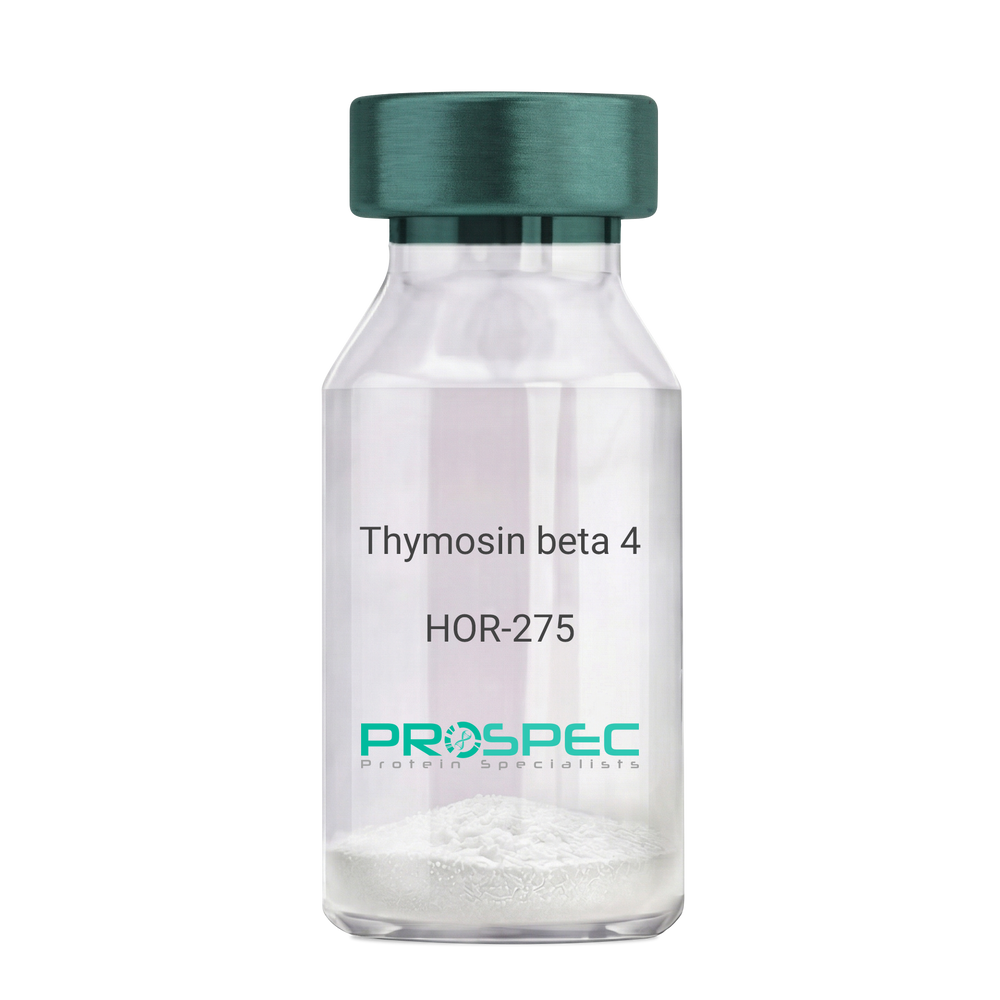
    Thymosin beta 4

    Description:

    Thymosin β4

    Thymosin beta-4. TB500, TB-500

    Product # :

    HOR-275

    Price :

    Quantity :

    Shipping Method :

    Room Temp Icon

    Shipped at Room temp

    Add To Cart

    More Info

    • description
    • formulation
    • purity
    • More Info

    Description

    Thymosin b4 is a 43 amino acid peptide which is regarded as the main intracellular G-actin sequestering peptide. It has a molecular weight of 4963.55 Da, and its molecular formula is: C212H350N56O78S1. Extracellular Thymosin b4 may contribute to physiological processes such as angiogenesis, wound healing, and regulation of inflammation.

    Formulation

    The protein (1mg/ml) was lyophilized with no additives.

    Purity

    Greater than 98.0% as determined by RP-HPLC.

    More Info

    • Introduction

      Thymosin is a hormone secreted from the thymus. Its primary function is to stimulate the production of T cells, which are an important part of the immune system. Thymosin also assists in the development of B cells to plasma cells to produce antibodies. The predominant form of thymosin, thymosin b4, is a member of a highly conserved family of actin monomer-sequestering proteins. b-thymosins are the primary regulators of unpolymerized actin, and are essential for maintaining the small cytoplasmic pool of free G-actin monomers required for rapid filament elongation and allowing for the flux of monomers between the thymosin-bound pool and F-actin.

    • Synonyms

      Thymosin beta-4. TB500, TB-500

    • Physical Appearance

      Sterile Filtered White lyophilized (freeze-dried) powder.

    • Stability

      Lyophilized Thymosin b4 although stable at room temperature for 3 weeks, should be stored desiccated below -18°C. Upon reconstitution T beta 4 should be stored at 4°C between 2-7 days and for future use below -18°C.For long term storage it is recommended to add a carrier protein (0.1% HSA or BSA).Please prevent freeze-thaw cycles.

    • Solubility

      It is recommended to reconstitute the lyophilized Thymosin beta-4 in sterile 18MΩ-cm H2O not less than 100 µg/ml, which can then be further diluted to other aqueous solutions.

    • Amino Acid Sequence

      Thymosin b4 has an a.a. sequence of Ac-Ser-Asp-Lys-Pro-Asp-Met-Ala-Glu-Ile-Glu-Lys-Phe-Asp-Lys-Ser-Lys-Leu-Lys-Lys-Thr-Glu-Thr-Gln-Glu-Lys-Asn-Pro-Leu-Pro-Ser-Lys-Glu-Thr-Ile-Glu-Gln-Glu-Lys-Gln-Ala-Gly-Glu-Ser-OH.

    ProSpec's products are furnished for LABORATORY RESEARCH USE ONLY. The product may not be used as drugs, agricultural or pesticidal products, food additives or household chemicals.

    Thymosin Beta 4
  • View Data Sheet

    Name :

    TBCA Antibody

    Description:

    Tubulin Folding Cofactor A, Mouse Anti Human

    Tubulin-specific chaperone A, Tubulin-folding cofactor A, CFA, TCP1-chaperonin cofactor A, TBCA.

    Product # :

    ANT-362

    Price :

    Quantity :

    Shipping Method :

    Ice Icon

    Shipped with Ice Packs

    Add To Cart

    More Info

    • formulation
    • More Info

    Formulation

    1mg/ml containing PBS, pH-7.4, 10% Glycerol and 0.02% Sodium Azide.

    More Info

    • Introduction

      TBCA is a tubulin-folding protein which is involved in the early step of the tubulin folding pathway. TBCA is one of four proteins (cofactors A, D, E, and C) implicated in the pathway directing to properly folded beta-tubulin from folding intermediates. Cofactors A and D are thought to be a factor in capturing and stabilizing beta-tubulin in a quasi-native confirmation. TBCA is crucial for cell viability, if reduced it causes a decrease in the amount of soluble tubulin, alterations in microtubules and G1 cell cycle arrest. Cofactor E attaches to the cofactor D-tubulin complex, afterward, interaction with cofactor C triggers the release of tubulin polypeptides that are committed to the native state.

    • Synonyms

      Tubulin-specific chaperone A, Tubulin-folding cofactor A, CFA, TCP1-chaperonin cofactor A, TBCA.

    • Immunogen

      Anti-human TBCA mAb is derived from hybridization of mouse F0 myeloma cells with spleen cells from BALB/c mice immunized with recombinant human TBCA amino acids 1-108 purified from E. coli.

    • Ig Subclass

      Mouse IgG2b heavy chain and κ light chain.

    • Clone

      PAT1A5AT.

    • Applications

      TBCA antibody has been tested by ELISA, Western blot, ICC/IF and FACS analysis to assure specificity and reactivity. Since application varies, however, each investigation should be titrated by the reagent to obtain optimal results.

    • Type

      Mouse Anti Human Monoclonal.

    • Storage Procedures

      For periods up to 1 month store at 4°C, for longer periods of time, store at -20°C. Prevent freeze thaw cycles.

    • Purification Method

      TBCA antibody was purified from mouse ascitic fluids by protein-G affinity chromatography.

    ProSpec's products are furnished for LABORATORY RESEARCH USE ONLY. The product may not be used as drugs, agricultural or pesticidal products, food additives or household chemicals.

    Tbca Antibody
  • View Data Sheet

    Name :

    CTSW Human

    Description:

    Cathepsin-W Human Recombinant

    Cathepsin W (Lymphopain), LYPN, lymphopain, EC 3.4.22.-.

    Product # :

    ENZ-762

    Price :

    Quantity :

    Shipping Method :

    Ice Icon

    Shipped with Ice Packs

    Add To Cart

    More Info

    • description
    • source
    • formulation
    • purity
    • More Info

    Description

    CTSW Human Recombinant produced in E.coli is a single, non-glycosylated polypeptide chain containing 378 amino acids (22-376) and having a molecular mass of 42.0 kDa. CTSW is fused to a 23 amino acid His-tag at N-terminus.

    Source

    Escherichia Coli.

    Formulation

    The CTSW solution (0.5mg/ml) contains 20mM Tris-HCl buffer (pH 8.0), 0.4M Urea and 10% glycerol.

    Purity

    Greater than 85% as determined by SDS-PAGE.

    More Info

    • Introduction

      CTSW protein belongs to the peptidase C1 family. CTSW is a cysteine proteinase with a detailed role in the regulation and mechanism of T-cell cytolytic activity. The encoded CTSW is linked to the membrane inside the endoplasmic reticulum of natural killer and cytotoxic T-cells. CTSW expression is up-regulated by interleukin-2.

    • Synonyms

      Cathepsin W (Lymphopain), LYPN, lymphopain, EC 3.4.22.-.

    • Physical Appearance

      Sterile Filtered clear solution.

    • Stability

      Store at 4°C if entire vial will be used within 2-4 weeks. Store, frozen at -20°C for longer periods of time. For long term storage it is recommended to add a carrier protein (0.1% HSA or BSA).Avoid multiple freeze-thaw cycles.

    • Amino Acid Sequence

      MGSSHHHHHH SSGLVPRGSH MGSIRGPLRA QDLGPQPLEL KEAFKLFQIQ FNRSYLSPEE HAHRLDIFAH NLAQAQRLQE EDLGTAEFGV TPFSDLTEEE FGQLYGYRRA AGGVPSMGRE IRSEEPEESV PFSCDWRKVA GAISPIKDQK NCNCCWAMAA AGNIETLWRI SFWDFVDVSV QELLDCGRCG DGCHGGFVWD AFITVLNNSG LASEKDYPFQ GKVRAHRCHP KKYQKVAWIQ DFIMLQNNEH RIAQYLATYG PITVTINMKP LQLYRKGVIK ATPTTCDPQL VDHSVLLVGF GSVKSEEGIW AETVSSQSQP QPPHPTPYWI LKNSWGAQWG EKGYFRLHRG SNTCGITKFP LTARVQKPDM KPRVSCPP.

    ProSpec's products are furnished for LABORATORY RESEARCH USE ONLY. The product may not be used as drugs, agricultural or pesticidal products, food additives or household chemicals.

    Ctsw Human
  • View Data Sheet

    Name :

    CST3 Mouse, sf9

    Description:

    Cystatin-C Mouse Recombinant, sf9

    Cystatin-C, Cystatin-3, Cst3.

    Product # :

    PRO-2249

    Price :

    Quantity :

    Shipping Method :

    Ice Icon

    Shipped with Ice Packs

    Add To Cart

    More Info

    • description
    • source
    • formulation
    • purity
    • More Info

    Description

    CST3 produced in Sf9 Insect cells is a single, glycosylated polypeptide chain containing 126 amino acids (21-140a.a.) and having a molecular mass of 14.2kDa. (Molecular size on SDS-PAGE will appear at approximately 13.5-18kDa).CST3 is expressed with a 6 amino acid His tag at C-Terminus and purified by proprietary chromatographic techniques.

    Source

    Sf9, Insect cells.

    Formulation

    CST3 protein solution (1mg/ml) contains Phosphate Buffered Saline (pH 7.4) and 10% glycerol.

    Purity

    Greater than 95.0% as determined by SDS-PAGE.

    More Info

    • Introduction

      Cystatins are a superfamily of cysteine proteinase inhibitors found in both plants and animals. They comprise a group of proteinase inhibitors, widely distributed in tissues and body fluids, and form tight complexes with cysteine proteases such as cathepsin B, H, L and S. Cystatin C, a secreted molecule of this family, is of interest from biochemical, medicine and evolutionary points of view. Cystatin C, with molecular weight of 13260 Da, is composed of 120 amino acids, lacks carbohydrate and has two disulfide bridges located near the carboxyl terminus. Cystatin C is increased in patients with malignant diseases, and is related to the insufficiency of renal function and appears to be a better marker than creatinine. On the other hand, low levels of cystatin C involve cause the breakdown of the elastic laminae and, subsequently, the atherosclerosis and abdominal aortic aneurysm.

    • Synonyms

      Cystatin-C, Cystatin-3, Cst3.

    • Physical Appearance

      Sterile filtered colorless solution.

    • Stability

      Store at 4°C if entire vial will be used within 2-4 weeks.Store, frozen at -20°C for longer periods of time. For long term storage it is recommended to add a carrier protein (0.1% HSA or BSA).Avoid multiple freeze-thaw cycles.

    • Amino Acid Sequence

      ATPKQGPRML GAPEEADANE EGVRRALDFA VSEYNKGSND AYHSRAIQVV RARKQLVAGV NYFLDVEMGR TTCTKSQTNL TDCPFHDQPH LMRKALCSFQ IYSVPWKGTH SLTKFSCKNA HHHHHH.

    ProSpec's products are furnished for LABORATORY RESEARCH USE ONLY. The product may not be used as drugs, agricultural or pesticidal products, food additives or household chemicals.

    Cst3 Mouse Sf9
  • View Data Sheet

    Name :

    TGM2 Human, Sf9

    Description:

    Tissue Transglutaminase Human Recombinant, Sf9

    Protein-glutamine gamma-glutamyltransferase 2, EC 2.3.2.13, Tissue transglutaminase, TGase C, TGC, TG(C), Transglutaminase-2, TGase-H, TG2, TGM2.

    Product # :

    ENZ-303

    Price :

    Quantity :

    Shipping Method :

    Ice Icon

    Shipped with Ice Packs

    Add To Cart

    More Info

    • description
    • source
    • formulation
    • purity
    • More Info

    Description

    Tissue Transglutaminase Human Recombinant produced in SF9 is a glycosylated, polypeptide chain having a molecular mass of 83 kDa. tTG is expressed with a -6xHis tag and purified by proprietary chromatographic techniques. By point mutation of the active center the catalytic transglutaminase activity has been eliminated, resulting in increased stability during storage and coating.

    Source

    Sf9 insect cells.

    Formulation

    TGM2 is supplied in 16mM HEPES buffer pH-8.0, 320mM NaCl and 20% glycerol.

    Purity

    Greater than 95% as determined by SDS-PAGE.

    More Info

    • Introduction

      Celiac disease is an enteropathy that is characterized by intestinal lesions of variable severity. Tissue-type transglutaminase (tTG) is believed to be the predominant autoantigen for celiac disease and the corresponding autoantibodies show higher sensitivity and specificity than anti-gliadin antibodies. Highly pure recombinant human tTG is now available to replace the traditionally used tTG fraction from guinea pig.
      Tissue-type transglutaminase antigens have been specifically modified for improved handling: exchange of an active site amino acid eliminates the protein cross-linking activity of the enzyme, while maintaining the native three-dimensional structure and the enzyme's secondary GTPase activity. This engineering assures reproducible properties of the antigen preparations through the absence of variable and ill-defined covalent aggregates of tTG antigen and host cell proteins.

    • Synonyms

      Protein-glutamine gamma-glutamyltransferase 2, EC 2.3.2.13, Tissue transglutaminase, TGase C, TGC, TG(C), Transglutaminase-2, TGase-H, TG2, TGM2.

    • Stability

      Store at 4°C if entire vial will be used within 2-4weeks. Store, frozen at -20°C for longer periods of time. Avoid multiple freeze-thaw cycles.

    ProSpec's products are furnished for LABORATORY RESEARCH USE ONLY. The product may not be used as drugs, agricultural or pesticidal products, food additives or household chemicals.

    Tgm2 Human Sf9
  • View Data Sheet

    Name :

    PRLR Human, Antagonist S.Active

    Description:

    Prolactin Receptor Antagonist, S. Active Human Recombinant

    Mammotropin, Luteotropic hormone, Luteotropin, PRL.

    Product # :

    CYT-1253

    Price :

    Quantity :

    Shipping Method :

    Room Temp Icon

    Shipped at Room temp

    Add To Cart

    More Info

    • description
    • source
    • formulation
    • purity
    • biological activity
    • More Info

    Description

    Prolactin Human Receptor Antagonist del 1-9, G129R mutant produced in E.Coli is a single, non-glycosylated polypeptide chain containing 190 amino acids + an additional Ala at n-terminal and having a molecular mass of ~ 22 kDa was modified by additional 12 mutations. The Human Prolactin Receptor Antagonist is purified by proprietary chromatographic techniques.

    Source

    Escherichia coli.

    Formulation

    The protein was lyophilized from a concentrated (1-2mg/ml) solution with 0.02% -0.03% NaHCO3.

    Purity

    Greater than 97.0% as determined by:

    (a) Analysis by Gel Filtration.

    (b) Analysis by SDS-PAGE.

    Biological Activity

    fully biologically active as evidenced by inhibiting PRLR-induced proliferation of Nb2 cells or Baf3 cells stably transfected with hPRL receptors. It also interacts at 1:1 molar ratio with human prolactin receptor extracellular domain as documented by SEC and SPR (Biacore analysis). It is ~ 100 fold more potent than 1-9 G129R hPRL in Ba/F3 cells and > 1000-fold potent in Nb2 cells.

    More Info

    • Synonyms

      Mammotropin, Luteotropic hormone, Luteotropin, PRL.

    • Physical Appearance

      Sterile Filtered White lyophilized (freeze-dried) powder.

    • Stability

      Lyophilized PRLR although stable at room temperature for 3 weeks, should be stored desiccated below -18°C. Upon reconstitution at > 0.1 mg/ml and up to 3 mg/ml and filter sterilization PRLR can be stored at 4C for several weeks. Please prevent freeze-thaw cycles.

    • Solubility

      It is recommended to reconstitute the lyophilized PRLR in sterile 0.4% NaHCO3 adjusted to pH 8-9 not less than 100µg/ml, which can then be further diluted to other aqueous solutions.

    • Amino Acid Sequence

      The sequence of the first six N-terminal amino acids was determined and was found to be Ala-Arg-Ser-Gln-Val-Thr

    • Background

      Prolactin is a pituitary hormone which takes part in the stimulation of milk production, salt and water regulation, development, growth and reproduction. The primary step in its action is binding a specific membrane receptor (prolactin receptor) which belongs to the superfamily of class 1 cytokine receptors. PRLR varies in size (short and long forms) with tissue source and species, from ~40 kDa to 100 kDa. The PRL-R consists of at least 3 separate domains: an extracellular region with 5 cysteines which contains the prolactin binding site, a single transmembrane domain and a cytoplasmic region, the length of which appears to influence ligand binding and regulate cellular function.

    ProSpec's products are furnished for LABORATORY RESEARCH USE ONLY. The product may not be used as drugs, agricultural or pesticidal products, food additives or household chemicals.

    Prlr Antagonist Human
  • View Data Sheet

    Name :

    TBCB Antibody

    Description:

    Tubulin Folding Cofactor B, Mouse Anti Human

    Tubulin folding cofactor B, Cytoskeleton-associated protein CKAPI, cytoskeleton associated protein 1, CKAP1, CG22, Tubulin-specific chaperone B.

    Product # :

    ANT-526

    Price :

    Quantity :

    Shipping Method :

    Ice Icon

    Shipped with Ice Packs

    Add To Cart

    More Info

    • formulation
    • More Info

    Formulation

    1mg/ml containing PBS, pH-7.4, 10% Glycerol and 0.02% Sodium Azide.

    More Info

    • Introduction

      TBCB is a member of the Microtubules family. Biosynthesis of functional microtubules include the involvement of a number of chaperones, termed Tubulin folding cofactors A (TBCA), B (TBCB), C (TBCC), D (TBCD) and E (TBCE), which operate on folding intermediates downstream of the cytosolic chaperon, known as TCP. The 244 amino acid cytoplasmic protein TBCB has one CAP-Gly domain and is universally expressed. TBCB takes part in the regulation of tubulin heterodimer dissociation and operates as a negative regulator of axonal growth.

    • Synonyms

      Tubulin folding cofactor B, Cytoskeleton-associated protein CKAPI, cytoskeleton associated protein 1, CKAP1, CG22, Tubulin-specific chaperone B.

    • Physical Appearance

      Sterile filtered colorless solution.

    • Immunogen

      Anti-human TBCB mAb, clone PAT1F6AT, is derived from hybridization of mouse F0 myeloma cells with spleen cells from BALB/c mice immunized with a recombinant human TBCB protein 1-244 amino acids purified from E. coli.

    • Ig Subclass

      Mouse IgG2b heavy chain and k light chain.

    • Clone

      PAT1F6AT.

    • Applications

      The antibody has been tested by ELISA, Western blot analysis to assure specificity and reactivity. Since application varies, however, each investigation should be titrated by the reagent to obtain optimal results. Recommended starting dilution is 1:1500.

    • Type

      Mouse Anti Human Monoclonal.

    • Storage Procedures

      For periods up to 1 month store at 4°C, for longer periods of time, store at -20°C. Prevent freeze thaw cycles.

    • Purification Method

      TBCB antibody was purified from mouse ascitic fluids by protein-A affinity chromatography.

    ProSpec's products are furnished for LABORATORY RESEARCH USE ONLY. The product may not be used as drugs, agricultural or pesticidal products, food additives or household chemicals.

    Tbcb Antibody
  • View Data Sheet

    Name :

    Cyclophilin D Human, His

    Description:

    Cyclophilin-D Human Recombinant, His Tag

    Peptidylprolyl isomerase D, PPID, CYPD, CYP-40, 40 kDa peptidyl-prolyl cis-trans isomerase, PPIase, Rotamase, Cyclophilin-40, CYP40, Cyclophilin-related protein, MGC33096, EC 5.2.1.8.

    Product # :

    ENZ-367

    Price :

    Quantity :

    Shipping Method :

    Ice Icon

    Shipped with Ice Packs

    Add To Cart

    More Info

    • description
    • source
    • formulation
    • purity
    • biological activity
    • More Info

    Description

    Cyclophilin-D Human Recombinant produced in E.Coli is a single, non-glycosylated, polypeptide chain (amino acids 1-370) containing 390 amino acids and having a molecular mass of 42.9kDa. Cyclophilin-D is fused to a 20 aa His Tag at N-terminus and is purified by proprietary chromatographic techniques.

    Source

    Escherichia Coli.

    Formulation

    1mg/ml solution containing 1x PBS pH-7.4 & 10% glycerol.

    Purity

    Greater than 95.0% as determined by SDS-PAGE.

    Biological Activity

    Specific activity is > 700 nmol/min/mg, and is defined as the amount of enzyme that cleaves 1nmole of suc-AAFP-pNA per minute at 25C in Tris-Hcl pH8.0 using chymotrypsin.

    More Info

    • Introduction

      Cyclophilin-D is a member of the peptidyl-prolyl cis-trans isomerase (PPIase) family. PPIases catalyze the cis-trans isomerization of proline imidic peptide bonds in oligopeptides and speeds up the protein folding. Cyclophilin-D possess PPIase activity and binds to the immunosuppressant cyclosporin-A. Cyclophilin-D is very well known that its overexpression suppresses the apoptosis in cancer cell. Cyclophilin-D suppresses apoptotic cell death by the use of mitochondrial hexokinase-2 dependent mechanism in cancer cells.

    • Synonyms

      Peptidylprolyl isomerase D, PPID, CYPD, CYP-40, 40 kDa peptidyl-prolyl cis-trans isomerase, PPIase, Rotamase, Cyclophilin-40, CYP40, Cyclophilin-related protein, MGC33096, EC 5.2.1.8.

    • Physical Appearance

      Sterile filtered colorless solution.

    • Stability

      Store at 4°C if entire vial will be used within 2-4 weeks. Store, frozen at -20°C for longer periods of time. For long term storage it is recommended to add a carrier protein (0.1% HSA or BSA).Avoid multiple freeze-thaw cycles.

    • Amino Acid Sequence

      MGSSHHHHHH SSGLVPRGSH MSHPSPQAKP SNPSNPRVFFDVDIGGERVG RIVLELFADI VPKTAENFRA LCTGEKGIGH TTGKPLHFKG CPFHRIIKKF MIQGGDFSNQ NGTGGESIYG EKFEDENFHY KHDREGLLSMANAGRNTNGS QFFITTVPTP HLDGKHVVFG QVIKGIGVAR ILENVEVKGEKPAKLCVIAE CGELKEGDDG GIFPKDGSGD SHPDFPEDAD IDLKDVDKIL LITEDLKNIG NTFFKSQNWE MAIKKYAEVL RYVDSSKAVI ETADRAKLQPIALSCVLNIG ACKLKMSNWQ GAIDSCLEAL ELDPSNTKAL YRRAQGWQGLKEYDQALADL KKAQGIAPED KAIQAELLKV KQKIKAQKDK EKAVYAKMFA.

    ProSpec's products are furnished for LABORATORY RESEARCH USE ONLY. The product may not be used as drugs, agricultural or pesticidal products, food additives or household chemicals.

    Cyclophilin D Human
  • View Data Sheet

    Name :

    EIF4EBP1 Human

    Description:

    Eukaryotic translation initiation factor 4E-binding protein 1 Human Recombinant

    Eukaryotic translation initiation factor 4E-binding protein 1, eIF4E-binding protein 1, 4E-BP1, PHAS-I, EIF4EBP1, BP-1, 4EBP1, MGC4316.

    Product # :

    PRO-532

    Price :

    Quantity :

    Shipping Method :

    Ice Icon

    Shipped with Ice Packs

    Add To Cart

    More Info

    • description
    • source
    • formulation
    • purity
    • More Info

    Description

    EIF4EBP1 Human Recombinant fused with a 20 amino acid His tag at N-terminus produced in E.Coli is a single, non-glycosylated, polypeptide chain containing 138 amino acids (1-118 a.a.) and having a molecular mass of 14.7kDa (molecular weight on SDS-PAGE will appear higher).The EIF4EBP1 is purified by proprietary chromatographic techniques.

    Source

    Escherichia Coli.

    Formulation

    The EIF4EBP1 solution (1mg/ml) contains 20mM Tris-HCl buffer (pH8.0) and 10% glycerol.

    Purity

    Greater than 95.0% as determined by SDS-PAGE.

    More Info

    • Introduction

      EIF4EBP1 (eukaryotic translation initiation factor 4E-binding protein 1) belongs to a family of translation repressor proteins. EIF4EBP1 regulates eIF4E (eukaryotic translation initiation factor 4E) activity by preventing its assembly into the eIF4F complex and mediates the regulation of protein translation by hormones, growth factors and other stimuli that signal through the MAP kinase and mTORC1 pathways. EIF4EBP1 is phosphorylated in response to various signals including UV irradiation, resulting in its dissociation from eIF4E and activation of mRNA translation. EIF4EBP1 C-terminus has domains which control function and phosphorylation. EIF4EBP1 has a role in progression of breast neoplasms through cell signaling.

    • Synonyms

      Eukaryotic translation initiation factor 4E-binding protein 1, eIF4E-binding protein 1, 4E-BP1, PHAS-I, EIF4EBP1, BP-1, 4EBP1, MGC4316.

    • Physical Appearance

      Sterile Filtered colorless solution.

    • Stability

      Store at 4°C if entire vial will be used within 2-4 weeks. Store, frozen at -20°C for longer periods of time. For long term storage it is recommended to add a carrier protein (0.1% HSA or BSA).Avoid multiple freeze-thaw cycles.

    • Amino Acid Sequence

      MGSSHHHHHH SSGLVPRGSH MSGGSSCSQT PSRAIPATRR VVLGDGVQLP PGDYSTTPGG TLFSTTPGGT RIIYDRKFLM ECRNSPVTKT PPRDLPTIPG VTSPSSDEPP MEASQSHLRN SPEDKRAGGE ESQFEMDI.

    ProSpec's products are furnished for LABORATORY RESEARCH USE ONLY. The product may not be used as drugs, agricultural or pesticidal products, food additives or household chemicals.

    Eif4Ebp1 Human
  • 1
  • …
  • 6
  • 7
  • 8
  • 9
  • 10
  • …
  • 42
Your browser does not support the video tag.

Products

  • Cytokines
  • Growth Factors
  • Chemokines
  • CD Antigens
  • Neurotrophins
  • Hormones
  • Enzymes
  • Viral Antigens
  • Recombinant Proteins
  • Natural Proteins
  • Monoclonal Antibodies
  • Polyclonal Antibodies
  • Thermal Packaging

About

  • Company
  • Founder
  • Contribution
  • Contact Us
  • My Account

Ordering

  • Ordering Method
  • Ordering - Credit Card
  • Ordering PO
  • Shipping Fees
  • FAQ's

Legal

  • Terms & Conditions
  • Privacy
  • Site Map
  • info@prospecbio.com
  • Facebook
  • Instagram
  • Linkedin Profile

© 2026 ProSpec-Tany TechnoGene Ltd. All Rights Reserved.

  • Choosing a selection results in a full page refresh.
  • Opens in a new window.