Skip to content

High-quality research proteins.

  • 1-800-805-6531

  • Mon - Sat 8.00-18.00, Sun - Closed

  • info@prospecbio.com

  • PO Box 6591 East Brunswick NJ 08816

  • Products
    • Cytokines
    • Growth factors
    • Chemokines
    • Cd antigens
    • Neurotrophins
    • Hormones
    • Enzymes
    • Viral antigens
    • Recombinant proteins
    • Natural proteins
    • Monoclonal antibodies
    • Polyclonal antibodies
    • Thermal Packaging
  • About
    • Company
    • Founder
    • Contribution
  • Customers
    • Eastern Asia
    • Eastern Europe
    • North America
    • South America
    • South East Asia
    • Southern Asia
    • Western Europe
  • Ordering
    • Ordering Method
    • Ordering - Credit Card
    • Ordering - PO
    • Shipping Fees
    • FAQs
  • Services
    • DNA Cloning
    • Protein Expression
    • Monoclonal Antibody
    • Fermentation
    • Technology License
  • Contact us
Log in

Country/region

  • USD $ | Albania
  • USD $ | Andorra
  • USD $ | Argentina
  • USD $ | Armenia
  • USD $ | Australia
  • USD $ | Austria
  • USD $ | Azerbaijan
  • USD $ | Belarus
  • USD $ | Belgium
  • USD $ | Bolivia
  • USD $ | Brazil
  • USD $ | Bulgaria
  • USD $ | Cambodia
  • USD $ | Canada
  • USD $ | Chile
  • USD $ | China
  • USD $ | Colombia
  • USD $ | Costa Rica
  • USD $ | Croatia
  • USD $ | Cyprus
  • USD $ | Czechia
  • USD $ | Denmark
  • USD $ | Estonia
  • USD $ | Finland
  • USD $ | France
  • USD $ | Georgia
  • USD $ | Germany
  • USD $ | Greece
  • USD $ | Hong Kong SAR
  • USD $ | Hungary
  • USD $ | Iceland
  • USD $ | India
  • USD $ | Ireland
  • USD $ | Israel
  • USD $ | Italy
  • USD $ | Japan
  • USD $ | Kazakhstan
  • USD $ | Latvia
  • USD $ | Liechtenstein
  • USD $ | Lithuania
  • USD $ | Madagascar
  • USD $ | Malta
  • USD $ | Mexico
  • USD $ | Moldova
  • USD $ | Monaco
  • USD $ | Netherlands
  • USD $ | New Zealand
  • USD $ | North Macedonia
  • USD $ | Norway
  • USD $ | Panama
  • USD $ | Paraguay
  • USD $ | Peru
  • USD $ | Philippines
  • USD $ | Poland
  • USD $ | Portugal
  • USD $ | Romania
  • USD $ | Singapore
  • USD $ | Slovakia
  • USD $ | Slovenia
  • USD $ | South Africa
  • USD $ | South Korea
  • USD $ | Spain
  • USD $ | Sri Lanka
  • USD $ | Sweden
  • USD $ | Switzerland
  • USD $ | Taiwan
  • USD $ | Thailand
  • USD $ | Türkiye
  • USD $ | Ukraine
  • USD $ | United Kingdom
  • USD $ | United States
  • USD $ | Uruguay
  • USD $ | Vatican City
  • USD $ | Venezuela
  • USD $ | Vietnam
  • Facebook
  • Instagram
logoProSpec - Recombinant Protein Manufacturer for academic and R&D industry
Become a distributor
Account Log in
Wishlist
Cart Cart(0)
  • Products
    +
    • Cytokines
    • Growth factors
    • Chemokines
    • Cd antigens
    • Neurotrophins
    • Hormones
    • Enzymes
    • Viral antigens
    • Recombinant proteins
    • Natural proteins
    • Monoclonal antibodies
    • Polyclonal antibodies
    • Thermal Packaging
  • About
    +
    • Company
    • Founder
    • Contribution
  • Customers
    +
    • Eastern Asia
    • Eastern Europe
    • North America
    • South America
    • South East Asia
    • Southern Asia
    • Western Europe
  • Ordering
    +
    • Ordering Method
    • Ordering - Credit Card
    • Ordering - PO
    • Shipping Fees
    • FAQs
  • Services
    +
    • DNA Cloning
    • Protein Expression
    • Monoclonal Antibody
    • Fermentation
    • Technology License
  • Contact us

Item added to your cart

View cart
View All
  • Cytokines
  • Growth factors
  • Chemokines
  • Cd antigens
  • Neurotrophins
  • Hormones
  • Enzymes
  • Viral antigens
  • Recombinant proteins
  • Natural proteins
  • Monoclonal antibodies
  • Polyclonal antibodies
  • Thermal Packaging
  • Tumor Necrosis Factor

    Tumor Necrosis Factor

    View All
  • 4-1BB

    4-1BB

    View All
  • Adiponectin

    Adiponectin

    View All
  • AIF1

    AIF1

    View All
  • Other Cytokines

    Other Cytokines

    View All
  • AITRL

    AITRL

    View All
  • Angiopoietin

    Angiopoietin

    View All
  • Apolipoprotein

    Apolipoprotein

    View All
  • B-Cell Activating Factor

    B-Cell Activating Factor

    View All
  • Beta Defensin

    Beta Defensin

    View All
  • Bone Morphogenetic Protein

    Bone Morphogenetic Protein

    View All
  • B type Natriuretic Peptide

    B type Natriuretic Peptide

    View All
  • BST

    BST

    View All
  • Betacellulin

    Betacellulin

    View All
  • Cardiotrophin

    Cardiotrophin

    View All
  • Activin

    Activin

    View All
  • Fibroblast Growth Factor

    Fibroblast Growth Factor

    View All
  • Other Growth Factors

    Other Growth Factors

    View All
  • CSF

    CSF

    View All
  • CTGF

    CTGF

    View All
  • IGFBP

    IGFBP

    View All
  • VEGF Protein

    VEGF Protein

    View All
  • EGF

    EGF

    View All
  • Epigen

    Epigen

    View All
  • Erythropoietin

    Erythropoietin

    View All
  • Insulin-Like Growth Factor

    Insulin-Like Growth Factor

    View All
  • Growth Hormone

    Growth Hormone

    View All
  • HDGF

    HDGF

    View All
  • Hepatocyte Growth Factor

    Hepatocyte Growth Factor

    View All
  • Insulin

    Insulin

    View All
  • BCA-1/ BLC (CXCL13)

    BCA-1/ BLC (CXCL13)

    View All
  • BRAK (CXCL14)

    BRAK (CXCL14)

    View All
  • C-10 (CCL6)

    C-10 (CCL6)

    View All
  • Other Chemokines

    Other Chemokines

    View All
  • MEC (CCL28)

    MEC (CCL28)

    View All
  • LD78-beta (CCL3L1)

    LD78-beta (CCL3L1)

    View All
  • CTACK (CCL27)

    CTACK (CCL27)

    View All
  • CXCL16

    CXCL16

    View All
  • CXCL17

    CXCL17

    View All
  • Platelet Factor-4 (CXCL4)

    Platelet Factor-4 (CXCL4)

    View All
  • ENA-78 (CXCL5)

    ENA-78 (CXCL5)

    View All
  • Eotaxin (CCL11,24,26)

    Eotaxin (CCL11,24,26)

    View All
  • Exodus-2 (CCL21)

    Exodus-2 (CCL21)

    View All
  • Fractalkine (CX3CL1)

    Fractalkine (CX3CL1)

    View All
  • CXCL6

    CXCL6

    View All
  • Other CD Antigens

    Other CD Antigens

    View All
  • CD14

    CD14

    View All
  • CD164

    CD164

    View All
  • CD1

    CD1

    View All
  • CD2

    CD2

    View All
  • CD200

    CD200

    View All
  • CD207

    CD207

    View All
  • CD226

    CD226

    View All
  • CD23

    CD23

    View All
  • CD244

    CD244

    View All
  • CD247

    CD247

    View All
  • CD27

    CD27

    View All
  • CD274

    CD274

    View All
  • CD300

    CD300

    View All
  • CD33

    CD33

    View All
  • Other Neurotrophins

    Other Neurotrophins

    View All
  • Beta-NGF

    Beta-NGF

    View All
  • BDNF

    BDNF

    View All
  • CDNF

    CDNF

    View All
  • CNTF

    CNTF

    View All
  • GDNF

    GDNF

    View All
  • Glia Maturation Factor

    Glia Maturation Factor

    View All
  • MANF

    MANF

    View All
  • Midkine

    Midkine

    View All
  • Neuroglobin

    Neuroglobin

    View All
  • Neurotrophic factors

    Neurotrophic factors

    View All
  • Neuregulin

    Neuregulin

    View All
  • Neuropilin

    Neuropilin

    View All
  • Pigment Epithelium-Derived Factor

    Pigment Epithelium-Derived Factor

    View All
  • Pleiotrophin

    Pleiotrophin

    View All
  • Peptide Hormones

    Peptide Hormones

    View All
  • Other Hormones

    Other Hormones

    View All
  • HCG

    HCG

    View All
  • Endothelin

    Endothelin

    View All
  • Exendin

    Exendin

    View All
  • FSH

    FSH

    View All
  • Glucagon

    Glucagon

    View All
  • GHRP

    GHRP

    View All
  • GLP

    GLP

    View All
  • Thyrostimulin

    Thyrostimulin

    View All
  • Inhibin A

    Inhibin A

    View All
  • LHRH

    LHRH

    View All
  • Melanotan

    Melanotan

    View All
  • Procalcitonin

    Procalcitonin

    View All
  • PTH

    PTH

    View All
  • Peroxiredoxin

    Peroxiredoxin

    View All
  • Peptidase

    Peptidase

    View All
  • Synthetase

    Synthetase

    View All
  • Transferase

    Transferase

    View All
  • Hydrolase

    Hydrolase

    View All
  • Dehydrogenase

    Dehydrogenase

    View All
  • ACE2

    ACE2

    View All
  • Esterase

    Esterase

    View All
  • Protein Kinases

    Protein Kinases

    View All
  • Other Enzymes

    Other Enzymes

    View All
  • Phosphatase

    Phosphatase

    View All
  • Deaminase

    Deaminase

    View All
  • Oxygenase

    Oxygenase

    View All
  • Adenylate Kinase

    Adenylate Kinase

    View All
  • Lyase

    Lyase

    View All
  • Chagas

    Chagas

    View All
  • SARS

    SARS

    View All
  • Influenza

    Influenza

    View All
  • ASFV

    ASFV

    View All
  • Astrovirus

    Astrovirus

    View All
  • Borrelia

    Borrelia

    View All
  • Helicobacter Pylori

    Helicobacter Pylori

    View All
  • Chikungunya

    Chikungunya

    View All
  • Chlamydia

    Chlamydia

    View All
  • Cytomegalo

    Cytomegalo

    View All
  • Dengue

    Dengue

    View All
  • EBV

    EBV

    View All
  • Ebola

    Ebola

    View All
  • Feline Leukemia Virus

    Feline Leukemia Virus

    View All
  • Hepatitis A

    Hepatitis A

    View All
  • Other

    Other

    View All
  • Actin

    Actin

    View All
  • ADAM

    ADAM

    View All
  • Complement Component

    Complement Component

    View All
  • Ag85

    Ag85

    View All
  • Eukaryotic Translation Initiation Factor

    Eukaryotic Translation Initiation Factor

    View All
  • Anterior Gradient Protein

    Anterior Gradient Protein

    View All
  • Heat Shock Protein

    Heat Shock Protein

    View All
  • Alpha-2-HS-Glycoprotein

    Alpha-2-HS-Glycoprotein

    View All
  • Hemoglobin

    Hemoglobin

    View All
  • Allergy

    Allergy

    View All
  • Anaplasma

    Anaplasma

    View All
  • Angiogenin

    Angiogenin

    View All
  • Ankyrin Repeat Domain

    Ankyrin Repeat Domain

    View All
  • Annexin

    Annexin

    View All
  • Other Natural Proteins

    Other Natural Proteins

    View All
  • Aprotinin

    Aprotinin

    View All
  • Transferrin

    Transferrin

    View All
  • Avidin

    Avidin

    View All
  • Anti Coagulation Factors

    Anti Coagulation Factors

    View All
  • Natural Albumin

    Natural Albumin

    View All
  • Natural Coagulation Factors

    Natural Coagulation Factors

    View All
  • Fibronectin

    Fibronectin

    View All
  • Thrombin

    Thrombin

    View All
  • Anti Human Enzyme

    Anti Human Enzyme

    View All
  • Other Monoclonal Antibodies

    Other Monoclonal Antibodies

    View All
  • Anti Human Cytokine

    Anti Human Cytokine

    View All
  • Anti Human Heat Shock Protein

    Anti Human Heat Shock Protein

    View All
  • Anti Mouse Lymphocyte

    Anti Mouse Lymphocyte

    View All
  • Anti Human Chemokine

    Anti Human Chemokine

    View All
  • Anti Human Lymphocyte

    Anti Human Lymphocyte

    View All
  • Anti Viral Monoclonal

    Anti Viral Monoclonal

    View All
  • Anti Mouse Cytokine

    Anti Mouse Cytokine

    View All
  • Anti-GST Monoclonal

    Anti-GST Monoclonal

    View All
  • Other Polyclonal Antibodies

    Other Polyclonal Antibodies

    View All
  • Anti Viral

    Anti Viral

    View All
  • Anti-GST Monoclonal

    Anti-GST Monoclonal

    View All
Back

Search results

1000 results found for “chitinase”

Name

Description

Product #

Price

Quantity

Shipping Method

  • View Data Sheet

    Name :

    CTSE Mouse

    Description:

    Cathepsin-E Mouse Recombinant

    CTSE, A430072003Rik, C920004C08Rik, CatE, CE.

    Product # :

    ENZ-1140

    Price :

    Quantity :

    Shipping Method :

    Ice Icon

    Shipped with Ice Packs

    Add To Cart

    More Info

    • description
    • source
    • formulation
    • purity
    • More Info

    Description

    CTSE Mouse produced in Sf9 Insect cells is a single, glycosylated polypeptide chain containing 385 amino acids ( 21-397 a.a.) and having a molecular mass of 41.8 kDa.CTSE is expressed with a 8 amino acid His tag at C-Terminus and purified by proprietary chromatographic techniques.

    Source

    Sf9, Insect cells.

    Formulation

    CTSE protein solution ( 0.5mg/ml ) contains PBS (pH 7.4) and 10% glycerol.

    Purity

    Greater than 95.0% as determined by SDS-PAGE.

    More Info

    • Introduction

      CTSE or cathepsin E is an intracellular aspartic protease from the pepsin protein family. CTSE has a crucial part in protein degradation, creating bioactive proteins & processing antigens. The enzyme is responsible for cleaving at B site, Swedish mutant of amyloid precursor protein and the enzyme shows reactivity with the wild-type APP.

    • Synonyms

      CTSE, A430072003Rik, C920004C08Rik, CatE, CE.

    • Physical Appearance

      Sterile Filtered clear solution.

    • Stability

      Store at 4°C if entire vial will be used within 2-4 weeks. Store, frozen at -20°C for longer periods of time. For long term storage it is recommended to add a carrier protein (0.1% HSA or BSA).Avoid multiple freeze-thaw cycles.

    • Amino Acid Sequence

      ALHRVPLRRH QSLRKKLRAQ GQLSEFWRSH NLDMTRLSES CNVYSSVNEP LINYLDMEYF GTISIGTPPQ NFTVIFDTGS SNLWVPSVYC TSPACKAHPV FHPSQSDTYT EVGNHFSIQY GTGSLTGIIG ADQVSVEGLT VDGQQFGESV KEPGQTFVNA EFDGILGLGY PSLAAGGVTP VFDNMMAQNL VALPMFSVYL SSDPQGGSGS ELTFGGYDPS HFSGSLNWIP VTKQAYWQIA
      LDGIQVGDTV MFCSEGCQAI VDTGTSLITG PPDKIKQLQE AIGATPIDGE YAVDCATLDT MPNVTFLINE VSYTLNPTDY ILPDLVEGMQ FCGSGFQGLD IPPPAGPLWI LGDVFIRQFY SVFDRGNNQV GLAPAVPLEH HHHHH.

    ProSpec's products are furnished for LABORATORY RESEARCH USE ONLY. The product may not be used as drugs, agricultural or pesticidal products, food additives or household chemicals.

    Ctse Mouse
  • View Data Sheet

    Name :

    Alkaline Phosphatase Bovine

    Description:

    Alkaline Phosphatase Bovine Intestinal

    EC 3.1.3.1, IAP, AP, ALPI, Intestinal-type alkaline phosphatase, Intestinal alkaline phosphatase.

    Product # :

    ENZ-322

    Price :

    Quantity :

    Shipping Method :

    Ice Icon

    Shipped with Ice Packs

    Add To Cart

    More Info

    • description
    • source
    • formulation
    • purity
    • biological activity
    • More Info

    Description

    The Alkaline Phosphatase is purified by affinity chromatography, which results in an enzyme of high specific activity and purity. Alkaline Phosphatase is Dimeric protein having a molecular weight of 140 kDa, one Zn++ ion is tightly bound to each subunit, and another less tightly bound is involved in the catalytic reaction. Mg++ stimulates the catalysis. The binding site for Mg++ is different to that of Zn++, but will be occupied by excess Zn++ followed by loss of enzyme activity.

    Source

    Calf Intestine.

    Formulation

    50% glycerol, 5mM MgCl2, 0.1mM ZnCl2 and 5mM TRIS, pH 7.0.

    Purity

    95% pure by Gel Filtration.

    Biological Activity

    >1500 U/mg (pH 9.6), 25°C and 0.025M glycin, 10% glycerol as buffer.

    More Info

    • Synonyms

      EC 3.1.3.1, IAP, AP, ALPI, Intestinal-type alkaline phosphatase, Intestinal alkaline phosphatase.

    • Physical Appearance

      Sterile Filtered clear colorless solution.

    • Stability

      AP should be stored at 4°C. Please Do-Not freeze.

    ProSpec's products are furnished for LABORATORY RESEARCH USE ONLY. The product may not be used as drugs, agricultural or pesticidal products, food additives or household chemicals.

    Alkaline Phosphatase
  • View Data Sheet

    Name :

    CHST5 Human

    Description:

    Carbohydrate Sulfotransferase 5 Human Recombinant

    Carbohydrate sulfotransferase 5, Galactose/N-acetylglucosamine/N-acetylglucosamine 6-O-sulfotransferase 4, GST4, Intestinal N-acetylglucosamine-6-O-sulfotransferase, I-GlcNAc6ST, Intestinal GlcNAc-6-sulfotransferase, mIGn6ST, N-acetylglucosamine 6-O-sulfotransferase 3, GlcNAc6ST-3, Gn6st-3, Chst5, Gst4.

    Product # :

    ENZ-1165

    Price :

    Quantity :

    Shipping Method :

    Ice Icon

    Shipped with Ice Packs

    Add To Cart

    More Info

    • description
    • source
    • formulation
    • purity
    • biological activity
    • More Info

    Description

    CHST5 Human produced in Sf9 Baculovirus cells is a single, glycosylated polypeptide chain containing 380 amino acids (27-395 a.a.) and having a molecular mass of 42.9kDa.CHST5 is expressed with a 6 amino acid His tag at C-Terminus and purified by proprietary chromatographic techniques.

    Source

    Sf9, Baculovirus cells.

    Formulation

    CHST5 protein solution (0.25mg/ml) containing 20% glycerol and Phosphate-Buffered Saline (pH 7.4).

    Purity

    Greater than 90.0% as determined by SDS-PAGE.

    Biological Activity

    Specific activity is greater than 10,000 pmol/min/ug, and is defined as the amount of enzyme that sulfate from PAPS to Nacetyl-D-glucosamine per minute at pH 7.5, at 37˚C.

    More Info

    • Introduction

      Carbohydrate Sulfotransferase 5 (CHST5) is a Golgi-embedded enzyme that is found in B cells, T cells and intestinal epithelium and is also mediates sulfation of keratan in cornea. CHST5 is a sulfotransferase that utilizes 3'-phospho-5'-adenylyl sulfate (PAPS) as sulfonate donor to catalyze the transfer of sulfate to position 6 of non-reducing N-acetylglucosamine residues of keratan. CHST5 works on the non-reducing terminal GlcNAc of short andlong carbohydrate substrates that have poly-N-acetyllactosamine structures.

    • Synonyms

      Carbohydrate sulfotransferase 5, Galactose/N-acetylglucosamine/N-acetylglucosamine 6-O-sulfotransferase 4, GST4, Intestinal N-acetylglucosamine-6-O-sulfotransferase, I-GlcNAc6ST, Intestinal GlcNAc-6-sulfotransferase, mIGn6ST, N-acetylglucosamine 6-O-sulfotransferase 3, GlcNAc6ST-3, Gn6st-3, Chst5, Gst4.

    • Physical Appearance

      Sterile filtered colorless solution.

    • Stability

      Store at 4°C if entire vial will be used within 2-4 weeks.Store, frozen at -20°C for longer periods of time.For long term storage it is recommended to add a carrier protein (0.1% HSA or BSA).Avoid multiple freeze-thaw cycles.

    • Amino Acid Sequence

      ADPEFSRQVP SSPAGLGERV HVLVLSSWRS GSSFVGQLFS QHPDVFYLME PAWHVWDTLS QGSAPALHMA VRDLIRSVFL CDMDVFDAYL PWRRNISDLF QWAVSRALCS PPVCEAFARG NISSEEVCKP LCATRPFGLA QEACSSYSHV VLKEVRFFNL QVLYPLLSDP ALNLRIVHLV RDPRAVLRSR EQTAKALARD NGIVLGTNGT WVEADPRLRV VNEVCRSHVR IAEAALHKPP PFLQDRYRLV RYEDLARDPL TVIRELYAFT GLGLTPQLQT WIHNITHGSG PGARREAFKT TSRDALSVSQ AWRHTLPFAK IRRVQELCGG ALQLLGYRSV HSELEQRDLS LDLLLPRGMD SFKWASSTEK QPESHHHHHH

    ProSpec's products are furnished for LABORATORY RESEARCH USE ONLY. The product may not be used as drugs, agricultural or pesticidal products, food additives or household chemicals.

    Chst5 Human
  • View Data Sheet

    Name :

    ALPP Human, Active

    Description:

    Alkaline Phosphatase Placental Human Recombinant, BioActive

    3 ALPP, Alkaline phosphatase Regan isozyme, Placental alkaline phosphatase 1, PLAP-1, ALP, PLAP, Alkaline phosphatase placental type, EC 3.1.3.1, PLAP-1, Alkaline phosphatase Regan isozyme.

    Product # :

    ENZ-1133

    Price :

    Quantity :

    Shipping Method :

    Ice Icon

    Shipped with Ice Packs

    Add To Cart

    More Info

    • description
    • source
    • formulation
    • purity
    • biological activity
    • More Info

    Description

    ALPP Human produced in Sf9 Baculovirus cells is a single, glycosylated polypeptide chain containing 494 amino acids (23-506 a.a.) and having a molecular mass of 53.9kDa. ALPP is expressed with a 10 amino acid His tag at C-Terminus and purified by proprietary chromatographic techniques.

    Source

    Sf9, Baculovirus cells.

    Formulation

    ALPP protein solution (0.5mg/ml) containing Phosphate-Buffered Saline (pH 7.4) and 10% glycerol.

    Purity

    Greater than 95.0% as determined by SDS-PAGE.

    Biological Activity

    Specific activity is > 2,500unit/mg, and is defined as the amount of enzyme that hydrolyze 1.0nmole of pnitrophenyl phosphate (pNPP) per minute at pH 7.5 at 37C.

    More Info

    • Introduction

      Placental alkaline phosphatase also known as PLAP is a membranal siaglycoprotein enzyme typicallyfoundin high concentration in syncytiotrophoblasts in the placenta amid the 3th trimester of gestation. The expression of PLAP was at firstconsidered to be onlyin the term placenta, though, a human PLAP-like variant has been found,thathas more than 85% homology with PLAP itself. PLAP is expressed strictly in normal term placenta, endocervix & fallopian tube and in ovarian and proximal gastrointestinal tumors. It is also widely expressed in germ cell tumors and more recently found in seminomas.

    • Synonyms

      3 ALPP, Alkaline phosphatase Regan isozyme, Placental alkaline phosphatase 1, PLAP-1, ALP, PLAP, Alkaline phosphatase placental type, EC 3.1.3.1, PLAP-1, Alkaline phosphatase Regan isozyme.

    • Physical Appearance

      Sterile Filtered colorless solution.

    • Stability

      Store at 4°C if entire vial will be used within 2-4 weeks. Store, frozen at -20°C for longer periods of time. For long term storage it is recommended to add a carrier protein (0.1% HSA or BSA).Avoid multiple freeze-thaw cycles.

    • Amino Acid Sequence

      ADLMIIPVEE ENPDFWNREA AEALGAAKKL QPAQTAAKNL IIFLGDGMGV STVTAARILK GQKKDKLGPE LPLAMDRFPY VALSKTYNVD KHVPDSGATA TAYLCGVKGN FQTIGLSAAA RFNQCNTTRG NEVISVMNRA KKAGKSVGVV TTTRVQHASP AGTYAHTVNR NWYSDADVPA SARQEGCQDI ATQLISNMDI DVILGGGRKY MFRMGTPDPE YPDDYSQGGT RLDGKNLVQE WLAKRQGARY VWNRTELMQA SLDPSVTHLM GLFEPGDMKY EIHRDSTLDP SLMEMTEAAL RLLSRNPRGF FLFVEGGRID HGHHESRAYR ALTETIMFDD AIERAGQLTS EEDTLSLVTA DHSHVFSFGG YPLRGSSIFG LAPGKARDRK AYTVLLYGNG PGYVLKDGAR PDVTESESGS PEYRQQSAVP LDEETHAGED VAVFARGPQA HLVHGVQEQT FIAHVMAFAA CLEPYTACDL APPAGTTDHH HHHH.

    ProSpec's products are furnished for LABORATORY RESEARCH USE ONLY. The product may not be used as drugs, agricultural or pesticidal products, food additives or household chemicals.

    Alpp Human
  • View Data Sheet

    Name :

    PGC Human

    Description:

    Progastricsin-C Human Recombinant

    Progastricsin (Pepsinogen C), Pepsinogen C, EC 3.4.23.3, Pepsinogen Group II, Preprogastricsin, EC 3.4.23, Pepsin C, PGII, PEPC.

    Product # :

    ENZ-966

    Price :

    Quantity :

    Shipping Method :

    Ice Icon

    Shipped with Ice Packs

    Add To Cart

    More Info

    • description
    • source
    • formulation
    • purity
    • More Info

    Description

    PGC produced in Sf9 Baculovirus cells is a single, glycosylated polypeptide chain containing 380 amino acids (17-388 a.a.) and having a molecular mass of 41.6kDa (Molecular size on SDS-PAGE will appear at approximately 40-57kDa). PGC is expressed with an 8 amino acid His tag at C-Terminus and purified by proprietary chromatographic techniques.

    Source

    Sf9, Baculovirus cells.

    Formulation

    PGC protein solution (0.25mg/ml) contains Phosphate Buffered Saline (pH 7.4) and 10% glycerol.

    Purity

    Greater than 95.0% as determined by SDS-PAGE.

    More Info

    • Introduction

      Progastricsin-C (PGC) is an aspartic proteinase which is synthesized in the gastric mucosa as inactive precursors. PGC is a part of the peptidase family A1 and contains a prosegment which is responsible for stabilizing the inactive form and preventing the entrance of the substrate to the active site. PGC is used as a biomarker for various gastric diseases including Helicobacter pylori related gastritis. PGC is also hydrolyzes various proteins.

    • Synonyms

      Progastricsin (Pepsinogen C), Pepsinogen C, EC 3.4.23.3, Pepsinogen Group II, Preprogastricsin, EC 3.4.23, Pepsin C, PGII, PEPC.

    • Physical Appearance

      Sterile Filtered colorless solution.

    • Stability

      Store at 4°C if entire vial will be used within 2-4 weeks. Store, frozen at -20°C for longer periods of time. For long term storage it is recommended to add a carrier protein (0.1% HSA or BSA). Avoid multiple freeze-thaw cycles.

    • Amino Acid Sequence

      AVVKVPLKKF KSIRETMKEK GLLGEFLRTH KYDPAWKYRF GDLSVTYEPM AYMDAAYFGE ISIGTPPQNF LVLFDTGSSN LWVPSVYCQS QACTSHSRFN PSESSTYSTN GQTFSLQYGS GSLTGFFGYD TLTVQSIQVP NQEFGLSENE PGTNFVYAQF DGIMGLAYPA LSVDEATTAM QGMVQEGALT SPVFSVYLSN QQGSSGGAVV FGGVDSSLYT GQIYWAPVTQ ELYWQIGIEE FLIGGQASGW CSEGCQAIVD TGTSLLTVPQ QYMSALLQAT GAQEDEYGQF LVNCNSIQNL PSLTFIINGV EFPLPPSSYI LSNNGYCTVG VEPTYLSSQN GQPLWILGDV FLRSYYSVYD LGNNRVGFAT AALEHHHHHH.

    ProSpec's products are furnished for LABORATORY RESEARCH USE ONLY. The product may not be used as drugs, agricultural or pesticidal products, food additives or household chemicals.

    Pgc Human
  • View Data Sheet

    Name :

    CKMB1 Human

    Description:

    Creatine Kinase MB Isoenzyme Type-1 Human Recombinant

    Creatine Kinase MB 1, CKMB1

    Product # :

    CKI-269

    Price :

    Quantity :

    Shipping Method :

    Ice Icon

    Shipped with Ice Packs

    Add To Cart

    More Info

    • description
    • source
    • formulation
    • purity
    • biological activity
    • More Info

    Description

    CKMB1 Human Recombinant produced in E.Coli is a non covalently linked heterodimer that consists of 381 a.a. and having a total Mw of ~85.6kDa. The CKMB1 is purified by proprietary chromatographic techniques.

    Source

    E.Coli

    Formulation

    CKMB1 was lyophilized a concentrated solution containing 20mM Tris, 150mM NaCl, pH-8.

    Purity

    Greater than 95.0% as determined by SDS-PAGE.

    Biological Activity

    CKMB1 activity was measured kinetically by the CK-NAC assay at 37°C which was found to be between 500-600 units/mg. 1U converts 1µmole of creatine phosphate to creatine/min at 37˚C

    More Info

    • Introduction

      The three isoenzymes (MM, MB, and BB) are found in muscle, cardiac and brain tissues. These recombinant proteins are ideal for calibrating diagnostic instruments and researching neuromuscular diseases. Creatine Kinases can be used for indications in many neuromuscular applications. These disorders include cardiac disease, mitochondrial disorders, inflammatory myopathies, myasthenia, polymyositis, McArdle's disease, NMJ disorders, muscular dystrophy, ALS, hypo and hyperthyroid disorders, central core disease, acid maltase deficiency, myoglobinuria, rhabdomyolysis, motor neuron diseases, rheumatic diseases, and other that create elevated or reduced levels of Creatine Kinases.

    • Synonyms

      Creatine Kinase MB Isoenzyme Type-1, CK MB1

    • Physical Appearance

      Sterile Filtered white lyophilized powder.

    • Stability

      Lyophilized CKMB1 although stable at room temperature for 3 weeks, should be stored desiccated below -18°C. Upon reconstitution MCSF should be stored at 4°C between 2-7 days and for future use below -18°C.Please prevent freeze-thaw cycles.

    • Solubility

      It is recommended to reconstitute the lyophilized CKMB1 in sterile 18MΩ-cm H2O at 0.1 mg/ml, which can then be further diluted to other aqueous solutions.

    • Amino Acid Sequence

      CKM1
      MPFGNTHNKF KLNYKPEEEY PDLSKHNNHM AKVLTLELYK KLRDKETPSG FTVDDVIQTG VDNPGHPFIM TVGCVAGDEE SYEVFKELFD PIISDRHGGY KPTDKHKTDL NHENLKGGDD LDPNYVLSSR VRTGRSIKGY TLPPHCSRGE RRAVEKLSVE ALNSLTGEFK GKYYPLKSMT EKEQQQLIDD HFLFDKPVSP LLLASGMARD WPDARGIWHN DNKSFLVWVN EEDHLRVISM EKGGNMKEVF RRFCVGLQKI EEIFKKAGHP FMWNQHLGYV LTCPSNLGTG LRGGVHVKLA HLSKHPKFEE ILTRLRLQKR GTGGVDTAAV GSVFDVSNAD RLGSSEVEQV QLVVDGVKLM VEMEKKLEKG QSIDDMIPAQ

      CKB
      MPFSNSHNAL KLRFPAEDEF PDLSAHNNHM AKVLTPELYA ELRAKSTPSG FTLDDVIQTG VDNPGHPYIM TVGCVAGDEE SYEVFKDLFD PIIEDRHGGY KPSDEHKTDL NPDNLQGGDD LDPNYVLSSR VRTGRSIRGF CLPPHCSRGE RRAIEKLAVE ALSSLDGDLA GRYYALKSMT EAEQQQLIDD HFLFDKPVSP LLLASGMARD WPDARGIWHN DNKTFLVWVN EEDHLRVISM QKGGNMKEVF TRFCTGLTQI ETLFKSKDYE FMWNPHLGYI LTCPSNLGTG LRAGVHIKLP NLGKHEKFSE VLKRLRLQKR GTGGVDTAAV GGVFDVSNAD RLGFSEVELV QMVVDGVKLL IEMEQRLEQG QAIDDLMPAQ K

    • Background

      What is the molecular weight / Mw of CKMB1 Protein?
      CKMB1 Protein is a non covalently heterodimer having a total Mw of 85.6

      What is the source or expression system of CKMB1 Protein?
      Escherichia Coli.

      What is the Purity of CKMB1 Protein?
      CKMB1 Protein is >95% pure as determined by SDS-PAGE.

      What is the Biological Activity of CKMB1 Protein?
      The activity was determined kinetically by the CK-NAC assay at 37°C which ranges between 500-600 U/mg.

      What is the amino acid sequence of CKMB1 Protein?
      CKM1
      MPFGNTHNKF KLNYKPEEEY PDLSKHNNHM AKVLTLELYK KLRDKETPSG FTVDDVIQTG VDNPGHPFIM TVGCVAGDEE SYEVFKELFD PIISDRHGGY KPTDKHKTDL NHENLKGGDD LDPNYVLSSR VRTGRSIKGY TLPPHCSRGE RRAVEKLSVE ALNSLTGEFK GKYYPLKSMT EKEQQQLIDD HFLFDKPVSP LLLASGMARD WPDARGIWHN DNKSFLVWVN EEDHLRVISM EKGGNMKEVF RRFCVGLQKI EEIFKKAGHP FMWNQHLGYV LTCPSNLGTG LRGGVHVKLA HLSKHPKFEE ILTRLRLQKR GTGGVDTAAV GSVFDVSNAD RLGSSEVEQV QLVVDGVKLM VEMEKKLEKG QSIDDMIPAQ
      CKB
      MPFSNSHNAL KLRFPAEDEF PDLSAHNNHM AKVLTPELYA ELRAKSTPSG FTLDDVIQTG VDNPGHPYIM TVGCVAGDEE SYEVFKDLFD PIIEDRHGGY KPSDEHKTDL NPDNLQGGDD LDPNYVLSSR VRTGRSIRGF CLPPHCSRGE RRAIEKLAVE ALSSLDGDLA GRYYALKSMT EAEQQQLIDD HFLFDKPVSP LLLASGMARD WPDARGIWHN DNKTFLVWVN EEDHLRVISM QKGGNMKEVF TRFCTGLTQI ETLFKSKDYE FMWNPHLGYI LTCPSNLGTG LRAGVHIKLP NLGKHEKFSE VLKRLRLQKR GTGGVDTAAV GGVFDVSNAD RLGFSEVELV QMVVDGVKLL IEMEQRLEQG QAIDDLMPAQ K

      What applications can CKMB1 Protein be used in?
      CKMB1 Protein can probably be used in western blot, ELISA and Lateral Flow.

      What is the endotoxin level for CKMB1 Protein?
      The endotoxin level is minimal, CKMB1 Protein was purified using conventional chromatography techniques.

    ProSpec's products are furnished for LABORATORY RESEARCH USE ONLY. The product may not be used as drugs, agricultural or pesticidal products, food additives or household chemicals.

    Ckmbi Human
  • View Data Sheet

    Name :

    ABO Human

    Description:

    ABO Blood Group Human Recombinant

    Histo-blood group ABO system transferase, Fucosylglycoprotein 3-alpha-galactosyltransferase, Fucosylglycoprotein alpha-N-acetylgalactosaminyltransferase, Glycoprotein-fucosylgalactoside alpha-N-acetylgalactosaminyltransferase, Glycoprotein-fucosylgalactoside alpha-galactosyltransferase, Histo-blood group A transferase, A transferase, Histo-blood group B transferase, B transferase, NAGAT, ABO, GTB, A3GALNT, A3GALT1.

    Product # :

    ENZ-167

    Price :

    Quantity :

    Shipping Method :

    Ice Icon

    Shipped with Ice Packs

    Add To Cart

    More Info

    • description
    • source
    • formulation
    • purity
    • More Info

    Description

    ABO Human Recombinant produced in E.Coli is a single, non-glycosylated polypeptide chain containing 322 amino acids (54-354 a.a) and having a molecular mass of 37.4kDa.ABO is fused to a 21 amino acid His-tag at N-terminus & purified by proprietary chromatographic techniques.

    Source

    Escherichia Coli.

    Formulation

    ABO protein solution (0.5mg/ml) containing 20mM Tris-HCl buffer (pH 8.0), 2mM DTT, 20% glycerol and 200mM NaCl.

    Purity

    Greater than 85.0% as determined by SDS-PAGE.

    More Info

    • Introduction

      NAGAT (ABO) is a member of the glycosyltransferase 6 family. The ABO protein is the basis of the ABO blood group system and related to the first discovered blood group system, ABO. The allele that is present in an individual determines the blood group. The histo-blood group ABO is comprised of 3 carbohydrate antigens: A, B, and H. A, B, and AB individuals express a glycosyltransferase activity which converts the H antigen to the A antigen (by addition of UDP-GalNAc) or to the B antigen (by addition of UDP-Gal), whereas O individuals are deficient of such activity.

    • Synonyms

      Histo-blood group ABO system transferase, Fucosylglycoprotein 3-alpha-galactosyltransferase, Fucosylglycoprotein alpha-N-acetylgalactosaminyltransferase, Glycoprotein-fucosylgalactoside alpha-N-acetylgalactosaminyltransferase, Glycoprotein-fucosylgalactoside alpha-galactosyltransferase, Histo-blood group A transferase, A transferase, Histo-blood group B transferase, B transferase, NAGAT, ABO, GTB, A3GALNT, A3GALT1.

    • Physical Appearance

      Sterile Filtered colorless solution.

    • Stability

      Store at 4°C if entire vial will be used within 2-4 weeks. Store, frozen at -20°C for longer periods of time. For long term storage it is recommended to add a carrier protein (0.1% HSA or BSA).Avoid multiple freeze-thaw cycles.

    • Amino Acid Sequence

      MGSSHHHHHH SSGLVPRGSH MAVREPDHLQ RVSLPRMVYP QPKVLTPCRK DVLVVTPWLA PIVWEGTFNI DILNEQFRLQ NTTIGLTVFA IKKYVAFLKL FLETAEKHFM VGHRVHYYVF TDQPAAVPRV TLGTGRQLSV LEVRAYKRWQ DVSMRRMEMI SDFCERRFLS EVDYLVCVDV DMEFRDHVGV EILTPLFGTL HPGFYGSSRE AFTYERRPQS QAYIPKDEGD FYYLGGFFGG SVQEVQRLTR ACHQAMMVDQ ANGIEAVWHD ESHLNKYLLR HKPTKVLSPE YLWDQQLLGW PAVLRKLRFT AVPKNHQAVR NP.

    ProSpec's products are furnished for LABORATORY RESEARCH USE ONLY. The product may not be used as drugs, agricultural or pesticidal products, food additives or household chemicals.

    Abo Human
  • View Data Sheet

    Name :

    HYAL1 Human

    Description:

    Hyaluronidase Human Recombinant

    Hyaluronidase-1, Hyal-1,Hyaluronoglucosaminidase-1, Lung carcinoma protein 1, LuCa-1, HYAL1, Hyaluronidase 1, Hyaluronoglucosaminidase 1, Hyaluronoglucosaminidase1, LUCA 1,MPS9, NAT6, Plasma hyaluronidase, Tumor suppressor LUCA 1.

    Product # :

    ENZ-1155

    Price :

    Quantity :

    Shipping Method :

    Ice Icon

    Shipped with Ice Packs

    Add To Cart

    More Info

    • description
    • source
    • formulation
    • purity
    • More Info

    Description

    HYAL1 Human Recombinant produced in HEK cells is a single, glycosylated, polypeptide chain (22-435 a.a) containing a total of 420 amino acids, having a molecular mass of 46.9 kDa. HYAL1 is fused to a 6 amino acid His-tag at C-terminus,and is purified by proprietary chromatographic techniques.

    Source

    HEK293 Cells.

    Formulation

    The HYAL1 solution (0.25mg/ml) contains 10% Glycerol and Phosphate-Buffered Saline (pH 7.4).

    Purity

    Greater than 90.0% as determined by SDS-PAGE.

    More Info

    • Introduction

      Hyaluronidase-1 or HYAL1 is a protein, part of the endolytic glycoside hydrolase proteins group. Human hyaluronidases proteins, are 5 endo­β­N­acetyl­hexosaminidases (including HYAL1, HYAL2, HYAL3). Hyaluronidase-1 causes degradation to hyaluronic acid in the extracellular matrix of somatic tissues. HYAL1 needs an acidic environment and is the most common hyaluronidase in the plasma. Mutations in this protein can lead to mucopolysaccharidosis type IX and hyaluronidase deficiency.

    • Synonyms

      Hyaluronidase-1, Hyal-1,Hyaluronoglucosaminidase-1, Lung carcinoma protein 1, LuCa-1, HYAL1, Hyaluronidase 1, Hyaluronoglucosaminidase 1, Hyaluronoglucosaminidase1, LUCA 1,MPS9, NAT6, Plasma hyaluronidase, Tumor suppressor LUCA 1.

    • Physical Appearance

      Sterile Filtered colorless solution.

    • Stability

      Store at 4°C if entire vial will be used within 2-4 weeks. Store, frozen at -20°C for longer periods of time. For long term storage it is recommended to add a carrier protein (0.1% HSA or BSA).Avoid multiple freeze-thaw cycles.

    • Amino Acid Sequence

      FRGPLLPNRP FTTVWNANTQ WCLERHGVDV DVSVFDVVAN PGQTFRGPDM TIFYSSQLGT YPYYTPTGEP VFGGLPQNAS LIAHLARTFQ DILAAIPAPD FSGLAVIDWE AWRPRWAFNW DTKDIYRQRS RALVQAQHPD WPAPQVEAVA QDQFQGAARA WMAGTLQLGR ALRPRGLWGF YGFPDCYNYD FLSPNYTGQC PSGIRAQNDQ LGWLWGQSRA LYPSIYMPAV LEGTGKSQMY VQHRVAEAFR VAVAAGDPNL PVLPYVQIFY DTTNHFLPLD ELEHSLGESA AQGAAGVVLW VSWENTRTKE SCQAIKEYMD TTLGPFILNV TSGALLCSQA LCSGHGRCVR RTSHPKALLL LNPASFSIQL TPGGGPLSLR GALSLEDQAQ MAVEFKCRCY PGWQAPWCER KSMWHHHHHH

    ProSpec's products are furnished for LABORATORY RESEARCH USE ONLY. The product may not be used as drugs, agricultural or pesticidal products, food additives or household chemicals.

    Hyaluronidase Enzyme
  • View Data Sheet

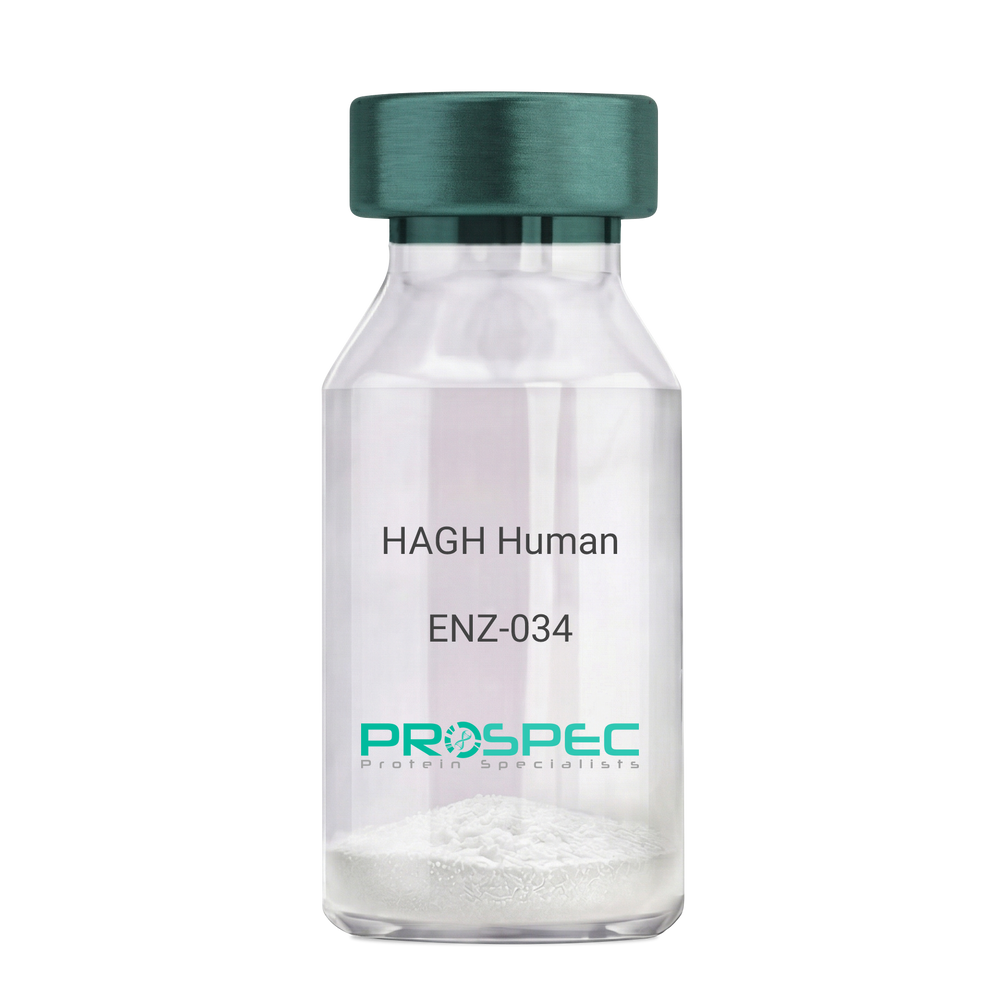
    Name :

    HAGH Human

    Description:

    Hydroxyacylglutathione Hydrolase Human Recombinant

    GLX2, Glyoxalase II, GLO2, Hydroxyacyl Glutathione Hydrolase, HAGH1, GLXII, Hydroxyacylglutathione Hydrolase, hydroxyacylglutathione hydroxylase.

    Product # :

    ENZ-034

    Price :

    Quantity :

    Shipping Method :

    Ice Icon

    Shipped with Ice Packs

    Add To Cart

    More Info

    • description
    • source
    • formulation
    • purity
    • More Info

    Description

    HAGH produced in E.Coli is a single, non-glycosylated polypeptide chain containing 284 amino acids (1-260a.a.) and having a molecular mass of 31.4kDa.HAGH is fused to a 24 amino acid His-tag at N-terminus & purified by proprietary chromatographic techniques.

    Source

    Escherichia Coli.

    Formulation

    The HAGH protein solution (0.5mg/1ml) is formulated in 20mM Tris-HCl Buffer (pH 8.5) and 10% Glycerol.

    Purity

    Greater than 95% as determined by SDS-PAGE.

    More Info

    • Introduction

      HAGH is a part of the glyoxalase family and a thiolesterase which hydrolyses S-lactoyl-glutathione to reduced glutathione and D-lactate. HAGH protein is a detoxifying enzyme of glycolysis byproduct methylglyoxal and a target of p63 and p73 and serves as a pro-survival factor of the p53 family. HAGH appears only as a monomer and binds two zinc ions per subunit.

    • Synonyms

      GLX2, Glyoxalase II, GLO2, Hydroxyacyl Glutathione Hydrolase, HAGH1, GLXII, Hydroxyacylglutathione Hydrolase, hydroxyacylglutathione hydroxylase.

    • Physical Appearance

      Sterile Filtered clear solution.

    • Stability

      Store at 4°C if entire vial will be used within 2-4 weeks. Store, frozen at -20°C for longer periods of time.For long term storage it is recommended to add a carrier protein (0.1% HSA or BSA).Please avoid freeze thaw cycles.

    • Amino Acid Sequence

      MGSSHHHHHH SSGLVPRGSH MGSHMKVEVL PALTDNYMYL VIDDETKEAA IVDPVQPQKV VDAARKHGVK LTTVLTTHHH WDHAGGNEKL VKLESGLKVY GGDDRIGALT HKITHLSTLQ VGSLNVKCLA TPCHTSGHIC YFVSKPGGSE PPAVFTGDTL FVAGCGKFYE GTADEMCKAL LEVLGRLPPD TRVYCGHEYT INNLKFARHV EPGNAAIREK LAWAKEKYSI GEPTVPSTLA EEFTYNPFMR VREKTVQQHA GETDPVTTMR AVRREKDQFK MPRD.

    ProSpec's products are furnished for LABORATORY RESEARCH USE ONLY. The product may not be used as drugs, agricultural or pesticidal products, food additives or household chemicals.

    Hagh Human
  • View Data Sheet

    Name :

    ARG1 Human

    Description:

    Arginase-1 Human Recombinant

    EC 3.5.3.1, Arginase 1, Type I Arginase, Liver-Type Arginase.

    Product # :

    ENZ-517

    Price :

    Quantity :

    Shipping Method :

    Ice Icon

    Shipped with Ice Packs

    Add To Cart

    More Info

    • description
    • source
    • formulation
    • purity
    • More Info

    Description

    ARG1 Human Recombinant produced in E.Coli is a single, non-glycosylated, polypeptide chain containing 330 amino acids (1-322a.a.) and having a molecular mass of 35.8kDa. ARG1 protein is fused to an 8 amino acid His tag at C-terminus and is purified by standard chromatography.

    Source

    Escherichia Coli.

    Formulation

    ARG1 Human protein solution (0.5mg/ml) containing 20mM Tris-HCl pH-8, 2mM DTT, 0.1M NaCl & 20% glycerol.

    Purity

    Greater than 85% as determined by SDS-PAGE.

    More Info

    • Introduction

      ARG1 catalyzes the hydrolysis of arginine to ornithine and urea. 2 isoforms of mammalian arginase exist which vary in their tissue distribution, subcellular localization, immunologic crossreactivity and physiologic role. ARG1 is a cytosolic enzyme and expressed widely in the liver as part of the urea cycle. Inherited deficiency of this ARG1 causes argininemia, which is an autosomal recessive disorder characterized by hyperammonemia.

    • Synonyms

      EC 3.5.3.1, Arginase 1, Type I Arginase, Liver-Type Arginase.

    • Physical Appearance

      Sterile filtered colorless solution.

    • Stability

      Store at 4°C if entire vial will be used within 2-4 weeks. Store, frozen at -20°C for longer periods of time. For long term storage it is recommended to add a carrier protein (0.1% HSA or BSA).Avoid multiple freeze-thaw cycles.

    • Amino Acid Sequence

      MSAKSRTIGI IGAPFSKGQP RGGVEEGPTV LRKAGLLEKL KEQECDVKDY GDLPFADIPN DSPFQIVKNP RSVGKASEQL AGKVAEVKKN GRISLVLGGD HSLAIGSISG HARVHPDLGV IWVDAHTDIN TPLTTTSGNL HGQPVSFLLK ELKGKIPDVP GFSWVTPCIS AKDIVYIGLR DVDPGEHYIL KTLGIKYFSM TEVDRLGIGK VMEETLSYLL GRKKRPIHLS FDVDGLDPSF TPATGTPVVG GLTYREGLYI TEEIYKTGLL SGLDIMEVNP SLGKTPEEVT RTVNTAVAIT LACFGLAREG NHKPIDYLNP PKLEHHHHHH.

    ProSpec's products are furnished for LABORATORY RESEARCH USE ONLY. The product may not be used as drugs, agricultural or pesticidal products, food additives or household chemicals.

    Arg1 Human
  • View Data Sheet

    Name :

    Uricase

    Description:

    Urate Oxidase Recombinant

    Urate Oxidase, Uricase, Urate Oxygen, Oxidoreductase, UOX, UO, EC 1.7.3.

    Product # :

    ENZ-312

    Price :

    Quantity :

    Shipping Method :

    Room Temp Icon

    Shipped at Room temp

    Add To Cart

    More Info

    • description
    • source
    • formulation
    • purity
    • biological activity
    • More Info

    Description

    Urate Oxidase Recombinant produced in E.Coli is a tetrameric, non-glycosylated polypeptide chain containing 302 amino acids, having a molecular formula of C1523H2383N417O462S7 and a molecular mass of 34,247 Dalton.The cDNA coding for urate-oxidase was cloned from a strain of Aspergillus flavus . The monomer protein has no intra- or inter-disulfide bridges.

    Source

    Escherichia Coli.

    Formulation

    Each 1.5mg Uricase contains 5mg sucrose, 25mg glycine, 0.1mg Tween-80, 13.6 mg Na2HPO4*12H20 and 0.33 mg NaH2PO4*2H20.

    Purity

    Greater than 90.0% as determined by SDS-PAGE.

    Biological Activity

    The specific activity was found to be 10U/mg.
    One Unit oxidizes one micromole of uric acid per minute at 25°C, at pH 8.5.

    More Info

    • Introduction

      Urate oxidase catalyzes the enzymatic oxidation (degrades) of uric acid into allantoin, an inactive and soluble metabolite, which is 5 to 10 fold more soluble than uric acid . Urate oxidase is an enzyme of the purine breakdown pathway that catalyses the oxidation of uric acid to allantoin. Uricase is present in numerous diverse organisms, but not in higher primates including human. Hyperuricaemia is most commonly associated with gout and also occurs in mammalians with malignancy, especially those with lymphoid malignancies due to rapid cell turnover and an increased rate of purine metabolism. Uricase is effective in the prevention and treatment of hyperuricaemia in mammalians with malignancy and in those who have undergone transplantation. It appears to act rapidly, safely and induces a more dramatic decrease in plasma levels of uric acid.

    • Synonyms

      Urate Oxidase, Uricase, Urate Oxygen, Oxidoreductase, UOX, UO, EC 1.7.3.

    • Physical Appearance

      Sterile Filtered White lyophilized (freeze-dried) powder.

    • Stability

      Lyophilized Urate Oxidase although stable at room temperature for 3 weeks, should be stored desiccated below -18°C. Upon reconstitution Uricase should be stored at 4°C between 2-7 days and for future use below -18°C.Please prevent freeze-thaw cycles.

    • Solubility

      We highly recommend reconstituting the lyophilized Uricase in 50mM borate buffer containing 0.001%Triton X-100 and 1.0mM EDTA, pH 8.5 for activity assay.

    • Amino Acid Sequence

      msavkaaryg kdnvrvykvh kdektgvqtv yemtvcvlle geietsytka dnsvivatds ikntiyitak qnpvtppelf gsilgthfie kynhihaahv nivchrwtrm didgkphphs firdseekrn vqvdvvegkg idiksslsgl tvlkstnsqf wgflrdeytt lketwdrils tdvdatwqwk nfsglqevrs hvpkfdatwa tarevtlktf aednsasvqa tmykmaeqil arqqlietve yslpnkhyfe idlswhkglq ntgknaevfa pqsdpnglik ctvgrsslks kl.

    ProSpec's products are furnished for LABORATORY RESEARCH USE ONLY. The product may not be used as drugs, agricultural or pesticidal products, food additives or household chemicals.

    Urate Oxidase
  • View Data Sheet

    Name :

    ANSA E.coli

    Description:

    Cytoplasmic L-asparaginase I E.Coli Recombinant

    L-asparaginase 1, L-asparaginase I, L-ASNase I, L-asparagine amidohydrolase I, ansA, b1767, JW1756.

    Product # :

    ENZ-119

    Price :

    Quantity :

    Shipping Method :

    Ice Icon

    Shipped with Ice Packs

    Add To Cart

    More Info

    • description
    • source
    • formulation
    • purity
    • More Info

    Description

    ANSA produced in E.Coli is a single, non-glycosylated polypeptide chain containing 358 amino acids (1-338 a.a.) and having a molecular mass of 39.3kDa.ANSA is fused to a 20 amino acid His-tag at N-terminus & purified by proprietary chromatographic techniques.

    Source

    Escherichia Coli.

    Formulation

    The ANSA solution (1mg/ml) contains 20mM Tris-HCl buffer (pH 8.0), 10% glycerol and 2mM DTT.

    Purity

    Greater than 95.0% as determined by SDS-PAGE.

    More Info

    • Introduction

      AnsA is a cytoplasmic asparaginase from E.coli involved in intracellular asparagine utilization. E.coli has 2 L-asparaginases: the cytoplasmic type I form (ansA) and the periplasmic type II form (ansB). AnsA (Type L asparaginase) is constitutively expressed and is obligatory for the growth of the bacteria on asparagine as the sole nitrogen source.

    • Synonyms

      L-asparaginase 1, L-asparaginase I, L-ASNase I, L-asparagine amidohydrolase I, ansA, b1767, JW1756.

    • Physical Appearance

      Sterile Filtered colorless solution.

    • Stability

      Store at 4°C if entire vial will be used within 2-4 weeks. Store, frozen at -20°C for longer periods of time. For long term storage it is recommended to add a carrier protein (0.1% HSA or BSA).Avoid multiple freeze-thaw cycles.

    • Amino Acid Sequence

      MGSSHHHHHH SSGLVPRGSH MQKKSIYVAY TGGTIGMQRS EQGYIPVSGH LQRQLALMPE FHRPEMPDFT IHEYTPLMDS SDMTPEDWQH IAEDIKAHYD DYDGFVILHG TDTMAYTASA LSFMLENLGK PVIVTGSQIP LAELRSDGQI NLLNALYVAA NYPINEVTLF FNNRLYRGNR TTKAHADGFD AFASPNLPPL LEAGIHIRRL NTPPAPHGEG ELIVHPITPQ PIGVVTIYPG ISADVVRNFL RQPVKALILR SYGVGNAPQN KAFLQELQEA SDRGIVVVNL TQCMSGKVNM GGYATGNALA HAGVIGGADM TVEATLTKLH YLLSQELDTE TIRKAMSQNL RGELTPDD.

    ProSpec's products are furnished for LABORATORY RESEARCH USE ONLY. The product may not be used as drugs, agricultural or pesticidal products, food additives or household chemicals.

    Ansa Ecoli
  • View Data Sheet

    Name :

    MAP E.coli

    Description:

    Methionine Aminopeptidase E.Coli Recombinant

    Methionine aminopeptidase, MAP, Peptidase M, map, b0168, JW0163.

    Product # :

    ENZ-123

    Price :

    Quantity :

    Shipping Method :

    Ice Icon

    Shipped with Ice Packs

    Add To Cart

    More Info

    • description
    • source
    • formulation
    • purity
    • More Info

    Description

    MAP produced in E.Coli is a single, non-glycosylated polypeptide chain containing 284 amino acids (1-264 a.a.) and having a molecular mass of 31.5kDa.MAP is fused to a 20 amino acid His-tag at N-terminus & purified by proprietary chromatographic techniques.

    Source

    Escherichia Coli.

    Formulation

    MAP protein solution (1mg/ml) 20mM Tris-HCl buffer (pH 8.0), 10% glycerol and 2mM DTT.

    Purity

    Greater than 90% as determined by SDS-PAGE.

    More Info

    • Introduction

      Methionine aminopeptidases and designated peptidase M proteins belong to the M24 family of proteins. MAP protein removes the amino-terminal methionine residue from nascent polypeptides. The active site of MAP contains 2 adjacent divalent metal ions connected by a water molecule or hydroxide ion.

    • Synonyms

      Methionine aminopeptidase, MAP, Peptidase M, map, b0168, JW0163.

    • Physical Appearance

      Sterile Filtered clear solution.

    • Stability

      Store at 4°C if entire vial will be used within 2-4 weeks. Store, frozen at -20°C for longer periods of time. For long term storage it is recommended to add a carrier protein (0.1% HSA or BSA).Avoid multiple freeze-thaw cycles.

    • Amino Acid Sequence

      MGSSHHHHHH SSGLVPRGSH MAISIKTPED IEKMRVAGRL AAEVLEMIEP YVKPGVSTGE LDRICNDYIV NEQHAVSACL GYHGYPKSVC ISINEVVCHG IPDDAKLLKD GDIVNIDVTV IKDGFHGDTS KMFIVGKPTI MGERLCRITQ ESLYLALRMV KPGINLREIG AAIQKFVEAE GFSVVREYCG HGIGRGFHEE PQVLHYDSRE TNVVLKPGMT FTIEPMVNAG KKEIRTMKDG WTVKTKDRSL SAQYEHTIVV TDNGCEILTL RKDDTIPAII SHDE.

    ProSpec's products are furnished for LABORATORY RESEARCH USE ONLY. The product may not be used as drugs, agricultural or pesticidal products, food additives or household chemicals.

    Map Ecoli
  • View Data Sheet

    Name :

    ODC1 Human

    Description:

    Ornithine Decarboxylase 1 Human Recombinant

    ODC, Ornithine decarboxylase 1, EC 4.1.1.17.

    Product # :

    ENZ-181

    Price :

    Quantity :

    Shipping Method :

    Ice Icon

    Shipped with Ice Packs

    Add To Cart

    More Info

    • description
    • source
    • formulation
    • purity
    • More Info

    Description

    ODC1 Human Recombinant produced in E.coli is a single, non-glycosylated polypeptide chain containing 484 amino acids (1-461) and having a molecular mass of 53.5 kDa.ODC1 is fused to a 23 amino acid His-tag at N-terminus & purified by proprietary chromatographic techniques.

    Source

    E.coli.

    Formulation

    The ODC1 solution (0.5mg/ml) contains 20mM Tris-HCl buffer (pH 8.0), 1mM DTT, 0.1M NaCl and 10% glycerol.

    Purity

    Greater than 95% as determined by SDS-PAGE.

    More Info

    • Introduction

      Ornithine decarboxylase is the preliminary and rate-limiting enzyme in the biosynthetic pathway of polyamines and it takes part in the alteration of ornithine to putrescine. ODC1 is a key member of various biological processes, such as cell growth, transformation, differentiation and apoptosis. Overexpression of the ODC1 gene has a vital part in cell proliferation and the progress of cancer.

    • Synonyms

      ODC, Ornithine decarboxylase 1, EC 4.1.1.17.

    • Physical Appearance

      Sterile Filtered colorless solution.

    • Stability

      Store at 4°C if entire vial will be used within 2-4 weeks. Store, frozen at -20°C for longer periods of time. For long term storage it is recommended to add a carrier protein (0.1% HSA or BSA).Avoid multiple freeze-thaw cycles.

    • Amino Acid Sequence

      MGSSHHHHHH SSGLVPRGSH MGSMNNFGNE EFDCHFLDEG FTAKDILDQK INEVSSSDDK DAFYVADLGD ILKKHLRWLK ALPRVTPFYA VKCNDSKAIV KTLAATGTGF DCASKTEIQL VQSLGVPPER IIYANPCKQV SQIKYAANNG VQMMTFDSEV ELMKVARAHP KAKLVLRIAT DDSKAVCRLS VKFGATLRTS RLLLERAKEL NIDVVGVSFH VGSGCTDPET FVQAISDARC VFDMGAEVGF SMYLLDIGGG FPGSEDVKLK FEEITGVINP ALDKYFPSDS GVRIIAEPGR YYVASAFTLA VNIIAKKIVL KEQTGSDDED ESSEQTFMYY VNDGVYGSFN CILYDHAHVK PLLQKRPKPD EKYYSSSIWG PTCDGLDRIV ERCDLPEMHV GDWMLFENMG AYTVAAASTF NGFQRPTIYY VMSGPAWQLM QQFQNPDFPP EVEEQDASTL PVSCAWESGM KRHRAACASA SINV

    ProSpec's products are furnished for LABORATORY RESEARCH USE ONLY. The product may not be used as drugs, agricultural or pesticidal products, food additives or household chemicals.

    Odc1 Human
  • View Data Sheet

    Name :

    C1GALT1 Human

    Description:

    Core 1 Beta3-Gal-T1 Human Recombinant

    Core 1 Synthase, Glycoprotein-N-Acetylgalactosamine 3-Beta-Galactosyltransferase 1, Core 1 Beta3-Gal-T1, Core 1 O-Glycan T-Synthase, Core 1 UDP-Galactose:N-Acetylgalactosamine-Alpha-R Beta 1,3 Galactosyltransferase 1, B3Gal-T8, EC 2.4.1.122, Core 1 Beta3-Gal-T, C1GALT, T-synthase, Glycoprotein-N-Acetylgalactosamine 3-Beta-Galactosyltransferase 1, Beta-1,3-galactosyltransferase, C1GalT1, Core 1 Beta1,3-Galactosyltransferase 1.

    Product # :

    ENZ-721

    Price :

    Quantity :

    Shipping Method :

    Ice Icon

    Shipped with Ice Packs

    Add To Cart

    More Info

    • description
    • source
    • formulation
    • purity
    • More Info

    Description

    C1GALT1 Human Recombinant produced in E.Coli is a single, non-glycosylated polypeptide chain containing 357 amino acids (30-363 a.a) and having a molecular mass of 41.4kDa.C1GALT1 is fused to a 23 amino acid His-tag at N-terminus & purified by proprietary chromatographic techniques.

    Source

    Escherichia Coli.

    Formulation

    C1GALT1 protein solution (0.5mg/ml) containing 20mM Tris-HCl buffer (pH 8.0), 0.15M NaCl, 20% glycerol and 1mM DTT.

    Purity

    Greater than 80.0% as determined by SDS-PAGE.

    More Info

    • Introduction

      Core 1 Beta3-Gal-T1 also known as,C1GALT1 creates the common core 1 O-glycan structure, Gal-beta-1-3GalNAc-R, by the transfer of Gal from UDP-Gal to GalNAc-alpha-1-R. Core 1 is a precursor for lots of extended mucin-type O-glycans on cell surface and secreted glycoproteins. Studies in mice have shown that this gene takes a main role in angiogenesis, thrombopoiesis and kidney homeostasis.

    • Synonyms

      Core 1 Synthase, Glycoprotein-N-Acetylgalactosamine 3-Beta-Galactosyltransferase 1, Core 1 Beta3-Gal-T1, Core 1 O-Glycan T-Synthase, Core 1 UDP-Galactose:N-Acetylgalactosamine-Alpha-R Beta 1,3 Galactosyltransferase 1, B3Gal-T8, EC 2.4.1.122, Core 1 Beta3-Gal-T, C1GALT, T-synthase, Glycoprotein-N-Acetylgalactosamine 3-Beta-Galactosyltransferase 1, Beta-1,3-galactosyltransferase, C1GalT1, Core 1 Beta1,3-Galactosyltransferase 1.

    • Physical Appearance

      Sterile Filtered clear solution.

    • Stability

      Store at 4°C if entire vial will be used within 2-4 weeks. Store, frozen at -20°C for longer periods of time. For long term storage it is recommended to add a carrier protein (0.1% HSA or BSA).Avoid multiple freeze-thaw cycles.

    • Amino Acid Sequence

      MGSSHHHHHH SSGLVPRGSH MGSLLGEKVD TQPNVLHNDP HARHSDDNGQ NHLEGQMNFN ADSSQHKDEN TDIAENLYQK VRILCWVMTG PQNLEKKAKH VKATWAQRCN KVLFMSSEEN KDFPAVGLKT KEGRDQLYWK TIKAFQYVHE HYLEDADWFL KADDDTYVIL DNLRWLLSKY DPEEPIYFGR RFKPYVKQGY MSGGAGYVLS KEALKRFVDA FKTDKCTHSS SIEDLALGRC MEIMNVEAGD SRDTIGKETF HPFVPEHHLI KGYLPRTFWY WNYNYYPPVE GPGCCSDLAV SFHYVDSTTM YELEYLVYHL RPYGYLYRYQ PTLPERILKE ISQANKNEDT KVKLGNP.

    ProSpec's products are furnished for LABORATORY RESEARCH USE ONLY. The product may not be used as drugs, agricultural or pesticidal products, food additives or household chemicals.

    C1Galt1 Human
  • View Data Sheet

    Name :

    LGMN Human

    Description:

    Legumain Human Recombinant

    Legumain, PRSC1, Protease, Cysteine, 1 (Legumain), Asparaginyl Endopeptidase, Protease, Cysteine 1, EC 3.4.22.34, Cysteine Protease 1, LGMN1, AEP.

    Product # :

    ENZ-923

    Price :

    Quantity :

    Shipping Method :

    Ice Icon

    Shipped with Ice Packs

    Add To Cart

    More Info

    • description
    • source
    • formulation
    • purity
    • More Info
    • sds-page

    Description

    LGMN produced in Sf9 Baculovirus cells is a single, glycosylated polypeptide chain (18-433 a.a.) and fused to a 6 aa His Tag at C-terminus containing a total of 422 amino acids and having a molecular mass of 48.4kDa (Molecular size on SDS-PAGE will appear at approximately 40-57kDa).LGMN is purified by proprietary chromatographic techniques.

    Source

    Sf9, Baculovirus cells.

    Formulation

    LGMN protein solution (1mg/ml) contains Phosphate buffered saline (pH7.4) and 10% glycerol.

    Purity

    Greater than 95.0% as determined by SDS-PAGE.

    sds-page

    lgmn human sds-page - Product image 1

    More Info

    • Introduction

      Legumain, also known as LGMN, is a cysteine endopeptidase which demonstrates strict specificity for hydrolysis of asparaginyl bonds. Furthermore, LGMN can also cleave aspartyl bonds slowly, in particular under acidic conditions. LGMN plays an essential role in the endosomal/lysosomal degradation system as the Legumain deficiency causes the accumulation of pro cathepsins B, H & L, another group of lysosomal cysteine proteases. Furthermore, over expression of LGMN in tumors is important for invasion/metastasis.

    • Synonyms

      Legumain, PRSC1, Protease, Cysteine, 1 (Legumain), Asparaginyl Endopeptidase, Protease, Cysteine 1, EC 3.4.22.34, Cysteine Protease 1, LGMN1, AEP.

    • Physical Appearance

      Sterile filtered colorless solution.

    • Stability

      Store at 4°C if entire vial will be used within 2-4 weeks. Store, frozen at -20°C for longer periods of time. For long term storage it is recommended to add a carrier protein (0.1% HSA or BSA).Avoid multiple freeze-thaw cycles.

    • Amino Acid Sequence

      VPIDDPEDGG KHWVVIVAGS NGWYNYRHQA DACHAYQIIH RNGIPDEQIV VMMYDDIAYS EDNPTPGIVI NRPNGTDVYQ GVPKDYTGED VTPQNFLAVL RGDAEAVKGI GSGKVLKSGP QDHVFIYFTD HGSTGILVFP NEDLHVKDLN ETIHYMYKHK MYRKMVFYIE ACESGSMMNH LPDNINVYAT TAANPRESSY ACYYDEKRST YLGDWYSVNW MEDSDVEDLT KETLHKQYHL VKSHTNTSHV MQYGNKTIST MKVMQFQGMK RKASSPVPLP PVTHLDLTPS PDVPLTIMKR KLMNTNDLEE SRQLTEEIQR HLDARHLIEK SVRKIVSLLA ASEAEVEQLL SERAPLTGHS CYPEALLHFR THCFNWHSPT YEYALRHLYV LVNLCEKPYP LHRIKLSMDH VCLGHYHHHH HH.

    ProSpec's products are furnished for LABORATORY RESEARCH USE ONLY. The product may not be used as drugs, agricultural or pesticidal products, food additives or household chemicals.

    Lgmn Human
  • View Data Sheet

    Name :

    FUT7 Human

    Description:

    Fucosyltransferase 7 Human Recombinant

    Fucosyltransferase 7 (Alpha (1,3) Fucosyltransferase), Fucosyltransferase VII, Galactoside 3-L-Fucosyltransferase, Selectin Ligand Synthase, FucT-VII, Fuc-TVII, FUT7, Alpha-(1,3)-Fucosyltransferase 7, Selectin-Ligand Synthase, EC 2.4.1.-, Fuc-TVII, Fucosyltransferase 7, EC 2.4.1, EC 2.4.1.65.

    Product # :

    ENZ-784

    Price :

    Quantity :

    Shipping Method :

    Ice Icon

    Shipped with Ice Packs

    Add To Cart

    More Info

    • description
    • source
    • formulation
    • purity
    • More Info

    Description

    FUT7 Human Recombinant produced in E.coli is a single, non-glycosylated polypeptide chain containing 329 amino acids (37-342) and having a molecular mass of 37.9kDa.FUT7 is fused to a 23 amino acid His-tag at N-terminus & purified by proprietary chromatographic techniques.

    Source

    Escherichia Coli.

    Formulation

    The FUT7 solution (0.25mg/ml) contains 20mM Tris-HCl buffer (pH 8.0), 0.4M Urea and 10% glycerol.

    Purity

    Greater than 85.0% as determined by SDS-PAGE.

    More Info

    • Introduction

      Fucosyltransferase 7 (FUT7) is a golgi stack membrane protein which is involved in the creation of sialyl-Lewis X antigens. The FUT7 protein leads the synthesis of the E-selectin-binding sialyl-Lewis X moiety. FUT7 catalyzes alpha-1,3 glycosidic linkages involved in the expression of sialyl Lewis X antigens.

    • Synonyms

      Fucosyltransferase 7 (Alpha (1,3) Fucosyltransferase), Fucosyltransferase VII, Galactoside 3-L-Fucosyltransferase, Selectin Ligand Synthase, FucT-VII, Fuc-TVII, FUT7, Alpha-(1,3)-Fucosyltransferase 7, Selectin-Ligand Synthase, EC 2.4.1.-, Fuc-TVII, Fucosyltransferase 7, EC 2.4.1, EC 2.4.1.65.

    • Physical Appearance

      Sterile Filtered colorless solution.

    • Stability

      Store at 4°C if entire vial will be used within 2-4 weeks. Store, frozen at -20°C for longer periods of time. For long term storage it is recommended to add a carrier protein (0.1% HSA or BSA).Avoid multiple freeze-thaw cycles.

    • Amino Acid Sequence

      MGSSHHHHHH SSGLVPRGSH MGSPRGTPAP QPTITILVWH WPFTDQPPEL PSDTCTRYGI ARCHLSANRS LLASADAVVF HHRELQTRRS HLPLAQRPRG QPWVWASMES PSHTHGLSHL RGIFNWVLSY RRDSDIFVPY GRLEPHWGPS PPLPAKSRVA AWVVSNFQER QLRARLYRQL APHLRVDVFG RANGRPLCAS CLVPTVAQYR FYLSFENSQH RDYITEKFWR NALVAGTVPV VLGPPRATYE AFVPADAFVH VDDFGSAREL AAFLTGMNES RYQRFFAWRD RLRVRLFTDW RERFCAICDR YPHLPRSQVY EDLEGWFQA.

    ProSpec's products are furnished for LABORATORY RESEARCH USE ONLY. The product may not be used as drugs, agricultural or pesticidal products, food additives or household chemicals.

    Fut7 Human
  • View Data Sheet

    Name :

    PHPT1 Human

    Description:

    Phosphohistidine Phosphatase 1 Human Recombinant

    PHP14, CGI-202, HSPC141, Phosphohistidine Phosphatase 1, Phosphohistidine Phosphatase 14kDa, Protein janus-A homolog, Sex-regulated protein Janus-a.

    Product # :

    ENZ-012

    Price :

    Quantity :

    Shipping Method :

    Ice Icon

    Shipped with Ice Packs

    Add To Cart

    More Info

    • description
    • source
    • formulation
    • purity
    • More Info

    Description

    PHPT1 produced in E.Coli is a single, non-glycosylated polypeptide chain containing 145 amino acids (1-125a.a.) and having a molecular mass of 15.9kDa.PHPT1 is fused to a 20 amino acid His-tag at N-terminus & purified by proprietary chromatographic techniques.

    Source

    Escherichia Coli.

    Formulation

    The PHPT1 protein solution (0.5mg/1ml) is formulated in 20 mM Tris-HCl buffer (pH8.0) 0.2M NaCl, 2mM DTT and 10% glycerol.

    Purity

    Greater than 95% as determined by SDS-PAGE.

    More Info

    • Introduction

      PHPT1 is a member of the Janus protein familyand is 125 amino acid long. PHPT1 appears as a monomer in the cytoplasm and is an EDTA-insensitive phosphohistidine phosphatase. Overexpression of PHPT1 resolts in specific phosphohistidine phosphatase activity towards phosphopeptide I, with no activity detected towards phosphotyrosine, phosphothreonine and phosphoserine peptides.

    • Synonyms

      PHP14, CGI-202, HSPC141, Phosphohistidine Phosphatase 1, Phosphohistidine Phosphatase 14kDa, Protein janus-A homolog, Sex-regulated protein Janus-a.

    • Physical Appearance

      Sterile Filtered clear solution.

    • Stability

      Store at 4°C if entire vial will be used within 2-4 weeks. Store, frozen at -20°C for longer periods of time. For long term storage it is recommended to add a carrier protein (0.1% HSA or BSA).Avoid multiple freeze-thaw cycles.

    • Amino Acid Sequence

      MGSSHHHHHH SSGLVPRGSH MAVADLALIP DVDIDSDGVF KYVLIRVHSA PRSGAPAAES KEIVRGYKWA EYHADIYDKV SGDMQKQGCD CECLGGGRIS HQSQDKKIHV YGYSMAYGPA QHAISTEKIK AKYPDYEVTW ANDGY

    ProSpec's products are furnished for LABORATORY RESEARCH USE ONLY. The product may not be used as drugs, agricultural or pesticidal products, food additives or household chemicals.

    Phpt1 Human
  • View Data Sheet

    Name :

    GCLM Human

    Description:

    Glutamate-Cysteine Ligase, Modifier Subunit Human Recombinant

    Glutamate--cysteine ligase regulatory subunit, GCS light chain, Gamma-ECS regulatory subunit, Gamma-glutamylcysteine synthetase regulatory subunit, Glutamate--cysteine ligase modifier subunit, GCLM, GLCLR.

    Product # :

    ENZ-636

    Price :

    Quantity :

    Shipping Method :

    Ice Icon

    Shipped with Ice Packs

    Add To Cart

    More Info

    • description
    • source
    • formulation
    • purity
    • More Info

    Description

    GCLM Human Recombinant produced in E. coli is a single polypeptide chain containing 298 amino acids (1-274) and having a molecular mass of 33.3kDa.GCLM is fused to a 24 amino acid His-tag at N-terminus & purified by proprietary chromatographic techniques.

    Source

    Escherichia Coli.

    Formulation

    The GCLM solution (1mg/ml) contains 20mM Tris-HCl buffer (pH8.0), 10% glycerol and 0.15M NaCl.

    Purity

    Greater than 90.0% as determined by SDS-PAGE.

    More Info

    • Introduction

      Glutamate-cysteine ligase (GCLM) is the first rate limiting enzyme of glutathione synthesis. The GCLM enzyme is comprised of 2 subunits, a heavy catalytic subunit and a light regulatory subunit. GCLM deficiency is associated with some forms of hemolytic anemia.

    • Synonyms

      Glutamate--cysteine ligase regulatory subunit, GCS light chain, Gamma-ECS regulatory subunit, Gamma-glutamylcysteine synthetase regulatory subunit, Glutamate--cysteine ligase modifier subunit, GCLM, GLCLR.

    • Physical Appearance

      Sterile Filtered colorless solution.

    • Stability

      Store at 4°C if entire vial will be used within 2-4 weeks. Store, frozen at -20°C for longer periods of time. For long term storage it is recommended to add a carrier protein (0.1% HSA or BSA).Avoid multiple freeze-thaw cycles.

    • Amino Acid Sequence

      MGSSHHHHHH SSGLVPRGSH MGSHMGTDSR AAKALLARAR TLHLQTGNLL NWGRLRKKCP STHSEELHDC IQKTLNEWSS QINPDLVREF PDVLECTVSH AVEKINPDER EEMKVSAKLF IVESNSSSST RSAVDMACSV LGVAQLDSVI IASPPIEDGV NLSLEHLQPY WEELENLVQS KKIVAIGTSD LDKTQLEQLY QWAQVKPNSN QVNLASCCVM PPDLTAFAKQ FDIQLLTHND PKELLSEASF QEALQESIPD IQAHEWVPLW LLRYSVIVKS RGIIKSKGYI LQAKRRGS.

    ProSpec's products are furnished for LABORATORY RESEARCH USE ONLY. The product may not be used as drugs, agricultural or pesticidal products, food additives or household chemicals.

    Gclm Human
  • View Data Sheet

    Name :

    CCL20 Mouse

    Description:

    Macrophage Inflammatory Protein-3 alpha Mouse Recombinant (CCL20)

    Small inducible cytokine A20 precursor, CCL20, Macrophage inflammatory protein 3 alpha, MIP-3-alpha, Liver and activation- regulated chemokine, CC chemokine LARC, Beta chemokine exodus-1, CKb4, LARC, ST38, MIP3A, MIP-3a, SCYA20, C-C motif chemokine 20, CC chemokine ST38, exodus-1.

    Product # :

    CHM-236

    Price :

    Quantity :

    Shipping Method :

    Room Temp Icon

    Shipped at Room temp

    Add To Cart

    More Info

    • description
    • source
    • formulation
    • purity
    • biological activity
    • More Info

    Description

    Macrophage Inflammatory Protein-3 alpha Mouse Recombinant produced in E.Coli is a single, non-glycosylated, polypeptide chain containing 70 amino acids and having a molecular mass of 7.9 kDa. The MIP-3a is purified by proprietary chromatographic techniques.

    Source

    Escherichia Coli.

    Formulation

    Lyophilized from a concentrated (1mg/ml) solution in water containing no additives.

    Purity

    Greater than 95.0% as determined by(a) Analysis by RP-HPLC.
    (b) Analysis by SDS-PAGE.

    Biological Activity

    The Activity is calculated by its ability to chemoattract primary human T cells at 2-20ng/ml, corresponding to a specific activity of 50,000-500,000 units/mg.

    More Info

    • Introduction

      CCL20 is a chemotactic factor that draws lymphocytes & neutrophils, rather than monocytes. MIP-3 alpha inhibits proliferation of myeloid progenitors in colony formation assays. MIP3A plays a role in the formation and function of the mucosal lymphoid tissues by attracting lymphocytes and dendritic cells towards epithelial cells. C-terminal processed forms have been shown to be equally chemotactically active for leukocytes. CCL20 holdes antibacterial activity e.coli atcc 25922 and s.aureus atcc 29213. CCL20 gene transcription is activated by H. pylori, which activates NF-kappaB through intracellular signal pathway which involves IkappaB kinase and NF-kappaB-inducing kinase. MIP-3 alpha is invloved in chemokine-mediated lymphocyte trafficking during gastric inflammation in Helicobacter infection. CCL20 expression is involved in the recruitment of CD45R0-positive T cell subsets into the intestinal lamina propria.
      MIP-3A is in charge of the advancement of pulpal inflammation through the recruitment of C-C motif Receptor 6-expressing lymphocytes Vaginal epithelial cells respond to factors present in semen by secreting MIP-3 alpha, which increases langerhans cells recruitment during HIV transmission.

    • Synonyms

      Small inducible cytokine A20 precursor, CCL20, Macrophage inflammatory protein 3 alpha, MIP-3-alpha, Liver and activation- regulated chemokine, CC chemokine LARC, Beta chemokine exodus-1, CKb4, LARC, ST38, MIP3A, MIP-3a, SCYA20, C-C motif chemokine 20, CC chemokine ST38, exodus-1.

    • Physical Appearance

      Sterile Filtered White lyophilized (freeze-dried) powder.

    • Stability

      Lyophilized MIP-3a although stable at room temperature for 3 weeks, should be stored desiccated below -18°C. Upon reconstitution CCL-20 should be stored at 4°C between 2-7 days and for future use below -18°C.For long term storage it is recommended to add a carrier protein (0.1% HSA or BSA).Please prevent freeze-thaw cycles.

    • Solubility

      It is recommended to reconstitute the lyophilized MIP-3a in sterile 18MΩ-cm H2O not less than 100µg/ml, which can then be further diluted to other aqueous solutions.

    • Amino Acid Sequence

      ASNYDCCLSY IQTPLPSRAI VGFTRQMADE ACDINAIIFH TKKRKSVCAD PKQNWVKRAV NLLSLRVKKM.

    • Background

      What is the molecular weight/Mw of CCL20 MOUSE Protein?
      CCL20 MOUSE Protein has a total Mw of 7.9kDa.

      What is the source or expression system of CCL20 MOUSE Protein?
      Escherichia Coli.

      What is the Purity of CCL20 MOUSE Protein?
      CCL20 MOUSE Protein is > 95% pure as determined by SDS-PAGE.

      What is the Biological Activity of CCL20 MOUSE Protein?
      The Activity is calculated by its ability to chemoattract primary human T cells at 2-20ng/ml, corresponding to a specific activity of 50,000-500,000 units/mg.

      What is the amino acid sequence of CCL20 MOUSE Protein?
      ASNYDCCLSY IQTPLPSRAI VGFTRQMADE ACDINAIIFH TKKRKSVCAD PKQNWVKRAV NLLSLRVKKM.

      What applications can CCL20 MOUSE Protein be used in?
      CCL20 MOUSE Protein can probably be used in western blot, ELISA and Lateral Flow.

      What is the endotoxin level for CCL20 MOUSE Protein?
      The endotoxin level is minimal, CCL20 MOUSE Protein was purified using conventional chromatography techniques.


    ProSpec's products are furnished for LABORATORY RESEARCH USE ONLY. The product may not be used as drugs, agricultural or pesticidal products, food additives or household chemicals.

    Mip 3A Mouse
  • 1
  • …
  • 3
  • 4
  • 5
  • 6
  • 7
  • …
  • 42
Your browser does not support the video tag.

Products

  • Cytokines
  • Growth Factors
  • Chemokines
  • CD Antigens
  • Neurotrophins
  • Hormones
  • Enzymes
  • Viral Antigens
  • Recombinant Proteins
  • Natural Proteins
  • Monoclonal Antibodies
  • Polyclonal Antibodies
  • Thermal Packaging

About

  • Company
  • Founder
  • Contribution
  • Contact Us
  • My Account

Ordering

  • Ordering Method
  • Ordering - Credit Card
  • Ordering PO
  • Shipping Fees
  • FAQ's

Legal

  • Terms & Conditions
  • Privacy
  • Site Map
  • info@prospecbio.com
  • Facebook
  • Instagram
  • Linkedin Profile

© 2026 ProSpec-Tany TechnoGene Ltd. All Rights Reserved.

  • Choosing a selection results in a full page refresh.
  • Opens in a new window.