Skip to content

High-quality research proteins.

  • 1-800-805-6531

  • Mon - Sat 8.00-18.00, Sun - Closed

  • info@prospecbio.com

  • PO Box 6591 East Brunswick NJ 08816

  • Products
    • Cytokines
    • Growth factors
    • Chemokines
    • Cd antigens
    • Neurotrophins
    • Hormones
    • Enzymes
    • Viral antigens
    • Recombinant proteins
    • Natural proteins
    • Monoclonal antibodies
    • Polyclonal antibodies
    • Thermal Packaging
  • About
    • Company
    • Founder
    • Contribution
  • Customers
    • Eastern Asia
    • Eastern Europe
    • North America
    • South America
    • South East Asia
    • Southern Asia
    • Western Europe
  • Ordering
    • Ordering Method
    • Ordering - Credit Card
    • Ordering - PO
    • Shipping Fees
    • FAQs
  • Services
    • DNA Cloning
    • Protein Expression
    • Monoclonal Antibody
    • Fermentation
    • Technology License
  • Contact us
Log in

Country/region

  • USD $ | Albania
  • USD $ | Andorra
  • USD $ | Argentina
  • USD $ | Armenia
  • USD $ | Australia
  • USD $ | Austria
  • USD $ | Azerbaijan
  • USD $ | Belarus
  • USD $ | Belgium
  • USD $ | Bolivia
  • USD $ | Brazil
  • USD $ | Bulgaria
  • USD $ | Cambodia
  • USD $ | Canada
  • USD $ | Chile
  • USD $ | China
  • USD $ | Colombia
  • USD $ | Costa Rica
  • USD $ | Croatia
  • USD $ | Cyprus
  • USD $ | Czechia
  • USD $ | Denmark
  • USD $ | Estonia
  • USD $ | Finland
  • USD $ | France
  • USD $ | Georgia
  • USD $ | Germany
  • USD $ | Greece
  • USD $ | Hong Kong SAR
  • USD $ | Hungary
  • USD $ | Iceland
  • USD $ | India
  • USD $ | Ireland
  • USD $ | Israel
  • USD $ | Italy
  • USD $ | Japan
  • USD $ | Kazakhstan
  • USD $ | Latvia
  • USD $ | Liechtenstein
  • USD $ | Lithuania
  • USD $ | Madagascar
  • USD $ | Malta
  • USD $ | Mexico
  • USD $ | Moldova
  • USD $ | Monaco
  • USD $ | Netherlands
  • USD $ | New Zealand
  • USD $ | North Macedonia
  • USD $ | Norway
  • USD $ | Panama
  • USD $ | Paraguay
  • USD $ | Peru
  • USD $ | Philippines
  • USD $ | Poland
  • USD $ | Portugal
  • USD $ | Romania
  • USD $ | Singapore
  • USD $ | Slovakia
  • USD $ | Slovenia
  • USD $ | South Africa
  • USD $ | South Korea
  • USD $ | Spain
  • USD $ | Sri Lanka
  • USD $ | Sweden
  • USD $ | Switzerland
  • USD $ | Taiwan
  • USD $ | Thailand
  • USD $ | Türkiye
  • USD $ | Ukraine
  • USD $ | United Kingdom
  • USD $ | United States
  • USD $ | Uruguay
  • USD $ | Vatican City
  • USD $ | Venezuela
  • USD $ | Vietnam
  • Facebook
  • Instagram
logoProSpec - Recombinant Protein Manufacturer for academic and R&D industry
Become a distributor
Account Log in
Wishlist
Cart Cart(0)
  • Products
    +
    • Cytokines
    • Growth factors
    • Chemokines
    • Cd antigens
    • Neurotrophins
    • Hormones
    • Enzymes
    • Viral antigens
    • Recombinant proteins
    • Natural proteins
    • Monoclonal antibodies
    • Polyclonal antibodies
    • Thermal Packaging
  • About
    +
    • Company
    • Founder
    • Contribution
  • Customers
    +
    • Eastern Asia
    • Eastern Europe
    • North America
    • South America
    • South East Asia
    • Southern Asia
    • Western Europe
  • Ordering
    +
    • Ordering Method
    • Ordering - Credit Card
    • Ordering - PO
    • Shipping Fees
    • FAQs
  • Services
    +
    • DNA Cloning
    • Protein Expression
    • Monoclonal Antibody
    • Fermentation
    • Technology License
  • Contact us

Item added to your cart

View cart
View All
  • Cytokines
  • Growth factors
  • Chemokines
  • Cd antigens
  • Neurotrophins
  • Hormones
  • Enzymes
  • Viral antigens
  • Recombinant proteins
  • Natural proteins
  • Monoclonal antibodies
  • Polyclonal antibodies
  • Thermal Packaging
  • Tumor Necrosis Factor

    Tumor Necrosis Factor

    View All
  • 4-1BB

    4-1BB

    View All
  • Adiponectin

    Adiponectin

    View All
  • AIF1

    AIF1

    View All
  • Other Cytokines

    Other Cytokines

    View All
  • AITRL

    AITRL

    View All
  • Angiopoietin

    Angiopoietin

    View All
  • Apolipoprotein

    Apolipoprotein

    View All
  • B-Cell Activating Factor

    B-Cell Activating Factor

    View All
  • Beta Defensin

    Beta Defensin

    View All
  • Bone Morphogenetic Protein

    Bone Morphogenetic Protein

    View All
  • B type Natriuretic Peptide

    B type Natriuretic Peptide

    View All
  • BST

    BST

    View All
  • Betacellulin

    Betacellulin

    View All
  • Cardiotrophin

    Cardiotrophin

    View All
  • Activin

    Activin

    View All
  • Fibroblast Growth Factor

    Fibroblast Growth Factor

    View All
  • Other Growth Factors

    Other Growth Factors

    View All
  • CSF

    CSF

    View All
  • CTGF

    CTGF

    View All
  • IGFBP

    IGFBP

    View All
  • VEGF Protein

    VEGF Protein

    View All
  • EGF

    EGF

    View All
  • Epigen

    Epigen

    View All
  • Erythropoietin

    Erythropoietin

    View All
  • Insulin-Like Growth Factor

    Insulin-Like Growth Factor

    View All
  • Growth Hormone

    Growth Hormone

    View All
  • HDGF

    HDGF

    View All
  • Hepatocyte Growth Factor

    Hepatocyte Growth Factor

    View All
  • Insulin

    Insulin

    View All
  • BCA-1/ BLC (CXCL13)

    BCA-1/ BLC (CXCL13)

    View All
  • BRAK (CXCL14)

    BRAK (CXCL14)

    View All
  • C-10 (CCL6)

    C-10 (CCL6)

    View All
  • Other Chemokines

    Other Chemokines

    View All
  • MEC (CCL28)

    MEC (CCL28)

    View All
  • LD78-beta (CCL3L1)

    LD78-beta (CCL3L1)

    View All
  • CTACK (CCL27)

    CTACK (CCL27)

    View All
  • CXCL16

    CXCL16

    View All
  • CXCL17

    CXCL17

    View All
  • Platelet Factor-4 (CXCL4)

    Platelet Factor-4 (CXCL4)

    View All
  • ENA-78 (CXCL5)

    ENA-78 (CXCL5)

    View All
  • Eotaxin (CCL11,24,26)

    Eotaxin (CCL11,24,26)

    View All
  • Exodus-2 (CCL21)

    Exodus-2 (CCL21)

    View All
  • Fractalkine (CX3CL1)

    Fractalkine (CX3CL1)

    View All
  • CXCL6

    CXCL6

    View All
  • Other CD Antigens

    Other CD Antigens

    View All
  • CD14

    CD14

    View All
  • CD164

    CD164

    View All
  • CD1

    CD1

    View All
  • CD2

    CD2

    View All
  • CD200

    CD200

    View All
  • CD207

    CD207

    View All
  • CD226

    CD226

    View All
  • CD23

    CD23

    View All
  • CD244

    CD244

    View All
  • CD247

    CD247

    View All
  • CD27

    CD27

    View All
  • CD274

    CD274

    View All
  • CD300

    CD300

    View All
  • CD33

    CD33

    View All
  • Other Neurotrophins

    Other Neurotrophins

    View All
  • Beta-NGF

    Beta-NGF

    View All
  • BDNF

    BDNF

    View All
  • CDNF

    CDNF

    View All
  • CNTF

    CNTF

    View All
  • GDNF

    GDNF

    View All
  • Glia Maturation Factor

    Glia Maturation Factor

    View All
  • MANF

    MANF

    View All
  • Midkine

    Midkine

    View All
  • Neuroglobin

    Neuroglobin

    View All
  • Neurotrophic factors

    Neurotrophic factors

    View All
  • Neuregulin

    Neuregulin

    View All
  • Neuropilin

    Neuropilin

    View All
  • Pigment Epithelium-Derived Factor

    Pigment Epithelium-Derived Factor

    View All
  • Pleiotrophin

    Pleiotrophin

    View All
  • Peptide Hormones

    Peptide Hormones

    View All
  • Other Hormones

    Other Hormones

    View All
  • HCG

    HCG

    View All
  • Endothelin

    Endothelin

    View All
  • Exendin

    Exendin

    View All
  • FSH

    FSH

    View All
  • Glucagon

    Glucagon

    View All
  • GHRP

    GHRP

    View All
  • GLP

    GLP

    View All
  • Thyrostimulin

    Thyrostimulin

    View All
  • Inhibin A

    Inhibin A

    View All
  • LHRH

    LHRH

    View All
  • Melanotan

    Melanotan

    View All
  • Procalcitonin

    Procalcitonin

    View All
  • PTH

    PTH

    View All
  • Peroxiredoxin

    Peroxiredoxin

    View All
  • Peptidase

    Peptidase

    View All
  • Synthetase

    Synthetase

    View All
  • Transferase

    Transferase

    View All
  • Hydrolase

    Hydrolase

    View All
  • Dehydrogenase

    Dehydrogenase

    View All
  • ACE2

    ACE2

    View All
  • Esterase

    Esterase

    View All
  • Protein Kinases

    Protein Kinases

    View All
  • Other Enzymes

    Other Enzymes

    View All
  • Phosphatase

    Phosphatase

    View All
  • Deaminase

    Deaminase

    View All
  • Oxygenase

    Oxygenase

    View All
  • Adenylate Kinase

    Adenylate Kinase

    View All
  • Lyase

    Lyase

    View All
  • Chagas

    Chagas

    View All
  • SARS

    SARS

    View All
  • Influenza

    Influenza

    View All
  • ASFV

    ASFV

    View All
  • Astrovirus

    Astrovirus

    View All
  • Borrelia

    Borrelia

    View All
  • Helicobacter Pylori

    Helicobacter Pylori

    View All
  • Chikungunya

    Chikungunya

    View All
  • Chlamydia

    Chlamydia

    View All
  • Cytomegalo

    Cytomegalo

    View All
  • Dengue

    Dengue

    View All
  • EBV

    EBV

    View All
  • Ebola

    Ebola

    View All
  • Feline Leukemia Virus

    Feline Leukemia Virus

    View All
  • Hepatitis A

    Hepatitis A

    View All
  • Other

    Other

    View All
  • Actin

    Actin

    View All
  • ADAM

    ADAM

    View All
  • Complement Component

    Complement Component

    View All
  • Ag85

    Ag85

    View All
  • Eukaryotic Translation Initiation Factor

    Eukaryotic Translation Initiation Factor

    View All
  • Anterior Gradient Protein

    Anterior Gradient Protein

    View All
  • Heat Shock Protein

    Heat Shock Protein

    View All
  • Alpha-2-HS-Glycoprotein

    Alpha-2-HS-Glycoprotein

    View All
  • Hemoglobin

    Hemoglobin

    View All
  • Allergy

    Allergy

    View All
  • Anaplasma

    Anaplasma

    View All
  • Angiogenin

    Angiogenin

    View All
  • Ankyrin Repeat Domain

    Ankyrin Repeat Domain

    View All
  • Annexin

    Annexin

    View All
  • Other Natural Proteins

    Other Natural Proteins

    View All
  • Aprotinin

    Aprotinin

    View All
  • Transferrin

    Transferrin

    View All
  • Avidin

    Avidin

    View All
  • Anti Coagulation Factors

    Anti Coagulation Factors

    View All
  • Natural Albumin

    Natural Albumin

    View All
  • Natural Coagulation Factors

    Natural Coagulation Factors

    View All
  • Fibronectin

    Fibronectin

    View All
  • Thrombin

    Thrombin

    View All
  • Anti Human Enzyme

    Anti Human Enzyme

    View All
  • Other Monoclonal Antibodies

    Other Monoclonal Antibodies

    View All
  • Anti Human Cytokine

    Anti Human Cytokine

    View All
  • Anti Human Heat Shock Protein

    Anti Human Heat Shock Protein

    View All
  • Anti Mouse Lymphocyte

    Anti Mouse Lymphocyte

    View All
  • Anti Human Chemokine

    Anti Human Chemokine

    View All
  • Anti Human Lymphocyte

    Anti Human Lymphocyte

    View All
  • Anti Viral Monoclonal

    Anti Viral Monoclonal

    View All
  • Anti Mouse Cytokine

    Anti Mouse Cytokine

    View All
  • Anti-GST Monoclonal

    Anti-GST Monoclonal

    View All
  • Other Polyclonal Antibodies

    Other Polyclonal Antibodies

    View All
  • Anti Viral

    Anti Viral

    View All
  • Anti-GST Monoclonal

    Anti-GST Monoclonal

    View All
Back

Search results

1000 results found for “Stathmin”

Name

Description

Product #

Price

Quantity

Shipping Method

  • View Data Sheet

    Name :

    Lymphotactin Human, His

    Description:

    Lymphotactin Human Recombinant (XCL1), His Tag

    XCL1, Cytokine SCM-1, ATAC, Lymphotaxin, SCM-1-alpha, Small inducible cytokine C1, XC chemokine ligand 1, LTN, LPTN, SCM1, SCM-1, SCYC1, SCM-1a.

    Product # :

    CHM-357

    Price :

    Quantity :

    Shipping Method :

    Ice Icon

    Shipped with Ice Packs

    Add To Cart

    More Info

    • description
    • source
    • formulation
    • purity
    • More Info

    Description

    XCL1 Human Recombinant produced in E.Coli is a single,non-glycosylated, polypeptide chain containing 114 amino acids (22-114 a.a.) and having a molecular mass of 12.5 kDa. The XCL1 is fused to a 20 amino acid His Tag at N-terminus and purified by proprietary chromatographic techniques.

    Source

    Escherichia Coli.

    Formulation

    Recombinant XCL1 contains 20mM Tris buffer pH-8, 200mM NaCl, 2mM DTT and 30% glycerol.

    Purity

    Greater than 95.0% as determined by SDS-PAGE.

    More Info

    • Introduction

      XCL1 is a small cytokine belonging to the XC chemokine family that is also known as lymphotactin. It is located in high levels in spleen, thymus, intestine and peripheral blood leukocytes, and at lower levels in lung, prostate gland and ovary. Cellular sources for XCL1 include activated thymic and peripheral blood CD8+ T cells. This chemokine attracts T cells. In humans, XCL1 is closely related to another chemokine called XCL2, whose gene is found at the same locus on chromosome 1. XCL1 induces it chemotactic function by binding to a chemokine receptor called XCR1.

    • Synonyms

      XCL1, Cytokine SCM-1, ATAC, Lymphotaxin, SCM-1-alpha, Small inducible cytokine C1, XC chemokine ligand 1, LTN, LPTN, SCM1, SCM-1, SCYC1, SCM-1a.

    • Physical Appearance

      Sterile Filtered colorless solution.

    • Stability

      Store at 4°C if entire vial will be used within 2-4 weeks. Store, frozen at -20°C for longer periods of time. For long term storage it is recommended to add a carrier protein (0.1% HSA or BSA).Avoid multiple freeze-thaw cycles.

    • Amino Acid Sequence

      MGSSHHHHHH SSGLVPRGSH MVGSEVSDKR TCVSLTTQRL PVSRIKTYTI TEGSLRAVIF ITKRGLKVCA DPQATWVRDV VRSMDRKSNT RNNMIQTKPT GTQQSTNTAV TLTG.

    ProSpec's products are furnished for LABORATORY RESEARCH USE ONLY. The product may not be used as drugs, agricultural or pesticidal products, food additives or household chemicals.

    Lymphotactin Human His
  • View Data Sheet

    Name :

    Sm Bovine

    Description:

    Bovine Small Nuclear Ribonucleoprotein Polypeptide

    Product # :

    PRO-998

    Price :

    Quantity :

    Shipping Method :

    Ice Icon

    Shipped with Ice Packs

    Add To Cart

    More Info

    • description
    • source
    • formulation
    • purity
    • More Info

    Description

    Bovine Small Nuclear Ribonucleoprotein Polypeptides purified from bovine tissues by proprietary protein-chemical techniques.

    Source

    Bovine tissues.

    Formulation

    SNRPD is supplied in 20mM HEPES buffer pH-7.6, 250mM NaCl and 20% glycerol.

    Purity

    Greater than 60% as determined by SDS-PAGE.

    More Info

    • Physical Appearance

      Sterile Filtered clear solution.

    • Stability

      Store at 4°C if entire vial will be used within 2-4 weeks. Store, frozen at -20°C for longer periods of time. Avoid multiple freeze-thaw cycles.

    • Immunological Functions

      1. Binds IgG-type human auto-antibodies.2. Standard ELISA test (checker-board analysis of positive/negative sera panels).

    • coating concentration

      0.4-0.8 µg/ml (depending on the type of ELISA plate and coating buffer). Suitable for labeling of functional groups.

    • Applications

      Western blot with anti-Sm positive patient sera.

    ProSpec's products are furnished for LABORATORY RESEARCH USE ONLY. The product may not be used as drugs, agricultural or pesticidal products, food additives or household chemicals.

    Snrpd Bovine
  • View Data Sheet

    Name :

    OSM Human

    Description:

    Oncostatin-M Human Recombinant

    OSM, MGC20461.

    Product # :

    CYT-231

    Price :

    Quantity :

    Shipping Method :

    Room Temp Icon

    Shipped at Room temp

    Add To Cart

    More Info

    • description
    • source
    • formulation
    • purity
    • biological activity
    • More Info

    Description

    Oncostatin-M Human Recombinant produced in E.Coli is a single, non-glycosylated polypeptide chain containing 227 amino acids and having a molecular mass of 26kDa. The OSM is purified by proprietary chromatographic techniques.

    Source

    Escherichia Coli.

    Formulation

    Lyophilized from a concentrated (1mg/ml) solution containing PBS pH-7.4.

    Purity

    Greater than 95.0% as determined by
    (a) Analysis by RP-HPLC.
    (b) Analysis by SDS-PAGE.

    Biological Activity

    The ED50 as determined by the dose-dependant stimulation of Human TF-1 cells is < 2 ng/ml, corresponding to a Specific Activity of 500,000IU/mg.

    More Info

    • Introduction

      Oncostatin M is a member of a cytokine family that includes leukemia-inhibitory factor, granulocyte colony-stimulating factor, and interleukin 6. This gene encodes a growth regulator which inhibits the proliferation of a number of tumor cell lines. It regulates cytokine production, including IL-6, G-CSF and GM-CSF from endothelial cells.

    • Synonyms

      OSM, MGC20461.

    • Physical Appearance

      Sterile Filtered White lyophilized (freeze-dried) powder.

    • Stability

      Lyophilized Oncostatin M although stable at room temperature for 3 weeks, should be stored desiccated below -18°C. Upon reconstitution Oncostatin should be stored at 4°C between 2-7 days and for future use below -18°C.For long term storage it is recommended to add a carrier protein (0.1% HSA or BSA).Please prevent freeze-thaw cycles.

    • Solubility

      It is recommended to reconstitute the lyophilized Oncostatin M in sterile 18MΩ-cm H2O not less than 100µg/ml, which can then be further diluted to other aqueous solutions.

    • Amino Acid Sequence

      AAIGSCSKEY RVLLGQLQKQ TDLMQDTSRL LDPYIRIQGL DVPKLREHCR
      ERPGAFPSEE TLRGLGRRGF LQTLNATLGC VLHRLADLEQ RLPKAQDLER
      SGLNIEDLEK LQMARPNILG LRNNIYCMAQ LLDNSDTAEP TKAGRGASQP
      PTPTPASDAF QRKLEGCRFL HGYHRFMHSV GRVFSKWGES PNRSRRHSPH
      QALRKGVRRT RPSRKGKRLM TRGQLPR.

    • Protein content

      Protein quantitation was carried out by two independent methods1. UV spectroscopy at 280 nm using the absorbency value of 0.45 as the extinction coefficient for a 0.1% (1mg/ml) solution. This value is calculated by the PC GENE computer analysis program of protein sequences (IntelliGenetics). 2. Analysis by RP-HPLC, using standard solution of Oncostatin as Reference.

    ProSpec's products are furnished for LABORATORY RESEARCH USE ONLY. The product may not be used as drugs, agricultural or pesticidal products, food additives or household chemicals.

    Oncostatin M Human
  • View Data Sheet

    Name :

    FAIM Human

    Description:

    Fas Apoptotic Inhibitory Molecule Human Recombinant

    FAIM1, Fas Apoptotic Inhibitory Molecule, FAIM2, LFG, NMP35, Fas Apoptotic Inhibitory Molecule 1, FAIM.

    Product # :

    PRO-1742

    Price :

    Quantity :

    Shipping Method :

    Ice Icon

    Shipped with Ice Packs

    Add To Cart

    More Info

    • description
    • source
    • formulation
    • purity
    • More Info

    Description

    FAIM Human Recombinant produced in E.Coli is a single, non-glycosylated polypeptide chain containing 236 amino acids (1-213aa) and having a molecular mass of 26.4kDa.FAIM is fused to a 23 amino acid His-tag at N-terminus & purified by proprietary chromatographic techniques.

    Source

    Escherichia Coli.

    Formulation

    FAIM protein solution (0.5 mg /ml) containing 20mM Tris-HCl buffer (pH 8.0), 0.4M UREA and 10% glycerol.

    Purity

    Greater than 85% as determined by SDS-PAGE.

    More Info

    • Introduction

      Fas apoptotic inhibitory molecule, also known as FAIM function as an inducible effector molecule which mediates Fas resistance produced by surface Ig engagement in B cells. In addition FAIM protects against death receptor-triggered apoptosis and regulates B-cell signaling and differentiation. Among the diseases associated with FAIM are hemorrhagic thrombocythemia, and food allergy.

    • Synonyms

      FAIM1, Fas Apoptotic Inhibitory Molecule, FAIM2, LFG, NMP35, Fas Apoptotic Inhibitory Molecule 1, FAIM.

    • Physical Appearance

      Sterile Filtered clear solution.

    • Stability

      Store at 4°C if entire vial will be used within 2-4 weeks. Store, frozen at -20°C for longer periods of time.For long term storage it is recommended to add a carrier protein (0.1% HSA or BSA).Please avoid freeze thaw cycles.

    • Amino Acid Sequence

      MGSSHHHHHH SSGLVPRGSH MGSMLLPFIR TLPLLCYNHL LVSPDSATLS PPYSLEKMTD LVAVWDVALS DGVHKIEFEH GTTSGKRVVY VDGKEEIRKE WMFKLVGKET FYVGAAKTKA TINIDAISGF AYEYTLEING KSLKKYMEDR SKTTNTWVLH MDGENFRIVL EKDAMDVWCN GKKLETAGEF VDDGTETHFS IGNHDCYIKA VSSGKRKEGI IHTLIVDNRE IPEIAS.

    ProSpec's products are furnished for LABORATORY RESEARCH USE ONLY. The product may not be used as drugs, agricultural or pesticidal products, food additives or household chemicals.

    Faim Human
  • View Data Sheet

    Name :

    s100bb Bovine

    Description:

    s100bb Bovine homodimer

    Product # :

    PRO-2796

    Price :

    Quantity :

    Shipping Method :

    Room Temp Icon

    Shipped at Room temp

    Add To Cart

    More Info

    • description
    • source
    • formulation
    • purity
    • More Info

    Description

    s100bb Bovine is suitable for use as a standard in immunoassay and as an immunogen for antiserum production.

    Source

    Bovine brain tissue.

    Formulation

    s100bb was lyophilized from 5mM Tris-HCl, pH 7.5, 2mM EDTA and 5mM 2-mercaptoethanol.

    Purity

    Greater than 95.0% .

    More Info

    • Physical Appearance

      Sterile Filtered White lyophilized (freeze-dried) powder.

    • Stability

      Lyophilized s100bb homodimer although stable at room temperature for 3 weeks, should be stored desiccated below -18°C. Upon reconstitution s100bb should be stored at 4°C between 2-7 days and for future use below -18°C. For long term storage it is recommended to add a carrier protein (0.1% HSA or BSA). Please prevent freeze-thaw cycles.

    • Solubility

      It is recommended to reconstitute the lyophilized s100bb in sterile 18MΩ-cm H2O containing 5mM 2- mercaptoethanol not less than 100µg/ml, which can then be further diluted to other aqueous solutions.

    • Background

      S100BB, a member of the S100 family of proteins, is a calcium-binding protein that plays a significant role in various cellular processes, particularly in the central nervous system (CNS). Initially identified as a brain-specific protein, S100BB has captured the attention of researchers due to its involvement in neurological signaling, brain development, and its potential implications in neurological disorders. This research delves into the enigmatic world of S100BB, aiming to uncover its diverse functions, regulatory mechanisms, and its relevance in health and disease.

      Discovery and Structural Insights:

      S100BB was first discovered in the brain, primarily localized in astrocytes, a type of glial cell in the CNS. Structurally, S100BB is characterized by its EF-hand motifs, allowing it to bind calcium ions, a property crucial for its function. These calcium-binding abilities enable S100BB to participate in intricate cellular signaling pathways, making it a vital player in the dynamic communication within the CNS.

      Neurological Signaling and Plasticity:

      Within the CNS, S100BB has been implicated in neuronal signaling and synaptic plasticity. It interacts with several target proteins, modulating their activities and influencing processes like neurotransmitter release and neuronal differentiation. Furthermore, S100BB participates in the regulation of intracellular calcium levels, a key factor in neuronal excitability and synaptic transmission. Understanding these roles is vital for unraveling the complexities of neurological function and plasticity.

    ProSpec's products are furnished for LABORATORY RESEARCH USE ONLY. The product may not be used as drugs, agricultural or pesticidal products, food additives or household chemicals.

    S100Bb Bovine
  • View Data Sheet

    Name :

    Thymosin a1 human

    Description:

    Thymosin a1 Acetate

    Product # :

    HOR-243

    Price :

    Quantity :

    Shipping Method :

    Room Temp Icon

    Shipped at Room temp

    Add To Cart

    More Info

    • description
    • formulation
    • purity
    • More Info

    Description

    Thymosin a1 acetate, also known as thymalfasin has immunoregulatory properties enhancing immune functions. Thymosin a1 has a molecular formula of C129H215N33O55 a.a. sequence of Ac-Ser-Asp-Ala-Ala-Val-Asp-Thr-Ser-Ser-Glu-Ile-Thr-Thr-Lys-Asp-Leu-Lys-Glu-Lys-Lys-Glu-Val-Val-Glu-Glu-Ala-Glu-Asn-OH and having a Mw of 3108.32 Dalton.

    Formulation

    The protein (1mg/ml) was lyophilized with no additives.

    Purity

    Greater than 99.0% as determined by:
    (a) Analysis by RP-HPLC.
    (b) Analysis by SDS-PAGE.

    More Info

    • Introduction

      Thymalfasin is a synthetic analogue of thymosin-alpha-1, a 28-amino acid protein derived from the precursor protein prothymosin-alpha. Exhibiting a variety of immunoregulating properties, thymosin-alpha-1 induces differentiation of murine T-cell precursors and human thymocytes and the terminal differentiation of functionally immature cord blood lymphocytes and induces production of IL-2, high affinity IL-2 receptors, and B-cell growth factors by peripheral blood mononuclear cells. T-helper and cytotoxic/suppressor T-cell populations are targets of thymosin activity. Thymosin-alpha-1 has been shown to increase the efficiency of antigen presentation by macrophages and to be an endogenous modulator of alpha-thrombin activity.

    • Physical Appearance

      Sterile Filtered White lyophilized (freeze-dried) powder.

    • Stability

      Lyophilized Thymosin a1 although stable at room temperature for 3 weeks, should be stored desiccated below -18°C. Upon reconstitution Thymalfasin should be stored at 4°C between 2-7 days and for future use below -18°C.For long term storage it is recommended to add a carrier protein (0.1% HSA or BSA).Please prevent freeze-thaw cycles.

    • Solubility

      It is recommended to reconstitute the lyophilized Thymosin a1 in sterile 18MΩ-cm H2O not less than 100 µg/ml, which can then be further diluted to other aqueous solutions.

    • Background

      What is the molecular weight/Mw of THYMOSIN-A1 HUMAN Protein?
      THYMOSIN-A1 HUMAN Protein has a total Mw of 3.1kDa.

      What is the Purity of THYMOSIN-A1 HUMAN Protein?
      THYMOSIN-A1 HUMAN Protein is >99% pure as determined by SDS-PAGE.

      What is the Biological Activity of THYMOSIN-A1 HUMAN Protein?
      The biological functionality of THYMOSIN-A1 HUMAN Protein will be determined in the future.

      What applications can THYMOSIN-A1 HUMAN Protein be used in?
      THYMOSIN-A1 HUMAN Protein can probably be used in western blot, ELISA and Lateral Flow.

      What is the endotoxin level for THYMOSIN-A1 HUMAN Protein?
      The endotoxin level is minimal, THYMOSIN-A1 HUMAN Protein was purified using conventional chromatography techniques.

    ProSpec's products are furnished for LABORATORY RESEARCH USE ONLY. The product may not be used as drugs, agricultural or pesticidal products, food additives or household chemicals.

    Thymosin Alpha 1
  • View Data Sheet

    Name :

    TIPIN Human

    Description:

    TIMELESS Interacting Protein Human Recombinant

    TIMELESS Interacting Protein, CSM3 Homolog.

    Product # :

    PRO-1710

    Price :

    Quantity :

    Shipping Method :

    Ice Icon

    Shipped with Ice Packs

    Add To Cart

    More Info

    • description
    • source
    • formulation
    • purity
    • More Info

    Description

    TIPIN Human Recombinant produced in E.coli is a single, non-glycosylated polypeptide chain containing 324 amino acids (1-301) and having a molecular mass of 36.9kDa.TIPIN is fused to a 23 amino acid His-tag at N-terminus & purified by proprietary chromatographic techniques.

    Source

    Escherichia Coli.

    Formulation

    The TIPIN solution (0.5mg/ml) contains 20mM Tris-HCl buffer (pH8.0), 0.15M NaCl, 1mM DTT and 10% glycerol.

    Purity

    Greater than 85.0% as determined by SDS-PAGE.

    More Info

    • Introduction

      TIPIN is a member of the CSM3 family. TIPIN protein is essential for normal advancement of S-phase and vital for cell existence after DNA damage or replication stress. TIPIN is specifically necessary for the ATR - CHEK1 pathway in the replication checkpoint induced by ultraviolet light.

    • Synonyms

      TIMELESS Interacting Protein, CSM3 Homolog.

    • Physical Appearance

      Sterile Filtered clear solution.

    • Stability

      Store at 4°C if entire vial will be used within 2-4 weeks. Store, frozen at -20°C for longer periods of time. For long term storage it is recommended to add a carrier protein (0.1% HSA or BSA).Avoid multiple freeze-thaw cycles.

    • Amino Acid Sequence

      MGSSHHHHHH SSGLVPRGSH MGSMLEPQEN GVIDLPDYEH VEDETFPPFP PPASPERQDG EGTEPDEESG NGAPVPVPPK RTVKRNIPKL DAQRLISERG LPALRHVFDK AKFKGKGHEA EDLKMLIRHM EHWAHRLFPK LQFEDFIDRV EYLGSKKEVQ TCLKRIRLDL PILHEDFVSN NDEVAENNEH DVTSTELDPF LTNLSESEMF ASELSRSLTE EQQQRIERNK QLALERRQAK LLSNSQTLGN DMLMNTPRAH TVEEVNTDED QKEESNGLNE DILDNPCNDA IANTLNEEET LLDQSFKNVQ QQLDATSRNI TEAR

    ProSpec's products are furnished for LABORATORY RESEARCH USE ONLY. The product may not be used as drugs, agricultural or pesticidal products, food additives or household chemicals.

    Tipin Human
  • View Data Sheet

    Name :

    S100A10 Human

    Description:

    S100 Calcium Binding Protein A10 Human Recombinant

    Protein S100-A10, S100 calcium-binding protein A10, Calpactin-1 light chain, Calpactin I light chain, p10 protein, p11, Cellular ligand of annexin II, S100A10, ANX2LG, CAL1L, CLP11, 42C, p10, GP11, ANX2L, Ca[1], MGC111133.

    Product # :

    PRO-384

    Price :

    Quantity :

    Shipping Method :

    Ice Icon

    Shipped with Ice Packs

    Add To Cart

    More Info

    • description
    • source
    • formulation
    • purity
    • More Info

    Description

    S100A10 Human Recombinant also called Calpactin light chain is expressed in E. coli having a molecular weight of 15.3kDa fused to an amino terminal hexahistidine tag.

    Source

    Escherichia Coli.

    Formulation

    S100-A10 is supplied in 1xPBS and 50% Glycerol.

    Purity

    Greater than 95% as determined by SDS-PAGE.
    2 bands on Western blot at 15.3 and 30.6 kDa, respectively representing monomeric and dimeric form.

    More Info

    • Introduction

      S100A10 is a member of the S100 family of proteins contains two EF-hand calcium-binding motifs and is thought to be involved in the regulation of a number of cellular processes including cell cycle progression and differentiation. S100 proteins are localized either in the cytoplasm or the nucleus of a wide range of cells. There are at least 13 members in the S100 gene family, which are located as a cluster on chromosome 1q21. S100A10 may function in exocytosis and endocytosis.

    • Synonyms

      Protein S100-A10, S100 calcium-binding protein A10, Calpactin-1 light chain, Calpactin I light chain, p10 protein, p11, Cellular ligand of annexin II, S100A10, ANX2LG, CAL1L, CLP11, 42C, p10, GP11, ANX2L, Ca[1], MGC111133.

    • Stability

      Store at 4°C if entire vial will be used within 1-2 weeks. Store, frozen at -20°C for longer periods of time. Avoid multiple freeze-thaw cycles.

    • Applications

      S100A10 can be used directly as a positive control in Western blotting, ELISA, immunoprecipitation and other immunological experiments.
      The biological activity of this product has not yet been tested.

    ProSpec's products are furnished for LABORATORY RESEARCH USE ONLY. The product may not be used as drugs, agricultural or pesticidal products, food additives or household chemicals.

    S100A10 Human
  • View Data Sheet

    Name :

    OSM Rat

    Description:

    Oncostatin-M Rat Recombinant

    Oncostatin-M, OSM, OncoM.

    Product # :

    CYT-169

    Price :

    Quantity :

    Shipping Method :

    Room Temp Icon

    Shipped at Room temp

    Add To Cart

    More Info

    • description
    • source
    • formulation
    • purity
    • biological activity
    • More Info

    Description

    OSM Rat Recombinant produced in E.coli is a single, non-glycosylated polypeptide chain containing 214 amino acids and having a molecular mass of 24.3kDa.The OSM is purified by proprietary chromatographic techniques.

    Source

    Escherichia Coli.

    Formulation

    OSM protein was lyophilized from a 0.2µm filtered concentrated solution in 1xPBS, pH 7.4.

    Purity

    Greater than 95.0% as determined by:
    (a) Analysis by RP-HPLC.
    (b) Analysis by SDS-PAGE.

    Biological Activity

    The ED50 as determined by the dose-dependent stimulation of the proliferation of rat C6 cells is < 5.0 µg/ml, corresponding to a specific activity of > 200 units/mg.

    More Info

    • Introduction

      Oncostatin M is a member of a cytokine family that includes leukemia-inhibitory factor, granulocyte colony-stimulating factor, and interleukin 6. This gene encodes a growth regulator which inhibits the proliferation of a number of tumor cell lines. It regulates cytokine production, including IL-6, G-CSF and GM-CSF from endothelial cells.

    • Synonyms

      Oncostatin-M, OSM, OncoM.

    • Physical Appearance

      Sterile Filtered White lyophilized (freeze-dried) powder.

    • Stability

      Lyophilized Oncostatin M although stable at room temperature for 3 weeks, should be stored desiccated below -18°C. Upon reconstitution Oncostatin should be stored at 4°C between 2-7 days and for future use below -18°C.For long term storage it is recommended to add a carrier protein (0.1% HSA or BSA).Please prevent freeze-thaw cycles.

    • Solubility

      It is recommended to reconstitute the lyophilized Oncostatin M in sterile 18MΩ-cm H2O not less than 100µg/ml, which can then be further diluted to other aqueous solutions.

    • Amino Acid Sequence

      KRGCSSSSPK LLSQLKSQAN ITGNTASLLE PYILHQNLNT LTLRAACTEH PVAFPSEDML RQLSKPDFLS TVHATLGRVW HQLGAFRQQF PKIQDFPELE RARQNIQGIR NNVYCMARLL HPPLEIPEPT QADSGTSRPT TTAPGIFQIK IDSCRFLWGY HRFMGSVGRV FEEWGDGSRR SR RHSPLWAW LKGDHRIRPS RSSQSAMLRS LVPR.

    ProSpec's products are furnished for LABORATORY RESEARCH USE ONLY. The product may not be used as drugs, agricultural or pesticidal products, food additives or household chemicals.

    Osm Rat
  • View Data Sheet

    Name :

    OTOR Human, His

    Description:

    Otoraplin Human Recombinant, His Tag

    Otoraplin, Melanoma Inhibitory Activity-Like Protein, Fibrocyte-Derived Protein, FDP, MIAL1, MIAL, Melanoma inhibitory activity-like protein.

    Product # :

    CYT-884

    Price :

    Quantity :

    Shipping Method :

    Ice Icon

    Shipped with Ice Packs

    Add To Cart

    More Info

    • description
    • source
    • formulation
    • purity
    • More Info

    Description

    OTOR Human Recombinant produced in E.Coli is a single, non-glycosylated polypeptide chain containing 128 amino acids (26-128 a.a) and having a molecular mass of 14.3kDa. OTOR is fused to a 25 amino acid His-tag at N-terminus & purified by proprietary chromatographic techniques.

    Source

    Escherichia Coli.

    Formulation

    OTOR protein solution (0.25mg/ml) containing Phosphate buffered saline (pH7.4), 30% glycerol and 1mM DTT.

    Purity

    Greater than 90% as determined by SDS-PAGE.

    More Info

    • Introduction

      OTOR proteins is also known as fibrocyte-derived protein (Fdp) and Melanoma inhibitory activity-like (MIAL). Otoraplin is a member of the melanoma-inhibiting activity gene family. Otoraplin is a secreted 16 kDa globular protein that is expressed in the inner ear by periotic mesenchyme and developing and mature fibrocytes. OTOR is highly homologous to MIA/cartilage-derived retinoic acid-sensitive protein (CD-RAP), which is a cartilage-specific protein that is also expressed in malignant melanoma cells. The 111 amino acid mature human otoraplin contains 1 SH3 domain (46 – 107 amino acids) and a Tyr at position 50 that is reportedly sulfated. Otoraplin takes pasrt in the initiation of periotic mesenchyme chondrogenesis.
      Otoraplin is secreted through the Golgi apparatus and plays a role in cartilage development and maintenance. A frequent polymorphism in the translation start codon of OTOR can abolish translation and may be associated with forms of deafness.

    • Synonyms

      Otoraplin, Melanoma Inhibitory Activity-Like Protein, Fibrocyte-Derived Protein, FDP, MIAL1, MIAL, Melanoma inhibitory activity-like protein.

    • Physical Appearance

      Sterile Filtered clear solution.

    • Stability

      Store at 4°C if entire vial will be used within 2-4 weeks. Store, frozen at -20°C for longer periods of time. For long term storage it is recommended to add a carrier protein (0.1% HSA or BSA).Avoid multiple freeze-thaw cycles.

    • Amino Acid Sequence

      MGSSHHHHHH SSGLVPRGSH MGSHMLASKK LCADDECVYT ISLASAQEDY NAPDCRFINV KKGQQIYVYS KLVKENGAGE FWAGSVYGDG QDEMGVVGYF PRNLVKEQRV YQEATKEVPT TDIDFFCE.

    ProSpec's products are furnished for LABORATORY RESEARCH USE ONLY. The product may not be used as drugs, agricultural or pesticidal products, food additives or household chemicals.

    Otor Human His
  • View Data Sheet

    Name :

    FSTL1 Human, HEK

    Description:

    Follistatin Like 1 Human Recombinant, HEK

    Follistatin-related protein 1, Follistatin-like protein 1, FSTL1, FRP, Follistatin Like 1, FSL1, MIR198.

    Product # :

    CYT-1027

    Price :

    Quantity :

    Shipping Method :

    Room Temp Icon

    Shipped at Room temp

    Add To Cart

    More Info

    • description
    • source
    • formulation
    • purity
    • More Info

    Description

    FSTL1 Human Recombinant produced in HEK293 cells is a single, glycosylated polypeptide chain (a.a 21-308) containing 296 amino acids including a 8 a.a C-terminal His tag. The total molecular mass is 33.8kDa (calculated).

    Source

    HEK293 cells.

    Formulation

    FSTL1 filtered (0.4 µm) and lyophilized from 0.5mg/ml in phosphate buffered saline and 5 % (w/v) trehalose, pH 7.4.

    Purity

    Greater than 95.0% as determined by SDS-PAGE.

    More Info

    • Introduction

      FSTL1 protein resembles follistatin, an activin-binding protein. FSTL1 is an autoantigen associated with rheumatoid arthritis and it holds an FS section, a follistatin-like sequence having 10 conserved cysteine residues.

    • Synonyms

      Follistatin-related protein 1, Follistatin-like protein 1, FSTL1, FRP, Follistatin Like 1, FSL1, MIR198.

    • Physical Appearance

      Filtered White lyophilized (freeze-dried) powder.

    • Stability

      Store lyophilized protein at -20°C. Aliquot the product after reconstitution to avoid repeated freezing/thawing cycles. Reconstituted protein can be stored at 4°C for a limited period of time; it does not show any change after one week at 4°C.

    • Solubility

      It is recommended to add deionized water to prepare a working stock solution of approximately 0.5mg/ml and let the lyophilized pellet dissolve completely. FSTL1 is not sterile! Please filter the product by an appropriate sterile filter before using it in the cell culture.

    • Amino Acid Sequence

      EEELRSKSKI CANVFCGAGR ECAVTEKGEP TCLCIEQCKP HKRPVCGSNG KTYLNHCELH RDACLTGSKI QVDYDGHCKE KKSVSPSASP VVCYQSNRDE LRRRIIQWLE AEIIPDGWFS KGSNYSEILD KYFKNFDNGD SRLDSSEFLK FVEQNETAIN ITTYPDQENN KLLRGLCVDA LIELSDENAD WKLSFQEFLK CLNPSFNPPE KKCALEDETY ADGAETEVDC NRCVCACGNW VCTAMTCDGK NQKGAQTQTE EEMTRYVQEL QKHQETAEKT KRVSTKEIHH HHHHHH.

    • Background

      What is the molecular weight/Mw of FSTL1 HUMAN, HEK Protein?
      FSTL1 HUMAN, HEK Protein has a total Mw of 33.8kDa.

      What is the source or expression system of FSTL1 HUMAN, HEK Protein?
      HEK293 cells.

      What is the Purity of FSTL1 HUMAN, HEK Protein?
      FSTL1 HUMAN, HEK Protein is >95% pure as determined by SDS-PAGE.

      What is the Biological Activity of FSTL1 HUMAN, HEK Protein?
      The biological functionality of FSTL1 HUMAN, HEK Protein will be determined in the future.

      What is the amino acid sequence of FSTL1 HUMAN, HEK Protein?
      EEELRSKSKI CANVFCGAGR ECAVTEKGEP TCLCIEQCKP HKRPVCGSNG KTYLNHCELH RDACLTGSKI QVDYDGHCKE KKSVSPSASP VVCYQSNRDE LRRRIIQWLE AEIIPDGWFS KGSNYSEILD KYFKNFDNGD SRLDSSEFLK FVEQNETAIN ITTYPDQENN KLLRGLCVDA LIELSDENAD WKLSFQEFLK CLNPSFNPPE KKCALEDETY ADGAETEVDC NRCVCACGNW VCTAMTCDGK NQKGAQTQTE EEMTRYVQEL QKHQETAEKT KRVSTKEIHH HHHHHH.

      What applications can FSTL1 HUMAN, HEK Protein be used in?
      FSTL1 HUMAN, HEK Protein can probably be used in western blot, ELISA and Lateral Flow.

      What is the endotoxin level for FSTL1 HUMAN, HEK Protein?
      The endotoxin level is minimal, FSTL1 HUMAN, HEK Protein was purified using conventional chromatography techniques.


    ProSpec's products are furnished for LABORATORY RESEARCH USE ONLY. The product may not be used as drugs, agricultural or pesticidal products, food additives or household chemicals.

    Fstl1 Protein
  • View Data Sheet

    Name :

    HAUS1 Human

    Description:

    HAUS Augmin-Like Complex, Subunit 1 Human Recombinant

    HAUS augmin-like complex subunit 1, Coiled-coil domain-containing protein 5, Enhancer of invasion-cluster, HEI-C, HAUS1, CCDC5, HEIC, HsT1461.

    Product # :

    PRO-1077

    Price :

    Quantity :

    Shipping Method :

    Ice Icon

    Shipped with Ice Packs

    Add To Cart

    More Info

    • description
    • source
    • formulation
    • purity
    • More Info

    Description

    HAUS1 Human Recombinant produced in E.Coli is a single, non-glycosylated polypeptide chain containing 302 amino acids (1-278 a.a) and having a molecular mass of 34.4kDa.HAUS1 is fused to a 24 amino acid His-tag at N-terminus & purified by proprietary chromatographic techniques.

    Source

    Escherichia Coli.

    Formulation

    HAUS1 protein solution (0.25mg/ml) containing 20mM Tris-HCl buffer (pH8.0), 50% glycerol, 0.2M NaCl and 2mM DTT.

    Purity

    Greater than 85.0% as determined by SDS-PAGE.

    More Info

    • Introduction

      HAUS augmin-like complex subunit 1 (HAUS1) is 1 of 8 subunits of the 390kDa human augmin complex/ HAUS complex. The augmin complex is a microtubule-binding complex required in microtubule generation within the mitotic spindle and is imperative to mitotic spindle compilation. HAUS1 contributes to mitotic spindle assembly, maintenance of centrosome integrity and completion of cytokinesis as part of the HAUS augmin-like complex. HAUS1 is broadly expressed, especially in the pancreas, kidney, skeletal muscle, liver and heart. However it is weakly expressed in the lung, brain and placenta. HAUS1-depleted cells hold functional cell cycle checkpoints, but the depletion reduces the G2/M cell cycle compartment and stimulates apoptosis. The HAUS1 protein level remains constant through the cell cycle.

    • Synonyms

      HAUS augmin-like complex subunit 1, Coiled-coil domain-containing protein 5, Enhancer of invasion-cluster, HEI-C, HAUS1, CCDC5, HEIC, HsT1461.

    • Physical Appearance

      Sterile Filtered colorless solution.

    • Stability

      Store at 4°C if entire vial will be used within 2-4 weeks. Store, frozen at -20°C for longer periods of time. For long term storage it is recommended to add a carrier protein (0.1% HSA or BSA).Avoid multiple freeze-thaw cycles.

    • Amino Acid Sequence

      MGSSHHHHHH SSGLVPRGSH MGSHMEPQEE RETQVAAWLK KIFGDHPIPQ YEVNPRTTEI LHHLSERNRV RDRDVYLVIE DLKQKASEYE SEAKYLQDLL MESVNFSPAN LSSTGSRYLN ALVDSAVALE TKDTSLASFI PAVNDLTSDL FRTKSKSEEI KIELEKLEKN LTATLVLEKC
      LQEDVKKAEL HLSTERAKVD NRRQNMDFLK AKSEEFRFGI KAAEEQLSAR GMDASLSHQS LVALSEKLAR LKQQTIPLKK KLESYLDLMP NPSLAQVKIE EAKRELDSIE AELTRRVDMM EL.

    ProSpec's products are furnished for LABORATORY RESEARCH USE ONLY. The product may not be used as drugs, agricultural or pesticidal products, food additives or household chemicals.

    Haus1 Human
  • View Data Sheet

    Name :

    SAT1 Human

    Description:

    Spermidine/Spermine N1-Acetyltransferase 1 Human Recombinant

    Diamine acetyltransferase 1, Spermidine/spermine N(1)-acetyltransferase 1, Putrescine acetyltransferase, Polyamine N-acetyltransferase 1, SSAT-1, SSAT, SAT1, SAT, DC21, KFSD, KFSDX.

    Product # :

    ENZ-433

    Price :

    Quantity :

    Shipping Method :

    Ice Icon

    Shipped with Ice Packs

    Add To Cart

    More Info

    • description
    • source
    • formulation
    • purity
    • More Info

    Description

    SAT1 Human Recombinant fused with a 20 amino acid His tag at N-terminus produced in E.Coli is a single, non-glycosylated, polypeptide chain containing 191 amino acids (1-171 a.a.) and having a molecular mass of 22.1kDa.The SAT1 is purified by proprietary chromatographic techniques.

    Source

    Escherichia Coli.

    Formulation

    The SAT1 solution contains 20mM Tris-HCl buffer (pH8.0) and 10% glycerol.

    Purity

    Greater than 95.0% as determined by SDS-PAGE.

    More Info

    • Introduction

      SAT-1 is a member the acetyltransferase family, and is a rate-limiting enzyme in the catabolic pathway of polyamine metabolism. SAT1 catalyzes the acetylation of spermidine and spermine, and is involved in the regulation of the intracellular concentration of polyamines and their transport out of cells. Therefore, SAT-1’s role is essential in polyamine homoeostasis, given that acetylated products are either excreted from the cell or oxidized by acetylpolyamine oxidase. Increased SAT1 activity causes variety of other effects which include pancreatic cells death, obstruction of regenerative tissue growth, behavioral changes, keratosis follicularis spinulosa decalvans (KFSD), and hair loss.
      Defects in the SAT1 gene are linked to KFSD (keratosis follicularis spinulosa decalvans), which is a rare X-linked disorder affecting the skin and the eye. The KFSD affected men show thickening of the skin of the neck, ears, and extremities, particularly the palms and soles, loss of eyebrows, eyelashes and beard, thickening of the eyelids with blepharitis and ectropion, and corneal degeneration. Even though the majority of the affected families are compatible with an X-linked inheritance, KFSD are found to be clinically and genetically heterogeneous.

    • Synonyms

      Diamine acetyltransferase 1, Spermidine/spermine N(1)-acetyltransferase 1, Putrescine acetyltransferase, Polyamine N-acetyltransferase 1, SSAT-1, SSAT, SAT1, SAT, DC21, KFSD, KFSDX.

    • Physical Appearance

      Sterile Filtered colorless solution.

    • Stability

      Store at 4°C if entire vial will be used within 2-4 weeks. Store, frozen at -20°C for longer periods of time. For long term storage it is recommended to add a carrier protein (0.1% HSA or BSA).Avoid multiple freeze-thaw cycles.

    • Amino Acid Sequence

      MGSSHHHHHH SSGLVPRGSH MAKFVIRPAT AADCSDILRL IKELAKYEYM EEQVILTEKD LLEDGFGEHP FYHCLVAEVP KEHWTPEGHS IVGFAMYYFT YDPWIGKLLY LEDFFVMSDY RGFGIGSEIL KNLSQVAMRC RCSSMHFLVA EWNEPSINFY KRRGASDLSS EEGWRLFKID KEYLLKMATE E.

    ProSpec's products are furnished for LABORATORY RESEARCH USE ONLY. The product may not be used as drugs, agricultural or pesticidal products, food additives or household chemicals.

    Sat1 Human
  • View Data Sheet

    Name :

    SCF Mouse

    Description:

    Stem Cell Factor Mouse Recombinant

    Kit ligand Precursor, C-kit ligand, SCF, Mast cell growth factor, MGF, SF, KL-1, Kitl, DKFZp686F2250, Hematopoietic growth factor KL, Steel factor.

    Product # :

    CYT-275

    Price :

    Quantity :

    Shipping Method :

    Room Temp Icon

    Shipped at Room temp

    Add To Cart

    More Info

    • description
    • source
    • formulation
    • purity
    • biological activity
    • More Info

    Description

    Stem Cell Factor Mouse Recombinant produced in E.Coli is a single, non-glycosylated polypeptide chain containing 165 amino acids and having a molecular mass of 18309 Dalton. The SCF is purified by proprietary chromatographic techniques.

    Source

    Escherichia Coli.

    Formulation

    Lyophilized from a concentrated (1mg/ml) solution in water containing 0.02% NaHCO3.

    Purity

    Greater than 98.0% as determined by:
    (a) Analysis by SEC-HPLC.
    (b) Analysis by SDS-PAGE.

    Biological Activity

    The ED50 as determined by the dose-dependant stimulation of Human TF-1 cell line is < 10 ng/ml, corresponding to a Specific Activity of 1x10⁵ IU/mg.

    More Info

    • Introduction

      Stem cell factor / KIT ligand (SCF) is a cytokine which binds CD117(c-Kit). SCF is also known as "steel factor" or "c-kit ligand". SCF exists in two forms, cell surface bound SCF and soluble (or free) SCF. Soluble SCF is produced by the cleavage of surface bound SCF by metalloproteases.
      SCF is a growth factor important for the survival, proliferation, and differentiation of hematopoietic stem cells and other hematopoietic progenitor cells. One of its roles is to change the BFU-E (burst-forming unit-erythroid) cells, which are the earliest erythrocyte precursors in the erythrocytic series, into the CFU-E (colony-forming unit-erythroid).

    • Synonyms

      Kit ligand Precursor, C-kit ligand, SCF, Mast cell growth factor, MGF, SF, KL-1, Kitl, DKFZp686F2250, Hematopoietic growth factor KL, Steel factor.

    • Physical Appearance

      Sterile Filtered White lyophilized (freeze-dried) powder.

    • Stability

      Lyophilized KIT ligand although stable at room temperature for 3 weeks, should be stored desiccated below -18°C. Upon reconstitution SCF should be stored at 4°C between 2-7 days and for future use below -18°C.For long term storage it is recommended to add a carrier protein (0.1% HSA or BSA).Please prevent freeze-thaw cycles.

    • Solubility

      It is recommended to reconstitute the lyophilized Stem Cell Factor in sterile 18MΩ-cm H2O not less than 100µg/ml, which can then be further diluted to other aqueous solutions.

    • Amino Acid Sequence

      MKEICGNPVT DNVKDITKLV ANLPNDYMIT LNYVAGMDVL PSHCWLRDMV IQLSLSLTTL LDKFSNISEG LSNYSIIDKL GKIVDDLVLC MEENAPKNIK ESPKRPETRS FTPEEFFSIF NRSIDAFKDF MVASDTSDCV LSSTLGPEKD SRVSVTKPFM LPPVA.

    • Protein content

      Protein quantitation was carried out by two independent methods:1. UV spectroscopy at 280 nm using the absorbency value of 0.52 as the extinction coefficient for a 0.1% (1mg/ml) solution. This value is calculated by the PC GENE computer analysis program of protein sequences (IntelliGenetics). 2. Analysis by RP-HPLC, using a standard solution of Stem Cell Factor as a Reference Standard.

    ProSpec's products are furnished for LABORATORY RESEARCH USE ONLY. The product may not be used as drugs, agricultural or pesticidal products, food additives or household chemicals.

    Scf Mouse
  • View Data Sheet

    Name :

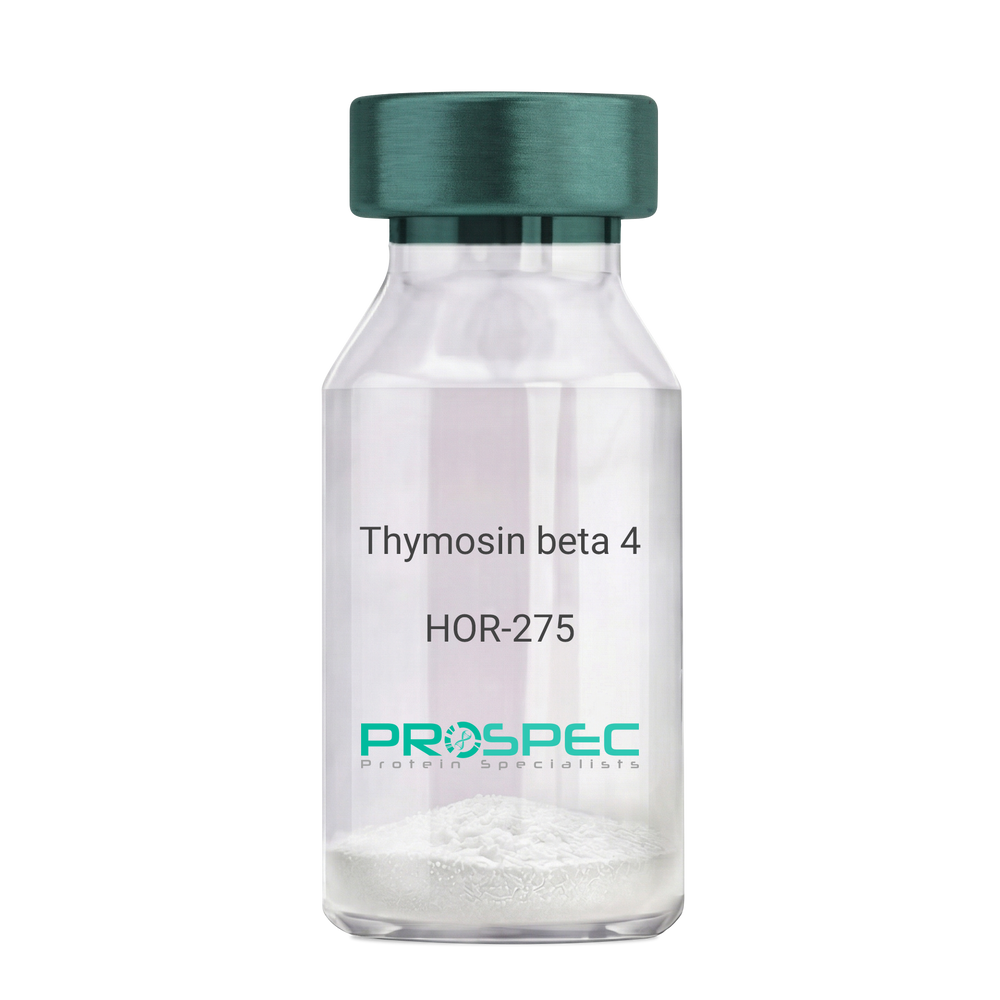
    Thymosin beta 4

    Description:

    Thymosin β4

    Thymosin beta-4. TB500, TB-500

    Product # :

    HOR-275

    Price :

    Quantity :

    Shipping Method :

    Room Temp Icon

    Shipped at Room temp

    Add To Cart

    More Info

    • description
    • formulation
    • purity
    • More Info

    Description

    Thymosin b4 is a 43 amino acid peptide which is regarded as the main intracellular G-actin sequestering peptide. It has a molecular weight of 4963.55 Da, and its molecular formula is: C212H350N56O78S1. Extracellular Thymosin b4 may contribute to physiological processes such as angiogenesis, wound healing, and regulation of inflammation.

    Formulation

    The protein (1mg/ml) was lyophilized with no additives.

    Purity

    Greater than 98.0% as determined by RP-HPLC.

    More Info

    • Introduction

      Thymosin is a hormone secreted from the thymus. Its primary function is to stimulate the production of T cells, which are an important part of the immune system. Thymosin also assists in the development of B cells to plasma cells to produce antibodies. The predominant form of thymosin, thymosin b4, is a member of a highly conserved family of actin monomer-sequestering proteins. b-thymosins are the primary regulators of unpolymerized actin, and are essential for maintaining the small cytoplasmic pool of free G-actin monomers required for rapid filament elongation and allowing for the flux of monomers between the thymosin-bound pool and F-actin.

    • Synonyms

      Thymosin beta-4. TB500, TB-500

    • Physical Appearance

      Sterile Filtered White lyophilized (freeze-dried) powder.

    • Stability

      Lyophilized Thymosin b4 although stable at room temperature for 3 weeks, should be stored desiccated below -18°C. Upon reconstitution T beta 4 should be stored at 4°C between 2-7 days and for future use below -18°C.For long term storage it is recommended to add a carrier protein (0.1% HSA or BSA).Please prevent freeze-thaw cycles.

    • Solubility

      It is recommended to reconstitute the lyophilized Thymosin beta-4 in sterile 18MΩ-cm H2O not less than 100 µg/ml, which can then be further diluted to other aqueous solutions.

    • Amino Acid Sequence

      Thymosin b4 has an a.a. sequence of Ac-Ser-Asp-Lys-Pro-Asp-Met-Ala-Glu-Ile-Glu-Lys-Phe-Asp-Lys-Ser-Lys-Leu-Lys-Lys-Thr-Glu-Thr-Gln-Glu-Lys-Asn-Pro-Leu-Pro-Ser-Lys-Glu-Thr-Ile-Glu-Gln-Glu-Lys-Gln-Ala-Gly-Glu-Ser-OH.

    ProSpec's products are furnished for LABORATORY RESEARCH USE ONLY. The product may not be used as drugs, agricultural or pesticidal products, food additives or household chemicals.

    Thymosin Beta 4
  • View Data Sheet

    Name :

    Staphylokinase

    Description:

    Staphylokinase Recombinant

    Staphylokinase, SakSTAR, Neutral proteinase, Protease III, SAK.

    Product # :

    ENZ-288

    Price :

    Quantity :

    Shipping Method :

    Room Temp Icon

    Shipped at Room temp

    Add To Cart

    More Info

    • description
    • source
    • formulation
    • purity
    • biological activity
    • More Info
    • sds-page

    Description

    Staphylokinase Recombinant produced in E.Coli is a non-glycosylated polypeptide chain containing 136 amino acids and having a molecular weight of 16kDa.The Staphylokinase is purified by proprietary chromatographic techniques.

    Source

    Escherichia Coli.

    Formulation

    Lyophilized from a 0.2µm filtered concentrated solution in PBS, pH 7.4.

    Purity

    Greater than 95.0% as determined by:
    (a) Analysis by RP-HPLC.
    (b) Analysis by SDS-PAGE.

    Biological Activity

    The biological activity measured by the ability of fibrin lysis in agarose plate was found to be 50,000IU/mg.

    sds-page

    Staphylokinase sds-page - Product image 1

    More Info

    • Introduction

      Staphylokinase (SAK) is a 136-amino acidenzymefrom Staphylococcus aureus. It is positively regulated by the "agr" gene regulator. It activates plasminogen, which in turn can degrade various host proteins during infection.

    • Synonyms

      Staphylokinase, SakSTAR, Neutral proteinase, Protease III, SAK.

    • Physical Appearance

      Sterile Filtered White lyophilized (freeze-dried) powder.

    • Stability

      Lyophilized SAK although stable at room temperature for 3 weeks, should be stored desiccated below -18°C. Upon reconstitution SAK should be stored at 4°C between 2-7 days and for future use below -18°C.Please prevent freeze-thaw cycles.

    • Solubility

      It is recommended to reconstitute the lyophilized SAKin sterile 18MΩ-cm H2O not less than 100µg/ml, which can then be further diluted to other aqueous solutions.

    ProSpec's products are furnished for LABORATORY RESEARCH USE ONLY. The product may not be used as drugs, agricultural or pesticidal products, food additives or household chemicals.

    Staphylokinase
  • View Data Sheet

    Name :

    SCF Human, Sf9

    Description:

    Stem Cell Factor Human Recombinant, Sf9

    Kit ligand Precursor, C-kit ligand, SCF, Mast cell growth factor, MGF, SF, KL-1, Kitl, DKFZp686F2250.

    Product # :

    CYT-421

    Price :

    Quantity :

    Shipping Method :

    Room Temp Icon

    Shipped at Room temp

    Add To Cart

    More Info

    • description
    • source
    • formulation
    • purity
    • biological activity
    • More Info

    Description

    Stem Cell Factor Human Recombinant produced in insect cells is a single, glycosylated polypeptide chain containing 165 amino acids and having a molecular mass of 18409 Dalton. The SCF is fused to a C-terminal His-tag (6xHis) and purified by proprietary chromatographic techniques.

    Source

    Sf9, Insect Cells.

    Formulation

    The protein is supplied in 1xPBS, pH 7.4.

    Purity

    Greater than 98.0% as determined by analysis by SDS-PAGE.

    Biological Activity

    The ED50 as determined by the dose-dependent stimulation of Human TF-1 cells is typically 1-5 ng/ml.

    More Info

    • Introduction

      Stem cell factor / KIT ligand (SCF) is a cytokine which binds CD117(c-Kit). SCF is also known as "steel factor" or "c-kit ligand". SCF exists in two forms, cell surface bound SCF and soluble (or free) SCF. Soluble SCF is produced by the cleavage of surface bound SCF by metalloproteases.
      SCF is a growth factor important for the survival, proliferation, and differentiation of hematopoietic stem cells and other hematopoietic progenitor cells. One of its roles is to change the BFU-E (burst-forming unit-erythroid) cells, which are the earliest erythrocyte precursors in the erythrocytic series, into the CFU-E (colony-forming unit-erythroid).

    • Synonyms

      Kit ligand Precursor, C-kit ligand, SCF, Mast cell growth factor, MGF, SF, KL-1, Kitl, DKFZp686F2250.

    • Physical Appearance

      Sterile Filtered White lyophilized (freeze-dried) powder.

    • Stability

      Lyophilized KIT ligand although stable at room temperature for 3 weeks, should be stored desiccated below -18°C. Upon reconstitution SCF should be stored at 4°C between 2-7 days and for future use below -18°C. For long term storage it is recommended to add a carrier protein (0.1% HSA or BSA).Please prevent freeze-thaw cycles.

    • Solubility

      It is recommended to reconstitute the lyophilized Stem Cell Factor in 10mM acetic acid not less than 100µg/ml, which can then be further diluted to other aqueous solutions.

    • Protein content

      Protein quantitation was carried out by two independent methods:1. UV spectroscopy at 280 nm using the absorbency value of 0.52 as the extinction coefficient for a 0.1% (1mg/ml) solution. This value is calculated by the PC GENE computer analysis program of protein sequences (IntelliGenetics). 2. Analysis by RP-HPLC, using a standard solution of Stem Cell Factor as a Reference Standard.

    ProSpec's products are furnished for LABORATORY RESEARCH USE ONLY. The product may not be used as drugs, agricultural or pesticidal products, food additives or household chemicals.

    Scf Human Sf9
  • View Data Sheet

    Name :

    Omentin Human

    Description:

    Omentin Human Recombinant

    Intelectin-1, HL1, LFR, HL-1, INTL, ITLN, hIntL.

    Product # :

    CYT-301

    Price :

    Quantity :

    Shipping Method :

    Room Temp Icon

    Shipped at Room temp

    Add To Cart

    More Info

    • description
    • source
    • formulation
    • purity
    • More Info

    Description

    Omentin Human Recombinant is produced in E.Coli by recombinant DNA technology is a single, polypeptide chain containing 313 amino acids and having a molecular mass of 35 kDa. Intelectin is purified by proprietary chromatographic techniques.

    Source

    E.Coli.

    Formulation

    Each mg of lyophilized powder contains 10mM NaP, pH-7.5 and 5:1 mannitol to protein.

    Purity

    Greater than 95.0% as determined by SDS-PAGE.

    More Info

    • Introduction

      Omentin is a recently recognized gene highly localized to the mental tissue (visceral adipose tissue). Omentin is present in the stromal vascular cells in the adipose tissue rather than in the adipocytes. Omentin is predominantly expressed in the visceral adipose tissue than the subcutaneous tissue, with the omentin mRNA being 150 times higher in the visceral adipose tissue. Omentin has also been detected in human blood using western blot analysis, and seems to increase INSstimulated glucose uptake in 3T3-L1 adipocytes in mice. Omentin seems to increase Akt phosphorylation irrespective of INS presence. Its role in glucose metabolism and obesity remains to be described; an INS-sensitizing action is possible.Differences in Omentin expression has been noted in adipose tissue from normals and patients with inflammatory bowel disease although its significance is unknown.

    • Synonyms

      Intelectin-1, HL1, LFR, HL-1, INTL, ITLN, hIntL.

    • Physical Appearance

      Sterile Filtered White lyophilized (freeze-dried) powder.

    • Stability

      Lyophilized Intelectin although stable at room temperature for 3 weeks, should be stored desiccated below -18°C. Upon reconstitution Intelectin should be stored at 4°C between 2-7 days and for future use below -18°C.For long term storage it is recommended to add a carrier protein (0.1% HSA or BSA).Please prevent freeze-thaw cycles.

    • Solubility

      It is recommended to reconstitute the lyophilized Omentin in sterile 18MΩ-cm H2O not less than 100µg/ml, which can then be further diluted to other aqueous solutions.

    • Amino Acid Sequence

      MNQLSFLLFL IATTRGWSTD EANTYFKEWTCSSSPSLPRS CKEIKDECPS AFDGLYFLRT ENGVIYQTFC DMTSGGGGWT LVASVHENDM RGKCTVGDRW SSQQGSKADY PEGDGNWANY NTFGSAEAAT SDDYKNPGYY DIQAKDLGIW HVPNKSPMQH WRNSSLLRYR TDTGFLQTLG HNLFGIYQKY PVKYGEGKCW TDNGPVIPVV YDFGDAQKTA SYYSPYGQRE FNNERAANAL CAGMRVTGCN TEHHCIGGGG YFPEASPQQC GDFSGFDWSG YGTHVGYSSS REITEAAVLLFYR.

    ProSpec's products are furnished for LABORATORY RESEARCH USE ONLY. The product may not be used as drugs, agricultural or pesticidal products, food additives or household chemicals.

    Omentin Human
  • View Data Sheet

    Name :

    SQSTM1 Human

    Description:

    Sequestosome 1 Human Recombinant

    A170, OSIL, p60, p62, p62B, PDB3, ZIP3, EBIAP, ORCA, OSIL, SQSTM1.

    Product # :

    PRO-806

    Price :

    Quantity :

    Shipping Method :

    Ice Icon

    Shipped with Ice Packs

    Add To Cart

    More Info

    • description
    • source
    • formulation
    • purity
    • More Info

    Description

    SQSTM1 Human Recombinant produced in E.Coli is a single, non-glycosylated, polypeptide chain containing 364 amino acids (1-356 a.a.) and having a molecular mass of 39.7 kDa. SQSTM1 protein is fused to an 8 amino acid His-Tag at C-terminus and purified by standard chromatography.

    Source

    Escherichia Coli.

    Formulation

    SQSTM1 Human 0.5mg/ml solution containing 20mM Tris-HCl pH-8, 1mM DTT and 10% glycerol.

    Purity

    Greater than 85% as determined by SDS-PAGE.

    More Info

    • Introduction

      SQSTM1 is an adapter protein which binds ubiquitin and mediates the activation of NFKB1 by TNF-a, NGF and IL-1. SQSTM1 is involved in titin/TTN downstream signaling in muscle cells. SQSTM1 controls signaling cascades through ubiquitination. SQSTM1 participates in cell differentiation, apoptosis, immune response and regulation of K(+) channels. Mutations in UBA domain of the SQSTM1 protein cause Paget’s disease because the UBA is essential for aggregate sequestration and cell survival.

    • Synonyms

      A170, OSIL, p60, p62, p62B, PDB3, ZIP3, EBIAP, ORCA, OSIL, SQSTM1.

    • Physical Appearance

      Sterile filtered colorless solution.

    • Stability

      Store at 4°C if entire vial will be used within 2-4 weeks. Store, frozen at -20°C for longer periods of time. For long term storage it is recommended to add a carrier protein (0.1% HSA or BSA).Avoid multiple freeze-thaw cycles.

    • Amino Acid Sequence

      MAMSYVKDDI FRIYIKEKKE CRRDHRPPCA QEAPRNMVHP NVICDGCNGP VVGTRYKCSV CPDYDLCSVC EGKGLHRGHT KLAFPSPFGH LSEGFSHSRW LRKVKHGHFG WPGWEMGPPG NWSPRPPRAG EARPGPTAES ASGPSEDPSV NFLKNVGESV AAALSPLGIE VDIDVEHGGK RSRLTPVSPE SSSTEEKSSS QPSSCCSDPS KPGGNVEGAT QSLAEQMRKI ALESEGRPEE QMESDNCSGG DDDWTHLSSK EVDPSTGELQ SLQMPESEGP SSLDPSQEGP TGLKEAALYP HLPPEADPRL IESLSQMLSM GFSDEGGWLT RLLQTKNYDI GAALDTIQYS KHPPPLLEHH HHHH.

    ProSpec's products are furnished for LABORATORY RESEARCH USE ONLY. The product may not be used as drugs, agricultural or pesticidal products, food additives or household chemicals.

    Sqstm1 Human
  • View Data Sheet

    Name :

    Endostatin Human

    Description:

    Endostatin Human Recombinant

    Product # :

    PRO-248

    Price :

    Quantity :

    Shipping Method :

    Ice Icon

    Shipped with Ice Packs

    Add To Cart

    More Info

    • description
    • source
    • formulation
    • purity
    • biological activity
    • More Info

    Description

    Endostatin Human Recombinant produced in E.Coli is a single, non-glycosylated, polypeptide having a predicted molecular mass of 20kDa.C-terminal fragment of collagen XVIII that has been shown to act as a potent inhibitor of angiogenesis and tumor growth in vitro and in vivo. Induces tyrosine phosphorylation of Shc (SH2 domain adapter protein) leading to specific inhibition in endothelial cell proliferation.The Endostatin is purified by proprietary chromatographic techniques.

    Source

    E.coli.

    Formulation

    The recombinant Human Endostatin is formulated with 30mM Sodium acetate buffer and Mannitol, pH-5.5.

    Purity

    Greater than 95.0% as determined by SDS-PAGE.

    Biological Activity

    The activity was found to be 16,000IU/mg.

    More Info

    • Introduction

      Once a cluster of cancer cells reaches a diameter of about 1–2 mm, it must develop a blood supply in order to grow larger. Given that diffusion is no longer adequate to supply the cancerous cells with oxygen and nutrients and to remove wastes. Therefore, these cells secrete substances that promote the formation of new blood vessels (angiogenesis), which are vital for the growth and persistence of solid tumors and their metastases.
      The production of several angiogenic factors (FGF-a, FGF-b, VEGF and VPF) is upregulated by tumors in order to stimulate angiogenesis. However, numerous malignant tumors also generate inhibitors of angiogenesis which include angiostatin and thrombospondin. The angiogenic phenotype is basically the end result of a net balance between the positive and negative regulators of neovascularization mentioned above. Endostatin’s role is to inhibit endothelial proliferation, therefore it is an effective angiogenesis inhibitor.

    • Physical Appearance

      Sterile filtered liquid formulation.

    • Stability

      Endostatin should be stored at 2-8°C.Do NOT Freeze!

    ProSpec's products are furnished for LABORATORY RESEARCH USE ONLY. The product may not be used as drugs, agricultural or pesticidal products, food additives or household chemicals.

    Endostatin Human
  • View Data Sheet

    Name :

    SDCBP2 Human

    Description:

    Syndecan Binding Protein 2 Human Recombinant

    SITAC, SITAC18, ST-2, Syntenin-2, Syndecan-binding protein 2.

    Product # :

    PRO-1297

    Price :

    Quantity :

    Shipping Method :

    Ice Icon

    Shipped with Ice Packs

    Add To Cart

    More Info

    • description
    • source
    • formulation
    • purity
    • More Info

    Description

    SDCBP2 Human Recombinant produced in E.Coli is a single, non-glycosylated polypeptide chain containing 315 amino acids (1-292 a.a.) and having a molecular mass of 34.0kDa. SDCBP2 is fused to a 23 amino acid His-tag at N-terminus & purified by proprietary chromatographic techniques.

    Source

    Escherichia Coli.

    Formulation

    SDCBP2 protein solution (0.5mg/ml) contains 20mM Tris-HCl buffer (pH 8.0), 0.15M NaCl, 10% glycerol and 1mM DTT.

    Purity

    Greater than 95.0% as determined by SDS-PAGE.

    More Info

    • Introduction

      SDCBP2 has two class II PDZ domains. PDZ domains assist protein-protein interactions by attaching to the cytoplasmic C-terminus of transmembrane proteins, and PDZ-containing proteins mediate cell signaling and the organization of protein complexes. SDCBP2 attaches to phosphatidylinositol 4, 5-bisphosphate (PIP2) and take part in nuclear PIP2 arrangement and cell division.

    • Synonyms

      SITAC, SITAC18, ST-2, Syntenin-2, Syndecan-binding protein 2.

    • Physical Appearance

      Sterile Filtered clear solution.

    • Stability

      Store at 4°C if entire vial will be used within 2-4 weeks. Store, frozen at -20°C for longer periods of time. For long term storage it is recommended to add a carrier protein (0.1% HSA or BSA).Avoid multiple freeze-thaw cycles.

    • Amino Acid Sequence

      MGSSHHHHHH SSGLVPRGSH MGSMSSLYPS LEDLKVDQAI QAQVRASPKM PALPVQATAI SPPPVLYPNL AELENYMGLS LSSQEVQESL LQIPEGDSTA VSGPGPGQMV APVTGYSLGV RRAEIKPGVR EIHLCKDERG KTGLRLRKVD QGLFVQLVQA NTPASLVGLR FGDQLLQIDG RDCAGWSSHK AHQVVKKASG DKIVVVVRDR PFQRTVTMHK DSMGHVGFVI KKGKIVSLVK GSSAARNGLL TNHYVCEVDG QNVIGLKDKK IMEILATAGN VVTLTIIPSV IYEHMVKKLP PVLLHHTMDH SIPDA.

    ProSpec's products are furnished for LABORATORY RESEARCH USE ONLY. The product may not be used as drugs, agricultural or pesticidal products, food additives or household chemicals.

    Sdcbp2 Human
  • View Data Sheet

    Name :

    SMCP Human

    Description:

    Sperm Mitochondria-Associated Cysteine-Rich Protein Human Recombinant

    Sperm Mitochondria-Associated Cysteine-Rich Protein, MCSP, MCS, Mitochondrial Capsule Selenoprotein, HSMCSGEN1, Sperm Mitochondrial-Associated Cysteine-Rich Protein.

    Product # :

    PRO-1719

    Price :

    Quantity :

    Shipping Method :

    Ice Icon

    Shipped with Ice Packs

    Add To Cart

    More Info

    • description
    • source
    • formulation
    • purity
    • More Info

    Description

    SMCP Human Recombinant produced in E.Coli is a single, non-glycosylated polypeptide chain containing 139 amino acids (1-116 a.a) and having a molecular mass of 15.2kDa (Molecular size on SDS-PAGE will appear higher). SMCP is fused to a 23 amino acid His-tag at N-terminus & purified by proprietary chromatographic techniques.

    Source

    Escherichia Coli.

    Formulation

    SMCP protein solution (0.5mg/ml) containing 20mM Tris-HCl buffer (pH 8.0), 0.15M NaCl, 20% glycerol, 1mM EDTA and 0.1mM PMSF.

    Purity

    Greater than 85.0% as determined by SDS-PAGE.

    More Info

    • Introduction

      SMCP is a protein-coding gene. SMCP localizes to the capsule linked with the mitochondrial outer membranes and assumed to function in the organization and stabilization of the helical structure of the sperm's mitochondrial sheath. Sperm mitochondria vary in morphology and subcellular localization from those of somatic cells. They are elongated, flattened, and arranged circumferentially construct a helical coiled sheath in the midpiece of the sperm flagellum. Diseases associated with SMCP include middle ear disease, and hard palate cancer.

    • Synonyms

      Sperm Mitochondria-Associated Cysteine-Rich Protein, MCSP, MCS, Mitochondrial Capsule Selenoprotein, HSMCSGEN1, Sperm Mitochondrial-Associated Cysteine-Rich Protein.

    • Physical Appearance

      Sterile Filtered clear solution.

    • Stability

      Store at 4°C if entire vial will be used within 2-4 weeks. Store, frozen at -20°C for longer periods of time. For long term storage it is recommended to add a carrier protein (0.1% HSA or BSA).Avoid multiple freeze-thaw cycles.

    • Amino Acid Sequence

      MGSSHHHHHH SSGLVPRGSH MGSMCDQTKH SKCCPAKGNQ CCPPQQNQCC QSKGNQCCPP KQNQCCQPKG SQCCPPKHNH CCQPKPPCCI QARCCGLETK PEVSPLNMES EPNSPQTQDK GCQTQQQPHS PQNESRPSK.

    ProSpec's products are furnished for LABORATORY RESEARCH USE ONLY. The product may not be used as drugs, agricultural or pesticidal products, food additives or household chemicals.

    Smcp Human
  • View Data Sheet

    Name :

    S100A16 Human

    Description:

    S100 Calcium Binding Protein A16 Human Recombinant

    Protein S100-A16, Aging-associated gene 13 protein, Protein S100-F, S100 calcium-binding protein A16, S100A16, S100F, AAG13, DT1P1A7, MGC17528.

    Product # :

    PRO-155

    Price :

    Quantity :

    Shipping Method :

    Ice Icon

    Shipped with Ice Packs

    Add To Cart

    More Info

    • description
    • source
    • formulation
    • purity
    • More Info

    Description

    S100A16 produced in E.Coli is a single, non-glycosylated polypeptide chain containing 123 amino acids (1-103 a.a.) and having a molecular mass of 13.9kDa.S100A16 is fused to a 20 amino acid His-tag at N-terminus & purified by proprietary chromatographic techniques.

    Source

    Escherichia Coli.

    Formulation

    S100A16 (1mg/ml) contains 20mM Tris-HCl buffer (pH 8.0), 1mM DTT, 40% glycerol and 0.2M NaCl.

    Purity

    Greater than 95.0% as determined by SDS-PAGE.

    More Info

    • Introduction

      S100A16 belongs to the S100 protein super family containing calcium-binding EF-hand motifs. S100 proteins are cell and tissue specific and are engaged in various intra and extracellular processes through interacting with specific target proteins. The S100A16 expression is astrocyte-specific. S100A16 accumulates within nucleoli and translocates to the cytoplasm in reaction to Ca(2+) stimulation. S100A16 physically interacts with tumor suppressor protein p53 (which is a known inhibitor of adipogenesis) as determined Immunoprecipitation analysis.

    • Synonyms

      Protein S100-A16, Aging-associated gene 13 protein, Protein S100-F, S100 calcium-binding protein A16, S100A16, S100F, AAG13, DT1P1A7, MGC17528.

    • Physical Appearance

      Sterile filtered colorless solution.

    • Stability

      Store at 4°C if entire vial will be used within 2-4 weeks. Store, frozen at -20°C for longer periods of time. For long term storage it is recommended to add a carrier protein (0.1% HSA or BSA).Avoid multiple freeze-thaw cycles.

    • Amino Acid Sequence

      MGSSHHHHHH SSGLVPRGSH MSDCYTELEK AVIVLVENFY KYVSKYSLVK NKISKSSFRE MLQKELNHML SDTGNRKAAD KLIQNLDANH DGRISFDEYW TLIGGITGPI AKLIHEQEQQ SSS.

    ProSpec's products are furnished for LABORATORY RESEARCH USE ONLY. The product may not be used as drugs, agricultural or pesticidal products, food additives or household chemicals.

    S100A16 Human
  • View Data Sheet

    Name :

    SBDS Human

    Description:

    Shwachman-Bodian-Diamond Syndrome Human Recombinant

    SDS, SWDS, Shwachman-Bodian-Diamond syndrome, Ribosome Maturation protein SBDS.

    Product # :

    PRO-272

    Price :

    Quantity :

    Shipping Method :

    Ice Icon

    Shipped with Ice Packs

    Add To Cart

    More Info

    • description
    • source
    • formulation
    • purity
    • More Info

    Description

    SBDS produced in E.Coli is a single, non-glycosylated polypeptide chain containing 270 amino acids (1-250a.a.) and having a molecular mass of 30.9kDa.SBDS is fused to a 20 amino acid His-tag at N-terminus & purified by proprietary chromatographic techniques.

    Source

    Escherichia Coli.

    Formulation

    The SBDS protein solution (0.5mg/1ml) is formulated in 20mM Tris-HCl buffer (pH8.0) 2mM DTT, 50mM NaCl, 0.1mM EDTA, and 20% glycerol.

    Purity

    Greater than 95% as determined by SDS-PAGE.

    More Info

    • Introduction

      SBDS is part of an extremely preserved protein family which exists from archaea to vertebrates and plants. SBDS protein functions in RNA metabolism and has a role in the biogenesis of the 60S ribosomal subunit and translational activation of ribosomes. Shwachman-Diamond syndrome is a rare autosomal recessive disorder produced by mutations in the SBDS gene.

    • Synonyms

      SDS, SWDS, Shwachman-Bodian-Diamond syndrome, Ribosome Maturation protein SBDS.

    • Physical Appearance

      Sterile Filtered clear solution.

    • Stability

      Store at 4°C if entire vial will be used within 2-4 weeks. Store, frozen at -20°C for longer periods of time.Please avoid freeze thaw cycles.

    • Amino Acid Sequence

      MGSSHHHHHH SSGLVPRGSH MSIFTPTNQI RLTNVAVVRM KRAGKRFEIA CYKNKVVGWR SGVEKDLDEV LQTHSVFVNV SKGQVAKKED LISAFGTDDQ TEICKQILTK GEVQVSDKER HTQLEQMFRD IATIVADKCV NPETKRPYTV ILIERAMKDI HYSVKTNKST KQQALEVIKQ LKEKMKIERA HMRLRFILPV NEGKKLKEKL KPLIKVIESE DYGQQLEIVC LIDPGCFREI DELIKKETKG KGSLEVLNLK DVEEGDEKFE

    ProSpec's products are furnished for LABORATORY RESEARCH USE ONLY. The product may not be used as drugs, agricultural or pesticidal products, food additives or household chemicals.

    Sbds Human
  • 1
  • …
  • 3
  • 4
  • 5
  • 6
  • 7
  • …
  • 42
Your browser does not support the video tag.

Products

  • Cytokines
  • Growth Factors
  • Chemokines
  • CD Antigens
  • Neurotrophins
  • Hormones
  • Enzymes
  • Viral Antigens
  • Recombinant Proteins
  • Natural Proteins
  • Monoclonal Antibodies
  • Polyclonal Antibodies
  • Thermal Packaging

About

  • Company
  • Founder
  • Contribution
  • Contact Us
  • My Account

Ordering

  • Ordering Method
  • Ordering - Credit Card
  • Ordering PO
  • Shipping Fees
  • FAQ's

Legal

  • Terms & Conditions
  • Privacy
  • Site Map
  • info@prospecbio.com
  • Facebook
  • Instagram
  • Linkedin Profile

© 2026 ProSpec-Tany TechnoGene Ltd. All Rights Reserved.

  • Choosing a selection results in a full page refresh.
  • Opens in a new window.