Skip to content

High-quality research proteins.

  • 1-800-805-6531

  • Mon - Sat 8.00-18.00, Sun - Closed

  • info@prospecbio.com

  • PO Box 6591 East Brunswick NJ 08816

  • Products
    • Cytokines
    • Growth factors
    • Chemokines
    • Cd antigens
    • Neurotrophins
    • Hormones
    • Enzymes
    • Viral antigens
    • Recombinant proteins
    • Natural proteins
    • Monoclonal antibodies
    • Polyclonal antibodies
    • Thermal Packaging
  • About
    • Company
    • Founder
    • Contribution
  • Customers
    • Eastern Asia
    • Eastern Europe
    • North America
    • South America
    • South East Asia
    • Southern Asia
    • Western Europe
  • Ordering
    • Ordering Method
    • Ordering - Credit Card
    • Ordering - PO
    • Shipping Fees
    • FAQs
  • Services
    • DNA Cloning
    • Protein Expression
    • Monoclonal Antibody
    • Fermentation
    • Technology License
  • Contact us
Log in

Country/region

  • USD $ | Albania
  • USD $ | Andorra
  • USD $ | Argentina
  • USD $ | Armenia
  • USD $ | Australia
  • USD $ | Austria
  • USD $ | Azerbaijan
  • USD $ | Belarus
  • USD $ | Belgium
  • USD $ | Bolivia
  • USD $ | Brazil
  • USD $ | Bulgaria
  • USD $ | Cambodia
  • USD $ | Canada
  • USD $ | Chile
  • USD $ | China
  • USD $ | Colombia
  • USD $ | Costa Rica
  • USD $ | Croatia
  • USD $ | Cyprus
  • USD $ | Czechia
  • USD $ | Denmark
  • USD $ | Estonia
  • USD $ | Finland
  • USD $ | France
  • USD $ | Georgia
  • USD $ | Germany
  • USD $ | Greece
  • USD $ | Hong Kong SAR
  • USD $ | Hungary
  • USD $ | Iceland
  • USD $ | India
  • USD $ | Ireland
  • USD $ | Israel
  • USD $ | Italy
  • USD $ | Japan
  • USD $ | Kazakhstan
  • USD $ | Latvia
  • USD $ | Liechtenstein
  • USD $ | Lithuania
  • USD $ | Madagascar
  • USD $ | Malta
  • USD $ | Mexico
  • USD $ | Moldova
  • USD $ | Monaco
  • USD $ | Netherlands
  • USD $ | New Zealand
  • USD $ | North Macedonia
  • USD $ | Norway
  • USD $ | Panama
  • USD $ | Paraguay
  • USD $ | Peru
  • USD $ | Philippines
  • USD $ | Poland
  • USD $ | Portugal
  • USD $ | Romania
  • USD $ | Singapore
  • USD $ | Slovakia
  • USD $ | Slovenia
  • USD $ | South Africa
  • USD $ | South Korea
  • USD $ | Spain
  • USD $ | Sri Lanka
  • USD $ | Sweden
  • USD $ | Switzerland
  • USD $ | Taiwan
  • USD $ | Thailand
  • USD $ | Türkiye
  • USD $ | Ukraine
  • USD $ | United Kingdom
  • USD $ | United States
  • USD $ | Uruguay
  • USD $ | Vatican City
  • USD $ | Venezuela
  • USD $ | Vietnam
  • Facebook
  • Instagram
logoProSpec - Recombinant Protein Manufacturer for academic and R&D industry
Become a distributor
Account Log in
Wishlist
Cart Cart(0)
  • Products
    +
    • Cytokines
    • Growth factors
    • Chemokines
    • Cd antigens
    • Neurotrophins
    • Hormones
    • Enzymes
    • Viral antigens
    • Recombinant proteins
    • Natural proteins
    • Monoclonal antibodies
    • Polyclonal antibodies
    • Thermal Packaging
  • About
    +
    • Company
    • Founder
    • Contribution
  • Customers
    +
    • Eastern Asia
    • Eastern Europe
    • North America
    • South America
    • South East Asia
    • Southern Asia
    • Western Europe
  • Ordering
    +
    • Ordering Method
    • Ordering - Credit Card
    • Ordering - PO
    • Shipping Fees
    • FAQs
  • Services
    +
    • DNA Cloning
    • Protein Expression
    • Monoclonal Antibody
    • Fermentation
    • Technology License
  • Contact us

Item added to your cart

View cart
View All
  • Cytokines
  • Growth factors
  • Chemokines
  • Cd antigens
  • Neurotrophins
  • Hormones
  • Enzymes
  • Viral antigens
  • Recombinant proteins
  • Natural proteins
  • Monoclonal antibodies
  • Polyclonal antibodies
  • Thermal Packaging
  • Tumor Necrosis Factor

    Tumor Necrosis Factor

    View All
  • 4-1BB

    4-1BB

    View All
  • Adiponectin

    Adiponectin

    View All
  • AIF1

    AIF1

    View All
  • Other Cytokines

    Other Cytokines

    View All
  • AITRL

    AITRL

    View All
  • Angiopoietin

    Angiopoietin

    View All
  • Apolipoprotein

    Apolipoprotein

    View All
  • B-Cell Activating Factor

    B-Cell Activating Factor

    View All
  • Beta Defensin

    Beta Defensin

    View All
  • Bone Morphogenetic Protein

    Bone Morphogenetic Protein

    View All
  • B type Natriuretic Peptide

    B type Natriuretic Peptide

    View All
  • BST

    BST

    View All
  • Betacellulin

    Betacellulin

    View All
  • Cardiotrophin

    Cardiotrophin

    View All
  • Activin

    Activin

    View All
  • Fibroblast Growth Factor

    Fibroblast Growth Factor

    View All
  • Other Growth Factors

    Other Growth Factors

    View All
  • CSF

    CSF

    View All
  • CTGF

    CTGF

    View All
  • IGFBP

    IGFBP

    View All
  • VEGF Protein

    VEGF Protein

    View All
  • EGF

    EGF

    View All
  • Epigen

    Epigen

    View All
  • Erythropoietin

    Erythropoietin

    View All
  • Insulin-Like Growth Factor

    Insulin-Like Growth Factor

    View All
  • Growth Hormone

    Growth Hormone

    View All
  • HDGF

    HDGF

    View All
  • Hepatocyte Growth Factor

    Hepatocyte Growth Factor

    View All
  • Insulin

    Insulin

    View All
  • BCA-1/ BLC (CXCL13)

    BCA-1/ BLC (CXCL13)

    View All
  • BRAK (CXCL14)

    BRAK (CXCL14)

    View All
  • C-10 (CCL6)

    C-10 (CCL6)

    View All
  • Other Chemokines

    Other Chemokines

    View All
  • MEC (CCL28)

    MEC (CCL28)

    View All
  • LD78-beta (CCL3L1)

    LD78-beta (CCL3L1)

    View All
  • CTACK (CCL27)

    CTACK (CCL27)

    View All
  • CXCL16

    CXCL16

    View All
  • CXCL17

    CXCL17

    View All
  • Platelet Factor-4 (CXCL4)

    Platelet Factor-4 (CXCL4)

    View All
  • ENA-78 (CXCL5)

    ENA-78 (CXCL5)

    View All
  • Eotaxin (CCL11,24,26)

    Eotaxin (CCL11,24,26)

    View All
  • Exodus-2 (CCL21)

    Exodus-2 (CCL21)

    View All
  • Fractalkine (CX3CL1)

    Fractalkine (CX3CL1)

    View All
  • CXCL6

    CXCL6

    View All
  • Other CD Antigens

    Other CD Antigens

    View All
  • CD14

    CD14

    View All
  • CD164

    CD164

    View All
  • CD1

    CD1

    View All
  • CD2

    CD2

    View All
  • CD200

    CD200

    View All
  • CD207

    CD207

    View All
  • CD226

    CD226

    View All
  • CD23

    CD23

    View All
  • CD244

    CD244

    View All
  • CD247

    CD247

    View All
  • CD27

    CD27

    View All
  • CD274

    CD274

    View All
  • CD300

    CD300

    View All
  • CD33

    CD33

    View All
  • Other Neurotrophins

    Other Neurotrophins

    View All
  • Beta-NGF

    Beta-NGF

    View All
  • BDNF

    BDNF

    View All
  • CDNF

    CDNF

    View All
  • CNTF

    CNTF

    View All
  • GDNF

    GDNF

    View All
  • Glia Maturation Factor

    Glia Maturation Factor

    View All
  • MANF

    MANF

    View All
  • Midkine

    Midkine

    View All
  • Neuroglobin

    Neuroglobin

    View All
  • Neurotrophic factors

    Neurotrophic factors

    View All
  • Neuregulin

    Neuregulin

    View All
  • Neuropilin

    Neuropilin

    View All
  • Pigment Epithelium-Derived Factor

    Pigment Epithelium-Derived Factor

    View All
  • Pleiotrophin

    Pleiotrophin

    View All
  • Peptide Hormones

    Peptide Hormones

    View All
  • Other Hormones

    Other Hormones

    View All
  • HCG

    HCG

    View All
  • Endothelin

    Endothelin

    View All
  • Exendin

    Exendin

    View All
  • FSH

    FSH

    View All
  • Glucagon

    Glucagon

    View All
  • GHRP

    GHRP

    View All
  • GLP

    GLP

    View All
  • Thyrostimulin

    Thyrostimulin

    View All
  • Inhibin A

    Inhibin A

    View All
  • LHRH

    LHRH

    View All
  • Melanotan

    Melanotan

    View All
  • Procalcitonin

    Procalcitonin

    View All
  • PTH

    PTH

    View All
  • Peroxiredoxin

    Peroxiredoxin

    View All
  • Peptidase

    Peptidase

    View All
  • Synthetase

    Synthetase

    View All
  • Transferase

    Transferase

    View All
  • Hydrolase

    Hydrolase

    View All
  • Dehydrogenase

    Dehydrogenase

    View All
  • ACE2

    ACE2

    View All
  • Esterase

    Esterase

    View All
  • Protein Kinases

    Protein Kinases

    View All
  • Other Enzymes

    Other Enzymes

    View All
  • Phosphatase

    Phosphatase

    View All
  • Deaminase

    Deaminase

    View All
  • Oxygenase

    Oxygenase

    View All
  • Adenylate Kinase

    Adenylate Kinase

    View All
  • Lyase

    Lyase

    View All
  • Chagas

    Chagas

    View All
  • SARS

    SARS

    View All
  • Influenza

    Influenza

    View All
  • ASFV

    ASFV

    View All
  • Astrovirus

    Astrovirus

    View All
  • Borrelia

    Borrelia

    View All
  • Helicobacter Pylori

    Helicobacter Pylori

    View All
  • Chikungunya

    Chikungunya

    View All
  • Chlamydia

    Chlamydia

    View All
  • Cytomegalo

    Cytomegalo

    View All
  • Dengue

    Dengue

    View All
  • EBV

    EBV

    View All
  • Ebola

    Ebola

    View All
  • Feline Leukemia Virus

    Feline Leukemia Virus

    View All
  • Hepatitis A

    Hepatitis A

    View All
  • Other

    Other

    View All
  • Actin

    Actin

    View All
  • ADAM

    ADAM

    View All
  • Complement Component

    Complement Component

    View All
  • Ag85

    Ag85

    View All
  • Eukaryotic Translation Initiation Factor

    Eukaryotic Translation Initiation Factor

    View All
  • Anterior Gradient Protein

    Anterior Gradient Protein

    View All
  • Heat Shock Protein

    Heat Shock Protein

    View All
  • Alpha-2-HS-Glycoprotein

    Alpha-2-HS-Glycoprotein

    View All
  • Hemoglobin

    Hemoglobin

    View All
  • Allergy

    Allergy

    View All
  • Anaplasma

    Anaplasma

    View All
  • Angiogenin

    Angiogenin

    View All
  • Ankyrin Repeat Domain

    Ankyrin Repeat Domain

    View All
  • Annexin

    Annexin

    View All
  • Other Natural Proteins

    Other Natural Proteins

    View All
  • Aprotinin

    Aprotinin

    View All
  • Transferrin

    Transferrin

    View All
  • Avidin

    Avidin

    View All
  • Anti Coagulation Factors

    Anti Coagulation Factors

    View All
  • Natural Albumin

    Natural Albumin

    View All
  • Natural Coagulation Factors

    Natural Coagulation Factors

    View All
  • Fibronectin

    Fibronectin

    View All
  • Thrombin

    Thrombin

    View All
  • Anti Human Enzyme

    Anti Human Enzyme

    View All
  • Other Monoclonal Antibodies

    Other Monoclonal Antibodies

    View All
  • Anti Human Cytokine

    Anti Human Cytokine

    View All
  • Anti Human Heat Shock Protein

    Anti Human Heat Shock Protein

    View All
  • Anti Mouse Lymphocyte

    Anti Mouse Lymphocyte

    View All
  • Anti Human Chemokine

    Anti Human Chemokine

    View All
  • Anti Human Lymphocyte

    Anti Human Lymphocyte

    View All
  • Anti Viral Monoclonal

    Anti Viral Monoclonal

    View All
  • Anti Mouse Cytokine

    Anti Mouse Cytokine

    View All
  • Anti-GST Monoclonal

    Anti-GST Monoclonal

    View All
  • Other Polyclonal Antibodies

    Other Polyclonal Antibodies

    View All
  • Anti Viral

    Anti Viral

    View All
  • Anti-GST Monoclonal

    Anti-GST Monoclonal

    View All
Back

Search results

1000 results found for “Hepatitis A”

Name

Description

Product #

Price

Quantity

Shipping Method

  • View Data Sheet

    Name :

    MIP 1b Rat

    Description:

    Macrophage Inflammatory Protein-1 beta Rat Recombinant (CCL4)

    C-C motif chemokine 4, Macrophage inflammatory protein 1-beta, MIP-1-beta, Small-inducible cytokine A4, Ccl4, Mip1b, Scya4.

    Product # :

    CHM-003

    Price :

    Quantity :

    Shipping Method :

    Room Temp Icon

    Shipped at Room temp

    Add To Cart

    More Info

    • description
    • source
    • formulation
    • purity
    • biological activity
    • More Info

    Description

    MIP-1b Rat Recombinant produced in E.Coli is a single, non-glycosylated polypeptide chain containing 69 amino acids and having a molecular mass of 7.8 kDa. The MIP-1b is purified by proprietary chromatographic techniques.

    Source

    Escherichia Coli.

    Formulation

    Filtered (0.2µm) and lyophilized from a concentrated (1mg/ml) solution in 30% Acetonitrile and 0.1% TFA.

    Purity

    Greater than 97.0% as determined by:
    (a) Analysis by RP-HPLC.
    (b) Analysis by SDS-PAGE.

    Biological Activity

    Determined by its ability to chemoattract human monocytes using a concentration range of 0.01-1.0 µg/ml.

    More Info

    • Introduction

      Macrophage Inflammatory Proteins (MIP) belong to the family of chemotactic cytokines known as chemokines. In humans, there are two major forms, MIP-1? and MIP-1? that are now officially named CCL3 and CCL4 respectively. Both are major factors produced by macrophages after they are stimulated with bacterial endotoxins. They activate human granulocytes (neutrophils, eosinophils and basophils) which can lead to acute neutrophilic inflammation. They also induce the synthesis and release of other pro-inflammatory cytokines such as interleukin 1 (IL-1), IL-6 and TNF-? from fibroblasts and macrophages. The genes for CCL3 and CCL4 are both located on human chromosome 17.

    • Synonyms

      C-C motif chemokine 4, Macrophage inflammatory protein 1-beta, MIP-1-beta, Small-inducible cytokine A4, Ccl4, Mip1b, Scya4.

    • Physical Appearance

      Sterile Filtered White lyophilized (freeze-dried) powder.

    • Stability

      Lyophilized Mouse MIP-1b although stable at room temperature for 3 weeks, should be stored desiccated below -18°C. Upon reconstitution Mouse CCL4 should be stored at 4°C between 2-7 days and for future use below -18°C.For long term storage it is recommended to add a carrier protein (0.1% HSA or BSA).Please prevent freeze-thaw cycles.

    • Solubility

      It is recommended to reconstitute the lyophilized Mouse MIP-1b in sterile 18MΩ-cm H2O not less than 100µg/ml, which can then be further diluted to other aqueous solutions.

    • Amino Acid Sequence

      APIGSDPPTS CCFSYTSRKI HRNFVMDYYE TSSLCSQPAV VFLTKKGRQI CADPSEPWVN EYVNDLELN.

    • Background

      What is the molecular weight/Mw of MIP 1B RAT Protein?
      MIP 1B RAT Protein has a total Mw of 7.8kDa.

      What is the source or expression system of MIP 1B RAT Protein?
      Escherichia Coli.

      What is the Purity of MIP 1B RAT Protein?
      MIP 1B RAT Protein is > 97% pure as determined by SDS-PAGE.

      What is the Biological Activity of MIP 1B RAT Protein?
      Determined by its ability to chemoattract human monocytes using a concentration range of 0.01-1.0 µg/ml.

      What is the amino acid sequence of MIP 1B RAT Protein?
      APIGSDPPTS CCFSYTSRKI HRNFVMDYYE TSSLCSQPAV VFLTKKGRQI CADPSEPWVN EYVNDLELN.

      What applications can MIP 1B RAT Protein be used in?
      MIP 1B RAT Protein can probably be used in western blot, ELISA and Lateral Flow.

      What is the endotoxin level for MIP 1B RAT Protein?
      The endotoxin level is minimal, MIP 1B RAT Protein was purified using conventional chromatography techniques.


    ProSpec's products are furnished for LABORATORY RESEARCH USE ONLY. The product may not be used as drugs, agricultural or pesticidal products, food additives or household chemicals.

    Mip 1B Rat
  • View Data Sheet

    Name :

    MMP-2 Human, HEK

    Description:

    Matrix Metalloproteinase-2 Human Recombinant, HEK

    72 kDa type IV collagenase, 72 kDa gelatinase, Gelatinase A, Matrix metalloproteinase-2, MMP-2, TBE-1, MMP2, CLG4A, CLG4, MONA, MMP-II.

    Product # :

    ENZ-100

    Price :

    Quantity :

    Shipping Method :

    Ice Icon

    Shipped with Ice Packs

    Add To Cart

    More Info

    • description
    • source
    • formulation
    • purity
    • biological activity
    • More Info
    • sds-page

    Description

    MMP-2 Human Recombinant produced in HEK293 cells is a proform of the Human MMP-2 (Ala30-Cys660) and fused with a ployhistide tag at the C-terminus, having an Mw of 71kDa. MMP-2 is purified by proprietary chromatographic techniques.

    Source

    HEK293 cells.

    Formulation

    The MMP-2 is supplied as a 0.2µm filtered solution in 20mM Tris-HCl, 150mM NaCl and 0.05% Brij 35, pH 7.4.

    Purity

    Greater than 95% as determined by SDS-PAGE.

    Biological Activity

    The activity was measured by its ability to cleave fluorogenic peptide substrate, Mca-PLGL-Dpa-AR-NH2 (RND,Catalog # ES001)., The specific activity is > 1,000 pmoles/min/µg.
    Recombinant Human MMP-2 protein pro form needs to be activated with p-aminophenylmercuric acetate (APMA).
    Activation Protocol:
    1. Dilute MMP2 to 100µg/ml in the Assay Buffer: 50mM Tris, 10mM CaCl2, 150mM NaCl, 0.05% (w/v) and Brij 35, pH 7.5.
    2. Activate MMP2 by adding APMA to a final concentration of 1mM. (Sigma, Catalog # A9563) and 100mM stock in DMSO.
    3. Incubate at 37°C for 1 hour.

    sds-page

    mmp-2 human hek sds-page - Product image 1

    More Info

    • Introduction

      Matrix metalloproteinase-2 (MMP-2) is a type IV collagenase, which is involved in endometrial menstrual breakdown, regulation of vascularization and the inflammatory response. MMP-2 contains a number of distinct domains: a prodomain that is cleaved upon activation; a catalytic domain containing the zinc binding site; a fibronectin like domain believed to have a role in substrate targeting; and a carboxyl terminal (hemopexin like) domain containing 2 N-linked glycosylation. The MMP-2 can degrade an extensive array of substrates including type IV, V, VII and X collagens as well as gelatin type I. In addition, MMP-2 interacts with THBS2, TIMP2, Thrombospondin 1, CCL7 and TIMP4. MMP-2 autocatalytic cleavage in the C-terminal generates the anti-angiogenic peptide, PEX. This process seems to be made possible by binding integrinv/beta3. Defects in the MMP-2 are the cause of Torg-Winchester syndrome (TWS), aka multicentric osteolysis nodulosis and arthropathy (MONA).

    • Synonyms

      72 kDa type IV collagenase, 72 kDa gelatinase, Gelatinase A, Matrix metalloproteinase-2, MMP-2, TBE-1, MMP2, CLG4A, CLG4, MONA, MMP-II.

    • Physical Appearance

      The MMP-2 is supplied as a sterile Filtered colorless solution.

    • Stability

      Store MMP-2 at 4°C if entire vial will be used within 2-4 weeks. Store frozen at -20°C for longer periods of time.Avoid multiple freeze-thaw cycles.

    ProSpec's products are furnished for LABORATORY RESEARCH USE ONLY. The product may not be used as drugs, agricultural or pesticidal products, food additives or household chemicals.

    Mmp 2 Human
  • View Data Sheet

    Name :

    AKAP7 Human

    Description:

    A Kinase Anchor Protein 7 Human Recombinant

    A kinase (PRKA) anchor protein 7, A-kinase anchor protein 18 kDa, A-kinase anchor protein 9, kDa PRKA7 isoforms alpha/beta, PRKA7 isoform gamma, AKAP15, AKAP18.

    Product # :

    PKA-030

    Price :

    Quantity :

    Shipping Method :

    Ice Icon

    Shipped with Ice Packs

    Add To Cart

    More Info

    • description
    • source
    • formulation
    • purity
    • More Info

    Description

    AKAP7 Human Recombinant produced in E. coli is a single polypeptide chain containing 105 amino acids (1-81) and having a molecular mass of 11.5kDa.AKAP7 is fused to a 24 amino acid His-tag at N-terminus & purified by proprietary chromatographic techniques.

    Source

    E.coli.

    Formulation

    The AKAP7 solution (1mg/1ml) contains 20mM Tris-HCl buffer (pH 8.0), 50mM NaCl, 1mM DTT and 10% glycerol.

    Purity

    Greater than 90% as determined by SDS-PAGE.

    More Info

    • Introduction

      AKAP7 is a member of the A-kinase anchoring protein (AKAP) family, a group of functionally related proteins which bind to a regulatory subunit (RII) of cAMP-dependent protein kinase A (PKA) and target the enzyme to specific subcellular sections. AKAP7 is expressed in heart, brain, pancreas, lung and skeletal muscle. AKAP7 binds PKA to the plasma membrane, and allows efficient coupling to the L-type calcium channel.

    • Synonyms

      A kinase (PRKA) anchor protein 7, A-kinase anchor protein 18 kDa, A-kinase anchor protein 9, kDa PRKA7 isoforms alpha/beta, PRKA7 isoform gamma, AKAP15, AKAP18.

    • Physical Appearance

      Sterile Filtered colorless solution.

    • Stability

      Store at 4°C if entire vial will be used within 2-4 weeks. Store, frozen at -20°C for longer periods of time. For long term storage it is recommended to add a carrier protein (0.1% HSA or BSA).Avoid multiple freeze-thaw cycles.

    • Amino Acid Sequence

      MGSSHHHHHH SSGLVPRGSH MGSHMGQLCC FPFSRDEGKI SEKNGGEPDD AELVRLSKRL VENAVLKAVQ QYLEETQNKN KPGEGSSVKT EAADQNGNDN ENNRK

    ProSpec's products are furnished for LABORATORY RESEARCH USE ONLY. The product may not be used as drugs, agricultural or pesticidal products, food additives or household chemicals.

    Akap7 Human
  • View Data Sheet

    Name :

    DBH Human

    Description:

    DBH Human Recombinant

    EC 1.14.17.1, DBM, DBH.

    Product # :

    ENZ-891

    Price :

    Quantity :

    Shipping Method :

    Ice Icon

    Shipped with Ice Packs

    Add To Cart

    More Info

    • description
    • source
    • formulation
    • purity
    • More Info

    Description

    DBH Human Recombinant produced in E.Coli is a single, non-glycosylated polypeptide chain containing 599 amino acids (40-617 a.a) and having a molecular mass of 67.2kDa.DBH is fused to a 21 amino acid His-tag at N-terminus & purified by proprietary chromatographic techniques.

    Source

    Escherichia Coli.

    Formulation

    DBH protein solution (0.25mg/ml) containing Phosphate buffered saline (pH7.4), 10% glycerol and 1mM DTT.

    Purity

    Greater than 85.0% as determined by SDS-PAGE.

    More Info

    • Introduction

      DBH catalyzes the chemical reaction. DBH is an oxidoreductase which belongs to the copper type II, ascorbate-dependent monooxygenase family, in particular those performing on paired donors, with O2 as oxidant and incorporation or reduction of oxygen. The oxygen incorporated can not be derived from O2 with reduced ascorbate as one donor, as well as incorporation of one ato of oxygen into the other donor.

    • Synonyms

      EC 1.14.17.1, DBM, DBH.

    • Physical Appearance

      Sterile Filtered colorless solution.

    • Stability

      Store at 4°C if entire vial will be used within 2-4 weeks. Store, frozen at -20°C for longer periods of time. For long term storage it is recommended to add a carrier protein (0.1% HSA or BSA).Avoid multiple freeze-thaw cycles.

    • Amino Acid Sequence

      MGSSHHHHHH SSGLVPRGSH MSAPRESPLP YHIPLDPEGS LELSWNVSYT QEAIHFQLLV RRLKAGVLFG MSDRGELENA DLVVLWTDGD TAYFADAWSD QKGQIHLDPQ QDYQLLQVQR TPEGLTLLFK RPFGTCDPKD YLIEDGTVHL VYGILEEPFR SLEAINGSGL QMGLQRVQLL KPNIPEPELP SDACTMEVQA PNIQIPSQET TYWCYIKELP KGFSRHHIIK YEPIVTKGNE ALVHHMEVFQ CAPEMDSVPH FSGPCDSKMK PDRLNYCRHV LAAWALGAKA FYYPEEAGLA FGGPGSSRYL RLEVHYHNPL VIEGRNDSSG IRLYYTAKLR RFNAGIMELG LVYTPVMAIP PRETAFILTG YCTDKCTQLA LPPSGIHIFA SQLHTHLTGR KVVTVLVRDG REWEIVNQDN HYSPHFQEIR MLKKVVSVHP GDVLITSCTY NTEDRELATV GGFGILEEMC VNYVHYYPQT QLELCKSAVD AGFLQKYFHL INRFNNEDVC TCPQASVSQQ FTSVPWNSFN RDVLKALYSF APISMHCNKS SAVRFQGEWN LQPLPKVIST LEEPTPQCPT SQGRSPAGPT VVSIGGGKG

    ProSpec's products are furnished for LABORATORY RESEARCH USE ONLY. The product may not be used as drugs, agricultural or pesticidal products, food additives or household chemicals.

    Dbh Human
  • View Data Sheet

    Name :

    HMBS Human

    Description:

    Hydroxymethylbilane Synthase Human Recombinant

    Porphobilinogen deaminase, PBG-D, Hydroxymethylbilane synthase, HMBS, Pre-uroporphyrinogen synthase, HMBS, PBGD, UPS, PORC.

    Product # :

    ENZ-581

    Price :

    Quantity :

    Shipping Method :

    Ice Icon

    Shipped with Ice Packs

    Add To Cart

    More Info

    • description
    • source
    • formulation
    • purity
    • More Info

    Description

    HMBS Human Recombinant produced in E.coli is a single, non-glycosylated polypeptide chain containing 385 amino acids (1-361) and having a molecular mass of 41.9kDa.HMBS is fused to a 24 amino acid His-tag at N-terminus & purified by proprietary chromatographic techniques.

    Source

    Escherichia Coli.

    Formulation

    The HMBS solution (1mg/ml) contains 20mM Tris-HCl buffer (pH 8.0), 1mM DTT, 10% glycerol and 0.1M NaCl.

    Purity

    Greater than 95.0% as determined by SDS-PAGE.

    More Info

    • Introduction

      Porphobilinogen deaminase (HMBS) belongs to the hydroxymethylbilane synthase superfamily. HMBS is a cytoplasmic enzyme found in the heme synthesis pathway. HMBS is the 3rd enzyme of the heme biosynthetic pathway and catalyzes the head to tail condensation of 4 porphobilinogen molecules into the linear hydroxymethylbilane. HMBS gene mutations cause errors in pyrrole metabolism which in turn lead to the autosomal dominant disease acute intermittent porphyria.

    • Synonyms

      Porphobilinogen deaminase, PBG-D, Hydroxymethylbilane synthase, HMBS, Pre-uroporphyrinogen synthase, HMBS, PBGD, UPS, PORC.

    • Physical Appearance

      Sterile Filtered colorless solution.

    • Stability

      Store at 4°C if entire vial will be used within 2-4 weeks. Store, frozen at -20°C for longer periods of time. For long term storage it is recommended to add a carrier protein (0.1% HSA or BSA).Avoid multiple freeze-thaw cycles.

    • Amino Acid Sequence

      MGSSHHHHHH SSGLVPRGSH MGSHMSGNGN AAATAEENSP KMRVIRVGTR KSQLARIQTD SVVATLKASY PGLQFEIIAM STTGDKILDT ALSKIGEKSL FTKELEHALE KNEVDLVVHS LKDLPTVLPP GFTIGAICKR ENPHDAVVFH PKFVGKTLET LPEKSVVGTS SLRRAAQLQR
      KFPHLEFRSI RGNLNTRLRK LDEQQEFSAI ILATAGLQRM GWHNRVGQIL HPEECMYAVG QGALGVEVRA KDQDILDLVG VLHDPETLLR CIAERAFLRH LEGGCSVPVA VHTAMKDGQL YLTGGVWSLD GSDSIQETMQ ATIHVPAQHE DGPEDDPQLV GITARNIPRG PQLAAQNLGI
      SLANLLLSKG AKNILDVARQ LNDAH.

    ProSpec's products are furnished for LABORATORY RESEARCH USE ONLY. The product may not be used as drugs, agricultural or pesticidal products, food additives or household chemicals.

    Hmbs Human
  • View Data Sheet

    Name :

    AP3S1 Human

    Description:

    Assembly Protein Complex 3 Subunit-1 Human Recombinant

    CLAPS3, Sigma3A ,AP-3 complex subunit sigma-1, AP-3 complex subunit sigma-3A, Adapter-related protein complex 3 sigma-1 subunit, Clathrin-associated/assembly/adapter protein, small 3, Sigma-3A-adaptin, Sigma-adaptin 3a.

    Product # :

    PRO-1280

    Price :

    Quantity :

    Shipping Method :

    Ice Icon

    Shipped with Ice Packs

    Add To Cart

    More Info

    • description
    • source
    • formulation
    • purity
    • More Info

    Description

    AP3S1 Human Recombinant produced in E. coli is a single polypeptide chain containing 213 amino acids (1-193) and having a molecular mass of 23.8 kDa. AP3S1 is fused to 20 amino acid His-tag at N-terminus & purified by proprietary chromatographic techniques.

    Source

    E.coli.

    Formulation

    The AP3S1 solution (1mg/1ml) contains 20mM Tris-HCl buffer (pH 8.0), 0.15M NaCl, 10% glycerol and 1mM DTT.

    Purity

    Greater than 90% as determined by SDS-PAGE.

    More Info

    • Introduction

      AP-3 complex subunit sigma-1 (AP3S1) belongs to the AP-3 complex, an adapter-related complex which is not clathrin-associated. AP3S1 is linkd with the Golgi region in addition to more peripheral structures. AP3S1 facilitates the budding of vesicles from the Golgi membrane and involved in trafficking to lysosomes.

    • Synonyms

      CLAPS3, Sigma3A ,AP-3 complex subunit sigma-1, AP-3 complex subunit sigma-3A, Adapter-related protein complex 3 sigma-1 subunit, Clathrin-associated/assembly/adapter protein, small 3, Sigma-3A-adaptin, Sigma-adaptin 3a.

    • Physical Appearance

      Sterile Filtered colorless solution.

    • Stability

      Store at 4°C if entire vial will be used within 2-4 weeks. Store, frozen at -20°C for longer periods of time. For long term storage it is recommended to add a carrier protein (0.1% HSA or BSA).Avoid multiple freeze-thaw cycles.

    • Amino Acid Sequence

      MGSSHHHHHH SSGLVPRGSH MIKAILIFNN HGKPRLSKFY QPYSEDTQQQ IIRETFHLVS RDENVCNFL EGGLLIGGSD NKLIYRHYAT LYFVFCVDSS ESELGILDLI QVFVETLDKC ENVCELDLI FHVDKVHNIL AEMVMGGMVL ETNMNEIVTQ IDAQNKLEKS EAGLAGAPAR AVSAVKNMNL PEIPRNINIG DISIKVPNLP SFK.

    ProSpec's products are furnished for LABORATORY RESEARCH USE ONLY. The product may not be used as drugs, agricultural or pesticidal products, food additives or household chemicals.

    Ap3S1 Human
  • View Data Sheet

    Name :

    ARSA Mouse

    Description:

    Arylsulfatase A Mouse Recombinant

    Arylsulfatase A, ASA, Cerebroside-sulfatase.

    Product # :

    ENZ-814

    Price :

    Quantity :

    Shipping Method :

    Ice Icon

    Shipped with Ice Packs

    Add To Cart

    More Info

    • description
    • source
    • formulation
    • purity
    • More Info

    Description

    ARSA Mouse Recombinant produced in Sf9 Baculovirus cells is a single, glycosylated polypeptide chain containing 498 amino acids (18-506 a.a.) and having a molecular mass of 53.2kDa (Molecular size on SDS-PAGE will appear at approximately 50-70kDa). ARSA is expressed with a 6 amino acid His tag at C-Terminus and purified by proprietary chromatographic techniques.

    Source

    Sf9, Baculovirus cells.

    Formulation

    ARSA protein solution (0.5mg/ml) containing Phosphate Buffered Saline (pH 7.4) and 10% glycerol.

    Purity

    Greater than 95% as determined by SDS-PAGE.

    More Info

    • Introduction

      Arylsulfatase A (ARSA) hydrolyzes cerebrosidesulfate to cerebroside and sulfate. ARSA is inhibited by phosphate. The phosphate develops a covalent bond with the active site 3-oxoalanine. ARSA gene defects cause metachromatic leucodystrophy (MLD), a progressive demyelination disease which results in various neurological symptoms and ultimately death.

    • Synonyms

      Arylsulfatase A, ASA, Cerebroside-sulfatase.

    • Physical Appearance

      Sterile Filtered clear solution.

    • Stability

      Store at 4°C if entire vial will be used within 2-4 weeks. Store, frozen at -20°C for longer periods of time. For long term storage it is recommended to add a carrier protein (0.1% HSA or BSA).Avoid multiple freeze-thaw cycles.

    • Amino Acid Sequence

      ADPSPPNILL IFADDLGYGD LGSYGHPSST TPNLDQLAEG GLRFTDFYVP VSLCTPSRAA LLTGRLPVRS GMYPGVLGPS SQGGLPLEEV TLAEVLAARG YLTGMAGKWH LGVGPEGAFL PPHQGFHRFL GIPYSHDQGP CQNLTCFPPD IPCKGGCDQG LVPIPLLANL TVEAQPPWLP GLEARYVSFS RDLMADAQRQ GRPFFLYYAS HHTHYPQFSG QSFTKRSGRG PFGDSLMELD GAVGALMTTV GDLGLLEETL VIFTADNGPE LMRMSNGGCS GLLRCGKGTT FEGGVREPAL VYWPGHITPG VTHELASSLD LLPTLAALTG APLPNVTLDG VDISPLLLGT GKSPRKSVFF YPPYPDEIHG VFAVRNGKYK AHFFTQGSAH SDTTSDPACH AANRLTAHEP PLLYDLSQDP GENYNVLESI EGVSPEALQA LKHIQLLKAQ YDAAMTFGPS QIAKGEDPAL QICCQPSCTP HPVCCHCPGS QSHHHHHH.

    ProSpec's products are furnished for LABORATORY RESEARCH USE ONLY. The product may not be used as drugs, agricultural or pesticidal products, food additives or household chemicals.

    Arsa Mouse
  • View Data Sheet

    Name :

    ARSG Human

    Description:

    Arylsulfatase G Human Recombinant

    Arylsulfatase G, ASG, ARSG, KIAA1001, UNQ839/PRO1777.

    Product # :

    ENZ-677

    Price :

    Quantity :

    Shipping Method :

    Ice Icon

    Shipped with Ice Packs

    Add To Cart

    More Info

    • description
    • source
    • formulation
    • purity
    • More Info

    Description

    ARSG Human Recombinant produced in E.coli is a single, non-glycosylated polypeptide chain containing 532 amino acids (17-525) and having a molecular mass of 57kDa.ARSG is fused to a 23 amino acid His-tag at N-terminus & purified by proprietary chromatographic techniques.

    Source

    Escherichia Coli.

    Formulation

    The ARSG solution (1mg/ml) contains 20mM Tris-HCl buffer (pH 8.0), 0.4M Urea and 10% glycerol.

    Purity

    Greater than 85% as determined by SDS-PAGE.

    More Info

    • Introduction

      Arylsulfatase G (ARSG) is a member of the sulfatase enzyme family. Sulfatases are enzymes which hydrolyze sulfate esters from sulfated steroids, carbohydrates, proteoglycans, and glycolipids. Sulfatases are involved in hormone biosynthesis, modulation of cell signaling, and degradation of macromolecules. The ARSG protein exhibits arylsulfatase activity at acidic pH, as is characteristic of lysosomal sulfatases. The Arylsulfatase G enzyme localizes in the lysosomes. ARSG is inhibited by phosphate, which forms a covalent bond with the active site 3-oxoalanine. Arylsulfatase G is widely expressed, having very low expression in the brain, lung, heart and skeletal muscle.

    • Synonyms

      Arylsulfatase G, ASG, ARSG, KIAA1001, UNQ839/PRO1777.

    • Physical Appearance

      Sterile Filtered clear solution.

    • Stability

      Store at 4°C if entire vial will be used within 2-4 weeks. Store, frozen at -20°C for longer periods of time. For long term storage it is recommended to add a carrier protein (0.1% HSA or BSA).Avoid multiple freeze-thaw cycles.

    • Amino Acid Sequence

      MGSSHHHHHH SSGLVPRGSH MGSGFLYPLV DFCISGKTRG QKPNFVIILA DDMGWGDLGA NWAETKDTAN LDKMASEGMR FVDFHAAAST CSPSRASLLT GRLGLRNGVT RNFAVTSVGG LPLNETTLAE VLQQAGYVTG IIGKWHLGHH GSYHPNFRGF DYYFGIPYSH DMGCTDTPGY NHPPCPACPQ GDGPSRNLQR DCYTDVALPL YENLNIVEQP VNLSSLAQKY AEKATQFIQR ASTSGRPFLL YVALAHMHVP LPVTQLPAAP RGRSLYGAGL WEMDSLVGQI KDKVDHTVKE NTFLWFTGDN GPWAQKCELA GSVGPFTGFW QTRQGGSPAK QTTWEGGHRV PALAYWPGRV PVNVTSTALL SVLDIFPTVV ALAQASLPQG RRFDGVDVSE VLFGRSQPGH RVLFHPNSGA AGEFGALQTV RLERYKAFYI TGGARACDGS TGPELQHKFP LIFNLEDDTA EAVPLERGGA EYQAVLPEVR KVLADVLQDI ANDNISSADY TQDPSVTPCC NPYQIACRCQ AA.

    ProSpec's products are furnished for LABORATORY RESEARCH USE ONLY. The product may not be used as drugs, agricultural or pesticidal products, food additives or household chemicals.

    Arsg Human
  • View Data Sheet

    Name :

    IDE Human

    Description:

    Insulin-Degrading Enzyme Human Recombinant

    Insulin-Degrading Enzyme, Abeta-Degrading Protease, Insulin Protease, EC 3.4.24.56, Insulinase, INSULYSIN, Insulysin, EC 3.4.24, IDE.

    Product # :

    ENZ-813

    Price :

    Quantity :

    Shipping Method :

    Ice Icon

    Shipped with Ice Packs

    Add To Cart

    More Info

    • description
    • source
    • formulation
    • purity
    • More Info

    Description

    IDE Human Recombinant produced in E.Coli is a single, non-glycosylated, polypeptide chain (Met1-Leu1019) containing 1026 amino acids including a 7 aa His tag at C-terminus. The total calculated molecular mass is 119kDa.

    Source

    Escherichia Coli.

    Formulation

    IDE filtered (0.4µm) in 20mM Tris buffer, 50mM NaCl, pH 8.0 and 10% (w/v) glycerol.

    Purity

    Greater than 95.0% as determined by SDS-PAGE.

    More Info

    • Introduction

      Insulin-Degrading Enzyme (IDE) is a zinc metallopeptidase which degrades intracellular insulin, and thus terminates insulins activity, as well as playing a part in intercellular peptide signaling by degrading various peptides such as amylin, bradykinin, and kallidin. The preferential affinity of the IDE enzyme for insulin results in insulin-mediated inhibition of the degradation of additional peptides such as beta-amyloid. Deficiencies in IDE protein's function are linked with Alzheimer's disease and type 2 diabetes mellitus nevertheless mutations in the IDE gene have not been demonstrated to be causative for these diseases. Insulin-Degrading Enzyme localizes mainly to the cytoplasm however in some cell types it localizes to the extracellular space, cell membrane, peroxisome, and mitochondrion. In addition, IDE degrades amyloid formed by APP and IAPP. Furthermore, IDE plays a part in the degradation and clearance of naturally secreted amyloid beta-protein by neurons and microglia.

    • Synonyms

      Insulin-Degrading Enzyme, Abeta-Degrading Protease, Insulin Protease, EC 3.4.24.56, Insulinase, INSULYSIN, Insulysin, EC 3.4.24, IDE.

    • Physical Appearance

      Filtered colorless solution.

    • Stability

      Store at 4°C if entire vial will be used within 2-4 weeks. Store, frozen at -20°C for longer periods of time. For long term storage it is recommended to add a carrier protein (0.1% HSA or BSA).Avoid multiple freeze-thaw cycles.

    • Amino Acid Sequence

      MRYRLAWLLH PALPSTFRSV LGARLPPPER LCGFQKKTYS KMNNPAIKRI GNHITKSPED KREYRGLELA NGIKVLLISD PTTDKSSAAL DVHIGSLSDP PNIAGLSHFC EHMLFLGTKK YPKENEYSQF LSEHAGSSNA FTSGEHTNYY FDVSHEHLEG ALDRFAQFFL CPLFDESCKD REVNAVDSEH EKNVMNDAWR LFQLEKATGN PKHPFSKFGT GNKYTLETRP NQEGIDVRQE LLKFHSAYYS SNLMAVCVLG RESLDDLTNL VVKLFSEVEN KNVPLPEFPE HPFQEEHLKQ LYKIVPIKDI RNLYVTFPIP DLQKYYKSNP GHYLGHLIGH EGPGSLLSEL KSKGWVNTLV GGQKEGARGF MFFIINVDLT EEGLLHVEDI ILHMFQYIQK LRAEGPQEWV FQECKDLNAV AFRFKDKERP RGYTSKIAGI LHYYPLEEVL TAEYLLEEFR PDLIEMVLDK LRPENVRVAI VSKSFEGKTD RTEEWYGTQY KQEAIPDEVI KKWQNADLNG KFKLPTKNEF IPTNFEILPL EKEATPYPAL IKDTAMSKLW FKQDDKFFLP KACLNFEFFS PFAYVDPLHC NMAYLYLELL KDSLNEYAYA AELAGLSYDL QNTIYGMYLS VKGYNDKQPI LLKKIIEKMA TFEIDEKRFE IIKEAYMRSL NNFRAEQPHQ HAMYYLRLLM TEVAWTKDEL KEALDDVTLP RLKAFIPQLL SRLHIEALLH GNITKQAALG IMQMVEDTLI EHAHTKPLLP SQLVRYREVQ LPDRGWFVYQ QRNEVHNNCG IEIYYQTDMQ STSENMFLEL FCQIISEPCF NTLRTKEQLG YIVFSGPRRA NGIQGLRFII QSEKPPHYLE SRVEAFLITM EKSIEDMTEE AFQKHIQALA IRRLDKPKKL SAECAKYWGE IISQQYNFDR DNTEVAYLKT LTKEDIIKFY KEMLAVDAPR RHKVSVHVLA REMDSCPVVG EFPCQNDINL SQAPALPQPE VIQNMTEFKR GLPLFPLVKP HINFMAAKL E HHHHHH.

    ProSpec's products are furnished for LABORATORY RESEARCH USE ONLY. The product may not be used as drugs, agricultural or pesticidal products, food additives or household chemicals.

    Ide Human
  • View Data Sheet

    Name :

    BNIP1 Human

    Description:

    BCL2/Adenovirus E1B 19kDa Interacting Protein 1 Human Recombinant

    BCL2/Adenovirus E1B 19kDa Interacting Protein 1, NIP1, BCL2/Adenovirus E1B 19 KDa Protein-Interacting Protein 1, Transformation-Related Gene 8 Protein, TRG-8, BCL2/Adenovirus E1B 19kD-Interacting Protein 1, Vesicle Transport Protein SEC20, SEC20L, SEC20, Vesicle transport protein SEC20.

    Product # :

    PRO-2150

    Price :

    Quantity :

    Shipping Method :

    Ice Icon

    Shipped with Ice Packs

    Add To Cart

    More Info

    • description
    • source
    • formulation
    • purity
    • More Info

    Description

    BNIP1 Human Recombinant produced in E.Coli is a single, non-glycosylated polypeptide chain containing 222 amino acids (1-199 a.a) and having a molecular mass of 25.2kDa. BNIP1 is fused to a 23 amino acid His-tag at N-terminus & purified by proprietary chromatographic techniques.

    Source

    Escherichia Coli.

    Formulation

    BNIP1 protein solution (1.0 mg/ml) containing 20mM Tris-HCl (pH8.0) and 10% glycerol.

    Purity

    Greater than 95% as determined by SDS-PAGE.

    More Info

    • Introduction

      BNIP1 belongs to the of the BCL2/adenovirus E1B 19 kd-interacting protein (BNIP) family. BNIP1 interacts with the E1B 19 kDa protein, which defends cells from virally-induced cell death. In addition, BNIP1 interacts with E1B 19 kDa-like sequences of BCL2 which is an additional apoptotic protector. Adding up, BNIP1 is implicated in vesicle transport into the endoplasmic reticulum. Alternative splicing results of BNIP1 in four protein products with identical N- and C-termini have been found.

    • Synonyms

      BCL2/Adenovirus E1B 19kDa Interacting Protein 1, NIP1, BCL2/Adenovirus E1B 19 KDa Protein-Interacting Protein 1, Transformation-Related Gene 8 Protein, TRG-8, BCL2/Adenovirus E1B 19kD-Interacting Protein 1, Vesicle Transport Protein SEC20, SEC20L, SEC20, Vesicle transport protein SEC20.

    • Physical Appearance

      Sterile filtered colorless solution.

    • Stability

      Store at 4°C if entire vial will be used within 2-4 weeks. Store, frozen at -20°C for longer periods of time. For long term storage it is recommended to add a carrier protein (0.1% HSA or BSA).Avoid multiple freeze-thaw cycles.

    • Amino Acid Sequence

      MGSSHHHHHH SSGLVPRGSH MGSMAAPQDV HVRICNQEIV KFDLEVKALI QDIRDCSGPL SALTELNTKV KEKFQQLRHR IQDLEQLAKE QDKESEKQLL LQEVENHKKQ MLSNQASWRK ANLTCKIAID NLEKAELLQG GDLLRQRKTT KESLAQTSST ITESLMGISR MMAQQVQQSE EAMQSLVTSS RTILDANEEF KSMSGTIQLG RKLITKYNRR EL.

    ProSpec's products are furnished for LABORATORY RESEARCH USE ONLY. The product may not be used as drugs, agricultural or pesticidal products, food additives or household chemicals.

    Bnip1 Human
  • View Data Sheet

    Name :

    Borrelia p28

    Description:

    Borrelia Burgdorferi p28 Recombinant

    Product # :

    BOR-027

    Price :

    Quantity :

    Shipping Method :

    Ice Icon

    Shipped with Ice Packs

    Add To Cart

    More Info

    • description
    • source
    • formulation
    • purity
    • More Info

    Description

    Borrelia Burgdorferi p28 Recombinant produced in E.Coli is a single, non-glycosylated polypeptide chain having a molecular mass of 27kDa. Borrelia p28 is expressed with a 10xHis tag and purified by proprietary chromatographic techniques.

    Source

    Escherichia Coli.

    Formulation

    Borrelia p28 is supplied in 20mM HEPES buffer pH-7.5, 400mM NaCl and 20% glycerol.

    Purity

    Greater than 80.0% as determined by SDS-PAGE.

    More Info

    • Introduction

      Borrelia is a part of the genus of bacteria of the spirochete phylum. Borrelia causes borreliosis, which is a zoonotic, vector-borne disease transmitted mostly by ticks and some by lice, depending on the species. Of the 36 known species of Borrelia, 12 are distinguished to cause Lyme disease or borreliosis and are transmitted by ticks. The Gram-negative bacterium Borreliella spielmanii is one of the pathogens of the Borreliella burgdorferi sensu lato complex causing Lyme disease. DbpA, also known as p17 or Osp17, is a heterogeneous protein among the human pathogenic B. burgdorferi sensu lato species.

    • Physical Appearance

      Sterile Filtered clear solution.

    • Stability

      Store at 4°C if entire vial will be used within 2-4 weeks. Store, frozen at -20°C for longer periods of time. Avoid multiple freeze-thaw cycles.

    • Immunological Functions

      1. Binds IgG- and IgM-type human antibodies.2. Immunodot test with Lyme disease positive/negative samples.

    • Applications

      Western blot with Lyme positive plasma.

    ProSpec's products are furnished for LABORATORY RESEARCH USE ONLY. The product may not be used as drugs, agricultural or pesticidal products, food additives or household chemicals.

    Borrelia P28
  • View Data Sheet

    Name :

    TADA3 Human

    Description:

    Transcriptional Adaptor 3 Human Recombinant

    Transcriptional adapter 3, ADA3 homolog, hADA3, STAF54, Transcriptional adapter 3-like, ADA3-like protein, TADA3, ADA3, TADA3L, Transcriptional adapter 3 isoform a, NGG1.

    Product # :

    PRO-1689

    Price :

    Quantity :

    Shipping Method :

    Ice Icon

    Shipped with Ice Packs

    Add To Cart

    More Info

    • description
    • source
    • formulation
    • purity
    • More Info

    Description

    TADA3 Human Recombinant produced in E.coli is a single, non-glycosylated polypeptide chain containing 455 amino acids (1-432) and having a molecular mass of 51.3 kDa.TADA3 is fused to a 23 amino acid His-tag at N-terminus & purified by proprietary chromatographic techniques.

    Source

    Escherichia Coli.

    Formulation

    The TADA3 solution (0.5mg/ml) contains 20mM Tris-HCl buffer (pH 8.0), 0.2M NaCl, 50% glycerol and 2mM DTT.

    Purity

    Greater than 80.0% as determined by SDS-PAGE.

    More Info

    • Introduction

      Transcriptional adapter 3 (TATD3) is a subunit of 2 histone acetyltransferase complexes, which functions as a component of the PCAF complex. TATD3 is a transcriptional activator adaptor that is also associates with the tumor suppressor protein p53 and is essential for full activity of p53 and p53-mediated apoptosis.

    • Synonyms

      Transcriptional adapter 3, ADA3 homolog, hADA3, STAF54, Transcriptional adapter 3-like, ADA3-like protein, TADA3, ADA3, TADA3L, Transcriptional adapter 3 isoform a, NGG1.

    • Physical Appearance

      Sterile Filtered colorless solution.

    • Stability

      Store at 4°C if entire vial will be used within 2-4 weeks. Store, frozen at -20°C for longer periods of time. For long term storage it is recommended to add a carrier protein (0.1% HSA or BSA).Avoid multiple freeze-thaw cycles.

    • Amino Acid Sequence

      MGSSHHHHHH SSGLVPRGSH MGSMSELKDC PLQFHDFKSV DHLKVCPRYT AVLARSEDDG IGIEELDTLQ LELETLLSSA SRRLRVLEAE TQILTDWQDK KGDRRFLKLG RDHELGAPPK HGKPKKQKLE GKAGHGPGPG PGRPKSKNLQ PKIQEYEFTD DPIDVPRIPK NDAPNRFWAS VEPYCADITS EEVRTLEELL KPPEDEAEHY KIPPLGKHYS QRWAQEDLLE EQKDGARAAA VADKKKGLMG PLTELDTKDV DALLKKSEAQ HEQPEDGCPF GALTQRLLQA LVEENIISPM EDSPIPDMSG KESGADGAST SPRNQNKPFS VPHTKSLESR IKEELIAQGL LESEDRPAED SEDEVLAELR KRQAELKALS AHNRTKKHDL LRLAKEEVSR QELRQRVRMA DNEVMDAFRK IMAARQKKRT PTKKEKDQAW KTLKERESIL KLLDG.

    ProSpec's products are furnished for LABORATORY RESEARCH USE ONLY. The product may not be used as drugs, agricultural or pesticidal products, food additives or household chemicals.

    Tada3 Human
  • View Data Sheet

    Name :

    FCER1A Human

    Description:

    Fc-Epsilon RI-Alpha Human Recombinant

    Fc Fragment Of IgE, High Affinity I, Receptor For; Alpha Polypeptide, FCE1A, IgE Fc Receptor Subunit Alpha, FcERI, Fc-Epsilon RI-Alpha, Fc Epsilon RI Alpha-Chain, Fc IgE Receptor, Alpha Polypeptide, High Affinity Immunoglobulin Epsilon Receptor Alpha-Subunit, High Affinity Immunoglobulin Epsilon Receptor Subunit Alpha, Immunoglobulin E Receptor, High-Affinity, Of Mast Cells, Alpha Polypeptide.

    Product # :

    PRO-1741

    Price :

    Quantity :

    Shipping Method :

    Ice Icon

    Shipped with Ice Packs

    Add To Cart

    More Info

    • description
    • source
    • formulation
    • purity
    • More Info

    Description

    FCER1A Human Recombinant produced in E.Coli is a single, non-glycosylated polypeptide chain containing 203 amino acids (26-205aa) and having a molecular mass of 23.4kDa.FCER1A is fused to a 23 amino acid His-tag at N-terminus & purified by proprietary chromatographic techniques.

    Source

    Escherichia Coli.

    Formulation

    FCER1A protein solution (0.25mg/ml) containing 20mM Tris-HCl buffer (pH 8.0), 0.15M NaCl, 30% glycerol and 1mM DTT.

    Purity

    Greater than 85% as determined by SDS-PAGE.

    More Info

    • Introduction

      Fc fragment of IgE, high affinity I, receptor for; alpha polypeptide (FCER1A) binds to the Fc region of immunoglobulins epsilon. FCER1A is a high affinity receptor. In addition FCER1A is responsible for starting the allergic response. Binding of allergen to receptor-bound IgE leads to cell activation and the release of mediators such as histamine which is responsible for the manifestations of allergy. This receptor is contains of an alpha subunit, a beta subunit, and two gamma subunits. FCER1A stands for the alpha subunit. Among the diseases associated with FCER1A are mast-cell leukemia, and allergic asthma.

    • Synonyms

      Fc Fragment Of IgE, High Affinity I, Receptor For; Alpha Polypeptide, FCE1A, IgE Fc Receptor Subunit Alpha, FcERI, Fc-Epsilon RI-Alpha, Fc Epsilon RI Alpha-Chain, Fc IgE Receptor, Alpha Polypeptide, High Affinity Immunoglobulin Epsilon Receptor Alpha-Subunit, High Affinity Immunoglobulin Epsilon Receptor Subunit Alpha, Immunoglobulin E Receptor, High-Affinity, Of Mast Cells, Alpha Polypeptide.

    • Physical Appearance

      Sterile Filtered clear solution.

    • Stability

      Store at 4°C if entire vial will be used within 2-4 weeks. Store, frozen at -20°C for longer periods of time.For long term storage it is recommended to add a carrier protein (0.1% HSA or BSA).Please avoid freeze thaw cycles.

    • Amino Acid Sequence

      MGSSHHHHHH SSGLVPRGSH MGSVPQKPKV SLNPPWNRIF KGENVTLTCN GNNFFEVSST KWFHNGSLSE ETNSSLNIVN AKFEDSGEYK CQHQQVNESE PVYLEVFSDW LLLQASAEVV MEGQPLFLRC HGWRNWDVYK VIYYKDGEAL KYWYENHNIS ITNATVEDSG TYYCTGKVWQ LDYESEPLNI TVIKAPREKY WLQ

    ProSpec's products are furnished for LABORATORY RESEARCH USE ONLY. The product may not be used as drugs, agricultural or pesticidal products, food additives or household chemicals.

    Fcer1A Human
  • View Data Sheet

    Name :

    PDIA4 Human

    Description:

    Protein Disulfide Isomerase A4 Human Recombinant

    Endoplasmic reticulum resident protein 72, ERP70, ERP72.

    Product # :

    ENZ-246

    Price :

    Quantity :

    Shipping Method :

    Ice Icon

    Shipped with Ice Packs

    Add To Cart

    More Info

    • description
    • source
    • formulation
    • purity
    • More Info

    Description

    PDIA4 Human Recombinant produced in E.Coli is a single, non-glycosylated polypeptide chain containing 646 amino acids (21-645 a.a.) and having a molecular weight of 72.9kDa. The PDIA4 is fused to 21a.a. His-Tag at N-terminus and purified by proprietary chromatographic techniques.

    Source

    Escherichia Coli.

    Formulation

    The PDIA4 1mg/ml protein solution contains 20mM Tris-HCl, pH-8, 1mM DTT, 0.1M NaCl and 10% glycerol.

    Purity

    Greater than 90.0% as determined by SDS-PAGE.

    More Info

    • Introduction

      PDIA4 is an endoplasmic reticulum luminal protein that is a stress protein as well as a member of the protein disulfide isomerase family of proteins. PDIA4 participates in the catalysis of protein-S-S-bond rearrangement. PDIA4 and PDIA3 function as proteases, protein disulfide isomerases, phospholipases or an arrangement of these.

    • Synonyms

      Endoplasmic reticulum resident protein 72, ERP70, ERP72.

    • Physical Appearance

      Sterile filtered colorless solution.

    • Stability

      Store at 4°C if entire vial will be used within 2-4 weeks. Store, frozen at -20°C for longer periods of time. For long term storage it is recommended to add a carrier protein (0.1% HSA or BSA). Avoid multiple freeze-thaw cycles.

    • Amino Acid Sequence

      MGSSHHHHHH SSGLVPRGSH MVAGAEGPDE DSSNRENAIE DEEEEEEEDD DEEEDDLEVK EENGVLVLND ANFDNFVADK DTVLLEFYAP WCGHCKQFAP EYEKIANILK DKDPPIPVAK IDATSASVLA SRFDVSGYPT IKILKKGQAV DYEGSRTQEE IVAKVREVSQ PDWTPPPEVT LVLTKENFDE VVNDADIILV EFYAPWCGHC KKLAPEYEKA AKELSKRSPP IPLAKVDATA ETDLAKRFDV SGYPTLKIFR KGRPYDYNGP REKYGIVDYM IEQSGPPSKE ILTLKQVQEF LKDGDDVIII GVFKGESDPA YQQYQDAANN LREDYKFHHT FSTEIAKFLK VSQGQLVVMQ PEKFQSKYEP RSHMMDVQGS TQDSAIKDFV LKYALPLVGH RKVSNDAKRY TRRPLVVVYY SVDFSFDYRA ATQFWRSKVL EVAKDFPEYT
      FAIADEEDYA GEVKDLGLSE SGEDVNAAIL DESGKKFAME PEEFDSDTLR EFVTAFKKGK LKPVIKSQPV PKNNKGPVKV VVGKTFDSIV MDPKKDVLIE FYAPWCGHCK QLEPVYNSLA KKYKGQKGLV IAKMDATAND VPSDRYKVEG FPTIYFAPSG DKKNPVKFEG GDRDLEHLSK FIEEHATKLS RTKEEL.

    ProSpec's products are furnished for LABORATORY RESEARCH USE ONLY. The product may not be used as drugs, agricultural or pesticidal products, food additives or household chemicals.

    Pdia4 Human
  • View Data Sheet

    Name :

    ITPA Human

    Description:

    Inosine Triphosphatase Human Recombinant

    EC 3.6.1.19, C20orf37, dJ794I6.3, HLC14-06-P, ITPase, My049, OK/SW-cl.9, Inosine Triphosphatase, ITPA.

    Product # :

    ENZ-549

    Price :

    Quantity :

    Shipping Method :

    Ice Icon

    Shipped with Ice Packs

    Add To Cart

    More Info

    • description
    • source
    • formulation
    • purity
    • More Info

    Description

    ITPA Recombinant Human produced in E.Coli is a single, non-glycosylated polypeptide chain containing 215 amino acids (1-194 a.a.) and having a molecular mass of 23.7 kDa. The ITPA is fused to a 21 amino acid His-Tag at N-terminus and purified by proprietary chromatographic techniques.

    Source

    Escherichia Coli.

    Formulation

    The ITPA solution (1mg/ml) contains 20mM Tris-HCl pH-8 & 10% glycerol.

    Purity

    Greater than 95.0% as determined by SDS-PAGE.

    More Info

    • Introduction

      ITPA enzyme catalyzes the pyrophosphohydrolysis of both ITP (inosine triphosphate) and dITP (deoxyinosine triphosphate) to IMP (inosine monophosphate) and diphosphate. IMP is exercised as a substrate for purine nucleotide pathways. IMP is phosphorylated to ITP, and ITPA mediates the concentration of ITP in the cell by changing ITP back to IMP. Defects in ITPA result in ITPA deficiency which is thought to be inherited and is characterized by an over-accumulation of ITP in erythocytes, leukocytes and fibroblasts.

    • Synonyms

      EC 3.6.1.19, C20orf37, dJ794I6.3, HLC14-06-P, ITPase, My049, OK/SW-cl.9, Inosine Triphosphatase, ITPA.

    • Physical Appearance

      Sterile filtered colorless solution.

    • Stability

      Store at 4°C if entire vial will be used within 2-4 weeks.Store, frozen at -20°C for longer periods of time. For long term storage it is recommended to add a carrier protein (0.1% HSA or BSA).Avoid multiple freeze-thaw cycles.

    • Amino Acid Sequence

      MGSSHHHHHH SSGLVPRGSH MMAASLVGKK IVFVTGNAKK LEEVVQILGD KFPCTLVAQK IDLPEYQGEP DEISIQKCQE AVRQVQGPVL VEDTCLCFNA LGGLPGPYIK WFLEKLKPEG LHQLLAGFED KSAYALCTFA LSTGDPSQPV RLFRGRTSGR IVAPRGCQDF GWDPCFQPDG YEQTYAEMPK AEKNAVSHRF RALLELQEYF GSLAA.

    ProSpec's products are furnished for LABORATORY RESEARCH USE ONLY. The product may not be used as drugs, agricultural or pesticidal products, food additives or household chemicals.

    Itpa Human
  • View Data Sheet

    Name :

    GABARAPL1 Human

    Description:

    GABA(A) Receptor-Associated Protein Like 1 Human Recombinant

    Gamma-aminobutyric acid receptor-associated protein-like 1, Early estrogen-regulated protein, GABA(A) receptor-associated protein-like 1, Glandular epithelial cell protein 1, GEC-1, GABARAPL1, GEC1, ATG8, APG8L, ATG8B, ATG8L, APG8-LIKE.

    Product # :

    PRO-048

    Price :

    Quantity :

    Shipping Method :

    Ice Icon

    Shipped with Ice Packs

    Add To Cart

    More Info

    • description
    • source
    • formulation
    • purity
    • More Info

    Description

    GABARAPL1 Human Recombinant fused with a 20 amino acid His tag at N-terminus produced in E.Coli is a single, non-glycosylated, polypeptide chain containing 137 amino acids (1-117 a.a.) and having a molecular mass of 16.2kDa (Molecular size on SDS-PAGE will appear higher). The GABARAPL1 is purified by proprietary chromatographic techniques.

    Source

    Escherichia Coli.

    Formulation

    The GABARAPL1 solution (1 mg/ml) contains 20mM Tris buffer (pH 8.0), 10% glycerol, 1mM DTT and 0.1M NaCl.

    Purity

    Greater than 85.0% as determined by SDS-PAGE.

    More Info

    • Introduction

      GABARAPL1 [Gamma-aminobutyric acid (GABA) receptor-associated protein-like 1] is a member of the MAP1 LC3 family. GABARAPL1 increases cell surface expression of kappa type opioid receptor through facilitating anterograde intracellular trafficking of the receptor.

    • Synonyms

      Gamma-aminobutyric acid receptor-associated protein-like 1, Early estrogen-regulated protein, GABA(A) receptor-associated protein-like 1, Glandular epithelial cell protein 1, GEC-1, GABARAPL1, GEC1, ATG8, APG8L, ATG8B, ATG8L, APG8-LIKE.

    • Physical Appearance

      Sterile Filtered colorless solution.

    • Stability

      Store at 4°C if entire vial will be used within 2-4 weeks. Store, frozen at -20°C for longer periods of time. For long term storage it is recommended to add a carrier protein (0.1% HSA or BSA).Avoid multiple freeze-thaw cycles.

    • Amino Acid Sequence

      MGSSHHHHHH SSGLVPRGSH MKFQYKEDHP FEYRKKEGEK IRKKYPDRVP VIVEKAPKAR VPDLDKRKYL VPSDLTVGQF YFLIRKRIHL RPEDALFFFV NNTIPPTSAT MGQLYEDNHE EDYFLYVAYS DESVYGK.

    ProSpec's products are furnished for LABORATORY RESEARCH USE ONLY. The product may not be used as drugs, agricultural or pesticidal products, food additives or household chemicals.

    Gabarapl1 Human
  • View Data Sheet

    Name :

    GLDA E.coli

    Description:

    Glycerol dehydrogenase E.coli Recombinant

    ECK3937, JW5556, Glycerol dehydrogenase, GDH, GLDH, b3945.

    Product # :

    ENZ-827

    Price :

    Quantity :

    Shipping Method :

    Ice Icon

    Shipped with Ice Packs

    Add To Cart

    More Info

    • description
    • source
    • formulation
    • purity
    • More Info

    Description

    GLDA E.coli Recombinant produced in E.Coli is a single, non-glycosylated polypeptide chain containing 390 amino acids (1-367 a.a) and having a molecular mass of 41.1kDa.GLDA is fused to a 23 amino acid His-tag at N-terminus & purified by proprietary chromatographic techniques.

    Source

    Escherichia Coli.

    Formulation

    GLDA protein solution (1mg/ml) containing Phosphate buffered saline (pH7.4) and 10% glycerol.

    Purity

    Greater than 95.0% as determined by SDS-PAGE.

    More Info

    • Introduction

      Glycerol dehydrogenase (GldA) catalyzes the NAD-dependent oxidation of glycerol to dihydroxyacetone (glycerone). The GldA protein allows microorganisms to use glycerol as a source of carbon under anaerobic conditions. Furthermore, in E.coli GldA has an imperative role by regulating the intracellular level of dihydroxyacetone by catalyzing the reverse reaction, i.e. the conversion of dihydroxyacetone into glycerol. GldA possesses an extensive substrate specificity, due to its ability to oxidize 1,2-propanediol and to reduce glycolaldehyde, methylglyoxal and hydroxyacetone into ethylene glycol, lactaldehyde and 1,2-propanediol, respectively.

    • Synonyms

      ECK3937, JW5556, Glycerol dehydrogenase, GDH, GLDH, b3945.

    • Physical Appearance

      Sterile Filtered colorless solution.

    • Stability

      Store at 4°C if entire vial will be used within 2-4 weeks. Store, frozen at -20°C for longer periods of time. For long term storage it is recommended to add a carrier protein (0.1% HSA or BSA).Avoid multiple freeze-thaw cycles.

    • Amino Acid Sequence

      MGSSHHHHHH SSGLVPRGSH MGSMDRIIQS PGKYIQGADV INRLGEYLKP LAERWLVVGD KFVLGFAQST VEKSFKDAGL VVEIAPFGGE CSQNEIDRLR GIAETAQCGA ILGIGGGKTL DTAKALAHFM GVPVAIAPTI ASTDAPCSAL SVIYTDEGEF DRYLLLPNNP NMVIVDTKIV AGAPARLLAA GIGDALATWF EARACSRSGA TTMAGGKCTQ AALALAELCY NTLLEEGEKA MLAAEQHVVT PALERVIEAN TYLSGVGFES GGLAAAHAVH NGLTAIPDAH HYYHGEKVAF GTLTQLVLEN APVEEIETVA ALSHAVGLPI TLAQLDIKED VPAKMRIVAE AACAEGETIH NMPGGATPDQ VYAALLVADQ YGQRFLQEWE.

    ProSpec's products are furnished for LABORATORY RESEARCH USE ONLY. The product may not be used as drugs, agricultural or pesticidal products, food additives or household chemicals.

    Glda Ecoli
  • View Data Sheet

    Name :

    PSMA1 Human

    Description:

    Proteasome Subunit Alpha Type 1 Human Recombinant

    Proteasome (prosome macropain) subunit alpha type 1, PROS30, HC2, NU, Macropain subunit C2, Multicatalytic endopeptidase complex subunit C2, Proteasome component C2, Proteasome nu chain, 30 kDa prosomal protein, protein P30-33K, PROS-30, PSC2, EC 3.4.25.1.

    Product # :

    ENZ-178

    Price :

    Quantity :

    Shipping Method :

    Ice Icon

    Shipped with Ice Packs

    Add To Cart

    More Info

    • description
    • source
    • formulation
    • purity
    • More Info

    Description

    PSMA1 Human Recombinant produced in E.coli is a single, non-glycosylated polypeptide chain containing 286 amino acids (1-263) and having a molecular mass of 32.0 kDa.PSMA1 is fused to a 23 amino acid His-tag at N-terminus & purified by proprietary chromatographic techniques.

    Source

    E.coli.

    Formulation

    The PSMA1 solution (1mg/ml) contains 20mM Tris-HCl buffer (pH 8.0), 0.15M NaCl, 2mM DTT and 10% glycerol.

    Purity

    Greater than 95% as determined by SDS-PAGE.

    More Info

    • Introduction

      PSMA1 is a prosomal protein who takes part in a nonlysosomal ATP/ubiquitin-dependent proteolytic pathway. PSMA1 is a multicatalytic proteinase complex that is characterized by its capacity to cleave peptides with Arg, Phe, Tyr, Leu, and Glu next to the leaving group at neutral or slightly basic pH. PSMA1 is vastly expressed in prostate epithelium.

    • Synonyms

      Proteasome (prosome macropain) subunit alpha type 1, PROS30, HC2, NU, Macropain subunit C2, Multicatalytic endopeptidase complex subunit C2, Proteasome component C2, Proteasome nu chain, 30 kDa prosomal protein, protein P30-33K, PROS-30, PSC2, EC 3.4.25.1.

    • Physical Appearance

      Sterile Filtered colorless solution.

    • Stability

      Store at 4°C if entire vial will be used within 2-4 weeks. Store, frozen at -20°C for longer periods of time. For long term storage it is recommended to add a carrier protein (0.1% HSA or BSA).Avoid multiple freeze-thaw cycles.

    • Amino Acid Sequence

      MGSSHHHHHH SSGLVPRGSH MGSMFRNQYD NDVTVWSPQG RIHQIEYAME AVKQGSATVG LKSKTHAVLV ALKRAQSELA AHQKKILHVD NHIGISIAGL TADARLLCNF MRQECLDSRF VFDRPLPVSR LVSLIGSKTQ IPTQRYGRRP YGVGLLIAGY DDMGPHIFQT CPSANYFDCR AMSIGARSQS ARTYLERHMS EFMECNLNEL VKHGLRALRE TLPAEQDLTT KNVSIGIVGK DLEFTIYDDD DVSPFLEGLE ERPQRKAQPA QPADEPAEKA DEPMEH

    ProSpec's products are furnished for LABORATORY RESEARCH USE ONLY. The product may not be used as drugs, agricultural or pesticidal products, food additives or household chemicals.

    Psma1 Human
  • View Data Sheet

    Name :

    GPT Mouse

    Description:

    Glutamic-Pyruvate Transaminase Mouse Recombinant

    Alanine aminotransferase 1, ALT1, Glutamate pyruvate transaminase 1, GPT 1, Glutamic--alanine transaminase 1, Glutamic--pyruvic transaminase 1.

    Product # :

    ENZ-1030

    Price :

    Quantity :

    Shipping Method :

    Ice Icon

    Shipped with Ice Packs

    Add To Cart

    More Info

    • description
    • source
    • formulation
    • purity
    • biological activity
    • More Info

    Description

    GPT Mouse Recombinant produced in E.Coli is a single, non-glycosylated polypeptide chain containing 519 amino acids (1-496 a.a) and having a molecular mass of 57.5kDa.GPT is fused to a 23 amino acid His-tag at N-terminus & purified by proprietary chromatographic techniques.

    Source

    Escherichia Coli.

    Formulation

    GPT protein solution (0.5mg/ml) containing Phosphate Buffered Saline (pH7.4), 1mM DTT and 10% glycerol.

    Purity

    Greater than 90.0% as determined by SDS-PAGE.

    Biological Activity

    Specific activity is > 40units/mg, and is defined as the amount of enzyme that convert 1umole of L-Alanine to L-Glutamate per minute at pH 7.5 at 37C. 

    More Info

    • Introduction

      GPT catalyzes the reversible transamination between alanine and 2-oxoglutarate to create pyruvate and glutamate. GPT has a crucial part in the intermediary metabolism of glucose and amino acids. GPT is broadly used as an indicator of liver reliability or hepatocellular destruction in clinical tests.

    • Synonyms

      Alanine aminotransferase 1, ALT1, Glutamate pyruvate transaminase 1, GPT 1, Glutamic--alanine transaminase 1, Glutamic--pyruvic transaminase 1.

    • Physical Appearance

      Sterile filtered colorless solution.

    • Stability

      Store at 4°C if entire vial will be used within 2-4 weeks. Store, frozen at -20°C for longer periods of time. For long term storage it is recommended to add a carrier protein (0.1% HSA or BSA).Avoid multiple freeze-thaw cycles.

    • Amino Acid Sequence

      MGSSHHHHHH SSGLVPRGSH MGSMASQRND RIQASRNGLK GKVLTLDTMN PCVRRVEYAV RGPIVQRALE LEQELRQGVK KPFTEVIRAN IGDAQAMGQR PITFFRQVLA LCVYPNLLSS PDFPEDAKRR AERILQACGG HSLGAYSISS GIQPIREDVA QYIERRDGGI PADPNNIFLS TGASDAIVTM LKLLVAGEGR ARTGVLIPIP QYPLYSAALA ELDAVQVDYY LDEERAWALD IAELRRALCQ ARDRCCPRVL CVINPGNPTG QVQTRECIEA VIRFAFEEGL FLMADEVYQD NVYAEGSQFH SFKKVLTEMG PPYATQQELA SFHSVSKGYM GECGFRGGYV EVVNMDAEVQ KQMAKLMSVR LCPPVPGQAL MGMVVSPPTP SEPSFKQFQA ERQEVLAELA AKAKLTEQVF NEAPGIRCNP VQGAMYSFPQ IQLPLKAVQR AQDLGLAPDM FFCLCLLEET GICVVPGSGF GQQEGTYHFR MTILPPMEKL RVLLEKLRHF HAKFTHEYS.

    ProSpec's products are furnished for LABORATORY RESEARCH USE ONLY. The product may not be used as drugs, agricultural or pesticidal products, food additives or household chemicals.

    Gpt Mouse
  • View Data Sheet

    Name :

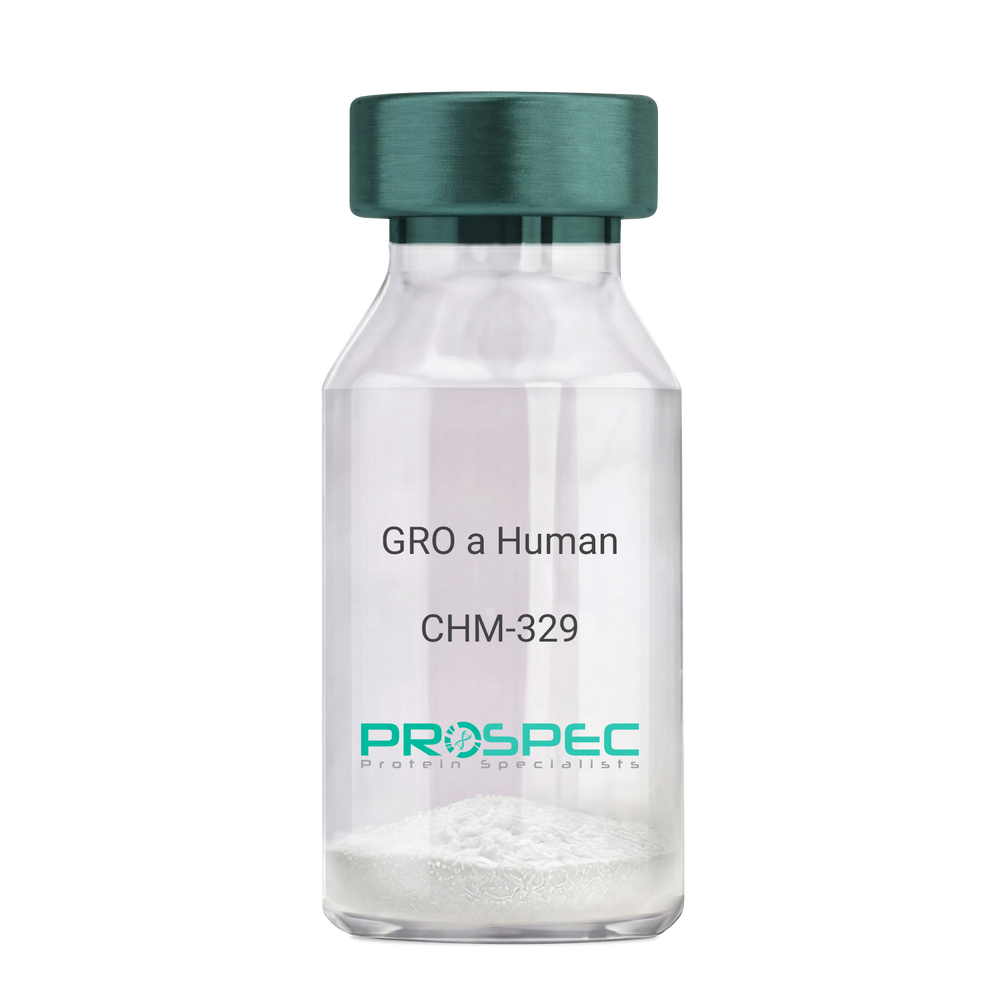
    CXCL1 Human

    Description:

    GRO-Alpha Human Recombinant (CXCL1)

    Growth-regulated protein alpha, CXCL1, Melanoma growth stimulatory activity, MGSA, Neutrophil-activating protein 3, NAP-3, GRO-alpha (1-73), chemokine (C-X-C motif) ligand 1, GRO1, GROa, SCYB1, MGSA-a, MGSA alpha.

    Product # :

    CHM-329

    Price :

    Quantity :

    Shipping Method :

    Room Temp Icon

    Shipped at Room temp

    Add To Cart

    More Info

    • description
    • source
    • formulation
    • purity
    • biological activity
    • More Info

    Description

    GRO Alpha Human Recombinant produced in E.Coli is a single,non-glycosylated, polypeptide chain containing 73 amino acids and having a molecular mass of 7811 Dalton. The GRO-alpha is purified by proprietary chromatographic techniques.

    Source

    Escherichia Coli.

    Formulation

    Lyophilized from a 0.2µm filtered concentrated (1mg/ml) solution in 20mM PB, pH 7.4, 50mM NaCl.

    Purity

    Greater than 97.0% as determined by:
    (a) Analysis by RP-HPLC.
    (b) Analysis by SDS-PAGE.

    Biological Activity

    Determined by its ability to chemoattract human peripheral blood neutrophils using a concentration range of 10.0-100.0 ng/ml.

    More Info

    • Introduction

      Chemokine (C-X-C motif) ligand 1 (CXCL1) is a small cytokine belonging to the CXC chemokine family that was previously called GRO1 oncogene, Neutrophil-activating protein 3 (NAP-3) and melanoma growth stimulating activity, alpha (MSGA-a). It is secreted by human melanoma cells, has mitogenic properties and is implicated in melanoma pathogenesis. CXCL1 is expressed by macrophages, neutrophilsand epithelial cells, and has neutrophil chemoattractant activity. CXCL1 plays a role in spinal cord development by inhibiting the migration of oligodendrocyte precursors and is involved in the processes of angiogenesis, inflammation, wound healing, and tumorigenesis. This chemokine elicits its effects by signaling through the chemokine receptor CXCR2. The gene for CXCL1 is located on human chromosome 4 amongst genes for other CXC chemokines.

    • Synonyms

      Growth-regulated protein alpha, CXCL1, Melanoma growth stimulatory activity, MGSA, Neutrophil-activating protein 3, NAP-3, GRO-alpha (1-73), chemokine (C-X-C motif) ligand 1, GRO1, GROa, SCYB1, MGSA-a, MGSA alpha.

    • Physical Appearance

      Sterile Filtered White lyophilized (freeze-dried) powder.

    • Stability

      Lyophilized GRO-alpha although stable at room temperature for 3 weeks, should be stored desiccated below -18°C. Upon reconstitution CXCL1 should be stored at 4°C between 2-7 days and for future use below -18°C. For long term storage it is recommended to add a carrier protein (0.1% HSA or BSA).Please prevent freeze-thaw cycles.

    • Solubility

      It is recommended to reconstitute the lyophilized CXCL1 in sterile 18MΩ-cm H2O not less than 100µg/ml, which can then be further diluted to other aqueous solutions.

    • Amino Acid Sequence

      The sequence of the first five N-terminal amino acids was determined and was found to be Ala-Ser-Val-Ala-Thr.

    • Background

      What is the molecular weight/Mw of CXCL1 HUMAN Protein?
      CXCL1 HUMAN Protein has a total Mw of 7.81kDa.

      What is the source or expression system of CXCL1 HUMAN Protein?
      Escherichia Coli.

      What is the Purity of CXCL1 HUMAN Protein?
      CXCL1 HUMAN Protein is >97% pure as determined by SDS-PAGE.

      What is the Biological Activity of CXCL1 HUMAN Protein?
      Determined by its ability to chemoattract human peripheral blood neutrophils using a concentration range of 10.0-100.0 ng/ml.

      What is the amino acid sequence of CXCL1 HUMAN Protein?
      The sequence of the first five N-terminal amino acids was determined and was found to be Ala-Ser-Val-Ala-Thr.

      What applications can CXCL1 HUMAN Protein be used in?
      CXCL1 HUMAN Protein can probably be used in western blot, ELISA and Lateral Flow.

      What is the endotoxin level for CXCL1 HUMAN Protein?
      The endotoxin level is minimal, CXCL1 HUMAN Protein was purified using conventional chromatography techniques.


    ProSpec's products are furnished for LABORATORY RESEARCH USE ONLY. The product may not be used as drugs, agricultural or pesticidal products, food additives or household chemicals.

    Gro A Human
  • View Data Sheet

    Name :

    CLTA Human

    Description:

    Clathrin, Light Chain A Human Recombinant

    Clathrin light chain A, Lca, CLTA.

    Product # :

    PRO-1144

    Price :

    Quantity :

    Shipping Method :

    Ice Icon

    Shipped with Ice Packs

    Add To Cart

    More Info

    • description
    • source
    • formulation
    • purity
    • More Info

    Description

    CLTA Human Recombinant produced in E.Coli is a single, non-glycosylated polypeptide chain containing 242 amino acids (1-218 a.a) and having a molecular mass of 26.2kDa (Molecular weight on SDS-PAGE will appear higher).CLTA is fused to a 24 amino acid His-tag at N-terminus & purified by proprietary chromatographic techniques.

    Source

    Escherichia Coli.

    Formulation

    CLTA protein solution (1mg/ml) containing 20mM Tris-HCl buffer (pH 8.0), 0.1M NaCl and 10% glycerol.

    Purity

    Greater than 90.0% as determined by SDS-PAGE.

    More Info

    • Introduction

      Clathrin, light chain A (CLTA) is a member of the clathrin family. Clathrin, which is a large, soluble protein, is comprised of heavy and light chains. CLTA is one of 2 clathrin light chain proteins which are supposed to function as regulatory elements. CLTA is a key cytosolic coat protein in pits and vesicles originating from the plasma membrane and the trans-Golgi network. In receptor-mediated endocytosis, receptor proteins are encapsulated by Clathrin-coated vesicles.

    • Synonyms

      Clathrin light chain A, Lca, CLTA.

    • Physical Appearance

      Sterile Filtered colorless solution.

    • Stability

      Store at 4°C if entire vial will be used within 2-4 weeks. Store, frozen at -20°C for longer periods of time. For long term storage it is recommended to add a carrier protein (0.1% HSA or BSA).Avoid multiple freeze-thaw cycles.

    • Amino Acid Sequence

      MGSSHHHHHH SSGLVPRGSH MGSHMAELDP FGAPAGAPGG PALGNGVAGA GEEDPAAAFL AQQESEIAGI ENDEAFAILD GGAPGPQPHG EPPGGPDAVD GVMNGEYYQE SNGPTDSYAA ISQVDRLQSE PESIRKWREE QMERLEALDA NSRKQEAEWK EKAIKELEEW YARQDEQLQK
      TKANNRAAEE AFVNDIDESS PGTEWERVAR LCDFNPKSSK QAKDVSRMRS VLISLKQAPL VH.

    ProSpec's products are furnished for LABORATORY RESEARCH USE ONLY. The product may not be used as drugs, agricultural or pesticidal products, food additives or household chemicals.

    Clta Human
  • View Data Sheet

    Name :

    GSTA4 Human, Active

    Description:

    Glutathione S-Transferase Alpha 4 Human Recombinant, Active

    Glutathione S-transferase A4, GST class-alpha member 4, Glutathione S-transferase A4-4, GSTA4, GSTA4-4.

    Product # :

    ENZ-996

    Price :

    Quantity :

    Shipping Method :

    Ice Icon

    Shipped with Ice Packs

    Add To Cart

    More Info

    • description
    • source
    • formulation
    • purity
    • biological activity
    • More Info

    Description

    GSTA4 Human Recombinant produced in E.coli is a single, non-glycosylated polypeptide chain containing 246 amino acids (1-222) and having a molecular mass of 28.3kDa.GSTA4 is fused to a 24 amino acid His-tag at N-terminus & purified by proprietary chromatographic techniques.

    Source

    Escherichia Coli.

    Formulation

    The GSTA4 solution (1mg/ml) contains 20mM Tris-HCl buffer, pH8.0, 20% glycerol, 2mM DTT and 100mM NaCl.

    Purity

    Greater than 95.0% as determined by SDS-PAGE.

    Biological Activity

    Specific activity is > 4,000 pmol/min/ug, and is defined as the amount of enzyme that conjugate 1.0 u mole of 1-chloro-2,4- dinitrobenzene (CDNB) with reduced glutathione per minute at pH 6.5 at 25C.

    More Info

    • Introduction

      Glutathione S-transferase A4 (GSTA4) is a member of the GST superfamily. The GSTA4 enzyme is involved in cellular defense against toxic, carcinogenic, and pharmacologically active electrophilic compounds. GSTA4 shows an especially high activity with reactive carbonyl compounds such as alk-2-enals. GSTA4 is extremely effective in catalyzing the conjugate addition of reduced glutathione to 4-hydroxynonenal, which is an important product of peroxidative degradation of arachidonic acid and a frequently used biomarker for oxidative damage in tissue. The GSTA4 enzyme is expressed at a high level in the brain, placenta, and skeletal muscle and much lower in the lung and liver.

    • Synonyms

      Glutathione S-transferase A4, GST class-alpha member 4, Glutathione S-transferase A4-4, GSTA4, GSTA4-4.

    • Physical Appearance

      Sterile Filtered clear solution.

    • Stability

      Store at 4°C if entire vial will be used within 2-4 weeks. Store, frozen at -20°C for longer periods of time. For long term storage it is recommended to add a carrier protein (0.1% HSA or BSA).Avoid multiple freeze-thaw cycles.

    • Amino Acid Sequence

      MGSSHHHHHH SSGLVPRGSH MGSHMAARPK LHYPNGRGRM ESVRWVLAAA GVEFDEEFLE TKEQLYKLQD GNHLLFQQVP MVEIDGMKLV QTRSILHYIA DKHNLFGKNL KERTLIDMYV EGTLDLLELL IMHPFLKPDD QQKEVVNMAQ KAIIRYFPVF EKILRGHGQS FLVGNQLSLA DVILLQTILA LEEKIPNILS AFPFLQEYTV KLSNIPTIKR FLEPGSKKKP PPDEIYVRTV YNIFRP.

    ProSpec's products are furnished for LABORATORY RESEARCH USE ONLY. The product may not be used as drugs, agricultural or pesticidal products, food additives or household chemicals.

    Gsta4 Human Active
  • View Data Sheet

    Name :

    GSTM1 Human, Sf9

    Description:

    Glutathione S-Transferase M1 Human Recombinant, Sf9

    GST1, GTH4, GTM1, GSTM1-1, MGC26563, GSTM1a-1a, GSTM1b-1b, GSTM1, Glutathione S-transferase Mu 1, GST class-mu 1, Glutathione S-transferase GT8.7, pmGT10, GST 1-1.

    Product # :

    ENZ-1092

    Price :

    Quantity :

    Shipping Method :

    Ice Icon

    Shipped with Ice Packs

    Add To Cart

    More Info

    • description
    • source
    • formulation
    • purity
    • More Info

    Description

    GSTM1 produced in Sf9 Insect cells is a single, glycosylated polypeptide chain (1-218a.a.) fused to a 9 aa His Tag at C-terminus containing 227 amino acids and having a molecular mass of 26.8kDa. GSTM1 shows multiple bands between 28-40kDa on SDS-PAGE, reducing conditions and purified by proprietary chromatographic techniques.

    Source

    Sf9, Insect cells.

    Formulation

    GSTM1 protein solution (0.5mg/ml) contains 40% glycerol, 0.2M NaCl, 2mM DTT and 0.1mM PMSF.

    Purity

    Greater than 90.0% as determined by SDS-PAGE.

    More Info

    • Introduction

      Cytosolic and membrane-bound types of GST are encoded by 2 different supergene families. There are 8 classes of the soluble cytoplasmic mammalian GST: alpha, kappa, mu, omega, pi, sigma, theta and zeta. The mu class of enzymes functions in the detoxification of electrophilic compounds, including carcinogens, therapeutic drugs, environmental toxins and products of oxidative stress, by conjugation with glutathione. The genes encoding the mu class of enzymes are arranged in a gene cluster on chromosome 1p13.3 and aare highly polymorphic. These genetic differences can change an individual's resistance to carcinogens and toxins as well as affect the toxicity and efficacy of certain drugs. Null mutations of this class mu gene have been linked with the rise in a number of cancers.

    • Synonyms

      GST1, GTH4, GTM1, GSTM1-1, MGC26563, GSTM1a-1a, GSTM1b-1b, GSTM1, Glutathione S-transferase Mu 1, GST class-mu 1, Glutathione S-transferase GT8.7, pmGT10, GST 1-1.

    • Physical Appearance

      Sterile Filtered colorless solution.

    • Stability

      Store at 4°C if entire vial will be used within 2-4 weeks. Store, frozen at -20°C for longer periods of time. For long term storage it is recommended to add a carrier protein (0.1% HSA or BSA).Avoid multiple freeze-thaw cycles.

    • Amino Acid Sequence

      ADPMPMILGY WDIRGLAHAI RLLLEYTDSS YEEKKYTMGD APDYDRSQWL NEKFKLGLDF PNLPYLIDGA HKITQSNAIL CYIARKHNLC GETEEEKIRV DILENQTMDN HMQLGMICYN PEFEKLKPKY LEELPEKLKL YSEFLGKRPW FAGNKITFVD FLVYDVLDLH RIFEPKCLDA FPNLKDFISR FEGLEKISAY MKSSRFLPRP VFSKMAVWGN KHHHHHH.

    ProSpec's products are furnished for LABORATORY RESEARCH USE ONLY. The product may not be used as drugs, agricultural or pesticidal products, food additives or household chemicals.

    Gstm1 Protein
  • View Data Sheet

    Name :

    GSTO1 Human

    Description:

    Glutathione S-Transferase Omega 1 Human Recombinant

    Glutathione S-transferase omega-1, GSTO 1-1, GSTO1, GSTTLP28, P28, DKFZp686H13163.

    Product # :

    ENZ-434

    Price :

    Quantity :

    Shipping Method :

    Ice Icon

    Shipped with Ice Packs

    Add To Cart

    More Info

    • description
    • source
    • formulation
    • purity
    • More Info

    Description

    GSTO1 Human Recombinant produced in E.Coli is single, a non-glycosylated, Polypeptide chain containing 241 amino acids fragment (1-241) having a Mw of 32.1 kDa.GSTO1 is fused with an amino-terminal hexahistidine tag having a total Mw of 36kDa and purified by proprietary chromatographic techniques.

    Source

    Escherichia Coli.

    Formulation

    GSTO1 protein is supplied in 20 mM Tris pH 8.0 and 50% glycerol.

    Purity

    Greater than 95.0% as determined by SDS-PAGE.

    More Info

    • Introduction

      GSTO1 belongs to the theta class glutathione S-transferase-like (GSTTL) protein family. GSTO1 is expressed in a broad array of human tissues and exhibits glutathione-dependent thiol transferase and dehydroascorbate reductase activities as well as catalyzing the reduction of monomethylarsonate which is an intermediate in the pathway of arsenic biotransformation. Furthermore, GSTO1 shields from oxidative stress which is a risk factor for Alzheimer disease, vascular dementia and stroke. GSTO1 is abundant in alveolar macrophages and airway secretions, with the levels reduced in chronic obstructive pulmonary disease patients. In mouse, the GSTO1 protein acts as a small stress response protein, probably involved in cellular redox homeostasis.

    • Synonyms

      Glutathione S-transferase omega-1, GSTO 1-1, GSTO1, GSTTLP28, P28, DKFZp686H13163.

    • Physical Appearance

      Sterile Filtered clear solution.

    • Stability

      Store at 4°C if entire vial will be used within 2-4 weeks. Store, frozen at -20°C for longer periods of time. Please avoid freeze thaw cycles.

    ProSpec's products are furnished for LABORATORY RESEARCH USE ONLY. The product may not be used as drugs, agricultural or pesticidal products, food additives or household chemicals.

    Gsto1 Human
  • 1
  • …
  • 40
  • 41
  • 42
Your browser does not support the video tag.

Products

  • Cytokines
  • Growth Factors
  • Chemokines
  • CD Antigens
  • Neurotrophins
  • Hormones
  • Enzymes
  • Viral Antigens
  • Recombinant Proteins
  • Natural Proteins
  • Monoclonal Antibodies
  • Polyclonal Antibodies
  • Thermal Packaging

About

  • Company
  • Founder
  • Contribution
  • Contact Us
  • My Account

Ordering

  • Ordering Method
  • Ordering - Credit Card
  • Ordering PO
  • Shipping Fees
  • FAQ's

Legal

  • Terms & Conditions
  • Privacy
  • Site Map
  • info@prospecbio.com
  • Facebook
  • Instagram
  • Linkedin Profile

© 2026 ProSpec-Tany TechnoGene Ltd. All Rights Reserved.

  • Choosing a selection results in a full page refresh.
  • Opens in a new window.