Skip to content

High-quality research proteins.

  • 1-800-805-6531

  • Mon - Sat 8.00-18.00, Sun - Closed

  • info@prospecbio.com

  • PO Box 6591 East Brunswick NJ 08816

  • Products
    • Cytokines
    • Growth factors
    • Chemokines
    • Cd antigens
    • Neurotrophins
    • Hormones
    • Enzymes
    • Viral antigens
    • Recombinant proteins
    • Natural proteins
    • Monoclonal antibodies
    • Polyclonal antibodies
    • Thermal Packaging
  • About
    • Company
    • Founder
    • Contribution
  • Customers
    • Eastern Asia
    • Eastern Europe
    • North America
    • South America
    • South East Asia
    • Southern Asia
    • Western Europe
  • Ordering
    • Ordering Method
    • Ordering - Credit Card
    • Ordering - PO
    • Shipping Fees
    • FAQs
  • Services
    • DNA Cloning
    • Protein Expression
    • Monoclonal Antibody
    • Fermentation
    • Technology License
  • Contact us
Log in

Country/region

  • USD $ | Albania
  • USD $ | Andorra
  • USD $ | Argentina
  • USD $ | Armenia
  • USD $ | Australia
  • USD $ | Austria
  • USD $ | Azerbaijan
  • USD $ | Belarus
  • USD $ | Belgium
  • USD $ | Bolivia
  • USD $ | Brazil
  • USD $ | Bulgaria
  • USD $ | Cambodia
  • USD $ | Canada
  • USD $ | Chile
  • USD $ | China
  • USD $ | Colombia
  • USD $ | Costa Rica
  • USD $ | Croatia
  • USD $ | Cyprus
  • USD $ | Czechia
  • USD $ | Denmark
  • USD $ | Estonia
  • USD $ | Finland
  • USD $ | France
  • USD $ | Georgia
  • USD $ | Germany
  • USD $ | Greece
  • USD $ | Hong Kong SAR
  • USD $ | Hungary
  • USD $ | Iceland
  • USD $ | India
  • USD $ | Ireland
  • USD $ | Israel
  • USD $ | Italy
  • USD $ | Japan
  • USD $ | Kazakhstan
  • USD $ | Latvia
  • USD $ | Liechtenstein
  • USD $ | Lithuania
  • USD $ | Madagascar
  • USD $ | Malta
  • USD $ | Mexico
  • USD $ | Moldova
  • USD $ | Monaco
  • USD $ | Netherlands
  • USD $ | New Zealand
  • USD $ | North Macedonia
  • USD $ | Norway
  • USD $ | Panama
  • USD $ | Paraguay
  • USD $ | Peru
  • USD $ | Philippines
  • USD $ | Poland
  • USD $ | Portugal
  • USD $ | Romania
  • USD $ | Singapore
  • USD $ | Slovakia
  • USD $ | Slovenia
  • USD $ | South Africa
  • USD $ | South Korea
  • USD $ | Spain
  • USD $ | Sri Lanka
  • USD $ | Sweden
  • USD $ | Switzerland
  • USD $ | Taiwan
  • USD $ | Thailand
  • USD $ | Türkiye
  • USD $ | Ukraine
  • USD $ | United Kingdom
  • USD $ | United States
  • USD $ | Uruguay
  • USD $ | Vatican City
  • USD $ | Venezuela
  • USD $ | Vietnam
  • Facebook
  • Instagram
logoProSpec - Recombinant Protein Manufacturer for academic and R&D industry
Become a distributor
Account Log in
Wishlist
Cart Cart(0)
  • Products
    +
    • Cytokines
    • Growth factors
    • Chemokines
    • Cd antigens
    • Neurotrophins
    • Hormones
    • Enzymes
    • Viral antigens
    • Recombinant proteins
    • Natural proteins
    • Monoclonal antibodies
    • Polyclonal antibodies
    • Thermal Packaging
  • About
    +
    • Company
    • Founder
    • Contribution
  • Customers
    +
    • Eastern Asia
    • Eastern Europe
    • North America
    • South America
    • South East Asia
    • Southern Asia
    • Western Europe
  • Ordering
    +
    • Ordering Method
    • Ordering - Credit Card
    • Ordering - PO
    • Shipping Fees
    • FAQs
  • Services
    +
    • DNA Cloning
    • Protein Expression
    • Monoclonal Antibody
    • Fermentation
    • Technology License
  • Contact us

Item added to your cart

View cart
View All
  • Cytokines
  • Growth factors
  • Chemokines
  • Cd antigens
  • Neurotrophins
  • Hormones
  • Enzymes
  • Viral antigens
  • Recombinant proteins
  • Natural proteins
  • Monoclonal antibodies
  • Polyclonal antibodies
  • Thermal Packaging
  • Tumor Necrosis Factor

    Tumor Necrosis Factor

    View All
  • 4-1BB

    4-1BB

    View All
  • Adiponectin

    Adiponectin

    View All
  • AIF1

    AIF1

    View All
  • Other Cytokines

    Other Cytokines

    View All
  • AITRL

    AITRL

    View All
  • Angiopoietin

    Angiopoietin

    View All
  • Apolipoprotein

    Apolipoprotein

    View All
  • B-Cell Activating Factor

    B-Cell Activating Factor

    View All
  • Beta Defensin

    Beta Defensin

    View All
  • Bone Morphogenetic Protein

    Bone Morphogenetic Protein

    View All
  • B type Natriuretic Peptide

    B type Natriuretic Peptide

    View All
  • BST

    BST

    View All
  • Betacellulin

    Betacellulin

    View All
  • Cardiotrophin

    Cardiotrophin

    View All
  • Activin

    Activin

    View All
  • Fibroblast Growth Factor

    Fibroblast Growth Factor

    View All
  • Other Growth Factors

    Other Growth Factors

    View All
  • CSF

    CSF

    View All
  • CTGF

    CTGF

    View All
  • IGFBP

    IGFBP

    View All
  • VEGF Protein

    VEGF Protein

    View All
  • EGF

    EGF

    View All
  • Epigen

    Epigen

    View All
  • Erythropoietin

    Erythropoietin

    View All
  • Insulin-Like Growth Factor

    Insulin-Like Growth Factor

    View All
  • Growth Hormone

    Growth Hormone

    View All
  • HDGF

    HDGF

    View All
  • Hepatocyte Growth Factor

    Hepatocyte Growth Factor

    View All
  • Insulin

    Insulin

    View All
  • BCA-1/ BLC (CXCL13)

    BCA-1/ BLC (CXCL13)

    View All
  • BRAK (CXCL14)

    BRAK (CXCL14)

    View All
  • C-10 (CCL6)

    C-10 (CCL6)

    View All
  • Other Chemokines

    Other Chemokines

    View All
  • MEC (CCL28)

    MEC (CCL28)

    View All
  • LD78-beta (CCL3L1)

    LD78-beta (CCL3L1)

    View All
  • CTACK (CCL27)

    CTACK (CCL27)

    View All
  • CXCL16

    CXCL16

    View All
  • CXCL17

    CXCL17

    View All
  • Platelet Factor-4 (CXCL4)

    Platelet Factor-4 (CXCL4)

    View All
  • ENA-78 (CXCL5)

    ENA-78 (CXCL5)

    View All
  • Eotaxin (CCL11,24,26)

    Eotaxin (CCL11,24,26)

    View All
  • Exodus-2 (CCL21)

    Exodus-2 (CCL21)

    View All
  • Fractalkine (CX3CL1)

    Fractalkine (CX3CL1)

    View All
  • CXCL6

    CXCL6

    View All
  • Other CD Antigens

    Other CD Antigens

    View All
  • CD14

    CD14

    View All
  • CD164

    CD164

    View All
  • CD1

    CD1

    View All
  • CD2

    CD2

    View All
  • CD200

    CD200

    View All
  • CD207

    CD207

    View All
  • CD226

    CD226

    View All
  • CD23

    CD23

    View All
  • CD244

    CD244

    View All
  • CD247

    CD247

    View All
  • CD27

    CD27

    View All
  • CD274

    CD274

    View All
  • CD300

    CD300

    View All
  • CD33

    CD33

    View All
  • Other Neurotrophins

    Other Neurotrophins

    View All
  • Beta-NGF

    Beta-NGF

    View All
  • BDNF

    BDNF

    View All
  • CDNF

    CDNF

    View All
  • CNTF

    CNTF

    View All
  • GDNF

    GDNF

    View All
  • Glia Maturation Factor

    Glia Maturation Factor

    View All
  • MANF

    MANF

    View All
  • Midkine

    Midkine

    View All
  • Neuroglobin

    Neuroglobin

    View All
  • Neurotrophic factors

    Neurotrophic factors

    View All
  • Neuregulin

    Neuregulin

    View All
  • Neuropilin

    Neuropilin

    View All
  • Pigment Epithelium-Derived Factor

    Pigment Epithelium-Derived Factor

    View All
  • Pleiotrophin

    Pleiotrophin

    View All
  • Peptide Hormones

    Peptide Hormones

    View All
  • Other Hormones

    Other Hormones

    View All
  • HCG

    HCG

    View All
  • Endothelin

    Endothelin

    View All
  • Exendin

    Exendin

    View All
  • FSH

    FSH

    View All
  • Glucagon

    Glucagon

    View All
  • GHRP

    GHRP

    View All
  • GLP

    GLP

    View All
  • Thyrostimulin

    Thyrostimulin

    View All
  • Inhibin A

    Inhibin A

    View All
  • LHRH

    LHRH

    View All
  • Melanotan

    Melanotan

    View All
  • Procalcitonin

    Procalcitonin

    View All
  • PTH

    PTH

    View All
  • Peroxiredoxin

    Peroxiredoxin

    View All
  • Peptidase

    Peptidase

    View All
  • Synthetase

    Synthetase

    View All
  • Transferase

    Transferase

    View All
  • Hydrolase

    Hydrolase

    View All
  • Dehydrogenase

    Dehydrogenase

    View All
  • ACE2

    ACE2

    View All
  • Esterase

    Esterase

    View All
  • Protein Kinases

    Protein Kinases

    View All
  • Other Enzymes

    Other Enzymes

    View All
  • Phosphatase

    Phosphatase

    View All
  • Deaminase

    Deaminase

    View All
  • Oxygenase

    Oxygenase

    View All
  • Adenylate Kinase

    Adenylate Kinase

    View All
  • Lyase

    Lyase

    View All
  • Chagas

    Chagas

    View All
  • SARS

    SARS

    View All
  • Influenza

    Influenza

    View All
  • ASFV

    ASFV

    View All
  • Astrovirus

    Astrovirus

    View All
  • Borrelia

    Borrelia

    View All
  • Helicobacter Pylori

    Helicobacter Pylori

    View All
  • Chikungunya

    Chikungunya

    View All
  • Chlamydia

    Chlamydia

    View All
  • Cytomegalo

    Cytomegalo

    View All
  • Dengue

    Dengue

    View All
  • EBV

    EBV

    View All
  • Ebola

    Ebola

    View All
  • Feline Leukemia Virus

    Feline Leukemia Virus

    View All
  • Hepatitis A

    Hepatitis A

    View All
  • Other

    Other

    View All
  • Actin

    Actin

    View All
  • ADAM

    ADAM

    View All
  • Complement Component

    Complement Component

    View All
  • Ag85

    Ag85

    View All
  • Eukaryotic Translation Initiation Factor

    Eukaryotic Translation Initiation Factor

    View All
  • Anterior Gradient Protein

    Anterior Gradient Protein

    View All
  • Heat Shock Protein

    Heat Shock Protein

    View All
  • Alpha-2-HS-Glycoprotein

    Alpha-2-HS-Glycoprotein

    View All
  • Hemoglobin

    Hemoglobin

    View All
  • Allergy

    Allergy

    View All
  • Anaplasma

    Anaplasma

    View All
  • Angiogenin

    Angiogenin

    View All
  • Ankyrin Repeat Domain

    Ankyrin Repeat Domain

    View All
  • Annexin

    Annexin

    View All
  • Other Natural Proteins

    Other Natural Proteins

    View All
  • Aprotinin

    Aprotinin

    View All
  • Transferrin

    Transferrin

    View All
  • Avidin

    Avidin

    View All
  • Anti Coagulation Factors

    Anti Coagulation Factors

    View All
  • Natural Albumin

    Natural Albumin

    View All
  • Natural Coagulation Factors

    Natural Coagulation Factors

    View All
  • Fibronectin

    Fibronectin

    View All
  • Thrombin

    Thrombin

    View All
  • Anti Human Enzyme

    Anti Human Enzyme

    View All
  • Other Monoclonal Antibodies

    Other Monoclonal Antibodies

    View All
  • Anti Human Cytokine

    Anti Human Cytokine

    View All
  • Anti Human Heat Shock Protein

    Anti Human Heat Shock Protein

    View All
  • Anti Mouse Lymphocyte

    Anti Mouse Lymphocyte

    View All
  • Anti Human Chemokine

    Anti Human Chemokine

    View All
  • Anti Human Lymphocyte

    Anti Human Lymphocyte

    View All
  • Anti Viral Monoclonal

    Anti Viral Monoclonal

    View All
  • Anti Mouse Cytokine

    Anti Mouse Cytokine

    View All
  • Anti-GST Monoclonal

    Anti-GST Monoclonal

    View All
  • Other Polyclonal Antibodies

    Other Polyclonal Antibodies

    View All
  • Anti Viral

    Anti Viral

    View All
  • Anti-GST Monoclonal

    Anti-GST Monoclonal

    View All
Back

Search results

1000 results found for “Reductase”

Name

Description

Product #

Price

Quantity

Shipping Method

  • View Data Sheet

    Name :

    GOT2 Human, Active

    Description:

    Glutamic-Oxaloacetic Transaminase 2 Human Recombinant, Active

    EC 2.6.1.1, Aspartate aminotransferase 1, Transaminase A, GIG18.

    Product # :

    ENZ-998

    Price :

    Quantity :

    Shipping Method :

    Ice Icon

    Shipped with Ice Packs

    Add To Cart

    More Info

    • description
    • source
    • formulation
    • purity
    • biological activity
    • More Info

    Description

    GOT2 Recombinant Human produced in E.Coli is a single, non-glycosylated polypeptide chain containing 424 amino acids (30-430 a.a.) and having a molecular mass of 47kDa. The GOT2 fused to a 23 amino acid his tag at N-terminus and is purified by proprietary chromatographic techniques.

    Source

    Escherichia Coli.

    Formulation

    The GOT2 solution (0.5mg/ml) contains 20mM Tris-HCl buffer (pH 8.0), 0.15M NaCl, 10% glycerol and 1mM DTT.

    Purity

    Greater than 95.0% as determined by SDS-PAGE.

    Biological Activity

    Specific activity is > 60 units/mg, and is defined as the amount of enzyme that convert 1umole of α-ketoglutarate to L-Glutamate per minute at pH 8.0 at 25C.

    More Info

    • Introduction

      GOT2 is a pyridoxal phosphate-dependent enzyme which is found in cytoplasmic and inner-membrane mitochondrial forms, GOT1 and GOT2. GOT2 is invloved in amino acid metabolism and the urea and tricarboxylic acid cycles. The 2 enzymes are homodimeric and demonstrate close homology.

    • Synonyms

      EC 2.6.1.1, Aspartate aminotransferase 1, Transaminase A, GIG18.

    • Physical Appearance

      Sterile filtered colorless solution.

    • Stability

      Store at 4°C if entire vial will be used within 2-4 weeks. Store, frozen at -20°C for longer periods of time. For long term storage it is recommended to add a carrier protein (0.1% HSA or BSA).Avoid multiple freeze-thaw cycles.

    • Amino Acid Sequence

      MGSSHHHHHH SSGLVPRGSH MGSSSWWTHV EMGPPDPILG VTEAFKRDTN SKKMNLGVGA YRDDNGKPYV LPSVRKAEAQ IAAKNLDKEY LPIGGLAEFC KASAELALGE NSEVLKSGRF VTVQTISGTG ALRIGASFLQ RFFKFSRDVF LPKPTWGNHT PIFRDAGMQL QGYRYYDPKT CGFDFTGAVE DISKIPEQSV LLLHACAHNP TGVDPRPEQW KEIATVVKKR NLFAFFDMAY QGFASGDGDK DAWAVRHFIE QGINVCLCQS YAKNMGLYGE RVGAFTMVCK DADEAKRVES QLKILIRPMY SNPPLNGARI AAAILNTPDL RKQWLQEVKV MADRIIGMRT QLVSNLKKEG STHNWQHITD QIGMFCFTGL KPEQVERLIK EFSIYMTKDG RISVAGVTSS NVGYLAHAIH QVTK.

    ProSpec's products are furnished for LABORATORY RESEARCH USE ONLY. The product may not be used as drugs, agricultural or pesticidal products, food additives or household chemicals.

    Got2 Human Active
  • View Data Sheet

    Name :

    ISG15 Human

    Description:

    ISG15 Human Recombinant

    ISG15, G1P2, IFI15, UCRP, ISG15 Ubiquitin-like modifier.

    Product # :

    PRO-611

    Price :

    Quantity :

    Shipping Method :

    Ice Icon

    Shipped with Ice Packs

    Add To Cart

    More Info

    • description
    • source
    • formulation
    • purity
    • More Info

    Description

    ISG15 Human Recombinant fused to N-terminal Calmudulin Tag (151 a.a.) produced in E.Coli is a single, non-glycosylated polypeptide chain containing a total of 308 amino acids (157 a.a. without tag) and having a molecular mass of 34 kDa.

    Source

    Escherichia Coli.

    Formulation

    The ISG15 solution contains 20mM Tris-HCl pH-8, 100mM NaCl and 1mM DTT.

    Purity

    Greater than 98.0% as determined by SDS-PAGE.

    More Info

    • Introduction

      ISG15 ubiquitin-like Modifier is conjugated to the intracellular target proteins after IFN-alpha or IFN-beta stimulation. ISG15 enzymatic pathway is partially distinct from that of ubiquitin, differing in substrate specificity and interaction with ligating enzymes. ISG15 conjugation pathway uses a dedicated E1 enzyme, but seems to converge with the ub conjugation pathway at the level of a specific E2 enzyme. ISG15 protein targets include STAT1, SERPINA 3G/SPI2A, JAK1, MAPK3/ERK1, PLCG1, EIF2AK2/PKR, MX1/MXA, and RIG-1. Deconjugated by USP18/UBP43 shows specific chemotactic activity towards neutrophils and activates them to induce release of eosinophil chemotactic factors. ISG15 serves as a trans-acting binding factor directing the association of ligated target proteins to intermediate filaments. ISG15 plays a role in autocrine, paracrine and endocrine mechanisms, as in cell-to-cell signaling, possibly partly by inducing ifn-gamma secretion by monocytes and macrophages. ISG15 displays antiviral activity during viral infections. ISG15 in response to IFN-TAU secreted by the conceptus, ligates to and regulate proteins involved in the release of prostaglandin F2-alpha and thus prevent lysis of the corpus luteum and maintain the pregnancy. ISG15 shares several common properties with other ubiquitin-like molecules, but its activity is strongly regulated by precise signaling pathways that have a role in innate immunity.

    • Synonyms

      ISG15, G1P2, IFI15, UCRP, ISG15 Ubiquitin-like modifier.

    • Physical Appearance

      Sterile Filtered colorless solution.

    • Stability

      Store at 4°C if entire vial will be used within 2-4 weeks. Store, frozen at -20°C for longer periods of time. For long term storage it is recommended to add a carrier protein (0.1% HSA or BSA).Avoid multiple freeze-thaw cycles.

    • Amino Acid Sequence

      MADQLTEEQI AEFKEAFSLF DKDGDGTITT KELGTVMRSL GQNPTEAELQ DMINEVDADG NGTIDFPEFL TMMARKMKDT DSEEEIREAF RVFDKDGNGY ISAAELRHVM TNLGEKLTDE EVDEMIREAD IDGDGQVNYE EFVQMMTAKG SMGWDLTVKM LAGNEFQVSL SSSMSVSELK AQITQKIGVH AFQQRLAVHP SGVALQDRVP LASQGLGPGS TVLLVVDKCD EPLNILVRNN KGRSSTYEVR LTQTVAHLKQ QVSGLEGVQD DLFWLTFEGK PLEDQLPLGE YGLKPLSTVF MNLRLRGG.

    ProSpec's products are furnished for LABORATORY RESEARCH USE ONLY. The product may not be used as drugs, agricultural or pesticidal products, food additives or household chemicals.

    Isg15 Human
  • View Data Sheet

    Name :

    PAPP-A Human

    Description:

    Pregnancy-Associated Plasma Protein-1 Human Recombinant

    Pappalysin-1, Pregnancy-associated plasma protein A, PAPP-A, IGF-dependent IGFBP-4 protease, IGFBP-4ase, PAPPA, PAPA, DIPLA1, PAPPA1, ASBABP2.

    Product # :

    ENZ-441

    Price :

    Quantity :

    Shipping Method :

    Ice Icon

    Shipped with Ice Packs

    Add To Cart

    More Info

    • description
    • source
    • formulation
    • purity
    • More Info

    Description

    PAPP-A Human Recombinant produced in E.Coli is single, a non-glycosylated, Polypeptide chain containing 191 amino acids fragment (81-271) corresponding to the PAPP-A “Jelly-Roll” domain fragment, having a total molecular mass of 25.75kDa and fused with an amino-terminal hexahistidine tag. The PAPP-A is purified by proprietary chromatographic techniques.

    Source

    Escherichia Coli.

    Formulation

    PAPP-A protein is supplied in 20mM Tris Hcl PH 8.0, 4M Urea and 50% Glycerol.

    Purity

    Greater than 95.0% as determined by SDS-PAGE.

    More Info

    • Introduction

      PAPPA is a large zinc binding protein, which acts as a metalloprotease and specifically cleaves IGFBP-4 and IGFBP-5, resulting in release of bound IGF. PAPP-A can also act as a regulator of IGF bioactivity in a number of biological systems, including the human ovary and cardiovascular systems. It was shown that PAPP A levels are elevated in patients with unstable angina or acute myocardial infarction. Furthermore, PAPPA is believed to be involved in local proliferative processes such as wound healing and bone remodeling. Moreover, PAPP-A is produced in high concentrations during pregnancy and is released into the maternal circulation. In placenta, PAPP A is expressed in X cells in septa and anchoring villi, and in syncytiotrophoblasts in the chorionic villi.
      Lower levels of PAPPA are found in an array of other tissues including kidney, myometrium, endometrium, ovaries, breast, prostate, bone marrow, colon, fibroblasts and osteoblasts. PAPP-A is present in serum and placenta during pregnancy; with levels increasing throughout pregnancy. Low levels of PAPP A are associated with a number of foetal chromosomal abnormalities, as well as pre-eclampsia and stillbirth.
      PAPPA levels may be a potentially highly specific marker for heart disease.
      PAPP-A proteolytic activity is inhibited by targeting substrate exosite binding.

    • Synonyms

      Pappalysin-1, Pregnancy-associated plasma protein A, PAPP-A, IGF-dependent IGFBP-4 protease, IGFBP-4ase, PAPPA, PAPA, DIPLA1, PAPPA1, ASBABP2.

    • Physical Appearance

      Sterile Filtered clear solution.

    • Stability

      Store at 4°C if entire vial will be used within 2-4 weeks. Store, frozen at -20°C for longer periods of time. Please avoid freeze thaw cycles.

    ProSpec's products are furnished for LABORATORY RESEARCH USE ONLY. The product may not be used as drugs, agricultural or pesticidal products, food additives or household chemicals.

    Papp A Human
  • View Data Sheet

    Name :

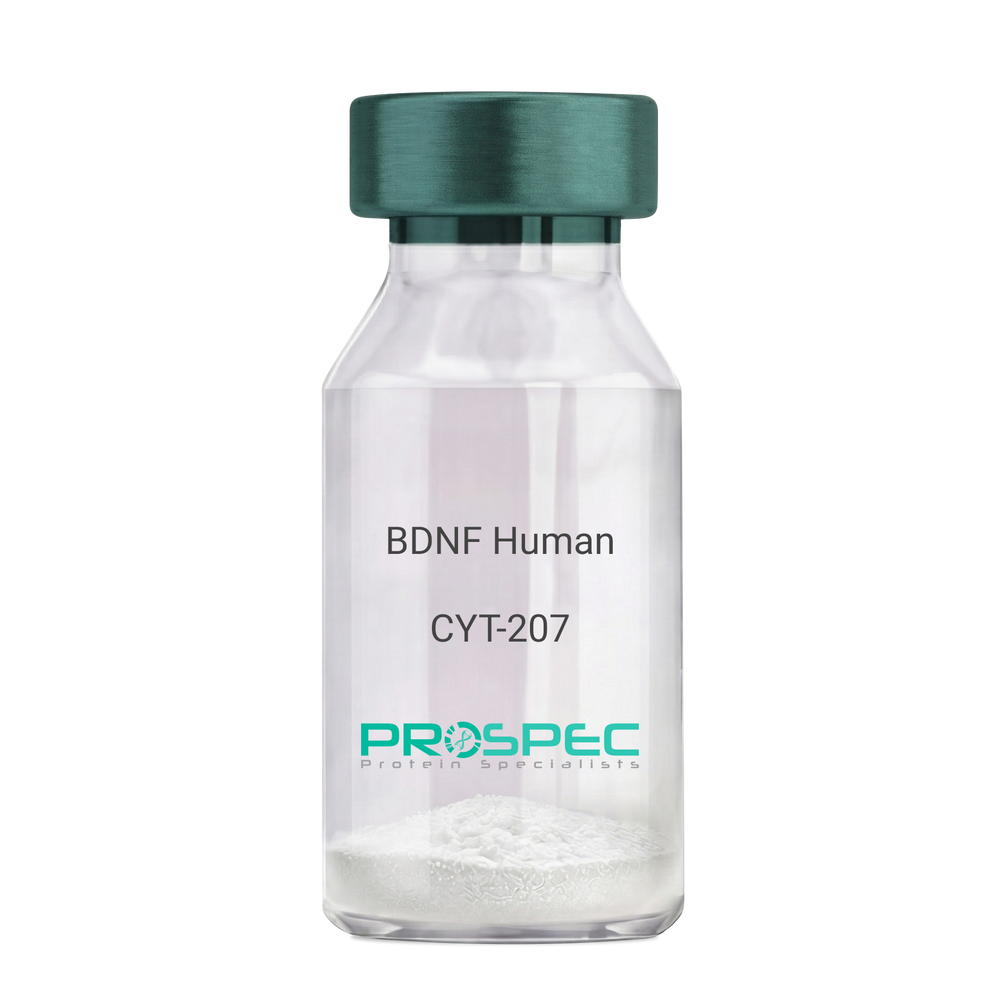
    BDNF Human

    Description:

    Brain-Derived Neurotrophic Factor Human Recombinant

    Brain-Derived Neurotrophic Factor, BDNF, MGC34632.

    Product # :

    CYT-207

    Price :

    Quantity :

    Shipping Method :

    Room Temp Icon

    Shipped at Room temp

    Add To Cart

    More Info

    • description
    • source
    • formulation
    • purity
    • biological activity
    • More Info
    • Activity

    Description

    BDNF Human Recombinant produced in E.Coli is a homodimer, non-glycosylated, polypeptide chain containing 2 x 119 amino acids (and an N-terminal Met) and having a total molecular mass of 28kDa. BDNF Human Recombinant is purified by proprietary chromatographic techniques.

    Source

    Escherichia Coli.

    Formulation

    The protein was lyophilized with 20mM PB and 400mM NaCl, pH 7.2.

    Purity

    BDNF is greater than 950% as determined SDS-PAGE.

    Biological Activity

    The activity was determined using Immobilized Human TrkB-His tag protein 2ug/ml (100 μl/well) for its binding to NHS-Biotin BDNF. The ED50 of was found to be ≤20ng/mL

    Activity

    bdnf activity - Product image 1

    More Info

    • Introduction

      BDNF promotes the survival of neuronal populations that are all located either in the central nervous system or directly connected to it. BDNF is a major regulator of synaptic transmission and plasticity at adult synapses in many regions of the cns. The versatility of BDNF is emphasized by its contribution to a range of adaptive neuronal responses including long-term potentiation (ltp), long-term depression (ltd), certain forms of short-term synaptic plasticity, as well as homeostatic regulation of intrinsic neuronal excitability.

    • Synonyms

      Brain-Derived Neurotrophic Factor, BDNF, MGC34632.

    • Physical Appearance

      Sterile Filtered White lyophilized (freeze-dried) powder.

    • Stability

      Lyophilized BDNF although stable at room temperature for 3 weeks, should be stored desiccated below -18°C. Upon reconstitution BDNF should be stored at 4°C between 2-7 days and for future use below -18°C.For long term storage it is recommended to add a carrier protein (0.1% HSA or BSA).Please prevent freeze-thaw cycles.

    • Solubility

      It is recommended to reconstitute the lyophilized BDNF in sterile 18M-cm H2O not less than 100µg/ml, which can then be further diluted to other aqueous solutions.

    • Amino Acid Sequence

      HSDPARRGE LSVCDSISEW VTAADKKTAV DMSGGTVTVL EKVPVSKGQL KQYFYETKCN PMGYTKEGCR GIDKRHWNSQ CRTTQSYVRA LTMDSKKRIG WRFIRIDTSC VCTLTIKRGR.

    • Background

      Final Thoughts

      Although more research is needed on the safety and effectiveness of BDNF human recombinant, trials suggest that this laboratory-produced protein may be effective in managing and treating several neurological and psychiatric disorders. It's important for experts to stay up to date on the latest developments and research to learn more about potential risks and benefits.

      What is the molecular weight/Mw of BDNF Protein?
      BDNF Protein has a total Mw of 27kDa.

      What is the source or expression system of BDNF Protein?
      Escherichia Coli.

      What is the Purity of BDNF Protein?
      BDNF Protein is >97% pure as determined by SDS-PAGE.

      What is the Biological Activity of BDNF Protein?
      The ED50, as determined by the dose-dependent induction of C6 cells proliferation, is 1.3-2µg/ml.

      What is the amino acid sequence of BDNF Protein?
      MHSDPARRGE LSVCDSISEW VTAADKKTAV DMSGGTVTVL EKVPVSKGQL KQYFYETKCN PMGYTKEGCR GIDKRHWNSQ CRTTQSYVRA LTMDSKKRIG WRFIRIDTSC VCTLTIKRGR.

      What applications can BDNF Protein be used in?
      BDNF Protein can probably be used in western blot, ELISA and Lateral Flow.

      What is the endotoxin level for BDNF Protein?
      The endotoxin level is minimal, BDNF Protein was purified using conventional chromatography techniques.

    • Protein content

      BDNF quantitation was carried out by two independent methods:1. UV spectroscopy at 280 nm using the absorbency value of 1.6 as the extinction coefficient for a 0.1% (1mg/ml) solution. This value is calculated by the PC GENE computer analysis program of protein sequences (IntelliGenetics). 2. Analysis by RP-HPLC, using a standard solution of Brain-derived Neurotrophic Factor as a Reference Standard.

    ProSpec's products are furnished for LABORATORY RESEARCH USE ONLY. The product may not be used as drugs, agricultural or pesticidal products, food additives or household chemicals.

    Bdnf Human
  • View Data Sheet

    Name :

    ACSF2 Human

    Description:

    Acyl-CoA Synthetase Family Member 2 Human Recombinant

    Acyl-CoA Synthetase Family Member 2, PPARG Binding, Long Chain Fatty Acid Acyl Co-A Ligase Like, Acyl-CoA Synthetase Family Member 2, Mitochondrial, EC 6.2.1.26, EC 6.2.1.-, FLJ20920, EC 6.2.1, AVYV493, ACSMW, Acyl-CoA synthetase family member 2, mitochondrial.

    Product # :

    ENZ-919

    Price :

    Quantity :

    Shipping Method :

    Ice Icon

    Shipped with Ice Packs

    Add To Cart

    More Info

    • description
    • source
    • formulation
    • purity
    • More Info

    Description

    ACSF2 Human Recombinant produced in E.Coli is a single, non-glycosylated polypeptide chain containing 597 amino acids (42-615 a.a) and having a molecular mass of 66.1kDa. ACSF2 is fused to a 23 amino acid His-tag at N-terminus & purified by proprietary chromatographic techniques.

    Source

    E.coli.

    Formulation

    ACSF2 protein solution (0.5mg/ml) containing Phosphate Buffered Saline pH 7.4 and 10% glycerol.

    Purity

    Greater than 95% as determined by SDS-PAGE.

    More Info

    • Introduction

      Acyl-CoA synthetase family member 2, also known as ACSF2 is a member of the ATP-dependent AMP-binding enzyme family. Acyl-CoA synthetases are a family of enzymes which catalyze the thioesterification of fatty acids with coenzymeA to form activated intermediates, which play a basic part in lipid metabolism as well as homeostasis of lipid-related processes. ACSF2 is required for the complex of lipid synthesis, energy production via beta-oxidation, protein acylation and fatty-acid dependent transcriptional regulation. Moreover, ACSF2 is required for fatty acid import into cells by the process of vectorial acylation.

    • Synonyms

      Acyl-CoA Synthetase Family Member 2, PPARG Binding, Long Chain Fatty Acid Acyl Co-A Ligase Like, Acyl-CoA Synthetase Family Member 2, Mitochondrial, EC 6.2.1.26, EC 6.2.1.-, FLJ20920, EC 6.2.1, AVYV493, ACSMW, Acyl-CoA synthetase family member 2, mitochondrial.

    • Physical Appearance

      Sterile Filtered colorless solution.

    • Stability

      Store at 4°C if entire vial will be used within 2-4 weeks. Store, frozen at -20°C for longer periods of time. For long term storage it is recommended to add a carrier protein (0.1% HSA or BSA).Avoid multiple freeze-thaw cycles.

    • Amino Acid Sequence

      MGSSHHHHHH SSGLVPRGSH MGSLSSREVD RMVSTPIGGL SYVQGCTKKH LNSKTVGQCL ETTAQRVPER EALVVLHEDV RLTFAQLKEE VDKAASGLLS IGLCKGDRLG MWGPNSYAWV LMQLATAQAG IILVSVNPAY QAMELEYVLK KVGCKALVFP KQFKTQQYYN VLKQICPEVE NAQPGALKSQ RLPDLTTVIS VDAPLPGTLL LDEVVAAGST RQHLDQLQYN QQFLSCHDPI NIQFTSGTTG SPKGATLSHY NIVNNSNILG ERLKLHEKTP EQLRMILPNP LYHCLGSVAG TMMCLMYGAT LILASPIFNG KKALEAISRE RGTFLYGTPT MFVDILNQPD FSSYDISTMC GGVIAGSPAP PELIRAIINK INMKDLVVAY GTTENSPVTF AHFPEDTVEQ KAESVGRIMP HTEARIMNME AGTLAKLNTP GELCIRGYCV MLGYWGEPQK TEEAVDQDKW YWTGDVATMN EQGFCKIVGR SKDMIIRGGE NIYPAELEDF FHTHPKVQEV QVVGVKDDRM GEEICACIRL KDGEETTVEE IKAFCKGKIS HFKIPKYIVF VTNYPLTISG KIQKFKLREQ MERHLNL.

    ProSpec's products are furnished for LABORATORY RESEARCH USE ONLY. The product may not be used as drugs, agricultural or pesticidal products, food additives or household chemicals.

    Acsf2 Human
  • View Data Sheet

    Name :

    HPGDS Human

    Description:

    Hematopoietic Prostaglandin D Synthase Human Recombinant

    Hematopoietic prostaglandin D synthase, H-PGDS, GST class-sigma, Glutathione S-transferase, Glutathione-dependent PGD synthase, Glutathione-requiring prostaglandin D synthase, Prostaglandin-H2 D-isomerase, HPGDS, GSTS, PGDS, PTGDS2GSTS, PGD2, GSTS1-1.

    Product # :

    ENZ-616

    Price :

    Quantity :

    Shipping Method :

    Ice Icon

    Shipped with Ice Packs

    Add To Cart

    More Info

    • description
    • source
    • formulation
    • purity
    • More Info

    Description

    HPGDS Human Recombinant produced in E.Coli is a single, non-glycosylated polypeptide chain containing 223 amino acids (1-199 a.a.) and having a molecular mass of 25.9kDa.HPGDS is fused to a 24 amino acid His-tag at N-terminus & purified by proprietary chromatographic techniques.

    Source

    Escherichia Coli.

    Formulation

    HPGDS protein solution (1mg/ml) containing 20mM Tris-HCl buffer (pH8.0), 10% glycerol, 0.15M NaCl and 1mM DTT.

    Purity

    Greater than 95.0% as determined by SDS-PAGE.

    More Info

    • Introduction

      Hematopoietic Prostaglandin D Synthase (HPGDS) belongs to the sigma class glutathione-S-transferase family. The HPGDS enzyme catalyzes the conversion of PGH2 to PGD2 and has a role in the production of prostanoids in the immune system and mast cells. The presence of the HPGDS enzyme can be utilized to identify the differentiation stage of human megakaryocytes. Furthermore, HPGDS is a prostaglandin involved in smooth muscle contraction/relaxation and an effective inhibitor of platelet aggregation, and the conjugation of glutathione with a extensive range of aryl halides and organic isothiocyanates. In addition, HPGDS displays low glutathione-peroxidase activity towards cumene hydroperoxide. HPGDS is expressed in a number of megakaryocytic cell lines but not in platelets. HPGDS is highly expressed in the adipose tissue, macrophages and placenta; however it is expressed at lower levels in the lung, heart, lymph nodes, appendix, bone marrow and fetal liver.

    • Synonyms

      Hematopoietic prostaglandin D synthase, H-PGDS, GST class-sigma, Glutathione S-transferase, Glutathione-dependent PGD synthase, Glutathione-requiring prostaglandin D synthase, Prostaglandin-H2 D-isomerase, HPGDS, GSTS, PGDS, PTGDS2GSTS, PGD2, GSTS1-1.

    • Physical Appearance

      Sterile Filtered colorless solution.

    • Stability

      Store at 4°C if entire vial will be used within 2-4 weeks. Store, frozen at -20°C for longer periods of time. For long term storage it is recommended to add a carrier protein (0.1% HSA or BSA).Avoid multiple freeze-thaw cycles.

    • Amino Acid Sequence

      MGSSHHHHHH SSGLVPRGSH MGSHMPNYKL TYFNMRGRAE IIRYIFAYLD IQYEDHRIEQ ADWPEIKSTL PFGKIPILEV DGLTLHQSLA IARYLTKNTD LAGNTEMEQC HVDAIVDTLD DFMSCFPWAE KKQDVKEQMF NELLTYNAPH LMQDLDTYLG GREWLIGNSV TWADFYWEIC
      STTLLVFKPD LLDNHPRLVT LRKKVQAIPA VANWIKRRPQ TKL.

    ProSpec's products are furnished for LABORATORY RESEARCH USE ONLY. The product may not be used as drugs, agricultural or pesticidal products, food additives or household chemicals.

    Hpgds Human
  • View Data Sheet

    Name :

    IMMP2L Human

    Description:

    IMP2 Inner Mitochondrial Membrane Peptidase-Like Human Recombinant

    IMP2 Inner Mitochondrial Membrane Peptidase-Like (S. Cerevisiae), IMP2, IMP2 Inner Mitochondrial Membrane Protease-Like (S. Cerevisiae), IMMP2L Intronic Transcript 1 (Non-Protein Coding), Mitochondrial Inner Membrane Protease Subunit, Inner Mitochondrial Membrane Peptidase 2 Like, IMP2-Like Protein, EC 3.4.21.- , IMMP2L-IT1, IMP2-LIKE, EC 3.4.21, Mitochondrial inner membrane protease subunit 2.

    Product # :

    ENZ-822

    Price :

    Quantity :

    Shipping Method :

    Ice Icon

    Shipped with Ice Packs

    Add To Cart

    More Info

    • description
    • source
    • formulation
    • purity
    • More Info

    Description

    IMMP2L Human Recombinant produced in E.Coli is a single, non-glycosylated polypeptide chain containing 161 amino acids (38-175aa) and having a molecular mass of 18.0kDa. IMMP2L is fused to a 23 amino acid His-tag at N-terminus & purified by proprietary chromatographic techniques.

    Source

    Escherichia Coli.

    Formulation

    IMMP2L protein solution (0.5mg/ml) containing 20mM Tris-HCl buffer (pH 8.0), 0.15M NaCl, 50% glycerol and 1mM DTT.

    Purity

    Greater than 95.0% as determined by SDS-PAGE.

    More Info

    • Introduction

      IMP2 Inner Mitochondrial Membrane Peptidase-Like (IMMP2L) is implicated in processing the signal peptide sequences, IMMP2L is used to direct mitochondrial proteins to the mitochondria. IMMP2L resides in the mitochondria and is one of the essential proteins for the catalytic activity of the mitochondrial inner membrane peptidase (IMP) complex. Two variants which encode the same protein have been found for IMMP2L.

    • Synonyms

      IMP2 Inner Mitochondrial Membrane Peptidase-Like (S. Cerevisiae), IMP2, IMP2 Inner Mitochondrial Membrane Protease-Like (S. Cerevisiae), IMMP2L Intronic Transcript 1 (Non-Protein Coding), Mitochondrial Inner Membrane Protease Subunit, Inner Mitochondrial Membrane Peptidase 2 Like, IMP2-Like Protein, EC 3.4.21.- , IMMP2L-IT1, IMP2-LIKE, EC 3.4.21, Mitochondrial inner membrane protease subunit 2.

    • Physical Appearance

      Sterile filtered colorless solution.

    • Stability

      Store at 4°C if entire vial will be used within 2-4 weeks. Store, frozen at -20°C for longer periods of time. For long term storage it is recommended to add a carrier protein (0.1% HSA or BSA).Avoid multiple freeze-thaw cycles.

    • Amino Acid Sequence

      MGSSHHHHHH SSGLVPRGSH MGSRVEGASM QPSLNPGGSQ SSDVVLLNHW KVRNFEVHRG DIVSLVSPKN PEQKIIKRVI ALEGDIVRTI GHKNRYVKVP RGHIWVEGDH HGHSFDSNSF GPVSLGLLHA HATHILWPPE RWQKLESVLP PERLPVQREE E.

    ProSpec's products are furnished for LABORATORY RESEARCH USE ONLY. The product may not be used as drugs, agricultural or pesticidal products, food additives or household chemicals.

    Immp2L Human
  • View Data Sheet

    Name :

    PPP1R8 Human

    Description:

    Protein Phosphatase 1, Regulatory Subunit 8 Human Recombinant

    Protein phosphatase 1 regulatory subunit 8, nuclear inhibitor of protein phosphatase-1 alpha, Protein phosphatase 1 regulatory inhibitor subunit 8, ARD1, NIPP1, PRO2047, ARD-1, activator of RNA decay, nuclear subunit of PP-1, RNase E.

    Product # :

    ENZ-648

    Price :

    Quantity :

    Shipping Method :

    Ice Icon

    Shipped with Ice Packs

    Add To Cart

    More Info

    • description
    • source
    • formulation
    • purity
    • More Info

    Description

    PPP1R8 Human Recombinant produced in E. coli is a single polypeptide chain containing 359 amino acids (1-351) and having a molecular mass of 39.5 kDa.PPP1R8 is fused to a 8 amino acid His-tag at C-terminus & purified by proprietary chromatographic techniques.

    Source

    E.coli.

    Formulation

    The PPP1R8 solution (0.5mg/1ml) contains 20mM Tris-HCl buffer (pH 8.0), 0.2M NaCl, 2mM DTT and 20% glycerol.

    Purity

    Greater than 90% as determined by SDS-PAGE.

    More Info

    • Introduction

      Protein Phosphatase 1, Regulatory Subunit 8 (PPP1R8) is the RNA-binding subunit of a key species of protein phosphatase-1 in the nucleus. The PPP1R8 enzyme is an inhibitor subunit of the main nuclear protein phosphatase-1 (PP-1). PPP1R8 has RNA-binding activity however it doesn’t cleave RNA and may target PP-1 to RNA-associated substrates. Two isoforms of the PPP1R8 protein are specific inhibitors of type 1 serine/threonine protein phosphatases which can bind but not cleave RNA. The third isoform of the PPP1R8 protein is deficient in of the phosphatase inhibitory activity nonetheless it is a single-strand endoribonuclease comparable to RNase E of E. coli.

    • Synonyms

      Protein phosphatase 1 regulatory subunit 8, nuclear inhibitor of protein phosphatase-1 alpha, Protein phosphatase 1 regulatory inhibitor subunit 8, ARD1, NIPP1, PRO2047, ARD-1, activator of RNA decay, nuclear subunit of PP-1, RNase E.

    • Physical Appearance

      Sterile Filtered colorless solution.

    • Stability

      Store at 4°C if entire vial will be used within 2-4 weeks. Store, frozen at -20°C for longer periods of time. For long term storage it is recommended to add a carrier protein (0.1% HSA or BSA).Avoid multiple freeze-thaw cycles.

    • Amino Acid Sequence

      MAAAANSGSS LPLFDCPTWA GKPPPGLHLD VVKGDKLIEK LIIDEKKYYL FGRNPDLCDF TIDHQSCSRV HAALVYHKHL KRVFLIDLNS THGTFLGHIR LEPHKPQQIP IDSTVSFGAS TRAYTLREKP QTLPSAVKGD EKMGGEDDEL KGLLGLPEEE TELDNLTEFN TAHNKRISTL TIEEGNLDIQ RPKRKRKNSR VTFSEDDEII NPEDVDPSVG RFRNMVQTAV VPVKKKRVEG PGSLGLEESG SRRMQNFAFS GGLYGGLPPT HSEAGSQPHG IHGTALIGGL PMPYPNLAPD VDLTPVVPSA VNMNPAPNPA VYNPEAVNEP KKKKYAKEAW PGKKPTPSLL IVEHHHHHH

    ProSpec's products are furnished for LABORATORY RESEARCH USE ONLY. The product may not be used as drugs, agricultural or pesticidal products, food additives or household chemicals.

    Ppp1R8 Human
  • View Data Sheet

    Name :

    ALKBH3 Human

    Description:

    ALKB Alkylation Repair Homolog 3 Human Recombinant

    Alpha-ketoglutarate-dependent dioxygenase alkB homolog 3, Alkylated DNA repair protein alkB homolog 3, DEPC-1, Prostate cancer antigen 1, ALKBH3, ABH3, DEPC1, PCA1, FLJ43614, MGC118790, MGC118792, MGC118793.

    Product # :

    ENZ-101

    Price :

    Quantity :

    Shipping Method :

    Ice Icon

    Shipped with Ice Packs

    Add To Cart

    More Info

    • description
    • source
    • formulation
    • purity
    • More Info

    Description

    ALKBH3 Human Recombinant fused to 39 amino acid His Tag at N-terminal produced in E.Coli is a single, non-glycosylated, polypeptide chain containing 325 amino acids (1-286 a.a.) and having a molecular mass of 37.9kDa. The ALKBH3 is purified by proprietary chromatographic techniques.

    Source

    Escherichia Coli.

    Formulation

    The ALKBH3 solution 1mg/ml contains 20mM Tris-HCl buffer (pH 8.0), 10% glycerol, 2mM DTT and 0.1M NaCl.

    Purity

    Greater than 95.0% as determined by SDS-PAGE.

    More Info

    • Introduction

      ALKBH3 belongs to the ALKB family of proteins and acts as a dioxygenase with a preference for RNA and single stranded DNA substrates. ALKBH3 protein repairs 1-methyladenine and 3-methylcytosine lesions in alkylated DNA and RNA and its activity is stimulated by ascorbate. ALKBH3 is expressed in a broad array of tissues and localizes to the cytoplasm and the nucleus.

    • Synonyms

      Alpha-ketoglutarate-dependent dioxygenase alkB homolog 3, Alkylated DNA repair protein alkB homolog 3, DEPC-1, Prostate cancer antigen 1, ALKBH3, ABH3, DEPC1, PCA1, FLJ43614, MGC118790, MGC118792, MGC118793.

    • Physical Appearance

      Sterile Filtered colorless solution.

    • Stability

      Store at 4°C if entire vial will be used within 2-4 weeks. Store, frozen at -20°C for longer periods of time. For long term storage it is recommended to add a carrier protein (0.1% HSA or BSA).Avoid multiple freeze-thaw cycles.

    • Amino Acid Sequence

      MRGSHHHHHH GMASMTGGQQ MGRDLYDDDD KDRWGSELDM EEKRRRARVQ GAWAAPVKSQ AIAQPATTAK SHLHQKPGQT WKNKEHHLSD REFVFKEPQQ VVRRAPEPRV IDREGVYEIS LSPTGVSRVC LYPGFVDVKE ADWILEQLCQ DVPWKQRTGI REDITYQQPR LTAWYGELPY TYSRITMEPN PHWHPVLRTL KNRIEENTGH TFNSLLCNLY RNEKDSVDWH SDDEPSLGRC PIIASLSFGA TRTFEMRKKP PPEENGDYTY VERVKIPLDH GTLLIMEGAT QADWQHRVPK EYHSREPRVN LTFRTVYPDP RGAPW.

    ProSpec's products are furnished for LABORATORY RESEARCH USE ONLY. The product may not be used as drugs, agricultural or pesticidal products, food additives or household chemicals.

    Alkbh3 Human
  • View Data Sheet

    Name :

    FADD Human

    Description:

    Fas-Associated Death Domain Human Recombinant

    GIG3, MORT1, MGC8528, FADD, Fas (TNFRSF6)-associated via death domain, Protein FADD, FAS-associated death domain protein, FAS-associating death domain-containing protein, Mediator of receptor induced toxicity, Growth-inhibiting gene 3 protein.

    Product # :

    PRO-733

    Price :

    Quantity :

    Shipping Method :

    Ice Icon

    Shipped with Ice Packs

    Add To Cart

    More Info

    • description
    • source
    • formulation
    • purity
    • More Info

    Description

    FADD produced in E.Coli is a single, non-glycosylated polypeptide chain containing 244 amino acids (1-208 a.a.) and having a molecular mass of 27.4 kDa.FADD is fused to 36 amino acid His-Tag at N-terminus and purified by proprietary chromatographic techniques.

    Source

    Escherichia Coli.

    Formulation

    The FADD protein solution contains 20mM Tris-HCl, pH-8, and 10% glycerol.

    Purity

    Greater than 95.0% as determined by SDS-PAGE.

    More Info

    • Introduction

      FADD is an adaptor protein that cooperates with a variety of cell surface receptors and mediates cell apoptotic signals. Using its C-terminal death domain, FADD is recruited by TNFRSF6/Fas-receptor, tumor necrosis factor receptor, TNFRSF25, and TNFSF10/TRAIL-receptor, and consequently it take parts in the death signaling initiated by these receptors. FADD interaction with the receptors reviels the N-terminal effector domain of, which allows it to recruit caspase-8, and thus initiate the cysteine protease cascade. Knockout studies in mice furthermore propose the significance of FADD in premature T cell development. FADD plays a role in survival/proliferation and cell cycle development. FADD also takes part in cellular sublocalization, protein phosphorylation, and inhibitory molecules.

    • Synonyms

      GIG3, MORT1, MGC8528, FADD, Fas (TNFRSF6)-associated via death domain, Protein FADD, FAS-associated death domain protein, FAS-associating death domain-containing protein, Mediator of receptor induced toxicity, Growth-inhibiting gene 3 protein.

    • Physical Appearance

      Sterile filtered colorless solution.

    • Stability

      Store at 4°C if entire vial will be used within 2-4 weeks. Store, frozen at -20°C for longer periods of time.For long term storage it is recommended to add a carrier protein (0.1% HSA or BSA).Avoid multiple freeze-thaw cycles.

    • Amino Acid Sequence

      MRGSHHHHHHGMASMTGGQQ MGRDLYDDDD KDRWGSMDPF LVLLHSVSSS LSSSELTELK FLCLGRVGKR KLERVQSGLD LFSMLLEQND LEPGHTELLR ELLASLRRHD LLRRVDDFEA GAAAGAAPGE EDLCAAFNVI CDNVGKDWRR LARQLKVSDT KIDSIEDRYP RNLTERVRES LRIWKNTEKE NATVAHLVGA LRSCQMNLVA DLVQEVQQAR DLQNRSGAMS PMSWNSDAST SEAS.

    ProSpec's products are furnished for LABORATORY RESEARCH USE ONLY. The product may not be used as drugs, agricultural or pesticidal products, food additives or household chemicals.

    Fadd Human
  • View Data Sheet

    Name :

    NAA30 Human

    Description:

    N Alpha-Acetyltransferase 30, NatC Catalytic Subunit Human Recombinant

    N(Alpha)-Acetyltransferase 30, NatC Catalytic Subunit, C14orf35, NAT12, N-Acetyltransferase 12 (GCN5-Related, Putative), N-Acetyltransferase 12, NatC Catalytic Subunit, MAK3, N-Acetyltransferase MAK3 Homolog, Chromosome 14 Open Reading Frame 35, Mak3p, NAT12P, N-Alpha-Acetyltransferase 30, N-Alpha-Acetyltransferase 30, NatC Catalytic Subunit, Putative N-Acetyltransferase, EC 2.3.1.88.

    Product # :

    ENZ-720

    Price :

    Quantity :

    Shipping Method :

    Ice Icon

    Shipped with Ice Packs

    Add To Cart

    More Info

    • description
    • source
    • formulation
    • purity
    • More Info

    Description

    NAA30 Human Recombinant produced in E.Coli is a single, non-glycosylated polypeptide chain containing 385 amino acids (1-362 a.a) and having a molecular mass of 41.7kDa.NAA30 is fused to a 23 amino acid His-tag at N-terminus & purified by proprietary chromatographic techniques.

    Source

    Escherichia Coli.

    Formulation

    NAA30 protein solution (0.25mg/ml) containing 20mM Tris-HCl buffer (pH 8.0), 0.15M NaCl, 10% glycerol and 1mM DTT.

    Purity

    Greater than 90.0% as determined by SDS-PAGE.

    More Info

    • Introduction

      N-alpha-acetyltransferase 30 (NAA30) is catalytic subunit of the N-terminal acetyltransferase C (NatC) complex. NAA30 catalyzes acetylation of the N-terminal methionine residues of peptides beginning with Met-Leu-Ala and Met-Leu-Gly. In addition, NAA30 is essential for the lysosomal localization and function of ARL8B. The disease Eastern equine encephalitis has been associated with NAA30.

    • Synonyms

      N(Alpha)-Acetyltransferase 30, NatC Catalytic Subunit, C14orf35, NAT12, N-Acetyltransferase 12 (GCN5-Related, Putative), N-Acetyltransferase 12, NatC Catalytic Subunit, MAK3, N-Acetyltransferase MAK3 Homolog, Chromosome 14 Open Reading Frame 35, Mak3p, NAT12P, N-Alpha-Acetyltransferase 30, N-Alpha-Acetyltransferase 30, NatC Catalytic Subunit, Putative N-Acetyltransferase, EC 2.3.1.88.

    • Physical Appearance

      Sterile Filtered clear solution.

    • Stability

      Store at 4°C if entire vial will be used within 2-4 weeks. Store, frozen at -20°C for longer periods of time. For long term storage it is recommended to add a carrier protein (0.1% HSA or BSA).Avoid multiple freeze-thaw cycles.

    • Amino Acid Sequence

      MGSSHHHHHH SSGLVPRGSH MGSMAEVPPG PSSLLPPPAP PAPAAVEPRC PFPAGAALAC CSEDEEDDEE HEGGGSRSPA GGESATVAAK GHPCLRCPQP PQEQQQLNGL ISPELRHLRA AASLKSKVLS VAEVAATTAT PDGGPRATAT KGAGVHSGER PPHSLSSNAR TAVPSPVEAA AASDPAAARN GLAEGTEQEE EEEDEQVRLL SSSLTADCSL RSPSGREVEP GEDRTIRYVR YESELQMPDI MRLITKDLSE PYSIYTYRYF IHNWPQLCFL AMVGEECVGA IVCKLDMHKK MFRRGYIAML AVDSKYRRNG IGTNLVKKAI YAMVEGDCDE VVLETEITNK SALKLYENLG FVRDKRLFRY YLNGVDALRL KLWLR

    ProSpec's products are furnished for LABORATORY RESEARCH USE ONLY. The product may not be used as drugs, agricultural or pesticidal products, food additives or household chemicals.

    Naa30 Human
  • View Data Sheet

    Name :

    TDP1 Human, Sf9

    Description:

    Tyrosyl-DNA Phosphodiesterase 1 Human Recombinant, Sf9

    Tyrosyl-DNA phosphodiesterase 1, Tyr-DNA phosphodiesterase 1, TDP1, FLJ11090, MGC104252.

    Product # :

    ENZ-1038

    Price :

    Quantity :

    Shipping Method :

    Ice Icon

    Shipped with Ice Packs

    Add To Cart

    More Info

    • description
    • source
    • formulation
    • purity
    • More Info

    Description

    TDP1 Human Recombinant produced in Sf9 Baculovirus cells is a single, glycosylated polypeptide chain containing 617 amino acids (1-608) and having a molecular mass of 69.5kDa. TDP1 is fused to 6 amino acid His-Tag at C-terminus and purified by proprietary chromatographic techniques.

    Source

    Sf9, Baculovirus cells.

    Formulation

    TDP1 protein solution (0.25mg/ml) containing Phosphate Buffered Saline (pH 7.4) and 10% glycerol.

    Purity

    Greater than 90.0% as determined by SDS-PAGE.

    More Info

    • Introduction

      TDP1 belongs to the phospholipase D family and contains two PLD phosphodiesterase domains. TDP1 is involved in repairing stalled topoisomerase I-DNA complexes by catalyzing the hydrolysis of the phosphodiester bond between the tyrosine residue of topoisomerase I and the 3-prime phosphate of DNA. TDP1 may also remove glycolate from single-stranded DNA containing 3-prime phosphoglycolate, suggesting a role in repair of free-radical mediated DNA double-strand breaks. Mutations in the TDP1 gene are linked to the disease spinocerebellar ataxia with axonal neuropathy (SCAN1).

    • Synonyms

      Tyrosyl-DNA phosphodiesterase 1, Tyr-DNA phosphodiesterase 1, TDP1, FLJ11090, MGC104252.

    • Physical Appearance

      Sterile Filtered clear solution.

    • Stability

      Store at 4°C if entire vial will be used within 2-4 weeks. Store, frozen at -20°C for longer periods of time. For long term storage it is recommended to add a carrier protein (0.1% HSA or BSA).Avoid multiple freeze-thaw cycles.

    • Amino Acid Sequence

      ADPMSQEGDY GRWTISSSDE SEEEKPKPDK PSTSSLLCAR QGAANEPRYT CSEAQKAAHK RKISPVKFSN TDSVLPPKRQ KSGSQEDLGW CLSSSDDELQ PEMPQKQAEK VVIKKEKDIS APNDGTAQRT ENHGAPACHR LKEEEDEYET SGEGQDIWDM LDKGNPFQFY LTRVSGVKPK YNSGALHIKD ILSPLFGTLV SSAQFNYCFD VDWLVKQYPP EFRKKPILLV HGDKREAKAH LHAQAKPYEN ISLCQAKLDI AFGTHHTKMM LLLYEEGLRV VIHTSNLIHA DWHQKTQGIW LSPLYPRIAD GTHKSGESPT HFKADLISYL MAYNAPSLKE WIDVIHKHDL SETNVYLIGS TPGRFQGSQK DNWGHFRLKK LLKDHASSMP NAESWPVVGQ FSSVGSLGAD ESKWLCSEFK ESMLTLGKES KTPGKSSVPL YLIYPSVENV RTSLEGYPAG GSLPYSIQTA EKQNWLHSYF HKWSAETSGR SNAMPHIKTY MRPSPDFSKI AWFLVTSANL SKAAWGALEK NGTQLMIRSY ELGVLFLPSA FGLDSFKVKQ KFFAGSQEPM ATFPVPYDLP PELYGSKDRP WIWNIPYVKA PDTHGNMWVP SHHHHHH.

    ProSpec's products are furnished for LABORATORY RESEARCH USE ONLY. The product may not be used as drugs, agricultural or pesticidal products, food additives or household chemicals.

    Tdp1 Human Sf9
  • View Data Sheet

    Name :

    Resistin Human (64-110)

    Description:

    Resistin (64-110) Human Recombinant

    Cysteine-rich secreted protein FIZZ3, Adipose tissue-specific secretory factor, ADSF.

    Product # :

    CYT-1232

    Price :

    Quantity :

    Shipping Method :

    Room Temp Icon

    Shipped at Room temp

    Add To Cart

    More Info

    • description
    • source
    • formulation
    • purity
    • More Info

    Description

    The Resistin Human is created as a recombinant protein with a 4kda N-terminal fusion of His Tag. The Resistin His-Tagged Fusion Protein, produced in E. coli, is a 12kDa protein containing 47 amino acid residues of the Resistin Human, 64-110 amino acids.

    Source

    Escherichia Coli.

    Formulation

    Each mg was lyophilized with 1xPBS, 0.4% SDS and 4mM DTT.

    Purity

    Greater than 80% as determined by SDS-PAGE.

    More Info

    • Synonyms

      Cysteine-rich secreted protein FIZZ3, Adipose tissue-specific secretory factor, ADSF.

    • Physical Appearance

      Filtered White lyophilized (freeze-dried) powder.

    • Stability

      Store lyophilized Resistin at -20°C. Aliquot the product after reconstitution to avoid repeated freezing/thawing cycles. Reconstituted protein can be stored at 4°C for a limited period of time; it does not show any change after two weeks at 4°C.

    • Solubility

      It is recommended to add deionized water to prepare a working stock solution of approximately 0.5mg/ml and let the lyophilized pellet dissolve completely. Product is not sterile! Please filter the product by an appropriate sterile filter before using it on cell culture.

    • Background

      Human resistin is an adipokine primarily secreted by adipose tissue, mainly in response to obesity and inflammatory conditions.

      Resistin Function

      Resistin takes part in insulin resistance, which can be the cause of the development of type 2 diabetes. Resistin can also affect glucose metabolism and insulin signalling.

      Regulation

      Levels of resistin are influenced by factors such as inflammation, obesity and certain hormones. It tends to increase in conditions associated with obesity and metabolic syndrome.

      Clinical Relevance

      Elevated levels of resistin have been associated with obesity-related conditions, cardiovascular diseases, and metabolic disorders. Resisting is considered as a potential biomarker for these conditions.

      Resistin Mechanism

      Resistin promotes insulin resistance through different pathways such as the modulation of inflammatory processes and the inhibition of insulin signaling in target tissues like liver and muscle.

      Research

      Ongoing studies are exploring resistin’s role in metabolic regulation, the exact mechanisms of action of resistin and its potential as a therapeutic target for treating metabolic diseases.

      Overall, resistin is a critical factor in metabolic health, mainly in the context of diabetes and obesity.

    ProSpec's products are furnished for LABORATORY RESEARCH USE ONLY. The product may not be used as drugs, agricultural or pesticidal products, food additives or household chemicals.

    Resistin Human Protein
  • View Data Sheet

    Name :

    RPN2 Human

    Description:

    Ribophorin II Human Recombinant

    Dolichyl-diphosphooligosaccharide--protein glycosyltransferase subunit 2, Dolichyl-diphosphooligosaccharide--protein glycosyltransferase 63 kDa subunit, RIBIIR, Ribophorin II, RPN-II, Ribophorin-2, RPN2, SWP1, RPNII.

    Product # :

    ENZ-349

    Price :

    Quantity :

    Shipping Method :

    Ice Icon

    Shipped with Ice Packs

    Add To Cart

    More Info

    • description
    • source
    • formulation
    • purity
    • More Info

    Description

    RPN2 Human Recombinant produced in E.coli is a single, non-glycosylated polypeptide chain containing 539 amino acids (23-540) and having a molecular mass of 59.2kDa.RPN2 is fused to a 21 amino acid His-tag at N-terminus & purified by proprietary chromatographic techniques.

    Source

    Escherichia Coli.

    Formulation

    The RPN2 solution (1mg/ml) contains 20mM Tris-HCl buffer (pH8.0), 10% glycerol and 0.1M NaCl.

    Purity

    Greater than 90.0% as determined by SDS-PAGE.

    More Info

    • Introduction

      Ribophorin 2 (RPN2) is a dolichyl-diphosphooligosaccharide protein glycosyltransferase subunit 2. The Ribophorin 2 protein is part of an N-oligosaccharyl transferase complex which links high mannose oligosaccharides to asparagine residues found in the Asn-X-Ser/Thr consensus motif of nascent polypeptide chains. RPN2 is analogous in sequence to the yeast oligosaccharyl transferase subunit SWP1.

    • Synonyms

      Dolichyl-diphosphooligosaccharide--protein glycosyltransferase subunit 2, Dolichyl-diphosphooligosaccharide--protein glycosyltransferase 63 kDa subunit, RIBIIR, Ribophorin II, RPN-II, Ribophorin-2, RPN2, SWP1, RPNII.

    • Physical Appearance

      Sterile filtered colorless solution.

    • Stability

      Store at 4°C if entire vial will be used within 2-4 weeks. Store, frozen at -20°C for longer periods of time. For long term storage it is recommended to add a carrier protein (0.1% HSA or BSA).Avoid multiple freeze-thaw cycles.

    • Amino Acid Sequence

      MGSSHHHHHH SSGLVPRGSH MLTPTHYLTK HDVERLKASL DRPFTNLESA FYSIVGLSSL GAQVPDAKKA CTYIRSNLDP SNVDSLFYAA QASQALSGCE ISISNETKDL LLAAVSEDSS VTQIYHAVAA LSGFGLPLAS QEALSALTAR LSKEETVLAT VQALQTASHL SQQADLRSIV
      EEIEDLVARL DELGGVYLQF EEGLETTALF VAATYKLMDH VGTEPSIKED QVIQLMNAIF SKKNFESLSE AFSVASAAAV LSHNRYHVPV VVVPEGSASD THEQAILRLQ VTNVLSQPLT QATVKLEHAK SVASRATVLQ KTSFTPVGDV FELNFMNVKF SSGYYDFLVE VEGDNRYIAN
      TVELRVKIST EVGITNVDLS TVDKDQSIAP KTTRVTYPAK AKGTFIADSH QNFALFFQLV DVNTGAELTP HQTFVRLHNQ KTGQEVVFVA EPDNKNVYKF ELDTSERKIE FDSASGTYTL YLIIGDATLK NPILWNVADV VIKFPEEEAP STVLSQNLFT PKQEIQHLFR EPEKRPPTV.

    ProSpec's products are furnished for LABORATORY RESEARCH USE ONLY. The product may not be used as drugs, agricultural or pesticidal products, food additives or household chemicals.

    Rpn2 Human
  • View Data Sheet

    Name :

    NUDT16L1 Human

    Description:

    Nudix Type Motif 16 Like-1 Human Recombinant

    Protein syndesmos, NUDT16-like protein 1, NUDT16L1, SDOS, MGC11275.

    Product # :

    ENZ-079

    Price :

    Quantity :

    Shipping Method :

    Ice Icon

    Shipped with Ice Packs

    Add To Cart

    More Info

    • description
    • source
    • formulation
    • purity
    • More Info

    Description

    NUDT16L1 Human Recombinant fused with a 20 amino acid His tag at N-terminus produced in E.Coli is a single, non-glycosylated, polypeptide chain containing 231 amino acids (1-211 a.a.) and having a molecular mass of 25.5kDa. The NUDT16L1 is purified by proprietary chromatographic techniques.

    Source

    Escherichia Coli.

    Formulation

    The NUDT16L1 solution (0.5 mg/ml) contains 20mM Tris-HCl buffer (pH8.0), 20% glycerol, 0.1M NaCl and 1mM DTT.

    Purity

    Greater than 95.0% as determined by SDS-PAGE.

    More Info

    • Introduction

      Syndesmos (NUDT16L1) is a cytoplasmic protein which interacts specifically with the cytoplasmic domain of syndecan-4, and co-localizes with syndecan-4 in focal contacts. NUDT16L1 interacts with the focal adhesion adaptor protein paxillin. The binding of NUDT16L1 to paxillin is direct, and these interactions are triggered by the activation of protein kinase C.

    • Synonyms

      Protein syndesmos, NUDT16-like protein 1, NUDT16L1, SDOS, MGC11275.

    • Physical Appearance

      Sterile Filtered colorless solution.

    • Stability

      Store at 4°C if entire vial will be used within 2-4 weeks. Store, frozen at -20°C for longer periods of time. For long term storage it is recommended to add a carrier protein (0.1% HSA or BSA).Please prevent freeze-thaw cycles.

    • Amino Acid Sequence

      MGSSHHHHHH SSGLVPRGSH MSTAAVPELK QISRVEAMRL GPGWSHSCHA MLYAANPGQL FGRIPMRFSV LMQMRFDGLL GFPGGFVDRR FWSLEDGLNR VLGLGLGCLR LTEADYLSSH LTEGPHRVVA HLYARQLTLE QLHAVEISAV HSRDHGLEVL GLVRVPLYTQ KDRVGGFPNF LSNAFVSTAK CQLLFALKVL NMMPEEKLVE ALAAATEKQK KALEKLLPAS S.

    ProSpec's products are furnished for LABORATORY RESEARCH USE ONLY. The product may not be used as drugs, agricultural or pesticidal products, food additives or household chemicals.

    Nudt16L1 Human
  • View Data Sheet

    Name :

    BLMH Human

    Description:

    BLM Hydrolase Human Recombinant

    BMH, BH, BLM hydrolase.

    Product # :

    ENZ-018

    Price :

    Quantity :

    Shipping Method :

    Ice Icon

    Shipped with Ice Packs

    Add To Cart

    More Info

    • description
    • source
    • formulation
    • purity
    • biological activity
    • More Info

    Description

    BLMH produced in E.Coli is a single, non-glycosylated polypeptide chain containing 475 amino acids (1-455a.a.) and having a molecular mass of 54.7kDa.BLMH is fused to a 20 amino acid His-tag at N-terminus & purified by proprietary chromatographic techniques.

    Source

    Escherichia Coli.

    Formulation

    The BLMH protein solution (1mg/1ml) is formulated in 20mM Tris-HCl Buffer (pH 8.0) and 10% Glycerol.

    Purity

    Greater than 90% as determined by SDS-PAGE.

    Biological Activity

    Specific activity: > 1,000 pmole/min/ug. Measured by the hydrolysis of Met-AMC at pH 7.5, at 37C.

    More Info

    • Introduction

      BLMH is affiliate to the papain superfamily of the cysteine protease and the peptidase C1 family. BLMH is a cytoplasmic cysteinepeptidase usually found as a homohexamer. The standard physiological role of BLMH has not been determined, but it shields normal and malignant cells from the glycopeptide antitumor drug BLM. BLMH catalyzes the inactivation of the antitumor drug BLM (a glycopeptide) by hydrolyzing the carboxyamide bond of its B-aminoalaninamide moiety and in addition demonstrates general aminopeptidase activity.

    • Synonyms

      BMH, BH, BLM hydrolase.

    • Physical Appearance

      Sterile Filtered clear solution.

    • Stability

      Store at 4°C if entire vial will be used within 2-4 weeks. Store, frozen at -20°C for longer periods of time.Please avoid freeze thaw cycles.

    • Amino Acid Sequence

      MGSSHHHHHH SSGLVPRGSH MSSSGLNSEK VAALIQKLNS DPQFVLAQNV GTTHDLLDIC LKRATVQRAQ HVFQHAVPQE GKPITNQKSS GRCWIFSCLN VMRLPFMKKL NIEEFEFSQS YLFFWDKVER CYFFLSAFVD TAQRKEPEDG RLVQFLLMNP ANDGGQWDML VNIVEKYGVI PKKCFPESYT TEATRRMNDI LNHKMREFCI RLRNLVHSGA TKGEISATQD VMMEEIFRVV CICLGNPPET FTWEYRDKDK NYQKIGPITP LEFYREHVKP LFNMEDKICL VNDPRPQHKY NKLYTVEYLS NMVGGRKTLY NNQPIDFLKK MVAASIKDGE AVWFGCDVGK HFNSKLGLSD MNLYDHELVF GVSLKNMNKA ERLTFGESLM THAMTFTAVS EKDDQDGAFT KWRVENSWGE DHGHKGYLCM TDEWFSEYVY EVVVDRKHVP EEVLAVLEQE PIILPAWDPM GALAE

    ProSpec's products are furnished for LABORATORY RESEARCH USE ONLY. The product may not be used as drugs, agricultural or pesticidal products, food additives or household chemicals.

    Blmh Human
  • View Data Sheet

    Name :

    Leptin Rabbit

    Description:

    Leptin Rabbit Recombinant

    OB Protein, Obesity Protein, OBS, Obesity factor.

    Product # :

    CYT-507

    Price :

    Quantity :

    Shipping Method :

    Room Temp Icon

    Shipped at Room temp

    Add To Cart

    More Info

    • description
    • source
    • formulation
    • purity
    • biological activity
    • More Info

    Description

    Leptin Rabbit Recombinant produced in E.Coli is a single, non-glycosylated, polypeptide chain containing 146 amino acids and having a molecular mass of 16 kDa.The Leptin is purified by proprietary chromatographic techniques.

    Source

    Escherichia Coli.

    Formulation

    The protein was lyophilized from a concentrated (1mg/ml) solution with 0.02% NaHCO3.

    Purity

    Greater than 98.0% as determined by:
    (a) Analysis by SEC-HPLC.
    (b) Analysis by SDS-PAGE.

    Biological Activity

    Biological active as evidenced by inducing proliferation of BAF/3 cells stably transfected with the long form of human leptin receptor.

    More Info

    • Introduction

      A 16-kDa peptide hormone secreted from white adipocytes and implicated in the regulation of food intake and energy balance. Leptin provides the key afferent signal from fat cells in the feedback system that controls body fat stores.

    • Synonyms

      OB Protein, Obesity Protein, OBS, Obesity factor.

    • Physical Appearance

      Sterile Filtered White lyophilized (freeze-dried) powder.

    • Stability

      Lyophilized Leptin although stable at room temperature for 3 weeks, should be stored desiccated below -18°C. Upon reconstitution Leptin should be stored at 4°C between 2-7 days and for future use below -18°C.For long term storage it is recommended to add a carrier protein (0.1% HSA or BSA).Please prevent freeze-thaw cycles.

    • Solubility

      It is recommended to reconstitute the lyophilized Leptin in sterile 0.4% NaHCO3 adjusted to pH-8-9, not less than 100µg/ml, which can then be further diluted to other aqueous solutions.

    • Amino Acid Sequence

      The sequence of the first five N-terminal amino acids was determined and was found to be Ala-Val-Pro-Ile-Arg.

    • Protein content

      Protein quantitation was carried out by UV spectroscopy at 280 nm using the absorbency value of 0.505 as the extinction coefficient for a 0.1% (1mg/ml) solution at pH 8.0. This value is calculated by the PC GENE computer analysis program of protein sequences (IntelliGenetics).

    ProSpec's products are furnished for LABORATORY RESEARCH USE ONLY. The product may not be used as drugs, agricultural or pesticidal products, food additives or household chemicals.

    Leptin Rabbit
  • View Data Sheet

    Name :

    OAS1 Human

    Description:

    2’-5’ Oligoadenylate Synthetase 1 Human Recombinant

    2'-5'-oligoadenylate synthetase 1, (2-5')oligo(A) synthetase 1, 2-5A synthetase 1, p46/p42 OAS, E18/E16, OAS1, OIAS, IFI-4, OIASI.

    Product # :

    ENZ-445

    Price :

    Quantity :

    Shipping Method :

    Ice Icon

    Shipped with Ice Packs

    Add To Cart

    More Info

    • description
    • source
    • formulation
    • purity
    • More Info

    Description

    OAS1 Human Recombinant fused with 20 amino acid His tag at N-terminus produced in E.Coli is a single, non-glycosylated, polypeptide chain containing 384 amino acids (1-364 a.a.) and having a molecular mass of 43.9kDa.The OAS1 is purified by proprietary chromatographic techniques.

    Source

    Escherichia Coli.

    Formulation

    The OAS1 solution (1mg/ml) contains 20mM Tris-HCl buffer (pH 8.0), 10% glycerol and 1mM DTT.

    Purity

    Greater than 95.0% as determined by SDS-PAGE.

    More Info

    • Introduction

      OAS1 enzyme is a member of the 2’,5’-oligoadenylate synthetase family. OAS1 is induced by interferons and uses adenosine triphosphate in 2’-specific nucleotidyl transfer reactions to synthesize 2’,5’-oligoadenylates(2-5As). These molecules in turn activate latent RNase L resulting in viral RNA degradation and the inhibition of viral replication.
      OAS1 may have a role in mediating resistance to virus infection, control of cell growth, differentiation, and apoptosis. OAS1 binds double-stranded RNA and polymerizes ATP into PPP (A2'P5'A)N oligomers, which activate the latent RNase L that, once activated, cleaves single-stranded RNAs.
      OAS1 gene mutations are been linked to host susceptibility to viral infection.
      OSA1 gene polymorphisms are linked to the outcome of hepatitis C virus infection. Furthermore, OAS1 gene polymorphisms are linked to the susceptibility to severe acute respiratory syndrome.

    • Synonyms

      2'-5'-oligoadenylate synthetase 1, (2-5')oligo(A) synthetase 1, 2-5A synthetase 1, p46/p42 OAS, E18/E16, OAS1, OIAS, IFI-4, OIASI.

    • Physical Appearance

      Sterile Filtered colorless solution.

    • Stability

      Store at 4°C if entire vial will be used within 2-4 weeks. Store, frozen at -20°C for longer periods of time. For long term storage it is recommended to add a carrier protein (0.1% HSA or BSA).Avoid multiple freeze-thaw cycles.

    • Amino Acid Sequence

      MGSSHHHHHH SSGLVPRGSH MMDLRNTPAK SLDKFIEDYL LPDTCFRMQI NHAIDIICGF LKERCFRGSS YPVCVSKVVK GGSSGKGTTL RGRSDADLVV FLSPLTTFQD QLNRRGEFIQ EIRRQLEACQ RERAFSVKFE VQAPRWGNPR ALSFVLSSLQ LGEGVEFDVL PAFDALGQLT GSYKPNPQIY VKLIEECTDL QKEGEFSTCF TELQRDFLKQ RPTKLKSLIR LVKHWYQNCK KKLGKLPPQY ALELLTVYAW ERGSMKTHFN TAQGFRTVLE LVINYQQLCI YWTKYYDFKN PIIEKYLRRQ LTKPRPVILD PADPTGNLGG GDPKGWRQLA QEAEAWLNYP CFKNWDGSPV SSWILLVRPP ASSLPFIPAP LHEA.

    ProSpec's products are furnished for LABORATORY RESEARCH USE ONLY. The product may not be used as drugs, agricultural or pesticidal products, food additives or household chemicals.

    Oas1 Human
  • View Data Sheet

    Name :

    TPO Human

    Description:

    Thyroid Peroxidase Human Recombinant

    Thyroid peroxidase, EC 1.11.1.8, TPO, MSA, TPX.

    Product # :

    ENZ-285

    Price :

    Quantity :

    Shipping Method :

    Ice Icon

    Shipped with Ice Packs

    Add To Cart

    More Info

    • description
    • source
    • formulation
    • purity
    • More Info

    Description

    Thyroid Peroxidase Human Recombinant produced in SF9 is a glycosylated, polypeptide chain containing 834 amino acids and having a molecular mass of 92,872 Dalton (excluding glycosylation), 101 kDa total mass.The TPO is expressed with a -6xHis tag and purified by proprietary chromatographic techniques.

    Source

    Sf9 insect cells.

    Formulation

    TPO is supplied in 16mM HEPES pH-7.6, 160mM NaCl, 0.08mM Kl and 20% glycerol.

    Purity

    Greater than 95% as determined by Densitometric Analysis

    More Info

    • Introduction

      Thyroid Peroxidase (TPO) represents one of the main autoantigenic targets in autoimmune thyroid disease of humans. Its identity with the formerly so-called `microsomal antigen` has been shown several years ago. As an integral membrane glycoprotein it is restricted to the apical plasma membrane of the follicular epithelial cells and comprises two identical subunits of approx. 100 kDa molecular weight. The hemoprotein TPO plays a key role in the thyroid hormone biosynthesis by catalysing both the iodination of tyrosyl residues and the coupling of iodotyrosyl residues in thyroglobulin (TG) to form precursors of the thyroid hormones T4 and T3.

    • Synonyms

      Thyroid peroxidase, EC 1.11.1.8, TPO, MSA, TPX.

    • Stability

      Store at 4°C if entire vial will be used within 2-4 weeks. Store, frozen at -20°C for longer periods of time. Avoid multiple freeze-thaw cycles.

    • coating concentration

      0.15-0.375 µg/ml (depending on the type of ELISA plate and coating buffer).Suitable for biotinylation and iodination.

    ProSpec's products are furnished for LABORATORY RESEARCH USE ONLY. The product may not be used as drugs, agricultural or pesticidal products, food additives or household chemicals.

    Thyroid Peroxidase Human
  • View Data Sheet

    Name :

    SULT1C4 Human

    Description:

    Sulfotransferase Family, Cytosolic 1C, Member 4 Human Recombinant

    Sulfotransferase 1C4, SULT1C, SULT1C2, Sulfotransferase Family, Cytosolic 1C, Member 4, SULT1C4, ST1C4, Sulfotransferase 1C2, SULT1C#2.

    Product # :

    ENZ-710

    Price :

    Quantity :

    Shipping Method :

    Ice Icon

    Shipped with Ice Packs

    Add To Cart

    More Info

    • description
    • source
    • formulation
    • purity
    • More Info

    Description

    SULT1C4 Human Recombinant produced in E.Coli is a single, non-glycosylated polypeptide chain containing 322 amino acids (1-302 a.a) and having a molecular mass of 37.6kDa. SULT1C4 is fused to a 20 amino acid His-tag at N-terminus & purified by proprietary chromatographic techniques.

    Source

    Escherichia Coli.

    Formulation

    SULT1C4 protein solution (1mg/ml) containing 0.1M NaCl, 20% glycerol and 1mM DTT.

    Purity

    Greater than 95.0% as determined by SDS-PAGE.

    More Info

    • Introduction

      Sulfotransferase 1C4 (SULT1C4) is a member of the SULT subfamily. SULT1C4 is responsible for transferring a sulfo moiety from PAPS to phenol-containing compounds. Sulfotransferase enzymes catalyze the sulfate conjugation of many hormones, neurotransmitters, drugs, and xenobiotic compounds. Sulfotransferase enzymes are different in their tissue distributions and substrate specificities. SULT1C4 catalyzes the sulfonation of p-nitrophenol and N-hydroxy-2-acetylaminofluorene.

    • Synonyms

      Sulfotransferase 1C4, SULT1C, SULT1C2, Sulfotransferase Family, Cytosolic 1C, Member 4, SULT1C4, ST1C4, Sulfotransferase 1C2, SULT1C#2.

    • Physical Appearance

      Sterile Filtered colorless solution.

    • Stability

      Store at 4°C if entire vial will be used within 2-4 weeks. Store, frozen at -20°C for longer periods of time. For long term storage it is recommended to add a carrier protein (0.1% HSA or BSA).Avoid multiple freeze-thaw cycles.

    • Amino Acid Sequence

      MGSSHHHHHH SSGLVPRGSH MALHDMEDFT FDGTKRLSVN YVKGILQPTD TCDIWDKIWN FQAKPDDLLI STYPKAGTTW TQEIVELIQN EGDVEKSKRA PTHQRFPFLE MKIPSLGSGL EQAHAMPSPR ILKTHLPFHL LPPSLLEKNC KIIYVARNPK DNMVSYYHFQ RMNKALPAPG TWEEYFETFL AGKVCWGSWH EHVKGWWEAK DKHRILYLFY EDMKKNPKHE IQKLAEFIGK KLDDKVLDKI VHYTSFDVMK QNPMANYSSI PAEIMDHSIS PFMRKGAVGD WKKHFTVAQN ERFDEDYKKK MTDTRLTFHF QF.

    ProSpec's products are furnished for LABORATORY RESEARCH USE ONLY. The product may not be used as drugs, agricultural or pesticidal products, food additives or household chemicals.

    Sult1C4 Human
  • View Data Sheet

    Name :

    SULT2A1 Human

    Description:

    Sulfotransferase Family, Cytosolic, 2A, Member 1 Human Recombinant

    Sulfotransferase family cytosolic 2A dehydroepiandrosterone (DHEA)-preferring member 1, DHEA-ST, STD, HST, ST2, ST2A1, ST2A3, Alcohol/hydroxysteroid sulfotransferase, bile-salt sulfotranasferase 2A1, EC 2.8.2.14.

    Product # :

    ENZ-141

    Price :

    Quantity :

    Shipping Method :

    Ice Icon

    Shipped with Ice Packs

    Add To Cart

    More Info

    • description
    • source
    • formulation
    • purity
    • More Info

    Description

    SULT2A1 Human Recombinant produced in E.Coli is a single, non-glycosylated polypeptide chain containing 305 amino acids (1-285a.a) and having a molecular mass of 35.9kDa.SULT2A1 is fused to a 20 amino acid His-tag at N-terminus & purified by proprietary chromatographic techniques.

    Source

    Escherichia Coli.

    Formulation

    SULT2A1 protein solution (1mg/1ml) containing 20mM Tris-HCl buffer (pH8.0), 20% glycerol, 0.1M NaCl and 1mM DTT.

    Purity

    Greater than 95.0% as determined by SDS-PAGE.

    More Info

    • Introduction

      SULT2A1 is a member fo the sulfotransferase family. SULT2A1 is primarily expressed in liver and adrenal tissues, and to a lesser extent in kidney. SULT2A1 catalyzes the 3'-phosphoadenosine 5'-phosphosulfate-dependent sulfation of an extensive selection of steroids in human liver and adrenal tissues, and in addition is responsible for a larg number of the sulfation of bile acids in human liver.

    • Synonyms

      Sulfotransferase family cytosolic 2A dehydroepiandrosterone (DHEA)-preferring member 1, DHEA-ST, STD, HST, ST2, ST2A1, ST2A3, Alcohol/hydroxysteroid sulfotransferase, bile-salt sulfotranasferase 2A1, EC 2.8.2.14.

    • Physical Appearance

      Sterile Filtered clear solution.

    • Stability

      Store at 4°C if entire vial will be used within 2-4 weeks. Store, frozen at -20°C for longer periods of time. For long term storage it is recommended to add a carrier protein (0.1% HSA or BSA).Avoid multiple freeze-thaw cycles.

    • Amino Acid Sequence

      MGSSHHHHHH SSGLVPRGSH MSDDFLWFEG IAFPTMGFRS ETLRKVRDEF VIRDEDVIIL TYPKSGTNWL AEILCLMHSK GDAKWIQSVP IWERSPWVES EIGYTALSET ESPRLFSSHL PIQLFPKSFF SSKAKVIYLM RNPRDVLVSG YFFWKNMKFI KKPKSWEEYF EWFCQGTVLY GSWFDHIHGW MPMREEKNFL LLSYEELKQD TGRTIEKICQ FLGKTLEPEE LNLILKNSSF QSMKENKMSN YSLLSVDYVV DKAQLLRKGV SGDWKNHFTV AQAEDFDKLF QEKMADLPRE LFPWE

    ProSpec's products are furnished for LABORATORY RESEARCH USE ONLY. The product may not be used as drugs, agricultural or pesticidal products, food additives or household chemicals.

    Sult2A1 Human
  • View Data Sheet

    Name :

    KAT2A Human

    Description:

    K (lysine) Acetyltransferase 2A Human Recombinant

    Histone acetyltransferase KAT2A, General control of amino acid synthesis protein 5-like 2, Histone acetyltransferase GCN5, HsGCN5, Lysine acetyltransferase 2A, STAF97, KAT2A, GCN5, GCN5L2, HGCN5, PCAF-b.

    Product # :

    ENZ-166

    Price :

    Quantity :

    Shipping Method :

    Ice Icon

    Shipped with Ice Packs

    Add To Cart

    More Info

    • description
    • source
    • formulation
    • purity
    • More Info

    Description

    KAT2A Human Recombinant produced in E.Coli is a single, non-glycosylated polypeptide chain containing 447 amino acids (411-837 a.a) and having a molecular mass of 51.1kDa.KAT2A is fused to a 20 amino acid His-tag at N-terminus & purified by proprietary chromatographic techniques.

    Source

    Escherichia Coli.

    Formulation

    KAT2A protein solution (0.25mg/ml) containing 20mM Tris-HCl buffer (pH 8.0), 5mM DTT, 40% glycerol, 200mM NaCl and 1mM EDTA.

    Purity

    Greater than 90.0% as determined by SDS-PAGE.

    More Info

    • Introduction

      General control of amino acid synthesis protein 5 like 2 (KAT2A) is a member of the GCN5 family. KAT2A functions as a histone acetyltransferase (HAT) to promote transcriptional activation. Acetylation of histones gives a specific tag for epigenetic transcription activation. KAT2A interacts with Ku70, TAF9, transcription initiation protein SPT3 homolog, TADA2L, Ku80 and DDB1.

    • Synonyms

      Histone acetyltransferase KAT2A, General control of amino acid synthesis protein 5-like 2, Histone acetyltransferase GCN5, HsGCN5, Lysine acetyltransferase 2A, STAF97, KAT2A, GCN5, GCN5L2, HGCN5, PCAF-b.

    • Physical Appearance

      Sterile Filtered colorless solution.

    • Stability

      Store at 4°C if entire vial will be used within 2-4 weeks. Store, frozen at -20°C for longer periods of time. For long term storage it is recommended to add a carrier protein (0.1% HSA or BSA).Avoid multiple freeze-thaw cycles.

    • Amino Acid Sequence

      MGSSHHHHHH SSGLVPRGSH MGGGSNSSLS LDSAGAEPMP GEKRTLPENL TLEDAKRLRV MGDIPMELVN EVMLTITDPA AMLGPETSLL SANAARDETA RLEERRGIIE FHVIGNSLTP KANRRVLLWL VGLQNVFSHQ LPRMPKEYIA RLVFDPKHKT LALIKDGRVI GGICFRMFPT QGFTEIVFCA VTSNEQVKGY GTHLMNHLKE YHIKHNILYF LTYADEYAIG YFKKQGFSKD IKVPKSRYLG YIKDYEGATL MECELNPRIP YTELSHIIKK QKEIIKKLIE RKQAQIRKVY PGLSCFKEGV RQIPVESVPG IRETGWKPLG KEKGKELKDP DQLYTTLKNL LAQIKSHPSA WPFMEPVKKS EAPDYYEVIR FPIDLKTMTE RLRSRYYVTR KLFVADLQRV IANCREYNPP DSEYCRCASA LEKFFYFKLK EGGLIDK.

    ProSpec's products are furnished for LABORATORY RESEARCH USE ONLY. The product may not be used as drugs, agricultural or pesticidal products, food additives or household chemicals.

    Kat2A Human
  • View Data Sheet

    Name :

    PSMB3 Human

    Description:

    Proteasome Subunit Beta Type 3 Human Recombinant

    Proteasome (prosome, macropain) subunit beta type 3, Proteasome chain 13, HC10-II, Proteasome component C10-II, Proteasome theta chain, EC 3.4.25.1, MGC4147.

    Product # :

    ENZ-200

    Price :

    Quantity :

    Shipping Method :

    Ice Icon

    Shipped with Ice Packs

    Add To Cart

    More Info

    • description
    • source
    • formulation
    • purity
    • More Info

    Description

    PSMB3 Human Recombinant produced in E.Coli is a single, non-glycosylated polypeptide chain containing 225 amino acids (1-205 a.a.) and having a molecular mass of 25.1kDa.PSMB3 is fused to a 20 amino acid His-tag at N-terminus & purified by proprietary chromatographic techniques.

    Source

    Escherichia Coli.

    Formulation

    PSMB3 protein solution (0.25mg/ml) containing 20mM Tris-HCl buffer (pH8.0), 200mM NaCl, 1mM DTT and 50% glycerol.

    Purity

    Greater than 90.0% as determined by SDS-PAGE.

    More Info

    • Introduction

      The proteasome is a multicatalytic proteinase complex with an extremely organized ring-shaped 20S core structure. The core structure consists of 4 rings of 28 non-identical subunits; 2 rings consist of 7 alpha subunits and 2 rings consist of 7 beta subunits. Proteasomes are spread all over the eukaryotic cells in large quantities and cleave peptides in an ATP/ubiquitin-dependent procedure in a non-lysosomal pathway. A vital role of a modified proteasome, the immunoproteasome, is the handling of class I MHC peptides.

    • Synonyms

      Proteasome (prosome, macropain) subunit beta type 3, Proteasome chain 13, HC10-II, Proteasome component C10-II, Proteasome theta chain, EC 3.4.25.1, MGC4147.

    • Physical Appearance

      Sterile Filtered colorless solution.

    • Stability

      Store at 4°C if entire vial will be used within 2-4 weeks. Store, frozen at -20°C for longer periods of time. For long term storage it is recommended to add a carrier protein (0.1% HSA or BSA).Avoid multiple freeze-thaw cycles.

    • Amino Acid Sequence

      MGSSHHHHHH SSGLVPRGSH MSIMSYNGGA VMAMKGKNCV AIAADRRFGI QAQMVTTDFQ KIFPMGDRLY IGLAGLATDV QTVAQRLKFR LNLYELKEGR QIKPYTLMSM VANLLYEKRF GPYYTEPVIA GLDPKTFKPF ICSLDLIGCP MVTDDFVVSG TCAEQMYGMC ESLWEPNMDP DHLFETISQA MLNAVDRDAV SGMGVIVHII EKDKITTRTL KARMD

    ProSpec's products are furnished for LABORATORY RESEARCH USE ONLY. The product may not be used as drugs, agricultural or pesticidal products, food additives or household chemicals.

    Psmb3 Human
  • View Data Sheet

    Name :

    PSMD5 Human

    Description:

    Proteasome 26S Subunit, Non-ATPase 5 Human Recombinant

    PSMD5, Proteasome (Prosome, Macropain) 26S Subunit, Non-ATPase, 526S Protease Subunit S5 Basic,26S Proteasome Subunit S5B,S5B,26S Proteasome Non-ATPase Regulatory Subunit 5,KIAA0072.

    Product # :

    ENZ-914

    Price :

    Quantity :

    Shipping Method :

    Ice Icon

    Shipped with Ice Packs

    Add To Cart

    More Info

    • description
    • source
    • formulation
    • purity
    • More Info

    Description

    PSMD5 Human Recombinant produced in E.Coli is a single, non-glycosylated polypeptide chain containing 529 amino acids (1-504 a.a) and having a molecular mass of 58.9kDa.PSMD5 is fused to a 25 amino acid His-tag at N-terminus & purified by proprietary chromatographic techniques.

    Source

    E.coli.

    Formulation

    PSMD5 protein solution (1mg/ml) containing Phosphate Buffered Saline (pH7.4) and 10% glycerol.

    Purity

    Greater than 90.0% as determined by SDS-PAGE.

    More Info

    • Introduction

      Proteasome 26S Subunit, Non-ATPase 5, also known as PSMD5 is a member of the proteasome subunit S5B/HSM3 family. The 26S proteasome is an enzymatic complex which degrades ubiquitinated proteins in eukaryotic cells. Furthermore, PSMD5 acts as a chaperones which is involved in the assembly of the 26s proteasome, particularly of the base subcomplex of the PA700/19S regulatory complex. PSMD5 is full of dileucine repeats, which have been involved in trafficking of various transmembrane proteins.

    • Synonyms

      PSMD5, Proteasome (Prosome, Macropain) 26S Subunit, Non-ATPase, 526S Protease Subunit S5 Basic,26S Proteasome Subunit S5B,S5B,26S Proteasome Non-ATPase Regulatory Subunit 5,KIAA0072.

    • Physical Appearance

      Sterile Filtered colorless solution.

    • Stability

      Store at 4°C if entire vial will be used within 2-4 weeks. Store, frozen at -20°C for longer periods of time. For long term storage it is recommended to add a carrier protein (0.1% HSA or BSA).Avoid multiple freeze-thaw cycles.

    • Amino Acid Sequence

      MGSSHHHHHH SSGLVPRGSH MGSEFMAAQA LALLREVARL EAPLEELRAL HSVLQAVPLN ELRQQAAELR LGPLFSLLNE NHREKTTLCV SILERLLQAM EPVHVARNLR VDLQRGLIHP DDSVKILTLS QIGRIVENSD AVTEILNNAE LLKQIVYCIG GENLSVAKAA IKSLSRISLT QAGLEALFES NLLDDLKSVM KTNDIVRYRV YELIIEISSV SPESLNYCTT SGLVTQLLRE LTGEDVLVRA TCIEMVTSLA YTHHGRQYLA QEGVIDQISN IIVGADSDPF SSFYLPGFVK FFGNLAVMDS PQQICERYPI FVEKVFEMIE SQDPTMIGVA VDTVGILGSN VEGKQVLQKT GTRFERLLMR IGHQSKNAPV ELKIRCLDAI SSLLYLPPEQ QTDDLLRMTE SWFSSLSRDP LELFRGISSQ PFPELHCAAL KVFTAIANQP WAQKLMFNSP GFVEYVVDRS VEHDKASKDA KYELVKALAN SKTIAEIFGN PNYLRLRTYL SEGPYYVKPV STTAVEGAE.

    ProSpec's products are furnished for LABORATORY RESEARCH USE ONLY. The product may not be used as drugs, agricultural or pesticidal products, food additives or household chemicals.

    Psmd5 Human
  • 1
  • …
  • 38
  • 39
  • 40
  • 41
  • 42
Your browser does not support the video tag.

Products

  • Cytokines
  • Growth Factors
  • Chemokines
  • CD Antigens
  • Neurotrophins
  • Hormones
  • Enzymes
  • Viral Antigens
  • Recombinant Proteins
  • Natural Proteins
  • Monoclonal Antibodies
  • Polyclonal Antibodies
  • Thermal Packaging

About

  • Company
  • Founder
  • Contribution
  • Contact Us
  • My Account

Ordering

  • Ordering Method
  • Ordering - Credit Card
  • Ordering PO
  • Shipping Fees
  • FAQ's

Legal

  • Terms & Conditions
  • Privacy
  • Site Map
  • info@prospecbio.com
  • Facebook
  • Instagram
  • Linkedin Profile

© 2026 ProSpec-Tany TechnoGene Ltd. All Rights Reserved.

  • Choosing a selection results in a full page refresh.
  • Opens in a new window.