Search results
1000 results found for “syndecan”
Name
Description
Product #
Price
Quantity
Shipping Method
- View Data Sheet
Name :
CXCL13 HumanDescription:
BCA-1/BLC Human Recombinant (CXCL13)
C-X-C motif chemokine 13, Small-inducible cytokine B13, B lymphocyte chemoattractant, CXC chemokine BLC, CXCL13, BCA1, BCA-1, CXCL-13, B cell Attracting Chemokine-1, BLC, ANGIE, BLR1L, SCYB13, ANGIE2.
Product # :
CHM-348Price :
Quantity :
Shipping Method :
Shipped at Room temp
More Info
- description
- source
- formulation
- purity
- biological activity
- More Info
Description
CXCL13 Human Recombinant produced in E.Coli is a single,non-glycosylated, polypeptide chain containing 87 amino acids and having a molecular mass of 10.3 kDa. The BCA-1 is purified by proprietary chromatographic techniques.
Source
Escherichia Coli.
Formulation
The BCA-1 protein was lyophilized from a concentrated (0.5mg/ml) solution containing 20mM PBS & 150mM NaCl pH-7.4.
Purity
Greater than 97.0% as determined by:
(a) Analysis by RP-HPLC.
(b) Analysis by SDS-PAGE.Biological Activity
Determined by its ability to chemoattract human B cells using a concentration range of 1-10ng/ml corresponding to a Specific Activity of 100,000-1,000,000IU/mg.More Info
-
Introduction
BCA-1 is a CXC chemokine that is highly expressed in thesecondary lymphoid organs, such as follicles of the spleen, lymph nodes, and Peyer's patches. CXCL13 promotes the migration of B lymphocytes (compared to T cells and macrophages), by stimulating calcium influx into, and chemotaxis of, cells expressing Burkitt's lymphoma receptor 1 (BLR1). BCA1 therefore function in the homing of B lymphocytes to follicles. Human BCA-1 shares a 64% amino acid sequence similarity with the mouse protein and 23 - 34% amino acid sequence identity with other known CXC chemokines. Recombinant or chemically synthesized BCA1 is a potent chemoattractant for B lymphocytes but not T lymphocytes, monocytes or neutrophils. BLR1, a G protein-coupled receptor originally isolated from Burkitt’s lymphoma cells, has now been shown to be the specific receptor for BCA1. Among cells of the hematopoietic lineages, the expression of BLR-1, now designated CXCR-5, is restricted to B lymphocytes and a subpopulation of T helper memory cells.
-
Synonyms
C-X-C motif chemokine 13, Small-inducible cytokine B13, B lymphocyte chemoattractant, CXC chemokine BLC, CXCL13, BCA1, BCA-1, CXCL-13, B cell Attracting Chemokine-1, BLC, ANGIE, BLR1L, SCYB13, ANGIE2.
-
Physical Appearance
Sterile Filtered White lyophilized (freeze-dried) powder.
-
Stability
Lyophilized BCA1 although stable at room temperature for 3 weeks, should be stored desiccated below -18°C. Upon reconstitution BCA1 should be stored at 4°C between 2-7 days and for future use below -18°C.For long term storage it is recommended to add a carrier protein (0.1% HSA or BSA).Please prevent freeze-thaw cycles.
-
Solubility
It is recommended to reconstitute the lyophilized CXCL13 in sterile 18MΩ-cm H2O not less than 100µg/ml, which can then be further diluted to other aqueous solutions.
-
Amino Acid Sequence
VLEVYYTSLRCRCVQESSVFIPRRFIDRIQILPRGNG CPRKEIIVWKKNKSIVCVDPQAEWIQRMMEVLRKR SSSTLPVPVFKRKIP.
-
Background
What is the molecular weight/Mw of CXCL13 HUMAN Protein?
CXCL13 HUMAN Protein has a total Mw of 10.3kDa.
What is the source or expression system of CXCL13 HUMAN Protein?
Escherichia Coli.
What is the Purity of CXCL13 HUMAN Protein?
CXCL13 HUMAN Protein is >97% pure as determined by SDS-PAGE.
What is the Biological Activity of CXCL13 HUMAN Protein?
Determined by its ability to chemoattract human B cells using a concentration range of 1-10ng/ml corresponding to a Specific Activity of 100,000-1,000,000IU/mg.
What is the amino acid sequence of CXCL13 HUMAN Protein?
VLEVYYTSLRCRCVQESSVFIPRRFIDRIQILPRGNG CPRKEIIVWKKNKSIVCVDPQAEWIQRMMEVLRKR SSSTLPVPVFKRKIP.
What applications can CXCL13 HUMAN Protein be used in?
CXCL13 HUMAN Protein can probably be used in western blot, ELISA and Lateral Flow.
What is the endotoxin level for CXCL13 HUMAN Protein?
The endotoxin level is minimal, CXCL13 HUMAN Protein was purified using conventional chromatography techniques.
ProSpec's products are furnished for LABORATORY RESEARCH USE ONLY. The product may not be used as drugs, agricultural or pesticidal products, food additives or household chemicals.
- View Data Sheet
Name :
NUDT21 HumanDescription:
Nudix Type Motif 21 Human Recombinant
Cleavage and polyadenylation specificity factor subunit 5, Cleavage and polyadenylation specificity factor 25 kDa subunit, CFIm25, CPSF 25 kDa subunit, Nucleoside diphosphate-linked moiety X motif 21, Nudix motif 21, Pre-mRNA cleavage factor Im 25 kDa subunit, NUDT21, CFIM25, CPSF25, CPSF5, DKFZp686H1588.
Product # :
ENZ-080Price :
Quantity :
Shipping Method :
Shipped with Ice Packs
More Info
- description
- source
- formulation
- purity
- More Info
Description
NUDT21 Human Recombinant fused with a 20 amino acid His tag at N-terminus produced in E.Coli is a single, non-glycosylated, polypeptide chain containing 247 amino acids (1-227 a.a.) and having a molecular mass of 28.3kDa. The NUDT21 is purified by proprietary chromatographic techniques.
Source
Escherichia Coli.
Formulation
The NUDT21 solution (1 mg/ml) contains 20mM Tris-HCl buffer (pH8.0), 0.2M NaCl, 2mM DTT and 20% glycerol.
Purity
Greater than 90.0% as determined by SDS-PAGE.
More Info
-
Introduction
NUDT21 belongs to the Nudix hydrolase family of pyrophosphatases. NUDT21 localizes to the paraspeckles and forms a heterodimer with CPSF6 or CPSF7 to comprise the CFIm (mammalian cleavage factor I) complex. NUDT21 being the smaller subunit of the complex, is present in all heterodimer combinations. NUDT21 has a vital role in pre-mRNA 3' cleavage and polyadenylation processing.
-
Synonyms
Cleavage and polyadenylation specificity factor subunit 5, Cleavage and polyadenylation specificity factor 25 kDa subunit, CFIm25, CPSF 25 kDa subunit, Nucleoside diphosphate-linked moiety X motif 21, Nudix motif 21, Pre-mRNA cleavage factor Im 25 kDa subunit, NUDT21, CFIM25, CPSF25, CPSF5, DKFZp686H1588.
-
Physical Appearance
Sterile Filtered colorless solution.
-
Stability
Store at 4°C if entire vial will be used within 2-4 weeks. Store, frozen at -20°C for longer periods of time. For long term storage it is recommended to add a carrier protein (0.1% HSA or BSA).Avoid multiple freeze-thaw cycles.
-
Amino Acid Sequence
MGSSHHHHHH SSGLVPRGSH MSVVPPNRSQ TGWPRGVTQF GNKYIQQTKP LTLERTINLY PLTNYTFGTK EPLYEKDSSV AARFQRMREE FDKIGMRRTV EGVLIVHEHR LPHVLLLQLG TTFFKLPGGE LNPGEDEVEG LKRLMTEILG RQDGVLQDWV IDDCIGNWWR PNFEPPQYPY IPAHITKPKE HKKLFLVQLQ EKALFAVPKN YKLVAAPLFE LYDNAPGYGP IISSLPQLLS RFNFIYN.
ProSpec's products are furnished for LABORATORY RESEARCH USE ONLY. The product may not be used as drugs, agricultural or pesticidal products, food additives or household chemicals.
- View Data Sheet
Name :
p16-INK4a Human, TATDescription:
Cyclin-Dependent Kinase Inhibitor 2A Human Recombinant, TAT
Cyclin-dependent kinase 4 inhibitor A, CDK4I, p16-INK4, p16-INK4a, p16INK4A, CDKN-2A, CDKN2, Multiple tumor suppressor 1, MTS1, CMM2, MLM, TP16, p16(INK4), p19.
Product # :
PKA-337Price :
Quantity :
Shipping Method :
Shipped at Room temp
More Info
- description
- source
- formulation
- purity
- More Info
Description
p16-INK4a Human Recombinant is a single, non-glycosylated, polypeptide chain produced in E.coli, containing a total of 168 amino acids, which includes the 156 residues of full-length p16-INK4a and a 13-residue C-terminal TAT peptide (GGYGRKKRRQRRR), having a total Mw of 18kDa. p16-INK4a is purified by proprietary chromatographic techniques.
Source
Escherichia Coli.
Formulation
Lyophilized from a 0.2µm filtered concentrated solution in 1xPBS, pH 7.4.
Purity
Greater than 95.0% as determined by:
(a) Analysis by RP-HPLC.
(b) Analysis by SDS-PAGE.More Info
-
Introduction
Cyclin-dependent kinase inhibitors (CDKIs) are proteins that bind to and inhibit the activity of CDKs. Two major classes of CDK inhibitors have been identified. The p16 family (p15, p16, p18 and p19) binds to and inhibits the activities of CDK4 and CDK6. The p21 family (p21, p27, p28 and p57) can bind to broad range of CDK-cyclin complexes and inhibit their activities. CDKIs are capable of suppressing growth, and several lines of evidence strongly suggest that at least some CDKIs may be tumor suppressor proteins.
-
Synonyms
Cyclin-dependent kinase 4 inhibitor A, CDK4I, p16-INK4, p16-INK4a, p16INK4A, CDKN-2A, CDKN2, Multiple tumor suppressor 1, MTS1, CMM2, MLM, TP16, p16(INK4), p19.
-
Physical Appearance
Sterile Filtered White lyophilized (freeze-dried) powder.
-
Stability
Lyophilized p16-INK4a although stable at room temperature for 3 weeks, should be stored desiccated below -18°C. Upon reconstitution p16-INK4a should be stored at 4°C between 2-7 days and for future use below -18°C. For long term storage it is recommended to add a carrier protein (0.1% HSA or BSA).Please prevent freeze-thaw cycles.
-
Solubility
It is recommended to reconstitute the lyophilized p16-INK4a in sterile 18MΩ-cm H2O not less than 100µg/ml, which can then be further diluted to other aqueous solutions.
-
Amino Acid Sequence
EPAAGSSMEP SADWLATAAA RGRVEEVRAL LEAGALPNAP NSYGRRPIQV MMMGSARVAE LLLLHGAEPN CADPATLTRP VHDAAREGFL DTLVVLHRAG ARLDVRDAWG RLPVDLAEEL GHRDVARYLR AAAGGTRGSN HARIDAAEGP SDIPDGGYGR KKRRQRRR.
ProSpec's products are furnished for LABORATORY RESEARCH USE ONLY. The product may not be used as drugs, agricultural or pesticidal products, food additives or household chemicals.
- View Data Sheet
Name :
SUMO2 HumanDescription:
Small Ubiquitin-Related Modifier 2 Human Recombinant
Small ubiquitin-related modifier 2, SUMO-2, Ubiquitin-like protein SMT3B, SMT3 homolog 2, Sentrin-2, HSMT3, SUMO-3, SUMO2, SMT3B, SMT3H2, MGC117191.
Product # :
PRO-586Price :
Quantity :
Shipping Method :
Shipped with Ice Packs
More Info
- description
- source
- formulation
- purity
- More Info
Description
SUMO2 Human Recombinant produced in E.Coli is a single, non-glycosylated polypeptide chain containing 93 amino acids and having a molecular mass of 10.6 kDa.The SUMO-2 is purified by proprietary chromatographic techniques.
Source
Escherichia Coli.
Formulation
The SUMO2 (1mg/ml) containing 20mM Tris-HCl buffer (pH 8.0).
Purity
Greater than 90.0% as determined by SDS-PAGE.
More Info
-
Introduction
Small Ubiquitin-like Modifiers (SUMOs) are a family of small, related proteins that can be enzymatically attached to a target protein by a post-translational modification process termed sumoylation. Unlike ubiquitination, which targets proteins for degradation, sumoylation participates in a number of cellular processes, such as nuclear transport, transcriptional regulation, apoptosis, and protein stability. All SUMO proteins share the conserved ubiquitin domain and the C-terminal diglycine cleavage/attachment site. Human SUMO2, also known as Sentrin2 and SMT3B is synthesized as a 95 amino acid (aa), 11 kDa propeptide that contains a two aa C-terminal prosegment, and an 18 aa N-terminal protein interacting region (aa 33 -50). Following prosegment cleavage, the C-terminal glycine is enzymatically attached to a lysine on a target protein. Human SUMO2 shares 100% sequence identity to SUMO-2 from mouse. SUMO2 also has very high sequence homology to SUMO3 and SUMO4, 86 % and 85%, respectively. SUMO2 shares only 44% sequence identity to SUMO1.
-
Synonyms
Small ubiquitin-related modifier 2, SUMO-2, Ubiquitin-like protein SMT3B, SMT3 homolog 2, Sentrin-2, HSMT3, SUMO-3, SUMO2, SMT3B, SMT3H2, MGC117191.
-
Physical Appearance
Sterile filtered colorless solution.
-
Stability
Can be stored at +4C for 1 week. For long term storage , below -20C.Please prevent freeze-thaw cycles.
-
Amino Acid Sequence
MADEKPKEGVKTENNDHINLKVAGQDGSVVQFKIKRHTPLSKLMKAYC
ERQGLSMRQIRFRFDGQPINETDTPAQLEMEDEDTIDVFQQQTGG.
ProSpec's products are furnished for LABORATORY RESEARCH USE ONLY. The product may not be used as drugs, agricultural or pesticidal products, food additives or household chemicals.
- View Data Sheet
Name :
IL3RA MouseDescription:
Interleukin-3 Receptor Subunit Alpha Mouse Recombinant
Interleukin 3 Receptor Subunit Alpha, Interleukin 3 Receptor, Alpha (Low Affinity), IL-3 Receptor Subunit Alpha, IL-3R Subunit Alpha, CD123 Antigen, IL-3R-Alpha, IL-3RA, IL3R, Interleukin-3 Receptor Subunit Alpha, IL-3 Receptor Alpha SP2 Isoform, HIL-3Ra, IL3RAY, CD123, IL3RX, IL3RY, IL3RA.
Product # :
CYT-1210Price :
Quantity :
Shipping Method :
Shipped with Ice Packs
More Info
- description
- source
- formulation
- purity
- More Info
Description
IL3RA Mouse Recombinant produced in Sf9 Baculovirus cells is a single, glycosylated polypeptide chain (17-331 a.a.) and fused to a 231 a.a. Human IgG His Tag at C-terminus containing a total of 554 amino acids and having a molecular mass of 61.5 kDa.
Source
Sf9, Baculovirus cells.
Formulation
IL3RA protein solution (0.25mg/ml) contains 20mM Tris-HCL, 30% glycerol & 0.1M NaCl (pH-8).
Purity
Greater than 90.0% as determined by SDS-PAGE.
More Info
-
Introduction
IL3RA, also known as Interleukin 3 Receptor Subunit Alpha, is a single-pass type 1 membrane protein which is a member of the type 1 cytokine receptor family as well as type 5 subfamily. IL3RA is a pleiotropic cytokine which is produced mainly by activated T cells or mast cells. Moreover, the specific alpha subunit of the interleukin 3 receptor is strongly expressed in a variety of leukemic blasts as well as leukemic stem cells and appears to be a great target for the therapy of leukemias.
-
Synonyms
Interleukin 3 Receptor Subunit Alpha, Interleukin 3 Receptor, Alpha (Low Affinity), IL-3 Receptor Subunit Alpha, IL-3R Subunit Alpha, CD123 Antigen, IL-3R-Alpha, IL-3RA, IL3R, Interleukin-3 Receptor Subunit Alpha, IL-3 Receptor Alpha SP2 Isoform, HIL-3Ra, IL3RAY, CD123, IL3RX, IL3RY, IL3RA.
-
Physical Appearance
Sterile filtered colorless solution.
-
Stability
Store at 4°C if entire vial will be used within 2-4 weeks. Store, frozen at -20°C for longer periods of time. For long term storage it is recommended to add a carrier protein (0.1% HSA or BSA).Avoid multiple freeze-thaw cycles.
-
Amino Acid Sequence
SDLAAVREAP PTAVTTPIQN LHIDPAHYTL SWDPAPGADI TTGAFCRKGR DIFVWADPGL ARCSFQSLSL CHVTNFTVFL GKDRAVAGSI QFPPDDDGDH EAAAQDLRCW VHEGQLSCQW ERGPKATGDV HYRMFWRDVR LGPAHNRECP HYHSLDVNTA GPAPHGGHEG CTLDLDTVLG STPNSPDLVP QVTITVNGSG RAGPVPCMDN TVDLQRAEVL APPTLTVECN GSEAHARWVA RNRFHHGLLG YTLQVNQSSR SEPQEYNVSI PHFWVPNAGA ISFRVKSRSE VYPRKLSSWS EAWGLVCPPE VMPVK LEPKS CDKTHTCPPC PAPELLGGPS VFLFPPKPKD TLMISRTPEV TCVVVDVSHE DPEVKFNWYV DGVEVHNAKT KPREEQYNST YRVVSVLTVL HQDWLNGKEY KCKVSNKALP APIEKTISKA KGQPREPQVY TLPPSRDELT KNQVSLTCLV KGFYPSDIAV EWESNGQPEN NYKTTPPVLD SDGSFFLYSK LTVDKSRWQQ GNVFSCSVMH EALHNHYTQK SLSLSPGKHH HHHH
ProSpec's products are furnished for LABORATORY RESEARCH USE ONLY. The product may not be used as drugs, agricultural or pesticidal products, food additives or household chemicals.
- View Data Sheet
Name :
CCDC23 HumanDescription:
Coiled-Coil Domain Containing 23 Human Recombinant
Coiled-Coil Domain Containing 23, CCDC23.
Product # :
PRO-2132Price :
Quantity :
Shipping Method :
Shipped with Ice Packs
More Info
- description
- source
- formulation
- purity
- More Info
Description
CCDC23 Human Recombinant produced in E.Coli is a single, non-glycosylated polypeptide chain containing 91 amino acids (1-66 a.a) and having a molecular mass of 10.5kDa.CCDC23 is fused to a 25 amino acid His-tag at N-terminus & purified by proprietary chromatographic techniques.
Source
E.coli.
Formulation
CCDC23 protein solution (0.5mg/ml) containing Phosphate buffered saline (pH7.4), 20% glycerol and 1mM DTT.
Purity
Greater than 90% as determined by SDS-PAGE.
More Info
-
Introduction
Coiled-Coil Domain Containing 23, also known as CCDC23 is a 66 amino acid protein which is encoded by a gene mapping tohuman chromosome 1. Chromosome 1 is the biggest human chromosome spanning approximately 260 million base pairsand making up 8% of the human genome. In addition, there are about 3,000 genes on chromosome 1, and taking into account thehuge number of genes there are also a big number of diseases connected with chromosome 1. One of the diseasesthat have been associated with CCDC23 is endotheliitis.
-
Synonyms
Coiled-Coil Domain Containing 23, CCDC23.
-
Physical Appearance
Sterile Filtered colorless solution.
-
Stability
Store at 4°C if entire vial will be used within 2-4 weeks. Store, frozen at -20°C for longer periods of time. For long term storage it is recommended to add a carrier protein (0.1% HSA or BSA).Avoid multiple freeze-thaw cycles.
-
Amino Acid Sequence
MGSSHHHHHH SSGLVPRGSH MGSEFMDPPA RKEKTKVKES VSRVEKAKQK SAQQELKQRQ RAEIYALNRV MTELEQQQFD EFCKQMQPPG E.
ProSpec's products are furnished for LABORATORY RESEARCH USE ONLY. The product may not be used as drugs, agricultural or pesticidal products, food additives or household chemicals.
- View Data Sheet
Name :
TIMM8A HumanDescription:
Translocase of Inner Mitochondrial Membrane 8 Homolog A Human Recombinant
Mitochondrial import inner membrane translocase subunit Tim8 A, TIMM8A, Translocase of Inner Mitochondrial Membrane 8 Homolog A, DDP, DDP1, DFN1, MTS, TIM8, Deafness dystonia protein 1, X-linked deafness dystonia protein.
Product # :
PRO-1818Price :
Quantity :
Shipping Method :
Shipped with Ice Packs
More Info
- description
- source
- formulation
- purity
- More Info
Description
TIMM8A Human Recombinant produced in E.coli is a single, non-glycosylated polypeptide chain containing 120 amino acids (1-97) and having a molecular mass of 13.4 kDa.TIMM8A is fused to a 23 amino acid His-Tag at N-terminus and purified by proprietary chromatographic techniques.
Source
Escherichia Coli.
Formulation
The TIMM8A solution (0.25mg/ml) contains 20mM Tris-HCl buffer (pH 8.0), 0.15M NaCl, 30% glycerol and 1mM DTT.
Purity
Greater than 90.0% as determined by SDS-PAGE.
More Info
-
Introduction
Translocase of Inner Mitochondrial Membrane 8 Homolog A (TIMM8A) takes part in the import and insertion of hydrophobic membrane proteins from the cytoplasm into the mitochondrial. TIMM8A plays a role as a chaperone-like protein which protects the hydrophobic precursors from aggregation and leads them through the mitochondrial intermembrane space. TIMM8A is essential for the transfer of beta-barrel precursors from the TOM complex to the sorting and assembly machinery (SAM complex) of the outer membrane. Defects in TIMM8A cause Jensen syndrome. TIMM8A and TIMM13, forms a 70 kDa heterohexamer.
-
Synonyms
Mitochondrial import inner membrane translocase subunit Tim8 A, TIMM8A, Translocase of Inner Mitochondrial Membrane 8 Homolog A, DDP, DDP1, DFN1, MTS, TIM8, Deafness dystonia protein 1, X-linked deafness dystonia protein.
-
Physical Appearance
Sterile Filtered colorless solution.
-
Stability
Store at 4°C if entire vial will be used within 2-4 weeks. Store, frozen at -20°C for longer periods of time. For long term storage it is recommended to add a carrier protein (0.1% HSA or BSA).Avoid multiple freeze-thaw cycles.
-
Amino Acid Sequence
MGSSHHHHHH SSGLVPRGSH MGSMDSSSSS SAAGLGAVDP QLQHFIEVET QKQRFQQLVH QMTELCWEKC MDKPGPKLDS RAEACFVNCV ERFIDTSQFI LNRLEQTQKS KPVFSESLSD.
ProSpec's products are furnished for LABORATORY RESEARCH USE ONLY. The product may not be used as drugs, agricultural or pesticidal products, food additives or household chemicals.
- View Data Sheet
Name :
IYD HumanDescription:
Iodotyrosine Deiodinase Human Recombinant
Iodotyrosine dehalogenase 1, IYD-1, Iodotyrosine Deiodinase, IYD, C6orf71, DEHAL1, iodotyrosine dehalogenase 1 isoform 3, dJ422F24.1, TDH4.
Product # :
ENZ-779Price :
Quantity :
Shipping Method :
Shipped with Ice Packs
More Info
- description
- source
- formulation
- purity
- More Info
Description
IYD Human Recombinant produced in E.Coli is a single, non-glycosylated polypeptide chain containing 214 amino acids (24-214 a.a) and having a molecular mass of 25.1kDa.IYD is fused to a 23 amino acid His-tag at N-terminus & purified by proprietary chromatographic techniques.
Source
Escherichia Coli.
Formulation
IYD protein solution (1mg/ml) containing 20mM Tris-HCl buffer (pH 8.0), 0.4M UREA and 10% glycerol.
Purity
Greater than 90.0% as determined by SDS-PAGE.
More Info
-
Introduction
IYD is an enzyme that catalyzes the oxidative NADPH-dependent deiodination of both mono- and diiodotyrosine although acts more efficiently on monoiodotyrosine. The N-terminus of Iodotyrosine Deiodinase , also known as IYD, plays a role as a membrane anchor. IYD acts during the hydrolysis of thyroglobulin to liberate iodide, which then reenter the hormone-producing pathways.
-
Synonyms
Iodotyrosine dehalogenase 1, IYD-1, Iodotyrosine Deiodinase, IYD, C6orf71, DEHAL1, iodotyrosine dehalogenase 1 isoform 3, dJ422F24.1, TDH4.
-
Physical Appearance
Sterile Filtered colorless solution.
-
Stability
Store at 4°C if entire vial will be used within 2-4 weeks. Store, frozen at -20°C for longer periods of time. For long term storage it is recommended to add a carrier protein (0.1% HSA or BSA).Avoid multiple freeze-thaw cycles.
-
Amino Acid Sequence
MGSSHHHHHH SSGLVPRGSH MGSDRSMEKK KGEPRTRAEA RPWVDEDLKD SSDLHQAEED ADEWQESEEN VEHIPFSHNH YPEKEMVKRS QEFYELLNKR RSVRFISNEQ VPMEVIDNVI RTAGTAPSGA HTEPWTFVVV KDPDVKHKIR KIIEEEEEIN YMKRMGHRWV TDLKKLRTNW IKEYLDTAPI LILIFKQVHG FAANGKKKVH YYNE.
ProSpec's products are furnished for LABORATORY RESEARCH USE ONLY. The product may not be used as drugs, agricultural or pesticidal products, food additives or household chemicals.
- View Data Sheet
Name :
KDSR HumanDescription:
3-Ketodihydrosphingosine Reductase Human Recombinant
3-ketodihydrosphingosine reductase, KDS reductase, 3-dehydrosphinganine reductase, Follicular variant translocation protein 1, FVT-1, KDSR, FVT1, DHSR, SDR35C1, FLJ36555, FLJ92680.
Product # :
ENZ-092Price :
Quantity :
Shipping Method :
Shipped with Ice Packs
More Info
- description
- source
- formulation
- purity
- More Info
Description
KDSR Human Recombinant fused with a 21 amino acid His tag at N-terminus produced in E.Coli is a single, non-glycosylated, polypeptide chain containing 266 amino acids (26-270 a.a.) and having a molecular mass of 29kDa. The KDSR is purified by proprietary chromatographic techniques.
Source
Escherichia Coli.
Formulation
The KDSR solution (0.5 mg/ml) contains 20mM Tris-HCl buffer (pH 8.0), 1mM DTT, 10% glycerol, 0.1M NaCl and 0.1mM PMSF.
Purity
KDSR purity was found to be greater than 90.0% as determined by SDS-PAGE.
More Info
-
Introduction
3-ketodihydrosphingosine reductase (KDSR) is a 332 amino acid multi-pass membrane protein which localizes to the ER and is a member of the short-chain dehydrogenases/reductases (SDR) family. KDSR is a secreted protein that is weakly expressed in hematopoietic tissue. Furthermore, KDSR catalyzes the reduction of 3-ketodihydrosphingosine (KDS) to dihydrosphingosine (DHS). The putative active site residues of KDSR are found on the cytosolic side of the endoplasmic reticulum membrane. Chromosomal rearrangement in the KDSR gene is a cause of follicular lymphoma, aka type II chronic lymphatic leukemia.
-
Synonyms
3-ketodihydrosphingosine reductase, KDS reductase, 3-dehydrosphinganine reductase, Follicular variant translocation protein 1, FVT-1, KDSR, FVT1, DHSR, SDR35C1, FLJ36555, FLJ92680.
-
Physical Appearance
The KDSR is supplied as a sterile filtered colorless solution.
-
Stability
Store at 4°C if entire vial will be used within 2-4 weeks. Store, frozen at -20°C for longer periods of time. For long term storage it is recommended to add a carrier protein (0.1% HSA or BSA).Avoid multiple freeze-thaw cycles.
-
Amino Acid Sequence
MGSSHHHHHH SSGLVPRGSH MKPLALPGAH VVVTGGSSGI GKCIAIECYK QGAFITLVAR NEDKLLQAKK EIEMHSINDK QVVLCISVDV SQDYNQVENV IKQAQEKLGP VDMLVNCAGM AVSGKFEDLE VSTFERLMSI NYLGSVYPSR AVITTMKERR VGRIVFVSSQ AGQLGLFGFT AYSASKFAIR GLAEALQMEV KPYNVYITVA YPPDTDTPGF AEENRTKPLE TRLISETTSV CKPEQVAKQI VKDAIQGNFN SSLGSD.
ProSpec's products are furnished for LABORATORY RESEARCH USE ONLY. The product may not be used as drugs, agricultural or pesticidal products, food additives or household chemicals.
- View Data Sheet
Name :
Placental Lactogen OvineDescription:
Placental Lactogen Ovine Recombinant
Chorionic Somatomammotropin Hormone 1, CSH1, CS-1, hCS, PL.
Product # :
CYT-512Price :
Quantity :
Shipping Method :
Shipped at Room temp
More Info
- description
- source
- formulation
- purity
- biological activity
- More Info
Description
Placental Lactogen Ovine Recombinant, is a single polypeptide chain containing 199 amino acids and an additional Ala at the N-terminus having a molecular mass of 23 kDa. Placental Lactogen Recombinant is purified by proprietary chromatographic techniques.
Source
Escherichia Coli.
Formulation
The protein was lyophilized from a concentrated (1mg/ml) solution with 0.02-0.03% NaHCO3.
Purity
Greater than 97.0% as determined by:
(a) Analysis gel filtration.
(b) Analysis by SDS-PAGE.Biological Activity
Placental Lactogen Ovine is biologically active as evidenced by inducing proliferation of Nb2 cells.More Info
-
Introduction
Placental Lactogen is a polypeptide hormone that is produced by the Syncytiotrophoblasts of the Placenta, also known as chorionic somatomammotropin. It has both Growth Hormone and Prolactin activities on growth, lactation, and luteal steroid production. In women, placental lactogen secretion begins soon after implantation and increases to 1 g or more a day in late pregnancy. Placental lactogen is also an insulin antagonist.
Placental Lactogen Ovine is also capable of activating human and other heterologous GH receptors but not ruminat GH receptors. -
Synonyms
Chorionic Somatomammotropin Hormone 1, CSH1, CS-1, hCS, PL.
-
Physical Appearance
Sterile Filtered White lyophilized (freeze-dried) powder.
-
Stability
Lyophilized Placental Lactogen Ovine Recombinant although stable at room temperature for 3 weeks, should be stored desiccated below -18°C. Upon reconstitution Placental Lactogen should be stored at 4°C between 2-7 days and for future use below -18°C.For long term storage it is recommended to add a carrier protein (0.1% HSA or BSA).Please prevent freeze-thaw cycles.
-
Solubility
It is recommended to reconstitute the lyophilized Placental Lactogen in sterile 18MΩ-cm H2O not less than 100µg/ml, which can then be further diluted to other aqueous solutions.
-
Amino Acid Sequence
The sequence of the first five N-terminal amino acids was determined and was found to be Ala-Gln-His-Pro-Pro.
-
Protein content
UV spectroscopy at 280 nm using the absorbency value of 0.85 as the extinction coefficient for a 0.1% (1mg/ml) solution. This value is calculated by the PC GENE computer analysis program of protein sequences (IntelliGenetics).
ProSpec's products are furnished for LABORATORY RESEARCH USE ONLY. The product may not be used as drugs, agricultural or pesticidal products, food additives or household chemicals.
- View Data Sheet
Name :
KIN HumanDescription:
KIN Human Recombinant
BTCD, KIN17, KIN, Binding to curved DNA, antigenic determinant of recA protein homolog, DNA/RNA-binding protein KIN17.
Product # :
PRO-1275Price :
Quantity :
Shipping Method :
Shipped with Ice Packs
More Info
- description
- source
- formulation
- purity
- More Info
Description
KIN Human Recombinant produced in E. coli is a single polypeptide chain containing 416 amino acids (1-393) and having a molecular mass of 47.8 kDa.KIN is fused to a 23 amino acid His-tag at N-terminus & purified by proprietary chromatographic techniques.
Source
Escherichia Coli.
Formulation
The KIN solution (0.5mg/ml) contains 20mM Tris-HCl buffer (pH 8.0), 0.2M NaCl and 20% glycerol.
Purity
Greater than 90.0% as determined by SDS-PAGE.
More Info
-
Introduction
DNA/RNA-binding protein KIN17 (KIN17) is a nuclear protein which constructs intranuclear foci for the duration of proliferation and is reallocated in the nucleoplasm during the cell cycle. KIN17 is ubiqutiously expressed having the highest levels of expression in the muscle, heart and testis. SV40- altered fibroblasts overexpress KIN17, which interacts with Large T antigen and decreases T-antigen-dependent DNA replication.
-
Synonyms
BTCD, KIN17, KIN, Binding to curved DNA, antigenic determinant of recA protein homolog, DNA/RNA-binding protein KIN17.
-
Physical Appearance
Sterile Filtered colorless solution.
-
Stability
Store at 4°C if entire vial will be used within 2-4 weeks. Store, frozen at -20°C for longer periods of time. For long term storage it is recommended to add a carrier protein (0.1% HSA or BSA).Avoid multiple freeze-thaw cycles.
-
Amino Acid Sequence
MGSSHHHHHH SSGLVPRGSH MGSMGKSDFL TPKAIANRIK SKGLQKLRWY CQMCQKQCRD
ENGFKCHCMS ESHQRQLLLA SENPQQFMDY FSEEFRNDFL ELLRRRFGTK RVHNNIVYNE YISHREHIHM NATQWETLTD FTKWLGREGL CKVDETPKGW YIQYIDRDPE TIRRQLELEK
KKKQDLDDEE KTAKFIEEQV RRGLEGKEQE VPTFTELSRE NDEEKVTFNL SKGACSSSGA
TSSKSSTLGP SALKTIGSSA SVKRKESSQS STQSKEKKKK KSALDEIMEI EEEKKRTART
DYWLQPEIIV KIITKKLGEK YHKKKAIVKE VIDKYTAVVK MIDSGDKLKL DQTHLETVIP
APGKRILVLN GGYRGNEGTL ESINEKTFSA TIVIETGPLK GRRVEGIQYE DISKLA.
ProSpec's products are furnished for LABORATORY RESEARCH USE ONLY. The product may not be used as drugs, agricultural or pesticidal products, food additives or household chemicals.
- View Data Sheet
Name :
GALM HumanDescription:
Galactose Mutarotase Human Recombinant
Aldose 1-epimerase, BLOCK25, IBD1, EC=5.1.3.3, GALM, galactose mutarotase.
Product # :
ENZ-541Price :
Quantity :
Shipping Method :
Shipped with Ice Packs
More Info
- description
- source
- formulation
- purity
- More Info
Description
GALM Human Recombinant produced in E.Coli is a single, non-glycosylated polypeptide chain containing 362 amino acids (1-342 a.a.) and having a molecular mass of 39.9 kDa. The GALM is fused to a 20 amino acid His-Tag at N-terminus and purified by proprietary chromatographic techniques.
Source
Escherichia Coli.
Formulation
GALM solution (1mg/ml) contains 20mM Tris-HCl (pH 8.0) and 10% glycerol.
Purity
Greater than 95.0% as determined by SDS-PAGE.
More Info
-
Introduction
GALM is a main enzyme of carbohydrate metabolism catalysing the translation of beta-D-galactose to alpha-D-galactose. GALM is needed for normal galactose metabolism by preserveing the equilibrium of alpha and beta anomers of galactose. GALM is required for the production of complex oligosaccharides.
-
Synonyms
Aldose 1-epimerase, BLOCK25, IBD1, EC=5.1.3.3, GALM, galactose mutarotase.
-
Physical Appearance
Sterile filtered colorless solution.
-
Stability
Store at 4°C if entire vial will be used within 2-4 weeks. Store, frozen at -20°C for longer periods of time. For long term storage it is recommended to add a carrier protein (0.1% HSA or BSA).Avoid multiple freeze-thaw cycles.
-
Amino Acid Sequence
MGSSHHHHHH SSGLVPRGSH MASVTRAVFG ELPSGGGTVE KFQLQSDLLR VDIISWGCTI TALEVKDRQG RASDVVLGFA ELEGYLQKQP YFGAVIGRVA NRIAKGTFKV DGKEYHLAIN KEPNSLHGGV RGFDKVLWTP RVLSNGVQFS RISPDGEEGY PGELKVWVTY TLDGGELIVN YRAQASQATP VNLTNHSYFN LAGQASPNIN DHEVTIEADT YLPVDETLIP TGEVAPVQGT AFDLRKPVEL GKHLQDFHLN GFDHNFCLKG SKEKHFCARV HHAASGRVLE VYTTQPGVQF YTGNFLDGTL KGKNGAVYPK HSGFCLETQN WPDAVNQPRF PPVLLRPGEE YDHTTWFKFS VA.
ProSpec's products are furnished for LABORATORY RESEARCH USE ONLY. The product may not be used as drugs, agricultural or pesticidal products, food additives or household chemicals.
- View Data Sheet
Name :
KRAS 2B HumanDescription:
Kirsten Rat Sarcoma Viral Oncogene, Isoform 2B Human Recombinant
C-K-RAS, K-RAS2A, K-RAS2B, K-RAS4A, K-RAS4B, KI-RAS, KRAS1, NS3, RASK2, c-Ki-ras, GTPase KRas, Kirsten Rat Sarcoma Viral Oncogene, KRAS.
Product # :
PRO-854Price :
Quantity :
Shipping Method :
Shipped with Ice Packs
More Info
- description
- source
- formulation
- purity
- More Info
Description
KRAS 2B Recombinant human produced in E.Coli is a single, non-glycosylated polypeptide chain containing 205 amino acids (1-185 a.a.) and having a molecular mass of 23.2 kDa. The Human KRAS 2B is fused to a 20 amino acid His-Tag at N-terminus and purified by proprietary chromatographic techniques.
Source
Escherichia Coli.
Formulation
KRAS 2B Human solution containing 20mM Tris-HCl pH-8, 0.1M NaCl, 1mM DTT & 10% glycerol.
Purity
Greater than 90.0% as determined by SDS-PAGE.
More Info
-
Introduction
KRAS is part of the small GTPase superfamily. A single amino acid substitution is accountable for an activating mutation. KRAS participates in various malignancies, including lung adenocarcinoma, mucinous adenoma, ductal carcinoma of the pancreas and colorectal carcinoma.
-
Synonyms
C-K-RAS, K-RAS2A, K-RAS2B, K-RAS4A, K-RAS4B, KI-RAS, KRAS1, NS3, RASK2, c-Ki-ras, GTPase KRas, Kirsten Rat Sarcoma Viral Oncogene, KRAS.
-
Physical Appearance
Sterile filtered colorless solution.
-
Stability
Store at 4°C if entire vial will be used within 2-4 weeks. Store, frozen at -20°C for longer periods of time. For long term storage it is recommended to add a carrier protein (0.1% HSA or BSA).Avoid multiple freeze-thaw cycles.
-
Amino Acid Sequence
MGSSHHHHHH SSGLVPRGSH MTEYKLVVVG AGGVGKSALT IQLIQNHFVD EYDPTIEDSY RKQVVIDGET CLLDILDTAG HEEYSAMRDQ YMRTGEGFLC VFAINNTKSF EDIHHYREQI KRVKDSEDVP MVLVGNKCDL PSRTVDTKQA QDLARSYGIP FIETSAKTRQ GVDDAFYTLV REIRKHKEKM SKDGKKKKKK SKTKC.
ProSpec's products are furnished for LABORATORY RESEARCH USE ONLY. The product may not be used as drugs, agricultural or pesticidal products, food additives or household chemicals.
- View Data Sheet
Name :
Tpc1808 RatDescription:
Tropic 1808 Rat Recombinant
Tropic 1808, Tpc1808.
Product # :
PRO-587Price :
Quantity :
Shipping Method :
Shipped at Room temp
More Info
- description
- source
- formulation
- purity
- More Info
Description
Tropic-1808 Rat Recombinant protein fused to N-terminal His-Tag produced in E.Coli is a single, non-glycosylated polypeptide chain containing 285 amino acids and having a molecular mass of 29.1 kDa.The Tpc1808 is purified by proprietary chromatographic techniques.
Source
Escherichia Coli.
Formulation
The Tropic-1808 was lyophilized from 1X PBS, pH 7.4.
Purity
Greater than 95.0% as determined by: (a) Analysis by RP-HPLC.
(b) Analysis by SDS-PAGE.More Info
-
Introduction
Tropic 1808 is a candidate chemotropic factor induced by nerve injury. Tpc1808 protein, similar to NGF, could promote the expression of NF-H in a time-dependent manner. Tpc1808 is the gene related to promotion of nerve growth, and both the Tpc1808 gene and the Tpc1808 recombinant protein up-regulate the expression of NF-H in PC12 cells.
-
Synonyms
Tropic 1808, Tpc1808.
-
Physical Appearance
Sterile Filtered White lyophilized (freeze-dried) powder.
-
Stability
Lyophilized Tpc1808 although stable 10°C for 1 week, should be stored desiccated below -18°C.Please prevent freeze-thaw cycles.
-
Amino Acid Sequence
MSYYHHHHHHMNLAQIAALNQISNLNAIRVGQVLKVSNAAGSNNTQNTTQPS
AGVPTNTASSTTGYTVKSGDTLSAIAAANGVSLANLLSWNNLSLQAIIYPGQKL
TIQNANNATVTTPNAPTSTPTVMPSTNGSYTVKSGDTLYGIAAKLGTNVQTLLS
LNGLQLSSTIYVGQVLKTTGAVAGAGTATSTPTPVTPTVSKPAAANGVSTAGLS
AAQAAWLRTAVVDAQAATAGTGVLASVTVAQAILESGWGQSALASAPYHNF
NLYLIKVKNTWKLMTLLLS.
ProSpec's products are furnished for LABORATORY RESEARCH USE ONLY. The product may not be used as drugs, agricultural or pesticidal products, food additives or household chemicals.
- View Data Sheet
Name :
LECT1 (214-333) HumanDescription:
Leukocyte Cell Derived Chemotaxin 1 (214-333 a.a.) Human Recombinant
BRICD3, CHM-I, CHM1, MYETS1, Leukocyte cell-derived chemotaxin 1, Chondrosurfactant protein, CH-SP, Chondromodulin-1, ChM-I, LECT1.
Product # :
PRO-1857Price :
Quantity :
Shipping Method :
Shipped with Ice Packs
More Info
- description
- source
- formulation
- purity
- More Info
Description
LECT1 Human Recombinant produced in E. coli is. a single polypeptide chain containing 143 amino acids (214-333) and having a molecular mass of 16.2kDa. LECT1 is fused to a 23 amino acid His-tag at N-terminus & purified by proprietary chromatographic techniques.
Source
Escherichia Coli.
Formulation
The LECT1 solution (1mg/ml) contains 20mM Tris-HCl buffer (pH 8.0), 0.4M UREA and 10% glycerol.
Purity
Greater than 85% as determined by SDS-PAGE.
More Info
-
Introduction
Leukocyte Cell Derived Chemotaxin 1 (214-333 a.a.), also known as LECT1, is a glycosylated transmembrane protein which is cleaved to form a mature, secreted protein. The mature protein encourages chondrocyte growth and inhibits angiogenesis. The mature protein takes part in endochondral bone development by permitting cartilaginous anlagen to be vascularized and replaced by bone. LECT1 is expressed in the avascular area of prehypertrophic cartilage and its expression reduces during vascular invasion and chondrocyte hypertrophy.
-
Synonyms
BRICD3, CHM-I, CHM1, MYETS1, Leukocyte cell-derived chemotaxin 1, Chondrosurfactant protein, CH-SP, Chondromodulin-1, ChM-I, LECT1.
-
Physical Appearance
Sterile Filtered clear solution.
-
Stability
Store at 4°C if entire vial will be used within 2-4 weeks. Store frozen at -20°C for longer periods of time. For long term storage it is recommended to add a carrier protein (0.1% HSA or BSA).Avoid multiple freeze-thaw cycles.
-
Amino Acid Sequence
MGSSHHHHHH SSGLVPRGSH MGSREVVRKI VPTTTKRPHS GPRSNPGAGR LNNETRPSVQ EDSQAFNPDN PYHQEGESMT FDPRLDHEGI CCIECRRSYT HCQKICEPLG GYYPWPYNYQ GCRSACRVIM PCSWWVARIL GMV.
ProSpec's products are furnished for LABORATORY RESEARCH USE ONLY. The product may not be used as drugs, agricultural or pesticidal products, food additives or household chemicals.
- View Data Sheet
Name :
CDH1 Human, HEKDescription:
E-Cadherin Human Recombinant, HEK
Epithelial cadherin, E-cadherin, Uvomorulin, Cadherin-1, CAM 120/80, CD324 antigen, CDH1, CDHE, UVO, ECAD, LCAM, Arc-1, CD324, Cadherin-E.
Product # :
PRO-2197Price :
Quantity :
Shipping Method :
Shipped at Room temp
More Info
- description
- source
- formulation
- purity
- More Info
Description
E-Cadherin Human Recombinant produced in HEK cells is a secreted protein with the sequence of Human E-Cadherin (amino acids Asp155-Ile707) and fused to a 6xHis tag at the C-terminus.
Source
HEK cells.
Formulation
The CDH1 protein was lyophilized from a 0.2µm filtered solution in PBS, pH7.4.
Purity
Greater than 95.0% as determined by SDS-PAGE.
More Info
-
Introduction
E-cadherin (uvomorulin, cell-CAM120/80) is a calcium dependent cell adhesion molecule expressed predominately in epithelial tissues. It plays an important role in the growth and development of cells via the mechanisms of control of tissue architecture and the maintenance of tissue integrity. Numerous studies have demonstrated that reduction and/or loss of Ecadherin expression in carcinomas correlates positively with the potential of these tumors for invasion and metastasis.
-
Synonyms
Epithelial cadherin, E-cadherin, Uvomorulin, Cadherin-1, CAM 120/80, CD324 antigen, CDH1, CDHE, UVO, ECAD, LCAM, Arc-1, CD324, Cadherin-E.
-
Physical Appearance
Sterile Filtered White lyophilized (freeze-dried) powder.
-
Stability
Lyophilized E-Cadherin although stable at room temperature for 3 weeks, should be stored desiccated below -18°C. Upon reconstitution CDH1 should be stored at 4°C between 2-7 days and for future use below -18°C.For long term storage it is recommended to add a carrier protein (0.1% HSA or BSA).Please prevent freeze-thaw cycles.
-
Solubility
It is recommended to reconstitute the lyophilized CDH1 in sterile 18M-cm H2O not less than 100µg/ml, which can then be further diluted to other aqueous solutions.
-
Amino Acid Sequence
DWVIPPISCPENEKGPFPKNLVQIKSNKDKEGKVFYSITGQGADTPPVGVFIIERETGWL
KVTEPLDRERIATYTLFSHAVSSNGNAVEDPMEILITVTDQNDNKPEFTQEVFKGSVME
GALPGTSVMEVTATDADDDVNTYNAAIAYTILSQDPELPDKNMFTINRNTGVISVVTTG
LDRESFPTYTLVVQAADLQGEGLSTTATAVITVTDTNDNPPIFNPTTYKGQVPENEANVV
ITTLKVTDADAPNTPAWEAVYTILNDDGGQFVVTTNPVNNDGILKTAKGLDFEAKQQYIL
HVAVTNVVPFEVSLTTSTATVTVDVLDVNEAPIFVPPEKRVEVSEDFGVGQEITSYTAQEP
DTFMEQKITYRIWRDTANWLEINPDTGAISTRAELDREDFEHVKNSTYTALIIATDNGSPV
ATGTGTLLLILSDVNDNAPIPEPRTIFFCERNPKPQVINIIDADLPPNTSPFTAELTHGASAN
WTIQYNDPTQESIILKPKMALEVGDYKINLKLMDNQNKDQVTTLEVSVCDCEGAAGVCR
KAQPVEAGLQIHHHHHH.
ProSpec's products are furnished for LABORATORY RESEARCH USE ONLY. The product may not be used as drugs, agricultural or pesticidal products, food additives or household chemicals.
- View Data Sheet
Name :
CDK5RAP3 HumanDescription:
CDK5 Regulatory Subunit Associated Protein 3 Human Recombinant
CDK5 Regulatory Subunit Associated Protein 3, LXXLL/Leucine-Zipper-Containing ARF-Binding Protein, LXXLL/Leucine-Zipper-Containing ARFbinding Protein, Ischemic Heart CDK5 Activator-Binding Protein C53, IC53, LZAP, CDK5 Regulatory Subunit Associated Protein IC53-2, CDK5 Regulatory Subunit-Associated Protein 3, CDK5 Activator-Binding Protein C53, Protein HSF-27, OK/SW-Cl.114, HSF-27, MST016, PP1553, C53, CDK5RAP3.
Product # :
PRO-2190Price :
Quantity :
Shipping Method :
Shipped with Ice Packs
More Info
- description
- source
- formulation
- purity
- More Info
Description
CDK5RAP3 Human Recombinant produced in E.Coli is a single, non-glycosylated polypeptide chain containing 526 amino acids (1-506 a.a) and having a molecular mass of 59kDa.CDK5RAP3 is fused to a 20 amino acid His-tag at N-terminus & purified by proprietary chromatographic techniques.
Source
Escherichia Coli.
Formulation
CDK5RAP3 protein solution (0.5mg/ml) containing Phosphate buffered saline (pH7.4), 20% glycerol and 1mM DTT.
Purity
Greater than 90.0% as determined by SDS-PAGE.
More Info
-
Introduction
CDK5 Regulatory Subunit Associated Protein 3 (CDK5RAP3) is a potential regulator of CDK5 activity via its interaction with CDK5R. Neuronal CDC2-like kinase, which is involved in the regulation of neuronal differentiation, is comprised of a catalytic subunit, CDK5, nad an activating subunit, p25NCK5A. CDK5RAP3 binds to p25NCK5A and hence may be involved in neuronal differentiation.
-
Synonyms
CDK5 Regulatory Subunit Associated Protein 3, LXXLL/Leucine-Zipper-Containing ARF-Binding Protein, LXXLL/Leucine-Zipper-Containing ARFbinding Protein, Ischemic Heart CDK5 Activator-Binding Protein C53, IC53, LZAP, CDK5 Regulatory Subunit Associated Protein IC53-2, CDK5 Regulatory Subunit-Associated Protein 3, CDK5 Activator-Binding Protein C53, Protein HSF-27, OK/SW-Cl.114, HSF-27, MST016, PP1553, C53, CDK5RAP3.
-
Physical Appearance
Sterile Filtered colorless solution.
-
Stability
Store at 4°C if entire vial will be used within 2-4 weeks. Store, frozen at -20°C for longer periods of time. For long term storage it is recommended to add a carrier protein (0.1% HSA or BSA).Avoid multiple freeze-thaw cycles.
-
Amino Acid Sequence
MGSSHHHHHH SSGLVPRGSH MEDHQHVPID IQTSKLLDWL VDRRHCSLKW QSLVLTIREK INAAIQDMPE SEEIAQLLSG SYIHYFHCLR ILDLLKGTEA STKNIFGRYS SQRMKDWQEI IALYEKDNTY LVELSSLLVR NVNYEIPSLK KQIAKCQQLQ QEYSRKEEEC QAGAAEMREQ FYHSCKQYGI TGENVRGELL ALVKDLPSQL AEIGAAAQQS LGEAIDVYQA SVGFVCESPT EQVLPMLRFV QKRGNSTVYE WRTGTEPSVV ERPHLEELPE QVAEDAIDWG DFGVEAVSEG TDSGISAEAA GIDWGIFPES DSKDPGGDGI DWGDDAVALQ ITVLEAGTQA PEGVARGPDA LTLLEYTETR NQFLDELMEL EIFLAQRAVE LSEEADVLSV SQFQLAPAIL QGQTKEKMVT MVSVLEDLIG KLTSLQLQHL FMILASPRYV DRVTEFLQQK LKQSQLLALK KELMVQKQQE ALEEQAALEP KLDLLLEKTK ELQKLIEADI SKRYSGRPVN LMGTSL.
ProSpec's products are furnished for LABORATORY RESEARCH USE ONLY. The product may not be used as drugs, agricultural or pesticidal products, food additives or household chemicals.
- View Data Sheet
Name :
TSTD3 HumanDescription:
Thiosulfate Sulfurtransferase Like Domain Containing 3 Human Recombinant
Thiosulfate Sulfurtransferase (Rhodanese)-Like Domain Containing 3, Rhodanese Domain-Containing Protein 3, Thiosulfate Sulfurtransferase/Rhodanese-Like Domain-Containing Protein 3.
Product # :
ENZ-723Price :
Quantity :
Shipping Method :
Shipped with Ice Packs
More Info
- description
- source
- formulation
- purity
- More Info
Description
TSTD3 Human Recombinant produced in E.Coli is a single, non-glycosylated polypeptide chain containing 120 amino acids (1-97 a.a) and having a molecular mass of 13.7kDa.TSTD3 is fused to a 23 amino acid His-tag at N-terminus & purified by proprietary chromatographic techniques.
Source
Escherichia Coli.
Formulation
TSTD3 protein solution (1mg/ml) containing 20mM Tris-HCl buffer (pH 8.0), 0.15M NaCl, 10% glycerol and 1mM DTT.
Purity
Greater than 90.0% as determined by SDS-PAGE.
More Info
-
Introduction
Thiosulfate Sulfurtransferase Like Domain Containing 3, also known as TSTD3 contains 1 rhodanese domain which is characterized by an active site cysteine residue that has the ability to bind sulfane sulfur and catalyse sulfur transfer.
-
Synonyms
Thiosulfate Sulfurtransferase (Rhodanese)-Like Domain Containing 3, Rhodanese Domain-Containing Protein 3, Thiosulfate Sulfurtransferase/Rhodanese-Like Domain-Containing Protein 3.
-
Physical Appearance
Sterile Filtered clear solution.
-
Stability
Store at 4°C if entire vial will be used within 2-4 weeks. Store, frozen at -20°C for longer periods of time. For long term storage it is recommended to add a carrier protein (0.1% HSA or BSA).Avoid multiple freeze-thaw cycles.
-
Amino Acid Sequence
MGSSHHHHHH SSGLVPRGSH MGSMKIEKCG WSEGLTSIKG NCHNFYTAIS KDVTYKELKN LLNSKNIMLI DVREIWEILE YQKIPESINV PLDEVGEALQ MNPRDFKEKY NEVKPSKSDS
ProSpec's products are furnished for LABORATORY RESEARCH USE ONLY. The product may not be used as drugs, agricultural or pesticidal products, food additives or household chemicals.
- View Data Sheet
Name :
CHRAC1 HumanDescription:
Chromatin Accessibility Complex 1 Human Recombinant
CHARC1, CHARC15, CHRAC-1, CHRAC-15, CHRAC15, YCL1, Chromatin accessibility complex protein 1, Chromatin accessibility complex 15 kDa protein, DNA polymerase epsilon subunit p15.
Product # :
PRO-1391Price :
Quantity :
Shipping Method :
Shipped with Ice Packs
More Info
- description
- source
- formulation
- purity
- More Info
Description
CHRAC1 Human Recombinant produced in E.Coli is a single, non-glycosylated polypeptide chain containing 154 amino acids (1-131 a.a.) and having a molecular mass of 17.1kDa. CHRAC1 is fused to a 23 amino acid His-tag at N-terminus & purified by proprietary chromatographic techniques.
Source
E.coli.
Formulation
CHRAC1 protein solution (1mg/ml) contains 20mM Tris-HCl buffer (pH 8.0), 0.4M urea and 10% glycerol.
Purity
Greater than 90% as determined by SDS-PAGE.
More Info
-
Introduction
Chromatin Accessibility Complex 1 (CHRAC1) is a histone-fold protein which interacts with further histone-fold proteins to bind DNA in a sequence-independent mode. These histone-fold protein dimers combine within larger enzymatic complexes for DNA replication, transcription, and packaging.
-
Synonyms
CHARC1, CHARC15, CHRAC-1, CHRAC-15, CHRAC15, YCL1, Chromatin accessibility complex protein 1, Chromatin accessibility complex 15 kDa protein, DNA polymerase epsilon subunit p15.
-
Physical Appearance
Sterile Filtered colorless solution.
-
Stability
Store at 4°C if entire vial will be used within 2-4 weeks. Store, frozen at -20°C for longer periods of time. For long term storage it is recommended to add a carrier protein (0.1% HSA or BSA).Avoid multiple freeze-thaw cycles.
-
Amino Acid Sequence
MGSSHHHHHH SSGLVPRGSH MGSMADVVVG KDKGGEQRLI SLPLSRIRVI MKSSPEVSSI NQEALVLTAK ATELFVQCLA TYSYRHGSGK EKKVLTYSDL ANTAQQSETF QFLADILPKK ILASKYLKML KEEKREEDEE NDNDNESDHD EADS.
ProSpec's products are furnished for LABORATORY RESEARCH USE ONLY. The product may not be used as drugs, agricultural or pesticidal products, food additives or household chemicals.
- View Data Sheet
Name :
GREM2 HumanDescription:
GREM2 Human Recombinant
CKTSF1B2, DAND3, PRDC, Gremlin-2, Cysteine knot superfamily 1, BMP antagonist 2, DAN domain family member 3, Protein related to DAN and cerberus, GREM2.
Product # :
PRO-1428Price :
Quantity :
Shipping Method :
Shipped with Ice Packs
More Info
- description
- source
- formulation
- purity
- More Info
Description
GREM2 Human Recombinant produced in E. coli is a single polypeptide chain containing 170 amino acids (22-168) and having a molecular mass of 19kDa. GREM2 is fused to a 23 amino acid His-tag at N-terminus & purified by proprietary chromatographic techniques.
Source
E.coli.
Formulation
The GREM2 solution (1mg/ml) contains 20mM Tris-HCl buffer (pH 8.0), 0.4M Urea and 10% glycerol.
Purity
Greater than 85% as determined by SDS-PAGE.
More Info
-
Introduction
GREM2 which is a member of the BMP (bone morphogenic protein) antagonist family takes part in regulating organogenesis, body patterning, and tissue differentiation. GREM2 is an antagonist of BMP and like BMPs, BMP antagonists contain cystine knots and typically form homo- and heterodimers. The CAN (cerberus and dan) subfamily of BMP antagonists, is characterized by a C-terminal cystine knot with an 8-membered ring.
-
Synonyms
CKTSF1B2, DAND3, PRDC, Gremlin-2, Cysteine knot superfamily 1, BMP antagonist 2, DAN domain family member 3, Protein related to DAN and cerberus, GREM2.
-
Physical Appearance
Sterile Filtered colorless solution.
-
Stability
Store at 4°C if entire vial will be used within 2-4 weeks. Store, frozen at -20°C for longer periods of time. For long term storage it is recommended to add a carrier protein (0.1% HSA or BSA).Avoid multiple freeze-thaw cycles.
-
Amino Acid Sequence
MGSSHHHHHH SSGLVPRGSH MGSRKNRPAG AIPSPYKDGS SNNSERWQHQ IKEVLASSQE ALVVTERKYL KSDWCKTQPL RQTVSEEGCR SRTILNRFCY GQCNSFYIPR HVKKEEESFQ SCAFCKPQRV TSVLVELECP GLDPPFRLKK IQKVKQCRCM SVNLSDSDKQ.
ProSpec's products are furnished for LABORATORY RESEARCH USE ONLY. The product may not be used as drugs, agricultural or pesticidal products, food additives or household chemicals.
- View Data Sheet
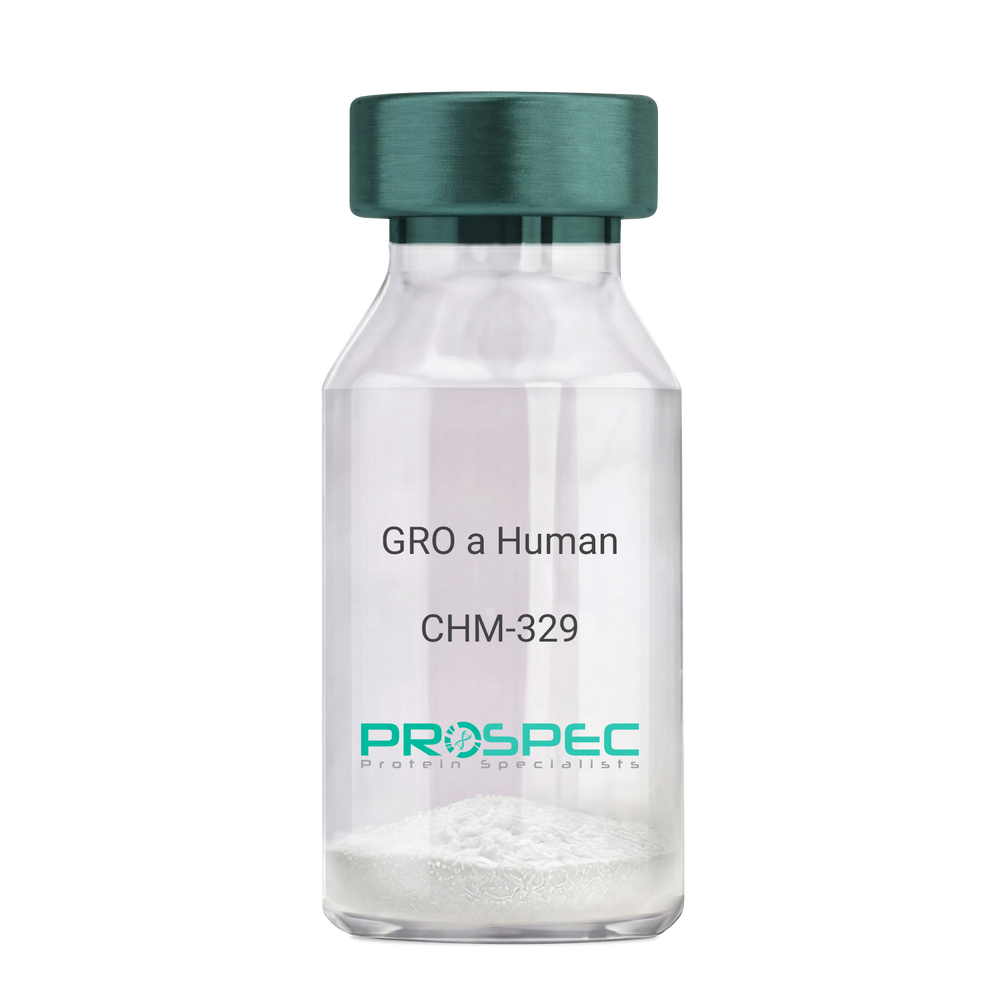
Name :
CXCL1 HumanDescription:
GRO-Alpha Human Recombinant (CXCL1)
Growth-regulated protein alpha, CXCL1, Melanoma growth stimulatory activity, MGSA, Neutrophil-activating protein 3, NAP-3, GRO-alpha (1-73), chemokine (C-X-C motif) ligand 1, GRO1, GROa, SCYB1, MGSA-a, MGSA alpha.
Product # :
CHM-329Price :
Quantity :
Shipping Method :
Shipped at Room temp
More Info
- description
- source
- formulation
- purity
- biological activity
- More Info
Description
GRO Alpha Human Recombinant produced in E.Coli is a single,non-glycosylated, polypeptide chain containing 73 amino acids and having a molecular mass of 7811 Dalton. The GRO-alpha is purified by proprietary chromatographic techniques.
Source
Escherichia Coli.
Formulation
Lyophilized from a 0.2µm filtered concentrated (1mg/ml) solution in 20mM PB, pH 7.4, 50mM NaCl.
Purity
Greater than 97.0% as determined by:
(a) Analysis by RP-HPLC.
(b) Analysis by SDS-PAGE.Biological Activity
Determined by its ability to chemoattract human peripheral blood neutrophils using a concentration range of 10.0-100.0 ng/ml.
More Info
-
Introduction
Chemokine (C-X-C motif) ligand 1 (CXCL1) is a small cytokine belonging to the CXC chemokine family that was previously called GRO1 oncogene, Neutrophil-activating protein 3 (NAP-3) and melanoma growth stimulating activity, alpha (MSGA-a). It is secreted by human melanoma cells, has mitogenic properties and is implicated in melanoma pathogenesis. CXCL1 is expressed by macrophages, neutrophilsand epithelial cells, and has neutrophil chemoattractant activity. CXCL1 plays a role in spinal cord development by inhibiting the migration of oligodendrocyte precursors and is involved in the processes of angiogenesis, inflammation, wound healing, and tumorigenesis. This chemokine elicits its effects by signaling through the chemokine receptor CXCR2. The gene for CXCL1 is located on human chromosome 4 amongst genes for other CXC chemokines.
-
Synonyms
Growth-regulated protein alpha, CXCL1, Melanoma growth stimulatory activity, MGSA, Neutrophil-activating protein 3, NAP-3, GRO-alpha (1-73), chemokine (C-X-C motif) ligand 1, GRO1, GROa, SCYB1, MGSA-a, MGSA alpha.
-
Physical Appearance
Sterile Filtered White lyophilized (freeze-dried) powder.
-
Stability
Lyophilized GRO-alpha although stable at room temperature for 3 weeks, should be stored desiccated below -18°C. Upon reconstitution CXCL1 should be stored at 4°C between 2-7 days and for future use below -18°C. For long term storage it is recommended to add a carrier protein (0.1% HSA or BSA).Please prevent freeze-thaw cycles.
-
Solubility
It is recommended to reconstitute the lyophilized CXCL1 in sterile 18MΩ-cm H2O not less than 100µg/ml, which can then be further diluted to other aqueous solutions.
-
Amino Acid Sequence
The sequence of the first five N-terminal amino acids was determined and was found to be Ala-Ser-Val-Ala-Thr.
-
Background
What is the molecular weight/Mw of CXCL1 HUMAN Protein?
CXCL1 HUMAN Protein has a total Mw of 7.81kDa.
What is the source or expression system of CXCL1 HUMAN Protein?
Escherichia Coli.
What is the Purity of CXCL1 HUMAN Protein?
CXCL1 HUMAN Protein is >97% pure as determined by SDS-PAGE.
What is the Biological Activity of CXCL1 HUMAN Protein?
Determined by its ability to chemoattract human peripheral blood neutrophils using a concentration range of 10.0-100.0 ng/ml.
What is the amino acid sequence of CXCL1 HUMAN Protein?
The sequence of the first five N-terminal amino acids was determined and was found to be Ala-Ser-Val-Ala-Thr.
What applications can CXCL1 HUMAN Protein be used in?
CXCL1 HUMAN Protein can probably be used in western blot, ELISA and Lateral Flow.
What is the endotoxin level for CXCL1 HUMAN Protein?
The endotoxin level is minimal, CXCL1 HUMAN Protein was purified using conventional chromatography techniques.
ProSpec's products are furnished for LABORATORY RESEARCH USE ONLY. The product may not be used as drugs, agricultural or pesticidal products, food additives or household chemicals.
- View Data Sheet
Name :
CLIC4 HumanDescription:
Chloride Intracellular Channel 4 Human Recombinant
Chloride intracellular channel protein 4, Intracellular chloride ion channel protein p64H1, CLIC4, H1, huH1, p64H1, CLIC4L, MTCLIC, FLJ38640, DKFZp566G223.
Product # :
PRO-173Price :
Quantity :
Shipping Method :
Shipped with Ice Packs
More Info
- description
- source
- formulation
- purity
- More Info
Description
CLIC4 Human Recombinant fused with a 20 amino acid His tag at N-terminus produced in E.Coli is a single, non-glycosylated, polypeptide chain containing 273 amino acids (1-253 a.a.) and having a molecular mass of 30.9kDa. The CLIC4 is purified by proprietary chromatographic techniques.
Source
Escherichia Coli.
Formulation
The CLIC4 solution (0.5 mg/ml) contains 20mM Tris-HCl buffer (pH8.0), 0.1M NaCl, 1mM DTT and 10% glycerol.
Purity
Greater than 95.0% as determined by SDS-PAGE.
More Info
-
Introduction
Chloride intracellular channel 4 (CLIC4) belongs to the p64 family; CLIC4 is expressed in various tissues and exhibits an intracellular vesicular pattern in Panc-1 cells (pancreatic cancer cells). CLIC4 is a 253 amino acid single-pass membrane protein which localizes to both the nucleus and the cytoplasm and contains one GST C-terminal domain. CLIC4 acts as a monomer which is able to form selective ion channels in target proteins, thus facilitating the transport of chloride and other ions. CLIC4 is believed to have a role in apoptosis and is able to translocate to the nucleus under stress conditions.
-
Synonyms
Chloride intracellular channel protein 4, Intracellular chloride ion channel protein p64H1, CLIC4, H1, huH1, p64H1, CLIC4L, MTCLIC, FLJ38640, DKFZp566G223.
-
Physical Appearance
Sterile Filtered colorless solution.
-
Stability
Store at 4°C if entire vial will be used within 2-4 weeks. Store, frozen at -20°C for longer periods of time. For long term storage it is recommended to add a carrier protein (0.1% HSA or BSA).Avoid multiple freeze-thaw cycles.
-
Amino Acid Sequence
MGSSHHHHHH SSGLVPRGSH MALSMPLNGL KEEDKEPLIE LFVKAGSDGE SIGNCPFSQR LFMILWLKGV VFSVTTVDLK RKPADLQNLA PGTHPPFITF NSEVKTDVNK IEEFLEEVLC PPKYLKLSPK HPESNTAGMD IFAKFSAYIK NSRPEANEAL ERGLLKTLQK LDEYLNSPLP DEIDENSMED IKFSTRKFLD GNEMTLADCN LLPKLHIVKV VAKKYRNFDI PKEMTGIWRY LTNAYSRDEF TNTCPSDKEV EIAYSDVAKR LTK.
ProSpec's products are furnished for LABORATORY RESEARCH USE ONLY. The product may not be used as drugs, agricultural or pesticidal products, food additives or household chemicals.
- View Data Sheet
Name :
MAP1LC3B MouseDescription:
Microtubule-Associated Protein 1 Light Chain 3 Beta Mouse Recombinant
Microtubule-Associated Protein 1 Light Chain 3 beta, ATG8F, Autophagy-related ubiquitin-like modifier LC3 B, MAP1 light chain 3-like protein 2, MAP1A/MAP1B LC3 B, LC3B, MAP1A/1BLC3, MAP1ALC3.
Product # :
PRO-2482Price :
Quantity :
Shipping Method :
Shipped with Ice Packs
More Info
- description
- source
- formulation
- purity
- More Info
Description
MAP1LC3B Mouse Recombinant produced in E.Coli is a single, non-glycosylated polypeptide chain containing 144 amino acids (1-120 a.a.) and having a molecular mass of 16.7kDa. MAP1LC3B is fused to a 24 amino acid His-tag at N-terminus & purified by proprietary chromatographic techniques.
Source
Escherichia Coli.
Formulation
MAP1LC3B protein solution (0.25mg/ml) containing 20mM MES(pH6.0), 0.1M NaCl, 1mM DTT and 30% glycerol.
Purity
Greater than 95.0% as determined by SDS-PAGE.
More Info
-
Introduction
MAP1LC3B is a member of the MAP1 LC3 family. MAP1LC3B is a subunit of neuronal microtubule-associated MAP1A and MAP1B proteins, that are involved in microtubule assembly and important for neurogenesis. In addition, MAP1LC3B takes part in formation of autophagosomal vacuoles and is expressed mainly in heart, testis, brain and skeletal muscle.
-
Synonyms
Microtubule-Associated Protein 1 Light Chain 3 beta, ATG8F, Autophagy-related ubiquitin-like modifier LC3 B, MAP1 light chain 3-like protein 2, MAP1A/MAP1B LC3 B, LC3B, MAP1A/1BLC3, MAP1ALC3.
-
Physical Appearance
Sterile filtered colorless solution.
-
Stability
Store at 4°C if entire vial will be used within 2-4 weeks. Store, frozen at -20°C for longer periods of time. For long term storage it is recommended to add a carrier protein (0.1% HSA or BSA).Avoid multiple freeze-thaw cycles.
-
Amino Acid Sequence
MGSSHHHHHH SSGLVPRGSH MGSHMPSEKT FKQRRSFEQR VEDVRLIREQ HPTKIPVIIE RYKGEKQLPV LDKTKFLVPD HVNMSELIKI IRRRLQLNAN QAFFLLVNGH SMVSVSTPIS EVYESERDED GFLYMVYASQ ETFG.
ProSpec's products are furnished for LABORATORY RESEARCH USE ONLY. The product may not be used as drugs, agricultural or pesticidal products, food additives or household chemicals.
- View Data Sheet
Name :
RAPSN MouseDescription:
Receptor-Associated Protein Of The Synapse Mouse Recombinant
Receptor-Associated Protein Of The Synapse, 43 KDa Postsynaptic Protein, Acetylcholine Receptor-Associated 43 KDa Protein, RNF205, RING Finger Protein 205, rapsyn, Receptor-Associated Protein Of The Synapse, 43Kd, 43 KDa Receptor-Associated Protein Of The Synapse, RAPSYN, RAPsyn, CMS1D, CMS1E.
Product # :
PRO-1751Price :
Quantity :
Shipping Method :
Shipped with Ice Packs
More Info
- description
- source
- formulation
- purity
- More Info
Description
RAPSN Mouse Recombinant produced in E.Coli is a single, non-glycosylated polypeptide chain containing 435 amino acids (1-412aa) and having a molecular mass of 48.8kDa.RAPSN is fused to a 23 amino acid His-tag at N-terminus & purified by proprietary chromatographic techniques.
Source
Escherichia Coli.
Formulation
RAPSN protein solution (0.5mg/ml) containing 20mM Tris-HCl buffer (pH 8.0), 0.4M Urea and 10% glycerol.
Purity
Greater than 85% as determined by SDS-PAGE.
More Info
-
Introduction
43 kDa receptor-associated protein of the synapse (RAPSN), is expressed in the postsynaptic membrane of skeletal muscle. RAPSN is essential for the clustering of nicotinic acetylcholine receptors (nAChR). In addition RAPSN self-associates via at least two of its seven tetra-tricopeptide repeats (TPRs). RAPSN interacts with the large intracellular domain of the nAChR a subunit all the way through the hydrophobic surface of the coiled-coil domain. RAPSN modifies trafficking of AChR within the cell. Overexpression inhibits agrin-induced AChR clustering pathway. RAPSN also plays a role in postsynaptic congenital myasthenic syndromes.
-
Synonyms
Receptor-Associated Protein Of The Synapse, 43 KDa Postsynaptic Protein, Acetylcholine Receptor-Associated 43 KDa Protein, RNF205, RING Finger Protein 205, rapsyn, Receptor-Associated Protein Of The Synapse, 43Kd, 43 KDa Receptor-Associated Protein Of The Synapse, RAPSYN, RAPsyn, CMS1D, CMS1E.
-
Physical Appearance
Sterile Filtered clear solution.
-
Stability
Store at 4°C if entire vial will be used within 2-4 weeks. Store, frozen at -20°C for longer periods of time.For long term storage it is recommended to add a carrier protein (0.1% HSA or BSA).Please avoid freeze thaw cycles.
-
Amino Acid Sequence
MGSSHHHHHH SSGLVPRGSH MGSMGQDQTK QQIEKGLQLY QSNQTEKALQ VWMKVLEKGS DLVGRFRVLG CLVTAHSEMG RYKEMLKFAV VQIDTARGLE DADFLLESYL NLARSNEKLC EFHKTISYCK TCLGLPGTRA GAQLGGQVSL SMGNAFLGLS LFQKALESFE KALRYAHNND DTMLECRVCC SLGSFYAQVK DYEKALFFPC KAAELVNDYG KGWSLKYRAM SQYHMAVAYR LLGHLGSAME CCEESMKIAL QHGDRPLQAL CLLCFADIHR SRGDLETAFP RYDSAMSIMT EIGNRLGQVH VLLGVAKCWM ARKVQDKALD AIEKAQDLAE EVGNKLSQLK LHCLSESIYR SKGLQRELRT HVVRFHECVE ETELYCGLCG ESIGERNSRL QALPCSHIFH LRCLQNNGTR SCPNCRRSSM KPGFV
ProSpec's products are furnished for LABORATORY RESEARCH USE ONLY. The product may not be used as drugs, agricultural or pesticidal products, food additives or household chemicals.