Skip to content

High-quality research proteins.

  • 1-800-805-6531

  • Mon - Sat 8.00-18.00, Sun - Closed

  • info@prospecbio.com

  • PO Box 6591 East Brunswick NJ 08816

  • Products
    • Cytokines
    • Growth factors
    • Chemokines
    • Cd antigens
    • Neurotrophins
    • Hormones
    • Enzymes
    • Viral antigens
    • Recombinant proteins
    • Natural proteins
    • Monoclonal antibodies
    • Polyclonal antibodies
    • Thermal Packaging
  • About
    • Company
    • Founder
    • Contribution
  • Customers
    • Eastern Asia
    • Eastern Europe
    • North America
    • South America
    • South East Asia
    • Southern Asia
    • Western Europe
  • Ordering
    • Ordering Method
    • Ordering - Credit Card
    • Ordering - PO
    • Shipping Fees
    • FAQs
  • Services
    • DNA Cloning
    • Protein Expression
    • Monoclonal Antibody
    • Fermentation
    • Technology License
  • Contact us
Log in

Country/region

  • USD $ | Albania
  • USD $ | Andorra
  • USD $ | Argentina
  • USD $ | Armenia
  • USD $ | Australia
  • USD $ | Austria
  • USD $ | Azerbaijan
  • USD $ | Belarus
  • USD $ | Belgium
  • USD $ | Bolivia
  • USD $ | Brazil
  • USD $ | Bulgaria
  • USD $ | Cambodia
  • USD $ | Canada
  • USD $ | Chile
  • USD $ | China
  • USD $ | Colombia
  • USD $ | Costa Rica
  • USD $ | Croatia
  • USD $ | Cyprus
  • USD $ | Czechia
  • USD $ | Denmark
  • USD $ | Estonia
  • USD $ | Finland
  • USD $ | France
  • USD $ | Georgia
  • USD $ | Germany
  • USD $ | Greece
  • USD $ | Hong Kong SAR
  • USD $ | Hungary
  • USD $ | Iceland
  • USD $ | India
  • USD $ | Ireland
  • USD $ | Israel
  • USD $ | Italy
  • USD $ | Japan
  • USD $ | Kazakhstan
  • USD $ | Latvia
  • USD $ | Liechtenstein
  • USD $ | Lithuania
  • USD $ | Madagascar
  • USD $ | Malta
  • USD $ | Mexico
  • USD $ | Moldova
  • USD $ | Monaco
  • USD $ | Netherlands
  • USD $ | New Zealand
  • USD $ | North Macedonia
  • USD $ | Norway
  • USD $ | Panama
  • USD $ | Paraguay
  • USD $ | Peru
  • USD $ | Philippines
  • USD $ | Poland
  • USD $ | Portugal
  • USD $ | Romania
  • USD $ | Singapore
  • USD $ | Slovakia
  • USD $ | Slovenia
  • USD $ | South Africa
  • USD $ | South Korea
  • USD $ | Spain
  • USD $ | Sri Lanka
  • USD $ | Sweden
  • USD $ | Switzerland
  • USD $ | Taiwan
  • USD $ | Thailand
  • USD $ | Türkiye
  • USD $ | Ukraine
  • USD $ | United Kingdom
  • USD $ | United States
  • USD $ | Uruguay
  • USD $ | Vatican City
  • USD $ | Venezuela
  • USD $ | Vietnam
  • Facebook
  • Instagram
logoProSpec - Recombinant Protein Manufacturer for academic and R&D industry
Become a distributor
Account Log in
Wishlist
Cart Cart(0)
  • Products
    +
    • Cytokines
    • Growth factors
    • Chemokines
    • Cd antigens
    • Neurotrophins
    • Hormones
    • Enzymes
    • Viral antigens
    • Recombinant proteins
    • Natural proteins
    • Monoclonal antibodies
    • Polyclonal antibodies
    • Thermal Packaging
  • About
    +
    • Company
    • Founder
    • Contribution
  • Customers
    +
    • Eastern Asia
    • Eastern Europe
    • North America
    • South America
    • South East Asia
    • Southern Asia
    • Western Europe
  • Ordering
    +
    • Ordering Method
    • Ordering - Credit Card
    • Ordering - PO
    • Shipping Fees
    • FAQs
  • Services
    +
    • DNA Cloning
    • Protein Expression
    • Monoclonal Antibody
    • Fermentation
    • Technology License
  • Contact us

Item added to your cart

View cart
View All
  • Cytokines
  • Growth factors
  • Chemokines
  • Cd antigens
  • Neurotrophins
  • Hormones
  • Enzymes
  • Viral antigens
  • Recombinant proteins
  • Natural proteins
  • Monoclonal antibodies
  • Polyclonal antibodies
  • Thermal Packaging
  • Tumor Necrosis Factor

    Tumor Necrosis Factor

    View All
  • 4-1BB

    4-1BB

    View All
  • Adiponectin

    Adiponectin

    View All
  • AIF1

    AIF1

    View All
  • Other Cytokines

    Other Cytokines

    View All
  • AITRL

    AITRL

    View All
  • Angiopoietin

    Angiopoietin

    View All
  • Apolipoprotein

    Apolipoprotein

    View All
  • B-Cell Activating Factor

    B-Cell Activating Factor

    View All
  • Beta Defensin

    Beta Defensin

    View All
  • Bone Morphogenetic Protein

    Bone Morphogenetic Protein

    View All
  • B type Natriuretic Peptide

    B type Natriuretic Peptide

    View All
  • BST

    BST

    View All
  • Betacellulin

    Betacellulin

    View All
  • Cardiotrophin

    Cardiotrophin

    View All
  • Activin

    Activin

    View All
  • Fibroblast Growth Factor

    Fibroblast Growth Factor

    View All
  • Other Growth Factors

    Other Growth Factors

    View All
  • CSF

    CSF

    View All
  • CTGF

    CTGF

    View All
  • IGFBP

    IGFBP

    View All
  • VEGF Protein

    VEGF Protein

    View All
  • EGF

    EGF

    View All
  • Epigen

    Epigen

    View All
  • Erythropoietin

    Erythropoietin

    View All
  • Insulin-Like Growth Factor

    Insulin-Like Growth Factor

    View All
  • Growth Hormone

    Growth Hormone

    View All
  • HDGF

    HDGF

    View All
  • Hepatocyte Growth Factor

    Hepatocyte Growth Factor

    View All
  • Insulin

    Insulin

    View All
  • BCA-1/ BLC (CXCL13)

    BCA-1/ BLC (CXCL13)

    View All
  • BRAK (CXCL14)

    BRAK (CXCL14)

    View All
  • C-10 (CCL6)

    C-10 (CCL6)

    View All
  • Other Chemokines

    Other Chemokines

    View All
  • MEC (CCL28)

    MEC (CCL28)

    View All
  • LD78-beta (CCL3L1)

    LD78-beta (CCL3L1)

    View All
  • CTACK (CCL27)

    CTACK (CCL27)

    View All
  • CXCL16

    CXCL16

    View All
  • CXCL17

    CXCL17

    View All
  • Platelet Factor-4 (CXCL4)

    Platelet Factor-4 (CXCL4)

    View All
  • ENA-78 (CXCL5)

    ENA-78 (CXCL5)

    View All
  • Eotaxin (CCL11,24,26)

    Eotaxin (CCL11,24,26)

    View All
  • Exodus-2 (CCL21)

    Exodus-2 (CCL21)

    View All
  • Fractalkine (CX3CL1)

    Fractalkine (CX3CL1)

    View All
  • CXCL6

    CXCL6

    View All
  • Other CD Antigens

    Other CD Antigens

    View All
  • CD14

    CD14

    View All
  • CD164

    CD164

    View All
  • CD1

    CD1

    View All
  • CD2

    CD2

    View All
  • CD200

    CD200

    View All
  • CD207

    CD207

    View All
  • CD226

    CD226

    View All
  • CD23

    CD23

    View All
  • CD244

    CD244

    View All
  • CD247

    CD247

    View All
  • CD27

    CD27

    View All
  • CD274

    CD274

    View All
  • CD300

    CD300

    View All
  • CD33

    CD33

    View All
  • Other Neurotrophins

    Other Neurotrophins

    View All
  • Beta-NGF

    Beta-NGF

    View All
  • BDNF

    BDNF

    View All
  • CDNF

    CDNF

    View All
  • CNTF

    CNTF

    View All
  • GDNF

    GDNF

    View All
  • Glia Maturation Factor

    Glia Maturation Factor

    View All
  • MANF

    MANF

    View All
  • Midkine

    Midkine

    View All
  • Neuroglobin

    Neuroglobin

    View All
  • Neurotrophic factors

    Neurotrophic factors

    View All
  • Neuregulin

    Neuregulin

    View All
  • Neuropilin

    Neuropilin

    View All
  • Pigment Epithelium-Derived Factor

    Pigment Epithelium-Derived Factor

    View All
  • Pleiotrophin

    Pleiotrophin

    View All
  • Peptide Hormones

    Peptide Hormones

    View All
  • Other Hormones

    Other Hormones

    View All
  • HCG

    HCG

    View All
  • Endothelin

    Endothelin

    View All
  • Exendin

    Exendin

    View All
  • FSH

    FSH

    View All
  • Glucagon

    Glucagon

    View All
  • GHRP

    GHRP

    View All
  • GLP

    GLP

    View All
  • Thyrostimulin

    Thyrostimulin

    View All
  • Inhibin A

    Inhibin A

    View All
  • LHRH

    LHRH

    View All
  • Melanotan

    Melanotan

    View All
  • Procalcitonin

    Procalcitonin

    View All
  • PTH

    PTH

    View All
  • Peroxiredoxin

    Peroxiredoxin

    View All
  • Peptidase

    Peptidase

    View All
  • Synthetase

    Synthetase

    View All
  • Transferase

    Transferase

    View All
  • Hydrolase

    Hydrolase

    View All
  • Dehydrogenase

    Dehydrogenase

    View All
  • ACE2

    ACE2

    View All
  • Esterase

    Esterase

    View All
  • Protein Kinases

    Protein Kinases

    View All
  • Other Enzymes

    Other Enzymes

    View All
  • Phosphatase

    Phosphatase

    View All
  • Deaminase

    Deaminase

    View All
  • Oxygenase

    Oxygenase

    View All
  • Adenylate Kinase

    Adenylate Kinase

    View All
  • Lyase

    Lyase

    View All
  • Chagas

    Chagas

    View All
  • SARS

    SARS

    View All
  • Influenza

    Influenza

    View All
  • ASFV

    ASFV

    View All
  • Astrovirus

    Astrovirus

    View All
  • Borrelia

    Borrelia

    View All
  • Helicobacter Pylori

    Helicobacter Pylori

    View All
  • Chikungunya

    Chikungunya

    View All
  • Chlamydia

    Chlamydia

    View All
  • Cytomegalo

    Cytomegalo

    View All
  • Dengue

    Dengue

    View All
  • EBV

    EBV

    View All
  • Ebola

    Ebola

    View All
  • Feline Leukemia Virus

    Feline Leukemia Virus

    View All
  • Hepatitis A

    Hepatitis A

    View All
  • Other

    Other

    View All
  • Actin

    Actin

    View All
  • ADAM

    ADAM

    View All
  • Complement Component

    Complement Component

    View All
  • Ag85

    Ag85

    View All
  • Eukaryotic Translation Initiation Factor

    Eukaryotic Translation Initiation Factor

    View All
  • Anterior Gradient Protein

    Anterior Gradient Protein

    View All
  • Heat Shock Protein

    Heat Shock Protein

    View All
  • Alpha-2-HS-Glycoprotein

    Alpha-2-HS-Glycoprotein

    View All
  • Hemoglobin

    Hemoglobin

    View All
  • Allergy

    Allergy

    View All
  • Anaplasma

    Anaplasma

    View All
  • Angiogenin

    Angiogenin

    View All
  • Ankyrin Repeat Domain

    Ankyrin Repeat Domain

    View All
  • Annexin

    Annexin

    View All
  • Other Natural Proteins

    Other Natural Proteins

    View All
  • Aprotinin

    Aprotinin

    View All
  • Transferrin

    Transferrin

    View All
  • Avidin

    Avidin

    View All
  • Anti Coagulation Factors

    Anti Coagulation Factors

    View All
  • Natural Albumin

    Natural Albumin

    View All
  • Natural Coagulation Factors

    Natural Coagulation Factors

    View All
  • Fibronectin

    Fibronectin

    View All
  • Thrombin

    Thrombin

    View All
  • Anti Human Enzyme

    Anti Human Enzyme

    View All
  • Other Monoclonal Antibodies

    Other Monoclonal Antibodies

    View All
  • Anti Human Cytokine

    Anti Human Cytokine

    View All
  • Anti Human Heat Shock Protein

    Anti Human Heat Shock Protein

    View All
  • Anti Mouse Lymphocyte

    Anti Mouse Lymphocyte

    View All
  • Anti Human Chemokine

    Anti Human Chemokine

    View All
  • Anti Human Lymphocyte

    Anti Human Lymphocyte

    View All
  • Anti Viral Monoclonal

    Anti Viral Monoclonal

    View All
  • Anti Mouse Cytokine

    Anti Mouse Cytokine

    View All
  • Anti-GST Monoclonal

    Anti-GST Monoclonal

    View All
  • Other Polyclonal Antibodies

    Other Polyclonal Antibodies

    View All
  • Anti Viral

    Anti Viral

    View All
  • Anti-GST Monoclonal

    Anti-GST Monoclonal

    View All
Back

Search results

1000 results found for “cyclin-dependent kinase”

Name

Description

Product #

Price

Quantity

Shipping Method

  • View Data Sheet

    Name :

    FUT7 Human

    Description:

    Fucosyltransferase 7 Human Recombinant

    Fucosyltransferase 7 (Alpha (1,3) Fucosyltransferase), Fucosyltransferase VII, Galactoside 3-L-Fucosyltransferase, Selectin Ligand Synthase, FucT-VII, Fuc-TVII, FUT7, Alpha-(1,3)-Fucosyltransferase 7, Selectin-Ligand Synthase, EC 2.4.1.-, Fuc-TVII, Fucosyltransferase 7, EC 2.4.1, EC 2.4.1.65.

    Product # :

    ENZ-784

    Price :

    Quantity :

    Shipping Method :

    Ice Icon

    Shipped with Ice Packs

    Add To Cart

    More Info

    • description
    • source
    • formulation
    • purity
    • More Info

    Description

    FUT7 Human Recombinant produced in E.coli is a single, non-glycosylated polypeptide chain containing 329 amino acids (37-342) and having a molecular mass of 37.9kDa.FUT7 is fused to a 23 amino acid His-tag at N-terminus & purified by proprietary chromatographic techniques.

    Source

    Escherichia Coli.

    Formulation

    The FUT7 solution (0.25mg/ml) contains 20mM Tris-HCl buffer (pH 8.0), 0.4M Urea and 10% glycerol.

    Purity

    Greater than 85.0% as determined by SDS-PAGE.

    More Info

    • Introduction

      Fucosyltransferase 7 (FUT7) is a golgi stack membrane protein which is involved in the creation of sialyl-Lewis X antigens. The FUT7 protein leads the synthesis of the E-selectin-binding sialyl-Lewis X moiety. FUT7 catalyzes alpha-1,3 glycosidic linkages involved in the expression of sialyl Lewis X antigens.

    • Synonyms

      Fucosyltransferase 7 (Alpha (1,3) Fucosyltransferase), Fucosyltransferase VII, Galactoside 3-L-Fucosyltransferase, Selectin Ligand Synthase, FucT-VII, Fuc-TVII, FUT7, Alpha-(1,3)-Fucosyltransferase 7, Selectin-Ligand Synthase, EC 2.4.1.-, Fuc-TVII, Fucosyltransferase 7, EC 2.4.1, EC 2.4.1.65.

    • Physical Appearance

      Sterile Filtered colorless solution.

    • Stability

      Store at 4°C if entire vial will be used within 2-4 weeks. Store, frozen at -20°C for longer periods of time. For long term storage it is recommended to add a carrier protein (0.1% HSA or BSA).Avoid multiple freeze-thaw cycles.

    • Amino Acid Sequence

      MGSSHHHHHH SSGLVPRGSH MGSPRGTPAP QPTITILVWH WPFTDQPPEL PSDTCTRYGI ARCHLSANRS LLASADAVVF HHRELQTRRS HLPLAQRPRG QPWVWASMES PSHTHGLSHL RGIFNWVLSY RRDSDIFVPY GRLEPHWGPS PPLPAKSRVA AWVVSNFQER QLRARLYRQL APHLRVDVFG RANGRPLCAS CLVPTVAQYR FYLSFENSQH RDYITEKFWR NALVAGTVPV VLGPPRATYE AFVPADAFVH VDDFGSAREL AAFLTGMNES RYQRFFAWRD RLRVRLFTDW RERFCAICDR YPHLPRSQVY EDLEGWFQA.

    ProSpec's products are furnished for LABORATORY RESEARCH USE ONLY. The product may not be used as drugs, agricultural or pesticidal products, food additives or household chemicals.

    Fut7 Human
  • View Data Sheet

    Name :

    MPG Human

    Description:

    N-Methylpurine-DNA Glycosylase Human Recombinant

    DNA-3-methyladenine glycosylase, 3-alkyladenine DNA glycosylase, 3-methyladenine DNA glycosidase, ADPG, N-methylpurine-DNA glycosylase, MPG, AAG, ANPG, MID1, MDG, PIG11, PIG16, CRA36.1.

    Product # :

    ENZ-151

    Price :

    Quantity :

    Shipping Method :

    Ice Icon

    Shipped with Ice Packs

    Add To Cart

    More Info

    • description
    • source
    • formulation
    • purity
    • More Info

    Description

    MPG Human Recombinant produced in E.Coli is a single, non-glycosylated polypeptide chain containing 306 amino acids (1-298 a.a.) and having a molecular mass of 33.9kDa (Molecular weight on SDS-PAGE will appear higher).MPG is fused to an 8 amino acid His-tag at N-terminus & purified by proprietary chromatographic techniques.

    Source

    Escherichia Coli.

    Formulation

    MPG protein solution (0.25mg/ml) containing 20mM Tris-HCl buffer (pH 8.0), 1mM DTT, 30% glycerol, 200mM NaCl and 1mM EDTA.

    Purity

    Greater than 90.0% as determined by SDS-PAGE.

    More Info

    • Introduction

      DNA-3-methyladenine glycosylase (MPG) is a member of the DNA glycosylase MPG family. MPG initiates base excision repair in DNA by removing a wide variety of alkylated, deaminated, and lipid peroxidation-induced purine adducts.

    • Synonyms

      DNA-3-methyladenine glycosylase, 3-alkyladenine DNA glycosylase, 3-methyladenine DNA glycosidase, ADPG, N-methylpurine-DNA glycosylase, MPG, AAG, ANPG, MID1, MDG, PIG11, PIG16, CRA36.1.

    • Physical Appearance

      Sterile filtered colorless solution.

    • Stability

      Store at 4°C if entire vial will be used within 2-4 weeks. Store, frozen at -20°C for longer periods of time. For long term storage it is recommended to add a carrier protein (0.1% HSA or BSA).Avoid multiple freeze-thaw cycles.

    • Amino Acid Sequence

      MVTPALQMKK PKQFCRRMGQ KKQRPARAGQ PHSSSDAAQA PAEQPHSSSD AAQAPCPRER CLGPPTTPGP YRSIYFSSPK GHLTRLGLEF FDQPAVPLAR AFLGQVLVRR LPNGTELRGR IVETEAYLGP EDEAAHSRGG RQTPRNRGMF MKPGTLYVYI IYGMYFCMNI SSQGDGACVL LRALEPLEGL ETMRQLRSTL RKGTASRVLK DRELCSGPSK LCQALAINKS FDQRDLAQDE AVWLERGPLE PSEPAVVAAA RVGVGHAGEW ARKPLRFYVR GSPWVSVVDR VAEQDTQALE HHHHHH.

    ProSpec's products are furnished for LABORATORY RESEARCH USE ONLY. The product may not be used as drugs, agricultural or pesticidal products, food additives or household chemicals.

    Mpg Human
  • View Data Sheet

    Name :

    POLR3K Human

    Description:

    Polymerase III Polypeptide K Human Recombinant

    DNA-directed RNA polymerase III subunit RPC10, RNA polymerase III subunit C10, DNA-directed RNA polymerase III subunit K, RNA polymerase III 12.5 kDa subunit, RPC12.5, RNA polymerase III subunit C11, HsC11p, RPC11, hRPC11, POLR3K, My010, Polymerase III Polypeptide K, C11, C11-RNP3, hRPC11, RPC10.

    Product # :

    ENZ-806

    Price :

    Quantity :

    Shipping Method :

    Ice Icon

    Shipped with Ice Packs

    Add To Cart

    More Info

    • description
    • source
    • formulation
    • purity
    • More Info

    Description

    POLR3K Human Recombinant produced in E.Coli is a single, non-glycosylated polypeptide chain containing 131 amino acids (1-108 a.a) and having a molecular mass of 14.7kDa.POLR3K is fused to a 23 amino acid His-tag at N-terminus & purified by proprietary chromatographic techniques.

    Source

    Escherichia Coli.

    Formulation

    POLR3K protein solution (0.25mg/ml) containing 20mM Tris-HCl buffer (pH 8.0), 0.15M NaCl, 50% glycerol, 2mM DTT and 2mM EDTA.

    Purity

    Greater than 85.0% as determined by SDS-PAGE.

    More Info

    • Introduction

      Polymerase III Polypeptide K, known as PORL3K, is a small vital subunit of RNA polymerase III. The carboxy-terminal domain of PORL3K owns a sequence which is very similar to the carboxy-terminal domain of an RNA polymerase II elongation factor. PORL3K takes part in sensing and limiting infection by intracellular bacteria and DNA viruses. PORL3K is also plays a role as nuclear and cytosolic DNA sensor which takes part in the innate immune response.

    • Synonyms

      DNA-directed RNA polymerase III subunit RPC10, RNA polymerase III subunit C10, DNA-directed RNA polymerase III subunit K, RNA polymerase III 12.5 kDa subunit, RPC12.5, RNA polymerase III subunit C11, HsC11p, RPC11, hRPC11, POLR3K, My010, Polymerase III Polypeptide K, C11, C11-RNP3, hRPC11, RPC10.

    • Physical Appearance

      Sterile Filtered colorless solution.

    • Stability

      Store at 4°C if entire vial will be used within 2-4 weeks. Store, frozen at -20°C for longer periods of time. For long term storage it is recommended to add a carrier protein (0.1% HSA or BSA).Avoid multiple freeze-thaw cycles.

    • Amino Acid Sequence

      MGSSHHHHHH SSGLVPRGSH MGSMLLFCPG CGNGLIVEEG QRCHRFACNT CPYVHNITRK VTNRKYPKLK EVDDVLGGAA AWENVDSTAE SCPKCEHPRA YFMQLQTRSA DEPMTTFYKC CNAQCGHRWR D.

    ProSpec's products are furnished for LABORATORY RESEARCH USE ONLY. The product may not be used as drugs, agricultural or pesticidal products, food additives or household chemicals.

    Polr3K Human
  • View Data Sheet

    Name :

    GNPDA1 Human

    Description:

    Glucosamine-6-Phosphate Deaminase 1 Human Recombinant

    GNP1, GNPDA, GNPI, GPI, HLN, Oscillin.

    Product # :

    ENZ-554

    Price :

    Quantity :

    Shipping Method :

    Ice Icon

    Shipped with Ice Packs

    Add To Cart

    More Info

    • description
    • source
    • formulation
    • purity
    • More Info

    Description

    GNPDA1 Recombinant Human produced in E.Coli is a single, non-glycosylated, polypeptide chain containing 309 amino acids (1-289) and having a molecular mass of 34.8 kDa.GNPDA1 is fused to a 20 amino macid His-Tag at N-terminus and purified by proprietary chromatographic techniques.

    Source

    Escherichia Coli.

    Formulation

    1 mg/ml solution containing 20mM Tris Hcl buffer pH-8, 1mM DTT, 50mM NaCl and 20% glycerol.

    Purity

    Greater than 90.0% as determined by SDS-PAGE.

    More Info

    • Introduction

      GNPDA1, catalyzes the conversion of glucosamine-6-phosphate to fructose-6-phosphate, a reaction that under physiological conditions proceeds to the formation of fructose-6-phosphate. GNPDA1 is widely expressed with highest expression in testes, ovary and heart. GNPDA1 triggers calcium oscillations in mammalian eggs. These oscillations are as the necessary trigger for egg activation and early development of the embryo.

    • Synonyms

      GNP1, GNPDA, GNPI, GPI, HLN, Oscillin.

    • Physical Appearance

      Sterile filtered colorless solution.

    • Stability

      GNPDA1 Human Recombinant although stable at 4°C for 1 week, should be stored below -18°C.Please prevent freeze-thaw cycles.

    • Amino Acid Sequence

      MGSSHHHHHH SSGLVPRGSH MKLIILEHYS QASEWAAKYI RNRIIQFNPG PEKYFTLGLP TGSTPLGCYK KLIEYYKNGD LSFKYVKTFN MDEYVGLPRD HPESYHSFMW NNFFKHIDIH PENTHILDGN AVDLQAECDA FEEKIKAAGG IELFVGGIGP DGHIAFNEPG SSLVSRTRVK TLAMDTILAN ARFFDGELTK VPTMALTVGV GTVMDAREVM ILITGAHKAF ALYKAIEEGV NHMWTVSAFQ QHPRTVFVCD EDATLELKVK TVKYFKGLML VHNKLVDPLY SIKEKETEKS QSSKKPYSD.

    ProSpec's products are furnished for LABORATORY RESEARCH USE ONLY. The product may not be used as drugs, agricultural or pesticidal products, food additives or household chemicals.

    Gnpda1 Human
  • View Data Sheet

    Name :

    PGD Human

    Description:

    Phosphogluconate Dehydrogenase Human Recombinant

    EC 1.1.1.44, 6PGD, PGDH, 6-phosphogluconate dehydrogenase decarboxylating, PGD.

    Product # :

    ENZ-501

    Price :

    Quantity :

    Shipping Method :

    Ice Icon

    Shipped with Ice Packs

    Add To Cart

    More Info

    • description
    • source
    • formulation
    • purity
    • More Info

    Description

    PGD Human Recombinant produced in E.Coli is a single, non-glycosylated, polypeptide chain containing 503 amino acids (1-483 a.a.) and having a molecular mass of 55.3 kDa. The PGD is fused to a 20 amino acid His Tag at N-terminus and purified by proprietary chromatographic techniques.

    Source

    Escherichia Coli.

    Formulation

    The PGD solution contains 20mM Tris-HCl pH-8, 1mM DTT, 0.1M NaCl and 10% glycerol.

    Purity

    Greater than 95% as determined by SDS-PAGE.

    More Info

    • Introduction

      6PGD is the second dehydrogenase in the pentose phosphate shunt. Pentose is neccesary for nucleic acid biosynthesis. The pentose phosphate cycle is a major source of NADPH 6PGD deficiency is usually asymptomatic, and the inheritance of this disorder is autosomal dominant. PGD deficiency raises the erythrocyte pyruvate kinase levels of activity and decreases glutathione synthetase, resulting in hemolysis.

    • Synonyms

      EC 1.1.1.44, 6PGD, PGDH, 6-phosphogluconate dehydrogenase decarboxylating, PGD.

    • Physical Appearance

      Sterile Filtered clear colorless solution.

    • Stability

      Store at 4°C if entire vial will be used within 2-4 weeks. Store, frozen at -20°C for longer periods of time. For long term storage it is recommended to add a carrier protein (0.1% HSA or BSA).Avoid multiple freeze-thaw cycles.

    • Amino Acid Sequence

      MGSSHHHHHH SSGLVPRGSH MAQADIALIG LAVMGQNLIL NMNDHGFVVC AFNRTVSKVD DFLANEAKGT KVVGAQSLKE MVSKLKKPRR IILLVKAGQA VDDFIEKLVP LLDTGDIIID GGNSEYRDTT RRCRDLKAKG ILFVGSGVSG GEEGARYGPS LMPGGNKEAW PHIKTIFQGI AAKVGTGEPC CDWVGDEGAG HFVKMVHNGI EYGDMQLICE AYHLMKDVLG MAQDEMAQAF EDWNKTELDS FLIEITANIL KFQDTDGKHL LPKIRDSAGQ KGTGKWTAIS ALEYGVPVTL IGEAVFARCL SSLKDERIQA SKKLKGPQKF QFDGDKKSFL EDIRKALYAS KIISYAQGFM LLRQAATEFG WTLNYGGIAL MWRGGCIIRS VFLGKIKDAF DRNPELQNLL LDDFFKSAVE NCQDSWRRAV STGVQAGIPM PCFTTALSFY DGYRHEMLPA SLIQAQRDYF GAHTYELLAK PGQFIHTNWT GHGGTVSSSS YNA.

    ProSpec's products are furnished for LABORATORY RESEARCH USE ONLY. The product may not be used as drugs, agricultural or pesticidal products, food additives or household chemicals.

    Pgd Human
  • View Data Sheet

    Name :

    YARS Human

    Description:

    Tyrosyl-tRNA Synthetase Human Recombinant

    Tyrosyl-tRNA synthetase cytoplasmic, Tyrosyl--tRNA ligase, TyrRS, YARS, YRS, YTS, CMTDIC.

    Product # :

    ENZ-134

    Price :

    Quantity :

    Shipping Method :

    Ice Icon

    Shipped with Ice Packs

    Add To Cart

    More Info

    • description
    • source
    • formulation
    • purity
    • More Info

    Description

    YARS produced in E.Coli is a single, non-glycosylated polypeptide chain containing 548 amino acids (1-528 a.a.) and having a molecular mass of 61.3kDa.YARS is fused to a 20 amino acid His-tag at N-terminus & purified by proprietary chromatographic techniques.

    Source

    Escherichia Coli.

    Formulation

    YARS protein solution (1mg/ml) containing 20mM Tris-HCl buffer (pH 8.0), 1mM DTT, 10% glycerol and 0.1M NaCl.

    Purity

    Greater than 90.0% as determined by SDS-PAGE.

    More Info

    • Introduction

      Tyrosyl-tRNA synthetase (YARS) is a member of the class I tRNA synthetase family. YARS is a vital enzyme which catalyzes the aminoacylation of tRNATrp with tryptophan, a critical function of the cell’s protein synthesis machinery. Expression of YARS is highly stimulated in human cells by the addition of IFN-gamma.

    • Synonyms

      Tyrosyl-tRNA synthetase cytoplasmic, Tyrosyl--tRNA ligase, TyrRS, YARS, YRS, YTS, CMTDIC.

    • Physical Appearance

      Sterile Filtered colorless solution.

    • Stability

      Store at 4°C if entire vial will be used within 2-4 weeks. Store, frozen at -20°C for longer periods of time. For long term storage it is recommended to add a carrier protein (0.1% HSA or BSA).Avoid multiple freeze-thaw cycles.

    • Amino Acid Sequence

      MGSSHHHHHH SSGLVPRGSH MGDAPSPEEK LHLITRNLQE VLGEEKLKEI LKERELKIYW GTATTGKPHV AYFVPMSKIA DFLKAGCEVT ILFADLHAYL DNMKAPWELL ELRVSYYENV IKAMLESIGV PLEKLKFIKG TDYQLSKEYT LDVYRLSSVV TQHDSKKAGA EVVKQVEHPL LSGLLYPGLQ ALDEEYLKVD AQFGGIDQRK IFTFAEKYLP ALGYSKRVHL MNPMVPGLTG SKMSSSEEES KIDLLDRKED VKKKLKKAFC EPGNVENNGV LSFIKHVLFP LKSEFVILRD EKWGGNKTYT AYVDLEKDFA AEVVHPGDLK NSVEVALNKL LDPIREKFNT PALKKLASAA YPDPSKQKPM AKGPAKNSEP EEVIPSRLDI RVGKIITVEK HPDADSLYVE KIDVGEAEPR TVVSGLVQFV PKEELQDRLV VVLCNLKPQK MRGVESQGML LCASIEGINR QVEPLDPPAG SAPGEHVFVK GYEKGQPDEE LKPKKKVFEK LQADFKISEE CIAQWKQTNF MTKLGSISCK SLKGGNIS.

    ProSpec's products are furnished for LABORATORY RESEARCH USE ONLY. The product may not be used as drugs, agricultural or pesticidal products, food additives or household chemicals.

    Yars Human
  • View Data Sheet

    Name :

    PMM2 Human

    Description:

    Phosphomannomutase 2 Human Recombinant

    Phosphomannomutase 2, PMM 2, PMM2, CDG1, CDGS, CDG1a.

    Product # :

    ENZ-002

    Price :

    Quantity :

    Shipping Method :

    Ice Icon

    Shipped with Ice Packs

    Add To Cart

    More Info

    • description
    • source
    • formulation
    • purity
    • More Info

    Description

    PMM2 Human Recombinant fused with a 20 amino acid His tag at N-terminus produced in E.Coli is a single, non-glycosylated, polypeptide chain containing 266 amino acids (1-246 a.a.) and having a molecular mass of 30.2kDa. The PMM2 is purified by proprietary chromatographic techniques.

    Source

    Escherichia Coli.

    Formulation

    The PMM2 solution (1 mg/ml) contains 20mM Tris-HCl buffer(pH 8.0), 10% glycerol,
    1mM DTT and 0.1M NaCl.

    Purity

    Greater than 95.0% as determined by SDS-PAGE.

    More Info

    • Introduction

      Phosphomannomutase 2 (PMM2) is a member of the eukaryotic PMM family. Phosphomannomutase 2 is involved in the synthesis of the GDP-mannose and dolichol-phosphate-mannose required for a number of critical mannosyl transfer reactions. PMM2 catalyzes the isomerization of mannose 6-phosphate to mannose 1-phosphate. PMM2 mutations are linked to congenital disorders of glycosylation (CDG)-Ia, an autosomal recessive disorder characterized by central nervous system dysfunction and multiorgan failure.

    • Synonyms

      Phosphomannomutase 2, PMM 2, PMM2, CDG1, CDGS, CDG1a.

    • Physical Appearance

      Sterile Filtered colorless solution.

    • Stability

      Store at 4°C if entire vial will be used within 2-4 weeks. Store, frozen at -20°C for longer periods of time. For long term storage it is recommended to add a carrier protein (0.1% HSA or BSA).Avoid multiple freeze-thaw cycles.

    • Amino Acid Sequence

      MGSSHHHHHH SSGLVPRGSH MAAPGPALCL FDVDGTLTAP RQKITKEMDD FLQKLRQKIK IGVVGGSDFE KVQEQLGNDV VEKYDYVFPE NGLVAYKDGK LLCRQNIQSH LGEALIQDLI NYCLSYIAKI KLPKKRGTFI EFRNGMLNVS PIGRSCSQEE RIEFYELDKK ENIRQKFVAD LRKEFAGKGL TFSIGGQISF DVFPDGWDKR YCLRHVENDG YKTIYFFGDK TMPGGNDHEI FTDPRTMGYS VTAPEDTRRI CELLFS.

    ProSpec's products are furnished for LABORATORY RESEARCH USE ONLY. The product may not be used as drugs, agricultural or pesticidal products, food additives or household chemicals.

    Pmm2 Human
  • View Data Sheet

    Name :

    CEA Protein

    Description:

    Carcinoembryonic Antigen Human

    CEACAM5, Meconium Antigen 100, Carcinoembryonic Antigen, CD66e Antigen, CD66e, Carcinoembryonic Antigen, CEA, oncofetal antigen.

    Product # :

    PRO-2801

    Price :

    Quantity :

    Shipping Method :

    Ice Icon

    Shipped with Ice Packs

    Add To Cart

    More Info

    • description
    • source
    • formulation
    • purity
    • More Info

    Description

    CEA produced from patient source colon carcinoma liver metastatic tissue can be used as general marker in screening and monitoring malignant disease states.

    Source

    Liver tissue.

    Formulation

    CEA protein solution contains 0.1M PBS, pH 7.4, 0.09 % NaN3 and 2 % methyl-mannoside.

    Purity

    Greater than 95.0% as determined by SDS-PAGE.

    More Info

    • Synonyms

      CEACAM5, Meconium Antigen 100, Carcinoembryonic Antigen, CD66e Antigen, CD66e, Carcinoembryonic Antigen, CEA, oncofetal antigen.

    • Physical Appearance

      Sterile Filtered colorless solution.

    • Stability

      Store at 4°C if entire vial will be used within 2-4 weeks. Store, frozen at -20°C for longer periods of time. For long term storage it is recommended to add a carrier protein (0.1% HSA or BSA). Avoid multiple freeze-thaw cycles.

    • Applications

      Blood samples from tissue donors were tested and found to be negative for HBsAg, HIV-1 and HIV-2 antibodies and HCV.

    • Background

      Carcinoembryonic Antigen, commonly known as CEA, is a glycoprotein that was initially identified as a tumor marker. Over the years, research into CEA has unveiled its intricate involvement in various physiological processes, not only in cancer but also in the context of normal development and inflammatory conditions. This research aims to delve into the multifaceted roles of CEA, exploring its structural intricacies, regulatory mechanisms, and its implications in health, disease, and beyond.

      Structural Complexity of CEA:

      CEA, belonging to the immunoglobulin superfamily, is a complex glycoprotein featuring multiple structural domains. Its diverse forms and glycosylation patterns contribute to its functional versatility. CEA is primarily expressed in fetal tissues, but its presence is often detected in adults under pathological conditions, especially in various types of cancer.

      CEA in Cancer Biology:

      CEA was first recognized as a biomarker for colorectal cancer, but its overexpression is not limited to this context. Elevated CEA levels have been associated with several other malignancies, including breast, lung, and pancreatic cancers. CEA’s involvement in cancer biology ranges from promoting angiogenesis and metastasis to inhibiting immune responses, making it a critical player in tumor progression and evasion.

      Beyond Cancer: CEA in Development and Inflammation:

      While CEA’s role in cancer is prominent, recent studies have uncovered its participation in normal physiological processes. During embryonic development, CEA is involved in cell adhesion, contributing to tissue organization and morphogenesis. Additionally, CEA expression can be induced in inflammatory conditions, suggesting its involvement in immune responses and tissue repair mechanisms.

      CEA as a Diagnostic and Therapeutic Target:

      The diverse expression patterns of CEA in various diseases make it a valuable diagnostic tool. CEA assays are widely used for cancer screening, monitoring disease progression, and assessing treatment efficacy. Moreover, CEA’s presence on the surface of cancer cells has made it a target for immunotherapy, enabling the development of targeted therapies aimed at specifically eradicating CEA-positive tumor cells.

    ProSpec's products are furnished for LABORATORY RESEARCH USE ONLY. The product may not be used as drugs, agricultural or pesticidal products, food additives or household chemicals.

    Cea Human
  • View Data Sheet

    Name :

    UBA3 Human

    Description:

    Ubiquitin-Like Modifier Activating Enzyme 3 Human Recombinant

    NEDD8-activating enzyme E1 catalytic subunit, NEDD8-activating enzyme E1C, Ubiquitin-activating enzyme E1C, Ubiquitin-like modifier-activating enzyme 3, Ubiquitin-activating enzyme 3, UBA3, UBE1C, hUBA3.

    Product # :

    ENZ-576

    Price :

    Quantity :

    Shipping Method :

    Ice Icon

    Shipped with Ice Packs

    Add To Cart

    More Info

    • description
    • source
    • formulation
    • purity
    • More Info

    Description

    UBA3 Human Recombinant produced in E.coli is a single, non-glycosylated polypeptide chain containing 487 amino acids (1-463) and having a molecular mass of 54.4kDa.UBA3 is fused to a 24 amino acid His-tag at N-terminus & purified by proprietary chromatographic techniques.

    Source

    Escherichia Coli.

    Formulation

    The UBA3 solution (1mg/ml) contains 20mM Tris-HCl buffer (pH8.0), 20% glycerol and 1mM DTT.

    Purity

    Greater than 90.0% as determined by SDS-PAGE.

    More Info

    • Introduction

      NEDD8-activating enzyme E1 catalytic subunit (UBA3) is the catalytic subunit of the dimeric UBA3-NAE1 E1 enzyme, which belongs to the E1 ubiquitin-activating enzyme family. E1 activates NEDD8 by initially adenylating its C-terminal glycine residue with ATP, afterwards linking this residue to the side chain of the catalytic cysteine, generating a NEDD8-UBA3 thioester and free AMP. E1 at last transfers NEDD8 to the catalytic cysteine of UBE2M. The UBA3 enzyme connects with AppBp1, an amyloid beta precursor protein binding protein, to form a heterodimer, and at that point the enzyme complex activates NEDD8, a ubiquitin-like protein, which controls cell division, signaling and embryogenesis.

    • Synonyms

      NEDD8-activating enzyme E1 catalytic subunit, NEDD8-activating enzyme E1C, Ubiquitin-activating enzyme E1C, Ubiquitin-like modifier-activating enzyme 3, Ubiquitin-activating enzyme 3, UBA3, UBE1C, hUBA3.

    • Physical Appearance

      Sterile filtered colorless solution.

    • Stability

      Store at 4°C if entire vial will be used within 2-4 weeks. Store, frozen at -20°C for longer periods of time. For long term storage it is recommended to add a carrier protein (0.1% HSA or BSA).Avoid multiple freeze-thaw cycles.

    • Amino Acid Sequence

      MGSSHHHHHH SSGLVPRGSH MGSHMADGEE PERKRRRIEE LLAEKMAVDG GCGDTGDWEG RWNHVKKFLE RSGPFTHPDF EPSTESLQFL LDTCKVLVIG AGGLGCELLK NLALSGFRQI HVIDMDTIDV SNLNRQFLFR PKDIGRPKAE VAAEFLNDRV PNCNVVPHFN KIQDFNDTFY RQFHIIVCGL DSIIARRWIN GMLISLLNYE DGVLDPSSIV PLIDGGTEGF KGNARVILPG MTACIECTLE LYPPQVNFPM CTIASMPRLP EHCIEYVRML QWPKEQPFGE GVPLDGDDPE HIQWIFQKSL ERASQYNIRG VTYRLTQGVV KRIIPAVAST NAVIAAVCAT EVFKIATSAY IPLNNYLVFN DVDGLYTYTF EAERKENCPA CSQLPQNIQF SPSAKLQEVL DYLTNSASLQ MKSPAITATL EGKNRTLYLQ SVTSIEERTR PNLSKTLKEL GLVDGQELAV ADVTTPQTVL FKLHFTS.

    ProSpec's products are furnished for LABORATORY RESEARCH USE ONLY. The product may not be used as drugs, agricultural or pesticidal products, food additives or household chemicals.

    Uba3 Human
  • View Data Sheet

    Name :

    FAP Human

    Description:

    Fibroblast Activation Protein Alpha Human Recombinant

    Prolyl endopeptidase FAP, 170 kDa melanoma membrane-bound gelatinase, Dipeptidyl peptidase FAP, Fibroblast activation protein alpha, FAPalpha, Gelatine degradation protease FAP, Integral membrane serine protease, Post-proline cleaving enzyme, Serine integral membrane protease, Surface-expressed protease, Seprase, SIMP,  FAP

    Product # :

    ENZ-1160

    Price :

    Quantity :

    Shipping Method :

    Ice Icon

    Shipped with Ice Packs

    Add To Cart

    More Info

    • description
    • source
    • formulation
    • purity
    • biological activity
    • More Info

    Description

    FAP Human produced in Sf9 Baculovirus cells is a single, glycosylated polypeptide chain containing 744 amino acids (26-760aa) and having a molecular mass of 86.1 kDa.FAP is fused to a 6 amino acid His tag at C-terminus and purified by proprietary chromatographic techniques.

    Source

    Sf9, Baculovirus cells.

    Formulation

    The FAP solution (0.25mg/ml) contains 20% Glycerol and Phosphate-Buffered Saline (pH 7.4).

    Purity

    Greater than 90.0% as determined by SDS-PAGE.

    Biological Activity

    Specific activity > 5,000 pmol/min/ug. It is defined by the amount of enzyme that hydrolyzes 1.0 pmole of ZGP-AMC per minute at pH 7.5, at 37˚C.

    More Info

    • Introduction

      DPP4 also called adenosine deaminase complexing protein-2, and T-cell activation antigen CD26 is a serine exopeptidase and complex enzyme that is expressed on the surface of most cell types. DPPIV is an intrinsic membrane glycoprotein and a serine exopeptidase that cleaves X-proline dipeptides from the N-terminus of polypeptides. DPP4 plays a role in t-cell activation. DPP4 is associated with intracellular signal transduction, apoptosis and involved in tumor biology. There are at least 63 substrates which can bind specifically to DPP4 enzyme including growth factors, chemokines, neuro peptides. Furthermore, DPP4 plays a major role in glucose metabolism by cleaving incretins such as glucose-dependent insulinotropic polypeptide (GIP) and GLP-1.

    • Synonyms

      Prolyl endopeptidase FAP, 170 kDa melanoma membrane-bound gelatinase, Dipeptidyl peptidase FAP, Fibroblast activation protein alpha, FAPalpha, Gelatine degradation protease FAP, Integral membrane serine protease, Post-proline cleaving enzyme, Serine integral membrane protease, Surface-expressed protease, Seprase, SIMP, FAP

    • Physical Appearance

      Sterile Filtered colorless solution.

    • Stability

      Store at 4°C if entire vial will be used within 2-4 weeks. Store, frozen at -20°C for longer periods of time. For long term storage it is recommended to add a carrier protein (0.1% HSA or BSA).Avoid multiple freeze-thaw cycles.

    • Amino Acid Sequence

      ADPLRPSRVH NSEENTMRAL TLKDILNGTF SYKTFFPNWI SGQEYLHQSA DNNIVLYNIE TGQSYTILSN RTMKSVNASN YGLSPDRQFV YLESDYSKLW RYSYTATYYI YDLSNGEFVR GNELPRPIQY LCWSPVGSKL AYVYQNNIYL KQRPGDPPFQ ITFNGRENKI FNGIPDWVYE EEMLATKYAL WWSPNGKFLA YAEFNDTDIP VIAYSYYGDE QYPRTINIPY PKAGAKNPVV RIFIIDTTYP AYVGPQEVPV PAMIASSDYY FSWLTWVTDE RVCLQWLKRV QNVSVLSICD FREDWQTWDC PKTQEHIEES RTGWAGGFFV STPVFSYDAI SYYKIFSDKD GYKHIHYIKD TVENAIQITS GKWEAINIFR VTQDSLFYSS NEFEEYPGRR NIYRISIGSY PPSKKCVTCH LRKERCQYYT ASFSDYAKYY ALVCYGPGIP ISTLHDGRTD QEIKILEENK ELENALKNIQ LPKEEIKKLE VDEITLWYKM ILPPQFDRSK KYPLLIQVYG GPCSQSVRSV FAVNWISYLA SKEGMVIALV DGRGTAFQGD KLLYAVYRKL GVYEVEDQIT AVRKFIEMGF IDEKRIAIWG WSYGGYVSSL ALASGTGLFK CGIAVAPVSS WEYYASVYTE RFMGLPTKDD NLEHYKNSTV MARAEYFRNV DYLLIHGTAD DNVHFQNSAQ IAKALVNAQV DFQAMWYSDQ NHGLSGLSTN HLYTHMTHFL KQCFSLSDHH HHHH

    ProSpec's products are furnished for LABORATORY RESEARCH USE ONLY. The product may not be used as drugs, agricultural or pesticidal products, food additives or household chemicals.

    Fap Human
  • View Data Sheet

    Name :

    PSMA6 Human

    Description:

    Proteasome Subunit Alpha Type 6 Human Recombinant

    Proteasome (prosome, macropain) subunit alpha type 6, PROS27, p27K, IOTA, Macropain iota chain, Multicatalytic endopeptidase complex iota chain, Proteasome iota chain, 27 kDa prosomal protein.

    Product # :

    ENZ-198

    Price :

    Quantity :

    Shipping Method :

    Ice Icon

    Shipped with Ice Packs

    Add To Cart

    More Info

    • description
    • source
    • formulation
    • purity
    • More Info

    Description

    PSMA6 Human Recombinant produced in E.Coli is a single, non-glycosylated polypeptide chain containing 270 amino acids (1-246 a.a.) and having a molecular mass of 29.9kDa.PSMA6 is fused to a 24 amino acid His-tag at N-terminus & purified by proprietary chromatographic techniques.

    Source

    Escherichia Coli.

    Formulation

    PSMA6 protein solution (0.25mg/ml) containing 20mM Tris-HCl buffer (pH8.0), 100mM NaCl, 1mM DTT and 40% glycerol.

    Purity

    Greater than 90.0% as determined by SDS-PAGE.

    More Info

    • Introduction

      PSMA6 belongs to the peptidase T1A family, which is a 20S core alpha subunit. The proteasome is a multicatalytic proteinase complex with an extremely organized ring-shaped 20S core structure. The core structure consists of 4 rings of 28 non-identical subunits; 2 rings consist of 7 alpha subunits and 2 rings consist of 7 beta subunits. PSMA6 is spread all over eukaryotic cells in large quantities and cleave peptides in an ATP/ubiquitin-dependent procedure in a non-lysosomal pathway.

    • Synonyms

      Proteasome (prosome, macropain) subunit alpha type 6, PROS27, p27K, IOTA, Macropain iota chain, Multicatalytic endopeptidase complex iota chain, Proteasome iota chain, 27 kDa prosomal protein.

    • Physical Appearance

      Sterile Filtered colorless solution.

    • Stability

      Store at 4°C if entire vial will be used within 2-4 weeks. Store, frozen at -20°C for longer periods of time. For long term storage it is recommended to add a carrier protein (0.1% HSA or BSA).Avoid multiple freeze-thaw cycles.

    • Amino Acid Sequence

      MGSSHHHHHH SSGLVPRGSH MGSHMSRGSS AGFDRHITIF SPEGRLYQVE YAFKAINQGG LTSVAVRGKD CAVIVTQKKV PDKLLDSSTVTHLFKITENI GCVMTGMTAD SRSQVQRARY EAANWKYKYG YEIPVDMLCK RIADISQVYT QNAEMRPLGC CMILIGIDEE QGPQVYKCDP AGYYCGFKAT AAGVKQTEST SFLEKKVKKK FDWTFEQTVE TAITCLSTVL SIDFKPSEIE VGVVTVENPK FRILTEAEID AHLVALAERD

    ProSpec's products are furnished for LABORATORY RESEARCH USE ONLY. The product may not be used as drugs, agricultural or pesticidal products, food additives or household chemicals.

    Psma6 Human
  • View Data Sheet

    Name :

    SAT2 Human

    Description:

    Spermidine/Spermine N1-Acetyltransferase 2 Human Recombinant

    Spermidine/spermine N1-acetyltransferase family member 2, Polyamine N-acetyltransferase 2, SSAT2, Thialysine N-epsilon-acetyltransferase, diamine acetyltransferase 2, S, EC 2.3.1.57.

    Product # :

    ENZ-587

    Price :

    Quantity :

    Shipping Method :

    Ice Icon

    Shipped with Ice Packs

    Add To Cart

    More Info

    • description
    • source
    • formulation
    • purity
    • More Info

    Description

    SAT2 Human Recombinant produced in E. coli is a single polypeptide chain containing 190 amino acids (1-170) and having a molecular mass of 21.0kDa.SAT2 is fused to a 20 amino acid His-tag at N-terminus & purified by proprietary chromatographic techniques.

    Source

    E.coli.

    Formulation

    The SAT2 solution (1mg/ml) contains 20mM Tris-HCl buffer (pH 8.0) and 10% glycerol.

    Purity

    Greater than 95% as determined by SDS-PAGE.

    More Info

    • Introduction

      Spermidine/Spermine N1-Acetyltransferase 2, also known as SAT2 catalyzes the acetylation of polyamines (Acetyl-CoA + an alkane-alpha,omega-diamine = CoA + an N-acetyldiamine).

    • Synonyms

      Spermidine/spermine N1-acetyltransferase family member 2, Polyamine N-acetyltransferase 2, SSAT2, Thialysine N-epsilon-acetyltransferase, diamine acetyltransferase 2, S, EC 2.3.1.57.

    • Physical Appearance

      Sterile Filtered colorless solution.

    • Stability

      Store at 4°C if entire vial will be used within 2-4 weeks. Store, frozen at -20°C for longer periods of time. For long term storage it is recommended to add a carrier protein (0.1% HSA or BSA).Avoid multiple freeze-thaw cycles.

    • Amino Acid Sequence

      MGSSHHHHHH SSGLVPRGSH MASVRIREAK EGDCGDILRL IRELAEFEKL SDQVKISEEA LRADGFGDNP FYHCLVAEIL PAPGKLLGPC VVGYGIYYFI YSTWKGRTIY LEDIYVMPEY RGQGIGSKII KKVAEVALDK GCSQFRLAVL DWNQRAMDLY KALGAQDLTE AEGWHFFCFQ GEATRKLAGK

    ProSpec's products are furnished for LABORATORY RESEARCH USE ONLY. The product may not be used as drugs, agricultural or pesticidal products, food additives or household chemicals.

    Sat2 Human
  • View Data Sheet

    Name :

    MMP28 Human

    Description:

    Matrix Metalloproteinase-28 Human Recombinant

    EPILYSIN, MM28, MMP-28, MMP25, Matrix metalloproteinase-28, MMP28.

    Product # :

    ENZ-768

    Price :

    Quantity :

    Shipping Method :

    Ice Icon

    Shipped with Ice Packs

    Add To Cart

    More Info

    • description
    • source
    • formulation
    • purity
    • More Info

    Description

    MMP28 Human Recombinant produced in E.coli is a single, non-glycosylated polypeptide chain containing 421 amino acids (123-520a.a) and having a molecular mass of 47.3kDa. MMP28 is fused to a 23 amino acid His-tag at N-terminus & purified by proprietary chromatographic techniques.

    Source

    Escherichia Coli.

    Formulation

    The MMP28 solution (1mg/ml) contains 20mM Tris-HCl buffer (pH 8.0), 0.4M Urea and 10% glycerol.

    Purity

    Greater than 90% as determined by SDS-PAGE.

    More Info

    • Introduction

      MMP28, which belongs to the matrix metalloproteinase (MMP) family, takes part in the breakdown of extracellular matrix for both normal physiological processes, such as embryonic development, reproduction and tissue remodeling, and disease processes, like asthma and metastasis. MMP28 is a secreted enzyme which degrades casein. MMP28 participates in tissue homeostasis and in wound repair.

    • Synonyms

      EPILYSIN, MM28, MMP-28, MMP25, Matrix metalloproteinase-28, MMP28.

    • Physical Appearance

      Sterile Filtered colorless solution.

    • Stability

      Store at 4°C if entire vial will be used within 2-4 weeks. Store, frozen at -20°C for longer periods of time. For long term storage it is recommended to add a carrier protein (0.1% HSA or BSA). Avoid multiple freeze-thaw cycles.

    • Amino Acid Sequence

      MGSSHHHHHH SSGLVPRGSH MGSFAKQGNK WYKQHLSYRL VNWPEHLPEP AVRGAVRAAF QLWSNVSALE FWEAPATGPA DIRLTFFQGD HNDGLGNAFD GPGGALAHAF LPRRGEAHFD QDERWSLSRR RGRNLFVVLA HEIGHTLGLT HSPAPRALMA PYYKRLGRDA LLSWDDVLAV QSLYGKPLGG SVAVQLPGKL FTDFETWDSY SPQGRRPETQ GPKYCHSSFD AITVDRQQQL YIFKGSHFWE VAADGNVSEP RPLQERWVGL PPNIEAAAVS LNDGDFYFFK GGRCWRFRGP KPVWGLPQLC RAGGLPRHPD AALFFPPLRR LILFKGARYY VLARGGLQVE PYYPRSLQDW GGIPEEVSGA LPRPDGSIIF FRDDRYWRLD QAKLQATTSG RWATELPWMG CWHANSGSAL F.

    ProSpec's products are furnished for LABORATORY RESEARCH USE ONLY. The product may not be used as drugs, agricultural or pesticidal products, food additives or household chemicals.

    Mmp28 Human
  • View Data Sheet

    Name :

    METTL1 Human

    Description:

    Methyltransferase Like 1 Human Recombinant

    Methyltransferase-Like 1, TRM8, tRNA(m7G46)-methyltransferase, tRNA (guanine-N(7)-)-methyltransferase , C12orf1, YDL201w, D1075-like gene product, FLJ95748, EC 2.1.1.33.

    Product # :

    ENZ-054

    Price :

    Quantity :

    Shipping Method :

    Ice Icon

    Shipped with Ice Packs

    Add To Cart

    More Info

    • description
    • source
    • formulation
    • purity
    • More Info

    Description

    Recombinant Human METTL1 produced in E.Coli is a single, non-glycosylated polypeptide chain containing 296 amino acids (1-276a.a.) and having a molecular mass of 33.6kDa.METTL1 is fused to a 20 amino acid His-tag at N-terminus & purified by proprietary chromatographic techniques.

    Source

    Escherichia Coli.

    Formulation

    The METTL1 protein solution (0.5mg/1ml) is formulated in 20mM Tris-HCl buffer (pH8.0)
    1mM DTT, 50mM NaCl and 10% glycerol.

    Purity

    Greater than 90% as determined by SDS-PAGE.

    More Info

    • Introduction

      METTL1 is recognized as tRNA (guanine-N(7)-)-methyltransferase that is a part of the methyltransferase superfamily. METTL1 displays high sequence similarity to yeast ORF YDL201w and can be inactivated by phosphorylation. METTL1 protein has a conserved S-adenosylmethionine-binding motif and ccatalyzes the formation of N(7)-methylguanine at position 46 (m7G46) in tRNA.

    • Synonyms

      Methyltransferase-Like 1, TRM8, tRNA(m7G46)-methyltransferase, tRNA (guanine-N(7)-)-methyltransferase , C12orf1, YDL201w, D1075-like gene product, FLJ95748, EC 2.1.1.33.

    • Physical Appearance

      Sterile Filtered clear solution.

    • Stability

      Store at 4°C if entire vial will be used within 2-4 weeks.Store, frozen at -20°C for longer periods of time. For long term storage it is recommended to add a carrier protein (0.1% HSA or BSA).Avoid multiple freeze-thaw cycles.

    • Amino Acid Sequence

      MGSSHHHHHH SSGLVPRGSH MAAETRNVAG AEAPPPQKRY YRQRAHSNPM ADHTLRYPVK PEEMDWSELY PEFFAPLTQN QSHDDPKDKK EKRAQAQVEF ADIGCGYGGL LVELSPLFPD TLILGLEIRV KVSDYVQDRI RALRAAPAGG FQNIACLRSN AMKHLPNFFY KGQLTKMFFL FPDPHFKRTK HKWRIISPTL LAEYAYVLRV GGLVYTITDV LELHDWMCTH FEEHPLFERV PLEDLSEDPV VGHLGTSTEE GKKVLRNGGK NFPAIFRRIQ DPVLQAVTSQ TSLPGH

    ProSpec's products are furnished for LABORATORY RESEARCH USE ONLY. The product may not be used as drugs, agricultural or pesticidal products, food additives or household chemicals.

    Mettl1 Human
  • View Data Sheet

    Name :

    ARMC10 Human

    Description:

    Armadillo Repeat Containing 10 Human Recombinant

    Armadillo repeat-containing protein 10, Splicing variant involved in hepatocarcinogenesis protein, ARMC10, SVH.

    Product # :

    PRO-1453

    Price :

    Quantity :

    Shipping Method :

    Ice Icon

    Shipped with Ice Packs

    Add To Cart

    More Info

    • description
    • source
    • formulation
    • purity
    • More Info

    Description

    ARMC10 Human Recombinant produced in E.Coli is a single, non-glycosylated polypeptide chain containing 304 amino acids (28-308 a.a) and having a molecular mass of 33.6 kDa.ARMC10 is fused to a 23 amino acid His-tag at N-terminus & purified by proprietary chromatographic techniques.

    Source

    Escherichia Coli.

    Formulation

    ARMC10 protein solution (1mg/ml) containing 20mM Tris-HCl buffer (pH 8.0), 0.15M NaCl, 10% glycerol and 1mM DTT.

    Purity

    Greater than 85.0% as determined by SDS-PAGE.

    More Info

    • Introduction

      AMRC10 is a protein which contains an armadillo repeat and transmembrane domain. Upregulation of the AMRC10 gene has a role in hepatocellular carcinoma. AMRC10 decreases the transcriptional activity of the tumor suppressor protein p53 through direct interaction with the DNA-binding domain of p53, moreover it might play a role in cell growth and survival.

    • Synonyms

      Armadillo repeat-containing protein 10, Splicing variant involved in hepatocarcinogenesis protein, ARMC10, SVH.

    • Physical Appearance

      Sterile Filtered colorless solution.

    • Stability

      Store at 4°C if entire vial will be used within 2-4 weeks. Store, frozen at -20°C for longer periods of time. For long term storage it is recommended to add a carrier protein (0.1% HSA or BSA).Avoid multiple freeze-thaw cycles.

    • Amino Acid Sequence

      MGSSHHHHHH SSGLVPRGSH MGSTRGRRRG DRELGIRSSK SAEDLTDGSY DDVLNAEQLQ KLLYLLESTE DPVIIERALI TLGNNAAFSV NQAIIRELGG IPIVANKINH SNQSIKEKAL NALNNLSVNV ENQIKIKIYI SQVCEDVFSG PLNSAVQLAG LTLLTNMTVT NDHQHMLHSY ITDLFQVLLT GNGNTKVQVL KLLLNLSENP AMTEGLLRAQ VDSSFLSLYD SHVAKEILLR VLTLFQNIKN CLKIEGHLAV QPTFTEGSLF FLLHGEECAQ KIRALVDHHD AEVKEKVVTI IPKI.

    ProSpec's products are furnished for LABORATORY RESEARCH USE ONLY. The product may not be used as drugs, agricultural or pesticidal products, food additives or household chemicals.

    Armc10 Human
  • View Data Sheet

    Name :

    GPT Rat

    Description:

    Glutamic-Pyruvate Transaminase Rat Recombinant

    Alanine aminotransferase 1 (EC:2.6.1.2), ALT1, Glutamate pyruvate transaminase 1, GPT 1, Glutamic--alanine transaminase 1, Glutamic--pyruvic transaminase 1, Gpt, Aat1, Gpt1.

    Product # :

    ENZ-918

    Price :

    Quantity :

    Shipping Method :

    Ice Icon

    Shipped with Ice Packs

    Add To Cart

    More Info

    • description
    • source
    • formulation
    • purity
    • biological activity
    • More Info

    Description

    GPT Rat Recombinant produced in E.Coli is a single, non-glycosylated polypeptide chain containing 519 amino acids (1-496 a.a) and having a molecular mass of 57.5kDa. GPT is fused to a 23 amino acid His-tag at N-terminus & purified by proprietary chromatographic techniques.

    Source

    E.coli.

    Formulation

    GPT protein solution (1mg/ml) containing Phosphate Buffered Saline pH 7.4 and 10% glycerol.

    Purity

    Greater than 90.0% as determined by SDS-PAGE.

    Biological Activity

    Specific activity is > 60units/mg, and is defined as the amount of enzyme that cleaves 1umole of L-Alanine to L-Glutamate per minute at pH 7.5 at 37C.

    More Info

    • Introduction

      GPT catalyzes the reversible transamination between alanine and 2-oxoglutarate to create pyruvate and glutamate. GPT has a crucial part in the intermediary metabolism of glucose and amino acids. GPT is broadly used as an indicator of liver reliability or hepatocellular destruction in clinical tests.

    • Synonyms

      Alanine aminotransferase 1 (EC:2.6.1.2), ALT1, Glutamate pyruvate transaminase 1, GPT 1, Glutamic--alanine transaminase 1, Glutamic--pyruvic transaminase 1, Gpt, Aat1, Gpt1.

    • Physical Appearance

      Sterile Filtered colorless solution.

    • Stability

      Store at 4°C if entire vial will be used within 2-4 weeks. Store, frozen at -20°C for longer periods of time. For long term storage it is recommended to add a carrier protein (0.1% HSA or BSA).Avoid multiple freeze-thaw cycles.

    • Amino Acid Sequence

      MGSSHHHHHH SSGLVPRGSH MGSMASRVND QSQASRNGLK GKVLTLDTMN PCVRRVEYAV RGPIVQRALE LEQELRQGVK KPFTEVIRAN IGDAQAMGQR PITFFRQVLA LCVYPNLLSS PDFPEDAKRR AERILQACGG HSLGAYSISS GIQPIREDVA QYIERRDGGI PADPNNIFLS TGASDAIVTM LKLLVSGEGR ARTGVLIPIP QYPLYSAALA ELDAVQVDYY LDEERAWALD IAELRRALCQ ARDRCCPRVL CVINPGNPTG QVQTRECIEA VIRFAFKEGL FLMADEVYQD NVYAEGSQFH SFKKVLMEMG PPYSTQQELA SFHSVSKGYM GECGFRGGYV EVVNMDAEVQ KQMGKLMSVR LCPPVPGQAL MDMVVSPPTP SEPSFKQFQA ERQEVLAELA AKAKLTEQVF NEAPGIRCNP VQGAMYSFPQ VQLPLKAVQR AQELGLAPDM FFCLCLLEET GICVVPGSGF GQQEGTYHFR MTILPPMEKL RLLLEKLSHF HAKFTHEYS.

    ProSpec's products are furnished for LABORATORY RESEARCH USE ONLY. The product may not be used as drugs, agricultural or pesticidal products, food additives or household chemicals.

    Gpt Rat
  • View Data Sheet

    Name :

    PPP1R8 Human

    Description:

    Protein Phosphatase 1, Regulatory Subunit 8 Human Recombinant

    Protein phosphatase 1 regulatory subunit 8, nuclear inhibitor of protein phosphatase-1 alpha, Protein phosphatase 1 regulatory inhibitor subunit 8, ARD1, NIPP1, PRO2047, ARD-1, activator of RNA decay, nuclear subunit of PP-1, RNase E.

    Product # :

    ENZ-648

    Price :

    Quantity :

    Shipping Method :

    Ice Icon

    Shipped with Ice Packs

    Add To Cart

    More Info

    • description
    • source
    • formulation
    • purity
    • More Info

    Description

    PPP1R8 Human Recombinant produced in E. coli is a single polypeptide chain containing 359 amino acids (1-351) and having a molecular mass of 39.5 kDa.PPP1R8 is fused to a 8 amino acid His-tag at C-terminus & purified by proprietary chromatographic techniques.

    Source

    E.coli.

    Formulation

    The PPP1R8 solution (0.5mg/1ml) contains 20mM Tris-HCl buffer (pH 8.0), 0.2M NaCl, 2mM DTT and 20% glycerol.

    Purity

    Greater than 90% as determined by SDS-PAGE.

    More Info

    • Introduction

      Protein Phosphatase 1, Regulatory Subunit 8 (PPP1R8) is the RNA-binding subunit of a key species of protein phosphatase-1 in the nucleus. The PPP1R8 enzyme is an inhibitor subunit of the main nuclear protein phosphatase-1 (PP-1). PPP1R8 has RNA-binding activity however it doesn’t cleave RNA and may target PP-1 to RNA-associated substrates. Two isoforms of the PPP1R8 protein are specific inhibitors of type 1 serine/threonine protein phosphatases which can bind but not cleave RNA. The third isoform of the PPP1R8 protein is deficient in of the phosphatase inhibitory activity nonetheless it is a single-strand endoribonuclease comparable to RNase E of E. coli.

    • Synonyms

      Protein phosphatase 1 regulatory subunit 8, nuclear inhibitor of protein phosphatase-1 alpha, Protein phosphatase 1 regulatory inhibitor subunit 8, ARD1, NIPP1, PRO2047, ARD-1, activator of RNA decay, nuclear subunit of PP-1, RNase E.

    • Physical Appearance

      Sterile Filtered colorless solution.

    • Stability

      Store at 4°C if entire vial will be used within 2-4 weeks. Store, frozen at -20°C for longer periods of time. For long term storage it is recommended to add a carrier protein (0.1% HSA or BSA).Avoid multiple freeze-thaw cycles.

    • Amino Acid Sequence

      MAAAANSGSS LPLFDCPTWA GKPPPGLHLD VVKGDKLIEK LIIDEKKYYL FGRNPDLCDF TIDHQSCSRV HAALVYHKHL KRVFLIDLNS THGTFLGHIR LEPHKPQQIP IDSTVSFGAS TRAYTLREKP QTLPSAVKGD EKMGGEDDEL KGLLGLPEEE TELDNLTEFN TAHNKRISTL TIEEGNLDIQ RPKRKRKNSR VTFSEDDEII NPEDVDPSVG RFRNMVQTAV VPVKKKRVEG PGSLGLEESG SRRMQNFAFS GGLYGGLPPT HSEAGSQPHG IHGTALIGGL PMPYPNLAPD VDLTPVVPSA VNMNPAPNPA VYNPEAVNEP KKKKYAKEAW PGKKPTPSLL IVEHHHHHH

    ProSpec's products are furnished for LABORATORY RESEARCH USE ONLY. The product may not be used as drugs, agricultural or pesticidal products, food additives or household chemicals.

    Ppp1R8 Human
  • View Data Sheet

    Name :

    DCT Human

    Description:

    Dopachrome Tautomerase Human Recombinant

    L-dopachrome tautomerase (EC:5.3.3.12), DCT, DT, L-dopachrome Delta-isomerase Tyrosinase-related protein 2, TRP-2, TRP2, TYRP2.

    Product # :

    ENZ-874

    Price :

    Quantity :

    Shipping Method :

    Ice Icon

    Shipped with Ice Packs

    Add To Cart

    More Info

    • description
    • source
    • formulation
    • purity
    • More Info

    Description

    DCT Human Recombinant produced in Sf9 Insect cell is a single, glycosylated polypeptide chain containing 455 amino acids (24-472aa.a) and having a molecular mass of 52.1kDa. DCT is fused to a 6 amino acid His tag at C-Terminus and purified by proprietary chromatographic techniques.

    Source

    Sf9 Insect cells.

    Formulation

    STK3 protein solution (0.25mg/ml) containing Phosphate Buffered Saline (pH 7.4) and 10% glycerol.

    Purity

    Greater than 90% as determined by SDS-PAGE.

    More Info

    • Introduction

      Dopachrome Tautomerase also known as DCT, belongs to the tyrosinase family. DCT takes a significant part in the synthesis of the melanin pigment including tyrosinase (Tyr), tyrosinase-related protein 1 (Tyrp1). Which are highly involved in eumelanin synthesis. The change among the eumelanin and the pheomelanin pathways is assumed to depend on the presence of cysteine. Hence, in the lack of cysteine, dopaquinone, the product of tyrosinase action, is transformed to cyclodopa (leucodopachrome) and afterwards to dopachrome (and DOPA).

    • Synonyms

      L-dopachrome tautomerase (EC:5.3.3.12), DCT, DT, L-dopachrome Delta-isomerase Tyrosinase-related protein 2, TRP-2, TRP2, TYRP2.

    • Physical Appearance

      Sterile Filtered colorless solution.

    • Stability

      Store at 4°C if entire vial will be used within 2-4 weeks. Store, frozen at -20°C for longer periods of time. For long term storage it is recommended to add a carrier protein (0.1% HSA or BSA).Avoid multiple freeze-thaw cycles.

    • Amino Acid Sequence

      QFPRVCMTVD SLVNKECCPR LGAESANVCG SQQGRGQCTE VRADTRPWSG PYILRNQDDR ELWPRKFFHR TCKCTGNFAG YNCGDCKFGW TGPNCERKKP PVIRQNIHSL SPQEREQFLG ALDLAKKRVH PDYVITTQHW LGLLGPNGTQ PQFANCSVYD FFVWLHYYSV RDTLLGPGRP YRAIDFSHQG PAFVTWHRYH LLCLERDLQR LIGNESFALP YWNFATGRNE CDVCTDQLFG AARPDDPTLI SRNSRFSSWE TVCDSLDDYN HLVTLCNGTY EGLLRRNQMG RNSMKLPTLK DIRDCLSLQK FDNPPFFQNS TFSFRNALEG FDKADGTLDS QVMSLHNLVH SFLNGTNALP HSAANDPIFV VLHSFTDAIF DEWMKRFNPP ADAWPQELAP IGHNRMYNMV PFFPPVTNEE LFLTSDQLGY SYAIDLPVSV EETPGWPTTH HHHHH.

    ProSpec's products are furnished for LABORATORY RESEARCH USE ONLY. The product may not be used as drugs, agricultural or pesticidal products, food additives or household chemicals.

    Dct Human
  • View Data Sheet

    Name :

    PPP1CA Human

    Description:

    Protein Phosphatase 1, Catalytic Subunit Alpha Human Recombinant

    Serine/threonine-protein phosphatase PP1-alpha catalytic subunit, PP-1A, PPP1CA, PPP1A, PP1alpha.

    Product # :

    ENZ-165

    Price :

    Quantity :

    Shipping Method :

    Ice Icon

    Shipped with Ice Packs

    Add To Cart

    More Info

    • description
    • source
    • formulation
    • purity
    • biological activity
    • More Info

    Description

    PPP1CA Human Recombinant produced in E.Coli is a single, non-glycosylated polypeptide chain containing 350 amino acids (1-330 a.a) and having a molecular mass of 39.7kDa.PPP1CA is fused to a 20 amino acid His-tag at N-terminus & purified by proprietary chromatographic techniques.

    Source

    Escherichia Coli.

    Formulation

    PPP1CA protein solution (0.2mg/ml) containing 50mM Tris-HCl (pH8.5),0.2M NaCl, 1mM DTT, 0.1mM PMSF, 1mM MnCl2 and 50% glycerol.

    Purity

    Greater than 80.0% as determined by SDS-PAGE.

    Biological Activity

    Specific activity: >3,000 units/mg. Enzymatic activity was confirmed by measuring the amount of enzyme hydrolyzing 1 nmole of p-nitrophenyl phosphate (pNPP) per minute at 37C, pH7.5 using 30mM of substrate.

    More Info

    • Introduction

      Serine/Threonine-protein phosphatase PP1-alpha catalytic subunit (PPP1CA) is crucial for cell division, and participates in the regulation of glycogen metabolism, muscle contractility and protein synthesis. The PPP1CA protein may have a significant role in dephosphorylating substrates such as the postsynaptic density-associated Ca2+/calmodulin dependent protein kinase II.

    • Synonyms

      Serine/threonine-protein phosphatase PP1-alpha catalytic subunit, PP-1A, PPP1CA, PPP1A, PP1alpha.

    • Physical Appearance

      Sterile filtered yellowish solution.

    • Stability

      Store at 4°C if entire vial will be used within 2-4 weeks. Store, frozen at -20°C for longer periods of time. For long term storage it is recommended to add a carrier protein (0.1% HSA or BSA).Avoid multiple freeze-thaw cycles.

    • Amino Acid Sequence

      MGSSHHHHHH SSGLVPRGSH MSDSEKLNLD SIIGRLLEVQ GSRPGKNVQL TENEIRGLCL KSREIFLSQP ILLELEAPLK ICGDIHGQYY DLLRLFEYGG FPPESNYLFL GDYVDRGKQS LETICLLLAY KIKYPENFFL LRGNHECASI NRIYGFYDEC KRRYNIKLWK TFTDCFNCLP IAAIVDEKIF CCHGGLSPDL QSMEQIRRIM RPTDVPDQGL LCDLLWSDPD KDVQGWGEND RGVSFTFGAE VVAKFLHKHD LDLICRAHQV VEDGYEFFAK RQLVTLFSAP NYCGEFDNAG AMMSVDETLM CSFQILKPAD KNKGKYGQFS GLNPGGRPIT PPRNSAKAKK.

    ProSpec's products are furnished for LABORATORY RESEARCH USE ONLY. The product may not be used as drugs, agricultural or pesticidal products, food additives or household chemicals.

    Ppp1Ca Human
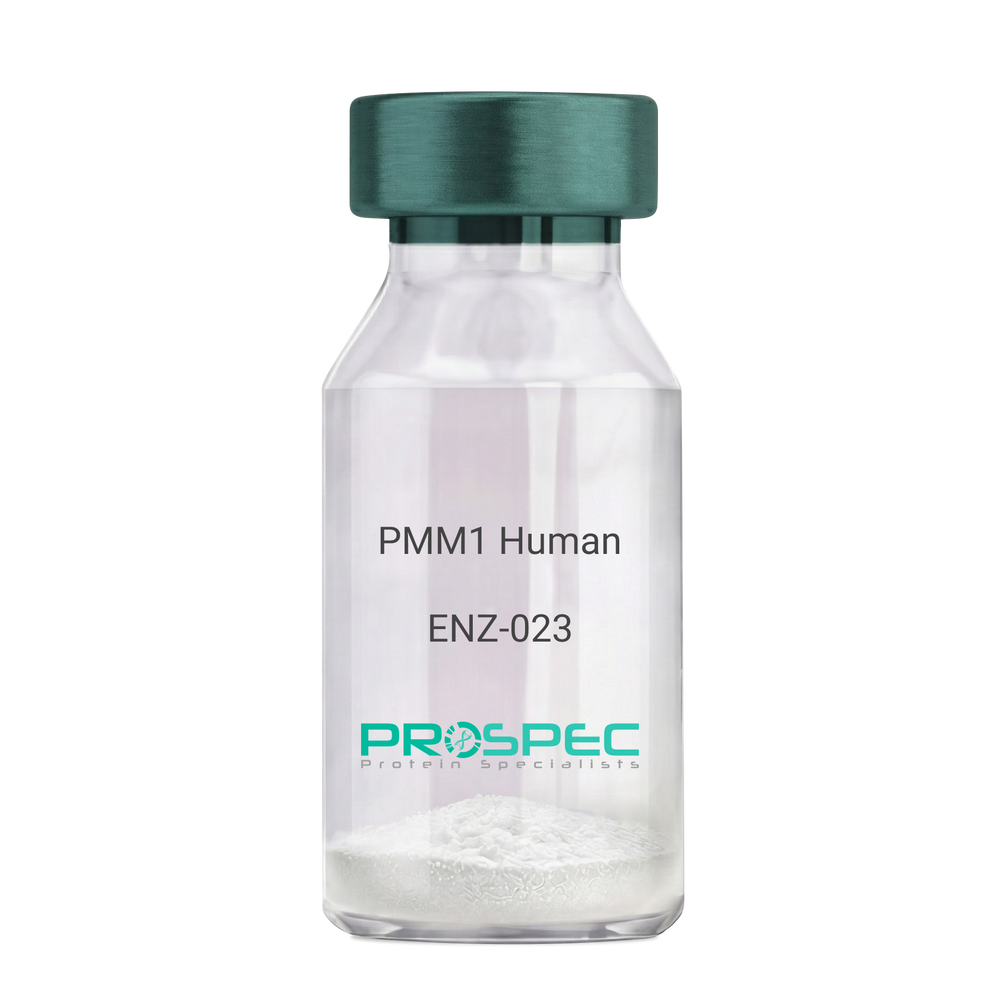
  • View Data Sheet

    Name :

    PMM1 Human

    Description:

    Phosphomannomutase 1 Human Recombinant

    Phosphomannomutase 1, PMM 1, PMMH-22, PMM1, PMMH22, Sec53.

    Product # :

    ENZ-023

    Price :

    Quantity :

    Shipping Method :

    Ice Icon

    Shipped with Ice Packs

    Add To Cart

    More Info

    • description
    • source
    • formulation
    • purity
    • More Info

    Description

    PMM1 Human Recombinant fused with a 20 amino acid His tag at N-terminus produced in E.Coli is a single, non-glycosylated, polypeptide chain containing 282 amino acids (1-262 a.a.) and having a molecular mass of 31.9kDa. The PMM1 is purified by proprietary chromatographic techniques.

    Source

    Escherichia Coli.

    Formulation

    The PMM1 solution (0.5mg/ml) contains 20mM Tris-HCl buffer (pH8.0), 10% glycerol, 2mM DTT, 100mM NaCl and 0.1mM PMSF.

    Purity

    Greater than 90.0% as determined by SDS-PAGE.

    More Info

    • Introduction

      Phosphomannomutase 1 (PMM1) is an enzyme involved in the synthesis of the GDP-mannose and dolichol-phosphate-mannose required for a number of critical mannosyl transfer reactions. PMM1 catalyzes the conversion between D-mannose 6-phosphate and D-mannose 1-phosphate which is a substrate for GDP-mannose synthesis. GDP-mannose is used for the synthesis of dolichol-phosphate-mannose, which is crucial for N-linked glycosylation and accordingly the secretion of several glycoproteins as well as for the synthesis of glycosyl-phosphatidyl-inositol (GPI) anchored proteins. Additionally, PMM1 may be responsible for the degradation of glucose-1,6-bisphosphate in ischemic brain.

    • Synonyms

      Phosphomannomutase 1, PMM 1, PMMH-22, PMM1, PMMH22, Sec53.

    • Physical Appearance

      Sterile Filtered colorless solution.

    • Stability

      Store at 4°C if entire vial will be used within 2-4 weeks. Store, frozen at -20°C for longer periods of time. For long term storage it is recommended to add a carrier protein (0.1% HSA or BSA).Avoid multiple freeze-thaw cycles.

    • Amino Acid Sequence

      MGSSHHHHHH SSGLVPRGSH MAVTAQAARR KERVLCLFDV DGTLTPARQK IDPEVAAFLQ KLRSRVQIGV VGGSDYCKIA EQLGDGDEVI EKFDYVFAEN GTVQYKHGRL LSKQTIQNHL GEELLQDLIN FCLSYMALLR LPKKRGTFIE FRNGMLNISP IGRSCTLEER IEFSELDKKE KIREKFVEAL KTEFAGKGLR FSRGGMISFD VFPEGWDKRY CLDSLDQDSF DTIHFFGNET SPGGNDFEIF ADPRTVGHSV VSPQDTVQRC REIFFPETAH EA.

    ProSpec's products are furnished for LABORATORY RESEARCH USE ONLY. The product may not be used as drugs, agricultural or pesticidal products, food additives or household chemicals.

    Pmm1 Human
  • View Data Sheet

    Name :

    DLAT Human

    Description:

    Dihydrolipoamide S-Acetyltransferase Human Recombinant

    Dihydrolipoamide S-Acetyltransferase, PDC-E2, dihydrolipoyllysine-residue acetyltransferase component of pyruvate dehydrogenase complex mitochondrial, Pyruvate dehydrogenase complex component E2, 70 kDa mitochondrial autoantigen of primary biliary cirrhosis, DLAT, PBC, M2 antigen complex 70 kDa subunit, EC 2.3.1.12, EC 2.3.1.

    Product # :

    ENZ-082

    Price :

    Quantity :

    Shipping Method :

    Ice Icon

    Shipped with Ice Packs

    Add To Cart

    More Info

    • description
    • source
    • formulation
    • purity
    • More Info

    Description

    DLAT is a full-length cDNA coding for the mature form of the human PDC-E2 protein having a molecular mass of 60,630 Dalton (pH 5.8). DLAT protein is fused to a hexa-histidine purification tag.

    Source

    Sf9 insect cells.

    Formulation

    DLAT is supplied in 20mM HEPES buffer pH-8.0, 200mM NaCl and 20% glycerol.

    Purity

    DLAT purity was found to be greater than 75% as determined by SDS-PAGE.

    More Info

    • Introduction

      DLAT gene encodes component E2 of the multi-enzyme pyruvate dehydrogenase complex (PDC). PDC is located in the inner mitochondrial membrane and catalyzes the conversion of pyruvate to acetyl coenzyme A. The protein product of this gene, dihydrolipoamide acetyltransferase, takes acetyl groups created by the oxidative decarboxylation of pyruvate and transfers them to coenzyme A. Dihydrolipoamide acetyltransferase is the antigen for antimitochondrial antibodies which are found in about 95% of patients with the autoimmune liver disease primary biliary cirrhosis (PBC). In patients who suffer from this illness, activated T lymphocytes attack and destroy epithelial cells in the bile duct where this protein is abnormally distributed and overexpressed. PBC ultimately leads to cirrhosis and liver failure. Mutations in DLAT are also a cause of pyruvate dehydrogenase E2 deficiency which causes primary lactic acidosis in infancy and early childhood.

    • Synonyms

      Dihydrolipoamide S-Acetyltransferase, PDC-E2, dihydrolipoyllysine-residue acetyltransferase component of pyruvate dehydrogenase complex mitochondrial, Pyruvate dehydrogenase complex component E2, 70 kDa mitochondrial autoantigen of primary biliary cirrhosis, DLAT, PBC, M2 antigen complex 70 kDa subunit, EC 2.3.1.12, EC 2.3.1.

    • Physical Appearance

      Sterile Filtered colorless solution.

    • Stability

      Store DLAT at 4°C if entire vial will be used within 2-4 weeks. Store, frozen at -20°C for longer periods of time. Avoid multiple freeze-thaw cycles.

    ProSpec's products are furnished for LABORATORY RESEARCH USE ONLY. The product may not be used as drugs, agricultural or pesticidal products, food additives or household chemicals.

    Dlat Human
  • View Data Sheet

    Name :

    TEK Mouse

    Description:

    TEK Tyrosine Kinase Endothelial Mouse Recombinant

    Angiopoietin-1 receptor, Endothelial tyrosine kinase, HYK, STK1, Tunica interna endothelial cell kinase, Tyrosine kinase with Ig and EGF homology domains-2, Tyrosine-protein kinase receptor TEK, Tyrosine-protein kinase receptor TIE-2, mTIE2, p140 TEK, CD202b.

    Product # :

    PKA-083

    Price :

    Quantity :

    Shipping Method :

    Ice Icon

    Shipped with Ice Packs

    Add To Cart

    More Info

    • description
    • source
    • formulation
    • purity
    • More Info

    Description

    TEK produced in Sf9 Baculovirus cells is a single, glycosylated polypeptide chain containing 730 amino acids (23-746 a.a.) and having a molecular mass of 81.6kDa (Migrates at 70-100kDa on SDS-PAGE under reducing conditions). TEK is expressed with a 6 amino acid His tag at C-Terminus and purified by proprietary chromatographic techniques.

    Source

    Sf9, Baculovirus cells.

    Formulation

    TEK protein solution (0.5mg/ml) contains Phosphate Buffered Saline (pH 7.4) and 10% glycerol.

    Purity

    Greater than 95.0% as determined by SDS-PAGE.

    More Info

    • Introduction

      TIE-1 (tyrosine kinase with Ig and EGF homology domains 1) and TIE-2/Tek comprise a receptor tyrosine kinase (RTK) subfamily with unique structural characteristics: two immunoglobulin-like domains flanking three epidermal growth factor (EGF)-like domains and followed by three fibronectin type III-like repeats in the extracellular region and a split tyrosine kinase domain in the cytoplasmic region. These receptors are expressed primarily on endothelial and hematopoietic progenitor cells and play critical roles in angiogenesis, vasculogenesis and hematopoiesis. Human TIE-1 cDNA encodes a 1122 amino acid (aa) residue precursor protein with an 18 residue putative signal peptide, a 726 residue extracellular domain and a 353 residue cytoplasmic domain. Two ligands, angiopoietin-1 (Ang1) and angiopoietin-2 (Ang2), which bind TIE-2 with high-affinity have been identified. Ang2 has been reported to act as an antagonist for Ang1. Mice engineered to overexpress Ang2 or to lack Ang1 or Tie-1 display similar angiogenic defects.

    • Synonyms

      Angiopoietin-1 receptor, Endothelial tyrosine kinase, HYK, STK1, Tunica interna endothelial cell kinase, Tyrosine kinase with Ig and EGF homology domains-2, Tyrosine-protein kinase receptor TEK, Tyrosine-protein kinase receptor TIE-2, mTIE2, p140 TEK, CD202b.

    • Physical Appearance

      Sterile Filtered colorless solution.

    • Stability

      Store at 4°C if entire vial will be used within 2-4 weeks. Store, frozen at -20°C for longer periods of time. For long term storage it is recommended to add a carrier protein (0.1% HSA or BSA). Avoid multiple freeze-thaw cycles.

    • Amino Acid Sequence

      AMDLILINSL PLVSDAETSL TCIASGWHPH EPITIGRDFE ALMNQHQDPL EVTQDVTREW AKKVVWKREK ASKINGAYFC EGRVRGQAIR IRTMKMRQQA SFLPATLTMT VDRGDNVNIS FKKVLIKEED AVIYKNGSFI HSVPRHEVPD ILEVHLPHAQ PQDAGVYSAR YIGGNLFTSA FTRLIVRRCE AQKWGPDCSR PCTTCKNNGV CHEDTGECIC PPGFMGRTCE KACEPHTFGR TCKERCSGPE GCKSYVFCLP DPYGCSCATG WRGLQCNEAC PSGYYGPDCK LRCHCTNEEI CDRFQGCLCS QGWQGLQCEK EGRPRMTPQI EDLPDHIEVN SGKFNPICKA SGWPLPTSEE MTLVKPDGTV LQPNDFNYTD RFSVAIFTVN RVLPPDSGVW VCSVNTVAGM VEKPFNISVK VLPEPLHAPN VIDTGHNFAI INISSEPYFG DGPIKSKKLF YKPVNQAWKY IEVTNEIFTL NYLEPRTDYE LCVQLARPGE GGEGHPGPVR RFTTASIGLP PPRGLSLLPK SQTALNLTWQ PIFTNSEDEF YVEVERRSLQ TTSDQQNIKV PGNLTSVLLS NLVPREQYTV RARVNTKAQG EWSEELRAWT LSDILPPQPE NIKISNITDS TAMVSWTIVD GYSISSIIIR YKVQGKNEDQ HIDVKIKNAT VTQYQLKGLE PETTYHVDIF AENNIGSSNP AFSHELRTLP HSPASADLGG GKMLHHHHHH.

    ProSpec's products are furnished for LABORATORY RESEARCH USE ONLY. The product may not be used as drugs, agricultural or pesticidal products, food additives or household chemicals.

    Tek Mouse
  • View Data Sheet

    Name :

    PRPS2 Human

    Description:

    Phosphoribosyl Pyrophosphate Synthetase 2 Human Recombinant

    Phosphoribosyl Pyrophosphate Synthetase 2, Phosphoribosyl Pyrophosphate Synthase II, Ribose-Phosphate Diphosphokinase 2, EC 2.7.6.1, PRS-II, Ribose-Phosphate Pyrophosphokinase 2, PPRibP Synthetase , PRS II, PPRibP, PRSII, Ribose-phosphate pyrophosphokinase 2.

    Product # :

    PKA-009

    Price :

    Quantity :

    Shipping Method :

    Ice Icon

    Shipped with Ice Packs

    Add To Cart

    More Info

    • description
    • source
    • formulation
    • purity
    • More Info

    Description

    PRPS2 Human Recombinant produced in E.Coli is a single, non-glycosylated polypeptide chain containing 344 amino acids (1-321 a.a) and having a molecular mass of 37.4kDa. PRPS2 is fused to a 23 amino acid His-tag at N-terminus & purified by proprietary chromatographic techniques.

    Source

    E.coli.

    Formulation

    PRPS2 protein solution (1mg/ml) containing Phosphate buffered saline (pH7.4), 10% glycerol and 1mM DTT.

    Purity

    Greater than 90% as determined by SDS-PAGE.

    More Info

    • Introduction

      Phosphoribosyl Pyrophosphate Synthetase 2, also known as PRPS2 is a member of the ribose-phosphate pyrophosphokinase family. PRPS2 catalyzes the synthesis of 5-phosphoribosyl 1-pyrophosphate from ATP and D-ribose 5-phosphate.

    • Synonyms

      Phosphoribosyl Pyrophosphate Synthetase 2, Phosphoribosyl Pyrophosphate Synthase II, Ribose-Phosphate Diphosphokinase 2, EC 2.7.6.1, PRS-II, Ribose-Phosphate Pyrophosphokinase 2, PPRibP Synthetase , PRS II, PPRibP, PRSII, Ribose-phosphate pyrophosphokinase 2.

    • Physical Appearance

      Sterile Filtered colorless solution.

    • Stability

      Store at 4°C if entire vial will be used within 2-4 weeks. Store, frozen at -20°C for longer periods of time. For long term storage it is recommended to add a carrier protein (0.1% HSA or BSA).Avoid multiple freeze-thaw cycles.

    • Amino Acid Sequence

      MGSSHHHHHH SSGLVPRGSH MGSMPNIVLF SGSSHQDLSQ RVADRLGLEL GKVVTKKFSN QETSVEIGES VRGEDVYIIQ SGCGEINDNL MELLIMINAC KIASSSRVTA VIPCFPYARQ DKKDKVGESR APISAKLVAN MLSVAGADHI ITMDLHASQI QGFFDIPVDN LYAEPAVLQW IRENIAEWKN CIIVSPDAGG AKRVTSIADR LNVEFALIHK ERKKANEVDR MVLVGDVKDR VAILVDDMAD TCGTICHAAD KLLSAGATKV YAILTHGIFS GPAISRINNA AFEAVVVTNT IPQEDKMKHC TKIQVIDISM ILAEAIRRTH NGESVSYLFS HVPL.

    ProSpec's products are furnished for LABORATORY RESEARCH USE ONLY. The product may not be used as drugs, agricultural or pesticidal products, food additives or household chemicals.

    Prps2 Human
  • View Data Sheet

    Name :

    CASP3 Human

    Description:

    Caspase 3 Apoptosis-Related Cysteine Peptidase Human Recombinant

    Caspase 3 Apoptosis-Related Cysteine Peptidase, CPP32 Caspase 3 Apoptosis-Related Cysteine Protease, Cysteine Protease CPP32, Protein Yama, CASP-3, CPP-32, SCA-1, SREBP Cleavage Activity 1, EC 3.4.22.56, CPP32B, caspase-3, PARP Cleavage Protease, procaspase3, Apopain, EC 3.4.22, CASP3.

    Product # :

    ENZ-791

    Price :

    Quantity :

    Shipping Method :

    Ice Icon

    Shipped with Ice Packs

    Add To Cart

    More Info

    • description
    • source
    • formulation
    • purity
    • More Info

    Description

    CASP3 Human Recombinant produced in E.coli is a single, non-glycosylated polypeptide chain containing 103 amino acids (176-277) and having a molecular mass of 12kDa.CASP3 is purified by proprietary chromatographic techniques.

    Source

    Escherichia Coli.

    Formulation

    The CASP3 solution (0.5mg/ml) contains 20mM Tris-HCl buffer (pH 8.0), 0.4M Urea and 10% glycerol.

    Purity

    Greater than 80.0% as determined by SDS-PAGE.

    More Info

    • Introduction

      Caspase 3 Apoptosis-Related Cysteine Peptidase (CASP3) belongs to the cysteine-aspartic acid protease (caspase) family. Sequential activation of caspases plays a key role in the execution-phase of cell apoptosis. Caspases exist as inactive proenzymes which undergo proteolytic processing at conserved aspartic residues to generate 2 subunits, large and small, that dimerize to create the active enzyme. CASP3 protein cleaves and activates caspases 6, 7 and 9, and the protein itself is processed by caspases 8, 9 and 10. CASP3 is the leading caspase involved in the cleavage of amyloid-beta 4A precursor protein, which is linked with neuronal death in Alzheimer's disease. In addition, CASP3 is involved in the cleavage of huntingtin. CASP3 also cleaves and activates sterol regulatory element binding proteins (SREBPs) between the basic helix-loop-helix leucine zipper domain and the membrane attachment domain. CASP3 initiates cell adhesion in sympathetic neurons through RET cleavage.

    • Synonyms

      Caspase 3 Apoptosis-Related Cysteine Peptidase, CPP32 Caspase 3 Apoptosis-Related Cysteine Protease, Cysteine Protease CPP32, Protein Yama, CASP-3, CPP-32, SCA-1, SREBP Cleavage Activity 1, EC 3.4.22.56, CPP32B, caspase-3, PARP Cleavage Protease, procaspase3, Apopain, EC 3.4.22, CASP3.

    • Physical Appearance

      Sterile Filtered colorless solution.

    • Stability

      Store at 4°C if entire vial will be used within 2-4 weeks. Store, frozen at -20°C for longer periods of time. For long term storage it is recommended to add a carrier protein (0.1% HSA or BSA).Avoid multiple freeze-thaw cycles.

    • Amino Acid Sequence

      MSGVDDDMAC HKIPVEADFL YAYSTAPGYY SWRNSKDGSW FIQSLCAMLK QYADKLEFMH ILTRVNRKVA TEFESFSFDA TFHAKKQIPC IVSMLTKELY FYH.

    ProSpec's products are furnished for LABORATORY RESEARCH USE ONLY. The product may not be used as drugs, agricultural or pesticidal products, food additives or household chemicals.

    Casp3 Human
  • 1
  • …
  • 36
  • 37
  • 38
  • 39
  • 40
  • …
  • 42
Your browser does not support the video tag.

Products

  • Cytokines
  • Growth Factors
  • Chemokines
  • CD Antigens
  • Neurotrophins
  • Hormones
  • Enzymes
  • Viral Antigens
  • Recombinant Proteins
  • Natural Proteins
  • Monoclonal Antibodies
  • Polyclonal Antibodies
  • Thermal Packaging

About

  • Company
  • Founder
  • Contribution
  • Contact Us
  • My Account

Ordering

  • Ordering Method
  • Ordering - Credit Card
  • Ordering PO
  • Shipping Fees
  • FAQ's

Legal

  • Terms & Conditions
  • Privacy
  • Site Map
  • info@prospecbio.com
  • Facebook
  • Instagram
  • Linkedin Profile

© 2026 ProSpec-Tany TechnoGene Ltd. All Rights Reserved.

  • Choosing a selection results in a full page refresh.
  • Opens in a new window.