Skip to content

High-quality research proteins.

  • 1-800-805-6531

  • Mon - Sat 8.00-18.00, Sun - Closed

  • info@prospecbio.com

  • PO Box 6591 East Brunswick NJ 08816

  • Products
    • Cytokines
    • Growth factors
    • Chemokines
    • Cd antigens
    • Neurotrophins
    • Hormones
    • Enzymes
    • Viral antigens
    • Recombinant proteins
    • Natural proteins
    • Monoclonal antibodies
    • Polyclonal antibodies
    • Thermal Packaging
  • About
    • Company
    • Founder
    • Contribution
  • Customers
    • Eastern Asia
    • Eastern Europe
    • North America
    • South America
    • South East Asia
    • Southern Asia
    • Western Europe
  • Ordering
    • Ordering Method
    • Ordering - Credit Card
    • Ordering - PO
    • Shipping Fees
    • FAQs
  • Services
    • DNA Cloning
    • Protein Expression
    • Monoclonal Antibody
    • Fermentation
    • Technology License
  • Contact us
Log in

Country/region

  • USD $ | Albania
  • USD $ | Andorra
  • USD $ | Argentina
  • USD $ | Armenia
  • USD $ | Australia
  • USD $ | Austria
  • USD $ | Azerbaijan
  • USD $ | Belarus
  • USD $ | Belgium
  • USD $ | Bolivia
  • USD $ | Brazil
  • USD $ | Bulgaria
  • USD $ | Cambodia
  • USD $ | Canada
  • USD $ | Chile
  • USD $ | China
  • USD $ | Colombia
  • USD $ | Costa Rica
  • USD $ | Croatia
  • USD $ | Cyprus
  • USD $ | Czechia
  • USD $ | Denmark
  • USD $ | Estonia
  • USD $ | Finland
  • USD $ | France
  • USD $ | Georgia
  • USD $ | Germany
  • USD $ | Greece
  • USD $ | Hong Kong SAR
  • USD $ | Hungary
  • USD $ | Iceland
  • USD $ | India
  • USD $ | Ireland
  • USD $ | Israel
  • USD $ | Italy
  • USD $ | Japan
  • USD $ | Kazakhstan
  • USD $ | Latvia
  • USD $ | Liechtenstein
  • USD $ | Lithuania
  • USD $ | Madagascar
  • USD $ | Malta
  • USD $ | Mexico
  • USD $ | Moldova
  • USD $ | Monaco
  • USD $ | Netherlands
  • USD $ | New Zealand
  • USD $ | North Macedonia
  • USD $ | Norway
  • USD $ | Panama
  • USD $ | Paraguay
  • USD $ | Peru
  • USD $ | Philippines
  • USD $ | Poland
  • USD $ | Portugal
  • USD $ | Romania
  • USD $ | Singapore
  • USD $ | Slovakia
  • USD $ | Slovenia
  • USD $ | South Africa
  • USD $ | South Korea
  • USD $ | Spain
  • USD $ | Sri Lanka
  • USD $ | Sweden
  • USD $ | Switzerland
  • USD $ | Taiwan
  • USD $ | Thailand
  • USD $ | Türkiye
  • USD $ | Ukraine
  • USD $ | United Kingdom
  • USD $ | United States
  • USD $ | Uruguay
  • USD $ | Vatican City
  • USD $ | Venezuela
  • USD $ | Vietnam
  • Facebook
  • Instagram
logoProSpec - Recombinant Protein Manufacturer for academic and R&D industry
Become a distributor
Account Log in
Wishlist
Cart Cart(0)
  • Products
    +
    • Cytokines
    • Growth factors
    • Chemokines
    • Cd antigens
    • Neurotrophins
    • Hormones
    • Enzymes
    • Viral antigens
    • Recombinant proteins
    • Natural proteins
    • Monoclonal antibodies
    • Polyclonal antibodies
    • Thermal Packaging
  • About
    +
    • Company
    • Founder
    • Contribution
  • Customers
    +
    • Eastern Asia
    • Eastern Europe
    • North America
    • South America
    • South East Asia
    • Southern Asia
    • Western Europe
  • Ordering
    +
    • Ordering Method
    • Ordering - Credit Card
    • Ordering - PO
    • Shipping Fees
    • FAQs
  • Services
    +
    • DNA Cloning
    • Protein Expression
    • Monoclonal Antibody
    • Fermentation
    • Technology License
  • Contact us

Item added to your cart

View cart
View All
  • Cytokines
  • Growth factors
  • Chemokines
  • Cd antigens
  • Neurotrophins
  • Hormones
  • Enzymes
  • Viral antigens
  • Recombinant proteins
  • Natural proteins
  • Monoclonal antibodies
  • Polyclonal antibodies
  • Thermal Packaging
  • Tumor Necrosis Factor

    Tumor Necrosis Factor

    View All
  • 4-1BB

    4-1BB

    View All
  • Adiponectin

    Adiponectin

    View All
  • AIF1

    AIF1

    View All
  • Other Cytokines

    Other Cytokines

    View All
  • AITRL

    AITRL

    View All
  • Angiopoietin

    Angiopoietin

    View All
  • Apolipoprotein

    Apolipoprotein

    View All
  • B-Cell Activating Factor

    B-Cell Activating Factor

    View All
  • Beta Defensin

    Beta Defensin

    View All
  • Bone Morphogenetic Protein

    Bone Morphogenetic Protein

    View All
  • B type Natriuretic Peptide

    B type Natriuretic Peptide

    View All
  • BST

    BST

    View All
  • Betacellulin

    Betacellulin

    View All
  • Cardiotrophin

    Cardiotrophin

    View All
  • Activin

    Activin

    View All
  • Fibroblast Growth Factor

    Fibroblast Growth Factor

    View All
  • Other Growth Factors

    Other Growth Factors

    View All
  • CSF

    CSF

    View All
  • CTGF

    CTGF

    View All
  • IGFBP

    IGFBP

    View All
  • VEGF Protein

    VEGF Protein

    View All
  • EGF

    EGF

    View All
  • Epigen

    Epigen

    View All
  • Erythropoietin

    Erythropoietin

    View All
  • Insulin-Like Growth Factor

    Insulin-Like Growth Factor

    View All
  • Growth Hormone

    Growth Hormone

    View All
  • HDGF

    HDGF

    View All
  • Hepatocyte Growth Factor

    Hepatocyte Growth Factor

    View All
  • Insulin

    Insulin

    View All
  • BCA-1/ BLC (CXCL13)

    BCA-1/ BLC (CXCL13)

    View All
  • BRAK (CXCL14)

    BRAK (CXCL14)

    View All
  • C-10 (CCL6)

    C-10 (CCL6)

    View All
  • Other Chemokines

    Other Chemokines

    View All
  • MEC (CCL28)

    MEC (CCL28)

    View All
  • LD78-beta (CCL3L1)

    LD78-beta (CCL3L1)

    View All
  • CTACK (CCL27)

    CTACK (CCL27)

    View All
  • CXCL16

    CXCL16

    View All
  • CXCL17

    CXCL17

    View All
  • Platelet Factor-4 (CXCL4)

    Platelet Factor-4 (CXCL4)

    View All
  • ENA-78 (CXCL5)

    ENA-78 (CXCL5)

    View All
  • Eotaxin (CCL11,24,26)

    Eotaxin (CCL11,24,26)

    View All
  • Exodus-2 (CCL21)

    Exodus-2 (CCL21)

    View All
  • Fractalkine (CX3CL1)

    Fractalkine (CX3CL1)

    View All
  • CXCL6

    CXCL6

    View All
  • Other CD Antigens

    Other CD Antigens

    View All
  • CD14

    CD14

    View All
  • CD164

    CD164

    View All
  • CD1

    CD1

    View All
  • CD2

    CD2

    View All
  • CD200

    CD200

    View All
  • CD207

    CD207

    View All
  • CD226

    CD226

    View All
  • CD23

    CD23

    View All
  • CD244

    CD244

    View All
  • CD247

    CD247

    View All
  • CD27

    CD27

    View All
  • CD274

    CD274

    View All
  • CD300

    CD300

    View All
  • CD33

    CD33

    View All
  • Other Neurotrophins

    Other Neurotrophins

    View All
  • Beta-NGF

    Beta-NGF

    View All
  • BDNF

    BDNF

    View All
  • CDNF

    CDNF

    View All
  • CNTF

    CNTF

    View All
  • GDNF

    GDNF

    View All
  • Glia Maturation Factor

    Glia Maturation Factor

    View All
  • MANF

    MANF

    View All
  • Midkine

    Midkine

    View All
  • Neuroglobin

    Neuroglobin

    View All
  • Neurotrophic factors

    Neurotrophic factors

    View All
  • Neuregulin

    Neuregulin

    View All
  • Neuropilin

    Neuropilin

    View All
  • Pigment Epithelium-Derived Factor

    Pigment Epithelium-Derived Factor

    View All
  • Pleiotrophin

    Pleiotrophin

    View All
  • Peptide Hormones

    Peptide Hormones

    View All
  • Other Hormones

    Other Hormones

    View All
  • HCG

    HCG

    View All
  • Endothelin

    Endothelin

    View All
  • Exendin

    Exendin

    View All
  • FSH

    FSH

    View All
  • Glucagon

    Glucagon

    View All
  • GHRP

    GHRP

    View All
  • GLP

    GLP

    View All
  • Thyrostimulin

    Thyrostimulin

    View All
  • Inhibin A

    Inhibin A

    View All
  • LHRH

    LHRH

    View All
  • Melanotan

    Melanotan

    View All
  • Procalcitonin

    Procalcitonin

    View All
  • PTH

    PTH

    View All
  • Peroxiredoxin

    Peroxiredoxin

    View All
  • Peptidase

    Peptidase

    View All
  • Synthetase

    Synthetase

    View All
  • Transferase

    Transferase

    View All
  • Hydrolase

    Hydrolase

    View All
  • Dehydrogenase

    Dehydrogenase

    View All
  • ACE2

    ACE2

    View All
  • Esterase

    Esterase

    View All
  • Protein Kinases

    Protein Kinases

    View All
  • Other Enzymes

    Other Enzymes

    View All
  • Phosphatase

    Phosphatase

    View All
  • Deaminase

    Deaminase

    View All
  • Oxygenase

    Oxygenase

    View All
  • Adenylate Kinase

    Adenylate Kinase

    View All
  • Lyase

    Lyase

    View All
  • Chagas

    Chagas

    View All
  • SARS

    SARS

    View All
  • Influenza

    Influenza

    View All
  • ASFV

    ASFV

    View All
  • Astrovirus

    Astrovirus

    View All
  • Borrelia

    Borrelia

    View All
  • Helicobacter Pylori

    Helicobacter Pylori

    View All
  • Chikungunya

    Chikungunya

    View All
  • Chlamydia

    Chlamydia

    View All
  • Cytomegalo

    Cytomegalo

    View All
  • Dengue

    Dengue

    View All
  • EBV

    EBV

    View All
  • Ebola

    Ebola

    View All
  • Feline Leukemia Virus

    Feline Leukemia Virus

    View All
  • Hepatitis A

    Hepatitis A

    View All
  • Other

    Other

    View All
  • Actin

    Actin

    View All
  • ADAM

    ADAM

    View All
  • Complement Component

    Complement Component

    View All
  • Ag85

    Ag85

    View All
  • Eukaryotic Translation Initiation Factor

    Eukaryotic Translation Initiation Factor

    View All
  • Anterior Gradient Protein

    Anterior Gradient Protein

    View All
  • Heat Shock Protein

    Heat Shock Protein

    View All
  • Alpha-2-HS-Glycoprotein

    Alpha-2-HS-Glycoprotein

    View All
  • Hemoglobin

    Hemoglobin

    View All
  • Allergy

    Allergy

    View All
  • Anaplasma

    Anaplasma

    View All
  • Angiogenin

    Angiogenin

    View All
  • Ankyrin Repeat Domain

    Ankyrin Repeat Domain

    View All
  • Annexin

    Annexin

    View All
  • Other Natural Proteins

    Other Natural Proteins

    View All
  • Aprotinin

    Aprotinin

    View All
  • Transferrin

    Transferrin

    View All
  • Avidin

    Avidin

    View All
  • Anti Coagulation Factors

    Anti Coagulation Factors

    View All
  • Natural Albumin

    Natural Albumin

    View All
  • Natural Coagulation Factors

    Natural Coagulation Factors

    View All
  • Fibronectin

    Fibronectin

    View All
  • Thrombin

    Thrombin

    View All
  • Anti Human Enzyme

    Anti Human Enzyme

    View All
  • Other Monoclonal Antibodies

    Other Monoclonal Antibodies

    View All
  • Anti Human Cytokine

    Anti Human Cytokine

    View All
  • Anti Human Heat Shock Protein

    Anti Human Heat Shock Protein

    View All
  • Anti Mouse Lymphocyte

    Anti Mouse Lymphocyte

    View All
  • Anti Human Chemokine

    Anti Human Chemokine

    View All
  • Anti Human Lymphocyte

    Anti Human Lymphocyte

    View All
  • Anti Viral Monoclonal

    Anti Viral Monoclonal

    View All
  • Anti Mouse Cytokine

    Anti Mouse Cytokine

    View All
  • Anti-GST Monoclonal

    Anti-GST Monoclonal

    View All
  • Other Polyclonal Antibodies

    Other Polyclonal Antibodies

    View All
  • Anti Viral

    Anti Viral

    View All
  • Anti-GST Monoclonal

    Anti-GST Monoclonal

    View All
Back

Search results

1000 results found for “Hydratase”

Name

Description

Product #

Price

Quantity

Shipping Method

  • View Data Sheet

    Name :

    PSMA1 Human

    Description:

    Proteasome Subunit Alpha Type 1 Human Recombinant

    Proteasome (prosome macropain) subunit alpha type 1, PROS30, HC2, NU, Macropain subunit C2, Multicatalytic endopeptidase complex subunit C2, Proteasome component C2, Proteasome nu chain, 30 kDa prosomal protein, protein P30-33K, PROS-30, PSC2, EC 3.4.25.1.

    Product # :

    ENZ-178

    Price :

    Quantity :

    Shipping Method :

    Ice Icon

    Shipped with Ice Packs

    Add To Cart

    More Info

    • description
    • source
    • formulation
    • purity
    • More Info

    Description

    PSMA1 Human Recombinant produced in E.coli is a single, non-glycosylated polypeptide chain containing 286 amino acids (1-263) and having a molecular mass of 32.0 kDa.PSMA1 is fused to a 23 amino acid His-tag at N-terminus & purified by proprietary chromatographic techniques.

    Source

    E.coli.

    Formulation

    The PSMA1 solution (1mg/ml) contains 20mM Tris-HCl buffer (pH 8.0), 0.15M NaCl, 2mM DTT and 10% glycerol.

    Purity

    Greater than 95% as determined by SDS-PAGE.

    More Info

    • Introduction

      PSMA1 is a prosomal protein who takes part in a nonlysosomal ATP/ubiquitin-dependent proteolytic pathway. PSMA1 is a multicatalytic proteinase complex that is characterized by its capacity to cleave peptides with Arg, Phe, Tyr, Leu, and Glu next to the leaving group at neutral or slightly basic pH. PSMA1 is vastly expressed in prostate epithelium.

    • Synonyms

      Proteasome (prosome macropain) subunit alpha type 1, PROS30, HC2, NU, Macropain subunit C2, Multicatalytic endopeptidase complex subunit C2, Proteasome component C2, Proteasome nu chain, 30 kDa prosomal protein, protein P30-33K, PROS-30, PSC2, EC 3.4.25.1.

    • Physical Appearance

      Sterile Filtered colorless solution.

    • Stability

      Store at 4°C if entire vial will be used within 2-4 weeks. Store, frozen at -20°C for longer periods of time. For long term storage it is recommended to add a carrier protein (0.1% HSA or BSA).Avoid multiple freeze-thaw cycles.

    • Amino Acid Sequence

      MGSSHHHHHH SSGLVPRGSH MGSMFRNQYD NDVTVWSPQG RIHQIEYAME AVKQGSATVG LKSKTHAVLV ALKRAQSELA AHQKKILHVD NHIGISIAGL TADARLLCNF MRQECLDSRF VFDRPLPVSR LVSLIGSKTQ IPTQRYGRRP YGVGLLIAGY DDMGPHIFQT CPSANYFDCR AMSIGARSQS ARTYLERHMS EFMECNLNEL VKHGLRALRE TLPAEQDLTT KNVSIGIVGK DLEFTIYDDD DVSPFLEGLE ERPQRKAQPA QPADEPAEKA DEPMEH

    ProSpec's products are furnished for LABORATORY RESEARCH USE ONLY. The product may not be used as drugs, agricultural or pesticidal products, food additives or household chemicals.

    Psma1 Human
  • View Data Sheet

    Name :

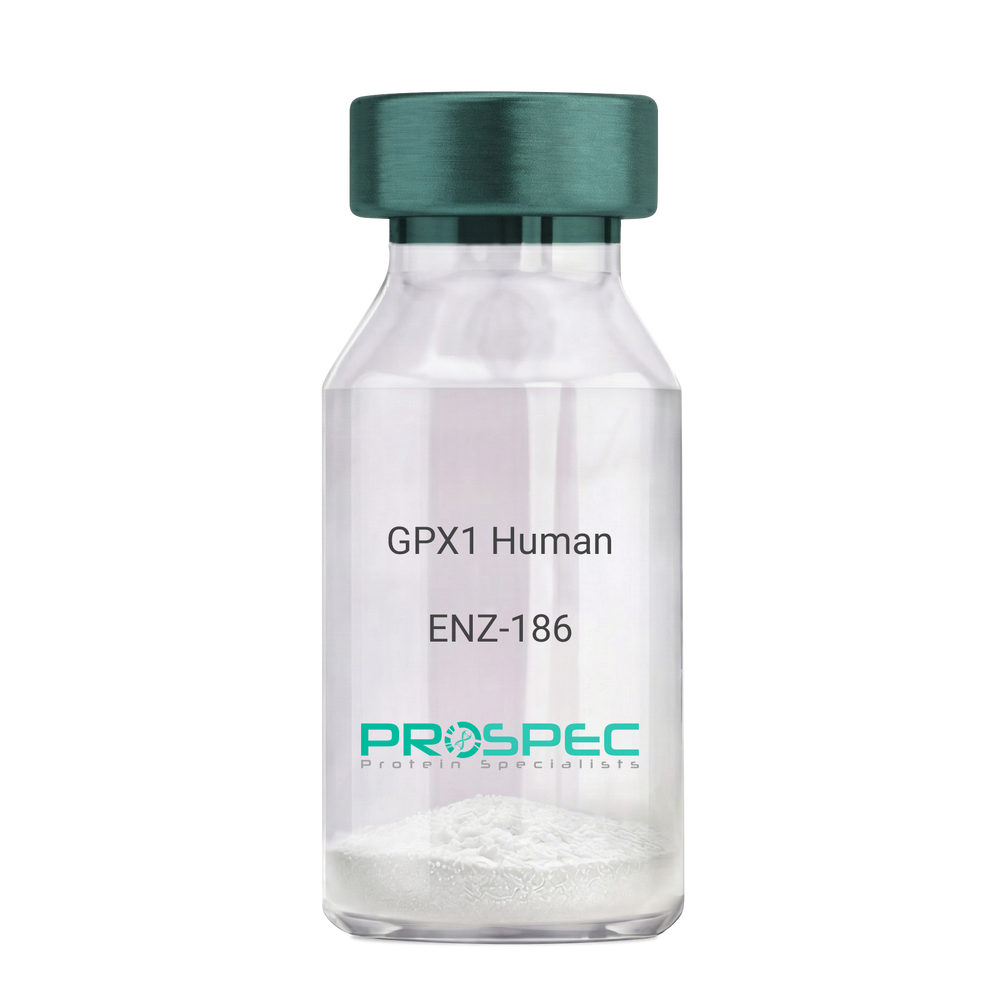
    GPX1 Human

    Description:

    Glutathione Peroxidase 1 Human Recombinant

    Glutathione peroxidase 1, GPx-1, GSHPx-1, Cellular glutathione peroxidase, GPX1, GPXD, GSHPX1.

    Product # :

    ENZ-186

    Price :

    Quantity :

    Shipping Method :

    Ice Icon

    Shipped with Ice Packs

    Add To Cart

    More Info

    • description
    • source
    • formulation
    • purity
    • More Info

    Description

    GPX1 Human Recombinant produced in E.coli is a single, non-glycosylated polypeptide chain containing 223 amino acids (1-203) and having a molecular mass of 24.2kDa.GPX1 is fused to a 20 amino acid His-tag at N-terminus & purified by proprietary chromatographic techniques.

    Source

    Escherichia Coli.

    Formulation

    The GPX1 solution (0.5mg/ml) contains 20mM Tris-HCl buffer (pH 8.0), 2mM DTT, 30% glycerol and 100mM NaCl.

    Purity

    Greater than 90% as determined by SDS-PAGE.

    More Info

    • Introduction

      Glutathione peroxidase 1 (GPX1) is a member of the glutathione peroxidase family, consisting of 8 identified glutathione peroxidases (Gpx1-8) in humans. Glutathione peroxidase serves in the detoxification of hydrogen peroxide, and is one of the most vital antioxidant enzymes in humans. The GPX1 is a component of the enzymatic antioxidant defense, preventing oxidative damage to DNA, proteins and lipids by detoxifying hydrogen and lipid peroxides which may contribute to prostate cancer development. GPX1 is one of only a small number of proteins known in higher vertebrates to contain selenocysteine, which occurs at the active site of glutathione peroxidase and is coded by the nonsense (stop) codon TGA. Furthermore, the GPX1 protein is characterized in a polyalanine sequence polymorphism in the N-terminal region, which includes 3 alleles with 5, 6 or 7 alanine (ALA) repeats in this sequence. The allele with 5 ALA repeats is significantly linked to breast cancer risk.

    • Synonyms

      Glutathione peroxidase 1, GPx-1, GSHPx-1, Cellular glutathione peroxidase, GPX1, GPXD, GSHPX1.

    • Physical Appearance

      Sterile filtered colorless solution.

    • Stability

      Store at 4°C if entire vial will be used within 2-4 weeks. Store, frozen at -20°C for longer periods of time. For long term storage it is recommended to add a carrier protein (0.1% HSA or BSA).Avoid multiple freeze-thaw cycles.

    • Amino Acid Sequence

      MGSSHHHHHH SSGLVPRGSH MCAARLAAAA AAAQSVYAFS ARPLAGGEPV SLGSLRGKVL LIENVASLCG TTVRDYTQMN ELQRRLGPRG LVVLGFPCNQ FGHQENAKNE EILNSLKYVR PGGGFEPNFM LFEKCEVNGA GAHPLFAFLR EALPAPSDDA TALMTDPKLI TWSPVCRNDV AWNFEKFLVG PDGVPLRRYS RRFQTIDIEP DIEALLSQGP SCA.

    ProSpec's products are furnished for LABORATORY RESEARCH USE ONLY. The product may not be used as drugs, agricultural or pesticidal products, food additives or household chemicals.

    Gpx1 Human
  • View Data Sheet

    Name :

    REXO1 Human

    Description:

    RNA Exonuclease 1 Human Recombinant

    RNA exonuclease 1 homolog, Elongin-A-binding protein 1, EloA-BP1, Transcription elongation factor B polypeptide 3-binding protein 1, REXO1, ELOABP1, KIAA1138, TCEB3BP1.

    Product # :

    ENZ-767

    Price :

    Quantity :

    Shipping Method :

    Ice Icon

    Shipped with Ice Packs

    Add To Cart

    More Info

    • description
    • source
    • formulation
    • purity
    • More Info

    Description

    REXO1 Human Recombinant produced in E.coli is a single, non-glycosylated polypeptide chain containing 198 amino acids (1060-1221a.a) and having a molecular mass of 22.3kDa. REXO1 is fused to a 36 amino acid His-tag at N-terminus & purified by proprietary chromatographic techniques.

    Source

    Escherichia Coli.

    Formulation

    The REXO1 solution (0.25mg/ml) contains 20mM Tris-HCl buffer (pH 8.0), 0.15M NaCl, 10% glycerol and 1mM DTT.

    Purity

    Greater than 90% as determined by SDS-PAGE.

    More Info

    • Introduction

      REXO1 is an exonuclease domain-containing protein which binds to Elongin. The Elongin complex stimulates the rate of transcription elongation by RNA polymerase II by suppressing the transient pausing of the polymerase at many sites along the DNA template. REXO1 is composed of 1221 amino acids and its mRNA is ubiquitously expressed. REXO1 is a putative stem cell marker and is highly expressed in embryonic and adult stem cells.

    • Synonyms

      RNA exonuclease 1 homolog, Elongin-A-binding protein 1, EloA-BP1, Transcription elongation factor B polypeptide 3-binding protein 1, REXO1, ELOABP1, KIAA1138, TCEB3BP1.

    • Physical Appearance

      Sterile Filtered colorless solution.

    • Stability

      Store at 4°C if entire vial will be used within 2-4 weeks. Store, frozen at -20°C for longer periods of time. For long term storage it is recommended to add a carrier protein (0.1% HSA or BSA). Avoid multiple freeze-thaw cycles.

    • Amino Acid Sequence

      MRGSHHHHHH GMASMTGGQQ MGRDLYDDDD KDRWGSIYAL DCEMSYTTYG LELTRVTVVD TDVHVVYDTF VKPDNEIVDY NTRFSGVTEA DLADTSVTLR DVQAVLLSMF SADTILIGHS LESDLLALKV IHSTVVDTSV LFPHRLGLPY KRSLRNLMAD YLRQIIQDNV DGHSSSEDAG ACMHLVIWKV REDAKTKR.

    ProSpec's products are furnished for LABORATORY RESEARCH USE ONLY. The product may not be used as drugs, agricultural or pesticidal products, food additives or household chemicals.

    Rexo1 Human
  • View Data Sheet

    Name :

    Fertirelin

    Description:

    Fertirelin

    Product # :

    HOR-037

    Price :

    Quantity :

    Shipping Method :

    Room Temp Icon

    Shipped at Room temp

    Add To Cart

    More Info

    • description
    • formulation
    • purity
    • More Info

    Description

    Fertirelin Synthetic is a single, non-glycosylated polypeptide chain containing 9 amino acids, having a molecular mass of 1153.31 Dalton and a Molecular formula of C55H76N16O12.

    Formulation

    The protein was lyophilized with no additives.

    Purity

    Greater than 97.0% as determined by analysis by RP-HPLC.

    More Info

    • Physical Appearance

      Sterile Filtered White lyophilized (freeze-dried) powder.

    • Stability

      Lyophilized Fertirelin although stable at room temperature for 3 weeks, should be stored desiccated below -18°C. Upon reconstitution Fertirelin should be stored at 4°C between 2-7 days and for future use below -18°C. For long term storage it is recommended to add a carrier protein (0.1% HSA or BSA). Please prevent freeze-thaw cycles.

    • Solubility

      It is recommended to reconstitute the lyophilized Fertirelin in sterile 18MΩ-cm H2O not less than 100 µg/ml, which can then be further diluted to other aqueous solutions.

    • Amino Acid Sequence

      Pyr-His-Trp-Ser-Tyr-Gly-Leu-Arg-Pro-NHEt.

    • Background

      Fertirelin, a potent gonadotropin-releasing hormone (GnRH) analogue, is crucial for fertility regulation in animals. This research paper endeavors to expound on the biochemical attributes of fertirelin and its potential therapeutic applications in veterinary medicine.

      Fertirelin, a synthetic analogue of the natural gonadotropin-releasing hormone, plays a fundamental role in fertility regulation in veterinary medicine. It stimulates the secretion of luteinizing hormone and follicle-stimulating hormone, crucial for reproduction (Kotwica et al., 2005). This paper aims to delve into the biochemical characteristics of fertirelin and its potential applications.

      Fertirelin, as a GnRH analogue, elicits its action by binding to GnRH receptors located on pituitary gonadotroph cells. This leads to the release of luteinizing hormone and follicle-stimulating hormone, key players in ovulation and spermatogenesis (Kotwica et al., 2005).

      In the realm of veterinary medicine, fertirelin is primarily used for treating ovarian follicular cysts in dairy cattle (Bosu & Peter, 1987). Its potent stimulatory effect on gonadotropin secretion facilitates ovulation and contributes to fertility management strategies.

      The potential of fertirelin extends beyond the current applications. Further research into the precise mechanism of action and potential side effects can enhance its utilization. Overall, fertirelin presents a powerful tool in veterinary reproductive medicine, making it a focal point of interest for future studies.

    ProSpec's products are furnished for LABORATORY RESEARCH USE ONLY. The product may not be used as drugs, agricultural or pesticidal products, food additives or household chemicals.

    Fertirelin
  • View Data Sheet

    Name :

    HINT2 Human

    Description:

    Histidine Triad Nucleotide Binding Protein 2 Human Recombinant

    Histidine triad nucleotide-binding protein 2 mitochondrial, HINT-2, HINT-3 HIT-17kDa, PKCI-1-related HIT protein, HINT2, histidine triad nucleotide binding protein 2, HIT-17.

    Product # :

    PRO-1455

    Price :

    Quantity :

    Shipping Method :

    Ice Icon

    Shipped with Ice Packs

    Add To Cart

    More Info

    • description
    • source
    • formulation
    • purity
    • More Info

    Description

    HINT2 Human Recombinant produced in E.Coli is a single, non-glycosylated polypeptide chain containing 169 amino acids (18-163 a.a) and having a molecular mass of 17.9kDa.HINT2 is fused to a 23 amino acid His-tag at N-terminus & purified by proprietary chromatographic techniques.

    Source

    Escherichia Coli.

    Formulation

    HINT2 protein solution (0.5mg/ml) containing 20mM Tris-HCl buffer (pH 8.0), 0.15M NaCl, 10% glycerol and 1mM DTT.

    Purity

    Greater than 90.0% as determined by SDS-PAGE.

    More Info

    • Introduction

      Histidine triad nucleotide-binding protein 2 (HINT2) belongs to the triad proteins, which are nucleotide hydrolases and transferases that act on the alpha-phosphate of ribonucleotides. Hydrolase is most likely involved in steroid biosynthesis, furthermore it might play a role in apoptosis. HINT2 shows high expression in liver and pancreas. Expression is significantly down-regulated in hepatocellular carcinoma (HCC) patients.

    • Synonyms

      Histidine triad nucleotide-binding protein 2 mitochondrial, HINT-2, HINT-3 HIT-17kDa, PKCI-1-related HIT protein, HINT2, histidine triad nucleotide binding protein 2, HIT-17.

    • Physical Appearance

      Sterile Filtered colorless solution.

    • Stability

      Store at 4°C if entire vial will be used within 2-4 weeks. Store, frozen at -20°C for longer periods of time. For long term storage it is recommended to add a carrier protein (0.1% HSA or BSA).Avoid multiple freeze-thaw cycles.

    • Amino Acid Sequence

      MGSSHHHHHH SSGLVPRGSH MGSVAATGVR GGQVRGAAGV TDGNEVAKAQ QATPGGAAPT IFSRILDKSL PADILYEDQQ CLVFRDVAPQ APVHFLVIPK KPIPRISQAE EEDQQLLGHL LLVAKQTAKA EGLGDGYRLV INDGKLGAQS VYHLHIHVLG GRQLQWPPG.

    ProSpec's products are furnished for LABORATORY RESEARCH USE ONLY. The product may not be used as drugs, agricultural or pesticidal products, food additives or household chemicals.

    Hint2 Human
  • View Data Sheet

    Name :

    MUTM E.Coli

    Description:

    Formamidopyrimidine-DNA Glycosylase E.Coli Recombinant

    Formamidopyrimidine-DNA glycosylase, FPG.

    Product # :

    ENZ-589

    Price :

    Quantity :

    Shipping Method :

    Ice Icon

    Shipped with Ice Packs

    Add To Cart

    More Info

    • description
    • source
    • formulation
    • purity
    • More Info

    Description

    MUTM Recombinant produced in E. coli is a single polypeptide chain containing 289 amino acids (1-269) and having a molecular mass of 32.4kDa.MUTM is fused to a 20 amino acid His-tag at N-terminus & purified by proprietary chromatographic techniques.

    Source

    E.coli.

    Formulation

    The MUTM solution (0.5mg/ml) contains 20mM Tris-HCl buffer (pH 8.0), 100mM Nacl, 1mM DTT and 20% glycerol.

    Purity

    Greater than 90% as determined by SDS-PAGE.

    More Info

    • Introduction

      MUTM is a base excision repair enzyme that identifies and eliminates a large variety of oxidized purines from correspondingly impaired DNA. MUTM is nondismissable and essential to remove quickly its substrate lesions on the chromosome. MUTM, additionally, mends a large number of the lesions recognized by Endo III, signifying that MUTM takes a prominent part in the overall repair of both purine damage and pyrimidine damage in vivo.

    • Synonyms

      Formamidopyrimidine-DNA glycosylase, FPG.

    • Physical Appearance

      Sterile Filtered colorless solution.

    • Stability

      Store at 4°C if entire vial will be used within 2-4 weeks. Store, frozen at -20°C for longer periods of time. For long term storage it is recommended to add a carrier protein (0.1% HSA or BSA).Avoid multiple freeze-thaw cycles.

    • Amino Acid Sequence

      MGSSHHHHHH SSGLVPRGSH MPELPEVETS RRGIEPHLVG ATILHAVVRN GRLRWPVSEE IYRLSDQPVL SVQRRAKYLL LELPEGWIII HLGMSGSLRI LPEELPPEKH DHVDLVMSNG KVLRYTDPRR FGAWLWTKEL EGHNVLTHLG PEPLSDDFNG EYLHQKCAKK KTAIKPWLMD NKLVVGVGNI YASESLFAAG IHPDRLASSL SLAECELLAR VIKAVLLRSI EQGGTTLKDF LQSDGKPGYF AQELQVYGRK GEPCRVCGTP IVATKHAQRA TFYCRQCQK

    ProSpec's products are furnished for LABORATORY RESEARCH USE ONLY. The product may not be used as drugs, agricultural or pesticidal products, food additives or household chemicals.

    Mutm
  • View Data Sheet

    Name :

    SPINT2 Human

    Description:

    Serine Peptidase Inhibitor, Kunitz Type 2 Human Recombinant

    DIAR3, FLJ45571, HAI-2, HAI2, Kop, PB, Kunitz-type protease inhibitor 2, Hepatocyte growth factor activator inhibitor type 2, Placental bikunin, SPINT2.

    Product # :

    PRO-1296

    Price :

    Quantity :

    Shipping Method :

    Ice Icon

    Shipped with Ice Packs

    Add To Cart

    More Info

    • description
    • source
    • formulation
    • purity
    • More Info

    Description

    SPINT2 Human Recombinant produced in E.Coli is a single, non-glycosylated polypeptide chain containing 195 amino acids (28-197 a.a.) and having a molecular mass of 21.8kDa.SPINT2 is fused to a 25 amino acid His-tag at N-terminus & purified by proprietary chromatographic techniques.

    Source

    Escherichia Coli.

    Formulation

    SPINT2 protein solution (0.5mg/ml) contains 20mM Tris-HCl buffer (pH 8.0), 0.4M Urea and 10% glycerol.

    Purity

    Greater than 85.0% as determined by SDS-PAGE.

    More Info

    • Introduction

      SPINT2 is a transmembrane protein acts as an inhibitor of HGF activator. SPINT2 inhibits plasmin, plasma and tissue kallikrein, and factor XIa. SPINT2 has two extracellular Kunitz domains that inhibit few serine proteases. SPINT2 is assumed tumor suppressor, mutations in SPINT2 leads to a congenital sodium diarrhea.

    • Synonyms

      DIAR3, FLJ45571, HAI-2, HAI2, Kop, PB, Kunitz-type protease inhibitor 2, Hepatocyte growth factor activator inhibitor type 2, Placental bikunin, SPINT2.

    • Physical Appearance

      Sterile Filtered clear solution.

    • Stability

      Store at 4°C if entire vial will be used within 2-4 weeks. Store, frozen at -20°C for longer periods of time. For long term storage it is recommended to add a carrier protein (0.1% HSA or BSA).Avoid multiple freeze-thaw cycles.

    • Amino Acid Sequence

      MGSSHHHHHH SSGLVPRGSH MGSHMADRER SIHDFCLVSK VVGRCRASMP RWWYNVTDGS CQLFVYGGCD GNSNNYLTKE ECLKKCATVT ENATGDLATS RNAADSSVPS APRRQDSEDH SSDMFNYEEY CTANAVTGPC RASFPRWYFD VERNSCNNFI YGGCRGNKNS YRSEEACMLR CFRQQENPPL PLGSK.

    ProSpec's products are furnished for LABORATORY RESEARCH USE ONLY. The product may not be used as drugs, agricultural or pesticidal products, food additives or household chemicals.

    Spint2 Human
  • View Data Sheet

    Name :

    GMPR2 Human

    Description:

    Guanosine Monophosphate Reductase 2 Human Recombinant

    GMP reductase 2, Guanosine 5''-monophosphate oxidoreductase 2.

    Product # :

    ENZ-557

    Price :

    Quantity :

    Shipping Method :

    Ice Icon

    Shipped with Ice Packs

    Add To Cart

    More Info

    • description
    • source
    • formulation
    • purity
    • More Info

    Description

    GMPR2 Human Recombinant produced in E.Coli is a single, non-glycosylated, polypeptide chain containing 368 amino acids (1-348 a.a.) and having a molecular mass of 40 kDa. GMPR2 is fused to a 20 amino acid His-tag at N-terminus and purified by proprietary chromatographic techniques.

    Source

    Escherichia Coli.

    Formulation

    GMPR2 1mg/ml solution contains 20mM Tris pH-8, 1mM DTT and 10% glycerol.

    Purity

    Greater than 90% as determined by SDS-PAGE.

    More Info

    • Introduction

      GMPR2 is the single known metabolic step by which guanine nucleotides can be transformed to the pivotal precursor of both adenine and guanine nucleotides. GMPR2 catalyzes the permanent NADPH-dependent reductive deamination of GMP to IMP, and is involved in re-utilization of free intracellular bases and purine nucleosides.

    • Synonyms

      GMP reductase 2, Guanosine 5''-monophosphate oxidoreductase 2.

    • Physical Appearance

      Sterile filtered colorless solution.

    • Stability

      GMPR2 Human Recombinant although stable at 4°C for 1 week, should be stored below -18°C. Please prevent freeze thaw cycles.

    • Amino Acid Sequence

      MGSSHHHHHH SSGLVPRGSH MPHIDNDVKL DFKDVLLRPK RSTLKSRSEV DLTRSFSFRN SKQTYSGVPI IAANMDTVGT FEMAKVLCKF
      SLFTAVHKHY SLVQWQEFAG QNPDCLEHLA ASSGTGSSDF EQLEQILEAI PQVKYICLDV ANGYSEHFVE FVKDVRKRFP QHTIMAGNVV
      TGEMVEELIL SGADIIKVGI GPGSVCTTRK KTGVGYPQLS AVMECADAAH GLKGHIISDG GCSCPGDVAK AFGAGADFVM LGGMLAGHSE
      SGGELIERDG KKYKLFYGMS SEMAMKKYAG GVAEYRASEG KTVEVPFKGD VEHTIRDILG GIRSTCTYVG AAKLKELSRR TTFIRVTQQV
      NPIFSEAC.

    ProSpec's products are furnished for LABORATORY RESEARCH USE ONLY. The product may not be used as drugs, agricultural or pesticidal products, food additives or household chemicals.

    Gmpr2 Human
  • View Data Sheet

    Name :

    CSTA Human, Active

    Description:

    Cystatin-A Human Recombinant, Active

    Cystatin-A, Cystatin-AS, Stefin-A, CSTA, STF1, STFA.

    Product # :

    PRO-086

    Price :

    Quantity :

    Shipping Method :

    Ice Icon

    Shipped with Ice Packs

    Add To Cart

    More Info

    • description
    • source
    • formulation
    • purity
    • biological activity
    • More Info

    Description

    Cystatin A Human Recombinant produced in E.Coli is a single, non-glycosylated, Polypeptide chain containing 118 amino acids (1-98a.a.) and having a molecular mass of 13.1 kDa.The Cystatin A is fused to a 20 amino acid His tag at N-terminus and purified by proprietary chromatographic techniques.

    Source

    Escherichia Coli.

    Formulation

    Cystatin-A (1mg/ml) in 20mM Tris-HCl buffer (pH8.0), 1mM DTT and 10% glycerol.

    Purity

    Greater than 95% as determined by reducing SDS-PAGE.

    Biological Activity

    The IC50 value is < 1.0nM. The inhibitory function of CSTA on protease activity of papain was measured by a fluorometric assay using Z-FR-AMC at pH 7.5 at 25C.

    More Info

    • Introduction

      Human Cystatin A (CSTA or Stefin A) belongs to family 1 of the cystatin superfamily, which is characterized by the lack of disulphide bonds and carbohydrates. CSTA is an intracellular inhibitor regulating the activities of cysteine proteases of the papain family such as Cathepsins B, H and L. Cystatin A has also been implicated in several disease states. Because of altered proteolytic state in cancer progression, CSTA may have a role in the proteolitic pathways.

    • Synonyms

      Cystatin-A, Cystatin-AS, Stefin-A, CSTA, STF1, STFA.

    • Physical Appearance

      Sterile Filtered clear solution.

    • Stability

      Store at 4°C if entire vial will be used within 2-4 weeks. Store, frozen at -20°C for longer periods of time. For long term storage it is recommended to add a carrier protein (0.1% HSA or BSA).Avoid multiple freeze-thaw cycles.

    • Amino Acid Sequence

      MGSSHHHHHH SSGLVPRGSH MIPGGLSEAK PATPEIQEIV DKVKPQLEEK TNETYGKLEA VQYKTQVVAG TNYYIKVRAG DNKYMHLKVF KSLPGQNEDL VLTGYQVDKN KDDELTGF.

    ProSpec's products are furnished for LABORATORY RESEARCH USE ONLY. The product may not be used as drugs, agricultural or pesticidal products, food additives or household chemicals.

    Csta Human
  • View Data Sheet

    Name :

    ACYP1 Human

    Description:

    Acylphosphatase 1 Human Recombinant

    Acylphosphatase-1, Acylphosphatase, erythrocyte isozyme, Acylphosphatase, organ-common type isozyme, Acylphosphate phosphohydrolase 1, ACYP1, ACYPE.

    Product # :

    ENZ-078

    Price :

    Quantity :

    Shipping Method :

    Ice Icon

    Shipped with Ice Packs

    Add To Cart

    More Info

    • description
    • source
    • formulation
    • purity
    • More Info

    Description

    ACYP1 Human Recombinant fused with a 23 amino acid His tag at N-terminus produced in E.Coli is a single, non-glycosylated, polypeptide chain containing 122 amino acids (1-99 a.a.) and having a molecular mass of 13.6kDa. The ACYP1 is purified by proprietary chromatographic techniques.

    Source

    Escherichia Coli.

    Formulation

    The ACYP1 solution (1 mg/ml) contains 20mM Tris-HCl buffer (pH8.0), 20% glycerol, 0.1M NaCl and 1mM DTT.

    Purity

    Greater than 90.0% as determined by SDS-PAGE.

    More Info

    • Introduction

      Erythrocyte acylphosphatase (ACYP1) is a cytosolic enzyme which catalyzes the hydrolysis of the carboxyl-phosphate bond of acylphosphates. There are two acylphophatase isoenzymes: ACYP1 and ACYP2. These isoenzymes share 60% homology and have the same substrate specificity, even though ACYP1 has a higher catalytic activity than ACYP2.

    • Synonyms

      Acylphosphatase-1, Acylphosphatase, erythrocyte isozyme, Acylphosphatase, organ-common type isozyme, Acylphosphate phosphohydrolase 1, ACYP1, ACYPE.

    • Physical Appearance

      Sterile Filtered colorless solution.

    • Stability

      Store at 4°C if entire vial will be used within 2-4 weeks. Store, frozen at -20°C for longer periods of time. For long term storage it is recommended to add a carrier protein (0.1% HSA or BSA).Avoid multiple freeze-thaw cycles.

    • Amino Acid Sequence

      MGSSHHHHHH SSGLVPRGSH MGSMAEGNTL ISVDYEIFGK VQGVFFRKHT QAEGKKLGLV GWVQNTDRGT VQGQLQGPIS KVRHMQEWLE TRGSPKSHID KANFNNEKVI LKLDYSDFQI VK.

    ProSpec's products are furnished for LABORATORY RESEARCH USE ONLY. The product may not be used as drugs, agricultural or pesticidal products, food additives or household chemicals.

    Acyp1 Human
  • View Data Sheet

    Name :

    DHH Human

    Description:

    Desert Hedgehog Human Recombinant

    HHG-3, Desert Hedgehog homolog, MGC35145, Desert hedgehog protein, DHH.

    Product # :

    CYT-467

    Price :

    Quantity :

    Shipping Method :

    Ice Icon

    Shipped with Ice Packs

    Add To Cart

    More Info

    • description
    • source
    • formulation
    • purity
    • More Info

    Description

    DHH Human Recombinant produced in E.Coli is a single, non-glycosylated, polypeptide chain containing 197 amino acids (23-198) and having a molecular mass of 22 kDa. DHH is fused to His-tag (20 a.a.) at N-terminus and is purified by proprietary chromatographic techniques.

    Source

    Escherichia Coli.

    Formulation

    DHH solution containing 20mM MES pH-5.5, 0.5mM DTT and 20% glycerol.

    Purity

    Greater than 95.0% as determined by SDS-PAGE.

    More Info

    • Introduction

      DHH is part of the Hedgehog family which encodes signaling molecules that are involved in regulating morphogenesis. DHH protein is a precursor that is autocatalytically cleaved, the N-terminal portion is soluble and contains the signalling activity while the C-terminal portion is involved in precursor processing. Additionally, the C-terminal product covalently attaches a cholesterol moiety to the N-terminal product, restricting the N-terminal product to the cell surface and preventing it from freely diffusing throughout the organism. Defects in DHH protein have been associated with partial gonadal dysgenesis (PGD) accompanied by minifascicular polyneuropathy. DHH plays a role both male gonadal differentiation and perineurial development.
      DHH plays a role in intercellular signaling which is essential for a variety of patterning events during development. DHH functions as a spermatocyte survival factor in the testes & is essential for testes development.

    • Synonyms

      HHG-3, Desert Hedgehog homolog, MGC35145, Desert hedgehog protein, DHH.

    • Physical Appearance

      Sterile filtered colorless solution.

    • Stability

      Store at 4°C if entire vial will be used within 2-4 weeks. Store, frozen at -20°C for longer periods of time. For long term storage it is recommended to add a carrier protein (0.1% HSA or BSA).Please prevent freeze thaw cycles.

    • Amino Acid Sequence

      MGSSHHHHHH SSGLVPRGSH MCGPGRGPVG RRRYARKQLV PLLYKQFVPG VPERTLGASG PAEGRVARGS ERFRDLVPNY NPDIIFKDEE NSGADRLMTE RCKERVNALA IAVMNMWPGV RLRVTEGWDE DGHHAQDSLH YEGRALDITT SDRDRNKYGL LARLAVEAGF DWVYYESRNH VHVSVKADNS LAVRAGG.

    ProSpec's products are furnished for LABORATORY RESEARCH USE ONLY. The product may not be used as drugs, agricultural or pesticidal products, food additives or household chemicals.

    Dhh Human
  • View Data Sheet

    Name :

    NMT2 Human

    Description:

    N-Myristoyltransferase 2 Human Recombinant

    Glycylpeptide N-tetradecanoyltransferase 2, Myristoyl-CoA:protein N-myristoyltransferase 2, NMT 2, Peptide N-myristoyltransferase 2, Type II N-myristoyltransferase, NMT2.

    Product # :

    ENZ-068

    Price :

    Quantity :

    Shipping Method :

    Ice Icon

    Shipped with Ice Packs

    Add To Cart

    More Info

    • description
    • source
    • formulation
    • purity
    • More Info

    Description

    NMT2 Human Recombinant fused with a 20 amino acid His tag at N-terminus produced in E.Coli is a single, non-glycosylated, polypeptide chain containing 518 amino acids (1-498 a.a.) and having a molecular mass of 59.1kDa. The NMT2 is purified by proprietary chromatographic techniques.

    Source

    Escherichia Coli.

    Formulation

    The NMT2 solution (1 mg/ml) contains 20mM Tris-HCl buffer (pH 8.0), 10% glycerol, 2mM DTT and 0.1M NaCl.

    Purity

    Greater than 85.0% as determined by SDS-PAGE.

    More Info

    • Introduction

      Glycylpeptide N-tetradecan-oyltransferases 2 (NMT2) is a cytoplasmic protein which is a member of the NMT family of proteins. The proteins in the NMT family catalyze the addition of a myristoyl group to the N-terminal glycine residue of eukaryotic, fungal and viral proteins. These proteins are mostly detected in the heart, gut, kidney, liver and placenta. NMT catalyzes the reaction of N-terminal myristoylation of various signaling proteins. NMT transfers myristic acid from myristoyl coenzyme A to the amino group of a protein's N-terminal glycine residue. There are several distinct NMTs which vary in the molecular weight and /or subcellular distribution.

    • Synonyms

      Glycylpeptide N-tetradecanoyltransferase 2, Myristoyl-CoA:protein N-myristoyltransferase 2, NMT 2, Peptide N-myristoyltransferase 2, Type II N-myristoyltransferase, NMT2.

    • Physical Appearance

      Sterile Filtered colorless solution.

    • Stability

      Store at 4°C if entire vial will be used within 2-4 weeks. Store, frozen at -20°C for longer periods of time. For long term storage it is recommended to add a carrier protein (0.1% HSA or BSA).Please prevent freeze-thaw cycles.

    • Amino Acid Sequence

      MGSSHHHHHH SSGLVPRGSH MAEDSESAAS QQSLELDDQD TCGIDGDNEE ETEHAKGSPG GYLGAKKKKK KQKRKKEKPN SGGTKSDSAS DSQEIKIQQP SKNPSVPMQK LQDIQRAMEL LSACQGPARN IDEAAKHRYQ FWDTQPVPKL DEVITSHGAI EPDKDNVRQE PYSLPQGFMW DTLDLSDAEV LKELYTLLNE NYVEDDDNMF RFDYSPEFLL WALRPPGWLL QWHCGVRVSS NKKLVGFISA IPANIRIYDS VKKMVEINFL CVHKKLRSKR VAPVLIREIT RRVNLEGIFQ AVYTAGVVLP KPIATCRYWH RSLNPKKLVE VKFSHLSRNM TLQRTMKLYR LPDVTKTSGL RPMEPKDIKS VRELINTYLK QFHLAPVMDE EEVAHWFLPR EHIIDTFVVE SPNGKLTDFL SFYTLPSTVM HHPAHKSLKA AYSFYNIHTE TPLLDLMSDA LILAKSKGFD VFNALDLMEN KTFLEKLKFG IGDGNLQYYL YNWRCPGTDS EKVGLVLQ.

    ProSpec's products are furnished for LABORATORY RESEARCH USE ONLY. The product may not be used as drugs, agricultural or pesticidal products, food additives or household chemicals.

    Nmt2 Human
  • View Data Sheet

    Name :

    BPGM Human

    Description:

    2,3-Bisphosphoglycerate Mutase Human Recombinant

    Bisphosphoglycerate mutase, EC 5.4.2.4, BPGM, 2,3-bisphosphoglycerate mutase erythrocyte, 2,3-bisphosphoglycerate synthase, BPG-dependent PGAM.

    Product # :

    ENZ-505

    Price :

    Quantity :

    Shipping Method :

    Ice Icon

    Shipped with Ice Packs

    Add To Cart

    More Info

    • description
    • source
    • formulation
    • purity
    • More Info

    Description

    BPGM Human Recombinant produced in E.Coli is a single, non-glycosylated, polypeptide chain containing 267 amino acids (1-259 a.a.) and having a molecular mass of 31 kDa. The BPGM is fused to an 8 amino acid His Tag at C-Terminus and purified by proprietary chromatographic techniques.

    Source

    Escherichia Coli.

    Formulation

    The BPGM solution (0.5mg/ml) contains 20mM Tris-HCl (pH 8.0), 1mM DTT and 10% glycerol.

    Purity

    Greater than 95% as determined by SDS-PAGE.

    More Info

    • Introduction

      BPGM is found at high concentrations in red blood cells where it binds to and decreases the oxygen affinity of hemoglobin. PGM deficiency increases the oxygen affinity of cells. BPGM is a multifunctional enzyme that catalyzes 2,3-DPG synthesis through its synthetase activity, and 2,3-DPG degradation using its phosphatase activity. BPGM has phosphoglycerate phosphomutase activity. Mutations in BPGM cause hemolytic anemia. BPGM catalyzes the reaction of EC 5.4.2.1 (mutase) and EC 3.1.3.13 (phosphatase), but with a reduced activity.

    • Synonyms

      Bisphosphoglycerate mutase, EC 5.4.2.4, BPGM, 2,3-bisphosphoglycerate mutase erythrocyte, 2,3-bisphosphoglycerate synthase, BPG-dependent PGAM.

    • Physical Appearance

      Sterile Filtered clear colorless solution.

    • Stability

      Store at 4°C if entire vial will be used within 2-4 weeks. Store, frozen at -20°C for longer periods of time. For long term storage it is recommended to add a carrier protein (0.1% HSA or BSA).Avoid multiple freeze-thaw cycles.

    • Amino Acid Sequence

      MSKYKLIMLR HGEGAWNKEN RFCSWVDQKL NSEGMEEARN CGKQLKALNF EFDLVFTSVL NRSIHTAWLI LEELGQEWVP VESSWRLNERHYGALIGLNR EQMALNHGEE QVRLWRRSYN VTPPPIEESH PYYQEIYNDR RYKVCDVPLD QLPRSESLKD VLERLLPYWN ERIAPEVLRG KTILISAHGN SSRALLKHLE GISDEDIINI TLPTGVPILL ELDENLRAVG PHQFLGDQEA IQAAIKKVED QGKVKQAKKL EHHHHHH.

    ProSpec's products are furnished for LABORATORY RESEARCH USE ONLY. The product may not be used as drugs, agricultural or pesticidal products, food additives or household chemicals.

    Bpgm Human
  • View Data Sheet

    Name :

    PECI Human

    Description:

    Peroxisomal D3,D2-Enoyl-CoA Isomerase Human Recombinant

    EC 5.3.3.8, ACBD2, DRS1, HCA88, PECI, Peroxisomal 3,2-trans-enoyl-CoA isomerase, Dodecenoyl-CoA isomerase, Delta(3),delta(2)-enoyl-CoA isomerase, D3,D2-enoyl-CoA isomerase, Diazepam-binding inhibitor-related protein 1, DBI-related protein 1, DRS-1, Hepatocellular carcinoma-associated antigen 88, Renal carcinoma antigen NY-REN-1, KIAA0536, dJ1013A10.

    Product # :

    ENZ-531

    Price :

    Quantity :

    Shipping Method :

    Ice Icon

    Shipped with Ice Packs

    Add To Cart

    More Info

    • description
    • source
    • formulation
    • purity
    • More Info

    Description

    PECI Recombinant Human produced in E.Coli is a single, non-glycosylated polypeptide chain containing 384 amino acids (1-364 a.a.) and having a molecular mass of 42.3 kDa. The PECI is fused to 20 amino acid His-Tag at N-terminus and purified by proprietary chromatographic techniques.

    Source

    Escherichia Coli.

    Formulation

    PECI Human solution (1mg/ml) containing 20mM Tris-HCl, pH-8 and 10% glycerol.

    Purity

    Greater than 95.0% as determined by SDS-PAGE.

    More Info

    • Introduction

      PECI is an enzyme that localized to the peroxisomal matrix and encloses one ACB (acyl-CoA-binding) domain. PECI is expressed abundantly in liver, heart and skeletal muscle. PECI functions to catalyze the isomerization of both 3-cis and 3-trans double bonds into the 2-trans form in an array of enoyl-CoA species. PECI takes part in the beta-oxidation of unsaturated fatty acids.

    • Synonyms

      EC 5.3.3.8, ACBD2, DRS1, HCA88, PECI, Peroxisomal 3,2-trans-enoyl-CoA isomerase, Dodecenoyl-CoA isomerase, Delta(3),delta(2)-enoyl-CoA isomerase, D3,D2-enoyl-CoA isomerase, Diazepam-binding inhibitor-related protein 1, DBI-related protein 1, DRS-1, Hepatocellular carcinoma-associated antigen 88, Renal carcinoma antigen NY-REN-1, KIAA0536, dJ1013A10.

    • Physical Appearance

      Sterile filtered colorless solution.

    • Stability

      Store at 4°C if entire vial will be used within 2-4 weeks. Store, frozen at -20°C for longer periods of time. For long term storage it is recommended to add a carrier protein (0.1% HSA or BSA).Avoid multiple freeze-thaw cycles.

    • Amino Acid Sequence

      MGSSHHHHHH SSGLVPRGSH MNRTAMRASQ KDFENSMNQV KLLKKDPGNE VKLKLYALYK QATEGPCNMP KPGVFDLINK AKWDAWNALG SLPKEAARQN YVDLVSSLSP SLESSSQVEP GTDRKSTGFE TLVVTSEDGI TKIMFNRPKK KNAINTEMYH EIMRALKAAS KDDSIITVLT GNGDYYSSGN DLTNFTDIPP GGVEEKAKNN AVLLREFVGC FIDFPKPLIA VVNGPAVGIS VTLLGLFDAV YASDRATFHT PFSHLGQSPE GCSSYTFPKI MSPAKATEML IFGKKLTAGE ACAQGLVTEV FPDSTFQKEV WTRLKAFAKL PPNALRISKE VIRKREREKL HAVNAEECNV LQGRWLSDEC TNAVVNFLSR KSKL.

    ProSpec's products are furnished for LABORATORY RESEARCH USE ONLY. The product may not be used as drugs, agricultural or pesticidal products, food additives or household chemicals.

    Peci Human
  • View Data Sheet

    Name :

    CBX1 Human

    Description:

    Chromobox Homolog 1 Human Recombinant

    Chromobox homolog 1, CBX, M31, HP1-BETA, HP1Hs-beta, MOD1, Heterochromatin protein 1 homolog beta, Modifier 1 protein, p25beta, Chromobox homolog 1 (Drosophila HP1 beta), Heterochromatin protein p25.

    Product # :

    PRO-876

    Price :

    Quantity :

    Shipping Method :

    Ice Icon

    Shipped with Ice Packs

    Add To Cart

    More Info

    • description
    • source
    • formulation
    • purity
    • More Info

    Description

    CBX1 Human Recombinant produced in E.coli is a single, non-glycosylated polypeptide chain containing 205 amino acids (1-185) and having a molecular mass of 23.6kDa (molecular weight on SDS-PAGE will appear higher).The CBX1 is fused to a 20 amino acid His-Tag at N-terminus and purified by proprietary chromatographic techniques.

    Source

    Escherichia Coli.

    Formulation

    CBX1 protein 1mg/ml is supplied in 20mM Tris-HCl, pH-8, 0.1M NaCl, 2mM DTT and
    20% Glycerol.

    Purity

    Greater than 85.0% as determined by SDS-PAGE.

    More Info

    • Introduction

      CBX1 is an enriched heterochromatin which belongs to the heterochromatin protein family. The centromeres related CBX1 identifies and binds histone H3 tails methylated at 'Lys-9', causing epigenetic repression. Collaboration with lamin B receptor (LBR) can impact the relations between the heterochromatin and the inner nuclear membrane. CBX1 has a vital part in the epigenetic control of chromatin structure and gene expression.

    • Synonyms

      Chromobox homolog 1, CBX, M31, HP1-BETA, HP1Hs-beta, MOD1, Heterochromatin protein 1 homolog beta, Modifier 1 protein, p25beta, Chromobox homolog 1 (Drosophila HP1 beta), Heterochromatin protein p25.

    • Physical Appearance

      CBX1 is supplied as a sterile filtered clear solution.

    • Stability

      Store at 4°C if entire vial will be used within 2-4 weeks. Store, frozen at -20°C for longer periods of time. For long term storage it is recommended to add a carrier protein (0.1% HSA or BSA).Avoid multiple freeze-thaw cycles.

    • Amino Acid Sequence

      MGSSHHHHHH SSGLVPRGSH MGKKQNKKKV EEVLEEEEEE YVVEKVLDRR VVKGKVEYLL KWKGFSDEDN TWEPEENLDC PDLIAEFLQS QKTAHETDKS EGGKRKADSD SEDKGEESKP KKKKEESEKP RGFARGLEPE RIIGATDSSG ELMFLMKWKN SDEADLVPAK EANVKCPQVV ISFYEERLTW HSYPSEDDDK KDDKN

    ProSpec's products are furnished for LABORATORY RESEARCH USE ONLY. The product may not be used as drugs, agricultural or pesticidal products, food additives or household chemicals.

    Cbx1 Human
  • View Data Sheet

    Name :

    GADD45G Human

    Description:

    Growth Arrest and DNA-Damage-Inducible Gamma Human Recombinant

    DDIT2, GADD45gamma, GADD45G, Growth arrest and DNA-damage-inducible protein GADD45 gamma, Cytokine-responsive protein CR6, DNA-damage-inducible transcript 2, DDIT-2, CR6, GRP17.

    Product # :

    PRO-570

    Price :

    Quantity :

    Shipping Method :

    Ice Icon

    Shipped with Ice Packs

    Add To Cart

    More Info

    • description
    • source
    • formulation
    • purity
    • More Info

    Description

    GADD45G Human Recombinant produced in E.Coli is a single, non-glycosylated polypeptide chain containing 159 amino acids and having a molecular mass of 17.1 kDa.

    Source

    Escherichia Coli.

    Formulation

    The GADD45G protein solution (1mg/ml) contains 20mM Tris-HCl pH-7.

    Purity

    Greater than 95.0% as determined by SDS-PAGE.

    More Info

    • Introduction

      GADD45G is part of the nuclear proteins to interact with various proteins whose transcript levels are raised after stressful growth arrest conditions and treatment with DNA-damaging agents. GADD45G reacts to environmental stresses by mediating activation of the p38/JNK pathway which is mediated through their protein binding and activating MTK1/MEKK4 kinase, which is an upstream activator of both p38 and JNK MAPKs. GADD45G acts as a new-age tumor suppressor however is being frequently inactivated epigenetically in multiple tumors. GADD45G mRNA expression is down-regulated in hepatocellular carcinoma. GADD45G causes cell cycle arrest at G2/M transition when transfected into Hep-G2 cells. GADD45 Gamma induction by androgens involves new protein synthesis. Overexpression of GADD45 Gamma inhibits cell growth and causes morphological modifications in prostate cell lines thus GADD45 gamma takes part in differentiation induction by androgens.

    • Synonyms

      DDIT2, GADD45gamma, GADD45G, Growth arrest and DNA-damage-inducible protein GADD45 gamma, Cytokine-responsive protein CR6, DNA-damage-inducible transcript 2, DDIT-2, CR6, GRP17.

    • Physical Appearance

      Sterile Filtered colorless solution.

    • Stability

      Store at 4°C if entire vial will be used within 2-4 weeks. Store, frozen at -20°C for longer periods of time. For long term storage it is recommended to add a carrier protein (0.1% HSA or BSA).Avoid multiple freeze-thaw cycles.

    • Amino Acid Sequence

      MTLEEVRGQD TVPESTARMQ GAGKALHELL LSAQRQGCLT AGVYESAKVL NVDPDNVTFC VLAAGEEDEG DIALQIHFTL IQAFCCENDIDIVRVGDVQR LAAIVGAGEE AGAPGDLHCI LISNPNEDAW KDPALEKLSL FCEESRSVND WVPSITLPE.

    ProSpec's products are furnished for LABORATORY RESEARCH USE ONLY. The product may not be used as drugs, agricultural or pesticidal products, food additives or household chemicals.

    Gadd45G Human
  • View Data Sheet

    Name :

    PPM1G Human

    Description:

    Protein Phosphatase 1G Human Recombinant

    Protein Phosphatase 1G, PP2CG, PPP2CG, MGC1675, MGC2870, PP2C GAMMA, EC 3.1.3.16, Protein phosphatase 2C isoform gamma, PP2C-gamma, Protein phosphatase magnesium-dependent 1 gamma, Protein phosphatase 1C, PPM1G, PPM1C.

    Product # :

    ENZ-368

    Price :

    Quantity :

    Shipping Method :

    Ice Icon

    Shipped with Ice Packs

    Add To Cart

    More Info

    • description
    • source
    • formulation
    • purity
    • More Info

    Description

    PPM1G Human Recombinant fused with His-tag at N-terminus produced in E.Coli is a single, non-glycosylated, polypeptide chain containing 250 amino acids and having a molecular mass of 27 kDa.The PPM1G is purified by proprietary chromatographic techniques.

    Source

    Escherichia Coli.

    Formulation

    The PPM1G solution (1mg/ml) contains 25mM Tris pH-7.5, 1mM DTT, 1mM EDTA, 2mM b-ME and 20% glycerol.

    Purity

    Greater than 95.0% as determined by SDS-PAGE.

    More Info

    • Introduction

      PPM1G is part of the PP2C family of Ser/Thr protein phosphatases which are known to be negative regulators of cell stress response pathways. PPM1G is accountable for the dephosphorylation of Pre-mRNA splicing factors, an important factor for the formation of functional spliceosome. PPM1G regulates cell cycle progression.
      PPM1G mediates histone dephosphorylation/exchange in response to DNA damage or checkpoint recovery in higher eukaryotes.
      The degradation of p21/WAF1 induced by PPM1G is mediated in a proteasome-dependent manner.
      Protein phosphatase 1G regulates assembly and function of the beta-catenin degradation complex.

    • Synonyms

      Protein Phosphatase 1G, PP2CG, PPP2CG, MGC1675, MGC2870, PP2C GAMMA, EC 3.1.3.16, Protein phosphatase 2C isoform gamma, PP2C-gamma, Protein phosphatase magnesium-dependent 1 gamma, Protein phosphatase 1C, PPM1G, PPM1C.

    • Physical Appearance

      Sterile Filtered colorless solution.

    • Stability

      Store at 4°C if entire vial will be used within 2-4 weeks. Store, frozen at -20°C for longer periods of time. For long term storage it is recommended to add a carrier protein (0.1% HSA or BSA).Avoid multiple freeze-thaw cycles.

    • Amino Acid Sequence

      MGSSHHHHHH SSGLVPRGSH MEGKEEPGSD SGTTAVVALI RGKQLIVANA GDSRCVVSEA GKALDMSYDH KPEDEVELAR IKNAGGKVTM DGRVNGGLNL SRAIGDHFYK RNKNLPPEEQ MISALPDIKV LTLTDDHEFM VIACDGIWNV MSSQEVVDFI QSKISQRDEN GELRLLSSIV EELLDQCLAP DTSGDGTGCD NMTCIIICFK PRNTAELQPE SGKRKLEEVL STEGAEENGN SDKKKKAKRD.

    ProSpec's products are furnished for LABORATORY RESEARCH USE ONLY. The product may not be used as drugs, agricultural or pesticidal products, food additives or household chemicals.

    Ppm1G Human
  • View Data Sheet

    Name :

    PRDX4 Human

    Description:

    Peroxiredoxin-4 Human Recombinant

    EC 1.11.1.15, AOE37-2, Peroxiredoxin-IV, Prx-IV, Thioredoxin peroxidase AO372, Thioredoxin-dependent peroxide reductase A0372, Antioxidant enzyme AOE372.

    Product # :

    ENZ-513

    Price :

    Quantity :

    Shipping Method :

    Ice Icon

    Shipped with Ice Packs

    Add To Cart

    More Info

    • description
    • source
    • formulation
    • purity
    • biological activity
    • More Info

    Description

    PRDX4 Human Recombinant produced in E.Coli is a single, non-glycosylated, polypeptide chain containing 255 amino acids (38-271 a.a.) and having a molecular mass of 28.8kDa. PRDX4 protein is fused to a 20 amino acid His-Tag at N-terminus and purified by standard chromatography.

    Source

    Escherichia Coli.

    Formulation

    PRDX4 Human solution containing 20mM Tris-HCl pH-8 & 10% glycerol.

    Purity

    Greater than 95% as determined by SDS-PAGE.

    Biological Activity

    Specific activity: approximately 230-310 pmole/min/µg.
    Enzymatic activity was confirmed by measuring the remaining peroxide after incubation of PRDX4 and peroxide for 20 min at room temperature. Specific activity is defined as the amount of hydroperoxide that 1ug of enzyme can reduce at 25 C for 1 minute.

    More Info

    • Introduction

      PRDX4 is an antioxidant enzyme that is part of the peroxiredoxin family. PRDX4 is localized to the cytoplasm. PRDX4 reduces hydrogen peroxide and alkyl hydroperoxides to water and alcohol with the use of reducing equivalents derived from thiol-containing donor molecules. PRDX4 has a regulatory part in the activation of the transcription factor NF-kappaB. PRDX4 participates in redox regulation of the cell. PRDX4 regulates the activation of NF-kappa-B in the cytosol by a modulation of I-kappa-B-alpha phosphorylation.

    • Synonyms

      EC 1.11.1.15, AOE37-2, Peroxiredoxin-IV, Prx-IV, Thioredoxin peroxidase AO372, Thioredoxin-dependent peroxide reductase A0372, Antioxidant enzyme AOE372.

    • Physical Appearance

      Sterile filtered colorless solution.

    • Stability

      Store at 4°C if entire vial will be used within 2-4 weeks. Store, frozen at -20°C for longer periods of time. For long term storage it is recommended to add a carrier protein (0.1% HSA or BSA).Avoid multiple freeze-thaw cycles.

    • Amino Acid Sequence

      MGSSHHHHHH SSGLVPRGSH MWETEERPRT REEECHFYAG GQVYPGEASR VSVADHSLHL SKAKISKPAP YWEGTAVIDG EFKELKLTDY RGKYLVFFFY PLDFTFVCPT EIIAFGDRLE EFRSINTEVV ACSVDSQFTH LAWINTPRRQ GGLGPIRIPL LSDLTHQISK DYGVYLEDSG HTLRGLFIID DKGILRQITL NDLPVGRSVD ETLRLVQAFQ YTDKHGEVCP AGWKPGSETI IPDPAGKLKY FDKLN.

    ProSpec's products are furnished for LABORATORY RESEARCH USE ONLY. The product may not be used as drugs, agricultural or pesticidal products, food additives or household chemicals.

    Prdx4 Human
  • View Data Sheet

    Name :

    PRMT1 Human

    Description:

    Protein Arginine Methyltransferase 1 Human Recombinant

    ANM1, HCP1, HRMT1L2, IR1B4, INF receptor 1-bound protein 4, EC 2.1.1, Protein arginine N-methyltransferase 1, PRMT1, HMT2.

    Product # :

    ENZ-364

    Price :

    Quantity :

    Shipping Method :

    Ice Icon

    Shipped with Ice Packs

    Add To Cart

    More Info

    • description
    • source
    • formulation
    • purity
    • More Info

    Description

    PRMT1 Human Recombinant (a.a. 1-353) fused with His-MBP tag at N-terminus produced in E.Coli is a single, non-glycosylated, polypeptide chain containing 750 amino acids and having a molecular mass of 84 kDa.The PRMT1 is purified by proprietary chromatographic techniques.

    Source

    Escherichia Coli.

    Formulation

    The PRMT1 solution contains 40mM Tris-HCl pH 8.0, 100mM NaCl, 4mM MgCl2, 2mM DTT & 40% glycerol.

    Purity

    Greater than 90.0% as determined by SDS-PAGE.

    More Info

    • Introduction

      PRMT1 Methylates (mono & asymmetric dimethylation) the guanidino nitrogens of arginyl residues present in a glycine and arginine-rich domain (may methylate HNRNPA1 and histones). Methylates SUPT5H.
      The PRMT1 protein functions as a histone methyltransferase specific for H4.
      PRMT1 is an essential factor in oncogenesis and is a potential novel therapeutic target in cancer.
      PRMT1-mediated methylation serves as a positive modulator of IR/IRS-1/PI3K pathway and glucose uptake in skeletal muscle cells.
      CAF1 is a new regulator of PRMT1-dependent arginine methylation.
      PRMT1 arginine-methylates MRE11 therefore it regulates the activity of MRE11-RAD50-NBS1 complex during the intra-S-phase DNA damage checkpoint response.
      PRMT1 plays a post-translationally part in regulating the transcriptional activity.
      PRMT1 is found predominantly in the cytoplasma though a fraction of PRMT1 is located in the nucleus.

    • Synonyms

      ANM1, HCP1, HRMT1L2, IR1B4, INF receptor 1-bound protein 4, EC 2.1.1, Protein arginine N-methyltransferase 1, PRMT1, HMT2.

    • Physical Appearance

      Sterile Filtered colorless solution.

    • Stability

      Store at 4°C if entire vial will be used within 2-4 weeks. Store, frozen at -20°C for longer periods of time. For long term storage it is recommended to add a carrier protein (0.1% HSA or BSA).Avoid multiple freeze-thaw cycles.

    • Amino Acid Sequence

      MHHHHHHMKI EEGKLVIWIN GDKGYNGLAE VGKKFEKDTG IKVTVEHPDK LEEKFPQVAA TGDGPDIIFW AHDRFGGYAQ SGLLAEITPD KAFQDKLYPF TWDAVRYNGK LIAYPIAVEA LSLIYNKDLL PNPPKTWEEI PALDKELKAK GKSALMFNLQ EPYFTWPLIA ADGGYAFKYE NGKYDIKDVG VDNAGAKAGL TFLVDLIKNK HMNADTDYSI AEAAFNKGET AMTINGPWAW SNIDTSKVNY GVTVLPTFKG QPSKPFVGVL SAGINAASPN KELAKEFLEN YLLTDEGLEA VNKDKPLGAV ALKSYEEELA KDPRIAATME NAQKGEIMPN IPQMSAFWYA VRTAVINAAS GRQTVDEALK DAQTNSSSNN NNNNNNNNLG IEGRGSHMAA AEAANCIMEV SCGQAESSEKPNAEDMTSKD YYFDSYAHFG IHEEMLKDEV RTLTYRNSMF HNRHLFKDKV VLDVGSGTGI LCMFAAKAGA RKVIGIECSS ISDYAVKIVK ANKLDHVVTI IKGKVEEVEL PVEKVDIIIS EWMGYCLFYE SMLNTVLYAR DKWLAPDGLI FPDRATLYVT AIEDRQYKDY KIHWWENVYG FDMSCIKDVA IKEPLVDVVD PKQLVTNACL IKEVDIYTVK VEDLTFTSPF CLQVKRNDYV HALVAYFNIE FTRCHKRTGF STSPESPYTH WKQTVFYMED YLTVKTGEEI FGTIGMRPNA KNNRDLDFTI DLDFKGQLCE LSCSTDYRMR.

    • Unit Definition

      One unit will transfer 1pmol of methyl group to synthetic peptide of histone H4 for 10 minutes at 37°C.

    • Specific Activity

      10,000 Units/ml.

    ProSpec's products are furnished for LABORATORY RESEARCH USE ONLY. The product may not be used as drugs, agricultural or pesticidal products, food additives or household chemicals.

    Prmt1 Human
  • View Data Sheet

    Name :

    LGALS7 Human, His

    Description:

    Galectin-7 Human Recombinant, His Tag

    Galectin-7, Gal-7, HKL-14, PI7, p53-induced gene 1 protein, LGALS7, PIG1, LGALS7B, GAL7, LGALS7A.

    Product # :

    CYT-617

    Price :

    Quantity :

    Shipping Method :

    Ice Icon

    Shipped with Ice Packs

    Add To Cart

    More Info

    • description
    • source
    • formulation
    • purity
    • More Info
    • SDS-PAGE

    Description

    Galectin-7 Human Recombinant fused with a 20 amino acid His tag at N-terminus produced in E.Coli is a single, non-glycosylated, polypeptide chain containing 156 amino acids (1-136 a.a.) and having a molecular mass of 17.2kDa. The Galectin-7 is purified by proprietary chromatographic techniques.

    Source

    Escherichia Coli.

    Formulation

    The Galectin-7 solution (1 mg/ml) 20mM Tris-HCl buffer (pH 8.0), 10% glycerol and 1mM DTT.

    Purity

    Greater than 95.0% as determined by SDS-PAGE.

    SDS-PAGE

    LGALS7 Human, His-SDS-PAGE - Product image 1

    More Info

    • Introduction

      Galectins are a family of animal lectins with an affinity for beta-galactosides. This family has at least 14 identified members. Galectins share similarities in the CRD (the carbohydrate recognition domain). Galectins are synthesized as cytosolic proteins. Though localized principally in the cytoplasm and lacking a classical signal peptide, galectins can also be stimulated to secretion by non-classical pathways or alternatively targeted to the nucleus. Galectins are involved in modulating cell-cell and cell-matrix interactions. Human Galectin-7 belongs to the prototypical Galectins containing a single CRD, which is initially identified in human epidermis as a monomer. The Galectin-7 expression is induced by tumor suppressor protein p53 and associated with apoptosis. Galectin-7 is a pro-apoptotic protein which functions intracellularlly upstream of JNK activation and mitochondrial cytochrome c release. The correlation of Galectin-7 with the UV-induced apoptosis of keratinocytes presents a critical mechanism in the maintenance of epidermal homeostasis. Human Galectin-7 is localized in both nucleus and cytoplasm.

    • Synonyms

      Galectin-7, Gal-7, HKL-14, PI7, p53-induced gene 1 protein, LGALS7, PIG1, LGALS7B, GAL7, LGALS7A.

    • Physical Appearance

      Sterile Filtered colorless solution.

    • Stability

      Store at 4°C if entire vial will be used within 2-4 weeks. Store, frozen at -20°C for longer periods of time. For long term storage it is recommended to add a carrier protein (0.1% HSA or BSA).Avoid multiple freeze-thaw cycles.

    • Amino Acid Sequence

      MGSSHHHHHH SSGLVPRGSH MSNVPHKSSL PEGIRPGTVL RIRGLVPPNA SRFHVNLLCG EEQGSDAALH FNPRLDTSEV VFNSKEQGSW GREERGPGVP FQRGQPFEVL IIASDDGFKA VVGDAQYHHF RHRLPLARVR LVEVGGDVQL DSVRIF.

    • Background

      What is the molecular weight/Mw of LGALS7 HUMAN, HIS Protein?
      LGALS7 HUMAN, HIS Protein has a total Mw of 17.2kDa.

      What is the source or expression system of LGALS7 HUMAN, HIS Protein?
      Escherichia Coli.

      What is the Purity of LGALS7 HUMAN, HIS Protein?
      LGALS7 HUMAN, HIS Protein is >95% pure as determined by SDS-PAGE.

      What is the Biological Activity of LGALS7 HUMAN, HIS Protein?
      The biological functionality of LGALS7 HUMAN, HIS Protein will be determined in the future.

      What is the amino acid sequence of LGALS7 HUMAN, HIS Protein?
      MGSSHHHHHH SSGLVPRGSH MSNVPHKSSL PEGIRPGTVL RIRGLVPPNA SRFHVNLLCG EEQGSDAALH FNPRLDTSEV VFNSKEQGSW GREERGPGVP FQRGQPFEVL IIASDDGFKA VVGDAQYHHF RHRLPLARVR LVEVGGDVQL DSVRIF.
      What applications can LGALS7 HUMAN, HIS Protein be used in?
      LGALS7 HUMAN, HIS Protein can probably be used in western blot, ELISA and Lateral Flow.

      What is the endotoxin level for LGALS7 HUMAN, HIS Protein?
      The endotoxin level is minimal, LGALS7 HUMAN, HIS Protein was purified using conventional chromatography techniques.


    ProSpec's products are furnished for LABORATORY RESEARCH USE ONLY. The product may not be used as drugs, agricultural or pesticidal products, food additives or household chemicals.

    Lgals7 Human His
  • View Data Sheet

    Name :

    UBE2D2 Human

    Description:

    Ubiquitin Conjugating Enzyme E2D2 Human Recombinant

    Ubiquitin-conjugating enzyme E2D 2 (homologous to yeast UBC4/5), UBC4, Ubiquitin carrier protein D2, Ubiquitin-conjugating enzyme E2-17 kDa 2, Ubiquitin-protein ligase D2, UBCH5B, EC 6.3.2.19, E2(17)KB2, PUBC1, UBC4/5, UBC5B, UBCH4.

    Product # :

    ENZ-1036

    Price :

    Quantity :

    Shipping Method :

    Ice Icon

    Shipped with Ice Packs

    Add To Cart

    More Info

    • description
    • source
    • formulation
    • purity
    • More Info

    Description

    UBE2D2 Human Recombinant produced in E.coli is a single, non-glycosylated polypeptide chain containing 147 amino acids (1-147) and having a molecular mass of 16.7kDa. The UBE2D2 is purified by proprietary chromatographic techniques.

    Source

    E.coli.

    Formulation

    The UBE2D2 solution (0.5mg/ml) contains 20mM MES (pH6.0), 50mM NaCl and 1mM DTT.

    Purity

    Greater than 95% as determined by SDS-PAGE.

    More Info

    • Introduction

      UBE2D2 belongs to the E2 ubiquitin-conjugating enzyme family. UBE2D2 takes part in the ubiquitination of the tumor-suppressor protein p53, which is induced by an E3 ubiquitin-protein ligase. UBE2D2 catalyzes ubiquitination of IkB-alpha in a SCFB-TRCP and phosphorylation dependent method.

    • Synonyms

      Ubiquitin-conjugating enzyme E2D 2 (homologous to yeast UBC4/5), UBC4, Ubiquitin carrier protein D2, Ubiquitin-conjugating enzyme E2-17 kDa 2, Ubiquitin-protein ligase D2, UBCH5B, EC 6.3.2.19, E2(17)KB2, PUBC1, UBC4/5, UBC5B, UBCH4.

    • Physical Appearance

      Sterile Filtered colorless solution.

    • Stability

      Store at 4°C if entire vial will be used within 2-4 weeks. Store, frozen at -20°C for longer periods of time. For long term storage it is recommended to add a carrier protein (0.1% HSA or BSA).Avoid multiple freeze-thaw cycles.

    • Amino Acid Sequence

      MALKRIHKEL NDLARDPPAQ CSAGPVGDDM FHWQATIMGP NDSPYQGGVF FLTIHFPTDY PFKPPKVAFT TRIYHPNINS NGSICLDILR SQWSPALTIS KVLLSICSLL CDPNPDDPLV PEIARIYKTD REKYNRIARE WTQKYAM.

    ProSpec's products are furnished for LABORATORY RESEARCH USE ONLY. The product may not be used as drugs, agricultural or pesticidal products, food additives or household chemicals.

    Ube2D2
  • View Data Sheet

    Name :

    UBE2E3 Human

    Description:

    Ubiquitin Conjugating Enzyme E2E3 Human Recombinant

    UBCH9, UbcM2, UBE2E3, Ubiquitin-Conjugating Enzyme E2E 3, UBCH9, Ubiquitin-Conjugating Enzyme E2E 3 (Homologous To Yeast UBC4/5), Ubiquitin-Conjugating Enzyme E2E 3 (UBC4/5 Homolog, Yeast), Ubiquitin-Conjugating Enzyme E2-23 KDa, Ubiquitin Carrier Protein E3, Ubiquitin-Protein Ligase E3, EC 6.3.2.19, Ubiquitin-Conjugating Enzyme E2 E3, UBCE4.

    Product # :

    ENZ-906

    Price :

    Quantity :

    Shipping Method :

    Ice Icon

    Shipped with Ice Packs

    Add To Cart

    More Info

    • description
    • source
    • formulation
    • purity
    • More Info

    Description

    UBE2E3 Human Recombinant produced in E.Coli is a single, non-glycosylated polypeptide chain containing 230 amino acids (1-207 a.a) and having a molecular mass of 25.3kDa.UBE2E3 is fused to a 23 amino acid His-tag at N-terminus & purified by proprietary chromatographic techniques.

    Source

    Escherichia Coli.

    Formulation

    UBE2E3 protein solution (1mg/ml) containing Phosphate buffered saline (pH7.4), 20% glycerol and 1mM DTT.

    Purity

    Greater than 80.0% as determined by SDS-PAGE.

    More Info

    • Introduction

      UBE2E3 or Ubiquitin-conjugating enzyme E2 E3 is part of the E2 ubiquitinconjugating enzyme family. UBE2E3 is needed for the destruction of mitotic cyclins and for cell cycle progression. The ubiquitination process covalently attaches to a short protein of 76 amino acids called ubiquitin, to a lysine residue on the target protein. When a protein has been tagged with one ubiquitin molecule, other rounds of ubiquitination form a polyubiquitin chain that is recognized by the proteasome's 19S regulatory particle, triggering the ATP-dependent unfolding of the target protein which grants passage into the proteasome's 20S core particle, where proteases degrade the target into short peptide fragments for recycling by the cell.

    • Synonyms

      UBCH9, UbcM2, UBE2E3, Ubiquitin-Conjugating Enzyme E2E 3, UBCH9, Ubiquitin-Conjugating Enzyme E2E 3 (Homologous To Yeast UBC4/5), Ubiquitin-Conjugating Enzyme E2E 3 (UBC4/5 Homolog, Yeast), Ubiquitin-Conjugating Enzyme E2-23 KDa, Ubiquitin Carrier Protein E3, Ubiquitin-Protein Ligase E3, EC 6.3.2.19, Ubiquitin-Conjugating Enzyme E2 E3, UBCE4.

    • Physical Appearance

      Sterile filtered colorless solution.

    • Stability

      Store at 4°C if entire vial will be used within 2-4 weeks. Store, frozen at -20°C for longer periods of time. For long term storage it is recommended to add a carrier protein (0.1% HSA or BSA).Avoid multiple freeze-thaw cycles.

    • Amino Acid Sequence

      MGSSHHHHHH SSGLVPRGSH MGSMSSDRQR SDDESPSTSS GSSDADQRDP AAPEPEEQEE RKPSATQQKK NTKLSSKTTA KLSTSAKRIQ KELAEITLDP PPNCSAGPKG DNIYEWRSTI LGPPGSVYEG GVFFLDITFS SDYPFKPPKV TFRTRIYHCN INSQGVICLD ILKDNWSPAL TISKVLLSIC SLLTDCNPAD PLVGSIATQY LTNRAEHDRI ARQWTKRYAT.

    ProSpec's products are furnished for LABORATORY RESEARCH USE ONLY. The product may not be used as drugs, agricultural or pesticidal products, food additives or household chemicals.

    Ube2E3 Human
  • View Data Sheet

    Name :

    XPNPEP1 Human

    Description:

    X-Prolyl Aminopeptidase-1 Human Recombinant

    X-Prolyl Aminopeptidase (Aminopeptidase P) 1, Soluble, XPNPEPL, SAMP, X-Prolyl Aminopeptidase 1, Soluble, Aminoacylproline Aminopeptidase, Cytosolic Aminopeptidase P, Soluble Aminopeptidase P, X-Pro Aminopeptidase 1, EC 3.4.11.9, XPNPEPL1, X-Prolyl Aminopeptidase (Aminopeptidase P)-Like, Aminopeptidase P, Cytosolic, Xaa-Pro Aminopeptidase 1, XPNPEP, APP1, Xaa-Pro aminopeptidase 1.

    Product # :

    ENZ-880

    Price :

    Quantity :

    Shipping Method :

    Ice Icon

    Shipped with Ice Packs

    Add To Cart

    More Info

    • description
    • source
    • formulation
    • purity
    • More Info

    Description

    XPNPEP1 Human Recombinant produced in E.Coli is a single, non-glycosylated polypeptide chain containing 655 amino acids (1-623 a.a) and having a molecular mass of 73.4kDa. XPNPEP1 is fused to a 32 amino acid His-tag at N-terminus & purified by proprietary chromatographic techniques.

    Source

    Escherichia Coli.

    Formulation

    XPNPEP1 protein solution (1mg/ml) containing Phosphate buffered saline (pH7.4) and 20% glycerol.

    Purity

    Greater than 85.0% as determined by SDS-PAGE.

    More Info

    • Introduction

      X-Prolyl Aminopeptidase-1, also known as XPNPEP1 is a member of the peptidase M24B family. XPNPEP1 encodes the cytosolic form of a metalloaminopeptidase which catalyzes the cleavage of the N-terminal amino acid adjacent to a proline residue. Furthermore, XPNPEP1 plays a role in degradation as well as maturation of tachykinins, neuropeptides and peptide hormones.

    • Synonyms

      X-Prolyl Aminopeptidase (Aminopeptidase P) 1, Soluble, XPNPEPL, SAMP, X-Prolyl Aminopeptidase 1, Soluble, Aminoacylproline Aminopeptidase, Cytosolic Aminopeptidase P, Soluble Aminopeptidase P, X-Pro Aminopeptidase 1, EC 3.4.11.9, XPNPEPL1, X-Prolyl Aminopeptidase (Aminopeptidase P)-Like, Aminopeptidase P, Cytosolic, Xaa-Pro Aminopeptidase 1, XPNPEP, APP1, Xaa-Pro aminopeptidase 1.

    • Physical Appearance

      Sterile filtered colorless solution.

    • Stability

      Store at 4°C if entire vial will be used within 2-4 weeks. Store, frozen at -20°C for longer periods of time. For long term storage it is recommended to add a carrier protein (0.1% HSA or BSA).Avoid multiple freeze-thaw cycles.

    • Amino Acid Sequence

      MGSSHHHHHH SSGLVPRGSH MGSEFELRRQ ASMPPKVTSE LLRQLRQAMR NSEYVTEPIQ AYIIPSGDAH QSEYIAPCDC RRAFVSGFDG SAGTAIITEE HAAMWTDGRY FLQAAKQMDS NWTLMKMGLK DTPTQEDWLV SVLPEGSRVG VDPLIIPTDY WKKMAKVLRS AGHHLIPVKE NLVDKIWTDR PERPCKPLLT LGLDYTGISW KDKVADLRLK MAERNVMWFV VTALDEIAWL FNLRGSDVEH NPVFFSYAII GLETIMLFID GDRIDAPSVK EHLLLDLGLE AEYRIQVHPY KSILSELKAL CADLSPREKV WVSDKASYAV SETIPKDHRC CMPYTPICIA KAVKNSAESE GMRRAHIKDA VALCELFNWL EKEVPKGGVT EISAADKAEE FRRQQADFVD LSFPTISSTG PNGAIIHYAP VPETNRTLSL DEVYLIDSGA QYKDGTTDVT RTMHFGTPTA YEKECFTYVL KGHIAVSAAV FPTGTKGHLL DSFARSALWD SGLDYLHGTG HGVGSFLNVH EGPCGISYKT FSDEPLEAGM IVTDEPGYYE DGAFGIRIEN VVLVVPVKTK YNFNNRGSLT FEPLTLVPIQ TKMIDVDSLT DKECDWLNNY HLTCRDVIGK ELQKQGRQEA LEWLIRETQP ISKQH.

    ProSpec's products are furnished for LABORATORY RESEARCH USE ONLY. The product may not be used as drugs, agricultural or pesticidal products, food additives or household chemicals.

    Xpnpep1 Human
  • View Data Sheet

    Name :

    L-Asparaginase

    Description:

    L-Asparaginase

    Product # :

    ENZ-287

    Price :

    Quantity :

    Shipping Method :

    Room Temp Icon

    Shipped at Room temp

    Add To Cart

    More Info

    • description
    • source
    • formulation
    • purity
    • biological activity
    • More Info

    Description

    L-asparaginase was purified from E.coli ASI.357.

    Source

    Escherichia Coli.

    Formulation

    The enzyme was lyophilized with no additives.

    Purity

    Greater than 96.0% as determined by SDS-PAGE.

    Biological Activity

    One IU of L- Asparaginase is defined as that amount of enzyme required to generate 1 µmol of ammonia per minute at pH 7.3 and 37°C.

    More Info

    • Introduction

      L-Asparaginase is an enzyme that depletes L-Asparagine "an important nutrient for cancer cells" resulting in cancer/tumor cell starvation. L-asparaginase is an anti-tumor agent derived from E.coli.,which can inhibit the growth of malignant cells. It is used mainly for the induction of remission in acute lymphoblastic leukaemia. Because of the lymph node origin of malignant B cells in Multiple Myeloma, L-Asparagine is an essential amino acid for their cell metabolism, and, consequently, L-Asparaginase may be of value in managing the disease.
      The rationale behind asparaginase is that it takes advantage of the fact that ALL cellsare unable to synthesize the non-essential amino acidasparaginewhereas normal cells are able to make their own asparagine. These leukemic cells depend on circulating asparagine. Asparaginase however catalyzes the conversion of L-asparagine to aspartic acidand ammonia. This deprives the leukemic cell of circulating asparagine.

    • Physical Appearance

      Sterile Filtered White lyophilized (freeze-dried) powder.

    • Stability

      Lyophilized L-Asparaginase although stable at room temperature for 3 weeks, should be stored desiccated below -18°C. Upon reconstitution L-Asparaginase should be stored at 4°C between 2-7 days and for future use below -18°C. Please prevent freeze-thaw cycles.

    • Solubility

      It is recommended to reconstitute the lyophilized L-Asparaginase in 18M-cm H2O at 1mg/ml.

    • Background

      L-Asparaginase Enzyme: Unraveling Its Therapeutic Potential in Cancer Treatment

      Abstract: L-Asparaginase is an enzyme that plays a crucial role in cancer therapy by depleting the levels of asparagine in the blood, thereby inhibiting the growth of cancer cells.

      This research paper provides a comprehensive analysis of L-Asparaginase, including its biochemical properties, mechanisms of action, therapeutic applications, and clinical implications.

      The paper explores the significance of L-Asparaginase as a key enzyme in cancer treatment and highlights its potential for improving patient outcomes.

      1. Introduction L-Asparaginase is an enzyme widely used in cancer therapy, particularly in the treatment of acute lymphoblastic leukemia (ALL). This section introduces L-Asparaginase and its role in cancer treatment, emphasizing its importance in medical research and clinical practice.
      2. Biochemical Properties of L-Asparaginase L-Asparaginase belongs to the class of enzymes known as hydrolases and catalyzes the hydrolysis of asparagine to aspartic acid and ammonia. This section discusses the biochemical properties of L-Asparaginase, including its structure, catalytic mechanism, and factors influencing its activity and stability.
      3. Mechanisms of Action L-Asparaginase exerts its anti-cancer effects by depleting circulating asparagine, an essential amino acid for cancer cell survival. This section delves into the mechanisms of action of L-Asparaginase, including its ability to selectively target cancer cells and induce metabolic stress, leading to cell death. The impact of asparagine deprivation on cancer cell metabolism and survival is also explored.
      4. Therapeutic Applications of L-Asparaginase L-Asparaginase has demonstrated therapeutic efficacy in the treatment of various malignancies, including ALL and certain solid tumors. This section provides an overview of the therapeutic applications of L-Asparaginase, highlighting its use as a first-line treatment in ALL and its potential in other cancer types. The challenges and limitations associated with L-Asparaginase therapy are also discussed.
      5. Clinical Implications and Future Perspectives L-Asparaginase therapy has shown promising results in improving patient outcomes, but it is not without side effects and challenges. This section discusses the clinical implications of L-Asparaginase treatment, including its impact on patient survival, toxicity profile, and the development of resistance. Additionally, the future prospects of L-Asparaginase therapy, such as the development of novel formulations and combination strategies, are explored.
      6. Conclusion L-Asparaginase is a vital enzyme in cancer treatment, particularly in the management of ALL. This research paper has provided a comprehensive analysis of L-Asparaginase, highlighting its biochemical properties, mechanisms of action, therapeutic applications, and clinical implications. Further research on L-Asparaginase and its optimization in cancer therapy will enhance our understanding and pave the way for improved treatments.

    • Unit Definition

      One unit of enzyme catalyzes hydrolyzation of 10 nanomoles of dUTP to dUMP in one hour at 85 Centigrade.

    • Specific Activity

      250IU/mg.

    ProSpec's products are furnished for LABORATORY RESEARCH USE ONLY. The product may not be used as drugs, agricultural or pesticidal products, food additives or household chemicals.

    L Asparaginase
  • 1
  • …
  • 36
  • 37
  • 38
  • 39
  • 40
  • …
  • 42
Your browser does not support the video tag.

Products

  • Cytokines
  • Growth Factors
  • Chemokines
  • CD Antigens
  • Neurotrophins
  • Hormones
  • Enzymes
  • Viral Antigens
  • Recombinant Proteins
  • Natural Proteins
  • Monoclonal Antibodies
  • Polyclonal Antibodies
  • Thermal Packaging

About

  • Company
  • Founder
  • Contribution
  • Contact Us
  • My Account

Ordering

  • Ordering Method
  • Ordering - Credit Card
  • Ordering PO
  • Shipping Fees
  • FAQ's

Legal

  • Terms & Conditions
  • Privacy
  • Site Map
  • info@prospecbio.com
  • Facebook
  • Instagram
  • Linkedin Profile

© 2026 ProSpec-Tany TechnoGene Ltd. All Rights Reserved.

  • Choosing a selection results in a full page refresh.
  • Opens in a new window.