Skip to content

High-quality research proteins.

  • 1-800-805-6531

  • Mon - Sat 8.00-18.00, Sun - Closed

  • info@prospecbio.com

  • PO Box 6591 East Brunswick NJ 08816

  • Products
    • Cytokines
    • Growth factors
    • Chemokines
    • Cd antigens
    • Neurotrophins
    • Hormones
    • Enzymes
    • Viral antigens
    • Recombinant proteins
    • Natural proteins
    • Monoclonal antibodies
    • Polyclonal antibodies
    • Thermal Packaging
  • About
    • Company
    • Founder
    • Contribution
  • Customers
    • Eastern Asia
    • Eastern Europe
    • North America
    • South America
    • South East Asia
    • Southern Asia
    • Western Europe
  • Ordering
    • Ordering Method
    • Ordering - Credit Card
    • Ordering - PO
    • Shipping Fees
    • FAQs
  • Services
    • DNA Cloning
    • Protein Expression
    • Monoclonal Antibody
    • Fermentation
    • Technology License
  • Contact us
Log in

Country/region

  • USD $ | Albania
  • USD $ | Andorra
  • USD $ | Argentina
  • USD $ | Armenia
  • USD $ | Australia
  • USD $ | Austria
  • USD $ | Azerbaijan
  • USD $ | Belarus
  • USD $ | Belgium
  • USD $ | Bolivia
  • USD $ | Brazil
  • USD $ | Bulgaria
  • USD $ | Cambodia
  • USD $ | Canada
  • USD $ | Chile
  • USD $ | China
  • USD $ | Colombia
  • USD $ | Costa Rica
  • USD $ | Croatia
  • USD $ | Cyprus
  • USD $ | Czechia
  • USD $ | Denmark
  • USD $ | Estonia
  • USD $ | Finland
  • USD $ | France
  • USD $ | Georgia
  • USD $ | Germany
  • USD $ | Greece
  • USD $ | Hong Kong SAR
  • USD $ | Hungary
  • USD $ | Iceland
  • USD $ | India
  • USD $ | Ireland
  • USD $ | Israel
  • USD $ | Italy
  • USD $ | Japan
  • USD $ | Kazakhstan
  • USD $ | Latvia
  • USD $ | Liechtenstein
  • USD $ | Lithuania
  • USD $ | Madagascar
  • USD $ | Malta
  • USD $ | Mexico
  • USD $ | Moldova
  • USD $ | Monaco
  • USD $ | Netherlands
  • USD $ | New Zealand
  • USD $ | North Macedonia
  • USD $ | Norway
  • USD $ | Panama
  • USD $ | Paraguay
  • USD $ | Peru
  • USD $ | Philippines
  • USD $ | Poland
  • USD $ | Portugal
  • USD $ | Romania
  • USD $ | Singapore
  • USD $ | Slovakia
  • USD $ | Slovenia
  • USD $ | South Africa
  • USD $ | South Korea
  • USD $ | Spain
  • USD $ | Sri Lanka
  • USD $ | Sweden
  • USD $ | Switzerland
  • USD $ | Taiwan
  • USD $ | Thailand
  • USD $ | Türkiye
  • USD $ | Ukraine
  • USD $ | United Kingdom
  • USD $ | United States
  • USD $ | Uruguay
  • USD $ | Vatican City
  • USD $ | Venezuela
  • USD $ | Vietnam
  • Facebook
  • Instagram
logoProSpec - Recombinant Protein Manufacturer for academic and R&D industry
Become a distributor
Account Log in
Wishlist
Cart Cart(0)
  • Products
    +
    • Cytokines
    • Growth factors
    • Chemokines
    • Cd antigens
    • Neurotrophins
    • Hormones
    • Enzymes
    • Viral antigens
    • Recombinant proteins
    • Natural proteins
    • Monoclonal antibodies
    • Polyclonal antibodies
    • Thermal Packaging
  • About
    +
    • Company
    • Founder
    • Contribution
  • Customers
    +
    • Eastern Asia
    • Eastern Europe
    • North America
    • South America
    • South East Asia
    • Southern Asia
    • Western Europe
  • Ordering
    +
    • Ordering Method
    • Ordering - Credit Card
    • Ordering - PO
    • Shipping Fees
    • FAQs
  • Services
    +
    • DNA Cloning
    • Protein Expression
    • Monoclonal Antibody
    • Fermentation
    • Technology License
  • Contact us

Item added to your cart

View cart
View All
  • Cytokines
  • Growth factors
  • Chemokines
  • Cd antigens
  • Neurotrophins
  • Hormones
  • Enzymes
  • Viral antigens
  • Recombinant proteins
  • Natural proteins
  • Monoclonal antibodies
  • Polyclonal antibodies
  • Thermal Packaging
  • Tumor Necrosis Factor

    Tumor Necrosis Factor

    View All
  • 4-1BB

    4-1BB

    View All
  • Adiponectin

    Adiponectin

    View All
  • AIF1

    AIF1

    View All
  • Other Cytokines

    Other Cytokines

    View All
  • AITRL

    AITRL

    View All
  • Angiopoietin

    Angiopoietin

    View All
  • Apolipoprotein

    Apolipoprotein

    View All
  • B-Cell Activating Factor

    B-Cell Activating Factor

    View All
  • Beta Defensin

    Beta Defensin

    View All
  • Bone Morphogenetic Protein

    Bone Morphogenetic Protein

    View All
  • B type Natriuretic Peptide

    B type Natriuretic Peptide

    View All
  • BST

    BST

    View All
  • Betacellulin

    Betacellulin

    View All
  • Cardiotrophin

    Cardiotrophin

    View All
  • Activin

    Activin

    View All
  • Fibroblast Growth Factor

    Fibroblast Growth Factor

    View All
  • Other Growth Factors

    Other Growth Factors

    View All
  • CSF

    CSF

    View All
  • CTGF

    CTGF

    View All
  • IGFBP

    IGFBP

    View All
  • VEGF Protein

    VEGF Protein

    View All
  • EGF

    EGF

    View All
  • Epigen

    Epigen

    View All
  • Erythropoietin

    Erythropoietin

    View All
  • Insulin-Like Growth Factor

    Insulin-Like Growth Factor

    View All
  • Growth Hormone

    Growth Hormone

    View All
  • HDGF

    HDGF

    View All
  • Hepatocyte Growth Factor

    Hepatocyte Growth Factor

    View All
  • Insulin

    Insulin

    View All
  • BCA-1/ BLC (CXCL13)

    BCA-1/ BLC (CXCL13)

    View All
  • BRAK (CXCL14)

    BRAK (CXCL14)

    View All
  • C-10 (CCL6)

    C-10 (CCL6)

    View All
  • Other Chemokines

    Other Chemokines

    View All
  • MEC (CCL28)

    MEC (CCL28)

    View All
  • LD78-beta (CCL3L1)

    LD78-beta (CCL3L1)

    View All
  • CTACK (CCL27)

    CTACK (CCL27)

    View All
  • CXCL16

    CXCL16

    View All
  • CXCL17

    CXCL17

    View All
  • Platelet Factor-4 (CXCL4)

    Platelet Factor-4 (CXCL4)

    View All
  • ENA-78 (CXCL5)

    ENA-78 (CXCL5)

    View All
  • Eotaxin (CCL11,24,26)

    Eotaxin (CCL11,24,26)

    View All
  • Exodus-2 (CCL21)

    Exodus-2 (CCL21)

    View All
  • Fractalkine (CX3CL1)

    Fractalkine (CX3CL1)

    View All
  • CXCL6

    CXCL6

    View All
  • Other CD Antigens

    Other CD Antigens

    View All
  • CD14

    CD14

    View All
  • CD164

    CD164

    View All
  • CD1

    CD1

    View All
  • CD2

    CD2

    View All
  • CD200

    CD200

    View All
  • CD207

    CD207

    View All
  • CD226

    CD226

    View All
  • CD23

    CD23

    View All
  • CD244

    CD244

    View All
  • CD247

    CD247

    View All
  • CD27

    CD27

    View All
  • CD274

    CD274

    View All
  • CD300

    CD300

    View All
  • CD33

    CD33

    View All
  • Other Neurotrophins

    Other Neurotrophins

    View All
  • Beta-NGF

    Beta-NGF

    View All
  • BDNF

    BDNF

    View All
  • CDNF

    CDNF

    View All
  • CNTF

    CNTF

    View All
  • GDNF

    GDNF

    View All
  • Glia Maturation Factor

    Glia Maturation Factor

    View All
  • MANF

    MANF

    View All
  • Midkine

    Midkine

    View All
  • Neuroglobin

    Neuroglobin

    View All
  • Neurotrophic factors

    Neurotrophic factors

    View All
  • Neuregulin

    Neuregulin

    View All
  • Neuropilin

    Neuropilin

    View All
  • Pigment Epithelium-Derived Factor

    Pigment Epithelium-Derived Factor

    View All
  • Pleiotrophin

    Pleiotrophin

    View All
  • Peptide Hormones

    Peptide Hormones

    View All
  • Other Hormones

    Other Hormones

    View All
  • HCG

    HCG

    View All
  • Endothelin

    Endothelin

    View All
  • Exendin

    Exendin

    View All
  • FSH

    FSH

    View All
  • Glucagon

    Glucagon

    View All
  • GHRP

    GHRP

    View All
  • GLP

    GLP

    View All
  • Thyrostimulin

    Thyrostimulin

    View All
  • Inhibin A

    Inhibin A

    View All
  • LHRH

    LHRH

    View All
  • Melanotan

    Melanotan

    View All
  • Procalcitonin

    Procalcitonin

    View All
  • PTH

    PTH

    View All
  • Peroxiredoxin

    Peroxiredoxin

    View All
  • Peptidase

    Peptidase

    View All
  • Synthetase

    Synthetase

    View All
  • Transferase

    Transferase

    View All
  • Hydrolase

    Hydrolase

    View All
  • Dehydrogenase

    Dehydrogenase

    View All
  • ACE2

    ACE2

    View All
  • Esterase

    Esterase

    View All
  • Protein Kinases

    Protein Kinases

    View All
  • Other Enzymes

    Other Enzymes

    View All
  • Phosphatase

    Phosphatase

    View All
  • Deaminase

    Deaminase

    View All
  • Oxygenase

    Oxygenase

    View All
  • Adenylate Kinase

    Adenylate Kinase

    View All
  • Lyase

    Lyase

    View All
  • Chagas

    Chagas

    View All
  • SARS

    SARS

    View All
  • Influenza

    Influenza

    View All
  • ASFV

    ASFV

    View All
  • Astrovirus

    Astrovirus

    View All
  • Borrelia

    Borrelia

    View All
  • Helicobacter Pylori

    Helicobacter Pylori

    View All
  • Chikungunya

    Chikungunya

    View All
  • Chlamydia

    Chlamydia

    View All
  • Cytomegalo

    Cytomegalo

    View All
  • Dengue

    Dengue

    View All
  • EBV

    EBV

    View All
  • Ebola

    Ebola

    View All
  • Feline Leukemia Virus

    Feline Leukemia Virus

    View All
  • Hepatitis A

    Hepatitis A

    View All
  • Other

    Other

    View All
  • Actin

    Actin

    View All
  • ADAM

    ADAM

    View All
  • Complement Component

    Complement Component

    View All
  • Ag85

    Ag85

    View All
  • Eukaryotic Translation Initiation Factor

    Eukaryotic Translation Initiation Factor

    View All
  • Anterior Gradient Protein

    Anterior Gradient Protein

    View All
  • Heat Shock Protein

    Heat Shock Protein

    View All
  • Alpha-2-HS-Glycoprotein

    Alpha-2-HS-Glycoprotein

    View All
  • Hemoglobin

    Hemoglobin

    View All
  • Allergy

    Allergy

    View All
  • Anaplasma

    Anaplasma

    View All
  • Angiogenin

    Angiogenin

    View All
  • Ankyrin Repeat Domain

    Ankyrin Repeat Domain

    View All
  • Annexin

    Annexin

    View All
  • Other Natural Proteins

    Other Natural Proteins

    View All
  • Aprotinin

    Aprotinin

    View All
  • Transferrin

    Transferrin

    View All
  • Avidin

    Avidin

    View All
  • Anti Coagulation Factors

    Anti Coagulation Factors

    View All
  • Natural Albumin

    Natural Albumin

    View All
  • Natural Coagulation Factors

    Natural Coagulation Factors

    View All
  • Fibronectin

    Fibronectin

    View All
  • Thrombin

    Thrombin

    View All
  • Anti Human Enzyme

    Anti Human Enzyme

    View All
  • Other Monoclonal Antibodies

    Other Monoclonal Antibodies

    View All
  • Anti Human Cytokine

    Anti Human Cytokine

    View All
  • Anti Human Heat Shock Protein

    Anti Human Heat Shock Protein

    View All
  • Anti Mouse Lymphocyte

    Anti Mouse Lymphocyte

    View All
  • Anti Human Chemokine

    Anti Human Chemokine

    View All
  • Anti Human Lymphocyte

    Anti Human Lymphocyte

    View All
  • Anti Viral Monoclonal

    Anti Viral Monoclonal

    View All
  • Anti Mouse Cytokine

    Anti Mouse Cytokine

    View All
  • Anti-GST Monoclonal

    Anti-GST Monoclonal

    View All
  • Other Polyclonal Antibodies

    Other Polyclonal Antibodies

    View All
  • Anti Viral

    Anti Viral

    View All
  • Anti-GST Monoclonal

    Anti-GST Monoclonal

    View All
Back

Search results

1000 results found for “nuclease”

Name

Description

Product #

Price

Quantity

Shipping Method

  • View Data Sheet

    Name :

    PSAT1 Human

    Description:

    Phosphoserine Aminotransferase 1 Human Recombinant

    Phosphoserine aminotransferase, Phosphohydroxythreonine aminotransferase, PSAT, PSAT1, PSA, EPIP.

    Product # :

    ENZ-209

    Price :

    Quantity :

    Shipping Method :

    Ice Icon

    Shipped with Ice Packs

    Add To Cart

    More Info

    • description
    • source
    • formulation
    • purity
    • More Info
    • Citations

    Description

    PSAT1 Human Recombinant produced in E.coli is a single, non-glycosylated polypeptide chain containing 394 amino acids (1-370) and having a molecular mass of 42.9kDa.PSAT1 is fused to a 24 amino acid His-tag at N-terminus & purified by proprietary chromatographic techniques.

    Source

    Escherichia Coli.

    Formulation

    The PSAT1 solution (1mg/ml) contains 20mM Tris-HCl buffer (pH8.0), 20% glycerol and 1mM DTT.

    Purity

    Greater than 90.0% as determined by SDS-PAGE.

    Citations

    More Info

    • Introduction

      Phosphoserine aminotransferase (PSAT1) catalyzes the conversion of 3-phosphohydroxypyruvate into 3-phosphoserine which is dephosphorylated consequently by phosphoserine phosphatase to form L-serine. PSAT1 is probably a phosphoserine aminotransferase, based on similarity to proteins in mouse, rabbit, and Drosophila. PSAT1 is expressed at high levels in the brain, liver, kidney and pancreas, and very weakly expressed in the thymus, prostate, testis and colon. Defects in the PSAT1 gene are the cause of phosphoserine aminotransferase deficiency (PSATD). PSATD is distinguished biochemically by low plasma and cerebrospinal fluid concentrations of serine and glycine and clinically by intractable seizures, acquired microcephaly, hypertonia, and psychomotor retardation.

    • Synonyms

      Phosphoserine aminotransferase, Phosphohydroxythreonine aminotransferase, PSAT, PSAT1, PSA, EPIP.

    • Physical Appearance

      Sterile filtered colorless solution.

    • Stability

      Store at 4°C if entire vial will be used within 2-4 weeks. Store, frozen at -20°C for longer periods of time. For long term storage it is recommended to add a carrier protein (0.1% HSA or BSA).Avoid multiple freeze-thaw cycles.

    • Amino Acid Sequence

      MGSSHHHHHH SSGLVPRGSH MGSHMDAPRQ VVNFGPGPAK LPHSVLLEIQ KELLDYKGVG ISVLEMSHRS SDFAKIINNT ENLVRELLAV PDNYKVIFLQ GGGCGQFSAV PLNLIGLKAG RCADYVVTGA WSAKAAEEAK KFGTINIVHP KLGSYTKIPD PSTWNLNPDA SYVYYCANET VHGVEFDFIP DVKGAVLVCD MSSNFLSKPV DVSKFGVIFA GAQKNVGSAG VTVVIVRDDL LGFALRECPS VLEYKVQAGN SSLYNTPPCF SIYVMGLVLE WIKNNGGAAA MEKLSSIKSQ TIYEIIDNSQ GFYVCPVEPQ NRSKMNIPFR IGNAKGDDAL EKRFLDKALE LNMLSLKGHR SVGGIRASLY NAVTIEDVQK LAAFMKKFLE MHQL.

    ProSpec's products are furnished for LABORATORY RESEARCH USE ONLY. The product may not be used as drugs, agricultural or pesticidal products, food additives or household chemicals.

    Psat1 Human
  • View Data Sheet

    Name :

    GSTP2 Mouse

    Description:

    Glutathione S-Transferase pi 2 Mouse Recombinant

    Glutathione S-transferase P 2, Gst P2, GST YF-YF, GST class-pi, GST-piA.

    Product # :

    ENZ-943

    Price :

    Quantity :

    Shipping Method :

    Ice Icon

    Shipped with Ice Packs

    Add To Cart

    More Info

    • description
    • source
    • formulation
    • purity
    • More Info
    • Citations

    Description

    GSTP2 Mouse Recombinant produced in E.Coli is a single, non-glycosylated, polypeptide chain containing 210 amino acids (1-210 a.a.) and having a molecular mass of 23.5kDa. The GSTP2 is purified by proprietary chromatographic techniques.

    Source

    Escherichia Coli.

    Formulation

    The GSTP2 protein solution (0.5mg/ml) contains Phosphate Buffered Saline (pH 7.4) and 20% glycerol.

    Purity

    Greater than 95.0% as determined by SDS-PAGE.

    Citations

    More Info

    • Introduction

      Gltathione S-transferase PI 2, also known as GSTP2 is multifunctional enzyme which is involved in the protection of cellular components against anti-cancer drugs or peroxidative stress. Furthermore, down regulation of GSTP2 induces an increase of oxidative damage in the pyramidal cells of the CA1&CA3 regions as well as in the granular layer of the dentate gyrus, which at the end leads to structural and functional damage.

    • Synonyms

      Glutathione S-transferase P 2, Gst P2, GST YF-YF, GST class-pi, GST-piA.

    • Physical Appearance

      Sterile Filtered clear solution.

    • Stability

      Store at 4°C if entire vial will be used within 2-4 weeks. Store, frozen at -20°C for longer periods of time. For long term storage it is recommended to add a carrier protein (0.1% HSA or BSA). Avoid multiple freeze-thaw cycles.

    • Amino Acid Sequence

      MPPYTIVYFP SPGRCEAMRM LLADQGQSWK EEVVTIDTWM QGLLKPTCLY GQLPKFEDGD LTLYQSNAIL RHLGRSLGLY GKNQREAAQV DMVNDGVEDL RGKYGTMIYR NYENGKNDYV KALPGHLKPF ETLLSQNQGG KAFIVGDQIS FADYNLLDLL LIHQVLAPGC LDNFPLLSAY VARLSARPKI KAFLSSPEHV NRPINGNGKQ.

    ProSpec's products are furnished for LABORATORY RESEARCH USE ONLY. The product may not be used as drugs, agricultural or pesticidal products, food additives or household chemicals.

    Mouse Gstp2
  • View Data Sheet

    Name :

    DUSP23 Human, Active

    Description:

    Dual Specificity Phosphatase 23 Human Recombinant, Active

    Dual specificity protein phosphatase 23, Low molecular mass dual specificity phosphatase 3, LDP-3, VH1-like phosphatase Z, DUSP23, LDP3, VHZ, VH1-Like Member Z, EC 3.1.3.16, EC 3.1.3.48, DUSP25, MOSP, LDP3, Dual Specificity Phosphatase 23, VH1-Like Phosphatase Z, LDP-3, VHZ, Low-Molecular-Mass Dual-Specificity Phosphatase 3, Low Molecular Mass Dual Specificity Phosphatase 3, Dual Specificity Protein, Phosphatase 23, Testicular Tissue Protein Li 59.

    Product # :

    ENZ-1043

    Price :

    Quantity :

    Shipping Method :

    Ice Icon

    Shipped with Ice Packs

    Add To Cart

    More Info

    • description
    • source
    • formulation
    • purity
    • biological activity
    • More Info
    • Citations

    Description

    DUSP23 Human Recombinant produced in E.coli is a single, non-glycosylated polypeptide chain containing 170 amino acids (1-150 a.a) and having a molecular mass of 18.8kDa.DUSP23 is fused to a 20 amino acid His-tag at N-terminus & purified by proprietary chromatographic techniques.

    Source

    Escherichia Coli.

    Formulation

    DUSP23 protein solution (1mg/ml) containing 20mM Tris-HCl buffer (pH 8.0), 2mM DTT, 10% glycerol and 100mM NaCl.

    Purity

    Greater than 90% as determined by SDS-PAGE.

    Biological Activity

    Specific activity is > 200 units/mg, and is defined as the amount of enzyme that hydrolyzes 1.0 nmole of p-nitrophenyl phosphate (pNPP) per minute at pH 7.5 at 37°C.

    Citations

    More Info

    • Introduction

      DUSP23 is a member of the protein-tyrosine phosphatase family. DUSP23 is a protein phosphatase which facilitates dephosphorylation of phosphorylated proteins on Tyr and Ser/Thr residues. In vitro, DUSP23 dephosphorylate p44-ERK1 (MAPK3) but not p54 SAPK-beta (MAPK10). In addition, DUSP23 enhances activation of JNK and p38(MAPK14).

    • Synonyms

      Dual specificity protein phosphatase 23, Low molecular mass dual specificity phosphatase 3, LDP-3, VH1-like phosphatase Z, DUSP23, LDP3, VHZ, VH1-Like Member Z, EC 3.1.3.16, EC 3.1.3.48, DUSP25, MOSP, LDP3, Dual Specificity Phosphatase 23, VH1-Like Phosphatase Z, LDP-3, VHZ, Low-Molecular-Mass Dual-Specificity Phosphatase 3, Low Molecular Mass Dual Specificity Phosphatase 3, Dual Specificity Protein, Phosphatase 23, Testicular Tissue Protein Li 59.

    • Physical Appearance

      Sterile Filtered clear solution.

    • Stability

      Store at 4°C if entire vial will be used within 2-4 weeks. Store, frozen at -20°C for longer periods of time. For long term storage it is recommended to add a carrier protein (0.1% HSA or BSA).Avoid multiple freeze-thaw cycles.

    • Amino Acid Sequence

      MGSSHHHHHH SSGLVPRGSH MGVQPPNFSW VLPGRLAGLA LPRLPAHYQF LLDLGVRHLV SLTERGPPHS DSCPGLTLHR LRIPDFCPPA PDQIDRFVQI VDEANARGEA VGVHCALGFG RTGTMLACYL VKERGLAAGD AIAEIRRLRP GSIETYEQEK AVFQFYQRTK.

    ProSpec's products are furnished for LABORATORY RESEARCH USE ONLY. The product may not be used as drugs, agricultural or pesticidal products, food additives or household chemicals.

    Dusp23 Human Active
  • View Data Sheet

    Name :

    HCV NS5, HRP

    Description:

    Hepatitis C Virus NS5, Horseradish Peroxidase Recombinant

    Product # :

    HCV-263

    Price :

    Quantity :

    Shipping Method :

    Ice Icon

    Shipped with Ice Packs

    Add To Cart

    More Info

    • description
    • formulation
    • purity
    • More Info
    • Citations

    Description

    The E.coli derived Biotin Labeled recombinant protein contains the HCV NS5 immunodominant regions.

    Formulation

    50mM Tris pH-8 & 5mM EDTA.

    Purity

    HCV-NS5 HRP protein is >95% pure as determined by 10% PAGE (coomassie staining).

    Citations

    More Info

    • Introduction

      HCV is a small 50nm, enveloped, single-stranded, positive sense RNAvirus in the family Flaviviridae.
      HCV has a high rate of replication with approximately one trillion particles produced each day in an infected individual. Due to lack of proofreading by the HCV RNA polymerase, the HCV has an exceptionally high mutation rate, a factor that may help it elude the host's immune response. Hepatitis C virus is classified into six genotypes(1-6) with several subtypes within each genotype. The preponderance and distribution of HCV genotypes varies globally. Genotype is clinically important in determining potential response to interferon-based therapy and the required duration of such therapy. Genotypes 1 and 4 are less responsive to interferon-based treatment than are the other genotypes (2, 3, 5 and 6).

    • Stability

      HCV NS5 HRP although stable at 4°C for 1 week, should be stored below -18°C. Please prevent freeze thaw cycles.

    • Applications

      HCV-NS5 HRP antigen is suitable for ELISA and Western blots, excellent antigen for detection of HCV with minimal specificity problems.

    • Specificity

      Immunoreactive with sera of HCV-infected individuals.

    • Purification Method

      HCV-NS5 HRP protein was purified by proprietary chromatographic technique.

    ProSpec's products are furnished for LABORATORY RESEARCH USE ONLY. The product may not be used as drugs, agricultural or pesticidal products, food additives or household chemicals.

    Hcv Ns5 Hrp
  • View Data Sheet

    Name :

    ABO Human

    Description:

    ABO Blood Group Human Recombinant

    Histo-blood group ABO system transferase, Fucosylglycoprotein 3-alpha-galactosyltransferase, Fucosylglycoprotein alpha-N-acetylgalactosaminyltransferase, Glycoprotein-fucosylgalactoside alpha-N-acetylgalactosaminyltransferase, Glycoprotein-fucosylgalactoside alpha-galactosyltransferase, Histo-blood group A transferase, A transferase, Histo-blood group B transferase, B transferase, NAGAT, ABO, GTB, A3GALNT, A3GALT1.

    Product # :

    ENZ-167

    Price :

    Quantity :

    Shipping Method :

    Ice Icon

    Shipped with Ice Packs

    Add To Cart

    More Info

    • description
    • source
    • formulation
    • purity
    • More Info
    • Citations

    Description

    ABO Human Recombinant produced in E.Coli is a single, non-glycosylated polypeptide chain containing 322 amino acids (54-354 a.a) and having a molecular mass of 37.4kDa.ABO is fused to a 21 amino acid His-tag at N-terminus & purified by proprietary chromatographic techniques.

    Source

    Escherichia Coli.

    Formulation

    ABO protein solution (0.5mg/ml) containing 20mM Tris-HCl buffer (pH 8.0), 2mM DTT, 20% glycerol and 200mM NaCl.

    Purity

    Greater than 85.0% as determined by SDS-PAGE.

    Citations

    More Info

    • Introduction

      NAGAT (ABO) is a member of the glycosyltransferase 6 family. The ABO protein is the basis of the ABO blood group system and related to the first discovered blood group system, ABO. The allele that is present in an individual determines the blood group. The histo-blood group ABO is comprised of 3 carbohydrate antigens: A, B, and H. A, B, and AB individuals express a glycosyltransferase activity which converts the H antigen to the A antigen (by addition of UDP-GalNAc) or to the B antigen (by addition of UDP-Gal), whereas O individuals are deficient of such activity.

    • Synonyms

      Histo-blood group ABO system transferase, Fucosylglycoprotein 3-alpha-galactosyltransferase, Fucosylglycoprotein alpha-N-acetylgalactosaminyltransferase, Glycoprotein-fucosylgalactoside alpha-N-acetylgalactosaminyltransferase, Glycoprotein-fucosylgalactoside alpha-galactosyltransferase, Histo-blood group A transferase, A transferase, Histo-blood group B transferase, B transferase, NAGAT, ABO, GTB, A3GALNT, A3GALT1.

    • Physical Appearance

      Sterile Filtered colorless solution.

    • Stability

      Store at 4°C if entire vial will be used within 2-4 weeks. Store, frozen at -20°C for longer periods of time. For long term storage it is recommended to add a carrier protein (0.1% HSA or BSA).Avoid multiple freeze-thaw cycles.

    • Amino Acid Sequence

      MGSSHHHHHH SSGLVPRGSH MAVREPDHLQ RVSLPRMVYP QPKVLTPCRK DVLVVTPWLA PIVWEGTFNI DILNEQFRLQ NTTIGLTVFA IKKYVAFLKL FLETAEKHFM VGHRVHYYVF TDQPAAVPRV TLGTGRQLSV LEVRAYKRWQ DVSMRRMEMI SDFCERRFLS EVDYLVCVDV DMEFRDHVGV EILTPLFGTL HPGFYGSSRE AFTYERRPQS QAYIPKDEGD FYYLGGFFGG SVQEVQRLTR ACHQAMMVDQ ANGIEAVWHD ESHLNKYLLR HKPTKVLSPE YLWDQQLLGW PAVLRKLRFT AVPKNHQAVR NP.

    ProSpec's products are furnished for LABORATORY RESEARCH USE ONLY. The product may not be used as drugs, agricultural or pesticidal products, food additives or household chemicals.

    Abo Human
  • View Data Sheet

    Name :

    ACOT13 Human

    Description:

    Acyl-CoA Thioesterase 13 Human Recombinant

    Acyl-coenzyme A thioesterase 13, Acyl-CoA thioesterase 13, Thioesterase superfamily member 2, ACOT13, THEM2, HT012, MGC4961, PNAS-27, ACOT13.

    Product # :

    ENZ-004

    Price :

    Quantity :

    Shipping Method :

    Ice Icon

    Shipped with Ice Packs

    Add To Cart

    More Info

    • description
    • source
    • formulation
    • purity
    • More Info
    • Citations

    Description

    ACOT13 Human Recombinant fused with a 20 amino acid His tag at N-terminus produced in E.Coli is a single, non-glycosylated, polypeptide chain containing 160 amino acids (1-140 a.a.) and having a molecular mass of 17.1kDa. The ACOT13 is purified by proprietary chromatographic techniques.

    Source

    Escherichia Coli.

    Formulation

    The ACOT13 solution (1mg/ml) contains 20mM Tris-HCl buffer (pH 8.0), 1mM DTT and 10% glycerol.

    Purity

    Greater than 95.0% as determined by SDS-PAGE.

    Citations

    More Info

    • Introduction

      Acyl-coenzyme A thioesterase 13 (ACOT13) belongs to the thioesterase subfamily of esterase family. ACOT13 is highly expressed in the kidney with moderate expression in the brain, liver and intestines. ACOT13 contains a hotdog-fold and is thought to co-localize with microtubules, possibly having a role in cellular proliferation events. Deletion of a segment of the q arm of chromosome 6 is linked to early onset intestinal cancer, suggesting the presence of a cancer susceptibility locus.

    • Synonyms

      Acyl-coenzyme A thioesterase 13, Acyl-CoA thioesterase 13, Thioesterase superfamily member 2, ACOT13, THEM2, HT012, MGC4961, PNAS-27, ACOT13.

    • Physical Appearance

      Sterile Filtered colorless solution.

    • Stability

      Store at 4°C if entire vial will be used within 2-4 weeks. Store, frozen at -20°C for longer periods of time. For long term storage it is recommended to add a carrier protein (0.1% HSA or BSA).Avoid multiple freeze-thaw cycles.

    • Amino Acid Sequence

      MGSSHHHHHH SSGLVPRGSH MTSMTQSLRE VIKAMTKARN FERVLGKITL VSAAPGKVIC EMKVEEEHTN AIGTLHGGLT ATLVDNISTM ALLCTERGAP GVSVDMNITY MSPAKLGEDI VITAHVLKQG KTLAFTSVDL TNKATGKLIA QGRHTKHLGN.

    ProSpec's products are furnished for LABORATORY RESEARCH USE ONLY. The product may not be used as drugs, agricultural or pesticidal products, food additives or household chemicals.

    Acot13 Human
  • View Data Sheet

    Name :

    HPGD Human

    Description:

    Hydroxyprostaglandin Dehydrogenase 15-(NAD) Human Recombinant

    GDH1, SDR36C1, 15-PGDH, PGDH, Prostaglandin dehydrogenase 1, hydroxyprostaglandin dehydrogenase 15-(NAD)

    Product # :

    ENZ-564

    Price :

    Quantity :

    Shipping Method :

    Ice Icon

    Shipped with Ice Packs

    Add To Cart

    More Info

    • description
    • source
    • formulation
    • purity
    • More Info
    • Citations

    Description

    HPGD Recombinant E.coli produced in E.Coli is a single, non-glycosylated polypeptide chain containing 286 amino acids (1-266a.a.) and having a molecular mass of 31.1 kDa. HPGD is fused to a 20 amino acids His-Tag at N-terminus and purified by proprietary chromatographic techniques.

    Source

    Escherichia Coli.

    Formulation

    The HPGD protein solution (0.5mg/1ml) is formulated in 20mM Tris-HCl buffer (pH8.0) 0.1M NaCl,1mM DTT and 20% glycerol.

    Purity

    Greater than 95% as determined by SDS-PAGE.

    Citations

    More Info

    • Introduction

      HPGD is the essential enzyme of prostaglandin degradation. 15-PGDH protein strongly decreases the biologic activity of these molecules by catalyzing the oxidation of the 15-hydroxyl group of prostaglandins to a keto group. GDH1 is involved in numerous physiologic and cellular processes, for instance inflammation.

    • Synonyms

      GDH1, SDR36C1, 15-PGDH, PGDH, Prostaglandin dehydrogenase 1, hydroxyprostaglandin dehydrogenase 15-(NAD)

    • Physical Appearance

      Sterile filtered colorless solution.

    • Stability

      Store at 4°C if entire vial will be used within 2-4 weeks. Store, frozen at -20°C for longer periods of time.For long term storage it is recommended to add a carrier protein (0.1% HSA or BSA).Please avoid freeze thaw cycles.

    • Amino Acid Sequence

      MGSSHHHHHH SSGLVPRGSH MHVNGKVALV TGAAQGIGRA FAEALLLKGA KVALVDWNLE AGVQCKAALD EQFEPQKTLF IQCDVADQQQ LRDTFRKVVD HFGRLDILVN NAGVNNEKNW EKTLQINLVS VISGTYLGLD YMSKQNGGEG GIIINMSSLA GLMPVAQQPV YCASKHGIVG FTRSAALAAN LMNSGVRLNA ICPGFVNTAI LESIEKEENM GQYIEYKDHI KDMIKYYGIL DPPLIANGLI TLIEDDALNG AIMKITTSKG IHFQDYDTTP FQAKTQ.

    ProSpec's products are furnished for LABORATORY RESEARCH USE ONLY. The product may not be used as drugs, agricultural or pesticidal products, food additives or household chemicals.

    Hpgd Human
  • View Data Sheet

    Name :

    IDI1 Human

    Description:

    Isopentenyl-Diphosphate Delta Isomerase 1 Human Recombinant

    Isopentenyl-diphosphate Delta-isomerase 1, Isopentenyl pyrophosphate isomerase 1, IPP isomerase 1, IPPI1, IDI1, IPP1.

    Product # :

    ENZ-189

    Price :

    Quantity :

    Shipping Method :

    Ice Icon

    Shipped with Ice Packs

    Add To Cart

    More Info

    • description
    • source
    • formulation
    • purity
    • More Info
    • Citations

    Description

    IDI1 Human Recombinant produced in E.coli is a single, non-glycosylated polypeptide chain containing 248 amino acids (1-228) and having a molecular mass of 28.6kDa.IDI1 is fused to a 20 amino acid His-tag at N-terminus & purified by proprietary chromatographic techniques.

    Source

    E.coli.

    Formulation

    The IDI1 solution (1mg/ml) contains 20mM Tris-HCl buffer (pH 8.0), 1mM DTT, 10% glycerol and 0.1M NaCl.

    Purity

    Greater than 90% as determined by SDS-PAGE.

    Citations

    More Info

    • Introduction

      Isopentenyl-diphosphate isomerase 1 (IDI1) belongs to the IPP isomerase type I family and is involved in cholesterol biosynthesis. IDI1 is a peroxisomally-localized enzyme which catalyzes the interconversion of isopentenyl diphosphate (IPP) to its highly electrophilic isomer, dimethylallyl diphosphate (DMAPP), which is the substrate for the sequential reaction that results in the synthesis of farnesyl diphosphate and, eventually, cholesterol. Peroxisomal deficiency diseases such as Zellweger syndrome and neonatal adrenoleukodystrophy show a reduction in IPP isomerase activity.

    • Synonyms

      Isopentenyl-diphosphate Delta-isomerase 1, Isopentenyl pyrophosphate isomerase 1, IPP isomerase 1, IPPI1, IDI1, IPP1.

    • Physical Appearance

      Sterile Filtered colorless solution.

    • Stability

      Store at 4°C if entire vial will be used within 2-4 weeks. Store, frozen at -20°C for longer periods of time. For long term storage it is recommended to add a carrier protein (0.1% HSA or BSA).Avoid multiple freeze-thaw cycles.

    • Amino Acid Sequence

      MGSSHHHHHH SSGLVPRGSH MMPEINTNHL DKQQVQLLAE MCILIDENDN KIGAETKKNC HLNENIEKGL LHRAFSVFLF NTENKLLLQQ RSDAKITFPG CFTNTCCSHP LSNPAELEES DALGVRRAAQ RRLKAELGIP LEEVPPEEIN YLTRIHYKAQ SDGIWGEHEI DYILLVRKNV
      TLNPDPNEIK SYCYVSKEEL KELLKKAASG EIKITPWFKI IAATFLFKWW DNLNHLNQFV DHEKIYRM.

    ProSpec's products are furnished for LABORATORY RESEARCH USE ONLY. The product may not be used as drugs, agricultural or pesticidal products, food additives or household chemicals.

    Idi1 Human
  • View Data Sheet

    Name :

    PPP1CC Human, Active

    Description:

    Protein Phosphatase 1, Catalytic Subunit Gamma Human Recombinant, Active

    Protein phosphatase 1 catalytic subunit gamma isozyme/isoform, Protein phosphatase 1C catalytic subunit, serine/threonine phosphatase 1 gamma, serine/threonine-protein phosphatase PP1-gamma catalytic subunit, PP1gamma, PPP1G, EC 3.1.3.16.

    Product # :

    ENZ-1042

    Price :

    Quantity :

    Shipping Method :

    Ice Icon

    Shipped with Ice Packs

    Add To Cart

    More Info

    • description
    • source
    • formulation
    • purity
    • biological activity
    • More Info
    • Citations

    Description

    PPP1CC produced in E.Coli is a single, non-glycosylated polypeptide chain containing 343 amino acids (1-323a.a.) and having a molecular mass of 39.1kDa.PPP1CC is fused to a 20 amino acid His-tag at N-terminus & purified by proprietary chromatographic techniques.

    Source

    Escherichia Coli.

    Formulation

    The PPP1CC protein solution (0.25mg/ml) containing 20mM Tris-HCl buffer (pH8.0), 0.2M NaCl, 2mM DTT and 50% glycerol.

    Purity

    Greater than 85.0% as determined by SDS-PAGE.

    Biological Activity

    Specific activity is > 700 units/mg, and is defined as the amount of enzyme that hydrolyzes 1.0 nmole of p-nitrophenyl phosphate (pNPP) per minute at pH 7.5 at 37°C.

    Citations

    More Info

    • Introduction

      PPP1CC is vital for cell division and takes part in the regulation of protein synthesis, muscle contractility and glycogen metabolism. Additionally, PPP1CC has a role in long-term synaptic plasticity and regulation of ionic conductance, and has a significant role in dephosphorylating substrates such as the postsynaptic density-associated Ca2+/calmodulin dependent protein kinase II.

    • Synonyms

      Protein phosphatase 1 catalytic subunit gamma isozyme/isoform, Protein phosphatase 1C catalytic subunit, serine/threonine phosphatase 1 gamma, serine/threonine-protein phosphatase PP1-gamma catalytic subunit, PP1gamma, PPP1G, EC 3.1.3.16.

    • Physical Appearance

      Sterile Filtered clear solution.

    • Stability

      Store at 4°C if entire vial will be used within 2-4 weeks. Store, frozen at -20°C for longer periods of time. For long term storage it is recommended to add a carrier protein (0.1% HSA or BSA).Avoid multiple freeze-thaw cycles.

    • Amino Acid Sequence

      MGSSHHHHHH SSGLVPRGSH MADLDKLNID SIIQRLLEVR GSKPGKNVQL QENEIRGLCL KSREIFLSQP ILLELEAPLK ICGDIHGQYY DLLRLFEYGG FPPESNYLFL GDYVDRGKQS LETICLLLAY KIKYPENFFL LRGNHECASI NRIYGFYDEC KRRYNIKLWK TFTDCFNCLP IAAIVDEKIF CCHGGLSPDL QSMEQIRRIM RPTDVPDQGL LCDLLWSDPD KDVLGWGEND RGVSFTFGAE VVAKFLHKHD LDLICRAHQV VEDGYEFFAK RQLVTLFSAP NYCGEFDNAG AMMSVDETLM CSFQILKPAE KKKPNATRPV TPPRGMITKQ AKK.

    ProSpec's products are furnished for LABORATORY RESEARCH USE ONLY. The product may not be used as drugs, agricultural or pesticidal products, food additives or household chemicals.

    Ppp1Cc Human Active
  • View Data Sheet

    Name :

    UNG Antibody

    Description:

    Uracil DNA Glycosilase, Mouse Anti Human

    Uracil DNA Glycosilase, Uracil DNA Glycosylase, UNG.

    Product # :

    ANT-374

    Price :

    Quantity :

    Shipping Method :

    Ice Icon

    Shipped with Ice Packs

    Add To Cart

    More Info

    • formulation
    • More Info
    • Citations

    Formulation

    1mg/ml containing PBS, pH-7.4, & 0.1% Sodium Azide.

    Citations

    More Info

    • Introduction

      E.Coli Uracil DNA Glycosilase (UNG) catalyses the release of free Uracil from Uracil-containing DNA. UNG efficiently hydrolyzes uracil from signle-stranded or double-stranded DNA, but not from oligomers (6 fewer bases).

    • Synonyms

      Uracil DNA Glycosilase, Uracil DNA Glycosylase, UNG.

    • Physical Appearance

      Sterile Filtered clear solution.

    • Immunogen

      Anti-human UNG mAb is derived from hybridization of mouse SP2/O myeloma cells with spleen cells from BALB/c mice immunized with recombinant human UNG amino acids 1-313 purified from E. coli.

    • Ig Subclass

      Mouse IgG2b heavy chain and κ light chain.

    • Clone

      Pk1C12AT.

    • Applications

      UNG antibody has been tested by ELISA and Western blot analysis to assure specificity and reactivity. Since application varies, however, each investigation should be titrated by the reagent to obtain optimal results. Recommended dilution range for Western blot analysis is 1:1,000 ~ 2,000. Recommended starting dilution is 1:1,000.

    • Type

      Mouse Anti Human Monoclonal.

    • Storage Procedures

      For periods up to 1 month store at 4°C, for longer periods of time, store at -20°C. Prevent freeze thaw cycles.

    • Purification Method

      UNG antibody was purified from mouse ascitic fluids by protein-G affinity chromatography.

    ProSpec's products are furnished for LABORATORY RESEARCH USE ONLY. The product may not be used as drugs, agricultural or pesticidal products, food additives or household chemicals.

    Ung Antibody
  • View Data Sheet

    Name :

    ACOT8 Human

    Description:

    Acyl-CoA Thioesterase 8 Human Recombinant

    Acyl-coenzyme A thioesterase 8, hACTE-III, HNAACTE, the, PTE-1, PTE-2, PTE1, PTE2, Acyl-CoA thioesterase 8, Choloyl-coenzyme A thioesterase, HIV-Nef-associated acyl-CoA thioesterase, PTE-2, Peroxisomal acyl-coenzyme A thioester hydrolase 1, Peroxisomal long-chain acyl-CoA thioesterase 1 Thioesterase II, ACTEIII, hACTEIII, the, ACOT8.

    Product # :

    ENZ-712

    Price :

    Quantity :

    Shipping Method :

    Ice Icon

    Shipped with Ice Packs

    Add To Cart

    More Info

    • description
    • source
    • formulation
    • purity
    • More Info
    • Citations

    Description

    ACOT8 Human Recombinant produced in E.coli is a single, non-glycosylated polypeptide chain containing 342 amino acids (1-319) and having a molecular mass of 38.3kDa. ACOT8 is fused to a 23 amino acid His-tag at N-terminus & purified by proprietary chromatographic techniques.

    Source

    Escherichia Coli.

    Formulation

    The ACOT8 solution (0.5mg/ml) contains 20mM Tris-HCl buffer (pH 8.0), 0.2M NaCl, 40% glycerol and 2mM DTT.

    Purity

    Greater than 95.0% as determined by SDS-PAGE.

    Citations

    More Info

    • Introduction

      Acyl-CoA Thioesterase 8 (ACOT8) is a group of enzymes which catalyze the hydrolysis of acyl-CoAs to the free fatty acid and coenzyme A (CoASH), granting the potential to regulate intracellular levels of acyl-CoAs, free fatty acids and CoASH. ACOT8 mediate Nef-induced down-regulation of CD4. ACOT8 contends with BAAT (Bile acid CoA: amino acid N-acyltransferase) for bile acid-CoA substrate (such as chenodeoxycholoyl-CoA). ACOT8 prefers medium-length fatty acyl-CoAs.

    • Synonyms

      Acyl-coenzyme A thioesterase 8, hACTE-III, HNAACTE, the, PTE-1, PTE-2, PTE1, PTE2, Acyl-CoA thioesterase 8, Choloyl-coenzyme A thioesterase, HIV-Nef-associated acyl-CoA thioesterase, PTE-2, Peroxisomal acyl-coenzyme A thioester hydrolase 1, Peroxisomal long-chain acyl-CoA thioesterase 1 Thioesterase II, ACTEIII, hACTEIII, the, ACOT8.

    • Physical Appearance

      Sterile Filtered colorless solution.

    • Stability

      Store at 4°C if entire vial will be used within 2-4 weeks. Store, frozen at -20°C for longer periods of time. For long term storage it is recommended to add a carrier protein (0.1% HSA or BSA).Avoid multiple freeze-thaw cycles.

    • Amino Acid Sequence

      MGSSHHHHHH SSGLVPRGSH MGSMSSPQAP EDGQGCGDRG DPPGDLRSVL VTTVLNLEPL DEDLFRGRHY WVPAKRLFGG QIVGQALVAA AKSVSEDVHV HSLHCYFVRA GDPKLPVLYQ VERTRTGSSF SVRSVKAVQH GKPIFICQAS FQQAQPSPMQ HQFSMPTVPP PEELLDCETL IDQYLRDPNL QKRYPLALNR IAAQEVPIEI KPVNPSPLSQ LQRMEPKQMF WVRARGYIGE GDMKMHCCVA AYISDYAFLG TALLPHQWQH KVHFMVSLDH SMWFHAPFRA DHWMLYECES PWAGGSRGLV HGRLWRQDGV LAVTCAQEGV IRVKPQVSES KL.

    ProSpec's products are furnished for LABORATORY RESEARCH USE ONLY. The product may not be used as drugs, agricultural or pesticidal products, food additives or household chemicals.

    Acot8 Human
  • View Data Sheet

    Name :

    ADH5 Human

    Description:

    Alcohol Dehydrogenase 5 Human Recombinant

    Alcohol dehydrogenase 5 (class III) chi polypeptide, Alcohol dehydrogenase class chi chain, Glutathione-dependent formaldehyde dehydrogenase, S-(hydroxymethyl) glutathione dehydrogenase, FDH, ADHX, ADH-3, FALDH, GSH-FDH, GSNOR, EC 1.1.1.1, EC 1.1.1.284.

    Product # :

    ENZ-595

    Price :

    Quantity :

    Shipping Method :

    Ice Icon

    Shipped with Ice Packs

    Add To Cart

    More Info

    • description
    • source
    • formulation
    • purity
    • More Info
    • Citations

    Description

    ADH5 Recombinant produced in E. coli is a single polypeptide chain containing 398 amino acids (1-374) and having a molecular mass of 42.3kDa.ADH5 is fused to a 24 amino acid His-tag at N-terminus & purified by proprietary chromatographic techniques.

    Source

    E.coli.

    Formulation

    The ADH5 solution (1mg/ml) contains 20mM Tris-HCl buffer (pH 8.0), 100mM NaCl, 1mM DTT and 20% glycerol.

    Purity

    Greater than 90% as determined by SDS-PAGE.

    Citations

    More Info

    • Introduction

      ADH5 belongs to the alcohol dehydrogenase family which metabolizes a large selection of substrates, such as retinol, ethanol, other aliphatic alcohols, hydroxysteroids, and lipid peroxidation products. ADH5 has practically no activity for ethanol oxidation, but displays high activity for oxidation of long-chain primary alcohols and for oxidation of S-hydroxymethyl-glutathione, a spontaneous adduct between glutathione and formaldehyde. ADH5 enzyme is a key factor of cellular metabolism for the removal of formaldehyde, a powerful aggravating and alerting mediator which causes pharyngitis, lacrymation, rhinitis and contact dermatitis.

    • Synonyms

      Alcohol dehydrogenase 5 (class III) chi polypeptide, Alcohol dehydrogenase class chi chain, Glutathione-dependent formaldehyde dehydrogenase, S-(hydroxymethyl) glutathione dehydrogenase, FDH, ADHX, ADH-3, FALDH, GSH-FDH, GSNOR, EC 1.1.1.1, EC 1.1.1.284.

    • Physical Appearance

      Sterile Filtered colorless solution.

    • Stability

      Store at 4°C if entire vial will be used within 2-4 weeks. Store, frozen at -20°C for longer periods of time. For long term storage it is recommended to add a carrier protein (0.1% HSA or BSA).Avoid multiple freeze-thaw cycles.

    • Amino Acid Sequence

      MGSSHHHHHH SSGLVPRGSH MGSHMANEVI KCKAAVAWEA GKPLSIEEIE VAPPKAHEVR IKIIATAVCH TDAYTLSGAD PEGCFPVILG HEGAGIVESV GEGVTKLKAG DTVIPLYIPQ CGECKFCLNP KTNLCQKIRV TQGKGLMPDG TSRFTCKGKT ILHYMGTSTF SEYTVVADIS VAKIDPLAPL DKVCLLGCGI STGYGAAVNT AKLEPGSVCA VFGLGGVGLA VIMGCKVAGA SRIIGVDINK DKFARAKEFG ATECINPQDF SKPIQEVLIE MTDGGVDYSF ECIGNVKVMR AALEACHKGW GVSVVVGVAA SGEEIATRPF QLVTGRTWKG TAFGGWKSVE SVPKLVSEYM SKKIKVDEFV THNLSFDEIN KAFELMHSGK SIRTVVKI

    ProSpec's products are furnished for LABORATORY RESEARCH USE ONLY. The product may not be used as drugs, agricultural or pesticidal products, food additives or household chemicals.

    Adh5 Human
  • View Data Sheet

    Name :

    PCMT1 Human

    Description:

    Protein-L-Isoaspartate O-Methyltransferase Human Recombinant

    EC 2.1.1.77, PIMT, PCMT1, Protein-beta-aspartate methyltransferase, Protein L-isoaspartyl/D-aspartyl methyltransferase, L-isoaspartyl protein carboxyl methyltransferase.

    Product # :

    ENZ-522

    Price :

    Quantity :

    Shipping Method :

    Ice Icon

    Shipped with Ice Packs

    Add To Cart

    More Info

    • description
    • source
    • formulation
    • purity
    • More Info
    • Citations

    Description

    PCMT1 Recombinant Human produced in E.Coli is a single, non-glycosylated polypeptide chain containing 263 amino acids (1-227 a.a.) and having a molecular mass of 28.8 kDa. The PCMT1 is fused to a 36 amino acids His-Tag at N-terminus and purified by proprietary chromatographic techniques.

    Source

    Escherichia Coli.

    Formulation

    PCMT1 Human solution containing 20mM Tris-HCl pH-8, 0.1M NaCl, & 10% glycerol.

    Purity

    Greater than 95.0% as determined by SDS-PAGE.

    Citations

    More Info

    • Introduction

      PCMT1 enzyme catalyses the methyl esterification of L-isoaspartyl and D-aspartyl residues in peptides and proteins that result from spontaneous decomposition of normal L-aspartyl and L-asparaginyl residues. PCMT1 is involved in the repair and/or degradation of damaged proteins.

    • Synonyms

      EC 2.1.1.77, PIMT, PCMT1, Protein-beta-aspartate methyltransferase, Protein L-isoaspartyl/D-aspartyl methyltransferase, L-isoaspartyl protein carboxyl methyltransferase.

    • Physical Appearance

      Sterile filtered colorless solution.

    • Stability

      Store at 4°C if entire vial will be used within 2-4 weeks. Store, frozen at -20°C for longer periods of time. For long term storage it is recommended to add a carrier protein (0.1% HSA or BSA).Avoid multiple freeze-thaw cycles.

    • Amino Acid Sequence

      RGSHHHHHH GMASMTGGQQ MGRDLYDDDD KDRWGSMAWK SGGASHSELI HNLRKNGIIK TDKVFEVMLA TDRSHYAKCN PYMDSPQSIG FQATISAPHM HAYALELLFD QLHEGAKALD VGSGSGILTA CFARMVGCTG KVIGIDHIKE LVDDSINNVR KDDPTLLSSG RVQLVVGDGR MGYAEEAPYD AIHVGAAAPV VPQALIDQLK PGGRLILPVG PAGGNQMLEQ YDKLQDGSIK MKPLMGVIYV PLTDKEKQWS RWK.

    ProSpec's products are furnished for LABORATORY RESEARCH USE ONLY. The product may not be used as drugs, agricultural or pesticidal products, food additives or household chemicals.

    Pcmt1 Human
  • View Data Sheet

    Name :

    GMDS Human

    Description:

    GDP-Mannose 4,6-Dehydratase Human Recombinant

    GDP-mannose 4,6-dehydratase, GMD, SDR3E1, short chain dehydrogenase/reductase family 3E member 1, GDP-D-mannose dehydratase, EC 4.2.1.47.

    Product # :

    ENZ-191

    Price :

    Quantity :

    Shipping Method :

    Ice Icon

    Shipped with Ice Packs

    Add To Cart

    More Info

    • description
    • source
    • formulation
    • purity
    • More Info
    • Citations

    Description

    GMDS Human Recombinant produced in E.coli is a single, non-glycosylated polypeptide chain containing 392 amino acids (1-372) and having a molecular mass of 44.1 kDa.GMDS is fused to a 20 amino acid His-tag at N-terminus & purified by proprietary chromatographic techniques.

    Source

    E.coli.

    Formulation

    The GMDS solution (0.5mg/ml) contains 20mM Tris-HCl buffer (pH 8.0), 1mM DTT, 0.1M NaCl, 0.1mM PMSF and 30% glycerol.

    Purity

    Greater than 95% as determined by SDS-PAGE.

    Citations

    More Info

    • Introduction

      GMDS is a member of the GDP-mannose 4,6-dehydratase family. GMDS uses NADP as a cofactor to catalyze the conversion of GDP-mannose to GDP-4-keto-6-deoxymannose. Defects in the gene encoding GMDS cause TRAIL (tumor necrosis factor-related apoptosis-inducing ligand)-induced apoptosis.

    • Synonyms

      GDP-mannose 4,6-dehydratase, GMD, SDR3E1, short chain dehydrogenase/reductase family 3E member 1, GDP-D-mannose dehydratase, EC 4.2.1.47.

    • Physical Appearance

      Sterile Filtered colorless solution.

    • Stability

      Store at 4°C if entire vial will be used within 2-4 weeks. Store, frozen at -20°C for longer periods of time. For long term storage it is recommended to add a carrier protein (0.1% HSA or BSA).Avoid multiple freeze-thaw cycles.

    • Amino Acid Sequence

      MGSSHHHHHH SSGLVPRGSH MAHAPARCPS ARGSGDGEMG KPRNVALITG ITGQDGSYLA EFLLEKGYEV HGIVRRSSSF NTGRIEHLYK NPQAHIEGNM KLHYGDLTDS TCLVKIINEV KPTEIYNLGA QSHVKISFDL AEYTADVDGV GTLRLLDAVK TCGLINSVKF YQASTSELYG KVQEIPQKET TPFYPRSPYG AAKLYAYWIV VNFREAYNLF AVNGILFNHE SPRRGANFVT RKISRSVAKI YLGQLECFSL GNLDAKRDWG HAKDYVEAMW LMLQNDEPED FVIATGEVHS VREFVEKSFL HIGKTIVWEG KNENEVGRCK ETGKVHVTVD LKYYRPTEVD FLQGDCTKAK QKLNWKPRVA FDELVREMVH ADVELMRTNP NA.

    ProSpec's products are furnished for LABORATORY RESEARCH USE ONLY. The product may not be used as drugs, agricultural or pesticidal products, food additives or household chemicals.

    Gmds Human
  • View Data Sheet

    Name :

    UCK1 Human

    Description:

    Uridine-Cytidine Kinase 1 Human Recombinant

    Uridine-cytidine kinase 1, UCK 1, Cytidine monophosphokinase 1, UCK1 Uridine monophosphokinase 1, URK1, FLJ12255, RP11-334J6.5, Uridine-cytidine kinase 1 isoform a.

    Product # :

    PKA-317

    Price :

    Quantity :

    Shipping Method :

    Ice Icon

    Shipped with Ice Packs

    Add To Cart

    More Info

    • description
    • source
    • formulation
    • purity
    • More Info
    • Citations

    Description

    UCK1 Human Recombinant produced in E.Coli is a single, non-glycosylated polypeptide chain containing 152 amino acids (143-273a.a) and having a molecular mass of 17.5kDa.UCK1 is fused to a 21 amino acid His-tag at N-terminus & purified by proprietary chromatographic techniques.

    Source

    Escherichia Coli.

    Formulation

    UCK1 solution (1mg/ml) contains 20mM Tris-HCl buffer (pH8.0), 10% glycerol and 0.4M Urea.

    Purity

    Greater than 80.0% as determined by SDS-PAGE.

    Citations

    More Info

    • Introduction

      UCK1 is a uridine-cytidine kinase which catalyzes the phosphorylation of uridine and cytidine to uridine monophosphate and cytidine monophosphate. UCK1 does not phosphorylate deoxyribonucleosides or purine ribonucleosides. UCK1 is also phosphorylates uridine and cytidine analogs and uses ATP and GTP as a phosphate donor.

    • Synonyms

      Uridine-cytidine kinase 1, UCK 1, Cytidine monophosphokinase 1, UCK1 Uridine monophosphokinase 1, URK1, FLJ12255, RP11-334J6.5, Uridine-cytidine kinase 1 isoform a.

    • Physical Appearance

      Sterile Filtered colorless solution.

    • Stability

      Store at 4°C if entire vial will be used within 2-4 weeks. Store, frozen at -20°C for longer periods of time. For long term storage it is recommended to add a carrier protein (0.1% HSA or BSA).Avoid multiple freeze-thaw cycles.

    • Amino Acid Sequence

      MGSSHHHHHH SSGLVPRGSH MFYSQEIRDM FHLRLFVDTD SDVRLSRRVL RDVRRGRDLE QILTQYTTFV KPAFEEFCLP TKKYADVIIP RGVDNMVAIN LIVQHIQDIL NGDICKWHRG GSNGRSYKRT FSEPGDHPGM LTSGKRSHLE SS.

    ProSpec's products are furnished for LABORATORY RESEARCH USE ONLY. The product may not be used as drugs, agricultural or pesticidal products, food additives or household chemicals.

    Uck1 Human
  • View Data Sheet

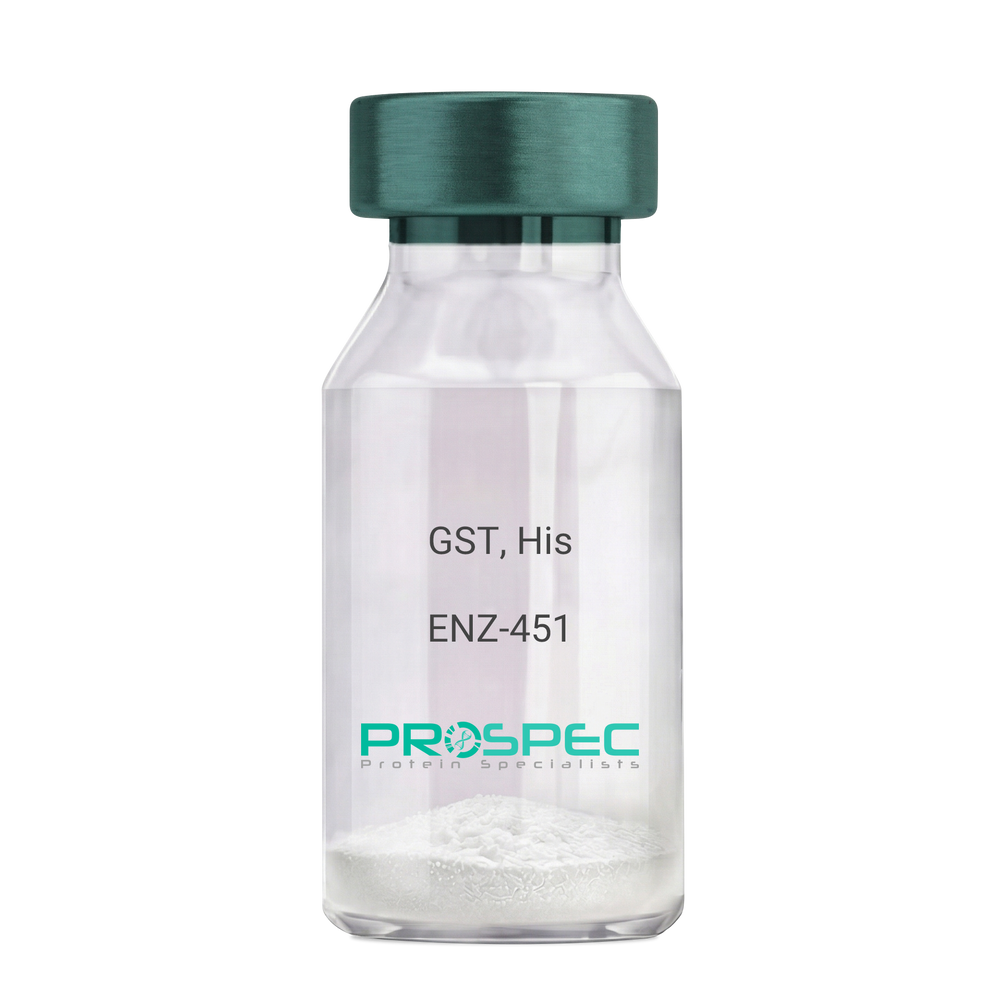
    Name :

    GST, His

    Description:

    Glutathione S-Transferase Recombinant, His Tag

    Glutathione S-Transferase, GST, Glutathione S-transferase class-mu 28 kDa isozyme, GST 28, EC 2.5.1.18, Sj28GST, Sj28 antigen.

    Product # :

    ENZ-451

    Price :

    Quantity :

    Shipping Method :

    Ice Icon

    Shipped with Ice Packs

    Add To Cart

    More Info

    • description
    • source
    • formulation
    • purity
    • biological activity
    • More Info
    • Citations

    Description

    Recombinant Schistosoma japonicum GST full length protein contains a total of 244 amino acids (1-218 a.a.) expressed in E.coli, having a molecular mass of 28.3kDa. The GST protein is fused to a 20 amino acids His-Tag at N-terminus. The GST protein is purified by proprietary chromatographic techniques.

    Source

    Escherichia Coli.

    Formulation

    GST is supplied in PBS pH 7.4 & 10% glycerol.

    Purity

    Greater than 90% as determined by SDS-PAGE.

    Biological Activity

    >10 units/mg, & is defined as the amount of enzyme that conjugate 1.0 u mole of 1-chloro-2,4-dinitrobenzene (CDNB) with reduced glutathione per minute at pH-6.5 at 25C.

    Citations

    More Info

    • Introduction

      Antioxidant enzyme Glutathione S- Transferase (GST) is thought to do the primary cellular defense mechanism against reactive oxygen species. GST reduces lipid hydroperoxides through its Se-independent glutathione peroxidase activity. The enzyme also detoxifies lipid peroxidation end products such as 4-hydroxynonenal (4-HNE).
      The soluble GST is a 26 kDa protein which occurs as a dimer in all aerobic organisms. Each monomer has two domains, one that binds GSH and is an /-structure similar to thioredoxin and the other, all helical, that binds the hydrophobic substrate. The GST -fusion protein expression system is a widely used recombinant protein expression system that allows a peptide or a regulatory protein domain to be expressed as a fusion to the C-terminus of Schistosoma japonicum GST. Fusion proteins also possess GST -enzymatic activity and can undergo dimerization similar to in vivo. The fusion protein can be purified via GST -affinity column chromatography. In most cases, the desired peptides or domains are removed from GST by applying a specific protease that recognizes and cleaves the linker between the protein domain and GST. The technique has been widely used to generate different kinds of proteins for crystallization, molecular immunology studies, the production of vaccines and studies involving protein-protein and protein-DNA interactions.

    • Synonyms

      Glutathione S-Transferase, GST, Glutathione S-transferase class-mu 28 kDa isozyme, GST 28, EC 2.5.1.18, Sj28GST, Sj28 antigen.

    • Physical Appearance

      Sterile Filtered clear solution.

    • Stability

      Store at 4°C if entire vial will be used within 2-4 weeks. Store, frozen at -20°C for longer periods of time. For long term storage it is recommended to add a carrier protein (0.1% HSA or BSA).Avoid multiple freeze-thaw cycles.

    • Amino Acid Sequence

      MGSSHHHHHH SSGLVPRGSH MSPILGYWKI KGLVQPTRLL LEYLEEKYEE HLYERDEGDK WRNKKFELGL EFPNLPYYID GDVKLTQSMAIIRYIADKHN MLGGCPKERA EISMLEGAVL DIRYGVSRIA YSKDFETLKV DFLSKLPEML KMFEDRLCHK TYLNGDHVTH PDFMLYDALDVVLYMDPMCL DAFPKLVCFK KRIEAIPQID KYLKSSKYIA WPLQGWQATF GGGDHPPKSD LVPR.

    ProSpec's products are furnished for LABORATORY RESEARCH USE ONLY. The product may not be used as drugs, agricultural or pesticidal products, food additives or household chemicals.

    Glutathione S Transferase His
  • View Data Sheet

    Name :

    AGA Human, sf9

    Description:

    Aspartylglucosaminidase Human Recombinant, sf9

    Aspartylglucosaminidase, Glycosylasparaginase, N4-(N-Acetyl-Beta-Glucosaminyl)-L-Asparagine Amidase, N(4)-(Beta-N-Acetylglucosaminyl)-L-Asparaginase , EC 3.5.1.26, Aspartylglucosylamine Deaspartylase, EC 3.5.1, ASRG, AGU, GA.

    Product # :

    ENZ-990

    Price :

    Quantity :

    Shipping Method :

    Ice Icon

    Shipped with Ice Packs

    Add To Cart

    More Info

    • description
    • source
    • formulation
    • purity
    • More Info
    • Citations

    Description

    AGA produced in Sf9 Baculovirus cells is a single, glycosylated polypeptide chain containing 332 amino acids (24-346 a.a.) and having a molecular mass of 35.7kDa (Molecular size on SDS-PAGE will appear at approximately 18-57kDa). AGA is expressed with a 6 amino acid His tag at C-Terminus and purified by proprietary chromatographic techniques.

    Source

    Sf9, Baculovirus cells.

    Formulation

    AGA protein solution (0.25mg/ml) contains Phosphate Buffered Saline (pH 7.4) and 10% glycerol.

    Purity

    Greater than 90.0% as determined by SDS-PAGE.

    Citations

    More Info

    • Introduction

      Aspartylglucosaminidase, also known as AGA, takes part in the catabolism of Nlinked oligosaccharides of glycoproteins. AGA is a protein coding gene which cleaves asparagine from N-acetylglucosamines in the lysosomal breakdown of glycoproteins.

    • Synonyms

      Aspartylglucosaminidase, Glycosylasparaginase, N4-(N-Acetyl-Beta-Glucosaminyl)-L-Asparagine Amidase, N(4)-(Beta-N-Acetylglucosaminyl)-L-Asparaginase , EC 3.5.1.26, Aspartylglucosylamine Deaspartylase, EC 3.5.1, ASRG, AGU, GA.

    • Physical Appearance

      Sterile Filtered colorless solution.

    • Stability

      Store at 4°C if entire vial will be used within 2-4 weeks. Store, frozen at -20°C for longer periods of time. For long term storage it is recommended to add a carrier protein (0.1% HSA or BSA). Avoid multiple freeze-thaw cycles.

    • Amino Acid Sequence

      ADPSSPLPLV VNTWPFKNAT EAAWRALASG GSALDAVESG CAMCEREQCD GSVGFGGSPD ELGETTLDAM IMDGTTMDVG AVGDLRRIKN AIGVARKVLE HTTHTLLVGE SATTFAQSMG FINEDLSTTA SQALHSDWLA RNCQPNYWRN VIPDPSKYCG PYKPPGILKQ DIPIHKETED DRGHDTIGMV VIHKTGHIAA GTSTNGIKFK IHGRVGDSPI PGAGAYADDT AGAAAATGNG DILMRFLPSY QAVEYMRRGE DPTIACQKVI SRIQKHFPEF FGAVICANVT GSYGAACNKL STFTQFSFMV YNSEKNQPTE EKVDCIHHHH HH.

    ProSpec's products are furnished for LABORATORY RESEARCH USE ONLY. The product may not be used as drugs, agricultural or pesticidal products, food additives or household chemicals.

    Aga Human Sf9
  • View Data Sheet

    Name :

    DUSP6 Human

    Description:

    Dual Specificity Phosphatase 6 Human Recombinant

    Dual specificity protein phosphatase 6, Dual specificity protein phosphatase PYST1, Mitogen-activated protein kinase phosphatase 3, MAP kinase phosphatase 3, MKP-3, DUSP6, MKP3, PYST1, Dual Specificity Phosphatase 6, Dual specificity phosphatase 6 isoform a.

    Product # :

    ENZ-817

    Price :

    Quantity :

    Shipping Method :

    Ice Icon

    Shipped with Ice Packs

    Add To Cart

    More Info

    • description
    • source
    • formulation
    • purity
    • More Info
    • Citations

    Description

    DUSP6 Human Recombinant produced in E.Coli is a single, non-glycosylated polypeptide chain containing 401 amino acids (1-381 a.a) and having a molecular mass of 44.4kDa.DUSP6 is fused to a 20 amino acid His-tag at N-terminus & purified by proprietary chromatographic techniques.

    Source

    Escherichia Coli.

    Formulation

    DUSP6 protein solution (0.25mg/ml) containing 20mM Tris-HCl buffer (pH 8.0), 0.15M NaCl, 10% glycerol and 1mM DTT.

    Purity

    Greater than 85.0% as determined by SDS-PAGE.

    Citations

    More Info

    • Introduction

      Dual Specificity Phosphatase 6, also known as DUSP6 belongs to the dual specificity protein phosphatase subfamily. DUSP6 is a Protein coding gene which inactivates MAP kinases. Various members of the family of dual specificity phosphatases show diverse tissue distribution, subcellular localization, and different modes of inducibility of their expression by extracellular stimuli.

    • Synonyms

      Dual specificity protein phosphatase 6, Dual specificity protein phosphatase PYST1, Mitogen-activated protein kinase phosphatase 3, MAP kinase phosphatase 3, MKP-3, DUSP6, MKP3, PYST1, Dual Specificity Phosphatase 6, Dual specificity phosphatase 6 isoform a.

    • Physical Appearance

      Sterile Filtered colorless solution.

    • Stability

      Store at 4°C if entire vial will be used within 2-4 weeks. Store, frozen at -20°C for longer periods of time. For long term storage it is recommended to add a carrier protein (0.1% HSA or BSA).Avoid multiple freeze-thaw cycles.

    • Amino Acid Sequence

      MGSSHHHHHH SSGLVPRGSH MIDTLRPVPF ASEMAISKTV AWLNEQLELG NERLLLMDCR PQELYESSHI ESAINVAIPG IMLRRLQKGN LPVRALFTRG EDRDRFTRRC GTDTVVLYDE SSSDWNENTG GESVLGLLLK KLKDEGCRAF YLEGGFSKFQ AEFSLHCETN LDGSCSSSSP PLPVLGLGGL RISSDSSSDI ESDLDRDPNS ATDSDGSPLS NSQPSFPVEI LPFLYLGCAK DSTNLDVLEE FGIKYILNVT PNLPNLFENA GEFKYKQIPI SDHWSQNLSQ FFPEAISFID EARGKNCGVL VHCLAGISRS VTVTVAYLMQ KLNLSMNDAY DIVKMKKSNI SPNFNFMGQL LDFERTLGLS SPCDNRVPAQ QLYFTTPSNQ NVYQVDSLQS T.

    ProSpec's products are furnished for LABORATORY RESEARCH USE ONLY. The product may not be used as drugs, agricultural or pesticidal products, food additives or household chemicals.

    Dusp6 Human
  • View Data Sheet

    Name :

    KLK5 Human

    Description:

    Kallikrein-5 Human Recombinant

    Kallikrein-5, Kallikrein-like protein 2, KLK-L2, Stratum corneum tryptic enzyme, KLK5, SCTE, UNQ570/PRO1132, KLKL2.

    Product # :

    ENZ-630

    Price :

    Quantity :

    Shipping Method :

    Ice Icon

    Shipped with Ice Packs

    Add To Cart

    More Info

    • description
    • source
    • formulation
    • purity
    • More Info
    • Citations

    Description

    KLK5 Human Recombinant produced in E.coli is a single, non-glycosylated polypeptide chain containing 252 amino acids (67-293) and having a molecular mass of 27.8kDa.KLK5 is fused to a 25 amino acid His-tag at N-terminus & purified by proprietary chromatographic techniques.

    Source

    Escherichia Coli.

    Formulation

    The KLK5 solution (0.25mg/ml) contains 20mM Tris-HCl buffer (pH 8.0), 2M Urea and 20% glycerol.

    Purity

    Greater than 90.0% as determined by SDS-PAGE.

    Citations

    More Info

    • Introduction

      Kallikrein-5 (KLK5) is a member of the serine protease family of proteolytic enzymes. KLK5 is expressed in various tissues including the salivary gland, stomach, uterus, lung, thymus, prostate, colon, brain, thyroid, and trachea. KLK5 expression is up-regulated by estrogens and progestins. KLK5 is secreted and may be involved in desquamation in the epidermis. Kallikreins which are a subgroup of serine proteases, have distinct physiological functions. Many kallikreins are associated with carcinogenesis and some have potential as novel cancer and other disease biomarkers. The KLK5 gene is one of the 15 kallikrein subfamily members located in a cluster on chromosome 19.

    • Synonyms

      Kallikrein-5, Kallikrein-like protein 2, KLK-L2, Stratum corneum tryptic enzyme, KLK5, SCTE, UNQ570/PRO1132, KLKL2.

    • Physical Appearance

      Sterile Filtered clear solution.

    • Stability

      Store at 4°C if entire vial will be used within 2-4 weeks. Store, frozen at -20°C for longer periods of time. For long term storage it is recommended to add a carrier protein (0.1% HSA or BSA).Avoid multiple freeze-thaw cycles.

    • Amino Acid Sequence

      MGSSHHHHHH SSGLVPRGSH MGSHMIINGS DCDMHTQPWQ AALLLRPNQL YCGAVLVHPQ WLLTAAHCRK KVFRVRLGHY SLSPVYESGQ QMFQGVKSIP HPGYSHPGHS NDLMLIKLNR RIRPTKDVRP INVSSHCPSA GTKCLVSGWG TTKSPQVHFP KVLQCLNISV LSQKRCEDAY PRQIDDTMFC AGDKAGRDSC QGDSGGPVVC NGSLQGLVSW GDYPCARPNR PGVYTNLCKF TKWIQETIQA NS.

    ProSpec's products are furnished for LABORATORY RESEARCH USE ONLY. The product may not be used as drugs, agricultural or pesticidal products, food additives or household chemicals.

    Klk5 Human
  • View Data Sheet

    Name :

    TPA (36-310) Human

    Description:

    Tissue Plasminogen Activator (36-310 a.a.) Human Recombinant

    Tissue-type plasminogen activator, EC 3.4.21.68, tPA, t-PA, t-plasminogen activator, TPA, T-PA, DKFZp686I03148, PLAT and tPA, Alteplase, Reteplase, Plasminogen Activator, Tissue, Plasminogen/Activator Kringle. 

    Product # :

    ENZ-1050

    Price :

    Quantity :

    Shipping Method :

    Ice Icon

    Shipped with Ice Packs

    Add To Cart

    More Info

    • description
    • source
    • formulation
    • purity
    • More Info
    • Citations

    Description

    TPA Human Recombinant produced in Sf9 Baculovirus cells is a single, glycosylated polypeptide chain containing 284 amino acids (36-310a.a.) and having a molecular mass of 32.0kDa (Molecular size on SDS-PAGE will appear at approximately 28-40kDa).TPA is expressed with a 6 amino acids His tag at C-Terminus and purified by proprietary chromatographic techniques.

    Source

    Sf9, Baculovirus cells.

    Formulation

    TPA protein solution (0.25mg/ml) contains 50mM MES(pH5.5),10% glycerol, 100mM NaCl and 5mM CaCl2.

    Purity

    Greater than 90.0% as determined by SDS-PAGE.

    Citations

    More Info

    • Introduction

      Tissue plasminogen activator (abbreviated PLAT or tPA) is a secreted serine proteasewhich converts the proenzymeplasminogento plasmin, a fibrinolyticenzyme. Plasminogen is synthesized as a single chain which is cleaved by PLAT into the two chain disulfide linked plasmin.
      This enzyme plays a role in cell migrationand tissue remodeling. Increased enzymatic activity causes hyperfibrinolysis, which manifests as excessive bleeding; decreased activity leads to hypofibrinolysiswhich can result in thrombosisor embolism.

    • Synonyms

      Tissue-type plasminogen activator, EC 3.4.21.68, tPA, t-PA, t-plasminogen activator, TPA, T-PA, DKFZp686I03148, PLAT and tPA, Alteplase, Reteplase, Plasminogen Activator, Tissue, Plasminogen/Activator Kringle.

    • Physical Appearance

      Sterile Filtered colorless solution.

    • Stability

      Store at 4°C if entire vial will be used within 2-4 weeks. Store, frozen at -20°C for longer periods of time. For long term storage it is recommended to add a carrier protein (0.1% HSA or BSA). Avoid multiple freeze-thaw cycles.

    • Amino Acid Sequence

      ADPSYQVICR DEKTQMIYQQ HQSWLRPVLR SNRVEYCWCN SGRAQCHSVP VKSCSEPRCF NGGTCQQALY FSDFVCQCPE GFAGKCCEID TRATCYEDQG ISYRGTWSTA ESGAECTNWN SSALAQKPYS GRRPDAIRLG LGNHNYCRNP DRDSKPWCYV FKAGKYSSEF CSTPACSEGN SDCYFGNGSA YRGTHSLTES GASCLPWNSM ILIGKVYTAQ NPSAQALGLG KHNYCRNPDG DAKPWCHVLK NRRLTWEYCD VPSCSTCGLR QYSQPQFRHH HHHH.

    ProSpec's products are furnished for LABORATORY RESEARCH USE ONLY. The product may not be used as drugs, agricultural or pesticidal products, food additives or household chemicals.

    Tpa Protein
  • View Data Sheet

    Name :

    PYGL Human

    Description:

    Phosphorylase, Glycogen, Liver Human Recombinant

    GSD6, Glycogen phosphorylase, liver form.

    Product # :

    ENZ-675

    Price :

    Quantity :

    Shipping Method :

    Ice Icon

    Shipped with Ice Packs

    Add To Cart

    More Info

    • description
    • source
    • formulation
    • purity
    • More Info
    • Citations

    Description

    PYGL Human Recombinant produced in E.Coli is a single, non-glycosylated polypeptide chain containing 879 amino acids (1-847 a.a) and having a molecular mass of 100.7kDa.PYGL is fused to a 32 amino acid His-tag at N-terminus & purified by proprietary chromatographic techniques.

    Source

    Escherichia Coli.

    Formulation

    PYGL protein solution (0.25mg/ml) in phosphate buffered saline (pH7.4), 30% glycerol and 1mM DTT.

    Purity

    Greater than 80.0% as determined by SDS-PAGE.

    Citations

    More Info

    • Introduction

      Glycogen phosphorylase (PYGL) converts from inactive phosphorylase B to active phosphorylase A by phosphorylation of serine residue 15. Activity of the PYGL enzyme is further regulated by numerous allosteric effectors and hormonal controls. The liver isozyme supplies the glycemic demands of the body in general whereas the brain and muscle isozymes supply just those tissues.

    • Synonyms

      GSD6, Glycogen phosphorylase, liver form.

    • Physical Appearance

      Sterile Filtered colorless solution.

    • Stability

      Store at 4°C if entire vial will be used within 2-4 weeks. Store, frozen at -20°C for longer periods of time. For long term storage it is recommended to add a carrier protein (0.1% HSA or BSA).Avoid multiple freeze-thaw cycles.

    • Amino Acid Sequence

      MGSSHHHHHH SSGLVPRGSH MGSEFELRRQ ASMAKPLTDQ EKRRQISIRG IVGVENVAEL KKSFNRHLHF TLVKDRNVAT TRDYYFALAH TVRDHLVGRW IRTQQHYYDK CPKRVYYLSL EFYMGRTLQN TMINLGLQNA CDEAIYQLGL DIEELEEIEE DAGLGNGGLG RLAACFLDSM ATLGLAAYGY GIRYEYGIFN QKIRDGWQVE EADDWLRYGN PWEKSRPEFM LPVHFYGKVE HTNTGTKWID TQVVLALPYD TPVPGYMNNT VNTMRLWSAR APNDFNLRDF NVGDYIQAVL DRNLAENISR VLYPNDNFFE GKELRLKQEY FVVAATLQDI IRRFKASKFG STRGAGTVFD AFPDQVAIQL NDTHPALAIP ELMRIFVDIE KLPWSKAWEL TQKTFAYTNH TVLPEALERW PVDLVEKLLP RHLEIIYEIN QKHLDRIVAL FPKDVDRLRR MSLIEEEGSK RINMAHLCIV GSHAVNGVAK IHSDIVKTKV FKDFSELEPD KFQNKTNGIT PRRWLLLCNP GLAELIAEKI GEDYVKDLSQ LTKLHSFLGD DVFLRELAKV KQENKLKFSQ FLETEYKVKI NPSSMFDVQV KRIHEYKRQL LNCLHVITMY NRIKKDPKKL FVPRTVIIGG KAAPGYHMAK MIIKLITSVA DVVNNDPMVG SKLKVIFLEN YRVSLAEKVI PATDLSEQIS TAGTEASGTG NMKFMLNGAL TIGTMDGANV EMAEEAGEEN LFIFGMRIDD VAALDKKGYE AKEYYEALPE LKLVIDQIDN GFFSPKQPDL FKDIINMLFY HDRFKVFADY EAYVKCQDKV SQLYMNPKAW NTMVLKNIAA SGKFSSDRTI KEYAQNIWNV EPSDLKISLS NESNKVNGN.

    ProSpec's products are furnished for LABORATORY RESEARCH USE ONLY. The product may not be used as drugs, agricultural or pesticidal products, food additives or household chemicals.

    Pygl Human
  • View Data Sheet

    Name :

    GZMH Human

    Description:

    Granzyme-H Human Recombinant

    Granzyme H (Cathepsin G-Like 2, Protein H-CCPX), CTSGL2, Cytotoxic T-Lymphocyte Proteinase, CCP-X, CSP-C, Cytotoxic T-Lymphocyte-Associated Serine Esterase 1, Cytotoxin Serine Protease-C, Cytotoxic Serine Protease C, Cathepsin G-Like 2, EC 3.4.21.79, EC 3.4.21, Granzyme H, EC 3.4.21, CGL-2, CTLA1, CGL2, GZMH.

    Product # :

    ENZ-896

    Price :

    Quantity :

    Shipping Method :

    Ice Icon

    Shipped with Ice Packs

    Add To Cart

    More Info

    • description
    • source
    • formulation
    • purity
    • More Info
    • Citations

    Description

    GZMH Human Recombinant produced in E.Coli is a single, non-glycosylated polypeptide chain containing 248 amino acids (20-246 a.a) and having a molecular mass of 27.5kDa.GZMH is fused to a 21 amino acid His-tag at N-terminus & purified by proprietary chromatographic techniques.

    Source

    Escherichia Coli.

    Formulation

    GZMH protein solution (0.25mg/ml) containing 20mM Tris-HCl (pH 8.0) and 10% glycerol.

    Purity

    Greater than 85.0% as determined by SDS-PAGE.

    Citations

    More Info

    • Introduction

      Granzyme H also known as GZMH belongs to the peptidase S1 family. GZMH is an essential part for HBV eradication. The HBx protein, which is required for the replication of HBV, is cleaved at Met(79) by GZMH. Furthermore, GZMH inhibitor can abolish GZNH- as well as lymphokine-activated killer cell-mediated HBx degradation and HBV clearance. A HBx-deficient HBV is resistant to GzmH- in addition to lymphokine-activated killer cell-mediated viral clearance.

    • Synonyms

      Granzyme H (Cathepsin G-Like 2, Protein H-CCPX), CTSGL2, Cytotoxic T-Lymphocyte Proteinase, CCP-X, CSP-C, Cytotoxic T-Lymphocyte-Associated Serine Esterase 1, Cytotoxin Serine Protease-C, Cytotoxic Serine Protease C, Cathepsin G-Like 2, EC 3.4.21.79, EC 3.4.21, Granzyme H, EC 3.4.21, CGL-2, CTLA1, CGL2, GZMH.

    • Physical Appearance

      Sterile Filtered clear solution.

    • Stability

      Store at 4°C if entire vial will be used within 2-4 weeks. Store, frozen at -20°C for longer periods of time. For long term storage it is recommended to add a carrier protein (0.1% HSA or BSA).Avoid multiple freeze-thaw cycles.

    • Amino Acid Sequence

      MGSSHHHHHH SSGLVPRGSH MEIIGGHEAK PHSRPYMAFV QFLQEKSRKR CGGILVRKDF VLTAAHCQGS SINVTLGAHN IKEQERTQQF IPVKRPIPHP AYNPKNFSND IMLLQLERKA KWTTAVRPLR LPSSKAQVKP GQLCSVAGWG YVSMSTLATT LQEVLLTVQK DCQCERLFHG NYSRATEICV GDPKKTQTGF KGDSGGPLVC KDVAQGILSY GNKKGTPPGV YIKVSHFLPW IKRTMKRL

    ProSpec's products are furnished for LABORATORY RESEARCH USE ONLY. The product may not be used as drugs, agricultural or pesticidal products, food additives or household chemicals.

    Gzmh Human
  • View Data Sheet

    Name :

    SUMF1 Human, Sf9

    Description:

    Sulfatase Modifying Factor 1 Human Recombinant, Sf9

    SUMF1, AAPA3037, FGE, UNQ3037, Formylglycine-generating enzyme, C-alpha-formylglycine-generating enzyme 1, Sulfatase-modifying factor 1.

    Product # :

    PRO-2619

    Price :

    Quantity :

    Shipping Method :

    Ice Icon

    Shipped with Ice Packs

    Add To Cart

    More Info

    • description
    • source
    • formulation
    • purity
    • More Info
    • Citations

    Description

    SUMF1 produced in Sf9 Insect cells is a single, glycosylated polypeptide chain containing 347 amino acids (34-374.a.) and having a molecular mass of 38.1kDa (Molecular size on SDS-PAGE will appear at approximately 40-57kDa). SUMF1 is expressed with a 6 amino acid His tag at C-Terminus and purified by proprietary chromatographic techniques.

    Source

    Sf9, Insect cells.

    Formulation

    SUMF1 protein solution (0.25mg/ml) contains Phosphate Buffered Saline (pH 7.4) and 10% glycerol.

    Purity

    Greater than 85.0% as determined by SDS-PAGE.

    Citations

    More Info

    • Introduction

      SUMF1 is a part of the SUMF protein family. SUMF1 catalyzes the hydrolysis of sulfate esters by oxidizing a cysteine residue in the substrate sulfatase to an active site 3-oxoalanine residue called C-alpha-formylglycine. Mutations in this gene will cause multiple sulfatase deficiency meaning a lysosomal storage disorder.

    • Synonyms

      SUMF1, AAPA3037, FGE, UNQ3037, Formylglycine-generating enzyme, C-alpha-formylglycine-generating enzyme 1, Sulfatase-modifying factor 1.

    • Physical Appearance

      Sterile Filtered colorless solution.

    • Stability

      Store at 4°C if entire vial will be used within 2-4 weeks. Store, frozen at -20°C for longer periods of time. For long term storage it is recommended to add a carrier protein (0.1% HSA or BSA). Avoid multiple freeze-thaw cycles.

    • Amino Acid Sequence

      SQEAGTGAGA GSLAGSCGCG TPQRPGAHGS SAAAHRYSRE ANAPGPVPGE RQLAHSKMVP IPAGVFTMGT DDPQIKQDGE APARRVTIDA FYMDAYEVSN TEFEKFVNST GYLTEAEKFG DSFVFEGMLS EQVKTNIQQA VAAAPWWLPV KGANWRHPEG PDSTILHRPD HPVLHVSWND AVAYCTWAGK RLPTEAEWEY SCRGGLHNRL FPWGNKLQPK GQHYANIWQG EFPVTNTGED GFQGTAPVDA FPPNGYGLYN IVGNAWEWTS DWWTVHHSVE ETLNPKGPPS GKDRVKKGGS YMCHRSYCYR YRCAARSQNT PDSSASNLGF RCAADRLPTM DHHHHHH.

    ProSpec's products are furnished for LABORATORY RESEARCH USE ONLY. The product may not be used as drugs, agricultural or pesticidal products, food additives or household chemicals.

    Sumf1 Protein
  • View Data Sheet

    Name :

    PDI Human

    Description:

    Protein Disulfide Isomerase Human Recombinant

    Protein Disulfide Isomerase, PDI, EC 5.3.4.1, Prolyl 4-hydroxylase subunit beta, Cellular thyroid hormone-binding protein, p55, P4HB, ERBA2L, PDIA1, PO4DB, DSI, GIT, PHDB, PO4HB, PROHB, P4Hbeta.

    Product # :

    ENZ-262

    Price :

    Quantity :

    Shipping Method :

    Room Temp Icon

    Shipped at Room temp

    Add To Cart

    More Info

    • description
    • source
    • formulation
    • purity
    • More Info
    • Citations

    Description

    PDI Human Recombinant produced in E.Coli is a single, non-glycosylated, polypeptide chain containing a total of 502 amino acids and having a molecular mass of 56.6kDa. The PDI is fused to a 12 amino acid His tag at N-terminal and purified by proprietary chromatographic techniques.

    Source

    Escherichia Coli.

    Formulation

    The PDI protein (1mg/ml)solution was lyophilized from PBS pH-7.

    Purity

    Greater than 95.0% as determined by:
    a) Analysis by RP-HPLC.
    b) Analysis by SDS-PAGE.

    Citations

    More Info

    • Introduction

      Protein disulfide isomerases (PDIs) constitute a family of structurally related enzymes which catalyze disulfide bonds formation, reduction, or isomerization of newly synthesized proteins in the lumen of the endoplasmic reticulum (ER). They act also as chaperones, and are, therefore, part of a quality-control system for the correct folding of the proteins in the same subcellular compartment. PDI has been found to have moderate effects (25-fold) on the rate of oxidative folding of proteins in vitro.
      Recombinant Human Protein Disulfide Isomerase is involved in disulphide-bond formation and isomerization, as well as the reduction of disulphide bonds in proteins. Recombinant PDI has been found to have moderate effects (25-fold) on the rate of oxidative folding of proteins in vitro.

    • Synonyms

      Protein Disulfide Isomerase, PDI, EC 5.3.4.1, Prolyl 4-hydroxylase subunit beta, Cellular thyroid hormone-binding protein, p55, P4HB, ERBA2L, PDIA1, PO4DB, DSI, GIT, PHDB, PO4HB, PROHB, P4Hbeta.

    • Physical Appearance

      Sterile Filtered White lyophilized (freeze-dried) powder.

    • Stability

      Lyophilized Protein Disulfide Isomerase although stable at room temperature for 3 weeks, should be stored desiccated below -18°C. Upon reconstitution Human PDI should be stored at 4°C between 2-7 days and for future use below -18°C. For long term storage it is recommended to add a carrier protein (0.1% HSA or BSA).Please avoid freeze-thaw cycles.

    • Solubility

      It is recommended to reconstitute the lyophilized PDI in sterile 18MΩ-cm H2O not less than 100µg/ml, which can then be further diluted to other aqueous solutions.

    • Amino Acid Sequence

      MRGSGSHHHHHHAPEEEDHVLVLRKSNFAEALAAHKYLLVEFYAPWCGHCKALAPEYAKA

      AGKLKAEGSEIRLAKVDATEESDLAQQYGVRGYPTIKFFRNGDTASPKEYTAGREADDIVN

      WLKKRTGPAATTLPDGAAAESLVESSEVAVIGFFKDVESDSAKQFLQAAEAIDDIPFGITSNS

      DVFSKYQLDKDGVVLFKKFDEGRNNFEGEVTKENLLDFIKHNQLPLVIEFTEQTAPKIFGGEIK

      THILLFLPKSVSDYDGKLSNFKTAAESFKGKILFIFIDSDHTDNQRILEFFGLKKEECPAVRLITL

      EEEMTKYKPESEELTAERITEFCHRFLEGKIKPHLMSQELPEDWDKQPVKVLVGKNFEDVAFDEK

      KNVFVEFYAPWCGHCKQLAPIWDKLGETYKDHENIVIAKMDSTANEVEAVKVHSFPTLKFFP

      ASADRTVIDYNGERTLDGFKKFLESGGQDGAGDDDDLEDLEEAEEPDMEEDDDQKAVKDEL

    • Reductase Activity

      0.001 650nm/ min-2. By measuring the turbidity increase at 650 nm due to insulin reduction (Holmgren, A. (1979) J. Biol. Chem. 254, 9627–9632). The activity is expressed as the ratio of the slope of a linear part of the turbidity curve to the lag time (Mart

    • Isomerase Activity

      0.5 µmol active RNase A min-1 µmol PDI-1. According to the re-activation of reduced and denatured RNase A (Lyles, M. M. and Gilbert, H. F. (1991) Biochemistry 30, 613-619).

    ProSpec's products are furnished for LABORATORY RESEARCH USE ONLY. The product may not be used as drugs, agricultural or pesticidal products, food additives or household chemicals.

    Protein Disulfide Isomerase Human
  • 1
  • …
  • 31
  • 32
  • 33
  • 34
  • 35
  • …
  • 42
Your browser does not support the video tag.

Products

  • Cytokines
  • Growth Factors
  • Chemokines
  • CD Antigens
  • Neurotrophins
  • Hormones
  • Enzymes
  • Viral Antigens
  • Recombinant Proteins
  • Natural Proteins
  • Monoclonal Antibodies
  • Polyclonal Antibodies
  • Thermal Packaging

About

  • Company
  • Founder
  • Contribution
  • Contact Us
  • My Account

Ordering

  • Ordering Method
  • Ordering - Credit Card
  • Ordering PO
  • Shipping Fees
  • FAQ's

Legal

  • Terms & Conditions
  • Privacy
  • Site Map
  • info@prospecbio.com
  • Facebook
  • Instagram
  • Linkedin Profile

© 2026 ProSpec-Tany TechnoGene Ltd. All Rights Reserved.

  • Choosing a selection results in a full page refresh.
  • Opens in a new window.