Skip to content

High-quality research proteins.

  • 1-800-805-6531

  • Mon - Sat 8.00-18.00, Sun - Closed

  • info@prospecbio.com

  • PO Box 6591 East Brunswick NJ 08816

  • Products
    • Cytokines
    • Growth factors
    • Chemokines
    • Cd antigens
    • Neurotrophins
    • Hormones
    • Enzymes
    • Viral antigens
    • Recombinant proteins
    • Natural proteins
    • Monoclonal antibodies
    • Polyclonal antibodies
    • Thermal Packaging
  • About
    • Company
    • Founder
    • Contribution
  • Customers
    • Eastern Asia
    • Eastern Europe
    • North America
    • South America
    • South East Asia
    • Southern Asia
    • Western Europe
  • Ordering
    • Ordering Method
    • Ordering - Credit Card
    • Ordering - PO
    • Shipping Fees
    • FAQs
  • Services
    • DNA Cloning
    • Protein Expression
    • Monoclonal Antibody
    • Fermentation
    • Technology License
  • Contact us
Log in

Country/region

  • USD $ | Albania
  • USD $ | Andorra
  • USD $ | Argentina
  • USD $ | Armenia
  • USD $ | Australia
  • USD $ | Austria
  • USD $ | Azerbaijan
  • USD $ | Belarus
  • USD $ | Belgium
  • USD $ | Bolivia
  • USD $ | Brazil
  • USD $ | Bulgaria
  • USD $ | Cambodia
  • USD $ | Canada
  • USD $ | Chile
  • USD $ | China
  • USD $ | Colombia
  • USD $ | Costa Rica
  • USD $ | Croatia
  • USD $ | Cyprus
  • USD $ | Czechia
  • USD $ | Denmark
  • USD $ | Estonia
  • USD $ | Finland
  • USD $ | France
  • USD $ | Georgia
  • USD $ | Germany
  • USD $ | Greece
  • USD $ | Hong Kong SAR
  • USD $ | Hungary
  • USD $ | Iceland
  • USD $ | India
  • USD $ | Ireland
  • USD $ | Israel
  • USD $ | Italy
  • USD $ | Japan
  • USD $ | Kazakhstan
  • USD $ | Latvia
  • USD $ | Liechtenstein
  • USD $ | Lithuania
  • USD $ | Madagascar
  • USD $ | Malta
  • USD $ | Mexico
  • USD $ | Moldova
  • USD $ | Monaco
  • USD $ | Netherlands
  • USD $ | New Zealand
  • USD $ | North Macedonia
  • USD $ | Norway
  • USD $ | Panama
  • USD $ | Paraguay
  • USD $ | Peru
  • USD $ | Philippines
  • USD $ | Poland
  • USD $ | Portugal
  • USD $ | Romania
  • USD $ | Singapore
  • USD $ | Slovakia
  • USD $ | Slovenia
  • USD $ | South Africa
  • USD $ | South Korea
  • USD $ | Spain
  • USD $ | Sri Lanka
  • USD $ | Sweden
  • USD $ | Switzerland
  • USD $ | Taiwan
  • USD $ | Thailand
  • USD $ | Türkiye
  • USD $ | Ukraine
  • USD $ | United Kingdom
  • USD $ | United States
  • USD $ | Uruguay
  • USD $ | Vatican City
  • USD $ | Venezuela
  • USD $ | Vietnam
  • Facebook
  • Instagram
logoProSpec - Recombinant Protein Manufacturer for academic and R&D industry
Become a distributor
Account Log in
Wishlist
Cart Cart(0)
  • Products
    +
    • Cytokines
    • Growth factors
    • Chemokines
    • Cd antigens
    • Neurotrophins
    • Hormones
    • Enzymes
    • Viral antigens
    • Recombinant proteins
    • Natural proteins
    • Monoclonal antibodies
    • Polyclonal antibodies
    • Thermal Packaging
  • About
    +
    • Company
    • Founder
    • Contribution
  • Customers
    +
    • Eastern Asia
    • Eastern Europe
    • North America
    • South America
    • South East Asia
    • Southern Asia
    • Western Europe
  • Ordering
    +
    • Ordering Method
    • Ordering - Credit Card
    • Ordering - PO
    • Shipping Fees
    • FAQs
  • Services
    +
    • DNA Cloning
    • Protein Expression
    • Monoclonal Antibody
    • Fermentation
    • Technology License
  • Contact us

Item added to your cart

View cart
View All
  • Cytokines
  • Growth factors
  • Chemokines
  • Cd antigens
  • Neurotrophins
  • Hormones
  • Enzymes
  • Viral antigens
  • Recombinant proteins
  • Natural proteins
  • Monoclonal antibodies
  • Polyclonal antibodies
  • Thermal Packaging
  • Tumor Necrosis Factor

    Tumor Necrosis Factor

    View All
  • 4-1BB

    4-1BB

    View All
  • Adiponectin

    Adiponectin

    View All
  • AIF1

    AIF1

    View All
  • Other Cytokines

    Other Cytokines

    View All
  • AITRL

    AITRL

    View All
  • Angiopoietin

    Angiopoietin

    View All
  • Apolipoprotein

    Apolipoprotein

    View All
  • B-Cell Activating Factor

    B-Cell Activating Factor

    View All
  • Beta Defensin

    Beta Defensin

    View All
  • Bone Morphogenetic Protein

    Bone Morphogenetic Protein

    View All
  • B type Natriuretic Peptide

    B type Natriuretic Peptide

    View All
  • BST

    BST

    View All
  • Betacellulin

    Betacellulin

    View All
  • Cardiotrophin

    Cardiotrophin

    View All
  • Activin

    Activin

    View All
  • Fibroblast Growth Factor

    Fibroblast Growth Factor

    View All
  • Other Growth Factors

    Other Growth Factors

    View All
  • CSF

    CSF

    View All
  • CTGF

    CTGF

    View All
  • IGFBP

    IGFBP

    View All
  • VEGF Protein

    VEGF Protein

    View All
  • EGF

    EGF

    View All
  • Epigen

    Epigen

    View All
  • Erythropoietin

    Erythropoietin

    View All
  • Insulin-Like Growth Factor

    Insulin-Like Growth Factor

    View All
  • Growth Hormone

    Growth Hormone

    View All
  • HDGF

    HDGF

    View All
  • Hepatocyte Growth Factor

    Hepatocyte Growth Factor

    View All
  • Insulin

    Insulin

    View All
  • BCA-1/ BLC (CXCL13)

    BCA-1/ BLC (CXCL13)

    View All
  • BRAK (CXCL14)

    BRAK (CXCL14)

    View All
  • C-10 (CCL6)

    C-10 (CCL6)

    View All
  • Other Chemokines

    Other Chemokines

    View All
  • MEC (CCL28)

    MEC (CCL28)

    View All
  • LD78-beta (CCL3L1)

    LD78-beta (CCL3L1)

    View All
  • CTACK (CCL27)

    CTACK (CCL27)

    View All
  • CXCL16

    CXCL16

    View All
  • CXCL17

    CXCL17

    View All
  • Platelet Factor-4 (CXCL4)

    Platelet Factor-4 (CXCL4)

    View All
  • ENA-78 (CXCL5)

    ENA-78 (CXCL5)

    View All
  • Eotaxin (CCL11,24,26)

    Eotaxin (CCL11,24,26)

    View All
  • Exodus-2 (CCL21)

    Exodus-2 (CCL21)

    View All
  • Fractalkine (CX3CL1)

    Fractalkine (CX3CL1)

    View All
  • CXCL6

    CXCL6

    View All
  • Other CD Antigens

    Other CD Antigens

    View All
  • CD14

    CD14

    View All
  • CD164

    CD164

    View All
  • CD1

    CD1

    View All
  • CD2

    CD2

    View All
  • CD200

    CD200

    View All
  • CD207

    CD207

    View All
  • CD226

    CD226

    View All
  • CD23

    CD23

    View All
  • CD244

    CD244

    View All
  • CD247

    CD247

    View All
  • CD27

    CD27

    View All
  • CD274

    CD274

    View All
  • CD300

    CD300

    View All
  • CD33

    CD33

    View All
  • Other Neurotrophins

    Other Neurotrophins

    View All
  • Beta-NGF

    Beta-NGF

    View All
  • BDNF

    BDNF

    View All
  • CDNF

    CDNF

    View All
  • CNTF

    CNTF

    View All
  • GDNF

    GDNF

    View All
  • Glia Maturation Factor

    Glia Maturation Factor

    View All
  • MANF

    MANF

    View All
  • Midkine

    Midkine

    View All
  • Neuroglobin

    Neuroglobin

    View All
  • Neurotrophic factors

    Neurotrophic factors

    View All
  • Neuregulin

    Neuregulin

    View All
  • Neuropilin

    Neuropilin

    View All
  • Pigment Epithelium-Derived Factor

    Pigment Epithelium-Derived Factor

    View All
  • Pleiotrophin

    Pleiotrophin

    View All
  • Peptide Hormones

    Peptide Hormones

    View All
  • Other Hormones

    Other Hormones

    View All
  • HCG

    HCG

    View All
  • Endothelin

    Endothelin

    View All
  • Exendin

    Exendin

    View All
  • FSH

    FSH

    View All
  • Glucagon

    Glucagon

    View All
  • GHRP

    GHRP

    View All
  • GLP

    GLP

    View All
  • Thyrostimulin

    Thyrostimulin

    View All
  • Inhibin A

    Inhibin A

    View All
  • LHRH

    LHRH

    View All
  • Melanotan

    Melanotan

    View All
  • Procalcitonin

    Procalcitonin

    View All
  • PTH

    PTH

    View All
  • Peroxiredoxin

    Peroxiredoxin

    View All
  • Peptidase

    Peptidase

    View All
  • Synthetase

    Synthetase

    View All
  • Transferase

    Transferase

    View All
  • Hydrolase

    Hydrolase

    View All
  • Dehydrogenase

    Dehydrogenase

    View All
  • ACE2

    ACE2

    View All
  • Esterase

    Esterase

    View All
  • Protein Kinases

    Protein Kinases

    View All
  • Other Enzymes

    Other Enzymes

    View All
  • Phosphatase

    Phosphatase

    View All
  • Deaminase

    Deaminase

    View All
  • Oxygenase

    Oxygenase

    View All
  • Adenylate Kinase

    Adenylate Kinase

    View All
  • Lyase

    Lyase

    View All
  • Chagas

    Chagas

    View All
  • SARS

    SARS

    View All
  • Influenza

    Influenza

    View All
  • ASFV

    ASFV

    View All
  • Astrovirus

    Astrovirus

    View All
  • Borrelia

    Borrelia

    View All
  • Helicobacter Pylori

    Helicobacter Pylori

    View All
  • Chikungunya

    Chikungunya

    View All
  • Chlamydia

    Chlamydia

    View All
  • Cytomegalo

    Cytomegalo

    View All
  • Dengue

    Dengue

    View All
  • EBV

    EBV

    View All
  • Ebola

    Ebola

    View All
  • Feline Leukemia Virus

    Feline Leukemia Virus

    View All
  • Hepatitis A

    Hepatitis A

    View All
  • Other

    Other

    View All
  • Actin

    Actin

    View All
  • ADAM

    ADAM

    View All
  • Complement Component

    Complement Component

    View All
  • Ag85

    Ag85

    View All
  • Eukaryotic Translation Initiation Factor

    Eukaryotic Translation Initiation Factor

    View All
  • Anterior Gradient Protein

    Anterior Gradient Protein

    View All
  • Heat Shock Protein

    Heat Shock Protein

    View All
  • Alpha-2-HS-Glycoprotein

    Alpha-2-HS-Glycoprotein

    View All
  • Hemoglobin

    Hemoglobin

    View All
  • Allergy

    Allergy

    View All
  • Anaplasma

    Anaplasma

    View All
  • Angiogenin

    Angiogenin

    View All
  • Ankyrin Repeat Domain

    Ankyrin Repeat Domain

    View All
  • Annexin

    Annexin

    View All
  • Other Natural Proteins

    Other Natural Proteins

    View All
  • Aprotinin

    Aprotinin

    View All
  • Transferrin

    Transferrin

    View All
  • Avidin

    Avidin

    View All
  • Anti Coagulation Factors

    Anti Coagulation Factors

    View All
  • Natural Albumin

    Natural Albumin

    View All
  • Natural Coagulation Factors

    Natural Coagulation Factors

    View All
  • Fibronectin

    Fibronectin

    View All
  • Thrombin

    Thrombin

    View All
  • Anti Human Enzyme

    Anti Human Enzyme

    View All
  • Other Monoclonal Antibodies

    Other Monoclonal Antibodies

    View All
  • Anti Human Cytokine

    Anti Human Cytokine

    View All
  • Anti Human Heat Shock Protein

    Anti Human Heat Shock Protein

    View All
  • Anti Mouse Lymphocyte

    Anti Mouse Lymphocyte

    View All
  • Anti Human Chemokine

    Anti Human Chemokine

    View All
  • Anti Human Lymphocyte

    Anti Human Lymphocyte

    View All
  • Anti Viral Monoclonal

    Anti Viral Monoclonal

    View All
  • Anti Mouse Cytokine

    Anti Mouse Cytokine

    View All
  • Anti-GST Monoclonal

    Anti-GST Monoclonal

    View All
  • Other Polyclonal Antibodies

    Other Polyclonal Antibodies

    View All
  • Anti Viral

    Anti Viral

    View All
  • Anti-GST Monoclonal

    Anti-GST Monoclonal

    View All
Back

Search results

1000 results found for “bromodomain containing”

Name

Description

Product #

Price

Quantity

Shipping Method

  • View Data Sheet

    Name :

    Bcl 2 Human (minus BH3 domain)

    Description:

    B-Cell Leukemia/Lymphoma 2 Human Recombinant (–BH3)

    Apoptosis regulator Bcl-2, BCL2, B-cell CLL/lymphoma 2, Bcl-2.

    Product # :

    PRO-633

    Price :

    Quantity :

    Shipping Method :

    Room Temp Icon

    Shipped at Room temp

    Add To Cart

    More Info

    • description
    • source
    • formulation
    • purity
    • More Info

    Description

    Bcl-2 Des BH3 domain (93-107 residues) Human Recombinant produced in E.Coli is a single, non-glycosylated polypeptide chain containing 203 amino acids 1-92 and 108-218.The Bcl-2 is expressed as His-Tag fusion protein and purified by proprietary chromatographic techniques.

    Source

    Escherichia Coli.

    Formulation

    The protein contains 10mM Tris-HCL pH-8, 1mM EDTA and 250mM NaCl.

    Purity

    Greater than 95.0% as determined by(a) Analysis by RP-HPLC.
    (b) Analysis by SDS-PAGE.

    More Info

    • Introduction

      BCL2 gene encodes an integral outer mitochondrial membrane protein that blocks the apoptotic death of some cells such as lymphocytes. Constitutive expression of BCL2, such as in the case of translocation of BCL2 to Ig heavy chain locus, is thought to be the cause of follicular lymphoma. Two transcript variants, produced by alternate splicing, differ in their C-terminal ends.

    • Synonyms

      Apoptosis regulator Bcl-2, BCL2, B-cell CLL/lymphoma 2, Bcl-2.

    • Physical Appearance

      Sterile Filtered White lyophilized (freeze-dried) powder.

    • Stability

      Lyophilized Bcl-2 although stable at room temperature for 3 weeks, should be stored desiccated below -18°C. Upon reconstitution Bcl-2 should be stored at 4°C between 2-7 days and for future use below -18°C.For long term storage it is recommended to add a carrier protein (0.1% HSA or BSA).Please prevent freeze-thaw cycles.

    • Solubility

      Suspend Bcl-2 in 100?l of 0.5M Acetic acid, over night at 4°C.
      Dilute 10 fold into selected buffer system.
      BCL-2 has tendency to form intramolecular disulfide bond, 5mM DTT is recommended in assay buffer. When running SDS-PAGE gel, 10mM DTT is recommended.

    • Applications

      Input marker or positive control (Western Blotting).
      Function study.

    ProSpec's products are furnished for LABORATORY RESEARCH USE ONLY. The product may not be used as drugs, agricultural or pesticidal products, food additives or household chemicals.

    Bcl2 Human Des Bh3
  • View Data Sheet

    Name :

    SBDS Antibody

    Description:

    Shwachman-Bodian-Diamond Syndrome, Mouse Anti Human

    SDS, SWDS, Shwachman-Bodian-Diamond syndrome, Ribosome Maturation protein SBDS.

    Product # :

    ANT-091

    Price :

    Quantity :

    Shipping Method :

    Ice Icon

    Shipped with Ice Packs

    Add To Cart

    More Info

    • formulation
    • More Info

    Formulation

    1mg/ml containing PBS, pH-7.4, 0.02% Sodium Azide and %10 Glycerol.

    More Info

    • Introduction

      SBDS is part of an extremely preserved protein family which exists from archaea to vertebrates and plants. SBDS protein functions in RNA metabolism and has a role in the biogenesis of the 60S ribosomal subunit and translational activation of ribosomes. Shwachman-Diamond syndrome is a rare autosomal recessive disorder produced by mutations in the SBDS gene.

    • Synonyms

      SDS, SWDS, Shwachman-Bodian-Diamond syndrome, Ribosome Maturation protein SBDS.

    • Immunogen

      Anti-human SBDS mAb, is derived from hybridization of mouse FO myeloma cells with spleen cells from BALB/c mice immunized with recombinant human SBDS amino acids 1-250 purified from E. coli.

    • Ig Subclass

      Mouse IgG2b heavy chain and kappa light chain.

    • Clone

      PAT1E8AT.

    • Type

      Mouse Anti Human Monoclonal.

    • Storage Procedures

      For periods up to 1 month store at 4°C, for longer periods of time, store at -20°C. Prevent freeze thaw cycles.

    • Purification Method

      SBDS antibody was purified from mouse ascitic fluids by protein-G affinity chromatography.

    ProSpec's products are furnished for LABORATORY RESEARCH USE ONLY. The product may not be used as drugs, agricultural or pesticidal products, food additives or household chemicals.

    Sbds Antibody
  • View Data Sheet

    Name :

    CTACK Mouse

    Description:

    CTACK Mouse Recombinant (CCL27)

    C-C motif chemokine 27, CC chemokine ILC, Cutaneous T-cell-attracting chemokine, CTACK, ESkine, IL-11 R-alpha-locus chemokine, ALP, mILC, Skinkine, Small-inducible cytokine A27, Ccl27, Ilc, Scya27.

    Product # :

    CHM-013

    Price :

    Quantity :

    Shipping Method :

    Room Temp Icon

    Shipped at Room temp

    Add To Cart

    More Info

    • description
    • source
    • formulation
    • purity
    • biological activity
    • More Info

    Description

    CTACK Mouse Recombinant produced in E.Coli is a single, non-glycosylated, polypeptide chain containing 95 amino acids and having a molecular mass of 10.9kDa. The CTACK is purified by proprietary chromatographic techniques.

    Source

    Escherichia Coli.

    Formulation

    Lyophilized from a 0.2µm filtered concentrated solution in 20mM PB, pH7.4 and 300mM NaCl.

    Purity

    Greater than 98.0% as determined by:
    (a) Analysis by RP-HPLC.
    (b) Analysis by SDS-PAGE.

    Biological Activity

    The biological activity determined by a chemotaxis bioassay using human peripheral blood lymphocytes is in a concentration range of 10-100 ng/ml.

    More Info

    • Introduction

      CTACK is a chemotactic factor that attracts skin-associated memory T-lymphocytes. CTACK is involved in mediating homing of lymphocytes to cutaneous sites. CTACK Binds to CCR10.

    • Synonyms

      C-C motif chemokine 27, CC chemokine ILC, Cutaneous T-cell-attracting chemokine, CTACK, ESkine, IL-11 R-alpha-locus chemokine, ALP, mILC, Skinkine, Small-inducible cytokine A27, Ccl27, Ilc, Scya27.

    • Physical Appearance

      Sterile Filtered White lyophilized (freeze-dried) powder.

    • Stability

      Lyophilized CTACK although stable at room temperature for 3 weeks, should be stored desiccated below -18°C. Upon reconstitution CTACK should be stored at 4°C between 2-7 days and for future use below -18°C. For long term storage it is recommended to add a carrier protein (0.1% HSA or BSA). Please prevent freeze-thaw cycles.

    • Solubility

      It is recommended to reconstitute the lyophilized CTACK in sterile 18MΩ-cm H2O not less than 100µg/ml, which can then be further diluted to other aqueous solutions.

    • Amino Acid Sequence

      LPLPSSTSCC TQLYRQPLPS RLLRRIVHME LQEADGDCHL QAVVLHLARR SVCVHPQNRS LARWLERQGK RLQGTVPSLN LVLQKKMYSN PQQQN.

    • Background

      What is the molecular weight/Mw of CTACK MOUSE Protein?
      CTACK MOUSE Protein has a total Mw of 10.9kDa.

      What is the source or expression system of CTACK MOUSE Protein?
      Escherichia Coli.

      What is the Purity of CTACK MOUSE Protein?
      CTACK MOUSE Protein is >98% pure as determined by SDS-PAGE.

      What is the Biological Activity of CTACK MOUSE Protein?
      The biological activity determined by a chemotaxis bioassay using human peripheral blood lymphocytes is in a concentration range of 10-100 ng/ml.

      What is the amino acid sequence of CTACK MOUSE Protein?
      LPLPSSTSCC TQLYRQPLPS RLLRRIVHME LQEADGDCHL QAVVLHLARR SVCVHPQNRS LARWLERQGK RLQGTVPSLN LVLQKKMYSN PQQQN.

      What applications can CTACK MOUSE Protein be used in?
      CTACK MOUSE Protein can probably be used in western blot, ELISA and Lateral Flow.

      What is the endotoxin level for CTACK MOUSE Protein?
      The endotoxin level is minimal, CTACK MOUSE Protein was purified using conventional chromatography techniques.


    ProSpec's products are furnished for LABORATORY RESEARCH USE ONLY. The product may not be used as drugs, agricultural or pesticidal products, food additives or household chemicals.

    Ctack Mouse
  • View Data Sheet

    Name :

    MLLT11 Human

    Description:

    Myeloid/Lymphoid Leukemia Translocated To 11 Human Recombinant

    AF1Q, RP11-316M1.10, Protein AF1q, MLLT11.

    Product # :

    PRO-1991

    Price :

    Quantity :

    Shipping Method :

    Ice Icon

    Shipped with Ice Packs

    Add To Cart

    More Info

    • description
    • source
    • formulation
    • purity
    • More Info

    Description

    MLLT11 Human Recombinant produced in E.Coli is a single, non-glycosylated polypeptide chain containing 113 amino acids (1-90 a.a) and having a molecular mass of 12.4kDa. MLLT11 is fused to a 23 amino acid His-tag at N-terminus & purified by proprietary chromatographic techniques.

    Source

    Escherichia Coli.

    Formulation

    MLLT11 protein solution (0.25mg/ml) containing 20mM Tris-HCl buffer (pH 8.0), 0.4M Urea and 10% glycerol.

    Purity

    Greater than 80.0% as determined by SDS-PAGE.

    More Info

    • Introduction

      Myeloid/Lymphoid Leukemia Translocated To 11 (MLLT11) is a part of the Mixed-Lineage Leukemia protein family. MLLT11 which takes part in leukemogenesis and in the progression of severe monocytic leukemia (AML) is located on chromosome 11q23. MLLT11 which is also expressed in embryonic brain cortex is upregulated during neuronal differentiation and is taking part in the evolution of the central nervous system.

    • Synonyms

      AF1Q, RP11-316M1.10, Protein AF1q, MLLT11.

    • Physical Appearance

      Sterile Filtered colorless solution.

    • Stability

      Store at 4°C if entire vial will be used within 2-4 weeks. Store, frozen at -20°C for longer periods of time. For long term storage it is recommended to add a carrier protein (0.1% HSA or BSA).Avoid multiple freeze-thaw cycles.

    • Amino Acid Sequence

      MGSSHHHHHH SSGLVPRGSH MGSMRDPVSS QYSSFLFWRM PIPELDLSEL EGLGLSDTAT YKVKDSSVGK MIGQATAADQ EKNPEGDGLL EYSTFNFWRA PIASIHSFEL DLL.

    ProSpec's products are furnished for LABORATORY RESEARCH USE ONLY. The product may not be used as drugs, agricultural or pesticidal products, food additives or household chemicals.

    Mllt11 Human
  • View Data Sheet

    Name :

    MOAP1 Human

    Description:

    Modulator Of Apoptosis 1 Human Recombinant

    Modulator Of Apoptosis 1, MAP1, PNMA4, Paraneoplastic Ma Antigen Family Member 4, Paraneoplastic Antigen Ma4, MAP-1, Paraneoplastic Antigen Like 4.

    Product # :

    PRO-1750

    Price :

    Quantity :

    Shipping Method :

    Ice Icon

    Shipped with Ice Packs

    Add To Cart

    More Info

    • description
    • source
    • formulation
    • purity
    • More Info

    Description

    MOAP1 Human Recombinant produced in E.Coli is a single, non-glycosylated polypeptide chain containing 374 amino acids (1-351a.a) and having a molecular mass of 41.9kDa.MOAP1 is fused to a 23 amino acid His-tag at N-terminus & purified by proprietary chromatographic techniques.

    Source

    Escherichia Coli.

    Formulation

    MOAP1 protein solution (0.5mg/ml) containing 20mM Tris-HCl buffer (pH 8.0), 0.4M Urea and 10% glycerol.

    Purity

    Greater than 85% as determined by SDS-PAGE.

    More Info

    • Introduction

      Modulator of apoptosis 1 (MOAP1), is a member of the PNMA family and contains one BH3-like domain and one RASSF1-binding domain. MOAP1 was recognized by its interaction with apoptosis regulator BAX protein. MOAP1 includes a Bcl-2 homology 3 (BH3)-like motif, which is essential for the association with BAX. In addition, once over expressed MOAP1 mediates caspase-dependent apoptosis.

    • Synonyms

      Modulator Of Apoptosis 1, MAP1, PNMA4, Paraneoplastic Ma Antigen Family Member 4, Paraneoplastic Antigen Ma4, MAP-1, Paraneoplastic Antigen Like 4.

    • Physical Appearance

      Sterile Filtered clear solution.

    • Stability

      Store at 4°C if entire vial will be used within 2-4 weeks. Store, frozen at -20°C for longer periods of time.For long term storage it is recommended to add a carrier protein (0.1% HSA or BSA).Please avoid freeze thaw cycles.

    • Amino Acid Sequence

      MGSSHHHHHH SSGLVPRGSH MGSMTLRLLE DWCRGMDMNP RKALLIAGIS QSCSVAEIEE ALQAGLAPLG EYRLLGRMFR RDENRKVALV GLTAETSHAL VPKEIPGKGG IWRVIFKPPD PDNTFLSRLN EFLAGEGMTV GELSRALGHE NGSLDPEQGM IPEMWAPMLA QALEALQPALQCLKYKKLRV FSGRESPEPG EEEFGRWMFH TTQMIKAWQV PDVEKRRRLL ESLRGPALDV IRVLKINNPL ITVDECLQAL EEVFGVTDNP RELQVKYLTT YQKDEEKLSA YVLRLEPLLQ KLVQRGAIER DAVNQARLDQ VIAGAVHKTI RRELNLPEDG PAPGFLQLLV LIKDYEAAEEEEALLQAILE GNFT

    ProSpec's products are furnished for LABORATORY RESEARCH USE ONLY. The product may not be used as drugs, agricultural or pesticidal products, food additives or household chemicals.

    Moap1 Human
  • View Data Sheet

    Name :

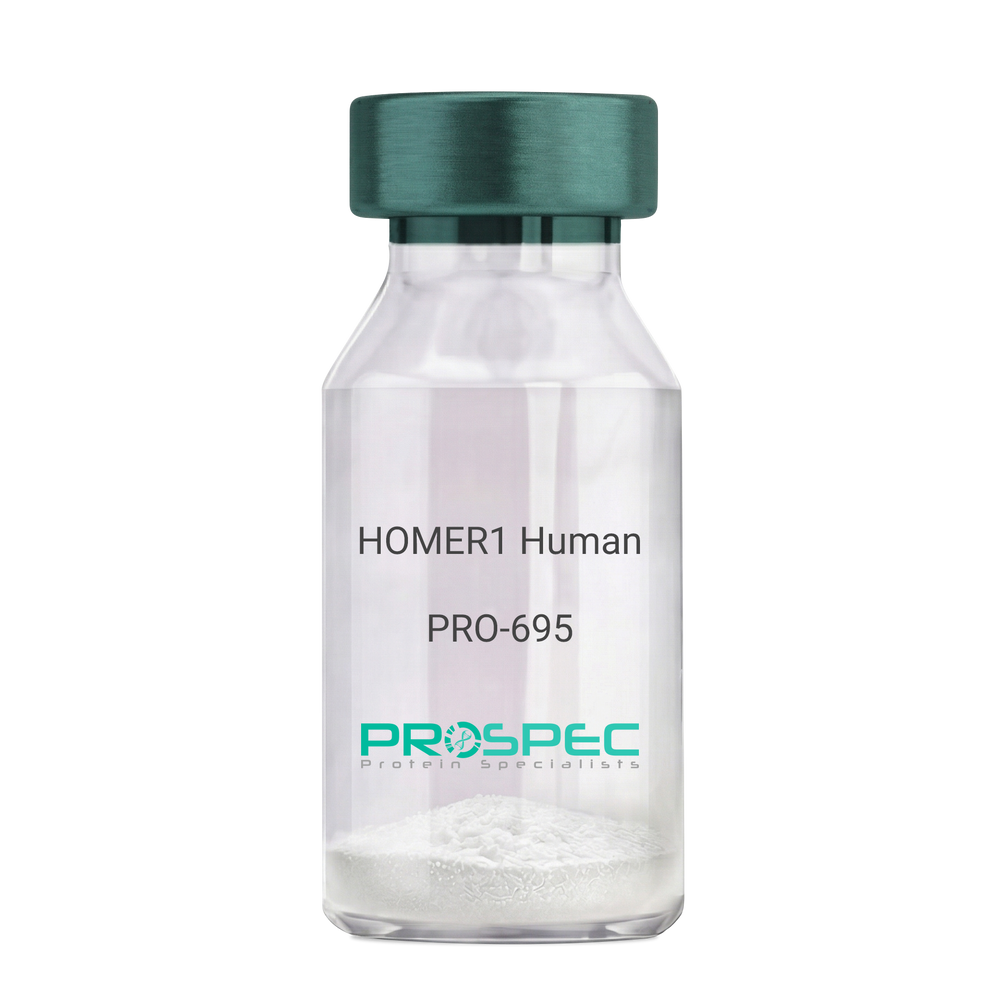
    HOMER1 Human

    Description:

    Homer Homolog-1 Human Recombinant

    HOMER, SYN47, Ves-1, HOMER1A, HOMER1B, HOMER1C, HOMER1, Homer protein homolog 1.

    Product # :

    PRO-695

    Price :

    Quantity :

    Shipping Method :

    Ice Icon

    Shipped with Ice Packs

    Add To Cart

    More Info

    • description
    • source
    • formulation
    • purity
    • More Info

    Description

    Recombinant Human HOMER1 produced in E.Coli is a single, non-glycosylated polypeptide chain containing 391 amino acids (1-354 a.a) and having a molecular mass of 44.5 kDa. HOMER1 is fused to a 37 amino acid His Tag at N-terminus and purified by proprietary chromatographic techniques.

    Source

    Escherichia Coli.

    Formulation

    The HOMER1 protein (1mg/ml) contains 20mM Tris-HCl buffer pH-8, 1mM DTT, 0.1M NaCl and 20% glycerol.

    Purity

    Greater than 90% as determined by Analysis by SDS-PAGE.

    More Info

    • Introduction

      HOMER1 takes part in determining the apoptotic susceptibility to TRAIL.
      HOMER1 is a member of the Homer family of proteins that regulate signal transduction through, and the trafficking of, glutamate receptors, plus maintain and regulate extracellular glutamate levels in corticolimbic brain regions. The HOMER1 is enriched at excitatory synapses and binds group 1 metabotropic glutamate receptors (mGluRs).

    • Synonyms

      HOMER, SYN47, Ves-1, HOMER1A, HOMER1B, HOMER1C, HOMER1, Homer protein homolog 1.

    • Physical Appearance

      Sterile filtered colorless solution.

    • Stability

      Store at 4°C if entire vial will be used within 2-4 weeks. Store, frozen at -20°C for longer periods of time. For long term storage it is recommended to add a carrier protein (0.1% HSA or BSA). Avoid multiple freeze-thaw cycles.

    • Amino Acid Sequence

      MRGSHHHHHH GMASMTGGQQ MGRDLYDDDD KDRWGSHMGE QPIFSTRAHV FQIDPNTKKN WVPTSKHAVT VSYFYDSTRN VYRIISLDGS KAIINSTITPNMTFTKTSQK FGQWADSRAN TVYGLGFSSE HHLSKFAEKF QEFKEAARLA KEKSQEKMEL TSTPSQESAG GDLQSPLTPE SINGTDDERT PDVTQNSEPR AEPTQNALPF SHSSAISKHW EAELATLKGN NAKLTAALLE STANVKQWKQ QLAAYQEEAE RLHKRVTELE CVSSQANAVH THKTELNQTI QELEETLKLK EEEIERLKQE IDNARELQEQ RDSLTQKLQE VEIRNKDLEG QLSDLEQRLE KSQNEQEAFR NNLKTLLEIL DGKIFELTEL RDNLAKLLEC S.

    ProSpec's products are furnished for LABORATORY RESEARCH USE ONLY. The product may not be used as drugs, agricultural or pesticidal products, food additives or household chemicals.

    Homer1 Human
  • View Data Sheet

    Name :

    DR1 Human

    Description:

    Down-Regulator of Transcription 1 Human Recombinant

    NC2, NC2-BETA, Negative cofactor 2-beta.

    Product # :

    PRO-542

    Price :

    Quantity :

    Shipping Method :

    Ice Icon

    Shipped with Ice Packs

    Add To Cart

    More Info

    • description
    • source
    • formulation
    • purity
    • More Info

    Description

    DR1 Recombinant Human produced in E.Coli is a single, non-glycosylated polypeptide chain containing 196 amino acids (1-176 a.a.) and having a molecular mass of 21.6 kDa. The DR1 is fused to 20 amino acid His-Tag at N-terminus and purified by proprietary chromatographic techniques.

    Source

    Escherichia Coli.

    Formulation

    DR1 protein solution (0.5mg/ml) containing 20mM Tris-HCl buffer (pH8.0), 0.1mM PMSF, 0.1M NaCl & 10% glycerol.

    Purity

    Greater than 85.0% as determined by SDS-PAGE.

    More Info

    • Introduction

      DR1 is a phosphoprotein that inhibits both basal and activated levels of transcription. DR1 is phosphorylated in vivo which affects its interaction with TBP. DR1 has a histone fold motif at the amino terminus, a TBP-binding domain, and a glutamine- and alanine-rich region. By selectively repressing polymerases II and III, DR1 alters the physiological balance of transcriptional output in favor of polymerase I.

    • Synonyms

      NC2, NC2-BETA, Negative cofactor 2-beta.

    • Physical Appearance

      Sterile filtered colorless solution.

    • Stability

      Store at 4°C if entire vial will be used within 2-4 weeks. Store, frozen at -20°C for longer periods of time. For long term storage it is recommended to add a carrier protein (0.1% HSA or BSA).Avoid multiple freeze-thaw cycles.

    • Amino Acid Sequence

      MGSSHHHHHH SSGLVPRGSH MASSSGNDDD LTIPRAAINK MIKETLPNVR VANDARELVV NCCTEFIHLI SSEANEICNK SEKKTISPEH VIQALESLGF GSYISEVKEV LQECKTVALK RRKASSRLEN LGIPEEELLR QQQELFAKAR QQQAELAQQE WLQMQQAAQQ AQLAAASASA NQAGSSQDE EDDDDI.

    ProSpec's products are furnished for LABORATORY RESEARCH USE ONLY. The product may not be used as drugs, agricultural or pesticidal products, food additives or household chemicals.

    Dr1 Human
  • View Data Sheet

    Name :

    ICAM3 Human

    Description:

    Intercellular Adhesion Molecule-3 Human Recombinant

    ICAM3, Intercellular adhesion molecule 3, ICAM-3, CD50, CDW50, ICAM-R, intercellular adhesion molecule 3 isoform 1

    Product # :

    PRO-2637

    Price :

    Quantity :

    Shipping Method :

    Ice Icon

    Shipped with Ice Packs

    Add To Cart

    More Info

    • description
    • source
    • formulation
    • purity
    • biological activity
    • More Info

    Description

    ICAM3 Human Recombinant produced in Sf9 Baculovirus cells is a single, glycosylated polypeptide chain containing 698 amino acids (30-485 a.a) and having a molecular mass of 76.7kDa.ICAM3 is fused to a 242 amino acid hIgG-His-Tag at C-terminus & purified by proprietary chromatographic techniques.

    Source

    Sf9, Baculovirus cells.

    Formulation

    The ICAM3 solution (0.25mg/1ml) contains Phosphate-Buffered Saline (pH 7.4) and 10% glycerol.

    Purity

    Greater than 90.0% as determined by SDS-PAGE.

    Biological Activity

    Measured by the ability of the immobilized protein to support the adhesion of HL-60 human promyelocytic cells.  When cells are added to Human ICAM-3/CD50 coated plates, the ED50 range ≤4ug/ml.

    More Info

    • Introduction

      ICAM-3/CD50, or CD50 or Cluster of Differentiation 50 is a protein, part of the intercellular adhesion molecule superfamily. every ICAM peptides are type I transmembrane glycoproteins, bind to leukocyte adhesion LFA-1 & has 2-9 immunoglobulinlike C2-type domains. ICAM-3/CD50 can be found in every leukocyte and acts as a crucial ligand for LFA-1 in the start of the immune system response. ICAM-3/CD50 acts as an adhesion molecule and is also a potent signaling protein.

    • Synonyms

      ICAM3, Intercellular adhesion molecule 3, ICAM-3, CD50, CDW50, ICAM-R, intercellular adhesion molecule 3 isoform 1

    • Physical Appearance

      Sterile Filtered colorless solution.

    • Stability

      Store at 4°C if entire vial will be used within 2-4 weeks. Store, frozen at -20°C for longer periods of time. For long term storage it is recommended to add a carrier protein (0.1% HSA or BSA).Avoid multiple freeze-thaw cycles.

    • Amino Acid Sequence

      ADLQEFLLRV EPQNPVLSAG GSLFVNCSTD CPSSEKIALE TSLSKELVAS GMGWAAFNLS NVTGNSRILC SVYCNGSQIT GSSNITVYRL PERVELAPLP PWQPVGQNFT LRCQVEDGSP RTSLTVVLLR WEEELSRQPA VEEPAEVTAT VLASRDDHGA PFSCRTELDM QPQGLGLFVN TSAPRQLRTF VLPVTPPRLV APRFLEVETS WPVDCTLDGL FPASEAQVYL ALGDQMLNAT VMNHGDTLTA TATATARADQ EGAREIVCNV TLGGERREAR ENLTVFSFLG PIVNLSEPTA HEGSTVTVSC MAGARVQVTL DGVPAAAPGQ PAQLQLNATE SDDGRSFFCS ATLEVDGEFL HRNSSVQLRV LYGPKIDRAT CPQHLKWKDK TRHVLQCQAR GNPYPELRCL KEGSSREVPV GIPFFVNVTH NGTYQCQASS SRGKYTLVVV MDIEAGSSHV EPKSCDKTHT CPPCPAPELL GGPSVFLFPP KPKDTLMISR TPEVTCVVVD VSHEDPEVKF NWYVDGVEVH NAKTKPREEQ YNSTYRVVSV LTVLHQDWLN GKEYKCKVSN KALPAPIEKT ISKAKGQPRE PQVYTLPPSR DELTKNQVSL TCLVKGFYPS DIAVEWESNG QPENNYKTTP PVLDSDGSFF LYSKLTVDKS RWQQGNVFSC SVMHEALHNH YTQKSLSLSP GKHHHHHH

    ProSpec's products are furnished for LABORATORY RESEARCH USE ONLY. The product may not be used as drugs, agricultural or pesticidal products, food additives or household chemicals.

    Icam3 Human
  • View Data Sheet

    Name :

    SNUPN Human

    Description:

    Snurportin 1 Human Recombinant

    KPNBL, RNUT1, Snurportin1, SPN1, RNA U transporter 1.

    Product # :

    PRO-866

    Price :

    Quantity :

    Shipping Method :

    Ice Icon

    Shipped with Ice Packs

    Add To Cart

    More Info

    • description
    • source
    • formulation
    • purity
    • More Info

    Description

    SNUPN Recombinant Human produced in E.Coli is a single, non-glycosylated polypeptide chain containing 380 amino acids (1-360 a.a.) and having a molecular mass of 43.3 kDa. The SNUPN is fused to 20 amino acid His-Tag at N-terminus and purified by proprietary chromatographic techniques.

    Source

    Escherichia Coli.

    Formulation

    SNUPN Human solution containing 20mM Tris pH-8, 2mM DTT, 0.1M NaCl, & 10% glycerol.

    Purity

    Greater than 90.0% as determined by SDS-PAGE.

    More Info

    • Introduction

      SNUPN is a nuclear import adaptor protein which is part of the Snurportin family.
      SNUPN is Localized to the cytoplasm and nucleus and contains an N-terminal IBB domain and a trimethylguanosine (m3G)-cap binding domain. SNUPN binds specifically the terminal 2,2,7-m3G-cap at the 5'' end of U snRNPs and is involved in transport of U snRNPs into the nucleus through an association with Importin β.

    • Synonyms

      KPNBL, RNUT1, Snurportin1, SPN1, RNA U transporter 1.

    • Physical Appearance

      Sterile filtered colorless solution.

    • Stability

      Store at 4°C if entire vial will be used within 2-4 weeks. Store, frozen at -20°C for longer periods of time. For long term storage it is recommended to add a carrier protein (0.1% HSA or BSA). Avoid multiple freeze-thaw cycles.

    • Amino Acid Sequence

      MGSSHHHHHH SSGLVPRGSH MEELSQALAS SFSVSQDLNS TAAPHPRLSQ YKSKYSSLEQ SERRRRLLEL QKSKRLDYVN HARRLAEDDW TGMESEEENK KDDEEMDIDT VKKLPKHYAN QLMLSEWLID VPSDLGQEWI VVVCPVGKRA LIVASRGSTS AYTKSGYCVN RFSSLLPGGN RRNSTAKDYT ILDCIYNEVN QTYYVLDVMC WRGHPFYDCQ TDFRFYWMHS KLPEEEGLGE KTKLNPFKFV GLKNFPCTPE SLCDVLSMDF PFEVDGLLFY HKQTHYSPGS TPLVGWLRPY MVSDVLGVAV PAGPLTTKPD YAGHQLQQIM EHKKSQKEGM KEKLTHKASE NGHYELEHLS
      TPKLKGSSHS PDHPGCLMEN.

    ProSpec's products are furnished for LABORATORY RESEARCH USE ONLY. The product may not be used as drugs, agricultural or pesticidal products, food additives or household chemicals.

    Snupn Human
  • View Data Sheet

    Name :

    SRGN Human

    Description:

    Serglycin Human Recombinant

    Serglycin, PRG, PRG1, PPG, Proteoglycan 1 secretory granule, Hematopoetic proteoglycan core protein, Platelet proteoglycan core protein, proteoglycan protein core for mast cell secretory granule.

    Product # :

    PRO-965

    Price :

    Quantity :

    Shipping Method :

    Ice Icon

    Shipped with Ice Packs

    Add To Cart

    More Info

    • description
    • source
    • formulation
    • purity
    • More Info

    Description

    SRGN Human Recombinant produced in E.coli is a single, non-glycosylated polypeptide chain containing 156 amino acids (28-158) and having a molecular mass of 17.4 kDa (Molecular weight on SDS-PAGE will appear higher).SRGN is fused to a 25 amino acid His-tag at N-terminus & purified by proprietary chromatographic techniques.

    Source

    E.coli.

    Formulation

    The SRGN solution (1mg/ml) contains 20mM Tris-HCl buffer (pH 8.0), 2mM DTT, 0.15M NaCl and 10% glycerol.

    Purity

    Greater than 90% as determined by SDS-PAGE.

    More Info

    • Introduction

      SRGN is identified as a hematopoietic cell granule proteoglycan. Proteoglycans stored in the secretory granules of various hematopoietic cells also hold a protease-resistant peptide core, and is vital for neutralizing hydrolytic enzymes. SRGN is related to the macromolecular complex of granzymes and perforin that acts as a intermediary of granule-mediated apoptosis.

    • Synonyms

      Serglycin, PRG, PRG1, PPG, Proteoglycan 1 secretory granule, Hematopoetic proteoglycan core protein, Platelet proteoglycan core protein, proteoglycan protein core for mast cell secretory granule.

    • Physical Appearance

      Sterile Filtered colorless solution.

    • Stability

      Store at 4°C if entire vial will be used within 2-4 weeks. Store, frozen at -20°C for longer periods of time. For long term storage it is recommended to add a carrier protein (0.1% HSA or BSA).Avoid multiple freeze-thaw cycles.

    • Amino Acid Sequence

      MGSSHHHHHH SSGLVPRGSH MGSHMYPTRR ARYQWVRCNP DSNSANCLEE KGPMFELLPG ESNKIPRLRT DLFPKTRIQD LNRIFPLSED YSGSGFGSGS GSGSGSGSGF LTEMEQDYQL VDESDAFHDN LRSLDRNLPS DSQDLGQHGL EEDFML.

    ProSpec's products are furnished for LABORATORY RESEARCH USE ONLY. The product may not be used as drugs, agricultural or pesticidal products, food additives or household chemicals.

    Srgn Human
  • View Data Sheet

    Name :

    SRI Human

    Description:

    Sorcin Human Recombinant

    Sorcin, 22 kDa protein, CP-22, CP22, V19, SRI, SCN, FLJ26259.

    Product # :

    PRO-166

    Price :

    Quantity :

    Shipping Method :

    Ice Icon

    Shipped with Ice Packs

    Add To Cart

    More Info

    • description
    • source
    • formulation
    • purity
    • More Info

    Description

    SRI Human Recombinant fused with a 23 amino acid His tag at N-terminus produced in E.Coli is a single, non-glycosylated, polypeptide chain containing 221 amino acids (1-198 a.a.) and having a molecular mass of 24.1kDa. The SRI is purified by proprietary chromatographic techniques.

    Source

    Escherichia Coli.

    Formulation

    The SRI solution (0.5 mg/ml) contains 20mM Tris-HCl buffer (pH8.0), 40% glycerol, 0.2M NaCl, 1mM DTT and 0.1mM PMSF.

    Purity

    Greater than 90.0% as determined by SDS-PAGE.

    More Info

    • Introduction

      Sorcin (SRI) which is a 22kDa calcium-binding protein was originally identified in multidrug-resistant cells. Sorcin, which modulates excitation-contraction coupling in the heart, contributes to calcium homeostasis in the heart sarcoplasmic reticulum.

    • Synonyms

      Sorcin, 22 kDa protein, CP-22, CP22, V19, SRI, SCN, FLJ26259.

    • Physical Appearance

      Sterile Filtered colorless solution.

    • Stability

      Store at 4°C if entire vial will be used within 2-4 weeks. Store, frozen at -20°C for longer periods of time. For long term storage it is recommended to add a carrier protein (0.1% HSA or BSA). Avoid multiple freeze-thaw cycles.

    • Amino Acid Sequence

      MGSSHHHHHH SSGLVPRGSH MGSMAYPGHP GAGGGYYPGG YGGAPGGPAF PGQTQDPLYG YFAAVAGQDG QIDADELQRC LTQSGIAGGY KPFNLETCRL MVSMLDRDMS GTMGFNEFKE LWAVLNGWRQ HFISFDTDRS GTVDPQELQK ALTTMGFRLS PQAVNSIAKR YSTNGKITFD DYIACCVKLR ALTDSFRRRD TAQQGVVNFP YDDFIQCVMS V.

    ProSpec's products are furnished for LABORATORY RESEARCH USE ONLY. The product may not be used as drugs, agricultural or pesticidal products, food additives or household chemicals.

    Sri Human
  • View Data Sheet

    Name :

    TCEA1 Human

    Description:

    Transcription Elongation Factor A (SII)-1 Human Recombinant

    Transcription elongation factor A (SII) 1, Transcription elongation factor TFIIS.o, TCEA, GTF2S, SII, TF2S.

    Product # :

    PRO-1098

    Price :

    Quantity :

    Shipping Method :

    Ice Icon

    Shipped with Ice Packs

    Add To Cart

    More Info

    • description
    • source
    • formulation
    • purity
    • More Info

    Description

    TCEA1 Human Recombinant produced in E. coli is a single polypeptide chain containing 325 amino acids (1-301) and having a molecular mass of 36.5kDa.TCEA1 is fused to a 24 amino acid His-tag at N-terminus & purified by proprietary chromatographic techniques.

    Source

    E.coli.

    Formulation

    The TCEA1 solution (1mg/1ml) contains 20mM Tris-HCl buffer (pH 7.5), 1mM DTT, 50mM NaCl and 20% glycerol.

    Purity

    Greater than 90% as determined by SDS-PAGE.

    More Info

    • Introduction

      TCEA1 is a member of the TFS-II family. TCEA1 binds to Pol II and operates to cleave the emerging transcript, thus unlocking the complex and permitting transcription to continue. TCEA1 is localized to the nucleus and holds three independently-folding domains that are essential for accurate binding to Pol II. The arresting sites in are able to trap a certain segment of elongating RNA polymerases that goes through, causing in a locked ternary complex. Cleavage of the emerging transcript by S-II enables the renewal of elongation from the new 3'-terminus.

    • Synonyms

      Transcription elongation factor A (SII) 1, Transcription elongation factor TFIIS.o, TCEA, GTF2S, SII, TF2S.

    • Physical Appearance

      Sterile Filtered colorless solution.

    • Stability

      Store at 4°C if entire vial will be used within 2-4 weeks. Store, frozen at -20°C for longer periods of time. For long term storage it is recommended to add a carrier protein (0.1% HSA or BSA).Avoid multiple freeze-thaw cycles.

    • Amino Acid Sequence

      MGSSHHHHHH SSGLVPRGSH MGSHMEDEVV RFAKKMDKMV QKKNAAGALD LLKELKNIPM TLELLQSTRI GMSVNAIRKQ STDEEVTSLA KSLIKSWKKL LDGPSTEKDL DEKKKEPAIT SQNSPEAREE STSSGNVSNR KDETNARDTY VSSFPRAPST SDSVRLKCRE MLAAALRTGD DYIAIGADEE ELGSQIEEAI YQEIRNTDMK YKNRVRSRIS NLKDAKNPNL RKNVLCGNIP PDLFARMTAE EMASDELKEM RKNLTKEAIR EHQMAKTGGT QTDLFTCGKC KKKNCTYTQV QTRSADEPMT TFVVCNECGN RWKFC

    ProSpec's products are furnished for LABORATORY RESEARCH USE ONLY. The product may not be used as drugs, agricultural or pesticidal products, food additives or household chemicals.

    Tcea1 Human
  • View Data Sheet

    Name :

    TIMM8A Human

    Description:

    Translocase of Inner Mitochondrial Membrane 8 Homolog A Human Recombinant

    Mitochondrial import inner membrane translocase subunit Tim8 A, TIMM8A, Translocase of Inner Mitochondrial Membrane 8 Homolog A, DDP, DDP1, DFN1, MTS, TIM8, Deafness dystonia protein 1, X-linked deafness dystonia protein.

    Product # :

    PRO-1818

    Price :

    Quantity :

    Shipping Method :

    Ice Icon

    Shipped with Ice Packs

    Add To Cart

    More Info

    • description
    • source
    • formulation
    • purity
    • More Info

    Description

    TIMM8A Human Recombinant produced in E.coli is a single, non-glycosylated polypeptide chain containing 120 amino acids (1-97) and having a molecular mass of 13.4 kDa.TIMM8A is fused to a 23 amino acid His-Tag at N-terminus and purified by proprietary chromatographic techniques.

    Source

    Escherichia Coli.

    Formulation

    The TIMM8A solution (0.25mg/ml) contains 20mM Tris-HCl buffer (pH 8.0), 0.15M NaCl, 30% glycerol and 1mM DTT.

    Purity

    Greater than 90.0% as determined by SDS-PAGE.

    More Info

    • Introduction

      Translocase of Inner Mitochondrial Membrane 8 Homolog A (TIMM8A) takes part in the import and insertion of hydrophobic membrane proteins from the cytoplasm into the mitochondrial. TIMM8A plays a role as a chaperone-like protein which protects the hydrophobic precursors from aggregation and leads them through the mitochondrial intermembrane space. TIMM8A is essential for the transfer of beta-barrel precursors from the TOM complex to the sorting and assembly machinery (SAM complex) of the outer membrane. Defects in TIMM8A cause Jensen syndrome. TIMM8A and TIMM13, forms a 70 kDa heterohexamer.

    • Synonyms

      Mitochondrial import inner membrane translocase subunit Tim8 A, TIMM8A, Translocase of Inner Mitochondrial Membrane 8 Homolog A, DDP, DDP1, DFN1, MTS, TIM8, Deafness dystonia protein 1, X-linked deafness dystonia protein.

    • Physical Appearance

      Sterile Filtered colorless solution.

    • Stability

      Store at 4°C if entire vial will be used within 2-4 weeks. Store, frozen at -20°C for longer periods of time. For long term storage it is recommended to add a carrier protein (0.1% HSA or BSA).Avoid multiple freeze-thaw cycles.

    • Amino Acid Sequence

      MGSSHHHHHH SSGLVPRGSH MGSMDSSSSS SAAGLGAVDP QLQHFIEVET QKQRFQQLVH QMTELCWEKC MDKPGPKLDS RAEACFVNCV ERFIDTSQFI LNRLEQTQKS KPVFSESLSD.

    ProSpec's products are furnished for LABORATORY RESEARCH USE ONLY. The product may not be used as drugs, agricultural or pesticidal products, food additives or household chemicals.

    Timm8A Human
  • View Data Sheet

    Name :

    PSMA7 Human

    Description:

    Proteasome Subunit Alpha Type 7 Human Recombinant

    HSPC, RC6-1, XAPC7, MGC3755, PSMA-7, Proteasome subunit alpha type-7, Proteasome subunit RC6-1, Proteasome subunit XAPC7, PSMA7, C6.

    Product # :

    ENZ-403

    Price :

    Quantity :

    Shipping Method :

    Ice Icon

    Shipped with Ice Packs

    Add To Cart

    More Info

    • description
    • source
    • formulation
    • purity
    • More Info

    Description

    PSMA7 Human Recombinant fused to N-terminal His-Tag produced in E.Coli is a single, non-glycosylated polypeptide chain containing 268 amino acids (1-248) and having a molecular mass of 30kDa. PSMA7 is fused to a 20 amino acid His Tag at N-Terminus and purified by standard chromatography techniques.

    Source

    Escherichia Coli.

    Formulation

    The PSMA7 solution contains 20mM Tris-HCl pH-8, 0.1M NaCl, and 20% glycerol.

    Purity

    Greater than 90.0% as determined SDS-PAGE.

    More Info

    • Introduction

      The proteasome is a multicatalytic proteinase complex with a highly assembled ring-shaped 20S core structure which is composed of 4 rings of 28 non-identical subunits, 2 rings are composed of 7 alpha subunits and 2 rings are composed of 7 beta subunits. Proteasomes are found throughout eukaryotic cells at a high concentration and cleave peptides in an ATP/ubiquitin-dependent process in a non-lysosomal pathway. PSMA7 is part of the peptidase T1A family, that is a 20S core alpha subunit. PSMA7 interacts particularly with the hepatitis B virus X protein, a protein critical to viral replication. PSMA7 is involved in regulating hepatitis virus C internal ribosome entry site activity that is crucial for viral replication. PSMA7 is in charge for regulating the hypoxia-inducible factor-1alpha, a transcription factor important for cellular responses to oxygen tension. PSMA7 is characterized by its ability to cleave peptides with Arg, Phe, Tyr, Leu, and Glu adjacent to the leaving group at neutral or slightly basic pH. PSMA7 interacts specifically with two subdomains of HIF-1alpha and inhibited the transactivation function of HIF-1alpha under both normoxic and hypoxia-mimicking conditions.

    • Synonyms

      HSPC, RC6-1, XAPC7, MGC3755, PSMA-7, Proteasome subunit alpha type-7, Proteasome subunit RC6-1, Proteasome subunit XAPC7, PSMA7, C6.

    • Physical Appearance

      Sterile Filtered colorless solution.

    • Stability

      Store at 4°C if entire vial will be used within 2-4 weeks. Store, frozen at -20°C for longer periods of time. For long term storage it is recommended to add a carrier protein (0.1% HSA or BSA).Avoid multiple freeze-thaw cycles.

    • Amino Acid Sequence

      MGSSHHHHHH SSGLVPRGSH MSYDRAITVF SPDGHLFQVE YAQEAVKKGS TAVGVRGRDI VVLGVEKKSV AKLQDERTVR KICALDDNVC MAFAGLTADA RIVINRARVE CQSHRLTVED PVTVEYITRY IASLKQRYTQ SNGRRPFGIS ALIVGFDFDG TPRLYQTDPS GTYHAWKANA IGRGAKSVRE FLEKNYTDEA IETDDLTIKL VIKALLEVVQ SGGKNIELAV MRRDQSLKIL NPEEIEKYVA EIEKEKEENE KKKQKKAS.

    ProSpec's products are furnished for LABORATORY RESEARCH USE ONLY. The product may not be used as drugs, agricultural or pesticidal products, food additives or household chemicals.

    Psma7 Human
  • View Data Sheet

    Name :

    CLMP Human

    Description:

    CXADR-Like Membrane Protein Human Recombinant

    CXADR-Like Membrane Protein, CLMP, Adipocyte Adhesion Molecule, Coxsackie- And Adenovirus Receptor-Like Membrane Protein, ACAM, ASAM, Adipocyte-Specific Adhesion Molecule, CAR-Like Membrane Protein, CSBS, CSBM.

    Product # :

    PRO-1941

    Price :

    Quantity :

    Shipping Method :

    Ice Icon

    Shipped with Ice Packs

    Add To Cart

    More Info

    • description
    • source
    • formulation
    • purity
    • More Info

    Description

    CLMP Human Recombinant produced in E.coli is a single, non-glycosylated polypeptide chain containing 233 amino acids (19-235) and having a molecular mass of 26.1 kDa.CLMP is fused to a 16 amino acid His-tag at N-terminus & purified by proprietary chromatographic techniques.

    Source

    Escherichia Coli.

    Formulation

    The CLMP solution (0.5mg/ml) contains 20mM Tris-HCl buffer (pH 8.0), 0.4M UREA and 10% glycerol.

    Purity

    Greater than 90.0% as determined by SDS-PAGE.

    More Info

    • Introduction

      The CTX family of proteins (including ASAM) are type I transmembrane proteins within the Ig superfamily, which localize to junctional complexes between endothelial and epithelial cells and may play a role in cell-cell adhesion. CLMP has a role in adipocyte differentiation and development of obesity. CLMP is required for normal small intestine development.

    • Synonyms

      CXADR-Like Membrane Protein, CLMP, Adipocyte Adhesion Molecule, Coxsackie- And Adenovirus Receptor-Like Membrane Protein, ACAM, ASAM, Adipocyte-Specific Adhesion Molecule, CAR-Like Membrane Protein, CSBS, CSBM.

    • Physical Appearance

      Sterile Filtered clear solution.

    • Stability

      Store at 4°C if entire vial will be used within 2-4 weeks. Store, frozen at -20°C for longer periods of time. For long term storage it is recommended to add a carrier protein (0.1% HSA or BSA).Avoid multiple freeze-thaw cycles.

    • Amino Acid Sequence

      MASMTGGQQM GRGSHMTHTE IKRVAEEKVT LPCHHQLGLP EKDTLDIEWL LTDNEGNQKV VITYSSRHVY NNLTEEQKGR VAFASNFLAG DASLQIEPLK PSDEGRYTCK VKNSGRYVWS HVILKVLVRP SKPKCELEGE LTEGSDLTLQ CESSSGTEPI VYYWQRIREK EGEDERLPPK SRIDYNHPGR VLLQNLTMSY SGLYQCTAGN EAGKESCVVR VTVQYVQSIG MVA.

    ProSpec's products are furnished for LABORATORY RESEARCH USE ONLY. The product may not be used as drugs, agricultural or pesticidal products, food additives or household chemicals.

    Clmp Human
  • View Data Sheet

    Name :

    PIH1D1 Human

    Description:

    PIH1 Domain Containing 1 Human Recombinant

    NOP17, Nucleolar Protein 17 Homolog, PIH1 Domain-Containing Protein 1, PIH1 Domain-Containing 1, PIH1D1.

    Product # :

    PRO-1753

    Price :

    Quantity :

    Shipping Method :

    Ice Icon

    Shipped with Ice Packs

    Add To Cart

    More Info

    • description
    • source
    • formulation
    • purity
    • More Info

    Description

    PIH1D1 Human Recombinant produced in E.Coli is a single, non-glycosylated polypeptide chain containing 313 amino acids (1-290a.a) and having a molecular mass of 34.8kDa. PIH1D1 is fused to a 23 amino acid His-tag at N-terminus & purified by proprietary chromatographic techniques.

    Source

    Escherichia Coli.

    Formulation

    PIH1D1 protein solution (0.25mg/ml) containing 20mM Tris-HCl buffer (pH 8.0), 0.4M Urea and 10% glycerol.

    Purity

    Greater than 85% as determined by SDS-PAGE.

    More Info

    • Introduction

      PIH1 domain-containing protein 1 (PIH1D1) is a member of the PIH1 family. PIH1D1 is a phylogenetically conserved protein vital for efficient processing of pre-rRNA through its association along with a class of small nucleolar RNAs (snoRNAs) during ribosomal biogenesis. SnoRNAs are linked in ribonucleoprotein particles localized to the nucleolus. PIH1D1 may also act as a novel modulator of apoptosis pathway.

    • Synonyms

      NOP17, Nucleolar Protein 17 Homolog, PIH1 Domain-Containing Protein 1, PIH1 Domain-Containing 1, PIH1D1.

    • Physical Appearance

      Sterile Filtered clear solution.

    • Stability

      Store at 4°C if entire vial will be used within 2-4 weeks. Store, frozen at -20°C for longer periods of time.For long term storage it is recommended to add a carrier protein (0.1% HSA or BSA).Please avoid freeze thaw cycles.

    • Amino Acid Sequence

      MGSSHHHHHH SSGLVPRGSH MGSMANPKLL GMGLSEAEAI GADSARFEEL LLQASKELQQ AQTTRPESTQ IQPQPGFCIK TNSSEGKVFI NICHSPSIPP PADVTEEELL QMLEEDQAGF RIPMSLGEPH AELDAKGQGC TAYDVAVNSD FYRRMQNSDF LRELVITIAR EGLEDKYNLQ LNPEWRMMKN RPFMGSISQQ NIRSEQRPRI QELGDLYTPA PGRAESGPEK PHLNLWLEAP DLLLAEVDLP KLDGALGLSL EIGENRLVMG GPQQLYHLDA YIPLQINSHE SKAAFHRKRK QLMVAMPLLP VPS

    ProSpec's products are furnished for LABORATORY RESEARCH USE ONLY. The product may not be used as drugs, agricultural or pesticidal products, food additives or household chemicals.

    Pih1D1 Human
  • View Data Sheet

    Name :

    ARC Human

    Description:

    Activity-Regulated Cytoskeleton-Associated Protein Human Recombinant

    Arg3.1, KIAA0278, Activity-regulated cytoskeleton-associated protein, Activity-regulated gene 3.1 protein homolog, ARC.

    Product # :

    PRO-1403

    Price :

    Quantity :

    Shipping Method :

    Ice Icon

    Shipped with Ice Packs

    Add To Cart

    More Info

    • description
    • source
    • formulation
    • purity
    • More Info

    Description

    ARC Human Recombinant produced in E.Coli is a single, non-glycosylated polypeptide chain containing 416 amino acids (1-396 a.a.) and having a molecular mass of 47.4kDa. ARC is fused to a 20 amino acid His-tag at N-terminus & purified by proprietary chromatographic techniques.

    Source

    E.coli.

    Formulation

    ARC protein solution (0.5mg/ml) contains 20mM Tris-HCl buffer (pH 8.0), 0.15M NaCl, 10% glycerol and 1mM DTT.

    Purity

    Greater than 90% as determined by SDS-PAGE.

    More Info

    • Introduction

      Activity-regulated cytoskeleton-associated protein (ARC) takes part in the regulation of cell morphology and cytoskeletal organization and is required for consolidation of synaptic plasticity as well as formation of long-term memory. ARC regulates endocytosis of AMPA receptors in response to synaptic activity and is also required for homeostatic synaptic scaling of AMPA receptors. ARC is required in the stress fiber dynamics and cell migration.

    • Synonyms

      Arg3.1, KIAA0278, Activity-regulated cytoskeleton-associated protein, Activity-regulated gene 3.1 protein homolog, ARC.

    • Physical Appearance

      Sterile Filtered colorless solution.

    • Stability

      Store at 4°C if entire vial will be used within 2-4 weeks. Store, frozen at -20°C for longer periods of time. For long term storage it is recommended to add a carrier protein (0.1% HSA or BSA).Avoid multiple freeze-thaw cycles.

    • Amino Acid Sequence

      MGSSHHHHHH SSGLVPRGSH MELDHRTSGG LHAYPGPRGG QVAKPNVILQ IGKCRAEMLE HVRRTHRHLL AEVSKQVERE LKGLHRSVGK LESNLDGYVP TSDSQRWKKS IKACLCRCQE TIANLERWVK REMHVWREVF YRLERWADRL ESTGGKYPVG SESARHTVSV GVGGPESYCH EADGYDYTVS PYAITPPPAA GELPGQEPAE AQQYQPWVPG EDGQPSPGVD TQIFEDPREF LSHLEEYLRQ VGGSEEYWLS QIQNHMNGPA KKWWEFKQGS VKNWVEFKKE FLQYSEGTLS REAIQRELDL PQKQGEPLDQ FLWRKRDLYQ TLYVDADEEE IIQYVVGTLQ PKLKRFLRHP LPKTLEQLIQ RGMEVQDDLE QAAEPAGPHL PVEDEAETLT PAPNSESVAS DRTQPE.

    ProSpec's products are furnished for LABORATORY RESEARCH USE ONLY. The product may not be used as drugs, agricultural or pesticidal products, food additives or household chemicals.

    Arc Human
  • View Data Sheet

    Name :

    CHMP1B Human

    Description:

    Charged Multivesicular Body Protein 1B Human Recombinant

    Charged multivesicular body protein 1b, CHMP1.5, Chromatin-modifying protein 1b, CHMP1b, Vacuolar protein sorting-associated protein 46-2, Vps46-2, hVps46-2, CHMP1B, C18orf2, Vps46B, C10orf2, C18-ORF2.

    Product # :

    PRO-1117

    Price :

    Quantity :

    Shipping Method :

    Ice Icon

    Shipped with Ice Packs

    Add To Cart

    More Info

    • description
    • source
    • formulation
    • purity
    • More Info

    Description

    CHMP1B Human Recombinant produced in E.Coli is a single, non-glycosylated polypeptide chain containing 223 amino acids (1-199 a.a) and having a molecular mass of 24.7kDa (Molecular weight on SDS-PAGE will appear higher).CHMP1B is fused to a 24 amino acid His-tag at N-terminus & purified by proprietary chromatographic techniques.

    Source

    Escherichia Coli.

    Formulation

    CHMP1B protein solution (0.25mg/ml) containing 20mM Tris-HCl buffer (pH8.0), 20% glycerol, 0.1M NaCl and 1mM DTT.

    Purity

    Greater than 85.0% as determined by SDS-PAGE.

    More Info

    • Introduction

      Charged multivesicular body protein 1b (CHMP1B) is a member of the chromatin-modifying protein/charged multivesicular body protein (CHMP) family. CHMP1B is a possible peripherally associated component of the ESCRT-III (endosomal sorting required for transport complex III) which is involved in MVBs (multivesicular bodies) formation and sorting of endosomal cargo proteins into MVBs. The MVBs contain ILVs (intraluminal vesicles) which are created by invagination and scission from the limiting membrane of the endosome and generally are transported to lysosomes enabling degradation of membrane proteins, such as stimulated growth factor receptors, lysosomal enzymes and lipids.

    • Synonyms

      Charged multivesicular body protein 1b, CHMP1.5, Chromatin-modifying protein 1b, CHMP1b, Vacuolar protein sorting-associated protein 46-2, Vps46-2, hVps46-2, CHMP1B, C18orf2, Vps46B, C10orf2, C18-ORF2.

    • Physical Appearance

      Sterile Filtered colorless solution.

    • Stability

      Store at 4°C if entire vial will be used within 2-4 weeks. Store, frozen at -20°C for longer periods of time. For long term storage it is recommended to add a carrier protein (0.1% HSA or BSA).Avoid multiple freeze-thaw cycles.

    • Amino Acid Sequence

      MGSSHHHHHH SSGLVPRGSH MGSHMSNMEK HLFNLKFAAK ELSRSAKKCD KEEKAEKAKI KKAIQKGNME VARIHAENAI RQKNQAVNFL RMSARVDAVA ARVQTAVTMG KVTKSMAGVV KSMDATLKTM NLEKISALMD KFEHQFETLD VQTQQMEDTM SSTTTLTTPQ NQVDMLLQEM ADEAGLDLNM ELPQGQTGSV GTSVASAEQD ELSQRLARLR DQV.

    ProSpec's products are furnished for LABORATORY RESEARCH USE ONLY. The product may not be used as drugs, agricultural or pesticidal products, food additives or household chemicals.

    Chmp1B Human
  • View Data Sheet

    Name :

    COPE Human

    Description:

    Coatomer Protein Complex Subunit Epsilon Human Recombinant

    Coatomer Protein Complex, Subunit Epsilon, Epsilon-Coat Protein, Epsilon-COP, Coatomer Epsilon Subunit, Coatomer Subunit Epsilon, Epsilon Coat Protein, Coatomer subunit epsilon.

    Product # :

    PRO-2120

    Price :

    Quantity :

    Shipping Method :

    Ice Icon

    Shipped with Ice Packs

    Add To Cart

    More Info

    • description
    • source
    • formulation
    • purity
    • More Info

    Description

    COPE Human Recombinant produced in E.Coli is a single, non-glycosylated polypeptide chain containing 331 amino acids (1-308 a.a) and having a molecular mass of 36.9kDa. COPE is fused to a 23 amino acid His-tag at N-terminus & purified by proprietary chromatographic techniques.

    Source

    Escherichia Coli.

    Formulation

    COPE protein solution (0.25 mg/ml) containing Phosphate buffered saline (pH7.4), 20% glycerol and 1mM DTT.

    Purity

    Greater than 90.0% as determined by SDS-PAGE.

    More Info

    • Introduction

      Coatomer Protein Complex SubunitEpsilon, also known as COPE is an epsilon subunit of coatomer protein complex. Coatomer is a cytosolic protein complex which binds to dilysine motifs and reversibly links with Golgi non-clathrin-coated vesicles. COPE is necessary forbudding from Golgi membranes, and is also essential for the retrograde Golgi-to-ER transport of dilysine-taggedproteins. Coatomer complex contain at least the alpha, beta, beta', gamma, delta, epsilon and zeta subunits. Alternatively spliced transcript variants encoding dissimilar isoforms have been identifiedfor COPE.

    • Synonyms

      Coatomer Protein Complex, Subunit Epsilon, Epsilon-Coat Protein, Epsilon-COP, Coatomer Epsilon Subunit, Coatomer Subunit Epsilon, Epsilon Coat Protein, Coatomer subunit epsilon.

    • Physical Appearance

      Sterile Filtered colorless solution.

    • Stability

      Store at 4°C if entire vial will be used within 2-4 weeks. Store, frozen at -20°C for longer periods of time. For long term storage it is recommended to add a carrier protein (0.1% HSA or BSA).Avoid multiple freeze-thaw cycles.

    • Amino Acid Sequence

      MGSSHHHHHH SSGLVPRGSH MGSMAPPAPG PASGGSGEVD ELFDVKNAFY IGSYQQCINE AQRVKLSSPE RDVERDVFLY RAYLAQRKFG VVLDEIKPSS APELQAVRMF ADYLAHESRR DSIVAELDRE MSRSVDVTNT TFLLMAASIY LHDQNPDAAL RALHQGDSLE CTAMTVQILL KLDRLDLARK ELKRMQDLDE DATLTQLATA WVSLATGGEK LQDAYYIFQE MADKCSPTLL LLNGQAACHM AQGRWEAAEG LLQEALDKDS GYPETLVNLI VLSQHLGKPP EVTNRYLSQL KDAHRSHPFI KEYQAKENDF DRLVLQYAPS A.

    ProSpec's products are furnished for LABORATORY RESEARCH USE ONLY. The product may not be used as drugs, agricultural or pesticidal products, food additives or household chemicals.

    Cope Human
  • View Data Sheet

    Name :

    LIN28 Human

    Description:

    LIN28 Human Recombinant

    CSDD1, FLJ12457, LIN-28, LIN28A, Protein lin-28 homolog A, ZCCHC1, Zinc finger CCHC domain-containing protein 1, Lin-28A, LIN28.

    Product # :

    PRO-743

    Price :

    Quantity :

    Shipping Method :

    Ice Icon

    Shipped with Ice Packs

    Add To Cart

    More Info

    • description
    • source
    • formulation
    • purity
    • More Info

    Description

    Recombinant Human LIN28 produced in E.Coli is a single, non-glycosylated polypeptide chain containing 191 amino acids (42-209) and having a molecular mass of 21.1 kDa.LIN28 is expressed with a 23 amino acid His tag fused at N-Terminus and purified by proprietary chromatographic techniques.

    Source

    Escherichia Coli.

    Formulation

    The LIN28 protein solution (0.5mg/ml) contains 20mM Tris-HCl, pH-8, 10% glycerol, 0.1mM PMSF and 0.1M NaCl.

    Purity

    Greater than 85.0% as determined by SDS-PAGE

    More Info

    • Introduction

      LIN28 plays an important role as a 'translational enhancer', leading specific mRNAs to polysomes and therefore increasing the competence of protein synthesis. LIN28 is a marker of undifferentiated human embryonic stem cells and it enhances the efficiency of the formation of induced pluripotent stem (iPS) cells from human fibroblasts. LIN28 binds to the let-7 pre-miRNA and blocks production of the mature let-7 microRNA in mouse embryonic stem cells. Overexpression of LIN28 is associated with human germ-cell tumors.

    • Synonyms

      CSDD1, FLJ12457, LIN-28, LIN28A, Protein lin-28 homolog A, ZCCHC1, Zinc finger CCHC domain-containing protein 1, Lin-28A, LIN28.

    • Physical Appearance

      Sterile filtered colorless solution.

    • Stability

      Store at 4°C if entire vial will be used within 2-4 weeks. Store, frozen at -20°C for longer periods of time. For long term storage it is recommended to add a carrier protein (0.1% HSA or BSA). Avoid multiple freeze-thaw cycles.

    • Amino Acid Sequence

      MGSSHHHHHH SSGLVPRGSHRSMGICKWFN VRMGFGFLSM TARAGVALDP PVDVFVHQSK LHMEGFRSLK EGEAVEFTFK KSAKGLESIR VTGPGGVFCI GSERRPKGKS MQKRRSKGDR CYNCGGLDHH AKECKLPPQP KKCHFCQSIS HMVASCPLKA QQGPSAQGKP TYFREEEEEI HSPTLLPEAQ N.

    ProSpec's products are furnished for LABORATORY RESEARCH USE ONLY. The product may not be used as drugs, agricultural or pesticidal products, food additives or household chemicals.

    Lin28 Human
  • View Data Sheet

    Name :

    T.pallidum p41

    Description:

    Treponema pallidum p41 Recombinant

    Product # :

    TRP-242

    Price :

    Quantity :

    Shipping Method :

    Ice Icon

    Shipped with Ice Packs

    Add To Cart

    More Info

    • description
    • source
    • formulation
    • purity
    • More Info

    Description

    The E.coli derived recombinant protein contains the outer membrane T.Pallidum p41 immunodominant regions. The protein is fused with a Beta-galactosidase tag.

    Source

    Escherichia Coli.

    Formulation

    10mM Tris-HCl pH8.0, 1mM EDTA, 1mMDTT and 8M urea.

    Purity

    Treponema pallidum protein is >90% pure as determined by 10% PAGE (coomassie staining).

    More Info

    • Introduction

      Treponema pallidum is a gram-negative spirochaete bacterium and is considered to be metabolically crippled. There are at least four known subspecies: T. pallidum pallidum, T. pallidum pertenue, T. pallidum carateum and T. pallidum endemicum. The helical structure of T. pallidum pallidum allows it to move in a corkscrew motion through viscous mediums such as mucus. Treponema pallidum sub sp. pallidum has one of the smallest bacterial genomes at 1.14 million base pairs (Mb) and has limited metabolic capabilities, reflecting its adaptation through genome reduction to the rich environment of mammalian tissue.

    • Stability

      T.pallidum p41 although stable at 4°C for 1 week, should be stored below -18°C. Please prevent freeze thaw cycles.

    • Applications

      Treponema pallidum is suitable for ELISA and Western blots, excellent antigen for detection of T. Pallidum with minimal specificity problems.

    • Specificity

      Immunoreactive with sera of T.Pallidum infected individuals.

    • Purification Method

      Treponema pallidum protein was purified by proprietary chromatographic technique.

    ProSpec's products are furnished for LABORATORY RESEARCH USE ONLY. The product may not be used as drugs, agricultural or pesticidal products, food additives or household chemicals.

    Tpallidum P41
  • View Data Sheet

    Name :

    DCTN6 Human

    Description:

    Dynactin 6 Human Recombinant

    Dynactin 6, WS3, Dynactin Subunit P27, Protein WS-3, P27, Novel RGD-Containing Protein, Dynactin Subunit 6, WS-3, Dynactin subunit 6.

    Product # :

    PRO-2094

    Price :

    Quantity :

    Shipping Method :

    Ice Icon

    Shipped with Ice Packs

    Add To Cart

    More Info

    • description
    • source
    • formulation
    • purity
    • More Info

    Description

    DCTN6 Human Recombinant produced in E.Coli is a single, non-glycosylated polypeptide chain containing 213 amino acids (1-190 a.a) and having a molecular mass of 23.1kDa. DCTN6 is fused to a 23 amino acid His-tag at N-terminus & purified by proprietary chromatographic techniques.

    Source

    Escherichia Coli.

    Formulation

    DCTN6 protein solution (1mg/ml) containing Phosphate Buffered Saline (pH7.4) and 10% glycerol.

    Purity

    Greater than 85.0% as determined by SDS-PAGE.

    More Info

    • Introduction

      Dynactin 6, also known as DCTN6 is a member of the dynactin subunits 5/6 family. DCTN6 includes an RGD (Arg-Gly-Asp) motif in the N-terminal region, which confers adhesive properties to macromolecular proteins such as fibronectin. DCTN6 has a high degree of sequence resemblance with the mouse homolog, which has been found to participate in mitochondrial biogenesis. Moreover, the precise biological function of DCTN6 is unknown.

    • Synonyms

      Dynactin 6, WS3, Dynactin Subunit P27, Protein WS-3, P27, Novel RGD-Containing Protein, Dynactin Subunit 6, WS-3, Dynactin subunit 6.

    • Physical Appearance

      Sterile Filtered colorless solution.

    • Stability

      Store at 4°C if entire vial will be used within 2-4 weeks. Store, frozen at -20°C for longer periods of time. For long term storage it is recommended to add a carrier protein (0.1% HSA or BSA).Avoid multiple freeze-thaw cycles.

    • Amino Acid Sequence

      MGSSHHHHHH SSGLVPRGSH MGSMAEKTQK SVKIAPGAVV CVESEIRGDV TIGPRTVIHP KARIIAEAGP IVIGEGNLIE EQALIINAYP DNITPDTEDP EPKPMIIGTN NVFEVGCYSQ AMKMGDNNVI ESKAYVGRNV ILTSGCIIGA CCNLNTFEVI PENTVIYGAD CLRRVQTERP QPQTLQLDFL MKILPNYHHL KKTMKGSSTP VKN.

    ProSpec's products are furnished for LABORATORY RESEARCH USE ONLY. The product may not be used as drugs, agricultural or pesticidal products, food additives or household chemicals.

    Dctn6 Human
  • View Data Sheet

    Name :

    PQBP1 Human

    Description:

    Polyglutamine Binding Protein 1 Human Recombinant

    Golyglutamine binding protein 1, Polyglutamine tract-binding protein 1, 38kDa nuclear protein containing a WW domain, mental retardation X-linked 55, Sutherland-Haan X-linked mental retardation syndrome, Npw38, MRXS3, MRX55, MRXS8, RENS1, SHS.

    Product # :

    PRO-1101

    Price :

    Quantity :

    Shipping Method :

    Ice Icon

    Shipped with Ice Packs

    Add To Cart

    More Info

    • description
    • source
    • formulation
    • purity
    • More Info

    Description

    PQBP1 Human Recombinant produced in E. coli is a single polypeptide chain containing 289 amino acids (1-265) and having a molecular mass of 33.0kDa.PQBP1 is fused to a 24 amino acid His-tag at N-terminus & purified by proprietary chromatographic techniques.

    Source

    E.coli.

    Formulation

    The PQBP1 solution (0.5mg/1ml) contains 20mM Tris-HCl buffer (pH 8.0), 1mM DTT, 100mM NaCl and 20% glycerol.

    Purity

    Greater than 95% as determined by SDS-PAGE.

    More Info

    • Introduction

      PQBP1 is a transcription repressor which is connected to polyglutamine tract-containing transcription regulators and connective genes for neurodegenerative disorders. PQBP1 is restricts to the nucleus and can be found in neurons all over the brain, with high levels in hippocampus, olfactory bulb and cerebellar cortex. PQBP1 holds a WWP/WW domain that binds proline-rich motifs and a C2 domain which is able to stimulate Ca2+-dependent phospholipid signaling.

    • Synonyms

      Golyglutamine binding protein 1, Polyglutamine tract-binding protein 1, 38kDa nuclear protein containing a WW domain, mental retardation X-linked 55, Sutherland-Haan X-linked mental retardation syndrome, Npw38, MRXS3, MRX55, MRXS8, RENS1, SHS.

    • Physical Appearance

      Sterile Filtered colorless solution.

    • Stability

      Store at 4°C if entire vial will be used within 2-4 weeks. Store, frozen at -20°C for longer periods of time. For long term storage it is recommended to add a carrier protein (0.1% HSA or BSA).Avoid multiple freeze-thaw cycles.

    • Amino Acid Sequence

      MGSSHHHHHH SSGLVPRGSH MGSHMPLPVA LQTRLAKRGI LKHLEPEPEE EIIAEDYDDD PVDYEATRLE GLPPSWYKVF DPSCGLPYYW NADTDLVSWL SPHDPNSVVT KSAKKLRSSN ADAEEKLDRS HDKSDRGHDK SDRSHEKLDR GHDKSDRGHD KSDRDRERGY DKVDRERERD RERDRDRGYD KADREEGKER RHHRREELAP YPKSKKAVSR KDEELDPMDP SSYSDAPRGT WSTGLPKRNE AKTGADTTAA GPLFQQRPYP SPGAVLRANA EASRTKQQD

    ProSpec's products are furnished for LABORATORY RESEARCH USE ONLY. The product may not be used as drugs, agricultural or pesticidal products, food additives or household chemicals.

    Pqbp1 Human
  • View Data Sheet

    Name :

    PPM1A Human

    Description:

    Protein Phosphatase 1A Alpha Isoform Human Recombinant

    Protein phosphatase 1A, EC 3.1.3.16, Protein phosphatase 2C isoform alpha, PP2C-alpha, IA, PPM1A, PP2CA, MGC9201.

    Product # :

    PKA-222

    Price :

    Quantity :

    Shipping Method :

    Ice Icon

    Shipped with Ice Packs

    Add To Cart

    More Info

    • description
    • source
    • formulation
    • purity
    • More Info

    Description

    PPM1A Human Recombinant produced in E.Coli is a single, non-glycosylated polypeptide chain containing 418 amino acids (1-382a.a) and having a molecular mass of 46.6kDa. PPM1A is fused to a 36 amino acid His-tag at N-terminus & purified by proprietary chromatographic techniques.

    Source

    Escherichia Coli.

    Formulation

    PPM1A protein solution (1mg/ml) contains 10mM Tris-HCl, pH7.5, 50mM NaCl, 2mM DTT, 1mM MnCl2 and 20% glycerol.

    Purity

    Greater than 95.0% as determined by SDS-PAGE.

    More Info

    • Introduction

      Protein Phosphatase 2C alpha is a member of the PP2C family of Ser/Thr protein phosphatases. PP2C family members are known to be negative regulators of cell stress response pathways. This phosphatase dephosphorylates, and negatively regulates the activities of, MAP kinases and MAP kinase kinases. It has been shown to inhibit the activation of p38 and JNK kinase cascades induced by environmental stresses. This phosphatase can also dephosphorylate cyclin-dependent kinases, and thus may be involved in cell cycle control. Overexpression of this phosphatase is reported to activate the expression of the tumor suppressor gene TP53/p53, which leads to G2/M cell cycle arrest and apoptosis. Three alternatively spliced transcript variants encoding two distinct isoforms have been described.
      Protein phosphatase 2C(PP2C?) is a Mn2+- or Mg2+-dependent protein serine/threonine phosphatase that is essential for regulating cellular stress response in eukaryotes.

    • Synonyms

      Protein phosphatase 1A, EC 3.1.3.16, Protein phosphatase 2C isoform alpha, PP2C-alpha, IA, PPM1A, PP2CA, MGC9201.

    • Physical Appearance

      Sterile filtered colorless solution.

    • Stability

      Store at 4°C if entire vial will be used within 2-4 weeks. Store, frozen at -20°C for longer periods of time. For long term storage it is recommended to add a carrier protein (0.1% HSA or BSA). Avoid multiple freeze-thaw cycles.

    • Amino Acid Sequence

      MRGSHHHHHH GMASMTGGQQ MGRDLYDDDD KDRWILMGAF LDKPKMEKHN AQGQGNGLRY GLSSMQGWRV EMEDAHTAVI GLPSGLESWS FFAVYDGHAG SQVAKYCCEH LLDHITNNQD FKGSAGAPSV ENVKNGIRTG FLEIDEHMRV MSEKKHGADR SGSTAVGVLI SPQHTYFINC GDSRGLLCRN RKVHFFTQDH KPSNPLEKER IQNAGGSVMI QRVNGSLAVS RALGDFDYKC VHGKGPTEQL VSPEPEVHDI ERSEEDDQFI ILACDGIWDV MGNEELCDFV RSRLEVTDDL EKVCNEVVDT CLYKGSRDNM SVILICFPNA PKVSPEAVKK EAELDKYLEC RVEEIIKKQG EGVPDLVHVM RTLASENIPS LPPGGELASK RNVIEAVYNR LNPYKNDDTD STSTDDMW.

    • Unit Definition

      One unit will hydrolyze 1 nanomole of p-nitrophenyl phosphatate (pNPP) per minute at pH 7.5 at 37°C.

    • Specific Activity

      >1,400 U/mg.

    ProSpec's products are furnished for LABORATORY RESEARCH USE ONLY. The product may not be used as drugs, agricultural or pesticidal products, food additives or household chemicals.

    Ppm1A Human
  • 1
  • …
  • 17
  • 18
  • 19
  • 20
  • 21
  • …
  • 42
Your browser does not support the video tag.

Products

  • Cytokines
  • Growth Factors
  • Chemokines
  • CD Antigens
  • Neurotrophins
  • Hormones
  • Enzymes
  • Viral Antigens
  • Recombinant Proteins
  • Natural Proteins
  • Monoclonal Antibodies
  • Polyclonal Antibodies
  • Thermal Packaging

About

  • Company
  • Founder
  • Contribution
  • Contact Us
  • My Account

Ordering

  • Ordering Method
  • Ordering - Credit Card
  • Ordering PO
  • Shipping Fees
  • FAQ's

Legal

  • Terms & Conditions
  • Privacy
  • Site Map
  • info@prospecbio.com
  • Facebook
  • Instagram
  • Linkedin Profile

© 2026 ProSpec-Tany TechnoGene Ltd. All Rights Reserved.

  • Choosing a selection results in a full page refresh.
  • Opens in a new window.