Skip to content

High-quality research proteins.

  • 1-800-805-6531

  • Mon - Sat 8.00-18.00, Sun - Closed

  • info@prospecbio.com

  • PO Box 6591 East Brunswick NJ 08816

  • Products
    • Cytokines
    • Growth factors
    • Chemokines
    • Cd antigens
    • Neurotrophins
    • Hormones
    • Enzymes
    • Viral antigens
    • Recombinant proteins
    • Natural proteins
    • Monoclonal antibodies
    • Polyclonal antibodies
    • Thermal Packaging
  • About
    • Company
    • Founder
    • Contribution
  • Customers
    • Eastern Asia
    • Eastern Europe
    • North America
    • South America
    • South East Asia
    • Southern Asia
    • Western Europe
  • Ordering
    • Ordering Method
    • Ordering - Credit Card
    • Ordering - PO
    • Shipping Fees
    • FAQs
  • Services
    • DNA Cloning
    • Protein Expression
    • Monoclonal Antibody
    • Fermentation
    • Technology License
  • Contact us
Log in

Country/region

  • USD $ | Albania
  • USD $ | Andorra
  • USD $ | Argentina
  • USD $ | Armenia
  • USD $ | Australia
  • USD $ | Austria
  • USD $ | Azerbaijan
  • USD $ | Belarus
  • USD $ | Belgium
  • USD $ | Bolivia
  • USD $ | Brazil
  • USD $ | Bulgaria
  • USD $ | Cambodia
  • USD $ | Canada
  • USD $ | Chile
  • USD $ | China
  • USD $ | Colombia
  • USD $ | Costa Rica
  • USD $ | Croatia
  • USD $ | Cyprus
  • USD $ | Czechia
  • USD $ | Denmark
  • USD $ | Estonia
  • USD $ | Finland
  • USD $ | France
  • USD $ | Georgia
  • USD $ | Germany
  • USD $ | Greece
  • USD $ | Hong Kong SAR
  • USD $ | Hungary
  • USD $ | Iceland
  • USD $ | India
  • USD $ | Ireland
  • USD $ | Israel
  • USD $ | Italy
  • USD $ | Japan
  • USD $ | Kazakhstan
  • USD $ | Latvia
  • USD $ | Liechtenstein
  • USD $ | Lithuania
  • USD $ | Madagascar
  • USD $ | Malta
  • USD $ | Mexico
  • USD $ | Moldova
  • USD $ | Monaco
  • USD $ | Netherlands
  • USD $ | New Zealand
  • USD $ | North Macedonia
  • USD $ | Norway
  • USD $ | Panama
  • USD $ | Paraguay
  • USD $ | Peru
  • USD $ | Philippines
  • USD $ | Poland
  • USD $ | Portugal
  • USD $ | Romania
  • USD $ | Singapore
  • USD $ | Slovakia
  • USD $ | Slovenia
  • USD $ | South Africa
  • USD $ | South Korea
  • USD $ | Spain
  • USD $ | Sri Lanka
  • USD $ | Sweden
  • USD $ | Switzerland
  • USD $ | Taiwan
  • USD $ | Thailand
  • USD $ | Türkiye
  • USD $ | Ukraine
  • USD $ | United Kingdom
  • USD $ | United States
  • USD $ | Uruguay
  • USD $ | Vatican City
  • USD $ | Venezuela
  • USD $ | Vietnam
  • Facebook
  • Instagram
logoProSpec - Recombinant Protein Manufacturer for academic and R&D industry
Become a distributor
Account Log in
Wishlist
Cart Cart(0)
  • Products
    +
    • Cytokines
    • Growth factors
    • Chemokines
    • Cd antigens
    • Neurotrophins
    • Hormones
    • Enzymes
    • Viral antigens
    • Recombinant proteins
    • Natural proteins
    • Monoclonal antibodies
    • Polyclonal antibodies
    • Thermal Packaging
  • About
    +
    • Company
    • Founder
    • Contribution
  • Customers
    +
    • Eastern Asia
    • Eastern Europe
    • North America
    • South America
    • South East Asia
    • Southern Asia
    • Western Europe
  • Ordering
    +
    • Ordering Method
    • Ordering - Credit Card
    • Ordering - PO
    • Shipping Fees
    • FAQs
  • Services
    +
    • DNA Cloning
    • Protein Expression
    • Monoclonal Antibody
    • Fermentation
    • Technology License
  • Contact us

Item added to your cart

View cart
View All
  • Cytokines
  • Growth factors
  • Chemokines
  • Cd antigens
  • Neurotrophins
  • Hormones
  • Enzymes
  • Viral antigens
  • Recombinant proteins
  • Natural proteins
  • Monoclonal antibodies
  • Polyclonal antibodies
  • Thermal Packaging
  • Tumor Necrosis Factor

    Tumor Necrosis Factor

    View All
  • 4-1BB

    4-1BB

    View All
  • Adiponectin

    Adiponectin

    View All
  • AIF1

    AIF1

    View All
  • Other Cytokines

    Other Cytokines

    View All
  • AITRL

    AITRL

    View All
  • Angiopoietin

    Angiopoietin

    View All
  • Apolipoprotein

    Apolipoprotein

    View All
  • B-Cell Activating Factor

    B-Cell Activating Factor

    View All
  • Beta Defensin

    Beta Defensin

    View All
  • Bone Morphogenetic Protein

    Bone Morphogenetic Protein

    View All
  • B type Natriuretic Peptide

    B type Natriuretic Peptide

    View All
  • BST

    BST

    View All
  • Betacellulin

    Betacellulin

    View All
  • Cardiotrophin

    Cardiotrophin

    View All
  • Activin

    Activin

    View All
  • Fibroblast Growth Factor

    Fibroblast Growth Factor

    View All
  • Other Growth Factors

    Other Growth Factors

    View All
  • CSF

    CSF

    View All
  • CTGF

    CTGF

    View All
  • IGFBP

    IGFBP

    View All
  • VEGF Protein

    VEGF Protein

    View All
  • EGF

    EGF

    View All
  • Epigen

    Epigen

    View All
  • Erythropoietin

    Erythropoietin

    View All
  • Insulin-Like Growth Factor

    Insulin-Like Growth Factor

    View All
  • Growth Hormone

    Growth Hormone

    View All
  • HDGF

    HDGF

    View All
  • Hepatocyte Growth Factor

    Hepatocyte Growth Factor

    View All
  • Insulin

    Insulin

    View All
  • BCA-1/ BLC (CXCL13)

    BCA-1/ BLC (CXCL13)

    View All
  • BRAK (CXCL14)

    BRAK (CXCL14)

    View All
  • C-10 (CCL6)

    C-10 (CCL6)

    View All
  • Other Chemokines

    Other Chemokines

    View All
  • MEC (CCL28)

    MEC (CCL28)

    View All
  • LD78-beta (CCL3L1)

    LD78-beta (CCL3L1)

    View All
  • CTACK (CCL27)

    CTACK (CCL27)

    View All
  • CXCL16

    CXCL16

    View All
  • CXCL17

    CXCL17

    View All
  • Platelet Factor-4 (CXCL4)

    Platelet Factor-4 (CXCL4)

    View All
  • ENA-78 (CXCL5)

    ENA-78 (CXCL5)

    View All
  • Eotaxin (CCL11,24,26)

    Eotaxin (CCL11,24,26)

    View All
  • Exodus-2 (CCL21)

    Exodus-2 (CCL21)

    View All
  • Fractalkine (CX3CL1)

    Fractalkine (CX3CL1)

    View All
  • CXCL6

    CXCL6

    View All
  • Other CD Antigens

    Other CD Antigens

    View All
  • CD14

    CD14

    View All
  • CD164

    CD164

    View All
  • CD1

    CD1

    View All
  • CD2

    CD2

    View All
  • CD200

    CD200

    View All
  • CD207

    CD207

    View All
  • CD226

    CD226

    View All
  • CD23

    CD23

    View All
  • CD244

    CD244

    View All
  • CD247

    CD247

    View All
  • CD27

    CD27

    View All
  • CD274

    CD274

    View All
  • CD300

    CD300

    View All
  • CD33

    CD33

    View All
  • Other Neurotrophins

    Other Neurotrophins

    View All
  • Beta-NGF

    Beta-NGF

    View All
  • BDNF

    BDNF

    View All
  • CDNF

    CDNF

    View All
  • CNTF

    CNTF

    View All
  • GDNF

    GDNF

    View All
  • Glia Maturation Factor

    Glia Maturation Factor

    View All
  • MANF

    MANF

    View All
  • Midkine

    Midkine

    View All
  • Neuroglobin

    Neuroglobin

    View All
  • Neurotrophic factors

    Neurotrophic factors

    View All
  • Neuregulin

    Neuregulin

    View All
  • Neuropilin

    Neuropilin

    View All
  • Pigment Epithelium-Derived Factor

    Pigment Epithelium-Derived Factor

    View All
  • Pleiotrophin

    Pleiotrophin

    View All
  • Peptide Hormones

    Peptide Hormones

    View All
  • Other Hormones

    Other Hormones

    View All
  • HCG

    HCG

    View All
  • Endothelin

    Endothelin

    View All
  • Exendin

    Exendin

    View All
  • FSH

    FSH

    View All
  • Glucagon

    Glucagon

    View All
  • GHRP

    GHRP

    View All
  • GLP

    GLP

    View All
  • Thyrostimulin

    Thyrostimulin

    View All
  • Inhibin A

    Inhibin A

    View All
  • LHRH

    LHRH

    View All
  • Melanotan

    Melanotan

    View All
  • Procalcitonin

    Procalcitonin

    View All
  • PTH

    PTH

    View All
  • Peroxiredoxin

    Peroxiredoxin

    View All
  • Peptidase

    Peptidase

    View All
  • Synthetase

    Synthetase

    View All
  • Transferase

    Transferase

    View All
  • Hydrolase

    Hydrolase

    View All
  • Dehydrogenase

    Dehydrogenase

    View All
  • ACE2

    ACE2

    View All
  • Esterase

    Esterase

    View All
  • Protein Kinases

    Protein Kinases

    View All
  • Other Enzymes

    Other Enzymes

    View All
  • Phosphatase

    Phosphatase

    View All
  • Deaminase

    Deaminase

    View All
  • Oxygenase

    Oxygenase

    View All
  • Adenylate Kinase

    Adenylate Kinase

    View All
  • Lyase

    Lyase

    View All
  • Chagas

    Chagas

    View All
  • SARS

    SARS

    View All
  • Influenza

    Influenza

    View All
  • ASFV

    ASFV

    View All
  • Astrovirus

    Astrovirus

    View All
  • Borrelia

    Borrelia

    View All
  • Helicobacter Pylori

    Helicobacter Pylori

    View All
  • Chikungunya

    Chikungunya

    View All
  • Chlamydia

    Chlamydia

    View All
  • Cytomegalo

    Cytomegalo

    View All
  • Dengue

    Dengue

    View All
  • EBV

    EBV

    View All
  • Ebola

    Ebola

    View All
  • Feline Leukemia Virus

    Feline Leukemia Virus

    View All
  • Hepatitis A

    Hepatitis A

    View All
  • Other

    Other

    View All
  • Actin

    Actin

    View All
  • ADAM

    ADAM

    View All
  • Complement Component

    Complement Component

    View All
  • Ag85

    Ag85

    View All
  • Eukaryotic Translation Initiation Factor

    Eukaryotic Translation Initiation Factor

    View All
  • Anterior Gradient Protein

    Anterior Gradient Protein

    View All
  • Heat Shock Protein

    Heat Shock Protein

    View All
  • Alpha-2-HS-Glycoprotein

    Alpha-2-HS-Glycoprotein

    View All
  • Hemoglobin

    Hemoglobin

    View All
  • Allergy

    Allergy

    View All
  • Anaplasma

    Anaplasma

    View All
  • Angiogenin

    Angiogenin

    View All
  • Ankyrin Repeat Domain

    Ankyrin Repeat Domain

    View All
  • Annexin

    Annexin

    View All
  • Other Natural Proteins

    Other Natural Proteins

    View All
  • Aprotinin

    Aprotinin

    View All
  • Transferrin

    Transferrin

    View All
  • Avidin

    Avidin

    View All
  • Anti Coagulation Factors

    Anti Coagulation Factors

    View All
  • Natural Albumin

    Natural Albumin

    View All
  • Natural Coagulation Factors

    Natural Coagulation Factors

    View All
  • Fibronectin

    Fibronectin

    View All
  • Thrombin

    Thrombin

    View All
  • Anti Human Enzyme

    Anti Human Enzyme

    View All
  • Other Monoclonal Antibodies

    Other Monoclonal Antibodies

    View All
  • Anti Human Cytokine

    Anti Human Cytokine

    View All
  • Anti Human Heat Shock Protein

    Anti Human Heat Shock Protein

    View All
  • Anti Mouse Lymphocyte

    Anti Mouse Lymphocyte

    View All
  • Anti Human Chemokine

    Anti Human Chemokine

    View All
  • Anti Human Lymphocyte

    Anti Human Lymphocyte

    View All
  • Anti Viral Monoclonal

    Anti Viral Monoclonal

    View All
  • Anti Mouse Cytokine

    Anti Mouse Cytokine

    View All
  • Anti-GST Monoclonal

    Anti-GST Monoclonal

    View All
  • Other Polyclonal Antibodies

    Other Polyclonal Antibodies

    View All
  • Anti Viral

    Anti Viral

    View All
  • Anti-GST Monoclonal

    Anti-GST Monoclonal

    View All
Back

Search results

1000 results found for “thrombin”

Name

Description

Product #

Price

Quantity

Shipping Method

  • View Data Sheet

    Name :

    TXNDC17 Human

    Description:

    Thioredoxin Domain Containing 17 Human Recombinant

    Thioredoxin domain containing 17, Thioredoxin-like protein 5, Protein 42-9-9, thioredoxin (Trx)-related protein 14 kDa, TRP14, TXNL5, MGC14353.

    Product # :

    PRO-1055

    Price :

    Quantity :

    Shipping Method :

    Ice Icon

    Shipped with Ice Packs

    Add To Cart

    More Info

    • description
    • source
    • formulation
    • purity
    • More Info

    Description

    TXNDC17 Human Recombinant produced in E. coli is a single polypeptide chain containing 147 amino acids (1-123) and having a molecular mass of 16.5kDa.TXNDC17 is fused to a 24 amino acid His-tag at N-terminus & purified by proprietary chromatographic techniques.

    Source

    E.coli.

    Formulation

    The TXNDC17 solution (1mg/ml) contains 20mM Tris-HCl buffer (pH 8.0), 50mM Nacl and 10% glycerol.

    Purity

    Greater than 95% as determined by SDS-PAGE.

    More Info

    • Introduction

      TXNDC17 is a disulfide reductase that takes part in several redox reactions using the reversible oxidation of its active center dithiol to a disulfide and catalyzes dithiol-disulfide exchange reactions. TXNDC17 has peroxidase activity and assists to eliminate cellular hydrogen peroxide.

    • Synonyms

      Thioredoxin domain containing 17, Thioredoxin-like protein 5, Protein 42-9-9, thioredoxin (Trx)-related protein 14 kDa, TRP14, TXNL5, MGC14353.

    • Physical Appearance

      Sterile Filtered colorless solution.

    • Stability

      Store at 4°C if entire vial will be used within 2-4 weeks. Store, frozen at -20°C for longer periods of time. For long term storage it is recommended to add a carrier protein (0.1% HSA or BSA).Avoid multiple freeze-thaw cycles.

    • Amino Acid Sequence

      MGSSHHHHHH SSGLVPRGSH MGSHMARYEE VSVSGFEEFH RAVEQHNGKT IFAYFTGSKD AGGKSWCPDC VQAEPVVREG LKHISEGCVF IYCQVGEKPY WKDPNNDFRK NLKVTAVPTL LKYGTPQKLV ESECLQANLV EMLFSED

    ProSpec's products are furnished for LABORATORY RESEARCH USE ONLY. The product may not be used as drugs, agricultural or pesticidal products, food additives or household chemicals.

    Txndc17 Human
  • View Data Sheet

    Name :

    TXNRD1 Human

    Description:

    Thioredoxin Reductase 1 Human Recombinant

    Thioredoxin reductase 1 cytoplasmic, TR, GRIM-12, Gene associated with retinoic and IFN-induced mortality 12 protein, KM-102-derived reductase-like factor, Thioredoxin reductase TR1, TXNRD1, GRIM12, KDRF, TR1, TXNR, TRXR1, MGC9145.

    Product # :

    ENZ-518

    Price :

    Quantity :

    Shipping Method :

    Ice Icon

    Shipped with Ice Packs

    Add To Cart

    More Info

    • description
    • source
    • formulation
    • purity
    • biological activity
    • More Info

    Description

    TXNRD1 Human Recombinant produced in E.Coli is a single, non-glycosylated,polypeptide chain containing 508 amino acids (161-647 a.a.) and having a molecular mass of 55.7 kDa. TXNRD1 protein is fused to a 21 amino acid His tag at N-terminus and is purified by standard chromatography.

    Source

    Escherichia Coli.

    Formulation

    TXNRD1 Human solution (0.5mg/ml) containing 1x PBS pH-7.4 & 20% glycerol.

    Purity

    Greater than 90% as determined by SDS-PAGE.

    Biological Activity

    Specific activity is > 15 units/mg, and was measured in a coupled assay with 5,5'-Dithiobis(2-nitrobenzoic acid)(DTNB)and NADPH. The amount of TNB generated by NADPH was measured in absorbance at 412 nm.

    More Info

    • Introduction

      TXNRD1 belongs to the selenium-containing pyridine nucleotide-disulphide oxidoreductase family, which has a conserved catalytic site of Cys-Val-Asn-Val-Gly-Cys. TXNRD1 decreases thioredoxins as well as other substrates, and participates in selenium metabolism and protection against oxidative stress. Inhibition of TXNRD1 activity serves as a potential treatment for cancer, AIDS and other autoimmune diseases as well as bacterial infections and parasitic diseases.

    • Synonyms

      Thioredoxin reductase 1 cytoplasmic, TR, GRIM-12, Gene associated with retinoic and IFN-induced mortality 12 protein, KM-102-derived reductase-like factor, Thioredoxin reductase TR1, TXNRD1, GRIM12, KDRF, TR1, TXNR, TRXR1, MGC9145.

    • Physical Appearance

      Sterile filtered colorless solution.

    • Stability

      Store at 4°C if entire vial will be used within 2-4 weeks. Store, frozen at -20°C for longer periods of time. For long term storage it is recommended to add a carrier protein (0.1% HSA or BSA).Avoid multiple freeze-thaw cycles.

    • Amino Acid Sequence

      MGSSHHHHHH SSGLVPRGSH MYDYDLIIIG GGSGGLAAAK EAAQYGKKVM VLDFVTPTPL GTRWGLGGTC VNVGCIPKKL MHQAALLGQALQDSRNYGWK VEETVKHDWD RMIEAVQNHI GSLNWGYRVA LREKKVVYEN AYGQFIGPHR IKATNNKGKE KIYSAERFLI ATGERPRYLGIPGDKEYCIS SDDLFSLPYC PGKTLVVGAS YVALECAGFL AGIGLDVTVM VRSILLRGFD QDMANKIGEH MEEHGIKFIR QFVPIKVEQIEAGTPGRLRV VAQSTNSEEI IEGEYNTVML AIGRDACTRK IGLETVGVKI NEKTGKIPVT DEEQTNVPYI YAIGDILEDK VELTPVAIQAGRLLAQRLYA GSTVKCDYEN VPTTVFTPLE YGACGLSEEK AVEKFGEENI EVYHSYFWPL EWTIPSRDNN KCYAKIICNT KDNERVVGFH VLGPNAGEVT QGFAAALKCG LTKKQLDSTI GIHPVCAEVF TTLSVTKRSG ASILQAGC.

    ProSpec's products are furnished for LABORATORY RESEARCH USE ONLY. The product may not be used as drugs, agricultural or pesticidal products, food additives or household chemicals.

    Txnrd1 Human
  • View Data Sheet

    Name :

    PTPMT1 Human

    Description:

    Protein Tyrosine Phosphatase, Mitochondrial 1 Human Recombinant

    Protein-tyrosine phosphatase mitochondrial 1, PTEN-like phosphatase, Phosphoinositide lipid phosphatase, PTPMT1, MOSP, PLIP, DUSP23, PNAS-129.

    Product # :

    ENZ-225

    Price :

    Quantity :

    Shipping Method :

    Ice Icon

    Shipped with Ice Packs

    Add To Cart

    More Info

    • description
    • source
    • formulation
    • purity
    • More Info

    Description

    PTPMT1 Human Recombinant produced in E.coli is a single, non-glycosylated polypeptide chain containing 199 amino acids (28-201) and having a molecular mass of 22.6kDa.PTPMT1 is fused to a 25 amino acid His-tag at N-terminus & purified by proprietary chromatographic techniques.

    Source

    Escherichia Coli.

    Formulation

    The PTPMT1 solution (1mg/ml) contains 20mM Tris-HCl buffer (pH 8.0), 10% glycerol, 1mM DTT and 0.15M NaCl.

    Purity

    Greater than 95.0% as determined by SDS-PAGE.

    More Info

    • Introduction

      Protein tyrosine phosphatase mitochondrial 1 (PTPMT1) is a broadly expressed PTP membrane protein with high expression levels in pancreatic beta cells. The PTPMT1 protein is completely restricted to the matrix face of the inner membrane of the mitochondrion. PTPMT1 is responsible for dephosphorylating mitochondrial proteins and thus has a major role in the production of ATP. PTPMT1 exhibits a specific preference for the lipid signaling molecule phosphatidylinositol 5-phosphate as substrate.

    • Synonyms

      Protein-tyrosine phosphatase mitochondrial 1, PTEN-like phosphatase, Phosphoinositide lipid phosphatase, PTPMT1, MOSP, PLIP, DUSP23, PNAS-129.

    • Physical Appearance

      Sterile Filtered colorless solution.

    • Stability

      Store at 4°C if entire vial will be used within 2-4 weeks. Store, frozen at -20°C for longer periods of time. For long term storage it is recommended to add a carrier protein (0.1% HSA or BSA).Avoid multiple freeze-thaw cycles.

    • Amino Acid Sequence

      MGSSHHHHHH SSGLVPRGSH MGSHMKVPGR AHRDWYHRID PTVLLGALPL RSLTRQLVQD ENVRGVITMN EEYETRFLCN SSQEWKRLGV EQLRLSTVDM TGIPTLDNLQ KGVQFALKYQ SLGQCVYVHC KAGRSRSATM VAAYLIQVHK WSPEEAVRAI AKIRSYIHIR PGQLDVLKEF HKQITARATK DGTFVISKT.

    ProSpec's products are furnished for LABORATORY RESEARCH USE ONLY. The product may not be used as drugs, agricultural or pesticidal products, food additives or household chemicals.

    Ptpmt1 Human
  • View Data Sheet

    Name :

    PTPN4 Human

    Description:

    Protein Tyrosine Phosphatase Non Receptor Type-4 Human Recombinant

    Protein Tyrosine Phosphatase, Non-Receptor Type 4 (Megakaryocyte), Protein-Tyrosine Phosphatase MEG1, PTPase-MEG1, EC 3.1.3.48, MEG, Tyrosine-Protein Phosphatase Non-Receptor Type 4, Megakaryocyte Protein-Tyrosine Phosphatase, Protein Tyrosine Phosphatase MEG1, Megakaryocyte Phosphatase, PTPMEG1, PTPMEG, Tyrosine-protein phosphatase non-receptor type 4, Protein-tyrosine phosphatase MEG1.

    Product # :

    PKA-075

    Price :

    Quantity :

    Shipping Method :

    Ice Icon

    Shipped with Ice Packs

    Add To Cart

    More Info

    • description
    • source
    • formulation
    • purity
    • More Info

    Description

    PTPN4 Human Recombinant produced in E.Coli is a single, non-glycosylated polypeptide chain containing 280 amino acids (655-913 a.a) and having a molecular mass of 32kDa. PTPN4 is fused to a 21 amino acid His-tag at N-terminus & purified by proprietary chromatographic techniques.

    Source

    E.coli.

    Formulation

    PTPN4 protein solution (1mg/ml) containing 20mM Tris buffer (pH 8.0) and 10% glycerol.

    Purity

    Greater than 85% as determined by SDS-PAGE.

    More Info

    • Introduction

      Protein Tyrosine Phosphatase Non Receptor Type-4, also known asPTPN4 belongs to the protein tyrosine phosphatase, PTP family. PTPs are identified as signaling molecules which regulate a variety of cellular processes as well as cell growth, differentiation, mitotic cycle, and oncogenic transformation. PTPN4 is broadly expressed non-receptor protein tyrosine phosphatase. In addition, PTPN4 interacts with glutamate receptor delta 2 & epsilon, and affects glutamate receptors signaling and/or in regulation of their activities through tyrosine dephosphorylation.

    • Synonyms

      Protein Tyrosine Phosphatase, Non-Receptor Type 4 (Megakaryocyte), Protein-Tyrosine Phosphatase MEG1, PTPase-MEG1, EC 3.1.3.48, MEG, Tyrosine-Protein Phosphatase Non-Receptor Type 4, Megakaryocyte Protein-Tyrosine Phosphatase, Protein Tyrosine Phosphatase MEG1, Megakaryocyte Phosphatase, PTPMEG1, PTPMEG, Tyrosine-protein phosphatase non-receptor type 4, Protein-tyrosine phosphatase MEG1.

    • Physical Appearance

      Sterile Filtered colorless solution.

    • Stability

      Store at 4°C if entire vial will be used within 2-4 weeks. Store, frozen at -20°C for longer periods of time. For long term storage it is recommended to add a carrier protein (0.1% HSA or BSA).Avoid multiple freeze-thaw cycles.

    • Amino Acid Sequence

      MGSSHHHHHH SSGLVPRGSH MVLTQFDQLY RKKPGMTMSC AKLPQNISKN RYRDISPYDA TRVILKGNED YINANYINME IPSSSIINQY IACQGPLPHT CTDFWQMTWE QGSSMVVMLT TQVERGRVKC HQYWPEPTGS SSYGCYQVTC HSEEGNTAYI FRKMTLFNQE KNESRPLTQI QYIAWPDHGV PDDSSDFLDF VCHVRNKRAG KEEPVVVHCS AGIGRTGVLI TMETAMCLIE CNQPVYPLDI VRTMRDQRAM MIQTPSQYRF VCEAILKVYE.

    ProSpec's products are furnished for LABORATORY RESEARCH USE ONLY. The product may not be used as drugs, agricultural or pesticidal products, food additives or household chemicals.

    Ptpn4 Human
  • View Data Sheet

    Name :

    VAMP7 Human

    Description:

    Vesicle-Associated Membrane Protein 7 Human Recombinant

    Vesicle-associated membrane protein 7, Tetanus-insensitive VAMP, tetanus neurotoxin-insensitive VAMP, Synaptobrevin-like protein 1, TI-VAMP, VAMP-7, TIVAMP, SYBL1.

    Product # :

    PRO-1194

    Price :

    Quantity :

    Shipping Method :

    Ice Icon

    Shipped with Ice Packs

    Add To Cart

    More Info

    • description
    • source
    • formulation
    • purity
    • More Info

    Description

    VAMP7 Human Recombinant produced in E. coli is a single polypeptide chain containing 211 amino acids (1-188) and having a molecular mass of 23.0 kDa.VAMP7 is fused to a 23 amino acid His-tag at N-terminus & purified by proprietary chromatographic techniques.

    Source

    E.coli.

    Formulation

    The VAMP7 solution (0.5mg/1ml) contains 20mM Tris-HCl buffer (pH 8.0), 0.15M NaCl and 20% glycerol.

    Purity

    Greater than 90% as determined by SDS-PAGE.

    More Info

    • Introduction

      Vesicle-Associated Membrane Protein 7 (VAMP7) is a member of the synaptobrevin family. VAMP7 is a transmembrane protein, which is a member of the soluble N-ethylmaleimide-sensitive factor attachment protein receptor (SNARE) family. VAMP7 is involved in the targeting and/or fusion of transport vesicles to their target membrane during transport of proteins from the early endosome to the lysosome. VAMP7 localizes to late endosomes and lysosomes and is involved in the fusion of transport vesicles to their target membranes. VAMP7 is essential for heterotypic fusion of late endosomes with lysosomes and homotypic lysosomal fusion. It is also necessary for calcium regulated lysosomal exocytosis. In addition, VAMP7 is involved in the export of chylomicrons from the endoplasmic reticulum to the cis Golgi. Furthermore, VAMP7 is needed for exocytosis of mediators during eosinophil and neutrophil degranulation, and target cell killing by natural killer cells.

    • Synonyms

      Vesicle-associated membrane protein 7, Tetanus-insensitive VAMP, tetanus neurotoxin-insensitive VAMP, Synaptobrevin-like protein 1, TI-VAMP, VAMP-7, TIVAMP, SYBL1.

    • Physical Appearance

      Sterile Filtered colorless solution.

    • Stability

      Store at 4°C if entire vial will be used within 2-4 weeks. Store, frozen at -20°C for longer periods of time. For long term storage it is recommended to add a carrier protein (0.1% HSA or BSA).Avoid multiple freeze-thaw cycles.

    • Amino Acid Sequence

      MGSSHHHHHH SSGLVPRGSH MGSMAILFAV VARGTTILAK HAWCGGNFLE VTEQILAKIP SENNKLTYSH GNYLFHYICQ DRIVYLCITD DDFERSRAFN FLNEIKKRFQ TTYGSRAQTA LPYAMNSEFS SVLAAQLKHH SENKGLDKVM ETQAQVDELK GIMVRNIDLV AQRGERLELL IDKTENLVDS SVTFKTTSRN LARAMCMKNL K

    ProSpec's products are furnished for LABORATORY RESEARCH USE ONLY. The product may not be used as drugs, agricultural or pesticidal products, food additives or household chemicals.

    Vamp7 Human
  • View Data Sheet

    Name :

    YWHAE Human

    Description:

    Tyr-3/Trp- 5 Monooxygenase Activation Protein Epsilon Human Recombinant

    YWHAE, MDS, MDCR, KCIP-1, 14-3-3E, 14-3-3 Epsilon, FLJ45465, Tyr-3/Trp- 5 Monooxygenase Activation Protein Epsilon.

    Product # :

    PKA-253

    Price :

    Quantity :

    Shipping Method :

    Ice Icon

    Shipped with Ice Packs

    Add To Cart

    More Info

    • description
    • source
    • formulation
    • purity
    • More Info

    Description

    YWHAE Human Recombinant produced in E.Coli is a single, non-glycosylated, polypeptide chain containing 255 amino acids (1-255) and having a molecular mass of 29 kDa. YWHAE is purified by proprietary chromatographic techniques.

    Source

    Escherichia Coli.

    Formulation

    YWHAE solution containing 20mM Tris 7.5.

    Purity

    Greater than 95.0% as determined by SDS-PAGE.

    More Info

    • Introduction

      The 14-3-3 family of proteins plays a key regulatory role in signal transduction, checkpoint control, apoptotic and nutrient-sensing pathways. 14-3-3 proteins are highly conserved and ubiquitously expressed. There are at least seven isoforms, β, γ, ε, σ, ζ, τ and η that have been identified in mammals. The 14-3-3 epsilon, a subtype of the 14-3-3 family of proteins, was thought to be brain and neuron-specific. It has been shown to interact with CDC25 phosphatases, RAF1 and IRS1 proteins, suggesting its role in diverse biochemical activities related to signal transduction, such as cell division and regulation of sensitivity. It has also been implicated in the pathogenesis of small cell lung cancer.

    • Synonyms

      YWHAE, MDS, MDCR, KCIP-1, 14-3-3E, 14-3-3 Epsilon, FLJ45465, Tyr-3/Trp- 5 Monooxygenase Activation Protein Epsilon.

    • Physical Appearance

      Sterile filtered colorless solution.

    • Stability

      YWHAE Human Recombinant although stable at 4°C for 1 week, should be stored below -18°C. Please prevent freeze thaw cycles.

    • Amino Acid Sequence

      MDDREDLVYQ AKLAEQAERY DEMVESMKKV AGMDVELTVE ERNLLSVAYK NVIGARRASWRIISSIEQKE ENKGGEDKLK MIREYRQMVE TELKLICCDI LDVLDKHLIP AANTGESKVFYYKMKGDYHR YLAEFATGND RKEAAENSLV AYKAASDIAM TELPPTHPIR LGLALNFSVFYYEILNSPDR ACRLAKAAFD DAIAELDTLS EESYKDSTLI MQLLRDNLTL WTSDMQGDGE EQNKEALQDV EDENQ.

    ProSpec's products are furnished for LABORATORY RESEARCH USE ONLY. The product may not be used as drugs, agricultural or pesticidal products, food additives or household chemicals.

    Ywhae Human
  • View Data Sheet

    Name :

    Inhibin alpha A Chain Human

    Description:

    Inhibin-Alpha A Chain Human Recombinant

    Inhibin-Alpha, A-Inhibin Subunit, Inhibin Alpha Chain, INHA.

    Product # :

    HOR-293

    Price :

    Quantity :

    Shipping Method :

    Ice Icon

    Shipped with Ice Packs

    Add To Cart

    More Info

    • description
    • source
    • formulation
    • purity
    • More Info

    Description

    Inhibin-Alpha A chain Human Recombinant produced in E.Coli is a single, non-glycosylated, polypeptide chain containing 134 amino acids fragment (233-366) and having an amino-terminal hexahistidine tag, having a total molecular weight of 19.2 kDa. The Inhibin-Alpha A chain is purified by standard chromatographic techniques.

    Source

    Escherichia Coli.

    Formulation

    Inhibin-A alpha chain is supplied in 20mM Tris HCl (pH-8), 5mM EDTA and 50% glycerol.

    Purity

    Greater than 95.0% as determined by SDS-PAGE.

    More Info

    • Introduction

      Inhibins are dimeric peptide hormones produced by female ovarian granulose cells and male Sertoli cells as well as a variety of other tissues. Inhibins have two isoforms, A and B, with the same alpha subunit but different beta subunits. Inhibin A is a dimer of alpha and beta A subunits, inhibin B is a dimer of alpha and beta B subunits.
      Inhibins are thought to inhibit the production of follicle-stimulating hormone (FSH) by the pituitary gland. In addition, Inhibins are also thought to play a role in the control of gametogenesis, and embryonic and fetal development.

    • Synonyms

      Inhibin-Alpha, A-Inhibin Subunit, Inhibin Alpha Chain, INHA.

    • Physical Appearance

      Sterile Filtered clear solution.

    • Stability

      Store at 4°C if entire vial will be used within 2-4 weeks. Store, frozen at -20°C for longer periods of time. Please avoid freeze thaw cycles.

    ProSpec's products are furnished for LABORATORY RESEARCH USE ONLY. The product may not be used as drugs, agricultural or pesticidal products, food additives or household chemicals.

    Inhibin A Alpha Chain Human
  • View Data Sheet

    Name :

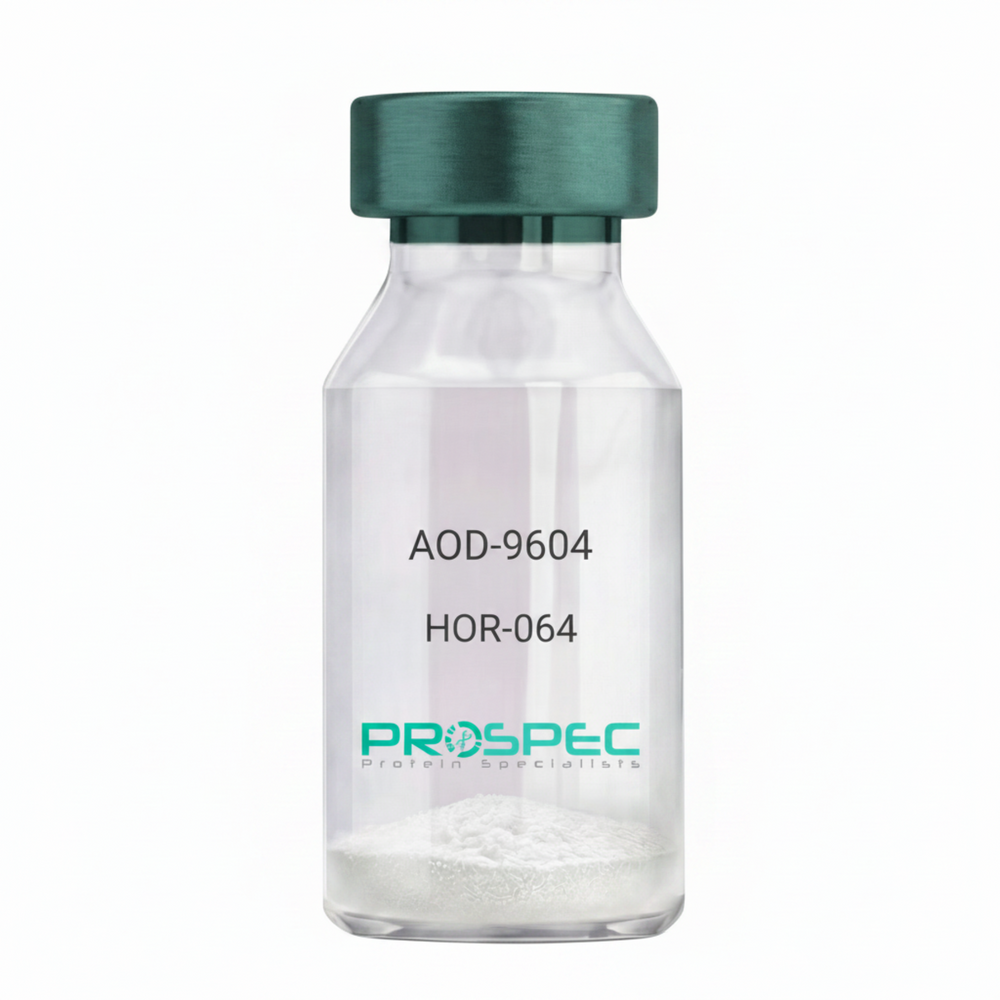
    AOD-9604

    Description:

    AOD-9604

    Product # :

    HOR-064

    Price :

    Quantity :

    Shipping Method :

    Room Temp Icon

    Shipped at Room temp

    Add To Cart

    More Info

    • description
    • formulation
    • purity
    • More Info

    Description

    AOD-9604 is a synthetic single, non-glycosylated polypeptide chain containing 16 amino acids, having a molecular mass of 1815 Dalton and a Molecular formula of C78H123N23O23 S2.

    Formulation

    The protein was lyophilized with no additives.

    Purity

    Greater than 97.0% as determined by analysis by RP-HPLC.

    More Info

    • Physical Appearance

      Sterile Filtered White lyophilized (freeze-dried) powder.

    • Stability

      Lyophilized AOD-9604 although stable at room temperature for 3 weeks, should be stored desiccated below -18°C. Upon reconstitution AOD-9604 should be stored at 4°C between 2-7 days and for future use below -18°C.
      For long term storage it is recommended to add a carrier protein (0.1% HSA or BSA).
      Please prevent freeze-thaw cycles.

    • Solubility

      It is recommended to reconstitute the lyophilized AOD-9604 in sterile 18MΩ-cm H2O not less than 100 µg/ml, which can then be further diluted to other aqueous solutions.

    • Amino Acid Sequence

      H-Tyr-Leu-Arg-Ile-Val-Gln-Cys-Arg-SerVal-Glu-Gly-Ser-Cys-Gly-Phe-OH (Disulfide bond).

    • Background

      AOD-9604 is a synthetic analog of the C-terminal fragment (177–191) AOD-9604 stimulates lipolysis (fat breakdown) without the unwanted growth-promoting or insulin-antagonizing effects of full-length hGH. AOD-9604 is a potent lipolytic tool in animal models and researchers focus on its regenerative properties in joint health and its ability to modulate beta3 adrenergic receptors without the systemic risks of growth hormone.

    ProSpec's products are furnished for LABORATORY RESEARCH USE ONLY. The product may not be used as drugs, agricultural or pesticidal products, food additives or household chemicals.

    AOD-9604
  • View Data Sheet

    Name :

    DBH Human

    Description:

    DBH Human Recombinant

    EC 1.14.17.1, DBM, DBH.

    Product # :

    ENZ-891

    Price :

    Quantity :

    Shipping Method :

    Ice Icon

    Shipped with Ice Packs

    Add To Cart

    More Info

    • description
    • source
    • formulation
    • purity
    • More Info

    Description

    DBH Human Recombinant produced in E.Coli is a single, non-glycosylated polypeptide chain containing 599 amino acids (40-617 a.a) and having a molecular mass of 67.2kDa.DBH is fused to a 21 amino acid His-tag at N-terminus & purified by proprietary chromatographic techniques.

    Source

    Escherichia Coli.

    Formulation

    DBH protein solution (0.25mg/ml) containing Phosphate buffered saline (pH7.4), 10% glycerol and 1mM DTT.

    Purity

    Greater than 85.0% as determined by SDS-PAGE.

    More Info

    • Introduction

      DBH catalyzes the chemical reaction. DBH is an oxidoreductase which belongs to the copper type II, ascorbate-dependent monooxygenase family, in particular those performing on paired donors, with O2 as oxidant and incorporation or reduction of oxygen. The oxygen incorporated can not be derived from O2 with reduced ascorbate as one donor, as well as incorporation of one ato of oxygen into the other donor.

    • Synonyms

      EC 1.14.17.1, DBM, DBH.

    • Physical Appearance

      Sterile Filtered colorless solution.

    • Stability

      Store at 4°C if entire vial will be used within 2-4 weeks. Store, frozen at -20°C for longer periods of time. For long term storage it is recommended to add a carrier protein (0.1% HSA or BSA).Avoid multiple freeze-thaw cycles.

    • Amino Acid Sequence

      MGSSHHHHHH SSGLVPRGSH MSAPRESPLP YHIPLDPEGS LELSWNVSYT QEAIHFQLLV RRLKAGVLFG MSDRGELENA DLVVLWTDGD TAYFADAWSD QKGQIHLDPQ QDYQLLQVQR TPEGLTLLFK RPFGTCDPKD YLIEDGTVHL VYGILEEPFR SLEAINGSGL QMGLQRVQLL KPNIPEPELP SDACTMEVQA PNIQIPSQET TYWCYIKELP KGFSRHHIIK YEPIVTKGNE ALVHHMEVFQ CAPEMDSVPH FSGPCDSKMK PDRLNYCRHV LAAWALGAKA FYYPEEAGLA FGGPGSSRYL RLEVHYHNPL VIEGRNDSSG IRLYYTAKLR RFNAGIMELG LVYTPVMAIP PRETAFILTG YCTDKCTQLA LPPSGIHIFA SQLHTHLTGR KVVTVLVRDG REWEIVNQDN HYSPHFQEIR MLKKVVSVHP GDVLITSCTY NTEDRELATV GGFGILEEMC VNYVHYYPQT QLELCKSAVD AGFLQKYFHL INRFNNEDVC TCPQASVSQQ FTSVPWNSFN RDVLKALYSF APISMHCNKS SAVRFQGEWN LQPLPKVIST LEEPTPQCPT SQGRSPAGPT VVSIGGGKG

    ProSpec's products are furnished for LABORATORY RESEARCH USE ONLY. The product may not be used as drugs, agricultural or pesticidal products, food additives or household chemicals.

    Dbh Human
  • View Data Sheet

    Name :

    DCN Human

    Description:

    Decorin Human Recombinant

    Decorin, Bone proteoglycan II, PG-S2, PG40, DCN, SLRR1B, CSCD, PGII, PGS2, DSPG2.

    Product # :

    PRO-1583

    Price :

    Quantity :

    Shipping Method :

    Ice Icon

    Shipped with Ice Packs

    Add To Cart

    More Info

    • description
    • source
    • formulation
    • purity
    • More Info

    Description

    DCN Human Recombinant produced in E.Coli is a single, non-glycosylated polypeptide chain containing 350 amino acids (31-359 a.a) and having a molecular mass of 38.6kDa.DCN is fused to a 21 amino acid His-tag at N-terminus & purified by proprietary chromatographic techniques.

    Source

    Escherichia Coli.

    Formulation

    DCN protein solution (0.25mg/ml) containing 20mM Tris pH 8.0 and 10% glycerol.

    Purity

    Greater than 80% as determined by SDS-PAGE.

    More Info

    • Introduction

      Decorin (DCN) is a small cellular or pericellular matrix proteoglycan which is closely related in structure to biglycan protein. Decorin is a secreted protein which binds to collagen and fibronectin in extracellular matrix. Decorin appears in different glycoforms, substituted with chondroitin sulfate or dermatan sulfate consistent with the original tissue. DCN contains one attached glycosaminoglycan chain. Decorin influences the rate of fibril formation. Decorin is capable of suppressing the growth of various tumor cell lines. DCN gene defects cause corneal dystrophy. The DCN gene is a candidate gene for Marfan syndrome.

    • Synonyms

      Decorin, Bone proteoglycan II, PG-S2, PG40, DCN, SLRR1B, CSCD, PGII, PGS2, DSPG2.

    • Physical Appearance

      Sterile filtered colorless solution.

    • Stability

      Store at 4°C if entire vial will be used within 2-4 weeks. Store, frozen at -20°C for longer periods of time. For long term storage it is recommended to add a carrier protein (0.1% HSA or BSA).Avoid multiple freeze-thaw cycles.

    • Amino Acid Sequence

      MGSSHHHHHH SSGLVPRGSH MDEASGIGPE VPDDRDFEPS LGPVCPFRCQ CHLRVVQCSDLGLDKVPKDL PPDTTLLDLQ NNKITEIKDG DFKNLKNLHA LILVNNKISK VSPGAFTPLVKLERLYLSKN QLKELPEKMP KTLQELRAHE NEITKVRKVT FNGLNQMIVI ELGTNPLKSS GIENGAFQGM KKLSYIRIAD TNITSIPQGL PPSLTELHLD GNKISRVDAA SLKGLNNLAKLGLSFNSISA VDNGSLANTP HLRELHLDNN KLTRVPGGLA EHKYIQVVYL HNNNISVVGSSDFCPPGHNT KKASYSGVSL FSNPVQYWEI QPSTFRCVYV RSAIQLGNYK.

    ProSpec's products are furnished for LABORATORY RESEARCH USE ONLY. The product may not be used as drugs, agricultural or pesticidal products, food additives or household chemicals.

    Dcn Human
  • View Data Sheet

    Name :

    DRG1 Human

    Description:

    Developmentally Regulated GTP Binding Protein 1 Human Recombinant

    Developmentally-regulated GTP-binding protein 1, DRG-1, Neural precursor cell expressed developmentally down-regulated protein 3, NEDD-3, DRG1, NEDD3.

    Product # :

    PRO-885

    Price :

    Quantity :

    Shipping Method :

    Ice Icon

    Shipped with Ice Packs

    Add To Cart

    More Info

    • description
    • source
    • formulation
    • purity
    • More Info

    Description

    DRG1 Human Recombinant produced in E.Coli is a single, non-glycosylated polypeptide chain containing 387 amino acids (1-367 a.a.) and having a molecular mass of 42.7kDa.DRG1 is fused to a 20 amino acid His-tag at N-terminus & purified by proprietary chromatographic techniques.

    Source

    Escherichia Coli.

    Formulation

    DRG1 protein solution (0.5mg/ml) containing 20mM Tris-HCl buffer (pH 8.0), 1mM DTT, 30% glycerol and 1mM EDTA.

    Purity

    Greater than 85.0% as determined by SDS-PAGE.

    More Info

    • Introduction

      Developmentally-regulated GTP-binding protein 1 (DRG1) is a member of the GTP1/OBG family. DRG1 has a role in cell proliferation and differentiation, as well as in apoptosis, proposing a role in tumor formation and metastasis. Expression of the DRG1 was considerably reduced in breast tumor cells, particularly in patients with lymph node or bone metastasis as compared to those with localized breast cancer. The DRG1 protein is expressed at high levels in the heart, kidney and skeletal muscle and at lower levels in the brain, liver, placenta, lung, colon and spleen.

    • Synonyms

      Developmentally-regulated GTP-binding protein 1, DRG-1, Neural precursor cell expressed developmentally down-regulated protein 3, NEDD-3, DRG1, NEDD3.

    • Physical Appearance

      Sterile Filtered clear solution.

    • Stability

      Store at 4°C if entire vial will be used within 2-4 weeks. Store, frozen at -20°C for longer periods of time. For long term storage it is recommended to add a carrier protein (0.1% HSA or BSA).Avoid multiple freeze-thaw cycles.

    • Amino Acid Sequence

      MGSSHHHHHH SSGLVPRGSH MSSTLAKIAE IEAEMARTQK NKATAHHLGL LKARLAKLRR ELITPKGGGG GGPGEGFDVA KTGDARIGFV GFPSVGKSTL LSNLAGVYSE VAAYEFTTLT TVPGVIRYKG AKIQLLDLPG IIEGAKDGKG RGRQVIAVAR TCNLILIVLD VLKPLGHKKI IENELEGFGI RLNSKPPNIG FKKKDKGGIN LTATCPQSEL DAETVKSILA EYKIHNADVT LRSDATADDL IDVVEGNRVY IPCIYVLNKI DQISIEELDI IYKVPHCVPI SAHHRWNFDD LLEKIWDYLK LVRIYTKPKG QLPDYTSPVV LPYSRTTVED FCMKIHKNLI KEFKYALVWG LSVKHNPQKV GKDHTLEDED VIQIVKK.

    ProSpec's products are furnished for LABORATORY RESEARCH USE ONLY. The product may not be used as drugs, agricultural or pesticidal products, food additives or household chemicals.

    Drg1 Human
  • View Data Sheet

    Name :

    TFF3 Rat

    Description:

    Trefoil Factor-3 Rat Recombinant

    Trefoil factor 3, Intestinal trefoil factor, rITF, Polypeptide P1.B, rP1.B, Tff3, Itf.

    Product # :

    CYT-781

    Price :

    Quantity :

    Shipping Method :

    Room Temp Icon

    Shipped at Room temp

    Add To Cart

    More Info

    • description
    • source
    • formulation
    • purity
    • More Info

    Description

    The Trefoil Factor-3 Rat was constructed as a recombinant protein with a 9 a.a C-terminal fusion of Flag-Tag (1 aa N-terminal+8 aa C-terminal). The TFF3 Rat produced in E.coli, is 7.7kDa protein containing a total of 68 amino acid residues.

    Source

    Escherichia Coli.

    Formulation

    TFF3 protein filtered (0.4µm) and lyophilized in 0.5mg/ml in 20mM TRIS and 50mM NaCl, pH 7.5.

    Purity

    Greater than 95.0% as determined by SDS-PAGE.

    More Info

    • Introduction

      Proteins of the TFF family are characterized by obtaining a minimum of 1 copy of the trefoil motif, a 40-amino acid domain that contains 3 conserved disulfides. Trefoil Factors are stable secretory proteins expressed in gastrointestinal mucosa which protect the mucosa from insults, stabilize the mucus layer and affect healing of the epithelium.TFF2 inhibits gastric acid motility & secretion. TFF2 stabilizes glycoproteins in the mucus gel through interactions with carbohydrate side chains. TFF3 induces ciliogenesis and promotes airway epithelial ciliated cell differentiation, relatively through an epidermal growth factor receptor-dependent pathway. TFF3 overexpression is crucial for progression in mouse and human hepatocellular carcinogenesis. TFF-3 is normally expressed in hepatocellular carcinoma and its expression associates with tumor grade.

    • Synonyms

      Trefoil factor 3, Intestinal trefoil factor, rITF, Polypeptide P1.B, rP1.B, Tff3, Itf.

    • Physical Appearance

      Filtered White lyophilized (freeze-dried) powder.

    • Stability

      Store lyophilized protein at -20°C. Aliquot the product after reconstitution to avoid repeated freezing/thawing cycles. Reconstituted protein can be stored at 4°C for a limited period of time; it does not show any change after two weeks at 4°C.

    • Solubility

      It is recommended to add deionized water to prepare a working stock solution of approximately 0.5 mg/ml and let the lyophilized pellet dissolve completely. Product is not sterile! Please filter the product by an appropriate sterile filter before using it in the cell culture.

    • Amino Acid Sequence

      MQEFVGLSPS QCMVPANVRV DCGYPTVTSE QCNNRGCCFD SSIPNVPWCF KPLQETECT F DYKDDDDK.

    ProSpec's products are furnished for LABORATORY RESEARCH USE ONLY. The product may not be used as drugs, agricultural or pesticidal products, food additives or household chemicals.

    Tff3 Rat
  • View Data Sheet

    Name :

    LGMN Mouse

    Description:

    Legumain Mouse Recombinant

    Legumain, Asparaginyl endopeptidase, Protease, cysteine 1.

    Product # :

    ENZ-933

    Price :

    Quantity :

    Shipping Method :

    Ice Icon

    Shipped with Ice Packs

    Add To Cart

    More Info

    • description
    • source
    • formulation
    • purity
    • More Info
    • sds-page

    Description

    LGMN produced in Sf9 Baculovirus cells is a single, glycosylated polypeptide chain containing 426 amino acids (18-435a.a.) and having a molecular mass of 48.6kDa. LGMN is expressed with an 8 amino acid His tag at C-Terminus and purified by proprietary chromatographic techniques.

    Source

    Sf9, Baculovirus cells.

    Formulation

    LGMN protein solution (0.5mg/ml) contains Phosphate Buffered Saline (pH 7.4) and 10% glycerol.

    Purity

    Greater than 90.0% as determined by SDS-PAGE.

    sds-page

    LGMN Mouse sds-page - Product image 1

    More Info

    • Introduction

      Legumain, also known as LGMN is a lysosomal cysteine protease which is found in all mouse tissues, however it was mainly abundant in the kidney as well as placenta. LGMN plays an essential role in the endosomal/lysosomal degradation system as the Legumain deficiency causes the accumulation of pro cathepsins B, H & L, another group of lysosomal cysteine proteases. Furthermore, over expression of LGMN in tumors is important for invasion/metastasis.

    • Synonyms

      Legumain, Asparaginyl endopeptidase, Protease, cysteine 1.

    • Physical Appearance

      Sterile filtered colorless solution.

    • Stability

      Store at 4°C if entire vial will be used within 2-4 weeks.Store, frozen at -20°C for longer periods of time. For long term storage it is recommended to add a carrier protein (0.1% HSA or BSA).Avoid multiple freeze-thaw cycles.

    • Amino Acid Sequence

      VPVGVDDPED GGKHWVVIVA GSNGWYNYRH QADACHAYQI IHRNGIPDEQ IIVMMYDDIA NSEENPTPGV VINRPNGTDV YKGVLKDYTG EDVTPENFLA VLRGDAEAVK GKGSGKVLKS GPRDHVFIYF TDHGATGILV FPNDDLHVKD LNKTIRYMYE HKMYQKMVFY IEACESGSMM NHLPDDINVY ATTAANPKES SYACYYDEER GTYLGDWYSV NWMEDSDVED LTKETLHKQY HLVKSHTNTS HVMQYGNKSI STMKVMQFQG MKHRASSPIS LPPVTHLDLT PSPDVPLTIL KRKLLRTNDV KESQNLIGQI QQFLDARHVI EKSVHKIVSL LAGFGETAER HLSERTMLTA HDCYQEAVTH FRTHCFNWHS VTYEHALRYL YVLANLCEAP YPIDRIEMAM DKVCLSHYLE HHHHHH.

    ProSpec's products are furnished for LABORATORY RESEARCH USE ONLY. The product may not be used as drugs, agricultural or pesticidal products, food additives or household chemicals.

    Lgmn Mouse
  • View Data Sheet

    Name :

    METRN Mouse

    Description:

    Meteorin Mouse Recombinant

    Meteorin, Hypoxia/reoxygenation regulatory factor, Metrn, 1810034B16Rik, Hyrac.

    Product # :

    PRO-2241

    Price :

    Quantity :

    Shipping Method :

    Ice Icon

    Shipped with Ice Packs

    Add To Cart

    More Info

    • description
    • source
    • formulation
    • purity
    • More Info

    Description

    METRN produced in Sf9 Baculovirus cells is a single, glycosylated polypeptide chain containing 276 amino acids (22-291 a.a.) and having a molecular mass of 30.2kDa (Migrates at 28-40kDa on SDS-PAGE under reducing conditions). METRN is expressed with a 6 amino acid His tag at C-Terminus and purified by proprietary chromatographic techniques.

    Source

    Sf9, Baculovirus cells.

    Formulation

    METRN protein solution (0.25mg/ml) contains Phosphate Buffered Saline (pH 7.4) and 10% glycerol.

    Purity

    Greater than 90.0% as determined by SDS-PAGE.

    More Info

    • Introduction

      Meteorin (METRN) is involved in both glial cell differentiation and axonal network formation during neurogenesis. METRN promotes astrocyte differentiation and transforms cerebellar astrocytes into radial glia. Moreover, the METRN protein stimulates axonal extension in small and intermediate neurons of sensory ganglia by activating nearby satellite glia.

    • Synonyms

      Meteorin, Hypoxia/reoxygenation regulatory factor, Metrn, 1810034B16Rik, Hyrac.

    • Physical Appearance

      Sterile Filtered colorless solution.

    • Stability

      Store at 4°C if entire vial will be used within 2-4 weeks. Store, frozen at -20°C for longer periods of time. For long term storage it is recommended to add a carrier protein (0.1% HSA or BSA). Avoid multiple freeze-thaw cycles.

    • Amino Acid Sequence

      GYSEDRCSWR GSGLTQEPGS VGQLTLDCTE GAIEWLYPAG ALRLTLGGPD PGTRPSIVCL RPERPFAGAQ VFAERMTGNL ELLLAEGPDL AGGRCMRWGP RERRALFLQA TPHRDISRRV AAFRFELHED QRAEMSPQAQ GLGVDGACRP CSDAELLLAA CTSDFVIHGT IHGVAHDTEL QESVITVVVA RVIRQTLPLF KEGSSEGQGR ASIRTLLRCG VRPGPGSFLF MGWSRFGEAW LGCAPRFQEF SRVYSAALTT HLNPCEMALD HHHHHH.

    ProSpec's products are furnished for LABORATORY RESEARCH USE ONLY. The product may not be used as drugs, agricultural or pesticidal products, food additives or household chemicals.

    Metrn Mouse
  • View Data Sheet

    Name :

    PTPN7 Human

    Description:

    Protein Tyrosine Phosphatase Non Receptor Type-7 Human Recombinant

    Protein tyrosine phosphatase non-receptor type 7, HEPTP, LC-PTP, Hematopoietic protein-tyrosine phosphatase, Protein-tyrosine phosphatase LC-PTP, PTPNI, LPTP, BPTP-4, dual specificity phosphatase 1, protein-tyrosine phosphatase non-receptor-type, stress induced, EC 3.1.3.48.

    Product # :

    PKA-025

    Price :

    Quantity :

    Shipping Method :

    Ice Icon

    Shipped with Ice Packs

    Add To Cart

    More Info

    • description
    • source
    • formulation
    • purity
    • More Info

    Description

    PTPN7 Human Recombinant produced in E. coli is a single polypeptide chain containing 384 amino acids (1-360) and having a molecular mass of 43.1kDa.PTPN7 is fused to a 24 amino acid His-tag at N-terminus & purified by proprietary chromatographic techniques.

    Source

    E.coli.

    Formulation

    The PTPN7 solution (0.5mg/ml) contains 20mM Tris-HCl buffer (pH 8.0), 100mM NaCl, 1mM DTT and 20% glycerol.

    Purity

    Greater than 90% as determined by SDS-PAGE.

    More Info

    • Introduction

      PTPN7 performs specifically on tyrosine-phosphorylated MAPK1. PTPN7 takes part in the regulation of signal transduction and T and B-lymphocyte development.

    • Synonyms

      Protein tyrosine phosphatase non-receptor type 7, HEPTP, LC-PTP, Hematopoietic protein-tyrosine phosphatase, Protein-tyrosine phosphatase LC-PTP, PTPNI, LPTP, BPTP-4, dual specificity phosphatase 1, protein-tyrosine phosphatase non-receptor-type, stress induced, EC 3.1.3.48.

    • Physical Appearance

      Sterile Filtered colorless solution.

    • Stability

      Store at 4°C if entire vial will be used within 2-4 weeks. Store, frozen at -20°C for longer periods of time. For long term storage it is recommended to add a carrier protein (0.1% HSA or BSA).Avoid multiple freeze-thaw cycles.

    • Amino Acid Sequence

      MGSSHHHHHH SSGLVPRGSH MGSHMVQAHG GRSRAQPLTL SLGAAMTQPP PEKTPAKKHV RLQERRGSNV ALMLDVRSLG AVEPICSVNT PREVTLHFLR TAGHPLTRWA LQRQPPSPKQ LEEEFLKIPS NFVSPEDLDI PGHASKDRYK TILPNPQSRV CLGRAQSQED GDYINANYIR GYDGKEKVYI ATQGPMPNTV SDFWEMVWQE EVSLIVMLTQ LREGKEKCVH YWPTEEETYG PFQIRIQDMK ECPEYTVRQL TIQYQEERRS VKHILFSAWP DHQTPESAGP LLRLVAEVEE SPETAAHPGP IVVHCSAGIG RTGCFIATRI GCQQLKARGE VDILGIVCQL RLDRGGMIQT AEQYQFLHHT LALYAGQLPE EPSP

    ProSpec's products are furnished for LABORATORY RESEARCH USE ONLY. The product may not be used as drugs, agricultural or pesticidal products, food additives or household chemicals.

    Ptpn7 Human
  • View Data Sheet

    Name :

    S100A4 Human

    Description:

    S100 Calcium-Binding Protein A4 Human Recombinant

    Protein S100-A4, S100 calcium-binding protein A4, Metastasin, Protein Mts1, Placental calcium-binding protein, Calvasculin, S100A4, CAPL, MTS1, 42A, 18A2, FSP1, P9KA, PEL98.

    Product # :

    PRO-698

    Price :

    Quantity :

    Shipping Method :

    Ice Icon

    Shipped with Ice Packs

    Add To Cart

    More Info

    • description
    • source
    • formulation
    • purity
    • More Info

    Description

    S100A4 Human Recombinant produced in E.coli is a single, non-glycosylated polypeptide chain containing 121 amino acids (1-101) and having a molecular mass of 13.8 kDa.The S100A4 is fused to a 20 amino acid His-Tag at N-terminus and purified by proprietary chromatographic techniques.

    Source

    Escherichia Coli.

    Formulation

    S100A4 protein at in 20mM Tris-HCl, pH-8 & 10% Glycerol.

    Purity

    Greater than 95.0% as determined by SDS-PAGE.

    More Info

    • Introduction

      S100A4 is part of the S100 super-family of proteins containing 2 EF-hand calcium binding domains. S100A4 is ubiquitously overexpressed and is localized in the cytoplasm and/or nucleus. S100A4 is involved in motility, invasion, and tubulin polymerization. Chromosomal rearrangements and altered expression of the S100A4 gene have been implicated in tumor metastasis.

    • Synonyms

      Protein S100-A4, S100 calcium-binding protein A4, Metastasin, Protein Mts1, Placental calcium-binding protein, Calvasculin, S100A4, CAPL, MTS1, 42A, 18A2, FSP1, P9KA, PEL98.

    • Physical Appearance

      Sterile Filtered clear solution.

    • Stability

      Store at 4°C if entire vial will be used within 2-4 weeks. Store, frozen at -20°C for longer periods of time. For long term storage it is recommended to add a carrier protein (0.1% HSA or BSA).Avoid multiple freeze-thaw cycles.

    • Amino Acid Sequence

      MGSSHHHHHH SSGLVPRGSH MACPLEKALD VMVSTFHKYS GKEGDKFKLN KSELKELLTR ELPSFLGKRT DEAAFQKLMS NLDSNRDNEVDFQEYCVFLS CIAMMCNEFF EGFPDKQPRK K.

    ProSpec's products are furnished for LABORATORY RESEARCH USE ONLY. The product may not be used as drugs, agricultural or pesticidal products, food additives or household chemicals.

    S100A4 Human His
  • View Data Sheet

    Name :

    S100A6 Human

    Description:

    S100 Calcium Binding Protein A6 Human Recombinant

    Protein S100-A6, Calcyclin, Growth factor-inducible protein 2A9, MLN 4, Prolactin receptor-associated protein, PRA, S100 calcium-binding protein A6, S100A6, CACY, 2A9, 5B10, CABP.

    Product # :

    PRO-148

    Price :

    Quantity :

    Shipping Method :

    Ice Icon

    Shipped with Ice Packs

    Add To Cart

    More Info

    • description
    • source
    • formulation
    • purity
    • More Info

    Description

    S100A6 Human Recombinant fused with a 20 amino acid His tag at N-terminus produced in E.Coli is a single, non-glycosylated, polypeptide chain containing 110 amino acids (1-90 a.a.) and having a molecular mass of 12.3kDa. The S100A6 is purified by proprietary chromatographic techniques.

    Source

    Escherichia Coli.

    Formulation

    The S100A6 solution (1 mg/ml) contains 20mM Tris-HCl buffer (pH8.0), 0.1M NaCl, 1mM DTT and 30% glycerol.

    Purity

    Greater than 95.0% as determined by SDS-PAGE.

    More Info

    • Introduction

      S100A6 is a member of the S100 family of proteins containing 2 EF-hand calcium-binding motifs. S100 proteins are localized either in the cytoplasm or the nucleus of a wide range of cells. S100 proteins are involved in the regulation of a number of cellular processes such as cell cycle progression and differentiation. There are at least 13 members in the S100 gene family, which are located as a cluster on chromosome 1q21. S100A6 function in stimulation of prolactin secretion and exocytosis. Chromosomal rearrangements and altered expression of the S100A6 gene are implicated in melanoma.

    • Synonyms

      Protein S100-A6, Calcyclin, Growth factor-inducible protein 2A9, MLN 4, Prolactin receptor-associated protein, PRA, S100 calcium-binding protein A6, S100A6, CACY, 2A9, 5B10, CABP.

    • Physical Appearance

      Sterile Filtered colorless solution.

    • Stability

      Store at 4°C if entire vial will be used within 2-4 weeks. Store, frozen at -20°C for longer periods of time. For long term storage it is recommended to add a carrier protein (0.1% HSA or BSA).Avoid multiple freeze-thaw cycles.

    • Amino Acid Sequence

      MGSSHHHHHH SSGLVPRGSH MACPLDQAIG LLVAIFHKYS GREGDKHTLS KKELKELIQK ELTIGSKLQD AEIARLMEDL DRNKDQEVNF QEYVTFLGAL ALIYNEALKG.

    ProSpec's products are furnished for LABORATORY RESEARCH USE ONLY. The product may not be used as drugs, agricultural or pesticidal products, food additives or household chemicals.

    S100A6 Human
  • View Data Sheet

    Name :

    SELE Human, HEK

    Description:

    E-Selectin Human Recombinant, HEK

    E-selectin, Endothelial leukocyte adhesion molecule 1, ELAM-1, Leukocyte-endothelial cell adhesion molecule 2, LECAM2, CD62E antigen, SELE, ELAM1, ELAM, ESEL, CD62E.

    Product # :

    PRO-1645

    Price :

    Quantity :

    Shipping Method :

    Room Temp Icon

    Shipped at Room temp

    Add To Cart

    More Info

    • description
    • source
    • formulation
    • purity
    • More Info

    Description

    SELE Human Recombinant produced by mammalian expression system in human cells is a single polypeptide chain containing 543 amino acids (22-556). SELE is fused to an 8 amino acid His-tag at C-terminus is purified by proprietary chromatographic techniques.

    Source

    HEK293 cells.

    Formulation

    SELE was lyophilized from a 0.2 µM filtered solution of PBS and 4% Mannitol, pH 7.5.

    Purity

    Greater than 95% as determined by SDS-PAGE.

    More Info

    • Introduction

      E-selectin which is also called Endothelial leukocyte adhesion molecule 1, ELAM1, ELAM belongs to a family of divalent cation-dependent carbohydrate-binding glycoproteins or adhesion molecules. Eselectin is expressed on the surface of endothelial cells and mediates the interaction of leukocytes and platelets with endothelial cells during an inflammatory response. E-selectin is present in single copy in the human genome and contains 14 exons spanning about 13 kb of DNA.

    • Synonyms

      E-selectin, Endothelial leukocyte adhesion molecule 1, ELAM-1, Leukocyte-endothelial cell adhesion molecule 2, LECAM2, CD62E antigen, SELE, ELAM1, ELAM, ESEL, CD62E.

    • Physical Appearance

      Sterile Filtered White lyophilized (freeze-dried) powder.

    • Stability

      Lyophilized SELE although stable at room temperature for 3 weeks, should be stored desiccated below -18°C. Upon reconstitution SELE should be stored at 4°C between 2-7 days and for future use below -18°C. Please prevent freeze-thaw cycles.

    • Solubility

      It is recommended to reconstitute the lyophilized SELE in 1xPBS to a concentration no less than 100 µg/ml, which can then be further diluted to other aqueous solutions.

    • Amino Acid Sequence

      WSYNTSTEAMTYDEASAYCQQRYTHLVAIQNKEEIEYLNSILSYSPSYYWIGIRKVNNVW
      VWVGTQKPLTEEAKNWAPGEPNNRQKDEDCVEIYIKREKDVGMWNDERCSKKKLALCYTA
      ACTNTSCSGHGECVETINNYTCKCDPGFSGLKCEQIVNCTALESPEHGSLVCSHPLGNFSY
      NSSCSISCDRGYLPSSMETMQCMSSGEWSAPIPACNVVECDAVTNPANGFVECFQNPGSFPW
      NTTCTFDCEEGFELMGAQSLQCTSSGNWDNEKPTCKAVTCRAVRQPQNGSVRCSHSPAGEFT
      FKSSCNFTCEEGFMLQGPAQVECTTQGQWTQQIPVCEAFQCTALSNPERGYMNCLPSASGSFR
      YGSSCEFSCEQGFVLKGSKRLQCGPTGEWDNEKPTCEAVRCDAVHQPPKGLVRCAHSPIGEFTY
      KSSCAFSCEEGFELHGSTQLECTSQGQWTEEVPSCQVVKCSSLAVPGKINMSCSGEPVFGTVCKF
      ACPEGWTLNGSAARTCGATGHWSGLLPTCEAPTESNIPVDHHHHHH.

    ProSpec's products are furnished for LABORATORY RESEARCH USE ONLY. The product may not be used as drugs, agricultural or pesticidal products, food additives or household chemicals.

    Sele Human Hek
  • View Data Sheet

    Name :

    SELE Human, Sf9

    Description:

    E-Selectin Human Recombinant, Sf9

    E-selectin, Endothelial leukocyte adhesion molecule 1, ELAM-1, Leukocyte-endothelial cell adhesion molecule 2, LECAM2, CD62E antigen, SELE, ELAM1, ELAM, ESEL, CD62E

    Product # :

    PRO-2712

    Price :

    Quantity :

    Shipping Method :

    Ice Icon

    Shipped with Ice Packs

    Add To Cart

    More Info

    • description
    • source
    • formulation
    • purity
    • biological activity
    • More Info

    Description

    SELE Human Recombinant produced in Sf9 Baculovirus cells is a single, glycosylated polypeptide chain containing 541 amino acids (22-556 a.a) and having a molecular mass of 59.4kDa.SELE is fused to a 6 amino acid His-tag at C-terminus & purified by proprietary chromatographic techniques.

    Source

    Sf9, Baculovirus cells.

    Formulation

    The SELE solution (0.5mg/1ml) contains Phosphate-Buffered Saline (pH 7.4) and 10% glycerol.

    Purity

    Greater than 95.0% as determined by SDS-PAGE.

    Biological Activity

    Measured by the ability of the immobilized protein to support the adhesion of U937 human histiocytic lymphoma cells, which are added to human E-Seletin/CD62E coated plates 2ug/ml.  This effect is > 40%.

    More Info

    • Introduction

      E-selectin (SELE) is a part of a family of divalent cation-dependent carbohydrate-binding glycoproteins or adhesion molecules. E-selectin is expressed on the surface of endothelial cells and mediates the interaction of leukocytes and platelets with endothelial cells during an inflammatory response. E-selectin is present in single copy in the human genome and contains 14 exons spanning about 13 kb of DNA.

    • Synonyms

      E-selectin, Endothelial leukocyte adhesion molecule 1, ELAM-1, Leukocyte-endothelial cell adhesion molecule 2, LECAM2, CD62E antigen, SELE, ELAM1, ELAM, ESEL, CD62E

    • Physical Appearance

      Sterile filtered colorless solution.

    • Stability

      Store at 4°C if entire vial will be used within 2-4 weeks.Store, frozen at -20°C for longer periods of time.For long term storage it is recommended to add a carrier protein (0.1% HSA or BSA).Avoid multiple freeze-thaw cycles.

    • Amino Acid Sequence

      WSYNTSTEAM TYDEASAYCQ QRYTHLVAIQ NKEEIEYLNS ILSYSPSYYW IGIRKVNNVW VWVGTQKPLT EEAKNWAPGE PNNRQKDEDC VEIYIKREKD VGMWNDERCS KKKLALCYTA ACTNTSCSGH GECVETINNY TCKCDPGFSG LKCEQIVNCT ALESPEHGSL VCSHPLGNFS YNSSCSISCD RGYLPSSMET MQCMSSGEWS APIPACNVVE CDAVTNPANG FVECFQNPGS FPWNTTCTFD CEEGFELMGA QSLQCTSSGN WDNEKPTCKA VTCRAVRQPQ NGSVRCSHSP AGEFTFKSSC NFTCEEGFML QGPAQVECTT QGQWTQQIPV CEAFQCTALS NPERGYMNCL PSASGSFRYG SSCEFSCEQG FVLKGSKRLQ CGPTGEWDNE KPTCEAVRCD AVHQPPKGLV RCAHSPIGEF TYKSSCAFSC EEGFELHGST QLECTSQGQW TEEVPSCQVV KCSSLAVPGK INMSCSGEPV FGTVCKFACP EGWTLNGSAA RTCGATGHWS GLLPTCEAPT ESNIPHHHHH H

    ProSpec's products are furnished for LABORATORY RESEARCH USE ONLY. The product may not be used as drugs, agricultural or pesticidal products, food additives or household chemicals.

    E Selectin Protein
  • View Data Sheet

    Name :

    ANXA3 Human

    Description:

    Annexin A3 Human Recombinant

    ANX3, ANXA3, Annexin-III, Lipocortin-3, Lipocortin-III, Annexin-3, Annexin A3, Placental anticoagulant protein III, PAP-III, 35-alpha calcimedin, Inositol 1,2-cyclic phosphate 2-phosphohydrolase.

    Product # :

    PRO-765

    Price :

    Quantity :

    Shipping Method :

    Ice Icon

    Shipped with Ice Packs

    Add To Cart

    More Info

    • description
    • source
    • formulation
    • purity
    • More Info

    Description

    ANXA3 produced in E.Coli is a single, non-glycosylated polypeptide chain containing 323 amino acids (1-323 a.a.) and having a molecular mass of 36.3 kDa. ANXA3 is purified by proprietary chromatographic techniques.

    Source

    Escherichia Coli.

    Formulation

    The ANXA3 protein solution contains 20mM Tris-HCl, pH-7.5, 1mM DTT and 10% glycerol.

    Purity

    Greater than 90% as determined by SDS-PAGE.

    More Info

    • Introduction

      ANXA3 is an inhibitor of phospholipase A2. ANXA3 possesses anti-coagulant properties. ANXA3 cleaves the cyclic bond of inositol 1,2-cyclic phosphate to form inositol 1-phosphate. ANXA3 is part of the annexin family which are members of the calcium-dependent phospholipid-binding protein family that are involved in the regulation of cellular growth and in signal transduction pathways. ANXA3 takes part as an anti-coagulation factor.

    • Synonyms

      ANX3, ANXA3, Annexin-III, Lipocortin-3, Lipocortin-III, Annexin-3, Annexin A3, Placental anticoagulant protein III, PAP-III, 35-alpha calcimedin, Inositol 1,2-cyclic phosphate 2-phosphohydrolase.

    • Physical Appearance

      Sterile filtered colorless solution.

    • Stability

      Store at 4°C if entire vial will be used within 2-4 weeks. Store, frozen at -20°C for longer periods of time. For long term storage it is recommended to add a carrier protein (0.1% HSA or BSA). Avoid multiple freeze-thaw cycles.

    • Amino Acid Sequence

      MASIWVGHRG TVRDYPDFSP SVDAEAIQKA IRGIGTDEKM LISILTERSN AQRQLIVKEY QAAYGKELKD DLKGDLSGHF EHLMVALVTP PAVFDAKQLK KSMKGAGTNE DALIEILTTR TSRQMKDISQ AYYTVYKKSL GDDISSETSG DFRKALLTLA DGRRDESLKV DEHLAKQDAQ ILYKAGENRW GTDEDKFTEI LCLRSFPQLK LTFDEYRNIS QKDIVDSIKG ELSGHFEDLL LAIVNCVRNT PAFLAERLHR ALKGIGTDEF TLNRIMVSRS EIDLLDIRTE FKKHYGYSLY SAIKSDTSGD YEITLLKICG GDD.

    ProSpec's products are furnished for LABORATORY RESEARCH USE ONLY. The product may not be used as drugs, agricultural or pesticidal products, food additives or household chemicals.

    Anxa3 Human
  • View Data Sheet

    Name :

    ASPRV1 Human

    Description:

    Aspartic Peptidase, Retroviral-Like 1 Human Recombinant

    Retroviral-like aspartic protease 1, Skin-specific retroviral-like aspartic protease, SASPase, Skin aspartic protease, TPA-inducible aspartic proteinase-like protein, TAPS, ASPRV1, SASP, MUNO.

    Product # :

    ENZ-659

    Price :

    Quantity :

    Shipping Method :

    Ice Icon

    Shipped with Ice Packs

    Add To Cart

    More Info

    • description
    • source
    • formulation
    • purity
    • More Info

    Description

    ASPRV1 Human Recombinant produced in E.coli is a single, non-glycosylated polypeptide chain containing 159 amino acids (191-326) and having a molecular mass of 17.2kDa.ASPRV1 is fused to a 23 amino acid His-tag at N-terminus & purified by proprietary chromatographic techniques.

    Source

    Escherichia Coli.

    Formulation

    The ASPRV1 solution (0.25mg/ml) contains 20mM Tris-HCl buffer (pH 8.0), 0.15M NaCl, 10% glycerol and 1mM DTT.

    Purity

    Greater than 90.0% as determined by SDS-PAGE.

    More Info

    • Introduction

      Aspartic Peptidase, Retroviral-Like 1 (ASPRV1) is a protein which contains one peptidase A2 domain. ASPRV1 undergoes autocleavage which is essential for activation of the protein. ASPRV1 is expressed mostly in the granular layer of the epidermis and inner root sheath of hair follicles and localized to membrane region. In the psoriatic skin, ASPRV1 is expressed throughout the stratum corneum. In the ulcerated skin, ASPRV1 is expressed in the stratum granulosum of intact epidermis; however it is virtually nonexistent from ulcerated regions. In addition, ASPRV1 is expressed in differentiated areas of squamous cell carcinomas but not in the undifferentiated tumors.

    • Synonyms

      Retroviral-like aspartic protease 1, Skin-specific retroviral-like aspartic protease, SASPase, Skin aspartic protease, TPA-inducible aspartic proteinase-like protein, TAPS, ASPRV1, SASP, MUNO.

    • Physical Appearance

      Sterile filtered colorless solution.

    • Stability

      Store at 4°C if entire vial will be used within 2-4 weeks. Store, frozen at -20°C for longer periods of time. For long term storage it is recommended to add a carrier protein (0.1% HSA or BSA).Avoid multiple freeze-thaw cycles.

    • Amino Acid Sequence

      MGSSHHHHHH SSGLVPRGSH MGSSMGKGYY LKGKIGKVPV RFLVDSGAQV SVVHPNLWEE VTDGDLDTLQ PFENVVKVAN GAEMKILGVW DTAVSLGKLK LKAQFLVANA SAEEAIIGTD VLQDHNAILD FEHRTCTLKG KKFRLLPVGG SLEDEFDLE.

    ProSpec's products are furnished for LABORATORY RESEARCH USE ONLY. The product may not be used as drugs, agricultural or pesticidal products, food additives or household chemicals.

    Asprv1 Human
  • View Data Sheet

    Name :

    EDAR Human

    Description:

    Ectodysplasin A Receptor Human Recombinant

    Ectodysplasin A Receptor, DL, Ectodysplasin 1, Anhidrotic Receptor, Anhidrotic Ectodysplasin Receptor 1, Ectodermal Dysplasia Receptor, Ectodysplasin-A Receptor, Downless Homolog, EDA-A1 Receptor, ECTD10A, ECTD10B, EDA3, HRM1, ED3, Tumor Necrosis Factor Receptor Superfamily Member EDAR, Downless, Mouse, Homolog Of, EDA-A1R, EDA1R, ED1R, ED5, Tumor necrosis factor receptor superfamily member EDAR.

    Product # :

    PRO-2092

    Price :

    Quantity :

    Shipping Method :

    Ice Icon

    Shipped with Ice Packs

    Add To Cart

    More Info

    • description
    • source
    • formulation
    • purity
    • More Info

    Description

    EDAR Human Recombinant produced in E.Coli is a single, non-glycosylated polypeptide chain containing 445 amino acids (27-448 a.a) and having a molecular mass of 48.2kDa. EDAR is fused to a 23 amino acid His-tag at N-terminus & purified by proprietary chromatographic techniques.

    Source

    Escherichia Coli.

    Formulation

    EDAR protein solution (0.25mg/ml) containing 20mM Tris-HCl (pH 8.0) and 10% glycerol.

    Purity

    Greater than 85.0% as determined by SDS-PAGE.

    More Info

    • Introduction

      Ectodysplasin A Receptor, also known as EDAR belongs to the tumor necrosis factor receptor family. EDAR is a receptor for the soluble ligand ectodysplasin A, and is capable of activating the nuclear factor-kappaB, JNK, as well as caspase-independent cell death pathways. EDAR is necessary for the development of hair, teeth, and other ectodermal derivatives. Furthermore, mutations in EDAR resulted in autosomal dominant and recessive forms of hypohidrotic ectodermal dysplasia.

    • Synonyms

      Ectodysplasin A Receptor, DL, Ectodysplasin 1, Anhidrotic Receptor, Anhidrotic Ectodysplasin Receptor 1, Ectodermal Dysplasia Receptor, Ectodysplasin-A Receptor, Downless Homolog, EDA-A1 Receptor, ECTD10A, ECTD10B, EDA3, HRM1, ED3, Tumor Necrosis Factor Receptor Superfamily Member EDAR, Downless, Mouse, Homolog Of, EDA-A1R, EDA1R, ED1R, ED5, Tumor necrosis factor receptor superfamily member EDAR.

    • Physical Appearance

      Sterile Filtered clear solution.

    • Stability

      Store at 4°C if entire vial will be used within 2-4 weeks. Store, frozen at -20°C for longer periods of time.For long term storage it is recommended to add a carrier protein (0.1% HSA or BSA).Please avoid freeze thaw cycles.

    • Amino Acid Sequence

      MGSSHHHHHH SSGLVPRGSH MGSEYSNCGE NEYYNQTTGL CQECPPCGPG EEPYLSCGYG TKDEDYGCVP CPAEKFSKGG YQICRRHKDC EGFFRATVLT PGDMENDAEC GPCLPGYYML ENRPRNIYGM VCYSCLLAPP NTKECVGATS GASANFPGTS GSSTLSPFQH AHKELSGQGH LATALIIAMS TIFIMAIAIV LIIMFYILKT KPSAPACCTS HPGKSVEAQV SKDEEKKEAP DNVVMFSEKD EFEKLTATPA KPTKSENDAS SENEQLLSRS VDSDEEPAPD KQGSPELCLL SLVHLAREKS ATSNKSAGIQ SRRKKILDVY ANVCGVVEGL SPTELPFDCL EKTSRMLSST YNSEKAVVKT WRHLAESFGL KRDEIGGMTD GMQLFDRIST AGYSIPELLT KLVQIERLDA VESLCADILE WAGVVPPASQ PHAAS.

    ProSpec's products are furnished for LABORATORY RESEARCH USE ONLY. The product may not be used as drugs, agricultural or pesticidal products, food additives or household chemicals.

    Edar Human
  • View Data Sheet

    Name :

    EFNA5 Human

    Description:

    Ephrin A5 Human Recombinant

    EFNA5, AF1, EFL5, EPLG7, GLC1M, LERK7, RAGS, Ephrin-A5, AL-1, EPH-related receptor tyrosine kinase ligand 7.

    Product # :

    PRO-2327

    Price :

    Quantity :

    Shipping Method :

    Ice Icon

    Shipped with Ice Packs

    Add To Cart

    More Info

    • description
    • source
    • formulation
    • purity
    • More Info

    Description

    EFNA5 produced in Sf9 Baculovirus cells is a single, glycosylated polypeptide chain containing 422 amino acids (21-203 a.a.) and having a molecular mass of 48.1kDa. EFNA5 is expressed with a 239 amino acid hIgG-His-tag at C-Terminus and purified by proprietary chromatographic techniques.

    Source

    Sf9, Baculovirus cells.

    Formulation

    EFNA5 protein solution (0.5mg/ml) contains Phosphate Buffered Saline (pH 7.4) and 10% glycerol.

    Purity

    Greater than 95.0% as determined by SDS-PAGE.

    More Info

    • Introduction

      Ephrin A5 (EFNA5) is a part of the ephrin ligand family which binds the members of ephrin receptor subfamily of tyrosine kinases and stimulates contact-dependent bidirectional signaling into neighboring cells. EFNA5 is mainly expressed in human adult brain, heart, spleen, and ovary and human fetal brain, lung, and kidney.

    • Synonyms

      EFNA5, AF1, EFL5, EPLG7, GLC1M, LERK7, RAGS, Ephrin-A5, AL-1, EPH-related receptor tyrosine kinase ligand 7.

    • Physical Appearance

      Sterile Filtered colorless solution.

    • Stability

      Store at 4°C if entire vial will be used within 2-4 weeks. Store, frozen at -20°C for longer periods of time. For long term storage it is recommended to add a carrier protein (0.1% HSA or BSA). Avoid multiple freeze-thaw cycles.

    • Amino Acid Sequence

      QDPGSKAVAD RYAVYWNSSN PRFQRGDYHI DVCINDYLDV FCPHYEDSVP EDKTERYVLY MVNFDGYSAC DHTSKGFKRW ECNRPHSPNG PLKFSEKFQL FTPFSLGFEF RPGREYFYIS SAIPDNGRRS CLKLKVFVRP TNSCMKTIGV HDRVFDVNDK VENSLEPADD TVHESAEPSR GENLEPKSCD KTHTCPPCPA PELLGGPSVF LFPPKPKDTL MISRTPEVTC VVVDVSHEDP EVKFNWYVDG VEVHNAKTKP REEQYNSTYR VVSVLTVLHQ DWLNGKEYKC KVSNKALPAP IEKTISKAKG QPREPQVYTL PPSRDELTKN QVSLTCLVKG FYPSDIAVEW ESNGQPENNY KTTPPVLDSD GSFFLYSKLT VDKSRWQQGN VFSCSVMHEA LHNHYTQKSL SLSPGKHHHH HH.

    ProSpec's products are furnished for LABORATORY RESEARCH USE ONLY. The product may not be used as drugs, agricultural or pesticidal products, food additives or household chemicals.

    Efna5 Human
  • View Data Sheet

    Name :

    PDCD5 Human

    Description:

    Programmed Cell Death-5 Human Recombinant

    Programmed cell death protein 5, TF-1 cell apoptosis-related protein 19, Protein TFAR19, PDCD5, TFAR19, MGC9294.

    Product # :

    PRO-624

    Price :

    Quantity :

    Shipping Method :

    Ice Icon

    Shipped with Ice Packs

    Add To Cart

    More Info

    • description
    • source
    • formulation
    • purity
    • More Info

    Description

    PDCD5 Recombinant produced in E.Coli is a single, non-glycosylated polypeptide chain containing 125 amino acids and having a molecular mass of 14 kDa.

    Source

    Escherichia Coli.

    Formulation

    PDCD5 protein solution contains 1x PBS pH-7.4.

    Purity

    Greater than 95.0% as determined by SDS-PAGE.

    More Info

    • Introduction

      PDCD5 is expressed in tumor cells during apoptosis independent of the apoptosis-inducing stimuli. Prior to apoptosis induction, PDCD5 is distributed in both the nucleus and cytoplasm. Once apoptosis is induced, the amount of PDCD5 increases and by relocation from the cytoplasm, it accumulates in the nucleus.PDCD5 protein has a stable helical core conformation consisting of a triple-helix bundle and two dissociated terminal regions. PDCD5 is an important novel protein that regulates both apoptotic and non-apoptotic programmed cell death. PDCD5 functions in the process of apoptosis.
      PDCD5 plays an important role in regulation of apoptotic processes in gastric cancer cells and gastric tumors.
      PDCD5 plays a role in the pathogenesis of rheumatoid arthritis.
      -27G/-11A SNP is associated with reduced PDCD5 promoter activity and increased susceptibility to chronic myelogenous leukemia.
      PDCD5 gene may be a target gene under the control of some important apoptosis-related transcriptional factors during the cell apoptosis.

    • Synonyms

      Programmed cell death protein 5, TF-1 cell apoptosis-related protein 19, Protein TFAR19, PDCD5, TFAR19, MGC9294.

    • Physical Appearance

      Sterile Filtered colorless solution.

    • Stability

      Store at 4°C if entire vial will be used within 2-4 weeks. Store, frozen at -20°C for longer periods of time. For long term storage it is recommended to add a carrier protein (0.1% HSA or BSA).Avoid multiple freeze-thaw cycles.

    • Amino Acid Sequence

      MADEELEALR RQRLAELQAK HGDPGDAAQQ EAKHRGAEMR NSILAQVLDQ SARARLSNLA LVKPEKTKAV ENYLIQMARY GQLSEKVSEQ GLIEILKKVS QQTEKTTTVK LNRRKVMDSD EDDDY.

    ProSpec's products are furnished for LABORATORY RESEARCH USE ONLY. The product may not be used as drugs, agricultural or pesticidal products, food additives or household chemicals.

    Pdcd5 Human
  • 1
  • …
  • 13
  • 14
  • 15
  • 16
  • 17
  • …
  • 42
Your browser does not support the video tag.

Products

  • Cytokines
  • Growth Factors
  • Chemokines
  • CD Antigens
  • Neurotrophins
  • Hormones
  • Enzymes
  • Viral Antigens
  • Recombinant Proteins
  • Natural Proteins
  • Monoclonal Antibodies
  • Polyclonal Antibodies
  • Thermal Packaging

About

  • Company
  • Founder
  • Contribution
  • Contact Us
  • My Account

Ordering

  • Ordering Method
  • Ordering - Credit Card
  • Ordering PO
  • Shipping Fees
  • FAQ's

Legal

  • Terms & Conditions
  • Privacy
  • Site Map
  • info@prospecbio.com
  • Facebook
  • Instagram
  • Linkedin Profile

© 2026 ProSpec-Tany TechnoGene Ltd. All Rights Reserved.

  • Choosing a selection results in a full page refresh.
  • Opens in a new window.