Skip to content

High-quality research proteins.

  • 1-800-805-6531

  • Mon - Sat 8.00-18.00, Sun - Closed

  • info@prospecbio.com

  • PO Box 6591 East Brunswick NJ 08816

  • Products
    • Cytokines
    • Growth factors
    • Chemokines
    • Cd antigens
    • Neurotrophins
    • Hormones
    • Enzymes
    • Viral antigens
    • Recombinant proteins
    • Natural proteins
    • Monoclonal antibodies
    • Polyclonal antibodies
    • Thermal Packaging
  • About
    • Company
    • Founder
    • Contribution
  • Customers
    • Eastern Asia
    • Eastern Europe
    • North America
    • South America
    • South East Asia
    • Southern Asia
    • Western Europe
  • Ordering
    • Ordering Method
    • Ordering - Credit Card
    • Ordering - PO
    • Shipping Fees
    • FAQs
  • Services
    • DNA Cloning
    • Protein Expression
    • Monoclonal Antibody
    • Fermentation
    • Technology License
  • Contact us
Log in

Country/region

  • USD $ | Albania
  • USD $ | Andorra
  • USD $ | Argentina
  • USD $ | Armenia
  • USD $ | Australia
  • USD $ | Austria
  • USD $ | Azerbaijan
  • USD $ | Belarus
  • USD $ | Belgium
  • USD $ | Bolivia
  • USD $ | Brazil
  • USD $ | Bulgaria
  • USD $ | Cambodia
  • USD $ | Canada
  • USD $ | Chile
  • USD $ | China
  • USD $ | Colombia
  • USD $ | Costa Rica
  • USD $ | Croatia
  • USD $ | Cyprus
  • USD $ | Czechia
  • USD $ | Denmark
  • USD $ | Estonia
  • USD $ | Finland
  • USD $ | France
  • USD $ | Georgia
  • USD $ | Germany
  • USD $ | Greece
  • USD $ | Hong Kong SAR
  • USD $ | Hungary
  • USD $ | Iceland
  • USD $ | India
  • USD $ | Ireland
  • USD $ | Israel
  • USD $ | Italy
  • USD $ | Japan
  • USD $ | Kazakhstan
  • USD $ | Latvia
  • USD $ | Liechtenstein
  • USD $ | Lithuania
  • USD $ | Madagascar
  • USD $ | Malta
  • USD $ | Mexico
  • USD $ | Moldova
  • USD $ | Monaco
  • USD $ | Netherlands
  • USD $ | New Zealand
  • USD $ | North Macedonia
  • USD $ | Norway
  • USD $ | Panama
  • USD $ | Paraguay
  • USD $ | Peru
  • USD $ | Philippines
  • USD $ | Poland
  • USD $ | Portugal
  • USD $ | Romania
  • USD $ | Singapore
  • USD $ | Slovakia
  • USD $ | Slovenia
  • USD $ | South Africa
  • USD $ | South Korea
  • USD $ | Spain
  • USD $ | Sri Lanka
  • USD $ | Sweden
  • USD $ | Switzerland
  • USD $ | Taiwan
  • USD $ | Thailand
  • USD $ | Türkiye
  • USD $ | Ukraine
  • USD $ | United Kingdom
  • USD $ | United States
  • USD $ | Uruguay
  • USD $ | Vatican City
  • USD $ | Venezuela
  • USD $ | Vietnam
  • Facebook
  • Instagram
logoProSpec - Recombinant Protein Manufacturer for academic and R&D industry
Become a distributor
Account Log in
Wishlist
Cart Cart(0)
  • Products
    +
    • Cytokines
    • Growth factors
    • Chemokines
    • Cd antigens
    • Neurotrophins
    • Hormones
    • Enzymes
    • Viral antigens
    • Recombinant proteins
    • Natural proteins
    • Monoclonal antibodies
    • Polyclonal antibodies
    • Thermal Packaging
  • About
    +
    • Company
    • Founder
    • Contribution
  • Customers
    +
    • Eastern Asia
    • Eastern Europe
    • North America
    • South America
    • South East Asia
    • Southern Asia
    • Western Europe
  • Ordering
    +
    • Ordering Method
    • Ordering - Credit Card
    • Ordering - PO
    • Shipping Fees
    • FAQs
  • Services
    +
    • DNA Cloning
    • Protein Expression
    • Monoclonal Antibody
    • Fermentation
    • Technology License
  • Contact us

Item added to your cart

View cart
View All
  • Cytokines
  • Growth factors
  • Chemokines
  • Cd antigens
  • Neurotrophins
  • Hormones
  • Enzymes
  • Viral antigens
  • Recombinant proteins
  • Natural proteins
  • Monoclonal antibodies
  • Polyclonal antibodies
  • Thermal Packaging
  • Tumor Necrosis Factor

    Tumor Necrosis Factor

    View All
  • 4-1BB

    4-1BB

    View All
  • Adiponectin

    Adiponectin

    View All
  • AIF1

    AIF1

    View All
  • Other Cytokines

    Other Cytokines

    View All
  • AITRL

    AITRL

    View All
  • Angiopoietin

    Angiopoietin

    View All
  • Apolipoprotein

    Apolipoprotein

    View All
  • B-Cell Activating Factor

    B-Cell Activating Factor

    View All
  • Beta Defensin

    Beta Defensin

    View All
  • Bone Morphogenetic Protein

    Bone Morphogenetic Protein

    View All
  • B type Natriuretic Peptide

    B type Natriuretic Peptide

    View All
  • BST

    BST

    View All
  • Betacellulin

    Betacellulin

    View All
  • Cardiotrophin

    Cardiotrophin

    View All
  • Activin

    Activin

    View All
  • Fibroblast Growth Factor

    Fibroblast Growth Factor

    View All
  • Other Growth Factors

    Other Growth Factors

    View All
  • CSF

    CSF

    View All
  • CTGF

    CTGF

    View All
  • IGFBP

    IGFBP

    View All
  • VEGF Protein

    VEGF Protein

    View All
  • EGF

    EGF

    View All
  • Epigen

    Epigen

    View All
  • Erythropoietin

    Erythropoietin

    View All
  • Insulin-Like Growth Factor

    Insulin-Like Growth Factor

    View All
  • Growth Hormone

    Growth Hormone

    View All
  • HDGF

    HDGF

    View All
  • Hepatocyte Growth Factor

    Hepatocyte Growth Factor

    View All
  • Insulin

    Insulin

    View All
  • BCA-1/ BLC (CXCL13)

    BCA-1/ BLC (CXCL13)

    View All
  • BRAK (CXCL14)

    BRAK (CXCL14)

    View All
  • C-10 (CCL6)

    C-10 (CCL6)

    View All
  • Other Chemokines

    Other Chemokines

    View All
  • MEC (CCL28)

    MEC (CCL28)

    View All
  • LD78-beta (CCL3L1)

    LD78-beta (CCL3L1)

    View All
  • CTACK (CCL27)

    CTACK (CCL27)

    View All
  • CXCL16

    CXCL16

    View All
  • CXCL17

    CXCL17

    View All
  • Platelet Factor-4 (CXCL4)

    Platelet Factor-4 (CXCL4)

    View All
  • ENA-78 (CXCL5)

    ENA-78 (CXCL5)

    View All
  • Eotaxin (CCL11,24,26)

    Eotaxin (CCL11,24,26)

    View All
  • Exodus-2 (CCL21)

    Exodus-2 (CCL21)

    View All
  • Fractalkine (CX3CL1)

    Fractalkine (CX3CL1)

    View All
  • CXCL6

    CXCL6

    View All
  • Other CD Antigens

    Other CD Antigens

    View All
  • CD14

    CD14

    View All
  • CD164

    CD164

    View All
  • CD1

    CD1

    View All
  • CD2

    CD2

    View All
  • CD200

    CD200

    View All
  • CD207

    CD207

    View All
  • CD226

    CD226

    View All
  • CD23

    CD23

    View All
  • CD244

    CD244

    View All
  • CD247

    CD247

    View All
  • CD27

    CD27

    View All
  • CD274

    CD274

    View All
  • CD300

    CD300

    View All
  • CD33

    CD33

    View All
  • Other Neurotrophins

    Other Neurotrophins

    View All
  • Beta-NGF

    Beta-NGF

    View All
  • BDNF

    BDNF

    View All
  • CDNF

    CDNF

    View All
  • CNTF

    CNTF

    View All
  • GDNF

    GDNF

    View All
  • Glia Maturation Factor

    Glia Maturation Factor

    View All
  • MANF

    MANF

    View All
  • Midkine

    Midkine

    View All
  • Neuroglobin

    Neuroglobin

    View All
  • Neurotrophic factors

    Neurotrophic factors

    View All
  • Neuregulin

    Neuregulin

    View All
  • Neuropilin

    Neuropilin

    View All
  • Pigment Epithelium-Derived Factor

    Pigment Epithelium-Derived Factor

    View All
  • Pleiotrophin

    Pleiotrophin

    View All
  • Peptide Hormones

    Peptide Hormones

    View All
  • Other Hormones

    Other Hormones

    View All
  • HCG

    HCG

    View All
  • Endothelin

    Endothelin

    View All
  • Exendin

    Exendin

    View All
  • FSH

    FSH

    View All
  • Glucagon

    Glucagon

    View All
  • GHRP

    GHRP

    View All
  • GLP

    GLP

    View All
  • Thyrostimulin

    Thyrostimulin

    View All
  • Inhibin A

    Inhibin A

    View All
  • LHRH

    LHRH

    View All
  • Melanotan

    Melanotan

    View All
  • Procalcitonin

    Procalcitonin

    View All
  • PTH

    PTH

    View All
  • Peroxiredoxin

    Peroxiredoxin

    View All
  • Peptidase

    Peptidase

    View All
  • Synthetase

    Synthetase

    View All
  • Transferase

    Transferase

    View All
  • Hydrolase

    Hydrolase

    View All
  • Dehydrogenase

    Dehydrogenase

    View All
  • ACE2

    ACE2

    View All
  • Esterase

    Esterase

    View All
  • Protein Kinases

    Protein Kinases

    View All
  • Other Enzymes

    Other Enzymes

    View All
  • Phosphatase

    Phosphatase

    View All
  • Deaminase

    Deaminase

    View All
  • Oxygenase

    Oxygenase

    View All
  • Adenylate Kinase

    Adenylate Kinase

    View All
  • Lyase

    Lyase

    View All
  • Chagas

    Chagas

    View All
  • SARS

    SARS

    View All
  • Influenza

    Influenza

    View All
  • ASFV

    ASFV

    View All
  • Astrovirus

    Astrovirus

    View All
  • Borrelia

    Borrelia

    View All
  • Helicobacter Pylori

    Helicobacter Pylori

    View All
  • Chikungunya

    Chikungunya

    View All
  • Chlamydia

    Chlamydia

    View All
  • Cytomegalo

    Cytomegalo

    View All
  • Dengue

    Dengue

    View All
  • EBV

    EBV

    View All
  • Ebola

    Ebola

    View All
  • Feline Leukemia Virus

    Feline Leukemia Virus

    View All
  • Hepatitis A

    Hepatitis A

    View All
  • Other

    Other

    View All
  • Actin

    Actin

    View All
  • ADAM

    ADAM

    View All
  • Complement Component

    Complement Component

    View All
  • Ag85

    Ag85

    View All
  • Eukaryotic Translation Initiation Factor

    Eukaryotic Translation Initiation Factor

    View All
  • Anterior Gradient Protein

    Anterior Gradient Protein

    View All
  • Heat Shock Protein

    Heat Shock Protein

    View All
  • Alpha-2-HS-Glycoprotein

    Alpha-2-HS-Glycoprotein

    View All
  • Hemoglobin

    Hemoglobin

    View All
  • Allergy

    Allergy

    View All
  • Anaplasma

    Anaplasma

    View All
  • Angiogenin

    Angiogenin

    View All
  • Ankyrin Repeat Domain

    Ankyrin Repeat Domain

    View All
  • Annexin

    Annexin

    View All
  • Other Natural Proteins

    Other Natural Proteins

    View All
  • Aprotinin

    Aprotinin

    View All
  • Transferrin

    Transferrin

    View All
  • Avidin

    Avidin

    View All
  • Anti Coagulation Factors

    Anti Coagulation Factors

    View All
  • Natural Albumin

    Natural Albumin

    View All
  • Natural Coagulation Factors

    Natural Coagulation Factors

    View All
  • Fibronectin

    Fibronectin

    View All
  • Thrombin

    Thrombin

    View All
  • Anti Human Enzyme

    Anti Human Enzyme

    View All
  • Other Monoclonal Antibodies

    Other Monoclonal Antibodies

    View All
  • Anti Human Cytokine

    Anti Human Cytokine

    View All
  • Anti Human Heat Shock Protein

    Anti Human Heat Shock Protein

    View All
  • Anti Mouse Lymphocyte

    Anti Mouse Lymphocyte

    View All
  • Anti Human Chemokine

    Anti Human Chemokine

    View All
  • Anti Human Lymphocyte

    Anti Human Lymphocyte

    View All
  • Anti Viral Monoclonal

    Anti Viral Monoclonal

    View All
  • Anti Mouse Cytokine

    Anti Mouse Cytokine

    View All
  • Anti-GST Monoclonal

    Anti-GST Monoclonal

    View All
  • Other Polyclonal Antibodies

    Other Polyclonal Antibodies

    View All
  • Anti Viral

    Anti Viral

    View All
  • Anti-GST Monoclonal

    Anti-GST Monoclonal

    View All
Back

Search results

1000 results found for “collagen”

Name

Description

Product #

Price

Quantity

Shipping Method

  • View Data Sheet

    Name :

    Collagen-III Bovine

    Description:

    Bovine Collagen-III

    Product # :

    PRO-2731

    Price :

    Quantity :

    Shipping Method :

    Room Temp Icon

    Shipped at Room temp

    Add To Cart

    More Info

    • description
    • source
    • formulation
    • purity
    • More Info

    Description

    Mouse Collagen-III is a natural protein purified from washed dissected tissue into dilute acetic acid. Collagen-I is purified by proprietary chromatographic techniques.

    Source

    Bovine washed dissected tissue.

    Formulation

    Collagen-III was lyophilized without additives.

    Purity

    > 90.0%.

    More Info

    • Introduction

      Collagen, a major component of the extracellular matrix, is a fibrous protein that provides tensile strength to tissues giving them structural integrity. Collagen and its derivative, gelatin, have been widely used in medical, pharmaceutical and consumer products for more than 100 years. The supply of these materials, created from animal remains, is both abundant and inexpensive. However, most formulations are not highly purified and have the potential to cause an inflammatory reaction in some product users. In addition, concerns have been raised over the last several years about the potential for contamination of bovine products with the agent that causes mad cow disease and its human variant, Creutzfeldt-Jakob Disease. Animal collagens are subject to extensive modifications that continue over the life of the molecule in the extracellular space. These differences influence both the extractability of collagens from tissue and the biophysical characteristics of these collagens. As a result, collagens isolated from tissues exhibit significant lot-to-lot variability and, as bulk materials, are often analytically intractable. Products that contain animal-derived collagen can induce potentially harmful inflammatory or immune responses in humans and pose risk of contamination with viruses or prions, potentially life-threatening pathogens. Recombinant collagens are essentially identical to the native collagen protein thereby reducing the risk of inflammation, immune response, and disease as compared to animal-sourced collagen.

    • Physical Appearance

      Filtered White lyophilized (freeze-dried) powder.

    • Stability

      Lyophilized Collagen-III although stable at room temperature for 3 weeks, should be stored desiccated below -18C. Upon reconstitution Collagen-III should be stored at 4C between 2-7 days and for future use below -18C.For long term storage it is recommended to add a carrier protein (0.1% HSA or BSA).Please prevent freeze-thaw cycles.

    • Solubility

      It is recommended to add 20 mM acetic acid to prepare a working stock solution of 1-5 mg/ml, which can then be further diluted to other aqueous solutions. Suspension should be shaken or stirred for several hours or overnight between 2-8°C.

    ProSpec's products are furnished for LABORATORY RESEARCH USE ONLY. The product may not be used as drugs, agricultural or pesticidal products, food additives or household chemicals.

    Collagen Iii Bovine
  • View Data Sheet

    Name :

    Collagen-I Bovine

    Description:

    Bovine Collagen-I

    Product # :

    PRO-2680

    Price :

    Quantity :

    Shipping Method :

    Room Temp Icon

    Shipped at Room temp

    Add To Cart

    More Info

    • description
    • source
    • formulation
    • purity
    • More Info

    Description

    Bovine Collagen-I is a natural protein purified from bovine skin. Collagen-I is purified by proprietary chromatographic techniques.

    Source

    Bovine skin.

    Formulation

    Collagen-I was lyophilized without additives.

    Purity

    > 90.0%.

    More Info

    • Introduction

      Collagen, a major component of the extracellular matrix, is a fibrous protein that provides tensile strength to tissues giving them structural integrity. Collagen and its derivative, gelatin, have been widely used in medical, pharmaceutical and consumer products for more than 100 years. The supply of these materials, created from animal remains, is both abundant and inexpensive. However, most formulations are not highly purified and have the potential to cause an inflammatory reaction in some product users. In addition, concerns have been raised over the last several years about the potential for contamination of bovine products with the agent that causes mad cow disease and its human variant, Creutzfeldt-Jakob Disease. Animal collagens are subject to extensive modifications that continue over the life of the molecule in the extracellular space. These differences influence both the extractability of collagens from tissue and the biophysical characteristics of these collagens. As a result, collagens isolated from tissues exhibit significant lot-to-lot variability and, as bulk materials, are often analytically intractable. Products that contain animal-derived collagen can induce potentially harmful inflammatory or immune responses in humans and pose risk of contamination with viruses or prions, potentially life-threatening pathogens. Recombinant collagens are essentially identical to the native collagen protein thereby reducing the risk of inflammation, immune response, and disease as compared to animal-sourced collagen.

    • Physical Appearance

      Filtered White lyophilized (freeze-dried) powder.

    • Stability

      Lyophilized Collagen-I although stable at room temperature for 3 weeks, should be stored desiccated below -18C. Upon reconstitution Collagen-I should be stored at 4C between 2-7 days and for future use below -18C.For long term storage it is recommended to add a carrier protein (0.1% HSA or BSA).Please prevent freeze-thaw cycles.

    • Solubility

      It is recommended to Add 0.5M acetic acid to prepare a working stock solution of approximately 1-5mg/ml and let the lyophilized pellet dissolve completely.

    ProSpec's products are furnished for LABORATORY RESEARCH USE ONLY. The product may not be used as drugs, agricultural or pesticidal products, food additives or household chemicals.

    Collagen I Bovine
  • View Data Sheet

    Name :

    Collagen-IV Bovine

    Description:

    Bovine Collagen-IV

    Product # :

    PRO-2678

    Price :

    Quantity :

    Shipping Method :

    Room Temp Icon

    Shipped at Room temp

    Add To Cart

    More Info

    • description
    • source
    • formulation
    • purity
    • More Info

    Description

    Bovine Collagen-IV is a natural protein purified from bovine placenta. Collagen-IV is purified by proprietary chromatographic techniques.

    Source

    Bovine placenta.

    Formulation

    Collagen-IV was lyophilized without additives.

    Purity

    > 90.0% .

    More Info

    • Introduction

      Collagen, a major component of the extracellular matrix, is a fibrous protein that provides tensile strength to tissues giving them structural integrity. Collagen and its derivative, gelatin, have been widely used in medical, pharmaceutical and consumer products for more than 100 years. The supply of these materials, created from animal remains, is both abundant and inexpensive. However, most formulations are not highly purified and have the potential to cause an inflammatory reaction in some product users. In addition, concerns have been raised over the last several years about the potential for contamination of bovine products with the agent that causes mad cow disease and its human variant, Creutzfeldt-Jakob Disease. Animal collagens are subject to extensive modifications that continue over the life of the molecule in the extracellular space. These differences influence both the extractability of collagens from tissue and the biophysical characteristics of these collagens. As a result, collagens isolated from tissues exhibit significant lot-to-lot variability and, as bulk materials, are often analytically intractable. Products that contain animal-derived collagen can induce potentially harmful inflammatory or immune responses in humans and pose risk of contamination with viruses or prions, potentially life-threatening pathogens. Recombinant collagens are essentially identical to the native collagen protein thereby reducing the risk of inflammation, immune response, and disease as compared to animal-sourced collagen.

    • Physical Appearance

      Filtered White lyophilized (freeze-dried) powder.

    • Stability

      Lyophilized Collagen-IV although stable at room temperature for 3 weeks, should be stored desiccated below -18C. Upon reconstitution Collagen-IV should be stored at 4C between 2-7 days and for future use below -18C.For long term storage it is recommended to add a carrier protein (0.1% HSA or BSA).Please prevent freeze-thaw cycles.

    • Solubility

      It is recommended to reconstitute the lyophilized Collagen-IV in 20 mM acetic acid not less than 1mg/ml, which can then be further diluted to other aqueous solutions.

    ProSpec's products are furnished for LABORATORY RESEARCH USE ONLY. The product may not be used as drugs, agricultural or pesticidal products, food additives or household chemicals.

    Collagen Iv Bovine
  • View Data Sheet

    Name :

    Collagen-I Goat

    Description:

    Goat Collagen-I

    Product # :

    PRO-2682

    Price :

    Quantity :

    Shipping Method :

    Room Temp Icon

    Shipped at Room temp

    Add To Cart

    More Info

    • description
    • source
    • formulation
    • purity
    • More Info

    Description

    Goat Collagen-I is a natural protein purified from Goat tissues. Collagen-I is purified by proprietary chromatographic techniques.

    Source

    Goat tissues.

    Formulation

    Collagen-I was lyophilized without additives.

    Purity

    Greater than 90.0% as determined by SDS-PAGE 90.0%.

    More Info

    • Introduction

      Collagen, a major component of the extracellular matrix, is a fibrous protein that provides tensile strength to tissues giving them structural integrity. Collagen and its derivative, gelatin, have been widely used in medical, pharmaceutical and consumer products for more than 100 years. The supply of these materials, created from animal remains, is both abundant and inexpensive. However, most formulations are not highly purified and have the potential to cause an inflammatory reaction in some product users. In addition, concerns have been raised over the last several years about the potential for contamination of bovine products with the agent that causes mad cow disease and its human variant, Creutzfeldt-Jakob Disease. Animal collagens are subject to extensive modifications that continue over the life of the molecule in the extracellular space. These differences influence both the extractability of collagens from tissue and the biophysical characteristics of these collagens. As a result, collagens isolated from tissues exhibit significant lot-to-lot variability and, as bulk materials, are often analytically intractable. Products that contain animal-derived collagen can induce potentially harmful inflammatory or immune responses in humans and pose risk of contamination with viruses or prions, potentially life-threatening pathogens. Recombinant collagens are essentially identical to the native collagen protein thereby reducing the risk of inflammation, immune response, and disease as compared to animal-sourced collagen.

    • Physical Appearance

      Filtered White lyophilized (freeze-dried) powder.

    • Stability

      Lyophilized Collagen-I although stable at room temperature for 3 weeks, should be stored desiccated below -18C. Upon reconstitution Collagen-I should be stored at 4C between 2-7 days and for future use below -18C.For long term storage it is recommended to add a carrier protein (0.1% HSA or BSA).Please prevent freeze-thaw cycles.

    • Solubility

      It is recommended to Add 0.5 M acetic acid, pH 2.5 to prepare a working stock solution not less than 100µg/ml, which can then be further diluted to other aqueous solutions.

    ProSpec's products are furnished for LABORATORY RESEARCH USE ONLY. The product may not be used as drugs, agricultural or pesticidal products, food additives or household chemicals.

    Collagen I Goat
  • View Data Sheet

    Name :

    Collagen-V Bovine

    Description:

    Bovine Collagen-V

    Product # :

    PRO-2677

    Price :

    Quantity :

    Shipping Method :

    Room Temp Icon

    Shipped at Room temp

    Add To Cart

    More Info

    • description
    • source
    • formulation
    • purity
    • More Info

    Description

    Bovine Collagen-V is a natural protein purified from bovine placenta. Collagen-V is purified by proprietary chromatographic techniques.

    Source

    Bovine placenta.

    Formulation

    Collagen-V was lyophilized without additives.

    Purity

    > 98.0%.

    More Info

    • Introduction

      Collagen, a major component of the extracellular matrix, is a fibrous protein that provides tensile strength to tissues giving them structural integrity. Collagen and its derivative, gelatin, have been widely used in medical, pharmaceutical and consumer products for more than 100 years. The supply of these materials, created from animal remains, is both abundant and inexpensive. However, most formulations are not highly purified and have the potential to cause an inflammatory reaction in some product users. In addition, concerns have been raised over the last several years about the potential for contamination of bovine products with the agent that causes mad cow disease and its human variant, Creutzfeldt-Jakob Disease. Animal collagens are subject to extensive modifications that continue over the life of the molecule in the extracellular space. These differences influence both the extractability of collagens from tissue and the biophysical characteristics of these collagens. As a result, collagens isolated from tissues exhibit significant lot-to-lot variability and, as bulk materials, are often analytically intractable. Products that contain animal-derived collagen can induce potentially harmful inflammatory or immune responses in humans and pose risk of contamination with viruses or prions, potentially life-threatening pathogens. Recombinant collagens are essentially identical to the native collagen protein thereby reducing the risk of inflammation, immune response, and disease as compared to animal-sourced collagen.

    • Physical Appearance

      Filtered White lyophilized (freeze-dried) powder.

    • Stability

      Lyophilized Collagen-V although stable at room temperature for 3 weeks, should be stored desiccated below -18C. Upon reconstitution Collagen-V should be stored at 4C between 2-7 days and for future use below -18C.For long term storage it is recommended to add a carrier protein (0.1% HSA or BSA).Please prevent freeze-thaw cycles.

    • Solubility

      It is recommended to reconstitute the lyophilized Collagen-V in 20 mM acetic acid not less than 1mg/ml, which can then be further diluted to other aqueous solutions.

    ProSpec's products are furnished for LABORATORY RESEARCH USE ONLY. The product may not be used as drugs, agricultural or pesticidal products, food additives or household chemicals.

    Collagen V Bovine
  • View Data Sheet

    Name :

    Collagen-II Human

    Description:

    Human Collagen-II

    Product # :

    PRO-2732

    Price :

    Quantity :

    Shipping Method :

    Room Temp Icon

    Shipped at Room temp

    Add To Cart

    More Info

    • description
    • source
    • formulation
    • purity
    • More Info

    Description

    Human Collagen-II is a natural protein purified from human cartilage. Collagen- II is purified by proprietary chromatographic techniques.

    Source

    Human cartilage.

    Formulation

    Collagen-I was lyophilized without additives.

    Purity

    > 95.0%.

    More Info

    • Introduction

      Collagen, a major component of the extracellular matrix, is a fibrous protein that provides tensile strength to tissues giving them structural integrity. Collagen and its derivative, gelatin, have been widely used in medical, pharmaceutical and consumer products for more than 100 years. The supply of these materials, created from animal remains, is both abundant and inexpensive. However, most formulations are not highly purified and have the potential to cause an inflammatory reaction in some product users. In addition, concerns have been raised over the last several years about the potential for contamination of bovine products with the agent that causes mad cow disease and its human variant, Creutzfeldt-Jakob Disease. Animal collagens are subject to extensive modifications that continue over the life of the molecule in the extracellular space. These differences influence both the extractability of collagens from tissue and the biophysical characteristics of these collagens. As a result, collagens isolated from tissues exhibit significant lot-to-lot variability and, as bulk materials, are often analytically intractable. Products that contain animal-derived collagen can induce potentially harmful inflammatory or immune responses in humans and pose risk of contamination with viruses or prions, potentially life-threatening pathogens. Recombinant collagens are essentially identical to the native collagen protein thereby reducing the risk of inflammation, immune response, and disease as compared to animal-sourced collagen.

    • Physical Appearance

      Filtered White lyophilized (freeze-dried) powder.

    • Stability

      Lyophilized Collagen-II although stable at room temperature for 3 weeks, should be stored desiccated below -18C. Upon reconstitution Collagen-II should be stored at 4C between 2-7 days and for future use below -18C.For long term storage it is recommended to add a carrier protein (0.1% HSA or BSA).Please prevent freeze-thaw cycles.

    • Solubility

      It is recommended to add 0.5 M acetic acid, pH 2.5 to prepare a working stock solution not less than 100µg/ml, which can then be further diluted to other aqueous solutions.

    ProSpec's products are furnished for LABORATORY RESEARCH USE ONLY. The product may not be used as drugs, agricultural or pesticidal products, food additives or household chemicals.

    Collagen Ii
  • View Data Sheet

    Name :

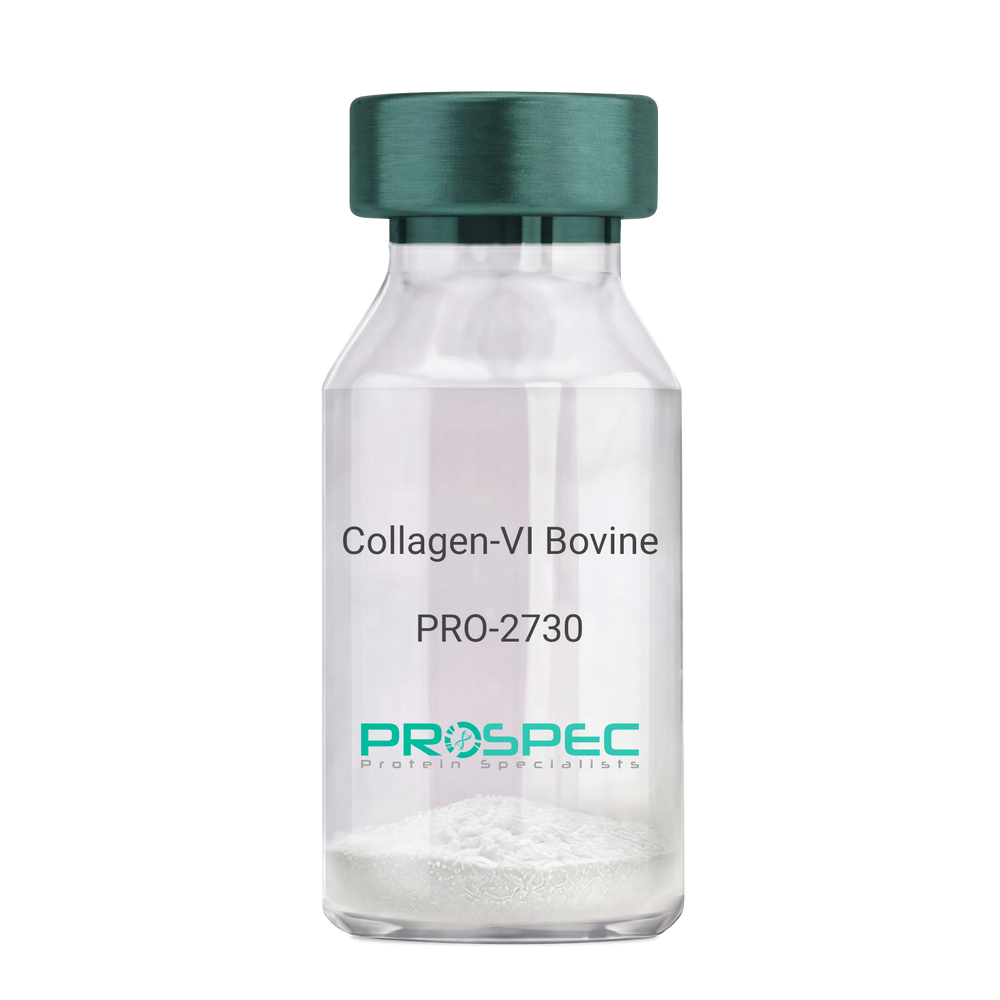
    Collagen-VI Bovine

    Description:

    Bovine Collagen-VI

    Product # :

    PRO-2730

    Price :

    Quantity :

    Shipping Method :

    Room Temp Icon

    Shipped at Room temp

    Add To Cart

    More Info

    • description
    • source
    • formulation
    • purity
    • More Info

    Description

    Bovine Collagen-VI is a natural protein purified from Bovine placenta. Bovine Collagen-VI is purified by proprietary chromatographic techniques.

    Source

    Bovine placenta.

    Formulation

    Collagen-VI was lyophilized without additives.

    Purity

    > 90.0%.

    More Info

    • Introduction

      Collagen, a major component of the extracellular matrix, is a fibrous protein that provides tensile strength to tissues giving them structural integrity. Collagen and its derivative, gelatin, have been widely used in medical, pharmaceutical and consumer products for more than 100 years. The supply of these materials, created from animal remains, is both abundant and inexpensive. However, most formulations are not highly purified and have the potential to cause an inflammatory reaction in some product users. In addition, concerns have been raised over the last several years about the potential for contamination of bovine products with the agent that causes mad cow disease and its human variant, Creutzfeldt-Jakob Disease. Animal collagens are subject to extensive modifications that continue over the life of the molecule in the extracellular space. These differences influence both the extractability of collagens from tissue and the biophysical characteristics of these collagens. As a result, collagens isolated from tissues exhibit significant lot-to-lot variability and, as bulk materials, are often analytically intractable. Products that contain animal-derived collagen can induce potentially harmful inflammatory or immune responses in humans and pose risk of contamination with viruses or prions, potentially life-threatening pathogens. Recombinant collagens are essentially identical to the native collagen protein thereby reducing the risk of inflammation, immune response, and disease as compared to animal-sourced collagen.

    • Physical Appearance

      Filtered White lyophilized (freeze-dried) powder.

    • Stability

      Lyophilized Collagen-VI although stable at room temperature for 3 weeks, should be stored desiccated below -18C. Upon reconstitution Collagen-VI should be stored at 4C between 2-7 days and for future use below -18C.For long term storage it is recommended to add a carrier protein (0.1% HSA or BSA).Please prevent freeze-thaw cycles.

    • Solubility

      It is recommended to Add 0.5 M acetic acid, pH 2.5 to prepare a working stock solution not less than 100µg/ml, which can then be further diluted to other aqueous solutions.

    ProSpec's products are furnished for LABORATORY RESEARCH USE ONLY. The product may not be used as drugs, agricultural or pesticidal products, food additives or household chemicals.

    Collagen Vi Bovine
  • View Data Sheet

    Name :

    Collagen-II Bovine

    Description:

    Bovine Collagen-II

    Product # :

    PRO-2679

    Price :

    Quantity :

    Shipping Method :

    Room Temp Icon

    Shipped at Room temp

    Add To Cart

    More Info

    • description
    • source
    • formulation
    • purity
    • More Info

    Description

    Bovine Collagen-II is a natural protein purified from bovine knee joint. Collagen-II is purified by proprietary chromatographic techniques.

    Source

    Bovine knee joint.

    Formulation

    Collagen-II was lyophilized without additives.

    Purity

    > 95.0% .

    More Info

    • Introduction

      Collagen, a major component of the extracellular matrix, is a fibrous protein that provides tensile strength to tissues giving them structural integrity. Collagen and its derivative, gelatin, have been widely used in medical, pharmaceutical and consumer products for more than 100 years. The supply of these materials, created from animal remains, is both abundant and inexpensive. However, most formulations are not highly purified and have the potential to cause an inflammatory reaction in some product users. In addition, concerns have been raised over the last several years about the potential for contamination of bovine products with the agent that causes mad cow disease and its human variant, Creutzfeldt-Jakob Disease. Animal collagens are subject to extensive modifications that continue over the life of the molecule in the extracellular space. These differences influence both the extractability of collagens from tissue and the biophysical characteristics of these collagens. As a result, collagens isolated from tissues exhibit significant lot-to-lot variability and, as bulk materials, are often analytically intractable. Products that contain animal-derived collagen can induce potentially harmful inflammatory or immune responses in humans and pose risk of contamination with viruses or prions, potentially life-threatening pathogens. Recombinant collagens are essentially identical to the native collagen protein thereby reducing the risk of inflammation, immune response, and disease as compared to animal-sourced collagen.

    • Physical Appearance

      Filtered White lyophilized (freeze-dried) powder.

    • Stability

      Lyophilized Collagen-II although stable at room temperature for 3 weeks, should be stored desiccated below -18C. Upon reconstitution Collagen-II should be stored at 4C between 2-7 days and for future use below -18C.For long term storage it is recommended to add a carrier protein (0.1% HSA or BSA).Please prevent freeze-thaw cycles.

    • Solubility

      It is recommended to Add 50 mM acetic acid to prepare a working stock solution of approximately 1-5mg/ml and let the lyophilized pellet dissolve completely.

    ProSpec's products are furnished for LABORATORY RESEARCH USE ONLY. The product may not be used as drugs, agricultural or pesticidal products, food additives or household chemicals.

    Collagen Ii Bovine
  • View Data Sheet

    Name :

    Collagen-I Mouse

    Description:

    Mouse Collagen-I

    Product # :

    PRO-2681

    Price :

    Quantity :

    Shipping Method :

    Room Temp Icon

    Shipped at Room temp

    Add To Cart

    More Info

    • description
    • source
    • formulation
    • purity
    • More Info

    Description

    Mouse Collagen-I is a natural protein purified from Mouse tail tendon. Collagen-I is purified by proprietary chromatographic techniques.

    Source

    Mouse tail tendon.

    Formulation

    Collagen-I was lyophilized without additives.

    Purity

    > 90.0%.

    More Info

    • Introduction

      Collagen, a major component of the extracellular matrix, is a fibrous protein that provides tensile strength to tissues giving them structural integrity. Collagen and its derivative, gelatin, have been widely used in medical, pharmaceutical and consumer products for more than 100 years. The supply of these materials, created from animal remains, is both abundant and inexpensive. However, most formulations are not highly purified and have the potential to cause an inflammatory reaction in some product users. In addition, concerns have been raised over the last several years about the potential for contamination of bovine products with the agent that causes mad cow disease and its human variant, Creutzfeldt-Jakob Disease. Animal collagens are subject to extensive modifications that continue over the life of the molecule in the extracellular space. These differences influence both the extractability of collagens from tissue and the biophysical characteristics of these collagens. As a result, collagens isolated from tissues exhibit significant lot-to-lot variability and, as bulk materials, are often analytically intractable. Products that contain animal-derived collagen can induce potentially harmful inflammatory or immune responses in humans and pose risk of contamination with viruses or prions, potentially life-threatening pathogens. Recombinant collagens are essentially identical to the native collagen protein thereby reducing the risk of inflammation, immune response, and disease as compared to animal-sourced collagen.

    • Physical Appearance

      Filtered White lyophilized (freeze-dried) powder.

    • Stability

      Lyophilized Collagen-I although stable at room temperature for 3 weeks, should be stored desiccated below -18C. Upon reconstitution Collagen-I should be stored at 4C between 2-7 days and for future use below -18C.For long term storage it is recommended to add a carrier protein (0.1% HSA or BSA).Please prevent freeze-thaw cycles.

    • Solubility

      It is recommended to Add 0.5 M acetic acid, pH 3 at 4°C to prepare a working stock solution not less than 100µg/ml, which can then be further diluted to other aqueous solutions.

    ProSpec's products are furnished for LABORATORY RESEARCH USE ONLY. The product may not be used as drugs, agricultural or pesticidal products, food additives or household chemicals.

    Collagen I Mouse
  • View Data Sheet

    Name :

    COL4A3 Human, Biotin

    Description:

    Collagen Type IV Alpha 3 Human Recombinant, Biotinylated

    Collagen alpha-3(IV) chain, Goodpasture antigen, COL4A3, Glomerular Basal Membrane, GBM.

    Product # :

    PRO-2564

    Price :

    Quantity :

    Shipping Method :

    Ice Icon

    Shipped with Ice Packs

    Add To Cart

    More Info

    • description
    • source
    • formulation
    • purity
    • More Info

    Description

    Human α3 chain of collagen IV; identical with the antigen called "glomerular basal membrane antigen" (GBM). Calculated Molecular weight: 48kDa. Calculated isoelectric point: pH 8.9. cDNA coding for a minicollagen version of the human collagen IV α3 chain fused to a 6-histidine purification tag. The term minicollagen designates the removal of most of the epitope-less triplehelical collagenous region (situated between the N-terminal 7S domain and the C-terminal noncollagenous NC1 domain), which is a requirement for recombinant production of this antigen.

    Source

    Sf9 insect cells.

    Formulation

    COL4A3 Human biotin contains 20mM HEPES, pH 7.5, 0.02% SDS and 0.01mM EDTA.

    Purity

    Greater than 87% as determined by Capillary Electrophoresis.

    More Info

    • Introduction

      Type IV collagen is a major structural component of basement membranes. It is a multimeric protein composed of 3 alpha subunits, which are encoded by 6 different genes, alpha 1 through alpha 6. Each of these alpha subunits can form a triple helix structure with 2 other subunits to form type IV collagen. The Goodpasture syndrome is a condition in which autoantibodies bind to the collagen molecules in the basement membranes of alveoli and glomeruli. The epitopes that elicit these autoantibodies are restricted basically to the non-collagenous C-terminal domain of the protein. There are numerous alternative transcripts that appear to be unique to the human COL4A3 and alternative splicing is limited to the six exons that encode this C-terminal domain. COL4A3 is also linked to an autosomal recessive form of Alport syndrome. The mutations contributing to the Alport syndrome are also situated within the exons that encode this C-terminal region. COL4A3 is organized in a head-to-head conformation with another type IV collagen gene so that each gene pair shares a common promoter. Several exons of COL4A3 are interspersed with exons of an uncharacterized gene which is on the opposite strand.

    • Synonyms

      Collagen alpha-3(IV) chain, Goodpasture antigen, COL4A3, Glomerular Basal Membrane, GBM.

    • Physical Appearance

      Sterile Filtered clear solution.

    • Stability

      Store at 4°C if entire vial will be used within 2-4 weeks. Store, frozen at -20°C for longer periods of time. Avoid multiple freeze-thaw cycles.

    • Immunological Functions

      1. Binds IgG type human auto antibodies.2. Functional Streptavidin based ELISA test (analysis of positive/negative samples.)

    • Note

      It has been reported that the immunodominant epitope of COL4A3 is a cryptic epitope that is not easily accessible to the corresponding autoantibodies. It is necessary to treat the protein under nonreducing conditions with a denaturant such as urea to unmask the epitopes (see Hellmark et al. in Autoantibodies, Peter, J.B. and Shoenfeld, Y., eds., Elsevier B.V., 1996, pp 291-298).

    ProSpec's products are furnished for LABORATORY RESEARCH USE ONLY. The product may not be used as drugs, agricultural or pesticidal products, food additives or household chemicals.

    Glomerular Basal Membrane
  • View Data Sheet

    Name :

    COL4A3BP Human

    Description:

    Collagen Type IV Alpha 3 Binding Protein Human Recombinant

    COL4A3BP, FLJ20597, Collagen type IV alpha-3-binding protein, GPBP, STARD11, CERT, HCERT, CERTL, Ceramide Transfer Protein, Goodpasture antigen-binding protein, StAR-related lipid transfer protein 11, START domain-containing protein 11.

    Product # :

    PRO-837

    Price :

    Quantity :

    Shipping Method :

    Ice Icon

    Shipped with Ice Packs

    Add To Cart

    More Info

    • description
    • source
    • formulation
    • purity
    • More Info

    Description

    COL4A3BP Recombinant Human produced in E.Coli is a single, non-glycosylated polypeptide chain containing 290 amino acids (347-598 a.a.) and having a molecular mass of 33.1 kDa. The COL4A3BP is fused to 38 amino acid His-Tag at N-terminus and purified by proprietary chromatographic techniques.

    Source

    Escherichia Coli.

    Formulation

    COL4A3BP Human solution containing 20mM Tris HCL pH-8, 0.1M NaCl, & 10% glycerol.

    Purity

    Greater than 95.0% as determined by SDS-PAGE.

    More Info

    • Introduction

      COL4A3BP is a kinase that particularly phosphorylates the N-terminal region of the non-collagenous domain of the alpha 3 chain of type IV collagen, recognized as the Goodpasture antigen that is the outcome of an autoimmune reaction directed at COL4A3BP. One isoform of COL4A3BP participates in ceramide intracellular transport.

    • Synonyms

      COL4A3BP, FLJ20597, Collagen type IV alpha-3-binding protein, GPBP, STARD11, CERT, HCERT, CERTL, Ceramide Transfer Protein, Goodpasture antigen-binding protein, StAR-related lipid transfer protein 11, START domain-containing protein 11.

    • Physical Appearance

      Sterile filtered colorless solution.

    • Stability

      Store at 4°C if entire vial will be used within 2-4 weeks. Store, frozen at -20°C for longer periods of time. For long term storage it is recommended to add a carrier protein (0.1% HSA or BSA).Avoid multiple freeze-thaw cycles.

    • Amino Acid Sequence

      MRGSHHHHHH GMASMTGGQQ MGRDLYDDDD KDRWAGSMLH WPTSLPSGDA FSSVGTHRFV QKVEEMVQNH MTYSLQDVGG DANWQLVVEE GEMKVYRREV EENGIVLDPL KATHAVKGVT GHEVCNYFWN VDVRNDWETT IENFHVVETL ADNAIIIYQT HKRVWPASQR DVLYLSVIRK IPALTENDPE TWIVCNFSVD HDSAPLNNRC VRAKINVAMI CQTLVSPPEG NQEISRDNIL CKITYVANVN PGGWAPASVL RAVAKREYPK FLKRFTSYVQ EKTAGKPILF.

    ProSpec's products are furnished for LABORATORY RESEARCH USE ONLY. The product may not be used as drugs, agricultural or pesticidal products, food additives or household chemicals.

    Col4A3Bp Human
  • View Data Sheet

    Name :

    COL4A3 Human

    Description:

    Collagen Type IV Alpha 3 Human Recombinant

    Collagen alpha-3(IV) chain, Goodpasture antigen, COL4A3, Glomerular Basal Membrane, GBM.

    Product # :

    PRO-387

    Price :

    Quantity :

    Shipping Method :

    Ice Icon

    Shipped with Ice Packs

    Add To Cart

    More Info

    • description
    • source
    • formulation
    • purity
    • More Info

    Description

    Human α3 chain of collagen IV; identical with the antigen called "glomerular basal membrane antigen" (GBM). Recombinant antigen for solid (ELISA) and fluid phase diagnostic assays. Calculated Molecular weight: 53kDa. Calculated isoelectric point: pH 8.9. cDNA coding for a minicollagen version of the human collagen IV α3 chain fused to a hexa-histidine purification tag. The term minicollagen designates the removal of most of the epitope-less triplehelical collagenous region (situated between the N-terminal 7S domain and the C-terminal noncollagenous NC1 domain), which is a requirement for recombinant production of this antigen.

    Source

    Sf9 insect cells.

    Formulation

    The protein solution contains 20mM Hepes, pH 8.0 and 4M Urea.

    Purity

    Greater than 95.0% as determined by SDS-PAGE.

    More Info

    • Introduction

      Type IV collagen is a major structural component of basement membranes. It is a multimeric protein composed of 3 alpha subunits, which are encoded by 6 different genes, alpha 1 through alpha 6. Each of these alpha subunits can form a triple helix structure with 2 other subunits to form type IV collagen. The Goodpasture syndrome is a condition in which autoantibodies bind to the collagen molecules in the basement membranes of alveoli and glomeruli. The epitopes that elicit these autoantibodies are restricted basically to the non-collagenous C-terminal domain of the protein. There are numerous alternative transcripts that appear to be unique to the human COL4A3 and alternative splicing is limited to the six exons that encode this C-terminal domain. COL4A3 is also linked to an autosomal recessive form of Alport syndrome. The mutations contributing to the Alport syndrome are also situated within the exons that encode this C-terminal region. COL4A3 is organized in a head-to-head conformation with another type IV collagen gene so that each gene pair shares a common promoter. Several exons of COL4A3 are interspersed with exons of an uncharacterized gene which is on the opposite strand.

    • Synonyms

      Collagen alpha-3(IV) chain, Goodpasture antigen, COL4A3, Glomerular Basal Membrane, GBM.

    • Physical Appearance

      Sterile Filtered clear solution.

    • Stability

      Recommendations for storage buffer: neutral to slightly alkaline pH and 4M urea as dissociating agent. Storage temperature: -70°C to -80°C. Please prevent freeze-thaw cycles.

    • Immunological Functions

      1. Binds IgG-type human auto-antibodies. 2. Standard ELISA test (checkerboard analysis of positive/negative samples. 3. Immunodot test with positive/negative samples.

    • coating concentration

      0.12-0.5 μg/ml (depending on the type of ELISA plate and coating buffer). Suitable for labeling of functional groups.

    • Note

      It has been reported that the immunodominant epitope of GBM is a cryptic epitope that is not easily accessible to the corresponding autoantibodies. It is necessary to treat the protein under nonreducing conditions with a denaturant such as urea to unmask the epitopes (see Hellmark et al. in Autoantibodies, Peter, J.B. and Shoenfeld, Y., eds., Elsevier B.V., 1996, pp 291-298).

    ProSpec's products are furnished for LABORATORY RESEARCH USE ONLY. The product may not be used as drugs, agricultural or pesticidal products, food additives or household chemicals.

    Col4A3 Human
  • View Data Sheet

    Name :

    CTHRC1 Human

    Description:

    Collagen Triple Helix Repeat Containing 1 Human Recombinant

    Collagen Triple Helix Repeat Containing 1, Protein NMTC1, CTHRC1.

    Product # :

    PRO-2027

    Price :

    Quantity :

    Shipping Method :

    Ice Icon

    Shipped with Ice Packs

    Add To Cart

    More Info

    • description
    • source
    • formulation
    • purity
    • More Info

    Description

    CTHRC1 Human Recombinant produced in E.Coli is a single, non-glycosylated polypeptide chain containing 234 amino acids (31-243 a.a) and having a molecular mass of 25.3kDa.CTHRC1 is fused to a 21 amino acid His-tag at N-terminus & purified by proprietary chromatographic techniques.

    Source

    Escherichia Coli.

    Formulation

    CTHRC1 protein solution (1mg/ml) containing 20mM Tris-HCl (pH 8.0) and 10% glycerol.

    Purity

    Greater than 90.0% as determined by SDS-PAGE.

    More Info

    • Introduction

      Collagen triple helix repeat-containing protein 1 (CTHRC1) functions as a negative regulator of collagen matrix deposition. CTHRC1 is a secreted 28kDa protein which is glycosylated and highly conserved from lower chordates to mammals. CTHRC1 is highly connected with calcified tissues and cartilaginous matrix, but not with endothelial cells. CTHRC1 is detected qualitatively in plasma of healthy human subjects. CTHRC1 plasma levels are also significantly elevated during pregnancy, in diabetes, in inflammatory and infectious conditions, in subjects with acute myeloid leukemia but not in subjects with solid cancers. The hormonal functions of CTHRC1 include regulation of lipid storage and cellular glycogen levels with potentially far-reaching implications for cell metabolism and physiology. CTHRC1 gene deletion leads to fatty liver (steatosis) formation in mice while others exhibited inactivation of the CTHRC1 gene also results in low bone mass.

    • Synonyms

      Collagen Triple Helix Repeat Containing 1, Protein NMTC1, CTHRC1.

    • Physical Appearance

      Sterile filtered colorless solution.

    • Stability

      Store at 4°C if entire vial will be used within 2-4 weeks. Store, frozen at -20°C for longer periods of time. For long term storage it is recommended to add a carrier protein (0.1% HSA or BSA).Avoid multiple freeze-thaw cycles.

    • Amino Acid Sequence

      MGSSHHHHHH SSGLVPRGSH MSEIPKGKQK AQLRQREVVD LYNGMCLQGP AGVPGRDGSP GANGIPGTPG IPGRDGFKGE KGECLRESFE ESWTPNYKQC SWSSLNYGID LGKIAECTFT KMRSNSALRV LFSGSLRLKC RNACCQRWYF TFNGAECSGP LPIEAIIYLD QGSPEMNSTI NIHRTSSVEG LCEGIGAGLV DVAIWVGTCS DYPKGDASTG WNSVSRIIIE ELPK.

    ProSpec's products are furnished for LABORATORY RESEARCH USE ONLY. The product may not be used as drugs, agricultural or pesticidal products, food additives or household chemicals.

    Cthrc1 Human
  • View Data Sheet

    Name :

    CTHRC1 Human, HEK

    Description:

    Collagen Triple Helix Repeat Containing 1 Human Recombinant, HEK

    Collagen Triple Helix Repeat Containing 1, Protein NMTC1, CTHRC1.

    Product # :

    PRO-2028

    Price :

    Quantity :

    Shipping Method :

    Room Temp Icon

    Shipped at Room temp

    Add To Cart

    More Info

    • description
    • source
    • formulation
    • purity
    • More Info

    Description

    CTHRC1 Human Recombinant produced in HEK cells is a single, glycosylated, polypeptide chain (Ser31-Lys243) containing a total of 219 amino acids, having a calculated molecular mass of 23.9kDa and fused to a 6 aa His tag at C-Terminus.

    Source

    HEK 293.

    Formulation

    CTHRC1 was filtered (0.4µm) and lyophilized in phosphate buffered saline pH 7.5.

    Purity

    Greater than 95.0% as determined by SDS-PAGE.

    More Info

    • Introduction

      Collagen triple helix repeat-containing protein 1 (CTHRC1) functions as a negative regulator of collagen matrix deposition. CTHRC1 is a secreted 28kDa protein which is glycosylated and highly conserved from lower chordates to mammals. CTHRC1 is highly connected with calcified tissues and cartilaginous matrix, but not with endothelial cells. CTHRC1 is detected qualitatively in plasma of healthy human subjects. CTHRC1 plasma levels are also significantly elevated during pregnancy, in diabetes, in inflammatory and infectious conditions, in subjects with acute myeloid leukemia but not in subjects with solid cancers. The hormonal functions of CTHRC1 include regulation of lipid storage and cellular glycogen levels with potentially far-reaching implications for cell metabolism and physiology. CTHRC1 gene deletion leads to fatty liver (steatosis) formation in mice while others exhibited inactivation of the CTHRC1 gene also results in low bone mass.

    • Synonyms

      Collagen Triple Helix Repeat Containing 1, Protein NMTC1, CTHRC1.

    • Physical Appearance

      Filtered White lyophilized (freeze-dried) powder.

    • Stability

      Store lyophilized protein at -20°C. Aliquot the product after reconstitution to avoid repeated freezing/thawing cycles. Reconstituted protein can be stored at 4°C for a limited period of time; it does not show any change after two weeks at 4°C.

    • Solubility

      It is recommended to add deionized water to prepare a working stock solution of approximately 0.5 mg/ml and let the lyophilized pellet dissolve completely. CTHRC1 is not sterile! Please filter the product by an appropriate sterile filter before using it in the cell culture.

    • Amino Acid Sequence

      SEIPKGKQKA QLRQREVVDL YNGMCLQGPA GVPGRDGSPG ANGIPGTPGI PGRDGFKGEK GECLRESFEE SWTPNYKQCS WSSLNYGIDL GKIAECTFTK MRSNSALRVL FSGSLRLKCR NACCQRWYFT FNGAECSGPL PIEAIIYLDQ GSPEMNSTIN IHRTSSVEGL CEGIGAGLVD VAIWVGTCSD YPKGDASTGW NSVSRIIIEE LPK HHHHHH.

    ProSpec's products are furnished for LABORATORY RESEARCH USE ONLY. The product may not be used as drugs, agricultural or pesticidal products, food additives or household chemicals.

    Cthrc1 Human Hek
  • View Data Sheet

    Name :

    CTHRC1 Human, Sf9

    Description:

    Collagen Triple Helix Repeat Containing 1 Human Recombinant, Sf9

    Collagen triple helix repeat-containing protein 1 isoform 1, CTHRC1, Protein NMTC1.

    Product # :

    PRO-2606

    Price :

    Quantity :

    Shipping Method :

    Ice Icon

    Shipped with Ice Packs

    Add To Cart

    More Info

    • description
    • source
    • formulation
    • purity
    • More Info

    Description

    CTHRC1 produced in Sf9 Baculovirus cells is a single, glycosylated polypeptide chain containing 222 amino acids (31-243a.a.) and having a molecular mass of 24.1kDa (Molecular size on SDS-PAGE will appear at approximately 28-40kDa). CTHRC1 is expressed with a 6 amino acid His tag at C-Terminus and purified by proprietary chromatographic techniques.

    Source

    Sf9, Baculovirus cells.

    Formulation

    CTHRC1 protein solution (0.5mg/ml) contains Phosphate Buffered Saline (pH 7.4) and 10% glycerol.

    Purity

    Greater than 90.0% as determined by SDS-PAGE.

    More Info

    • Introduction

      Collagen triple helix repeat-containing protein 1 or CTHRC1 acts as a negative regulator of collagen matrix deposition. The protein is secreted from a 28kDa protein which is glycosylated and very conserved from lower chordates to mammals. CTHRC1 is found qualitatively in plasma of healthy human subjects. CTHRC1 plasma levels are also significantly elevated during pregnancy, in diabetes, in inflammatory and infectious conditions, in subjects with acute myeloid leukemia but not in subjects with solid cancers.CTHRC1 is highly connected with calcified tissues and cartilaginous matrix, but not with endothelial cells.

    • Synonyms

      Collagen triple helix repeat-containing protein 1 isoform 1, CTHRC1, Protein NMTC1.

    • Physical Appearance

      Sterile Filtered colorless solution.

    • Stability

      Store at 4°C if entire vial will be used within 2-4 weeks. Store, frozen at -20°C for longer periods of time. For long term storage it is recommended to add a carrier protein (0.1% HSA or BSA).Avoid multiple freeze-thaw cycles.

    • Amino Acid Sequence

      ADPSEIPKGK QKAQLRQREV VDLYNGMCLQ GPAGVPGRDG SPGANGIPGT PGIPGRDGFK GEKGECLRES FEESWTPNYK QCSWSSLNYG IDLGKIAECT FTKMRSNSAL RVLFSGSLRL KCRNACCQRW YFTFNGAECS GPLPIEAIIY LDQGSPEMNS TINIHRTSSV EGLCEGIGAG LVDVAIWVGT CSDYPKGDAS TGWNSVSRII IEELPKHHHH HH.

    ProSpec's products are furnished for LABORATORY RESEARCH USE ONLY. The product may not be used as drugs, agricultural or pesticidal products, food additives or household chemicals.

    Cthrc1 Protein
  • View Data Sheet

    Name :

    PCOLCE Human

    Description:

    Procollagen C-Endopeptidase Enhancer Human Recombinant

    Procollagen C-Endopeptidase Enhancer, Procollagen C-Proteinase Enhancer 1, Type I Procollagen COOH-Terminal Proteinase Enhancer, Type 1 Procollagen C-Proteinase Enhancer Protein, Procollagen COOH-Terminal Proteinase Enhancer 1, PCPE-1, PCPE1, Procollagen, Type 1, COOH-Terminal Proteinase Enhancer, Procollagen C-Endopeptidase Enhancer 1, COOH-Terminal Proteinase Enhancer, Procollagen, Type 1, PCPE, Procollagen C-endopeptidase enhancer 1.

    Product # :

    ENZ-863

    Price :

    Quantity :

    Shipping Method :

    Ice Icon

    Shipped with Ice Packs

    Add To Cart

    More Info

    • description
    • source
    • formulation
    • purity
    • More Info

    Description

    PCOLCE Human Recombinant produced in E.Coli is a single, non-glycosylated polypeptide chain containing 447 amino acids (26-449 a.a) and having a molecular mass of 47.9kDa. PCOLCE is fused to a 23 amino acid His-tag at N-terminus & purified by proprietary chromatographic techniques.

    Source

    Escherichia Coli.

    Formulation

    PCOLCE protein solution (1mg/ml) containing 20mM Tris-HCl buffer (pH 8.0) and 10% glycerol.

    Purity

    Greater than 85.0% as determined by SDS-PAGE.

    More Info

    • Introduction

      Procollagen C-endopeptidase enhancer 1, also known as PCOLCE binds to the C-terminal propeptide of type I procollagen and enhances procollagen C-proteinase activity. In addition, C-terminal processed part of PCPE (CT-PCPE) has a metalloproteinase inhibitory activity. Among the diseases which are associated with PCOLCE: bone fracture & oculopharyngeal muscular dystrophy.

    • Synonyms

      Procollagen C-Endopeptidase Enhancer, Procollagen C-Proteinase Enhancer 1, Type I Procollagen COOH-Terminal Proteinase Enhancer, Type 1 Procollagen C-Proteinase Enhancer Protein, Procollagen COOH-Terminal Proteinase Enhancer 1, PCPE-1, PCPE1, Procollagen, Type 1, COOH-Terminal Proteinase Enhancer, Procollagen C-Endopeptidase Enhancer 1, COOH-Terminal Proteinase Enhancer, Procollagen, Type 1, PCPE, Procollagen C-endopeptidase enhancer 1.

    • Physical Appearance

      Sterile filtered colorless solution.

    • Stability

      Store at 4°C if entire vial will be used within 2-4 weeks. Store, frozen at -20°C for longer periods of time. For long term storage it is recommended to add a carrier protein (0.1% HSA or BSA).Avoid multiple freeze-thaw cycles.

    • Amino Acid Sequence

      MGSSHHHHHH SSGLVPRGSH MGSQTPNYTR PVFLCGGDVK GESGYVASEG FPNLYPPNKE CIWTITVPEG QTVSLSFRVF DLELHPACRY DALEVFAGSG TSGQRLGRFC GTFRPAPLVA PGNQVTLRMT TDEGTGGRGF LLWYSGRATS GTEHQFCGGR LEKAQGTLTT PNWPESDYPP GISCSWHIIA PPDQVIALTF EKFDLEPDTY CRYDSVSVFN GAVSDDSRRL GKFCGDAVPG SISSEGNELL VQFVSDLSVT ADGFSASYKT LPRGTAKEGQ GPGPKRGTEP KVKLPPKSQP PEKTEESPSA PDAPTCPKQC RRTGTLQSNF CASSLVVTAT VKSMVREPGE GLAVTVSLIG AYKTGGLDLP SPPTGASLKF YVPCKQCPPM KKGVSYLLMG QVEENRGPVL PPESFVVLHR PNQDQILTNL SKRKCPSQPV RAAASQD.

    ProSpec's products are furnished for LABORATORY RESEARCH USE ONLY. The product may not be used as drugs, agricultural or pesticidal products, food additives or household chemicals.

    Pcolce Human
  • View Data Sheet

    Name :

    VWA2 Human

    Description:

    Von Willebrand Factor A Domain Containing 2 Human Recombinant

    A domain-containing protein similar to matrilin and collagen, AMACO, Colon cancer secreted protein 2, CCSP-2.

    Product # :

    PRO-2752

    Price :

    Quantity :

    Shipping Method :

    Ice Icon

    Shipped with Ice Packs

    Add To Cart

    More Info

    • description
    • source
    • formulation
    • purity
    • More Info

    Description

    VWA2 Human Recombinant produced in E.Coli is a single, non-glycosylated polypeptide chain containing 177 amino acids (341-517 a.a) and having a molecular mass of 19.3kDa.The VWA2 is expressed with an amino-terminal hexahistidine tag and purified by proprietary chromatographic techniques.

    Source

    Escherichia Coli.

    Formulation

    The VWA2 protein solution contains 20mM Tris-HCl, pH 8.0, 0.8M Urea & 50% glycerol.

    Purity

    Greater than 95% as determined by SDS-PAGE.

    More Info

    • Introduction

      Von Willebrand Factor A Domain Containing 2 (VWA2) is an extracellular matrix protein containing vWA-like domains. VWA2 contains a signal peptide sequence, an N-terminal VWA domain connected to 2 additional tandem vWA domains by a cysteine-rich sequence and an EGF-like domain. Also, another EGF-like domain is located at the C-terminus. Expression of VWA2 is induced in stage II, III and IV colon cancers and colon adenomas and is considered a novel serum marker for the diagnosis of early-stage colon cancer.

    • Synonyms

      A domain-containing protein similar to matrilin and collagen, AMACO, Colon cancer secreted protein 2, CCSP-2.

    • Physical Appearance

      Sterile Filtered colorless liquid formulation.

    • Stability

      Store at 4°C if entire vial will be used within 2-4 weeks. Store, frozen at -20°C for longer periods of time.Please avoid freeze thaw cycles.

    ProSpec's products are furnished for LABORATORY RESEARCH USE ONLY. The product may not be used as drugs, agricultural or pesticidal products, food additives or household chemicals.

    Vwa2 Human
  • View Data Sheet

    Name :

    PCOLCE Human, Sf9

    Description:

    Procollagen C-Endopeptidase Enhancer Human Recombinant, Sf9

    Procollagen C-endopeptidase enhancer 1,  Procollagen COOH-terminal proteinase enhancer 1,  PCPE-1,  Procollagen C-proteinase enhancer 1,  Type 1 procollagen C-proteinase enhancer protein,  Type I procollagen COOH-terminal proteinase enhancer,  PCOLCE,  PCPE1,  Procollagen C-Endopeptidase Enhancer, Procollagen C-Proteinase, Enhancer 1, Procollagen, Type 1, COOH-Terminal Proteinase Enhancer, Type I Procollagen COOH-Terminal Proteinase Enhancer, Type 1 Procollagen C-Proteinase Enhancer Protein, Procollagen COOH-Terminal Proteinase Enhancer 1.

    Product # :

    ENZ-1075

    Price :

    Quantity :

    Shipping Method :

    Ice Icon

    Shipped with Ice Packs

    Add To Cart

    More Info

    • description
    • source
    • formulation
    • purity
    • More Info

    Description

    PCOLCE produced in Sf9 Insect cells is a single, glycosylated polypeptide chain containing 433 amino acids (26-449 a.a.) and having a molecular mass of 46.6kDa (Molecular size on SDS-PAGE will appear at approximately 40-57kDa). PCOLCE is expressed with an 9 amino acid His tag at C-Terminus and purified by proprietary chromatographic techniques.

    Source

    Sf9, Insect cells.

    Formulation

    PCOLCE protein solution (0.25mg/ml) contains 20mM Tris-HCl (pH 8.0), 10% glycerol and 0.1M NaCl.

    Purity

    Greater than 95.0% as determined by SDS-PAGE.

    More Info

    • Introduction

      Procollagen C-endopeptidase enhancer 1, also known as PCOLCE binds to the C-terminal propeptide of type I procollagen and enhances procollagen C-proteinase activity. In addition, C-terminal processed part of PCPE (CT-PCPE) has a metalloproteinase inhibitory activity. Among the diseases which are associated with PCOLCE: bone fracture & oculopharyngeal muscular dystrophy.

    • Synonyms

      Procollagen C-endopeptidase enhancer 1, Procollagen COOH-terminal proteinase enhancer 1, PCPE-1, Procollagen C-proteinase enhancer 1, Type 1 procollagen C-proteinase enhancer protein, Type I procollagen COOH-terminal proteinase enhancer, PCOLCE, PCPE1, Procollagen C-Endopeptidase Enhancer, Procollagen C-Proteinase, Enhancer 1, Procollagen, Type 1, COOH-Terminal Proteinase Enhancer, Type I Procollagen COOH-Terminal Proteinase Enhancer, Type 1 Procollagen C-Proteinase Enhancer Protein, Procollagen COOH-Terminal Proteinase Enhancer 1.

    • Physical Appearance

      Sterile filtered colorless solution.

    • Stability

      Store at 4°C if entire vial will be used within 2-4 weeks. Store, frozen at -20°C for longer periods of time. For long term storage it is recommended to add a carrier protein (0.1% HSA or BSA).Avoid multiple freeze-thaw cycles.

    • Amino Acid Sequence

      ADPQTPNYTR PVFLCGGDVK GESGYVASEG FPNLYPPNKE CIWTITVPEG QTVSLSFRVF DLELHPACRY DALEVFAGSG TSGQRLGRFC GTFRPAPLVA PGNQVTLRMT TDEGTGGRGF LLWYSGRATS GTEHQFCGGR LEKAQGTLTT PNWPESDYPP GISCSWHIIA PPDQVIALTF EKFDLEPDTY CRYDSVSVFN GAVSDDSRRL GKFCGDAVPG SISSEGNELL VQFVSDLSVT ADGFSASYKT LPRGTAKEGQ GPGPKRGTEP KVKLPPKSQP PEKTEESPSA PDAPTCPKQC RRTGTLQSNF CASSLVVTAT VKSMVREPGE GLAVTVSLIG AYKTGGLDLP SPPTGASLKF YVPCKQCPPM KKGVSYLLMG QVEENRGPVL PPESFVVLHR PNQDQILTNL SKRKCPSQPV RAAASQDHHH HHH.

    ProSpec's products are furnished for LABORATORY RESEARCH USE ONLY. The product may not be used as drugs, agricultural or pesticidal products, food additives or household chemicals.

    Pcolce Protein
  • View Data Sheet

    Name :

    MMP1 Human, sf9

    Description:

    Matrix Metalloproteinase-1 Human Recombinant, sf9

    Matrix Metallopeptidase 1, Interstitial Collagenase, Fibroblast Collagenase, EC 3.4.24.7, CLG, Matrix Metalloproteinase 1 (Interstitial Collagenase), Matrix Metallopeptidase 1 (Interstitial Collagenase), Matrix Metalloproteinase 1, Matrix Metalloproteinase-1, Matrix Metalloprotease 1, EC 3.4.24, MMP-1, CLGN, Fibroblast collagenase, Matrix metalloproteinase-1, MMP-1.

    Product # :

    ENZ-989

    Price :

    Quantity :

    Shipping Method :

    Ice Icon

    Shipped with Ice Packs

    Add To Cart

    More Info

    • description
    • source
    • formulation
    • purity
    • More Info

    Description

    MMP1 Human Recombinant produced in Sf9 Baculovirus cells is a single, non-glycosylated polypeptide chain containing 460 amino acids (18-469a.a) and having a molecular mass of 53.1kDa (Molecular size on SDS-PAGE will appear at approximately 50-70kDa). MMP1 is fused to an 8 amino acid His-tag at C-terminus & purified by proprietary chromatographic techniques.

    Source

    Sf9, Baculovirus cells.

    Formulation

    MMP1 protein solution (0.25mg/ml) containing 20mM MES buffer (pH 5.5), 10mM CaCl2, 100 mM NaCl, 0.05% Brij35 and 30% glycerol.

    Purity

    Greater than 95% as determined by SDS-PAGE.

    More Info

    • Introduction

      MMP-1 (interstitial collagenase) can break down a wide range of substrates including types I, II, III, VII, VIII, and X collagens as well as L-Selectin, pro-TNF, IL-1?, IGFBP-3, IGFBP-5, casein, gelatin, ?1 antitrypsin, myelin basic protein, pro-MMP2 and pro-MMP9. A significant function of MMP-1 is the degradation of fibrillar collagens in extracellular matrix remodeling. MMP-1 is expressed in fibroblasts, keratinocytes, endothelial cells, monocytes and macrophages. MMP1 can be divided into a number of distinct domains: a prodomain which is cleaved on activation, a catalytic domain containing the zinc binding site and a short hinge region with a carboxyl terminal domain. MMP1 is part of a cluster of MMP genes which localize to chromosome 11q22.3.

    • Synonyms

      Matrix Metallopeptidase 1, Interstitial Collagenase, Fibroblast Collagenase, EC 3.4.24.7, CLG, Matrix Metalloproteinase 1 (Interstitial Collagenase), Matrix Metallopeptidase 1 (Interstitial Collagenase), Matrix Metalloproteinase 1, Matrix Metalloproteinase-1, Matrix Metalloprotease 1, EC 3.4.24, MMP-1, CLGN, Fibroblast collagenase, Matrix metalloproteinase-1, MMP-1.

    • Physical Appearance

      Sterile Filtered colorless solution.

    • Stability

      Store at 4°C if entire vial will be used within 2-4 weeks. Store, frozen at -20°C for longer periods of time. For long term storage it is recommended to add a carrier protein (0.1% HSA or BSA). Avoid multiple freeze-thaw cycles.

    • Amino Acid Sequence

      HSFPATLETQ EQDVDLVQKY LEKYYNLKND GRQVEKRRNS GPVVEKLKQM QEFFGLKVTG KPDAETLKVM KQPRCGVPDV AQFVLTEGNP RWEQTHLTYR IENYTPDLPR ADVDHAIEKA FQLWSNVTPL TFTKVSEGQA DIMISFVRGD HRDNSPFDGP GGNLAHAFQP GPGIGGDAHF DEDERWTNNF REYNLHRVAA HELGHSLGLS HSTDIGALMY PSYTFSGDVQ LAQDDIDGIQ AIYGRSQNPV QPIGPQTPKA CDSKLTFDAI TTIRGEVMFF KDRFYMRTNP FYPEVELNFI SVFWPQLPNG LEAAYEFADR DEVRFFKGNK YWAVQGQNVL HGYPKDIYSS FGFPRTVKHI DAALSEENTG KTYFFVANKY WRYDEYKRSM DPGYPKMIAH DFPGIGHKVD AVFMKDGFFY FFHGTRQYKF DPKTKRILTL QKANSWFNCR KNLEHHHHHH.

    ProSpec's products are furnished for LABORATORY RESEARCH USE ONLY. The product may not be used as drugs, agricultural or pesticidal products, food additives or household chemicals.

    Mmp1 Human Sf9
  • View Data Sheet

    Name :

    SERPINH1 Human

    Description:

    Heat Shock 47kDa Human Recombinant

    HSP47, HSP-47, Colligin-1, CBP1, Collagen Binding Protein-1, Serpin Peptidase Inhibitor Clade-H memebr 1, Serpin H1, Collagen-binding protein, Colligin, 47 kDa heat shock protein, Rheumatoid arthritis-related antigen RA-A47, Arsenic-transactivated protein 3, AsTP3, Cell proliferation-inducing gene 14 protein, SERPINH1, CBP2, gp46, PIG14, PPROM, RA-A47, SERPINH2.

    Product # :

    HSP-047

    Price :

    Quantity :

    Shipping Method :

    Ice Icon

    Shipped with Ice Packs

    Add To Cart

    More Info

    • description
    • source
    • formulation
    • purity
    • More Info

    Description

    Recombinant Human HSP47 produced in E.Coli is a single, non-glycosylated polypeptide chain containing 439 amino acids (18-418 a.a.) and having a molecular mass of 48.9 kDa. HSP47 human recombinant is fused to a 38 amino acid His Tag at N-terminus and purified by convential chromatogrpahy techniques.

    Source

    Escherichia Coli.

    Formulation

    The SERPINH1 protein solution (1mg/ml) contains 20mM Tris-HCl buffer (pH 8.0) and 20% glycerol.

    Purity

    Greater than 90.0% as determined by SDS-PAGE.

    More Info

    • Introduction

      SERPINH1 is part of the serpin superfamily of serine proteinase inhibitors. SEPINH1 expression is induced by heat shock. HSP47 localizes to the endoplasmic reticulum lumen and binds collagen therefore it is a molecular chaperone which takes part in the maturation of collagen molecules, facilitating the folding and assembly of procollagen molecules, retaining unfolded molecules within the ER, and assisting the transport of correctly folded-molecules from the ER to Golgi apparatus. Autoantibodies to HSP47 protein have been found in rheumatoid arthritis. SERPINH1 binds specifically to collagen and acts as a chaperone in the biosynthetic pathway of collagen.

    • Synonyms

      HSP47, HSP-47, Colligin-1, CBP1, Collagen Binding Protein-1, Serpin Peptidase Inhibitor Clade-H memebr 1, Serpin H1, Collagen-binding protein, Colligin, 47 kDa heat shock protein, Rheumatoid arthritis-related antigen RA-A47, Arsenic-transactivated protein 3, AsTP3, Cell proliferation-inducing gene 14 protein, SERPINH1, CBP2, gp46, PIG14, PPROM, RA-A47, SERPINH2.

    • Physical Appearance

      Sterile filtered colorless solution.

    • Stability

      Store at 4°C if entire vial will be used within 2-4 weeks. Store, frozen at -20°C for longer periods of time. For long term storage it is recommended to add a carrier protein (0.1% HSA or BSA). Avoid multiple freeze-thaw cycles.

    • Amino Acid Sequence

      MRGSHHHHHH GMASMTGGQQ MGRDLYDDDD KDRWGSHMAA EVKKPAAAAA PGTAEKLSPK AATLAERSAG LAFSLYQAMA KDQAVENILV SPVVVASSLG LVSLGGKATT ASQAKAVLSA EQLRDEEVHA GLGELLRSLS NSTARNVTWK LGSRLYGPSS VSFADDFVRS SKQHYNCEHS KINFRDKRSA LQSINEWAAQ TTDGKLPEVT KDVERTDGAL LVNAMFFKPH WDEKFHHKMV DNRGFMVTRS YTVGVMMMHR TGLYNYYDDE KEKLQIVEMP LAHKLSSLII LMPHHVEPLE RLEKLLTKEQ LKIWMGKMQK KAVAISLPKG VVEVTHDLQK HLAGLGLTEA IDKNKADLSR MSGKKDLYLA SVFHATAFEL DTDGNPFDQD IYGREELRSP KLFYADHPFI FLVRDTQSGS LLFIGRLVRP KGDKMRDEL.

    ProSpec's products are furnished for LABORATORY RESEARCH USE ONLY. The product may not be used as drugs, agricultural or pesticidal products, food additives or household chemicals.

    Serpinh1 Human
  • View Data Sheet

    Name :

    TGFBI Human, 182 a.a.

    Description:

    Transforming Growth Factor Beta-Induced (182 a.a.) Human Recombinant

    Transforming growth factor-beta-induced protein ig-h3, Beta ig-h3, Kerato-epithelin, RGD-containing collagen-associated protein, RGD-CAP, TGFBI, BIGH3, CSD, CDB1, CDG2, CSD1, CSD2, CSD3, EBMD, LCD1, CDGG1.

    Product # :

    PRO-672

    Price :

    Quantity :

    Shipping Method :

    Ice Icon

    Shipped with Ice Packs

    Add To Cart

    More Info

    • description
    • source
    • formulation
    • purity
    • More Info

    Description

    TGFBI Recombinant Human produced in e.Coli is a single, non-glycosylated, polypeptide containing 182 amino acids (502-683) and having a molecular mass of 19.9 kDa (Molecular weight on SDS-PAGE will appear higher). The TGFBI recombinant Human protein is purified by proprietary chromatographic techniques.

    Source

    Escherichia Coli.

    Formulation

    The TGFBI 182 a.a. recombinant Human is formulated in 20mM Tris-HCl pH-8, 1mM EDTA, 0.1mM PMSF and 20% glycerol.

    Purity

    Greater than 95.0% as determined by SDS-PAGE.

    More Info

    • Introduction

      TGFBI is an extracellular matrix protein induced by transforming growth factor (TGF)-beta 1. TGFBI protein is involved in cell growth, cell differentiation, wound healing and cell adhesion. In addition, some missense mutations of TGFBI were identified in families affected with human autosomal dominant corneal dystrophies. TGFBI gene encodes for a 683 amino-acid protein containing an RGD motif and four internal repeated domains which have highly conserved sequences founded in several species (Fasciclin domain).

    • Synonyms

      Transforming growth factor-beta-induced protein ig-h3, Beta ig-h3, Kerato-epithelin, RGD-containing collagen-associated protein, RGD-CAP, TGFBI, BIGH3, CSD, CDB1, CDG2, CSD1, CSD2, CSD3, EBMD, LCD1, CDGG1.

    • Physical Appearance

      Sterile filtered liquid formulation.

    • Stability

      Store at 4°C if entire vial will be used within 2-4 weeks. Store, frozen at -20°C for longer periods of time. For long term storage it is recommended to add a carrier protein (0.1% HSA or BSA).Avoid multiple freeze-thaw cycles.

    • Amino Acid Sequence

      MGTVMDVLKG DNRFSMLVAA IQSAGLTETL NREGVYTVFA PTNEAFRALP PRERSRLLGD AKELANILKY HIGDEILVSG GIGALVRLKS LQGDKLEVSL KNNVVSVNKE PVAEPDIMAT NGVVHVITNV LQPPANRPQE RGDELADSAL EIFKQASAFS RASQRSVRLA PVYQKLLERM KH.

    ProSpec's products are furnished for LABORATORY RESEARCH USE ONLY. The product may not be used as drugs, agricultural or pesticidal products, food additives or household chemicals.

    Tgfbi Human 182 Aa
  • View Data Sheet

    Name :

    TGFBI Human

    Description:

    Transforming Growth Factor Beta Induced Human Recombinant

    Transforming growth factor-beta-induced protein ig-h3, Beta ig-h3, Kerato-epithelin, RGD-containing collagen-associated protein, RGD-CAP, TGFBI, BIGH3, CSD, CDB1, CDG2, CSD1, CSD2, CSD3, EBMD, LCD1, CDGG1.

    Product # :

    PRO-568

    Price :

    Quantity :

    Shipping Method :

    Ice Icon

    Shipped with Ice Packs

    Add To Cart

    More Info

    • description
    • source
    • formulation
    • purity
    • More Info

    Description

    TGFBI Human Recombinant produced in e.Coli is a single, non-glycosylated, polypeptide containing 135 amino acids (502-636) and having a molecular mass of 14.5 kDa. The TGFBI recombinant Human protein is purified by proprietary chromatographic techniques.

    Source

    Escherichia Coli.

    Formulation

    The TGFBI recombinant Human is formulated 20mM Tris-HCl pH-8.

    Purity

    Greater than 95.0% as determined by SDS-PAGE.

    More Info

    • Introduction

      Transforming Growth Factor Beta Induced protein also known as TGFBI is an extracellular matrix protein induced by transforming growth factor (TGF)-beta 1. TGFBI protein is involved in cell growth, cell differentiation, wound healing and cell adhesion. In addition, some missense mutations of TGFBI were identified in families affected with human autosomal dominant corneal dystrophies. TGFBI gene encodes for a 683 amino-acid protein containing an RGD motif and four internal repeated domains which have highly conserved sequences founded in several species (Fasciclin domain).

    • Synonyms

      Transforming growth factor-beta-induced protein ig-h3, Beta ig-h3, Kerato-epithelin, RGD-containing collagen-associated protein, RGD-CAP, TGFBI, BIGH3, CSD, CDB1, CDG2, CSD1, CSD2, CSD3, EBMD, LCD1, CDGG1.

    • Physical Appearance

      Sterile filtered liquid formulation.

    • Stability

      Store at 4°C if entire vial will be used within 2-4 weeks. Store, frozen at -20°C for longer periods of time. For long term storage it is recommended to add a carrier protein (0.1% HSA or BSA).Avoid multiple freeze-thaw cycles.

    • Amino Acid Sequence

      MGTVMDVLKG DNRFSMLVAA IQSAGLTETL NREGVYTVFA PTNEAFRALP PRERSRLLGD AKELANILKY HIGDEILVSG GIGALVRLKS LQGDKLEVSL KNNVVSVNKE PVAEPDIMAT NGVVHVITNV LQPPA.

    ProSpec's products are furnished for LABORATORY RESEARCH USE ONLY. The product may not be used as drugs, agricultural or pesticidal products, food additives or household chemicals.

    Tgfbi Human
  • View Data Sheet

    Name :

    MMP-2 Human, HEK

    Description:

    Matrix Metalloproteinase-2 Human Recombinant, HEK

    72 kDa type IV collagenase, 72 kDa gelatinase, Gelatinase A, Matrix metalloproteinase-2, MMP-2, TBE-1, MMP2, CLG4A, CLG4, MONA, MMP-II.

    Product # :

    ENZ-100

    Price :

    Quantity :

    Shipping Method :

    Ice Icon

    Shipped with Ice Packs

    Add To Cart

    More Info

    • description
    • source
    • formulation
    • purity
    • biological activity
    • More Info
    • sds-page

    Description

    MMP-2 Human Recombinant produced in HEK293 cells is a proform of the Human MMP-2 (Ala30-Cys660) and fused with a ployhistide tag at the C-terminus, having an Mw of 71kDa. MMP-2 is purified by proprietary chromatographic techniques.

    Source

    HEK293 cells.

    Formulation

    The MMP-2 is supplied as a 0.2µm filtered solution in 20mM Tris-HCl, 150mM NaCl and 0.05% Brij 35, pH 7.4.

    Purity

    Greater than 95% as determined by SDS-PAGE.

    Biological Activity

    The activity was measured by its ability to cleave fluorogenic peptide substrate, Mca-PLGL-Dpa-AR-NH2 (RND,Catalog # ES001)., The specific activity is > 1,000 pmoles/min/µg.
    Recombinant Human MMP-2 protein pro form needs to be activated with p-aminophenylmercuric acetate (APMA).
    Activation Protocol:
    1. Dilute MMP2 to 100µg/ml in the Assay Buffer: 50mM Tris, 10mM CaCl2, 150mM NaCl, 0.05% (w/v) and Brij 35, pH 7.5.
    2. Activate MMP2 by adding APMA to a final concentration of 1mM. (Sigma, Catalog # A9563) and 100mM stock in DMSO.
    3. Incubate at 37°C for 1 hour.

    sds-page

    mmp-2 human hek sds-page - Product image 1

    More Info

    • Introduction

      Matrix metalloproteinase-2 (MMP-2) is a type IV collagenase, which is involved in endometrial menstrual breakdown, regulation of vascularization and the inflammatory response. MMP-2 contains a number of distinct domains: a prodomain that is cleaved upon activation; a catalytic domain containing the zinc binding site; a fibronectin like domain believed to have a role in substrate targeting; and a carboxyl terminal (hemopexin like) domain containing 2 N-linked glycosylation. The MMP-2 can degrade an extensive array of substrates including type IV, V, VII and X collagens as well as gelatin type I. In addition, MMP-2 interacts with THBS2, TIMP2, Thrombospondin 1, CCL7 and TIMP4. MMP-2 autocatalytic cleavage in the C-terminal generates the anti-angiogenic peptide, PEX. This process seems to be made possible by binding integrinv/beta3. Defects in the MMP-2 are the cause of Torg-Winchester syndrome (TWS), aka multicentric osteolysis nodulosis and arthropathy (MONA).

    • Synonyms

      72 kDa type IV collagenase, 72 kDa gelatinase, Gelatinase A, Matrix metalloproteinase-2, MMP-2, TBE-1, MMP2, CLG4A, CLG4, MONA, MMP-II.

    • Physical Appearance

      The MMP-2 is supplied as a sterile Filtered colorless solution.

    • Stability

      Store MMP-2 at 4°C if entire vial will be used within 2-4 weeks. Store frozen at -20°C for longer periods of time.Avoid multiple freeze-thaw cycles.

    ProSpec's products are furnished for LABORATORY RESEARCH USE ONLY. The product may not be used as drugs, agricultural or pesticidal products, food additives or household chemicals.

    Mmp 2 Human
  • View Data Sheet

    Name :

    Adiponectin Human, Sf9

    Description:

    Adiponectin Human Recombinant, Sf9

    Adiponectin, C1Q And Collagen Domain Containing, Adipose Most Abundant Gene Transcript 1 Protein, Adipocyte Complement-Related 30 KDa Protein, 30 KDa Adipocyte Complement-Related Protein, ACRP30, APM-1, GBP28, ACDC, APM1, Adipocyte, C1q And Collagen Domain-Containing Protein, Adipocyte, C1Q And Collagen Domain Containing, Adipose Most Abundant Gene Transcript 1, Adipose Specific Collagen-Like Factor, Gelatin-Binding Protein 28, Gelatin-Binding Protein, Adiponectin Precursor, Adiponectin, ADIPQTL1, ADPN, 30 kDa adipocyte complement-related protein, dipocyte complement-related 30 kDa protein, ACRP30, Adipocyte, C1q and collagen domain-containing protein, Adipose most abundant gene transcript 1 protein, apM-1, Gelatin-binding protein.

    Product # :

    CYT-1002

    Price :

    Quantity :

    Shipping Method :

    Ice Icon

    Shipped with Ice Packs

    Add To Cart

    More Info

    • description
    • source
    • formulation
    • purity
    • More Info
    • sds-page

    Description

    Acrp30 Human Recombinant produced in Sf9 Baculovirus cells is a single, glycosylated polypeptide chain containing 146 amino acids (106-242a.a.) and having a molecular mass of 16.9kDa. (Molecular size on SDS-PAGE will appear at approximately 13.5-18kDa). Acrp30 is expressed with a 6 amino acid His tag at C-Terminus and purified by proprietary chromatographic techniques.

    Source

    Sf9, Baculovirus cells.

    Formulation

    Acrp30 protein solution (0.5mg/ml) contains Phosphate Buffered Saline (pH 7.4) and 10% glycerol.

    Purity

    Greater than 95.0% as determined by SDS-PAGE.

    sds-page

    Adiponectin-sds-page - Product image 1

    More Info

    • Introduction

      The adipose tissue exclusively expresses and secretes Adiponectin (Acrp30). Acrp30 is involved in various physiological processes such as energy homeostasis, insulin sensitivity, hormonal processes, fatty acid metabolism and obesity.
      Adiponectin circulates in the plasma. Decreased levels of Adiponectin are associated with insulin resistance and hyperinsulinemia, as seen in people with obesity insulin resistance, and diabetes type 2, whose plasma levels of adiponectin are reduced.
      The modular structure of Acrp30 is comprised of N-terminal collagenous domain followed by a C-terminal globular domain.
      Acrp30 also acts as a significant negative regulator in hematopoiesis and immune systems; it may be involved in ending inflammatory responses through its inhibitory functions. Adiponectin inhibits endothelial NF-kappa-b signaling through a cAMP-dependent pathway, it also inhibits TNF-alpha- induced expression of endothelial adhesion molecules.

    • Synonyms

      Adiponectin, C1Q And Collagen Domain Containing, Adipose Most Abundant Gene Transcript 1 Protein, Adipocyte Complement-Related 30 KDa Protein, 30 KDa Adipocyte Complement-Related Protein, ACRP30, APM-1, GBP28, ACDC, APM1, Adipocyte, C1q And Collagen Domain-Containing Protein, Adipocyte, C1Q And Collagen Domain Containing, Adipose Most Abundant Gene Transcript 1, Adipose Specific Collagen-Like Factor, Gelatin-Binding Protein 28, Gelatin-Binding Protein, Adiponectin Precursor, Adiponectin, ADIPQTL1, ADPN, 30 kDa adipocyte complement-related protein, dipocyte complement-related 30 kDa protein, ACRP30, Adipocyte, C1q and collagen domain-containing protein, Adipose most abundant gene transcript 1 protein, apM-1, Gelatin-binding protein.

    • Physical Appearance

      Sterile Filtered clear solution.

    • Stability

      Store at 4°C if entire vial will be used within 2-4 weeks. Store, frozen at -20°C for longer periods of time. For long term storage it is recommended to add a carrier protein (0.1% HSA or BSA).Avoid multiple freeze-thaw cycles.

    • Amino Acid Sequence

      ADPEGAYVYR SAFSVGLETY VTIPNMPIRF TKIFYNQQNH YDGSTGKFHC NIPGLYYFAY HITVYMKDVK VSLFKKDKAM LFTYDQYQEN NVDQASGSVL LHLEVGDQVW LQVYGEGERN GLYADNDNDS TFTGFLLYHD HHHHHH.

    • Background

      What is the molecular weight/Mw of ADIPONECTIN Protein?
      ADIPONECTIN Protein has a total Mw of 16.9kDa.

      What is the source or expression system of ADIPONECTIN Protein?
      Sf9, Baculovirus cells.

      What is the Purity of ADIPONECTIN Protein?
      ADIPONECTIN Protein is >95% pure as determined by SDS-PAGE.

      What is the Biological Activity of ADIPONECTIN Protein?
      The biological functionality of ADIPONECTIN Protein will be determined in the future.

      What is the amino acid sequence of ADIPONECTIN Protein?
      ADPEGAYVYR SAFSVGLETY VTIPNMPIRF TKIFYNQQNH YDGSTGKFHC NIPGLYYFAY HITVYMKDVK VSLFKKDKAM LFTYDQYQEN NVDQASGSVL LHLEVGDQVW LQVYGEGERN GLYADNDNDS TFTGFLLYHD HHHHHH.

      What applications can ADIPONECTIN Protein be used in?
      ADIPONECTIN Protein can probably be used in western blot, ELISA and Lateral Flow.

      What is the endotoxin level for ADIPONECTIN Protein?
      The endotoxin level is minimal, ADIPONECTIN Protein was purified using conventional chromatography techniques.

    ProSpec's products are furnished for LABORATORY RESEARCH USE ONLY. The product may not be used as drugs, agricultural or pesticidal products, food additives or household chemicals.

    Acrp30 Human Sf9
  • 1
  • 2
  • 3
  • …
  • 42
Your browser does not support the video tag.

Products

  • Cytokines
  • Growth Factors
  • Chemokines
  • CD Antigens
  • Neurotrophins
  • Hormones
  • Enzymes
  • Viral Antigens
  • Recombinant Proteins
  • Natural Proteins
  • Monoclonal Antibodies
  • Polyclonal Antibodies
  • Thermal Packaging

About

  • Company
  • Founder
  • Contribution
  • Contact Us
  • My Account

Ordering

  • Ordering Method
  • Ordering - Credit Card
  • Ordering PO
  • Shipping Fees
  • FAQ's

Legal

  • Terms & Conditions
  • Privacy
  • Site Map
  • info@prospecbio.com
  • Facebook
  • Instagram
  • Linkedin Profile

© 2026 ProSpec-Tany TechnoGene Ltd. All Rights Reserved.

  • Choosing a selection results in a full page refresh.
  • Opens in a new window.