Skip to content

High-quality research proteins.

  • 1-800-805-6531

  • Mon - Sat 8.00-18.00, Sun - Closed

  • info@prospecbio.com

  • PO Box 6591 East Brunswick NJ 08816

  • Products
    • Cytokines
    • Growth factors
    • Chemokines
    • Cd antigens
    • Neurotrophins
    • Hormones
    • Enzymes
    • Viral antigens
    • Recombinant proteins
    • Natural proteins
    • Monoclonal antibodies
    • Polyclonal antibodies
    • Thermal Packaging
  • About
    • Company
    • Founder
    • Contribution
  • Customers
    • Eastern Asia
    • Eastern Europe
    • North America
    • South America
    • South East Asia
    • Southern Asia
    • Western Europe
  • Ordering
    • Ordering Method
    • Ordering - Credit Card
    • Ordering - PO
    • Shipping Fees
    • FAQs
  • Services
    • DNA Cloning
    • Protein Expression
    • Monoclonal Antibody
    • Fermentation
    • Technology License
  • Contact us
Log in

Country/region

  • USD $ | Albania
  • USD $ | Andorra
  • USD $ | Argentina
  • USD $ | Armenia
  • USD $ | Australia
  • USD $ | Austria
  • USD $ | Azerbaijan
  • USD $ | Belarus
  • USD $ | Belgium
  • USD $ | Bolivia
  • USD $ | Brazil
  • USD $ | Bulgaria
  • USD $ | Cambodia
  • USD $ | Canada
  • USD $ | Chile
  • USD $ | China
  • USD $ | Colombia
  • USD $ | Costa Rica
  • USD $ | Croatia
  • USD $ | Cyprus
  • USD $ | Czechia
  • USD $ | Denmark
  • USD $ | Estonia
  • USD $ | Finland
  • USD $ | France
  • USD $ | Georgia
  • USD $ | Germany
  • USD $ | Greece
  • USD $ | Hong Kong SAR
  • USD $ | Hungary
  • USD $ | Iceland
  • USD $ | India
  • USD $ | Ireland
  • USD $ | Israel
  • USD $ | Italy
  • USD $ | Japan
  • USD $ | Kazakhstan
  • USD $ | Latvia
  • USD $ | Liechtenstein
  • USD $ | Lithuania
  • USD $ | Madagascar
  • USD $ | Malta
  • USD $ | Mexico
  • USD $ | Moldova
  • USD $ | Monaco
  • USD $ | Netherlands
  • USD $ | New Zealand
  • USD $ | North Macedonia
  • USD $ | Norway
  • USD $ | Panama
  • USD $ | Paraguay
  • USD $ | Peru
  • USD $ | Philippines
  • USD $ | Poland
  • USD $ | Portugal
  • USD $ | Romania
  • USD $ | Singapore
  • USD $ | Slovakia
  • USD $ | Slovenia
  • USD $ | South Africa
  • USD $ | South Korea
  • USD $ | Spain
  • USD $ | Sri Lanka
  • USD $ | Sweden
  • USD $ | Switzerland
  • USD $ | Taiwan
  • USD $ | Thailand
  • USD $ | Türkiye
  • USD $ | Ukraine
  • USD $ | United Kingdom
  • USD $ | United States
  • USD $ | Uruguay
  • USD $ | Vatican City
  • USD $ | Venezuela
  • USD $ | Vietnam
  • Facebook
  • Instagram
logoProSpec - Recombinant Protein Manufacturer for academic and R&D industry
Become a distributor
Account Log in
Wishlist
Cart Cart(0)
  • Products
    +
    • Cytokines
    • Growth factors
    • Chemokines
    • Cd antigens
    • Neurotrophins
    • Hormones
    • Enzymes
    • Viral antigens
    • Recombinant proteins
    • Natural proteins
    • Monoclonal antibodies
    • Polyclonal antibodies
    • Thermal Packaging
  • About
    +
    • Company
    • Founder
    • Contribution
  • Customers
    +
    • Eastern Asia
    • Eastern Europe
    • North America
    • South America
    • South East Asia
    • Southern Asia
    • Western Europe
  • Ordering
    +
    • Ordering Method
    • Ordering - Credit Card
    • Ordering - PO
    • Shipping Fees
    • FAQs
  • Services
    +
    • DNA Cloning
    • Protein Expression
    • Monoclonal Antibody
    • Fermentation
    • Technology License
  • Contact us

Item added to your cart

View cart
View All
  • Cytokines
  • Growth factors
  • Chemokines
  • Cd antigens
  • Neurotrophins
  • Hormones
  • Enzymes
  • Viral antigens
  • Recombinant proteins
  • Natural proteins
  • Monoclonal antibodies
  • Polyclonal antibodies
  • Thermal Packaging
  • Tumor Necrosis Factor

    Tumor Necrosis Factor

    View All
  • 4-1BB

    4-1BB

    View All
  • Adiponectin

    Adiponectin

    View All
  • AIF1

    AIF1

    View All
  • Other Cytokines

    Other Cytokines

    View All
  • AITRL

    AITRL

    View All
  • Angiopoietin

    Angiopoietin

    View All
  • Apolipoprotein

    Apolipoprotein

    View All
  • B-Cell Activating Factor

    B-Cell Activating Factor

    View All
  • Beta Defensin

    Beta Defensin

    View All
  • Bone Morphogenetic Protein

    Bone Morphogenetic Protein

    View All
  • B type Natriuretic Peptide

    B type Natriuretic Peptide

    View All
  • BST

    BST

    View All
  • Betacellulin

    Betacellulin

    View All
  • Cardiotrophin

    Cardiotrophin

    View All
  • Activin

    Activin

    View All
  • Fibroblast Growth Factor

    Fibroblast Growth Factor

    View All
  • Other Growth Factors

    Other Growth Factors

    View All
  • CSF

    CSF

    View All
  • CTGF

    CTGF

    View All
  • IGFBP

    IGFBP

    View All
  • VEGF Protein

    VEGF Protein

    View All
  • EGF

    EGF

    View All
  • Epigen

    Epigen

    View All
  • Erythropoietin

    Erythropoietin

    View All
  • Insulin-Like Growth Factor

    Insulin-Like Growth Factor

    View All
  • Growth Hormone

    Growth Hormone

    View All
  • HDGF

    HDGF

    View All
  • Hepatocyte Growth Factor

    Hepatocyte Growth Factor

    View All
  • Insulin

    Insulin

    View All
  • BCA-1/ BLC (CXCL13)

    BCA-1/ BLC (CXCL13)

    View All
  • BRAK (CXCL14)

    BRAK (CXCL14)

    View All
  • C-10 (CCL6)

    C-10 (CCL6)

    View All
  • Other Chemokines

    Other Chemokines

    View All
  • MEC (CCL28)

    MEC (CCL28)

    View All
  • LD78-beta (CCL3L1)

    LD78-beta (CCL3L1)

    View All
  • CTACK (CCL27)

    CTACK (CCL27)

    View All
  • CXCL16

    CXCL16

    View All
  • CXCL17

    CXCL17

    View All
  • Platelet Factor-4 (CXCL4)

    Platelet Factor-4 (CXCL4)

    View All
  • ENA-78 (CXCL5)

    ENA-78 (CXCL5)

    View All
  • Eotaxin (CCL11,24,26)

    Eotaxin (CCL11,24,26)

    View All
  • Exodus-2 (CCL21)

    Exodus-2 (CCL21)

    View All
  • Fractalkine (CX3CL1)

    Fractalkine (CX3CL1)

    View All
  • CXCL6

    CXCL6

    View All
  • Other CD Antigens

    Other CD Antigens

    View All
  • CD14

    CD14

    View All
  • CD164

    CD164

    View All
  • CD1

    CD1

    View All
  • CD2

    CD2

    View All
  • CD200

    CD200

    View All
  • CD207

    CD207

    View All
  • CD226

    CD226

    View All
  • CD23

    CD23

    View All
  • CD244

    CD244

    View All
  • CD247

    CD247

    View All
  • CD27

    CD27

    View All
  • CD274

    CD274

    View All
  • CD300

    CD300

    View All
  • CD33

    CD33

    View All
  • Other Neurotrophins

    Other Neurotrophins

    View All
  • Beta-NGF

    Beta-NGF

    View All
  • BDNF

    BDNF

    View All
  • CDNF

    CDNF

    View All
  • CNTF

    CNTF

    View All
  • GDNF

    GDNF

    View All
  • Glia Maturation Factor

    Glia Maturation Factor

    View All
  • MANF

    MANF

    View All
  • Midkine

    Midkine

    View All
  • Neuroglobin

    Neuroglobin

    View All
  • Neurotrophic factors

    Neurotrophic factors

    View All
  • Neuregulin

    Neuregulin

    View All
  • Neuropilin

    Neuropilin

    View All
  • Pigment Epithelium-Derived Factor

    Pigment Epithelium-Derived Factor

    View All
  • Pleiotrophin

    Pleiotrophin

    View All
  • Peptide Hormones

    Peptide Hormones

    View All
  • Other Hormones

    Other Hormones

    View All
  • HCG

    HCG

    View All
  • Endothelin

    Endothelin

    View All
  • Exendin

    Exendin

    View All
  • FSH

    FSH

    View All
  • Glucagon

    Glucagon

    View All
  • GHRP

    GHRP

    View All
  • GLP

    GLP

    View All
  • Thyrostimulin

    Thyrostimulin

    View All
  • Inhibin A

    Inhibin A

    View All
  • LHRH

    LHRH

    View All
  • Melanotan

    Melanotan

    View All
  • Procalcitonin

    Procalcitonin

    View All
  • PTH

    PTH

    View All
  • Peroxiredoxin

    Peroxiredoxin

    View All
  • Peptidase

    Peptidase

    View All
  • Synthetase

    Synthetase

    View All
  • Transferase

    Transferase

    View All
  • Hydrolase

    Hydrolase

    View All
  • Dehydrogenase

    Dehydrogenase

    View All
  • ACE2

    ACE2

    View All
  • Esterase

    Esterase

    View All
  • Protein Kinases

    Protein Kinases

    View All
  • Other Enzymes

    Other Enzymes

    View All
  • Phosphatase

    Phosphatase

    View All
  • Deaminase

    Deaminase

    View All
  • Oxygenase

    Oxygenase

    View All
  • Adenylate Kinase

    Adenylate Kinase

    View All
  • Lyase

    Lyase

    View All
  • Chagas

    Chagas

    View All
  • SARS

    SARS

    View All
  • Influenza

    Influenza

    View All
  • ASFV

    ASFV

    View All
  • Astrovirus

    Astrovirus

    View All
  • Borrelia

    Borrelia

    View All
  • Helicobacter Pylori

    Helicobacter Pylori

    View All
  • Chikungunya

    Chikungunya

    View All
  • Chlamydia

    Chlamydia

    View All
  • Cytomegalo

    Cytomegalo

    View All
  • Dengue

    Dengue

    View All
  • EBV

    EBV

    View All
  • Ebola

    Ebola

    View All
  • Feline Leukemia Virus

    Feline Leukemia Virus

    View All
  • Hepatitis A

    Hepatitis A

    View All
  • Other

    Other

    View All
  • Actin

    Actin

    View All
  • ADAM

    ADAM

    View All
  • Complement Component

    Complement Component

    View All
  • Ag85

    Ag85

    View All
  • Eukaryotic Translation Initiation Factor

    Eukaryotic Translation Initiation Factor

    View All
  • Anterior Gradient Protein

    Anterior Gradient Protein

    View All
  • Heat Shock Protein

    Heat Shock Protein

    View All
  • Alpha-2-HS-Glycoprotein

    Alpha-2-HS-Glycoprotein

    View All
  • Hemoglobin

    Hemoglobin

    View All
  • Allergy

    Allergy

    View All
  • Anaplasma

    Anaplasma

    View All
  • Angiogenin

    Angiogenin

    View All
  • Ankyrin Repeat Domain

    Ankyrin Repeat Domain

    View All
  • Annexin

    Annexin

    View All
  • Other Natural Proteins

    Other Natural Proteins

    View All
  • Aprotinin

    Aprotinin

    View All
  • Transferrin

    Transferrin

    View All
  • Avidin

    Avidin

    View All
  • Anti Coagulation Factors

    Anti Coagulation Factors

    View All
  • Natural Albumin

    Natural Albumin

    View All
  • Natural Coagulation Factors

    Natural Coagulation Factors

    View All
  • Fibronectin

    Fibronectin

    View All
  • Thrombin

    Thrombin

    View All
  • Anti Human Enzyme

    Anti Human Enzyme

    View All
  • Other Monoclonal Antibodies

    Other Monoclonal Antibodies

    View All
  • Anti Human Cytokine

    Anti Human Cytokine

    View All
  • Anti Human Heat Shock Protein

    Anti Human Heat Shock Protein

    View All
  • Anti Mouse Lymphocyte

    Anti Mouse Lymphocyte

    View All
  • Anti Human Chemokine

    Anti Human Chemokine

    View All
  • Anti Human Lymphocyte

    Anti Human Lymphocyte

    View All
  • Anti Viral Monoclonal

    Anti Viral Monoclonal

    View All
  • Anti Mouse Cytokine

    Anti Mouse Cytokine

    View All
  • Anti-GST Monoclonal

    Anti-GST Monoclonal

    View All
  • Other Polyclonal Antibodies

    Other Polyclonal Antibodies

    View All
  • Anti Viral

    Anti Viral

    View All
  • Anti-GST Monoclonal

    Anti-GST Monoclonal

    View All
Back

Search results

1000 results found for “mmp”

Name

Description

Product #

Price

Quantity

Shipping Method

  • View Data Sheet

    Name :

    MIP 4 Human

    Description:

    Macrophage Inflammatory Protein-4 Human Recombinant (CCL18)

    Small inducible cytokine A18, CCL18, Macrophage inflammatory protein 4, MIP-4, Pulmonary and activation-regulated chemokine, CC chemokine PARC, Alternative macrophage activation-associated CC chemokine 1, AMAC-1, Dendritic cell chemokine 1, DC-CK1, chemokine (C-C motif) ligand 18, CKb7, PARC, AMAC1, DCCK1, SCYA18.

    Product # :

    CHM-322

    Price :

    Quantity :

    Shipping Method :

    Room Temp Icon

    Shipped at Room temp

    Add To Cart

    More Info

    • description
    • source
    • formulation
    • purity
    • biological activity
    • More Info

    Description

    Macrophage Inflammatory Protein-4 Human Recombinant produced in E.Coli is a single, non-glycosylated, polypeptide chain containing 69 amino acids and having a molecular mass of 7813 Dalton. The MIP-4 is purified by proprietary chromatographic techniques.

    Source

    Escherichia Coli.

    Formulation

    MIP-4 protein is lyophilized from a 0.2µm filtered concentrated (1.0mg/ml) solution in 20mM PB, pH 7.4, 100mM NaCl.

    Purity

    Greater than 97.0% as determined by:
    (a) Analysis by RP-HPLC.
    (b) Analysis by SDS-PAGE.

    Biological Activity

    The Activity MIP-4 is calculated by the ability to chemoattract Human T lymphocytes at 1-10ng/ml corresponding to a Specific Activity of 100,000-1,000,000IU/mg.

    More Info

    • Introduction

      Chemokine (C-C motif) ligand 18 (CCL18 / MIP-4) is a small cytokine belonging to the CC chemokine family that was previously called PARC (pulmonary and activation-regulated chemokine). MIP-4 is approximately 60% identical in amino acid sequence to CCL3. MIP-4 is expressed at high levels in lung and at lower levels in certain lymphoid tissues, such as the lymph nodes, and is chemotactic for activated T cells and non activated lymphocytes. The gene for human CCL18 contains three exons and is located on chromosome 17.

    • Synonyms

      Small inducible cytokine A18, CCL18, Macrophage inflammatory protein 4, MIP-4, Pulmonary and activation-regulated chemokine, CC chemokine PARC, Alternative macrophage activation-associated CC chemokine 1, AMAC-1, Dendritic cell chemokine 1, DC-CK1, chemokine (C-C motif) ligand 18, CKb7, PARC, AMAC1, DCCK1, SCYA18.

    • Physical Appearance

      Sterile Filtered White lyophilized (freeze-dried) powder.

    • Stability

      Lyophilized MIP-4 although stable at room temperature for 3 weeks, should be stored desiccated below -18°C. Upon reconstitution MIP-4 should be stored at 4°C between 2-7 days and for future use below -18°C. For long term storage it is recommended to add a carrier protein (0.1% HSA or BSA).Please prevent freeze-thaw cycles.

    • Solubility

      It is recommended to reconstitute the lyophilized MIP-4 in sterile 18M-cm H2O not less than 100µg/ml, which can then be further diluted to other aqueous solutions.

    • Amino Acid Sequence

      The sequence of the first five N-terminal amino acids of MIP-4 was determined and found to be Ala-Gln-Val-Gly-Thr.

    ProSpec's products are furnished for LABORATORY RESEARCH USE ONLY. The product may not be used as drugs, agricultural or pesticidal products, food additives or household chemicals.

    Mip 4 Human
  • View Data Sheet

    Name :

    MSP1 Antibody

    Description:

    Malaria Falciparum MSP1 , antibody


    Product # :

    ANT-792

    Price :

    Quantity :

    Shipping Method :

    Ice Icon

    Shipped with Ice Packs

    Add To Cart

    More Info

    • description
    • formulation
    • purity
    • More Info

    Description

    Merozoite surface antigen is a protein located on the outside of the merozoite, playing an imperative role in immune reaction. About 55% cases of malaria are infected by Plasmodium falciparum (Pf). Pf MSP1 has to be used with Plasmodium vivax (Pv) together for ELISA and rapid diagnostic test, Plasmodium falciparum and vivax infection takes about 95% of Plasmodium caused infection.

    Purification Method: MSP1 Antibody is the purified IgG of mouse monoclonal antibody targeting to merozoite surface protein 1 of Plasmodium falciparum for research.

    Formulation

    PBS, 0.05% sodium azide and 25mM K2CO3.

    Purity

    Protein is >90% pure.
    Purified by protein A chromatography.

    More Info

    • Physical Appearance

      Sterile Filtered solution.

    • Stability

      Pf. MSP1 although stable at 4°C for 1 week, should be stored below -18°C. Please prevent freeze thaw cycles.

    • Applications

      ELISA.

    • Background

      Mab-Pf-MSP1 is a monoclonal antibody that recognizes the Plasmodium falciparum Merozoite Surface Protein 1 (MSP1), a major surface antigen expressed during the blood stage of malaria infection. It is widely used for immunological assays such as ELISA, Western blotting, immunofluorescence, and studies investigating parasite invasion, MSP1 processing, and malaria vaccine development.

      1. What is MSP1 antibody?
      Mab-Pf-MSP1 is a purified mouse monoclonal IgG antibody that specifically targets the merozoite surface protein 1 (MSP1) of Plasmodium falciparum.

      2. What species is MSP1 antibody derived from?
      Mab-Pf-MSP1 is produced in mouse and is supplied as a purified mouse IgG monoclonal antibody.

      3. What antigen does Pf-MSP1 antibody recognize?
      The antibody specifically recognizes merozoite surface protein 1 (MSP1) from Plasmodium falciparum.

      4. Does MSP1 antibody cross-react with Plasmodium vivax MSP1?
      No. Mab-Pf-MSP1 has no cross-reactivity with merozoite surface protein 1 (MSP1) from Plasmodium vivax.

      5. What is the format of MSP1 antibody?
      The antibody is supplied as purified IgG in liquid form, making it ready for use or further dilution.

      6. How is MSP1 antibody purified?
      The antibody is purified from mouse ascites fluid using Protein A chromatography and has a purity greater than 90%.

      7. What is the concentration of MSP1 antibody?
      Pf-MSP1 antibody is supplied at a concentration that ranges between 0.5mg-2mg/mL

      8. What buffer is MSP1 antibody supplied in?
      The antibody is provided in PBS containing 25 mM potassium carbonate (K₂CO₃).

      9. Does MSP1 antibody contain a preservative?
      Yes. The formulation contains 0.05% sodium azide as a preservative.

      10. What applications is MSP1 antibody recommended for?
      MSP1 antibody is recommended for ELISA applications and is suggested to be diluted more than 1:750 for indirect ELISA.

      11. What dilution is recommended for indirect ELISA?
      For indirect ELISA, a dilution greater than 1:750 is recommended. Users may optimize the dilution depending on their assay conditions.

      12. How should MSP1 antibody be stored?
      Store the antibody at 4°C for short-term use. For long-term storage, keep it at −20°C.

      13. Why should the vial be centrifuged before opening?
      The vial should be centrifuged before opening to ensure complete recovery of the contents and minimize product loss.

      14. What is the purity of MSP1 Antibody?
      The antibody has a purity of greater than 90%, as determined following Protein A chromatography purification.

      15. Is MSP1 antibody supplied in liquid or lyophilized form?
      Mab-Pf-MSP1 is supplied in liquid form as purified IgG.

      16. Can MSP1 antibody be used to distinguish Plasmodium falciparum from Plasmodium vivax?
      Yes. Since MSP1 antibody specifically recognizes P. falciparum MSP1 and does not cross-react with P. vivax MSP1, it can be useful in studies requiring species-specific detection.

    ProSpec's products are furnished for LABORATORY RESEARCH USE ONLY. The product may not be used as drugs, agricultural or pesticidal products, food additives or household chemicals.

    MSP1 Antibody
  • View Data Sheet

    Name :

    MIF Human His N

    Description:

    Macrophage Migration Inhibitory Factor Human, Recombinant His Tag N-Terminus

    Phenylpyruvate tautomerase, Glycosylation-inhibiting factor, GIF, MMIF, MIF.

    Product # :

    CYT-431

    Price :

    Quantity :

    Shipping Method :

    Ice Icon

    Shipped with Ice Packs

    Add To Cart

    More Info

    • description
    • source
    • formulation
    • purity
    • More Info

    Description

    MIF human Recombinant, fused to 40 a.a. His-tag at N-terminus, was cloned into an E. coli expression vector and was purified to apparent homogeneity by using conventional column chromatography techniques. Macrophage Inducing Factor Human Recombinant ( 1-115 a.a. ) is a single, non-glycosylated, polypeptide chain having a total amino acids of 155 and molecular mass of 17kDa.

    Source

    Escherichia Coli.

    Formulation

    1mg/ml solution containing PBS pH-7.4.

    Purity

    Greater than 95.0% as determined by:
    (a) Analysis by RP-HPLC.
    (b) Analysis by SDS-PAGE.

    More Info

    • Introduction

      The cytokine Macrophage migration inhibitory factor (MIF) has been identified to be secreted by the pituitary gland and the monocyte/macrophage and to play an important role in endotoxic shock. MIF has the unique property of being released from macrophages and T cells in response to physiological concentrations of glucocorticoids. The secretion of MIF is tightly regulated and decreases at high, anti-inflammatory steroid concentration.

    • Synonyms

      Phenylpyruvate tautomerase, Glycosylation-inhibiting factor, GIF, MMIF, MIF.

    • Physical Appearance

      Sterile filtered colorless solution.

    • Stability

      Liquid MIF although stable 4°C for 1 week, should be stored below -18°C. Please prevent freeze-thaw cycles.

    • Amino Acid Sequence

      MRGSHHHHHHGMASMTGGQQMGRDLYDDDDKDRWGSMPMFIVNTNV PRASVPDGFL SELTQQLAQA TGKPPQYIAV HVVPDQLMAF GGSSEPCALC LHSIGKIGGA QNRSYSKLLC GLLAERLRIS PDRVYINYYD MNAANVGWNN STFA.

    ProSpec's products are furnished for LABORATORY RESEARCH USE ONLY. The product may not be used as drugs, agricultural or pesticidal products, food additives or household chemicals.

    Mif Human His N
  • View Data Sheet

    Name :

    MIF Mouse, His

    Description:

    Macrophage Migration Inhibitor Factor Mouse Recombinant, His Tag

    Macrophage migration inhibitory factor, MIF, Delayed early response protein 6, DER6, Glycosylation-inhibiting factor, GIF, L-dopachrome isomerase, L-dopachrome tautomerase, Phenylpyruvate tautomerase.

    Product # :

    CYT-896

    Price :

    Quantity :

    Shipping Method :

    Ice Icon

    Shipped with Ice Packs

    Add To Cart

    More Info

    • description
    • source
    • formulation
    • purity
    • More Info

    Description

    MIF Mouse Recombinant produced in E.Coli is a single, non-glycosylated polypeptide chain containing 138 amino acids (1-115 a.a) and having a molecular mass of 14.9kDa. MIF is fused to a 23 amino acid His-tag at N-terminus & purified by proprietary chromatographic techniques.

    Source

    Escherichia Coli.

    Formulation

    MIF protein solution (0.5mg/ml) containing Phosphate buffered saline , 10% glycerol and 1mM DTT.

    Purity

    Greater than 90.0% as determined by SDS-PAGE.

    More Info

    • Introduction

      The cytokine Macrophage migration inhibitory factor (MIF) has been identified to be secreted by the pituitary gland and the monocyte/macrophage and to play an important role in endotoxic shock. MIF has the unique property of being released from macrophages and T cells in response to physiological concentrations of glucocorticoids. The secretion of MIF is tightly regulated and decreases at high, anti-inflammatory steroid concentration.

    • Synonyms

      Macrophage migration inhibitory factor, MIF, Delayed early response protein 6, DER6, Glycosylation-inhibiting factor, GIF, L-dopachrome isomerase, L-dopachrome tautomerase, Phenylpyruvate tautomerase.

    • Physical Appearance

      Sterile Filtered colorless solution.

    • Stability

      Store at 4°C if entire vial will be used within 2-4 weeks. Store, frozen at -20°C for longer periods of time. For long term storage it is recommended to add a carrier protein (0.1% HSA or BSA). Avoid multiple freeze-thaw cycles.

    • Amino Acid Sequence

      MGSSHHHHHH SSGLVPRGSH MGSMPMFIVN TNVPRASVPE GFLSELTQQL AQATGKPAQY IAVHVVPDQL MTFSGTNDPC ALCSLHSIGK IGGAQNRNYS KLLCGLLSDR LHISPDRVYI NYYDMNAANV GWNGSTFA.

    ProSpec's products are furnished for LABORATORY RESEARCH USE ONLY. The product may not be used as drugs, agricultural or pesticidal products, food additives or household chemicals.

    Mif Mouse His
  • View Data Sheet

    Name :

    MRRF Human

    Description:

    Mitochondrial Ribosome Recycling Factor Human Recombinant

    MRFF, MTRRF, RRF, Ribosome-recycling factor, mitochondrial, Ribosome-releasing factor, mitochondrial.

    Product # :

    PRO-1299

    Price :

    Quantity :

    Shipping Method :

    Ice Icon

    Shipped with Ice Packs

    Add To Cart

    More Info

    • description
    • source
    • formulation
    • purity
    • More Info

    Description

    MRRF Human Recombinant produced in E.Coli is a single, non-glycosylated polypeptide chain containing 228 amino acids (56-262 a.a.) and having a molecular mass of 25.1kDa.MRRF is fused to a 21 amino acid His-tag at N-terminus & purified by proprietary chromatographic techniques.

    Source

    Escherichia Coli.

    Formulation

    MRRF protein solution (0.5mg/ml) containing 20mM Tris-HCl buffer, (pH 8.0), 0.2M NaCl, 30% glycerol and 2mM DTT.

    Purity

    Greater than 95.0% as determined by SDS-PAGE.

    More Info

    • Introduction

      Mitochondrial Ribosome Recycling Factor (MRRF) is a member of the RRF family. MRRF attaches to the large ribosomal subunit in the cleft which has a peptidyl transferase center. MRRF controls the release of ribosome from messenger RNA at the termination of protein biosynthesis. Also, it may intensify the efficacy of translation by recycling ribosome from one round of translation to another.

    • Synonyms

      MRFF, MTRRF, RRF, Ribosome-recycling factor, mitochondrial, Ribosome-releasing factor, mitochondrial.

    • Physical Appearance

      Sterile Filtered clear solution.

    • Stability

      Store at 4°C if entire vial will be used within 2-4 weeks. Store, frozen at -20°C for longer periods of time. For long term storage it is recommended to add a carrier protein (0.1% HSA or BSA).Avoid multiple freeze-thaw cycles.

    • Amino Acid Sequence

      MGSSHHHHHH SSGLVPRGSH MATKKAKAKG KGQSQTRVNI NAALVEDIIN LEEVNEEMKS VIEALKDNFN KTLNIRTSPG SLDKIAVVTA DGKLALNQIS QISMKSPQLI LVNMASFPEC TAAAIKAIRE SGMNLNPEVE GTLIRVPIPQ VTREHREMLV KLAKQNTNKA KDSLRKVRTN SMNKLKKSKD TVSEDTIRLI EKQISQMADD TVAELDRHLA VKTKELLG.

    ProSpec's products are furnished for LABORATORY RESEARCH USE ONLY. The product may not be used as drugs, agricultural or pesticidal products, food additives or household chemicals.

    Mrrf Human
  • View Data Sheet

    Name :

    MPZL1 Human

    Description:

    Myelin Protein Zero-Like 1 Human Recombinant

    Myelin Protein Zero-Like 1, PZRa, PZR, Protein Zero-Related, PZRb, Immunoglobulin Family Transmembrane Protein, Myelin Protein Zero-Like Protein 1, MPZL1b, Protein Zero Related, PZR1b.

    Product # :

    PRO-1611

    Price :

    Quantity :

    Shipping Method :

    Ice Icon

    Shipped with Ice Packs

    Add To Cart

    More Info

    • description
    • source
    • formulation
    • purity
    • More Info

    Description

    MPZL1 Human Recombinant produced in E.coli is a single, non-glycosylated polypeptide chain containing 148 amino acids (38-162) and having a molecular mass of 16.1kDa.MPZL1 is fused to a 23 amino acid His-tag at N-terminus & purified by proprietary chromatographic techniques.

    Source

    Escherichia Coli.

    Formulation

    The MPZL1 solution contains 20mM Tris-HCl buffer (pH 8.0), 0.15M NaCl, 1mM DTT and 20% glycerol.

    Purity

    Greater than 90% as determined by SDS-PAGE.

    More Info

    • Introduction

      Myelin Protein Zero-Like 1 (MPZL1) is a cell surface receptor, which is involved in signal transduction processes. MPZL1 recruits PTPN11/SHP-2 to the cell membrane and is a putative substrate of PTPN11/SHP-2. MPZL1 is a main receptor for concanavalin-A (ConA) and it is involved in cellular signaling induced by ConA, which most likely includes Src family tyrosine-protein kinases. MPZL1 Isoform 3 appears to have a dominant negative role by blocking tyrosine phosphorylation of MPZL1 induced by ConA. Isoform 1, but not isoform 2 and isoform 3, might be involved in regulation of integrin-mediated cell motility.

    • Synonyms

      Myelin Protein Zero-Like 1, PZRa, PZR, Protein Zero-Related, PZRb, Immunoglobulin Family Transmembrane Protein, Myelin Protein Zero-Like Protein 1, MPZL1b, Protein Zero Related, PZR1b.

    • Physical Appearance

      Sterile filtered colorless solution.

    • Stability

      Store at 4°C if entire vial will be used within 2-4 weeks. Store, frozen at -20°C for longer periods of time. For long term storage it is recommended to add a carrier protein (0.1% HSA or BSA).Avoid multiple freeze-thaw cycles.

    • Amino Acid Sequence

      MGSSHHHHHH SSGLVPRGSH MGSLEVYTPK EIFVANGTQG KLTCKFKSTS TTGGLTSVSW SFQPEGADTT VSFFHYSQGQ VYLGNYPPFK DRISWAGDLD KKDASINIEN MQFIHNGTYI CDVKNPPDIV VQPGHIRLYV VEKENLPV.

    ProSpec's products are furnished for LABORATORY RESEARCH USE ONLY. The product may not be used as drugs, agricultural or pesticidal products, food additives or household chemicals.

    Mpzl1 Human
  • View Data Sheet

    Name :

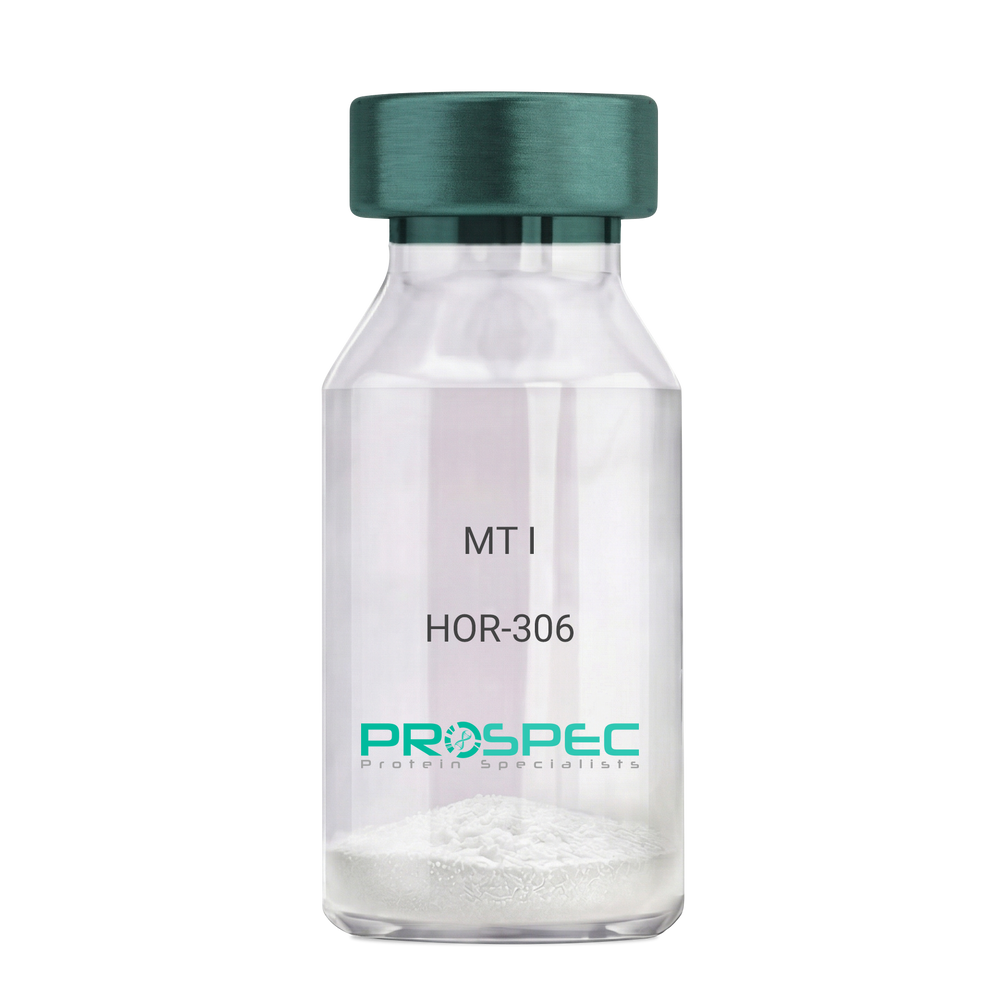
    MT I

    Description:

    Melanotan-I

    Melanotan-I, MT-I, Melanotan-1.

    Product # :

    HOR-306

    Price :

    Quantity :

    Shipping Method :

    Room Temp Icon

    Shipped at Room temp

    Add To Cart

    More Info

    • description
    • formulation
    • purity
    • More Info

    Description

    Melanotan-I has the amino acid sequence of Ser-Tyr-Ser-Nle-Glu-His-D-Phe-Arg-Trp-Gly-Lys-Pro-Val and a molecular weight of 1647.4 Dalton.

    Formulation

    The protein (1mg/ml) was lyophilized with no additives.

    Purity

    Greater than 98.0% as determined by RP-HPLC.

    More Info

    • Synonyms

      Melanotan-I, MT-I, Melanotan-1.

    • Physical Appearance

      Sterile Filtered off-White lyophilized (freeze-dried) powder.

    • Stability

      Lyophilized Melanotan-I although stable at room temperature for 3 weeks, should be stored desiccated below -18°C. Upon reconstitution MT-I should be stored at 4°C between 2-7 days and for future use below -18°C.For long term storage it is recommended to add a carrier protein (0.1% HSA or BSA).Please prevent freeze-thaw cycles.

    • Solubility

      It is recommended to reconstitute the lyophilized Melanotan-I in sterile 1% acetic acid not less than 100 µg/ml, which can then be further diluted to other aqueous solutions.

    ProSpec's products are furnished for LABORATORY RESEARCH USE ONLY. The product may not be used as drugs, agricultural or pesticidal products, food additives or household chemicals.

    Melanotan I
  • View Data Sheet

    Name :

    MIF Human, GST

    Description:

    Macrophage Migration Inhibitor Factor Human Recombinant, GST tag

    Macrophage Migration Inhibitory Factor (Glycosylation-Inhibiting Factor), Phenylpyruvate Tautomerase, L-Dopachrome Tautomerase, L-Dopachrome Isomerase, GLIF, MMIF, GIF, Macrophage Migration Inhibitory Factor, Glycosylation-Inhibiting Factor, EC 5.3.3.12, EC 5.3.2.1, Macrophage migration inhibitory factor.

    Product # :

    CYT-401

    Price :

    Quantity :

    Shipping Method :

    Ice Icon

    Shipped with Ice Packs

    Add To Cart

    More Info

    • description
    • source
    • formulation
    • purity
    • More Info

    Description

    MIF Human Recombinant produced in E.Coli is a single, non-glycosylated polypeptide chain containing 345 amino acids (1-115 a.a) and having a molecular mass of 39.2kDa. MIF is fused to a 230 amino acid GST-tag at N-terminus & purified by proprietary chromatographic techniques.

    Source

    Escherichia Coli.

    Formulation

    MIF protein solution (1mg/ml) containing Phosphate Buffered Saline (pH7.4) and 10% glycerol.

    Purity

    Greater than 90.0% as determined by SDS-PAGE.

    More Info

    • Introduction

      The cytokine Macrophage migration inhibitory factor (MIF) has been identified to be secreted by the pituitary gland and the monocyte/macrophage and to play an important role in endotoxic shock. MIF has the unique property of being released from macrophages and T cells in response to physiological concentrations of glucocorticoids. The secretion of MIF is tightly regulated and decreases at high, anti-inflammatory steroid concentration.

    • Synonyms

      Macrophage Migration Inhibitory Factor (Glycosylation-Inhibiting Factor), Phenylpyruvate Tautomerase, L-Dopachrome Tautomerase, L-Dopachrome Isomerase, GLIF, MMIF, GIF, Macrophage Migration Inhibitory Factor, Glycosylation-Inhibiting Factor, EC 5.3.3.12, EC 5.3.2.1, Macrophage migration inhibitory factor.

    • Physical Appearance

      Sterile Filtered clear solution.

    • Stability

      Store at 4°C if entire vial will be used within 2-4 weeks. Store, frozen at -20°C for longer periods of time. For long term storage it is recommended to add a carrier protein (0.1% HSA or BSA).Avoid multiple freeze-thaw cycles.

    • Amino Acid Sequence

      MSPILGYWKI KGLVQPTRLL LEYLEEKYEE HLYERDEGDK WRNKKFELGL EFPNLPYYID GDVKLTQSMA IIRYIADKHN MLGGCPKERA EISMLEGAVL DIRYGVSRIA YSKDFETLKV DFLSKLPEML KMFEDRLCHK TYLNGDHVTH PDFMLYDALD VVLYMDPMCL DAFPKLVCFK KRIEAIPQID KYLKSSKYIA WPLQGWQATF GGGDHPPKSD LVPRGSPEFA MPMFIVNTNV PRASVPDGFL SELTQQLAQA TGKPPQYIAV HVVPDQLMAF GGSSEPCALC SLHSIGKIGG AQNRSYSKLL CGLLAERLRI SPDRVYINYY DMNAANVGWN NSTFA.

    ProSpec's products are furnished for LABORATORY RESEARCH USE ONLY. The product may not be used as drugs, agricultural or pesticidal products, food additives or household chemicals.

    Mif Human Gst
  • View Data Sheet

    Name :

    Malaria Pv. MSP1

    Description:

    Malaria Vivax MSP1 Recombinant

    Product # :

    MAL-003

    Price :

    Quantity :

    Shipping Method :

    Ice Icon

    Shipped with Ice Packs

    Add To Cart

    More Info

    • description
    • formulation
    • purity
    • More Info

    Description

    Merozoite surface antigen is a protein located on the outside of the merozoite, playing an imperative role in immune reaction. About 45% cases of malaria are infected by Plasmodium vivax (Pv). Pv. MSP1 has to be used with Plasmodium falciparum (Pf) together for ELISA and rapid diagnostic test, Plasmodium falciparum and vivax infection takes about 95% of Plasmodium caused infection.Recombinant Malaria Vivax MSP1 produced in E.coli and fused to a His tag was purified by proprietary chromatographic technique.

    Formulation

    Sterile Filtered solution containing Phosphate buffered saline and 25mM K2CO3.

    Purity

    Protein is >95% pure as determined by SDS-PAGE.

    More Info

    • Introduction

      Plasmodium falciparum is a protozoan parasite, one of the species of Plasmodium that cause malaria. Malaria parasites are members of the Apicomplexa. Apicomplexa are characterized by a set of organelles found in some stages of the parasite's life cycle. These organelles, collectively known as apical organelles because of their localization at one end of the parasite, are involved in interactions between the parasite and host. In particular, the apical organelles have been implicated in the process of host cell invasion. In the case of Plasmodium, three distinct invasive forms have been identified: sporozoite, merozoite, and ookinete.

    • Physical Appearance

      Sterile Filtered clear solution.

    • Stability

      Pv. MSP1 although stable at 4°C for 1 week, should be stored below -18°C. Please prevent freeze thaw cycles.

    • Applications

      Rapid test and Immunoassay.

    ProSpec's products are furnished for LABORATORY RESEARCH USE ONLY. The product may not be used as drugs, agricultural or pesticidal products, food additives or household chemicals.

    Malaria Pv Msp1
  • View Data Sheet

    Name :

    MAPK10 Human

    Description:

    Mitogen-Activated Protein Kinase 10 Human Recombinant

    C-Jun N-Terminal Kinase 3, MAP Kinase P49 3F12, MAP Kinase 10, PRKM10, SAPK1b, JNK3A, JNK3.

    Product # :

    PKA-115

    Price :

    Quantity :

    Shipping Method :

    Ice Icon

    Shipped with Ice Packs

    Add To Cart

    More Info

    • description
    • source
    • formulation
    • purity
    • More Info

    Description

    MAPK10 produced in Sf9 Insect cells is a single, glycosylated polypeptide chain containing 470 amino acids (1-464 a.a.) and having a molecular mass of 53.4kDa. MAPK10 is expressed with a 6 amino acid His tag at C-Terminus and purified by proprietary chromatographic techniques.

    Source

    Sf9, Baculovirus cells.

    Formulation

    MAPK10 is protein solution ( 0.25mg/ml) contains Phosphate Buffered Saline (pH 7.4), 30% glycerol, 1mM DTT and 0.1mM PMSF.

    Purity

    Greater than 85.0% as determined by SDS-PAGE.

    More Info

    • Introduction

      MAPK10 is part of the MAP kinase protein family. MAP Kinases perform as assimilation point for many biochemical pathways. The enzyme also takes part in wide range of cellular pathways: differentiation, proliferation, development and transcription regulation.

    • Synonyms

      C-Jun N-Terminal Kinase 3, MAP Kinase P49 3F12, MAP Kinase 10, PRKM10, SAPK1b, JNK3A, JNK3.

    • Physical Appearance

      Sterile Filtered colorless solution.

    • Stability

      Store at 4°C if entire vial will be used within 2-4 weeks. Store, frozen at -20°C for longer periods of time. For long term storage it is recommended to add a carrier protein (0.1% HSA or BSA).Avoid multiple freeze-thaw cycles.

    • Amino Acid Sequence

      MSLHFLYYCS EPTLDVKIAF CQGFDKQVDV SYIAKHYNMS KSKVDNQFYS VEVGDSTFTV LKRYQNLKPI GSGAQGIVCA AYDAVLDRNV AIKKLSRPFQ NQTHAKRAYR ELVLMKCVNH KNIISLLNVF TPQKTLEEFQ DVYLVMELMD ANLCQVIQME LDHERMSYLL YQMLCGIKHL HSAGIIHRDL KPSNIVVKSD CTLKILDFGL ARTAGTSFMM TPYVVTRYYR APEVILGMGY KENVDIWSVG CIMGEMVRHK ILFPGRDYID QWNKVIEQLG TPCPEFMKKL QPTVRNYVEN RPKYAGLTFP KLFPDSLFPA DSEHNKLKAS QARDLLSKML VIDPAKRISV DDALQHPYIN VWYDPAEVEA PPPQIYDKQL DEREHTIEEW KELIYKEVMN SEEKTKNGVV KGQPSPSGAA VNSSESLPPS SSVNDISSMS TDQTLASDTD SSLEASAGPL GCCRHHHHHH.

    ProSpec's products are furnished for LABORATORY RESEARCH USE ONLY. The product may not be used as drugs, agricultural or pesticidal products, food additives or household chemicals.

    Mapk10 Human
  • View Data Sheet

    Name :

    MOG

    Description:

    Myelin Oligodendrocyte Glycoprotein

    Myelin Oligodendrocyte Glycoprotein, MOG.

    Product # :

    PRO-371

    Price :

    Quantity :

    Shipping Method :

    Room Temp Icon

    Shipped at Room temp

    Add To Cart

    More Info

    • description
    • formulation
    • purity
    • More Info

    Description

    Myelin Oligodendrocyte Glycoprotein is a single, non-glycosylated polypeptide chain containing 21 amino acids and having a molecular mass of 2581 Dalton, the molecular formula: C118H177N35O29S.

    Formulation

    The protein was lyophilized with no additives.

    Purity

    Greater than 98.0% as determined by RP-HPLC.

    More Info

    • Introduction

      MOG is a transmembrane protein expressed on the surface of oligodendrocyte cell and on the outermost surface of myelin sheaths. MOG comprises about 0.1% of total CNS myelin protein. The MOG gene is a member of the immunoglobulin gene superfamily and is found within the MHC. The MOG gene is found on chromosome 6p21.3-p22. Myelin Oligodendrocyte Glycoprotein is a glycoprotein thought to be significant in the process of myelinization of nerves in the central nervous system (CNS). MOG peptide (35-55) is highly encephalitogenic and can induce strong T and B cell responses. A single injection of this peptide produces a relapsing- remitting neurologic disease with extensive plaque-like demyelination. Because of the clinical, histophathologic, and immunologic similarities with multiple sclerosis (MS), the MOG induced demyelinating encephalomyelitis may serve as a model for investigating MS.

    • Synonyms

      Myelin Oligodendrocyte Glycoprotein, MOG.

    • Physical Appearance

      Sterile Filtered White lyophilized (freeze-dried) powder.

    • Stability

      Lyophilized MOG although stable at room temperature for 3 weeks, should be stored desiccated below -18°C. Upon reconstitution MOG should be stored at 4°C between 2-7 days and for future use below -18°C.For long term storage it is recommended to add a carrier protein (0.1% HSA or BSA).Please prevent freeze-thaw cycles.

    • Solubility

      It is recommended to reconstitute the lyophilized MOG in sterile 18MΩ-cm H2O not less than 100µg/ml, which can then be further diluted to other aqueous solutions.

    • Amino Acid Sequence

      H-Met-Glu-Val-Gly-Trp-Tyr-Arg-Ser-Pro-Phe-Ser-Arg-Val-Val-His-Leu-Tyr-Arg-Asn-Gly-Lys-OH.

    ProSpec's products are furnished for LABORATORY RESEARCH USE ONLY. The product may not be used as drugs, agricultural or pesticidal products, food additives or household chemicals.

    Mog
  • View Data Sheet

    Name :

    MIP 1a Mouse

    Description:

    Macrophage Inflammatory Protein-1 Alpha Mouse Recombinant (CCL3)

    Small inducible cytokine A3, CCL3, Macrophage inflammatory protein 1-alpha, MIP-1-alpha, Tonsillar lymphocyte LD78 alpha protein, G0/G1 switch regulatory protein 19-1, G0S19-1 protein, SIS-beta, PAT 464.1, chemokine (C-C motif) ligand 3, MIP1A, SCYA3, G0S19-1, LD78ALPHA, TY-5, SIS-alpha, L2G25B.

    Product # :

    CHM-320

    Price :

    Quantity :

    Shipping Method :

    Room Temp Icon

    Shipped at Room temp

    Add To Cart

    More Info

    • description
    • source
    • formulation
    • purity
    • biological activity
    • More Info

    Description

    Macrophage Inflammatory Protein-1 alpha Mouse Recombinant produced in E.Coli is a single, non-glycosylated, polypeptide chain containing 69 amino acids and having a molecular mass of 7820 Dalton. The MIP-1a is purified by proprietary chromatographic techniques.

    Source

    Escherichia Coli.

    Formulation

    The protein was lyophilized from 1mg/ml solution containing no additives.

    Purity

    Greater than 99.0% as determined by:
    (a) Analysis by RP-HPLC.
    (b) Analysis by SDS-PAGE.

    Biological Activity

    The Activity is calculated by the ability to chemoattract of Balb3/C splenocytes using 1-10ng/ml corresponding to a Specific Activity of 100,000-1,000,000IU/mg.

    More Info

    • Introduction

      Macrophage Inflammatory Proteins (MIP) belong to the family of chemotactic cytokines known as chemokines. In humans, there are two major forms, MIP-1a and MIP-1b that are now officially named CCL3 and CCL4 respectively. Both are major factors produced by macrophages after they are stimulated with bacterial endotoxins. They activate human granulocytes (neutrophils, eosinophils and basophils) which can lead to acute neutrophilic inflammation. They also induce the synthesis and release of other pro-inflammatory cytokines such as interleukin 1 (IL-1), IL-6 and TNF-a from fibroblasts and macrophages. The genes for CCL3 and CCL4 are both located on human chromosome 17.

    • Synonyms

      Small inducible cytokine A3, CCL3, Macrophage inflammatory protein 1-alpha, MIP-1-alpha, Tonsillar lymphocyte LD78 alpha protein, G0/G1 switch regulatory protein 19-1, G0S19-1 protein, SIS-beta, PAT 464.1, chemokine (C-C motif) ligand 3, MIP1A, SCYA3, G0S19-1, LD78ALPHA, TY-5, SIS-alpha, L2G25B.

    • Physical Appearance

      Sterile Filtered White lyophilized (freeze-dried) powder.

    • Stability

      Lyophilized MIP-1a although stable at room temperature for 3 weeks, should be stored desiccated below -18°C. Upon reconstitution CCL3 should be stored at 4°C between 2-7 days and for future use below -18°C.For long term storage it is recommended to add a carrier protein (0.1% HSA or BSA).Please prevent freeze-thaw cycles.

    • Solubility

      It is recommended to reconstitute the lyophilized Macrophage Inflammatory Protein-1a in sterile 18MΩ-cm H2O not less than 100µg/ml, which can then be further diluted to other aqueous solutions.

    • Amino Acid Sequence

      The sequence of the first five N-terminal amino acids was determined and was found to be, Ala-Pro-Tyr-Gly-Ala.

    • Background

      What is the molecular weight/Mw of MIP 1A MOUSE Protein?
      MIP 1A MOUSE Protein has a total Mw of 7.82kDa.

      What is the source or expression system of MIP 1A MOUSE Protein?
      Escherichia Coli.

      What is the Purity of MIP 1A MOUSE Protein?
      MIP 1A MOUSE Protein is >99% pure as determined by SDS-PAGE.

      What is the Biological Activity of MIP 1A MOUSE Protein?
      The Activity is calculated by the ability to chemoattract of Balb3/C splenocytes using 1-10ng/ml corresponding to a Specific Activity of 100,000-1,000,000IU/mg.

      What is the amino acid sequence of MIP 1A MOUSE Protein?
      The sequence of the first five N-terminal amino acids was determined and was found to be, Ala-Pro-Tyr-Gly-Ala.

      What applications can MIP 1A MOUSE Protein be used in?
      MIP 1A MOUSE Protein can probably be used in western blot, ELISA and Lateral Flow.

      What is the endotoxin level for MIP 1A MOUSE Protein?
      The endotoxin level is minimal, MIP 1A MOUSE Protein was purified using conventional chromatography techniques.


    ProSpec's products are furnished for LABORATORY RESEARCH USE ONLY. The product may not be used as drugs, agricultural or pesticidal products, food additives or household chemicals.

    Mip 1A Mouse
  • View Data Sheet

    Name :

    MVK Human

    Description:

    Mevalonate Kinase Human Recombinant

    Mevalonate Kinase (Mevalonic Aciduria), LH Receptor MRNA-Binding Protein, LRBP, Mevalonate Kinase 1, MK, MVLK, EC 2.7.1.36.

    Product # :

    PKA-052

    Price :

    Quantity :

    Shipping Method :

    Ice Icon

    Shipped with Ice Packs

    Add To Cart

    More Info

    • description
    • source
    • formulation
    • purity
    • More Info

    Description

    MVK Human Recombinant produced in E.coli is a single, non-glycosylated polypeptide chain containing 419 amino acids (1-396) and having a molecular mass of 44.8kDa.The MVK is fused to a 23 amino acid His-Tag at N-terminus and purified by proprietary chromatographic techniques.

    Source

    Escherichia Coli.

    Formulation

    MVK protein (0.5mg/ml) contains 20mM Tris-HCl buffer (pH 8.0), 0.15M NaCl, 10% glycerol and 1mM DTT.

    Purity

    Greater than 90% as determined by SDS-PAGE.

    More Info

    • Introduction

      MVK is a member of the GHMP kinase family. Mevalonate is a vital mediator, and MVK an important early enzyme, in isoprenoid and sterol synthesis. MVK deficiency can result in gene mutation associated with Mevalonic aciduria, an illness which causes psychomotor retardation, failure to thrive hepatosplenomegaly, anemia and frequent febrile crises. Mutations in this gene also cause hyperimmunoglobulinaemia D and sporadic fever syndrome, in which the person suffers from recurrent episodes of fever related with lymphadenopathy, skin rash, gastrointestinal dismay and arthralgia.

    • Synonyms

      Mevalonate Kinase (Mevalonic Aciduria), LH Receptor MRNA-Binding Protein, LRBP, Mevalonate Kinase 1, MK, MVLK, EC 2.7.1.36.

    • Physical Appearance

      Sterile Filtered clear solution.

    • Stability

      Store at 4°C if entire vial will be used within 2-4 weeks. Store, frozen at -20°C for longer periods of time. For long term storage it is recommended to add a carrier protein (0.1% HSA or BSA).Avoid multiple freeze-thaw cycles.

    • Amino Acid Sequence

      MGSSHHHHHH SSGLVPRGSH MGSMLSEVLL VSAPGKVILH GEHAVVHGKV ALAVSLNLRT FLRLQPHSNG KVDLSLPNIG IKRAWDVARL QSLDTSFLEQ GDVTTPTSEQ VEKLKEVAGL PDDCAVTERL AVLAFLYLYL SICRKQRALP SLDIVVWSEL PPGAGLGSSA AYSVCLAAAL LTVCEEIPNP LKDGDCVNRW TKEDLELINK WAFQGERMIH GNPSGVDNAV STWGGALRYH QGKISSLKRS PALQILLTNT KVPRNTRALV AGVRNRLLKF PEIVAPLLTS IDAISLECER VLGEMGEAPA PEQYLVLEEL IDMNQHHLNA LGVGHASLDQ LCQVTRARGL HSKLTGAGGG GCGITLLKPG LEQPEVEATK QALTSCGFDC LETSIGAPGV SIHSATSLDS RVQQALDGL.

    ProSpec's products are furnished for LABORATORY RESEARCH USE ONLY. The product may not be used as drugs, agricultural or pesticidal products, food additives or household chemicals.

    Mvk Human
  • View Data Sheet

    Name :

    MAPK1 Human, His

    Description:

    Recombinant Human Mitogen-Activated Protein Kinase 1, His Tag

    Mitogen-activated protein kinase 1, EC 2.7.11.24, Extracellular signal-regulated kinase 2, ERK-2, Mitogen-activated protein kinase 2, MAP kinase 2, MAPK 2, p42-MAPK, ERT1, ERK, p38, p40, p41, ERK2, MAPK2, PRKM1, PRKM2, P42MAPK, p41mapk.

    Product # :

    PKA-360

    Price :

    Quantity :

    Shipping Method :

    Ice Icon

    Shipped with Ice Packs

    Add To Cart

    More Info

    • description
    • source
    • formulation
    • purity
    • More Info

    Description

    MAPK1 Human Recombinant produced in E.Coli is a single, non-glycosylated, polypeptide chain containing 380 amino acids (1-360 a.a.) and having a molecular mass of 43.5 kDa. MAPK1 is fused to a 20 amino acids His-tag at N-terminus & purified by proprietary chromatographic techniques.

    Source

    Escherichia Coli.

    Formulation

    The MAPK1 solution contains 20 mM Tris-HCl buffer (pH 8.0), 1mM DTT and 10% glycerol.

    Purity

    Greater than 95.0% as determined by SDS-PAGE.

    More Info

    • Introduction

      Mitogen-activated protein kinase 1 (MAPK1) is also known as "extracellular signal-regulated kinase 2" (ERK2). Two similar (85% sequence identity) protein kinases were originally called ERK1 and ERK2. They were found during a search for protein kinases that are rapidly phosphorylated after activation of cell surface tyrosine kinases such as the epidermal growth factor receptor. Phosphorylation of ERKs leads to the activation of their kinase activity.The molecular events linking cell surface receptors to activation of ERKs are complex. It was found that Ras GTP-binding proteins are involved in the activation of ERKs. Another protein kinase, Raf-1, was shown to phosphorylate a "MAPK kinase", thus qualifying as a "MAPK kinase kinase". The MAPK kinase was named "MAPK/ERK kinase" (MEK). Receptor-linked tyrosine kinases, Ras, Raf, MEK and MAPK could be fitted into a signaling cascade linking an extracellular signal to MAPK activation Transgenic gene knockout mice lacking MAPK1 have major defe

    • Synonyms

      Mitogen-activated protein kinase 1, EC 2.7.11.24, Extracellular signal-regulated kinase 2, ERK-2, Mitogen-activated protein kinase 2, MAP kinase 2, MAPK 2, p42-MAPK, ERT1, ERK, p38, p40, p41, ERK2, MAPK2, PRKM1, PRKM2, P42MAPK, p41mapk.

    • Physical Appearance

      Sterile Filtered colorless solution.

    • Stability

      Store at 4°C if entire vial will be used within 2-4 weeks. Store, frozen at -20°C for longer periods of time. For long term storage it is recommended to add a carrier protein (0.1% HSA or BSA).Avoid multiple freeze-thaw cycles.

    • Amino Acid Sequence

      MGSSHHHHHH SSGLVPRGSH MAAAAAAGAG PEMVRGQVFD VGPRYTNLSY IGEGAYGMVC SAYDNVNKVR VAIKKISPFE HQTYCQRTLR EIKILLRFRH ENIIGINDII RAPTIEQMKD VYIVQDLMET DLYKLLKTQH LSNDHICYFL YQILRGLKYI HSANVLHRDL KPSNLLLNTT CDLKICDFGL ARVADPDHDH TGFLTEYVAT RWYRAPEIML NSKGYTKSID IWSVGCILAE MLSNRPIFPG KHYLDQLNHI LGILGSPSQE MGSSHHHHHH SSGLVPRGSH MAAAAAAGAG PEMVRGQVFD VGPRYTNLSY IGEGAYGMVC SAYDNVNKVR VAIKKISPFE HQTYCQRTLR EIKILLRFRH ENIIGINDII RAPTIEQMKD VYIVQDLMET DLYKLLKTQH LSNDHICYFL YQILRGLKYI HSANVLHRDL KPSNLLLNTT CDLKICDFGL ARVADPDHDH TGFLTEYVAT RWYRAPEIML NSKGYTKSID IWSVGCILAE MLSNRPIFPG KHYLDQLNHI LGILGSPSQE DLNCIINLKA RNYLLSLPHK NKVPWNRLFP NADSKALDLL DKMLTFNPHK RIEVEQALAH PYLEQYYDPS DEPIAEAPFK FDMELDDLPK EKLKELIFEE TARFQPGYRS.

    ProSpec's products are furnished for LABORATORY RESEARCH USE ONLY. The product may not be used as drugs, agricultural or pesticidal products, food additives or household chemicals.

    Mapk1 Human His
  • View Data Sheet

    Name :

    MAPK3 Human

    Description:

    Mitogen-Activated Protein Kinase 3 Human Recombinant

    Mitogen-activated protein kinase 3, EC 2.7.11.24, Extracellular signal-regulated kinase 1, ERK-1, Insulin-stimulated MAP2 kinase, MAP kinase 1, MAPK 1, p44-ERK1, ERT2, p44-MAPK, Microtubule-associated protein 2 kinase, ERK1, PRKM3, P44ERK1, P44MAPK, HS44KDAP, HUMKER1A, MGC20180.

    Product # :

    PKA-213

    Price :

    Quantity :

    Shipping Method :

    Ice Icon

    Shipped with Ice Packs

    Add To Cart

    More Info

    • description
    • source
    • formulation
    • purity
    • More Info

    Description

    ERK1/MAPK3 Recombinant is a highly active form produced by phosphorylation of the purified ERK1/MAPK3 in vitro with MEK1 is a non-glycosylated polypeptide having a molecular mass of 43.6 kDa. ERK1/MAPK3 is purified by proprietary chromatographic techniques.

    Source

    Escherichia Coli.

    Formulation

    ERK1 is supplied containing 50mM Tris-HCl, 150mM NaCl, 2mM DTT, 5mM EDTA, pH 8.0.

    Purity

    Greater than 95% as determined by SDS-PAGE.

    More Info

    • Introduction

      Extracellular signal-regulated kinases (ERKs) or classical MAP kinases are widely expressed protein kinaseintracellular signalingmolecules which are involved in functions including the regulation of meiosis, mitosis, and postmitotic functions in differentiated cells. Many different stimuli, including growth factors, cytokines, virusinfection, ligands for heterotrimeric G protein-coupled receptors, transforming agents, and carcinogens, activate the ERK pathway.
      The term, "extracellular signal-regulated kinases", is sometimes used as a synonym for mitogen-activated protein kinase(MAPK), but has more recently been adopted for a specific subset of the mammalianMAPK family. In the MAPK/ERK pathway, Rasactivates c-Raf, followed by MEKand then MAPK1/2 (below). Ras is typically activated by growth hormones through receptor tyrosine kinasesand GRB2/SOS, but may also receive other signals. ERKs are known to activate many transcription factors and some downstream protein kinases. Disruption of the ERK pathway is common in cancers, especially Ras, c-Raf and receptors such as HER2.
      Mitogen-activated protein kinase 3 (MAPK3) is also known as "extracellular signal-regulated kinase 1" (ERK1). Transgenic gene knockoutmice lacking MAPK3 are viable and it is thought that MAPK1 can fulfill most MAPK3 functions in most cells. The main exception is in T cells. Mice lacking MAPK3 have reduced T cell development past the CD4+CD8+ stage.

    • Synonyms

      Mitogen-activated protein kinase 3, EC 2.7.11.24, Extracellular signal-regulated kinase 1, ERK-1, Insulin-stimulated MAP2 kinase, MAP kinase 1, MAPK 1, p44-ERK1, ERT2, p44-MAPK, Microtubule-associated protein 2 kinase, ERK1, PRKM3, P44ERK1, P44MAPK, HS44KDAP, HUMKER1A, MGC20180.

    • Physical Appearance

      Sterile Filtered clear solution.

    • Stability

      Store at 4°C if entire vial will be used within 2-4 weeks. Store, frozen at -20°C for longer periods of time. Avoid multiple freeze-thaw cycles.

    • Unit Definition

      No protease activity detectable, specific activity > 200 U*/mg (*1 U = 1 pmol/min transferred to myelin basic protein at 30 degree C).

    ProSpec's products are furnished for LABORATORY RESEARCH USE ONLY. The product may not be used as drugs, agricultural or pesticidal products, food additives or household chemicals.

    Erk1 Human Inactive Enzyme
  • View Data Sheet

    Name :

    MOBKL3 Human

    Description:

    MOB1, Mps One Binder kinase Activator-Like 3 Human Recombinant

    Mps one binder kinase activator-like 3, 2C4D, Class II mMOB1, Mob1 homolog 3, Mob3, Preimplantation protein 3, MOBKL3, MOB3, PREI3, MOB1, PREI3, CGI-95, MGC12264.

    Product # :

    PRO-049

    Price :

    Quantity :

    Shipping Method :

    Ice Icon

    Shipped with Ice Packs

    Add To Cart

    More Info

    • description
    • source
    • formulation
    • purity
    • More Info

    Description

    MOBKL3 Human Recombinant fused with a 20 amino acid His tag at N-terminus produced in E.Coli is a single, non-glycosylated, polypeptide chain containing 245 amino acids (1-225 a.a.) and having a molecular mass of 28.1kDa. The MOBKL3 is purified by proprietary chromatographic techniques.

    Source

    Escherichia Coli.

    Formulation

    The MOBKL3 solution (0.5 mg/ml) contains 20mM Tris-HCl buffer (pH8.0) containing 0.2M Nacl, 5mM DTT, 10% glycerol.

    Purity

    Greater than 95.0% as determined by SDS-PAGE.

    More Info

    • Introduction

      Mps one binder kinase activator-like 3 (MOBKL3) is a member of the MOB1/Phocein family and is phosphorylated on serine residues. MOBKL3 is usually linked with membranes but can be present in the cytosol, where it behaves as a protein complex. MOBKL3 is the major partner of the striatin family members, which are scaffolding proteins involved in signaling and trafficking.

    • Synonyms

      Mps one binder kinase activator-like 3, 2C4D, Class II mMOB1, Mob1 homolog 3, Mob3, Preimplantation protein 3, MOBKL3, MOB3, PREI3, MOB1, PREI3, CGI-95, MGC12264.

    • Physical Appearance

      Sterile Filtered colorless solution.

    • Stability

      Store at 4°C if entire vial will be used within 2-4 weeks. Store, frozen at -20°C for longer periods of time. For long term storage it is recommended to add a carrier protein (0.1% HSA or BSA).Avoid multiple freeze-thaw cycles.

    • Amino Acid Sequence

      MGSSHHHHHH SSGLVPRGSH MVMAEGTAVL RRNRPGTKAQ DFYNWPDESF DEMDSTLAVQ QYIQQNIRAD CSNIDKILEP PEGQDEGVWK YEHLRQFCLE LNGLAVKLQS ECHPDTCTQM TATEQWIFLC AAHKTPKECP AIDYTRHTLD GAACLLNSNK YFPSRVSIKE SSVAKLGSVC RRIYRIFSHA YFHHRQIFDE YENETFLCHR FTKFVMKYNL MSKDNLIVPI LEEEVQNSVS GESEA.

    ProSpec's products are furnished for LABORATORY RESEARCH USE ONLY. The product may not be used as drugs, agricultural or pesticidal products, food additives or household chemicals.

    Mobkl3 Human
  • View Data Sheet

    Name :

    MVD Human

    Description:

    Mevalonate Decarboxylase Human Recombinant

    Diphosphomevalonate decarboxylase, Mevalonate (diphospho)decarboxylase, MDDase, Mevalonate pyrophosphate decarboxylase, MVD, MPD, FP17780.

    Product # :

    ENZ-226

    Price :

    Quantity :

    Shipping Method :

    Ice Icon

    Shipped with Ice Packs

    Add To Cart

    More Info

    • description
    • source
    • formulation
    • purity
    • More Info

    Description

    MVD Human Recombinant produced in E.coli is a single, non-glycosylated polypeptide chain containing 420 amino acids (1-400) and having a molecular mass of 45.6kDa.MVD is fused to a 20 amino acid His-tag at N-terminus & purified by proprietary chromatographic techniques.

    Source

    E.coli.

    Formulation

    The MVD solution (0.5mg/ml) contains 20mM Tris-HCl buffer (pH8.0), 20% glycerol and 1mM DTT.

    Purity

    Greater than 85% as determined by SDS-PAGE.

    More Info

    • Introduction

      Diphosphomevalonate decarboxylase (MVD) catalyzes the conversion of mevalonate pyrophosphate into isopentenyl pyrophosphate in one of the early steps in cholesterol biosynthesis. MVD decarboxylates and dehydrates its substrate while hydrolyzing ATP. MVD is expressed in the heart, skeletal muscle, lung, liver, brain, pancreas, kidney and placenta.

    • Synonyms

      Diphosphomevalonate decarboxylase, Mevalonate (diphospho)decarboxylase, MDDase, Mevalonate pyrophosphate decarboxylase, MVD, MPD, FP17780.

    • Physical Appearance

      Sterile Filtered colorless solution.

    • Stability

      Store at 4°C if entire vial will be used within 2-4 weeks. Store, frozen at -20°C for longer periods of time. For long term storage it is recommended to add a carrier protein (0.1% HSA or BSA).Avoid multiple freeze-thaw cycles.

    • Amino Acid Sequence

      MGSSHHHHHH SSGLVPRGSH MASEKPLAAV TCTAPVNIAV IKYWGKRDEE LVLPINSSLS VTLHQDQLKT TTTAVISKDF TEDRIWLNGR EEDVGQPRLQ ACLREIRCLA RKRRNSRDGD PLPSSLSCKV HVASVNNFPT AAGLASSAAG YACLAYTLAR VYGVESDLSE VARRGSGSAC RSLYGGFVEW QMGEQADGKD SIARQVAPES HWPELRVLIL VVSAEKKLTG STVGMRASVE TSPLLRFRAE SVVPARMAEM ARCIRERDFP SFAQLTMKDS NQFHATCLDT FPPISYLNAI SWRIIHLVHR FNAHHGDTKV AYTFDAGPNA VIFTLDDTVA EFVAAVWHGF PPGSNGDTFL KGLQVRPAPL SAELQAALAM EPTPGGVKYI IVTQVGPGPQ ILDDPCAHLL GPDGLPKPAA.

    ProSpec's products are furnished for LABORATORY RESEARCH USE ONLY. The product may not be used as drugs, agricultural or pesticidal products, food additives or household chemicals.

    Mvd Human
  • View Data Sheet

    Name :

    MoeX

    Description:

    Mycobacterium Tuberculosis MoeX Recombinant

    Product # :

    PRO-1919

    Price :

    Quantity :

    Shipping Method :

    Ice Icon

    Shipped with Ice Packs

    Add To Cart

    More Info

    • description
    • source
    • formulation
    • purity
    • More Info

    Description

    Recombinant Mycobacterium Tuberculosis MoeX produced in E.Coli is a single, non-glycosylated, polypeptide chain having a molecular mass of 38 kDa. The MoeX is fused to a His tag at C-terminus and purified by proprietary chromatographic techniques.

    Source

    Escherichia Coli.

    Formulation

    MoeX protein solution 0.75mg/ml contains 1xPBS, 25mM arginine and 0.02% NaN3.

    Purity

    Protein is >95% pure as determined by 12% PAGE (coomassie staining).

    More Info

    • Physical Appearance

      Sterile Filtered clear solution.

    • Stability

      MoeX Recombinant although stable at 4°C for 1 week, should be stored below -18°C. Please prevent freeze thaw cycles.

    ProSpec's products are furnished for LABORATORY RESEARCH USE ONLY. The product may not be used as drugs, agricultural or pesticidal products, food additives or household chemicals.

    Moex
  • View Data Sheet

    Name :

    MIP 3b Mouse

    Description:

    Macrophage Inflammatory Protein-3 Beta Mouse Recombinant (CCL19)

    Small inducible cytokine A19, CCL19, Macrophage inflammatory protein 3 beta, MIP-3- beta, EBI1-ligand chemokine, ELC, Beta chemokine exodus-3, CK beta-11, chemokine (C-C motif) ligand 19, CKb11, MIP3B, MIP-3b, SCYA19, MGC34433, Epstein-Barr virus-induced molecule 1 ligand chemokine, EBI1-ligand chemokine.

    Product # :

    CHM-341

    Price :

    Quantity :

    Shipping Method :

    Room Temp Icon

    Shipped at Room temp

    Add To Cart

    More Info

    • description
    • source
    • formulation
    • purity
    • biological activity
    • More Info

    Description

    Macrophage Inflammatory Protein-3 beta Mouse Recombinant produced in E.Coli is a single, non-glycosylated, polypeptide chain containing 83 amino acids and having a molecular mass of 9216 Dalton. The MIP-3b is purified by proprietary chromatographic techniques.

    Source

    Escherichia Coli.

    Formulation

    Lyophilized from a 0.2μm filtered solution in Acetonitrile and TFA.

    Purity

    Greater than 97.0% as determined by SDS-PAGE.

    Biological Activity

    The ED50, as measured by its ability to chemoattract human PBL, is less than 100ng/ml. 

    More Info

    • Introduction

      Chemokine (C-C motif) ligand 19 (CCL19) is a small cytokine belonging to the CC chemokine family that is also known as EBI1 ligand chemokine (ELC) and macrophage inflammatory protein-3-beta (MIP-3-beta). CCL19 is expressed abundantly in thymus and lymph nodes, with moderate levels in trachea and colon and low levels in stomach, small intestine, lung, kidney and spleen. The gene for CCL19 is located on human chromosome 9. This chemokine elicits its effects on its target cells by binding to the chemokine receptor chemokine receptor CCR7. It attracts certain cells of the immune system, including dendritic cells and antigen-engaged B cells.

    • Synonyms

      Small inducible cytokine A19, CCL19, Macrophage inflammatory protein 3 beta, MIP-3- beta, EBI1-ligand chemokine, ELC, Beta chemokine exodus-3, CK beta-11, chemokine (C-C motif) ligand 19, CKb11, MIP3B, MIP-3b, SCYA19, MGC34433, Epstein-Barr virus-induced molecule 1 ligand chemokine, EBI1-ligand chemokine.

    • Physical Appearance

      Sterile Filtered White lyophilized (freeze-dried) powder.

    • Stability

      Lyophilized MIP-3b although stable at room temperature for 3 weeks, should be stored desiccated below -18°C. Upon reconstitution CCL19 should be stored at 4°C between 2-7 days and for future use below -18°C. For long term storage it is recommended to add a carrier protein (0.1% HSA or BSA).Please prevent freeze-thaw cycles.

    • Solubility

      It is recommended to reconstitute the lyophilized Macrophage Inflammatory Protein-3b in sterile 18MΩ-cm H2O not less than 100µg/ml, which can then be further diluted to other aqueous solutions.

    • Amino Acid Sequence

      GANDAEDCCL SVTQRPIPGN IVKAFRYLLN EDGCRVPAVV FTTLRGYQLC APPDQPWVDR IIRRLKKSSA KNKGNSTRRS PVLE.

    • Protein content

      Protein quantitation was carried out by two independent methods:1. UV spectroscopy at 280 nm using the absorbency value of 0.91 as the extinction coefficient for a 0.1% (1mg/ml) solution. This value is calculated by the PC GENE computer analysis program of protein sequences (IntelliGenetics). 2. Analysis by RP-HPLC, using a calibrated solution of MIP-3b as a Reference Standard.

    ProSpec's products are furnished for LABORATORY RESEARCH USE ONLY. The product may not be used as drugs, agricultural or pesticidal products, food additives or household chemicals.

    Mip 3B Mouse
  • View Data Sheet

    Name :

    IMPA1 Human

    Description:

    Inositol Monophosphatase 1 Human Recombinant

    Inositol monophosphatase 1, IMP 1, IMPase 1, Inositol-1(or 4)-monophosphatase 1, Lithium-sensitive myo-inositol monophosphatase A1, IMPA1, IMPA, IMP.

    Product # :

    ENZ-006

    Price :

    Quantity :

    Shipping Method :

    Ice Icon

    Shipped with Ice Packs

    Add To Cart

    More Info

    • description
    • source
    • formulation
    • purity
    • More Info

    Description

    IMPA1 Human Recombinant fused with a 20 amino acid His tag at N-terminus produced in E.Coli is a single, non-glycosylated, polypeptide chain containing 297 amino acids (1-277 a.a.) and having a molecular mass of 32.3kDa. The IMPA1 is purified by proprietary chromatographic techniques.

    Source

    Escherichia Coli.

    Formulation

    The IMPA1 solution (1mg/ml) contains 20mM Tris-HCl Buffer (pH 8.0) and 10% Glycerol.

    Purity

    Greater than 95.0% as determined by SDS-PAGE.

    More Info

    • Introduction

      Inositol monophosphatase1 (IMPA1) is responsible for the provision of inositol essential for synthesis of phosphatidylinositol and polyphosphoinositides. IMPA1 has a central role in the phosphatidylinositol signaling pathway by catalyzing the hydrolysis of inositol monophosphates. IMPA1 has been recognized as the pharmacological target for lithium action in the brain. The IMPA1 enzyme has a magnesium-dependent phosphatase activity and is inhibited by therapeutic concentrations of lithium. Inhibition of inositol monophosphate hydroylosis and ensuing depletion of inositol for phosphatidylinositol synthesis may perhaps explain the anti-manic and anti-depressive effects of lithium administered to treat bipolar disorder.

    • Synonyms

      Inositol monophosphatase 1, IMP 1, IMPase 1, Inositol-1(or 4)-monophosphatase 1, Lithium-sensitive myo-inositol monophosphatase A1, IMPA1, IMPA, IMP.

    • Physical Appearance

      Sterile Filtered colorless solution.

    • Stability

      Store at 4°C if entire vial will be used within 2-4 weeks. Store, frozen at -20°C for longer periods of time. For long term storage it is recommended to add a carrier protein (0.1% HSA or BSA).Avoid multiple freeze-thaw cycles.

    • Amino Acid Sequence

      MGSSHHHHHH SSGLVPRGSH MADPWQECMD YAVTLARQAG EVVCEAIKNE MNVMLKSSPV DLVTATDQKV EKMLISSIKE KYPSHSFIGE ESVAAGEKSI LTDNPTWIID PIDGTTNFVH RFPFVAVSIG FAVNKKIEFG VVYSCVEGKM YTARKGKGAF CNGQKLQVSQ QEDITKSLLV TELGSSRTPE TVRMVLSNME KLFCIPVHGI RSVGTAAVNM CLVATGGADA YYEMGIHCWD VAGAGIIVTE AGGVLMDVTG GPFDLMSRRV IAANNRILAE RIAKEIQVIP LQRDDED.

    ProSpec's products are furnished for LABORATORY RESEARCH USE ONLY. The product may not be used as drugs, agricultural or pesticidal products, food additives or household chemicals.

    Impa1 Human
  • View Data Sheet

    Name :

    MSH6 Human

    Description:

    MutS Homolog 6 Human Recombinant

    MSH6, GTBP, HNPCC5, HSAP, DNA mismatch repair protein Msh6, MutS-alpha 160 kDa subunit, G/T mismatch-binding protein, hMSH6, p160, GTMBP.

    Product # :

    PRO-745

    Price :

    Quantity :

    Shipping Method :

    Ice Icon

    Shipped with Ice Packs

    Add To Cart

    More Info

    • description
    • source
    • formulation
    • More Info

    Description

    MSH6 Human Recombinant produced in E.Coli is single, a non-glycosylated, Polypeptide chain containing 51 amino acids (350-400 a.a.) having a total Mw of 33 kDa. Human MSH6 is fused to a GST tag and purified by proprietary chromatographic techniques.

    Source

    Escherichia Coli.

    Formulation

    MSH6 is supplied in 50mM Tris-HCl, pH-7.5, 10mM L-glutathione (reduced).

    More Info

    • Introduction

      MSH6 deficiency result in hereditary non-polyposis colorectal cancer (Lynch syndrome). HNPCC is an autosomal, dominantly inherited disease linked with rise in cancer susceptibility. MSH6 is is known by its familial predisposition to premature onset colorectal carcinoma (crc).
      MSH6 is involved in repairing DNA. MSH6 protein repairs mistakes that occure during DNA replication in preparation for cell division. The MSH6 protein bonds with MSH2 protein and form an active protein complex which recognizes specific parts on the DNA where mistakes have been made during DNA replication. MLH1-PMS2 protein complex, afterwards takes over with the repair. MSH6 gene is part of the set of the mismatch repair (MMR) genes.

    • Synonyms

      MSH6, GTBP, HNPCC5, HSAP, DNA mismatch repair protein Msh6, MutS-alpha 160 kDa subunit, G/T mismatch-binding protein, hMSH6, p160, GTMBP.

    • Physical Appearance

      Sterile Filtered clear solution.

    • Stability

      Store at 4°C if entire vial will be used within 2-4 weeks. Store, frozen at -20°C for longer periods of time. Please avoid freeze thaw cycles.

    ProSpec's products are furnished for LABORATORY RESEARCH USE ONLY. The product may not be used as drugs, agricultural or pesticidal products, food additives or household chemicals.

    Msh6 Human
  • View Data Sheet

    Name :

    MUSTN1 Human

    Description:

    Musculoskeletal, Embryonic Nuclear Protein 1 Human Recombinant

    Musculoskeletal, Embryonic Nuclear Protein 1, MUSTANG, Musculoskeletal Embryonic Nuclear Protein 1, Musculoskeletal Temporally Activated Novel, MUSTN1.

    Product # :

    PRO-2061

    Price :

    Quantity :

    Shipping Method :

    Ice Icon

    Shipped with Ice Packs

    Add To Cart

    More Info

    • description
    • source
    • formulation
    • purity
    • More Info

    Description

    MUSTN1 Human Recombinant produced in E.Coli is a single, non-glycosylated polypeptide chain containing 105 amino acids (1-82 a.a) and having a molecular mass of 11.3kDa. MUSTN1 is fused to a 23 amino acid His-tag at N-terminus & purified by proprietary chromatographic techniques.

    Source

    Escherichia Coli.

    Formulation

    MUSTN1 protein solution (0.25 mg/ml) containing 20mM Tris-HCl buffer (pH 8.0), 0.15M NaCl, 10% glycerol and 1mM DTT.

    Purity

    Greater than 80.0% as determined by SDS-PAGE.

    More Info

    • Introduction

      Musculoskeletal, Embryonic Nuclear Protein 1, also known as MUSTN1 is a member of the MUSTANG family. MUSTN1 is implicated in the development andregeneration of the musculoskeletal system.

    • Synonyms

      Musculoskeletal, Embryonic Nuclear Protein 1, MUSTANG, Musculoskeletal Embryonic Nuclear Protein 1, Musculoskeletal Temporally Activated Novel, MUSTN1.

    • Physical Appearance

      Sterile Filtered clear solution.

    • Stability

      Store at 4°C if entire vial will be used within 2-4 weeks. Store, frozen at -20°C for longer periods of time. For long term storage it is recommended to add a carrier protein (0.1% HSA or BSA).Avoid multiple freeze-thaw cycles.

    • Amino Acid Sequence

      MGSSHHHHHH SSGLVPRGSH MGSMSQAGAQ EAPIKKKRPP VKEEDLKGAR GNLTKNQEIK SKTYQVMREC EQAGSAAPSV FSRTRTGTET VFEKPKAGPT KSVFG.

    ProSpec's products are furnished for LABORATORY RESEARCH USE ONLY. The product may not be used as drugs, agricultural or pesticidal products, food additives or household chemicals.

    Mustn1 Human
  • View Data Sheet

    Name :

    MIP 5 Human

    Description:

    Macrophage Inflammatory Protein-5 Human Recombinant (CCL15)

    Small inducible cytokine A15 precursor, CCL15, Macrophage inflammatory protein 5, MIP-5, MIP5, Chemokine CC-2, HCC-2, NCC-3, MIP- 1 delta, Leukotactin-1, LKN-1, Mrp-2b, C-C motif chemokine 15.

    Product # :

    CHM-230

    Price :

    Quantity :

    Shipping Method :

    Room Temp Icon

    Shipped at Room temp

    Add To Cart

    More Info

    • description
    • source
    • formulation
    • purity
    • biological activity
    • More Info

    Description

    Macrophage Inflammatory Protein-5 Human Recombinant produced in E.Coli is a single, non-glycosylated, polypeptide chain containing 92 amino acids and having a molecular mass of 10.1 kDa. The MIP5 is purified by proprietary chromatographic techniques.

    Source

    Escherichia Coli.

    Formulation

    MIP5 was lyophilized from a concentrated (1mg/ml) solution containing 20mM PBS pH-7.4 and 100mM NaCl.

    Purity

    Greater than 97.0% as determined by:
    (a) Analysis by RP-HPLC.
    (b) Analysis by SDS-PAGE.

    Biological Activity

    Determined by its ability to chemoattract human T-lymphocytes using a concentration range of 1-10 ng/ml corresponding to a Specific Activity of 100,000-1,000,000IU/mg.

    More Info

    • Introduction

      CCL15, a new human CC chemokine, was isolated from a human fetal spleen cDNA library. CCL15 cDNA encodes a predicted 113 amino acid (aa) protein containing a putative signal peptide of 21 amino acids that is cleaved to generate a 92 aa residue mature protein. Within the CC family members, human CCL15 shares 45%, 44%, 35%, and 30% aa homology with mouse C10, human MPIF-1, human HCC-1, and mouse MIP-1?, respectively. The gene for MIP-5 is found on chromosome 17 where the genes for most of the human CC chemokines are located. Human CCL15 is expressed in T and B lymphocytes, NK cells, monocytes and monocyte-derived dendritic cells. Human MIP-5 is chemotactic for T cells and monocytes and has been shown to induce calcium flux in human CCR-1-transfected cells.

    • Synonyms

      Small inducible cytokine A15 precursor, CCL15, Macrophage inflammatory protein 5, MIP-5, MIP5, Chemokine CC-2, HCC-2, NCC-3, MIP- 1 delta, Leukotactin-1, LKN-1, Mrp-2b, C-C motif chemokine 15.

    • Physical Appearance

      Sterile Filtered White lyophilized (freeze-dried) powder.

    • Stability

      Lyophilized MIP-5 although stable at room temperature for 3 weeks, should be stored desiccated below -18°C. Upon reconstitution CCL15 should be stored at 4°C between 2-7 days and for future use below -18°C.For long term storage it is recommended to add a carrier protein (0.1% HSA or BSA).Please prevent freeze-thaw cycles.

    • Solubility

      It is recommended to reconstitute the lyophilized MIP5 in sterile 18MΩ-cm H2O not less than 100µg/ml, which can then be further diluted to other aqueous solutions.

    • Amino Acid Sequence

      QFINDAETELMMSKLPLENPVVLNSFHFAADCCTSYISQSIPCSLMKSYFETSSECSKP GVIFLTKKGRQVCAKPSGPGVQDCMKKLKPYSI.

    ProSpec's products are furnished for LABORATORY RESEARCH USE ONLY. The product may not be used as drugs, agricultural or pesticidal products, food additives or household chemicals.

    Mip 5 Human
  • View Data Sheet

    Name :

    MGLL Human, Active

    Description:

    Monoglyceride Lipase Human Recombinant, Active

    Monoglyceride lipase, MGL, HU-K5, Lysophospholipase homolog, Lysophospholipase-like, Monoacylglycerol lipase, MAGL, MGLL, HUK5.

    Product # :

    ENZ-983

    Price :

    Quantity :

    Shipping Method :

    Ice Icon

    Shipped with Ice Packs

    Add To Cart

    More Info

    • description
    • source
    • formulation
    • purity
    • biological activity
    • More Info

    Description

    MGLL Human Recombinant fused with a 20 amino acid His tag at N-terminus produced in E.Coli is a single, non-glycosylated, polypeptide chain containing 333 amino acids (1-313 a.a.) and having a molecular mass of 36.4kDa. The MGLL is purified by proprietary chromatographic techniques.

    Source

    Escherichia Coli.

    Formulation

    The MGLL solution (0.5mg/ml) contains 20mM Tris-HCl Buffer (pH 8.0) and 10% Glycerol.

    Purity

    Greater than 85.0% as determined by SDS-PAGE.

    Biological Activity

    Specific activity is > 170 units/mg, and is defined as the amount of enzyme that hydrolyze 1.0 umole of p-nitrophenyl butyrate to pnitrophenol per minute at pH 7.5 at 25C.

    More Info

    • Introduction

      MGLL is a membrane-associated member of the serine hydrolase superfamily. MGLL is expressed in abundance in skeletal muscle and adipose tissue. MGLL functions jointly with hormone-sensitive lipase (LIPE) to hydrolyze intracellular triglyceride stores in adipocytes and other cells to fatty acids and glycerol. MGLL may also complement lipoprotein lipase (LPL) in completing hydrolysis of monoglycerides resulting from degradation of lipoprotein triglycerides.

    • Synonyms

      Monoglyceride lipase, MGL, HU-K5, Lysophospholipase homolog, Lysophospholipase-like, Monoacylglycerol lipase, MAGL, MGLL, HUK5.

    • Physical Appearance

      Sterile Filtered colorless solution.

    • Stability

      Store at 4°C if entire vial will be used within 2-4 weeks. Store, frozen at -20°C for longer periods of time. For long term storage it is recommended to add a carrier protein (0.1% HSA or BSA).Avoid multiple freeze-thaw cycles.

    • Amino Acid Sequence

      MGSSHHHHHH SSGLVPRGSH METGPEDPSS MPEESSPRRT PQSIPYQDLP HLVNADGQYL FCRYWKPTGT PKALIFVSHG AGEHSGRYEE LARMLMGLDL LVFAHDHVGH GQSEGERMVV SDFHVFVRDV LQHVDSMQKD YPGLPVFLLG HSMGGAIAIL TAAERPGHFA GMVLISPLVL ANPESATTFK VLAAKVLNLV LPNLSLGPID SSVLSRNKTE VDIYNSDPLI CRAGLKVCFG IQLLNAVSRV ERALPKLTVP FLLLQGSADR LCDSKGAYLL MELAKSQDKT LKIYEGAYHV LHKELPEVTN SVFHEINMWV SQRTATAGTA SPP.

    ProSpec's products are furnished for LABORATORY RESEARCH USE ONLY. The product may not be used as drugs, agricultural or pesticidal products, food additives or household chemicals.

    Mgll Human Active
  • 1
  • …
  • 5
  • 6
  • 7
  • 8
  • 9
  • …
  • 42
Your browser does not support the video tag.

Products

  • Cytokines
  • Growth Factors
  • Chemokines
  • CD Antigens
  • Neurotrophins
  • Hormones
  • Enzymes
  • Viral Antigens
  • Recombinant Proteins
  • Natural Proteins
  • Monoclonal Antibodies
  • Polyclonal Antibodies
  • Thermal Packaging

About

  • Company
  • Founder
  • Contribution
  • Contact Us
  • My Account

Ordering

  • Ordering Method
  • Ordering - Credit Card
  • Ordering PO
  • Shipping Fees
  • FAQ's

Legal

  • Terms & Conditions
  • Privacy
  • Site Map
  • info@prospecbio.com
  • Facebook
  • Instagram
  • Linkedin Profile

© 2026 ProSpec-Tany TechnoGene Ltd. All Rights Reserved.

  • Choosing a selection results in a full page refresh.
  • Opens in a new window.