Skip to content

High-quality research proteins.

  • 1-800-805-6531

  • Mon - Sat 8.00-18.00, Sun - Closed

  • info@prospecbio.com

  • PO Box 6591 East Brunswick NJ 08816

  • Products
    • Cytokines
    • Growth factors
    • Chemokines
    • Cd antigens
    • Neurotrophins
    • Hormones
    • Enzymes
    • Viral antigens
    • Recombinant proteins
    • Natural proteins
    • Monoclonal antibodies
    • Polyclonal antibodies
    • Thermal Packaging
  • About
    • Company
    • Founder
    • Contribution
  • Customers
    • Eastern Asia
    • Eastern Europe
    • North America
    • South America
    • South East Asia
    • Southern Asia
    • Western Europe
  • Ordering
    • Ordering Method
    • Ordering - Credit Card
    • Ordering - PO
    • Shipping Fees
    • FAQs
  • Services
    • DNA Cloning
    • Protein Expression
    • Monoclonal Antibody
    • Fermentation
    • Technology License
  • Contact us
Log in

Country/region

  • USD $ | Albania
  • USD $ | Andorra
  • USD $ | Argentina
  • USD $ | Armenia
  • USD $ | Australia
  • USD $ | Austria
  • USD $ | Azerbaijan
  • USD $ | Belarus
  • USD $ | Belgium
  • USD $ | Bolivia
  • USD $ | Brazil
  • USD $ | Bulgaria
  • USD $ | Cambodia
  • USD $ | Canada
  • USD $ | Chile
  • USD $ | China
  • USD $ | Colombia
  • USD $ | Costa Rica
  • USD $ | Croatia
  • USD $ | Cyprus
  • USD $ | Czechia
  • USD $ | Denmark
  • USD $ | Estonia
  • USD $ | Finland
  • USD $ | France
  • USD $ | Georgia
  • USD $ | Germany
  • USD $ | Greece
  • USD $ | Hong Kong SAR
  • USD $ | Hungary
  • USD $ | Iceland
  • USD $ | India
  • USD $ | Ireland
  • USD $ | Israel
  • USD $ | Italy
  • USD $ | Japan
  • USD $ | Kazakhstan
  • USD $ | Latvia
  • USD $ | Liechtenstein
  • USD $ | Lithuania
  • USD $ | Madagascar
  • USD $ | Malta
  • USD $ | Mexico
  • USD $ | Moldova
  • USD $ | Monaco
  • USD $ | Netherlands
  • USD $ | New Zealand
  • USD $ | North Macedonia
  • USD $ | Norway
  • USD $ | Panama
  • USD $ | Paraguay
  • USD $ | Peru
  • USD $ | Philippines
  • USD $ | Poland
  • USD $ | Portugal
  • USD $ | Romania
  • USD $ | Singapore
  • USD $ | Slovakia
  • USD $ | Slovenia
  • USD $ | South Africa
  • USD $ | South Korea
  • USD $ | Spain
  • USD $ | Sri Lanka
  • USD $ | Sweden
  • USD $ | Switzerland
  • USD $ | Taiwan
  • USD $ | Thailand
  • USD $ | Türkiye
  • USD $ | Ukraine
  • USD $ | United Kingdom
  • USD $ | United States
  • USD $ | Uruguay
  • USD $ | Vatican City
  • USD $ | Venezuela
  • USD $ | Vietnam
  • Facebook
  • Instagram
logoProSpec - Recombinant Protein Manufacturer for academic and R&D industry
Become a distributor
Account Log in
Wishlist
Cart Cart(0)
  • Products
    +
    • Cytokines
    • Growth factors
    • Chemokines
    • Cd antigens
    • Neurotrophins
    • Hormones
    • Enzymes
    • Viral antigens
    • Recombinant proteins
    • Natural proteins
    • Monoclonal antibodies
    • Polyclonal antibodies
    • Thermal Packaging
  • About
    +
    • Company
    • Founder
    • Contribution
  • Customers
    +
    • Eastern Asia
    • Eastern Europe
    • North America
    • South America
    • South East Asia
    • Southern Asia
    • Western Europe
  • Ordering
    +
    • Ordering Method
    • Ordering - Credit Card
    • Ordering - PO
    • Shipping Fees
    • FAQs
  • Services
    +
    • DNA Cloning
    • Protein Expression
    • Monoclonal Antibody
    • Fermentation
    • Technology License
  • Contact us

Item added to your cart

View cart
View All
  • Cytokines
  • Growth factors
  • Chemokines
  • Cd antigens
  • Neurotrophins
  • Hormones
  • Enzymes
  • Viral antigens
  • Recombinant proteins
  • Natural proteins
  • Monoclonal antibodies
  • Polyclonal antibodies
  • Thermal Packaging
  • Tumor Necrosis Factor

    Tumor Necrosis Factor

    View All
  • 4-1BB

    4-1BB

    View All
  • Adiponectin

    Adiponectin

    View All
  • AIF1

    AIF1

    View All
  • Other Cytokines

    Other Cytokines

    View All
  • AITRL

    AITRL

    View All
  • Angiopoietin

    Angiopoietin

    View All
  • Apolipoprotein

    Apolipoprotein

    View All
  • B-Cell Activating Factor

    B-Cell Activating Factor

    View All
  • Beta Defensin

    Beta Defensin

    View All
  • Bone Morphogenetic Protein

    Bone Morphogenetic Protein

    View All
  • B type Natriuretic Peptide

    B type Natriuretic Peptide

    View All
  • BST

    BST

    View All
  • Betacellulin

    Betacellulin

    View All
  • Cardiotrophin

    Cardiotrophin

    View All
  • Activin

    Activin

    View All
  • Fibroblast Growth Factor

    Fibroblast Growth Factor

    View All
  • Other Growth Factors

    Other Growth Factors

    View All
  • CSF

    CSF

    View All
  • CTGF

    CTGF

    View All
  • IGFBP

    IGFBP

    View All
  • VEGF Protein

    VEGF Protein

    View All
  • EGF

    EGF

    View All
  • Epigen

    Epigen

    View All
  • Erythropoietin

    Erythropoietin

    View All
  • Insulin-Like Growth Factor

    Insulin-Like Growth Factor

    View All
  • Growth Hormone

    Growth Hormone

    View All
  • HDGF

    HDGF

    View All
  • Hepatocyte Growth Factor

    Hepatocyte Growth Factor

    View All
  • Insulin

    Insulin

    View All
  • BCA-1/ BLC (CXCL13)

    BCA-1/ BLC (CXCL13)

    View All
  • BRAK (CXCL14)

    BRAK (CXCL14)

    View All
  • C-10 (CCL6)

    C-10 (CCL6)

    View All
  • Other Chemokines

    Other Chemokines

    View All
  • MEC (CCL28)

    MEC (CCL28)

    View All
  • LD78-beta (CCL3L1)

    LD78-beta (CCL3L1)

    View All
  • CTACK (CCL27)

    CTACK (CCL27)

    View All
  • CXCL16

    CXCL16

    View All
  • CXCL17

    CXCL17

    View All
  • Platelet Factor-4 (CXCL4)

    Platelet Factor-4 (CXCL4)

    View All
  • ENA-78 (CXCL5)

    ENA-78 (CXCL5)

    View All
  • Eotaxin (CCL11,24,26)

    Eotaxin (CCL11,24,26)

    View All
  • Exodus-2 (CCL21)

    Exodus-2 (CCL21)

    View All
  • Fractalkine (CX3CL1)

    Fractalkine (CX3CL1)

    View All
  • CXCL6

    CXCL6

    View All
  • Other CD Antigens

    Other CD Antigens

    View All
  • CD14

    CD14

    View All
  • CD164

    CD164

    View All
  • CD1

    CD1

    View All
  • CD2

    CD2

    View All
  • CD200

    CD200

    View All
  • CD207

    CD207

    View All
  • CD226

    CD226

    View All
  • CD23

    CD23

    View All
  • CD244

    CD244

    View All
  • CD247

    CD247

    View All
  • CD27

    CD27

    View All
  • CD274

    CD274

    View All
  • CD300

    CD300

    View All
  • CD33

    CD33

    View All
  • Other Neurotrophins

    Other Neurotrophins

    View All
  • Beta-NGF

    Beta-NGF

    View All
  • BDNF

    BDNF

    View All
  • CDNF

    CDNF

    View All
  • CNTF

    CNTF

    View All
  • GDNF

    GDNF

    View All
  • Glia Maturation Factor

    Glia Maturation Factor

    View All
  • MANF

    MANF

    View All
  • Midkine

    Midkine

    View All
  • Neuroglobin

    Neuroglobin

    View All
  • Neurotrophic factors

    Neurotrophic factors

    View All
  • Neuregulin

    Neuregulin

    View All
  • Neuropilin

    Neuropilin

    View All
  • Pigment Epithelium-Derived Factor

    Pigment Epithelium-Derived Factor

    View All
  • Pleiotrophin

    Pleiotrophin

    View All
  • Peptide Hormones

    Peptide Hormones

    View All
  • Other Hormones

    Other Hormones

    View All
  • HCG

    HCG

    View All
  • Endothelin

    Endothelin

    View All
  • Exendin

    Exendin

    View All
  • FSH

    FSH

    View All
  • Glucagon

    Glucagon

    View All
  • GHRP

    GHRP

    View All
  • GLP

    GLP

    View All
  • Thyrostimulin

    Thyrostimulin

    View All
  • Inhibin A

    Inhibin A

    View All
  • LHRH

    LHRH

    View All
  • Melanotan

    Melanotan

    View All
  • Procalcitonin

    Procalcitonin

    View All
  • PTH

    PTH

    View All
  • Peroxiredoxin

    Peroxiredoxin

    View All
  • Peptidase

    Peptidase

    View All
  • Synthetase

    Synthetase

    View All
  • Transferase

    Transferase

    View All
  • Hydrolase

    Hydrolase

    View All
  • Dehydrogenase

    Dehydrogenase

    View All
  • ACE2

    ACE2

    View All
  • Esterase

    Esterase

    View All
  • Protein Kinases

    Protein Kinases

    View All
  • Other Enzymes

    Other Enzymes

    View All
  • Phosphatase

    Phosphatase

    View All
  • Deaminase

    Deaminase

    View All
  • Oxygenase

    Oxygenase

    View All
  • Adenylate Kinase

    Adenylate Kinase

    View All
  • Lyase

    Lyase

    View All
  • Chagas

    Chagas

    View All
  • SARS

    SARS

    View All
  • Influenza

    Influenza

    View All
  • ASFV

    ASFV

    View All
  • Astrovirus

    Astrovirus

    View All
  • Borrelia

    Borrelia

    View All
  • Helicobacter Pylori

    Helicobacter Pylori

    View All
  • Chikungunya

    Chikungunya

    View All
  • Chlamydia

    Chlamydia

    View All
  • Cytomegalo

    Cytomegalo

    View All
  • Dengue

    Dengue

    View All
  • EBV

    EBV

    View All
  • Ebola

    Ebola

    View All
  • Feline Leukemia Virus

    Feline Leukemia Virus

    View All
  • Hepatitis A

    Hepatitis A

    View All
  • Other

    Other

    View All
  • Actin

    Actin

    View All
  • ADAM

    ADAM

    View All
  • Complement Component

    Complement Component

    View All
  • Ag85

    Ag85

    View All
  • Eukaryotic Translation Initiation Factor

    Eukaryotic Translation Initiation Factor

    View All
  • Anterior Gradient Protein

    Anterior Gradient Protein

    View All
  • Heat Shock Protein

    Heat Shock Protein

    View All
  • Alpha-2-HS-Glycoprotein

    Alpha-2-HS-Glycoprotein

    View All
  • Hemoglobin

    Hemoglobin

    View All
  • Allergy

    Allergy

    View All
  • Anaplasma

    Anaplasma

    View All
  • Angiogenin

    Angiogenin

    View All
  • Ankyrin Repeat Domain

    Ankyrin Repeat Domain

    View All
  • Annexin

    Annexin

    View All
  • Other Natural Proteins

    Other Natural Proteins

    View All
  • Aprotinin

    Aprotinin

    View All
  • Transferrin

    Transferrin

    View All
  • Avidin

    Avidin

    View All
  • Anti Coagulation Factors

    Anti Coagulation Factors

    View All
  • Natural Albumin

    Natural Albumin

    View All
  • Natural Coagulation Factors

    Natural Coagulation Factors

    View All
  • Fibronectin

    Fibronectin

    View All
  • Thrombin

    Thrombin

    View All
  • Anti Human Enzyme

    Anti Human Enzyme

    View All
  • Other Monoclonal Antibodies

    Other Monoclonal Antibodies

    View All
  • Anti Human Cytokine

    Anti Human Cytokine

    View All
  • Anti Human Heat Shock Protein

    Anti Human Heat Shock Protein

    View All
  • Anti Mouse Lymphocyte

    Anti Mouse Lymphocyte

    View All
  • Anti Human Chemokine

    Anti Human Chemokine

    View All
  • Anti Human Lymphocyte

    Anti Human Lymphocyte

    View All
  • Anti Viral Monoclonal

    Anti Viral Monoclonal

    View All
  • Anti Mouse Cytokine

    Anti Mouse Cytokine

    View All
  • Anti-GST Monoclonal

    Anti-GST Monoclonal

    View All
  • Other Polyclonal Antibodies

    Other Polyclonal Antibodies

    View All
  • Anti Viral

    Anti Viral

    View All
  • Anti-GST Monoclonal

    Anti-GST Monoclonal

    View All
Back

Search results

1000 results found for “Cysteine-Rich”

Name

Description

Product #

Price

Quantity

Shipping Method

  • View Data Sheet

    Name :

    KRT19 Human

    Description:

    Cytokeratin 19 Human Recombinant

    Keratin type I cytoskeletal 19, Cytokeratin-19, CK-19, Keratin-19, K19, KRT19, CK19, K1CS, MGC15366.

    Product # :

    PRO-350

    Price :

    Quantity :

    Shipping Method :

    Room Temp Icon

    Shipped at Room temp

    Add To Cart

    More Info

    • description
    • source
    • formulation
    • purity
    • More Info

    Description

    Cytokeratin 19 Human Recombinant produced in E.Coli is a single, non-glycosylated polypeptide chain having a molecular mass of 44,098 Dalton. The KRT19 is purified by proprietary chromatographic techniques.

    Source

    Escherichia Coli.

    Formulation

    The protein (1mg/ml) was lyophilized after from a sterile solution containing 30mM Tris-HCl pH-8, 9.5M urea, 2mM DTT, 2mM EDTA and 10mM methylammonium chloride.

    Purity

    Greater than 95.0% as determined by SDS-PAGE.

    More Info

    • Introduction

      CTK-19 is a member of the keratin family. The keratins are intermediate filament proteins responsible for the structural integrity of epithelial cells and are subdivided into cytokeratins and hair keratins. The type I cytokeratins consist of acidic proteins which are arranged in pairs of heterotypic keratin chains. Unlike its related family members, this smallest known acidic cytokeratin is not paired with a basic cytokeratin in epithelial cells. It is specifically expressed in the periderm, the transiently superficial layer that envelopes the developing epidermis. The type I cytokeratins are clustered in a region of chromosome 17q12-q21.

    • Synonyms

      Keratin type I cytoskeletal 19, Cytokeratin-19, CK-19, Keratin-19, K19, KRT19, CK19, K1CS, MGC15366.

    • Physical Appearance

      Sterile Filtered White lyophilized (freeze-dried) powder.

    • Stability

      Lyophilized KRT19 although stable at room temperature for 3 weeks, should be stored desiccated below -18°C. Upon reconstitution KRT19 should be stored at 4°C between 2-7 days and for future use below -18°C.For long term storage it is recommended to add a carrier protein (0.1% HSA or BSA).Please prevent freeze-thaw cycles.

    • Solubility

      It is recommended to reconstitute the lyophilized KRT19 in sterile 18MΩ-cm H2O not less than 100µg/ml, which can then be further diluted to other aqueous solutions.

    • Reconstitution to filaments

      Performed by mixing equimolar amounts of cytokeratins of type I and type II at concentrations of approx. 0.5 mg/ml, both dissolved in 9.5 M urea buffer (see above). Protofilaments and filament complexes are obtained by dialyzing the resulting polypeptide solution stepwise to a concentration of 4 M urea and then to low salt condition (50 mM NaCl, 2 mM dithiothreitol, 10 mM Tris-HCl, pH 7.4). For immunization purposes, the solution can be further dialyzed against PBS (phosphate buffered saline, e.g. Dulbecco's PBS).

    ProSpec's products are furnished for LABORATORY RESEARCH USE ONLY. The product may not be used as drugs, agricultural or pesticidal products, food additives or household chemicals.

    Krt19 Human
  • View Data Sheet

    Name :

    KRT8 Human

    Description:

    Cytokeratin 8 Human Recombinant

    Keratin type II cytoskeletal 8, Cytokeratin-8, CK-8, Keratin-8, K8, KRT8, CYK8, KO, CK8, K2C8, CARD2.

    Product # :

    PRO-347

    Price :

    Quantity :

    Shipping Method :

    Room Temp Icon

    Shipped at Room temp

    Add To Cart

    More Info

    • description
    • source
    • formulation
    • purity
    • More Info

    Description

    Cytokeratin 8 Human Recombinant produced in E.Coli is a single, non-glycosylated polypeptide chain having a molecular mass of 53,532 Dalton. The KRT8 is purified by proprietary chromatographic techniques.

    Source

    Escherichia Coli.

    Formulation

    The protein (1mg/ml) was lyophilized after from a sterile solution containing 30mM Tris-HCl pH-8, 9.5M urea, 2mM DTT, 2mM EDTA and 10mM methylammonium chloride.

    Purity

    Greater than 95.0% as determined by:
    (a) Analysis by RP-HPLC.
    (b) Analysis by SDS-PAGE.

    More Info

    • Introduction

      Keratin 8 and 18 (K8/18) are the major components of intermediate filament (IF) proteins of simple or single-layered epithelia.

    • Synonyms

      Keratin type II cytoskeletal 8, Cytokeratin-8, CK-8, Keratin-8, K8, KRT8, CYK8, KO, CK8, K2C8, CARD2.

    • Physical Appearance

      Sterile Filtered White lyophilized (freeze-dried) powder.

    • Stability

      Lyophilized KRT8 although stable at room temperature for 3 weeks, should be stored at 2-8°C. Upon reconstitution KRT8 should be stored at 4°C between 2-7 days and for future use below -18°C. For long term storage it is recommended to add a carrier protein (0.1% HSA or BSA). Please prevent freeze-thaw cycles.

    • Solubility

      It is recommended to reconstitute the lyophilized KRT8 in sterile 18MΩ-cm H2O not less than 100µg/ml, which can then be further diluted to other aqueous solutions.

    • Reconstitution to filaments

      Performed by mixing equimolar amounts of cytokeratins of type I and type II at concentrations of approx. 0.5 mg/ml, both dissolved in 9.5 M urea buffer (see above). Protofilaments and filament complexes are obtained by dialyzing the resulting polypeptide solution stepwise to a concentration of 4 M urea and then to low salt condition (50 mM NaCl, 2 mM dithiothreitol, 10 mM Tris-HCl, pH 7.4). For immunization purposes, the solution can be further dialyzed against PBS (phosphate buffered saline, e.g. Dulbecco's PBS).

    ProSpec's products are furnished for LABORATORY RESEARCH USE ONLY. The product may not be used as drugs, agricultural or pesticidal products, food additives or household chemicals.

    Krt8 Human
  • View Data Sheet

    Name :

    CKMM Human, Native

    Description:

    Creatine Kinase Muscle Human

    Creatine kinase M-type, EC 2.7.3.2, Creatine kinase M chain, M-CK, CKM, CKMM.

    Product # :

    CKI-273

    Price :

    Quantity :

    Shipping Method :

    Room Temp Icon

    Shipped at Room temp

    Add To Cart

    More Info

    • description
    • source
    • formulation
    • purity
    • biological activity
    • More Info

    Description

    Human CKMM derived from Human Cardiac Tissue.

    Source

    Human Cardiac Tissue.

    Formulation

    The CKMM protein was lyophilized from 40mM Tris-HCL, 1mM EDTA, pH 7.5 & 10mM n-Acetyl cysteine.

    Purity

    Greater than 10.0% as visualized by sds-page.

    Biological Activity

    1 unit will transfer 1 µmole of phosphate from Creatine phosphate to ATP/minute at 37 degrees Celsius. Measured at 340nm as one equimolar amount of NADH produced by a coupled reaction. The specific activity was measured and found to be > 100U/mg.

    More Info

    • Introduction

      The three isoenzymes (MM, MB, and BB) are found in muscle, cardiac and brain tissues. These recombinant proteins are ideal for calibrating diagnostic instruments and researching neuromuscular diseases. Creatine Kinases can be used for indications in many neuromuscular applications. These disorders include cardiac disease, mitochondrial disorders, inflammatory myopathies, myasthenia, polymyositis, McArdle''s disease, NMJ disorders, muscular dystrophy, ALS, hypo and hyperthyroid disorders, central core disease, acid maltase deficiency, myoglobinuria, rhabdomyolysis, motor neuron diseases, rheumatic diseases, and other that create elevated or reduced levels of Creatine Kinases.

    • Synonyms

      Creatine kinase M-type, EC 2.7.3.2, Creatine kinase M chain, M-CK, CKM, CKMM.

    • Physical Appearance

      Lyophilized Powder

    • Stability

      Lyophilized CKMM although stable at room temperature for 3 weeks, should be stored desiccated below -18°C. Upon reconstitution IL2 should be stored at 4°C between 2-7 days and for future use below -18°C.For long term storage it is recommended to add a carrier protein (0.1% HSA or BSA).Please prevent freeze-thaw cycles.

    • Solubility

      It is recommended to reconstitute the lyophilized CKMM in sterile distilled water not less than 100µg/ml, which can then be further diluted to other aqueous solutions.

    ProSpec's products are furnished for LABORATORY RESEARCH USE ONLY. The product may not be used as drugs, agricultural or pesticidal products, food additives or household chemicals.

    Ckmm Human
  • View Data Sheet

    Name :

    GDNF Human

    Description:

    Glial-Derived Neurotrophic Factor Human Recombinant

    ATF1, ATF2, HFB1-GDNF, GDNF.

    Product # :

    CYT-305

    Price :

    Quantity :

    Shipping Method :

    Room Temp Icon

    Shipped at Room temp

    Add To Cart

    More Info

    • description
    • source
    • formulation
    • purity
    • biological activity
    • More Info
    • sds-page

    Description

    Glial derived Neurotrophic Factor Human Recombinant produced in E.Coli is a non-glycosylated disulfide-linked homodimer containing 2 x 135 amino acids and having a total molecular mass of approximately 30kDa. GDNF is purified by proprietary chromatographic techniques.

    Source

    Escherichia Coli.

    Formulation

    GDNF was lyophilized from a 0.2µm filtered concentrated solution in 1×PBS, pH 7.4 and 5% Trehalose.

    Purity

    Greater than 95.0% as determined by analysis by SDS-PAGE.

    Biological Activity

    The ED50 was determined by the proliferation of rat C6 cells is < 0.1 ng/ml, corresponding to a specific activity of > 1.0x10⁷ units/mg.

    sds-page

    GDNF sds-page - Product image 1

    More Info

    • Introduction

      GDNF promotes the survival and differentiation of minergic neurons in culture, and is able to prevent apoptosis of motor neurons induced by axotomy. The encoded protein is processed to a mature secreted form that exists as a homodimer. The mature form of the protein is a ligand for the product of the RET (rearranged during transfection) protooncogene. In addition to the transcript encoding GDNF, two additional alternative transcripts encoding distinct proteins, referred to as astrocyte-derived trophic factors, have also been described. Mutations in this gene may be associated with Hirschsprung disease.
      GDNF enhances survival and morphological differentiation of minergic neurons and increases their high-affinity uptake.

    • Synonyms

      ATF1, ATF2, HFB1-GDNF, GDNF.

    • Physical Appearance

      Sterile Filtered White lyophilized (freeze-dried) powder.

    • Stability

      Lyophilized Glial-derived Neurotrophic Factor although stable at room temperature for 3 weeks, should be stored desiccated below -18°C. Upon reconstitution GDNF should be stored at 4°C between 2-7 days and for future use below -18°C.For long term storage it is recommended to add a carrier protein (0.1% HSA or BSA).Please prevent freeze-thaw cycles.

    • Solubility

      It is recommended to reconstitute the lyophilized Glial Derived Neurotrophic Factor in sterile 18MΩ-cm H2O not less than 100µg/ml, which can then be further diluted to other aqueous solutions.

    • Amino Acid Sequence

      SPDKQMAVLP RRERNRQAAA ANPENSRGKG RRGQRGKNRG CVLTAIHLNV TDLGLGYETK EELIFRYCSG SCDAAETTYD KILKNLSRNR RLVSDKVGQA CCRPIAFDDD LSFLDDNLVY HILRKHSAKR CGCI.

    • Background

      What is the molecular weight/Mw of GDNF HUMAN Protein?
      GDNF HUMAN Protein has a total Mw of 30kDa.

      What is the source or expression system of GDNF HUMAN Protein?
      Escherichia Coli.

      What is the Purity of GDNF HUMAN Protein?
      GDNF HUMAN Protein is >95% pure as determined by SDS-PAGE.

      What is the Biological Activity of GDNF HUMAN Protein?
      The ED50 was determined by the proliferation of rat C6 cells is < 0.1 ng/ml, corresponding to a specific activity of > 1.0x10⁷ units/mg.

      What is the amino acid sequence of GDNF HUMAN Protein?
      SPDKQMAVLP RRERNRQAAA ANPENSRGKG RRGQRGKNRG CVLTAIHLNV TDLGLGYETK EELIFRYCSG SCDAAETTYD KILKNLSRNR RLVSDKVGQA CCRPIAFDDD LSFLDDNLVY HILRKHSAKR CGCI.
      What applications can GDNF HUMAN Protein be used in?
      GDNF HUMAN Protein can probably be used in western blot, ELISA and Lateral Flow.

      What is the endotoxin level for GDNF HUMAN Protein?
      The endotoxin level is minimal, GDNF HUMAN Protein was purified using conventional chromatography techniques.


    ProSpec's products are furnished for LABORATORY RESEARCH USE ONLY. The product may not be used as drugs, agricultural or pesticidal products, food additives or household chemicals.

    Gdnf Human
  • View Data Sheet

    Name :

    MCSFR Human

    Description:

    Colony Stimulating Factor 1 Receptor Human Recombinant

    Macrophage colony-stimulating factor 1 receptor, CSF-1 receptor (EC:2.7.10.1), CSF-1-R, CSF-1R, M-CSF-R, Proto-oncogene c-Fms, CD115, CSF1R, FMS. 

    Product # :

    CYT-1068

    Price :

    Quantity :

    Shipping Method :

    Ice Icon

    Shipped with Ice Packs

    Add To Cart

    More Info

    • description
    • source
    • formulation
    • purity
    • biological activity
    • More Info

    Description

    MCSFR produced in Sf9 Baculovirus cells is a single, glycosylated polypeptide chain containing 737 amino acids (20-517a.a.) and having a molecular mass of 82.1kDa. (Molecular size on SDS-PAGE will appear at approximately 70-100kDa).MCSFR is expressed with a 239 amino acid hIgG-His tag at C-Terminus and purified by proprietary chromatographic techniques.

    Source

    Sf9, Baculovirus cells.

    Formulation

    MCSFR protein solution (0.25mg/ml) contains Phosphate Buffered Saline (pH 7.4) and 10% glycerol.

    Purity

    Greater than 90.0% as determined by SDS-PAGE.

    Biological Activity

    Measured by its ability to inhibit M-CSF dependent proliferation of M-NFS-60 mouse myelogenous leukemia lymphoblast cells. The ED50 for this effect is less or equal to 100ng/ml in the presence of 10 ng/ml M-CSF.

    More Info

    • Introduction

      MCSFR which is also familiar as CSF1R, is part of the type3 subfamily of receptor tyrosine kinases. MCSFR is expressed mainly on cells of the monocyte and macrophage lineage, stem cells, and in the growing placenta. Most of the biological effects of this cytokine are mediated by MCSFR. MCSFR contains an extracellular ligand-binding domain, a single membrane-spanning segment, and an intracellular tyrosine kinase domain. Originally CSF1 and this receptor were implicated as vital for normal trophoblastic implantation as well as monocyte development. The role of CSF1/CSF1R in normal mammary gland development is actually very interesting since this connection has also been discovered in the biology of breast cancer with the results of abnormal expression of CSF1 and its receptor. Likewise, in Alzheimer's disease and after brain injuries an increased level of CSF1R was found in the microglia, which causes the microglia to become more active.

    • Synonyms

      Macrophage colony-stimulating factor 1 receptor, CSF-1 receptor (EC:2.7.10.1), CSF-1-R, CSF-1R, M-CSF-R, Proto-oncogene c-Fms, CD115, CSF1R, FMS.

    • Physical Appearance

      Sterile filtered colorless solution.

    • Stability

      Store at 4°C if entire vial will be used within 2-4 weeks. Store, frozen at -20°C for longer periods of time. For long term storage it is recommended to add a carrier protein (0.1% HSA or BSA).Avoid multiple freeze-thaw cycles.

    • Amino Acid Sequence

      IPVIEPSVPE LVVKPGATVT LRCVGNGSVE WDGPPSPHWT LYSDGSSSIL STNNATFQNT GTYRCTEPGD PLGGSAAIHL YVKDPARPWN VLAQEVVVFE DQDALLPCLL TDPVLEAGVS LVRVRGRPLM RHTNYSFSPW HGFTIHRAKF IQSQDYQCSA LMGGRKVMSI SIRLKVQKVI PGPPALTLVP AELVRIRGEA AQIVCSASSV DVNFDVFLQH NNTKLAIPQQ SDFHNNRYQK VLTLNLDQVD FQHAGNYSCV ASNVQGKHST SMFFRVVESA YLNLSSEQNL IQEVTVGEGL NLKVMVEAYP GLQGFNWTYL GPFSDHQPEP KLANATTKDT YRHTFTLSLP RLKPSEAGRY SFLARNPGGW RALTFELTLR YPPEVSVIWT FINGSGTLLC AASGYPQPNV TWLQCSGHTD RCDEAQVLQV WDDPYPEVLS QEPFHKVTVQ SLLTVETLEH NQTYECRAHN SVGSGSWAFI PISAGAHTHP PDEFLFTPLE PKSCDKTHTC PPCPAPELLG GPSVFLFPPK PKDTLMISRT PEVTCVVVDV SHEDPEVKFN WYVDGVEVHN AKTKPREEQY NSTYRVVSVL TVLHQDWLNG KEYKCKVSNK ALPAPIEKTI SKAKGQPREP QVYTLPPSRD ELTKNQVSLT CLVKGFYPSD IAVEWESNGQ PENNYKTTPP VLDSDGSFFL YSKLTVDKSR WQQGNVFSCS VMHEALHNHY TQKSLSLSPG KHHHHHH.

    ProSpec's products are furnished for LABORATORY RESEARCH USE ONLY. The product may not be used as drugs, agricultural or pesticidal products, food additives or household chemicals.

    Csf1R Human
  • View Data Sheet

    Name :

    I TAC Human, His

    Description:

    I-TAC Human Recombinant (CXCL11), His Tag

    Small inducible cytokine B11, CXCL11, Interferon-inducible T-cell alpha chemoattractant, I-TAC, Interferon-gamma-inducible protein 9, IP-9, H174, Beta-R1, chemokine (C-X-C motif) ligand 11, IP9, b-R1, SCYB11, SCYB9B, MGC102770.

    Product # :

    CHM-232

    Price :

    Quantity :

    Shipping Method :

    Ice Icon

    Shipped with Ice Packs

    Add To Cart

    More Info

    • description
    • source
    • formulation
    • purity
    • More Info

    Description

    I-TAC (CXCL11) Human Recombinant produced in E.coli is a single, non-glycosylated polypeptide chain containing 94 amino acids (22-94) and having a molecular mass of 10.6kDa.I-TAC is fused to a 21 amino acid His-tag at N-terminus & purified by proprietary chromatographic techniques.

    Source

    Escherichia Coli.

    Formulation

    The I-TAC solution (1mg/ml) contains 10mM sodium citrate(pH 3.5), 20% glycerol and 2mM DTT.

    Purity

    Greater than 90.0% as determined by SDS-PAGE.

    More Info

    • Introduction

      Chemokine (C-X-C motif) ligand 11 (CXCL11) is a small cytokine belonging to the CXC chemokine family that is also called Interferon-inducible T-cell alpha chemoattractant (I-TAC) and Interferon-gamma-inducible protein 9 (IP-9). It is highly expressed in peripheral blood leukocytes, pancreas and liver, with moderate levels in thymus, spleen and lung and low expression levels were in small intestine, placenta and prostate. Gene expression of CXCL11 is strongly induced by IFN-g and IFN-b, and weakly induced by IFN-a. This chemokine elicits its effects on its target cells by interacting with the cell surface chemokine receptor CXCR3, with a higher affinity than do the other ligands for this receptor, CXCL9 and CXCL10. CXCL11 is chemotactic for activated T cells. Its gene is located on human chromosome 4 along with many other members of the CXC chemokine family.

    • Synonyms

      Small inducible cytokine B11, CXCL11, Interferon-inducible T-cell alpha chemoattractant, I-TAC, Interferon-gamma-inducible protein 9, IP-9, H174, Beta-R1, chemokine (C-X-C motif) ligand 11, IP9, b-R1, SCYB11, SCYB9B, MGC102770.

    • Physical Appearance

      Sterile filtered colorless solution.

    • Stability

      Store at 4°C if entire vial will be used within 2-4 weeks. Store, frozen at -20°C for longer periods of time. For long term storage it is recommended to add a carrier protein (0.1% HSA or BSA).Avoid multiple freeze-thaw cycles.

    • Amino Acid Sequence

      MGSSHHHHHH SSGLVPRGSH MFPMFKRGRC LCIGPGVKAV KVADIEKASI MYPSNNCDKI EVIITLKENK GQRCLNPKSK QARLIIKKVE RKNF.

    ProSpec's products are furnished for LABORATORY RESEARCH USE ONLY. The product may not be used as drugs, agricultural or pesticidal products, food additives or household chemicals.

    I Tac Human His
  • View Data Sheet

    Name :

    FAHD1 Human

    Description:

    Fumarylacetoacetate Hydrolase Domain Containing 1 Human Recombinant

    Fumarylacetoacetate hydrolase domain-containing protein 1, YisK-like protein, FAHD1, C16orf36, YISKL, MGC74876, DKFZp566J2046.

    Product # :

    ENZ-067

    Price :

    Quantity :

    Shipping Method :

    Ice Icon

    Shipped with Ice Packs

    Add To Cart

    More Info

    • description
    • source
    • formulation
    • purity
    • More Info

    Description

    FAHD1 Human Recombinant fused with a 20 amino acid His tag at N-terminus produced in E.Coli is a single, non-glycosylated, polypeptide chain containing 244 amino acids (1-224 a.a.) and having a molecular mass of 27kDa. The FAHD1 is purified by proprietary chromatographic techniques.

    Source

    Escherichia Coli.

    Formulation

    The FAHD1 solution (1 mg/ml) contains 20mM Tris-HCl buffer (pH 8.0), 1mM DTT, 10% glycerol and 0.1M NaCl.

    Purity

    Greater than 95.0% as determined by SDS-PAGE.

    More Info

    • Introduction

      Fumarylacetoacetate hydrolase domain-containing protein 1 (FAHD1) is a member of the FAH family. FAHD1 is considered to have hydrolase activity and it uses Magnesium and Calcium as cofactors. It seems quite likely that the metal binding sites are involved in an enzymatic activity connected to the catabolism of aromatic amino acids.

    • Synonyms

      Fumarylacetoacetate hydrolase domain-containing protein 1, YisK-like protein, FAHD1, C16orf36, YISKL, MGC74876, DKFZp566J2046.

    • Physical Appearance

      Sterile Filtered colorless solution.

    • Stability

      Store at 4°C if entire vial will be used within 2-4 weeks. Store, frozen at -20°C for longer periods of time. For long term storage it is recommended to add a carrier protein (0.1% HSA or BSA).Avoid multiple freeze-thaw cycles.

    • Amino Acid Sequence

      MGSSHHHHHH SSGLVPRGSH MGIMAASRPL SRFWEWGKNI VCVGRNYADH VREMRSAVLS EPVLFLKPST AYAPEGSPIL MPAYTRNLHH ELELGVVMGK RCRAVPEAAA MDYVGGYALC LDMTARDVQD ECKKKGLPWT LAKSFTASCP VSAFVPKEKI PDPHKLKLWL KVNGELRQEG ETSSMIFSIP YIISYVSKII TLEEGDIILT GTPKGVGPVK ENDEIEAGIH GLVSMTFKVE KPEY.

    ProSpec's products are furnished for LABORATORY RESEARCH USE ONLY. The product may not be used as drugs, agricultural or pesticidal products, food additives or household chemicals.

    Fahd1 Human
  • View Data Sheet

    Name :

    CKBB Human His

    Description:

    Creatine Kinase Brain Human Recombinant, His Tag

    EC 2.7.3.2, Creatine kinase B chain, Creatine kinase B type, CKB, CKBBB, B-CK, Creatine Kinase Brain.

    Product # :

    CKI-274

    Price :

    Quantity :

    Shipping Method :

    Ice Icon

    Shipped with Ice Packs

    Add To Cart

    More Info

    • description
    • source
    • formulation
    • purity
    • More Info

    Description

    CKBB Recombinant Human produced in E.Coli is a single, non-glycosylated polypeptide chain containing 401 amino acids (1-381 a.a.) and having a molecular mass of 44.8 kDa. The CKB is fused to 20 amino acid His-Tag at N-terminus and purified by proprietary chromatographic techniques.

    Source

    Escherichia Coli.

    Formulation

    CKBB Human solution containing 20mM Trsi pH-8, 1mM DTT, & 10% glycerol.

    Purity

    Greater than 95.0% as determined by SDS-PAGE.

    More Info

    • Introduction

      CKB is a cytoplasmic enzyme that takes part in energy homeostasis. CKB enzyme reversibly catalyzes the transfer of phosphate among ATP and various phosphogens such as creatine phosphate. CKB functions as a homodimer in the brain as well as in different tissues, and as a heterodimer with a similar muscle isozyme in heart. Creatine kinases supply the energy of phosphate hydrolysis essential to drive the normal role of many cellular systems including muscle, tumor and cancer cells.

    • Synonyms

      EC 2.7.3.2, Creatine kinase B chain, Creatine kinase B type, CKB, CKBBB, B-CK, Creatine Kinase Brain.

    • Physical Appearance

      Sterile filtered colorless solution.

    • Stability

      CKBB Human although stable at 4°C for 1 week, should be stored below -18°C. Please prevent freeze thaw cycles.

    • Amino Acid Sequence

      MGSSHHHHHH SSGLVPRGSH MPFSNSHNAL KLRFPAEDEF PDLSAHNNHM AKVLTPELYA ELRAKSTPSG FTLDDVIQTG VDNPGHPYIM TVGCVAGDEE SYEVFKDLFD PIIEDRHGGY KPSDEHKTDL NPDNLQGGDD LDPNYVLSSR VRTGRSIRGF CLPPHCSRGE RRAIEKLAVE ALSSLDGDLA GRYYALKSMT EAEQQQLIDD HFLFDKPVSP LLLASGMARD WPDARGIWHN DNKTFLVWVN EEDHLRVISM QKGGNMKEVF TRFCTGLTQI ETLFKSKDYE FMWNPHLGYI LTCPSNLGTG LRAGVHIKLP NLGKHEKFSE VLKRLRLQKR GTGGVDTAAV GGVFDVSNAD
      RLGFSEVELV QMVVDGVKLL IEMEQRLEQG QAIDDLMPAQ K.

    ProSpec's products are furnished for LABORATORY RESEARCH USE ONLY. The product may not be used as drugs, agricultural or pesticidal products, food additives or household chemicals.

    Ckb Human
  • View Data Sheet

    Name :

    Chitinase Protein

    Description:

    Chitinase Clostridium Paraputrificum Recombinant

    Product # :

    ENZ-031

    Price :

    Quantity :

    Shipping Method :

    Room Temp Icon

    Shipped at Room temp

    Add To Cart

    More Info

    • description
    • source
    • formulation
    • purity
    • More Info

    Description

    Chitinase Clostridium Paraputrificum Recombinant fused with a His tag at N-terminus produced in E.Coli is a single, non-glycosylated, polypeptide chain containing 582 amino acids and having a molecular mass of 64.2kDa. The Chitinase is purified by proprietary chromatographic techniques.

    Source

    Escherichia Coli.

    Formulation

    Chitinase lyophilized from a 0.2µm filtered concentrated solution in PBS.

    Purity

    Greater than 95.0% as determined by SDS-PAGE.

    More Info

    • Introduction

      Chitinase is a digestive enzyme which breaks down glycosidic bonds in chitin. Due to chitin being a component of the cell walls of fungi and exoskeletal elements of some animals (including worms and arthropods), chitinases are usually found in organisms that either need to remake their own chitin or to dissolve and digest the chitin of fungi or animals. Chitinivorous organisms include many bacteria genuses such as Aeromonas, Bacillus, Vibrio, among others, which may be pathogenic or detritivorous. Chitinase expression is mediated by the NPR1 gene and the salicylic acid pathway, both of which are involved in resisting fungal and insect attack. Human chitinases appear in gastric juices. They are likely to be digestive chitinases, for catabolic activity. Chitinase activity is identified systemically in humans, in the blood, and possibly cartilage. Chitinase has been related to allergies, asthma in particular has been linked to enhanced chitinase expression levels, also dust mites and mold spores which are both chitin covered.

    • Physical Appearance

      Sterile Filtered White lyophilized (freeze-dried) powder.

    • Stability

      Lyophilized Chitinase although stable at room temperature for 3 weeks, should be stored desiccated below -18°C. Upon reconstitution Chitinase should be stored at 4°C between 2-7 days and for future use below -18°C.For long term storage it is recommended to add a carrier protein (0.1% HSA or BSA).Please prevent freeze-thaw cycles.

    • Solubility

      It is recommended to reconstitute the lyophilized Chitinase in sterile 18MΩ-cm H2O not less than 100µg/ml, which can then be further diluted to other aqueous solutions.

    • Amino Acid Sequence

      MRGSGSHHHH HHMYYGDWSI WGGQGNFYPK DIPADKLTHL NFAFMDFNSS GELIYCDKDA AIGHPLGNLG VTYGDVNGGI LNAFQVLKSE NPNLKIGVSL GGWSKSGDFS TIAATPSIRA KFVENVMKFI KYTNMDFVDI DWEYPGDYRE PDKTDNINDE GTPNASAGDK ENYILLLQDL KEALNKQGKE LGKVYELSVA LPAGVSKIEK GIDVDKLFNI VDFANIMTYD MAGAWSTTSG HQTALYTNPN APEEYKGLSV DESVKYYISQ GAEREKIVVG AAYYTRGWEQ VSDKGTDPNN PGLFGEAAVV NKDADLSPTP GALNEAPMKN GEGGRAGGVW GYNALDKLKS KYTGLKEYWD DSAKAPYLYN SETGAFFTYD NIRSIQEKAK YVKENNLGGI IGWMASQDAT TNSTKRDELT TATKESLFGK EDLPKYEIKY TENDITCTVT PVKQSWGSGG VLKMSITNNE KLDESGEVLS TVETSAKTVK NMKVYIKTDG IAITGSQYPA GPVTKEGDYY VIDFGKISDG KLMKAGITFT FDLNLDKAIE DTNNIISIEV SQRMYQTSPE FNRQTIWENT NS.

    ProSpec's products are furnished for LABORATORY RESEARCH USE ONLY. The product may not be used as drugs, agricultural or pesticidal products, food additives or household chemicals.

    Chitinase
  • View Data Sheet

    Name :

    PCOLCE Human

    Description:

    Procollagen C-Endopeptidase Enhancer Human Recombinant

    Procollagen C-Endopeptidase Enhancer, Procollagen C-Proteinase Enhancer 1, Type I Procollagen COOH-Terminal Proteinase Enhancer, Type 1 Procollagen C-Proteinase Enhancer Protein, Procollagen COOH-Terminal Proteinase Enhancer 1, PCPE-1, PCPE1, Procollagen, Type 1, COOH-Terminal Proteinase Enhancer, Procollagen C-Endopeptidase Enhancer 1, COOH-Terminal Proteinase Enhancer, Procollagen, Type 1, PCPE, Procollagen C-endopeptidase enhancer 1.

    Product # :

    ENZ-863

    Price :

    Quantity :

    Shipping Method :

    Ice Icon

    Shipped with Ice Packs

    Add To Cart

    More Info

    • description
    • source
    • formulation
    • purity
    • More Info

    Description

    PCOLCE Human Recombinant produced in E.Coli is a single, non-glycosylated polypeptide chain containing 447 amino acids (26-449 a.a) and having a molecular mass of 47.9kDa. PCOLCE is fused to a 23 amino acid His-tag at N-terminus & purified by proprietary chromatographic techniques.

    Source

    Escherichia Coli.

    Formulation

    PCOLCE protein solution (1mg/ml) containing 20mM Tris-HCl buffer (pH 8.0) and 10% glycerol.

    Purity

    Greater than 85.0% as determined by SDS-PAGE.

    More Info

    • Introduction

      Procollagen C-endopeptidase enhancer 1, also known as PCOLCE binds to the C-terminal propeptide of type I procollagen and enhances procollagen C-proteinase activity. In addition, C-terminal processed part of PCPE (CT-PCPE) has a metalloproteinase inhibitory activity. Among the diseases which are associated with PCOLCE: bone fracture & oculopharyngeal muscular dystrophy.

    • Synonyms

      Procollagen C-Endopeptidase Enhancer, Procollagen C-Proteinase Enhancer 1, Type I Procollagen COOH-Terminal Proteinase Enhancer, Type 1 Procollagen C-Proteinase Enhancer Protein, Procollagen COOH-Terminal Proteinase Enhancer 1, PCPE-1, PCPE1, Procollagen, Type 1, COOH-Terminal Proteinase Enhancer, Procollagen C-Endopeptidase Enhancer 1, COOH-Terminal Proteinase Enhancer, Procollagen, Type 1, PCPE, Procollagen C-endopeptidase enhancer 1.

    • Physical Appearance

      Sterile filtered colorless solution.

    • Stability

      Store at 4°C if entire vial will be used within 2-4 weeks. Store, frozen at -20°C for longer periods of time. For long term storage it is recommended to add a carrier protein (0.1% HSA or BSA).Avoid multiple freeze-thaw cycles.

    • Amino Acid Sequence

      MGSSHHHHHH SSGLVPRGSH MGSQTPNYTR PVFLCGGDVK GESGYVASEG FPNLYPPNKE CIWTITVPEG QTVSLSFRVF DLELHPACRY DALEVFAGSG TSGQRLGRFC GTFRPAPLVA PGNQVTLRMT TDEGTGGRGF LLWYSGRATS GTEHQFCGGR LEKAQGTLTT PNWPESDYPP GISCSWHIIA PPDQVIALTF EKFDLEPDTY CRYDSVSVFN GAVSDDSRRL GKFCGDAVPG SISSEGNELL VQFVSDLSVT ADGFSASYKT LPRGTAKEGQ GPGPKRGTEP KVKLPPKSQP PEKTEESPSA PDAPTCPKQC RRTGTLQSNF CASSLVVTAT VKSMVREPGE GLAVTVSLIG AYKTGGLDLP SPPTGASLKF YVPCKQCPPM KKGVSYLLMG QVEENRGPVL PPESFVVLHR PNQDQILTNL SKRKCPSQPV RAAASQD.

    ProSpec's products are furnished for LABORATORY RESEARCH USE ONLY. The product may not be used as drugs, agricultural or pesticidal products, food additives or household chemicals.

    Pcolce Human
  • View Data Sheet

    Name :

    CNTFR Human, Sf9

    Description:

    Ciliary Neurotrophic Factor Receptor Human Recombinant, Sf9

    Ciliary Neurotrophic Factor Receptor, CNTF Receptor Subunit Alpha, CNTFR-Alpha, Ciliary Neurotrophic Factor Receptor Subunit Alpha.

    Product # :

    CYT-1087

    Price :

    Quantity :

    Shipping Method :

    Ice Icon

    Shipped with Ice Packs

    Add To Cart

    More Info

    • description
    • source
    • formulation
    • purity
    • More Info

    Description

    CTNFR produced in Sf9 Baculovirus cells is a single, glycosylated polypeptide chain containing 329 amino acids (23-342a.a.) and having a molecular mass of 36.9kDa. (Molecular size on SDS-PAGE will appear at approximately 40-57kDa).CTNFR is expressed with a 9 amino acid His tag at C-Terminus and purified by proprietary chromatographic techniques.

    Source

    Sf9, Baculovirus cells.

    Formulation

    CTNFR protein solution (1mg/ml) contains 10% glycerol & Phosphate Buffered Saline (pH 7.4).

    Purity

    Greater than 95.0% as determined by SDS-PAGE.

    More Info

    • Introduction

      Ciliary Neurotrophic Factor Receptor (CNTFR) is a member of the type I cytokine receptor family and binds to CNTF. The alpha subunit provides the receptor specificity. Sole nucleotide polymorphisms in CNTFR has been associated with variations in muscle strength, in addition to early onset of eating disorders.

    • Synonyms

      Ciliary Neurotrophic Factor Receptor, CNTF Receptor Subunit Alpha, CNTFR-Alpha, Ciliary Neurotrophic Factor Receptor Subunit Alpha.

    • Physical Appearance

      Sterile Filtered colorless clear solution.

    • Stability

      Store at 4°C if entire vial will be used within 2-4 weeks. Store, frozen at -20°C for longer periods of time. For long term storage it is recommended to add a carrier protein (0.1% HSA or BSA).Avoid multiple freeze-thaw cycles.

    • Amino Acid Sequence

      ADPQRHSPQE APHVQYERLG SDVTLPCGTA NWDAAVTWRV NGTDLAPDLL NGSQLVLHGL ELGHSGLYAC FHRDSWHLRH QVLLHVGLPPREPVLSCRSN TYPKGFYCSW HLPTPTYIPN TFNVTVLHGS KIMVCEKDPA LKNRCHIRYM HLFSTIKYKV SISVSNALGH NATAITFDEF TIVKPDPPEN VVARPVPSNP RRLEVTWQTP STWPDPESFP LKFFLRYRPL ILDQWQHVEL SDGTAHTITD AYAGKEYIIQ VAAKDNEIGTWSDWSVAAHA TPWTEEPRHL TTEAQAAETT TSTTSSLAPP PTTKICDPGE LGSHHHHHH.

    • Background

      What is the molecular weight/Mw of CNTFR Protein?
      CNTFR Protein has a total Mw of 36.9kDa.

      What is the source or expression system of CNTFR Protein?
      Sf9, Baculovirus cells.
      What is the Purity of CNTFR Protein?
      CNTFR Protein is >95% pure as determined by SDS-PAGE.

      What is the Biological Activity of CNTFR Protein?
      The biological functionality of CNTFR Protein will be determined in the future.

      What is the amino acid sequence of CNTFR Protein?
      ADPQRHSPQE APHVQYERLG SDVTLPCGTA NWDAAVTWRV NGTDLAPDLL NGSQLVLHGL ELGHSGLYAC FHRDSWHLRH QVLLHVGLPPREPVLSCRSN TYPKGFYCSW HLPTPTYIPN TFNVTVLHGS KIMVCEKDPA LKNRCHIRYM HLFSTIKYKV SISVSNALGH NATAITFDEF TIVKPDPPEN VVARPVPSNP RRLEVTWQTP STWPDPESFP LKFFLRYRPL ILDQWQHVEL SDGTAHTITD AYAGKEYIIQ VAAKDNEIGTWSDWSVAAHA TPWTEEPRHL TTEAQAAETT TSTTSSLAPP PTTKICDPGE LGSHHHHHH.
      What applications can CNTFR Protein be used in?
      CNTFR Protein can probably be used in western blot, ELISA and Lateral Flow.

      What is the endotoxin level for CNTFR Protein?
      The endotoxin level is minimal, CNTFR Protein was purified using conventional chromatography techniques.

    ProSpec's products are furnished for LABORATORY RESEARCH USE ONLY. The product may not be used as drugs, agricultural or pesticidal products, food additives or household chemicals.

    Cntf Receptor
  • View Data Sheet

    Name :

    CENPB Human

    Description:

    Centromere Protein B Human Recombinant

    Major centromere autoantigen B, Centromere protein B, CENP-B, CENPB.

    Product # :

    PRO-390

    Price :

    Quantity :

    Shipping Method :

    Ice Icon

    Shipped with Ice Packs

    Add To Cart

    More Info

    • description
    • source
    • formulation
    • purity
    • More Info

    Description

    CENPB Human Recombinant produced in SF9 is a glycosylated, polypeptide chain having a molecular mass of 80kDa. CENPB is expressed with a -6x His tag at N-terminus and purified by proprietary chromatographic techniques.

    Source

    Sf9 insect cells.

    Formulation

    CENPB is supplied at a concentration of in 20mM HEPES buffer pH-7.6, 250mM NaCl and 20% glycerol.

    Purity

    Greater than 95% as determined by SDS-PAGE.

    More Info

    • Introduction

      Centromere proteins are a group of proteins which form and/or mediate the function of centromeres, the central structures of chromosomes to which spindle fibers/microtubuli attach and pull the chromosomes apart in cell division. Currently, 9 centromere proteins are known and designated CENPA to CENP-I. Most of the centromere proteins are targets of autoantibodies, the anti-centromere antibodies.
      CENPB is the most important of the centromeric autoantigens: it has a molecular weight of approx. 66 kDa and plays an important role in the formation of the centromeric chromatin. CENPB antibodies are present in the sera of up to 80% of patients with CREST syndrome.

    • Synonyms

      Major centromere autoantigen B, Centromere protein B, CENP-B, CENPB.

    • Physical Appearance

      Sterile Filtered liquid formulation.

    • Stability

      Store at 4°C if entire vial will be used within 2-4 weeks. Store, frozen at -20°C for longer periods of time. Avoid multiple freeze-thaw cycles.

    • coating concentration

      0.15-0.375 µg/ml (depending on the type of ELISA plate and coating buffer).Suitable for biotinylation and iodination.

    ProSpec's products are furnished for LABORATORY RESEARCH USE ONLY. The product may not be used as drugs, agricultural or pesticidal products, food additives or household chemicals.

    Cenpb Human
  • View Data Sheet

    Name :

    RAET1L Human

    Description:

    Retinoic Acid Early Transcript 1L Human Recombinant

    early transcript 1L, ULBP6, UL16-binding protein 6, RAET1L, retinoic acid early transcript 1L protein, retinoic acid early transcript 1L

    Product # :

    PRO-2723

    Price :

    Quantity :

    Shipping Method :

    Ice Icon

    Shipped with Ice Packs

    Add To Cart

    More Info

    • description
    • source
    • formulation
    • purity
    • biological activity
    • More Info

    Description

    RAET1L Human Recombinant produced in Sf9 Baculovirus cells is a single, glycosylated polypeptide chain containing 202 amino acids (26-218 a.a) and having a molecular mass of 22.9kDa.RAET1L is fused to a 6 amino acid His-tag at C-terminus & purified by proprietary chromatographic techniques.

    Source

    Sf9, Baculovirus cells.

    Formulation

    The RAET1L solution (1mg/ml) contains 10% glycerol and Phosphate-Buffered Saline (pH 7.4).

    Purity

    Greater than 95.0% as determined by SDS-PAGE.

    Biological Activity

    Determined by its binding ability in a functional ELISA with Human KLRK1 (CAT# pro-2474).

    More Info

    • Introduction

      RAET1L plays a role as a stress-induced ligand for NKG2D receptor. Retinoic Acid Early Transcript 1L (RAET1L) is linked to the cell membrane by the GPI anchor. HCMV infection triggers RAET1L’sexpression but HCMV alters its function. HCMV-encoded UL16 glycoprotein retains RAET1L/ULBP6 inside the cells, preventing it from reaching the cell surface and being exposed to cells of the immune system. RAET1L has a more restricted expression profile in cell lines and primary human tissues than other NKG2D ligands.

    • Synonyms

      early transcript 1L, ULBP6, UL16-binding protein 6, RAET1L, retinoic acid early transcript 1L protein, retinoic acid early transcript 1L

    • Physical Appearance

      Sterile filtered colorless solution.

    • Stability

      Store at 4°C if entire vial will be used within 2-4 weeks.Store, frozen at -20°C for longer periods of time.For long term storage it is recommended to add a carrier protein (0.1% HSA or BSA).Avoid multiple freeze-thaw cycles.

    • Amino Acid Sequence

      ADPRRDDPHS LCYDITVIPK FRPGPRWCAV QGQVDEKTFL HYDCGNKTVT PVSPLGKKLN VTMAWKAQNP VLREVVDILT EQLLDIQLEN YTPKEPLTLQ ARMSCEQKAE GHSSGSWQFS IDGQTFLLFD SEKRMWTTVH PGARKMKEKW ENDKDVAMSF HYISMGDCIG WLEDFLMGMD STLEPSAGAP LAMSSGHHHH HH

    ProSpec's products are furnished for LABORATORY RESEARCH USE ONLY. The product may not be used as drugs, agricultural or pesticidal products, food additives or household chemicals.

    Raet1L Human
  • View Data Sheet

    Name :

    HES7 Human

    Description:

    Hairy and Enhancer of Split 7 Human Recombinant

    Hairy and enhancer of split 7, bHLHb37, SCDO4, Transcription factor HES-7, HES7, hHes7, Class B basic helix-loop-helix protein 37, bHLH factor Hes7.

    Product # :

    PRO-1306

    Price :

    Quantity :

    Shipping Method :

    Ice Icon

    Shipped with Ice Packs

    Add To Cart

    More Info

    • description
    • source
    • formulation
    • purity
    • More Info

    Description

    HES7 Human Recombinant produced in E.coli is a single, non-glycosylated polypeptide chain containing 253 amino acids (1-230) and having a molecular mass of 27kDa. HES7 is fused to a 23 amino acid His-tag at N-terminus & purified by proprietary chromatographic techniques.

    Source

    Escherichia Coli.

    Formulation

    The HES7 solution (1mg/ml) contains 20mM Tris-HCl buffer (pH 8.0), 0.4M Urea and 10% glycerol.

    Purity

    Greater than 85% as determined by SDS-PAGE.

    More Info

    • Introduction

      HES7 belongs to the Hairy and enhancer of split family of bHLH transcription factors. The mouse ortholog of the HES7 is set by Notch signaling. The protein serves as a transcriptional repressor, and is involved in correct patterning of the axial skeleton. A mutation in HES7 has been shown to result in spondylocostal dysostosis. Multiple transcript variants encoding different isoforms have been discovered for HES7.

    • Synonyms

      Hairy and enhancer of split 7, bHLHb37, SCDO4, Transcription factor HES-7, HES7, hHes7, Class B basic helix-loop-helix protein 37, bHLH factor Hes7.

    • Physical Appearance

      Sterile Filtered colorless solution.

    • Stability

      Store at 4°C if entire vial will be used within 2-4 weeks. Store, frozen at -20°C for longer periods of time. For long term storage it is recommended to add a carrier protein (0.1% HSA or BSA).Avoid multiple freeze-thaw cycles.

    • Amino Acid Sequence

      MGSSHHHHHH SSGLVPRGSH MGSMVTRDRA ENRDGPKMLK PLVEKRRRDR INRSLEELRL LLLERTRDQN LRNPKLEKAE ILEFAVGYLR ERSRVEPPAA AAPGVPRSPV QDAEALASCY LSGFRECLLR LAAFAHDASP AARAQLFSAL HGYLRPKPPR PKPVDPRPPA PRPSLDPAAP ALGPALHQRP PVHQGHPSPR CAWSPSLCSP RAGDSGAPAP LTGLLPPPPP PHRQDGAPKA PLPPPPAFWR PWP.

    ProSpec's products are furnished for LABORATORY RESEARCH USE ONLY. The product may not be used as drugs, agricultural or pesticidal products, food additives or household chemicals.

    Hes7 Human
  • View Data Sheet

    Name :

    FHIT Human

    Description:

    Fragile Histidine Triad Human Recombinant

    EC 3.6.1.29, Dinucleosidetriphosphatase, Bis (5''-adenosyl)-triphosphatase , AP3Aase, AP3A hydrolase, Diadenosine 5'',5''''''-P1,P3-triphosphate hydrolase, FRA3B.

    Product # :

    PRO-828

    Price :

    Quantity :

    Shipping Method :

    Ice Icon

    Shipped with Ice Packs

    Add To Cart

    More Info

    • description
    • source
    • formulation
    • purity
    • More Info

    Description

    FHIT Human Recombinant produced in E.Coli is a single, non-glycosylated, polypeptide chain containing 155 amino acids (1-147 a.a.) and having a molecular mass of 17.9 kDa. FHIT protein is fused to an 8 amino acid His tag at C-terminus and is purified by standard chromatography.

    Source

    Escherichia Coli.

    Formulation

    FHIT Human solution containing 20mM Tris-HCl pH-8 & 10% glycerol.

    Purity

    Greater than 95% as determined by SDS-PAGE.

    More Info

    • Introduction

      FHIT enzyme cleaves adenosine 5'' PPP 5'' A to yield AMP and ADP. FHIT gene includees the regular fragile site FRA3B on chromosome 3. Alterations and deletions of the FHIT gene are highly linked to the genesis and establishment of human tumors of the lung, cervix, breast, colon, stomach and pancreas. In normal cells, FHIT functions as a tumor suppressor and physically relates with ubiquitin conjugating enzyme 9.

    • Synonyms

      EC 3.6.1.29, Dinucleosidetriphosphatase, Bis (5''-adenosyl)-triphosphatase , AP3Aase, AP3A hydrolase, Diadenosine 5'',5''''''-P1,P3-triphosphate hydrolase, FRA3B.

    • Physical Appearance

      Sterile filtered colorless solution.

    • Stability

      Store at 4°C if entire vial will be used within 2-4 weeks. Store, frozen at -20°C for longer periods of time. For long term storage it is recommended to add a carrier protein (0.1% HSA or BSA).Avoid multiple freeze-thaw cycles.

    • Amino Acid Sequence

      MSFRFGQHLI KPSVVFLKTE LSFALVNRKP VVPGHVLVCP LRPVERFHDL RPDEVADLFQ TTQRVGTVVE KHFHGTSLTF SMQDGPEAGQ TVKHVHVHVL PRKAGDFHRN DSIYEELQKH DKEDFPASWR SEEEMAAEAA ALRVYFQLEH HHHHH.

    ProSpec's products are furnished for LABORATORY RESEARCH USE ONLY. The product may not be used as drugs, agricultural or pesticidal products, food additives or household chemicals.

    Fhit Human
  • View Data Sheet

    Name :

    CCNH Human

    Description:

    Cyclin-H Human Recombinant

    CCNH, CAK, p34, p37, Cyclin-H, MO15-associated protein.

    Product # :

    PKA-364

    Price :

    Quantity :

    Shipping Method :

    Ice Icon

    Shipped with Ice Packs

    Add To Cart

    More Info

    • description
    • source
    • formulation
    • purity
    • More Info

    Description

    CCNH Human Recombinant produced in E.Coli is a single, non-glycosylated, polypeptide chain containing 343 amino acids (1-323 a.a.) and having a molecular mass of 39.8 kDa. The CCNH is fused to a 20 amino acid His Tag and purified by proprietary chromatographic techniques.

    Source

    Escherichia Coli.

    Formulation

    The CCNH solution contains 20mM Tris-HCl pH-8, 2mM DTT, 2mM EDTA, 0.1M NaCl and 30% glycerol.

    Purity

    Greater than 90% as determined by SDS-PAGE.

    More Info

    • Introduction

      CCNH is part of the cyclin family that is known for its protein abundance through the cell cycle. Cyclins act as regulators of CDK kinases. CCNH forms a complex with CDK7 kinase and ring finger protein MAT1. The kinase complex is able to phosphorylate CDK2 and CDC2 kinases, therefore it functions as a CDK-activating kinase (CAK). CCNH and its kinase collaborator are components of TFIIH, as well as RNA polymerase II protein complexes.

    • Synonyms

      CCNH, CAK, p34, p37, Cyclin-H, MO15-associated protein.

    • Physical Appearance

      Sterile Filtered clear colorless solution.

    • Stability

      Store at 4°C if entire vial will be used within 2-4 weeks. Store, frozen at -20°C for longer periods of time. For long term storage it is recommended to add a carrier protein (0.1% HSA or BSA).Avoid multiple freeze-thaw cycles.

    • Amino Acid Sequence

      MGSSHHHHHH SSGLVPRGSH MYHNSSQKRH WTFSSEEQLA RLRADANRKF RCKAVANGKV LPNDPVFLEP HEEMTLCKYY EKRLLEFCSV FKPAMPRSVV GTACMYFKRF YLNNSVMEYH PRIIMLTCAF LACKVDEFNV SSPQFVGNLR ESPLGQEKAL EQILEYELLL IQQLNFHLIV HNPYRPFEGF LIDLKTRYPI LENPEILRKT ADDFLNRIAL TDAYLLYTPS QIALTAILSS ASRAGITMES YLSESLMLKE NRTCLSQLLD IMKSMRNLVK KYEPPRSEEV AVLKQKLERC HSAELALNVI TKKRKGYEDD DYVSKKSKHE EEEWTDDDLV ESL.

    ProSpec's products are furnished for LABORATORY RESEARCH USE ONLY. The product may not be used as drugs, agricultural or pesticidal products, food additives or household chemicals.

    Ccnh Human
  • View Data Sheet

    Name :

    KRT16 Human

    Description:

    Cytokeratin 16 Human Recombinant

    Keratin, type I cytoskeletal 16, Cytokeratin 16, KRT16, Cytokeratin-16, CK-16, Keratin-16, K16, KRT16A, FNEPPK, K1CP, NEPPK.

    Product # :

    PRO-1899

    Price :

    Quantity :

    Shipping Method :

    Ice Icon

    Shipped with Ice Packs

    Add To Cart

    More Info

    • description
    • source
    • formulation
    • purity
    • More Info

    Description

    KRT16 Human Recombinant produced in E.coli is a single, non-glycosylated polypeptide chain containing 496 amino acids (1-473) and having a molecular mass of 53.7 kDa.KRT16 is fused to a 23 amino acid His-Tag at N-terminus and purified by proprietary chromatographic techniques.

    Source

    Escherichia Coli.

    Formulation

    The KRT16 solution (1mg/ml) contains 20mM Tris-HCl buffer (pH 8.0), 0.4M Urea and 10% glycerol.

    Purity

    Greater than 90.0% as determined by SDS-PAGE.

    More Info

    • Introduction

      Cytokeratin 16, also known as KRT16, is a member of the keratin gene family. KRT16 which acts as a regulator of innate immunity in response to skin barrier breach is required for some inflammatory checkpoint for the skin barrier maintenance. KRT16 is coexpressed with keratin 14 in a few epithelial tissues as esophagus, tongue, and hair follicles.

    • Synonyms

      Keratin, type I cytoskeletal 16, Cytokeratin 16, KRT16, Cytokeratin-16, CK-16, Keratin-16, K16, KRT16A, FNEPPK, K1CP, NEPPK.

    • Physical Appearance

      Sterile Filtered colorless solution.

    • Stability

      Store at 4°C if entire vial will be used within 2-4 weeks. Store, frozen at -20°C for longer periods of time. For long term storage it is recommended to add a carrier protein (0.1% HSA or BSA).Avoid multiple freeze-thaw cycles.

    • Amino Acid Sequence

      MGSSHHHHHH SSGLVPRGSH MGSMTTCSRQ FTSSSSMKGS CGIGGGIGGG SSRISSVLAG GSCRAPSTYG GGLSVSSRFS SGGACGLGGG YGGGFSSSSS FGSGFGGGYG GGLGAGFGGG LGAGFGGGFA GGDGLLVGSE KVTMQNLNDR LASYLDKVRA LEEANADLEV KIRDWYQRQR PSEIKDYSPY FKTIEDLRNK IIAATIENAQ PILQIDNARL AADDFRTKYE HELALRQTVE ADVNGLRRVL DELTLARTDL EMQIEGLKEE LAYLRKNHEE EMLALRGQTG GDVNVEMDAA PGVDLSRILN EMRDQYEQMA EKNRRDAETW FLSKTEELNK EVASNSELVQ SSRSEVTELR RVLQGLEIEL QSQLSMKASL ENSLEETKGR YCMQLSQIQG LIGSVEEQLA QLRCEMEQQS QEYQILLDVK TRLEQEIATY RRLLEGEDAH LSSQQASGQS YSSREVFTSS SSSSSRQTRP ILKEQSSSSF SQGQSS.

    ProSpec's products are furnished for LABORATORY RESEARCH USE ONLY. The product may not be used as drugs, agricultural or pesticidal products, food additives or household chemicals.

    Krt16 Human
  • View Data Sheet

    Name :

    KRT17 Human

    Description:

    Cytokeratin 17 Human Recombinant

    Keratin 17, PCHC1, 39.1, CK-17, K17, PC2, PC, cytokeratin-17, Keratin 17 Epitope S1, Keratin 17 Epitope S2, Keratin 17 Epitope S4, Keratin, Type I Cytoskeletal 1, keratin-17, Cytokeratin-17, Keratin-17.

    Product # :

    PRO-1883

    Price :

    Quantity :

    Shipping Method :

    Ice Icon

    Shipped with Ice Packs

    Add To Cart

    More Info

    • description
    • source
    • formulation
    • purity
    • More Info

    Description

    KRT17 Human Recombinant produced in E.Coli is a single, non-glycosylated polypeptide chain containing 455 amino acids (1-432 a.a) and having a molecular mass of 50.5kDa.KRT17 is fused to a 23 amino acid His-tag at N-terminus & purified by proprietary chromatographic techniques.

    Source

    Escherichia Coli.

    Formulation

    KRT17 protein solution (0.5mg/ml) containing 20mM Tris-HCl buffer (pH8.0), 10% glycerol and 0.4M Urea.

    Purity

    Greater than 90% as determined by SDS-PAGE.

    More Info

    • Introduction

      Cytokeratin 17 also known as KRT17 is a type I cytokeratin. KRT17 is found in nail beds, hair follicles, sebaceous glands, and other epidermal appendages. Mutations in KRT17 lead to Jackson-Lawler type pachyonychia congenita and steatocystoma multiplex. KRT17 takes part in the formation and maintenance of a variety of skin appendages, particularly in determining shape and orientation of hair. KRT17 also modulates the function of TNF-alpha in the precise context of hair cycling. Moreover, KRT17 regulates protein synthesis and epithelial cell growth all through binding to the adapter protein SFN and by stimulating Akt/mTOR pathway.

    • Synonyms

      Keratin 17, PCHC1, 39.1, CK-17, K17, PC2, PC, cytokeratin-17, Keratin 17 Epitope S1, Keratin 17 Epitope S2, Keratin 17 Epitope S4, Keratin, Type I Cytoskeletal 1, keratin-17, Cytokeratin-17, Keratin-17.

    • Physical Appearance

      Sterile Filtered clear solution.

    • Stability

      Store at 4°C if entire vial will be used within 2-4 weeks. Store, frozen at -20°C for longer periods of time.For long term storage it is recommended to add a carrier protein (0.1% HSA or BSA).Please avoid freeze thaw cycles.

    • Amino Acid Sequence

      MGSSHHHHHH SSGLVPRGSH MGSMTTSIRQ FTSSSSIKGS SGLGGGSSRT SCRLSGGLGA GSCRLGSAGG LGSTLGGSSY SSCYSFGSGG GYGSSFGGVD GLLAGGEKAT MQNLNDRLAS YLDKVRALEE ANTELEVKIR DWYQRQAPGP ARDYSQYYRT IEELQNKILT ATVDNANILL QIDNARLAAD DFRTKFETEQ ALRLSVEADI NGLRRVLDEL TLARADLEMQ IENLKEELAY LKKNHEEEMN ALRGQVGGEI NVEMDAAPGV DLSRILNEMR DQYEKMAEKN RKDAEDWFFS KTEELNREVA TNSELVQSGK SEISELRRTM QALEIELQSQ LSMKASLEGN LAETENRYCV QLSQIQGLIG SVEEQLAQLR CEMEQQNQEY KILLDVKTRL EQEIATYRRL LEGEDAHLTQ YKKEPVTTRQ VRTIVEEVQD GKVISSREQV HQTTR

    ProSpec's products are furnished for LABORATORY RESEARCH USE ONLY. The product may not be used as drugs, agricultural or pesticidal products, food additives or household chemicals.

    Krt17 Human
  • View Data Sheet

    Name :

    KRT5 Human

    Description:

    Cytokeratin 5 Human Recombinant

    Keratin 5, KRT5, EBS2, Epidermolysis Bullosa Simplex 2 Dowling-Meara/Kobner/Weber-Cockayne Types, Keratin 5 (Epidermolysis Bullosa Simplex,Dowling-Meara/Kobner/Weber-Cockayne Types), 58 KDa Cytokeratin, Type-II Keratin Kb5, CK-5, K5, DDD1, CK5, DDD, KRT5A, cytokeratin-5, Keratin, Type II Cytoskeletal 5, Cytokeratin-5, Keratin-5.

    Product # :

    PRO-1940

    Price :

    Quantity :

    Shipping Method :

    Ice Icon

    Shipped with Ice Packs

    Add To Cart

    More Info

    • description
    • source
    • formulation
    • purity
    • More Info

    Description

    KRT5 Human Recombinant produced in E.coli is a single, non-glycosylated polypeptide chain containing 613 amino acids (1-590) and having a molecular mass of 64.8 kDa.KRT5 is fused to a 23 amino acid His-tag at N-terminus.

    Source

    Escherichia Coli.

    Formulation

    The KRT5 solution (1mg/ml) contains 20mM Tris-HCl buffer (pH 8.0), 10% glycerol and 0.4M Urea.

    Purity

    Greater than 85% as determined by SDS-PAGE.

    More Info

    • Introduction

      Cytokeratin 5 (KRT5) belongs to the keratin gene family. The type II cytokeratins are comprised of basic or neutral proteins which are arranged in pairs of heterotypic keratin chains coexpressed throughout differentiation of simple and stratified epithelial tissues. The type II cytokeratins are clustered in a region of chromosome 12q12-q13. The KRT5 type II cytokeratin is specifically expressed in the basal layer of the epidermis with family member KRT14. Mutations in these genes are linked with a complex of diseases termed epidermolysis bullosa simplex.

    • Synonyms

      Keratin 5, KRT5, EBS2, Epidermolysis Bullosa Simplex 2 Dowling-Meara/Kobner/Weber-Cockayne Types, Keratin 5 (Epidermolysis Bullosa Simplex,Dowling-Meara/Kobner/Weber-Cockayne Types), 58 KDa Cytokeratin, Type-II Keratin Kb5, CK-5, K5, DDD1, CK5, DDD, KRT5A, cytokeratin-5, Keratin, Type II Cytoskeletal 5, Cytokeratin-5, Keratin-5.

    • Physical Appearance

      Sterile Filtered clear solution.

    • Stability

      Store at 4°C if entire vial will be used within 2-4 weeks. Store, frozen at -20°C for longer periods of time.For long term storage it is recommended to add a carrier protein (0.1% HSA or BSA).Please avoid freeze thaw cycles.

    • Amino Acid Sequence

      MGSSHHHHHH SSGLVPRGSH MGSMSRQSSV SFRSGGSRSF STASAITPSV SRTSFTSVSR SGGGGGGGFG RVSLAGACGV GGYGSRSLYN LGGSKRISIS TSGGSFRNRF GAGAGGGYGF GGGAGSGFGF GGGAGGGFGL GGGAGFGGGF GGPGFPVCPP GGIQEVTVNQ SLLTPLNLQI DPSIQRVRTE EREQIKTLNN KFASFIDKVR FLEQQNKVLD TKWTLLQEQG TKTVRQNLEP LFEQYINNLR RQLDSIVGER GRLDSELRNM QDLVEDFKNK YEDEINKRTT AENEFVMLKK DVDAAYMNKV ELEAKVDALM DEINFMKMFF DAELSQMQTH VSDTSVVLSM DNNRNLDLDS IIAEVKAQYE EIANRSRTEA ESWYQTKYEE LQQTAGRHGD DLRNTKHEIS EMNRMIQRLR AEIDNVKKQC ANLQNAIADA EQRGELALKD ARNKLAELEE ALQKAKQDMA RLLREYQELM NTKLALDVEI ATYRKLLEGE ECRLSGEGVG PVNISVVTSS VSSGYGSGSG YGGGLGGGLG GGLGGGLAGG GSGSYYSSSS GGVGLSGGLS VGGSGFSASS GRGLGVGFGS GGGSSSSVKF VSTTSSSRKS FKS.

    ProSpec's products are furnished for LABORATORY RESEARCH USE ONLY. The product may not be used as drugs, agricultural or pesticidal products, food additives or household chemicals.

    Krt5 Human
  • View Data Sheet

    Name :

    CETN3 Human

    Description:

    Centrin-3 Human Recombinant

    CEN3, CEN-3, CETN-3.

    Product # :

    PRO-533

    Price :

    Quantity :

    Shipping Method :

    Ice Icon

    Shipped with Ice Packs

    Add To Cart

    More Info

    • description
    • source
    • formulation
    • purity
    • More Info

    Description

    CETN3 Human Recombinant produced in E.Coli is a single, non-glycosylated, polypeptide chain containing 187 amino acids (1-167 a.a.) and having a molecular mass of 21.7 kDa. CETN3 protein is fused to a 20 amino acid His-Tag at N-terminus and purified by standard chromatography.

    Source

    Escherichia Coli.

    Formulation

    CETN3 Human 0.5mg/ml solution contains 20mM Trsi HCl pH-8, 0.1M NaCl and 10% glycerol.

    Purity

    Greater than 95% as determined by SDS-PAGE.

    More Info

    • Introduction

      CETN3 comprises of 4 EF-hand calcium binding domains, and is a part of the centrin protein family. CETN3 protein is widely expressed cytoskeletal components that demonstrate increased expression during cell differentiation. CETN3 takes part in centrosome reproduction.

    • Synonyms

      CEN3, CEN-3, CETN-3.

    • Physical Appearance

      Sterile filtered colorless solution.

    • Stability

      Store at 4°C if entire vial will be used within 2-4 weeks. Store, frozen at -20°C for longer periods of time. For long term storage it is recommended to add a carrier protein (0.1% HSA or BSA).Avoid multiple freeze-thaw cycles.

    • Amino Acid Sequence

      MGSSHHHHHH SSGLVPRGSH MSLALRSELV VDKTKRKKRR ELSEEQKQEI KDAFELFDTD KDEAIDYHEL KVAMRALGFD VKKADVLKIL
      KDYDREATGK ITFEDFNEVV TDWILERDPH EEILKAFKLF DDDDSGKISL RNLRRVAREL GENMSDEELR AMIEEFDKDG DGEINQEEFI
      AIMTGDI.

    ProSpec's products are furnished for LABORATORY RESEARCH USE ONLY. The product may not be used as drugs, agricultural or pesticidal products, food additives or household chemicals.

    Cetn3 Human
  • View Data Sheet

    Name :

    CIB2 Human

    Description:

    Calcium and Integrin Binding 2 Human Recombinant

    Calcium and integrin-binding family member 2, Kinase-interacting protein 2, KIP 2, CIB2, KIP2.

    Product # :

    PKA-268

    Price :

    Quantity :

    Shipping Method :

    Ice Icon

    Shipped with Ice Packs

    Add To Cart

    More Info

    • description
    • source
    • formulation
    • purity
    • More Info

    Description

    CIB2 Human Recombinant fused with a 20 amino acid His tag at N-terminus produced in E.Coli is a single, non-glycosylated, polypeptide chain containing 207 amino acids (1-187a.a.) and having a molecular mass of 23.8kDa (Molecular weight on SDS-PAGE will appear higher). The CIB2 is purified by proprietary chromatographic techniques.

    Source

    Escherichia Coli.

    Formulation

    The CIB2 solution (0.5 mg/ml) contains 20mM Tris-HCl buffer (pH8.0), 10% glycerol, 2mM DTT, 100mM NaCl and 1mM PMSF.

    Purity

    Greater than 90.0% as determined by SDS-PAGE.

    More Info

    • Introduction

      CIB2 is a member of the calcium and integrin-binding family.CIB2 is possibly a Ca2+-binding regulatory protein which interacts with DNA-dependent protein kinase catalytic subunit (DNA-PKcs). In the skeletal muscle, CIB2 co-localizes with the integrin alpha7B subunit at the sarcolemma and at the neuromuscular and myotendinous junctions. CIB2 is closely related to CIB1.

    • Synonyms

      Calcium and integrin-binding family member 2, Kinase-interacting protein 2, KIP 2, CIB2, KIP2.

    • Physical Appearance

      Sterile Filtered colorless solution.

    • Stability

      Store at 4°C if entire vial will be used within 2-4 weeks. Store, frozen at -20°C for longer periods of time. For long term storage it is recommended to add a carrier protein (0.1% HSA or BSA).Avoid multiple freeze-thaw cycles.

    • Amino Acid Sequence

      MGSSHHHHHH SSGLVPRGSH MGNKQTIFTE EQLDNYQDCT FFNKKDILKL HSRFYELAPN LVPMDYRKSP IVHVPMSLII QMPELRENPF KERIVAAFSE DGEGNLTFND FVDMFSVLCE SAPRELKANY AFKIYDFNTD NFICKEDLEL TLARLTKSEL DEEEVVLVCD KVIEEADLDG DGKLGFADFE DMIAKAPDFL STFHIRI.

    ProSpec's products are furnished for LABORATORY RESEARCH USE ONLY. The product may not be used as drugs, agricultural or pesticidal products, food additives or household chemicals.

    Cib2 Human
  • View Data Sheet

    Name :

    CINP Human

    Description:

    Cyclin-Dependent Kinase 2 Interacting Protein Human Recombinant

    Cyclin-dependent kinase 2 interacting protein, CDK2-interacting protein, MGC849.

    Product # :

    PKA-269

    Price :

    Quantity :

    Shipping Method :

    Ice Icon

    Shipped with Ice Packs

    Add To Cart

    More Info

    • description
    • source
    • formulation
    • purity
    • More Info

    Description

    CINP Human Recombinant produced in E.coli is a single, non-glycosylated polypeptide chain containing 232 amino acids (1-212) and having a molecular mass of 26.4 kDa.The CINP is fused to a 20 amino acid His-Tag at N-terminus and purified by proprietary chromatographic techniques.

    Source

    Escherichia Coli.

    Formulation

    CINP protein (1mg/ml) is supplied in 20mM Tris-HCL, pH-8, 0.1M NaCl, 1mM DTT and 20% Glycerol.

    Purity

    Greater than 95.0% as determined by SDS-PAGE.

    More Info

    • Introduction

      CINP is a member of the CINP family. CINP cooperates with the components of the replication complex and 2 kinases, CDK2 and CDC7, to provide a working and physical link between CDK2 and CDC7 throughout the firing of the origins of replication.

    • Synonyms

      Cyclin-dependent kinase 2 interacting protein, CDK2-interacting protein, MGC849.

    • Physical Appearance

      CINP is supplied as a sterile filtered clear solution.

    • Stability

      Store at 4°C if entire vial will be used within 2-4 weeks. Store, frozen at -20°C for longer periods of time. For long term storage it is recommended to add a carrier protein (0.1% HSA or BSA).Avoid multiple freeze-thaw cycles.

    • Amino Acid Sequence

      MGSSHHHHHH SSGLVPRGSH MEAKTLGTVT PRKPVLSVSA RKIKDNAADW HNLILKWETL NDAGFTTANN IANLKISLLN KDKIELDSSS PASKENEEKV CLEYNEELEK LCEELQATLD GLTKIQVKME KLSSTTKGIC ELENYHYGEE SKRPPLFHTW PTTHFYEVSH KLLEMYRKEL LLKRTVAKEL AHTGDPDLTL SYLSMWLHQP YVESDSRLHL ESMLLETGHR AL

    ProSpec's products are furnished for LABORATORY RESEARCH USE ONLY. The product may not be used as drugs, agricultural or pesticidal products, food additives or household chemicals.

    Cinp Human
  • View Data Sheet

    Name :

    CXCL1 Human

    Description:

    GRO-Alpha Human Recombinant (CXCL1)

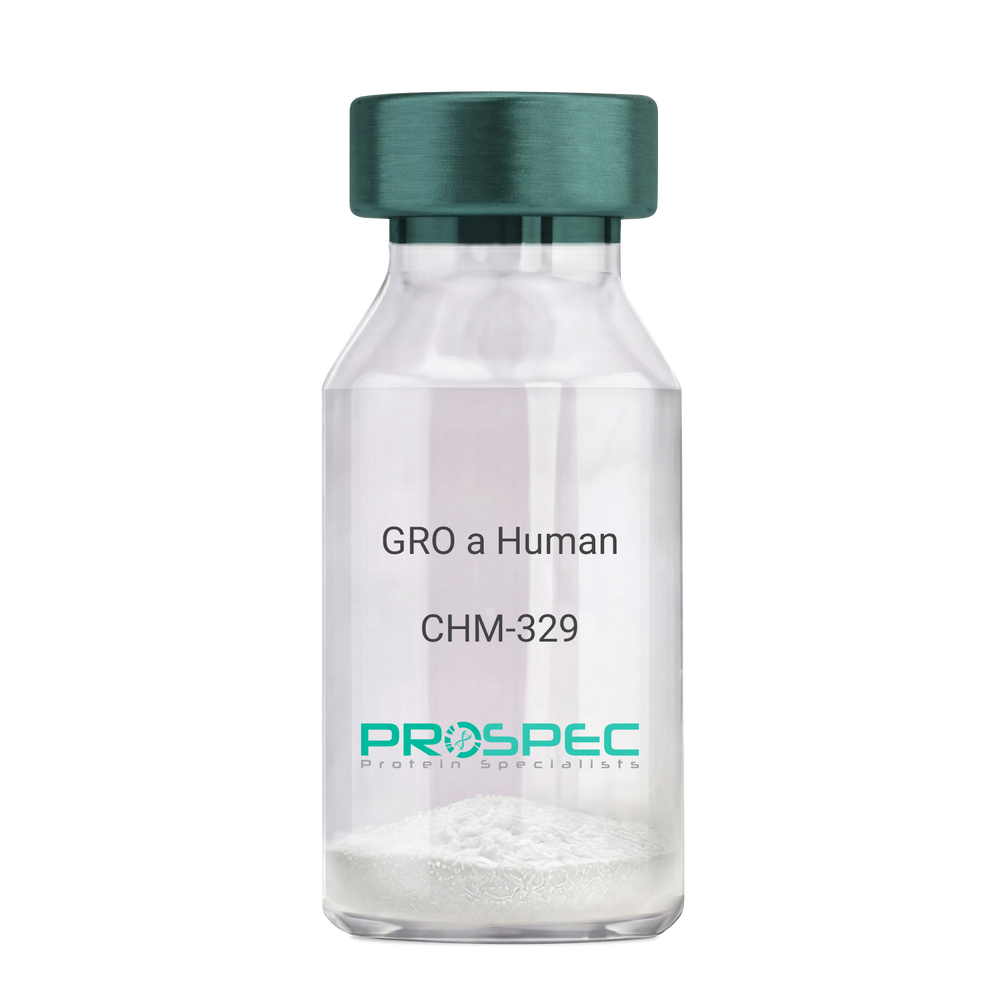
    Growth-regulated protein alpha, CXCL1, Melanoma growth stimulatory activity, MGSA, Neutrophil-activating protein 3, NAP-3, GRO-alpha (1-73), chemokine (C-X-C motif) ligand 1, GRO1, GROa, SCYB1, MGSA-a, MGSA alpha.

    Product # :

    CHM-329

    Price :

    Quantity :

    Shipping Method :

    Room Temp Icon

    Shipped at Room temp

    Add To Cart

    More Info

    • description
    • source
    • formulation
    • purity
    • biological activity
    • More Info

    Description

    GRO Alpha Human Recombinant produced in E.Coli is a single,non-glycosylated, polypeptide chain containing 73 amino acids and having a molecular mass of 7811 Dalton. The GRO-alpha is purified by proprietary chromatographic techniques.

    Source

    Escherichia Coli.

    Formulation

    Lyophilized from a 0.2µm filtered concentrated (1mg/ml) solution in 20mM PB, pH 7.4, 50mM NaCl.

    Purity

    Greater than 97.0% as determined by:
    (a) Analysis by RP-HPLC.
    (b) Analysis by SDS-PAGE.

    Biological Activity

    Determined by its ability to chemoattract human peripheral blood neutrophils using a concentration range of 10.0-100.0 ng/ml.

    More Info

    • Introduction

      Chemokine (C-X-C motif) ligand 1 (CXCL1) is a small cytokine belonging to the CXC chemokine family that was previously called GRO1 oncogene, Neutrophil-activating protein 3 (NAP-3) and melanoma growth stimulating activity, alpha (MSGA-a). It is secreted by human melanoma cells, has mitogenic properties and is implicated in melanoma pathogenesis. CXCL1 is expressed by macrophages, neutrophilsand epithelial cells, and has neutrophil chemoattractant activity. CXCL1 plays a role in spinal cord development by inhibiting the migration of oligodendrocyte precursors and is involved in the processes of angiogenesis, inflammation, wound healing, and tumorigenesis. This chemokine elicits its effects by signaling through the chemokine receptor CXCR2. The gene for CXCL1 is located on human chromosome 4 amongst genes for other CXC chemokines.

    • Synonyms

      Growth-regulated protein alpha, CXCL1, Melanoma growth stimulatory activity, MGSA, Neutrophil-activating protein 3, NAP-3, GRO-alpha (1-73), chemokine (C-X-C motif) ligand 1, GRO1, GROa, SCYB1, MGSA-a, MGSA alpha.

    • Physical Appearance

      Sterile Filtered White lyophilized (freeze-dried) powder.

    • Stability

      Lyophilized GRO-alpha although stable at room temperature for 3 weeks, should be stored desiccated below -18°C. Upon reconstitution CXCL1 should be stored at 4°C between 2-7 days and for future use below -18°C. For long term storage it is recommended to add a carrier protein (0.1% HSA or BSA).Please prevent freeze-thaw cycles.

    • Solubility

      It is recommended to reconstitute the lyophilized CXCL1 in sterile 18MΩ-cm H2O not less than 100µg/ml, which can then be further diluted to other aqueous solutions.

    • Amino Acid Sequence

      The sequence of the first five N-terminal amino acids was determined and was found to be Ala-Ser-Val-Ala-Thr.

    • Background

      What is the molecular weight/Mw of CXCL1 HUMAN Protein?
      CXCL1 HUMAN Protein has a total Mw of 7.81kDa.

      What is the source or expression system of CXCL1 HUMAN Protein?
      Escherichia Coli.

      What is the Purity of CXCL1 HUMAN Protein?
      CXCL1 HUMAN Protein is >97% pure as determined by SDS-PAGE.

      What is the Biological Activity of CXCL1 HUMAN Protein?
      Determined by its ability to chemoattract human peripheral blood neutrophils using a concentration range of 10.0-100.0 ng/ml.

      What is the amino acid sequence of CXCL1 HUMAN Protein?
      The sequence of the first five N-terminal amino acids was determined and was found to be Ala-Ser-Val-Ala-Thr.

      What applications can CXCL1 HUMAN Protein be used in?
      CXCL1 HUMAN Protein can probably be used in western blot, ELISA and Lateral Flow.

      What is the endotoxin level for CXCL1 HUMAN Protein?
      The endotoxin level is minimal, CXCL1 HUMAN Protein was purified using conventional chromatography techniques.


    ProSpec's products are furnished for LABORATORY RESEARCH USE ONLY. The product may not be used as drugs, agricultural or pesticidal products, food additives or household chemicals.

    Gro A Human
  • View Data Sheet

    Name :

    LZIC Human

    Description:

    Leucine Zipper And CTNNBIP1 Domain Containing Human Recombinant

    WAP Four-Disulfide Core Domain 12, Putative Protease Inhibitor WAP12, Whey Acidic Protein 2, Chromosome 20 Open Reading Frame 122, Protease Inhibitor WAP2, Single WAP Motif Protein 2, WAP Four-Disulfide Core Domain Protein 12, dJ211D12.4, C20orf122, SWAM2, WAP2.

    Product # :

    PRO-1831

    Price :

    Quantity :

    Shipping Method :

    Ice Icon

    Shipped with Ice Packs

    Add To Cart

    More Info

    • description
    • source
    • formulation
    • purity
    • More Info

    Description

    LZIC Human Recombinant produced in E.coli is a single, non-glycosylated polypeptide chain containing 111 amino acids (24-111) and having a molecular mass of 12.1 kDa. LZIC is fused to a 23 amino acid His-tag at N-terminus.

    Source

    Escherichia Coli.

    Formulation

    The LZIC solution (1mg/ml) contains 20mM Tris-HCl buffer (pH 8.0), 1mM DTT and 10% glycerol.

    Purity

    Greater than 85% as determined by SDS-PAGE.

    More Info

    • Introduction

      LZIC is a member of the CTNNBIP1 family. LZIC protein is universally expressed, with largest levels in kidney and up-regulated in various cases of gastric cancers. LZIC has no interaction with CTNNB1.

    • Synonyms

      WAP Four-Disulfide Core Domain 12, Putative Protease Inhibitor WAP12, Whey Acidic Protein 2, Chromosome 20 Open Reading Frame 122, Protease Inhibitor WAP2, Single WAP Motif Protein 2, WAP Four-Disulfide Core Domain Protein 12, dJ211D12.4, C20orf122, SWAM2, WAP2.

    • Physical Appearance

      Sterile Filtered clear solution.

    • Stability

      Store at 4°C if entire vial will be used within 2-4 weeks. Store, frozen at -20°C for longer periods of time. For long term storage it is recommended to add a carrier protein (0.1% HSA or BSA).Avoid multiple freeze-thaw cycles.

    • Amino Acid Sequence

      MGSSHHHHHH SSGLVPRGSH MGSMASRGKT ETSKLKQNLE EQLDRLMQQL QDLEECREEL DTDEYEETKK ETLEQLSEFN DSLKKIMSGN MTLVDELSGM QLAIQAAISQ AFKTPEVIRL FAKKQPGQLR TRLAEMDRDL MVGKLERDLY TQQKVEILTA LRKLGEKLTA DDEAFLSANA GAILSQFEKV STDLGSGDKI LALASFEVEK TKK.

    ProSpec's products are furnished for LABORATORY RESEARCH USE ONLY. The product may not be used as drugs, agricultural or pesticidal products, food additives or household chemicals.

    Lzic Human
  • 1
  • …
  • 5
  • 6
  • 7
  • 8
  • 9
  • …
  • 42
Your browser does not support the video tag.

Products

  • Cytokines
  • Growth Factors
  • Chemokines
  • CD Antigens
  • Neurotrophins
  • Hormones
  • Enzymes
  • Viral Antigens
  • Recombinant Proteins
  • Natural Proteins
  • Monoclonal Antibodies
  • Polyclonal Antibodies
  • Thermal Packaging

About

  • Company
  • Founder
  • Contribution
  • Contact Us
  • My Account

Ordering

  • Ordering Method
  • Ordering - Credit Card
  • Ordering PO
  • Shipping Fees
  • FAQ's

Legal

  • Terms & Conditions
  • Privacy
  • Site Map
  • info@prospecbio.com
  • Facebook
  • Instagram
  • Linkedin Profile

© 2026 ProSpec-Tany TechnoGene Ltd. All Rights Reserved.

  • Choosing a selection results in a full page refresh.
  • Opens in a new window.