Skip to content

High-quality research proteins.

  • 1-800-805-6531

  • Mon - Sat 8.00-18.00, Sun - Closed

  • info@prospecbio.com

  • PO Box 6591 East Brunswick NJ 08816

  • Products
    • Cytokines
    • Growth factors
    • Chemokines
    • Cd antigens
    • Neurotrophins
    • Hormones
    • Enzymes
    • Viral antigens
    • Recombinant proteins
    • Natural proteins
    • Monoclonal antibodies
    • Polyclonal antibodies
    • Thermal Packaging
  • About
    • Company
    • Founder
    • Contribution
  • Customers
    • Eastern Asia
    • Eastern Europe
    • North America
    • South America
    • South East Asia
    • Southern Asia
    • Western Europe
  • Ordering
    • Ordering Method
    • Ordering - Credit Card
    • Ordering - PO
    • Shipping Fees
    • FAQs
  • Services
    • DNA Cloning
    • Protein Expression
    • Monoclonal Antibody
    • Fermentation
    • Technology License
  • Contact us
Log in

Country/region

  • USD $ | Albania
  • USD $ | Andorra
  • USD $ | Argentina
  • USD $ | Armenia
  • USD $ | Australia
  • USD $ | Austria
  • USD $ | Azerbaijan
  • USD $ | Belarus
  • USD $ | Belgium
  • USD $ | Bolivia
  • USD $ | Brazil
  • USD $ | Bulgaria
  • USD $ | Cambodia
  • USD $ | Canada
  • USD $ | Chile
  • USD $ | China
  • USD $ | Colombia
  • USD $ | Costa Rica
  • USD $ | Croatia
  • USD $ | Cyprus
  • USD $ | Czechia
  • USD $ | Denmark
  • USD $ | Estonia
  • USD $ | Finland
  • USD $ | France
  • USD $ | Georgia
  • USD $ | Germany
  • USD $ | Greece
  • USD $ | Hong Kong SAR
  • USD $ | Hungary
  • USD $ | Iceland
  • USD $ | India
  • USD $ | Ireland
  • USD $ | Israel
  • USD $ | Italy
  • USD $ | Japan
  • USD $ | Kazakhstan
  • USD $ | Latvia
  • USD $ | Liechtenstein
  • USD $ | Lithuania
  • USD $ | Madagascar
  • USD $ | Malta
  • USD $ | Mexico
  • USD $ | Moldova
  • USD $ | Monaco
  • USD $ | Netherlands
  • USD $ | New Zealand
  • USD $ | North Macedonia
  • USD $ | Norway
  • USD $ | Panama
  • USD $ | Paraguay
  • USD $ | Peru
  • USD $ | Philippines
  • USD $ | Poland
  • USD $ | Portugal
  • USD $ | Romania
  • USD $ | Singapore
  • USD $ | Slovakia
  • USD $ | Slovenia
  • USD $ | South Africa
  • USD $ | South Korea
  • USD $ | Spain
  • USD $ | Sri Lanka
  • USD $ | Sweden
  • USD $ | Switzerland
  • USD $ | Taiwan
  • USD $ | Thailand
  • USD $ | Türkiye
  • USD $ | Ukraine
  • USD $ | United Kingdom
  • USD $ | United States
  • USD $ | Uruguay
  • USD $ | Vatican City
  • USD $ | Venezuela
  • USD $ | Vietnam
  • Facebook
  • Instagram
logoProSpec - Recombinant Protein Manufacturer for academic and R&D industry
Become a distributor
Account Log in
Wishlist
Cart Cart(0)
  • Products
    +
    • Cytokines
    • Growth factors
    • Chemokines
    • Cd antigens
    • Neurotrophins
    • Hormones
    • Enzymes
    • Viral antigens
    • Recombinant proteins
    • Natural proteins
    • Monoclonal antibodies
    • Polyclonal antibodies
    • Thermal Packaging
  • About
    +
    • Company
    • Founder
    • Contribution
  • Customers
    +
    • Eastern Asia
    • Eastern Europe
    • North America
    • South America
    • South East Asia
    • Southern Asia
    • Western Europe
  • Ordering
    +
    • Ordering Method
    • Ordering - Credit Card
    • Ordering - PO
    • Shipping Fees
    • FAQs
  • Services
    +
    • DNA Cloning
    • Protein Expression
    • Monoclonal Antibody
    • Fermentation
    • Technology License
  • Contact us

Item added to your cart

View cart
View All
  • Cytokines
  • Growth factors
  • Chemokines
  • Cd antigens
  • Neurotrophins
  • Hormones
  • Enzymes
  • Viral antigens
  • Recombinant proteins
  • Natural proteins
  • Monoclonal antibodies
  • Polyclonal antibodies
  • Thermal Packaging
  • Tumor Necrosis Factor

    Tumor Necrosis Factor

    View All
  • 4-1BB

    4-1BB

    View All
  • Adiponectin

    Adiponectin

    View All
  • AIF1

    AIF1

    View All
  • Other Cytokines

    Other Cytokines

    View All
  • AITRL

    AITRL

    View All
  • Angiopoietin

    Angiopoietin

    View All
  • Apolipoprotein

    Apolipoprotein

    View All
  • B-Cell Activating Factor

    B-Cell Activating Factor

    View All
  • Beta Defensin

    Beta Defensin

    View All
  • Bone Morphogenetic Protein

    Bone Morphogenetic Protein

    View All
  • B type Natriuretic Peptide

    B type Natriuretic Peptide

    View All
  • BST

    BST

    View All
  • Betacellulin

    Betacellulin

    View All
  • Cardiotrophin

    Cardiotrophin

    View All
  • Activin

    Activin

    View All
  • Fibroblast Growth Factor

    Fibroblast Growth Factor

    View All
  • Other Growth Factors

    Other Growth Factors

    View All
  • CSF

    CSF

    View All
  • CTGF

    CTGF

    View All
  • IGFBP

    IGFBP

    View All
  • VEGF Protein

    VEGF Protein

    View All
  • EGF

    EGF

    View All
  • Epigen

    Epigen

    View All
  • Erythropoietin

    Erythropoietin

    View All
  • Insulin-Like Growth Factor

    Insulin-Like Growth Factor

    View All
  • Growth Hormone

    Growth Hormone

    View All
  • HDGF

    HDGF

    View All
  • Hepatocyte Growth Factor

    Hepatocyte Growth Factor

    View All
  • Insulin

    Insulin

    View All
  • BCA-1/ BLC (CXCL13)

    BCA-1/ BLC (CXCL13)

    View All
  • BRAK (CXCL14)

    BRAK (CXCL14)

    View All
  • C-10 (CCL6)

    C-10 (CCL6)

    View All
  • Other Chemokines

    Other Chemokines

    View All
  • MEC (CCL28)

    MEC (CCL28)

    View All
  • LD78-beta (CCL3L1)

    LD78-beta (CCL3L1)

    View All
  • CTACK (CCL27)

    CTACK (CCL27)

    View All
  • CXCL16

    CXCL16

    View All
  • CXCL17

    CXCL17

    View All
  • Platelet Factor-4 (CXCL4)

    Platelet Factor-4 (CXCL4)

    View All
  • ENA-78 (CXCL5)

    ENA-78 (CXCL5)

    View All
  • Eotaxin (CCL11,24,26)

    Eotaxin (CCL11,24,26)

    View All
  • Exodus-2 (CCL21)

    Exodus-2 (CCL21)

    View All
  • Fractalkine (CX3CL1)

    Fractalkine (CX3CL1)

    View All
  • CXCL6

    CXCL6

    View All
  • Other CD Antigens

    Other CD Antigens

    View All
  • CD14

    CD14

    View All
  • CD164

    CD164

    View All
  • CD1

    CD1

    View All
  • CD2

    CD2

    View All
  • CD200

    CD200

    View All
  • CD207

    CD207

    View All
  • CD226

    CD226

    View All
  • CD23

    CD23

    View All
  • CD244

    CD244

    View All
  • CD247

    CD247

    View All
  • CD27

    CD27

    View All
  • CD274

    CD274

    View All
  • CD300

    CD300

    View All
  • CD33

    CD33

    View All
  • Other Neurotrophins

    Other Neurotrophins

    View All
  • Beta-NGF

    Beta-NGF

    View All
  • BDNF

    BDNF

    View All
  • CDNF

    CDNF

    View All
  • CNTF

    CNTF

    View All
  • GDNF

    GDNF

    View All
  • Glia Maturation Factor

    Glia Maturation Factor

    View All
  • MANF

    MANF

    View All
  • Midkine

    Midkine

    View All
  • Neuroglobin

    Neuroglobin

    View All
  • Neurotrophic factors

    Neurotrophic factors

    View All
  • Neuregulin

    Neuregulin

    View All
  • Neuropilin

    Neuropilin

    View All
  • Pigment Epithelium-Derived Factor

    Pigment Epithelium-Derived Factor

    View All
  • Pleiotrophin

    Pleiotrophin

    View All
  • Peptide Hormones

    Peptide Hormones

    View All
  • Other Hormones

    Other Hormones

    View All
  • HCG

    HCG

    View All
  • Endothelin

    Endothelin

    View All
  • Exendin

    Exendin

    View All
  • FSH

    FSH

    View All
  • Glucagon

    Glucagon

    View All
  • GHRP

    GHRP

    View All
  • GLP

    GLP

    View All
  • Thyrostimulin

    Thyrostimulin

    View All
  • Inhibin A

    Inhibin A

    View All
  • LHRH

    LHRH

    View All
  • Melanotan

    Melanotan

    View All
  • Procalcitonin

    Procalcitonin

    View All
  • PTH

    PTH

    View All
  • Peroxiredoxin

    Peroxiredoxin

    View All
  • Peptidase

    Peptidase

    View All
  • Synthetase

    Synthetase

    View All
  • Transferase

    Transferase

    View All
  • Hydrolase

    Hydrolase

    View All
  • Dehydrogenase

    Dehydrogenase

    View All
  • ACE2

    ACE2

    View All
  • Esterase

    Esterase

    View All
  • Protein Kinases

    Protein Kinases

    View All
  • Other Enzymes

    Other Enzymes

    View All
  • Phosphatase

    Phosphatase

    View All
  • Deaminase

    Deaminase

    View All
  • Oxygenase

    Oxygenase

    View All
  • Adenylate Kinase

    Adenylate Kinase

    View All
  • Lyase

    Lyase

    View All
  • Chagas

    Chagas

    View All
  • SARS

    SARS

    View All
  • Influenza

    Influenza

    View All
  • ASFV

    ASFV

    View All
  • Astrovirus

    Astrovirus

    View All
  • Borrelia

    Borrelia

    View All
  • Helicobacter Pylori

    Helicobacter Pylori

    View All
  • Chikungunya

    Chikungunya

    View All
  • Chlamydia

    Chlamydia

    View All
  • Cytomegalo

    Cytomegalo

    View All
  • Dengue

    Dengue

    View All
  • EBV

    EBV

    View All
  • Ebola

    Ebola

    View All
  • Feline Leukemia Virus

    Feline Leukemia Virus

    View All
  • Hepatitis A

    Hepatitis A

    View All
  • Other

    Other

    View All
  • Actin

    Actin

    View All
  • ADAM

    ADAM

    View All
  • Complement Component

    Complement Component

    View All
  • Ag85

    Ag85

    View All
  • Eukaryotic Translation Initiation Factor

    Eukaryotic Translation Initiation Factor

    View All
  • Anterior Gradient Protein

    Anterior Gradient Protein

    View All
  • Heat Shock Protein

    Heat Shock Protein

    View All
  • Alpha-2-HS-Glycoprotein

    Alpha-2-HS-Glycoprotein

    View All
  • Hemoglobin

    Hemoglobin

    View All
  • Allergy

    Allergy

    View All
  • Anaplasma

    Anaplasma

    View All
  • Angiogenin

    Angiogenin

    View All
  • Ankyrin Repeat Domain

    Ankyrin Repeat Domain

    View All
  • Annexin

    Annexin

    View All
  • Other Natural Proteins

    Other Natural Proteins

    View All
  • Aprotinin

    Aprotinin

    View All
  • Transferrin

    Transferrin

    View All
  • Avidin

    Avidin

    View All
  • Anti Coagulation Factors

    Anti Coagulation Factors

    View All
  • Natural Albumin

    Natural Albumin

    View All
  • Natural Coagulation Factors

    Natural Coagulation Factors

    View All
  • Fibronectin

    Fibronectin

    View All
  • Thrombin

    Thrombin

    View All
  • Anti Human Enzyme

    Anti Human Enzyme

    View All
  • Other Monoclonal Antibodies

    Other Monoclonal Antibodies

    View All
  • Anti Human Cytokine

    Anti Human Cytokine

    View All
  • Anti Human Heat Shock Protein

    Anti Human Heat Shock Protein

    View All
  • Anti Mouse Lymphocyte

    Anti Mouse Lymphocyte

    View All
  • Anti Human Chemokine

    Anti Human Chemokine

    View All
  • Anti Human Lymphocyte

    Anti Human Lymphocyte

    View All
  • Anti Viral Monoclonal

    Anti Viral Monoclonal

    View All
  • Anti Mouse Cytokine

    Anti Mouse Cytokine

    View All
  • Anti-GST Monoclonal

    Anti-GST Monoclonal

    View All
  • Other Polyclonal Antibodies

    Other Polyclonal Antibodies

    View All
  • Anti Viral

    Anti Viral

    View All
  • Anti-GST Monoclonal

    Anti-GST Monoclonal

    View All
Back

Search results

1000 results found for “Calcyphosine”

Name

Description

Product #

Price

Quantity

Shipping Method

  • View Data Sheet

    Name :

    S100b Mouse, His

    Description:

    S100 Calcium Binding Protein B Mouse Recombinant, His Tag

    Protein S100-B, S-100 protein beta chain, S-100 protein subunit beta, S100 calcium-binding protein B, Bpb, AI850290, MGC74317, S100b.

    Product # :

    PRO-853

    Price :

    Quantity :

    Shipping Method :

    Ice Icon

    Shipped with Ice Packs

    Add To Cart

    More Info

    • description
    • source
    • formulation
    • purity
    • More Info

    Description

    S100B Mouse Recombinant produced in E.Coli is a single, non-glycosylated polypeptide chain containing 92 amino acids (1-112 a.a.) and having a molecular mass of 12.8 kDa. The Mouse S100B is fused to a 20 amino acid His-Tag at N-terminus and purified by proprietary chromatographic techniques.

    Source

    Escherichia Coli.

    Formulation

    S100B Mouse solution containing 20mM Tris-HCl pH-8, 1mM DTT & 10% glycerol.

    Purity

    Greater than 85.0% as determined by SDS-PAGE.

    More Info

    • Introduction

      S100B faintly binds calcium but binds zinc extremely strongly-distinct binding sites with different affinities exist for both ions on each monomer. Physiological concentrations of potassium ion antagonize the binding of both divalent cations, especially affecting high-affinity calcium-binding sites. S100B binds to and initiates the activation of STK38 by releasing autoinhibitory intramolecular interactions within the kinase. Interaction with AGER after myocardial infarction participates in myocyte apoptosis by activating ERK1/2 and p53/TP53 signaling.

    • Synonyms

      Protein S100-B, S-100 protein beta chain, S-100 protein subunit beta, S100 calcium-binding protein B, Bpb, AI850290, MGC74317, S100b.

    • Physical Appearance

      Sterile filtered colorless solution.

    • Stability

      Store at 4°C if entire vial will be used within 2-4 weeks. Store, frozen at -20°C for longer periods of time. For long term storage it is recommended to add a carrier protein (0.1% HSA or BSA).Avoid multiple freeze-thaw cycles.

    • Amino Acid Sequence

      MGSSHHHHHH SSGLVPRGSH MSELEKAMVA LIDVFHQYSG REGDKHKLKK SELKELINNE LSHFLEEIKE QEVVDKVMET LDEDGDGECD FQEFMAFVAM VTTACHEFFE HE.

    ProSpec's products are furnished for LABORATORY RESEARCH USE ONLY. The product may not be used as drugs, agricultural or pesticidal products, food additives or household chemicals.

    S100B Mouse
  • View Data Sheet

    Name :

    CAMK4 Human

    Description:

    Calcium/Calmodulin-Dependent Protein Kinase IV Human Recombinant

    Calcium/calmodulin-dependent protein kinase type IV catalytic chain, CaMK-GR, CaM kinase-GR, CaMK IV, IV, brain Ca(2+)-calmodulin-dependent protein kinase type IV, caMK, CAM kinase IV, EC 2.7.11.17.

    Product # :

    PKA-021

    Price :

    Quantity :

    Shipping Method :

    Ice Icon

    Shipped with Ice Packs

    Add To Cart

    More Info

    • description
    • source
    • formulation
    • purity
    • More Info

    Description

    CAMK4 Human Recombinant produced in E.coli is a single, non-glycosylated polypeptide chain containing 497 amino acids (1-473) and having a molecular mass of 54.5kDa.CAMK4 is fused to a 24 amino acid His-tag at N-terminus & purified by proprietary chromatographic techniques.

    Source

    E.coli.

    Formulation

    The CAMK4 solution (0.5mg/ml) contains 20mM Tris-HCl buffer (pH 8.0), 100mM NaCl and 10% glycerol.

    Purity

    Greater than 85% as determined by SDS-PAGE.

    More Info

    • Introduction

      CAMK4 is a member of the serine/threonine protein kinase family, and of the Ca(2+)/calmodulin-dependent protein kinase subfamily. CAMK4 is a multifunctional serine/threonine protein kinase with restricted tissue distribution which is associated to transcriptional regulation in lymphocytes, neurons and male germ cells.

    • Synonyms

      Calcium/calmodulin-dependent protein kinase type IV catalytic chain, CaMK-GR, CaM kinase-GR, CaMK IV, IV, brain Ca(2+)-calmodulin-dependent protein kinase type IV, caMK, CAM kinase IV, EC 2.7.11.17.

    • Physical Appearance

      Sterile Filtered colorless solution.

    • Stability

      Store at 4°C if entire vial will be used within 2-4 weeks. Store, frozen at -20°C for longer periods of time. For long term storage it is recommended to add a carrier protein (0.1% HSA or BSA).Avoid multiple freeze-thaw cycles.

    • Amino Acid Sequence

      MGSSHHHHHH SSGLVPRGSH MGSHMLKVTV PSCSASSCSS VTASAAPGTA SLVPDYWIDG SNRDALSDFF EVESELGRGA TSIVYRCKQK GTQKPYALKV LKKTVDKKIV RTEIGVLLRL SHPNIIKLKE IFETPTEISL VLELVTGGEL FDRIVEKGYY SERDAADAVK QILEAVAYLH ENGIVHRDLK PENLLYATPA PDAPLKIADF GLSKIVEHQV LMKTVCGTPG YCAPEILRGC AYGPEVDMWS VGIITYILLC GFEPFYDERG DQFMFRRILN CEYYFISPWW DEVSLNAKDL VRKLIVLDPK KRLTTFQALQ HPWVTGKAAN FVHMDTAQKK LQEFNARRKL KAAVKAVVAS SRLGSASSSH GSIQESHKAS RDPSPIQDGN EDMKAIPEGE KIQGDGAQAA VKGAQAELMK VQALEKVKGA DINAEEAPKM VPKAVEDGIK VADLELEEGL AEEKLKTVEE AAAPREGQGS SAVGFEVPQQ DVILPEY.

    ProSpec's products are furnished for LABORATORY RESEARCH USE ONLY. The product may not be used as drugs, agricultural or pesticidal products, food additives or household chemicals.

    Camk4 Human
  • View Data Sheet

    Name :

    Cyclophilin A Rat

    Description:

    Cyclophilin-A Rat Recombinant

    Peptidyl-prolyl cis-trans isomerase A, EC:5.2.1.8, PPIase A, Cyclophilin A, Cyclosporin A-binding protein, Rotamase A, p1B15, p31, Ppia.

    Product # :

    ENZ-938

    Price :

    Quantity :

    Shipping Method :

    Room Temp Icon

    Shipped at Room temp

    Add To Cart

    More Info

    • description
    • source
    • formulation
    • purity
    • More Info

    Description

    Cyclophilin-A Rat Recombinant produced in E.Coli is a single, non-glycosylated, polypeptide chain (Val2-Leu164) containing 173 amino acids including a 10 aa His tag at N-terminus. The total calculated molecular mass is 19kDa.

    Source

    Escherichia Coli.

    Formulation

    Cyclophilin-A was filtered (0.4µm) and lyophilized from 0.5mg/ml solution in phosphate buffered saline and 5%(w/v) trehalose.

    Purity

    Greater than 95.0% as determined by SDS-PAGE.

    More Info

    • Introduction

      PPIases catalyze the cis-trans isomerization of proline imidic peptide bonds in oligopeptides and accelerate the folding of proteins. Cyclophilin-A is a cyclosporin binding-protein and may play a role in cyclosporin A-mediated immunosuppression. Cyclophilin-A can also interact with several HIV proteins, including p55 gag, Vpr, and capsid protein, and has been shown to be necessary for the formation of infectious HIV virions. Multiple pseudogenes that map to different chromosomes have been reported.

    • Synonyms

      Peptidyl-prolyl cis-trans isomerase A, EC:5.2.1.8, PPIase A, Cyclophilin A, Cyclosporin A-binding protein, Rotamase A, p1B15, p31, Ppia.

    • Physical Appearance

      Filtered White lyophilized (freeze-dried) powder.

    • Stability

      Store lyophilized protein at -20°C. Aliquot the product after reconstitution to avoid repeated freezing/thawing cycles. Reconstituted protein can be stored at 4°C for a limited period of time; it does not show any change after two weeks at 4°C.

    • Solubility

      It is recommended to add deionized water to prepare a working stock solution of approximately 0.5mg/ml and let the lyophilized pellet dissolve completely. Cyclophilin-A is not sterile! Please filter the product by an appropriate sterile filter before using it in the cell culture.

    • Amino Acid Sequence

      MKHHHHHHASVNPTVFFDIT ADGEPLGRVC FELFADKVPK TAENFRALST GEKGFGYKGS SFHRIIPGFM CQGGDFTRHN GTGGKSIYGE KFEDENFILK HTGPGILSMA NAGPNTNGSQ FFICTAKTEW LDGKHVVFGK VKEGMSIVEA MERFGSRNGK TSKKITISDC GQL.

    ProSpec's products are furnished for LABORATORY RESEARCH USE ONLY. The product may not be used as drugs, agricultural or pesticidal products, food additives or household chemicals.

    Cyclophilin A Rat
  • View Data Sheet

    Name :

    Periostin Human, HEK

    Description:

    Periostin Human Recombinant, HEK

    OSF-2, Periostin, Osteoblast Specific Factor 2, PN OSF-2, PDLPOSTN, POSTN, MGC119510, MGC119511, PN, RP11-412K4.1.

    Product # :

    CYT-835

    Price :

    Quantity :

    Shipping Method :

    Room Temp Icon

    Shipped at Room temp

    Add To Cart

    More Info

    • description
    • source
    • formulation
    • purity
    • More Info

    Description

    Periostin Human Recombinant produced in HEK cells is a single, glycosylated, polypeptide chain (Asn22-Gln836) containing a total of 821 amino acids, having a calculated molecular mass of 91.8kDa and fused to a 6 aa His tag at C-Terminus.

    Source

    HEK 293.

    Formulation

    Periostin was filtered (0.4 µm) and lyophilized from 0.5mg/ml solution in phosphate buffered saline and 5% trehalose.

    Purity

    Greater than 38.0% as determined by SDS-PAGE.

    More Info

    • Introduction

      Periostin is a disulfide linked 90 kDa, 811 amino acid protein originally isolated as a osteoblast-specific factor that functions as a cell adhesion molecule for preosteoblasts and is thought to be involved in osteoblast recruitment, attachment and spreading. Additionally, periostin expression has previously been shown to be significantly increased by both transforming growth factor beta-1(TGFbeta1) and bone morphogenetic protein (BMP-2). OSF-2 has a typical signal sequence, followed by a cysteine-rich domain, a fourfold repeated domain and a C-terminal domain. The fourfold repeated domain of OSF-2 shows homology with the insect protein fasciclin
      Periostin mRNA is expressed in the developing mouse embryonic and fetal heart, and that it is localized to the endocardial cushions that ultimately divide the primitive heart tube into a four-chambered heart.

    • Synonyms

      OSF-2, Periostin, Osteoblast Specific Factor 2, PN OSF-2, PDLPOSTN, POSTN, MGC119510, MGC119511, PN, RP11-412K4.1.

    • Physical Appearance

      Filtered White lyophilized (freeze-dried) powder.

    • Stability

      Store lyophilized protein at -20°C. Aliquot the product after reconstitution to avoid repeated freezing/thawing cycles. Reconstituted protein can be stored at 4°C for a limited period of time.

    • Solubility

      It is recommended to add deionized water to prepare a working stock solution of approximately 0.5 mg/ml and let the lyophilized pellet dissolve completely. Periostin is not sterile! Please filter the product by an appropriate sterile filter before using it in the cell culture.

    • Amino Acid Sequence

      NNHYDKILAH SRIRGRDQGP NVCALQQILG TKKKYFSTCK NWYKKSICGQ KTTVLYECCP GYMRMEGMKG CPAVLPIDHV YGTLGIVGAT TTQRYSDASK LREEIEGKGS FTYFAPSNEA WDNLDSDIRR GLESNVNVEL LNALHSHMIN KRMLTKDLKN GMIIPSMYNN LGLFINHYPN GVVTVNCARI IHGNQIATNG VVHVIDRVLT QIGTSIQDFI EAEDDLSSFR AAAITSDILE ALGRDGHFTL FAPTNEAFEK LPRGVLERIM GDKVASEALM KYHILNTLQC SESIMGGAVF ETLEGNTIEI GCDGDSITVN GIKMVNKKDI VTNNGVIHLI DQVLIPDSAK QVIELAGKQQ TTFTDLVAQL GLASALRPDG EYTLLAPVNN AFSDDTLSMD QRLLKLILQN HILKVKVGLN ELYNGQILET IGGKQLRVFV YRTAVCIENS CMEKGSKQGR NGAIHIFREI IKPAEKSLHE KLKQDKRFST FLSLLEAADL KELLTQPGDW TLFVPTNDAF KGMTSEEKEI LIRDKNALQN IILYHLTPGV FIGKGFEPGV TNILKTTQGS KIFLKEVNDT LLVNELKSKE SDIMTTNGVI HVVDKLLYPA DTPVGNDQLL EILNKLIKYI QIKFVRGSTF KEIPVTVYTT KIITKVVEPK IKVIEGSLQP IIKTEGPTLT KVKIEGEPEF RLIKEGETIT EVIHGEPIIK KYTKIIDGVP VEITEKETRE ERIITGPEIK YTRISTGGGE TEETLKKLLQ EEVTKVTKFI EGGDGHLFED EEIKRLLQGD TPVRKLQANK KVQGSRRRLR EGRSQHHHHH H.

    ProSpec's products are furnished for LABORATORY RESEARCH USE ONLY. The product may not be used as drugs, agricultural or pesticidal products, food additives or household chemicals.

    Periostin Human Hek
  • View Data Sheet

    Name :

    CCM2 Human

    Description:

    Cerebral Cavernous Malformation 2 Human Recombinant

    Cerebral Cavernous Malformation 2, C7orf22, malcavernin, Cerebral Cavernous Malformations 2 Protein, Chromosome 7 Open Reading Frame 22, OSM, MGC4067.

    Product # :

    PRO-1825

    Price :

    Quantity :

    Shipping Method :

    Ice Icon

    Shipped with Ice Packs

    Add To Cart

    More Info

    • description
    • source
    • formulation
    • purity
    • More Info

    Description

    CCM2 Human Recombinant produced in E.Coli is a single, non-glycosylated polypeptide chain containing 311 amino acids (66-353 a.a) and having a molecular mass of 34.3kDa.CCM2 is fused to a 23 amino acid His-tag at N-terminus & purified by proprietary chromatographic techniques.

    Source

    Escherichia Coli.

    Formulation

    CCM2 protein solution (0.5mg/ml) containing 20mM Tris-HCl buffer (pH8.0), 20% glycerol and 1mM DTT.

    Purity

    Greater than 90.0% as determined by SDS-PAGE.

    More Info

    • Introduction

      Cerebral Cavernous Malformation 2, also known as CCM2 is a piece of the CCM signaling pathway which is a vital regulator of heart and vessel formation as well as integrity. CCM2 performs through the stabilization of endothelial cell junctions. In addition, CCM2 functions as a scaffold protein for MAP2K3-MAP3K3 signaling. CCM2 plays a key role in the modulation of MAP3K3-dependent p38 activation induced by hyperosmotic shock. Mutations in CCM2 result in cerebral cavernous malformations. Multiple transcript variants encoding dissimilar isoforms have been discovered for CCM2.

    • Synonyms

      Cerebral Cavernous Malformation 2, C7orf22, malcavernin, Cerebral Cavernous Malformations 2 Protein, Chromosome 7 Open Reading Frame 22, OSM, MGC4067.

    • Physical Appearance

      Sterile Filtered clear solution.

    • Stability

      Store at 4°C if entire vial will be used within 2-4 weeks. Store, frozen at -20°C for longer periods of time.For long term storage it is recommended to add a carrier protein (0.1% HSA or BSA).Please avoid freeze thaw cycles.

    • Amino Acid Sequence

      MGSSHHHHHH SSGLVPRGSH MGSEVKYLGQ LTSIPGYLNP SSRTEILHFI DNAKRAHQLP GHLTQEHDAV LSLSAYNVKL AWRDGEDIIL RVPIHDIAAV SYVRDDAAHL VVLKTDDSST KVDIKETYEV EASTFCFPES VDVGGASPHS KTISESELSA SATELLQDYM LTLRTKLSSQ EIQQFAALLH EYRNGASIHE FCINLRQLYG DSRKFLLLGL RPFIPEKDSQ HFENFLETIG VKDGRGIITD SFGRHRRALS TTSSSTTNGN RATGSSDDRS APSEGDEWDR MISDISSDIE ALGCSMDQDS A

    ProSpec's products are furnished for LABORATORY RESEARCH USE ONLY. The product may not be used as drugs, agricultural or pesticidal products, food additives or household chemicals.

    Ccm2 Human
  • View Data Sheet

    Name :

    CDHR5 Mouse

    Description:

    Cadherin Related Family Member 5 Mouse Recombinant

    Cadherin-related family member 5, Mu-protocadherin, Cdhr5, Mucdhl, Mupcdh, 1810074H01Rik, AI481143

    Product # :

    PRO-2647

    Price :

    Quantity :

    Shipping Method :

    Ice Icon

    Shipped with Ice Packs

    Add To Cart

    More Info

    • description
    • source
    • formulation
    • purity
    • More Info

    Description

    CDHR5 Mouse Recombinant produced in Sf9 Baculovirus cells is a single, glycosylated polypeptide chain containing 621 amino acids (29-641 a.a) and having a molecular mass of 66.3kDa.CDHR5 is fused to an 8 amino acid His-tag at C-terminus & purified by proprietary chromatographic techniques.

    Source

    Sf9, Baculovirus cells.

    Formulation

    The CDHR5 solution (0.25mg/1ml) contains Phosphate-Buffered Saline (pH 7.4) and 10% glycerol.

    Purity

    Greater than 90.0% as determined by SDS-PAGE.

    More Info

    • Introduction

      CDHR5, also referred to ascadherin-related family member 5, is a calcium-dependent cell adhesion protein. CDHR5 is located in coated pits, and is expressed during lung and kidney developmentat at the lateral and basal surfaces of epithelia.

    • Synonyms

      Cadherin-related family member 5, Mu-protocadherin, Cdhr5, Mucdhl, Mupcdh, 1810074H01Rik, AI481143

    • Physical Appearance

      Sterile Filtered colorless solution.

    • Stability

      Store at 4°C if entire vial will be used within 2-4 weeks. Store, frozen at -20°C for longer periods of time. For long term storage it is recommended to add a carrier protein (0.1% HSA or BSA).Avoid multiple freeze-thaw cycles.

    • Amino Acid Sequence

      QTQVCSVNQT IFRVEENTTV SEPLVNIFVP DGLHVTLGPL STPYAFRIEG KDLFLNVTPD YEENSLLQAD VECKRGDAVV VRLEVFVAVL DINDNAPKFS FEIKTFNVSE DTKVNTTVIP ETQLKATDAD INDILVYTLQ EVTPNASKFF SLEGVNYPAL KLDQTLDYFK NQNMTFMLLA RDTWEENVEP SHTATATLVL NTLPADLRTP WFLPCSFTDG YVCIHAQYSA VVPTGHKLPS PLIMSPGPIY AVDGDQAINQ SIIYSIIAGN TDGTFIINAH DGNLTMTKSI PSPMKFTLLI RADQEDMAQY SVTQAIVEAR SVTGNPLQFS QSLYYGTVVL GSEAGTAVKD KTFPSEILRI QAQYPGFPDL NSAVTYRVTN SSEFMMNKDI MLTAVPMEEA RTIRVEVEAS NTVTKDTATA VVEIQVSERE LPSTEFPTPP EAGGTTGPSS NTTMEAPLTS GTSQRPATTS SGGSVGPFPP GGTTLRPPTP ASSIPGGSPT LGTSTSPQTT TPGGDSAQTP KPGTSHPTAP TSRTSTSLMT TSSRSDSTQT PKPGTSQPMV PIPGASTSSQ PATPSGSSPQ TPKPGTSQST ATGPISGAGE QGDGQRFSTV DMALEHHHHH H

    ProSpec's products are furnished for LABORATORY RESEARCH USE ONLY. The product may not be used as drugs, agricultural or pesticidal products, food additives or household chemicals.

    Cdhr5 Mouse
  • View Data Sheet

    Name :

    CXCL13 Mouse

    Description:

    BCA-1/BLC Mouse Recombinant (CXCL13)

    C-X-C motif chemokine 13, B lymphocyte chemoattractant, CXC chemokine BLC, Small-inducible cytokine B13, Cxcl13, Blc, Scyb13.

    Product # :

    CHM-030

    Price :

    Quantity :

    Shipping Method :

    Room Temp Icon

    Shipped at Room temp

    Add To Cart

    More Info

    • description
    • source
    • formulation
    • purity
    • biological activity
    • More Info

    Description

    CXCL13 Mouse Recombinant (22-109) produced in E.Coli is a single, non-glycosylated, polypeptide chain containing 88 amino acids and having a molecular mass of 10kDa.The BCA-1 is purified by proprietary chromatographic techniques.

    Source

    Escherichia Coli.

    Formulation

    The BCA1 protein was lyophilized from a 0.2µm filtered solution in Acetonitrile and TFA.

    Purity

    Greater than 97.0% as determined by SDS-PAGE.

    Biological Activity

    The ED50, as measured by its ability to chemoattract human CXCR5-transfected mouse BaF3 cells, is less than 2µg/ml.

    More Info

    • Introduction

      BCA-1 is a CXC chemokine that is highly expressed in thesecondary lymphoid organs, such as follicles of the spleen, lymph nodes, and Peyer's patches. CXCL13 promotes the migration of B lymphocytes (compared to T cells and macrophages), by stimulating calcium influx into, and chemotaxis of, cells expressing Burkitt's lymphoma receptor 1 (BLR1). BCA1 therefore function in the homing of B lymphocytes to follicles. Human BCA-1 shares a 64% amino acid sequence similarity with the mouse protein and 23 - 34% amino acid sequence identity with other known CXC chemokines. Recombinant or chemically synthesized BCA1 is a potent chemoattractant for B lymphocytes but not T lymphocytes, monocytes or neutrophils. BLR1, a G protein-coupled receptor originally isolated from Burkitt’s lymphoma cells, has now been shown to be the specific receptor for BCA1. Among cells of the hematopoietic lineages, the expression of BLR-1, now designated CXCR-5, is restricted to B lymphocytes and a subpopulation of T helper memory cells.

    • Synonyms

      C-X-C motif chemokine 13, B lymphocyte chemoattractant, CXC chemokine BLC, Small-inducible cytokine B13, Cxcl13, Blc, Scyb13.

    • Physical Appearance

      Sterile Filtered White lyophilized (freeze-dried) powder.

    • Stability

      Lyophilized BCA1 although stable at room temperature for 3 weeks, should be stored desiccated below -18°C. Upon reconstitution BCA1 should be stored at 4°C between 2-7 days and for future use below -18°C.For long term storage it is recommended to add a carrier protein (0.1% HSA or BSA).Please prevent freeze-thaw cycles.

    • Solubility

      It is recommended to reconstitute the lyophilized CXCL13 in sterile 18MΩ-cm H2O not less than 100µg/ml, which can then be further diluted to other aqueous solutions.

    • Amino Acid Sequence

      ILEAHYTNLK CRCSGVISTV VGLNIIDRIQ VTPPGNGCPK TEVVIWTKMK KVICVNPRAK WLQRLLRHVQ SKSLSSTPQA PVSKRRAA.

    • Background

      What is the molecular weight/Mw of CXCL13 MOUSE Protein?
      CXCL13 MOUSE Protein has a total Mw of 10kDa.

      What is the source or expression system of CXCL13 MOUSE Protein?
      Escherichia Coli.

      What is the Purity of CXCL13 MOUSE Protein?
      CXCL13 MOUSE Protein is >97% pure as determined by SDS-PAGE.

      What is the Biological Activity of CXCL13 MOUSE Protein?
      The ED50, as measured by its ability to chemoattract human CXCR5-transfected mouse BaF3 cells, is less than 2µg/ml.

      What is the amino acid sequence of CXCL13 MOUSE Protein?
      ILEAHYTNLK CRCSGVISTV VGLNIIDRIQ VTPPGNGCPK TEVVIWTKMK KVICVNPRAK WLQRLLRHVQ SKSLSSTPQA PVSKRRAA.

      What applications can CXCL13 MOUSE Protein be used in?
      CXCL13 MOUSE Protein can probably be used in western blot, ELISA and Lateral Flow.

      What is the endotoxin level for CXCL13 MOUSE Protein?
      The endotoxin level is minimal, CXCL13 MOUSE Protein was purified using conventional chromatography techniques.


    ProSpec's products are furnished for LABORATORY RESEARCH USE ONLY. The product may not be used as drugs, agricultural or pesticidal products, food additives or household chemicals.

    Bca 1 Mouse
  • View Data Sheet

    Name :

    CCL24 Mouse

    Description:

    Eotaxin-2 Mouse Recombinant (CCL24)

    C-C motif chemokine 24, Small-inducible cytokine A24, Myeloid progenitor inhibitory factor 2, CK-beta-6, Eosinophil chemotactic protein 2, Eotaxin-2, CCL24, Ckb-6, MPIF2, MPIF-2, SCYA24, Eotaxin2, CCL-24.

    Product # :

    CHM-368

    Price :

    Quantity :

    Shipping Method :

    Room Temp Icon

    Shipped at Room temp

    Add To Cart

    More Info

    • description
    • source
    • formulation
    • purity
    • biological activity
    • More Info

    Description

    CCL24 Mouse Recombinant produced in E.Coli is a single, non-glycosylated polypeptide chain containing 93 amino acids and having a molecular mass of 10.3 kDa. The CCL24 is purified by proprietary chromatographic techniques.

    Source

    Escherichia Coli.

    Formulation

    The CCL24 protein was lyophilized from a concentrated (1mg/ml) sterile solution containing 20mM Phosphate buffer pH-7.4 and 0.15M sodium chloride.

    Purity

    Greater than 97.0% as determined by:(a) Analysis by RP-HPLC.
    (b) Analysis by SDS-PAGE.

    Biological Activity

    Determined by its ability to chemoattract murine lymphocytes using a concentration range of 10-100ng/ml corresponding to a Specific Activity of 10,000-100,000IU/mg.

    More Info

    • Introduction

      Eotaxin-2, also called MPIF2 & Ckb6, is a novel CC chemokine produced by activated monocytes and T lymphocytes. Eotaxin-2 selectively chemoattracts cells expressing CCR3 including eosinophils, basophils, Th2 T cells, mast cells, and certain subsets of dendritic cells. Furthermore, Eotaxin-2 inhibits the proliferation of multipotential hematopoietic progenitor cells. The mature protein, which includes C-terminal truncation, contains 78 amino acids (92 amino acids for the mouse homolog, without C-terminal truncation).
      CCL24 functions as a chemotactic chemokine for resting t-lymphocytes, and eosinophils. CCL24 has lower chemotactic activity for neutrophils but none for monocytes and activated lymphocytes. CCL24 is a strong suppressor of colony formation by a multipotential hematopoietic progenitor cell line and binds to CCR3.

    • Synonyms

      C-C motif chemokine 24, Small-inducible cytokine A24, Myeloid progenitor inhibitory factor 2, CK-beta-6, Eosinophil chemotactic protein 2, Eotaxin-2, CCL24, Ckb-6, MPIF2, MPIF-2, SCYA24, Eotaxin2, CCL-24.

    • Physical Appearance

      Sterile Filtered White lyophilized (freeze-dried) powder.

    • Stability

      Lyophilized Eotaxin-2 although stable at room temperature for 3 weeks, should be stored desiccated below -18°C. Upon reconstitution CCL24 should be stored at 4°C between 2-7 days and for future use below -18°C. For long term storage it is recommended to add a carrier protein (0.1% HSA or BSA).Please prevent freeze-thaw cycles.

    • Solubility

      It is recommended to reconstitute the lyophilized CCL24 Mouse Recombinant in sterile 18MΩ-cm H2O not less than 100µg/ml, which can then be further diluted to other aqueous solutions.

    • Amino Acid Sequence

      VTIPSSCCTS FISKKIPENR VVSYQLANGS ICPKAGVIFI TKKGHKICTD PKLLWVQRHI QKLDAKKNQP SKGAKAVRTK FAVQRRRGNS TEV.

    • Background

      What is the molecular weight/Mw of CCL24 MOUSE Protein?
      CCL24 MOUSE Protein has a total Mw of 10.3kDa.

      What is the source or expression system of CCL24 MOUSE Protein?
      Escherichia Coli.

      What is the Purity of CCL24 MOUSE Protein?
      CCL24 MOUSE Protein is >97% pure as determined by SDS-PAGE.

      What is the Biological Activity of CCL24 MOUSE Protein?
      Determined by its ability to chemoattract murine lymphocytes using a concentration range of 10-100ng/ml corresponding to a Specific Activity of 10,000-100,000IU/mg.

      What is the amino acid sequence of CCL24 MOUSE Protein?
      VTIPSSCCTS FISKKIPENR VVSYQLANGS ICPKAGVIFI TKKGHKICTD PKLLWVQRHI QKLDAKKNQP SKGAKAVRTK FAVQRRRGNS TEV.

      What applications can CCL24 MOUSE Protein be used in?
      CCL24 MOUSE Protein can probably be used in western blot, ELISA and Lateral Flow.

      What is the endotoxin level for CCL24 MOUSE Protein?
      The endotoxin level is minimal, CCL24 MOUSE Protein was purified using conventional chromatography techniques.


    ProSpec's products are furnished for LABORATORY RESEARCH USE ONLY. The product may not be used as drugs, agricultural or pesticidal products, food additives or household chemicals.

    Ccl24 Mouse
  • View Data Sheet

    Name :

    TOR1A Human

    Description:

    Torsin Family 1 Member A Human Recombinant

    DQ2, DYT1, Torsin-1A, Dystonia 1 protein, Torsin family 1 member A, TOR1A.

    Product # :

    PRO-1430

    Price :

    Quantity :

    Shipping Method :

    Ice Icon

    Shipped with Ice Packs

    Add To Cart

    More Info

    • description
    • source
    • formulation
    • purity
    • More Info

    Description

    TOR1A Human Recombinant produced in E. coli is a single polypeptide chain containing 333 amino acids (21-332) and having a molecular mass of 38kDa. TOR1A is fused to a 21 amino acid His-tag at N-terminus & purified by proprietary chromatographic techniques.

    Source

    E.coli.

    Formulation

    The TOR1A solution (1mg/ml) contains 20mM Tris-HCl buffer (pH 8.0), 0.4M Urea and 10% glycerol.

    Purity

    Greater than 90% as determined by SDS-PAGE.

    More Info

    • Introduction

      TOR1A which is a member of the AAA family of adenosine triphosphatases (ATPases) is associated to the Clp protease/heat shock family and is expressed highly in the substantia nigra pars compacta.TOR1A functions as a molecular chaperone assisting in the suitable folding of secreted and/or membrane proteins. Mutations in TOR1A result in the autosomal dominant disorder, torsion dystonia one.

    • Synonyms

      DQ2, DYT1, Torsin-1A, Dystonia 1 protein, Torsin family 1 member A, TOR1A.

    • Physical Appearance

      Sterile Filtered colorless solution.

    • Stability

      Store at 4°C if entire vial will be used within 2-4 weeks. Store, frozen at -20°C for longer periods of time. For long term storage it is recommended to add a carrier protein (0.1% HSA or BSA).Avoid multiple freeze-thaw cycles.

    • Amino Acid Sequence

      MGSSHHHHHH SSGLVPRGSH MVEPISLGLA LAGVLTGYIY PRLYCLFAEC CGQKRSLSRE ALQKDLDDNL FGQHLAKKII LNAVFGFINN PKPKKPLTLS LHGWTGTGKN FVSKIIAENI YEGGLNSDYV HLFVATLHFP HASNITLYKD QLQLWIRGNV SACARSIFIF DEMDKMHAGL IDAIKPFLDY YDLVDGVSYQ KAMFIFLSNA GAERITDVAL DFWRSGKQRE DIKLKDIEHA LSVSVFNNKN SGFWHSSLIH RNLIDYFVPF LPLEYKHLKM CIRVEMQSRG YEIDEDIVSR VAEEMTFFPK EERVFSDKGC KTVFTKLDYY YDD.

    ProSpec's products are furnished for LABORATORY RESEARCH USE ONLY. The product may not be used as drugs, agricultural or pesticidal products, food additives or household chemicals.

    Tor1A Human
  • View Data Sheet

    Name :

    CXCL1 Human

    Description:

    GRO-Alpha Human Recombinant (CXCL1)

    Growth-regulated protein alpha, CXCL1, Melanoma growth stimulatory activity, MGSA, Neutrophil-activating protein 3, NAP-3, GRO-alpha (1-73), chemokine (C-X-C motif) ligand 1, GRO1, GROa, SCYB1, MGSA-a, MGSA alpha.

    Product # :

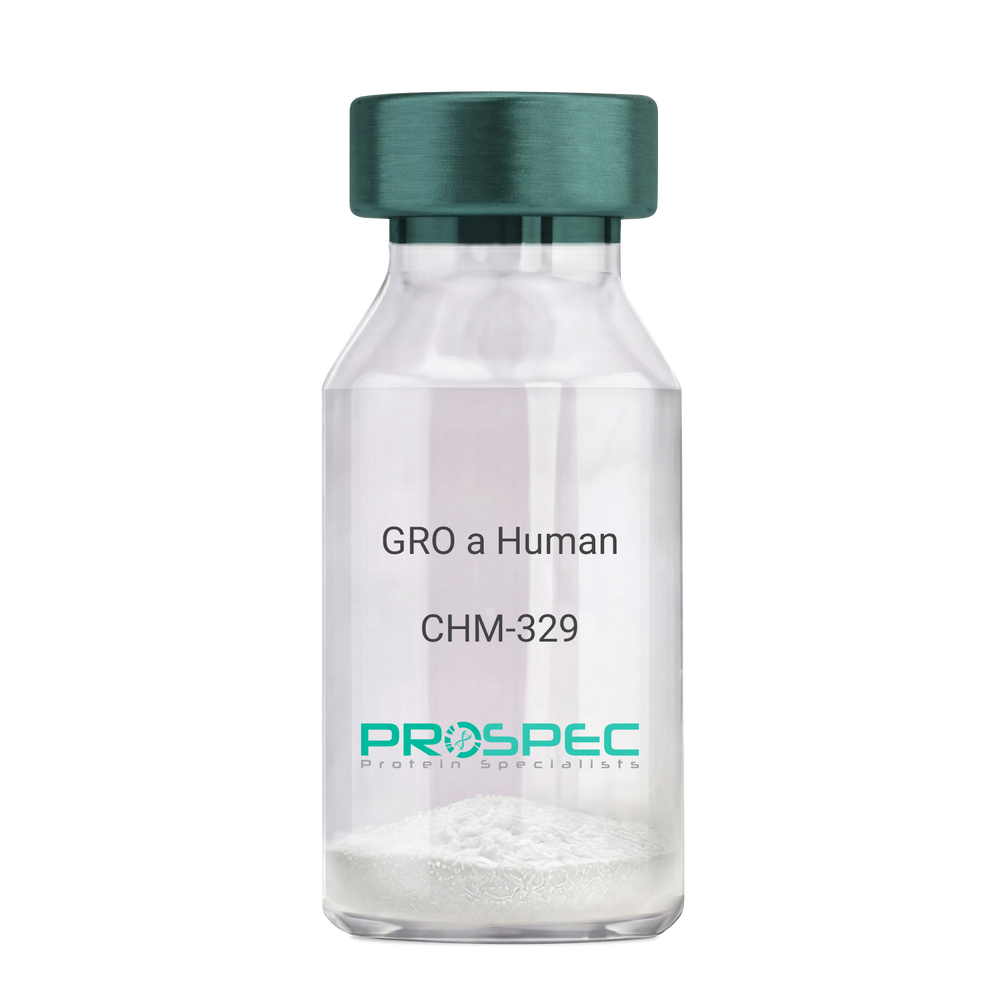
    CHM-329

    Price :

    Quantity :

    Shipping Method :

    Room Temp Icon

    Shipped at Room temp

    Add To Cart

    More Info

    • description
    • source
    • formulation
    • purity
    • biological activity
    • More Info

    Description

    GRO Alpha Human Recombinant produced in E.Coli is a single,non-glycosylated, polypeptide chain containing 73 amino acids and having a molecular mass of 7811 Dalton. The GRO-alpha is purified by proprietary chromatographic techniques.

    Source

    Escherichia Coli.

    Formulation

    Lyophilized from a 0.2µm filtered concentrated (1mg/ml) solution in 20mM PB, pH 7.4, 50mM NaCl.

    Purity

    Greater than 97.0% as determined by:
    (a) Analysis by RP-HPLC.
    (b) Analysis by SDS-PAGE.

    Biological Activity

    Determined by its ability to chemoattract human peripheral blood neutrophils using a concentration range of 10.0-100.0 ng/ml.

    More Info

    • Introduction

      Chemokine (C-X-C motif) ligand 1 (CXCL1) is a small cytokine belonging to the CXC chemokine family that was previously called GRO1 oncogene, Neutrophil-activating protein 3 (NAP-3) and melanoma growth stimulating activity, alpha (MSGA-a). It is secreted by human melanoma cells, has mitogenic properties and is implicated in melanoma pathogenesis. CXCL1 is expressed by macrophages, neutrophilsand epithelial cells, and has neutrophil chemoattractant activity. CXCL1 plays a role in spinal cord development by inhibiting the migration of oligodendrocyte precursors and is involved in the processes of angiogenesis, inflammation, wound healing, and tumorigenesis. This chemokine elicits its effects by signaling through the chemokine receptor CXCR2. The gene for CXCL1 is located on human chromosome 4 amongst genes for other CXC chemokines.

    • Synonyms

      Growth-regulated protein alpha, CXCL1, Melanoma growth stimulatory activity, MGSA, Neutrophil-activating protein 3, NAP-3, GRO-alpha (1-73), chemokine (C-X-C motif) ligand 1, GRO1, GROa, SCYB1, MGSA-a, MGSA alpha.

    • Physical Appearance

      Sterile Filtered White lyophilized (freeze-dried) powder.

    • Stability

      Lyophilized GRO-alpha although stable at room temperature for 3 weeks, should be stored desiccated below -18°C. Upon reconstitution CXCL1 should be stored at 4°C between 2-7 days and for future use below -18°C. For long term storage it is recommended to add a carrier protein (0.1% HSA or BSA).Please prevent freeze-thaw cycles.

    • Solubility

      It is recommended to reconstitute the lyophilized CXCL1 in sterile 18MΩ-cm H2O not less than 100µg/ml, which can then be further diluted to other aqueous solutions.

    • Amino Acid Sequence

      The sequence of the first five N-terminal amino acids was determined and was found to be Ala-Ser-Val-Ala-Thr.

    • Background

      What is the molecular weight/Mw of CXCL1 HUMAN Protein?
      CXCL1 HUMAN Protein has a total Mw of 7.81kDa.

      What is the source or expression system of CXCL1 HUMAN Protein?
      Escherichia Coli.

      What is the Purity of CXCL1 HUMAN Protein?
      CXCL1 HUMAN Protein is >97% pure as determined by SDS-PAGE.

      What is the Biological Activity of CXCL1 HUMAN Protein?
      Determined by its ability to chemoattract human peripheral blood neutrophils using a concentration range of 10.0-100.0 ng/ml.

      What is the amino acid sequence of CXCL1 HUMAN Protein?
      The sequence of the first five N-terminal amino acids was determined and was found to be Ala-Ser-Val-Ala-Thr.

      What applications can CXCL1 HUMAN Protein be used in?
      CXCL1 HUMAN Protein can probably be used in western blot, ELISA and Lateral Flow.

      What is the endotoxin level for CXCL1 HUMAN Protein?
      The endotoxin level is minimal, CXCL1 HUMAN Protein was purified using conventional chromatography techniques.


    ProSpec's products are furnished for LABORATORY RESEARCH USE ONLY. The product may not be used as drugs, agricultural or pesticidal products, food additives or household chemicals.

    Gro A Human
  • View Data Sheet

    Name :

    VAMP7 Human

    Description:

    Vesicle-Associated Membrane Protein 7 Human Recombinant

    Vesicle-associated membrane protein 7, Tetanus-insensitive VAMP, tetanus neurotoxin-insensitive VAMP, Synaptobrevin-like protein 1, TI-VAMP, VAMP-7, TIVAMP, SYBL1.

    Product # :

    PRO-1194

    Price :

    Quantity :

    Shipping Method :

    Ice Icon

    Shipped with Ice Packs

    Add To Cart

    More Info

    • description
    • source
    • formulation
    • purity
    • More Info

    Description

    VAMP7 Human Recombinant produced in E. coli is a single polypeptide chain containing 211 amino acids (1-188) and having a molecular mass of 23.0 kDa.VAMP7 is fused to a 23 amino acid His-tag at N-terminus & purified by proprietary chromatographic techniques.

    Source

    E.coli.

    Formulation

    The VAMP7 solution (0.5mg/1ml) contains 20mM Tris-HCl buffer (pH 8.0), 0.15M NaCl and 20% glycerol.

    Purity

    Greater than 90% as determined by SDS-PAGE.

    More Info

    • Introduction

      Vesicle-Associated Membrane Protein 7 (VAMP7) is a member of the synaptobrevin family. VAMP7 is a transmembrane protein, which is a member of the soluble N-ethylmaleimide-sensitive factor attachment protein receptor (SNARE) family. VAMP7 is involved in the targeting and/or fusion of transport vesicles to their target membrane during transport of proteins from the early endosome to the lysosome. VAMP7 localizes to late endosomes and lysosomes and is involved in the fusion of transport vesicles to their target membranes. VAMP7 is essential for heterotypic fusion of late endosomes with lysosomes and homotypic lysosomal fusion. It is also necessary for calcium regulated lysosomal exocytosis. In addition, VAMP7 is involved in the export of chylomicrons from the endoplasmic reticulum to the cis Golgi. Furthermore, VAMP7 is needed for exocytosis of mediators during eosinophil and neutrophil degranulation, and target cell killing by natural killer cells.

    • Synonyms

      Vesicle-associated membrane protein 7, Tetanus-insensitive VAMP, tetanus neurotoxin-insensitive VAMP, Synaptobrevin-like protein 1, TI-VAMP, VAMP-7, TIVAMP, SYBL1.

    • Physical Appearance

      Sterile Filtered colorless solution.

    • Stability

      Store at 4°C if entire vial will be used within 2-4 weeks. Store, frozen at -20°C for longer periods of time. For long term storage it is recommended to add a carrier protein (0.1% HSA or BSA).Avoid multiple freeze-thaw cycles.

    • Amino Acid Sequence

      MGSSHHHHHH SSGLVPRGSH MGSMAILFAV VARGTTILAK HAWCGGNFLE VTEQILAKIP SENNKLTYSH GNYLFHYICQ DRIVYLCITD DDFERSRAFN FLNEIKKRFQ TTYGSRAQTA LPYAMNSEFS SVLAAQLKHH SENKGLDKVM ETQAQVDELK GIMVRNIDLV AQRGERLELL IDKTENLVDS SVTFKTTSRN LARAMCMKNL K

    ProSpec's products are furnished for LABORATORY RESEARCH USE ONLY. The product may not be used as drugs, agricultural or pesticidal products, food additives or household chemicals.

    Vamp7 Human
  • View Data Sheet

    Name :

    CCL22 Mouse

    Description:

    Macrophage-Derived Chemokine Mouse Recombinant (CCL22)

    C-C motif chemokine 22, Small-inducible cytokine A22, Macrophage-derived chemokine, MDC(1-69), Stimulated T-cell chemotactic protein 1, CC chemokine STCP-1, CCL22, MDC, SCYA22, ABCD-1, DC/B-CK, MGC34554, A-152E5.1, CC chemokine ABCD-1, Activated B and dendritic cell-derived, DCBCK.

    Product # :

    CHM-370

    Price :

    Quantity :

    Shipping Method :

    Room Temp Icon

    Shipped at Room temp

    Add To Cart

    More Info

    • description
    • source
    • formulation
    • purity
    • biological activity
    • More Info

    Description

    CCL22 Mouse Recombinant produced in E.Coli is a non-glycosylated, Polypeptide chain containing 68 amino acids and having a molecular mass of 7.8kDa. The Mouse CCL22 is purified by proprietary chromatographic techniques.

    Source

    Escherichia Coli.

    Formulation

    CCL22 filtered (0.2µm) and lyophilized from a concentrated solution containing 20mM phosphate buffer & 150mM NaCl pH-7.4.

    Purity

    Greater than 97.0% as determined by: (a) Analysis by RP-HPLC. (b) Analysis by SDS-PAGE.

    Biological Activity

    Determined by its ability to chemoattract human activated lymphocytes using a concentration range of 10-100ng/ml corresponding to a Specific Activity of 10,000-100,000IU/mg.

    More Info

    • Introduction

      MDC (CCL22) is a small cytokine that belongs to the CC chemokine family. CCL22 is one of several Cys-Cys (CC) cytokine genes clustered on the q arm of chromosome 16. MDC shows chemotactic activity for natural killer cells, chronically activated T lymphocytes, monocytes and dendritic cells. On the other hand, MDC shows a mild activity for primary activated T lymphocytes and has no chemoattractant activity for neutrophils, eosinophils and resting T lymphocytes. MDC may also have a role in the trafficking of activated T lymphocytes to inflammatory sites and other aspects of activated T lymphocyte physiology. MDC interacts with cell surface chemokine receptors CCR4. CCL22 is vastly expressed in macrophage and in monocyte-derived dendritic cells, and thymus. CCL22 is also found in the lymph node, appendix, activated monocytes, resting and activated macrophages. Lower expression of CCL22 can be seen in the lung and the spleen and very weak expression in the small intestine. In the lymph

    • Synonyms

      C-C motif chemokine 22, Small-inducible cytokine A22, Macrophage-derived chemokine, MDC(1-69), Stimulated T-cell chemotactic protein 1, CC chemokine STCP-1, CCL22, MDC, SCYA22, ABCD-1, DC/B-CK, MGC34554, A-152E5.1, CC chemokine ABCD-1, Activated B and dendritic cell-derived, DCBCK.

    • Physical Appearance

      Filtered White lyophilized (freeze-dried) powder.

    • Stability

      Lyophilized CCL22 although stable at room temperature for 3 weeks, should be stored desiccated below -18°C. Upon reconstitution CCL22 should be stored at 4°C between 2-7 days and for future use below -18°C. For long term storage it is recommended to add a carrier protein (0.1% HSA or BSA). Please prevent freeze-thaw cycles.

    • Solubility

      It is recommended to reconstitute the lyophilized CCL22 in sterile 18MΩ-cm H2O not less than 100µg/ml, which can then be further diluted to other aqueous solutions.

    • Amino Acid Sequence

      GPYGANVEDS ICCQDYIRHP LPSRLVKEFF WTSKSCRKPG VVLITVKNRD ICADPRQVWV KKLLHKLS.

    • Background

      What is the molecular weight/Mw of CCL22 MOUSE Protein?
      CCL22 MOUSE Protein has a total Mw of 7.8kDa.

      What is the source or expression system of CCL22 MOUSE Protein?
      Escherichia Coli.

      What is the Purity of CCL22 MOUSE Protein?
      CCL22 MOUSE Protein is >97% pure as determined by SDS-PAGE.

      What is the Biological Activity of CCL22 MOUSE Protein?
      Determined by its ability to chemoattract human activated lymphocytes using a concentration range of 10-100ng/ml corresponding to a Specific Activity of 10,000-100,000IU/mg.

      What is the amino acid sequence of CCL22 MOUSE Protein?
      GPYGANVEDS ICCQDYIRHP LPSRLVKEFF WTSKSCRKPG VVLITVKNRD ICADPRQVWV KKLLHKLS.

      What applications can CCL22 MOUSE Protein be used in?
      CCL22 MOUSE Protein can probably be used in western blot, ELISA and Lateral Flow.

      What is the endotoxin level for CCL22 MOUSE Protein?
      The endotoxin level is minimal, CCL22 MOUSE Protein was purified using conventional chromatography techniques.

    ProSpec's products are furnished for LABORATORY RESEARCH USE ONLY. The product may not be used as drugs, agricultural or pesticidal products, food additives or household chemicals.

    Mdc Mouse
  • View Data Sheet

    Name :

    S100A3 Human

    Description:

    S100 Calcium Binding Protein A3 Human Recombinant

    S100-A3, S-100E, S100 calcium-binding protein A3, S100E, S-100A3, Protein S100-A3, Protein S-100E, S100A3.

    Product # :

    PRO-755

    Price :

    Quantity :

    Shipping Method :

    Ice Icon

    Shipped with Ice Packs

    Add To Cart

    More Info

    • description
    • source
    • formulation
    • purity
    • More Info

    Description

    S100A3 Human Recombinant produced in E.coli is a single, non-glycosylated polypeptide chain containing 121 amino acids (1-101) and having a molecular mass of 13.9kDa.The S100A3 is fused to a 20 amino acid His-Tag at N-terminus and purified by proprietary chromatographic techniques.

    Source

    Escherichia Coli.

    Formulation

    S100A3 protein at 1mg/ml in 20mM Tris-HCl buffer (pH 8.0), 20% glycerol, 2mM DTT and 0.2M NaCl.

    Purity

    Greater than 90.0% as determined by SDS-PAGE.

    More Info

    • Introduction

      S100A3 is part of S100 family of proteins containing 2 EF-hand calcium-binding motifs. S100 proteins are localized in the cytoplasm/nucleus of a broad range of cells, and takes part in the regulation of several cellular processes such as cell cycle progression and differentiation. S100A3 has the largest number of cysteines of all S100 proteins. S100A3 has high affinity for Zinc, and is widely expressed in human hair cuticle.

    • Synonyms

      S100-A3, S-100E, S100 calcium-binding protein A3, S100E, S-100A3, Protein S100-A3, Protein S-100E, S100A3.

    • Physical Appearance

      Sterile Filtered clear solution.

    • Stability

      Store at 4°C if entire vial will be used within 2-4 weeks.Store, frozen at -20°C for longer periods of time. For long term storage it is recommended to add a carrier protein (0.1% HSA or BSA).Please prevent freeze thaw cycles.

    • Amino Acid Sequence

      MGSSHHHHHH SSGLVPRGSH MARPLEQAVA AIVCTFQEYA GRCGDKYKLC QAELKELLQK ELATWTPTEF RECDYNKFMS VLDTNKDCEV DFVEYVRSLA CLCLYCHEYF KDCPSEPPCS Q.

    ProSpec's products are furnished for LABORATORY RESEARCH USE ONLY. The product may not be used as drugs, agricultural or pesticidal products, food additives or household chemicals.

    S100A3 Human
  • View Data Sheet

    Name :

    Thymosin a1 human

    Description:

    Thymosin a1 Acetate

    Product # :

    HOR-243

    Price :

    Quantity :

    Shipping Method :

    Room Temp Icon

    Shipped at Room temp

    Add To Cart

    More Info

    • description
    • formulation
    • purity
    • More Info

    Description

    Thymosin a1 acetate, also known as thymalfasin has immunoregulatory properties enhancing immune functions. Thymosin a1 has a molecular formula of C129H215N33O55 a.a. sequence of Ac-Ser-Asp-Ala-Ala-Val-Asp-Thr-Ser-Ser-Glu-Ile-Thr-Thr-Lys-Asp-Leu-Lys-Glu-Lys-Lys-Glu-Val-Val-Glu-Glu-Ala-Glu-Asn-OH and having a Mw of 3108.32 Dalton.

    Formulation

    The protein (1mg/ml) was lyophilized with no additives.

    Purity

    Greater than 99.0% as determined by:
    (a) Analysis by RP-HPLC.
    (b) Analysis by SDS-PAGE.

    More Info

    • Introduction

      Thymalfasin is a synthetic analogue of thymosin-alpha-1, a 28-amino acid protein derived from the precursor protein prothymosin-alpha. Exhibiting a variety of immunoregulating properties, thymosin-alpha-1 induces differentiation of murine T-cell precursors and human thymocytes and the terminal differentiation of functionally immature cord blood lymphocytes and induces production of IL-2, high affinity IL-2 receptors, and B-cell growth factors by peripheral blood mononuclear cells. T-helper and cytotoxic/suppressor T-cell populations are targets of thymosin activity. Thymosin-alpha-1 has been shown to increase the efficiency of antigen presentation by macrophages and to be an endogenous modulator of alpha-thrombin activity.

    • Physical Appearance

      Sterile Filtered White lyophilized (freeze-dried) powder.

    • Stability

      Lyophilized Thymosin a1 although stable at room temperature for 3 weeks, should be stored desiccated below -18°C. Upon reconstitution Thymalfasin should be stored at 4°C between 2-7 days and for future use below -18°C.For long term storage it is recommended to add a carrier protein (0.1% HSA or BSA).Please prevent freeze-thaw cycles.

    • Solubility

      It is recommended to reconstitute the lyophilized Thymosin a1 in sterile 18MΩ-cm H2O not less than 100 µg/ml, which can then be further diluted to other aqueous solutions.

    • Background

      What is the molecular weight/Mw of THYMOSIN-A1 HUMAN Protein?
      THYMOSIN-A1 HUMAN Protein has a total Mw of 3.1kDa.

      What is the Purity of THYMOSIN-A1 HUMAN Protein?
      THYMOSIN-A1 HUMAN Protein is >99% pure as determined by SDS-PAGE.

      What is the Biological Activity of THYMOSIN-A1 HUMAN Protein?
      The biological functionality of THYMOSIN-A1 HUMAN Protein will be determined in the future.

      What applications can THYMOSIN-A1 HUMAN Protein be used in?
      THYMOSIN-A1 HUMAN Protein can probably be used in western blot, ELISA and Lateral Flow.

      What is the endotoxin level for THYMOSIN-A1 HUMAN Protein?
      The endotoxin level is minimal, THYMOSIN-A1 HUMAN Protein was purified using conventional chromatography techniques.

    ProSpec's products are furnished for LABORATORY RESEARCH USE ONLY. The product may not be used as drugs, agricultural or pesticidal products, food additives or household chemicals.

    Thymosin Alpha 1
  • View Data Sheet

    Name :

    Cagrilintide

    Description:

    Cagrilintide

    Product # :

    HOR-059

    Price :

    Quantity :

    Shipping Method :

    Room Temp Icon

    Shipped at Room temp

    Add To Cart

    More Info

    • description
    • formulation
    • purity
    • More Info

    Description

    Cagrilintide is a synthetic single, non-glycosylated polypeptide chain containing 37 amino acids, having a molecular mass of 4409 Dalton and a Molecular formula of C194H312N54O59.

    Formulation

    The protein was lyophilized with no additives.

    Purity

    Greater than 97.0% as determined by analysis by RP-HPLC.

    More Info

    • Physical Appearance

      Sterile Filtered White lyophilized (freeze-dried) powder.

    • Stability

      Lyophilized Cagrilintide although stable at room temperature for 3 weeks, should be stored desiccated below -18°C. Upon reconstitution Cagrilintide should be stored at 4°C between 2-7 days and for future use below -18°C.
      For long term storage it is recommended to add a carrier protein (0.1% HSA or BSA).
      Please prevent freeze-thaw cycles.

    • Solubility

      It is recommended to reconstitute the lyophilized Cagrilintide in sterile 18MΩ-cm H2O not less than 100 µg/ml, which can then be further diluted to other aqueous solutions.

    • Amino Acid Sequence

      (Eicosanedioic acid-γ-Glu)-Lys-CysAsn-Thr-Ala-Thr-Cys-Ala-Thr-Gln-Arg-Leu-Ala-Glu-Phe-Leu-Arg-HisSer-Ser-Asn-Asn-Phe-Gly-Pro-Ile-Leu-Pro-Pro-Thr-Asn-Val-Gly-SerAsn-Thr-Pro-NH2 (Disulfide bridge:Cys3-Cys8).

    • Background

      Cagrilintide plays a role as a pioneering long-acting amylin analogue and integrates into the fixed-dose combination CagriSema (Cagrilintide + Semaglutide). Unlike GLP-1 agonists, Cagrilintide mimics amylin, a hormone co-secreted with insulin takes part in regulating satiety and slows gastric emptying through brainstem pathways.

    ProSpec's products are furnished for LABORATORY RESEARCH USE ONLY. The product may not be used as drugs, agricultural or pesticidal products, food additives or household chemicals.

    Cagrilintide
  • View Data Sheet

    Name :

    S100A5 Human

    Description:

    S100 Calcium Binding Protein A5 Human Recombinant

    Protein S100-A5, Protein S-100D, S100 calcium-binding protein A5, S100A5, S100D.

    Product # :

    PRO-147

    Price :

    Quantity :

    Shipping Method :

    Ice Icon

    Shipped with Ice Packs

    Add To Cart

    More Info

    • description
    • source
    • formulation
    • purity
    • More Info

    Description

    S100A5 Human Recombinant fused with a 20 amino acid His tag at N-terminus produced in E.Coli is a single, non-glycosylated, polypeptide chain containing 112 amino acids (1-92 a.a.) and having a molecular mass of 12.9kDa. The S100A5 is purified by proprietary chromatographic techniques.

    Source

    Escherichia Coli.

    Formulation

    The S100A5 solution (1mg/1ml) contains 20mM Tris-HCl buffer (pH 8.0), 1mM DTT, 30% glycerol, 0.1M NaCl and 0.1mM PMSF.

    Purity

    Greater than 90.0% as determined by SDS-PAGE.

    More Info

    • Introduction

      S100 calcium binding protein A5 (S100A5) belongs to the S100 family of proteins containing 2 EF-hand calcium-binding motifs. S100 family members are localized in the cytoplasm and/or nucleus of a wide range of cells, and are involved in the regulation of a number of cellular processes such as cell cycle progression and differentiation. S100A5 has a Ca2+ affinity 20-100 fold higher than the other S100 proteins investigated under identical conditions. Furthermore, S100A5 protein binds Zn2+ and Cu2+, and Cu2+ strongly which harms the binding of Ca2+. S100A5 is expressed in very limited regions of the adult brain.

    • Synonyms

      Protein S100-A5, Protein S-100D, S100 calcium-binding protein A5, S100A5, S100D.

    • Physical Appearance

      Sterile Filtered colorless solution.

    • Stability

      Store at 4°C if entire vial will be used within 2-4 weeks. Store, frozen at -20°C for longer periods of time. For long term storage it is recommended to add a carrier protein (0.1% HSA or BSA).Avoid multiple freeze-thaw cycles.

    • Amino Acid Sequence

      MGSSHHHHHH SSGLVPRGSH METPLEKALT TMVTTFHKYS GREGSKLTLS RKELKELIKK ELCLGEMKES SIDDLMKSLD KNSDQEIDFK EYSVFLTMLC MAYNDFFLED NK.

    ProSpec's products are furnished for LABORATORY RESEARCH USE ONLY. The product may not be used as drugs, agricultural or pesticidal products, food additives or household chemicals.

    S100A5 Human
  • View Data Sheet

    Name :

    S100A4 Human

    Description:

    S100 Calcium-Binding Protein A4 Human Recombinant

    Protein S100-A4, S100 calcium-binding protein A4, Metastasin, Protein Mts1, Placental calcium-binding protein, Calvasculin, S100A4, CAPL, MTS1, 42A, 18A2, FSP1, P9KA, PEL98.

    Product # :

    PRO-698

    Price :

    Quantity :

    Shipping Method :

    Ice Icon

    Shipped with Ice Packs

    Add To Cart

    More Info

    • description
    • source
    • formulation
    • purity
    • More Info

    Description

    S100A4 Human Recombinant produced in E.coli is a single, non-glycosylated polypeptide chain containing 121 amino acids (1-101) and having a molecular mass of 13.8 kDa.The S100A4 is fused to a 20 amino acid His-Tag at N-terminus and purified by proprietary chromatographic techniques.

    Source

    Escherichia Coli.

    Formulation

    S100A4 protein at in 20mM Tris-HCl, pH-8 & 10% Glycerol.

    Purity

    Greater than 95.0% as determined by SDS-PAGE.

    More Info

    • Introduction

      S100A4 is part of the S100 super-family of proteins containing 2 EF-hand calcium binding domains. S100A4 is ubiquitously overexpressed and is localized in the cytoplasm and/or nucleus. S100A4 is involved in motility, invasion, and tubulin polymerization. Chromosomal rearrangements and altered expression of the S100A4 gene have been implicated in tumor metastasis.

    • Synonyms

      Protein S100-A4, S100 calcium-binding protein A4, Metastasin, Protein Mts1, Placental calcium-binding protein, Calvasculin, S100A4, CAPL, MTS1, 42A, 18A2, FSP1, P9KA, PEL98.

    • Physical Appearance

      Sterile Filtered clear solution.

    • Stability

      Store at 4°C if entire vial will be used within 2-4 weeks. Store, frozen at -20°C for longer periods of time. For long term storage it is recommended to add a carrier protein (0.1% HSA or BSA).Avoid multiple freeze-thaw cycles.

    • Amino Acid Sequence

      MGSSHHHHHH SSGLVPRGSH MACPLEKALD VMVSTFHKYS GKEGDKFKLN KSELKELLTR ELPSFLGKRT DEAAFQKLMS NLDSNRDNEVDFQEYCVFLS CIAMMCNEFF EGFPDKQPRK K.

    ProSpec's products are furnished for LABORATORY RESEARCH USE ONLY. The product may not be used as drugs, agricultural or pesticidal products, food additives or household chemicals.

    S100A4 Human His
  • View Data Sheet

    Name :

    CTF1 Mouse

    Description:

    Cardiotrophin-1 Mouse Recombinant

    CTF1, CT1, CT-1, Cardiophin 1.

    Product # :

    CYT-151

    Price :

    Quantity :

    Shipping Method :

    Room Temp Icon

    Shipped at Room temp

    Add To Cart

    More Info

    • description
    • source
    • formulation
    • purity
    • biological activity
    • More Info

    Description

    CTF1 Mouse Recombinant produced in E.Coli is a single, non-glycosylated, polypeptide chain containing 202 amino acids and having a molecular mass of 21.3kDa.The CTF1 Mouse is purified by proprietary chromatographic techniques.

    Source

    Escherichia Coli.

    Formulation

    Lyophilized from a 0.2µm filtered concentrated solution in PBS, pH 7.4.

    Purity

    Greater than 98.0% as determined by SDS-PAGE.

    Biological Activity

    The ED50 as determined by the dose-dependent proliferation of TF-1 cells was < 1.0ng/ml, corresponding to a specific activity of > 1,000,000units/mg.

    More Info

    • Introduction

      Cardiotrophin 1 (CT-1) is a 201 amino acid member of the interleukin-6 superfamily. It was identified by its ability to induce hypertrophic response in cardiac myocytes. CT-1 mRNA levels were found both in cardiac myocytes and in cardiac nonmyocytes. CT 1 was also detected in abundance in normal adult human lung and was expressed in both fetal and adult airway smooth muscle cells. CT 1 activates gp130 dependent signaling and stimulates the Janus kinase/signal transducers and activators of transcription (JAK/STAT) pathway to transduce hypertrophic and cytoprotective signals in cardiac myocytes.
      CT 1 has also a neurotrophic function. CTF1 deficiency causes increased motoneuron cell death in spinal cord and brainstem nuclei of mice during a period between embryonic day 14 and the first postnatal week. Moreover, CT-1 is a hepatocyte survival factor that efficiently reduces hepatocellular damage in animal models of acute liver injury. Cardiotrophin 1 expression is augmented after hypoxic stimulation and it can protect cardiac cells when added either prior to simulated ischaemia or at the time of reoxygenation following simulated ischaemia. Cardiotrophin 1 can induce expression of the protective heat shock proteins (hsps) in cardiac cells.
      Cardiotrophin-1 increased ventricular expression of ANP, brain natriuretic peptide (BNP) and angiotensinogen mRNA.
      Cardiophin 1 levels were significantly elevated in patients with heart failure, patients with dilatative cardiomyopathy, moderate/severe mitral regurgitation, stable and unstable angina and after acute myocardial infarction.

    • Synonyms

      CTF1, CT1, CT-1, Cardiophin 1.

    • Physical Appearance

      Sterile Filtered White lyophilized (freeze-dried) powder.

    • Stability

      Lyophilized CTF1 although stable at room temperature for 3 weeks, should be stored desiccated below -18°C. Upon reconstitution CTF1 should be stored at 4°C between 2-7 days and for future use below -18°C.Please prevent freeze-thaw cycles.

    • Solubility

      It is recommended to reconstitute the lyophilized CTF1 in sterile 4mM HCl to a concentration of 0.1-0.5 mg/ml. Stock solutions should be apportioned into working aliquots and stored at <-200C. Further dilutions should be made in appropriate buffered solutions.

    • Amino Acid Sequence

      SQREGSLEDH QTDSSISFLP HLEAKIRQTH NLARLLTKYA EQLLEEYVQQ QGEPFGLPGF SPPRLPLAGL SGPAPSHAGL PVSERLRQDA AALSVLPALL DAVRRRQAEL NPRAPRLLRS LEDAARQVRA LGAAVETVLA ALGAAARGPG PEPVTVATLF TANSTAGIFS AKVLGFHVCG LYGEWVSRTE GDLGQLVPGG VA

    • Background

      What is the molecular weight/Mw of CTF1 Protein?
      CTF1 Protein has a total Mw of 21.3kDa.

      What is the source or expression system of CTF1 Protein?
      Escherichia Coli.

      What is the Purity of CTF1 Protein?
      CTF1 Protein is >98% pure as determined by SDS-PAGE.

      What is the Biological Activity of CTF1 Protein?
      The ED50 as determined by the dose-dependent proliferation of TF-1 cells was < 1.0ng/ml, corresponding to a specific activity of > 1,000,000units/mg.

      What is the amino acid sequence of CTF1 Protein?
      SQREGSLEDH QTDSSISFLP HLEAKIRQTH NLARLLTKYA EQLLEEYVQQ QGEPFGLPGF SPPRLPLAGL SGPAPSHAGL PVSERLRQDA AALSVLPALL DAVRRRQAEL NPRAPRLLRS LEDAARQVRA LGAAVETVLA ALGAAARGPG PEPVTVATLF TANSTAGIFS AKVLGFHVCG LYGEWVSRTE GDLGQLVPGG VA

      What applications can CTF1 Protein be used in?
      CTF1 Protein can probably be used in western blot, ELISA and Lateral Flow.

      What is the endotoxin level for CTF1 Protein?
      The endotoxin level is minimal, CTF1 Protein was purified using conventional chromatography techniques.

    ProSpec's products are furnished for LABORATORY RESEARCH USE ONLY. The product may not be used as drugs, agricultural or pesticidal products, food additives or household chemicals.

    Ct 1 Mouse
  • View Data Sheet

    Name :

    SERPINF2 Mouse

    Description:

    Serpin Peptidase Inhibitor, Clade F Member 2 Mouse Recombinant

    Alpha-2-antiplasmin, Alpha-2-AP, Alpha-2-plasmin inhibitor, Alpha-2-PI, Serpin F2.

    Product # :

    PRO-2240

    Price :

    Quantity :

    Shipping Method :

    Ice Icon

    Shipped with Ice Packs

    Add To Cart

    More Info

    • description
    • source
    • formulation
    • purity
    • More Info

    Description

    SERPINF2 produced in Sf9 Baculovirus cells is a single, glycosylated polypeptide chain containing 470 amino acids (28-491 a.a.) and having a molecular mass of 52.9kDa (Migrates at 70-100kDa on SDS-PAGE under reducing conditions). SERPINF2 is expressed with a 6 amino acid His tag at C-Terminus and purified by proprietary chromatographic techniques.

    Source

    Sf9, Baculovirus cells.

    Formulation

    SERPINF2 protein solution (1mg/ml) contains Phosphate Buffered Saline (pH 7.4) and 10% glycerol.

    Purity

    Greater than 90.0% as determined by SDS-PAGE.

    More Info

    • Introduction

      Alpha-2-antiplasmin (SERPINF2) is a serine protease inhibitor. The main targets of SERPINF2 are plasmin and trypsin; however SERPINF2 also inactivates matriptase-3/TMPRSS7 and chymotrypsin.

    • Synonyms

      Alpha-2-antiplasmin, Alpha-2-AP, Alpha-2-plasmin inhibitor, Alpha-2-PI, Serpin F2.

    • Physical Appearance

      Sterile Filtered colorless solution.

    • Stability

      Store at 4°C if entire vial will be used within 2-4 weeks. Store, frozen at -20°C for longer periods of time. For long term storage it is recommended to add a carrier protein (0.1% HSA or BSA). Avoid multiple freeze-thaw cycles.

    • Amino Acid Sequence

      VDLPGQQPVS EQAQQKLPLP ALFKLDNQDF GDHATLKRSP GHCKSVPTAE ETRRLAQAMM AFTTDLFSLV AQTSTSSNLV LSPLSVALAL SHLALGAQNQ TLHSLHRVLH MNTGSCLPHL LSHFYQNLGP GTIRLAARIY LQKGFPIKDD FLEQSERLFG AKPVKLTGKQ EEDLANINQW VKEATEGKIE DFLSELPDST VLLLLNAIHF HGFWRTKFDP SLTQKDFFHL DERFTVSVDM MHAVSYPLRW FLLEQPEIQV AHFPFKNNMS FVVVMPTYFE WNVSEVLANL TWDTLYHPSL QERPTKVWLP KLHLQQQLDL VATLSQLGLQ ELFQGPDLRG ISEQNLVVSS VQHQSTMELS EAGVEAAAAT SVAMNRMSLS SFTVNRPFLF FIMEDTIGVP LFVGSVRNPN PSALPQLQEQ RDSPDNRLIG QNDKADFHGG KTFGPDLKLA PRMEEDYPQF SSPKHHHHHH.

    ProSpec's products are furnished for LABORATORY RESEARCH USE ONLY. The product may not be used as drugs, agricultural or pesticidal products, food additives or household chemicals.

    Serpinf2 Mouse
  • View Data Sheet

    Name :

    SOST Mouse

    Description:

    Sclerostin Mouse Recombinant

    SOST, Sclerostin, 5430411E23Rik.

    Product # :

    PRO-2670

    Price :

    Quantity :

    Shipping Method :

    Ice Icon

    Shipped with Ice Packs

    Add To Cart

    More Info

    • description
    • source
    • formulation
    • purity
    • More Info

    Description

    SOST Mouse Recombinant produced in HEK293 cells is a single, glycosylated polypeptide chain (24-211 a.a) containing 194 amino acids and having a molecular mass of 21.9 kDa.SOST is fused to a 6 amino acid His-tag at C-terminus & purified by proprietary chromatographic techniques.

    Source

    HEK293 cells.

    Formulation

    SOST protein (0.25mg/ml) contains 10% glycerol and Phosphate-Buffered Saline (pH 7.4).

    Purity

    Greater than 90.0% as determined by SDS-PAGE.

    More Info

    • Introduction

      Sclerostin (SOST) is a secreted glycoprotein with a C-terminal cysteine knot-like (CTCK) domain and sequence similarity to the DAN (differential screening-selected gene aberrative in neuroblastoma) family of bone morphogenetic protein antagonists. Sclerostin functions as a negative regulator of bone growth, by inhibiting bone formation. SOST is expressed mainly in the bone, cartilage, kidney, liver, bone marrow and primary osteoblasts differentiated for 21 days. SOST gene defects cause sclerosteosis and bone dysplasia.

    • Synonyms

      SOST, Sclerostin, 5430411E23Rik.

    • Physical Appearance

      Sterile Filtered colorless solution.

    • Stability

      Store at 4°C if entire vial will be used within 2-4 weeks. Store, frozen at -20°C for longer periods of time. For long term storage it is recommended to add a carrier protein (0.1% HSA or BSA).Avoid multiple freeze-thaw cycles.

    • Amino Acid Sequence

      QGWQAFRNDA TEVIPGLGEY PEPPPENNQT MNRAENGGRP PHHPYDAKDV SEYSCRELHY TRFLTDGPCR SAKPVTELVC SGQCGPARLL PNAIGRVKWW RPNGPDFRCI PDRYRAQRVQ LLCPGGAAPR SRKVRLVASC KCKRLTRFHN QSELKDFGPE TARPQKGRKP RPGARGAKAN QAELENAYHH HHHH

    ProSpec's products are furnished for LABORATORY RESEARCH USE ONLY. The product may not be used as drugs, agricultural or pesticidal products, food additives or household chemicals.

    Sclerostin Mouse
  • View Data Sheet

    Name :

    STIP1 Human, His

    Description:

    Stress-Induced-Phosphoprotein 1 Human Recombinant, His Tag

    HOP, P60, STI1, STI1L, IEF-SSP-3521, STIP1, Stress-induced-phosphoprotein 1, Hsc70/Hsp90-organizing protein, Transformation-sensitive protein IEF SSP 3521, Renal carcinoma antigen NY-REN-11.

    Product # :

    PRO-753

    Price :

    Quantity :

    Shipping Method :

    Ice Icon

    Shipped with Ice Packs

    Add To Cart

    More Info

    • description
    • source
    • formulation
    • purity
    • More Info

    Description

    Recombinant Human STIP1 produced in E.Coli is a single, non-glycosylated polypeptide chain containing 563 amino acids (1-543 a.a) and having a molecular mass of 64.8kDa. STIP1 is fused to a 20 amino acid His-Tag at N-terminus and purified by conventional chromatography techniques.

    Source

    Escherichia Coli.

    Formulation

    The STIP1 protein solution (1mg/ml) contains 20mM Tris-HCl, pH-8, 1mM DTT, 1mM EDTA, 0.2mM PMSF and 20% Glycerol.

    Purity

    Greater than 90.0% as determined by SDS-PAGE.

    More Info

    • Introduction

      STIP1 is an adaptor protein that mediates the functions of HSP70 & HSP90 in protein folding. STIP1 supports the transfer of proteins from HSP70 to HSP90 by binding together HSP90 and substrate-bound HSP70. STIP1 stimulates the ATPase activity of HSP70 and inhibits the ATPase activity of HSP90, suggesting that it regulates both the conformations and ATPase cycles of these chaperones. STIP1 genetic variations are involved in regulating corticosteroid response in asthmatic subjects with reduced lung function.

    • Synonyms

      HOP, P60, STI1, STI1L, IEF-SSP-3521, STIP1, Stress-induced-phosphoprotein 1, Hsc70/Hsp90-organizing protein, Transformation-sensitive protein IEF SSP 3521, Renal carcinoma antigen NY-REN-11.

    • Physical Appearance

      Sterile filtered colorless solution.

    • Stability

      Store at 4°C if entire vial will be used within 2-4 weeks. Store, frozen at -20°C for longer periods of time. For long term storage it is recommended to add a carrier protein (0.1% HSA or BSA). Avoid multiple freeze-thaw cycles.

    • Amino Acid Sequence

      MGSSHHHHHH SSGLVPRGSH MEQVNELKEK GNKALSVGNI DDALQCYSEA IKLDPHNHVL YSNRSAAYAK KGDYQKAYED GCKTVDLKPDWGKGYSRKAA ALEFLNRFEE AKRTYEEGLK HEANNPQLKE GLQNMEARLA ERKFMNPFNM PNLYQKLESD PRTRTLLSDP TYRELIEQLRNKPSDLGTKL QDPRIMTTLS VLLGVDLGSM DEEEEIATPP PPPPPKKETK PEPMEEDLPE NKKQALKEKE LGNDAYKKKD FDTALKHYDKAKELDPTNMT YITNQAAVYF EKGDYNKCRE LCEKAIEVGR ENREDYRQIA KAYARIGNSY FKEEKYKDAI HFYNKSLAEH TPDVLKKCQQAEKILKEQE RLAYINPDLA LEEKNKGNEC FQKGDYPQAM KHYTEAIKRN PKDAKLYSNR AACYTKLLEF QLALKDCEEC QLEPTFIKGYTRKAAALEA MKDYTKAMDV YQKALDLDSS CKEAADGYQR CMMAQYNRHD SPEDVKRRAM ADPEVQQIMS DPAMRLILEQ MQKDPQALSE HLKNPVIAQK IQKLMDVGLI AIR.

    ProSpec's products are furnished for LABORATORY RESEARCH USE ONLY. The product may not be used as drugs, agricultural or pesticidal products, food additives or household chemicals.

    Stip1 Human
  • View Data Sheet

    Name :

    CDH11 Human

    Description:

    Cadherin 11 Human Recombinant

    CAD11, CDHOB, OB, OSF-4, Cadherin 11, Osteoblast cadherin, OB-cadherin.

    Product # :

    PRO-1368

    Price :

    Quantity :

    Shipping Method :

    Ice Icon

    Shipped with Ice Packs

    Add To Cart

    More Info

    • description
    • source
    • formulation
    • purity
    • More Info

    Description

    CDH11 Human Recombinant produced in E.Coli is a single, non-glycosylated polypeptide chain containing 601 amino acids (54-617 a.a) and having a molecular mass of 66.2kDa. CDH11 is fused to a 37 amino acid His-tag at N-terminus & purified by proprietary chromatographic techniques.

    Source

    E.coli.

    Formulation

    CDH11 protein solution (1mg/ml) containing 20mM Tris-HCl buffer (pH8.0), 10% glycerol and 0.1M NaCl.

    Purity

    Greater than 85% as determined by SDS-PAGE.

    More Info

    • Introduction

      Cadherin 11 (CDH11) belongs to the cadherin superfamily (integral membrane proteins) which mediate calcium-dependent cell-cell adhesion. CDH11 is defined based on lacking a HAV cell adhesion recognition sequence specific to type I cadherins. CDH11 protein’s expression in osteoblastic cell lines, and its upregulation during differentiation, suggests a specific function in bone development and maintenance. CDH11 contributes to the sorting of heterogeneous cell types.

    • Synonyms

      CAD11, CDHOB, OB, OSF-4, Cadherin 11, Osteoblast cadherin, OB-cadherin.

    • Physical Appearance

      Sterile Filtered colorless solution.

    • Stability

      Store at 4°C if entire vial will be used within 2-4 weeks. Store, frozen at -20°C for longer periods of time. For long term storage it is recommended to add a carrier protein (0.1% HSA or BSA).Avoid multiple freeze-thaw cycles.

    • Amino Acid Sequence

      MRGSHHHHHH GMASMTGGQQ MGRDLYDDDD KDRWGSMGWV WNQFFVIEEY TGPDPVLVGR LHSDIDSGDG NIKYILSGEG AGTIFVIDDK SGNIHATKTL DREERAQYTL MAQAVDRDTN RPLEPPSEFI VKVQDINDNP PEFLHETYHA NVPERSNVGT SVIQVTASDA DDPTYGNSAK LVYSILEGQP YFSVEAQTGI IRTALPNMDR EAKEEYHVVI QAKDMGGHMG GLSGTTKVMI TLTDVNDNPP KFPQSVYQMS VSEAAVPGEE VGRVKAKDPD IGENGLVTYN IVDGDGMESF EITTDYETQE GVIKLKKPVD FETKRAYSLK VEAANVHIDP KFISNGPFKD TVTVKIAVED ADEPPMFLAP SYIHEVQENA AAGTVVGRVH AKDPDAANSP IRYSIDRHTD LDRFFTINPE DGFIKTTKPL DREETAWLNI TVFAAEIHNR HQEAKVPVAI RVLDVNDNAP KFAAPYEGFI CESDQTKPLS NQPIVTISAD DKDDTANGPR FIFSLPPEII HNPNFTVRDN RDNTAGVYAR RGGFSRQKQD LYLLPIVISD GGIPPMSSTN TLTIKVCGCD VNGALLSCNA EAYILNAGLS T.

    ProSpec's products are furnished for LABORATORY RESEARCH USE ONLY. The product may not be used as drugs, agricultural or pesticidal products, food additives or household chemicals.

    Cdh11 Human
  • View Data Sheet

    Name :

    TDP2 Human

    Description:

    Tyrosyl-DNA Phosphodiesterase 2 Human Recombinant

    AD022, dJ30M3.3, EAP2, EAPII, RP1-30M3.3, TTRAP, 5'-tyrosyl-DNA phosphodiesterase,hTDP2, ETS1-associated protein 2, ETS1-associated protein II.

    Product # :

    ENZ-698

    Price :

    Quantity :

    Shipping Method :

    Ice Icon

    Shipped with Ice Packs

    Add To Cart

    More Info

    • description
    • source
    • formulation
    • purity
    • More Info

    Description

    TDP2 Human Recombinant produced in E.coli is a single, non-glycosylated polypeptide chain containing 385 amino acids (1-362) and having a molecular mass of 43.3kDa. TDP2 is fused to a 23 amino acid His-tag at N-terminus & purified by proprietary chromatographic techniques.

    Source

    Escherichia Coli.

    Formulation

    The TDP2 solution (0.5mg/ml) contains 20mM Tris-HCl buffer, (pH 8.0), 0.15M NaCl, 10% glycerol and 1mM DTT.

    Purity

    Greater than 85.0% as determined by SDS-PAGE.

    More Info

    • Introduction

      Tyrosyl-DNA Phosphodiesterase 2 (TDP2), belongs to the CCR4/nocturin family of divalent cation-dependent phosphodiesterases.TDP2 associates with CD40, tumor necrosis factor (TNF) receptor-75 and TNF receptor associated factors (TRAFs), and inhibits nuclear factor-kappa-B activation. TDP2 is characterized by similar sequence and structure as APE1 endonuclease, which participates in DNA repair and the activation of transcription factors.

    • Synonyms

      AD022, dJ30M3.3, EAP2, EAPII, RP1-30M3.3, TTRAP, 5'-tyrosyl-DNA phosphodiesterase,hTDP2, ETS1-associated protein 2, ETS1-associated protein II.

    • Physical Appearance

      Sterile filtered colorless solution.

    • Stability

      Store at 4°C if entire vial will be used within 2-4 weeks. Store, frozen at -20°C for longer periods of time. For long term storage it is recommended to add a carrier protein (0.1% HSA or BSA). Avoid multiple freeze-thaw cycles.

    • Amino Acid Sequence

      MGSSHHHHHH SSGLVPRGSH MGSMELGSCL EGGREAAEEE GEPEVKKRRL LCVEFASVAS CDAAVAQCFL AENDWEMERA LNSYFEPPVE ESALERRPET ISEPKTYVDL TNEETTDSTT SKISPSEDTQ QENGSMFSLI TWNIDGLDLN NLSERARGVC SYLALYSPDV IFLQEVIPPY YSYLKKRSSN YEIITGHEEG YFTAIMLKKS RVKLKSQEII PFPSTKMMRN LLCVHVNVSG NELCLMTSHL ESTRGHAAER MNQLKMVLKK MQEAPESATV IFAGDTNLRD REVTRCGGLP NNIVDVWEFL GKPKHCQYTW DTQMNSNLGI TAACKLRFDR IFFRAAAEEG HIIPRSLDLL GLEKLDCGRF PSDHWGLLCN LDIIL.

    ProSpec's products are furnished for LABORATORY RESEARCH USE ONLY. The product may not be used as drugs, agricultural or pesticidal products, food additives or household chemicals.

    Tdp2 Human
  • View Data Sheet

    Name :

    M CSF Rat HEK

    Description:

    Macrophage Colony Stimulating Factor Rat Recombinant HEK

    CSF-1, Lanimostim, MCSF, MGC31930, M-CSF.

    Product # :

    CYT-046

    Price :

    Quantity :

    Shipping Method :

    Room Temp Icon

    Shipped at Room temp

    Add To Cart

    More Info

    • description
    • source
    • formulation
    • purity
    • biological activity
    • More Info

    Description

    MCSF Rat Recombinant produced in HEK-293 cells is a secreted protein (amino acids Glu33-Arg254). M-CSF is disulfide-linked homodimer containing 2 x 222 a.a chains.

    Source

    HEK293

    Formulation

    The recombinant MCSF was lyophilized after extensive dialysis against PBS.

    Purity

    Greater than 95.0% as determined by SDS-PAGE.

    Biological Activity

    The ED50 of 3-4ng/ml is measured by its ability to stimulate the proliferation of mouse M-NFS-60 cells.

    More Info

    • Introduction

      Granulocyte/Macrophage Colony-Stimulating Factors are cytokines that act in hematopoiesis by controlling the production, differentiation, and function of 2 related white cell populations of the blood, the granulocytes and the monocytes-macrophages. CSF-1 induces cells of the monocyte/macrophage lineage. It plays a role in immunological defenses, bone metabolism, lipoproteins clearance, fertility and pregnancy.

    • Synonyms

      CSF-1, Lanimostim, MCSF, MGC31930, M-CSF.

    • Physical Appearance

      Sterile Filtered White lyophilized (freeze-dried) powder.

    • Stability

      Lyophilized MCSF although stable at room temperature for 3 weeks, should be stored desiccated below -18°C. Upon reconstitution MCSF should be stored at 4°C between 2-7 days and for future use below -18°C.For long term storage it is recommended to add a carrier protein (0.1% HSA or BSA).Please prevent freeze-thaw cycles.

    • Solubility

      It is recommended to reconstitute the MCSF in sterile PBS not less than 100 µg/ml, which can then be further diluted to other aqueous solutions.

    ProSpec's products are furnished for LABORATORY RESEARCH USE ONLY. The product may not be used as drugs, agricultural or pesticidal products, food additives or household chemicals.

    M Csf Rat
  • 1
  • …
  • 5
  • 6
  • 7
  • 8
  • 9
  • …
  • 42
Your browser does not support the video tag.

Products

  • Cytokines
  • Growth Factors
  • Chemokines
  • CD Antigens
  • Neurotrophins
  • Hormones
  • Enzymes
  • Viral Antigens
  • Recombinant Proteins
  • Natural Proteins
  • Monoclonal Antibodies
  • Polyclonal Antibodies
  • Thermal Packaging

About

  • Company
  • Founder
  • Contribution
  • Contact Us
  • My Account

Ordering

  • Ordering Method
  • Ordering - Credit Card
  • Ordering PO
  • Shipping Fees
  • FAQ's

Legal

  • Terms & Conditions
  • Privacy
  • Site Map
  • info@prospecbio.com
  • Facebook
  • Instagram
  • Linkedin Profile

© 2026 ProSpec-Tany TechnoGene Ltd. All Rights Reserved.

  • Choosing a selection results in a full page refresh.
  • Opens in a new window.