Search results
1000 results found for “Asparaginase”
Name
Description
Product #
Price
Quantity
Shipping Method
- View Data Sheet
Name :
PARP1 HumanDescription:
Poly (ADP-Ribose) Polymerase 1 Human Recombinant
ADPRT, ADPRT1, pADPRT, pADPRT-1, PARP, PARP-1, PPOL, Poly [ADP-ribose] polymerase 1, NAD(+) ADP-ribosyltransferase 1, Poly[ADP-ribose] synthase 1, PARP1.
Product # :
ENZ-477Price :
Quantity :
Shipping Method :
Shipped with Ice Packs
More Info
- description
- source
- formulation
- purity
- More Info
Description
PARP1 Human Recombinant produced in E.Coli is a single, non-glycosylated, polypeptide chain containing 354 amino acids (662-1014a.a.) and having a molecular mass of 39.6 kDa. PARP1 is purified by proprietary chromatographic techniques.
Source
Escherichia Coli.
Formulation
PARP1 solution containing 20mM Tris pH-8, 1mM DTT and 10% glycerol.
Purity
Greater than 95% as determined by SDS-PAGE.
More Info
-
Introduction
PARP1 takes part in the base excision repair pathway, by catalyzing the poly ADP-ribosyl of a restricted number of acceptor proteins involved in chromatin architecture and in DNA metabolism.. PARP1 mediates the poly ADP-ribosy of APLF and CHFR. PARP1 positively regulates the transcription of MTUS1 and negatively regulates the transcription of MTUS2/TIP150. PARP1 is a chromatin-associated enzyme, poly (ADP-ribosyl) transferase, which modifies various nuclear proteins by poly ADP-ribosyl. PARP1 takes part in the regulation of various significant cellular processes such as differentiation, proliferation, and tumor transformation and also in the regulation of the molecular events involved in the recovery of cell from DNA damage. PARP1 is a site of mutation in Fanconi anemia, and is involved in the pathophysiology of type I diabetes.
-
Synonyms
ADPRT, ADPRT1, pADPRT, pADPRT-1, PARP, PARP-1, PPOL, Poly [ADP-ribose] polymerase 1, NAD(+) ADP-ribosyltransferase 1, Poly[ADP-ribose] synthase 1, PARP1.
-
Physical Appearance
Sterile filtered colorless solution.
-
Stability
Store at 4°C if entire vial will be used within 2-4 weeks. Store, frozen at -20°C for longer periods of time. For long term storage it is recommended to add a carrier protein (0.1% HSA or BSA).Avoid multiple freeze-thaw cycles.
-
Amino Acid Sequence
MKSKLPKPVQ DLIKMIFDVE SMKKAMVEYE IDLQKMPLGK LSKRQIQAAY SILSEVQQAV SQGSSDSQIL DLSNRFYTLI PHDFGMKKPP LLNNADSVQA KAEMLDNLLD IEVAYSLLRG GSDDSSKDPI DVNYEKLKTD IKVVDRDSEE AEIIRKYVKN THATTHNAYD LEVIDIFKIE REGECQRYKP FKQLHNRRLL WHGSRTTNFA GILSQGLRIA PPEAPVTGYM FGKGIYFADM VSKSANYCHT SQGDPIGLIL LGEVALGNMY ELKHASHISK LPKGKHSVKG LGKTTPDPSA NISLDGVDVP LGTGISSGVN DTSLLYNEYI VYDIAQVNLK YLLKLKFNFK TSLW.
ProSpec's products are furnished for LABORATORY RESEARCH USE ONLY. The product may not be used as drugs, agricultural or pesticidal products, food additives or household chemicals.
- View Data Sheet
Name :
OXSM HumanDescription:
3-Oxoacyl-ACP Synthase, Mitochondrial Human Recombinant
3-Oxoacyl-ACP Synthase Mitochondrial, Type II Mitochondrial Beta-Ketoacyl Synthase, 3-Ketoacyl-Acyl Carrier Protein Synthase, FASN2D, KASI, EC 2.3.1, Beta-Ketoacyl-ACP Synthase.
Product # :
ENZ-751Price :
Quantity :
Shipping Method :
Shipped with Ice Packs
More Info
- description
- source
- formulation
- purity
- More Info
Description
OXSM Human Recombinant produced in E.coli is a single, non-glycosylated polypeptide chain containing 455 amino acids (28-459) and having a molecular mass of 48.1kDa.OXSM is fused to a 23 amino acid His-tag at N-terminus & purified by proprietary chromatographic techniques.
Source
Escherichia Coli.
Formulation
The OXSM solution (0.5mg/ml) contains 20mM Tris-HCl buffer (pH8.0), 0.15M NaCl, 1mM DTT and 10% glycerol.
Purity
Greater than 90.0% as determined by SDS-PAGE.
More Info
-
Introduction
OXSM, a beta-ketoacyl synthetase, is essential for elongation of fatty acid chains in the mitochondria. Alternatively spliced transcript variants were found.
-
Synonyms
3-Oxoacyl-ACP Synthase Mitochondrial, Type II Mitochondrial Beta-Ketoacyl Synthase, 3-Ketoacyl-Acyl Carrier Protein Synthase, FASN2D, KASI, EC 2.3.1, Beta-Ketoacyl-ACP Synthase.
-
Physical Appearance
Sterile Filtered clear solution.
-
Stability
Store at 4°C if entire vial will be used within 2-4 weeks. Store, frozen at -20°C for longer periods of time. For long term storage it is recommended to add a carrier protein (0.1% HSA or BSA).Avoid multiple freeze-thaw cycles.
-
Amino Acid Sequence
MGSSHHHHHH SSGLVPRGSH MGSKRKFFGT VPISRLHRRV VITGIGLVTP LGVGTHLVWD RLIGGESGIV SLVGEEYKSI PCSVAAYVPR GSDEGQFNEQ NFVSKSDIKS MSSPTIMAIG AAELAMKDSG WHPQSEADQV ATGVAIGMGM IPLEVVSETA LNFQTKGYNK VSPFFVPKIL VNMAAGQVSI RYKLKGPNHA VSTACTTGAH AVGDSFRFIA HGDADVMVAG GTDSCISPLS LAGFSRARAL STNSDPKLAC RPFHPKRDGF VMGEGAAVLV LEEYEHAVQR RARIYAEVLG YGLSGDAGHI TAPDPEGEGA LRCMAAALKD AGVQPEEISY INAHATSTPL GDAAENKAIK HLFKDHAYAL AVSSTKGATG HLLGAAGAVE AAFTTLACYY QKLPPTLNLD CSEPEFDLNY VPLKAQEWKT EKRFIGLTNS FGFGGTNATL CIAGL.
ProSpec's products are furnished for LABORATORY RESEARCH USE ONLY. The product may not be used as drugs, agricultural or pesticidal products, food additives or household chemicals.
- View Data Sheet
Name :
GATM HumanDescription:
Glycine Amidinotransferase Human Recombinant
Glycine amidinotransferase, mitochondrial, L-arginine:glycine amidinotransferase, Transamidinase, GATM, AGAT, AT.
Product # :
ENZ-583Price :
Quantity :
Shipping Method :
Shipped with Ice Packs
More Info
- description
- source
- formulation
- purity
- More Info
Description
GATM Human Recombinant produced in E.coli is a single, non-glycosylated polypeptide chain containing 410 amino acids (38-423) and having a molecular mass of 46.9kDa (Molecular size on SDS-PAGE will appear higher).GATM is fused to a 24 amino acid His-tag at N-terminus & purified by proprietary chromatographic techniques.
Source
E.coli.
Formulation
The GATM solution (1mg/ml) contains 20mM Tris-HCl buffer (pH 8.0), 2mM DTT, 10% glycerol and 200mM NaCl.
Purity
Greater than 90% as determined by SDS-PAGE.
More Info
-
Introduction
Glycine amidinotransferase mitochondrial (GATM) is a mitochondrial enzyme which is a member of the amidinotransferase family. The GATM enzyme is involved in creatine biosynthesis, where it catalyzes the transfer of a guanido group from L-arginine to glycine, resulting in guanidinoacetic acid, the immediate precursor of creatine, which has an imperative role in energy metabolism in muscle tissues. GATM is significant in embryonic and central nervous system development. GATM gene mutations cause arginine:glycine amidinotransferase deficiency, an inborn error of creatine synthesis characterized by mental retardation, language impairment, and behavioral disorders.
-
Synonyms
Glycine amidinotransferase, mitochondrial, L-arginine:glycine amidinotransferase, Transamidinase, GATM, AGAT, AT.
-
Physical Appearance
Sterile Filtered colorless solution.
-
Stability
Store at 4°C if entire vial will be used within 2-4 weeks. Store, frozen at -20°C for longer periods of time. For long term storage it is recommended to add a carrier protein (0.1% HSA or BSA).Avoid multiple freeze-thaw cycles.
-
Amino Acid Sequence
MGSSHHHHHH SSGLVPRGSH MGSMSTQAAT ASSRNSCAAD DKATEPLPKD CPVSSYNEWD PLEEVIVGRA ENACVPPFTI EVKANTYEKY WPFYQKQGGH YFPKDHLKKA VAEIEEMCNI LKTEGVTVRR PDPIDWSLKY KTPDFESTGL YSAMPRDILI VVGNEIIEAP MAWRSRFFEY
RAYRSIIKDY FHRGAKWTTA PKPTMADELY NQDYPIHSVE DRHKLAAQGK FVTTEFEPCF DAADFIRAGR DIFAQRSQVT NYLGIEWMRR HLAPDYRVHI ISFKDPNPMH IDATFNIIGP GIVLSNPDRP CHQIDLFKKA GWTIITPPTP IIPDDHPLWM SSKWLSMNVL MLDEKRVMVD
ANEVPIQKMF EKLGITTIKV NIRNANSLGG GFHCWTCDVR RRGTLQSYLD.
ProSpec's products are furnished for LABORATORY RESEARCH USE ONLY. The product may not be used as drugs, agricultural or pesticidal products, food additives or household chemicals.
- View Data Sheet
Name :
PGP HumanDescription:
Phosphoglycolate Phosphatase Human Recombinant
Phosphoglycolate phosphatase, PGP, PGPase.
Product # :
ENZ-692Price :
Quantity :
Shipping Method :
Shipped with Ice Packs
More Info
- description
- source
- formulation
- purity
- More Info
Description
PGP produced in E.Coli is a single, non-glycosylated polypeptide chain containing 345 amino acids (1-321 a.a.) and having a molecular mass of 36.5kDa. PGP is fused to a 24 amino acid His-tag at N-terminus & purified by proprietary chromatographic techniques.
Source
Escherichia Coli.
Formulation
The PGP protein solution (0.5mg/1ml) is formulated in 20mM Tris-HCl buffer (pH 8.0), 0.15M NaCl, 10% glycerol and 1mM DTT.
Purity
Greater than 95% as determined by SDS-PAGE.
More Info
-
Introduction
Phosphoglycolate phosphatase (PGP) is discovered in all tissues including red cells, lymphocytes and cultured fibroblasts (at protein level). PGP is most active in skeletal muscle and cardiac muscle. The catalytic activity of PGP is 2-phosphoglycolate + H2O = glycolate + phosphate. Diseases associated with PGP include tardive dyskinesia and polycystic kidney disease.
-
Synonyms
Phosphoglycolate phosphatase, PGP, PGPase.
-
Physical Appearance
Sterile Filtered colorless solution.
-
Stability
Store at 4°C if entire vial will be used within 2-4 weeks.Store, frozen at -20°C for longer periods of time. For long term storage it is recommended to add a carrier protein (0.1% HSA or BSA).Avoid multiple freeze-thaw cycles.
-
Amino Acid Sequence
MGSSHHHHHH SSGLVPRGSH MGSHMAAAEA GGDDARCVRL SAERAQALLA DVDTLLFDCD GVLWRGETAV PGAPEALRAL RARGKRLGFI TNNSSKTRAA YAEKLRRLGF GGPAGPGASL EVFGTAYCTA LYLRQRLAGA PAPKAYVLGS PALAAELEAV GVASVGVGPE PLQGEGPGDW LHAPLEPDVR AVVVGFDPHF SYMKLTKALR YLQQPGCLLV GTNMDNRLPL ENGRFIAGTG CLVRAVEMAA QRQADIIGKP SRFIFDCVSQ EYGINPERTV MVGDRLDTDI LLGATCGLKT ILTLTGVSTL GDVKNNQESD CVSKKKMVPD FYVDSIADLL PALQG.
ProSpec's products are furnished for LABORATORY RESEARCH USE ONLY. The product may not be used as drugs, agricultural or pesticidal products, food additives or household chemicals.
- View Data Sheet
Name :
HBsAg adwDescription:
Hepatitis B Surface Antigen, adw Recombinant
Product # :
HBS-872Price :
Quantity :
Shipping Method :
Shipped with Ice Packs
More Info
- description
- source
- formulation
- purity
- More Info
Description
HbsAg adw produced Pichia Pastoris, having a molecular weight of approximately 24.0 kDa as shown on SDS-PAGE.
Source
Pichia Pastoris.
Formulation
Sterile Filtered solution containing 20mM Phosphate Buffer, 154mM sodium chloride, pH 7.1.
Purity
Greater than 95.0% as determined by SDS-PAGE.
More Info
-
Introduction
HBsAg is the surface antigenof the Hepatitis-B-Virus (HBV). The capsidof a virus has different surface proteins from the rest of the virus. The antigen is a protein that binds specifically on one of these surface proteins. It is commonly referred to as the Australian Antigen.
-
Physical Appearance
Sterile Filtered pale solution.
-
Stability
HBsAg Should be stored at 4°C.DO NOT FREEZE.
ProSpec's products are furnished for LABORATORY RESEARCH USE ONLY. The product may not be used as drugs, agricultural or pesticidal products, food additives or household chemicals.
- View Data Sheet
Name :
Fumarase HumanDescription:
Fumarate Hydratase Human Recombinant
MCL, LRCC, HLRCC, MCUL1, FH, Fumarate hydratase, Fumarase.
Product # :
ENZ-395Price :
Quantity :
Shipping Method :
Shipped with Ice Packs
More Info
- description
- source
- formulation
- purity
- biological activity
- More Info
Description
Fumarase Human Recombinant produced in E.Coli is a single, non-glycosylated polypeptide chain containing 467 amino acids (44-510) and having a molecular mass of 50.2 kDa. Fumarate Hydratase is purified by proprietary chromatographic techniques.
Source
Escherichia Coli.
Formulation
The Fumarase protein solution (1mg/ml) contains 20mM Tris-HCl, pH-8.
Purity
Greater than 95.0% as determined by SDS-PAGE.
Biological Activity
Specific activity is > 25 unit/mg, and is defined as the amount of enzyme that cleaves 1umole of L-Malate to Fumarate per minute at pH 7.5 at 37°C.More Info
-
Introduction
Fumarase is an enzymatic factor of Krebs cycle, which catalyzes the formation of L-malate from fumarate. Fumarase exists in both a cytosolic form and an N-terminal extended form, differing only in the translation start site used. The N-terminal extended form is aimed to the mitochondrion, where the removal of the extension results in the same form as in the cytoplasm. Fumarase is similar to a number of thermostable Class-2 fumarases and functions as a homotetramer. Mutations in the Fumarase gene causes fumarase deficiency and leads to progressive encephalopathy, cerebral atrophy and developmental delay. Fumarase enzyme is also thought to act as a tumor suppressor. Leydig cell tumors are caused by Fumarase mutations and represents one of the first reports of germline mutations in any type of adult testicular tumor.
-
Synonyms
MCL, LRCC, HLRCC, MCUL1, FH, Fumarate hydratase, Fumarase.
-
Physical Appearance
Sterile filtered colorless solution.
-
Stability
Store at 4°C if entire vial will be used within 2-4 weeks. Store, frozen at -20°C for longer periods of time. For long term storage it is recommended to add a carrier protein (0.1% HSA or BSA). Avoid multiple freeze-thaw cycles.
-
Amino Acid Sequence
MASQNSFRIE YDTFGELKVP NDKYYGAQTV RSTMNFKIGG VTERMPTPVI KAFGILKRAA AEVNQDYGLD PKIANAIMKA ADEVAEGKLN DHFPLVVWQT GSGTQTNMNV NEVISNRAIE MLGGELGSKI PVHPNDHVNK SQSSNDTFPT AMHIAAAIEV HEVLLPGLQK LHDALDAKSK EFAQIIKIGR THTQDAVPLT LGQEFSGYVQ QVKYAMTRIK AAMPRIYELA AGGTAVGTGL NTRIGFAEKV AAKVAALTGL PFVTAPNKFE ALAAHDALVE LSGAMNTTAC SLMKIANDIR FLGSGPRSGL GELILPENEP GSSIMPGKVN PTQCEAMTMV AAQVMGNHVA VTVGGSNGHF ELNVFKPMMI KNVLHSARLL GDASVSFTEN CVVGIQANTE RINKLMNESL MLVTALNPHI GYDKAAKIAK TAHKNGSTLK ETAIELGYLT AEQFDEWVKP KDMLGPK.
ProSpec's products are furnished for LABORATORY RESEARCH USE ONLY. The product may not be used as drugs, agricultural or pesticidal products, food additives or household chemicals.
- View Data Sheet
Name :
GGPS1 HumanDescription:
Geranylgeranyl Diphosphate Synthase 1 Human Recombinant
GGPPS, GGPPS1, GGPP synthetase.
Product # :
ENZ-555Price :
Quantity :
Shipping Method :
Shipped with Ice Packs
More Info
- description
- source
- formulation
- purity
- More Info
Description
GGPS1 Recombinant Human produced in E.Coli is a single, non-glycosylated polypeptide chain containing 320 amino acids (1-300 a.a.) and having a molecular mass of 37 kDa. The GGPS1 is fused to a 20 amino acids His-Tag at N-terminus and purified by proprietary chromatographic techniques.
Source
Escherichia Coli.
Formulation
GGPS1 Human recombinant (1mg/ml) protein solution contains 20mM Tris-HCl pH-8, 1mM DTT & 10% glycerol.
Purity
Greater than 90.0% as determined by SDS-PAGE.
More Info
-
Introduction
GGPS1 is PART of the prenyltransferase family. GGPS1 is widely expressed in testis, heart and skeletal muscle, GGPS1 is localized in the cytoplasm and catalyzes the formation of geranylgeranyl pyrophosphate, a precursor of geranylgeranylated proteins and carotenoids. GGPS1 is a significant enzyme that is responsible for the C20-prenylation of proteins and for the regulation of a nuclear hormone receptor.
-
Synonyms
GGPPS, GGPPS1, GGPP synthetase.
-
Physical Appearance
Sterile filtered colorless solution.
-
Stability
Store at 4°C if entire vial will be used within 2-4 weeks. Store, frozen at -20°C for longer periods of time. For long term storage it is recommended to add a carrier protein (0.1% HSA or BSA).Avoid multiple freeze-thaw cycles.
-
Amino Acid Sequence
MGSSHHHHHH SSGLVPRGSH MEKTQETVQR ILLEPYKYLL QLPGKQVRTK LSQAFNHWLK VPEDKLQIII EVTEMLHNAS LLIDDIEDNS KLRRGFPVAH SIYGIPSVIN SANYVYFLGL EKVLTLDHPD AVKLFTRQLL ELHQGQGLDI YWRDNYTCPT EEEYKAMVLQ KTGGLFGLAV
GLMQLFSDYK EDLKPLLNTL GLFFQIRDDY ANLHSKEYSE NKSFCEDLTE GKFSFPTIHA IWSRPESTQV QNILRQRTEN IDIKKYCVHY LEDVGSFEYT RNTLKELEAK AYKQIDARGG NPELVALVKH LSKMFKEENE.
ProSpec's products are furnished for LABORATORY RESEARCH USE ONLY. The product may not be used as drugs, agricultural or pesticidal products, food additives or household chemicals.
- View Data Sheet
Name :
PARP2 HumanDescription:
Poly (ADP-Ribose) Polymerase 2 Human Recombinant
ADPRT2, ADPRTL2, ADPRTL3, ARTD2, pADPRT-2, PARP-2, Poly [ADP-ribose] polymerase 2, hPARP-2, ADP-ribosyltransferase diphtheria toxin-like 2, NAD (+) ADP-ribosyltransferase 2, Poly [ADP-ribose] synthase 2.
Product # :
ENZ-694Price :
Quantity :
Shipping Method :
Shipped with Ice Packs
More Info
- description
- source
- formulation
- purity
- More Info
Description
PARP2 Human Recombinant produced in E.coli is a single, non-glycosylated polypeptide chain containing 376 amino acids (233-583a.a) and having a molecular mass of 42.5kDa. PARP2 is fused to a 25 amino acid His-tag at N-terminus & purified by proprietary chromatographic techniques.
Source
Escherichia Coli.
Formulation
The PARP2 solution (1mg/ml) contains 20mM Tris-HCl buffer (pH 8.0), 0.4M urea and 10% glycerol.
Purity
Greater than 85.0% as determined by SDS-PAGE.
More Info
-
Introduction
Poly (ADP-Ribose) Polymerase 2 (PARP2) contains a catalytic domain which is homologous to that of poly (ADP-ribosyl) transferase but lacks an N-terminal DNA binding domain which activates the C-terminal catalytic domain of poly (ADP-ribosyl) transferase. PARP2 is capable of catalyzing a poly (ADP-ribosyl)ation reaction. The basic residues within the N-terminal area of this protein can bear potential DNA-binding properties, and can be engaged in the nuclear and/or nucleolar targeting of the protein. There has been found two alternatively spliced transcript variants encoding distinct isoforms.
-
Synonyms
ADPRT2, ADPRTL2, ADPRTL3, ARTD2, pADPRT-2, PARP-2, Poly [ADP-ribose] polymerase 2, hPARP-2, ADP-ribosyltransferase diphtheria toxin-like 2, NAD (+) ADP-ribosyltransferase 2, Poly [ADP-ribose] synthase 2.
-
Physical Appearance
Sterile Filtered colorless solution.
-
Stability
Store at 4°C if entire vial will be used within 2-4 weeks. Store, frozen at -20°C for longer periods of time. For long term storage it is recommended to add a carrier protein (0.1% HSA or BSA).Avoid multiple freeze-thaw cycles.
-
Amino Acid Sequence
MGSSHHHHHH SSGLVPRGSH MGSHMQLDLR VQELIKLICN VQAMEEMMME MKYNTKKAPL GKLTVAQIKA GYQSLKKIED CIRAGQHGRA LMEACNEFYT RIPHDFGLRT PPLIRTQKEL SEKIQLLEAL GDIEIAIKLV KTELQSPEHP LDQHYRNLHC ALRPLDHESY EFKVISQYLQ STHAPTHSDY TMTLLDLFEV EKDGEKEAFR EDLHNRMLLW HGSRMSNWVG ILSHGLRIAP PEAPITGYMF GKGIYFADMS SKSANYCFAS RLKNTGLLLL SEVALGQCNE LLEANPKAEG LLQGKHSTKG LGKMAPSSAH FVTLNGSTVP LGPASDTGIL NPDGYTLNYN EYIVYNPNQV RMRYLLKVQF NFLQLW.
ProSpec's products are furnished for LABORATORY RESEARCH USE ONLY. The product may not be used as drugs, agricultural or pesticidal products, food additives or household chemicals.
- View Data Sheet
Name :
CTSD HumanDescription:
Cathepsin-D Human Recombinant
Cathepsin D, EC 3.4.23.5, CTSD, CPSD, CLN10, MGC2311.
Product # :
ENZ-378Price :
Quantity :
Shipping Method :
Shipped with Ice Packs
More Info
- description
- source
- formulation
- purity
- More Info
Description
CTSD produced in HEK293 cells is a single, glycosylated polypeptide chain containing 398 amino acids (21-412 a.a.) and having a molecular mass of 43.4kDa. CTSD is expressed with a 6 amino acid His tag at C-Terminus and purified by proprietary chromatographic techniques.
Source
HEK293 Cells
Formulation
CTSD at 1mg/ml in 50mM MES, pH5.5, 100mM NaCl and 20% Glycerol.
Purity
Greater than 95% as determined by SDS-PAGE
More Info
-
Introduction
Cathepsin D is synthesized as a 54kDa precursor, which is proteolytically processed to an intermediate 48kDa single chain, which matures into more stable 34kDa and 14kDa two chain form. It is an estrogen-regulated lysosomal protease that has been suggested to facilitate cancer cell migration and invasion by digesting the basement membrane, extracellular matrix, and xonnective tissue. Because of its mitogenic and proteolytic activities, it has been implicated as a prognostic marker in many tumor types. Cathepsin D is expressed in epithelial cells as well as in macrophages.
-
Synonyms
Cathepsin D, EC 3.4.23.5, CTSD, CPSD, CLN10, MGC2311.
-
Physical Appearance
Sterile Filtered clear solution.
-
Stability
Store vial at -20°C to -80°C. When stored at the recommended temperature, this protein is stable for 12 months.Please prevent freeze-thaw cycles.
-
Amino Acid Sequence
LVRIPLHKFT SIRRTMSEVG GSVEDLIAKG PVSKYSQAVP AVTEGPIPEV LKNYMDAQYY GEIGIGTPPQ CFTVVFDTGS SNLWVPSIHC KLLDIACWIH HKYNSDKSST YVKNGTSFDI HYGSGSLSGY LSQDTVSVPC QSASSASALG GVKVERQVFG EATKQPGITF IAAKFDGILG MAYPRISVNN VLPVFDNLMQ QKLVDQNIFS FYLSRDPDAQ PGGELMLGGT DSKYYKGSLS YLNVTRKAYW QVHLDQVEVA SGLTLCKEGC EAIVDTGTSL MVGPVDEVRE LQKAIGAVPL IQGEYMIPCE KVSTLPAITL KLGGKGYKLS PEDYTLKVSQ AGKTLCLSGF MGMDIPPPSG PLWILGDVFI GRYYTVFDRD NNRVGFAEAA RLHHHHHH
-
Enzymatic Activity
> 20 pmol/min/ug, defined as the amount of enzyme which cleaves 1pmol of Mca-PLGLDpa-AR-NH2/min at pH-3.5 at 25C.
ProSpec's products are furnished for LABORATORY RESEARCH USE ONLY. The product may not be used as drugs, agricultural or pesticidal products, food additives or household chemicals.
- View Data Sheet
Name :
PYCRL HumanDescription:
Pyrroline-5-Carboxylate Reductase Like Human Recombinant
Pyrroline-5-carboxylate reductase 3, P5C reductase 3, P5CR 3, Pyrroline-5-carboxylate reductase-like protein, PYCRL.
Product # :
ENZ-678Price :
Quantity :
Shipping Method :
Shipped with Ice Packs
More Info
- description
- source
- formulation
- purity
- More Info
Description
PYCRL Human Recombinant produced in E.coli is a single, non-glycosylated polypeptide chain containing 297 amino acids (1-274) and having a molecular mass of 31kDa.PYCRL is fused to a 23 amino acid His-tag at N-terminus & purified by proprietary chromatographic techniques.
Source
Escherichia Coli.
Formulation
The PYCRL solution (0.25mg/ml) contains 20mM Tris-HCl buffer (pH 8.0), 0.2M NaCl, 50% glycerol and 2mM DTT.
Purity
Greater than 90.0% as determined by SDS-PAGE.
More Info
-
Introduction
Pyrroline-5-Carboxylate Reductase Like (PYCRL) is a member of the pyrroline-5-carboxylate reductase family and acts as a homodecamer. PYCRL plays a key role in proline bio-synthesis. Proline serves as a non-enzymatic antioxidant to reduce damage caused by reactive oxygen species (ROS) in microorganisms, animals and plants. In the final stage of proline biosynthesis, PYCRL catalyzes the reduction of aldehyde dehydrogenase 4A1 (ALDH4A1) to proline with NAD(P)H as the cofactor.
-
Synonyms
Pyrroline-5-carboxylate reductase 3, P5C reductase 3, P5CR 3, Pyrroline-5-carboxylate reductase-like protein, PYCRL.
-
Physical Appearance
Sterile Filtered colorless solution.
-
Stability
Store at 4°C if entire vial will be used within 2-4 weeks.Store, frozen at -20°C for longer periods of time. For long term storage it is recommended to add a carrier protein (0.1% HSA or BSA).Avoid multiple freeze-thaw cycles.
-
Amino Acid Sequence
MGSSHHHHHH SSGLVPRGSH MGSMAAAEPS PRRVGFVGAG RMAGAIAQGL IRAGKVEAQH ILASAPTDRN LCHFQALGCR TTHSNQEVLQ SCLLVIFATK PHVLPAVLAE VAPVVTTEHI LVSVAAGVSL STLEELLPPN TRVLRVLPNL PCVVQEGAIV MARGRHVGSS ETNLLQHLLE ACGRCEEVPE AYVDIHTGLS GSGVAFVCAF SEALAEGAVK MGMPSSLAHR IAAQTLLGTA KMLLHEGQHP AQLRSDVCTP GGTTIYGLHA LEQGGLRAAT MSAVEAATCR AKELSRK.
ProSpec's products are furnished for LABORATORY RESEARCH USE ONLY. The product may not be used as drugs, agricultural or pesticidal products, food additives or household chemicals.
- View Data Sheet
Name :
GALM HumanDescription:
Galactose Mutarotase Human Recombinant
Aldose 1-epimerase, BLOCK25, IBD1, EC=5.1.3.3, GALM, galactose mutarotase.
Product # :
ENZ-541Price :
Quantity :
Shipping Method :
Shipped with Ice Packs
More Info
- description
- source
- formulation
- purity
- More Info
Description
GALM Human Recombinant produced in E.Coli is a single, non-glycosylated polypeptide chain containing 362 amino acids (1-342 a.a.) and having a molecular mass of 39.9 kDa. The GALM is fused to a 20 amino acid His-Tag at N-terminus and purified by proprietary chromatographic techniques.
Source
Escherichia Coli.
Formulation
GALM solution (1mg/ml) contains 20mM Tris-HCl (pH 8.0) and 10% glycerol.
Purity
Greater than 95.0% as determined by SDS-PAGE.
More Info
-
Introduction
GALM is a main enzyme of carbohydrate metabolism catalysing the translation of beta-D-galactose to alpha-D-galactose. GALM is needed for normal galactose metabolism by preserveing the equilibrium of alpha and beta anomers of galactose. GALM is required for the production of complex oligosaccharides.
-
Synonyms
Aldose 1-epimerase, BLOCK25, IBD1, EC=5.1.3.3, GALM, galactose mutarotase.
-
Physical Appearance
Sterile filtered colorless solution.
-
Stability
Store at 4°C if entire vial will be used within 2-4 weeks. Store, frozen at -20°C for longer periods of time. For long term storage it is recommended to add a carrier protein (0.1% HSA or BSA).Avoid multiple freeze-thaw cycles.
-
Amino Acid Sequence
MGSSHHHHHH SSGLVPRGSH MASVTRAVFG ELPSGGGTVE KFQLQSDLLR VDIISWGCTI TALEVKDRQG RASDVVLGFA ELEGYLQKQP YFGAVIGRVA NRIAKGTFKV DGKEYHLAIN KEPNSLHGGV RGFDKVLWTP RVLSNGVQFS RISPDGEEGY PGELKVWVTY TLDGGELIVN YRAQASQATP VNLTNHSYFN LAGQASPNIN DHEVTIEADT YLPVDETLIP TGEVAPVQGT AFDLRKPVEL GKHLQDFHLN GFDHNFCLKG SKEKHFCARV HHAASGRVLE VYTTQPGVQF YTGNFLDGTL KGKNGAVYPK HSGFCLETQN WPDAVNQPRF PPVLLRPGEE YDHTTWFKFS VA.
ProSpec's products are furnished for LABORATORY RESEARCH USE ONLY. The product may not be used as drugs, agricultural or pesticidal products, food additives or household chemicals.
- View Data Sheet
Name :
PPARG HumanDescription:
Peroxisome Proliferator Activated Receptor Gamma Human Recombinant
Peroxisome proliferator-activated receptor gamma, PPAR-gamma, PPARG, NR1C3, PPARG1, PPARG2.
Product # :
PKA-228Price :
Quantity :
Shipping Method :
Shipped with Ice Packs
More Info
- description
- source
- formulation
- purity
- More Info
Description
Peroxisome Proliferator Activated Receptor Gamma Human Recombinant is expressed in E.coli having a molecular weight of 59.2 kDa and fused to an amino terminal hexahistidine tag.
Source
Escherichia Coli.
Formulation
The protein solution contains 20mM Tris-HCl and 50% glycerol.
Purity
Greater than 90.0% as determined by SDS-PAGE.
More Info
-
Introduction
The peroxisome proliferator activated receptors (PPARs) are ligandactivated transcription factors within the nuclear receptor superfamily, which play important roles in adipogenesis, glucose homeostasis andinflammation. Three different isotypes can be distinguished; alpha, beta and gamma. PPARg, is mainly expressed in adipose tissue and to lesser extent in colon, the immune system and the retina. Whereas PPARg operates in the catabolism of fatty acids in the liver, PPARg influences the storage of fatty acids in the adipose tissue and plays a role in adipocyte differentiation. PPARg binds to DNA as a heterodimer with retinoid X receptor (RXR), activating expression of target genes after binding ligand.
-
Synonyms
Peroxisome proliferator-activated receptor gamma, PPAR-gamma, PPARG, NR1C3, PPARG1, PPARG2.
-
Physical Appearance
Sterile Filtered clear solution.
-
Stability
Store at 4°C if entire vial will be used within 2-4 weeks.Store, frozen at -20°C for longer periods of time.Avoid multiple freeze-thaw cycles.
ProSpec's products are furnished for LABORATORY RESEARCH USE ONLY. The product may not be used as drugs, agricultural or pesticidal products, food additives or household chemicals.
- View Data Sheet
Name :
HS3ST1 HumanDescription:
Heparan Sulfate 3-O-Sulfotransferase 1 Human Recombinant
Heparan sulfate glucosamine 3-O-sulfotransferase 1, Heparan sulfate D-glucosaminyl 3-O-sulfotransferase 1, 3-OST-1, Heparan sulfate 3-O-sulfotransferase 1, h3-OST-1, HS3ST1, 3OST, 3OST1, HS3S1.
Product # :
ENZ-744Price :
Quantity :
Shipping Method :
Shipped with Ice Packs
More Info
- description
- source
- formulation
- purity
- More Info
Description
HS3ST1 Human Recombinant produced in E.Coli is a single, non-glycosylated polypeptide chain containing 310 amino acids (21-307 a.a) and having a molecular mass of 36.2kDa.HS3ST1 is fused to a 23 amino acid His-tag at N-terminus & purified by proprietary chromatographic techniques.
Source
Escherichia Coli.
Formulation
HS3ST1 protein solution (0.25mg/ml) containing 20mM Tris-HCl buffer (pH 8.0), 0.2M NaCl, 40% glycerol and 2mM DTT.
Purity
Greater than 90.0% as determined by SDS-PAGE.
More Info
-
Introduction
Heparan Sulfate 3-O-Sulfotransferase 1 (HS3ST1), is sulfotransferase which uses 3'-phospho-5'-adenylyl sulfate (PAPS) to catalyze the transfer of a sulfo group to position 3 of glucosamine residues in heparan. HS3ST1 catalyzes the rate limiting step in the biosynthesis of heparan sulfate (HSact). This modification is a vital part in the biosynthesis of anticoagulant heparan sulfate since it concludes the structure of the antithrombin pentasaccharide binding site.
-
Synonyms
Heparan sulfate glucosamine 3-O-sulfotransferase 1, Heparan sulfate D-glucosaminyl 3-O-sulfotransferase 1, 3-OST-1, Heparan sulfate 3-O-sulfotransferase 1,
h3-OST-1, HS3ST1, 3OST, 3OST1, HS3S1. -
Physical Appearance
Sterile Filtered colorless solution.
-
Stability
Store at 4°C if entire vial will be used within 2-4 weeks. Store, frozen at -20°C for longer periods of time. For long term storage it is recommended to add a carrier protein (0.1% HSA or BSA).Avoid multiple freeze-thaw cycles.
-
Amino Acid Sequence
MGSSHHHHHH SSGLVPRGSH MGSRPAELGQ QELLRKAGTL QDDVRDGVAP NGSAQQLPQT IIIGVRKGGT RALLEMLSLH PDVAAAENEV HFFDWEEHYS HGLGWYLSQM PFSWPHQLTV EKTPAYFTSP KVPERVYSMN PSIRLLLILR DPSERVLSDY TQVFYNHMQK HKPYPSIEEF LVRDGRLNVD YKALNRSLYH VHMQNWLRFF PLRHIHIVDG DRLIRDPFPE IQKVERFLKL SPQINASNFY FNKTKGFYCL RDSGRDRCLH ESKGRAHPQV DPKLLNKLHE YFHEPNKKFF ELVGRTFDWH.
ProSpec's products are furnished for LABORATORY RESEARCH USE ONLY. The product may not be used as drugs, agricultural or pesticidal products, food additives or household chemicals.
- View Data Sheet
Name :
GCK HumanDescription:
Glucokinase/Hexokinase-4 Human Recombinant
Glucokinase, EC 2.7.1.2, Hexokinase-4, Hexokinase type IV, HK IV, HK4, Hexokinase-D, GCK, GK, GLK, HHF3, HKIV, HXKP, MODY2.
Product # :
PKA-236Price :
Quantity :
Shipping Method :
Shipped with Ice Packs
More Info
- description
- source
- formulation
- purity
- More Info
Description
Glucokinase Human Recombinant produced in E.Coli is a single, non-glycosylated, polypeptide chain (aa 1-465) fused to a 20aa His tag at the N-terminal encoding the sequence of 485 amino acids and having a molecular mass of 54.3 kDa.HK4 is purified by proprietary chromatographic techniques.
Source
Escherichia Coli.
Formulation
The protein (1mg/ml) contains 20mM Tris-HCl pH-8.0 and 10% glycerol.
Purity
Greater than 95.0% as determined by SDS-PAGE.
More Info
-
Introduction
Hexokinases phosphorylate glucose to produce glucose-6-phosphate, thus committing glucose to the glycolytic pathway. Alternative splicing of Glucokinase results in three tissue-specific forms of glucokinase, one found in pancreatic islet beta cells and two found in liver. The protein localizes to the outer membrane of mitochondria. In contrast to other forms of hexokinase, HK4 is not inhibited by its product glucose-6-phosphate but remains active while glucose is abundant. Mutations in this gene have been associated with non-insulin dependent diabetes mellitus (NIDDM), maturity onset diabetes of the young, type 2 (MODY2) and persistent hyperinsulinemic hypoglycemia of infancy (PHHI).
-
Synonyms
Glucokinase, EC 2.7.1.2, Hexokinase-4, Hexokinase type IV, HK IV, HK4, Hexokinase-D, GCK, GK, GLK, HHF3, HKIV, HXKP, MODY2.
-
Physical Appearance
Sterile filtered colorless solution.
-
Stability
Store at 4°C if entire vial will be used within 2-4 weeks.Store, frozen at -20°C for longer periods of time. For long term storage it is recommended to add a carrier protein (0.1% HSA or BSA). Please avoid freeze-thaw cycles.
-
Amino Acid Sequence
MGSSHHHHHH SSGLVPRGSH MLDDRARMEA AKKEKVEQIL AEFQLQEEDL KKVMRRMQKE MDRGLRLETH EEASVKMLPT YVRSTPEGSE VGDFLSLDLG GTNFRVMLVK VGEGEEGQWS VKTKHQMYSI PEDAMTGTAE MLFDYISECI SDFLDKHQMK HKKLPLGFTF SFPVRHEDID KGILLNWTKG FKASGAEGNN VVGLLRDAIK RRGDFEMDVV AMVNDTVATM ISCYYEDHQC EVGMIVGTGC NACYMEEMQN VELVEGDEGR MCVNTEWGAF GDSGELDEFL LEYDRLVDES SANPGQQLYE KLIGGKYMGE LVRLVLLRLV DENLLFHGEA SEQLRTRGAF ETRFVSQVES DTGDRKQIYN ILSTLGLRPS TTDCDIVRRA CESVSTRAAH MCSAGLAGVI NRMRESRSED VMRITVGVDG SVYKLHPSFK ERFHASVRRL TPSCEITFIE SEEGSGRGAA LVSAVACKKA CMLGQ.
ProSpec's products are furnished for LABORATORY RESEARCH USE ONLY. The product may not be used as drugs, agricultural or pesticidal products, food additives or household chemicals.
- View Data Sheet
Name :
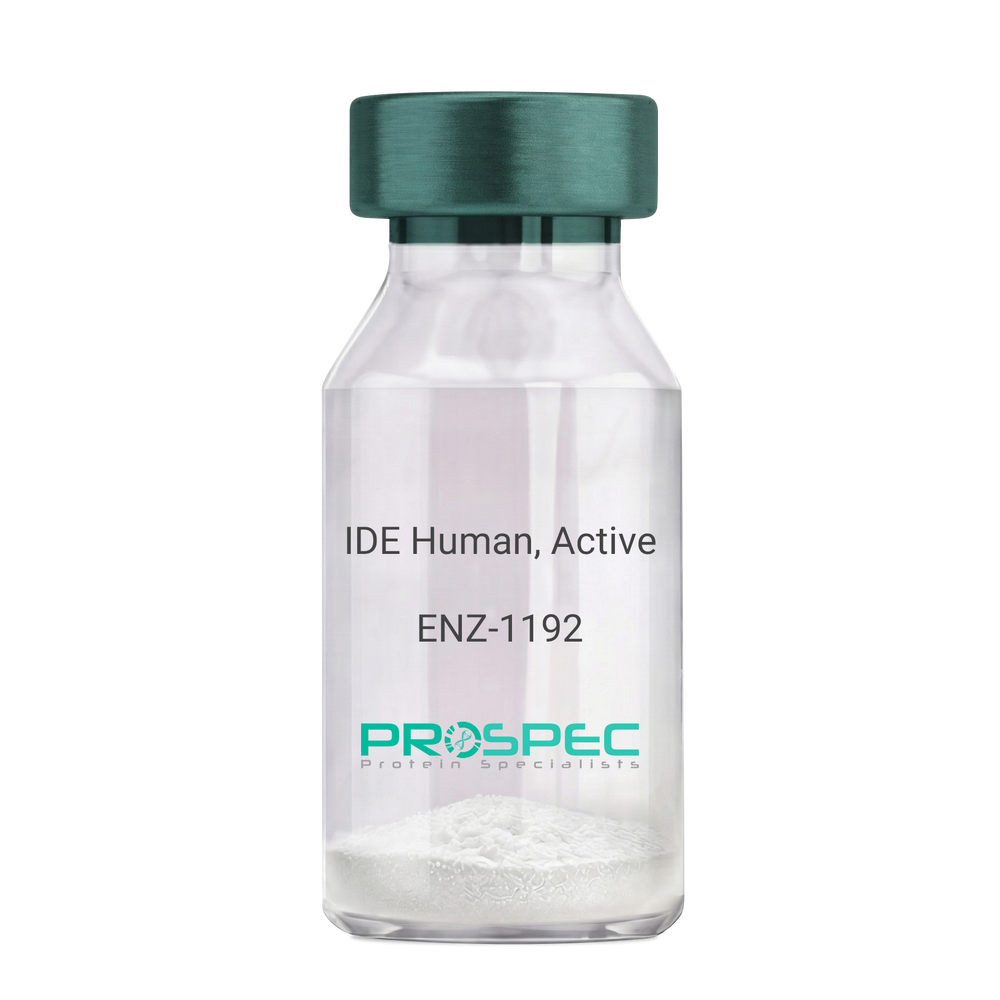
IDE Human, ActiveDescription:
Insulin-Degrading Enzyme Human Recombinant
Insulin-Degrading Enzyme, Abeta-Degrading Protease, Insulysin, EC 3.4.24.56, Insulinase, Insulin Protease, INSULYSIN, EC 3.4.24, IDE, insulin-degrading enzyme isoform 1.
Product # :
ENZ-1192Price :
Quantity :
Shipping Method :
Shipped with Ice Packs
More Info
- description
- source
- formulation
- purity
- biological activity
- More Info
Description
IDE Human, Active Human Recombinant produced in E.Coli is a single, non-glycosylated, polypeptide chain (42-1019 a.a) containing a total of 984 amino acids, having a molecular mass of 114 kDa. IDE is fused to a 6 amino acid His-tag at C-terminus and is purified by proprietary chromatographic techniques.
Source
Escherichia Coli.
Formulation
The IDE solution (0.5mg/ml) contains 10% Glycerol, 100mM NaCl, 0.05% Brij35 and 20mM Tris-HCl buffer (pH 7.5).
Purity
Greater than 90.0% as determined by SDS-PAGE.
Biological Activity
Specific activity is greater than 3,000 pmol/min/ug in which 1 unit will convert 1.0 pmole of Mca-RPPGFSAFK(Dnp)-OH to MCA-Pro-Leu-OH per minute at pH 7.5 at 25°C.
More Info
-
Synonyms
Insulin-Degrading Enzyme, Abeta-Degrading Protease, Insulysin, EC 3.4.24.56, Insulinase, Insulin Protease, INSULYSIN, EC 3.4.24, IDE, insulin-degrading enzyme isoform 1.
-
Physical Appearance
Filtered colorless solution.
-
Stability
Store at 4°C if entire vial will be used within 2-4 weeks. Store, frozen at -20°C for longer periods of time. For long term storage it is recommended to add a carrier protein (0.1% HSA or BSA). Avoid multiple freeze-thaw cycles.
-
Amino Acid Sequence
MNNPAIKRIG NHITKSPEDK REYRGLELAN GIKVLLISDP TTDKSSAALD VHIGSLSDPP NIAGLSHFCE HMLFLGTKKY PKENEYSQFL SEHAGSSNAF TSGEHTNYYF DVSHEHLEGA LDRFAQFFLC PLFDESCKDR EVNAVDSEHE KNVMNDAWRL FQLEKATGNP KHPFSKFGTG NKYTLETRPN QEGIDVRQEL LKFHSAYYSS NLMAVCVLGR ESLDDLTNLV VKLFSEVENK NVPLPEFPEH PFQEEHLKQL YKIVPIKDIR NLYVTFPIPD LQKYYKSNPG HYLGHLIGHE GPGSLLSELK SKGWVNTLVG GQKEGARGFM FFIINVDLTE EGLLHVEDII LHMFQYIQKL RAEGPQEWVF QECKDLNAVA FRFKDKERPR GYTSKIAGIL HYYPLEEVLT AEYLLEEFRP DLIEMVLDKL RPENVRVAIV SKSFEGKTDR TEEWYGTQYK QEAIPDEVIK KWQNADLNGK FKLPTKNEFI PTNFEILPLE KEATPYPALI KDTAMSKLWF KQDDKFFLPK ACLNFEFFSP FAYVDPLHCN MAYLYLELLK DSLNEYAYAA ELAGLSYDLQ NTIYGMYLSV KGYNDKQPIL LKKIIEKMAT FEIDEKRFEI IKEAYMRSLN NFRAEQPHQH AMYYLRLLMT EVAWTKDELK EALDDVTLPR LKAFIPQLLS RLHIEALLHG NITKQAALGI MQMVEDTLIE HAHTKPLLPS
QLVRYREVQL PDRGWFVYQQ RNEVHNNCGI EIYYQTDMQS TSENMFLELF CQIISEPCFN TLRTKEQLGY IVFSGPRRAN GIQGLRFIIQ SEKPPHYLES RVEAFLITME KSIEDMTEEA FQKHIQALAI RRLDKPKKLS AECAKYWGEI ISQQYNFDRD NTEVAYLKTL TKEDIIKFYK EMLAVDAPRR HKVSVHVLAR EMDSCPVVGE FPCQNDINLS QAPALPQPEV IQNMTEFKRG LPLFPLVKPH INFMAAKLHH HHHH. -
Background
Insulin-degrading enzyme (IDE) is a crucial protease that plays a significant role in maintaining glucose homeostasis by degrading insulin and other bioactive peptides. Dysregulation of IDE has been implicated in various metabolic disorders, particularly type 2 diabetes mellitus. IDE is also associated with the clearance of amyloid-beta peptides in the brain, making it relevant to Alzheimer's disease pathology. Studying the recombinant form of IDE is fundamental to understanding its functional mechanisms and exploring potential avenues for therapeutic interventions.
The primary goal of this research is to express and purify recombinant IDE using diverse expression systems. Recombinant DNA techniques will be employed to construct expression vectors containing the IDE gene, followed by expression in bacterial, yeast, or mammalian cell-based systems. The recombinant IDE will be purified using affinity chromatography or other appropriate methods, facilitating subsequent biochemical and biophysical characterization.
The second objective is to investigate the substrate specificity and catalytic activity of the purified IDE. In vitro enzymatic assays will be conducted to analyse the ability of the recombinant IDE to degrade insulin and other potential substrates. The effects of various factors, such as pH, temperature, and potential modulators, on IDE activity will be evaluated. Additionally, the interactions between IDE and its substrates will be explored using binding assays.
The third objective is to elucidate the three-dimensional structure of the IDE recombinant using techniques like X-ray crystallography or nuclear magnetic resonance (NMR) spectroscopy. Structural insights into the active site and binding pockets of IDE will provide valuable information for understanding its substrate recognition and catalytic mechanisms. This knowledge could be instrumental in designing targeted therapeutic compounds.
By characterizing the IDE recombinant, this research aims to contribute to our understanding of its role in insulin metabolism, glucose regulation, and potential therapeutic applications. The findings from this study may have implications for the development of novel treatments for diabetes and other related disorders.
ProSpec's products are furnished for LABORATORY RESEARCH USE ONLY. The product may not be used as drugs, agricultural or pesticidal products, food additives or household chemicals.
- View Data Sheet
Name :
B3GNT2 HumanDescription:
Beta-1,3-N-Acetylglucosaminyltransferase 2 Human Recombinant
B3GNT2, B3GN-T2, B3GNT, B3GNT-2, B3GNT1, BETA3GNT, BGnT-2, BGNT2, N-acetyllactosaminide beta-1,3-N-acetylglucosaminyltransferase 2, Beta-1,3-N-acetylglucosaminyltransferase 1, BGnT-1, Beta-1,3-Gn-T1, Beta3Gn-T1, Beta-1,3-galactosyltransferase 7, Beta-1,3-GalTase 7, Beta3Gal-T7, Beta3GalT7, b3Gal-T7, Beta-3-Gx-T7, beta-GlcNAc beta-1,3-galactosyltransferase 7, betaGal beta-1,3-N-acetylglucosaminyltransferase 2, BGnT-2, Beta-1,3-Gn-T2, Beta-1,3-N-acetylglucosaminyltransferase 2, Beta3Gn-T2, beta-N-acetylglucosamine beta-1,3-galactosyltransferase 7.
Product # :
ENZ-973Price :
Quantity :
Shipping Method :
Shipped with Ice Packs
More Info
- description
- source
- formulation
- purity
- More Info
Description
B3GNT2 produced in Sf9 Baculovirus cells is a single, glycosylated polypeptide chain containing 375 amino acids (29-397a.a.) and having a molecular mass of 43.5kDa (Molecular size on SDS-PAGE will appear at approximately 40-57kDa). B3GNT2 is expressed with a 6 amino acid His tag at C-Terminus and purified by proprietary chromatographic techniques.
Source
Sf9, Baculovirus cells.
Formulation
B3GNT2 protein solution (0.5mg/ml) contains Phosphate Buffered Saline (pH 7.4) and 10% glycerol.
Purity
Greater than 90.0% as determined by SDS-PAGE.
More Info
-
Introduction
Beta-1,3-N-Acetylglucosaminyltransferase 2 (B3GNT2) is a part of the beta-1,3-N-acetylglucosaminyltransferase family which takes part in the synthesis of poly-N-acetyllactosamine. B3GNT2 is a type II transmembrane protein which prefers the substrate of lacto-N-neotetraose. B3GNT2 catalyzes the initiation and elongation of poly-N-acetyllactosamine chains and comprises the main polylactosamine synthase.
-
Synonyms
B3GNT2, B3GN-T2, B3GNT, B3GNT-2, B3GNT1, BETA3GNT, BGnT-2, BGNT2, N-acetyllactosaminide beta-1,3-N-acetylglucosaminyltransferase 2, Beta-1,3-N-acetylglucosaminyltransferase 1, BGnT-1, Beta-1,3-Gn-T1, Beta3Gn-T1, Beta-1,3-galactosyltransferase 7, Beta-1,3-GalTase 7, Beta3Gal-T7, Beta3GalT7, b3Gal-T7, Beta-3-Gx-T7, beta-GlcNAc beta-1,3-galactosyltransferase 7, betaGal beta-1,3-N-acetylglucosaminyltransferase 2, BGnT-2, Beta-1,3-Gn-T2, Beta-1,3-N-acetylglucosaminyltransferase 2, Beta3Gn-T2, beta-N-acetylglucosamine beta-1,3-galactosyltransferase 7.
-
Physical Appearance
Sterile Filtered colorless solution.
-
Stability
Store at 4°C if entire vial will be used within 2-4 weeks. Store, frozen at -20°C for longer periods of time. For long term storage it is recommended to add a carrier protein (0.1% HSA or BSA). Avoid multiple freeze-thaw cycles.
-
Amino Acid Sequence
ADPKSSSQEK NGKGEVIIPK EKFWKISTPP EAYWNREQEK LNRQYNPILS MLTNQTGEAG RLSNISHLNY CEPDLRVTSV VTGFNNLPDR FKDFLLYLRC RNYSLLIDQP DKCAKKPFLL LAIKSLTPHF ARRQAIRESW GQESNAGNQT VVRVFLLGQT PPEDNHPDLS DMLKFESEKH QDILMWNYRD TFFNLSLKEV LFLRWVSTSC PDTEFVFKGD DDVFVNTHHI LNYLNSLSKT KAKDLFIGDV IHNAGPHRDK KLKYYIPEVV YSGLYPPYAG GGGFLYSGHL ALRLYHITDQ VHLYPIDDVY TGMCLQKLGL VPEKHKGFRT FDIEEKNKNN ICSYVDLMLV HSRKPQEMID IWSQLQSAHL KCHHHHHH.
ProSpec's products are furnished for LABORATORY RESEARCH USE ONLY. The product may not be used as drugs, agricultural or pesticidal products, food additives or household chemicals.
- View Data Sheet
Name :
AHCY HumanDescription:
Adenosylhomocysteinase Human Recombinant
EC 3.3.1.1, SAHH, AdoHcyase, S-adenosyl-L-homocysteine hydrolase, Adenosylhomocysteinase.
Product # :
ENZ-532Price :
Quantity :
Shipping Method :
Shipped with Ice Packs
More Info
- description
- source
- formulation
- purity
- More Info
Description
AHCY Recombinant Human produced in E.Coli is a single, non-glycosylated polypeptide chain containing 452 amino acids (1-432 a.a.) and having a molecular mass of 49.8 kDa. The AHCY is fused to a 20 amino acids His-Tag at N-terminus and purified by proprietary chromatographic techniques.
Source
Escherichia Coli.
Formulation
AHCY Human solution containing 20mM Tris pH-8, & 10% glycerol.
Purity
Greater than 95.0% as determined by SDS-PAGE.
More Info
-
Introduction
AHCY is an enzyme that catalyzes the reversible hydrolysis of S-adenosylhomocysteine (AdoHcy) to adenosine (Ado) and L-homocysteine (Hcy). AHCY controls the intracellular S-adenosylhomocysteine (SAH) concentration that is crucial for transmethylation reactions. AHCY deficiency causes hypermethioninemia.
-
Synonyms
EC 3.3.1.1, SAHH, AdoHcyase, S-adenosyl-L-homocysteine hydrolase, Adenosylhomocysteinase.
-
Physical Appearance
Sterile filtered colorless solution.
-
Stability
Store at 4°C if entire vial will be used within 2-4 weeks. Store, frozen at -20°C for longer periods of time. For long term storage it is recommended to add a carrier protein (0.1% HSA or BSA).Avoid multiple freeze-thaw cycles.
-
Amino Acid Sequence
MGSSHHHHHH SSGLVPRGSH MSDKLPYKVA DIGLAAWGRK ALDIAENEMP GLMRMRERYS ASKPLKGARI AGCLHMTVET AVLIETLVTL GAEVQWSSCN IFSTQDHAAA AIAKAGIPVY AWKGETDEEY LWCIEQTLYF KDGPLNMILD DGGDLTNLIH TKYPQLLPGI RGISEETTTG VHNLYKMMAN GILKVPAINV NDSVTKSKFD NLYGCRESLI DGIKRATDVM IAGKVAVVAG YGDVGKGCAQ ALRGFGARVI ITEIDPINAL QAAMEGYEVT TMDEACQEGN IFVTTTGCID IILGRHFEQM KDDAIVCNIG HFDVEIDVKW LNENAVEKVN IKPQVDRYRL KNGRRIILLA EGRLVNLGCA MGHPSFVMSN SFTNQVMAQI ELWTHPDKYP VGVHFLPKKL DEAVAEAHLG KLNVKLTKLT EKQAQYLGMS CDGPFKPDHY RY.
ProSpec's products are furnished for LABORATORY RESEARCH USE ONLY. The product may not be used as drugs, agricultural or pesticidal products, food additives or household chemicals.
- View Data Sheet
Name :
FDFT1 HumanDescription:
Farnesyl-Diphosphate Farnesyltransferase 1 Human Recombinant
Farnesyl-Diphosphate Farnesyltransferase 1, Squalene Synthase, SQS, SS, FPP:FPP Farnesyltransferase, EC 2.5.1.21, DGPT, ERG9, Presqualene-Di-Diphosphate Synthase, Squalene Synthetase, Farnesyl-Diphosphate, Farnesyltransferase, FDFT1.
Product # :
ENZ-820Price :
Quantity :
Shipping Method :
Shipped with Ice Packs
More Info
- description
- source
- formulation
- purity
- More Info
Description
FDFT1 Human Recombinant produced in E.Coli is a single, non-glycosylated polypeptide chain containing 306 amino acids (1-283 a.a) and having a molecular mass of 35.4 kDa. FDFT1 is fused to a 23 amino acid His-tag at N-terminus & purified by proprietary chromatographic techniques.
Source
Escherichia Coli.
Formulation
FDFT1 protein solution (0.25 mg/ml) containing 20mM Tris-HCl buffer (pH 8.0), 10% glycerol and 0.4M Urea.
Purity
Greater than 85.0% as determined by SDS-PAGE.
More Info
-
Introduction
Farnesyl-Diphosphate Farnesyltransferase 1, also known as FDFT1 is a membrane-associated enzyme sited at a branch point in the mevalonate pathway. FDFT1belongs to the phytoene/squalene synthase family. FDFT1 is the 1st specific enzyme in cholesterol biosynthesis, which catalyzes the dimerization of 2 molecules of farnesyl diphosphate in a two-step reaction to form squalene.
-
Synonyms
Farnesyl-Diphosphate Farnesyltransferase 1, Squalene Synthase, SQS, SS, FPP:FPP Farnesyltransferase, EC 2.5.1.21, DGPT, ERG9, Presqualene-Di-Diphosphate Synthase, Squalene Synthetase, Farnesyl-Diphosphate, Farnesyltransferase, FDFT1.
-
Physical Appearance
Sterile Filtered colorless solution.
-
Stability
Store at 4°C if entire vial will be used within 2-4 weeks. Store, frozen at -20°C for longer periods of time. For long term storage it is recommended to add a carrier protein (0.1% HSA or BSA).Avoid multiple freeze-thaw cycles.
-
Amino Acid Sequence
MGSSHHHHHH SSGLVPRGSH MGSMEFVKCL GHPEEFYNLV RFRIGGKRKV MPKMDQDSLS SSLKTCYKYL NQTSRSFAAV IQALDGEMRN AVCIFYLVLR ALDTLEDDMT ISVEKKVPLL HNFHSFLYQP DWRFMESKEK DRQVLEDFPT ISLEFRNLAE KYQTVIADIC RRMGIGMAEF LDKHVTSEQE WDKYCHYVAG LVGIGLSRLF SASEFEDPLV GEDTERANSM GLFLQKTNII RDYLEDQQGG REFWPQEVWS RYVKKLGDFA KPENIDLAVQ CLNELITNAL HHIPDVITYL SRLRNQ.
ProSpec's products are furnished for LABORATORY RESEARCH USE ONLY. The product may not be used as drugs, agricultural or pesticidal products, food additives or household chemicals.
- View Data Sheet
Name :
ACP2 HumanDescription:
Acid Phosphatase-2 Human Recombinant
Acid Phosphatase 2, Lysosoma, EC 3.1.3.2 LAP, Lysosomal Acid Phosphatase, ACP2.
Product # :
ENZ-849Price :
Quantity :
Shipping Method :
Shipped with Ice Packs
More Info
- description
- source
- formulation
- purity
- More Info
Description
ACP2 Human Recombinant produced in E.Coli is a single, non-glycosylated polypeptide chain containing 373 amino acids (31-380 a.a.) and having a molecular mass of 42.9kDa. ACP2 is fused to a 23 amino acid His-Tag at N-Terminus and purified by conventional chromatography techniques.
Source
Escherichia Coli.
Formulation
ACP2 protein solution (1mg/ml) contains 20mM Tris-HCl (pH8.0) and 10% glycerol.
Purity
Greater than 85.0% as determined by SDS-PAGE.
More Info
-
Introduction
Acid Phosphatase-2, also known as ACP2 is composed of two subunits, Alpha & beta, and is chemically as well as genetically distinct from red cell acid phosphatase. ACP2 belongs to a family of distinct isoenzymes which hydrolyze orthophosphoric monoesters to alcohol and phosphate. In addition, Acid phosphatase deficiency is caused by mutations in the ACP2-beta subunit as well as ACP3-alpha subunit genes.
-
Synonyms
Acid Phosphatase 2, Lysosoma, EC 3.1.3.2 LAP, Lysosomal Acid Phosphatase, ACP2.
-
Physical Appearance
Sterile filtered colorless solution.
-
Stability
Store at 4°C if entire vial will be used within 2-4 weeks. Store, frozen at -20°C for longer periods of time. For long term storage it is recommended to add a carrier protein (0.1% HSA or BSA).Avoid multiple freeze-thaw cycles.
-
Amino Acid Sequence
MGSSHHHHHH SSGLVPRGSH MGSRSLRFVT LLYRHGDRSP VKTYPKDPYQ EEEWPQGFGQ LTKEGMLQHW ELGQALRQRY HGFLNTSYHR QEVYVRSTDF DRTLMSAEAN LAGLFPPNGM QRFNPNISWQ PIPVHTVPIT EDRLLKFPLG PCPRYEQLQN ETRQTPEYQN ESSRNAQFLD MVANETGLTD LTLETVWNVY DTLFCEQTHG LRLPPWASPQ TMQRLSRLKD FSFRFLFGIY QQAEKARLQG GVLLAQIRKN LTLMATTSQL PKLLVYSAHD TTLVALQMAL DVYNGEQAPY ASCHIFELYQ EDSGNFSVEM YFRNESDKAP WPLSLPGCPH RCPLQDFLRL TEPVVPKDWQ QECQLASGPA DTE
ProSpec's products are furnished for LABORATORY RESEARCH USE ONLY. The product may not be used as drugs, agricultural or pesticidal products, food additives or household chemicals.
- View Data Sheet
Name :
PGPEP1 HumanDescription:
Pyroglutamyl-Peptidase I Human Recombinant
Pyroglutamyl-peptidase 1, EC 3.4.19.3, 5-oxoprolyl-peptidase, Pyroglutamyl aminopeptidase I, PAP-I, Pyroglutamyl-peptidase I, PGP-I, Pyrrolidone-carboxylate peptidase, PGPEP1, PGPI, PGP, Pcp.
Product # :
ENZ-672Price :
Quantity :
Shipping Method :
Shipped with Ice Packs
More Info
- description
- source
- formulation
- purity
- More Info
Description
PGPEP1 Human Recombinant produced in E.coli is a single, non-glycosylated polypeptide chain containing 232 amino acids (1-209) and having a molecular mass of 25.5kDa.PGPEP1 is fused to a 23 amino acid His-tag at N-terminus & purified by proprietary chromatographic techniques.
Source
Escherichia Coli.
Formulation
The PGPEP1 solution (1mg/ml) contains 20mM Tris-HCl buffer (pH 8.0), 0.15M NaCl, 20% glycerol and 1mM DTT.
Purity
Greater than 95.0% as determined by SDS-PAGE.
More Info
-
Introduction
Pyroglutamyl-Peptidase I (PGPEP1) is an omega peptidase which detaches pyroglutamyl residues from the amino termini of peptides and proteins. PGPEP1 is a cytosolic cysteine peptidase which is expressed in most cell types. PGPEP1 enzyme has need of s a thiol-reducing agent for activity. PGPEP1 is possibly involved in the inactivation of biologically active peptides which have an amino terminal pyroglutamyl group, for instance peptides as neurotensin, luteinizing hormone releasing hormone, and thyrotropinreleasing hormone.
-
Synonyms
Pyroglutamyl-peptidase 1, EC 3.4.19.3, 5-oxoprolyl-peptidase, Pyroglutamyl aminopeptidase I, PAP-I, Pyroglutamyl-peptidase I, PGP-I, Pyrrolidone-carboxylate peptidase, PGPEP1, PGPI, PGP, Pcp.
-
Physical Appearance
Sterile filtered colorless solution.
-
Stability
Store at 4°C if entire vial will be used within 2-4 weeks. Store, frozen at -20°C for longer periods of time. For long term storage it is recommended to add a carrier protein (0.1% HSA or BSA).Avoid multiple freeze-thaw cycles.
-
Amino Acid Sequence
MGSSHHHHHH SSGLVPRGSH MGSMEQPRKA VVVTGFGPFG EHTVNASWIA VQELEKLGLG DSVDLHVYEI PVEYQTVQRL IPALWEKHSP QLVVHVGVSG MATTVTLEKC GHNKGYKGLD NCRFCPGSQC CVEDGPESID SIIDMDAVCK RVTTLGLDVS VTISQDAGRY LCDFTYYTSL YQSHGRSAFV HVPPLGKPYN ADQLGRALRA IIEEMLDLLE QSEGKINYCH KH.
ProSpec's products are furnished for LABORATORY RESEARCH USE ONLY. The product may not be used as drugs, agricultural or pesticidal products, food additives or household chemicals.
- View Data Sheet
Name :
GDA Human, ActiveDescription:
Guanine Deaminase Human Recombinant, Active
Guanine Deaminase, Guanine Aminohydrolase, Guanine Aminase, P51-Nedasin, EC 3.5.4.3, GUANASE, GAH, Cytoplasmic PSD95 Interactor, KIAA1258, NEDASIN, CYPIN.
Product # :
ENZ-982Price :
Quantity :
Shipping Method :
Shipped with Ice Packs
More Info
- description
- source
- formulation
- purity
- biological activity
- More Info
Description
GDA Human Recombinant produced in E. coli is a single polypeptide chain containing 477 amino acids (1-454) and having a molecular mass of 53kDa.GDA is fused to a 23 amino acid His-tag at N-terminus & purified by proprietary chromatographic techniques.
Source
Escherichia Coli.
Formulation
GDA protein solution (1mg/ml) containing 20mM Tris-HCl buffer (pH8.0), 0.15M NaCl, 10% glycerol, 1mM DTT.
Purity
Greater than 90.0% as determined by SDS-PAGE.
Biological Activity
Specific activity is > 2,000 pmol/min/ug, and is defined as the amount of enzyme that convert guanine to xanthine per minute at pH 8.0 at 37C.More Info
-
Introduction
GDA is a member of the ATZ/TRZ family and is in charge for the hydrolytic deamination of guanine. GDA takes part in microtubule assembly. Multiple transcript variants encoding different isoforms have been found for GDA.
-
Synonyms
Guanine Deaminase, Guanine Aminohydrolase, Guanine Aminase, P51-Nedasin, EC 3.5.4.3, GUANASE, GAH, Cytoplasmic PSD95 Interactor, KIAA1258, NEDASIN, CYPIN.
-
Physical Appearance
Sterile Filtered colorless solution.
-
Stability
Store at 4°C if entire vial will be used within 2-4 weeks. Store, frozen at -20°C for longer periods of time. For long term storage it is recommended to add a carrier protein (0.1% HSA or BSA). Avoid multiple freeze-thaw cycles.
-
Amino Acid Sequence
MGSSHHHHHH SSGLVPRGSH MGSMCAAQMP PLAHIFRGTF VHSTWTCPME VLRDHLLGVS DSGKIVFLEE ASQQEKLAKE WCFKPCEIRE LSHHEFFMPG LVDTHIHASQ YSFAGSSIDL PLLEWLTKYT FPAEHRFQNI DFAEEVYTRV VRRTLKNGTT TACYFATIHT DSSLLLADIT DKFGQRAFVG KVCMDLNDTF PEYKETTEES IKETERFVSE MLQKNYSRVK PIVTPRFSLS CSETLMGELG NIAKTRDLHI QSHISENRDE VEAVKNLYPS YKNYTSVYDK NNLLTNKTVM AHGCYLSAEE LNVFHERGAS IAHCPNSNLS LSSGFLNVLE VLKHEVKIGL GTDVAGGYSY SMLDAIRRAV MVSNILLINK VNEKSLTLKE VFRLATLGGS QALGLDGEIG NFEVGKEFDA ILINPKASDS PIDLFYGDFF GDISEAVIQK FLYLGDDRNI EEVYVGGKQV VPFSSSV.
ProSpec's products are furnished for LABORATORY RESEARCH USE ONLY. The product may not be used as drugs, agricultural or pesticidal products, food additives or household chemicals.
- View Data Sheet
Name :
GCK Human, ActiveDescription:
Hexokinase-4 Human Recombinant, Active
Glucokinase, Glucokinase (Hexokinase 4), Hexokinase Type IV, HK IV, HK4, Maturity Onset Diabetes of The Young 2, ATP:D-Hexose 6-Phosphotransferase, Hexokinase D, Pancreatic Isozyme, Hexokinase-4, Hexokinase-D, Hexokinase 4.
Product # :
PKA-116Price :
Quantity :
Shipping Method :
Shipped with Ice Packs
More Info
- description
- source
- formulation
- purity
- biological activity
- More Info
Description
GCK Human Recombinant produced in E.Coli is a single, non-glycosylated polypeptide chain containing 485 amino acids (1-465 a.a) and having a molecular mass of 54.3kDa. GCK is fused to a 20 amino acid His-tag at N-terminus & purified by proprietary chromatographic techniques.
Source
Escherichia Coli.
Formulation
GCK protein solution (1mg/ml) contains 20 mM Tris-HCl buffer (pH 8.0) and 10% glycerol.
Purity
Greater than 95% as determined by SDS-PAGE.
Biological Activity
Specific activity is > 2,000 pmol/min/ug. One unit will convert 1 pmoles of D-Glucose to D-Glucose-6-phosphate per minute at pH8.0 at 37C.
More Info
-
Introduction
GCK is an enzyme that expedite the formation of glucose-6-phosphate for glucose by phosphorylation. Humans and other vertebrates have GCK in the cells of the pancreas and liver. In both organs, the enzyme has an important role in carbohydrate metabolism regulation by sensing sugar levels and acting according to the change in glucose levels, that can rise after a meal or fall during fasting. Mutations in the gene that codes for this enzyme can cause hypoglycemia or diabetes.
.
-
Synonyms
Glucokinase, Glucokinase (Hexokinase 4), Hexokinase Type IV, HK IV, HK4, Maturity Onset Diabetes of The Young 2, ATP:D-Hexose 6-Phosphotransferase, Hexokinase D, Pancreatic Isozyme, Hexokinase-4, Hexokinase-D, Hexokinase 4.
-
Physical Appearance
Sterile filtered colorless solution.
-
Stability
Store at 4°C if entire vial will be used within 2-4 weeks. Store, frozen at -20°C for longer periods of time. For long term storage it is recommended to add a carrier protein (0.1% HSA or BSA).Avoid multiple freeze-thaw cycles.
-
Amino Acid Sequence
MGSSHHHHHH SSGLVPRGSH MLDDRARMEA AKKEKVEQIL AEFQLQEEDL KKVMRRMQKE MDRGLRLETH EEASVKMLPT YVRSTPEGSE VGDFLSLDLG GTNFRVMLVK VGEGEEGQWS VKTKHQMYSI PEDAMTGTAE MLFDYISECI SDFLDKHQMK HKKLPLGFTF SFPVRHEDID KGILLNWTKG FKASGAEGNN VVGLLRDAIK RRGDFEMDVV AMVNDTVATM ISCYYEDHQC EVGMIVGTGC NACYMEEMQN VELVEGDEGR MCVNTEWGAF GDSGELDEFL LEYDRLVDES SANPGQQLYE KLIGGKYMGE LVRLVLLRLV DENLLFHGEA SEQLRTRGAF ETRFVSQVES DTGDRKQIYN ILSTLGLRPS TTDCDIVRRA CESVSTRAAH MCSAGLAGVI NRMRESRSED VMRITVGVDG SVYKLHPSFK ERFHASVRRL TPSCEITFIE SEEGSGRGAA LVSAVACKKA CMLGQ.
ProSpec's products are furnished for LABORATORY RESEARCH USE ONLY. The product may not be used as drugs, agricultural or pesticidal products, food additives or household chemicals.
- View Data Sheet
Name :
IDI1 HumanDescription:
Isopentenyl-Diphosphate Delta Isomerase 1 Human Recombinant
Isopentenyl-diphosphate Delta-isomerase 1, Isopentenyl pyrophosphate isomerase 1, IPP isomerase 1, IPPI1, IDI1, IPP1.
Product # :
ENZ-189Price :
Quantity :
Shipping Method :
Shipped with Ice Packs
More Info
- description
- source
- formulation
- purity
- More Info
Description
IDI1 Human Recombinant produced in E.coli is a single, non-glycosylated polypeptide chain containing 248 amino acids (1-228) and having a molecular mass of 28.6kDa.IDI1 is fused to a 20 amino acid His-tag at N-terminus & purified by proprietary chromatographic techniques.
Source
E.coli.
Formulation
The IDI1 solution (1mg/ml) contains 20mM Tris-HCl buffer (pH 8.0), 1mM DTT, 10% glycerol and 0.1M NaCl.
Purity
Greater than 90% as determined by SDS-PAGE.
More Info
-
Introduction
Isopentenyl-diphosphate isomerase 1 (IDI1) belongs to the IPP isomerase type I family and is involved in cholesterol biosynthesis. IDI1 is a peroxisomally-localized enzyme which catalyzes the interconversion of isopentenyl diphosphate (IPP) to its highly electrophilic isomer, dimethylallyl diphosphate (DMAPP), which is the substrate for the sequential reaction that results in the synthesis of farnesyl diphosphate and, eventually, cholesterol. Peroxisomal deficiency diseases such as Zellweger syndrome and neonatal adrenoleukodystrophy show a reduction in IPP isomerase activity.
-
Synonyms
Isopentenyl-diphosphate Delta-isomerase 1, Isopentenyl pyrophosphate isomerase 1, IPP isomerase 1, IPPI1, IDI1, IPP1.
-
Physical Appearance
Sterile Filtered colorless solution.
-
Stability
Store at 4°C if entire vial will be used within 2-4 weeks. Store, frozen at -20°C for longer periods of time. For long term storage it is recommended to add a carrier protein (0.1% HSA or BSA).Avoid multiple freeze-thaw cycles.
-
Amino Acid Sequence
MGSSHHHHHH SSGLVPRGSH MMPEINTNHL DKQQVQLLAE MCILIDENDN KIGAETKKNC HLNENIEKGL LHRAFSVFLF NTENKLLLQQ RSDAKITFPG CFTNTCCSHP LSNPAELEES DALGVRRAAQ RRLKAELGIP LEEVPPEEIN YLTRIHYKAQ SDGIWGEHEI DYILLVRKNV
TLNPDPNEIK SYCYVSKEEL KELLKKAASG EIKITPWFKI IAATFLFKWW DNLNHLNQFV DHEKIYRM.
ProSpec's products are furnished for LABORATORY RESEARCH USE ONLY. The product may not be used as drugs, agricultural or pesticidal products, food additives or household chemicals.
- View Data Sheet
Name :
NMNAT1 Human, ActiveDescription:
Nicotinamide Nucleotide Adenylyltransferase 1 Human Recombinant , Active
NMNAT, NMNAT1, PNAT1, Nicotinamide mononucleotide adenylyltransferase 1, NMN adenylyltransferase 1, Nicotinate-nucleotide adenylyltransferase 1, NaMN adenylyltransferase 1, EC=2.7.7.1, EC=2.7.7.18.
Product # :
ENZ-1002Price :
Quantity :
Shipping Method :
Shipped with Ice Packs
More Info
- description
- source
- formulation
- purity
- biological activity
- More Info
Description
NMNAT1 Recombinant Human produced in E.Coli is a single, non-glycosylated polypeptide chain containing 315 amino acids (1-279 a.a.) and having a molecular mass of 36 kDa. The NMNAT1 is fused to a 36 amino acid His-Tag at N-terminus and purified by proprietary chromatographic techniques.
Source
Escherichia Coli.
Formulation
The NMNAT1 solution (1mg/ml) contains 20mM Tris-HCl buffer (pH8.0), 20% glycerol, 0.1M NaCl, 1mM DTT and 1mM EDTA.
Purity
Greater than 95.0% as determined by SDS-PAGE.
Biological Activity
Specific activity is > 7,000 pmol/min/ug, and was obtained by measuring the beta-NAD from nicotinamide mononucleotide and ATP per minute at pH 8.0 at 37C.More Info
-
Introduction
NMNAT1 enzyme is vital for NAD biosynthesis, catalyzing the condensation of nicotinamide mononucleotide (NMN) or nicotinic acid mononucleotide (NaMN) with the AMP moiety of ATP to form NAD or NaAD. NMNAT1 is widely expressed with high levels in skeletal muscle, heart, liver and kidney. This protein appears to have the ability to protect against axonal degeneration following mechanical or toxic insults.
-
Synonyms
NMNAT, NMNAT1, PNAT1, Nicotinamide mononucleotide adenylyltransferase 1, NMN adenylyltransferase 1, Nicotinate-nucleotide adenylyltransferase 1, NaMN adenylyltransferase 1, EC=2.7.7.1, EC=2.7.7.18.
-
Physical Appearance
Sterile filtered colorless solution.
-
Stability
Store at 4°C if entire vial will be used within 2-4 weeks. Store, frozen at -20°C for longer periods of time.For long term storage it is recommended to add a carrier protein (0.1% HSA or BSA). Avoid multiple freeze-thaw cycles.
-
Amino Acid Sequence
MRGSHHHHHH GMASMTGGQQ MGRDLYDDDD KDRWGSMENS EKTEVVLLAC GSFNPITNMH LRLFELAKDY MNGTGRYTVV KGIISPVGDA YKKKGLIPAY HRVIMAELAT KNSKWVEVDT WESLQKEWKE TLKVLRHHQE KLEASDCDHQ QNSPTLERPG RKRKWTETQD SSQKKSLEPK TKAVPKVKLL CGADLLESFA VPNLWKSEDI TQIVANYGLI CVTRAGNDAQ KFIYESDVLW KHRSNIHVVN EWIANDISST KIRRALRRGQSIRYLVPDLV QEYIEKHNLY SSESEDRNAG VILAPLQRNT AEAKT.
ProSpec's products are furnished for LABORATORY RESEARCH USE ONLY. The product may not be used as drugs, agricultural or pesticidal products, food additives or household chemicals.