Skip to content

High-quality research proteins.

  • 1-800-805-6531

  • Mon - Sat 8.00-18.00, Sun - Closed

  • info@prospecbio.com

  • PO Box 6591 East Brunswick NJ 08816

  • Products
    • Cytokines
    • Growth factors
    • Chemokines
    • Cd antigens
    • Neurotrophins
    • Hormones
    • Enzymes
    • Viral antigens
    • Recombinant proteins
    • Natural proteins
    • Monoclonal antibodies
    • Polyclonal antibodies
    • Thermal Packaging
  • About
    • Company
    • Founder
    • Contribution
  • Customers
    • Eastern Asia
    • Eastern Europe
    • North America
    • South America
    • South East Asia
    • Southern Asia
    • Western Europe
  • Ordering
    • Ordering Method
    • Ordering - Credit Card
    • Ordering - PO
    • Shipping Fees
    • FAQs
  • Services
    • DNA Cloning
    • Protein Expression
    • Monoclonal Antibody
    • Fermentation
    • Technology License
  • Contact us
Log in

Country/region

  • USD $ | Albania
  • USD $ | Andorra
  • USD $ | Argentina
  • USD $ | Armenia
  • USD $ | Australia
  • USD $ | Austria
  • USD $ | Azerbaijan
  • USD $ | Belarus
  • USD $ | Belgium
  • USD $ | Bolivia
  • USD $ | Brazil
  • USD $ | Bulgaria
  • USD $ | Cambodia
  • USD $ | Canada
  • USD $ | Chile
  • USD $ | China
  • USD $ | Colombia
  • USD $ | Costa Rica
  • USD $ | Croatia
  • USD $ | Cyprus
  • USD $ | Czechia
  • USD $ | Denmark
  • USD $ | Estonia
  • USD $ | Finland
  • USD $ | France
  • USD $ | Georgia
  • USD $ | Germany
  • USD $ | Greece
  • USD $ | Hong Kong SAR
  • USD $ | Hungary
  • USD $ | Iceland
  • USD $ | India
  • USD $ | Ireland
  • USD $ | Israel
  • USD $ | Italy
  • USD $ | Japan
  • USD $ | Kazakhstan
  • USD $ | Latvia
  • USD $ | Liechtenstein
  • USD $ | Lithuania
  • USD $ | Madagascar
  • USD $ | Malta
  • USD $ | Mexico
  • USD $ | Moldova
  • USD $ | Monaco
  • USD $ | Netherlands
  • USD $ | New Zealand
  • USD $ | North Macedonia
  • USD $ | Norway
  • USD $ | Panama
  • USD $ | Paraguay
  • USD $ | Peru
  • USD $ | Philippines
  • USD $ | Poland
  • USD $ | Portugal
  • USD $ | Romania
  • USD $ | Singapore
  • USD $ | Slovakia
  • USD $ | Slovenia
  • USD $ | South Africa
  • USD $ | South Korea
  • USD $ | Spain
  • USD $ | Sri Lanka
  • USD $ | Sweden
  • USD $ | Switzerland
  • USD $ | Taiwan
  • USD $ | Thailand
  • USD $ | Türkiye
  • USD $ | Ukraine
  • USD $ | United Kingdom
  • USD $ | United States
  • USD $ | Uruguay
  • USD $ | Vatican City
  • USD $ | Venezuela
  • USD $ | Vietnam
  • Facebook
  • Instagram
logoProSpec - Recombinant Protein Manufacturer for academic and R&D industry
Become a distributor
Account Log in
Wishlist
Cart Cart(0)
  • Products
    +
    • Cytokines
    • Growth factors
    • Chemokines
    • Cd antigens
    • Neurotrophins
    • Hormones
    • Enzymes
    • Viral antigens
    • Recombinant proteins
    • Natural proteins
    • Monoclonal antibodies
    • Polyclonal antibodies
    • Thermal Packaging
  • About
    +
    • Company
    • Founder
    • Contribution
  • Customers
    +
    • Eastern Asia
    • Eastern Europe
    • North America
    • South America
    • South East Asia
    • Southern Asia
    • Western Europe
  • Ordering
    +
    • Ordering Method
    • Ordering - Credit Card
    • Ordering - PO
    • Shipping Fees
    • FAQs
  • Services
    +
    • DNA Cloning
    • Protein Expression
    • Monoclonal Antibody
    • Fermentation
    • Technology License
  • Contact us

Item added to your cart

View cart
View All
  • Cytokines
  • Growth factors
  • Chemokines
  • Cd antigens
  • Neurotrophins
  • Hormones
  • Enzymes
  • Viral antigens
  • Recombinant proteins
  • Natural proteins
  • Monoclonal antibodies
  • Polyclonal antibodies
  • Thermal Packaging
  • Tumor Necrosis Factor

    Tumor Necrosis Factor

    View All
  • 4-1BB

    4-1BB

    View All
  • Adiponectin

    Adiponectin

    View All
  • AIF1

    AIF1

    View All
  • Other Cytokines

    Other Cytokines

    View All
  • AITRL

    AITRL

    View All
  • Angiopoietin

    Angiopoietin

    View All
  • Apolipoprotein

    Apolipoprotein

    View All
  • B-Cell Activating Factor

    B-Cell Activating Factor

    View All
  • Beta Defensin

    Beta Defensin

    View All
  • Bone Morphogenetic Protein

    Bone Morphogenetic Protein

    View All
  • B type Natriuretic Peptide

    B type Natriuretic Peptide

    View All
  • BST

    BST

    View All
  • Betacellulin

    Betacellulin

    View All
  • Cardiotrophin

    Cardiotrophin

    View All
  • Activin

    Activin

    View All
  • Fibroblast Growth Factor

    Fibroblast Growth Factor

    View All
  • Other Growth Factors

    Other Growth Factors

    View All
  • CSF

    CSF

    View All
  • CTGF

    CTGF

    View All
  • IGFBP

    IGFBP

    View All
  • VEGF Protein

    VEGF Protein

    View All
  • EGF

    EGF

    View All
  • Epigen

    Epigen

    View All
  • Erythropoietin

    Erythropoietin

    View All
  • Insulin-Like Growth Factor

    Insulin-Like Growth Factor

    View All
  • Growth Hormone

    Growth Hormone

    View All
  • HDGF

    HDGF

    View All
  • Hepatocyte Growth Factor

    Hepatocyte Growth Factor

    View All
  • Insulin

    Insulin

    View All
  • BCA-1/ BLC (CXCL13)

    BCA-1/ BLC (CXCL13)

    View All
  • BRAK (CXCL14)

    BRAK (CXCL14)

    View All
  • C-10 (CCL6)

    C-10 (CCL6)

    View All
  • Other Chemokines

    Other Chemokines

    View All
  • MEC (CCL28)

    MEC (CCL28)

    View All
  • LD78-beta (CCL3L1)

    LD78-beta (CCL3L1)

    View All
  • CTACK (CCL27)

    CTACK (CCL27)

    View All
  • CXCL16

    CXCL16

    View All
  • CXCL17

    CXCL17

    View All
  • Platelet Factor-4 (CXCL4)

    Platelet Factor-4 (CXCL4)

    View All
  • ENA-78 (CXCL5)

    ENA-78 (CXCL5)

    View All
  • Eotaxin (CCL11,24,26)

    Eotaxin (CCL11,24,26)

    View All
  • Exodus-2 (CCL21)

    Exodus-2 (CCL21)

    View All
  • Fractalkine (CX3CL1)

    Fractalkine (CX3CL1)

    View All
  • CXCL6

    CXCL6

    View All
  • Other CD Antigens

    Other CD Antigens

    View All
  • CD14

    CD14

    View All
  • CD164

    CD164

    View All
  • CD1

    CD1

    View All
  • CD2

    CD2

    View All
  • CD200

    CD200

    View All
  • CD207

    CD207

    View All
  • CD226

    CD226

    View All
  • CD23

    CD23

    View All
  • CD244

    CD244

    View All
  • CD247

    CD247

    View All
  • CD27

    CD27

    View All
  • CD274

    CD274

    View All
  • CD300

    CD300

    View All
  • CD33

    CD33

    View All
  • Other Neurotrophins

    Other Neurotrophins

    View All
  • Beta-NGF

    Beta-NGF

    View All
  • BDNF

    BDNF

    View All
  • CDNF

    CDNF

    View All
  • CNTF

    CNTF

    View All
  • GDNF

    GDNF

    View All
  • Glia Maturation Factor

    Glia Maturation Factor

    View All
  • MANF

    MANF

    View All
  • Midkine

    Midkine

    View All
  • Neuroglobin

    Neuroglobin

    View All
  • Neurotrophic factors

    Neurotrophic factors

    View All
  • Neuregulin

    Neuregulin

    View All
  • Neuropilin

    Neuropilin

    View All
  • Pigment Epithelium-Derived Factor

    Pigment Epithelium-Derived Factor

    View All
  • Pleiotrophin

    Pleiotrophin

    View All
  • Peptide Hormones

    Peptide Hormones

    View All
  • Other Hormones

    Other Hormones

    View All
  • HCG

    HCG

    View All
  • Endothelin

    Endothelin

    View All
  • Exendin

    Exendin

    View All
  • FSH

    FSH

    View All
  • Glucagon

    Glucagon

    View All
  • GHRP

    GHRP

    View All
  • GLP

    GLP

    View All
  • Thyrostimulin

    Thyrostimulin

    View All
  • Inhibin A

    Inhibin A

    View All
  • LHRH

    LHRH

    View All
  • Melanotan

    Melanotan

    View All
  • Procalcitonin

    Procalcitonin

    View All
  • PTH

    PTH

    View All
  • Peroxiredoxin

    Peroxiredoxin

    View All
  • Peptidase

    Peptidase

    View All
  • Synthetase

    Synthetase

    View All
  • Transferase

    Transferase

    View All
  • Hydrolase

    Hydrolase

    View All
  • Dehydrogenase

    Dehydrogenase

    View All
  • ACE2

    ACE2

    View All
  • Esterase

    Esterase

    View All
  • Protein Kinases

    Protein Kinases

    View All
  • Other Enzymes

    Other Enzymes

    View All
  • Phosphatase

    Phosphatase

    View All
  • Deaminase

    Deaminase

    View All
  • Oxygenase

    Oxygenase

    View All
  • Adenylate Kinase

    Adenylate Kinase

    View All
  • Lyase

    Lyase

    View All
  • Chagas

    Chagas

    View All
  • SARS

    SARS

    View All
  • Influenza

    Influenza

    View All
  • ASFV

    ASFV

    View All
  • Astrovirus

    Astrovirus

    View All
  • Borrelia

    Borrelia

    View All
  • Helicobacter Pylori

    Helicobacter Pylori

    View All
  • Chikungunya

    Chikungunya

    View All
  • Chlamydia

    Chlamydia

    View All
  • Cytomegalo

    Cytomegalo

    View All
  • Dengue

    Dengue

    View All
  • EBV

    EBV

    View All
  • Ebola

    Ebola

    View All
  • Feline Leukemia Virus

    Feline Leukemia Virus

    View All
  • Hepatitis A

    Hepatitis A

    View All
  • Other

    Other

    View All
  • Actin

    Actin

    View All
  • ADAM

    ADAM

    View All
  • Complement Component

    Complement Component

    View All
  • Ag85

    Ag85

    View All
  • Eukaryotic Translation Initiation Factor

    Eukaryotic Translation Initiation Factor

    View All
  • Anterior Gradient Protein

    Anterior Gradient Protein

    View All
  • Heat Shock Protein

    Heat Shock Protein

    View All
  • Alpha-2-HS-Glycoprotein

    Alpha-2-HS-Glycoprotein

    View All
  • Hemoglobin

    Hemoglobin

    View All
  • Allergy

    Allergy

    View All
  • Anaplasma

    Anaplasma

    View All
  • Angiogenin

    Angiogenin

    View All
  • Ankyrin Repeat Domain

    Ankyrin Repeat Domain

    View All
  • Annexin

    Annexin

    View All
  • Other Natural Proteins

    Other Natural Proteins

    View All
  • Aprotinin

    Aprotinin

    View All
  • Transferrin

    Transferrin

    View All
  • Avidin

    Avidin

    View All
  • Anti Coagulation Factors

    Anti Coagulation Factors

    View All
  • Natural Albumin

    Natural Albumin

    View All
  • Natural Coagulation Factors

    Natural Coagulation Factors

    View All
  • Fibronectin

    Fibronectin

    View All
  • Thrombin

    Thrombin

    View All
  • Anti Human Enzyme

    Anti Human Enzyme

    View All
  • Other Monoclonal Antibodies

    Other Monoclonal Antibodies

    View All
  • Anti Human Cytokine

    Anti Human Cytokine

    View All
  • Anti Human Heat Shock Protein

    Anti Human Heat Shock Protein

    View All
  • Anti Mouse Lymphocyte

    Anti Mouse Lymphocyte

    View All
  • Anti Human Chemokine

    Anti Human Chemokine

    View All
  • Anti Human Lymphocyte

    Anti Human Lymphocyte

    View All
  • Anti Viral Monoclonal

    Anti Viral Monoclonal

    View All
  • Anti Mouse Cytokine

    Anti Mouse Cytokine

    View All
  • Anti-GST Monoclonal

    Anti-GST Monoclonal

    View All
  • Other Polyclonal Antibodies

    Other Polyclonal Antibodies

    View All
  • Anti Viral

    Anti Viral

    View All
  • Anti-GST Monoclonal

    Anti-GST Monoclonal

    View All
Back

Search results

1000 results found for “transferase”

Name

Description

Product #

Price

Quantity

Shipping Method

  • View Data Sheet

    Name :

    F8 Protein

    Description:

    Coagulation Factor-VIII Human Recombinant

    Coagulation factor VIII, Procoagulant component, Antihemophilic factor, AHF, F8, F8C, F8B, HEMA, FVIII, DXS1253E, F8 protein.

    Product # :

    PRO-318

    Price :

    Quantity :

    Shipping Method :

    Room Temp Icon

    Shipped at Room temp

    Add To Cart

    More Info

    • description
    • source
    • formulation
    • purity
    • biological activity
    • More Info
    • Citations

    Description

    Antihemophilic Facor Human Recombinant produced in CHO is a glycosylated polypeptide chain having 2332 amino acids. The Factor-VIII is purified by proprietary chromatographic techniques.

    Source

    CHO cells (Chinese Hamster Ovarian Cells).

    Formulation

    Each 250IU vial was lyophilized from a solution containing 8mg Tween-80, 112mM NaCl, 40mg Mannitol, 10mg Trehalose, 1ng VWF and 4.2mM CaCl2.

    Purity

    Greater than 97.0% as determined by SDS-PAGE.

    Biological Activity

    The specific activity was found to be 7,058 IU/mg.

    Citations

    More Info

    • Introduction

      Coagulation factor VIII participates in the intrinsic pathway of blood coagulation; factor VIII is a cofactor for factor IXa which, in the presence of Ca+2 and phospholipids, converts factor X to the activated form Xa. This gene produces two alternatively spliced transcripts. Transcript variant 1 encodes a large glycoprotein, isoform a, which circulates in plasma and associates with von Willebrand factor in a noncovalent complex. This protein undergoes multiple cleavage events. Transcript variant 2 encodes a putative small protein, isoform b, which consists primarily of the phospholipid binding domain of factor VIIIc. This binding domain is essential for coagulant activity. Defects in this gene results in hemophilia A, a common recessive X-linked coagulation disorder.

    • Synonyms

      Coagulation factor VIII, Procoagulant component, Antihemophilic factor, AHF, F8, F8C, F8B, HEMA, FVIII, DXS1253E, F8 protein.

    • Physical Appearance

      Sterile Filtered White lyophilized (freeze-dried) powder.

    • Stability

      Lyophilized Factor-VIII although stable at room temperature for 3 weeks, should be stored desiccated below -18°C. Upon reconstitution Factor-VIII should be stored at 4°C between 2-7 days and for future use below -18°C.Please prevent freeze-thaw cycles.

    • Solubility

      It is recommended to reconstitute 250IU lyophilized Factor-VIII in 5ml sterile 18M-cm H2O, which can then be further diluted to other aqueous solutions.

    ProSpec's products are furnished for LABORATORY RESEARCH USE ONLY. The product may not be used as drugs, agricultural or pesticidal products, food additives or household chemicals.

    Factor Viii Human Recombinant
  • View Data Sheet

    Name :

    LDHA Mouse

    Description:

    Lactate Dehydrogenase A Mouse Recombinant

    L-lactate dehydrogenase A chain, LDH-A, LDH muscle subunit, LDH-M.

    Product # :

    ENZ-952

    Price :

    Quantity :

    Shipping Method :

    Ice Icon

    Shipped with Ice Packs

    Add To Cart

    More Info

    • description
    • source
    • formulation
    • purity
    • biological activity
    • More Info
    • Citations

    Description

    LDHA Mouse Recombinant produced in Sf9 Baculovirus cells is a single, glycosylated polypeptide chain containing 340 amino acids (1-332a.a.) and having a molecular mass of 37.5kDa (Molecular size on SDS-PAGE will appear at approximately 28-40kDa). LDHA is expressed with an 8 amino acid His tag at C-Terminus and purified by proprietary chromatographic techniques.

    Source

    Sf9, Baculovirus cells.

    Formulation

    LDHA protein solution (0.5mg/ml) containing Phosphate Buffered Saline (pH 7.4) and 10% glycerol.

    Purity

    Greater than 95.0% as determined by SDS-PAGE.

    Biological Activity

    Specific activity is > 250 units/mg, and is defined as the Amount of enzyme that convert 1.0 umole of pyruvate to L-lactate and per minute at pH 7.5 at 37C.

    Citations

    More Info

    • Introduction

      LDHA catalyzes the conversion of L-lactate and NAD to pyruvate and NADH in the final step of anaerobic glycolysis. LDHA is localized primarily in muscle tissue and is part of the lactate dehydrogenase family. Mutations in LDHA have been linked to exertional myoglobinuria. LDH1 is decreased in essential thrombocythemia. LDHA is induced through a non-genomic pathway of estrogen action. Reduction in LDH-A activity results in stimulation of mitochondrial respiration and decrease of mitochondrial membrane potential.

    • Synonyms

      L-lactate dehydrogenase A chain, LDH-A, LDH muscle subunit, LDH-M.

    • Physical Appearance

      Sterile Filtered colorless solution.

    • Stability

      Store at 4°C if entire vial will be used within 2-4 weeks. Store, frozen at -20°C for longer periods of time. For long term storage it is recommended to add a carrier protein (0.1% HSA or BSA).Avoid multiple freeze-thaw cycles.

    • Amino Acid Sequence

      MATLKDQLIV NLLKEEQAPQ NKITVVGVGA VGMACAISIL MKDLADELAL VDVMEDKLKG EMMDLQHGSL FLKTPKIVSS KDYCVTANSK LVIITAGARQ QEGESRLNLV QRNVNIFKFI IPNIVKYSPH CKLLIVSNPV DILTYVAWKI SGFPKNRVIG SGCNLDSARF RYLMGERLGV HALSCHGWVL GEHGDSSVPV WSGVNVAGVS LKSLNPELGT DADKEQWKEV HKQVVDSAYE VIKLKGYTSW AIGLSVADLA ESIMKNLRRV HPISTMIKGL YGINEDVFLS VPCILGQNGI SDVVKVTLTP EEEARLKKSA DTLWGIQKEL QFLEHHHHHH.

    ProSpec's products are furnished for LABORATORY RESEARCH USE ONLY. The product may not be used as drugs, agricultural or pesticidal products, food additives or household chemicals.

    Ldha Mouse
  • View Data Sheet

    Name :

    TGFB3 Rat

    Description:

    Transforming Growth Factor-Beta 3 Rat Recombinant

    Transforming Growth Factor-beta3, TGFB3, ARVD, FLJ16571, TGF-beta3.

    Product # :

    CYT-1269

    Price :

    Quantity :

    Shipping Method :

    Room Temp Icon

    Shipped at Room temp

    Add To Cart

    More Info

    • description
    • source
    • formulation
    • purity
    • biological activity
    • More Info
    • Citations

    Description

    TGFB3 Rat Recombinant produced in CHO cells is a glycosylated, polypeptide homodimer chain containing 2x112 amino acids and having a total molecular mass of 25.0kDa. The TGFB3 is purified by proprietary chromatographic techniques.

    Source

    CHO cells.

    Formulation

    TGFB3 was lyophilized from a concentrated solution containing 35% (v/v) Acetonitrile and 0.1% (v/v) TFA.

    Purity

    Greater than 97.0% as determined by: (a) Analysis by HPLC. (b) Analysis by SDS-PAGE.

    Biological Activity

    The ED50 as determined by its ability to inhibit the mouse IL-4-dependent proliferation of mouse HT-2 cells is less than 0.05 ng/ml, corresponding to a specific activity of ≥ 2.0 × 10⁷ units/mg.

    Citations

    More Info
    • Synonyms

      Transforming Growth Factor-beta3, TGFB3, ARVD, FLJ16571, TGF-beta3.

    • Physical Appearance

      Sterile Filtered White lyophilized (freeze-dried) powder.

    • Stability

      Lyophilized Transforming Growth Factor-Beta 3 Recombinant although stable at room temperature for 3 weeks, should be stored desiccated below -18°C. Upon reconstitution TGFB3 should be stored at 4°C between 2-7 days and for future use below -18°C. For long term storage it is recommended to add a carrier protein (0.1% HSA or BSA). Please prevent freeze-thaw cycles.

    • Solubility

      It is recommended to reconstitute the lyophilized TGFB3 in sterile 4mM HCl to a concentration of 0.1-1.0 mg/mL. Stock solutions should be apportioned into working aliquots and stored at ≤-20°C which can then be further diluted to other aqueous solutions.

    • Amino Acid Sequence

      ALDTNYCFRN LEENCCVRPL YIDFRQDLGW KWVHEPKGYY ANFCSGPCPY LRSSDTTHST VLGLYNTLNP EASASPCCVP QDLEPLTILY YVGRTPKVEQ LSNMVVKSCK CS.

    • Background

      Recombinant TGF-β3 Rat is commonly used in cell culture and biomedical research to investigate TGF-β signalling, stem cell differentiation, tissue engineering, chondrogenesis, wound healing, fibrosis, and cancer biology. TGFB3 is added to mesenchymal stem cell and chondrocyte cultures to promote cartilage formation and maintain specific cellular phenotypes under defined experimental conditions.

      What is the molecular weight / Mw of TGFB3 Rat Protein?
      TGFB3 Rat Protein has a total Mw of 25kDa.

      What is the source or expression system of TGFB3 Rat Protein?
      CHO Cells

      What is the Purity of TGFB3 Rat Protein?
      TGFB3 rat Protein is >97% pure as determined by SDS-PAGE.

      What is the Biological Activity of TGFB3 rat Protein?
      Determined by the ability to inhibit the mouse IL-4-dependent proliferation of mouse HT-2 cells. The expected ED50 for this effect is less than 0.05 ng/ml, corresponding to a specific activity of ≥ 2.0×10⁷ units/mg.

      What is the amino acid sequence of TGFB3 Protein?
      ALDAAYCFRN VQDNCCLRPL YIDFKRDLGW KWIHEPKGYN ANFCAGACPY LWSSDTQHSR VLSLYNTINP EASASPCCVS QDLEPLTILY YIGKTPKIEQ LSNMIVKSCK CS

      What applications can TGFB3 rat Protein be used in?
      TGFB3 rat Protein can probably be used in western blot, ELISA and Lateral Flow.

      What is the endotoxin level for TGFB3 rat Protein?
      The endotoxin level is minimal, TGFB3 rat Protein was purified using conventional chromatography techniques.

    ProSpec's products are furnished for LABORATORY RESEARCH USE ONLY. The product may not be used as drugs, agricultural or pesticidal products, food additives or household chemicals.

    TGFB3 Rat
  • View Data Sheet

    Name :

    SAE1/SAE2 Human

    Description:

    SAE1/SAE2 Human Recombinant

    Product # :

    ENZ-1161

    Price :

    Quantity :

    Shipping Method :

    Ice Icon

    Shipped with Ice Packs

    Add To Cart

    More Info

    • description
    • source
    • formulation
    • purity
    • More Info
    • Citations

    Description

    SAE1/SAE2 Human Recombinant produced in SF9 is glycosylated, polypeptide chain containing 2 subunits (SAE1 subunit molecular mass is 41kDa & SAE2 subunit molecular mass is 91kDa). The subunits associate to form a complex. The SAE1/SAE2 is expressed with a -10xHis tag and purified by proprietary chromatographic techniques.

    Source

    Sf9 insect cells.

    Formulation

    SAE1/SAE2 is supplied in 20mM HEPES buffer pH-8.0, 200mM NaCl and 20% glycerol.

    Purity

    Greater than 95.0% as determined by SDS-PAGE.

    Citations

    More Info

    • Introduction

      SAE1 and SAE2 form heterodimers which take part in the posttranslational modification of proteins (sumoylation). This process regulates protein structure as well as intracellular localization of the target. SAE1/SAE2 may indicate on dermatomyositis (DM) as autoantibodies against those 2 proteins have been found in patients.

    • Physical Appearance

      Sterile Filtered colorless solution.

    • Stability

      Store at 4°C if entire vial will be used within 2-4 weeks. Store, frozen at -20°C for longer periods of time. Avoid multiple freeze-thaw cycles.

    • Immunological Functions

      1. Binds IgG-type human auto-antibodies.2. Standard ELISA test (checkerboard analysis of positive/negative samples) and immunodot test with positive/negative samples.

    • coating concentration

      0.3-0.8 µg/ml (depending on the type of ELISA plate and coating buffer). Suitable for labeling of functional groups.

    • Applications

      Western blot with anti SAE1/SAE2 autoantibody positive sample & Polyclonal anti-SAE1 and anti-SAE2 antibodies.

    ProSpec's products are furnished for LABORATORY RESEARCH USE ONLY. The product may not be used as drugs, agricultural or pesticidal products, food additives or household chemicals.

    Sae1 Sae2
  • View Data Sheet

    Name :

    DAAO Human

    Description:

    D-Amino Acid Oxidase Human Recombinant

    D-amino-acid oxidase, DAMOX, DAAO, DAO, OXDA, MGC35381.

    Product # :

    ENZ-425

    Price :

    Quantity :

    Shipping Method :

    Ice Icon

    Shipped with Ice Packs

    Add To Cart

    More Info

    • description
    • source
    • formulation
    • purity
    • More Info
    • Citations

    Description

    DAAO Human Recombinant fused with a 20 amino acid His tag at N-terminus produced in E.Coli is a single, non-glycosylated, polypeptide chain containing 367 amino acids (1-347 a.a.) and having a molecular mass of 41.6kDa.The DAAO is purified by proprietary chromatographic techniques.

    Source

    Escherichia Coli.

    Formulation

    The DAAO solution (0.5mg/ml) contains 20mM Tris-HCl buffer (pH 8.0), 20% glycerol and 1mM DTT.

    Purity

    Greater than 95.0% as determined by SDS-PAGE.

    Citations

    More Info

    • Introduction

      DAAO is a peroxisomal enzyme which uses FAD (flavin adenine dinucleotide) as a cofactor and oxidizes D-amino acids to the corresponding amino acids, producing ammonia and hydrogen peroxide. DAAO substrates include an extensive array of D-amino acids, but it is inactive on the naturally occurring L-amino acids. DAAO acts on a variety of D-amino acids especially on those having small hydrophobic side chains followed by those bearing polar, aromatic, and basic groups; however it doesn’t act on acidic amino acids. DAAO may be involved in acid base balance in the kidney or it could act as a detoxifying agent which removes D-amino acids accumulated during aging. DAAO regulates the neuromodulator D-serine level in the brain. DAAO is highly active towards D-DOPA. Creatinine inhibits the DAAO in uremia. DAAO may also have a role in the pathophysiology of schizophrenia, but not in bipolar disorder.

    • Synonyms

      D-amino-acid oxidase, DAMOX, DAAO, DAO, OXDA, MGC35381.

    • Physical Appearance

      Sterile Filtered colorless solution.

    • Stability

      Store at 4°C if entire vial will be used within 2-4 weeks. Store, frozen at -20°C for longer periods of time. For long term storage it is recommended to add a carrier protein (0.1% HSA or BSA).Avoid multiple freeze-thaw cycles.

    • Amino Acid Sequence

      MGSSHHHHHH SSGLVPRGSH MRVVVIGAGV IGLSTALCIH ERYHSVLQPL DIKVYADRFT PLTTTDVAAG LWQPYLSDPN NPQEADWSQQ TFDYLLSHVH SPNAENLGLF LISGYNLFHE AIPDPSWKDT VLGFRKLTPR ELDMFPDYGY GWFHTSLILE GKNYLQWLTE RLTERGVKFF QRKVESFEEV AREGADVIVN CTGVWAGALQ RDPLLQPGRG QIMKVDAPWM KHFILTHDPE RGIYNSPYII PGTQTVTLGG IFQLGNWSEL NNIQDHNTIW EGCCRLEPTL KNARIIGERT GFRPVRPQIR LEREQLRTGP SNTEVIHNYG HGGYGLTIHW GCALEAAKLF GRILEEKKLS RMPPSHL.

    ProSpec's products are furnished for LABORATORY RESEARCH USE ONLY. The product may not be used as drugs, agricultural or pesticidal products, food additives or household chemicals.

    Daao Human
  • View Data Sheet

    Name :

    GCDH Human

    Description:

    Glutaryl-Coenzyme A Dehydrogenase Human Recombinant

    ACAD5, GCD, EC 1.3.99.7, GCDH, Glutaryl-Coenzyme A Dehydrogenase, glutaryl-CoA dehydrogenase.

    Product # :

    ENZ-542

    Price :

    Quantity :

    Shipping Method :

    Ice Icon

    Shipped with Ice Packs

    Add To Cart

    More Info

    • description
    • source
    • formulation
    • purity
    • More Info
    • Citations

    Description

    GCDH Recombinant Human produced in E.Coli is a single, non-glycosylated polypeptide chain containing 415 amino acids (45-438 a.a.) and having a molecular mass of 45.8 kDa. The GCDH is fused to 21 amino acid His-Tag at N-terminus and purified by proprietary chromatographic techniques.

    Source

    Escherichia Coli.

    Formulation

    0.5mg/ml solution containing 20mM Tris-HCl, pH-8, 5mM DTT, 0.2M NaCl & 20% glycerol.

    Purity

    Greater than 90.0% as determined by SDS-PAGE.

    Citations

    More Info

    • Introduction

      GCDH is part of the acyl-CoA dehydrogenase family. GCDH is localized in the mitochondrial matrix as a homotetramer of 45-kD subunits. GCDH catalyzes the oxidative decarboxylation of glutaryl-CoA to crotonyl-CoA and CO(2) in the degradative pathway of L-lysine, L-hydroxylysine, and L-tryptophan metabolism. GCDH uses electron transfer flavoprotein as its electron acceptor.

    • Synonyms

      ACAD5, GCD, EC 1.3.99.7, GCDH, Glutaryl-Coenzyme A Dehydrogenase, glutaryl-CoA dehydrogenase.

    • Physical Appearance

      Sterile filtered colorless solution.

    • Stability

      Store at 4°C if entire vial will be used within 2-4 weeks. Store, frozen at -20°C for longer periods of time. For long term storage it is recommended to add a carrier protein (0.1% HSA or BSA).Avoid multiple freeze-thaw cycles.

    • Amino Acid Sequence

      MGSSHHHHHH SSGLVPRGSH MRPEFDWQDP LVLEEQLTTD EILIRDTFRT YCQERLMPRI LLANRNEVFH REIISEMGEL GVLGPTIKGY GCAGVSSVAY GLLARELERV DSGYRSAMSV QSSLVMHPIY AYGSEEQRQK YLPQLAKGEL LGCFGLTEPN SGSDPSSMET RAHYNSSNKS YTLNGTKTWI TNSPMADLFV VWARCEDGCI RGFLLEKGMR GLSAPRIQGK FSLRASATGM IIMDGVEVPE ENVLPGASSL GGPFGCLNNA RYGIAWGVLG ASEFCLHTAR QYALDRMQFG VPLARNQLIQ KKLADMLTEI TLGLHACLQL GRLKDQDKAA PEMVSLLKRN NCGKALDIAR QARDMLGGNG ISDEYHVIRH AMNLEAVNTY EGTHDIHALI LGRAITGIQA FTASK.

    ProSpec's products are furnished for LABORATORY RESEARCH USE ONLY. The product may not be used as drugs, agricultural or pesticidal products, food additives or household chemicals.

    Gcdh Human
  • View Data Sheet

    Name :

    UBE2K Human

    Description:

    Ubiquitin-Conjugating Enzyme E2K Human Recombinant

    HIP2, Huntingtin Interacting protein 2, HYPG, Ubiquitin-conjugating enzyme E2-25K kDa, Ubiquitin-protein ligase, Ubiquitin carrier protein, LIG, HIP-2, E2(25K), DKFZp686J24237, OTTHUMP00000218440, EC 6.3.2.19.

    Product # :

    ENZ-339

    Price :

    Quantity :

    Shipping Method :

    Ice Icon

    Shipped with Ice Packs

    Add To Cart

    More Info

    • description
    • source
    • formulation
    • purity
    • More Info
    • Citations

    Description

    UBE2K produced in E.Coli is a single, non-glycosylated polypeptide chain containing 236 amino acids (1-200a.a.) and having a molecular mass of 26.5kDa.UBE2K is fused to a 36 amino acid His-tag at N-terminus & purified by proprietary chromatographic techniques.

    Source

    Escherichia Coli.

    Formulation

    The UBE2K protein solution (1mg/1ml) is formulated in 20mM Tris-HCl buffer (pH7.5) 1mM DTT, 50mM NaCl, and 10% glycerol.

    Purity

    Greater than 95.0% as determined by: (a) Analysis by RP-HPLC.
    (b) Analysis by SDS-PAGE.

    Citations

    More Info

    • Introduction

      UBE2K belongs to the ubiquitin-conjugating enzymes family which take part in many cellular processes such as selective protein degradation, DNA repair, cell cycle control, and sporulation. In this mechanism, the ATP-coupled activation and subsequent ligation of ubiquitin are catalyzed by separate enzymes functionally linked by ubiquitin carrier protein UBC1. In addition, UBE2K is involved in Alzheimer's disease, Huntington's disease and antigen processing through its interaction with amyloid-?, huntingtin, and MHC-heavy chain proteins.

    • Synonyms

      HIP2, Huntingtin Interacting protein 2, HYPG, Ubiquitin-conjugating enzyme E2-25K kDa, Ubiquitin-protein ligase, Ubiquitin carrier protein, LIG, HIP-2, E2(25K), DKFZp686J24237, OTTHUMP00000218440, EC 6.3.2.19.

    • Physical Appearance

      Sterile Filtered clear solution.

    • Stability

      Store at 4°C if entire vial will be used within 2-4 weeks. Store, frozen at -20°C for longer periods of time.Please avoid freeze thaw cycles.

    • Amino Acid Sequence

      MRGSHHHHHH GMASMTGGQQ MGRDLYDDDD KDRWGSMANI AVQRIKREFK EVLKSEETSK NQIKVDLVDE NFTELRGEIA GPPDTPYEGG RYQLEIKIPE TYPFNPPKVR FITKIWHPNI SSVTGAICLD ILKDQWAAAM TLRTVLLSLQ ALLAAAEPDD PQDAVVANQY KQNPEMFKQT ARLWAHVYAG APVSSPEYTK KIENLCAMGF DRNAVIVALS SKSWDVETAT ELLLSN.

    ProSpec's products are furnished for LABORATORY RESEARCH USE ONLY. The product may not be used as drugs, agricultural or pesticidal products, food additives or household chemicals.

    Ube2K Human
  • View Data Sheet

    Name :

    GOR E.Coli

    Description:

    Glutathione Oxidoreductase E.Coli Recombinant

    Glutathione reductase, GR, GRase, gor, b3500, JW3467.

    Product # :

    ENZ-574

    Price :

    Quantity :

    Shipping Method :

    Ice Icon

    Shipped with Ice Packs

    Add To Cart

    More Info

    • description
    • source
    • formulation
    • purity
    • biological activity
    • More Info
    • Citations

    Description

    GOR E.Coli Recombinant produced in E.coli is a single, non-glycosylated polypeptide chain containing 473 amino acids (1-450) and having a molecular mass of 51.2kDa.GOR is fused to a 23 amino acid His-tag at N-terminus & purified by proprietary chromatographic techniques.

    Source

    Escherichia Coli.

    Formulation

    The GOR solution (1mg/ml) contains 20mM Tris-HCl buffer (pH8.0), 10% glycerol, 0.1M NaCl and 1mM DTT.

    Purity

    Greater than 90.0% as determined by SDS-PAGE.

    Biological Activity

    The specific activity is > 52 units/ml.
    One unit will reduce 1.0 umol of oxidized glutathione per minute at pH 7.5 at 25°C.

    Citations

    More Info

    • Introduction

      Glutathione reductase (Gor) is a member of the class-I pyridine nucleotide disulfide oxidoreductase family. The main role of the Gor protein is to uphold high levels of reduced glutathione in the cytosol. With the associated oxidation of NADPH, Gor transforms oxidized glutathione to the reduced form. The active site of the Gor protein is a redox-active disulfide bond.

    • Synonyms

      Glutathione reductase, GR, GRase, gor, b3500, JW3467.

    • Physical Appearance

      Sterile filtered colorless solution.

    • Stability

      Store at 4°C if entire vial will be used within 2-4 weeks.Store, frozen at -20°C for longer periods of time. For long term storage it is recommended to add a carrier protein (0.1% HSA or BSA).Avoid multiple freeze-thaw cycles.

    • Amino Acid Sequence

      MGSSHHHHHH SSGLVPRGSH MGSMTKHYDY IAIGGGSGGI ASINRAAMYG QKCALIEAKE LGGTCVNVGC VPKKVMWHAA QIREAIHMYG PDYGFDTTIN KFNWETLIAS RTAYIDRIHT SYENVLGKNN VDVIKGFARF VDAKTLEVNG ETITADHILI ATGGRPSHPD IPGVEYGIDS
      DGFFALPALP ERVAVVGAGY IAVELAGVIN GLGAKTHLFV RKHAPLRSFD PMISETLVEV MNAEGPQLHT NAIPKAVVKN TDGSLTLELE DGRSETVDCL IWAIGREPAN DNINLEAAGV KTNEKGYIVV DKYQNTNIEG IYAVGDNTGA VELTPVAVAA GRRLSERLFN NKPDEHLDYS
      NIPTVVFSHP PIGTVGLTEP QAREQYGDDQ VKVYKSSFTA MYTAVTTHRQ PCRMKLVCVG SEEKIVGIHG IGFGMDEMLQ GFAVALKMGA TKKDFDNTVA IHPTAAEEFV TMR.

    ProSpec's products are furnished for LABORATORY RESEARCH USE ONLY. The product may not be used as drugs, agricultural or pesticidal products, food additives or household chemicals.

    Gor Ecoli
  • View Data Sheet

    Name :

    HADH Human

    Description:

    Hydroxyacyl-Coenzyme A Dehydrogenase Human Recombinant

    EC 1.1.1.35, HAD, HADH1, HHF4, MSCHAD, SCHAD, Hydroxyacyl-coenzyme A dehydrogenase, HCDH, Short-chain 3-hydroxyacyl-CoA dehydrogenase, Medium and short-chain L-3-hydroxyacyl-coenzyme A dehydrogenase, HADH, HADHSC, MGC8392.

    Product # :

    ENZ-499

    Price :

    Quantity :

    Shipping Method :

    Ice Icon

    Shipped with Ice Packs

    Add To Cart

    More Info

    • description
    • source
    • formulation
    • purity
    • More Info
    • Citations

    Description

    HADH Human Recombinant fused to a 21 amino acids His Tag at N-terminal produced in E.Coli is a single, non-glycosylated, polypeptide chain containing 323 amino acids (13-314 a.a.) and having a molecular mass of 35.1 kDa. The HADH is purified by proprietary chromatographic techniques.

    Source

    Escherichia Coli.

    Formulation

    The HADH solution contains 20mM Tris-HCl pH-8, 0.1M NaCl and 20% glycerol.

    Purity

    Greater than 95% as determined by SDS-PAGE.

    Citations

    More Info

    • Introduction

      HADH is part of the 3-hydroxyacyl-CoA dehydrogenase enzyme family. HADH is involved in mitochondrial matrix to catalyze the oxidation of straight-chain 3-hydroxyacyl-CoAs as part of the beta-oxidation pathway. HADH enzymatic activity is at its peak with medium-chain-length fatty acids. Mutations in HADH cause familial hyperinsulinemic hypoglycemia. HADH participates in fatty acid oxidation, where some enzymes work in a step-wise fashion to break metabolize fats and convert them to energy.

    • Synonyms

      EC 1.1.1.35, HAD, HADH1, HHF4, MSCHAD, SCHAD, Hydroxyacyl-coenzyme A dehydrogenase, HCDH, Short-chain 3-hydroxyacyl-CoA dehydrogenase, Medium and short-chain L-3-hydroxyacyl-coenzyme A dehydrogenase, HADH, HADHSC, MGC8392.

    • Physical Appearance

      Sterile Filtered clear colorless solution.

    • Stability

      Store at 4°C if entire vial will be used within 2-4 weeks. Store, frozen at -20°C for longer periods of time. For long term storage it is recommended to add a carrier protein (0.1% HSA or BSA).Avoid multiple freeze-thaw cycles.

    • Amino Acid Sequence

      MGSSHHHHHH SSGLVPRGSH MSSSSTASAS AKKIIVKHVT VIGGGLMGAG IAQVAAATGH TVVLVDQTED ILAKSKKGIE ESLRKVAKKK FAENPKAGDE FVEKTLSTIA TSTDAASVVH STDLVVEAIV ENLKVKNELF KRLDKFAAEH TIFASNTSSL QITSIANATT RQDRFAGLHF FNPVPVMKLV EVIKTPMTSQ KTFESLVDFS KALGKHPVSC KDTPGFIVNR LLVPYLMEAI RLYERGDASK EDIDTAMKLG AGYPMGPFEL LDYVGLDTTK FIVDGWHEMD AENPLHQPSP SLNKLVAENK FGKKTGEGFY KYK.

    ProSpec's products are furnished for LABORATORY RESEARCH USE ONLY. The product may not be used as drugs, agricultural or pesticidal products, food additives or household chemicals.

    Hadh Human
  • View Data Sheet

    Name :

    MRM1 Human

    Description:

    Mitochondrial RRNA Methyltransferase 1 Human Recombinant

    Mitochondrial rRNA methyltransferase 1 homolog, rRNA methyltransferase 1, mitochondrial, Mitochondrial large ribosomal RNA ribose methylase, MRM1.

    Product # :

    PRO-1416

    Price :

    Quantity :

    Shipping Method :

    Ice Icon

    Shipped with Ice Packs

    Add To Cart

    More Info

    • description
    • source
    • formulation
    • purity
    • More Info
    • Citations

    Description

    MRM1 Human Recombinant produced in E. coli is a single polypeptide chain containing 356 amino acids (21-353) and having a molecular mass of 38.8kDa. MRM1 is fused to a 23 amino acid His-tag at N-terminus & purified by proprietary chromatographic techniques.

    Source

    E.coli.

    Formulation

    The MRM1 solution (0.25mg/ml) contains 20mM Tris-HCl buffer (pH 8.0), 0.15M NaCl, 30% glycerol, 1mM DTT and 0.1mM PMSF.

    Purity

    Greater than 90% as determined by SDS-PAGE.

    Citations

    More Info

    • Introduction

      Mitochondrial rRNA methyltransferase 1 homolog (MRM1) is a part of the RNA methyltransferase TrmH family. MRM1 methylates the ribose of guanosine G-2270 in the peptidyl transferase center of the mitochondrial large ribosomal RNA (21S).

    • Synonyms

      Mitochondrial rRNA methyltransferase 1 homolog, rRNA methyltransferase 1, mitochondrial, Mitochondrial large ribosomal RNA ribose methylase, MRM1.

    • Physical Appearance

      Sterile Filtered colorless solution.

    • Stability

      Store at 4°C if entire vial will be used within 2-4 weeks. Store, frozen at -20°C for longer periods of time. For long term storage it is recommended to add a carrier protein (0.1% HSA or BSA).Avoid multiple freeze-thaw cycles.

    • Amino Acid Sequence

      MGSSHHHHHH SSGLVPRGSH MGSSHAARHG ERPGGEELSR LLLDDLVPTS RLELLFGMTP CLLALQAARR SVARLLLQAG KAGLQGKRAE LLRMAEARDI PVLRPRRQKL DTMCRYQVHQ GVCMEVSPLR PRPWREAGEA SPGDDPQQLW LVLDGIQDPR NFGAVLRSAH FLGVDKVITS RRNSCPLTPV VSKSSAGAME VMDVFSTDDL TGFLQTKAQQ GWLVAGTVGC PSTEDPQSSE IPIMSCLEFL WERPTLLVLG NEGSGLSQEV QASCQLLLTI LPRRQLPPGL ESLNVSVAAG ILLHSICSQR KGFPTEGERR QLLQDPQEPS ARSEGLSMAQ HPGLSSGPEK ERQNEG.

    ProSpec's products are furnished for LABORATORY RESEARCH USE ONLY. The product may not be used as drugs, agricultural or pesticidal products, food additives or household chemicals.

    Mrm1 Human
  • View Data Sheet

    Name :

    DPP4 Human, HEK

    Description:

    Dipeptidyl-Peptidase 4 Human Recombinant, HEK

    CD26, ADABP, ADCP2, DPPIV, TP103, DPP4, Dipeptidyl peptidase 4, Dipeptidyl peptidase IV, DPP IV, T-cell activation antigen CD26, Adenosine deaminase complexing protein 2, CD26 antigen.

    Product # :

    ENZ-1187

    Price :

    Quantity :

    Shipping Method :

    Ice Icon

    Shipped with Ice Packs

    Add To Cart

    More Info

    • description
    • source
    • formulation
    • purity
    • biological activity
    • More Info
    • Citations

    Description

    DPP4 Human Recombinant is a single, glycosylated polypeptide chain containing 977 amino acids (29-766a.a) and having a molecular mass of 112.1kDa (calculated). DPP4 is fused to a 239 amino acid hIgG-Tag at C-terminus and is purified by proprietary chromatographic techniques.

    Source

    HEK293 Cells.

    Formulation

    DPP4 protein solution (0.25mg/ml) contains 10% Glycerol and Phosphate-Buffered Saline (pH 7.4).

    Purity

    Greater than 95.0% as determined by Analysis by SDS-PAGE.

    Biological Activity

    Specific activity is > 15,000 pmol/min/ug in which one unit defined as the amount of enzyme that hydrolyze 1pmole of H-Gly-Pro-AMC.HBr to H-Gly-Pro and AMC per minute at pH 8.0 at 37℃.

     The ED50 range ≤250 ng/ml is measured by its binding ability in a functional ELISA with MERS-CoV Spike S1 Subunit (CAT# sars-052)..

    The ED50 range ≤200 ng/ml is measured by its binding ability in a functional ELISA with MERS-CoV Spike RBD (CAT# sars-054).

    The ED50 range ≤120 ng/ml is measured by its binding ability in a functional ELISA with MERS-CoV Spike (CAT# sars-051).

    Citations

    More Info

    • Synonyms

      CD26, ADABP, ADCP2, DPPIV, TP103, DPP4, Dipeptidyl peptidase 4, Dipeptidyl peptidase IV, DPP IV, T-cell activation antigen CD26, Adenosine deaminase complexing protein 2, CD26 antigen.

    • Physical Appearance

      Sterile Filtered colorless solution.

    • Stability

      Store at 4°C if entire vial will be used within 2-4 weeks. Store, frozen at -20°C for longer periods of time. For long term storage it is recommended to add a carrier protein (0.1% HSA or BSA).Avoid multiple freeze-thaw cycles.

    • Amino Acid Sequence

      DGSMNKGTDD ATADSRKTYT LTDYLKNTYR LKLYSLRWIS DHEYLYKQEN NILVFNAEYG NSSVFLENST FDEFGHSIND YSISPDGQFI LLEYNYVKQW RHSYTASYDI YDLNKRQLIT EERIPNNTQW VTWSPVGHKL AYVWNNDIYV KIEPNLPSYR ITWTGKEDII YNGITDWVYE EEVFSAYSAL WWSPNGTFLA YAQFNDTEVP LIEYSFYSDE SLQYPKTVRV PYPKAGAVNP TVKFFVVNTD SLSSVTNATS IQITAPASML IGDHYLCDVT WATQERISLQ WLRRIQNYSV MDICDYDESS GRWNCLVARQ HIEMSTTGWV GRFRPSEPHF TLDGNSFYKI ISNEEGYRHI CYFQIDKKDC TFITKGTWEV IGIEALTSDY LYYISNEYKG MPGGRNLYKI QLSDYTKVTC LSCELNPERC QYYSVSFSKE AKYYQLRCSG PGLPLYTLHS SVNDKGLRVL EDNSALDKML QNVQMPSKKL DFIILNETKF WYQMILPPHF DKSKKYPLLL DVYAGPCSQK ADTVFRLNWA TYLASTENII VASFDGRGSG YQGDKIMHAI NRRLGTFEVE DQIEAARQFS KMGFVDNKRI AIWGWSYGGY VTSMVLGSGS GVFKCGIAVA PVSRWEYYDS VYTERYMGLP TPEDNLDHYR NSTVMSRAEN FKQVEYLLIH GTADDNVHFQ QSAQISKALV DVGVDFQAMW YTDEDHGIAS STAHQHIYTH MSHFIKQCFS LPKLLEPKSC DKTHTCPPCP APELLGGPSV FLFPPKPKDT LMISRTPEVT CVVVDVSHED PEVKFNWYVD GVEVHNAKTK PREEQYNSTY RVVSVLTVLH QDWLNGKEYK CKVSNKALPA PIEKTISKAK GQPREPQVYT LPPSRDELTK NQVSLTCLVK GFYPSDIAVE WESNGQPENN YKTTPPVLDS DGSFFLYSKL TVDKSRWQQG NVFSCSVMHE ALHNHYTQKS LSLSPGK.

    • Background

      DPP4 protein, also known as Dipeptidyl peptidase-4 or CD26, is a cell surface protease with diverse functions in cell signaling and metabolism. This research aims to investigate the role of DPP4 protein in various physiological processes and its implications in disease pathogenesis. Understanding the biological significance of DPP4 can provide insights into its potential as a therapeutic target for several disorders.

      Function of DPP4 Protein:

      DPP4 protein is involved in the cleavage and regulation of several peptide hormones and chemokines, influencing their bioactivity and half-life. It is widely expressed in various tissues, including immune cells, endothelial cells, and epithelial cells. DPP4 can modulate immune responses, glucose metabolism, and neuropeptide signaling through enzymatic and non-enzymatic activities.

      Role of DPP4 Protein in Immune Regulation:

      DPP4 protein plays a role in immune cell activation and regulation. It is expressed on the surface of T cells, where it functions as a co-stimulatory molecule. DPP4 engagement on T cells promotes T cell activation, cytokine production, and adhesion to endothelial cells. Additionally, DPP4 can cleave and inactivate certain chemokines, thereby influencing chemotaxis and immune cell recruitment.

      Implications of DPP4 Protein in Metabolic Disorders:

      DPP4 protein is involved in glucose metabolism and insulin regulation. It cleaves incretin hormones, such as glucagon-like peptide-1 (GLP-1) and gastric inhibitory polypeptide (GIP), which play crucial roles in glucose homeostasis. Inhibition of DPP4 activity can enhance the action of these incretin hormones, leading to improved glycemic control. Therefore, DPP4 inhibitors have been developed as antidiabetic drugs.

      Association of DPP4 Protein with Cardiovascular Diseases:

      DPP4 protein has been implicated in the pathogenesis of cardiovascular diseases. Elevated DPP4 levels have been observed in patients with heart failure, atherosclerosis, and hypertension. DPP4 can contribute to endothelial dysfunction, inflammation, and vascular remodeling, which are key factors in the development and progression of cardiovascular disorders. Inhibition of DPP4 activity has shown potential as a therapeutic strategy in preclinical studies.

      Given its involvement in various biological processes and disease pathogenesis, DPP4 protein has emerged as a potential therapeutic target. DPP4 inhibitors, which prevent the enzymatic activity of DPP4, have been developed for the treatment of type 2 diabetes. These inhibitors enhance the action of incretin hormones, leading to improved glycemic control. Additionally, ongoing research aims to explore the therapeutic potential of DPP4 inhibitors in other conditions, such as immune-mediated disorders and cardiovascular diseases.

      Conclusion:

      The investigation of DPP4 protein provides insights into its diverse functions in cell signaling, immune regulation, and metabolism. Understanding the role of DPP4 in disease pathogenesis opens avenues for the development of targeted therapies for conditions such as diabetes, cardiovascular diseases, and immune-mediated disorders. Further research on DPP4 protein and its associated pathways may uncover new therapeutic opportunities and improve patient outcomes.

    ProSpec's products are furnished for LABORATORY RESEARCH USE ONLY. The product may not be used as drugs, agricultural or pesticidal products, food additives or household chemicals.

    Dpp4 Human Hek
  • View Data Sheet

    Name :

    ATP1B2 Human, Sf9

    Description:

    ATPase Transporting Beta 2 Human Recombinant, Sf9

    ATP1B2, AMOG, Sodium/Potassium-Transporting ATPase Beta-2 Chain, Sodium/Potassium-Dependent ATPase Beta-2 Subunit, Na, K-ATPase Beta-2 Polypeptide, Adhesion Molecule On Glia, ATPase Na+/K+ Transporting Subunit Beta 2, Sodium-Potassium ATPase Subunit Beta 2 (Non-Catalytic), Sodium/Potassium-Transporting ATPase Subunit Beta-2, Sodium/Potassium-Dependent ATPase Subunit Beta-2, ATPase, Na+/K+ Transporting, Beta 2 Polypeptide, Sodium Pump Subunit Beta-2, Adhesion Molecule In Glia.

    Product # :

    PRO-2397

    Price :

    Quantity :

    Shipping Method :

    Ice Icon

    Shipped with Ice Packs

    Add To Cart

    More Info

    • description
    • source
    • formulation
    • purity
    • More Info
    • Citations

    Description

    ATP1B2 Human Recombinant produced in Sf9 Baculovirus cells is a single, glycosylated polypeptide chain containing 232 amino acids (68-290a.a.) and having a molecular mass of 26.4kDa (Molecular size on SDS-PAGE will appear at approximately 28-40 kDa). ATP1B2 is expressed with a 9 amino acid His tag at C-Terminus and purified by proprietary chromatographic techniques.

    Source

    Sf9, Baculovirus cells.

    Formulation

    ATP1B2 protein solution (0.5mg/ml) contains Phosphate Buffered Saline (pH 7.4) and 10% glycerol.

    Purity

    Greater than 90.0% as determined by SDS-PAGE.

    Citations

    More Info

    • Introduction

      ATPaseTransporting Beta 2 (ATP1B2) is the non-catalytic component of the active enzyme, which catalyzes the hydrolysis of ATP coupled with the exchange of Na+ and K+ ions across the plasma membrane. The precise function of the beta-2 subunit is not known. The ATP1B2 protein is composed of 3 subunits: alpha (catalytic), beta and gamma.

    • Synonyms

      ATP1B2, AMOG, Sodium/Potassium-Transporting ATPase Beta-2 Chain, Sodium/Potassium-Dependent ATPase Beta-2 Subunit, Na, K-ATPase Beta-2 Polypeptide, Adhesion Molecule On Glia, ATPase Na+/K+ Transporting Subunit Beta 2, Sodium-Potassium ATPase Subunit Beta 2 (Non-Catalytic), Sodium/Potassium-Transporting ATPase Subunit Beta-2, Sodium/Potassium-Dependent ATPase Subunit Beta-2, ATPase, Na+/K+ Transporting, Beta 2 Polypeptide, Sodium Pump Subunit Beta-2, Adhesion Molecule In Glia.

    • Physical Appearance

      Sterile Filtered colorless solution.

    • Stability

      Store at 4°C if entire vial will be used within 2-4 weeks. Store, frozen at -20°C for longer periods of time. For long term storage it is recommended to add a carrier protein (0.1% HSA or BSA).Avoid multiple freeze-thaw cycles.

    • Amino Acid Sequence

      ADPDHTPKYQ DRLATPGLMI RPKTENLDVI VNVSDTESWD QHVQKLNKFL EPYNDSIQAQ KNDVCRPGRY YEQPDNGVLN YPKRACQFNR TQLGNCSGIG DSTHYGYSTG QPCVFIKMNR VINFYAGANQ SMNVTCAGKR DEDAENLGNF VMFPANGNID LMYFPYYGKK FHVNYTQPLV AVKFLNVTPN VEVNVECRIN AANIATDDER DKFAGRVAFK LRINKTHHHH HH.

    ProSpec's products are furnished for LABORATORY RESEARCH USE ONLY. The product may not be used as drugs, agricultural or pesticidal products, food additives or household chemicals.

    Atp1B2 Human Sf9
  • View Data Sheet

    Name :

    PDIA6 Human, Active

    Description:

    Protein Disulfide Isomerase A6 Human Recombinant, Active

    Protein disulfide-isomerase A6, Endoplasmic reticulum protein 5, ER protein 5, ERp5, Protein disulfide isomerase P5, Thioredoxin domain-containing protein 7, PDIA6, ERP5, P5, TXNDC7.

    Product # :

    ENZ-994

    Price :

    Quantity :

    Shipping Method :

    Ice Icon

    Shipped with Ice Packs

    Add To Cart

    More Info

    • description
    • source
    • formulation
    • purity
    • biological activity
    • More Info
    • Citations

    Description

    PDIA6 Human Recombinant fused with a 21 amino acid His tag at N-terminus produced in E.Coli is a single, non-glycosylated, polypeptide chain containing 442 amino acids (20-440 a.a.) and having a molecular mass of 48.5kDa. The PDIA6 is purified by proprietary chromatographic techniques.

    Source

    Escherichia Coli.

    Formulation

    The PDIA6 solution (1 mg/ml) contains 20mM Tris-HCl buffer (pH8.0), 10% glycerol, 2mM DTT and 50mM NaCl.

    Purity

    Greater than 90.0% as determined by SDS-PAGE.

    Biological Activity

    Specific activity > 10 A650/cm/min/mg. Enzymatic activity was confirmed by measuring the aggregation of INS in the presence of DTT.

    Citations

    More Info

    • Introduction

      PDIA6 belongs to the protein disulfide isomerase family (PDI). PDIA6 is an enzyme in the endoplasmic reticulum in eukaryotes or periplasmic space of prokaryotes which catalyzes the formation and breakage of disulfide bonds between cysteine residues within proteins as they fold. PDIA6 functions as a chaperone that inhibits aggregation of misfolded proteins. PDIA6, also has a role in platelet aggregation and activation by agonists such as convulxin, collagen and thrombin.

    • Synonyms

      Protein disulfide-isomerase A6, Endoplasmic reticulum protein 5, ER protein 5, ERp5, Protein disulfide isomerase P5, Thioredoxin domain-containing protein 7, PDIA6, ERP5, P5, TXNDC7.

    • Physical Appearance

      Sterile Filtered colorless solution.

    • Stability

      Store at 4°C if entire vial will be used within 2-4 weeks. Store, frozen at -20°C for longer periods of time. For long term storage it is recommended to add a carrier protein (0.1% HSA or BSA).Avoid multiple freeze-thaw cycles.

    • Amino Acid Sequence

      MGSSHHHHHH SSGLVPRGSH MLYSSSDDVI ELTPSNFNRE VIQSDSLWLV EFYAPWCGHC QRLTPEWKKA ATALKDVVKV GAVDADKHHS LGGQYGVQGF PTIKIFGSNK NRPEDYQGGR TGEAIVDAAL SALRQLVKDR LGGRSGGYSS GKQGRSDSSS KKDVIELTDD SFDKNVLDSE DVWMVEFYAP WCGHCKNLEP EWAAAASEVK EQTKGKVKLA AVDATVNQVL ASRYGIRGFP TIKIFQKGES PVDYDGGRTR SDIVSRALDL FSDNAPPPEL LEIINEDIAK RTCEEHQLCV VAVLPHILDT GAAGRNSYLE VLLKLADKYK KKMWGWLWTE AGAQSELETA LGIGGFGYPA MAAINARKMK FALLKGSFSE QGINEFLREL SFGRGSTAPV GGGAFPTIVE REPWDGRDGE LPVEDDIDLS DVELDDLGKD EL.

    ProSpec's products are furnished for LABORATORY RESEARCH USE ONLY. The product may not be used as drugs, agricultural or pesticidal products, food additives or household chemicals.

    Pdia6 Human Active
  • View Data Sheet

    Name :

    PDXP Human

    Description:

    Pyridoxal Phosphatase Human Recombinant

    CIN, PLP, PLPP, EC 3.1.3.74.

    Product # :

    ENZ-551

    Price :

    Quantity :

    Shipping Method :

    Ice Icon

    Shipped with Ice Packs

    Add To Cart

    More Info

    • description
    • source
    • formulation
    • purity
    • More Info
    • Citations

    Description

    PDXP Recombinant Human produced in E.Coli is a single, non-glycosylated polypeptide chain containing 316 amino acids (1-296 a.a.) and having a molecular mass of 33.8 kDa. The PDXP is fused to 20 amino acid His-Tag at N-terminus and purified by proprietary chromatographic techniques.

    Source

    Escherichia Coli.

    Formulation

    1mg/ml solution containing 20mM Tris pH-8, 1mM DTT, 0.1M NaCl & 20% glycerol.

    Purity

    Greater than 95.0% as determined by SDS-PAGE.

    Citations

    More Info

    • Introduction

      PDXP is the active form of vitamin B6 that functions as a coenzyme in preserving biochemical homeostasis. The desired degradation route from PLP to 4-pyridoxic acid involves the dephosphorylation of PLP by PDXP. PDXP shows activity to pyridoxal 5''-phosphate (PLP), pyridoxine 5''-phosphate (PMP) and Pyridoxine 5''-phosphate (PNP), with a highest activity with PLP followed by PNP.

    • Synonyms

      CIN, PLP, PLPP, EC 3.1.3.74.

    • Physical Appearance

      Sterile filtered colorless solution.

    • Stability

      Store at 4°C if entire vial will be used within 2-4 weeks. Store, frozen at -20°C for longer periods of time. For long term storage it is recommended to add a carrier protein (0.1% HSA or BSA).Avoid multiple freeze-thaw cycles.

    • Amino Acid Sequence

      MGSSHHHHHH SSGLVPRGSH MARCERLRGA ALRDVLGRAQ GVLFDCDGVL WNGERAVPGA PELLERLARA GKAALFVSNN SRRARPELAL RFARLGFGGL RAEQLFSSAL CAARLLRQRL PGPPDAPGAV FVLGGEGLRA ELRAAGLRLA GDPSAGDGAA PRVRAVLVGY DEHFSFAKLR EACAHLRDPE CLLVATDRDP WHPLSDGSRT PGTGSLAAAV ETASGRQALV VGKPSPYMFE CITENFSIDP ARTLMVGDRL ETDILFGHRC GMTTVLTLTG VSRLEEAQAY LAAGQHDLVP HYYVESIADL TEGLED.

    ProSpec's products are furnished for LABORATORY RESEARCH USE ONLY. The product may not be used as drugs, agricultural or pesticidal products, food additives or household chemicals.

    Pdxp Human
  • View Data Sheet

    Name :

    CAIII Human, His

    Description:

    Carbonic Anhydrase III Human Recombinant, His Tag

    Car3, CAIII, Carbonic anhydrase 3, EC 4.2.1.1, Carbonic anhydrase III, Carbonate dehydratase III, CA-III.

    Product # :

    ENZ-270

    Price :

    Quantity :

    Shipping Method :

    Ice Icon

    Shipped with Ice Packs

    Add To Cart

    More Info

    • description
    • source
    • formulation
    • purity
    • More Info
    • Citations

    Description

    Carbonic anhydrase III Human Recombinant produced in E.Coli, and having a molecular mass of 33.9 kDa. CAIII is expressed with an amino-terminal hexahistidine tag.The CA-III is purified by proprietary chromatographic techniques.

    Source

    Escherichia Coli.

    Formulation

    Supplied in 10mM Tris-HCl (pH 8), 250mM NaCl, 0.5mM DTT, 1.5mM Cysteine, and 50% Glycerol.

    Purity

    Greater than 95.0% as determined by SDS-PAGE.

    Citations

    More Info

    • Introduction

      Carbonic anhydrase (carbonate dehydratase) is a family of metalloenzymes (enzymes that contain one or more metal atoms as a functional component of the enzyme) that catalyze the rapid (and reversible) conversion of carbon dioxide to bicarbonate and protons, a reaction that occurs rather slowly in the absence of a catalyst. Carbonic anhydrase greatly increases the rate of the reaction, with typical catalytic rates of the different forms of this enzyme ranging between 104 and 106 reactions per second. The active site of most carbonic anhydrases contains a zincion. CAIII is a cytoplasmic isoenzyme, but is released into the circulation following injury.

    • Synonyms

      Car3, CAIII, Carbonic anhydrase 3, EC 4.2.1.1, Carbonic anhydrase III, Carbonate dehydratase III, CA-III.

    • Physical Appearance

      Sterile Filtered blue solution.

    • Stability

      Store at 4°C if entire vial will be used within 2-4 weeks. Store, frozen at -20°C for longer periods of time. For long term storage it is recommended to add a carrier protein (0.1% HSA or BSA).Avoid multiple freeze-thaw cycles.

    ProSpec's products are furnished for LABORATORY RESEARCH USE ONLY. The product may not be used as drugs, agricultural or pesticidal products, food additives or household chemicals.

    Caiii Human
  • View Data Sheet

    Name :

    PIN1 Mouse

    Description:

    Peptidyl-Prolyl Cis/Trans Isomerase NIMA-Interacting 1 Mouse Recombinant

    Peptidyl-prolyl cis-trans isomerase NIMA-interacting 1 (EC:5.2.1.8), Peptidyl-prolyl cis-trans isomerase Pin1, PPIase Pin1, Pin1, PIN1.

    Product # :

    ENZ-1045

    Price :

    Quantity :

    Shipping Method :

    Ice Icon

    Shipped with Ice Packs

    Add To Cart

    More Info

    • description
    • source
    • formulation
    • purity
    • biological activity
    • More Info
    • Citations

    Description

    PIN1 Mouse Recombinant produced in E.Coli is a single, non-glycosylated polypeptide chain containing 188 amino acids (1-165 a.a) and having a molecular mass of 20.8kDa. PIN1 is fused to a 23 amino acid His-tag at N-terminus & purified by proprietary chromatographic techniques.

    Source

    Escherichia Coli.

    Formulation

    PIN1 protein solution (1mg/ml) containing Phosphate buffered saline (pH7.4) and 10% glycerol.

    Purity

    Greater than 95.0% as determined by SDS-PAGE.

    Biological Activity

    Specific activity is > 1,200 nmol/min/mg, and is defined as the amount of enzyme that cleaves 1nmole of suc-AAFP-PNA per minute at 37°C in Tris-HCl pH 8.0 using chymotrypsin.

    Citations

    More Info

    • Introduction

      Pin 1 is a peptidyl-prolyl cis/trans isomerase (PPIase) which interacts with NIMA and essential for cell cycle regulation Pin1 is nuclear PPIase containing a WW protein interaction domain, and is structurally and functionally related to Ess1/Ptf1, an essential protein in budding yeast. PPIase activity is necessary for Ess1/Pin1 function in yeast. Pin1 is thus an essential PPIase that regulates mitosis presumably by interacting with NIMA and attenuating its mitosis-promoting activity. Substrates of Pin1 include the mitotic regulators (Cdc25 phosphatase and NIMA, PLK I, Wee, and Myt1 kinases), several transcription factors like b-Catenin, c-Jun, and the tumor suppressor protein p53, and some specific proteins like the RNA Pol II, the cytoskeleton protein tau, and the G1/S protein Cyclin D1.

    • Synonyms

      Peptidyl-prolyl cis-trans isomerase NIMA-interacting 1 (EC:5.2.1.8), Peptidyl-prolyl cis-trans isomerase Pin1, PPIase Pin1, Pin1, PIN1.

    • Physical Appearance

      Sterile Filtered clear solution.

    • Stability

      Store at 4°C if entire vial will be used within 2-4 weeks. Store, frozen at -20°C for longer periods of time. For long term storage it is recommended to add a carrier protein (0.1% HSA or BSA).Avoid multiple freeze-thaw cycles.

    • Amino Acid Sequence

      MGSSHHHHHH SSGLVPRGSH MGSMADEEKL PPGWEKRMSR SSGRVYYFNH ITNASQWERP SGGSTVGGSS KNGQGEPAKV RCSHLLVKHS QSRRPSSWRQ EKITRSKEEA LELINGYIQK IKSGEEDFES LASQFSDCSS AKARGDLGPF SRGQMQKPFE DASFALRTGE MSGPVFTDSG IHIILRTE.

    ProSpec's products are furnished for LABORATORY RESEARCH USE ONLY. The product may not be used as drugs, agricultural or pesticidal products, food additives or household chemicals.

    Pin1 Mouse
  • View Data Sheet

    Name :

    TPO Human

    Description:

    Thyroid Peroxidase Human Recombinant

    Thyroid peroxidase, EC 1.11.1.8, TPO, MSA, TPX.

    Product # :

    ENZ-285

    Price :

    Quantity :

    Shipping Method :

    Ice Icon

    Shipped with Ice Packs

    Add To Cart

    More Info

    • description
    • source
    • formulation
    • purity
    • More Info
    • Citations

    Description

    Thyroid Peroxidase Human Recombinant produced in SF9 is a glycosylated, polypeptide chain containing 834 amino acids and having a molecular mass of 92,872 Dalton (excluding glycosylation), 101 kDa total mass.The TPO is expressed with a -6xHis tag and purified by proprietary chromatographic techniques.

    Source

    Sf9 insect cells.

    Formulation

    TPO is supplied in 16mM HEPES pH-7.6, 160mM NaCl, 0.08mM Kl and 20% glycerol.

    Purity

    Greater than 95% as determined by Densitometric Analysis

    Citations

    More Info

    • Introduction

      Thyroid Peroxidase (TPO) represents one of the main autoantigenic targets in autoimmune thyroid disease of humans. Its identity with the formerly so-called `microsomal antigen` has been shown several years ago. As an integral membrane glycoprotein it is restricted to the apical plasma membrane of the follicular epithelial cells and comprises two identical subunits of approx. 100 kDa molecular weight. The hemoprotein TPO plays a key role in the thyroid hormone biosynthesis by catalysing both the iodination of tyrosyl residues and the coupling of iodotyrosyl residues in thyroglobulin (TG) to form precursors of the thyroid hormones T4 and T3.

    • Synonyms

      Thyroid peroxidase, EC 1.11.1.8, TPO, MSA, TPX.

    • Stability

      Store at 4°C if entire vial will be used within 2-4 weeks. Store, frozen at -20°C for longer periods of time. Avoid multiple freeze-thaw cycles.

    • coating concentration

      0.15-0.375 µg/ml (depending on the type of ELISA plate and coating buffer).Suitable for biotinylation and iodination.

    ProSpec's products are furnished for LABORATORY RESEARCH USE ONLY. The product may not be used as drugs, agricultural or pesticidal products, food additives or household chemicals.

    Thyroid Peroxidase Human
  • View Data Sheet

    Name :

    PSMB2 Human

    Description:

    Proteasome Subunit Beta Type 2 Human Recombinant

    Proteasome subunit beta type-2, Macropain subunit C7-I, Multicatalytic endopeptidase complex subunit C7-I, Proteasome component C7-I, PSMB2, HC7-I.

    Product # :

    ENZ-204

    Price :

    Quantity :

    Shipping Method :

    Ice Icon

    Shipped with Ice Packs

    Add To Cart

    More Info

    • description
    • source
    • formulation
    • purity
    • More Info
    • Citations

    Description

    PSMB2 Human Recombinant produced in E.coli is a single, non-glycosylated polypeptide chain containing 221 amino acids (1-201) and having a molecular mass of 24.9kDa.PSMB2 is fused to a 20 amino acid His-tag at N-terminus & purified by proprietary chromatographic techniques.

    Source

    Escherichia Coli.

    Formulation

    The PSMB2 solution (0.5mg/ml) contains 20mM Tris-HCl buffer (pH 8.0), 1mM DTT, 30% glycerol and 0.1M NaCl.

    Purity

    Greater than 90.0% as determined by SDS-PAGE.

    Citations

    More Info

    • Introduction

      Proteasome subunit beta type-2 (PSMB2) belongs to the proteasome T1B family, which is a 20S core beta subunit. The proteasome is a multicatalytic proteinase complex with a highly ordered ring-shaped 20S core structure. Proteasomes are spread throughout eukaryotic cells at a high concentration and cleave peptides in an ATP/ubiquitin-dependent process in a non-lysosomal pathway. A crucial function of a modified proteasome, the immunoproteasome, is the processing of class I MHC peptides. PSMB2 is up-regulated in ovarian cancer cell lines.

    • Synonyms

      Proteasome subunit beta type-2, Macropain subunit C7-I, Multicatalytic endopeptidase complex subunit C7-I, Proteasome component C7-I, PSMB2, HC7-I.

    • Physical Appearance

      Sterile Filtered colorless solution.

    • Stability

      Store at 4°C if entire vial will be used within 2-4 weeks. Store, frozen at -20°C for longer periods of time. For long term storage it is recommended to add a carrier protein (0.1% HSA or BSA).Avoid multiple freeze-thaw cycles.

    • Amino Acid Sequence

      MGSSHHHHHH SSGLVPRGSH MEYLIGIQGP DYVLVASDRV AASNIVQMKD DHDKMFKMSE KILLLCVGEA GDTVQFAEYI QKNVQLYKMR NGYELSPTAA ANFTRRNLAD CLRSRTPYHV NLLLAGYDEH EGPALYYMDY LAALAKAPFA AHGYGAFLTL SILDRYYTPT ISRERAVELL
      RKCLEELQKR FILNLPTFSV RIIDKNGIHD LDNISFPKQG S.

    ProSpec's products are furnished for LABORATORY RESEARCH USE ONLY. The product may not be used as drugs, agricultural or pesticidal products, food additives or household chemicals.

    Psmb2 Human
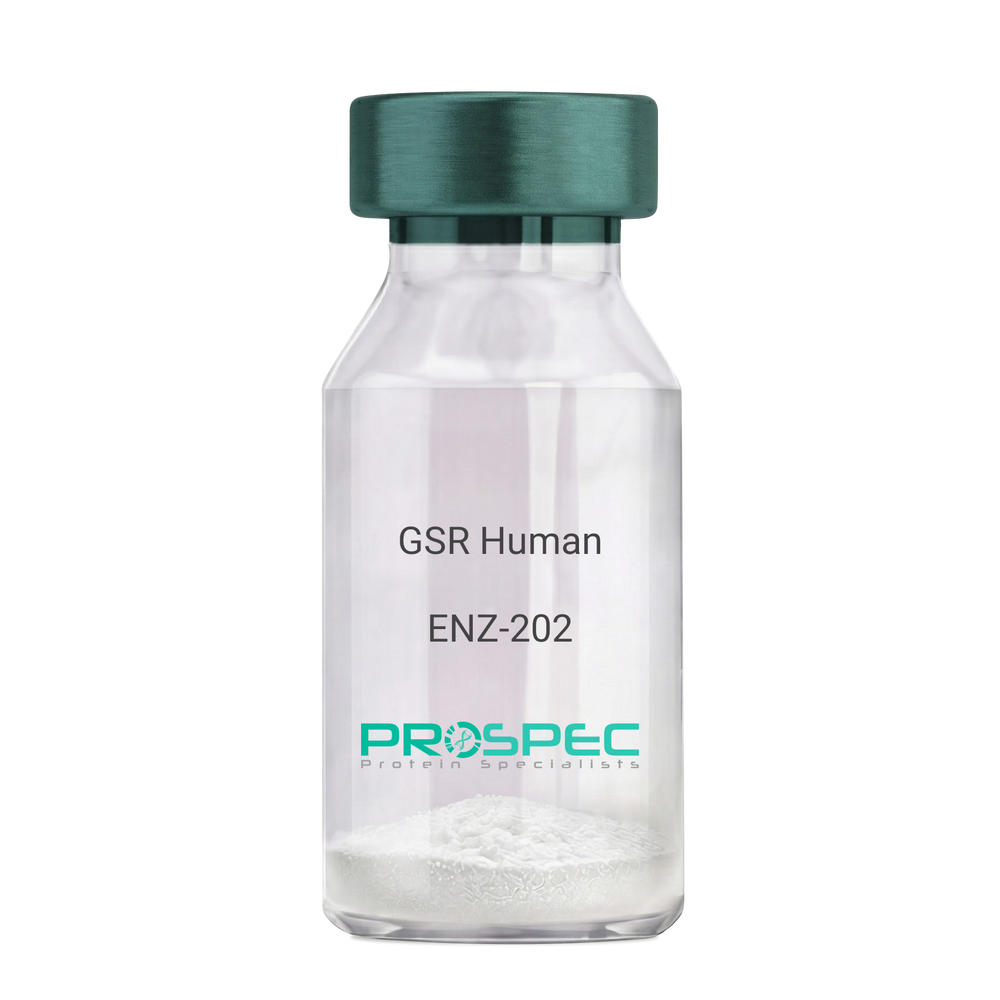
  • View Data Sheet

    Name :

    GSR Human

    Description:

    Glutathione Reductase Human Recombinant

    Glutathione reductase mitochondrial, GR, GRase, GSR, GLUR, GRD1.

    Product # :

    ENZ-202

    Price :

    Quantity :

    Shipping Method :

    Ice Icon

    Shipped with Ice Packs

    Add To Cart

    More Info

    • description
    • source
    • formulation
    • purity
    • biological activity
    • More Info
    • Citations

    Description

    GSR Human Recombinant produced in E.coli is a single, non-glycosylated polypeptide chain containing 504 amino acids (43-522) and having a molecular mass of 54.3kDa.GSR is fused to a 24 amino acid His-tag at N-terminus & purified by proprietary chromatographic techniques.

    Source

    Escherichia Coli.

    Formulation

    The GSR solution (1mg/ml) contains 20mM Tris-HCl buffer (pH 8.0), 1mM DTT, 10% glycerol and 0.1M NaCl.

    Purity

    Greater than 95.0% as determined by SDS-PAGE.

    Biological Activity

    Specific activity: > 29 unit/ml.
    One unit will reduce 1.0 umol of oxidized glutathione per minute at pH 7.5 at 25°C.

    Citations

    More Info

    • Introduction

      Glutathione reductase (GSR) belongs to the class-I pyridine nucleotide-disulfide oxidoreductase family. The GSR enzyme is a homodimeric flavoprotein and has a role in maintaining glutathione (GSH) in its reduced form by catalyzing the reduction of glutathione disulfide (GSSG): GSSG + NADPH + H+ ->2GSH + NADP+. In the majority of eukaryotic cells, GSR upholds the ratio of [GSH] / [GSSG], and partakes in quite a few critical functions such as the detoxification of reactive oxygen species as well as protein and DNA biosynthesis.

    • Synonyms

      Glutathione reductase mitochondrial, GR, GRase, GSR, GLUR, GRD1.

    • Physical Appearance

      Sterile Filtered colorless solution.

    • Stability

      Store at 4°C if entire vial will be used within 2-4 weeks.Store, frozen at -20°C for longer periods of time. For long term storage it is recommended to add a carrier protein (0.1% HSA or BSA).Avoid multiple freeze-thaw cycles.

    • Amino Acid Sequence

      MGSSHHHHHH SSGLVPRGSH MGSMAMACRQ EPQPQGPPPA AGAVASYDYL VIGGGSGGLA SARRAAELGA RAAVVESHKL GGTCVNVGCV PKKVMWNTAV HSEFMHDHAD YGFPSCEGKF NWRVIKEKRD AYVSRLNAIY QNNLTKSHIE IIRGHAAFTS DPKPTIEVSG KKYTAPHILI
      ATGGMPSTPH ESQIPGASLG ITSDGFFQLE ELPGRSVIVG AGYIAVEMAG ILSALGSKTS LMIRHDKVLR SFDSMISTNC TEELENAGVE VLKFSQVKEV KKTLSGLEVS MVTAVPGRLP VMTMIPDVDC LLWAIGRVPN TKDLSLNKLG IQTDDKGHII VDEFQNTNVK GIYAVGDVCG
      KALLTPVAIA AGRKLAHRLF EYKEDSKLDY NNIPTVVFSH PPIGTVGLTE DEAIHKYGIE NVKTYSTSFT PMYHAVTKRK TKCVMKMVCA NKEEKVVGIH MQGLGCDEML QGFAVAVKMG ATKADFDNTV AIHPTSSEEL VTLR.

    ProSpec's products are furnished for LABORATORY RESEARCH USE ONLY. The product may not be used as drugs, agricultural or pesticidal products, food additives or household chemicals.

    Gsr Human
  • View Data Sheet

    Name :

    Dopa Decarboxylase Human

    Description:

    Dopa Decarboxylase Human Recombinant

    DDC, AADC, Aromatic-L-amino-acid decarboxylase, DOPA decarboxylase.

    Product # :

    ENZ-413

    Price :

    Quantity :

    Shipping Method :

    Ice Icon

    Shipped with Ice Packs

    Add To Cart

    More Info

    • description
    • source
    • formulation
    • purity
    • More Info
    • Citations

    Description

    Dopa decarboxylase human recombinant produced in E.Coli is a single, non-glycosylated, polypeptide chain containing 503 amino acids (1-480 a.a.) and having a molecular mass of 56.4 kDa. The Dopa decarboxylase is fused to a 23 amino acid His Tag at N-terminus and purified by conventional chromatpgraphy.

    Source

    Escherichia Coli.

    Formulation

    The Dopa decarboxylase protein solution (1mg/ml) contains 20mM Tris-HCl, pH-8, 2mM DTT and 10% glycerol.

    Purity

    Greater than 95.0% as determined by SDS-PAGE.

    Citations

    More Info

    • Introduction

      Dopa decarboxylase is a homodimeric, pyridoxal phosphate dependent enzyme.
      Dopa decarboxylase is involved in 2 metabolic pathways, synthesizing 2 significant neurotransmitters the take part in numerous clinical disorders, including Parkinson’s disease. Dopa decarboxylase is located in different areas of the brain and is mostly found in basal ganglia. Dopa decarboxylase catalyzes the decarboxylation of L-3,4-dihydroxyphenylalanine (DOPA) to dopa, L-5-hydroxytryptophan to serotonin and L-tryptophan to tryptamine. Defects in Dopa decarboxylase leads to aromatic L-amino-acid decarboxylase deficiency (AADCD). AADCD deficiency is an inborn error in neurotransmitter metabolism that causes combined serotonin and catecholamine deficiency.

    • Synonyms

      DDC, AADC, Aromatic-L-amino-acid decarboxylase, DOPA decarboxylase.

    • Physical Appearance

      Sterile filtered colorless solution.

    • Stability

      Store at 4°C if entire vial will be used within 2-4 weeks. Store, frozen at -20°C for longer periods of time. For long term storage it is recommended to add a carrier protein (0.1% HSA or BSA).Avoid multiple freeze-thaw cycles.

    • Amino Acid Sequence

      MGSSHHHHHH SSGLVPRGSH TRSMNASEFR RRGKEMVDYV ANYMEGIEGR QVYPDVEPGY LRPLIPAAAP QEPDTFEDII NDVEKIIMPG VTHWHSPYFF AYFPTASSYP AMLADMLCGA IGCIGFSWAA SPACTELETV MMDWLGKMLE LPKAFLNEKA GEGGGVIQGS ASEATLVALL AARTKVIHRL QAASPELTQA AIMEKLVAYS SDQAHSSVER AGLIGGVKLK AIPSDGNFAM RASALQEALE RDKAAGLIPF FMVATLGTTT CCSFDNLLEV GPICNKEDIW LHVDAAYAGS AFICPEFRHL LNGVEFADSF NFNPHKWLLV NFDCSAMWVK KRTDLTGAFR LDPTYLKHSH QDSGLITDYR HWQIPLGRRF RSLKMWFVFR MYGVKGLQAY IRKHVQLSHE FESLVRQDPR FEICVEVILG LVCFRLKGSN KVNEALLQRI NSAKKIHLVP CHLRDKFVLR FAICSRTVES AHVQRAWEHI KELAADVLRA ERE.

    ProSpec's products are furnished for LABORATORY RESEARCH USE ONLY. The product may not be used as drugs, agricultural or pesticidal products, food additives or household chemicals.

    Dopa Decarboxylase Human
  • View Data Sheet

    Name :

    CTSZ Human

    Description:

    Cathepsin-Z Human Recombinant

    Cathepsin Z preproprotein, Cathepsin Z, CTSX, Cathepsin P, Cathepsin X, CTSZ, Cathepsin-Z.

    Product # :

    ENZ-748

    Price :

    Quantity :

    Shipping Method :

    Ice Icon

    Shipped with Ice Packs

    Add To Cart

    More Info

    • description
    • source
    • formulation
    • purity
    • More Info
    • Citations

    Description

    CTSZ Human Recombinant produced in E.coli is a single, non-glycosylated polypeptide chain containing 265 amino acids (62-303) and having a molecular mass of 29.5kDa.CTSZ is fused to a 23 amino acid His-tag at N-terminus & purified by proprietary chromatographic techniques.

    Source

    Escherichia Coli.

    Formulation

    The CTSZ solution (1mg/ml) contains 20mM Tris-HCl buffer (pH 8.0), 0.4M Urea and 10% glycerol.

    Purity

    Greater than 90.0% as determined by SDS-PAGE.

    Citations

    More Info

    • Introduction

      Cathepsin-Z (CTSZ) is a lysosomal cysteine proteinase and member of the peptidase C1 family. CTSZ, which has been also known as cathepsin X and cathepsin P, exhibits carboxy-monopeptidase and carboxy-dipeptidase activities. CTSZ is expressed ubiquitously in cancer cell lines and primary tumors and, similar to other members of this family, takes part in tumorigenesis.

    • Synonyms

      Cathepsin Z preproprotein, Cathepsin Z, CTSX, Cathepsin P, Cathepsin X, CTSZ, Cathepsin-Z.

    • Physical Appearance

      Sterile Filtered colorless solution.

    • Stability

      Store at 4°C if entire vial will be used within 2-4 weeks. Store, frozen at -20°C for longer periods of time. For long term storage it is recommended to add a carrier protein (0.1% HSA or BSA).Avoid multiple freeze-thaw cycles.

    • Amino Acid Sequence

      MGSSHHHHHH SSGLVPRGSH MGSLPKSWDW RNVDGVNYAS ITRNQHIPQY CGSCWAHAST SAMADRINIK RKGAWPSTLL SVQNVIDCGN AGSCEGGNDL SVWDYAHQHG IPDETCNNYQ AKDQECDKFN QCGTCNEFKE CHAIRNYTLW RVGDYGSLSG REKMMAEIYA NGPISCGIMA TERLANYTGG IYAEYQDTTY INHVVSVAGW GISDGTEYWI VRNSWGEPWG ERGWLRIVTS TYKDGKGARY NLAIEEHCTF GDPIV.

    ProSpec's products are furnished for LABORATORY RESEARCH USE ONLY. The product may not be used as drugs, agricultural or pesticidal products, food additives or household chemicals.

    Ctsz Human
  • View Data Sheet

    Name :

    MMP23B Human

    Description:

    Matrix Metallopeptidase 23B Human Recombinant

    Matrix Metallopeptidase 23B, MMP23B, MMP22, Matrix Metalloproteinase 23B, Matrix Metalloproteinase 22, Matrix Metalloproteinase In The Female Reproductive Tract, Matrix Metalloproteinase-21, Matrix Metalloproteinase-22, MIFR-1, MMP-21, MMP-22, MMP-23, MIFR, MMP23A, Matrix Metalloproteinase-23, EC 3.4.24.-, Femalysin, MMP21.

    Product # :

    ENZ-793

    Price :

    Quantity :

    Shipping Method :

    Ice Icon

    Shipped with Ice Packs

    Add To Cart

    More Info

    • description
    • source
    • formulation
    • purity
    • More Info
    • Citations

    Description

    MMP23B Human Recombinant produced in E.coli is a single, non-glycosylated polypeptide chain containing 199 amino acids (79-254) and having a molecular mass of 22.6kDa.MMP23B is fused to a 23 amino acid His-tag at N-terminus & purified by proprietary chromatographic techniques.

    Source

    Escherichia Coli.

    Formulation

    The MMP23B solution (0.5mg/ml) contains 20mM Tris-HCl buffer (pH 8.0), 0.4M Urea and 10% glycerol.

    Purity

    Greater than 85% as determined by SDS-PAGE.

    Citations

    More Info

    • Introduction

      Matrix Metallopeptidase 23B (MMP23B) belongs to the matrix metalloproteinase (MMP) family, and it is section of a duplicated region of chromosome 1p36.3. MMP23B is a protease. MMP23B regulates the surface expression of some potassium channels by holding them in the endoplasmic reticulum. Members of the matrix metalloproteinase (MMP) family are involved in the breakdown of extracellular matrix in normal physiological processes, such as embryonic development, reproduction, and tissue remodeling, as well as in disease processes, such as arthritis and metastasis.

    • Synonyms

      Matrix Metallopeptidase 23B, MMP23B, MMP22, Matrix Metalloproteinase 23B, Matrix Metalloproteinase 22, Matrix Metalloproteinase In The Female Reproductive Tract, Matrix Metalloproteinase-21, Matrix Metalloproteinase-22, MIFR-1, MMP-21, MMP-22, MMP-23, MIFR, MMP23A, Matrix Metalloproteinase-23, EC 3.4.24.-, Femalysin, MMP21.

    • Physical Appearance

      Sterile Filtered colorless solution.

    • Stability

      Store at 4°C if entire vial will be used within 2-4 weeks. Store, frozen at -20°C for longer periods of time. For long term storage it is recommended to add a carrier protein (0.1% HSA or BSA). Avoid multiple freeze-thaw cycles.

    • Amino Acid Sequence

      MGSSHHHHHH SSGLVPRGSH MGSYTLTPAR LRWDHFNLTY RILSFPRNLL SPRETRRALA AAFRMWSDVS PFSFREVAPE QPSDLRIGFY PINHTDCLVS ALHHCFDGPT GELAHAFFPP HGGIHFDDSE YWVLGPTRYS WKKGVWLTDL VHVAAHEIGH ALGLMHSQHG RALMHLNATL RGWKALSQDE LWGLHRLYG.

    ProSpec's products are furnished for LABORATORY RESEARCH USE ONLY. The product may not be used as drugs, agricultural or pesticidal products, food additives or household chemicals.

    Mmp23B Human
  • View Data Sheet

    Name :

    HMOX2 Human

    Description:

    Heme Oxygenase-2 Human Recombinant

    EC 1.14.99.3, HO2, Heme oxygenase 2, HO-2, HMOX2.

    Product # :

    ENZ-478

    Price :

    Quantity :

    Shipping Method :

    Ice Icon

    Shipped with Ice Packs

    Add To Cart

    More Info

    • description
    • source
    • formulation
    • purity
    • More Info
    • Citations

    Description

    HMOX2 Human Recombinant produced in E.Coli is a single, non-glycosylated, polypeptide chain containing 264 amino acids (1-264 a.a.) and having a molecular mass of 30.5 kDa. HMOX2 is purified by proprietary chromatographic techniques.

    Source

    Escherichia Coli.

    Formulation

    HMOX2 solution containing 20mM Tris pH-8, 1mM DTT and 10% glycerol.

    Purity

    Greater than 90% as determined by SDS-PAGE.

    Citations

    More Info

    • Introduction

      HMOX2 cleaves the heme ring at the alpha methene bridge to form biliverdin. Biliverdin is subsequently transferred to bilirubin by biliverdin reductase. Under physiological conditions, the activity of HMOX2 is highest in the spleen, where senescent erythrocytes are sequestrated and destroyed. HMOX2 participates in the production of carbon monoxide in the brain where it operates as a neurotransmitter. HMOX2 is an essential enzyme in heme catabolism and is involved in cellular response to oxidative stress.

    • Synonyms

      EC 1.14.99.3, HO2, Heme oxygenase 2, HO-2, HMOX2.

    • Physical Appearance

      Sterile filtered colorless solution.

    • Stability

      HMOX2 Human Recombinant although stable at 4°C for 1 week, should be stored below -18°C. Please prevent freeze thaw cycles.

    • Amino Acid Sequence

      SAEVETSEG VDESEKKNSG ALEKENQMRM ADLSELLKEG TKEAHDRAEN TQFVKDFLKG NIKKELFKLA TTALYFTYSA LEEEMERNKD HPAFAPLYFP MELHRKEALT KDMEYFFGEN WEEQVQCPKA AQKYVERIHY IGQNEPELLV AHAYTRYMGD LSGGQVLKKV AQRALKLPST GEGTQFYLFE NVDNAQQFKQ LYRARMNALD LNMKTKERIV EEANKAFEYN MQIFNELDQA GSTLARETLE DGFPVHDGKG DMRK.

    ProSpec's products are furnished for LABORATORY RESEARCH USE ONLY. The product may not be used as drugs, agricultural or pesticidal products, food additives or household chemicals.

    Hmox2 Human
  • View Data Sheet

    Name :

    STK16 Human

    Description:

    Serine/Threonine Kinase 16 Human Recombinant

    Serine/threonine-protein kinase 16, Myristoylated and palmitoylated serine/threonine-protein kinase, MPSK, Protein kinase PKL12, TGF-beta-stimulated factor 1, TSF-1, Tyrosine-protein kinase STK16, hPSK, STK16, MPSK1, PKL12, TSF1, KRCT.

    Product # :

    PKA-032

    Price :

    Quantity :

    Shipping Method :

    Ice Icon

    Shipped with Ice Packs

    Add To Cart

    More Info

    • description
    • source
    • formulation
    • purity
    • More Info
    • Citations

    Description

    STK16 Human Recombinant produced in E.Coli is a single, non-glycosylated polypeptide chain containing 329 amino acids (1-305 a.a) and having a molecular mass of 37.2kDa.STK16 is fused to a 24 amino acid His-tag at N-terminus & purified by proprietary chromatographic techniques.

    Source

    Escherichia Coli.

    Formulation

    STK16 protein solution (1mg/ml) containing 20mM Tris-HCl buffer (pH8.0), 20% glycerol, 0.1M NaCl and 1mM DTT.

    Purity

    Greater than 90.0% as determined by SDS-PAGE.

    Citations

    More Info

    • Introduction

      Serine/threonine-protein kinase 16 (STK16) is a membrane-associated protein kinase which phosphorylates on serine and threonine residues. STK16 is involved in secretory vesicle trafficking or intracellular signaling. Furthermore, the STK16 protein may have a role in regulating stromal-epithelial interactions which occur during ductal morphogenesis in the mammary gland. STK16 can autophosphorylate on Tyr residue; it is however unclear whether STK16 has tyrosine-protein kinase toward other proteins. STK16 may also be involved in TGF-beta signaling.

    • Synonyms

      Serine/threonine-protein kinase 16, Myristoylated and palmitoylated serine/threonine-protein kinase, MPSK, Protein kinase PKL12, TGF-beta-stimulated factor 1, TSF-1, Tyrosine-protein kinase STK16, hPSK, STK16, MPSK1, PKL12, TSF1, KRCT.

    • Physical Appearance

      Sterile Filtered colorless solution.

    • Stability

      Store at 4°C if entire vial will be used within 2-4 weeks. Store, frozen at -20°C for longer periods of time. For long term storage it is recommended to add a carrier protein (0.1% HSA or BSA).Avoid multiple freeze-thaw cycles.

    • Amino Acid Sequence

      MGSSHHHHHH SSGLVPRGSH MGSHMGHALC VCSRGTVIID NKRYLFIQKL GEGGFSYVDL VEGLHDGHFY ALKRILCHEQ QDREEAQREA DMHRLFNHPN ILRLVAYCLR ERGAKHEAWL LLPFFKRGTL WNEIERLKDK GNFLTEDQIL WLLLGICRGL EAIHAKGYAH RDLKPTNILL GDEGQPVLMD LGSMNQACIH VEGSRQALTL QDWAAQRCTI SYRAPELFSV QSHCVIDERT DVWSLGCVLY AMMFGEGPYD MVFQKGDSVA LAVQNQLSIP QSPRHSSALR QLLNSMMTVD PHQRPHIPLL LSQLEALQPP APGQHTTQI.

    ProSpec's products are furnished for LABORATORY RESEARCH USE ONLY. The product may not be used as drugs, agricultural or pesticidal products, food additives or household chemicals.

    Stk16 Human
  • 1
  • …
  • 40
  • 41
  • 42
Your browser does not support the video tag.

Products

  • Cytokines
  • Growth Factors
  • Chemokines
  • CD Antigens
  • Neurotrophins
  • Hormones
  • Enzymes
  • Viral Antigens
  • Recombinant Proteins
  • Natural Proteins
  • Monoclonal Antibodies
  • Polyclonal Antibodies
  • Thermal Packaging

About

  • Company
  • Founder
  • Contribution
  • Contact Us
  • My Account

Ordering

  • Ordering Method
  • Ordering - Credit Card
  • Ordering PO
  • Shipping Fees
  • FAQ's

Legal

  • Terms & Conditions
  • Privacy
  • Site Map
  • info@prospecbio.com
  • Facebook
  • Instagram
  • Linkedin Profile

© 2026 ProSpec-Tany TechnoGene Ltd. All Rights Reserved.

  • Choosing a selection results in a full page refresh.
  • Opens in a new window.