Skip to content

High-quality research proteins.

  • 1-800-805-6531

  • Mon - Sat 8.00-18.00, Sun - Closed

  • info@prospecbio.com

  • PO Box 6591 East Brunswick NJ 08816

  • Products
    • Cytokines
    • Growth factors
    • Chemokines
    • Cd antigens
    • Neurotrophins
    • Hormones
    • Enzymes
    • Viral antigens
    • Recombinant proteins
    • Natural proteins
    • Monoclonal antibodies
    • Polyclonal antibodies
    • Thermal Packaging
  • About
    • Company
    • Founder
    • Contribution
  • Customers
    • Eastern Asia
    • Eastern Europe
    • North America
    • South America
    • South East Asia
    • Southern Asia
    • Western Europe
  • Ordering
    • Ordering Method
    • Ordering - Credit Card
    • Ordering - PO
    • Shipping Fees
    • FAQs
  • Services
    • DNA Cloning
    • Protein Expression
    • Monoclonal Antibody
    • Fermentation
    • Technology License
  • Contact us
Log in

Country/region

  • USD $ | Albania
  • USD $ | Andorra
  • USD $ | Argentina
  • USD $ | Armenia
  • USD $ | Australia
  • USD $ | Austria
  • USD $ | Azerbaijan
  • USD $ | Belarus
  • USD $ | Belgium
  • USD $ | Bolivia
  • USD $ | Brazil
  • USD $ | Bulgaria
  • USD $ | Cambodia
  • USD $ | Canada
  • USD $ | Chile
  • USD $ | China
  • USD $ | Colombia
  • USD $ | Costa Rica
  • USD $ | Croatia
  • USD $ | Cyprus
  • USD $ | Czechia
  • USD $ | Denmark
  • USD $ | Estonia
  • USD $ | Finland
  • USD $ | France
  • USD $ | Georgia
  • USD $ | Germany
  • USD $ | Greece
  • USD $ | Hong Kong SAR
  • USD $ | Hungary
  • USD $ | Iceland
  • USD $ | India
  • USD $ | Ireland
  • USD $ | Israel
  • USD $ | Italy
  • USD $ | Japan
  • USD $ | Kazakhstan
  • USD $ | Latvia
  • USD $ | Liechtenstein
  • USD $ | Lithuania
  • USD $ | Madagascar
  • USD $ | Malta
  • USD $ | Mexico
  • USD $ | Moldova
  • USD $ | Monaco
  • USD $ | Netherlands
  • USD $ | New Zealand
  • USD $ | North Macedonia
  • USD $ | Norway
  • USD $ | Panama
  • USD $ | Paraguay
  • USD $ | Peru
  • USD $ | Philippines
  • USD $ | Poland
  • USD $ | Portugal
  • USD $ | Romania
  • USD $ | Singapore
  • USD $ | Slovakia
  • USD $ | Slovenia
  • USD $ | South Africa
  • USD $ | South Korea
  • USD $ | Spain
  • USD $ | Sri Lanka
  • USD $ | Sweden
  • USD $ | Switzerland
  • USD $ | Taiwan
  • USD $ | Thailand
  • USD $ | Türkiye
  • USD $ | Ukraine
  • USD $ | United Kingdom
  • USD $ | United States
  • USD $ | Uruguay
  • USD $ | Vatican City
  • USD $ | Venezuela
  • USD $ | Vietnam
  • Facebook
  • Instagram
logoProSpec - Recombinant Protein Manufacturer for academic and R&D industry
Become a distributor
Account Log in
Wishlist
Cart Cart(0)
  • Products
    +
    • Cytokines
    • Growth factors
    • Chemokines
    • Cd antigens
    • Neurotrophins
    • Hormones
    • Enzymes
    • Viral antigens
    • Recombinant proteins
    • Natural proteins
    • Monoclonal antibodies
    • Polyclonal antibodies
    • Thermal Packaging
  • About
    +
    • Company
    • Founder
    • Contribution
  • Customers
    +
    • Eastern Asia
    • Eastern Europe
    • North America
    • South America
    • South East Asia
    • Southern Asia
    • Western Europe
  • Ordering
    +
    • Ordering Method
    • Ordering - Credit Card
    • Ordering - PO
    • Shipping Fees
    • FAQs
  • Services
    +
    • DNA Cloning
    • Protein Expression
    • Monoclonal Antibody
    • Fermentation
    • Technology License
  • Contact us

Item added to your cart

View cart
View All
  • Cytokines
  • Growth factors
  • Chemokines
  • Cd antigens
  • Neurotrophins
  • Hormones
  • Enzymes
  • Viral antigens
  • Recombinant proteins
  • Natural proteins
  • Monoclonal antibodies
  • Polyclonal antibodies
  • Thermal Packaging
  • Tumor Necrosis Factor

    Tumor Necrosis Factor

    View All
  • 4-1BB

    4-1BB

    View All
  • Adiponectin

    Adiponectin

    View All
  • AIF1

    AIF1

    View All
  • Other Cytokines

    Other Cytokines

    View All
  • AITRL

    AITRL

    View All
  • Angiopoietin

    Angiopoietin

    View All
  • Apolipoprotein

    Apolipoprotein

    View All
  • B-Cell Activating Factor

    B-Cell Activating Factor

    View All
  • Beta Defensin

    Beta Defensin

    View All
  • Bone Morphogenetic Protein

    Bone Morphogenetic Protein

    View All
  • B type Natriuretic Peptide

    B type Natriuretic Peptide

    View All
  • BST

    BST

    View All
  • Betacellulin

    Betacellulin

    View All
  • Cardiotrophin

    Cardiotrophin

    View All
  • Activin

    Activin

    View All
  • Fibroblast Growth Factor

    Fibroblast Growth Factor

    View All
  • Other Growth Factors

    Other Growth Factors

    View All
  • CSF

    CSF

    View All
  • CTGF

    CTGF

    View All
  • IGFBP

    IGFBP

    View All
  • VEGF Protein

    VEGF Protein

    View All
  • EGF

    EGF

    View All
  • Epigen

    Epigen

    View All
  • Erythropoietin

    Erythropoietin

    View All
  • Insulin-Like Growth Factor

    Insulin-Like Growth Factor

    View All
  • Growth Hormone

    Growth Hormone

    View All
  • HDGF

    HDGF

    View All
  • Hepatocyte Growth Factor

    Hepatocyte Growth Factor

    View All
  • Insulin

    Insulin

    View All
  • BCA-1/ BLC (CXCL13)

    BCA-1/ BLC (CXCL13)

    View All
  • BRAK (CXCL14)

    BRAK (CXCL14)

    View All
  • C-10 (CCL6)

    C-10 (CCL6)

    View All
  • Other Chemokines

    Other Chemokines

    View All
  • MEC (CCL28)

    MEC (CCL28)

    View All
  • LD78-beta (CCL3L1)

    LD78-beta (CCL3L1)

    View All
  • CTACK (CCL27)

    CTACK (CCL27)

    View All
  • CXCL16

    CXCL16

    View All
  • CXCL17

    CXCL17

    View All
  • Platelet Factor-4 (CXCL4)

    Platelet Factor-4 (CXCL4)

    View All
  • ENA-78 (CXCL5)

    ENA-78 (CXCL5)

    View All
  • Eotaxin (CCL11,24,26)

    Eotaxin (CCL11,24,26)

    View All
  • Exodus-2 (CCL21)

    Exodus-2 (CCL21)

    View All
  • Fractalkine (CX3CL1)

    Fractalkine (CX3CL1)

    View All
  • CXCL6

    CXCL6

    View All
  • Other CD Antigens

    Other CD Antigens

    View All
  • CD14

    CD14

    View All
  • CD164

    CD164

    View All
  • CD1

    CD1

    View All
  • CD2

    CD2

    View All
  • CD200

    CD200

    View All
  • CD207

    CD207

    View All
  • CD226

    CD226

    View All
  • CD23

    CD23

    View All
  • CD244

    CD244

    View All
  • CD247

    CD247

    View All
  • CD27

    CD27

    View All
  • CD274

    CD274

    View All
  • CD300

    CD300

    View All
  • CD33

    CD33

    View All
  • Other Neurotrophins

    Other Neurotrophins

    View All
  • Beta-NGF

    Beta-NGF

    View All
  • BDNF

    BDNF

    View All
  • CDNF

    CDNF

    View All
  • CNTF

    CNTF

    View All
  • GDNF

    GDNF

    View All
  • Glia Maturation Factor

    Glia Maturation Factor

    View All
  • MANF

    MANF

    View All
  • Midkine

    Midkine

    View All
  • Neuroglobin

    Neuroglobin

    View All
  • Neurotrophic factors

    Neurotrophic factors

    View All
  • Neuregulin

    Neuregulin

    View All
  • Neuropilin

    Neuropilin

    View All
  • Pigment Epithelium-Derived Factor

    Pigment Epithelium-Derived Factor

    View All
  • Pleiotrophin

    Pleiotrophin

    View All
  • Peptide Hormones

    Peptide Hormones

    View All
  • Other Hormones

    Other Hormones

    View All
  • HCG

    HCG

    View All
  • Endothelin

    Endothelin

    View All
  • Exendin

    Exendin

    View All
  • FSH

    FSH

    View All
  • Glucagon

    Glucagon

    View All
  • GHRP

    GHRP

    View All
  • GLP

    GLP

    View All
  • Thyrostimulin

    Thyrostimulin

    View All
  • Inhibin A

    Inhibin A

    View All
  • LHRH

    LHRH

    View All
  • Melanotan

    Melanotan

    View All
  • Procalcitonin

    Procalcitonin

    View All
  • PTH

    PTH

    View All
  • Peroxiredoxin

    Peroxiredoxin

    View All
  • Peptidase

    Peptidase

    View All
  • Synthetase

    Synthetase

    View All
  • Transferase

    Transferase

    View All
  • Hydrolase

    Hydrolase

    View All
  • Dehydrogenase

    Dehydrogenase

    View All
  • ACE2

    ACE2

    View All
  • Esterase

    Esterase

    View All
  • Protein Kinases

    Protein Kinases

    View All
  • Other Enzymes

    Other Enzymes

    View All
  • Phosphatase

    Phosphatase

    View All
  • Deaminase

    Deaminase

    View All
  • Oxygenase

    Oxygenase

    View All
  • Adenylate Kinase

    Adenylate Kinase

    View All
  • Lyase

    Lyase

    View All
  • Chagas

    Chagas

    View All
  • SARS

    SARS

    View All
  • Influenza

    Influenza

    View All
  • ASFV

    ASFV

    View All
  • Astrovirus

    Astrovirus

    View All
  • Borrelia

    Borrelia

    View All
  • Helicobacter Pylori

    Helicobacter Pylori

    View All
  • Chikungunya

    Chikungunya

    View All
  • Chlamydia

    Chlamydia

    View All
  • Cytomegalo

    Cytomegalo

    View All
  • Dengue

    Dengue

    View All
  • EBV

    EBV

    View All
  • Ebola

    Ebola

    View All
  • Feline Leukemia Virus

    Feline Leukemia Virus

    View All
  • Hepatitis A

    Hepatitis A

    View All
  • Other

    Other

    View All
  • Actin

    Actin

    View All
  • ADAM

    ADAM

    View All
  • Complement Component

    Complement Component

    View All
  • Ag85

    Ag85

    View All
  • Eukaryotic Translation Initiation Factor

    Eukaryotic Translation Initiation Factor

    View All
  • Anterior Gradient Protein

    Anterior Gradient Protein

    View All
  • Heat Shock Protein

    Heat Shock Protein

    View All
  • Alpha-2-HS-Glycoprotein

    Alpha-2-HS-Glycoprotein

    View All
  • Hemoglobin

    Hemoglobin

    View All
  • Allergy

    Allergy

    View All
  • Anaplasma

    Anaplasma

    View All
  • Angiogenin

    Angiogenin

    View All
  • Ankyrin Repeat Domain

    Ankyrin Repeat Domain

    View All
  • Annexin

    Annexin

    View All
  • Other Natural Proteins

    Other Natural Proteins

    View All
  • Aprotinin

    Aprotinin

    View All
  • Transferrin

    Transferrin

    View All
  • Avidin

    Avidin

    View All
  • Anti Coagulation Factors

    Anti Coagulation Factors

    View All
  • Natural Albumin

    Natural Albumin

    View All
  • Natural Coagulation Factors

    Natural Coagulation Factors

    View All
  • Fibronectin

    Fibronectin

    View All
  • Thrombin

    Thrombin

    View All
  • Anti Human Enzyme

    Anti Human Enzyme

    View All
  • Other Monoclonal Antibodies

    Other Monoclonal Antibodies

    View All
  • Anti Human Cytokine

    Anti Human Cytokine

    View All
  • Anti Human Heat Shock Protein

    Anti Human Heat Shock Protein

    View All
  • Anti Mouse Lymphocyte

    Anti Mouse Lymphocyte

    View All
  • Anti Human Chemokine

    Anti Human Chemokine

    View All
  • Anti Human Lymphocyte

    Anti Human Lymphocyte

    View All
  • Anti Viral Monoclonal

    Anti Viral Monoclonal

    View All
  • Anti Mouse Cytokine

    Anti Mouse Cytokine

    View All
  • Anti-GST Monoclonal

    Anti-GST Monoclonal

    View All
  • Other Polyclonal Antibodies

    Other Polyclonal Antibodies

    View All
  • Anti Viral

    Anti Viral

    View All
  • Anti-GST Monoclonal

    Anti-GST Monoclonal

    View All
Back

Search results

1000 results found for “myoglobin”

Name

Description

Product #

Price

Quantity

Shipping Method

  • View Data Sheet

    Name :

    SNRPC Human

    Description:

    Small Nuclear Ribonucleoprotein Polypeptide C Human Recombinant

    U1 small nuclear ribonucleoprotein C, U1 snRNP C, U1-C, U1C, SNRPC, Yhc1.

    Product # :

    PRO-1004

    Price :

    Quantity :

    Shipping Method :

    Ice Icon

    Shipped with Ice Packs

    Add To Cart

    More Info

    • description
    • source
    • formulation
    • purity
    • More Info

    Description

    SNRPC Human Recombinant produced in E.Coli is a single, non-glycosylated polypeptide chain containing 182 amino acids (1-159 a.a.) and having a molecular mass of 19.8kDa (Molecular weight on SDS-PAGE will appear higher).SNRPC is fused to a 23 amino acid His-tag at N-terminus & purified by proprietary chromatographic techniques.

    Source

    Escherichia Coli.

    Formulation

    SNRPC protein solution (0.25mg/ml) containing 20mM Tris-HCl buffer (pH8.0), 50% glycerol, 0.3M NaCl, 5mM DTT and 2mM EDTA.

    Purity

    Greater than 85% as determined by SDS-PAGE.

    More Info

    • Introduction

      SNRPC is a member of the U1 small nuclear ribonucleoprotein C family. The SNRPC protein component of the U1 small nuclear ribonucleoprotein (snRNP) particle required for the formation of the spliceosome. SNRPC participates in the processing of nuclear precursor messenger RNA splicing. snRNP particles are tackled by autoantibodies frequently produced by patients with connective tissue diseases.

    • Synonyms

      U1 small nuclear ribonucleoprotein C, U1 snRNP C, U1-C, U1C, SNRPC, Yhc1.

    • Physical Appearance

      Sterile Filtered clear solution.

    • Stability

      Store at 4°C if entire vial will be used within 2-4 weeks. Store, frozen at -20°C for longer periods of time. For long term storage it is recommended to add a carrier protein (0.1% HSA or BSA).Avoid multiple freeze-thaw cycles.

    • Amino Acid Sequence

      MGSSHHHHHH SSGLVPRGSH MGSMPKFYCD YCDTYLTHDS PSVRKTHCSG RKHKENVKDY YQKWMEEQAQ SLIDKTTAAF QQGKIPPTPF SAPPPAGAMI PPPPSLPGPP RPGMMPAPHM GGPPMMPMMG PPPPGMMPVG PAPGMRPPMG GHMPMMPGPP MMRPPARPMM VPTRPGMTRP DR.

    ProSpec's products are furnished for LABORATORY RESEARCH USE ONLY. The product may not be used as drugs, agricultural or pesticidal products, food additives or household chemicals.

    Snrpc Human
  • View Data Sheet

    Name :

    INHBC Human

    Description:

    Inhibin-Beta C Chain Human Recombinant

    Inhibin Beta C, Actv Beta-C Chain, IHBC, Inhibin Beta C Chain.

    Product # :

    HOR-010

    Price :

    Quantity :

    Shipping Method :

    Ice Icon

    Shipped with Ice Packs

    Add To Cart

    More Info

    • description
    • source
    • formulation
    • purity
    • More Info

    Description

    INHBC Human Recombinant produced in E.coli is a single, non-glycosylated polypeptide chain containing 139 amino acids (237-352) and having a molecular mass of 14.9kDa.INHBC is fused to a 23 amino acid His-tag at N-terminus & purified by proprietary chromatographic techniques.

    Source

    E.coli.

    Formulation

    The INHBC solution (0.5mg/ml) contains 20mM Tris-HCl buffer (pH 8.0), 0.15M NaCl, 1mM DTT and 10% glycerol.

    Purity

    Greater than 85% as determined by SDS-PAGE.

    More Info

    • Introduction

      INHBC, the beta C chain of inhibin, belongs to the TGF-beta superfamily. INHBC formulates heterodimers with beta A and beta B subunits. Other members of the TGF-beta superfamily are Actv's and Inhibins, hormones with contradictory roles which take part in pituitary, hypothalamic, and gonadal hormone secretion, as well as differentiation and growth of numerous cell types.

    • Synonyms

      Inhibin Beta C, Actv Beta-C Chain, IHBC, Inhibin Beta C Chain.

    • Physical Appearance

      Sterile Filtered colorless solution.

    • Stability

      Store at 4°C if entire vial will be used within 2-4 weeks. Store, frozen at -20°C for longer periods of time. For long term storage it is recommended to add a carrier protein (0.1% HSA or BSA).Avoid multiple freeze-thaw cycles.

    • Amino Acid Sequence

      MGSSHHHHHH SSGLVPRGSH MGSGIDCQGG SRMCCRQEFF VDFREIGWHD WIIQPEGYAM NFCIGQCPLH IAGMPGIAAS FHTAVLNLLK ANTAAGTTGG GSCCVPTARR PLSLLYYDRD SNIVKTDIPD MVVEACGCS

    ProSpec's products are furnished for LABORATORY RESEARCH USE ONLY. The product may not be used as drugs, agricultural or pesticidal products, food additives or household chemicals.

    Inhbc Human
  • View Data Sheet

    Name :

    LBH Human

    Description:

    Limb Bud And Heart Development Human Recombinant

    Protein LBH, hLBH, Limb Bud And Heart Development Homolog.

    Product # :

    PRO-423

    Price :

    Quantity :

    Shipping Method :

    Ice Icon

    Shipped with Ice Packs

    Add To Cart

    More Info

    • description
    • source
    • formulation
    • purity
    • More Info

    Description

    LBH Human Recombinant produced in E.Coli is a single, non-glycosylated polypeptide chain containing 128 amino acids (1-105 a.a) and having a molecular mass of 14.6kDa.LBH is fused to a 23 amino acid His-tag at N-terminus & purified by proprietary chromatographic techniques.

    Source

    Escherichia Coli.

    Formulation

    LBH protein solution (0.25mg/ml) containing 20mM Tris-HCl(pH 8.0), 20% glycerol, 0.15M NaCl and 1mM DTT.

    Purity

    Greater than 90.0% as determined by SDS-PAGE.

    More Info

    • Introduction

      Limb Bud And Heart Development, (LBH) belongs to the LBH family.LBH is highly expressed in the heart, and expressed at low levels in placenta, lung, skeletal muscle, kidney and liver. In addition, LBH protein is a transcriptional activator which may act in mitogen-activated protein kinase signaling pathway. Among the diseases associated with LBH are celiac disease, and rheumatoid arthritis.

    • Synonyms

      Protein LBH, hLBH, Limb Bud And Heart Development Homolog.

    • Physical Appearance

      Sterile Filtered clear solution.

    • Stability

      Store at 4°C if entire vial will be used within 2-4 weeks. Store, frozen at -20°C for longer periods of time. For long term storage it is recommended to add a carrier protein (0.1% HSA or BSA).Avoid multiple freeze-thaw cycles.

    • Amino Acid Sequence

      MGSSHHHHHH SSGLVPRGSH MGSMSIYFPI HCPDYLRSAK MTEVMMNTQP MEEIGLSPRK DGLSYQIFPD PSDFDRCCKL KDRLPSIVVE PTEGEVESGE LRWPPEEFLV QEDEQDNCEE TAKENKEQ

    ProSpec's products are furnished for LABORATORY RESEARCH USE ONLY. The product may not be used as drugs, agricultural or pesticidal products, food additives or household chemicals.

    Lbh Human
  • View Data Sheet

    Name :

    TYRP1 Human

    Description:

    Tyrosinase Related Protein 1 Human Recombinant

    Tyrosinase Related Protein 1, Tyrosinase-Related Protein 1, Melanoma Antigen Gp75, Glycoprotein 75, DHICA Oxidase, Catalase B, CAS2, TRP1, TYRP, TRP, 5,6-Dihydroxyindole-2-Carboxylic Acid Oxidase, EC 1.14.18.1, EC 1.14.18.-, EC 1.14.18, B-PROTEIN, TRP-1, TYRRP, CATB, GP75, OCA3, 5,6-dihydroxyindole-2-carboxylic acid oxidase.

    Product # :

    PRO-2350

    Price :

    Quantity :

    Shipping Method :

    Ice Icon

    Shipped with Ice Packs

    Add To Cart

    More Info

    • description
    • source
    • formulation
    • purity
    • More Info

    Description

    TYRP1 Human Recombinant produced in Sf9 Baculovirus cells is a single, non-glycosylated polypeptide chain containing 462 amino acids (25-477a.a) and having a molecular mass of 52.5kDa. (Molecular size on SDS-PAGE will appear at approximately 50-70kDa).TYRP1 is fused to a 6 amino acid His-tag at C-terminus & purified by proprietary chromatographic techniques.

    Source

    Sf9, Baculovirus cells.

    Formulation

    TYRP1 protein solution (0.25mg/ml) containing Phosphate Buffered Saline (pH 7.4) and 10% glycerol.

    Purity

    Greater than 85.0% as determined by SDS-PAGE.

    More Info

    • Introduction

      TYRP1, also known as 5, 6-dihydroxyindole-2-carboxylic acid oxidase, is a melanosomal enzyme which is a member of the tyrosinase family and takes a significant part in the melanin biosynthetic pathway. TYRP1 is a melanocyte-specific gene which is involved in eumelanin synthesis. Furthermore, TYRP1 is implicated in the oxidation of 5,6-dihydroxyindole-2-carboxylic acid-DHICA into indole-5,6-quinone-2-carboxylic acid. TYRP1 is regulated by the microphthalmia-associatedtranscription factor-MITF.

    • Synonyms

      Tyrosinase Related Protein 1, Tyrosinase-Related Protein 1, Melanoma Antigen Gp75, Glycoprotein 75, DHICA Oxidase, Catalase B, CAS2, TRP1, TYRP, TRP, 5,6-Dihydroxyindole-2-Carboxylic Acid Oxidase, EC 1.14.18.1, EC 1.14.18.-, EC 1.14.18, B-PROTEIN, TRP-1, TYRRP, CATB, GP75, OCA3, 5,6-dihydroxyindole-2-carboxylic acid oxidase.

    • Physical Appearance

      Sterile Filtered colorless solution.

    • Stability

      Store at 4°C if entire vial will be used within 2-4 weeks. Store, frozen at -20°C for longer periods of time. For long term storage it is recommended to add a carrier protein (0.1% HSA or BSA).Avoid multiple freeze-thaw cycles.

    • Amino Acid Sequence

      ADLQFPRQCA TVEALRSGMC CPDLSPVSGP GTDRCGSSSG RGRCEAVTAD SRPHSPQYPH DGRDDREVWP LRFFNRTCHC NGNFSGHNCG TCRPGWRGAA CDQRVLIVRR NLLDLSKEEK NHFVRALDMA KRTTHPLFVI ATRRSEEILG PDGNTPQFEN ISIYNYFVWT HYYSVKKTFL GVGQESFGEV DFSHEGPAFL TWHRYHLLRL EKDMQEMLQE PSFSLPYWNF ATGKNVCDIC TDDLMGSRSN FDSTLISPNS VFSQWRVVCD SLEDYDTLGT LCNSTEDGPI RRNPAGNVAR PMVQRLPEPQ DVAQCLEVGL FDTPPFYSNS TNSFRNTVEG YSDPTGKYDP AVRSLHNLAH LFLNGTGGQT HLSPNDPIFV LLHTFTDAVF DEWLRRYNAD ISTFPLENAP IGHNRQYNMV PFWPPVTNTE MFVTAPDNLG YTYEIQWPSR EFSVPEHHHH HH.

    ProSpec's products are furnished for LABORATORY RESEARCH USE ONLY. The product may not be used as drugs, agricultural or pesticidal products, food additives or household chemicals.

    Tyrp1 Human
  • View Data Sheet

    Name :

    LMNA Human

    Description:

    Lamin A/C Human Recombinant

    Prelamin-A/C, Lamin-A/C, 70 kDa lamin, LMNA, LMN1, Renal carcinoma antigen NY-REN-32, Progerin.

    Product # :

    PRO-2666

    Price :

    Quantity :

    Shipping Method :

    Ice Icon

    Shipped with Ice Packs

    Add To Cart

    More Info

    • description
    • source
    • formulation
    • purity
    • More Info

    Description

    LMNA Human Recombinant fused with a His tag produced in E.Coli is a single, non-glycosylated, polypeptide chain containing 614 amino acids and having a molecular mass of 68.0kDa. The LMNA is purified by proprietary chromatographic techniques.

    Source

    Escherichia Coli.

    Formulation

    The LMNA solution contains 20mM Tris-HCl pH 7.5, 1mM DTT, 0.5M NaCl, 1.5mM EDTA and 20%(v/v) glycerol.

    Purity

    Greater than 90.0% as determined by SDS-PAGE.

    More Info

    • Introduction

      Lamin-A is a major component of the nuclear lamina, a dynamic meshwork located just under the nuclear envelope and it is encoded by lamin A/C gene (LMNA).
      Lamin-A is synthesized as Prelamin A, a longer precursor that in vivo goes through a serial post-translational modifications that lead to mature Lamin A.
      Diverse mutations in the Lamin A/C gene are associated with different diseases that are collectively called laminophaties, including Emery-Dreifuss muscular dystrophy, familiar partial lipodystrophy, limb girdle muscular dystrophy, dilated cardiomyopathy, Charcot-Marie-Tooth disease, and Hutchinson-Gilford progeria syndrome.

    • Synonyms

      Prelamin-A/C, Lamin-A/C, 70 kDa lamin, LMNA, LMN1, Renal carcinoma antigen NY-REN-32, Progerin.

    • Physical Appearance

      Sterile filtered colorless solution.

    • Stability

      Store at 4°C if entire vial will be used within 2-4 weeks.Store, frozen at -20°C for longer periods of time.For long term storage it is recommended to add a carrier protein (0.1% HSA or BSA).Avoid multiple freeze-thaw cycles.

    • Amino Acid Sequence

      MAHHHHHHVG TGSNDDDDKS PDMETPSQRR ATRSGAQASS TPLSPTRITR LQEKEDLQEL NDRLAVYIDR VRSLETENAG LRLRITESEE VVSREVSGI KAAYEAELGD ARKTLDSVAK ERARLQLELS KVREEFKELK ARNTKKEGDL IAAQARLKDL EALLNSKEAA LSTALSEKRT LEGELHDLRG QVAKLEAALG EAKKQLQDEM LRRVDAENRL QTMKEELDFQ KNIYSEELRE TKRRHETRLV EIDNGKQREF ESRLADALQE LRAQHEDQVE QYKKELEKTY SAKLDNARQS AERNSNLVGA AHEELQQSRI RIDSLSAQLS QLQKQLAAKE AKLRDLEDSL ARERDTSRRL LAEKEREMAE MRARMQQQLD EYQELLDIKL ALDMEIHAYR KLLEGEEERL RLSPSPTSQR SRGRASSHSS QTQGGGSVTK KRKLESTESR SSFSQHARTS GRVAVEEVDE EGKFVRLRNK SNEDQSMGNW QIKRQNGDDP LLTYRFPPKF TLKAGQVVTI WAAGAGATHS PPTDLVWKAQ NTWGCGNSLR TALINSTGEE VAMRKLVRSV TVVEDDEDED GDDLLHHHHG SHCSSSGDPA EYNLRSRTVL CGTCGQPADK ASASGSGAQS PQNCSIM

    ProSpec's products are furnished for LABORATORY RESEARCH USE ONLY. The product may not be used as drugs, agricultural or pesticidal products, food additives or household chemicals.

    Lmna Human
  • View Data Sheet

    Name :

    CHMP1B Human

    Description:

    Charged Multivesicular Body Protein 1B Human Recombinant

    Charged multivesicular body protein 1b, CHMP1.5, Chromatin-modifying protein 1b, CHMP1b, Vacuolar protein sorting-associated protein 46-2, Vps46-2, hVps46-2, CHMP1B, C18orf2, Vps46B, C10orf2, C18-ORF2.

    Product # :

    PRO-1117

    Price :

    Quantity :

    Shipping Method :

    Ice Icon

    Shipped with Ice Packs

    Add To Cart

    More Info

    • description
    • source
    • formulation
    • purity
    • More Info

    Description

    CHMP1B Human Recombinant produced in E.Coli is a single, non-glycosylated polypeptide chain containing 223 amino acids (1-199 a.a) and having a molecular mass of 24.7kDa (Molecular weight on SDS-PAGE will appear higher).CHMP1B is fused to a 24 amino acid His-tag at N-terminus & purified by proprietary chromatographic techniques.

    Source

    Escherichia Coli.

    Formulation

    CHMP1B protein solution (0.25mg/ml) containing 20mM Tris-HCl buffer (pH8.0), 20% glycerol, 0.1M NaCl and 1mM DTT.

    Purity

    Greater than 85.0% as determined by SDS-PAGE.

    More Info

    • Introduction

      Charged multivesicular body protein 1b (CHMP1B) is a member of the chromatin-modifying protein/charged multivesicular body protein (CHMP) family. CHMP1B is a possible peripherally associated component of the ESCRT-III (endosomal sorting required for transport complex III) which is involved in MVBs (multivesicular bodies) formation and sorting of endosomal cargo proteins into MVBs. The MVBs contain ILVs (intraluminal vesicles) which are created by invagination and scission from the limiting membrane of the endosome and generally are transported to lysosomes enabling degradation of membrane proteins, such as stimulated growth factor receptors, lysosomal enzymes and lipids.

    • Synonyms

      Charged multivesicular body protein 1b, CHMP1.5, Chromatin-modifying protein 1b, CHMP1b, Vacuolar protein sorting-associated protein 46-2, Vps46-2, hVps46-2, CHMP1B, C18orf2, Vps46B, C10orf2, C18-ORF2.

    • Physical Appearance

      Sterile Filtered colorless solution.

    • Stability

      Store at 4°C if entire vial will be used within 2-4 weeks. Store, frozen at -20°C for longer periods of time. For long term storage it is recommended to add a carrier protein (0.1% HSA or BSA).Avoid multiple freeze-thaw cycles.

    • Amino Acid Sequence

      MGSSHHHHHH SSGLVPRGSH MGSHMSNMEK HLFNLKFAAK ELSRSAKKCD KEEKAEKAKI KKAIQKGNME VARIHAENAI RQKNQAVNFL RMSARVDAVA ARVQTAVTMG KVTKSMAGVV KSMDATLKTM NLEKISALMD KFEHQFETLD VQTQQMEDTM SSTTTLTTPQ NQVDMLLQEM ADEAGLDLNM ELPQGQTGSV GTSVASAEQD ELSQRLARLR DQV.

    ProSpec's products are furnished for LABORATORY RESEARCH USE ONLY. The product may not be used as drugs, agricultural or pesticidal products, food additives or household chemicals.

    Chmp1B Human
  • View Data Sheet

    Name :

    MAGEA8 Human

    Description:

    Melanoma Antigen Family A, 8 Human Recombinant

    Melanoma Antigen Family A8, MAGE-8 Antigen, MAGE8, Cancer/Testis Antigen 1.8, CT1.8, Cancer/Testis Antigen Family 1, Member 8, Cancer/Testis Antigen Family 1, Melanoma-Associated Antigen 8, Melanoma Antigen Family A, 8, Member 8, MAGEA8.

    Product # :

    PRO-2206

    Price :

    Quantity :

    Shipping Method :

    Ice Icon

    Shipped with Ice Packs

    Add To Cart

    More Info

    • description
    • source
    • formulation
    • purity
    • More Info

    Description

    MAGEA8 Human Recombinant produced in E.Coli is a single, non-glycosylated polypeptide chain containing 341 amino acids (1-318 a.a) and having a molecular mass of 37.6kDa.MAGEA8 is fused to a 23 amino acid His-tag at N-terminus & purified by proprietary chromatographic techniques.

    Source

    Escherichia Coli.

    Formulation

    MAGEA8 protein solution (0.25mg/ml) containing Phosphate Buffered Saline, 10% glycerol and 1mM DTT.

    Purity

    Greater than 85% as determined by SDS-PAGE.

    More Info

    • Introduction

      Melanoma Antigen Family A 8, also known as MAGEA8 belongs to the MAGE gene family, which includes twelve known genes, of which six are expressed in tumors. Furthermore, the MAGE genes were at first isolated from different kinds of tumors, and according to their virtually exclusive tumor-specific expression in adult tissues, they have been used as targets for cancer immunotherapy.

    • Synonyms

      Melanoma Antigen Family A8, MAGE-8 Antigen, MAGE8, Cancer/Testis Antigen 1.8, CT1.8, Cancer/Testis Antigen Family 1, Member 8, Cancer/Testis Antigen Family 1, Melanoma-Associated Antigen 8, Melanoma Antigen Family A, 8, Member 8, MAGEA8.

    • Physical Appearance

      Sterile Filtered clear solution.

    • Stability

      Store at 4°C if entire vial will be used within 2-4 weeks.Store, frozen at -20°C for longer periods of time. For long term storage it is recommended to add a carrier protein (0.1% HSA or BSA).Avoid multiple freeze-thaw cycles.

    • Amino Acid Sequence

      MGSSHHHHHH SSGLVPRGSH MGSMLLGQKS QRYKAEEGLQ AQGEAPGLMD VQIPTAEEQK AASSSSTLIM GTLEEVTDSG SPSPPQSPEG ASSSLTVTDS TLWSQSDEGS SSNEEEGPST SPDPAHLESL FREALDEKVA ELVRFLLRKY QIKEPVTKAE MLESVIKNYK NHFPDIFSKA SECMQVIFGI DVKEVDPAGH SYILVTCLGL SYDGLLGDDQ STPKTGLLII VLGMILMEGS RAPEEAIWEA LSVMGLYDGR EHSVYWKLRK LLTQEWVQEN YLEYRQAPGS DPVRYEFLWG PRALAETSYV KVLEHVVRVN ARVRISYPSL HEEALGEEKG V.

    ProSpec's products are furnished for LABORATORY RESEARCH USE ONLY. The product may not be used as drugs, agricultural or pesticidal products, food additives or household chemicals.

    Magea8 Human
  • View Data Sheet

    Name :

    RHOD Human

    Description:

    Ras Homolog Gene Family Member D Human Recombinant

    Rho-related GTP-binding protein RhoD, Rho-related protein HP1, RhoHP1, RHOD, ARHD, Rho, RHOM.

    Product # :

    PRO-190

    Price :

    Quantity :

    Shipping Method :

    Ice Icon

    Shipped with Ice Packs

    Add To Cart

    More Info

    • description
    • source
    • formulation
    • purity
    • More Info

    Description

    RHOD produced in E.Coli is a single, non-glycosylated polypeptide chain containing 211 amino acids (18-207 a.a.) and having a molecular mass of 23.8kDa.RHOD is fused to a 21 amino acid His-tag at N-terminus & purified by proprietary chromatographic techniques.

    Source

    Escherichia Coli.

    Formulation

    The RHOD solution (1 mg/ml) contains 20mM Tris-HCl buffer (pH 8.0), 5mM DTT, 50% glycerol, 200mM NaCl, 2mM EDTA and 0.1mM PMSF.

    Purity

    Greater than 90.0% as determined by SDS-PAGE.

    More Info

    • Introduction

      Rho-related GTP-binding protein (RhoD) is a member of the small GTPase superfamily. The small GTPase Rho D promotes the rearrangement of the actin cytoskeleton and cell surface and also regulates endosome motility and distribution.

    • Synonyms

      Rho-related GTP-binding protein RhoD, Rho-related protein HP1, RhoHP1, RHOD, ARHD, Rho, RHOM.

    • Physical Appearance

      Sterile Filtered colorless solution.

    • Stability

      Store at 4°C if entire vial will be used within 2-4 weeks. Store, frozen at -20°C for longer periods of time. For long term storage it is recommended to add a carrier protein (0.1% HSA or BSA).Avoid multiple freeze-thaw cycles.

    • Amino Acid Sequence

      MGSSHHHHHH SSGLVPRGSH MVKVVLVGDG GCGKTSLLMV FADGAFPESY TPTVFERYMV NLQVKGKPVH LHIWDTAGQD DYDRLRPLFY PDASVLLLCF DVTSPNSFDN IFNRWYPEVN HFCKKVPIIV VGCKTDLRKD KSLVNKLRRN GLEPVTYHRG QEMARSVGAV AYLECSARLH
      DNVHAVFQEA AEVALSSRGR NFWRRITQGF C.

    ProSpec's products are furnished for LABORATORY RESEARCH USE ONLY. The product may not be used as drugs, agricultural or pesticidal products, food additives or household chemicals.

    Rhod Human
  • View Data Sheet

    Name :

    Polcalcin Phl p 7

    Description:

    Pollen Allergen Phl p 7 Recombinant

    Polcalcin Phl p 7, Calcium-binding pollen allergen Phl p 7, P7, Phl p 7.

    Product # :

    ALR-015

    Price :

    Quantity :

    Shipping Method :

    Ice Icon

    Shipped with Ice Packs

    Add To Cart

    More Info

    • description
    • source
    • formulation
    • purity
    • More Info

    Description

    Recombinant Polcalcin Phl p 7 produced in SF9 is a glycosylated, polypeptide chain having a calculated molecular mass of 9.0 kDa. Polcalcin Phl p 7 is purified by proprietary chromatographic techniques.

    Source

    Sf9 insect cells.

    Formulation

    Polcalcin Phl p 7 is supplied in 20mM HEPES buffer pH-8.0, 0.2M NaCl, 1mM CaCl2 and 20% Glycerol.

    Purity

    Greater than 95.0% as determined by SDS-PAGE.

    More Info

    • Introduction

      Phl p 7.0101 is a secondary allergen of timothy grass pollen, which is non-glycosylated protein. Grass pollen-sensitized individuals show IgE antibodies in their blood system. Phl p 7.0101 is a calcium binding protein with similar sequence to pollen antigens that exist in different plants, hence, cross-reactions are possible.

    • Synonyms

      Polcalcin Phl p 7, Calcium-binding pollen allergen Phl p 7, P7, Phl p 7.

    • Physical Appearance

      Sterile Filtered clear solution.

    • Stability

      Store at 4°C if entire vial will be used within 2-4 weeks. Store, frozen at -20°C for longer periods of time. Avoid multiple freeze-thaw cycles.

    • Immunological Functions

      1. Binds IgE type human antibodies. 2. Immunodot test with positive/negative sera panels.

    ProSpec's products are furnished for LABORATORY RESEARCH USE ONLY. The product may not be used as drugs, agricultural or pesticidal products, food additives or household chemicals.

    Polcalcin Phl P 7
  • View Data Sheet

    Name :

    PTPRN Human

    Description:

    Protein Tyrosine Phosphatase Receptor Type N Human Recombinant

    Receptor-type tyrosine-protein phosphatase-like N, R-PTP-N, Islet cell antigen 512, ICA 512, Islet cell autoantigen 3, PTP IA-2, PTPRN, ICA3, ICA512.

    Product # :

    ENZ-1162

    Price :

    Quantity :

    Shipping Method :

    Ice Icon

    Shipped with Ice Packs

    Add To Cart

    More Info

    • description
    • source
    • formulation
    • purity
    • More Info

    Description

    Recombinant Human Protein Tyrosine Phosphatase Receptor Type N produced in SF9 is a glycosylated, polypeptide chain having a calculated molecular mass of 46kDa. PTPRN is expressed with a 6xHis tag and purified by proprietary chromatographic techniques.

    Source

    Sf9 insect cells.

    Formulation

    PTPRN is supplied in 50mM Sodium phosphate (pH 8.0) and 20% Glycerol.

    Purity

    Greater than 95.0% as determined by SDS-PAGE.

    More Info

    • Introduction

      Protein Tyrosine Phosphatase Receptor Type N (PTPRN) is a catalytically inactive protein and a major target of autoimmune response in diabetes mellitus. The long C-terminal intracellular tail covers the majority of autoantibody epitopes. PTPRN is expressed in neural, neuroendocrine and pancreatic islet cells.

    • Synonyms

      Receptor-type tyrosine-protein phosphatase-like N, R-PTP-N, Islet cell antigen 512, ICA 512, Islet cell autoantigen 3, PTP IA-2, PTPRN, ICA3, ICA512.

    • Physical Appearance

      Sterile Filtered colorless solution.

    • Stability

      Store at 4°C if entire vial will be used within 2-4 weeks. Store, frozen at -20°C for longer periods of time. Avoid multiple freeze-thaw cycles.

    ProSpec's products are furnished for LABORATORY RESEARCH USE ONLY. The product may not be used as drugs, agricultural or pesticidal products, food additives or household chemicals.

    Ptprn Human
  • View Data Sheet

    Name :

    MALD1

    Description:

    Major Allergen Mal d 1 Recombinant (Mal d 1.0108)

    Major allergen Mal d 1, Ypr10 protein, MALD1, ypr10, Mal d 1.0108

    Product # :

    ALR-013

    Price :

    Quantity :

    Shipping Method :

    Ice Icon

    Shipped with Ice Packs

    Add To Cart

    More Info

    • description
    • source
    • formulation
    • purity
    • More Info

    Description

    Recombinant MALD1 produced in SF9 is a glycosylated, polypeptide chain having a calculated molecular mass of 17,492 Dalton. MALD1 purified by proprietary chromatographic techniques.

    Source

    Sf9 insect cells.

    Formulation

    MALD1 is supplied in 20mM HEPES buffer pH-7.6, 250mM NaCl and 20% glycerol.

    Purity

    Greater than 80.0% as determined by SDS-PAGE.

    More Info

    • Introduction

      MALD1 is a ribonuclease and a heat-sensitive allergen which is a member of the pathogenesis-related protein class. MALD1 shares homologous IgE epitopes with major birch pollen allergen Bet v 1 and Cor a 1 from hazelnut pollen.

    • Synonyms

      Major allergen Mal d 1, Ypr10 protein, MALD1, ypr10, Mal d 1.0108

    • Physical Appearance

      Sterile Filtered clear solution.

    • Stability

      Store at 4°C if entire vial will be used within 2-4 weeks. Store, frozen at -20°C for longer periods of time. Avoid multiple freeze-thaw cycles.

    • Immunological Functions

      1. Binds IgE type human antibodies. 2. Immunodot test with positive/negative sera panels.

    ProSpec's products are furnished for LABORATORY RESEARCH USE ONLY. The product may not be used as drugs, agricultural or pesticidal products, food additives or household chemicals.

    Mald1
  • View Data Sheet

    Name :

    NHLH1 Human

    Description:

    Nescient Helix Loop Helix 1 Human Recombinant

    Nescient Helix Loop Helix 1, Class A Basic Helix-Loop-Helix Protein 35, Helix-Loop-Helix Protein 1, BHLHA35, NSCL1, HEN1.

    Product # :

    PRO-1547

    Price :

    Quantity :

    Shipping Method :

    Ice Icon

    Shipped with Ice Packs

    Add To Cart

    More Info

    • description
    • source
    • formulation
    • purity
    • More Info

    Description

    NHLH1 Human Recombinant produced in E.coli is a single, non-glycosylated polypeptide chain containing 156 amino acids (1-133) and having a molecular mass of 17.0kDa.NHLH1 is fused to a 23 amino acid His-tag at N-terminus & purified by proprietary chromatographic techniques.

    Source

    Escherichia Coli.

    Formulation

    The NHLH1 solution (0.25mg/ml) contains 20mM Tris-HCl buffer (pH 8.0), 0.2M NaCl, 2mM DTT and 40% glycerol.

    Purity

    Greater than 85% as determined by SDS-PAGE.

    More Info

    • Introduction

      HLH (helix-loop-helix) proteins are a putative transcription factors family. Several HLH proteins take part in growth and development of an extensive range of tissues and species. NHLH1 functions as a DNA-binding protein and has a role in the regulation of cell-type determination in the developing nervous system.

    • Synonyms

      Nescient Helix Loop Helix 1, Class A Basic Helix-Loop-Helix Protein 35, Helix-Loop-Helix Protein 1, BHLHA35, NSCL1, HEN1.

    • Physical Appearance

      Sterile Filtered clear solution.

    • Stability

      Store at 4°C if entire vial will be used within 2-4 weeks. Store, frozen at -20°C for longer periods of time. For long term storage it is recommended to add a carrier protein (0.1% HSA or BSA).Avoid multiple freeze-thaw cycles.

    • Amino Acid Sequence

      MGSSHHHHHH SSGLVPRGSH MGSMMLNSDT MELDLPPTHS ETESGFSDCG GGAGPDGAGP GGPGGGQARG PEPGEPGRKD LQHLSREERR RRRRATAKYR TAHATRERIR VEAFNLAFAE LRKLLPTLPP DKKLSKIEIL RLAICYISYL NHVLDV

    ProSpec's products are furnished for LABORATORY RESEARCH USE ONLY. The product may not be used as drugs, agricultural or pesticidal products, food additives or household chemicals.

    Nhlh1 Human
  • View Data Sheet

    Name :

    PDIA3 Mouse

    Description:

    Protein Disulfide Isomerase A3 Mouse Recombinant

    ERp57, ERp60, ERp61, GRP57, GRP58, HsT17083, P58, PI-PLC, ER60, Protein disulfide-isomerase A3, Disulfide isomerase ER-60, Endoplasmic reticulum resident protein 60, ER protein 60, 58 kDa microsomal protein, Endoplasmic reticulum resident protein 57, ER protein 57, 58 kDa glucose-regulated protein, PDIA3.

    Product # :

    ENZ-1051

    Price :

    Quantity :

    Shipping Method :

    Ice Icon

    Shipped with Ice Packs

    Add To Cart

    More Info

    • description
    • source
    • formulation
    • purity
    • biological activity
    • More Info

    Description

    PDIA3 Mouse Recombinant produced in E.Coli is a single, non-glycosylated polypeptide chain containing 505 amino acids (25-505 a.a) and having a molecular mass of 56.8kDa. PDIA3 is fused to a 23 amino acid His-tag at N-terminus & purified by proprietary chromatographic techniques.

    Source

    Escherichia Coli.

    Formulation

    PDIA3 protein solution (1mg/ml) containing 20 mM Tris-HCl buffer (pH8.0), 1mM DTT, 0.1M NaCl and 10% glycerol .

    Purity

    Greater than 95.0% as determined by SDS-PAGE.

    Biological Activity

    Specific activity is >15 A650/cm/min/mg,obtained by measuring the increase of insulin precipitation in absorbance at 650nm resulting from the reduction of insulin.

    More Info

    • Introduction

      PDIA3 is an enzyme that belongs to the endoplasmic reticulum and interacts with lectin chaperones calreticulin and calnexin to modulate folding of newly synthesized glycoproteins. PDIA3 has protein disulfide isomerase activity. Complexes of lectins and PDIA3 mediate protein folding by promoting formation of disulfide bonds in their glycoprotein substrates. PDIA3 is expressed in the lumbar spinal cord from rats submitted to peripheral lesion during neonatal period. PDIA3 interacts with thiazide-sensitive sodium-chloride cotransporter in the kidney and is induced by glucose deprivation. PDIA3 is part of the major histocompatibility complex (MHC) class I peptide-loading complex (TAP1), which is important for formation of the final antigen conformation and export from the endoplasmic reticulum to the cell surface.

    • Synonyms

      ERp57, ERp60, ERp61, GRP57, GRP58, HsT17083, P58, PI-PLC, ER60, Protein disulfide-isomerase A3, Disulfide isomerase ER-60, Endoplasmic reticulum resident protein 60, ER protein 60, 58 kDa microsomal protein, Endoplasmic reticulum resident protein 57, ER protein 57, 58 kDa glucose-regulated protein, PDIA3.

    • Physical Appearance

      Sterile filtered colourless solution.

    • Stability

      Store at 4°C if entire vial will be used within 2-4 weeks.Store, frozen at -20°C for longer periods of time. For long term storage it is recommended to add a carrier protein (0.1% HSA or BSA).Avoid multiple freeze-thaw cycles.

    • Amino Acid Sequence

      MGSSHHHHHH SSGLVPRGSH MGSMSDVLEL TDENFESRVS DTGSAGLMLV EFFAPWCGHC KRLAPEYEAA ATRLKGIVPL AKVDCTANTN TCNKYGVSGY PTLKIFRDGE EAGAYDGPRT ADGIVSHLKK QAGPASVPLR TEEEFKKFIS DKDASVVGFF RDLFSDGHSE FLKAASNLRD NYRFAHTNIE SLVKEYDDNG EGITIFRPLH LANKFEDKTV AYTEKKMTSG KIKKFIQDSI FGLCPHMTED NKDLIQGKDL LTAYYDVDYE KNAKGSNYWR NRVMMVAKKF LDAGHKLNFA VASRKTFSHE LSDFGLESTT GEVPVVAIRT AKGEKFVMQE EFSRDGKALE QFLQEYFDGN LKRYLKSEPI PESNEGPVKV VVAENFDDIV NEEDKDVLIE FYAPWCGHCK NLEPKYKELG EKLSKDPNIV IAKMDATAND VPSPYEVKGF PTIYFSPANK KLTPKKYEGG RELNDFISYL QREATNPPII QEEKPKKKKK AQEDL.

    ProSpec's products are furnished for LABORATORY RESEARCH USE ONLY. The product may not be used as drugs, agricultural or pesticidal products, food additives or household chemicals.

    Pdia3 Mouse
  • View Data Sheet

    Name :

    MAPK11 Human

    Description:

    Mitogen-Activated Protein Kinase 11 Human Recombinant

    Mitogen-activated protein kinase 11, PRKM11, SAPK2, p38-2, p38Beta, Mitogen-activated protein kinase p38 beta, Stress-activated protein kinase 2b, SAPK2B, MAP kinase 11, MAP kinase p38 beta, MAPK 11, P38BETA2, mitogen-activated protein kinase p38-2, EC 2.7.11, EC 2.7.11.24.

    Product # :

    PKA-013

    Price :

    Quantity :

    Shipping Method :

    Ice Icon

    Shipped with Ice Packs

    Add To Cart

    More Info

    • description
    • source
    • formulation
    • purity
    • More Info

    Description

    MAPK11 Human Recombinant produced in E.Coli is a single, non-glycosylated polypeptide chain containing 387 amino acids (1-364 a.a.) and having a molecular mass of 43.8kDa.MAPK11 is fused to a 23 amino acid His-tag at N-terminus & purified by proprietary chromatographic techniques.

    Source

    Escherichia Coli.

    Formulation

    MAPK11 protein solution (1mg/ml) containing 20mM Tris-HCl buffer (pH8.0), 2mM DTT, 100mM NaCl and 20% glycerol.

    Purity

    Greater than 90.0% as determined by SDS-PAGE analysis.

    More Info

    • Introduction

      MAPK11 belongs to the MAP kinase family and is most associated with p38 MAP kinases (MAPKs). MAPKs are activated mainly as a reaction to cellular stress and inflammatory cytokines, and inhibitors that target the MAPK14 and MAPK11 have demonstrated ability to cure inflammatory disease. MAPK11 cooperates with HDAC3 and Promyelocytic leukemia protein and takes part in a signal transduction pathway which is activated by alterations in the osmolarity of the extracellular environment, by environmental stress, or by cytokines.

    • Synonyms

      Mitogen-activated protein kinase 11, PRKM11, SAPK2, p38-2, p38Beta, Mitogen-activated protein kinase p38 beta, Stress-activated protein kinase 2b, SAPK2B, MAP kinase 11, MAP kinase p38 beta, MAPK 11, P38BETA2, mitogen-activated protein kinase p38-2, EC 2.7.11, EC 2.7.11.24.

    • Physical Appearance

      Sterile Filtered colorless solution.

    • Stability

      Store at 4°C if entire vial will be used within 2-4 weeks.Store, frozen at -20°C for longer periods of time. For long term storage it is recommended to add a carrier protein (0.1% HSA or BSA).Avoid multiple freeze-thaw cycles.

    • Amino Acid Sequence

      MGSSHHHHHH SSGLVPRGSH MGSMSGPRAG FYRQELNKTV WEVPQRLQGL RPVGSGAYGS VCSAYDARLR QKVAVKKLSR PFQSLIHARR TYRELRLLKH LKHENVIGLL DVFTPATSIE DFSEVYLVTT LMGADLNNIV KCQALSDEHV QFLVYQLLRG LKYIHSAGII HRDLKPSNVA VNEDCELRIL DFGLARQADE EMTGYVATRW YRAPEIMLNW MHYNQTVDIW SVGCIMAELL QGKALFPGSD YIDQLKRIME VVGTPSPEVL AKISSEHART YIQSLPPMPQ KDLSSIFRGA NPLAIDLLGR MLVLDSDQRV SAAEALAHAY FSQYHDPEDE PEAEPYDESV EAKERTLEEW KELTYQEVLS FKPPEPPKPP GSLEIEQ.

    ProSpec's products are furnished for LABORATORY RESEARCH USE ONLY. The product may not be used as drugs, agricultural or pesticidal products, food additives or household chemicals.

    Mapk11 Human
  • View Data Sheet

    Name :

    TH Mouse

    Description:

    Tyrosine Hydroxylase Mouse Recombinant

    Tyrosine 3-monooxygenase, Tyrosine 3-hydroxylase, TH.

    Product # :

    ENZ-988

    Price :

    Quantity :

    Shipping Method :

    Ice Icon

    Shipped with Ice Packs

    Add To Cart

    More Info

    • description
    • source
    • formulation
    • purity
    • More Info

    Description

    TH Mouse Recombinant produced in Sf9 Baculovirus cells is a single, glycosylated polypeptide chain containing 507 amino acids (1-498a.a.) and having a molecular mass of 57.0kDa (Molecular size on SDS-PAGE will appear at approximately 50-70kDa). TH is expressed with a 6 amino acid His tag at C-Terminus and purified by proprietary chromatographic techniques.

    Source

    Sf9, Baculovirus cells.

    Formulation

    TH protein solution (0.25mg/ml) containing Phosphate Buffered Saline (pH 7.4) and 10% glycerol.

    Purity

    Greater than 90.0% as determined by SDS-PAGE.

    More Info

    • Introduction

      Tyrosine 3-monooxygenase (Th), is a rate-limiting enzyme in catecholamine synthesis. Th utilizes tetrahydrobiopterin as well as molecular oxygen to convert tyrosine to DOPA. Th regulates dopamine (DA) neurotransmission at the biosynthesis and reuptake steps. Th takes a vital part in the physiology of adrenergic neurons. Furthermore, Th effects overexpression in lymphocytes on the differentiation as well as function of T helper cells.

    • Synonyms

      Tyrosine 3-monooxygenase, Tyrosine 3-hydroxylase, TH.

    • Physical Appearance

      Sterile Filtered colorless solution.

    • Stability

      Store at 4°C if entire vial will be used within 2-4 weeks. Store, frozen at -20°C for longer periods of time. For long term storage it is recommended to add a carrier protein (0.1% HSA or BSA).Avoid multiple freeze-thaw cycles.

    • Amino Acid Sequence

      ADPMPTPSAS SPQPKGFRRA VSEQDTKQAE AVTSPRFIGR RQSLIEDARK EREAAAAAAA AAVASAEPGN PLEAVVFEER DGNAVLNLLF SLRGTKPSSL SRALKVFETF EAKIHHLETR PAQRPLAGSP HLEYFVRFEV PSGDLAALLS SVRRVSDDVR SAREDKVPWF PRKVSELDKC HHLVTKFDPD LDLDHPGFSD QAYRQRRKLI AEIAFQYKQG EPIPHVEYTK EEIATWKEVY ATLKGLYATH ACREHLEAFQ LLERYCGYRE DSIPQLEDVS HFLKERTGFQ LRPVAGLLSA RDFLASLAFR VFQCTQYIRH ASSPMHSPEP DCCHELLGHV PMLADRTFAQ FSQDIGLASL GASDEEIEKL STVYWFTVEF GLCKQNGELK AYGAGLLSSY GELLHSLSEE PEVRAFDPDT AAVQPYQDQT YQPVYFVSES FSDAKDKLRN YASRIQRPFS VKFDPYTLAI DVLDSPHTIR RSLEGVQDEL HTLTQALSAI SHHHHHH.

    ProSpec's products are furnished for LABORATORY RESEARCH USE ONLY. The product may not be used as drugs, agricultural or pesticidal products, food additives or household chemicals.

    Th Mouse
  • View Data Sheet

    Name :

    sRAGE Mouse

    Description:

    Advanced Glycosylation End Product-Specific Receptor Mouse Recombinant

    Advanced glycosylation end product-specific receptor, Receptor for advanced glycosylation end products, AGER, SRAGE, RAGE, MGC22357.

    Product # :

    PRO-2781

    Price :

    Quantity :

    Shipping Method :

    Room Temp Icon

    Shipped at Room temp

    Add To Cart

    More Info

    • description
    • source
    • formulation
    • purity
    • More Info

    Description

    sRAGE Mouse Recombinant produced in HEK cells is a single, glycosylated, polypeptide chain containing 317 amino acids (Gly23–Asp333) and having a molecular mass of 34.0kDa. sRAGE Mouse is fused to a 6 a.a his tag at C-Terminus and is purified by proprietary chromatographic techniques.

    Source

    HEK 293.

    Formulation

    The filtered (0.4µm) concentrated protein solution was lyophilized with PBS, PH 7.4.

    Purity

    Greater than 95% as determined by SDS-PAGE.

    More Info

    • Synonyms

      Advanced glycosylation end product-specific receptor, Receptor for advanced glycosylation end products, AGER, SRAGE, RAGE, MGC22357.

    • Physical Appearance

      Sterile Filtered White lyophilized (freeze-dried) powder.

    • Stability

      Store lyophilized protein at -20°C. Aliquot the product after reconstitution to avoid repeated freezing/thawing cycles. Reconstituted protein can be stored at 4°C for a limited period of time.

    • Solubility

      It is recommended to add deionized water to prepare a working stock solution of approximately 0.5mg/ml and let the lyophilized pellet dissolve completely.

    • Amino Acid Sequence

      GQNITARIGE PLVLSCKGAP KKPPQQLEWK LNTGRTEAWK VLSPQGGPWD SVARILPNGS LLLPATGIVD EGTFRCRATN RRGKEVKSNY RVRVYQIPGK PEIVDPASEL TASVPNKVGT CVSEGSYPAG TLSWHLDGKL LIPDGKETLV KEETRRHPET GLFTLRSELT VIPTQGGTHP TFSCSFSLGL PRRRPLNTAP IQLRVREPGP PEGIQLLVEP EGGIVAPGGT VTLTCAISAQ PPPQVHWIKD GAPLPLAPSP VLLLPEVGHE DEGTYSCVAT HPSHGPQESP PVSIRVTETG DEGPAEGEGL DHHHHHH.

    • Background

      The soluble receptor for advanced glycation end products, sRAGE, is a multifunctional protein known for its involvement in diverse physiological processes, including inflammation, aging, and chronic diseases. Research using mouse models has been instrumental in unraveling the complexities of sRAGE biology and its implications for health and disease. This study aims to provide a comprehensive exploration of sRAGE in mouse physiology, shedding light on its various functions and potential applications in understanding aging and disease mechanisms.

      The primary objective of this research is to elucidate the impact of sRAGE in mouse models on aging processes. In vivo experiments utilizing genetically modified mice with altered sRAGE expression will be conducted to investigate how sRAGE influences the aging process, including effects on tissue homeostasis, oxidative stress, and longevity. Understanding these mechanisms is fundamental for deciphering the role of sRAGE in age-related diseases.

      The second objective is to assess the clinical relevance of sRAGE in mouse models of chronic diseases. Mouse models of diseases such as diabetes, Alzheimer's disease, and cancer will be employed to explore how sRAGE modulation affects disease progression, inflammation, and tissue damage. These investigations may provide valuable insights into potential therapeutic strategies targeting sRAGE in various chronic diseases.

      The third objective is to explore the broader implications of sRAGE in mouse physiology, including its effects on immunity, tissue repair, and metabolic regulation. Research will investigate its roles in immune cell function, wound healing, and glucose homeostasis. Understanding the multifaceted properties of sRAGE in mouse models may open new avenues for therapeutic interventions in various health and disease contexts.

      By delving into the diverse functions of sRAGE in mouse physiology, this research aims to expand our knowledge of its physiological roles and clinical applications. The findings may contribute to the development of targeted interventions for age-related diseases and chronic conditions influenced by sRAGE.

    ProSpec's products are furnished for LABORATORY RESEARCH USE ONLY. The product may not be used as drugs, agricultural or pesticidal products, food additives or household chemicals.

    Srage Mouse
  • View Data Sheet

    Name :

    CD105 Human, Sf9

    Description:

    Endoglin Human Recombinant, Sf9

    CD105, ENG, END, ORW, HHT1, ORW1, FLJ41744, Endoglin.

    Product # :

    CYT-389

    Price :

    Quantity :

    Shipping Method :

    Room Temp Icon

    Shipped at Room temp

    Add To Cart

    More Info

    • description
    • source
    • formulation
    • purity
    • biological activity
    • More Info

    Description

    CD105 Human Recombinant extracellular domain produced in baculovirus is a homodimeric, glycosylated, Polypeptide containing 586 amino acids and having a molecular mass of 61 kDa but as a result of glycosylation, migrates at 90 kDa under reducing conditions in SDS-PAGE. The CD105 is fused to a C-terminal His-tag (6xHis) and purified by proprietary chromatographic techniques.

    Source

    Sf9 Insect Cells.

    Formulation

    Endoglin was lyophilized from a concentrated (1mg/ml) sterile solution containing 1xPBS.

    Purity

    Greater than 95.0% as determined by:
    (a) Analysis by RP-HPLC.
    (b) Analysis by SDS-PAGE.

    Biological Activity

    Measured by its ability to bind with rhTGF-beta RII/Fc in a functional ELISA. Optimal dilutions should be determined by each laboratory for each application.

    More Info

    • Introduction

      Endoglin is a type I membrane glycoprotein located on cell surfaces and is part of the TGF beta receptor complex.
      The protein consists of a homodimer of 180 kDA with disulfide links. It has been found on endothelial cells, activated macrophages, fibroblasts, and smooth muscle cells. Endoglin has been found to be part of the TGF-beta1 receptor complex. It thus may be involved in the binding of TGF-beta1, TGF-beta3, activin-A, BMP-2, and BMP-7. Beside TGF-beta signaling endoglin may have other functions. It has been postulated that endoglin is involved in the cytoskeletal organization affecting cell morphology and migration. Endoglin has a role in the development of the cardiovascular system and in vascular remodeling. Its expression is regulated during heart development . Experimental mice without the endoglin gene die due to cardiovascular abnormalities.

    • Synonyms

      CD105, ENG, END, ORW, HHT1, ORW1, FLJ41744, Endoglin.

    • Physical Appearance

      Sterile Filtered White lyophilized (freeze-dried) powder.

    • Stability

      Lyophilized Endoglin although stable at room temperature for 3 weeks, should be stored desiccated below -18°C. Upon reconstitution CD105 should be stored at 4°C between 2-7 days and for future use below -18°C.For long term storage it is recommended to add a carrier protein (0.1% HSA or BSA).Please prevent freeze-thaw cycles.

    • Solubility

      It is recommended to reconstitute the lyophilized CD-105 in sterile PBS not less than 100µg/ml, which can then be further diluted to other aqueous solutions.

    • Amino Acid Sequence

      MDRGTLPLAVALLLASCSLSPTSLAETVHCDLQPVGPERGEVTY TTSQVSKGCVAQAPNAILEVHVLFLEFPTGPSQLELTLQASKQNGTWPREVLLVL SVNSSVFLHLQALGIPLHLAYNSSLVTFQEPPGVNTTELPSFPKTQILEWAAERGPI TSAAELNDPQSILLRLGQAQGSLSFCMLEASQDMGRTLEWRPRTPALVRGCHLE GVAGHKEAHILRVLPGHSAGPRTVTVKVELSCAPGDLDAVLILQGPPYVSWLID ANHNMQIWTTGEYSFKIFPEKNIRGFKLPDTPQGLLGEARMLNASIVASFVELPL ASIVSLHASSCGGRLQTSPAPIQTTPPKDTCSPELLMSLIQTKCADDAMTLVLKKE LVAHLKCTITGLTFWDPSCEAEDRGDKFVLRSAYSSCGMQVSASMISNEAVVNI LSSSSPQRKKVHCLNMDSLSFQLGLYLSPHFLQASNTIEPGQQSFVQVRVSPSVSE FLLQLDSCHLDLGPEGGTVELIQGRAAKGNCVSLLSPSPEGDPRFSFLLHFYTVPI PKTGTLSCTVALRPKTGS.

    • Background

      What is the molecular weight/Mw of CD105 Protein?
      CD105 Protein has a total Mw of 90kDa.

      What is the source or expression system of CD105 Protein?
      Sf9 Insect Cells.

      What is the Purity of CD105 Protein?
      CD105 Protein is >95% pure as determined by SDS-PAGE.

      What is the Biological Activity of CD105 Protein?
      Measured by its ability to bind with rhTGF-beta RII/Fc in a functional ELISA. Optimal dilutions should be determined by each laboratory for each application.

      What is the amino acid sequence of CD105 Protein?
      MDRGTLPLAVALLLASCSLSPTSLAETVHCDLQPVGPERGEVTY TTSQVSKGCVAQAPNAILEVHVLFLEFPTGPSQLELTLQASKQNGTWPREVLLVL SVNSSVFLHLQALGIPLHLAYNSSLVTFQEPPGVNTTELPSFPKTQILEWAAERGPI TSAAELNDPQSILLRLGQAQGSLSFCMLEASQDMGRTLEWRPRTPALVRGCHLE GVAGHKEAHILRVLPGHSAGPRTVTVKVELSCAPGDLDAVLILQGPPYVSWLID ANHNMQIWTTGEYSFKIFPEKNIRGFKLPDTPQGLLGEARMLNASIVASFVELPL ASIVSLHASSCGGRLQTSPAPIQTTPPKDTCSPELLMSLIQTKCADDAMTLVLKKE LVAHLKCTITGLTFWDPSCEAEDRGDKFVLRSAYSSCGMQVSASMISNEAVVNI LSSSSPQRKKVHCLNMDSLSFQLGLYLSPHFLQASNTIEPGQQSFVQVRVSPSVSE FLLQLDSCHLDLGPEGGTVELIQGRAAKGNCVSLLSPSPEGDPRFSFLLHFYTVPI PKTGTLSCTVALRPKTGS.

      What applications can CD105 Protein be used in?
      CD105 Protein can probably be used in western blot, ELISA and Lateral Flow.

      What is the endotoxin level for CD105 Protein?
      The endotoxin level is minimal, CD105 Protein was purified using conventional chromatography techniques.

    ProSpec's products are furnished for LABORATORY RESEARCH USE ONLY. The product may not be used as drugs, agricultural or pesticidal products, food additives or household chemicals.

    Endoglin Human Sf9
  • View Data Sheet

    Name :

    TXN Mouse

    Description:

    Thioredoxin Mouse Recombinant

    TRX1, TRX2, Thioredoxin-1, Thioredoxin I, TR-I, Thioredoxin-2, Thioredoxin-1, ADF, Surface associated sulphydryl protein, TXN protein, ATL derived factor, DKFZp686B1993, MGC61975, SASP, Thioredoxin, TRDX, TRX, TRX 1, TXN.

    Product # :

    PRO-2607

    Price :

    Quantity :

    Shipping Method :

    Ice Icon

    Shipped with Ice Packs

    Add To Cart

    More Info

    • description
    • source
    • formulation
    • purity
    • biological activity
    • More Info

    Description

    TXN Mouse Recombinant produced in E.Coli is a single, non-glycosylated polypeptide chain containing 128 amino acids (1-105 a.a.) and having a molecular mass of 14.1kDa. TXN is fused to a 23 amino acid His-tag at N-terminus & purified by proprietary chromatographic techniques.

    Source

    Escherichia Coli.

    Formulation

    TXN protein solution (1mg/ml) containing Phosphate Buffered Saline (pH 7.4) and 10% glycerol.

    Purity

    Greater than 90.0% as determined by SDS-PAGE.

    Biological Activity

    Specific activity is >60 A650/cm/min/mg, obtained by measuring the increase of insulin precipitation in absorbance at 650 nm resulting from the reduction of insulin.

    More Info

    • Introduction

      Thioredoxin or TRX contains a single disulfide active site and serves as a general protein disulphide oxidoreductase.Thioredoxins are small disulphide-containing redox proteins (within the conserved Cys-Gly-Pro-Cys active site) that are found in all the kingdoms of living organisms. The proteinis involved in the first unique step in DNA synthesis; It interacts with a wide range of proteins by a redox mechanism based on reversible oxidation of two cysteine thiol groups to a disulphide, along with the transfer of two electrons and two protons. The net result is the covalent interconversion of a disulphide and a dithiol. It has been suggested that thioredoxin may catalyze the formation of correct disulfides during protein folding because of its ability to act as an efficient oxidoreductant.

    • Synonyms

      TRX1, TRX2, Thioredoxin-1, Thioredoxin I, TR-I, Thioredoxin-2, Thioredoxin-1, ADF, Surface associated sulphydryl protein, TXN protein, ATL derived factor, DKFZp686B1993, MGC61975, SASP, Thioredoxin, TRDX, TRX, TRX 1, TXN.

    • Physical Appearance

      Sterile filtered colorless solution.

    • Stability

      Store at 4°C if entire vial will be used within 2-4 weeks. Store, frozen at -20°C for longer periods of time. For long term storage it is recommended to add a carrier protein (0.1% HSA or BSA). Avoid multiple freeze-thaw cycles.

    • Amino Acid Sequence

      MGSSHHHHHH SSGLVPRGSH MGSMVKLIES KEAFQEALAA AGDKLVVVDF SATWCGPCKM IKPFFHSLCD KYSNVVFLEV DVDDCQDVAA DCEVKCMPTF QFYKKGQKVG EFSGANKEKL EASITEYA.

    ProSpec's products are furnished for LABORATORY RESEARCH USE ONLY. The product may not be used as drugs, agricultural or pesticidal products, food additives or household chemicals.

    Thioredoxin Mouse
  • View Data Sheet

    Name :

    Protein A/G

    Description:

    Protein A/G Recombinant

    Product # :

    PRO-646

    Price :

    Quantity :

    Shipping Method :

    Room Temp Icon

    Shipped at Room temp

    Add To Cart

    More Info

    • description
    • source
    • formulation
    • purity
    • More Info

    Description

    The recombinant Protein A/G consists of 5 IgG-binding regions of protein A and 2 of protein G, which corresponds to the Protein A and G domains that are included in the recombinant sequence. Cell wall binding region, cell membrane binding region and albumin binding region have been removed from the recombinant Protein A/G to ensure the maximum specific IgG binding. The Protein A portion is from Staphylococcus aureus segments E, D, A, B and C. The Protein G portion is from Streptococcus segments C1 and C3. The fusion protein has a predicted molecular mass of 47.7kDa and containing 429 amino acids.

    Source

    Escherichia coli.

    Formulation

    Lyophilized white Powder containing no additives.

    Purity

    >97% as determined by SDS-PAGE and RP-HPLC.

    More Info

    • Introduction

      Recombinant Protein A/G fusion protein joins IgG binding domains of both Protein A and Protein G.
      Protein A/G includes four Fc binding domains from Protein A and two from Protein G, yielding a final mass of 50.4 kDa. The binding dependency to pH of Protein A/G lower than Protein A, but has the additive properties of Protein A and G together. Protein A/G binds to all subclasses of human IgG, making it helpful for purifying polyclonal or monoclonal IgG antibodies whose subclasses have not been identifieed. Protein A/G binds to IgA, IgE, IgM and IgD. Protein A/G binds to all subclasses of mouse IgG excluding mouse IgA, IgM or serum albumin. This permits Protein A/G to be used in purification and detection of mouse monoclonal IgG antibodies, with no interference from IgA, IgM and serum albumin. Mouse monoclonal antibodies normally have a stronger affinity to the chimeric Protein A/G than to either Protein A or Protein G. Protein A/G also has been used for purification of macaque IgG.

    • Stability

      After reconstitution, aliquot and store at -20°C. Avoid repeated freeze/thaw cycles.

    • Solubility

      It is recommended to reconstitute the lyophilized Protein-A/G in sterile 18M-cm H2O not less than 0.1mg/ml, which can then be further diluted to other aqueous solutions.

    • Amino Acid Sequence

      NAAQHDEAQQ NAFYQVLNMP NLNADQRNGF IQSLKDDPSQ SANVLGEAQK LNDSQAPKAD AQQNNFNKDQ QSAFYEILNM PNLNEAQRNG FIQSLKDDPS QSTNVLGEAK KLNESQAPKA DNNFNKEQQN AFYEILNMPN LNEEQRNGFI QSLKDDPSQS ANLLSEAKKL NESQAPKADN KFNKEQQNAF YEILHLPNLN EEQRNGFIQS LKDDPSQSAN LLAEAKKLND AQAPKADNKF NKEQQNAFYE ILHLPNLTEE QRNGFIQSLK DDPSVSKEIL AEAKKLNDAQ APKEEDSLEG SGSGTYKLIL NGKTLKGETT TEAVDAATAE KVFKQYANDN GVDGEWTYDD ATKTFTVTEK PEVIDASELT PAVTTYKLVI NGKTLKGETT TKAVDAETAE KAFKQYANDN GVDGVWTYDD ATKTFTVTE.

    ProSpec's products are furnished for LABORATORY RESEARCH USE ONLY. The product may not be used as drugs, agricultural or pesticidal products, food additives or household chemicals.

    Protein A G
  • View Data Sheet

    Name :

    MECP2 Human

    Description:

    Methyl CpG Binding Protein 2 Human Recombinant

    Methyl CpG binding protein 2 (Rett syndrome), MeCp-2 protein, AUTSX3, MRX16, MRX79, MRXS13, MRXSL, PPMX, RTT, Mental retardation, X-linked 16, DKFZp686A24160.

    Product # :

    PRO-212

    Price :

    Quantity :

    Shipping Method :

    Ice Icon

    Shipped with Ice Packs

    Add To Cart

    More Info

    • description
    • source
    • formulation
    • purity
    • More Info

    Description

    MECP2 Human Recombinant is expressed in 293 cells. The protein contains 486 amino acids (1-486a.a.) and fused to an N-terminal Flag tag, having an Mw of 53.56kDa.

    Source

    Mammalian system, 293 cells.

    Formulation

    The MECP2 solution (0.45mg/ml) contains 50mM Tris, 135mM NaCl, 20% Glycerol, pH 7.5 and 200µg/ml FLAG peptide.

    Purity

    Greater than 80% as determined by SDS-PAGE.

    More Info

    • Introduction

      MECP2 is the key modificator of eukaryotic genomes and has a crucial part in mammalian development.
      Human proteins MECP2, MBD1, MBD2, MBD3, and MBD4 form a family of nuclear proteins linked by the existence in each of a methyl-CpG binding domain (MBD). Each one of these proteins, with the exception of MBD3, can bind specifically to methylated DNA. In addition, MECP2, MBD1 and MBD2 can inhibit transcription from methylated gene promoters. Unlike other MBD family members, MECP2 is X-linked and subject to X inactivation. MECP2 is expendable in stem cells, but is vital for embryonic development. MECP2 gene mutations are the cause of most cases of Rett syndrome, a progressive neurologic developmental disorder and one of the most common reasons of mental retardation in females.

    • Synonyms

      Methyl CpG binding protein 2 (Rett syndrome), MeCp-2 protein, AUTSX3, MRX16, MRX79, MRXS13, MRXSL, PPMX, RTT, Mental retardation, X-linked 16, DKFZp686A24160.

    • Physical Appearance

      Sterile Filtered colorless solution.

    • Stability

      MECP2 although stable 4°C for 4 weeks, should be stored below -18°C. For long term storage it is recommended to add a carrier protein (0.1% HSA or BSA).Please prevent freeze-thaw cycles.

    • Amino Acid Sequence

      MDYKDDDDKMVAGMLGLREEKSEDQDLQGLKDKPLKFKKVKKDKKEEKEGKHEPVQPSAHHSA
      EPAEAGKAETSEGSGSAPAVPEASASPKQRRSIIRDRGPMYDDPTLPEGWTRKLKQRKSGRSAG
      KYDVYLINPQGKAFRSKVELIAYFEKVGDTSLDPNDFDFTVTGRGSPSRREQKPPKKPKSPKAPGT
      GRGRGRPKGSGTTRPKAATSEGVQVKRVLEKSPGKLLVKMPFQTSPGGKAEGGGATTSTQVMV
      IKRPGRKRKAEADPQAIPKKRGRKPGSVVAAAAAEAKKKAVKESSIRSVQETVLPIKKRKTRETVSIE
      VKEVVKPLLVSTLGEKSGKGLKTCKSPGRKSKESSPKGRSSSASSPPKKEHHHHHHHSESPKAPVP
      LLPPLPPPPPEPESSEDPTSPPEPQDLSSSVCKEEKMPRGGSLESDGCPKEPAKTQPAVATAATAA
      EKYKHRGEGERKDIVSSSMPRPNREEPVDSRTPVTERVS.

    ProSpec's products are furnished for LABORATORY RESEARCH USE ONLY. The product may not be used as drugs, agricultural or pesticidal products, food additives or household chemicals.

    Mecp2 Human
  • View Data Sheet

    Name :

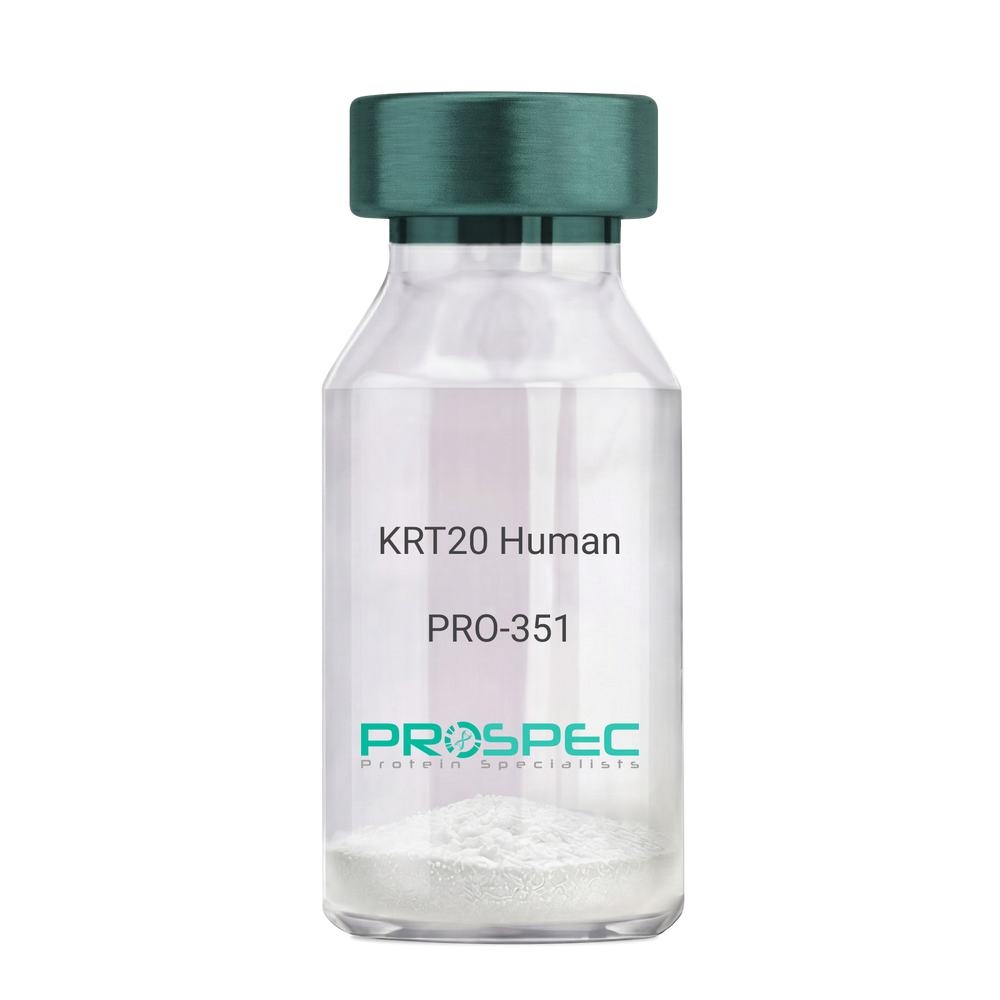
    KRT20 Human

    Description:

    Cytokeratin 20 Human Recombinant

    Keratin type I cytoskeletal 20, Cytokeratin-20, CK-20, Keratin-20, K20, Protein IT, KRT20, CD20, CK20, KRT21, MGC35423.

    Product # :

    PRO-351

    Price :

    Quantity :

    Shipping Method :

    Room Temp Icon

    Shipped at Room temp

    Add To Cart

    More Info

    • description
    • source
    • formulation
    • purity
    • More Info

    Description

    Cytokeratin 20 Human Recombinant produced in E.Coli is a single,non-glycosylated polypeptide chain having a molecular mass of 48,553 Dalton. The KRT20 is purified by proprietary chromatographic techniques.

    Source

    Escherichia Coli.

    Formulation

    The protein (1mg/1ml) was lyophilized after from a sterile solution containing 30mM Tris-HCL pH-8, 9.5M urea, 2mM DDT, 2mM EDTA and 10mM methylammonium chloride.

    Purity

    Greater than 95.0% as determined by SDS-PAGE.

    More Info

    • Introduction

      KRT20 is a member of the keratin family. The keratins are intermediate filament proteins responsible for the structural integrity of epithelial cells and are subdivided into cytokeratins and hair keratins. The type I cytokeratins consist of acidic proteins which are arranged in pairs of heterotypic keratin chains. This cytokeratin is a major cellular protein of mature enterocytes and goblet cells and is specifically expressed in the gastric and intestinal mucosa. The type I cytokeratin genes are clustered in a region of chromosome 17q12-q21.

    • Synonyms

      Keratin type I cytoskeletal 20, Cytokeratin-20, CK-20, Keratin-20, K20, Protein IT, KRT20, CD20, CK20, KRT21, MGC35423.

    • Physical Appearance

      Sterile Filtered White lyophilized (freeze-dried) powder.

    • Stability

      Lyophilized KRT20 although stable at room temperature for 3 weeks, should be stored desiccated below -18°C. Upon reconstitution KRT20 should be stored at 4°C between 2-7 days and for future use below -18°C.For long term storage it is recommended to add a carrier protein (0.1% HSA or BSA).Please prevent freeze-thaw cycles.

    • Solubility

      It is recommended to reconstitute the lyophilized KRT20 in sterile 18MΩ-cm H2O not less than 100µg/ml, which can then be further diluted to other aqueous solutions.

    • Reconstitution to filaments

      Performed by mixing equimolar amounts of cytokeratins of type I and type II at concentrations of approx. 0.5 mg/ml, both dissolved in 9.5 M urea buffer (see above). Protofilaments and filament complexes are obtained by dialyzing the resulting polypeptide solution stepwise to a concentration of 4 M urea and then to low salt condition (50 mM NaCI, 2 mM dithiothreitol, 10 mM Tris-HCI, pH 7.4). For immunization purposes, the solution can be further dialyzed against PBS (phosphate buffered saline, e.g. Dulbecco's PBS).

    ProSpec's products are furnished for LABORATORY RESEARCH USE ONLY. The product may not be used as drugs, agricultural or pesticidal products, food additives or household chemicals.

    Krt20 Human
  • View Data Sheet

    Name :

    FGL1 Human

    Description:

    Fibrinogen Like 1 Human Recombinant

    Fibrinogen-like protein 1, HP-041, Hepassocin, Hepatocyte-derived fibrinogen-related protein 1, HFREP-1, Liver fibrinogen-related protein 1, LFIRE-1, FGL1, HFREP1.

    Product # :

    PRO-2580

    Price :

    Quantity :

    Shipping Method :

    Room Temp Icon

    Shipped at Room temp

    Add To Cart

    More Info

    • description
    • source
    • formulation
    • purity
    • More Info

    Description

    FGL1 Human Recombinant produced in E.Coli is a single, non-glycosylated, polypeptide chain (a.a 23-312) containing 300 amino acids including a 10 a.a N-terminal His tag. The total molecular mass is 35.3kDa (calculated).

    Source

    Escherichia Coli.

    Formulation

    FGL1 filtered (0.4 µm) and lyophilized from 0.5mg/ml in in 100 mM carbonate buffer, pH 9.2.

    Purity

    Greater than 90.0% as determined by SDS-PAGE.

    More Info

    • Introduction

      FGL1 belongs to the fibrinogen family. Fibrinogen Like 1 is homologous to the carboxy terminus of the fibrinogen beta- and gamma- subunits which comprises the 4 conserved cysteines of fibrinogens and fibrinogen related proteins. FGL1 lacks the platelet-binding site, cross-linking region and a thrombin-sensitive site which are necessary for fibrin clot formation. Fibrinogen takes part in the development of hepatocellular carcinomas.

    • Synonyms

      Fibrinogen-like protein 1, HP-041, Hepassocin, Hepatocyte-derived fibrinogen-related protein 1, HFREP-1, Liver fibrinogen-related protein 1, LFIRE-1, FGL1, HFREP1.

    • Physical Appearance

      Filtered White lyophilized (freeze-dried) powder.

    • Stability

      Store lyophilized protein at -20°C. Aliquot the product after reconstitution to avoid repeated freezing/thawing cycles. Reconstituted protein can be stored at 4°C for a limited period of time; it does not show any change after two weeks at 4°C.

    • Solubility

      It is recommended to add deionized water to prepare a working stock solution of approximately 0.5mg/ml and let the lyophilized pellet dissolve completely. FGL1 is not sterile! Please filter the product by an appropriate sterile filter before using it in the cell culture.

    • Amino Acid Sequence

      MKHHHHHHAS LEDCAQEQMR LRAQVRLLET RVKQQQVKIK QLLQENEVQF LDKGDENTVI DLGSKRQYAD CSEIFNDGYK LSGFYKIKPL QSPAEFSVYC DMSDGGGWTV IQRRSDGSEN FNRGWKDYEN GFGNFVQKHG EYWLGNKNLH FLTTQEDYTL KIDLADFEKN SRYAQYKNFK VGDEKNFYEL NIGEYSGTAG DSLAGNFHPE VQWWASHQRM KFSTWDRDHD NYEGNCAEED QSGWWFNRCH SANLNGVYYS GPYTAKTDNG IVWYTWHGWW YSLKSVVMKI RPNDFIPNVI.

    ProSpec's products are furnished for LABORATORY RESEARCH USE ONLY. The product may not be used as drugs, agricultural or pesticidal products, food additives or household chemicals.

    Fgl1 Human
  • View Data Sheet

    Name :

    NEFL Bovine

    Description:

    Neurofilament Light Bovine

    Neurofilament light polypeptide, NF-L, NEFL, NF68, NFL, 68 kDa neurofilament protein.

    Product # :

    PRO-2786

    Price :

    Quantity :

    Shipping Method :

    Room Temp Icon

    Shipped at Room temp

    Add To Cart

    More Info

    • description
    • source
    • formulation
    • purity
    • More Info

    Description

    NEFL Bovine having a calculated molecular mass of 68 kDa, pI-5.0.

    Source

    Bovine spinal cord.

    Formulation

    NEFL was lyophilized from a 1mg/ml solution containing 10mM sodium phosphate buffer pH 7.5, 6M urea, 1mM EDTA, 2mM DTT and 10mM methylammonium chloride.

    Purity

    Greater than 95.0% as determined by SDS-PAGE.

    More Info

    • Synonyms

      Neurofilament light polypeptide, NF-L, NEFL, NF68, NFL, 68 kDa neurofilament protein.

    • Physical Appearance

      Filtered White lyophilized (freeze-dried) powder.

    • Stability

      Store the lyophilized NEFL between 2-8°C, do not freeze. Upon reconstitution NEFL should be stored at -20°C.Please prevent freeze-thaw cycles.

    • Solubility

      It is recommended to reconstitute the lyophilized NEFL in sterile 18MΩ-cm H2O not less than 100µg/ml, which can then be further diluted to other aqueous solutions.

    • Background

      Neurofilament light chain (NEFL) is a critical component of the neuronal cytoskeleton, primarily found in neurons of the central and peripheral nervous systems. While extensive research has been conducted on NEFL in human and rodent models, the study of NEFL in bovine nervous tissues is an emerging area with potential for advancing our understanding of neuronal biology in larger mammals and its applications in veterinary medicine and neurobiology.

      Bovine nervous tissues, such as the brain and spinal cord, are of particular interest due to their relevance in cattle health and the food industry. This research aims to provide a comprehensive exploration of NEFL in bovine nervous tissues, elucidating its functions, structural significance, and potential applications.

      The primary objective of this research is to elucidate the role of NEFL in bovine nervous tissues, particularly in maintaining the structural integrity of neurons and axons. In vitro and ex vivo experiments, utilizing bovine neuronal cell cultures and tissue specimens, will be conducted to investigate how NEFL contributes to neuronal morphology, axonal transport, and neuronal resilience. Understanding these mechanisms is fundamental for deciphering the complexities of neuronal biology in bovine species.

      The second objective is to assess the relevance of bovine NEFL in veterinary medicine. Studies involving bovine models will be conducted to evaluate the impact of NEFL mutations or variations on neuronal health, disease susceptibility, and neurodegenerative conditions. These investigations may provide valuable insights into potential applications in cattle health and the development of diagnostic tools for neurological disorders.

      The third objective is to explore the potential applications of bovine NEFL in neurobiology and biotechnology. Research will investigate the use of bovine NEFL-expressing cells as models for studying neuronal-related diseases and for developing tissue engineering approaches for veterinary medicine and biotechnology.

      By delving into the functions and roles of NEFL in bovine nervous tissues, this research aims to expand our knowledge of neuronal biology, its implications for veterinary medicine, and its potential applications in neurobiology and cattle health

    ProSpec's products are furnished for LABORATORY RESEARCH USE ONLY. The product may not be used as drugs, agricultural or pesticidal products, food additives or household chemicals.

    Nefl Bovine
  • View Data Sheet

    Name :

    CTSD Mouse

    Description:

    Cathepsin-D Mouse Recombinant

    Ctsd, CatD, CD, Cathepsin D.

    Product # :

    ENZ-1017

    Price :

    Quantity :

    Shipping Method :

    Ice Icon

    Shipped with Ice Packs

    Add To Cart

    More Info

    • description
    • source
    • formulation
    • purity
    • biological activity
    • More Info

    Description

    CTSD produced in Sf9 Baculovirus cells is a single, glycosylated polypeptide chain containing 398 amino acids (21-410 a.a.) and having a molecular mass of 44.0kDa (Molecular size on SDS-PAGE will appear at approximately 40-57kDa). CTSD is expressed with an 8 amino acid His tag at C-Terminus and purified by proprietary chromatographic techniques.

    Source

    Sf9, Baculovirus cells.

    Formulation

    CTSD protein solution (0.25mg/ml) contains Phosphate Buffered Saline (pH 7.4) and 10% glycerol.

    Purity

    Greater than 90.0% as determined by SDS-PAGE.

    Biological Activity

    Specific activity is > 1,000 pmol/min/ug in which one unit will convert 1.0 pmole of Mca-PLGL-Dpa-AR-NH2 to MCA- Pro-Leu-OH per minute at pH 3.5 at 25C.

    More Info

    • Introduction

      Cathepsin D is synthesized as a 54kDa precursor, which is proteolytically processed to an intermediate 48kDa single chain, which matures into more stable 34kDa and 14kDa two chain form. It is an estrogen-regulated lysosomal protease that has been suggested to facilitate cancer cell migration and invasion by digesting the basement membrane, extracellular matrix, and xonnective tissue. Because of its mitogenic and proteolytic activities, it has been implicated as a prognostic marker in many tumor types. Cathepsin D is expressed in epithelial cells as well as in macrophages.

    • Synonyms

      Ctsd, CatD, CD, Cathepsin D.

    • Physical Appearance

      Sterile Filtered colorless solution.

    • Stability

      Store at 4°C if entire vial will be used within 2-4 weeks. Store, frozen at -20°C for longer periods of time. For long term storage it is recommended to add a carrier protein (0.1% HSA or BSA). Avoid multiple freeze-thaw cycles.

    • Amino Acid Sequence

      IIRIPLRKFT SIRRTMTEVG GSVEDLILKG PITKYSMQSS PKTTEPVSEL LKNYLDAQYY GDIGIGTPPQ CFTVVFDTGS SNLWVPSIHC KILDIACWVH HKYNSDKSST YVKNGTSFDI HYGSGSLSGY LSQDTVSVPC KSDQSKARGI KVEKQIFGEA TKQPGIVFVA AKFDGILGMG YPHISVNNVL PVFDNLMQQK LVDKNIFSFY LNRDPEGQPG GELMLGGTDS KYYHGELSYL NVTRKAYWQV HMDQLEVGNE LTLCKGGCEA IVDTGTSLLV GPVEEVKELQ KAIGAVPLIQ GEYMIPCEKV SSLPTVYLKL GGKNYELHPD KYILKVSQGG KTICLSGFMG MDIPPPSGPL WILGDVFIGS YYTVFDRDNN RVGFANAVVL LEHHHHHH.

    ProSpec's products are furnished for LABORATORY RESEARCH USE ONLY. The product may not be used as drugs, agricultural or pesticidal products, food additives or household chemicals.

    Ctsd Mouse
  • 1
  • …
  • 40
  • 41
  • 42
Your browser does not support the video tag.

Products

  • Cytokines
  • Growth Factors
  • Chemokines
  • CD Antigens
  • Neurotrophins
  • Hormones
  • Enzymes
  • Viral Antigens
  • Recombinant Proteins
  • Natural Proteins
  • Monoclonal Antibodies
  • Polyclonal Antibodies
  • Thermal Packaging

About

  • Company
  • Founder
  • Contribution
  • Contact Us
  • My Account

Ordering

  • Ordering Method
  • Ordering - Credit Card
  • Ordering PO
  • Shipping Fees
  • FAQ's

Legal

  • Terms & Conditions
  • Privacy
  • Site Map
  • info@prospecbio.com
  • Facebook
  • Instagram
  • Linkedin Profile

© 2026 ProSpec-Tany TechnoGene Ltd. All Rights Reserved.

  • Choosing a selection results in a full page refresh.
  • Opens in a new window.