Skip to content

High-quality research proteins.

  • 1-800-805-6531

  • Mon - Sat 8.00-18.00, Sun - Closed

  • info@prospecbio.com

  • PO Box 6591 East Brunswick NJ 08816

  • Products
    • Cytokines
    • Growth factors
    • Chemokines
    • Cd antigens
    • Neurotrophins
    • Hormones
    • Enzymes
    • Viral antigens
    • Recombinant proteins
    • Natural proteins
    • Monoclonal antibodies
    • Polyclonal antibodies
    • Thermal Packaging
  • About
    • Company
    • Founder
    • Contribution
  • Customers
    • Eastern Asia
    • Eastern Europe
    • North America
    • South America
    • South East Asia
    • Southern Asia
    • Western Europe
  • Ordering
    • Ordering Method
    • Ordering - Credit Card
    • Ordering - PO
    • Shipping Fees
    • FAQs
  • Services
    • DNA Cloning
    • Protein Expression
    • Monoclonal Antibody
    • Fermentation
    • Technology License
  • Contact us
Log in

Country/region

  • USD $ | Albania
  • USD $ | Andorra
  • USD $ | Argentina
  • USD $ | Armenia
  • USD $ | Australia
  • USD $ | Austria
  • USD $ | Azerbaijan
  • USD $ | Belarus
  • USD $ | Belgium
  • USD $ | Bolivia
  • USD $ | Brazil
  • USD $ | Bulgaria
  • USD $ | Cambodia
  • USD $ | Canada
  • USD $ | Chile
  • USD $ | China
  • USD $ | Colombia
  • USD $ | Costa Rica
  • USD $ | Croatia
  • USD $ | Cyprus
  • USD $ | Czechia
  • USD $ | Denmark
  • USD $ | Estonia
  • USD $ | Finland
  • USD $ | France
  • USD $ | Georgia
  • USD $ | Germany
  • USD $ | Greece
  • USD $ | Hong Kong SAR
  • USD $ | Hungary
  • USD $ | Iceland
  • USD $ | India
  • USD $ | Ireland
  • USD $ | Israel
  • USD $ | Italy
  • USD $ | Japan
  • USD $ | Kazakhstan
  • USD $ | Latvia
  • USD $ | Liechtenstein
  • USD $ | Lithuania
  • USD $ | Madagascar
  • USD $ | Malta
  • USD $ | Mexico
  • USD $ | Moldova
  • USD $ | Monaco
  • USD $ | Netherlands
  • USD $ | New Zealand
  • USD $ | North Macedonia
  • USD $ | Norway
  • USD $ | Panama
  • USD $ | Paraguay
  • USD $ | Peru
  • USD $ | Philippines
  • USD $ | Poland
  • USD $ | Portugal
  • USD $ | Romania
  • USD $ | Singapore
  • USD $ | Slovakia
  • USD $ | Slovenia
  • USD $ | South Africa
  • USD $ | South Korea
  • USD $ | Spain
  • USD $ | Sri Lanka
  • USD $ | Sweden
  • USD $ | Switzerland
  • USD $ | Taiwan
  • USD $ | Thailand
  • USD $ | Türkiye
  • USD $ | Ukraine
  • USD $ | United Kingdom
  • USD $ | United States
  • USD $ | Uruguay
  • USD $ | Vatican City
  • USD $ | Venezuela
  • USD $ | Vietnam
  • Facebook
  • Instagram
logoProSpec - Recombinant Protein Manufacturer for academic and R&D industry
Become a distributor
Account Log in
Wishlist
Cart Cart(0)
  • Products
    +
    • Cytokines
    • Growth factors
    • Chemokines
    • Cd antigens
    • Neurotrophins
    • Hormones
    • Enzymes
    • Viral antigens
    • Recombinant proteins
    • Natural proteins
    • Monoclonal antibodies
    • Polyclonal antibodies
    • Thermal Packaging
  • About
    +
    • Company
    • Founder
    • Contribution
  • Customers
    +
    • Eastern Asia
    • Eastern Europe
    • North America
    • South America
    • South East Asia
    • Southern Asia
    • Western Europe
  • Ordering
    +
    • Ordering Method
    • Ordering - Credit Card
    • Ordering - PO
    • Shipping Fees
    • FAQs
  • Services
    +
    • DNA Cloning
    • Protein Expression
    • Monoclonal Antibody
    • Fermentation
    • Technology License
  • Contact us

Item added to your cart

View cart
View All
  • Cytokines
  • Growth factors
  • Chemokines
  • Cd antigens
  • Neurotrophins
  • Hormones
  • Enzymes
  • Viral antigens
  • Recombinant proteins
  • Natural proteins
  • Monoclonal antibodies
  • Polyclonal antibodies
  • Thermal Packaging
  • Tumor Necrosis Factor

    Tumor Necrosis Factor

    View All
  • 4-1BB

    4-1BB

    View All
  • Adiponectin

    Adiponectin

    View All
  • AIF1

    AIF1

    View All
  • Other Cytokines

    Other Cytokines

    View All
  • AITRL

    AITRL

    View All
  • Angiopoietin

    Angiopoietin

    View All
  • Apolipoprotein

    Apolipoprotein

    View All
  • B-Cell Activating Factor

    B-Cell Activating Factor

    View All
  • Beta Defensin

    Beta Defensin

    View All
  • Bone Morphogenetic Protein

    Bone Morphogenetic Protein

    View All
  • B type Natriuretic Peptide

    B type Natriuretic Peptide

    View All
  • BST

    BST

    View All
  • Betacellulin

    Betacellulin

    View All
  • Cardiotrophin

    Cardiotrophin

    View All
  • Activin

    Activin

    View All
  • Fibroblast Growth Factor

    Fibroblast Growth Factor

    View All
  • Other Growth Factors

    Other Growth Factors

    View All
  • CSF

    CSF

    View All
  • CTGF

    CTGF

    View All
  • IGFBP

    IGFBP

    View All
  • VEGF Protein

    VEGF Protein

    View All
  • EGF

    EGF

    View All
  • Epigen

    Epigen

    View All
  • Erythropoietin

    Erythropoietin

    View All
  • Insulin-Like Growth Factor

    Insulin-Like Growth Factor

    View All
  • Growth Hormone

    Growth Hormone

    View All
  • HDGF

    HDGF

    View All
  • Hepatocyte Growth Factor

    Hepatocyte Growth Factor

    View All
  • Insulin

    Insulin

    View All
  • BCA-1/ BLC (CXCL13)

    BCA-1/ BLC (CXCL13)

    View All
  • BRAK (CXCL14)

    BRAK (CXCL14)

    View All
  • C-10 (CCL6)

    C-10 (CCL6)

    View All
  • Other Chemokines

    Other Chemokines

    View All
  • MEC (CCL28)

    MEC (CCL28)

    View All
  • LD78-beta (CCL3L1)

    LD78-beta (CCL3L1)

    View All
  • CTACK (CCL27)

    CTACK (CCL27)

    View All
  • CXCL16

    CXCL16

    View All
  • CXCL17

    CXCL17

    View All
  • Platelet Factor-4 (CXCL4)

    Platelet Factor-4 (CXCL4)

    View All
  • ENA-78 (CXCL5)

    ENA-78 (CXCL5)

    View All
  • Eotaxin (CCL11,24,26)

    Eotaxin (CCL11,24,26)

    View All
  • Exodus-2 (CCL21)

    Exodus-2 (CCL21)

    View All
  • Fractalkine (CX3CL1)

    Fractalkine (CX3CL1)

    View All
  • CXCL6

    CXCL6

    View All
  • Other CD Antigens

    Other CD Antigens

    View All
  • CD14

    CD14

    View All
  • CD164

    CD164

    View All
  • CD1

    CD1

    View All
  • CD2

    CD2

    View All
  • CD200

    CD200

    View All
  • CD207

    CD207

    View All
  • CD226

    CD226

    View All
  • CD23

    CD23

    View All
  • CD244

    CD244

    View All
  • CD247

    CD247

    View All
  • CD27

    CD27

    View All
  • CD274

    CD274

    View All
  • CD300

    CD300

    View All
  • CD33

    CD33

    View All
  • Other Neurotrophins

    Other Neurotrophins

    View All
  • Beta-NGF

    Beta-NGF

    View All
  • BDNF

    BDNF

    View All
  • CDNF

    CDNF

    View All
  • CNTF

    CNTF

    View All
  • GDNF

    GDNF

    View All
  • Glia Maturation Factor

    Glia Maturation Factor

    View All
  • MANF

    MANF

    View All
  • Midkine

    Midkine

    View All
  • Neuroglobin

    Neuroglobin

    View All
  • Neurotrophic factors

    Neurotrophic factors

    View All
  • Neuregulin

    Neuregulin

    View All
  • Neuropilin

    Neuropilin

    View All
  • Pigment Epithelium-Derived Factor

    Pigment Epithelium-Derived Factor

    View All
  • Pleiotrophin

    Pleiotrophin

    View All
  • Peptide Hormones

    Peptide Hormones

    View All
  • Other Hormones

    Other Hormones

    View All
  • HCG

    HCG

    View All
  • Endothelin

    Endothelin

    View All
  • Exendin

    Exendin

    View All
  • FSH

    FSH

    View All
  • Glucagon

    Glucagon

    View All
  • GHRP

    GHRP

    View All
  • GLP

    GLP

    View All
  • Thyrostimulin

    Thyrostimulin

    View All
  • Inhibin A

    Inhibin A

    View All
  • LHRH

    LHRH

    View All
  • Melanotan

    Melanotan

    View All
  • Procalcitonin

    Procalcitonin

    View All
  • PTH

    PTH

    View All
  • Peroxiredoxin

    Peroxiredoxin

    View All
  • Peptidase

    Peptidase

    View All
  • Synthetase

    Synthetase

    View All
  • Transferase

    Transferase

    View All
  • Hydrolase

    Hydrolase

    View All
  • Dehydrogenase

    Dehydrogenase

    View All
  • ACE2

    ACE2

    View All
  • Esterase

    Esterase

    View All
  • Protein Kinases

    Protein Kinases

    View All
  • Other Enzymes

    Other Enzymes

    View All
  • Phosphatase

    Phosphatase

    View All
  • Deaminase

    Deaminase

    View All
  • Oxygenase

    Oxygenase

    View All
  • Adenylate Kinase

    Adenylate Kinase

    View All
  • Lyase

    Lyase

    View All
  • Chagas

    Chagas

    View All
  • SARS

    SARS

    View All
  • Influenza

    Influenza

    View All
  • ASFV

    ASFV

    View All
  • Astrovirus

    Astrovirus

    View All
  • Borrelia

    Borrelia

    View All
  • Helicobacter Pylori

    Helicobacter Pylori

    View All
  • Chikungunya

    Chikungunya

    View All
  • Chlamydia

    Chlamydia

    View All
  • Cytomegalo

    Cytomegalo

    View All
  • Dengue

    Dengue

    View All
  • EBV

    EBV

    View All
  • Ebola

    Ebola

    View All
  • Feline Leukemia Virus

    Feline Leukemia Virus

    View All
  • Hepatitis A

    Hepatitis A

    View All
  • Other

    Other

    View All
  • Actin

    Actin

    View All
  • ADAM

    ADAM

    View All
  • Complement Component

    Complement Component

    View All
  • Ag85

    Ag85

    View All
  • Eukaryotic Translation Initiation Factor

    Eukaryotic Translation Initiation Factor

    View All
  • Anterior Gradient Protein

    Anterior Gradient Protein

    View All
  • Heat Shock Protein

    Heat Shock Protein

    View All
  • Alpha-2-HS-Glycoprotein

    Alpha-2-HS-Glycoprotein

    View All
  • Hemoglobin

    Hemoglobin

    View All
  • Allergy

    Allergy

    View All
  • Anaplasma

    Anaplasma

    View All
  • Angiogenin

    Angiogenin

    View All
  • Ankyrin Repeat Domain

    Ankyrin Repeat Domain

    View All
  • Annexin

    Annexin

    View All
  • Other Natural Proteins

    Other Natural Proteins

    View All
  • Aprotinin

    Aprotinin

    View All
  • Transferrin

    Transferrin

    View All
  • Avidin

    Avidin

    View All
  • Anti Coagulation Factors

    Anti Coagulation Factors

    View All
  • Natural Albumin

    Natural Albumin

    View All
  • Natural Coagulation Factors

    Natural Coagulation Factors

    View All
  • Fibronectin

    Fibronectin

    View All
  • Thrombin

    Thrombin

    View All
  • Anti Human Enzyme

    Anti Human Enzyme

    View All
  • Other Monoclonal Antibodies

    Other Monoclonal Antibodies

    View All
  • Anti Human Cytokine

    Anti Human Cytokine

    View All
  • Anti Human Heat Shock Protein

    Anti Human Heat Shock Protein

    View All
  • Anti Mouse Lymphocyte

    Anti Mouse Lymphocyte

    View All
  • Anti Human Chemokine

    Anti Human Chemokine

    View All
  • Anti Human Lymphocyte

    Anti Human Lymphocyte

    View All
  • Anti Viral Monoclonal

    Anti Viral Monoclonal

    View All
  • Anti Mouse Cytokine

    Anti Mouse Cytokine

    View All
  • Anti-GST Monoclonal

    Anti-GST Monoclonal

    View All
  • Other Polyclonal Antibodies

    Other Polyclonal Antibodies

    View All
  • Anti Viral

    Anti Viral

    View All
  • Anti-GST Monoclonal

    Anti-GST Monoclonal

    View All
Back

Search results

1000 results found for “tyrosine kinase”

Name

Description

Product #

Price

Quantity

Shipping Method

  • View Data Sheet

    Name :

    TROVE2 Human

    Description:

    TROVE Domain Family Member 2 Human Recombinant

    60 kDa SS-A/Ro ribonucleoprotein, 60 kDa ribonucleoprotein Ro, RoRNP, 60 kDa Ro protein, Ro 60 kDa autoantigen, TROVE domain family member 2, Sjoegren syndrome type A antigen, SS-A, Sjoegren syndrome antigen A2, TROVE2, RO60, SSA2, RO-60.

    Product # :

    PRO-329

    Price :

    Quantity :

    Shipping Method :

    Ice Icon

    Shipped with Ice Packs

    Add To Cart

    More Info

    • description
    • source
    • formulation
    • purity
    • More Info

    Description

    RO-60 Human Recombinant produced in E.Coli is a single, non-glycosylated, polypeptide chain having a molecular mass of 60kDa. RO60 is fused to a 6 amino acid His-Tag at C-terminus and purified by proprietary chromatographic techniques.

    Source

    Escherichia Coli.

    Formulation

    The protein solution contains 6M Urea, 500mM NaCl, 500mM imidazole and 10mM Tris pH-6.

    Purity

    Greater than 90.0% as determined by SDS-PAGE.

    More Info

    • Introduction

      Ro 60 kDa autoantigen is an RNA-binding protein that binds to several small cytoplasmic RNA molecules known as Y RNAs. SSA2 may stabilize these RNAs from degradation. Sera taken from patients with Systemic Lupus Erythematosus (SLE) often contains antibodies that react with the normal cellular SSA2 protein as if this antigen was foreign.

    • Synonyms

      60 kDa SS-A/Ro ribonucleoprotein, 60 kDa ribonucleoprotein Ro, RoRNP, 60 kDa Ro protein, Ro 60 kDa autoantigen, TROVE domain family member 2, Sjoegren syndrome type A antigen, SS-A, Sjoegren syndrome antigen A2, TROVE2, RO60, SSA2, RO-60.

    • Physical Appearance

      Sterile Filtered clear solution.

    • Stability

      RO-60 although stable at 4°C for 3 weeks, should be stored below -18°C. Please prevent freeze-thaw cycles.

    ProSpec's products are furnished for LABORATORY RESEARCH USE ONLY. The product may not be used as drugs, agricultural or pesticidal products, food additives or household chemicals.

    Trove2 Human
  • View Data Sheet

    Name :

    TXNDC12 Human

    Description:

    Thioredoxin Domain Containing 12 Human Recombinant

    Thioredoxin domain containing 12 (endoplasmic reticulum), Endoplasmic reticulum resident protein 18, Endoplasmic reticulum resident protein 19, endoplasmic reticulum thioredoxin superfamily member 18 kDa, thioredoxin domain-containing protein 12, protein disulfide isomerase family A member 16, endoplasmic reticulum protein ERp19, anterior gradient homolog 1, Thioredoxin-like protein p19, ER protein 18, ERP18, ER protein 19, ERP19, ERP16, TLP19, AGR1, PDIA16, hAG-1, EC 1.8.4.2.

    Product # :

    PRO-1133

    Price :

    Quantity :

    Shipping Method :

    Ice Icon

    Shipped with Ice Packs

    Add To Cart

    More Info

    • description
    • source
    • formulation
    • purity
    • More Info

    Description

    TXNDC12 Human Recombinant produced in E. coli is a single polypeptide chain containing 184 amino acids (27-172) and having a molecular mass of 20.8 kDa.TXNDC12 is fused to a 38 amino acid His-tag at N-terminus & purified by proprietary chromatographic techniques.

    Source

    E.coli.

    Formulation

    The TXNDC12 solution (0.25mg/ml) contains 20mM Tris-HCl buffer (pH 8.0), 0.15M NaCl and 10% glycerol.

    Purity

    Greater than 90% as determined by SDS-PAGE.

    More Info

    • Introduction

      TXNDC12 is a member of the thioredoxin super family. This Family members have a thioredoxin fold with a consensus active-site sequence (CxxC) and take part in redox regulation, protection against oxidative stress, refolding of disulfide-containing proteins, and regulation of transcription factors.

    • Synonyms

      Thioredoxin domain containing 12 (endoplasmic reticulum), Endoplasmic reticulum resident protein 18, Endoplasmic reticulum resident protein 19, endoplasmic reticulum thioredoxin superfamily member 18 kDa, thioredoxin domain-containing protein 12, protein disulfide isomerase family A member 16, endoplasmic reticulum protein ERp19, anterior gradient homolog 1, Thioredoxin-like protein p19, ER protein 18, ERP18, ER protein 19, ERP19, ERP16, TLP19, AGR1, PDIA16, hAG-1, EC 1.8.4.2.

    • Physical Appearance

      Sterile Filtered colorless solution.

    • Stability

      Store at 4°C if entire vial will be used within 2-4 weeks. Store, frozen at -20°C for longer periods of time. For long term storage it is recommended to add a carrier protein (0.1% HSA or BSA).Avoid multiple freeze-thaw cycles.

    • Amino Acid Sequence

      MRGSHHHHHH GMASMTGGQQ MGRDLYDDDD KDRWGSHMHN GLGKGFGDHI HWRTLEDGKK EAAASGLPLM VIIHKSWCGA CKALKPKFAE STEISELSHN FVMVNLEDEE EPKDEDFSPD GGYIPRILFL DPSGKVHPEI INENGNPSYK YFYVSAEQVV QGMKEAQERL TGDAFRKKHL EDEL

    ProSpec's products are furnished for LABORATORY RESEARCH USE ONLY. The product may not be used as drugs, agricultural or pesticidal products, food additives or household chemicals.

    Txndc12 Human
  • View Data Sheet

    Name :

    CCBL1 Human

    Description:

    Cysteine Conjugate-Beta Lyase Cytoplasmic Human Recombinant

    Cysteine Conjugate-Beta Lyase, Cytoplasmic, Glutamine Transaminase K, Cysteine Conjugate-Beta Lyase; Cytoplasmic (Glutamine Transaminase K, Kyneurenine Aminotransferase), Kynurenine--Oxoglutarate Transaminase I, Glutamine--Phenylpyruvate Transaminase, Cysteine-S-Conjugate Beta-Lyase, Kynurenine Aminotransferase I, Kyneurenine Aminotransferase, KATI, GTK, Glutamine-Phenylpyruvate Aminotransferase, Kynurenine--Oxoglutarate Transaminase 1, Beta-Lysase, Kidney, EC 4.4.1.13, EC 2.6.1.64, EC 2.6.1.7, KAT1, Kynurenine--oxoglutarate transaminase 1.

    Product # :

    ENZ-878

    Price :

    Quantity :

    Shipping Method :

    Ice Icon

    Shipped with Ice Packs

    Add To Cart

    More Info

    • description
    • source
    • formulation
    • purity
    • More Info

    Description

    CCBL1 Human Recombinant produced in E.Coli is a single, non-glycosylated polypeptide chain containing 445 amino acids (1-422 a.a) and having a molecular mass of 50.3kDa. CCBL1 is fused to a 23 amino acid His-tag at N-terminus & purified by proprietary chromatographic techniques.

    Source

    Escherichia Coli.

    Formulation

    CCBL1 protein solution (1mg/ml) containing Phosphate buffered saline (pH7.4), 10% glycerol and 1mM DTT.

    Purity

    Greater than 90.0% as determined by SDS-PAGE.

    More Info

    • Introduction

      Cysteine Conjugate-Beta Lyase Cytoplasmic also known as CCBL1 is a member of the class-I pyridoxal-phosphate-dependent aminotransferase family. CCBL1 catalyzes the irreversible transamination of the L-tryptophan metabolite L-kynurenine to form kynurenic acid (KA) it also metabolizes the cysteine conjugates of certain halogenated alkenes and alkanes to form reactive metabolites. Furthermore, CCBL1 catalyzes the beta-elimination of S-conjugates and Se-conjugates of L-(seleno) cysteine, resulting in the cleavage of the C-S or C-Se bond.

    • Synonyms

      Cysteine Conjugate-Beta Lyase, Cytoplasmic, Glutamine Transaminase K, Cysteine Conjugate-Beta Lyase; Cytoplasmic (Glutamine Transaminase K, Kyneurenine Aminotransferase), Kynurenine--Oxoglutarate Transaminase I, Glutamine--Phenylpyruvate Transaminase, Cysteine-S-Conjugate Beta-Lyase, Kynurenine Aminotransferase I, Kyneurenine Aminotransferase, KATI, GTK, Glutamine-Phenylpyruvate Aminotransferase, Kynurenine--Oxoglutarate Transaminase 1, Beta-Lysase, Kidney, EC 4.4.1.13, EC 2.6.1.64, EC 2.6.1.7, KAT1, Kynurenine--oxoglutarate transaminase 1.

    • Physical Appearance

      Sterile Filtered colorless solution.

    • Stability

      Store at 4°C if entire vial will be used within 2-4 weeks. Store, frozen at -20°C for longer periods of time. For long term storage it is recommended to add a carrier protein (0.1% HSA or BSA).Avoid multiple freeze-thaw cycles.

    • Amino Acid Sequence

      MGSSHHHHHH SSGLVPRGSH MGSMAKQLQA RRLDGIDYNP WVEFVKLASE HDVVNLGQGF PDFPPPDFAV EAFQHAVSGD FMLNQYTKTF GYPPLTKILA SFFGELLGQE IDPLRNVLVT VGGYGALFTA FQALVDEGDE VIIIEPFFDC YEPMTMMAGG RPVFVSLKPG PIQNGELGSS SNWQLDPMEL AGKFTSRTKA LVLNTPNNPL GKVFSREELE LVASLCQQHD VVCITDEVYQ WMVYDGHQHI SIASLPGMWE RTLTIGSAGK TFSATGWKVG WVLGPDHIMK HLRTVHQNSV FHCPTQSQAA VAESFEREQL LFRQPSSYFV QFPQAMQRCR DHMIRSLQSV GLKPIIPQGS YFLITDISDF KRKMPDLPGA VDEPYDRRFV KWMIKNKGLV AIPVSIFYSV PHQKHFDHYI RFCFVKDEAT LQAMDEKLRK WKVEL.

    ProSpec's products are furnished for LABORATORY RESEARCH USE ONLY. The product may not be used as drugs, agricultural or pesticidal products, food additives or household chemicals.

    Ccbl1 Human
  • View Data Sheet

    Name :

    MAT1A Human

    Description:

    Methionine Adenosyltransferase I Alpha Human Recombinant

    EC 2.5.1.6, MAT, MATA1, SAMS, SAMS1, Methionine adenosyltransferase 1, S-adenosylmethionine synthase isoform type-1, AdoMet synthase 1, MAT 1, Methionine adenosyltransferase I/III, MAT-I/III, MAT1A, AMS1.

    Product # :

    ENZ-493

    Price :

    Quantity :

    Shipping Method :

    Ice Icon

    Shipped with Ice Packs

    Add To Cart

    More Info

    • description
    • source
    • formulation
    • purity
    • More Info

    Description

    MAT1A Human Recombinant produced in E.Coli is a single, non-glycosylated polypeptide chain containing 414 amino acids (1-395 a.a.) and having a molecular mass of 45.6 kDa. The MAT1A is fused to a 20 amino acid his tag at N-terminus and purified by conventional chromatography.

    Source

    Escherichia Coli.

    Formulation

    The MAT1A protein solution contains 20mM Tris-HCl pH-8, 1mM DTT, 100mM NaCl and 10% glycerol.

    Purity

    Greater than 95.0% as determined by SDS-PAGE.

    More Info

    • Introduction

      MAT1A catalyzes a two-step reaction that involves the transfer of the adenosyl moiety of ATP to methionine to form S-adenosylmethionine and tripolyphosphate, which is subsequently cleaved to PPi and Pi. S-adenosylmethionine is the source of methyl groups for most biological methylations. MAT1A is found as a homotetramer (MAT I) or a homodimer (MAT III) whereas a third form, MAT II (gamma), is encoded by the MAT2A gene. Mutations in MAT1A gene are associated with methionine adenosyltransferase deficiency. MAT1A expression also correlates with a differentiated phenotype, whereas liver cells expressing MAT2A present a dedifferentiated phenotype and lowered AdoMet synthesis. Likewise, NFκB and TNFα cause a switch from MAT1A to MAT2A expression in human hepatocellular carcinoma (HCC), which facilitates cancer cell growth.

    • Synonyms

      EC 2.5.1.6, MAT, MATA1, SAMS, SAMS1, Methionine adenosyltransferase 1, S-adenosylmethionine synthase isoform type-1, AdoMet synthase 1, MAT 1, Methionine adenosyltransferase I/III, MAT-I/III, MAT1A, AMS1.

    • Physical Appearance

      Sterile Filtered colorless solution.

    • Stability

      Store at 4°C if entire vial will be used within 2-4 weeks. Store, frozen at -20°C for longer periods of time. For long term storage it is recommended to add a carrier protein (0.1% HSA or BSA).Avoid multiple freeze-thaw cycles.

    • Amino Acid Sequence

      MGSSHHHHHS SGLVPRGSHM NGPVDGLCDH SLSEGVFMFT SESVGEGHPD KICDQISDAV LDAHLKQDPN AKVACETVCK TGMVLLCGEI TSMAMVDYQR VVRDTIKHIG YDDSAKGFDF KTCNVLVALE QQSPDIAQCV HLDRNEEDVG AGDQGLMFGY ATDETEECMP LTIILAHKLN ARMADLRRSG LLPWLRPDSK TQVTVQYMQD NGAVIPVRIH TIVISVQHNE DITLEEMRRA LKEQVIRAVV PAKYLDEDTV YHLQPSGRFV IGGPQGDAGV TGRKIIVDTY GGWGAHGGGA FSGKDYTKVD RSAAYAARWV AKSLVKAGLC RRVLVQVSYA IGVAEPLSIS IFTYGTSQKT ERELLDVVHK NFDLRPGVIV RDLDLKKPIY QKTACYGHFG RSEFPWEVPR KLVF.

    ProSpec's products are furnished for LABORATORY RESEARCH USE ONLY. The product may not be used as drugs, agricultural or pesticidal products, food additives or household chemicals.

    Mat1A Human
  • View Data Sheet

    Name :

    RAB31 Human

    Description:

    RAB31, Member RAS Oncogene Family Recombinant Human

    Ras-related protein Rab-31, Ras-related protein Rab-22B, RAB31, RAB22B.

    Product # :

    PRO-1090

    Price :

    Quantity :

    Shipping Method :

    Ice Icon

    Shipped with Ice Packs

    Add To Cart

    More Info

    • description
    • source
    • formulation
    • purity
    • More Info

    Description

    RAB31 Human Recombinant produced in E.Coli is a single, non-glycosylated polypeptide chain containing 232 amino acids (1-195 a.a) and having a molecular mass of 25.9kDa.RAB31 is fused to a 37 amino acid His-tag at N-terminus & purified by proprietary chromatographic techniques.

    Source

    Escherichia Coli.

    Formulation

    RAB31 protein solution (0.5mg/ml) containing 20mM Tris-HCl buffer (pH 8.0), 0.1M NaCl and 30% glycerol.

    Purity

    Greater than 90% as determined by SDS-PAGE.

    More Info

    • Introduction

      RAB31 Member RAS Oncogene Family (RAB31) is a 194 amino lipid-anchored protein which localizes to the cytoplasmic side of the cell membrane and is a member of the Ras related GTPase superfamily. RAB31 is expressed at high levels in the lung, brain and heart. RAB31 functions in a similar mode to other Rab proteins, namely playing a part in protein transport. Small GTP-binding proteins of the RAB family, for example RAB31, play critical roles in vesicle and granule targeting. RAB31 gas the highest expression in the placenta and brain with lower levels in the heart and lung. However, RAB31 is not detected in liver, skeletal muscle, kidney or pancreas.

    • Synonyms

      Ras-related protein Rab-31, Ras-related protein Rab-22B, RAB31, RAB22B.

    • Physical Appearance

      Sterile Filtered clear solution.

    • Stability

      Store at 4°C if entire vial will be used within 2-4 weeks. Store, frozen at -20°C for longer periods of time. For long term storage it is recommended to add a carrier protein (0.1% HSA or BSA).Avoid multiple freeze-thaw cycles.

    • Amino Acid Sequence

      MRGSHHHHHH GMASMTGGQQ MGRDLYDDDD KDRWGSHMMA IRELKVCLLG DTGVGKSSIV CRFVQDHFDH NISPTIGASF MTKTVPCGNE LHKFLIWDTA GQERFHSLAP MYYRGSAAAV IVYDITKQDS FYTLKKWVKE LKEHGPENIV MAIAGNKCDL SDIREVPLKD AKEYAESIGA IVVETSAKNA INIEELFQGI SRQIPPLDPH ENGNNGTIKV EKPTMQASRR CC.

    ProSpec's products are furnished for LABORATORY RESEARCH USE ONLY. The product may not be used as drugs, agricultural or pesticidal products, food additives or household chemicals.

    Rab31 Human
  • View Data Sheet

    Name :

    RNASE1 Human

    Description:

    Ribonuclease 1 Human Recombinant

    RNASE1, ribonuclease A family member 1, pancreatic, RAC1, RIB1, RNS1, ribonuclease pancreatic, HP-RNase, RIB-1, RNase UpI-1, RNase 1, Ribonuclease A, RNase A, Ribonuclease 1.

    Product # :

    ENZ-1168

    Price :

    Quantity :

    Shipping Method :

    Ice Icon

    Shipped with Ice Packs

    Add To Cart

    More Info

    • description
    • source
    • formulation
    • purity
    • biological activity
    • More Info

    Description

    RNASE1 Human Recombinant produced in HEK cells is a single, glycosylated, polypeptide chain (29-156 a.a) containing a total of 134 amino acids, having a molecular mass of 15.3kDa. RNASE1 is fused to a 6 amino acid His-tag at C-terminus,and is purified by proprietary chromatographic techniques.

    Source

    HEK293 Cells.

    Formulation

    The RNASE1 solution (1mg/ml) contains 10% Glycerol and Phosphate-Buffered Saline (pH 7.4).

    Purity

    Greater than 90.0% as determined by SDS-PAGE.

    Biological Activity

    Specific activity is >  3 X 10^6 unit/mg. Defined by the amount of enzyme that  hydrolyzes 1nmole of RNA per minute at 25˚C.

    More Info

    • Introduction

      Ribonuclease 1R (NASE1) is a small protein which is a part of pancreatic ribonuclease enzyme family. NASE1 has 4 disulfide bonds in its native state and cleaves speciallyafter pyrimidine nucleotides.Cleavage takes place in 2 steps: first, the 3’,5’-phosphodiester bond is cleaved to craete a 2’,3’-cyclic phosphodiester intermediate; than, the cyclic phosphodiester is hydrolyzed to a 3’-monophosphate. NASE1is activated the most with single stranded RNA.NASE1inhibited by alkylation of His12 and His119 and activated by potassium and sodium salts.NASE1hydrolyzes RNA from protein samples.

    • Synonyms

      RNASE1, ribonuclease A family member 1, pancreatic, RAC1, RIB1, RNS1, ribonuclease pancreatic, HP-RNase, RIB-1, RNase UpI-1, RNase 1, Ribonuclease A, RNase A, Ribonuclease 1.

    • Physical Appearance

      Sterile Filtered colorless solution.

    • Stability

      Store at 4°C if entire vial will be used within 2-4 weeks.Store, frozen at -20°C for longer periods of time.For long term storage it is recommended to add a carrier protein (0.1% HSA or BSA).Avoid multiple freeze-thaw cycles.

    • Amino Acid Sequence

      KESRAKKFQR QHMDSDSSPS SSSTYCNQMM RRRNMTQGRC KPVNTFVHEP LVDVQNVCFQ EKVTCKNGQG NCYKSNSSMH ITDCRLTNGS RYPNCAYRTS PKERHIIVAC EGSPYVPVHF DASVEDSTHH HHHH

    ProSpec's products are furnished for LABORATORY RESEARCH USE ONLY. The product may not be used as drugs, agricultural or pesticidal products, food additives or household chemicals.

    Rnase1 Human
  • View Data Sheet

    Name :

    OGG1 Mouse

    Description:

    8-Oxoguanine DNA Glycosylase Mouse Recombinant

    HMMH, HOGG1, MUTM, OGH1, AP lyase, OGG1, 8-Oxoguanine DNA Glycosylase, OGG1.

    Product # :

    ENZ-1048

    Price :

    Quantity :

    Shipping Method :

    Ice Icon

    Shipped with Ice Packs

    Add To Cart

    More Info

    • description
    • source
    • formulation
    • purity
    • More Info

    Description

    OGG1 Mouse Recombinant produced in E.Coli is a single, non-glycosylated polypeptide chain containing 368 amino acids (1-345 a.a) and having a molecular mass of 41.3kDa. OGG1 is fused to a 23 amino acid His-tag at N-terminus & purified by proprietary chromatographic techniques.

    Source

    Escherichia Coli.

    Formulation

    OGG1 protein solution (0.25mg/ml) containing Phosphate Buffered Saline (pH7.4) and 30% glycerol.

    Purity

    Greater than 90.0% as determined by SDS-PAGE.

    More Info

    • Introduction

      OGG1 is a DNA glycosylase enzyme which takes part in base excision repair. OGG1 protein is the main enzyme accountable for the excision of 7,8-dihydro-8-oxoguanine (8-oxoG), a mutagenic base byproduct which arises as a result of exposure to reactive oxygen species (ROS). OGG1 shows beta lyase activity that nicks DNA 3 to the lesion.

    • Synonyms

      HMMH, HOGG1, MUTM, OGH1, AP lyase, OGG1, 8-Oxoguanine DNA Glycosylase, OGG1.

    • Physical Appearance

      Sterile filtered colourless solution.

    • Stability

      Store at 4°C if entire vial will be used within 2-4 weeks.Store, frozen at -20°C for longer periods of time. For long term storage it is recommended to add a carrier protein (0.1% HSA or BSA).Avoid multiple freeze-thaw cycles.

    • Amino Acid Sequence

      MGSSHHHHHH SSGLVPRGSH MGSMLFRSWL PSSMRHRTLS SSPALWASIP CPRSELRLDL VLASGQSFRW KEQSPAHWSG VLADQVWTLT QTEDQLYCTV YRGDDSQVSR PTLEELETLH KYFQLDVSLA QLYSHWASVD SHFQRVAQKF QGVRLLRQDP TECLFSFICS SNNNIARITG MVERLCQAFG PRLIQLDDVT YHGFPNLHAL AGPEAETHLR KLGLGYRARY VRASAKAILE EQGGPAWLQQ LRVAPYEEAH KALCTLPGVG AKVADCICLM ALDKPQAVPV DVHVWQIAHR DYGWHPKTSQ AKGPSPLANK ELGNFFRNLW GPYAGWAQAV LFSADLRQPS LSREPPAKRK KGSKRPEG.

    ProSpec's products are furnished for LABORATORY RESEARCH USE ONLY. The product may not be used as drugs, agricultural or pesticidal products, food additives or household chemicals.

    Ogg1 Mouse
  • View Data Sheet

    Name :

    Thyroglobulin Human, Biotin

    Description:

    Thyroglobulin Human, Biotinylated

    Thyroglobulin, TGN, AITD3, TG.

    Product # :

    PRO-2563

    Price :

    Quantity :

    Shipping Method :

    Ice Icon

    Shipped with Ice Packs

    Add To Cart

    More Info

    • description
    • source
    • formulation
    • purity
    • More Info

    Description

    Human Thyroglobulin is a biotinylated, glycosylated, polypeptide chain having a total molecular mass of 662 kDa (331 kDa per subunit).

    Source

    Native, Isolated from human thyroid glands.

    Formulation

    Human Thyroglobulin biotinylated is supplied at a 20mM HEPES buffer pH-7.6, 150mM NaCl and 40% Sucrose (w/v).

    Purity

    Greater than 80% as determined by SDS-PAGE.

    More Info

    • Introduction

      Thyroglobulin (TG) represents one of the main autoantigenic targets in autoimmune thyroid disease of humans. TG is a large globular dimeric glycoprotein with a total molecular weight of 660 kDa, which occupies a key precursor role in the biosynthesis of the thyroid hormones. Approximately 75% of the total protein content of the thyroid follicle consists of TG. The thyroid gland uses the Thyroglobulin in order to produce the thyroid hormones thyroxine (T4) and triiodothyronine (T3). Thyroglobulin is produced by the thyroid epithelial cells (thyrocytes) which form spherical follicles. Thyroglobulin is subsequently secreted and stored in the follicular lumen.
      Patients with Hashimoto's thyroiditis or Graves' disease, frequently develop antibodies against Thyroglobulin. Tg-specific antibodies help in the diagnosis of the above diseases, however they also may be present in apparently healthy euthyroid individuals. Blood Thyroglobulin levels can be used as a tumor marker for certain kinds of thyroid cancer, and the may also be elevated in cases of Graves' disease.

    • Synonyms

      Thyroglobulin, TGN, AITD3, TG.

    • Physical Appearance

      Sterile Filtered solution.

    • Stability

      Store at 4°C if entire vial will be used within 2-4 weeks. Store, frozen at -20°C for longer periods of time. Avoid multiple freeze-thaw cycles.

    • Immunological Functions

      1. Binds IgG type human auto antibodies.2. Auto antibodies to thyroglobulin recognize conformation dependent epitopes. 3.Functional Streptavidin based ELISA test (analysis of positive/negative samples.)

    ProSpec's products are furnished for LABORATORY RESEARCH USE ONLY. The product may not be used as drugs, agricultural or pesticidal products, food additives or household chemicals.

    Thyroglobulin Protein
  • View Data Sheet

    Name :

    CBR1 Human

    Description:

    Carbonyl Reductase-1 Human Recombinant

    CBR, hCBR1, SDR21C1, CBR1, Carbonyl reductase [NADPH] 1, NADPH-dependent carbonyl reductase 1, Prostaglandin-E(2) 9-reductase, Prostaglandin 9-ketoreductase, 15-hydroxyprostaglandin dehydrogenase [NADP+], CRN.

    Product # :

    ENZ-415

    Price :

    Quantity :

    Shipping Method :

    Ice Icon

    Shipped with Ice Packs

    Add To Cart

    More Info

    • description
    • source
    • formulation
    • purity
    • More Info

    Description

    Recombinant Human CBR1 produced in E.Coli is a single, non-glycosylated polypeptide chain containing 277 amino acids (1-277 a.a) and having a molecular mass of 30 kDa. CBR1 is purified by proprietary chromatographic techniques.

    Source

    Escherichia Coli.

    Formulation

    The CBR1 protein contains 20mM Tris-HCl buffer pH-8.5, and 10% glycerol.

    Purity

    Greater than 95.0% as determined by analysis by SDS-PAGE.

    More Info

    • Introduction

      CBR1 is one of numerous monomeric, NADPH-dependent oxidoreductases having ubiquistly specificity for carbonyl compounds. CBR1 is broadly distributed in human tissues. CBR1 metabolizes toxic environmental quinones and pharmacological relevant substrates. CBR1 converts prostaglandin E2 to prostaglandin F2-alpha.

    • Synonyms

      CBR, hCBR1, SDR21C1, CBR1, Carbonyl reductase [NADPH] 1, NADPH-dependent carbonyl reductase 1, Prostaglandin-E(2) 9-reductase, Prostaglandin 9-ketoreductase, 15-hydroxyprostaglandin dehydrogenase [NADP+], CRN.

    • Physical Appearance

      Sterile filtered colorless solution.

    • Stability

      Store at 4°C if entire vial will be used within 2-4 weeks. Store, frozen at -20°C for longer periods of time. For long term storage it is recommended to add a carrier protein (0.1% HSA or BSA). Avoid multiple freeze-thaw cycles.

    • Amino Acid Sequence

      MSSGIHVALV TGGNKGIGLA IVRDLCRLFS GDVVLTARDV TRGQAAVQQL QAEGLSPRFH QLDIDDLQSI RALRDFLRKE YGGLDVLVNN AGIAFKVADP TPFHIQAEVT MKTNFFGTRD VCTELLPLIK PQGRVVNVSS IMSVRALKSC SPELQQKFRS ETITEEELVG LMNKFVEDTK KGVHQKEGWP SSAYGVTKIG VTVLSRIHAR KLSEQRKGDK ILLNACCPGW VRTDMAGPKA TKSPEEGAET PVYLALLPPD AEGPHGQFVS EKRVEQW.

    ProSpec's products are furnished for LABORATORY RESEARCH USE ONLY. The product may not be used as drugs, agricultural or pesticidal products, food additives or household chemicals.

    Cbr1 Human
  • View Data Sheet

    Name :

    NCK1 Human

    Description:

    NCK Adaptor Protein 1 Human Recombinant

    NCK, NCKalpha, NCK1, NCK adaptor protein 1, Cytoplasmic protein NCK1, SH2/SH3 adaptor protein NCK-alpha, MGC12668.

    Product # :

    PRO-839

    Price :

    Quantity :

    Shipping Method :

    Ice Icon

    Shipped with Ice Packs

    Add To Cart

    More Info

    • description
    • source
    • formulation
    • purity
    • More Info

    Description

    NCK1 Recombinant Human produced in E.Coli is a single, non-glycosylated polypeptide chain containing 397 amino acids (1-377 a.a.) and having a molecular mass of 45 kDa. The NCK1 is fused to a 20 amino acid His-Tag at N-terminus and purified by proprietary chromatographic techniques.

    Source

    Escherichia Coli.

    Formulation

    NCK1 Human solution containing 20mM Tris-HCl pH-8, 1mM DTT, 1mM EDTA, 50mM NaCl & 20% glycerol.

    Purity

    Greater than 90.0% as determined by SDS-PAGE.

    More Info

    • Introduction

      NCK1 is an adapter protein which binds with tyrosine-phosphorylated growth factor receptors or their cellular substrates. NCK1 maintains low levels of EIF2S1 phosphorylation by promoting its dephosphorylation by PP1. NCK1 is involved in the DNA damage response, for efficient activation of downstream effectors, such as that of CHEK2. NCK1 is one of the signaling and transforming proteins containing Src homology 2 and 3 (SH2 and SH3) domains. NCK1 is located in the cytoplasm and is an adaptor protein that participates in transducing signals from receptor tyrosine kinases to downstream signal recipients such as RAS.

    • Synonyms

      NCK, NCKalpha, NCK1, NCK adaptor protein 1, Cytoplasmic protein NCK1, SH2/SH3 adaptor protein NCK-alpha, MGC12668.

    • Physical Appearance

      Sterile filtered colorless solution.

    • Stability

      Store at 4°C if entire vial will be used within 2-4 weeks. Store, frozen at -20°C for longer periods of time. For long term storage it is recommended to add a carrier protein (0.1% HSA or BSA).Avoid multiple freeze-thaw cycles.

    • Amino Acid Sequence

      MGSSHHHHHH SSGLVPRGSH MAEEVVVVAK FDYVAQQEQE LDIKKNERLW LLDDSKSWWR VRNSMNKTGF VPSNYVERKN SARKASIVKN LKDTLGIGKV KRKPSVPDSA SPADDSFVDP GERLYDLNMP AYVKFNYMAE REDELSLIKG TKVIVMEKCS DGWWRGSYNG QVGWFPSNYV TEEGDSPLGD HVGSLSEKLA AVVNNLNTGQ VLHVVQALYP FSSSNDEELN FEKGDVMDVIEKPENDPEWW KCRKINGMVG LVPKNYVTVM QNNPLTSGLE PSPPQCDYIR PSLTGKFAGN PWYYGKVTRH QAEMALNERG HEGDFLIRDS ESSPNDFSVS LKAQGKNKHF KVQLKETVYC IGQRKFSTME ELVEHYKKAP IFTSEQGEKL YLVKHLS.

    ProSpec's products are furnished for LABORATORY RESEARCH USE ONLY. The product may not be used as drugs, agricultural or pesticidal products, food additives or household chemicals.

    Nck1 Human
  • View Data Sheet

    Name :

    SPINK7 Human

    Description:

    Serine Peptidase Inhibitor Kazal Type 7 Human Recombinant

    Serine peptidase inhibitor Kazal type 7, ECG2, ECRG2, Serine protease inhibitor Kazal-type 7, Esophagus cancer-related gene 2 protein, ECRG-2, SPINK7.

    Product # :

    PRO-1507

    Price :

    Quantity :

    Shipping Method :

    Ice Icon

    Shipped with Ice Packs

    Add To Cart

    More Info

    • description
    • source
    • formulation
    • purity
    • More Info

    Description

    SPINK7 Human Recombinant produced in E.coli is a single, non-glycosylated polypeptide chain containing 89 amino acids (20-85) and having a molecular mass of 9.6 kDa.SPINK7 is fused to a 23 amino acid His-tag at N-terminus & purified by proprietary chromatographic techniques.

    Source

    Escherichia Coli.

    Formulation

    The SPINK7 solution (0.25mg/ml) contains 20mM Tris-HCl buffer (pH 8.0), 0.2M NaCl, 40% glycerol and 2mM DTT.

    Purity

    Greater than 85.0% as determined by SDS-PAGE.

    More Info

    • Introduction

      Serine peptidase inhibitor Kazal type 7 (SPINK7) which includes one Kazal-like domain is most likely serine protease inhibitor. Diseases linked with SPINK7 include esophageal cancer, and oral squamous cell carcinoma

    • Synonyms

      Serine peptidase inhibitor Kazal type 7, ECG2, ECRG2, Serine protease inhibitor Kazal-type 7, Esophagus cancer-related gene 2 protein, ECRG-2, SPINK7.

    • Physical Appearance

      Sterile Filtered colorless solution.

    • Stability

      Store at 4°C if entire vial will be used within 2-4 weeks. Store, frozen at -20°C for longer periods of time. For long term storage it is recommended to add a carrier protein (0.1% HSA or BSA).Avoid multiple freeze-thaw cycles.

    • Amino Acid Sequence

      MGSSHHHHHH SSGLVPRGSH MGSSEAASLS PKKVDCSIYK KYPVVAIPCP ITYLPVCGSD YITYGNECHL CTESLKSNGR VQFLHDGSC.

    ProSpec's products are furnished for LABORATORY RESEARCH USE ONLY. The product may not be used as drugs, agricultural or pesticidal products, food additives or household chemicals.

    Spink7 Human
  • View Data Sheet

    Name :

    LGALS1 Mouse

    Description:

    Galectin-1 Mouse Recombinant

    Galectin-1, Gal-1, 14 kDa lectin, Beta-galactoside-binding lectin L-14-I, Galaptin, Lactose-binding lectin 1, Lectin galactoside-binding soluble 1, S-Lac lectin 1, Lgals1, Gbp, L14, Galbp, L-14.5, Lect14, AA410090.

    Product # :

    CYT-186

    Price :

    Quantity :

    Shipping Method :

    Ice Icon

    Shipped with Ice Packs

    Add To Cart

    More Info

    • description
    • source
    • formulation
    • purity
    • More Info
    • SDS-PAGE

    Description

    LGALS1 mouse Recombinant produced E. coli is a single polypeptide chain containing 159 amino acids (1-135) and having a molecular mass of 17kDa.LGALS1 is fused to a 24 amino acid His-tag at N-terminus & purified by proprietary chromatographic techniques.

    Source

    Escherichia Coli.

    Formulation

    The LGALS1 solution (1mg/ml) contains 20mM Tris-HCl buffer (pH 8.0), 0.15M NaCl and 10% glycerol.

    Purity

    Greater than 95.0% as determined by SDS-PAGE.

    SDS-PAGE

    LGALS1 Mouse-SDS-PAGE - Product image 1

    More Info

    • Introduction

      The galectins are a family of beta-galactoside-binding proteins implicated in modulating cell-cell and cell-matrix interactions. Galectin-1 is an autocrine negative growth factor that regulates cell proliferation. Galectin-1 regulates cell apoptosis and cell differentiation. Galectin-1 binds CD45, CD3 and CD4 & inhibits CD45 protein phosphatase activity and therefore the dephosphorylation of lyn kinase. Galectin-1 and its ligands are one of the master regulators of immune responses as T-cell homeostasis and survival, T-cell immune disorders, inflammation and allergies as well as host–pathogen interactions. Galectin-1 expression or overexpression in tumors and/or the tissue surrounding them must be considered as a sign of the malignant tumor progression that is often related to the long-range dissemination of tumoral cells (metastasis), to their dissemination into the surrounding normal tissue, and to tumor immune-escape. Galectin-1 in its oxidized form plays a number of important roles in the regeneration of the central nervous system after injury. The targeted overexpression (or delivery) of Galectin-1 should be considered as a method of choice for the treatment of some kinds of inflammation-related diseases, neurodegenerative pathologies and muscular dystrophies. In contrast, the targeted inhibition of Galectin-1 expression is what should be developed for therapeutic applications against cancer progression. Galectin-1 is thus a promising molecular target for the development of new and original therapeutic tools. There is 88% homology between the human and mouse galectin-1.

    • Synonyms

      Galectin-1, Gal-1, 14 kDa lectin, Beta-galactoside-binding lectin L-14-I, Galaptin, Lactose-binding lectin 1, Lectin galactoside-binding soluble 1, S-Lac lectin 1, Lgals1, Gbp, L14, Galbp, L-14.5, Lect14, AA410090.

    • Physical Appearance

      Sterile Filtered colorless solution.

    • Stability

      Store at 4°C if entire vial will be used within 2-4 weeks. Store, frozen at -20°C for longer periods of time. For long term storage it is recommended to add a carrier protein (0.1% HSA or BSA).Avoid multiple freeze-thaw cycles.

    • Amino Acid Sequence

      MGSSHHHHHH SSGLVPRGSH MGSHMACGLV ASNLNLKPGE CLKVRGEVAS DAKSFVLNLG KDSNNLCLHF NPRFNAHGDA NTIVCNTKED GTWGTEHREP AFPFQPGSIT EVCITFDQAD LTIKLPDGHE FKFPNRLNME AINYMAADGD FKIKCVAFE.

    • Background

      What is the molecular weight/Mw of LGALS1 MOUSE Protein?
      LGALS1 MOUSE Protein has a total Mw of 17kDa.

      What is the source or expression system of LGALS1 MOUSE Protein?
      Escherichia Coli.

      What is the Purity of LGALS1 MOUSE Protein?
      LGALS1 MOUSE Protein is >95% pure as determined by SDS-PAGE.

      What is the Biological Activity of LGALS1 MOUSE Protein?
      The biological functionality of LGALS1 MOUSE Protein will be determined in the future.

      What is the amino acid sequence of LGALS1 MOUSE Protein?
      MGSSHHHHHH SSGLVPRGSH MGSHMACGLV ASNLNLKPGE CLKVRGEVAS DAKSFVLNLG KDSNNLCLHF NPRFNAHGDA NTIVCNTKED GTWGTEHREP AFPFQPGSIT EVCITFDQAD LTIKLPDGHE FKFPNRLNME AINYMAADGD FKIKCVAFE.

      What applications can LGALS1 MOUSE Protein be used in?
      LGALS1 MOUSE Protein can probably be used in western blot, ELISA and Lateral Flow.

      What is the endotoxin level for LGALS1 MOUSE Protein?
      The endotoxin level is minimal, LGALS1 MOUSE Protein was purified using conventional chromatography techniques.


    ProSpec's products are furnished for LABORATORY RESEARCH USE ONLY. The product may not be used as drugs, agricultural or pesticidal products, food additives or household chemicals.

    Lgals1 Mouse
  • View Data Sheet

    Name :

    RPN2 Human

    Description:

    Ribophorin II Human Recombinant

    Dolichyl-diphosphooligosaccharide--protein glycosyltransferase subunit 2, Dolichyl-diphosphooligosaccharide--protein glycosyltransferase 63 kDa subunit, RIBIIR, Ribophorin II, RPN-II, Ribophorin-2, RPN2, SWP1, RPNII.

    Product # :

    ENZ-349

    Price :

    Quantity :

    Shipping Method :

    Ice Icon

    Shipped with Ice Packs

    Add To Cart

    More Info

    • description
    • source
    • formulation
    • purity
    • More Info

    Description

    RPN2 Human Recombinant produced in E.coli is a single, non-glycosylated polypeptide chain containing 539 amino acids (23-540) and having a molecular mass of 59.2kDa.RPN2 is fused to a 21 amino acid His-tag at N-terminus & purified by proprietary chromatographic techniques.

    Source

    Escherichia Coli.

    Formulation

    The RPN2 solution (1mg/ml) contains 20mM Tris-HCl buffer (pH8.0), 10% glycerol and 0.1M NaCl.

    Purity

    Greater than 90.0% as determined by SDS-PAGE.

    More Info

    • Introduction

      Ribophorin 2 (RPN2) is a dolichyl-diphosphooligosaccharide protein glycosyltransferase subunit 2. The Ribophorin 2 protein is part of an N-oligosaccharyl transferase complex which links high mannose oligosaccharides to asparagine residues found in the Asn-X-Ser/Thr consensus motif of nascent polypeptide chains. RPN2 is analogous in sequence to the yeast oligosaccharyl transferase subunit SWP1.

    • Synonyms

      Dolichyl-diphosphooligosaccharide--protein glycosyltransferase subunit 2, Dolichyl-diphosphooligosaccharide--protein glycosyltransferase 63 kDa subunit, RIBIIR, Ribophorin II, RPN-II, Ribophorin-2, RPN2, SWP1, RPNII.

    • Physical Appearance

      Sterile filtered colorless solution.

    • Stability

      Store at 4°C if entire vial will be used within 2-4 weeks. Store, frozen at -20°C for longer periods of time. For long term storage it is recommended to add a carrier protein (0.1% HSA or BSA).Avoid multiple freeze-thaw cycles.

    • Amino Acid Sequence

      MGSSHHHHHH SSGLVPRGSH MLTPTHYLTK HDVERLKASL DRPFTNLESA FYSIVGLSSL GAQVPDAKKA CTYIRSNLDP SNVDSLFYAA QASQALSGCE ISISNETKDL LLAAVSEDSS VTQIYHAVAA LSGFGLPLAS QEALSALTAR LSKEETVLAT VQALQTASHL SQQADLRSIV
      EEIEDLVARL DELGGVYLQF EEGLETTALF VAATYKLMDH VGTEPSIKED QVIQLMNAIF SKKNFESLSE AFSVASAAAV LSHNRYHVPV VVVPEGSASD THEQAILRLQ VTNVLSQPLT QATVKLEHAK SVASRATVLQ KTSFTPVGDV FELNFMNVKF SSGYYDFLVE VEGDNRYIAN
      TVELRVKIST EVGITNVDLS TVDKDQSIAP KTTRVTYPAK AKGTFIADSH QNFALFFQLV DVNTGAELTP HQTFVRLHNQ KTGQEVVFVA EPDNKNVYKF ELDTSERKIE FDSASGTYTL YLIIGDATLK NPILWNVADV VIKFPEEEAP STVLSQNLFT PKQEIQHLFR EPEKRPPTV.

    ProSpec's products are furnished for LABORATORY RESEARCH USE ONLY. The product may not be used as drugs, agricultural or pesticidal products, food additives or household chemicals.

    Rpn2 Human
  • View Data Sheet

    Name :

    CDC37 Antibody

    Description:

    Cell Division Cycle 37, Mouse Anti Human

    P50CDC37, CDC-37, CDC37, Hsp90 co-chaperone Cdc37, Hsp90 chaperone protein kinase-targeting subunit, CDC37A, Cell Division Cycle 37.

    Product # :

    ANT-454

    Price :

    Quantity :

    Shipping Method :

    Ice Icon

    Shipped with Ice Packs

    Add To Cart

    More Info

    • formulation
    • More Info

    Formulation

    1mg/ml containing PBS, pH-7.4, 10% Glycerol and 0.02% Sodium Azide.

    More Info

    • Introduction

      CDC37 is an essential protein in Saccharomyces cerevisiae and is a molecular chaperone with precise function in cell signal transduction. CDC37 forms a complex/associates with Hsp90 molecular chaperone as one of several auxiliary proteins that are collectively referred to as Hsp90 co-chaperones. CDC37 also forms complex with a number of protein kinases such as CDK4, CDK6, SRC, RAF-1, MOK, as well as eIF2 alpha kinases. CDC34 is involved in directing Hsp90 to its target kinases. CDC37 up-regulation is a common early event in some localized human cancers. CDC37 is necessary for maintaining prostate tumor cell growth and represents a novel target in the exploration for multitargeted therapies. CDC37 plays a role in regulating Hsp90 ATPase activity. CDC37 binds to Akt and HSP90 in the signal transduction pathway in human tumor cells. Tnf-induced recruitment and activation of the IKK complex require Cdc37 and Hsp90. CDC37 and heat shock protein 90 bind specifically to the kinase domain of LKB1.

    • Synonyms

      P50CDC37, CDC-37, CDC37, Hsp90 co-chaperone Cdc37, Hsp90 chaperone protein kinase-targeting subunit, CDC37A, Cell Division Cycle 37.

    • Physical Appearance

      Sterile filtered colorless solution.

    • Immunogen

      Anti-human CDC37 mAb, is derived from hybridization of mouse F0 myeloma cells with spleen cells from BALB/c mice immunized with a recombinant human CDC37 protein 1-378 amino acids purified from E. coli.

    • Ig Subclass

      Mouse IgG1 heavy chain and k light chain.

    • Clone

      PAT3G7AT.

    • Applications

      The antibody has been tested by ELISA, Western blot analysis, Flow cytometry and ICC/IF to assure specificity and reactivity. Since application varies, however, each investigation should be titrated by the reagent to obtain optimal results.

    • Type

      Mouse Anti Human Monoclonal.

    • Storage Procedures

      For periods up to 1 month store at 4°C, for longer periods of time, store at -20°C. Prevent freeze thaw cycles.

    • Purification Method

      CDC37 antibody was purified from mouse ascitic fluids by protein-A affinity chromatography.

    ProSpec's products are furnished for LABORATORY RESEARCH USE ONLY. The product may not be used as drugs, agricultural or pesticidal products, food additives or household chemicals.

    Cdc37 Antibody
  • View Data Sheet

    Name :

    BACE2 Mouse, HEK

    Description:

    Beta-Secretase 2 Mouse Recombinant, HEK

    BAE2, CDA13, CEAP1, DRAP, ARP1, ASP1, ASP21, 1110059C24Rik, AEPLC, AI850424, ALP56, beta-site APPcleaving enzyme 2, beta-secretase 2, Aspartyl protease 1, Asp 1, Beta-site amyloid precursor protein cleaving enzyme 2, Memapsin-1, Membrane-associated aspartic protease 1, Theta-secretase.

    Product # :

    ENZ-1188

    Price :

    Quantity :

    Shipping Method :

    Ice Icon

    Shipped with Ice Packs

    Add To Cart

    More Info

    • description
    • source
    • formulation
    • purity
    • biological activity
    • More Info

    Description

    BACE2 Mouse Recombinant produced in HEK293 Cells is a single, glycosylated, polypeptide chain (20-462 a.a) containing a total of 449 amino acids, having a molecular mass of 48.6 kDa. BACE2 Mouse is fused to a 6 amino acid His-tag at C-terminus and is purified by proprietary chromatographic techniques.

    Source

    HEK293 Cells.

    Formulation

    BACE2 (0.25mg/ml) is filtered in 10% (w/v) glycerol and Phosphate-Buffered Saline pH 7.4.

    Purity

    Greater than 95.0% as determined by SDS-PAGE.

    Biological Activity

    Specific activity is > 20 pmol/min/ug in which one unit will convert 1.0pmole of Mca-SEVNLDAEFRK(Dnp)RR-NH2 to Mca- Pro-Leu-OH per minute at pH 3.5 at 25C.

    More Info

    • Synonyms

      BAE2, CDA13, CEAP1, DRAP, ARP1, ASP1, ASP21, 1110059C24Rik, AEPLC, AI850424, ALP56, beta-site APPcleaving enzyme 2, beta-secretase 2, Aspartyl protease 1, Asp 1, Beta-site amyloid precursor protein cleaving enzyme 2, Memapsin-1, Membrane-associated aspartic protease 1, Theta-secretase.

    • Physical Appearance

      Filtered clear solution.

    • Stability

      Store at 4°C if entire vial will be used within 2-4 weeks. Store, frozen at -20°C for longer periods of time. For long term storage it is recommended to add a carrier protein (0.1% HSA or BSA). Avoid multiple freeze-thaw cycles.

    • Amino Acid Sequence

      AVPALAPAPF TLPLQVARAT NHRASAVPGL GTPELPRADG LALALEPVRA TANFLAMVDN LQGDSGRGYY LEMLIGTPPQ KVQILVDTGS SNFAVAGAPH SYIDTYFDSE SSSTYHSKGF DVTVKYTQGS WTGFVGEDLV TIPKGFNSSF LVNIATIFES ENFFLPGIKW NGILGLAYAA LAKPSSSLET FFDSLVAQAK IPDIFSMQMC GAGLPVAGSG TNGGSLVLGG IEPSLYKGDI

      WYTPIKEEWY YQIEILKLEI GGQNLNLDCR EYNADKAIVD SGTTLLRLPQ KVFDAVVEAV ARTSLIPEFS DGFWTGAQLA CWTNSETPWA YFPKISIYLR DENASRSFRI TILPQLYIQP MMGAGFNYEC YRFGISSSTN ALVIGATVME GFYVVFDRAQ RRVGFAVSPC AEIEGTTVSE ISGPFSTEDI ASNCVPAQAL NEP HHHHHH.

    • Background

      BACE2 protein, a member of the beta-secretase family, has gained attention as a key player in the pathogenesis of neurological disorders, particularly Alzheimer's disease. This research aims to explore the function and potential therapeutic implications of BACE2 protein in neurodegenerative conditions. Understanding the role of BACE2 protein can provide valuable insights into its significance as a therapeutic target for the development of novel treatment strategies.

      Function of BACE2 Protein:

      BACE2 is a transmembrane aspartic protease predominantly expressed in the central nervous system. It exhibits distinct cleavage activity on various protein substrates, including neuregulins, APP-like proteins, and TGF-β. Unlike its close homolog BACE1, BACE2 has been proposed to have non-amyloidogenic processing capabilities and has shown potential neuroprotective effects.

      Implications of BACE2 Protein in Alzheimer's Disease:

      Alzheimer's disease is characterized by the accumulation of amyloid-beta (Aβ) peptides in the brain, which are generated through the sequential cleavage of amyloid precursor protein (APP). BACE1 is primarily responsible for the cleavage of APP, leading to the production of toxic Aβ peptides. In contrast, BACE2 has been suggested to compete with BACE1, thereby reducing the levels of Aβ generation. This has led to speculation about the neuroprotective role of BACE2 and its potential as a therapeutic target for Alzheimer's disease.

      BACE2 Protein and Neuronal Survival:

      Emerging evidence suggests that BACE2 may play a role in promoting neuronal survival and function. Studies have shown that BACE2 deficiency leads to impaired synaptic plasticity, reduced dendritic branching, and altered neurotransmitter release. BACE2 has also been implicated in the regulation of axonal growth and guidance during development. These findings highlight the potential importance of BACE2 in maintaining neuronal integrity.

      Association of BACE2 Protein with Other Neurological Disorders:

      Apart from Alzheimer's disease, BACE2 has been implicated in other neurological conditions as well. Genetic studies have identified BACE2 gene variants associated with an increased risk of Parkinson's disease, suggesting its involvement in the pathogenesis of this disorder. Furthermore, BACE2 has been linked to the regulation of insulin signaling and glucose homeostasis, making it a potential target for diabetes-associated cognitive decline.

      Therapeutic Implications of BACE2 Protein:

      Given its potential neuroprotective effects and modulatory role in amyloid processing, BACE2 protein has emerged as a promising therapeutic target for neurodegenerative disorders. Strategies aimed at enhancing BACE2 activity or selectively activating BACE2-mediated non-amyloidogenic processing pathways hold promise for reducing amyloid pathology and preserving neuronal function. However, further research is needed to better understand the complex mechanisms underlying BACE2 function and to develop safe and effective therapeutic interventions.

      Conclusion:

      The investigation of BACE2 protein has provided valuable insights into its role in neurodegenerative diseases, particularly Alzheimer's disease. The potential neuroprotective effects and modulation of amyloid processing pathways by BACE2 make it an intriguing therapeutic target. Future studies should focus on unraveling the precise mechanisms by which BACE2 influences disease pathogenesis and developing strategies to harness its therapeutic potential. The exploration of BACE2 protein opens new avenues for the development of innovative treatment approaches for neurodegenerative disorders.

    ProSpec's products are furnished for LABORATORY RESEARCH USE ONLY. The product may not be used as drugs, agricultural or pesticidal products, food additives or household chemicals.

    Bace2 Mouse Hek
  • View Data Sheet

    Name :

    RHOG Human

    Description:

    Ras Homolog Gene Family Member G Human Recombinant

    Ras homolog family member G(rho G), rho-related GTP-binding protein RhoG, MGC125836, RhoG, ARHG, MGC125835.

    Product # :

    PRO-1136

    Price :

    Quantity :

    Shipping Method :

    Ice Icon

    Shipped with Ice Packs

    Add To Cart

    More Info

    • description
    • source
    • formulation
    • purity
    • More Info

    Description

    RHOG Human Recombinant produced in E. coli is a single polypeptide chain containing 225 amino acids (1-188) and having a molecular mass of 25.2 kDa. RHOG is fused to a 37 amino acid His-tag at N-terminus & purified by proprietary chromatographic techniques.

    Source

    E.coli.

    Formulation

    The RHOG solution (0.25mg/ml) contains 20mM Tris-HCl buffer (pH 8.0), 0.5M NaCl, 50mM Imidazole and 20% glycerol.

    Purity

    Greater than 90% as determined by SDS-PAGE.

    More Info

    • Introduction

      RHOG belongs to the Rac subfamily of the Rho family of small G proteins. RHOG is a small monomeric GTP-binding protein (G protein), and is a key element of several intracellular signalling pathways. RHOG is needed for the formation of membrane ruffles during macropinocytosis. RHOG takes part in cell migration and is essential for the formation of cup-like structures during trans-endothelial migration of leukocytes. Similar to various small G proteins RHOG has a role in several cellular signalling mechanisms such as cell motility, gene transcription, endocytosis, neurite outgrowth, protection from anoikis and regulation of the neutrophil NADPH oxidase.

    • Synonyms

      Ras homolog family member G(rho G), rho-related GTP-binding protein RhoG, MGC125836, RhoG, ARHG, MGC125835.

    • Physical Appearance

      Sterile Filtered colorless solution.

    • Stability

      Store at 4°C if entire vial will be used within 2-4 weeks. Store, frozen at -20°C for longer periods of time. For long term storage it is recommended to add a carrier protein (0.1% HSA or BSA).Avoid multiple freeze-thaw cycles.

    • Amino Acid Sequence

      MRGSHHHHHH GMASMTGGQQ MGRDLYDDDD KDRWGSHMQS IKCVVVGDGA VGKTCLLICY TTNAFPKEYI PTVFDNYSAQ SAVDGRTVNL NLWDTAGQEE YDRLRTLSYP QTNVFVICFS IASPPSYENV RHKWHPEVCH HCPDVPILLV GTKKDLRAQP DTLRRLKEQG QAPITPQQGQ ALAKQIHAVR YLECSALQQD GVKEVFAEAV RAVLNPTPIK RGRSC

    ProSpec's products are furnished for LABORATORY RESEARCH USE ONLY. The product may not be used as drugs, agricultural or pesticidal products, food additives or household chemicals.

    Rhog Human
  • View Data Sheet

    Name :

    CNDP2 Human

    Description:

    CNDP Dipeptidase 2 Human Recombinant

    Cytosolic non-specific dipeptidase, CNDP dipeptidase 2, CN2, CPGL, HsT2298, PEPA, Glutamate carboxypeptidase-like protein 1, Peptidase A.

    Product # :

    ENZ-681

    Price :

    Quantity :

    Shipping Method :

    Ice Icon

    Shipped with Ice Packs

    Add To Cart

    More Info

    • description
    • source
    • formulation
    • purity
    • More Info

    Description

    CNDP2 Human Recombinant produced in E. coli is a single polypeptide chain containing 498 amino acids (1-475) and having a molecular mass of 55.3 kDa. CNDP2 is fused to a 23 amino acid His-tag at N-terminus & purified by proprietary chromatographic techniques.

    Source

    Escherichia Coli.

    Formulation

    The CNDP2 solution (1mg/1ml) contains 20mM Tris-HCl buffer (pH 8.0), 0.1M NaCl, 10% glycerol and 1mM DTT.

    Purity

    Greater than 90% as determined by SDS-PAGE.

    More Info

    • Introduction

      CNDP Dipeptidase 2 (CNDP2), is a cytosolic, non-specific dipeptidase which is a part of the peptidase M20A protein family. CNDP2 is a secreted peptidase homologous to M20 peptidases. CNDP2 expresses through all adult and fetal tissue, though, an isoform missing exons 3 and 4 expresses in all fetal tissue in adult liver. Over expression of CPGL-B in hepatocellular carcinoma cells results in significant inhibition of HC cell viability, colony formation, cell invasiveness and tumor configuration.

    • Synonyms

      Cytosolic non-specific dipeptidase, CNDP dipeptidase 2, CN2, CPGL, HsT2298, PEPA, Glutamate carboxypeptidase-like protein 1, Peptidase A.

    • Physical Appearance

      Sterile Filtered colorless solution.

    • Stability

      Store at 4°C if entire vial will be used within 2-4 weeks. Store, frozen at -20°C for longer periods of time. For long term storage it is recommended to add a carrier protein (0.1% HSA or BSA).Avoid multiple freeze-thaw cycles.

    • Amino Acid Sequence

      MGSSHHHHHH SSGLVPRGSH MGSMAALTTL FKYIDENQDR YIKKLAKWVA IQSVSAWPEK RGEIRRMMEV AAADVKQLGG SVELVDIGKQ KLPDGSEIPL PPILLGRLGS DPQKKTVCIY GHLDVQPAAL EDGWDSEPFT LVERDGKLYG RGSTDDKGPV AGWINALEAY QKTGQEIPVN VRFCLEGMEE SGSEGLDELI FARKDTFFKD VDYVCISDNY WLGKKKPCIT YGLRGICYFF IEVECSNKDL HSGVYGGSVH EAMTDLILLM GSLVDKRGNI LIPGINEAVA AVTEEEHKLY DDIDFDIEEF AKDVGAQILL HSHKKDILMH RWRYPSLSLH GIEGAFSGSG AKTVIPRKVV GKFSIRLVPN MTPEVVGEQV TSYLTKKFAE LRSPNEFKVY MGHGGKPWVS DFSHPHYLAG RRAMKTVFGV EPDLTREGGS IPVTLTFQEA TGKNVMLLPV GSADDGAHSQ NEKLNRYNYI EGTKMLAAYL YEVSQLKD.

    ProSpec's products are furnished for LABORATORY RESEARCH USE ONLY. The product may not be used as drugs, agricultural or pesticidal products, food additives or household chemicals.

    Cndp2 Human
  • View Data Sheet

    Name :

    ASPSCR1 Human

    Description:

    Alveolar Soft Part Sarcoma Chromosome Region, Candidate 1 Human Recombinant

    ASPCR1, ASPL, ASPS, RCC17, TUG, UBXD9, UBXN9, Tether containing UBX domain for GLUT4, Alveolar soft part sarcoma chromosomal region candidate gene 1 protein, Alveolar soft part sarcoma locus, Renal papillary cell carcinoma protein 17, UBX domain-containing protein 9, ASPSCR1.

    Product # :

    PRO-1519

    Price :

    Quantity :

    Shipping Method :

    Ice Icon

    Shipped with Ice Packs

    Add To Cart

    More Info

    • description
    • source
    • formulation
    • purity
    • More Info

    Description

    ASPSCR1 Human Recombinant produced in E. coli is a single polypeptide chain containing 576 amino acids (1-553) and having a molecular mass of 62.6kDa. ASPSCR1 is fused to a 23 amino acid His-tag at N-terminus & purified by proprietary chromatographic techniques.

    Source

    Escherichia Coli.

    Formulation

    The ASPSCR1 solution (0.25mg/ml) contains 20mM Tris-HCl buffer (pH 8.0), 0.15M NaCl, 10% glycerol and 1mM DTT.

    Purity

    Greater than 85% as determined by SDS-PAGE.

    More Info

    • Introduction

      Alveolar Soft Part Sarcoma Chromosome Region, Candidate 1 (ASPSCR1) contains a UBX domain and interacts with glucose transporter type 4 (GLUT4). ASPSCR1 is a tether, which sequesters the GLUT4 in intracellular vesicles in muscle and fat cells, and redistributes the GLUT4 to the plasma membrane. Translocation t(X;17)(p11;q25) of this ASPSCR1 with transcription factor TFE3 gene ends with a ASPSCR1-TFE3 fusion protein in alveolar soft part sarcoma and in renal cell carcinomas.

    • Synonyms

      ASPCR1, ASPL, ASPS, RCC17, TUG, UBXD9, UBXN9, Tether containing UBX domain for GLUT4, Alveolar soft part sarcoma chromosomal region candidate gene 1 protein, Alveolar soft part sarcoma locus, Renal papillary cell carcinoma protein 17, UBX domain-containing protein 9, ASPSCR1.

    • Physical Appearance

      Sterile Filtered clear solution.

    • Stability

      Store at 4°C if entire vial will be used within 2-4 weeks. Store, frozen at -20°C for longer periods of time. For long term storage it is recommended to add a carrier protein (0.1% HSA or BSA).Avoid multiple freeze-thaw cycles.

    • Amino Acid Sequence

      MGSSHHHHHH SSGLVPRGSH MGSMAAPAGG GGSAVSVLAP NGRRHTVKVT PSTVLLQVLE DTCRRQDFNP CEYDLKFQRS VLDLSLQWRF ANLPNNAKLE MVPASRSREG PENMVRIALQ LDDGSRLQDS FCSGQTLWEL LSHFPQIREC LQHPGGATPV CVYTRDEVTG EAALRGTTLQ SLGLTGGSAT IRFVMKCYDP VGKTPGSLGS SASAGQAAAS APLPLESGEL SRGDLSRPED ADTSGPCCEH TQEKQSTRAP AAAPFVPFSG GGQRLGGPPG PTRPLTSSSA KLPKSLSSPG GPSKPKKSKS GQDPQQEQEQ ERERDPQQEQ ERERPVDREP VDREPVVCHP DLEERLQAWP AELPDEFFEL TVDDVRRRLA QLKSERKRLE EAPLVTKAFR EAQIKEKLER YPKVALRVLF PDRYVLQGFF RPSETVGDLR DFVRSHLGNP ELSFYLFITP PKTVLDDHTQ TLFQANLFPA ALVHLGAEEP AGVYLEPGLL EHAISPSAAD VLVARYMSRA AGSPSPLPAP DPAPKSEPAA EEGALVPPEP IPGTAQPVKR SLGKVPKWLK LPASKR.

    ProSpec's products are furnished for LABORATORY RESEARCH USE ONLY. The product may not be used as drugs, agricultural or pesticidal products, food additives or household chemicals.

    Aspscr1 Human
  • View Data Sheet

    Name :

    TNF a Rat

    Description:

    Tumor Necrosis Factor-Alpha Rat Recombinant

    TNF-alpha, Tumor necrosis factor ligand superfamily member 2, TNF-a, Cachectin, DIF, TNFA, TNFSF2.

    Product # :

    CYT-393

    Price :

    Quantity :

    Shipping Method :

    Room Temp Icon

    Shipped at Room temp

    Add To Cart

    More Info

    • description
    • source
    • formulation
    • purity
    • biological activity
    • More Info

    Description

    Tumor Necrosis Factor-a Rat Recombinant produced in E.Coli is a single, non-glycosylated, polypeptide chain containing 157 amino acids and having a molecular mass of 17339.44 Dalton. The TNF-alpha is purified by standard chromatographic techniques.

    Source

    Escherichia Coli.

    Formulation

    The concentrated protein solution (1mg/ml) was lyophilized from 20mM phosphate buffer and 0.1M NaCl.

    Purity

    Greater than 95.0% as determined by:
    (a) Analysis by RP-HPLC.
    (b) Analysis by SDS-PAGE.

    Biological Activity

    The ED50 as determined by the cytolysis of murine L929 cells in the presence of Actinomycin D is < 0.05ng/ml, corresponding to a Specific Activity of 20,000,000 IU/mg.

    More Info

    • Introduction

      Tumor necrosis factor is a cytokine involved in systemic inflammation and is a member of a group of cytokines that all stimulate the acute phase reaction. TNF is mainly secreted by macrophages.
      TNF causes apoptotic cell death, cellular proliferation, differentiation, inflammation, tumorigenesis and viral replication, TNF is also involved in lipid metabolism, and coagulation. TNF's primary role is in the regulation of immune cells.
      Dysregulation and, in particular, overproduction of TNF have been implicated in a variety of human diseases- autoimmune diseases, and cancer.

    • Synonyms

      TNF-alpha, Tumor necrosis factor ligand superfamily member 2, TNF-a, Cachectin, DIF, TNFA, TNFSF2.

    • Physical Appearance

      Sterile Filtered White lyophilized (freeze-dried) powder.

    • Stability

      Lyophilized Tumor Necrosis Factor-a although stable at room temperature for 3 weeks, should be stored desiccated below -18°C. Upon reconstitution TNF-a should be stored at 4°C between 2-7 days and for future use below -18°C.For long term storage it is recommended to add a carrier protein (0.1% HSA or BSA).Please prevent freeze-thaw cycles.

    • Solubility

      It is recommended to reconstitute the lyophilized Tumor Necrosis Factor-alpha in sterile 18M-cm H2O not less than 100µg/ml, which can then be further diluted to other aqueous solutions.

    • Amino Acid Sequence

      MLRSSSQNSS DKPVVHVVAN HQAEEQLEWL SQRANALLAN GMDLKDNQLV VPADGLYLIY SQVLFKGQGC PDYVLLTHTV SRFATSYQEK VSLLSAIKSP CPKDTPEGAE LKPWYEPMYL GGVSQLEKGD LLSAEVNLPK YLDITESGQV YFGVIAL.

    ProSpec's products are furnished for LABORATORY RESEARCH USE ONLY. The product may not be used as drugs, agricultural or pesticidal products, food additives or household chemicals.

    Tnf Alpha Rat
  • View Data Sheet

    Name :

    ACAA1 Human

    Description:

    Acetyl-COA Acyltransferase Human Recombinant

    ACAA, PTHIO, THIO.

    Product # :

    ENZ-251

    Price :

    Quantity :

    Shipping Method :

    Ice Icon

    Shipped with Ice Packs

    Add To Cart

    More Info

    • description
    • source
    • formulation
    • purity
    • More Info

    Description

    ACAA1 Recombinant Human produced in E.Coli is a single, non-glycosylated polypeptide chain containing 419 amino acids (27-424 a.a.) and having a molecular mass of 43.8 kDa. The ACAA1 is fused to 21 amino acid His-Tag at N-terminus and purified by proprietary chromatographic techniques.

    Source

    Escherichia Coli.

    Formulation

    ACAA1 1mg/ml protein solution contains 20mM Tris pH-8, 0.1M NaCl, 1mM DTT & 20% glycerol.

    Purity

    Greater than 95.0% as determined by SDS-PAGE.

    More Info

    • Introduction

      ACAA1 is part of the thiolase family of enzymes and is takes part in lipid metabolism. ACAA1 enzyme is localized to the peroxisome and catalyzes the conversion of acyl-CoA and acetyl-CoA to 3-oxoacyl-CoA in the fatty acid oxidation pathway. ACAA1 shows high enzymatic activity in liver, kidney, intestine and white adipose tissue in rats. ACAA1 deficiency causes pseudo-Zellweger syndrome.

    • Synonyms

      ACAA, PTHIO, THIO.

    • Physical Appearance

      Sterile Filtered clear solution.

    • Stability

      ACAA1 Human although stable at 4°C for 1 week, should be stored below -18°C. Please prevent freeze thaw cycles.

    • Amino Acid Sequence

      MGSSHHHHHH SSGLVPRGSH MLSGAPQASA ADVVVVHGRR TAICRAGRGG FKDTTPDELL SAVMTAVLKD VNLRPEQLGD ICVGNVLQPG AGAIMARIAQ FLSDIPETVP LSTVNRQCSS GLQAVASIAG GIRNGSYDIG MACGVESMSL ADRGNPGNIT SRLMEKEKAR DCLIPMGITS ENVAERFGIS REKQDTFALA SQQKAARAQS KGCFQAEIVP VTTTVHDDKG TKRSITVTQD EGIRPSTTME GLAKLKPAFK KDGSTTAGNS SQVSDGAAAI LLARRSKAEE LGLPILGVLR SYAVVGVPPD IMGIGPAYAI PVALQKAGLT VSDVDIFEIN EAFASQAAYC VEKLRLPPEK VNPLGGAVAL GHPLGCTGAR QVITLLNELK RRGKRAYGVV SMCIGTGMGA AAVFEYPGN.

    ProSpec's products are furnished for LABORATORY RESEARCH USE ONLY. The product may not be used as drugs, agricultural or pesticidal products, food additives or household chemicals.

    Acaa1 Human
  • View Data Sheet

    Name :

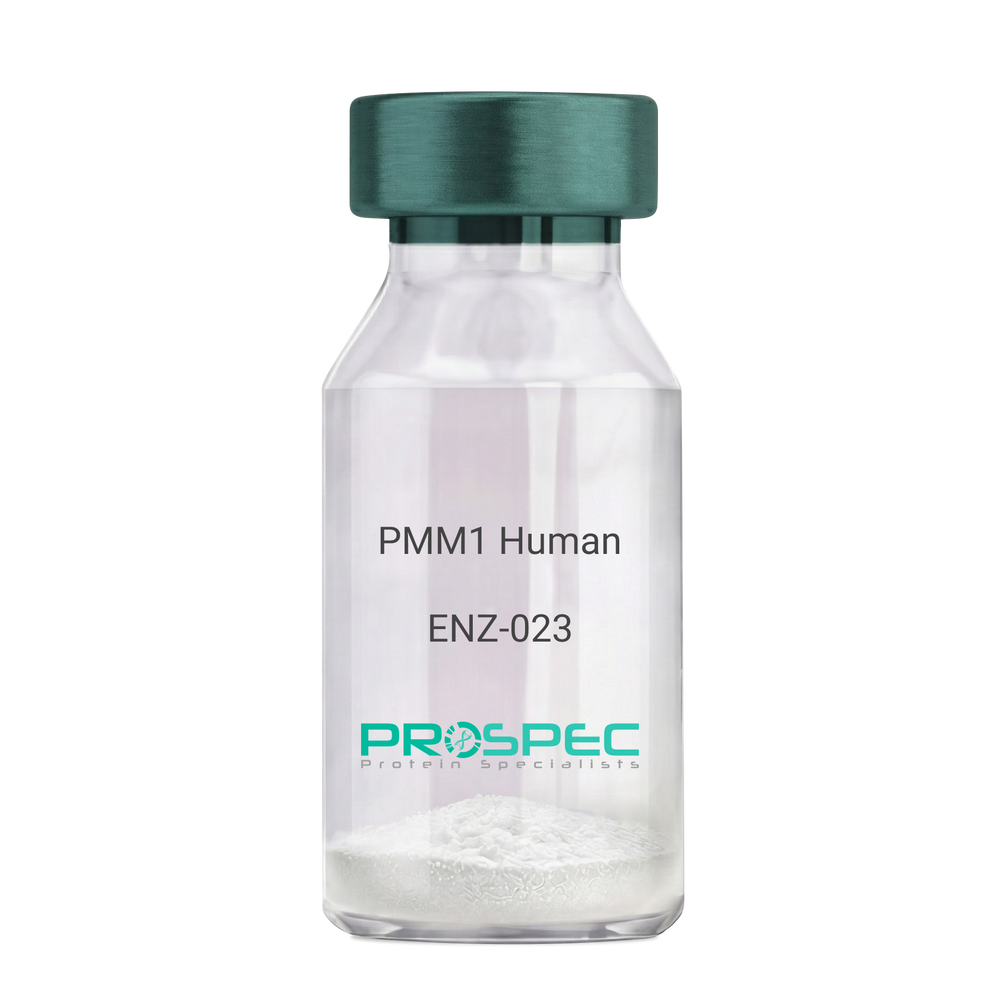
    PMM1 Human

    Description:

    Phosphomannomutase 1 Human Recombinant

    Phosphomannomutase 1, PMM 1, PMMH-22, PMM1, PMMH22, Sec53.

    Product # :

    ENZ-023

    Price :

    Quantity :

    Shipping Method :

    Ice Icon

    Shipped with Ice Packs

    Add To Cart

    More Info

    • description
    • source
    • formulation
    • purity
    • More Info

    Description

    PMM1 Human Recombinant fused with a 20 amino acid His tag at N-terminus produced in E.Coli is a single, non-glycosylated, polypeptide chain containing 282 amino acids (1-262 a.a.) and having a molecular mass of 31.9kDa. The PMM1 is purified by proprietary chromatographic techniques.

    Source

    Escherichia Coli.

    Formulation

    The PMM1 solution (0.5mg/ml) contains 20mM Tris-HCl buffer (pH8.0), 10% glycerol, 2mM DTT, 100mM NaCl and 0.1mM PMSF.

    Purity

    Greater than 90.0% as determined by SDS-PAGE.

    More Info

    • Introduction

      Phosphomannomutase 1 (PMM1) is an enzyme involved in the synthesis of the GDP-mannose and dolichol-phosphate-mannose required for a number of critical mannosyl transfer reactions. PMM1 catalyzes the conversion between D-mannose 6-phosphate and D-mannose 1-phosphate which is a substrate for GDP-mannose synthesis. GDP-mannose is used for the synthesis of dolichol-phosphate-mannose, which is crucial for N-linked glycosylation and accordingly the secretion of several glycoproteins as well as for the synthesis of glycosyl-phosphatidyl-inositol (GPI) anchored proteins. Additionally, PMM1 may be responsible for the degradation of glucose-1,6-bisphosphate in ischemic brain.

    • Synonyms

      Phosphomannomutase 1, PMM 1, PMMH-22, PMM1, PMMH22, Sec53.

    • Physical Appearance

      Sterile Filtered colorless solution.

    • Stability

      Store at 4°C if entire vial will be used within 2-4 weeks. Store, frozen at -20°C for longer periods of time. For long term storage it is recommended to add a carrier protein (0.1% HSA or BSA).Avoid multiple freeze-thaw cycles.

    • Amino Acid Sequence

      MGSSHHHHHH SSGLVPRGSH MAVTAQAARR KERVLCLFDV DGTLTPARQK IDPEVAAFLQ KLRSRVQIGV VGGSDYCKIA EQLGDGDEVI EKFDYVFAEN GTVQYKHGRL LSKQTIQNHL GEELLQDLIN FCLSYMALLR LPKKRGTFIE FRNGMLNISP IGRSCTLEER IEFSELDKKE KIREKFVEAL KTEFAGKGLR FSRGGMISFD VFPEGWDKRY CLDSLDQDSF DTIHFFGNET SPGGNDFEIF ADPRTVGHSV VSPQDTVQRC REIFFPETAH EA.

    ProSpec's products are furnished for LABORATORY RESEARCH USE ONLY. The product may not be used as drugs, agricultural or pesticidal products, food additives or household chemicals.

    Pmm1 Human
  • View Data Sheet

    Name :

    CASP3 Human, Sf9

    Description:

    Caspase 3 Apoptosis-Related Cysteine Peptidase Human Recombinant, Sf9

    CASP3, CPP32, CPP32B, SCA-1, CASP-3, Apopain, Cysteine protease CPP32, CPP-32, Protein Yama, SREBP cleavage activity 1.

    Product # :

    ENZ-1106

    Price :

    Quantity :

    Shipping Method :

    Ice Icon

    Shipped with Ice Packs

    Add To Cart

    More Info

    • description
    • source
    • formulation
    • purity
    • biological activity
    • More Info

    Description

    CASP3 Human produced in Sf9 Baculovirus cells is a single, glycosylated polypeptide chain containing 256 amino acids (29-277 a.a.) and having a molecular mass of 29.4kDa (Migrates at 13.5-18kDa on SDS-PAGE under reducing conditions). CASP3 is expressed with a 6 amino acid His tag at C-Terminus and purified by proprietary chromatographic techniques.

    Source

    Sf9, Baculovirus cells.

    Formulation

    CASP3 protein solution (0.5mg/ml) containing 20mM HEPES buffer (pH 7.5), 0.1M NaCl, 1mM EDTA, 20% Glycerol and 1mM DTT.

    Purity

    Greater than 90.0% as determined by SDS-PAGE.

    Biological Activity

    Specific activity is  greater than 5,000 pmol/min/ug. One unit will liberate 1 pmoles of Ac-DEVD-AFC to Ac-DEVD and AFC per minute at pH7.5 at 25C.

    More Info

    • Introduction

      Caspase 3 Apoptosis-Related Cysteine Peptidase (CASP3) belongs to the cysteine-aspartic acid protease (caspase) family. Sequential activation of caspases plays a key role in the execution-phase of cell apoptosis. Caspases exist as inactive proenzymes which undergo proteolytic processing at conserved aspartic residues to generate 2 subunits, large and small, that dimerize to create the active enzyme. CASP3 protein cleaves and activates caspases 6, 7 and 9, and the protein itself is processed by caspases 8, 9 and 10. CASP3 is the leading caspase involved in the cleavage of amyloid-beta 4A precursor protein, which is linked with neuronal death in Alzheimer's disease. In addition, CASP3 is involved in the cleavage of huntingtin. CASP3 also cleaves and activates sterol regulatory element binding proteins (SREBPs) between the basic helix-loop-helix leucine zipper domain and the membrane attachment domain. CASP3 initiates cell adhesion in sympathetic neurons through RET cleavage.

    • Synonyms

      CASP3, CPP32, CPP32B, SCA-1, CASP-3, Apopain, Cysteine protease CPP32, CPP-32, Protein Yama, SREBP cleavage activity 1.

    • Physical Appearance

      Sterile Filtered colorless solution.

    • Stability

      Store at 4°C if entire vial will be used within 2-4 weeks. Store, frozen at -20°C for longer periods of time. For long term storage it is recommended to add a carrier protein (0.1% HSA or BSA).Avoid multiple freeze-thaw cycles.

    • Amino Acid Sequence

      MSGISLDNSY KMDYPEMGLC IIINNKNFHK STGMTSRSGT DVDAANLRET FRNLKYEVRN
      KNDLTREEIV ELMRDVSKED HSKRSSFVCV LLSHGEEGII FGTNGPVDLK KITNFFRGDR
      CRSLTGKPKL FIIQACRGTE LDCGIETDSG VDDDMACHKI PVEADFLYAY STAPGYYSWR
      NSKDGSWFIQ SLCAMLKQYA DKLEFMHILT RVNRKVATEF ESFSFDATFH AKKQIPCIVS MLTKELYFYH HHHHHH

    ProSpec's products are furnished for LABORATORY RESEARCH USE ONLY. The product may not be used as drugs, agricultural or pesticidal products, food additives or household chemicals.

    Caspase 3 Protein
  • View Data Sheet

    Name :

    ACOT11 Human

    Description:

    Acyl-CoA Thioesterase 11 Human Recombinant

    Acyl-CoA Thioesterase 11, StAR-Related Lipid Transfer (START) Domain Containing 14, Thioesterase, Adipose Associated, Acyl-CoA Thioester Hydrolase 11, Adipose-Associated Thioesterase, Brown Fat-Inducible Thioesterase, Thioesterase Superfamily Member 1, START Domain Containing 14, Acyl-Coenzyme A Thioesterase 11, STARD14, THEM1, THEA, BFIT, BFIT1, BFIT2, KIAA0707, EC 3.1.2.1.

    Product # :

    ENZ-756

    Price :

    Quantity :

    Shipping Method :

    Ice Icon

    Shipped with Ice Packs

    Add To Cart

    More Info

    • description
    • source
    • formulation
    • purity
    • More Info

    Description

    ACOT11 Human Recombinant produced in E.Coli is a single, non-glycosylated polypeptide chain topological domain containing 268 amino acids (19-250 a.a) and having a molecular mass of 29.9kDa. ACOT11 is fused to a 36 amino acid His-tag at N-terminus.

    Source

    Escherichia Coli.

    Formulation

    ACOT11 protein solution (1mg/ml) containing 20mM Tris-HCl buffer (pH8.0), 0.4M Urea and 10% glycerol.

    Purity

    Greater than 90% as determined by SDS-PAGE.

    More Info

    • Introduction

      ACOT11 belongs to the acyl-CoA thioesterase family which catalyses the transformation of activated fatty acids to the equivalent non-esterified fatty acid and coenzyme A. Expression of a mouse homolog in brown adipose tissue is induced by low temperatures and inhibited by high temperatures. Obesity-resistant mice demonstrated High levels of expression compared with obesity-prone mice, indicating BFIT takes part in acyl-CoA thioesterase 11 in obesity. BFIT has acyl-CoA thioesterase activity towards medium (C12) and long-chain (C18) fatty acyl-CoA substrates.

    • Synonyms

      Acyl-CoA Thioesterase 11, StAR-Related Lipid Transfer (START) Domain Containing 14, Thioesterase, Adipose Associated, Acyl-CoA Thioester Hydrolase 11, Adipose-Associated Thioesterase, Brown Fat-Inducible Thioesterase, Thioesterase Superfamily Member 1, START Domain Containing 14, Acyl-Coenzyme A Thioesterase 11, STARD14, THEM1, THEA, BFIT, BFIT1, BFIT2, KIAA0707, EC 3.1.2.1.

    • Physical Appearance

      Sterile Filtered colorless solution.

    • Stability

      Store at 4°C if entire vial will be used within 2-4 weeks. Store, frozen at -20°C for longer periods of time. For long term storage it is recommended to add a carrier protein (0.1% HSA or BSA).Avoid multiple freeze-thaw cycles.

    • Amino Acid Sequence

      MRGSHHHHHH GMASMTGGQQ MGRDLYDDDD KDRWGSNRTS RKSALRAGND SAMADGEGYR NPTEVQMSQL VLPCHTNQRG ELSVGQLLKW IDTTACLSAE RHAGCPCVTA SMDDIYFEHT ISVGQVVNIK AKVNRAFNSS MEVGIQVASE DLCSEKQWNV CKALATFVAR REITKVKLKQ ITPRTEEEKM EHSVAAERRR MRLVYADTIK DLLANCAIQG DLESRDCSRM VPAEKTRVES VELVLPPHAN HQGNTFGGQI MAWMENVA

    ProSpec's products are furnished for LABORATORY RESEARCH USE ONLY. The product may not be used as drugs, agricultural or pesticidal products, food additives or household chemicals.

    Acot11 Human
  • View Data Sheet

    Name :

    NME2 Human

    Description:

    Non-Metastatic Cells 2 Human Recombinant

    Nucleoside diphosphate kinase B, NDPK-B, NDPKB, NM23-H2, NM23B, EC 2.7.4.6, NDP kinase B, C-myc purine-binding transcription factor PUF, NDK B, NME2, puf, MGC111212.

    Product # :

    PKA-363

    Price :

    Quantity :

    Shipping Method :

    Ice Icon

    Shipped with Ice Packs

    Add To Cart

    More Info

    • description
    • source
    • formulation
    • purity
    • More Info

    Description

    NME2 Human Recombinant produced in E.Coli is a single, non-glycosylated polypeptide chain containing 152 amino acids (1-152 a.a.) and having a molecular mass of 17.2kDa. The NME2 is purified by conventional chromatography.

    Source

    Escherichia Coli.

    Formulation

    The NME2 protein solution contains 20mM Tris-HCl pH-8, 1mM DTT, and 10% glycerol.

    Purity

    Greater than 95.0% as determined by SDS-PAGE.

    More Info

    • Introduction

      NME2 takes an important part in the synthesis of nucleoside triphosphates other than ATP. NME2 negatively controls Rho activity by interacting with AKAP13/LBC. NME2 acts as a transcriptional activator of the MYC gene. NME2 binds DNA non-specifically. NME2 is a heterodimeric enzyme functioning as a nucleoside diphosphate kinase. NME1 and NME2 contain 152 amino acids, A and B polypeptide chains of the NM23 enzyme, respectively. NME2 is identical to the beta subunit of human erythrocyte NDP kinase. NDP kinases participate in the synthesis of nucleoside triphosphates, and NM23 is involved in the regulation of signal transduction by complexing with G proteins, causing activation/inactivation of developmental pathways.

    • Synonyms

      Nucleoside diphosphate kinase B, NDPK-B, NDPKB, NM23-H2, NM23B, EC 2.7.4.6, NDP kinase B, C-myc purine-binding transcription factor PUF, NDK B, NME2, puf, MGC111212.

    • Physical Appearance

      Sterile Filtered colorless solution.

    • Stability

      Store at 4°C if entire vial will be used within 2-4 weeks. Store, frozen at -20°C for longer periods of time. For long term storage it is recommended to add a carrier protein (0.1% HSA or BSA).Avoid multiple freeze-thaw cycles.

    • Amino Acid Sequence

      MANLERTFIA IKPDGVQRGL VGEIIKRFEQ KGFRLVAMKF LRASEEHLKQ HYIDLKDRPF FPGLVKYMNS GPVVAMVWEG LNVVKTGRVM LGETNPADSK PGTIRGDFCI QVGRNIIHGS DSVKSAEKEI SLWFKPEELV DYKSCAHDWV YE.

    ProSpec's products are furnished for LABORATORY RESEARCH USE ONLY. The product may not be used as drugs, agricultural or pesticidal products, food additives or household chemicals.

    Nme2 Human
  • 1
  • …
  • 39
  • 40
  • 41
  • 42
Your browser does not support the video tag.

Products

  • Cytokines
  • Growth Factors
  • Chemokines
  • CD Antigens
  • Neurotrophins
  • Hormones
  • Enzymes
  • Viral Antigens
  • Recombinant Proteins
  • Natural Proteins
  • Monoclonal Antibodies
  • Polyclonal Antibodies
  • Thermal Packaging

About

  • Company
  • Founder
  • Contribution
  • Contact Us
  • My Account

Ordering

  • Ordering Method
  • Ordering - Credit Card
  • Ordering PO
  • Shipping Fees
  • FAQ's

Legal

  • Terms & Conditions
  • Privacy
  • Site Map
  • info@prospecbio.com
  • Facebook
  • Instagram
  • Linkedin Profile

© 2026 ProSpec-Tany TechnoGene Ltd. All Rights Reserved.

  • Choosing a selection results in a full page refresh.
  • Opens in a new window.