Skip to content

High-quality research proteins.

  • 1-800-805-6531

  • Mon - Sat 8.00-18.00, Sun - Closed

  • info@prospecbio.com

  • PO Box 6591 East Brunswick NJ 08816

  • Products
    • Cytokines
    • Growth factors
    • Chemokines
    • Cd antigens
    • Neurotrophins
    • Hormones
    • Enzymes
    • Viral antigens
    • Recombinant proteins
    • Natural proteins
    • Monoclonal antibodies
    • Polyclonal antibodies
    • Thermal Packaging
  • About
    • Company
    • Founder
    • Contribution
  • Customers
    • Eastern Asia
    • Eastern Europe
    • North America
    • South America
    • South East Asia
    • Southern Asia
    • Western Europe
  • Ordering
    • Ordering Method
    • Ordering - Credit Card
    • Ordering - PO
    • Shipping Fees
    • FAQs
  • Services
    • DNA Cloning
    • Protein Expression
    • Monoclonal Antibody
    • Fermentation
    • Technology License
  • Contact us
Log in

Country/region

  • USD $ | Albania
  • USD $ | Andorra
  • USD $ | Argentina
  • USD $ | Armenia
  • USD $ | Australia
  • USD $ | Austria
  • USD $ | Azerbaijan
  • USD $ | Belarus
  • USD $ | Belgium
  • USD $ | Bolivia
  • USD $ | Brazil
  • USD $ | Bulgaria
  • USD $ | Cambodia
  • USD $ | Canada
  • USD $ | Chile
  • USD $ | China
  • USD $ | Colombia
  • USD $ | Costa Rica
  • USD $ | Croatia
  • USD $ | Cyprus
  • USD $ | Czechia
  • USD $ | Denmark
  • USD $ | Estonia
  • USD $ | Finland
  • USD $ | France
  • USD $ | Georgia
  • USD $ | Germany
  • USD $ | Greece
  • USD $ | Hong Kong SAR
  • USD $ | Hungary
  • USD $ | Iceland
  • USD $ | India
  • USD $ | Ireland
  • USD $ | Israel
  • USD $ | Italy
  • USD $ | Japan
  • USD $ | Kazakhstan
  • USD $ | Latvia
  • USD $ | Liechtenstein
  • USD $ | Lithuania
  • USD $ | Madagascar
  • USD $ | Malta
  • USD $ | Mexico
  • USD $ | Moldova
  • USD $ | Monaco
  • USD $ | Netherlands
  • USD $ | New Zealand
  • USD $ | North Macedonia
  • USD $ | Norway
  • USD $ | Panama
  • USD $ | Paraguay
  • USD $ | Peru
  • USD $ | Philippines
  • USD $ | Poland
  • USD $ | Portugal
  • USD $ | Romania
  • USD $ | Singapore
  • USD $ | Slovakia
  • USD $ | Slovenia
  • USD $ | South Africa
  • USD $ | South Korea
  • USD $ | Spain
  • USD $ | Sri Lanka
  • USD $ | Sweden
  • USD $ | Switzerland
  • USD $ | Taiwan
  • USD $ | Thailand
  • USD $ | Türkiye
  • USD $ | Ukraine
  • USD $ | United Kingdom
  • USD $ | United States
  • USD $ | Uruguay
  • USD $ | Vatican City
  • USD $ | Venezuela
  • USD $ | Vietnam
  • Facebook
  • Instagram
logoProSpec - Recombinant Protein Manufacturer for academic and R&D industry
Become a distributor
Account Log in
Wishlist
Cart Cart(0)
  • Products
    +
    • Cytokines
    • Growth factors
    • Chemokines
    • Cd antigens
    • Neurotrophins
    • Hormones
    • Enzymes
    • Viral antigens
    • Recombinant proteins
    • Natural proteins
    • Monoclonal antibodies
    • Polyclonal antibodies
    • Thermal Packaging
  • About
    +
    • Company
    • Founder
    • Contribution
  • Customers
    +
    • Eastern Asia
    • Eastern Europe
    • North America
    • South America
    • South East Asia
    • Southern Asia
    • Western Europe
  • Ordering
    +
    • Ordering Method
    • Ordering - Credit Card
    • Ordering - PO
    • Shipping Fees
    • FAQs
  • Services
    +
    • DNA Cloning
    • Protein Expression
    • Monoclonal Antibody
    • Fermentation
    • Technology License
  • Contact us

Item added to your cart

View cart
View All
  • Cytokines
  • Growth factors
  • Chemokines
  • Cd antigens
  • Neurotrophins
  • Hormones
  • Enzymes
  • Viral antigens
  • Recombinant proteins
  • Natural proteins
  • Monoclonal antibodies
  • Polyclonal antibodies
  • Thermal Packaging
  • Tumor Necrosis Factor

    Tumor Necrosis Factor

    View All
  • 4-1BB

    4-1BB

    View All
  • Adiponectin

    Adiponectin

    View All
  • AIF1

    AIF1

    View All
  • Other Cytokines

    Other Cytokines

    View All
  • AITRL

    AITRL

    View All
  • Angiopoietin

    Angiopoietin

    View All
  • Apolipoprotein

    Apolipoprotein

    View All
  • B-Cell Activating Factor

    B-Cell Activating Factor

    View All
  • Beta Defensin

    Beta Defensin

    View All
  • Bone Morphogenetic Protein

    Bone Morphogenetic Protein

    View All
  • B type Natriuretic Peptide

    B type Natriuretic Peptide

    View All
  • BST

    BST

    View All
  • Betacellulin

    Betacellulin

    View All
  • Cardiotrophin

    Cardiotrophin

    View All
  • Activin

    Activin

    View All
  • Fibroblast Growth Factor

    Fibroblast Growth Factor

    View All
  • Other Growth Factors

    Other Growth Factors

    View All
  • CSF

    CSF

    View All
  • CTGF

    CTGF

    View All
  • IGFBP

    IGFBP

    View All
  • VEGF Protein

    VEGF Protein

    View All
  • EGF

    EGF

    View All
  • Epigen

    Epigen

    View All
  • Erythropoietin

    Erythropoietin

    View All
  • Insulin-Like Growth Factor

    Insulin-Like Growth Factor

    View All
  • Growth Hormone

    Growth Hormone

    View All
  • HDGF

    HDGF

    View All
  • Hepatocyte Growth Factor

    Hepatocyte Growth Factor

    View All
  • Insulin

    Insulin

    View All
  • BCA-1/ BLC (CXCL13)

    BCA-1/ BLC (CXCL13)

    View All
  • BRAK (CXCL14)

    BRAK (CXCL14)

    View All
  • C-10 (CCL6)

    C-10 (CCL6)

    View All
  • Other Chemokines

    Other Chemokines

    View All
  • MEC (CCL28)

    MEC (CCL28)

    View All
  • LD78-beta (CCL3L1)

    LD78-beta (CCL3L1)

    View All
  • CTACK (CCL27)

    CTACK (CCL27)

    View All
  • CXCL16

    CXCL16

    View All
  • CXCL17

    CXCL17

    View All
  • Platelet Factor-4 (CXCL4)

    Platelet Factor-4 (CXCL4)

    View All
  • ENA-78 (CXCL5)

    ENA-78 (CXCL5)

    View All
  • Eotaxin (CCL11,24,26)

    Eotaxin (CCL11,24,26)

    View All
  • Exodus-2 (CCL21)

    Exodus-2 (CCL21)

    View All
  • Fractalkine (CX3CL1)

    Fractalkine (CX3CL1)

    View All
  • CXCL6

    CXCL6

    View All
  • Other CD Antigens

    Other CD Antigens

    View All
  • CD14

    CD14

    View All
  • CD164

    CD164

    View All
  • CD1

    CD1

    View All
  • CD2

    CD2

    View All
  • CD200

    CD200

    View All
  • CD207

    CD207

    View All
  • CD226

    CD226

    View All
  • CD23

    CD23

    View All
  • CD244

    CD244

    View All
  • CD247

    CD247

    View All
  • CD27

    CD27

    View All
  • CD274

    CD274

    View All
  • CD300

    CD300

    View All
  • CD33

    CD33

    View All
  • Other Neurotrophins

    Other Neurotrophins

    View All
  • Beta-NGF

    Beta-NGF

    View All
  • BDNF

    BDNF

    View All
  • CDNF

    CDNF

    View All
  • CNTF

    CNTF

    View All
  • GDNF

    GDNF

    View All
  • Glia Maturation Factor

    Glia Maturation Factor

    View All
  • MANF

    MANF

    View All
  • Midkine

    Midkine

    View All
  • Neuroglobin

    Neuroglobin

    View All
  • Neurotrophic factors

    Neurotrophic factors

    View All
  • Neuregulin

    Neuregulin

    View All
  • Neuropilin

    Neuropilin

    View All
  • Pigment Epithelium-Derived Factor

    Pigment Epithelium-Derived Factor

    View All
  • Pleiotrophin

    Pleiotrophin

    View All
  • Peptide Hormones

    Peptide Hormones

    View All
  • Other Hormones

    Other Hormones

    View All
  • HCG

    HCG

    View All
  • Endothelin

    Endothelin

    View All
  • Exendin

    Exendin

    View All
  • FSH

    FSH

    View All
  • Glucagon

    Glucagon

    View All
  • GHRP

    GHRP

    View All
  • GLP

    GLP

    View All
  • Thyrostimulin

    Thyrostimulin

    View All
  • Inhibin A

    Inhibin A

    View All
  • LHRH

    LHRH

    View All
  • Melanotan

    Melanotan

    View All
  • Procalcitonin

    Procalcitonin

    View All
  • PTH

    PTH

    View All
  • Peroxiredoxin

    Peroxiredoxin

    View All
  • Peptidase

    Peptidase

    View All
  • Synthetase

    Synthetase

    View All
  • Transferase

    Transferase

    View All
  • Hydrolase

    Hydrolase

    View All
  • Dehydrogenase

    Dehydrogenase

    View All
  • ACE2

    ACE2

    View All
  • Esterase

    Esterase

    View All
  • Protein Kinases

    Protein Kinases

    View All
  • Other Enzymes

    Other Enzymes

    View All
  • Phosphatase

    Phosphatase

    View All
  • Deaminase

    Deaminase

    View All
  • Oxygenase

    Oxygenase

    View All
  • Adenylate Kinase

    Adenylate Kinase

    View All
  • Lyase

    Lyase

    View All
  • Chagas

    Chagas

    View All
  • SARS

    SARS

    View All
  • Influenza

    Influenza

    View All
  • ASFV

    ASFV

    View All
  • Astrovirus

    Astrovirus

    View All
  • Borrelia

    Borrelia

    View All
  • Helicobacter Pylori

    Helicobacter Pylori

    View All
  • Chikungunya

    Chikungunya

    View All
  • Chlamydia

    Chlamydia

    View All
  • Cytomegalo

    Cytomegalo

    View All
  • Dengue

    Dengue

    View All
  • EBV

    EBV

    View All
  • Ebola

    Ebola

    View All
  • Feline Leukemia Virus

    Feline Leukemia Virus

    View All
  • Hepatitis A

    Hepatitis A

    View All
  • Other

    Other

    View All
  • Actin

    Actin

    View All
  • ADAM

    ADAM

    View All
  • Complement Component

    Complement Component

    View All
  • Ag85

    Ag85

    View All
  • Eukaryotic Translation Initiation Factor

    Eukaryotic Translation Initiation Factor

    View All
  • Anterior Gradient Protein

    Anterior Gradient Protein

    View All
  • Heat Shock Protein

    Heat Shock Protein

    View All
  • Alpha-2-HS-Glycoprotein

    Alpha-2-HS-Glycoprotein

    View All
  • Hemoglobin

    Hemoglobin

    View All
  • Allergy

    Allergy

    View All
  • Anaplasma

    Anaplasma

    View All
  • Angiogenin

    Angiogenin

    View All
  • Ankyrin Repeat Domain

    Ankyrin Repeat Domain

    View All
  • Annexin

    Annexin

    View All
  • Other Natural Proteins

    Other Natural Proteins

    View All
  • Aprotinin

    Aprotinin

    View All
  • Transferrin

    Transferrin

    View All
  • Avidin

    Avidin

    View All
  • Anti Coagulation Factors

    Anti Coagulation Factors

    View All
  • Natural Albumin

    Natural Albumin

    View All
  • Natural Coagulation Factors

    Natural Coagulation Factors

    View All
  • Fibronectin

    Fibronectin

    View All
  • Thrombin

    Thrombin

    View All
  • Anti Human Enzyme

    Anti Human Enzyme

    View All
  • Other Monoclonal Antibodies

    Other Monoclonal Antibodies

    View All
  • Anti Human Cytokine

    Anti Human Cytokine

    View All
  • Anti Human Heat Shock Protein

    Anti Human Heat Shock Protein

    View All
  • Anti Mouse Lymphocyte

    Anti Mouse Lymphocyte

    View All
  • Anti Human Chemokine

    Anti Human Chemokine

    View All
  • Anti Human Lymphocyte

    Anti Human Lymphocyte

    View All
  • Anti Viral Monoclonal

    Anti Viral Monoclonal

    View All
  • Anti Mouse Cytokine

    Anti Mouse Cytokine

    View All
  • Anti-GST Monoclonal

    Anti-GST Monoclonal

    View All
  • Other Polyclonal Antibodies

    Other Polyclonal Antibodies

    View All
  • Anti Viral

    Anti Viral

    View All
  • Anti-GST Monoclonal

    Anti-GST Monoclonal

    View All
Back

Search results

1000 results found for “phospholipid scramblase”

Name

Description

Product #

Price

Quantity

Shipping Method

  • View Data Sheet

    Name :

    LPL Human, HEK

    Description:

    Lipoprotein Lipase Human Recombinant, HEK

    Lipoprotein lipase, LPL, LIPD, HDLCQ11.

    Product # :

    ENZ-087

    Price :

    Quantity :

    Shipping Method :

    Room Temp Icon

    Shipped at Room temp

    Add To Cart

    More Info

    • description
    • source
    • formulation
    • More Info

    Description

    The Recombinant Human LPL produced in HEK293 cell line has a molecular mass of 51.8kDa containing 461 amino acid residues of the human LPL (Ala28-Gly475, variant Asn > Ser318) and fused to a 13 a.a. Flag-tag at N-terminus.

    Source

    HEK293 (Human Embryonic Kidney cell line).

    Formulation

    LPL was filtered (0.4 µm) and lyophilized from 0.5mg/ml in 20mM Tris buffer and 50mM NaCl, pH 7.5.

    More Info

    • Introduction

      LPL is a lipoprotein lipase, which is expressed in the heart, muscle, and adipose tissue. LPL acts as a homodimer, and has the dual functions of triglyceride hydrolase and ligand/bridging factor for receptor-mediated lipoprotein uptake. Type I hyperlipoproteinemia is a result of severe mutations which cause LPL deficiency, whereas less extreme mutations in LPL are linked to many disorders of lipoprotein metabolism. Lipoprotein lipase (LPL) is a fundamental enzyme in plasma triglyceride hydrolysis and is secreted by macrophages in the subendothelial space. LPL also promotes the development of atherosclerosis through facilitation of monocyte adhesion to endothelial cells, stimulation of tumor necrosis factor alpha (TNF) secretion and induction of vascular smooth muscle cell proliferation.

    • Synonyms

      Lipoprotein lipase, LPL, LIPD, HDLCQ11.

    • Physical Appearance

      Filtered white lyophilized powder.

    • Stability

      Store lyophilized protein at -20°C. Aliquot the product after reconstitution to avoid repeated freezing/thawing cycles. Reconstituted protein can be stored at 4°C for a limited period of time; it does not show any change after two weeks at 4°C.

    • Solubility

      It is recommended to add deionized water to prepare a working stock solution of approximately 0.5 mg/ml and let the lyophilized pellet dissolve completely. Product is not sterile! Please filter the product by an appropriate sterile filter before using it in the cell culture.

    • Amino Acid Sequence

      HVDYKDDDDK PAGADQRRDF IDIESKFALR TPEDTAEDTC HLIPGVAESV ATCHFNHSSK TFMVIHGWTV TGMYESWVPK ADQRRDF IDIESKFALR TPEDTAEDTC HLIPGVAESV ATCHFNHSSK TFMVIHGWTV TGMYESWVPK LVAALYKREP DSNVIVVDWL SRAQEHYPVS AGYTKLVGQD VARFINWMEE EFNYPLDNVH LLGYSLGAHA AGIAGSLTNK KVNRITGLDP AGPNFEYAEA PSRLSPDDAD FVDVLHTFTR GSPGRSIGIQ KPVGHVDIYP NGGTFQPGCN IGEAIRVIAE RGLGDVDQLV KCSHERSIHL FIDSLLNEEN PSKAYRCSSK EAFEKGLCLS CRKNRCNNLG YEISKVRAKR SSKMYLKTRS QMPYKVFHYQ VKIHFSGTES ETHTNQAFEI SLYGTVAESE NIPFTLPEVS TNKTYSFLIY TEVDIGELLM LKLKWKSDSY FSWSDWWSSP GFAIQKIRVK AGETQKKVIF CSREKVSHLQ KGKAPAVFVK CHDKSLNKKS G.

    ProSpec's products are furnished for LABORATORY RESEARCH USE ONLY. The product may not be used as drugs, agricultural or pesticidal products, food additives or household chemicals.

    Lpl Human Hek
  • View Data Sheet

    Name :

    SERPINA9 Mouse

    Description:

    Serpin Peptidase Inhibitor, Clade A Mouse Recombinant

    Serpin A9, Serpina9, SERPINA9.

    Product # :

    PRO-2366

    Price :

    Quantity :

    Shipping Method :

    Ice Icon

    Shipped with Ice Packs

    Add To Cart

    More Info

    • description
    • source
    • formulation
    • purity
    • More Info

    Description

    SERPINA9 Mouse Recombinant produced in Sf9 Baculovirus cells is a single, glycosylated polypeptide chain containing 401 amino acids (26-418 a.a) and having a molecular mass of 45.2kDa (Molecular size on SDS-PAGE will appear at approximately 50-70kDa).SERPINA9 is fused to an 8 amino acid His-tag at C-terminus & purified by proprietary chromatographic techniques.

    Source

    Sf9, Baculovirus cells.

    Formulation

    SERPINA9 protein solution (0.25mg/ml) contains Phosphate Buffered Saline (pH 7.4) and 10% glycerol.

    Purity

    Greater than 85.0% as determined by SDS-PAGE.

    More Info

    • Introduction

      Serpin Peptidase Inhibitor, Clade A Member 9, also known as serpin A9, belongs to the Serpin superfamily of serine protease inhibitors. Serpins are the most extensively distributed superfamily of protease inhibitors which use a conformational modification to inhibit target enzymes. Serpins are known to inhibit serine proteases as well as inhibiting caspases in addition to papain-like cysteine proteases. Serpins are conformational labile and numerous of the disease-linked mutations of serpins outcome in misfolding or in pathogenic, inactive polymers. serpin A9 demonstrates inhibition towards trypsin, thrombin, as well as plasmin and binds DNA and heparin.

    • Synonyms

      Serpin A9, Serpina9, SERPINA9.

    • Physical Appearance

      Sterile Filtered colorless solution.

    • Stability

      Store at 4°C if entire vial will be used within 2-4 weeks. Store, frozen at -20°C for longer periods of time. For long term storage it is recommended to add a carrier protein (0.1% HSA or BSA). Avoid multiple freeze-thaw cycles.

    • Amino Acid Sequence

      NPYNQESSHL PSMKKNPASQ VSPSNTRFSF LLYQRLAQEN PGQNILFSPV SISTSLAMLS LGARSATKTQ ILRTLGFNFT WVSEPTIHMG FEYLVRSLNK CHQGRELRMG SVLFIRKELQ LQATFLDRVK KLYGAKVFSE DFSNAATAQA QINSYVEKET KGKVVDVIQD LDSQTAMVLV NHIFFKANWT QPFSTANTNK SFPFLLSKGT TVHVPMMHQT ESFAFGVDKE LGCSILQMDY RGDAVAFFVL PGKGKMRQLE KSLSARRLRK WSRSLQKRWI KVFIPKFSIS ASYNLETILP KMGIRDAFNS NADFSGITKT HFLQVSKAAH KAVLDVSEEG TEAAAATTTK LIVRSRDTPS SIIAFKEPFL ILLLDKNTES VLFLGKVENP RKMLEHHHHH H

    ProSpec's products are furnished for LABORATORY RESEARCH USE ONLY. The product may not be used as drugs, agricultural or pesticidal products, food additives or household chemicals.

    Serpina9 Mouse
  • View Data Sheet

    Name :

    PSG5 Human

    Description:

    Pregnancy Specific Beta-1-Glycoprotein 5 Human Recombinant

    Pregnancy Specific Beta-1-Glycoprotein 5, Pregnancy-Specific Beta-1 Glycoprotein, Fetal Liver Non-Specific Cross-Reactive Antigen 3, Pregnancy-Specific Beta-1-Glycoprotein 5, FL-NCA-3, PS-beta-G-5, PSBG-5, PSG.

    Product # :

    PRO-1633

    Price :

    Quantity :

    Shipping Method :

    Ice Icon

    Shipped with Ice Packs

    Add To Cart

    More Info

    • description
    • source
    • formulation
    • purity
    • More Info

    Description

    PSG5 Human Recombinant produced in E.coli is a single, non-glycosylated polypeptide chain containing 324 amino acids (35-335) and having a molecular mass of 36.4kDa.PSG5 is fused to a 23 amino acid His-tag at N-terminus & purified by proprietary chromatographic techniques.

    Source

    Escherichia Coli.

    Formulation

    The PSG5 solution contains 20mM Tris-HCl buffer (pH 8.0), 1M Urea and 10% glycerol.

    Purity

    Greater than 80% as determined by SDS-PAGE.

    More Info

    • Introduction

      PSG5 belongs to the PSG family, which are a highly connected group of secreted glycoproteins, vastly expressed in fetal placental syncytiotrophoblast cells. PSGs are can be found in serum from the first 2-3 weeks of pregnancy and at higher levels as the pregnancy progresses, up to e point where they are the highest fetal protein found in maternal blood at term. PSG5’s role is inducing secretion of TH2-type cytokines from monocytes and modulating the maternal immune system throughout the pregnancy, thus defending the semi-allotypic fetus from rejection.

    • Synonyms

      Pregnancy Specific Beta-1-Glycoprotein 5, Pregnancy-Specific Beta-1 Glycoprotein, Fetal Liver Non-Specific Cross-Reactive Antigen 3, Pregnancy-Specific Beta-1-Glycoprotein 5, FL-NCA-3, PS-beta-G-5, PSBG-5, PSG.

    • Physical Appearance

      Sterile filtered colorless solution.

    • Stability

      Store at 4°C if entire vial will be used within 2-4 weeks. Store, frozen at -20°C for longer periods of time. For long term storage it is recommended to add a carrier protein (0.1% HSA or BSA).Avoid multiple freeze-thaw cycles.

    • Amino Acid Sequence

      MGSSHHHHHH SSGLVPRGSH MGSQVTIEAL PPKVSEGKDV LLLVHNLPQN LAGYIWYKGQ LMDLYHYITS YVVDGQINIY GPAYTGRETV YSNASLLIQN VTREDAGSYT LHIIKRGDRT RGVTGYFTFN LYLKLPKPYI TINNSKPREN KDVLAFTCEP KSENYTYIWW LNGQSLPVSP RVKRPIENRI LILPSVTRNE TGPYECEIRD RDGGMRSDPV TLNVLYGPDL PSIYPSFTYY RSGENLYLSC FAESNPPAEY FWTINGKFQQ SGQKLSIPQI TTKHRGLYTC SVRNSATGKE SSKSMTVEVS APSGIGRLPL LNPI

    ProSpec's products are furnished for LABORATORY RESEARCH USE ONLY. The product may not be used as drugs, agricultural or pesticidal products, food additives or household chemicals.

    Psg5 Human
  • View Data Sheet

    Name :

    CCL9 Mouse

    Description:

    Macrophage Inflammatory Protein-1 Gamma Mouse Recombinant (CCL9)

    CCL9/10, MRP2, CCF18.

    Product # :

    CHM-257

    Price :

    Quantity :

    Shipping Method :

    Room Temp Icon

    Shipped at Room temp

    Add To Cart

    More Info

    • description
    • source
    • formulation
    • purity
    • biological activity
    • More Info

    Description

    MIP-1 gamma Mouse Recombinant produced in E.Coli is a single, non-glycosylated, polypeptide chain containing 101 amino acids and having a molecular mass of 11.6 kDa. The MIP-1 gamma is purified by proprietary chromatographic techniques.

    Source

    Escherichia Coli.

    Formulation

    The MIP-1 gamma was lyophilized from 1xPBS solution pH-7.4.

    Purity

    Greater than 97.0% as determined by:
    (a) Analysis by RP-HPLC.
    (b) Analysis by SDS-PAGE.

    Biological Activity

    Defined by its ability to chemoattract human neutrophils using a concentration range of 0.1-10 ng/ml, corresponding to a Specific Activity of 10,000-100,000IU/mg.

    More Info

    • Introduction

      Mouse MIP-1 gamma is 75% identical in its amino acid compostion as compared to the rat specie. MIP-1 gamma is a CC chemokine localized in murine blood and a widespread range of murine tissues, without having an identified human homolog. MIP-1 gamma signals through the CCR1 receptor. MIP-1 gamma chemoattracts neutrophils and also inhibits colony formation of bone marrow myeloid immature progenitors. MIP-1 gamma has six cysteines including the four highly conserved cysteine residues present in CC chemokines.

    • Synonyms

      CCL9/10, MRP2, CCF18.

    • Physical Appearance

      Sterile Filtered White lyophilized (freeze-dried) powder.

    • Stability

      Lyophilized MIP-1 gamma although stable at room temperature for 3 weeks, should be stored desiccated below -18°C. Upon reconstitution CCL9/10 should be stored at 4°C between 2-7 days and for future use below -18°C. For long term storage it is recommended to add a carrier protein (0.1% HSA or BSA). Please prevent freeze-thaw cycles.

    • Solubility

      It is recommended to reconstitute the lyophilized MIP-1 gamma in sterile 18M-cm H2O not less than 100µg/ml, which can then be further diluted to other aqueous solutions.

    • Amino Acid Sequence

      QITHATETKE VQSSLKAQQG LEIEMFHMGF QDSSDCCLSY NSRIQCSRFI GYFPTSGGCT RPGIIFISKR GFQVCANPSD RRVQRCIERL EQNSQPRTYK Q.

    • Background

      What is the molecular weight/Mw of CCL9 MOUSE Protein?
      CCL9 MOUSE Protein has a total Mw of 11.6kDa.

      What is the source or expression system of CCL9 MOUSE Protein?
      Escherichia Coli.

      What is the Purity of CCL9 MOUSE Protein?
      CCL9 MOUSE Protein is > 97% pure as determined by SDS-PAGE.

      What is the Biological Activity of CCL9 MOUSE Protein?
      Defined by its ability to chemoattract human neutrophils using a concentration range of 0.1-10 ng/ml, corresponding to a Specific Activity of 10,000-100,000IU/mg.

      What is the amino acid sequence of CCL9 MOUSE Protein?
      QITHATETKE VQSSLKAQQG LEIEMFHMGF QDSSDCCLSY NSRIQCSRFI GYFPTSGGCT RPGIIFISKR GFQVCANPSD RRVQRCIERL EQNSQPRTYK Q.

      What applications can CCL9 MOUSE Protein be used in?
      CCL9 MOUSE Protein can probably be used in western blot, ELISA and Lateral Flow.

      What is the endotoxin level for CCL9 MOUSE Protein?
      The endotoxin level is minimal, CCL9 MOUSE Protein was purified using conventional chromatography techniques.


    ProSpec's products are furnished for LABORATORY RESEARCH USE ONLY. The product may not be used as drugs, agricultural or pesticidal products, food additives or household chemicals.

    Mip 1 Gamma Mouse
  • View Data Sheet

    Name :

    CoV-2 N-Mosaic

    Description:

    Coronavirus 2019 Nucleocapsid Mosaic Recombinant

    Product # :

    SARS-015

    Price :

    Quantity :

    Shipping Method :

    Ice Icon

    Shipped with Ice Packs

    Add To Cart

    More Info

    • description
    • source
    • formulation
    • purity
    • More Info

    Description

    The E.Coli derived recombinant protein contains the Coronavirus 2019 full length nuclepocapsid Mosaic immunodominant regions [ full length N-antigen ], fused to 6xHis tag at C-terminal.

    Source

    Escherichia Coli.

    Formulation

    CoV 2019 Nucleocapsid-Mosaic Protein solution is supplied in 1x PBS.

    Purity

    CoV 2019 Nucleocapsid-Mosaic Protein ein is >90% pure as determined SDS-PAGE.

    More Info

    • Introduction

      A human infecting coronavirus (viral pneumonia) called 2019 novel coronavirus, 2019-nCoV was found in the fish market at the city of Wuhan, Hubei province of China on December 2019.

      The 2019-nCoV shares an 87% identity to the 2 bat-derived severe acute respiratory syndrome 2018 SARS-CoV-2 located in Zhoushan of eastern China. 2019-nCoV has an analogous receptor-BD-structure to that of 2018 SARS-CoV, even though there is a.a. diversity so thus the 2019-nCoV might bind to ACE2 receptor protein (angiotensin-converting enzyme 2) in humans.

      While bats are possibly the host of 2019-nCoV, researchers suspect that animal from the ocean sold at the seafood market was an intermediate host. RSCU analysis proposes that the 2019-nCoV is a recombinant within the viral spike glycoprotein between the bat coronavirus and an unknown coronavirus.

    • Physical Appearance

      Sterile Filtered clear solution.

    • Stability

      CoV 2019 Nucleocapsid-Mosaic Protein is shipped on ice packs. Upon arrival, Store at -20°C.

    • Specificity

      Reactivity with SARS infected individuals not tested.

    ProSpec's products are furnished for LABORATORY RESEARCH USE ONLY. The product may not be used as drugs, agricultural or pesticidal products, food additives or household chemicals.

    product_image.jpg
  • View Data Sheet

    Name :

    CMBL Human

    Description:

    Carboxymethylenebutenolidase Human Recombinant

    Carboxymethylenebutenolidase homolog, CMBL, JS-1.

    Product # :

    ENZ-634

    Price :

    Quantity :

    Shipping Method :

    Ice Icon

    Shipped with Ice Packs

    Add To Cart

    More Info

    • description
    • source
    • formulation
    • purity
    • More Info

    Description

    CMBL Human Recombinant produced in E. coli is a single polypeptide chain containing 269 amino acids (1-245) and having a molecular mass of 30.6kDa.CMBL is fused to a 24 amino acid His-tag at N-terminus & purified by proprietary chromatographic techniques.

    Source

    Escherichia Coli.

    Formulation

    The CMBL solution (0.5mg/ml) contains 20mM Tris-HCl buffer (pH 8.0), 0.1M NaCl, 10% glycerol and 1mM EDTA.

    Purity

    Greater than 95.0% as determined by SDS-PAGE.

    More Info

    • Introduction

      Carboxymethylenebutenolidase homolog (CMBL) is a cysteine hydrolase of the dienelactone hydrolase family which is highly expressed in the liver cytosol. CMBL is the human homolog of Pseudomonas dienelactone hydrolase, which is a protein that participates in the bacterial halocatechol degradation pathway. CMBL which preferentially cleaves cyclic esters activates medoxomil-ester prodrugs in which the medoxomil moiety is coupled with an oxygen atom. CMBL is inhibited by PCMB (p-chloromercuribenzoate) and is encoded by a gene which maps to human chromosome 5p15.2. CMBL can also activate beta-lactam antibiotics faropenem medoxomil and lenampicillin. CMBL is widely expressed, with the highest levels in the liver, followed by the kidney, small intestine and the colon.

    • Synonyms

      Carboxymethylenebutenolidase homolog, CMBL, JS-1.

    • Physical Appearance

      Sterile filtered colorless solution.

    • Stability

      Store at 4°C if entire vial will be used within 2-4 weeks. Store, frozen at -20°C for longer periods of time. For long term storage it is recommended to add a carrier protein (0.1% HSA or BSA).Avoid multiple freeze-thaw cycles.

    • Amino Acid Sequence

      MGSSHHHHHH SSGLVPRGSH MGSHMANEAY PCPCDIGHRL EYGGLGREVQ VEHIKAYVTK SPVDAGKAVI VIQDIFGWQL PNTRYIADMI SGNGYTTIVP DFFVGQEPWD PSGDWSIFPE WLKTRNAQKI DREISAILKY LKQQCHAQKI GIVGFCWGGT AVHHLMMKYS EFRAGVSVYG IVKDSEDIYN LKNPTLFIFA ENDVVIPLKD VSLLTQKLKE HCKVEYQIKT FSGQTHGFVH RKREDCSPAD KPYIDEARRN LIEWLNKYM.

    ProSpec's products are furnished for LABORATORY RESEARCH USE ONLY. The product may not be used as drugs, agricultural or pesticidal products, food additives or household chemicals.

    Cmbl Human
  • View Data Sheet

    Name :

    PPARG Human

    Description:

    Peroxisome Proliferator Activated Receptor Gamma Human Recombinant

    Peroxisome proliferator-activated receptor gamma, PPAR-gamma, PPARG, NR1C3, PPARG1, PPARG2.

    Product # :

    PKA-228

    Price :

    Quantity :

    Shipping Method :

    Ice Icon

    Shipped with Ice Packs

    Add To Cart

    More Info

    • description
    • source
    • formulation
    • purity
    • More Info

    Description

    Peroxisome Proliferator Activated Receptor Gamma Human Recombinant is expressed in E.coli having a molecular weight of 59.2 kDa and fused to an amino terminal hexahistidine tag.

    Source

    Escherichia Coli.

    Formulation

    The protein solution contains 20mM Tris-HCl and 50% glycerol.

    Purity

    Greater than 90.0% as determined by SDS-PAGE.

    More Info

    • Introduction

      The peroxisome proliferator activated receptors (PPARs) are ligandactivated transcription factors within the nuclear receptor superfamily, which play important roles in adipogenesis, glucose homeostasis andinflammation. Three different isotypes can be distinguished; alpha, beta and gamma. PPARg, is mainly expressed in adipose tissue and to lesser extent in colon, the immune system and the retina. Whereas PPARg operates in the catabolism of fatty acids in the liver, PPARg influences the storage of fatty acids in the adipose tissue and plays a role in adipocyte differentiation. PPARg binds to DNA as a heterodimer with retinoid X receptor (RXR), activating expression of target genes after binding ligand.

    • Synonyms

      Peroxisome proliferator-activated receptor gamma, PPAR-gamma, PPARG, NR1C3, PPARG1, PPARG2.

    • Physical Appearance

      Sterile Filtered clear solution.

    • Stability

      Store at 4°C if entire vial will be used within 2-4 weeks.Store, frozen at -20°C for longer periods of time.Avoid multiple freeze-thaw cycles.

    ProSpec's products are furnished for LABORATORY RESEARCH USE ONLY. The product may not be used as drugs, agricultural or pesticidal products, food additives or household chemicals.

    Pparg Human
  • View Data Sheet

    Name :

    ASB13 Human

    Description:

    Ankyrin Repeat And SOCS Box Containing 13 Human Recombinant

    Ankyrin repeat and SOCS box protein 13, ASB-13, ASB13, ankyrin repeat and SOCS box containing 13.

    Product # :

    PRO-2060

    Price :

    Quantity :

    Shipping Method :

    Ice Icon

    Shipped with Ice Packs

    Add To Cart

    More Info

    • description
    • source
    • formulation
    • purity
    • More Info

    Description

    ASB13 Human Recombinant produced in E.Coli is a single, non-glycosylated polypeptide chain containing 301 amino acids (1-278 a.a.) and having a molecular mass of 32.4kDa.ASB13 is fused to a 23 amino acid His-tag at N-terminus & purified by proprietary chromatographic techniques.

    Source

    Escherichia Coli.

    Formulation

    ASB13 protein solution (1mg/ml) containing 20mM Tris-HCl buffer (pH8.0), 0.4M UREA and 10% glycerol.

    Purity

    Greater than 90% as determined by SDS-PAGE.

    More Info

    • Introduction

      ASB13 belongs to the ankyrin repeat and SOCS box-containing (ASB) family of proteins which contains ankyrin repeat sequence and a SOCS box domain. ASB13 is a protein coding gene that plays a role as a substrate-recognition part of a SCF-like ECS E3 ubiquitin-protein ligase complex which arbitrates the ubiquitination and subsequent proteasomal degradation of target proteins.

    • Synonyms

      Ankyrin repeat and SOCS box protein 13, ASB-13, ASB13, ankyrin repeat and SOCS box containing 13.

    • Physical Appearance

      Sterile Filtered clear solution.

    • Stability

      Store at 4°C if entire vial will be used within 2-4 weeks. Store, frozen at -20°C for longer periods of time.For long term storage it is recommended to add a carrier protein (0.1% HSA or BSA).Please avoid freeze thaw cycles.

    • Amino Acid Sequence

      MGSSHHHHHH SSGLVPRGSH MGSMEPRAAD GCFLGDVGFW VERTPVHEAA QRGESLQLQQ LIESGACVNQ VTVDSITPLH AASLQGQARC VQLLLAAGAQ VDARNIDGST PLCDACASGS IECVKLLLSY GAKVNPPLYT ASPLHEACMS GSSECVRLLI DVGANLEAHD CHFGTPLHVA CAREHLDCVK VLLNAGANVN AAKLHETALH HAAKVKNVDL IEMLIEFGGN IYARDNRGKK PSDYTWSSSA PAKCFEYYEK TPLTLSQLCR VNLRKATGVR GLEKIAKLNI PPRLIDYLSY N.

    ProSpec's products are furnished for LABORATORY RESEARCH USE ONLY. The product may not be used as drugs, agricultural or pesticidal products, food additives or household chemicals.

    Asb13 Human
  • View Data Sheet

    Name :

    FABP9 Human

    Description:

    Fatty Acid Binding Protein-9 Human Recombinant

    Fatty acid-binding protein 9, Testis lipid-binding protein, TLBP, Testis-type fatty acid-binding protein, T-FABP, FABP9, PERF, PERF15.

    Product # :

    PRO-1088

    Price :

    Quantity :

    Shipping Method :

    Ice Icon

    Shipped with Ice Packs

    Add To Cart

    More Info

    • description
    • source
    • formulation
    • purity
    • More Info

    Description

    FABP9 Human Recombinant produced in E.Coli is a single, non-glycosylated polypeptide chain containing 156 amino acids (1-132 a.a) and having a molecular mass of 17.6kDa.FABP9 is fused to a 24 amino acid His-tag at N-terminus & purified by proprietary chromatographic techniques.

    Source

    Escherichia Coli.

    Formulation

    FABP9 protein solution (1mg/ml) containing 20mM Tris-HCl buffer (pH 8.0), 0.1M NaCl and 10% glycerol.

    Purity

    Greater than 95.0% as determined by SDS-PAGE.

    More Info

    • Introduction

      Fatty acid binding protein 9 (FABP9) belongs to the fatty acid-binding proteins (FABPs) which are a family of small, extremely conserved, cytoplasmic proteins to bind long-chain fatty acids and other hydrophobic ligands. FABP9 is found in midpachytene spermatocytes and round spermatids, and comprises part of the perinuclear theca. FABP9 probably links intracellular membranes and signals abnormal sperm formation during spermatogenesis.

    • Synonyms

      Fatty acid-binding protein 9, Testis lipid-binding protein, TLBP, Testis-type fatty acid-binding protein, T-FABP, FABP9, PERF, PERF15.

    • Physical Appearance

      Sterile Filtered colorless solution.

    • Stability

      Store at 4°C if entire vial will be used within 2-4 weeks. Store, frozen at -20°C for longer periods of time. For long term storage it is recommended to add a carrier protein (0.1% HSA or BSA).Avoid multiple freeze-thaw cycles.

    • Amino Acid Sequence

      MGSSHHHHHH SSGLVPRGSH MGSHMVEPFL GTWKLVSSEN FEDYMKELGV NFAARNMAGL VKPTVTISVD GKMMTIRTES SFQDTKISFK LGEEFDETTA DNRKVKSTIT LENGSMIHVQ KWLGKETTIK RKIVDEKMVV ECKMNNIVST RIYEKV.

    ProSpec's products are furnished for LABORATORY RESEARCH USE ONLY. The product may not be used as drugs, agricultural or pesticidal products, food additives or household chemicals.

    Fabp9 Human
  • View Data Sheet

    Name :

    KIR3DL1 Human

    Description:

    Killer Cell Immunoglobulin-Like Receptor, 3 Domains Long Cytoplasmic Tail 1 Human Recombinant

    Killer cell immunoglobulin-like receptor 3DL1, MHC class I NK cell receptor, Natural killer-associated transcript 3, NKAT-3, p70 natural killer cell receptor clones CL-2/CL-11, HLA-BW4-specific inhibitory NK cell receptor, CD158 antigen-like family member E, CD158e antigen, KIR3DL1, CD158E, NKAT3, NKB1, KIR, NKB1B, CD158E1, MGC119726, MGC119728, MGC126589, MGC126591.

    Product # :

    PRO-427

    Price :

    Quantity :

    Shipping Method :

    Ice Icon

    Shipped with Ice Packs

    Add To Cart

    More Info

    • description
    • source
    • formulation
    • purity
    • More Info

    Description

    Recombinant KIR3DL1 produced in E.Coli is a single, non-glycosylated polypeptide chain containing 132 amino acids and having a molecular mass of 15 kDa.The KIR3DL1 is purified by proprietary chromatographic techniques.

    Source

    Escherichia Coli.

    Formulation

    The protein (1mg/ml) contains 25mM Tris-HCl (pH7.5) and 100mM NaCl.

    Purity

    Greater than 95.0% as determined by(a) Analysis by RP-HPLC.
    (b) Analysis by SDS-PAGE.

    More Info

    • Introduction

      Killer-cell immunoglobulin-like receptors (KIRs), are a family of cell surface glycoproteins found on Natural Killer (NK) Cells, which are important cells of the immune system. They control the killing function of these cells by interacting with MHC class I molecules, which are expressed on all cell types. This interaction allows them to identify virally infected cells or tumor cells that have a distinctive low level of Class I MHC on their surface. The majority of KIRs are inhibitory, which means that their recognition of MHC suppresses the cytotoxic activity of their NK cell. Only a limited number of KIRs have the capacity to activate cells.
      The KIR genes are found in a cluster on chromosome 19q13.4 within the 1 Mb leukocyte receptor complex (LRC). KIR molecules are extremely polymorphic, meaning their gene sequences differ significantly between individuals, so that different individuals have different arrays/repertoires of KIR genes.
      The KIR proteins are categorized by the number of extracellular immunoglobulin domains (2D or 3D) and by whether they have a long (L) or short (S) cytoplasmic domain. KIR proteins with the long cytoplasmic domain transduce inhibitory signals upon ligand binding via an immune tyrosine-based inhibitory motif (ITIM). Whereas KIR proteins with the short cytoplasmic domain lack the ITIM motif and instead associate with the TYRO protein tyrosine kinase binding protein to transduce activating signals.
      The three Ig-domain from of inhibitory killer cell Ig-like receptor 1(KIR3DL1, NKB1, nkat3, p70KIR) is a NK cell receptor for polymorphic HLA-B determinant. KIR3DLl recognizes the Bw4 determinant defined by sequence motifs at positions 77-83 of the HLA-B heavy chain. The cytoplasmic tail of KIR, which contains two immunoreceptor tyrosine-based inhibition motifs (ITIMs), mediates inhibitory signal transduction that prevents killer cell-mediated cytotoxicity. A His-tag fusion protein of KIR3DL1 cytoplasmic tail (361-444aa) was overexpressed as insoluble protein aggregates (inclusion bodies).

    • Synonyms

      Killer cell immunoglobulin-like receptor 3DL1, MHC class I NK cell receptor, Natural killer-associated transcript 3, NKAT-3, p70 natural killer cell receptor clones CL-2/CL-11, HLA-BW4-specific inhibitory NK cell receptor, CD158 antigen-like family member E, CD158e antigen, KIR3DL1, CD158E, NKAT3, NKB1, KIR, NKB1B, CD158E1, MGC119726, MGC119728, MGC126589, MGC126591.

    • Physical Appearance

      Sterile filtered colorless solution.

    • Stability

      Store at 4°C if entire vial will be used within 2-4 weeks. Store, frozen at -20°C for longer periods of time. For long term storage it is recommended to add a carrier protein (0.1% HSA or BSA).Avoid multiple freeze-thaw cycles.

    • Amino Acid Sequence

      MRGSHHHHHH GMASMTGGQQ MGRDLYDDDD KDRWGSTSGT IDKLDIEFHLWCSNKKNAAV MDQEPAGNRT ANSEDSDEQD PEEVTYAQLD HCVFTQRKIT RPSQRPKTPP TDTILYTELP NAKPRSKVVS CP.

    ProSpec's products are furnished for LABORATORY RESEARCH USE ONLY. The product may not be used as drugs, agricultural or pesticidal products, food additives or household chemicals.

    Kir3Dl1 Human
  • View Data Sheet

    Name :

    ATG10 Human

    Description:

    Autophagy Related 10 Human Recombinant

    Autophagy Related Protein 10, ATG10 Autophagy Related 10 Homolog (S. Cerevisiae), Ubiquitin-Like-Conjugating Enzyme ATG10, APG10 Autophagy 10-Like (S. Cerevisiae), APG10-Like, APG10L, Pp12616, DKFZP586I0418, FLJ13954, EC 6.3.2.-.

    Product # :

    PRO-1234

    Price :

    Quantity :

    Shipping Method :

    Ice Icon

    Shipped with Ice Packs

    Add To Cart

    More Info

    • description
    • source
    • formulation
    • purity
    • More Info

    Description

    ATG10 Human Recombinant produced in E. coli is a single polypeptide chain containing 243 amino acids (1-220) and having a molecular mass of 27.7 kDa.ATG10 is fused to a 23 amino acid His-tag at N-terminus & purified by proprietary chromatographic techniques.

    Source

    E.coli.

    Formulation

    The ATG10 solution (1mg/1ml) contains 20mM Tris-HCl buffer (pH 8.0), 0.1M NaCl, 1mM DTT and 10% glycerol.

    Purity

    Greater than 95% as determined by SDS-PAGE.

    More Info

    • Introduction

      Ubiquitin-like-conjugating enzyme ATG10 (ATG10) is a 220 amino acid protein which localizes to the cytoplasm and has a role in autophagy, specifically acting as an E2-like enzyme providing Atg recognition sites during autophagosome synthesis. ATG10 functions as an E2-like enzyme which catalyzes the conjugation of ATG12 to ATG5, which is required for autophagy. In addition, ATG10 interacts with ATG12 in human embryonic kidney cells in the presence of ATG7. ATG10 probably serves as an ATG5-recognition molecule. Furthermore, ATG10 has a role in adenovirus-mediated cell lysis.

    • Synonyms

      Autophagy Related Protein 10, ATG10 Autophagy Related 10 Homolog (S. Cerevisiae), Ubiquitin-Like-Conjugating Enzyme ATG10, APG10 Autophagy 10-Like (S. Cerevisiae), APG10-Like, APG10L, Pp12616, DKFZP586I0418, FLJ13954, EC 6.3.2.-.

    • Physical Appearance

      Sterile Filtered colorless solution.

    • Stability

      Store at 4°C if entire vial will be used within 2-4 weeks. Store, frozen at -20°C for longer periods of time. For long term storage it is recommended to add a carrier protein (0.1% HSA or BSA).Avoid multiple freeze-thaw cycles.

    • Amino Acid Sequence

      MGSSHHHHHH SSGLVPRGSH MGSMEEDEFI GEKTFQRYCA EFIKHSQQIG DSWEWRPSKD CSDGYMCKIH FQIKNGSVMS HLGASTHGQT CLPMEEAFEL PLDDCEVIET AAASEVIKYE YHVLYSCSYQ VPVLYFRASF LDGRPLTLKD IWEGVHECYK MRLLQGPWDT ITQQEHPILG QPFFVLHPCK TNEFMTPVLK NSQKINKNVN YITSWLSIVG PVVGLNLPLS YAKATSQDER NVP

    ProSpec's products are furnished for LABORATORY RESEARCH USE ONLY. The product may not be used as drugs, agricultural or pesticidal products, food additives or household chemicals.

    Atg10 Human
  • View Data Sheet

    Name :

    SEC13 Human

    Description:

    SEC13 Human Recombinant

    Protein SEC13 homolog, SEC13-like protein 1, SEC13-related protein, SEC13, D3S1231E, SEC13L1, SEC13R, npp-20.

    Product # :

    PRO-194

    Price :

    Quantity :

    Shipping Method :

    Ice Icon

    Shipped with Ice Packs

    Add To Cart

    More Info

    • description
    • source
    • formulation
    • purity
    • More Info

    Description

    SEC13 Human Recombinant fused with a 20 amino acid His tag at N-terminus produced in E.Coli is a single, non-glycosylated, polypeptide chain containing 342 amino acids (1-322 a.a.) and having a molecular mass of 37.7kDa. The SEC13 is purified by proprietary chromatographic techniques.

    Source

    Escherichia Coli.

    Formulation

    The SEC13 solution (0.5 mg/ml) contains 20mM Tris-HCl buffer (pH 8.0), 1mM DTT, 10% glycerol and 100mM NaCl.

    Purity

    Greater than 95.0% as determined by SDS-PAGE.

    More Info

    • Introduction

      SEC13 is a member of the SEC13 family of WD-repeat proteins. SEC13 is a constituent of the endoplasmic reticulum and the nuclear pore complex. SEC13 is similar to the yeast SEC13 protein that is essential for vesicle biogenesis from endoplasmic reticulum during the transport of proteins. SEC13 interacts with SEC31A and SEC31B. SEC31A colocalizes with SEC13, one of the other components of COPII, in the subcellular structures corresponding to the vesicle transport function.

    • Synonyms

      Protein SEC13 homolog, SEC13-like protein 1, SEC13-related protein, SEC13, D3S1231E, SEC13L1, SEC13R, npp-20.

    • Physical Appearance

      Sterile Filtered colorless solution.

    • Stability

      Store at 4°C if entire vial will be used within 2-4 weeks. Store, frozen at -20°C for longer periods of time. For long term storage it is recommended to add a carrier protein (0.1% HSA or BSA).Avoid multiple freeze-thaw cycles.

    • Amino Acid Sequence

      MGSSHHHHHH SSGLVPRGSH MVSVINTVDT SHEDMIHDAQ MDYYGTRLAT CSSDRSVKIF DVRNGGQILI ADLRGHEGPV WQVAWAHPMY GNILASCSYD RKVIIWREEN GTWEKSHEHA GHDSSVNSVC WAPHDYGLIL ACGSSDGAIS LLTYTGEGQW EVKKINNAHT IGCNAVSWAP
      AVVPGSLIDH PSGQKPNYIK RFASGGCDNL IKLWKEEEDG QWKEEQKLEA HSDWVRDVAW APSIGLPTST IASCSQDGRV FIWTCDDASS NTWSPKLLHK FNDVVWHVSW SITANILAVS GGDNKVTLWK ESVDGQWVCI SDVNKGQGSV SASVTEGQQN EQ.

    ProSpec's products are furnished for LABORATORY RESEARCH USE ONLY. The product may not be used as drugs, agricultural or pesticidal products, food additives or household chemicals.

    Sec13 Human
  • View Data Sheet

    Name :

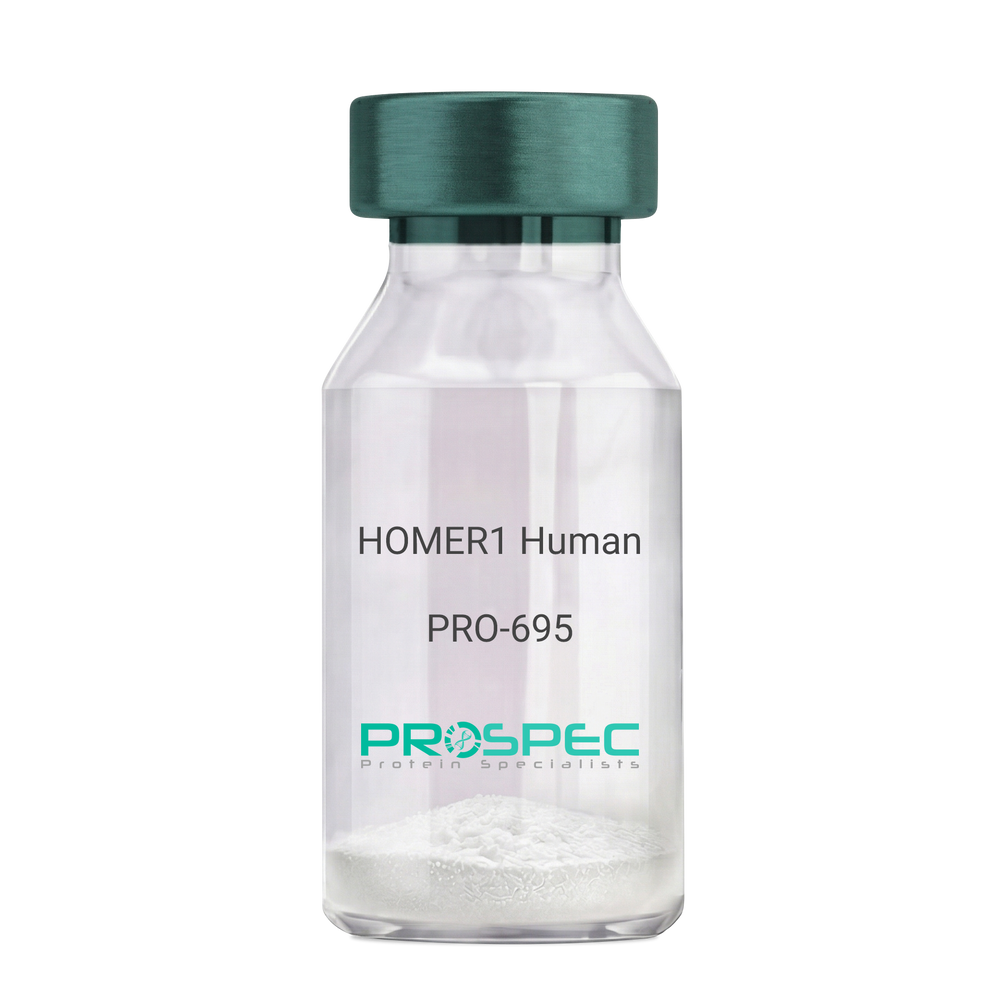
    HOMER1 Human

    Description:

    Homer Homolog-1 Human Recombinant

    HOMER, SYN47, Ves-1, HOMER1A, HOMER1B, HOMER1C, HOMER1, Homer protein homolog 1.

    Product # :

    PRO-695

    Price :

    Quantity :

    Shipping Method :

    Ice Icon

    Shipped with Ice Packs

    Add To Cart

    More Info

    • description
    • source
    • formulation
    • purity
    • More Info

    Description

    Recombinant Human HOMER1 produced in E.Coli is a single, non-glycosylated polypeptide chain containing 391 amino acids (1-354 a.a) and having a molecular mass of 44.5 kDa. HOMER1 is fused to a 37 amino acid His Tag at N-terminus and purified by proprietary chromatographic techniques.

    Source

    Escherichia Coli.

    Formulation

    The HOMER1 protein (1mg/ml) contains 20mM Tris-HCl buffer pH-8, 1mM DTT, 0.1M NaCl and 20% glycerol.

    Purity

    Greater than 90% as determined by Analysis by SDS-PAGE.

    More Info

    • Introduction

      HOMER1 takes part in determining the apoptotic susceptibility to TRAIL.
      HOMER1 is a member of the Homer family of proteins that regulate signal transduction through, and the trafficking of, glutamate receptors, plus maintain and regulate extracellular glutamate levels in corticolimbic brain regions. The HOMER1 is enriched at excitatory synapses and binds group 1 metabotropic glutamate receptors (mGluRs).

    • Synonyms

      HOMER, SYN47, Ves-1, HOMER1A, HOMER1B, HOMER1C, HOMER1, Homer protein homolog 1.

    • Physical Appearance

      Sterile filtered colorless solution.

    • Stability

      Store at 4°C if entire vial will be used within 2-4 weeks. Store, frozen at -20°C for longer periods of time. For long term storage it is recommended to add a carrier protein (0.1% HSA or BSA). Avoid multiple freeze-thaw cycles.

    • Amino Acid Sequence

      MRGSHHHHHH GMASMTGGQQ MGRDLYDDDD KDRWGSHMGE QPIFSTRAHV FQIDPNTKKN WVPTSKHAVT VSYFYDSTRN VYRIISLDGS KAIINSTITPNMTFTKTSQK FGQWADSRAN TVYGLGFSSE HHLSKFAEKF QEFKEAARLA KEKSQEKMEL TSTPSQESAG GDLQSPLTPE SINGTDDERT PDVTQNSEPR AEPTQNALPF SHSSAISKHW EAELATLKGN NAKLTAALLE STANVKQWKQ QLAAYQEEAE RLHKRVTELE CVSSQANAVH THKTELNQTI QELEETLKLK EEEIERLKQE IDNARELQEQ RDSLTQKLQE VEIRNKDLEG QLSDLEQRLE KSQNEQEAFR NNLKTLLEIL DGKIFELTEL RDNLAKLLEC S.

    ProSpec's products are furnished for LABORATORY RESEARCH USE ONLY. The product may not be used as drugs, agricultural or pesticidal products, food additives or household chemicals.

    Homer1 Human
  • View Data Sheet

    Name :

    XPA Human

    Description:

    Xeroderma Pigmentosum, Complementation Group A Human Recombinant

    XP1, XPAC, DNA repair protein complementing XP-A cells.

    Product # :

    PRO-026

    Price :

    Quantity :

    Shipping Method :

    Ice Icon

    Shipped with Ice Packs

    Add To Cart

    More Info

    • description
    • source
    • formulation
    • purity
    • More Info

    Description

    XPA Human Recombinant produced in E.Coli is a single, non-glycosylated polypeptide chain containing 296 amino acids (1-273 a.a.) and having a molecular mass of 33.8 kDa.XPA is fused to a 23 amino acid His-tag at N-terminus & purified by proprietary chromatographic techniques.

    Source

    Escherichia Coli.

    Formulation

    XPA protein solution (1mg/ml) contains 20mM Tris-HCl buffer (pH 8.0), 0.4M Urea and 10% glycerol.

    Purity

    Greater than 85.0% as determined by SDS-PAGE.

    More Info

    • Introduction

      DNA repair protein complementing XP-A cells, (XPA), is a member of the XPA family. XPA protein takes a part in DNA excision repair. It Inductees repair by binding to damaged sites with different affinities depending on the photoproduct and the transcriptional state of the region. Defects in XPA is the reason of xeroderma pigmentosum complementation group A (XP-A), which is infrequent human autosomal recessive disease which characterized by solar sensitivity, high predisposition for developing cancers on areas exposed to sunlight, also may cause to neurological abnormalities.

    • Synonyms

      XP1, XPAC, DNA repair protein complementing XP-A cells.

    • Physical Appearance

      Sterile Filtered clear solution.

    • Stability

      Store at 4°C if entire vial will be used within 2-4 weeks. Store, frozen at -20°C for longer periods of time. For long term storage it is recommended to add a carrier protein (0.1% HSA or BSA).Avoid multiple freeze-thaw cycles.

    • Amino Acid Sequence

      MGSSHHHHHH SSGLVPRGSH MGSMAAADGA LPEAAALEQP AELPASVRAS IERKRQRALM LRQARLAARP YSATAAAATG GMANVKAAPK IIDTGGGFIL EEEEEEEQKI GKVVHQPGPV MEFDYVICEE CGKEFMDSYL MNHFDLPTCD NCRDADDKHK LITKTEAKQE YLLKDCDLEK REPPLKFIVK KNPHHSQWGD MKLYLKLQIV KRSLEVWGSQ EALEEAKEVR QENREKMKQK KFDKKVKELR RAVRSSVWKR ETIVHQHEYG PEENLEDDMY RKTCTMCGHE LTYEKM .

    ProSpec's products are furnished for LABORATORY RESEARCH USE ONLY. The product may not be used as drugs, agricultural or pesticidal products, food additives or household chemicals.

    Xpa Human
  • View Data Sheet

    Name :

    HSPB3 Human

    Description:

    Heat Shock 27kDa Protein 3 Human Recombinant

    Heat shock 27kDa protein 3, HSPL27, Protein 3, HSP 17, DHMN2C, HMN2C, heat shock protein beta-3, HspB3.

    Product # :

    HSP-049

    Price :

    Quantity :

    Shipping Method :

    Ice Icon

    Shipped with Ice Packs

    Add To Cart

    More Info

    • description
    • source
    • formulation
    • purity
    • More Info

    Description

    HSPB3 Human Recombinant produced in E.coli is a single, non-glycosylated polypeptide chain containing 170 amino acids (1-150) and having a molecular mass of 19.1 kDa.The HSPB3 is fused to a 20 amino acid His-Tag at N-terminus and purified by proprietary chromatographic techniques.

    Source

    E.coli.

    Formulation

    The HSPB3 solution (1mg/ml) contains 20mM Tris-HCl buffer (pH 8.0), 1M Urea and 5% glycerol.

    Purity

    Greater than 85% as determined by SDS-PAGE.

    More Info

    • Introduction

      HSPB3 is a muscle-specific small heat shock protein which is expressed specially in heart and skeletal muscle. Mammalian small heat shock proteins (sHSP) are highly expressed proteins with varied roles, including the assembly and impounding of multi-protein complexes, transportation of nascent polypeptide chains thru cellular membranes and regulation of protein folding. HSPB3 perform as an ATP-dependent chaperone protein which takes part in the refolding of denatured proteins and inhibition of actin polymerization.

    • Synonyms

      Heat shock 27kDa protein 3, HSPL27, Protein 3, HSP 17, DHMN2C, HMN2C, heat shock protein beta-3, HspB3.

    • Physical Appearance

      Sterile Filtered colorless solution.

    • Stability

      Store at 4°C if entire vial will be used within 2-4 weeks. Store, frozen at -20°C for longer periods of time. For long term storage it is recommended to add a carrier protein (0.1% HSA or BSA).Avoid multiple freeze-thaw cycles.

    • Amino Acid Sequence

      MGSSHHHHHH SSGLVPRGSH MAKIILRHLI EIPVRYQEEF EARGLEDCRL DHALYALPGP TIVDLRKTRA AQSPPVDSAA ETPPREGKSH FQILLDVVQF LPEDIIIQTF EGWLLIKAQH GTRMDEHGFI SRSFTRQYKL PDGVEIKDLS AVLCHDGILV VEVKDPVGTK

    ProSpec's products are furnished for LABORATORY RESEARCH USE ONLY. The product may not be used as drugs, agricultural or pesticidal products, food additives or household chemicals.

    Hspb3 Human
  • View Data Sheet

    Name :

    MYL4 Human

    Description:

    Myosin Light Chain 4 Human Recombinant

    Myosin light chain 4 alkali atrial embryonic, ALC1, AMLC, GT1, Myosin light chain 1 embryonic muscle/atrial isoform, Myosin light chain alkali GT-1 isoform, PRO1957, MLC1.

    Product # :

    PRO-992

    Price :

    Quantity :

    Shipping Method :

    Ice Icon

    Shipped with Ice Packs

    Add To Cart

    More Info

    • description
    • source
    • formulation
    • purity
    • More Info

    Description

    MYL4 Human Recombinant produced in E.Coli is a single, non-glycosylated polypeptide chain containing 205 amino acids (1-197 a.a.) and having a molecular mass of 22.6kDa.MYL4 is fused to an 8 amino acid His-tag at C-terminus & purified by proprietary chromatographic techniques.

    Source

    E.coli.

    Formulation

    MYL4 protein solution (0.5mg/ml) containing 20mM Tris-HCl buffer (pH8.0), 150mM NaCl, 1mM DTT and 20% glycerol.

    Purity

    Greater than 90% as determined by SDS-PAGE.

    More Info

    • Introduction

      MYL4 is a hexameric ATPase cellular motor protein which is composed of two nonphosphorylatable alkali light chains, two heavy chains and two phosphorylatable regulatory light chains. MYL4 encodes a myosin alkali light chain which is located in embryonic muscle and adult atria. Two alternatively spliced transcript variants encoding the same protein were found for this gene.

    • Synonyms

      Myosin light chain 4 alkali atrial embryonic, ALC1, AMLC, GT1, Myosin light chain 1 embryonic muscle/atrial isoform, Myosin light chain alkali GT-1 isoform, PRO1957, MLC1.

    • Physical Appearance

      Sterile Filtered colorless solution.

    • Stability

      Store at 4°C if entire vial will be used within 2-4 weeks. Store, frozen at -20°C for longer periods of time. For long term storage it is recommended to add a carrier protein (0.1% HSA or BSA).Avoid multiple freeze-thaw cycles.

    • Amino Acid Sequence

      MAPKKPEPKK EAAKPAPAPA PAPAPAPAPA PEAPKEPAFD PKSVKIDFTA DQIEEFKEAF SLFDRTPTGE MKITYGQCGD VLRALGQNPT NAEVLRVLGK PKPEEMNVKM LDFETFLPIL QHISRNKEQG TYEDFVEGLR VFDKESNGTV MGAELRHVLA TLGEKMTEAE VEQLLAGQED ANGCINYEAF VKHIMSGLEH HHHHH.

    ProSpec's products are furnished for LABORATORY RESEARCH USE ONLY. The product may not be used as drugs, agricultural or pesticidal products, food additives or household chemicals.

    Myl4 Human
  • View Data Sheet

    Name :

    USP14 Human

    Description:

    Ubiquitin Specific Peptidase 14 Human Recombinant

    TGT, Ubiquitin thioesterase 14, Deubiquitinating enzyme 14, Ubiquitin thioesterase 14, Ubiquitin-specific-processing protease 14.

    Product # :

    PRO-016

    Price :

    Quantity :

    Shipping Method :

    Ice Icon

    Shipped with Ice Packs

    Add To Cart

    More Info

    • description
    • source
    • formulation
    • purity
    • More Info

    Description

    USP14 Human Recombinant produced in E.Coli is a single, non-glycosylated polypeptide chain containing 517 amino acids (1-494 a.a) and having a molecular mass of 58.5kDa. USP14 is fused to a 23 amino acid His-tag at N-terminus & purified by proprietary chromatographic techniques.

    Source

    Escherichia Coli.

    Formulation

    USP14 protein solution (1mg/ml) containing 20mM Tris-HCl buffer (pH 8.0), 0.2M NaCl, 20% glycerol and 1mM DTT.

    Purity

    Greater than 90.0% as determined by SDS-PAGE.

    More Info

    • Introduction

      USP14 belongs to the ubiquitin-specific processing (UBP) family of proteases which is a deubiquitinating enzyme (DUB) containing His and Cys domains. USP14 placed in the cytoplasm and cuts the ubiquitin from ubiquitin-fused precursors and ubiquitinylated proteins.a mutation which results in reduced expression of the ortholog of USP14 in mice inhibits growth, develop severe tremors by 2 to 3 weeks of age followed by paralysis and death by 6 to 10 weeks of age.

    • Synonyms

      TGT, Ubiquitin thioesterase 14, Deubiquitinating enzyme 14, Ubiquitin thioesterase 14, Ubiquitin-specific-processing protease 14.

    • Physical Appearance

      Sterile Filtered colorless solution.

    • Stability

      Store at 4°C if entire vial will be used within 2-4 weeks. Store, frozen at -20°C for longer periods of time. For long term storage it is recommended to add a carrier protein (0.1% HSA or BSA).Avoid multiple freeze-thaw cycles.

    • Amino Acid Sequence

      MGSSHHHHHH SSGLVPRGSH MGSMPLYSVT VKWGKEKFEG VELNTDEPPM VFKAQLFALT GVQPARQKVM VKGGTLKDDD WGNIKIKNGM TLLMMGSADA LPEEPSAKTV FVEDMTEEQL ASAMELPCGL TNLGNTCYMN ATVQCIRSVP ELKDALKRYA GALRASGEMA SAQYITAALR DLFDSMDKTS SSIPPIILLQ FLHMAFPQFA EKGEQGQYLQ QDANECWIQM MRVLQQKLEA IEDDSVKETD SSSASAATPS KKKSLIDQFF GVEFETTMKC TESEEEEVTK GKENQLQLSC FINQEVKYLF TGLKLRLQEE ITKQSPTLQR NALYIKSSKI SRLPAYLTIQ MVRFFYKEKE SVNAKVLKDV KFPLMLDMYE LCTPELQEKM VSFRSKFKDL EDKKVNQQPN TSDKKSSPQK EVKYEPFSFA DDIGSNNCGY YDLQAVLTHQ GRSSSSGHYV SWVKRKQDEW IKFDDDKVSI VTPEDILRLS GGGDWHIAYV LLYGPRRVEI MEEESEQ.

    ProSpec's products are furnished for LABORATORY RESEARCH USE ONLY. The product may not be used as drugs, agricultural or pesticidal products, food additives or household chemicals.

    Usp14 Human
  • View Data Sheet

    Name :

    UCP3 Human

    Description:

    Uncoupling protein 3 Human Recombinant

    Product # :

    PRO-2821

    Price :

    Quantity :

    Shipping Method :

    Room Temp Icon

    Shipped at Room temp

    Add To Cart

    More Info

    • description
    • source
    • formulation
    • purity
    • More Info

    Description

    The UCP3 Human is created as a recombinant protein with a 4kda N-terminal fusion of His Tag. The UCP3 His-Tagged Fusion Protein, produced in E. coli, is a 10kDa protein containing 34 amino acid residues of the Resistin Human, 181-214 amino acids.

    Source

    Escherichia Coli.

    Formulation

    Each mg was lyophilized with 1xPBS, 0.4% SDS and 4mM DTT.

    Purity

    Greater than 90% as determined by SDS-PAGE.

    More Info

    • Physical Appearance

      Sterile Filtered White lyophilized (freeze-dried) powder.

    • Stability

      Store lyophilized UCP3 at -20°C. Aliquot the product after reconstitution to avoid repeated freezing/thawing cycles. Reconstituted protein can be stored at 4°C for a limited period of time; it does not show any change after two weeks at 4°C.

    • Solubility

      It is recommended to add deionized water to prepare a working stock solution of approximately 0.5mg/ml and let the lyophilized pellet dissolve completely. Product is not sterile! Please filter the product by an appropriate sterile filter before using it on cell culture.

    • Background

      Uncoupling protein 3 (UCP3) is a mitochondrial protein which takes part in energy metabolism and thermoregulation.

      UCP3 Function

      Proton Uncoupling - UCP3 helps dissipate the proton gradient across the inner mitochondrial membrane. This uncoupling leads to the production of heat instead of ATP, a necessary process for thermogenesis.

      Energy Regulation - UCP3 takes part in the regulation of energy expenditure and can influence metabolic efficiency.

      UCP3 Location

      UCP3 is predominantly expressed in skeletal muscle and brown adipose tissue, where its activity is critical for energy metabolism.

      UCP3 Role in Metabolism

      according to some studies, UCP3 may improve insulin sensitivity and help manage body weight. In addition, UCP3 participates in the metabolism of fatty acids and may help reduce the accumulation of reactive oxygen species (ROS) by decreasing oxidative stress.

      UCP3 Regulation

      UCP3 expression can raise in response to physical activity, emphasising its role in adapting to varius energy demands during exercise.

      Changes in UCP3 levels have been associated with diabetes, obesity and other metabolic disorders.

      Clinical Relevance

      UCP3 is being investigated as a potential target for obesity and metabolic disease treatments because of its role in energy balance

      UCP3 is a central player in energy metabolism and thermogenesis, with implications for metabolic health and the body's response to exercise and diet.

    ProSpec's products are furnished for LABORATORY RESEARCH USE ONLY. The product may not be used as drugs, agricultural or pesticidal products, food additives or household chemicals.

    Ucp3 Human
  • View Data Sheet

    Name :

    VAMP2 Human, (1-94)

    Description:

    Synaptobrevin-2 Human Recombinant, (1-94)

    Vesicle Associated Membrane Protein 2, Vesicle-Associated Membrane Protein 2, Synaptobrevin 2, VAMP-2, SYB2, Synaptobrevin-2.

    Product # :

    PRO-2644

    Price :

    Quantity :

    Shipping Method :

    Ice Icon

    Shipped with Ice Packs

    Add To Cart

    More Info

    • description
    • source
    • formulation
    • purity
    • More Info

    Description

    VAMP2 Human Recombinant produced in e.coli is a single, non-glycosylated polypeptide chain containing 118 amino acids (1-94 a.a) and having a molecular mass of 12.8kDa. VAMP2 is fused to a 24 amino acid His-tag at N-terminus & purified by proprietary chromatographic techniques.

    Source

    E.Coli

    Formulation

    The VAMP2 solution (0.5mg/1ml) contains 0.1mM PMSF, 10% glycerol and Phosphate-Buffered Saline (pH 7.4).

    Purity

    Greater than 95.0% as determined by SDS-PAGE.

    More Info

    • Introduction

      Synaptobrevin-2 or VAMP2 is a protein that has a proline-rich N-terminal part, highly conserved hydrophilic domain, a transmembrane anchor and a C-terminal.VAMP2 found in the transmembrane region of the cell, in the cytoplasmic surface of the synaptic vesicle. The protein is mainly found in the Langerhans islets in the pancreas and glomerular cells in the kidney. A SNARE complex is created within the protein’s N-terminal domain and the target membrane-associated T.

    • Synonyms

      Vesicle Associated Membrane Protein 2, Vesicle-Associated Membrane Protein 2, Synaptobrevin 2, VAMP-2, SYB2, Synaptobrevin-2.

    • Physical Appearance

      Sterile Filtered colorless solution.

    • Stability

      Store at 4°C if entire vial will be used within 2-4 weeks. Store, frozen at -20°C for longer periods of time. For long term storage it is recommended to add a carrier protein (0.1% HSA or BSA).Avoid multiple freeze-thaw cycles.

    • Amino Acid Sequence

      MGSSHHHHHH SSGLVPRGSH MGSHMSATAA TAPPAAPAGE GGPPAPPPNL TSNRRLQQTQ AQVDEVVDIM RVNVDKVLER DQKLSELDDR ADALQAGASQ FETSAAKLKR KYWWKNLK.

    ProSpec's products are furnished for LABORATORY RESEARCH USE ONLY. The product may not be used as drugs, agricultural or pesticidal products, food additives or household chemicals.

    Synaptobrevin 2 Human
  • View Data Sheet

    Name :

    CAMK4 Human

    Description:

    Calcium/Calmodulin-Dependent Protein Kinase IV Human Recombinant

    Calcium/calmodulin-dependent protein kinase type IV catalytic chain, CaMK-GR, CaM kinase-GR, CaMK IV, IV, brain Ca(2+)-calmodulin-dependent protein kinase type IV, caMK, CAM kinase IV, EC 2.7.11.17.

    Product # :

    PKA-021

    Price :

    Quantity :

    Shipping Method :

    Ice Icon

    Shipped with Ice Packs

    Add To Cart

    More Info

    • description
    • source
    • formulation
    • purity
    • More Info

    Description

    CAMK4 Human Recombinant produced in E.coli is a single, non-glycosylated polypeptide chain containing 497 amino acids (1-473) and having a molecular mass of 54.5kDa.CAMK4 is fused to a 24 amino acid His-tag at N-terminus & purified by proprietary chromatographic techniques.

    Source

    E.coli.

    Formulation

    The CAMK4 solution (0.5mg/ml) contains 20mM Tris-HCl buffer (pH 8.0), 100mM NaCl and 10% glycerol.

    Purity

    Greater than 85% as determined by SDS-PAGE.

    More Info

    • Introduction

      CAMK4 is a member of the serine/threonine protein kinase family, and of the Ca(2+)/calmodulin-dependent protein kinase subfamily. CAMK4 is a multifunctional serine/threonine protein kinase with restricted tissue distribution which is associated to transcriptional regulation in lymphocytes, neurons and male germ cells.

    • Synonyms

      Calcium/calmodulin-dependent protein kinase type IV catalytic chain, CaMK-GR, CaM kinase-GR, CaMK IV, IV, brain Ca(2+)-calmodulin-dependent protein kinase type IV, caMK, CAM kinase IV, EC 2.7.11.17.

    • Physical Appearance

      Sterile Filtered colorless solution.

    • Stability

      Store at 4°C if entire vial will be used within 2-4 weeks. Store, frozen at -20°C for longer periods of time. For long term storage it is recommended to add a carrier protein (0.1% HSA or BSA).Avoid multiple freeze-thaw cycles.

    • Amino Acid Sequence

      MGSSHHHHHH SSGLVPRGSH MGSHMLKVTV PSCSASSCSS VTASAAPGTA SLVPDYWIDG SNRDALSDFF EVESELGRGA TSIVYRCKQK GTQKPYALKV LKKTVDKKIV RTEIGVLLRL SHPNIIKLKE IFETPTEISL VLELVTGGEL FDRIVEKGYY SERDAADAVK QILEAVAYLH ENGIVHRDLK PENLLYATPA PDAPLKIADF GLSKIVEHQV LMKTVCGTPG YCAPEILRGC AYGPEVDMWS VGIITYILLC GFEPFYDERG DQFMFRRILN CEYYFISPWW DEVSLNAKDL VRKLIVLDPK KRLTTFQALQ HPWVTGKAAN FVHMDTAQKK LQEFNARRKL KAAVKAVVAS SRLGSASSSH GSIQESHKAS RDPSPIQDGN EDMKAIPEGE KIQGDGAQAA VKGAQAELMK VQALEKVKGA DINAEEAPKM VPKAVEDGIK VADLELEEGL AEEKLKTVEE AAAPREGQGS SAVGFEVPQQ DVILPEY.

    ProSpec's products are furnished for LABORATORY RESEARCH USE ONLY. The product may not be used as drugs, agricultural or pesticidal products, food additives or household chemicals.

    Camk4 Human
  • View Data Sheet

    Name :

    CCL18 Human

    Description:

    Macrophage Inflammatory Protein-4 Human Recombinant (CCL18)

    Small inducible cytokine A18, CCL18, Macrophage inflammatory protein 4, MIP-4, Pulmonary and activation-regulated chemokine, CC chemokine PARC, Alternative macrophage activation-associated CC chemokine 1, AMAC-1, Dendritic cell chemokine 1, DC-CK1, chemokine (C-C motif) ligand 18, CKb7, PARC, AMAC1, DCCK1, SCYA18.

    Product # :

    CHM-322

    Price :

    Quantity :

    Shipping Method :

    Room Temp Icon

    Shipped at Room temp

    Add To Cart

    More Info

    • description
    • source
    • formulation
    • purity
    • biological activity
    • More Info

    Description

    Macrophage Inflammatory Protein-4 Human Recombinant produced in E.Coli is a single, non-glycosylated, polypeptide chain containing 69 amino acids and having a molecular mass of 7813 Dalton. The MIP-4 is purified by proprietary chromatographic techniques.

    Source

    Escherichia Coli.

    Formulation

    MIP-4 protein is lyophilized from a 0.2µm filtered concentrated (1.0mg/ml) solution in 20mM PB, pH 7.4, 100mM NaCl.

    Purity

    Greater than 97.0% as determined by:
    (a) Analysis by RP-HPLC.
    (b) Analysis by SDS-PAGE.

    Biological Activity

    The Activity MIP-4 is calculated by the ability to chemoattract Human T lymphocytes at 1-10ng/ml corresponding to a Specific Activity of 100,000-1,000,000IU/mg.

    More Info

    • Introduction

      Chemokine (C-C motif) ligand 18 (CCL18 / MIP-4) is a small cytokine belonging to the CC chemokine family that was previously called PARC (pulmonary and activation-regulated chemokine). MIP-4 is approximately 60% identical in amino acid sequence to CCL3. MIP-4 is expressed at high levels in lung and at lower levels in certain lymphoid tissues, such as the lymph nodes, and is chemotactic for activated T cells and non activated lymphocytes. The gene for human CCL18 contains three exons and is located on chromosome 17.

    • Synonyms

      Small inducible cytokine A18, CCL18, Macrophage inflammatory protein 4, MIP-4, Pulmonary and activation-regulated chemokine, CC chemokine PARC, Alternative macrophage activation-associated CC chemokine 1, AMAC-1, Dendritic cell chemokine 1, DC-CK1, chemokine (C-C motif) ligand 18, CKb7, PARC, AMAC1, DCCK1, SCYA18.

    • Physical Appearance

      Sterile Filtered White lyophilized (freeze-dried) powder.

    • Stability

      Lyophilized MIP-4 although stable at room temperature for 3 weeks, should be stored desiccated below -18°C. Upon reconstitution MIP-4 should be stored at 4°C between 2-7 days and for future use below -18°C. For long term storage it is recommended to add a carrier protein (0.1% HSA or BSA).Please prevent freeze-thaw cycles.

    • Solubility

      It is recommended to reconstitute the lyophilized MIP-4 in sterile 18M-cm H2O not less than 100µg/ml, which can then be further diluted to other aqueous solutions.

    • Amino Acid Sequence

      The sequence of the first five N-terminal amino acids of MIP-4 was determined and found to be Ala-Gln-Val-Gly-Thr.

    • Background

      What is the molecular weight/Mw of CCL18 HUMAN Protein?
      CCL18 HUMAN Protein has a total Mw of 7.8kDa.

      What is the source or expression system of CCL18 HUMAN Protein?
      Escherichia Coli.

      What is the Purity of CCL18 HUMAN Protein?
      CCL18 HUMAN Protein is > 97% pure as determined by SDS-PAGE.

      What is the Biological Activity of CCL18 HUMAN Protein?
      The Activity MIP-4 is calculated by the ability to chemoattract Human T lymphocytes at 1-10ng/ml corresponding to a Specific Activity of 100,000-1,000,000IU/mg.

      What is the amino acid sequence of CCL18 HUMAN Protein?
      The sequence of the first five N-terminal amino acids of MIP-4 was determined and found to be Ala-Gln-Val-Gly-Thr.

      What applications can CCL18 HUMAN Protein be used in?
      CCL18 HUMAN Protein can probably be used in western blot, ELISA and Lateral Flow.

      What is the endotoxin level for CCL18 HUMAN Protein?
      The endotoxin level is minimal, CCL18 HUMAN Protein was purified using conventional chromatography techniques.


    ProSpec's products are furnished for LABORATORY RESEARCH USE ONLY. The product may not be used as drugs, agricultural or pesticidal products, food additives or household chemicals.

    Mip 4 Human
  • View Data Sheet

    Name :

    SARS Nucleocaspid (2-422), HEK

    Description:

    SARS Nucleocaspid (2-422 a.a.), HEK Recombinant

    Product # :

    SARS-024

    Price :

    Quantity :

    Shipping Method :

    Ice Icon

    Shipped with Ice Packs

    Add To Cart

    More Info

    • description
    • source
    • formulation
    • purity
    • More Info

    Description

    The HEK293 derived recombinant protein contains the SARS Coronavirus Nucleoprotein, amino acids 2-422 fused to a 6 His tag at N-terminal.

    Source

    HEK293

    Formulation

    SARS Nucleocapsid protein solution is supplied in 0.28M NaCl & 50mM HEPES pH-8.

    Purity

    Protein is >85% pure as determined SDS-PAGE.

    More Info

    • Introduction

      SARS Coronavirus is an enveloped virus containing three outer structural proteins, namely the membrane (M), envelope (E), and spike (S) proteins. Spike (S)-glycoprotein of the virus interacts with a cellular receptor and mediates membrane fusion to allow viral entry into susceptible target cells. Accordingly, S-protein plays an important role in virus infection cycle and is the primary target of neutralizing antibodies.

    • Physical Appearance

      Sterile Filtered clear solution.

    • Stability

      SARS nucleoprotein is shipped on ice packs. Upon arrival, Store at -20°C.

    • Purification Method

      Purified by immobilized metal affinity chromatographic technique.

    ProSpec's products are furnished for LABORATORY RESEARCH USE ONLY. The product may not be used as drugs, agricultural or pesticidal products, food additives or household chemicals.

    product_image.jpg
  • View Data Sheet

    Name :

    S100A15 Mouse

    Description:

    S100 Calcium Binding Protein A15 Mouse Recombinant

    Protein S100-A7A, S100 calcium-binding protein A15A, S100 calcium-binding protein A7A.

    Product # :

    PRO-1145

    Price :

    Quantity :

    Shipping Method :

    Ice Icon

    Shipped with Ice Packs

    Add To Cart

    More Info

    • description
    • source
    • formulation
    • purity
    • More Info

    Description

    S100A15 Mouse Recombinant produced in E. coli is a single polypeptide chain containing 132 amino acids (1-108) and having a molecular mass of 15.0 kDa.S100A15 is fused to a 24 amino acid His-tag at N-terminus & purified by proprietary chromatographic techniques.

    Source

    E.coli.

    Formulation

    The S100A15 solution (0.25mg/1ml) contains 20mM Tris-HCl buffer (pH 8.0), 150mM NaCl and 20% glycerol.

    Purity

    Greater than 85% as determined by SDS-PAGE.

    More Info

    • Introduction

      Mouse S100A15 is a protein of 104 amino acids with an expected molecular weight of 12,870 Dalton having 2 EF-hand calcium binding sites. The S100A15 expression is upregulated in cultured keratinocytes stimulated to differentiate by calcium or phorbol esters. S100A15 is expressed in the skin and keratinocytes.

    • Synonyms

      Protein S100-A7A, S100 calcium-binding protein A15A, S100 calcium-binding protein A7A.

    • Physical Appearance

      Sterile Filtered colorless solution.

    • Stability

      Store at 4°C if entire vial will be used within 2-4 weeks. Store, frozen at -20°C for longer periods of time. For long term storage it is recommended to add a carrier protein (0.1% HSA or BSA).Avoid multiple freeze-thaw cycles.

    • Amino Acid Sequence

      MGSSHHHHHH SSGLVPRGSH MGSHMPDTPV EDSLFQIIHC FHHYAAREGD KETLSLEELK ALLLDSVPRF MDTLGRRQPY YITELFRAAD KNKDNQICFD EFLYILGKLV KDYHLQFHRQ LCAHYCTEHS LY.

    ProSpec's products are furnished for LABORATORY RESEARCH USE ONLY. The product may not be used as drugs, agricultural or pesticidal products, food additives or household chemicals.

    S100A15 Mouse
  • View Data Sheet

    Name :

    S100A3 Human

    Description:

    S100 Calcium Binding Protein A3 Human Recombinant

    S100-A3, S-100E, S100 calcium-binding protein A3, S100E, S-100A3, Protein S100-A3, Protein S-100E, S100A3.

    Product # :

    PRO-755

    Price :

    Quantity :

    Shipping Method :

    Ice Icon

    Shipped with Ice Packs

    Add To Cart

    More Info

    • description
    • source
    • formulation
    • purity
    • More Info

    Description

    S100A3 Human Recombinant produced in E.coli is a single, non-glycosylated polypeptide chain containing 121 amino acids (1-101) and having a molecular mass of 13.9kDa.The S100A3 is fused to a 20 amino acid His-Tag at N-terminus and purified by proprietary chromatographic techniques.

    Source

    Escherichia Coli.

    Formulation

    S100A3 protein at 1mg/ml in 20mM Tris-HCl buffer (pH 8.0), 20% glycerol, 2mM DTT and 0.2M NaCl.

    Purity

    Greater than 90.0% as determined by SDS-PAGE.

    More Info

    • Introduction

      S100A3 is part of S100 family of proteins containing 2 EF-hand calcium-binding motifs. S100 proteins are localized in the cytoplasm/nucleus of a broad range of cells, and takes part in the regulation of several cellular processes such as cell cycle progression and differentiation. S100A3 has the largest number of cysteines of all S100 proteins. S100A3 has high affinity for Zinc, and is widely expressed in human hair cuticle.

    • Synonyms

      S100-A3, S-100E, S100 calcium-binding protein A3, S100E, S-100A3, Protein S100-A3, Protein S-100E, S100A3.

    • Physical Appearance

      Sterile Filtered clear solution.

    • Stability

      Store at 4°C if entire vial will be used within 2-4 weeks.Store, frozen at -20°C for longer periods of time. For long term storage it is recommended to add a carrier protein (0.1% HSA or BSA).Please prevent freeze thaw cycles.

    • Amino Acid Sequence

      MGSSHHHHHH SSGLVPRGSH MARPLEQAVA AIVCTFQEYA GRCGDKYKLC QAELKELLQK ELATWTPTEF RECDYNKFMS VLDTNKDCEV DFVEYVRSLA CLCLYCHEYF KDCPSEPPCS Q.

    ProSpec's products are furnished for LABORATORY RESEARCH USE ONLY. The product may not be used as drugs, agricultural or pesticidal products, food additives or household chemicals.

    S100A3 Human
  • 1
  • …
  • 38
  • 39
  • 40
  • 41
  • 42
Your browser does not support the video tag.

Products

  • Cytokines
  • Growth Factors
  • Chemokines
  • CD Antigens
  • Neurotrophins
  • Hormones
  • Enzymes
  • Viral Antigens
  • Recombinant Proteins
  • Natural Proteins
  • Monoclonal Antibodies
  • Polyclonal Antibodies
  • Thermal Packaging

About

  • Company
  • Founder
  • Contribution
  • Contact Us
  • My Account

Ordering

  • Ordering Method
  • Ordering - Credit Card
  • Ordering PO
  • Shipping Fees
  • FAQ's

Legal

  • Terms & Conditions
  • Privacy
  • Site Map
  • info@prospecbio.com
  • Facebook
  • Instagram
  • Linkedin Profile

© 2026 ProSpec-Tany TechnoGene Ltd. All Rights Reserved.

  • Choosing a selection results in a full page refresh.
  • Opens in a new window.