Skip to content

High-quality research proteins.

  • 1-800-805-6531

  • Mon - Sat 8.00-18.00, Sun - Closed

  • info@prospecbio.com

  • PO Box 6591 East Brunswick NJ 08816

  • Products
    • Cytokines
    • Growth factors
    • Chemokines
    • Cd antigens
    • Neurotrophins
    • Hormones
    • Enzymes
    • Viral antigens
    • Recombinant proteins
    • Natural proteins
    • Monoclonal antibodies
    • Polyclonal antibodies
    • Thermal Packaging
  • About
    • Company
    • Founder
    • Contribution
  • Customers
    • Eastern Asia
    • Eastern Europe
    • North America
    • South America
    • South East Asia
    • Southern Asia
    • Western Europe
  • Ordering
    • Ordering Method
    • Ordering - Credit Card
    • Ordering - PO
    • Shipping Fees
    • FAQs
  • Services
    • DNA Cloning
    • Protein Expression
    • Monoclonal Antibody
    • Fermentation
    • Technology License
  • Contact us
Log in

Country/region

  • USD $ | Albania
  • USD $ | Andorra
  • USD $ | Argentina
  • USD $ | Armenia
  • USD $ | Australia
  • USD $ | Austria
  • USD $ | Azerbaijan
  • USD $ | Belarus
  • USD $ | Belgium
  • USD $ | Bolivia
  • USD $ | Brazil
  • USD $ | Bulgaria
  • USD $ | Cambodia
  • USD $ | Canada
  • USD $ | Chile
  • USD $ | China
  • USD $ | Colombia
  • USD $ | Costa Rica
  • USD $ | Croatia
  • USD $ | Cyprus
  • USD $ | Czechia
  • USD $ | Denmark
  • USD $ | Estonia
  • USD $ | Finland
  • USD $ | France
  • USD $ | Georgia
  • USD $ | Germany
  • USD $ | Greece
  • USD $ | Hong Kong SAR
  • USD $ | Hungary
  • USD $ | Iceland
  • USD $ | India
  • USD $ | Ireland
  • USD $ | Israel
  • USD $ | Italy
  • USD $ | Japan
  • USD $ | Kazakhstan
  • USD $ | Latvia
  • USD $ | Liechtenstein
  • USD $ | Lithuania
  • USD $ | Madagascar
  • USD $ | Malta
  • USD $ | Mexico
  • USD $ | Moldova
  • USD $ | Monaco
  • USD $ | Netherlands
  • USD $ | New Zealand
  • USD $ | North Macedonia
  • USD $ | Norway
  • USD $ | Panama
  • USD $ | Paraguay
  • USD $ | Peru
  • USD $ | Philippines
  • USD $ | Poland
  • USD $ | Portugal
  • USD $ | Romania
  • USD $ | Singapore
  • USD $ | Slovakia
  • USD $ | Slovenia
  • USD $ | South Africa
  • USD $ | South Korea
  • USD $ | Spain
  • USD $ | Sri Lanka
  • USD $ | Sweden
  • USD $ | Switzerland
  • USD $ | Taiwan
  • USD $ | Thailand
  • USD $ | Türkiye
  • USD $ | Ukraine
  • USD $ | United Kingdom
  • USD $ | United States
  • USD $ | Uruguay
  • USD $ | Vatican City
  • USD $ | Venezuela
  • USD $ | Vietnam
  • Facebook
  • Instagram
logoProSpec - Recombinant Protein Manufacturer for academic and R&D industry
Become a distributor
Account Log in
Wishlist
Cart Cart(0)
  • Products
    +
    • Cytokines
    • Growth factors
    • Chemokines
    • Cd antigens
    • Neurotrophins
    • Hormones
    • Enzymes
    • Viral antigens
    • Recombinant proteins
    • Natural proteins
    • Monoclonal antibodies
    • Polyclonal antibodies
    • Thermal Packaging
  • About
    +
    • Company
    • Founder
    • Contribution
  • Customers
    +
    • Eastern Asia
    • Eastern Europe
    • North America
    • South America
    • South East Asia
    • Southern Asia
    • Western Europe
  • Ordering
    +
    • Ordering Method
    • Ordering - Credit Card
    • Ordering - PO
    • Shipping Fees
    • FAQs
  • Services
    +
    • DNA Cloning
    • Protein Expression
    • Monoclonal Antibody
    • Fermentation
    • Technology License
  • Contact us

Item added to your cart

View cart
View All
  • Cytokines
  • Growth factors
  • Chemokines
  • Cd antigens
  • Neurotrophins
  • Hormones
  • Enzymes
  • Viral antigens
  • Recombinant proteins
  • Natural proteins
  • Monoclonal antibodies
  • Polyclonal antibodies
  • Thermal Packaging
  • Tumor Necrosis Factor

    Tumor Necrosis Factor

    View All
  • 4-1BB

    4-1BB

    View All
  • Adiponectin

    Adiponectin

    View All
  • AIF1

    AIF1

    View All
  • Other Cytokines

    Other Cytokines

    View All
  • AITRL

    AITRL

    View All
  • Angiopoietin

    Angiopoietin

    View All
  • Apolipoprotein

    Apolipoprotein

    View All
  • B-Cell Activating Factor

    B-Cell Activating Factor

    View All
  • Beta Defensin

    Beta Defensin

    View All
  • Bone Morphogenetic Protein

    Bone Morphogenetic Protein

    View All
  • B type Natriuretic Peptide

    B type Natriuretic Peptide

    View All
  • BST

    BST

    View All
  • Betacellulin

    Betacellulin

    View All
  • Cardiotrophin

    Cardiotrophin

    View All
  • Activin

    Activin

    View All
  • Fibroblast Growth Factor

    Fibroblast Growth Factor

    View All
  • Other Growth Factors

    Other Growth Factors

    View All
  • CSF

    CSF

    View All
  • CTGF

    CTGF

    View All
  • IGFBP

    IGFBP

    View All
  • VEGF Protein

    VEGF Protein

    View All
  • EGF

    EGF

    View All
  • Epigen

    Epigen

    View All
  • Erythropoietin

    Erythropoietin

    View All
  • Insulin-Like Growth Factor

    Insulin-Like Growth Factor

    View All
  • Growth Hormone

    Growth Hormone

    View All
  • HDGF

    HDGF

    View All
  • Hepatocyte Growth Factor

    Hepatocyte Growth Factor

    View All
  • Insulin

    Insulin

    View All
  • BCA-1/ BLC (CXCL13)

    BCA-1/ BLC (CXCL13)

    View All
  • BRAK (CXCL14)

    BRAK (CXCL14)

    View All
  • C-10 (CCL6)

    C-10 (CCL6)

    View All
  • Other Chemokines

    Other Chemokines

    View All
  • MEC (CCL28)

    MEC (CCL28)

    View All
  • LD78-beta (CCL3L1)

    LD78-beta (CCL3L1)

    View All
  • CTACK (CCL27)

    CTACK (CCL27)

    View All
  • CXCL16

    CXCL16

    View All
  • CXCL17

    CXCL17

    View All
  • Platelet Factor-4 (CXCL4)

    Platelet Factor-4 (CXCL4)

    View All
  • ENA-78 (CXCL5)

    ENA-78 (CXCL5)

    View All
  • Eotaxin (CCL11,24,26)

    Eotaxin (CCL11,24,26)

    View All
  • Exodus-2 (CCL21)

    Exodus-2 (CCL21)

    View All
  • Fractalkine (CX3CL1)

    Fractalkine (CX3CL1)

    View All
  • CXCL6

    CXCL6

    View All
  • Other CD Antigens

    Other CD Antigens

    View All
  • CD14

    CD14

    View All
  • CD164

    CD164

    View All
  • CD1

    CD1

    View All
  • CD2

    CD2

    View All
  • CD200

    CD200

    View All
  • CD207

    CD207

    View All
  • CD226

    CD226

    View All
  • CD23

    CD23

    View All
  • CD244

    CD244

    View All
  • CD247

    CD247

    View All
  • CD27

    CD27

    View All
  • CD274

    CD274

    View All
  • CD300

    CD300

    View All
  • CD33

    CD33

    View All
  • Other Neurotrophins

    Other Neurotrophins

    View All
  • Beta-NGF

    Beta-NGF

    View All
  • BDNF

    BDNF

    View All
  • CDNF

    CDNF

    View All
  • CNTF

    CNTF

    View All
  • GDNF

    GDNF

    View All
  • Glia Maturation Factor

    Glia Maturation Factor

    View All
  • MANF

    MANF

    View All
  • Midkine

    Midkine

    View All
  • Neuroglobin

    Neuroglobin

    View All
  • Neurotrophic factors

    Neurotrophic factors

    View All
  • Neuregulin

    Neuregulin

    View All
  • Neuropilin

    Neuropilin

    View All
  • Pigment Epithelium-Derived Factor

    Pigment Epithelium-Derived Factor

    View All
  • Pleiotrophin

    Pleiotrophin

    View All
  • Peptide Hormones

    Peptide Hormones

    View All
  • Other Hormones

    Other Hormones

    View All
  • HCG

    HCG

    View All
  • Endothelin

    Endothelin

    View All
  • Exendin

    Exendin

    View All
  • FSH

    FSH

    View All
  • Glucagon

    Glucagon

    View All
  • GHRP

    GHRP

    View All
  • GLP

    GLP

    View All
  • Thyrostimulin

    Thyrostimulin

    View All
  • Inhibin A

    Inhibin A

    View All
  • LHRH

    LHRH

    View All
  • Melanotan

    Melanotan

    View All
  • Procalcitonin

    Procalcitonin

    View All
  • PTH

    PTH

    View All
  • Peroxiredoxin

    Peroxiredoxin

    View All
  • Peptidase

    Peptidase

    View All
  • Synthetase

    Synthetase

    View All
  • Transferase

    Transferase

    View All
  • Hydrolase

    Hydrolase

    View All
  • Dehydrogenase

    Dehydrogenase

    View All
  • ACE2

    ACE2

    View All
  • Esterase

    Esterase

    View All
  • Protein Kinases

    Protein Kinases

    View All
  • Other Enzymes

    Other Enzymes

    View All
  • Phosphatase

    Phosphatase

    View All
  • Deaminase

    Deaminase

    View All
  • Oxygenase

    Oxygenase

    View All
  • Adenylate Kinase

    Adenylate Kinase

    View All
  • Lyase

    Lyase

    View All
  • Chagas

    Chagas

    View All
  • SARS

    SARS

    View All
  • Influenza

    Influenza

    View All
  • ASFV

    ASFV

    View All
  • Astrovirus

    Astrovirus

    View All
  • Borrelia

    Borrelia

    View All
  • Helicobacter Pylori

    Helicobacter Pylori

    View All
  • Chikungunya

    Chikungunya

    View All
  • Chlamydia

    Chlamydia

    View All
  • Cytomegalo

    Cytomegalo

    View All
  • Dengue

    Dengue

    View All
  • EBV

    EBV

    View All
  • Ebola

    Ebola

    View All
  • Feline Leukemia Virus

    Feline Leukemia Virus

    View All
  • Hepatitis A

    Hepatitis A

    View All
  • Other

    Other

    View All
  • Actin

    Actin

    View All
  • ADAM

    ADAM

    View All
  • Complement Component

    Complement Component

    View All
  • Ag85

    Ag85

    View All
  • Eukaryotic Translation Initiation Factor

    Eukaryotic Translation Initiation Factor

    View All
  • Anterior Gradient Protein

    Anterior Gradient Protein

    View All
  • Heat Shock Protein

    Heat Shock Protein

    View All
  • Alpha-2-HS-Glycoprotein

    Alpha-2-HS-Glycoprotein

    View All
  • Hemoglobin

    Hemoglobin

    View All
  • Allergy

    Allergy

    View All
  • Anaplasma

    Anaplasma

    View All
  • Angiogenin

    Angiogenin

    View All
  • Ankyrin Repeat Domain

    Ankyrin Repeat Domain

    View All
  • Annexin

    Annexin

    View All
  • Other Natural Proteins

    Other Natural Proteins

    View All
  • Aprotinin

    Aprotinin

    View All
  • Transferrin

    Transferrin

    View All
  • Avidin

    Avidin

    View All
  • Anti Coagulation Factors

    Anti Coagulation Factors

    View All
  • Natural Albumin

    Natural Albumin

    View All
  • Natural Coagulation Factors

    Natural Coagulation Factors

    View All
  • Fibronectin

    Fibronectin

    View All
  • Thrombin

    Thrombin

    View All
  • Anti Human Enzyme

    Anti Human Enzyme

    View All
  • Other Monoclonal Antibodies

    Other Monoclonal Antibodies

    View All
  • Anti Human Cytokine

    Anti Human Cytokine

    View All
  • Anti Human Heat Shock Protein

    Anti Human Heat Shock Protein

    View All
  • Anti Mouse Lymphocyte

    Anti Mouse Lymphocyte

    View All
  • Anti Human Chemokine

    Anti Human Chemokine

    View All
  • Anti Human Lymphocyte

    Anti Human Lymphocyte

    View All
  • Anti Viral Monoclonal

    Anti Viral Monoclonal

    View All
  • Anti Mouse Cytokine

    Anti Mouse Cytokine

    View All
  • Anti-GST Monoclonal

    Anti-GST Monoclonal

    View All
  • Other Polyclonal Antibodies

    Other Polyclonal Antibodies

    View All
  • Anti Viral

    Anti Viral

    View All
  • Anti-GST Monoclonal

    Anti-GST Monoclonal

    View All
Back

Search results

1000 results found for “Phosphorylase”

Name

Description

Product #

Price

Quantity

Shipping Method

  • View Data Sheet

    Name :

    CKMM Human, Native

    Description:

    Creatine Kinase Muscle Human

    Creatine kinase M-type, EC 2.7.3.2, Creatine kinase M chain, M-CK, CKM, CKMM.

    Product # :

    CKI-273

    Price :

    Quantity :

    Shipping Method :

    Room Temp Icon

    Shipped at Room temp

    Add To Cart

    More Info

    • description
    • source
    • formulation
    • purity
    • biological activity
    • More Info

    Description

    Human CKMM derived from Human Cardiac Tissue.

    Source

    Human Cardiac Tissue.

    Formulation

    The CKMM protein was lyophilized from 40mM Tris-HCL, 1mM EDTA, pH 7.5 & 10mM n-Acetyl cysteine.

    Purity

    Greater than 10.0% as visualized by sds-page.

    Biological Activity

    1 unit will transfer 1 µmole of phosphate from Creatine phosphate to ATP/minute at 37 degrees Celsius. Measured at 340nm as one equimolar amount of NADH produced by a coupled reaction. The specific activity was measured and found to be > 100U/mg.

    More Info

    • Introduction

      The three isoenzymes (MM, MB, and BB) are found in muscle, cardiac and brain tissues. These recombinant proteins are ideal for calibrating diagnostic instruments and researching neuromuscular diseases. Creatine Kinases can be used for indications in many neuromuscular applications. These disorders include cardiac disease, mitochondrial disorders, inflammatory myopathies, myasthenia, polymyositis, McArdle''s disease, NMJ disorders, muscular dystrophy, ALS, hypo and hyperthyroid disorders, central core disease, acid maltase deficiency, myoglobinuria, rhabdomyolysis, motor neuron diseases, rheumatic diseases, and other that create elevated or reduced levels of Creatine Kinases.

    • Synonyms

      Creatine kinase M-type, EC 2.7.3.2, Creatine kinase M chain, M-CK, CKM, CKMM.

    • Physical Appearance

      Lyophilized Powder

    • Stability

      Lyophilized CKMM although stable at room temperature for 3 weeks, should be stored desiccated below -18°C. Upon reconstitution IL2 should be stored at 4°C between 2-7 days and for future use below -18°C.For long term storage it is recommended to add a carrier protein (0.1% HSA or BSA).Please prevent freeze-thaw cycles.

    • Solubility

      It is recommended to reconstitute the lyophilized CKMM in sterile distilled water not less than 100µg/ml, which can then be further diluted to other aqueous solutions.

    ProSpec's products are furnished for LABORATORY RESEARCH USE ONLY. The product may not be used as drugs, agricultural or pesticidal products, food additives or household chemicals.

    Ckmm Human
  • View Data Sheet

    Name :

    CKMT2 Human

    Description:

    Creatine Kinase, Mitochondrial 2 Human Recombinant

    Creatine kinase mitochondrial 2 (sarcomeric), Basic-type mitochondrial creatine kinase, Sarcomeric mitochondrial creatine kinase, creatine kinase S-type, mitochondrial, SMTCK, Mib-CK, EC 2.7.3.2.

    Product # :

    CKI-276

    Price :

    Quantity :

    Shipping Method :

    Ice Icon

    Shipped with Ice Packs

    Add To Cart

    More Info

    • description
    • source
    • formulation
    • purity
    • More Info

    Description

    CKMT2 Human Recombinant produced in E. coli is a single polypeptide chain containing 405 amino acids (40-419) and having a molecular mass of 46.1 kDa.CKMT2 is fused to a 25 amino acid His-tag at N-terminus & purified by proprietary chromatographic techniques.

    Source

    E.coli.

    Formulation

    The CKMT2 solution (1mg/ml) contains 20mM Tris-HCl buffer (pH 8.0), 0.1M NaCl, 1mM DTT and 10% glycerol.

    Purity

    Greater than 90% as determined by SDS-PAGE.

    More Info

    • Introduction

      Creatine Kinase, Mitochondrial 2 (CKMT2) is a member of the ATP:guanido phosphotransferase family. CKMT2 is responsible for the transfer of high energy phosphate from mitochondria to the cytosolic carrier, creatine. CKMT2 reversibly catalyzes the transfer of phosphate between ATP and various phosphogens (e.g. creatine phosphate). Creatine kinase isoenzymes have a principal role in energy transduction in tissues with large, variable energy demands, such as skeletal muscle, heart, brain and spermatozoa. Mitochondrial creatine kinase occurs in 2 different oligomeric forms: dimers and octamers, contrary to the exclusively dimeric cytosolic creatine kinase isoenzymes. The CKMT2 gene contains sequences homologous to a number of motifs which are shared among some nuclear genes encoding mitochondrial proteins and therefore may be crucial for the coordinated activation of these genes during mitochondrial biogenesis.

    • Synonyms

      Creatine kinase mitochondrial 2 (sarcomeric), Basic-type mitochondrial creatine kinase, Sarcomeric mitochondrial creatine kinase, creatine kinase S-type, mitochondrial, SMTCK, Mib-CK, EC 2.7.3.2.

    • Physical Appearance

      Sterile Filtered colorless solution.

    • Stability

      Store at 4°C if entire vial will be used within 2-4 weeks. Store, frozen at -20°C for longer periods of time. For long term storage it is recommended to add a carrier protein (0.1% HSA or BSA).Avoid multiple freeze-thaw cycles.

    • Amino Acid Sequence

      MGSSHHHHHH SSGLVPRGSH MGSHMEVREQ PRLFPPSADY PDLRKHNNCM AECLTPAIYA KLRNKVTPNG YTLDQCIQTG VDNPGHPFIK TVGMVAGDEE SYEVFADLFD PVIKLRHNGY DPRVMKHTTD LDASKITQGQ FDEHYVLSSR VRTGRSIRGL SLPPACTRAE RREVENVAIT ALEGLKGDLA GRYYKLSEMT EQDQQRLIDD HFLFDKPVSP LLTCAGMARD WPDARGIWHN YDKTFLIWIN EEDHTRVISM EKGGNMKRVF ERFCRGLKEV ERLIQERGWE FMWNERLGYI LTCPSNLGTG LRAGVHVRIP KLSKDPRFSK ILENLRLQKR GTGGVDTAAV ADVYDISNID RIGRSEVELV QIVIDGVNYL VDCEKKLERG QDIKVPPPLP QFGKK

    ProSpec's products are furnished for LABORATORY RESEARCH USE ONLY. The product may not be used as drugs, agricultural or pesticidal products, food additives or household chemicals.

    Ckmt2 Human
  • View Data Sheet

    Name :

    PTEN Human, His

    Description:

    Phosphatase and Tensin homolog Human Recombinant, His Tag

    Phosphatidylinositol-3,4,5-trisphosphate 3-phosphatase and dual-specificity protein phosphatase PTEN, EC 3.1.3.67, EC 3.1.3.16, EC 3.1.3.48, Phosphatase and tensin homolog, Mutated in multiple advanced cancers 1, PTEN, MMAC1, TEP1, BZS, MHAM, PTEN1, 10q23del, MGC11227.

    Product # :

    PRO-712

    Price :

    Quantity :

    Shipping Method :

    Ice Icon

    Shipped with Ice Packs

    Add To Cart

    More Info

    • description
    • source
    • formulation
    • purity
    • More Info

    Description

    PTEN Human Recombinant fused with a 20 amino acid His tag at N-terminus produced in E.Coli is a single, non-glycosylated, polypeptide chain containing 423 amino acids (1- 403 a.a.) and having a molecular mass of 49.3kDa.The PTEN is purified by proprietary chromatographic techniques.

    Source

    Escherichia Coli.

    Formulation

    The PTEN solution contains 20mM Tris-HCl buffer (pH 8.0), 1mM EDTA, 2mM DTT, 100mM NaCl, and 20% glycerol.

    Purity

    Greater than 85.0% as determined by SDS-PAGE.

    More Info

    • Introduction

      PTEN, a tumor suppressor, has been implicated in a large number of human tumors and is conserved from humans to worms. PTEN has a tensin like domain and a catalytic domain similar to that of the dual specificity protein tyrosine phosphatases. Characterization of PTEN protein showed that it is a phosphatase that acts on proteins and on 3-phosphorylated phosphoinositides, and can therefore modulate signal transduction pathways that involve lipid second messengers. In contrast to most of the protein tyrosine phosphatases, PTEN preferentially dephosphorylates phosphoinositide substrates. PTEN negatively regulates intracellular levels of phosphatidylinositol-3,4,5-trisphosphate in cells and acts as a tumor suppressor by negative regulation of AKT/PKB signaling pathway. Recent results indicate that at least part of its role is to regulate the activity of the serine/threonine kinase AKT/PKB, and thus influence cell survival signaling.

    • Synonyms

      Phosphatidylinositol-3,4,5-trisphosphate 3-phosphatase and dual-specificity protein phosphatase PTEN, EC 3.1.3.67, EC 3.1.3.16, EC 3.1.3.48, Phosphatase and tensin homolog, Mutated in multiple advanced cancers 1, PTEN, MMAC1, TEP1, BZS, MHAM, PTEN1, 10q23del, MGC11227.

    • Physical Appearance

      Sterile Filtered colorless solution.

    • Stability

      Store at 4°C if entire vial will be used within 2-4 weeks. Store, frozen at -20°C for longer periods of time. For long term storage it is recommended to add a carrier protein (0.1% HSA or BSA).Please prevent freeze-thaw cycles.

    • Amino Acid Sequence

      MGSSHHHHHH SSGLVPRGSH MTAIIKEIVS RNKRRYQEDG FDLDLTYIYP NIIAMGFPAE RLEGVYRNNI DDVVRFLDSK HKNHYKIYNL CAERHYDTAK FNCRVAQYPF EDHNPPQLEL IKPFCEDLDQ WLSEDDNHVA AIHCKAGKGR TGVMICAYLL HRGKFLKAQE ALDFYGEVRT RDKKGVTIPS QRRYVYYYSY LLKNHLDYRP VALLFHKMMF ETIPMFSGGT CNPQFVVCQL KVKIYSSNSG PTRREDKFMY FEFPQPLPVC GDIKVEFFHK QNKMLKKDKM FHFWVNTFFI PGPEETSEKV ENGSLCDQEI DSICSIERAD NDKEYLVLTL TKNDLDKANK DKANRYFSPN FKVKLYFTKT VEEPSNPEAS SSTSVTPDVS DNEPDHYRYS DTTDSDPENE PFDEDQHTQI TKV.

    • Patent Protected Countries

      The Sale of recombinant Human PTEN by ProSpec is prohibited in the following countries: United States, Japan, Australia, Canada, Austria, Belgium, Denmark, Finland, France, Germany, Ireland, Italy, Liechtenstein, Luxembourg, Netherlands, Portugal, Spain, Sweden, Switzerland and UK.

    ProSpec's products are furnished for LABORATORY RESEARCH USE ONLY. The product may not be used as drugs, agricultural or pesticidal products, food additives or household chemicals.

    Pten Human His
  • View Data Sheet

    Name :

    ECHS1 Human

    Description:

    Enoyl CoA Hydratase, Short chain, 1, Mitochondrial Human Recombinant

    Enoyl-CoA hydratase 1, SCEH.

    Product # :

    ENZ-556

    Price :

    Quantity :

    Shipping Method :

    Ice Icon

    Shipped with Ice Packs

    Add To Cart

    More Info

    • description
    • source
    • formulation
    • purity
    • More Info

    Description

    ECHS1 Human Recombinant produced in E.Coli is a single, non-glycosylated polypeptide chain containing 284 amino acids (28-290 a.a.) and having a molecular mass of 30.6kDa.ECHS1 is fused to a 21 amino acid His-tag at N-terminus & purified by proprietary chromatographic techniques.

    Source

    Escherichia Coli.

    Formulation

    The ECHS1 protein solution (1mg/ml) contains 20mM Tris-HCl buffer (pH-8), 1mM DTT,0.1M NaCl and 20% glycerol.

    Purity

    Greater than 95.0% as determined by SDS-PAGE.

    More Info

    • Introduction

      ECHS1 is part of the hydratase/isomerase superfamily. ECHS1 is localized in the mitochondrial matrix and Expressed in muscle, liver and fibroblasts, with low expression in kidney and spleen, ECHS1 exists as a homohexamer that takes part in the second phase of the mitochondrial fatty acid β-oxidation pathway.

    • Synonyms

      Enoyl-CoA hydratase 1, SCEH.

    • Physical Appearance

      Sterile filtered colorless solution.

    • Stability

      Store at 4°C if entire vial will be used within 2-4 weeks. Store, frozen at -20°C for longer periods of time. For long term storage it is recommended to add a carrier protein (0.1% HSA or BSA).Avoid multiple freeze-thaw cycles.

    • Amino Acid Sequence

      MGSSHHHHHH SSGLVPRGSH MASGANFEYI IAEKRGKNNT VGLIQLNRPK ALNALCDGLI DELNQALKIF EEDPAVGAIV LTGGDKAFAA GADIKEMQNL SFQDCYSSKF LKHWDHLTQV KKPVIAAVNG YAFGGGCELA MMCDIIYAGE KAQFAQPEIL IGTIPGAGGT QRLTRAVGKS LAMEMVLTGD RISAQDAKQA GLVSKICPVE TLVEEAIQCA EKIASNSKIV VAMAKESVNA AFEMTLTEGS KLEKKLFYST FATDDRKEGM TAFVEKRKAN FKDQ.

    ProSpec's products are furnished for LABORATORY RESEARCH USE ONLY. The product may not be used as drugs, agricultural or pesticidal products, food additives or household chemicals.

    Echs1 Human
  • View Data Sheet

    Name :

    GOR E.Coli

    Description:

    Glutathione Oxidoreductase E.Coli Recombinant

    Glutathione reductase, GR, GRase, gor, b3500, JW3467.

    Product # :

    ENZ-574

    Price :

    Quantity :

    Shipping Method :

    Ice Icon

    Shipped with Ice Packs

    Add To Cart

    More Info

    • description
    • source
    • formulation
    • purity
    • biological activity
    • More Info

    Description

    GOR E.Coli Recombinant produced in E.coli is a single, non-glycosylated polypeptide chain containing 473 amino acids (1-450) and having a molecular mass of 51.2kDa.GOR is fused to a 23 amino acid His-tag at N-terminus & purified by proprietary chromatographic techniques.

    Source

    Escherichia Coli.

    Formulation

    The GOR solution (1mg/ml) contains 20mM Tris-HCl buffer (pH8.0), 10% glycerol, 0.1M NaCl and 1mM DTT.

    Purity

    Greater than 90.0% as determined by SDS-PAGE.

    Biological Activity

    The specific activity is > 52 units/ml.
    One unit will reduce 1.0 umol of oxidized glutathione per minute at pH 7.5 at 25°C.

    More Info

    • Introduction

      Glutathione reductase (Gor) is a member of the class-I pyridine nucleotide disulfide oxidoreductase family. The main role of the Gor protein is to uphold high levels of reduced glutathione in the cytosol. With the associated oxidation of NADPH, Gor transforms oxidized glutathione to the reduced form. The active site of the Gor protein is a redox-active disulfide bond.

    • Synonyms

      Glutathione reductase, GR, GRase, gor, b3500, JW3467.

    • Physical Appearance

      Sterile filtered colorless solution.

    • Stability

      Store at 4°C if entire vial will be used within 2-4 weeks.Store, frozen at -20°C for longer periods of time. For long term storage it is recommended to add a carrier protein (0.1% HSA or BSA).Avoid multiple freeze-thaw cycles.

    • Amino Acid Sequence

      MGSSHHHHHH SSGLVPRGSH MGSMTKHYDY IAIGGGSGGI ASINRAAMYG QKCALIEAKE LGGTCVNVGC VPKKVMWHAA QIREAIHMYG PDYGFDTTIN KFNWETLIAS RTAYIDRIHT SYENVLGKNN VDVIKGFARF VDAKTLEVNG ETITADHILI ATGGRPSHPD IPGVEYGIDS
      DGFFALPALP ERVAVVGAGY IAVELAGVIN GLGAKTHLFV RKHAPLRSFD PMISETLVEV MNAEGPQLHT NAIPKAVVKN TDGSLTLELE DGRSETVDCL IWAIGREPAN DNINLEAAGV KTNEKGYIVV DKYQNTNIEG IYAVGDNTGA VELTPVAVAA GRRLSERLFN NKPDEHLDYS
      NIPTVVFSHP PIGTVGLTEP QAREQYGDDQ VKVYKSSFTA MYTAVTTHRQ PCRMKLVCVG SEEKIVGIHG IGFGMDEMLQ GFAVALKMGA TKKDFDNTVA IHPTAAEEFV TMR.

    ProSpec's products are furnished for LABORATORY RESEARCH USE ONLY. The product may not be used as drugs, agricultural or pesticidal products, food additives or household chemicals.

    Gor Ecoli
  • View Data Sheet

    Name :

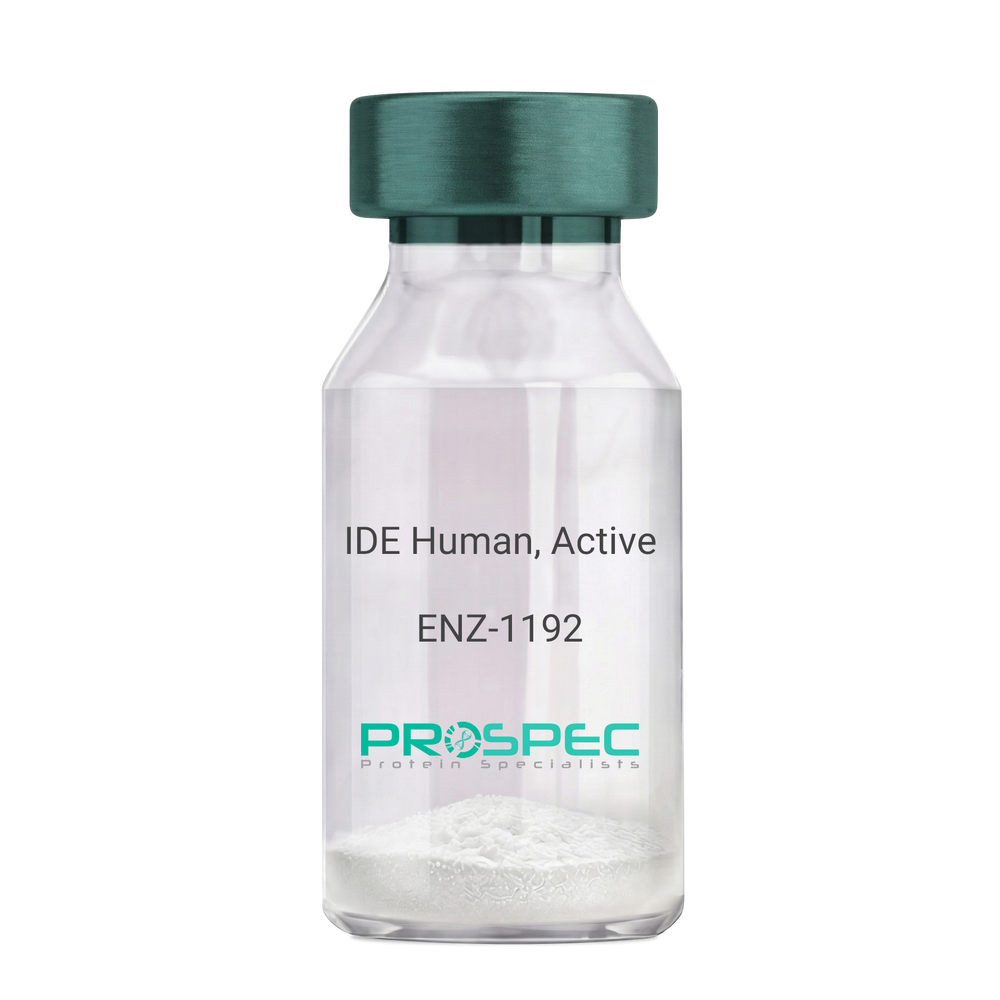
    IDE Human, Active

    Description:

    Insulin-Degrading Enzyme Human Recombinant

    Insulin-Degrading Enzyme, Abeta-Degrading Protease, Insulysin, EC 3.4.24.56, Insulinase, Insulin Protease, INSULYSIN, EC 3.4.24, IDE, insulin-degrading enzyme isoform 1. 

    Product # :

    ENZ-1192

    Price :

    Quantity :

    Shipping Method :

    Ice Icon

    Shipped with Ice Packs

    Add To Cart

    More Info

    • description
    • source
    • formulation
    • purity
    • biological activity
    • More Info

    Description

    IDE Human, Active Human Recombinant produced in E.Coli is a single, non-glycosylated, polypeptide chain (42-1019 a.a) containing a total of 984 amino acids, having a molecular mass of 114 kDa. IDE is fused to a 6 amino acid His-tag at C-terminus and is purified by proprietary chromatographic techniques.

    Source

    Escherichia Coli.

    Formulation

    The IDE solution (0.5mg/ml) contains 10% Glycerol, 100mM NaCl, 0.05% Brij35 and 20mM Tris-HCl buffer (pH 7.5).

    Purity

    Greater than 90.0% as determined by SDS-PAGE.

    Biological Activity

    Specific activity is greater than 3,000 pmol/min/ug in which 1 unit will convert 1.0 pmole of Mca-RPPGFSAFK(Dnp)-OH to MCA-Pro-Leu-OH per minute at pH 7.5 at 25°C.

    More Info

    • Synonyms

      Insulin-Degrading Enzyme, Abeta-Degrading Protease, Insulysin, EC 3.4.24.56, Insulinase, Insulin Protease, INSULYSIN, EC 3.4.24, IDE, insulin-degrading enzyme isoform 1.

    • Physical Appearance

      Filtered colorless solution.

    • Stability

      Store at 4°C if entire vial will be used within 2-4 weeks. Store, frozen at -20°C for longer periods of time. For long term storage it is recommended to add a carrier protein (0.1% HSA or BSA). Avoid multiple freeze-thaw cycles.

    • Amino Acid Sequence

      MNNPAIKRIG NHITKSPEDK REYRGLELAN GIKVLLISDP TTDKSSAALD VHIGSLSDPP NIAGLSHFCE HMLFLGTKKY PKENEYSQFL SEHAGSSNAF TSGEHTNYYF DVSHEHLEGA LDRFAQFFLC PLFDESCKDR EVNAVDSEHE KNVMNDAWRL FQLEKATGNP KHPFSKFGTG NKYTLETRPN QEGIDVRQEL LKFHSAYYSS NLMAVCVLGR ESLDDLTNLV VKLFSEVENK NVPLPEFPEH PFQEEHLKQL YKIVPIKDIR NLYVTFPIPD LQKYYKSNPG HYLGHLIGHE GPGSLLSELK SKGWVNTLVG GQKEGARGFM FFIINVDLTE EGLLHVEDII LHMFQYIQKL RAEGPQEWVF QECKDLNAVA FRFKDKERPR GYTSKIAGIL HYYPLEEVLT AEYLLEEFRP DLIEMVLDKL RPENVRVAIV SKSFEGKTDR TEEWYGTQYK QEAIPDEVIK KWQNADLNGK FKLPTKNEFI PTNFEILPLE KEATPYPALI KDTAMSKLWF KQDDKFFLPK ACLNFEFFSP FAYVDPLHCN MAYLYLELLK DSLNEYAYAA ELAGLSYDLQ NTIYGMYLSV KGYNDKQPIL LKKIIEKMAT FEIDEKRFEI IKEAYMRSLN NFRAEQPHQH AMYYLRLLMT EVAWTKDELK EALDDVTLPR LKAFIPQLLS RLHIEALLHG NITKQAALGI MQMVEDTLIE HAHTKPLLPS
      QLVRYREVQL PDRGWFVYQQ RNEVHNNCGI EIYYQTDMQS TSENMFLELF CQIISEPCFN TLRTKEQLGY IVFSGPRRAN GIQGLRFIIQ SEKPPHYLES RVEAFLITME KSIEDMTEEA FQKHIQALAI RRLDKPKKLS AECAKYWGEI ISQQYNFDRD NTEVAYLKTL TKEDIIKFYK EMLAVDAPRR HKVSVHVLAR EMDSCPVVGE FPCQNDINLS QAPALPQPEV IQNMTEFKRG LPLFPLVKPH INFMAAKLHH HHHH.

    • Background

      Insulin-degrading enzyme (IDE) is a crucial protease that plays a significant role in maintaining glucose homeostasis by degrading insulin and other bioactive peptides. Dysregulation of IDE has been implicated in various metabolic disorders, particularly type 2 diabetes mellitus. IDE is also associated with the clearance of amyloid-beta peptides in the brain, making it relevant to Alzheimer's disease pathology. Studying the recombinant form of IDE is fundamental to understanding its functional mechanisms and exploring potential avenues for therapeutic interventions.

      The primary goal of this research is to express and purify recombinant IDE using diverse expression systems. Recombinant DNA techniques will be employed to construct expression vectors containing the IDE gene, followed by expression in bacterial, yeast, or mammalian cell-based systems. The recombinant IDE will be purified using affinity chromatography or other appropriate methods, facilitating subsequent biochemical and biophysical characterization.

      The second objective is to investigate the substrate specificity and catalytic activity of the purified IDE. In vitro enzymatic assays will be conducted to analyse the ability of the recombinant IDE to degrade insulin and other potential substrates. The effects of various factors, such as pH, temperature, and potential modulators, on IDE activity will be evaluated. Additionally, the interactions between IDE and its substrates will be explored using binding assays.

      The third objective is to elucidate the three-dimensional structure of the IDE recombinant using techniques like X-ray crystallography or nuclear magnetic resonance (NMR) spectroscopy. Structural insights into the active site and binding pockets of IDE will provide valuable information for understanding its substrate recognition and catalytic mechanisms. This knowledge could be instrumental in designing targeted therapeutic compounds.

      By characterizing the IDE recombinant, this research aims to contribute to our understanding of its role in insulin metabolism, glucose regulation, and potential therapeutic applications. The findings from this study may have implications for the development of novel treatments for diabetes and other related disorders.

    ProSpec's products are furnished for LABORATORY RESEARCH USE ONLY. The product may not be used as drugs, agricultural or pesticidal products, food additives or household chemicals.

    Ide Human Active
  • View Data Sheet

    Name :

    ARSA Mouse

    Description:

    Arylsulfatase A Mouse Recombinant

    Arylsulfatase A, ASA, Cerebroside-sulfatase.

    Product # :

    ENZ-814

    Price :

    Quantity :

    Shipping Method :

    Ice Icon

    Shipped with Ice Packs

    Add To Cart

    More Info

    • description
    • source
    • formulation
    • purity
    • More Info

    Description

    ARSA Mouse Recombinant produced in Sf9 Baculovirus cells is a single, glycosylated polypeptide chain containing 498 amino acids (18-506 a.a.) and having a molecular mass of 53.2kDa (Molecular size on SDS-PAGE will appear at approximately 50-70kDa). ARSA is expressed with a 6 amino acid His tag at C-Terminus and purified by proprietary chromatographic techniques.

    Source

    Sf9, Baculovirus cells.

    Formulation

    ARSA protein solution (0.5mg/ml) containing Phosphate Buffered Saline (pH 7.4) and 10% glycerol.

    Purity

    Greater than 95% as determined by SDS-PAGE.

    More Info

    • Introduction

      Arylsulfatase A (ARSA) hydrolyzes cerebrosidesulfate to cerebroside and sulfate. ARSA is inhibited by phosphate. The phosphate develops a covalent bond with the active site 3-oxoalanine. ARSA gene defects cause metachromatic leucodystrophy (MLD), a progressive demyelination disease which results in various neurological symptoms and ultimately death.

    • Synonyms

      Arylsulfatase A, ASA, Cerebroside-sulfatase.

    • Physical Appearance

      Sterile Filtered clear solution.

    • Stability

      Store at 4°C if entire vial will be used within 2-4 weeks. Store, frozen at -20°C for longer periods of time. For long term storage it is recommended to add a carrier protein (0.1% HSA or BSA).Avoid multiple freeze-thaw cycles.

    • Amino Acid Sequence

      ADPSPPNILL IFADDLGYGD LGSYGHPSST TPNLDQLAEG GLRFTDFYVP VSLCTPSRAA LLTGRLPVRS GMYPGVLGPS SQGGLPLEEV TLAEVLAARG YLTGMAGKWH LGVGPEGAFL PPHQGFHRFL GIPYSHDQGP CQNLTCFPPD IPCKGGCDQG LVPIPLLANL TVEAQPPWLP GLEARYVSFS RDLMADAQRQ GRPFFLYYAS HHTHYPQFSG QSFTKRSGRG PFGDSLMELD GAVGALMTTV GDLGLLEETL VIFTADNGPE LMRMSNGGCS GLLRCGKGTT FEGGVREPAL VYWPGHITPG VTHELASSLD LLPTLAALTG APLPNVTLDG VDISPLLLGT GKSPRKSVFF YPPYPDEIHG VFAVRNGKYK AHFFTQGSAH SDTTSDPACH AANRLTAHEP PLLYDLSQDP GENYNVLESI EGVSPEALQA LKHIQLLKAQ YDAAMTFGPS QIAKGEDPAL QICCQPSCTP HPVCCHCPGS QSHHHHHH.

    ProSpec's products are furnished for LABORATORY RESEARCH USE ONLY. The product may not be used as drugs, agricultural or pesticidal products, food additives or household chemicals.

    Arsa Mouse
  • View Data Sheet

    Name :

    MDH E. coli

    Description:

    Malate Dehydrogenase Recombinant

    Malate dehydrogenase cytoplasmic, EC 1.1.1.37, Cytosolic malate dehydrogenase, MDHA, MOR2, MDH-s, MGC:1375, MDH1.

    Product # :

    ENZ-598

    Price :

    Quantity :

    Shipping Method :

    Ice Icon

    Shipped with Ice Packs

    Add To Cart

    More Info

    • description
    • source
    • formulation
    • purity
    • More Info

    Description

    MDH Recombinant produced in E. coli is a single polypeptide chain containing 336 amino acids (1-312) and having a molecular mass of 34.9kDa.MDH is fused to a 24 amino acid His-tag at N-terminus & purified by proprietary chromatographic techniques.

    Source

    E.coli.

    Formulation

    The MDH solution (1mg/ml) contains 20mM Tris-HCl buffer (pH 8.0), 50mM Nacl, 1mM DTT and 10% glycerol.

    Purity

    Greater than 95% as determined by SDS-PAGE.

    More Info

    • Introduction

      Malate dehydrogenase (EC1.1.1.37) is an enzyme in the citric acid cycle that catalyzes the conversion of malate into oxaloacetate (using NAD+) and vice versa (this is a reversible reaction). Malate dehydrogenase is not to be confused with malic enzyme, which catalyzes the conversion of pyruvate using NADPH.
      Malate dehydrogenase is also involved in gluconeogenesis, the synthesis of glucose from smaller molecules. Pyruvate in the mitochondria is acted upon by pyruvate carboxylase to form oxaloacetate, a citric acid cycle intermediate. In order to get the oxaloacetate out of the mitochondria, malate dehydrogenase reduces it to malate, and it then traverses the inner mitochondrial membrane. Once in the cytosol, the malate is oxidized back to oxaloacetate by cytosolic malate dehydrogenase. Finally, phosphoenol-pyruvate carboxy kinase (PEPCK) converts oxaloacetate to phosphoenol pyruvate.

    • Synonyms

      Malate dehydrogenase cytoplasmic, EC 1.1.1.37, Cytosolic malate dehydrogenase, MDHA, MOR2, MDH-s, MGC:1375, MDH1.

    • Physical Appearance

      Sterile Filtered colorless solution.

    • Stability

      Store at 4°C if entire vial will be used within 2-4 weeks. Store, frozen at -20°C for longer periods of time. For long term storage it is recommended to add a carrier protein (0.1% HSA or BSA).Avoid multiple freeze-thaw cycles.

    • Amino Acid Sequence

      MGSSHHHHHH SSGLVPRGSH MGSHMKVAVL GAAGGIGQAL ALLLKTQLPS GSELSLYDIA PVTPGVAVDL SHIPTAVKIK GFSGEDATPA LEGADVVLIS AGVARKPGMD RSDLFNVNAG IVKNLVQQVA KTCPKACIGI ITNPVNTTVA IAAEVLKKAG VYDKNKLFGV TTLDIIRSNT FVAELKGKQP GEVEVPVIGG HSGVTILPLL SQVPGVSFTE QEVADLTKRI QNAGTEVVEA KAGGGSATLS MGQAAARFGL SLVRALQGEQ GVVECAYVEG DGQYARFFSQ PLLLGKNGVE ERKSIGTLSA FEQNALEGML DTLKKDIALG EEFVNK

    ProSpec's products are furnished for LABORATORY RESEARCH USE ONLY. The product may not be used as drugs, agricultural or pesticidal products, food additives or household chemicals.

    Mdh
  • View Data Sheet

    Name :

    CKMM Human Active

    Description:

    Creatine Kinase MB Muscle Human Recombinant

    CKMB, CK-MB 


    Product # :

    CKI-201

    Price :

    Quantity :

    Shipping Method :

    Room Temp Icon

    Shipped at Room temp

    Add To Cart

    More Info

    • description
    • source
    • formulation
    • purity
    • biological activity
    • More Info

    Description

    CKMM Human Recombinant produced in E. coli is a non-glycosylated disulfide-linked homodimer containing 2 x 381 amino acids and having a total molecular mass of approximately 86.2kDa. CKMM is purified by proprietary chromatographic techniques.

    Source

    Escherichia Coli.

    Formulation

    The protein was Lyophilized from a 0.2µm filtered concentrated solution in 20mM Tris, 150mM NaCl and 1mM TCEP, pH 8.0.

    Purity

    Greater than 95.0% as determined by Analysis by SDS-PAGE.

    Biological Activity

    The specific activity is > 1,900 pmol/min/μg and was measured by its ability to phosphorylate creatine at room temperature.

    More Info

    • Physical Appearance

      Sterile Filtered White lyophilized (freeze-dried) powder.

    • Stability

      Lyophilized CKMM Active although stable at room temperature for 3 weeks, should be stored desiccated below -18°C. Upon reconstitution CKMM Active should be stored at 4°C between 2-7 days and for future use below -18°C.
      Please prevent freeze-thaw cycles.

    • Solubility

      It is recommended to reconstitute the lyophilized CKMM in sterile 18MΩ-cm H2O not less than 100µg/ml, which can then be further diluted to other aqueous solutions.

    • Amino Acid Sequence

      MPFGNTHNKF KLNYKPEEEY PDLSKHNNHM AKVLTLELYK KLRDKETPSG FTVDDVIQTG VDNPGHPFIM TVGCVAGDEE SYEVFKELFD PIISDRHGGY KPTDKHKTDL NHENLKGGDD LDPNYVLSSR VRTGRSIKGY TLPPHCSRGE RRAVEKLSVE ALNSLTGEFK GKYYPLKSMT EKEQQQLIDD HFLFDKPVSP LLLASGMARD WPDARGIWHN DNKSFLVWVN EEDHLRVISM EKGGNMKEVF RRFCVGLQKI EEIFKKAGHP FMWNQHLGYV LTCPSNLGTG LRGGVHVKLA HLSKHPKFEE ILTRLRLQKR GTGGVDTAAV GSVFDVSNAD RLGSSEVEQV QLVVDGVKLM VEMEKKLEKG QSIDDMIPAQ K.

    • Background

      CKMM is the muscle-specific form enzyme which catalyzes the reversible transfer of phosphate between ATP and creatine, thus keeping rapid cellular energy homeostasis in skeletal and cardiac muscle. Recombinant CKMM protein is used in studies of muscle metabolism, exercise physiology, muscular dystrophies, biomarker assay development, enzyme kinetics, and the evaluation of compounds affecting energy metabolism and muscle function.

      What is the molecular weight / Mw of CKMM Protein?
      CKMM Protein is a non covalently homodimer having a total Mw of 86.2kDa

      What is the source or expression system of CKMM Protein?
      Escherichia Coli.

      What is the Purity of CKMM Protein?
      CKMM Protein is >95% pure as determined by SDS-PAGE.

      What is the Biological Activity of CKMM Protein?
      The enzymatic activity was determined by its ability to phosphorylate creatine at room temperature. The specific activity is > 1,900 pmol/min/μg.

      What is the amino acid sequence of CKMM Protein?
      MPFGNTHNKF KLNYKPEEEY PDLSKHNNHM AKVLTLELYK KLRDKETPSG FTVDDVIQTG VDNPGHPFIM TVGCVAGDEE SYEVFKELFD PIISDRHGGY KPTDKHKTDL NHENLKGGDD LDPNYVLSSR VRTGRSIKGY TLPPHCSRGE RRAVEKLSVE ALNSLTGEFK GKYYPLKSMT EKEQQQLIDD HFLFDKPVSP LLLASGMARD WPDARGIWHN DNKSFLVWVN EEDHLRVISM EKGGNMKEVF RRFCVGLQKI EEIFKKAGHP FMWNQHLGYV LTCPSNLGTG LRGGVHVKLA HLSKHPKFEE ILTRLRLQKR GTGGVDTAAV GSVFDVSNAD RLGSSEVEQV QLVVDGVKLM VEMEKKLEKG QSIDDMIPAQ K

      What applications can CKMM Protein be used in?
      CKMM Protein can probably be used in western blot, ELISA and Lateral Flow.

      What is the endotoxin level for CKMM Protein?
      The endotoxin level is minimal, CKMM Protein was purified using conventional chromatography techniques.

    ProSpec's products are furnished for LABORATORY RESEARCH USE ONLY. The product may not be used as drugs, agricultural or pesticidal products, food additives or household chemicals.

    CKMM Human Active
  • View Data Sheet

    Name :

    TPST1 Human

    Description:

    Tyrosylprotein Sulfotransferase 1 Human Recombinant

    Tyrosylprotein Sulfotransferase 1, EC 2.8.2.20, TPST-1, Transport And Golgi Organization 13 Homolog A (Drosophila), Transport And Golgi Organization 13 Homolog A, Protein-Tyrosine Sulfotransferase 1, Tyrosylprotein Sulfotransferase-1, TANGO13A, TPST1.

    Product # :

    ENZ-892

    Price :

    Quantity :

    Shipping Method :

    Ice Icon

    Shipped with Ice Packs

    Add To Cart

    More Info

    • description
    • source
    • formulation
    • purity
    • More Info

    Description

    TPST1 Human Recombinant produced in E.Coli is a single, non-glycosylated polypeptide chain containing 369 amino acids (26-370 a.a) and having a molecular mass of 42kDa.TPST1 is fused to a 24 amino acid His-tag at N-terminus & purified by proprietary chromatographic techniques.

    Source

    Escherichia Coli.

    Formulation

    TPST1 protein solution (1mg/ml) containing 20mM Tris-HCl (pH 8.0) and 10% glycerol.

    Purity

    Greater than 90.0% as determined by SDS-PAGE.

    More Info

    • Introduction

      Tyrosylprotein Sulfotransferase 1, also known as TPST1 is the enzyme which catalyzes the sulfation reaction of protein tyrosines, a post-translational modification of proteins. TPST1 belongs to the protein sulfotransferase family. In addition, TPST1 utilizes 3'-Phosphoadenosine-5'-phosphosulfate (PAPS) as the sulfonate donor and also binds proteins with target tyrosineresidues to eventually form the tyrosine O-sulfate ester group in addition to the desulfonated 3’-phosphoadenosine-5’-phosphate.

    • Synonyms

      Tyrosylprotein Sulfotransferase 1, EC 2.8.2.20, TPST-1, Transport And Golgi Organization 13 Homolog A (Drosophila), Transport And Golgi Organization 13 Homolog A, Protein-Tyrosine Sulfotransferase 1, Tyrosylprotein Sulfotransferase-1, TANGO13A, TPST1.

    • Physical Appearance

      Sterile Filtered colorless solution.

    • Stability

      Store at 4°C if entire vial will be used within 2-4 weeks. Store, frozen at -20°C for longer periods of time. For long term storage it is recommended to add a carrier protein (0.1% HSA or BSA).Avoid multiple freeze-thaw cycles.

    • Amino Acid Sequence

      MGSSHHHHHH SSGLVPRGSH TGSMQHAMEC HHRIEERSQP VKLESTRTTV RTGLDLKANK TFAYHKDMPL IFIGGVPRSG TTLMRAMLDA HPDIRCGEET RVIPRILALK QMWSRSSKEK IRLDEAGVTD EVLDSAMQAF LLEIIVKHGE PAPYLCNKDP FALKSLTYLS RLFPNAKFLL MVRDGRASVH SMISRKVTIA GFDLNSYRDC LTKWNRAIET MYNQCMEVGY KKCMLVHYEQ LVLHPERWMR TLLKFLQIPW NHSVLHHEEM IGKAGGVSLS KVERSTDQVI KPVNVGALSK WVGKIPPDVL QDMAVIAPML AKLGYDPYAN PPNYGKPDPK IIENTRRVYK GEFQLPDFLK EKPQTEQVE.

    ProSpec's products are furnished for LABORATORY RESEARCH USE ONLY. The product may not be used as drugs, agricultural or pesticidal products, food additives or household chemicals.

    Tpst1 Human
  • View Data Sheet

    Name :

    Enterokinase Human

    Description:

    Enteropeptidase/ Enterokinase, Light Chain Human Recombinant

    Enteropeptidase, EC 3.4.21.9, Enterokinase, Serine protease 7, ENTK,TMPRSS15, MGC133046, Transmembrane Protease Serine 15.

    Product # :

    ENZ-260

    Price :

    Quantity :

    Shipping Method :

    Ice Icon

    Shipped with Ice Packs

    Add To Cart

    More Info

    • description
    • source
    • formulation
    • purity
    • More Info

    Description

    Enterokinase Human produced in E.Coli cells is a single, non-glycosylated polypeptide chain containing 237 amino acids (785-1019aa ) and having a molecular mass of 26.4kDa. Enterokinase is purified by proprietary chromatographic techniques

    Source

    Escherichia Coli.

    Formulation

    Enterokinase 1mg/ml is supplied in 20mM Tris-HCl, pH 8.0, and 10% glycerol.

    Purity

    Greater than 85.0% as determined by SDS-PAGE.

    More Info

    • Introduction

      Enteropeptidase or enterokinase is an enzymeinvolved in human digestion. It is produced by cells in the duodenum wall, and is secreted from duodenum's glands, the crypts of Lieberk?hn, whenever ingested food enters the duodenum from the stomach. Enteropeptidase has the critical job of turning trypsinogen(a zymogen) to trypsin, indirectly activating a number of pancreaticdigestive enzymes.
      Enteropeptidase is a serine proteaseenzyme(EC3.4.21.9). Enteropeptidase is a part of the Chymotrypsin-clan of serine proteases, and is structurally similar to these proteins.

    • Synonyms

      Enteropeptidase, EC 3.4.21.9, Enterokinase, Serine protease 7, ENTK,TMPRSS15, MGC133046, Transmembrane Protease Serine 15.

    • Physical Appearance

      Liquid solution.

    • Stability

      Store at 4°C if entire vial will be used within 2-4 weeks.Store, frozen at -20°C for longer periods of time.For long term storage it is recommended to add a carrier protein (0.1% HSA or BSA).Avoid multiple freeze-thaw cycles.

    • Amino Acid Sequence

      MAIVGGSNAK EGAWPWVVGL YYGGRLLCGA SLVSSDWLVS AAHCVYGRNL EPSKWTAILG LHMKSNLTSP QTVPRLIDEI VINPHYNRRR KDNDIAMMHL EFKVNYTDYI QPICLPEENQ VFPPGRNCSI AGWGTVVYQG TTANILQEAD VPLLSNERCQ QQMPEYNITE NMICAGYEEG GIDSCQGDSG GPLMCQENNR WFLAGVTSFG YKCALPNRPG VYARVSRFTE WIQSFLH

    ProSpec's products are furnished for LABORATORY RESEARCH USE ONLY. The product may not be used as drugs, agricultural or pesticidal products, food additives or household chemicals.

    Enterokinase Human
  • View Data Sheet

    Name :

    ALDH2 Human

    Description:

    Aldehyde Dehydrogenase-2 Human Recombinant

    ALDM, ALDHI, ALDH-E2, MGC1806, ALDH2, Aldehyde dehydrogenase mitochondrial, ALDH class 2.

    Product # :

    ENZ-401

    Price :

    Quantity :

    Shipping Method :

    Ice Icon

    Shipped with Ice Packs

    Add To Cart

    More Info

    • description
    • source
    • formulation
    • purity
    • biological activity
    • More Info

    Description

    ALDH2 Human Recombinant produced in E.Coli is a single, non-glycosylated polypeptide chain containing 501 amino acids (18-517 a.a.) & having a molecular mass of 54.5 kDa. The ALDH2 is purified by proprietary chromatographic techniques.

    Source

    Escherichia Coli.

    Formulation

    ALDH2 protein (1mg/ml) contains 20mM Tris-HCl buffer, pH-7.5, 1mM DTT, 1mM EDTA and 10% Glycerol.

    Purity

    Greater than 90.0% as determined by SDS-PAGE.

    Biological Activity

    Specific activity was found to be > 250pmol/min/ug, and was obtained by measuring the increase of NADH in absorbance at 340 nm resulting from the reduction of NAD at pH 8.0 at 25°C.

    More Info

    • Introduction

      ALDH2 is part of the aldehyde dehydrogenase family of proteins which catalyze the chemical transformation from acetaldehyde to acetic acid. ALDH2 is the second enzyme of the major oxidative pathway of alcohol metabolism. ALDH2 has 2 major liver isoforms: cytosolic and mitochondrial, which differ by their electrophoretic mobilities, kinetic properties, and subcellular localizations. Nearly all Caucasians have 2 major isozymes, whereas roughly 50% of Orientals have only the cytosolic isozyme, omitting the mitochondrial isozyme. The extremely higher rate of acute alcohol intoxication with Orientals compared to Caucasians is due to the fact of the absence of mitochondrial isozyme. ALDH2 has a low Km for acetaldehydes, and is localized in mitochondrial matrix.

    • Synonyms

      ALDM, ALDHI, ALDH-E2, MGC1806, ALDH2, Aldehyde dehydrogenase mitochondrial, ALDH class 2.

    • Physical Appearance

      Sterile Filtered clear solution.

    • Stability

      Store at 4°C if entire vial will be used within 2-4 weeks. Store, frozen at -20°C for longer periods of time. For long term storage it is recommended to add a carrier protein (0.1% HSA or BSA).Please prevent freeze-thaw cycles.

    • Amino Acid Sequence

      MSAAATQAVP APNQQPEVFC NQIFINNEWH DAVSRKTFPT VNPSTGEVIC QVAEGDKEDV DKAVKAARAA FQLGSPWRRM DASHRGRLLNRLADLIERDR TYLAALETLD NGKPYVISYL VDLDMVLKCL RYYAGWADKY HGKTIPIDGD FFSYTRHEPV GVCGQIIPWN FPLLMQAWKL GPALATGNVV VMKVAEQTPL TALYVANLIK EAGFPPGVVN IVPGFGPTAG AAIASHEDVD KVAFTGSTEI GRVIQVAAGS SNLKRVTLEL GGKSPNIIMS DADMDWAVEQ AHFALFFNQG QCCCAGSRTF VQEDIYDEFV ERSVARAKSR VVGNPFDSKT EQGPQVDETQ FKKILGYINT GKQEGAKLLC GGGIAADRGY FIQPTVFGDV QDGMTIAKEE IFGPVMQILK FKTIEEVVGR ANNSTYGLAA AVFTKDLDKA NYLSQALQAGTVWVNCYDVF GAQSPFGGYK MSGSGRELGE YGLQAYTEVK TVTVKVPQKN S.

    ProSpec's products are furnished for LABORATORY RESEARCH USE ONLY. The product may not be used as drugs, agricultural or pesticidal products, food additives or household chemicals.

    Aldh2 Human
  • View Data Sheet

    Name :

    TrxR Yeast

    Description:

    Thioredoxin Reductase (NADPH) Yeast Recombinant

    Thioredoxin Reductase (NADPH), NTR, TrxR.

    Product # :

    ENZ-278

    Price :

    Quantity :

    Shipping Method :

    Room Temp Icon

    Shipped at Room temp

    Add To Cart

    More Info

    • description
    • source
    • formulation
    • purity
    • biological activity
    • More Info

    Description

    Thioredoxin Reductase (NADPH) Yeast Recombinant produced in E.Coli is a single, non-glycosylated, polypeptide chain having a molecular mass of 36 kDa. Thioredoxin Reductase is purified by proprietary chromatographic techniques.

    Source

    Escherichia Coli.

    Formulation

    Each mg of protein contains 20mM phosphate buffer pH 7.4.

    Purity

    Greater than 95.0% as determined by SDS-PAGE.

    Biological Activity

    The specific activity was found to be 5.8 IU/mg.

    More Info

    • Introduction

      Thioredoxin reductase (TrxR/NTR), an enzyme belonging to the flavoprotein family of pyridine nucleotide-disulfide oxidoreductases. Thioredoxin reductase (TrxR), a component of the thioredoxin system, including thioredoxin (Trx) and NADPH, catalyzes the transfer of electrons from NADPH to Trx, acts as a reductant of disulfide-containing proteins and participates in the defense system against oxidative stresses.

    • Synonyms

      Thioredoxin Reductase (NADPH), NTR, TrxR.

    • Physical Appearance

      Sterile Filtered White lyophilized (freeze-dried) powder.

    • Stability

      NTR although stable at 4°C for 3 weeks, should be stored desiccated below -18°C. Please prevent freeze thaw cycles.

    • Solubility

      It is recommended to reconstitute the lyophilized NTR in sterile 18MΩ-cm H2O.

    • Unit Definition

      One unit equals the change in absorbance at 412 nm per minute at 25°C using 0.2mM NADPH containing 5mM DTNB (pH 7.0).

    ProSpec's products are furnished for LABORATORY RESEARCH USE ONLY. The product may not be used as drugs, agricultural or pesticidal products, food additives or household chemicals.

    Thioredoxin Reductase Yeast
  • View Data Sheet

    Name :

    GLK E.coli

    Description:

    Glucokinase E.coli Recombinant

    Glucokinase, Glucose kinase, glk, b2388, JW2385.

    Product # :

    PKA-059

    Price :

    Quantity :

    Shipping Method :

    Ice Icon

    Shipped with Ice Packs

    Add To Cart

    More Info

    • description
    • source
    • formulation
    • purity
    • More Info

    Description

    GLK E.coli Recombinant produced in E.Coli is a single, non-glycosylated polypeptide chain containing 344 amino acids (1-321 a.a) and having a molecular mass of 37.1kDa. GLK is fused to a 23 amino acid His-tag at N-terminus & purified by proprietary chromatographic techniques.

    Source

    E.coli.

    Formulation

    GLK protein solution (1.0 mg/ml) containing 20mM Tris-HCl buffer (pH 8.0), 0.15M NaCl and 10% glycerol.

    Purity

    Greater than 95% as determined by SDS-PAGE.

    More Info

    • Introduction

      Glucokinase also known as GLK is a member of the bacterial glucokinase family. GLK is not highly significant in E.coli since glucoseis already transported into the cell through the PTS system as glucose 6-phosphate.

    • Synonyms

      Glucokinase, Glucose kinase, glk, b2388, JW2385.

    • Physical Appearance

      Sterile Filtered colorless solution.

    • Stability

      Store at 4°C if entire vial will be used within 2-4 weeks. Store, frozen at -20°C for longer periods of time. For long term storage it is recommended to add a carrier protein (0.1% HSA or BSA).Avoid multiple freeze-thaw cycles.

    • Amino Acid Sequence

      MGSSHHHHHH SSGLVPRGSH MGSMTKYALV GDVGGTNARL ALCDIASGEI SQAKTYSGLD YPSLEAVIRV YLEEHKVEVK DGCIAIACPI TGDWVAMTNH TWAFSIAEMK KNLGFSHLEI INDFTAVSMA IPMLKKEHLI QFGGAEPVEG KPIAVYGAGT GLGVAHLVHV DKRWVSLPGE GGHVDFAPNS EEEAIILEIL RAEIGHVSAE RVLSGPGLVN LYRAIVKADN RLPENLKPKD ITERALADSC TDCRRALSLF CVIMGRFGGN LALNLGTFGG VFIAGGIVPR FLEFFKASGF RAAFEDKGRF KEYVHDIPVY LIVHDNPGLL GSGAHLRQTL GHIL.

    ProSpec's products are furnished for LABORATORY RESEARCH USE ONLY. The product may not be used as drugs, agricultural or pesticidal products, food additives or household chemicals.

    Glk Ecoli
  • View Data Sheet

    Name :

    RNASE7 Human

    Description:

    Ribonuclease 7 Human Recombinant

    Ribonuclease, RNase A Family, 7, Skin-Derived Antimicrobial Protein 2, RNase 7, SAP-2, EC 3.1.27.5, EC 3.1.27., EC 3.1.27, Ribonuclease 7.

    Product # :

    ENZ-704

    Price :

    Quantity :

    Shipping Method :

    Ice Icon

    Shipped with Ice Packs

    Add To Cart

    More Info

    • description
    • source
    • formulation
    • purity
    • More Info

    Description

    RNASE7 Human Recombinant produced in E.Coli is a single, non-glycosylated polypeptide chain containing 151 amino acids (29-156 a.a) and having a molecular mass of 16.9kDa. RNASE7 is fused to a 23 amino acid His-tag at N-terminus & purified by proprietary chromatographic techniques.

    Source

    Escherichia Coli.

    Formulation

    RNASE7 protein solution (0.5mg/ml) containing 20mM Tris-HCl buffer (pH8.0) and 10% glycerol 1mM DTT.

    Purity

    Greater than 90% as determined by SDS-PAGE.

    More Info

    • Introduction

      Ribonuclease 7 (RNASE7) is one of the final RNase A superfamily ribonucleases. RNASE7 was isolated from skin-derived stratum corneum. RNASE7 protein demonstrated potent ribonuclease activity and hence may contribute to the well-known ribonuclease activity of human skin. RNASE7 has revealed a broad spectrum antimicrobial activity against many pathogenic microorganisms and extraordinarily potent activity.

    • Synonyms

      Ribonuclease, RNase A Family, 7, Skin-Derived Antimicrobial Protein 2, RNase 7, SAP-2, EC 3.1.27.5, EC 3.1.27., EC 3.1.27, Ribonuclease 7.

    • Physical Appearance

      Sterile Filtered colorless solution.

    • Stability

      Store at 4°C if entire vial will be used within 2-4 weeks. Store, frozen at -20°C for longer periods of time. For long term storage it is recommended to add a carrier protein (0.1% HSA or BSA). Avoid multiple freeze-thaw cycles.

    • Amino Acid Sequence

      MGSSHHHHHH SSGLVPRGSH MGSKPKGMTS SQWFKIQHMQ PSPQACNSAM KNINKHTKRC KDLNTFLHEP FSSVAATCQT PKIACKNGDK NCHQSHGPVS LTMCKLTSGK YPNCRYKEKR QNKSYVVACK PPQKKDSQQF HLVPVHLDRV L.

    ProSpec's products are furnished for LABORATORY RESEARCH USE ONLY. The product may not be used as drugs, agricultural or pesticidal products, food additives or household chemicals.

    Rnase7 Human
  • View Data Sheet

    Name :

    CA1 Human

    Description:

    Carbonic Anhydrase-1 Human Recombinant

    CA-1, CA1, CAI, CA-I, Carbonate dehydratase I, Carbonic anhydrase I, Carbonic anhydrase 1, Car1.

    Product # :

    ENZ-462

    Price :

    Quantity :

    Shipping Method :

    Ice Icon

    Shipped with Ice Packs

    Add To Cart

    More Info

    • description
    • source
    • formulation
    • purity
    • More Info

    Description

    Recombinant Human Carbonic anhydrase 1 produced in E.Coli is a single, non-glycosylated polypeptide chain containing 281 amino acids (1-261 a.a) and having a molecular mass of 31 kDa. Carbonic anhydrase 1 is fused to a 20 amino acids His-Tag at N-terminus and purified by conventional chromatography techniques.

    Source

    Escherichia Coli.

    Formulation

    The Carbonic Anhydrase-1 protein solution contains 20mM Tris-HCl, pH-8, 1mM DTT and 10% Glycerol.

    Purity

    Greater than 95.0% as determined by SDS-PAGE.

    More Info

    • Introduction

      Carbonic anhydrase 1 is a zinc metalloenzyme that catalyses reversible hydration of CO2 (CO2 + H2O ? HCO3- + H+). Carbonic anhydrase 1 is essential to many biological processes such as cellular respiration, calcification, acid-base balance, bone resorption, and the formation of aqueous humor, cerebrospinal fluid, salvia, and gastric acid. Carbonic anhydrase 1 is abundant in erythrocytes and an early marker for erythroid differentiation.

    • Synonyms

      CA-1, CA1, CAI, CA-I, Carbonate dehydratase I, Carbonic anhydrase I, Carbonic anhydrase 1, Car1.

    • Physical Appearance

      Sterile filtered colorless solution.

    • Stability

      Store at 4°C if entire vial will be used within 2-4 weeks. Store, frozen at -20°C for longer periods of time. For long term storage it is recommended to add a carrier protein (0.1% HSA or BSA). Avoid multiple freeze-thaw cycles.

    • Amino Acid Sequence

      MGSSHHHHHH SSGLVPRGSH MASPDWGYDD KNGPEQWSKL YPIANGNNQS PVDIKTSETK HDTSLKPISV SYNPATAKEI INVGHSFHVN FEDNDNRSVL KGGPFSDSYR LFQFHFHWGS TNEHGSEHTV DGVKYSAELH VAHWNSAKYS SLAEAASKAD GLAVIGVLMK VGEANPKLQK VLDALQAIKT KGKRAPFTNF DPSTLLPSSL DFWTYPGSLT HPPLYESVTW IICKESISVS SEQLAQFRSL LSNVEGDNAV PMQHNNRPTQ PLKGRTVRAS F.

    ProSpec's products are furnished for LABORATORY RESEARCH USE ONLY. The product may not be used as drugs, agricultural or pesticidal products, food additives or household chemicals.

    Carbonic Anhydrase 1 Human
  • View Data Sheet

    Name :

    SORD Human, His

    Description:

    Sorbitol Dehydrogenase Human Recombinant, His Tag

    EC 1.1.1.14, SORD1,SORD, L-iditol 2-dehydrogenase, DHSO, Sorbitol Dehydrogenase.

    Product # :

    ENZ-520

    Price :

    Quantity :

    Shipping Method :

    Ice Icon

    Shipped with Ice Packs

    Add To Cart

    More Info

    • description
    • source
    • formulation
    • purity
    • biological activity
    • More Info

    Description

    SORD Human Recombinant produced in E.Coli is a single, non-glycosylated, polypeptide chain containing 377 amino acids (1-357 a.a.) and having a molecular mass of 40.4 kDa. SORD protein is fused to a 20 amino acid His tag at N-terminus and is purified by standard chromatography.

    Source

    Escherichia Coli.

    Formulation

    SORD protein solution (0.5mg/ml) is formulated in 20mM Tris-HCl pH-8, 0.2M NaCl, 5mM DTT & 20% glycerol.

    Purity

    Greater than 90% as determined by SDS-PAGE.

    Biological Activity

    Specific activity is > 0.2 units/mg, in which one unit will convert 1.0 umole of D-fructose to D-sorbitol per minute at pH 7.5 at 25°C.

    More Info

    • Introduction

      SORD enzyme is part of of the zinc-containing alcohol dehydrogenase family that is broadly expressed in kidney and in the lens eye. SORD enzymatically catalyzes the zinc-dependent interconversion of polyols, such as sorbitol and xylitol, to their respective ketoses.

    • Synonyms

      EC 1.1.1.14, SORD1,SORD, L-iditol 2-dehydrogenase, DHSO, Sorbitol Dehydrogenase.

    • Physical Appearance

      Sterile filtered colorless solution.

    • Stability

      Store at 4°C if entire vial will be used within 2-4 weeks. Store, frozen at -20°C for longer periods of time. For long term storage it is recommended to add a carrier protein (0.1% HSA or BSA).Avoid multiple freeze-thaw cycles.

    • Amino Acid Sequence

      MGSSHHHHHH SSGLVPRGSH MAAAAKPNNL SLVVHGPGDL RLENYPIPEP GPNEVLLRMH SVGICGSDVH YWEYGRIGNF IVKKPMVLGH EASGTVEKVG SSVKHLKPGD RVAIEPGAPR ENDEFCKMGR YNLSPSIFFC ATPPDDGNLC RFYKHNAAFC YKLPDNVTFE EGALIEPLSV GIHACRRGGV TLGHKVLVCG AGPIGMVTLL VAKAMGAAQV VVTDLSATRL SKAKEIGADL VLQISKESPQ EIARKVEGQL GCKPEVTIEC TGAEASIQAG IYATRSGGTL VLVGLGSEMT TVPLLHAAIR EVDIKGVFRY CNTWPVAISM LASKSVNVKP LVTHRFPLEK ALEAFETFKK GLGLKIMLKC DPSDQNP.

    ProSpec's products are furnished for LABORATORY RESEARCH USE ONLY. The product may not be used as drugs, agricultural or pesticidal products, food additives or household chemicals.

    Sord Human
  • View Data Sheet

    Name :

    BTD Human

    Description:

    Biotinidase Human Recombinant

    Biotinidase, EC 3.5.1.12, Biotinase, EC 3.5.1.

    Product # :

    ENZ-1004

    Price :

    Quantity :

    Shipping Method :

    Ice Icon

    Shipped with Ice Packs

    Add To Cart

    More Info

    • description
    • source
    • formulation
    • purity
    • More Info

    Description

    BTD Human Recombinant produced in Sf9 Baculovirus cells is a single, glycosylated polypeptide chain containing 510 amino acids (44-545a.a) and having a molecular mass of 57.8kDa. (Molecular size on SDS-PAGE will appear at approximately 50-70kDa). BTD is fused to an 8 amino acid His-tag at C-terminus & purified by proprietary chromatographic techniques.

    Source

    Sf9, Baculovirus cells.

    Formulation

    BTD protein solution (0.25mg/ml) containing Phosphate Buffered Saline (pH 7.4) and 10% glycerol.

    Purity

    Greater than 85% as determined by SDS-PAGE.

    More Info

    • Introduction

      Biotinidase also known BTD, belongs to the nitrilase superfamily, which contains 12 families of nitrilases, amidases, carbamylases, and N-acyltrasferases. BTD catalyzes the hydrolysis of biocytin, the product of biotin-dependent carboxylase degradation, to biotin and lysine. BTD has a vital regulatory part in chromatin/DNA function. Mutations in BTD protein lead to Biotinidase deficiency.

    • Synonyms

      Biotinidase, EC 3.5.1.12, Biotinase, EC 3.5.1.

    • Physical Appearance

      Sterile Filtered colorless solution.

    • Stability

      Store at 4°C if entire vial will be used within 2-4 weeks. Store, frozen at -20°C for longer periods of time. For long term storage it is recommended to add a carrier protein (0.1% HSA or BSA).Avoid multiple freeze-thaw cycles.

    • Amino Acid Sequence

      AHTGEESVAD HHEAEYYVAA VYEHPSILSL NPLALISRQE ALELMNQNLD IYEQQVMTAA QKDVQIIVFP EDGIHGFNFT RTSIYPFLDF MPSPQVVRWN PCLEPHRFND TEVLQRLSCM AIRGDMFLVA NLGTKEPCHS SDPRCPKDGR YQFNTNVVFS NNGTLVDRYR KHNLYFEAAF DVPLKVDLIT FDTPFAGRFG IFTCFDILFF DPAIRVLRDY KVKHVVYPTA WMNQLPLLAA IEIQKAFAVA FGINVLAANV HHPVLGMTGS GIHTPLESFW YHDMENPKSH LIIAQVAKNP VGLIGAENAT GETDPSHSKF LKILSGDPYC EKDAQEVHCD EATKWNVNAP PTFHSEMMYD NFTLVPVWGK EGYLHVCSNG LCCYLLYERP TLSKELYALG VFDGLHTVHG TYYIQVCALV RCGGLGFDTC GQEITEATGI FEFHLWGNFS TSYIFPLFLT SGMTLEVPDQ LGWENDHYFL RKSRLSSGLV TAALYGRLYE RDLEHHHHHH.

    ProSpec's products are furnished for LABORATORY RESEARCH USE ONLY. The product may not be used as drugs, agricultural or pesticidal products, food additives or household chemicals.

    Btd Human
  • View Data Sheet

    Name :

    DNase Bovine

    Description:

    Deoxyribonuclease I Bovine

    EC 3.1.21.1, Deoxyribonuclease I, DNase I, DNL1, DRNI, FLJ38093, DNASE1, Deoxyribonuclease-1.

    Product # :

    ENZ-417

    Price :

    Quantity :

    Shipping Method :

    Room Temp Icon

    Shipped at Room temp

    Add To Cart

    More Info

    • source
    • More Info

    Source

    Extracted from Pancreas.

    More Info

    • Introduction

      Deoxyribonuclease I Bovine (bDNase), an enzyme which selectively cleaves DNA. Bovine Dnase is an endonuclease enzyme which splits phosphodiester linkages within polynucleotides, acting primarely on single stranded DNA (ssDNA), double stranded DNA (ddDNA) and chromatin. Dnase is activated by bivalent metals such as Mg+2 and Ca+2 .
      Dnase enzymes are common reagents used in biochemical methods requiring diestion of DNA and recovery of RNA, or where DNA is to be removed without affecting structural proteins or enzymes. Dnase enzymes are also used in tissue culture to digest DNA from damaged cells, resulting in reduced viscosity, and for removal of membrane-bound DNA fragments.

    • Synonyms

      EC 3.1.21.1, Deoxyribonuclease I, DNase I, DNL1, DRNI, FLJ38093, DNASE1, Deoxyribonuclease-1.

    • Physical Appearance

      Sterile lyophilized freezed dried powder.

    • Unit Definition

      One unit will produce a A260 of 0.001/min/mL reaction mixture using calf thymus DNA at pH 5.0 and 25°C.

    • Specific Activity

      316IU/1mg.

    ProSpec's products are furnished for LABORATORY RESEARCH USE ONLY. The product may not be used as drugs, agricultural or pesticidal products, food additives or household chemicals.

    Dnase Bovine
  • View Data Sheet

    Name :

    LACTB E.Coli, His Active

    Description:

    Beta Lactamase E.Coli Recombinant, His Active

    Beta-lactamase, Cephalosporinase, ampC, ampA, b4150, JW4111.

    Product # :

    ENZ-1033

    Price :

    Quantity :

    Shipping Method :

    Ice Icon

    Shipped with Ice Packs

    Add To Cart

    More Info

    • description
    • source
    • formulation
    • purity
    • biological activity
    • More Info

    Description

    LACTB produced in E.Coli is a single, non-glycosylated polypeptide chain containing 379 amino acids (20-377 a.a) and having a molecular mass of 41.8kDa. LACTB is fused to a 20 amino acid His-tag at N-terminus & purified by proprietary chromatographic techniques.

    Source

    Escherichia Coli.

    Formulation

    The LACTB solution (1mg/ml) contains 20mM Tris-HCl buffer (pH 8.0) and 10% glycerol.

    Purity

    Greater than 95.0% as determined by SDS-PAGE.

    Biological Activity

    Specific activity is >700 units/mg, in which One unit will hydrolyze 1.0umole of Nitrocefin per minute at pH 7.0 at 37°C.

    More Info

    • Introduction

      Beta-lactamase is a type of enzyme (EC 3.5.2.6) produced by some bacteria that is responsible for their resistance to beta-lactam antibiotics like penicillins, cephalosporins, cephamycins and carbapenems. These antibiotics have a common element in their molecular structure: a four-atom ring known as a beta-lactam. The lactamase enzyme breaks that ring open, deactivating the molecule's antibacterial properties.

    • Synonyms

      Beta-lactamase, Cephalosporinase, ampC, ampA, b4150, JW4111.

    • Physical Appearance

      Sterile Filtered colorless solution.

    • Stability

      Store at 4°C if entire vial will be used within 2-4 weeks. Store, frozen at -20°C for longer periods of time. For long term storage it is recommended to add a carrier protein (0.1% HSA or BSA).Avoid multiple freeze-thaw cycles.

    • Amino Acid Sequence

      MGSSHHHHHH SSGLVPRGSH MAPQQINDIV HRTITPLIEQ QKIPGMAVAV IYQGKPYYFT WGYADIAKKQ PVTQQTLFEL GSVSKTFTGV LGGDAIARGE IKLSDPTTKY WPELTAKQWN GITLLHLATY TAGGLPLQVP DEVKSSSDLL RFYQNWQPAW APGTQRLYAN SSIGLFGALA VKPSGLSFEQ AMQTRVFQPL KLNHTWINVP PAEEKNYAWG YREGKAVHVS PGALDAEAYG VKSTIEDMAR WVQSNLKPLD INEKTLQQGI QLAQSRYWQT GDMYQGLGWE MLDWPVNPDS IINGSDNKIA LAARPVKAIT PPTPAVRASW VHKTGATGGF GSYVAFIPEK ELGIVMLANK NYPNPARVDA AWQILNALQ.

    ProSpec's products are furnished for LABORATORY RESEARCH USE ONLY. The product may not be used as drugs, agricultural or pesticidal products, food additives or household chemicals.

    Lactb Ecoli His Active
  • View Data Sheet

    Name :

    CEL Mouse

    Description:

    Carboxyl Ester Lipase Mouse Recombinant

    Bile salt-activated lipase, BAL, EC 3.1.1.13, EC 3.1.1.3, Bile salt-stimulated lipase, BSSL, Bucelipase, Carboxyl ester lipase, Cholesterol esterase, Pancreatic lysophospholipase, Sterol esterase, CEL, FAP, BSDL, CELL, FAPP, LIPA, Cease, MODY8.

    Product # :

    ENZ-1115

    Price :

    Quantity :

    Shipping Method :

    Ice Icon

    Shipped with Ice Packs

    Add To Cart

    More Info

    • description
    • source
    • formulation
    • purity
    • biological activity
    • More Info

    Description

    CEL Mouse produced in Sf9 Baculovirus cells is a single, glycosylated polypeptide chain containing 585 amino acids (21-599 aa) and having a molecular mass of 64.5kDa.CEL is fused to a 6 amino acid His tag at C-terminus and purified by proprietary chromatographic techniques.

    Source

    Sf9, Baculovirus cells.

    Formulation

    The CEL solution (0.5 mg/ml) contains 10% Glycerol and Phosphate-Buffered Saline (pH 7.4).

    Purity

    Greater than 90.0% as determined by SDS-PAGE.

    Biological Activity

    Specific activity is > 100,000 pmol/min/ug. Measured by the amount of enzyme that hydrolyze 1.0 umole of p-nitrophenyl butyrate to p-nitrophenol per minute at pH7.5 at 25C˚.

    More Info

    • Introduction

      Carboxyl ester lipase also known as CEL, formely called cholesterol esterase or bile salt-stimulated lipase, is an enzyme with lipolytic capablity of hydrolyzing cholesteryl esters, tri-, di-, and mono- phospholipids, acylglycerol, ceramide and lysophospholipids. The carboxyl terminus of the enzyme controls enzymatic activity by creating hydrogen bonds with the surface loop to partlyshield the active site. The active catalytic site triad of serine-histidine-aspartate is centrally located in the enzyme structure and is partly covered by a surface loop. Bile salt binding to the loop domain set free the active site for accessibility by water-insoluble substrates. CEL is produced mainly in the pancreas and lactating mammary gland, thus the protein is also expressed in liver, macrophages, and in the vessel wall.

    • Synonyms

      Bile salt-activated lipase, BAL, EC 3.1.1.13, EC 3.1.1.3, Bile salt-stimulated lipase, BSSL, Bucelipase, Carboxyl ester lipase, Cholesterol esterase, Pancreatic lysophospholipase, Sterol esterase, CEL, FAP, BSDL, CELL, FAPP, LIPA, Cease, MODY8.

    • Physical Appearance

      Sterile Filtered colorless solution.

    • Stability

      Store at 4°C if entire vial will be used within 2-4 weeks. Store, frozen at -20°C for longer periods of time. For long term storage it is recommended to add a carrier protein (0.1% HSA or BSA).Avoid multiple freeze-thaw cycles.

    • Amino Acid Sequence

      AKLGAVYTEG GFVEGVNKKL SLLGGDSVDI FKGIPFATAK TLENPQRHPG WQGTLKATNF
      KKRCLQATIT QDNTYGQEDC LYLNIWVPQG RKQVSHNLPV MVWIYGGAFL MGSGQGANFL
      KNYLYDGEEI ATRGNVIVVT FNYRVGPLGF LSTGDANLPG NFGLRDQHMA IAWVKRNIAA
      FGGDPDNITI FGESAGAASV SLQTLSPYNK GLIRRAISQS GMALSPWAIQ KNPLFWAKTI
      AKKVGCPTED TGKMAACLKI TDPRALTLAY KLPVKKQEYP VVHYLAFIPV IDGDFIPDDP
      INLYNNTADI DYIAGINNMD GHLFATIDVP AVDKTKQTVT EEDFYRLVSG HTVAKGLKGA
      QATFDIYTES WAQDPSQENM KKTVVAFETD VLFLIPTEIA LAQHKAHAKS AKTYSYLFSH
      PSRMPIYPKW MGADHADDLQ YVFGKPFATP LGYRPQDRAV SKAMIAYWTN FARSGDPNMG
      NSPVPTHWYP YTLENGNYLD ITKTITSASM KEHLREKFLK FWAVTFEVLP TVTGDQDTLT
      PPEDDSEVAP DPPSDDSQVV PVPPTDDSVE AQMPATIGFH HHHHH

    ProSpec's products are furnished for LABORATORY RESEARCH USE ONLY. The product may not be used as drugs, agricultural or pesticidal products, food additives or household chemicals.

    Carboxyl Ester Lipase Mouse
  • View Data Sheet

    Name :

    RNASE2 Human

    Description:

    Ribonuclease 2 Human Recombinant

    EDN, RNS2, ribonuclease A family member 2, RAF3, non-secretory ribonuclease, Eosinophil-derived neurotoxin, RNase UpI-2, Ribonuclease 2, RNase 2, Ribonuclease US.

    Product # :

    ENZ-1175

    Price :

    Quantity :

    Shipping Method :

    Ice Icon

    Shipped with Ice Packs

    Add To Cart

    More Info

    • description
    • source
    • formulation
    • purity
    • More Info

    Description

    RNASE2 Human produced in Sf9 Baculovirus cells is a single, glycosylated polypeptide chain containing 143 amino acids (28-161 a.a.) and having a molecular mass of 16.5kDa.RNASE2 is fused to a 6 amino acid His tag at C-Terminus and purified by proprietary chromatographic techniques.

    Source

    Sf9, Baculovirus cells.

    Formulation

    RNASE2 Human protein (1mg/ml) is formulated in 20% glycerol and Phosphate-Buffered Saline (pH 7.4).

    Purity

    Greater than 90.0% as determined by SDS-PAGE.

    More Info

    • Introduction

      RNASE2, also known as EDN, is best-known as one of the 4 major proteins found in the large specific granules of human eosinophilic leukocytes. This protein is also expressed constitutively in human liver tissue and its expression can be induced in macrophages by proinflammatory stimuli. RNASE2 is a non-secretory ribonuclease which belongs to the pancreatic ribonuclease family, a subset of the ribonuclease A superfamily. Diseases associated with EDN include Dermatitis, Atopic, 8 and Pulmonary Eosinophilia.

    • Synonyms

      EDN, RNS2, ribonuclease A family member 2, RAF3, non-secretory ribonuclease, Eosinophil-derived neurotoxin, RNase UpI-2, Ribonuclease 2, RNase 2, Ribonuclease US.

    • Physical Appearance

      Sterile Filtered colorless solution.

    • Stability

      Store at 4°C if entire vial will be used within 2-4 weeks. Store, frozen at -20°C for longer periods of time. For long term storage it is recommended to add a carrier protein (0.1% HSA or BSA).Avoid multiple freeze-thaw cycles.

    • Amino Acid Sequence

      ADPKPPQFTW AQWFETQHIN MTSQQCTNAM QVINNYQRRC KNQNTFLLTT FANVVNVCGN PNMTCPSNKT RKNCHHSGSQ VPLIHCNLTT PSPQNISNCR YAQTPANMFY IVACDNRDQR RDPPQYPVVP VHLDRIIHHH HHH

    ProSpec's products are furnished for LABORATORY RESEARCH USE ONLY. The product may not be used as drugs, agricultural or pesticidal products, food additives or household chemicals.

    Rnase2 Human
  • View Data Sheet

    Name :

    KEL Mouse

    Description:

    Kell Metallo-Endopeptidase Mouse Recombinant

    kell blood group antigen, kell blood group glycoprotein, Kell blood group, Kell blood group glycoprotein homolog, KEL, Kell, CD238 antigen, CD238, ECE3, Kell blood group-metalloendopeptidase, Kell blood group-metalloendopeptidase.

    Product # :

    ENZ-1158

    Price :

    Quantity :

    Shipping Method :

    Ice Icon

    Shipped with Ice Packs

    Add To Cart

    More Info

    • description
    • source
    • formulation
    • purity
    • More Info

    Description

    KEL Mouse produced in Sf9 Baculovirus cells is a single, glycosylated polypeptide chain containing 674 amino acids (49-713 aa) and having a molecular mass of 76.3kDa.KEL is fused to a 9 amino acid His tag at C-terminus and purified by proprietary chromatographic techniques.

    Source

    Sf9, Baculovirus cells.

    Formulation

    The KEL solution (0.25mg/ml) contains 10% Glycerol and Phosphate-Buffered Saline (pH 7.4).

    Purity

    Greater than 90.0% as determined by SDS-PAGE.

    More Info

    • Introduction

      Kell blood group glycoprotein homolog or KEL, is an enzyme, part of the zinc endopeptidase of the neprilysin (NEP) group of proteins. KEL has a crucial part in the production of the potent bioactive ET-3, which also includes enzymes that are endothelin convertingenzymes (PEX, XCE, DINE &various NEP-like proteins). KEL uses a single disulfide bond to XK, a gated membranal transporter. The Kell antigen system that includes two proteins, is very crucial among blood group systems.

    • Synonyms

      kell blood group antigen, kell blood group glycoprotein, Kell blood group, Kell blood group glycoprotein homolog, KEL, Kell, CD238 antigen, CD238, ECE3, Kell blood group-metalloendopeptidase, Kell blood group-metalloendopeptidase.

    • Physical Appearance

      Sterile Filtered colorless solution.

    • Stability

      Store at 4°C if entire vial will be used within 2-4 weeks. Store, frozen at -20°C for longer periods of time. For long term storage it is recommended to add a carrier protein (0.1% HSA or BSA).Avoid multiple freeze-thaw cycles.

    • Amino Acid Sequence

      ADPIFRNCGP CPCETPVCME LLDHYLASGN RSVAPCTDFF SFACEKANGT SDSFQALTEE NKSRLWRLLE APGSWHLGSG EEKAFQFYNS CMDTDAIEAS GSGPLIQIIE ELGGWNITGN WTSLDFNQNL RLLMSQYGHF PFFRAYLRPH PAPPHTPIIQ IDQPEFDILL QQEQEQKVYA QILREYVTYL NRLGTLLGSN PQEAQQHASW SIVFTSRLFQ FLRPQQQQQA QDKLFHVVTI DELQEMAPAI DWLSCLQAIF TPMSLNSSQT LVVHDLDYLR NMSQLVEEGL LNHRESIQSY MILGLVDTLS PALDTKFQEA RRELIQELRK LKERPPLPAY PRWMKCVEQT GAFFEPTLAA LFVREAFGPS IQSAAMELFA EIKDAVIIRL KKLSWISEET QKEALNKLAQ LQVEMGAPKR AVKPDIATQE YNDIQLGPSF LQSFLSCVRS LRARNVQSFL QPFPYHRWQK SPWEVNAYYS ISDHMVVFPA GLLQPPFFHP GYPRAVNFGA AGSIMAHELL HIFYQLLLPG GCPACDTHVL QEALLCLERH YAAFPLPSIS SFNGSHTLLE NAADIGGVAI AFQAYSKRIV EHTGELTLPN LDLSPYQLFF RSYAQVMCRG LSSQDPQDPH SPPSLRVHGP LSNTPDFAKH FHCPRGTLLN PSARCKLWHH HHHH.

    ProSpec's products are furnished for LABORATORY RESEARCH USE ONLY. The product may not be used as drugs, agricultural or pesticidal products, food additives or household chemicals.

    Cd238 Mouse
  • View Data Sheet

    Name :

    POLR2I Human

    Description:

    Polymerase II Polypeptide I Human Recombinant

    hRPB14.5, RPB9, DNA-directed RNA polymerase II subunit RPB9, DNA-directed RNA polymerase II subunit I, RNA polymerase II 14.5 kDa subunit, RPB14.5.

    Product # :

    ENZ-669

    Price :

    Quantity :

    Shipping Method :

    Ice Icon

    Shipped with Ice Packs

    Add To Cart

    More Info

    • description
    • source
    • formulation
    • purity
    • More Info

    Description

    POLR2I Human Recombinant produced in E.Coli is a single, non-glycosylated polypeptide chain containing 148 amino acids (1-125 a.a.) and having a molecular mass of 17.0kDa.POLR2I is fused to a 23 amino acid His-tag at N-terminus & purified by proprietary chromatographic techniques.

    Source

    E.coli.

    Formulation

    POLR2I protein solution (1mg/ml) contains 20mM Tris-HCl buffer (pH 8.0), 0.2M NaCl, 20% glycerol and 1mM DTT.

    Purity

    Greater than 85% as determined by SDS-PAGE.

    More Info

    • Introduction

      Polymerase II Polypeptide I (POLR2I) is a member of the archaeal RpoM/eukaryotic RPA12/RPB9/RPC11 RNA polymerase family. POLR2I is a subunit of RNA polymerase II, which is a polymerase responsible for synthesizing messenger RNA in eukaryotes. DNA-dependent RNA polymerase catalyzes the transcription of DNA into RNA using the 4 ribonucleoside triphosphates as substrates. In addition POLR2I synthesizes mRNA precursors and numerous functional non-coding RNAs.

    • Synonyms

      hRPB14.5, RPB9, DNA-directed RNA polymerase II subunit RPB9, DNA-directed RNA polymerase II subunit I, RNA polymerase II 14.5 kDa subunit, RPB14.5.

    • Physical Appearance

      Sterile Filtered colorless solution.

    • Stability

      Store at 4°C if entire vial will be used within 2-4 weeks. Store, frozen at -20°C for longer periods of time. For long term storage it is recommended to add a carrier protein (0.1% HSA or BSA).Avoid multiple freeze-thaw cycles.

    • Amino Acid Sequence

      MGSSHHHHHH SSGLVPRGSH MGSMEPDGTY EPGFVGIRFC QECNNMLYPK EDKENRILLY ACRNCDYQQE ADNSCIYVNK ITHEVDELTQ IIADVSQDPT LPRTEDHPCQ KCGHKEAVFF QSHSARAEDA MRLYYVCTAP HCGHRWTE.

    ProSpec's products are furnished for LABORATORY RESEARCH USE ONLY. The product may not be used as drugs, agricultural or pesticidal products, food additives or household chemicals.

    Polr2I Human
  • 1
  • …
  • 38
  • 39
  • 40
  • 41
  • 42
Your browser does not support the video tag.

Products

  • Cytokines
  • Growth Factors
  • Chemokines
  • CD Antigens
  • Neurotrophins
  • Hormones
  • Enzymes
  • Viral Antigens
  • Recombinant Proteins
  • Natural Proteins
  • Monoclonal Antibodies
  • Polyclonal Antibodies
  • Thermal Packaging

About

  • Company
  • Founder
  • Contribution
  • Contact Us
  • My Account

Ordering

  • Ordering Method
  • Ordering - Credit Card
  • Ordering PO
  • Shipping Fees
  • FAQ's

Legal

  • Terms & Conditions
  • Privacy
  • Site Map
  • info@prospecbio.com
  • Facebook
  • Instagram
  • Linkedin Profile

© 2026 ProSpec-Tany TechnoGene Ltd. All Rights Reserved.

  • Choosing a selection results in a full page refresh.
  • Opens in a new window.