Skip to content

High-quality research proteins.

  • 1-800-805-6531

  • Mon - Sat 8.00-18.00, Sun - Closed

  • info@prospecbio.com

  • PO Box 6591 East Brunswick NJ 08816

  • Products
    • Cytokines
    • Growth factors
    • Chemokines
    • Cd antigens
    • Neurotrophins
    • Hormones
    • Enzymes
    • Viral antigens
    • Recombinant proteins
    • Natural proteins
    • Monoclonal antibodies
    • Polyclonal antibodies
    • Thermal Packaging
  • About
    • Company
    • Founder
    • Contribution
  • Customers
    • Eastern Asia
    • Eastern Europe
    • North America
    • South America
    • South East Asia
    • Southern Asia
    • Western Europe
  • Ordering
    • Ordering Method
    • Ordering - Credit Card
    • Ordering - PO
    • Shipping Fees
    • FAQs
  • Services
    • DNA Cloning
    • Protein Expression
    • Monoclonal Antibody
    • Fermentation
    • Technology License
  • Contact us
Log in

Country/region

  • USD $ | Albania
  • USD $ | Andorra
  • USD $ | Argentina
  • USD $ | Armenia
  • USD $ | Australia
  • USD $ | Austria
  • USD $ | Azerbaijan
  • USD $ | Belarus
  • USD $ | Belgium
  • USD $ | Bolivia
  • USD $ | Brazil
  • USD $ | Bulgaria
  • USD $ | Cambodia
  • USD $ | Canada
  • USD $ | Chile
  • USD $ | China
  • USD $ | Colombia
  • USD $ | Costa Rica
  • USD $ | Croatia
  • USD $ | Cyprus
  • USD $ | Czechia
  • USD $ | Denmark
  • USD $ | Estonia
  • USD $ | Finland
  • USD $ | France
  • USD $ | Georgia
  • USD $ | Germany
  • USD $ | Greece
  • USD $ | Hong Kong SAR
  • USD $ | Hungary
  • USD $ | Iceland
  • USD $ | India
  • USD $ | Ireland
  • USD $ | Israel
  • USD $ | Italy
  • USD $ | Japan
  • USD $ | Kazakhstan
  • USD $ | Latvia
  • USD $ | Liechtenstein
  • USD $ | Lithuania
  • USD $ | Madagascar
  • USD $ | Malta
  • USD $ | Mexico
  • USD $ | Moldova
  • USD $ | Monaco
  • USD $ | Netherlands
  • USD $ | New Zealand
  • USD $ | North Macedonia
  • USD $ | Norway
  • USD $ | Panama
  • USD $ | Paraguay
  • USD $ | Peru
  • USD $ | Philippines
  • USD $ | Poland
  • USD $ | Portugal
  • USD $ | Romania
  • USD $ | Singapore
  • USD $ | Slovakia
  • USD $ | Slovenia
  • USD $ | South Africa
  • USD $ | South Korea
  • USD $ | Spain
  • USD $ | Sri Lanka
  • USD $ | Sweden
  • USD $ | Switzerland
  • USD $ | Taiwan
  • USD $ | Thailand
  • USD $ | Türkiye
  • USD $ | Ukraine
  • USD $ | United Kingdom
  • USD $ | United States
  • USD $ | Uruguay
  • USD $ | Vatican City
  • USD $ | Venezuela
  • USD $ | Vietnam
  • Facebook
  • Instagram
logoProSpec - Recombinant Protein Manufacturer for academic and R&D industry
Become a distributor
Account Log in
Wishlist
Cart Cart(0)
  • Products
    +
    • Cytokines
    • Growth factors
    • Chemokines
    • Cd antigens
    • Neurotrophins
    • Hormones
    • Enzymes
    • Viral antigens
    • Recombinant proteins
    • Natural proteins
    • Monoclonal antibodies
    • Polyclonal antibodies
    • Thermal Packaging
  • About
    +
    • Company
    • Founder
    • Contribution
  • Customers
    +
    • Eastern Asia
    • Eastern Europe
    • North America
    • South America
    • South East Asia
    • Southern Asia
    • Western Europe
  • Ordering
    +
    • Ordering Method
    • Ordering - Credit Card
    • Ordering - PO
    • Shipping Fees
    • FAQs
  • Services
    +
    • DNA Cloning
    • Protein Expression
    • Monoclonal Antibody
    • Fermentation
    • Technology License
  • Contact us

Item added to your cart

View cart
View All
  • Cytokines
  • Growth factors
  • Chemokines
  • Cd antigens
  • Neurotrophins
  • Hormones
  • Enzymes
  • Viral antigens
  • Recombinant proteins
  • Natural proteins
  • Monoclonal antibodies
  • Polyclonal antibodies
  • Thermal Packaging
  • Tumor Necrosis Factor

    Tumor Necrosis Factor

    View All
  • 4-1BB

    4-1BB

    View All
  • Adiponectin

    Adiponectin

    View All
  • AIF1

    AIF1

    View All
  • Other Cytokines

    Other Cytokines

    View All
  • AITRL

    AITRL

    View All
  • Angiopoietin

    Angiopoietin

    View All
  • Apolipoprotein

    Apolipoprotein

    View All
  • B-Cell Activating Factor

    B-Cell Activating Factor

    View All
  • Beta Defensin

    Beta Defensin

    View All
  • Bone Morphogenetic Protein

    Bone Morphogenetic Protein

    View All
  • B type Natriuretic Peptide

    B type Natriuretic Peptide

    View All
  • BST

    BST

    View All
  • Betacellulin

    Betacellulin

    View All
  • Cardiotrophin

    Cardiotrophin

    View All
  • Activin

    Activin

    View All
  • Fibroblast Growth Factor

    Fibroblast Growth Factor

    View All
  • Other Growth Factors

    Other Growth Factors

    View All
  • CSF

    CSF

    View All
  • CTGF

    CTGF

    View All
  • IGFBP

    IGFBP

    View All
  • VEGF Protein

    VEGF Protein

    View All
  • EGF

    EGF

    View All
  • Epigen

    Epigen

    View All
  • Erythropoietin

    Erythropoietin

    View All
  • Insulin-Like Growth Factor

    Insulin-Like Growth Factor

    View All
  • Growth Hormone

    Growth Hormone

    View All
  • HDGF

    HDGF

    View All
  • Hepatocyte Growth Factor

    Hepatocyte Growth Factor

    View All
  • Insulin

    Insulin

    View All
  • BCA-1/ BLC (CXCL13)

    BCA-1/ BLC (CXCL13)

    View All
  • BRAK (CXCL14)

    BRAK (CXCL14)

    View All
  • C-10 (CCL6)

    C-10 (CCL6)

    View All
  • Other Chemokines

    Other Chemokines

    View All
  • MEC (CCL28)

    MEC (CCL28)

    View All
  • LD78-beta (CCL3L1)

    LD78-beta (CCL3L1)

    View All
  • CTACK (CCL27)

    CTACK (CCL27)

    View All
  • CXCL16

    CXCL16

    View All
  • CXCL17

    CXCL17

    View All
  • Platelet Factor-4 (CXCL4)

    Platelet Factor-4 (CXCL4)

    View All
  • ENA-78 (CXCL5)

    ENA-78 (CXCL5)

    View All
  • Eotaxin (CCL11,24,26)

    Eotaxin (CCL11,24,26)

    View All
  • Exodus-2 (CCL21)

    Exodus-2 (CCL21)

    View All
  • Fractalkine (CX3CL1)

    Fractalkine (CX3CL1)

    View All
  • CXCL6

    CXCL6

    View All
  • Other CD Antigens

    Other CD Antigens

    View All
  • CD14

    CD14

    View All
  • CD164

    CD164

    View All
  • CD1

    CD1

    View All
  • CD2

    CD2

    View All
  • CD200

    CD200

    View All
  • CD207

    CD207

    View All
  • CD226

    CD226

    View All
  • CD23

    CD23

    View All
  • CD244

    CD244

    View All
  • CD247

    CD247

    View All
  • CD27

    CD27

    View All
  • CD274

    CD274

    View All
  • CD300

    CD300

    View All
  • CD33

    CD33

    View All
  • Other Neurotrophins

    Other Neurotrophins

    View All
  • Beta-NGF

    Beta-NGF

    View All
  • BDNF

    BDNF

    View All
  • CDNF

    CDNF

    View All
  • CNTF

    CNTF

    View All
  • GDNF

    GDNF

    View All
  • Glia Maturation Factor

    Glia Maturation Factor

    View All
  • MANF

    MANF

    View All
  • Midkine

    Midkine

    View All
  • Neuroglobin

    Neuroglobin

    View All
  • Neurotrophic factors

    Neurotrophic factors

    View All
  • Neuregulin

    Neuregulin

    View All
  • Neuropilin

    Neuropilin

    View All
  • Pigment Epithelium-Derived Factor

    Pigment Epithelium-Derived Factor

    View All
  • Pleiotrophin

    Pleiotrophin

    View All
  • Peptide Hormones

    Peptide Hormones

    View All
  • Other Hormones

    Other Hormones

    View All
  • HCG

    HCG

    View All
  • Endothelin

    Endothelin

    View All
  • Exendin

    Exendin

    View All
  • FSH

    FSH

    View All
  • Glucagon

    Glucagon

    View All
  • GHRP

    GHRP

    View All
  • GLP

    GLP

    View All
  • Thyrostimulin

    Thyrostimulin

    View All
  • Inhibin A

    Inhibin A

    View All
  • LHRH

    LHRH

    View All
  • Melanotan

    Melanotan

    View All
  • Procalcitonin

    Procalcitonin

    View All
  • PTH

    PTH

    View All
  • Peroxiredoxin

    Peroxiredoxin

    View All
  • Peptidase

    Peptidase

    View All
  • Synthetase

    Synthetase

    View All
  • Transferase

    Transferase

    View All
  • Hydrolase

    Hydrolase

    View All
  • Dehydrogenase

    Dehydrogenase

    View All
  • ACE2

    ACE2

    View All
  • Esterase

    Esterase

    View All
  • Protein Kinases

    Protein Kinases

    View All
  • Other Enzymes

    Other Enzymes

    View All
  • Phosphatase

    Phosphatase

    View All
  • Deaminase

    Deaminase

    View All
  • Oxygenase

    Oxygenase

    View All
  • Adenylate Kinase

    Adenylate Kinase

    View All
  • Lyase

    Lyase

    View All
  • Chagas

    Chagas

    View All
  • SARS

    SARS

    View All
  • Influenza

    Influenza

    View All
  • ASFV

    ASFV

    View All
  • Astrovirus

    Astrovirus

    View All
  • Borrelia

    Borrelia

    View All
  • Helicobacter Pylori

    Helicobacter Pylori

    View All
  • Chikungunya

    Chikungunya

    View All
  • Chlamydia

    Chlamydia

    View All
  • Cytomegalo

    Cytomegalo

    View All
  • Dengue

    Dengue

    View All
  • EBV

    EBV

    View All
  • Ebola

    Ebola

    View All
  • Feline Leukemia Virus

    Feline Leukemia Virus

    View All
  • Hepatitis A

    Hepatitis A

    View All
  • Other

    Other

    View All
  • Actin

    Actin

    View All
  • ADAM

    ADAM

    View All
  • Complement Component

    Complement Component

    View All
  • Ag85

    Ag85

    View All
  • Eukaryotic Translation Initiation Factor

    Eukaryotic Translation Initiation Factor

    View All
  • Anterior Gradient Protein

    Anterior Gradient Protein

    View All
  • Heat Shock Protein

    Heat Shock Protein

    View All
  • Alpha-2-HS-Glycoprotein

    Alpha-2-HS-Glycoprotein

    View All
  • Hemoglobin

    Hemoglobin

    View All
  • Allergy

    Allergy

    View All
  • Anaplasma

    Anaplasma

    View All
  • Angiogenin

    Angiogenin

    View All
  • Ankyrin Repeat Domain

    Ankyrin Repeat Domain

    View All
  • Annexin

    Annexin

    View All
  • Other Natural Proteins

    Other Natural Proteins

    View All
  • Aprotinin

    Aprotinin

    View All
  • Transferrin

    Transferrin

    View All
  • Avidin

    Avidin

    View All
  • Anti Coagulation Factors

    Anti Coagulation Factors

    View All
  • Natural Albumin

    Natural Albumin

    View All
  • Natural Coagulation Factors

    Natural Coagulation Factors

    View All
  • Fibronectin

    Fibronectin

    View All
  • Thrombin

    Thrombin

    View All
  • Anti Human Enzyme

    Anti Human Enzyme

    View All
  • Other Monoclonal Antibodies

    Other Monoclonal Antibodies

    View All
  • Anti Human Cytokine

    Anti Human Cytokine

    View All
  • Anti Human Heat Shock Protein

    Anti Human Heat Shock Protein

    View All
  • Anti Mouse Lymphocyte

    Anti Mouse Lymphocyte

    View All
  • Anti Human Chemokine

    Anti Human Chemokine

    View All
  • Anti Human Lymphocyte

    Anti Human Lymphocyte

    View All
  • Anti Viral Monoclonal

    Anti Viral Monoclonal

    View All
  • Anti Mouse Cytokine

    Anti Mouse Cytokine

    View All
  • Anti-GST Monoclonal

    Anti-GST Monoclonal

    View All
  • Other Polyclonal Antibodies

    Other Polyclonal Antibodies

    View All
  • Anti Viral

    Anti Viral

    View All
  • Anti-GST Monoclonal

    Anti-GST Monoclonal

    View All
Back

Search results

1000 results found for “Myelin Basic Protein”

Name

Description

Product #

Price

Quantity

Shipping Method

  • View Data Sheet

    Name :

    REN Human, HEK

    Description:

    Renin Human Recombinant, HEK

    Renin, Angiotensinogenase, EC 3.4.23.15, HNFJ2, Angiotensin-Forming Enzyme, Renin Precursor Renal, EC 3.4.23.

    Product # :

    PRO-2044

    Price :

    Quantity :

    Shipping Method :

    Room Temp Icon

    Shipped at Room temp

    Add To Cart

    More Info

    • description
    • source
    • formulation
    • purity
    • More Info

    Description

    Renin Human Recombinant produced in HEK cells is a single, glycosylated, polypeptide chain (Leu24-Arg406) containing a total of 393 amino acids, having a calculated molecular mass of 43.7kDa and fused to a 10 aa His tag at C-Terminus.

    Source

    HEK 293.

    Formulation

    REN was filtered (0.4µm) and lyophilized from 0.5mg/ml solution in phosphate buffered saline and 5% (w/v) trehalose.

    Purity

    Greater than 95.0% as determined by SDS-PAGE.

    More Info

    • Introduction

      Renin is a highly specific endopeptidase which generates angiotensin I from angiotensinogen in the plasma. angiotensin I is an important regulator of blood pressure and electrolyte balance. Renin initiates a cascade of reactions that produce an elevation of blood pressure and increased sodium retention by the kidney.

    • Synonyms

      Renin, Angiotensinogenase, EC 3.4.23.15, HNFJ2, Angiotensin-Forming Enzyme, Renin Precursor Renal, EC 3.4.23.

    • Physical Appearance

      Filtered White lyophilized (freeze-dried) powder.

    • Stability

      Store lyophilized protein at -20°C. Aliquot the product after reconstitution to avoid repeated freezing/thawing cycles. Reconstituted protein can be stored at 4°C for a limited period of time; it does not show any change after two weeks at 4°C.

    • Solubility

      It is recommended to add deionized water to prepare a working stock solution of approximately 0.5 mg/ml and let the lyophilized pellet dissolve completely. REN is not sterile! Please filter the product by an appropriate sterile filter before using it in the cell culture.

    • Amino Acid Sequence

      LPTDTTTFKR IFLKRMPSIR ESLKERGVDM ARLGPEWSQP MKRLTLGNTT SSVILTNYMD TQYYGEIGIG TPPQTFKVVF DTGSSNVWVP SSKCSRLYTA CVYHKLFDAS DSSSYKHNGT ELTLRYSTGT VSGFLSQDII TVGGITVTQM FGEVTEMPAL PFMLAEFDGV VGMGFIEQAI GRVTPIFDNI ISQGVLKEDV FSFYYNRDSE NSQSLGGQIV LGGSDPQHYE GNFHYINLIK TGVWQIQMKG VSVGSSTLLC EDGCLALVDT GASYISGSTS SIEKLMEALG AKKRLFDYVV KCNEGPTLPD ISFHLGGKEY TLTSADYVFQ ESYSSKKLCT LAIHAMDIPP PTGPTWALGA TFIRKFYTEF DRRNNRIGFA LAR HHHHHHH HHH.

    ProSpec's products are furnished for LABORATORY RESEARCH USE ONLY. The product may not be used as drugs, agricultural or pesticidal products, food additives or household chemicals.

    Ren Human Hek
  • View Data Sheet

    Name :

    NCF1 Human

    Description:

    Neutrophil Cytosolic Factor 1 Human Recombinant

    NCF1A, NOXO2, p47phox, SH3PXD1A .

    Product # :

    PRO-488

    Price :

    Quantity :

    Shipping Method :

    Ice Icon

    Shipped with Ice Packs

    Add To Cart

    More Info

    • description
    • source
    • formulation
    • purity
    • More Info

    Description

    NCF1 Recombinant Human produced in E.Coli is a single, non-glycosylated polypeptide chain containing 398 amino acids (1-390 a.a.) and having a molecular mass of 45.7 kDa. The NCF1 is fused to an 8 amino acid His-Tag at C-terminus and purified by proprietary chromatographic techniques.

    Source

    Escherichia Coli.

    Formulation

    0.5mg/ml solution containing 20mM Tris-HCl pH-8, 1mM DTT, 0.1M NaCl & 20% glycerol.

    Purity

    Greater than 90.0% as determined by SDS-PAGE.

    More Info

    • Introduction

      NCF1 is a cytosolic subunit protein of neutrophil NADPH oxidase which a
      Multi-component enzyme that is activates production of superoxide anion. NCF1, along with NCF2 and a membrane bound cytochrome b558, is necessary for activation of the latent NADPH oxidase necessary for superoxide production. Mutations in this NCF1 have been related with chronic granulomatous disease.

    • Synonyms

      NCF1A, NOXO2, p47phox, SH3PXD1A .

    • Physical Appearance

      Sterile filtered colorless solution.

    • Stability

      Store at 4°C if entire vial will be used within 2-4 weeks. Store, frozen at -20°C for longer periods of time. For long term storage it is recommended to add a carrier protein (0.1% HSA or BSA).Avoid multiple freeze-thaw cycles.

    • Amino Acid Sequence

      MGDTFIRHIA LLGFEKRFVP SQHYVYMFLV KWQDLSEKVV YRRFTEIYEF HKTLKEMFPI EAGAINPENR IIPHLPAPKW FDGQRAAENR QGTLTEYCST LMSLPTKISR CPHLLDFFKV RPDDLKLPTD NQTKKPETYL MPKDGKSTAT DITGPIILQT YRAIANYEKT SGSEMALSTG DVVEVVEKSE SGWWFCQMKA KRGWIPASFL EPLDSPDETE DPEPNYAGEP YVAIKAYTAV EGDEVSLLEG EAVEVIHKLL DGWWVIRKDDVTGYFPSMYL QKSGQDVSQA QRQIKRGAPP RRSSIRNAHS IHQRSRKRLS QDAYRRNSVR FLQQRRRQAR PGPQSPGSPL EEERQTQRSK PQPAVPPRPS ADLILNRCSE STKRKLASAV VEHHHHHH.

    ProSpec's products are furnished for LABORATORY RESEARCH USE ONLY. The product may not be used as drugs, agricultural or pesticidal products, food additives or household chemicals.

    Ncf1 Human
  • View Data Sheet

    Name :

    APOE3 Human

    Description:

    Apolipoprotein E3 Human Recombinant

    Apolipoprotein E, LDLCQ5, APO-E, LPG, AD2, Alzheimer Disease 2 (APOE*E4-Associated, Late Onset), Apolipoprotein E3, APOE.

    Product # :

    CYT-874

    Price :

    Quantity :

    Shipping Method :

    Ice Icon

    Shipped with Ice Packs

    Add To Cart

    More Info

    • description
    • source
    • formulation
    • purity
    • biological activity
    • More Info

    Description

    APOE3 Human Recombinant (19-317) produced in E.Coli is a single, non-glycosylated, polypeptide chain containing 306 amino acids and having a molecular mass of 35.2kDa. The APOE is fused to a Met and a 6 amino acid His tag [M-HHHHHH] at N-terminus and purified by proprietary chromatographic techniques.

    Source

    Escherichia Coli.

    Formulation

    sterile filtered solution supplied in 10mM MOPS, 50mM NaCl, 0.2 %( w/v) CHAPS and 1mM TCEP, PH 7.5.

    Purity

    Greater than 95% as determined by SDS-PAGE.

    Biological Activity

    Immobilized rHuApoE3 binds to rMuVLDLR with EC50 less than 0.075-0.375µg/ml.

    More Info

    • Introduction

      Apolipoprotein E3 (ApoE) is a 34kDa protein component of serum chylomicrons, VLDL, and HDL particles. ApoE mediates the binding, uptake, and catabolism of these particles as a result of interactions with the ApoE receptor and LDL receptors in the liver and brain. ApoE is imperative in fatty acid homeostasis and memory formation. Polymorphisms encode 3 variants (ApoE2, 3, 4), which are differentially connected to the development of atherosclerosis and neurogenerative disorders, mainly Alzheimer's disease.

    • Synonyms

      Apolipoprotein E, LDLCQ5, APO-E, LPG, AD2, Alzheimer Disease 2 (APOE*E4-Associated, Late Onset), Apolipoprotein E3, APOE.

    • Physical Appearance

      Sterile Filtered clear solution.

    • Stability

      Store at 4°C if entire vial will be used within 2-4 weeks. Store, frozen at -20°C for longer periods of time.For long term storage it is recommended to add a carrier protein (0.1% HSA or BSA). Avoid multiple freeze-thaw cycles.

    • Amino Acid Sequence

      MHHHHHHKVE QAVETEPEPE LRQQTEWQSG QRWELALGRF WDYLRWVQTL SEQVQEELLS SQVTQELRAL MDETMKELKA YKSELEEQLT PVAEETRARL SKELQAAQAR LGADMEDVCG RLVQYRGEVQ AMLGQSTEEL RVRLASHLRK LRKRLLRDAD DLQKRLAVYQ AGAREGAERG LSAIRERLGP LVEQGRVRAA TVGSLAGQPL QERAQAWGER LRARMEEMGS RTRDRLDEVK EQVAEVRAKL EEQAQQIRLQ AEAFQARLKS WFEPLVEDMQ RQWAGLVEKV QAAVGTSAAP VPSDNH.

    • Background

      Apolipoprotein E3 Human Recombinant: Unlocking the Genetic Guardian for Brain Health

      Abstract:


      Apolipoprotein E3 (ApoE3), a significant variant of Apolipoprotein E, plays a vital role in lipid metabolism and safeguarding brain health. This research paper aims to provide a comprehensive understanding of ApoE3 human recombinant, elucidating its functions, genetic implications, and potential therapeutic applications. By exploring the intricacies of ApoE3, we gain valuable insights into its role as a genetic guardian of brain health and its potential as a therapeutic target for neurodegenerative disorders. This article presents a concise yet comprehensive analysis of ApoE3, emphasizing its impact on human well-being.

      Introduction:


      Unraveling the genetic factors that influence brain health is of paramount importance in comprehending the complexities of neurodegenerative diseases. ApoE3, a key player in lipid metabolism and neuronal maintenance, offers unique insights into these areas. This paper delves into the multifaceted nature of ApoE3, shedding light on its genetic implications and neuroprotective properties.

      Structure and Function of Apolipoprotein E3:


      ApoE3 possesses a complex molecular structure, comprising distinct domains that facilitate interactions with lipoproteins and cell surface receptors. Its essential role in lipid transport involves clearing triglyceride-rich lipoproteins, while also exerting neuroprotective effects through neuronal repair and anti-inflammatory activities.

      Genetic Implications of Apolipoprotein E3:


      The APOE gene, responsible for encoding ApoE3, undergoes genetic variations that influence individual susceptibility to neurodegenerative disorders. Remarkably, the presence of the ApoE3 allele is associated with a reduced risk of developing Alzheimer's disease, underscoring the genetic protective effect of ApoE3.

      Apolipoprotein E3 and Neurodegenerative Diseases:


      ApoE3 has garnered significant attention in the realm of neurodegenerative diseases, particularly Alzheimer's disease. It plays a crucial role in amyloid-beta clearance and tau protein metabolism, which are hallmark features of Alzheimer's disease pathology. By unraveling the intricate interplay between ApoE3 and neurodegenerative processes, novel therapeutic strategies may emerge.

      Production of Apolipoprotein E3 Human Recombinant:


      Advanced biotechnological techniques, such as recombinant DNA technology and protein expression systems, facilitate the production of ApoE3 human recombinant. These methods enable large-scale production, purification, and characterization of ApoE3, thereby paving the way for potential therapeutic applications.

      Therapeutic Potential of Apolipoprotein E3 Human Recombinant:


      Harnessing the therapeutic potential of ApoE3 represents a promising avenue for interventions in neurodegenerative disorders. Strategies aimed at enhancing ApoE3 expression or function may promote neuroprotection, aid in neuronal repair, and mitigate disease progression.

      Conclusion:


      Apolipoprotein E3 human recombinant holds great promise in the domains of lipid metabolism and neurodegeneration. Understanding the genetic implications and neuroprotective properties of ApoE3 is pivotal for unlocking its full therapeutic potential in combating neurodegenerative disorders. Ongoing research into the functions and mechanisms of ApoE3 will likely lead to innovative therapeutic strategies, fostering optimal brain health.

      What is the molecular weight/Mw of APOE3 Protein?
      APOE3 Protein has a total Mw of 35.2kDa.

      What is the source or expression system of APOE3 Protein?
      Escherichia Coli.

      What is the Purity of APOE3 Protein?
      APOE3 Protein is >95% pure as determined by SDS-PAGE.

      What is the Biological Activity of APOE3 Protein?
      Immobilized rHuApoE3 binds to rMuVLDLR with EC50 less than 0.075-0.375µg/ml.

      What is the amino acid sequence of APOE3 Protein?
      MHHHHHHKVE QAVETEPEPE LRQQTEWQSG QRWELALGRF WDYLRWVQTL SEQVQEELLS SQVTQELRAL MDETMKELKA YKSELEEQLT PVAEETRARL SKELQAAQAR LGADMEDVCG RLVQYRGEVQ AMLGQSTEEL RVRLASHLRK LRKRLLRDAD DLQKRLAVYQ AGAREGAERG LSAIRERLGP LVEQGRVRAA TVGSLAGQPL QERAQAWGER LRARMEEMGS RTRDRLDEVK EQVAEVRAKL EEQAQQIRLQ AEAFQARLKS WFEPLVEDMQ RQWAGLVEKV QAAVGTSAAP VPSDNH.

      What applications can APOE3 Protein be used in?
      APOE3 Protein can probably be used in western blot, ELISA and Lateral Flow.

      What is the endotoxin level for APOE3 Protein?
      The endotoxin level is minimal, APOE3 Protein was purified using conventional chromatography techniques.

    ProSpec's products are furnished for LABORATORY RESEARCH USE ONLY. The product may not be used as drugs, agricultural or pesticidal products, food additives or household chemicals.

    Apoe3 Human
  • View Data Sheet

    Name :

    EPCAM Human

    Description:

    Epithelial Cell Adhesion Molecule Human Recombinant

    Epithelial cell adhesion molecule, Ep-CAM, Adenocarcinoma-associated antigen, Cell surface glycoprotein Trop-1, Epithelial cell surface antigen, Epithelial glycoprotein, EGP, Epithelial glycoprotein 314, EGP314, hEGP314, KS 1/4 antigen, KSA, Major gastrointestinal tumor-associated protein GA733-2, Tumor-associated calcium signal transducer 1, CD326, EPCAM, GA733-2, M1S2, M4S1, MIC18, TACSTD1, TROP1, ESA, MK-1, DIAR5, EGP-2, EGP40, KS1/4, HNPCC8.

    Product # :

    PRO-1322

    Price :

    Quantity :

    Shipping Method :

    Ice Icon

    Shipped with Ice Packs

    Add To Cart

    More Info

    • description
    • source
    • formulation
    • purity
    • More Info

    Description

    EPCAM Human Recombinant produced in E.Coli is a single, non-glycosylated polypeptide chain containing 267 amino acids (24-265 a.a.) and having a molecular mass of 30.1kDa.EPCAM is fused to a 25 amino acid His-tag at N-terminus & purified by proprietary chromatographic techniques.

    Source

    Escherichia Coli.

    Formulation

    EPCAM protein solution (1mg/ml) containing 20mM Tris-HCl buffer (pH 8.0), 0.4M urea and 10% glycerol.

    Purity

    Greater than 85.0% as determined by SDS-PAGE.

    More Info

    • Introduction

      EPCAM is a carcinoma-associated antigen and belongs to a family which includes at least 2 type I membrane proteins. The EPCAM protein has a role in embryonic stem cells proliferation and differentiation. EPCAM is used as a target for immunotherapy treatment of human carcinomas. EPCAM is expressed on most normal epithelial cells and gastrointestinal carcinomas and acts as a homotypic calcium-independent cell adhesion molecule. Epithelial cell adhesion molecules (EPCAM) can act as a physical homophilic interaction molecule between intestinal epithelial cells (IECs) and intraepithelial lymphocytes (IELs) at the mucosal epithelium for supplying immunological barrier as a first line of defense against mucosal infection. EPCAM gene mutations result in congenital tufting enteropathy.

    • Synonyms

      Epithelial cell adhesion molecule, Ep-CAM, Adenocarcinoma-associated antigen, Cell surface glycoprotein Trop-1, Epithelial cell surface antigen, Epithelial glycoprotein, EGP, Epithelial glycoprotein 314, EGP314, hEGP314, KS 1/4 antigen, KSA, Major gastrointestinal tumor-associated protein GA733-2, Tumor-associated calcium signal transducer 1, CD326, EPCAM, GA733-2, M1S2, M4S1, MIC18, TACSTD1, TROP1, ESA, MK-1, DIAR5, EGP-2, EGP40, KS1/4, HNPCC8.

    • Physical Appearance

      Sterile Filtered colorless solution.

    • Stability

      Store at 4°C if entire vial will be used within 2-4 weeks. Store, frozen at -20°C for longer periods of time. For long term storage it is recommended to add a carrier protein (0.1% HSA or BSA).Avoid multiple freeze-thaw cycles.

    • Amino Acid Sequence

      MGSSHHHHHH SSGLVPRGSH MGSHMQEECV CENYKLAVNC FVNNNRQCQC TSVGAQNTVI CSKLAAKCLV MKAEMNGSKL GRRAKPEGALQNNDGLYDPD CDESGLFKAK QCNGTSMCWC VNTAGVRRTD KDTEITCSER VRTYWIIIEL KHKAREKPYD SKSLRTALQK EITTRYQLDP KFITSILYEN NVITIDLVQN SSQKTQNDVD IADVAYYFEK DVKGESLFHS KKMDLTVNGE QLDLDPGQTL IYYVDEKAPE FSMQGLK.

    ProSpec's products are furnished for LABORATORY RESEARCH USE ONLY. The product may not be used as drugs, agricultural or pesticidal products, food additives or household chemicals.

    Epcam Human
  • View Data Sheet

    Name :

    SERPINA1 Human, Active

    Description:

    Alpha-1 Antitrypsin, Active Human Recombinant

    Alpha-1-antitrypsin, Alpha-1 protease inhibitor, Alpha-1-antiproteinase, SERPINA1, A1AT, PI, A1A, AAT, PI1, MGC9222, PRO2275, MGC23330.

    Product # :

    PRO-907

    Price :

    Quantity :

    Shipping Method :

    Room Temp Icon

    Shipped at Room temp

    Add To Cart

    More Info

    • description
    • source
    • formulation
    • purity
    • biological activity
    • More Info

    Description

    SERPINA1 Human Recombinant produced in rice is a single, non-glycosylated polypeptide chain containing 384 amino acids and having a molecular mass of 43.1 kDa.The SERPINA1 protein is purified by proprietary chromatographic techniques.

    Source

    Rice Grain (Oryza Sativa).

    Formulation

    SERPINA1 was lyophilized from a concentrated solution containing recombinant Albumin.

    Purity

    Greater than 95% as determined by SDS-PAGE.

    Biological Activity

    3~5 mg SERPINA1 will inhibit 1 mg PPE with an activity of 10.8 units per mg protein

    More Info

    • Introduction

      SERPINA1 is secreted and is a serine protease inhibitor which its targets include elastase, plasmin, collagenase, leucocytic proteases, trypsin, chymotrypsin, and plasminogen activator. Defects in SERPINA1 gene can cause emphysema or liver disease. SERPINA1 is an endogenous inhibitor of serine proteases and inhibits the catalytic domain of human recombinant matriptase in vitro. Rise in SERPINA1 occurs as an acute phase response to tissue necrosis and inflammation. mutations in SERPINA1 and SLC11A1 genes change the balance between elastase produced by leukocytes during phagocytosis.

    • Synonyms

      Alpha-1-antitrypsin, Alpha-1 protease inhibitor, Alpha-1-antiproteinase, SERPINA1, A1AT, PI, A1A, AAT, PI1, MGC9222, PRO2275, MGC23330.

    • Physical Appearance

      Sterile Filtered White lyophilized (freeze-dried) powder.

    • Stability

      Lyophilized SERPINA1 although stable at room temperature for 3 weeks, should be stored desiccated below -18°C. Upon reconstitution SERPINA1 should be stored at 4°C between 2-7 days and for future use below -18°C.For long term storage it is recommended to add a carrier protein (0.1% HSA or BSA).Please prevent freeze-thaw cycles.

    • Solubility

      It is recommended to reconstitute the lyophilized SERPINA1 in sterile 18M-cm H2O not less than 100µg/ml, which can then be further diluted to other aqueous solutions.

    ProSpec's products are furnished for LABORATORY RESEARCH USE ONLY. The product may not be used as drugs, agricultural or pesticidal products, food additives or household chemicals.

    Serpina1 Human Active
  • View Data Sheet

    Name :

    POP4 Human

    Description:

    Processing Of Precursor 4 Human Recombinant

    RPP29, Ribonuclease P protein subunit p29, hPOP4.

    Product # :

    PRO-1407

    Price :

    Quantity :

    Shipping Method :

    Ice Icon

    Shipped with Ice Packs

    Add To Cart

    More Info

    • description
    • source
    • formulation
    • purity
    • More Info

    Description

    POP4 Human Recombinant produced in E.Coli is a single, non-glycosylated polypeptide chain containing 243 amino acids (1-220 a.a.) and having a molecular mass of 27.8kDa.POP4 is fused to a 23 amino acid His-tag at N-terminus & purified by proprietary chromatographic techniques.

    Source

    Escherichia Coli.

    Formulation

    POP4 protein solution (1mg/ml) contains 20mM Tris-HCl buffer, (pH 8.0), 0.4M UREA and 10% glycerol.

    Purity

    Greater than 85.0% as determined by SDS-PAGE.

    More Info

    • Introduction

      Processing of Precursor 4 (POP4) is a member of the eukaryotic/archaeal RNase P protein component 1 family. POP4 is one of the protein subunits of the small nucleolar ribonucleoprotein complexes: the endoribonuclease for mitochondrial RNA processing complex and the ribonuclease P complex. POP4 is confined to the nucleus and associates promptly with the RNA component of this complexes.POP4 is participating in processing of precursor RNAs.

    • Synonyms

      RPP29, Ribonuclease P protein subunit p29, hPOP4.

    • Physical Appearance

      Sterile Filtered clear solution.

    • Stability

      Store at 4°C if entire vial will be used within 2-4 weeks. Store, frozen at -20°C for longer periods of time. For long term storage it is recommended to add a carrier protein (0.1% HSA or BSA).Avoid multiple freeze-thaw cycles.

    • Amino Acid Sequence

      MGSSHHHHHH SSGLVPRGSH MGSMKSVIYH ALSQKEANDS DVQPSGAQRA EAFVRAFLKR STPRMSPQAR EDQLQRKAVV LEYFTRHKRK EKKKKAKGLS ARQRRELRLF DIKPEQQRYS LFLPLHELWK QYIRDLCSGL KPDTQPQMIQ AKLLKADLHG AIISVTKSKC PSYVGITGIL LQETKHIFKI ITKEDRLKVI PKLNCVFTVE TDGFISYIYG SKFQLRSSER SAKKFKAKGT IDL.

    ProSpec's products are furnished for LABORATORY RESEARCH USE ONLY. The product may not be used as drugs, agricultural or pesticidal products, food additives or household chemicals.

    Pop4 Human
  • View Data Sheet

    Name :

    ATOX1 Human

    Description:

    Copper Transport Protein ATOX1 Human Recombinant

    Antioxidant protein 1, ATX1, HAH1, Copper transport protein ATOX1, Metal transport protein ATX1, ATOX1, MGC138453, MGC138455.

    Product # :

    PRO-754

    Price :

    Quantity :

    Shipping Method :

    Ice Icon

    Shipped with Ice Packs

    Add To Cart

    More Info

    • description
    • source
    • formulation
    • purity
    • More Info

    Description

    ATOX1 Human Recombinant produced in E.Coli is a single, non-glycosylated, polypeptide chain containing 88 amino acids (1-68 a.a.) and having a molecular mass of 9.5kDa. ATOX1 is fused to a 20 amino acid His Tag at N-terminus and purified by proprietary chromatographic techniques.

    Source

    Escherichia Coli.

    Formulation

    ATOX1 solution containing 20mM Tris pH-8, 1mM DTT and 10% glycerol.

    Purity

    Greater than 95% as determined by SDS-PAGE.

    More Info

    • Introduction

      ATOX1 is a metal transport protein that is part of the ATX1 family. ATOX1 is a copper chaperone that takes part in cellular antioxidant defense and can bind and deliver cytosolic copper to the copper ATPase proteins in the trans-Golgi network for later incorporation to the ceruloplasmin. ATOX1 plays a role as an antioxidant against superoxide and hydrogen peroxide, and consequently, takes an important part in cancer carcinogenesis. Because of ATOX1 cytogenetic location, the gene can be a good a candidate gene for 5q-syndrome.

    • Synonyms

      Antioxidant protein 1, ATX1, HAH1, Copper transport protein ATOX1, Metal transport protein ATX1, ATOX1, MGC138453, MGC138455.

    • Physical Appearance

      Sterile filtered colorless solution.

    • Stability

      Store at 4°C if entire vial will be used within 2-4 weeks. Store, frozen at -20°C for longer periods of time. For long term storage it is recommended to add a carrier protein (0.1% HSA or BSA).Please prevent freeze thaw cycles.

    • Amino Acid Sequence

      MGSSHHHHHH SSGLVPRGSH MPKHEFSVDM TCGGCAEAVS RVLNKLGGVK YDIDLPNKKV CIESEHSMDT LLATLKKTGK TVSYLGLE.

    ProSpec's products are furnished for LABORATORY RESEARCH USE ONLY. The product may not be used as drugs, agricultural or pesticidal products, food additives or household chemicals.

    Atox1 Human
  • View Data Sheet

    Name :

    CYTH1 Human

    Description:

    Cytohesin 1 Human Recombinant

    Cytohesin 1, D17S811E, PH, SEC7 And Coiled-Coil Domain-Containing Protein 1, Pleckstrin Homology, Sec7 And Coiled-Coil Domains 1, SEC7 Homolog B2-1, PSCD1, SEC7, Homolog Of Secretory Protein SEC7, Cytoadhesin 1, CYTOHESIN-1, B2-1, Cytohesin-1.

    Product # :

    PRO-2215

    Price :

    Quantity :

    Shipping Method :

    Ice Icon

    Shipped with Ice Packs

    Add To Cart

    More Info

    • description
    • source
    • formulation
    • purity
    • More Info

    Description

    CYTH1 Human Recombinant produced in E.Coli is a single, non-glycosylated polypeptide chain containing 421 amino acids (1-398 a.a) and having a molecular mass of 48.8kDa. CYTH1 is fused to a 23 amino acid His-tag at N-terminus & purified by proprietary chromatographic techniques.

    Source

    E.coli.

    Formulation

    CYTH1 protein solution (0.5mg/ml) containing Phosphate buffered saline (pH7.4), 10% glycerol and 1mM DTT.

    Purity

    Greater than 85% as determined by SDS-PAGE.

    More Info

    • Introduction

      Cytohesin 1 also known as CYTH1 belongs to the PSCD family. CYTH1 is responsible for promoting guanine-nucleotide exchange on ARF1 and ARF5 and also promotes the activation of ARF factors by the replacement of GDP with GTP.

    • Synonyms

      Cytohesin 1, D17S811E, PH, SEC7 And Coiled-Coil Domain-Containing Protein 1, Pleckstrin Homology, Sec7 And Coiled-Coil Domains 1, SEC7 Homolog B2-1, PSCD1, SEC7, Homolog Of Secretory Protein SEC7, Cytoadhesin 1, CYTOHESIN-1, B2-1, Cytohesin-1.

    • Physical Appearance

      Sterile Filtered colorless solution.

    • Stability

      Store at 4°C if entire vial will be used within 2-4 weeks. Store, frozen at -20°C for longer periods of time. For long term storage it is recommended to add a carrier protein (0.1% HSA or BSA).Avoid multiple freeze-thaw cycles.

    • Amino Acid Sequence

      MGSSHHHHHH SSGLVPRGSH MGSMEEDDSY VPSDLTAEER QELENIRRRK QELLADIQRL KDEIAEVANE IENLGSTEER KNMQRNKQVA MGRKKFNMDP KKGIQFLIEN DLLKNTCEDI AQFLYKGEGL NKTAIGDYLG ERDEFNIQVL HAFVELHEFT DLNLVQALRQ FLWSFRLPGE AQKIDRMMEA FAQRYCQCNN GVFQSTDTCY VLSFAIIMLN TSLHNPNVKD KPTVERFIAM NRGINDGGDL PEELLRNLYE SIKNEPFKIP EDDGNDLTHT FFNPDREGWL LKLGGGRVKT WKRRWFILTD NCLYYFEYTT DKEPRGIIPL ENLSIREVED SKKPNCFELY IPDNKDQVIK ACKTEADGRV VEGNHTVYRI SAPTPEEKEE WIKCIKAAIS RDPFYEMLAA RKKKVSSTKR H.

    ProSpec's products are furnished for LABORATORY RESEARCH USE ONLY. The product may not be used as drugs, agricultural or pesticidal products, food additives or household chemicals.

    Cyth1 Human
  • View Data Sheet

    Name :

    THAP7 Human

    Description:

    THAP Domain Containing, Apoptosis Associated Protein 7 Human Recombinant

    THAP domain containing 7, THAP7.

    Product # :

    PRO-1989

    Price :

    Quantity :

    Shipping Method :

    Ice Icon

    Shipped with Ice Packs

    Add To Cart

    More Info

    • description
    • source
    • formulation
    • purity
    • More Info

    Description

    THAP7 Human Recombinant produced in E.Coli is a single, non-glycosylated polypeptide chain containing 332 amino acids (1-309 a.a) and having a molecular mass of 36.8kDa. THAP7 is fused to a 23 amino acid His-tag at N-terminus & purified by proprietary chromatographic techniques.

    Source

    Escherichia Coli.

    Formulation

    THAP7 protein solution (1mg/ml) containing 20mM Tris-HCl buffer (pH 8.0), 10% glycerol and 0.4M Urea.

    Purity

    Greater than 85.0% as determined by SDS-PAGE.

    More Info

    • Introduction

      THAP Domain Containing, Apoptosis Associated Protein 7 (THAP7) holds one THAP-type zinc finger. THAP7 is a chromatin-associated, histone tail-binding protein which represses transcription by recruiting HDAC3 and nuclear hormone receptor corepressors.

    • Synonyms

      THAP domain containing 7, THAP7.

    • Physical Appearance

      Sterile Filtered colorless solution.

    • Stability

      Store at 4°C if entire vial will be used within 2-4 weeks. Store, frozen at -20°C for longer periods of time. For long term storage it is recommended to add a carrier protein (0.1% HSA or BSA).Avoid multiple freeze-thaw cycles.

    • Amino Acid Sequence

      MGSSHHHHHH SSGLVPRGSH MGSMPRHCSA AGCCTRDTRE TRNRGISFHR LPKKDNPRRG LWLANCQRLD PSGQGLWDPA SEYIYFCSKH FEEDCFELVG ISGYHRLKEG AVPTIFESFS KLRRTTKTKG HSYPPGPAEV SRLRRCRKRC SEGRGPTTPF SPPPPADVTC FPVEEASAPA TLPASPAGRL EPGLSSPFSD LLGPLGAQAD EAGCSAQPSP ERQPSPLEPR PVSPSAYMLR LPPPAGAYIQ NEHSYQVGSA LLWKRRAEAA LDALDKAQRQ LQACKRREQR LRLRLTKLQQ ERAREKRAQA DARQTLKEHV QDFAMQLSSS MA.

    ProSpec's products are furnished for LABORATORY RESEARCH USE ONLY. The product may not be used as drugs, agricultural or pesticidal products, food additives or household chemicals.

    Thap7 Human
  • View Data Sheet

    Name :

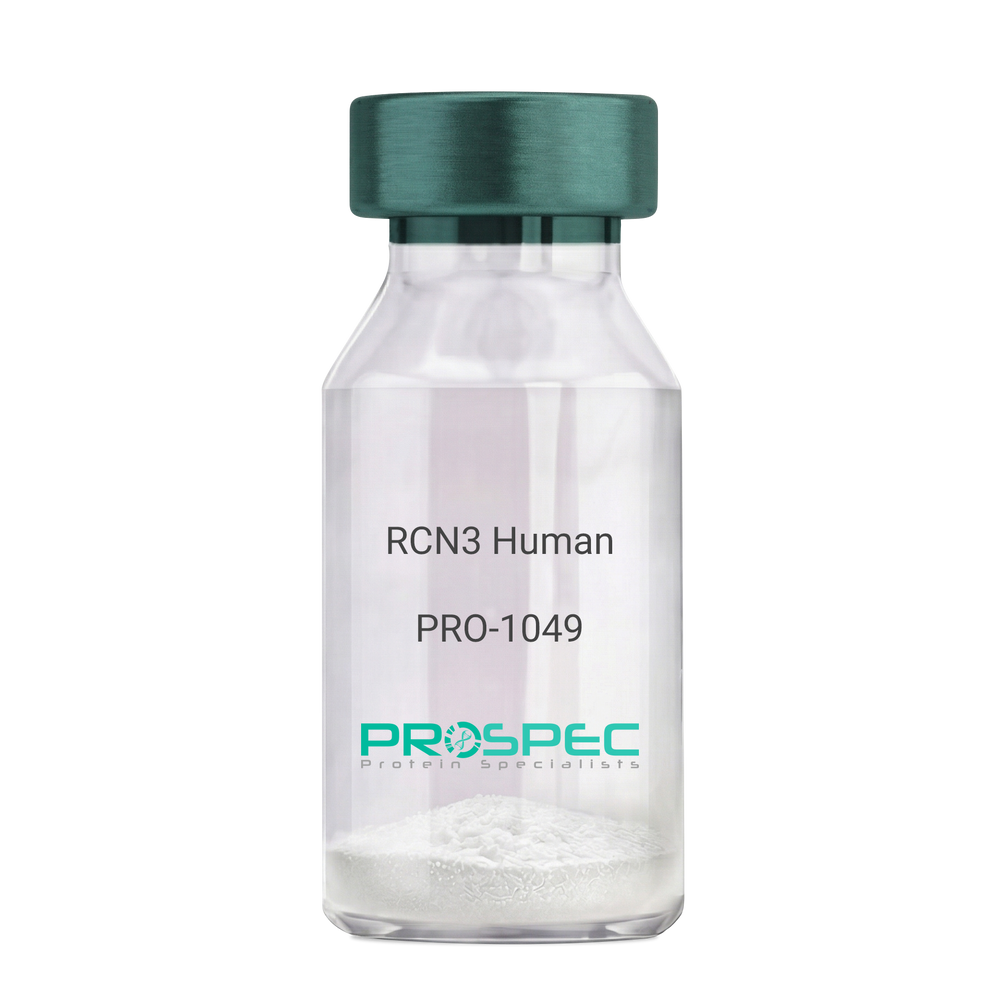
    RCN3 Human

    Description:

    Reticulocalbin 3 Human Recombinant

    Reticulocalbin-3, EF-hand calcium-binding protein RLP49, RCN3, RLP49.

    Product # :

    PRO-1049

    Price :

    Quantity :

    Shipping Method :

    Ice Icon

    Shipped with Ice Packs

    Add To Cart

    More Info

    • description
    • source
    • formulation
    • purity
    • More Info

    Description

    RCN3 Human Recombinant produced in E.Coli is a single, non-glycosylated polypeptide chain containing 333 amino acids (21-328 a.a) and having a molecular mass of 37.9kDa.RCN3 is fused to a 25 amino acid His-tag at N-terminus & purified by proprietary chromatographic techniques.

    Source

    Escherichia Coli.

    Formulation

    RCN3 protein solution (1mg/ml) containing 20mM Tris-HCl buffer (pH 8.0), 1mM DTT, 10% glycerol and 0.1M NaCl.

    Purity

    Greater than 95.0% as determined by SDS-PAGE.

    More Info

    • Introduction

      Reticulocalbin 3 (RCN3) belongs to the CREC (cab45/reticulocalbin/ ERC45/calumenin) family. RCN3 contains 5 Arg-Xaa-Xaa-Arg motifs, which function as target sequences of SPCs (subtilisin-like proprotein convertases), which is a family of serine endoproteases that proteolytically activate proproteins. The synthesis of PACE4 is induced by association and coexpression with RCN3.

    • Synonyms

      Reticulocalbin-3, EF-hand calcium-binding protein RLP49, RCN3, RLP49.

    • Physical Appearance

      Sterile Filtered colorless solution.

    • Stability

      Store at 4°C if entire vial will be used within 2-4 weeks. Store, frozen at -20°C for longer periods of time. For long term storage it is recommended to add a carrier protein (0.1% HSA or BSA).Avoid multiple freeze-thaw cycles.

    • Amino Acid Sequence

      MGSSHHHHHH SSGLVPRGSH MGSHMKPSPD AGPHGQGRVH QAAPLSDAPH DDAHGNFQYD HEAFLGREVA KEFDQLTPEE SQARLGRIVD RMDRAGDGDG WVSLAELRAW IAHTQQRHIR DSVSAAWDTY DTDRDGRVGW EELRNATYGH YAPGEEFHDV EDAETYKKML ARDERRFRVA DQDGDSMATR EELTAFLHPE EFPHMRDIVI AETLEDLDRN KDGYVQVEEY IADLYSAEPG EEEPAWVQTE RQQFRDFRDL NKDGHLDGSE VGHWVLPPAQ DQPLVEANHL LHESDTDKDG RLSKAEILGN WNMFVGSQAT NYGEDLTRHH DEL.

    ProSpec's products are furnished for LABORATORY RESEARCH USE ONLY. The product may not be used as drugs, agricultural or pesticidal products, food additives or household chemicals.

    Rcn3 Human
  • View Data Sheet

    Name :

    EGLN3 Human

    Description:

    Egl Nine Homolog 3 Human Recombinant

    Egl nine homolog 3 (C. elegans), Hypoxia-inducible factor prolyl hydroxylase 3, Prolyl hydroxylase domain-containing protein 3, HIF-PH3, PHD3, egl nine-like protein 3 isoform, HIF prolyl hydroxylase 3, EC 1.14.11.29, HPH-1, HPH-3.

    Product # :

    PRO-1143

    Price :

    Quantity :

    Shipping Method :

    Ice Icon

    Shipped with Ice Packs

    Add To Cart

    More Info

    • description
    • source
    • formulation
    • purity
    • More Info

    Description

    EGLN3 Human Recombinant produced in E. coli is a single polypeptide chain containing 263 amino acids (1-239) and having a molecular mass of 29.8 kDa.EGLN3 is fused to a 24 amino acid His-tag at N-terminus & purified by proprietary chromatographic techniques.

    Source

    E.coli.

    Formulation

    The EGLN3 solution (0.25mg/1ml) contains 20mM Tris-HCl buffer (pH 8.0), 300mM NaCl, 5mM DTT, 2mM EDTA and 50% glycerol.

    Purity

    Greater than 90% as determined by SDS-PAGE.

    More Info

    • Introduction

      Egl Nine Homolog 3 (EGLN3) belongs to the EGLN family of prolyl hydroxylases. EGLN3 catalyzes hydroxylation of the ? subunit of hypoxia-inducible factor-?, which targets hypoxia-inducible factor-? for ubiquitination by a ubiquitin ligase complex containing the von Hippel-Lindau (VHL) tumor suppressor. EGLN3 is the most significant isozyme in limiting physiological activation of HIFs (especially HIF2A) in hypoxia. EGLN3 is activated in cardiovascular cells and Hela cells after exposure to hypoxia. In addition, EGLN3 hydroxylates PKM2 in hypoxia, thus limiting glycolysis. Under normoxia, EGLN3 hydroxylates and regulates the stability of ADRB2. EGLN3 is inhibited by polynitrogen compounds possibly by chelation to Fe2+ ions.

    • Synonyms

      Egl nine homolog 3 (C. elegans), Hypoxia-inducible factor prolyl hydroxylase 3, Prolyl hydroxylase domain-containing protein 3, HIF-PH3, PHD3, egl nine-like protein 3 isoform, HIF prolyl hydroxylase 3, EC 1.14.11.29, HPH-1, HPH-3.

    • Physical Appearance

      Sterile Filtered colorless solution.

    • Stability

      Store at 4°C if entire vial will be used within 2-4 weeks. Store, frozen at -20°C for longer periods of time. For long term storage it is recommended to add a carrier protein (0.1% HSA or BSA).Avoid multiple freeze-thaw cycles.

    • Amino Acid Sequence

      MGSSHHHHHH SSGLVPRGSH MGSHMPLGHI MRLDLEKIAL EYIVPCLHEV GFCYLDNFLG EVVGDCVLER VKQLHCTGAL RDGQLAGPRA GVSKRHLRGD QITWIGGNEE GCEAISFLLS LIDRLVLYCG SRLGKYYVKE RSKAMVACYP GNGTGYVRHV DNPNGDGRCI TCIYYLNKNW DAKLHGGILR IFPEGKSFIA DVEPIFDRLL FFWSDRRNPH EVQPSYATRY AMTVWYFDAE ERAEAKKKFR NLTRKTESAL TED

    ProSpec's products are furnished for LABORATORY RESEARCH USE ONLY. The product may not be used as drugs, agricultural or pesticidal products, food additives or household chemicals.

    Egln3 Human
  • View Data Sheet

    Name :

    SRP19 Human

    Description:

    Signal Recognition Particle 19kDa Human Recombinant

    Signal recognition particle 19kDa protein, SRP19.

    Product # :

    PRO-1474

    Price :

    Quantity :

    Shipping Method :

    Ice Icon

    Shipped with Ice Packs

    Add To Cart

    More Info

    • description
    • source
    • formulation
    • purity
    • More Info

    Description

    SRP19 Human Recombinant fused with a 23 amino acid His tag at N-terminus produced in E.Coli is a single, non-glycosylated, polypeptide chain containing 167 amino acids (1-144 a.a.) and having a molecular mass of 18.5kDa. The SRP19 is purified by proprietary chromatographic techniques.

    Source

    Escherichia Coli.

    Formulation

    The SRP19 solution (0.25mg/ml) contains 20mM Tris-HCl buffer (pH8.0), 0.2M NaCl, 50% glycerol and 2mM DTT.

    Purity

    Greater than 90.0% as determined by SDS-PAGE.

    More Info

    • Introduction

      Signal recognition particle 19kDa protein (SRP19) is a member of the SRP19 family. SRP19 binds directly to 7S RNA and mediates binding of the 54 kDa subunit of the SRP.

    • Synonyms

      Signal recognition particle 19kDa protein, SRP19.

    • Physical Appearance

      Sterile Filtered colorless solution.

    • Stability

      Store at 4°C if entire vial will be used within 2-4 weeks. Store, frozen at -20°C for longer periods of time. For long term storage it is recommended to add a carrier protein (0.1% HSA or BSA).Avoid multiple freeze-thaw cycles.

    • Amino Acid Sequence

      MGSSHHHHHH SSGLVPRGSH MGSMACAAAR SPADQDRFIC IYPAYLNNKK TIAEGRRIPI SKAVENPTAT EIQDVCSAVG LNVFLEKNKM YSREWNRDVQ YRGRVRVQLK QEDGSLCLVQ FPSRKSVMLY AAEMIPKLKT RTQKTGGADQ SLQQGEGSKK GKGKKKK.

    ProSpec's products are furnished for LABORATORY RESEARCH USE ONLY. The product may not be used as drugs, agricultural or pesticidal products, food additives or household chemicals.

    Srp19 Human
  • View Data Sheet

    Name :

    DAG1 Human

    Description:

    Dystroglycan 1 Human Recombinant

    Dystroglycan, Dystrophin-associated glycoprotein 1, DAG1, A3a, DAG, AGRNR, 156DAG, MDDGC7, MDDGC9.

    Product # :

    PRO-1571

    Price :

    Quantity :

    Shipping Method :

    Room Temp Icon

    Shipped at Room temp

    Add To Cart

    More Info

    • description
    • source
    • formulation
    • purity
    • More Info

    Description

    DAG1 Human Recombinant produced in E.Coli is a single, non-glycosylated, polypeptide chain (a.a 30-312) containing 293 amino acids including a 10 a.a N-terminal His tag. The total molecular mass is 31.87kDa (calculated).

    Source

    Escherichia Coli.

    Formulation

    DAG1 filtered (0.4 µm) and lyophilized from 0.5mg/ml in 0.05M phosphate buffer and 0.075M NaCl, pH 7.4.

    Purity

    Greater than 90.0% as determined by SDS-PAGE.

    More Info

    • Introduction

      Dystroglycan 1 (DAG1) is a laminin binding component of the dystrophin-glycoprotein complex which provides a connection between the subsarcolemmal cytoskeleton and the extracellular matrix. The N-terminal domain of alpha-dystroglycan is secreted into the cerebrospinal fluid. The effect of DAG1 on the nervous system remains vague. The complete dystroglycan complex is expressed in a various tissues and has a role in processes such as laminin and basement membrane assembly, sarcolemmal stability, cell survival, peripheral nerve myelination, nodal structure, cell migration, and epithelial polarization. DAG1 is a candidate gene for the site of the mutation in autosomal recessive muscular dystrophies. The dramatic decrease of DAG1 in Duchenne muscular dystrophy leads to a loss of linkage between the sarcolemma and extracellular matrix, making muscle fibers more susceptible to necrosis.

    • Synonyms

      Dystroglycan, Dystrophin-associated glycoprotein 1, DAG1, A3a, DAG, AGRNR, 156DAG, MDDGC7, MDDGC9.

    • Physical Appearance

      Filtered White lyophilized (freeze-dried) powder.

    • Stability

      Store lyophilized protein at -20°C. Aliquot the product after reconstitution to avoid repeated freezing/thawing cycles. Reconstituted protein can be stored at 4°C for a limited period of time; it does not show any change after two weeks at 4°C.

    • Solubility

      It is recommended to add deionized water to prepare a working stock solution of approximately 0.5mg/ml and let the lyophilized pellet dissolve completely. DAG1 is not sterile! Please filter the product by an appropriate sterile filter before using it in the cell culture.

    • Amino Acid Sequence

      MKHHHHHHASHWPSEPSEAV RDWENQLEAS MHSVLSDLHE AVPTVVGIPD GTAVVGRSFR VTIPTDLIAS SGDIIKVSAA GKEALPSWLH WDSQSHTLEG LPLDTDKGVH YISVSATRLG ANGSHIPQTS SVFSIEVYPE DHSELQSVRT ASPDPGEVVS SACAADEPVT VLTVILDADL TKMTPKQRID LLHRMRSFSE VELHNMKLVP VVNNRLFDMS AFMAGPGNAK KVVENGALLS WKLGCSLNQN SVPDIHGVEA PAREGAMSAQ LGYPVVGWHI ANKKPPLPKR VRR.

    ProSpec's products are furnished for LABORATORY RESEARCH USE ONLY. The product may not be used as drugs, agricultural or pesticidal products, food additives or household chemicals.

    Dag1 Human
  • View Data Sheet

    Name :

    TBCB Human

    Description:

    Tubulin Folding Cofactor B Human Recombinant

    Tubulin folding cofactor B, Cytoskeleton-associated protein CKAPI, cytoskeleton associated protein 1, CKAP1, CG22, Tubulin-specific chaperone B.

    Product # :

    PRO-1127

    Price :

    Quantity :

    Shipping Method :

    Ice Icon

    Shipped with Ice Packs

    Add To Cart

    More Info

    • description
    • source
    • formulation
    • purity
    • More Info

    Description

    TBCB Human Recombinant produced in E. coli is a single polypeptide chain containing 268 amino acids (1-244) and having a molecular mass of 29.9 kDa.TBCB is fused to a 24 amino acid His-tag at N-terminus & purified by proprietary chromatographic techniques.

    Source

    E.coli.

    Formulation

    The TBCB solution (0.5mg/ml) contains 20mM Tris-HCl buffer (pH 8.0), 100mM Nacl and 20% glycerol.

    Purity

    Greater than 90% as determined by SDS-PAGE.

    More Info

    • Introduction

      TBCB is a member of the Microtubules family. Biosynthesis of functional microtubules include the involvement of a number of chaperones, termed Tubulin folding cofactors A (TBCA), B (TBCB), C (TBCC), D (TBCD) and E (TBCE), which operate on folding intermediates downstream of the cytosolic chaperon, known as TCP. The 244 amino acid cytoplasmic protein TBCB has one CAP-Gly domain and is universally expressed. TBCB takes part in the regulation of tubulin heterodimer dissociation and operates as a negative regulator of axonal growth.

    • Synonyms

      Tubulin folding cofactor B, Cytoskeleton-associated protein CKAPI, cytoskeleton associated protein 1, CKAP1, CG22, Tubulin-specific chaperone B.

    • Physical Appearance

      Sterile Filtered colorless solution.

    • Stability

      Store at 4°C if entire vial will be used within 2-4 weeks. Store, frozen at -20°C for longer periods of time. For long term storage it is recommended to add a carrier protein (0.1% HSA or BSA).Avoid multiple freeze-thaw cycles.

    • Amino Acid Sequence

      MGSSHHHHHH SSGLVPRGSH MGSHMEVTGV SAPTVTVFIS SSLNTFRSEK RYSRSLTIAE FKCKLELLVG SPASCMELEL YGVDDKFYSK LDQEDALLGS YPVDDGCRIH VIDHSGARLG EYEDVSRVEK YTISQEAYDQ RQDTVRSFLK RSKLGRYNEE ERAQQEAEAA QRLAEEKAQA SSIPVGSRCE VRAAGQSPRR GTVMYVGLTD FKPGYWIGVR YDEPLGKNDG SVNGKRYFEC QAKYGAFVKP AVVTVGDFPE EDYGLDEI

    ProSpec's products are furnished for LABORATORY RESEARCH USE ONLY. The product may not be used as drugs, agricultural or pesticidal products, food additives or household chemicals.

    Tbcb Human
  • View Data Sheet

    Name :

    CRABP2 Human

    Description:

    Cellular Retinoic Acid binding Protein 2 Human Recombinant

    RBP6, CRABP-II, CRABP2, RETINOIC ACID-BINDING PROTEIN CELLULAR TYPE II, Cellular retinoic acid-binding protein 2, Cellular retinoic acid-binding protein II.

    Product # :

    PRO-637

    Price :

    Quantity :

    Shipping Method :

    Ice Icon

    Shipped with Ice Packs

    Add To Cart

    More Info

    • description
    • source
    • formulation
    • purity
    • More Info

    Description

    CRABP2 Human Recombinant produced in E.Coli is a single, non-glycosylated polypeptide chain containing 136 amino acids and having a molecular mass of 15.6 kDa. The CRABP2 is purified by proprietary chromatographic techniques.

    Source

    Escherichia Coli.

    Formulation

    The CRABP2 protein solution contains 20mM Tris-HCl pH-8 and 20% glycerol.

    Purity

    Greater than 95.0% as determined by SDS-PAGE.

    More Info

    • Introduction

      CRABP2 NCBI Accession No: NP_001869 regulates the access of retinoic acid to the nuclear retinoic acid receptors. CRABP2 is involved in a regulatory feedback mechanism that controls the action of retinoic acid on cell differentiation.
      CRABP2 is involved in the conversion of vitamin A into its intracellular active form retinoic acid, which regulate the genes responsible for lipid metabolism and adipocyte differentiation. CRABP2 gene is located on chromosome 1q21-23 and this region has been linked with related disorders such as familial combined hyperlipidemia (FCHL) and type 2 diabetes mellitus.
      CRABP proteins are of low molecular weight having an important function in retinoic acid-mediated regulation of human skin growth and differentiation.

    • Synonyms

      RBP6, CRABP-II, CRABP2, RETINOIC ACID-BINDING PROTEIN CELLULAR TYPE II, Cellular retinoic acid-binding protein 2, Cellular retinoic acid-binding protein II.

    • Physical Appearance

      Sterile Filtered colorless solution.

    • Stability

      Store at 4°C if entire vial will be used within 2-4 weeks. Store, frozen at -20°C for longer periods of time. For long term storage it is recommended to add a carrier protein (0.1% HSA or BSA).Avoid multiple freeze-thaw cycles.

    • Amino Acid Sequence

      MPNFSGNWKI IRSENFEELL KVLGVNVMLR KIAVAAASKP AVEIKQEGDT FYIKTSTTVR TTEINFKVGE EFEEQTVDGR PCKSLVKWES ENKMVCEQKL LKGEGPKTSW TRELTNDGEL ILTMTADDVV CTRVYVRE.

    ProSpec's products are furnished for LABORATORY RESEARCH USE ONLY. The product may not be used as drugs, agricultural or pesticidal products, food additives or household chemicals.

    Crabp2 Human
  • View Data Sheet

    Name :

    REG3A Human

    Description:

    Regenerating Islet-Derived 3 Alpha Human Recombinant

    Regenerating islet-derived protein 3 alpha, Reg III-alpha, Pancreatitis-associated protein 1, REG3A, HIP, PAP, PAP1, REG3, INGAP, PAP-H, PBCGF, REG-III.

    Product # :

    PRO-421

    Price :

    Quantity :

    Shipping Method :

    Room Temp Icon

    Shipped at Room temp

    Add To Cart

    More Info

    • description
    • source
    • formulation
    • purity
    • More Info

    Description

    The Recombinant Human REG3A protein is produced with N-terminal fusion of His Tag. The REG3A His -Tagged Fusion Protein is an 18.4 kDa protein containing 149 amino acid residues of the Human REG3A and 16 additional amino acid residues- His Tag (underlined).

    Source

    Escherichia Coli.

    Formulation

    Filtered (0.4µm) and lyophilized from 0.5 mg/ml in 0.05M Acetate buffer pH-4.

    Purity

    Greater than 95.0% as determined by SDS-PAGE.

    More Info

    • Introduction

      Pancreatitis-associated protein (PAP) is a secretory protein not normally expressed in healthy pancreas but highly induced during acute pancreatitis. While PAP has been shown to be anti-bacterial and antiapoptotic in vitro, its definitive biological function in vivo is not clear. Using antisepse oligonucleotides, inhibition of PAP expression significantly worsened pancreatitis in a rat model. During pancreatitis, PAP released by the pancreas could mediate lung inflammation through induction of hepatic TNF- alpha expression and subsequent increase in circulating TNF-alpha.
      PAP is activated in primary liver cancers. In normal liver, the protein is undetectable in normal mature hepatocytes and found only in some ductular cells, representing potential hepatic progenitor cells. PAP can be considered hepatic cytokine that combines mitogenic and anti-apoptotic functions regarding hepatocytes, and consequently acts as a growth factor in vivo to enhance liver regeneration. In pancreatic cancor, PAP was overexpressed in 79% (30 of 38) of pancreatic ductal adenocarcinoma, 19% (7 of 36) of chronic pancreatitis, and 29% (2 of 7) of mucinous cystadenoma. PAP was found in malignant ductular structures in pancreatic carcinomas as well as in benign proliferating ductules and acinar cells in chronic pancreatitis. Elevation of PAP in patients with pancreatic cancer is not merely explainable by concomitant pancreatitis, but seems to be due to increased PAP production by the cancer cells and is also correlated to tumour load as expressed by the UICC stages.
      Epithelial expression of PAP was induced under intestinal mucosal inflammation initiated by exposure to commensal bacteria or DSS as well as inflamed IBD colon. Increased serum level of PAP diagnosed ileal location in active Crohn disease with a sensitivity of 60%, a specificity of 94%, a positive predictive value of 84% and a negative predictive value of 81%. Elevated serum PAP (> 50 ng/mL) is significantly associated with disease activity and ileal location of Crohn disease.

    • Synonyms

      Regenerating islet-derived protein 3 alpha, Reg III-alpha, Pancreatitis-associated protein 1, REG3A, HIP, PAP, PAP1, REG3, INGAP, PAP-H, PBCGF, REG-III.

    • Physical Appearance

      Filtered White lyophilized (freeze-dried) powder.

    • Stability

      Store lyophilized protein at -20°C. Aliquot the product after reconstitution to avoid repeated freezing/thawing cycles. Reconstituted protein can be stored at 4°C for a limited period of time; it does not show any change after two weeks at 4°C.

    • Solubility

      It is recommended to add 0.1M Acetate buffer pH-4 to prepare a working stock solution of approximately 0.5mg/ml and let the lyophilized pellet dissolve completely. For conversion into higher pH value, we recommend intensive dilution by relevant buffer to a concentration of 10μg/ml. In higher concentrations the solubility of this antigen is limited. Product is not sterile! Please filter the product by an appropriate sterile filter before using it in the cell culture.

    • Amino Acid Sequence

      MRGSHHHHHH GMASHMEEPQ RELPSARIRC PKGSKAYGSH CYALFLSPKS WTDADLACQK RPSGNLVSVL SGAEGSFVSS LVKSIGNSYS YVWIGLHDPT QGTEPNGEGW EWSSSDVMNY FAWERNPSTI SSPGHCASLS RSTAFLRWKD YNCNVRLPYV CKFTD.

    • Applications

      Western blotting, ELISA.

    ProSpec's products are furnished for LABORATORY RESEARCH USE ONLY. The product may not be used as drugs, agricultural or pesticidal products, food additives or household chemicals.

    Reg3A Human
  • View Data Sheet

    Name :

    OAZ1 Human

    Description:

    Ornithine Decarboxylase Antizyme 1 Human Recombinant

    Ornithine decarboxylase antizyme 1, OAZ, ODC-Az, AZI, antizyme 1, MGC138338.

    Product # :

    PRO-1200

    Price :

    Quantity :

    Shipping Method :

    Ice Icon

    Shipped with Ice Packs

    Add To Cart

    More Info

    • description
    • source
    • formulation
    • purity
    • More Info

    Description

    OAZ1 Human Recombinant produced in E. coli is a single polypeptide chain containing 251 amino acids (1-228) and having a molecular mass of 27.8 kDa.OAZ1 is fused to a 23 amino acid His-tag at N-terminus & purified by proprietary chromatographic techniques.

    Source

    E.coli.

    Formulation

    The OAZ1 solution (0.25mg/1ml) contains 20mM Tris-HCl buffer (pH 8.0), 0.15M NaCl, 1mM DTT and 30% glycerol.

    Purity

    Greater than 90% as determined by SDS-PAGE.

    More Info

    • Introduction

      OAZ1 is a member of the ODC antizyme family. OAZ1 is auto-regulated expressed by polyamine-enhanced translational frame shifting. OAZ1 negatively controls polyamine synthesis by increasing the negative feedback loop regulating ornithine decarboxylase (ODC) activity. The OAZ1 protein inhibits ornithine decarboxylase and speeds up its detraction.

    • Synonyms

      Ornithine decarboxylase antizyme 1, OAZ, ODC-Az, AZI, antizyme 1, MGC138338.

    • Physical Appearance

      Sterile Filtered colorless solution.

    • Stability

      Store at 4°C if entire vial will be used within 2-4 weeks. Store, frozen at -20°C for longer periods of time. For long term storage it is recommended to add a carrier protein (0.1% HSA or BSA).Avoid multiple freeze-thaw cycles.

    • Amino Acid Sequence

      MGSSHHHHHH SSGLVPRGSH MGSMVKSSLQ RILNSHCFAR EKEGDKPSAT IHASRTMPLL SLHSRGGSSS ESSRVSLHCC SNPGPGPRWC SDAPHPPLKI PGGRGNSQRD HNLSANLFYS DDRLNVTEEL TSNDKTRILN VQSRLTDAKR INWRTVLSGG SLYIEIPGGA LPEGSKDSFA VLLEFAEEQL RADHVFICFH KNREDRAALL RTFSFLGFEI VRPGHPLVPK RPDACFMAYT FERESSGEEE E

    ProSpec's products are furnished for LABORATORY RESEARCH USE ONLY. The product may not be used as drugs, agricultural or pesticidal products, food additives or household chemicals.

    Oaz1 Human
  • View Data Sheet

    Name :

    GIMAP5 Human

    Description:

    GTPase, IMAP Family Member 5 Human Recombinant

    GTPase IMAP family member 5, Immunity-associated nucleotide 4-like 1 protein, Immunity-associated nucleotide 5 protein, IAN-5, hIAN5, Immunity-associated protein 3, GIMAP5, IAN4L1, IAN5, IMAP3, HIMAP3, IAN4, IROD.

    Product # :

    PRO-1695

    Price :

    Quantity :

    Shipping Method :

    Ice Icon

    Shipped with Ice Packs

    Add To Cart

    More Info

    • description
    • source
    • formulation
    • purity
    • More Info

    Description

    GIMAP5 Human Recombinant produced in E.coli is a single, non-glycosylated polypeptide chain containing 307 amino acids (1-284) and having a molecular mass of 34.4 kDa.GIMAP5 is fused to a 23 amino acid His-tag at N-terminus & purified by proprietary chromatographic techniques.

    Source

    Escherichia Coli.

    Formulation

    The GIMAP5 solution (0.25mg/ml) contains 20mM Tris-HCl buffer (pH 8.0), 0.2M NaCl, 40% glycerol and 2mM DTT.

    Purity

    Greater than 85.0% as determined by SDS-PAGE.

    More Info

    • Introduction

      GTPase, IMAP Family Member 5 (GIMAP5) is a part of the GTP-binding superfamily and the immuno-associated nucleotide subfamily of nucleotide-binding proteins. GIMAP5 is an antiapoptotic protein which is required for mitochondrial integrity and T-cell survival. Polymorphisms in GIMAP5 are related with systemic lupus erythematosus. Read-through transcription can be found between GIMAP5 and the neighboring upstream GIMAP1 (GTPase, IMAP family member 1) gene. GIMAP5 also contributes to T-cell quiescence.

    • Synonyms

      GTPase IMAP family member 5, Immunity-associated nucleotide 4-like 1 protein, Immunity-associated nucleotide 5 protein, IAN-5, hIAN5, Immunity-associated protein 3, GIMAP5, IAN4L1, IAN5, IMAP3, HIMAP3, IAN4, IROD.

    • Physical Appearance

      Sterile Filtered colorless solution.

    • Stability

      Store at 4°C if entire vial will be used within 2-4 weeks. Store, frozen at -20°C for longer periods of time. For long term storage it is recommended to add a carrier protein (0.1% HSA or BSA).Avoid multiple freeze-thaw cycles.

    • Amino Acid Sequence

      MGSSHHHHHH SSGLVPRGSH MGSMGGFQRG KYGTMAEGRS EDNLSATPPA LRIILVGKTG CGKSATGNSI LGQPVFESKL RAQSVTRTCQ VKTGTWNGRK VLVVDTPSIF ESQADTQELY KNIGDCYLLS APGPHVLLLV IQLGRFTAQD TVAIRKVKEV FGTGAMRHVV ILFTHKEDLG GQALDDYVAN TDNCSLKDLV RECERRYCAF NNWGSVEEQR QQQAELLAVI ERLGREREGS FHSNDLFLDA QLLQRTGAGA CQEDYRQYQA KVEWQVEKHK QELRENESNW AYKALLRVKH LMLLHYE.

    ProSpec's products are furnished for LABORATORY RESEARCH USE ONLY. The product may not be used as drugs, agricultural or pesticidal products, food additives or household chemicals.

    Gimap5 Human
  • View Data Sheet

    Name :

    TADA3 Human

    Description:

    Transcriptional Adaptor 3 Human Recombinant

    Transcriptional adapter 3, ADA3 homolog, hADA3, STAF54, Transcriptional adapter 3-like, ADA3-like protein, TADA3, ADA3, TADA3L, Transcriptional adapter 3 isoform a, NGG1.

    Product # :

    PRO-1689

    Price :

    Quantity :

    Shipping Method :

    Ice Icon

    Shipped with Ice Packs

    Add To Cart

    More Info

    • description
    • source
    • formulation
    • purity
    • More Info

    Description

    TADA3 Human Recombinant produced in E.coli is a single, non-glycosylated polypeptide chain containing 455 amino acids (1-432) and having a molecular mass of 51.3 kDa.TADA3 is fused to a 23 amino acid His-tag at N-terminus & purified by proprietary chromatographic techniques.

    Source

    Escherichia Coli.

    Formulation

    The TADA3 solution (0.5mg/ml) contains 20mM Tris-HCl buffer (pH 8.0), 0.2M NaCl, 50% glycerol and 2mM DTT.

    Purity

    Greater than 80.0% as determined by SDS-PAGE.

    More Info

    • Introduction

      Transcriptional adapter 3 (TATD3) is a subunit of 2 histone acetyltransferase complexes, which functions as a component of the PCAF complex. TATD3 is a transcriptional activator adaptor that is also associates with the tumor suppressor protein p53 and is essential for full activity of p53 and p53-mediated apoptosis.

    • Synonyms

      Transcriptional adapter 3, ADA3 homolog, hADA3, STAF54, Transcriptional adapter 3-like, ADA3-like protein, TADA3, ADA3, TADA3L, Transcriptional adapter 3 isoform a, NGG1.

    • Physical Appearance

      Sterile Filtered colorless solution.

    • Stability

      Store at 4°C if entire vial will be used within 2-4 weeks. Store, frozen at -20°C for longer periods of time. For long term storage it is recommended to add a carrier protein (0.1% HSA or BSA).Avoid multiple freeze-thaw cycles.

    • Amino Acid Sequence

      MGSSHHHHHH SSGLVPRGSH MGSMSELKDC PLQFHDFKSV DHLKVCPRYT AVLARSEDDG IGIEELDTLQ LELETLLSSA SRRLRVLEAE TQILTDWQDK KGDRRFLKLG RDHELGAPPK HGKPKKQKLE GKAGHGPGPG PGRPKSKNLQ PKIQEYEFTD DPIDVPRIPK NDAPNRFWAS VEPYCADITS EEVRTLEELL KPPEDEAEHY KIPPLGKHYS QRWAQEDLLE EQKDGARAAA VADKKKGLMG PLTELDTKDV DALLKKSEAQ HEQPEDGCPF GALTQRLLQA LVEENIISPM EDSPIPDMSG KESGADGAST SPRNQNKPFS VPHTKSLESR IKEELIAQGL LESEDRPAED SEDEVLAELR KRQAELKALS AHNRTKKHDL LRLAKEEVSR QELRQRVRMA DNEVMDAFRK IMAARQKKRT PTKKEKDQAW KTLKERESIL KLLDG.

    ProSpec's products are furnished for LABORATORY RESEARCH USE ONLY. The product may not be used as drugs, agricultural or pesticidal products, food additives or household chemicals.

    Tada3 Human
  • View Data Sheet

    Name :

    CPLX1 Human

    Description:

    Complexin-1 Human Recombinant

    CPLX-1, CPXI, CPX-I, CPX1, CPX-1, Synaphin2, Synaphin-2, Complexin-1, Complexin I, CPX I, CPLX1.

    Product # :

    PRO-645

    Price :

    Quantity :

    Shipping Method :

    Ice Icon

    Shipped with Ice Packs

    Add To Cart

    More Info

    • description
    • source
    • formulation
    • purity
    • More Info

    Description

    CPLX1 Human Recombinant fused with a 20 amino acid His tag at N-terminus produced in E.Coli is a single, non-glycosylated, polypeptide chain containing 154 amino acids (1-134 a.a) and having a molecular mass of 17.1kDa (molecular weight on SDS-PAGE will appear higher).The CPLX1 is purified by proprietary chromatographic techniques.

    Source

    Escherichia Coli.

    Formulation

    The CPLX1protein solution contains 20mM Tris-HCl pH-8 and 10% glycerol.

    Purity

    Greater than 90% by SDS-PAGE.

    More Info

    • Introduction

      CPLX1 is part of the SNARE family complex binding proteins that are catalysts or inhibitors of vesicle exocytosis. CPLX1 shows reduced Ca2+-triggered fast neurotransmitter release at hippocampal glutamatergic synapses, indicating that CPLX1 is a positive regulator of transmitter release. In contrast, CPLX1 inhibits SNARE-mediated liposome and cell fusions in vitro, that result in hypothesis thus acts as a fusion clamp of synaptic exocytosis. CPLX1 regulates a late step in synaptic vesicle exocytosis.

    • Synonyms

      CPLX-1, CPXI, CPX-I, CPX1, CPX-1, Synaphin2, Synaphin-2, Complexin-1, Complexin I, CPX I, CPLX1.

    • Physical Appearance

      Sterile Filtered colorless solution.

    • Stability

      Store at 4°C if entire vial will be used within 2-4 weeks. Store, frozen at -20°C for longer periods of time. For long term storage it is recommended to add a carrier protein (0.1% HSA or BSA).Avoid multiple freeze-thaw cycles.

    • Amino Acid Sequence

      MGSSHHHHHH SSGLVPRGSH MEFVMKQALG GATKDMGKML GGDEEKDPDA AKKEEERQEA LRQAEEERKA KYAKMEAERE AVRQGIRDKYGIKKKEEREA EAQAAMEANS EGSLTRPKKA IPPGCGDEVE EEDESILDTV IKYLPGPLQD MLKK.

    ProSpec's products are furnished for LABORATORY RESEARCH USE ONLY. The product may not be used as drugs, agricultural or pesticidal products, food additives or household chemicals.

    Cplx1 Human
  • View Data Sheet

    Name :

    Adiponectin Human, HMW

    Description:

    Adiponectin glycosylated Human Recombinant, HMW Rich

    Acrp30, AdipoQ, GBP-28, APM-1, ACDC.

    Product # :

    CYT-764

    Price :

    Quantity :

    Shipping Method :

    Room Temp Icon

    Shipped at Room temp

    Add To Cart

    More Info

    • description
    • source
    • formulation
    • purity
    • More Info

    Description

    Adiponectin Human Recombinant HMW Rich produced in HEK cells is a single, glycosylated, polypeptide chain (19-244) containing a total of 226 amino acids, having a molecular mass of 24.6kDa (calculated). Human Acrp30 HMW Rich migrates on SDS-PAGE under non-reducing conditions at ~ 884 kDa.

    Source

    HEK293.

    Formulation

    Acrp30 was filtered (0.4µm) and lyophilized from 0.5mg/ml in 20mM Tris, 50mM NaCl, pH 7.5 and 1mM CaCl2.

    Purity

    Greater than 90% as determined by SDS-PAGE.

    More Info

    • Introduction

      Adiponectin is a recently discovered 244 amino acid protein, the product of the apM1 gene, which is physiologically active and specifically and highly expressed in adipose cells (Adipokine). The protein belongs to the soluble defense collagen super family; it has a collagen-like domain structurally homologous with collagen VIII and X and complement factor C1q-like globular domain. APM-1 forms homotrimers, which are the building blocks for higher order complexes found circulating in serum.

    • Synonyms

      Acrp30, AdipoQ, GBP-28, APM-1, ACDC.

    • Physical Appearance

      Filtered White lyophilized (freeze-dried) powder.

    • Stability

      Store lyophilized protein at -20°C. Aliquot the product after reconstitution to avoid repeated freezing/thawing cycles. Reconstituted protein can be stored at 4°C for a limited period of time.

    • Solubility

      It is recommended to add deionized water to a working concentration of 0.5mg/ml and let the lyophilized pellet dissolve completely. Acrp30 is not sterile! Please filter the product by an appropriate sterile filter before using it in the cell culture.

    • Amino Acid Sequence

      ETTTQGPGVL LPLPKGACTG WMAGIPGHPG HNGAPGRDGR DGTPGEKGEK GDPGLIGPKG DIGETGVPGA EGPRGFPGIQ GRKGEPGEGA YVYRSAFSVG LETYVTIPNM PIRFTKIFYN QQNHYDGSTG KFHCNIPGLY YFAYHITVYM KDVKVSLFKK DKAMLFTYDQ YQENNVDQAS GSVLLHLEVG DQVWLQVYGE GERNGLYADN DNDSTFTGFL LYHDTN.

    • Background

      What is the molecular weight/Mw of ADIPONECTIN Protein?
      ADIPONECTIN Protein has a total Mw of 24.6 kDa.

      What is the source or expression system of ADIPONECTIN Protein?
      HEK293.


      What is the Purity of ADIPONECTIN Protein?
      ADIPONECTIN Protein is >90% pure as determined by SDS-PAGE.

      What is the Biological Activity of ADIPONECTIN Protein?
      The biological functionality of ADIPONECTIN Protein will be determined in the future.

      What is the amino acid sequence of ADIPONECTIN Protein?
      ETTTQGPGVL LPLPKGACTG WMAGIPGHPG HNGAPGRDGR DGTPGEKGEK GDPGLIGPKG DIGETGVPGA EGPRGFPGIQ GRKGEPGEGA YVYRSAFSVG LETYVTIPNM PIRFTKIFYN QQNHYDGSTG KFHCNIPGLY YFAYHITVYM KDVKVSLFKK DKAMLFTYDQ YQENNVDQAS GSVLLHLEVG DQVWLQVYGE GERNGLYADN DNDSTFTGFL LYHDTN.

      What applications can ADIPONECTIN Protein be used in?
      ADIPONECTIN Protein can probably be used in western blot, ELISA and Lateral Flow.

      What is the endotoxin level for ADIPONECTIN Protein?
      The endotoxin level is minimal, ADIPONECTIN Protein was purified using conventional chromatography techniques.

    ProSpec's products are furnished for LABORATORY RESEARCH USE ONLY. The product may not be used as drugs, agricultural or pesticidal products, food additives or household chemicals.

    Adiponectin Human Hmw
  • View Data Sheet

    Name :

    Holo Transferrin Human

    Description:

    Holo Transferrin Human Recombinant

    Serotransferrin, Transferrin, Siderophilin, Beta-1-metal-binding globulin, TF, PRO1557, PRO2086, DKFZp781D0156, HTF.

    Product # :

    PRO-2844

    Price :

    Quantity :

    Shipping Method :

    Room Temp Icon

    Shipped at Room temp

    Add To Cart

    More Info

    • description
    • source
    • formulation
    • purity
    • biological activity
    • More Info
    • sds-page, activity

    Description

    Human Holo Transferrin Recombinant produced in HEK Cells is a glycosylated polypeptide containing 679 amino acids and having a Mw of of 76 kDa.

    Source

    HEK Cells

    Formulation

    The protein was lyophilized from 1x PBS pH-7.4.

    Purity

    Protein is >98% pure as determined by 10% PAGE (coomassie staining).

    Biological Activity

    The activity of Recombinant Holo Transferrin was determined by the proliferation assay using MDCK cells stimulated with recombinant human Holo Transferrin. The protein was found biologically active

    sds-page, activity

    Holo Transferrin Human sds-page - Product image 1
    Holo Transferrin Human activity - Product image 2

    More Info

    • Introduction

      Recombinant Human Holo Transferrin is an iron-delivery signaling protein which functions in the delivery of Fe³⁺ iron to cells using transferrin receptor-1 (TfR1/CD71).
      Holo-transferrin binds TfR1, undergoes receptor-mediated endocytosis and the iron is released intracellularly. Transferrin Human Recombinant is crucial for brain and the nervous system, neuronal mitochondrial metabolism, neurotransmitter synthesis, oligodendrocyte myelination and synaptic activity. Recombinant holo-transferrin can be used in cell therapy, stem-cell expansion, CHO production, or drug-delivery platforms.

    • Synonyms

      Serotransferrin, Transferrin, Siderophilin, Beta-1-metal-binding globulin, TF, PRO1557, PRO2086, DKFZp781D0156, HTF.

    • Physical Appearance

      Sterile Filtered lyophilized (freeze-dried) powder.

    • Stability

      Store the lyophilized Holo Transferrin recombinant between 2-8°C, do not freeze.
      Upon reconstitution Holo Transferrin should be stored at 4°C between 2-7 days and for future use below -18°C. Please prevent freeze-thaw cycles.

    • Solubility

      It is recommended to reconstitute the lyophilized Holo Transferrin recombinant in sterile 18MΩ-cm H2O at 1mg/ml, which can then be further diluted to other aqueous solutions.

    • Amino Acid Sequence

      VPDKTVRWCA VSEHEATKCQ SFRDHMKSVI PSDGPSVACV KKASYLDCIR AIAANEADAV TLDAGLVYDA YLAPNNLKPV VAEFYGSKED PQTFYYAVAV VKKDSGFQMN QLRGKKSCHT GLGRSAGWNI PIGLLYCDLP EPRKPLEKAV ANFFSGSCAP CADGTDFPQL CQLCPGCGCS TLNQYFGYSG AFKCLKDGAG DVAFVKHSTI FENLANKADR DQYELLCLDN TRKPVDEYKD CHLAQVPSHT VVARSMGGKE DLIWELLNQA QEHFGKDKSK EFQLFSSPHG KDLLFKDSAH GFLKVPPRMD AKMYLGYEYV TAIRNLREGT CPEAPTDECK PVKWCALSHH ERLKCDEWSV NSVGKIECVS AETTEDCIAK IMNGEADAMS LDGGFVYIAG KCGLVPVLAE NYNKSDNCED TPEAGYFAVA VVKKSASDLT WDNLKGKKSC HTAVGRTAGW NIPMGLLYNK INHCRFDEFF SEGCAPGSKK DSSLCKLCMG SGLNLCEPNN KEGYYGYTGA FRCLVEKGDV AFVKHQTVPQ NTGGKNPDPW AKNLNEKDYE LLCLDGTRKP VEEYANCHLA RAPNHAVVTR KDKEACVHKI LRQQQHLFGS NVTDCSGNFC LFRSETKDLL FRDDTVCLAK LHDRNTYEKY LGEEYVKAVG NLRKCSTSSL LEACTFRRP.

    ProSpec's products are furnished for LABORATORY RESEARCH USE ONLY. The product may not be used as drugs, agricultural or pesticidal products, food additives or household chemicals.

    Holo Transferrin
  • View Data Sheet

    Name :

    PLAUR Human

    Description:

    PLAUR Human Recombinant

    PLAUR, Monocyte Activation Antigen Mo3, U-PAR, UPAR, U-Plasminogen Activator Receptor Form 2, CD87 Antigen , CD87, URKR, MO3.

    Product # :

    PRO-2340

    Price :

    Quantity :

    Shipping Method :

    Ice Icon

    Shipped with Ice Packs

    Add To Cart

    More Info

    • description
    • source
    • formulation
    • purity
    • More Info

    Description

    PLAUR produced in Sf9 Baculovirus cells is a single, glycosylated polypeptide chain containing 291 amino acids (23-305 a.a.) and having a molecular mass of 32.5kDa (Molecular size on SDS-PAGE will appear at approximately 40-57 kDa).PLAUR is fused to a 8 amino acid His-tag at C-terminus & purified by proprietary chromatographic techniques.

    Source

    Sf9, Baculovirus cells.

    Formulation

    PLAUR protein solution (0.5mg/ml) contains Phosphate Buffered Saline (pH 7.4) and 10% glycerol.

    Purity

    Greater than 95.0% as determined by SDS-PAGE.

    More Info

    • Introduction

      PLAUR is one of 2 activators which convert the extracellular zymogen plasminogen to plasmin, a serine protease involved in a various normal and pathological processes that require cell migration and/or tissue destruction. PLAUR protein is synthesized and released from cells as a single-chain proenzyme with narrow enzymatic activity and is converted to an active two-chain disulfide-linked active enzyme by plasmin and other specific proteinases.

    • Synonyms

      PLAUR, Monocyte Activation Antigen Mo3, U-PAR, UPAR, U-Plasminogen Activator Receptor Form 2, CD87 Antigen , CD87, URKR, MO3.

    • Physical Appearance

      Sterile Filtered colorless solution.

    • Stability

      Store at 4°C if entire vial will be used within 2-4 weeks. Store, frozen at -20°C for longer periods of time. For long term storage it is recommended to add a carrier protein (0.1% HSA or BSA). Avoid multiple freeze-thaw cycles.

    • Amino Acid Sequence

      LRCMQCKTNG DCRVEECALG QDLCRTTIVR LWEEGEELEL VEKSCTHSEK TNRTLSYRTG LKITSLTEVV CGLDLCNQGN SGRAVTYSRS RYLECISCGS SDMSCERGRH QSLQCRSPEE QCLDVVTHWI QEGEEGRPKD DRHLRGCGYL PGCPGSNGFH NNDTFHFLKC CNTTKCNEGP ILELENLPQN GRQCYSCKGN STHGCSSEET FLIDCRGPMN QCLVATGTHE PKNQSYMVRG CATASMCQHA HLGDAFSMNH IDVSCCTKSG CNHPDLDVQY RSGLEHHHHH H.

    ProSpec's products are furnished for LABORATORY RESEARCH USE ONLY. The product may not be used as drugs, agricultural or pesticidal products, food additives or household chemicals.

    Plaur Human
  • View Data Sheet

    Name :

    KRT8 Human

    Description:

    Cytokeratin 8 Human Recombinant

    Keratin type II cytoskeletal 8, Cytokeratin-8, CK-8, Keratin-8, K8, KRT8, CYK8, KO, CK8, K2C8, CARD2.

    Product # :

    PRO-347

    Price :

    Quantity :

    Shipping Method :

    Room Temp Icon

    Shipped at Room temp

    Add To Cart

    More Info

    • description
    • source
    • formulation
    • purity
    • More Info

    Description

    Cytokeratin 8 Human Recombinant produced in E.Coli is a single, non-glycosylated polypeptide chain having a molecular mass of 53,532 Dalton. The KRT8 is purified by proprietary chromatographic techniques.

    Source

    Escherichia Coli.

    Formulation

    The protein (1mg/ml) was lyophilized after from a sterile solution containing 30mM Tris-HCl pH-8, 9.5M urea, 2mM DTT, 2mM EDTA and 10mM methylammonium chloride.

    Purity

    Greater than 95.0% as determined by:
    (a) Analysis by RP-HPLC.
    (b) Analysis by SDS-PAGE.

    More Info

    • Introduction

      Keratin 8 and 18 (K8/18) are the major components of intermediate filament (IF) proteins of simple or single-layered epithelia.

    • Synonyms

      Keratin type II cytoskeletal 8, Cytokeratin-8, CK-8, Keratin-8, K8, KRT8, CYK8, KO, CK8, K2C8, CARD2.

    • Physical Appearance

      Sterile Filtered White lyophilized (freeze-dried) powder.

    • Stability

      Lyophilized KRT8 although stable at room temperature for 3 weeks, should be stored at 2-8°C. Upon reconstitution KRT8 should be stored at 4°C between 2-7 days and for future use below -18°C. For long term storage it is recommended to add a carrier protein (0.1% HSA or BSA). Please prevent freeze-thaw cycles.

    • Solubility

      It is recommended to reconstitute the lyophilized KRT8 in sterile 18MΩ-cm H2O not less than 100µg/ml, which can then be further diluted to other aqueous solutions.

    • Reconstitution to filaments

      Performed by mixing equimolar amounts of cytokeratins of type I and type II at concentrations of approx. 0.5 mg/ml, both dissolved in 9.5 M urea buffer (see above). Protofilaments and filament complexes are obtained by dialyzing the resulting polypeptide solution stepwise to a concentration of 4 M urea and then to low salt condition (50 mM NaCl, 2 mM dithiothreitol, 10 mM Tris-HCl, pH 7.4). For immunization purposes, the solution can be further dialyzed against PBS (phosphate buffered saline, e.g. Dulbecco's PBS).

    ProSpec's products are furnished for LABORATORY RESEARCH USE ONLY. The product may not be used as drugs, agricultural or pesticidal products, food additives or household chemicals.

    Krt8 Human
  • 1
  • …
  • 37
  • 38
  • 39
  • 40
  • 41
  • 42
Your browser does not support the video tag.

Products

  • Cytokines
  • Growth Factors
  • Chemokines
  • CD Antigens
  • Neurotrophins
  • Hormones
  • Enzymes
  • Viral Antigens
  • Recombinant Proteins
  • Natural Proteins
  • Monoclonal Antibodies
  • Polyclonal Antibodies
  • Thermal Packaging

About

  • Company
  • Founder
  • Contribution
  • Contact Us
  • My Account

Ordering

  • Ordering Method
  • Ordering - Credit Card
  • Ordering PO
  • Shipping Fees
  • FAQ's

Legal

  • Terms & Conditions
  • Privacy
  • Site Map
  • info@prospecbio.com
  • Facebook
  • Instagram
  • Linkedin Profile

© 2026 ProSpec-Tany TechnoGene Ltd. All Rights Reserved.

  • Choosing a selection results in a full page refresh.
  • Opens in a new window.