Skip to content

High-quality research proteins.

  • 1-800-805-6531

  • Mon - Sat 8.00-18.00, Sun - Closed

  • info@prospecbio.com

  • PO Box 6591 East Brunswick NJ 08816

  • Products
    • Cytokines
    • Growth factors
    • Chemokines
    • Cd antigens
    • Neurotrophins
    • Hormones
    • Enzymes
    • Viral antigens
    • Recombinant proteins
    • Natural proteins
    • Monoclonal antibodies
    • Polyclonal antibodies
    • Thermal Packaging
  • About
    • Company
    • Founder
    • Contribution
  • Customers
    • Eastern Asia
    • Eastern Europe
    • North America
    • South America
    • South East Asia
    • Southern Asia
    • Western Europe
  • Ordering
    • Ordering Method
    • Ordering - Credit Card
    • Ordering - PO
    • Shipping Fees
    • FAQs
  • Services
    • DNA Cloning
    • Protein Expression
    • Monoclonal Antibody
    • Fermentation
    • Technology License
  • Contact us
Log in

Country/region

  • USD $ | Albania
  • USD $ | Andorra
  • USD $ | Argentina
  • USD $ | Armenia
  • USD $ | Australia
  • USD $ | Austria
  • USD $ | Azerbaijan
  • USD $ | Belarus
  • USD $ | Belgium
  • USD $ | Bolivia
  • USD $ | Brazil
  • USD $ | Bulgaria
  • USD $ | Cambodia
  • USD $ | Canada
  • USD $ | Chile
  • USD $ | China
  • USD $ | Colombia
  • USD $ | Costa Rica
  • USD $ | Croatia
  • USD $ | Cyprus
  • USD $ | Czechia
  • USD $ | Denmark
  • USD $ | Estonia
  • USD $ | Finland
  • USD $ | France
  • USD $ | Georgia
  • USD $ | Germany
  • USD $ | Greece
  • USD $ | Hong Kong SAR
  • USD $ | Hungary
  • USD $ | Iceland
  • USD $ | India
  • USD $ | Ireland
  • USD $ | Israel
  • USD $ | Italy
  • USD $ | Japan
  • USD $ | Kazakhstan
  • USD $ | Latvia
  • USD $ | Liechtenstein
  • USD $ | Lithuania
  • USD $ | Madagascar
  • USD $ | Malta
  • USD $ | Mexico
  • USD $ | Moldova
  • USD $ | Monaco
  • USD $ | Netherlands
  • USD $ | New Zealand
  • USD $ | North Macedonia
  • USD $ | Norway
  • USD $ | Panama
  • USD $ | Paraguay
  • USD $ | Peru
  • USD $ | Philippines
  • USD $ | Poland
  • USD $ | Portugal
  • USD $ | Romania
  • USD $ | Singapore
  • USD $ | Slovakia
  • USD $ | Slovenia
  • USD $ | South Africa
  • USD $ | South Korea
  • USD $ | Spain
  • USD $ | Sri Lanka
  • USD $ | Sweden
  • USD $ | Switzerland
  • USD $ | Taiwan
  • USD $ | Thailand
  • USD $ | Türkiye
  • USD $ | Ukraine
  • USD $ | United Kingdom
  • USD $ | United States
  • USD $ | Uruguay
  • USD $ | Vatican City
  • USD $ | Venezuela
  • USD $ | Vietnam
  • Facebook
  • Instagram
logoProSpec - Recombinant Protein Manufacturer for academic and R&D industry
Become a distributor
Account Log in
Wishlist
Cart Cart(0)
  • Products
    +
    • Cytokines
    • Growth factors
    • Chemokines
    • Cd antigens
    • Neurotrophins
    • Hormones
    • Enzymes
    • Viral antigens
    • Recombinant proteins
    • Natural proteins
    • Monoclonal antibodies
    • Polyclonal antibodies
    • Thermal Packaging
  • About
    +
    • Company
    • Founder
    • Contribution
  • Customers
    +
    • Eastern Asia
    • Eastern Europe
    • North America
    • South America
    • South East Asia
    • Southern Asia
    • Western Europe
  • Ordering
    +
    • Ordering Method
    • Ordering - Credit Card
    • Ordering - PO
    • Shipping Fees
    • FAQs
  • Services
    +
    • DNA Cloning
    • Protein Expression
    • Monoclonal Antibody
    • Fermentation
    • Technology License
  • Contact us

Item added to your cart

View cart
View All
  • Cytokines
  • Growth factors
  • Chemokines
  • Cd antigens
  • Neurotrophins
  • Hormones
  • Enzymes
  • Viral antigens
  • Recombinant proteins
  • Natural proteins
  • Monoclonal antibodies
  • Polyclonal antibodies
  • Thermal Packaging
  • Tumor Necrosis Factor

    Tumor Necrosis Factor

    View All
  • 4-1BB

    4-1BB

    View All
  • Adiponectin

    Adiponectin

    View All
  • AIF1

    AIF1

    View All
  • Other Cytokines

    Other Cytokines

    View All
  • AITRL

    AITRL

    View All
  • Angiopoietin

    Angiopoietin

    View All
  • Apolipoprotein

    Apolipoprotein

    View All
  • B-Cell Activating Factor

    B-Cell Activating Factor

    View All
  • Beta Defensin

    Beta Defensin

    View All
  • Bone Morphogenetic Protein

    Bone Morphogenetic Protein

    View All
  • B type Natriuretic Peptide

    B type Natriuretic Peptide

    View All
  • BST

    BST

    View All
  • Betacellulin

    Betacellulin

    View All
  • Cardiotrophin

    Cardiotrophin

    View All
  • Activin

    Activin

    View All
  • Fibroblast Growth Factor

    Fibroblast Growth Factor

    View All
  • Other Growth Factors

    Other Growth Factors

    View All
  • CSF

    CSF

    View All
  • CTGF

    CTGF

    View All
  • IGFBP

    IGFBP

    View All
  • VEGF Protein

    VEGF Protein

    View All
  • EGF

    EGF

    View All
  • Epigen

    Epigen

    View All
  • Erythropoietin

    Erythropoietin

    View All
  • Insulin-Like Growth Factor

    Insulin-Like Growth Factor

    View All
  • Growth Hormone

    Growth Hormone

    View All
  • HDGF

    HDGF

    View All
  • Hepatocyte Growth Factor

    Hepatocyte Growth Factor

    View All
  • Insulin

    Insulin

    View All
  • BCA-1/ BLC (CXCL13)

    BCA-1/ BLC (CXCL13)

    View All
  • BRAK (CXCL14)

    BRAK (CXCL14)

    View All
  • C-10 (CCL6)

    C-10 (CCL6)

    View All
  • Other Chemokines

    Other Chemokines

    View All
  • MEC (CCL28)

    MEC (CCL28)

    View All
  • LD78-beta (CCL3L1)

    LD78-beta (CCL3L1)

    View All
  • CTACK (CCL27)

    CTACK (CCL27)

    View All
  • CXCL16

    CXCL16

    View All
  • CXCL17

    CXCL17

    View All
  • Platelet Factor-4 (CXCL4)

    Platelet Factor-4 (CXCL4)

    View All
  • ENA-78 (CXCL5)

    ENA-78 (CXCL5)

    View All
  • Eotaxin (CCL11,24,26)

    Eotaxin (CCL11,24,26)

    View All
  • Exodus-2 (CCL21)

    Exodus-2 (CCL21)

    View All
  • Fractalkine (CX3CL1)

    Fractalkine (CX3CL1)

    View All
  • CXCL6

    CXCL6

    View All
  • Other CD Antigens

    Other CD Antigens

    View All
  • CD14

    CD14

    View All
  • CD164

    CD164

    View All
  • CD1

    CD1

    View All
  • CD2

    CD2

    View All
  • CD200

    CD200

    View All
  • CD207

    CD207

    View All
  • CD226

    CD226

    View All
  • CD23

    CD23

    View All
  • CD244

    CD244

    View All
  • CD247

    CD247

    View All
  • CD27

    CD27

    View All
  • CD274

    CD274

    View All
  • CD300

    CD300

    View All
  • CD33

    CD33

    View All
  • Other Neurotrophins

    Other Neurotrophins

    View All
  • Beta-NGF

    Beta-NGF

    View All
  • BDNF

    BDNF

    View All
  • CDNF

    CDNF

    View All
  • CNTF

    CNTF

    View All
  • GDNF

    GDNF

    View All
  • Glia Maturation Factor

    Glia Maturation Factor

    View All
  • MANF

    MANF

    View All
  • Midkine

    Midkine

    View All
  • Neuroglobin

    Neuroglobin

    View All
  • Neurotrophic factors

    Neurotrophic factors

    View All
  • Neuregulin

    Neuregulin

    View All
  • Neuropilin

    Neuropilin

    View All
  • Pigment Epithelium-Derived Factor

    Pigment Epithelium-Derived Factor

    View All
  • Pleiotrophin

    Pleiotrophin

    View All
  • Peptide Hormones

    Peptide Hormones

    View All
  • Other Hormones

    Other Hormones

    View All
  • HCG

    HCG

    View All
  • Endothelin

    Endothelin

    View All
  • Exendin

    Exendin

    View All
  • FSH

    FSH

    View All
  • Glucagon

    Glucagon

    View All
  • GHRP

    GHRP

    View All
  • GLP

    GLP

    View All
  • Thyrostimulin

    Thyrostimulin

    View All
  • Inhibin A

    Inhibin A

    View All
  • LHRH

    LHRH

    View All
  • Melanotan

    Melanotan

    View All
  • Procalcitonin

    Procalcitonin

    View All
  • PTH

    PTH

    View All
  • Peroxiredoxin

    Peroxiredoxin

    View All
  • Peptidase

    Peptidase

    View All
  • Synthetase

    Synthetase

    View All
  • Transferase

    Transferase

    View All
  • Hydrolase

    Hydrolase

    View All
  • Dehydrogenase

    Dehydrogenase

    View All
  • ACE2

    ACE2

    View All
  • Esterase

    Esterase

    View All
  • Protein Kinases

    Protein Kinases

    View All
  • Other Enzymes

    Other Enzymes

    View All
  • Phosphatase

    Phosphatase

    View All
  • Deaminase

    Deaminase

    View All
  • Oxygenase

    Oxygenase

    View All
  • Adenylate Kinase

    Adenylate Kinase

    View All
  • Lyase

    Lyase

    View All
  • Chagas

    Chagas

    View All
  • SARS

    SARS

    View All
  • Influenza

    Influenza

    View All
  • ASFV

    ASFV

    View All
  • Astrovirus

    Astrovirus

    View All
  • Borrelia

    Borrelia

    View All
  • Helicobacter Pylori

    Helicobacter Pylori

    View All
  • Chikungunya

    Chikungunya

    View All
  • Chlamydia

    Chlamydia

    View All
  • Cytomegalo

    Cytomegalo

    View All
  • Dengue

    Dengue

    View All
  • EBV

    EBV

    View All
  • Ebola

    Ebola

    View All
  • Feline Leukemia Virus

    Feline Leukemia Virus

    View All
  • Hepatitis A

    Hepatitis A

    View All
  • Other

    Other

    View All
  • Actin

    Actin

    View All
  • ADAM

    ADAM

    View All
  • Complement Component

    Complement Component

    View All
  • Ag85

    Ag85

    View All
  • Eukaryotic Translation Initiation Factor

    Eukaryotic Translation Initiation Factor

    View All
  • Anterior Gradient Protein

    Anterior Gradient Protein

    View All
  • Heat Shock Protein

    Heat Shock Protein

    View All
  • Alpha-2-HS-Glycoprotein

    Alpha-2-HS-Glycoprotein

    View All
  • Hemoglobin

    Hemoglobin

    View All
  • Allergy

    Allergy

    View All
  • Anaplasma

    Anaplasma

    View All
  • Angiogenin

    Angiogenin

    View All
  • Ankyrin Repeat Domain

    Ankyrin Repeat Domain

    View All
  • Annexin

    Annexin

    View All
  • Other Natural Proteins

    Other Natural Proteins

    View All
  • Aprotinin

    Aprotinin

    View All
  • Transferrin

    Transferrin

    View All
  • Avidin

    Avidin

    View All
  • Anti Coagulation Factors

    Anti Coagulation Factors

    View All
  • Natural Albumin

    Natural Albumin

    View All
  • Natural Coagulation Factors

    Natural Coagulation Factors

    View All
  • Fibronectin

    Fibronectin

    View All
  • Thrombin

    Thrombin

    View All
  • Anti Human Enzyme

    Anti Human Enzyme

    View All
  • Other Monoclonal Antibodies

    Other Monoclonal Antibodies

    View All
  • Anti Human Cytokine

    Anti Human Cytokine

    View All
  • Anti Human Heat Shock Protein

    Anti Human Heat Shock Protein

    View All
  • Anti Mouse Lymphocyte

    Anti Mouse Lymphocyte

    View All
  • Anti Human Chemokine

    Anti Human Chemokine

    View All
  • Anti Human Lymphocyte

    Anti Human Lymphocyte

    View All
  • Anti Viral Monoclonal

    Anti Viral Monoclonal

    View All
  • Anti Mouse Cytokine

    Anti Mouse Cytokine

    View All
  • Anti-GST Monoclonal

    Anti-GST Monoclonal

    View All
  • Other Polyclonal Antibodies

    Other Polyclonal Antibodies

    View All
  • Anti Viral

    Anti Viral

    View All
  • Anti-GST Monoclonal

    Anti-GST Monoclonal

    View All
Back

Search results

1000 results found for “Synaptobrevin”

Name

Description

Product #

Price

Quantity

Shipping Method

  • View Data Sheet

    Name :

    IFNAR2 Human

    Description:

    Interferon Alpha And Beta Receptor Subunit 2 Human Recombinant

    Interferon alpha/beta receptor 2, IFNAR2, IFN-alpha binding protein, Interferon alpha binding protein, Type I interferon receptor 2, interferon alpha/beta receptor 2 isoform a, IFN-R-2, IFNABR, IFNARB, IFN-alpha-REC, IFN-R, IMD45.

    Product # :

    CYT-1167

    Price :

    Quantity :

    Shipping Method :

    Ice Icon

    Shipped with Ice Packs

    Add To Cart

    More Info

    • description
    • source
    • formulation
    • purity
    • biological activity
    • More Info
    • SDS-PAGE

    Description

    IFNAR2 Human Recombinant produced in Baculovirus is a single glycosylated polypeptide chain containing 456 amino acids (27-243 a.a.) and having a molecular mass of 51.7kDa. IFNAR2 is fused to an 239 amino acid hIgG-His tag at C-terminus and purified by proprietary chromatographic techniques.

    Source

    Sf9, Baculovirus cells.

    Formulation

    IFNAR2 protein (0.25mg/ml) contains 10% glycerol and Phosphate-Buffered Saline (pH 7.4).

    Purity

    Greater than 90.0% as determined by SDS-PAGE.

    Biological Activity

    The ED50 range ≤ 500 ng/ml and is measured by its binding ability in a functional ELISA with Human IFN-alpha 2 in the presence of Human IFN-alpha/beta R1.

    SDS-PAGE

    IFNAR2 Human - Product image 1

    More Info

    • Introduction

      Interferon Alpha and Beta Receptor Subunit 2 or IFNAR2 is a protein, part of the class II cytokine receptor family. When different innate immune signaling transduction are activated, there is a rapid induction of type I IFNs because it has an intronless gene source. IFNAR2 is the main ligand and binds to the receptor. Once bind, stabilization occurs and a signaling compelx recptor is formed. IFNAR2 also takes part in the activation process of STAT proteins.

    • Synonyms

      Interferon alpha/beta receptor 2, IFNAR2, IFN-alpha binding protein, Interferon alpha binding protein, Type I interferon receptor 2, interferon alpha/beta receptor 2 isoform a, IFN-R-2, IFNABR, IFNARB, IFN-alpha-REC, IFN-R, IMD45.

    • Physical Appearance

      Sterile Filtered colorless solution.

    • Stability

      Store at 4°C if entire vial will be used within 2-4 weeks. Store, frozen at -20°C for longer periods of time. For long term storage it is recommended to add a carrier protein (0.1% HSA or BSA).Avoid multiple freeze-thaw cycles.

    • Amino Acid Sequence

      ISYDSPDYTD ESCTFKISLR NFRSILSWEL KNHSIVPTHY TLLYTIMSKP EDLKVVKNCA NTTRSFCDLT DEWRSTHEAY VTVLEGFSGN TTLFSCSHNF WLAIDMSFEP PEFEIVGFTN HINVMVKFPS IVEEELQFDL SLVIEEQSEG IVKKHKPEIK GNMSGNFTYI IDKLIPNTNY CVSVYLEHSD EQAVIKSPLK CTLLPPGQES ESAESAKLEP KSCDKTHTCP PCPAPELLGG PSVFLFPPKP KDTLMISRTP EVTCVVVDVS HEDPEVKFNW YVDGVEVHNA KTKPREEQYN STYRVVSVLT VLHQDWLNGK EYKCKVSNKA LPAPIEKTIS KAKGQPREPQ VYTLPPSRDE LTKNQVSLTC LVKGFYPSDI AVEWESNGQP ENNYKTTPPV LDSDGSFFLY SKLTVDKSRW QQGNVFSCSV MHEALHNHYT QKSLSLSPGK HHHHHH.

    • Background

      What is the molecular weight/Mw of IFNAR2 HUMAN Protein?
      IFNAR2 HUMAN Protein has a total Mw of 51.7kDa.

      What is the source or expression system of IFNAR2 HUMAN Protein?
      Sf9, Baculovirus cells.

      What is the Purity of IFNAR2 HUMAN Protein?
      IFNAR2 HUMAN Protein is >90% pure as determined by SDS-PAGE.

      What is the Biological Activity of IFNAR2 HUMAN Protein?
      The ED50 range ≤ 500 ng/ml and is measured by its binding ability in a functional ELISA with Human IFN-alpha 2 in the presence of Human IFN-alpha/beta R1.

      What is the amino acid sequence of IFNAR2 HUMAN Protein?
      ISYDSPDYTD ESCTFKISLR NFRSILSWEL KNHSIVPTHY TLLYTIMSKP EDLKVVKNCA NTTRSFCDLT DEWRSTHEAY VTVLEGFSGN TTLFSCSHNF WLAIDMSFEP PEFEIVGFTN HINVMVKFPS IVEEELQFDL SLVIEEQSEG IVKKHKPEIK GNMSGNFTYI IDKLIPNTNY CVSVYLEHSD EQAVIKSPLK CTLLPPGQES ESAESAKLEP KSCDKTHTCP PCPAPELLGG PSVFLFPPKP KDTLMISRTP EVTCVVVDVS HEDPEVKFNW YVDGVEVHNA KTKPREEQYN STYRVVSVLT VLHQDWLNGK EYKCKVSNKA LPAPIEKTIS KAKGQPREPQ VYTLPPSRDE LTKNQVSLTC LVKGFYPSDI AVEWESNGQP ENNYKTTPPV LDSDGSFFLY SKLTVDKSRW QQGNVFSCSV MHEALHNHYT QKSLSLSPGK HHHHHH.
      What applications can IFNAR2 HUMAN Protein be used in?
      IFNAR2 HUMAN Protein can probably be used in western blot, ELISA and Lateral Flow.

      What is the endotoxin level for IFNAR2 HUMAN Protein?
      The endotoxin level is minimal, IFNAR2 HUMAN Protein was purified using conventional chromatography techniques.

    ProSpec's products are furnished for LABORATORY RESEARCH USE ONLY. The product may not be used as drugs, agricultural or pesticidal products, food additives or household chemicals.

    Ifnar2 Human
  • View Data Sheet

    Name :

    BD 3 Mouse

    Description:

    Beta Defensin-3 Mouse Recombinant

    Beta-defensin 3, BD-3, mBD-3, Defensin beta 3, Defb3, Bd3, MGC129397.

    Product # :

    CYT-036

    Price :

    Quantity :

    Shipping Method :

    Room Temp Icon

    Shipped at Room temp

    Add To Cart

    More Info

    • description
    • source
    • formulation
    • purity
    • biological activity
    • More Info

    Description

    Beta Defensin-3 Mouse Recombinant produced in E.Coli is a single, non-glycosylated polypeptide chain containing 41 amino acids and having a molecular mass of 4.6kDa. The BD-3 is purified by proprietary chromatographic techniques.

    Source

    Escherichia Coli.

    Formulation

    The Mouse BD-3 was lyophilized from a 0.2µm filtered concentrated solution in PBS, pH7.4.

    Purity

    Greater than 98.0% as determined by:
    (a) Analysis by RP-HPLC.
    (b) Analysis by SDS-PAGE.

    Biological Activity

    Measured by its antimicrobial activity against E. coli. The ED50 for this effect is typically 4-20µg/ml, corresponding to a specific activity of 50,000-250,000units/mg.

    More Info

    • Introduction

      Defensins form a family of microbicidal and cytotoxic peptides made by neutrophils. Members of the defensin family are highly similar in protein sequence. This gene encodes defensin, beta 103A, which has broad spectrum antimicrobial activity and may play an important role in innate epithelial defense.

    • Synonyms

      Beta-defensin 3, BD-3, mBD-3, Defensin beta 3, Defb3, Bd3, MGC129397.

    • Physical Appearance

      Sterile Filtered White lyophilized (freeze-dried) powder.

    • Stability

      Lyophilized Beta Defensin-3 Recombinant although stable at room temperature for 3 weeks, should be stored desiccated below -18°C. Upon reconstitution BD-3 should be stored at 4°C between 2-7 days and for future use below -18°C.Please prevent freeze-thaw cycles.

    • Solubility

      It is recommended to reconstitute the lyophilized Beta Defensin-3 in sterile 18M-cm H2O not less than 100µg/ml, which can then be further diluted to other aqueous solutions.

    • Amino Acid Sequence

      KKINNPVSCL RKGGRCWNRC IGNTRQIGSC GVPFLKCCKR K.

    • Background

      What is the molecular weight/Mw of BD3 Protein?
      BD3 Protein has a total Mw of 4.6kDa.

      What is the source or expression system of BD3 Protein?
      Escherichia Coli.

      What is the Purity of BD3 Protein?
      BD3 Protein is >98% pure as determined by SDS-PAGE.

      What is the Biological Activity of BD3 Protein?
      Measured by its antimicrobial activity against E. coli. The ED50 for this effect is typically 4-20µg/ml, corresponding to a specific activity of 50,000-250,000units/mg.

      What is the amino acid sequence of BD3 Protein?
      KKINNPVSCL RKGGRCWNRC IGNTRQIGSC GVPFLKCCKR K.

      What applications can BD3 Protein be used in?
      BD3 Protein can probably be used in western blot, ELISA and Lateral Flow.

      What is the endotoxin level for BD3 Protein?
      The endotoxin level is minimal, BD3 Protein was purified using conventional chromatography techniques.

    ProSpec's products are furnished for LABORATORY RESEARCH USE ONLY. The product may not be used as drugs, agricultural or pesticidal products, food additives or household chemicals.

    Bd 3 Mouse
  • View Data Sheet

    Name :

    p16-INK4a Human

    Description:

    Cyclin-Dependent Kinase Inhibitor 2A Human Recombinant

    Cyclin-dependent kinase 4 inhibitor A, CDK4I, p16-INK4, p16-INK4a, p16INK4A, CDKN-2A, CDKN2, Multiple tumor suppressor 1, MTS1, CMM2, MLM, TP16, p16(INK4), p19.

    Product # :

    PKA-341

    Price :

    Quantity :

    Shipping Method :

    Room Temp Icon

    Shipped at Room temp

    Add To Cart

    More Info

    • description
    • source
    • formulation
    • purity
    • More Info

    Description

    CDKN2A Human Recombinant produced in E.Coli, it's a single non-glycosylated polypeptide chain containing 156 amino acids, approximately 16.5 kDa.CDKN2A is purified by proprietary chromatographic techniques.

    Source

    Escherichia Coli.

    Formulation

    CDKN2A was lyophilized from a concentrated (1mg/ml) sterile solution containing 1x PBS pH-7.4.

    Purity

    Greater than 95.0% as determined by:
    (a) Analysis by RP-HPLC.
    (b) Analysis by SDS-PAGE.

    More Info

    • Introduction

      Cyclin-dependent kinase inhibitors (CDKIs) are proteins that bind to and inhibit the activity of CDKs. Two major classes of CDK inhibitors have been identified. The p16 family (p15, p16, p18 and p19) binds to and inhibits the activities of CDK4 and CDK6. The p21 family (p21, p27, p28 and p57) can bind to broad range of CDK-cyclin complexes and inhibit their activities. CDKIs are capable of suppressing growth, and several lines of evidence strongly suggest that at least some CDKIs may be tumor suppressor proteins.

    • Synonyms

      Cyclin-dependent kinase 4 inhibitor A, CDK4I, p16-INK4, p16-INK4a, p16INK4A, CDKN-2A, CDKN2, Multiple tumor suppressor 1, MTS1, CMM2, MLM, TP16, p16(INK4), p19.

    • Physical Appearance

      Sterile Filtered White lyophilized (freeze-dried) powder.

    • Stability

      Lyophilized Cyclin-dependent kinase although stable at room temperature for 3 weeks, should be stored desiccated below -18°C. Upon reconstitution Cyclin-dependent kinase should be stored at 4°C between 2-7 days and for future use below -18°C.For long term storage it is recommended to add a carrier protein (0.1% HSA or BSA).Please prevent freeze-thaw cycles.

    • Solubility

      It is recommended to reconstitute the lyophilized Cyclin-dependent kinase in sterile water not less than 100µg/ml, which can then be further diluted to other aqueous solutions.

    • Amino Acid Sequence

      MEPAAGSSMEPSADWLATAAARGRVEEVRALLEAGALPNAPNSYGRRPIQVM
      MMGSARVAELLLLHGAEPNCADPATLTRPVHDAAREGFLDTLVVLHRAGARL
      DVRDAWGRLPVDLAEELGHRDVARYLRAAAGGTRGSNHARIDAAEGPSDIPD.

    ProSpec's products are furnished for LABORATORY RESEARCH USE ONLY. The product may not be used as drugs, agricultural or pesticidal products, food additives or household chemicals.

    Cdkn2A Human
  • View Data Sheet

    Name :

    BRD3 Human

    Description:

    Bromodomain Containing 3 Human Recombinant

    ORFX, RING3L, Bromodomain-containing protein 3, RING3-like protein, KIAA0043, RING3L.

    Product # :

    PRO-2143

    Price :

    Quantity :

    Shipping Method :

    Ice Icon

    Shipped with Ice Packs

    Add To Cart

    More Info

    • description
    • source
    • formulation
    • purity
    • More Info

    Description

    BRD3 Human Recombinant produced in E.Coli is a single, non-glycosylated polypeptide chain containing 439 amino acids (1-416 a.a) and having a molecular mass of 48.1kDa.BRD3 is fused to a 23 amino acid His-tag at N-terminus & purified by proprietary chromatographic techniques.

    Source

    Escherichia Coli.

    Formulation

    BRD3 protein solution (0.5mg/ml) containing PBS buffer (pH 7.4) and 10% glycerol.

    Purity

    Greater than 90.0% as determined by SDS-PAGE.

    More Info

    • Introduction

      Bromodomain Containing 3 (BRD3) was classified based on its homology to the gene encoding the RING3 protein, which is a serine/threonine kinase. The BRD3 protein localizes to 9q34, a region which contains a number of major histocompatibility complex (MHC) genes. The function of the BRD3 protein is unknown.

    • Synonyms

      ORFX, RING3L, Bromodomain-containing protein 3, RING3-like protein, KIAA0043, RING3L.

    • Physical Appearance

      Sterile Filtered clear solution.

    • Stability

      Store at 4°C if entire vial will be used within 2-4 weeks. Store, frozen at -20°C for longer periods of time. For long term storage it is recommended to add a carrier protein (0.1% HSA or BSA).Avoid multiple freeze-thaw cycles.

    • Amino Acid Sequence

      MGSSHHHHHH SSGLVPRGSH MGSMSTATTV APAGIPATPG PVNPPPPEVS NPSKPGRKTN QLQYMQNVVV KTLWKHQFAW PFYQPVDAIK LNLPDYHKII KNPMDMGTIK KRLENNYYWS ASECMQDFNT MFTNCYIYNK PTDDIVLMAQ ALEKIFLQKV AQMPQEEVEL LPPAPKGKGR KPAAGAQSAG TQQVAAVSSV SPATPFQSVP PTVSQTPVIA ATPVPTITAN VTSVPVPPAA APPPPATPIV PVVPPTPPVV KKKGVKRKAD TTTPTTSAIT ASRSESPPPL SDPKQAKVVA RRESGGRPIK PPKKDLEDGE VPQHAGKKGK LSEHLRYCDS ILREMLSKKH AAYAWPFYKP VDAEALELHD YHDIIKHPMD LSTVKRKMDG REYPDAQGFA ADVRLMFSNC YKYNPPDHEV VAMARKLQDV FEMRFAKMP.

    ProSpec's products are furnished for LABORATORY RESEARCH USE ONLY. The product may not be used as drugs, agricultural or pesticidal products, food additives or household chemicals.

    Brd3 Human
  • View Data Sheet

    Name :

    FKBP3 Human

    Description:

    FK506 Binding Protein 3 Human Recombinant

    EC 5.2.1.8, FKBP-3, FKBP25, FKBP-25, Peptidyl-prolyl cis-trans isomerase FKBP3, PPIase FKBP3, FK506-binding protein 3, Rotamase, Immunophilin FKBP25, 25 kDa FK506-binding protein, 25 kDa FKBP, Rapamycin-selective 25 kDa immunophilin, FKBP3, PPIase.

    Product # :

    ENZ-495

    Price :

    Quantity :

    Shipping Method :

    Ice Icon

    Shipped with Ice Packs

    Add To Cart

    More Info

    • description
    • source
    • formulation
    • purity
    • biological activity
    • More Info

    Description

    FKBP3 produced in E.Coli is a single, non-glycosylated polypeptide chain containing 224 amino acids (1-224 a.a.) and having a molecular mass of 25.1 kDa. FKBP3 is purified by proprietary chromatographic techniques.

    Source

    Escherichia Coli.

    Formulation

    The FKBP3 protein solution contains 20mM Tris-HCl, pH-8, 1mM DTT and 10% glycerol.

    Purity

    Greater than 90.0% as determined by SDS-PAGE.

    Biological Activity

    Specific activity is >900 nmoles/min/mg, and is defined as the amount of enzyme that cleaves 1umole of suc-AAFP-pNA per minute at 37C in Tris-Hcl pH8.0 using chymotrypsin.

    More Info

    • Introduction

      FKBP3 is part of a family of immunosuppressant receptors which inhibit T-cell proliferation by arresting two distinct cytoplasmic signal transmission pathways. FKBP3 accelerates the folding of proteins. FKBP3 is part of the immunophilin protein family, which participates in immunoregulation and fundamental cellular processes concerning protein folding and trafficking. FKBP3 is a cis-trans prolyl isomerase enzyme that binds the immunosuppressants FK506 and rapamycin, as well as histone deacetylases, the transcription factor YY1, casein kinase II, and nucleolin. It has a greater affinity for rapamycin than for FK506 and therefore is a significant protein for immunosuppression by rapamycin.

    • Synonyms

      EC 5.2.1.8, FKBP-3, FKBP25, FKBP-25, Peptidyl-prolyl cis-trans isomerase FKBP3, PPIase FKBP3, FK506-binding protein 3, Rotamase, Immunophilin FKBP25, 25 kDa FK506-binding protein, 25 kDa FKBP, Rapamycin-selective 25 kDa immunophilin, FKBP3, PPIase.

    • Physical Appearance

      Sterile filtered colorless solution.

    • Stability

      Store at 4°C if entire vial will be used within 2-4 weeks. Store, frozen at -20°C for longer periods of time. For long term storage it is recommended to add a carrier protein (0.1% HSA or BSA). Avoid multiple freeze-thaw cycles.

    • Amino Acid Sequence

      MAAAVPQRAW TVEQLRSEQL PKKDIIKFLQ EHGSDSFLAE HKLLGNIKNV AKTANKDHLV TAYNHLFETK RFKGTESISK VSEQVKNVKL NEDKPKETKS EETLDEGPPK YTKSVLKKGD KTNFPKKGDV VHCWYTGTLQ DGTVFDTNIQ TSAKKKKNAK PLSFKVGVGK VIRGWDEALL TMSKGEKARL EIEPEWAYGK KGQPDAKIPP NAKLTFEVEL VDID.

    ProSpec's products are furnished for LABORATORY RESEARCH USE ONLY. The product may not be used as drugs, agricultural or pesticidal products, food additives or household chemicals.

    Fkbp3 Human
  • View Data Sheet

    Name :

    CCL28 Mouse

    Description:

    Mucosae-Associated Epithelial Chemokine Mouse Recombinant (CCL28)

    MEC, CCK1, SCYA28, MGC71902, CCL28, C-C motif chemokine 28, Small-inducible cytokine A28, Mucosae-associated epithelial chemokine, Protein CCK1.

    Product # :

    CHM-369

    Price :

    Quantity :

    Shipping Method :

    Room Temp Icon

    Shipped at Room temp

    Add To Cart

    More Info

    • description
    • source
    • formulation
    • purity
    • biological activity
    • More Info

    Description

    CCL28 Mouse Recombinant produced in E.Coli is a single, non-glycosylated, polypeptide chain containing 111 amino acids and having a molecular mass of 12.6 kDa. The CCL28 is purified by proprietary chromatographic techniques.

    Source

    Escherichia Coli.

    Formulation

    Lyophilized from a concentrated (1mg/ml) solution in water containing 20mM Phosphate buffer pH-7.4 and 150mM NaCl.

    Purity

    Greater than 97.0% as determined by:
    (a) Analysis by RP-HPLC.
    (b) Analysis by SDS-PAGE.

    Biological Activity

    Determined by its ability to chemoattract mouse lymphocytes using a concentration range of 1-10ng/ml corresponding to a Specific Activity of 100,000-1,000,000IU/mg.

    More Info

    • Introduction

      CCL28 is part of the subfamily of small cytokine CC genes. CCL28 shows chemotactic activity for resting CD4 or CD8 T cells and eosinophils. CCL28 binds to chemokine receptors CCR3 and CCR10. CCL28 is involved in the physiology of extracutaneous epithelial tissues, including diverse mucosal organs. CCL28 mediates mucosal immunity in HIV exposure and infection. CCL28 is involved in the pathogenesis of inflammatory skin diseases.
      Human CCL28 cDNA encodes a 127 amino acid residue precursor protein with a putative 22 amino acid residue signal peptide that is cleaved to produce the 105 amino acid residue mature protein. Human and mouse CCL28 are highly conserved, sharing 83% amino acid identity in their mature regions. CCL28 shares the most homology with CCL27/CTACK. Human and mouse CCL28 RNA expression was found to be highest in normal and pathologic colon with the protein being expressed by epithelial cells. Human CCL28 RNA was also present in normal and asthmatic lung tissues.

    • Synonyms

      MEC, CCK1, SCYA28, MGC71902, CCL28, C-C motif chemokine 28, Small-inducible cytokine A28, Mucosae-associated epithelial chemokine, Protein CCK1.

    • Physical Appearance

      Sterile Filtered White lyophilized (freeze-dried) powder.

    • Stability

      Lyophilized CCL28 although stable at room temperature for 3 weeks, should be stored desiccated below -18°C. Upon reconstitution CCL28 should be stored at 4°C between 2-7 days and for future use below -18°C.For long term storage it is recommended to add a carrier protein (0.1% HSA or BSA).Please prevent freeze-thaw cycles.

    • Solubility

      It is recommended to reconstitute the lyophilized CCL28 in sterile 18MΩ-cm H2O not less than 100µg/ml, which can then be further diluted to other aqueous solutions.

    • Amino Acid Sequence

      SEAILPMASS CCTEVSHHVS GRLLERVSSC SIQRADGDCD LAAVILHVKR RRICISPHNR TLKQWMRASE VKKNGRENVC SGKKQPSRKD RKGHTTRKHR TRGTHRHEAS R.

    • Background

      What is the molecular weight/Mw of CCL28 MOUSE Protein?
      CCL28 MOUSE Protein has a total Mw of 12.6kDa.

      What is the source or expression system of CCL28 MOUSE Protein?
      Escherichia Coli.

      What is the Purity of CCL28 MOUSE Protein?
      CCL28 MOUSE Protein is > 97% pure as determined by SDS-PAGE.

      What is the Biological Activity of CCL28 MOUSE Protein?
      Determined by its ability to chemoattract mouse lymphocytes using a concentration range of 1-10ng/ml corresponding to a Specific Activity of 100,000-1,000,000IU/mg.

      What is the amino acid sequence of CCL28 MOUSE Protein?
      SEAILPMASS CCTEVSHHVS GRLLERVSSC SIQRADGDCD LAAVILHVKR RRICISPHNR TLKQWMRASE VKKNGRENVC SGKKQPSRKD RKGHTTRKHR TRGTHRHEAS R.

      What applications can CCL28 MOUSE Protein be used in?
      CCL28 MOUSE Protein can probably be used in western blot, ELISA and Lateral Flow.

      What is the endotoxin level for CCL28 MOUSE Protein?
      The endotoxin level is minimal, CCL28 MOUSE Protein was purified using conventional chromatography techniques.

    ProSpec's products are furnished for LABORATORY RESEARCH USE ONLY. The product may not be used as drugs, agricultural or pesticidal products, food additives or household chemicals.

    Ccl28 Mouse
  • View Data Sheet

    Name :

    KISS1 Human

    Description:

    KISS-1 Metastasis-Suppressor Human Recombinant

    Kisspeptin-1, KISS-1, METASTIN, Metastasis-suppressor KiSS-1, KISS1, MGC39258.

    Product # :

    PRO-419

    Price :

    Quantity :

    Shipping Method :

    Ice Icon

    Shipped with Ice Packs

    Add To Cart

    More Info

    • description
    • source
    • formulation
    • purity
    • More Info

    Description

    KISS1 Human Recombinant produced in E.Coli is a single, non-glycosylated polypeptide chain containing 120 amino acids (20-138) and having a molecular mass of 12.6 Dalton. The KISS1 is purified by proprietary chromatographic techniques.

    Source

    Escherichia Coli.

    Formulation

    The protein solution (1mg/ml) contains 20mM Tris-HCl pH-8, 1mM DTT & 10% glycerol.

    Purity

    Greater than 90.0% as determined by SDS-PAGE.

    More Info

    • Introduction

      KISS1 is a metastasis suppressor protein that suppresses metastases of melanomas and breast carcinomas without affecting tumorigenicity.KISS1 functions to inhibit chemotaxis and invasion, attenuating metastasis in malignant melanomas. KISS1 is involved in the regulation of cell-matrix adhesion. KISS1 plays a role in cytoskeletal reorganization. A polymorphism in the terminal exon of KISS1 mRNA results in two protein isoforms. Expression of KiSS1 is localized to specific regions of the hypothalamus in numerous species and is regulated by gonadal steroids and across the estrous cycle..KISS1 generates a c-terminally amidated peptide, metastin which functions as the endogenous ligand of the g-protein coupled receptor gpr54. Activation of the receptor inhibits cell proliferation and cell migration, key characteristics of tumor metastasis.

    • Synonyms

      Kisspeptin-1, KISS-1, METASTIN, Metastasis-suppressor KiSS-1, KISS1, MGC39258.

    • Physical Appearance

      Sterile Filtered colorless solution.

    • Stability

      Store at 4°C if entire vial will be used within 2-4 weeks. Store, frozen at -20°C for longer periods of time. For long term storage it is recommended to add a carrier protein (0.1% HSA or BSA).Please prevent freeze-thaw cycles.

    • Amino Acid Sequence

      MEPLEKVASV GNSRPTGQQL ESLGLLAPGE QSLPCTERKP AATARLSRRG TSLSPPPESS GSPQQPGLSA PHSRQIPAPQ GAVLVQREKD LPNYNWNSFG LRFGKREAAP GNHGRSAGRG.

    ProSpec's products are furnished for LABORATORY RESEARCH USE ONLY. The product may not be used as drugs, agricultural or pesticidal products, food additives or household chemicals.

    Kiss1 Human
  • View Data Sheet

    Name :

    GP9 Human

    Description:

    Glycoprotein-9 Human Recombinant

    Platelet glycoprotein IX, GP-IX, GPIX, Glycoprotein 9, CD42a, Glycoprotein IX (Platelet).

    Product # :

    PRO-055

    Price :

    Quantity :

    Shipping Method :

    Ice Icon

    Shipped with Ice Packs

    Add To Cart

    More Info

    • description
    • source
    • formulation
    • purity
    • More Info

    Description

    GP9 Human Recombinant produced in E.coli is a single, non-glycosylated polypeptide chain containing 154 amino acids (17-147) and having a molecular mass of 16.8kDa. GP9 is fused to a 23 amino acid His-tag at N-terminus & purified by proprietary chromatographic techniques.

    Source

    Escherichia Coli.

    Formulation

    GP9 protein solution (1mg/ml) containing 20mM Tris-HCl buffer (pH 8.0), 2M UREA and 10% glycerol.

    Purity

    Greater than 90.0% as determined by SDS-PAGE.

    More Info

    • Introduction

      Glycoprotein-9 (GP9) is a small membrane glycoprotein found on the surface of human platelets. GP9 forms a one to one noncovalent complex with glycoprotein Ib, a platelet surface membrane glycoprotein complex which functions as a receptor for von Willebrand factor. The complete receptor complex includes noncovalent association of the alpha and beta subunits with the protein and platelet glycoprotein V. GP9 gene defects cause the Bernard-Soulier syndrome, aka giant platelet disease whose patients have unusually large platelets and have a clinical bleeding tendency.

    • Synonyms

      Platelet glycoprotein IX, GP-IX, GPIX, Glycoprotein 9, CD42a, Glycoprotein IX (Platelet).

    • Physical Appearance

      Sterile Filtered colorless solution.

    • Stability

      Store at 4°C if entire vial will be used within 2-4 weeks. Store, frozen at -20°C for longer periods of time. For long term storage it is recommended to add a carrier protein (0.1% HSA or BSA).Avoid multiple freeze-thaw cycles.

    • Amino Acid Sequence

      MGSSHHHHHH SSGLVPRGSH MGSTKDCPSP CTCRALETMG LWVDCRGHGL TALPALPART RHLLLANNSL QSVPPGAFDH LPQLQTLDVT QNPWHCDCSL TYLRLWLEDR TPEALLQVRC ASPSLAAHGP LGRLTGYQLG SCGWQLQASW VRPG.

    ProSpec's products are furnished for LABORATORY RESEARCH USE ONLY. The product may not be used as drugs, agricultural or pesticidal products, food additives or household chemicals.

    Gp9 Human
  • View Data Sheet

    Name :

    ULBP2 Human

    Description:

    UL16 Binding Protein 2 Human Recombinant

    UL16 binding protein 2, retinoic acid early transcript 1 H, NKG2D ligand 2, Retinoic acid early transcript 1H, ALCAN-alpha, N2DL-2, RAET1H.

    Product # :

    PRO-1134

    Price :

    Quantity :

    Shipping Method :

    Ice Icon

    Shipped with Ice Packs

    Add To Cart

    More Info

    • description
    • source
    • formulation
    • purity
    • More Info

    Description

    ULBP2 Human Recombinant produced in E. coli is a single polypeptide chain containing 216 amino acids (26-216) and having a molecular mass of 24.3 kDa.ULBP2 is fused to a 25 amino acid His-tag at N-terminus & purified by proprietary chromatographic techniques.

    Source

    E.coli.

    Formulation

    The ULBP2 solution (1mg/ml) contains 20mM Tris-HCl buffer (pH 8.0), 2M urea, 0.2M NaCl, 2mM DTT and 30% glycerol.

    Purity

    Greater than 85% as determined by SDS-PAGE.

    More Info

    • Introduction

      ULBP2 is a member of the MHC class I family. ULBP2 is ligand for the NKG2D receptor, composed with at least ULBP1 and ULBP3. ULBPs promote multiple signaling pathways in primary NK cells, triggering the production of cytokines and chemokines. Binding of ULBPs ligands to NKG2D encourages calcium mobilization and activation of the JAK2, STAT5, ERK and PI3K kinase/Akt signal transduction pathway. In CMV infected cells, ULBP2 cooperates with soluble CMV glycoprotein UL16. This cooperation is blocked with the NKG2D receptor, providing a mechanism in which CMV infected cells can escape the immune system. Additionally, UL16 causes ULBP2 to be held in the ER and cis-Golgi apparatus so that it does not reach the cell surface.

    • Synonyms

      UL16 binding protein 2, retinoic acid early transcript 1 H, NKG2D ligand 2, Retinoic acid early transcript 1H, ALCAN-alpha, N2DL-2, RAET1H.

    • Physical Appearance

      Sterile Filtered colorless solution.

    • Stability

      Store at 4°C if entire vial will be used within 2-4 weeks. Store, frozen at -20°C for longer periods of time. For long term storage it is recommended to add a carrier protein (0.1% HSA or BSA).Avoid multiple freeze-thaw cycles.

    • Amino Acid Sequence

      MGSSHHHHHH SSGLVPRGSH MGSHMGRADP HSLCYDITVI PKFRPGPRWC AVQGQVDEKT FLHYDCGNKT VTPVSPLGKK LNVTTAWKAQ NPVLREVVDI LTEQLRDIQL ENYTPKEPLT LQARMSCEQK AEGHSSGSWQ FSFDGQIFLL FDSEKRMWTT VHPGARKMKE KWENDKVVAM SFHYFSMGDC IGWLEDFLMG MDSTLEPSAG APLAMS

    ProSpec's products are furnished for LABORATORY RESEARCH USE ONLY. The product may not be used as drugs, agricultural or pesticidal products, food additives or household chemicals.

    Ulbp2 Human
  • View Data Sheet

    Name :

    CXCL3 Human

    Description:

    GRO-Gamma Human Recombinant (CXCL3)

    Macrophage inflammatory protein 2-beta, MIP2-beta, CXCL3, Growth-regulated protein gamma, GRO-gamma, GRO-gamma(1-73), GRO3, GROg, MIP2B, SCYB3, MIP-2b, CINC-2b, MGSA gamma.

    Product # :

    CHM-310

    Price :

    Quantity :

    Shipping Method :

    Room Temp Icon

    Shipped at Room temp

    Add To Cart

    More Info

    • description
    • source
    • formulation
    • purity
    • biological activity
    • More Info

    Description

    GRO-Gamma Human Recombinant produced in E.Coli is a single, non-glycosylated, polypeptide chain containing 73 amino acids and having a molecular mass of 7902 Dalton. The CXCL3 is purified by proprietary chromatographic techniques.

    Source

    Escherichia Coli.

    Formulation

    The protein was lyophilized with no additives.

    Purity

    Greater than 98.0% as determined by:
    (a) Analysis by RP-HPLC.
    (b) Analysis by SDS-PAGE.

    Biological Activity

    The Biological activity is calculated by its ability to chemoattract CXCR2 transfected 293 cells using 10-100ng/ml corresponding to a Specific Activity of 10,000-100,000IU/mg.

    More Info

    • Introduction

      Chemokine (C-X-C motif) ligand 3 (CXCL3) is a small cytokine belonging to the CXC chemokine family that is also known as GRO3 oncogene (GRO3), GRO protein gamma (GROg) and macrophage inflammatory protein-2-beta (MIP2b). CXCL3 controls migration and adhesion of monocytes and mediates it effects on its target cell by interacting with a cell surface chemokine receptor called CXCR2. The gene for CXCL3 is located on chromosome 4 in a cluster of other CXC chemokines.

    • Synonyms

      Macrophage inflammatory protein 2-beta, MIP2-beta, CXCL3, Growth-regulated protein gamma, GRO-gamma, GRO-gamma(1-73), GRO3, GROg, MIP2B, SCYB3, MIP-2b, CINC-2b, MGSA gamma.

    • Physical Appearance

      Sterile Filtered White lyophilized (freeze-dried) powder.

    • Stability

      Lyophilized GRO-gamma although stable at room temperature for 3 weeks, should be stored desiccated below -18°C. Upon reconstitution CXCL3 should be stored at 4°C between 2-7 days and for future use below -18°C. For long term storage it is recommended to add a carrier protein (0.1% HSA or BSA).Please prevent freeze-thaw cycles.

    • Solubility

      It is recommended to reconstitute the lyophilized CXCL3 in sterile 18MΩ-cm H2O not less than 100µg/ml, which can then be further diluted to other aqueous solutions.

    • Amino Acid Sequence

      The sequence of the first five N-terminal amino acids was determined and was found to be Ala-Ser-Val-Val-Thr.

    • Background

      What is the molecular weight/Mw of CXCL3 HUMAN Protein?
      CXCL3 HUMAN Protein has a total Mw of 7.9kDa.

      What is the source or expression system of CXCL3 HUMAN Protein?
      Escherichia Coli.

      What is the Purity of CXCL3 HUMAN Protein?
      CXCL3 HUMAN Protein is >98% pure as determined by SDS-PAGE.

      What is the Biological Activity of CXCL3 HUMAN Protein?
      The Biological activity is calculated by its ability to chemoattract CXCR2 transfected 293 cells using 10-100ng/ml corresponding to a Specific Activity of 10,000-100,000IU/mg.

      What is the amino acid sequence of CXCL3 HUMAN Protein?
      The sequence of the first five N-terminal amino acids was determined and was found to be Ala-Ser-Val-Val-Thr.

      What applications can CXCL3 HUMAN Protein be used in?
      CXCL3 HUMAN Protein can probably be used in western blot, ELISA and Lateral Flow.

      What is the endotoxin level for CXCL3 HUMAN Protein?
      The endotoxin level is minimal, CXCL3 HUMAN Protein was purified using conventional chromatography techniques.


    ProSpec's products are furnished for LABORATORY RESEARCH USE ONLY. The product may not be used as drugs, agricultural or pesticidal products, food additives or household chemicals.

    Gro Gamma Human
  • View Data Sheet

    Name :

    VTA1 Human

    Description:

    Vps20-Associated 1 Homolog Human Recombinant

    Vacuolar protein sorting-associated protein VTA1 homolog, DRG-1, LYST-interacting protein 5, LIP5, SKD1-binding protein 1, SBP1, VTA1, C6orf55, DRG1My012, HSPC228.

    Product # :

    PRO-1044

    Price :

    Quantity :

    Shipping Method :

    Ice Icon

    Shipped with Ice Packs

    Add To Cart

    More Info

    • description
    • source
    • formulation
    • purity
    • More Info

    Description

    VTA1 Human Recombinant produced in E.Coli is a single, non-glycosylated polypeptide chain containing 331 amino acids (1-307 a.a.) and having a molecular mass of 36.5kDa.VTA1 is fused to a 24 amino acid His-tag at N-terminus & purified by proprietary chromatographic techniques.

    Source

    Escherichia Coli.

    Formulation

    VTA1 protein solution (1mg/ml) containing 20mM Tris-HCl buffer (pH 8.0), 2mM DTT, 10% glycerol and 200mM NaCl.

    Purity

    Greater than 95.0% as determined by SDS-PAGE.

    More Info

    • Introduction

      Vps20-associated 1 homolog (VTA1) is a member of the VTA1 family. The VTA1 protein is involved in the endosomal multivesicular bodies (MVB) pathway. Furthermore, VTA1 is interacts with CHMP1B, CHMP2A, CHMP5, VPS4B, KIAA0174 (IST1) and possibly CHMP3. VTA1 is believed to be a cofactor of VPS4A/B, which catalyzes membrane-associated ESCRT-III assemblies. In addition, VTA1 is involved in the sorting and down-regulation of EGFR and also in HIV-1 budding.

    • Synonyms

      Vacuolar protein sorting-associated protein VTA1 homolog, DRG-1, LYST-interacting protein 5, LIP5, SKD1-binding protein 1, SBP1, VTA1, C6orf55, DRG1My012, HSPC228.

    • Physical Appearance

      Sterile filtered colorless solution.

    • Stability

      Store at 4°C if entire vial will be used within 2-4 weeks. Store, frozen at -20°C for longer periods of time. For long term storage it is recommended to add a carrier protein (0.1% HSA or BSA).Avoid multiple freeze-thaw cycles.

    • Amino Acid Sequence

      MGSSHHHHHH SSGLVPRGSH MGSHMAALAP LPPLPAQFKS IQHHLRTAQE HDKRDPVVAY YCRLYAMQTG MKIDSKTPEC RKFLSKLMDQ LEALKKQLGD NEAITQEIVG CAHLENYALK MFLYADNEDR AGRFHKNMIK SFYTASLLID VITVFGELTD ENVKHRKYAR WKATYIHNCL KNGETPQAGP VGIEEDNDIE ENEDAGAASL PTQPTQPSSS STYDPSNMPS GNYTGIQIPP GAHAPANTPA EVPHSTGVAS NTIQPTPQTI PAIDPALFNT ISQGDVRLTP EDFARAQKYC KYAGSALQYE DVSTAVQNLQ KALKLLTTGR E.

    ProSpec's products are furnished for LABORATORY RESEARCH USE ONLY. The product may not be used as drugs, agricultural or pesticidal products, food additives or household chemicals.

    Vta1 Human
  • View Data Sheet

    Name :

    VTCN1 Human

    Description:

    V-Set Domain Containing T Cell Activation Inhibitor 1 Human Recombinant

    V-set domain-containing T-cell activation inhibitor 1, B7 homolog 4, B7-H4, B7h.5, Immune costimulatory protein B7-H4, Protein B7S1, T-cell costimulatory molecule B7x, B7H4, VTCN1, B7S1, B7X, PRO1291, RP11-229A19.4.

    Product # :

    PRO-1812

    Price :

    Quantity :

    Shipping Method :

    Ice Icon

    Shipped with Ice Packs

    Add To Cart

    More Info

    • description
    • source
    • formulation
    • purity
    • More Info

    Description

    VTCN1 Human Recombinant produced in E.coli is a single, non-glycosylated polypeptide chain containing 258 amino acids (25-259) and having a molecular mass of 28.2 kDa.VTCN1 is fused to a 23 amino acid His-tag at N-terminus & purified by proprietary chromatographic techniques.

    Source

    Escherichia Coli.

    Formulation

    The VTCN1 solution (1mg/ml) contains 20mM Tris-HCl buffer (pH 8.0), 0.4M UREA and 10% glycerol.

    Purity

    Greater than 90.0% as determined by SDS-PAGE.

    More Info

    • Introduction

      V-Set Domain Containing T Cell Activation Inhibitor 1, also known as VCTN1, is part of the B7 costimulatory protein family. Proteins in this family are located on the surface of antigen-presenting cells and interact with ligand bound to receptors on the surface of T cells. High level of the encoded protein has been associated with tumor progression. VCTN1 also takes part in promoting epithelial cell transformation.

    • Synonyms

      V-set domain-containing T-cell activation inhibitor 1, B7 homolog 4, B7-H4, B7h.5, Immune costimulatory protein B7-H4, Protein B7S1, T-cell costimulatory molecule B7x, B7H4, VTCN1, B7S1, B7X, PRO1291, RP11-229A19.4.

    • Physical Appearance

      Sterile Filtered colorless solution.

    • Stability

      Store at 4°C if entire vial will be used within 2-4 weeks. Store, frozen at -20°C for longer periods of time. For long term storage it is recommended to add a carrier protein (0.1% HSA or BSA).Avoid multiple freeze-thaw cycles.

    • Amino Acid Sequence

      MGSSHHHHHH SSGLVPRGSH MGSLIIGFGI SGRHSITVTT VASAGNIGED GILSCTFEPD IKLSDIVIQW LKEGVLGLVH EFKEGKDELS EQDEMFRGRT AVFADQVIVG NASLRLKNVQ LTDAGTYKCY IITSKGKGNA NLEYKTGAFS MPEVNVDYNA SSETLRCEAP RWFPQPTVVW
      ASQVDQGANF SEVSNTSFEL NSENVTMKVV SVLYNVTINN TYSCMIENDI AKATGDIKVT ESEIKRRSHL QLLNSKAS.

    ProSpec's products are furnished for LABORATORY RESEARCH USE ONLY. The product may not be used as drugs, agricultural or pesticidal products, food additives or household chemicals.

    Vtcn1 Human
  • View Data Sheet

    Name :

    CPLX1 Human

    Description:

    Complexin-1 Human Recombinant

    CPLX-1, CPXI, CPX-I, CPX1, CPX-1, Synaphin2, Synaphin-2, Complexin-1, Complexin I, CPX I, CPLX1.

    Product # :

    PRO-645

    Price :

    Quantity :

    Shipping Method :

    Ice Icon

    Shipped with Ice Packs

    Add To Cart

    More Info

    • description
    • source
    • formulation
    • purity
    • More Info

    Description

    CPLX1 Human Recombinant fused with a 20 amino acid His tag at N-terminus produced in E.Coli is a single, non-glycosylated, polypeptide chain containing 154 amino acids (1-134 a.a) and having a molecular mass of 17.1kDa (molecular weight on SDS-PAGE will appear higher).The CPLX1 is purified by proprietary chromatographic techniques.

    Source

    Escherichia Coli.

    Formulation

    The CPLX1protein solution contains 20mM Tris-HCl pH-8 and 10% glycerol.

    Purity

    Greater than 90% by SDS-PAGE.

    More Info

    • Introduction

      CPLX1 is part of the SNARE family complex binding proteins that are catalysts or inhibitors of vesicle exocytosis. CPLX1 shows reduced Ca2+-triggered fast neurotransmitter release at hippocampal glutamatergic synapses, indicating that CPLX1 is a positive regulator of transmitter release. In contrast, CPLX1 inhibits SNARE-mediated liposome and cell fusions in vitro, that result in hypothesis thus acts as a fusion clamp of synaptic exocytosis. CPLX1 regulates a late step in synaptic vesicle exocytosis.

    • Synonyms

      CPLX-1, CPXI, CPX-I, CPX1, CPX-1, Synaphin2, Synaphin-2, Complexin-1, Complexin I, CPX I, CPLX1.

    • Physical Appearance

      Sterile Filtered colorless solution.

    • Stability

      Store at 4°C if entire vial will be used within 2-4 weeks. Store, frozen at -20°C for longer periods of time. For long term storage it is recommended to add a carrier protein (0.1% HSA or BSA).Avoid multiple freeze-thaw cycles.

    • Amino Acid Sequence

      MGSSHHHHHH SSGLVPRGSH MEFVMKQALG GATKDMGKML GGDEEKDPDA AKKEEERQEA LRQAEEERKA KYAKMEAERE AVRQGIRDKYGIKKKEEREA EAQAAMEANS EGSLTRPKKA IPPGCGDEVE EEDESILDTV IKYLPGPLQD MLKK.

    ProSpec's products are furnished for LABORATORY RESEARCH USE ONLY. The product may not be used as drugs, agricultural or pesticidal products, food additives or household chemicals.

    Cplx1 Human
  • View Data Sheet

    Name :

    ZNRD1 Human

    Description:

    Zinc Ribbon Domain Containing 1 Human Recombinant

    Zinc Ribbon Domain Containing 1, Zinc Ribbon Domain Containing, 1, HTEX-6, Rpa12, TEX6, ZR14, DNA-Directed RNA Polymerase I Subunit RPA12, hZR14, RNA Polymerase I Small Specific Subunit Rpa12, tctex-6, Transcription-Associated Zinc Ribbon Protein, RPA12, Zinc Ribbon Domain-Containing Protein 1.

    Product # :

    PRO-1747

    Price :

    Quantity :

    Shipping Method :

    Ice Icon

    Shipped with Ice Packs

    Add To Cart

    More Info

    • description
    • source
    • formulation
    • purity
    • More Info

    Description

    ZNRD1 Human Recombinant produced in E.Coli is a single, non-glycosylated polypeptide chain containing 149 amino acids (1-126a.a) and having a molecular mass of 16.3kDa.ZNRD1 is fused to a 23 amino acid His-tag at N-terminus & purified by proprietary chromatographic techniques.

    Source

    Escherichia Coli.

    Formulation

    ZNRD1 protein solution (1mg/ml) containing 20mM Tris-HCl buffer (pH 8.0), 0.15M NaCl, 10% glycerol and 1mM DTT.

    Purity

    Greater than 95% as determined by SDS-PAGE.

    More Info

    • Introduction

      Zinc Ribbon Domain Containing 1 (ZNRD1) is a protein which shows similarity to the Saccharomyces cerevisiae Rpa12p subunit of RNA polymerase I. ZNRD1 contains two potential zinc-binding motifs and takes part in regulation of cell proliferation. ZNRD1 is involved in cancer and human immunodeficiency virus progression. Alternate splicing of this gene results in two transcript variants encoding the same protein. Additional splice variants have been found, but their full-length sequences have not been determined.

    • Synonyms

      Zinc Ribbon Domain Containing 1, Zinc Ribbon Domain Containing, 1, HTEX-6, Rpa12, TEX6, ZR14, DNA-Directed RNA Polymerase I Subunit RPA12, hZR14, RNA Polymerase I Small Specific Subunit Rpa12, tctex-6, Transcription-Associated Zinc Ribbon Protein, RPA12, Zinc Ribbon Domain-Containing Protein 1.

    • Physical Appearance

      Sterile Filtered clear solution.

    • Stability

      Store at 4°C if entire vial will be used within 2-4 weeks. Store, frozen at -20°C for longer periods of time.For long term storage it is recommended to add a carrier protein (0.1% HSA or BSA).Please avoid freeze thaw cycles.

    • Amino Acid Sequence

      MGSSHHHHHH SSGLVPRGSH MGSMSVMDLA NTCSSFQSDL DFCSDCGSVL PLPGAQDTVT CIRCGFNINV RDFEGKVVKT SVVFHQLGTA MPMSVEEGPE CQGPVVDRRC PRCGHEGMAY HTRQMRSADE GQTVFYTCTN CKFQEKEDS

    ProSpec's products are furnished for LABORATORY RESEARCH USE ONLY. The product may not be used as drugs, agricultural or pesticidal products, food additives or household chemicals.

    Znrd1 Human
  • View Data Sheet

    Name :

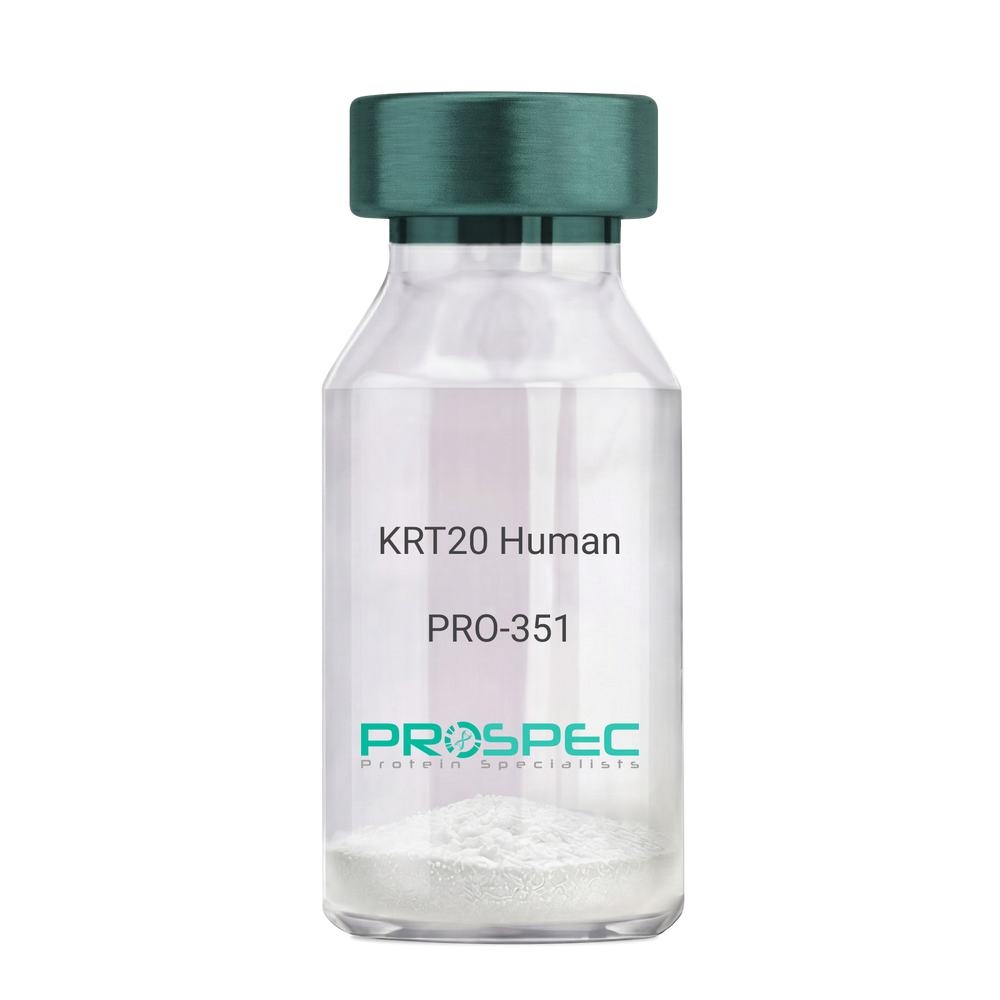
    KRT20 Human

    Description:

    Cytokeratin 20 Human Recombinant

    Keratin type I cytoskeletal 20, Cytokeratin-20, CK-20, Keratin-20, K20, Protein IT, KRT20, CD20, CK20, KRT21, MGC35423.

    Product # :

    PRO-351

    Price :

    Quantity :

    Shipping Method :

    Room Temp Icon

    Shipped at Room temp

    Add To Cart

    More Info

    • description
    • source
    • formulation
    • purity
    • More Info

    Description

    Cytokeratin 20 Human Recombinant produced in E.Coli is a single,non-glycosylated polypeptide chain having a molecular mass of 48,553 Dalton. The KRT20 is purified by proprietary chromatographic techniques.

    Source

    Escherichia Coli.

    Formulation

    The protein (1mg/1ml) was lyophilized after from a sterile solution containing 30mM Tris-HCL pH-8, 9.5M urea, 2mM DDT, 2mM EDTA and 10mM methylammonium chloride.

    Purity

    Greater than 95.0% as determined by SDS-PAGE.

    More Info

    • Introduction

      KRT20 is a member of the keratin family. The keratins are intermediate filament proteins responsible for the structural integrity of epithelial cells and are subdivided into cytokeratins and hair keratins. The type I cytokeratins consist of acidic proteins which are arranged in pairs of heterotypic keratin chains. This cytokeratin is a major cellular protein of mature enterocytes and goblet cells and is specifically expressed in the gastric and intestinal mucosa. The type I cytokeratin genes are clustered in a region of chromosome 17q12-q21.

    • Synonyms

      Keratin type I cytoskeletal 20, Cytokeratin-20, CK-20, Keratin-20, K20, Protein IT, KRT20, CD20, CK20, KRT21, MGC35423.

    • Physical Appearance

      Sterile Filtered White lyophilized (freeze-dried) powder.

    • Stability

      Lyophilized KRT20 although stable at room temperature for 3 weeks, should be stored desiccated below -18°C. Upon reconstitution KRT20 should be stored at 4°C between 2-7 days and for future use below -18°C.For long term storage it is recommended to add a carrier protein (0.1% HSA or BSA).Please prevent freeze-thaw cycles.

    • Solubility

      It is recommended to reconstitute the lyophilized KRT20 in sterile 18MΩ-cm H2O not less than 100µg/ml, which can then be further diluted to other aqueous solutions.

    • Reconstitution to filaments

      Performed by mixing equimolar amounts of cytokeratins of type I and type II at concentrations of approx. 0.5 mg/ml, both dissolved in 9.5 M urea buffer (see above). Protofilaments and filament complexes are obtained by dialyzing the resulting polypeptide solution stepwise to a concentration of 4 M urea and then to low salt condition (50 mM NaCI, 2 mM dithiothreitol, 10 mM Tris-HCI, pH 7.4). For immunization purposes, the solution can be further dialyzed against PBS (phosphate buffered saline, e.g. Dulbecco's PBS).

    ProSpec's products are furnished for LABORATORY RESEARCH USE ONLY. The product may not be used as drugs, agricultural or pesticidal products, food additives or household chemicals.

    Krt20 Human
  • View Data Sheet

    Name :

    HTNV

    Description:

    Hantavirus Recombinant

    HTNV, Hantaan Virus, Hantanvirus.

    Product # :

    HTV-001

    Price :

    Quantity :

    Shipping Method :

    Ice Icon

    Shipped with Ice Packs

    Add To Cart

    More Info

    • description
    • source
    • formulation
    • purity
    • More Info

    Description

    The Hantavirus nucleocapsid (N) fusion protein is expressed in E. coli and is fused to 6xHis tag. Hantavirus nucleocapsid (N) is conserved among different strains, and is used to test the specific IgM and IgG to Hantavirus.

    Source

    E.Coli

    Formulation

    HTNV is formulated in 1xPBS pH-7.4 and 0.05% Sodium azide.

    Purity

    HTNV protein is >95% pure as determined by 12% PAGE (coomassie staining).

    More Info

    • Synonyms

      HTNV, Hantaan Virus, Hantanvirus.

    • Physical Appearance

      Sterile filtered colorless solution.

    • Stability

      Upon arrival, Store at -20°C. Please avoid multiple freeze/thaw cycles.

    • Amino Acid Sequence

      GSMATMEELQREINAHEGQLVIARQKVRDAEKQYEKDPDELNKRTLTDRE GVAVSIQAKIDELKRQLADRIATGKNLGKEQDPTGVEPGDHLKERSMLSY GNVLDLNHLDIDEPTGQTADWLSIVVYVD

    • Background

      What is the source or expression system of Hantavirus- Nucleocapsid Protein?
      Escherichia Coli.

      What is the Purity of Hantavirus- Nucleocapsid Protein?
      Hantavirus- Nucleocapsid Protein is >95% pure as determined by SDS-PAGE.

      Is Hantavirus- Nucleocapsid conjugated to a Tag?
      Hantavirus- Nucleocapsid is fused to 6xHis.

      What is the Biological Activity of Hantavirus- Nucleocapsid Protein?
      The biological functionality of Hantavirus- Nucleocapsid Protein will be determined in the future.

      What is the endotoxin level for Hantavirus- Nucleocapsid Protein?
      The endotoxin level is minimal, Hantavirus- Nucleocapsid Protein was purified using conventional chromatography techniques.

      What applications can Hantavirus- Nucleocapsid Protein be used in?
      Hantavirus-Nucleocapsid Protein can probably be used in Immunoassay.

      What is the function of the hantavirus nucleocapsid (N) protein?
      The hantavirus nucleocapsid (N) protein surrounds the viral RNA binding site and protects it during viral replication and assembly.

      Why is hantavirus nucleocapsid protein commonly used in ELISA assays?
      The hantavirus N protein is highly immunogenic, conserved and widely expressed and induces a strong antibody response in infected individuals.

      Does hantavirus N protein bind RNA?
      Hantavirus N protein contains RNA-binding domains that specifically interact with viral genomic

      Is the hantavirus nucleocapsid protein suitable for antibody production?
      Resulting from high immunogenicity, recombinant hantavirus N protein is highly used as an immunogen for generating both polyclonal and monoclonal antibodies.

    • Purification Method

      Purified by proprietary chromatographic technique.

    ProSpec's products are furnished for LABORATORY RESEARCH USE ONLY. The product may not be used as drugs, agricultural or pesticidal products, food additives or household chemicals.

    Hantavirus Protein
  • View Data Sheet

    Name :

    Treponema TP0453

    Description:

    Outer Membrane Protein Treponema pallidum Recombinant

    Outer membrane protein TP0453, 30kLP, TP_0453, TPANIC_0453

    Product # :

    TRP-255

    Price :

    Quantity :

    Shipping Method :

    Ice Icon

    Shipped with Ice Packs

    Add To Cart

    More Info

    • description
    • source
    • formulation
    • purity
    • More Info

    Description

    Recombinant Treponema pallidum Outer Membrane Protein TP0453 has a Mw of 26kDa, and was purified from E. coli.The Recombinant Treponema pallidum Outer Membrane Protein TP0453 is fused to 6 amino acid His tag at its C terminal and purified by proprietary chromatographic technique.

    Source

    Escherichia Coli.

    Formulation

    Treponema TP0453 solution contains 25mM K2CO3 with PBS.

    Purity

    Protein is >95% pure as determined by SDS-PAGE (coomassie staining).

    More Info

    • Introduction

      Tp0453 is a carrier of lipids and glycolipids during outer membrane. Tp045 is hypothesized to be a new type of bacterial outer membrane protein, which reduces T.pallidum outer membrane permeability to nutrients while remaining inaccessible to antibodies. Tp0453 exhibited 100% specificity and sensitivity in reaction with syphilis patients’ sera, giving negative result with Lyme disease, relapsing-fever or leptospirosis patients’ sera.

    • Synonyms

      Outer membrane protein TP0453, 30kLP, TP_0453, TPANIC_0453

    • Physical Appearance

      Sterile Filtered clear solution.

    • Stability

      Store at 4°C if entire vial will be used within 2-4 weeks.Store, frozen at -20°C for longer periods of time.For long term storage it is recommended to add a carrier protein (0.1% HSA or BSA).Avoid multiple freeze-thaw cycles.

    • Applications

      Rapid test, Immunoassay.

    ProSpec's products are furnished for LABORATORY RESEARCH USE ONLY. The product may not be used as drugs, agricultural or pesticidal products, food additives or household chemicals.

    Tp0453 Treponema
  • View Data Sheet

    Name :

    CRMP1 Mouse

    Description:

    Collapsin Response Mediator Protein-1 Mouse Recombinant

    Dihydropyrimidinase-related protein 1, DRP-1, Collapsin response mediator protein 1, CRMP-1, Unc-33-like phosphoprotein 3, ULIP-3.

    Product # :

    PRO-2521

    Price :

    Quantity :

    Shipping Method :

    Ice Icon

    Shipped with Ice Packs

    Add To Cart

    More Info

    • description
    • source
    • formulation
    • purity
    • More Info

    Description

    CRMP1 Mouse Recombinant produced in E.Coli is a single, non-glycosylated polypeptide chain containing 597 amino acids (1-572 a.a) and having a molecular mass of 64.8kDa.CRMP1 is fused to a 25 amino acid His-tag at N-terminus & purified by proprietary chromatographic techniques.

    Source

    Escherichia Coli.

    Formulation

    CRMP1 protein solution (0.25mg/ml) contains 40% glycerol, 20mM Tris-HCl (pH 8.5), 0.2M NaCl & 0.1mM PMSF.

    Purity

    Greater than 95.0% as determined by SDS-PAGE.

    More Info

    • Introduction

      Collapsin response mediator proteins (CRMPs) are cytosolic phosphoproteins involved in neuronal differentiation as well as axonal guidance. CRMP2 was previously shown to mediate the repulsive effect of Sema3A on axons and to participate in axonal specification. The X-ray crystal structure of murine CRMP1 was determined at 2.1 resolution and demonstrates that CRMP1 is a bilobed ‘lung-shaped’ protein forming a tetrameric assembly.

    • Synonyms

      Dihydropyrimidinase-related protein 1, DRP-1, Collapsin response mediator protein 1, CRMP-1, Unc-33-like phosphoprotein 3, ULIP-3.

    • Physical Appearance

      Sterile Filtered clear solution.

    • Stability

      Store at 4°C if entire vial will be used within 2-4 weeks. Store, frozen at -20°C for longer periods of time. For long term storage it is recommended to add a carrier protein (0.1% HSA or BSA).Avoid multiple freeze-thaw cycles.

    • Amino Acid Sequence

      MGSSHHHHHH SSGLVPRGSH MGSEFMSHQG KKSIPHITSD RLLIRGGRII NDDQSFYADV YLEDGLIKQI GENLIVPGGV KTIEANGRMV IPGGIDVNTY LQKPSQGMTS ADDFFQGTKA ALAGGTTMII DHVVPEPGSS LLTSFEKWHE AADTKSCCDY SLHVDITSWY DGVREELEVL VQDKGVNSFQ VYMAYKDLYQ MSDSQLYEAF TFLKGLGAVI LVHAENGDLI AQEQKRILEM GITGPEGHAL SRPEELEAEA VFRAIAIAGR INCPVYITKV MSKSAADIIA LARKKGPLVF GEPIAASLGT DGTHYWSKNW AKAAAFVTSP PLSPDPTTPD YLTSLLACGD LQVTGSGHCP YSTAQKAVGK DNFTLIPEGV NGIEERMTVV WDKAVATGKM DENQFVAVTS TNAAKIFNLY PRKGRIAVGS DADVVIWDPD KMKTITAKSH KSTVEYNIFE GMECHGSPLV VISQGKIVFE DGNISVSKGM GRFIPRKPFP EHLYQRVRIR SKVFGLHSVS RGMYDGPVYE VPATPKHAAP APSAKSSPSK HQPPPIRNLH QSNFSLSGAQ IDDNNPRRTG HRIVAPPGGR SNITSLG.

    ProSpec's products are furnished for LABORATORY RESEARCH USE ONLY. The product may not be used as drugs, agricultural or pesticidal products, food additives or household chemicals.

    CRMP1 Mouse
  • View Data Sheet

    Name :

    USE1 Human

    Description:

    Unconventional SNARE In The ER 1 Human Recombinant

    Vesicle transport protein USE1, Putative MAPK-activating protein PM26, USE1-like protein, p31, USE1L, MDS032, Q-SNARE, SLT1, SNARE-Like Tail-Anchored Protein 1 Homolog, Protein P31.

    Product # :

    PRO-1464

    Price :

    Quantity :

    Shipping Method :

    Ice Icon

    Shipped with Ice Packs

    Add To Cart

    More Info

    • description
    • source
    • formulation
    • purity
    • More Info

    Description

    USE1 Human Recombinant produced in E.Coli is a single, non-glycosylated polypeptide chain containing 254 amino acids (1-231 a.a) and having a molecular mass of 28.3kDa.USE1 is fused to a 23 amino acid His-tag at N-terminus & purified by proprietary chromatographic techniques.

    Source

    Escherichia Coli.

    Formulation

    USE1 protein solution (0.25mg/ml) containing 20mM Tris-HCl buffer (pH8.0), 10% glycerol, 0.1M NaCl and 1mM DTT.

    Purity

    Greater than 80.0% as determined by SDS-PAGE.

    More Info

    • Introduction

      USE1 Belongs to the USE1 family, this protein is a vesicle transport protein. USE1 is a component of a SNAREcomplex consisting of STX18, USE1L, BNIP1/SEC20L and SEC22B. In addition USE1 interacts directly with STX18. SNARE maybe involved in targeting and fusion of Golgi-derived retrograde transport vesicles with the ER. Diseases associated with USE1 comprise dysentery and hemolytic-uremic syndrome. Among its related super-pathways are Nicotine Pathway (Dopaminergic Neuron) and Pharmacodynamics. GO annotations related to this gene include protein binding.

    • Synonyms

      Vesicle transport protein USE1, Putative MAPK-activating protein PM26, USE1-like protein, p31, USE1L, MDS032, Q-SNARE, SLT1, SNARE-Like Tail-Anchored Protein 1 Homolog, Protein P31.

    • Physical Appearance

      Sterile Filtered clear solution.

    • Stability

      Store at 4°C if entire vial will be used within 2-4 weeks. Store, frozen at -20°C for longer periods of time. For long term storage it is recommended to add a carrier protein (0.1% HSA or BSA).Avoid multiple freeze-thaw cycles.

    • Amino Acid Sequence

      MGSSHHHHHH SSGLVPRGSH MGSMAASRLE LNLVRLLSRC EAMAAEKRDP DEWRLEKYVG ALEDMLQALK VHASKPASEV INEYSWKVDF LKGMLQAEKL TSSSEKALAN QFLAPGRVPT TARERVPATK TVHLQSRARY TSEMRSELLG TDSAEPEMDV RKRTGVAGSQ PVSEKQSAAE LDLVLQRHQN LQEKLAEEML GLARSLKTNT LAAQSVIKKD NQTLSHSLKM ADQNLEKLKT ESERLEQHTQ KSVN

    ProSpec's products are furnished for LABORATORY RESEARCH USE ONLY. The product may not be used as drugs, agricultural or pesticidal products, food additives or household chemicals.

    Use1 Human
  • View Data Sheet

    Name :

    EBV p23

    Description:

    Epstein-Barr Virus (HHV-4) p23 Recombinant

    Product # :

    EBV-274

    Price :

    Quantity :

    Shipping Method :

    Ice Icon

    Shipped with Ice Packs

    Add To Cart

    More Info

    • description
    • source
    • formulation
    • purity
    • More Info

    Description

    The E.Coli derived recombinant protein contains the HHV-4 p23 regions, 1-162 amino acids and fused to a GST-Tag at C-terminus.

    Source

    Escherichia Coli.

    Formulation

    25mM glycine pH-9.6 and 50% glycerol.

    Purity

    EBV- p23 protein is >95% pure as determined by 10% PAGE (coomassie staining).

    More Info

    • Introduction

      The Epstein-Barr virus (EBV), also called Human herpes virus 4 (HHV-4), is a virusof the herpes family(which includes Herpes simplex virusand Cytomegalovirus. On infecting the B-lymphocyte, the linear virus genome circularizes and the virus subsequently persists within the cell as an episome. The virus can execute several distinct programs of gene expressionwhich can be broadly categorized as being lytic cycle or latent cycle. The lytic cycleor productive infection results in staged expression of a host of viral proteinswith the ultimate objective of producing infectious virions. Formally, this phase of infection does not inevitably lead to lysis of the host cellas EBV virions are produced by budding from the infected cell. The latent cycle(lysogenic) programs are those that do not result in production of virions. A very limited, distinct set of viral proteins are produced during latent cycle infection. These include Epstein-Barr nuclear antigen(EBNA)-1, EBNA-2, EBNA-3A, EBNA-3B, EBNA-3C, EBNA-leader protein (EBNA-LP) and latent membrane proteins(LMP)-1, LMP-2A and LMP-2B and the Epstein-Barr encoded RNAs(EBERs).

    • Stability

      EBV-p23 protein although stable at 4°C for 1 week, should be stored below -18°C. Please prevent freeze thaw cycles.

    • Applications

      EBV-p23 antigen is suitable for ELISA and Western blots, excellent antigen for detection of HHV-4 (EBV) with minimal specificity problems.

    • Specificity

      Immunoreactive with sera of EBV-infected individuals.

    • Purification Method

      EBV-p23 was purified by proprietary chromatographic technique.

    ProSpec's products are furnished for LABORATORY RESEARCH USE ONLY. The product may not be used as drugs, agricultural or pesticidal products, food additives or household chemicals.

    Ebv P23
  • View Data Sheet

    Name :

    CMV Pp52

    Description:

    Cytomegalo Virus Pp52 (UL44) Recombinant

    Product # :

    CMV-214

    Price :

    Quantity :

    Shipping Method :

    Ice Icon

    Shipped with Ice Packs

    Add To Cart

    More Info

    • description
    • source
    • formulation
    • purity
    • More Info

    Description

    The E.coli derived 51 kDa recombinant protein contains the CMV Pp52 (UL44) immunodominant regions, 202-434 amino acids. Recombinant CMV-Pp52 is fused to a 26 kDa GST tag.

    Source

    Escherichia Coli.

    Formulation

    50mM Tris pH 7.2, 1mM EDTA and 50% glycerol.

    Purity

    CMV Pp52 protein is >95% pure as determined by 10% PAGE (coomassie staining).

    More Info

    • Introduction

      CMV belongs to the Betaherpesvirinae subfamily of Herpesviridae which includes herpes simplex virustypes 1 and 2, varicella-zoster virus, and Epstein-Barrvirus. The herpesviruses share a characteristic ability to remain latentover long periods. CMV is a double-stranded linear DNA virus with 162 hexagonal protein capsomeres surrounded by a lipid membrane. CMV has the largest genome of the herpes viruses, ranging from 230-240 kilobase pairs. Human CMV is composed of unique and inverted repeats that include the existence of 4 genome isomers caused by inversion of L-S genome components (class E). Replication may be divided into immediate early, delayed early, and late gene expression based on time of synthesis after infection. The DNA is replicated by rolling circles. In vitro, CMV replicates in human fibroblasts.

    • Stability

      CMV Pp52 protein although stable at 4°C for 1 week, should be stored below -18°C. Please prevent freeze thaw cycles.

    • Applications

      CMV Pp52 antigen is suitable for ELISA and Western blots, excellent antigen for detection of CMV with minimal specificity problems.

    • Specificity

      Immunoreactive with sera of CMV-infected individuals.

    • Purification Method

      CMV Pp52 protein was purified by proprietary chromatographic technique.

    ProSpec's products are furnished for LABORATORY RESEARCH USE ONLY. The product may not be used as drugs, agricultural or pesticidal products, food additives or household chemicals.

    Cmv Pp52
  • View Data Sheet

    Name :

    Flt3 Ligand Mouse, Sf9

    Description:

    Flt3 Ligand Mouse Recombinant, Sf9

    Fms-related tyrosine kinase 3 ligand, Flt3 ligand, Flt3L, SL cytokine, lt3lgF, Flt3l.

    Product # :

    CYT-910

    Price :

    Quantity :

    Shipping Method :

    Ice Icon

    Shipped with Ice Packs

    Add To Cart

    More Info

    • description
    • source
    • formulation
    • purity
    • More Info

    Description

    Flt3 Ligand produced in Sf9 Baculovirus cells is a single, glycosylated polypeptide chain (27-189 a.a.) and fused to a 6 aa His Tag at C-terminus containing a total of 169 amino acids and having a molecular mass of 19.3kDa.Flt3 Ligand shows multiple bands between 18-28kDa on SDS-PAGE, reducing conditions and purified by proprietary chromatographic techniques.

    Source

    Sf9, Baculovirus cells.

    Formulation

    Flt3 Ligand protein solution (0.5mg/ml) contains Phosphate buffered saline (pH7.4) and 10% glycerol.

    Purity

    Greater than 85.0% as determined by SDS-PAGE.

    More Info

    • Introduction

      FLT3 ligand is a receptor for the fl cytokine has a tyrosine-protein kinase activity & a growth factor that regulates proliferation of early hematopoietic cells. Flt3-Ligand synergizes with other CSFs and interleukins to induce growth and differentiation.

    • Synonyms

      Fms-related tyrosine kinase 3 ligand, Flt3 ligand, Flt3L, SL cytokine, lt3lgF, Flt3l.

    • Physical Appearance

      Sterile filtered colorless solution.

    • Stability

      Store at 4°C if entire vial will be used within 2-4 weeks. Store, frozen at -20°C for longer periods of time. For long term storage it is recommended to add a carrier protein (0.1% HSA or BSA).Avoid multiple freeze-thaw cycles.

    • Amino Acid Sequence

      GTPDCYFSHS PISSNFKVKF RELTDHLLKD YPVTVAVNLQ DEKHCKALWS LFLAQRWIEQ LKTVAGSKMQ TLLEDVNTEI HFVTSCTFQP LPECLRFVQT NISHLLKDTC TQLLALKPCI GKACQNFSRC LEVQCQPDSS TLLPPRSPIA LEATELPEPR PRQHHHHHH

    • Background

      What is the molecular weight/Mw of FLT3 LIGAND MOUSE, SF9 Protein?
      FLT3 LIGAND MOUSE, SF9 Protein has a total Mw of 19.3kDa.

      What is the source or expression system of FLT3 LIGAND MOUSE, SF9 Protein?
      Sf9, Baculovirus cells.

      What is the Purity of FLT3 LIGAND MOUSE, SF9 Protein?
      FLT3 LIGAND MOUSE, SF9 Protein is >85% pure as determined by SDS-PAGE.

      What is the Biological Activity of FLT3 LIGAND MOUSE, SF9 Protein?
      The biological functionality of FLT3 LIGAND MOUSE, SF9 Protein will be determined in the future.

      What is the amino acid sequence of FLT3 LIGAND MOUSE, SF9 Protein?
      GTPDCYFSHS PISSNFKVKF RELTDHLLKD YPVTVAVNLQ DEKHCKALWS LFLAQRWIEQ LKTVAGSKMQ TLLEDVNTEI HFVTSCTFQP LPECLRFVQT NISHLLKDTC TQLLALKPCI GKACQNFSRC LEVQCQPDSS TLLPPRSPIA LEATELPEPR PRQHHHHHH.

      What applications can FLT3 LIGAND MOUSE, SF9 Protein be used in?
      FLT3 LIGAND MOUSE, SF9 Protein can probably be used in western blot, ELISA and Lateral Flow.

      What is the endotoxin level for FLT3 LIGAND MOUSE, SF9 Protein?
      The endotoxin level is minimal, FLT3 LIGAND MOUSE, SF9 Protein was purified using conventional chromatography techniques.

    ProSpec's products are furnished for LABORATORY RESEARCH USE ONLY. The product may not be used as drugs, agricultural or pesticidal products, food additives or household chemicals.

    Flt3 Ligand Mouse Sf9
  • View Data Sheet

    Name :

    DnaK SBD

    Description:

    DnaK Substrate Binding Domain E.Coli Recombinant

    HSP-70, HSP70, DnaK, Chaperone protein dnaK, Heat shock protein 70, Heat shock 70 kDa protein, groP, grpF, seg, b0014, JW0013.

    Product # :

    HSP-008

    Price :

    Quantity :

    Shipping Method :

    Ice Icon

    Shipped with Ice Packs

    Add To Cart

    More Info

    • description
    • source
    • formulation
    • purity
    • More Info

    Description

    Recombinant DnaK Substrate Binding domain produced in E.Coli is a single, non-glycosylated polypeptide chain containing (385-546 a.a.) 163 amino acids and having a molecular mass of 17.7 kDa.

    Source

    Escherichia Coli.

    Formulation

    The protein contains 25mM Tris-HCl, pH7.5, 2mM B-ME and 1mM DTT.

    Purity

    Greater than 95.0% as determined by SDS-PAGE.

    More Info

    • Introduction

      DnaK, originally identified for its DNA replication by bacteriophage l in E. coli is the bacterial hsp70 chaperone. This protein is involved in the folding and assembly of newly synthesized polypeptide chains and in preventing the aggregation of stress-denatured proteins. Dnak(residues 508-638) of the substrate binding domain is a-helical and appears to act as a lid covering the substrate binding cleft. DnaK(amino acid 508-638) was purified to apparent homogeneity by using conventional column chromatography techniques. Additional amino acid (Met) is attached at N- terminus.

    • Synonyms

      HSP-70, HSP70, DnaK, Chaperone protein dnaK, Heat shock protein 70, Heat shock 70 kDa protein, groP, grpF, seg, b0014, JW0013.

    • Physical Appearance

      Sterile filtered colorless solution.

    • Stability

      Store at 4°C if entire vial will be used within 2-4 weeks. Store, frozen at -20°C for longer periods of time. For long term storage it is recommended to add a carrier protein (0.1% HSA or BSA).Avoid multiple freeze-thaw cycles.

    • Amino Acid Sequence

      MDVKDVLLLD VTPLSLGIET MGGVMTTLIA KNTTIPTKHS QVFSTAEDNQ SAVTIHVLQG ERKRAADNKS LGQFNLDGIN PAPRGMPQIE VTFDIDADGI LHVSAKDKNS GKEQKITIKA SSGLNEDEIQ KMVRDAEANA EADRKFEELV QTRNQGDHLL HST.

    ProSpec's products are furnished for LABORATORY RESEARCH USE ONLY. The product may not be used as drugs, agricultural or pesticidal products, food additives or household chemicals.

    Dnak Sbd
  • View Data Sheet

    Name :

    CSTB Antibody

    Description:

    Cystatin B, Mouse Anti Human

    Cystatin-B, Stefin-B, Liver thiol proteinase inhibitor, CPI-B, CSTB, CST6, EPM1, PME, STFB.

    Product # :

    ANT-339

    Price :

    Quantity :

    Shipping Method :

    Ice Icon

    Shipped with Ice Packs

    Add To Cart

    More Info

    • formulation
    • More Info

    Formulation

    1mg/ml containing PBS, pH-7.4, & 0.1% Sodium Azide.

    More Info

    • Introduction

      Type 1 cystatins are also called stefins which function as intracellular thiol protease inhibitors. Cystatin-B protein is able to form a dimer stabilized by noncovalent forces, inhibiting papain and cathepsins l, h and b. CSTB protein protects proteases leakage from lysosomes. Mutations in Stefin-B gene cause primary defects in patients with progressive myoclonic epilepsy (EPM1), a degenerative disease of the central nervous system. CSTB is overexpressed & elevated in the serum of HCC patients. Cystatin-B in vivo has a polymeric structure which is sensitive to the redox environment. Cystatin-B inhibits bone resorption by down-regulating intracellular cathepsin K activity despite increased osteoclast survival. Protein and mRNA levels of stefin B are significantly lower in atypical benign meningiomas. Stefins-A & Stefin-B which belong to the type-1 Cystatins, are up-regulated in lung tumours and thus able to counteract harmful tumour-associated proteolytic activity. Human stefin-A & Stef

    • Synonyms

      Cystatin-B, Stefin-B, Liver thiol proteinase inhibitor, CPI-B, CSTB, CST6, EPM1, PME, STFB.

    • Immunogen

      Anti-human CSTB mAb is derived from hybridization of mouse F0 myeloma cells with spleen cells from BALB/c mice immunized with recombinant human CSTB amino acids 1-98 purified from E. coli.

    • Ig Subclass

      Mouse IgG2b heavy chain and κ light chain.

    • Clone

      P2F1AT.

    • Applications

      CSTB antibody has been tested by ELISA and Western blot analysis to assure specificity and reactivity. Since application varies, however, each investigation should be titrated by the reagent to obtain optimal results. Recommended dilution range for Western blot analysis is 1:1,000~ 2,000. Recommended starting dilution is 1:1,000.

    • Type

      Mouse Anti Human Monoclonal.

    • Storage Procedures

      For periods up to 1 month store at 4°C, for longer periods of time, store at -20°C. Prevent freeze thaw cycles.

    • Purification Method

      CSTB antibody was purified from mouse ascitic fluids by protein-G affinity chromatography.

    ProSpec's products are furnished for LABORATORY RESEARCH USE ONLY. The product may not be used as drugs, agricultural or pesticidal products, food additives or household chemicals.

    Cstb Antibody
  • 1
  • …
  • 36
  • 37
  • 38
  • 39
  • 40
  • …
  • 42
Your browser does not support the video tag.

Products

  • Cytokines
  • Growth Factors
  • Chemokines
  • CD Antigens
  • Neurotrophins
  • Hormones
  • Enzymes
  • Viral Antigens
  • Recombinant Proteins
  • Natural Proteins
  • Monoclonal Antibodies
  • Polyclonal Antibodies
  • Thermal Packaging

About

  • Company
  • Founder
  • Contribution
  • Contact Us
  • My Account

Ordering

  • Ordering Method
  • Ordering - Credit Card
  • Ordering PO
  • Shipping Fees
  • FAQ's

Legal

  • Terms & Conditions
  • Privacy
  • Site Map
  • info@prospecbio.com
  • Facebook
  • Instagram
  • Linkedin Profile

© 2026 ProSpec-Tany TechnoGene Ltd. All Rights Reserved.

  • Choosing a selection results in a full page refresh.
  • Opens in a new window.