Skip to content

High-quality research proteins.

  • 1-800-805-6531

  • Mon - Sat 8.00-18.00, Sun - Closed

  • info@prospecbio.com

  • PO Box 6591 East Brunswick NJ 08816

  • Products
    • Cytokines
    • Growth factors
    • Chemokines
    • Cd antigens
    • Neurotrophins
    • Hormones
    • Enzymes
    • Viral antigens
    • Recombinant proteins
    • Natural proteins
    • Monoclonal antibodies
    • Polyclonal antibodies
    • Thermal Packaging
  • About
    • Company
    • Founder
    • Contribution
  • Customers
    • Eastern Asia
    • Eastern Europe
    • North America
    • South America
    • South East Asia
    • Southern Asia
    • Western Europe
  • Ordering
    • Ordering Method
    • Ordering - Credit Card
    • Ordering - PO
    • Shipping Fees
    • FAQs
  • Services
    • DNA Cloning
    • Protein Expression
    • Monoclonal Antibody
    • Fermentation
    • Technology License
  • Contact us
Log in

Country/region

  • USD $ | Albania
  • USD $ | Andorra
  • USD $ | Argentina
  • USD $ | Armenia
  • USD $ | Australia
  • USD $ | Austria
  • USD $ | Azerbaijan
  • USD $ | Belarus
  • USD $ | Belgium
  • USD $ | Bolivia
  • USD $ | Brazil
  • USD $ | Bulgaria
  • USD $ | Cambodia
  • USD $ | Canada
  • USD $ | Chile
  • USD $ | China
  • USD $ | Colombia
  • USD $ | Costa Rica
  • USD $ | Croatia
  • USD $ | Cyprus
  • USD $ | Czechia
  • USD $ | Denmark
  • USD $ | Estonia
  • USD $ | Finland
  • USD $ | France
  • USD $ | Georgia
  • USD $ | Germany
  • USD $ | Greece
  • USD $ | Hong Kong SAR
  • USD $ | Hungary
  • USD $ | Iceland
  • USD $ | India
  • USD $ | Ireland
  • USD $ | Israel
  • USD $ | Italy
  • USD $ | Japan
  • USD $ | Kazakhstan
  • USD $ | Latvia
  • USD $ | Liechtenstein
  • USD $ | Lithuania
  • USD $ | Madagascar
  • USD $ | Malta
  • USD $ | Mexico
  • USD $ | Moldova
  • USD $ | Monaco
  • USD $ | Netherlands
  • USD $ | New Zealand
  • USD $ | North Macedonia
  • USD $ | Norway
  • USD $ | Panama
  • USD $ | Paraguay
  • USD $ | Peru
  • USD $ | Philippines
  • USD $ | Poland
  • USD $ | Portugal
  • USD $ | Romania
  • USD $ | Singapore
  • USD $ | Slovakia
  • USD $ | Slovenia
  • USD $ | South Africa
  • USD $ | South Korea
  • USD $ | Spain
  • USD $ | Sri Lanka
  • USD $ | Sweden
  • USD $ | Switzerland
  • USD $ | Taiwan
  • USD $ | Thailand
  • USD $ | Türkiye
  • USD $ | Ukraine
  • USD $ | United Kingdom
  • USD $ | United States
  • USD $ | Uruguay
  • USD $ | Vatican City
  • USD $ | Venezuela
  • USD $ | Vietnam
  • Facebook
  • Instagram
logoProSpec - Recombinant Protein Manufacturer for academic and R&D industry
Become a distributor
Account Log in
Wishlist
Cart Cart(0)
  • Products
    +
    • Cytokines
    • Growth factors
    • Chemokines
    • Cd antigens
    • Neurotrophins
    • Hormones
    • Enzymes
    • Viral antigens
    • Recombinant proteins
    • Natural proteins
    • Monoclonal antibodies
    • Polyclonal antibodies
    • Thermal Packaging
  • About
    +
    • Company
    • Founder
    • Contribution
  • Customers
    +
    • Eastern Asia
    • Eastern Europe
    • North America
    • South America
    • South East Asia
    • Southern Asia
    • Western Europe
  • Ordering
    +
    • Ordering Method
    • Ordering - Credit Card
    • Ordering - PO
    • Shipping Fees
    • FAQs
  • Services
    +
    • DNA Cloning
    • Protein Expression
    • Monoclonal Antibody
    • Fermentation
    • Technology License
  • Contact us

Item added to your cart

View cart
View All
  • Cytokines
  • Growth factors
  • Chemokines
  • Cd antigens
  • Neurotrophins
  • Hormones
  • Enzymes
  • Viral antigens
  • Recombinant proteins
  • Natural proteins
  • Monoclonal antibodies
  • Polyclonal antibodies
  • Thermal Packaging
  • Tumor Necrosis Factor

    Tumor Necrosis Factor

    View All
  • 4-1BB

    4-1BB

    View All
  • Adiponectin

    Adiponectin

    View All
  • AIF1

    AIF1

    View All
  • Other Cytokines

    Other Cytokines

    View All
  • AITRL

    AITRL

    View All
  • Angiopoietin

    Angiopoietin

    View All
  • Apolipoprotein

    Apolipoprotein

    View All
  • B-Cell Activating Factor

    B-Cell Activating Factor

    View All
  • Beta Defensin

    Beta Defensin

    View All
  • Bone Morphogenetic Protein

    Bone Morphogenetic Protein

    View All
  • B type Natriuretic Peptide

    B type Natriuretic Peptide

    View All
  • BST

    BST

    View All
  • Betacellulin

    Betacellulin

    View All
  • Cardiotrophin

    Cardiotrophin

    View All
  • Activin

    Activin

    View All
  • Fibroblast Growth Factor

    Fibroblast Growth Factor

    View All
  • Other Growth Factors

    Other Growth Factors

    View All
  • CSF

    CSF

    View All
  • CTGF

    CTGF

    View All
  • IGFBP

    IGFBP

    View All
  • VEGF Protein

    VEGF Protein

    View All
  • EGF

    EGF

    View All
  • Epigen

    Epigen

    View All
  • Erythropoietin

    Erythropoietin

    View All
  • Insulin-Like Growth Factor

    Insulin-Like Growth Factor

    View All
  • Growth Hormone

    Growth Hormone

    View All
  • HDGF

    HDGF

    View All
  • Hepatocyte Growth Factor

    Hepatocyte Growth Factor

    View All
  • Insulin

    Insulin

    View All
  • BCA-1/ BLC (CXCL13)

    BCA-1/ BLC (CXCL13)

    View All
  • BRAK (CXCL14)

    BRAK (CXCL14)

    View All
  • C-10 (CCL6)

    C-10 (CCL6)

    View All
  • Other Chemokines

    Other Chemokines

    View All
  • MEC (CCL28)

    MEC (CCL28)

    View All
  • LD78-beta (CCL3L1)

    LD78-beta (CCL3L1)

    View All
  • CTACK (CCL27)

    CTACK (CCL27)

    View All
  • CXCL16

    CXCL16

    View All
  • CXCL17

    CXCL17

    View All
  • Platelet Factor-4 (CXCL4)

    Platelet Factor-4 (CXCL4)

    View All
  • ENA-78 (CXCL5)

    ENA-78 (CXCL5)

    View All
  • Eotaxin (CCL11,24,26)

    Eotaxin (CCL11,24,26)

    View All
  • Exodus-2 (CCL21)

    Exodus-2 (CCL21)

    View All
  • Fractalkine (CX3CL1)

    Fractalkine (CX3CL1)

    View All
  • CXCL6

    CXCL6

    View All
  • Other CD Antigens

    Other CD Antigens

    View All
  • CD14

    CD14

    View All
  • CD164

    CD164

    View All
  • CD1

    CD1

    View All
  • CD2

    CD2

    View All
  • CD200

    CD200

    View All
  • CD207

    CD207

    View All
  • CD226

    CD226

    View All
  • CD23

    CD23

    View All
  • CD244

    CD244

    View All
  • CD247

    CD247

    View All
  • CD27

    CD27

    View All
  • CD274

    CD274

    View All
  • CD300

    CD300

    View All
  • CD33

    CD33

    View All
  • Other Neurotrophins

    Other Neurotrophins

    View All
  • Beta-NGF

    Beta-NGF

    View All
  • BDNF

    BDNF

    View All
  • CDNF

    CDNF

    View All
  • CNTF

    CNTF

    View All
  • GDNF

    GDNF

    View All
  • Glia Maturation Factor

    Glia Maturation Factor

    View All
  • MANF

    MANF

    View All
  • Midkine

    Midkine

    View All
  • Neuroglobin

    Neuroglobin

    View All
  • Neurotrophic factors

    Neurotrophic factors

    View All
  • Neuregulin

    Neuregulin

    View All
  • Neuropilin

    Neuropilin

    View All
  • Pigment Epithelium-Derived Factor

    Pigment Epithelium-Derived Factor

    View All
  • Pleiotrophin

    Pleiotrophin

    View All
  • Peptide Hormones

    Peptide Hormones

    View All
  • Other Hormones

    Other Hormones

    View All
  • HCG

    HCG

    View All
  • Endothelin

    Endothelin

    View All
  • Exendin

    Exendin

    View All
  • FSH

    FSH

    View All
  • Glucagon

    Glucagon

    View All
  • GHRP

    GHRP

    View All
  • GLP

    GLP

    View All
  • Thyrostimulin

    Thyrostimulin

    View All
  • Inhibin A

    Inhibin A

    View All
  • LHRH

    LHRH

    View All
  • Melanotan

    Melanotan

    View All
  • Procalcitonin

    Procalcitonin

    View All
  • PTH

    PTH

    View All
  • Peroxiredoxin

    Peroxiredoxin

    View All
  • Peptidase

    Peptidase

    View All
  • Synthetase

    Synthetase

    View All
  • Transferase

    Transferase

    View All
  • Hydrolase

    Hydrolase

    View All
  • Dehydrogenase

    Dehydrogenase

    View All
  • ACE2

    ACE2

    View All
  • Esterase

    Esterase

    View All
  • Protein Kinases

    Protein Kinases

    View All
  • Other Enzymes

    Other Enzymes

    View All
  • Phosphatase

    Phosphatase

    View All
  • Deaminase

    Deaminase

    View All
  • Oxygenase

    Oxygenase

    View All
  • Adenylate Kinase

    Adenylate Kinase

    View All
  • Lyase

    Lyase

    View All
  • Chagas

    Chagas

    View All
  • SARS

    SARS

    View All
  • Influenza

    Influenza

    View All
  • ASFV

    ASFV

    View All
  • Astrovirus

    Astrovirus

    View All
  • Borrelia

    Borrelia

    View All
  • Helicobacter Pylori

    Helicobacter Pylori

    View All
  • Chikungunya

    Chikungunya

    View All
  • Chlamydia

    Chlamydia

    View All
  • Cytomegalo

    Cytomegalo

    View All
  • Dengue

    Dengue

    View All
  • EBV

    EBV

    View All
  • Ebola

    Ebola

    View All
  • Feline Leukemia Virus

    Feline Leukemia Virus

    View All
  • Hepatitis A

    Hepatitis A

    View All
  • Other

    Other

    View All
  • Actin

    Actin

    View All
  • ADAM

    ADAM

    View All
  • Complement Component

    Complement Component

    View All
  • Ag85

    Ag85

    View All
  • Eukaryotic Translation Initiation Factor

    Eukaryotic Translation Initiation Factor

    View All
  • Anterior Gradient Protein

    Anterior Gradient Protein

    View All
  • Heat Shock Protein

    Heat Shock Protein

    View All
  • Alpha-2-HS-Glycoprotein

    Alpha-2-HS-Glycoprotein

    View All
  • Hemoglobin

    Hemoglobin

    View All
  • Allergy

    Allergy

    View All
  • Anaplasma

    Anaplasma

    View All
  • Angiogenin

    Angiogenin

    View All
  • Ankyrin Repeat Domain

    Ankyrin Repeat Domain

    View All
  • Annexin

    Annexin

    View All
  • Other Natural Proteins

    Other Natural Proteins

    View All
  • Aprotinin

    Aprotinin

    View All
  • Transferrin

    Transferrin

    View All
  • Avidin

    Avidin

    View All
  • Anti Coagulation Factors

    Anti Coagulation Factors

    View All
  • Natural Albumin

    Natural Albumin

    View All
  • Natural Coagulation Factors

    Natural Coagulation Factors

    View All
  • Fibronectin

    Fibronectin

    View All
  • Thrombin

    Thrombin

    View All
  • Anti Human Enzyme

    Anti Human Enzyme

    View All
  • Other Monoclonal Antibodies

    Other Monoclonal Antibodies

    View All
  • Anti Human Cytokine

    Anti Human Cytokine

    View All
  • Anti Human Heat Shock Protein

    Anti Human Heat Shock Protein

    View All
  • Anti Mouse Lymphocyte

    Anti Mouse Lymphocyte

    View All
  • Anti Human Chemokine

    Anti Human Chemokine

    View All
  • Anti Human Lymphocyte

    Anti Human Lymphocyte

    View All
  • Anti Viral Monoclonal

    Anti Viral Monoclonal

    View All
  • Anti Mouse Cytokine

    Anti Mouse Cytokine

    View All
  • Anti-GST Monoclonal

    Anti-GST Monoclonal

    View All
  • Other Polyclonal Antibodies

    Other Polyclonal Antibodies

    View All
  • Anti Viral

    Anti Viral

    View All
  • Anti-GST Monoclonal

    Anti-GST Monoclonal

    View All
Back

Search results

1000 results found for “heparanase”

Name

Description

Product #

Price

Quantity

Shipping Method

  • View Data Sheet

    Name :

    HK1 Antibody

    Description:

    Hexokinase-1, Mouse Anti Human

    Hexokinase-1, EC 2.7.1.1, Hexokinase type I, HK I, Brain form hexokinase, HK1-ta, HK1-tb, HXK1, HK1.

    Product # :

    ANT-375

    Price :

    Quantity :

    Shipping Method :

    Ice Icon

    Shipped with Ice Packs

    Add To Cart

    More Info

    • formulation
    • More Info

    Formulation

    1mg/ml containing PBS, pH-7.4, & 0.1% Sodium Azide.

    More Info

    • Introduction

      Hexokinases phosphorylate glucose to produce glucose-6-phosphate, thus committing glucose to the glycolytic pathway. Hexokinase1 encodes a ubiquitous form of hexokinase which localizes to the outer membrane of mitochondria. Mutations in this gene have been associated with hemolytic anemia due to hexokinase deficiency. Alternative splicing of HXK1 results in five transcript variants which encode different isoforms, some of which are tissue-specific. Each isoform has a distinct N-terminus; the remainder of the protein is identical among all the isoforms. A sixth transcript variant has been described, but due to the presence of several stop codons, it is not thought to encode a protein.

    • Synonyms

      Hexokinase-1, EC 2.7.1.1, Hexokinase type I, HK I, Brain form hexokinase, HK1-ta, HK1-tb, HXK1, HK1.

    • Physical Appearance

      Sterile Filtered clear solution.

    • Immunogen

      Anti-human Hexokinase-1 mAb is derived from hybridization of mouse SP2/0 myeloma cells with spleen cells from BALB/c mice immunized with recombinant human Hexokinase-1 amino acids 1-917 purified from E. coli.

    • Ig Subclass

      Mouse IgG2a heavy chain and κ light chain.

    • Clone

      P4D7AT.

    • Applications

      Hexokinase-1 antibody has been tested by ELISA and Western blot analysis to assure specificity and reactivity. Since application varies, however, each investigation should be titrated by the reagent to obtain optimal results. Recommended dilution range for Western blot analysis is 1:1,000 ~ 2,000. Recommended starting dilution is 1:1,000.

    • Type

      Mouse Anti Human Monoclonal.

    • Storage Procedures

      For periods up to 1 month store at 4°C, for longer periods of time, store at -20°C. Prevent freeze thaw cycles.

    • Purification Method

      Hexokinase-1 antibody was purified from mouse ascitic fluids by protein-G affinity chromatography.

    ProSpec's products are furnished for LABORATORY RESEARCH USE ONLY. The product may not be used as drugs, agricultural or pesticidal products, food additives or household chemicals.

    Hk1 Antibody
  • View Data Sheet

    Name :

    TrxR Yeast

    Description:

    Thioredoxin Reductase (NADPH) Yeast Recombinant

    Thioredoxin Reductase (NADPH), NTR, TrxR.

    Product # :

    ENZ-278

    Price :

    Quantity :

    Shipping Method :

    Room Temp Icon

    Shipped at Room temp

    Add To Cart

    More Info

    • description
    • source
    • formulation
    • purity
    • biological activity
    • More Info

    Description

    Thioredoxin Reductase (NADPH) Yeast Recombinant produced in E.Coli is a single, non-glycosylated, polypeptide chain having a molecular mass of 36 kDa. Thioredoxin Reductase is purified by proprietary chromatographic techniques.

    Source

    Escherichia Coli.

    Formulation

    Each mg of protein contains 20mM phosphate buffer pH 7.4.

    Purity

    Greater than 95.0% as determined by SDS-PAGE.

    Biological Activity

    The specific activity was found to be 5.8 IU/mg.

    More Info

    • Introduction

      Thioredoxin reductase (TrxR/NTR), an enzyme belonging to the flavoprotein family of pyridine nucleotide-disulfide oxidoreductases. Thioredoxin reductase (TrxR), a component of the thioredoxin system, including thioredoxin (Trx) and NADPH, catalyzes the transfer of electrons from NADPH to Trx, acts as a reductant of disulfide-containing proteins and participates in the defense system against oxidative stresses.

    • Synonyms

      Thioredoxin Reductase (NADPH), NTR, TrxR.

    • Physical Appearance

      Sterile Filtered White lyophilized (freeze-dried) powder.

    • Stability

      NTR although stable at 4°C for 3 weeks, should be stored desiccated below -18°C. Please prevent freeze thaw cycles.

    • Solubility

      It is recommended to reconstitute the lyophilized NTR in sterile 18MΩ-cm H2O.

    • Unit Definition

      One unit equals the change in absorbance at 412 nm per minute at 25°C using 0.2mM NADPH containing 5mM DTNB (pH 7.0).

    ProSpec's products are furnished for LABORATORY RESEARCH USE ONLY. The product may not be used as drugs, agricultural or pesticidal products, food additives or household chemicals.

    Thioredoxin Reductase Yeast
  • View Data Sheet

    Name :

    M2 Human

    Description:

    DLAT/DLST/BCOADC Recombinant Human

    Product # :

    ENZ-072

    Price :

    Quantity :

    Shipping Method :

    Ice Icon

    Shipped with Ice Packs

    Add To Cart

    More Info

    • description
    • source
    • formulation
    • purity
    • More Info

    Description

    Recombinant antigen for solid (ELISA) and fluid phase diagnostic assays. Mixture of E2/dihydrolipamide acyltransferase-subunits from 3 mitochondrial protein complexes: pyruvate dehydrogenase complex (PDC-E2) having a molecular mass of 60,630 Dalton (pI 5.8); 2-oxo-glutarate dehydrogenase complex (OGDC-E2) having a molecular mass of 42,301 Dalton (pI 6.3); branched chain 2-oxo-acid dehydrogenase complex (BCOADCE2) having a molecular mass of 47,321 Dalton (pI 6.5). Mixture contains equal mass of each protein component. cDNAs coding for the mature forms of the human PDC-E2, OGDC-E2 and BCOADC-E2 proteins individually fused to a hexa-histidine purification tag.

    Source

    Sf9 insect cells.

    Formulation

    M2 is supplied in 16mM HEPES buffer pH-8.0, 400mM NaCl, and 20% glycerol.

    Purity

    Greater than 75% as determined by SDS-PAGE.

    More Info

    • Introduction

      M2 autoantigen is a key mark of antimitochondrial autoantibodies (AMA), a typical serological feature in patients suffering from primary biliary cirrhosis (PBC) which is a serious autoimmune liver disease accompanied by damage to intrahepatic bile ducts. Molecular definition of the M2 antigen has displayed it as no less than 3 separate target proteins. The M2 role is like the so-called E2 subunits (or dihydrolipoamide transferases) of different mitochondrial dehydrogenase complexes:
      *pyruvate dehydrogenase complex.
      *branched chain 2-oxo-acid dehydrogenase complex.
      *2-oxoglutarate dehydrogenase complex.
      Biochemically, these complexes catalyze the oxidative decarboxylation of various alpha-keto-acid substrates and systematically engage with a prosthetic lipoamide group; they are situated in the mitochondrial matrix in association with the inner membrane. The most well-known reactivity of AMA positive PBC sera is against PDC-E2. Some patients have AMA which reacts with PDC-E2 alone (95%), but most patients also show reactivity against OGDC-E2 (39-88%) and/or BCOADC-E2 (53-55%). Actually, patients can be found with reactivity only against OGDC-E2 and/or BCOADC-E2 and no PDC-E2 autoantibodies. These patients will be overlooked in assays based on natural source-derived, predominantly PDC-E2-containing M2 antigen preparations.

    • Stability

      Store at 4°C if entire vial will be used within 2-4 weeks. Store, frozen at -20°C for longer periods of time. Avoid multiple freeze-thaw cycles.

    • Immunological Functions

      1. Binds IgG-type human auto-antibodies. 2. Standard ELISA test (checkerboard analysis of positive/negative sera panels); immunodot test with positive/negative sera panels.

    • coating concentration

      0.4-0.8 µg/ml (depending on the type of ELISA plate and coating buffer). Suitable for biotinylation and iodination.

    • Applications

      Western blot with anti-M2-Antigen autoantibody-positive patient sera or monoclonal
      anti-hexa-His-tag antibody.

    ProSpec's products are furnished for LABORATORY RESEARCH USE ONLY. The product may not be used as drugs, agricultural or pesticidal products, food additives or household chemicals.

    M2 Human
  • View Data Sheet

    Name :

    ALPL Mouse

    Description:

    Alkaline Phosphatase Liver/Bone/Kidney Mouse Recombinant

    Alpl, Akp-2, Akp2, ALP, APTNAP, TNAP, TNSALP, HOPS, AP-TNAP, Alkaline phosphatase 2.

    Product # :

    ENZ-1008

    Price :

    Quantity :

    Shipping Method :

    Ice Icon

    Shipped with Ice Packs

    Add To Cart

    More Info

    • description
    • source
    • formulation
    • purity
    • biological activity
    • More Info

    Description

    ALPL produced in Sf9 Baculovirus cells is a single, glycosylated polypeptide chain containing 493 amino acids (19-503 a.a.) and having a molecular mass of 54.5kDa (Molecular size on SDS-PAGE will appear at approximately 50-70kDa). ALPL is expressed with an 8 amino acid His tag at C-Terminus and purified by proprietary chromatographic techniques.

    Source

    Sf9, Baculovirus cells.

    Formulation

    ALPL protein solution (0.5mg/ml) contains Phosphate Buffered Saline (pH 7.4) and 10% glycerol.

    Purity

    Greater than 95.0% as determined by SDS-PAGE.

    Biological Activity

    Specific activity is > 46,000 pmol/min/ug and is defined as the amount of enzyme that hydrolyze 1pmole of 4-Methylumbelliferyl phosphate to phosphate and 4-Methylumbelliferone per minute at pH 8.8 at 25C.

    More Info

    • Introduction

      Alkaline Phosphatase Liver/Bone/Kidney (Alpl) is a part of the alkaline phosphatases family which comprises 4 related alkaline phosphatases. Alpl is a membrane-bound glycosylated enzyme which is not expressed in any particular tissue. Alpl takes part in skeletal mineralization.

    • Synonyms

      Alpl, Akp-2, Akp2, ALP, APTNAP, TNAP, TNSALP, HOPS, AP-TNAP, Alkaline phosphatase 2.

    • Physical Appearance

      Sterile Filtered colorless solution.

    • Stability

      Store at 4°C if entire vial will be used within 2-4 weeks. Store, frozen at -20°C for longer periods of time. For long term storage it is recommended to add a carrier protein (0.1% HSA or BSA). Avoid multiple freeze-thaw cycles.

    • Amino Acid Sequence

      VPEKERDPSY WRQQAQETLK NALKLQKLNT NVAKNVIMFL GDGMGVSTVT AARILKGQLH HNTGEETRLE MDKFPFVALS KTYNTNAQVP DSAGTATAYL CGVKANEGTV GVSAATERTR CNTTQGNEVT SILRWAKDAG KSVGIVTTTR VNHATPSAAY AHSADRDWYS DNEMPPEALS QGCKDIAYQL MHNIKDIDVI MGGGRKYMYP KNRTDVEYEL DEKARGTRLD GLDLISIWKS FKPRHKHSHY VWNRTELLAL DPSRVDYLLG LFEPGDMQYE LNRNNLTDPS LSEMVEVALR ILTKNLKGFF LLVEGGRIDH GHHEGKAKQA LHEAVEMDQA IGKAGAMTSQ KDTLTVVTAD HSHVFTFGGY TPRGNSIFGL APMVSDTDKK PFTAILYGNG PGYKVVDGER ENVSMVDYAH NNYQAQSAVP LRHETHGGED VAVFAKGPMA HLLHGVHEQN YIPHVMAYAS CIGANLDHCA WAGSGLEHHH HHH.

    ProSpec's products are furnished for LABORATORY RESEARCH USE ONLY. The product may not be used as drugs, agricultural or pesticidal products, food additives or household chemicals.

    Alpl Mouse
  • View Data Sheet

    Name :

    EPHX1 Human, Sf9

    Description:

    Epoxide Hydrolase 1 Microsomal Human Recombinant, sf9

    Epoxide hydrolase 1, Epoxide hydratase, Microsomal epoxide hydrolase, Meh, EPHX1, EPHX, EPOX, Epoxide Hydrolase 1 Microsomal, Microsomal Epoxide Hydrolase, EC 3.3.2.9, HYL1

    Product # :

    ENZ-1076

    Price :

    Quantity :

    Shipping Method :

    Ice Icon

    Shipped with Ice Packs

    Add To Cart

    More Info

    • description
    • source
    • formulation
    • purity
    • More Info

    Description

    EPHX1 produced in Sf9 Insect cells is a single, glycosylated polypeptide chain containing 442 amino acids (21-455 a.a.) and having a molecular mass of 51.5kDaEPHX1 is expressed with an 6 amino acid His tag at C-Terminus and purified by proprietary chromatographic techniques.

    Source

    Sf9, Insect cells.

    Formulation

    EPHX1 protein solution (0.25mg/ml) contains 20mM Tris-HCl buffer (pH 8.0) 50% glycerol,1mM DTT and 0.1M NaCl.

    Purity

    Greater than 85% as determined by SDS-PAGE.

    More Info

    • Introduction

      Epoxide Hydrolase 1 Microsomal (EPHX1) is a vital biotransformation enzyme which transfers epoxides from the degradation of aromatic compounds to trans-dihydrodiols that can be conjugated and excreted from the body. Epoxide hydrolase plays a role in both activation and detoxification of epoxides. Mutations in EPHX1 trigger preeclampsia, epoxide hydrolase deficiency or increased epoxide hydrolase activity.

    • Synonyms

      Epoxide hydrolase 1, Epoxide hydratase, Microsomal epoxide hydrolase, Meh, EPHX1, EPHX, EPOX, Epoxide Hydrolase 1 Microsomal, Microsomal Epoxide Hydrolase,
      EC 3.3.2.9, HYL1

    • Physical Appearance

      Sterile Filtered colorless solution.

    • Stability

      Store at 4°C if entire vial will be used within 2-4 weeks. Store, frozen at -20°C for longer periods of time. For long term storage it is recommended to add a carrier protein (0.1% HSA or BSA). Avoid multiple freeze-thaw cycles.

    • Amino Acid Sequence

      MRDKEETLPL EDGWWGPGTR SAAREDDSIR PFKVETSDEE IHDLHQRIDK FRFTPPLEDS CFHYGFNSNY LKKVISYWRN EFDWKKQVEI LNRYPHFKTK IEGLDIHFIH VKPPQLPAGH TPKPLLMVHG WPGSFYEFYK IIPLLTDPKN HGLSDEHVFE VICPSIPGYG FSEASSKKGF NSVATARIFY KLMLRLGFQE FYIQGGDWGS LICTNMAQLV PSHVKGLHLN MALVLSNFST LTLLLGQRFG RFLGLTERDV ELLYPVKEKV FYSLMRESGY MHIQCTKPDT VGSALNDSPV GLAAYILEKF STWTNTEFRY LEDGGLERKF SLDDLLTNVM LYWTTGTIIS SQRFYKENLG QGWMTQKHER MKVYVPTGFS AFPFELLHTP EKWVRFKYPK LISYSYMVRG GHFAAFEEPE LLAQDIRKFL SVLERQHHHH HH.

    ProSpec's products are furnished for LABORATORY RESEARCH USE ONLY. The product may not be used as drugs, agricultural or pesticidal products, food additives or household chemicals.

    Ephx1 Protein
  • View Data Sheet

    Name :

    GNMT Human

    Description:

    Glycine N-methyltransferase Human Recombinant

    Glycine N-methyltransferase, GNMT.

    Product # :

    ENZ-386

    Price :

    Quantity :

    Shipping Method :

    Ice Icon

    Shipped with Ice Packs

    Add To Cart

    More Info

    • description
    • source
    • formulation
    • purity
    • More Info

    Description

    GNMT Human Recombinant fused with 20 amino acid His-Tag tag at N-terminus produced in E.Coli is a single, non-glycosylated, polypeptide chain containing a total of 315 amino acids (1-295 a.a.) and having a molecular mass of 34.9 kDa.The GNMT is purified by proprietary chromatographic techniques.

    Source

    Escherichia Coli.

    Formulation

    The GNMT solution contains 20mM Tris pH 8.0 & 20% glycerol.

    Purity

    Greater than 95.0% as determined by SDS-PAGE.

    More Info

    • Introduction

      GNMT is an enzyme that catalyzes the conversion of S-adenosyl-L-methionine with glycine to S-adenosyl-L-homocysteine. GNMT is located in the cytoplasm and acts as a homotetramer. Defects in the GNMT gene causes of GNMT deficiency (hypermethioninemia). GNMT affects DNA methylation by regulating the ratio of S-adenosylmethionine to S-adenosylhomocystine and is involved in the detoxification pathway in liver cells. GNMT expression is diminished in human hepatocellular carcinoma (HCC). GNMT catalyzes the methylation of glycine by using s- adenosylmethionine (adomet) to form n-methylglycine with the concomitant production of s-adenosylhomocysteine (adohcy). GNMT plays an essential role in the regulation of tissue concentration of adomet and of metabolism of methionine.

    • Synonyms

      Glycine N-methyltransferase, GNMT.

    • Physical Appearance

      Sterile Filtered colorless solution.

    • Stability

      Store at 4°C if entire vial will be used within 2-4 weeks. Store, frozen at -20°C for longer periods of time. For long term storage it is recommended to add a carrier protein (0.1% HSA or BSA).Avoid multiple freeze-thaw cycles.

    • Amino Acid Sequence

      MGSSHHHHHH SSGLVPRGSH MVDSVYRTRS LGVAAEGLPD QYADGEAARV WQLYIGDTRS RTAEYKAWLL GLLRQHGCQR VLDVACGTGV DSIMLVEEGF SVTSVDASDK MLKYALKERW NRRHEPAFDK WVIEEANWMT LDKDVPQSAE GGFDAVICLG NSFAHLPDCK GDQSEHRLAL KNIASMVRAG GLLVIDHRNY DHILSTGCAP PGKNIYYKSD LTKDVTTSVL IVNNKAHMVT LDYTVQVPGA GQDGSPGLSK FRLSYYPHCL ASFTELLQAA FGGKCQHSVL GDFKPYKPGQ TYIPCYFIHV LKRTD.

    ProSpec's products are furnished for LABORATORY RESEARCH USE ONLY. The product may not be used as drugs, agricultural or pesticidal products, food additives or household chemicals.

    Gnmt Human
  • View Data Sheet

    Name :

    ALDOB Human

    Description:

    Aldolase B Fructose-Bisphosphate Human Recombinant

    Fructose-bisphosphate aldolase B, Liver-type aldolase, ALDOB, ALDB, Aldolase B fructose-bisphosphate, ALDO2, aldolase 2, Aldolase B fructose-bisphosphatase.

    Product # :

    ENZ-245

    Price :

    Quantity :

    Shipping Method :

    Ice Icon

    Shipped with Ice Packs

    Add To Cart

    More Info

    • description
    • source
    • formulation
    • purity
    • More Info

    Description

    ALDOB Human Recombinant produced in E.coli is a single, non-glycosylated polypeptide chain containing 388 amino acids (1-364) and having a molecular mass of 42kDa.ALDOB is fused to a 24 amino acid His-tag at N-terminus & purified by proprietary chromatographic techniques.

    Source

    Escherichia Coli.

    Formulation

    The ALDOB solution (1mg/ml) contains 20mM Tris-HCl buffer (pH 8.0), 1mM DTT, 10% glycerol and 0.1M NaCl.

    Purity

    Greater than 95.0% as determined by SDS-PAGE.

    More Info

    • Introduction

      ALDOB is a tetrameric glycolytic enzyme which catalyzes the reversible cleavage of fructose 1-phosphate into dihydroxyacetone phosphate and glyceraldehyde. Fructose-bisphosphate aldolase B (ALDOB) is one of 3 known aldolase isoenzymes, and is located in the kidney and the small adult intestine where it is linked with aldolases A or C. ALDOB is regulated by Insulin and glucagon and is implicated in hereditary fructose intolerance disease.

    • Synonyms

      Fructose-bisphosphate aldolase B, Liver-type aldolase, ALDOB, ALDB, Aldolase B fructose-bisphosphate, ALDO2, aldolase 2, Aldolase B fructose-bisphosphatase.

    • Physical Appearance

      Sterile Filtered clear colorless solution.

    • Stability

      Store at 4°C if entire vial will be used within 2-4 weeks. Store, frozen at -20°C for longer periods of time. For long term storage it is recommended to add a carrier protein (0.1% HSA or BSA).Avoid multiple freeze-thaw cycles.

    • Amino Acid Sequence

      MGSSHHHHHH SSGLVPRGSH MGSHMAHRFP ALTQEQKKEL SEIAQSIVAN GKGILAADES VGTMGNRLQR IKVENTEENR RQFREILFSV DSSINQSIGG VILFHETLYQ KDSQGKLFRN ILKEKGIVVG IKLDQGGAPL AGTNKETTIQ GLDGLSERCA QYKKDGVDFG KWRAVLRIAD
      QCPSSLAIQE NANALARYAS ICQQNGLVPI VEPEVIPDGD HDLEHCQYVT EKVLAAVYKA LNDHHVYLEG TLLKPNMVTA GHACTKKYTP EQVAMATVTA LHRTVPAAVP GICFLSGGMS EEDATLNLNA INLCPLPKPW KLSFSYGRAL QASALAAWGG KAANKEATQE AFMKRAMANC
      QAAKGQYVHT GSSGAASTQS LFTACYTY.

    ProSpec's products are furnished for LABORATORY RESEARCH USE ONLY. The product may not be used as drugs, agricultural or pesticidal products, food additives or household chemicals.

    Aldob Human
  • View Data Sheet

    Name :

    GSS Human

    Description:

    Glutathione Synthetase Human Recombinant

    Glutathione synthetase, GSH synthetase, GSH-S, Glutathione synthase, GSHS, MGC14098, GSS.

    Product # :

    ENZ-021

    Price :

    Quantity :

    Shipping Method :

    Ice Icon

    Shipped with Ice Packs

    Add To Cart

    More Info

    • description
    • source
    • formulation
    • purity
    • More Info

    Description

    GSS Human Recombinant fused with a 20 amino acid His tag at N-terminus produced in E.Coli is a single, non-glycosylated, polypeptide chain containing 494 amino acids (1-474 a.a.) and having a molecular mass of 54.5kDa. The GSS is purified by proprietary chromatographic techniques.

    Source

    Escherichia Coli.

    Formulation

    The GSS solution (1mg/ml) contains 20mM Tris-HCl buffer (pH 8.0), 1mM DTT and 10% glycerol.

    Purity

    Greater than 95.0% as determined by SDS-PAGE.

    More Info

    • Introduction

      Glutathione synthetase (GSS) is the second enzyme in the glutathione biosynthesis pathway. GSS catalyses the condensation of gamma-glutamylcysteine and glycine to form glutathione. Defects in the GSS are the cause of glutathione synthetase deficiency aka GSS deficiency or 5-oxoprolinuria or pyroglutamic aciduria, which is a severe form characterized by an increased rate of hemolysis and defective function of the central nervous system.

    • Synonyms

      Glutathione synthetase, GSH synthetase, GSH-S, Glutathione synthase, GSHS, MGC14098, GSS.

    • Physical Appearance

      Sterile Filtered colorless solution.

    • Stability

      Store at 4°C if entire vial will be used within 2-4 weeks. Store, frozen at -20°C for longer periods of time. For long term storage it is recommended to add a carrier protein (0.1% HSA or BSA).Avoid multiple freeze-thaw cycles.

    • Amino Acid Sequence

      MGSSHHHHQH SSGLVPRGSH MATNWGSLLQ DKQQLEELAR QAVDRALAEG VLLRTSQEPT SSEVVSYAPF TLFPSLVPSA LLEQAYAVQM DFNLLVDAVS QNAAFLEQTL SSTIKQDDFT ARLFDIHKQV LKEGIAQTVF LGLNRSDYMF QRSADGSPAL KQIEINTISA SFGGLASRTP AVHRHVLSVL SKTKEAGKIL SNNPSKGLAL GIAKAWELYG SPNALVLLIA QEKERNIFDQRAIENELLAR NIHVIRRTFE DISEKGSLDQ DRRLFVDGQE IAVVYFRDGY MPRQYSLQNW EARLLLERSH AAKCPDIATQ LAGTKKVQQE LSRPGMLEML LPGQPEAVAR LRATFAGLYS LDVGEEGDQA IAEALAAPSR FVLKPQREGG GNNLYGEEMV QALKQLKDSE ERASYILMEK IEPEPFENCL LRPGSPARVV QCISELGIFG VYVRQEKTLV MNKHVGHLLR TKAIEHADGG VAAGVAVLDN PYPV.

    ProSpec's products are furnished for LABORATORY RESEARCH USE ONLY. The product may not be used as drugs, agricultural or pesticidal products, food additives or household chemicals.

    Gss Human
  • View Data Sheet

    Name :

    UBE2J2 Human

    Description:

    Ubiquitin-Conjugating Enzyme E2, J2 Human Recombinant

    Ubiquitin-conjugating enzyme E2 J2, ubiquitin-conjugating enzyme E2 J2 (UBC6 homolog east), Non-canonical ubiquitin-conjugating enzyme 2, ubiquitin conjugating enzyme 6, PRO2121, yeast UBC6 homolog, Ubc6p, NCUBE-2, EC 6.3.2.19.

    Product # :

    ENZ-626

    Price :

    Quantity :

    Shipping Method :

    Ice Icon

    Shipped with Ice Packs

    Add To Cart

    More Info

    • description
    • source
    • formulation
    • purity
    • More Info

    Description

    UBE2J2 Human Recombinant produced in E. coli is a single polypeptide chain containing 250 amino acids (1-226) and having a molecular mass of 28.0 kDa.UBE2J2 is fused to a 24 amino acid His-tag at N-terminus & purified by proprietary chromatographic techniques.

    Source

    E.coli.

    Formulation

    The UBE2J2 solution (1mg/1ml) contains 20mM Tris-HCl buffer (pH 8.0), 200mM NaCl, 1mM DTT and 30% glycerol.

    Purity

    Greater than 90% as determined by SDS-PAGE.

    More Info

    • Introduction

      Ubiquitin-conjugating enzyme E2 J2 (UBE2J2) is a member of the ubiquitin-conjugating enzyme family. UBE2J2 catalyzes the covalent attachment of ubiquitin to other proteins. UBE2J2 is located in the membrane of the endoplasmic reticulum. UBE2J2 participates in the selective degradation of misfolded membrane proteins from the endoplasmic reticulum (ERAD).

    • Synonyms

      Ubiquitin-conjugating enzyme E2 J2, ubiquitin-conjugating enzyme E2 J2 (UBC6 homolog east), Non-canonical ubiquitin-conjugating enzyme 2, ubiquitin conjugating enzyme 6, PRO2121, yeast UBC6 homolog, Ubc6p, NCUBE-2, EC 6.3.2.19.

    • Physical Appearance

      Sterile Filtered colorless solution.

    • Stability

      Store at 4°C if entire vial will be used within 2-4 weeks. Store, frozen at -20°C for longer periods of time. For long term storage it is recommended to add a carrier protein (0.1% HSA or BSA).Avoid multiple freeze-thaw cycles.

    • Amino Acid Sequence

      MGSSHHHHHH SSGLVPRGSH MGSHMSSTSS KRAPTTATQR LKQDYLRIKK DPVPYICAEP LPSNILEWHY VVRGPEMTPY EGGYYHGKLI FPREFPFKPP SIYMITPNGR FKCNTRLCLS ITDFHPDTWN PAWSVSTILT GLLSFMVEKG PTLGSIETSD FTKRQLAVQS LAFNLKDKVF CELFPEVVEE IKQKQKAQDE LSSRPQTLPL PDVVPDGETH LVQNGIQLLN GHAPGAVPNL AGLQQANRHH

    ProSpec's products are furnished for LABORATORY RESEARCH USE ONLY. The product may not be used as drugs, agricultural or pesticidal products, food additives or household chemicals.

    Ube2J2 Human
  • View Data Sheet

    Name :

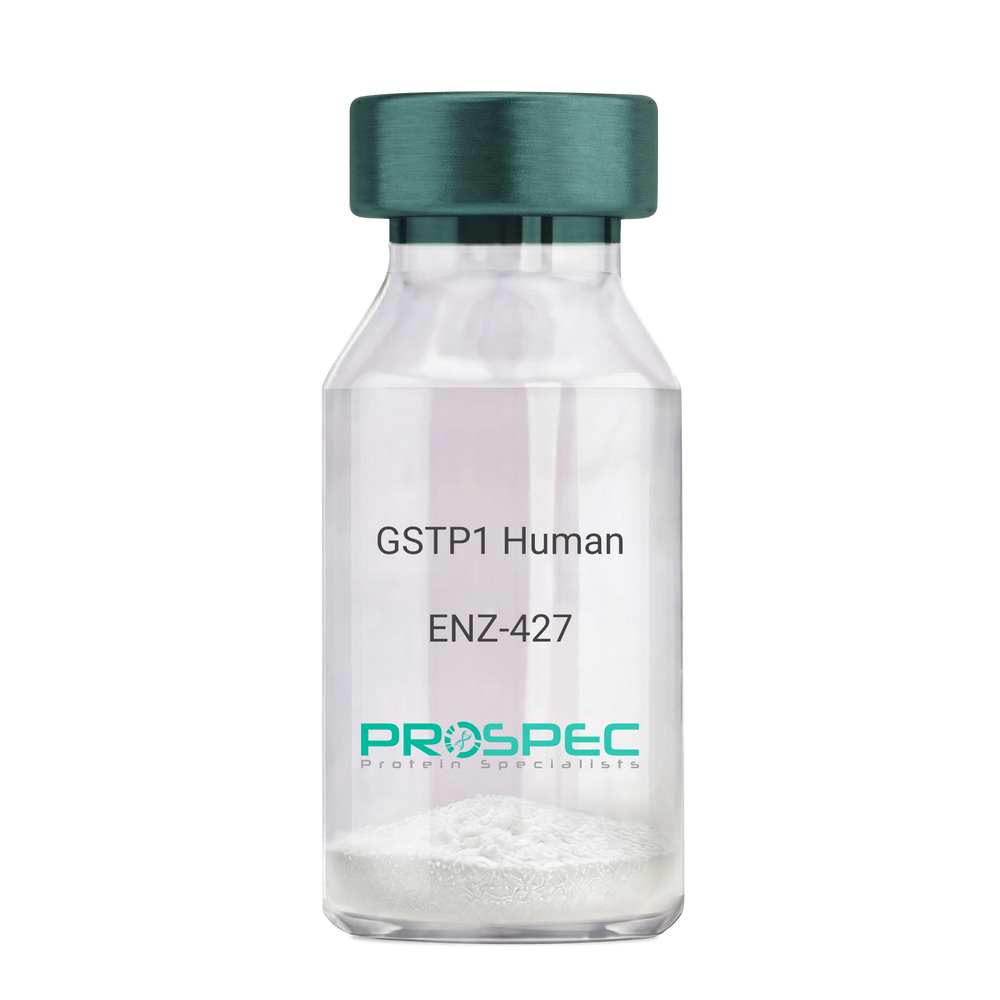
    GSTP1 Human

    Description:

    Glutathione S-Transferase pi 1 Human Recombinant

    Glutathione S-transferase P, GST class-pi, GSTP1-1, GSTP1, FAEES3, GST3, PI, DFN7.

    Product # :

    ENZ-427

    Price :

    Quantity :

    Shipping Method :

    Ice Icon

    Shipped with Ice Packs

    Add To Cart

    More Info

    • description
    • source
    • formulation
    • purity
    • biological activity
    • More Info

    Description

    GSTP1 Human Recombinant fused with 36 amino acid His tag at N-terminus produced in E.Coli is a single, non-glycosylated, polypeptide chain containing 246 amino acids (1-210 a.a.) And having a molecular mass of 27.4kDa. The GSTP1 is purified by proprietary chromatographic techniques.

    Source

    Escherichia Coli.

    Formulation

    The GSTP1 solution (0.5mg/ml) contains 20mM Tris-HCl buffer (pH7.0), 30% glycerol, 1mM EDTA and 0.1mM PMSF.

    Purity

    Greater than 95.0% as determined by SDS-PAGE.

    Biological Activity

    Specific activity is > 80 units/mg, and is defined as the amount of enzyme that conjugate 1.0 u mole of 1-chloro-2,4-dinitrobenzene (CDNB) with reduced glutathione per minute at pH 6.5 at 25°C.

    More Info

    • Introduction

      GSTP1 is a polymorphic gene encoding active, functionally different GSTP1 variant proteins that are believed to function in xenobiotic metabolism and have a part in susceptibility to cancer, and other diseases. GSTP1 is a glutathione S-transferase belonging to the pi class. GST family enzymes play a significant role in detoxification by catalyzing the conjugation of many hydrophobic and electrophilic compounds with reduced glutathione. Based upon the biochemical, immunologic and structural properties of the soluble GSTs they are grouped into 4 main classes: alpha, mu, pi, and theta. The GSTP1 enzyme acts by catalyzing the reaction of glutathione with an acceptor molecule to form a Sulfur-substituted glutathione. The reactions employing glutathione contribute the transformation of a broad range of electrophiles, including reactive products of lipid, protein, carcinogens, therapeutic drugs, environmental toxins, and products of oxidative stress.
      The GSTP1 inactivation through CpG hypermethylation is frequent in pituitary adenomas and may be a factor in aggressive pituitary tumor behavior. GSTP1 is may be a transcriptional target of the p53 tumor suppressor gene. Single-nucleotide polymorphism in GSTP1 is linked to modified protein binding, which influence GSTP1's contribution to carcinogen and drug metabolism, and possibly disease pathogenesis and/or drug response. GST-pi might have central roles in proliferation of androgen-independent human prostate cancer cells.

    • Synonyms

      Glutathione S-transferase P, GST class-pi, GSTP1-1, GSTP1, FAEES3, GST3, PI, DFN7.

    • Physical Appearance

      Sterile Filtered colorless solution.

    • Stability

      Store at 4°C if entire vial will be used within 2-4 weeks. Store, frozen at -20°C for longer periods of time. For long term storage it is recommended to add a carrier protein (0.1% HSA or BSA). Avoid multiple freeze-thaw cycles.

    • Amino Acid Sequence

      MRGSHHHHHH GMASMTGGQQ MGRDLYDDDD KDRWGSMPPY TVVYFPVRGR CAALRMLLAD QGQSWKEEVV TVETWQEGSL KASCLYGQLP KFQDGDLTLY QSNTILRHLG RTLGLYGKDQ QEAALVDMVN DGVEDLRCKY ISLIYTNYEA GKDDYVKALP GQLKPFETLL SQNQGGKTFI VGDQISFADY NLLDLLLIHE VLAPGCLDAF PLLSAYVGRL SARPKLKAFL ASPEYVNLPI NGNGKQ.

    ProSpec's products are furnished for LABORATORY RESEARCH USE ONLY. The product may not be used as drugs, agricultural or pesticidal products, food additives or household chemicals.

    Gstp1 Human
  • View Data Sheet

    Name :

    Placental Lactogen Bovine

    Description:

    Placental Lactogen Bovine Recombinant

    Chorionic Somatomammotropin Hormone 1, CSH1, CSB, CS-1, hCS-B, BPL, BPLP-I.

    Product # :

    CYT-511

    Price :

    Quantity :

    Shipping Method :

    Room Temp Icon

    Shipped at Room temp

    Add To Cart

    More Info

    • description
    • source
    • formulation
    • purity
    • biological activity
    • More Info

    Description

    Placental Lactogen Bovine Recombinant, is a single polypeptide chain containing 199 amino acids and an additional Ala at the N-terminus having a molecular mass of 23 kDa. Placental Lactogen Recombinant is purified by proprietary chromatographic techniques.

    Source

    Escherichia Coli.

    Formulation

    The protein was lyophilized from a concentrated (1mg/ml) solution with 0.02-0.03% NaHCO3.

    Purity

    Greater than 99.0% as determined by:
    (a) Analysis by SEC-HPLC.
    (b) Analysis by SDS-PAGE.

    Biological Activity

    Placental Lactogen Bovine is biologically active as evidenced by inducing proliferation of Nb2 cells.

    More Info

    • Introduction

      Placental Lactogen is a polypeptide hormone that is produced by the Syncytiotrophoblasts of the Placenta, also known as chorionic somatomammotropin. It has both Growth Hormone and Prolactin activities on growth, lactation, and luteal steroid production. In women, placental lactogen secretion begins soon after implantation and increases to 1 g or more a day in late pregnancy. Placental lactogen is also an insulin antagonist.
      Placental Lactogen Bovine is also capable of activating human and other heterologous GH receptors but not ruminat GH receptors.

    • Synonyms

      Chorionic Somatomammotropin Hormone 1, CSH1, CSB, CS-1, hCS-B, BPL, BPLP-I.

    • Physical Appearance

      Sterile Filtered White lyophilized (freeze-dried) powder.

    • Stability

      Lyophilized Placental Lactogen Bovine Recombinant although stable at room temperature for 3 weeks, should be stored desiccated below -18°C. Upon reconstitution Placental Lactogen should be stored at 4°C between 2-7 days and for future use below -18°C. For long term storage it is recommended to add a carrier protein (0.1% HSA or BSA).Please prevent freeze-thaw cycles.

    • Solubility

      It is recommended to reconstitute the lyophilized Placental Lactogen in sterile 18MΩ-cm H2O not less than 100µg/ml, which can then be further diluted to other aqueous solutions.

    • Amino Acid Sequence

      The sequence of the first six N-terminal amino acids was determined and was found to be Ala-Glu-Asp-Tyr-Ala-Pro.

    • Protein content

      UV spectroscopy at 280 nm using the absorbency value of 0.86 as the extinction coefficient for a 0.1% (1mg/ml) solution at pH 8. This value is calculated by the DNAman computer analysis program of protein sequences.

    ProSpec's products are furnished for LABORATORY RESEARCH USE ONLY. The product may not be used as drugs, agricultural or pesticidal products, food additives or household chemicals.

    Placental Lactogen Bovine
  • View Data Sheet

    Name :

    PLA2G10 Human

    Description:

    Secreted Phospholipase A2-X Human Recombinant

    Group 10 secretory phospholipase A2, EC 3.1.1.4, Group X secretory phospholipase A2, Phosphatidylcholine 2-acylhydrolase GX, GX sPLA2, sPLA2-X, SPLA2, GXPLA2, MGC119918, MGC119919, MGC133367, PLA2G10.

    Product # :

    ENZ-329

    Price :

    Quantity :

    Shipping Method :

    Room Temp Icon

    Shipped at Room temp

    Add To Cart

    More Info

    • description
    • source
    • formulation
    • purity
    • More Info

    Description

    Secreted Phospholipase A2-X Human Recombinant is manufactured with N-terminal fusion HisTag. PLA2G10 His-Tagged Fusion Protein, is 15.5 kDa containing 123 amino acid residues of the human secreted phospholipase A2-X and 16 additional amino acid residues - HisTag (underlined).

    Source

    Escherichia Coli.

    Formulation

    PLA2G10 filtered (0.4 µm) and lyophilized from 0.5mg/ml solution in 20mM Tris and 50mM NaCl, pH 7.5.

    Purity

    Greater than 95% as determined by SDS PAGE.

    More Info

    • Introduction

      Phospholipase A2 (PLA2) catalyzes the hydrolysis of the sn-2 position of membrane glycerophospholipids to liberate arachidonic acid (AA), a precursor of eicosanoids including prostaglandins and leukotrienes. The same reaction also produces lysophosholipids, which represent another class of lipid mediators.
      The secretory PLA2 (sPLA2) family, in which 10 isozymes have been identified, consists of low molecular weight, Ca2+-requiring secretory enzymes that have been implicated in a number of biological processes, such as modification of eicosanoid generation, inflammation, and host defense.
      This enzyme has been proposed to hydrolyze phosphatidylcholine (PC) in lipoproteins to liberate lyso-PC and free fatty acids in the arterial wall, thereby facilitating the accumulation of bioactive lipids and modified lipoproteins in atherosclerotic foci.
      In mice, sPLA2 expression significantly influences HDL particle size and composition and demonstrate that an induction of sPLA2 is required for the decrease in plasma HDL cholesterol in response to inflammatory stimuli. Instillation of bacteria into the bronchi was associated with surfactant degradation and a decrease in large:small ratio of surfactant aggregates in rats.

    • Synonyms

      Group 10 secretory phospholipase A2, EC 3.1.1.4, Group X secretory phospholipase A2, Phosphatidylcholine 2-acylhydrolase GX, GX sPLA2, sPLA2-X, SPLA2, GXPLA2, MGC119918, MGC119919, MGC133367, PLA2G10.

    • Physical Appearance

      Sterile Filtered lyophilized (freeze-dried) powder.

    • Stability

      Store lyophilized protein at -20°C. Aliquot the product after reconstitution to avoid repeated freezing/thawing cycles. Reconstituted protein can be stored at 4°C for a limited period of time; it does not show any change after two weeks at 4°C.

    • Solubility

      It is recommended to add deionized water to prepare a working stock solution of approximately 0.5mg/ml and let the lyophilized pellet dissolve completely.

    • Amino Acid Sequence

      MRGSHHHHHH GMASHMGILE LAGTVGCVGP RTPIAYMKYG CFCGLGGHGQ PRDAIDWCCH GHDCCYTRAE EAGCSPKTER YSWQCVNQSV LCGPAENKCQ ELLCKCDQEI ANCLAQTEYN LKYLFYPQFL CEPDSPKCD

    ProSpec's products are furnished for LABORATORY RESEARCH USE ONLY. The product may not be used as drugs, agricultural or pesticidal products, food additives or household chemicals.

    Pla2G10 Human
  • View Data Sheet

    Name :

    ACADL Human

    Description:

    Acyl-CoA Dehydrogenase, Long Chain, Human Recombinant

    Acyl-CoA dehydrogenase long chain, Acyl-Coenzyme A dehydrogenase long chain, LCAD, ong-chain specific acyl-CoA dehydrogenase mitochondrial, ACAD4, EC 1.3.99.13.

    Product # :

    ENZ-190

    Price :

    Quantity :

    Shipping Method :

    Ice Icon

    Shipped with Ice Packs

    Add To Cart

    More Info

    • description
    • source
    • formulation
    • purity
    • More Info

    Description

    ACADL Human Recombinant produced in E.coli is a single, non-glycosylated polypeptide chain containing 421 amino acids (31-430) and having a molecular mass of 46.7 kDa.ACADL is fused to a 21 amino acid His-tag at N-terminus & purified by proprietary chromatographic techniques.

    Source

    E.coli.

    Formulation

    The ACADL solution (1mg/ml) contains 20mM Tris-HCl buffer (pH 8.0), 0.15M NaCl, 1mM DTT and 10% glycerol.

    Purity

    Greater than 85% as determined by SDS-PAGE.

    More Info

    • Introduction

      ACADL is a homotetramer belonging to the acyl-CoA dehydrogenase family. ACADL takes part in the catabolism of fatty acids and amino acids and is a key source of energy for the heart and skeletal muscle. Mutation in the ACADL gene results in non-ketotic hypoglycemia and hypotonia (muscle weakness).

    • Synonyms

      Acyl-CoA dehydrogenase long chain, Acyl-Coenzyme A dehydrogenase long chain, LCAD, ong-chain specific acyl-CoA dehydrogenase mitochondrial, ACAD4, EC 1.3.99.13.

    • Physical Appearance

      Sterile Filtered colorless solution.

    • Stability

      Store at 4°C if entire vial will be used within 2-4 weeks. Store, frozen at -20°C for longer periods of time. For long term storage it is recommended to add a carrier protein (0.1% HSA or BSA).Avoid multiple freeze-thaw cycles.

    • Amino Acid Sequence

      MGSSHHHHHH SSGLVPRGSH MGGEERLETP SAKKLTDIGI RRIFSPEHDI FRKSVRKFFQ EEVIPHHSEW EKAGEVSREV WEKAGKQGLL GVNIAEHLGG IGGDLYSAAI VWEEQAYSNC SGPGFSIHSG IVMSYITNHG SEEQIKHFIP QMTAGKCIGA IAMTEPGAGS DLQGIKTNAK KDGSDWILNG SKVFISNGSL SDVVIVVAVT NHEAPSPAHG ISLFLVENGM KGFIKGRKLH KMGLKAQDTA ELFFEDIRLP ASALLGEENK GFYYIMKELP QERLLIADVA ISASEFMFEE TRNYVKQRKA FGKTVAHLQT VQHKLAELKT HICVTRAFVD NCLQLHEAKR LDSATACMAK YWASELQNSV AYDCVQLHGG WGYMWEYPIA KAYVDARVQP IYGGTNEIMK ELIAREIVFD K

    ProSpec's products are furnished for LABORATORY RESEARCH USE ONLY. The product may not be used as drugs, agricultural or pesticidal products, food additives or household chemicals.

    Acadl Human
  • View Data Sheet

    Name :

    FTCD Human

    Description:

    Formiminotransferase Cyclodeaminase Human Recombinant

    Formiminotransferase-cyclodeaminase, FTCD, LCHC1, LC-1.

    Product # :

    ENZ-302

    Price :

    Quantity :

    Shipping Method :

    Ice Icon

    Shipped with Ice Packs

    Add To Cart

    More Info

    • description
    • source
    • formulation
    • purity
    • More Info

    Description

    Formiminotransferase Cyclodeaminase Human Recombinant (also called liver cytosol type 1) produced in SF9, is a glycosylated, polypeptide chain having a molecular mass of 59,749 Dalton.The FTCD is expressed with a -6xHis tag and purified by proprietary chromatographic techniques.

    Source

    Sf9 insect cells.

    Formulation

    FTCD is supplied in 16mM HEPES buffer pH-7.6, 240mM sodium chloride, and 20% glycerol.

    Purity

    Greater than 95% as determined by SDS-PAGE.

    More Info

    • Introduction

      Formiminotransferase cyclodeaminase is an enzyme which catalyzes the conversion of formiminoglutamateand tetrahydrofolateinto formiminotetrahydrofolateand glutamate.
      Formiminotransferase cyclodeaminase, a bifunctional enzyme of tetrahydrofolate synthesis, is the target antigen of anti-LC1 (liver cytosol antigen type 1) autoantibodies. Presence of LC1 autoantibodies is a marker for type 2 autoimmune hepatitis (for which anti-LKM 1/cytochrome P450 2D6 autoantibodies are a further marker).
      Serum LC1 autoantibody concentrations appear to fluctuate in parallel with aminotransferase levels, a particularly intriguing observation that suggests a possible role of LC1 autoreactivity in the pathogenic mechanism leading to hepatocyte injury.

    • Synonyms

      Formiminotransferase-cyclodeaminase, FTCD, LCHC1, LC-1.

    • Stability

      Store at 4°C if entire vial will be used within 2-4 weeks. Store, frozen at -20°Cfor longer periods of time. Avoid multiple freeze-thaw cycles.

    • Immunological Functions

      1. Binds IgG-type human auto-antibodies.2. Standard ELISA test (checker-board analysis of positive/negative sera panels, immuno-dot test).

    • coating concentration

      0.35-0.7 µg/ml (depending on the type of ELISA plate and coating buffer).Suitable for biotinylation and iodination.

    ProSpec's products are furnished for LABORATORY RESEARCH USE ONLY. The product may not be used as drugs, agricultural or pesticidal products, food additives or household chemicals.

    Ftcd Hunan
  • View Data Sheet

    Name :

    MutY E.Coli

    Description:

    Adenine DNA Glycosylase E.Coli Recombinant

    ECK2956, JW2928, mica, mutB, mutY.

    Product # :

    ENZ-702

    Price :

    Quantity :

    Shipping Method :

    Ice Icon

    Shipped with Ice Packs

    Add To Cart

    More Info

    • description
    • source
    • formulation
    • purity
    • More Info

    Description

    MutY Recombinant produced in E.coli is a single, non-glycosylated polypeptide chain containing 373 amino acids (1-350) and having a molecular mass of 41.5kDa. MutY is fused to a 23 amino acid His-tag at N-terminus & purified by proprietary chromatographic techniques.

    Source

    E.coli.

    Formulation

    The MutY solution (0.25mg/ml) contains 20mM Tris-HCl buffer (pH 8.0), 0.1M NaCl and 20% glycerol.

    Purity

    Greater than 90% as determined by SDS-PAGE.

    More Info

    • Introduction

      Adenine DNA glycosylase (mutY) is an adenine DNA glycosylase active on DNA substrates including A/G, A/8-oxoG, or A/C mismatches and also has a weak guanine glycosylase activity on G/8- oxoG-containing DNA. mutY is essential for the prevention of mutations resulting from oxidative DNA impairment. Rising levels of mutY in A549 cells exposed to oxygen and infrared radiation leads to improvements in cell survival. mutY is common in neurons where mitochondrial genomes exposed to reactive oxygen species that damage DNA must uphold integrity over the whole mammalian life span.

    • Synonyms

      ECK2956, JW2928, mica, mutB, mutY.

    • Physical Appearance

      Sterile Filtered colorless solution.

    • Stability

      Store at 4°C if entire vial will be used within 2-4 weeks. Store, frozen at -20°C for longer periods of time. For long term storage it is recommended to add a carrier protein (0.1% HSA or BSA).Avoid multiple freeze-thaw cycles.

    • Amino Acid Sequence

      MGSSHHHHHH SSGLVPRGSH MGSMQASQFS AQVLDWYDKY GRKTLPWQID KTPYKVWLSE VMLQQTQVAT VIPYFERFMA RFPTVTDLAN APLDEVLHLW TGLGYYARAR NLHKAAQQVA TLHGGKFPET FEEVAALPGV GRSTAGAILS LSLGKHFPIL DGNVKRVLAR CYAVSGWPGK KEVENKLWSL SEQVTPAVGV ERFNQAMMDL GAMICTRSKP KCSLCPLQNG CIAAANNSWA LYPGKKPKQT LPERTGYFLL LQHEDEVLLA QRPPSGLWGG LYCFPQFADE ESLRQWLAQR QIAADNLTQL TAFRHTFSHF HLDIVPMWLP VSSFTGCMDE GNALWYNLAQ PPSVGLAAPV ERLLQQLRTG APV.

    ProSpec's products are furnished for LABORATORY RESEARCH USE ONLY. The product may not be used as drugs, agricultural or pesticidal products, food additives or household chemicals.

    Muty Ecoli
  • View Data Sheet

    Name :

    NMNAT1 Mouse

    Description:

    Nicotinamide Nucleotide Adenylyltransferase 1 Mouse Recombinant

    Nicotinamide/nicotinic acid mononucleotide adenylyltransferase 1, NMNAT1, NMN/NaMN adenylyltransferase 1, Nicotinamide mononucleotide adenylyltransferase 1, NMN adenylyltransferase, Nicotinate-nucleotide adenylyltransferase 1, NaMN adenylyltransferase 1, D4Cole1e, Nmnat.

    Product # :

    ENZ-1049

    Price :

    Quantity :

    Shipping Method :

    Ice Icon

    Shipped with Ice Packs

    Add To Cart

    More Info

    • description
    • source
    • formulation
    • purity
    • More Info

    Description

    NMNAT1 Mouse Recombinant produced in E.Coli is a single, non-glycosylated polypeptide chain containing 308 amino acids (1-285 a.a) and having a molecular mass of 34.7kDa. NMNAT1 is fused to a 23 amino acid His-tag at N-terminus & purified by proprietary chromatographic techniques.

    Source

    Escherichia Coli.

    Formulation

    NMNAT1 protein solution (1mg/ml) containing Phosphate Buffered Saline (pH7.4), 20% glycerol and 1mM EDTA.

    Purity

    Greater than 95.0% as determined by SDS-PAGE.

    More Info

    • Introduction

      NMNAT1 enzyme is vital for NAD biosynthesis, catalyzing the condensation of nicotinamide mononucleotide (NMN) or nicotinic acid mononucleotide (NaMN) with the AMP moiety of ATP to form NAD or NaAD. NMNAT1 is widely expressed with high levels in skeletal muscle, heart, liver and kidney. This protein appears to have the ability to protect against axonal degeneration following mechanical or toxic insults.

    • Synonyms

      Nicotinamide/nicotinic acid mononucleotide adenylyltransferase 1, NMNAT1, NMN/NaMN adenylyltransferase 1, Nicotinamide mononucleotide adenylyltransferase 1, NMN adenylyltransferase, Nicotinate-nucleotide adenylyltransferase 1, NaMN adenylyltransferase 1, D4Cole1e, Nmnat.

    • Physical Appearance

      Sterile filtered colourless solution.

    • Stability

      Store at 4°C if entire vial will be used within 2-4 weeks.Store, frozen at -20°C for longer periods of time. For long term storage it is recommended to add a carrier protein (0.1% HSA or BSA).Avoid multiple freeze-thaw cycles.

    • Amino Acid Sequence

      MGSSHHHHHH SSGLVPRGSH MGSMDSSKKT EVVLLACGSF NPITNMHLRL FELAKDYMHA TGKYSVIKGI ISPVGDAYKK KGLIPAHHRI IMAELATKNS HWVEVDTWES LQKEWVETVK VLRYHQEKLA TGSCSYPQSS PALEKPGRKR KWADQKQDSS PQKPQEPKPT GVPKVKLLCG ITNDISSTKI RRALRRGQSI RYLVPDLVQE YIEKHELYNT ESEGRNAGVT LAPLQRNAAE AKHNHSTL.

    ProSpec's products are furnished for LABORATORY RESEARCH USE ONLY. The product may not be used as drugs, agricultural or pesticidal products, food additives or household chemicals.

    Nmnat1 Mouse
  • View Data Sheet

    Name :

    PDHX Human

    Description:

    Pyruvate Dehydrogenase Complex, Component X Human Recombinant

    DLDBP, E3BP, OPDX, PDX1, proX, Pyruvate Dehydrogenase Complex, Component X, Dihydrolipoamide Dehydrogenase-Binding Protein Of Pyruvate Dehydrogenase Complex, Lipoyl-Containing Pyruvate Dehydrogenase Complex Component X, Pyruvate Dehydrogenase Complex, Lipoyl-Containing Component X, Pyruvate Dehydrogenase Complex, E3-Binding Protein Subunit, Pyruvate Dehydrogenase Protein X Component, Mitochondrial, E3-Binding Protein.

    Product # :

    ENZ-843

    Price :

    Quantity :

    Shipping Method :

    Ice Icon

    Shipped with Ice Packs

    Add To Cart

    More Info

    • description
    • source
    • formulation
    • purity
    • More Info

    Description

    PDHX Human Recombinant produced in E.Coli is a single, non-glycosylated polypeptide chain containing 471 amino acids (54-501 a.a) and having a molecular mass of 50.4kDa. PDHX is fused to a 23 amino acid His-tag at N-terminus & purified by proprietary chromatographic techniques.

    Source

    Escherichia Coli.

    Formulation

    PDHX protein solution (0.25mg/ml) containing Phosphate buffer saline (pH 7.4) and 20% glycerol, 1mM DTT.

    Purity

    Greater than 85.0% as determined by SDS-PAGE.

    More Info

    • Introduction

      Pyruvate Dehydrogenase Complex, Component X, also known as PDHX, encodes the E3 binding protein subunit of the PDH complex which contains 3 catalytic subunits. PDHX tethers E3 dimers to the E2 core of the pyruvate dehydrogenase complexes of eukaryotes. This specific binding is critical for a functional PDH complex.

    • Synonyms

      DLDBP, E3BP, OPDX, PDX1, proX, Pyruvate Dehydrogenase Complex, Component X, Dihydrolipoamide Dehydrogenase-Binding Protein Of Pyruvate Dehydrogenase Complex, Lipoyl-Containing Pyruvate Dehydrogenase Complex Component X, Pyruvate Dehydrogenase Complex, Lipoyl-Containing Component X, Pyruvate Dehydrogenase Complex, E3-Binding Protein Subunit, Pyruvate Dehydrogenase Protein X Component, Mitochondrial, E3-Binding Protein.

    • Physical Appearance

      Sterile Filtered clear solution.

    • Stability

      Store at 4°C if entire vial will be used within 2-4 weeks. Store, frozen at -20°C for longer periods of time. For long term storage it is recommended to add a carrier protein (0.1% HSA or BSA).Avoid multiple freeze-thaw cycles.

    • Amino Acid Sequence

      MGSSHHHHHH SSGLVPRGSH MGSGDPIKIL MPSLSPTMEE GNIVKWLKKE GEAVSAGDAL CEIETDKAVV TLDASDDGIL AKIVVEEGSK NIRLGSLIGL IVEEGEDWKH VEIPKDVGPP PPVSKPSEPR PSPEPQISIP VKKEHIPGTL RFRLSPAARN ILEKHSLDAS QGTATGPRGI FTKEDALKLV QLKQTGKITE SRPTPAPTAT PTAPSPLQAT AGPSYPRPVI PPVSTPGQPN AVGTFTEIPA SNIRRVIAKR LTESKSTVPH AYATADCDLG AVLKVRQDLV KDDIKVSVND FIIKAAAVTL KQMPDVNVSW DGEGPKQLPF IDISVAVATD KGLLTPIIKD AAAKGIQEIA DSVKALSKKA RDGKLLPEEY QGGSFSISNL GMFGIDEFTA VINPPQACIL AVGRFRPVLK LTEDEEGNAK LQQRQLITVT MSSDSRVVDD ELATRFLKSF KANLENPIRL A.

    ProSpec's products are furnished for LABORATORY RESEARCH USE ONLY. The product may not be used as drugs, agricultural or pesticidal products, food additives or household chemicals.

    Pdhx Human
  • View Data Sheet

    Name :

    MUTM E.Coli

    Description:

    Formamidopyrimidine-DNA Glycosylase E.Coli Recombinant

    Formamidopyrimidine-DNA glycosylase, FPG.

    Product # :

    ENZ-589

    Price :

    Quantity :

    Shipping Method :

    Ice Icon

    Shipped with Ice Packs

    Add To Cart

    More Info

    • description
    • source
    • formulation
    • purity
    • More Info

    Description

    MUTM Recombinant produced in E. coli is a single polypeptide chain containing 289 amino acids (1-269) and having a molecular mass of 32.4kDa.MUTM is fused to a 20 amino acid His-tag at N-terminus & purified by proprietary chromatographic techniques.

    Source

    E.coli.

    Formulation

    The MUTM solution (0.5mg/ml) contains 20mM Tris-HCl buffer (pH 8.0), 100mM Nacl, 1mM DTT and 20% glycerol.

    Purity

    Greater than 90% as determined by SDS-PAGE.

    More Info

    • Introduction

      MUTM is a base excision repair enzyme that identifies and eliminates a large variety of oxidized purines from correspondingly impaired DNA. MUTM is nondismissable and essential to remove quickly its substrate lesions on the chromosome. MUTM, additionally, mends a large number of the lesions recognized by Endo III, signifying that MUTM takes a prominent part in the overall repair of both purine damage and pyrimidine damage in vivo.

    • Synonyms

      Formamidopyrimidine-DNA glycosylase, FPG.

    • Physical Appearance

      Sterile Filtered colorless solution.

    • Stability

      Store at 4°C if entire vial will be used within 2-4 weeks. Store, frozen at -20°C for longer periods of time. For long term storage it is recommended to add a carrier protein (0.1% HSA or BSA).Avoid multiple freeze-thaw cycles.

    • Amino Acid Sequence

      MGSSHHHHHH SSGLVPRGSH MPELPEVETS RRGIEPHLVG ATILHAVVRN GRLRWPVSEE IYRLSDQPVL SVQRRAKYLL LELPEGWIII HLGMSGSLRI LPEELPPEKH DHVDLVMSNG KVLRYTDPRR FGAWLWTKEL EGHNVLTHLG PEPLSDDFNG EYLHQKCAKK KTAIKPWLMD NKLVVGVGNI YASESLFAAG IHPDRLASSL SLAECELLAR VIKAVLLRSI EQGGTTLKDF LQSDGKPGYF AQELQVYGRK GEPCRVCGTP IVATKHAQRA TFYCRQCQK

    ProSpec's products are furnished for LABORATORY RESEARCH USE ONLY. The product may not be used as drugs, agricultural or pesticidal products, food additives or household chemicals.

    Mutm
  • View Data Sheet

    Name :

    PMM2 Human

    Description:

    Phosphomannomutase 2 Human Recombinant

    Phosphomannomutase 2, PMM 2, PMM2, CDG1, CDGS, CDG1a.

    Product # :

    ENZ-002

    Price :

    Quantity :

    Shipping Method :

    Ice Icon

    Shipped with Ice Packs

    Add To Cart

    More Info

    • description
    • source
    • formulation
    • purity
    • More Info

    Description

    PMM2 Human Recombinant fused with a 20 amino acid His tag at N-terminus produced in E.Coli is a single, non-glycosylated, polypeptide chain containing 266 amino acids (1-246 a.a.) and having a molecular mass of 30.2kDa. The PMM2 is purified by proprietary chromatographic techniques.

    Source

    Escherichia Coli.

    Formulation

    The PMM2 solution (1 mg/ml) contains 20mM Tris-HCl buffer(pH 8.0), 10% glycerol,
    1mM DTT and 0.1M NaCl.

    Purity

    Greater than 95.0% as determined by SDS-PAGE.

    More Info

    • Introduction

      Phosphomannomutase 2 (PMM2) is a member of the eukaryotic PMM family. Phosphomannomutase 2 is involved in the synthesis of the GDP-mannose and dolichol-phosphate-mannose required for a number of critical mannosyl transfer reactions. PMM2 catalyzes the isomerization of mannose 6-phosphate to mannose 1-phosphate. PMM2 mutations are linked to congenital disorders of glycosylation (CDG)-Ia, an autosomal recessive disorder characterized by central nervous system dysfunction and multiorgan failure.

    • Synonyms

      Phosphomannomutase 2, PMM 2, PMM2, CDG1, CDGS, CDG1a.

    • Physical Appearance

      Sterile Filtered colorless solution.

    • Stability

      Store at 4°C if entire vial will be used within 2-4 weeks. Store, frozen at -20°C for longer periods of time. For long term storage it is recommended to add a carrier protein (0.1% HSA or BSA).Avoid multiple freeze-thaw cycles.

    • Amino Acid Sequence

      MGSSHHHHHH SSGLVPRGSH MAAPGPALCL FDVDGTLTAP RQKITKEMDD FLQKLRQKIK IGVVGGSDFE KVQEQLGNDV VEKYDYVFPE NGLVAYKDGK LLCRQNIQSH LGEALIQDLI NYCLSYIAKI KLPKKRGTFI EFRNGMLNVS PIGRSCSQEE RIEFYELDKK ENIRQKFVAD LRKEFAGKGL TFSIGGQISF DVFPDGWDKR YCLRHVENDG YKTIYFFGDK TMPGGNDHEI FTDPRTMGYS VTAPEDTRRI CELLFS.

    ProSpec's products are furnished for LABORATORY RESEARCH USE ONLY. The product may not be used as drugs, agricultural or pesticidal products, food additives or household chemicals.

    Pmm2 Human
  • View Data Sheet

    Name :

    GST S. Japonicum, His

    Description:

    Glutathione S-Transferase Schistosoma Japonicum Recombinant, His

    Glutathione S-Transferase class-mu 26 kDa isozyme, Sj26 antigen, SjGST, Glutathione S-Transferase class-mu 26 kDa isozyme Glutathione S Transferase. 

    Product # :

    ENZ-1146

    Price :

    Quantity :

    Shipping Method :

    Ice Icon

    Shipped with Ice Packs

    Add To Cart

    More Info

    • description
    • source
    • formulation
    • purity
    • biological activity
    • More Info

    Description

    GST S. Japonicum Recombinant produced in E.Coli is a single, non-glycosylated polypeptide chain containing 244 amino acids (1-218) and having a molecular mass of 28.3 kDa.GST S. Japonicum is fused to a 26 amino acid His-Tag at N-terminus and purified by proprietary chromatographic techniques.

    Source

    Escherichia Coli.

    Formulation

    GST S. Japonicum protein solution (1mg/ml) contains Phosphate-Buffered Saline (pH 7.4) and 10% glycerol.

    Purity

    Greater than 95.0% as determined by SDS-PAGE.

    Biological Activity

    Specific activity is > 10unit/mg, and is defined as the amount of enzyme that conjugate 1.0 umole of 1-chloro2,4-dinitrobenzene (CDNB) with reduced glutathione per minute at pH 6.5 at 25C.

    More Info

    • Introduction

      Glutathione S-transferase or GST, stands for a large family of detoxification proteins and enzymes. Glutathione S-transferase catalyzes glutathione reaction and an acceptor molecule to create S-substituted glutathione (S stands for sulfur). By this reaction, a large variety of compounds, for example therapeutic drugs, carcinogens & oxidative stress products, transformed. Glutathione S-transferase acts as a transport protein by binding toxins and acts as a transport protein. At first, the protein was isolated from Schistosomajaponicum, nowadays it is isolated from E. coli bacteria.

    • Synonyms

      Glutathione S-Transferase class-mu 26 kDa isozyme, Sj26 antigen, SjGST, Glutathione S-Transferase class-mu 26 kDa isozyme Glutathione S Transferase.

    • Physical Appearance

      Sterile Filtered colorless solution.

    • Stability

      Store at 4°C if entire vial will be used within 2-4 weeks. Store, frozen at -20°C for longer periods of time. For long term storage it is recommended to add a carrier protein (0.1% HSA or BSA).Avoid multiple freeze-thaw cycles.

    • Amino Acid Sequence

      MGSSHHHHHH SSGLVPRGSH MSPILGYWKI KGLVQPTRLL LEYLEEKYEE HLYERDEGDK WRNKKFELGL EFPNLPYYID GDVKLTQSMA IIRYIADKHN MLGGCPKERA EISMLEGAVL DIRYGVSRIA YSKDFETLKV DFLSKLPEML KMFEDRLCHK TYLNGDHVTH PDFMLYDALD VVLYMDPMCL DAFPKLVCFK KRIEAIPQID KYLKSSKYIA WPLQGWQATF GGGDHPPKSD
      LVPR

    ProSpec's products are furnished for LABORATORY RESEARCH USE ONLY. The product may not be used as drugs, agricultural or pesticidal products, food additives or household chemicals.

    Gst S Japonicum
  • View Data Sheet

    Name :

    EREG Human, HEK

    Description:

    Epiregulin Human Recombinant, HEK

    EPR, Epiregulin, Ep, ER, Proepiregulin, EREG.

    Product # :

    CYT-1206

    Price :

    Quantity :

    Shipping Method :

    Ice Icon

    Shipped with Ice Packs

    Add To Cart

    More Info

    • description
    • source
    • formulation
    • purity
    • biological activity
    • More Info

    Description

    EREG Human Recombinant produced in HEK293 cells is a single, glycosylated polypeptide chain (63-108a.a) containing 289 amino acids and having a molecular mass of 32.6 kDa.EREG is fused to a 239 amino acid hIgG-His-Tag at C-terminus & purified by proprietary chromatographic techniques.

    Source

    HEK293 cells.

    Formulation

    EREG protein (0.25mg/ml) contains 10% glycerol and Phosphate-Buffered Saline (pH 7.4).

    Purity

    Greater than 90.0% as determined by SDS-PAGE.

    Biological Activity

    Measured in a cell proliferation assay using Balb/3T3 mouse embryonic fibroblast cells. The ED50 range ≤ 1ug/ml.

    More Info

    • Introduction

      "Epiregulin is part of the EGF family. Epiregulin functions as a ligand of EGFR, as well as a ligand of most members of the ERBB (v-erb-b2 oncogene homolog) family of tyrosine-kinase receptors.Epiregulin is expressed mostly in the placenta and peripheral blood leukocytes and in specific carcinomas of the bladder, lung, kidney and colon. Epiregulin stimulates the proliferation of keratinocytes, hepatocytes, fibroblasts and vascular smooth muscle cells. Epiregulin inhibits the growth of several tumor-derived epithelial cell lines. Human Epiregulin is initially synthesized as a glycosylated 19.0 kDa transmembrane precursor protein, which is processed by proteolytic cleavage to produce a 6.0 kDa mature secreted sequence."

    • Synonyms

      EPR, Epiregulin, Ep, ER, Proepiregulin, EREG.

    • Physical Appearance

      Sterile filtered colorless solution.

    • Stability

      Store at 4°C if entire vial will be used within 2-4 weeks.Store, frozen at -20°C for longer periods of time.For long term storage it is recommended to add a carrier protein (0.1% HSA or BSA).Avoid multiple freeze-thaw cycles.

    • Amino Acid Sequence

      DGSMVSITKC SSDMNGYCLH GQCIYLVDMS QNYCRCEVGY TGVRCEHFFL LEPKSCDKTH TCPPCPAPEL LGGPSVFLFP PKPKDTLMIS RTPEVTCVVV DVSHEDPEVK FNWYVDGVEV HNAKTKPREE QYNSTYRVVS VLTVLHQDWL NGKEYKCKVS NKALPAPIEK TISKAKGQPR EPQVYTLPPS RDELTKNQVS LTCLVKGFYP SDIAVEWESN GQPENNYKTT PPVLDSDGSF FLYSKLTVDK SRWQQGNVFS CSVMHEALHN HYTQKSLSLS PGKHHHHHH

    • Background

      What is the molecular weight/Mw of EREG Protein?
      EREG Protein has a total Mw of 32.6kDa.

      What is the source or expression system of EREG Protein?
      HEK293 cells.

      What is the Purity of EREG Protein?
      EREG Protein is >90% pure as determined by SDS-PAGE.

      What is the Biological Activity of EREG Protein?
      Measured in a cell proliferation assay using Balb/3T3 mouse embryonic fibroblast cells. The ED50 range ≤ 1ug/ml.

      What is the amino acid sequence of EREG Protein?
      DGSMVSITKC SSDMNGYCLH GQCIYLVDMS QNYCRCEVGY TGVRCEHFFL LEPKSCDKTH TCPPCPAPEL LGGPSVFLFP PKPKDTLMIS RTPEVTCVVV DVSHEDPEVK FNWYVDGVEV HNAKTKPREE QYNSTYRVVS VLTVLHQDWL NGKEYKCKVS NKALPAPIEK TISKAKGQPR EPQVYTLPPS RDELTKNQVS LTCLVKGFYP SDIAVEWESN GQPENNYKTT PPVLDSDGSF FLYSKLTVDK SRWQQGNVFS CSVMHEALHN HYTQKSLSLS PGKHHHHHH

      What applications can EREG Protein be used in?
      EREG Protein can probably be used in western blot, ELISA and Lateral Flow.

      What is the endotoxin level for EREG Protein?
      The endotoxin level is minimal, EREG Protein was purified using conventional chromatography techniques.

    ProSpec's products are furnished for LABORATORY RESEARCH USE ONLY. The product may not be used as drugs, agricultural or pesticidal products, food additives or household chemicals.

    Ereg Human
  • View Data Sheet

    Name :

    GIMAP6 Human

    Description:

    GTPase, IMAP Family Member 6 Human Recombinant

    GTPase IMAP Family Member 6, Immune Associated Nucleotide 2, Immune Associated Nucleotide 6, IAN6, IAN2, hIAN2, hIAN6.

    Product # :

    PRO-1628

    Price :

    Quantity :

    Shipping Method :

    Ice Icon

    Shipped with Ice Packs

    Add To Cart

    More Info

    • description
    • source
    • formulation
    • purity
    • More Info

    Description

    GIMAP6 Human Recombinant produced in E.coli is a single, non-glycosylated polypeptide chain containing 315 amino acids (1-292) and having a molecular mass of 35.0kDa.GIMAP6 is fused to a 23 amino acid His-tag at N-terminus & purified by proprietary chromatographic techniques.

    Source

    Escherichia Coli.

    Formulation

    The GIMAP6 solution contains 20mM Tris-HCl buffer (pH 8.0), 0.2M NaCl, 1mM DTT and 30% glycerol.

    Purity

    Greater than 85% as determined by SDS-PAGE.

    More Info

    • Introduction

      GIMAP6 is a member of the GTPases of immunity-associated proteins (GIMAP) family. GIMAP proteins contain GTP-binding and coiled-coil motifs, and may play roles in the regulation of cell survival. Decreased expression of this gene may play a role in non-small cell lung cancer. Alternatively spliced transcript variants encoding multiple isoforms have been observed for this gene, which is found in a cluster with seven additional GIMAP genes on the long arm of chromosome 7.

    • Synonyms

      GTPase IMAP Family Member 6, Immune Associated Nucleotide 2, Immune Associated Nucleotide 6, IAN6, IAN2, hIAN2, hIAN6.

    • Physical Appearance

      Sterile filtered colorless solution.

    • Stability

      Store at 4°C if entire vial will be used within 2-4 weeks. Store, frozen at -20°C for longer periods of time. For long term storage it is recommended to add a carrier protein (0.1% HSA or BSA).Avoid multiple freeze-thaw cycles.

    • Amino Acid Sequence

      MGSSHHHHHH SSGLVPRGSH MGSMEEEEYE QIPQENPPEE LSQDPVLELS GGLREKEQKT PRRLRLILMG KTGSGKSATG NSILGRDVFE SKLSTRPVTK TSQRRSREWA GKELEVIDTP NILSPQVSPE VADAICQAIV LSAPGPHAVL LVTQLGRFTD EDQQVVRRLQ EVFGVGVLGH TILVFTRKED LAGGSLEDYV RETNNQALAW LDVTLARRHC GFNNRAQGEE QEAQLRELME KVEAIMWENE GDYYSNKAYQ YTQQNFRLKE LQERQVSQGQ GSEDVPGEES WLEGLSQIQK ESEEAHRCLL GKADL

    ProSpec's products are furnished for LABORATORY RESEARCH USE ONLY. The product may not be used as drugs, agricultural or pesticidal products, food additives or household chemicals.

    Gimap6 Human
  • View Data Sheet

    Name :

    UBA2 Human

    Description:

    Ubiquitin-Like Modifier Activating Enzyme 2 Human Recombinant

    SAE2, UBA-2, SAE-2, SUMO-1 Activating Enzyme Subunit 2.

    Product # :

    ENZ-959

    Price :

    Quantity :

    Shipping Method :

    Ice Icon

    Shipped with Ice Packs

    Add To Cart

    More Info

    • description
    • source
    • formulation
    • purity
    • More Info

    Description

    UBA2 Human Recombinant produced in in Sf9 Baculovirus cells is a single, glycosylated polypeptide chain containing 649 amino acids (1-640a.a) and having a molecular mass of 72.3kDa. UBA2 is fused to a 6 amino acid His-tag at C-Terminus and purified by proprietary chromatographic techniques.

    Source

    Sf9, Baculovirus cells.

    Formulation

    UBA2 protein solution (0.5mg/ml) containing Phosphate Buffered Saline (pH 7.4) and 10% glycerol.

    Purity

    Greater than 85.0% as determined by SDS-PAGE.

    More Info

    • Introduction

      SUMO-activating enzyme subunit 2 (UBA2) belongs to a family of small and related proteins which can be enzymatically attached to a target protein by a post-translational modification process termed sumoylation. UBA2 is conjugated to various molecules in the presence of the SAE1/UBA2 SUMO-activating(E1) enzyme and the UBE2I/Ubc9 SUMO-conjugating(E2) enzyme. UBA2 represents a vital mechanism to protect neurons during episodes of cerebral ischemia.

    • Synonyms

      SAE2, UBA-2, SAE-2, SUMO-1 Activating Enzyme Subunit 2.

    • Physical Appearance

      Sterile Filtered colorless solution.

    • Stability

      Store at 4°C if entire vial will be used within 2-4 weeks. Store, frozen at -20°C for longer periods of time. For long term storage it is recommended to add a carrier protein (0.1% HSA or BSA).Avoid multiple freeze-thaw cycles.

    • Amino Acid Sequence

      ADLMALSRGL PRELAEAVAG GRVLVVGAGG IGCELLKNLV LTGFSHIDLI DLDTIDVSNL NRQFLFQKKH VGRSKAQVAK ESVLQFYPKA NIVAYHDSIM NPDYNVEFFR QFILVMNALD NRAARNHVNR MCLAADVPLI ESGTAGYLGQ VTTIKKGVTE CYECHPKPTQ RTFPGCTIRN TPSEPIHCIV WAKYLFNQLF GEEDADQEVS PDRADPEAAW EPTEAEARAR ASNEDGDIKR ISTKEWAKST GYDPVKLFTK LFKDDIRYLL TMDKLWRKRK PPVPLDWAEV QSQGEETNAS DQQNEPQLGL KDQQVLDVKS YARLFSKSIE TLRVHLAEKG DGAELIWDKD DPSAMDFVTS AANLRMHIFS MNMKSRFDIK SMAGNIIPAI ATTNAVIAGL IVLEGLKILS GKIDQCRTIF LNKQPNPRKK LLVPCALDPP NPNCYVCASK PEVTVRLNVH KVTVLTLQDK IVKEKFAMVA PDVQIEDGKG TILISSEEGE TEANNHKKLS EFGIRNGSRL QADDFLQDYT LLINILHSED LGKDVEFEVV GDAPEKVGPK QAEDAAKSIT NGSDDGAQPS TSTAQEQDDV LIVDSDEEDS SNNADVSEEE RSRKRKLDEK ENLSAKRSRI EQKEELDDVI ALDHHHHHH

    ProSpec's products are furnished for LABORATORY RESEARCH USE ONLY. The product may not be used as drugs, agricultural or pesticidal products, food additives or household chemicals.

    Uba2 Human
  • View Data Sheet

    Name :

    TPST1 Human

    Description:

    Tyrosylprotein Sulfotransferase 1 Human Recombinant

    Tyrosylprotein Sulfotransferase 1, EC 2.8.2.20, TPST-1, Transport And Golgi Organization 13 Homolog A (Drosophila), Transport And Golgi Organization 13 Homolog A, Protein-Tyrosine Sulfotransferase 1, Tyrosylprotein Sulfotransferase-1, TANGO13A, TPST1.

    Product # :

    ENZ-892

    Price :

    Quantity :

    Shipping Method :

    Ice Icon

    Shipped with Ice Packs

    Add To Cart

    More Info

    • description
    • source
    • formulation
    • purity
    • More Info

    Description

    TPST1 Human Recombinant produced in E.Coli is a single, non-glycosylated polypeptide chain containing 369 amino acids (26-370 a.a) and having a molecular mass of 42kDa.TPST1 is fused to a 24 amino acid His-tag at N-terminus & purified by proprietary chromatographic techniques.

    Source

    Escherichia Coli.

    Formulation

    TPST1 protein solution (1mg/ml) containing 20mM Tris-HCl (pH 8.0) and 10% glycerol.

    Purity

    Greater than 90.0% as determined by SDS-PAGE.

    More Info

    • Introduction

      Tyrosylprotein Sulfotransferase 1, also known as TPST1 is the enzyme which catalyzes the sulfation reaction of protein tyrosines, a post-translational modification of proteins. TPST1 belongs to the protein sulfotransferase family. In addition, TPST1 utilizes 3'-Phosphoadenosine-5'-phosphosulfate (PAPS) as the sulfonate donor and also binds proteins with target tyrosineresidues to eventually form the tyrosine O-sulfate ester group in addition to the desulfonated 3’-phosphoadenosine-5’-phosphate.

    • Synonyms

      Tyrosylprotein Sulfotransferase 1, EC 2.8.2.20, TPST-1, Transport And Golgi Organization 13 Homolog A (Drosophila), Transport And Golgi Organization 13 Homolog A, Protein-Tyrosine Sulfotransferase 1, Tyrosylprotein Sulfotransferase-1, TANGO13A, TPST1.

    • Physical Appearance

      Sterile Filtered colorless solution.

    • Stability

      Store at 4°C if entire vial will be used within 2-4 weeks. Store, frozen at -20°C for longer periods of time. For long term storage it is recommended to add a carrier protein (0.1% HSA or BSA).Avoid multiple freeze-thaw cycles.

    • Amino Acid Sequence

      MGSSHHHHHH SSGLVPRGSH TGSMQHAMEC HHRIEERSQP VKLESTRTTV RTGLDLKANK TFAYHKDMPL IFIGGVPRSG TTLMRAMLDA HPDIRCGEET RVIPRILALK QMWSRSSKEK IRLDEAGVTD EVLDSAMQAF LLEIIVKHGE PAPYLCNKDP FALKSLTYLS RLFPNAKFLL MVRDGRASVH SMISRKVTIA GFDLNSYRDC LTKWNRAIET MYNQCMEVGY KKCMLVHYEQ LVLHPERWMR TLLKFLQIPW NHSVLHHEEM IGKAGGVSLS KVERSTDQVI KPVNVGALSK WVGKIPPDVL QDMAVIAPML AKLGYDPYAN PPNYGKPDPK IIENTRRVYK GEFQLPDFLK EKPQTEQVE.

    ProSpec's products are furnished for LABORATORY RESEARCH USE ONLY. The product may not be used as drugs, agricultural or pesticidal products, food additives or household chemicals.

    Tpst1 Human
  • 1
  • …
  • 34
  • 35
  • 36
  • 37
  • 38
  • …
  • 42
Your browser does not support the video tag.

Products

  • Cytokines
  • Growth Factors
  • Chemokines
  • CD Antigens
  • Neurotrophins
  • Hormones
  • Enzymes
  • Viral Antigens
  • Recombinant Proteins
  • Natural Proteins
  • Monoclonal Antibodies
  • Polyclonal Antibodies
  • Thermal Packaging

About

  • Company
  • Founder
  • Contribution
  • Contact Us
  • My Account

Ordering

  • Ordering Method
  • Ordering - Credit Card
  • Ordering PO
  • Shipping Fees
  • FAQ's

Legal

  • Terms & Conditions
  • Privacy
  • Site Map
  • info@prospecbio.com
  • Facebook
  • Instagram
  • Linkedin Profile

© 2026 ProSpec-Tany TechnoGene Ltd. All Rights Reserved.

  • Choosing a selection results in a full page refresh.
  • Opens in a new window.