Skip to content

High-quality research proteins.

  • 1-800-805-6531

  • Mon - Sat 8.00-18.00, Sun - Closed

  • info@prospecbio.com

  • PO Box 6591 East Brunswick NJ 08816

  • Products
    • Cytokines
    • Growth factors
    • Chemokines
    • Cd antigens
    • Neurotrophins
    • Hormones
    • Enzymes
    • Viral antigens
    • Recombinant proteins
    • Natural proteins
    • Monoclonal antibodies
    • Polyclonal antibodies
    • Thermal Packaging
  • About
    • Company
    • Founder
    • Contribution
  • Customers
    • Eastern Asia
    • Eastern Europe
    • North America
    • South America
    • South East Asia
    • Southern Asia
    • Western Europe
  • Ordering
    • Ordering Method
    • Ordering - Credit Card
    • Ordering - PO
    • Shipping Fees
    • FAQs
  • Services
    • DNA Cloning
    • Protein Expression
    • Monoclonal Antibody
    • Fermentation
    • Technology License
  • Contact us
Log in

Country/region

  • USD $ | Albania
  • USD $ | Andorra
  • USD $ | Argentina
  • USD $ | Armenia
  • USD $ | Australia
  • USD $ | Austria
  • USD $ | Azerbaijan
  • USD $ | Belarus
  • USD $ | Belgium
  • USD $ | Bolivia
  • USD $ | Brazil
  • USD $ | Bulgaria
  • USD $ | Cambodia
  • USD $ | Canada
  • USD $ | Chile
  • USD $ | China
  • USD $ | Colombia
  • USD $ | Costa Rica
  • USD $ | Croatia
  • USD $ | Cyprus
  • USD $ | Czechia
  • USD $ | Denmark
  • USD $ | Estonia
  • USD $ | Finland
  • USD $ | France
  • USD $ | Georgia
  • USD $ | Germany
  • USD $ | Greece
  • USD $ | Hong Kong SAR
  • USD $ | Hungary
  • USD $ | Iceland
  • USD $ | India
  • USD $ | Ireland
  • USD $ | Israel
  • USD $ | Italy
  • USD $ | Japan
  • USD $ | Kazakhstan
  • USD $ | Latvia
  • USD $ | Liechtenstein
  • USD $ | Lithuania
  • USD $ | Madagascar
  • USD $ | Malta
  • USD $ | Mexico
  • USD $ | Moldova
  • USD $ | Monaco
  • USD $ | Netherlands
  • USD $ | New Zealand
  • USD $ | North Macedonia
  • USD $ | Norway
  • USD $ | Panama
  • USD $ | Paraguay
  • USD $ | Peru
  • USD $ | Philippines
  • USD $ | Poland
  • USD $ | Portugal
  • USD $ | Romania
  • USD $ | Singapore
  • USD $ | Slovakia
  • USD $ | Slovenia
  • USD $ | South Africa
  • USD $ | South Korea
  • USD $ | Spain
  • USD $ | Sri Lanka
  • USD $ | Sweden
  • USD $ | Switzerland
  • USD $ | Taiwan
  • USD $ | Thailand
  • USD $ | Türkiye
  • USD $ | Ukraine
  • USD $ | United Kingdom
  • USD $ | United States
  • USD $ | Uruguay
  • USD $ | Vatican City
  • USD $ | Venezuela
  • USD $ | Vietnam
  • Facebook
  • Instagram
logoProSpec - Recombinant Protein Manufacturer for academic and R&D industry
Become a distributor
Account Log in
Wishlist
Cart Cart(0)
  • Products
    +
    • Cytokines
    • Growth factors
    • Chemokines
    • Cd antigens
    • Neurotrophins
    • Hormones
    • Enzymes
    • Viral antigens
    • Recombinant proteins
    • Natural proteins
    • Monoclonal antibodies
    • Polyclonal antibodies
    • Thermal Packaging
  • About
    +
    • Company
    • Founder
    • Contribution
  • Customers
    +
    • Eastern Asia
    • Eastern Europe
    • North America
    • South America
    • South East Asia
    • Southern Asia
    • Western Europe
  • Ordering
    +
    • Ordering Method
    • Ordering - Credit Card
    • Ordering - PO
    • Shipping Fees
    • FAQs
  • Services
    +
    • DNA Cloning
    • Protein Expression
    • Monoclonal Antibody
    • Fermentation
    • Technology License
  • Contact us

Item added to your cart

View cart
View All
  • Cytokines
  • Growth factors
  • Chemokines
  • Cd antigens
  • Neurotrophins
  • Hormones
  • Enzymes
  • Viral antigens
  • Recombinant proteins
  • Natural proteins
  • Monoclonal antibodies
  • Polyclonal antibodies
  • Thermal Packaging
  • Tumor Necrosis Factor

    Tumor Necrosis Factor

    View All
  • 4-1BB

    4-1BB

    View All
  • Adiponectin

    Adiponectin

    View All
  • AIF1

    AIF1

    View All
  • Other Cytokines

    Other Cytokines

    View All
  • AITRL

    AITRL

    View All
  • Angiopoietin

    Angiopoietin

    View All
  • Apolipoprotein

    Apolipoprotein

    View All
  • B-Cell Activating Factor

    B-Cell Activating Factor

    View All
  • Beta Defensin

    Beta Defensin

    View All
  • Bone Morphogenetic Protein

    Bone Morphogenetic Protein

    View All
  • B type Natriuretic Peptide

    B type Natriuretic Peptide

    View All
  • BST

    BST

    View All
  • Betacellulin

    Betacellulin

    View All
  • Cardiotrophin

    Cardiotrophin

    View All
  • Activin

    Activin

    View All
  • Fibroblast Growth Factor

    Fibroblast Growth Factor

    View All
  • Other Growth Factors

    Other Growth Factors

    View All
  • CSF

    CSF

    View All
  • CTGF

    CTGF

    View All
  • IGFBP

    IGFBP

    View All
  • VEGF Protein

    VEGF Protein

    View All
  • EGF

    EGF

    View All
  • Epigen

    Epigen

    View All
  • Erythropoietin

    Erythropoietin

    View All
  • Insulin-Like Growth Factor

    Insulin-Like Growth Factor

    View All
  • Growth Hormone

    Growth Hormone

    View All
  • HDGF

    HDGF

    View All
  • Hepatocyte Growth Factor

    Hepatocyte Growth Factor

    View All
  • Insulin

    Insulin

    View All
  • BCA-1/ BLC (CXCL13)

    BCA-1/ BLC (CXCL13)

    View All
  • BRAK (CXCL14)

    BRAK (CXCL14)

    View All
  • C-10 (CCL6)

    C-10 (CCL6)

    View All
  • Other Chemokines

    Other Chemokines

    View All
  • MEC (CCL28)

    MEC (CCL28)

    View All
  • LD78-beta (CCL3L1)

    LD78-beta (CCL3L1)

    View All
  • CTACK (CCL27)

    CTACK (CCL27)

    View All
  • CXCL16

    CXCL16

    View All
  • CXCL17

    CXCL17

    View All
  • Platelet Factor-4 (CXCL4)

    Platelet Factor-4 (CXCL4)

    View All
  • ENA-78 (CXCL5)

    ENA-78 (CXCL5)

    View All
  • Eotaxin (CCL11,24,26)

    Eotaxin (CCL11,24,26)

    View All
  • Exodus-2 (CCL21)

    Exodus-2 (CCL21)

    View All
  • Fractalkine (CX3CL1)

    Fractalkine (CX3CL1)

    View All
  • CXCL6

    CXCL6

    View All
  • Other CD Antigens

    Other CD Antigens

    View All
  • CD14

    CD14

    View All
  • CD164

    CD164

    View All
  • CD1

    CD1

    View All
  • CD2

    CD2

    View All
  • CD200

    CD200

    View All
  • CD207

    CD207

    View All
  • CD226

    CD226

    View All
  • CD23

    CD23

    View All
  • CD244

    CD244

    View All
  • CD247

    CD247

    View All
  • CD27

    CD27

    View All
  • CD274

    CD274

    View All
  • CD300

    CD300

    View All
  • CD33

    CD33

    View All
  • Other Neurotrophins

    Other Neurotrophins

    View All
  • Beta-NGF

    Beta-NGF

    View All
  • BDNF

    BDNF

    View All
  • CDNF

    CDNF

    View All
  • CNTF

    CNTF

    View All
  • GDNF

    GDNF

    View All
  • Glia Maturation Factor

    Glia Maturation Factor

    View All
  • MANF

    MANF

    View All
  • Midkine

    Midkine

    View All
  • Neuroglobin

    Neuroglobin

    View All
  • Neurotrophic factors

    Neurotrophic factors

    View All
  • Neuregulin

    Neuregulin

    View All
  • Neuropilin

    Neuropilin

    View All
  • Pigment Epithelium-Derived Factor

    Pigment Epithelium-Derived Factor

    View All
  • Pleiotrophin

    Pleiotrophin

    View All
  • Peptide Hormones

    Peptide Hormones

    View All
  • Other Hormones

    Other Hormones

    View All
  • HCG

    HCG

    View All
  • Endothelin

    Endothelin

    View All
  • Exendin

    Exendin

    View All
  • FSH

    FSH

    View All
  • Glucagon

    Glucagon

    View All
  • GHRP

    GHRP

    View All
  • GLP

    GLP

    View All
  • Thyrostimulin

    Thyrostimulin

    View All
  • Inhibin A

    Inhibin A

    View All
  • LHRH

    LHRH

    View All
  • Melanotan

    Melanotan

    View All
  • Procalcitonin

    Procalcitonin

    View All
  • PTH

    PTH

    View All
  • Peroxiredoxin

    Peroxiredoxin

    View All
  • Peptidase

    Peptidase

    View All
  • Synthetase

    Synthetase

    View All
  • Transferase

    Transferase

    View All
  • Hydrolase

    Hydrolase

    View All
  • Dehydrogenase

    Dehydrogenase

    View All
  • ACE2

    ACE2

    View All
  • Esterase

    Esterase

    View All
  • Protein Kinases

    Protein Kinases

    View All
  • Other Enzymes

    Other Enzymes

    View All
  • Phosphatase

    Phosphatase

    View All
  • Deaminase

    Deaminase

    View All
  • Oxygenase

    Oxygenase

    View All
  • Adenylate Kinase

    Adenylate Kinase

    View All
  • Lyase

    Lyase

    View All
  • Chagas

    Chagas

    View All
  • SARS

    SARS

    View All
  • Influenza

    Influenza

    View All
  • ASFV

    ASFV

    View All
  • Astrovirus

    Astrovirus

    View All
  • Borrelia

    Borrelia

    View All
  • Helicobacter Pylori

    Helicobacter Pylori

    View All
  • Chikungunya

    Chikungunya

    View All
  • Chlamydia

    Chlamydia

    View All
  • Cytomegalo

    Cytomegalo

    View All
  • Dengue

    Dengue

    View All
  • EBV

    EBV

    View All
  • Ebola

    Ebola

    View All
  • Feline Leukemia Virus

    Feline Leukemia Virus

    View All
  • Hepatitis A

    Hepatitis A

    View All
  • Other

    Other

    View All
  • Actin

    Actin

    View All
  • ADAM

    ADAM

    View All
  • Complement Component

    Complement Component

    View All
  • Ag85

    Ag85

    View All
  • Eukaryotic Translation Initiation Factor

    Eukaryotic Translation Initiation Factor

    View All
  • Anterior Gradient Protein

    Anterior Gradient Protein

    View All
  • Heat Shock Protein

    Heat Shock Protein

    View All
  • Alpha-2-HS-Glycoprotein

    Alpha-2-HS-Glycoprotein

    View All
  • Hemoglobin

    Hemoglobin

    View All
  • Allergy

    Allergy

    View All
  • Anaplasma

    Anaplasma

    View All
  • Angiogenin

    Angiogenin

    View All
  • Ankyrin Repeat Domain

    Ankyrin Repeat Domain

    View All
  • Annexin

    Annexin

    View All
  • Other Natural Proteins

    Other Natural Proteins

    View All
  • Aprotinin

    Aprotinin

    View All
  • Transferrin

    Transferrin

    View All
  • Avidin

    Avidin

    View All
  • Anti Coagulation Factors

    Anti Coagulation Factors

    View All
  • Natural Albumin

    Natural Albumin

    View All
  • Natural Coagulation Factors

    Natural Coagulation Factors

    View All
  • Fibronectin

    Fibronectin

    View All
  • Thrombin

    Thrombin

    View All
  • Anti Human Enzyme

    Anti Human Enzyme

    View All
  • Other Monoclonal Antibodies

    Other Monoclonal Antibodies

    View All
  • Anti Human Cytokine

    Anti Human Cytokine

    View All
  • Anti Human Heat Shock Protein

    Anti Human Heat Shock Protein

    View All
  • Anti Mouse Lymphocyte

    Anti Mouse Lymphocyte

    View All
  • Anti Human Chemokine

    Anti Human Chemokine

    View All
  • Anti Human Lymphocyte

    Anti Human Lymphocyte

    View All
  • Anti Viral Monoclonal

    Anti Viral Monoclonal

    View All
  • Anti Mouse Cytokine

    Anti Mouse Cytokine

    View All
  • Anti-GST Monoclonal

    Anti-GST Monoclonal

    View All
  • Other Polyclonal Antibodies

    Other Polyclonal Antibodies

    View All
  • Anti Viral

    Anti Viral

    View All
  • Anti-GST Monoclonal

    Anti-GST Monoclonal

    View All
Back

Search results

1000 results found for “processing of precursor”

Name

Description

Product #

Price

Quantity

Shipping Method

  • View Data Sheet

    Name :

    PEDF Human, His

    Description:

    Pigment Epithelium-Derived Factor Human Recombinant, His Tag

    Pigment epithelium-derived factor, PEDF, Serpin-F1, SerpinF1, EPC-1, EPC1, PIG35.

    Product # :

    CYT-552

    Price :

    Quantity :

    Shipping Method :

    Ice Icon

    Shipped with Ice Packs

    Add To Cart

    More Info

    • description
    • source
    • formulation
    • purity
    • More Info

    Description

    PEDF Human Recombinant produced in E.Coli containing a natural variant M72T is a single, non-glycosylated, polypeptide chain containing 420 amino acids (20-418 a.a.) and having a total molecular mass of 46.7 kDa. PEDF is fused to a 20 amino acid His Tag at N-terminus and purified by proprietary chromatographic techniques.

    Source

    Escherichia Coli.

    Formulation

    The PEDF solution contains 20mM Tris-HCl buffer(pH 8.0), 0.1M NaCl , and 20% glycerol.

    Purity

    Greater than 90% as determined by SDS-PAGE.

    More Info

    • Introduction

      PEDF is a neurotrophic protein that induces extensive neuronal differentiation in retinoblastoma cells. SerpinF1 is a potent inhibitor of angiogenesis. EPC1 doesn’t undergo the stressed to relaxed conformation transition characteristic as of the active serpins since it exhibits no serine protease inhibitory activity.
      Aqueous humour level of asymmetric dimethylarginine is correlated with PEDF in humans. ADMA and PEDF levels are increased in response to inflammation in uveitis.
      Lack of PEDF expression is a potent factor for the enhancement of tumor growth and angiogenesis in breast cancer.
      PEDF & VEGF genes contribute to the development of diabetic retinopathy.
      PEDF and VEGF structural changes in blood vessel wall play an important role in the pathophysiology of PD patients.
      PEDF-overexpressing tumors exhibited reduced intratumoral angiogenesis.
      SerpinF1 is a new promising approach for the treatment of osteosarcoma.
      Levels of the natural ocular anti-angiogenic factor SentrinF1 (PEDF) is associated with proliferative retinopathy.
      VEGF secreted by retinal pigment epithelial cells upregulates PEDF expression via VEGFR-1 in an autocrine manner.
      Sentrin-F1 concentration in the aqueous humor of diabetic patients predicts who will develop progression of retinopathy.
      PEDF blocks angiogenic effects of leptin through its anti-oxidative properties.

    • Synonyms

      Pigment epithelium-derived factor, PEDF, Serpin-F1, SerpinF1, EPC-1, EPC1, PIG35.

    • Physical Appearance

      Sterile Filtered colorless solution.

    • Stability

      Store at 4°C if entire vial will be used within 2-4 weeks. Store, frozen at -20°C for longer periods of time. For long term storage it is recommended to add a carrier protein (0.1% HSA or BSA). Please prevent freeze-thaw cycles.

    • Amino Acid Sequence

      MGSSHHHHHH SSGLVPRGSH MQNPASPPEE GSPDPDSTGA LVEEEDPFFK VPVNKLAAAV SNFGYDLYRV RSSMSPTTNV LLSPLSVATA LSALSLGAEQ RTESIIHRAL YYDLISSPDI HGTYKELLDT VTAPQKNLKS ASRIVFEKKL RIKSSFVAPL EKSYGTRPRV LTGNPRLDLQ EINNWVQAQM KGKLARSTKE IPDEISILLL GVAHFKGQWV TKFDSRKTSL EDFYLDEERT VRVPMMSDPK AVLRYGLDSD LSCKIAQLPL TGSMSIIFFL PLKVTQNLTL IEESLTSEFI HDIDRELKTV QAVLTVPKLK LSYEGEVTKS LQEMKLQSLF DSPDFSKITG KPIKLTQVEH RAGFEWNEDG AGTTPSPGLQ PAHLTFPLDY HLNQPFIFVL RDTDTGALLF IGKILDPRGP.

    ProSpec's products are furnished for LABORATORY RESEARCH USE ONLY. The product may not be used as drugs, agricultural or pesticidal products, food additives or household chemicals.

    Serpinf1 Human His
  • View Data Sheet

    Name :

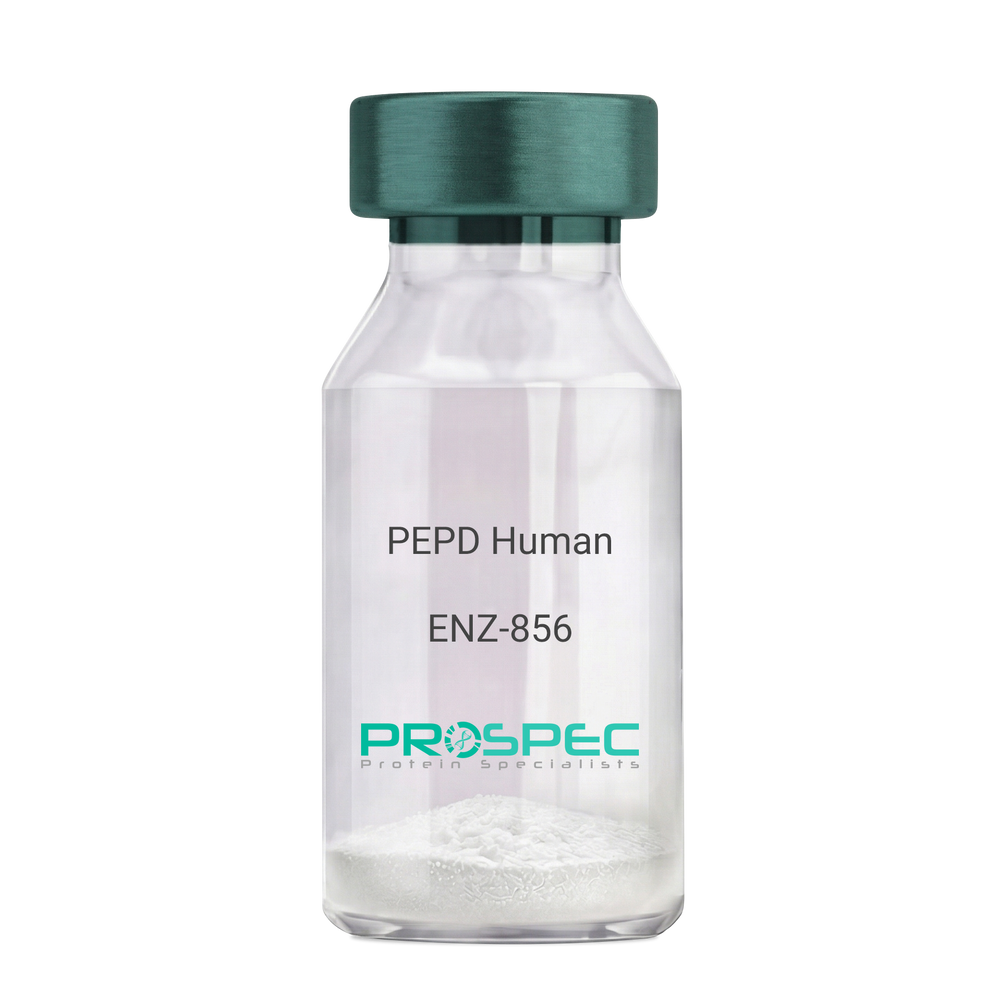
    PEPD Human

    Description:

    Peptidase D Human Recombinant

    Xaa-Pro dipeptidase, X-Pro dipeptidase, Imidodipeptidase, Peptidase D, Proline dipeptidase, Prolidase, PRD, PEPD, Xaa-Pro dipeptidase isoform 1, PROLIDASE.

    Product # :

    ENZ-856

    Price :

    Quantity :

    Shipping Method :

    Ice Icon

    Shipped with Ice Packs

    Add To Cart

    More Info

    • description
    • source
    • formulation
    • purity
    • More Info

    Description

    PEPD Human Recombinant produced in E.Coli is a single, non-glycosylated polypeptide chain containing 516 amino acids (1-493a.a.) and having a molecular mass of 56.9kDa.PEPD is fused to a 23 amino acid His-tag at N-terminus & purified by proprietary chromatographic techniques.

    Source

    E.coli.

    Formulation

    PEPD protein solution (0.5mg/ml) containing Phosphate buffered saline (pH7.4), 10% glycerol and 1mM DTT.

    Purity

    Greater than 90% as determined by SDS-PAGE.

    More Info

    • Introduction

      Peptidase D, also known as PEPD, Is a part of the peptidase family. PEPD is involved in collagen metabolism due to the high level of iminoacids in collagen. PEPD recycles proline, and sets the pace for the production of collagen. PEPD is also parts dipeptides with a prolyl or hydroxyprolyl residue in the C-terminal position.

    • Synonyms

      Xaa-Pro dipeptidase, X-Pro dipeptidase, Imidodipeptidase, Peptidase D, Proline dipeptidase, Prolidase, PRD, PEPD, Xaa-Pro dipeptidase isoform 1, PROLIDASE.

    • Physical Appearance

      Sterile Filtered colorless solution.

    • Stability

      Store at 4°C if entire vial will be used within 2-4 weeks. Store, frozen at -20°C for longer periods of time. For long term storage it is recommended to add a carrier protein (0.1% HSA or BSA).Avoid multiple freeze-thaw cycles.

    • Amino Acid Sequence

      MGSSHHHHHH SSGLVPRGSH MGSMAAATGP SFWLGNETLK VPLALFALNR QRLCERLRKN PAVQAGSIVV LQGGEETQRY CTDTGVLFRQ ESFFHWAFGV TEPGCYGVID VDTGKSTLFV PRLPASHATW MGKIHSKEHF KEKYAVDDVQ YVDEIASVLT SQKPSVLLTL RGVNTDSGSVCREASFDGIS KFEVNNTILH PEIVECRVFK TDMELEVLRY TNKISSEAHR EVMKAVKVGM KEYELESLFE HYCYSRGGMR HSSYTCICGS GENSAVLHYG HAGAPNDRTI QNGDMCLFDM GGEYYCFASD ITCSFPANGK FTADQKAVYE AVLRSSRAVM GAMKPGVWWP DMHRLADRIH LEELAHMGIL SGSVDAMVQA HLGAVFMPHG LGHFLGIDVH DVGGYPEGVE RIDEPGLRSL RTARHLQPGM VLTVEPGIYF IDHLLDEALA DPARASFLNR EVLQRFRGFG GVRIEEDVVV TDSGIELLTC VPRTVEEIEA CMAGCDKAFT PFSGPK.

    ProSpec's products are furnished for LABORATORY RESEARCH USE ONLY. The product may not be used as drugs, agricultural or pesticidal products, food additives or household chemicals.

    Pepd Human
  • View Data Sheet

    Name :

    ITPA Human

    Description:

    Inosine Triphosphatase Human Recombinant

    EC 3.6.1.19, C20orf37, dJ794I6.3, HLC14-06-P, ITPase, My049, OK/SW-cl.9, Inosine Triphosphatase, ITPA.

    Product # :

    ENZ-549

    Price :

    Quantity :

    Shipping Method :

    Ice Icon

    Shipped with Ice Packs

    Add To Cart

    More Info

    • description
    • source
    • formulation
    • purity
    • More Info

    Description

    ITPA Recombinant Human produced in E.Coli is a single, non-glycosylated polypeptide chain containing 215 amino acids (1-194 a.a.) and having a molecular mass of 23.7 kDa. The ITPA is fused to a 21 amino acid His-Tag at N-terminus and purified by proprietary chromatographic techniques.

    Source

    Escherichia Coli.

    Formulation

    The ITPA solution (1mg/ml) contains 20mM Tris-HCl pH-8 & 10% glycerol.

    Purity

    Greater than 95.0% as determined by SDS-PAGE.

    More Info

    • Introduction

      ITPA enzyme catalyzes the pyrophosphohydrolysis of both ITP (inosine triphosphate) and dITP (deoxyinosine triphosphate) to IMP (inosine monophosphate) and diphosphate. IMP is exercised as a substrate for purine nucleotide pathways. IMP is phosphorylated to ITP, and ITPA mediates the concentration of ITP in the cell by changing ITP back to IMP. Defects in ITPA result in ITPA deficiency which is thought to be inherited and is characterized by an over-accumulation of ITP in erythocytes, leukocytes and fibroblasts.

    • Synonyms

      EC 3.6.1.19, C20orf37, dJ794I6.3, HLC14-06-P, ITPase, My049, OK/SW-cl.9, Inosine Triphosphatase, ITPA.

    • Physical Appearance

      Sterile filtered colorless solution.

    • Stability

      Store at 4°C if entire vial will be used within 2-4 weeks.Store, frozen at -20°C for longer periods of time. For long term storage it is recommended to add a carrier protein (0.1% HSA or BSA).Avoid multiple freeze-thaw cycles.

    • Amino Acid Sequence

      MGSSHHHHHH SSGLVPRGSH MMAASLVGKK IVFVTGNAKK LEEVVQILGD KFPCTLVAQK IDLPEYQGEP DEISIQKCQE AVRQVQGPVL VEDTCLCFNA LGGLPGPYIK WFLEKLKPEG LHQLLAGFED KSAYALCTFA LSTGDPSQPV RLFRGRTSGR IVAPRGCQDF GWDPCFQPDG YEQTYAEMPK AEKNAVSHRF RALLELQEYF GSLAA.

    ProSpec's products are furnished for LABORATORY RESEARCH USE ONLY. The product may not be used as drugs, agricultural or pesticidal products, food additives or household chemicals.

    Itpa Human
  • View Data Sheet

    Name :

    IVD Human

    Description:

    Isovaleryl Coenzyme A Dehydrogenase Human Recombinant

    FLJ12715, isovaleryl-CoA dehydrogenase mitochondrial, FLJ34849, EC 1.3.99.10, IVD, ACAD2.

    Product # :

    ENZ-490

    Price :

    Quantity :

    Shipping Method :

    Ice Icon

    Shipped with Ice Packs

    Add To Cart

    More Info

    • description
    • source
    • formulation
    • purity
    • More Info

    Description

    IVD Human Recombinant produced in E.Coli is a single, non-glycosylated polypeptide chain containing 415 amino acids (33-426 a.a.) and having a molecular mass of 45.3 kDa. The IVD is fused to a 20 amino acid his tag at N-terminus and purified by conventional chromatography.

    Source

    Escherichia Coli.

    Formulation

    The IVD protein solution (1mg/ml) contains 20mM Tris-HCl pH-8, 1mM DTT and 10% glycerol.

    Purity

    Greater than 90.0% as determined by SDS-PAGE.

    More Info

    • Introduction

      IVD is a mitochondrial matrix enzyme that is part of the cyl-CoA dehydrogenase family which catalyzes the third step in leucine catabolism. The genetic deficiency of IVD leads to a buildup of isovaleric acid, which is toxic to the central nervous system and results in isovaleric acidemia. IVD is a homotetrameric flavoenzyme which catalyzes the conversion of isovaleryl-CoA to 3-methylcrotonyl-CoA.

    • Synonyms

      FLJ12715, isovaleryl-CoA dehydrogenase mitochondrial, FLJ34849, EC 1.3.99.10, IVD, ACAD2.

    • Physical Appearance

      Sterile Filtered colorless solution.

    • Stability

      Store at 4°C if entire vial will be used within 2-4 weeks. Store, frozen at -20°C for longer periods of time. For long term storage it is recommended to add a carrier protein (0.1% HSA or BSA).Avoid multiple freeze-thaw cycles.

    • Amino Acid Sequence

      MGSSHHHHHH SSGLVPRGSH MHSLLPVDDA INGLSEEQRQ LRQTMAKFLQ EHLAPKAQEI DRSNEFKNLR EFWKQLGNLG VLGITAPVQY GGSGLGYLEH VLVMEEISRA SGAVGLSYGA HSNLCINQLV RNGNEAQKEK YLPKLISGEY IGALAMSEPN AGSDVVSMKL KAEKKGNHYI LNGNKFWITN GPDADVLIVY AKTDLAAVPA SRGITAFIVE KGMPGFSTSK KLDKLGMRGS NTCELIFEDC KIPAANILGH ENKGVYVLMS GLDLERLVLA GGPLGLMQAV LDHTIPYLHV REAFGQKIGH FQLMQGKMAD MYTRLMACRQ YVYNVAKACD EGHCTAKDCA GVILYSAECA TQVALDGIQC FGGNGYINDF PMGRFLRDAK LYEIGAGTSE VRRLVIGRAF NADFH.

    ProSpec's products are furnished for LABORATORY RESEARCH USE ONLY. The product may not be used as drugs, agricultural or pesticidal products, food additives or household chemicals.

    Ivd Human
  • View Data Sheet

    Name :

    FUBP1 Human

    Description:

    Far Upstream Element Binding Protein Human Recombinant

    Far upstream element (FUSE) binding protein 1, FUSE-binding protein 1, DNA helicase V, FUBP, FBP, hDH V.

    Product # :

    PRO-1132

    Price :

    Quantity :

    Shipping Method :

    Ice Icon

    Shipped with Ice Packs

    Add To Cart

    More Info

    • description
    • source
    • formulation
    • purity
    • More Info

    Description

    FUBP1 Human Recombinant produced in E. coli is a single polypeptide chain containing 195 amino acids (279-448) and having a molecular mass of 20.8 kDa.FUBP1 is fused to a 25 amino acid His-tag at N-terminus & purified by proprietary chromatographic techniques.

    Source

    E.coli.

    Formulation

    The FUBP1 solution (0.5mg/ml) contains 20mM Tris-HCl buffer (pH 8.0), 0.15M NaCl and 10% glycerol.

    Purity

    Greater than 85% as determined by SDS-PAGE.

    More Info

    • Introduction

      FUBP1 is a ssDNA binding protein which stimulates expression of c-myc in undifferentiated cells and activates the far upstream element (FUSE) of c-myc. Regulation of FUSE by FUBP happens by single-strand binding of FUBP to the non-coding strand. FUBP1 performs as an ATP-dependent DNA helicase.

    • Synonyms

      Far upstream element (FUSE) binding protein 1, FUSE-binding protein 1, DNA helicase V, FUBP, FBP, hDH V.

    • Physical Appearance

      Sterile Filtered colorless solution.

    • Stability

      Store at 4°C if entire vial will be used within 2-4 weeks. Store, frozen at -20°C for longer periods of time. For long term storage it is recommended to add a carrier protein (0.1% HSA or BSA).Avoid multiple freeze-thaw cycles.

    • Amino Acid Sequence

      MGSSHHHHHH SSGLVPRGSH MGSHMDVPIP RFAVGIVIGR NGEMIKKIQN DAGVRIQFKP DDGTTPERIA QITGPPDRCQ HAAEIITDLL RSVQAGNPGG PGPGGRGRGR GQGNWNMGPP GGLQEFNFIV PTGKTGLIIG KGGETIKSIS QQSGARIELQ RNPPPNADPN MKLFTIRGTP QQIDYARQLI EEKIG

    ProSpec's products are furnished for LABORATORY RESEARCH USE ONLY. The product may not be used as drugs, agricultural or pesticidal products, food additives or household chemicals.

    Fubp1 Human
  • View Data Sheet

    Name :

    POLR2H Human

    Description:

    Polymerase (RNA) II (DNA directed) Polypeptide H Human Recombinant

    DNA-directed RNA polymerases I, II, and III subunit RPABC3, RNA polymerases I, II, and III subunit ABC3, DNA-directed RNA polymerase II subunit H, DNA-directed RNA polymerases I, II, and III 17.1 kDa polypeptide, RPB17, RPB8 homolog, hRPB8, POLR2H, polymerase (RNA) II (DNA directed) polypeptide H, RPB8, RPABC3.

    Product # :

    PRO-1443

    Price :

    Quantity :

    Shipping Method :

    Ice Icon

    Shipped with Ice Packs

    Add To Cart

    More Info

    • description
    • source
    • formulation
    • purity
    • More Info

    Description

    POLR2H Human Recombinant produced in E.Coli is a single, non-glycosylated polypeptide chain containing 173 amino acids (1-150 a.a) and having a molecular mass of 19.5kDa.POLR2H is fused to a 23 amino acid His-tag at N-terminus & purified by proprietary chromatographic techniques.

    Source

    Escherichia Coli.

    Formulation

    POLR2H protein solution (1mg/ml) containing 20mM Tris-HCl buffer (pH 8.0), 0.15M NaCl, 10% glycerol and 1mM DTT.

    Purity

    Greater than 90.0% as determined by SDS-PAGE.

    More Info

    • Introduction

      POLR2H is an essential and highly conserved subunit of RNA polymerase II which is shared by the other 2 eukaryotic DNA-directed RNA polymerases, I and III. The three eukaryotic RNA polymerases are complex multisubunit enzymes which play a vital role in the transcription of nuclear genes. POLR2H encodes an essential and highly conserved subunit of RNA polymerase II which is shared by the other two eukaryotic DNA-directed RNA polymerases, I and III.

    • Synonyms

      DNA-directed RNA polymerases I, II, and III subunit RPABC3, RNA polymerases I, II, and III subunit ABC3, DNA-directed RNA polymerase II subunit H, DNA-directed RNA polymerases I, II, and III 17.1 kDa polypeptide, RPB17, RPB8 homolog, hRPB8, POLR2H, polymerase (RNA) II (DNA directed) polypeptide H, RPB8, RPABC3.

    • Physical Appearance

      Sterile Filtered colorless solution.

    • Stability

      Store at 4°C if entire vial will be used within 2-4 weeks. Store, frozen at -20°C for longer periods of time. For long term storage it is recommended to add a carrier protein (0.1% HSA or BSA).Avoid multiple freeze-thaw cycles.

    • Amino Acid Sequence

      MGSSHHHHHH SSGLVPRGSH MGSMAGILFE DIFDVKDIDP EGKKFDRVSR LHCESESFKM DLILDVNIQI YPVDLGDKFR LVIASTLYED GTLDDGEYNP TDDRPSRADQ FEYVMYGKVY RIEGDETSTE AATRLSAYVS YGGLLMRLQG DANNLHGFEV DSRVYLLMKK LAF.

    ProSpec's products are furnished for LABORATORY RESEARCH USE ONLY. The product may not be used as drugs, agricultural or pesticidal products, food additives or household chemicals.

    Polr2H Human
  • View Data Sheet

    Name :

    PPP3R1 Human

    Description:

    Protein Phosphatase 3, Regulatory subunit, Alpha Isozyme Recombinant Human

    Protein phosphatase 3 regulatory subunit B alpha, CNB1, CALNB1, Protein phosphatase 3 (formerly 2B) regulatory subunit B (19kD) alpha isoform (calcineurin B type I), Calcineurin B type I (19kDa).

    Product # :

    ENZ-066

    Price :

    Quantity :

    Shipping Method :

    Ice Icon

    Shipped with Ice Packs

    Add To Cart

    More Info

    • description
    • source
    • formulation
    • purity
    • More Info

    Description

    PPP3R1 produced in E.Coli is a single, non-glycosylated polypeptide chain containing 190 amino acids (1-170.a.a) and having a molecular mass of 21.5kDa. PPP3R1 is fused to a 20 amino acid His-tag at N-terminus & purified by proprietary chromatographic techniques.

    Source

    Escherichia Coli.

    Formulation

    PPP3R1 Human solution (1mg/1ml) containing 20mM Trsi HCL pH-8, 0.1M NaCl, 2mM DTT and 10% glycerol.

    Purity

    Greater than 90% as determined by SDS-PAGE.

    More Info

    • Introduction

      PPP3R1 is a Ser/Thr-specific calcium and calmodulin-dependent protein phosphatase which takes a vital part in the T cell activation pathway. Calcineurin is composed of two subunits; calcineurin A (CnA) and calcineurin B (CnB). Dephosphorylation of the nuclear factor of activated T-cells (NF-AT) by Calcineurin is essential for NF-AT activation, nuclear translocation, and early gene expression in T-cells.

    • Synonyms

      Protein phosphatase 3 regulatory subunit B alpha, CNB1, CALNB1, Protein phosphatase 3 (formerly 2B) regulatory subunit B (19kD) alpha isoform (calcineurin B type I), Calcineurin B type I (19kDa).

    • Physical Appearance

      Sterile filtered colorless solution.

    • Stability

      Store at 4°C if entire vial will be used within 2-4 weeks. Store, frozen at -20°C for longer periods of time.Please avoid freeze thaw cycles.

    • Amino Acid Sequence

      MGSSHHHHHH SSGLVPRGSH MGNEASYPLE MCSHFDADEI KRLGKRFKKL DLDNSGSLSV EEFMSLPELQ QNPLVQRVID IFDTDGNGEV DFKEFIEGVS QFSVKGDKEQ KLRFAFRIYD MDKDGYISNG ELFQVLKMMV GNNLKDTQLQ QIVDKTIINA DKDGDGRISF EEFCAVVGGL DIHKKMVVDV

    ProSpec's products are furnished for LABORATORY RESEARCH USE ONLY. The product may not be used as drugs, agricultural or pesticidal products, food additives or household chemicals.

    Ppp3R1 Human
  • View Data Sheet

    Name :

    PRKACA Human

    Description:

    cAMP-Dependent Protein Kinase A catalytic subunit α Human Recombinant

    cAMP-dependent protein kinase alpha-catalytic subunit, EC 2.7.11.11, PKA C-alpha, PKACA, PRKACA, MGC48865, MGC102831.

    Product # :

    PKA-200

    Price :

    Quantity :

    Shipping Method :

    Ice Icon

    Shipped with Ice Packs

    Add To Cart

    More Info

    • description
    • source
    • formulation
    • purity
    • More Info

    Description

    cAMP-dependent PKA is an ubiquitous serine/threonine protein kinase present in a variety of tissues (e.g. brain, skeletal muscle, heart). The intracellular cAMP level regulates cellular responses by altering the interaction between the catalytic C and regulatory R subunits of PKA. The inactive tetrameric PKA holoenzyme R2C2 is activated when cAMP binds to R2, which dissociates the tetramer to R2 cAMP 4 and two active catalytic subunits. Free Catalytic subunits of PKA can phosphorylate a wide variety of intracellular target proteins. In response to hormone- induced high cAMP levels, PKA phosphorylates glycogen synthetase (inhibition of the enzyme activity) and phosphorylase kinase to block glycogen synthesis. Different isoforms of catalytic and regulatory subunits suggest specific functions. The recombinant PKA catalytic subunit a is a 41kDa protein. The a-isoform is the predominant form with a broad tissue distribution and can be used for in vitro enzymological studies of neural and hormonal signal transduction or to phosphorylate target proteins in vivo including Ion channels, transcriptional activator proteins and regulatory enzymes of glycogen metabolism.

    Source

    Escherichia Coli.

    Formulation

    PKA catalytic subunit a is supplied in a buffer containing 20mM MOPS pH7, 150mM NaCl, 1mM DTT, 1mM EDTA and 50% Glycerin.

    Purity

    Greater than 95% as determined by SDS-PAGE.

    More Info

    • Synonyms

      cAMP-dependent protein kinase alpha-catalytic subunit, EC 2.7.11.11, PKA C-alpha, PKACA, PRKACA, MGC48865, MGC102831.

    • Stability

      Store at 4°C if entire vial will be used within 2-4 weeks. Store, frozen at -20°C for longer periods of time. Avoid multiple freeze-thaw cycles.

    • Amino Acid Sequence

      MGNAAAAKKG SEQESVKEFL AKAKEDFLKK WESPAQNTAH LDQFERIKTL GTGSFGRVML VKHKETGNHY AMKILDKQKV VKLKQIEHTL NEKRILQAVN FPFLVKLEFS FKDNSNLYMV MEYVPGGEMF SHLRRIGRFS EPHARFYAAQ IVLTFEYLHS LDLIYRDLKP ENLLIDQQGY IQVTDFGFAK RVKGRTWTLC GTPEYLAPEI ILSKGYNKAV DWWALGVLIY EMAAGYPPFF ADQPIQIYEK IVSGKVRFPS HFSSDLKDLL RNLLQVDLTK RFGNLKNGVN DIKNHKWFAT TDWIAIYQRK VEAPFIPKFK GPGDTSNFDD YEEEEIRVSI NEKCGKEFSE F.

    • Assay Conditions

      Roskoski-AssayProtein kinase activity can be measured using a modified radioactive assay according to Roskoski et al.The assay will be performed in a mixture containing 50mM MOPS (pH7.0), 10mM MgCI2, 0.25 mg/ml bovine serum albumin, 100 IJM Kemptide (peptide substrate), 100 IJM unlabeled ATP mixed with [y_32p] ATP (500-1000 cpm/pmol) and Ca subunit in a final volume of 50 IJI. Reaction is started by addition of the Ca subunit and can be stopped after 5 minutes incubation at 30°C by spotting the reaction mix onto Whatman P-81 filters and soaking the filters four times in 75mM phosphoric acid (10 ml per sample) for at least 5 minutes. After four washing steps rinse filters with ethanol, dry and count. Roskoski, R., Jr. (1983) Methods Enzymol. 99, 3-6For the detection of phosphorylation in substrate proteins the phosphotransferase reaction can alternatively be stopped by taking aliquots of the mixture and adding SDS sample buffer. The phosphorylation status of the substrate proteins can subsequently be analysed using SDS PAGE and autoradiography. Zimmermann, B. (1999) Journal of Biological Chemistry.274, 9, 5370-78.

    • Unit Definition

      One unit is defined as the amount of cAMP-Dependent Protein Kinase, recombinant C? catalytic subunit, required to incorporate 1 pmol of phosphate into the specific substrate peptide kemptide (LRRASLG) in one minute at 30°C.

    • Specific Activity

      The specific activity of the recombinant PKA catalytic subunit alpha, is >10,000,000 U/mg.

    ProSpec's products are furnished for LABORATORY RESEARCH USE ONLY. The product may not be used as drugs, agricultural or pesticidal products, food additives or household chemicals.

    Prkaca
  • View Data Sheet

    Name :

    PRKACB Human

    Description:

    Protein Kinase CAMP-Dependent Catalytic Beta Human Recombinant

    Protein Kinase CAMP-Dependent Catalytic Beta, PKA C-Beta, EC 2.7.11.11, PKACB, CAMP-Dependent Protein Kinase Catalytic Beta Subunit Isoform 4ab, CAMP-Dependent Protein Kinase Catalytic Subunit Beta, Protein Kinase A Catalytic Subunit Beta, EC 2.7.11, PRKACB.

    Product # :

    PKA-366

    Price :

    Quantity :

    Shipping Method :

    Ice Icon

    Shipped with Ice Packs

    Add To Cart

    More Info

    • description
    • source
    • formulation
    • purity
    • More Info

    Description

    PRKACB Human Recombinant produced in E.coli is a single, non-glycosylated polypeptide chain containing 421 amino acids (1-398) and having a molecular mass of 48.6kDa. PRKACB is fused to a 23 amino acid His-tag at N-terminus & purified by proprietary chromatographic techniques.

    Source

    Escherichia Coli.

    Formulation

    The PRKACB solution (1mg/ml) contains 20mM Tris-HCl buffer (pH 8.0), 0.4M Urea and 10% glycerol.

    Purity

    Greater than 80.0% as determined by SDS-PAGE.

    More Info

    • Introduction

      Protein Kinase CAMP-Dependent Catalytic Beta (PRKACB) belongs to the Ser/Thr protein kinase family and is a catalytic subunit of cAMP-dependent protein kinase. cAMP is a signaling molecule imperative for various cellular functions. cAMP activates the cAMP-dependent protein kinase, which transduces the signal by way of phosphorylation of different target proteins. The inactive kinase holoenzyme is a tetramer composed of 2 regulatory and 2 catalytic subunits. cAMP triggers the dissociation of the inactive holoenzyme into a dimer of regulatory subunits bound to 4 cAMP and 2 free monomeric catalytic subunits. PRKACB mediates cAMP-dependent signaling initiated by receptor binding to GPCRs. PKA activation regulates various cellular processes such as cell proliferation, the cell cycle, differentiation and regulation of microtubule dynamics, chromatin condensation and decondensation, nuclear envelope disassembly and reassembly, in addition to regulation of intracellular transport mechanisms and ion flux. PRKACB regulates the abundance of compartmentalized pools of its regulatory subunits via phosphorylation of PJA2 which binds and ubiquitinates these subunits, leading to their consequent proteolysis.

    • Synonyms

      Protein Kinase CAMP-Dependent Catalytic Beta, PKA C-Beta, EC 2.7.11.11, PKACB, CAMP-Dependent Protein Kinase Catalytic Beta Subunit Isoform 4ab, CAMP-Dependent Protein Kinase Catalytic Subunit Beta, Protein Kinase A Catalytic Subunit Beta, EC 2.7.11, PRKACB.

    • Physical Appearance

      Sterile Filtered colorless solution.

    • Stability

      Store at 4°C if entire vial will be used within 2-4 weeks. Store, frozen at -20°C for longer periods of time. For long term storage it is recommended to add a carrier protein (0.1% HSA or BSA).Avoid multiple freeze-thaw cycles.

    • Amino Acid Sequence

      MGSSHHHHHH SSGLVPRGSH MGSMAAYREP PCNQYTGTTT ALQKLEGFAS RLFHRHSKGT AHDQKTALEN DSLHFSEHTA LWDRSMKEFL AKAKEDFLKK WENPTQNNAG LEDFERKKTL GTGSFGRVML VKHKATEQYY AMKILDKQKV VKLKQIEHTL NEKRILQAVN FPFLVRLEYA FKDNSNLYMV MEYVPGGEMF SHLRRIGRFS EPHARFYAAQ IVLTFEYLHS LDLIYRDLKP ENLLIDHQGY IQVTDFGFAK RVKGRTWTLC GTPEYLAPEI ILSKGYNKAV DWWALGVLIY EMAAGYPPFF ADQPIQIYEK IVSGKVRFPS HFSSDLKDLL RNLLQVDLTK RFGNLKNGVS DIKTHKWFAT TDWIAIYQRK VEAPFIPKFR GSGDTSNFDD YEEEDIRVSI TEKCAKEFGE F.

    ProSpec's products are furnished for LABORATORY RESEARCH USE ONLY. The product may not be used as drugs, agricultural or pesticidal products, food additives or household chemicals.

    Prkacb Human
  • View Data Sheet

    Name :

    TXNRD1 Human

    Description:

    Thioredoxin Reductase 1 Human Recombinant

    Thioredoxin reductase 1 cytoplasmic, TR, GRIM-12, Gene associated with retinoic and IFN-induced mortality 12 protein, KM-102-derived reductase-like factor, Thioredoxin reductase TR1, TXNRD1, GRIM12, KDRF, TR1, TXNR, TRXR1, MGC9145.

    Product # :

    ENZ-518

    Price :

    Quantity :

    Shipping Method :

    Ice Icon

    Shipped with Ice Packs

    Add To Cart

    More Info

    • description
    • source
    • formulation
    • purity
    • biological activity
    • More Info

    Description

    TXNRD1 Human Recombinant produced in E.Coli is a single, non-glycosylated,polypeptide chain containing 508 amino acids (161-647 a.a.) and having a molecular mass of 55.7 kDa. TXNRD1 protein is fused to a 21 amino acid His tag at N-terminus and is purified by standard chromatography.

    Source

    Escherichia Coli.

    Formulation

    TXNRD1 Human solution (0.5mg/ml) containing 1x PBS pH-7.4 & 20% glycerol.

    Purity

    Greater than 90% as determined by SDS-PAGE.

    Biological Activity

    Specific activity is > 15 units/mg, and was measured in a coupled assay with 5,5'-Dithiobis(2-nitrobenzoic acid)(DTNB)and NADPH. The amount of TNB generated by NADPH was measured in absorbance at 412 nm.

    More Info

    • Introduction

      TXNRD1 belongs to the selenium-containing pyridine nucleotide-disulphide oxidoreductase family, which has a conserved catalytic site of Cys-Val-Asn-Val-Gly-Cys. TXNRD1 decreases thioredoxins as well as other substrates, and participates in selenium metabolism and protection against oxidative stress. Inhibition of TXNRD1 activity serves as a potential treatment for cancer, AIDS and other autoimmune diseases as well as bacterial infections and parasitic diseases.

    • Synonyms

      Thioredoxin reductase 1 cytoplasmic, TR, GRIM-12, Gene associated with retinoic and IFN-induced mortality 12 protein, KM-102-derived reductase-like factor, Thioredoxin reductase TR1, TXNRD1, GRIM12, KDRF, TR1, TXNR, TRXR1, MGC9145.

    • Physical Appearance

      Sterile filtered colorless solution.

    • Stability

      Store at 4°C if entire vial will be used within 2-4 weeks. Store, frozen at -20°C for longer periods of time. For long term storage it is recommended to add a carrier protein (0.1% HSA or BSA).Avoid multiple freeze-thaw cycles.

    • Amino Acid Sequence

      MGSSHHHHHH SSGLVPRGSH MYDYDLIIIG GGSGGLAAAK EAAQYGKKVM VLDFVTPTPL GTRWGLGGTC VNVGCIPKKL MHQAALLGQALQDSRNYGWK VEETVKHDWD RMIEAVQNHI GSLNWGYRVA LREKKVVYEN AYGQFIGPHR IKATNNKGKE KIYSAERFLI ATGERPRYLGIPGDKEYCIS SDDLFSLPYC PGKTLVVGAS YVALECAGFL AGIGLDVTVM VRSILLRGFD QDMANKIGEH MEEHGIKFIR QFVPIKVEQIEAGTPGRLRV VAQSTNSEEI IEGEYNTVML AIGRDACTRK IGLETVGVKI NEKTGKIPVT DEEQTNVPYI YAIGDILEDK VELTPVAIQAGRLLAQRLYA GSTVKCDYEN VPTTVFTPLE YGACGLSEEK AVEKFGEENI EVYHSYFWPL EWTIPSRDNN KCYAKIICNT KDNERVVGFH VLGPNAGEVT QGFAAALKCG LTKKQLDSTI GIHPVCAEVF TTLSVTKRSG ASILQAGC.

    ProSpec's products are furnished for LABORATORY RESEARCH USE ONLY. The product may not be used as drugs, agricultural or pesticidal products, food additives or household chemicals.

    Txnrd1 Human
  • View Data Sheet

    Name :

    PSG1 Human

    Description:

    Pregnancy Specific Beta-1-Glycoprotein 1 Human Recombinant

    Pregnancy Specific Beta-1-Glycoprotein 1, PSBG1, B1G1, Fetal Liver Non-Specific Cross-Reactive Antigen 1/2, Pregnancy-Specific Beta-1 Glycoprotein C/D, CD66 Antigen-Like Family Member F, PS-Beta-C/D, PS-Beta-G-1, FL-NCA-1/2, PSBG-1, PSGGA, PSG95, SP1, Pregnancy-Specific Beta-1-Glycoprotein 1, Pregnancy-Specific B-1 Glycoprotein, Pregnancy-Specific Glycoprotein 1, CD66f Antigen, DHFRP2, PSGIIA, CD66f, PBG1, PSG1.

    Product # :

    PRO-1966

    Price :

    Quantity :

    Shipping Method :

    Ice Icon

    Shipped with Ice Packs

    Add To Cart

    More Info

    • description
    • source
    • formulation
    • purity
    • More Info

    Description

    PSG1 Human Recombinant produced in E.coli is a single, non-glycosylated polypeptide chain containing 408 amino acids (35-419) and having a molecular mass of 45.9 kDa.PSG1 is fused to a 23 amino acid His-tag at N-terminus & purified by proprietary chromatographic techniques.

    Source

    Escherichia Coli.

    Formulation

    The PSG1 solution (1mg/ml) contains 20mM Tris-HCl buffer (pH 8.0), 0.4M Urea and 10% glycerol.

    Purity

    Greater than 80% as determined by SDS-PAGE.

    More Info

    • Introduction

      Pregnancy Specific Beta-1-Glycoprotein 1 (PSG1) is a member of a subgroup of transcription factors which are phosphorylated upon binding to promoter sequences. PSGs belong to the carcinoembryonic antigen (CEA) family and function as early biochemical markers of syncytiotrophoblast formation. Furthermore, PSG1 is assumed to mediate placental vascular morphogenesis by enhancing VEGF-A production and endothelial tube formation. PSG1 is a major product of the syncytiotrophoblast, reaching concentrations of 100- 290 mg/l at term in the serum of pregnant women.

    • Synonyms

      Pregnancy Specific Beta-1-Glycoprotein 1, PSBG1, B1G1, Fetal Liver Non-Specific Cross-Reactive Antigen 1/2, Pregnancy-Specific Beta-1 Glycoprotein C/D, CD66 Antigen-Like Family Member F, PS-Beta-C/D, PS-Beta-G-1, FL-NCA-1/2, PSBG-1, PSGGA, PSG95, SP1, Pregnancy-Specific Beta-1-Glycoprotein 1, Pregnancy-Specific B-1 Glycoprotein, Pregnancy-Specific Glycoprotein 1, CD66f Antigen, DHFRP2, PSGIIA, CD66f, PBG1, PSG1.

    • Physical Appearance

      Sterile filtered colorless solution.

    • Stability

      Store at 4°C if entire vial will be used within 2-4 weeks. Store, frozen at -20°C for longer periods of time. For long term storage it is recommended to add a carrier protein (0.1% HSA or BSA).Avoid multiple freeze-thaw cycles.

    • Amino Acid Sequence

      MGSSHHHHHH SSGLVPRGSH MGSQVTIEAE PTKVSEGKDV LLLVHNLPQN LTGYIWYKGQ MRDLYHYITS YVVDGEIIIY GPAYSGRETA YSNASLLIQN VTREDAGSYT LHIIKGDDGT RGVTGRFTFT LHLETPKPSI SSSNLNPRET MEAVSLTCDP ETPDASYLWW MNGQSLPMTH SLKLSETNRT LFLLGVTKYT AGPYECEIRN PVSASRSDPV TLNLLPKLPK PYITINNLNP RENKDVLNFT CEPKSENYTY IWWLNGQSLP VSPRVKRPIE NRILILPSVT RNETGPYQCE IRDRYGGIRS DPVTLNVLYG PDLPRIYPSF TYYRSGEVLY LSCSADSNPP AQYSWTINEK FQLPGQKLFI RHITTKHSGL YVCSVRNSAT GKESSKSMTV EVSGKWIP.

    ProSpec's products are furnished for LABORATORY RESEARCH USE ONLY. The product may not be used as drugs, agricultural or pesticidal products, food additives or household chemicals.

    Psg1 Human
  • View Data Sheet

    Name :

    CKBB Human His

    Description:

    Creatine Kinase Brain Human Recombinant, His Tag

    EC 2.7.3.2, Creatine kinase B chain, Creatine kinase B type, CKB, CKBBB, B-CK, Creatine Kinase Brain.

    Product # :

    CKI-274

    Price :

    Quantity :

    Shipping Method :

    Ice Icon

    Shipped with Ice Packs

    Add To Cart

    More Info

    • description
    • source
    • formulation
    • purity
    • More Info

    Description

    CKBB Recombinant Human produced in E.Coli is a single, non-glycosylated polypeptide chain containing 401 amino acids (1-381 a.a.) and having a molecular mass of 44.8 kDa. The CKB is fused to 20 amino acid His-Tag at N-terminus and purified by proprietary chromatographic techniques.

    Source

    Escherichia Coli.

    Formulation

    CKBB Human solution containing 20mM Trsi pH-8, 1mM DTT, & 10% glycerol.

    Purity

    Greater than 95.0% as determined by SDS-PAGE.

    More Info

    • Introduction

      CKB is a cytoplasmic enzyme that takes part in energy homeostasis. CKB enzyme reversibly catalyzes the transfer of phosphate among ATP and various phosphogens such as creatine phosphate. CKB functions as a homodimer in the brain as well as in different tissues, and as a heterodimer with a similar muscle isozyme in heart. Creatine kinases supply the energy of phosphate hydrolysis essential to drive the normal role of many cellular systems including muscle, tumor and cancer cells.

    • Synonyms

      EC 2.7.3.2, Creatine kinase B chain, Creatine kinase B type, CKB, CKBBB, B-CK, Creatine Kinase Brain.

    • Physical Appearance

      Sterile filtered colorless solution.

    • Stability

      CKBB Human although stable at 4°C for 1 week, should be stored below -18°C. Please prevent freeze thaw cycles.

    • Amino Acid Sequence

      MGSSHHHHHH SSGLVPRGSH MPFSNSHNAL KLRFPAEDEF PDLSAHNNHM AKVLTPELYA ELRAKSTPSG FTLDDVIQTG VDNPGHPYIM TVGCVAGDEE SYEVFKDLFD PIIEDRHGGY KPSDEHKTDL NPDNLQGGDD LDPNYVLSSR VRTGRSIRGF CLPPHCSRGE RRAIEKLAVE ALSSLDGDLA GRYYALKSMT EAEQQQLIDD HFLFDKPVSP LLLASGMARD WPDARGIWHN DNKTFLVWVN EEDHLRVISM QKGGNMKEVF TRFCTGLTQI ETLFKSKDYE FMWNPHLGYI LTCPSNLGTG LRAGVHIKLP NLGKHEKFSE VLKRLRLQKR GTGGVDTAAV GGVFDVSNAD
      RLGFSEVELV QMVVDGVKLL IEMEQRLEQG QAIDDLMPAQ K.

    ProSpec's products are furnished for LABORATORY RESEARCH USE ONLY. The product may not be used as drugs, agricultural or pesticidal products, food additives or household chemicals.

    Ckb Human
  • View Data Sheet

    Name :

    LY6G6F Human

    Description:

    Lymphocyte Antigen 6 Complex Locus G6F Human Recombinant

    Lymphocyte Antigen 6 Complex Locus G6F, Lymphocyte Antigen 6 Complex Locus G6D, Chromosome 6 Open Reading Frame 21, C6orf21, LY6G6D, NG32, G6F.

    Product # :

    PRO-1782

    Price :

    Quantity :

    Shipping Method :

    Ice Icon

    Shipped with Ice Packs

    Add To Cart

    More Info

    • description
    • source
    • formulation
    • purity
    • More Info

    Description

    LY6G6F Human Recombinant produced in E.coli is a single, non-glycosylated polypeptide chain containing 242 amino acids (17-235) and having a molecular mass of 26.2kDa.LY6G6F is fused to a 23 amino acid His-tag at N-terminus & purified by proprietary chromatographic techniques.

    Source

    Escherichia Coli.

    Formulation

    The LY6G6F solution contains 20mM Tris-HCl buffer (pH 8.0), 0.4M Urea and 10% glycerol.

    Purity

    Greater than 90% as determined by SDS-PAGE.

    More Info

    • Introduction

      The human Lymphocyte Antigen 6 Complex Locus G6F (LY6G6F) protein is a type I transmembrane protein belonging to the immunoglobin (Ig) superfamily, which contains cell-surface proteins involved in the immune system and cellular recognition. The LY6G6F protein has a role in the downstream signal transduction pathways involving GRB2 and GRB7.

    • Synonyms

      Lymphocyte Antigen 6 Complex Locus G6F, Lymphocyte Antigen 6 Complex Locus G6D, Chromosome 6 Open Reading Frame 21, C6orf21, LY6G6D, NG32, G6F.

    • Physical Appearance

      Sterile filtered colorless solution.

    • Stability

      Store at 4°C if entire vial will be used within 2-4 weeks. Store, frozen at -20°C for longer periods of time. For long term storage it is recommended to add a carrier protein (0.1% HSA or BSA).Avoid multiple freeze-thaw cycles.

    • Amino Acid Sequence

      MGSSHHHHHH SSGLVPRGSH MGSADNMQAI YVALGEAVEL PCPSPPTLHG DEHLSWFCSP AAGSFTTLVA QVQVGRPAPD PGKPGRESRL RLLGNYSLWL EGSKEEDAGR YWCAVLGQHH NYQNWRVYDV LVLKGSQLSA RAADGSPCNV LLCSVVPSRR MDSVTWQEGK GPVRGRVQSF WGSEAALLLV CPGEGLSEPR SRRPRIIRCL MTHNKGVSFS LAASIDASPA LCAPSTGWDM PW

    ProSpec's products are furnished for LABORATORY RESEARCH USE ONLY. The product may not be used as drugs, agricultural or pesticidal products, food additives or household chemicals.

    Ly6G6F Human
  • View Data Sheet

    Name :

    MAP E.coli

    Description:

    Methionine Aminopeptidase E.Coli Recombinant

    Methionine aminopeptidase, MAP, Peptidase M, map, b0168, JW0163.

    Product # :

    ENZ-123

    Price :

    Quantity :

    Shipping Method :

    Ice Icon

    Shipped with Ice Packs

    Add To Cart

    More Info

    • description
    • source
    • formulation
    • purity
    • More Info

    Description

    MAP produced in E.Coli is a single, non-glycosylated polypeptide chain containing 284 amino acids (1-264 a.a.) and having a molecular mass of 31.5kDa.MAP is fused to a 20 amino acid His-tag at N-terminus & purified by proprietary chromatographic techniques.

    Source

    Escherichia Coli.

    Formulation

    MAP protein solution (1mg/ml) 20mM Tris-HCl buffer (pH 8.0), 10% glycerol and 2mM DTT.

    Purity

    Greater than 90% as determined by SDS-PAGE.

    More Info

    • Introduction

      Methionine aminopeptidases and designated peptidase M proteins belong to the M24 family of proteins. MAP protein removes the amino-terminal methionine residue from nascent polypeptides. The active site of MAP contains 2 adjacent divalent metal ions connected by a water molecule or hydroxide ion.

    • Synonyms

      Methionine aminopeptidase, MAP, Peptidase M, map, b0168, JW0163.

    • Physical Appearance

      Sterile Filtered clear solution.

    • Stability

      Store at 4°C if entire vial will be used within 2-4 weeks. Store, frozen at -20°C for longer periods of time. For long term storage it is recommended to add a carrier protein (0.1% HSA or BSA).Avoid multiple freeze-thaw cycles.

    • Amino Acid Sequence

      MGSSHHHHHH SSGLVPRGSH MAISIKTPED IEKMRVAGRL AAEVLEMIEP YVKPGVSTGE LDRICNDYIV NEQHAVSACL GYHGYPKSVC ISINEVVCHG IPDDAKLLKD GDIVNIDVTV IKDGFHGDTS KMFIVGKPTI MGERLCRITQ ESLYLALRMV KPGINLREIG AAIQKFVEAE GFSVVREYCG HGIGRGFHEE PQVLHYDSRE TNVVLKPGMT FTIEPMVNAG KKEIRTMKDG WTVKTKDRSL SAQYEHTIVV TDNGCEILTL RKDDTIPAII SHDE.

    ProSpec's products are furnished for LABORATORY RESEARCH USE ONLY. The product may not be used as drugs, agricultural or pesticidal products, food additives or household chemicals.

    Map Ecoli
  • View Data Sheet

    Name :

    COMMD6 Human

    Description:

    COMM Domain Containing 6 Human Recombinant

    COMM domain-containing protein 6, COMM Domain Containing 6, COMMD6, MSTP076, COMM domain-containing protein 6 isoform b, Acrg.

    Product # :

    PRO-2052

    Price :

    Quantity :

    Shipping Method :

    Ice Icon

    Shipped with Ice Packs

    Add To Cart

    More Info

    • description
    • source
    • formulation
    • purity
    • More Info

    Description

    COMMD6 Human Recombinant produced in E.coli is a single, non-glycosylated polypeptide chain containing 108 amino acids (1-85) and having a molecular mass of 12kDa.COMMD6 is fused to a 23 amino acid His-tag at N-terminus & purified by proprietary chromatographic techniques.

    Source

    E.coli.

    Formulation

    The COMMD6 solution (1mg/ml) contains 20mM Tris-HCl buffer (pH 8.0), 20% glycerol, 0.15M NaCl and 1mM DTT.

    Purity

    Greater than 90% as determined by SDS-PAGE.

    More Info

    • Introduction

      COMM Domain Containing (COMMD6) which is a part of the NF-kappa-B -inhibiting proteins, contains one COMM domain. COMMD6 down-regulates the activation of NF-kappa-B and inhibits TNF-induced NFKB1 activation.

    • Synonyms

      COMM domain-containing protein 6, COMM Domain Containing 6, COMMD6, MSTP076, COMM domain-containing protein 6 isoform b, Acrg.

    • Physical Appearance

      Sterile Filtered colorless solution.

    • Stability

      Store at 4°C if entire vial will be used within 2-4 weeks. Store, frozen at -20°C for longer periods of time. For long term storage it is recommended to add a carrier protein (0.1% HSA or BSA).Avoid multiple freeze-thaw cycles.

    • Amino Acid Sequence

      MGSSHHHHHH SSGLVPRGSH MGSMEASSEP PLDAKSDVTN QLVDFQWKLG MAVSSDTCRS LKYPYVAVML KVADHSGQVK TKCFEMTIPQ FQNFYRQFKE IAAVIETV.

    ProSpec's products are furnished for LABORATORY RESEARCH USE ONLY. The product may not be used as drugs, agricultural or pesticidal products, food additives or household chemicals.

    Commd6 Human
  • View Data Sheet

    Name :

    HPRT1 Human, Active

    Description:

    Hypoxanthine-Guanine Phosphoribosyltransferase, Human Recombinant, Active

    Hypoxanthine Phosphoribosyltransferase 1, EC 2.4.2.8, HGPRTase, HGPRT, HPRT , Hypoxanthine-Guanine Phosphoribosyltransferase 1, Hypoxanthine-Guanine Phosphoribosyltransferase, Testicular Tissue Protein Li 89, Lesch-Nyhan Syndrome, HPRT1.

    Product # :

    ENZ-1006

    Price :

    Quantity :

    Shipping Method :

    Ice Icon

    Shipped with Ice Packs

    Add To Cart

    More Info

    • description
    • source
    • formulation
    • purity
    • biological activity
    • More Info

    Description

    HPRT1 Human Recombinant produced in E.Coli is a single, non-glycosylated polypeptide chain containing 238 amino acids (1-218 a.a) and having a molecular mass of 26.7kDa. HPRT1 is fused to a 20 amino acid His-tag at N-terminus & purified by proprietary chromatographic techniques.

    Source

    Escherichia Coli.

    Formulation

    HPRT1 protein solution (0.5mg/ml) containing 20mM Tris-HCl buffer (pH 8.0) and 20% glycerol.

    Purity

    Greater than 95.0% as determined by SDS-PAGE.

    Biological Activity

    Specific activity is > 15 units/mg and is defined as the amount of enzyme that catalyze the formation of 1 umole of guanosine 5’-monophosphate (GMP) per minute from guanine and phosphoribosyl pyrophosphate at pH 7.5 at 37C.

    More Info

    • Introduction

      HPRT1 has a main part in the generation of purine nucleotides through the purine salvage pathway. HPRT1 primarily functions to salvage purines from degraded DNA to renewed purine synthesis. Therefore, it performs as a catalyst in the reaction between guanine and phosphoribosyl pyrophosphate to form GMP.

    • Synonyms

      Hypoxanthine Phosphoribosyltransferase 1, EC 2.4.2.8, HGPRTase, HGPRT, HPRT , Hypoxanthine-Guanine Phosphoribosyltransferase 1, Hypoxanthine-Guanine Phosphoribosyltransferase, Testicular Tissue Protein Li 89, Lesch-Nyhan Syndrome, HPRT1.

    • Physical Appearance

      Sterile Filtered clear solution.

    • Stability

      Store at 4°C if entire vial will be used within 2-4 weeks. Store, frozen at -20°C for longer periods of time. For long term storage it is recommended to add a carrier protein (0.1% HSA or BSA).Avoid multiple freeze-thaw cycles.

    • Amino Acid Sequence

      MGSSHHHHHH SSGLVPRGSH MATRSPGVVI SDDEPGYDLD LFCIPNHYAE DLERVFIPHG LIMDRTERLA RDVMKEMGGH HIVALCVLKG GYKFFADLLD YIKALNRNSD RSIPMTVDFI RLKSYCNDQS TGDIKVIGGD DLSTLTGKNV LIVEDIIDTG KTMQTLLSLV RQYNPKMVKVASLLVKRTPR SVGYKPDFVG FEIPDKFVVG YALDYNEYFR DLNHVCVISE TGKAKYKA

    ProSpec's products are furnished for LABORATORY RESEARCH USE ONLY. The product may not be used as drugs, agricultural or pesticidal products, food additives or household chemicals.

    Hprt1 Human Active
  • View Data Sheet

    Name :

    DBR1 Human

    Description:

    Debranching RNA Lariats 1 Human Recombinant

    Debranching RNA Lariats 1, Lariat Debranching Enzyme, Debranching Enzyme Homolog 1, RNA Lariat Debranching Enzyme, EC 3.1.-.-.

    Product # :

    PRO-1708

    Price :

    Quantity :

    Shipping Method :

    Ice Icon

    Shipped with Ice Packs

    Add To Cart

    More Info

    • description
    • source
    • formulation
    • purity
    • More Info

    Description

    DBR1 Human Recombinant produced in E.coli is a single, non-glycosylated polypeptide chain containing 340 amino acids (228-544) and having a molecular mass of 38kDa (molecular size on SDS-PAGE will appear higher).DBR1 is fused to a 23 amino acid His-tag at N-terminus & purified by proprietary chromatographic techniques.

    Source

    Escherichia Coli.

    Formulation

    The DBR1 solution (0.5mg/ml) contains 20mM Tris-HCl buffer (pH8.0), 0.15M NaCl, 1mM DTT and 20% glycerol.

    Purity

    Greater than 90.0% as determined by SDS-PAGE.

    More Info

    • Introduction

      DBR1 is an RNA lariat debranching enzyme which hydrolyzes 2'-5' prime branched phosphodiester bonds. The encoded protein specifically targets the bonds at the branch point of eliminated lariat intron RNA, transforming them to linear molecules which are then degraded. Additionally, DBR1 takes part in retroviral replication.

    • Synonyms

      Debranching RNA Lariats 1, Lariat Debranching Enzyme, Debranching Enzyme Homolog 1, RNA Lariat Debranching Enzyme, EC 3.1.-.-.

    • Physical Appearance

      Sterile Filtered clear solution.

    • Stability

      Store at 4°C if entire vial will be used within 2-4 weeks. Store, frozen at -20°C for longer periods of time. For long term storage it is recommended to add a carrier protein (0.1% HSA or BSA).Avoid multiple freeze-thaw cycles.

    • Amino Acid Sequence

      MGSSHHHHHH SSGLVPRGSH MGSHVKFAAL MQHQAKDKGQ TARATKFLAL DKCLPHRDFL QILEIEHDPS APDYLEYDIE WLTILRATDD LINVTGRLWN MPENNGLHAR WDYSATEEGM KEVLEKLNHD LKVPCNFSVT AACYDPSKPQ TQMQLIHRIN PQTTEFCAQL GIIDINVRLQ KSKEEHHVCG EYEEQDDVES NDSGEDQSEY NTDTSALSSI NPDEIMLDEE EDEDSIVSAH SGMNTPSVEP SDQASEFSAS FSDVRILPGS MIVSSDDTVD STIDREGKPG GTVESGNGED LTKVPLKRLS DEHEPEQRKK IKRRNQAIYA AVDDDDDDAA

    ProSpec's products are furnished for LABORATORY RESEARCH USE ONLY. The product may not be used as drugs, agricultural or pesticidal products, food additives or household chemicals.

    Dbr1 Human
  • View Data Sheet

    Name :

    OPG Mouse

    Description:

    Osteoprotegerin Mouse Recombinant

    Tumor necrosis factor receptor superfamily member 11B, Ocif, Opg, Tnfrsf11b, Osteoclastogenesis inhibitory factor, TR1.

    Product # :

    CYT-956

    Price :

    Quantity :

    Shipping Method :

    Ice Icon

    Shipped with Ice Packs

    Add To Cart

    More Info

    • description
    • source
    • formulation
    • purity
    • More Info

    Description

    OPG Mouse Recombinant produced in Sf9 Baculovirus cells is a single, glycosylated polypeptide chain containing 388 amino acids (22-401a.a.) and having a molecular mass of 44.4kDa (Molecular size on SDS-PAGE will appear at approximately 40-57kDa).OPG is expressed with an 8 amino acid His tag at C-Terminus and purified by proprietary chromatographic techniques.

    Source

    Sf9, Baculovirus cells.

    Formulation

    OPG protein solution (0.25mg/ml) containing Phosphate Buffered Saline (pH 7.4) and 10% glycerol.

    Purity

    Greater than 90.0% as determined by SDS-PAGE.

    More Info

    • Introduction

      Osteoprotegerin acts as decoy receptor for rankl and thereby neutralizes its function in osteoclastogenesis. OPG inhibits the activation of osteoclasts and promotes osteoclast apoptosis in vitro. Bone homeostasis seems to depend on the local rankl/opg ratio. Osteoprotegerin may also play a role in preventing arterial calcification. May act as decoy receptor for trail and protect against apoptosis. Trail binding blocks the inhibition of osteoclastogenesis.

    • Synonyms

      Tumor necrosis factor receptor superfamily member 11B, Ocif, Opg, Tnfrsf11b, Osteoclastogenesis inhibitory factor, TR1.

    • Physical Appearance

      Sterile filtered colorless solution.

    • Stability

      Store at 4°C if entire vial will be used within 2-4 weeks. Store, frozen at -20°C for longer periods of time. For long term storage it is recommended to add a carrier protein (0.1% HSA or BSA).Avoid multiple freeze-thaw cycles.

    • Amino Acid Sequence

      ETLPPKYLHY DPETGHQLLC DKCAPGTYLK QHCTVRRKTL CVPCPDHSYT DSWHTSDECV YCSPVCKELQ SVKQECNRTH NRVCECEEGR YLEIEFCLKH RSCPPGSGVV QAGTPERNTV CKKCPDGFFS GETSSKAPCI KHTNCSTFGL LLIQKGNATH DNVCSGNREA TQKCGIDVTL CEEAFFRFAV PTKIIPNWLS VLVDSLPGTK VNAESVERIK RRHSSQEQTF QLLKLWKHQN RDQEMVKKII QDIDLCESSV QRHLGHSNLT TEQLLALMES LPGKKISPEE IERTRKTCKS SEQLLKLLSL WRIKNGDQDT LKGLMYALKH LKTSHFPKTV THSLRKTMRF LHSFTMYRLY QKLFLEMIGN QVQSVKISCL LEHHHHHH.

    ProSpec's products are furnished for LABORATORY RESEARCH USE ONLY. The product may not be used as drugs, agricultural or pesticidal products, food additives or household chemicals.

    Opg Mouse
  • View Data Sheet

    Name :

    UBE2K Human

    Description:

    Ubiquitin-Conjugating Enzyme E2K Human Recombinant

    HIP2, Huntingtin Interacting protein 2, HYPG, Ubiquitin-conjugating enzyme E2-25K kDa, Ubiquitin-protein ligase, Ubiquitin carrier protein, LIG, HIP-2, E2(25K), DKFZp686J24237, OTTHUMP00000218440, EC 6.3.2.19.

    Product # :

    ENZ-339

    Price :

    Quantity :

    Shipping Method :

    Ice Icon

    Shipped with Ice Packs

    Add To Cart

    More Info

    • description
    • source
    • formulation
    • purity
    • More Info

    Description

    UBE2K produced in E.Coli is a single, non-glycosylated polypeptide chain containing 236 amino acids (1-200a.a.) and having a molecular mass of 26.5kDa.UBE2K is fused to a 36 amino acid His-tag at N-terminus & purified by proprietary chromatographic techniques.

    Source

    Escherichia Coli.

    Formulation

    The UBE2K protein solution (1mg/1ml) is formulated in 20mM Tris-HCl buffer (pH7.5) 1mM DTT, 50mM NaCl, and 10% glycerol.

    Purity

    Greater than 95.0% as determined by: (a) Analysis by RP-HPLC.
    (b) Analysis by SDS-PAGE.

    More Info

    • Introduction

      UBE2K belongs to the ubiquitin-conjugating enzymes family which take part in many cellular processes such as selective protein degradation, DNA repair, cell cycle control, and sporulation. In this mechanism, the ATP-coupled activation and subsequent ligation of ubiquitin are catalyzed by separate enzymes functionally linked by ubiquitin carrier protein UBC1. In addition, UBE2K is involved in Alzheimer's disease, Huntington's disease and antigen processing through its interaction with amyloid-?, huntingtin, and MHC-heavy chain proteins.

    • Synonyms

      HIP2, Huntingtin Interacting protein 2, HYPG, Ubiquitin-conjugating enzyme E2-25K kDa, Ubiquitin-protein ligase, Ubiquitin carrier protein, LIG, HIP-2, E2(25K), DKFZp686J24237, OTTHUMP00000218440, EC 6.3.2.19.

    • Physical Appearance

      Sterile Filtered clear solution.

    • Stability

      Store at 4°C if entire vial will be used within 2-4 weeks. Store, frozen at -20°C for longer periods of time.Please avoid freeze thaw cycles.

    • Amino Acid Sequence

      MRGSHHHHHH GMASMTGGQQ MGRDLYDDDD KDRWGSMANI AVQRIKREFK EVLKSEETSK NQIKVDLVDE NFTELRGEIA GPPDTPYEGG RYQLEIKIPE TYPFNPPKVR FITKIWHPNI SSVTGAICLD ILKDQWAAAM TLRTVLLSLQ ALLAAAEPDD PQDAVVANQY KQNPEMFKQT ARLWAHVYAG APVSSPEYTK KIENLCAMGF DRNAVIVALS SKSWDVETAT ELLLSN.

    ProSpec's products are furnished for LABORATORY RESEARCH USE ONLY. The product may not be used as drugs, agricultural or pesticidal products, food additives or household chemicals.

    Ube2K Human
  • View Data Sheet

    Name :

    GPD2 Human

    Description:

    Glycerol-3-Phosphate Dehydrogenase 2 Human Recombinant

    Glycerol-3-phosphate dehydrogenase mitochondrial, glycerol-3-phosphate dehydrogenase 2 (mitochondrial), GPDH-M, GPD-M, mtGPD, GPD2, GDH2, GPDM, mGPDH.

    Product # :

    ENZ-437

    Price :

    Quantity :

    Shipping Method :

    Ice Icon

    Shipped with Ice Packs

    Add To Cart

    More Info

    • description
    • source
    • formulation
    • purity
    • More Info

    Description

    GPD2 Human Recombinant produced in E.Coli is single, a non-glycosylated, Polypeptide chain containing 558 amino acids fragment (43-600) corresponding to the GlpA domain fragment of the mature protein, having a total molecular mass of 66.26kDa and fused with a 4.5kDa amino-terminal hexahistidine tag. The GPD2 is purified by proprietary chromatographic techniques.

    Source

    Escherichia Coli.

    Formulation

    GPD2 protein solution is supplied in 20mM Tris-HCl pH 8, 1mM EDTA and 50% glycerol.

    Purity

    Greater than 95.0% as determined by SDS-PAGE.

    More Info

    • Introduction

      GPD2 (Mitochondrial glycerol-3-phosphate dehydrogenase) is a Ca2+-sensitive, FAD-binding protein, which is located on the outer surface of the inner mitochondrial membrane. Two isoforms have been identified for mGPD: Isoform 1 is comprised of 727 a.a. residues, while isoform 2 lacks 126 a.a. residues of the N-terminus. GPD2 catalyses the oxidation of glycerol-3-phosphate to DHAP (dihydroxyacetone phosphate) with associated reduction of the enzyme-bound FAD. GPD2 is a testis-specific promoter of mitochondrial GPDH. GPD2 along with a cytosolic NAD-linked GPD forms the glycerol phosphate shuttle that uses the interconversion of G-3-P and DHAP to transfer reducing equivalents into mitochondria, which results in the reoxidation of NADH produced during glycolysis.
      GPD2 deficiency contributes to the impairment of glucose-stimulated INS discharge in a number of animal models of non-INS dependent diabetes mellitus. GPD2 up-regulation as a result of a highly glycolytic environment contributes to the general increase in ROS generation and may lead to the progression of prostate cancer.

    • Synonyms

      Glycerol-3-phosphate dehydrogenase mitochondrial, glycerol-3-phosphate dehydrogenase 2 (mitochondrial), GPDH-M, GPD-M, mtGPD, GPD2, GDH2, GPDM, mGPDH.

    • Physical Appearance

      Sterile Filtered clear solution.

    • Stability

      Store at 4°C if entire vial will be used within 2-4 weeks. Store, frozen at -20°C for longer periods of time. Please avoid freeze thaw cycles.

    ProSpec's products are furnished for LABORATORY RESEARCH USE ONLY. The product may not be used as drugs, agricultural or pesticidal products, food additives or household chemicals.

    Gpd2 Human
  • View Data Sheet

    Name :

    MGAT2 Human, Sf9

    Description:

    Mannoside Acetylglucosaminyltransferase 2 Human Recombinant, Sf9

    Alpha-1, 6-mannosyl-glycoprotein 2-beta-N-acetylglucosaminyltransferase, MGAT2, CDG2A, CDGS2, GLCNACTII, GNT-II, GNT2, Beta-1,2-N-acetylglucosaminyltransferase II, GlcNAc-T II, Mannoside acetylglucosaminyltransferase 2, N-glycosyl-oligosaccharide-glycoprotein N-acetylglucosaminyltransferase II.

    Product # :

    ENZ-1077

    Price :

    Quantity :

    Shipping Method :

    Ice Icon

    Shipped with Ice Packs

    Add To Cart

    More Info

    • description
    • source
    • formulation
    • purity
    • More Info

    Description

    MGAT2 produced in Sf9 Baculovirus cells is a single, glycosylated polypeptide chain containing 427 amino acids (30-447a.a.) and having a molecular mass of 49.3kDa. (Molecular size on SDS-PAGE will appear at approximately 40-57kDa).MGAT2 is expressed with a 6 amino acid His tag at C-Terminus and purified by proprietary chromatographic techniques.

    Source

    Sf9, Baculovirus cells.

    Formulation

    MGAT2 protein solution (0.25mg/ml) contains 20mM Tris-HCl (pH 7.5), 10% glycerol, 0.15M NaCl and 1mM DTT.

    Purity

    Greater than 90.0% as determined by SDS-PAGE.

    More Info

    • Introduction

      MGAT2 is an enzyme which takes part in the catalyzation of a crucial step in the reaction of oligomannose which converts to complex N-glycans. MGAT2 has three domains, classic to glycosyltransferase: short N-terminal cytoplasmic domain, a C-terminal catalytic domain and hydrophobic non-cleavable signal-anchor domain. The enzyme MGAT2 is encoded by the MGAT2 gene in humans. There are no introns in the DNA coding the gene, therefore mutations in the MGAT2 will result in carbohydrate-deficient glycoprotein syndrome, type II.

    • Synonyms

      Alpha-1, 6-mannosyl-glycoprotein 2-beta-N-acetylglucosaminyltransferase, MGAT2, CDG2A, CDGS2, GLCNACTII, GNT-II, GNT2, Beta-1,2-N-acetylglucosaminyltransferase II, GlcNAc-T II, Mannoside acetylglucosaminyltransferase 2, N-glycosyl-oligosaccharide-glycoprotein N-acetylglucosaminyltransferase II.

    • Physical Appearance

      Sterile filtered colorless solution.

    • Stability

      Store at 4°C if entire vial will be used within 2-4 weeks. Store, frozen at -20°C for longer periods of time. For long term storage it is recommended to add a carrier protein (0.1% HSA or BSA).Avoid multiple freeze-thaw cycles.

    • Amino Acid Sequence

      ADPRQRKNEA LAPPLLDAEP ARGAGGRGGD HPSVAVGIRR VSNVSAASLV PAVPQPEADN LTLRYRSLVY QLNFDQTLRN VDKAGTWAPR ELVLVVQVHN RPEYLRLLLD SLRKAQGIDN VLVIFSHDFW STEINQLIAG VNFCPVLQVF FPFSIQLYPN EFPGSDPRDC PRDLPKNAAL
      KLGCINAEYP DSFGHYREAK FSQTKHHWWW KLHFVWERVK ILRDYAGLIL FLEEDHYLAP DFYHVFKKMW KLKQQECPEC DVLSLGTYSA SRSFYGMADK VDVKTWKSTE HNMGLALTRN AYQKLIECTD TFCTYDDYNW DWTLQYLTVS CLPKFWKVLV PQIPRIFHAG DCGMHHKKTC
      RPSTQSAQIE SLLNNNKQYM FPETLTISEK FTVVAISPPR KNGGWGDIRD HELCKSYRRL QHHHHHH.

    ProSpec's products are furnished for LABORATORY RESEARCH USE ONLY. The product may not be used as drugs, agricultural or pesticidal products, food additives or household chemicals.

    Mgat2 Protein
  • View Data Sheet

    Name :

    SDF 1a Mouse, His

    Description:

    Stromal Cell-Derived Factor-1 alpha (CXCL12), Mouse Recombinant, His Tag

    SDF-1, CXCL12, Pre-B cell growth-stimulating factor, PBSF, hIRH, chemokine (C-X-C motif) ligand 12, SDF1, SDF1A, TPAR1, SCYB12, SDF-1a, TLSF-a, 12-O tetradecanoylphorbol 13-acetate repressed protein 1, Thymic lymphoma cell stimulating factor, TLSF.

    Product # :

    CHM-323

    Price :

    Quantity :

    Shipping Method :

    Ice Icon

    Shipped with Ice Packs

    Add To Cart

    More Info

    • description
    • source
    • formulation
    • purity
    • More Info

    Description

    SDF 1a Mouse Recombinant produced in E.Coli is a single, non-glycosylated polypeptide chain containing 91 amino acids (22-89 a.a) and having a molecular mass of 10.4kDa. SDF 1a is fused to a 23 amino acid His-tag at N-terminus & purified by proprietary chromatographic techniques.

    Source

    Escherichia Coli.

    Formulation

    SDF 1a protein solution (0.25mg/ml) containing Phosphate Buffered Saline (pH7.4) and 10% glycerol.

    Purity

    Greater than 95.0% as determined by SDS-PAGE.

    More Info

    • Introduction

      SDF-1 (stromal cell-derived factor-1) is small cytokine belonging to the chemokine family that is officially designated Chemokine (C-X-C motif) ligand 12 (CXCL12). It is produced in two forms, SDF-1?/CXCL12a and SDF-1?/CXCL12b, by alternate splicing of the same gene. Chemokines are characterized by the presence of four conserved cysteines, which form two disulfide bonds. The CXCL12 proteins belong to the group of CXC chemokines, whose initial pair of cysteines are separated by one intervening amino acid. CXCL12 is strongly chemotactic for lymphocytes and has been implicated as an important cell co-ordinator during development. During embryogenesis it directs the migration of hematopoietic cells from foetal liver to bone marrow. Mice which were knocked-out for CXCL12 gene were lethal before the birth or within just 1 hour of life. As another role, CXCL12a alters also the electrophysiology of neurons. CXCL12 was shown to be expressend in many tissues in mice (including brain, thymus, heart, lung, liver, kidney, spleen and bone marrow).
      The receptor for this chemokine is CXCR4, which was previously called fusin. This CXCL12-CXCR4 interaction used to be considered exclusive (unlike for other chemokines and their receptors), but recently it was suggested that CXCL12 is also bound by CXCR7 receptor.
      The gene for CXCL12 is located on human chromosome 10. In human and mouse both CXCL12 and CXCR4 show high identity of sequence: 99% and 90%, respectively.

    • Synonyms

      SDF-1, CXCL12, Pre-B cell growth-stimulating factor, PBSF, hIRH, chemokine (C-X-C motif) ligand 12, SDF1, SDF1A, TPAR1, SCYB12, SDF-1a, TLSF-a, 12-O tetradecanoylphorbol 13-acetate repressed protein 1, Thymic lymphoma cell stimulating factor, TLSF.

    • Physical Appearance

      Sterile Filtered colorless solution.

    • Stability

      Store at 4°C if entire vial will be used within 2-4 weeks. Store, frozen at -20°C for longer periods of time. For long term storage it is recommended to add a carrier protein (0.1% HSA or BSA).Avoid multiple freeze-thaw cycles.

    • Amino Acid Sequence

      MGSSHHHHHH SSGLVPRGSH MGSKPVSLSY RCPCRFFESH IARANVKHLK ILNTPNCALQ IVARLKNNNR QVCIDPKLKW IQEYLEKALN K.

    ProSpec's products are furnished for LABORATORY RESEARCH USE ONLY. The product may not be used as drugs, agricultural or pesticidal products, food additives or household chemicals.

    Sdf 1A Mouse His
  • View Data Sheet

    Name :

    ALDOC Human, Active

    Description:

    Aldolase C Fructose-Bisphosphate Human Recombinant, Active

    Aldolase, Fructose-Bisphosphate C, Aldolase C, Fructose-Bisphosphate, Brain-Type Aldolase, EC 4.1.2.13, ALDC, Fructose-1,6-Biphosphate Triosephosphate Lyase, Fructose-Bisphosphate Aldolase C, Fructoaldolase C, Aldolase 3, ALDOC .

    Product # :

    ENZ-1065

    Price :

    Quantity :

    Shipping Method :

    Ice Icon

    Shipped with Ice Packs

    Add To Cart

    More Info

    • description
    • source
    • formulation
    • purity
    • biological activity
    • More Info

    Description

    ALDOC Human Recombinant produced in E.Coli is a single, non-glycosylated, polypeptide chain containing 364 amino acids (1-364 a.a.) and having a molecular mass of 39.4kDa.The ALDOC is purified by proprietary chromatographic techniques.

    Source

    Escherichia Coli.

    Formulation

    The ALDOC solution (1mg/ml) contains 20% glycerol, 20mM Tris-HCl buffer (pH 8.0) , 2mM DTT & 0.1M NaCl.

    Purity

    Greater than 90.0% as determined by SDS-PAGE.

    Biological Activity

    Specific activity is > 6 units/mg, one unit will convert 1.0 umol of fructose 1,6-diphosphate to dihydroxyacetone phosphate and glyceraldehydes 3- phosphate per minute at pH 7.5 at 37C.

    More Info

    • Introduction

      Aldolase C Fructose-Bisphosphate (ALDOC) belongs to the class I fructose-bisphosphate aldolase family. ALDOC is a glycolytic enzyme which catalyzes the reversible aldol cleavage of fructose-1,6-biphosphate and fructose 1-phosphate to dihydroxyacetone phosphate and either glyceraldehyde-3-phosphate or glyceraldehydes respectively. ALDOC is expressed exclusively in the hippocampus and Purkinje cells of the brain.

    • Synonyms

      Aldolase, Fructose-Bisphosphate C, Aldolase C, Fructose-Bisphosphate, Brain-Type Aldolase, EC 4.1.2.13, ALDC, Fructose-1,6-Biphosphate Triosephosphate Lyase, Fructose-Bisphosphate Aldolase C, Fructoaldolase C, Aldolase 3, ALDOC .

    • Physical Appearance

      Sterile Filtered clear solution.

    • Stability

      Store at 4°C if entire vial will be used within 2-4 weeks. Store, frozen at -20°C for longer periods of time. For long term storage it is recommended to add a carrier protein (0.1% HSA or BSA).Avoid multiple freeze-thaw cycles.

    • Amino Acid Sequence

      MPHSYPALSA EQKKELSDIA LRIVAPGKGI LAADESVGSM AKRLSQIGVE NTEENRRLYR QVLFSADDRV KKCIGGVIFF HETLYQKDDN GVPFVRTIQD KGIVVGIKVD KGVVPLAGTD GETTTQGLDG LSERCAQYKK DGADFAKWRC VLKISERTPS ALAILENANV LARYASICQQ NGIVPIVEPE ILPDGDHDLK RCQYVTEKVL AAVYKALSDH HVYLEGTLLK PNMVTPGHAC PIKYTPEEIA MATVTALRRT VPPAVPGVTF LSGGQSEEEA SFNLNAINRC PLPRPWALTF SYGRALQASA LNAWRGQRDN AGAATEEFIK RAEVNGLAAQ GKYEGSGEDG GAAAQSLYIA NHAY

    ProSpec's products are furnished for LABORATORY RESEARCH USE ONLY. The product may not be used as drugs, agricultural or pesticidal products, food additives or household chemicals.

    Aldoc Protein
  • View Data Sheet

    Name :

    ALPL Human

    Description:

    Alkaline Phosphatase Human Recombinant

    Alkaline phosphatase liver/bone/kidney isozyme, phosphoamidase, Phosphocreatine phosphatase, aalkaline phosphatase, tissue-nonspecific isozyme isoform 1, ALPL, AP-TNAP, APTNAP, HOPS, HPPA, HPPC, HPPI, HPPO, TNALP, TNAP, TNS-ALP, TNSALP.

    Product # :

    ENZ-1190

    Price :

    Quantity :

    Shipping Method :

    Ice Icon

    Shipped with Ice Packs

    Add To Cart

    More Info

    • description
    • source
    • formulation
    • purity
    • biological activity
    • More Info

    Description

    ALPL Human Recombinant produced in HEK293 is a single, glycosylated polypeptide chain containing 493 amino acids (18-501 a.a) and having a molecular mass of 54.3kDa. ALPL is fused to a 6 amino acid His-tag at C-terminus & purified by proprietary chromatographic techniques.

    Source

    HEK293.

    Formulation

    ALPL protein solution (1mg/ml) containing Phosphate buffered saline (pH7.4) & 10% glycerol.

    Purity

    Greater than 95.0% as determined by SDS-PAGE.

    Biological Activity

    Specific activity is > 40,000 pmol/min/ug and is defined as the amount of enzyme that hydrolyze 1pmole of 4-Methylumbelliferyl phosphate to phosphate and 4-Methylumbelliferone per minute at pH 8.8 at 37C.

    More Info

    • Synonyms

      Alkaline phosphatase liver/bone/kidney isozyme, phosphoamidase, Phosphocreatine phosphatase, aalkaline phosphatase, tissue-nonspecific isozyme isoform 1, ALPL, AP-TNAP, APTNAP, HOPS, HPPA, HPPC, HPPI, HPPO, TNALP, TNAP, TNS-ALP, TNSALP.

    • Physical Appearance

      Sterile Filtered colorless solution.

    • Stability

      Store at 4°C if entire vial will be used within 2-4 weeks. Store, frozen at -20°C for longer periods of time. For long term storage it is recommended to add a carrier protein (0.1% HSA or BSA). Avoid multiple freeze-thaw cycles.

    • Amino Acid Sequence

      DGSLVPEKEK DPKYWRDQAQ ETLKYALELQ KLNTNVAKNV IMFLGDGMGV STVTAARILK GQLHHNPGEE TRLEMDKFPF VALSKTYNTN AQVPDSAGTA TAYLCGVKAN EGTVGVSAAT ERSRCNTTQG NEVTSILRWA KDAGKSVGIV TTTRVNHATP SAAYAHSADR DWYSDNEMPP EALSQGCKDI AYQLMHNIRD IDVIMGGGRK YMYPKNKTDV EYESDEKARG TRLDGLDLVD TWKSFKPRYK HSHFIWNRTE LLTLDPHNVD YLLGLFEPGD MQYELNRNNV TDPSLSEMVV VAIQILRKNP KGFFLLVEGG RIDHGHHEGK AKQALHEAVE MDRAIGQAGS LTSSEDTLTV VTADHSHVFT FGGYTPRGNS IFGLAPMLSD TDKKPFTAIL YGNGPGYKVV GGERENVSMV DYAHNNYQAQ SAVPLRHETH GGEDVAVFSK GPMAHLLHGV HEQNYVPHVM AYAACIGANL GHCAPAS HHHHHH.

    • Background

      The ALPL human recombinant, a variant of the alkaline phosphatase enzyme, has emerged as a significant focus of biomedical research due to its diverse biological functions and potential therapeutic applications. Alkaline phosphatase (ALPL) is an essential enzyme involved in various physiological processes, including bone mineralization, liver function, and immune regulation. The ALPL human recombinant, generated through recombinant DNA technology, offers a unique platform to explore the molecular complexity and therapeutic implications of this enzyme.

      Understanding the molecular characteristics of ALPL is crucial to unravel its functional diversity. ALPL belongs to a family of enzymes that hydrolyze phosphate esters under alkaline conditions. The structural features, post-translational modifications, and molecular interactions of ALPL contribute to its complexity and enable its participation in multiple biological processes.

      ALPL plays diverse roles in different tissues and physiological contexts. In bone, ALPL is involved in the regulation of mineralization, ensuring proper skeletal development and maintenance. In the liver, ALPL participates in bile acid metabolism and detoxification processes. Furthermore, ALPL has been implicated in immune regulation and inflammation modulation.

      The therapeutic potential of the ALPL human recombinant is vast, offering opportunities for the diagnosis, treatment, and management of various diseases. ALPL-based therapies hold promise for addressing skeletal disorders, such as hypophosphatasia, where ALPL deficiency leads to impaired bone mineralization. ALPL's involvement in liver function also presents avenues for therapeutic interventions in liver diseases. Moreover, the immunomodulatory properties of ALPL highlight its potential role in immune-related disorders.

      This research aims to provide a comprehensive analysis of the ALPL human recombinant, focusing on its molecular characteristics, biological functions, and therapeutic implications. By exploring the intricate nature of ALPL, we aim to shed light on its therapeutic potential and pave the way for future research in this exciting field.

    ProSpec's products are furnished for LABORATORY RESEARCH USE ONLY. The product may not be used as drugs, agricultural or pesticidal products, food additives or household chemicals.

    Alpl Protein
  • 1
  • …
  • 29
  • 30
  • 31
  • 32
  • 33
  • …
  • 42
Your browser does not support the video tag.

Products

  • Cytokines
  • Growth Factors
  • Chemokines
  • CD Antigens
  • Neurotrophins
  • Hormones
  • Enzymes
  • Viral Antigens
  • Recombinant Proteins
  • Natural Proteins
  • Monoclonal Antibodies
  • Polyclonal Antibodies
  • Thermal Packaging

About

  • Company
  • Founder
  • Contribution
  • Contact Us
  • My Account

Ordering

  • Ordering Method
  • Ordering - Credit Card
  • Ordering PO
  • Shipping Fees
  • FAQ's

Legal

  • Terms & Conditions
  • Privacy
  • Site Map
  • info@prospecbio.com
  • Facebook
  • Instagram
  • Linkedin Profile

© 2026 ProSpec-Tany TechnoGene Ltd. All Rights Reserved.

  • Choosing a selection results in a full page refresh.
  • Opens in a new window.