Skip to content

High-quality research proteins.

  • 1-800-805-6531

  • Mon - Sat 8.00-18.00, Sun - Closed

  • info@prospecbio.com

  • PO Box 6591 East Brunswick NJ 08816

  • Products
    • Cytokines
    • Growth factors
    • Chemokines
    • Cd antigens
    • Neurotrophins
    • Hormones
    • Enzymes
    • Viral antigens
    • Recombinant proteins
    • Natural proteins
    • Monoclonal antibodies
    • Polyclonal antibodies
    • Thermal Packaging
  • About
    • Company
    • Founder
    • Contribution
  • Customers
    • Eastern Asia
    • Eastern Europe
    • North America
    • South America
    • South East Asia
    • Southern Asia
    • Western Europe
  • Ordering
    • Ordering Method
    • Ordering - Credit Card
    • Ordering - PO
    • Shipping Fees
    • FAQs
  • Services
    • DNA Cloning
    • Protein Expression
    • Monoclonal Antibody
    • Fermentation
    • Technology License
  • Contact us
Log in

Country/region

  • USD $ | Albania
  • USD $ | Andorra
  • USD $ | Argentina
  • USD $ | Armenia
  • USD $ | Australia
  • USD $ | Austria
  • USD $ | Azerbaijan
  • USD $ | Belarus
  • USD $ | Belgium
  • USD $ | Bolivia
  • USD $ | Brazil
  • USD $ | Bulgaria
  • USD $ | Cambodia
  • USD $ | Canada
  • USD $ | Chile
  • USD $ | China
  • USD $ | Colombia
  • USD $ | Costa Rica
  • USD $ | Croatia
  • USD $ | Cyprus
  • USD $ | Czechia
  • USD $ | Denmark
  • USD $ | Estonia
  • USD $ | Finland
  • USD $ | France
  • USD $ | Georgia
  • USD $ | Germany
  • USD $ | Greece
  • USD $ | Hong Kong SAR
  • USD $ | Hungary
  • USD $ | Iceland
  • USD $ | India
  • USD $ | Ireland
  • USD $ | Israel
  • USD $ | Italy
  • USD $ | Japan
  • USD $ | Kazakhstan
  • USD $ | Latvia
  • USD $ | Liechtenstein
  • USD $ | Lithuania
  • USD $ | Madagascar
  • USD $ | Malta
  • USD $ | Mexico
  • USD $ | Moldova
  • USD $ | Monaco
  • USD $ | Netherlands
  • USD $ | New Zealand
  • USD $ | North Macedonia
  • USD $ | Norway
  • USD $ | Panama
  • USD $ | Paraguay
  • USD $ | Peru
  • USD $ | Philippines
  • USD $ | Poland
  • USD $ | Portugal
  • USD $ | Romania
  • USD $ | Singapore
  • USD $ | Slovakia
  • USD $ | Slovenia
  • USD $ | South Africa
  • USD $ | South Korea
  • USD $ | Spain
  • USD $ | Sri Lanka
  • USD $ | Sweden
  • USD $ | Switzerland
  • USD $ | Taiwan
  • USD $ | Thailand
  • USD $ | Türkiye
  • USD $ | Ukraine
  • USD $ | United Kingdom
  • USD $ | United States
  • USD $ | Uruguay
  • USD $ | Vatican City
  • USD $ | Venezuela
  • USD $ | Vietnam
  • Facebook
  • Instagram
logoProSpec - Recombinant Protein Manufacturer for academic and R&D industry
Become a distributor
Account Log in
Wishlist
Cart Cart(0)
  • Products
    +
    • Cytokines
    • Growth factors
    • Chemokines
    • Cd antigens
    • Neurotrophins
    • Hormones
    • Enzymes
    • Viral antigens
    • Recombinant proteins
    • Natural proteins
    • Monoclonal antibodies
    • Polyclonal antibodies
    • Thermal Packaging
  • About
    +
    • Company
    • Founder
    • Contribution
  • Customers
    +
    • Eastern Asia
    • Eastern Europe
    • North America
    • South America
    • South East Asia
    • Southern Asia
    • Western Europe
  • Ordering
    +
    • Ordering Method
    • Ordering - Credit Card
    • Ordering - PO
    • Shipping Fees
    • FAQs
  • Services
    +
    • DNA Cloning
    • Protein Expression
    • Monoclonal Antibody
    • Fermentation
    • Technology License
  • Contact us

Item added to your cart

View cart
View All
  • Cytokines
  • Growth factors
  • Chemokines
  • Cd antigens
  • Neurotrophins
  • Hormones
  • Enzymes
  • Viral antigens
  • Recombinant proteins
  • Natural proteins
  • Monoclonal antibodies
  • Polyclonal antibodies
  • Thermal Packaging
  • Tumor Necrosis Factor

    Tumor Necrosis Factor

    View All
  • 4-1BB

    4-1BB

    View All
  • Adiponectin

    Adiponectin

    View All
  • AIF1

    AIF1

    View All
  • Other Cytokines

    Other Cytokines

    View All
  • AITRL

    AITRL

    View All
  • Angiopoietin

    Angiopoietin

    View All
  • Apolipoprotein

    Apolipoprotein

    View All
  • B-Cell Activating Factor

    B-Cell Activating Factor

    View All
  • Beta Defensin

    Beta Defensin

    View All
  • Bone Morphogenetic Protein

    Bone Morphogenetic Protein

    View All
  • B type Natriuretic Peptide

    B type Natriuretic Peptide

    View All
  • BST

    BST

    View All
  • Betacellulin

    Betacellulin

    View All
  • Cardiotrophin

    Cardiotrophin

    View All
  • Activin

    Activin

    View All
  • Fibroblast Growth Factor

    Fibroblast Growth Factor

    View All
  • Other Growth Factors

    Other Growth Factors

    View All
  • CSF

    CSF

    View All
  • CTGF

    CTGF

    View All
  • IGFBP

    IGFBP

    View All
  • VEGF Protein

    VEGF Protein

    View All
  • EGF

    EGF

    View All
  • Epigen

    Epigen

    View All
  • Erythropoietin

    Erythropoietin

    View All
  • Insulin-Like Growth Factor

    Insulin-Like Growth Factor

    View All
  • Growth Hormone

    Growth Hormone

    View All
  • HDGF

    HDGF

    View All
  • Hepatocyte Growth Factor

    Hepatocyte Growth Factor

    View All
  • Insulin

    Insulin

    View All
  • BCA-1/ BLC (CXCL13)

    BCA-1/ BLC (CXCL13)

    View All
  • BRAK (CXCL14)

    BRAK (CXCL14)

    View All
  • C-10 (CCL6)

    C-10 (CCL6)

    View All
  • Other Chemokines

    Other Chemokines

    View All
  • MEC (CCL28)

    MEC (CCL28)

    View All
  • LD78-beta (CCL3L1)

    LD78-beta (CCL3L1)

    View All
  • CTACK (CCL27)

    CTACK (CCL27)

    View All
  • CXCL16

    CXCL16

    View All
  • CXCL17

    CXCL17

    View All
  • Platelet Factor-4 (CXCL4)

    Platelet Factor-4 (CXCL4)

    View All
  • ENA-78 (CXCL5)

    ENA-78 (CXCL5)

    View All
  • Eotaxin (CCL11,24,26)

    Eotaxin (CCL11,24,26)

    View All
  • Exodus-2 (CCL21)

    Exodus-2 (CCL21)

    View All
  • Fractalkine (CX3CL1)

    Fractalkine (CX3CL1)

    View All
  • CXCL6

    CXCL6

    View All
  • Other CD Antigens

    Other CD Antigens

    View All
  • CD14

    CD14

    View All
  • CD164

    CD164

    View All
  • CD1

    CD1

    View All
  • CD2

    CD2

    View All
  • CD200

    CD200

    View All
  • CD207

    CD207

    View All
  • CD226

    CD226

    View All
  • CD23

    CD23

    View All
  • CD244

    CD244

    View All
  • CD247

    CD247

    View All
  • CD27

    CD27

    View All
  • CD274

    CD274

    View All
  • CD300

    CD300

    View All
  • CD33

    CD33

    View All
  • Other Neurotrophins

    Other Neurotrophins

    View All
  • Beta-NGF

    Beta-NGF

    View All
  • BDNF

    BDNF

    View All
  • CDNF

    CDNF

    View All
  • CNTF

    CNTF

    View All
  • GDNF

    GDNF

    View All
  • Glia Maturation Factor

    Glia Maturation Factor

    View All
  • MANF

    MANF

    View All
  • Midkine

    Midkine

    View All
  • Neuroglobin

    Neuroglobin

    View All
  • Neurotrophic factors

    Neurotrophic factors

    View All
  • Neuregulin

    Neuregulin

    View All
  • Neuropilin

    Neuropilin

    View All
  • Pigment Epithelium-Derived Factor

    Pigment Epithelium-Derived Factor

    View All
  • Pleiotrophin

    Pleiotrophin

    View All
  • Peptide Hormones

    Peptide Hormones

    View All
  • Other Hormones

    Other Hormones

    View All
  • HCG

    HCG

    View All
  • Endothelin

    Endothelin

    View All
  • Exendin

    Exendin

    View All
  • FSH

    FSH

    View All
  • Glucagon

    Glucagon

    View All
  • GHRP

    GHRP

    View All
  • GLP

    GLP

    View All
  • Thyrostimulin

    Thyrostimulin

    View All
  • Inhibin A

    Inhibin A

    View All
  • LHRH

    LHRH

    View All
  • Melanotan

    Melanotan

    View All
  • Procalcitonin

    Procalcitonin

    View All
  • PTH

    PTH

    View All
  • Peroxiredoxin

    Peroxiredoxin

    View All
  • Peptidase

    Peptidase

    View All
  • Synthetase

    Synthetase

    View All
  • Transferase

    Transferase

    View All
  • Hydrolase

    Hydrolase

    View All
  • Dehydrogenase

    Dehydrogenase

    View All
  • ACE2

    ACE2

    View All
  • Esterase

    Esterase

    View All
  • Protein Kinases

    Protein Kinases

    View All
  • Other Enzymes

    Other Enzymes

    View All
  • Phosphatase

    Phosphatase

    View All
  • Deaminase

    Deaminase

    View All
  • Oxygenase

    Oxygenase

    View All
  • Adenylate Kinase

    Adenylate Kinase

    View All
  • Lyase

    Lyase

    View All
  • Chagas

    Chagas

    View All
  • SARS

    SARS

    View All
  • Influenza

    Influenza

    View All
  • ASFV

    ASFV

    View All
  • Astrovirus

    Astrovirus

    View All
  • Borrelia

    Borrelia

    View All
  • Helicobacter Pylori

    Helicobacter Pylori

    View All
  • Chikungunya

    Chikungunya

    View All
  • Chlamydia

    Chlamydia

    View All
  • Cytomegalo

    Cytomegalo

    View All
  • Dengue

    Dengue

    View All
  • EBV

    EBV

    View All
  • Ebola

    Ebola

    View All
  • Feline Leukemia Virus

    Feline Leukemia Virus

    View All
  • Hepatitis A

    Hepatitis A

    View All
  • Other

    Other

    View All
  • Actin

    Actin

    View All
  • ADAM

    ADAM

    View All
  • Complement Component

    Complement Component

    View All
  • Ag85

    Ag85

    View All
  • Eukaryotic Translation Initiation Factor

    Eukaryotic Translation Initiation Factor

    View All
  • Anterior Gradient Protein

    Anterior Gradient Protein

    View All
  • Heat Shock Protein

    Heat Shock Protein

    View All
  • Alpha-2-HS-Glycoprotein

    Alpha-2-HS-Glycoprotein

    View All
  • Hemoglobin

    Hemoglobin

    View All
  • Allergy

    Allergy

    View All
  • Anaplasma

    Anaplasma

    View All
  • Angiogenin

    Angiogenin

    View All
  • Ankyrin Repeat Domain

    Ankyrin Repeat Domain

    View All
  • Annexin

    Annexin

    View All
  • Other Natural Proteins

    Other Natural Proteins

    View All
  • Aprotinin

    Aprotinin

    View All
  • Transferrin

    Transferrin

    View All
  • Avidin

    Avidin

    View All
  • Anti Coagulation Factors

    Anti Coagulation Factors

    View All
  • Natural Albumin

    Natural Albumin

    View All
  • Natural Coagulation Factors

    Natural Coagulation Factors

    View All
  • Fibronectin

    Fibronectin

    View All
  • Thrombin

    Thrombin

    View All
  • Anti Human Enzyme

    Anti Human Enzyme

    View All
  • Other Monoclonal Antibodies

    Other Monoclonal Antibodies

    View All
  • Anti Human Cytokine

    Anti Human Cytokine

    View All
  • Anti Human Heat Shock Protein

    Anti Human Heat Shock Protein

    View All
  • Anti Mouse Lymphocyte

    Anti Mouse Lymphocyte

    View All
  • Anti Human Chemokine

    Anti Human Chemokine

    View All
  • Anti Human Lymphocyte

    Anti Human Lymphocyte

    View All
  • Anti Viral Monoclonal

    Anti Viral Monoclonal

    View All
  • Anti Mouse Cytokine

    Anti Mouse Cytokine

    View All
  • Anti-GST Monoclonal

    Anti-GST Monoclonal

    View All
  • Other Polyclonal Antibodies

    Other Polyclonal Antibodies

    View All
  • Anti Viral

    Anti Viral

    View All
  • Anti-GST Monoclonal

    Anti-GST Monoclonal

    View All
Back

Search results

1000 results found for “Uroplakin”

Name

Description

Product #

Price

Quantity

Shipping Method

  • View Data Sheet

    Name :

    IL4R Human

    Description:

    Interleukin-4 Receptor Human Recombinant

    Interleukin 4 Receptor, IL-4 Receptor Subunit Alpha, Interleukin 13 Receptor, IL-4RA, IL4RA, Interleukin-4 Receptor Subunit Alpha, Interleukin-4 Receptor Alpha Chain, IL4R Nirs Variant 1, IL-4R Subunit Alpha, CD124 Antigen, IL-4R-Alpha, CD124, IL4R.

    Product # :

    CYT-1047

    Price :

    Quantity :

    Shipping Method :

    Ice Icon

    Shipped with Ice Packs

    Add To Cart

    More Info

    • description
    • source
    • formulation
    • purity
    • More Info

    Description

    IL4R produced in Sf9 Baculovirus cells is a single, glycosylated polypeptide chain (26-232 a.a.) and fused to an 8 aa His Tag at C-terminus containing a total of 215 amino acids and having a molecular mass of 24.7kDa.IL4R shows multiple bands between 28-40kDa on SDS-PAGE, reducing conditions and purified by proprietary chromatographic techniques.

    Source

    Sf9, Baculovirus cells.

    Formulation

    IL4R protein solution (0.25mg/ml) contains Phosphate buffered saline (pH7.4).

    Purity

    Greater than 95.0% as determined by SDS-PAGE.

    More Info

    • Introduction

      IL4 is a pleiotropic cytokine produced by activated T cells. IL4 is a ligand for interleukin 4 receptor. The interleukin 4 receptor also binds to IL13, which may contribute to many overlapping functions of this cytokine and IL13. STAT6, a signal transducer and activator of transcription, has been shown to play a central role in mediating the immune regulatory signal of this cytokine. This gene, IL3, IL5, IL13, and CSF2 form a cytokine gene cluster on chromosome 5q, with this gene particularly close to IL13. IL4, IL13 and IL5 are found to be regulated coordinately by several long-range regulatory elements in an over 120 kilobase range on the chromosome. Two alternatively spliced transcript variants of this gene encoding distinct isoforms have been reported.

    • Synonyms

      Interleukin 4 Receptor, IL-4 Receptor Subunit Alpha, Interleukin 13 Receptor, IL-4RA, IL4RA, Interleukin-4 Receptor Subunit Alpha, Interleukin-4 Receptor Alpha Chain, IL4R Nirs Variant 1, IL-4R Subunit Alpha, CD124 Antigen, IL-4R-Alpha, CD124, IL4R.

    • Physical Appearance

      Sterile filtered colorless solution.

    • Stability

      Store at 4°C if entire vial will be used within 2-4 weeks. Store, frozen at -20°C for longer periods of time. For long term storage it is recommended to add a carrier protein (0.1% HSA or BSA).Avoid multiple freeze-thaw cycles.

    • Amino Acid Sequence

      MKVLQEPTCV SDYMSISTCE WKMNGPTNCS TELRLLYQLV FLLSEAHTCI PENNGGAGCV CHLLMDDVVS ADNYTLDLWA GQQLLWKGSF KPSEHVKPRA PGNLTVHTNV SDTLLLTWSN PYPPDNYLYN HLTYAVNIWS ENDPADFRIY NVTYLEPSLR IAASTLKSGI SYRARVRAWA
      QCYNTTWSEW SPSTKWHNSY REPFEQHLEH HHHHH

    ProSpec's products are furnished for LABORATORY RESEARCH USE ONLY. The product may not be used as drugs, agricultural or pesticidal products, food additives or household chemicals.

    Il4R Human
  • View Data Sheet

    Name :

    MEK1 Human

    Description:

    Mitogen Activated Kinase Kinase 1 Human Recombinant

    Product # :

    PKA-256

    Price :

    Quantity :

    Shipping Method :

    Ice Icon

    Shipped with Ice Packs

    Add To Cart

    More Info

    • description
    • source
    • formulation
    • purity
    • biological activity
    • More Info

    Description

    MAP2K1 active Human Recombinant produced in Sf9 cells is a glycosylated, polypeptide chain containing amino acids 2-393 having a molecular mass of 47 kDa. MAP2K1 is fused to a polyhistidine tag and is purified by proprietary chromatographic techniques.

    Source

    Sf9 Insect Cells.

    Formulation

    MEK1 is supplied at a concentration of in 40mM Tris, pH-8, 0.15M NaCl, 0.27M sucrose, 1mM DTT, 0.2mM PMSF, 1mM benzamidine, 0.1mM sodium vanadate and 0.03% Brij-35.

    Purity

    Greater than 90% as determined by SDS-PAGE.

    Biological Activity

    ~125-175 units/mg. One unit of MEK1 activity transfers 1 nmol of phosphate to ERK1/2 peptide per minute at 30°C in a reaction containing 100µM ATP.
    Recombinant active MEK1 also phosphorylates ERK1, ERK2, and GSK-3?. Kinase activity may vary depending on the substrate and reaction conditions.
    The optimal concentration should be determined for each specific application.

    More Info

    • Introduction

      MAP2K1 is a member of the dual specificity protein kinase family, which plays a role as a mitogen-activated protein (MAP) kinase kinase. MAP kinases, are recognized as extracellular signal-regulated kinases (ERKs), that act as an integration position for multiple biochemical signals. MEK1 is located upstream of MAP kinases and stimulates the enzymatic activity of MAP kinases upon wide variety of extra- and intracellular signals. As a key player of MAP kinase signal transduction pathway, MEK1 is involved in many cellular processes such as proliferation, differentiation, transcription regulation and development. MAP2K1 catalyzes the concomitant phosphorylation of a threonine and a tyrosine residue in a thr-glu-tyr sequence located in map kinases. MEK1 activates erk1 and erk2 map kinases.

    • Physical Appearance

      Sterile Filtered clear solution.

    • Stability

      Store at 4°C if entire vial will be used within 1-2 weeks. Store frozen at -20°C for longer periods of time. Avoid multiple freeze-thaw cycles.

    ProSpec's products are furnished for LABORATORY RESEARCH USE ONLY. The product may not be used as drugs, agricultural or pesticidal products, food additives or household chemicals.

    Mek1 Human
  • View Data Sheet

    Name :

    AURKB Antibody

    Description:

    Aurora Kinase B, Mouse Anti Human

    Serine/threonine-protein kinase 12, Aurora kinase B, Serine/threonine-protein kinase aurora-B, Aurora- and Ipl1-like midbody-associated protein 1, Aurora/IPL1-related kinase 2, Aurora-related kinase 2, AIM-1, ARK-2, STK-1, AURKB, AIK2, AIM1, ARK2, STK12, AurB, IPL1, STK5, aurkb-sv1, aurkb-sv2.

    Product # :

    ANT-017

    Price :

    Quantity :

    Shipping Method :

    Ice Icon

    Shipped with Ice Packs

    Add To Cart

    More Info

    • formulation
    • More Info

    Formulation

    1mg/ml containing PBS, pH-7.4, & 0.02% Sodium Azide and 10% glycerol.

    More Info

    • Introduction

      Aurora Kinase B (AURKB) belongs to a family of mitotic serine/threonine kinases. AURKB connects with chromosomes for the period of prophase prior to relocalizing to the spindle at anaphase. AURKB localizes to microtubules near kinetochores, specifically to the specialized microtubules called K-fibers. AURKB controls chromosome segregation through the control of microtubule-kinetochore attachment and cytokinesis. AURKB is required for kinetochore localization of BUB1 and SGOL1. AURKB expression during the G2/M phase transition is firmly coordinated with histone H3 phosphorylation, while overexpression is seen in many kinds of cancers. AURKB phosphorylates ''Ser-10'' and ''Ser-28'' of histone H3 during mitosis. AURKB is a component of the CPC (chromosomal passenger complex), which is a complex that acts as a key regulator of mitosis. High level expression of AURKB is seen in the thymus, which is also expressed in the spleen, lung, testis, colon, placenta and fetal liver. AURKB is expressed during S and G2/M phase and expression is up-regulated in cancer cells during M phase.

    • Synonyms

      Serine/threonine-protein kinase 12, Aurora kinase B, Serine/threonine-protein kinase aurora-B, Aurora- and Ipl1-like midbody-associated protein 1, Aurora/IPL1-related kinase 2, Aurora-related kinase 2, AIM-1, ARK-2, STK-1, AURKB, AIK2, AIM1, ARK2, STK12, AurB, IPL1, STK5, aurkb-sv1, aurkb-sv2.

    • Immunogen

      Anti-human AURKB mAb, is derived from hybridization of mouse F0 myeloma cells with spleen cells from BALB/c mice immunized with recombinant human AURKB amino acids 1-344 purified from E. coli.

    • Ig Subclass

      Mouse IgG2b heavy chain and κ light chain.

    • Clone

      PAT2B1AT.

    • Applications

      AURKB antibody has been tested by ELISA, Western blot and FACS analysis to assure specificity and reactivity. Since application varies, however, each investigation should be titrated by the reagent to obtain optimal results.

    • Type

      Mouse Anti Human Monoclonal.

    • Storage Procedures

      For periods up to 1 month store at 4°C, for longer periods of time, store at -20°C. Prevent freeze thaw cycles.

    • Purification Method

      AURKB antibody was purified from mouse ascitic fluids by protein-A affinity chromatography.

    ProSpec's products are furnished for LABORATORY RESEARCH USE ONLY. The product may not be used as drugs, agricultural or pesticidal products, food additives or household chemicals.

    Aurkb Antibody
  • View Data Sheet

    Name :

    Triptorelin

    Description:

    Triptorelin Acetate

    Product # :

    HOR-238

    Price :

    Quantity :

    Shipping Method :

    Room Temp Icon

    Shipped at Room temp

    Add To Cart

    More Info

    • description
    • formulation
    • purity
    • More Info

    Description

    Triptorelin C64H82N18O13, Pyr-His-Trp-Ser-Tyr-D-Trp-Leu-Arg-Pro-Gly-NH2 is a synthetic analogue of gonadorelin (GnRH). As a result of the substitution of the 6th amino acid residue in the native molecule, the agonistic effect is more pronounced and the plasma half-life prolonged.

    Formulation

    The protein (1 mg/ml) was lyophilized with no additives.

    Purity

    Greater than 98.0% as determined by:
    (a) Analysis by RP-HPLC.
    (b) Analysis by SDS-PAGE.

    More Info

    • Physical Appearance

      Sterile Filtered White lyophilized (freeze-dried) powder.

    • Stability

      Lyophilized Trp although stable at room temperature for 3 weeks, should be stored desiccated below -18°C. Upon reconstitution Trp should be stored at 4°C between 2-7 days and for future use below -18°C.For long term storage it is recommended to add a carrier protein (0.1% HSA or BSA).Please prevent freeze-thaw cycles.

    • Solubility

      It is recommended to reconstitute the lyophilized Trp in sterile 18MΩ-cm H2O not less than 100 µg/ml, which can then be further diluted to other aqueous solutions.

    • Background

      What is the Purity of TRIPTORELIN Protein?
      TRIPTORELIN Protein is >98% pure as determined by SDS-PAGE.

      What is the Biological Activity of TRIPTORELIN Protein?
      The biological functionality of TRIPTORELIN Protein will be determined in the future.

      What applications can TRIPTORELIN Protein be used in?
      TRIPTORELIN Protein can probably be used in western blot, ELISA and Lateral Flow.

      What is the endotoxin level for TRIPTORELIN Protein?
      The endotoxin level is minimal, TRIPTORELIN Protein was purified using conventional chromatography techniques.

    ProSpec's products are furnished for LABORATORY RESEARCH USE ONLY. The product may not be used as drugs, agricultural or pesticidal products, food additives or household chemicals.

    Triptorelin
  • View Data Sheet

    Name :

    Buserelin

    Description:

    Buserelin

    Product # :

    HOR-255

    Price :

    Quantity :

    Shipping Method :

    Room Temp Icon

    Shipped at Room temp

    Add To Cart

    More Info

    • description
    • formulation
    • purity
    • More Info

    Description

    Buserelin contains 9 amino acids Glu-His-Trp-Ser-Tyr-D-Ser(tBu)-Leu-Arg-Pro-NHEt and having a molecular weight of 1239.44 Dalton.

    Formulation

    The Buserelin peptide was lyophilized with no additives.

    Purity

    Greater than 98.0% as determined by:
    (a) Analysis by RP-HPLC.
    (b) Analysis by SDS-PAGE.

    More Info

    • Introduction

      Buserelin belongs to the group of gonadotrophin releasing hormone (gonadorelin) analogues (LHRH agonist). It acts on the pituitary gland which controls the amount of many different types of hormones (chemical messengers). It alters the amount of hormones, particularly the oestrogens androgens. This alteration of hormone levels can be exploited to treat cancers of the prostate gland, which are stimulated to grow by testosterone. Buserelin lowers the levels of testosterone, which starves the tumour of testosterone and causes it to shrink.

    • Physical Appearance

      Sterile Filtered White lyophilized (freeze-dried) powder.

    • Stability

      Lyophilized Buserelin although stable at room temperature for 3 weeks, should be stored desiccated below -18°C. Upon reconstitution Buserelin should be stored at 4°C between 2-7 days and for future use below -18°C. For long term storage it is recommended to add a carrier protein (0.1% HSA or BSA).Please prevent freeze-thaw cycles.

    • Solubility

      It is recommended to reconstitute the lyophilized Buserelin in sterile 18MΩ-cm H2O not less than 100 µg/ml, which can then be further diluted to other aqueous solutions.

    ProSpec's products are furnished for LABORATORY RESEARCH USE ONLY. The product may not be used as drugs, agricultural or pesticidal products, food additives or household chemicals.

    Buserelin
  • View Data Sheet

    Name :

    Cagrilintide

    Description:

    Cagrilintide

    Product # :

    HOR-059

    Price :

    Quantity :

    Shipping Method :

    Room Temp Icon

    Shipped at Room temp

    Add To Cart

    More Info

    • description
    • formulation
    • purity
    • More Info

    Description

    Cagrilintide is a synthetic single, non-glycosylated polypeptide chain containing 37 amino acids, having a molecular mass of 4409 Dalton and a Molecular formula of C194H312N54O59.

    Formulation

    The protein was lyophilized with no additives.

    Purity

    Greater than 97.0% as determined by analysis by RP-HPLC.

    More Info

    • Physical Appearance

      Sterile Filtered White lyophilized (freeze-dried) powder.

    • Stability

      Lyophilized Cagrilintide although stable at room temperature for 3 weeks, should be stored desiccated below -18°C. Upon reconstitution Cagrilintide should be stored at 4°C between 2-7 days and for future use below -18°C.
      For long term storage it is recommended to add a carrier protein (0.1% HSA or BSA).
      Please prevent freeze-thaw cycles.

    • Solubility

      It is recommended to reconstitute the lyophilized Cagrilintide in sterile 18MΩ-cm H2O not less than 100 µg/ml, which can then be further diluted to other aqueous solutions.

    • Amino Acid Sequence

      (Eicosanedioic acid-γ-Glu)-Lys-CysAsn-Thr-Ala-Thr-Cys-Ala-Thr-Gln-Arg-Leu-Ala-Glu-Phe-Leu-Arg-HisSer-Ser-Asn-Asn-Phe-Gly-Pro-Ile-Leu-Pro-Pro-Thr-Asn-Val-Gly-SerAsn-Thr-Pro-NH2 (Disulfide bridge:Cys3-Cys8).

    • Background

      Cagrilintide plays a role as a pioneering long-acting amylin analogue and integrates into the fixed-dose combination CagriSema (Cagrilintide + Semaglutide). Unlike GLP-1 agonists, Cagrilintide mimics amylin, a hormone co-secreted with insulin takes part in regulating satiety and slows gastric emptying through brainstem pathways.

    ProSpec's products are furnished for LABORATORY RESEARCH USE ONLY. The product may not be used as drugs, agricultural or pesticidal products, food additives or household chemicals.

    Cagrilintide
  • View Data Sheet

    Name :

    PLA2G1B Human

    Description:

    Secreted Phospholipase A2-IB Human Recombinant

    Phospholipase A2, EC 3.1.1.4, Phosphatidylcholine 2-acylhydrolase, Group IB phospholipase A2, PLA2, PLA2A, PPLA2, sPLA2-IB,MGC119834, MGC119835, PLA2G1B.

    Product # :

    ENZ-325

    Price :

    Quantity :

    Shipping Method :

    Room Temp Icon

    Shipped at Room temp

    Add To Cart

    More Info

    • description
    • source
    • formulation
    • purity
    • More Info

    Description

    Secreted Phospholipase A2-IB Human Recombinant is manufactured with N-terminal fusionf HisTag. PLA2G1B His-Tagged Fusion Protein is 16 kDa containing 126 amino acid residues of the human secreted phospholipase A2-IB and 16 additional amino acid residues - HisTag (underlined).

    Source

    Escherichia Coli.

    Formulation

    Filtered (0.4µm) and lyophilized from 0.5 mg/ml in 0.05M Acetate buffer pH-4.

    Purity

    Greater than 95% as determined by SDS-PAGE.

    More Info

    • Introduction

      Group IB secretory phospholipase A2 (sPLA2-IB) mediates cell proliferation, cell migration, hormone release and eicosanoid production via its receptor in peripheral tissues. In the CNS, high-affinity binding sites of sPLA2-IB have been documented. sPLA2-IB induced neuronal cell death in a concentrationdependent manner depending on PGD2 metabolites, especially Delta12-PGJ2 that might mediate sPLA2-IB-induced apoptosis. The secretory PLA2 (sPLA2) family, in which 10 isozymes have been identified, consists of lowmolecular weight, Ca2+-requiring secretory enzymes that have been implicated in a number of biological processes, such as modification of eicosanoid generation, inflammation, and host defense.

    • Synonyms

      Phospholipase A2, EC 3.1.1.4, Phosphatidylcholine 2-acylhydrolase, Group IB phospholipase A2, PLA2, PLA2A, PPLA2, sPLA2-IB,MGC119834, MGC119835, PLA2G1B.

    • Physical Appearance

      Lyophilized (freeze-dried) powder.

    • Stability

      Store lyophilized protein at -20°C. Aliquot the product after reconstitution to avoid repeated freezing/thawing cycles. Reconstituted protein can be stored at 4°C for a limited period of time; it does not show any change after two weeks at 4°C.

    • Solubility

      Add 0.1M Acetate buffer pH4 to prepare a working stock solution of approximately 0.5 mg/mL and let the lyophilized pellet dissolve completely. For conversion into higher pH value, we recommend intensive dilution by relevant buffer to a concentration of 10μg/ml. In higher concentrations the solubility of this antigen is limited. Product is not sterile! Please filter the product by an appropriate sterile filter before using it in the cell culture.

    • Amino Acid Sequence

      MRGSHHHHHH GMASHMAVWQ FRKMIKCVIP GSDPFLEYNN YGCYCGLGGS GTPVDELDKC CQTHDNCYDQ AKKLDSCKFL LDNPYTHTYS YSCSGSAITC SSKNKECEAF ICNCDRNAAI CFSKAPYNKA HKNLDTKKYC QS.

    ProSpec's products are furnished for LABORATORY RESEARCH USE ONLY. The product may not be used as drugs, agricultural or pesticidal products, food additives or household chemicals.

    Pla2G1B Human
  • View Data Sheet

    Name :

    NTRK2 Human

    Description:

    Neurotrophic Receptor Tyrosine Kinase 2 Human Recombinant

    GP145-TrkB, trk-B, TRKB, NTRK2

    Product # :

    CYT-1159

    Price :

    Quantity :

    Shipping Method :

    Ice Icon

    Shipped with Ice Packs

    Add To Cart

    More Info

    • description
    • source
    • formulation
    • purity
    • More Info

    Description

    NTRK2 Human produced in Sf9 Baculovirus cells is a single, glycosylated polypeptide chain containing 407 amino acids (32-430a.a) and having a molecular mass of 45.2kDa.NTRK2 is fused to an 8 amino acid His tag at C-terminus and purified by proprietary chromatographic techniques.

    Source

    Sf9, Baculovirus cells.

    Formulation

    The NTRK2 solution (0. 5mg/ml) contains 10% Glycerol and Phosphate-Buffered Saline (pH 7.4).

    Purity

    Greater than 95% as determined by SDS-PAGE.

    More Info

    • Introduction

      Neurotrophic Receptor Tyrosine Kinase 2, also referred to NTRK2, is a tyrosine-protein kinase receptor which takes part in the development & the maturation of the central and the peripheral nervous systems through regulation of neuron survival, migration, proliferation, differentiation and synapse formation & plasticity. NTRK2 acts in learning and memory by regulating both short term synaptic function and long-term potentiation. The substrates that are known for the TRK family receptors are: SHC1, PI-3 kinase and PLC-gamma-1.

    • Synonyms

      GP145-TrkB, trk-B, TRKB, NTRK2

    • Physical Appearance

      Sterile Filtered colorless solution.

    • Stability

      Store at 4°C if entire vial will be used within 2-4 weeks. Store, frozen at -20°C for longer periods of time. For long term storage it is recommended to add a carrier protein (0.1% HSA or BSA).Avoid multiple freeze-thaw cycles.

    • Amino Acid Sequence

      CPTSCKCSAS RIWCSDPSPG IVAFPRLEPN SVDPENITEI FIANQKRLEI INEDDVEAYV GLRNLTIVDS GLKFVAHKAF LKNSNLQHIN FTRNKLTSLS RKHFRHLDLS ELILVGNPFT CSCDIMWIKT LQEAKSSPDT QDLYCLNESS KNIPLANLQI PNCGLPSANL AAPNLTVEEG KSITLSCSVA GDPVPNMYWD VGNLVSKHMN ETSHTQGSLR ITNISSDDSG KQISCVAENL VGEDQDSVNL TVHFAPTITF LESPTSDHHW CIPFTVKGNP KPALQWFYNG AILNESKYIC TKIHVTNHTE YHGCLQLDNP THMNNGDYTL IAKNEYGKDE KQISAHFMGW PGIDDGANPN YPDVIYEDYG TAANDIGDTT NRSNEIPSTD VTDKTGREHL EHHHHHH

    ProSpec's products are furnished for LABORATORY RESEARCH USE ONLY. The product may not be used as drugs, agricultural or pesticidal products, food additives or household chemicals.

    Ntrk2 Human
  • View Data Sheet

    Name :

    Betacellulin His Human

    Description:

    Betacellulin Human Recombinant, His Tag

    Betacellulin, Probetacellulin. 

    Product # :

    CYT-077

    Price :

    Quantity :

    Shipping Method :

    Ice Icon

    Shipped with Ice Packs

    Add To Cart

    More Info

    • description
    • source
    • formulation
    • purity
    • More Info
    • sds-page

    Description

    BTC Human Recombinant produced in E.coli is a single, non-glycosylated polypeptide chain containing 101 amino acids (32-111) and having a molecular mass of 11.3 kDa.BTC is fused to a 21 amino acid His-tag at N-terminus & purified by proprietary chromatographic techniques.

    Source

    E.coli.

    Formulation

    The BTC solution (0.25mg/ml) contains 20mM Tris-HCl buffer (pH 8.0), 5mM DTT, 0.2M NaCl and 20% glycerol.

    Purity

    Greater than 90% as determined by SDS-PAGE.

    sds-page

    Betacellulin-sds-page - Product image 1

    More Info

    • Introduction

      Btc is a potent mitogen for retinal pigment epithelial cells and vascular smooth muscle cells. The effects of betacellulin are probably mediated by the egf receptor and other related receptors.

    • Synonyms

      Betacellulin, Probetacellulin.

    • Physical Appearance

      Sterile Filtered colorless solution.

    • Stability

      Store at 4°C if entire vial will be used within 2-4 weeks. Store, frozen at -20°C for longer periods of time. For long term storage it is recommended to add a carrier protein (0.1% HSA or BSA).Avoid multiple freeze-thaw cycles.

    • Amino Acid Sequence

      MGSSHHHHHH SSGLVPRGSH MDGNSTRSPE TNGLLCGDPE ENCAATTTQS KRKGHFSRCP KQYKHYCIKG RCRFVVAEQT PSCVCDEGYI GARCERVDLF Y

    • Background

      What is the molecular weight/Mw of BETACELLULIN Protein?
      BETACELLULIN Protein has a total Mw of 11.3kDa.

      What is the source or expression system of BETACELLULIN Protein?
      Escherichia Coli.

      What is the Purity of BETACELLULIN Protein?
      BETACELLULIN Protein is >90% pure as determined by SDS-PAGE.

      What is the Biological Activity of BETACELLULIN Protein?
      The biological functionality of BETACELLULIN Protein will be determined in the future.

      What is the amino acid sequence of BETACELLULIN Protein?
      MGSSHHHHHH SSGLVPRGSH MDGNSTRSPE TNGLLCGDPE ENCAATTTQS KRKGHFSRCP KQYKHYCIKG RCRFVVAEQT PSCVCDEGYI GARCERVDLF Y

      What applications can BETACELLULIN Protein be used in?
      BETACELLULIN Protein can probably be used in western blot, ELISA and Lateral Flow.

      What is the endotoxin level for BETACELLULIN Protein?
      The endotoxin level is minimal, BETACELLULIN Protein was purified using conventional chromatography techniques.

    ProSpec's products are furnished for LABORATORY RESEARCH USE ONLY. The product may not be used as drugs, agricultural or pesticidal products, food additives or household chemicals.

    Btc His Human
  • View Data Sheet

    Name :

    IL1F10 Human

    Description:

    Interleukin 1 Family, Member 10 Human Recombinant

    Interleukin-1 family member 10, IL-1F10, FIL1 theta, Interleukin-1 HY2, IL-1HY2, Interleukin-1 theta, IL-1 theta, IL1F10, FIL1T, IL1HY2, FKSG75, MGC119831, MGC119832, MGC119833, FIL1-theta.

    Product # :

    CYT-012

    Price :

    Quantity :

    Shipping Method :

    Room Temp Icon

    Shipped at Room temp

    Add To Cart

    More Info

    • description
    • source
    • formulation
    • purity
    • biological activity
    • More Info

    Description

    IL1F10 Human Recombinant produced in E.Coli is a single, non-glycosylated, Polypeptide chain containing 152 amino acids and having a molecular mass of 17kDa.The IL1F10 is purified by proprietary chromatographic techniques.

    Source

    Escherichia Coli.

    Formulation

    IL1F10 was lyophilized after extensive dialysis against 20mM Phosphate buffer, pH7.4.

    Purity

    Greater than 95.0% as determined by:
    (a) Analysis by RP-HPLC.
    (b) Analysis by SDS-PAGE.

    Biological Activity

    As measured by its binding ability in a functional ELISA, immobilized IL1F10 at 1 µg/ml (100 µl/well) can bind rHuIL-1 Rrp2/Fc Chimera with a linear range of 0.15- 5 µg/ml.

    More Info

    • Introduction

      Human interleukin family 1, member 10 (IL1F10) belongs to the interleukin 1 cytokine family. IL1F10 is expressed in the fetal skin, spleen and tonsil, generally in the basal epithelia of skin and in proliferating B-cells of the tonsil. IL1F10 binds soluble IL1 receptor type 1 and may be implicated in the regulation of adapted and innate immune responses.

    • Synonyms

      Interleukin-1 family member 10, IL-1F10, FIL1 theta, Interleukin-1 HY2, IL-1HY2, Interleukin-1 theta, IL-1 theta, IL1F10, FIL1T, IL1HY2, FKSG75, MGC119831, MGC119832, MGC119833, FIL1-theta.

    • Physical Appearance

      Sterile Filtered White lyophilized (freeze-dried) powder.

    • Stability

      Lyophilized IL1F10 although stable at room temperature for 3 weeks, should be stored desiccated below -18°C. Upon reconstitution IL1F10 should be stored at 4°C between 2-7 days and for future use below -18°C.Please prevent freeze-thaw cycles.

    • Solubility

      It is recommended to quick spin followed by reconstitution of IL1F10 in PBS to a concentration no less than 100 µg/ml, which can then be further diluted to other aqueous solutions.

    • Amino Acid Sequence

      The sequence of the first five N-terminal amino acids was determined and was found to be Met-Cys-Ser-Leu-Pro.

    ProSpec's products are furnished for LABORATORY RESEARCH USE ONLY. The product may not be used as drugs, agricultural or pesticidal products, food additives or household chemicals.

    Il1F10 Human
  • View Data Sheet

    Name :

    Clusterin Human

    Description:

    Clusterin Human Recombinant

    CLI, AAG4, KUB1, SGP2, SGP-2, SP-40, TRPM2, MGC24903, Clusterin, Apolipoprotein J, Apo-J.

    Product # :

    CYT-278

    Price :

    Quantity :

    Shipping Method :

    Room Temp Icon

    Shipped at Room temp

    Add To Cart

    More Info

    • description
    • source
    • formulation
    • purity
    • More Info

    Description

    Clusterin Human Recombinant produced in HEK is a glycosylated, polypeptide chain containing 438 amino acids and having a molecular mass of 51.27 kDa. Clusterin (1-427 a.a.) is fused to 11 a.a. flag tag at c-terminal and purified by proprietary chromatographic techniques.

    Source

    293 cell line (Human embryonic kidney).

    Formulation

    Filtered (0.4 micron) and lyophilized PBS, pH 7.5.

    Purity

    Greater than 95% as determined by SDS PAGE.

    More Info

    • Introduction

      Clusterin also named Apolipoprotein J (APO-J) is a 75-80 kD disulfide-linked heterodimeric protein containing about 30% of N-linked carbohydrate rich in sialic acid but truncated forms targeted to the nucleus have also been identified.
      The precursor polypeptide chain is cleaved proteolytically to remove the 22-mer secretory signal peptide and subsequently between residues 227/228 to generate the a and b chains. These are assembled in anti-parallel to give a heterodimeric molecule in which the cysteine-rich centers are linked by five disulfide bridges and are flanked by two predicted coiled-coil a-helices and three predicted amphipathic a-helices.
      Across a broad range of species clusterin shows a high degree of sequence homology ranging from 70% to 80%. It is nearly ubiquitously expressed in most mammalian tissues and can be found in plasma, milk, urine, cerebrospinal fluid and semen.
      It is able to bind and form complexes with numerous partners such as immunoglobulins, lipids, bacteria, complement components, paraoxonase, beta amyloid, leptin and others. Clusterin has been ascribed a plethora of functions such as phagocyte recruitment, aggregation induction, complement attack prevention, apoptosis inhibition, membrane remodeling, lipid transport, hormone transport and/or scavenging, matrix metalloproteinase inhibition.
      A genuine function of clusterin has not been defined. One tempting hypothesis says that clusterin is an extracellular chaperone protecting cells from stress induced insults caused by degraded and misfolded protein precipitates.
      Clusterin is up- or down regulated on the mRNA or protein level in many pathological and clinically relevant situations including cancer, organ regeneration, infection, Alzheimer disease, retinitis pigmentosa, myocardial infarction, renal tubular damage, autoimmunity and others.

    • Synonyms

      CLI, AAG4, KUB1, SGP2, SGP-2, SP-40, TRPM2, MGC24903, Clusterin, Apolipoprotein J, Apo-J.

    • Physical Appearance

      Filtered, White, Lyophilized powder.

    • Stability

      Store lyophilized protein at -20°C. Aliquot the product after reconstitution to avoid repeated freezing/thawing cycles. Reconstituted protein can be stored at 4°C for a limited period of time; it does not show any change after two weeks at 4°C.

    • Solubility

      Add deionized water to prepare a working stock solution of approximately 0.5mg/ml and let the lyophilized pellet dissolve completely. Product not sterile! Please filter the product by an appropriate sterile filter before using it in cell culture.

    • Amino Acid Sequence

      DQTVSDNELQ EMSNQGSKYV NKEIQNAVNG VKQIKTLIEK TNEERKTLLS NLEEAKKKKE DALNETRESE TKLKELPGVC NETMMALWEE CKPCLKQTCM KFYARVCRSGS GLVGRQLEE FLNQSSPFYF WMNGDRIDSL LENDRQQTHM LDVMQDHFSRA SSIIDELFQ DRFFTREPQD TYHYLPFSLP HRRPHFFFPK SRIVRSLMPF SPYEPLNFHA MFQPFLEMIH EAQQAMDIHF HSPAFQHPPT EFIREGDDDR TVCREIRHNS TGCLRMKDQC DKCREILSVD CSTNNPSQAKLRRELDESLQ VAERLTRKYN ELLKSYQWKM LNTSSLLEQL NEQFNWVSRL ANLTQGEDQYYLRVTTVASH TSDSDVPSGV TEVVVKLFDS DPITVTVPVE VSRKNPKFME TVAEKALQEY RKKHREEAAA DYKDDDDK.

    • Background

      What is the molecular weight/Mw of CLUSTERIN Protein?
      CLUSTERIN Protein has a total Mw of 51.27kDa.

      What is the source or expression system of CLUSTERIN Protein?
      293 cell line
      What is the Purity of CLUSTERIN Protein?
      CLUSTERIN Protein is >95% pure as determined by SDS-PAGE.

      What is the Biological Activity of CLUSTERIN Protein?
      The biological functionality of CLUSTERIN Protein will be determined in the future.

      What is the amino acid sequence of CLUSTERIN Protein?
      DQTVSDNELQ EMSNQGSKYV NKEIQNAVNG VKQIKTLIEK TNEERKTLLS NLEEAKKKKE DALNETRESE TKLKELPGVC NETMMALWEE CKPCLKQTCM KFYARVCRSGS GLVGRQLEE FLNQSSPFYF WMNGDRIDSL LENDRQQTHM LDVMQDHFSRA SSIIDELFQ DRFFTREPQD TYHYLPFSLP HRRPHFFFPK SRIVRSLMPF SPYEPLNFHA MFQPFLEMIH EAQQAMDIHF HSPAFQHPPT EFIREGDDDR TVCREIRHNS TGCLRMKDQC DKCREILSVD CSTNNPSQAKLRRELDESLQ VAERLTRKYN ELLKSYQWKM LNTSSLLEQL NEQFNWVSRL ANLTQGEDQYYLRVTTVASH TSDSDVPSGV TEVVVKLFDS DPITVTVPVE VSRKNPKFME TVAEKALQEY RKKHREEAAA DYKDDDDK.

      What applications can CLUSTERIN Protein be used in?
      CLUSTERIN Protein can probably be used in western blot, ELISA and Lateral Flow.

      What is the endotoxin level for CLUSTERIN Protein?
      The endotoxin level is minimal, CLUSTERIN Protein was purified using conventional chromatography techniques.

    ProSpec's products are furnished for LABORATORY RESEARCH USE ONLY. The product may not be used as drugs, agricultural or pesticidal products, food additives or household chemicals.

    Clusterin Human Recombinant
  • View Data Sheet

    Name :

    PLGF-1 Human

    Description:

    Placental Growth Factor-1 Human Recombinant

    PIGF, PGF, PLGF-1.

    Product # :

    CYT-1227

    Price :

    Quantity :

    Shipping Method :

    Ice Icon

    Shipped with Ice Packs

    Add To Cart

    More Info

    • description
    • source
    • formulation
    • purity
    • biological activity
    • More Info

    Description

    PLGF1 Human Recombinant produced in HEK293 cells is a single, glycosylated polypeptide chain (a.a 19-149) containing 137 amino acids and having a molecular mass of 15.5kDa. PLGF1 is fused to a 6 amino acid His tag at C-terminus and purified by proprietary chromatographic techniques.

    Source

    HEK293 cells.

    Formulation

    PLGF1 protein (0.5mg/ml) contains Phosphate-Buffered Saline (pH 7.4) and 10% glycerol.

    Purity

    Greater than 90.0% as determined by SDS-PAGE.

    Biological Activity

    Measured by its binding ability in a functional ELISA with Human VEGFR1/Flt-1.

    More Info

    • Synonyms

      PIGF, PGF, PLGF-1.

    • Physical Appearance

      Sterile Filtered colorless solution.

    • Stability

      Store at 4°C if entire vial will be used within 2-4 weeks. Store, frozen at -20°C for longer periods of time. For long term storage it is recommended to add a carrier protein (0.1% HSA or BSA). Avoid multiple freeze-thaw cycles.

    • Amino Acid Sequence

      LPAVPPQQWA LSAGNGSSEV EVVPFQEVWG RSYCRALERL VDVVSEYPSE VEHMFSPSCV SLLRCTGCCG DENLHCVPVE TANVTMQLLK IRSGDRPSYV ELTFSQHVRC ECRPLREKMK PERCGDAVPR RHHHHHH.

    • Background

      Implications in Pathological Angiogenesis:

      While PLGF1 is essential for normal vascular development, dysregulation of its expression is associated with pathological angiogenesis. In conditions such as cancer, PLGF1 can contribute to the formation of abnormal blood vessels that support tumor growth and metastasis. Investigations involving PLGF1 Human Recombinant provide insights into the mechanisms by which PLGF1 contributes to pathological angiogenesis, offering potential targets for anti-angiogenic therapies.

      Challenges and Future Directions:

      While the potential of PLGF1 Human Recombinant in understanding angiogenesis is evident, challenges persist. Fine-tuning its applications, understanding its interactions with other angiogenic factors, and deciphering the context-dependent nature of its functions are critical considerations for translational success. Additionally, developing strategies to selectively target PLGF1 in pathological conditions without compromising its physiological roles poses a challenge in the pursuit of therapeutic interventions.

      PLGF1 Human Recombinant stands at the forefront of angiogenesis research, offering a controlled platform for scientific exploration. Its structural insights, angiogenic signaling functions, and implications in both physiological and pathological contexts position it as a key player in the evolving landscape of vascular biology. As researchers continue to delve into the molecular intricacies of PLGF1, they not only enhance our understanding of angiogenesis but also pave the way for transformative advancements in vascular-targeted therapies, shaping the future of precision medicine and anti-angiogenic interventions.

    ProSpec's products are furnished for LABORATORY RESEARCH USE ONLY. The product may not be used as drugs, agricultural or pesticidal products, food additives or household chemicals.

    Plgf1 Human
  • View Data Sheet

    Name :

    LLO

    Description:

    Listeriolysin-O Recombinant

    Listeriolysin-O, LLO, hlyA.

    Product # :

    PRO-320

    Price :

    Quantity :

    Shipping Method :

    Ice Icon

    Shipped with Ice Packs

    Add To Cart

    More Info

    • description
    • source
    • formulation
    • purity
    • biological activity
    • More Info

    Description

    LLO is a single, non-glycosylated polypeptide chain containing 529 amino acids and having a molecular mass of 58kDa. (accession number: AAF64524).

    Source

    Escherichia Coli.

    Formulation

    The protein contains 50mM NaH2PO4, 1mM EDTA, 2.7mM KCl, pH 6.4, 1mM DTT, 5% (v/v) glycerol and 0.5M NaCl.

    Purity

    Greater than 90.0% as determined by SDS-PAGE.

    Biological Activity

    Hemolytic activity is 8,27E+05  HU/mg of protein where HU means hemolytic activity unit that is the amount of toxin needed to release half the hemoglobin (50% lysis) of the erythrocytes as determined by hemolysin assay.

    More Info

    • Introduction

      Listeriolysin O (aka LLO) is a hemolysin produced by Listeria monocytogenes bacteria, the pathogen responsible for causing listeriosis. The toxin may be regarded as a virulence factor, since it is crucial for the virulence of L. monocytogenes. LLO is a single polypeptide protein encoded by the hlyA gene and composed of 529 residues. LLO is a thiol-activated cholesterol-dependent pore forming toxin protein; therefore, it is activated by reducing agents and inhibited by oxidizing agents. Still, LLO differs from other thiol-activated toxins, as its cytolytic activity is maximized at a pH of 5.5. Inside the acidic phagosomes (average pH ~ 5.9) of cells that have phagocytosed L. monocytogenes, LLO is selectively activated by maximizing activity at a pH of 5.5. Following the phagosome lysis by LLO, the bacterium breaks out into the cytosol, where it is able to grow intracellularly, and the toxin has reduced activity in the more basic cytosol. Thus, LLO permits L. monocytogenes to break out from the phagosomes into the cytosol without harming the plasma membrane of the infected cell, which allows the bacteria to live intracellularly, where they are sheltered from extracellular immune system factors such as the complement system and antibodies. LLO also brings about dephosphorylation of histone H3 and deacetylation of histone H4 in the early phases of infection, before entry of L. monocytogenes into the host cell. The pore-forming activity is not implicated in causing the histone modifications. The modifications of the histones affect the down regulation of genes encoding proteins involved in the inflammatory response. Therefore, LLO may be significant in subverting the host immune response to L. monocytogenes. At its NH2-terminus it possesses a 25 residues long typical signal sequence excited during the secretion process. Moreover, in its NH2-terminus there is also a 19 amino acids PEST- like sequence that may target this toxin for degradation. The PEST-like sequence found in LLO and is considered crucial for virulence, given that mutants lacking the sequence lysed the host cell. Nevertheless, contrary to PEST's supposed role in protein degradation, evidence implies that the PEST-like sequence may control LLO production in the cytosol rather than increase degradation of LLO.

    • Synonyms

      Listeriolysin-O, LLO, hlyA.

    • Physical Appearance

      Sterile Filtered clear solution.

    • Stability

      Store at 4°C if entire vial will be used within 2-4 weeks. Store, frozen at -20°C for longer periods of time. Avoid multiple freeze-thaw cycles.

    ProSpec's products are furnished for LABORATORY RESEARCH USE ONLY. The product may not be used as drugs, agricultural or pesticidal products, food additives or household chemicals.

    Listeriolysin O
  • View Data Sheet

    Name :

    HBXIP Human

    Description:

    Hepatitis B Virus x Interacting Protein Human Recombinant

    Ragulator complex protein LAMTOR5, Hepatitis B virus X-interacting protein, HBV X-interacting protein, HBX-interacting protein, Late endosomal/lysosomal adaptor and MAPK and MTOR activator 5, LAMTOR5, HBXIP, XIP.

    Product # :

    HBV-235

    Price :

    Quantity :

    Shipping Method :

    Ice Icon

    Shipped with Ice Packs

    Add To Cart

    More Info

    • description
    • source
    • formulation
    • purity
    • More Info

    Description

    HBXIP Human Recombinant produced in E. coli is a single polypeptide chain containing 197 amino acids (aa 1-173) and having a molecular mass of 20.7kDa.HBXIP is fused to a 24 amino acid His-tag at N-terminus & purified by proprietary chromatographic techniques.

    Source

    Escherichia Coli.

    Formulation

    The HBXIP solution (1mg/ml) contains 20mM Tris-HCl buffer (pH 8.0), 0.1M NaCl, 10% glycerol and 1mM EDTA.

    Purity

    Greater than 90% as determined by SDS-PAGE.

    More Info

    • Introduction

      Hepatitis B virus x interacting protein (HBXIP) forms a complex with the C-terminus of hepatitis B virus X (HBX) protein. HBXIP negatively regulates HBX activity and changes the replicative life cycle of the virus. Furthermore, HBXIP is involved in bipolar spindle formation and regulates centrosome dynamics and cytokinesis in cells, possibly due to interaction with Dynein light chain. HBXIP is highly expressed in the skeletal and cardiac muscle, followed by pancreas, kidney, liver, brain, placenta and lung. HBXIP has elevated levels in both cancerous and non-cancerous liver tissue of patients with chronic HBV infection compared with hepatic tissue without HBV infection.

    • Synonyms

      Ragulator complex protein LAMTOR5, Hepatitis B virus X-interacting protein, HBV X-interacting protein, HBX-interacting protein, Late endosomal/lysosomal adaptor and MAPK and MTOR activator 5, LAMTOR5, HBXIP, XIP.

    • Physical Appearance

      Sterile filtered colorless solution.

    • Stability

      Store at 4°C if entire vial will be used within 2-4 weeks. Store, frozen at -20°C for longer periods of time. For long term storage it is recommended to add a carrier protein (0.1% HSA or BSA).Avoid multiple freeze-thaw cycles.

    • Amino Acid Sequence

      MGSSHHHHHH SSGLVPRGSH MGSHMEPGAG HLDGHRAGSP SLRQALCDGS AVMFSSKERG RCTVINFVPL EAPLRSTPRS RQVTEACGGE GRAVPLGSEP EWSVGGMEAT LEQHLEDTMK NPSIVGVLCT DSQGLNLGCR GTLSDEHAGV ISVLAQQAAK LTSDPTDIPV VCLESDNGNI MIQKHDGITV AVHKMAS.

    ProSpec's products are furnished for LABORATORY RESEARCH USE ONLY. The product may not be used as drugs, agricultural or pesticidal products, food additives or household chemicals.

    HBXIP Human
  • View Data Sheet

    Name :

    IL 2 Mouse

    Description:

    Interleukin-2 Mouse Recombinant

    Interleukin-2, T-cell growth factor (TCGF),  Lymphokine, IL-2.

    Product # :

    CYT-370

    Price :

    Quantity :

    Shipping Method :

    Room Temp Icon

    Shipped at Room temp

    Add To Cart

    More Info

    • description
    • source
    • formulation
    • purity
    • biological activity
    • More Info

    Description

    Interleukin-2 Mouse Recombinant produced in E.Coli is a single, non-glycosylated polypeptide chain containing 148 amino acids and having a molecular mass of 17.2kDa. The IL-2 is purified by proprietary chromatographic techniques.

    Source

    Escherichia Coli.

    Formulation

    Lyophilized from a 0.2µm filtered concentrated solution (1mg/ml) in 20mM PBS, pH 7.4.

    Purity

    Greater than 97.0% as determined by:
    (a) Analysis by RP-HPLC.
    (b) Analysis by SDS-PAGE.

    Biological Activity

    The ED50 as determined by the dose-dependant stimulation of murine CTLL-2 cells is less than 0.2ng/ml corresponding to a Specific Activity of 5x10⁶IU/mg.

    More Info

    • Introduction

      IL2 is a secreted cytokine that is important for the proliferation of T and B lymphocytes. The receptor of this cytokine is a heterotrimeric protein complex whose gamma chain is also shared by interleukin 4 (IL4) and interleukin 7 (IL7). The expression of this gene in mature thymocytes is monoallelic, which represents an unusual regulatory mode for controlling the precise expression of a single gene. The targeted disruption of a similar gene in mice leads to ulcerative colitis-like disease, which suggests an essential role of this gene in the immune response to antigenic stimuli.

    • Synonyms

      Interleukin-2, T-cell growth factor (TCGF), Lymphokine, IL-2.

    • Physical Appearance

      Sterile Filtered White lyophilized (freeze-dried) powder.

    • Stability

      Lyophilized Interleukin-2 although stable at room temperature for 3 weeks, should be stored desiccated below -18°C. Upon reconstitution IL2 should be stored at 4°C between 2-7 days and for future use below -18°C.For long term storage it is recommended to add a carrier protein (0.1% HSA or BSA).Please prevent freeze-thaw cycles.

    • Solubility

      It is recommended to reconstitute the lyophilized Mouse IL-2 in sterile 18MΩ-cm H2O not less than 100µg/ml, which can then be further diluted to other aqueous solutions.

    • Amino Acid Sequence

      PTSSSTSSST AEAQQQQQQQ QQQQQHLEQL LMDLQELLSR MENYRNLKLP RMLTFKFYLP KQATELKDLQ CLEDELGPLR HVLDLTQSKS FQLEDAENFI SNIRVTVVKL KGSDNTFECQ FDDESATVVD FLRRWIAFCQ SIISTSPQ.

    • Protein content

      Protein quantitation was carried out by two independent methods:1. UV spectroscopy at 280 nm using the absorbency value of 0.482 as the extinction coefficient for a 0.1% (1mg/ml) solution. This value is calculated by the PC GENE computer analysis program of protein sequences (IntelliGenetics). 2. Analysis by RP-HPLC, using a calibrated solution of IL-2 as a Reference Standard.

    ProSpec's products are furnished for LABORATORY RESEARCH USE ONLY. The product may not be used as drugs, agricultural or pesticidal products, food additives or household chemicals.

    Il 2 Mouse
  • View Data Sheet

    Name :

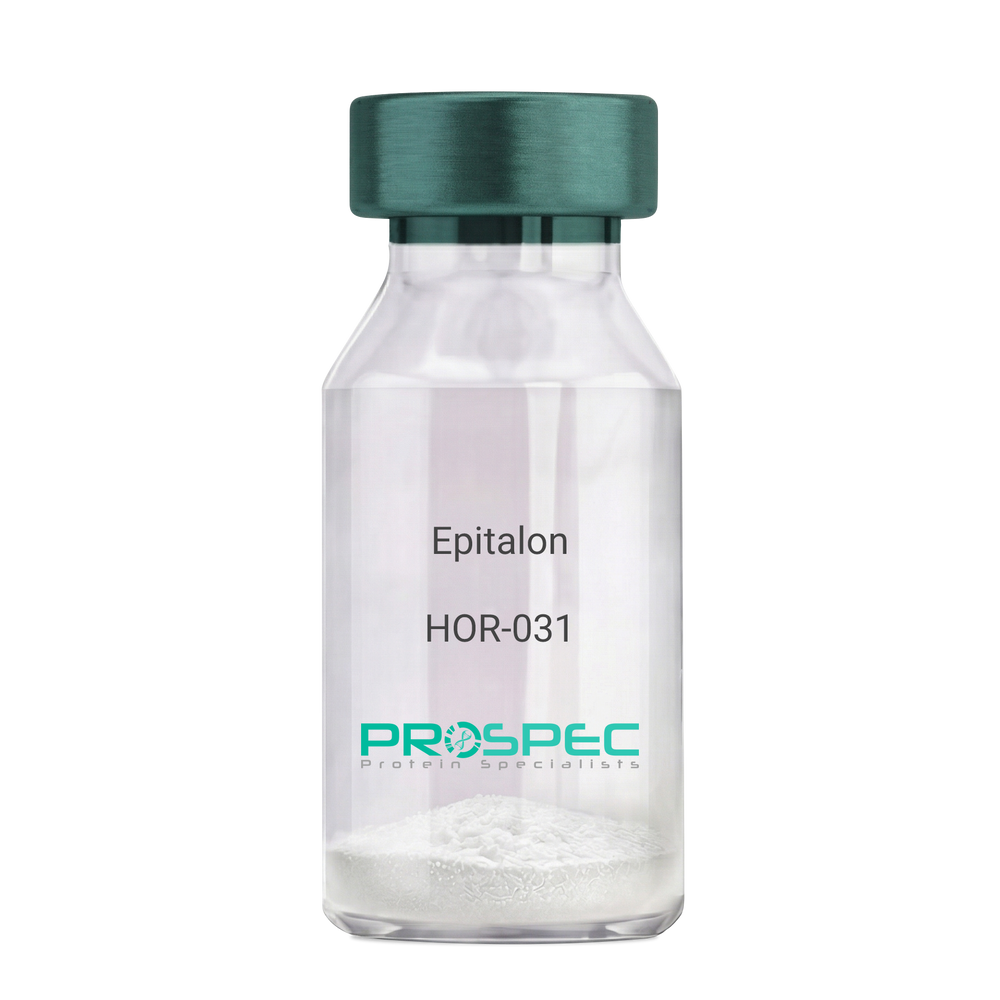
    Epitalon

    Description:

    Epitalon

    Product # :

    HOR-031

    Price :

    Quantity :

    Shipping Method :

    Room Temp Icon

    Shipped at Room temp

    Add To Cart

    More Info

    • description
    • formulation
    • purity
    • More Info

    Description

    Epithalon Synthetic is a single, non-glycosylated polypeptide chain containing 4 amino acids, having a molecular mass of 390.35 Dalton and a Molecular formula of C14H22N4O9.

    Formulation

    The protein was lyophilized with no additives.

    Purity

    Greater than 97.0% as determined by analysis by RP-HPLC.

    More Info

    • Physical Appearance

      Sterile Filtered White lyophilized (freeze-dried) powder.

    • Stability

      Lyophilized Epithalon although stable at room temperature for 3 weeks, should be stored desiccated below -18°C. Upon reconstitution Epithalon should be stored at 4°C between 2-7 days and for future use below -18°C.For long term storage it is recommended to add a carrier protein (0.1% HSA or BSA). Please prevent freeze-thaw cycles.

    • Solubility

      It is recommended to reconstitute the lyophilized Epithalon in sterile 18MΩ-cm H2O not less than 100 µg/ml, which can then be further diluted to other aqueous solutions.

    • Amino Acid Sequence

      H-Ala-Glu-Asp-Gly-OH .

    • Background

      Epitalon, also known as Epithalon, is a synthetic tetrapeptide that has been a focal point in the field of aging and longevity research. This peptide, consisting of four amino acids, is derived from the pineal gland and has been associated with a variety of biological effects, most notably its potential role in extending the lifespan of cells.

      Epitalon's primary function is its interaction with telomeres, the protective caps at the ends of chromosomes that shorten as cells divide. By stimulating the production of telomerase, an enzyme that can repair and lengthen telomeres, Epitalon may slow down the aging process at a cellular level.

      Numerous studies have explored the potential of Epitalon in extending the lifespan of organisms. For instance, Khavinson and colleagues (2003) found that Epitalon increased the lifespan of fruit flies, while Anisimov et al. (2003) reported similar results in mice. These findings suggest that Epitalon could potentially have similar effects in humans.

      Epitalon has also been studied for its role in regulating circadian rhythms. Korkushko et al. (2011) found that Epitalon could restore disrupted circadian rhythms in elderly people, suggesting potential applications in sleep disorders and other conditions related to circadian rhythm disruption.

      Beyond its potential role in aging and longevity, Epitalon has been explored for its potential therapeutic applications. Anisimov et al. (2011) found that Epitalon could reduce the incidence of spontaneous tumors in mice, suggesting potential applications in cancer prevention.

      While research on Epitalon is promising, it is important to note that most studies have been conducted in animals or in vitro. More research is needed to fully understand the potential effects and applications of Epitalon in humans. However, the existing body of research suggests that Epitalon could be a promising tool in the fight against aging and age-related diseases.

    ProSpec's products are furnished for LABORATORY RESEARCH USE ONLY. The product may not be used as drugs, agricultural or pesticidal products, food additives or household chemicals.

    Epitalon
  • View Data Sheet

    Name :

    Flavokinase Human

    Description:

    Riboflavin Kinase Human Recombinant

    Riboflavin kinase, ATP:riboflavin 5'-phosphotransferase, Flavokinase, RFK, RIFK, FLJ11149, RP11-422N19.2.

    Product # :

    PKA-352

    Price :

    Quantity :

    Shipping Method :

    Ice Icon

    Shipped with Ice Packs

    Add To Cart

    More Info

    • description
    • source
    • formulation
    • purity
    • More Info

    Description

    Flavokinase Human Recombinant produced in E.Coli is a single, non-glycosylated, polypeptide chain containing 182 amino acids (1-162 a.a.) and having a molecular mass of 20.5kDa. Flavokinase is fused to 20 a.a. His-Tag at N-terminus and purified by proprietary chromatographic techniques.

    Source

    Escherichia Coli.

    Formulation

    The Flavokinase solution containing 20mM Tris-HCl buffer (pH8.0) and 10% glycerol.

    Purity

    Greater than 90.0% as determined by SDS-PAGE.

    More Info

    • Introduction

      Flavokinase is a transferases family member, specifically those transferring phosphorus-containing groups (phosphotransferases) with an alcohol group as acceptor. Flavokinase is an enzyme that catalyzes the phosphorylation of riboflavin (vitamin B2) to form flavin-mononucleotide (FMN), which is an obligatory step in vitamin B2 utilization and flavin cofactor synthesis. It has been proposed that TNF, through the activation of the RFK gene, enhances the incorporation of FAD in NADPH oxidase enzymes, which is a critical step for the assembly and activation of NADPH oxidase.

    • Synonyms

      Riboflavin kinase, ATP:riboflavin 5'-phosphotransferase, Flavokinase, RFK, RIFK, FLJ11149, RP11-422N19.2.

    • Physical Appearance

      Sterile filtered colorless solution.

    • Stability

      Flavokinase although stable at 4°C for 1 week, should be stored below -18°C. For long term storage it is recommended to add a carrier protein (0.1% HSA or BSA).Please prevent freeze thaw cycles.

    • Amino Acid Sequence

      MGSSHHHHHH SSGLVPRGSH MPRADCIMRH LPYFCRGQVV RGFGRGSKQL GIPTANFPEQ VVDNLPADIS TGIYYGWASV GSGDVHKMVV SIGWNPYYKN TKKSMETHIM HTFKEDFYGE ILNVAIVGYL RPEKNFDSLE SLISAIQGDI EEAKKRLELP EHLKIKEDNF FQVSKSKIMNGH.

    ProSpec's products are furnished for LABORATORY RESEARCH USE ONLY. The product may not be used as drugs, agricultural or pesticidal products, food additives or household chemicals.

    Flavokinase Human
  • View Data Sheet

    Name :

    PRDX2 Mouse

    Description:

    Eukaryotic Translation Initiation Factor 4E Mouse Recombinant

    PRDX2, Peroxiredoxin-2 (EC:1.11.1.15), TSA, Thioredoxin peroxidase 1, Thioredoxin-dependent peroxide reductase 1, Thiol-specific antioxidant protein, Prdx2, Tdpx1, Tpx.  

    Product # :

    ENZ-1061

    Price :

    Quantity :

    Shipping Method :

    Ice Icon

    Shipped with Ice Packs

    Add To Cart

    More Info

    • description
    • source
    • formulation
    • purity
    • biological activity
    • More Info

    Description

    PRDX2 Mouse Recombinant produced in E.Coli is a single, non-glycosylated polypeptide chain containing 222 amino acids (1-198 a.a) and having a molecular mass of 24.3kDa. PRDX2 is fused to a 24 amino acid His-tag at N-terminus & purified by proprietary chromatographic techniques.

    Source

    Escherichia Coli.

    Formulation

    PRDX2 protein solution (1mg/ml) containing 20mM Tris-HCl buffer (pH8.0) and 10% Glycerol 1mM DTT.

    Purity

    Greater than 90.0% as determined by SDS-PAGE.

    Biological Activity

    Specific activity is > 700 pmol/min/ug, Activity is defined as the amount of hydroperoxide that 1ug of enzyme can reduce at 25C for minute. 

    More Info

    • Introduction

      PRDX2 is part of the peroxiredoxin family of antioxidant enzymes, which reduce hydrogen peroxide and alkyl hydroperoxides. PRDX2 takes part as an antioxidant protective role in cells, and contributes to the antiviral activity of CD8(+) T-cells. PRDX2 has proliferative effect in cancer development or progression.
      If PRDX2 protection is insufficient against peroxidases, the DNA damage results in neurological disease such as Alzheimer's or DNA damage leading to cancer.

    • Synonyms

      PRDX2, Peroxiredoxin-2 (EC:1.11.1.15), TSA, Thioredoxin peroxidase 1, Thioredoxin-dependent peroxide reductase 1, Thiol-specific antioxidant protein, Prdx2, Tdpx1, Tpx.

    • Physical Appearance

      Sterile Filtered clear solution.

    • Stability

      Store at 4°C if entire vial will be used within 2-4 weeks. Store, frozen at -20°C for longer periods of time. For long term storage it is recommended to add a carrier protein (0.1% HSA or BSA).Avoid multiple freeze-thaw cycles.

    • Amino Acid Sequence

      MGSSHHHHHH SSGLVPRGSH MGSHMASGNA QIGKSAPDFT ATAVVDGAFK EIKLSDYRGK YVVLFFYPLD FTFVCPTEII AFSDHAEDFR KLGCEVLGVS VDSQFTHLAW INTPRKEGGL GPLNIPLLAD VTKSLSQNYG VLKNDEGIAY RGLFIIDAKG VLRQITVNDL PVGRSVDEAL RLVQAFQYTD EHGEVCPAGW KPGSDTIKPN VDDSKEYFSK HN

    ProSpec's products are furnished for LABORATORY RESEARCH USE ONLY. The product may not be used as drugs, agricultural or pesticidal products, food additives or household chemicals.

    PRDX2 Mouse
  • View Data Sheet

    Name :

    MSMB Human

    Description:

    Beta-Microseminoprotein Human Recombinant

    Beta-microseminoprotein, Prostate secreted seminal plasma protein, Prostate secretory protein PSP94, Seminal plasma beta-inhibin, Immunoglobulin-binding factor, MSP, PSP, PSP57, PSP94, PSP-94, MSP-beta, beta-MSP, Microseminoprotein, IGBF, PN44, MSMB, MSP-B, MSPB, PRPS, Prostatic Secretory Protein.

    Product # :

    PRO-598

    Price :

    Quantity :

    Shipping Method :

    Room Temp Icon

    Shipped at Room temp

    Add To Cart

    More Info

    • description
    • source
    • formulation
    • purity
    • More Info

    Description

    MSMB Recombinant Human produced in E.Coli is a single, non-glycosylated, polypeptide chain containing 104 amino acids and having a molecular mass of 12 kDa. The MSMB is fused to His tag at N-Terminus.The Human MSMB is purified by proprietary chromatographic techniques.

    Source

    Escherichia Coli.

    Formulation

    The sterile filtered concentrated (0.5mg/ml) protein solution was lyophilized with 20mM Tris & 20mM NaCl pH-7.5.

    Purity

    Greater than 95% as determined by SDS-PAGE.

    More Info

    • Introduction

      Microseminoprotein is a member of the immunoglobulin binding factor family. It is synthesized by the epithelial cells of the prostate gland and secreted into the seminal plasma. This protein has inhibin-like activity. It may have a role as an autocrine paracrine factor in uterine, breast and other female reproductive tissues. The expression of the encoded protein is found to be decreased in prostate cancer. Two alternatively spliced transcript variants encoding different isoforms are described for this gene. The use of alternate polyadenylation sites has been found for this gene.

    • Synonyms

      Beta-microseminoprotein, Prostate secreted seminal plasma protein, Prostate secretory protein PSP94, Seminal plasma beta-inhibin, Immunoglobulin-binding factor, MSP, PSP, PSP57, PSP94, PSP-94, MSP-beta, beta-MSP, Microseminoprotein, IGBF, PN44, MSMB, MSP-B, MSPB, PRPS, Prostatic Secretory Protein.

    • Physical Appearance

      Sterile Filtered White lyophilized (freeze-dried) powder.

    • Stability

      Store lyophilized protein at -20°C. Aliquot the product after reconstitution to avoid repeated freezing/thawing cycles. Reconstituted protein can be stored at 4°C for a limited period of time.

    • Solubility

      Add deionized water to a working concentration of 0.5mg/ml and let the lyophilized pellet dissolve completely.

    • Amino Acid Sequence

      MKHHHHHHAS SCYFIPNEGV PGDSTRKCMD LKGNKHPINS EWQTDNCETC TCYETEISCC TLVSTPVGYD KDNCQRIFKK EDCKYIVVEK KDPKKTCSVSEWII.

    ProSpec's products are furnished for LABORATORY RESEARCH USE ONLY. The product may not be used as drugs, agricultural or pesticidal products, food additives or household chemicals.

    Psp 94 Human
  • View Data Sheet

    Name :

    MYL9 Human

    Description:

    Myosin Light Chain 9 Human Recombinant

    Myosin regulatory light polypeptide 9, 20 kDa myosin light chain, LC20, MLC-2C, Myosin RLC, Myosin regulatory light chain 2, smooth muscle isoform, Myosin regulatory light chain 9, Myosin regulatory light chain MRLC1, MYL9, MLC2, MRLC1, MYRL2, MGC3505.

    Product # :

    PRO-107

    Price :

    Quantity :

    Shipping Method :

    Ice Icon

    Shipped with Ice Packs

    Add To Cart

    More Info

    • description
    • source
    • formulation
    • purity
    • More Info

    Description

    MYL9 Human Recombinant fused with a20 amino acid His tag at N-terminus produced in E.Coli is a single, non-glycosylated, polypeptide chain containing192 amino acids (1-172 a.a.) and having a molecular mass of 21.9kDa. The MYL9 is purified by proprietary chromatographic techniques.

    Source

    Escherichia Coli.

    Formulation

    The MYL9 solution (0.5 mg/ml) contains 20mM Tris-HCl buffer (pH8.0), 0.1M NaCl, 1mM DTT and 10% glycerol.

    Purity

    Greater than 90.0% as determined by SDS-PAGE.

    More Info

    • Introduction

      MYL9 is one of the numerous regulatory myosin light chains. Myosin which is a structural component of the muscle consists of 2 heavy chains and 4 light chains. MYL9 is a myosin light chain regulates muscle contraction by modulating the ATPase activity of myosin heads. MYL9 binds calcium and is activated by myosin light chain kinase. Regulatory myosin light chains regulate contraction in smooth muscle and non-muscle cells via phosphorylation by MLCK (myosin light chain kinase). Phosphorylation of regulatory myosin light chains is catalyzed by MLCK in the presence of calcium and calmodulin and it increases the actin-activated myosin ATPase activity, thus regulates the contractile activity.

    • Synonyms

      Myosin regulatory light polypeptide 9, 20 kDa myosin light chain, LC20, MLC-2C, Myosin RLC, Myosin regulatory light chain 2, smooth muscle isoform, Myosin regulatory light chain 9, Myosin regulatory light chain MRLC1, MYL9, MLC2, MRLC1, MYRL2, MGC3505.

    • Physical Appearance

      Sterile Filtered colorless solution.

    • Stability

      Store at 4°C if entire vial will be used within 2-4 weeks. Store, frozen at -20°C for longer periods of time. For long term storage it is recommended to add a carrier protein (0.1% HSA or BSA).Please prevent freeze-thaw cycles.

    • Amino Acid Sequence

      MGSSHHHHHH SSGLVPRGSH MSSKRAKAKT TKKRPQRATS NVFAMFDQSQ IQEFKEAFNM IDQNRDGFID KEDLHDMLAS LGKNPTDEYL EGMMSEAPGP INFTMFLTMF GEKLNGTDPE DVIRNAFACF DEEASGFIHE DHLRELLTTM GDRFTDEEVD EMYREAPIDK KGNFNYVEFT RILKHGAKDK DD.

    ProSpec's products are furnished for LABORATORY RESEARCH USE ONLY. The product may not be used as drugs, agricultural or pesticidal products, food additives or household chemicals.

    Myl9 Human
  • View Data Sheet

    Name :

    HNRNPAB Human

    Description:

    Heterogeneous Nuclear Ribonucleoprotein A/B Human Recombinant

    Heterogeneous Nuclear Ribonucleoprotein A/B, ABBP-1, ABBP1, APOBEC1-Binding Protein 1, HnRNP A/B, Apobec-1 Binding Protein 1, Apolipoprotein B MRNA Editing Enzyme, Catalytic Polypeptide 1-Binding Protein 1, HnRNP Type A/B Protein.

    Product # :

    PRO-1731

    Price :

    Quantity :

    Shipping Method :

    Ice Icon

    Shipped with Ice Packs

    Add To Cart

    More Info

    • description
    • source
    • formulation
    • purity
    • More Info

    Description

    HNRNPAB Human Recombinant produced in E.Coli is a single, non-glycosylated polypeptide chain containing 308 amino acids (1-285 a.a) and having a molecular mass of 33kDa.HNRNPAB is fused to a 23 amino acid His-tag at N-terminus & purified by proprietary chromatographic techniques.

    Source

    Escherichia Coli.

    Formulation

    HNRNPAB protein solution (0.25mg/ml) containing 30% glycerol and 1mM DTT.

    Purity

    Greater than 95.0% as determined by SDS-PAGE.

    More Info

    • Introduction

      Heterogeneous Nuclear Ribonucleoprotein A/B (HNRNPAB) is a member of the subfamily of ubiquitously expressed heterogeneous nuclearribonucleoproteins (hnRNPs). The hnRNPs are produced by RNA polymerase II and are components of theheterogeneous nuclear RNA (hnRNA) complexes. They are linked with pre-mRNAs in the nucleus and seem to influence pre-mRNA processing and further aspects of mRNA metabolism and transport. Whereas all of the hnRNPsare present in the nucleus, some seem to shuttle between the nucleus and the cytoplasm. The hnRNP proteins have distinct nucleic acid binding properties. HNRNPAB, which binds to one of the components of the multiproteineditosome complex, has two repeats of quasi-RRM (RNA recognition motif) domains that bind to RNAs. Among the diseases associated with HNRNPAB are wells syndrome, and cystic fibrosis.

    • Synonyms

      Heterogeneous Nuclear Ribonucleoprotein A/B, ABBP-1, ABBP1, APOBEC1-Binding Protein 1, HnRNP A/B, Apobec-1 Binding Protein 1, Apolipoprotein B MRNA Editing Enzyme, Catalytic Polypeptide 1-Binding Protein 1, HnRNP Type A/B Protein.

    • Physical Appearance

      Sterile Filtered clear solution.

    • Stability

      Store at 4°C if entire vial will be used within 2-4 weeks. Store, frozen at -20°C for longer periods of time. For long term storage it is recommended to add a carrier protein (0.1% HSA or BSA).Avoid multiple freeze-thaw cycles.

    • Amino Acid Sequence

      MGSSHHHHHH SSGLVPRGSH MGSMSEAGEE QPMETTGATE NGHEAVPEGE SPAGAGTGAA AGAGGATAAP PSGNQNGAEG DQINASKNEE DAGKMFVGGL SWDTSKKDLK DYFTKFGEVV DCTIKMDPNT GRSRGFGFIL FKDAASVEKV LDQKEHRLDG RVIDPKKAMA MKKDPVKKIF VGGLNPEATE EKIREYFGEF GEIEAIELPM DPKLNKRRGF VFITFKEEEP VKKVLEKKFH TVSGSKCEIK VAQPKEVYQQ QQYGSGGRGN RNRGNRGSGG GGGGGGQGST NYGKSQRRGG HQNNYKPY

    ProSpec's products are furnished for LABORATORY RESEARCH USE ONLY. The product may not be used as drugs, agricultural or pesticidal products, food additives or household chemicals.

    Hnrnpab Human
  • View Data Sheet

    Name :

    NFKBIA Human

    Description:

    NF-kappa-B Inhibitor Alpha Human Recombinant

    Nuclear factor of kappa light polypeptide gene enhancer in B-cells inhibitor alpha, nuclear factor of kappa light chain gene enhancer in B-cells, IKBA, I-kappa-B-alpha, IkappaBalpha, ikB-alpha, NFKBI, MAD-3, Major histocompatibility complex enhancer-binding protein MAD3, NF-kappa-B inhibitor alpha.

    Product # :

    PRO-960

    Price :

    Quantity :

    Shipping Method :

    Ice Icon

    Shipped with Ice Packs

    Add To Cart

    More Info

    • description
    • source
    • formulation
    • purity
    • More Info

    Description

    NFKBIA Human Recombinant produced in E.coli is a single, non-glycosylated polypeptide chain containing 337 amino acids (1-317) and having a molecular mass of 37.7 kDa.NFKBIA is fused to a 20 amino acid His-tag at N-terminus & purified by proprietary chromatographic techniques.

    Source

    E.coli.

    Formulation

    The NFKBIA solution (0.5mg/ml) contains 20mM Tris-HCl buffer (pH 8.0), 1mM DTT, 0.1M NaCl and 20% glycerol.

    Purity

    Greater than 90% as determined by SDS-PAGE.

    More Info

    • Introduction

      NFKBIA belongs to the I-kappa-B family of proteins which is separated into four groups (IkB-a, IkB-b, IkB-g, IkB-e). NFKBIA inhibits the NFkB complex by binding and impounding it in the cytoplasm. When stimulated, NFKBIA is phosphorylated on serine residues targeting it for degradation by the ubiquitin pathway.

    • Synonyms

      Nuclear factor of kappa light polypeptide gene enhancer in B-cells inhibitor alpha, nuclear factor of kappa light chain gene enhancer in B-cells, IKBA, I-kappa-B-alpha, IkappaBalpha, ikB-alpha, NFKBI, MAD-3, Major histocompatibility complex enhancer-binding protein MAD3, NF-kappa-B inhibitor alpha.

    • Physical Appearance

      Sterile Filtered colorless solution.

    • Stability

      Store at 4°C if entire vial will be used within 2-4 weeks. Store, frozen at -20°C for longer periods of time. For long term storage it is recommended to add a carrier protein (0.1% HSA or BSA).Avoid multiple freeze-thaw cycles.

    • Amino Acid Sequence

      MGSSHHHHHH SSGLVPRGSH MFQAAERPQE WAMEGPRDGL KKERLLDDRH DSGLDSMKDE EYEQMVKELQ EIRLEPQEVP RGSEPWKQQL TEDGDSFLHL AIIHEEKALT MEVIRQVKGD LAFLNFQNNL QQTPLHLAVI TNQPEIAEAL LGAGCDPELR DFRGNTPLHL ACEQGCLASV GVLTQSCTTP HLHSILKATN YNGHTCLHLA SIHGYLGIVE LLVSLGADVN AQEPCNGRTA LHLAVDLQNP DLVSLLLKCG ADVNRVTYQG YSPYQLTWGR PSTRIQQQLG QLTLENLQML PESEDEESYD TESEFTEFTE DELPYDDCVF GGQRLTL

    ProSpec's products are furnished for LABORATORY RESEARCH USE ONLY. The product may not be used as drugs, agricultural or pesticidal products, food additives or household chemicals.

    Nfkbia Human
  • View Data Sheet

    Name :

    LILRB1 Human

    Description:

    Leukocyte Immunoglobulin Like Receptor B1 Human Recombinant

    Leukocyte immunoglobulin-like receptor subfamily B member 1,Leukocyte immunoglobulin-like receptor 1, leucocyte Ig-like receptor B1, CD85 antigen-like family member J, Immunoglobulin-like transcript 2, myeloid inhibitory receptor 7, Monocyte/macrophage immunoglobulin-like receptor 7, Ig-like transcript 2, MIR-7, LILRB1, ILT2, LIR1, MIR7, LIR-1, ILT-2, PIRB, PIR-B

    Product # :

    PRO-2668

    Price :

    Quantity :

    Shipping Method :

    Ice Icon

    Shipped with Ice Packs

    Add To Cart

    More Info

    • description
    • source
    • formulation
    • purity
    • biological activity
    • More Info

    Description

    LILRB1 Human Recombinant produced in Sf9 Baculovirus cells is a single, glycosylated polypeptide chain containing 446 amino acids (24-461 a.a) and having a molecular mass of 48.5kDa.LILRB1 is fused to an 8 amino acid His-tag at C-terminus & purified by proprietary chromatographic techniques.

    Source

    Sf9, Baculovirus cells.

    Formulation

    The LILRB1 solution (0.25mg/ml) contains 10% glycerol and Phosphate-Buffered Saline (pH 7.4).

    Purity

    Greater than 95.0% as determined by SDS-PAGE.

    Biological Activity

    Biological activity is > 50%. It is defined by the ability of the immobilized protein to support the adhesion of HSB2 human peripheral blood acute lymphoblastic leukemia cells, while the cells are added to LILRB1 coated plates at 5ug/ml.

    More Info

    • Introduction

      Leukocyte Immunoglobulin Like Receptor B1 (LILRB1) is a member of the leukocyteimmunoglobulinlike receptor (LIR) family. LILRB1is expressed on immune cells, binds to MHC classI molecules on antigen-presenting cells and transduces a negative signal that inhibits stimulation of an immuneresponse. LILRB1 controls inflammatory responses and cytotoxicity to help focus the immune responseand limit autoreactivity. LILRB1 is also expressed on the surface of B cells and monocytes, subsets of NKcells, gamma δ T cells,memory/effector CD8+ T cells and monocyte-derived dendritic cells.

    • Synonyms

      Leukocyte immunoglobulin-like receptor subfamily B member 1,
      Leukocyte immunoglobulin-like receptor 1, leucocyte Ig-like receptor B1, CD85 antigen-like family member J, Immunoglobulin-like transcript 2, myeloid inhibitory receptor 7, Monocyte/macrophage immunoglobulin-like receptor 7, Ig-like transcript 2, MIR-7, LILRB1, ILT2, LIR1, MIR7, LIR-1, ILT-2, PIRB, PIR-B

    • Physical Appearance

      Sterile Filtered colorless solution.

    • Stability

      Store at 4°C if entire vial will be used within 2-4 weeks. Store, frozen at -20°C for longer periods of time. For long term storage it is recommended to add a carrier protein (0.1% HSA or BSA).Avoid multiple freeze-thaw cycles.

    • Amino Acid Sequence

      GHLPKPTLWA EPGSVITQGS PVTLRCQGGQ ETQEYRLYRE KKTAPWITRI PQELVKKGQF PIPSITWEHT GRYRCYYGSD TAGRSESSDP LELVVTGAYI KPTLSAQPSP VVNSGGNVTL QCDSQVAFDG FILCKEGEDE HPQCLNSQPH ARGSSRAIFS VGPVSPSRRW WYRCYAYDSN SPYEWSLPSD LLELLVLGVS KKPSLSVQPG PIVAPEETLT LQCGSDAGYN RFVLYKDGER DFLQLAGAQP QAGLSQANFT LGPVSRSYGG QYRCYGAHNL SSEWSAPSDP LDILIAGQFY DRVSLSVQPG PTVASGENVT LLCQSQGWMQ TFLLTKEGAA DDPWRLRSTY QSQKYQAEFP MGPVTSAHAG TYRCYGSQSS KPYLLTHPSD PLELVVSGPS GGPSSPTTGP TSTSGPEDQP LTPTGSDPQS GLGRHLGVLE HHHHHH

    ProSpec's products are furnished for LABORATORY RESEARCH USE ONLY. The product may not be used as drugs, agricultural or pesticidal products, food additives or household chemicals.

    Lilrb1 Human
  • View Data Sheet

    Name :

    UBE2Q2 Human

    Description:

    Ubiquitin Conjugating Enzyme E2Q2 Human Recombinant

    Ubiquitin-conjugating enzyme E2 Q2, UBE2Q2, E2 ubiquitin-conjugating enzyme Q2, Ubiquitin carrier protein Q2, Ubiquitin-protein ligase Q2, Ubiquitin Conjugating Enzyme E2Q2, Ubiquitin-conjugating enzyme E2 Q2 isoform1.

    Product # :

    ENZ-885

    Price :

    Quantity :

    Shipping Method :

    Ice Icon

    Shipped with Ice Packs

    Add To Cart

    More Info

    • description
    • source
    • formulation
    • purity
    • More Info

    Description

    UBE2Q2 Human Recombinant produced in E.Coli is a single, non-glycosylated polypeptide chain containing 398 amino acids (1-375a.a.) and having a molecular mass of 45.2kDa.UBE2Q2 is fused to a 23 amino acid His-tag at N-terminus & purified by proprietary chromatographic techniques.

    Source

    Escherichia Coli.

    Formulation

    UBE2Q2 protein solution (0.5mg/ml) containing Phosphate Buffer Saline (pH7.4), 30% glycerol and 1mM DTT.

    Purity

    Greater than 85.0% as determined by SDS-PAGE.

    More Info

    • Introduction

      Ubiquitin Conjugating Enzyme E2Q2 (UBE2Q2) is a protein coding gene which receives ubiquitin from the E1 complex and catalyzes its covalent attachment to various proteins. UBE2Q2 which is a part of the ubiquitin-conjugating enzyme family is detected in hypopharyngeal head and neck squamous cell carcinoma and in tumor masses.

    • Synonyms

      Ubiquitin-conjugating enzyme E2 Q2, UBE2Q2, E2 ubiquitin-conjugating enzyme Q2, Ubiquitin carrier protein Q2, Ubiquitin-protein ligase Q2, Ubiquitin Conjugating Enzyme E2Q2, Ubiquitin-conjugating enzyme E2 Q2 isoform1.

    • Physical Appearance

      Sterile Filtered clear solution.

    • Stability

      Store at 4°C if entire vial will be used within 2-4 weeks. Store, frozen at -20°C for longer periods of time. For long term storage it is recommended to add a carrier protein (0.1% HSA or BSA).Avoid multiple freeze-thaw cycles.

    • Amino Acid Sequence

      MGSSHHHHHH SSGLVPRGSH MGSMSVSGLK AELKFLASIF DKNHERFRIV SWKLDELHCQ FLVPQQGSPH SLPPPLTLHC NITESYPSSS PIWFVDSEDP NLTSVLERLE DTKNNNLLRQ QLKWLICELC SLYNLPKHLD VEMLDQPLPT GQNGTTEEVT SEEEEEEEEM AEDIEDLDHY EMKEEEPISG KKSEDEGIEK ENLAILEKIR KTQRQDHLNG AVSGSVQASD RLMKELRDIY RSQSYKTGIY SVELINDSLY DWHVKLQKVD PDSPLHSDLQ ILKEKEGIEY ILLNFSFKDN FPFDPPFVRV VLPVLSGGYV LGGGALCMEL LTKQGWSSAY SIESVIMQIN ATLVKGKARV QFGANKNQYN LARAQQSYNS IVQIHEKNGW YTPPKEDG.

    ProSpec's products are furnished for LABORATORY RESEARCH USE ONLY. The product may not be used as drugs, agricultural or pesticidal products, food additives or household chemicals.

    Ube2Q2 Human
  • 1
  • …
  • 29
  • 30
  • 31
  • 32
  • 33
  • …
  • 42
Your browser does not support the video tag.

Products

  • Cytokines
  • Growth Factors
  • Chemokines
  • CD Antigens
  • Neurotrophins
  • Hormones
  • Enzymes
  • Viral Antigens
  • Recombinant Proteins
  • Natural Proteins
  • Monoclonal Antibodies
  • Polyclonal Antibodies
  • Thermal Packaging

About

  • Company
  • Founder
  • Contribution
  • Contact Us
  • My Account

Ordering

  • Ordering Method
  • Ordering - Credit Card
  • Ordering PO
  • Shipping Fees
  • FAQ's

Legal

  • Terms & Conditions
  • Privacy
  • Site Map
  • info@prospecbio.com
  • Facebook
  • Instagram
  • Linkedin Profile

© 2026 ProSpec-Tany TechnoGene Ltd. All Rights Reserved.

  • Choosing a selection results in a full page refresh.
  • Opens in a new window.