Skip to content

High-quality research proteins.

  • 1-800-805-6531

  • Mon - Sat 8.00-18.00, Sun - Closed

  • info@prospecbio.com

  • PO Box 6591 East Brunswick NJ 08816

  • Products
    • Cytokines
    • Growth factors
    • Chemokines
    • Cd antigens
    • Neurotrophins
    • Hormones
    • Enzymes
    • Viral antigens
    • Recombinant proteins
    • Natural proteins
    • Monoclonal antibodies
    • Polyclonal antibodies
    • Thermal Packaging
  • About
    • Company
    • Founder
    • Contribution
  • Customers
    • Eastern Asia
    • Eastern Europe
    • North America
    • South America
    • South East Asia
    • Southern Asia
    • Western Europe
  • Ordering
    • Ordering Method
    • Ordering - Credit Card
    • Ordering - PO
    • Shipping Fees
    • FAQs
  • Services
    • DNA Cloning
    • Protein Expression
    • Monoclonal Antibody
    • Fermentation
    • Technology License
  • Contact us
Log in

Country/region

  • USD $ | Albania
  • USD $ | Andorra
  • USD $ | Argentina
  • USD $ | Armenia
  • USD $ | Australia
  • USD $ | Austria
  • USD $ | Azerbaijan
  • USD $ | Belarus
  • USD $ | Belgium
  • USD $ | Bolivia
  • USD $ | Brazil
  • USD $ | Bulgaria
  • USD $ | Cambodia
  • USD $ | Canada
  • USD $ | Chile
  • USD $ | China
  • USD $ | Colombia
  • USD $ | Costa Rica
  • USD $ | Croatia
  • USD $ | Cyprus
  • USD $ | Czechia
  • USD $ | Denmark
  • USD $ | Estonia
  • USD $ | Finland
  • USD $ | France
  • USD $ | Georgia
  • USD $ | Germany
  • USD $ | Greece
  • USD $ | Hong Kong SAR
  • USD $ | Hungary
  • USD $ | Iceland
  • USD $ | India
  • USD $ | Ireland
  • USD $ | Israel
  • USD $ | Italy
  • USD $ | Japan
  • USD $ | Kazakhstan
  • USD $ | Latvia
  • USD $ | Liechtenstein
  • USD $ | Lithuania
  • USD $ | Madagascar
  • USD $ | Malta
  • USD $ | Mexico
  • USD $ | Moldova
  • USD $ | Monaco
  • USD $ | Netherlands
  • USD $ | New Zealand
  • USD $ | North Macedonia
  • USD $ | Norway
  • USD $ | Panama
  • USD $ | Paraguay
  • USD $ | Peru
  • USD $ | Philippines
  • USD $ | Poland
  • USD $ | Portugal
  • USD $ | Romania
  • USD $ | Singapore
  • USD $ | Slovakia
  • USD $ | Slovenia
  • USD $ | South Africa
  • USD $ | South Korea
  • USD $ | Spain
  • USD $ | Sri Lanka
  • USD $ | Sweden
  • USD $ | Switzerland
  • USD $ | Taiwan
  • USD $ | Thailand
  • USD $ | Türkiye
  • USD $ | Ukraine
  • USD $ | United Kingdom
  • USD $ | United States
  • USD $ | Uruguay
  • USD $ | Vatican City
  • USD $ | Venezuela
  • USD $ | Vietnam
  • Facebook
  • Instagram
logoProSpec - Recombinant Protein Manufacturer for academic and R&D industry
Become a distributor
Account Log in
Wishlist
Cart Cart(0)
  • Products
    +
    • Cytokines
    • Growth factors
    • Chemokines
    • Cd antigens
    • Neurotrophins
    • Hormones
    • Enzymes
    • Viral antigens
    • Recombinant proteins
    • Natural proteins
    • Monoclonal antibodies
    • Polyclonal antibodies
    • Thermal Packaging
  • About
    +
    • Company
    • Founder
    • Contribution
  • Customers
    +
    • Eastern Asia
    • Eastern Europe
    • North America
    • South America
    • South East Asia
    • Southern Asia
    • Western Europe
  • Ordering
    +
    • Ordering Method
    • Ordering - Credit Card
    • Ordering - PO
    • Shipping Fees
    • FAQs
  • Services
    +
    • DNA Cloning
    • Protein Expression
    • Monoclonal Antibody
    • Fermentation
    • Technology License
  • Contact us

Item added to your cart

View cart
View All
  • Cytokines
  • Growth factors
  • Chemokines
  • Cd antigens
  • Neurotrophins
  • Hormones
  • Enzymes
  • Viral antigens
  • Recombinant proteins
  • Natural proteins
  • Monoclonal antibodies
  • Polyclonal antibodies
  • Thermal Packaging
  • Tumor Necrosis Factor

    Tumor Necrosis Factor

    View All
  • 4-1BB

    4-1BB

    View All
  • Adiponectin

    Adiponectin

    View All
  • AIF1

    AIF1

    View All
  • Other Cytokines

    Other Cytokines

    View All
  • AITRL

    AITRL

    View All
  • Angiopoietin

    Angiopoietin

    View All
  • Apolipoprotein

    Apolipoprotein

    View All
  • B-Cell Activating Factor

    B-Cell Activating Factor

    View All
  • Beta Defensin

    Beta Defensin

    View All
  • Bone Morphogenetic Protein

    Bone Morphogenetic Protein

    View All
  • B type Natriuretic Peptide

    B type Natriuretic Peptide

    View All
  • BST

    BST

    View All
  • Betacellulin

    Betacellulin

    View All
  • Cardiotrophin

    Cardiotrophin

    View All
  • Activin

    Activin

    View All
  • Fibroblast Growth Factor

    Fibroblast Growth Factor

    View All
  • Other Growth Factors

    Other Growth Factors

    View All
  • CSF

    CSF

    View All
  • CTGF

    CTGF

    View All
  • IGFBP

    IGFBP

    View All
  • VEGF Protein

    VEGF Protein

    View All
  • EGF

    EGF

    View All
  • Epigen

    Epigen

    View All
  • Erythropoietin

    Erythropoietin

    View All
  • Insulin-Like Growth Factor

    Insulin-Like Growth Factor

    View All
  • Growth Hormone

    Growth Hormone

    View All
  • HDGF

    HDGF

    View All
  • Hepatocyte Growth Factor

    Hepatocyte Growth Factor

    View All
  • Insulin

    Insulin

    View All
  • BCA-1/ BLC (CXCL13)

    BCA-1/ BLC (CXCL13)

    View All
  • BRAK (CXCL14)

    BRAK (CXCL14)

    View All
  • C-10 (CCL6)

    C-10 (CCL6)

    View All
  • Other Chemokines

    Other Chemokines

    View All
  • MEC (CCL28)

    MEC (CCL28)

    View All
  • LD78-beta (CCL3L1)

    LD78-beta (CCL3L1)

    View All
  • CTACK (CCL27)

    CTACK (CCL27)

    View All
  • CXCL16

    CXCL16

    View All
  • CXCL17

    CXCL17

    View All
  • Platelet Factor-4 (CXCL4)

    Platelet Factor-4 (CXCL4)

    View All
  • ENA-78 (CXCL5)

    ENA-78 (CXCL5)

    View All
  • Eotaxin (CCL11,24,26)

    Eotaxin (CCL11,24,26)

    View All
  • Exodus-2 (CCL21)

    Exodus-2 (CCL21)

    View All
  • Fractalkine (CX3CL1)

    Fractalkine (CX3CL1)

    View All
  • CXCL6

    CXCL6

    View All
  • Other CD Antigens

    Other CD Antigens

    View All
  • CD14

    CD14

    View All
  • CD164

    CD164

    View All
  • CD1

    CD1

    View All
  • CD2

    CD2

    View All
  • CD200

    CD200

    View All
  • CD207

    CD207

    View All
  • CD226

    CD226

    View All
  • CD23

    CD23

    View All
  • CD244

    CD244

    View All
  • CD247

    CD247

    View All
  • CD27

    CD27

    View All
  • CD274

    CD274

    View All
  • CD300

    CD300

    View All
  • CD33

    CD33

    View All
  • Other Neurotrophins

    Other Neurotrophins

    View All
  • Beta-NGF

    Beta-NGF

    View All
  • BDNF

    BDNF

    View All
  • CDNF

    CDNF

    View All
  • CNTF

    CNTF

    View All
  • GDNF

    GDNF

    View All
  • Glia Maturation Factor

    Glia Maturation Factor

    View All
  • MANF

    MANF

    View All
  • Midkine

    Midkine

    View All
  • Neuroglobin

    Neuroglobin

    View All
  • Neurotrophic factors

    Neurotrophic factors

    View All
  • Neuregulin

    Neuregulin

    View All
  • Neuropilin

    Neuropilin

    View All
  • Pigment Epithelium-Derived Factor

    Pigment Epithelium-Derived Factor

    View All
  • Pleiotrophin

    Pleiotrophin

    View All
  • Peptide Hormones

    Peptide Hormones

    View All
  • Other Hormones

    Other Hormones

    View All
  • HCG

    HCG

    View All
  • Endothelin

    Endothelin

    View All
  • Exendin

    Exendin

    View All
  • FSH

    FSH

    View All
  • Glucagon

    Glucagon

    View All
  • GHRP

    GHRP

    View All
  • GLP

    GLP

    View All
  • Thyrostimulin

    Thyrostimulin

    View All
  • Inhibin A

    Inhibin A

    View All
  • LHRH

    LHRH

    View All
  • Melanotan

    Melanotan

    View All
  • Procalcitonin

    Procalcitonin

    View All
  • PTH

    PTH

    View All
  • Peroxiredoxin

    Peroxiredoxin

    View All
  • Peptidase

    Peptidase

    View All
  • Synthetase

    Synthetase

    View All
  • Transferase

    Transferase

    View All
  • Hydrolase

    Hydrolase

    View All
  • Dehydrogenase

    Dehydrogenase

    View All
  • ACE2

    ACE2

    View All
  • Esterase

    Esterase

    View All
  • Protein Kinases

    Protein Kinases

    View All
  • Other Enzymes

    Other Enzymes

    View All
  • Phosphatase

    Phosphatase

    View All
  • Deaminase

    Deaminase

    View All
  • Oxygenase

    Oxygenase

    View All
  • Adenylate Kinase

    Adenylate Kinase

    View All
  • Lyase

    Lyase

    View All
  • Chagas

    Chagas

    View All
  • SARS

    SARS

    View All
  • Influenza

    Influenza

    View All
  • ASFV

    ASFV

    View All
  • Astrovirus

    Astrovirus

    View All
  • Borrelia

    Borrelia

    View All
  • Helicobacter Pylori

    Helicobacter Pylori

    View All
  • Chikungunya

    Chikungunya

    View All
  • Chlamydia

    Chlamydia

    View All
  • Cytomegalo

    Cytomegalo

    View All
  • Dengue

    Dengue

    View All
  • EBV

    EBV

    View All
  • Ebola

    Ebola

    View All
  • Feline Leukemia Virus

    Feline Leukemia Virus

    View All
  • Hepatitis A

    Hepatitis A

    View All
  • Other

    Other

    View All
  • Actin

    Actin

    View All
  • ADAM

    ADAM

    View All
  • Complement Component

    Complement Component

    View All
  • Ag85

    Ag85

    View All
  • Eukaryotic Translation Initiation Factor

    Eukaryotic Translation Initiation Factor

    View All
  • Anterior Gradient Protein

    Anterior Gradient Protein

    View All
  • Heat Shock Protein

    Heat Shock Protein

    View All
  • Alpha-2-HS-Glycoprotein

    Alpha-2-HS-Glycoprotein

    View All
  • Hemoglobin

    Hemoglobin

    View All
  • Allergy

    Allergy

    View All
  • Anaplasma

    Anaplasma

    View All
  • Angiogenin

    Angiogenin

    View All
  • Ankyrin Repeat Domain

    Ankyrin Repeat Domain

    View All
  • Annexin

    Annexin

    View All
  • Other Natural Proteins

    Other Natural Proteins

    View All
  • Aprotinin

    Aprotinin

    View All
  • Transferrin

    Transferrin

    View All
  • Avidin

    Avidin

    View All
  • Anti Coagulation Factors

    Anti Coagulation Factors

    View All
  • Natural Albumin

    Natural Albumin

    View All
  • Natural Coagulation Factors

    Natural Coagulation Factors

    View All
  • Fibronectin

    Fibronectin

    View All
  • Thrombin

    Thrombin

    View All
  • Anti Human Enzyme

    Anti Human Enzyme

    View All
  • Other Monoclonal Antibodies

    Other Monoclonal Antibodies

    View All
  • Anti Human Cytokine

    Anti Human Cytokine

    View All
  • Anti Human Heat Shock Protein

    Anti Human Heat Shock Protein

    View All
  • Anti Mouse Lymphocyte

    Anti Mouse Lymphocyte

    View All
  • Anti Human Chemokine

    Anti Human Chemokine

    View All
  • Anti Human Lymphocyte

    Anti Human Lymphocyte

    View All
  • Anti Viral Monoclonal

    Anti Viral Monoclonal

    View All
  • Anti Mouse Cytokine

    Anti Mouse Cytokine

    View All
  • Anti-GST Monoclonal

    Anti-GST Monoclonal

    View All
  • Other Polyclonal Antibodies

    Other Polyclonal Antibodies

    View All
  • Anti Viral

    Anti Viral

    View All
  • Anti-GST Monoclonal

    Anti-GST Monoclonal

    View All
Back

Search results

1000 results found for “HCG”

Name

Description

Product #

Price

Quantity

Shipping Method

  • View Data Sheet

    Name :

    GMNN Antibody

    Description:

    Geminin, Mouse Anti Human

    GMNN, Geminin, DNA Replication Inhibitor, Gem, RP3-369A17.3.

    Product # :

    ANT-319

    Price :

    Quantity :

    Shipping Method :

    Ice Icon

    Shipped with Ice Packs

    Add To Cart

    More Info

    • formulation
    • More Info
    • Citations

    Formulation

    1mg/ml containing PBS, pH-7.4, & 0.1% Sodium Azide.

    Citations

    More Info

    • Introduction

      Geminin is a 25 kDa nuclear protein, which inhibits DNA replication and is degraded during the mitotic phase of the cell cycle. Geminin controls replication by binding to the licensing factor Cdt1, and is involved in neural differentiation. In addition, Geminin directly interacts with Six3 and Hox homeodomain proteins during embryogenesis and inhibits their functions. Geminin can also promote DNA replication. Geminin has 2 roles in 2 different stages of the cell cycle: Geminin is a negative regulator of DNA replication during the “S phase” of the cell cycle. Inhibition of Geminin during the “S phase” (by RNAi) results in an additional round of replication of portions of the genome. During the “M phase” of the cell cycle (mitosis) Geminin stabilizes the replication factor Cdt1 promoting DNA replication during the next cell cycle. Moreover, inhibition of Geminin during mitosis (by RNAi) causes destabilization of Cdt1 protein and impairment of DNA replication during the next cell cycle. G

    • Synonyms

      GMNN, Geminin, DNA Replication Inhibitor, Gem, RP3-369A17.3.

    • Immunogen

      Anti-human Geminin mAb is derived from hybridization of mouse SP2/0 myeloma cells with spleen cells from BALB/c mice immunized with recombinant human Geminin amino acids 1-209 purified from E. coli.

    • Ig Subclass

      Mouse IgG1 heavy chain and κ light chain.

    • Clone

      P2H7AT.

    • Applications

      Geminin antibody has been tested by ELISA and Western blot analysis to assure specificity and reactivity. Since application varies, however, each investigation should be titrated by the reagent to obtain optimal results. Recommended dilution range for Western blot analysis is 1:500 ~ 1,000. Recommended starting dilution is 1:500.

    • Type

      Mouse Anti Human Monoclonal.

    • Storage Procedures

      For periods up to 1 month store at 4°C, for longer periods of time, store at -20°C. Prevent freeze thaw cycles.

    • Purification Method

      Geminin antibody was purified from mouse ascitic fluids by protein-G affinity chromatography.

    ProSpec's products are furnished for LABORATORY RESEARCH USE ONLY. The product may not be used as drugs, agricultural or pesticidal products, food additives or household chemicals.

    Geminin Antibody
  • View Data Sheet

    Name :

    MHC Class II, I-A Antibody, Biotin

    Description:

    MHC Class II, (I-A) Mouse Antibody, Biotin

    Product # :

    ANT-269

    Price :

    Quantity :

    Shipping Method :

    Room Temp Icon

    Shipped at Room temp

    Add To Cart

    More Info

    • formulation
    • More Info
    • Citations

    Formulation

    1mg/ml in PBS (after reconstitution).

    Citations

    More Info

    • Introduction

      MHC Class II is consists of 2 membrane spanning proteins. Each of these proteins is roughly 30 kDa, and has of two Globular domains, Alpha-1, Alpha-2, Beta-1 and Beta-2. The two regions farthest away from the membrane are alpha-1 and beta-1. The two proteins link without Covalent Bonds. The MHC Class II protein mainly presents peptides, which have been digested from external sources. MHC Class II is normally only expressed by Antigen Presenting Cells (APC) which digest foreign protein. Within the RER the alpha and beta proteins of the molecule, associate with each other, while a third protein called the "invariant chain," is necessary for stabilizing the complex, without it, they will not associate. The MHC-invariant complex is then passed from the RER, into and out of, the Golgi body. It fuses with an Endocytic compartment, where an external protein has been sampled and degraded.

    • Solubility

      Reconstitute with of H20. Mix gently, wash the sides of the vial and wait 30-60 seconds before use.

    • Immunogen

      Purified mouse LN B cells (C3H anti-C57Bl6).

    • Ig Subclass

      Mouse IgG2a.

    • Clone

      NYRmI-A.

    • Applications

      Cytotoxic and staining antibody. For staining, use 10ml/1,000,000 cells. Titer for cytotoxicity should be determined by the investigator.

    • Specificity

      Recognizes most MHC class II haplotypes (b,f,p,q,r,s,u,v), but weak against I-Ak.

    • Available Conjugates

      This antibody is also available unconjugated and conjugated to FITC.

    • Type

      Mouse Antibody Monoclonal.

    • Storage Procedures

      Lyophilized: store at 4°C. After reconstitution, if not intended for use within a month, aliquot and store at -20°C.

    • Purification Method

      Ion exchange column.

    ProSpec's products are furnished for LABORATORY RESEARCH USE ONLY. The product may not be used as drugs, agricultural or pesticidal products, food additives or household chemicals.

    Mhc Class Ii I A Antibody Biotin
  • View Data Sheet

    Name :

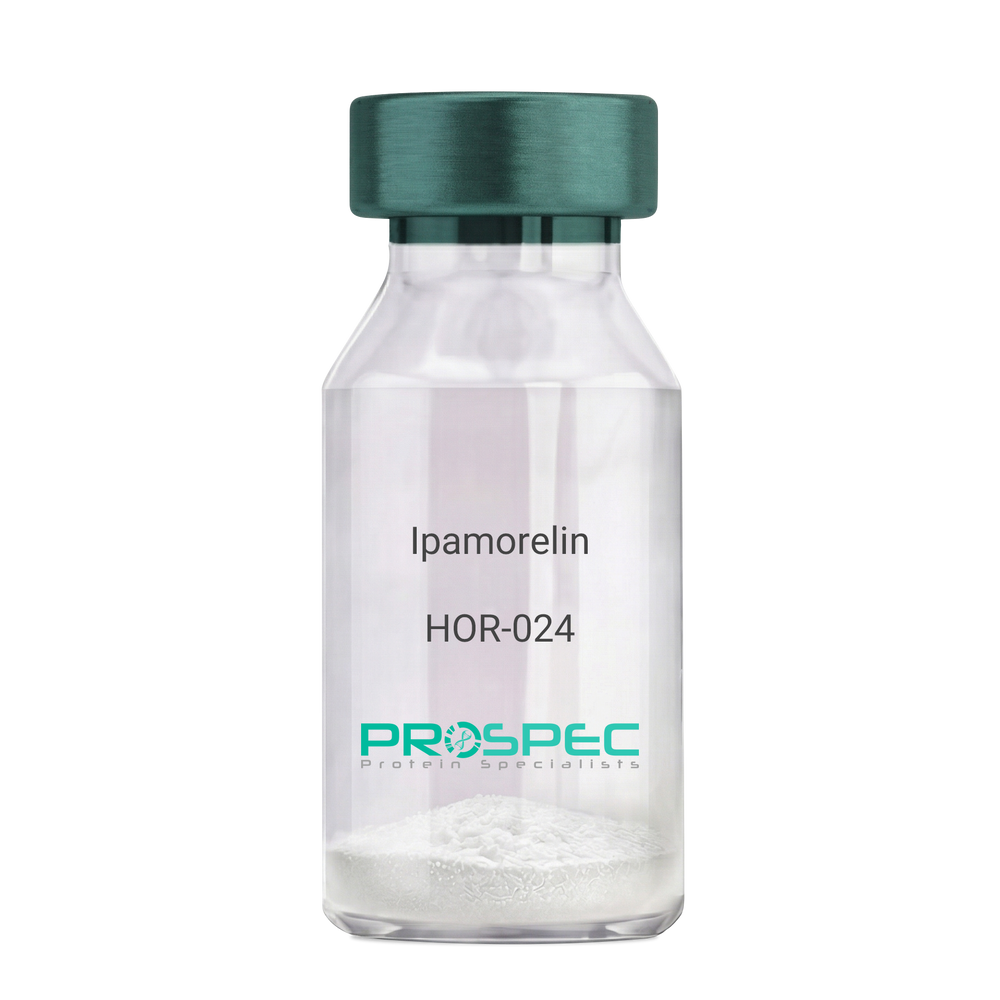
    Ipamorelin

    Description:

    Ipamorelin

    Ipamorelin

    Product # :

    HOR-024

    Price :

    Quantity :

    Shipping Method :

    Room Temp Icon

    Shipped at Room temp

    Add To Cart

    More Info

    • description
    • formulation
    • purity
    • More Info
    • Citations

    Description

    Ipamorelin Synthetic is a single, non-glycosylated polypeptide chain containing 4 amino acids, having a molecular mass of 711.85 Dalton and a Molecular formula of C38H49N9O5.

    Formulation

    The protein was lyophilized with no additives.

    Purity

    Greater than 97.0% as determined by analysis by RP-HPLC.

    Citations

    More Info

    • Introduction

      Ipamorelin is a peptide selective agonist of the ghrelin/growth hormone secretagogue receptor and a growth hormone secretagogue. Ipamorelin is a pentapeptide that was derived from GHRP1. Ipamorelin significantly increases plasma growth hormone levels in both animals and humans. Like pralmorelin and GHRP-6, ipamorelin does not affect prolactin, FSH, LH or TSH levels. However, unlike GHRP2 and GHRP6, but as growth hormone-releasing hormone (GHRH), ipamorelin does not stimulate the secretion of adrenocorticotropic hormone (ACTH) or cortisol, and is highly selective for inducing the secretion only of GH.

    • Synonyms

      Ipamorelin

    • Physical Appearance

      Sterile Filtered White lyophilized (freeze-dried) powder.

    • Stability

      Lyophilized Ipamorelin although stable at room temperature for 3 weeks, should be stored desiccated below -18°C. Upon reconstitution Ipamorelin should be stored at 4°C between 2-7 days and for future use below -18°C. For long term storage it is recommended to add a carrier protein (0.1% HSA or BSA). Please prevent freeze-thaw cycles.

    • Solubility

      It is recommended to reconstitute the lyophilized Ipamorelin in sterile 18MΩ-cm H2O not less than 100 µg/ml, which can then be further diluted to other aqueous solutions.

    • Amino Acid Sequence

      Aib-His-D-2-Nal-D-Phe-Lys-NH2.

    ProSpec's products are furnished for LABORATORY RESEARCH USE ONLY. The product may not be used as drugs, agricultural or pesticidal products, food additives or household chemicals.

    Ipamorelin
  • View Data Sheet

    Name :

    HBsAg preS1

    Description:

    Hepatitis B Surface Antigen, preS1 Recombinant

    Product # :

    HBS-871

    Price :

    Quantity :

    Shipping Method :

    Room Temp Icon

    Shipped at Room temp

    Add To Cart

    More Info

    • description
    • source
    • formulation
    • purity
    • More Info
    • Citations

    Description

    The E.Coli derived Recombinant Hepatitis B Surface Antigen preS1 is a single non-glycosylated polypeptide chain containing 119 amino acids and having a molecular weight of 12.6 kDa.

    Source

    Escherichia Coli.

    Formulation

    HBsAg protein was lyophilized from 0.2μm filtered (1mg/ml) solution in 20mM PB, pH 7.4, and 50mM NaCl.

    Purity

    Greater than 97.0% as determined by:

    (a) Analysis by RP-HPLC.

    (b) Analysis by SDS-PAGE.

    Citations

    More Info

    • Introduction

      Hepatitis B virus (HBV) is a human pathogen, causing serious liver disease. The HBV surface protein antigens (HBsAg) are comprised of three carboxyl co terminal HBs proteins termed large (LHBs), middle (MHBs) and small (SHBs, also called major) protein. LHBs and MHBs also share the highly hydrophobic, repetitive, membrane spanning S domain. In addition, LHBs has a 119 amino acid region called preS1.

    • Stability

      This lyophilized HBsAg preparation is stable at 2-8°C, but should be kept at -20°C for long term storage, preferably desiccated. Upon reconstitution, the preparation is stable for up to one week at 2-8°C. For maximal stability, apportion the reconstituted preparation into working aliquots and store at -20°C to -70°C. Avoid repeated freeze/thaw cycles.

    • Solubility

      We recommend that this vial be briefly centrifuged prior to opening to bring the contents to the bottom. Reconstitute in sterile distilled water or aqueous buffer containing 0.1% BSA to a concentration of 0.1-1.0 mg/mL. Stock solutions should be apportioned into working aliquots and stored at <-20°C. Further dilutions should be made in appropriate buffered solutions.

    • Amino Acid Sequence

      MGGWSSKPRQGMGTNLSVPNPLGFFPDHQLDPAFGAN
      SNNPDWDFNPNKDHWPEAHQVGAGAFGPGFTPPHGGLLGWSP
      QAQGILTTVPVAPPPASTNRQSGRQPTPISPPLRDSHPQA.

    • Purification Method

      HBsAg protein was purified by proprietary chromatographic technique.

    ProSpec's products are furnished for LABORATORY RESEARCH USE ONLY. The product may not be used as drugs, agricultural or pesticidal products, food additives or household chemicals.

    Hbsag Pres1
  • View Data Sheet

    Name :

    BAG3 Human

    Description:

    BCL2-Associated Athanogene 3 Human Recombinant

    BIS, CAIR-1, BAG-3, BAG Family Molecular Chaperone Regulator 3, Bcl-2-associated athanogene 3, Bcl-2-binding protein Bis, Docking protein CAIR-1, BAG3, MGC104307.

    Product # :

    PRO-760

    Price :

    Quantity :

    Shipping Method :

    Ice Icon

    Shipped with Ice Packs

    Add To Cart

    More Info

    • description
    • source
    • formulation
    • purity
    • More Info
    • Citations

    Description

    BAG3 Human Recombinant produced in E.Coli is a single, non-glycosylated polypeptide chain containing 595 amino acids (1-575 a.a.) and having a molecular mass of 63.7 kDa. The BAG3 protein is fused to a 20 amino acid His Tag at N-terminus and purified by standard chromatogrpahy techniques.

    Source

    Escherichia Coli.

    Formulation

    The BAG3 protein contains 20mM Tris buffer pH-8, 1mM EDTA, 10% glycerol and 0.1mM PMSF.

    Purity

    Greater than 90% as determined by SDS-PAGE.

    Citations

    More Info

    • Introduction

      BAG3 Inhibits the chaperone activity of HSP70/HSC70 by promoting substrate release. BAG3 has anti-apoptotic activity. BAG proteins participate with Hip for their binding to Hsc70/Hsp70 ATPase domain and encourage substrate release. BAG proteins have about 45 amino acid BAG domain close to the C terminus however they differ noticeably in their N-terminal regions. BAG3 includes a WW domain in the N-terminal region and a BAG domain in the C-terminal region. The BAG domains of BAG1, BAG2, and BAG3 interact particularly with the Hsc70 ATPase domain in vitro and in mammalian cells. They bind with high affinity to the ATPase domain of Hsc70 and inhibit its chaperone activity in a Hip-repressible manner. BAG3 plays a role as a protein-refolding cochaperone of the bcl2 binding protein BAG family and as upregulated in response to persistent stress of cellular calcium balance dysregulation. BAG3 has been shown to diminish stress-induced apoptosis.

    • Synonyms

      BIS, CAIR-1, BAG-3, BAG Family Molecular Chaperone Regulator 3, Bcl-2-associated athanogene 3, Bcl-2-binding protein Bis, Docking protein CAIR-1, BAG3, MGC104307.

    • Physical Appearance

      Sterile filtered colorless solution.

    • Stability

      Store at 4°C if entire vial will be used within 2-4 weeks. Store, frozen at -20°C for longer periods of time. For long term storage it is recommended to add a carrier protein (0.1% HSA or BSA). Avoid multiple freeze-thaw cycles.

    • Amino Acid Sequence

      MGSSHHHHHH SSGLVPRGSH MSAATHSPMM QVASGNGDRD PLPPGWEIKI DPQTGWPFFV DHNSRTTTWN DPRVPSEGPK ETPSSANGPS REGSRLPPAR EGHPVYPQLR PGYIPIPVLH EGAENRQVHP FHVYPQPGMQ RFRTEAAAAA PQRSQSPLRG MPETTQPDKQ CGQVAAAAAA QPPASHGPER SQSPAASDCS SSSSSASLPS SGRSSLGSHQ LPRGYISIPV IHEQNVTRPA AQPSFHQAQK THYPAQQGEY QTHQPVYHKI QGDDWEPRPL RAASPFRSSV QGASSREGSP ARSSTPLHSP SPIRVHTVVD RPQQPMTHRE TAPVSQPENK PESKPGPVGP ELPPGHIPIQ VIRKEVDSKP VSQKPPPPSE KVEVKVPPAP VPCPPPSPGP SAVPSSPKSV ATEERAAPST APAEATPPKP GEAEAPPKHP GVLKVEAILE KVQGLEQAVD NFEGKKTDKK YLMIEEYLTK ELLALDSVDP EGRADVRQAR RDGVRKVQTI LEKLEQKAID VPGQVQVYEL QPSNLEADQP LQAIMEMGAV AADKGKKNAG NAEDPHTETQ QPEATAAATS NPSSMTDTPG NPAAP.

    ProSpec's products are furnished for LABORATORY RESEARCH USE ONLY. The product may not be used as drugs, agricultural or pesticidal products, food additives or household chemicals.

    Bag3 Human
  • View Data Sheet

    Name :

    C19ORF80 Human

    Description:

    Chromosome 19 Open Reading Frame 80 Human Recombinant

    Betatrophin, Angiopoietin-like protein 8, Lipasin, C19orf80, Angptl8, RIFL, TD26, PRO1185, PVPA599.

    Product # :

    PRO-1575

    Price :

    Quantity :

    Shipping Method :

    Room Temp Icon

    Shipped at Room temp

    Add To Cart

    More Info

    • description
    • source
    • formulation
    • purity
    • More Info
    • Citations

    Description

    C19ORF80 Human Recombinant produced in E.Coli is a single, non-glycosylated, polypeptide chain (a.a 22-198) containing 187 amino acids including a 10 a.a N-terminal His tag. The total molecular mass is 21.1kDa (calculated).

    Source

    Escherichia Coli.

    Formulation

    C19ORF80 filtered (0.4 µm) and lyophilized from 0.5mg/ml in 0.05M Acetate buffer pH-4.0.

    Purity

    Greater than 95.0% as determined by SDS-PAGE.

    Citations

    More Info

    • Introduction

      Chromosome 19 Open Reading Frame 80 (C19ORF80) is a significant new regulator of lipid metabolism which regulates serum triglyceride levels, possibly by promoting ANGPTL3 cleavage. C19ORF80 belongs to the ANGPTL protein family. C19ORF80 is a hormone which specifically promotes pancreatic beta cell proliferation and beta cell mass expansion, thus improving glucose tolerance. C19ORF80 is mainly expressed in the liver; it is also expressed in adipose tissues. C19ORF80 is expressed in response to food intake.

    • Synonyms

      Betatrophin, Angiopoietin-like protein 8, Lipasin, C19orf80, Angptl8, RIFL, TD26, PRO1185, PVPA599.

    • Physical Appearance

      Filtered White lyophilized (freeze-dried) powder.

    • Stability

      Store lyophilized protein at -20°C. Aliquot the product after reconstitution to avoid repeated freezing/thawing cycles. Reconstituted protein can be stored at 4°C for a limited period of time; it does not show any change after two weeks at 4°C.

    • Solubility

      It is recommended to add 0.1M Acetate buffer pH-4 to prepare a working stock solution of approximately 0.5mg/ml and let the lyophilized pellet dissolve completely. For conversion into higher pH value, we recommend intensive dilution by relevant buffer to a concentration of 10µg/ml. In higher concentrations the solubility of this antigen is limited. C19ORF80 is not sterile! Please filter the product by an appropriate sterile filter before using it in the cell culture.

    • Amino Acid Sequence

      MKHHHHHHASAPMGGPELAQ HEELTLLFHG TLQLGQALNG VYRTTEGRLT KARNSLGLYG RTIELLGQEV SRGRDAAQEL RASLLETQME EDILQLQAEA TAEVLGEVAQ AQKVLRDSVQ RLEVQLRSAW LGPAYREFEV LKAHADKQSH ILWALTGHVQ RQRREMVAQQ HRLRQIQERL HTAALPA.

    ProSpec's products are furnished for LABORATORY RESEARCH USE ONLY. The product may not be used as drugs, agricultural or pesticidal products, food additives or household chemicals.

    C19Orf80 Human
  • View Data Sheet

    Name :

    C1GALT1 Human

    Description:

    Core 1 Beta3-Gal-T1 Human Recombinant

    Core 1 Synthase, Glycoprotein-N-Acetylgalactosamine 3-Beta-Galactosyltransferase 1, Core 1 Beta3-Gal-T1, Core 1 O-Glycan T-Synthase, Core 1 UDP-Galactose:N-Acetylgalactosamine-Alpha-R Beta 1,3 Galactosyltransferase 1, B3Gal-T8, EC 2.4.1.122, Core 1 Beta3-Gal-T, C1GALT, T-synthase, Glycoprotein-N-Acetylgalactosamine 3-Beta-Galactosyltransferase 1, Beta-1,3-galactosyltransferase, C1GalT1, Core 1 Beta1,3-Galactosyltransferase 1.

    Product # :

    ENZ-721

    Price :

    Quantity :

    Shipping Method :

    Ice Icon

    Shipped with Ice Packs

    Add To Cart

    More Info

    • description
    • source
    • formulation
    • purity
    • More Info
    • Citations

    Description

    C1GALT1 Human Recombinant produced in E.Coli is a single, non-glycosylated polypeptide chain containing 357 amino acids (30-363 a.a) and having a molecular mass of 41.4kDa.C1GALT1 is fused to a 23 amino acid His-tag at N-terminus & purified by proprietary chromatographic techniques.

    Source

    Escherichia Coli.

    Formulation

    C1GALT1 protein solution (0.5mg/ml) containing 20mM Tris-HCl buffer (pH 8.0), 0.15M NaCl, 20% glycerol and 1mM DTT.

    Purity

    Greater than 80.0% as determined by SDS-PAGE.

    Citations

    More Info

    • Introduction

      Core 1 Beta3-Gal-T1 also known as,C1GALT1 creates the common core 1 O-glycan structure, Gal-beta-1-3GalNAc-R, by the transfer of Gal from UDP-Gal to GalNAc-alpha-1-R. Core 1 is a precursor for lots of extended mucin-type O-glycans on cell surface and secreted glycoproteins. Studies in mice have shown that this gene takes a main role in angiogenesis, thrombopoiesis and kidney homeostasis.

    • Synonyms

      Core 1 Synthase, Glycoprotein-N-Acetylgalactosamine 3-Beta-Galactosyltransferase 1, Core 1 Beta3-Gal-T1, Core 1 O-Glycan T-Synthase, Core 1 UDP-Galactose:N-Acetylgalactosamine-Alpha-R Beta 1,3 Galactosyltransferase 1, B3Gal-T8, EC 2.4.1.122, Core 1 Beta3-Gal-T, C1GALT, T-synthase, Glycoprotein-N-Acetylgalactosamine 3-Beta-Galactosyltransferase 1, Beta-1,3-galactosyltransferase, C1GalT1, Core 1 Beta1,3-Galactosyltransferase 1.

    • Physical Appearance

      Sterile Filtered clear solution.

    • Stability

      Store at 4°C if entire vial will be used within 2-4 weeks. Store, frozen at -20°C for longer periods of time. For long term storage it is recommended to add a carrier protein (0.1% HSA or BSA).Avoid multiple freeze-thaw cycles.

    • Amino Acid Sequence

      MGSSHHHHHH SSGLVPRGSH MGSLLGEKVD TQPNVLHNDP HARHSDDNGQ NHLEGQMNFN ADSSQHKDEN TDIAENLYQK VRILCWVMTG PQNLEKKAKH VKATWAQRCN KVLFMSSEEN KDFPAVGLKT KEGRDQLYWK TIKAFQYVHE HYLEDADWFL KADDDTYVIL DNLRWLLSKY DPEEPIYFGR RFKPYVKQGY MSGGAGYVLS KEALKRFVDA FKTDKCTHSS SIEDLALGRC MEIMNVEAGD SRDTIGKETF HPFVPEHHLI KGYLPRTFWY WNYNYYPPVE GPGCCSDLAV SFHYVDSTTM YELEYLVYHL RPYGYLYRYQ PTLPERILKE ISQANKNEDT KVKLGNP.

    ProSpec's products are furnished for LABORATORY RESEARCH USE ONLY. The product may not be used as drugs, agricultural or pesticidal products, food additives or household chemicals.

    C1Galt1 Human
  • View Data Sheet

    Name :

    PDGF A Human

    Description:

    Platelet-Derived Growth Factor A Human Recombinant

    Glioma-derived growth factor, GDGF, Osteosarcoma-derived Growth Factor, ODGF, PDGF-A, PDGF-1.

    Product # :

    CYT-491

    Price :

    Quantity :

    Shipping Method :

    Ice Icon

    Shipped with Ice Packs

    Add To Cart

    More Info

    • description
    • source
    • formulation
    • purity
    • More Info
    • Citations

    Description

    Platelet-Derived Growth Factor A Human Recombinant short chain produced in E.Coli is a non-glycosylated, polypeptide chain containing 110 amino acids fragment (87-196) and having a total Mw of 17.02kDa, with an amino-terminal hexahistidine tag. PDGF-A is purified by proprietary chromatographic techniques.

    Source

    Escherichia Coli.

    Formulation

    Platelet-derived Growth Factor A is supplied in 25mM Na-Acetate, pH-4.8, 1mM EDTA and 50% glycerol.

    Purity

    Greater than 95.0% as determined by SDS-PAGE.

    Citations

    More Info

    • Introduction

      The term ‘PDGF’ refers to a family of disulphide bond-linked dimeric isoforms that act as autocrine and paracrine growth factors and are produced by a variety of cell types other than platelets.
      They act as potent mitogens for almost all mesenchymally-derived cells. Aberrant expression is involved in certain cancers, fibroproliferative disorders and atherosclerosis. The protein also contributes to wound healing and neural regeneration. There are four members of the PDGF family – PDGF A, PDGF B, PDGF C and PDGF D. Two distinct types of PDGF-A exist – a short form that is soluble and a long form that is retained by the extracellular matrix.

    • Synonyms

      Glioma-derived growth factor, GDGF, Osteosarcoma-derived Growth Factor, ODGF, PDGF-A, PDGF-1.

    • Physical Appearance

      Sterile Filtered clear solution.

    • Stability

      Store at 4°C if entire vial will be used within 2-4 weeks. Store, frozen at -20°C for longer periods of time. Please avoid freeze thaw cycles.

    ProSpec's products are furnished for LABORATORY RESEARCH USE ONLY. The product may not be used as drugs, agricultural or pesticidal products, food additives or household chemicals.

    Pdgf A Human
  • View Data Sheet

    Name :

    Follistatin Human, His

    Description:

    Follistatin Human Recombinant, His Tag

    FST, FS, Activin-binding protein.

    Product # :

    CYT-029

    Price :

    Quantity :

    Shipping Method :

    Room Temp Icon

    Shipped at Room temp

    Add To Cart

    More Info

    • description
    • source
    • formulation
    • More Info
    • Citations

    Description

    FST His Protein is 36.0 kDa protein containing 325 amino acid residues of the FST His and the 10 aa N-Terminal His-tag.

    Source

    E. coli.

    Formulation

    FST His Tag was filtered (0.4µm) and lyophilized from 0.5mg/ml supplied in 20mM TRIS and 20mM NaCl, pH 7.5.

    Citations

    More Info

    • Introduction

      Follistatin is a single-chain gonadal protein that specifically inhibits follicle-stimulating hormone release. The single FST gene encodes two isoforms, FST317 and FST344 containing 317 and 344 amino acids respectively, resulting from alternative splicing of the precursor mRNA. In a study in which 37 candidate genes were tested for linkage and association with polycystic ovary syndrome (PCOS) or hyperandrogenemia in 150 families, evidence was found for linkage between PCOS and follistatin. Follistatin binds directly to activin and functions as an activin antagonist. specific inhibitor of the biosynthesis and secretion of pituitary follicle stimulating hormone (fsh).

    • Synonyms

      FST, FS, Activin-binding protein.

    • Stability

      Store lyophilized FST His at -20°C. Aliquot the product after reconstitution to avoid repeated freezing/thawing cycles. Reconstituted FST His can be stored at 4°C for a limited period of time; it does not show any change after two weeks at 4°C.

    • Solubility

      It is recommended to add deionized water to prepare a working stock solution of approximately 0.5mg/ml and let the lyophilized pellet dissolve completely. Product is not sterile! Please filter the product by an appropriate sterile filter before using it on cell culture.

    • Amino Acid Sequence

      MKHHHHHHAS GNCWLRQAKN GRCQVLYKTE LSKEECCSTG RLSTSWTEED VNDNTLFKWM IFNGGAPNCI PCKETCENVD CGPGKKCRMN KKNKPRCVCA PDCSNITWKG PVCGLDGKTY RNECALLKAR CKEQPELEVQ YQGRCKKTCR DVFCPGSSTC VVDQTNNAYC VTCNRICPEP ASSEQYLCGN DGVTYSSACH LRKATCLLGR SIGLAYEGKC IKAKSCEDIQ CTGGKKCLWD FKVGRGRCSL CDELCPDSKS DEPVCASDNA TYASECAMKE AACSSGVLLE VKHSGSCNSI SEDTEEEEED EDQDYSFPIS SILEW.

    • Background

      What is the molecular weight/Mw of FOLLISTATIN HUMAN, HIS Protein?
      FOLLISTATIN HUMAN, HIS Protein has a total Mw of 36kDa.

      What is the source or expression system of FOLLISTATIN HUMAN, HIS Protein?
      Escherichia Coli.

      What is the Biological Activity of FOLLISTATIN HUMAN, HIS Protein?
      The biological functionality of FOLLISTATIN HUMAN, HIS Protein will be determined in the future.

      What is the amino acid sequence of FOLLISTATIN HUMAN, HIS Protein?
      MKHHHHHHAS GNCWLRQAKN GRCQVLYKTE LSKEECCSTG RLSTSWTEED VNDNTLFKWM IFNGGAPNCI PCKETCENVD CGPGKKCRMN KKNKPRCVCA PDCSNITWKG PVCGLDGKTY RNECALLKAR CKEQPELEVQ YQGRCKKTCR DVFCPGSSTC VVDQTNNAYC VTCNRICPEP ASSEQYLCGN DGVTYSSACH LRKATCLLGR SIGLAYEGKC IKAKSCEDIQ CTGGKKCLWD FKVGRGRCSL CDELCPDSKS DEPVCASDNA TYASECAMKE AACSSGVLLE VKHSGSCNSI SEDTEEEEED EDQDYSFPIS SILEW.

      What applications can FOLLISTATIN HUMAN, HIS Protein be used in?
      FOLLISTATIN HUMAN, HIS Protein can probably be used in western blot, ELISA and Lateral Flow.

      What is the endotoxin level for FOLLISTATIN HUMAN, HIS Protein?
      The endotoxin level is minimal, FOLLISTATIN HUMAN, HIS Protein was purified using conventional chromatography techniques.

    ProSpec's products are furnished for LABORATORY RESEARCH USE ONLY. The product may not be used as drugs, agricultural or pesticidal products, food additives or household chemicals.

    Fst His Human
  • View Data Sheet

    Name :

    PPARG Human

    Description:

    Peroxisome Proliferator Activated Receptor Gamma Human Recombinant

    Peroxisome proliferator-activated receptor gamma, PPAR-gamma, PPARG, NR1C3, PPARG1, PPARG2.

    Product # :

    PKA-228

    Price :

    Quantity :

    Shipping Method :

    Ice Icon

    Shipped with Ice Packs

    Add To Cart

    More Info

    • description
    • source
    • formulation
    • purity
    • More Info
    • Citations

    Description

    Peroxisome Proliferator Activated Receptor Gamma Human Recombinant is expressed in E.coli having a molecular weight of 59.2 kDa and fused to an amino terminal hexahistidine tag.

    Source

    Escherichia Coli.

    Formulation

    The protein solution contains 20mM Tris-HCl and 50% glycerol.

    Purity

    Greater than 90.0% as determined by SDS-PAGE.

    Citations

    More Info

    • Introduction

      The peroxisome proliferator activated receptors (PPARs) are ligandactivated transcription factors within the nuclear receptor superfamily, which play important roles in adipogenesis, glucose homeostasis andinflammation. Three different isotypes can be distinguished; alpha, beta and gamma. PPARg, is mainly expressed in adipose tissue and to lesser extent in colon, the immune system and the retina. Whereas PPARg operates in the catabolism of fatty acids in the liver, PPARg influences the storage of fatty acids in the adipose tissue and plays a role in adipocyte differentiation. PPARg binds to DNA as a heterodimer with retinoid X receptor (RXR), activating expression of target genes after binding ligand.

    • Synonyms

      Peroxisome proliferator-activated receptor gamma, PPAR-gamma, PPARG, NR1C3, PPARG1, PPARG2.

    • Physical Appearance

      Sterile Filtered clear solution.

    • Stability

      Store at 4°C if entire vial will be used within 2-4 weeks.Store, frozen at -20°C for longer periods of time.Avoid multiple freeze-thaw cycles.

    ProSpec's products are furnished for LABORATORY RESEARCH USE ONLY. The product may not be used as drugs, agricultural or pesticidal products, food additives or household chemicals.

    Pparg Human
  • View Data Sheet

    Name :

    PTX3 Human, HEK

    Description:

    Pentraxin-3 Human Recombinant, HEK

    TSG-14, TNFAIP5, PTX3, Pentraxin-related protein PTX3, Pentaxin-related protein PTX3, Tumor necrosis factor-inducible gene 14 protein, TSG14, pentraxin-related gene rapidly induced by IL-1 beta.

    Product # :

    PRO-2041

    Price :

    Quantity :

    Shipping Method :

    Room Temp Icon

    Shipped at Room temp

    Add To Cart

    More Info

    • description
    • source
    • formulation
    • purity
    • More Info
    • Citations

    Description

    Pentraxin-3 Human Recombinant produced in HEK cells is a single, glycosylated, polypeptide chain (Glu18-Ser381) containing a total of 370 amino acids, having a calculated molecular mass of 41kDa and fused to a 6 aa His tag at C-Terminus.

    Source

    HEK 293.

    Formulation

    PTX3 was filtered (0.4 µm) and lyophilized from 0.5mg/ml solution in phosphate buffered saline.

    Purity

    Greater than 95.0% as determined by SDS-PAGE.

    Citations

    More Info

    • Introduction

      PTX3 is part of the pentraxin family sharing the C-terminal domain with short pentraxins and containing a unique N-terminal domain. PTX3 is produced and released at inflammatory sites by various cell types including monocytes/macrophages, endothelial cells, vascular smooth muscle cells, fibroblasts, and adipocytes. PTX3 is involved in the regulation of innate resistance to pathogens, inflammatory reactions, possibly clearance of self-components and female fertility. PTX3 is used as a marker for disease activity of psoriasis. High serum PTX3 levels are associated with the disease severity of systemic sclerosis. Elevated serum PTX3 is associated with pulmonary fungal infections.

    • Synonyms

      TSG-14, TNFAIP5, PTX3, Pentraxin-related protein PTX3, Pentaxin-related protein PTX3, Tumor necrosis factor-inducible gene 14 protein, TSG14, pentraxin-related gene rapidly induced by IL-1 beta.

    • Physical Appearance

      Filtered White lyophilized (freeze-dried) powder.

    • Stability

      Store lyophilized protein at -20°C. Aliquot the product after reconstitution to avoid repeated freezing/thawing cycles. Reconstituted protein can be stored at 4°C for a limited period of time; it does not show any change after two weeks at 4°C.

    • Solubility

      It is recommended to add deionized water to prepare a working stock solution of approximately 0.5 mg/ml and let the lyophilized pellet dissolve completely. PTX3 is not sterile! Please filter the product by an appropriate sterile filter before using it in the cell culture.

    • Amino Acid Sequence

      ENSDDYDLMY VNLDNEIDNG LHPTEDPTPC DCGQEHSEWD KLFIMLENSQ MRERMLLQAT DDVLRGELQR LREELGRLAE SLARPCAPGA PAEARLTSAL DELLQATRDA GRRLARMEGA EAQRPEEAGR ALAAVLEELR QTRADLHAVQ GWAARSWLPA GCETAILFPM RSKKIFGSVH PVRPMRLESF SACIWVKATD VLNKTILFSY GTKRNPYEIQ LYLSYQSIVF VVGGEENKLV AEAMVSLGRW THLCGTWNSE EGLTSLWVNG ELAATTVEMA TGHIVPEGGI LQIGQEKNGC CVGGGFDETL AFSGRLTGFN IWDSVLSNEE IRETGGAESC HIRGNIVGWG VTEIQPHGGA QYVSHHHHHH.

    ProSpec's products are furnished for LABORATORY RESEARCH USE ONLY. The product may not be used as drugs, agricultural or pesticidal products, food additives or household chemicals.

    Ptx3 Human Hek
  • View Data Sheet

    Name :

    HAUS1 Human

    Description:

    HAUS Augmin-Like Complex, Subunit 1 Human Recombinant

    HAUS augmin-like complex subunit 1, Coiled-coil domain-containing protein 5, Enhancer of invasion-cluster, HEI-C, HAUS1, CCDC5, HEIC, HsT1461.

    Product # :

    PRO-1077

    Price :

    Quantity :

    Shipping Method :

    Ice Icon

    Shipped with Ice Packs

    Add To Cart

    More Info

    • description
    • source
    • formulation
    • purity
    • More Info
    • Citations

    Description

    HAUS1 Human Recombinant produced in E.Coli is a single, non-glycosylated polypeptide chain containing 302 amino acids (1-278 a.a) and having a molecular mass of 34.4kDa.HAUS1 is fused to a 24 amino acid His-tag at N-terminus & purified by proprietary chromatographic techniques.

    Source

    Escherichia Coli.

    Formulation

    HAUS1 protein solution (0.25mg/ml) containing 20mM Tris-HCl buffer (pH8.0), 50% glycerol, 0.2M NaCl and 2mM DTT.

    Purity

    Greater than 85.0% as determined by SDS-PAGE.

    Citations

    More Info

    • Introduction

      HAUS augmin-like complex subunit 1 (HAUS1) is 1 of 8 subunits of the 390kDa human augmin complex/ HAUS complex. The augmin complex is a microtubule-binding complex required in microtubule generation within the mitotic spindle and is imperative to mitotic spindle compilation. HAUS1 contributes to mitotic spindle assembly, maintenance of centrosome integrity and completion of cytokinesis as part of the HAUS augmin-like complex. HAUS1 is broadly expressed, especially in the pancreas, kidney, skeletal muscle, liver and heart. However it is weakly expressed in the lung, brain and placenta. HAUS1-depleted cells hold functional cell cycle checkpoints, but the depletion reduces the G2/M cell cycle compartment and stimulates apoptosis. The HAUS1 protein level remains constant through the cell cycle.

    • Synonyms

      HAUS augmin-like complex subunit 1, Coiled-coil domain-containing protein 5, Enhancer of invasion-cluster, HEI-C, HAUS1, CCDC5, HEIC, HsT1461.

    • Physical Appearance

      Sterile Filtered colorless solution.

    • Stability

      Store at 4°C if entire vial will be used within 2-4 weeks. Store, frozen at -20°C for longer periods of time. For long term storage it is recommended to add a carrier protein (0.1% HSA or BSA).Avoid multiple freeze-thaw cycles.

    • Amino Acid Sequence

      MGSSHHHHHH SSGLVPRGSH MGSHMEPQEE RETQVAAWLK KIFGDHPIPQ YEVNPRTTEI LHHLSERNRV RDRDVYLVIE DLKQKASEYE SEAKYLQDLL MESVNFSPAN LSSTGSRYLN ALVDSAVALE TKDTSLASFI PAVNDLTSDL FRTKSKSEEI KIELEKLEKN LTATLVLEKC
      LQEDVKKAEL HLSTERAKVD NRRQNMDFLK AKSEEFRFGI KAAEEQLSAR GMDASLSHQS LVALSEKLAR LKQQTIPLKK KLESYLDLMP NPSLAQVKIE EAKRELDSIE AELTRRVDMM EL.

    ProSpec's products are furnished for LABORATORY RESEARCH USE ONLY. The product may not be used as drugs, agricultural or pesticidal products, food additives or household chemicals.

    Haus1 Human
  • View Data Sheet

    Name :

    CRISP2 Human

    Description:

    Cysteine-Rich Secretory Protein 2 Human Recombinant

    Cysteine-Rich Secretory Protein 2, Cancer/Testis Antigen 36, TPX1, Testis Specific Protein 1 (Probe H4-1 P3-1), Testis-Specific Protein TPX-1, CRISP-2, GAPDL5, TSP1, CT36, Glyceraldehyde-3-Phosphate Dehydrogenase-Like 5, CRISP2.

    Product # :

    PRO-2030

    Price :

    Quantity :

    Shipping Method :

    Ice Icon

    Shipped with Ice Packs

    Add To Cart

    More Info

    • description
    • source
    • formulation
    • purity
    • More Info
    • Citations

    Description

    CRISP2 Human Recombinant produced in E.Coli is a single, non-glycosylated, polypeptide chain (22-243) containing 232 amino acids including a 10 aa His tag at N-terminus. The total calculated molecular mass is 26.32kDa.

    Source

    Escherichia Coli.

    Formulation

    CRISP2 filtered (0.4µm) solution at a concentration of 0.3mg/ml in 50mM acetate buffer, pH 4, 5mM DTT and 20%glycerol.

    Purity

    Greater than 90.0% as determined by SDS-PAGE.

    Citations

    More Info

    • Introduction

      Cysteine-Rich Secretory Protein 2 (CRISP2) regulates some ion channels activity and thereby regulates calcium fluxes during sperm capacitation. Amongst its related pathways are p53 signaling. Diseases related with CRISP2 include epididymitis and orchitis.

    • Synonyms

      Cysteine-Rich Secretory Protein 2, Cancer/Testis Antigen 36, TPX1, Testis Specific Protein 1 (Probe H4-1 P3-1), Testis-Specific Protein TPX-1, CRISP-2, GAPDL5, TSP1, CT36, Glyceraldehyde-3-Phosphate Dehydrogenase-Like 5, CRISP2.

    • Physical Appearance

      Filtered colorless solution.

    • Stability

      Store at 4°C if entire vial will be used within 2-4 weeks. Store, frozen at -20°C for longer periods of time. For long term storage it is recommended to add a carrier protein (0.1% HSA or BSA).Avoid multiple freeze-thaw cycles.

    • Amino Acid Sequence

      MKHHHHHHASKDPAFTALLT TQLQVQREIV NKHNELRKAV SPPASNMLKM EWSREVTTNA QRWANKCTLQ HSDPEDRKTS TRCGENLYMS SDPTSWSSAI QSWYDEILDF VYGVGPKSPN AVVGHYTQLV WYSTYQVGCG IAYCPNQDSL KYYYVCQYCP AGNNMNRKNT PYQQGTPCAG CPDDCDKGLC TNSCQYQDLL SNCDSLKNTA GCEHELLKEK CKATCLCENK IY.

    ProSpec's products are furnished for LABORATORY RESEARCH USE ONLY. The product may not be used as drugs, agricultural or pesticidal products, food additives or household chemicals.

    Crisp2 Human
  • View Data Sheet

    Name :

    CD105 Human, His

    Description:

    Endoglin Human Recombinant, His-Tag

    CD105, ENG, END, ORW, HHT1, ORW1, FLJ41744, Endoglin.

    Product # :

    CYT-823

    Price :

    Quantity :

    Shipping Method :

    Ice Icon

    Shipped with Ice Packs

    Add To Cart

    More Info

    • description
    • source
    • formulation
    • purity
    • More Info
    • sds-page
    • Citations

    Description

    Endoglin Human Recombinant produced in E.coli is a single, non-glycosylated polypeptide chain containing 594 amino acids (26-586) and having a molecular mass of 64.9 kDa. Endoglin is fused to a 36 amino acid His-tag at N-terminus.

    Source

    Escherichia Coli.

    Formulation

    The Endoglin solution (0.25mg/ml) contains 20mM Tris-HCl buffer (pH 8.0), 1mM DTT, 150mM NaCl and 10% glycerol.

    Purity

    Greater than 85% as determined by SDS-PAGE.

    sds-page

    CD105-sds-page - Product image 1

    Citations

    More Info

    • Introduction

      Endoglin is a type I membrane glycoprotein located on cell surfaces and is part of the TGF beta receptor complex.The Endoglin protein consists of a homodimer of 180 kDA with disulfide links. Endoglin has been found on endothelial cells, activated macrophages, fibroblasts, and smooth muscle cells. Furthermore, Endoglin has been found to be part of the TGF-beta1 receptor complex. Endoglin thus may be involved in the binding of TGF-beta1, TGF-beta3, activin-A, BMP-2, and BMP-7. Beside TGF-beta signaling endoglin may have other functions. It has been postulated that endoglin is involved in the cytoskeletal organization affecting cell morphology and migration. Endoglin has a role in the development of the cardiovascular system and in vascular remodeling. Endoglin expression is regulated during heart development . Experimental mice without the endoglin gene die due to cardiovascular abnormalities.

    • Synonyms

      CD105, ENG, END, ORW, HHT1, ORW1, FLJ41744, Endoglin.

    • Physical Appearance

      Sterile Filtered clear solution.

    • Stability

      Store at 4°C if entire vial will be used within 2-4 weeks. Store, frozen at -20°C for longer periods of time. For long term storage it is recommended to add a carrier protein (0.1% HSA or BSA).Avoid multiple freeze-thaw cycles.

    • Amino Acid Sequence

      MRGSHHHHHH GMASMTGGQQ MGRDLYDDDD KDRWGSETVH CDLQPVGPER DEVTYTTSQV SKGCVAQAPN AILEVHVLFL EFPTGPSQLE LTLQASKQNG TWPREVLLVL SVNSSVFLHL QALGIPLHLA YNSSLVTFQE PPGVNTTELP SFPKTQILEW AAERGPITSA AELNDPQSIL LRLGQAQGSL SFCMLEASQD MGRTLEWRPR TPALVRGCHL EGVAGHKEAH ILRVLPGHSA GPRTVTVKVE LSCAPGDLDA VLILQGPPYV SWLIDANHNM QIWTTGEYSF KIFPEKNIRG FKLPDTPQGL LGEARMLNAS IVASFVELPL ASIVSLHASS CGGRLQTSPA PIQTTPPKDT CSPELLMSLI QTKCADDAMT LVLKKELVAH LKCTITGLTF WDPSCEAEDR GDKFVLRSAY SSCGMQVSAS MISNEAVVNI LSSSSPQRKK VHCLNMDSLS FQLGLYLSPH FLQASNTIEP GQQSFVQVRV SPSVSEFLLQ LDSCHLDLGP EGGTVELIQG RAAKGNCVSL LSPSPEGDPR FSFLLHFYTV PIPKTGTLSC TVALRPKTGS QDQEVHRTVF MRLNIISPDL SGCTSKG

    • Background

      What is the molecular weight/Mw of CD105 Protein?
      CD105 Protein has a total Mw of 64.9kDa.

      What is the source or expression system of CD105 Protein?
      Escherichia Coli.

      What is the Purity of CD105 Protein?
      CD105 Protein is >85% pure as determined by SDS-PAGE.

      What is the Biological Activity of CD105 Protein?
      The biological functionality of CD105 Protein will be determined in the future.

      What is the amino acid sequence of CD105 Protein?
      MRGSHHHHHH GMASMTGGQQ MGRDLYDDDD KDRWGSETVH CDLQPVGPER DEVTYTTSQV SKGCVAQAPN AILEVHVLFL EFPTGPSQLE LTLQASKQNG TWPREVLLVL SVNSSVFLHL QALGIPLHLA YNSSLVTFQE PPGVNTTELP SFPKTQILEW AAERGPITSA AELNDPQSIL LRLGQAQGSL SFCMLEASQD MGRTLEWRPR TPALVRGCHL EGVAGHKEAH ILRVLPGHSA GPRTVTVKVE LSCAPGDLDA VLILQGPPYV SWLIDANHNM QIWTTGEYSF KIFPEKNIRG FKLPDTPQGL LGEARMLNAS IVASFVELPL ASIVSLHASS CGGRLQTSPA PIQTTPPKDT CSPELLMSLI QTKCADDAMT LVLKKELVAH LKCTITGLTF WDPSCEAEDR GDKFVLRSAY SSCGMQVSAS MISNEAVVNI LSSSSPQRKK VHCLNMDSLS FQLGLYLSPH FLQASNTIEP GQQSFVQVRV SPSVSEFLLQ LDSCHLDLGP EGGTVELIQG RAAKGNCVSL LSPSPEGDPR FSFLLHFYTV PIPKTGTLSC TVALRPKTGS QDQEVHRTVF MRLNIISPDL SGCTSKG

      What applications can CD105 Protein be used in?
      CD105 Protein can probably be used in western blot, ELISA and Lateral Flow.

      What is the endotoxin level for CD105 Protein?
      The endotoxin level is minimal, CD105 Protein was purified using conventional chromatography techniques.

    ProSpec's products are furnished for LABORATORY RESEARCH USE ONLY. The product may not be used as drugs, agricultural or pesticidal products, food additives or household chemicals.

    Endoglin Human His
  • View Data Sheet

    Name :

    LAGE3 Human

    Description:

    L Antigen Family Member 3 Human Recombinant

    CVG5, DXS9879E, DXS9951E, ESO3, ITBA2, EKC/KEOPS complex subunit LAGE3, L antigen family member 3, Protein ESO-3.

    Product # :

    PRO-1424

    Price :

    Quantity :

    Shipping Method :

    Ice Icon

    Shipped with Ice Packs

    Add To Cart

    More Info

    • description
    • source
    • formulation
    • purity
    • More Info
    • Citations

    Description

    LAGE3 Human Recombinant produced in E. coli is a single polypeptide chain containing 166 amino acids (1-143) and having a molecular mass of 17.2kDa. LAGE3 is fused to a 23 amino acid His-tag at N-terminus & purified by proprietary chromatographic techniques.

    Source

    E.coli.

    Formulation

    The LAGE3 solution (0.25mg/ml) contains 20mM Tris-HCl buffer (pH 8.0), 0.15M NaCl, 50% glycerol and 2mM DTT.

    Purity

    Greater than 85% as determined by SDS-PAGE.

    Citations

    More Info

    • Introduction

      L antigen family member 3 (LAGE3) is a part of the CTAG family. LAGE3 is ubiquitously expressed in somatic tissues unlike the other family members, which are usually expressed only in testis and activated in a broad range of human tumors. LAGE3 is also highly conserved in mouse and rat, suggesting that the encoded protein is functionally significant.

    • Synonyms

      CVG5, DXS9879E, DXS9951E, ESO3, ITBA2, EKC/KEOPS complex subunit LAGE3, L antigen family member 3, Protein ESO-3.

    • Physical Appearance

      Sterile Filtered colorless solution.

    • Stability

      Store at 4°C if entire vial will be used within 2-4 weeks. Store, frozen at -20°C for longer periods of time. For long term storage it is recommended to add a carrier protein (0.1% HSA or BSA).Avoid multiple freeze-thaw cycles.

    • Amino Acid Sequence

      MGSSHHHHHH SSGLVPRGSH MGSMRDADAD AGGGADGGDG RGGHSCRGGV DTAAAPAGGA PPAHAPGPGR DAASAARGSR MRPHIFTLSV PFPTPLEAEI AHGSLAPDAE PHQRVVGKDL TVSGRILVVR WKAEDCRLLR ISVINFLDQL SLVVRTMQRF GPPVSR.

    ProSpec's products are furnished for LABORATORY RESEARCH USE ONLY. The product may not be used as drugs, agricultural or pesticidal products, food additives or household chemicals.

    Lage3 Human
  • View Data Sheet

    Name :

    CCL2 Human, HEK

    Description:

    Monocyte Chemotactic Protein-1/MCAF (CCL2) Human Recombinant, HEK

    CCL2, C-C motif chemokine 2, GDCF-2, HSMCR30, JE, HC11, MCAF, MCP-1, MCP1, Scya2, Sigje, SMC-CF, Immediate-early serum-responsive protein JE, Monocyte chemoattractant protein 1, Small-inducible cytokine A2.

    Product # :

    CHM-048

    Price :

    Quantity :

    Shipping Method :

    Ice Icon

    Shipped with Ice Packs

    Add To Cart

    More Info

    • description
    • source
    • formulation
    • purity
    • biological activity
    • More Info
    • Citations

    Description

    MCP1 Human HEK Recombinant produced in HEK293 Cells is a single, glycosylated polypeptide chain containing 82 amino acids (24-99a.a) and having a molecular mass of 9.5 kDa.MCP1 is expressed with a 6 amino acid His tag at C-Terminus and purified by proprietary chromatographic techniques.

    Source

    HEK293 Cells.

    Formulation

    The MCP1 solution (0.25mg/1ml) contains phosphate buffered saline (pH7.4) and 10% glycerol.

    Purity

    Greater than 90.0% as determined by SDS-PAGE.

    Biological Activity

    Measured its ability to chemoattract using THP-1 human acute monocytic leukemia cells. The ED50 range ≤ 30 ng/ml.

    Citations

    More Info

    • Introduction

      Chemokine (C-C motif) ligand 2 (CCL2) is a small cytokine belonging to the CC chemokine family that is also known as monocyte chemotactic protein-1 (MCP-1). It is found at the site of tooth eruption and bone degradation. In the bone, CCL2 is expressed by mature osteoclasts and osteoblasts and is under the control of nuclear factor ?B (NF?B).CCL2 recruits immune cells, such as monocytes, to sites of tissue injury and infection.This chemokine is produced as a protein precursor containing signal peptide of 23 amino acids and a mature peptide of 76 amino acids. It is a monomeric polypeptide, with a molecular weight of approximately 13kDa. As with many other CC chemokines, CCL2 is located on chromosome 17 in humans.The cell surface receptors that bind CCL2 are CCR2 and CCR5

    • Synonyms

      CCL2, C-C motif chemokine 2, GDCF-2, HSMCR30, JE, HC11, MCAF, MCP-1, MCP1, Scya2, Sigje, SMC-CF, Immediate-early serum-responsive protein JE, Monocyte chemoattractant protein 1, Small-inducible cytokine A2.

    • Physical Appearance

      Sterile filtered colorless solution.

    • Stability

      Store at 4°C if entire vial will be used within 2-4 weeks.Store, frozen at -20°C for longer periods of time. For long term storage it is recommended to add a carrier protein (0.1% HSA or BSA).Avoid multiple freeze-thaw cycles.

    • Amino Acid Sequence

      QPDAINAPVT CCYNFTNRKI SVQRLASYRR ITSSKCPKEA VIFKTIVAKE ICADPKQKWV QDSMDHLDKQ TQTPKTHHHH HH

    • Background

      What is the molecular weight/Mw of CCL2 HUMAN, HEK Protein?
      CCL2 HUMAN, HEK Protein has a total Mw of 9.5kDa.

      What is the source or expression system of CCL2 HUMAN, HEK Protein?
      HEK293 Cells.

      What is the Purity of CCL2 HUMAN, HEK Protein?
      CCL2 HUMAN, HEK Protein is >90% pure as determined by SDS-PAGE.

      What is the Biological Activity of CCL2 HUMAN, HEK Protein?
      Measured its ability to chemoattract using THP-1 human acute monocytic leukemia cells. The ED50 range ≤ 30 ng/ml.

      What is the amino acid sequence of CCL2 HUMAN, HEK Protein?
      QPDAINAPVT CCYNFTNRKI SVQRLASYRR ITSSKCPKEA VIFKTIVAKE ICADPKQKWV QDSMDHLDKQ TQTPKTHHHH HH

      What applications can CCL2 HUMAN, HEK Protein be used in?
      CCL2 HUMAN, HEK Protein can probably be used in western blot, ELISA and Lateral Flow.

      What is the endotoxin level for CCL2 HUMAN, HEK Protein?
      The endotoxin level is minimal, CCL2 HUMAN, HEK Protein was purified using conventional chromatography techniques.

      Who supplies recombinant CCL2 HUMAN, HEK that is in stock and available to order?
      ProSpec has the protein in stock and available for immediate delivery.

      Where can I order bulk mg quantities of CCL2 HUMAN, HEK?
      ProSpec supplies bulk mg quantities at affordable prices that meets research and academic budgets.

    ProSpec's products are furnished for LABORATORY RESEARCH USE ONLY. The product may not be used as drugs, agricultural or pesticidal products, food additives or household chemicals.

    Ccl2 Human
  • View Data Sheet

    Name :

    Activin B Human Active

    Description:

    Activin-B Human Recombinant, Active

    Inhibin beta B (activin AB beta polypeptide), Inhibin, beta-2, Activin beta-B chain, MGC157939.

    Product # :

    CYT-057

    Price :

    Quantity :

    Shipping Method :

    Room Temp Icon

    Shipped at Room temp

    Add To Cart

    More Info

    • description
    • source
    • formulation
    • purity
    • biological activity
    • More Info
    • Citations

    Description

    Activin B human Recombinant produced in Nicotiana benthamiana plant is a beta-B single chain (aa 293-406) containing 123 amino acids (molecular formula C615H910N178O177S12). Activin B is fused to a 10-His-tag at the N-terminal having the total molecular mass of 14kDa and purified by standard chromatographic techniques.

    Source

    Nicotiana benthamiana plant

    Formulation

    Lyophilized from 1mg/ml solution in 0.05M Tris-HCl buffer pH 7.4.

    Purity

    Greater than 97.0% as determined by Analysis by SDS-PAGE.

    Biological Activity

    The biological activity of Activin B is measured by its ability to inhibit mouse plasmacytoma cell line (MPC-11) cells proliferation. EC50 <5ng/ml is required to stimulate a half-maximal response at cytokine saturation. Note: Since applications vary, each investigator should titrate the reagent to obtain optimal results.

    Citations

    More Info

    • Synonyms

      Inhibin beta B (activin AB beta polypeptide), Inhibin, beta-2, Activin beta-B chain, MGC157939.

    • Physical Appearance

      Sterile Filtered White lyophilized (freeze-dried) powder.

    • Stability

      Lyophilized Activin B although stable at room temperature for 3 weeks, should be stored desiccated below -18°C. Upon reconstitution Activin B should be stored at 4°C between 2-7 days and for future use below -18°C. For long term storage it is recommended to add a carrier protein (0.1% HSA or BSA). Please prevent freeze-thaw cycles.

    • Solubility

      It is recommended to reconstitute the lyophilized Activin B in sterile 18M-cm H2O not less than 100µg/ml, which can then be further diluted to other aqueous solutions.

    • Amino Acid Sequence

      HHHHHHHHHH GLECDGRTNL CCRQQFFIDF RLIGWNDWII APTGYYGNYC EGSCPAYLAG VPGSASSFHT AVVNQYRMRG LNPGTVNSCC IPTKLSTMSM LYFDDEYNIV KRDVPNMIVE ECG.

    • Background

      An Investigation into the Functional Roles and Therapeutic Potential of Activin-B Human Recombinant, Active

      1. Abstract

      Activin-B Human Recombinant, Active, also referred to as beta-2, Activin beta-B chain, or MGC157939, is a crucial component of the Transforming Growth Factor-beta (TGF-beta) superfamily. The multifaceted nature of this protein implicates it in numerous physiological processes. This paper delves into the bioactivity of Activin-B, exploring its role in cellular proliferation, differentiation, apoptosis, and its potential for therapeutic applications, especially in the realms of regenerative medicine, reproductive health, and cancer therapy.

      2. Introduction

      The TGF-beta superfamily, of which Activin-B is a member, is renowned for its far-reaching implications in cell and developmental biology. This superfamily boasts members that control cell growth, differentiation, and apoptosis, thus playing vital roles in organogenesis, bone growth, and reproductive functions. This research paper aims to shed light on the characteristics and potential therapeutic applications of Activin-B.

      3. Structure and Synthesis of Activin-B

      Activin-B is a dimeric protein, composed of two identical beta-B chains. This homodimer undergoes multiple stages of synthesis, starting as a precursor protein, which then experiences proteolytic processing to eventually form the mature peptide. It is this coordinated activity of various enzymes and molecular chaperones that ensure the accurate biosynthesis of Activin-B.

      4. Biological Functions of Activin-B

      Activin-B's roles extend from embryogenesis and organogenesis to the modulation of reproductive functions. Its influence over cellular proliferation, differentiation, and apoptosis has significant repercussions in physiological and pathological scenarios. Its regulatory functions also encompass immunomodulation and wound healing, underpinning its extensive biological reach.

      5. Activin-B in Regenerative Medicine

      Regenerative medicine's primary focus is the repair and regeneration of tissues, and it is here that the potential of Activin-B shines. The protein's capacity to regulate cellular processes positions it as a possible agent in tissue repair, making it an intriguing research topic for therapeutic applications in regenerative medicine.

      6. Activin-B and Reproductive Health

      Activin-B’s role in reproductive health is undeniable, having been implicated in follicular development, ovulation, and pregnancy maintenance. Its potent influence on reproductive functions indicates the possibility of its use in the treatment of reproductive disorders, providing a potential pathway for further therapeutic development.

      7. Activin-B in Cancer

      Recent research has connected the deregulation of Activin-B to various types of cancer. Deciphering the mechanisms through which Activin-B affects cancer cell proliferation and survival could open up new avenues for targeted cancer therapy. This critical linkage emphasizes the need for comprehensive studies on Activin-B's role in oncogenesis.

      8. Conclusion and Future Perspectives

      Our understanding of Activin-B's biological functions has grown immensely, but many mysteries remain. The continued exploration of the molecular mechanisms through which Activin-B operates will undoubtedly yield more insights into its potential therapeutic uses, guiding the development of new treatments for a myriad of diseases.

      What is the molecular weight / Mw of Activin B Protein?
      Activin A Protein has a total Mw of 14 kDa.

      What is the source or expression system of Activin B Protein?
      Nicotinia

      What is the Purity of Activin B Protein?
      Activin B Protein is >97% pure as determined by SDS-PAGE.

      What is the Biological Activity of Activin B Protein?
      The biological activity of Activin B is measured by its ability to inhibit mouse plasmacytoma cell line (MPC-11) cells proliferation. EC50 <5ng/ml is required to stimulate a half-maximal response at cytokine saturation. Note: Since applications vary, each investigator should titrate the reagent to obtain optimal results.

      What is the endotoxin level for Activin B Protein?
      The endotoxin level is minimal, ACTIVIN B Protein was purified using conventional chromatography techniques.

      What is the amino acid sequence of ACTIVIN B Protein?
      HHHHHHHHHH GLECDGRTNL CCRQQFFIDF RLIGWNDWII APTGYYGNYC EGSCPAYLAG VPGSASSFHT AVVNQYRMRG LNPGTVNSCC IPTKLSTMSM LYFDDEYNIV KRDVPNMIVE ECG

      What applications can ACTIVIN B Protein be used in?
      ACTIVIN A Protein can probably be used in western blot, ELISA and Lateral Flow.

    ProSpec's products are furnished for LABORATORY RESEARCH USE ONLY. The product may not be used as drugs, agricultural or pesticidal products, food additives or household chemicals.

    Activin B Human Active
  • View Data Sheet

    Name :

    Protein Cys-A/G

    Description:

    Protein Cys-A/G Recombinant

    Product # :

    PRO-1929

    Price :

    Quantity :

    Shipping Method :

    Room Temp Icon

    Shipped at Room temp

    Add To Cart

    More Info

    • description
    • source
    • formulation
    • purity
    • More Info
    • Citations

    Description

    Protein-A/G Recombinant produced in E.Coli is a single non-glycosylated polypeptide chain fused with a Cys at N-terminus. Protein-A/G is comprised of 5 IgG-binding regions of protein A (E-D-A-B-C) and 2 of protein G (C1-C3) containing 430 amino acids in total and having a molecular mass of 47.8kDa. Cell wall binding region, cell membrane binding region and albumin binding region have been eliminated from the recombinant Protein A/G to guarantee the maximum specific IgG binding.

    Source

    Escherichia Coli.

    Formulation

    Protein-A/G was lyophilized without any additives.

    Purity

    Greater than 96.0% as determined by:
    (a) Analysis by RP-HPLC.
    (b) Analysis by SDS-PAGE.

    Citations

    More Info

    • Introduction

      The recombinant Protein A/G is a genetically engineered protein comprised of 7 IgG-binding domains EDABC-C1C3, corresponding to the Protein A and G domains which are included in the recombinant sequence. The Protein A part is from Staphylococcus aureus segments E, D, A, B and C. The Protein G part is from Streptococcus segments C1 and C3. The recombinant Protein A/G has a broader binding capacity than either Protein A or Protein G alone. The recombinant Protein A/G is ideal for purification of monoclonal or polyclonal IgG antibodies. Protein A/G binds to various human, mouse and rat IgG subclasses such as the human IgG1, IgG2, IgG3, IgG4; mouse IgG2a, IgG2b, IgG3 and rat IgG2a, IgG2c. In addition, Protein A/G binds to total IgG from cow, goat, sheep, horse, rabbit, guinea pig, pig, dog and cat.

    • Physical Appearance

      Sterile Filtered White lyophilized (freeze-dried) powder.

    • Stability

      Lyophilized Protein-A/G although stable at room temperature for 3 weeks, should be stored desiccated below -18°C. Upon reconstitution Protein-A/G should be stored at 4°C between 2-7 days and for future use below -18°C. For long term storage it is recommended to add a carrier protein (0.1% HSA or BSA). Please prevent freeze-thaw cycles.

    • Solubility

      It is recommended to reconstitute the lyophilized Protein-A/G in sterile 18M-cm H2O not less than 0.1mg/ml, which can then be further diluted to other aqueous solutions.

    • Amino Acid Sequence

      CNAAQHDEAQ QNAFYQVLNM PNLNADQRNG FIQSLKDDPS QSANVLGEAQ KLNDSQAPKA DAQQNNFNKD QQSAFYEILN MPNLNEAQRN GFIQSLKDDP SQSTNVLGEA KKLNESQAPK ADNNFNKEQQ NAFYEILNMP NLNEEQRNGF IQSLKDDPSQ SANLLSEAKK LNESQAPKAD NKFNKEQQNA FYEILHLPNL NEEQRNGFIQ SLKDDPSQSA NLLAEAKKLN DAQAPKADNK FNKEQQNAFY EILHLPNLTE EQRNGFIQSL KDDPSVSKEI LAEAKKLNDA QAPKEEDSLE GSGSGTYKLI LNGKTLKGET TTEAVDAATA EKVFKQYAND NGVDGEWTYD DATKTFTVTE KPEVIDASEL TPAVTTYKLV INGKTLKGET TTKAVDAETA EKAFKQYAND NGVDGVWTYD DATKTFTVTE.

    ProSpec's products are furnished for LABORATORY RESEARCH USE ONLY. The product may not be used as drugs, agricultural or pesticidal products, food additives or household chemicals.

    Protein Cys A G
  • View Data Sheet

    Name :

    MIF Human His C

    Description:

    Macrophage Migration Inhibitory Factor Human Recombinant, His Tag C-Terminus

    Phenylpyruvate tautomerase, Glycosylation-inhibiting factor, GIF, MMIF, MIF.

    Product # :

    CYT-521

    Price :

    Quantity :

    Shipping Method :

    Room Temp Icon

    Shipped at Room temp

    Add To Cart

    More Info

    • description
    • source
    • formulation
    • purity
    • biological activity
    • More Info
    • Citations

    Description

    MIF human Recombinant, fused to His-tag at C-terminus, was cloned into an E. coli expression vector and was purified to apparent homogeneity by using conventional column chromatography techniques.Macrophage Inducing Factor Human Recombinant is a single, non-glycosylated, polypeptide chaincontaining 123 amino acidsand having a molecular mass of 13.5 kDa.

    Source

    Escherichia Coli.

    Formulation

    Human MIF was lyophilized from a 1mg/ml solution containing PBS pH-7.4.

    Purity

    Greater than 95.0% as determined by:
    (a) Analysis by RP-HPLC.
    (b) Analysis by SDS-PAGE.

    Biological Activity

    Measured by its ability to bind rhCD74 in a functional ELISA.

    Citations

    More Info

    • Introduction

      The cytokine Macrophage migration inhibitory factor (MIF) has been identified to be secreted by the pituitary gland and the monocyte/macrophage and to play an important role in endotoxic shock. MIF has the unique property of being released from macrophages and T cells in response to physiological concentrations of glucocorticoids. The secretion of MIF is tightly regulated and decreases at high, anti-inflammatory steroid concentration.

    • Synonyms

      Phenylpyruvate tautomerase, Glycosylation-inhibiting factor, GIF, MMIF, MIF.

    • Physical Appearance

      Sterile Filtered lyophilized powder.

    • Stability

      Lyophilized MIF although stable at room temperature for 3 weeks, should be stored desiccated below -18°C. Upon reconstitution MIF should be stored at 4°C between 2-7 days and for future use below -18°C.For long term storage it is recommended to add a carrier protein (0.1% HSA or BSA).Please prevent freeze-thaw cycles.

    • Solubility

      It is recommended to reconstitute the lyophilized MIF in sterile 18MΩ-cm H2O not less than 100µg/ml, which can then be further diluted to other aqueous solutions.

    • Amino Acid Sequence

      MPMFIVNTNVPRASVPDGFLSELTQQLAQATGKPPQYIAVHVVPDQLMAFGGSSEPC
      ALCSLHSIGKIGGAQNRSYSKLLCGLLAERLRISPDRVYINYYDMNAANVGWNNSTF
      ALEHHHHHH.

    ProSpec's products are furnished for LABORATORY RESEARCH USE ONLY. The product may not be used as drugs, agricultural or pesticidal products, food additives or household chemicals.

    Mif Human His C
  • View Data Sheet

    Name :

    SNPH Human

    Description:

    Syntaphilin Human Recombinant

    KIAA0374, MGC46096, bA314N13.5, SNPH, Syntaphilin.

    Product # :

    PRO-545

    Price :

    Quantity :

    Shipping Method :

    Ice Icon

    Shipped with Ice Packs

    Add To Cart

    More Info

    • description
    • source
    • formulation
    • purity
    • More Info
    • Citations

    Description

    SNPH Human Recombinant produced in E.Coli is a single, non-glycosylated polypeptide chain containing 444 amino acids (1-424) and having a molecular mass of 48.2 kDa.The SNPH is fused to 20 amino acid His-Tag at N-terminus and purified by standard chromatography techniques.

    Source

    Escherichia Coli.

    Formulation

    The Syntaphilin protein solution contains 20mM Tris-HCl pH-8, 1mM DTT and 10% glycerol.

    Purity

    Greater than 90.0% as determined by SDS-PAGE.

    Citations

    More Info

    • Introduction

      Syntaxin-1, synaptobrevin, and SNAP25 cooperate to form the SNARE complex, which is needed for synaptic vesicle docking and fusion SNPH is a neuron-specific protein originally characterized as a binding partner of syntaxin-1. SNPH participates with SNAP25 for the binding to Syntaxin-1 and prevents the construction of the SNARE core complex, thus manageling free syntaxin-1 availability for the assembly of the SNARE complex and potentially regulating synaptic vesicle exocytosis. Expression Syntaphilin appears to be brain-specific. SNPH is an inhibitor of both SNARE-based fusion and dynamin-mediated endocytosis.

    • Synonyms

      KIAA0374, MGC46096, bA314N13.5, SNPH, Syntaphilin.

    • Physical Appearance

      Sterile Filtered colorless solution.

    • Stability

      Store at 4°C if entire vial will be used within 2-4 weeks. Store, frozen at -20°C for longer periods of time. For long term storage it is recommended to add a carrier protein (0.1% HSA or BSA). Avoid multiple freeze-thaw cycles.

    • Amino Acid Sequence

      MGSSHHHHHH SSGLVPRGSH MAMSLPGSRR TSAGSRRRTS PPVSVRDAYG TSSLSSSSNS GSYKGSDSSP TPRRSMKYTL CSDNHGIKPPTPEQYLTPLQ QKEVCIRHLK ARLKDTQDRL QDRDTEIDDL KTQLSRMQED WIEEECHRVE AQLALKEARK EIKQLKQVID TVKNNLIDKDKGLQKYFVDI NIQNKKLETL LHSMEVAQNG MAKEDGTGES AGGSPARSLT RSSTYTKLSD PAVCGDRQPG DPSSGSAEDG ADSGFAAADD
      TLSRTDALEA SSLLSSGVDC GTEETSLHSS FGLGPRFPAS NTYEKLLCGM EAGVQASCMQ ERAIQTDFVQ YQPDLDTILE KVTQAQVCGTDPESGDRCPE LDAHPSGPRD PNSAVVVTVG DELEAPEPIT RGPTPQRPGA NPNPGQSVSV VCPMEEEEEA AVAEKEPKSY WSRH.

    ProSpec's products are furnished for LABORATORY RESEARCH USE ONLY. The product may not be used as drugs, agricultural or pesticidal products, food additives or household chemicals.

    Snph Human
  • View Data Sheet

    Name :

    TAGLN2 Human

    Description:

    Transgelin-2 Human Recombinant

    Transgelin-2, SM22-alpha homolog, TAGLN2, KIAA0120, HA1756.

    Product # :

    PRO-124

    Price :

    Quantity :

    Shipping Method :

    Ice Icon

    Shipped with Ice Packs

    Add To Cart

    More Info

    • description
    • source
    • formulation
    • purity
    • More Info
    • Citations

    Description

    TAGLN2 Human Recombinant fused with a 21 amino acid His tag at N-terminus produced in E.Coli is a single, non-glycosylated, polypeptide chain containing 208 amino acids (13-199 a.a.) and having a molecular mass of 23.4kDa. The TAGLN2 is purified by proprietary chromatographic techniques.

    Source

    Escherichia Coli.

    Formulation

    The TAGLN2 solution (1 mg/ml), 20mM Tris-HCl buffer (pH8.0), 20% glycerol, 0.1M NaCl and 1mM DTT.

    Purity

    Greater than 90.0% as determined by SDS-PAGE.

    Citations

    More Info

    • Introduction

      Transgelin 2 (TAGLN2) is one of the earliest markers of differentiated smooth muscle. TAGLN2 contains a calponin like repeat and a calponin-homology (CH) domain. TAGLN2 is downregulated in some transformed cell lines, indicating that a reduction of transgelin expression may be an early indicator of the onset of transformation. TAGLN2 also binds actin, causing actin fibers to gel within minutes of binding. The binding of transgelin to actin occurs at a ratio of 1:6 actin monomers.

    • Synonyms

      Transgelin-2, SM22-alpha homolog, TAGLN2, KIAA0120, HA1756.

    • Physical Appearance

      Sterile Filtered colorless solution.

    • Stability

      Store at 4°C if entire vial will be used within 2-4 weeks. Store, frozen at -20°C for longer periods of time. For long term storage it is recommended to add a carrier protein (0.1% HSA or BSA).Avoid multiple freeze-thaw cycles.

    • Amino Acid Sequence

      MGSSHHHHHH SSGLVPRGSH MEVQQKIEKQ YDADLEQILI QWITTQCRKD VGRPQPGREN FQNWLKDGTV LCELINALYP EGQAPVKKIQ ASTMAFKQME QISQFLQAAE RYGINTTDIF QTVDLWEGKN MACVQRTLMN LGGLAVARDD GLFSGDPNWF PKKSKENPRN FSDNQLQEGK NVIGLQMGTN RGASQAGMTG YGMPRQIL.

    ProSpec's products are furnished for LABORATORY RESEARCH USE ONLY. The product may not be used as drugs, agricultural or pesticidal products, food additives or household chemicals.

    Tagln2 Human
  • View Data Sheet

    Name :

    TDG Human

    Description:

    Thymine-DNA Glycosylase Human Recombinant

    Thymine-DNA Glycosylase, G/T Mismatch-Specific Thymine DNA Glycosylase, EC 3.2.2.29.

    Product # :

    ENZ-649

    Price :

    Quantity :

    Shipping Method :

    Ice Icon

    Shipped with Ice Packs

    Add To Cart

    More Info

    • description
    • source
    • formulation
    • purity
    • More Info
    • Citations

    Description

    TDG Human Recombinant produced in E. coli is a single polypeptide chain containing 433 amino acids (1-410) and having a molecular mass of 48.4 kDa.TDG is fused to a 23 amino acid His-tag at N-terminus & purified by proprietary chromatographic techniques.

    Source

    E.coli.

    Formulation

    The TDG solution (0.5mg/1ml) contains 20mM Tris-HCl buffer (pH 8.0), 0.1M NaCl, 0.4M Urea and 10% glycerol.

    Purity

    Greater than 85% as determined by SDS-PAGE.

    Citations

    More Info

    • Introduction

      Thymine-DNA glycosylase (TDG) is a member of the TDG/mug DNA glycosylase family.
      TDG is a nuclear protein that fixes G/T mismatches to G/C pairs by hydrolyzing the carbon-nitrogen bond between the sugar-phosphate backbone of the DNA and the mispaired thymin. In addition, TDG removes uracil and 5-bromouracil from mispairings with guanine. The TDG enzyme has an essential role in cellular defense against genetic mutation triggered by the spontaneous deamination of 5-methylcytosine and cytosine.

    • Synonyms

      Thymine-DNA Glycosylase, G/T Mismatch-Specific Thymine DNA Glycosylase, EC 3.2.2.29.

    • Physical Appearance

      Sterile Filtered colorless solution.

    • Stability

      Store at 4°C if entire vial will be used within 2-4 weeks. Store, frozen at -20°C for longer periods of time. For long term storage it is recommended to add a carrier protein (0.1% HSA or BSA).Avoid multiple freeze-thaw cycles.

    • Amino Acid Sequence

      MGSSHHHHHH SSGLVPRGSH MGSMEAENAG SYSLQQAQAF YTFPFQQLMA EAPNMAVVNE QQMPEEVPAP APAQEPVQEA PKGRKRKPRT TEPKQPVEPK KPVESKKSGK SAKSKEKQEK ITDTFKVKRK VDRFNGVSEA ELLTKTLPDI LTFNLDIVII GINPGLMAAY KGHHYPGPGN HFWKCLFMSG LSEVQLNHMD DHTLPGKYGI GFTNMVERTT PGSKDLSSKE FREGGRILVQ KLQKYQPRIA VFNGKCIYEI FSKEVFGVKV KNLEFGLQPH KIPDTETLCY GMPSSSARCA QFPRAQDKVH YYIKLKDLRD QLKGIERNMD VQEVQYTFDL QLAQEDAKKM AVKEEKYDPG YEAAYGGAYG ENPCSSEPCG FSSNGLIESV ELRGESAFSG IPNGQWMTQS FTDQIPSFSN HCGTQEQEEE SHA.

    ProSpec's products are furnished for LABORATORY RESEARCH USE ONLY. The product may not be used as drugs, agricultural or pesticidal products, food additives or household chemicals.

    Tdg Human
  • View Data Sheet

    Name :

    TGIF2LX Human

    Description:

    TGFB-Induced Factor Homeobox 2-Like, X-Linked Human Recombinant

    Homeobox protein TGIF2LX, TGF-beta-induced transcription factor 2-like protein, TGFB-induced factor 2-like protein, X-linked, TGIF-like on the X, TGIF2LX, TGIFLX, TGFB-Induced Factor Homeobox 2-Like, X-Linked.

    Product # :

    PRO-1902

    Price :

    Quantity :

    Shipping Method :

    Ice Icon

    Shipped with Ice Packs

    Add To Cart

    More Info

    • description
    • source
    • formulation
    • purity
    • More Info
    • Citations

    Description

    TGIF2LX Human Recombinant produced in E. coli is. a single polypeptide chain containing 264 amino acids (1-241) and having a molecular mass of 29.1kDa.TGIF2LX is fused to a 23 amino acid His-tag at N-terminus & purified by proprietary chromatographic techniques.

    Source

    Escherichia Coli.

    Formulation

    The TGIF2LX solution (0.5mg/ml) contains 20mM Tris-HCl buffer (pH 8.0), 0.2M NaCl, 50% glycerol and 1mM DTT.

    Purity

    Greater than 85% as determined by SDS-PAGE.

    Citations

    More Info

    • Introduction

      TGFB-Induced Factor Homeobox 2-Like, X-Linked (TGIF2LX) belongs to the TALE/TGIF homeobox family of transcription factors and takes part in spermatogenesis. A homolog of TGIF2LX is located in the male specific region of chromosome Y, in a block of sequence which is the outcome of a large X-to-Y transposition.

    • Synonyms

      Homeobox protein TGIF2LX, TGF-beta-induced transcription factor 2-like protein,
      TGFB-induced factor 2-like protein, X-linked, TGIF-like on the X, TGIF2LX, TGIFLX, TGFB-Induced Factor Homeobox 2-Like, X-Linked.

    • Physical Appearance

      Sterile Filtered clear solution.

    • Stability

      Store at 4°C if entire vial will be used within 2-4 weeks. Store frozen at -20°C for longer periods of time. For long term storage it is recommended to add a carrier protein (0.1% HSA or BSA).Avoid multiple freeze-thaw cycles.

    • Amino Acid Sequence

      MGSSHHHHHH SSGLVPRGSH MGSMEAAADG PAETQSPVEK DSPAKTQSPA QDTSIMSRNN ADTGRVLALP EHKKKRKGNL PAESVKILRD WMYKHRFKAY PSEEEKQMLS EKTNLSLLQI SNWFINARRR ILPDMLQQRR NDPIIGHKTG KDAHATHLQS TEASVPAKSG PSGPDNVQSL PLWPLPKGQM SREKQPDPES APSQKLTGIA QPKKKVKVSV TSPSSPELVS PEEHADFSSF LLLVDAAVQR AAELELEKKQ EPNP.

    ProSpec's products are furnished for LABORATORY RESEARCH USE ONLY. The product may not be used as drugs, agricultural or pesticidal products, food additives or household chemicals.

    Tgif2Lx Human
  • View Data Sheet

    Name :

    PLGF3 Human, sf9

    Description:

    Placental Growth Factor-3 Human Recombinant, sf9

    Placental Growth Factor, Placental Growth Factor Vascular Endothelial Growth Factor-Related Protein, PGFL, PLGF, Placental Growth Factor-Like, Placenta Growth Factor, SHGC-10760, D12S1900, PlGF-2, PGF.

    Product # :

    CYT-961

    Price :

    Quantity :

    Shipping Method :

    Room Temp Icon

    Shipped at Room temp

    Add To Cart

    More Info

    • description
    • source
    • formulation
    • purity
    • biological activity
    • More Info
    • Citations

    Description

    PLGF3 Human Recombinant produced in Spodoptera frugiperda is a glycosylated homodimer containing 2 chains of 203 amino acids (Leu19-Arg221) and having a molecular mass of 58kDa.The PLGF-3 is purified by proprietary chromatographic techniques.

    Source

    Spodoptera frugiperda.

    Formulation

    PLGF-3 protein was lyophilized from a 0.2µm filtered solution in HCl.

    Purity

    Greater than 95.0% as determined by SDS-PAGE.

    Biological Activity

    The ED50, as measured by its binding ability to rHuVEGF R1 in a functional ELISA, is less than 3ng/ml.

    Citations

    More Info

    • Introduction

      PLGF is a growth factor active in angiogenesis, and endothelial cell growth, stimulating their proliferation and migration. It binds to receptor vegfr-1/flt1.

    • Synonyms

      Placental Growth Factor, Placental Growth Factor Vascular Endothelial Growth Factor-Related Protein, PGFL, PLGF, Placental Growth Factor-Like, Placenta Growth Factor, SHGC-10760, D12S1900, PlGF-2, PGF.

    • Physical Appearance

      Sterile Filtered White lyophilized (freeze-dried) powder.

    • Stability

      Lyophilized PLGF3 although stable at room temperature for 3 weeks, should be stored desiccated below -18°C. Upon reconstitution PLGF-3 should be stored at 4°C between 2-7 days and for future use below -18°C. For long term storage it is recommended to add a carrier protein (0.1% HSA or BSA). Please prevent freeze-thaw cycles.

    • Solubility

      It is recommended to reconstitute the lyophilized PLGF3 in sterile 4mM HCl not less than 100µg/ml, which can then be further diluted to other aqueous solutions.

    ProSpec's products are furnished for LABORATORY RESEARCH USE ONLY. The product may not be used as drugs, agricultural or pesticidal products, food additives or household chemicals.

    Plgf3 Human
  • 1
  • …
  • 29
  • 30
  • 31
  • 32
  • 33
  • …
  • 42
Your browser does not support the video tag.

Products

  • Cytokines
  • Growth Factors
  • Chemokines
  • CD Antigens
  • Neurotrophins
  • Hormones
  • Enzymes
  • Viral Antigens
  • Recombinant Proteins
  • Natural Proteins
  • Monoclonal Antibodies
  • Polyclonal Antibodies
  • Thermal Packaging

About

  • Company
  • Founder
  • Contribution
  • Contact Us
  • My Account

Ordering

  • Ordering Method
  • Ordering - Credit Card
  • Ordering PO
  • Shipping Fees
  • FAQ's

Legal

  • Terms & Conditions
  • Privacy
  • Site Map
  • info@prospecbio.com
  • Facebook
  • Instagram
  • Linkedin Profile

© 2026 ProSpec-Tany TechnoGene Ltd. All Rights Reserved.

  • Choosing a selection results in a full page refresh.
  • Opens in a new window.