Skip to content

High-quality research proteins.

  • 1-800-805-6531

  • Mon - Sat 8.00-18.00, Sun - Closed

  • info@prospecbio.com

  • PO Box 6591 East Brunswick NJ 08816

  • Products
    • Cytokines
    • Growth factors
    • Chemokines
    • Cd antigens
    • Neurotrophins
    • Hormones
    • Enzymes
    • Viral antigens
    • Recombinant proteins
    • Natural proteins
    • Monoclonal antibodies
    • Polyclonal antibodies
    • Thermal Packaging
  • About
    • Company
    • Founder
    • Contribution
  • Customers
    • Eastern Asia
    • Eastern Europe
    • North America
    • South America
    • South East Asia
    • Southern Asia
    • Western Europe
  • Ordering
    • Ordering Method
    • Ordering - Credit Card
    • Ordering - PO
    • Shipping Fees
    • FAQs
  • Services
    • DNA Cloning
    • Protein Expression
    • Monoclonal Antibody
    • Fermentation
    • Technology License
  • Contact us
Log in

Country/region

  • USD $ | Albania
  • USD $ | Andorra
  • USD $ | Argentina
  • USD $ | Armenia
  • USD $ | Australia
  • USD $ | Austria
  • USD $ | Azerbaijan
  • USD $ | Belarus
  • USD $ | Belgium
  • USD $ | Bolivia
  • USD $ | Brazil
  • USD $ | Bulgaria
  • USD $ | Cambodia
  • USD $ | Canada
  • USD $ | Chile
  • USD $ | China
  • USD $ | Colombia
  • USD $ | Costa Rica
  • USD $ | Croatia
  • USD $ | Cyprus
  • USD $ | Czechia
  • USD $ | Denmark
  • USD $ | Estonia
  • USD $ | Finland
  • USD $ | France
  • USD $ | Georgia
  • USD $ | Germany
  • USD $ | Greece
  • USD $ | Hong Kong SAR
  • USD $ | Hungary
  • USD $ | Iceland
  • USD $ | India
  • USD $ | Ireland
  • USD $ | Israel
  • USD $ | Italy
  • USD $ | Japan
  • USD $ | Kazakhstan
  • USD $ | Latvia
  • USD $ | Liechtenstein
  • USD $ | Lithuania
  • USD $ | Madagascar
  • USD $ | Malta
  • USD $ | Mexico
  • USD $ | Moldova
  • USD $ | Monaco
  • USD $ | Netherlands
  • USD $ | New Zealand
  • USD $ | North Macedonia
  • USD $ | Norway
  • USD $ | Panama
  • USD $ | Paraguay
  • USD $ | Peru
  • USD $ | Philippines
  • USD $ | Poland
  • USD $ | Portugal
  • USD $ | Romania
  • USD $ | Singapore
  • USD $ | Slovakia
  • USD $ | Slovenia
  • USD $ | South Africa
  • USD $ | South Korea
  • USD $ | Spain
  • USD $ | Sri Lanka
  • USD $ | Sweden
  • USD $ | Switzerland
  • USD $ | Taiwan
  • USD $ | Thailand
  • USD $ | Türkiye
  • USD $ | Ukraine
  • USD $ | United Kingdom
  • USD $ | United States
  • USD $ | Uruguay
  • USD $ | Vatican City
  • USD $ | Venezuela
  • USD $ | Vietnam
  • Facebook
  • Instagram
logoProSpec - Recombinant Protein Manufacturer for academic and R&D industry
Become a distributor
Account Log in
Wishlist
Cart Cart(0)
  • Products
    +
    • Cytokines
    • Growth factors
    • Chemokines
    • Cd antigens
    • Neurotrophins
    • Hormones
    • Enzymes
    • Viral antigens
    • Recombinant proteins
    • Natural proteins
    • Monoclonal antibodies
    • Polyclonal antibodies
    • Thermal Packaging
  • About
    +
    • Company
    • Founder
    • Contribution
  • Customers
    +
    • Eastern Asia
    • Eastern Europe
    • North America
    • South America
    • South East Asia
    • Southern Asia
    • Western Europe
  • Ordering
    +
    • Ordering Method
    • Ordering - Credit Card
    • Ordering - PO
    • Shipping Fees
    • FAQs
  • Services
    +
    • DNA Cloning
    • Protein Expression
    • Monoclonal Antibody
    • Fermentation
    • Technology License
  • Contact us

Item added to your cart

View cart
View All
  • Cytokines
  • Growth factors
  • Chemokines
  • Cd antigens
  • Neurotrophins
  • Hormones
  • Enzymes
  • Viral antigens
  • Recombinant proteins
  • Natural proteins
  • Monoclonal antibodies
  • Polyclonal antibodies
  • Thermal Packaging
  • Tumor Necrosis Factor

    Tumor Necrosis Factor

    View All
  • 4-1BB

    4-1BB

    View All
  • Adiponectin

    Adiponectin

    View All
  • AIF1

    AIF1

    View All
  • Other Cytokines

    Other Cytokines

    View All
  • AITRL

    AITRL

    View All
  • Angiopoietin

    Angiopoietin

    View All
  • Apolipoprotein

    Apolipoprotein

    View All
  • B-Cell Activating Factor

    B-Cell Activating Factor

    View All
  • Beta Defensin

    Beta Defensin

    View All
  • Bone Morphogenetic Protein

    Bone Morphogenetic Protein

    View All
  • B type Natriuretic Peptide

    B type Natriuretic Peptide

    View All
  • BST

    BST

    View All
  • Betacellulin

    Betacellulin

    View All
  • Cardiotrophin

    Cardiotrophin

    View All
  • Activin

    Activin

    View All
  • Fibroblast Growth Factor

    Fibroblast Growth Factor

    View All
  • Other Growth Factors

    Other Growth Factors

    View All
  • CSF

    CSF

    View All
  • CTGF

    CTGF

    View All
  • IGFBP

    IGFBP

    View All
  • VEGF Protein

    VEGF Protein

    View All
  • EGF

    EGF

    View All
  • Epigen

    Epigen

    View All
  • Erythropoietin

    Erythropoietin

    View All
  • Insulin-Like Growth Factor

    Insulin-Like Growth Factor

    View All
  • Growth Hormone

    Growth Hormone

    View All
  • HDGF

    HDGF

    View All
  • Hepatocyte Growth Factor

    Hepatocyte Growth Factor

    View All
  • Insulin

    Insulin

    View All
  • BCA-1/ BLC (CXCL13)

    BCA-1/ BLC (CXCL13)

    View All
  • BRAK (CXCL14)

    BRAK (CXCL14)

    View All
  • C-10 (CCL6)

    C-10 (CCL6)

    View All
  • Other Chemokines

    Other Chemokines

    View All
  • MEC (CCL28)

    MEC (CCL28)

    View All
  • LD78-beta (CCL3L1)

    LD78-beta (CCL3L1)

    View All
  • CTACK (CCL27)

    CTACK (CCL27)

    View All
  • CXCL16

    CXCL16

    View All
  • CXCL17

    CXCL17

    View All
  • Platelet Factor-4 (CXCL4)

    Platelet Factor-4 (CXCL4)

    View All
  • ENA-78 (CXCL5)

    ENA-78 (CXCL5)

    View All
  • Eotaxin (CCL11,24,26)

    Eotaxin (CCL11,24,26)

    View All
  • Exodus-2 (CCL21)

    Exodus-2 (CCL21)

    View All
  • Fractalkine (CX3CL1)

    Fractalkine (CX3CL1)

    View All
  • CXCL6

    CXCL6

    View All
  • Other CD Antigens

    Other CD Antigens

    View All
  • CD14

    CD14

    View All
  • CD164

    CD164

    View All
  • CD1

    CD1

    View All
  • CD2

    CD2

    View All
  • CD200

    CD200

    View All
  • CD207

    CD207

    View All
  • CD226

    CD226

    View All
  • CD23

    CD23

    View All
  • CD244

    CD244

    View All
  • CD247

    CD247

    View All
  • CD27

    CD27

    View All
  • CD274

    CD274

    View All
  • CD300

    CD300

    View All
  • CD33

    CD33

    View All
  • Other Neurotrophins

    Other Neurotrophins

    View All
  • Beta-NGF

    Beta-NGF

    View All
  • BDNF

    BDNF

    View All
  • CDNF

    CDNF

    View All
  • CNTF

    CNTF

    View All
  • GDNF

    GDNF

    View All
  • Glia Maturation Factor

    Glia Maturation Factor

    View All
  • MANF

    MANF

    View All
  • Midkine

    Midkine

    View All
  • Neuroglobin

    Neuroglobin

    View All
  • Neurotrophic factors

    Neurotrophic factors

    View All
  • Neuregulin

    Neuregulin

    View All
  • Neuropilin

    Neuropilin

    View All
  • Pigment Epithelium-Derived Factor

    Pigment Epithelium-Derived Factor

    View All
  • Pleiotrophin

    Pleiotrophin

    View All
  • Peptide Hormones

    Peptide Hormones

    View All
  • Other Hormones

    Other Hormones

    View All
  • HCG

    HCG

    View All
  • Endothelin

    Endothelin

    View All
  • Exendin

    Exendin

    View All
  • FSH

    FSH

    View All
  • Glucagon

    Glucagon

    View All
  • GHRP

    GHRP

    View All
  • GLP

    GLP

    View All
  • Thyrostimulin

    Thyrostimulin

    View All
  • Inhibin A

    Inhibin A

    View All
  • LHRH

    LHRH

    View All
  • Melanotan

    Melanotan

    View All
  • Procalcitonin

    Procalcitonin

    View All
  • PTH

    PTH

    View All
  • Peroxiredoxin

    Peroxiredoxin

    View All
  • Peptidase

    Peptidase

    View All
  • Synthetase

    Synthetase

    View All
  • Transferase

    Transferase

    View All
  • Hydrolase

    Hydrolase

    View All
  • Dehydrogenase

    Dehydrogenase

    View All
  • ACE2

    ACE2

    View All
  • Esterase

    Esterase

    View All
  • Protein Kinases

    Protein Kinases

    View All
  • Other Enzymes

    Other Enzymes

    View All
  • Phosphatase

    Phosphatase

    View All
  • Deaminase

    Deaminase

    View All
  • Oxygenase

    Oxygenase

    View All
  • Adenylate Kinase

    Adenylate Kinase

    View All
  • Lyase

    Lyase

    View All
  • Chagas

    Chagas

    View All
  • SARS

    SARS

    View All
  • Influenza

    Influenza

    View All
  • ASFV

    ASFV

    View All
  • Astrovirus

    Astrovirus

    View All
  • Borrelia

    Borrelia

    View All
  • Helicobacter Pylori

    Helicobacter Pylori

    View All
  • Chikungunya

    Chikungunya

    View All
  • Chlamydia

    Chlamydia

    View All
  • Cytomegalo

    Cytomegalo

    View All
  • Dengue

    Dengue

    View All
  • EBV

    EBV

    View All
  • Ebola

    Ebola

    View All
  • Feline Leukemia Virus

    Feline Leukemia Virus

    View All
  • Hepatitis A

    Hepatitis A

    View All
  • Other

    Other

    View All
  • Actin

    Actin

    View All
  • ADAM

    ADAM

    View All
  • Complement Component

    Complement Component

    View All
  • Ag85

    Ag85

    View All
  • Eukaryotic Translation Initiation Factor

    Eukaryotic Translation Initiation Factor

    View All
  • Anterior Gradient Protein

    Anterior Gradient Protein

    View All
  • Heat Shock Protein

    Heat Shock Protein

    View All
  • Alpha-2-HS-Glycoprotein

    Alpha-2-HS-Glycoprotein

    View All
  • Hemoglobin

    Hemoglobin

    View All
  • Allergy

    Allergy

    View All
  • Anaplasma

    Anaplasma

    View All
  • Angiogenin

    Angiogenin

    View All
  • Ankyrin Repeat Domain

    Ankyrin Repeat Domain

    View All
  • Annexin

    Annexin

    View All
  • Other Natural Proteins

    Other Natural Proteins

    View All
  • Aprotinin

    Aprotinin

    View All
  • Transferrin

    Transferrin

    View All
  • Avidin

    Avidin

    View All
  • Anti Coagulation Factors

    Anti Coagulation Factors

    View All
  • Natural Albumin

    Natural Albumin

    View All
  • Natural Coagulation Factors

    Natural Coagulation Factors

    View All
  • Fibronectin

    Fibronectin

    View All
  • Thrombin

    Thrombin

    View All
  • Anti Human Enzyme

    Anti Human Enzyme

    View All
  • Other Monoclonal Antibodies

    Other Monoclonal Antibodies

    View All
  • Anti Human Cytokine

    Anti Human Cytokine

    View All
  • Anti Human Heat Shock Protein

    Anti Human Heat Shock Protein

    View All
  • Anti Mouse Lymphocyte

    Anti Mouse Lymphocyte

    View All
  • Anti Human Chemokine

    Anti Human Chemokine

    View All
  • Anti Human Lymphocyte

    Anti Human Lymphocyte

    View All
  • Anti Viral Monoclonal

    Anti Viral Monoclonal

    View All
  • Anti Mouse Cytokine

    Anti Mouse Cytokine

    View All
  • Anti-GST Monoclonal

    Anti-GST Monoclonal

    View All
  • Other Polyclonal Antibodies

    Other Polyclonal Antibodies

    View All
  • Anti Viral

    Anti Viral

    View All
  • Anti-GST Monoclonal

    Anti-GST Monoclonal

    View All
Back

Search results

1000 results found for “heparanase”

Name

Description

Product #

Price

Quantity

Shipping Method

  • View Data Sheet

    Name :

    ASPH Human

    Description:

    Aspartate Beta-Hydroxylase Human Recombinant

    AAH, BAH, CASQ2BP1, HAAH, JCTN, Junctin, EC 1.14.11.16, Aspartyl/asparaginyl beta-hydroxylase, Aspartate beta-hydroxylase, Peptide-aspartate beta-dioxygenase, ASP beta-hydroxylase, ASPH.

    Product # :

    ENZ-488

    Price :

    Quantity :

    Shipping Method :

    Ice Icon

    Shipped with Ice Packs

    Add To Cart

    More Info

    • description
    • source
    • formulation
    • purity
    • More Info

    Description

    ASPH Human Recombinant produced in E.Coli is a single, non-glycosylated polypeptide chain containing 217 amino acids (75-270 a.a.) and having a molecular mass of 24.5 kDa. The ASPH is fused to a 20 amino acid His Tag and purified by conventional chromatography.

    Source

    Escherichia Coli.

    Formulation

    The ASPH protein solution contains 20mM Tris-HCl pH-8, 1mM DTT and 10% glycerol.

    Purity

    Greater than 90.0% as determined by SDS-PAGE.

    More Info

    • Introduction

      ASPH hydroxylates an Asp or Asn residue in EGF domains. ASPH is involved in calcium homeostasis. ASPH is expressed from two promoters and goes through extensive alternative splicing. The encoded set of ASPH proteins share varying quantities of overlap near their N-termini although have considerable differences in their C-terminal domains resulting in distinct functional properties. The longest isoforms (a and f) include a C-terminal Aspartyl/Asparaginyl beta-hydroxylase domain that hydroxylates aspartic acid or asparagine residues in the EGF domain, including protein C, coagulation factors VII, IX, and X, and the complement factors C1R and C1S. Further isoforms diverge mainly in the C-terminal sequence and lack the hydroxylase domain, and some have been localized to the endoplasmic and sarcoplasmic reticulum.

    • Synonyms

      AAH, BAH, CASQ2BP1, HAAH, JCTN, Junctin, EC 1.14.11.16, Aspartyl/asparaginyl beta-hydroxylase, Aspartate beta-hydroxylase, Peptide-aspartate beta-dioxygenase, ASP beta-hydroxylase, ASPH.

    • Physical Appearance

      Sterile Filtered colorless solution.

    • Stability

      Store at 4°C if entire vial will be used within 2-4 weeks. Store, frozen at -20°C for longer periods of time. For long term storage it is recommended to add a carrier protein (0.1% HSA or BSA).Avoid multiple freeze-thaw cycles.

    • Amino Acid Sequence

      MGSSHHHHHH SSGLVPRGSH MFDLVDYEEV LGKLGIYDAD GDGDFDVDDA KVLLGLKERS TSEPAVPPEE AEPHTEPEEQ VPVEAEPQNI EDEAKEQIQS LLHEMVHAEH ETEHSYHVEE TVSQDCNQDM EEMMSEQENP DSSEPVVEDE RLHHDTDDVT YQVYEEQAVY EPLENEGIEI TEVTAPPEDN PVEDSQVIVE EVSIFPVEEQ QEVPPDT.

    ProSpec's products are furnished for LABORATORY RESEARCH USE ONLY. The product may not be used as drugs, agricultural or pesticidal products, food additives or household chemicals.

    Asph Human
  • View Data Sheet

    Name :

    PSMA2 Human

    Description:

    Proteasome Subunit Alpha Type 2 Human Recombinant

    Proteasome subunit alpha type-2, Macropain subunit C3, Multicatalytic endopeptidase complex subunit C3, Proteasome component C3, PSMA2, HC3, PSC3, MU, PSC2.

    Product # :

    ENZ-175

    Price :

    Quantity :

    Shipping Method :

    Ice Icon

    Shipped with Ice Packs

    Add To Cart

    More Info

    • description
    • source
    • formulation
    • purity
    • More Info

    Description

    PSMA2 Human Recombinant produced in E.Coli is a single, non-glycosylated polypeptide chain containing 254 amino acids (1-234 a.a.) and having a molecular mass of 28kDa.PSMA2 is fused to a 20 amino acid His-tag at N-terminus & purified by proprietary chromatographic techniques.

    Source

    Escherichia Coli.

    Formulation

    PSMA2 protein solution (1mg/ml) containing 20mM Tris-HCl buffer (pH8.0), 30% glycerol, 0.1M NaCl, 1mM DTT and 0.1mM PMSF.

    Purity

    Greater than 95.0% as determined by SDS-PAGE.

    More Info

    • Introduction

      Proteasome subunit alpha type-2 (PSMA2) is a multicatalytic proteinase complex which is characterized by its ability to cleave peptides with Arg, Phe, Tyr, Leu, and Glu adjacent to the leaving group at neutral or slightly basic pH. PSMA2 is a 20S core alpha subunit of proteasome belonging to the peptidase T1A family. PSMA2 functions as a docking domain for the regulatory particles and exterior gates blocking unregulated access to the inner cavity.

    • Synonyms

      Proteasome subunit alpha type-2, Macropain subunit C3, Multicatalytic endopeptidase complex subunit C3, Proteasome component C3, PSMA2, HC3, PSC3, MU, PSC2.

    • Physical Appearance

      Sterile Filtered colorless solution.

    • Stability

      Store at 4°C if entire vial will be used within 2-4 weeks. Store, frozen at -20°C for longer periods of time. For long term storage it is recommended to add a carrier protein (0.1% HSA or BSA).Avoid multiple freeze-thaw cycles.

    • Amino Acid Sequence

      MGSSHHHHHH SSGLVPRGSH MAERGYSFSL TTFSPSGKLV QIEYALAAVA GGAPSVGIKA ANGVVLATEK KQKSILYDER SVHKVEPITK HIGLVYSGMG PDYRVLVHRA RKLAQQYYLV YQEPIPTAQL VQRVASVMQE YTQSGGVRPF GVSLLICGWN EGRPYLFQSD PSGAYFAWKA TAMGKNYVNG KTFLEKRYNE DLELEDAIHT AILTLKESFE GQMTEDNIEV GICNEAGFRR LTPTEVKDYL AAIA.

    ProSpec's products are furnished for LABORATORY RESEARCH USE ONLY. The product may not be used as drugs, agricultural or pesticidal products, food additives or household chemicals.

    Psma2 Human
  • View Data Sheet

    Name :

    KLK15 Human

    Description:

    Kallikrein-15 Human Recombinant

    Kallikrein-related peptidase 15, ACO, HSRNASPH, Kallikrein-15, ACO protease, KLK15.

    Product # :

    ENZ-772

    Price :

    Quantity :

    Shipping Method :

    Ice Icon

    Shipped with Ice Packs

    Add To Cart

    More Info

    • description
    • source
    • formulation
    • purity
    • More Info

    Description

    KLK15 Human Recombinant produced in E.coli is a single, non-glycosylated polypeptide chain containing 258 amino acids (22-256a.a) and having a molecular mass of 28.2kDa. KLK15 is fused to a 23 amino acid His-tag at N-terminus & purified by proprietary chromatographic techniques.

    Source

    Escherichia Coli.

    Formulation

    The KLK15 solution (1mg/ml) contains 20mM Tris-HCl buffer (pH 8.0), 10% glycerol and 0.4M Urea.

    Purity

    Greater than 90% as determined by SDS-PAGE.

    More Info

    • Introduction

      Kallikrein-15 (KLK15) is one of the 15 kallikrein subfamily members located in a cluster on chromosome 19. KLK15 contains numerous polyadenylation sites and alternative splicing results in multiple transcript variants encoding different isoforms. KLK15 is over expressed in prostate cancer and therefore uses as a diagnostic or prognostic marker for prostate cancer.

    • Synonyms

      Kallikrein-related peptidase 15, ACO, HSRNASPH, Kallikrein-15, ACO protease, KLK15.

    • Physical Appearance

      Sterile Filtered colorless solution.

    • Stability

      Store at 4°C if entire vial will be used within 2-4 weeks. Store, frozen at -20°C for longer periods of time. For long term storage it is recommended to add a carrier protein (0.1% HSA or BSA). Avoid multiple freeze-thaw cycles.

    • Amino Acid Sequence

      MGSSHHHHHH SSGLVPRGSH MGSLLEGDEC APHSQPWQVA LYERGRFNCG ASLISPHWVL SAAHCQSRFM RVRLGEHNLR KRDGPEQLRT TSRVIPHPRY EARSHRNDIM LLRLVQPARL NPQVRPAVLP TRCPHPGEAC VVSGWGLVSH NEPGTAGSPR SQVSLPDTLH CANISIISDT SCDKSYPGRL TNTMVCAGAE GRGAESCEGD SGGPLVCGGI LQGIVSWGDV PCDNTTKPGV YTKVCHYLEW IRETMKRN.

    ProSpec's products are furnished for LABORATORY RESEARCH USE ONLY. The product may not be used as drugs, agricultural or pesticidal products, food additives or household chemicals.

    Klk15 Human
  • View Data Sheet

    Name :

    ACAA2 Human

    Description:

    Acetyl-COA Acyltransferase 2 Human Recombinant

    DSAEC, 3-ketoacyl-CoA thiolase, mitochondrial, Acetyl-CoA acyltransferase, Beta-ketothiolase.

    Product # :

    ENZ-697

    Price :

    Quantity :

    Shipping Method :

    Ice Icon

    Shipped with Ice Packs

    Add To Cart

    More Info

    • description
    • source
    • formulation
    • purity
    • More Info

    Description

    ACAA2 Human Recombinant produced in E.coli is a single, non-glycosylated polypeptide chain containing 404 amino acids (17-397) and having a molecular mass of 42.6kDa.ACAA2 is fused to a 23 amino acid His-tag at N-terminus & purified by proprietary chromatographic techniques.

    Source

    Escherichia Coli.

    Formulation

    The ACAA2 solution (0.5mg/ml) contains 20mM Tris-HCl buffer (pH 8.0), 0.15M NaCl, 10% glycerol and 1mM DTT.

    Purity

    Greater than 85.0% as determined by SDS-PAGE.

    More Info

    • Introduction

      Acetyl-COA Acyltransferase 2, (ACAA2) is a member of the thiolase family. ACAA2 catalyzes the final step of the mitochondrial fatty acid beta-oxidation spiral. Not like most mitochondrial matrix proteins, ACAA2 contains a non-cleavable amino-terminal targeting signal.

    • Synonyms

      DSAEC, 3-ketoacyl-CoA thiolase, mitochondrial, Acetyl-CoA acyltransferase, Beta-ketothiolase.

    • Physical Appearance

      Sterile Filtered clear solution.

    • Stability

      Store at 4°C if entire vial will be used within 2-4 weeks. Store, frozen at -20°C for longer periods of time. For long term storage it is recommended to add a carrier protein (0.1% HSA or BSA).Avoid multiple freeze-thaw cycles.

    • Amino Acid Sequence

      MGSSHHHHHH SSGLVPRGSH MGSFGAYGGL LKDFTATDLS EFAAKAALSA GKVSPETVDS VIMGNVLQSS SDAIYLARHV GLRVGIPKET PALTINRLCG SGFQSIVNGC QEICVKEAEV VLCGGTESMS QAPYCVRNVR FGTKLGSDIK LEDSLWVSLT DQHVQLPMAM TAENLAVKHK ISREECDKYA LQSQQRWKAA NDAGYFNDEM APIEVKTKKG KQTMQVDEHA RPQTTLEQLQ KLPPVFKKDG TVTAGNASGV ADGAGAVIIA SEDAVKKHNF TPLARIVGYF VSGCDPSIMG IGPVPAISGA LKKAGLSLKD MDLVEVNEAF APQYLAVERS LDLDISKTNV NGGAIALGHP LGGSGSRITA HLVHELRRRG GKYAVGSACI GGGQGIAVII QSTA.

    ProSpec's products are furnished for LABORATORY RESEARCH USE ONLY. The product may not be used as drugs, agricultural or pesticidal products, food additives or household chemicals.

    Acaa2 Human
  • View Data Sheet

    Name :

    NIT2 Human

    Description:

    Nitrilase Family Member 2 Human Recombinant

    Nitrilase homolog 2, Nitrilase family member 2, omega-amidase NIT2, MGC111199, Nit protein 2, EC 3.5.1.3.

    Product # :

    ENZ-039

    Price :

    Quantity :

    Shipping Method :

    Ice Icon

    Shipped with Ice Packs

    Add To Cart

    More Info

    • description
    • source
    • formulation
    • purity
    • More Info

    Description

    NIT2 produced in E.Coli is a single, non-glycosylated polypeptide chain containing 299 amino acids (1-276a.a.) and having a molecular mass of 33kDa.NIT2 is fused to a 23 amino acid His-tag at N-terminus & purified by proprietary chromatographic techniques.

    Source

    Escherichia Coli.

    Formulation

    The NIT2 protein solution (1mg/1ml) is formulated in 20mM Tris-HCl buffer (pH 8.0) 1mM DTT, 0.1M NaCl, and 10% glycerol.

    Purity

    Greater than 95% as determined by SDS-PAGE.

    More Info

    • Introduction

      NIT2 is a member of the nitrilase superfamily. NIT2 protein has an omega-amidase activity which removes potentially toxic intermediates by converting alpha-ketoglutaramate and alpha-ketosuccinamate to biologically useful alpha-ketoglutarate and oxaloacetate, respectively. In addition, Nit2 is widely distributed in nature and is thought to be a tumor suppressor protein.

    • Synonyms

      Nitrilase homolog 2, Nitrilase family member 2, omega-amidase NIT2, MGC111199, Nit protein 2, EC 3.5.1.3.

    • Physical Appearance

      Sterile Filtered clear solution.

    • Stability

      Store at 4°C if entire vial will be used within 2-4 weeks. Store, frozen at -20°C for longer periods of time.For long term storage it is recommended to add a carrier protein (0.1% HSA or BSA).Please avoid freeze thaw cycles.

    • Amino Acid Sequence

      MGSSHHHHHH SSGLVPRGSH MGSMTSFRLA LIQLQISSIK SDNVTRACSF IREAATQGAK IVSLPECFNS PYGAKYFPEY AEKIPGESTQ KLSEVAKECS IYLIGGSIPE EDAGKLYNTC AVFGPDGTLL AKYRKIHLFD IDVPGKITFQ ESKTLSPGDS FSTFDTPYCR VGLGICYDMR FAELAQIYAQ RGCQLLVYPG AFNLTTGPAH WELLQRSRAV DNQVYVATAS PARDDKASYV AWGHSTVVNP WGEVLAKAGT EEAIVYSDID LKKLAEIRQQ IPVFRQKRSD LYAVEMKKP

    ProSpec's products are furnished for LABORATORY RESEARCH USE ONLY. The product may not be used as drugs, agricultural or pesticidal products, food additives or household chemicals.

    Nit2 Human
  • View Data Sheet

    Name :

    GNMT Human, Active

    Description:

    Glycine N-Methyltransferase Human Recombinant , Active

    Glycine N-methyltransferase, GNMT, Glycine N-Methyltransferase, EC 2.1.1.20Epididymis Secretory Sperm Binding Protein Li 182mP, HEL-S-182mP.

    Product # :

    ENZ-1059

    Price :

    Quantity :

    Shipping Method :

    Ice Icon

    Shipped with Ice Packs

    Add To Cart

    More Info

    • description
    • source
    • formulation
    • purity
    • biological activity
    • More Info

    Description

    GNMT Human Recombinant produced in E.Coli is a single, non-glycosylated polypeptide chain containing 315 amino acids (1-295 a.a) and having a molecular mass of 34.9kDa.GNMT is fused to a 20 amino acid His-tag at N-terminus & purified by proprietary chromatographic techniques.

    Source

    Escherichia Coli.

    Formulation

    GNMT protein solution (1mg/ml) containing 20 mM Tris-HCl buffer (pH 8.0) and 20% glycerol.

    Purity

    Greater than 95.0% as determined by SDS-PAGE.

    Biological Activity

    Specific activity is > 100 nmol/min/mg, and is defined as the amount of enzyme that transfer 1.0 nmole of methyl group per minute at 37C.

    More Info

    • Introduction

      GNMT is an enzyme that catalyzes the conversion of S-adenosyl-L-methionine with glycine to S-adenosyl-L-homocysteine and sarcosine. GNMT is located in the cytoplasm and acts as a homotetramer. Defects in the GNMT gene causes of GNMT deficiency (hypermethioninemia). GNMT affects DNA methylation by regulating the ratio of S-adenosylmethionine to S-adenosylhomocystine and is involved in the detoxification pathway in liver cells. GNMT expression is diminished in human hepatocellular carcinoma (HCC). GNMT catalyzes the methylation of glycine by using s- adenosylmethionine (adomet) to form n-methylglycine (sarcosine) with the concomitant production of s-adenosylhomocysteine (adohcy). GNMT plays an essential role in the regulation of tissue concentration of adomet and of metabolism of methionine.

    • Synonyms

      Glycine N-methyltransferase, GNMT, Glycine N-Methyltransferase, EC 2.1.1.20
      Epididymis Secretory Sperm Binding Protein Li 182mP, HEL-S-182mP.

    • Physical Appearance

      Sterile filtered colorless solution.

    • Stability

      Store at 4°C if entire vial will be used within 2-4 weeks. Store, frozen at -20°C for longer periods of time. For long term storage it is recommended to add a carrier protein (0.1% HSA or BSA).Avoid multiple freeze-thaw cycles.

    • Amino Acid Sequence

      MGSSHHHHHH SSGLVPRGSH MVDSVYRTRS LGVAAEGLPD QYADGEAARV WQLYIGDTRS RTAEYKAWLL GLLRQHGCQR VLDVACGTGV DSIMLVEEGF SVTSVDASDK MLKYALKERW NRRHEPAFDK WVIEEANWMT LDKDVPQSAE GGFDAVICLG NSFAHLPDCK GDQSEHRLAL KNIASMVRAG GLLVIDHRNY DHILSTGCAP PGKNIYYKSD LTKDVTTSVL IVNNKAHMVT LDYTVQVPGA GQDGSPGLSK FRLSYYPHCL ASFTELLQAA FGGKCQHSVL GDFKPYKPGQ TYIPCYFIHV LKRTD.

    ProSpec's products are furnished for LABORATORY RESEARCH USE ONLY. The product may not be used as drugs, agricultural or pesticidal products, food additives or household chemicals.

    Gnmt Human Active
  • View Data Sheet

    Name :

    DTD2 Human

    Description:

    D-Tyrosyl-tRNA Deacylase 2 Human Recombinant

    D-Tyrosyl-TRNA Deacylase 2 (Putative), Chromosome 14 Open Reading Frame 126, Probable D-Tyrosyl-TRNA(Tyr) Deacylase 2, EC 3.1.-.-,C14orf126

    Product # :

    ENZ-763

    Price :

    Quantity :

    Shipping Method :

    Ice Icon

    Shipped with Ice Packs

    Add To Cart

    More Info

    • description
    • source
    • formulation
    • purity
    • More Info

    Description

    DTD2 Human Recombinant produced in E.coli is a single, non-glycosylated polypeptide chain containing 191 amino acids (1-168) and having a molecular mass of 21.0 kDa. DTD2 is fused to a 23 amino acid His-tag at N-terminus.

    Source

    Escherichia Coli.

    Formulation

    The DTD2 solution (1mg/ml) contains 20mM Tris-HCl buffer (pH 8.0), 150mM NaCl, 1mM DTT and 20% glycerol.

    Purity

    Greater than 90% as determined by SDS-PAGE.

    More Info

    • Introduction

      DTD2 is e member of the DTD family. DTD2 protein hydrolyzes D-tyrosyl-tRNA(Tyr) into D-tyrosine and free tRNA(Tyr) as a defense mechanism against a harmful effect of D-tyrosine.

    • Synonyms

      D-Tyrosyl-TRNA Deacylase 2 (Putative), Chromosome 14 Open Reading Frame 126, Probable D-Tyrosyl-TRNA(Tyr) Deacylase 2, EC 3.1.-.-,C14orf126

    • Physical Appearance

      Sterile Filtered clear solution.

    • Stability

      Store at 4°C if entire vial will be used within 2-4 weeks. Store, frozen at -20°C for longer periods of time. For long term storage it is recommended to add a carrier protein (0.1% HSA or BSA).Avoid multiple freeze-thaw cycles.

    • Amino Acid Sequence

      MGSSHHHHHH SSGLVPRGSH MGSMAEGSRI PQARALLQQC LHARLQIRPA DGDVAAQWVE VQRGLVIYVC FFKGADKELL PKMVNTLLNV KLSETENGKH VSILDLPGNI LIIPQATLGG RLKGRNMQYH SNSGKEEGFE LYSQFVTLCE KEVAANSKCA EARVVVEHGT YGNRQVLKLD TNGPFTHLIE F

    ProSpec's products are furnished for LABORATORY RESEARCH USE ONLY. The product may not be used as drugs, agricultural or pesticidal products, food additives or household chemicals.

    Dtd2 Human
  • View Data Sheet

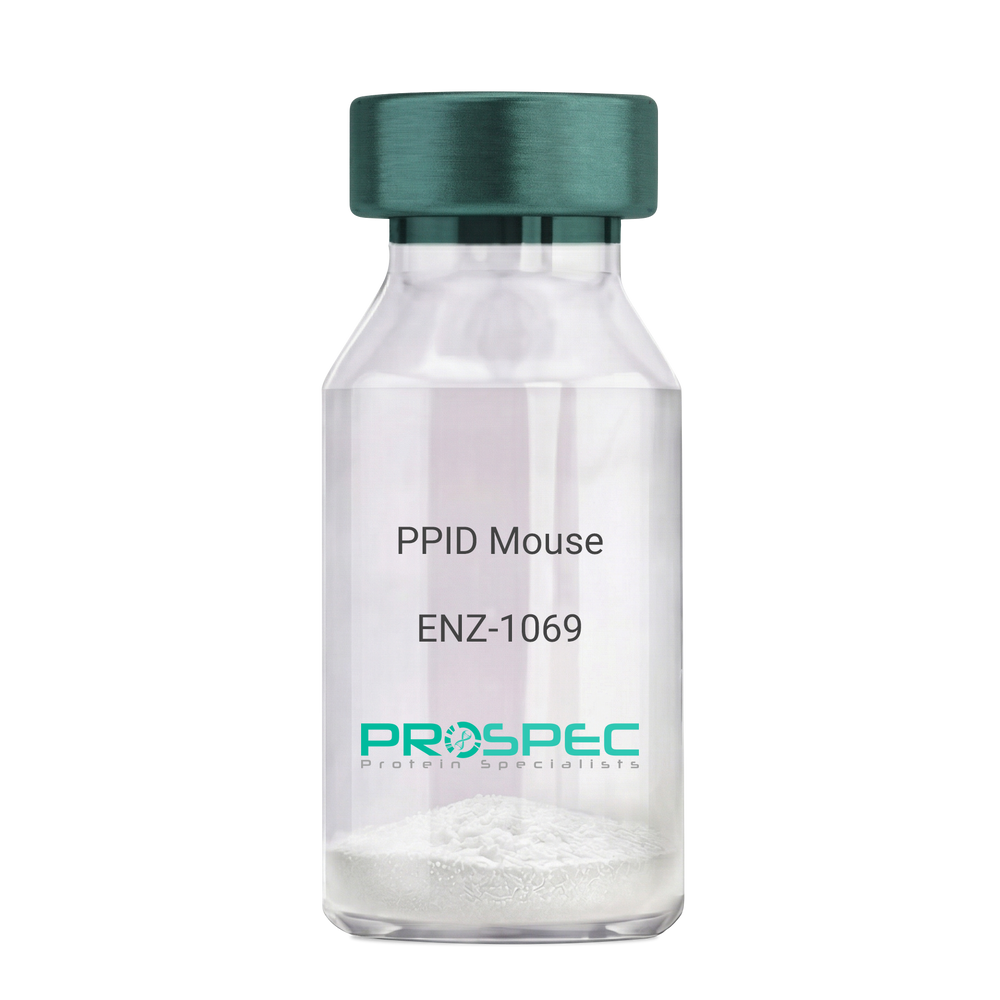
    Name :

    PPID Mouse

    Description:

    Peptidylprolyl Isomerase D Mouse Recombinant

    Peptidyl-prolyl cis-trans isomerase D, PPIase D, 40 kDa peptidyl-prolyl cis-trans isomerase, Cyclophilin-40, CYP-40, Cyclophilin-related protein, CYP40, CYPD, PPID, Peptidylprolyl Isomerase D.

    Product # :

    ENZ-1069

    Price :

    Quantity :

    Shipping Method :

    Ice Icon

    Shipped with Ice Packs

    Add To Cart

    More Info

    • description
    • source
    • formulation
    • purity
    • biological activity
    • More Info

    Description

    PPID Mouse Recombinant produced in E.Coli is a single, non-glycosylated polypeptide chain containing 395 amino acids (1-370a.a.) and having a molecular mass of 43.4kDa. PPID is fused to a 25 amino acid His-tag at N-terminus & purified by proprietary chromatographic techniques.

    Source

    Escherichia Coli.

    Formulation

    PPID protein solution (1mg/ml) containing 20mM Tris-Hcl buffer (pH8.0), 10% glycerol and 1mM DTT.

    Purity

    Greater than 90.0% as determined by SDS-PAGE.

    Biological Activity

    Specific activity is > 700nmol/min/mg, and is defined as the amount of enzyme that cleaves 1umole of suc-AAFP-PNA per minute at 37°C in Tris–HCl pH 8.0 using chymotrypsin.

    More Info

    • Introduction

      Cyclophilin-D is a member of the peptidyl-prolyl cis-trans isomerase (PPIase) family. PPIases catalyze the cis-trans isomerization of proline imidic peptide bonds in oligopeptides and speeds up the protein folding. Cyclophilin-D possess PPIase activity and binds to the immunosuppressant cyclosporin-A. Cyclophilin-D is very well known that its overexpression suppresses the apoptosis in cancer cell. Cyclophilin-D suppresses apoptotic cell death by the use of mitochondrial hexokinase-2 dependent mechanism in cancer cells.

    • Synonyms

      Peptidyl-prolyl cis-trans isomerase D, PPIase D, 40 kDa peptidyl-prolyl cis-trans isomerase, Cyclophilin-40, CYP-40, Cyclophilin-related protein, CYP40, CYPD, PPID, Peptidylprolyl Isomerase D.

    • Physical Appearance

      Sterile Filtered colorless solution.

    • Stability

      Store at 4°C if entire vial will be used within 2-4 weeks. Store, frozen at -20°C for longer periods of time. For long term storage it is recommended to add a carrier protein (0.1% HSA or BSA). Please prevent freeze-thaw cycles.

    • Amino Acid Sequence

      MGSSHHHHHH SSGLVPRGSH MGSEFMSHAS PAAKPSNSKN PRVFFDVDIG GERVGRIVLE LFADIVPKTA ENFRALCTGE KGTGSTTGKP LHFKGCPFHR IIKKFMIQGG DFSNQNGTGG ESIYGEKFED ENFHYKHDRE GLLSMANAGP NTNGSQFFIT TVPTPHLDGK HVVFGQVIKG LGVARTLENV EVNGEKPAKL CVIAECGELK EGDDWGIFPK DGSGDSHPDF PEDADIDLKD VDKILLISED LKNIGNTFFK SQNWEMAIKK YAKVLRYVDS SKAVIEKADR SRLQPIALSC VLNIGACKLK MSNWQGAIDS CLEALEMDPS NTKALYRKAQ GWQGLKEYDQ ALADLKKAQE IAPGDKAIQA ELLKVKQMIK AQKDKEKAVY AKMFA.

    ProSpec's products are furnished for LABORATORY RESEARCH USE ONLY. The product may not be used as drugs, agricultural or pesticidal products, food additives or household chemicals.

    Ppid Mouse
  • View Data Sheet

    Name :

    CAS9 S. Pyogenes

    Description:

    CRISPR-Associated Protein-9 Nuclease S. Pyogenes Recombinant

    CRISPR-associated endonuclease Cas9/Csn1, SpyCas9, cas9, csn1.

    Product # :

    ENZ-901

    Price :

    Quantity :

    Shipping Method :

    Ice Icon

    Shipped with Ice Packs

    Add To Cart

    More Info

    • description
    • source
    • formulation
    • purity
    • More Info

    Description

    Recombinant Cas9-NLS produced in E.coli, comprises the entire Cas9 protein sequence (1368 amino acids) joined to a proprietary nuclear localization sequence (NLS) and a 6xHis tag at the C-terminus, having a total of 1414 amino acids. The protein has an apparent molecular weight of 163kDa.

    Source

    Escherichia Coli.

    Formulation

    The CAS9 solution contains 10mM Tris-HCl, 300mM NaCl, 0.1mM EDTA, 50% glycerol and 1mM DTT pH 7.5.

    Purity

    Greater than 90% as determined by SDS-PAGE.

    More Info

    • Introduction

      Cas9 (CRISPR associated protein 9) is an RNA-guided DNA endonuclease enzyme associated with the CRISPR (Clustered Regularly Interspaced Short Palindromic Repeats) adaptive immunity system in Streptococcus pyogenes, among other bacteria. S. Pyogenes utilizes Cas9 to remember and later probe and cleave foreign DNA, such as invading bacteriophage DNA or plasmid DNA. In case that the DNA substrate is complementary to the guide RNA, Cas9 cleaves the invading DNA. In addition to its original role in bacterial immunity, the Cas9 protein has been heavily employed as a genome engineering tool to induce site-directed double strand breaks in DNA. These disruptions may lead to gene inactivation or the presentation of heterologous genes via non-homologous end joining and homologous recombination respectively in many laboratory model organisms.

    • Synonyms

      CRISPR-associated endonuclease Cas9/Csn1, SpyCas9, cas9, csn1.

    • Physical Appearance

      Sterile Filtered colorless solution.

    • Stability

      Store at 4°C if entire vial will be used within 2-4 weeks. Store, frozen at -20°C for longer periods of time. For long term storage it is recommended to add a carrier protein (0.1% HSA or BSA).Avoid multiple freeze-thaw cycles.

    • Non-specific DNAse activity

      The incubation of 20pmol of CAS9 protein with 1µg of lambda DNA at 37°C for 4 hours is free of detectable DNA degradation, as visualized on agarose gel.

    • Enzymatic Activity

      97% of PCR product digestion after 30 minutes at 37°C.

    • Endonuclease Activity

      The incubation of 20pmol of CAS9 protein with 1µg pUC19 supercoiled vector at 37°C for 4 hours leads to formation of less than 10% open circular pUC19 form as determined by gel electrophoresis.

    ProSpec's products are furnished for LABORATORY RESEARCH USE ONLY. The product may not be used as drugs, agricultural or pesticidal products, food additives or household chemicals.

    Cas9 S Pyogenes
  • View Data Sheet

    Name :

    PYCRL Human

    Description:

    Pyrroline-5-Carboxylate Reductase Like Human Recombinant

    Pyrroline-5-carboxylate reductase 3, P5C reductase 3, P5CR 3, Pyrroline-5-carboxylate reductase-like protein, PYCRL.

    Product # :

    ENZ-678

    Price :

    Quantity :

    Shipping Method :

    Ice Icon

    Shipped with Ice Packs

    Add To Cart

    More Info

    • description
    • source
    • formulation
    • purity
    • More Info

    Description

    PYCRL Human Recombinant produced in E.coli is a single, non-glycosylated polypeptide chain containing 297 amino acids (1-274) and having a molecular mass of 31kDa.PYCRL is fused to a 23 amino acid His-tag at N-terminus & purified by proprietary chromatographic techniques.

    Source

    Escherichia Coli.

    Formulation

    The PYCRL solution (0.25mg/ml) contains 20mM Tris-HCl buffer (pH 8.0), 0.2M NaCl, 50% glycerol and 2mM DTT.

    Purity

    Greater than 90.0% as determined by SDS-PAGE.

    More Info

    • Introduction

      Pyrroline-5-Carboxylate Reductase Like (PYCRL) is a member of the pyrroline-5-carboxylate reductase family and acts as a homodecamer. PYCRL plays a key role in proline bio-synthesis. Proline serves as a non-enzymatic antioxidant to reduce damage caused by reactive oxygen species (ROS) in microorganisms, animals and plants. In the final stage of proline biosynthesis, PYCRL catalyzes the reduction of aldehyde dehydrogenase 4A1 (ALDH4A1) to proline with NAD(P)H as the cofactor.

    • Synonyms

      Pyrroline-5-carboxylate reductase 3, P5C reductase 3, P5CR 3, Pyrroline-5-carboxylate reductase-like protein, PYCRL.

    • Physical Appearance

      Sterile Filtered colorless solution.

    • Stability

      Store at 4°C if entire vial will be used within 2-4 weeks.Store, frozen at -20°C for longer periods of time. For long term storage it is recommended to add a carrier protein (0.1% HSA or BSA).Avoid multiple freeze-thaw cycles.

    • Amino Acid Sequence

      MGSSHHHHHH SSGLVPRGSH MGSMAAAEPS PRRVGFVGAG RMAGAIAQGL IRAGKVEAQH ILASAPTDRN LCHFQALGCR TTHSNQEVLQ SCLLVIFATK PHVLPAVLAE VAPVVTTEHI LVSVAAGVSL STLEELLPPN TRVLRVLPNL PCVVQEGAIV MARGRHVGSS ETNLLQHLLE ACGRCEEVPE AYVDIHTGLS GSGVAFVCAF SEALAEGAVK MGMPSSLAHR IAAQTLLGTA KMLLHEGQHP AQLRSDVCTP GGTTIYGLHA LEQGGLRAAT MSAVEAATCR AKELSRK.

    ProSpec's products are furnished for LABORATORY RESEARCH USE ONLY. The product may not be used as drugs, agricultural or pesticidal products, food additives or household chemicals.

    Pycrl Human
  • View Data Sheet

    Name :

    ALDOC Mouse

    Description:

    Aldolase C Fructose-Bisphosphate Mouse Recombinant

    Aldolase 3, Brain-type aldolase, Scrapie-responsive protein 2, Zebrin II, Aldo3, Scrg2, Fructose-bisphosphate aldolase C, ALDOC.

    Product # :

    ENZ-868

    Price :

    Quantity :

    Shipping Method :

    Ice Icon

    Shipped with Ice Packs

    Add To Cart

    More Info

    • description
    • source
    • formulation
    • purity
    • More Info

    Description

    ALDOC Mouse Recombinant produced in E.Coli is a single, non-glycosylated polypeptide chain containing 387 amino acids (1-363 a.a) and having a molecular mass of 41.9kDa.ALDOC is fused to a 24 amino acid His-tag at N-terminus & purified by proprietary chromatographic techniques.

    Source

    Escherichia Coli.

    Formulation

    The ALDOC solution (1mg/ml) containing Phosphate buffered saline (pH7.4), 20% glycerol and 1mM DTT.

    Purity

    Greater than 95.0% as determined by SDS-PAGE.

    More Info

    • Introduction

      Aldolase C Fructose-Bisphosphate (ALDOC) belongs to the class I fructose-bisphosphate aldolase family. ALDOC is a glycolytic enzyme which catalyzes the reversible aldol cleavage of fructose-1,6-biphosphate and fructose 1-phosphate to dihydroxyacetone phosphate and either glyceraldehyde-3-phosphate or glyceraldehydes respectively. ALDOC is expressed exclusively in the hippocampus and Purkinje cells of the brain.

    • Synonyms

      Aldolase 3, Brain-type aldolase, Scrapie-responsive protein 2, Zebrin II, Aldo3, Scrg2, Fructose-bisphosphate aldolase C, ALDOC.

    • Physical Appearance

      Sterile Filtered clear colorless solution.

    • Stability

      Store at 4°C if entire vial will be used within 2-4 weeks.Store, frozen at -20°C for longer periods of time. For long term storage it is recommended to add a carrier protein (0.1% HSA or BSA).Avoid multiple freeze-thaw cycles.

    • Amino Acid Sequence

      MGSSHHHHHH SSGLVPRGSH MGSHMPHSYP ALSAEQKKEL SDIALRIVTP GKGILAADES VGSMAKRLSQ IGVENTEENR RLYRQVLFSA DDRVKKCIGG VIFFHETLYQ KDDNGVPFVR TIQDKGILVG IKVDKGVVPL AGTDGETTTQ GLDGLLERCA QYKKDGADFA KWRCVLKISD RTPSALAILE NANVLARYAS ICQQNGIVPI VEPEILPDGD HDLKRCQYVT EKVLAAVYKA LSDHHVYLEG TLLKPNMVTP GHACPIKYSP EEIAMATVTA LRRTVPPAVP GVTFLSGGQS EEEASLNLNA INRCPLPRPW ALTFSYGRAL QASALNAWRG QRDNAGAATE EFIKRAEMNG LAAQGRYEGS GDGGAAAQSL YIANHAY

    ProSpec's products are furnished for LABORATORY RESEARCH USE ONLY. The product may not be used as drugs, agricultural or pesticidal products, food additives or household chemicals.

    Aldoc Mouse
  • View Data Sheet

    Name :

    HPRT1 Human

    Description:

    Hypoxanthine-Guanine Phosphoribosyltransferase Human Recombinant

    Hypoxanthine-Guanine Phosphoribosyltransferase , EC 2.4.2.8, HGPRT, HGPRTase, HPRT, HPRT1.

    Product # :

    ENZ-524

    Price :

    Quantity :

    Shipping Method :

    Ice Icon

    Shipped with Ice Packs

    Add To Cart

    More Info

    • description
    • source
    • formulation
    • purity
    • More Info

    Description

    HPRT1 Recombinant Human produced in E.Coli is a single, non-glycosylated polypeptide chain containing 238 amino acids (1-218 a.a.) and having a molecular mass of 26.7 kDa. The HPRT1 is fused to a 20 amino acids His-Tag at N-terminus and purified by proprietary chromatographic techniques.

    Source

    Escherichia Coli.

    Formulation

    HPRT1 Human solution containing 20mM Tris HCl pH-8, & 20% glycerol.

    Purity

    Greater than 95.0% as determined by SDS-PAGE.

    More Info

    • Introduction

      HPRT1 has a main part in the generation of purine nucleotides through the purine salvage pathway. HPRT1 primarily functions to salvage purines from degraded DNA to renewed purine synthesis. Therefore, it performs as a catalyst in the reaction between guanine and phosphoribosyl pyrophosphate to form GMP.

    • Synonyms

      Hypoxanthine-Guanine Phosphoribosyltransferase , EC 2.4.2.8, HGPRT, HGPRTase, HPRT, HPRT1.

    • Physical Appearance

      Sterile filtered colorless solution.

    • Stability

      Store at 4°C if entire vial will be used within 2-4 weeks. Store, frozen at -20°C for longer periods of time. For long term storage it is recommended to add a carrier protein (0.1% HSA or BSA).Avoid multiple freeze-thaw cycles.

    • Amino Acid Sequence

      MGSSHHHHHH SSGLVPRGSH MATRSPGVVI SDDEPGYDLD LFCIPNHYAE DLERVFIPHG LIMDRTERLA RDVMKEMGGH HIVALCVLKG GYKFFADLLD YIKALNRNSD RSIPMTVDFI RLKSYCNDQS TGDIKVIGGD DLSTLTGKNV LIVEDIIDTG KTMQTLLSLV RQYNPKMVKV ASLLVKRTPR SVGYKPDFVG FEIPDKFVVG YALDYNEYFR DLNHVCVISE TGKAKYKA.

    ProSpec's products are furnished for LABORATORY RESEARCH USE ONLY. The product may not be used as drugs, agricultural or pesticidal products, food additives or household chemicals.

    Hprt1 Human
  • View Data Sheet

    Name :

    ASMT Human

    Description:

    Acetylserotonin O-Methyltransferase Human Recombinant

    HIOMT, HIOMTY, Acetylserotonin O-methyltransferase , Hydroxyindole O-methyltransferase , ASMT.

    Product # :

    ENZ-664

    Price :

    Quantity :

    Shipping Method :

    Ice Icon

    Shipped with Ice Packs

    Add To Cart

    More Info

    • description
    • source
    • formulation
    • purity
    • More Info

    Description

    ASMT Human Recombinant produced in E.coli is a single, non-glycosylated polypeptide chain containing 318 amino acids (1-298 a.a) and having a molecular mass of 35.3kDa.ASMT is fused to a 20 amino acid His-tag at N-terminus & purified by proprietary chromatographic techniques.

    Source

    Escherichia Coli.

    Formulation

    The ASMT solution (1mg/ml) contains 20mM Tris-HCl buffer (pH 8.0) , 1M Urea and 10% glycerol.

    Purity

    Greater than 90.0% as determined by SDS-PAGE.

    More Info

    • Introduction

      ASMT is a member of the methyltransferase superfamily. ASMT participates in melatonin biosynthesis. ASMT Expressed in brain, retina and pineal gland, ASMT utilities to catalyze the final reaction in the synthesis of melatonin, particularly the conversion of S-adenosyl-L-methionine and N-acetylserotonin to S-adenosyl-Lhomocysteine and melatonin.

    • Synonyms

      HIOMT, HIOMTY, Acetylserotonin O-methyltransferase , Hydroxyindole O-methyltransferase , ASMT.

    • Physical Appearance

      Sterile Filtered clear solution.

    • Stability

      Store at 4°C if entire vial will be used within 2-4 weeks. Store, frozen at -20°C for longer periods of time. For long term storage it is recommended to add a carrier protein (0.1% HSA or BSA).Avoid multiple freeze-thaw cycles.

    • Amino Acid Sequence

      MGSSHHHHHH SSGLVPRGSH MGSSEDQAYR LLNDYANGFM VSQVLFAACE LGVFDLLAEA PGPLDVAAVA AGVRASAHGT ELLLDICVSL KLLKVETRGG KAFYRNTELS SDYLTTVSPT SQCSMLKYMG RTSYRCWGHL ADAVREGRNQ YLETFGVPAE ELFTAIYRSE GERLQFMQAL QEVWSVNGRS VLTAFDLSVF PLMCDLGGDF FKDPLPEADL YILARVLHDW ADGKCSHLLE RIYHTCKPGG GILVIESLLD EDRRGPLLTQ LYSLNMLVQT EGQERTPTHY HMLLSSAGFR DFQFKKTGAI YDAILARK

    ProSpec's products are furnished for LABORATORY RESEARCH USE ONLY. The product may not be used as drugs, agricultural or pesticidal products, food additives or household chemicals.

    Asmt Human
  • View Data Sheet

    Name :

    ENO2 Human

    Description:

    Enolase-2 Human Recombinant

    Gamma-enolase, EC 4.2.1.11, 2-phospho-D-glycerate hydro-lyase, Neural enolase, Neuron-specific enolase, NSE, Enolase 2, ENO2.

    Product # :

    ENZ-324

    Price :

    Quantity :

    Shipping Method :

    Ice Icon

    Shipped with Ice Packs

    Add To Cart

    More Info

    • description
    • source
    • formulation
    • purity
    • biological activity
    • More Info
    • sds-page

    Description

    ENO2 Human Recombinant expressed in E. coli contains 434 amino acids and its Mw is 47 kDa. The Enolase-2 is purified by proprietary chromatographic techniques.

    Source

    Escherichia Coli.

    Formulation

    ENO2 is supplied in 20mM Tris pH-7.5, 0.1M KCl, 5mM MgSO4.

    Purity

    Greater than 95% as determined by SDS-PAGE.

    Biological Activity

    > 25,000 pmol/min/ug, determined by the decrease of NAD in absorbance at 340nm resulting from NADH at pH 6.5 at 37C.

    sds-page

    ENO2 Human sds-page - Product image 1

    More Info

    • Introduction

      Neuron-specificenolase also caled NSE is a glycolytic isoenzyme which is situated in central and peripheral neurons and neuroendocrine cells. Enolase-2 is released into the CSF when neural tissue is injured. Neoplasms derived from neural or neuroendocrine tissue release Enolase-2 into the blood. Enolase-2 is a useful substance that has been detected in patients with certain tumors, such as neuroblastoma, small cell lung cancer, medullary thyroid cancer, carcinoid tumors, pancreatic endocrine tumors, and melanoma. ENO2 is 1 of the 3 enolase isoenzymes found in mammals. ENO2 isoenzyme, is found in mature neurons and cells of neuronal origin. An exchange from alpha enolase to gamma enolase occurs in neural tissue during development in rats and primates.

    • Synonyms

      Gamma-enolase, EC 4.2.1.11, 2-phospho-D-glycerate hydro-lyase, Neural enolase, Neuron-specific enolase, NSE, Enolase 2, ENO2.

    • Physical Appearance

      Sterile Filtered clear solution.

    • Stability

      Store at 4°C if entire vial will be used within 1-2 weeks. Store, frozen at -20°C for longer periods of time. Please prevent freeze-thaw cycles.

    • Amino Acid Sequence

      MSIEKIWARE ILDSRGNPTV EVDLYTAKGL FRAAVPSGAS TGIYEALELR DGDKQRYLGK GVLKAVDHIN STIAPALISS GLSVVEQEKL DNLMLELDGT ENKSKFGANA ILGVSLAVCK AGAAERELPL YRHIAQLAGN SDLILPVPAF NVINGGSHAG NKLAMQEFMI LPVGAESFRD AMRLGAEVYH TLKGVIKDKY GKDATNVGDE GGFAPNILEN SEALELVKEA IDKAGYTEKI VIGMDVAASE FYRDGKYDLD FKSPTDPSRY ITGDQLGALY QDFVRDYPVV SIEDPFDQDD WAAWSKFTAN VGIQIVGDDL TVTNPKRIER AVEEKACNCL LLKVNQIGSV TEAIQACKLA QENGWGVMVS HRSGETEDTF IADLVVGLCT GQIKTGAPCR SERLAKYNQL MRIEEELGDE ARFAGHNFRN PSVL.

    ProSpec's products are furnished for LABORATORY RESEARCH USE ONLY. The product may not be used as drugs, agricultural or pesticidal products, food additives or household chemicals.

    Eno2 Human Recombinant
  • View Data Sheet

    Name :

    LDHB Human, His

    Description:

    Lactate Dehydrogenase B Human Recombinant, His Tag

    LDH-H, TRG-5, L-lactate dehydrogenase B chain, LDH-B, EC=1.1.1.27, Renal carcinoma antigen NY-REN-46, LDHB.

    Product # :

    ENZ-539

    Price :

    Quantity :

    Shipping Method :

    Ice Icon

    Shipped with Ice Packs

    Add To Cart

    More Info

    • description
    • source
    • formulation
    • purity
    • biological activity
    • More Info

    Description

    LDHB Recombinant Human produced in E.Coli is a single, non-glycosylated polypeptide chain containing 354 amino acids (1-334 a.a.) and having a molecular mass of 38.8 kDa. The LDHB is fused to a 20 amino acids His-Tag at N-terminus and purified by proprietary chromatographic techniques.

    Source

    Escherichia Coli.

    Formulation

    LDHB Human solution containing 20mM Tris-HCl pH-8, 1mM DTT & 10% glycerol.

    Purity

    Greater than 95.0% as determined by SDS-PAGE.

    Biological Activity

    Specific activity is > 6 units/mg. in which one unit will convert 1.0 umole of pyruvate to L-lactate and beta-NAD per minute at pH 7.5 at 37°C.

    More Info

    • Introduction

      LDHB is part of the lactate dehydrogenase family. LDHB is an oxidoreductase which catalyses the interconversion of pyruvate and lactate with concomitant interconversion of NADH and NAD+. LDHB catalyzes the oxidation of hydroxybutyrate, and frequently called Hydroxybutyrate Dehydrogenase (HBD). The LDH family consists of three members, LDH-A, LDH-B and LDH-C. LDHs function as powerful markers for germ cell tumors.

    • Synonyms

      LDH-H, TRG-5, L-lactate dehydrogenase B chain, LDH-B, EC=1.1.1.27, Renal carcinoma antigen NY-REN-46, LDHB.

    • Physical Appearance

      Sterile filtered colorless solution.

    • Stability

      Store at 4°C if entire vial will be used within 2-4 weeks. Store, frozen at -20°C for longer periods of time. For long term storage it is recommended to add a carrier protein (0.1% HSA or BSA).Avoid multiple freeze-thaw cycles.

    • Amino Acid Sequence

      MGSSHHHHHH SSGLVPRGSH MATLKEKLIA PVAEEEATVP NNKITVVGVG QVGMACAISI LGKSLADELA LVDVLEDKLK GEMMDLQHGS LFLQTPKIVA DKDYSVTANS KIVVVTAGVR QQEGESRLNL VQRNVNVFKF IIPQIVKYSP DCIIIVVSNP VDILTYVTWK LSGLPKHRVI GSGCNLDSAR FRYLMAEKLG IHPSSCHGWI LGEHGDSSVA VWSGVNVAGV SLQELNPEMG TDNDSENWKE VHKMVVESAY EVIKLKGYTN WAIGLSVADL IESMLKNLSR IHPVSTMVKG MYGIENEVFL SLPCILNARG LTSVINQKLK DDEVAQLKKS ADTLWDIQKD LKDL.

    ProSpec's products are furnished for LABORATORY RESEARCH USE ONLY. The product may not be used as drugs, agricultural or pesticidal products, food additives or household chemicals.

    Ldhb Human
  • View Data Sheet

    Name :

    KARS Human

    Description:

    Lysyl-tRNA Synthetase Human Recombinant

    Lysine--tRNA ligase, Lysyl-tRNA synthetase, LysRS, KARS, KIAA0070, KRS, KARS2, CMTRIB.

    Product # :

    ENZ-161

    Price :

    Quantity :

    Shipping Method :

    Ice Icon

    Shipped with Ice Packs

    Add To Cart

    More Info

    • description
    • source
    • formulation
    • purity
    • More Info

    Description

    KARS Human Recombinant produced in E.Coli is a single, non-glycosylated polypeptide chain containing 558 amino acids (63-597 a.a.) and having a molecular mass of 63.7kDa.KARS is fused to a 23 amino acid His-tag at N-terminus & purified by proprietary chromatographic techniques.

    Source

    Escherichia Coli.

    Formulation

    KARS protein solution (1mg/ml) containing 20mM Tris-HCl buffer (pH8.0), 20% glycerol, 0.1M NaCl and 1mM DTT.

    Purity

    Greater than 95.0% as determined by SDS-PAGE.

    More Info

    • Introduction

      Lysyl-tRNA synthetase (KARS) is a member of the class-II aminoacyl-tRNA synthetase family. KARS exists as both mitochondrial and cytoplasmic isoforms produced by alternative splicing, and believed to have a role in autoimmune diseases, such as polymyositis or dermatomyositis. The KARS protein functions to catalyze the aminoacylation of tRNAs by their corresponding amino acids, so linking amino acids with tRNA-contained nucleotide triplets.

    • Synonyms

      Lysine--tRNA ligase, Lysyl-tRNA synthetase, LysRS, KARS, KIAA0070, KRS, KARS2, CMTRIB.

    • Physical Appearance

      Sterile Filtered colorless solution.

    • Stability

      Store at 4°C if entire vial will be used within 2-4 weeks. Store, frozen at -20°C for longer periods of time. For long term storage it is recommended to add a carrier protein (0.1% HSA or BSA).Avoid multiple freeze-thaw cycles.

    • Amino Acid Sequence

      MGSSHHHHHH SSGLVPRGSH MGSGVGPEEE SVDPNQYYKI RSQAIHQLKV NGEDPYPHKF HVDISLTDFI QKYSHLQPGD HLTDITLKVA GRIHAKRASG GKLIFYDLRG EGVKLQVMAN SRNYKSEEEF IHINNKLRRG DIIGVQGNPG KTKKGELSII PYEITLLSPC LHMLPHLHFG LKDKETRYRQ RYLDLILNDF VRQKFIIRSK IITYIRSFLD ELGFLEIETP MMNIIPGGAV AKPFITYHNE LDMNLYMRIA PELYHKMLVV GGIDRVYEIG RQFRNEGIDL THNPEFTTCE FYMAYADYHD LMEITEKMVS GMVKHITGSY KVTYHPDGPE GQAYDVDFTP PFRRINMVEE LEKALGMKLP ETNLFETEET RKILDDICVA KAVECPPPRT TARLLDKLVG EFLEVTCINP TFICDHPQIM SPLAKWHRSK EGLTERFELF VMKKEICNAY TELNDPMRQR QLFEEQAKAK AAGDDEAMFI DENFCTALEY GLPPTAGWGM GIDRVAMFLT DSNNIKEVLL FPAMKPEDKK ENVATTDTLE STTVGTSV.

    ProSpec's products are furnished for LABORATORY RESEARCH USE ONLY. The product may not be used as drugs, agricultural or pesticidal products, food additives or household chemicals.

    Kars Human
  • View Data Sheet

    Name :

    SERPINI1 Human

    Description:

    Serpin Peptidase Inhibitor, Clade I Member 1 Human Recombinant

    Neuroserpin, Peptidase inhibitor 12, PI-12, Serpin I1, SERPINI1, PI12.

    Product # :

    PRO-213

    Price :

    Quantity :

    Shipping Method :

    Room Temp Icon

    Shipped at Room temp

    Add To Cart

    More Info

    • description
    • source
    • formulation
    • purity
    • biological activity
    • More Info

    Description

    SERPINI1 Human Recombinant produced in E.coli is a single, non-glycosylated polypeptide chain containing 394 amino acids and having a total molecular mass of 44.7kDa. SERPINI1 is purified by proprietary chromatographic techniques.

    Source

    Escherichia Coli.

    Formulation

    The protein was Lyophilized from a 0.2µm filtered concentrated solution in 1×PBS, pH 7.4.

    Purity

    Greater than 95.0% as determined by
    (a) Analysis by HPLC.
    (b) Analysis by SDS-PAGE.

    Biological Activity

    Determined by the dose-dependent stimulation of the proliferation of rat C6 cells which is less than 0.5µg/ml, corresponding to a specific activity of >2000IU/mg.

    More Info

    • Introduction

      SERPINI1 (Neuroserpin) is an inhibitory serpin which is expressed primarily in the central nervous system. Even though the physiological target of SERPINI1 is still vague, amassed evidence suggest that SERPINI1 has an imperative role in controlling proteolytic degradation of extracellular matrix (ECM) during synaptogenesis and the subsequent development of neuronal plasticity. The neuroprotective role of SERPINI1 has been demonstrated in transgenic mice lacking SERPINI1 expression. The deficiency of SERPINI1 in these mice is linked with motor neuron disease characterized by axonal degradation. In humans, defects in SERPINI1, caused by point mutations in the neuroserpin gene, trigger a hereditary disorder known as the familial encephalopathy with neuroserpin inclusion bodies (FENIB).

    • Synonyms

      Neuroserpin, Peptidase inhibitor 12, PI-12, Serpin I1, SERPINI1, PI12.

    • Physical Appearance

      Sterile Filtered White lyophilized (freeze-dried) powder.

    • Stability

      Lyophilized SERPINI1 although stable at room temperature for 3 weeks, should be stored desiccated below -18°C. Upon reconstitution SERPINI1 should be stored at 4°C between 2-7 days and for future use below -18°C.Please prevent freeze-thaw cycles.

    • Solubility

      It is recommended to reconstitute the lyophilized SERPINI1 in sterile 18M-cm H2O not less than 100µg/ml, which can then be further diluted to other aqueous solutions.

    • Amino Acid Sequence

      TGATFPEEAI ADLSVNMYNR LRATGEDENI LFSPLSIALA MGMMELGAQG
      STQKEIRHSM GYDSLKNGEE FSFLKEFSNM VTAKESQYVM KIANSLFVQN
      GFHVNEEFLQ MMKKYFNAAV NHVDFSQNVA VANYINKWVE NNTNNLVKDL
      VSPRDFDAAT YLALINAVYF KGNWKSQFRP ENTRTFSFTK DDESEVQIPM
      MYQQGEFYYG EFSDGSNEAG GIYQVLEIPY EGDEISMMLV LSRQEVPLAT
      LEPLVKAQLV EEWANSVKKQ KVEVYLPRFT VEQEIDLKDV LKALGITEIF
      IKDANLTGLS DNKEIFLSKA IHKSFLEVNE EGSEAAAVSG MIAISRMAVL
      YPQVIVDHPF FFLIRNRRTG TILFMGRVMH PETMNTSGHD FEEL.

    ProSpec's products are furnished for LABORATORY RESEARCH USE ONLY. The product may not be used as drugs, agricultural or pesticidal products, food additives or household chemicals.

    Serpini1 Human
  • View Data Sheet

    Name :

    PLA2G7 Human

    Description:

    Secreted Phospholipase A2-VII Human Recombinant

    Platelet-activating factor acetylhydrolase, PAF acetylhydrolase, PAF 2-acylhydrolase, LDL-associated phospholipase A2, LDL-PLA(2), 2-acetyl-1-alkylglycerophosphocholine esterase, 1-alkyl-2-acetylglycerophosphocholine esterase, PLA2G7, PAFAH, LP-PLA2, LDL-PLA2.

    Product # :

    ENZ-436

    Price :

    Quantity :

    Shipping Method :

    Ice Icon

    Shipped with Ice Packs

    Add To Cart

    More Info

    • description
    • source
    • formulation
    • purity
    • More Info

    Description

    PLA2G7 Human Recombinant produced in E.Coli is single, a non-glycosylated, Polypeptide chain containing 420 amino acids fragment (22-441) having a total molecular mass of 52.29kDa and fused with a 4.5kDa amino-terminal hexahistidine tag. The PLA2G7 is purified by proprietary chromatographic techniques.

    Source

    Escherichia Coli.

    Formulation

    PLA2G7 protein is supplied in 20mM Tris-HCl pH-8.0, 1mM EDTA and 50% glycerol.

    Purity

    Greater than 95.0% as determined by SDS-PAGE.

    More Info

    • Introduction

      PLA2G7 is a secreted enzyme which catalyzes the degradation of platelet-activating factor to biologically inactive products. The PLA2G7 enzyme is produced by inflammatory cells and hydrolyzes oxidised phospholipids in LDL. In the blood, PLA2G7 goes mainly with LDL and less than 20% is coupled with HDL.
      PLA2G7 is implicated in the development of atherosclerosis and is also a marker for cardiac disease. PLA2G7 might have a major physiologic effect in the presence of inflammatory bodily responses.
      PLA2G7 alters the action of PAF (platelet-activating factor) by hydrolyzing the sn-2 ester bond to yield the biologically inactive lyso-PAF. PLA2G7 has specificity for substrates with a short residue at the sn-2 position. PLA2G7 is inactive against long-chain phospholipids.
      PLA2G7 gene defects are the source of platelet-activating factor acetylhydrolase deficiency, which is a trait that is present in 27% of the Japanese population.

    • Synonyms

      Platelet-activating factor acetylhydrolase, PAF acetylhydrolase, PAF 2-acylhydrolase, LDL-associated phospholipase A2, LDL-PLA(2), 2-acetyl-1-alkylglycerophosphocholine esterase, 1-alkyl-2-acetylglycerophosphocholine esterase, PLA2G7, PAFAH, LP-PLA2, LDL-PLA2.

    • Physical Appearance

      Sterile Filtered clear solution.

    • Stability

      Store at 4°C if entire vial will be used within 2-4 weeks. Store, frozen at -20°C for longer periods of time. Please avoid freeze thaw cycles.

    ProSpec's products are furnished for LABORATORY RESEARCH USE ONLY. The product may not be used as drugs, agricultural or pesticidal products, food additives or household chemicals.

    Pla2G7 Human
  • View Data Sheet

    Name :

    RNLS Human

    Description:

    Renalase Human Recombinant

    Renalase FAD-Dependent Amine Oxidase, Chromosome 10 Open Reading Frame 59, Monoamine Oxidase-C, C10orf59, FLJ11218, Renalase, MAO-C, EC 1.4.-.-.

    Product # :

    ENZ-653

    Price :

    Quantity :

    Shipping Method :

    Ice Icon

    Shipped with Ice Packs

    Add To Cart

    More Info

    • description
    • source
    • formulation
    • purity
    • More Info

    Description

    RNLS Human Recombinant produced in E. coli is a single polypeptide chain containing 349 amino acids (18-342) and having a molecular mass of 38.8 kDa.RNLS is fused to a 24 amino acid His-tag at N-terminus & purified by proprietary chromatographic techniques.

    Source

    E.coli.

    Formulation

    The RNLS solution contains 20mM Tris-HCl buffer (pH 8.0), 2M Urea and 10% glycerol.

    Purity

    Greater than 90% as determined by SDS-PAGE.

    More Info

    • Introduction

      Renalase (RNLS) is a flavin adenine dinucleotide-dependent amine oxidase which is secreted into the blood from the kidney. RNLS acts as a hormone which metabolizes circulating catecholamines that have an active role in the sympathetic and parasympathetic nervous systems. High catecholamine concentration activates plasma RNLS and promotes its secretion and synthesis.

    • Synonyms

      Renalase FAD-Dependent Amine Oxidase, Chromosome 10 Open Reading Frame 59, Monoamine Oxidase-C, C10orf59, FLJ11218, Renalase, MAO-C, EC 1.4.-.-.

    • Physical Appearance

      Sterile Filtered colorless solution.

    • Stability

      Store at 4°C if entire vial will be used within 2-4 weeks. Store, frozen at -20°C for longer periods of time. For long term storage it is recommended to add a carrier protein (0.1% HSA or BSA).Avoid multiple freeze-thaw cycles.

    • Amino Acid Sequence

      MGSSHHHHHH SSGLVPRGSH MGSMALLRRQ TSGPLYLAVW DKAEDSGGRM TTACSPHNPQ CTADLGAQYI TCTPHYAKKH QRFYDELLAY GVLRPLSSPI EGMVMKEGDC NFVAPQGISS IIKHYLKESG AEVYFRHRVT QINLRDDKWE VSKQTGSPEQ FDLIVLTMPV PEILQLQGDI TTLISECQRQ QLEAVSYSSR YALGLFYEAG TKIDVPWAGQ YITSNPCIRF VSIDNKKRNI ESSEIGPSLV IHTTVPFGVT YLEHSIEDVQ ELVFQQLENI LPGLPQPIAT KCQKWRHSQV TNAAANCPGQ MTLHHKPFLA CGGDGFTQSN FDGCITSALC VLEALKNYI

    ProSpec's products are furnished for LABORATORY RESEARCH USE ONLY. The product may not be used as drugs, agricultural or pesticidal products, food additives or household chemicals.

    Rnls Human
  • View Data Sheet

    Name :

    Streptokinase

    Description:

    Streptokinase Recombinant

    Streptokinase, SK.

    Product # :

    ENZ-315

    Price :

    Quantity :

    Shipping Method :

    Room Temp Icon

    Shipped at Room temp

    Add To Cart

    More Info

    • description
    • source
    • formulation
    • purity
    • biological activity
    • More Info
    • sds-page

    Description

    Streptokinase Recombinant produced in E.Coli is a non-glycosylated polypeptide chain containing 414 amino acids and having a molecular weight of 47.3kDa.The Streptokinase is purified by proprietary chromatographic techniques.

    Source

    Escherichia Coli.

    Formulation

    Lyophilized from a 0.2µm filtered concentrated (1mg/ml) solution in PBS, pH 7.4.

    Purity

    Greater than 97.0% as determined by:
    (a) Analysis by RP-HPLC.
    (b) Analysis by SDS-PAGE.

    Biological Activity

    The specific biological activity measured by the ability of fibrin lysis in agarose plate was found to be 80000IU/mg.

    sds-page

    streptokinase sds-page - Product image 1

    More Info

    • Introduction

      Streptokinase is an extracellular metallo-enzymeproduced by beta-haemolytic streptococcusand is used as an effective and cheap clot-dissolving medicationin some cases of myocardial infarction(heart attack) and pulmonary embolism.
      It belongs to a group of medications known as fibrinolytics, and works by activating plasminogenthrough cleavage to produce plasmin.

    • Synonyms

      Streptokinase, SK.

    • Physical Appearance

      Sterile Filtered White lyophilized (freeze-dried) powder.

    • Stability

      Lyophilized Streptokinase although stable at room temperature for 3 weeks, should be stored desiccated below -18°C. Upon reconstitution Streptokinase should be stored at 4°C between 2-7 days and for future use below -18°C.Please prevent freeze-thaw cycles.

    • Solubility

      It is recommended to reconstitute the lyophilized Streptokinase in sterile 18M-cm H2O not less than 100µg/ml, which can then be further diluted to other aqueous solutions.

    • Amino Acid Sequence

      IAGPEWLLDR PSVNNSQLVV SVAGTVEGTN QDISLKFFEI DLTSRPAHGG KTEQGLSPKS KLFATDSGAM PHKLEKADLL KAIQEQLIAN VHSNDDYFEV IDFASDATIT DRNGKVYFAD KDGSVTLPIQ PVQEFLLKGH VRVRPYKEKP VQNQAKSVDV EYTVQFTPLN PDDDFRPALK DTKLLKTLAI GDTITSQELL AQAQSILNKN HPGYTIYERD SSIVTHDNDI FRTILPMDQE FTYHVKNREQ AYRINKKSGL NEEINNTDLI SEKYYVLKKG EKPYDPFDRS HLKLFTIKYV DVNTNELLKS EQLLTASERN LDFRDLYDPR DKAKLLYNNL DAFGIMDYTL TGKVEDNHDD TNRIITVYMG KRPEGENASY HLAYDKDRYT EEEREVYSYL RYTGTPIPDN PNDK.

    ProSpec's products are furnished for LABORATORY RESEARCH USE ONLY. The product may not be used as drugs, agricultural or pesticidal products, food additives or household chemicals.

    Streptokinase
  • View Data Sheet

    Name :

    ALPL Human

    Description:

    Alkaline Phosphatase Human Recombinant

    Alkaline phosphatase liver/bone/kidney isozyme, phosphoamidase, Phosphocreatine phosphatase, aalkaline phosphatase, tissue-nonspecific isozyme isoform 1, ALPL, AP-TNAP, APTNAP, HOPS, HPPA, HPPC, HPPI, HPPO, TNALP, TNAP, TNS-ALP, TNSALP.

    Product # :

    ENZ-1190

    Price :

    Quantity :

    Shipping Method :

    Ice Icon

    Shipped with Ice Packs

    Add To Cart

    More Info

    • description
    • source
    • formulation
    • purity
    • biological activity
    • More Info

    Description

    ALPL Human Recombinant produced in HEK293 is a single, glycosylated polypeptide chain containing 493 amino acids (18-501 a.a) and having a molecular mass of 54.3kDa. ALPL is fused to a 6 amino acid His-tag at C-terminus & purified by proprietary chromatographic techniques.

    Source

    HEK293.

    Formulation

    ALPL protein solution (1mg/ml) containing Phosphate buffered saline (pH7.4) & 10% glycerol.

    Purity

    Greater than 95.0% as determined by SDS-PAGE.

    Biological Activity

    Specific activity is > 40,000 pmol/min/ug and is defined as the amount of enzyme that hydrolyze 1pmole of 4-Methylumbelliferyl phosphate to phosphate and 4-Methylumbelliferone per minute at pH 8.8 at 37C.

    More Info

    • Synonyms

      Alkaline phosphatase liver/bone/kidney isozyme, phosphoamidase, Phosphocreatine phosphatase, aalkaline phosphatase, tissue-nonspecific isozyme isoform 1, ALPL, AP-TNAP, APTNAP, HOPS, HPPA, HPPC, HPPI, HPPO, TNALP, TNAP, TNS-ALP, TNSALP.

    • Physical Appearance

      Sterile Filtered colorless solution.

    • Stability

      Store at 4°C if entire vial will be used within 2-4 weeks. Store, frozen at -20°C for longer periods of time. For long term storage it is recommended to add a carrier protein (0.1% HSA or BSA). Avoid multiple freeze-thaw cycles.

    • Amino Acid Sequence

      DGSLVPEKEK DPKYWRDQAQ ETLKYALELQ KLNTNVAKNV IMFLGDGMGV STVTAARILK GQLHHNPGEE TRLEMDKFPF VALSKTYNTN AQVPDSAGTA TAYLCGVKAN EGTVGVSAAT ERSRCNTTQG NEVTSILRWA KDAGKSVGIV TTTRVNHATP SAAYAHSADR DWYSDNEMPP EALSQGCKDI AYQLMHNIRD IDVIMGGGRK YMYPKNKTDV EYESDEKARG TRLDGLDLVD TWKSFKPRYK HSHFIWNRTE LLTLDPHNVD YLLGLFEPGD MQYELNRNNV TDPSLSEMVV VAIQILRKNP KGFFLLVEGG RIDHGHHEGK AKQALHEAVE MDRAIGQAGS LTSSEDTLTV VTADHSHVFT FGGYTPRGNS IFGLAPMLSD TDKKPFTAIL YGNGPGYKVV GGERENVSMV DYAHNNYQAQ SAVPLRHETH GGEDVAVFSK GPMAHLLHGV HEQNYVPHVM AYAACIGANL GHCAPAS HHHHHH.

    • Background

      The ALPL human recombinant, a variant of the alkaline phosphatase enzyme, has emerged as a significant focus of biomedical research due to its diverse biological functions and potential therapeutic applications. Alkaline phosphatase (ALPL) is an essential enzyme involved in various physiological processes, including bone mineralization, liver function, and immune regulation. The ALPL human recombinant, generated through recombinant DNA technology, offers a unique platform to explore the molecular complexity and therapeutic implications of this enzyme.

      Understanding the molecular characteristics of ALPL is crucial to unravel its functional diversity. ALPL belongs to a family of enzymes that hydrolyze phosphate esters under alkaline conditions. The structural features, post-translational modifications, and molecular interactions of ALPL contribute to its complexity and enable its participation in multiple biological processes.

      ALPL plays diverse roles in different tissues and physiological contexts. In bone, ALPL is involved in the regulation of mineralization, ensuring proper skeletal development and maintenance. In the liver, ALPL participates in bile acid metabolism and detoxification processes. Furthermore, ALPL has been implicated in immune regulation and inflammation modulation.

      The therapeutic potential of the ALPL human recombinant is vast, offering opportunities for the diagnosis, treatment, and management of various diseases. ALPL-based therapies hold promise for addressing skeletal disorders, such as hypophosphatasia, where ALPL deficiency leads to impaired bone mineralization. ALPL's involvement in liver function also presents avenues for therapeutic interventions in liver diseases. Moreover, the immunomodulatory properties of ALPL highlight its potential role in immune-related disorders.

      This research aims to provide a comprehensive analysis of the ALPL human recombinant, focusing on its molecular characteristics, biological functions, and therapeutic implications. By exploring the intricate nature of ALPL, we aim to shed light on its therapeutic potential and pave the way for future research in this exciting field.

    ProSpec's products are furnished for LABORATORY RESEARCH USE ONLY. The product may not be used as drugs, agricultural or pesticidal products, food additives or household chemicals.

    Alpl Protein
  • View Data Sheet

    Name :

    SERPINA9 Mouse

    Description:

    Serpin Peptidase Inhibitor, Clade A Mouse Recombinant

    Serpin A9, Serpina9, SERPINA9.

    Product # :

    PRO-2366

    Price :

    Quantity :

    Shipping Method :

    Ice Icon

    Shipped with Ice Packs

    Add To Cart

    More Info

    • description
    • source
    • formulation
    • purity
    • More Info

    Description

    SERPINA9 Mouse Recombinant produced in Sf9 Baculovirus cells is a single, glycosylated polypeptide chain containing 401 amino acids (26-418 a.a) and having a molecular mass of 45.2kDa (Molecular size on SDS-PAGE will appear at approximately 50-70kDa).SERPINA9 is fused to an 8 amino acid His-tag at C-terminus & purified by proprietary chromatographic techniques.

    Source

    Sf9, Baculovirus cells.

    Formulation

    SERPINA9 protein solution (0.25mg/ml) contains Phosphate Buffered Saline (pH 7.4) and 10% glycerol.

    Purity

    Greater than 85.0% as determined by SDS-PAGE.

    More Info

    • Introduction

      Serpin Peptidase Inhibitor, Clade A Member 9, also known as serpin A9, belongs to the Serpin superfamily of serine protease inhibitors. Serpins are the most extensively distributed superfamily of protease inhibitors which use a conformational modification to inhibit target enzymes. Serpins are known to inhibit serine proteases as well as inhibiting caspases in addition to papain-like cysteine proteases. Serpins are conformational labile and numerous of the disease-linked mutations of serpins outcome in misfolding or in pathogenic, inactive polymers. serpin A9 demonstrates inhibition towards trypsin, thrombin, as well as plasmin and binds DNA and heparin.

    • Synonyms

      Serpin A9, Serpina9, SERPINA9.

    • Physical Appearance

      Sterile Filtered colorless solution.

    • Stability

      Store at 4°C if entire vial will be used within 2-4 weeks. Store, frozen at -20°C for longer periods of time. For long term storage it is recommended to add a carrier protein (0.1% HSA or BSA). Avoid multiple freeze-thaw cycles.

    • Amino Acid Sequence

      NPYNQESSHL PSMKKNPASQ VSPSNTRFSF LLYQRLAQEN PGQNILFSPV SISTSLAMLS LGARSATKTQ ILRTLGFNFT WVSEPTIHMG FEYLVRSLNK CHQGRELRMG SVLFIRKELQ LQATFLDRVK KLYGAKVFSE DFSNAATAQA QINSYVEKET KGKVVDVIQD LDSQTAMVLV NHIFFKANWT QPFSTANTNK SFPFLLSKGT TVHVPMMHQT ESFAFGVDKE LGCSILQMDY RGDAVAFFVL PGKGKMRQLE KSLSARRLRK WSRSLQKRWI KVFIPKFSIS ASYNLETILP KMGIRDAFNS NADFSGITKT HFLQVSKAAH KAVLDVSEEG TEAAAATTTK LIVRSRDTPS SIIAFKEPFL ILLLDKNTES VLFLGKVENP RKMLEHHHHH H

    ProSpec's products are furnished for LABORATORY RESEARCH USE ONLY. The product may not be used as drugs, agricultural or pesticidal products, food additives or household chemicals.

    Serpina9 Mouse
  • View Data Sheet

    Name :

    GLRX1 Yeast

    Description:

    Glutaredoxin 1 Yeast Recombinant

    Thioltransferase, GRX, GLRX1, GRX1, GRX-1, GLRX-1, Glutathione-dependent oxidoreductase 1, Glutaredoxin 1.

    Product # :

    ENZ-361

    Price :

    Quantity :

    Shipping Method :

    Ice Icon

    Shipped with Ice Packs

    Add To Cart

    More Info

    • description
    • source
    • formulation
    • purity
    • More Info

    Description

    Glutaredoxin Saccharamyces cerevisiae Recombinant containing 6x His tag at C-Terminus produced in E.Coli is a single, non-glycosylated, Polypeptide chain having a molecular mass of 16 kDa.

    Source

    Escherichia Coli.

    Formulation

    Glutaredoxin solution contains PBS, pH-7.5 & 0.01% Na Azide.

    Purity

    Greater than 95% as determined by SDS-PAGE.

    More Info

    • Introduction

      GLRX1 has a glutathione-disulfide oxidoreductase activity in the presence of nadph and glutathione reductase. reduces low molecular weight disulfides and proteins. Glutaredoxin is a glutathione (GSH)-dependent hydrogen donor for ribonucleotide reductase and also catalyzes glutathione-disulfide oxidoreduction reactions in the presence of NADPH and glutathione reductase. GLRX1 is multifunctional enzyme with glutathione-dependent oxidoreductase, glutathione peroxidase and glutathione S-transferase (GST) activity. The disulfide bond functions as an electron carrier in the glutathione-dependent synthesis of deoxyribonucleotides by the enzyme ribonucleotide reductase. In addition, it is also involved in reducing cytosolic protein- and non-protein-disulfides in a coupled system with glutathione reductase. Required for resistance to reactive oxygen species (ROS) by directly reducing hydroperoxides and for the detoxification of ROS-mediated damage.

    • Synonyms

      Thioltransferase, GRX, GLRX1, GRX1, GRX-1, GLRX-1, Glutathione-dependent oxidoreductase 1, Glutaredoxin 1.

    • Physical Appearance

      Sterile Filtered clear colorless solution.

    • Stability

      1 week at 2-10°C. For long term store at -20 to -80°C.

    ProSpec's products are furnished for LABORATORY RESEARCH USE ONLY. The product may not be used as drugs, agricultural or pesticidal products, food additives or household chemicals.

    Glrx1
  • View Data Sheet

    Name :

    BMP 7 Human, HEK

    Description:

    Bone Morphogenetic protein-7 Human Recombinant, HEK

    Osteogenic Protein 1, BMP-7.

    Product # :

    CYT-082

    Price :

    Quantity :

    Shipping Method :

    Room Temp Icon

    Shipped at Room temp

    Add To Cart

    More Info

    • description
    • source
    • formulation
    • purity
    • biological activity
    • More Info

    Description

    BMP-7 Human Recombinant produced in HEK cells is a glycosylated disulfide-linked homodimer, having a molecular weight range of 30-38kDa due to glycosylation.The BMP7 corresponds to amino acid residues 315 to 431 of the full-length BMP-7 precursor and is purified by proprietary chromatographic techniques.

    Source

    HEK.

    Formulation

    The BMP7 was lyophilized from 1mg/ml in 1xPBS.

    Purity

    Greater than 95% as obsereved by SDS-PAGE.

    Biological Activity

    The specific activity was determined by the dose dependent induction of alkaline phosphatase production in the ATDC-5 cell line (Mouse chondrogenic cell line) and is typically 50-250ng/ml.

    More Info

    • Introduction

      The bone morphogenetic proteins (BMPs) are a family of secreted signaling molecules that can induce ectopic bone growth. Many BMPs are part of the transforming growth factor-beta (TGFB) superfamily. BMPs were originally identified by an ability of demineralized bone extract to induce endochondral osteogenesis in vivo in an extraskeletal site. Based on its expression early in embryogenesis, the BMP encoded by this gene has a proposed role in early development. In addition, the fact that this BMP is closely related to BMP5 and BMP7 has lead to speculation of possible bone inductive activity.

    • Synonyms

      Osteogenic Protein 1, BMP-7.

    • Physical Appearance

      Sterile Filtered White lyophilized (freeze-dried) powder.

    • Stability

      Lyophilized BMP7 although stable at room temperature for 3 weeks, should be stored desiccated below -18°C. Upon reconstitution BMP-7 should be stored at 4°C between 2-7 days and for future use below -18°C.For long term storage it is recommended to add a carrier protein (0.1% HSA or BSA).Please prevent freeze-thaw cycles.

    • Solubility

      It is recommended to reconstitute the lyophilized BMP-7 in sterile water not less than 100µg/ml, which can then be further diluted to other aqueous solutions.

    • Amino Acid Sequence

      DFSLDNEVHSSFIHRRLRSQERREMQREILSILGLPHRPRPHLQGKHNSAPMFMLDLYNAM AVEEGGGPGGQGFSYPYKAVFSTQGPPLASLQDSHFLTDADMVMSFVNLVEHDKEFFHPR YHHREFRFDLSKIPEGEAVTAAEFRIYKDYIRERFDNETFRISVYQVLQEHLGRESDLFLDSRTLWASE EGWLVFDITATSNHWVVNPRHNLGLQLSVETLDGQSINPKLAGLIGRHGPQNKQPFMVAFFKAT.

    • Background

      BMP-7 Bone Morphogenetic Protein-7 Human Recombinant: A Key Regulator of Osteogenesis and Beyond

      Abstract:

      BMP-7 (Bone Morphogenetic Protein-7), also known as Osteogenic Protein 1 or BMP-7, is a potent growth factor that plays a crucial role in various biological processes, particularly in osteogenesis and tissue regeneration.

      This research paper aims to comprehensively explore the molecular characteristics, signaling pathways, and diverse physiological functions of BMP-7.

      Additionally, it investigates the therapeutic implications of BMP-7 in different disorders. Synonyms such as Osteogenic Protein 1 and BMP-7 associated with the protein are discussed throughout the paper to highlight their relevance in scientific literature.

      Introduction:

      BMP-7, also known as Osteogenic Protein 1 or BMP-7, is a growth factor with multifaceted roles in osteogenesis, tissue regeneration, and disease. This section introduces BMP-7 and its synonyms, highlighting their significance and relevance in scientific research.

      Molecular Characteristics of BMP-7:

      This section explores the molecular characteristics of BMP-7, including its primary amino acid sequence, protein structure, post-translational modifications, and binding partners. The importance of these factors in determining BMP-7's biological activity and receptor specificity is discussed.

      Signaling Pathways Activated by BMP-7 :

      BMP-7 activates specific signaling pathways upon binding to its receptors, leading to diverse cellular responses. This section focuses on the canonical BMP signaling pathway, highlighting the activation of Smad-dependent and Smad-independent pathways. The downstream effectors and transcriptional regulators involved in mediating BMP-7's cellular responses are also discussed.

      Physiological Functions of BMP-7 :

      BMP-7 plays critical roles in various physiological processes, particularly in osteogenesis and tissue regeneration. This section provides an in-depth analysis of BMP-7's contributions to these processes, emphasizing its role in promoting bone formation, cartilage development, renal function, and wound healing.

      Therapeutic Implications of BMP-7 :

      The unique properties of BMP-7 make it a promising therapeutic candidate for various disorders. This section discusses the potential applications of BMP-7 in bone regeneration, cartilage repair, kidney disease, and tissue engineering. The challenges and future directions in utilizing BMP-7 as a therapeutic agent are also explored.

      BMP-7 in Disease Progression:

      BMP-7 is implicated in the progression of certain diseases, including fibrosis, cancer, and cardiovascular disorders. This section examines the role of BMP-7 in tissue fibrosis, tumor progression, angiogenesis, and cardiac remodeling. The therapeutic implications and targeting of BMP-7 in disease management are also discussed.

      Conclusion:

      BMP-7, also known as Osteogenic Protein 1 or BMP-7, is a critical growth factor involved in osteogenesis, tissue regeneration, and disease progression. Understanding the molecular characteristics, signaling pathways, and physiological functions of BMP-7 contributes to the exploration of its therapeutic potential in various disorders.

      What is the molecular weight/Mw of BMP7 Protein?
      BMP7 Protein has a total Mw of 38kDa.

      What is the source or expression system of BMP7 Protein?
      HEK.

      What is the Purity of BMP7 Protein?
      BMP7 Protein is >95% pure as determined by SDS-PAGE.

      What is the Biological Activity of BMP7 Protein?
      The specific activity was determined by the dose dependent induction of alkaline phosphatase production in the ATDC-5 cell line (Mouse chondrogenic cell line) and is typically 50-250ng/ml.

      What is the amino acid sequence of BMP7 Protein?
      DFSLDNEVHSSFIHRRLRSQERREMQREILSILGLPHRPRPHLQGKHNSAPMFMLDLYNAM AVEEGGGPGGQGFSYPYKAVFSTQGPPLASLQDSHFLTDADMVMSFVNLVEHDKEFFHPR YHHREFRFDLSKIPEGEAVTAAEFRIYKDYIRERFDNETFRISVYQVLQEHLGRESDLFLDSRTLWASE EGWLVFDITATSNHWVVNPRHNLGLQLSVETLDGQSINPKLAGLIGRHGPQNKQPFMVAFFKAT.


      What applications can BMP7 Protein be used in?
      BMP7 Protein can probably be used in western blot, ELISA and Lateral Flow.

      What is the endotoxin level for BMP7 Protein?
      The endotoxin level is minimal, BMP7 Protein was purified using conventional chromatography techniques.

    ProSpec's products are furnished for LABORATORY RESEARCH USE ONLY. The product may not be used as drugs, agricultural or pesticidal products, food additives or household chemicals.

    Bmp 7 Human Hek
  • 1
  • …
  • 28
  • 29
  • 30
  • 31
  • 32
  • …
  • 42
Your browser does not support the video tag.

Products

  • Cytokines
  • Growth Factors
  • Chemokines
  • CD Antigens
  • Neurotrophins
  • Hormones
  • Enzymes
  • Viral Antigens
  • Recombinant Proteins
  • Natural Proteins
  • Monoclonal Antibodies
  • Polyclonal Antibodies
  • Thermal Packaging

About

  • Company
  • Founder
  • Contribution
  • Contact Us
  • My Account

Ordering

  • Ordering Method
  • Ordering - Credit Card
  • Ordering PO
  • Shipping Fees
  • FAQ's

Legal

  • Terms & Conditions
  • Privacy
  • Site Map
  • info@prospecbio.com
  • Facebook
  • Instagram
  • Linkedin Profile

© 2026 ProSpec-Tany TechnoGene Ltd. All Rights Reserved.

  • Choosing a selection results in a full page refresh.
  • Opens in a new window.