Skip to content

High-quality research proteins.

  • 1-800-805-6531

  • Mon - Sat 8.00-18.00, Sun - Closed

  • info@prospecbio.com

  • PO Box 6591 East Brunswick NJ 08816

  • Products
    • Cytokines
    • Growth factors
    • Chemokines
    • Cd antigens
    • Neurotrophins
    • Hormones
    • Enzymes
    • Viral antigens
    • Recombinant proteins
    • Natural proteins
    • Monoclonal antibodies
    • Polyclonal antibodies
    • Thermal Packaging
  • About
    • Company
    • Founder
    • Contribution
  • Customers
    • Eastern Asia
    • Eastern Europe
    • North America
    • South America
    • South East Asia
    • Southern Asia
    • Western Europe
  • Ordering
    • Ordering Method
    • Ordering - Credit Card
    • Ordering - PO
    • Shipping Fees
    • FAQs
  • Services
    • DNA Cloning
    • Protein Expression
    • Monoclonal Antibody
    • Fermentation
    • Technology License
  • Contact us
Log in

Country/region

  • USD $ | Albania
  • USD $ | Andorra
  • USD $ | Argentina
  • USD $ | Armenia
  • USD $ | Australia
  • USD $ | Austria
  • USD $ | Azerbaijan
  • USD $ | Belarus
  • USD $ | Belgium
  • USD $ | Bolivia
  • USD $ | Brazil
  • USD $ | Bulgaria
  • USD $ | Cambodia
  • USD $ | Canada
  • USD $ | Chile
  • USD $ | China
  • USD $ | Colombia
  • USD $ | Costa Rica
  • USD $ | Croatia
  • USD $ | Cyprus
  • USD $ | Czechia
  • USD $ | Denmark
  • USD $ | Estonia
  • USD $ | Finland
  • USD $ | France
  • USD $ | Georgia
  • USD $ | Germany
  • USD $ | Greece
  • USD $ | Hong Kong SAR
  • USD $ | Hungary
  • USD $ | Iceland
  • USD $ | India
  • USD $ | Ireland
  • USD $ | Israel
  • USD $ | Italy
  • USD $ | Japan
  • USD $ | Kazakhstan
  • USD $ | Latvia
  • USD $ | Liechtenstein
  • USD $ | Lithuania
  • USD $ | Madagascar
  • USD $ | Malta
  • USD $ | Mexico
  • USD $ | Moldova
  • USD $ | Monaco
  • USD $ | Netherlands
  • USD $ | New Zealand
  • USD $ | North Macedonia
  • USD $ | Norway
  • USD $ | Panama
  • USD $ | Paraguay
  • USD $ | Peru
  • USD $ | Philippines
  • USD $ | Poland
  • USD $ | Portugal
  • USD $ | Romania
  • USD $ | Singapore
  • USD $ | Slovakia
  • USD $ | Slovenia
  • USD $ | South Africa
  • USD $ | South Korea
  • USD $ | Spain
  • USD $ | Sri Lanka
  • USD $ | Sweden
  • USD $ | Switzerland
  • USD $ | Taiwan
  • USD $ | Thailand
  • USD $ | Türkiye
  • USD $ | Ukraine
  • USD $ | United Kingdom
  • USD $ | United States
  • USD $ | Uruguay
  • USD $ | Vatican City
  • USD $ | Venezuela
  • USD $ | Vietnam
  • Facebook
  • Instagram
logoProSpec - Recombinant Protein Manufacturer for academic and R&D industry
Become a distributor
Account Log in
Wishlist
Cart Cart(0)
  • Products
    +
    • Cytokines
    • Growth factors
    • Chemokines
    • Cd antigens
    • Neurotrophins
    • Hormones
    • Enzymes
    • Viral antigens
    • Recombinant proteins
    • Natural proteins
    • Monoclonal antibodies
    • Polyclonal antibodies
    • Thermal Packaging
  • About
    +
    • Company
    • Founder
    • Contribution
  • Customers
    +
    • Eastern Asia
    • Eastern Europe
    • North America
    • South America
    • South East Asia
    • Southern Asia
    • Western Europe
  • Ordering
    +
    • Ordering Method
    • Ordering - Credit Card
    • Ordering - PO
    • Shipping Fees
    • FAQs
  • Services
    +
    • DNA Cloning
    • Protein Expression
    • Monoclonal Antibody
    • Fermentation
    • Technology License
  • Contact us

Item added to your cart

View cart
View All
  • Cytokines
  • Growth factors
  • Chemokines
  • Cd antigens
  • Neurotrophins
  • Hormones
  • Enzymes
  • Viral antigens
  • Recombinant proteins
  • Natural proteins
  • Monoclonal antibodies
  • Polyclonal antibodies
  • Thermal Packaging
  • Tumor Necrosis Factor

    Tumor Necrosis Factor

    View All
  • 4-1BB

    4-1BB

    View All
  • Adiponectin

    Adiponectin

    View All
  • AIF1

    AIF1

    View All
  • Other Cytokines

    Other Cytokines

    View All
  • AITRL

    AITRL

    View All
  • Angiopoietin

    Angiopoietin

    View All
  • Apolipoprotein

    Apolipoprotein

    View All
  • B-Cell Activating Factor

    B-Cell Activating Factor

    View All
  • Beta Defensin

    Beta Defensin

    View All
  • Bone Morphogenetic Protein

    Bone Morphogenetic Protein

    View All
  • B type Natriuretic Peptide

    B type Natriuretic Peptide

    View All
  • BST

    BST

    View All
  • Betacellulin

    Betacellulin

    View All
  • Cardiotrophin

    Cardiotrophin

    View All
  • Activin

    Activin

    View All
  • Fibroblast Growth Factor

    Fibroblast Growth Factor

    View All
  • Other Growth Factors

    Other Growth Factors

    View All
  • CSF

    CSF

    View All
  • CTGF

    CTGF

    View All
  • IGFBP

    IGFBP

    View All
  • VEGF Protein

    VEGF Protein

    View All
  • EGF

    EGF

    View All
  • Epigen

    Epigen

    View All
  • Erythropoietin

    Erythropoietin

    View All
  • Insulin-Like Growth Factor

    Insulin-Like Growth Factor

    View All
  • Growth Hormone

    Growth Hormone

    View All
  • HDGF

    HDGF

    View All
  • Hepatocyte Growth Factor

    Hepatocyte Growth Factor

    View All
  • Insulin

    Insulin

    View All
  • BCA-1/ BLC (CXCL13)

    BCA-1/ BLC (CXCL13)

    View All
  • BRAK (CXCL14)

    BRAK (CXCL14)

    View All
  • C-10 (CCL6)

    C-10 (CCL6)

    View All
  • Other Chemokines

    Other Chemokines

    View All
  • MEC (CCL28)

    MEC (CCL28)

    View All
  • LD78-beta (CCL3L1)

    LD78-beta (CCL3L1)

    View All
  • CTACK (CCL27)

    CTACK (CCL27)

    View All
  • CXCL16

    CXCL16

    View All
  • CXCL17

    CXCL17

    View All
  • Platelet Factor-4 (CXCL4)

    Platelet Factor-4 (CXCL4)

    View All
  • ENA-78 (CXCL5)

    ENA-78 (CXCL5)

    View All
  • Eotaxin (CCL11,24,26)

    Eotaxin (CCL11,24,26)

    View All
  • Exodus-2 (CCL21)

    Exodus-2 (CCL21)

    View All
  • Fractalkine (CX3CL1)

    Fractalkine (CX3CL1)

    View All
  • CXCL6

    CXCL6

    View All
  • Other CD Antigens

    Other CD Antigens

    View All
  • CD14

    CD14

    View All
  • CD164

    CD164

    View All
  • CD1

    CD1

    View All
  • CD2

    CD2

    View All
  • CD200

    CD200

    View All
  • CD207

    CD207

    View All
  • CD226

    CD226

    View All
  • CD23

    CD23

    View All
  • CD244

    CD244

    View All
  • CD247

    CD247

    View All
  • CD27

    CD27

    View All
  • CD274

    CD274

    View All
  • CD300

    CD300

    View All
  • CD33

    CD33

    View All
  • Other Neurotrophins

    Other Neurotrophins

    View All
  • Beta-NGF

    Beta-NGF

    View All
  • BDNF

    BDNF

    View All
  • CDNF

    CDNF

    View All
  • CNTF

    CNTF

    View All
  • GDNF

    GDNF

    View All
  • Glia Maturation Factor

    Glia Maturation Factor

    View All
  • MANF

    MANF

    View All
  • Midkine

    Midkine

    View All
  • Neuroglobin

    Neuroglobin

    View All
  • Neurotrophic factors

    Neurotrophic factors

    View All
  • Neuregulin

    Neuregulin

    View All
  • Neuropilin

    Neuropilin

    View All
  • Pigment Epithelium-Derived Factor

    Pigment Epithelium-Derived Factor

    View All
  • Pleiotrophin

    Pleiotrophin

    View All
  • Peptide Hormones

    Peptide Hormones

    View All
  • Other Hormones

    Other Hormones

    View All
  • HCG

    HCG

    View All
  • Endothelin

    Endothelin

    View All
  • Exendin

    Exendin

    View All
  • FSH

    FSH

    View All
  • Glucagon

    Glucagon

    View All
  • GHRP

    GHRP

    View All
  • GLP

    GLP

    View All
  • Thyrostimulin

    Thyrostimulin

    View All
  • Inhibin A

    Inhibin A

    View All
  • LHRH

    LHRH

    View All
  • Melanotan

    Melanotan

    View All
  • Procalcitonin

    Procalcitonin

    View All
  • PTH

    PTH

    View All
  • Peroxiredoxin

    Peroxiredoxin

    View All
  • Peptidase

    Peptidase

    View All
  • Synthetase

    Synthetase

    View All
  • Transferase

    Transferase

    View All
  • Hydrolase

    Hydrolase

    View All
  • Dehydrogenase

    Dehydrogenase

    View All
  • ACE2

    ACE2

    View All
  • Esterase

    Esterase

    View All
  • Protein Kinases

    Protein Kinases

    View All
  • Other Enzymes

    Other Enzymes

    View All
  • Phosphatase

    Phosphatase

    View All
  • Deaminase

    Deaminase

    View All
  • Oxygenase

    Oxygenase

    View All
  • Adenylate Kinase

    Adenylate Kinase

    View All
  • Lyase

    Lyase

    View All
  • Chagas

    Chagas

    View All
  • SARS

    SARS

    View All
  • Influenza

    Influenza

    View All
  • ASFV

    ASFV

    View All
  • Astrovirus

    Astrovirus

    View All
  • Borrelia

    Borrelia

    View All
  • Helicobacter Pylori

    Helicobacter Pylori

    View All
  • Chikungunya

    Chikungunya

    View All
  • Chlamydia

    Chlamydia

    View All
  • Cytomegalo

    Cytomegalo

    View All
  • Dengue

    Dengue

    View All
  • EBV

    EBV

    View All
  • Ebola

    Ebola

    View All
  • Feline Leukemia Virus

    Feline Leukemia Virus

    View All
  • Hepatitis A

    Hepatitis A

    View All
  • Other

    Other

    View All
  • Actin

    Actin

    View All
  • ADAM

    ADAM

    View All
  • Complement Component

    Complement Component

    View All
  • Ag85

    Ag85

    View All
  • Eukaryotic Translation Initiation Factor

    Eukaryotic Translation Initiation Factor

    View All
  • Anterior Gradient Protein

    Anterior Gradient Protein

    View All
  • Heat Shock Protein

    Heat Shock Protein

    View All
  • Alpha-2-HS-Glycoprotein

    Alpha-2-HS-Glycoprotein

    View All
  • Hemoglobin

    Hemoglobin

    View All
  • Allergy

    Allergy

    View All
  • Anaplasma

    Anaplasma

    View All
  • Angiogenin

    Angiogenin

    View All
  • Ankyrin Repeat Domain

    Ankyrin Repeat Domain

    View All
  • Annexin

    Annexin

    View All
  • Other Natural Proteins

    Other Natural Proteins

    View All
  • Aprotinin

    Aprotinin

    View All
  • Transferrin

    Transferrin

    View All
  • Avidin

    Avidin

    View All
  • Anti Coagulation Factors

    Anti Coagulation Factors

    View All
  • Natural Albumin

    Natural Albumin

    View All
  • Natural Coagulation Factors

    Natural Coagulation Factors

    View All
  • Fibronectin

    Fibronectin

    View All
  • Thrombin

    Thrombin

    View All
  • Anti Human Enzyme

    Anti Human Enzyme

    View All
  • Other Monoclonal Antibodies

    Other Monoclonal Antibodies

    View All
  • Anti Human Cytokine

    Anti Human Cytokine

    View All
  • Anti Human Heat Shock Protein

    Anti Human Heat Shock Protein

    View All
  • Anti Mouse Lymphocyte

    Anti Mouse Lymphocyte

    View All
  • Anti Human Chemokine

    Anti Human Chemokine

    View All
  • Anti Human Lymphocyte

    Anti Human Lymphocyte

    View All
  • Anti Viral Monoclonal

    Anti Viral Monoclonal

    View All
  • Anti Mouse Cytokine

    Anti Mouse Cytokine

    View All
  • Anti-GST Monoclonal

    Anti-GST Monoclonal

    View All
  • Other Polyclonal Antibodies

    Other Polyclonal Antibodies

    View All
  • Anti Viral

    Anti Viral

    View All
  • Anti-GST Monoclonal

    Anti-GST Monoclonal

    View All
Back

Search results

1000 results found for “atpase”

Name

Description

Product #

Price

Quantity

Shipping Method

  • View Data Sheet

    Name :

    TSTD3 Human

    Description:

    Thiosulfate Sulfurtransferase Like Domain Containing 3 Human Recombinant

    Thiosulfate Sulfurtransferase (Rhodanese)-Like Domain Containing 3, Rhodanese Domain-Containing Protein 3, Thiosulfate Sulfurtransferase/Rhodanese-Like Domain-Containing Protein 3.

    Product # :

    ENZ-723

    Price :

    Quantity :

    Shipping Method :

    Ice Icon

    Shipped with Ice Packs

    Add To Cart

    More Info

    • description
    • source
    • formulation
    • purity
    • More Info

    Description

    TSTD3 Human Recombinant produced in E.Coli is a single, non-glycosylated polypeptide chain containing 120 amino acids (1-97 a.a) and having a molecular mass of 13.7kDa.TSTD3 is fused to a 23 amino acid His-tag at N-terminus & purified by proprietary chromatographic techniques.

    Source

    Escherichia Coli.

    Formulation

    TSTD3 protein solution (1mg/ml) containing 20mM Tris-HCl buffer (pH 8.0), 0.15M NaCl, 10% glycerol and 1mM DTT.

    Purity

    Greater than 90.0% as determined by SDS-PAGE.

    More Info

    • Introduction

      Thiosulfate Sulfurtransferase Like Domain Containing 3, also known as TSTD3 contains 1 rhodanese domain which is characterized by an active site cysteine residue that has the ability to bind sulfane sulfur and catalyse sulfur transfer.

    • Synonyms

      Thiosulfate Sulfurtransferase (Rhodanese)-Like Domain Containing 3, Rhodanese Domain-Containing Protein 3, Thiosulfate Sulfurtransferase/Rhodanese-Like Domain-Containing Protein 3.

    • Physical Appearance

      Sterile Filtered clear solution.

    • Stability

      Store at 4°C if entire vial will be used within 2-4 weeks. Store, frozen at -20°C for longer periods of time. For long term storage it is recommended to add a carrier protein (0.1% HSA or BSA).Avoid multiple freeze-thaw cycles.

    • Amino Acid Sequence

      MGSSHHHHHH SSGLVPRGSH MGSMKIEKCG WSEGLTSIKG NCHNFYTAIS KDVTYKELKN LLNSKNIMLI DVREIWEILE YQKIPESINV PLDEVGEALQ MNPRDFKEKY NEVKPSKSDS

    ProSpec's products are furnished for LABORATORY RESEARCH USE ONLY. The product may not be used as drugs, agricultural or pesticidal products, food additives or household chemicals.

    Tstd3 Human
  • View Data Sheet

    Name :

    GALT Human

    Description:

    Galactose-1-Phosphate Uridylyltransferase Human Recombinant

    Galactose-1-phosphate uridylyltransferase, Gal-1-P uridylyltransferase, UDP-glucose--hexose-1-phosphate uridylyltransferase, GALT.

    Product # :

    ENZ-358

    Price :

    Quantity :

    Shipping Method :

    Ice Icon

    Shipped with Ice Packs

    Add To Cart

    More Info

    • description
    • source
    • formulation
    • purity
    • More Info

    Description

    GALT Human Recombinant produced in E.coli is a single, non-glycosylated polypeptide chain containing 403 amino acids (1-379) and having a molecular mass of 45.9kDa.GALT is fused to a 24 amino acid His-tag at N-terminus & purified by proprietary chromatographic techniques.

    Source

    Escherichia Coli.

    Formulation

    The GALT solution (0.25mg/ml) contains 20mM Tris-HCl buffer (pH 8.5), 0.2M NaCl and 10% glycerol.

    Purity

    Greater than 85.0% as determined by SDS-PAGE.

    More Info

    • Introduction

      Galactose-1-Phosphate Uridylyltransferase (GALT) catalyzes the 2nd step of the “Leloir pathway” of galactose metabolism, specifically the conversion of UDP-glucose + galactose-1-phosphate to glucose-1-phosphate + UDP-galactose. The deficiency of the GALT enzyme results in typical galactosemia in humans and may be fatal in the newborn stage if lactose is not eliminated from the diet. Galactosemia pathophysiology has not been clearly defined.

    • Synonyms

      Galactose-1-phosphate uridylyltransferase, Gal-1-P uridylyltransferase, UDP-glucose--hexose-1-phosphate uridylyltransferase, GALT.

    • Physical Appearance

      Sterile filtered colorless solution.

    • Stability

      Store at 4°C if entire vial will be used within 2-4 weeks. Store, frozen at -20°C for longer periods of time. For long term storage it is recommended to add a carrier protein (0.1% HSA or BSA). Avoid multiple freeze-thaw cycles.

    • Amino Acid Sequence

      MGSSHHHHHH SSGLVPRGSH MGSHMSRSGT DPQQRQQASE ADAAAATFRA NDHQHIRYNP LQDEWVLVSA HRMKRPWQGQ VEPQLLKTVP RHDPLNPLCP GAIRANGEVN PQYDSTFLFD NDFPALQPDA PSPGPSDHPL FQAKSARGVC KVMCFHPWSD VTLPLMSVPE IRAVVDAWAS VTEELGAQYP WVQIFENKGA MMGCSNPHPH CQVWASSFLP DIAQREERSQ QAYKSQHGEP LLMEYSRQEL LRKERLVLTS EHWLVLVPFW ATWPYQTLLL PRRHVRRLPE LTPAERDDLA SIMKKLLTKY DNLFETSFPY SMGWHGAPTG SEAGANWNHW QLHAHYYPPL LRSATVRKFM VGYEMLAQAQ RDLTPEQAAE RLRALPEVHY HLGQKDRETA TIA.

    ProSpec's products are furnished for LABORATORY RESEARCH USE ONLY. The product may not be used as drugs, agricultural or pesticidal products, food additives or household chemicals.

    Galt Human
  • View Data Sheet

    Name :

    GLRX1 Yeast

    Description:

    Glutaredoxin 1 Yeast Recombinant

    Thioltransferase, GRX, GLRX1, GRX1, GRX-1, GLRX-1, Glutathione-dependent oxidoreductase 1, Glutaredoxin 1.

    Product # :

    ENZ-361

    Price :

    Quantity :

    Shipping Method :

    Ice Icon

    Shipped with Ice Packs

    Add To Cart

    More Info

    • description
    • source
    • formulation
    • purity
    • More Info

    Description

    Glutaredoxin Saccharamyces cerevisiae Recombinant containing 6x His tag at C-Terminus produced in E.Coli is a single, non-glycosylated, Polypeptide chain having a molecular mass of 16 kDa.

    Source

    Escherichia Coli.

    Formulation

    Glutaredoxin solution contains PBS, pH-7.5 & 0.01% Na Azide.

    Purity

    Greater than 95% as determined by SDS-PAGE.

    More Info

    • Introduction

      GLRX1 has a glutathione-disulfide oxidoreductase activity in the presence of nadph and glutathione reductase. reduces low molecular weight disulfides and proteins. Glutaredoxin is a glutathione (GSH)-dependent hydrogen donor for ribonucleotide reductase and also catalyzes glutathione-disulfide oxidoreduction reactions in the presence of NADPH and glutathione reductase. GLRX1 is multifunctional enzyme with glutathione-dependent oxidoreductase, glutathione peroxidase and glutathione S-transferase (GST) activity. The disulfide bond functions as an electron carrier in the glutathione-dependent synthesis of deoxyribonucleotides by the enzyme ribonucleotide reductase. In addition, it is also involved in reducing cytosolic protein- and non-protein-disulfides in a coupled system with glutathione reductase. Required for resistance to reactive oxygen species (ROS) by directly reducing hydroperoxides and for the detoxification of ROS-mediated damage.

    • Synonyms

      Thioltransferase, GRX, GLRX1, GRX1, GRX-1, GLRX-1, Glutathione-dependent oxidoreductase 1, Glutaredoxin 1.

    • Physical Appearance

      Sterile Filtered clear colorless solution.

    • Stability

      1 week at 2-10°C. For long term store at -20 to -80°C.

    ProSpec's products are furnished for LABORATORY RESEARCH USE ONLY. The product may not be used as drugs, agricultural or pesticidal products, food additives or household chemicals.

    Glrx1
  • View Data Sheet

    Name :

    PDE6H Human

    Description:

    Phosphodiesterase 6H cGMP-Specific Cone Gamma Human Recombinant

    Phosphodiesterase 6H, CGMP-Specific, Cone, Gamma, Retinal Cone Rhodopsin-Sensitive CGMP 3',5'-Cyclic Phosphodiesterase, Subunit Gamma, EC 3.1.4.35, EC 3.1.4.17, RCD3, GMP-PDE Gamma, ACHM6, PDE6H.

    Product # :

    ENZ-819

    Price :

    Quantity :

    Shipping Method :

    Ice Icon

    Shipped with Ice Packs

    Add To Cart

    More Info

    • description
    • source
    • formulation
    • purity
    • More Info

    Description

    PDE6H Human Recombinant produced in E.Coli is a single, non-glycosylated polypeptide chain containing 106 amino acids (1-83 a.a) and having a molecular mass of 11.5 kDa. PDE6H is fused to a 23 amino acid His-tag at N-terminus & purified by proprietary chromatographic techniques.

    Source

    Escherichia Coli.

    Formulation

    PDE6H protein solution (0.5mg/ml) containing 20mM Tris-HCl buffer (pH 8.0), 0.2M NaCl, 40% glycerol, 2mM DTT and 0.1mM PMSF.

    Purity

    Greater than 80% as determined by SDS-PAGE.

    More Info

    • Introduction

      PDE6H belongs to the rod/cone cGMP-PDE gamma subunit family, which selectively catalyze the hydrolysis of 3 cyclic phosphate bonds in adenosine and/or guanine 3,5 cyclic monophosphate (cAMP and/or cGMP). This family regulates the cellular levels, localization and duration of action of these second messengers by controlling the rate of their degradation. PDE6H is the inhibitory (or gamma) subunit of the cone-specific cGMP phosphodiesterase, which is atetramer composed of two catalytic chains (alpha and beta), and two inhibitory chains (gamma). PDE6H is particularly expressed in the retina, and is implicated in the transmission and amplification of the visual signal. Mutations in PDE6H have been associated with retinal cone dystrophy type 3A.

    • Synonyms

      Phosphodiesterase 6H, CGMP-Specific, Cone, Gamma, Retinal Cone Rhodopsin-Sensitive CGMP 3',5'-Cyclic Phosphodiesterase, Subunit Gamma, EC 3.1.4.35, EC 3.1.4.17, RCD3, GMP-PDE Gamma, ACHM6, PDE6H.

    • Physical Appearance

      Sterile Filtered colorless solution.

    • Stability

      Store at 4°C if entire vial will be used within 2-4 weeks. Store, frozen at -20°C for longer periods of time. For long term storage it is recommended to add a carrier protein (0.1% HSA or BSA).Avoid multiple freeze-thaw cycles.

    • Amino Acid Sequence

      MGSSHHHHHH SSGLVPRGSH MGSMSDNTTL PAPASNQGPT TPRKGPPKFK QRQTRQFKSK PPKKGVKGFG DDIPGMEGLG TDITVICPWE AFSHLELHEL AQFGII.

    ProSpec's products are furnished for LABORATORY RESEARCH USE ONLY. The product may not be used as drugs, agricultural or pesticidal products, food additives or household chemicals.

    Pde6H Human
  • View Data Sheet

    Name :

    GAPDH Mouse, Active

    Description:

    GAPDH Mouse Recombinant, Active

    Glyceraldehyde-3-phosphate dehydrogenase, GAPDH, Peptidyl-cysteine S-nitrosylase GAPDH, Gapdh, Gapd, Glyceraldehyde-3-phosphate dehydrogenase isoform 2, G3PD, GAPD, HEL-S-162eP.

    Product # :

    ENZ-986

    Price :

    Quantity :

    Shipping Method :

    Ice Icon

    Shipped with Ice Packs

    Add To Cart

    More Info

    • description
    • source
    • formulation
    • purity
    • biological activity
    • More Info

    Description

    GAPDH Mouse Recombinant produced in E.Coli is a single, non-glycosylated polypeptide chain containing 356 amino acids (1-333a.a.) and having a molecular mass of 38.2kDa.GAPDH is fused to a 23 amino acid His-tag at N-terminus & purified by proprietary chromatographic techniques.

    Source

    E.coli.

    Formulation

    GAPDH protein solution (0.25mg/ml) containing Phosphate buffered saline (pH7.4), 20% glycerol and 1mM DTT.

    Purity

    Greater than 95% as determined by SDS-PAGE.

    Biological Activity

    Specific activity is > 40 units/mg, and is defined as the amount of enzyme that convert 1.0 umole of glyceraldehyde-3-phosphate to 1,3-Bisphosphoglycerate per minute at pH 8.5 at 37C.

    More Info

    • Introduction

      GAPDH is a catalytic enzyme normally known to play a role in glycolysis. GAPDH exists as a tetramer composed of 36-kDa subunits and has a range of intracellular functions. GAPDH catalyzes the reversible reduction of 1,3-bisphosphoglycerate to glyceraldehyde 3-phosphophate in the presence of NADPH. Besides functioning as a glycolytic enzyme in cytoplasm, GAPDH has function in intracellular processes such as membrane fusion, microtubule bundling, phosphotransferase activity, nuclear RNA export, DNA replication and DNA repair. GAPDH catalyzes a vital energy-yielding step in carbohydrate metabolism, the reversible oxidative phosphorylation of glyceraldehyde-3-phosphate in the presence of inorganic phosphate and nicotinamide adenine dinucleotide (NAD). The enzyme exists as a tetramer of identical chains.

    • Synonyms

      Glyceraldehyde-3-phosphate dehydrogenase, GAPDH, Peptidyl-cysteine S-nitrosylase GAPDH, Gapdh, Gapd, Glyceraldehyde-3-phosphate dehydrogenase isoform 2, G3PD, GAPD, HEL-S-162eP.

    • Physical Appearance

      Sterile Filtered colorless solution.

    • Stability

      Store at 4°C if entire vial will be used within 2-4 weeks. Store, frozen at -20°C for longer periods of time. For long term storage it is recommended to add a carrier protein (0.1% HSA or BSA).Avoid multiple freeze-thaw cycles.

    • Amino Acid Sequence

      MGSSHHHHHH SSGLVPRGSH MGSMVKVGVN GFGRIGRLVT RAAICSGKVE IVAINDPFID LNYMVYMFQY DSTHGKFNGT VKAENGKLVI NGKPITIFQE RDPTNIKWGE AGAEYVVEST GVFTTMEKAG AHLKGGAKRV IISAPSADAP MFVMGVNHEK YDNSLKIVSN ASCTTNCLAP LAKVIHDNFG IVEGLMTTVH AITATQKTVD GPSGKLWRDG RGAAQNIIPA STGAAKAVGK VIPELNGKLT GMAFRVPTPN VSVVDLTCRL EKPAKYDDIK KVVKQASEGP LKGILGYTED QVVSCDFNSN SHSSTFDAGA GIALNDNFVK LISWYDNEYG YSNRVVDLMA YMASKE.

    ProSpec's products are furnished for LABORATORY RESEARCH USE ONLY. The product may not be used as drugs, agricultural or pesticidal products, food additives or household chemicals.

    Gapdh Mouse Active
  • View Data Sheet

    Name :

    UGP2 Human

    Description:

    UDP-Glucose Pyrophosphorylase 2 Human Recombinant

    UDP-Glucose Pyrophosphorylase 2,UDP-Glucose Pyrophosphorylase 1, EC 2.7.7.9, UGPP2, UDPGP, UGP1, UTP--Glucose-1-Phosphate Uridylyltransferase 2Uridyl Diphosphate Glucose Pyrophosphorylase-1, Uridyl Diphosphate Glucose Pyrophosphorylase 2, UTP--Glucose-1-Phosphate Uridylyltransferase , UTP-Glucose-1-Phosphate, Uridyltransferase, UDP-Glucose Pyrophosphorylase , UDP-Glucose Diphosphorylase, UGPase 2, UDPGP2, PHC379, UGPase, UGPP1, UDPG.

    Product # :

    ENZ-832

    Price :

    Quantity :

    Shipping Method :

    Ice Icon

    Shipped with Ice Packs

    Add To Cart

    More Info

    • description
    • source
    • formulation
    • purity
    • More Info

    Description

    UGP2 Human Recombinant produced in E.Coli is a single, non-glycosylated polypeptide chain containing 531 amino acids (1-508 a.a) and having a molecular mass of 59.3kDa.UGP2 is fused to a 23 amino acid His-tag at N-terminus & purified by proprietary chromatographic techniques.

    Source

    Escherichia Coli.

    Formulation

    UGP2 protein solution (0.25mg/ml) containing Phosphate buffered saline (pH7.4) 30% glycerol and 1mM DTT.

    Purity

    Greater than 90.0% as determined by SDS-PAGE.

    More Info

    • Introduction

      UDP-Glucose Pyrophosphorylase 2, also known as UGP2 is an essential intermediary in mammalian carbohydrate inter conversions. UGP2 transfers a glucose moiety from glucose-1-phosphate to MgUTP and forms UDP-glucose and MgPPi. UDP-glucose is a direct precursor of glycogen in the liver and muscle tissue, moreover in lactating mammary gland it is converted to UDP-galactose which is next converted to lactose.

    • Synonyms

      UDP-Glucose Pyrophosphorylase 2,UDP-Glucose Pyrophosphorylase 1, EC 2.7.7.9, UGPP2, UDPGP, UGP1, UTP--Glucose-1-Phosphate Uridylyltransferase 2Uridyl Diphosphate Glucose Pyrophosphorylase-1, Uridyl Diphosphate Glucose Pyrophosphorylase 2, UTP--Glucose-1-Phosphate Uridylyltransferase , UTP-Glucose-1-Phosphate, Uridyltransferase, UDP-Glucose Pyrophosphorylase , UDP-Glucose Diphosphorylase, UGPase 2, UDPGP2, PHC379, UGPase, UGPP1, UDPG.

    • Physical Appearance

      Sterile filtered colorless solution.

    • Stability

      Store at 4°C if entire vial will be used within 2-4 weeks. Store, frozen at -20°C for longer periods of time. For long term storage it is recommended to add a carrier protein (0.1% HSA or BSA).Avoid multiple freeze-thaw cycles.

    • Amino Acid Sequence

      MGSSHHHHHH SSGLVPRGSH MGSMSRFVQD LSKAMSQDGA SQFQEVIRQE LELSVKKELE KILTTASSHE FEHTKKDLDG FRKLFHRFLQ EKGPSVDWGK IQRPPEDSIQ PYEKIKARGL PDNISSVLNK LVVVKLNGGL GTSMGCKGPK SLIGVRNENT FLDLTVQQIE HLNKTYNTDV PLVLMNSFNT DEDTKKILQK YNHCRVKIYT FNQSRYPRIN KESLLPVAKD VSYSGENTEA WYPPGHGDIY ASFYNSGLLD TFIGEGKEYI FVSNIDNLGA TVDLYILNHL MNPPNGKRCE FVMEVTNKTR ADVKGGTLTQ YEGKLRLVEI AQVPKAHVDE FKSVSKFKIF NTNNLWISLA AVKRLQEQNA IDMEIIVNAK TLDGGLNVIQ LETAVGAAIK SFENSLGINV PRSRFLPVKT TSDLLLVMSN LYSLNAGSLT MSEKREFPTV PLVKLGSSFT KVQDYLRRFE SIPDMLELDH LTVSGDVTFG KNVSLKGTVI IIANHGDRID IPPGAVLENK IVSGNLRILD H.

    ProSpec's products are furnished for LABORATORY RESEARCH USE ONLY. The product may not be used as drugs, agricultural or pesticidal products, food additives or household chemicals.

    Ugp2 Human
  • View Data Sheet

    Name :

    HPRT PAT1D9AT Antibody

    Description:

    Hypoxanthine-Guanine Phosphoribosyltransferase Clone PAT1D9AT, Mouse Anti Human

    Hypoxanthine-Guanine Phosphoribosyltransferase , EC 2.4.2.8, HGPRT, HGPRTase, HPRT, HPRT1.

    Product # :

    ANT-727

    Price :

    Quantity :

    Shipping Method :

    Ice Icon

    Shipped with Ice Packs

    Add To Cart

    More Info

    • formulation
    • More Info

    Formulation

    1mg/ml containing PBS, pH-7.4, 10% Glycerol and 0.02% Sodium Azide.

    More Info

    • Introduction

      HPRT1 has a main part in the generation of purine nucleotides through the purine salvage pathway. HPRT1 primarily functions to salvage purines from degraded DNA to renewed purine synthesis. Therefore, it performs as a catalyst in the reaction between guanine and phosphoribosyl pyrophosphate to form GMP.

    • Synonyms

      Hypoxanthine-Guanine Phosphoribosyltransferase , EC 2.4.2.8, HGPRT, HGPRTase, HPRT, HPRT1.

    • Physical Appearance

      Sterile filtered colorless solution.

    • Immunogen

      Anti-human HPRT mAb, is derived from hybridization of mouse F0 myeloma cells with spleen cells from BALB/c mice immunized with recombinant human HPRT amino acids 1-218 purified from E. coli.

    • Ig Subclass

      Mouse IgG2b heavy chain and κ light chain.

    • Clone

      PAT1D9AT.

    • Applications

      HPRT antibody has been tested by ELISA, Western blot analysis, ICC/IF and Flow cytometry to assure specificity and reactivity. Since application varies, however, each investigation should be titrated by the reagent to obtain optimal results.

    • Type

      Mouse Anti Human Monoclonal.

    • Storage Procedures

      For periods up to 1 month store at 4°C, for longer periods of time, store at -20°C. Prevent freeze thaw cycles.

    • Purification Method

      HPRT antibody was purified from mouse ascitic fluids by protein-A affinity chromatography.

    ProSpec's products are furnished for LABORATORY RESEARCH USE ONLY. The product may not be used as drugs, agricultural or pesticidal products, food additives or household chemicals.

    Hprt1 Antibody
  • View Data Sheet

    Name :

    KAT2A Antibody

    Description:

    Histone acetyltransferase KAT2A, Mouse Anti Human

    Histone acetyltransferase KAT2A, General control of amino acid synthesis protein 5-like 2, Histone acetyltransferase GCN5, HsGCN5, Lysine acetyltransferase 2A, STAF97, KAT2A, GCN5, GCN5L2, HGCN5, PCAF-b, MGC102791.

    Product # :

    ANT-011

    Price :

    Quantity :

    Shipping Method :

    Ice Icon

    Shipped with Ice Packs

    Add To Cart

    More Info

    • formulation
    • More Info

    Formulation

    1mg/ml containing PBS, pH-7.4, & 0.1% Sodium Azide.

    More Info

    • Introduction

      KAT2A (GCN5L2 or GCN5) is a histone acetyltransferase (HAT), which functions mainly as a transcriptional activator. GCN5L2 may be one of the enzymes involved in acetylation in vivo. GCN5 is expressed primarily in the embryo and newborn and is crucial for normal embryonic development. Hence, KAT2A appears to be significant for differentiation of embryonic-derived preadipocytes. GCN5 also functions as a repressor of NF-kappa-B by promoting ubiquitination of the NF-kappa-B subunit RELA in a HAT-independent manner. Loss of GCN5L2 leads to a high occurrence of apoptosis in the KAT2A mutants, which begins before the onset of morphological abnormality.

    • Synonyms

      Histone acetyltransferase KAT2A, General control of amino acid synthesis protein 5-like 2, Histone acetyltransferase GCN5, HsGCN5, Lysine acetyltransferase 2A, STAF97, KAT2A, GCN5, GCN5L2, HGCN5, PCAF-b, MGC102791.

    • Immunogen

      Anti-human KAT2A mAb, is derived from hybridization of mouse F0 myeloma cells with spleen cells from BALB/c mice immunized with recombinant human KAT2A amino acids 411-837 purified from E. coli.

    • Ig Subclass

      Mouse IgG2a heavy chain and κ light chain.

    • Clone

      PAT3G13AT.

    • Applications

      KAT2A antibody has been tested by ELISA, Western blot and Immunofluorescence analysis to assure specificity and reactivity. Since application varies, however, each investigation should be titrated by the reagent to obtain optimal results. Recommended dilution range for Western blot analysis and Immunofluorescence is 1:250 ~ 500.
      Recommended starting dilution is 1:250.

    • Type

      Mouse Anti Human Monoclonal.

    • Storage Procedures

      For periods up to 1 month store at 4°C, for longer periods of time, store at -20°C. Prevent freeze thaw cycles.

    • Purification Method

      KAT2A antibody was purified from mouse ascitic fluids by protein-G affinity chromatography.

    ProSpec's products are furnished for LABORATORY RESEARCH USE ONLY. The product may not be used as drugs, agricultural or pesticidal products, food additives or household chemicals.

    Kat2A Antibody
  • View Data Sheet

    Name :

    ACAD8 Human

    Description:

    Acyl-Coenzyme A Dehydrogenase 8 Human Recombinant

    Acyl-CoA dehydrogenase family member 8 mitochondrial, ACAD-8, Isobutyryl-CoA dehydrogenase, Activator-recruited cofactor 42 kDa component, ARC42, FLJ22590.

    Product # :

    ENZ-294

    Price :

    Quantity :

    Shipping Method :

    Ice Icon

    Shipped with Ice Packs

    Add To Cart

    More Info

    • description
    • source
    • formulation
    • purity
    • More Info

    Description

    ACAD8 Human Recombinant produced in E.coli is a single, non-glycosylated polypeptide chain containing 416 amino acids (23-415) and having a molecular mass of 45.1kDa.ACAD8 is fused to a 23 amino acid His-tag at N-terminus & purified by proprietary chromatographic techniques.

    Source

    Escherichia Coli.

    Formulation

    The ACAD8 solution contains 20mM Tris-HCl buffer (pH 8.0), 0.15M NaCl, 1mM DTT and 30% glycerol.

    Purity

    Greater than 95% as determined by SDS-PAGE.

    More Info

    • Introduction

      Acyl CoA dehydrogenase is the enzymeused to catalyzethe first step of ?-oxidationin Fatty acid metabolism.
      Acyl-coenzyme A (CoA) dehydrogenases (ACADs) are a family of mitochondrial enzymes that catalyze the first dehydrogenation step in the bets-oxidation of fatty acyl-CoA derivatives. Several human ACADs exist and all ACADs catalyze the same initial dehydrogenation of the substrate at the beta-carbon atom and require electron transfer flavoprotein as an alectron acceptor. The predicted 415-amino acid ACAD8 protein contains many of the residues conserved in most other ACADs, including an active site glutamic acid residue and residues important for tetramer formation.

    • Synonyms

      Acyl-CoA dehydrogenase family member 8 mitochondrial, ACAD-8, Isobutyryl-CoA dehydrogenase, Activator-recruited cofactor 42 kDa component, ARC42, FLJ22590.

    • Physical Appearance

      Sterile Filtered clear solution.

    • Stability

      Store at 4°C if entire vial will be used within 2-4 weeks. Store, frozen at -20°C for longer periods of time. For long term storage it is recommended to add a carrier protein (0.1% HSA or BSA).Avoid multiple freeze-thaw cycles.

    • Amino Acid Sequence

      MGSSHHHHHH SSGLVPRGSH MGSLVQTGHR SLTSCIDPSM GLNEEQKEFQ KVAFDFAARE MAPNMAEWDQ KELFPVDVMR KAAQLGFGGV YIQTDVGGSG LSRLDTSVIF EALATGCTST TAYISIHNMC AWMIDSFGNE EQRHKFCPPL CTMEKFASYC LTEPGSGSDA ASLLTSAKKQ GDHYILNGSK AFISGAGESD IYVVMCRTGG PGPKGISCIV VEKGTPGLSF GKKEKKVGWN SQPTRAVIFE DCAVPVANRI GSEGQGFLIA VRGLNGGRIN IASCSLGAAH ASVILTRDHL NVRKQFGEPL ASNQYLQFTL ADMATRLVAA RLMVRNAAVA LQEERKDAVA LCSMAKLFAT DECFAICNQA LQMHGGYGYL KDYAVQQYVR DSRVHQILEG SNEVMRILIS RSLLQE.

    ProSpec's products are furnished for LABORATORY RESEARCH USE ONLY. The product may not be used as drugs, agricultural or pesticidal products, food additives or household chemicals.

    Acad8 Human
  • View Data Sheet

    Name :

    ENO1 Human

    Description:

    Enolase-1 Human Recombinant

    NNE, PPH, MPB1, MBP-1, ENO1L1, ENO1, Alpha-Enolase, Enolase-Alpha, 2-phospho-D-glycerate hydro-lyase, Non-neural enolase, Enolase 1, MPB-1, Phosphopyruvate hydratase, C-myc promoter-binding protein, Plasminogen-binding protein, MBPB1.

    Product # :

    ENZ-452

    Price :

    Quantity :

    Shipping Method :

    Ice Icon

    Shipped with Ice Packs

    Add To Cart

    More Info

    • description
    • source
    • formulation
    • purity
    • biological activity
    • More Info

    Description

    The ENO1 Human Recombinant protein is a single, non-glycosilated polypeptide chain produced in E. coli, having a molecular weight of 47.1kDa and containing 434 amino acids (1-434 a.a.).

    Source

    Escherichia Coli.

    Formulation

    The ENO1 protein solution (1mg/ml) is formulated in 20mM Tris-HCl pH-7.5 1mM MgSO4 and 10% glycerol.

    Purity

    Greater than 90% as determined by SDS-PAGE.

    Biological Activity

    Specific activity is > 20,000pmol/min/ug, and was obtained by measuring the decrease of NAD in absorbance at 340nm resulting from NADH at pH 6.5 at 37°C.

    More Info

    • Introduction

      ENO1 is a homodimeric soluble protein that encodes a smaller monomeric structural lens protein, tau-crystallin. ENO1 is a glycolytic enzyme expressed in mainly all tissues. ENO1 isoenzyme full length protein is found in the cytoplasm. The shorter protein is formed from another translation start that is restricted to the nucleus, and binds to a component in the c-myc promoter. ENO1 is involved in anaerobic metabolism under hypoxic conditions and plays a role as a cell surface plasminogen receptor during tissue invasion. Irregular expression of Enolase-1 is linked with tumor progression in several cases of breast and lung cancer. Enolase-1 is as an auto antigen associated with Hashimoto's encephalopathy and severe asthma. ENO1 is the target protein of serum anti-endothelial antibody in Behcet's disease.

    • Synonyms

      NNE, PPH, MPB1, MBP-1, ENO1L1, ENO1, Alpha-Enolase, Enolase-Alpha, 2-phospho-D-glycerate hydro-lyase, Non-neural enolase, Enolase 1, MPB-1, Phosphopyruvate hydratase, C-myc promoter-binding protein, Plasminogen-binding protein, MBPB1.

    • Physical Appearance

      Sterile Filtered clear solution.

    • Stability

      Store at 4°C if entire vial will be used within 2-4 weeks.Store, frozen at -20°C for longer periods of time. For long term storage it is recommended to add a carrier protein (0.1% HSA or BSA). Avoid multiple freeze-thaw cycles.

    • Amino Acid Sequence

      MSILKIHARE IFDSRGNPTV EVDLFTSKGL FRAAVPSGAS TGIYEALELR DNDKTRYMGK GVSKAVEHIN KTIAPALVSK KLNVTEQEKI DKLMIEMDGT ENKSKFGANA ILGVSLAVCK AGAVEKGVPL YRHIADLAGN SEVILPVPAF NVINGGSHAG NKLAMQEFMI LPVGAANFRE AMRIGAEVYH NLKNVIKEKY GKDATNVGDE GGFAPNILEN KEGLELLKTA IGKAGYTDKV VIGMDVAASE FFRSGKYDLD FKSPDDPSRY ISPDQLADLY KSFIKDYPVV SIEDPFDQDD WGAWQKFTAS AGIQVVGDDL TVTNPKRIAK AVNEKSCNCL LLKVNQIGSV TESLQACKLA QANGWGVMVS HRSGETEDTF IADLVVGLCT GQIKTGAPCR SERLAKYNQL LRIEEELGSK AKFAGRNFRN PLAK.

    ProSpec's products are furnished for LABORATORY RESEARCH USE ONLY. The product may not be used as drugs, agricultural or pesticidal products, food additives or household chemicals.

    Eno1 Human
  • View Data Sheet

    Name :

    PHPT1 Human

    Description:

    Phosphohistidine Phosphatase 1 Human Recombinant

    PHP14, CGI-202, HSPC141, Phosphohistidine Phosphatase 1, Phosphohistidine Phosphatase 14kDa, Protein janus-A homolog, Sex-regulated protein Janus-a.

    Product # :

    ENZ-012

    Price :

    Quantity :

    Shipping Method :

    Ice Icon

    Shipped with Ice Packs

    Add To Cart

    More Info

    • description
    • source
    • formulation
    • purity
    • More Info

    Description

    PHPT1 produced in E.Coli is a single, non-glycosylated polypeptide chain containing 145 amino acids (1-125a.a.) and having a molecular mass of 15.9kDa.PHPT1 is fused to a 20 amino acid His-tag at N-terminus & purified by proprietary chromatographic techniques.

    Source

    Escherichia Coli.

    Formulation

    The PHPT1 protein solution (0.5mg/1ml) is formulated in 20 mM Tris-HCl buffer (pH8.0) 0.2M NaCl, 2mM DTT and 10% glycerol.

    Purity

    Greater than 95% as determined by SDS-PAGE.

    More Info

    • Introduction

      PHPT1 is a member of the Janus protein familyand is 125 amino acid long. PHPT1 appears as a monomer in the cytoplasm and is an EDTA-insensitive phosphohistidine phosphatase. Overexpression of PHPT1 resolts in specific phosphohistidine phosphatase activity towards phosphopeptide I, with no activity detected towards phosphotyrosine, phosphothreonine and phosphoserine peptides.

    • Synonyms

      PHP14, CGI-202, HSPC141, Phosphohistidine Phosphatase 1, Phosphohistidine Phosphatase 14kDa, Protein janus-A homolog, Sex-regulated protein Janus-a.

    • Physical Appearance

      Sterile Filtered clear solution.

    • Stability

      Store at 4°C if entire vial will be used within 2-4 weeks. Store, frozen at -20°C for longer periods of time. For long term storage it is recommended to add a carrier protein (0.1% HSA or BSA).Avoid multiple freeze-thaw cycles.

    • Amino Acid Sequence

      MGSSHHHHHH SSGLVPRGSH MAVADLALIP DVDIDSDGVF KYVLIRVHSA PRSGAPAAES KEIVRGYKWA EYHADIYDKV SGDMQKQGCD CECLGGGRIS HQSQDKKIHV YGYSMAYGPA QHAISTEKIK AKYPDYEVTW ANDGY

    ProSpec's products are furnished for LABORATORY RESEARCH USE ONLY. The product may not be used as drugs, agricultural or pesticidal products, food additives or household chemicals.

    Phpt1 Human
  • View Data Sheet

    Name :

    KDSR Human

    Description:

    3-Ketodihydrosphingosine Reductase Human Recombinant

    3-ketodihydrosphingosine reductase, KDS reductase, 3-dehydrosphinganine reductase, Follicular variant translocation protein 1, FVT-1, KDSR, FVT1, DHSR, SDR35C1, FLJ36555, FLJ92680.

    Product # :

    ENZ-092

    Price :

    Quantity :

    Shipping Method :

    Ice Icon

    Shipped with Ice Packs

    Add To Cart

    More Info

    • description
    • source
    • formulation
    • purity
    • More Info

    Description

    KDSR Human Recombinant fused with a 21 amino acid His tag at N-terminus produced in E.Coli is a single, non-glycosylated, polypeptide chain containing 266 amino acids (26-270 a.a.) and having a molecular mass of 29kDa. The KDSR is purified by proprietary chromatographic techniques.

    Source

    Escherichia Coli.

    Formulation

    The KDSR solution (0.5 mg/ml) contains 20mM Tris-HCl buffer (pH 8.0), 1mM DTT, 10% glycerol, 0.1M NaCl and 0.1mM PMSF.

    Purity

    KDSR purity was found to be greater than 90.0% as determined by SDS-PAGE.

    More Info

    • Introduction

      3-ketodihydrosphingosine reductase (KDSR) is a 332 amino acid multi-pass membrane protein which localizes to the ER and is a member of the short-chain dehydrogenases/reductases (SDR) family. KDSR is a secreted protein that is weakly expressed in hematopoietic tissue. Furthermore, KDSR catalyzes the reduction of 3-ketodihydrosphingosine (KDS) to dihydrosphingosine (DHS). The putative active site residues of KDSR are found on the cytosolic side of the endoplasmic reticulum membrane. Chromosomal rearrangement in the KDSR gene is a cause of follicular lymphoma, aka type II chronic lymphatic leukemia.

    • Synonyms

      3-ketodihydrosphingosine reductase, KDS reductase, 3-dehydrosphinganine reductase, Follicular variant translocation protein 1, FVT-1, KDSR, FVT1, DHSR, SDR35C1, FLJ36555, FLJ92680.

    • Physical Appearance

      The KDSR is supplied as a sterile filtered colorless solution.

    • Stability

      Store at 4°C if entire vial will be used within 2-4 weeks. Store, frozen at -20°C for longer periods of time. For long term storage it is recommended to add a carrier protein (0.1% HSA or BSA).Avoid multiple freeze-thaw cycles.

    • Amino Acid Sequence

      MGSSHHHHHH SSGLVPRGSH MKPLALPGAH VVVTGGSSGI GKCIAIECYK QGAFITLVAR NEDKLLQAKK EIEMHSINDK QVVLCISVDV SQDYNQVENV IKQAQEKLGP VDMLVNCAGM AVSGKFEDLE VSTFERLMSI NYLGSVYPSR AVITTMKERR VGRIVFVSSQ AGQLGLFGFT AYSASKFAIR GLAEALQMEV KPYNVYITVA YPPDTDTPGF AEENRTKPLE TRLISETTSV CKPEQVAKQI VKDAIQGNFN SSLGSD.

    ProSpec's products are furnished for LABORATORY RESEARCH USE ONLY. The product may not be used as drugs, agricultural or pesticidal products, food additives or household chemicals.

    Kdsr Human
  • View Data Sheet

    Name :

    CDA Human

    Description:

    Cytidine Deaminase Human Recombinant

    Cytidine deaminase, Cytidine aminohydrolase, CDA, CDD.

    Product # :

    ENZ-007

    Price :

    Quantity :

    Shipping Method :

    Ice Icon

    Shipped with Ice Packs

    Add To Cart

    More Info

    • description
    • source
    • formulation
    • purity
    • biological activity
    • More Info

    Description

    CDA Human Recombinant fused with a 20 amino acid His tag at N-terminus produced in E.Coli is a single, non-glycosylated, polypeptide chain containing 166 amino acids (1-146 a.a.) and having a molecular mass of 18.3kDa. The CDA is purified by proprietary chromatographic techniques.

    Source

    Escherichia Coli.

    Formulation

    The CDA solution (0.5mg/ml) contains 20mM Tris-HCl Buffer (pH 8.0), 1mM DTT, 2mM EDTA, 100mM NaCl and 40% Glycerol.

    Purity

    Greater than 90.0% as determined by SDS-PAGE.

    Biological Activity

    Specific activity is > 10,000pmol/min/ug, and is defined as the amount of required to deaminate 1.0pmole of cytidine per min at pH 7.5 at 25C.

    More Info

    • Introduction

      Cytidine deaminase (CDA) is an enzyme that scavenges exogenous and endogenous cytidine and 2'-deoxycytidine for UMP synthesis. CDA is one of several deaminases responsible for maintaining the cellular pyrimidine pool. CDA also catalyzes the deamination of chemotherapeutic cytosine nucleoside analogs such as Ara-C and 5-azacytidine, which results in the loss of their cytotoxic and antitumor function. CDA can form homotetramers and is generally expressed in granulocytes. Mutations in the CDA gene are linked to decreased sensitivity to the cytosine nucleoside analogue cytosine arabinoside used in the treatment of certain childhood leukemias.

    • Synonyms

      Cytidine deaminase, Cytidine aminohydrolase, CDA, CDD.

    • Physical Appearance

      Sterile Filtered colorless solution.

    • Stability

      Store at 4°C if entire vial will be used within 2-4 weeks.Store, frozen at -20°C for longer periods of time. For long term storage it is recommended to add a carrier protein (0.1% HSA or BSA).Avoid multiple freeze-thaw cycles.

    • Amino Acid Sequence

      MGSSHHHHHH SSGLVPRGSH MAQKRPACTL KPECVQQLLV CSQEAKQSAY CPYSHFPVGA ALLTQEGRIF KGCNIENACY PLGICAERTA IQKAVSEGYK DFRAIAIASD MQDDFISPCG ACRQVMREFG TNWPVYMTKP DGTYIVMTVQ ELLPSSFGPE DLQKTQ.

    ProSpec's products are furnished for LABORATORY RESEARCH USE ONLY. The product may not be used as drugs, agricultural or pesticidal products, food additives or household chemicals.

    Cda Human
  • View Data Sheet

    Name :

    PTGES3 Human

    Description:

    Prostaglandin E Synthase 3 Human Recombinant

    TEBP, CPGES, SID3177, 5730442A20Rik, p23, HSP90 co-chaperone, Prostaglandin E synthase 3, Cytosolic prostaglandin E2 synthase, Telomerase-binding protein p23, Progesterone receptor complex p23, PTGES3.

    Product # :

    ENZ-458

    Price :

    Quantity :

    Shipping Method :

    Ice Icon

    Shipped with Ice Packs

    Add To Cart

    More Info

    • description
    • source
    • formulation
    • purity
    • More Info

    Description

    Recombinant Human PTGES3 produced in E.Coli is a single,non-glycosylated polypeptide chain containing 160 amino acids (1-160 a.a.) and having a molecular mass of 18.6 kDa.PTGES3 is purified by convential chromatogrpahy techniques.

    Source

    Escherichia Coli.

    Formulation

    The PTGES3 protein solution contains 20mM Tris-HCl, pH-8, 1mM DTT & 10% Glycerol.

    Purity

    Greater than 95.0% as determined by SDS-PAGE.

    More Info

    • Introduction

      PTGES3 takes part as a cochaperone and is involved in signal transduction.
      PTGES3 is a molecular chaperone that localizes to genomic response elements in a hormone-dependent manner and disrupts receptor-mediated transcriptional activation, by promoting disassembly of transcriptional regulatory complexess. PTGES3 is necessary for appropriate functioning of the glucocorticoid and other steroid receptors.
      PTGES3 localizes to genomic response elements in a hormone-dependent method and disrupts receptor-mediated transcriptional activation, by promoting disassembly of transcriptional regulatory complexes.

    • Synonyms

      TEBP, CPGES, SID3177, 5730442A20Rik, p23, HSP90 co-chaperone, Prostaglandin E synthase 3, Cytosolic prostaglandin E2 synthase, Telomerase-binding protein p23, Progesterone receptor complex p23, PTGES3.

    • Physical Appearance

      Sterile filtered colorless solution.

    • Stability

      Store at 4°C if entire vial will be used within 2-4 weeks. Store, frozen at -20°C for longer periods of time. For long term storage it is recommended to add a carrier protein (0.1% HSA or BSA). Avoid multiple freeze-thaw cycles.

    • Amino Acid Sequence

      MQPASAKWYD RRDYVFIEFC VEDSKDVNVN FEKSKLTFSC LGGSDNFKHL NEIDLFHCID PNDSKHKRTD RSILCCLRKG ESGQSWPRLT KERAKLNWLS VDFNNWKDWE DDSDEDMSNF DRFSEMMNNM GGDEDVDLPE VDGADDDSQD SDDEKMPDLE.

    ProSpec's products are furnished for LABORATORY RESEARCH USE ONLY. The product may not be used as drugs, agricultural or pesticidal products, food additives or household chemicals.

    Ptges3 Human
  • View Data Sheet

    Name :

    CoV-2 3CL

    Description:

    Coronavirus 2019 3CL Protease Recombinant

    Product # :

    SARS-058

    Price :

    Quantity :

    Shipping Method :

    Room Temp Icon

    Shipped at Room temp

    Add To Cart

    More Info

    • description
    • source
    • formulation
    • purity
    • biological activity
    • More Info

    Description

    Recombinant Coronavirus 2019 3CL Protease having a Mw of approximately 33.8 kDa was purified from E. coli. The CoV-2 3CL contains 306 amino acids and purified by proprietary chromatographic technique.

    Source

    Escherichia Coli.

    Formulation

    CoV-2 3CL solution contains 5 % Trehalose, 0.02 % Tween-20 and PBS, pH 7.4.

    Purity

    Protein is >98% pure as determined by SDS-PAGE and HPLC analyses.

    Biological Activity

    CoV-2 3CL is a cysteine protease that cleaves proteins with sequences including LQ(S/A/G).  The cleavage takes c-terminal to the glutamine residue. 

    More Info

    • Introduction

      The SARS CoV-2 3CL protease (C30 Endopeptidase) derived from human SARS-CoV-2 is a C30-type cysteine protease situated in the NS3 segment. SARS CoV-2 3CL protease biological functionality is needed to process viral polyproteins to functional complete units. SARS CoV-2 3CL protease (main protease) is the core protease protein in CoV and corresponds to non-structural protein 5. SARS CoV-2 3CL cleaves the CoV polyprotein at 11 locations. SARS CoV-2 3CL protease has a cysteine-histidine catalytic dyad at its active site and cleaves a Gln–(Ser/Ala/Gly) peptide bond. SARS CoV-2 3CL protease at position P1 cleaves the bond between the glutamine and serine/alanine/glycine. SARS CoV-2 3CL protease is necessary in the processing of the CoV replicase polyprotein.

    • Physical Appearance

      Filtered White lyophilized (freeze-dried) powder.

    • Stability

      Store lyophilized protein at -20°C. Aliquot the product after reconstitution to avoid repeated freezing/thawing cycles. Reconstituted protein can be stored at 4°C for a limited period of time; it does not show any change after two weeks at 4°C.

    • Solubility

      It is recommended to add deionized water to prepare a working stock solution of approximately 0.5mg/ml and let the lyophilized pellet dissolve completely. CoV-2 3CL is not sterile! Please filter the product by an appropriate sterile filter before using it in the cell culture.

    • Amino Acid Sequence

      SGFRKMAFPS GKVEGCMVQV TCGTTTLNGL WLDDVVYCPR HVICTSEDML NPNYEDLLIR KSNHNFLVQA GNVQLRVIGH SMQNCVLKLK VDTANPKTPK YKFVRIQPGQ TFSVLACYNG SPSGVYQCAM RPNFTIKGSF LNGSCGSVGF NIDYDCVSFC YMHHMELPTG VHAGTDLEGN FYGPFVDRQT AQAAGTDTTI TVNVLAWLYA AVINGDRWFL NRFTTTLNDF NLVAMKYNYE PLTQDHVDIL GPLSAQTGIA VLDMCASLKE LLQNGMNGRT ILGSALLEDE FTPFDVVRQC SGVTFQ

    ProSpec's products are furnished for LABORATORY RESEARCH USE ONLY. The product may not be used as drugs, agricultural or pesticidal products, food additives or household chemicals.

    product_image.jpg
  • View Data Sheet

    Name :

    AMD1 Human

    Description:

    Adenosylmethionine Decarboxylase 1 Human Recombinant

    Adenosylmethionine decarboxylase 1, S-adenosylmethionine decarboxylase proenzyme, AdoMetDC, S-adenosylmethionine decarboxylase 1, SAMDC, AMD, EC 4.1.1.50.

    Product # :

    ENZ-624

    Price :

    Quantity :

    Shipping Method :

    Ice Icon

    Shipped with Ice Packs

    Add To Cart

    More Info

    • description
    • source
    • formulation
    • purity
    • More Info

    Description

    AMD1 Human Recombinant produced in E. coli is a single polypeptide chain containing 292 amino acids (68-334) and having a molecular mass of 33.4 kDa.AMD1 is fused to a 25 amino acid His-tag at N-terminus & purified by proprietary chromatographic techniques.

    Source

    E.coli.

    Formulation

    The AMD1 solution (0.5mg/1ml) contains 20mM Tris-HCl buffer (pH 8.0), 100mM NaCl, 1mM DTT and 20% glycerol.

    Purity

    Greater than 80% as determined by SDS-PAGE.

    More Info

    • Introduction

      Adenosylmethionine decarboxylase proenzyme (AMD1) is synthesized originally as an inactive proenzyme. Putrescine stimulates both the proenzyme processing and the catalytic activity. The catalytic activity is inhibited by iodoacetic acid. The active enzyme formation entails a self-maturation process in which the active site pyruvoyl group is produced from an internal serine residue using an autocatalytic post-translational modification.

    • Synonyms

      Adenosylmethionine decarboxylase 1, S-adenosylmethionine decarboxylase proenzyme, AdoMetDC, S-adenosylmethionine decarboxylase 1, SAMDC, AMD, EC 4.1.1.50.

    • Physical Appearance

      Sterile Filtered colorless solution.

    • Stability

      Store at 4°C if entire vial will be used within 2-4 weeks. Store, frozen at -20°C for longer periods of time. For long term storage it is recommended to add a carrier protein (0.1% HSA or BSA).Avoid multiple freeze-thaw cycles.

    • Amino Acid Sequence

      GSSHHHHHH SSGLVPRGSH MGSHMSSMFV SKRRFILKTC GTTLLLKALV PLLKLARDYS GFDSIQSFFY SRKNFMKPSH QGYPHRNFQE EIEFLNAIFP NGAAYCMGRM NSDCWYLYTL DFPESRVISQ PDQTLEILMS ELDPAVMDQF YMKDGVTAKD VTRESGIRDL IPGSVIDATM FNPCGYSMNG MKSDGTYWTI HITPEPEFSY VSFETNLSQT SYDDLIRKVV EVFKPGKFVT TLFVNQSSKC RTVLASPQKI EGFKRLDCQS AMFNDYNFVF TSFAKKQQQQ QS

    ProSpec's products are furnished for LABORATORY RESEARCH USE ONLY. The product may not be used as drugs, agricultural or pesticidal products, food additives or household chemicals.

    Amd1 Human
  • View Data Sheet

    Name :

    APEX1 Human

    Description:

    APEX Nuclease-1 Human Recombinant

    APEX nuclease (multifunctional DNA repair enzyme) 1, APE, REF1, HAP1, APX, APEN, APEX, Apurinic-apyrimidinic endonuclease 1, Protein REF-1, AP endonuclease 1, APEX nuclease (multifunctional DNA repair enzyme), APE-1, deoxyribonuclease (apurinic or apyrimidinic), apurinic/apyrimidinic exonuclease, AP endonuclease class I, multifunctional DNA repair enzyme, redox factor 1, EC 4.2.99.18.

    Product # :

    ENZ-059

    Price :

    Quantity :

    Shipping Method :

    Ice Icon

    Shipped with Ice Packs

    Add To Cart

    More Info

    • description
    • source
    • formulation
    • purity
    • More Info

    Description

    APEX1 Human Recombinant produced in E.Coli is a single, non-glycosylated, polypeptide chain containing 332 amino acids (1-318a.a.) and having a molecular mass of 36.9kDa.APEX1 protein is fused to a 14 amino acid T7-tag at N-terminus and is purified by standard chromatography.

    Source

    Escherichia Coli.

    Formulation

    APEX1 Human solution (1mg/ml) containing 20mM Tris-HCl pH-8, 2mM DTT, 0.2M NaCl, and 10% glycerol.

    Purity

    Greater than 90% as determined by SDS-PAGE.

    More Info

    • Introduction

      APEX1 is in charge of the incision of DNA basic sites during base excision repair. APEX1 also stimulates the DNA binding activity of numerous transcription factors which take part in cancer promotion and progression. APEX1 is part of the cellular response to oxidative stress and protects cells from the genotoxic and cytotoxic effect of oxidizing agents.

    • Synonyms

      APEX nuclease (multifunctional DNA repair enzyme) 1, APE, REF1, HAP1, APX, APEN, APEX, Apurinic-apyrimidinic endonuclease 1, Protein REF-1, AP endonuclease 1, APEX nuclease (multifunctional DNA repair enzyme), APE-1, deoxyribonuclease (apurinic or apyrimidinic), apurinic/apyrimidinic exonuclease, AP endonuclease class I, multifunctional DNA repair enzyme, redox factor 1, EC 4.2.99.18.

    • Physical Appearance

      Sterile filtered colorless solution.

    • Stability

      Store at 4°C if entire vial will be used within 2-4 weeks. Store, frozen at -20°C for longer periods of time.Please avoid freeze thaw cycles.

    • Amino Acid Sequence

      MASMTGGQQM GRGSMPKRGK KGAVAEDGDE LRTEPEAKKS KTAAKKNDKE AAGEGPALYE DPPDQKTSPS GKPATLKICS WNVDGLRAWI KKKGLDWVKE EAPDILCLQE TKCSENKLPA ELQELPGLSH QYWSAPSDKE GYSGVGLLSR QCPLKVSYGI GEEEHDQEGR VIVAEFDSFV LVTAYVPNAG RGLVRLEYRQ RWDEAFRKFL KGLASRKPLV LCGDLNVAHE EIDLRNPKGN KKNAGFTPQE RQGFGELLQA VPLADSFRHL YPNTPYAYTF WTYMMNARSK NVGWRLDYFL LSHSLLPALC DSKIRSKALG SDHCPITLYL AL.

    ProSpec's products are furnished for LABORATORY RESEARCH USE ONLY. The product may not be used as drugs, agricultural or pesticidal products, food additives or household chemicals.

    Apex1 Human
  • View Data Sheet

    Name :

    HEXA Human, Sf9

    Description:

    Hexosaminidase A Human Recombinant, SF9

    Hexosaminidase A (Alpha Polypeptide), N-Acetyl-Beta-Glucosaminidase Subunit Alpha, Beta-N-Acetylhexosaminidase Subunit Alpha, Hexosaminidase Subunit A, EC 3.2.1.52, TSD, Beta-Hexosaminidase Subunit Alpha, GM2 Gangliosidosis, Tay Sachs Disease, EC 3.2.1, Beta-hexosaminidase subunit alpha, Beta-N-acetylhexosaminidase subunit alpha, Hexosaminidase subunit A, N-acetyl-beta-glucosaminidase subunit alpha.

    Product # :

    ENZ-881

    Price :

    Quantity :

    Shipping Method :

    Ice Icon

    Shipped with Ice Packs

    Add To Cart

    More Info

    • description
    • source
    • formulation
    • purity
    • More Info

    Description

    HEXA produced in Sf9 Baculovirus cells is a single, glycosylated polypeptide chain containing 513 amino acids (23-529a.a.) and having a molecular mass of 59.2kDa. (Molecular size on SDS-PAGE will appear at approximately 50-70kDa). HEXA is expressed with a 6 amino acid His tag at C-Terminus and purified by proprietary chromatographic techniques.

    Source

    Sf9, Baculovirus cells.

    Formulation

    HEXA protein solution (0. 5mg/ml) contains phosphate buffered saline (pH7.4).

    Purity

    Greater than 90% as determined by SDS-PAGE.

    More Info

    • Introduction

      HEXA is the alpha subunit of the lysosomal enzyme beta-hexosaminidase which, combined with the cofactor GM2 activator protein, catalyzes the degradation of the ganglioside GM2, and other molecules having N-acetyl hexosamines terminus. The two subunits composing Beta-hexosaminidase, alpha and beta, belong to the glycosyl hydrolases family and are encoded by distinct genes. Alpha subunit gene mutations can cause Tay-Sachs disease (GM2-gangliosidosis type I).

    • Synonyms

      Hexosaminidase A (Alpha Polypeptide), N-Acetyl-Beta-Glucosaminidase Subunit Alpha, Beta-N-Acetylhexosaminidase Subunit Alpha, Hexosaminidase Subunit A, EC 3.2.1.52, TSD, Beta-Hexosaminidase Subunit Alpha, GM2 Gangliosidosis, Tay Sachs Disease, EC 3.2.1, Beta-hexosaminidase subunit alpha, Beta-N-acetylhexosaminidase subunit alpha, Hexosaminidase subunit A, N-acetyl-beta-glucosaminidase subunit alpha.

    • Physical Appearance

      Sterile Filtered colorless solution.

    • Stability

      Store at 4°C if entire vial will be used within 2-4 weeks. Store, frozen at -20°C for longer periods of time. For long term storage it is recommended to add a carrier protein (0.1% HSA or BSA).Avoid multiple freeze-thaw cycles.

    • Amino Acid Sequence

      LWPWPQNFQT SDQRYVLYPN NFQFQYDVSS AAQPGCSVLD EAFQRYRDLL FGSGSWPRPY LTGKRHTLEK NVLVVSVVTP GCNQLPTLES VENYTLTIND DQCLLLSETV WGALRGLETF SQLVWKSAEG TFFINKTEIE DFPRFPHRGL LLDTSRHYLP LSSILDTLDV MAYNKLNVFH WHLVDDPSFP YESFTFPELM RKGSYNPVTH IYTAQDVKEV IEYARLRGIR VLAEFDTPGH TLSWGPGIPG LLTPCYSGSE PSGTFGPVNP SLNNTYEFMS TFFLEVSSVF PDFYLHLGGD EVDFTCWKSN PEIQDFMRKK GFGEDFKQLE SFYIQTLLDI VSSYGKGYVV WQEVFDNKVK IQPDTIIQVW REDIPVNYMK ELELVTKAGF RALLSAPWYL NRISYGPDWK DFYIVEPLAF EGTPEQKALV IGGEACMWGE YVDNTNLVPR LWPRAGAVAE RLWSNKLTSD LTFAYERLSH FRCELLRRGV QAQPLNVGFC EQEFEQTHHH HHH.

    ProSpec's products are furnished for LABORATORY RESEARCH USE ONLY. The product may not be used as drugs, agricultural or pesticidal products, food additives or household chemicals.

    Hexa Human Sf9
  • View Data Sheet

    Name :

    DCTD Human

    Description:

    dCMP Deaminase Human Recombinant

    Deoxycytidylate deaminase, EC 3.5.4.12, dCMP Deaminase, DCTD, MGC111062.

    Product # :

    ENZ-538

    Price :

    Quantity :

    Shipping Method :

    Ice Icon

    Shipped with Ice Packs

    Add To Cart

    More Info

    • description
    • source
    • formulation
    • purity
    • More Info

    Description

    DCTD Recombinant Human produced in E.Coli is a single, non-glycosylated polypeptide chain containing 198 amino acids (1-178 a.a.) and having a molecular mass of 22.1 kDa. The DCTD is fused to a 20 amino acid His-Tag at N-terminus and purified by proprietary chromatographic techniques.

    Source

    Escherichia Coli.

    Formulation

    The DCTD solution (0.5mg/ml) contains 20mM Tris-HCl pH-8, 1mM DTT, 1mM EDTA & 20% glycerol.

    Purity

    Greater than 90.0% as determined by SDS-PAGE.

    More Info

    • Introduction

      DCTD is an allosteric enzyme that exists as a homohexamer and is part of the cytidine and deoxycytidylate deaminase protein family. DTCD uses zinc as a cofactor to catalyze the deamination of dCMP to dUMP, thus making the nucleotide substrate (dUMP) that is used by thymidylate synthase.

    • Synonyms

      Deoxycytidylate deaminase, EC 3.5.4.12, dCMP Deaminase, DCTD, MGC111062.

    • Physical Appearance

      Sterile filtered colorless solution.

    • Stability

      Store at 4°C if entire vial will be used within 2-4 weeks. Store, frozen at -20°C for longer periods of time. For long term storage it is recommended to add a carrier protein (0.1% HSA or BSA).Avoid multiple freeze-thaw cycles.

    • Amino Acid Sequence

      MGSSHHHHHH SSGLVPRGSH MSEVSCKKRD DYLEWPEYFM AVAFLSAQRS KDPNSQVGAC IVNSENKIVG IGYNGMPNGC SDDVLPWRRT AENKLDTKYP YVCHAELNAI MNKNSTDVKG CSMYVALFPC NECAKLIIQA GIKEVIFMSD KYHDSDEATA ARLLFNMAGV TFRKFIPKCS KIVIDFDSIN SRPSQKLQ.

    ProSpec's products are furnished for LABORATORY RESEARCH USE ONLY. The product may not be used as drugs, agricultural or pesticidal products, food additives or household chemicals.

    Dctd Human
  • View Data Sheet

    Name :

    NFATC1 Antibody

    Description:

    Nuclear factor of activated T-cells cytoplasmic 1, Mouse Anti Human

    Nuclear factor of activated T-cells cytoplasmic 1, NFAT transcription complex cytosolic component, NF-ATc1, NFATc1, NF-ATc, NFATc, NFAT2, MGC138448.

    Product # :

    ANT-436

    Price :

    Quantity :

    Shipping Method :

    Ice Icon

    Shipped with Ice Packs

    Add To Cart

    More Info

    • formulation
    • More Info

    Formulation

    1mg/ml containing PBS, pH-7.4, 0.02% Sodium Azide and 10% Glycerol.

    More Info

    • Introduction

      NFATC1 is a component of the nuclear factor of activated T cells DNA-binding transcription complex. This complex consists of at least 2 components: a preexisting cytosolic component that translocates to the nucleus upon T cell receptor (TCR) stimulation, and an inducible nuclear component. Proteins belonging to this family of transcription factors play an essential role in inducible gene transcription during immune response. NFATC1 is an inducible nuclear component. NFATC1 functions as a major molecular target for the immunosuppressive drugs such as cyclosporin A. Different isoforms of NFATC1 may regulate inducible expression of different cytokine genes.

    • Synonyms

      Nuclear factor of activated T-cells cytoplasmic 1, NFAT transcription complex cytosolic component, NF-ATc1, NFATc1, NF-ATc, NFATc, NFAT2, MGC138448.

    • Physical Appearance

      Sterile filtered colorless solution.

    • Immunogen

      Anti-human NFATC1 mAb is derived from hybridization of mouse F0 myeloma cells with spleen cells from BALB/c mice immunized with recombinant human NFATC1 amino acids 428-716 purified from E. coli.

    • Ig Subclass

      Mouse IgG2a heavy chain and κ light chain.

    • Clone

      PAT1C3AT.

    • Applications

      NFATC1 antibody has been tested by ELISA and Western blot analysis to assure specificity and reactivity. Since application varies, however, each investigation should be titrated by the reagent to obtain optimal results.

    • Type

      Mouse Anti Human Monoclonal.

    • Storage Procedures

      For periods up to 1 month store at 4°C, for longer periods of time, store at -20°C. Prevent freeze thaw cycles.

    • Purification Method

      NFATC1 antibody was purified from mouse ascitic fluids by protein-G affinity chromatography.

    ProSpec's products are furnished for LABORATORY RESEARCH USE ONLY. The product may not be used as drugs, agricultural or pesticidal products, food additives or household chemicals.

    Nfatc1 Antibody
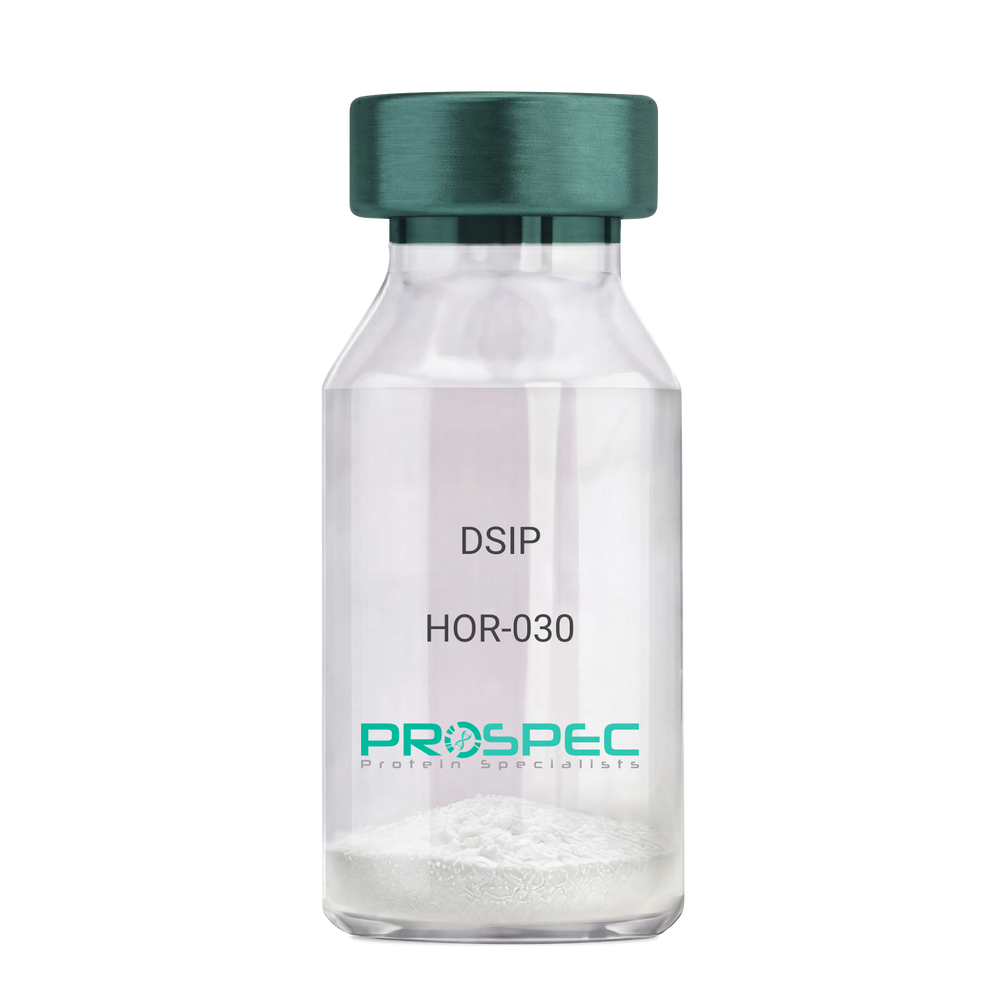
  • View Data Sheet

    Name :

    DSIP

    Description:

    Delta Sleep Inducing Peptide

    Product # :

    HOR-030

    Price :

    Quantity :

    Shipping Method :

    Room Temp Icon

    Shipped at Room temp

    Add To Cart

    More Info

    • description
    • formulation
    • purity
    • More Info

    Description

    DSIP Synthetic is a single, non-glycosylated polypeptide chain containing 15 amino acids, having a molecular mass of 1419.55 Dalton and a Molecular formula of C62H98N16O22.

    Formulation

    The protein was lyophilized with no additives.

    Purity

    Greater than 97.0% as determined by analysis by RP-HPLC.

    More Info

    • Physical Appearance

      Sterile Filtered White lyophilized (freeze-dried) powder.

    • Stability

      Lyophilized DSIP although stable at room temperature for 3 weeks, should be stored desiccated below -18°C. Upon reconstitution DSIP should be stored at 4°C between 2-7 days and for future use below -18°C. For long term storage it is recommended to add a carrier protein (0.1% HSA or BSA). Please prevent freeze-thaw cycles.

    • Solubility

      It is recommended to reconstitute the lyophilized DSIP in sterile 18MΩ-cm H2O not less than 100 µg/ml, which can then be further diluted to other aqueous solutions.

    • Amino Acid Sequence

      H-Gly-Glu-Pro-Pro-Pro-Gly-Lys-Pro-Ala-Asp-Asp-Ala-Gly-Leu-Val-OH

    • Background

      Delta Sleep-Inducing Peptide (DSIP), also known as Sleep-Promoting Peptide, is a neuropeptide that has been the subject of extensive research due to its potential role in sleep regulation, stress response, and neuroprotection. This nonapeptide, first isolated from the cerebral venous blood of rabbits during sleep, has been shown to induce slow-wave sleep, modulate pain perception, and exhibit potential antioxidant and immunomodulatory properties.

      DSIP's primary function is its interaction with the sleep regulatory system. By modulating the release of certain neurotransmitters, DSIP can influence sleep patterns, particularly promoting slow-wave sleep, the most restorative stage of sleep. Studies by Kovalzon et al. (2011) have demonstrated that DSIP can enhance sleep quality in rats, suggesting potential applications in sleep disorders and the promotion of healthy sleep patterns.

      In addition to its sleep-inducing effects, DSIP has been shown to possess neuroprotective properties. Research by Zolotarev et al. (2014) found that DSIP could protect neurons from oxidative stress, suggesting potential applications in the treatment of neurodegenerative diseases such as Alzheimer's and Parkinson's disease.

      Given its sleep-inducing and neuroprotective effects, DSIP has been proposed as a potential therapeutic agent for a variety of conditions, including sleep disorders, chronic pain, and neurodegenerative diseases. For instance, a study by Spong et al. (2016) found that DSIP could improve sleep quality in patients with chronic insomnia, indicating its potential as a therapeutic agent in the treatment of sleep disorders.

      While research on DSIP is promising, it is important to note that most studies have been conducted in animals or in vitro. More research is needed to fully understand the potential effects and applications of DSIP in humans. However, the existing body of research suggests that DSIP could be a promising tool in the treatment of sleep disorders, chronic pain, and neurodegenerative diseases.

    ProSpec's products are furnished for LABORATORY RESEARCH USE ONLY. The product may not be used as drugs, agricultural or pesticidal products, food additives or household chemicals.

    Dsip
  • View Data Sheet

    Name :

    Chitodextrinase

    Description:

    Chitodextrinase Clostridium Botulinum Recombinant

    Product # :

    ENZ-032

    Price :

    Quantity :

    Shipping Method :

    Room Temp Icon

    Shipped at Room temp

    Add To Cart

    More Info

    • description
    • source
    • formulation
    • purity
    • More Info

    Description

    Chitodextrinase Clostridium Botulinum Recombinant fused with a 13 amino acid His tag at N-terminus produced in E.Coli is a single, non-glycosylated, polypeptide chain containing 590 amino acids and having a molecular mass of 66.9kDa. The Chitodextrinase is purified by proprietary chromatographic techniques.

    Source

    Escherichia Coli.

    Formulation

    Chitodextrinase lyophilized from a 0.2µm filtered concentrated solution in PBS.

    Purity

    Greater than 95.0% as determined by SDS-PAGE.

    More Info

    • Introduction

      Chitodextrinase is a unique membrane-bound endoenzyme. The chitodextrinase enzyme cleaves soluble oligomers, but not chitin, to the di- and trisaccharides. Chitodextrinase is unable to solubilize chitin, but it can catalyze the hydrolysis of high to low molecular weight soluble chitin oligosaccharides.

    • Physical Appearance

      Sterile Filtered White lyophilized (freeze-dried) powder.

    • Stability

      Lyophilized Chitodextrinase although stable at room temperature for 3 weeks, should be stored desiccated below -18°C. Upon reconstitution Chitodextrinase should be stored at 4°C between 2-7 days and for future use below -18°C.For long term storage it is recommended to add a carrier protein (0.1% HSA or BSA).Please prevent freeze-thaw cycles.

    • Solubility

      It is recommended to reconstitute the lyophilized Chitodextrinase in sterile 18MΩ-cm H2O not less than 100 µg/ml, which can then be further diluted to other aqueous solutions.

    • Amino Acid Sequence

      HMRGSGSHHHHHHKEKFKTTKIKNSSELNRKLVGYFPEWAYSSEAQGYFNVTD
      LQWDSLTHIQYSFAMVDPSTNKITLSNKHAAIEEDFSEFDLNYNGKKIELDPS
      LPYKGHFNVLQTMKKNYPDVSLLISVGGWTGTRCFYTMIDTDNRINTFADSCV
      DFIRKYGFDGVDIDFEYPSSTSQSGNPDDFDLSEPRRTKLNERYNILIKTLRE
      KIDMASKEDGKEYLLTAAVTASPWVLGGISDNTYAKYLDFLSIMSYDYHGGWN
      EYVEHLAGIYPNKEDRETVTQIMPTLCMDWAYRYYRGVLPAEKILMGIPYYTR
      GWENVQGGINGLHGSSKTPASGKYNILGDDLNNDGVLEPDGANPLWHVLNLME
      QDPNLKVYWDEISKVPYVWQNDKKVFVSFENEKSIDARLEYIQNKNLGGALIW
      VMNGDYGLNPNYVEGSNKINEGKYTFGDTLTKRLSQGLKKMGVCNKTPDDLNI
      SLEPINVDVKFNGKYDHPNYTYSIDITNYTDKEIKGGWNVSFDLPKSAVFKSS
      WGGTYSVTDNGDFNTITLTSGAWQNIAPNSTITVQGMIGLCFSGIRNVTFNGM
      NPIGNDK.

    ProSpec's products are furnished for LABORATORY RESEARCH USE ONLY. The product may not be used as drugs, agricultural or pesticidal products, food additives or household chemicals.

    Chitodextrinase
  • View Data Sheet

    Name :

    ATF Human

    Description:

    Apo Transferrin Human

    Serotransferrin, Transferrin, Siderophilin, Beta-1-metal-binding globulin, TF, PRO1557, PRO2086, DKFZp781D0156, Apo Transferrin, ATF.

    Product # :

    PRO-325

    Price :

    Quantity :

    Shipping Method :

    Room Temp Icon

    Shipped at Room temp

    Add To Cart

    More Info

    • description
    • source
    • formulation
    • purity
    • More Info

    Description

    Human Apo Transferrin is a glycoprotein of approximately 77 kDa.

    Source

    Human serum.

    Formulation

    The protein was lyophilized from 20mM NH4HC03 solution. May contain traces of buffer salts.

    Purity

    Greater than 98.0% as determined by coomassie blue stained SDS-PAGE and Cellulose Acetate electrophoresis.

    More Info

    • Introduction

      Transferrin is the iron-transport protein of vertebrate serum and donates iron to cells through interaction with a specific membrane receptor, CD71. Transferrin appears to be indispensable for most cells growing in tissue culture.
      It is referred to frequently as a growth factor because, in analogy to other growth factor-receptor interactions, proliferating cells express high numbers of transferrin receptors, and the binding of transferrin to their receptors is needed for cells to initiate and maintain their DNA synthesis. Apart from its role as an iron transport protein transferrin acts as a cytokine and has functions that may not be related to its iron-carrying capacity.
      Human Transferrin is a crucial component for the cultivation of mammalian cells in-vitro. Human Transferrin is Critical for long-term cells growth in-vitro. Human Transferrin is used as detoxificant in media by binding contaminating metal ions. Human Transferrin is often used as a nutrient in fermentation media for recombinant protein and biopharmaceutical production. Additional common uses of Human Transferrin areMolecular weight, Affinity purification of anti-human transferrin antibodies and also as receptor mediated transfection of molecules such as DNA, into cells.

    • Synonyms

      Serotransferrin, Transferrin, Siderophilin, Beta-1-metal-binding globulin, TF, PRO1557, PRO2086, DKFZp781D0156, Apo Transferrin, ATF.

    • Physical Appearance

      Sterile Filtered White lyophilized (freeze-dried) powder.

    • Stability

      Store the lyophilized Apo Transferrin between 2-8°C, do not freeze. Upon reconstitution Apo Transferrin should be stored at 4°C between 2-7 days and for future use below -18°C.Please prevent freeze-thaw cycles.

    • Solubility

      It is recommended to reconstitute the lyophilized Apo Transferrin in sterile 18MΩ-cm H2O not less than 100µg/ml, which can then be further diluted to other aqueous solutions.

    • Human Virus Test

      Plasma from each donor has been tested and found negative for antibody to HIV-1, HIV-2, HCV, HBSAG and Syphilis.

    • Iron Content

      The Iron content was estimated by ICP and was found to be <6 ppm.

    ProSpec's products are furnished for LABORATORY RESEARCH USE ONLY. The product may not be used as drugs, agricultural or pesticidal products, food additives or household chemicals.

    Apo Transferrin Human
  • View Data Sheet

    Name :

    REXO2 Human

    Description:

    RNA Exonuclease 2 Human Recombinant

    REX2, RNA exonuclease 2 homolog (S. cerevisiae), CGI-114, RFN, SFN, Oligoribonuclease, mitochondrial, RNA exonuclease 2 homolog, Small fragment nuclease,REXO2, SMFN.

    Product # :

    ENZ-715

    Price :

    Quantity :

    Shipping Method :

    Ice Icon

    Shipped with Ice Packs

    Add To Cart

    More Info

    • description
    • source
    • formulation
    • purity
    • More Info

    Description

    REXO2 Human Recombinant produced in E. coli is a single polypeptide chain containing 235 amino acids (26-237) and having a molecular mass of 26.8kDa. REXO2 is fused to a 23 amino acid His-tag at N-terminus & purified by proprietary chromatographic techniques.

    Source

    Escherichia Coli.

    Formulation

    The REXO2 solution (1mg/ml) contains 20mM Tris-HCl buffer (pH 8.0), 0.15M NaCl and 20% glycerol.

    Purity

    Greater than 90% as determined by SDS-PAGE.

    More Info

    • Introduction

      EXO2 is a 3'-to-5' exonuclease specific for small (primarily 5 nucleotides or less in length) single-stranded RNA and DNA oligomers. RNA Exonuclease 2 (REXO2) takes part in DNA repair, replication, and recombination, and in RNA processing and degradation. EXO2 is involved in resistance of human cells to UV-C-induced cell death via its part in the DNA repair process.

    • Synonyms

      REX2, RNA exonuclease 2 homolog (S. cerevisiae), CGI-114, RFN, SFN, Oligoribonuclease, mitochondrial, RNA exonuclease 2 homolog, Small fragment nuclease,REXO2, SMFN.

    • Physical Appearance

      Sterile Filtered colorless solution.

    • Stability

      Store at 4°C if entire vial will be used within 2-4 weeks. Store, frozen at -20°C for longer periods of time. For long term storage it is recommended to add a carrier protein (0.1% HSA or BSA).Avoid multiple freeze-thaw cycles.

    • Amino Acid Sequence

      MGSSHHHHHH SSGLVPRGSH MGSVREGGAA MAAGESMAQR MVWVDLEMTG LDIEKDQIIE MACLITDSDL NILAEGPNLI IKQPDELLDS MSDWCKEHHG KSGLTKAVKE STITLQQAEY EFLSFVRQQT PPGLCPLAGN SVHEDKKFLD KYMPQFMKHL HYRIIDVSTV KELCRRWYPE EYEFAPKKAA SHRALDDISE SIKELQFYRN NIFKKKIDEK KRKIIENGEN EKTVS.

    ProSpec's products are furnished for LABORATORY RESEARCH USE ONLY. The product may not be used as drugs, agricultural or pesticidal products, food additives or household chemicals.

    Rexo2 Human
  • 1
  • …
  • 27
  • 28
  • 29
  • 30
  • 31
  • …
  • 42
Your browser does not support the video tag.

Products

  • Cytokines
  • Growth Factors
  • Chemokines
  • CD Antigens
  • Neurotrophins
  • Hormones
  • Enzymes
  • Viral Antigens
  • Recombinant Proteins
  • Natural Proteins
  • Monoclonal Antibodies
  • Polyclonal Antibodies
  • Thermal Packaging

About

  • Company
  • Founder
  • Contribution
  • Contact Us
  • My Account

Ordering

  • Ordering Method
  • Ordering - Credit Card
  • Ordering PO
  • Shipping Fees
  • FAQ's

Legal

  • Terms & Conditions
  • Privacy
  • Site Map
  • info@prospecbio.com
  • Facebook
  • Instagram
  • Linkedin Profile

© 2026 ProSpec-Tany TechnoGene Ltd. All Rights Reserved.

  • Choosing a selection results in a full page refresh.
  • Opens in a new window.