Skip to content

High-quality research proteins.

  • 1-800-805-6531

  • Mon - Sat 8.00-18.00, Sun - Closed

  • info@prospecbio.com

  • PO Box 6591 East Brunswick NJ 08816

  • Products
    • Cytokines
    • Growth factors
    • Chemokines
    • Cd antigens
    • Neurotrophins
    • Hormones
    • Enzymes
    • Viral antigens
    • Recombinant proteins
    • Natural proteins
    • Monoclonal antibodies
    • Polyclonal antibodies
    • Thermal Packaging
  • About
    • Company
    • Founder
    • Contribution
  • Customers
    • Eastern Asia
    • Eastern Europe
    • North America
    • South America
    • South East Asia
    • Southern Asia
    • Western Europe
  • Ordering
    • Ordering Method
    • Ordering - Credit Card
    • Ordering - PO
    • Shipping Fees
    • FAQs
  • Services
    • DNA Cloning
    • Protein Expression
    • Monoclonal Antibody
    • Fermentation
    • Technology License
  • Contact us
Log in

Country/region

  • USD $ | Albania
  • USD $ | Andorra
  • USD $ | Argentina
  • USD $ | Armenia
  • USD $ | Australia
  • USD $ | Austria
  • USD $ | Azerbaijan
  • USD $ | Belarus
  • USD $ | Belgium
  • USD $ | Bolivia
  • USD $ | Brazil
  • USD $ | Bulgaria
  • USD $ | Cambodia
  • USD $ | Canada
  • USD $ | Chile
  • USD $ | China
  • USD $ | Colombia
  • USD $ | Costa Rica
  • USD $ | Croatia
  • USD $ | Cyprus
  • USD $ | Czechia
  • USD $ | Denmark
  • USD $ | Estonia
  • USD $ | Finland
  • USD $ | France
  • USD $ | Georgia
  • USD $ | Germany
  • USD $ | Greece
  • USD $ | Hong Kong SAR
  • USD $ | Hungary
  • USD $ | Iceland
  • USD $ | India
  • USD $ | Ireland
  • USD $ | Israel
  • USD $ | Italy
  • USD $ | Japan
  • USD $ | Kazakhstan
  • USD $ | Latvia
  • USD $ | Liechtenstein
  • USD $ | Lithuania
  • USD $ | Madagascar
  • USD $ | Malta
  • USD $ | Mexico
  • USD $ | Moldova
  • USD $ | Monaco
  • USD $ | Netherlands
  • USD $ | New Zealand
  • USD $ | North Macedonia
  • USD $ | Norway
  • USD $ | Panama
  • USD $ | Paraguay
  • USD $ | Peru
  • USD $ | Philippines
  • USD $ | Poland
  • USD $ | Portugal
  • USD $ | Romania
  • USD $ | Singapore
  • USD $ | Slovakia
  • USD $ | Slovenia
  • USD $ | South Africa
  • USD $ | South Korea
  • USD $ | Spain
  • USD $ | Sri Lanka
  • USD $ | Sweden
  • USD $ | Switzerland
  • USD $ | Taiwan
  • USD $ | Thailand
  • USD $ | Türkiye
  • USD $ | Ukraine
  • USD $ | United Kingdom
  • USD $ | United States
  • USD $ | Uruguay
  • USD $ | Vatican City
  • USD $ | Venezuela
  • USD $ | Vietnam
  • Facebook
  • Instagram
logoProSpec - Recombinant Protein Manufacturer for academic and R&D industry
Become a distributor
Account Log in
Wishlist
Cart Cart(0)
  • Products
    +
    • Cytokines
    • Growth factors
    • Chemokines
    • Cd antigens
    • Neurotrophins
    • Hormones
    • Enzymes
    • Viral antigens
    • Recombinant proteins
    • Natural proteins
    • Monoclonal antibodies
    • Polyclonal antibodies
    • Thermal Packaging
  • About
    +
    • Company
    • Founder
    • Contribution
  • Customers
    +
    • Eastern Asia
    • Eastern Europe
    • North America
    • South America
    • South East Asia
    • Southern Asia
    • Western Europe
  • Ordering
    +
    • Ordering Method
    • Ordering - Credit Card
    • Ordering - PO
    • Shipping Fees
    • FAQs
  • Services
    +
    • DNA Cloning
    • Protein Expression
    • Monoclonal Antibody
    • Fermentation
    • Technology License
  • Contact us

Item added to your cart

View cart
View All
  • Cytokines
  • Growth factors
  • Chemokines
  • Cd antigens
  • Neurotrophins
  • Hormones
  • Enzymes
  • Viral antigens
  • Recombinant proteins
  • Natural proteins
  • Monoclonal antibodies
  • Polyclonal antibodies
  • Thermal Packaging
  • Tumor Necrosis Factor

    Tumor Necrosis Factor

    View All
  • 4-1BB

    4-1BB

    View All
  • Adiponectin

    Adiponectin

    View All
  • AIF1

    AIF1

    View All
  • Other Cytokines

    Other Cytokines

    View All
  • AITRL

    AITRL

    View All
  • Angiopoietin

    Angiopoietin

    View All
  • Apolipoprotein

    Apolipoprotein

    View All
  • B-Cell Activating Factor

    B-Cell Activating Factor

    View All
  • Beta Defensin

    Beta Defensin

    View All
  • Bone Morphogenetic Protein

    Bone Morphogenetic Protein

    View All
  • B type Natriuretic Peptide

    B type Natriuretic Peptide

    View All
  • BST

    BST

    View All
  • Betacellulin

    Betacellulin

    View All
  • Cardiotrophin

    Cardiotrophin

    View All
  • Activin

    Activin

    View All
  • Fibroblast Growth Factor

    Fibroblast Growth Factor

    View All
  • Other Growth Factors

    Other Growth Factors

    View All
  • CSF

    CSF

    View All
  • CTGF

    CTGF

    View All
  • IGFBP

    IGFBP

    View All
  • VEGF Protein

    VEGF Protein

    View All
  • EGF

    EGF

    View All
  • Epigen

    Epigen

    View All
  • Erythropoietin

    Erythropoietin

    View All
  • Insulin-Like Growth Factor

    Insulin-Like Growth Factor

    View All
  • Growth Hormone

    Growth Hormone

    View All
  • HDGF

    HDGF

    View All
  • Hepatocyte Growth Factor

    Hepatocyte Growth Factor

    View All
  • Insulin

    Insulin

    View All
  • BCA-1/ BLC (CXCL13)

    BCA-1/ BLC (CXCL13)

    View All
  • BRAK (CXCL14)

    BRAK (CXCL14)

    View All
  • C-10 (CCL6)

    C-10 (CCL6)

    View All
  • Other Chemokines

    Other Chemokines

    View All
  • MEC (CCL28)

    MEC (CCL28)

    View All
  • LD78-beta (CCL3L1)

    LD78-beta (CCL3L1)

    View All
  • CTACK (CCL27)

    CTACK (CCL27)

    View All
  • CXCL16

    CXCL16

    View All
  • CXCL17

    CXCL17

    View All
  • Platelet Factor-4 (CXCL4)

    Platelet Factor-4 (CXCL4)

    View All
  • ENA-78 (CXCL5)

    ENA-78 (CXCL5)

    View All
  • Eotaxin (CCL11,24,26)

    Eotaxin (CCL11,24,26)

    View All
  • Exodus-2 (CCL21)

    Exodus-2 (CCL21)

    View All
  • Fractalkine (CX3CL1)

    Fractalkine (CX3CL1)

    View All
  • CXCL6

    CXCL6

    View All
  • Other CD Antigens

    Other CD Antigens

    View All
  • CD14

    CD14

    View All
  • CD164

    CD164

    View All
  • CD1

    CD1

    View All
  • CD2

    CD2

    View All
  • CD200

    CD200

    View All
  • CD207

    CD207

    View All
  • CD226

    CD226

    View All
  • CD23

    CD23

    View All
  • CD244

    CD244

    View All
  • CD247

    CD247

    View All
  • CD27

    CD27

    View All
  • CD274

    CD274

    View All
  • CD300

    CD300

    View All
  • CD33

    CD33

    View All
  • Other Neurotrophins

    Other Neurotrophins

    View All
  • Beta-NGF

    Beta-NGF

    View All
  • BDNF

    BDNF

    View All
  • CDNF

    CDNF

    View All
  • CNTF

    CNTF

    View All
  • GDNF

    GDNF

    View All
  • Glia Maturation Factor

    Glia Maturation Factor

    View All
  • MANF

    MANF

    View All
  • Midkine

    Midkine

    View All
  • Neuroglobin

    Neuroglobin

    View All
  • Neurotrophic factors

    Neurotrophic factors

    View All
  • Neuregulin

    Neuregulin

    View All
  • Neuropilin

    Neuropilin

    View All
  • Pigment Epithelium-Derived Factor

    Pigment Epithelium-Derived Factor

    View All
  • Pleiotrophin

    Pleiotrophin

    View All
  • Peptide Hormones

    Peptide Hormones

    View All
  • Other Hormones

    Other Hormones

    View All
  • HCG

    HCG

    View All
  • Endothelin

    Endothelin

    View All
  • Exendin

    Exendin

    View All
  • FSH

    FSH

    View All
  • Glucagon

    Glucagon

    View All
  • GHRP

    GHRP

    View All
  • GLP

    GLP

    View All
  • Thyrostimulin

    Thyrostimulin

    View All
  • Inhibin A

    Inhibin A

    View All
  • LHRH

    LHRH

    View All
  • Melanotan

    Melanotan

    View All
  • Procalcitonin

    Procalcitonin

    View All
  • PTH

    PTH

    View All
  • Peroxiredoxin

    Peroxiredoxin

    View All
  • Peptidase

    Peptidase

    View All
  • Synthetase

    Synthetase

    View All
  • Transferase

    Transferase

    View All
  • Hydrolase

    Hydrolase

    View All
  • Dehydrogenase

    Dehydrogenase

    View All
  • ACE2

    ACE2

    View All
  • Esterase

    Esterase

    View All
  • Protein Kinases

    Protein Kinases

    View All
  • Other Enzymes

    Other Enzymes

    View All
  • Phosphatase

    Phosphatase

    View All
  • Deaminase

    Deaminase

    View All
  • Oxygenase

    Oxygenase

    View All
  • Adenylate Kinase

    Adenylate Kinase

    View All
  • Lyase

    Lyase

    View All
  • Chagas

    Chagas

    View All
  • SARS

    SARS

    View All
  • Influenza

    Influenza

    View All
  • ASFV

    ASFV

    View All
  • Astrovirus

    Astrovirus

    View All
  • Borrelia

    Borrelia

    View All
  • Helicobacter Pylori

    Helicobacter Pylori

    View All
  • Chikungunya

    Chikungunya

    View All
  • Chlamydia

    Chlamydia

    View All
  • Cytomegalo

    Cytomegalo

    View All
  • Dengue

    Dengue

    View All
  • EBV

    EBV

    View All
  • Ebola

    Ebola

    View All
  • Feline Leukemia Virus

    Feline Leukemia Virus

    View All
  • Hepatitis A

    Hepatitis A

    View All
  • Other

    Other

    View All
  • Actin

    Actin

    View All
  • ADAM

    ADAM

    View All
  • Complement Component

    Complement Component

    View All
  • Ag85

    Ag85

    View All
  • Eukaryotic Translation Initiation Factor

    Eukaryotic Translation Initiation Factor

    View All
  • Anterior Gradient Protein

    Anterior Gradient Protein

    View All
  • Heat Shock Protein

    Heat Shock Protein

    View All
  • Alpha-2-HS-Glycoprotein

    Alpha-2-HS-Glycoprotein

    View All
  • Hemoglobin

    Hemoglobin

    View All
  • Allergy

    Allergy

    View All
  • Anaplasma

    Anaplasma

    View All
  • Angiogenin

    Angiogenin

    View All
  • Ankyrin Repeat Domain

    Ankyrin Repeat Domain

    View All
  • Annexin

    Annexin

    View All
  • Other Natural Proteins

    Other Natural Proteins

    View All
  • Aprotinin

    Aprotinin

    View All
  • Transferrin

    Transferrin

    View All
  • Avidin

    Avidin

    View All
  • Anti Coagulation Factors

    Anti Coagulation Factors

    View All
  • Natural Albumin

    Natural Albumin

    View All
  • Natural Coagulation Factors

    Natural Coagulation Factors

    View All
  • Fibronectin

    Fibronectin

    View All
  • Thrombin

    Thrombin

    View All
  • Anti Human Enzyme

    Anti Human Enzyme

    View All
  • Other Monoclonal Antibodies

    Other Monoclonal Antibodies

    View All
  • Anti Human Cytokine

    Anti Human Cytokine

    View All
  • Anti Human Heat Shock Protein

    Anti Human Heat Shock Protein

    View All
  • Anti Mouse Lymphocyte

    Anti Mouse Lymphocyte

    View All
  • Anti Human Chemokine

    Anti Human Chemokine

    View All
  • Anti Human Lymphocyte

    Anti Human Lymphocyte

    View All
  • Anti Viral Monoclonal

    Anti Viral Monoclonal

    View All
  • Anti Mouse Cytokine

    Anti Mouse Cytokine

    View All
  • Anti-GST Monoclonal

    Anti-GST Monoclonal

    View All
  • Other Polyclonal Antibodies

    Other Polyclonal Antibodies

    View All
  • Anti Viral

    Anti Viral

    View All
  • Anti-GST Monoclonal

    Anti-GST Monoclonal

    View All
Back

Search results

1000 results found for “ATP Synthase Mitochondrial”

Name

Description

Product #

Price

Quantity

Shipping Method

  • View Data Sheet

    Name :

    MMP 3 Human

    Description:

    Matrix Metalloproteinase-3 Human Recombinant

    CHDS6, MMP-3, SL-1, STMY, STMY1, STR1, Stromelysin-1, Matrix metalloproteinase-3, Transin-1, MMP3.

    Product # :

    ENZ-774

    Price :

    Quantity :

    Shipping Method :

    Ice Icon

    Shipped with Ice Packs

    Add To Cart

    More Info

    • description
    • source
    • formulation
    • purity
    • More Info
    • Citations

    Description

    MMP 3 Human Recombinant produced in E.coli is a single, non-glycosylated polypeptide chain containing 401 amino acids (100-477a.a) and having a molecular mass of 45.2kDa. MMP 3 is fused to a 23 amino acid His-tag at N-terminus & purified by proprietary chromatographic techniques.

    Source

    Escherichia Coli.

    Formulation

    The MMP 3 solution (0.25mg/ml) contains 20mM Tris-HCl buffer (pH 8.0), 0.15M NaCl, and 10% glycerol.

    Purity

    Greater than 90% as determined by SDS-PAGE.

    Citations

    More Info

    • Introduction

      MMP-3 enzyme is also known as Stromelysin-1or as Transin-1 which hydrolyzes natural collagen at physiological pH and temperature. It dissolves the intervertebral nucleus pulposus and annulus fibrosus of Herniated Lumbar Intervertebral Disk . MMP-3 hydrolyzes components of the extracellular matrix like proteoglycan, laminin, fibronectin, gelatin and collagen types III, IV and IX. It also activates pro-MMP-9 and pro-MMP-8 and superactivates plasmin activated MMP-1. MMP-3 is secreted as a latent proenzyme and is activated by a variety of proteinases, e.g. plasmin, trypsin, chymotrypsin, cathepsin G or human neutrophil elastase. MMP-3 was found to be capable of activating the precursor of IL1-beta.

    • Synonyms

      CHDS6, MMP-3, SL-1, STMY, STMY1, STR1, Stromelysin-1, Matrix metalloproteinase-3, Transin-1, MMP3.

    • Physical Appearance

      Sterile Filtered colorless solution.

    • Stability

      Store at 4°C if entire vial will be used within 2-4 weeks. Store, frozen at -20°C for longer periods of time. For long term storage it is recommended to add a carrier protein (0.1% HSA or BSA). Avoid multiple freeze-thaw cycles.

    • Amino Acid Sequence

      MGSSHHHHHH SSGLVPRGSH MGSFRTFPGI PKWRKTHLTY RIVNYTPDLP KDAVDSAVEK ALKVWEEVTP LTFSRLYEGE ADIMISFAVR EHGDFYPFDG PGNVLAHAYA PGPGINGDAH FDDDEQWTKD TTGTNLFLVA AHEIGHSLGL FHSANTEALM YPLYHSLTDL TRFRLSQDDI NGIQSLYGPP PDSPETPLVP TEPVPPEPGT PANCDPALSF DAVSTLRGEI LIFKDRHFWR KSLRKLEPEL HLISSFWPSL PSGVDAAYEV TSKDLVFIFK GNQFWAIRGN EVRAGYPRGI HTLGFPPTVR KIDAAISDKE KNKTYFFVED KYWRFDEKRN SMEPGFPKQI AEDFPGIDSK IDAVFEEFGF FYFFTGSSQL EFDPNAKKVT HTLKSNSWLN C.

    ProSpec's products are furnished for LABORATORY RESEARCH USE ONLY. The product may not be used as drugs, agricultural or pesticidal products, food additives or household chemicals.

    Human Mmp 3
  • View Data Sheet

    Name :

    PARP2 Antibody

    Description:

    Poly (ADP-Ribose) Polymerase 2, Mouse Anti Human

    ADPRT2, ADPRTL2, ADPRTL3, ARTD2, pADPRT-2, PARP-2, Poly [ADP-ribose] polymerase 2, hPARP-2, ADP-ribosyltransferase diphtheria toxin-like 2, NAD (+) ADP-ribosyltransferase 2, Poly [ADP-ribose] synthase 2.

    Product # :

    ANT-491

    Price :

    Quantity :

    Shipping Method :

    Ice Icon

    Shipped with Ice Packs

    Add To Cart

    More Info

    • formulation
    • More Info
    • Citations

    Formulation

    1mg/ml containing PBS, pH-7.4, 10% Glycerol and 0.02% Sodium Azide.

    Citations

    More Info

    • Introduction

      Poly (ADP-Ribose) Polymerase 2 (PARP2) contains a catalytic domain which is homologous to that of poly (ADP-ribosyl) transferase but lacks an N-terminal DNA binding domain which activates the C-terminal catalytic domain of poly (ADP-ribosyl) transferase. PARP2 is capable of catalyzing a poly (ADP-ribosyl)ation reaction. The basic residues within the N-terminal area of this protein can bear potential DNA-binding properties, and can be engaged in the nuclear and/or nucleolar targeting of the protein. There has been found two alternatively spliced transcript variants encoding distinct isoforms.

    • Synonyms

      ADPRT2, ADPRTL2, ADPRTL3, ARTD2, pADPRT-2, PARP-2, Poly [ADP-ribose] polymerase 2, hPARP-2, ADP-ribosyltransferase diphtheria toxin-like 2, NAD (+) ADP-ribosyltransferase 2, Poly [ADP-ribose] synthase 2.

    • Physical Appearance

      Sterile filtered colorless solution.

    • Immunogen

      Anti-human PARP2 mAb, clone PAT29G4A, is derived from hybridization of mouse F0 myeloma cells with spleen cells from BALB/c mice immunized with a recombinant human PARP2 protein 233-583 amino acids purified from E. coli.

    • Ig Subclass

      Mouse IgG2a heavy chain and Kappa light chain.

    • Clone

      PAT29G4A.

    • Applications

      The antibody has been tested by ELISA, Western blot analysis to assure specificity and reactivity. Since application varies, however, each investigation should be titrated by the reagent to obtain optimal results. Recommended dilution range for Western blot analysis is 1:500 ~ 1:5000. Recommended starting dilution is 1:500.

    • Type

      Mouse Anti Human Monoclonal.

    • Storage Procedures

      For periods up to 1 month store at 4°C, for longer periods of time, store at -20°C. Prevent freeze thaw cycles.

    • Purification Method

      PARP2 antibody was purified from mouse ascitic fluids by protein-A affinity chromatography.

    ProSpec's products are furnished for LABORATORY RESEARCH USE ONLY. The product may not be used as drugs, agricultural or pesticidal products, food additives or household chemicals.

    Parp2 Antibody
  • View Data Sheet

    Name :

    ATG3 Human

    Description:

    Autophagy Related 3 Human Recombinant

    APG3, APG3-LIKE, APG3L, PC3-96, Ubiquitin-like-conjugating enzyme ATG3, Autophagy-related protein 3, hApg3, PC3-96, ATG3.

    Product # :

    PRO-1987

    Price :

    Quantity :

    Shipping Method :

    Ice Icon

    Shipped with Ice Packs

    Add To Cart

    More Info

    • description
    • source
    • formulation
    • purity
    • More Info
    • Citations

    Description

    ATG3 Human Recombinant produced in E.Coli is a single, non-glycosylated polypeptide chain containing 337 amino acids (1-314 a.a) and having a molecular mass of 38.3kDa. ATG3 is fused to a 23 amino acid His-tag at N-terminus & purified by proprietary chromatographic techniques.

    Source

    Escherichia Coli.

    Formulation

    ATG3 protein solution (0.5mg/ml) containing 20mM Tris-HCl buffer (pH 8.0), 0.1M NaCl and 10% glycerol.

    Purity

    Greater than 85.0% as determined by SDS-PAGE.

    Citations

    More Info

    • Introduction

      Autophagy Related 3 (ATG3) is a conjugating enzyme essential for the cytoplasm to vacuole transport (Cvt), autophagy, and mitochondrial homeostasis. ATG3 is localizes to the cytoplasm and is expressed in tissues with predominant levels found in kidney, placenta, liver, heart and skeletal muscle. ATG3 catalyzes a reaction which is necessary for autophagy. That reaction is the formation of the Atg8-phosphatidylethanolamine (ATG-PE) conjugate.

    • Synonyms

      APG3, APG3-LIKE, APG3L, PC3-96, Ubiquitin-like-conjugating enzyme ATG3, Autophagy-related protein 3, hApg3, PC3-96, ATG3.

    • Physical Appearance

      Sterile Filtered colorless solution.

    • Stability

      Store at 4°C if entire vial will be used within 2-4 weeks. Store, frozen at -20°C for longer periods of time. For long term storage it is recommended to add a carrier protein (0.1% HSA or BSA).Avoid multiple freeze-thaw cycles.

    • Amino Acid Sequence

      MGSSHHHHHH SSGLVPRGSH MGSMQNVINT VKGKALEVAE YLTPVLKESK FKETGVITPE EFVAAGDHLV HHCPTWQWAT GEELKVKAYL PTGKQFLVTK NVPCYKRCKQ MEYSDELEAI IEEDDGDGGW VDTYHNTGIT GITEAVKEIT LENKDNIRLQ DCSALCEEEE DEDEGEAADM EEYEESGLLE TDEATLDTRK IVEACKAKTD AGGEDAILQT RTYDLYITYD KYYQTPRLWL FGYDEQRQPL TVEHMYEDIS QDHVKKTVTI ENHPHLPPPP MCSVHPCRHA EVMKKIIETV AEGGGELGVH MYLLIFLKFV QAVIPTIEYD YTRHFTM.

    ProSpec's products are furnished for LABORATORY RESEARCH USE ONLY. The product may not be used as drugs, agricultural or pesticidal products, food additives or household chemicals.

    Atg3 Human
  • View Data Sheet

    Name :

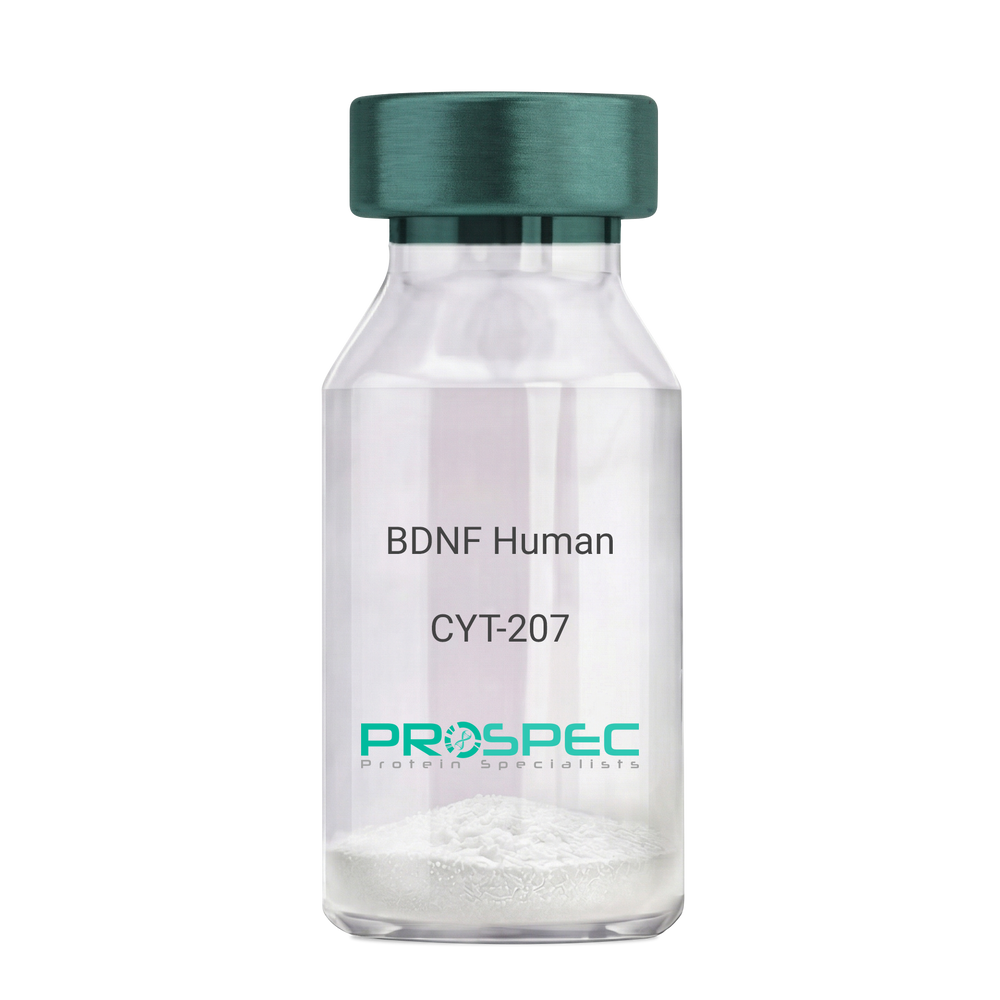
    BDNF Human

    Description:

    Brain-Derived Neurotrophic Factor Human Recombinant

    Brain-Derived Neurotrophic Factor, BDNF, MGC34632.

    Product # :

    CYT-207

    Price :

    Quantity :

    Shipping Method :

    Room Temp Icon

    Shipped at Room temp

    Add To Cart

    More Info

    • description
    • source
    • formulation
    • purity
    • biological activity
    • More Info
    • Activity
    • Citations

    Description

    BDNF Human Recombinant produced in E.Coli is a homodimer, non-glycosylated, polypeptide chain containing 2 x 119 amino acids (and an N-terminal Met) and having a total molecular mass of 28kDa. BDNF Human Recombinant is purified by proprietary chromatographic techniques.

    Source

    Escherichia Coli.

    Formulation

    The protein was lyophilized with 20mM PB and 400mM NaCl, pH 7.2.

    Purity

    BDNF is greater than 950% as determined SDS-PAGE.

    Biological Activity

    The activity was determined using Immobilized Human TrkB-His tag protein 2ug/ml (100 μl/well) for its binding to NHS-Biotin BDNF. The ED50 of was found to be ≤20ng/mL

    Activity

    bdnf activity - Product image 1

    Citations

    More Info

    • Introduction

      BDNF promotes the survival of neuronal populations that are all located either in the central nervous system or directly connected to it. BDNF is a major regulator of synaptic transmission and plasticity at adult synapses in many regions of the cns. The versatility of BDNF is emphasized by its contribution to a range of adaptive neuronal responses including long-term potentiation (ltp), long-term depression (ltd), certain forms of short-term synaptic plasticity, as well as homeostatic regulation of intrinsic neuronal excitability.

    • Synonyms

      Brain-Derived Neurotrophic Factor, BDNF, MGC34632.

    • Physical Appearance

      Sterile Filtered White lyophilized (freeze-dried) powder.

    • Stability

      Lyophilized BDNF although stable at room temperature for 3 weeks, should be stored desiccated below -18°C. Upon reconstitution BDNF should be stored at 4°C between 2-7 days and for future use below -18°C.For long term storage it is recommended to add a carrier protein (0.1% HSA or BSA).Please prevent freeze-thaw cycles.

    • Solubility

      It is recommended to reconstitute the lyophilized BDNF in sterile 18M-cm H2O not less than 100µg/ml, which can then be further diluted to other aqueous solutions.

    • Amino Acid Sequence

      HSDPARRGE LSVCDSISEW VTAADKKTAV DMSGGTVTVL EKVPVSKGQL KQYFYETKCN PMGYTKEGCR GIDKRHWNSQ CRTTQSYVRA LTMDSKKRIG WRFIRIDTSC VCTLTIKRGR.

    • Background

      Final Thoughts

      Although more research is needed on the safety and effectiveness of BDNF human recombinant, trials suggest that this laboratory-produced protein may be effective in managing and treating several neurological and psychiatric disorders. It's important for experts to stay up to date on the latest developments and research to learn more about potential risks and benefits.

      What is the molecular weight/Mw of BDNF Protein?
      BDNF Protein has a total Mw of 27kDa.

      What is the source or expression system of BDNF Protein?
      Escherichia Coli.

      What is the Purity of BDNF Protein?
      BDNF Protein is >97% pure as determined by SDS-PAGE.

      What is the Biological Activity of BDNF Protein?
      The ED50, as determined by the dose-dependent induction of C6 cells proliferation, is 1.3-2µg/ml.

      What is the amino acid sequence of BDNF Protein?
      MHSDPARRGE LSVCDSISEW VTAADKKTAV DMSGGTVTVL EKVPVSKGQL KQYFYETKCN PMGYTKEGCR GIDKRHWNSQ CRTTQSYVRA LTMDSKKRIG WRFIRIDTSC VCTLTIKRGR.

      What applications can BDNF Protein be used in?
      BDNF Protein can probably be used in western blot, ELISA and Lateral Flow.

      What is the endotoxin level for BDNF Protein?
      The endotoxin level is minimal, BDNF Protein was purified using conventional chromatography techniques.

    • Protein content

      BDNF quantitation was carried out by two independent methods:1. UV spectroscopy at 280 nm using the absorbency value of 1.6 as the extinction coefficient for a 0.1% (1mg/ml) solution. This value is calculated by the PC GENE computer analysis program of protein sequences (IntelliGenetics). 2. Analysis by RP-HPLC, using a standard solution of Brain-derived Neurotrophic Factor as a Reference Standard.

    ProSpec's products are furnished for LABORATORY RESEARCH USE ONLY. The product may not be used as drugs, agricultural or pesticidal products, food additives or household chemicals.

    Bdnf Human
  • View Data Sheet

    Name :

    TFAM Human

    Description:

    Transcription Factor-A Recombinant Human

    Transcription factor A, mitochondrial, TCF6, TCF6L2, Mitochondrial transcription factor 1, Transcription factor 6-like 2, MtTF1, mtTFA, TCF6L1, TCF6L3.

    Product # :

    PRO-095

    Price :

    Quantity :

    Shipping Method :

    Ice Icon

    Shipped with Ice Packs

    Add To Cart

    More Info

    • description
    • source
    • formulation
    • purity
    • More Info
    • Citations

    Description

    TFAM produced in E.Coli is a single, non-glycosylated polypeptide chain containing 225 amino acids (43-246.a.a) and having a molecular mass of 26.6kDa. TFAM is fused to a 21 amino acid His-tag at N-terminus & purified by proprietary chromatographic techniques.

    Source

    Escherichia Coli.

    Formulation

    The TFAM protein solution (0.25mg/1ml) is formulated in 20 mM Tris-HCl buffer (pH8.0), 0.2M NaCl, 5mM DTT and 20% glycerol.

    Purity

    Greater than 90% as determined by SDS-PAGE.

    Citations

    More Info

    • Introduction

      TFAM is a mitochondrial transcription factor which is a main activator of mitochondrial transcription and is also a participant in mitochondrial genome replication. TFAM is situated primarily in the nuclei of elongated spermatids and takes part in the regulation of gene expression of the haploid male genome. TFAM is linked to mitochondrial disorder in humans characterized by ocular myopathy, exercise intolerance and muscle wasting.

    • Synonyms

      Transcription factor A, mitochondrial, TCF6, TCF6L2, Mitochondrial transcription factor 1, Transcription factor 6-like 2, MtTF1, mtTFA, TCF6L1, TCF6L3.

    • Physical Appearance

      Sterile Filtered clear solution.

    • Stability

      Store at 4°C if entire vial will be used within 2-4 weeks. Store, frozen at -20°C for longer periods of time.Please avoid freeze thaw cycles.

    • Amino Acid Sequence

      MGSSHHHHHH SSGLVPRGSH MSSVLASCPK KPVSSYLRFS KEQLPIFKAQ NPDAKTTELI RRIAQRWREL PDSKKKIYQD AYRAEWQVYK EEISRFKEQL TPSQIMSLEK EIMDKHLKRK AMTKKKELTL LGKPKRPRSA YNVYVAERFQ EAKGDSPQEK LKTVKENWKN LSDSEKELYI QHAKEDETRY HNEMKSWEEQ MIEVGRKDLL RRTIKKQRKY GAEEC

    ProSpec's products are furnished for LABORATORY RESEARCH USE ONLY. The product may not be used as drugs, agricultural or pesticidal products, food additives or household chemicals.

    Tfam Human
  • View Data Sheet

    Name :

    ATF3 Human

    Description:

    Activating Transcription Factor-3 Human Recombinant

    Activating transcription factor 3, cyclic AMP-dependent transcription factor ATF-3, FLJ41705.

    Product # :

    PKA-270

    Price :

    Quantity :

    Shipping Method :

    Ice Icon

    Shipped with Ice Packs

    Add To Cart

    More Info

    • description
    • source
    • formulation
    • purity
    • More Info
    • Citations

    Description

    ATF3 Human Recombinant produced in E.coli is a single, non-glycosylated polypeptide chain containing 181 amino acids (1-181) and having a molecular mass of 20.6 kDa.The ATF3 is purified by proprietary chromatographic techniques.

    Source

    Escherichia Coli.

    Formulation

    ATF3 protein (1mg/ml) is supplied in 20mM Tris-HCl, pH-8, 2M Urea and 20% Glycerol.

    Purity

    Greater than 90.0% as determined by SDS-PAGE.

    Citations

    More Info

    • Introduction

      ATF3 belongs to the mammalian activation transcription factor/cAMP responsive element-binding (CREB) protein family of transcription factors. ATF3 binds the cAMP response element (CRE) (consensus: 5'-GTGACGT[AC][AG]-3'), a sequence present in numerous viral and cellular promoters. Multiple transcript variants encoding two different isoforms are known for this gene. The longer isoform represses transcription from promoters with ATF binding elements instead of activating it. The shorter isoform (deltaZip2) which stimulates transcription by sequestering inhibitory co-factors away from the promoter has no leucine zipper protein-dimerization motif and does not bind to DNA.

    • Synonyms

      Activating transcription factor 3, cyclic AMP-dependent transcription factor ATF-3, FLJ41705.

    • Physical Appearance

      ATF3 is supplied as a sterile filtered clear solution.

    • Stability

      Store at 4°C if entire vial will be used within 2-4 weeks. Store, frozen at -20°C for longer periods of time. For long term storage it is recommended to add a carrier protein (0.1% HSA or BSA).Avoid multiple freeze-thaw cycles.

    • Amino Acid Sequence

      MMLQHPGQVS ASEVSASAIV PCLSPPGSLV FEDFANLTPF VKEELRFAIQ NKHLCHRMSS ALESVTVSDR PLGVSITKAE VAPEEDERKK RRRERNKIAA AKCRNKKKEK TECLQKESEK LESVNAELKA QIEELKNEKQ HLIYMLNLHR PTCIVRAQNG RTPEDERNLF IQQIKEGTLQ S.

    ProSpec's products are furnished for LABORATORY RESEARCH USE ONLY. The product may not be used as drugs, agricultural or pesticidal products, food additives or household chemicals.

    Atf3 Human
  • View Data Sheet

    Name :

    PRMT3 Human

    Description:

    Protein Arginine Methyltransferase 3 Human Recombinant

    Protein Arginine Methyltransferase 3, Heterogeneous Nuclear Ribonucleoprotein, Methyltransferase-Like Protein 3, HRMT1L3, HMT1 HnRNP Methyltransferase-Like 3 (S. Cerevisiae), Protein Arginine N-Methyltransferase 3, HMT1 HnRNP Methyltransferase-Like 3, EC 2.1.1.- ,EC 2.1.1, PRMT3.

    Product # :

    ENZ-848

    Price :

    Quantity :

    Shipping Method :

    Ice Icon

    Shipped with Ice Packs

    Add To Cart

    More Info

    • description
    • source
    • formulation
    • purity
    • More Info
    • Citations

    Description

    PRMT3 Human Recombinant produced in E.Coli is a single, non-glycosylated polypeptide chain containing 554 amino acids (1-531 a.a) and having a molecular mass of 62.3kDa.PRMT3 is fused to a 23 amino acid His-tag at N-terminus & purified by proprietary chromatographic techniques.

    Source

    Escherichia Coli.

    Formulation

    PRMT3 protein solution (0.5mg/ml) containing Phosphate buffered saline (pH7.4) and 20% glycerol, 1mM DTT.

    Purity

    Greater than 90.0% as determined by SDS-PAGE.

    Citations

    More Info

    • Introduction

      PRMT3, also known as protein arginine N-methyltransferase 3, is a member of the protein arginine methyltransferase family. PRMT3 catalyzes the methylation of guanidino nitrogens of arginyl residues of proteins. PRMT3 operates on 40S ribosomal protein S2 ,rpS2, which is the major in-vivo substrate, additionally PRMT3 is also involved in the proper maturation of the 80S ribosome.

    • Synonyms

      Protein Arginine Methyltransferase 3, Heterogeneous Nuclear Ribonucleoprotein, Methyltransferase-Like Protein 3, HRMT1L3, HMT1 HnRNP Methyltransferase-Like 3 (S. Cerevisiae), Protein Arginine N-Methyltransferase 3, HMT1 HnRNP Methyltransferase-Like 3, EC 2.1.1.- ,EC 2.1.1, PRMT3.

    • Physical Appearance

      Sterile Filtered colorless solution.

    • Stability

      Store at 4°C if entire vial will be used within 2-4 weeks. Store, frozen at -20°C for longer periods of time. For long term storage it is recommended to add a carrier protein (0.1% HSA or BSA).Avoid multiple freeze-thaw cycles.

    • Amino Acid Sequence

      MGSSHHHHHH SSGLVPRGSH MGSMCSLASG ATGGRGAVEN EEDLPELSDS GDEAAWEDED DADLPHGKQQ TPCLFCNRLF TSAEETFSHC KSEHQFNIDS MVHKHGLEFY GYIKLINFIR LKNPTVEYMN SIYNPVPWEK EEYLKPVLED DLLLQFDVED LYEPVSVPFS YPNGLSENTS VVEKLKHMEA RALSAEAALA RAREDLQKMK QFAQDFVMHT DVRTCSSSTS VIADLQEDED GVYFSSYGHY GIHEEMLKDK IRTESYRDFI YQNPHIFKDK VVLDVGCGTG ILSMFAAKAG AKKVLGVDQS EILYQAMDII RLNKLEDTIT LIKGKIEEVH LPVEKVDVII SEWMGYFLLF ESMLDSVLYA KNKYLAKGGS VYPDICTISL VAVSDVNKHA DRIAFWDDVY GFKMSCMKKA VIPEAVVEVL DPKTLISEPC GIKHIDCHTT SISDLEFSSD FTLKITRTSM CTAIAGYFDI YFEKNCHNRV VFSTGPQSTK THWKQTVFLL EKPFSVKAGE ALKGKVTVHK NKKDPRSLTV TLTLNNSTQT YGLQ

    ProSpec's products are furnished for LABORATORY RESEARCH USE ONLY. The product may not be used as drugs, agricultural or pesticidal products, food additives or household chemicals.

    Prmt3 Human
  • View Data Sheet

    Name :

    ACOT8 Human

    Description:

    Acyl-CoA Thioesterase 8 Human Recombinant

    Acyl-coenzyme A thioesterase 8, hACTE-III, HNAACTE, the, PTE-1, PTE-2, PTE1, PTE2, Acyl-CoA thioesterase 8, Choloyl-coenzyme A thioesterase, HIV-Nef-associated acyl-CoA thioesterase, PTE-2, Peroxisomal acyl-coenzyme A thioester hydrolase 1, Peroxisomal long-chain acyl-CoA thioesterase 1 Thioesterase II, ACTEIII, hACTEIII, the, ACOT8.

    Product # :

    ENZ-712

    Price :

    Quantity :

    Shipping Method :

    Ice Icon

    Shipped with Ice Packs

    Add To Cart

    More Info

    • description
    • source
    • formulation
    • purity
    • More Info
    • Citations

    Description

    ACOT8 Human Recombinant produced in E.coli is a single, non-glycosylated polypeptide chain containing 342 amino acids (1-319) and having a molecular mass of 38.3kDa. ACOT8 is fused to a 23 amino acid His-tag at N-terminus & purified by proprietary chromatographic techniques.

    Source

    Escherichia Coli.

    Formulation

    The ACOT8 solution (0.5mg/ml) contains 20mM Tris-HCl buffer (pH 8.0), 0.2M NaCl, 40% glycerol and 2mM DTT.

    Purity

    Greater than 95.0% as determined by SDS-PAGE.

    Citations

    More Info

    • Introduction

      Acyl-CoA Thioesterase 8 (ACOT8) is a group of enzymes which catalyze the hydrolysis of acyl-CoAs to the free fatty acid and coenzyme A (CoASH), granting the potential to regulate intracellular levels of acyl-CoAs, free fatty acids and CoASH. ACOT8 mediate Nef-induced down-regulation of CD4. ACOT8 contends with BAAT (Bile acid CoA: amino acid N-acyltransferase) for bile acid-CoA substrate (such as chenodeoxycholoyl-CoA). ACOT8 prefers medium-length fatty acyl-CoAs.

    • Synonyms

      Acyl-coenzyme A thioesterase 8, hACTE-III, HNAACTE, the, PTE-1, PTE-2, PTE1, PTE2, Acyl-CoA thioesterase 8, Choloyl-coenzyme A thioesterase, HIV-Nef-associated acyl-CoA thioesterase, PTE-2, Peroxisomal acyl-coenzyme A thioester hydrolase 1, Peroxisomal long-chain acyl-CoA thioesterase 1 Thioesterase II, ACTEIII, hACTEIII, the, ACOT8.

    • Physical Appearance

      Sterile Filtered colorless solution.

    • Stability

      Store at 4°C if entire vial will be used within 2-4 weeks. Store, frozen at -20°C for longer periods of time. For long term storage it is recommended to add a carrier protein (0.1% HSA or BSA).Avoid multiple freeze-thaw cycles.

    • Amino Acid Sequence

      MGSSHHHHHH SSGLVPRGSH MGSMSSPQAP EDGQGCGDRG DPPGDLRSVL VTTVLNLEPL DEDLFRGRHY WVPAKRLFGG QIVGQALVAA AKSVSEDVHV HSLHCYFVRA GDPKLPVLYQ VERTRTGSSF SVRSVKAVQH GKPIFICQAS FQQAQPSPMQ HQFSMPTVPP PEELLDCETL IDQYLRDPNL QKRYPLALNR IAAQEVPIEI KPVNPSPLSQ LQRMEPKQMF WVRARGYIGE GDMKMHCCVA AYISDYAFLG TALLPHQWQH KVHFMVSLDH SMWFHAPFRA DHWMLYECES PWAGGSRGLV HGRLWRQDGV LAVTCAQEGV IRVKPQVSES KL.

    ProSpec's products are furnished for LABORATORY RESEARCH USE ONLY. The product may not be used as drugs, agricultural or pesticidal products, food additives or household chemicals.

    Acot8 Human
  • View Data Sheet

    Name :

    SSU72 Human

    Description:

    SSU72 RNA Polymerase II CTD Phosphatase Human Recombinant

    SSU72 RNA polymerase II CTD phosphatase homolog (S. cerevisiae), HSPC182, CTD phosphatase SSU72, Ssu72 RNA polymerase II CTD phosphatase homolog (yeast), PNAS-120, RNA polymerase II subunit A C-terminal domain phosphatase SSU72, EC 3.1.3.16.

    Product # :

    ENZ-243

    Price :

    Quantity :

    Shipping Method :

    Ice Icon

    Shipped with Ice Packs

    Add To Cart

    More Info

    • description
    • source
    • formulation
    • purity
    • More Info
    • Citations

    Description

    SSU72 Human Recombinant produced in E.coli is a single, non-glycosylated polypeptide chain containing 217 amino acids (1-194) and having a molecular mass of 25.0kDa.SSU72 is fused to a 23 amino acid His-tag at N-terminus & purified by proprietary chromatographic techniques.

    Source

    E.coli.

    Formulation

    The SSU72 solution (1mg/ml) contains 20mM Tris-HCl buffer (pH 8.0), 100mM NaCl, 1mM DTT and 10% glycerol.

    Purity

    Greater than 95% as determined by SDS-PAGE.

    Citations

    More Info

    • Introduction

      SSU72 is an extremely conserved homologue of yeast Ssu72, a CTD phosphatase and a component of the polyadenylation/termination machinery. SSU72 interacts with TFIIB, Rb and DNAM-1 and operates to catalyze the dephosphorylation of target proteins, and taking part in RNA processing and termination via dephosphorylation of Pol II. SSU72 is found in multiple alternatively spliced isoforms.

    • Synonyms

      SSU72 RNA polymerase II CTD phosphatase homolog (S. cerevisiae), HSPC182, CTD phosphatase SSU72, Ssu72 RNA polymerase II CTD phosphatase homolog (yeast), PNAS-120, RNA polymerase II subunit A C-terminal domain phosphatase SSU72, EC 3.1.3.16.

    • Physical Appearance

      Sterile Filtered colorless solution.

    • Stability

      Store at 4°C if entire vial will be used within 2-4 weeks. Store, frozen at -20°C for longer periods of time. For long term storage it is recommended to add a carrier protein (0.1% HSA or BSA).Avoid multiple freeze-thaw cycles.

    • Amino Acid Sequence

      MGSSHHHHHH SSGLVPRGSH MGSMPSSPLR VAVVCSSNQN RSMEAHNILS KRGFSVRSFG TGTHVKLPGP APDKPNVYDF KTTYDQMYND LLRKDKELYT QNGILHMLDR NKRIKPRPER FQNCKDLFDL ILTCEERVYD QVVEDLNSRE QETCQPVHVV NVDIQDNHEE ATLGAFLICE LCQCIQHTED MENEIDELLQ EFEEKSGRTF LHTVCFY

    ProSpec's products are furnished for LABORATORY RESEARCH USE ONLY. The product may not be used as drugs, agricultural or pesticidal products, food additives or household chemicals.

    Ssu72 Human
  • View Data Sheet

    Name :

    GOT1 Mouse

    Description:

    Glutamic-Oxaloacetic Transaminase 1 Mouse Recombinant

    Aspartate aminotransferase, cytoplasmic, cAspAT, Cysteine aminotransferase, cytoplasmic, Cysteine transaminase, cytoplasmic, cCAT, Glutamate oxaloacetate transaminase 1, Transaminase A.

    Product # :

    ENZ-872

    Price :

    Quantity :

    Shipping Method :

    Ice Icon

    Shipped with Ice Packs

    Add To Cart

    More Info

    • description
    • source
    • formulation
    • purity
    • More Info
    • Citations

    Description

    GOT1 Mouse Recombinant produced in E.Coli is a single, non-glycosylated polypeptide chain containing 436 amino acids (1-413a.a) and having a molecular mass of 48.6kDa.GOT1 is fused to a 23 amino acid His-tag at N-terminus & purified by proprietary chromatographic techniques.

    Source

    Escherichia Coli.

    Formulation

    GOT1 protein solution (0.5mg/ml) containing Phosphate buffered saline (pH7.4), 10% glycerol and 1mM DTT.

    Purity

    Greater than 95.0% as determined by SDS-PAGE.

    Citations

    More Info

    • Introduction

      GOT1 is a pyridoxal phosphate-dependent enzyme which exists in cytoplasmic and mitochondrial forms, GOT1 and GOT2, which participate in amino acid metabolism and the urea and tricarboxylic acid cycles. Both enzymes are homodimeric and show close homology.

    • Synonyms

      Aspartate aminotransferase, cytoplasmic, cAspAT, Cysteine aminotransferase, cytoplasmic, Cysteine transaminase, cytoplasmic, cCAT, Glutamate oxaloacetate transaminase 1, Transaminase A.

    • Physical Appearance

      Sterile filtered colorless solution.

    • Stability

      Store at 4°C if entire vial will be used within 2-4 weeks.Store, frozen at -20°C for longer periods of time.For long term storage it is recommended to add a carrier protein (0.1% HSA or BSA).Avoid multiple freeze-thaw cycles.

    • Amino Acid Sequence

      MGSSHHHHHH SSGLVPRGSH MGSMAPPSVF AQVPQAPPVL VFKLTADFRD DPDPRKVNLG VGAYRTDESQ PWVLPVVRKV EQKIANDNSL NHEYLPILGL AEFRSCASRL VLGDNSPAIR ENRVGGVQSL GGTGALRIGA DFLGRWYNGT DNKNTPIYVS SPTWENHNAV FSAAGFKDIR PYCYWDAEKR GLDLQGFLND LENAPEFSIF VLHACAHNPT GTDPTPEQWK QIAAVMQRRF LFPFFDSAYQ GFASGDLEKD AWAIRYFVSE GFELFCAQSF SKNFGLYNER VGNLTVVGKE SDSVLRVLSQ MEKIVRITWS NPPAQGARIV AATLSDPELF KEWKGNVKTM ADRILTMRSE LRARLEALKT PGTWSHITEQ IGMFSFTGLN PKQVEYLVNE KHIYLLPSGR INMCGLTTKN LDYVATSIHE AVTKIQ.

    ProSpec's products are furnished for LABORATORY RESEARCH USE ONLY. The product may not be used as drugs, agricultural or pesticidal products, food additives or household chemicals.

    Got1 Mouse
  • View Data Sheet

    Name :

    SPR Mouse

    Description:

    Sepiapterin Reductase Mouse Recombinant

    SDR38C1, SPR, Dystonia, Sepiapterin reductase, mCG_128676.

    Product # :

    ENZ-1055

    Price :

    Quantity :

    Shipping Method :

    Ice Icon

    Shipped with Ice Packs

    Add To Cart

    More Info

    • description
    • source
    • formulation
    • purity
    • More Info
    • Citations

    Description

    SPR Mouse Recombinant produced in E.Coli is a single, non-glycosylated polypeptide chain containing 285 amino acids (1-262 a.a) and having a molecular mass of 30.3kDa.SPR is fused to a 23 amino acid His-tag at N-terminus & purified by proprietary chromatographic techniques.

    Source

    Escherichia Coli.

    Formulation

    SPR protein solution (1mg/ml) containing 20mM Tris-HCl buffer (pH8.5), 1mM DTT and 10% glycerol.

    Purity

    Greater than 95.0% as determined by SDS-PAGE.

    Citations

    More Info

    • Introduction

      Sepiapterin Reductase is an aldo-keto reductase that catalyzes the NADPH-dependent reduction of pteridine derivatives and is essential in the biosynthesis of BH4. Mutations in Sepiapterin Reductase gene result in DOPA-responsive dystonia due to sepiaterin reductase deficiency defined by the presence of sustained involuntary muscle contractions, often leading to abnormal postures. Sepiapterin reductase is part of the short-chain dehydrogenase/reductase family which reduces exogenous carbonyl compounds as well as phenylpropanedione. Sepiapterin reductase is an important enzyme for the biosynthesis of tetrahydrobiopterin, an necessary cofactor for aromatic amino acid hydrolases together with tyrosine hydroxylase, the rate-limiting enzyme in dopamine synthesis.

    • Synonyms

      SDR38C1, SPR, Dystonia, Sepiapterin reductase, mCG_128676.

    • Physical Appearance

      Sterile filtered colourless solution.

    • Stability

      Store at 4°C if entire vial will be used within 2-4 weeks.Store, frozen at -20°C for longer periods of time. For long term storage it is recommended to add a carrier protein (0.1% HSA or BSA).Avoid multiple freeze-thaw cycles.

    • Amino Acid Sequence

      MGSSHHHHHH SSGLVPRGSH MGSMEAGGLG CAVCVLTGAS RGFGRALAPQ LARLLSPGSV MLVSARSESM LRQLKEELGA QQPDLKVVLA AADLGTEAGV QRLLSAVREL PRPEGLQRLL LINNAATLGD VSKGFLNVND LAEVNNYWAL NLTSMLCLTS GTLNAFQDSP GLSKTVVNIS SLCALQPYKG WGLYCAGKAA RDMLYQVLAA EEPSVRVLSY APGPLDNDMQ QLARETSKDP ELRSKLQKLK SDGALVDCGT SAQKLLGLLQ KDTFQSGAHV DFYDC.

    ProSpec's products are furnished for LABORATORY RESEARCH USE ONLY. The product may not be used as drugs, agricultural or pesticidal products, food additives or household chemicals.

    Spr Mouse
  • View Data Sheet

    Name :

    FBP2 Human

    Description:

    Fructose-1,6-Bisphosphatase 2 Human Recombinant

    Fructose-1,6-bisphosphatase isozyme 2, Fructose-1,6-bisphosphatase isozyme 2, FBPase 2, D-fructose-1,6-bisphosphate 1-phosphohydrolase 2, FBP2.

    Product # :

    ENZ-667

    Price :

    Quantity :

    Shipping Method :

    Ice Icon

    Shipped with Ice Packs

    Add To Cart

    More Info

    • description
    • source
    • formulation
    • purity
    • More Info
    • Citations

    Description

    FBP2 Human Recombinant produced in E.coli is a single, non-glycosylated polypeptide chain containing 362 amino acids (1-339) and having a molecular mass of 39kDa. FBP2 is fused to a 23 amino acid His-tag at N-terminus & purified by proprietary chromatographic techniques.

    Source

    Escherichia Coli.

    Formulation

    The FBP2 solution (1mg/ml) contains 20mM Tris-HCl buffer (pH 8.0), 0.15M NaCl, 10% glycerol and 1mM DTT.

    Purity

    Greater than 90.0% as determined by SDS-PAGE.

    Citations

    More Info

    • Introduction

      Fructose-1,6-bisphosphatase isozyme 2 (FBP2) is a part of the FBPase class 1 family. FBP2 is a gluconeogenesis regulatory enzyme Which catalyzes the hydrolysis of fructose 1,6-bisphosphate to fructose 6-phosphate and inorganic phosphate.

    • Synonyms

      Fructose-1,6-bisphosphatase isozyme 2, Fructose-1,6-bisphosphatase isozyme 2, FBPase 2, D-fructose-1,6-bisphosphate 1-phosphohydrolase 2, FBP2.

    • Physical Appearance

      Sterile Filtered colorless solution.

    • Stability

      Store at 4°C if entire vial will be used within 2-4 weeks.Store, frozen at -20°C for longer periods of time. For long term storage it is recommended to add a carrier protein (0.1% HSA or BSA).Avoid multiple freeze-thaw cycles.

    • Amino Acid Sequence

      MGSSHHHHHH SSGLVPRGSH MGSMTDRSPF ETDMLTLTRY VMEKGRQAKG TGELTQLLNS MLTAIKAISS AVRKAGLAHL YGIAGSVNVT GDEVKKLDVL SNSLVINMVQ SSYSTCVLVS EENKDAIITA KEKRGKYVVC FDPLDGSSNI DCLASIGTIF AIYRKTSEDE PSEKDALQCG RNIVAAGYAL YGSATLVALS TGQGVDLFML DPALGEFVLV EKDVKIKKKG KIYSLNEGYA KYFDAATTEY VQKKKFPEDG SAPYGARYVG SMVADVHRTL VYGGIFLYPA NQKSPKGKLR LLYECNPVAY IIEQAGGLAT TGTQPVLDVK PEAIHQRVPL ILGSPEDVQE YLTCVQKNQA GS.

    ProSpec's products are furnished for LABORATORY RESEARCH USE ONLY. The product may not be used as drugs, agricultural or pesticidal products, food additives or household chemicals.

    Fbp2 Human
  • View Data Sheet

    Name :

    TDP1 Human

    Description:

    Tyrosyl-DNA Phosphodiesterase 1 Human Recombinant

    Tyrosyl-DNA phosphodiesterase 1, TDP1 protein, TDP1.

    Product # :

    ENZ-685

    Price :

    Quantity :

    Shipping Method :

    Ice Icon

    Shipped with Ice Packs

    Add To Cart

    More Info

    • description
    • source
    • formulation
    • purity
    • More Info
    • Citations

    Description

    TDP1 Human Recombinant produced in E.coli is a single, non-glycosylated polypeptide chain containing 318 amino acids (1-298) and having a molecular mass of 35.8kDa. TDP1 is fused to a 20 amino acid His-tag at N-terminus & purified by proprietary chromatographic techniques.

    Source

    Escherichia Coli.

    Formulation

    The TDP1 solution (1mg/ml) contains 20mM Tris-HCl buffer (pH 8.0), 0.4M urea and 10% glycerol.

    Purity

    Greater than 90.0% as determined by SDS-PAGE.

    Citations

    More Info

    • Introduction

      Tyrosyl-DNA phosphodiesterase 1 ( TDP1) is required for repairing stalled topoisomerase I-DNA complexes by catalyzing the hydrolysis of the phosphodiester bond between the tyrosine residue of topoisomerase I and the 3-prime phosphate of DNA. TDP1 also detach glycolate from single-stranded DNA having 3-prime phosphoglycolate, suggesting a role in repair of free-radical mediated DNA double-strand breaks.

    • Synonyms

      Tyrosyl-DNA phosphodiesterase 1, TDP1 protein, TDP1.

    • Physical Appearance

      Sterile Filtered colorless solution.

    • Stability

      Store at 4°C if entire vial will be used within 2-4 weeks. Store, frozen at -20°C for longer periods of time. For long term storage it is recommended to add a carrier protein (0.1% HSA or BSA).Avoid multiple freeze-thaw cycles.

    • Amino Acid Sequence

      MGSSHHHHHH SSGLVPRGSH MSQEGDYGRW TISSSDESEE EKPKPDKPST SSLLCARQGA ANEPRYTCSE AQKAAHKRKI SPVKFSNTDS VLPPKRQKSG SQEDLGWCLS SSDDELQPEM PQKQAEKVVI KKEKDISAPN DGTAQRTENH GAPACHRLKE EEDEYETSGE GQDIWDMLDK GNPFQFYLTR VSGVKPKYNS GALHIKDILS PLFGTLVSSA QFNYCFDVDW LVKQYPPEFR KKPILLVHGD KREAKAHLHA QAKPYENISL CQAKLDIAFG THHTKMMLLL YEEGLRVVIH TSNLIHADWH QKTQGTHL.

    ProSpec's products are furnished for LABORATORY RESEARCH USE ONLY. The product may not be used as drugs, agricultural or pesticidal products, food additives or household chemicals.

    Tdp1 Human
  • View Data Sheet

    Name :

    UBE2W Human

    Description:

    Ubiquitin Conjugating Enzyme E2W Human Recombinant

    Probable ubiquitin-conjugating enzyme E2 W, Ubiquitin carrier protein W, Ubiquitin-protein ligase W, UBE2W, hUBC-16, FLJ11011.

    Product # :

    ENZ-117

    Price :

    Quantity :

    Shipping Method :

    Ice Icon

    Shipped with Ice Packs

    Add To Cart

    More Info

    • description
    • source
    • formulation
    • purity
    • More Info
    • Citations

    Description

    UBE2W produced in E.Coli is a single, non-glycosylated polypeptide chain containing 171 amino acids (1-151 a.a.) and having a molecular mass of 19.5kDa.UBE2W is fused to a 20 amino acid His-tag at N-terminus & purified by proprietary chromatographic techniques.

    Source

    Escherichia Coli.

    Formulation

    UBE2W solution (1mg/ml) containing 20mM Tris-HCl buffer (pH 8.0), 10% glycerol, 2mM DTT and 0.1M NaCl.

    Purity

    Greater than 90.0% as determined by SDS-PAGE.

    Citations

    More Info

    • Introduction

      UBE2W receives ubiquitin from the E1 complex and catalyzes its covalent attachment to other proteins. In vitro, UBE2W catalyzes monoubiquitination and 'Lys-11'-linked polyubiquitination. UBE2W is broadly expressed, particularly at highest levels in the testis.

    • Synonyms

      Probable ubiquitin-conjugating enzyme E2 W, Ubiquitin carrier protein W, Ubiquitin-protein ligase W, UBE2W, hUBC-16, FLJ11011.

    • Physical Appearance

      Sterile filtered colorless solution.

    • Stability

      UBE2W Human Recombinant although stable at 4°C for 1 week, should be stored below -18°C. Please prevent freeze thaw cycles.

    • Amino Acid Sequence

      MGSSHHHHHH SSGLVPRGSH MASMQKRLQK ELLALQNDPP PGMTLNEKSV QNSITQWIVD MEGAPGTLYE GEKFQLLFKF SSRYPFDSPQ VMFTGENIPV HPHVYSNGHI CLSILTEDWS PALSVQSVCL SIISMLSSCK EKRRPPDNSF YVRTCNKNPK KTKWWYHDDT C.

    ProSpec's products are furnished for LABORATORY RESEARCH USE ONLY. The product may not be used as drugs, agricultural or pesticidal products, food additives or household chemicals.

    Ube2W Human
  • View Data Sheet

    Name :

    MDH E. coli

    Description:

    Malate Dehydrogenase Recombinant

    Malate dehydrogenase cytoplasmic, EC 1.1.1.37, Cytosolic malate dehydrogenase, MDHA, MOR2, MDH-s, MGC:1375, MDH1.

    Product # :

    ENZ-598

    Price :

    Quantity :

    Shipping Method :

    Ice Icon

    Shipped with Ice Packs

    Add To Cart

    More Info

    • description
    • source
    • formulation
    • purity
    • More Info
    • Citations

    Description

    MDH Recombinant produced in E. coli is a single polypeptide chain containing 336 amino acids (1-312) and having a molecular mass of 34.9kDa.MDH is fused to a 24 amino acid His-tag at N-terminus & purified by proprietary chromatographic techniques.

    Source

    E.coli.

    Formulation

    The MDH solution (1mg/ml) contains 20mM Tris-HCl buffer (pH 8.0), 50mM Nacl, 1mM DTT and 10% glycerol.

    Purity

    Greater than 95% as determined by SDS-PAGE.

    Citations

    More Info

    • Introduction

      Malate dehydrogenase (EC1.1.1.37) is an enzyme in the citric acid cycle that catalyzes the conversion of malate into oxaloacetate (using NAD+) and vice versa (this is a reversible reaction). Malate dehydrogenase is not to be confused with malic enzyme, which catalyzes the conversion of pyruvate using NADPH.
      Malate dehydrogenase is also involved in gluconeogenesis, the synthesis of glucose from smaller molecules. Pyruvate in the mitochondria is acted upon by pyruvate carboxylase to form oxaloacetate, a citric acid cycle intermediate. In order to get the oxaloacetate out of the mitochondria, malate dehydrogenase reduces it to malate, and it then traverses the inner mitochondrial membrane. Once in the cytosol, the malate is oxidized back to oxaloacetate by cytosolic malate dehydrogenase. Finally, phosphoenol-pyruvate carboxy kinase (PEPCK) converts oxaloacetate to phosphoenol pyruvate.

    • Synonyms

      Malate dehydrogenase cytoplasmic, EC 1.1.1.37, Cytosolic malate dehydrogenase, MDHA, MOR2, MDH-s, MGC:1375, MDH1.

    • Physical Appearance

      Sterile Filtered colorless solution.

    • Stability

      Store at 4°C if entire vial will be used within 2-4 weeks. Store, frozen at -20°C for longer periods of time. For long term storage it is recommended to add a carrier protein (0.1% HSA or BSA).Avoid multiple freeze-thaw cycles.

    • Amino Acid Sequence

      MGSSHHHHHH SSGLVPRGSH MGSHMKVAVL GAAGGIGQAL ALLLKTQLPS GSELSLYDIA PVTPGVAVDL SHIPTAVKIK GFSGEDATPA LEGADVVLIS AGVARKPGMD RSDLFNVNAG IVKNLVQQVA KTCPKACIGI ITNPVNTTVA IAAEVLKKAG VYDKNKLFGV TTLDIIRSNT FVAELKGKQP GEVEVPVIGG HSGVTILPLL SQVPGVSFTE QEVADLTKRI QNAGTEVVEA KAGGGSATLS MGQAAARFGL SLVRALQGEQ GVVECAYVEG DGQYARFFSQ PLLLGKNGVE ERKSIGTLSA FEQNALEGML DTLKKDIALG EEFVNK

    ProSpec's products are furnished for LABORATORY RESEARCH USE ONLY. The product may not be used as drugs, agricultural or pesticidal products, food additives or household chemicals.

    Mdh
  • View Data Sheet

    Name :

    AKT1 Human

    Description:

    Protein Kinase B Alpha Human Recombinant

    V-Akt Murine Thymoma Viral Oncogene Homolog 1, Protein Kinase B Alpha, Proto-Oncogene C-Akt, RAC-PK-Alpha, EC 2.7.11.1, PKB Alpha, CWS6, PKB, RAC, RAC-Alpha Serine/Threonine-Protein Kinase, Rac Protein Kinase Alpha, Protein Kinase B, PKB-ALPHA, RAC-ALPHA, EC 2.7.11, AKT1m, PRKBA, AKT, RAC-alpha serine/threonine-protein kinase.

    Product # :

    PKA-068

    Price :

    Quantity :

    Shipping Method :

    Ice Icon

    Shipped with Ice Packs

    Add To Cart

    More Info

    • description
    • source
    • formulation
    • purity
    • More Info
    • Citations

    Description

    AKT1 Human Recombinant produced in E.Coli is a single, non-glycosylated polypeptide chain containing 503 amino acids (1-480 a.a) and having a molecular mass of 58.1kDa. AKT1 is fused to a 23 amino acid His-tag at N-terminus & purified by proprietary chromatographic techniques.

    Source

    Escherichia Coli.

    Formulation

    AKT1 protein solution (0.5mg/ml) containing 20mM Tris-HCl (pH8.0) and 10% glycerol.

    Purity

    Greater than 85% as determined by SDS-PAGE.

    Citations

    More Info

    • Introduction

      Akt1, also known as Akt or else protein kinase B (PKB) is an important molecule in mammaliancellular signaling. In humans, there are three genes in the "Akt family": Akt1, Akt2, and Akt3. Moreover, these enzymes are members of the serine/threonine-specific protein kinase family (EC2.7.11.1). Akt1 is involved in cellular survival pathways, by inhibiting apoptoticprocesses. Akt1 is also able to induce protein synthesis pathways, and is therefore a key signaling protein in the cellular pathways which lead to skeletal muscle hypertrophy, and general tissue growth. Since it can block apoptosis, and thereby promote cell survival, Akt1 has been implicated as a most important factor in numerous types of cancer. Akt (now also called Akt1) was at first identified as the oncogenein the transforming retrovirus, AKT8.

    • Synonyms

      V-Akt Murine Thymoma Viral Oncogene Homolog 1, Protein Kinase B Alpha, Proto-Oncogene C-Akt, RAC-PK-Alpha, EC 2.7.11.1, PKB Alpha, CWS6, PKB, RAC, RAC-Alpha Serine/Threonine-Protein Kinase, Rac Protein Kinase Alpha, Protein Kinase B, PKB-ALPHA, RAC-ALPHA, EC 2.7.11, AKT1m, PRKBA, AKT, RAC-alpha serine/threonine-protein kinase.

    • Physical Appearance

      Sterile filtered colorless solution.

    • Stability

      Store at 4°C if entire vial will be used within 2-4 weeks. Store, frozen at -20°C for longer periods of time. For long term storage it is recommended to add a carrier protein (0.1% HSA or BSA).Avoid multiple freeze-thaw cycles.

    • Amino Acid Sequence

      MGSSHHHHHH SSGLVPRGSH MGSMSDVAIV KEGWLHKRGE YIKTWRPRYF LLKNDGTFIG YKERPQDVDQ REAPLNNFSV AQCQLMKTER PRPNTFIIRC LQWTTVIERT FHVETPEERE EWTTAIQTVA DGLKKQEEEE MDFRSGSPSD NSGAEEMEVS LAKPKHRVTM NEFEYLKLLG KGTFGKVILV KEKATGRYYA MKILKKEVIV AKDEVAHTLT ENRVLQNSRH PFLTALKYSF QTHDRLCFVM EYANGGELFF HLSRERVFSE DRARFYGAEI VSALDYLHSE KNVVYRDLKL ENLMLDKDGH IKITDFGLCK EGIKDGATMK TFCGTPEYLA PEVLEDNDYG RAVDWWGLGV VMYEMMCGRL PFYNQDHEKL FELILMEEIR FPRTLGPEAK SLLSGLLKKD PKQRLGGGSE DAKEIMQHRF FAGIVWQHVY EKKLSPPFKP QVTSETDTRY FDEEFTAQMI TITPPDQDDS MECVDSERRP HFPQFSYSAS GTA.

    ProSpec's products are furnished for LABORATORY RESEARCH USE ONLY. The product may not be used as drugs, agricultural or pesticidal products, food additives or household chemicals.

    Akt1 Human
  • View Data Sheet

    Name :

    ANSA E.coli

    Description:

    Cytoplasmic L-asparaginase I E.Coli Recombinant

    L-asparaginase 1, L-asparaginase I, L-ASNase I, L-asparagine amidohydrolase I, ansA, b1767, JW1756.

    Product # :

    ENZ-119

    Price :

    Quantity :

    Shipping Method :

    Ice Icon

    Shipped with Ice Packs

    Add To Cart

    More Info

    • description
    • source
    • formulation
    • purity
    • More Info
    • Citations

    Description

    ANSA produced in E.Coli is a single, non-glycosylated polypeptide chain containing 358 amino acids (1-338 a.a.) and having a molecular mass of 39.3kDa.ANSA is fused to a 20 amino acid His-tag at N-terminus & purified by proprietary chromatographic techniques.

    Source

    Escherichia Coli.

    Formulation

    The ANSA solution (1mg/ml) contains 20mM Tris-HCl buffer (pH 8.0), 10% glycerol and 2mM DTT.

    Purity

    Greater than 95.0% as determined by SDS-PAGE.

    Citations

    More Info

    • Introduction

      AnsA is a cytoplasmic asparaginase from E.coli involved in intracellular asparagine utilization. E.coli has 2 L-asparaginases: the cytoplasmic type I form (ansA) and the periplasmic type II form (ansB). AnsA (Type L asparaginase) is constitutively expressed and is obligatory for the growth of the bacteria on asparagine as the sole nitrogen source.

    • Synonyms

      L-asparaginase 1, L-asparaginase I, L-ASNase I, L-asparagine amidohydrolase I, ansA, b1767, JW1756.

    • Physical Appearance

      Sterile Filtered colorless solution.

    • Stability

      Store at 4°C if entire vial will be used within 2-4 weeks. Store, frozen at -20°C for longer periods of time. For long term storage it is recommended to add a carrier protein (0.1% HSA or BSA).Avoid multiple freeze-thaw cycles.

    • Amino Acid Sequence

      MGSSHHHHHH SSGLVPRGSH MQKKSIYVAY TGGTIGMQRS EQGYIPVSGH LQRQLALMPE FHRPEMPDFT IHEYTPLMDS SDMTPEDWQH IAEDIKAHYD DYDGFVILHG TDTMAYTASA LSFMLENLGK PVIVTGSQIP LAELRSDGQI NLLNALYVAA NYPINEVTLF FNNRLYRGNR TTKAHADGFD AFASPNLPPL LEAGIHIRRL NTPPAPHGEG ELIVHPITPQ PIGVVTIYPG ISADVVRNFL RQPVKALILR SYGVGNAPQN KAFLQELQEA SDRGIVVVNL TQCMSGKVNM GGYATGNALA HAGVIGGADM TVEATLTKLH YLLSQELDTE TIRKAMSQNL RGELTPDD.

    ProSpec's products are furnished for LABORATORY RESEARCH USE ONLY. The product may not be used as drugs, agricultural or pesticidal products, food additives or household chemicals.

    Ansa Ecoli
  • View Data Sheet

    Name :

    DERA

    Description:

    Deoxyribose-Phosphate Aldolase E.Coli Recombinant

    Putative deoxyribose-phosphate aldolase, DERA, 2-deoxy-D-ribose 5-phosphate aldolase, Phosphodeoxyriboaldolase, Deoxyriboaldolase, DERA, CGI-26.

    Product # :

    ENZ-127

    Price :

    Quantity :

    Shipping Method :

    Ice Icon

    Shipped with Ice Packs

    Add To Cart

    More Info

    • description
    • source
    • formulation
    • purity
    • More Info
    • Citations

    Description

    DERA produced in E.Coli is a single, non-glycosylated polypeptide chain containing 279 amino acids (1-259 a.a.) and having a molecular mass of 29.9kDa.DERA is fused to a 20 amino acid His-tag at N-terminus & purified by proprietary chromatographic techniques.

    Source

    Escherichia Coli.

    Formulation

    The DERA solution (1mg/ml) 20mM Tris-HCl buffer (pH 8.0), 10% glycerol and 2mM DTT.

    Purity

    Greater than 95.0% as determined by SDS-PAGE.

    Citations

    More Info

    • Introduction

      Deoxyribose-phosphate aldolase (DERA) is a member of the deoC/fbaB aldolase protein family involved in the carbohydrate degradation pathway. DERA catalyzes the conversion of 2-deoxy-D-ribose 5-phosphate to D-glyceraldehyde 3-phosphate and an acetyldehyde.

    • Synonyms

      Putative deoxyribose-phosphate aldolase, DERA, 2-deoxy-D-ribose 5-phosphate aldolase, Phosphodeoxyriboaldolase, Deoxyriboaldolase, DERA, CGI-26.

    • Physical Appearance

      Sterile Filtered colorless solution.

    • Stability

      Store at 4°C if entire vial will be used within 2-4 weeks. Store, frozen at -20°C for longer periods of time. For long term storage it is recommended to add a carrier protein (0.1% HSA or BSA).Avoid multiple freeze-thaw cycles.

    • Amino Acid Sequence

      MGSSHHHHHH SSGLVPRGSH MTDLKASSLR ALKLMDLTTL NDDDTDEKVI ALCHQAKTPV GNTAAICIYP RFIPIARKTL KEQGTPEIRI ATVTNFPHGN DDIDIALAET RAAIAYGADE VDVVFPYRAL MAGNEQVGFD LVKACKEACA AANVLLKVII ETGELKDEAL IRKASEISIK AGADFIKTST GKVAVNATPE SARIMMEVIR DMGVEKTVGF KPAGGVRTAE DAQKYLAIAD ELFGADWADA RHYRFGASSL LASLLKALGH GDGKSASSY.

    ProSpec's products are furnished for LABORATORY RESEARCH USE ONLY. The product may not be used as drugs, agricultural or pesticidal products, food additives or household chemicals.

    Dera Ecoli 259 Aa
  • View Data Sheet

    Name :

    HTATIP2 Human

    Description:

    HIV-1 Tat Interactive Protein 2 Human Recombinant

    TIP30, CC3, SDR44U1, HTATIP2, EC=1.1.1.-, HIV-1 TAT-interactive protein 2, FLJ26963.

    Product # :

    ENZ-546

    Price :

    Quantity :

    Shipping Method :

    Ice Icon

    Shipped with Ice Packs

    Add To Cart

    More Info

    • description
    • source
    • formulation
    • purity
    • More Info
    • Citations

    Description

    HTATIP2 Recombinant Human produced in E.Coli is a single, non-glycosylated polypeptide chain containing 262 amino acids (1-242 a.a.) and having a molecular mass of 29.3 kDa. The HTATIP2 is fused to a 20 amino acid His-Tag at N-terminus and purified by proprietary chromatographic techniques.

    Source

    Escherichia Coli.

    Formulation

    HTATIP2 protein solution (1mg/ml) containing 20mM Tris-HCl pH-8, 1mM DTT & 10% glycerol.

    Purity

    Greater than 95.0% as determined by SDS-PAGE.

    Citations

    More Info

    • Introduction

      HTATIP2 is part of the short-chain dehydrogenases/reductases (SDR) family which acts as a tumor suppressor in metabolic suppression, inhibition of angiogenesis and induces the expression of apoptosis related genes Bad and Siva. HTATIP2 cooperates with the activation domain of HIV-1 TAT and enhances its transcription by phosphorylating RNA polymerase II (Pol II). Defects in HTATIP2 are related with hepatocellular carcinomas and apoptotic resistant tumor cells, implicating a probable use for HTATIP2 in antitumor therapy.

    • Synonyms

      TIP30, CC3, SDR44U1, HTATIP2, EC=1.1.1.-, HIV-1 TAT-interactive protein 2, FLJ26963.

    • Physical Appearance

      Sterile filtered colorless solution.

    • Stability

      Store at 4°C if entire vial will be used within 2-4 weeks. Store, frozen at -20°C for longer periods of time. For long term storage it is recommended to add a carrier protein (0.1% HSA or BSA).Avoid multiple freeze-thaw cycles.

    • Amino Acid Sequence

      MGSSHHHHHH SSGLVPRGSH MAETEALSKL REDFRMQNKS VFILGASGET GRVLLKEILE QGLFSKVTLI GRRKLTFDEE AYKNVNQEVV DFEKLDDYAS AFQGHDVGFC CLGTTRGKAG AEGFVRVDRD YVLKSAELAK AGGCKHFNLL SSKGADKSSN FLYLQVKGEV EAKVEELKFD RYSVFRPGVL LCDRQESRPG EWLVRKFFGS LPDSWARGHS VPVVTVVRAM LNNVVRPRDK QMELLENKAI HDLGKAHGSL KP.

    ProSpec's products are furnished for LABORATORY RESEARCH USE ONLY. The product may not be used as drugs, agricultural or pesticidal products, food additives or household chemicals.

    Htatip2 Human
  • View Data Sheet

    Name :

    ECH1 Human

    Description:

    Enoyl CoA Hydratase 1, Peroxisomal Human Recombinant

    peroxisomal, enoyl Coenzyme A hydratase 1.

    Product # :

    ENZ-562

    Price :

    Quantity :

    Shipping Method :

    Ice Icon

    Shipped with Ice Packs

    Add To Cart

    More Info

    • description
    • source
    • formulation
    • purity
    • More Info
    • Citations

    Description

    ECH1 produced in E.Coli is a single, non-glycosylated polypeptide chain containing 316 amino acids (34-328a.a.) and having a molecular mass of 34.4kDa.ECH1 is fused to a 21 amino acid His-tag at N-terminus & purified by proprietary chromatographic techniques.

    Source

    Escherichia Coli.

    Formulation

    The ECH1 protein solution (1mg/1ml) is formulated in 20mM Tris-HCl buffer (pH8.0) 1mM DTT, 50mM NaCl, and 10% glycerol.

    Purity

    Greater than 90% as determined by SDS-PAGE.

    Citations

    More Info

    • Introduction

      ECH1 is a member of the hydratase/isomerase superfamily. ECH1 demonstrates high sequence similarity to enoyl-coenzyme A (CoA) hydratases of more than a few species, mostly within a conserved domain characteristic of these proteins. ECH1 contains a C-terminal peroxisomal targeting sequence, localizes to both the peroxisome and the mitochondria. peroxisomal takes part in the auxiliary step of the fatty acid beta-oxidation pathway specifically functioning to catalyze the isomerization of 3-trans, 5-cis-dienoyl-CoA to 2-trans, 4-transdienoyl-CoA.

    • Synonyms

      peroxisomal, enoyl Coenzyme A hydratase 1.

    • Physical Appearance

      Sterile Filtered clear solution.

    • Stability

      Store at 4°C if entire vial will be used within 2-4 weeks. Store, frozen at -20°C for longer periods of time. For long term storage it is recommended to add a carrier protein (0.1% HSA or BSA).Avoid multiple freeze-thaw cycles.

    • Amino Acid Sequence

      MGSSHHHHHH SSGLVPRGSH MTGSSAQEAA SGVALGEAPD HSYESLRVTS AQKHVLHVQL NRPNKRNAMN KVFWREMVEC FNKISRDADC RAVVISGAGK MFTAGIDLMD MASDILQPKG DDVARISWYL RDIITRYQET FNVIERCPKP VIAAVHGGCI GGGVDLVTAC DIRYCAQDAF FQVKEVDVGL AADVGTLQRL PKVIGNQSLV NELAFTARKM MADEALGSGL VSRVFPDKEV MLDAALALAA EISSKSPVAV QSTKVNLLYS RDHSVAESLN YVASWNMSML QTQDLVKSVQ ATTENKELKT VTFSKL.

    ProSpec's products are furnished for LABORATORY RESEARCH USE ONLY. The product may not be used as drugs, agricultural or pesticidal products, food additives or household chemicals.

    Ech1 Human
  • View Data Sheet

    Name :

    TDG Human

    Description:

    Thymine-DNA Glycosylase Human Recombinant

    Thymine-DNA Glycosylase, G/T Mismatch-Specific Thymine DNA Glycosylase, EC 3.2.2.29.

    Product # :

    ENZ-649

    Price :

    Quantity :

    Shipping Method :

    Ice Icon

    Shipped with Ice Packs

    Add To Cart

    More Info

    • description
    • source
    • formulation
    • purity
    • More Info
    • Citations

    Description

    TDG Human Recombinant produced in E. coli is a single polypeptide chain containing 433 amino acids (1-410) and having a molecular mass of 48.4 kDa.TDG is fused to a 23 amino acid His-tag at N-terminus & purified by proprietary chromatographic techniques.

    Source

    E.coli.

    Formulation

    The TDG solution (0.5mg/1ml) contains 20mM Tris-HCl buffer (pH 8.0), 0.1M NaCl, 0.4M Urea and 10% glycerol.

    Purity

    Greater than 85% as determined by SDS-PAGE.

    Citations

    More Info

    • Introduction

      Thymine-DNA glycosylase (TDG) is a member of the TDG/mug DNA glycosylase family.
      TDG is a nuclear protein that fixes G/T mismatches to G/C pairs by hydrolyzing the carbon-nitrogen bond between the sugar-phosphate backbone of the DNA and the mispaired thymin. In addition, TDG removes uracil and 5-bromouracil from mispairings with guanine. The TDG enzyme has an essential role in cellular defense against genetic mutation triggered by the spontaneous deamination of 5-methylcytosine and cytosine.

    • Synonyms

      Thymine-DNA Glycosylase, G/T Mismatch-Specific Thymine DNA Glycosylase, EC 3.2.2.29.

    • Physical Appearance

      Sterile Filtered colorless solution.

    • Stability

      Store at 4°C if entire vial will be used within 2-4 weeks. Store, frozen at -20°C for longer periods of time. For long term storage it is recommended to add a carrier protein (0.1% HSA or BSA).Avoid multiple freeze-thaw cycles.

    • Amino Acid Sequence

      MGSSHHHHHH SSGLVPRGSH MGSMEAENAG SYSLQQAQAF YTFPFQQLMA EAPNMAVVNE QQMPEEVPAP APAQEPVQEA PKGRKRKPRT TEPKQPVEPK KPVESKKSGK SAKSKEKQEK ITDTFKVKRK VDRFNGVSEA ELLTKTLPDI LTFNLDIVII GINPGLMAAY KGHHYPGPGN HFWKCLFMSG LSEVQLNHMD DHTLPGKYGI GFTNMVERTT PGSKDLSSKE FREGGRILVQ KLQKYQPRIA VFNGKCIYEI FSKEVFGVKV KNLEFGLQPH KIPDTETLCY GMPSSSARCA QFPRAQDKVH YYIKLKDLRD QLKGIERNMD VQEVQYTFDL QLAQEDAKKM AVKEEKYDPG YEAAYGGAYG ENPCSSEPCG FSSNGLIESV ELRGESAFSG IPNGQWMTQS FTDQIPSFSN HCGTQEQEEE SHA.

    ProSpec's products are furnished for LABORATORY RESEARCH USE ONLY. The product may not be used as drugs, agricultural or pesticidal products, food additives or household chemicals.

    Tdg Human
  • View Data Sheet

    Name :

    PGAM1 Human

    Description:

    Phosphoglycerate Mutase 1 Human Recombinant

    Phosphoglycerate mutase isozyme B, PGAM-B, PGAMA.

    Product # :

    ENZ-337

    Price :

    Quantity :

    Shipping Method :

    Ice Icon

    Shipped with Ice Packs

    Add To Cart

    More Info

    • description
    • source
    • formulation
    • purity
    • More Info
    • Citations

    Description

    PGAM1 Human Recombinant produced in E.Coli is a single, non-glycosylated, polypeptide chain containing 274 amino acids (1-254 a.a.) and having a molecular mass of 30.9 kDa. The PGAM1 is fused to a 20 amino acid His Tag at N-Terminus and purified by proprietary chromatographic techniques.

    Source

    Escherichia Coli.

    Formulation

    The PGAM1 1mg/ml protein solution contains 20mM Tris-HCl pH-8, 1mM DTT, and 10% glycerol.

    Purity

    Greater than 90% as determined by SDS-PAGE.

    Citations

    More Info

    • Introduction

      PGAM1 is part of the phosphoglycerate mutase family. PGAM1 is an essential component of glucose and 2,3-BPGA (2,3-bisphosphoglycerate) metabolism and catalyzes the reversible reaction of 3-phosphoglycerate (3-PGA) to 2-phosphoglycerate (2-PGA) in the glycolytic pathway. PGAM1 is a dimeric enzyme containing, in different tissues, different proportions of a slow-migrating muscle (MM) isozyme, a fast-migrating brain (BB) isozyme, and a hybrid form (MB). PGAM1 mutations lead to muscle phosphoglycerate mutase deficiency, a.k.a. glycogen storage disease X.

    • Synonyms

      Phosphoglycerate mutase isozyme B, PGAM-B, PGAMA.

    • Physical Appearance

      Sterile Filtered clear colorless solution.

    • Stability

      Store at 4°C if entire vial will be used within 2-4 weeks. Store, frozen at -20°C for longer periods of time. For long term storage it is recommended to add a carrier protein (0.1% HSA or BSA).Avoid multiple freeze-thaw cycles.

    • Amino Acid Sequence

      MGSSHHHHHH SSGLVPRGSH MAAYKLVLIR HGESAWNLEN RFSGWYDADL SPAGHEEAKR GGQALRDAGY EFDICFTSVQ KRAIRTLWTV LDAIDQMWLP VVRTWRLNER HYGGLTGLNK AETAAKHGEA QVKIWRRSYD VPPPPMEPDH PFYSNISKDR RYADLTEDQL PSCESLKDTI ARALPFWNEE IVPQIKEGKR VLIAAHGNSL RGIVKHLEGL SEEAIMELNL PTGIPIVYEL DKNLKPIKPM QFLGDEETVR KAMEAVAAQG KAKK.

    ProSpec's products are furnished for LABORATORY RESEARCH USE ONLY. The product may not be used as drugs, agricultural or pesticidal products, food additives or household chemicals.

    Pgam1 Human
  • View Data Sheet

    Name :

    IYD Human

    Description:

    Iodotyrosine Deiodinase Human Recombinant

    Iodotyrosine dehalogenase 1, IYD-1, Iodotyrosine Deiodinase, IYD, C6orf71, DEHAL1, iodotyrosine dehalogenase 1 isoform 3, dJ422F24.1, TDH4.

    Product # :

    ENZ-779

    Price :

    Quantity :

    Shipping Method :

    Ice Icon

    Shipped with Ice Packs

    Add To Cart

    More Info

    • description
    • source
    • formulation
    • purity
    • More Info
    • Citations

    Description

    IYD Human Recombinant produced in E.Coli is a single, non-glycosylated polypeptide chain containing 214 amino acids (24-214 a.a) and having a molecular mass of 25.1kDa.IYD is fused to a 23 amino acid His-tag at N-terminus & purified by proprietary chromatographic techniques.

    Source

    Escherichia Coli.

    Formulation

    IYD protein solution (1mg/ml) containing 20mM Tris-HCl buffer (pH 8.0), 0.4M UREA and 10% glycerol.

    Purity

    Greater than 90.0% as determined by SDS-PAGE.

    Citations

    More Info

    • Introduction

      IYD is an enzyme that catalyzes the oxidative NADPH-dependent deiodination of both mono- and diiodotyrosine although acts more efficiently on monoiodotyrosine. The N-terminus of Iodotyrosine Deiodinase , also known as IYD, plays a role as a membrane anchor. IYD acts during the hydrolysis of thyroglobulin to liberate iodide, which then reenter the hormone-producing pathways.

    • Synonyms

      Iodotyrosine dehalogenase 1, IYD-1, Iodotyrosine Deiodinase, IYD, C6orf71, DEHAL1, iodotyrosine dehalogenase 1 isoform 3, dJ422F24.1, TDH4.

    • Physical Appearance

      Sterile Filtered colorless solution.

    • Stability

      Store at 4°C if entire vial will be used within 2-4 weeks. Store, frozen at -20°C for longer periods of time. For long term storage it is recommended to add a carrier protein (0.1% HSA or BSA).Avoid multiple freeze-thaw cycles.

    • Amino Acid Sequence

      MGSSHHHHHH SSGLVPRGSH MGSDRSMEKK KGEPRTRAEA RPWVDEDLKD SSDLHQAEED ADEWQESEEN VEHIPFSHNH YPEKEMVKRS QEFYELLNKR RSVRFISNEQ VPMEVIDNVI RTAGTAPSGA HTEPWTFVVV KDPDVKHKIR KIIEEEEEIN YMKRMGHRWV TDLKKLRTNW IKEYLDTAPI LILIFKQVHG FAANGKKKVH YYNE.

    ProSpec's products are furnished for LABORATORY RESEARCH USE ONLY. The product may not be used as drugs, agricultural or pesticidal products, food additives or household chemicals.

    Iyd Human
  • View Data Sheet

    Name :

    PLA1A Human

    Description:

    Phospholipase A1 Member A Human Recombinant

    Phospholipase A1 Member A, PSPLA1, PS-PLA1, Phosphatidylserine-Specific Phospholipase A1alpha, EC 3.1.1.-, NMD, Phosphatidylserine-Specific Phospholipase A1, PLA1A.

    Product # :

    ENZ-794

    Price :

    Quantity :

    Shipping Method :

    Ice Icon

    Shipped with Ice Packs

    Add To Cart

    More Info

    • description
    • source
    • formulation
    • purity
    • More Info
    • Citations

    Description

    PLA1A Human Recombinant produced in E.coli is a single, non-glycosylated polypeptide chain containing 454 amino acids (26-456) and having a molecular mass of 49.5kDa.PLA1A is fused to a 23 amino acid His-tag at N-terminus & purified by proprietary chromatographic techniques.

    Source

    Escherichia Coli.

    Formulation

    The PLA1A solution (1mg/ml) contains 20mM Tris-HCl buffer (pH 8.0), 0.4M Urea and 10% glycerol.

    Purity

    Greater than 80% as determined by SDS-PAGE.

    Citations

    More Info

    • Introduction

      Phospholipase A1 Member A (PLA1A) is a phospholipase which hydrolyzes fatty acids at the sn-1 position of phosphatidylserine and 1-acyl-2-lysophosphatidylserine. The secreted PLA1A protein hydrolyzes phosphatidylserine in liposomes. PLA1A hydrolyzes phosphatidylserine (PS) in the form of liposomes and 1-acyl-2 lysophosphatidylserine (lyso-PS), but not triolein, phosphatidylcholine (PC), phosphatidylethanolamine (PE), phosphatidic acid (PA) or phosphatidylinositol (PI). PLA1A isoform 2 hydrolyzes lyso-PS but not PS. The hydrolysis of lyso-PS in peritoneal mast cells activated by receptors for IgE leads to stimulation of histamine production.

    • Synonyms

      Phospholipase A1 Member A, PSPLA1, PS-PLA1, Phosphatidylserine-Specific Phospholipase A1alpha, EC 3.1.1.-, NMD, Phosphatidylserine-Specific Phospholipase A1, PLA1A.

    • Physical Appearance

      Sterile Filtered clear solution.

    • Stability

      Store at 4°C if entire vial will be used within 2-4 weeks. Store, frozen at -20°C for longer periods of time. For long term storage it is recommended to add a carrier protein (0.1% HSA or BSA).Avoid multiple freeze-thaw cycles.

    • Amino Acid Sequence

      MGSSHHHHHH SSGLVPRGSH MGSDAPPTPQ PKCADFQSAN LFEGTDLKVQ FLLFVPSNPS CGQLVEGSSD LQNSGFNATL GTKLIIHGFR VLGTKPSWID TFIRTLLRAT NANVIAVDWI YGSTGVYFSA VKNVIKLSLE ISLFLNKLLV LGVSESSIHI IGVSLGAHVG GMVGQLFGGQ LGQITGLDPA GPEYTRASVE ERLDAGDALF VEAIHTDTDN LGIRIPVGHV DYFVNGGQDQ PGCPTFFYAG YSYLICDHMR AVHLYISALE NSCPLMAFPC ASYKAFLAGR CLDCFNPFLL SCPRIGLVEQ GGVKIEPLPK EVKVYLLTTS SAPYCMHHSL VEFHLKELRN KDTNIEVTFL SSNITSSSKI TIPKQQRYGK GIIAHATPQC QINQVKFKFQ SSNRVWKKDR TTIIGKFCTA LLPVNDREKM VCLPEPVNLQ ASVTVSCDLK IACV.

    ProSpec's products are furnished for LABORATORY RESEARCH USE ONLY. The product may not be used as drugs, agricultural or pesticidal products, food additives or household chemicals.

    Pla1A Human
  • 1
  • …
  • 27
  • 28
  • 29
  • 30
  • 31
  • …
  • 42
Your browser does not support the video tag.

Products

  • Cytokines
  • Growth Factors
  • Chemokines
  • CD Antigens
  • Neurotrophins
  • Hormones
  • Enzymes
  • Viral Antigens
  • Recombinant Proteins
  • Natural Proteins
  • Monoclonal Antibodies
  • Polyclonal Antibodies
  • Thermal Packaging

About

  • Company
  • Founder
  • Contribution
  • Contact Us
  • My Account

Ordering

  • Ordering Method
  • Ordering - Credit Card
  • Ordering PO
  • Shipping Fees
  • FAQ's

Legal

  • Terms & Conditions
  • Privacy
  • Site Map
  • info@prospecbio.com
  • Facebook
  • Instagram
  • Linkedin Profile

© 2026 ProSpec-Tany TechnoGene Ltd. All Rights Reserved.

  • Choosing a selection results in a full page refresh.
  • Opens in a new window.