Skip to content

High-quality research proteins.

  • 1-800-805-6531

  • Mon - Sat 8.00-18.00, Sun - Closed

  • info@prospecbio.com

  • PO Box 6591 East Brunswick NJ 08816

  • Products
    • Cytokines
    • Growth factors
    • Chemokines
    • Cd antigens
    • Neurotrophins
    • Hormones
    • Enzymes
    • Viral antigens
    • Recombinant proteins
    • Natural proteins
    • Monoclonal antibodies
    • Polyclonal antibodies
    • Thermal Packaging
  • About
    • Company
    • Founder
    • Contribution
  • Customers
    • Eastern Asia
    • Eastern Europe
    • North America
    • South America
    • South East Asia
    • Southern Asia
    • Western Europe
  • Ordering
    • Ordering Method
    • Ordering - Credit Card
    • Ordering - PO
    • Shipping Fees
    • FAQs
  • Services
    • DNA Cloning
    • Protein Expression
    • Monoclonal Antibody
    • Fermentation
    • Technology License
  • Contact us
Log in

Country/region

  • USD $ | Albania
  • USD $ | Andorra
  • USD $ | Argentina
  • USD $ | Armenia
  • USD $ | Australia
  • USD $ | Austria
  • USD $ | Azerbaijan
  • USD $ | Belarus
  • USD $ | Belgium
  • USD $ | Bolivia
  • USD $ | Brazil
  • USD $ | Bulgaria
  • USD $ | Cambodia
  • USD $ | Canada
  • USD $ | Chile
  • USD $ | China
  • USD $ | Colombia
  • USD $ | Costa Rica
  • USD $ | Croatia
  • USD $ | Cyprus
  • USD $ | Czechia
  • USD $ | Denmark
  • USD $ | Estonia
  • USD $ | Finland
  • USD $ | France
  • USD $ | Georgia
  • USD $ | Germany
  • USD $ | Greece
  • USD $ | Hong Kong SAR
  • USD $ | Hungary
  • USD $ | Iceland
  • USD $ | India
  • USD $ | Ireland
  • USD $ | Israel
  • USD $ | Italy
  • USD $ | Japan
  • USD $ | Kazakhstan
  • USD $ | Latvia
  • USD $ | Liechtenstein
  • USD $ | Lithuania
  • USD $ | Madagascar
  • USD $ | Malta
  • USD $ | Mexico
  • USD $ | Moldova
  • USD $ | Monaco
  • USD $ | Netherlands
  • USD $ | New Zealand
  • USD $ | North Macedonia
  • USD $ | Norway
  • USD $ | Panama
  • USD $ | Paraguay
  • USD $ | Peru
  • USD $ | Philippines
  • USD $ | Poland
  • USD $ | Portugal
  • USD $ | Romania
  • USD $ | Singapore
  • USD $ | Slovakia
  • USD $ | Slovenia
  • USD $ | South Africa
  • USD $ | South Korea
  • USD $ | Spain
  • USD $ | Sri Lanka
  • USD $ | Sweden
  • USD $ | Switzerland
  • USD $ | Taiwan
  • USD $ | Thailand
  • USD $ | Türkiye
  • USD $ | Ukraine
  • USD $ | United Kingdom
  • USD $ | United States
  • USD $ | Uruguay
  • USD $ | Vatican City
  • USD $ | Venezuela
  • USD $ | Vietnam
  • Facebook
  • Instagram
logoProSpec - Recombinant Protein Manufacturer for academic and R&D industry
Become a distributor
Account Log in
Wishlist
Cart Cart(0)
  • Products
    +
    • Cytokines
    • Growth factors
    • Chemokines
    • Cd antigens
    • Neurotrophins
    • Hormones
    • Enzymes
    • Viral antigens
    • Recombinant proteins
    • Natural proteins
    • Monoclonal antibodies
    • Polyclonal antibodies
    • Thermal Packaging
  • About
    +
    • Company
    • Founder
    • Contribution
  • Customers
    +
    • Eastern Asia
    • Eastern Europe
    • North America
    • South America
    • South East Asia
    • Southern Asia
    • Western Europe
  • Ordering
    +
    • Ordering Method
    • Ordering - Credit Card
    • Ordering - PO
    • Shipping Fees
    • FAQs
  • Services
    +
    • DNA Cloning
    • Protein Expression
    • Monoclonal Antibody
    • Fermentation
    • Technology License
  • Contact us

Item added to your cart

View cart
View All
  • Cytokines
  • Growth factors
  • Chemokines
  • Cd antigens
  • Neurotrophins
  • Hormones
  • Enzymes
  • Viral antigens
  • Recombinant proteins
  • Natural proteins
  • Monoclonal antibodies
  • Polyclonal antibodies
  • Thermal Packaging
  • Tumor Necrosis Factor

    Tumor Necrosis Factor

    View All
  • 4-1BB

    4-1BB

    View All
  • Adiponectin

    Adiponectin

    View All
  • AIF1

    AIF1

    View All
  • Other Cytokines

    Other Cytokines

    View All
  • AITRL

    AITRL

    View All
  • Angiopoietin

    Angiopoietin

    View All
  • Apolipoprotein

    Apolipoprotein

    View All
  • B-Cell Activating Factor

    B-Cell Activating Factor

    View All
  • Beta Defensin

    Beta Defensin

    View All
  • Bone Morphogenetic Protein

    Bone Morphogenetic Protein

    View All
  • B type Natriuretic Peptide

    B type Natriuretic Peptide

    View All
  • BST

    BST

    View All
  • Betacellulin

    Betacellulin

    View All
  • Cardiotrophin

    Cardiotrophin

    View All
  • Activin

    Activin

    View All
  • Fibroblast Growth Factor

    Fibroblast Growth Factor

    View All
  • Other Growth Factors

    Other Growth Factors

    View All
  • CSF

    CSF

    View All
  • CTGF

    CTGF

    View All
  • IGFBP

    IGFBP

    View All
  • VEGF Protein

    VEGF Protein

    View All
  • EGF

    EGF

    View All
  • Epigen

    Epigen

    View All
  • Erythropoietin

    Erythropoietin

    View All
  • Insulin-Like Growth Factor

    Insulin-Like Growth Factor

    View All
  • Growth Hormone

    Growth Hormone

    View All
  • HDGF

    HDGF

    View All
  • Hepatocyte Growth Factor

    Hepatocyte Growth Factor

    View All
  • Insulin

    Insulin

    View All
  • BCA-1/ BLC (CXCL13)

    BCA-1/ BLC (CXCL13)

    View All
  • BRAK (CXCL14)

    BRAK (CXCL14)

    View All
  • C-10 (CCL6)

    C-10 (CCL6)

    View All
  • Other Chemokines

    Other Chemokines

    View All
  • MEC (CCL28)

    MEC (CCL28)

    View All
  • LD78-beta (CCL3L1)

    LD78-beta (CCL3L1)

    View All
  • CTACK (CCL27)

    CTACK (CCL27)

    View All
  • CXCL16

    CXCL16

    View All
  • CXCL17

    CXCL17

    View All
  • Platelet Factor-4 (CXCL4)

    Platelet Factor-4 (CXCL4)

    View All
  • ENA-78 (CXCL5)

    ENA-78 (CXCL5)

    View All
  • Eotaxin (CCL11,24,26)

    Eotaxin (CCL11,24,26)

    View All
  • Exodus-2 (CCL21)

    Exodus-2 (CCL21)

    View All
  • Fractalkine (CX3CL1)

    Fractalkine (CX3CL1)

    View All
  • CXCL6

    CXCL6

    View All
  • Other CD Antigens

    Other CD Antigens

    View All
  • CD14

    CD14

    View All
  • CD164

    CD164

    View All
  • CD1

    CD1

    View All
  • CD2

    CD2

    View All
  • CD200

    CD200

    View All
  • CD207

    CD207

    View All
  • CD226

    CD226

    View All
  • CD23

    CD23

    View All
  • CD244

    CD244

    View All
  • CD247

    CD247

    View All
  • CD27

    CD27

    View All
  • CD274

    CD274

    View All
  • CD300

    CD300

    View All
  • CD33

    CD33

    View All
  • Other Neurotrophins

    Other Neurotrophins

    View All
  • Beta-NGF

    Beta-NGF

    View All
  • BDNF

    BDNF

    View All
  • CDNF

    CDNF

    View All
  • CNTF

    CNTF

    View All
  • GDNF

    GDNF

    View All
  • Glia Maturation Factor

    Glia Maturation Factor

    View All
  • MANF

    MANF

    View All
  • Midkine

    Midkine

    View All
  • Neuroglobin

    Neuroglobin

    View All
  • Neurotrophic factors

    Neurotrophic factors

    View All
  • Neuregulin

    Neuregulin

    View All
  • Neuropilin

    Neuropilin

    View All
  • Pigment Epithelium-Derived Factor

    Pigment Epithelium-Derived Factor

    View All
  • Pleiotrophin

    Pleiotrophin

    View All
  • Peptide Hormones

    Peptide Hormones

    View All
  • Other Hormones

    Other Hormones

    View All
  • HCG

    HCG

    View All
  • Endothelin

    Endothelin

    View All
  • Exendin

    Exendin

    View All
  • FSH

    FSH

    View All
  • Glucagon

    Glucagon

    View All
  • GHRP

    GHRP

    View All
  • GLP

    GLP

    View All
  • Thyrostimulin

    Thyrostimulin

    View All
  • Inhibin A

    Inhibin A

    View All
  • LHRH

    LHRH

    View All
  • Melanotan

    Melanotan

    View All
  • Procalcitonin

    Procalcitonin

    View All
  • PTH

    PTH

    View All
  • Peroxiredoxin

    Peroxiredoxin

    View All
  • Peptidase

    Peptidase

    View All
  • Synthetase

    Synthetase

    View All
  • Transferase

    Transferase

    View All
  • Hydrolase

    Hydrolase

    View All
  • Dehydrogenase

    Dehydrogenase

    View All
  • ACE2

    ACE2

    View All
  • Esterase

    Esterase

    View All
  • Protein Kinases

    Protein Kinases

    View All
  • Other Enzymes

    Other Enzymes

    View All
  • Phosphatase

    Phosphatase

    View All
  • Deaminase

    Deaminase

    View All
  • Oxygenase

    Oxygenase

    View All
  • Adenylate Kinase

    Adenylate Kinase

    View All
  • Lyase

    Lyase

    View All
  • Chagas

    Chagas

    View All
  • SARS

    SARS

    View All
  • Influenza

    Influenza

    View All
  • ASFV

    ASFV

    View All
  • Astrovirus

    Astrovirus

    View All
  • Borrelia

    Borrelia

    View All
  • Helicobacter Pylori

    Helicobacter Pylori

    View All
  • Chikungunya

    Chikungunya

    View All
  • Chlamydia

    Chlamydia

    View All
  • Cytomegalo

    Cytomegalo

    View All
  • Dengue

    Dengue

    View All
  • EBV

    EBV

    View All
  • Ebola

    Ebola

    View All
  • Feline Leukemia Virus

    Feline Leukemia Virus

    View All
  • Hepatitis A

    Hepatitis A

    View All
  • Other

    Other

    View All
  • Actin

    Actin

    View All
  • ADAM

    ADAM

    View All
  • Complement Component

    Complement Component

    View All
  • Ag85

    Ag85

    View All
  • Eukaryotic Translation Initiation Factor

    Eukaryotic Translation Initiation Factor

    View All
  • Anterior Gradient Protein

    Anterior Gradient Protein

    View All
  • Heat Shock Protein

    Heat Shock Protein

    View All
  • Alpha-2-HS-Glycoprotein

    Alpha-2-HS-Glycoprotein

    View All
  • Hemoglobin

    Hemoglobin

    View All
  • Allergy

    Allergy

    View All
  • Anaplasma

    Anaplasma

    View All
  • Angiogenin

    Angiogenin

    View All
  • Ankyrin Repeat Domain

    Ankyrin Repeat Domain

    View All
  • Annexin

    Annexin

    View All
  • Other Natural Proteins

    Other Natural Proteins

    View All
  • Aprotinin

    Aprotinin

    View All
  • Transferrin

    Transferrin

    View All
  • Avidin

    Avidin

    View All
  • Anti Coagulation Factors

    Anti Coagulation Factors

    View All
  • Natural Albumin

    Natural Albumin

    View All
  • Natural Coagulation Factors

    Natural Coagulation Factors

    View All
  • Fibronectin

    Fibronectin

    View All
  • Thrombin

    Thrombin

    View All
  • Anti Human Enzyme

    Anti Human Enzyme

    View All
  • Other Monoclonal Antibodies

    Other Monoclonal Antibodies

    View All
  • Anti Human Cytokine

    Anti Human Cytokine

    View All
  • Anti Human Heat Shock Protein

    Anti Human Heat Shock Protein

    View All
  • Anti Mouse Lymphocyte

    Anti Mouse Lymphocyte

    View All
  • Anti Human Chemokine

    Anti Human Chemokine

    View All
  • Anti Human Lymphocyte

    Anti Human Lymphocyte

    View All
  • Anti Viral Monoclonal

    Anti Viral Monoclonal

    View All
  • Anti Mouse Cytokine

    Anti Mouse Cytokine

    View All
  • Anti-GST Monoclonal

    Anti-GST Monoclonal

    View All
  • Other Polyclonal Antibodies

    Other Polyclonal Antibodies

    View All
  • Anti Viral

    Anti Viral

    View All
  • Anti-GST Monoclonal

    Anti-GST Monoclonal

    View All
Back

Search results

1000 results found for “Deaminase”

Name

Description

Product #

Price

Quantity

Shipping Method

  • View Data Sheet

    Name :

    MMP 1 Human, HEK

    Description:

    Matrix Metalloproteinase-1 Human Recombinant, HEK

    Interstitial collagenase, Fibroblast collagenase, Matrix metalloproteinase-1, MMP-1, MMP1, CLG, CLGN.

    Product # :

    ENZ-099

    Price :

    Quantity :

    Shipping Method :

    Ice Icon

    Shipped with Ice Packs

    Add To Cart

    More Info

    • description
    • source
    • formulation
    • purity
    • biological activity
    • More Info
    • sds-page

    Description

    MMP-1 Human Recombinant produced in HEK293 cells is a proform of the Human MMP1 (Met1-Asn469) and fused with a ployhistide tag at the C-terminus, having an Mw of 52kDa. MMP-1 is purified by proprietary chromatographic techniques.

    Source

    HEK293 cells.

    Formulation

    The MMP-1 is supplied as a 0.2µm filtered solution in MES, NaCl, Glycerol and Brij35.

    Purity

    Greater than 95% as determined by SDS-PAGE.

    Biological Activity

    The activity was measured by its ability to cleave fluorogenic peptide substrate, Mca-KPLGL-Dpa-AR-NH2, The specific activity is > 400 pmoles/min/µg.
    Recombinant Human MMP-1 protein pro form needs to be activated with p-aminophenylmercuric acetate (APMA).
    Activation Protocol:
    1. Dilute MMP1 to 50µg/ml in the Assay Buffer: 50mM Tris, 10mM CaCl2, 150mM NaCl, 0.05% (w/v) and Brij 35, pH 7.5.
    2. Activate MMP1 by adding APMA to a final concentration of 1mM. (Sigma, Catalog # A9563) and 100mM stock in DMSO.
    3. Incubate at 37°C for 2 hours.

    sds-page

    mmp1 human hek sds-page - Product image 1

    More Info

    • Introduction

      MMP-1 (interstitial collagenase) can break down a wide range of substrates including types I, II, III, VII, VIII, and X collagens as well as L-Selectin, pro-TNF, IL-1?, IGFBP-3, IGFBP-5, casein, gelatin, ?1 antitrypsin, myelin basic protein, pro-MMP2 and pro-MMP9. A significant function of MMP-1 is the degradation of fibrillar collagens in extracellular matrix remodeling. MMP-1 is expressed in fibroblasts, keratinocytes, endothelial cells, monocytes and macrophages. MMP1 can be divided into a number of distinct domains: a prodomain which is cleaved on activation, a catalytic domain containing the zinc binding site and a short hinge region with a carboxyl terminal domain. MMP1 is part of a cluster of MMP genes which localize to chromosome 11q22.3.

    • Synonyms

      Interstitial collagenase, Fibroblast collagenase, Matrix metalloproteinase-1, MMP-1, MMP1, CLG, CLGN.

    • Physical Appearance

      Sterile Filtered colorless solution.

    • Stability

      Store at 4°C if entire vial will be used within 2-4 weeks. Store, frozen at -20°C for longer periods of time.Avoid multiple freeze-thaw cycles.

    ProSpec's products are furnished for LABORATORY RESEARCH USE ONLY. The product may not be used as drugs, agricultural or pesticidal products, food additives or household chemicals.

    Mmp 1 Human
  • View Data Sheet

    Name :

    MMP9 Mouse

    Description:

    Matrix Metalloproteinase-9 Mouse Recombinant

    Matrix metalloproteinase-9, MMP-9, 92 kDa gelatinase, Gelatinase B, GELB, MMP9, CLG4B.

    Product # :

    ENZ-1177

    Price :

    Quantity :

    Shipping Method :

    Ice Icon

    Shipped with Ice Packs

    Add To Cart

    More Info

    • description
    • source
    • formulation
    • purity
    • biological activity
    • More Info

    Description

    MMP9 Mouse produced in Sf9 Insect cells is a single, glycosylated polypeptide chain containing 717 amino acids (20-730 a.a.) and having a molecular mass of 79.3 kDa. MMP9 is expressed with a 6 amino acid His tag at C-Terminus and purified by proprietary chromatographic techniques.

    Source

    Sf9, Baculovirus cells.

    Formulation

    MMP9 Mouse protein solution (0.25mg/ml) contains 20mM Tris-HCl pH-7.5, 10mM CaCl2, 100mM NaCl, 0.05% Brij35 and 10% glycerol.

    Purity

    Greater than 85% as determined by SDS-PAGE.

    Biological Activity

    Defined as the amount of enzyme that cleaves 1pmol of Mca-PLGLDpa-AR-NH2 per minute at pH 7.5 at 25C. Specific activity is > 500 pmol/min/ug.

    More Info

    • Introduction

      MMP9 is part of the matrix metalloproteinase family. MMP enzymes take part in the dismantle of extracellular matrix in different physiological pathways, for instance wound healing, bone development, reproduction etc. the enzyme is also involved in pathological pathways: metastasis, arthritis and intracerebral hemorrhage.

    • Synonyms

      Matrix metalloproteinase-9, MMP-9, 92 kDa gelatinase, Gelatinase B, GELB, MMP9, CLG4B.

    • Physical Appearance

      Sterile Filtered colorless solution.

    • Stability

      Store at 4°C if entire vial will be used within 2-4 weeks. Store, frozen at -20°C for longer periods of time. For long term storage it is recommended to add a carrier protein (0.1% HSA or BSA).Avoid multiple freeze-thaw cycles.

    • Amino Acid Sequence

      APYQRQPTFV VFPKDLKTSN LTDTQLAEAY LYRYGYTRAA QMMGEKQSLR PALLMLQKQL SLPQTGELDS QTLKAIRTPR CGVPDVGRFQ TFKGLKWDHH NITYWIQNYS EDLPRDMIDD AFARAFAVWG EVAPLTFTRV YGPEADIVIQ FGVAEHGDGY PFDGKDGLLA HAFPPGAGVQ GDAHFDDDEL WSLGKGVVIP TYYGNSNGAP CHFPFTFEGR SYSACTTDGR NDGTPWCSTT ADYDKDGKFG FCPSERLYTE HGNGEGKPCV FPFIFEGRSY SACTTKGRSD GYRWCATTAN YDQDKLYGFC PTRVDATVVG GNSAGELCVF PFVFLGKQYS SCTSDGRRDG RLWCATTSNF DTDKKWGFCP DQGYSLFLVA AHEFGHALGL DHSSVPEALM YPLYSYLEGF PLNKDDIDGI QYLYGRGSKP DPRPPATTTT EPQPTAPPTM CPTIPPTAYP TVGPTVGPTG APSPGPTSSP SPGPTGAPSP GPTAPPTAGS SEASTESLSP ADNPCNVDVF DAIAEIQGAL HFFKDGWYWK FLNHRGSPLQ GPFLTARTWP ALPATLDSAF EDPQTKRVFF FSGRQMWVYT GKTVLGPRSL DKLGLGPEVT HVSGLLPRRL GKALLFSKGR VWRFDLKSQK VDPQSVIRVD KEFSGVPWNS HDIFQYQDKA YFCHGKFFWR VSFQNEVNKV DHEVNQVDDV GYVTYDLLQC P-HHHHHH

    ProSpec's products are furnished for LABORATORY RESEARCH USE ONLY. The product may not be used as drugs, agricultural or pesticidal products, food additives or household chemicals.

    Mmp9 Mouse
  • View Data Sheet

    Name :

    ACE2 Rat

    Description:

    Angiotensin Converting Enzyme 2 Rat Recombinant

    ACE2, 2010305L05Rik, Angiotensin I Converting Enzyme, Angiotensin I Converting, Enzyme (Peptidyl-Dipeptidase A), Angiotensin-Converting Enzyme Homolog, Angiotensin-Converting Enzyme, ACE-Related Carboxypeptidase, Metalloprotease MPROT15, Peptidyl-Dipeptidase A, ACEH, EC 3.4.17.23, EC 3.4.17.

    Product # :

    ENZ-1124

    Price :

    Quantity :

    Shipping Method :

    Ice Icon

    Shipped with Ice Packs

    Add To Cart

    More Info

    • description
    • source
    • formulation
    • purity
    • biological activity
    • More Info

    Description

    ACE2 Rat produced in Sf9 Baculovirus cells is a single, glycosylated polypeptide chain containing 731 amino acids (18-740 aa) and having a molecular mass of 84.7kDa. ACE2 is fused to an 8 amino acid His-Tag at C-terminus and purified by proprietary chromatographic techniques.

    Source

    Sf9, Baculovirus cells.

    Formulation

    The ACE2 solution contains 10% Glycerol and Phosphate-Buffered Saline (pH 7.4).

    Purity

    Greater than 95.0% as determined by SDS-PAGE.

    Biological Activity

    Specific activity is > 150 pmol/min/ug, and is defined as the amount of enzyme that hydrolysis 1.0 pmole of McaYVADAPK(Dnp)-OH per minute at pH 7.5, at 25C.

    More Info

    • Introduction

      Angiotensin converting enzyme 2 or ACE-2 is an enzyme that is located in the cell membranes in different organs such as kidney, intestines, lungs, heart & arteries. ACE2 acts as an entry receptor of SARS coronaviruses & SARS-CoV-2.The coronavirus spike (S) glycoprotein is a class I viral fusion antigen bound to the external envelope of the virion that has a role in a crucial part in viral infection by identifying host cell receptors and starting fusion of the viral and cellular membranes. Couple of main domains in coronavirus S1 have been identified, the N-terminal domain and C-terminal domain. One or the other and/or both S1 domains acts as a receptor-binding domain. SARS-CoV + MERS-CoV equally use C-domain to attach their receptors.ACE2 is a type I transmembrane antigen with an extracellular N-terminal domain having the catalytic site and an intracellular C-terminal tail. ACE2 has a signal peptide, a transmembrane domain & a single metalloproteinase active site holds an HEXXH zinc-binding domain. ACE-2 takes part as a mono-carboxypeptidase which degrades Ang I to produce the nonapeptide Ang 1–9 and Ang II to create the heptapeptide Ang 1–7.

    • Synonyms

      ACE2, 2010305L05Rik, Angiotensin I Converting Enzyme, Angiotensin I Converting, Enzyme (Peptidyl-Dipeptidase A), Angiotensin-Converting Enzyme Homolog, Angiotensin-Converting Enzyme, ACE-Related Carboxypeptidase, Metalloprotease MPROT15, Peptidyl-Dipeptidase A, ACEH, EC 3.4.17.23, EC 3.4.17.

    • Physical Appearance

      Sterile Filtered colorless solution.

    • Stability

      Store at 4°C if entire vial will be used within 2-4 weeks. Store, frozen at -20°C for longer periods of time. For long term storage it is recommended to add a carrier protein (0.1% HSA or BSA).Avoid multiple freeze-thaw cycles.

    • Amino Acid Sequence

      QSLIEEKAES FLNKFNQEAE DLSYQSSLAS WNYNTNITEE NAQKMNEAAA KWSAFYEEQS KIAQNFSLQE IQNATIKRQL KALQQSGSSA LSPDKNKQLN TILNTMSTIY STGKVCNSMN PQECFLLEPG LDEIMATSTD YNRRLWAWEG WRAEVGKQLR PLYEEYVVLK NEMARANNYE DYGDYWRGDY EAEGVEGYNY NRNQLIEDVE NTFKEIKPLY EQLHAYVRTK LMEVYPSYIS PTGCLPAHLL GDMWGRFWTN LYPLTTPFLQ KPNIDVTDAM VNQSWDAERI FKEAEKFFVS VGLPQMTPGF WTNSMLTEPG DDRKVVCHPT AWDLGHGDFR IKMCTKVTMD NFLTAHHEMG HIQYDMAYAK QPFLLRNGAN EGFHEAVGEI MSLSAATPKH LKSIGLLPSN FQEDNETEIN FLLKQALTIV GTLPFTYMLE KWRWMVFQDK IPREQWTKKW WEMKREIVGV VEPLPHDETY CDPASLFHVS NDYSFIRYYT RTIYQFQFQE ALCQAAKHDG PLHKCDISNS TEAGQKLLNM LSLGNSGPWT LALENVVGSR NMDVKPLLNY FQPLFVWLKE QNRNSTVGWS TDWSPYADQS IKVRISLKSA LGKNAYEWTD NEMYLFRSSV AYAMREYFSR EKNQTVPFGE ADVWVSDLKP RVSFNFFVTS PKNVSDIIPR SEVEEAIRMS RGRINDIFGL NDNSLEFLGI YPTLKPPYEP PVTLEHHHHH H.

    ProSpec's products are furnished for LABORATORY RESEARCH USE ONLY. The product may not be used as drugs, agricultural or pesticidal products, food additives or household chemicals.

    Ace2 Rat
  • View Data Sheet

    Name :

    CA8 Human

    Description:

    Carbonic Anhydrase 8 Human Recombinant

    Carbonic anhydrase VIII, CALS, CARP, CA-VIII, CAMRQ3, CA-related protein, carbonate dehydratase, carbonic anhydrase-like sequence, carbonic anhydrase-related protein.

    Product # :

    ENZ-235

    Price :

    Quantity :

    Shipping Method :

    Ice Icon

    Shipped with Ice Packs

    Add To Cart

    More Info

    • description
    • source
    • formulation
    • purity
    • More Info

    Description

    CA8 Human Recombinant produced in E.coli is a single, non-glycosylated polypeptide chain containing 314 amino acids (1-290) and having a molecular mass of 35.5kDa.CA8 is fused to a 24 amino acid His-tag at N-terminus & purified by proprietary chromatographic techniques.

    Source

    E.coli.

    Formulation

    The CA8 solution (1mg/ml) contains 20mM Tris-HCl buffer (pH 8.0), 1mM DTT and 20% glycerol.

    Purity

    Greater than 90% as determined by SDS-PAGE.

    More Info

    • Introduction

      CA8 was first called CA-related protein since there is a sequence similarity to other identified carbonic anhydrase genes. Still, this protein has no carbonic anhydrase activity - the reversible hydration of carbon dioxide. CA8 still holds a carbonic anhydrase designation due to obvious sequence similarity to other members of the carbonic anhydrase gene family. Mutations in CA8 result in cerebellar ataxia mental retardation and dysequilibrium syndrome type 3 (CMARQ3).

    • Synonyms

      Carbonic anhydrase VIII, CALS, CARP, CA-VIII, CAMRQ3, CA-related protein, carbonate dehydratase, carbonic anhydrase-like sequence, carbonic anhydrase-related protein.

    • Physical Appearance

      Sterile Filtered colorless solution.

    • Stability

      Store at 4°C if entire vial will be used within 2-4 weeks. Store, frozen at -20°C for longer periods of time. For long term storage it is recommended to add a carrier protein (0.1% HSA or BSA).Avoid multiple freeze-thaw cycles.

    • Amino Acid Sequence

      MGSSHHHHHH SSGLVPRGSH MGSHMADLSF IEDTVAFPEK EEDEEEEEEG VEWGYEEGVE WGLVFPDANG EYQSPINLNS REARYDPSLL DVRLSPNYVV CRDCEVTNDG HTIQVILKSK SVLSGGPLPQ GHEFELYEVR FHWGRENQRG SEHTVNFKAF PMELHLIHWN STLFGSIDEA VGKPHGIAII ALFVQIGKEH VGLKAVTEIL QDIQYKGKSK TIPCFNPNTL LPDPLLRDYW VYEGSLTIPP CSEGVTWILF RYPLTISQLQ IEEFRRLRTH VKGAELVEGC DGILGDNFRP TQPLSDRVIR AAFQ

    ProSpec's products are furnished for LABORATORY RESEARCH USE ONLY. The product may not be used as drugs, agricultural or pesticidal products, food additives or household chemicals.

    Ca8 Human
  • View Data Sheet

    Name :

    PGPEP1 Human

    Description:

    Pyroglutamyl-Peptidase I Human Recombinant

    Pyroglutamyl-peptidase 1, EC 3.4.19.3, 5-oxoprolyl-peptidase, Pyroglutamyl aminopeptidase I, PAP-I, Pyroglutamyl-peptidase I, PGP-I, Pyrrolidone-carboxylate peptidase, PGPEP1, PGPI, PGP, Pcp.

    Product # :

    ENZ-672

    Price :

    Quantity :

    Shipping Method :

    Ice Icon

    Shipped with Ice Packs

    Add To Cart

    More Info

    • description
    • source
    • formulation
    • purity
    • More Info

    Description

    PGPEP1 Human Recombinant produced in E.coli is a single, non-glycosylated polypeptide chain containing 232 amino acids (1-209) and having a molecular mass of 25.5kDa.PGPEP1 is fused to a 23 amino acid His-tag at N-terminus & purified by proprietary chromatographic techniques.

    Source

    Escherichia Coli.

    Formulation

    The PGPEP1 solution (1mg/ml) contains 20mM Tris-HCl buffer (pH 8.0), 0.15M NaCl, 20% glycerol and 1mM DTT.

    Purity

    Greater than 95.0% as determined by SDS-PAGE.

    More Info

    • Introduction

      Pyroglutamyl-Peptidase I (PGPEP1) is an omega peptidase which detaches pyroglutamyl residues from the amino termini of peptides and proteins. PGPEP1 is a cytosolic cysteine peptidase which is expressed in most cell types. PGPEP1 enzyme has need of s a thiol-reducing agent for activity. PGPEP1 is possibly involved in the inactivation of biologically active peptides which have an amino terminal pyroglutamyl group, for instance peptides as neurotensin, luteinizing hormone releasing hormone, and thyrotropinreleasing hormone.

    • Synonyms

      Pyroglutamyl-peptidase 1, EC 3.4.19.3, 5-oxoprolyl-peptidase, Pyroglutamyl aminopeptidase I, PAP-I, Pyroglutamyl-peptidase I, PGP-I, Pyrrolidone-carboxylate peptidase, PGPEP1, PGPI, PGP, Pcp.

    • Physical Appearance

      Sterile filtered colorless solution.

    • Stability

      Store at 4°C if entire vial will be used within 2-4 weeks. Store, frozen at -20°C for longer periods of time. For long term storage it is recommended to add a carrier protein (0.1% HSA or BSA).Avoid multiple freeze-thaw cycles.

    • Amino Acid Sequence

      MGSSHHHHHH SSGLVPRGSH MGSMEQPRKA VVVTGFGPFG EHTVNASWIA VQELEKLGLG DSVDLHVYEI PVEYQTVQRL IPALWEKHSP QLVVHVGVSG MATTVTLEKC GHNKGYKGLD NCRFCPGSQC CVEDGPESID SIIDMDAVCK RVTTLGLDVS VTISQDAGRY LCDFTYYTSL YQSHGRSAFV HVPPLGKPYN ADQLGRALRA IIEEMLDLLE QSEGKINYCH KH.

    ProSpec's products are furnished for LABORATORY RESEARCH USE ONLY. The product may not be used as drugs, agricultural or pesticidal products, food additives or household chemicals.

    Pgpep1 Human
  • View Data Sheet

    Name :

    PPA2 Human

    Description:

    Pyrophosphatase-2 Human Recombinant

    PPA2, Pyrophosphatase-2, Inorganic pyrophosphatase 2, mitochondrial, PPase 2, Pyrophosphatase SID6-306, Pyrophosphate phospho-hydrolase 2, HSPC124, Pyrophosphatase (inorganic) 2, SID6-306, Inorganic pyrophosphatase 2, mitochondrial isoform 1.

    Product # :

    ENZ-815

    Price :

    Quantity :

    Shipping Method :

    Ice Icon

    Shipped with Ice Packs

    Add To Cart

    More Info

    • description
    • source
    • formulation
    • purity
    • More Info

    Description

    PPA2 Human Recombinant produced in E.Coli is a single, non-glycosylated polypeptide chain containing 325 amino acids (33-334 a.a) and having a molecular mass of 37.1kDa.PPA2 is fused to a 23 amino acid His-tag at N-terminus & purified by proprietary chromatographic techniques.

    Source

    Escherichia Coli.

    Formulation

    PPA2 protein solution (1mg/ml) containing 20mM Tris-HCl buffer (pH 8.0), 0.15M NaCl, 10% glycerol, 1mM DTT.

    Purity

    Greater than 95.0% as determined by SDS-PAGE.

    More Info

    • Introduction

      PPA2 shares great imagination with members of the inorganic pyrophosphatase (PPase) family. PPA2 is localized to the mitochondrion and owns the signature sequence necessary for the catalytic activity of PPase. PPases catalyze the hydrolysis of pyrophosphate to inorganic phosphate, which is vital for the phosphate metabolism of cells.

    • Synonyms

      PPA2, Pyrophosphatase-2, Inorganic pyrophosphatase 2, mitochondrial, PPase 2, Pyrophosphatase SID6-306, Pyrophosphate phospho-hydrolase 2, HSPC124, Pyrophosphatase (inorganic) 2, SID6-306, Inorganic pyrophosphatase 2, mitochondrial isoform 1.

    • Physical Appearance

      Sterile Filtered colorless solution.

    • Stability

      Store at 4°C if entire vial will be used within 2-4 weeks. Store, frozen at -20°C for longer periods of time. For long term storage it is recommended to add a carrier protein (0.1% HSA or BSA).Avoid multiple freeze-thaw cycles.

    • Amino Acid Sequence

      MGSSHHHHHH SSGLVPRGSH MGSALYHTEE RGQPCSQNYR LFFKNVTGHY ISPFHDIPLK VNSKEENGIP MKKARNDEYE NLFNMIVEIP RWTNAKMEIA TKEPMNPIKQ YVKDGKLRYV ANIFPYKGYI WNYGTLPQTW EDPHEKDKST NCFGDNDPID VCEIGSKILS CGEVIHVKIL GILALIDEGE TDWKLIAINA NDPEASKFHD IDDVKKFKPG YLEATLNWFR LYKVPDGKPE NQFAFNGEFK NKAFALEVIK STHQCWKALL MKKCNGGAIN CTNVQISDSP FRCTQEEARS LVESVSSSPN KESNEEEQVW HFLGK.

    ProSpec's products are furnished for LABORATORY RESEARCH USE ONLY. The product may not be used as drugs, agricultural or pesticidal products, food additives or household chemicals.

    Ppa2 Human
  • View Data Sheet

    Name :

    UNG Heat Labile

    Description:

    Recombinant Psychrophilic Marine Bacterium Uracil DNA Glycosylase, Heat Labile

    UDG, b2580, JW2564, EC 3.2.2.27, DGU, UNG15, HIGM5, Uracil-DNA Glycosylase 1, EC 3.2.2, HIGM4, UNG2.

    Product # :

    ENZ-1183

    Price :

    Quantity :

    Shipping Method :

    Ice Icon

    Shipped with Ice Packs

    Add To Cart

    More Info

    • description
    • source
    • formulation
    • purity
    • More Info

    Description

    UNG psychrophilic marine bacterium Recombinant produced in E.Coli is a single, non-glycosylated polypeptide. UNG is purified by proprietary chromatographic techniques.

    Source

    Escherichia Coli.

    Formulation

    UNG protein solution (1U/ul) 20mM Tris-HCl (25℃, pH 8.0), 100mM KCl, 0.1mM EDTA, 1mM DTT, 0.5% NP-40, 0.5% Tween-20 and 50% glycerol.

    Purity

    Greater than 97.0% as determined by SDS-PAGE.

    More Info

    • Introduction

      E. coli UDG is a valuable tool in molecular biology research for its ability to remove uracil from DNA templates. This enzyme is widely used in various applications, including site-directed mutagenesis, PCR amplification, and sequencing. UDG can remove uracil from the template strand of a DNA duplex, enabling the introduction of specific mutations or the creation of nicked DNA for downstream applications. Additionally, UDG is used in PCR amplification to prevent the amplification of any residual uracil-containing templates, which can lead to false-positive results. UDG has also been used in sequencing applications to remove uracil from DNA templates before sequencing, improving the accuracy and reliability of the results.

      Conclusion: E. coli UDG is a highly conserved enzyme that plays a crucial role in maintaining genomic integrity by removing uracil from DNA. The crystal structure of E. coli UDG has been extensively studied, revealing the conserved catalytic mechanism and the interaction of the protein with DNA. E. coli UDG is a valuable enzyme with numerous applications in molecular biology research and potential applications in the medical field, such as cancer treatment. More research is needed to fully understand the therapeutic potential of targeting UDG. Overall, E. coli UDG is a valuable enzyme with numerous applications in molecular biology research and potential applications in the medical field.

    • Synonyms

      UDG, b2580, JW2564, EC 3.2.2.27, DGU, UNG15, HIGM5, Uracil-DNA Glycosylase 1, EC 3.2.2, HIGM4, UNG2.

    • Physical Appearance

      Sterile Filtered clear solution.

    • Stability

      Store at 4°C if entire vial will be used within 2-4 weeks. Store, frozen at -20°C for longer periods of time. For long term storage it is recommended to add a carrier protein (0.1% HSA or BSA).Avoid multiple freeze-thaw cycles.

    • Applications

      Treatment of 0.1μg of uracil containing DNA with 1U UDG for 10 min. at 37℃ renders the DNA incapable of being copied by DNA polymerase. The enzyme can be 95% heat killed by incubation at 95℃ for 10 minutes. Since UDG remains partially active following heat treatment at 95℃, it is recommended that uracil glycosylase inhibitor be added to prevent degradation of product DNA. Alternatively, reaction products can be immediately extracted with phenol/chloroform

    • Unit Definition

      1 unit is defined as the amount of enzyme that releases 1 nmol of uracils from the DNA strand (containing dU) within 1 hour at 37°C in the reaction system containing 70mM TrisHCl, pH-7.5, 10mM NaCl, 1mM EDTA and 0.1mg/ml BSA reaction liquid.

    • Specific Activity

      ≥200,000 U/mg.

    ProSpec's products are furnished for LABORATORY RESEARCH USE ONLY. The product may not be used as drugs, agricultural or pesticidal products, food additives or household chemicals.

    Ung Heat Labile
  • View Data Sheet

    Name :

    CTSS Mouse

    Description:

    Cathepsin-S Mouse Recombinant

    Cathepsin S, Ctss, Cats.

    Product # :

    ENZ-954

    Price :

    Quantity :

    Shipping Method :

    Ice Icon

    Shipped with Ice Packs

    Add To Cart

    More Info

    • description
    • source
    • formulation
    • purity
    • More Info

    Description

    CTSS Mouse Recombinant produced in Sf9 Baculovirus cells is a single, glycosylated polypeptide chain containing 325 amino acids (24-340 a.a.) and having a molecular mass of 36.9kDa.CTSS is expressed with an 8 amino acid His tag at C-Terminus and purified by proprietary chromatographic techniques.

    Source

    Sf9, Baculovirus cells.

    Formulation

    CTSS protein solution (0.5mg/ml) containing Phosphate Buffered Saline (pH 7.4) and 10% glycerol.

    Purity

    Greater than 90.0% as determined by SDS-PAGE.

    More Info

    • Introduction

      Cathepsin S (CTSS) belongs to the peptidase C1 family. CTSS is a lysosomal cysteine proteinase that participates in the degradation of antigenic proteins to peptides for presentation on MHC class II molecules. CTSS functions as an elastase over a broad pH range in alveolar macrophages.

    • Synonyms

      Cathepsin S, Ctss, Cats.

    • Physical Appearance

      Sterile filtered colorless solution.

    • Stability

      Store at 4°C if entire vial will be used within 2-4 weeks. Store, frozen at -20°C for longer periods of time. For long term storage it is recommended to add a carrier protein (0.1% HSA or BSA).Avoid multiple freeze-thaw cycles.

    • Amino Acid Sequence

      EQLQRDP TLDYHWDLWK KTHEKEYKDK NEEEVRRLIW EKNLKFIMIH NLEYSMGMHT YQVGMNDMGD MTNEEISCRM GALRISRQSP KTVTFRSYSN RTLPDTVDWR EKGCVTEVKY QGSCGACWAF SAVGALEGQL KLKTGKLISL SAQNLVDCSN EEKYGNKGCG GGYMTEAFQY IIDNGGIEAD ASYPYKAMDE KCHYNSKNRA ATCSRYIQLP FGDEDALKEA VATKGPVSVG IDASHSSFFF YKSGVYDDPS CTGNVNHGVL VVGYGTLDGK DYWLVKNSWG LNFGDQGYIR MARNNKNHCG IASYCSYPEI LEHHHHHHDY WLVKNSWGLN FGDQGYIRMA RNNKNHCGIA
      SYCSYPEILE HHHHHH.

    ProSpec's products are furnished for LABORATORY RESEARCH USE ONLY. The product may not be used as drugs, agricultural or pesticidal products, food additives or household chemicals.

    Ctss Mouse
  • View Data Sheet

    Name :

    SULT2A1 Human

    Description:

    Sulfotransferase Family, Cytosolic, 2A, Member 1 Human Recombinant

    Sulfotransferase family cytosolic 2A dehydroepiandrosterone (DHEA)-preferring member 1, DHEA-ST, STD, HST, ST2, ST2A1, ST2A3, Alcohol/hydroxysteroid sulfotransferase, bile-salt sulfotranasferase 2A1, EC 2.8.2.14.

    Product # :

    ENZ-141

    Price :

    Quantity :

    Shipping Method :

    Ice Icon

    Shipped with Ice Packs

    Add To Cart

    More Info

    • description
    • source
    • formulation
    • purity
    • More Info

    Description

    SULT2A1 Human Recombinant produced in E.Coli is a single, non-glycosylated polypeptide chain containing 305 amino acids (1-285a.a) and having a molecular mass of 35.9kDa.SULT2A1 is fused to a 20 amino acid His-tag at N-terminus & purified by proprietary chromatographic techniques.

    Source

    Escherichia Coli.

    Formulation

    SULT2A1 protein solution (1mg/1ml) containing 20mM Tris-HCl buffer (pH8.0), 20% glycerol, 0.1M NaCl and 1mM DTT.

    Purity

    Greater than 95.0% as determined by SDS-PAGE.

    More Info

    • Introduction

      SULT2A1 is a member fo the sulfotransferase family. SULT2A1 is primarily expressed in liver and adrenal tissues, and to a lesser extent in kidney. SULT2A1 catalyzes the 3'-phosphoadenosine 5'-phosphosulfate-dependent sulfation of an extensive selection of steroids in human liver and adrenal tissues, and in addition is responsible for a larg number of the sulfation of bile acids in human liver.

    • Synonyms

      Sulfotransferase family cytosolic 2A dehydroepiandrosterone (DHEA)-preferring member 1, DHEA-ST, STD, HST, ST2, ST2A1, ST2A3, Alcohol/hydroxysteroid sulfotransferase, bile-salt sulfotranasferase 2A1, EC 2.8.2.14.

    • Physical Appearance

      Sterile Filtered clear solution.

    • Stability

      Store at 4°C if entire vial will be used within 2-4 weeks. Store, frozen at -20°C for longer periods of time. For long term storage it is recommended to add a carrier protein (0.1% HSA or BSA).Avoid multiple freeze-thaw cycles.

    • Amino Acid Sequence

      MGSSHHHHHH SSGLVPRGSH MSDDFLWFEG IAFPTMGFRS ETLRKVRDEF VIRDEDVIIL TYPKSGTNWL AEILCLMHSK GDAKWIQSVP IWERSPWVES EIGYTALSET ESPRLFSSHL PIQLFPKSFF SSKAKVIYLM RNPRDVLVSG YFFWKNMKFI KKPKSWEEYF EWFCQGTVLY GSWFDHIHGW MPMREEKNFL LLSYEELKQD TGRTIEKICQ FLGKTLEPEE LNLILKNSSF QSMKENKMSN YSLLSVDYVV DKAQLLRKGV SGDWKNHFTV AQAEDFDKLF QEKMADLPRE LFPWE

    ProSpec's products are furnished for LABORATORY RESEARCH USE ONLY. The product may not be used as drugs, agricultural or pesticidal products, food additives or household chemicals.

    Sult2A1 Human
  • View Data Sheet

    Name :

    UBE2D1 Human

    Description:

    Ubiquitin Conjugating Enzyme E2D1 Human Recombinant

    Ubiquitin-conjugating enzyme E2 D1, Stimulator of Fe transport, SFT, UBC4/5 homolog, UbcH5, Ubiquitin carrier protein D1, Ubiquitin-conjugating enzyme E2(17)KB 1, Ubiquitin-conjugating enzyme E2-17 kDa 1, Ubiquitin-protein ligase D1, UBE2D1, SFT, UBC5A, UBCH5A, E2(17)KB1.

    Product # :

    ENZ-116

    Price :

    Quantity :

    Shipping Method :

    Ice Icon

    Shipped with Ice Packs

    Add To Cart

    More Info

    • description
    • source
    • formulation
    • purity
    • More Info

    Description

    UBE2D1 produced in E.Coli is a single, non-glycosylated polypeptide chain containing 170 amino acids (1-147 a.a.) and having a molecular mass of 19kDa.UBE2D1 is fused to a 23 amino acid His-tag at N-terminus & purified by proprietary chromatographic techniques.

    Source

    Escherichia Coli.

    Formulation

    UBE2D1 solution (1mg/ml) containing 20mM Tris-HCl buffer (pH8.0), 40% glycerol and 0.1M NaCl.

    Purity

    Greater than 95.0% as determined by SDS-PAGE.

    More Info

    • Introduction

      UBE2D1 is a member of the ubiquitin-conjugating enzyme family. Ubiquitination involves at least 3 classes of enzymes: ubiquitin-activating enzymes (E1s), ubiquitin-conjugating enzymes (E2s) and ubiquitin-protein ligases (E3s). UBE2D1 is strongly related to a stimulator of iron transport (SFT), and is up-regulated in hereditary hemochromatosis. In addition, UBE2D1 functions in the ubiquitination of the tumor-suppressor protein p53 and the hypoxia-inducible transcription factor HIF1alpha by interacting with the E1 ubiquitin-activating enzyme and the E3 ubiquitin-protein ligases.

    • Synonyms

      Ubiquitin-conjugating enzyme E2 D1, Stimulator of Fe transport, SFT, UBC4/5 homolog, UbcH5, Ubiquitin carrier protein D1, Ubiquitin-conjugating enzyme E2(17)KB 1, Ubiquitin-conjugating enzyme E2-17 kDa 1, Ubiquitin-protein ligase D1, UBE2D1, SFT, UBC5A, UBCH5A, E2(17)KB1.

    • Physical Appearance

      Sterile filtered colorless solution.

    • Stability

      UBE2D1 Human Recombinant although stable at 4°C for 1 week, should be stored below -18°C. Please prevent freeze thaw cycles.

    • Amino Acid Sequence

      MGSSHHHHHH SSGLVPRGSH MGSMALKRIQ KELSDLQRDP PAHCSAGPVG DDLFHWQATI MGPPDSAYQG GVFFLTVHFP TDYPFKPPKI AFTTKIYHPN INSNGSICLD ILRSQWSPAL TVSKVLLSIC SLLCDPNPDD PLVPDIAQIY KSDKEKYNRH AREWTQKYAM.

    ProSpec's products are furnished for LABORATORY RESEARCH USE ONLY. The product may not be used as drugs, agricultural or pesticidal products, food additives or household chemicals.

    Ube2D1 Human
  • View Data Sheet

    Name :

    PDIA6 Human, Active

    Description:

    Protein Disulfide Isomerase A6 Human Recombinant, Active

    Protein disulfide-isomerase A6, Endoplasmic reticulum protein 5, ER protein 5, ERp5, Protein disulfide isomerase P5, Thioredoxin domain-containing protein 7, PDIA6, ERP5, P5, TXNDC7.

    Product # :

    ENZ-994

    Price :

    Quantity :

    Shipping Method :

    Ice Icon

    Shipped with Ice Packs

    Add To Cart

    More Info

    • description
    • source
    • formulation
    • purity
    • biological activity
    • More Info

    Description

    PDIA6 Human Recombinant fused with a 21 amino acid His tag at N-terminus produced in E.Coli is a single, non-glycosylated, polypeptide chain containing 442 amino acids (20-440 a.a.) and having a molecular mass of 48.5kDa. The PDIA6 is purified by proprietary chromatographic techniques.

    Source

    Escherichia Coli.

    Formulation

    The PDIA6 solution (1 mg/ml) contains 20mM Tris-HCl buffer (pH8.0), 10% glycerol, 2mM DTT and 50mM NaCl.

    Purity

    Greater than 90.0% as determined by SDS-PAGE.

    Biological Activity

    Specific activity > 10 A650/cm/min/mg. Enzymatic activity was confirmed by measuring the aggregation of INS in the presence of DTT.

    More Info

    • Introduction

      PDIA6 belongs to the protein disulfide isomerase family (PDI). PDIA6 is an enzyme in the endoplasmic reticulum in eukaryotes or periplasmic space of prokaryotes which catalyzes the formation and breakage of disulfide bonds between cysteine residues within proteins as they fold. PDIA6 functions as a chaperone that inhibits aggregation of misfolded proteins. PDIA6, also has a role in platelet aggregation and activation by agonists such as convulxin, collagen and thrombin.

    • Synonyms

      Protein disulfide-isomerase A6, Endoplasmic reticulum protein 5, ER protein 5, ERp5, Protein disulfide isomerase P5, Thioredoxin domain-containing protein 7, PDIA6, ERP5, P5, TXNDC7.

    • Physical Appearance

      Sterile Filtered colorless solution.

    • Stability

      Store at 4°C if entire vial will be used within 2-4 weeks. Store, frozen at -20°C for longer periods of time. For long term storage it is recommended to add a carrier protein (0.1% HSA or BSA).Avoid multiple freeze-thaw cycles.

    • Amino Acid Sequence

      MGSSHHHHHH SSGLVPRGSH MLYSSSDDVI ELTPSNFNRE VIQSDSLWLV EFYAPWCGHC QRLTPEWKKA ATALKDVVKV GAVDADKHHS LGGQYGVQGF PTIKIFGSNK NRPEDYQGGR TGEAIVDAAL SALRQLVKDR LGGRSGGYSS GKQGRSDSSS KKDVIELTDD SFDKNVLDSE DVWMVEFYAP WCGHCKNLEP EWAAAASEVK EQTKGKVKLA AVDATVNQVL ASRYGIRGFP TIKIFQKGES PVDYDGGRTR SDIVSRALDL FSDNAPPPEL LEIINEDIAK RTCEEHQLCV VAVLPHILDT GAAGRNSYLE VLLKLADKYK KKMWGWLWTE AGAQSELETA LGIGGFGYPA MAAINARKMK FALLKGSFSE QGINEFLREL SFGRGSTAPV GGGAFPTIVE REPWDGRDGE LPVEDDIDLS DVELDDLGKD EL.

    ProSpec's products are furnished for LABORATORY RESEARCH USE ONLY. The product may not be used as drugs, agricultural or pesticidal products, food additives or household chemicals.

    Pdia6 Human Active
  • View Data Sheet

    Name :

    MMP 7 Human

    Description:

    Matrix Metalloproteinase-7 Human Recombinant

    Matrilysin, EC 3.4.24.23, Pump-1 protease, Uterine metalloproteinase, Matrix metalloproteinase-7, MMP-7, Matrin, MPSL1, PUMP-1, MMP7.

    Product # :

    ENZ-867

    Price :

    Quantity :

    Shipping Method :

    Ice Icon

    Shipped with Ice Packs

    Add To Cart

    More Info

    • description
    • source
    • formulation
    • purity
    • More Info

    Description

    MMP-7 Human Recombinant produced in E.Coli is a single, non-glycosylated polypeptide chain containing 174 amino acids (95-267 a.a) and having a molecular mass of 19.2kDa.MMP7 is purified by proprietary chromatographic techniques.

    Source

    Escherichia Coli.

    Formulation

    MMP7 protein solution (1mg/ml) containing 20mM Tris 8.0 and 10% glycerol.

    Purity

    Greater than 90% as determined by SDS-PAGE.

    More Info

    • Introduction

      Matrix metalloproteinase-7 (MMP-7) also known as matrilysin and PUMP (EC 3.4.24.23) cleaves a number of substrates including collagen types IV and X, elastin, fibronectin, gelatin, laminin and proteoglycans. MMP-7 is closely related to the stromelysin family members but is encoded by a different gene. MMP-7 is the smallest of all the MMPs consisting of a pro-peptide domain and a catalytic domain. It lacks the hemopexin-like domain common to other members of the MMPs. MMP-7 is secreted as a 28 kDa proenzyme and can be activated in vitro by organomercurials and trypsin and in vivo by MMP-3 to a 18 kDa active MMP-7 enzyme. Once activated, MMP-7 can activate pro-MMP-1 and pro-MMP-9 but not pro-MMP-2. MMP-7 is widely expressed having been reported in elevated levels in cycling endometrium as well as in colorectal cancers and adenomas, hepatocellular carcinomas, rectal carcinomas, and approximately 50% of gliomas.

    • Synonyms

      Matrilysin, EC 3.4.24.23, Pump-1 protease, Uterine metalloproteinase, Matrix metalloproteinase-7, MMP-7, Matrin, MPSL1, PUMP-1, MMP7.

    • Physical Appearance

      Sterile Filtered colorless solution.

    • Stability

      Store at 4°C if entire vial will be used within 2-4 weeks. Store, frozen at -20°C for longer periods of time. For long term storage it is recommended to add a carrier protein (0.1% HSA or BSA). Avoid multiple freeze-thaw cycles.

    • Amino Acid Sequence

      MYSLFPNSPK WTSKVVTYRI VSYTRDLPHI TVDRLVSKAL NMWGKEIPLH FRKVVWGTAD IMIGFARGAH GDSYPFDGPG NTLAHAFAPG TGLGGDAHFD EDERWTDGSS LGINFLYAAT HELGHSLGMG HSSDPNAVMY PTYGNGDPQN FKLSQDDIKG IQKLYGKRSN SRKK.

    ProSpec's products are furnished for LABORATORY RESEARCH USE ONLY. The product may not be used as drugs, agricultural or pesticidal products, food additives or household chemicals.

    Mmp 7 Human
  • View Data Sheet

    Name :

    Welqut Protease

    Description:

    Welqut Protease Staphylococcus aureus Recombinant

    Product # :

    ENZ-1113

    Price :

    Quantity :

    Shipping Method :

    Ice Icon

    Shipped with Ice Packs

    Add To Cart

    More Info

    • description
    • source
    • formulation
    • purity
    • More Info

    Description

    Welqut Protease Recombinant is a single, non-glycosylated polypeptide chain containing 204 amino acids and having a molecular mass of 22kDa. The Welqut Protease is purified by proprietary chromatographic techniques.

    Source

    Escherichia Coli.

    Formulation

    Welqut Protease contains 10 mM Na2HPO4, 50% glycerol, 1.8 mM KH2PO4, pH 7.3, 140 mM NaCl and 2.7 mM KCl.

    Purity

    Greater than 97.0% as determined by SDS-PAGE.

    More Info

    • Introduction

      WELQut Protease is an extremely specific and recombinant serine protease from Staphylococcus aureus. The WELQut Protease identifies and accurately cleaves recombinant proteins that has a recognition sequence added to them, with the amino acid sequence Trp, Glu, Leu, Gln, X (any amino acid). WELQut Protease cut externally from the recognition sequence, therefor doesn’t leave extra amino acids bound to the target protein. The protease isn’t temperature sensitive (works in 4-30°C) or pH sensitive (pH 6.5-9.0), also, there is no need in any particular buffers.

    • Physical Appearance

      Sterile Filtered colorless solution.

    • Stability

      Store at 4°C if entire vial will be used within 2-4 weeks. Store, frozen at -20°C for longer periods of time. For long term storage it is recommended to add a carrier protein (0.1% HSA or BSA).Avoid multiple freeze-thaw cycles.

    • Unit Definition

      Each unit is defined as the amount of enzyme required to cleave ≥99% of 100μg of a control protein in 16 h at 20°C. Enzyme activity is assayed in 100μl 100 mM Tris-HCl (pH 8.0).

    ProSpec's products are furnished for LABORATORY RESEARCH USE ONLY. The product may not be used as drugs, agricultural or pesticidal products, food additives or household chemicals.

    Welqut Protease
  • View Data Sheet

    Name :

    Chymotrypsin Porcine

    Description:

    Alpha Chymotrypsin Porcine

    a-chymotrypsin, alpha chymotrypsin.

    Product # :

    ENZ-1195

    Price :

    Quantity :

    Shipping Method :

    Room Temp Icon

    Shipped at Room temp

    Add To Cart

    More Info

    • description
    • source
    • formulation
    • biological activity
    • More Info

    Description

    Chymotrypsin purified from porcine pancreas, CAS: 9004-07-3, EC: 3.4.21.1 having a molecular mass of ~25kDa.

    Source

    Porcine Pancreas.

    Formulation

    The protein (1mg/ml) was lyophilized with no additives.

    Biological Activity

    Greater than 1500 USP U/mg.

    More Info

    • Synonyms

      a-chymotrypsin, alpha chymotrypsin.

    • Physical Appearance

      Sterile Filtered White lyophilized (freeze-dried) powder.

    • Stability

      Lyophilized Chymotrypsin although stable at room temperature for 3 weeks, should be stored desiccated below -18°C. Upon reconstitution Chymotrypsin should be stored at 4°C between 2-7 days and for future use below -18°C. For long term storage it is recommended to add a carrier protein (0.1% HSA or BSA). Please prevent freeze-thaw cycles.

    • Solubility

      It is recommended to reconstitute the lyophilized Chymotrypsin in sterile 18MΩ-cm H2O not less than 100µg/ml, which can then be further diluted to other aqueous solutions.

    • Background

      Porcine chymotrypsin, derived from the pancreas of pigs, stands as a cornerstone in enzymology, serving as a paradigmatic model for understanding proteolytic mechanisms and substrate specificity. Renowned for its catalytic prowess and structural intricacies, porcine chymotrypsin has garnered significant attention from researchers across various scientific disciplines.

      The fascination with porcine chymotrypsin stems from its ability to cleave peptide bonds selectively after large hydrophobic amino acids, such as tryptophan, tyrosine, and phenylalanine.

    ProSpec's products are furnished for LABORATORY RESEARCH USE ONLY. The product may not be used as drugs, agricultural or pesticidal products, food additives or household chemicals.

    Chymotrypsin Porcine
  • View Data Sheet

    Name :

    MSRA Human

    Description:

    Methionine Sulfoxide Reductase A Human Recombinant

    Mitochondrial peptide methionine sulfoxide reductase, Peptide-methionine (S)-S-oxide reductase, Peptide Met(O) reductase, Protein-methionine-S-oxide reductase, PMSR, MSRA.

    Product # :

    ENZ-621

    Price :

    Quantity :

    Shipping Method :

    Ice Icon

    Shipped with Ice Packs

    Add To Cart

    More Info

    • description
    • source
    • formulation
    • purity
    • More Info

    Description

    MSRA Human Recombinant produced in E.coli is a single, non-glycosylated polypeptide chain containing 237 amino acids (24-235) and having a molecular mass of 26.2kDa.The MSRA is fused to a 24 amino acid His-Tag at N-terminus and purified by proprietary chromatographic techniques.

    Source

    Escherichia Coli.

    Formulation

    MSRA protein solution (0.5mg/ml) is supplied in 20mM Tris-HCl buffer, pH8.0, 10% glycerol, 1mM DTT and 50mM NaCl.

    Purity

    Greater than 90.0% as determined by SDS-PAGE.

    More Info

    • Introduction

      Methionine sulfoxide reductase A (MSRA) is a member of the MsrA Met sulfoxide reductase family. The MSRA enzyme has a vital function as a repair enzyme for proteins which have been inactivated by oxidation. MSRA catalyzes the reversible oxidation-reduction of methionine sulfoxide in proteins to methionine. The three substrates of the MSRA enzyme are peptide-L-methionine, thioredoxin disulfide, and H2O, while its 2 products are peptide-L-methionine (R)-S-oxide and thioredoxin. The MSRA protein is ubiquitous and extremely conserved. Human and animal studies have shown the ultimate levels of expression in kidney and nervous tissue.

    • Synonyms

      Mitochondrial peptide methionine sulfoxide reductase, Peptide-methionine (S)-S-oxide reductase, Peptide Met(O) reductase, Protein-methionine-S-oxide reductase, PMSR, MSRA.

    • Physical Appearance

      Sterile Filtered clear colorless solution.

    • Stability

      Store at 4°C if entire vial will be used within 2-4 weeks. Store, frozen at -20°C for longer periods of time. For long term storage it is recommended to add a carrier protein (0.1% HSA or BSA).Avoid multiple freeze-thaw cycles.

    • Amino Acid Sequence

      MGSSHHHHHH SSGLVPRGSH MGSHMGNSAS NIVSPQEALP GRKEQTPVAA KHHVNGNRTV EPFPEGTQMA VFGMGCFWGA ERKFWVLKGV YSTQVGFAGG YTSNPTYKEV CSEKTGHAEV VRVVYQPEHM SFEELLKVFW ENHDPTQGMR QGNDHGTQYR SAIYPTSAKQ MEAALSSKEN YQKVLSEHGF GPITTDIREG QTFYYAEDYH QQYLSKNPNG YCGLGGTGVS CPVGIKK.

    ProSpec's products are furnished for LABORATORY RESEARCH USE ONLY. The product may not be used as drugs, agricultural or pesticidal products, food additives or household chemicals.

    Msra Human
  • View Data Sheet

    Name :

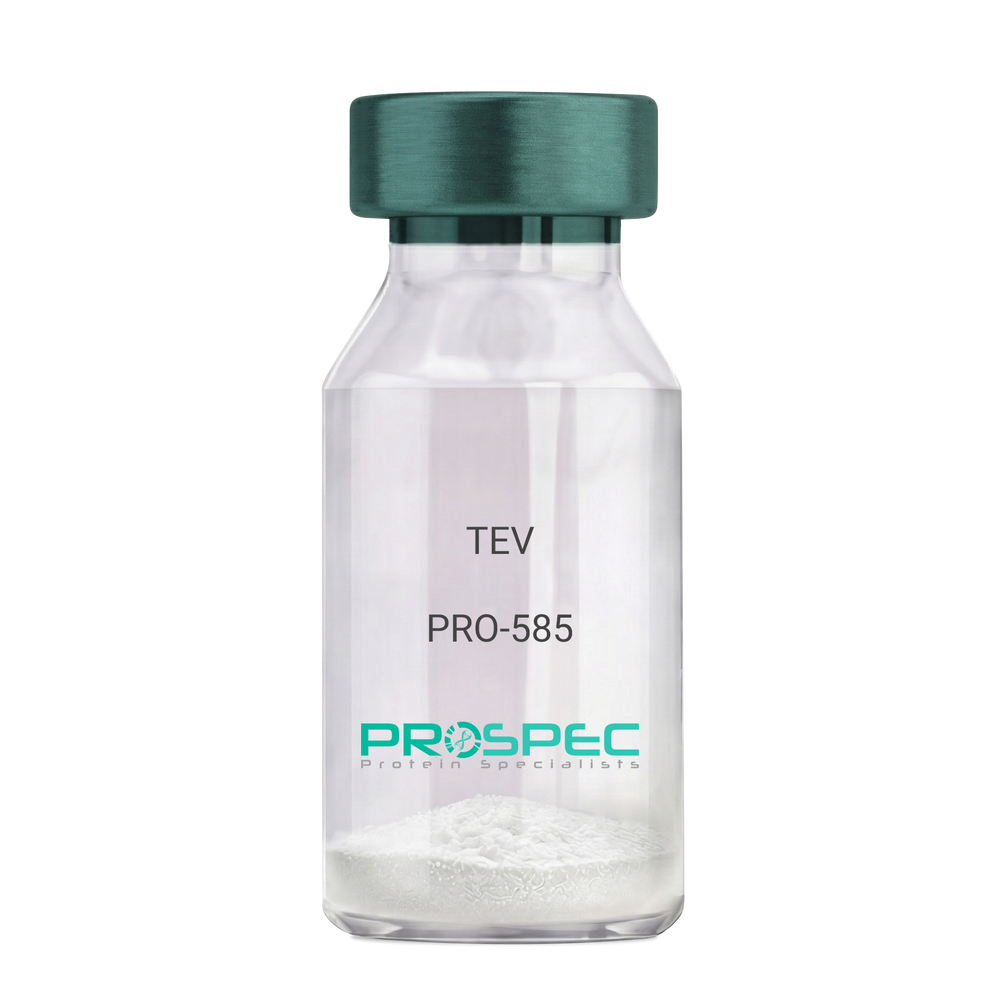
    TEV

    Description:

    Tobacco Etch Virus Protease Recombinant

    rTEV, TEV, P1 protease.

    Product # :

    PRO-585

    Price :

    Quantity :

    Shipping Method :

    Ice Icon

    Shipped with Ice Packs

    Add To Cart

    More Info

    • description
    • source
    • formulation
    • purity
    • More Info

    Description

    Recombinant TEV Protease (rTEV) is a site-specific protease purified from E. coli. The protease can be used for the removal of affinity tags from fusion proteins. The seven-amino-acid recognition site for rTEV is Glu-Asn-Leu-Tyr-Phe-Gln-Gly with cleavage occurring between Gln and Gly. The optimal temperature for cleavage is 30°C; however, the enzyme can be used at temperatures as low as 4°C. The rTEV contains His tag.The rTEV is purified by proprietary chromatographic techniques.

    Source

    Escherichia Coli.

    Formulation

    The rTEV contains 25mM Tris, Ph 8.0, 75mM NaCl, 5mM EDTA, 10mM GSH, 50% Glycerol.

    Purity

    Greater than 90.0% as determined by analysis by SDS-PAGE.

    More Info

    • Introduction

      TEV protease is the common name for the 27 kDa catalytic domain of the Nuclear Inclusion a (NIa) protein encoded by the tobacco etch virus (TEV). Because its sequence specificity is far more stringent than that of factor Xa, thrombin, or enterokinase, TEV protease is a very useful reagent for cleaving fusion proteins. TEV protease recognizes a linear epitope of the general form E-Xaa-Xaa-Y -Xaa-Q-(G/S), with cleavage occurring between Q and G or Q and S. The most commonly used sequence is ENLYFQG.

    • Synonyms

      rTEV, TEV, P1 protease.

    • Physical Appearance

      Sterile liquid formulation.

    • Stability

      rTEV although stable at 4°C for 1 week, should be stored below -18°C. Please prevent freeze thaw cycles.

    • Cleavage Conditions

      A number of variables can be changed to optimize the cleavage of any specific protein. The amount of rTEV, the temperature of the incubation, and the time needed for cleavage may be examined. If the protein of interest is heat-labile, then 4°C incubations are recommended. Reactions at 4°C will require longer incubation times and/or more rTEV.

    • Unit Definition

      One unit is defined as the amount of enzyme needed to cleave 3 ug of fusion protein in 1 hour to 85 % completion at 30°C in a buffer containing 50 mM Tris-HCl, pH 8.0, 0.5 mM EDTA, and 1 mM DTT.

    ProSpec's products are furnished for LABORATORY RESEARCH USE ONLY. The product may not be used as drugs, agricultural or pesticidal products, food additives or household chemicals.

    Tev Protease
  • View Data Sheet

    Name :

    PPA Yeast

    Description:

    Inorganic Pyrophosphatase Yeast Recombinant

    Inorganic pyrophosphatase, PPA.

    Product # :

    ENZ-1181

    Price :

    Quantity :

    Shipping Method :

    Ice Icon

    Shipped with Ice Packs

    Add To Cart

    More Info

    • description
    • source
    • formulation
    • purity
    • More Info

    Description

    PPA Yeast Recombinant produced in E.Coli is a single, non-glycosylated polypeptide chain containing 286 amino acids and having a molecular mass of 35kDa. Inorganic Pyrophosphatase is purified by proprietary chromatographic techniques.

    Source

    Escherichia Coli.

    Formulation

    Inorganic pyrophosphatase protein solution (100U/ml) containing 20mM Tris-HCl (25℃, pH 8.0), 100mM KCl, 0.1mM EDTA, 1mM DTT and 50% glycerol.

    Purity

    Greater than 98.0% as determined by SDS-PAGE.

    More Info

    • Introduction

      Inorganic pyrophosphatase (ppa) is a member of the Ppase family. PPA is an enzyme which catalyzes the conversion of one molecule of pyrophosphate to two phosphate ions. Since this is a highly exergonic reaction, it can therefore be coupled to unfavorable biochemical transformations in order to drive these transformations to completion. The role of the PPA enzyme is a critical one in the lipid metabolism (including lipid synthesis and degradation), calcium absorption and bone formation, DNA synthesis, as well as other biochemical transformations.

    • Synonyms

      Inorganic pyrophosphatase, PPA.

    • Physical Appearance

      Sterile filtered colorless solution.

    • Stability

      Store at 4°C if entire vial will be used within 2-4 weeks. Store, frozen at -20°C for longer periods of time. Do not store at -70C. For long term storage it is recommended to add a carrier protein (0.1% HSA or BSA). Avoid multiple freeze-thaw cycles.

    • Unit Definition

      Under standard conditions, 1U is defined as the amount of enzyme required to catalyze the hydrolysis of pyrophosphate (PPi)/min. to produce 1μmol of orthophosphate (Pi). Optimal reaction temp. is 25℃ , activity at 16 ~ 37℃. Cofactor: Mg+2

    ProSpec's products are furnished for LABORATORY RESEARCH USE ONLY. The product may not be used as drugs, agricultural or pesticidal products, food additives or household chemicals.

    Ppa Yeast
  • View Data Sheet

    Name :

    BAT1 Human

    Description:

    HLA-B Associated Transcript 1 Human Recombinant

    HLA-B associated transcript 1, UAP56, D6S81E, DDX39B, ATP-dependent RNA helicase p47, DEAD-box protein UAP56

    Product # :

    ENZ-563

    Price :

    Quantity :

    Shipping Method :

    Ice Icon

    Shipped with Ice Packs

    Add To Cart

    More Info

    • description
    • source
    • formulation
    • purity
    • More Info

    Description

    BAT1 Human Recombinant protein produced in E.Coli is a single, non-glycosylated, polypeptide chain containing 448 amino acids (1-428) and having a molecular mass of 51.1kDa. BAT1 is fused to 20 amino acid His Tag at N-terminus and is purified by proprietary chromatographic techniques.

    Source

    Escherichia Coli.

    Formulation

    BAT1 protein (0.5mg/ml) solution contains 20mM Tris-HCl buffer (pH8.0) 0.1M NaCl,1mM DTT and 20% glycerol.

    Purity

    Greater than 90.0% as determined by SDS-PAGE.

    More Info

    • Introduction

      BAT1 belongs to the DEAD box family of RNA-dependent ATPases that mediate ATP hydrolysis during pre-mRNA splicing. UAP56 protein is a vital splicing factor which is needed for connecting U2 small nuclear ribonucleoprotein with pre-mRNA, as well as takes a key part in mRNA export from the nucleus to the cytoplasm. Mutations in this protein may be connected to rheumatoid arthritis.

    • Synonyms

      HLA-B associated transcript 1, UAP56, D6S81E, DDX39B, ATP-dependent RNA helicase p47, DEAD-box protein UAP56

    • Physical Appearance

      Sterile filtered colorless solution.

    • Stability

      Store at 4°C if entire vial will be used within 2-4 weeks. Store, frozen at -20°C for longer periods of time. For long term storage it is recommended to add a carrier protein (0.1% HSA or BSA).Avoid multiple freeze-thaw cycles.

    • Amino Acid Sequence

      MGSSHHHHHH SSGLVPRGSH MAENDVDNEL LDYEDDEVET AAGGDGAEAP AKKDVKGSYV SIHSSGFRDF LLKPELLRAI VDCGFEHPSE VQHECIPQAI LGMDVLCQAK SGMGKTAVFV LATLQQLEPV TGQVSVLVMC HTRELAFQIS KEYERFSKYM PNVKVAVFFG GLSIKKDEEV LKKNCPHIVV GTPGRILALA RNKSLNLKHI KHFILDECDK MLEQLDMRRD VQEIFRMTPH EKQVMMFSAT LSKEIRPVCR KFMQDPMEIF VDDETKLTLH GLQQYYVKLK DNEKNRKLFD LLDVLEFNQV VIFVKSVQRC IALAQLLVEQ NFPAIAIHRG MPQEERLSRY QQFKDFQRRI LVATNLFGRG MDIERVNIAF NYDMPEDSDT YLHRVARAGR FGTKGLAITF VSDENDAKIL NDVQDRFEVN ISELPDEIDI SSYIEQTR

    ProSpec's products are furnished for LABORATORY RESEARCH USE ONLY. The product may not be used as drugs, agricultural or pesticidal products, food additives or household chemicals.

    Bat1 Human
  • View Data Sheet

    Name :

    PSMA8 Human

    Description:

    Proteasome Subunit Alpha Type 8 Human Recombinant

    Proteasome subunit alpha type-7-like, PSMA8, PSMA7L.

    Product # :

    ENZ-203

    Price :

    Quantity :

    Shipping Method :

    Ice Icon

    Shipped with Ice Packs

    Add To Cart

    More Info

    • description
    • source
    • formulation
    • purity
    • More Info

    Description

    PSMA8 Human Recombinant produced in E.coli is a single, non-glycosylated polypeptide chain containing 270 amino acids (1-250) and having a molecular mass of 30kDa.PSMA8 is fused to a 20 amino acid His-tag at N-terminus & purified by proprietary chromatographic techniques.

    Source

    E.coli.

    Formulation

    The PSMA8 solution (0.5mg/ml) contains 20mM Tris-HCl buffer (pH 8.0), 1mM DTT, 10% glycerol and 0.1M NaCl.

    Purity

    Greater than 90% as determined by SDS-PAGE.

    More Info

    • Introduction

      Proteasome subunit alpha type-8 (PSMA8) is a member of the peptidase T1A family. PSMA8 is a multicatalytic proteinase complex which is distinguished by its ability to cleave peptides with Arg, Phe, Tyr, Leu, and Glu adjacent to the leaving group at neutral or slightly basic pH. The proteasome has an ATP-dependent proteolytic activity. The PSMA8 subunit may be testis-specific.

    • Synonyms

      Proteasome subunit alpha type-7-like, PSMA8, PSMA7L.

    • Physical Appearance

      Sterile Filtered colorless solution.

    • Stability

      Store at 4°C if entire vial will be used within 2-4 weeks. Store, frozen at -20°C for longer periods of time. For long term storage it is recommended to add a carrier protein (0.1% HSA or BSA).Avoid multiple freeze-thaw cycles.

    • Amino Acid Sequence

      MGSSHHHHHH SSGLVPRGSH MASRYDRAIT VFSPDGHLFQ VEYAQEAVKK GSTAVGIRGT NIVVLGVEKK SVAKLQDERT VRKICALDDH VCMAFAGLTA DARVVINRAR VECQSHKLTV EDPVTVEYIT RFIATLKQKY TQSNGRRPFG ISALIVGFDD DGISRLYQTD PSGTYHAWKA
      NAIGRSAKTV REFLEKNYTE DAIASDSEAI KLAIKALLEV VQSGGKNIEL AIIRRNQPLK MFSAKEVELY VTEIEKEKEE AEKKKSKKSV.

    ProSpec's products are furnished for LABORATORY RESEARCH USE ONLY. The product may not be used as drugs, agricultural or pesticidal products, food additives or household chemicals.

    Psma8 Human
  • View Data Sheet

    Name :

    GCDH Human

    Description:

    Glutaryl-Coenzyme A Dehydrogenase Human Recombinant

    ACAD5, GCD, EC 1.3.99.7, GCDH, Glutaryl-Coenzyme A Dehydrogenase, glutaryl-CoA dehydrogenase.

    Product # :

    ENZ-542

    Price :

    Quantity :

    Shipping Method :

    Ice Icon

    Shipped with Ice Packs

    Add To Cart

    More Info

    • description
    • source
    • formulation
    • purity
    • More Info

    Description

    GCDH Recombinant Human produced in E.Coli is a single, non-glycosylated polypeptide chain containing 415 amino acids (45-438 a.a.) and having a molecular mass of 45.8 kDa. The GCDH is fused to 21 amino acid His-Tag at N-terminus and purified by proprietary chromatographic techniques.

    Source

    Escherichia Coli.

    Formulation

    0.5mg/ml solution containing 20mM Tris-HCl, pH-8, 5mM DTT, 0.2M NaCl & 20% glycerol.

    Purity

    Greater than 90.0% as determined by SDS-PAGE.

    More Info

    • Introduction

      GCDH is part of the acyl-CoA dehydrogenase family. GCDH is localized in the mitochondrial matrix as a homotetramer of 45-kD subunits. GCDH catalyzes the oxidative decarboxylation of glutaryl-CoA to crotonyl-CoA and CO(2) in the degradative pathway of L-lysine, L-hydroxylysine, and L-tryptophan metabolism. GCDH uses electron transfer flavoprotein as its electron acceptor.

    • Synonyms

      ACAD5, GCD, EC 1.3.99.7, GCDH, Glutaryl-Coenzyme A Dehydrogenase, glutaryl-CoA dehydrogenase.

    • Physical Appearance

      Sterile filtered colorless solution.

    • Stability

      Store at 4°C if entire vial will be used within 2-4 weeks. Store, frozen at -20°C for longer periods of time. For long term storage it is recommended to add a carrier protein (0.1% HSA or BSA).Avoid multiple freeze-thaw cycles.

    • Amino Acid Sequence

      MGSSHHHHHH SSGLVPRGSH MRPEFDWQDP LVLEEQLTTD EILIRDTFRT YCQERLMPRI LLANRNEVFH REIISEMGEL GVLGPTIKGY GCAGVSSVAY GLLARELERV DSGYRSAMSV QSSLVMHPIY AYGSEEQRQK YLPQLAKGEL LGCFGLTEPN SGSDPSSMET RAHYNSSNKS YTLNGTKTWI TNSPMADLFV VWARCEDGCI RGFLLEKGMR GLSAPRIQGK FSLRASATGM IIMDGVEVPE ENVLPGASSL GGPFGCLNNA RYGIAWGVLG ASEFCLHTAR QYALDRMQFG VPLARNQLIQ KKLADMLTEI TLGLHACLQL GRLKDQDKAA PEMVSLLKRN NCGKALDIAR QARDMLGGNG ISDEYHVIRH AMNLEAVNTY EGTHDIHALI LGRAITGIQA FTASK.

    ProSpec's products are furnished for LABORATORY RESEARCH USE ONLY. The product may not be used as drugs, agricultural or pesticidal products, food additives or household chemicals.

    Gcdh Human
  • View Data Sheet

    Name :

    HPGDS Human

    Description:

    Hematopoietic Prostaglandin D Synthase Human Recombinant

    Hematopoietic prostaglandin D synthase, H-PGDS, GST class-sigma, Glutathione S-transferase, Glutathione-dependent PGD synthase, Glutathione-requiring prostaglandin D synthase, Prostaglandin-H2 D-isomerase, HPGDS, GSTS, PGDS, PTGDS2GSTS, PGD2, GSTS1-1.

    Product # :

    ENZ-616

    Price :

    Quantity :

    Shipping Method :

    Ice Icon

    Shipped with Ice Packs

    Add To Cart

    More Info

    • description
    • source
    • formulation
    • purity
    • More Info

    Description

    HPGDS Human Recombinant produced in E.Coli is a single, non-glycosylated polypeptide chain containing 223 amino acids (1-199 a.a.) and having a molecular mass of 25.9kDa.HPGDS is fused to a 24 amino acid His-tag at N-terminus & purified by proprietary chromatographic techniques.

    Source

    Escherichia Coli.

    Formulation

    HPGDS protein solution (1mg/ml) containing 20mM Tris-HCl buffer (pH8.0), 10% glycerol, 0.15M NaCl and 1mM DTT.

    Purity

    Greater than 95.0% as determined by SDS-PAGE.

    More Info

    • Introduction

      Hematopoietic Prostaglandin D Synthase (HPGDS) belongs to the sigma class glutathione-S-transferase family. The HPGDS enzyme catalyzes the conversion of PGH2 to PGD2 and has a role in the production of prostanoids in the immune system and mast cells. The presence of the HPGDS enzyme can be utilized to identify the differentiation stage of human megakaryocytes. Furthermore, HPGDS is a prostaglandin involved in smooth muscle contraction/relaxation and an effective inhibitor of platelet aggregation, and the conjugation of glutathione with a extensive range of aryl halides and organic isothiocyanates. In addition, HPGDS displays low glutathione-peroxidase activity towards cumene hydroperoxide. HPGDS is expressed in a number of megakaryocytic cell lines but not in platelets. HPGDS is highly expressed in the adipose tissue, macrophages and placenta; however it is expressed at lower levels in the lung, heart, lymph nodes, appendix, bone marrow and fetal liver.

    • Synonyms

      Hematopoietic prostaglandin D synthase, H-PGDS, GST class-sigma, Glutathione S-transferase, Glutathione-dependent PGD synthase, Glutathione-requiring prostaglandin D synthase, Prostaglandin-H2 D-isomerase, HPGDS, GSTS, PGDS, PTGDS2GSTS, PGD2, GSTS1-1.

    • Physical Appearance

      Sterile Filtered colorless solution.

    • Stability

      Store at 4°C if entire vial will be used within 2-4 weeks. Store, frozen at -20°C for longer periods of time. For long term storage it is recommended to add a carrier protein (0.1% HSA or BSA).Avoid multiple freeze-thaw cycles.

    • Amino Acid Sequence

      MGSSHHHHHH SSGLVPRGSH MGSHMPNYKL TYFNMRGRAE IIRYIFAYLD IQYEDHRIEQ ADWPEIKSTL PFGKIPILEV DGLTLHQSLA IARYLTKNTD LAGNTEMEQC HVDAIVDTLD DFMSCFPWAE KKQDVKEQMF NELLTYNAPH LMQDLDTYLG GREWLIGNSV TWADFYWEIC
      STTLLVFKPD LLDNHPRLVT LRKKVQAIPA VANWIKRRPQ TKL.

    ProSpec's products are furnished for LABORATORY RESEARCH USE ONLY. The product may not be used as drugs, agricultural or pesticidal products, food additives or household chemicals.

    Hpgds Human
  • View Data Sheet

    Name :

    LAP3 Human

    Description:

    Leucine Aminopeptidase 3 Human Recombinant

    Leucine Aminopeptidase 3, Peptidase S, PEPS, Proline Aminopeptidase, Leucyl Aminopeptidase, Prolyl Aminopeptidase, EC 3.4.11.1, LAP-3, LAPEP, Epididymis Secretory Protein Li 106, Cytosol Aminopeptidase, EC 3.4.11.5, HEL-S-106, EC 3.4.11, LAP, Cytosol aminopeptidase, Leucine aminopeptidase 3, Leucyl aminopeptidase, Proline aminopeptidase, Prolyl aminopeptidase.

    Product # :

    ENZ-889

    Price :

    Quantity :

    Shipping Method :

    Ice Icon

    Shipped with Ice Packs

    Add To Cart

    More Info

    • description
    • source
    • formulation
    • purity
    • More Info

    Description

    LAP3 Human Recombinant produced in E.Coli is a single, non-glycosylated polypeptide chain containing 539 amino acids (1-519 a.a) and having a molecular mass of 58.3kDa. LAP3 is fused to a 20 amino acid His-tag at N-terminus & purified by proprietary chromatographic techniques.

    Source

    Escherichia Coli.

    Formulation

    LAP3 protein solution (0.5mg/ml) containing 20mM Tris-HCl(pH8.5), 50% glycerol, 5mM DTT and 1mM EDTA.

    Purity

    Greater than 85% as determined by SDS-PAGE.

    More Info

    • Introduction

      Leucine Aminopeptidase 3 also known as LAP3 is a member of the peptidase M17 family. LAP3 is implicated in the processing as well as regular turnover of intracellular proteins. LAP3 catalyzes the removal of unsubstituted N-terminal amino acids from different peptides. LAP3 is responsible of releasing an N-terminal amino acid, Xaa-|-Yaa-, in which Xaa is preferably Leu, but could be other amino acids including Pro although not Arg or Lys, and Yaa may be Pro. Amino acid amides and methyl esters are as well readily hydrolyzed; however rates on arylamides are exceedingly low.

    • Synonyms

      Leucine Aminopeptidase 3, Peptidase S, PEPS, Proline Aminopeptidase, Leucyl Aminopeptidase, Prolyl Aminopeptidase, EC 3.4.11.1, LAP-3, LAPEP, Epididymis Secretory Protein Li 106, Cytosol Aminopeptidase, EC 3.4.11.5, HEL-S-106, EC 3.4.11, LAP, Cytosol aminopeptidase, Leucine aminopeptidase 3, Leucyl aminopeptidase, Proline aminopeptidase, Prolyl aminopeptidase.

    • Physical Appearance

      Sterile Filtered colorless solution.

    • Stability

      Store at 4°C if entire vial will be used within 2-4 weeks. Store, frozen at -20°C for longer periods of time. For long term storage it is recommended to add a carrier protein (0.1% HSA or BSA).Avoid multiple freeze-thaw cycles.

    • Amino Acid Sequence

      MGSSHHHHHH SSGLVPRGSH MFLLPLPAAG RVVVRRLAVR RFGSRSLSTA DMTKGLVLGI YSKEKEDDVP QFTSAGENFD KLLAGKLRET LNISGPPLKA GKTRTFYGLH QDFPSVVLVG LGKKAAGIDE QENWHEGKEN IRAAVAAGCR QIQDLELSSV EVDPCGDAQA AAEGAVLGLY EYDDLKQKKK MAVSAKLYGS GDQEAWQKGV LFASGQNLAR QLMETPANEM TPTRFAEIIE KNLKSASSKT EVHIRPKSWI EEQAMGSFLS VAKGSDEPPV FLEIHYKGSP NANEPPLVFV GKGITFDSGG ISIKASANMD LMRADMGGAA TICSAIVSAA KLNLPINIIG LAPLCENMPS GKANKPGDVV RAKNGKTIQV DNTDAEGRLI LADALCYAHT FNPKVILNAA TLTGAMDVAL GSGATGVFTN SSWLWNKLFE ASIETGDRVW RMPLFEHYTR QVVDCQLADV NNIGKYRSAG ACTAAAFLKE FVTHPKWAHL DIAGVMTNKD EVPYLRKGMT GRPTRTLIEF LLRFSQDNA.

    ProSpec's products are furnished for LABORATORY RESEARCH USE ONLY. The product may not be used as drugs, agricultural or pesticidal products, food additives or household chemicals.

    Lap3 Human
  • View Data Sheet

    Name :

    TXNRD1 Human

    Description:

    Thioredoxin Reductase 1 Human Recombinant

    Thioredoxin reductase 1 cytoplasmic, TR, GRIM-12, Gene associated with retinoic and IFN-induced mortality 12 protein, KM-102-derived reductase-like factor, Thioredoxin reductase TR1, TXNRD1, GRIM12, KDRF, TR1, TXNR, TRXR1, MGC9145.

    Product # :

    ENZ-518

    Price :

    Quantity :

    Shipping Method :

    Ice Icon

    Shipped with Ice Packs

    Add To Cart

    More Info

    • description
    • source
    • formulation
    • purity
    • biological activity
    • More Info

    Description

    TXNRD1 Human Recombinant produced in E.Coli is a single, non-glycosylated,polypeptide chain containing 508 amino acids (161-647 a.a.) and having a molecular mass of 55.7 kDa. TXNRD1 protein is fused to a 21 amino acid His tag at N-terminus and is purified by standard chromatography.

    Source

    Escherichia Coli.

    Formulation

    TXNRD1 Human solution (0.5mg/ml) containing 1x PBS pH-7.4 & 20% glycerol.

    Purity

    Greater than 90% as determined by SDS-PAGE.

    Biological Activity

    Specific activity is > 15 units/mg, and was measured in a coupled assay with 5,5'-Dithiobis(2-nitrobenzoic acid)(DTNB)and NADPH. The amount of TNB generated by NADPH was measured in absorbance at 412 nm.

    More Info

    • Introduction

      TXNRD1 belongs to the selenium-containing pyridine nucleotide-disulphide oxidoreductase family, which has a conserved catalytic site of Cys-Val-Asn-Val-Gly-Cys. TXNRD1 decreases thioredoxins as well as other substrates, and participates in selenium metabolism and protection against oxidative stress. Inhibition of TXNRD1 activity serves as a potential treatment for cancer, AIDS and other autoimmune diseases as well as bacterial infections and parasitic diseases.

    • Synonyms

      Thioredoxin reductase 1 cytoplasmic, TR, GRIM-12, Gene associated with retinoic and IFN-induced mortality 12 protein, KM-102-derived reductase-like factor, Thioredoxin reductase TR1, TXNRD1, GRIM12, KDRF, TR1, TXNR, TRXR1, MGC9145.

    • Physical Appearance

      Sterile filtered colorless solution.

    • Stability

      Store at 4°C if entire vial will be used within 2-4 weeks. Store, frozen at -20°C for longer periods of time. For long term storage it is recommended to add a carrier protein (0.1% HSA or BSA).Avoid multiple freeze-thaw cycles.

    • Amino Acid Sequence

      MGSSHHHHHH SSGLVPRGSH MYDYDLIIIG GGSGGLAAAK EAAQYGKKVM VLDFVTPTPL GTRWGLGGTC VNVGCIPKKL MHQAALLGQALQDSRNYGWK VEETVKHDWD RMIEAVQNHI GSLNWGYRVA LREKKVVYEN AYGQFIGPHR IKATNNKGKE KIYSAERFLI ATGERPRYLGIPGDKEYCIS SDDLFSLPYC PGKTLVVGAS YVALECAGFL AGIGLDVTVM VRSILLRGFD QDMANKIGEH MEEHGIKFIR QFVPIKVEQIEAGTPGRLRV VAQSTNSEEI IEGEYNTVML AIGRDACTRK IGLETVGVKI NEKTGKIPVT DEEQTNVPYI YAIGDILEDK VELTPVAIQAGRLLAQRLYA GSTVKCDYEN VPTTVFTPLE YGACGLSEEK AVEKFGEENI EVYHSYFWPL EWTIPSRDNN KCYAKIICNT KDNERVVGFH VLGPNAGEVT QGFAAALKCG LTKKQLDSTI GIHPVCAEVF TTLSVTKRSG ASILQAGC.

    ProSpec's products are furnished for LABORATORY RESEARCH USE ONLY. The product may not be used as drugs, agricultural or pesticidal products, food additives or household chemicals.

    Txnrd1 Human
  • View Data Sheet

    Name :

    GSTM2 Human

    Description:

    Glutathione S-Transferase MU 2 Human Recombinant

    Glutathione S-transferase Mu 2, GST class-mu 2, GSTM2-2, GSTM2, GST4, GSTM, GTHMUS, MGC117303.

    Product # :

    ENZ-003

    Price :

    Quantity :

    Shipping Method :

    Ice Icon

    Shipped with Ice Packs

    Add To Cart

    More Info

    • description
    • source
    • formulation
    • purity
    • biological activity
    • More Info

    Description

    GSTM2 Human Recombinant fused with a 20 amino acid His tag at N-terminus produced in E.Coli is a single, non-glycosylated, polypeptide chain containing 238 amino acids (1-218 a.a.) and having a molecular mass of 27.9kDa. The GSTM2 is purified by proprietary chromatographic techniques.

    Source

    Escherichia Coli.

    Formulation

    The GSTM2 solution (0.5mg/ml) contains 20mM Tris-HCl buffer (pH8.0), 10% glycerol,
    0.1M NaCl and 1mM DTT.

    Purity

    Greater than 95.0% as determined by SDS-PAGE.

    Biological Activity

    Specific activity is < 25 units/mg, and is defined as the amount of enzyme that conjugate 1.0 µmole of 1-chloro-2,4-dinitrobenzene (CDNB) with reduced glutathione per minute at pH 6.5 at 25°C.

    More Info

    • Introduction

      Glutathione S-transferase Mu 2 (GSTM2) belongs to the glutathione s-transferase (GST) family of proteins. GSTM2 is a glutathione S-transferase that belongs to the mu class. There are 8 families of GST proteins, specifically: alpha, kappa, mu, omega, pi, sigma, theta and zeta, each of which is composed of proteins that have various functions throughout the cell. The mu class of enzymes functions in the detoxification of electrophilic compounds, including carcinogens, therapeutic drugs, environmental toxins and products of oxidative stress, by conjugation with glutathione. The genes encoding the mu class of enzymes are structured in a gene cluster on chromosome 1p13.3 and are proven to be highly polymorphic. These genetic variants can change an individual''s susceptibility to carcinogens and toxins as well as have an effect on the toxicity and efficacy of several drugs.

    • Synonyms

      Glutathione S-transferase Mu 2, GST class-mu 2, GSTM2-2, GSTM2, GST4, GSTM, GTHMUS, MGC117303.

    • Physical Appearance

      Sterile Filtered colorless solution.

    • Stability

      Store at 4°C if entire vial will be used within 2-4 weeks. Store, frozen at -20°C for longer periods of time. For long term storage it is recommended to add a carrier protein (0.1% HSA or BSA).Avoid multiple freeze-thaw cycles.

    • Amino Acid Sequence

      MGSSHHHHHH SSGLVPRGSH MPMTLGYWNI RGLAHSIRLL LEYTDSSYEE KKYTMGDAPD YDRSQWLNEK FKLGLDFPNL PYLIDGTHKI TQSNAILRYI ARKHNLCGES EKEQIREDIL ENQFMDSRMQ LAKLCYDPDF EKLKPEYLQA LPEMLKLYSQ FLGKQPWFLG DKITFVDFIA YDVLERNQVF EPSCLDAFPN LKDFISRFEG LEKISAYMKS SRFLPRPVFT KMAVWGNK.

    ProSpec's products are furnished for LABORATORY RESEARCH USE ONLY. The product may not be used as drugs, agricultural or pesticidal products, food additives or household chemicals.

    Gstm2 Human
  • 1
  • …
  • 23
  • 24
  • 25
  • 26
  • 27
  • …
  • 42
Your browser does not support the video tag.

Products

  • Cytokines
  • Growth Factors
  • Chemokines
  • CD Antigens
  • Neurotrophins
  • Hormones
  • Enzymes
  • Viral Antigens
  • Recombinant Proteins
  • Natural Proteins
  • Monoclonal Antibodies
  • Polyclonal Antibodies
  • Thermal Packaging

About

  • Company
  • Founder
  • Contribution
  • Contact Us
  • My Account

Ordering

  • Ordering Method
  • Ordering - Credit Card
  • Ordering PO
  • Shipping Fees
  • FAQ's

Legal

  • Terms & Conditions
  • Privacy
  • Site Map
  • info@prospecbio.com
  • Facebook
  • Instagram
  • Linkedin Profile

© 2026 ProSpec-Tany TechnoGene Ltd. All Rights Reserved.

  • Choosing a selection results in a full page refresh.
  • Opens in a new window.