Skip to content

High-quality research proteins.

  • 1-800-805-6531

  • Mon - Sat 8.00-18.00, Sun - Closed

  • info@prospecbio.com

  • PO Box 6591 East Brunswick NJ 08816

  • Products
    • Cytokines
    • Growth factors
    • Chemokines
    • Cd antigens
    • Neurotrophins
    • Hormones
    • Enzymes
    • Viral antigens
    • Recombinant proteins
    • Natural proteins
    • Monoclonal antibodies
    • Polyclonal antibodies
    • Thermal Packaging
  • About
    • Company
    • Founder
    • Contribution
  • Customers
    • Eastern Asia
    • Eastern Europe
    • North America
    • South America
    • South East Asia
    • Southern Asia
    • Western Europe
  • Ordering
    • Ordering Method
    • Ordering - Credit Card
    • Ordering - PO
    • Shipping Fees
    • FAQs
  • Services
    • DNA Cloning
    • Protein Expression
    • Monoclonal Antibody
    • Fermentation
    • Technology License
  • Contact us
Log in

Country/region

  • USD $ | Albania
  • USD $ | Andorra
  • USD $ | Argentina
  • USD $ | Armenia
  • USD $ | Australia
  • USD $ | Austria
  • USD $ | Azerbaijan
  • USD $ | Belarus
  • USD $ | Belgium
  • USD $ | Bolivia
  • USD $ | Brazil
  • USD $ | Bulgaria
  • USD $ | Cambodia
  • USD $ | Canada
  • USD $ | Chile
  • USD $ | China
  • USD $ | Colombia
  • USD $ | Costa Rica
  • USD $ | Croatia
  • USD $ | Cyprus
  • USD $ | Czechia
  • USD $ | Denmark
  • USD $ | Estonia
  • USD $ | Finland
  • USD $ | France
  • USD $ | Georgia
  • USD $ | Germany
  • USD $ | Greece
  • USD $ | Hong Kong SAR
  • USD $ | Hungary
  • USD $ | Iceland
  • USD $ | India
  • USD $ | Ireland
  • USD $ | Israel
  • USD $ | Italy
  • USD $ | Japan
  • USD $ | Kazakhstan
  • USD $ | Latvia
  • USD $ | Liechtenstein
  • USD $ | Lithuania
  • USD $ | Madagascar
  • USD $ | Malta
  • USD $ | Mexico
  • USD $ | Moldova
  • USD $ | Monaco
  • USD $ | Netherlands
  • USD $ | New Zealand
  • USD $ | North Macedonia
  • USD $ | Norway
  • USD $ | Panama
  • USD $ | Paraguay
  • USD $ | Peru
  • USD $ | Philippines
  • USD $ | Poland
  • USD $ | Portugal
  • USD $ | Romania
  • USD $ | Singapore
  • USD $ | Slovakia
  • USD $ | Slovenia
  • USD $ | South Africa
  • USD $ | South Korea
  • USD $ | Spain
  • USD $ | Sri Lanka
  • USD $ | Sweden
  • USD $ | Switzerland
  • USD $ | Taiwan
  • USD $ | Thailand
  • USD $ | Türkiye
  • USD $ | Ukraine
  • USD $ | United Kingdom
  • USD $ | United States
  • USD $ | Uruguay
  • USD $ | Vatican City
  • USD $ | Venezuela
  • USD $ | Vietnam
  • Facebook
  • Instagram
logoProSpec - Recombinant Protein Manufacturer for academic and R&D industry
Become a distributor
Account Log in
Wishlist
Cart Cart(0)
  • Products
    +
    • Cytokines
    • Growth factors
    • Chemokines
    • Cd antigens
    • Neurotrophins
    • Hormones
    • Enzymes
    • Viral antigens
    • Recombinant proteins
    • Natural proteins
    • Monoclonal antibodies
    • Polyclonal antibodies
    • Thermal Packaging
  • About
    +
    • Company
    • Founder
    • Contribution
  • Customers
    +
    • Eastern Asia
    • Eastern Europe
    • North America
    • South America
    • South East Asia
    • Southern Asia
    • Western Europe
  • Ordering
    +
    • Ordering Method
    • Ordering - Credit Card
    • Ordering - PO
    • Shipping Fees
    • FAQs
  • Services
    +
    • DNA Cloning
    • Protein Expression
    • Monoclonal Antibody
    • Fermentation
    • Technology License
  • Contact us

Item added to your cart

View cart
View All
  • Cytokines
  • Growth factors
  • Chemokines
  • Cd antigens
  • Neurotrophins
  • Hormones
  • Enzymes
  • Viral antigens
  • Recombinant proteins
  • Natural proteins
  • Monoclonal antibodies
  • Polyclonal antibodies
  • Thermal Packaging
  • Tumor Necrosis Factor

    Tumor Necrosis Factor

    View All
  • 4-1BB

    4-1BB

    View All
  • Adiponectin

    Adiponectin

    View All
  • AIF1

    AIF1

    View All
  • Other Cytokines

    Other Cytokines

    View All
  • AITRL

    AITRL

    View All
  • Angiopoietin

    Angiopoietin

    View All
  • Apolipoprotein

    Apolipoprotein

    View All
  • B-Cell Activating Factor

    B-Cell Activating Factor

    View All
  • Beta Defensin

    Beta Defensin

    View All
  • Bone Morphogenetic Protein

    Bone Morphogenetic Protein

    View All
  • B type Natriuretic Peptide

    B type Natriuretic Peptide

    View All
  • BST

    BST

    View All
  • Betacellulin

    Betacellulin

    View All
  • Cardiotrophin

    Cardiotrophin

    View All
  • Activin

    Activin

    View All
  • Fibroblast Growth Factor

    Fibroblast Growth Factor

    View All
  • Other Growth Factors

    Other Growth Factors

    View All
  • CSF

    CSF

    View All
  • CTGF

    CTGF

    View All
  • IGFBP

    IGFBP

    View All
  • VEGF Protein

    VEGF Protein

    View All
  • EGF

    EGF

    View All
  • Epigen

    Epigen

    View All
  • Erythropoietin

    Erythropoietin

    View All
  • Insulin-Like Growth Factor

    Insulin-Like Growth Factor

    View All
  • Growth Hormone

    Growth Hormone

    View All
  • HDGF

    HDGF

    View All
  • Hepatocyte Growth Factor

    Hepatocyte Growth Factor

    View All
  • Insulin

    Insulin

    View All
  • BCA-1/ BLC (CXCL13)

    BCA-1/ BLC (CXCL13)

    View All
  • BRAK (CXCL14)

    BRAK (CXCL14)

    View All
  • C-10 (CCL6)

    C-10 (CCL6)

    View All
  • Other Chemokines

    Other Chemokines

    View All
  • MEC (CCL28)

    MEC (CCL28)

    View All
  • LD78-beta (CCL3L1)

    LD78-beta (CCL3L1)

    View All
  • CTACK (CCL27)

    CTACK (CCL27)

    View All
  • CXCL16

    CXCL16

    View All
  • CXCL17

    CXCL17

    View All
  • Platelet Factor-4 (CXCL4)

    Platelet Factor-4 (CXCL4)

    View All
  • ENA-78 (CXCL5)

    ENA-78 (CXCL5)

    View All
  • Eotaxin (CCL11,24,26)

    Eotaxin (CCL11,24,26)

    View All
  • Exodus-2 (CCL21)

    Exodus-2 (CCL21)

    View All
  • Fractalkine (CX3CL1)

    Fractalkine (CX3CL1)

    View All
  • CXCL6

    CXCL6

    View All
  • Other CD Antigens

    Other CD Antigens

    View All
  • CD14

    CD14

    View All
  • CD164

    CD164

    View All
  • CD1

    CD1

    View All
  • CD2

    CD2

    View All
  • CD200

    CD200

    View All
  • CD207

    CD207

    View All
  • CD226

    CD226

    View All
  • CD23

    CD23

    View All
  • CD244

    CD244

    View All
  • CD247

    CD247

    View All
  • CD27

    CD27

    View All
  • CD274

    CD274

    View All
  • CD300

    CD300

    View All
  • CD33

    CD33

    View All
  • Other Neurotrophins

    Other Neurotrophins

    View All
  • Beta-NGF

    Beta-NGF

    View All
  • BDNF

    BDNF

    View All
  • CDNF

    CDNF

    View All
  • CNTF

    CNTF

    View All
  • GDNF

    GDNF

    View All
  • Glia Maturation Factor

    Glia Maturation Factor

    View All
  • MANF

    MANF

    View All
  • Midkine

    Midkine

    View All
  • Neuroglobin

    Neuroglobin

    View All
  • Neurotrophic factors

    Neurotrophic factors

    View All
  • Neuregulin

    Neuregulin

    View All
  • Neuropilin

    Neuropilin

    View All
  • Pigment Epithelium-Derived Factor

    Pigment Epithelium-Derived Factor

    View All
  • Pleiotrophin

    Pleiotrophin

    View All
  • Peptide Hormones

    Peptide Hormones

    View All
  • Other Hormones

    Other Hormones

    View All
  • HCG

    HCG

    View All
  • Endothelin

    Endothelin

    View All
  • Exendin

    Exendin

    View All
  • FSH

    FSH

    View All
  • Glucagon

    Glucagon

    View All
  • GHRP

    GHRP

    View All
  • GLP

    GLP

    View All
  • Thyrostimulin

    Thyrostimulin

    View All
  • Inhibin A

    Inhibin A

    View All
  • LHRH

    LHRH

    View All
  • Melanotan

    Melanotan

    View All
  • Procalcitonin

    Procalcitonin

    View All
  • PTH

    PTH

    View All
  • Peroxiredoxin

    Peroxiredoxin

    View All
  • Peptidase

    Peptidase

    View All
  • Synthetase

    Synthetase

    View All
  • Transferase

    Transferase

    View All
  • Hydrolase

    Hydrolase

    View All
  • Dehydrogenase

    Dehydrogenase

    View All
  • ACE2

    ACE2

    View All
  • Esterase

    Esterase

    View All
  • Protein Kinases

    Protein Kinases

    View All
  • Other Enzymes

    Other Enzymes

    View All
  • Phosphatase

    Phosphatase

    View All
  • Deaminase

    Deaminase

    View All
  • Oxygenase

    Oxygenase

    View All
  • Adenylate Kinase

    Adenylate Kinase

    View All
  • Lyase

    Lyase

    View All
  • Chagas

    Chagas

    View All
  • SARS

    SARS

    View All
  • Influenza

    Influenza

    View All
  • ASFV

    ASFV

    View All
  • Astrovirus

    Astrovirus

    View All
  • Borrelia

    Borrelia

    View All
  • Helicobacter Pylori

    Helicobacter Pylori

    View All
  • Chikungunya

    Chikungunya

    View All
  • Chlamydia

    Chlamydia

    View All
  • Cytomegalo

    Cytomegalo

    View All
  • Dengue

    Dengue

    View All
  • EBV

    EBV

    View All
  • Ebola

    Ebola

    View All
  • Feline Leukemia Virus

    Feline Leukemia Virus

    View All
  • Hepatitis A

    Hepatitis A

    View All
  • Other

    Other

    View All
  • Actin

    Actin

    View All
  • ADAM

    ADAM

    View All
  • Complement Component

    Complement Component

    View All
  • Ag85

    Ag85

    View All
  • Eukaryotic Translation Initiation Factor

    Eukaryotic Translation Initiation Factor

    View All
  • Anterior Gradient Protein

    Anterior Gradient Protein

    View All
  • Heat Shock Protein

    Heat Shock Protein

    View All
  • Alpha-2-HS-Glycoprotein

    Alpha-2-HS-Glycoprotein

    View All
  • Hemoglobin

    Hemoglobin

    View All
  • Allergy

    Allergy

    View All
  • Anaplasma

    Anaplasma

    View All
  • Angiogenin

    Angiogenin

    View All
  • Ankyrin Repeat Domain

    Ankyrin Repeat Domain

    View All
  • Annexin

    Annexin

    View All
  • Other Natural Proteins

    Other Natural Proteins

    View All
  • Aprotinin

    Aprotinin

    View All
  • Transferrin

    Transferrin

    View All
  • Avidin

    Avidin

    View All
  • Anti Coagulation Factors

    Anti Coagulation Factors

    View All
  • Natural Albumin

    Natural Albumin

    View All
  • Natural Coagulation Factors

    Natural Coagulation Factors

    View All
  • Fibronectin

    Fibronectin

    View All
  • Thrombin

    Thrombin

    View All
  • Anti Human Enzyme

    Anti Human Enzyme

    View All
  • Other Monoclonal Antibodies

    Other Monoclonal Antibodies

    View All
  • Anti Human Cytokine

    Anti Human Cytokine

    View All
  • Anti Human Heat Shock Protein

    Anti Human Heat Shock Protein

    View All
  • Anti Mouse Lymphocyte

    Anti Mouse Lymphocyte

    View All
  • Anti Human Chemokine

    Anti Human Chemokine

    View All
  • Anti Human Lymphocyte

    Anti Human Lymphocyte

    View All
  • Anti Viral Monoclonal

    Anti Viral Monoclonal

    View All
  • Anti Mouse Cytokine

    Anti Mouse Cytokine

    View All
  • Anti-GST Monoclonal

    Anti-GST Monoclonal

    View All
  • Other Polyclonal Antibodies

    Other Polyclonal Antibodies

    View All
  • Anti Viral

    Anti Viral

    View All
  • Anti-GST Monoclonal

    Anti-GST Monoclonal

    View All
Back

Search results

1000 results found for “Interferon”

Name

Description

Product #

Price

Quantity

Shipping Method

  • View Data Sheet

    Name :

    LYG2 Human

    Description:

    Lysozyme G-Like 2 Human Recombinant

    Lysozyme G-Like 2, Lysozyme G-Like Protein 2, LYGH, EC 3.2.1.-.

    Product # :

    PRO-1245

    Price :

    Quantity :

    Shipping Method :

    Ice Icon

    Shipped with Ice Packs

    Add To Cart

    More Info

    • description
    • source
    • formulation
    • purity
    • More Info
    • Citations

    Description

    LYG2 Human Recombinant produced in E. coli is a single polypeptide chain containing 216 amino acids (20-212) and having a molecular mass of 23.9 kDa. LYG2 is fused to a 23 amino acid His-tag at N-terminus & purified by proprietary chromatographic techniques.

    Source

    E.coli.

    Formulation

    The LYG2 solution (0.5mg/1ml) contains 20mM Tris-HCl buffer (pH 8.0), 0.2M NaCl, 1mM DTT and 20% glycerol.

    Purity

    Greater than 90% as determined by SDS-PAGE.

    Citations

    More Info

    • Introduction

      lysozyme G-like 2 and LYGH (LYG2), is a member of the glycosyl hydrolase 23 family. Lysozyme takes part in human innate immunity by causing bacterial cell lysis. LYG2 contains a SLT domain, a protein domain present in bacterial lytic transglycosylase (SLT) and in eukaryotic lysozymes (GEWL). SLT domain catalyzes the cleavage of the beta-1,4-glycosidic bond between N-acetylmuramic acid (MurNAc) and N-acetyglucosamine (GlcNAc).

    • Synonyms

      Lysozyme G-Like 2, Lysozyme G-Like Protein 2, LYGH, EC 3.2.1.-.

    • Physical Appearance

      Sterile Filtered colorless solution.

    • Stability

      Store at 4°C if entire vial will be used within 2-4 weeks. Store, frozen at -20°C for longer periods of time. For long term storage it is recommended to add a carrier protein (0.1% HSA or BSA).Avoid multiple freeze-thaw cycles.

    • Amino Acid Sequence

      MGSSHHHHHH SSGLVPRGSH MGSSYPFSHS MKPHLHPRLY HGCYGDIMTM KTSGATCDAN SVMNCGIRGS EMFAEMDLRA IKPYQTLIKE VGQRHCVDPA VIAAIISRES HGGSVLQDGW DHRGLKFGLM QLDKQTYHPV GAWDSKEHLS QATGILTERI KAIQKKFPTW SVAQHLKGGL SAFKSGIEAI ATPSDIDNDF VNDIIARAKF YKRQSF.

    ProSpec's products are furnished for LABORATORY RESEARCH USE ONLY. The product may not be used as drugs, agricultural or pesticidal products, food additives or household chemicals.

    Lyg2 Human
  • View Data Sheet

    Name :

    CoV-2 Nucleocapsid

    Description:

    Coronavirus 2019 Nucleocapsid Recombinant

    Product # :

    SARS-013

    Price :

    Quantity :

    Shipping Method :

    Ice Icon

    Shipped with Ice Packs

    Add To Cart

    More Info

    • description
    • source
    • formulation
    • purity
    • More Info
    • Citations

    Description

    The E.Coli derived recombinant protein contains the Coronavirus 2019 full-length nucleocapsid: Gene bank- MN908947, fused to 6xHis tag at C-terminal and having a Mw. Of 48 kDa as appears on SDS-PAGE.

    Source

    Escherichia Coli.

    Formulation

    CoV 2019 protein solution is supplied in PBS and 25mM K2CO3.

    Purity

    CoV 2019 Nucleocapsid protein is >95% pure as determined SDS-PAGE.

    Citations

    More Info

    • Introduction

      A human infecting coronavirus (viral pneumonia) called 2019 novel coronavirus, 2019-nCoV was found in the fish market at the city of Wuhan, Hubei province of China on December 2019.

      The 2019-nCoV shares an 87% identity to the 2 bat-derived severe acute respiratory syndrome 2018 SARS-CoV-2 located in Zhoushan of eastern China. 2019-nCoV has an analogous receptor-BD-structure to that of 2018 SARS-CoV, even though there is a.a. diversity so thus the 2019-nCoV might bind to ACE2 receptor protein (angiotensin-converting enzyme 2) in humans.

      While bats are possibly the host of 2019-nCoV, researchers suspect that animal from the ocean sold at the seafood market was an intermediate host. RSCU analysis proposes that the 2019-nCoV is a recombinant within the viral spike glycoprotein between the bat coronavirus and an unknown coronavirus.

    • Physical Appearance

      Sterile Filtered clear solution.

    • Stability

      CoV 2019 Nucleocapsid protein is shipped on ice packs. Upon arrival, Store at -20°C.

    • Amino Acid Sequence

      MSDNGPQNQRNAPRITFGGPSDSTGSNQNGERSGARSKQRRPQGLPNNTASWFTALTQHGKED

      LKFPRGQGVPINTNSSPDDQIGYYRRATRRIRGGDGKMKDLSPRWYFYYLGTGPEAGLPYGAN

      KDGIIWVATEGALNTPKDHIGTRNPANNAAIVLQLPQGTTLPKGFYAEGSRGGSQASSRSSSR

      SRNSSRNSTPGSSRGTSPARMAGNGGDAALALLLLDRLNQLESKMSGKGQQQQGQTVTKKSAA

      EASKKPRQKRTATKAYNVTQAFGRRGPEQTQGNFGDQELIRQGTDYKHWPQIAQFAPSASAFF

      GMSRIGMEVTPSGTWLTYTGAIKLDDKDPNFKDQVILLNKHIDAYKTFPPTEPKKDKKKKADE

      TQALPQRQKKQQTVTLLPAADLDDFSKQLQQSMSSADSTQA

    ProSpec's products are furnished for LABORATORY RESEARCH USE ONLY. The product may not be used as drugs, agricultural or pesticidal products, food additives or household chemicals.

    product_image.jpg
  • View Data Sheet

    Name :

    AITRL Human, T7

    Description:

    AITRL Human Recombinant, T7 Tag

    Osteostat, TNFSF18, Activation-induced TNFR member Ligand, GITRL,TL6, AITRL, Glucocorticoid-induced TNF-related ligand, hGITRL, Tumor necrosis factor ligand superfamily member 18, MGC138237.

    Product # :

    CYT-807

    Price :

    Quantity :

    Shipping Method :

    Ice Icon

    Shipped with Ice Packs

    Add To Cart

    More Info

    • description
    • source
    • formulation
    • purity
    • More Info
    • Citations

    Description

    AITRL Human Recombinant produced in E.Coli is a single, non-glycosylated polypeptide chain containing 134 amino acids (81-199 a.a) and having a molecular mass of 15kDa.AITRL is fused to a 15 amino acid T7-tag at N-terminus & purified by proprietary chromatographic techniques.

    Source

    Escherichia Coli.

    Formulation

    AITRL protein solution (0.25mg/ml) contains 20mM Tris-HCl buffer (pH 8.0), 10% glycerol and 0.4M Urea.

    Purity

    Greater than 90% as determined by SDS-PAGE.

    Citations

    More Info

    • Introduction

      Osteostat is the cytokine that binds to TNFRSF18/AITR/GITR and is important for interactions between activated T-lymphocytes and endothelial cells and may modulate T-lymphocyte survival in peripheral tissues. Osteostat is expressed at high levels in the small intestine, ovary, testis, kidney and endothelial cells after stimulation by lipopolysaccharides.
      Osteostat protein is detectable in human microvascular EC and is highly up-regulated by IFN-alpha and IFN-beta. Osteostat inhibit differentiation of osteoclasts from monocytic precursor cells. Osteostat suppresses the early stage of osteoclastogenesis via inhibition of macrophage colony-stimulating factorinduced receptor activator of NF-kappaB (RANK) expression in the osteoclast precursor cells. Osteostat does not inhibit lipopolysaccharide-induced RANK expression in monocytes and dendritic cells, or activation-induced RANK expression in T cells. Osteostat is a novel regulator of osteoclast generation and substantiate the major role played by the endothelium in bone physiology.

    • Synonyms

      Osteostat, TNFSF18, Activation-induced TNFR member Ligand, GITRL,TL6, AITRL, Glucocorticoid-induced TNF-related ligand, hGITRL, Tumor necrosis factor ligand superfamily member 18, MGC138237.

    • Physical Appearance

      Sterile Filtered colorless solution.

    • Stability

      Store at 4°C if entire vial will be used within 2-4 weeks. Store, frozen at -20°C for longer periods of time. For long term storage it is recommended to add a carrier protein (0.1% HSA or BSA).Avoid multiple freeze-thaw cycles.

    • Amino Acid Sequence

      MASMTGGQQM GRGSHMAKFG PLPSKWQMAS SEPPCVNKVS DWKLEILQNG LYLIYGQVAP NANYNDVAPF EVRLYKNKDM IQTLTNKSKI QNVGGTYELH VGDTIDLIFN SEHQVLKNNT YWGIILLANP QFIS.

    • Background

      What is the molecular weight/Mw of AITRL Protein?
      AITRL Protein has a total Mw of 15kDa.

      What is the source or expression system of AITRL Protein?
      Escherichia Coli.

      What is the Purity of AITRL Protein?
      AITRL Protein is >90% pure as determined by SDS-PAGE.

      What is the Biological Activity of AITRL Protein?
      The biological functionality of AITRL Protein will be determined in the future.

      What is the amino acid sequence of AITRL Protein?
      MASMTGGQQM GRGSHMAKFG PLPSKWQMAS SEPPCVNKVS DWKLEILQNG LYLIYGQVAP NANYNDVAPF EVRLYKNKDM IQTLTNKSKI QNVGGTYELH VGDTIDLIFN SEHQVLKNNT YWGIILLANP QFIS.

      What applications can AITRL Protein be used in?
      AITRL Protein can probably be used in western blot, ELISA and Lateral Flow.

      What is the endotoxin level for AITRL Protein?
      The endotoxin level is minimal, AITRL Protein was purified using conventional chromatography techniques.

    ProSpec's products are furnished for LABORATORY RESEARCH USE ONLY. The product may not be used as drugs, agricultural or pesticidal products, food additives or household chemicals.

    Aitrl Human T7
  • View Data Sheet

    Name :

    APOC1 Human

    Description:

    Apolipoprotein C-I Human Recombinant

    Apolipoprotein C-I, Apo-CI, ApoC-I, Apolipoprotein C1, APOC1.

    Product # :

    CYT-812

    Price :

    Quantity :

    Shipping Method :

    Ice Icon

    Shipped with Ice Packs

    Add To Cart

    More Info

    • description
    • source
    • formulation
    • purity
    • More Info
    • sds-page
    • Citations

    Description

    APOC1 Human Recombinant produced in E.Coli is a single, non-glycosylated polypeptide chain containing 80 amino acids (27-83 a.a.) and having a molecular mass of 9.0kDa. APOC1 is fused to a 23 amino acid His-tag at N-terminus & purified by proprietary chromatographic techniques.

    Source

    Escherichia Coli.

    Formulation

    APOC1 protein solution (0.25mg/ml) contains 20mM Tris-HCl buffer (pH 8.0), 0.15M NaCl and 10% glycerol.

    Purity

    Greater than 85% as determined by SDS-PAGE.

    sds-page

    APOC1-sds-page - Product image 1

    Citations

    More Info

    • Introduction

      Apolipoprotein C-I (APOC1) which expressed mainly in the liver is a part of the apolipoprotein C family. APOC1 which is usually found in plasma and responsible for the activation of esterified lechitin cholesterol takes an important part in the exchange of esterified cholesterol among lipoproteins and in removal of cholesterol from tissues. APOC1 is activated when monocytes differentiate into macrophages. APOC1 protein’s main role is to inhibit CETP by altering the electric charge of HDL molecules. APOC1 is also binds free fatty acids and reduces their intracellular esterification.

    • Synonyms

      Apolipoprotein C-I, Apo-CI, ApoC-I, Apolipoprotein C1, APOC1.

    • Physical Appearance

      Sterile Filtered clear solution.

    • Stability

      Store at 4°C if entire vial will be used within 2-4 weeks. Store, frozen at -20°C for longer periods of time. For long term storage it is recommended to add a carrier protein (0.1% HSA or BSA).Avoid multiple freeze-thaw cycles.

    • Amino Acid Sequence

      MGSSHHHHHH SSGLVPRGSH MGSTPDVSSA LDKLKEFGNT LEDKARELIS RIKQSELSAK MREWFSETFQ KVKEKLKIDS.

    • Background

      Apolipoprotein C-I Human Recombinant: Unraveling the Complexity of Lipid Regulation

      Abstract:

      Apolipoprotein C-I (ApoC-I) is a remarkable protein that plays a significant role in lipid metabolism and cardiovascular health. It is primarily synthesized in the liver and is associated with lipoproteins involved in lipid transport. This research paper aims to provide a comprehensive overview of ApoC-I human recombinant, shedding light on its physiological functions, production methods, and potential therapeutic applications. By delving into the intricacies of ApoC-I, we can gain valuable insights into its role as a key player in lipid regulation and its potential as a therapeutic target.

      Introduction:

      The prevalence of lipid disorders and cardiovascular diseases necessitates a deeper understanding of the mechanisms governing lipid metabolism. ApoC-I, a critical component of lipoproteins, offers unique insights into the regulation of lipid levels and its implications for cardiovascular health.

      Structure and Function of Apolipoprotein C-I:

      ApoC-I exhibits a complex molecular structure, comprising functional domains that enable its interaction with lipoproteins. It plays a crucial role in regulating lipoprotein metabolism by inhibiting the activity of lipoprotein lipase and modulating the clearance of triglyceride-rich lipoproteins.

      Regulation of Apolipoprotein C-I Expression:

      The synthesis and secretion of ApoC-I are tightly regulated processes influenced by various factors, including nutritional status and hormonal signals. Understanding the regulatory mechanisms underlying ApoC-I expression can provide insights into its role in maintaining lipid homeostasis.

      Apolipoprotein C-I and Cardiovascular Diseases:

      Dysregulation of ApoC-I has been associated with various lipid disorders and cardiovascular diseases. Altered levels of ApoC-I have been observed in conditions such as hypertriglyceridemia and atherosclerosis, highlighting its potential as a biomarker for cardiovascular risk assessment.

      Production of Apolipoprotein C-I Human Recombinant:

      Recombinant ApoC-I can be produced using advanced biotechnological approaches, including recombinant DNA technology and protein expression systems. These methods enable large-scale production, purification, and characterization of ApoC-I, facilitating its potential therapeutic applications.

      Therapeutic Potential of Apolipoprotein C-I Human Recombinant:

      Targeting ApoC-I opens up exciting avenues for therapeutic interventions in lipid disorders and cardiovascular diseases. Modulating ApoC-I expression or function holds promise for restoring lipid balance and reducing the risk of cardiovascular complications.

      Conclusion:

      Apolipoprotein C-I human recombinant represents a fascinating area of research in the field of lipid metabolism and cardiovascular health. By unraveling the intricate interplay between ApoC-I, lipoproteins, and cardiovascular diseases, we can pave the way for novel therapeutic strategies and improved risk assessment. Further studies are required to fully understand the therapeutic potential of ApoC-I human recombinant and translate these findings into clinical applications.

      What is the molecular weight/Mw of APOC1 Protein?
      APOC1 Protein has a total Mw of 9kDa.

      What is the source or expression system of APOC1 Protein?
      Escherichia Coli.

      What is the Purity of APOC1 Protein?
      APOC1 Protein is >85% pure as determined by SDS-PAGE.

      What is the Biological Activity of APOC1 Protein?
      The biological functionality of APOC1 Protein will be determined in the future.

      What is the amino acid sequence of APOC1 Protein?
      MGSSHHHHHH SSGLVPRGSH MGSTPDVSSA LDKLKEFGNT LEDKARELIS RIKQSELSAK MREWFSETFQ KVKEKLKIDS.

      What applications can APOC1 Protein be used in?
      APOC1 Protein can probably be used in western blot, ELISA and Lateral Flow.

      What is the endotoxin level for APOC1 Protein?
      The endotoxin level is minimal, APOC1 Protein was purified using conventional chromatography techniques.

    ProSpec's products are furnished for LABORATORY RESEARCH USE ONLY. The product may not be used as drugs, agricultural or pesticidal products, food additives or household chemicals.

    Apoc1 Human
  • View Data Sheet

    Name :

    FCGR3B Human

    Description:

    CD16b Human Recombinant

    Fc Fragment Of IgG Receptor IIIb, Fc Fragment Of IgG, Low Affinity IIIb, Receptor (CD16b), Fc Gamma Receptor IIIb, IgG Fc Receptor III-1, Fc-Gamma RIII-Beta, Fc-Gamma RIIIb, FCRIIIb, FCR-10, FCRIII, FCGR3, CD16b, FCG3, Fc Fragment Of IgG, Low Affinity IIIb, Receptor For (CD16), Low Affinity Immunoglobulin Gamma Fc Region Receptor III-B, Fc-Gamma Receptor IIIb (CD 16), Fc-Gamma RIII, CD16b Antigen, IGFR3, CD16.

    Product # :

    PRO-2486

    Price :

    Quantity :

    Shipping Method :

    Ice Icon

    Shipped with Ice Packs

    Add To Cart

    More Info

    • description
    • source
    • formulation
    • purity
    • More Info
    • Citations

    Description

    FCGR3B produced in Sf9 Baculovirus cells is a single, glycosylated polypeptide chain containing 188 amino acids (21-200a.a.) and having a molecular mass of 21.4kDa. (Molecular size on SDS-PAGE will appear at approximately 28-40kDa).FCGR3B is expressed with an 8 amino acid His tag at C-Terminus and purified by proprietary chromatographic techniques.

    Source

    Sf9, Baculovirus cells.

    Formulation

    FCGR3B protein solution (0.25mg/ml) contains Phosphate Buffered Saline (pH 7.4) and 10% glycerol.

    Purity

    Greater than 90.0% as determined by SDS-PAGE.

    Citations

    More Info

    • Introduction

      FCGR3B, also known as CD16b belongs to the Ig super family. FCGR3B encodes a glycosylphosphatidylinositol (GPI)-anchored protein which is expressed constitutively by neutrophils. FCGR3B binds to complex or aggregated IgG and monomeric IgG. Different from III-A, FCGR3B cannot arbitrate antibody-dependent cytotoxicity and phagocytosis. FCGR3B operate to capture immune complexes in peripheral blood circulation that does not activate neutrophils.

    • Synonyms

      Fc Fragment Of IgG Receptor IIIb, Fc Fragment Of IgG, Low Affinity IIIb, Receptor (CD16b), Fc Gamma Receptor IIIb, IgG Fc Receptor III-1, Fc-Gamma RIII-Beta, Fc-Gamma RIIIb, FCRIIIb, FCR-10, FCRIII, FCGR3, CD16b, FCG3, Fc Fragment Of IgG, Low Affinity IIIb, Receptor For (CD16), Low Affinity Immunoglobulin Gamma Fc Region Receptor III-B, Fc-Gamma Receptor IIIb (CD 16), Fc-Gamma RIII, CD16b Antigen, IGFR3, CD16.

    • Physical Appearance

      Sterile filtered colorless solution.

    • Stability

      Store at 4°C if entire vial will be used within 2-4 weeks. Store, frozen at -20°C for longer periods of time. For long term storage it is recommended to add a carrier protein (0.1% HSA or BSA).Avoid multiple freeze-thaw cycles.

    • Amino Acid Sequence

      EDLPKAVVFL EPQWYSVLEK DSVTLKCQGA YSPEDNSTQW FHNENLISSQ ASSYFIDAAT VNDSGEYRCQ TNLSTLSDPV QLEVHIGWLL LQAPRWVFKE EDPIHLRCHS WKNTALHKVT YLQNGKDRKY FHHNSDFHIP KATLKDSGSY FCRGLVGSKN VSSETVNITI TQGLAVSTIS VEHHHHHH.

    ProSpec's products are furnished for LABORATORY RESEARCH USE ONLY. The product may not be used as drugs, agricultural or pesticidal products, food additives or household chemicals.

    Fcgr3B Human
  • View Data Sheet

    Name :

    Tetanus antibody

    Description:

    Tetanus toxoid scFv Recombinant antibody

    Product # :

    ANT-195

    Price :

    Quantity :

    Shipping Method :

    Ice Icon

    Shipped with Ice Packs

    Add To Cart

    More Info

    • description
    • source
    • formulation
    • purity
    • More Info
    • Citations

    Description

    Tetanus toxin is the neurotoxin produced by the vegetative spore of Clostridium tetani in anaerobic conditions, causing tetanus.Recombinant Anti Tetanus produced in E.Coli is a non-glycosylated, polypeptide chain containing a hexahistidine tag and having a molecular weight of 37 kDa.Tetanus Antibody is purified by proprietary chromatographic techniques.

    Source

    Escherichia Coli.

    Formulation

    Tetanus is supplied in 1x PBS (pH 7.4) and 0.09% azide

    Purity

    Greater than 95.0% as determined byAnalysis by RP-HPLC.
    Analysis by SDS-PAGE.

    Citations

    More Info

    • Physical Appearance

      Sterile Filtered clear solution.

    • Stability

      Store at 4°C if entire vial will be used within 2-4 weeks. Store, frozen at -20°C for longer periods of time. Please avoid freeze thaw cycles.

    • Type

      Antibody Recombinant.

    ProSpec's products are furnished for LABORATORY RESEARCH USE ONLY. The product may not be used as drugs, agricultural or pesticidal products, food additives or household chemicals.

    Tetanus Antibody
  • View Data Sheet

    Name :

    TIPIN Human

    Description:

    TIMELESS Interacting Protein Human Recombinant

    TIMELESS Interacting Protein, CSM3 Homolog.

    Product # :

    PRO-1710

    Price :

    Quantity :

    Shipping Method :

    Ice Icon

    Shipped with Ice Packs

    Add To Cart

    More Info

    • description
    • source
    • formulation
    • purity
    • More Info
    • Citations

    Description

    TIPIN Human Recombinant produced in E.coli is a single, non-glycosylated polypeptide chain containing 324 amino acids (1-301) and having a molecular mass of 36.9kDa.TIPIN is fused to a 23 amino acid His-tag at N-terminus & purified by proprietary chromatographic techniques.

    Source

    Escherichia Coli.

    Formulation

    The TIPIN solution (0.5mg/ml) contains 20mM Tris-HCl buffer (pH8.0), 0.15M NaCl, 1mM DTT and 10% glycerol.

    Purity

    Greater than 85.0% as determined by SDS-PAGE.

    Citations

    More Info

    • Introduction

      TIPIN is a member of the CSM3 family. TIPIN protein is essential for normal advancement of S-phase and vital for cell existence after DNA damage or replication stress. TIPIN is specifically necessary for the ATR - CHEK1 pathway in the replication checkpoint induced by ultraviolet light.

    • Synonyms

      TIMELESS Interacting Protein, CSM3 Homolog.

    • Physical Appearance

      Sterile Filtered clear solution.

    • Stability

      Store at 4°C if entire vial will be used within 2-4 weeks. Store, frozen at -20°C for longer periods of time. For long term storage it is recommended to add a carrier protein (0.1% HSA or BSA).Avoid multiple freeze-thaw cycles.

    • Amino Acid Sequence

      MGSSHHHHHH SSGLVPRGSH MGSMLEPQEN GVIDLPDYEH VEDETFPPFP PPASPERQDG EGTEPDEESG NGAPVPVPPK RTVKRNIPKL DAQRLISERG LPALRHVFDK AKFKGKGHEA EDLKMLIRHM EHWAHRLFPK LQFEDFIDRV EYLGSKKEVQ TCLKRIRLDL PILHEDFVSN NDEVAENNEH DVTSTELDPF LTNLSESEMF ASELSRSLTE EQQQRIERNK QLALERRQAK LLSNSQTLGN DMLMNTPRAH TVEEVNTDED QKEESNGLNE DILDNPCNDA IANTLNEEET LLDQSFKNVQ QQLDATSRNI TEAR

    ProSpec's products are furnished for LABORATORY RESEARCH USE ONLY. The product may not be used as drugs, agricultural or pesticidal products, food additives or household chemicals.

    Tipin Human
  • View Data Sheet

    Name :

    LIFR Mouse

    Description:

    Leukemia Inhibitory Factor Receptor Alpha Mouse Recombinant

    Leukemia inhibitory factor receptor, LIF receptor, LIF-R, D-factor/LIF receptor, CD118, CD antigen, leukemia inhibitory factor receptor isoform 1 precursor, Lifr.

    Product # :

    CYT-1170

    Price :

    Quantity :

    Shipping Method :

    Ice Icon

    Shipped with Ice Packs

    Add To Cart

    More Info

    • description
    • source
    • formulation
    • purity
    • biological activity
    • More Info
    • Citations

    Description

    LIFR Mouse Recombinant produced in Baculovirus is a single glycosylated polypeptide chain containing 794 amino acids (44-828 aa) and having a molecular mass of 89.6kDa.LIFR is fused to a 9 amino acid His tag at C-terminus and purified by proprietary chromatographic techniques.

    Source

    Sf9, Baculovirus cells.

    Formulation

    LIFR protein (0.25mg/ml) contains 10% glycerol and Phosphate-Buffered Saline (pH 7.4).

    Purity

    Greater than 90.0% as determined by SDS-PAGE.

    Biological Activity

    Measured by its ability to inhibit proliferation using TF-1 human erythroleukemic cells. The ED50 range ≤ 1ug/ml with Mouse LIF.

    Citations

    More Info

    • Introduction

      Leukemia Inhibitory Factor Receptor Alpha or LIFR is a protein, part of the Interleukin-6 receptor group of proteins. As such, LIFR acts as a mediator for various proteins (IL-6, IL-11, IL-27, Oncostatin M etc). LIFR has many functions as a cytokine, he has an affect on the cell proliferation, differentiation and survival in the different stages of life. In different types of breast cancer LIFR is down regulated, and as such, can be used as a prognostic tool.

    • Synonyms

      Leukemia inhibitory factor receptor, LIF receptor, LIF-R, D-factor/LIF receptor, CD118, CD antigen, leukemia inhibitory factor receptor isoform 1 precursor, Lifr.

    • Physical Appearance

      Sterile Filtered colorless solution.

    • Stability

      Store at 4°C if entire vial will be used within 2-4 weeks. Store, frozen at -20°C for longer periods of time. For long term storage it is recommended to add a carrier protein (0.1% HSA or BSA).Avoid multiple freeze-thaw cycles.

    • Amino Acid Sequence

      ADPLKRGVQD LKCTTNNMRV WDCTWPAPLG VSPGTVKDIC IKDRFHSCHP LETTNVKIPA LSPGDHEVTI NYLNGFQSKF TLNEKDVSLI PETPEILDLS ADFFTSSLLL KWNDRGSALP HPSNATWEIK VLQNPRTEPV ALVLLNTMLS GKDTVQHWNW TSDLPLQCAT HSVSIRWHID SPHFSGYKEW SDWSPLKNIS WIRNTETNVF PQDKVVLAGS NMTICCMSPT KVLSGQIGNT LRPLIHLYGQ TVAIHILNIP VSENSGTNII FITDDDVYGT VVFAGYPPDV PQKLSCETHD LKEIICSWNP GRITGLVGPR NTEYTLFESI SGKSAVFHRI EGLTNETYRL GVQMHPGQEI HNFTLTGRNP LGQAQSAVVI NVTERVAPHD PTSLKVKDIN STVVTFSWYL PGNFTKINLL CQIEICKANS KKEVRNATIR GAEDSTYHVA VDKLNPYTAY TFRVRCSSKT FWKWSRWSDE KRHLTTEATP SKGPDTWREW SSDGKNLIVY WKPLPINEAN GKILSYNVSC SLNEETQSVL EIFDPQHRAE IQLSKNDYII SVVARNSAGS SPPSKIASME IPNDDITVEQ AVGLGNRIFL TWRHDPNMTC DYVIKWCNSS RSEPCLLDWR KVPSNSTETV IESDQFQPGV RYNFYLYGCT NQGYQLLRSI IGYVEELAPI VAPNFTVEDT SADSILVKWD DIPVEELRGF LRGYLFYFQK GERDTPKTRS LEPHHSDIKL KNITDISQKT LRIADLQGKT SYHLVLRAYT HGGLGPEKSM FVVTKENSHH HHHH.

    ProSpec's products are furnished for LABORATORY RESEARCH USE ONLY. The product may not be used as drugs, agricultural or pesticidal products, food additives or household chemicals.

    Lifr Mouse
  • View Data Sheet

    Name :

    LILRB1 Human

    Description:

    Leukocyte Immunoglobulin Like Receptor B1 Human Recombinant

    Leukocyte immunoglobulin-like receptor subfamily B member 1,Leukocyte immunoglobulin-like receptor 1, leucocyte Ig-like receptor B1, CD85 antigen-like family member J, Immunoglobulin-like transcript 2, myeloid inhibitory receptor 7, Monocyte/macrophage immunoglobulin-like receptor 7, Ig-like transcript 2, MIR-7, LILRB1, ILT2, LIR1, MIR7, LIR-1, ILT-2, PIRB, PIR-B

    Product # :

    PRO-2668

    Price :

    Quantity :

    Shipping Method :

    Ice Icon

    Shipped with Ice Packs

    Add To Cart

    More Info

    • description
    • source
    • formulation
    • purity
    • biological activity
    • More Info
    • Citations

    Description

    LILRB1 Human Recombinant produced in Sf9 Baculovirus cells is a single, glycosylated polypeptide chain containing 446 amino acids (24-461 a.a) and having a molecular mass of 48.5kDa.LILRB1 is fused to an 8 amino acid His-tag at C-terminus & purified by proprietary chromatographic techniques.

    Source

    Sf9, Baculovirus cells.

    Formulation

    The LILRB1 solution (0.25mg/ml) contains 10% glycerol and Phosphate-Buffered Saline (pH 7.4).

    Purity

    Greater than 95.0% as determined by SDS-PAGE.

    Biological Activity

    Biological activity is > 50%. It is defined by the ability of the immobilized protein to support the adhesion of HSB2 human peripheral blood acute lymphoblastic leukemia cells, while the cells are added to LILRB1 coated plates at 5ug/ml.

    Citations

    More Info

    • Introduction

      Leukocyte Immunoglobulin Like Receptor B1 (LILRB1) is a member of the leukocyteimmunoglobulinlike receptor (LIR) family. LILRB1is expressed on immune cells, binds to MHC classI molecules on antigen-presenting cells and transduces a negative signal that inhibits stimulation of an immuneresponse. LILRB1 controls inflammatory responses and cytotoxicity to help focus the immune responseand limit autoreactivity. LILRB1 is also expressed on the surface of B cells and monocytes, subsets of NKcells, gamma δ T cells,memory/effector CD8+ T cells and monocyte-derived dendritic cells.

    • Synonyms

      Leukocyte immunoglobulin-like receptor subfamily B member 1,
      Leukocyte immunoglobulin-like receptor 1, leucocyte Ig-like receptor B1, CD85 antigen-like family member J, Immunoglobulin-like transcript 2, myeloid inhibitory receptor 7, Monocyte/macrophage immunoglobulin-like receptor 7, Ig-like transcript 2, MIR-7, LILRB1, ILT2, LIR1, MIR7, LIR-1, ILT-2, PIRB, PIR-B

    • Physical Appearance

      Sterile Filtered colorless solution.

    • Stability

      Store at 4°C if entire vial will be used within 2-4 weeks. Store, frozen at -20°C for longer periods of time. For long term storage it is recommended to add a carrier protein (0.1% HSA or BSA).Avoid multiple freeze-thaw cycles.

    • Amino Acid Sequence

      GHLPKPTLWA EPGSVITQGS PVTLRCQGGQ ETQEYRLYRE KKTAPWITRI PQELVKKGQF PIPSITWEHT GRYRCYYGSD TAGRSESSDP LELVVTGAYI KPTLSAQPSP VVNSGGNVTL QCDSQVAFDG FILCKEGEDE HPQCLNSQPH ARGSSRAIFS VGPVSPSRRW WYRCYAYDSN SPYEWSLPSD LLELLVLGVS KKPSLSVQPG PIVAPEETLT LQCGSDAGYN RFVLYKDGER DFLQLAGAQP QAGLSQANFT LGPVSRSYGG QYRCYGAHNL SSEWSAPSDP LDILIAGQFY DRVSLSVQPG PTVASGENVT LLCQSQGWMQ TFLLTKEGAA DDPWRLRSTY QSQKYQAEFP MGPVTSAHAG TYRCYGSQSS KPYLLTHPSD PLELVVSGPS GGPSSPTTGP TSTSGPEDQP LTPTGSDPQS GLGRHLGVLE HHHHHH

    ProSpec's products are furnished for LABORATORY RESEARCH USE ONLY. The product may not be used as drugs, agricultural or pesticidal products, food additives or household chemicals.

    Lilrb1 Human
  • View Data Sheet

    Name :

    HBXIP Human

    Description:

    Hepatitis B Virus x Interacting Protein Human Recombinant

    Ragulator complex protein LAMTOR5, Hepatitis B virus X-interacting protein, HBV X-interacting protein, HBX-interacting protein, Late endosomal/lysosomal adaptor and MAPK and MTOR activator 5, LAMTOR5, HBXIP, XIP.

    Product # :

    HBV-235

    Price :

    Quantity :

    Shipping Method :

    Ice Icon

    Shipped with Ice Packs

    Add To Cart

    More Info

    • description
    • source
    • formulation
    • purity
    • More Info
    • Citations

    Description

    HBXIP Human Recombinant produced in E. coli is a single polypeptide chain containing 197 amino acids (aa 1-173) and having a molecular mass of 20.7kDa.HBXIP is fused to a 24 amino acid His-tag at N-terminus & purified by proprietary chromatographic techniques.

    Source

    Escherichia Coli.

    Formulation

    The HBXIP solution (1mg/ml) contains 20mM Tris-HCl buffer (pH 8.0), 0.1M NaCl, 10% glycerol and 1mM EDTA.

    Purity

    Greater than 90% as determined by SDS-PAGE.

    Citations

    More Info

    • Introduction

      Hepatitis B virus x interacting protein (HBXIP) forms a complex with the C-terminus of hepatitis B virus X (HBX) protein. HBXIP negatively regulates HBX activity and changes the replicative life cycle of the virus. Furthermore, HBXIP is involved in bipolar spindle formation and regulates centrosome dynamics and cytokinesis in cells, possibly due to interaction with Dynein light chain. HBXIP is highly expressed in the skeletal and cardiac muscle, followed by pancreas, kidney, liver, brain, placenta and lung. HBXIP has elevated levels in both cancerous and non-cancerous liver tissue of patients with chronic HBV infection compared with hepatic tissue without HBV infection.

    • Synonyms

      Ragulator complex protein LAMTOR5, Hepatitis B virus X-interacting protein, HBV X-interacting protein, HBX-interacting protein, Late endosomal/lysosomal adaptor and MAPK and MTOR activator 5, LAMTOR5, HBXIP, XIP.

    • Physical Appearance

      Sterile filtered colorless solution.

    • Stability

      Store at 4°C if entire vial will be used within 2-4 weeks. Store, frozen at -20°C for longer periods of time. For long term storage it is recommended to add a carrier protein (0.1% HSA or BSA).Avoid multiple freeze-thaw cycles.

    • Amino Acid Sequence

      MGSSHHHHHH SSGLVPRGSH MGSHMEPGAG HLDGHRAGSP SLRQALCDGS AVMFSSKERG RCTVINFVPL EAPLRSTPRS RQVTEACGGE GRAVPLGSEP EWSVGGMEAT LEQHLEDTMK NPSIVGVLCT DSQGLNLGCR GTLSDEHAGV ISVLAQQAAK LTSDPTDIPV VCLESDNGNI MIQKHDGITV AVHKMAS.

    ProSpec's products are furnished for LABORATORY RESEARCH USE ONLY. The product may not be used as drugs, agricultural or pesticidal products, food additives or household chemicals.

    HBXIP Human
  • View Data Sheet

    Name :

    GDF11 Human, His

    Description:

    Growth and Differentiation factor 11 Human Recombinant, His Tag

    Growth Differentiation Factor 11, BMP11, Bone Morphogenetic Protein 11, BMP-11, GDF-11, Growth/Differentiation Factor 11, Growth/differentiation factor 11.

    Product # :

    CYT-887

    Price :

    Quantity :

    Shipping Method :

    Ice Icon

    Shipped with Ice Packs

    Add To Cart

    More Info

    • description
    • source
    • formulation
    • purity
    • More Info
    • Citations

    Description

    GDF11 Human Recombinant produced in E.Coli is a single, non-glycosylated polypeptide chain containing 132 amino acids (299-407a.a) and having a molecular mass of 14.8kDa. GDF11 is fused to a 23 amino acid His-tag at N-terminus & purified by proprietary chromatographic techniques.

    Source

    Escherichia Coli.

    Formulation

    GDF11 protein solution (1mg/ml) containing 20mM Tris-HCl (pH8.0) and 10% glycerol.

    Purity

    Greater than 85.0% as determined by SDS-PAGE.

    Citations

    More Info

    • Introduction

      GDF-11 belongs to the bone morphogenetic protein (BMP) family and the TGF-beta superfamily. GDF-11 is a central developmental factor which controls muscular and neural development. In adults, GDF-11 encourages cardiac hypertrophy reverse by the revival of cardiomyocytes.

    • Synonyms

      Growth Differentiation Factor 11, BMP11, Bone Morphogenetic Protein 11, BMP-11, GDF-11, Growth/Differentiation Factor 11, Growth/differentiation factor 11.

    • Physical Appearance

      Sterile Filtered colorless solution.

    • Stability

      Store at 4°C if entire vial will be used within 2-4 weeks. Store, frozen at -20°C for longer periods of time. For long term storage it is recommended to add a carrier protein (0.1% HSA or BSA).Avoid multiple freeze-thaw cycles.

    • Amino Acid Sequence

      MGSSHHHHHH SSGLVPRGSH MGSNLGLDCD EHSSESRCCR YPLTVDFEAF GWDWIIAPKR YKANYCSGQC EYMFMQKYPH THLVQQANPR GSAGPCCTPT KMSPINMLYF NDKQQIIYGK IPGMVVDRCG CS.

    • Background

      What is the molecular weight/Mw of GDF11 HUMAN, HIS Protein?
      GDF11 HUMAN, HIS Protein has a total Mw of 14.8kDa.

      What is the source or expression system of GDF11 HUMAN, HIS Protein?
      Escherichia Coli.

      What is the Purity of GDF11 HUMAN, HIS Protein?
      GDF11 HUMAN, HIS Protein is >85% pure as determined by SDS-PAGE.

      What is the Biological Activity of GDF11 HUMAN, HIS Protein?
      The biological functionality of GDF11 HUMAN, HIS Protein will be determined in the future.

      What is the amino acid sequence of GDF11 HUMAN, HIS Protein?
      MGSSHHHHHH SSGLVPRGSH MGSNLGLDCD EHSSESRCCR YPLTVDFEAF GWDWIIAPKR YKANYCSGQC EYMFMQKYPH THLVQQANPR GSAGPCCTPT KMSPINMLYF NDKQQIIYGK IPGMVVDRCG CS.

      What applications can GDF11 HUMAN, HIS Protein be used in?
      GDF11 HUMAN, HIS Protein can probably be used in western blot, ELISA and Lateral Flow.

      What is the endotoxin level for GDF11 HUMAN, HIS Protein?
      The endotoxin level is minimal, GDF11 HUMAN, HIS Protein was purified using conventional chromatography techniques.


    ProSpec's products are furnished for LABORATORY RESEARCH USE ONLY. The product may not be used as drugs, agricultural or pesticidal products, food additives or household chemicals.

    Gdf11 Human His
  • View Data Sheet

    Name :

    4 1BBR Human, His

    Description:

    4-1BB Receptor Human Recombinant, His Tag

    Tumor necrosis factor receptor superfamily member 9, 4-1BB ligand receptor T-cell, antigen 4-1BB homolog, T-cell antigen ILA, CD137 antigen, CDw137, ILA, 4-1BB, MGC2172, 4-1BBR, TNFRSF9.

    Product # :

    CYT-137

    Price :

    Quantity :

    Shipping Method :

    Ice Icon

    Shipped with Ice Packs

    Add To Cart

    More Info

    • description
    • source
    • formulation
    • purity
    • More Info
    • Citations

    Description

    4-1BBR Human Recombinant produced in E.Coli is a single, non-glycosylated polypeptide chain containing 193 amino acids (18-186 a.a) and having a molecular mass of 20kDa.4-1BBR is fused to a 24 amino acid His-tag at N-terminus & purified by proprietary chromatographic techniques.

    Source

    Escherichia Coli.

    Formulation

    4-1BBR protein solution (0.5mg/ml) containing 20mM Tris-HCl buffer (pH 8.0), 0.1M NaCl, 10% glycerol and 1mM DTT.

    Purity

    Greater than 90% as determined by SDS-PAGE.

    Citations

    More Info

    • Introduction

      The protein encoded by this gene is a member of the TNF-receptor superfamily. This receptor contributes to the clonal expansion, survival, and development of T cells. It can also induce proliferation in peripheral monocytes, enhance T cell apoptosis induced by TCR/CD3 triggered activation, and regulate CD28 co-stimulation to promote Th1 cell responses. The expression of this receptor is induced by lymphocyte activation. TRAF adaptor proteins have been shown to bind to this receptor and transduce the signals leading to activation of NF-kappaB.

    • Synonyms

      Tumor necrosis factor receptor superfamily member 9, 4-1BB ligand receptor T-cell, antigen 4-1BB homolog, T-cell antigen ILA, CD137 antigen, CDw137, ILA, 4-1BB, MGC2172, 4-1BBR, TNFRSF9.

    • Physical Appearance

      Sterile Filtered clear solution.

    • Stability

      Store at 4°C if entire vial will be used within 2-4 weeks. Store, frozen at -20°C for longer periods of time. For long term storage it is recommended to add a carrier protein (0.1% HSA or BSA).Avoid multiple freeze-thaw cycles.

    • Amino Acid Sequence

      MGSSHHHHHH SSGLVPRGSH MGSMFERTRS LQDPCSNCPA GTFCDNNRNQ ICSPCPPNSF SSAGGQRTCD ICRQCKGVFR TRKECSSTSN AECDCTPGFH CLGAGCSMCE QDCKQGQELT KKGCKDCCFG TFNDQKRGIC RPWTNCSLDG KSVLVNGTKE RDVVCGPSPA DLSPGASSVT
      PPAPAREPGH SPQ.

    ProSpec's products are furnished for LABORATORY RESEARCH USE ONLY. The product may not be used as drugs, agricultural or pesticidal products, food additives or household chemicals.

    4 1BBR Human, His
  • View Data Sheet

    Name :

    CXADR Human

    Description:

    Coxsackie Virus And Adenovirus Receptor Human Recombinant

    Coxsackie Virus And Adenovirus Receptor, CAR, 46 KD Coxsackievirus And Adenovirus Receptor (CAR) Protein 11, Coxsackievirus B-Adenovirus Receptor, HCVADR, CVB3-Binding Protein, CAR4/6, HCAR.

    Product # :

    PRO-1548

    Price :

    Quantity :

    Shipping Method :

    Ice Icon

    Shipped with Ice Packs

    Add To Cart

    More Info

    • description
    • source
    • formulation
    • purity
    • More Info
    • Citations

    Description

    CXADR Human Recombinant produced in E.coli is a single, non-glycosylated polypeptide chain containing 241 amino acids (20-237) and having a molecular mass of 26.0kDa.CXADR is fused to a 23 amino acid His-tag at N-terminus & purified by proprietary chromatographic techniques.

    Source

    Escherichia Coli.

    Formulation

    The CXADR solution (0.5mg/ml) contains 20mM Tris-HCl buffer (pH 8.0), 0.15M NaCl, 1mM DTT and 10% glycerol.

    Purity

    Greater than 90% as determined by SDS-PAGE.

    Citations

    More Info

    • Introduction

      CXADR is a component of the epithelial apical junction complex which operates as an homophilic cell adhesion molecule and is crucial for tight junction integrity. CXADR also takes part in transepithelial relocation of leukocytes through adhesive interactions with AMICA1/JAML a transmembrane protein of the plasma membrane of leukocytes. A number of transcript variants encoding different isoforms were identified for this gene. Pseudogenes of this gene were located on chromosomes 15, 18, and 21.

    • Synonyms

      Coxsackie Virus And Adenovirus Receptor, CAR, 46 KD Coxsackievirus And Adenovirus Receptor (CAR) Protein 11, Coxsackievirus B-Adenovirus Receptor, HCVADR, CVB3-Binding Protein, CAR4/6, HCAR.

    • Physical Appearance

      Sterile Filtered clear solution.

    • Stability

      Store at 4°C if entire vial will be used within 2-4 weeks. Store, frozen at -20°C for longer periods of time. For long term storage it is recommended to add a carrier protein (0.1% HSA or BSA).Avoid multiple freeze-thaw cycles.

    • Amino Acid Sequence

      MGSSHHHHHH SSGLVPRGSH MGSLSITTPE EMIEKAKGET AYLPCKFTLS PEDQGPLDIE WLISPADNQK VDQVIILYSG DKIYDDYYPD LKGRVHFTSN DLKSGDASIN VTNLQLSDIG TYQCKVKKAP GVANKKIHLV VLVKPSGARC YVDGSEEIGS DFKIKCEPKE GSLPLQYEWQ KLSDSQKMPT SWLAEMTSSV ISVKNASSEY SGTYSCTVRN RVGSDQCLLR LNVVPPSNKA G.

    ProSpec's products are furnished for LABORATORY RESEARCH USE ONLY. The product may not be used as drugs, agricultural or pesticidal products, food additives or household chemicals.

    Cxadr Human
  • View Data Sheet

    Name :

    CXCL11 Human

    Description:

    I-TAC Human Recombinant (CXCL11)

    Small inducible cytokine B11, CXCL11, I-TAC, IP-9, H174, Beta-R1, chemokine (C-X-C motif) ligand 11, IP9, b-R1, SCYB11, SCYB9B, MGC102770.

    Product # :

    CHM-334

    Price :

    Quantity :

    Shipping Method :

    Room Temp Icon

    Shipped at Room temp

    Add To Cart

    More Info

    • description
    • source
    • formulation
    • purity
    • biological activity
    • More Info
    • Citations

    Description

    I-TAC Human Recombinant produced in E.Coli is a single, non-glycosylated, polypeptide chain containing 73 amino acids and having a molecular mass of 8300 Dalton. The I-TAC is purified by proprietary chromatographic techniques.

    Source

    Escherichia Coli.

    Formulation

    Lyophilized from a 0.2?m filtered concentrated (0.5mg/ml) solution in 20mM PB, pH 7.4, 100mM NaCl.

    Purity

    Greater than 97.0% as determined by:
    (a) Analysis by RP-HPLC.
    (b) Analysis by SDS-PAGE.

    Biological Activity

    Determined by its ability to chemoattract human IL-2 activated T-Lymphocytes using a concentration range of 0.1-10.0 ng/ml.

    Citations

    More Info

    • Introduction

      Chemokine (C-X-C motif) ligand 11 (CXCL11) is a small cytokine belonging to the CXC chemokinen family that is also called inducible T-cell alpha chemoattractant (I-TAC) and (IP-9). I-TAC is highly expressed in peripheral blood leukocytes, pancreas and liver, with moderate levels in thymus, spleen and lung and low expression levels were in small intestine, placenta and prostate. Gene expression of CXCL11 is strongly induced by IFN-g and IFN-b, and weakly induced by IFN-a. The I-TAC chemokine elicits its effects on its target cells by interacting with the cell surface chemokine receptor CXCR3, with a higher affinity than do the other ligands for this receptor, CXCL9 and CXCL10. I-TAC is chemotactic for activated T cells. The CXCL11 gene is located on human chromosome 4 along with many other members of the CXC chemokine family.

    • Synonyms

      Small inducible cytokine B11, CXCL11, I-TAC, IP-9, H174, Beta-R1, chemokine (C-X-C motif) ligand 11, IP9, b-R1, SCYB11, SCYB9B, MGC102770.

    • Physical Appearance

      Sterile Filtered White lyophilized (freeze-dried) powder.

    • Stability

      Lyophilized I-TAC although stable at room temperature for 3 weeks, should be stored desiccated below -18°C. Upon reconstitution I-TAC should be stored at 4°C between 2-7 days and for future use below -18°C. For long term storage it is recommended to add a carrier protein (0.1% HSA or BSA).Please prevent freeze-thaw cycles.

    • Solubility

      It is recommended to reconstitute the lyophilized I-TAC in sterile 18MΩ-cm H2O not less than 100µg/ml, which can then be further diluted to other aqueous solutions.

    • Amino Acid Sequence

      FPMFKRGRCLCIGPGVKAVKVADIEKASIMYPSNNCDKIEVIITLKENKGQRCLNPKSKQARLIIKKVERKNF.

    • Background

      What is the molecular weight/Mw of CXCL11 HUMAN Protein?
      CXCL11 HUMAN Protein has a total Mw of 8.3kDa.

      What is the source or expression system of CXCL11 HUMAN Protein?
      Escherichia Coli.

      What is the Purity of CXCL11 HUMAN Protein?
      CXCL11 HUMAN Protein is >97% pure as determined by SDS-PAGE.

      What is the Biological Activity of CXCL11 HUMAN Protein?
      Determined by its ability to chemoattract human IL-2 activated T-Lymphocytes using a concentration range of 0.1-10.0 ng/ml.

      What is the amino acid sequence of CXCL11 HUMAN Protein?
      FPMFKRGRCLCIGPGVKAVKVADIEKASIMYPSNNCDKIEVIITLKENKGQRCLNPKSKQARLIIKKVERKNF.

      What applications can CXCL11 HUMAN Protein be used in?
      CXCL11 HUMAN Protein can probably be used in western blot, ELISA and Lateral Flow.

      What is the endotoxin level for CXCL11 HUMAN Protein?
      The endotoxin level is minimal, CXCL11 HUMAN Protein was purified using conventional chromatography techniques.

      Who supplies recombinant CXCL11 HUMAN that is in stock and available to order?
      ProSpec has the protein in stock and available for immediate delivery.

      Where can I order bulk mg quantities of CXCL11 HUMAN?
      ProSpec supplies bulk mg quantities at affordable prices that meets research and academic budgets.

    ProSpec's products are furnished for LABORATORY RESEARCH USE ONLY. The product may not be used as drugs, agricultural or pesticidal products, food additives or household chemicals.

    I Tac Human
  • View Data Sheet

    Name :

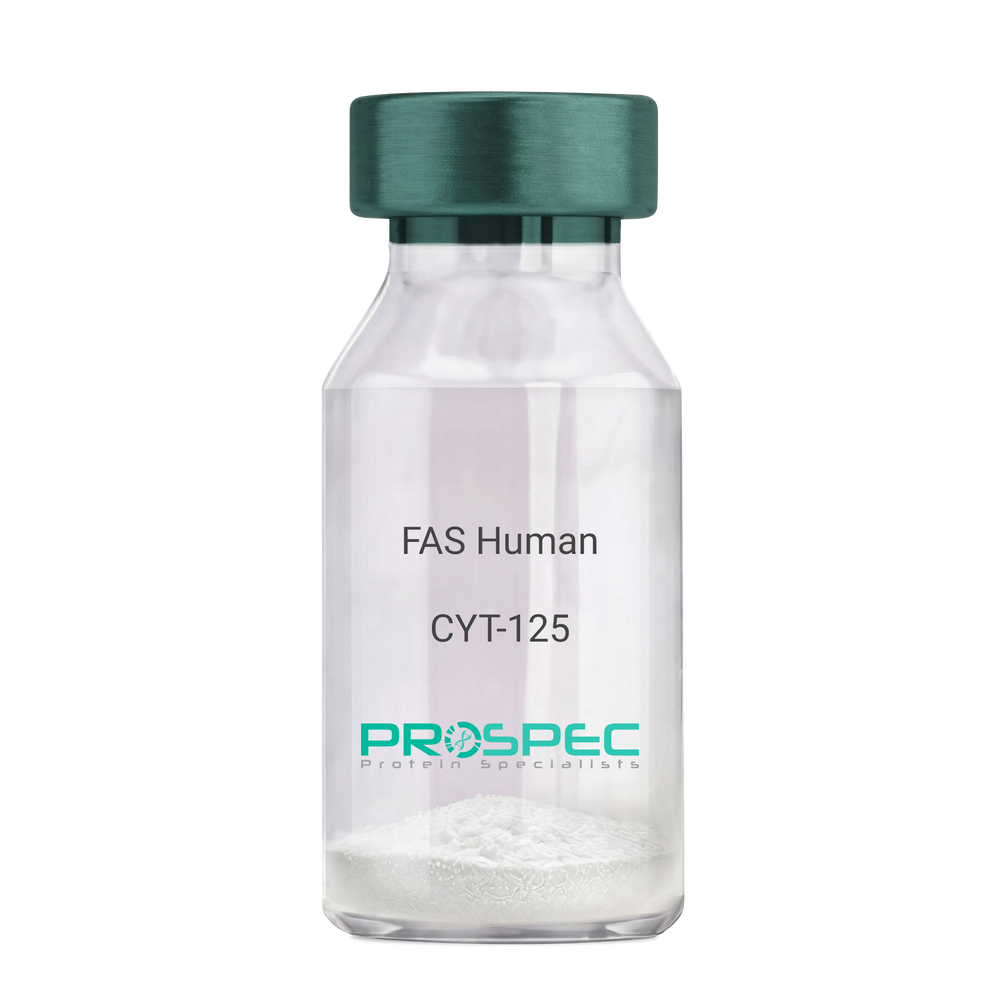
    FAS Human

    Description:

    sFas Receptor Human Recombinant

    Tumor necrosis factor receptor superfamily member 6, Apo-1 antigen, Apoptosis-mediating surface antigen FAS, FASLG receptor, CD95, FAS, APT1, FAS1, APO-1, FASTM, ALPS1A, TNFRSF6.

    Product # :

    CYT-125

    Price :

    Quantity :

    Shipping Method :

    Room Temp Icon

    Shipped at Room temp

    Add To Cart

    More Info

    • description
    • source
    • formulation
    • purity
    • biological activity
    • More Info
    • Citations

    Description

    sFas Receptor Human Recombinant produced in E.coli is a single, non-glycosylated polypeptide chain containing 157 amino acids and having a molecular mass of 17.6kDa.The FAS is purified by proprietary chromatographic techniques.

    Source

    Escherichia Coli.

    Formulation

    FAS protein was lyophilized from a 0.2µm filtered concentrated solution in 1×PBS, pH 7.4.

    Purity

    Greater than 95.0% as determined by:
    (a) Analysis by RP-HPLC.
    (b) Analysis by SDS-PAGE.

    Biological Activity

    The ED50 was determined by its ability to inhibit the cytotoxicity of Jurkat cells is between 10-15 µg/ml in the presence of 2ng/ml of hFasL.

    Citations

    More Info

    • Introduction

      Fas and Fas Ligand (FasL) are members of the TNF superfamily and are type I and type II transmembrane proteins, respectively. Binding of FasL to Fas initiates apoptosis in Fas-bearing cells. The apoptosis mechanism involves the recruitment of pro-caspase 8 through an adaptor molecule named FADD followed by processing of the pro-enzyme to active forms. These active caspases subsequently cleave a variety of cellular substrates leading to the eventual cell death. sFasR is able to inhibit FasL-induced apoptosis by acting as a decoy receptor whicht serves as a sink for FasL. The full length Fas Receptor is a 319 a.a type I transmembrane protein, which contains a 157 a.a extracellular domain, a 17 a.a transmembrane domain, and 145 a.a cytoplasmic domain. The mature human Fas ECD shares 55%, 58%, a.a sequence identity with the mouse, rat, Fas, respectively.

    • Synonyms

      Tumor necrosis factor receptor superfamily member 6, Apo-1 antigen, Apoptosis-mediating surface antigen FAS, FASLG receptor, CD95, FAS, APT1, FAS1, APO-1, FASTM, ALPS1A, TNFRSF6.

    • Physical Appearance

      Sterile Filtered White lyophilized (freeze-dried) powder.

    • Stability

      Lyophilized FAS although stable at room temperature for 3 weeks, should be stored desiccated below -18°C. Upon reconstitution FAS should be stored at 4°C between 2-7 days and for future use below -18°C. For long term storage it is recommended to add a carrier protein (0.1% HSA or BSA). Please prevent freeze-thaw cycles.

    • Solubility

      It is recommended to reconstitute the lyophilized FAS in sterile 18M-cm H2O not less than 100µg/ml, which can then be further diluted to other aqueous solutions.

    • Amino Acid Sequence

      MRLSSKSVNA QVTDINSKGL ELRKTVTTVE TQNLEGLHHD GQFCHKPCPP GERKARDCTV NGDEPDCVPC QEGKEYTDKA HFSSKCRRCR LCDEGHGLEV EINCTRTQNT KCRCKPNFFC NSTVCEHCDP CTKCEHGIIK ECTLTSNTKC KEEGSRS.

    • Background

      What is the molecular weight/Mw of FAS Protein?
      FAS Protein has a total Mw of 17.6kDa.

      What is the source or expression system of FAS Protein?
      Escherichia Coli.

      What is the Purity of FAS Protein?
      FAS Protein is >95% pure as determined by SDS-PAGE.

      What is the Biological Activity of FAS Protein?
      The ED50 was determined by its ability to inhibit the cytotoxicity of Jurkat cells is between 10-15 µg/ml in the presence of 2ng/ml of hFasL.

      What is the amino acid sequence of FAS Protein?
      MRLSSKSVNA QVTDINSKGL ELRKTVTTVE TQNLEGLHHD GQFCHKPCPP GERKARDCTV NGDEPDCVPC QEGKEYTDKA HFSSKCRRCR LCDEGHGLEV EINCTRTQNT KCRCKPNFFC NSTVCEHCDP CTKCEHGIIK ECTLTSNTKC KEEGSRS.

      What applications can FAS Protein be used in?
      FAS Protein can probably be used in western blot, ELISA and Lateral Flow.

      What is the endotoxin level for FAS Protein?
      The endotoxin level is minimal, FAS Protein was purified using conventional chromatography techniques..

    ProSpec's products are furnished for LABORATORY RESEARCH USE ONLY. The product may not be used as drugs, agricultural or pesticidal products, food additives or household chemicals.

    Fas Human
  • View Data Sheet

    Name :

    CXCL10 Human

    Description:

    IP-10 Human Recombinant (CXCL10)

    Small inducible cytokine B10, CXCL10, 10 kDa, Gamma-IP10, IP-10, chemokine (C-X-C motif) ligand 10, C7, IFI10, INP10, crg-2, mob-1, SCYB10, gIP-10.

    Product # :

    CHM-330

    Price :

    Quantity :

    Shipping Method :

    Room Temp Icon

    Shipped at Room temp

    Add To Cart

    More Info

    • description
    • source
    • formulation
    • purity
    • More Info
    • Citations

    Description

    IP-10 Human Recombinant produced in E.Coli is a single, non-glycosylated, polypeptide chain containing 77 amino acids and having a molecular mass of 8.6kDa. The IP-10 is purified by proprietary chromatographic techniques.

    Source

    Escherichia Coli.

    Formulation

    Lyophilized from a sterile (0.2 micron) filtered aqueous solution containing 0.1% Trifluoroacetic Acid (TFA).

    Purity

    Greater than 95.0% as determined by SDS-PAGE.

    Citations

    More Info

    • Introduction

      Chemokine (C-X-C motif) ligand 10 (CXCL10) is a small cytokine belonging to the CXC chemokine family. CXCL10 is secreted by several cell types in response to IFN. These cell types include monocytes, endothelial cells and fibroblasts. CXCL10 has been attributed to several roles, such as chemoattraction for monocytes and T cells, promotion of T cell adhesion to endothelial cells, antitumor activity, and inhibition of bone marrow colony formation and angiogenesis. The gene for CXCL10 is located on human chromosome 4 in a cluster among several other CXC chemokines. This chemokine elicits its effects by binding to the cell surface chemokine receptor CXCR3. The three-dimensional crystal structure of this chemokine has been determined under 3 different conditions to a resolution of up to 1.92A.

    • Synonyms

      Small inducible cytokine B10, CXCL10, 10 kDa, Gamma-IP10, IP-10, chemokine (C-X-C motif) ligand 10, C7, IFI10, INP10, crg-2, mob-1, SCYB10, gIP-10.

    • Physical Appearance

      Sterile Filtered White lyophilized (freeze-dried) powder.

    • Stability

      Lyophilized IP-10 although stable at room temperature for 3 weeks, should be stored desiccated below -18°C. Upon reconstitution CXCL10 should be stored at 4°C between 2-7 days and for future use below -18°C.For long term storage it is recommended to add a carrier protein (0.1% HSA or BSA).Please prevent freeze-thaw cycles.

    • Solubility

      It is recommended to reconstitute the lyophilized IP-10 in sterile 18MΩ-cm H2O not less than 100µg/ml, which can then be further diluted to other aqueous solutions.

    • Amino Acid Sequence

      VPLSRTVRCTCISISNQPVNPRSLEKLEIIPASQFCPRVEIIATMKKKGEKRCLNPESKA IKNLLKAVSKERSKRSP.

    • Background

      What is the molecular weight/Mw of CXCL10 HUMAN Protein?
      CXCL10 HUMAN Protein has a total Mw of 8.6kDa.

      What is the source or expression system of CXCL10 HUMAN Protein?
      Escherichia Coli.

      What is the Purity of CXCL10 HUMAN Protein?
      CXCL10 HUMAN Protein is >95% pure as determined by SDS-PAGE.

      What is the Biological Activity of CXCL10 HUMAN Protein?
      The biological functionality of CXCL10 HUMAN Protein will be determined in the future.

      What is the amino acid sequence of CXCL10 HUMAN Protein?
      VPLSRTVRCTCISISNQPVNPRSLEKLEIIPASQFCPRVEIIATMKKKGEKRCLNPESKA IKNLLKAVSKERSKRSP.

      What applications can CXCL10 HUMAN Protein be used in?
      CXCL10 HUMAN Protein can probably be used in western blot, ELISA and Lateral Flow.

      What is the endotoxin level for CXCL10 HUMAN Protein?
      The endotoxin level is minimal, CXCL10 HUMAN Protein was purified using conventional chromatography techniques.

      Who supplies recombinant CXCL10 HUMAN that is in stock and available to order?
      ProSpec has the protein in stock and available for immediate delivery.

      Where can I order bulk mg quantities of CXCL10 HUMAN?
      ProSpec supplies bulk mg quantities at affordable prices that meets research and academic budgets.

    ProSpec's products are furnished for LABORATORY RESEARCH USE ONLY. The product may not be used as drugs, agricultural or pesticidal products, food additives or household chemicals.

    Ip 10 Human
  • View Data Sheet

    Name :

    KIR2DL1 Human

    Description:

    Killer Cell Immunoglobulin-Like Receptor, 2 Domains Long Cytoplasmic Tail 1 Human Recombinant

    Killer cell immunoglobulin-like receptor 2DL1, MHC class I NK cell receptor, Natural killer-associated transcript 1, NKAT-1, p58 natural killer cell receptor clones CL-42/47.11, p58 NK receptor, p58.1 MHC class-I-specific NK receptor, CD158 antigen-like family member A, CD158a antigen, KIR2DL1, CD158A, NKAT1, NKAT, p58.1, KIR221, KIR-K64.

    Product # :

    PRO-428

    Price :

    Quantity :

    Shipping Method :

    Ice Icon

    Shipped with Ice Packs

    Add To Cart

    More Info

    • description
    • source
    • formulation
    • purity
    • More Info
    • Citations

    Description

    KIR2DL1 Recombinant produced in E.Coli is a single, non-glycosylated polypeptide chain containing amino acids 1-202 and having a molecular mass of 22.2 kDa.The KIR2DL1 is purified by proprietary chromatographic techniques.

    Source

    Escherichia Coli.

    Formulation

    The protein (1mg/ml) contains 25mM Tris- HCl (pH-7.5).

    Purity

    Greater than 95.0% as determined by(a) Analysis by RP-HPLC.
    (b) Analysis by SDS-PAGE.

    Citations

    More Info

    • Introduction

      Killer-cell immunoglobulin-like receptors (KIRs), are a family of cell surface glycoproteins found on Natural Killer (NK) Cells, which are important cells of the immune system. They control the killing function of these cells by interacting with MHC class I molecules, which are expressed on all cell types. This interaction allows them to identify virally infected cells or tumor cells that have a distinctive low level of Class I MHC on their surface. The majority of KIRs are inhibitory, which means that their recognition of MHC suppresses the cytotoxic activity of their NK cell. Only a limited number of KIRs have the capacity to activate cells.
      The KIR genes are found in a cluster on chromosome 19q13.4 within the 1 Mb leukocyte receptor complex (LRC). KIR molecules are extremely polymorphic, meaning their gene sequences differ significantly between individuals, so that different individuals have different arrays/repertoires of KIR genes.
      The KIR proteins are categorized by the number of extracellular immunoglobulin domains (2D or 3D) and by whether they have a long (L) or short (S) cytoplasmic domain. KIR proteins with the long cytoplasmic domain transduce inhibitory signals upon ligand binding via an immune tyrosine-based inhibitory motif (ITIM). Whereas KIR proteins with the short cytoplasmic domain lack the ITIM motif and instead associate with the TYRO protein tyrosine kinase binding protein to transduce activating signals.
      KIR2DL1 is an inhibitory Killer Cell Ig-like Receptor (KIR, previously called p58 KIR, p58.1, cl-42, NKAT1, or KIR-K6), which recognizes class I MHC molecules (HLA-Cw2, -Cw4, -Cw5, and Cw6). The extracellular domain of KIR2DL1 was over expressed as insoluble protein aggregates (inclusion bodies).

    • Synonyms

      Killer cell immunoglobulin-like receptor 2DL1, MHC class I NK cell receptor, Natural killer-associated transcript 1, NKAT-1, p58 natural killer cell receptor clones CL-42/47.11, p58 NK receptor, p58.1 MHC class-I-specific NK receptor, CD158 antigen-like family member A, CD158a antigen, KIR2DL1, CD158A, NKAT1, NKAT, p58.1, KIR221, KIR-K64.

    • Physical Appearance

      Sterile filtered colorless solution.

    • Stability

      Store at 4°C if entire vial will be used within 2-4 weeks. Store, frozen at -20°C for longer periods of time. For long term storage it is recommended to add a carrier protein (0.1% HSA or BSA).Avoid multiple freeze-thaw cycles.

    • Amino Acid Sequence

      MEGVHRKPSL LAHPGRLVKS EETVILQCWS DVMFEHFLLH REGMFNDTLR LIGEHHDGVS KANFSISRMT QDLAGTYRCY GSVTHSPYQV SAPSDPLDIV IIGLYEKPSL SAQLGPTVLA GENVTLSCSS RSSYDMYHLS REGEAHERRL PAGPKVNGTF QADFPLGPAT HGGTYRCFGS FHDSPYEWSK SSDPLLVSVT GN.

    ProSpec's products are furnished for LABORATORY RESEARCH USE ONLY. The product may not be used as drugs, agricultural or pesticidal products, food additives or household chemicals.

    Kir2Dl1 Human
  • View Data Sheet

    Name :

    VTCN1 Human

    Description:

    V-Set Domain Containing T Cell Activation Inhibitor 1 Human Recombinant

    V-set domain-containing T-cell activation inhibitor 1, B7 homolog 4, B7-H4, B7h.5, Immune costimulatory protein B7-H4, Protein B7S1, T-cell costimulatory molecule B7x, B7H4, VTCN1, B7S1, B7X, PRO1291, RP11-229A19.4.

    Product # :

    PRO-1812

    Price :

    Quantity :

    Shipping Method :

    Ice Icon

    Shipped with Ice Packs

    Add To Cart

    More Info

    • description
    • source
    • formulation
    • purity
    • More Info
    • Citations

    Description

    VTCN1 Human Recombinant produced in E.coli is a single, non-glycosylated polypeptide chain containing 258 amino acids (25-259) and having a molecular mass of 28.2 kDa.VTCN1 is fused to a 23 amino acid His-tag at N-terminus & purified by proprietary chromatographic techniques.

    Source

    Escherichia Coli.

    Formulation

    The VTCN1 solution (1mg/ml) contains 20mM Tris-HCl buffer (pH 8.0), 0.4M UREA and 10% glycerol.

    Purity

    Greater than 90.0% as determined by SDS-PAGE.

    Citations

    More Info

    • Introduction

      V-Set Domain Containing T Cell Activation Inhibitor 1, also known as VCTN1, is part of the B7 costimulatory protein family. Proteins in this family are located on the surface of antigen-presenting cells and interact with ligand bound to receptors on the surface of T cells. High level of the encoded protein has been associated with tumor progression. VCTN1 also takes part in promoting epithelial cell transformation.

    • Synonyms

      V-set domain-containing T-cell activation inhibitor 1, B7 homolog 4, B7-H4, B7h.5, Immune costimulatory protein B7-H4, Protein B7S1, T-cell costimulatory molecule B7x, B7H4, VTCN1, B7S1, B7X, PRO1291, RP11-229A19.4.

    • Physical Appearance

      Sterile Filtered colorless solution.

    • Stability

      Store at 4°C if entire vial will be used within 2-4 weeks. Store, frozen at -20°C for longer periods of time. For long term storage it is recommended to add a carrier protein (0.1% HSA or BSA).Avoid multiple freeze-thaw cycles.

    • Amino Acid Sequence

      MGSSHHHHHH SSGLVPRGSH MGSLIIGFGI SGRHSITVTT VASAGNIGED GILSCTFEPD IKLSDIVIQW LKEGVLGLVH EFKEGKDELS EQDEMFRGRT AVFADQVIVG NASLRLKNVQ LTDAGTYKCY IITSKGKGNA NLEYKTGAFS MPEVNVDYNA SSETLRCEAP RWFPQPTVVW
      ASQVDQGANF SEVSNTSFEL NSENVTMKVV SVLYNVTINN TYSCMIENDI AKATGDIKVT ESEIKRRSHL QLLNSKAS.

    ProSpec's products are furnished for LABORATORY RESEARCH USE ONLY. The product may not be used as drugs, agricultural or pesticidal products, food additives or household chemicals.

    Vtcn1 Human
  • View Data Sheet

    Name :

    TNFAIP8 Human

    Description:

    Tumor Necrosis Factor, Alpha-Induced Protein 8 Human Recombinant

    GG2-1; MDC-3.13, SCC-S2, SCCS2, Tumor necrosis factor alpha-induced protein 8, TNF alpha-induced protein 8, Head and neck tumor and metastasis-related protein, NF-kappa-B-inducible DED-containing protein, NDED, TNF-induced protein GG2-1, TNFAIP8.

    Product # :

    CYT-759

    Price :

    Quantity :

    Shipping Method :

    Ice Icon

    Shipped with Ice Packs

    Add To Cart

    More Info

    • description
    • source
    • formulation
    • purity
    • More Info
    • Citations

    Description

    TNFAIP8 Human Recombinant produced in E.Coli is a single, non-glycosylated polypeptide chain containing 221 amino acids (1-198a.a.) and having a molecular mass of 25kDa. TNFAIP8 is fused to a 23 amino acid His-tag at N-terminus & purified by proprietary chromatographic techniques.

    Source

    Escherichia Coli.

    Formulation

    TNFAIP8 protein solution (0.25mg/ml) contains 20mM Tris-HCl buffer (pH 8.0), 0.15M NaCl, 10% glycerol and 1mM DTT.

    Purity

    Greater than 90% as determined by SDS-PAGE.

    Citations

    More Info

    • Introduction

      TNFAIP8 which is a part of the TNFAIP8 family acts as a negative mediator of apoptosis and takes part in tumor progression. TNFAIP8 suppresses the TNF-mediated apoptosis by inhibiting caspase-8 activity but not the processing of procaspase-8, resulting in inhibition of BID cleavage and activation of caspase-3.

    • Synonyms

      GG2-1; MDC-3.13, SCC-S2, SCCS2, Tumor necrosis factor alpha-induced protein 8, TNF alpha-induced protein 8, Head and neck tumor and metastasis-related protein, NF-kappa-B-inducible DED-containing protein, NDED, TNF-induced protein GG2-1, TNFAIP8.

    • Physical Appearance

      Sterile filtered colorless solution.

    • Stability

      Store at 4°C if entire vial will be used within 2-4 weeks. Store, frozen at -20°C for longer periods of time. For long term storage it is recommended to add a carrier protein (0.1% HSA or BSA).Avoid multiple freeze-thaw cycles.

    • Amino Acid Sequence

      MGSSHHHHHH SSGLVPRGSH MGSMHSEAEE SKEVATDVFN SKNLAVQAQK KILGKMVSKS IATTLIDDTS SEVLDELYRV TREYTQNKKE AEKIIKNLIK TVIKLAILYR NNQFNQDELA LMEKFKKKVH QLAMTVVSFH QVDYTFDRNV LSRLLNECRE MLHQIIQRHL TAKSHGRVNN VFDHFSDCEF LAALYNPFGN FKPHLQKLCD GINKMLDEEN I.

    ProSpec's products are furnished for LABORATORY RESEARCH USE ONLY. The product may not be used as drugs, agricultural or pesticidal products, food additives or household chemicals.

    Tnfaip8 Human
  • View Data Sheet

    Name :

    TNFSF7 Human, sf9

    Description:

    CD70 Human Recombinant, sf9

    CD70 Molecule, Tumor Necrosis Factor (Ligand) Superfamily, Member 7, Tumor Necrosis Factor Ligand Superfamily Member 7 , CD27 Ligand, CD27LG, TNFSF7, CD27-L, CD27L, Tumor Necrosis Factor Ligand 8A, Surface Antigen CD70, Ki-24 Antigen, CD70 Antigen, TNLG8A.

    Product # :

    CYT-953

    Price :

    Quantity :

    Shipping Method :

    Ice Icon

    Shipped with Ice Packs

    Add To Cart

    More Info

    • description
    • source
    • formulation
    • purity
    • More Info
    • Citations

    Description

    TNFSF7 produced in Sf9 Baculovirus cells is a single, glycosylated polypeptide chain containing 164 amino acids (39-193 a.a.) and having a molecular mass of 18.2kDa. TNFSF7 is expressed with a 6 amino acid His tag at C-Terminus and purified by proprietary chromatographic techniques.

    Source

    Sf9, Baculovirus cells.

    Formulation

    TNFSF7 protein solution (0.25mg/ml) contains Phosphate Buffered Saline (pH 7.4) and 10% glycerol.

    Purity

    Greater than 90.0% as determined by SDS-PAGE.

    Citations

    More Info

    • Introduction

      CD70 also known as TNFSF7 is a cytokine which binds to CD27. TNFSF7 takes part in T-cell activation as well as induces the proliferation of costimulated T-cells. Moreover, TNFSF7 enhances the generation of cytolytic T-cells. Among the diseases which are associated with TNFSF7: Include acute myocarditis & Myocarditis.

    • Synonyms

      CD70 Molecule, Tumor Necrosis Factor (Ligand) Superfamily, Member 7, Tumor Necrosis Factor Ligand Superfamily Member 7 , CD27 Ligand, CD27LG, TNFSF7, CD27-L, CD27L, Tumor Necrosis Factor Ligand 8A, Surface Antigen CD70, Ki-24 Antigen, CD70 Antigen, TNLG8A.

    • Physical Appearance

      Sterile Filtered colorless solution.

    • Stability

      Store at 4°C if entire vial will be used within 2-4 weeks. Store, frozen at -20°C for longer periods of time. For long term storage it is recommended to add a carrier protein (0.1% HSA or BSA). Avoid multiple freeze-thaw cycles.

    • Amino Acid Sequence

      ADPQRFAQAQ QQLPLESLGW DVAELQLNHT GPQQDPRLYW QGGPALGRSF LHGPELDKGQ LRIHRDGIYM VHIQVTLAIC SSTTASRHHP TTLAVGICSP ASRSISLLRL SFHQGCTIAS QRLTPLARGD TLCTNLTGTL LPSRNTDETF FGVQWVRPHH HHHH.

    ProSpec's products are furnished for LABORATORY RESEARCH USE ONLY. The product may not be used as drugs, agricultural or pesticidal products, food additives or household chemicals.

    Tnfsf7 Human Sf9
  • View Data Sheet

    Name :

    BD5 Human

    Description:

    Beta Defensin-5 Human Recombinant

    Beta-defensin 105, eta-defensin 5, BD-5, DEFB-5, Defensin, beta 105, DEFB105A, BD5, DEFB105, DEFB5, DEFB105B.

    Product # :

    CYT-804

    Price :

    Quantity :

    Shipping Method :

    Room Temp Icon

    Shipped at Room temp

    Add To Cart

    More Info

    • description
    • source
    • formulation
    • purity
    • More Info
    • Citations

    Description

    BD5 Human Recombinant produced in E.Coli is a single, non-glycosylated, polypeptide chain containing 51 amino acids and having a molecular mass of 5.8 kDa. The Beta Defensin-5 is purified by proprietary chromatographic techniques.

    Source

    Escherichia Coli.

    Formulation

    Lyophilized from a 0.2µm filtered concentrated solution in PBS, pH 7.4.

    Purity

    Greater than 95.0% as determined by:(a) Analysis by RP-HPLC.(b) Analysis by SDS-PAGE.

    Citations

    More Info

    • Introduction

      Defensins (alpha & beta) are cationic peptides with a wide spectrum of antimicrobial activity which include a significant arm of the innate immune system. There are 6 human beta-defensins, BD-1, BD-2, BD-3, BD-4, BD-5 and BD-6 which are expressed on some leukocytes and at epithelial surfaces. In addition to their direct antimicrobial activities, beta-defensins can act as chemoattractants towards immature dendritic cells and memory T cells. Beta-defensins contain a 6-cysteine motif which forms 3 intra-molecular disulfide bonds.

    • Synonyms

      Beta-defensin 105, eta-defensin 5, BD-5, DEFB-5, Defensin, beta 105, DEFB105A, BD5, DEFB105, DEFB5, DEFB105B.

    • Physical Appearance

      Sterile Filtered White lyophilized (freeze-dried) powder.

    • Stability

      Lyophilized Beta Defensin-5 although stable at room temperature for 3 weeks, should be stored desiccated below -18°C. Upon reconstitution BD5 should be stored at 4°C between 2-7 days and for future use below -18°C. For long term storage it is recommended to add a carrier protein (0.1% HSA or BSA). Please prevent freeze-thaw cycles.

    • Solubility

      It is recommended to reconstitute the lyophilized Beta Defensin-5 in sterile 18M-cm H2O not less than 100µg/ml, which can then be further diluted to other aqueous solutions.

    • Amino Acid Sequence

      GLDFSQPFPS GEFAVCESCK LGRGKCRKEC LENEKPDGNC RLNFLCCRQR I.

    • Background

      Beta Defensin-5 Human Recombinant: Unleashing the Potential of an Emerging Antimicrobial Peptide

      Abstract:

      Beta Defensin-5 (hBD-5) human recombinant is an intriguing antimicrobial peptide with diverse properties and promising therapeutic applications. This research paper aims to provide a comprehensive analysis of hBD-5, including its characteristics, mode of action, and potential uses. Furthermore, innovative methodologies for the production and optimization of hBD-5 human recombinant are proposed, offering insights into its future implications in the field of infectious disease management.

      Introduction:

      The emergence of drug-resistant infections demands innovative solutions to combat pathogens. Antimicrobial peptides, such as hBD-5, have attracted attention due to their broad-spectrum activity. This paper explores the unique features of hBD-5 and presents novel approaches for its production and optimization.

      Characteristics and Mode of Action:

      hBD-5 is a cationic peptide composed of 41 amino acids and possesses a distinctive structure that contributes to its antimicrobial properties. The mechanism of action involves the disruption of microbial membranes and subsequent destruction of pathogens. Additionally, hBD-5 exhibits immunomodulatory effects by stimulating immune cells and modulating the inflammatory response.

      Production of hBD-5 Human Recombinant:

      Efficient production methodologies are crucial for the therapeutic application of hBD-5 human recombinant. Various expression systems, including bacterial, yeast, and mammalian cell-based platforms, have been investigated. Each system presents unique advantages and challenges, requiring careful selection to achieve high yields and protein quality. Optimization strategies, such as codon optimization, fusion protein tags, and growth conditions, have been implemented to enhance production efficiency. Purification techniques, such as chromatography and ultrafiltration, have been optimized to isolate high-quality hBD-5 recombinant.

      Potential Applications:

      hBD-5 human recombinant holds great promise for the treatment of drug-resistant pathogens. Its broad-spectrum antimicrobial activity against bacteria, viruses, and fungi positions it as a valuable therapeutic agent for infectious disease management. Moreover, hBD-5 exhibits potential in wound healing and tissue regeneration, as it promotes cell migration and angiogenesis. Exploring its potential as an adjuvant therapy in combination with existing antibiotics is an exciting area for future research.

      Conclusion:

      hBD-5 human recombinant represents an emerging antimicrobial peptide with diverse therapeutic potential. Optimizing production methodologies and elucidating its mechanisms of action will further enhance its clinical utility. With its broad-spectrum antimicrobial activity and potential implications in wound healing and adjuvant therapy, hBD-5 human recombinant holds promise as an innovative therapeutic tool.

      What is the molecular weight/Mw of BD5 Protein?
      BD5 Protein has a total Mw of 5.8kDa.

      What is the source or expression system of BD5 Protein?
      Escherichia Coli.

      What is the Purity of BD5 Protein?
      BD5 Protein is >95% pure as determined by SDS-PAGE.

      What is the Biological Activity of BD5 Protein?
      The biological functionality of BD5 Protein will be determined in the future.

      What is the amino acid sequence of BD5 Protein?
      GLDFSQPFPS GEFAVCESCK LGRGKCRKEC LENEKPDGNC RLNFLCCRQR I.

      What applications can BD5 Protein be used in?
      BD5 Protein can probably be used in western blot, ELISA and Lateral Flow.

      What is the endotoxin level for BD5 Protein?
      The endotoxin level is minimal, BD5 Protein was purified using conventional chromatography techniques.

    ProSpec's products are furnished for LABORATORY RESEARCH USE ONLY. The product may not be used as drugs, agricultural or pesticidal products, food additives or household chemicals.

    Bd5 Human
  • View Data Sheet

    Name :

    TNF a Rabbit

    Description:

    Tumor Necrosis Factor-Alpha Rabbit Recombinant

    Tumor necrosis factor, Cachectin, TNF-alpha, Tumor necrosis factor ligand superfamily member 2, TNF-a, TNF, TNFA, TNFSF2. 

    Product # :

    CYT-008

    Price :

    Quantity :

    Shipping Method :

    Room Temp Icon

    Shipped at Room temp

    Add To Cart

    More Info

    • description
    • source
    • formulation
    • purity
    • biological activity
    • More Info
    • Citations

    Description

    Tumor Necrosis Factor-a Rabbit Recombinant consists of three identical polypeptide chains of 158 amino acids combined to form a compact, bell-shaped homotrimer. TNF-alpha was produced in E.Coli is a non-glycosylated, polypeptide chain having a molecular mass of 17.4 kDa for the individual subunit. The TNF-alpha is purified by standard chromatographic techniques.

    Source

    Escherichia Coli.

    Formulation

    TNF-alpha Rabbit was lyophilized after extensive dialysis against 20mM PB, pH7.4, 300mM NaCl.

    Purity

    Greater than 95% as determined by:
    (a) Analysis by RP-HPLC.
    (b) Analysis by SDS-PAGE.

    Biological Activity

    The ED50 as determined by the cytolysis of murine L929 cells in the presence of Actinomycin D is less than 0.03ng/ml, corresponding to a Specific Activity of 30,000,000 IU/mg.

    Citations

    More Info

    • Introduction

      Tumor necrosis factor is a cytokine involved in systemic inflammation and is a member of a group of cytokines that all stimulate the acute phase reaction. TNF is mainly secreted by macrophages.
      TNF causes apoptotic cell death, cellular proliferation, differentiation, inflammation, tumorigenesis and viral replication, TNF is also involved in lipid metabolism, and coagulation. TNF's primary role is in the regulation of immune cells.
      Dysregulation and, in particular, overproduction of TNF have been implicated in a variety of human diseases- autoimmune diseases, insulin resistance, and cancer.

    • Synonyms

      Tumor necrosis factor, Cachectin, TNF-alpha, Tumor necrosis factor ligand superfamily member 2, TNF-a, TNF, TNFA, TNFSF2.

    • Physical Appearance

      Sterile Filtered White lyophilized (freeze-dried) powder.

    • Stability

      Lyophilized Tumor Necrosis Factor-a although stable at room temperature for 3 weeks, should be stored desiccated below -18°C. Upon reconstitution TNF-a should be stored at 4°C between 2-7 days and for future use below -18°C.For long term storage it is recommended to add a carrier protein (0.1% HSA or BSA).Please prevent freeze-thaw cycles.

    • Solubility

      It is recommended to reconstitute the lyophilized Tumor Necrosis Factor-alpha in sterile 18MΩ-cm H2O not less than 100µg/ml, which can then be further diluted to other aqueous solutions.

    • Amino Acid Sequence

      The sequence of the first five N-terminal amino acids was determined and was found to be Met-Ser-Ala-Ser-Arg.

    ProSpec's products are furnished for LABORATORY RESEARCH USE ONLY. The product may not be used as drugs, agricultural or pesticidal products, food additives or household chemicals.

    Tnf A Rabbit
  • View Data Sheet

    Name :

    Influenza-B Antibody

    Description:

    Influenza-B, Mouse Antibody

    Product # :

    ANT-217

    Price :

    Quantity :

    Shipping Method :

    Ice Icon

    Shipped with Ice Packs

    Add To Cart

    More Info

    • description
    • formulation
    • More Info
    • Citations

    Description

    Hybridoma has been derived from hybridization of Sp2/0 myeloma cells with spleen cells of Balb/c mice immunized with purified influenza virus type B strain B/Tokio/53/99.

    Formulation

    In PBS, pH 7.4 and 0.1 % NaN3.

    Citations

    More Info

    • Introduction

      Influenza-B virus is a genus in the virusfamily Orthomyxoviridae. The only species in this genus is called "Influenza B virus". Influenza B virus only infects humans and seals. This limited host range is apparently in contrast with those caused by the similar Influenza virus Aas both mutate by both genetic drift and reassortment. Influenza-B virus evolves slower than A viruses and faster than C viruses. Influenza-B virus mutates at a rate 2-3 times lower than type A. However, influenza B mutates enough that lasting immunity is not possible. The Influenza B virus capsidis enveloped while its virionconsists of a matrix protein + envelope + nucleoprotein complex + nucleocapsid, and a polymerase complex. Influenza B is sometimes spherical and sometimes filamentous. Its 500 or so surface projections are made of hemagglutinin and neuraminidase.
      The Influenza B virus is 14648 nucleotides long and consists of eight segments of linear negative-sense, single-stranded RNA. The multipartite genome is encapsidated, each segment in a separate nucleocapsid, and the nucleocapsids are surrounded by one envelope.

    • Physical Appearance

      Sterile Filtered clear solution.

    • Immunogen

      Influenza-B.

    • Ig Subclass

      mouse IgG1.

    • Clone

      PIB-633-HY.

    • Applications

      Western blotting, ELISA, can also be used in indirect immunofluorescence.

    • Shipping Conditions

      Antibody is shipped as in liquid form with ice packs.

    • Type

      Mouse Antibody Monoclonal.

    • Storage Procedures

      For long periods, store at 4°C.

    • Purification Method

      Protein-A column.

    ProSpec's products are furnished for LABORATORY RESEARCH USE ONLY. The product may not be used as drugs, agricultural or pesticidal products, food additives or household chemicals.

    Influenza B Antibody
  • View Data Sheet

    Name :

    H3N2 Influenza-A Antibody

    Description:

    Influenza-A Hemagglutinin H3N2, Mouse Antibody

    Product # :

    ANT-215

    Price :

    Quantity :

    Shipping Method :

    Ice Icon

    Shipped with Ice Packs

    Add To Cart

    More Info

    • description
    • formulation
    • More Info
    • Citations

    Description

    Hybridoma clones have been derived from hybridization of Sp2/0 myeloma cells with spleen cells of Balb/c mice immunized with Influenza A/Shandong/9/93 H3N2 derived from allantoic fluid of 10 days old embryonated eggs.

    Formulation

    In PBS, pH 7.4 and 0.1 % NaN3.

    Citations

    More Info

    • Introduction

      H3N2 is a subtype of the influenza A virus. Its name derives from the forms of the two kinds of proteinson the surface of its coat, hemagglutinin(H) and neuraminidase(N). H3N2 exchanges genes for internal proteins with other influenza subtypes. H3N2 has tended to dominate in prevalence over H1N1, H1N2, and influenza B. H3N2 strain descended from H2N2by antigenic shift, in which genes from multiple subtypes re-assorted to form a new virus. Both the H2N2and H3N2 strains contained genesfrom avian influenzaviruses.

    • Physical Appearance

      Sterile Filtered clear solution.

    • Immunogen

      Influenza A hemagglutinin H3N2.

    • Ig Subclass

      mouse IgG1.

    • Clone

      IA-H3N2.

    • Applications

      Influenza A haemagglutinin H3N2 immunodetection in direct or indirect ELISA, and Western Blotting.

    • Shipping Conditions

      Antibody is shipped as in liquid form with ice packs.

    • Type

      Mouse Antibody Monoclonal.

    • Storage Procedures

      Should be stored at 4C.Do not freeze.

    • Purification Method

      Protein-A column.

    ProSpec's products are furnished for LABORATORY RESEARCH USE ONLY. The product may not be used as drugs, agricultural or pesticidal products, food additives or household chemicals.

    Influenza A H3N2 Antibody
  • 1
  • …
  • 22
  • 23
  • 24
  • 25
  • 26
  • …
  • 42
Your browser does not support the video tag.

Products

  • Cytokines
  • Growth Factors
  • Chemokines
  • CD Antigens
  • Neurotrophins
  • Hormones
  • Enzymes
  • Viral Antigens
  • Recombinant Proteins
  • Natural Proteins
  • Monoclonal Antibodies
  • Polyclonal Antibodies
  • Thermal Packaging

About

  • Company
  • Founder
  • Contribution
  • Contact Us
  • My Account

Ordering

  • Ordering Method
  • Ordering - Credit Card
  • Ordering PO
  • Shipping Fees
  • FAQ's

Legal

  • Terms & Conditions
  • Privacy
  • Site Map
  • info@prospecbio.com
  • Facebook
  • Instagram
  • Linkedin Profile

© 2026 ProSpec-Tany TechnoGene Ltd. All Rights Reserved.

  • Choosing a selection results in a full page refresh.
  • Opens in a new window.