Skip to content

High-quality research proteins.

  • 1-800-805-6531

  • Mon - Sat 8.00-18.00, Sun - Closed

  • info@prospecbio.com

  • PO Box 6591 East Brunswick NJ 08816

  • Products
    • Cytokines
    • Growth factors
    • Chemokines
    • Cd antigens
    • Neurotrophins
    • Hormones
    • Enzymes
    • Viral antigens
    • Recombinant proteins
    • Natural proteins
    • Monoclonal antibodies
    • Polyclonal antibodies
    • Thermal Packaging
  • About
    • Company
    • Founder
    • Contribution
  • Customers
    • Eastern Asia
    • Eastern Europe
    • North America
    • South America
    • South East Asia
    • Southern Asia
    • Western Europe
  • Ordering
    • Ordering Method
    • Ordering - Credit Card
    • Ordering - PO
    • Shipping Fees
    • FAQs
  • Services
    • DNA Cloning
    • Protein Expression
    • Monoclonal Antibody
    • Fermentation
    • Technology License
  • Contact us
Log in

Country/region

  • USD $ | Albania
  • USD $ | Andorra
  • USD $ | Argentina
  • USD $ | Armenia
  • USD $ | Australia
  • USD $ | Austria
  • USD $ | Azerbaijan
  • USD $ | Belarus
  • USD $ | Belgium
  • USD $ | Bolivia
  • USD $ | Brazil
  • USD $ | Bulgaria
  • USD $ | Cambodia
  • USD $ | Canada
  • USD $ | Chile
  • USD $ | China
  • USD $ | Colombia
  • USD $ | Costa Rica
  • USD $ | Croatia
  • USD $ | Cyprus
  • USD $ | Czechia
  • USD $ | Denmark
  • USD $ | Estonia
  • USD $ | Finland
  • USD $ | France
  • USD $ | Georgia
  • USD $ | Germany
  • USD $ | Greece
  • USD $ | Hong Kong SAR
  • USD $ | Hungary
  • USD $ | Iceland
  • USD $ | India
  • USD $ | Ireland
  • USD $ | Israel
  • USD $ | Italy
  • USD $ | Japan
  • USD $ | Kazakhstan
  • USD $ | Latvia
  • USD $ | Liechtenstein
  • USD $ | Lithuania
  • USD $ | Madagascar
  • USD $ | Malta
  • USD $ | Mexico
  • USD $ | Moldova
  • USD $ | Monaco
  • USD $ | Netherlands
  • USD $ | New Zealand
  • USD $ | North Macedonia
  • USD $ | Norway
  • USD $ | Panama
  • USD $ | Paraguay
  • USD $ | Peru
  • USD $ | Philippines
  • USD $ | Poland
  • USD $ | Portugal
  • USD $ | Romania
  • USD $ | Singapore
  • USD $ | Slovakia
  • USD $ | Slovenia
  • USD $ | South Africa
  • USD $ | South Korea
  • USD $ | Spain
  • USD $ | Sri Lanka
  • USD $ | Sweden
  • USD $ | Switzerland
  • USD $ | Taiwan
  • USD $ | Thailand
  • USD $ | Türkiye
  • USD $ | Ukraine
  • USD $ | United Kingdom
  • USD $ | United States
  • USD $ | Uruguay
  • USD $ | Vatican City
  • USD $ | Venezuela
  • USD $ | Vietnam
  • Facebook
  • Instagram
logoProSpec - Recombinant Protein Manufacturer for academic and R&D industry
Become a distributor
Account Log in
Wishlist
Cart Cart(0)
  • Products
    +
    • Cytokines
    • Growth factors
    • Chemokines
    • Cd antigens
    • Neurotrophins
    • Hormones
    • Enzymes
    • Viral antigens
    • Recombinant proteins
    • Natural proteins
    • Monoclonal antibodies
    • Polyclonal antibodies
    • Thermal Packaging
  • About
    +
    • Company
    • Founder
    • Contribution
  • Customers
    +
    • Eastern Asia
    • Eastern Europe
    • North America
    • South America
    • South East Asia
    • Southern Asia
    • Western Europe
  • Ordering
    +
    • Ordering Method
    • Ordering - Credit Card
    • Ordering - PO
    • Shipping Fees
    • FAQs
  • Services
    +
    • DNA Cloning
    • Protein Expression
    • Monoclonal Antibody
    • Fermentation
    • Technology License
  • Contact us

Item added to your cart

View cart
View All
  • Cytokines
  • Growth factors
  • Chemokines
  • Cd antigens
  • Neurotrophins
  • Hormones
  • Enzymes
  • Viral antigens
  • Recombinant proteins
  • Natural proteins
  • Monoclonal antibodies
  • Polyclonal antibodies
  • Thermal Packaging
  • Tumor Necrosis Factor

    Tumor Necrosis Factor

    View All
  • 4-1BB

    4-1BB

    View All
  • Adiponectin

    Adiponectin

    View All
  • AIF1

    AIF1

    View All
  • Other Cytokines

    Other Cytokines

    View All
  • AITRL

    AITRL

    View All
  • Angiopoietin

    Angiopoietin

    View All
  • Apolipoprotein

    Apolipoprotein

    View All
  • B-Cell Activating Factor

    B-Cell Activating Factor

    View All
  • Beta Defensin

    Beta Defensin

    View All
  • Bone Morphogenetic Protein

    Bone Morphogenetic Protein

    View All
  • B type Natriuretic Peptide

    B type Natriuretic Peptide

    View All
  • BST

    BST

    View All
  • Betacellulin

    Betacellulin

    View All
  • Cardiotrophin

    Cardiotrophin

    View All
  • Activin

    Activin

    View All
  • Fibroblast Growth Factor

    Fibroblast Growth Factor

    View All
  • Other Growth Factors

    Other Growth Factors

    View All
  • CSF

    CSF

    View All
  • CTGF

    CTGF

    View All
  • IGFBP

    IGFBP

    View All
  • VEGF Protein

    VEGF Protein

    View All
  • EGF

    EGF

    View All
  • Epigen

    Epigen

    View All
  • Erythropoietin

    Erythropoietin

    View All
  • Insulin-Like Growth Factor

    Insulin-Like Growth Factor

    View All
  • Growth Hormone

    Growth Hormone

    View All
  • HDGF

    HDGF

    View All
  • Hepatocyte Growth Factor

    Hepatocyte Growth Factor

    View All
  • Insulin

    Insulin

    View All
  • BCA-1/ BLC (CXCL13)

    BCA-1/ BLC (CXCL13)

    View All
  • BRAK (CXCL14)

    BRAK (CXCL14)

    View All
  • C-10 (CCL6)

    C-10 (CCL6)

    View All
  • Other Chemokines

    Other Chemokines

    View All
  • MEC (CCL28)

    MEC (CCL28)

    View All
  • LD78-beta (CCL3L1)

    LD78-beta (CCL3L1)

    View All
  • CTACK (CCL27)

    CTACK (CCL27)

    View All
  • CXCL16

    CXCL16

    View All
  • CXCL17

    CXCL17

    View All
  • Platelet Factor-4 (CXCL4)

    Platelet Factor-4 (CXCL4)

    View All
  • ENA-78 (CXCL5)

    ENA-78 (CXCL5)

    View All
  • Eotaxin (CCL11,24,26)

    Eotaxin (CCL11,24,26)

    View All
  • Exodus-2 (CCL21)

    Exodus-2 (CCL21)

    View All
  • Fractalkine (CX3CL1)

    Fractalkine (CX3CL1)

    View All
  • CXCL6

    CXCL6

    View All
  • Other CD Antigens

    Other CD Antigens

    View All
  • CD14

    CD14

    View All
  • CD164

    CD164

    View All
  • CD1

    CD1

    View All
  • CD2

    CD2

    View All
  • CD200

    CD200

    View All
  • CD207

    CD207

    View All
  • CD226

    CD226

    View All
  • CD23

    CD23

    View All
  • CD244

    CD244

    View All
  • CD247

    CD247

    View All
  • CD27

    CD27

    View All
  • CD274

    CD274

    View All
  • CD300

    CD300

    View All
  • CD33

    CD33

    View All
  • Other Neurotrophins

    Other Neurotrophins

    View All
  • Beta-NGF

    Beta-NGF

    View All
  • BDNF

    BDNF

    View All
  • CDNF

    CDNF

    View All
  • CNTF

    CNTF

    View All
  • GDNF

    GDNF

    View All
  • Glia Maturation Factor

    Glia Maturation Factor

    View All
  • MANF

    MANF

    View All
  • Midkine

    Midkine

    View All
  • Neuroglobin

    Neuroglobin

    View All
  • Neurotrophic factors

    Neurotrophic factors

    View All
  • Neuregulin

    Neuregulin

    View All
  • Neuropilin

    Neuropilin

    View All
  • Pigment Epithelium-Derived Factor

    Pigment Epithelium-Derived Factor

    View All
  • Pleiotrophin

    Pleiotrophin

    View All
  • Peptide Hormones

    Peptide Hormones

    View All
  • Other Hormones

    Other Hormones

    View All
  • HCG

    HCG

    View All
  • Endothelin

    Endothelin

    View All
  • Exendin

    Exendin

    View All
  • FSH

    FSH

    View All
  • Glucagon

    Glucagon

    View All
  • GHRP

    GHRP

    View All
  • GLP

    GLP

    View All
  • Thyrostimulin

    Thyrostimulin

    View All
  • Inhibin A

    Inhibin A

    View All
  • LHRH

    LHRH

    View All
  • Melanotan

    Melanotan

    View All
  • Procalcitonin

    Procalcitonin

    View All
  • PTH

    PTH

    View All
  • Peroxiredoxin

    Peroxiredoxin

    View All
  • Peptidase

    Peptidase

    View All
  • Synthetase

    Synthetase

    View All
  • Transferase

    Transferase

    View All
  • Hydrolase

    Hydrolase

    View All
  • Dehydrogenase

    Dehydrogenase

    View All
  • ACE2

    ACE2

    View All
  • Esterase

    Esterase

    View All
  • Protein Kinases

    Protein Kinases

    View All
  • Other Enzymes

    Other Enzymes

    View All
  • Phosphatase

    Phosphatase

    View All
  • Deaminase

    Deaminase

    View All
  • Oxygenase

    Oxygenase

    View All
  • Adenylate Kinase

    Adenylate Kinase

    View All
  • Lyase

    Lyase

    View All
  • Chagas

    Chagas

    View All
  • SARS

    SARS

    View All
  • Influenza

    Influenza

    View All
  • ASFV

    ASFV

    View All
  • Astrovirus

    Astrovirus

    View All
  • Borrelia

    Borrelia

    View All
  • Helicobacter Pylori

    Helicobacter Pylori

    View All
  • Chikungunya

    Chikungunya

    View All
  • Chlamydia

    Chlamydia

    View All
  • Cytomegalo

    Cytomegalo

    View All
  • Dengue

    Dengue

    View All
  • EBV

    EBV

    View All
  • Ebola

    Ebola

    View All
  • Feline Leukemia Virus

    Feline Leukemia Virus

    View All
  • Hepatitis A

    Hepatitis A

    View All
  • Other

    Other

    View All
  • Actin

    Actin

    View All
  • ADAM

    ADAM

    View All
  • Complement Component

    Complement Component

    View All
  • Ag85

    Ag85

    View All
  • Eukaryotic Translation Initiation Factor

    Eukaryotic Translation Initiation Factor

    View All
  • Anterior Gradient Protein

    Anterior Gradient Protein

    View All
  • Heat Shock Protein

    Heat Shock Protein

    View All
  • Alpha-2-HS-Glycoprotein

    Alpha-2-HS-Glycoprotein

    View All
  • Hemoglobin

    Hemoglobin

    View All
  • Allergy

    Allergy

    View All
  • Anaplasma

    Anaplasma

    View All
  • Angiogenin

    Angiogenin

    View All
  • Ankyrin Repeat Domain

    Ankyrin Repeat Domain

    View All
  • Annexin

    Annexin

    View All
  • Other Natural Proteins

    Other Natural Proteins

    View All
  • Aprotinin

    Aprotinin

    View All
  • Transferrin

    Transferrin

    View All
  • Avidin

    Avidin

    View All
  • Anti Coagulation Factors

    Anti Coagulation Factors

    View All
  • Natural Albumin

    Natural Albumin

    View All
  • Natural Coagulation Factors

    Natural Coagulation Factors

    View All
  • Fibronectin

    Fibronectin

    View All
  • Thrombin

    Thrombin

    View All
  • Anti Human Enzyme

    Anti Human Enzyme

    View All
  • Other Monoclonal Antibodies

    Other Monoclonal Antibodies

    View All
  • Anti Human Cytokine

    Anti Human Cytokine

    View All
  • Anti Human Heat Shock Protein

    Anti Human Heat Shock Protein

    View All
  • Anti Mouse Lymphocyte

    Anti Mouse Lymphocyte

    View All
  • Anti Human Chemokine

    Anti Human Chemokine

    View All
  • Anti Human Lymphocyte

    Anti Human Lymphocyte

    View All
  • Anti Viral Monoclonal

    Anti Viral Monoclonal

    View All
  • Anti Mouse Cytokine

    Anti Mouse Cytokine

    View All
  • Anti-GST Monoclonal

    Anti-GST Monoclonal

    View All
  • Other Polyclonal Antibodies

    Other Polyclonal Antibodies

    View All
  • Anti Viral

    Anti Viral

    View All
  • Anti-GST Monoclonal

    Anti-GST Monoclonal

    View All
Back

Search results

1000 results found for “prefoldin”

Name

Description

Product #

Price

Quantity

Shipping Method

  • View Data Sheet

    Name :

    KRT8 Human, His

    Description:

    Cytokeratin 8 Human Recombinant, His Tag

    Keratin type II cytoskeletal 8, Cytokeratin-8, CK-8, Keratin-8, K8, KRT8, CYK8, KO, CK8, K2C8, CARD2.

    Product # :

    PRO-1567

    Price :

    Quantity :

    Shipping Method :

    Ice Icon

    Shipped with Ice Packs

    Add To Cart

    More Info

    • description
    • source
    • formulation
    • purity
    • More Info

    Description

    KRT8 Human Recombinant produced in E.Coli is a single, non-glycosylated polypeptide chain containing 506 amino acids (1-483 a.a) and having a molecular mass of 56kDa. KRT8 is fused to a 23 amino acid His-tag at N-terminus & purified by proprietary chromatographic techniques.

    Source

    Escherichia Coli.

    Formulation

    KRT8 protein solution (1mg/ml) containing 20mM Tris-HCl buffer (pH 8.0), 0.4M Urea and 10% glycerol.

    Purity

    Greater than 90.0% as determined by SDS-PAGE.

    More Info

    • Introduction

      Cytokeratin 8 (KRT8) belongs to the type II keratin family clustered on the long arm of chromosome 12. Type I and type II keratins heteropolymerize to form intermediate-sized filaments in the cytoplasm of epithelial cells. KRT8 typically dimerizes with keratin 18 to form an intermediate filament in simple single-layered epithelial cells. KRT8 has a role in retaining cellular structural integrity and also functions in signal transduction and cellular differentiation. KRT8 gene mutations cause cryptogenic cirrhosis.

    • Synonyms

      Keratin type II cytoskeletal 8, Cytokeratin-8, CK-8, Keratin-8, K8, KRT8, CYK8, KO, CK8, K2C8, CARD2.

    • Physical Appearance

      Sterile Filtered colorless solution.

    • Stability

      Store at 4°C if entire vial will be used within 2-4 weeks. Store, frozen at -20°C for longer periods of time.For long term storage it is recommended to add a carrier protein (0.1% HSA or BSA).Avoid multiple freeze-thaw cycles.

    • Amino Acid Sequence

      MGSSHHHHHH SSGLVPRGSH MGSMSIRVTQ KSYKVSTSGP RAFSSRSYTS GPGSRISSSS FSRVGSSNFR GGLGGGYGGA SGMGGITAVT VNQSLLSPLV LEVDPNIQAV RTQEKEQIKT LNNKFASFID KVRFLEQQNK MLETKWSLLQ QQKTARSNMD NMFESYINNL RRQLETLGQE KLKLEAELGN MQGLVEDFKN KYEDEINKRT EMENEFVLIK KDVDEAYMNK VELESRLEGL TDEINFLRQL YEEEIRELQS QISDTSVVLS MDNSRSLDMD SIIAEVKAQY EDIANRSRAE AESMYQIKYE ELQSLAGKHG DDLRRTKTEI SEMNRNISRL QAEIEGLKGQ RASLEAAIAD AEQRGELAIK DANAKLSELE AALQRAKQDM ARQLREYQEL MNVKLALDIE IATYRKLLEG EESRLESGMQ NMSIHTKTTS GYAGGLSSAY GGLTSPGLSY SLGSSFGSGA GSSSFSRTSS SRAVVVKKIE TRDGKLVSES SDVLPK.

    ProSpec's products are furnished for LABORATORY RESEARCH USE ONLY. The product may not be used as drugs, agricultural or pesticidal products, food additives or household chemicals.

    Krt8 Human His
  • View Data Sheet

    Name :

    LAP3 Human

    Description:

    Leucine Aminopeptidase 3 Human Recombinant

    Leucine Aminopeptidase 3, Peptidase S, PEPS, Proline Aminopeptidase, Leucyl Aminopeptidase, Prolyl Aminopeptidase, EC 3.4.11.1, LAP-3, LAPEP, Epididymis Secretory Protein Li 106, Cytosol Aminopeptidase, EC 3.4.11.5, HEL-S-106, EC 3.4.11, LAP, Cytosol aminopeptidase, Leucine aminopeptidase 3, Leucyl aminopeptidase, Proline aminopeptidase, Prolyl aminopeptidase.

    Product # :

    ENZ-889

    Price :

    Quantity :

    Shipping Method :

    Ice Icon

    Shipped with Ice Packs

    Add To Cart

    More Info

    • description
    • source
    • formulation
    • purity
    • More Info

    Description

    LAP3 Human Recombinant produced in E.Coli is a single, non-glycosylated polypeptide chain containing 539 amino acids (1-519 a.a) and having a molecular mass of 58.3kDa. LAP3 is fused to a 20 amino acid His-tag at N-terminus & purified by proprietary chromatographic techniques.

    Source

    Escherichia Coli.

    Formulation

    LAP3 protein solution (0.5mg/ml) containing 20mM Tris-HCl(pH8.5), 50% glycerol, 5mM DTT and 1mM EDTA.

    Purity

    Greater than 85% as determined by SDS-PAGE.

    More Info

    • Introduction

      Leucine Aminopeptidase 3 also known as LAP3 is a member of the peptidase M17 family. LAP3 is implicated in the processing as well as regular turnover of intracellular proteins. LAP3 catalyzes the removal of unsubstituted N-terminal amino acids from different peptides. LAP3 is responsible of releasing an N-terminal amino acid, Xaa-|-Yaa-, in which Xaa is preferably Leu, but could be other amino acids including Pro although not Arg or Lys, and Yaa may be Pro. Amino acid amides and methyl esters are as well readily hydrolyzed; however rates on arylamides are exceedingly low.

    • Synonyms

      Leucine Aminopeptidase 3, Peptidase S, PEPS, Proline Aminopeptidase, Leucyl Aminopeptidase, Prolyl Aminopeptidase, EC 3.4.11.1, LAP-3, LAPEP, Epididymis Secretory Protein Li 106, Cytosol Aminopeptidase, EC 3.4.11.5, HEL-S-106, EC 3.4.11, LAP, Cytosol aminopeptidase, Leucine aminopeptidase 3, Leucyl aminopeptidase, Proline aminopeptidase, Prolyl aminopeptidase.

    • Physical Appearance

      Sterile Filtered colorless solution.

    • Stability

      Store at 4°C if entire vial will be used within 2-4 weeks. Store, frozen at -20°C for longer periods of time. For long term storage it is recommended to add a carrier protein (0.1% HSA or BSA).Avoid multiple freeze-thaw cycles.

    • Amino Acid Sequence

      MGSSHHHHHH SSGLVPRGSH MFLLPLPAAG RVVVRRLAVR RFGSRSLSTA DMTKGLVLGI YSKEKEDDVP QFTSAGENFD KLLAGKLRET LNISGPPLKA GKTRTFYGLH QDFPSVVLVG LGKKAAGIDE QENWHEGKEN IRAAVAAGCR QIQDLELSSV EVDPCGDAQA AAEGAVLGLY EYDDLKQKKK MAVSAKLYGS GDQEAWQKGV LFASGQNLAR QLMETPANEM TPTRFAEIIE KNLKSASSKT EVHIRPKSWI EEQAMGSFLS VAKGSDEPPV FLEIHYKGSP NANEPPLVFV GKGITFDSGG ISIKASANMD LMRADMGGAA TICSAIVSAA KLNLPINIIG LAPLCENMPS GKANKPGDVV RAKNGKTIQV DNTDAEGRLI LADALCYAHT FNPKVILNAA TLTGAMDVAL GSGATGVFTN SSWLWNKLFE ASIETGDRVW RMPLFEHYTR QVVDCQLADV NNIGKYRSAG ACTAAAFLKE FVTHPKWAHL DIAGVMTNKD EVPYLRKGMT GRPTRTLIEF LLRFSQDNA.

    ProSpec's products are furnished for LABORATORY RESEARCH USE ONLY. The product may not be used as drugs, agricultural or pesticidal products, food additives or household chemicals.

    Lap3 Human
  • View Data Sheet

    Name :

    PRPS2 Human

    Description:

    Phosphoribosyl Pyrophosphate Synthetase 2 Human Recombinant

    Phosphoribosyl Pyrophosphate Synthetase 2, Phosphoribosyl Pyrophosphate Synthase II, Ribose-Phosphate Diphosphokinase 2, EC 2.7.6.1, PRS-II, Ribose-Phosphate Pyrophosphokinase 2, PPRibP Synthetase , PRS II, PPRibP, PRSII, Ribose-phosphate pyrophosphokinase 2.

    Product # :

    PKA-009

    Price :

    Quantity :

    Shipping Method :

    Ice Icon

    Shipped with Ice Packs

    Add To Cart

    More Info

    • description
    • source
    • formulation
    • purity
    • More Info

    Description

    PRPS2 Human Recombinant produced in E.Coli is a single, non-glycosylated polypeptide chain containing 344 amino acids (1-321 a.a) and having a molecular mass of 37.4kDa. PRPS2 is fused to a 23 amino acid His-tag at N-terminus & purified by proprietary chromatographic techniques.

    Source

    E.coli.

    Formulation

    PRPS2 protein solution (1mg/ml) containing Phosphate buffered saline (pH7.4), 10% glycerol and 1mM DTT.

    Purity

    Greater than 90% as determined by SDS-PAGE.

    More Info

    • Introduction

      Phosphoribosyl Pyrophosphate Synthetase 2, also known as PRPS2 is a member of the ribose-phosphate pyrophosphokinase family. PRPS2 catalyzes the synthesis of 5-phosphoribosyl 1-pyrophosphate from ATP and D-ribose 5-phosphate.

    • Synonyms

      Phosphoribosyl Pyrophosphate Synthetase 2, Phosphoribosyl Pyrophosphate Synthase II, Ribose-Phosphate Diphosphokinase 2, EC 2.7.6.1, PRS-II, Ribose-Phosphate Pyrophosphokinase 2, PPRibP Synthetase , PRS II, PPRibP, PRSII, Ribose-phosphate pyrophosphokinase 2.

    • Physical Appearance

      Sterile Filtered colorless solution.

    • Stability

      Store at 4°C if entire vial will be used within 2-4 weeks. Store, frozen at -20°C for longer periods of time. For long term storage it is recommended to add a carrier protein (0.1% HSA or BSA).Avoid multiple freeze-thaw cycles.

    • Amino Acid Sequence

      MGSSHHHHHH SSGLVPRGSH MGSMPNIVLF SGSSHQDLSQ RVADRLGLEL GKVVTKKFSN QETSVEIGES VRGEDVYIIQ SGCGEINDNL MELLIMINAC KIASSSRVTA VIPCFPYARQ DKKDKVGESR APISAKLVAN MLSVAGADHI ITMDLHASQI QGFFDIPVDN LYAEPAVLQW IRENIAEWKN CIIVSPDAGG AKRVTSIADR LNVEFALIHK ERKKANEVDR MVLVGDVKDR VAILVDDMAD TCGTICHAAD KLLSAGATKV YAILTHGIFS GPAISRINNA AFEAVVVTNT IPQEDKMKHC TKIQVIDISM ILAEAIRRTH NGESVSYLFS HVPL.

    ProSpec's products are furnished for LABORATORY RESEARCH USE ONLY. The product may not be used as drugs, agricultural or pesticidal products, food additives or household chemicals.

    Prps2 Human
  • View Data Sheet

    Name :

    GSTA1 Human

    Description:

    Glutathione S-Transferase Alpha-1 Human Recombinant

    GST2, GSTA1-1, GTH1, GSTA-1, GSTAI, GSTA-I, EC 2.5.1.18, Glutathione S-transferase A1, GST HA subunit 1, GST-epsilon, GST class-alpha member 1, GSTA1, MGC131939.

    Product # :

    ENZ-469

    Price :

    Quantity :

    Shipping Method :

    Ice Icon

    Shipped with Ice Packs

    Add To Cart

    More Info

    • description
    • source
    • formulation
    • purity
    • biological activity
    • More Info

    Description

    GSTA1 Human Recombinant produced in E.Coli is a single, non-glycosylated, polypeptide chain containing 222 amino acids (1-222 a.a.) and having a molecular mass of 25.6 kDa. The GSTA1 is purified by proprietary chromatographic techniques.

    Source

    Escherichia Coli.

    Formulation

    The GSTA1 solution (1mg/ml) contains 20mM Tris-HCl buffer (pH 8.0), 1mM DTT and 10% glycerol.

    Purity

    Greater than 90.0% as determined by SDS-PAGE.

    Biological Activity

    Specific activity is 35,000 pmol/min/ug, and is defined as the amount of enzyme that conjugate 1.0 u mole of 1-chloro-2,4-dinitrobenzene (CDNB) with reduced glutathione per minute at pH 6.5 at 25°C.

    More Info

    • Introduction

      Membrane-bound & Cytosolic forms of GST are encoded by 2 separate supergene families. These enzymes function in the detoxification of electrophilic compounds, including carcinogens, therapeutic drugs, environmental toxins and products of oxidative stress, by conjugation with glutathione. There are 8 different classes of soluble cytoplasmic mammalian GST: alpha, kappa, mu, omega, pi, sigma, theta and zeta. The GSTA1 is found in a cluster mapped to chromosome 6, and is highly expressed in the liver. GSTA1 protects the cells from reactive oxygen species.

    • Synonyms

      GST2, GSTA1-1, GTH1, GSTA-1, GSTAI, GSTA-I, EC 2.5.1.18, Glutathione S-transferase A1, GST HA subunit 1, GST-epsilon, GST class-alpha member 1, GSTA1, MGC131939.

    • Physical Appearance

      Sterile Filtered colorless solution.

    • Stability

      Store at 4°C if entire vial will be used within 2-4 weeks. Store, frozen at -20°C for longer periods of time. For long term storage it is recommended to add a carrier protein (0.1% HSA or BSA).Avoid multiple freeze-thaw cycles.

    • Amino Acid Sequence

      MAEKPKLHYF NARGRMESTR WLLAAAGVEF EEKFIKSAED LDKLRNDGYL MFQQVPMVEI DGMKLVQTRA ILNYIASKYN LYGKDIKERA LIDMYIEGIA DLGEMILLLP VCPPEEKDAK LALIKEKIKN RYFPAFEKVL KSHGQDYLVG NKLSRADIHL VELLYYVEEL DSSLISSFPL LKALKTRISN LPTVKKFLQP GSPRKPPMDE KSLEEARKIF RF.

    ProSpec's products are furnished for LABORATORY RESEARCH USE ONLY. The product may not be used as drugs, agricultural or pesticidal products, food additives or household chemicals.

    Gsta1 Human
  • View Data Sheet

    Name :

    GSTA1 Mouse

    Description:

    Glutathione S-Transferase Alpha 1 Mouse Recombinant

    Glutathione S-transferase A1, GST class-alpha member 1, Glutathione S-transferase Ya , Glutathione S-transferase Ya1.

    Product # :

    ENZ-873

    Price :

    Quantity :

    Shipping Method :

    Ice Icon

    Shipped with Ice Packs

    Add To Cart

    More Info

    • description
    • source
    • formulation
    • purity
    • biological activity
    • More Info

    Description

    GSTA1 Mouse Recombinant produced in E.Coli is a single, non-glycosylated polypeptide chain containing 246 amino acids (1-223 a.a) and having a molecular mass of 28kDa.GSTA1 is fused to a 23 amino acid His-tag at N-terminus & purified by proprietary chromatographic techniques.

    Source

    Escherichia Coli.

    Formulation

    GSTA1 protein solution (1mg/ml) containing Phosphate buffered saline (pH7.4), 10% glycerol and 1mM DTT.

    Purity

    Greater than 95.0% as determined by SDS-PAGE.

    Biological Activity

    The specific activity is defined as the amount of enzyme that conjugate 1.0 pmole of 1-chloro-2,4-dinitrobenzene (CDNB) with reduced glutathione per minute at pH 6.5 at 25C and is > 4,000 pmol/min/ug.

    More Info

    • Introduction

      Membrane-bound & Cytosolic forms of GST are encoded by 2 separate supergene families. These enzymes function in the detoxification of electrophilic compounds, including carcinogens, therapeutic drugs, environmental toxins and products of oxidative stress, by conjugation with glutathione. There are 8 different classes of soluble cytoplasmic mammalian GST: alpha, kappa, mu, omega, pi, sigma, theta and zeta. The GSTA1 is found in a cluster mapped to chromosome 6, and is highly expressed in the liver. GSTA1 protects the cells from reactive oxygen species.

    • Synonyms

      Glutathione S-transferase A1, GST class-alpha member 1, Glutathione S-transferase Ya , Glutathione S-transferase Ya1.

    • Physical Appearance

      Sterile Filtered colorless solution.

    • Stability

      Store at 4°C if entire vial will be used within 2-4 weeks. Store, frozen at -20°C for longer periods of time. For long term storage it is recommended to add a carrier protein (0.1% HSA or BSA).Avoid multiple freeze-thaw cycles.

    • Amino Acid Sequence

      MGSSHHHHHH SSGLVPRGSH MGSMAGKPVL HYFNARGRME CIRWLLAAAG VEFEEKFIQS PEDLEKLKKD GNLMFDQVPM VEIDGMKLAQ TRAILNYIAT KYDLYGKDMK ERALIDMYSE GILDLTEMIG QLVLCPPDQR EAKTALAKDR TKNRYLPAFE KVLKSHGQDY LVGNRLTRVD IHLLEVLLYV EEFDASLLTP FPLLKAFKSR ISSLPNVKKF LQPGSQRKPP MDAKQIQEAR KAFKIQ.

    ProSpec's products are furnished for LABORATORY RESEARCH USE ONLY. The product may not be used as drugs, agricultural or pesticidal products, food additives or household chemicals.

    Gsta1 Mouse
  • View Data Sheet

    Name :

    GTF2F2 Human

    Description:

    General Transcription Factor IIF, Polypeptide 2 Human Recombinant

    General transcription factor IIF subunit 2, ATP-dependent helicase GTF2F2, General transcription factor IIF 30 kDa subunit, Transcription initiation factor IIF subunit beta, TFIIF-beta, Transcription initiation factor RAP30, GTF2F2, RAP30, BTF4, TF2F2, TFIIF.

    Product # :

    PRO-1093

    Price :

    Quantity :

    Shipping Method :

    Ice Icon

    Shipped with Ice Packs

    Add To Cart

    More Info

    • description
    • source
    • formulation
    • purity
    • More Info

    Description

    GTF2F2 Human Recombinant produced in E.Coli is a single, non-glycosylated polypeptide chain containing 269 amino acids (1-249 a.a) and having a molecular mass of 30.5kDa (Molecular weight on SDS-PAGE will appear higher).GTF2F2 is fused to a 20 amino acid His-tag at N-terminus & purified by proprietary chromatographic techniques.

    Source

    Escherichia Coli.

    Formulation

    GTF2F2 protein solution (0.5mg/ml) containing 20mM Tris-HCl buffer (pH 8.0), 20% glycerol, 0.2M NaCl and 1mM DTT.

    Purity

    Greater than 90.0% as determined by SDS-PAGE.

    More Info

    • Introduction

      General Transcription Factor IIF Polypeptide 2 (GTF2F2) is a general transcription initiation factor which binds to RNA polymerase II and helps engage it in the initiation complex in collaboration with TFIIB. GTF2F2 promotes transcription elongation. GTF2F2 shows ATP-dependent DNA-helicase activity.

    • Synonyms

      General transcription factor IIF subunit 2, ATP-dependent helicase GTF2F2, General transcription factor IIF 30 kDa subunit, Transcription initiation factor IIF subunit beta, TFIIF-beta, Transcription initiation factor RAP30, GTF2F2, RAP30, BTF4, TF2F2, TFIIF.

    • Physical Appearance

      Sterile Filtered colorless solution.

    • Stability

      Store at 4°C if entire vial will be used within 2-4 weeks. Store, frozen at -20°C for longer periods of time. For long term storage it is recommended to add a carrier protein (0.1% HSA or BSA).Avoid multiple freeze-thaw cycles.

    • Amino Acid Sequence

      MGSSHHHHHH SSGLVPRGSH MAERGELDLT GAKQNTGVWL VKVPKYLSQQ WAKASGRGEV GKLRIAKTQG RTEVSFTLNE DLANIHDIGG KPASVSAPRE HPFVLQSVGG QTLTVFTESS SDKLSLEGIV VQRAECRPAA SENYMRLKRL QIEESSKPVR LSQQLDKVVT TNYKPVANHQ
      YNIEYERKKK EDGKRARADK QHVLDMLFSA FEKHQYYNLK DLVDITKQPV VYLKEILKEI GVQNVKGIHK NTWELKPEYR HYQGEEKSD.

    ProSpec's products are furnished for LABORATORY RESEARCH USE ONLY. The product may not be used as drugs, agricultural or pesticidal products, food additives or household chemicals.

    Gtf2F2 Human
  • View Data Sheet

    Name :

    WARS Human

    Description:

    Tryptophanyl-tRNA Synthetase Human Recombinant

    GAMMA-2, IFI53, IFP53, WRS, WARS, TrpRS, hWRS, EC=6.1.1.2, Tryptophanyl-tRNA synthetase, INF-induced protein 53, Tryptophan--tRNA ligase, GAMMA-2.

    Product # :

    ENZ-545

    Price :

    Quantity :

    Shipping Method :

    Ice Icon

    Shipped with Ice Packs

    Add To Cart

    More Info

    • description
    • source
    • formulation
    • purity
    • More Info

    Description

    WARS Recombinant Human produced in E.Coli is a single, non-glycosylated polypeptide chain containing 491 amino acids (1-471 a.a.) and having a molecular mass of 55.3 kDa. The WARS is fused to a 20 amino acid His-Tag at N-terminus and purified by proprietary chromatographic techniques.

    Source

    Escherichia Coli.

    Formulation

    1mg/ml solution containing 20mM Tris-HCl pH-8, 1mM DTT, 0.1M NaCl, 1mM DTT & 10% glycerol.

    Purity

    Greater than 90.0% as determined by SDS-PAGE.

    More Info

    • Introduction

      WARS is part of the class I tRNA synthetase family. 2 types of tryptophanyl tRNA synthetase exist, a cytoplasmic form, called WARS, and a mitochondrial form, called WARS2. WARS catalyzes the aminoacylation of tRNA(trp) with tryptophan and is induced by INF. WARS controls ERK, Akt, and eNOS activation pathways that are related with angiogenesis, cytoskeletal reorganization and shear stress-responsive gene expression.

    • Synonyms

      GAMMA-2, IFI53, IFP53, WRS, WARS, TrpRS, hWRS, EC=6.1.1.2, Tryptophanyl-tRNA synthetase, INF-induced protein 53, Tryptophan--tRNA ligase, GAMMA-2.

    • Physical Appearance

      Sterile filtered colorless solution.

    • Stability

      Store at 4°C if entire vial will be used within 2-4 weeks. Store, frozen at -20°C for longer periods of time. For long term storage it is recommended to add a carrier protein (0.1% HSA or BSA).Avoid multiple freeze-thaw cycles.

    • Amino Acid Sequence

      MGSSHHHHHH SSGLVPRGSH MPNSEPASLL ELFNSIATQG ELVRSLKAGN ASKDEIDSAV KMLVSLKMSY KAAAGEDYKA DCPPGNPAPT SNHGPDATEA EEDFVDPWTV QTSSAKGIDY DKLIVRFGSS KIDKELINRI ERATGQRPHH FLRRGIFFSH RDMNQVLDAY ENKKPFYLYT GRGPSSEAMH VGHLIPFIFT KWLQDVFNVP LVIQMTDDEK YLWKDLTLDQ AYSYAVENAK DIIACGFDIN KTFIFSDLDY MGMSSGFYKN VVKIQKHVTF NQVKGIFGFT DSDCIGKISF PAIQAAPSFS NSFPQIFRDR TDIQCLIPCA IDQDPYFRMT RDVAPRIGYP KPALLHSTFF PALQGAQTKM SASDPNSSIF LTDTAKQIKT KVNKHAFSGG RDTIEEHRQF GGNCDVDVSF MYLTFFLEDD DKLEQIRKDY TSGAMLTGEL KKALIEVLQP LIAEHQARRK EVTDEIVKEF MTPRKLSFDF Q.

    ProSpec's products are furnished for LABORATORY RESEARCH USE ONLY. The product may not be used as drugs, agricultural or pesticidal products, food additives or household chemicals.

    Wars Human
  • View Data Sheet

    Name :

    RPN2 Human

    Description:

    Ribophorin II Human Recombinant

    Dolichyl-diphosphooligosaccharide--protein glycosyltransferase subunit 2, Dolichyl-diphosphooligosaccharide--protein glycosyltransferase 63 kDa subunit, RIBIIR, Ribophorin II, RPN-II, Ribophorin-2, RPN2, SWP1, RPNII.

    Product # :

    ENZ-349

    Price :

    Quantity :

    Shipping Method :

    Ice Icon

    Shipped with Ice Packs

    Add To Cart

    More Info

    • description
    • source
    • formulation
    • purity
    • More Info

    Description

    RPN2 Human Recombinant produced in E.coli is a single, non-glycosylated polypeptide chain containing 539 amino acids (23-540) and having a molecular mass of 59.2kDa.RPN2 is fused to a 21 amino acid His-tag at N-terminus & purified by proprietary chromatographic techniques.

    Source

    Escherichia Coli.

    Formulation

    The RPN2 solution (1mg/ml) contains 20mM Tris-HCl buffer (pH8.0), 10% glycerol and 0.1M NaCl.

    Purity

    Greater than 90.0% as determined by SDS-PAGE.

    More Info

    • Introduction

      Ribophorin 2 (RPN2) is a dolichyl-diphosphooligosaccharide protein glycosyltransferase subunit 2. The Ribophorin 2 protein is part of an N-oligosaccharyl transferase complex which links high mannose oligosaccharides to asparagine residues found in the Asn-X-Ser/Thr consensus motif of nascent polypeptide chains. RPN2 is analogous in sequence to the yeast oligosaccharyl transferase subunit SWP1.

    • Synonyms

      Dolichyl-diphosphooligosaccharide--protein glycosyltransferase subunit 2, Dolichyl-diphosphooligosaccharide--protein glycosyltransferase 63 kDa subunit, RIBIIR, Ribophorin II, RPN-II, Ribophorin-2, RPN2, SWP1, RPNII.

    • Physical Appearance

      Sterile filtered colorless solution.

    • Stability

      Store at 4°C if entire vial will be used within 2-4 weeks. Store, frozen at -20°C for longer periods of time. For long term storage it is recommended to add a carrier protein (0.1% HSA or BSA).Avoid multiple freeze-thaw cycles.

    • Amino Acid Sequence

      MGSSHHHHHH SSGLVPRGSH MLTPTHYLTK HDVERLKASL DRPFTNLESA FYSIVGLSSL GAQVPDAKKA CTYIRSNLDP SNVDSLFYAA QASQALSGCE ISISNETKDL LLAAVSEDSS VTQIYHAVAA LSGFGLPLAS QEALSALTAR LSKEETVLAT VQALQTASHL SQQADLRSIV
      EEIEDLVARL DELGGVYLQF EEGLETTALF VAATYKLMDH VGTEPSIKED QVIQLMNAIF SKKNFESLSE AFSVASAAAV LSHNRYHVPV VVVPEGSASD THEQAILRLQ VTNVLSQPLT QATVKLEHAK SVASRATVLQ KTSFTPVGDV FELNFMNVKF SSGYYDFLVE VEGDNRYIAN
      TVELRVKIST EVGITNVDLS TVDKDQSIAP KTTRVTYPAK AKGTFIADSH QNFALFFQLV DVNTGAELTP HQTFVRLHNQ KTGQEVVFVA EPDNKNVYKF ELDTSERKIE FDSASGTYTL YLIIGDATLK NPILWNVADV VIKFPEEEAP STVLSQNLFT PKQEIQHLFR EPEKRPPTV.

    ProSpec's products are furnished for LABORATORY RESEARCH USE ONLY. The product may not be used as drugs, agricultural or pesticidal products, food additives or household chemicals.

    Rpn2 Human
  • View Data Sheet

    Name :

    AMPD2 Human

    Description:

    AMPD2 Human Recombinant

    (Isoform L), EC 3.5.4.6, SPG63, AMP Deaminase Isoform L, AMP Deaminase 2, AMPD Isoform L, AMPD, PCH9, AMP deaminase 2.

    Product # :

    ENZ-835

    Price :

    Quantity :

    Shipping Method :

    Ice Icon

    Shipped with Ice Packs

    Add To Cart

    More Info

    • description
    • source
    • formulation
    • purity
    • More Info

    Description

    AMPD2 Human Recombinant produced in E.Coli is a single, non-glycosylated polypeptide chain containing 667 amino acids (236-879 a.a) and having a molecular mass of 77.0kDa. AMPD2 is fused to a 23 amino acid His-tag at N-terminus & purified by proprietary chromatographic techniques.

    Source

    Escherichia Coli.

    Formulation

    AMPD2 protein solution (0.25mg/ml) containing Phosphate buffered saline (pH7.4) and 10% glycerol.

    Purity

    Greater than 85% as determined by Analysis by SDS-PAGE.

    More Info

    • Introduction

      AMPD2 is significant in purine metabolism by converting AMP to IMP. AMPD2 which functions as a homotetramer, is one of the three AMP deaminases shown in mammals. More than a few transcript variants encoding differentisoforms have been discovered for AMPD2.

    • Synonyms

      (Isoform L), EC 3.5.4.6, SPG63, AMP Deaminase Isoform L, AMP Deaminase 2, AMPD Isoform L, AMPD, PCH9, AMP deaminase 2.

    • Physical Appearance

      Sterile filtered colorless solution.

    • Stability

      Store at 4°C if entire vial will be used within 2-4 weeks. Store, frozen at -20°C for longer periods of time. For long term storage it is recommended to add a carrier protein (0.1% HSA or BSA). Avoid multiple freeze-thaw cycles.

    • Amino Acid Sequence

      MGSSHHHHHH SSGLVPRGSH MGSDLLDAAK SVVRALFIRE KYMALSLQSF CPTTRRYLQQ LAEKPLETRT YEQGPDTPVS ADAPVHPPAL EQHPYEHCEP STMPGDLGLG LRMVRGVVHV YTRREPDEHC SEVELPYPDL QEFVADVNVL MALIINGPIK SFCYRRLQYL SSKFQMHVLL NEMKELAAQK KVPHRDFYNI RKVDTHIHAS SCMNQKHLLR FIKRAMKRHL EEIVHVEQGR EQTLREVFES MNLTAYDLSV DTLDVHADRN TFHRFDKFNA KYNPIGESVL REIFIKTDNR VSGKYFAHII KEVMSDLEES KYQNAELRLS IYGRSRDEWD KLARWAVMHR VHSPNVRWLV QVPRLFDVYR TKGQLANFQE MLENIFLPLF EATVHPASHP ELHLFLEHVD GFDSVDDESK PENHVFNLES PLPEAWVEED NPPYAYYLYY TFANMAMLNH LRRQRGFHTF VLRPHCGEAG PIHHLVSAFM LAENISHGLL LRKAPVLQYL YYLAQIGIAM SPLSNNSLFL SYHRNPLPEY LSRGLMVSLS TDDPLQFHFT KEPLMEEYSI ATQVWKLSSC DMCELARNSV LMSGFSHKVK SHWLGPNYTK EGPEGNDIRR TNVPDIRVGY RYETLCQELA LITQAVQSEM LETIPEEAGI TMSPGPQ.

    ProSpec's products are furnished for LABORATORY RESEARCH USE ONLY. The product may not be used as drugs, agricultural or pesticidal products, food additives or household chemicals.

    Ampd2 Human
  • View Data Sheet

    Name :

    Trypsin Bovine

    Description:

    Trypsin Bovine Recombinant

    Product # :

    PRO-313

    Price :

    Quantity :

    Shipping Method :

    Room Temp Icon

    Shipped at Room temp

    Add To Cart

    More Info

    • description
    • source
    • formulation
    • purity
    • biological activity
    • More Info

    Description

    Recombinant Bovine Trypsin is free from any animal and human sources. Trypsin Bovine specifically cleaves peptide bonds after basic amino acids such as lysine and arginine.

    Source

    Corn.

    Formulation

    The protein was lyophilized without any additives.

    Purity

    Greater than 90% as determined by SDS-PAGE.

    Biological Activity

    4,313 Units/mg.

    More Info

    • Introduction

      Trypsin is a serine protease that hydrolyses proteins, it is found in the digestive system of numerous vertebrates. Trypsin is produced as the inactive proenzyme trypsinogen in the pancreas. Trypsin cleaves peptide chains at the carboxyl side of the amino acids lysine and arginine, except when either is followed by proline. Trypsin is secreted into the duodenum, where it acts to hydrolyses peptides into amino acids, which is necessary for the uptake of protein in the food even though peptides are smaller than proteins; they are still too big to be absorbed through the lining of the ileum. The optimal operating pH for Trypsins is about 8 and about 37°C temperature. In cystic fibrosis disease there is a deficiency in transport of trypsin and other digestive enzymes from the pancreas. Trypsin is widely used in various biotechnological processes since it’s available in high quantity in the pancreases, and can be purified rather easily.

    • Physical Appearance

      Sterile Filtered lyophilized powder.

    • Stability

      Store the Bovine Trypsin between 2-8°C, do not freeze.

    • Solubility

      It is recommended to reconstitute the lyophilized Bovine Trypsin in sterile 18MΩ-cm H2O not less than 100µg/ml, which can then be further diluted to other aqueous solutions.

    ProSpec's products are furnished for LABORATORY RESEARCH USE ONLY. The product may not be used as drugs, agricultural or pesticidal products, food additives or household chemicals.

    Trypsin Bovine
  • View Data Sheet

    Name :

    Leuprorelin Human

    Description:

    Leuprolide Human

    Leuprolide, Leuprorelin.

    Product # :

    HOR-260

    Price :

    Quantity :

    Shipping Method :

    Room Temp Icon

    Shipped at Room temp

    Add To Cart

    More Info

    • description
    • formulation
    • purity
    • More Info

    Description

    Leuprolide Human Synthetic is a single, non-glycosylated, polypeptide chain containing 9 amino acids and having a molecular mass of 1209 Dalton. The molecular formula is C59H84N16O12.

    Formulation

    The Leuprorelin was lyophilized from a concentrated (1mg/ml) solution with no additives.

    Purity

    Greater than 98.0% as determined by RP-HPLC.

    More Info

    • Introduction

      Leuprorelin (INN) or leuprolide acetate (USAN) is a gonadotropin-releasing hormone agonist (GnRH agonist).
      By causing constant stimulation of the pituitaryGnRH receptors, it initially causes stimulation (flare), but thereafter decreases pituitary secretion (downregulation) of gonadotropins luteinizing hormone(LH) and follicle-stimulating hormone(FSH).
      Like other GnRH agonists, leuprolide may be used in the treatment of hormone-responsive cancers such as prostate canceror breast cancer, estrogen-dependent conditions (such as endometriosisor uterine fibroids), to treat precocious puberty, and to control ovarian stimulation in IVF.

    • Synonyms

      Leuprolide, Leuprorelin.

    • Physical Appearance

      Sterile Filtered White lyophilized (freeze-dried) powder.

    • Stability

      Lyophilized Leoprolide although stable at room temperature for 3 weeks, should be stored desiccated below -18°C. Upon reconstitution Leuprorelin should be stored at 4°C between 2-7 days and for future use below -18°C.For long term storage it is recommended to add a carrier protein (0.1% HSA or BSA).Please prevent freeze-thaw cycles.

    • Solubility

      It is recommended to reconstitute the lyophilized Leoprolide in sterile 18MΩ-cm H2O not less than 100µg/ml, which can then be further diluted to other aqueous solutions.

    • Amino Acid Sequence

      pGlu-His-Trp-Ser-Tyr-D-Leu-Leu-Arg-Pro-NHEt.

    ProSpec's products are furnished for LABORATORY RESEARCH USE ONLY. The product may not be used as drugs, agricultural or pesticidal products, food additives or household chemicals.

    Leuprolide Human
  • View Data Sheet

    Name :

    Lysostaphin

    Description:

    Lysostaphin Recombinant

    Lysostaphin, EC 3.4.24.75, Glycyl-glycine endopeptidase.

    Product # :

    ENZ-269

    Price :

    Quantity :

    Shipping Method :

    Room Temp Icon

    Shipped at Room temp

    Add To Cart

    More Info

    • description
    • source
    • formulation
    • purity
    • biological activity
    • More Info

    Description

    Lysostaphin Recombinant produced in E.Coli is a non-glycosylated polypeptide chain having a molecular mass of 26.92 kDa.

    Source

    Escherichia Coli.

    Formulation

    The protein was lyophilized without any additives.

    Purity

    98% as determined by RP-HPLC.

    Biological Activity

    Assessed by the decrease in turbidity of a suspension of heat-killed Staphylococcus aureus at pH-8, 30°C.  Lysostaphin is a zinc enzyme therefore EDTA is an inhibitory factor.

    More Info

    • Introduction

      Lysostaphin, an endopeptidase specific for the cell wall peptidoglycan of staphylococci, is an extremely potent anti-staphylococcal agent. Lysostaphin is used as a research and diagnostic tool. Because it lyses staphylococci efficiently, it is widely used when preparing staphylococcal DNA or other cellular components for genetic and biochemical studies and for the preparation of protoplasts for transformation. Preparation and analysis of bacterial DNA has become a powerful tool used by clinical and other microbiologists in epidemiological studies aimed at tracing sources of infection or bacterial contamination.

    • Synonyms

      Lysostaphin, EC 3.4.24.75, Glycyl-glycine endopeptidase.

    • Physical Appearance

      Sterile Filtered lyophilized powder.

    • Stability

      Lyophilized Lysostaphin although stable at room temperature for 2 weeks, should be stored desiccated below -18°C. Upon reconstitution Lysostaphin can be stored at 4°C up to 3 weeks and for future use below -18°C.Please prevent freeze-thaw cycles.

    • Solubility

      It is recommended to reconstitute the lyophilized Lysostaphin in 20mM sodium acetate, pH 4.5 for optimal stability, which can then be further diluted.

    • Protein content

      Protein quantitation was carried out by two independent methods 1. UV spectroscopy at 280 nm using the absorbency value of 2.02 as the extinction coefficient for a 0.1% (1mg/ml) solution. This value is calculated by the PC GENE computer analysis program of protein sequences (IntelliGenetics). 2. Analysis RP-HPLC, using a calibrated solution of Lysostaphin as a Reference standard.

    • Specific Activity

      Determined to be 3,540 units/mg.

    ProSpec's products are furnished for LABORATORY RESEARCH USE ONLY. The product may not be used as drugs, agricultural or pesticidal products, food additives or household chemicals.

    Lysostaphin
  • View Data Sheet

    Name :

    METTL21A Human

    Description:

    Methyltransferase Like 21A Human Recombinant

    Protein N-lysine methyltransferase METTL21A, HSPA lysine methyltransferase, HSPA-KMT, Hepatocellular carcinoma-associated antigen 557b, Methyltransferase-like protein 21A, METTL21A, FAM119A, HCA557B, Methyltransferase Like 21A.

    Product # :

    ENZ-718

    Price :

    Quantity :

    Shipping Method :

    Ice Icon

    Shipped with Ice Packs

    Add To Cart

    More Info

    • description
    • source
    • formulation
    • purity
    • More Info

    Description

    METTL21A Human Recombinant produced in E. coli is a single polypeptide chain containing 149 amino acids (93-218) and having a molecular mass of 17 kDa.METTL21A is fused to a 23 amino acid His-tag at N-terminus & purified by proprietary chromatographic techniques.

    Source

    E.coli.

    Formulation

    The METTL21A solution (0.25mg/ml) contains 20mM Tris-HCl buffer (pH 8.0), 0.15M NaCl and 30% glycerol.

    Purity

    Greater than 85% as determined by SDS-PAGE.

    More Info

    • Introduction

      METTL21A, which is a part of the methyltransferase superfamily, is a Protein-lysine methyltransferase that in vitro methylates HSPA1, HSPA5 and HSPA8.

    • Synonyms

      Protein N-lysine methyltransferase METTL21A, HSPA lysine methyltransferase, HSPA-KMT, Hepatocellular carcinoma-associated antigen 557b, Methyltransferase-like protein 21A, METTL21A, FAM119A, HCA557B, Methyltransferase Like 21A.

    • Physical Appearance

      Sterile Filtered colorless solution.

    • Stability

      Store at 4°C if entire vial will be used within 2-4 weeks. Store, frozen at -20°C for longer periods of time. For long term storage it is recommended to add a carrier protein (0.1% HSA or BSA).Avoid multiple freeze-thaw cycles.

    • Amino Acid Sequence

      MGSSHHHHHH SSGLVPRGSH MGSTDRKVAL EFLKSNVQAN LPPHIQTKTV VKELTWGQNL GSFSPGEFDL ILGADIIYLE ETFTDLLQTL EHLCSNHSVI LLACRIRYER DNNFLAMLER QFTVRKVHYD PEKDVHIYEA QKRNQKEDL.

    ProSpec's products are furnished for LABORATORY RESEARCH USE ONLY. The product may not be used as drugs, agricultural or pesticidal products, food additives or household chemicals.

    Mettl21A Human
  • View Data Sheet

    Name :

    NAIF1 Human

    Description:

    Nuclear Apoptosis Inducing Factor 1 Human Recombinant

    bA379C10.2, C9orf90, RP11-379C10.2, Nuclear apoptosis-inducing factor 1, NAIF1.

    Product # :

    PRO-1978

    Price :

    Quantity :

    Shipping Method :

    Ice Icon

    Shipped with Ice Packs

    Add To Cart

    More Info

    • description
    • source
    • formulation
    • purity
    • More Info

    Description

    NAIF1 Human Recombinant produced in E.Coli is a single, non-glycosylated polypeptide chain containing 350 amino acids (1-327 a.a) and having a molecular mass of 37.6kDa. NAIF1 is fused to a 23 amino acid His-tag at N-terminus & purified by proprietary chromatographic techniques.

    Source

    Escherichia Coli.

    Formulation

    NAIF1 protein solution (0.25mg/ml) containing 20mM Tris-HCl buffer (pH 8.0), 0.15M NaCl, 30% glycerol and 1mM DTT.

    Purity

    Greater than 90.0% as determined by SDS-PAGE.

    More Info

    • Introduction

      Nuclear Apoptosis Inducing Factor 1 (NAIF1) is a part of the NAIF1 family. NAIF1 Interacts with HARBI1 and Induces apoptosis.

    • Synonyms

      bA379C10.2, C9orf90, RP11-379C10.2, Nuclear apoptosis-inducing factor 1, NAIF1.

    • Physical Appearance

      Sterile Filtered colorless solution.

    • Stability

      Store at 4°C if entire vial will be used within 2-4 weeks. Store, frozen at -20°C for longer periods of time. For long term storage it is recommended to add a carrier protein (0.1% HSA or BSA).Avoid multiple freeze-thaw cycles.

    • Amino Acid Sequence

      MGSSHHHHHH SSGLVPRGSH MGSMAVPAKK RKMNFSEREV EIIVEELELK KHLLVNHFNA GVPLAAKSAA WHGILRRVNA VATCRRELPE VKKKWSDLKT EVRRKVAQVR AAVEGGEAPG PTEEDGAGGP GTGGGSGGGG PAVAPVLLTP MQQRICNLLG EATIISLPST TEIHPVALGP SATAAAATVT LTQIPTETTY HTLEEGVVEY CTAEAPPPLP PETPVDMMAQ HADTSVKPQA LKSRIALNSA KLIQEQRVTN LHVKEIAQHL EQQNDLLQMI RRSQEVQACA QERQAQAMEG TQAALSVLIQ VLRPMIKDFR RYLQSNTANP APASDPGQVA QNGQPDSIIQ.

    ProSpec's products are furnished for LABORATORY RESEARCH USE ONLY. The product may not be used as drugs, agricultural or pesticidal products, food additives or household chemicals.

    Naif1 Human
  • View Data Sheet

    Name :

    DKK1 Mouse

    Description:

    Dickkopf-Related Protein 1 Mouse Recombinant

    Dkk-1, mDkk-1, Dkk1, Dickkopf-related protein 1, Dickkopf-1.

    Product # :

    PRO-2756

    Price :

    Quantity :

    Shipping Method :

    Ice Icon

    Shipped with Ice Packs

    Add To Cart

    More Info

    • description
    • source
    • formulation
    • purity
    • More Info

    Description

    DKK1 Mouse Recombinant produced in HEK293 cells is a single, glycosylated polypeptide chain (32-272a.a) containing 247 amino acids and having a molecular mass of 26.9kDa.DKK1 is fused to a 6 amino acid His-tag at C-terminus,and is purified by proprietary chromatographic techniques.

    Source

    HEK293 Cells.

    Formulation

    The DKK1 solution (0.25mg/ml) contains 50mM MES buffer (pH 6.5) and 30% glycerol.

    Purity

    Greater than 95% as determined by SDS-PAGE.

    More Info

    • Introduction

      Dickkopf-related protein 1 (DKK1) antagonizes canonical Wnt signaling by inhibiting LRP5/6 interaction with Wnt and by creating a ternary complex with the transmembrane protein KREMEN which promotes internalization of LRP5/6. DKKs have a significant role in vertebrate development, where they locally inhibit Wnt controlled processes for instance antero-posterior axial patterning, limb development, somitogenesis and eye formation. Furthermore, Dkks are involved in bone formation and bone disease, cancer and Alzheimer disease in Adults.

    • Synonyms

      Dkk-1, mDkk-1, Dkk1, Dickkopf-related protein 1, Dickkopf-1.

    • Physical Appearance

      Sterile Filtered clear solution.

    • Stability

      Store at 4°C if entire vial will be used within 2-4 weeks. Store, frozen at -20°C for longer periods of time. For long term storage it is recommended to add a carrier protein (0.1% HSA or BSA).Avoid multiple freeze-thaw cycles.

    • Amino Acid Sequence

      TLNSVLINSN AIKNLPPPLG GAGGQPGSAV SVAPGVLYEG GNKYQTLDNY QPYPCAEDEE CGSDEYCSSP SRGAAGVGGV QICLACRKRR KRCMRHAMCC PGNYCKNGIC MPSDHSHFPR GEIEESIIEN LGNDHNAAAG DGYPRRTTLT SKIYHTKGQE GSVCLRSSDC AAGLCCARHF WSKICKPVLK EGQVCTKHKR KGSHGLEIFQ RCYCGEGLAC RIQKDHHQAS NSSRLHTCQR
      HHHHHHH

    ProSpec's products are furnished for LABORATORY RESEARCH USE ONLY. The product may not be used as drugs, agricultural or pesticidal products, food additives or household chemicals.

    Dkk1 Mouse
  • View Data Sheet

    Name :

    KLK7 Human, sf9

    Description:

    Kallikrein-7 Human Recombinant, sf9

    Kallikrein Related Peptidase 7, Kallikrein 7 (Chymotryptic, Stratum Corneum), Stratum Corneum Chymotryptic Enzyme, Serine Protease 6, PRSS6, SCCE, HK7, Kallikrein-Related Peptidase 7, Signal Protein, EC 3.4.21.117, EC 3.4.21, HSCCE.

    Product # :

    ENZ-962

    Price :

    Quantity :

    Shipping Method :

    Ice Icon

    Shipped with Ice Packs

    Add To Cart

    More Info

    • description
    • source
    • formulation
    • purity
    • More Info

    Description

    KLK7 produced in Sf9 Baculovirus cells is a single, glycosylated polypeptide chain containing 190 amino acids (1-181 a.a.) and having a molecular mass of 20.9kDa (Migrates at 28-40kDa on SDS-PAGE under reducing conditions). KLK7 is expressed with a 6 amino acid His tag at C-Terminus and purified by proprietary chromatographic techniques.

    Source

    Sf9, Baculovirus cells.

    Formulation

    KLK7 protein solution (0.5mg/ml) contains Phosphate Buffered Saline (pH 7.4) and 10% glycerol.

    Purity

    Greater than 95.0% as determined by SDS-PAGE.

    More Info

    • Introduction

      KLK7 catalyzes the degradation of intercellular cohesive structures in the cornified layer of the skin in the continuous shedding of cells from the skin surface. Specific for amino acid residues with aromatic side chains in the P1 position. KLK7 cleaves insulin B chain at ''6-Leu- -Cys-7'', ''16-Tyr- -Leu-17'', ''25-Phe- -Tyr-26'' and ''26-Tyr--Thr-27''. KLK7 is involved in the activation of precursors to inflammatory cytokines.

    • Synonyms

      Kallikrein Related Peptidase 7, Kallikrein 7 (Chymotryptic, Stratum Corneum), Stratum Corneum Chymotryptic Enzyme, Serine Protease 6, PRSS6, SCCE, HK7, Kallikrein-Related Peptidase 7, Signal Protein, EC 3.4.21.117, EC 3.4.21, HSCCE.

    • Physical Appearance

      Sterile Filtered colorless solution.

    • Stability

      Store at 4°C if entire vial will be used within 2-4 weeks. Store, frozen at -20°C for longer periods of time. For long term storage it is recommended to add a carrier protein (0.1% HSA or BSA). Avoid multiple freeze-thaw cycles.

    • Amino Acid Sequence

      ADPMNEYTVH LGSDTLGDRR AQRIKASKSF RHPGYSTQTH VNDLMLVKLN SQARLSSMVK KVRLPSRCEP PGTTCTVSGW GTTTSPDVTF PSDLMCVDVK LISPQDCTKV YKDLLENSML CAGIPDSKKN ACNGDSGGPL VCRGTLQGLV SWGTFPCGQP NDPGVYTQVC KFTKWINDTM KKHRHHHHHH.

    ProSpec's products are furnished for LABORATORY RESEARCH USE ONLY. The product may not be used as drugs, agricultural or pesticidal products, food additives or household chemicals.

    Klk7 Human Sf9
  • View Data Sheet

    Name :

    SYT1 Human

    Description:

    Synaptotagmin I Human Recombinant

    Synaptotagmin-1, Synaptotagmin I, SytI, p65, SYT1, SVP65, SYT.

    Product # :

    PRO-239

    Price :

    Quantity :

    Shipping Method :

    Ice Icon

    Shipped with Ice Packs

    Add To Cart

    More Info

    • description
    • source
    • formulation
    • purity
    • More Info

    Description

    SYT1 produced in E.Coli is a single, non-glycosylated polypeptide chain containing 256 amino acids (136-382 a.a) and having a molecular mass of 29.5kDa.SYT1 is fused to an 8 amino acid His-tag at C-terminus & purified by proprietary chromatographic techniques.

    Source

    Escherichia Coli.

    Formulation

    SYT1 protein solution (0.25mg/ml) containing 20mM Tris-HCl buffer (pH 8.0), 2mM DTT, 20% glycerol and 100mM NaCl.

    Purity

    Greater than 85.0% as determined by SDS-PAGE.

    More Info

    • Introduction

      Synaptotagmin-1(SYT1) is a member of the synaptotagmin family, which contains two C2 domains. The synaptotagmins are integral membrane proteins of synaptic vesicles assumed to function as Ca(2+) sensors in the process of vesicular trafficking and exocytosis. SYT1 is the principal regulator responsible for allowing the human brain to release neurotransmitters. SYT1 may have a regulatory role in the membrane interactions during trafficking of synaptic vesicles at the active zone of the synapse. SYT1 binds acidic phospholipids with a specificity which entails the presence of both an acidic head group and a diacyl backbone. SYT1 can also bind to at least 3 additional proteins in a Ca2+-independent manner; these being neurexins, syntaxin and AP2.

    • Synonyms

      Synaptotagmin-1, Synaptotagmin I, SytI, p65, SYT1, SVP65, SYT.

    • Physical Appearance

      Sterile Filtered colorless solution.

    • Stability

      Store at 4°C if entire vial will be used within 2-4 weeks. Store, frozen at -20°C for longer periods of time. For long term storage it is recommended to add a carrier protein (0.1% HSA or BSA).Avoid multiple freeze-thaw cycles.

    • Amino Acid Sequence

      MEPKEEEKLG KLQYSLDYDF QNNQLLVGII QAAELPALDM GGTSDPYVKV FLLPDKKKKF ETKVHRKTLN PVFNEQFTFK VPYSELGGKT LVMAVYDFDR FSKHDIIGEF KVPMNTVDFG HVTEEWRDLQ SAEKEEQEKL GDICFSLRYV PTAGKLTVVI LEAKNLKKMD VGGLSDPYVK IHLMQNGKRL KKKKTTIKKN TLNPYYNESF SFEVPFEQIQ KVQVVVTVLD YDKIGKNDAI GKVFVGYNLE HHHHHH.

    ProSpec's products are furnished for LABORATORY RESEARCH USE ONLY. The product may not be used as drugs, agricultural or pesticidal products, food additives or household chemicals.

    Syt1 Human
  • View Data Sheet

    Name :

    DnaK Lid Covering Substrate E.Coli

    Description:

    DnaK Lid Covering Substrate E.Coli Recombinant

    HSP-70, HSP70, DnaK, Chaperone protein dnaK, Heat shock protein 70, Heat shock 70 kDa protein, groP, grpF, seg, b0014, JW0013.

    Product # :

    HSP-011

    Price :

    Quantity :

    Shipping Method :

    Ice Icon

    Shipped with Ice Packs

    Add To Cart

    More Info

    • description
    • source
    • formulation
    • purity
    • More Info

    Description

    Recombinant DnaK Lid Covering Substrate domain produced in E.Coli is a single, non-glycosylated polypeptide chain containing 132 amino acids and having a molecular mass of 14.6 kDa.

    Source

    Escherichia Coli.

    Formulation

    The DnaK protein contains 25mM Tris-HCl, pH7.5, 100mM NaCl, 5mM DTT and 10%Glycerol.

    Purity

    Greater than 95.0% as determined by(a) Analysis by RP-HPLC.
    (b) Analysis by SDS-PAGE.

    More Info

    • Introduction

      DnaK, originally identified for its DNA replication by bacteriophage l in E. coli is the bacterial hsp70 chaperone. This protein is involved in the folding and assembly of newly synthesized polypeptide chains and in preventing the aggregation of stress-denatured proteins. Dnak(residues 508-638) of the substrate binding domain is a-helical and appears to act as a lid covering the substrate binding cleft. DnaK(amino acid 508-638) was purified to apparent homogeneity by using conventional column chromatography techniques. Additional amino acid (Met) is attached at N- terminus.

    • Synonyms

      HSP-70, HSP70, DnaK, Chaperone protein dnaK, Heat shock protein 70, Heat shock 70 kDa protein, groP, grpF, seg, b0014, JW0013.

    • Physical Appearance

      Sterile filtered colorless solution.

    • Stability

      Store at 4°C if entire vial will be used within 2-4 weeks. Store, frozen at -20°C for longer periods of time. For long term storage it is recommended to add a carrier protein (0.1% HSA or BSA).Avoid multiple freeze-thaw cycles.

    • Amino Acid Sequence

      MNEDEIQKMV RDAEANAEAD RKFEELVQTR NQGDHLLHST RKQVEEAGDK LPADDKTAIESALTALETAL KGEDKAAIEA KMQELAQVSQ KLMEIAQQQH AQQQTAGADASANNAKDDDVVDAEFEEVKDKK.

    ProSpec's products are furnished for LABORATORY RESEARCH USE ONLY. The product may not be used as drugs, agricultural or pesticidal products, food additives or household chemicals.

    Dnak Lcs
  • View Data Sheet

    Name :

    Fibronectin Human

    Description:

    Fibronectin Human

    Product # :

    PRO-448

    Price :

    Quantity :

    Shipping Method :

    Room Temp Icon

    Shipped at Room temp

    Add To Cart

    More Info

    • description
    • source
    • formulation
    • purity
    • More Info

    Description

    Human Fibronectin produced purified from Human Plasma having a Molecular Weight of 440kDa.

    Source

    Human Plasma.

    Formulation

    The Fibronectin was lyophilized from a non sterile 2mg/ml buffer of 10mM sodium phosphate, pH 7.5 and 0.15M NaCl.

    Purity

    ≥ 95.0% as determined by SDS-PAGE.

    More Info

    • Introduction

      Plasma fibronectin level is elevated in severe coronary artery disease. Increased plasma fibronectin levels are related with venous thromboembolism (VTE) particularly in males, and extend the probable association between biomarkers and risk factors for arterial atherothrombosis and VTE. Fibronectin plays a role in several cellular processes, including tissue repair, embryogenesis, blood clotting, and cell migration/adhesion. Fibronectin consists in two main forms: 1) as an insoluble glycoprotein dimer that serves as a linker in the extracellular matrix and 2) as a soluble disulphide linked dimer found in the plasma. The plasma form is produced by hepatocytes, and the ECM form is synthesized by fibroblasts, chondrocytes, endothelial cells, macrophages, as well as certain epithelial cells. Fibronectin also takes part as a general cell adhesion molecule by anchoring cells to collagen or proteoglycan substrates. Fibronectin organizes cellular interaction with the ECM by binding to different components of the extracellular matrix and to membrane-bound Fibronectin receptors on cell surfaces.

    • Physical Appearance

      Filtered White lyophilized (freeze-dried) powder.

    • Stability

      Lyophilized Fibronectin although stable at room temperature for 3 weeks, should be stored desiccated below -18°C. Upon reconstitution Fibronectin should be stored at 4°C between 2-7 days and for future use below -18°C.

    • Solubility

      We suggest reconstituting the 1mg Fibronectin with a chaotropic agent such as urea at room temperature at a concentration of 0.2mg/ml using sterile water. Let stand 1-2 hours. The recommended concentration is 4M-5M urea.

      When using the protein as an attachment factor, wash the urea off after attaching the fibronectin to the growth surface (plate or dish).

    ProSpec's products are furnished for LABORATORY RESEARCH USE ONLY. The product may not be used as drugs, agricultural or pesticidal products, food additives or household chemicals.

    Fibronectin Human
  • View Data Sheet

    Name :

    Placental Lactogen Human

    Description:

    Placental Lactogen Human Recombinant

    Chorionic Somatomammotropin Hormone 1, CSH1, Choriomammotropin, Lactogen, CSH2, PL, CSA, CSMT, FLJ75407.

    Product # :

    CYT-656

    Price :

    Quantity :

    Shipping Method :

    Room Temp Icon

    Shipped at Room temp

    Add To Cart

    More Info

    • description
    • source
    • formulation
    • purity
    • biological activity
    • More Info

    Description

    Placental Lactogen Human Recombinant, is a single polypeptide chain containing 199 amino acids and an additional Ala at the N-terminus having a molecular mass of approximately 22.4 kDa. Placental Lactogen Recombinant is purified by proprietary chromatographic techniques.

    Source

    Escherichia Coli.

    Formulation

    The protein was lyophilized from a concentrated (1mg/ml) solution with 0.02-0.03% NaHCO3.

    Purity

    Greater than 99.0% as determined by:
    (a) Analysis by Gel Filtration.
    (b) Analysis by SDS-PAGE.

    Biological Activity

    Placental Lactogen Human is biologically active as evidenced by inducing proliferation of Nb2 cells.

    More Info

    • Introduction

      Placental Lactogen is a polypeptide hormone that is produced by the Syncytiotrophoblasts of the Placenta, also known as chorionic somatomammotropin. It has both GH and Prolactin activities on growth, lactation, and luteal steroid production. In women, placental lactogen secretion begins soon after implantation and increases to 1 g or more a day in late pregnancy. Placental lactogen is also an ins. antagonist.
      Placental Lactogen Bovine is also capable of activating human and other heterologous GH receptors but not ruminat GH receptors.

    • Synonyms

      Chorionic Somatomammotropin Hormone 1, CSH1, Choriomammotropin, Lactogen, CSH2, PL, CSA, CSMT, FLJ75407.

    • Physical Appearance

      Sterile Filtered White lyophilized (freeze-dried) powder.

    • Stability

      Lyophilized Placental Lactogen Human Recombinant although stable at room temperature for 3 weeks, should be stored desiccated below -18°C. Upon reconstitution Placental Lactogen should be stored at 4°C between 2-7 days and for future use below -18°C. For long term storage it is recommended to add a carrier protein (0.1% HSA or BSA).Please prevent freeze-thaw cycles.

    • Solubility

      It is recommended to reconstitute the lyophilized Placental Lactogen in sterile water or 0.4% NaHCO3 adjusted to pH 8-9, not less than 100µg/ml, which can then be further diluted to other aqueous solutions, preferably in presence of carrier protein.

    • Amino Acid Sequence

      The sequence of the first 6 N-terminal amino acids was determined and was found to be Ala-Val-Gln-Thr-Val-Pro.

    • Protein content

      UV spectroscopy at 280 nm using the absorbency value of 0.73 as the extinction coefficient for a 0.1% (1mg/ml) solution. This value is calculated by the DNAman computer analysis program of protein sequences.

    ProSpec's products are furnished for LABORATORY RESEARCH USE ONLY. The product may not be used as drugs, agricultural or pesticidal products, food additives or household chemicals.

    Placental Lactogen Human
  • View Data Sheet

    Name :

    GH Human 20kDa

    Description:

    Growth Hormone Pituitary 20kDa Human Recombinant

    GH1, GH, GHN, GH-N, hGH-N,Pituitary growth hormone, Growth hormone 1, Somatotropin.

    Product # :

    CYT-259

    Price :

    Quantity :

    Shipping Method :

    Ice Icon

    Shipped with Ice Packs

    Add To Cart

    More Info

    • description
    • source
    • formulation
    • purity
    • More Info

    Description

    Growth Hormone 20KDa Pituitary Human Recombinant produced in E.Coli is a single, non-glycosylated, polypeptide chain containing 177 amino acids ( 27-202 a.a. ) and having a molecular mass of 20322 Dalton. HGH-20kDa is purified by proprietary chromatographic techniques.

    Source

    Escherichia Coli.

    Formulation

    HGH-20K solution contains PBS pH-7,4, and 10% glycerol.

    Purity

    Greater than 95% as determined by SDS-PAGE.

    More Info

    • Introduction

      GH is a member of the somatotropin/prolactin family of hormones which play an important role in growth control. The gene, along with four other related genes, is located at the growth hormone locus on chromosome 17 where they are interspersed in the same transcriptional orientation; an arrangement which is thought to have evolved by a series of gene duplications. The five genes share a remarkably high degree of sequence identity. Alternative splicing generates additional isoforms of each of the five growth hormones, leading to further diversity and potential for specialization. This particular family member is expressed in the pituitary but not in placental tissue as is the case for the other four genes in the growth hormone locus. Mutations in or deletions of the gene lead to growth hormone deficiency and short stature.

    • Synonyms

      GH1, GH, GHN, GH-N, hGH-N,Pituitary growth hormone, Growth hormone 1, Somatotropin.

    • Physical Appearance

      Sterile Filtered clear colorless solution.

    • Stability

      Store at 4°C if entire vial will be used within 2-4 weeks. Store, frozen at -20°C for longer periods of time.For long term storage it is recommended to add a carrier protein (0.1% HSA or BSA).Avoid multiple freeze-thaw cycles.

    • Amino Acid Sequence

      MFPTIPLSRL FDNAMLRAHR LHQLAFDTYQ EFNPQTSLCF SESIPTPSNR EETQQKSNLE LLRISLLLIQ SWLEPVQFLR SVFANSLVYG ASDSNVYDLL KDLEEGIQTL MGRLEDGSPR TGQIFKQTYS KFDTNSHNDD ALLKNYGLLY CFRKDMDKVE TFLRIVQCRS VEGSCGF

    ProSpec's products are furnished for LABORATORY RESEARCH USE ONLY. The product may not be used as drugs, agricultural or pesticidal products, food additives or household chemicals.

    Pituitary Gh 20K Human
  • View Data Sheet

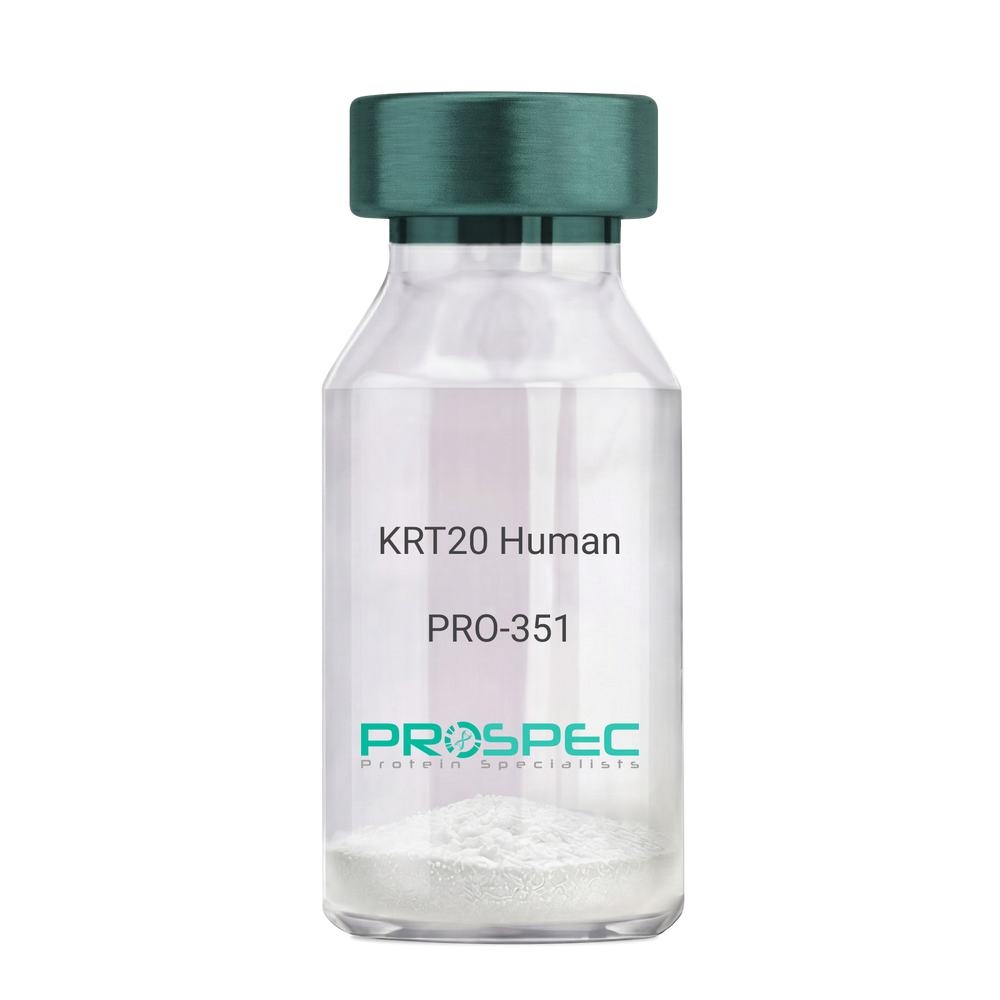
    Name :

    KRT20 Human

    Description:

    Cytokeratin 20 Human Recombinant

    Keratin type I cytoskeletal 20, Cytokeratin-20, CK-20, Keratin-20, K20, Protein IT, KRT20, CD20, CK20, KRT21, MGC35423.

    Product # :

    PRO-351

    Price :

    Quantity :

    Shipping Method :

    Room Temp Icon

    Shipped at Room temp

    Add To Cart

    More Info

    • description
    • source
    • formulation
    • purity
    • More Info

    Description

    Cytokeratin 20 Human Recombinant produced in E.Coli is a single,non-glycosylated polypeptide chain having a molecular mass of 48,553 Dalton. The KRT20 is purified by proprietary chromatographic techniques.

    Source

    Escherichia Coli.

    Formulation

    The protein (1mg/1ml) was lyophilized after from a sterile solution containing 30mM Tris-HCL pH-8, 9.5M urea, 2mM DDT, 2mM EDTA and 10mM methylammonium chloride.

    Purity

    Greater than 95.0% as determined by SDS-PAGE.

    More Info

    • Introduction

      KRT20 is a member of the keratin family. The keratins are intermediate filament proteins responsible for the structural integrity of epithelial cells and are subdivided into cytokeratins and hair keratins. The type I cytokeratins consist of acidic proteins which are arranged in pairs of heterotypic keratin chains. This cytokeratin is a major cellular protein of mature enterocytes and goblet cells and is specifically expressed in the gastric and intestinal mucosa. The type I cytokeratin genes are clustered in a region of chromosome 17q12-q21.

    • Synonyms

      Keratin type I cytoskeletal 20, Cytokeratin-20, CK-20, Keratin-20, K20, Protein IT, KRT20, CD20, CK20, KRT21, MGC35423.

    • Physical Appearance

      Sterile Filtered White lyophilized (freeze-dried) powder.

    • Stability

      Lyophilized KRT20 although stable at room temperature for 3 weeks, should be stored desiccated below -18°C. Upon reconstitution KRT20 should be stored at 4°C between 2-7 days and for future use below -18°C.For long term storage it is recommended to add a carrier protein (0.1% HSA or BSA).Please prevent freeze-thaw cycles.

    • Solubility

      It is recommended to reconstitute the lyophilized KRT20 in sterile 18MΩ-cm H2O not less than 100µg/ml, which can then be further diluted to other aqueous solutions.

    • Reconstitution to filaments

      Performed by mixing equimolar amounts of cytokeratins of type I and type II at concentrations of approx. 0.5 mg/ml, both dissolved in 9.5 M urea buffer (see above). Protofilaments and filament complexes are obtained by dialyzing the resulting polypeptide solution stepwise to a concentration of 4 M urea and then to low salt condition (50 mM NaCI, 2 mM dithiothreitol, 10 mM Tris-HCI, pH 7.4). For immunization purposes, the solution can be further dialyzed against PBS (phosphate buffered saline, e.g. Dulbecco's PBS).

    ProSpec's products are furnished for LABORATORY RESEARCH USE ONLY. The product may not be used as drugs, agricultural or pesticidal products, food additives or household chemicals.

    Krt20 Human
  • View Data Sheet

    Name :

    KRT8 Human

    Description:

    Cytokeratin 8 Human Recombinant

    Keratin type II cytoskeletal 8, Cytokeratin-8, CK-8, Keratin-8, K8, KRT8, CYK8, KO, CK8, K2C8, CARD2.

    Product # :

    PRO-347

    Price :

    Quantity :

    Shipping Method :

    Room Temp Icon

    Shipped at Room temp

    Add To Cart

    More Info

    • description
    • source
    • formulation
    • purity
    • More Info

    Description

    Cytokeratin 8 Human Recombinant produced in E.Coli is a single, non-glycosylated polypeptide chain having a molecular mass of 53,532 Dalton. The KRT8 is purified by proprietary chromatographic techniques.

    Source

    Escherichia Coli.

    Formulation

    The protein (1mg/ml) was lyophilized after from a sterile solution containing 30mM Tris-HCl pH-8, 9.5M urea, 2mM DTT, 2mM EDTA and 10mM methylammonium chloride.

    Purity

    Greater than 95.0% as determined by:
    (a) Analysis by RP-HPLC.
    (b) Analysis by SDS-PAGE.

    More Info

    • Introduction

      Keratin 8 and 18 (K8/18) are the major components of intermediate filament (IF) proteins of simple or single-layered epithelia.

    • Synonyms

      Keratin type II cytoskeletal 8, Cytokeratin-8, CK-8, Keratin-8, K8, KRT8, CYK8, KO, CK8, K2C8, CARD2.

    • Physical Appearance

      Sterile Filtered White lyophilized (freeze-dried) powder.

    • Stability

      Lyophilized KRT8 although stable at room temperature for 3 weeks, should be stored at 2-8°C. Upon reconstitution KRT8 should be stored at 4°C between 2-7 days and for future use below -18°C. For long term storage it is recommended to add a carrier protein (0.1% HSA or BSA). Please prevent freeze-thaw cycles.

    • Solubility

      It is recommended to reconstitute the lyophilized KRT8 in sterile 18MΩ-cm H2O not less than 100µg/ml, which can then be further diluted to other aqueous solutions.

    • Reconstitution to filaments

      Performed by mixing equimolar amounts of cytokeratins of type I and type II at concentrations of approx. 0.5 mg/ml, both dissolved in 9.5 M urea buffer (see above). Protofilaments and filament complexes are obtained by dialyzing the resulting polypeptide solution stepwise to a concentration of 4 M urea and then to low salt condition (50 mM NaCl, 2 mM dithiothreitol, 10 mM Tris-HCl, pH 7.4). For immunization purposes, the solution can be further dialyzed against PBS (phosphate buffered saline, e.g. Dulbecco's PBS).

    ProSpec's products are furnished for LABORATORY RESEARCH USE ONLY. The product may not be used as drugs, agricultural or pesticidal products, food additives or household chemicals.

    Krt8 Human
  • View Data Sheet

    Name :

    Exenatide

    Description:

    Exenatide

    Exendin-4.

    Product # :

    HOR-246

    Price :

    Quantity :

    Shipping Method :

    Room Temp Icon

    Shipped at Room temp

    Add To Cart

    More Info

    • description
    • formulation
    • purity
    • More Info

    Description

    Exenatide is a single, non-glycosylated, peptide containing 39 amino acids and having a molecular mass of 4186.6 Dalton. Exenatide has the empirical formula C184H282N50O60S.

    Formulation

    The Exenatide peptide was lyophilized from a concentrated solution with no additives.

    Purity

    Greater than 99.0% as determined by:
    (a) Analysis by RP-HPLC.
    (b) Analysis by SDS-PAGE.

    More Info

    • Introduction

      Exenatide Derived from the saliva of the gila monster, is a 39 amino acid peptide that mimics the GLP-1 incretin, an insulin secretagogue with glucoregulatory effects. Typical responses to exenatide include improvements in the initial rapid release of endogenous insulin, suppression of glucagon release by the pancreas, regulation of gastric empyting, and reduced appetite - all of which function to lower blood glucose. Exenatide is self-regulating in that it lowers blood sugar when levels are elevated but does not continue to lower blood sugar when levels return to normal, unlike with sulfonylureas or insulins.

    • Synonyms

      Exendin-4.

    • Physical Appearance

      Sterile Filtered White lyophilized (freeze-dried) powder.

    • Stability

      Lyophilized Exenatide although stable at room temperature for 3 weeks, should be stored desiccated below -18°C. Upon reconstitution Exenatide should be stored at 4°C between 2-7 days and for future use below -18°C. For long term storage it is recommended to add a carrier protein (0.1% HSA or BSA).Please prevent freeze-thaw cycles.

    • Solubility

      It is recommended to reconstitute the lyophilized Exenatide in sterile 18MΩ-cm H2O not less than 100 µg/ml, which can then be further diluted to other aqueous solutions.

    • Amino Acid Sequence

      H-His-Gly-Glu-Gly-Thr-Phe-Thr-Ser-Asp-Leu-Ser-Lys-Gln-Met-Glu-Glu-Glu-Ala-Val-Arg-Leu-Phe-Ile-Glu-Trp-Leu-Lys-Asn-Gly-Gly-Pro-Ser-Ser-Gly-Ala-Pro-Pro-Pro-Ser-NH2.

    ProSpec's products are furnished for LABORATORY RESEARCH USE ONLY. The product may not be used as drugs, agricultural or pesticidal products, food additives or household chemicals.

    Exenatide
  • 1
  • …
  • 20
  • 21
  • 22
  • 23
  • 24
  • …
  • 42
Your browser does not support the video tag.

Products

  • Cytokines
  • Growth Factors
  • Chemokines
  • CD Antigens
  • Neurotrophins
  • Hormones
  • Enzymes
  • Viral Antigens
  • Recombinant Proteins
  • Natural Proteins
  • Monoclonal Antibodies
  • Polyclonal Antibodies
  • Thermal Packaging

About

  • Company
  • Founder
  • Contribution
  • Contact Us
  • My Account

Ordering

  • Ordering Method
  • Ordering - Credit Card
  • Ordering PO
  • Shipping Fees
  • FAQ's

Legal

  • Terms & Conditions
  • Privacy
  • Site Map
  • info@prospecbio.com
  • Facebook
  • Instagram
  • Linkedin Profile

© 2026 ProSpec-Tany TechnoGene Ltd. All Rights Reserved.

  • Choosing a selection results in a full page refresh.
  • Opens in a new window.