Search results
1000 results found for “synaptobrevin”
Name
Description
Product #
Price
Quantity
Shipping Method
- View Data Sheet
Name :
CAPZA2 HumanDescription:
Capping Protein (Actin Filament) Muscle Z-Line Alpha 2 Human Recombinant
Capping Protein (Actin Filament) Muscle Z-Line, Alpha 2, F-Actin Capping Protein Alpha-2 Subunit, CapZ Alpha-2, CAPPA, CAPZ2, F-Actin-Capping Protein Subunit Alpha-2.
Product # :
PRO-1721Price :
Quantity :
Shipping Method :
Shipped with Ice Packs
More Info
- description
- source
- formulation
- purity
- More Info
Description
CAPZA2 Human Recombinant produced in E.Coli is a single, non-glycosylated polypeptide chain containing 309 amino acids (1-286 a.a) and having a molecular mass of 35.3kDa.CAPZA2 is fused to a 23 amino acid His-tag at N-terminus & purified by proprietary chromatographic techniques.
Source
Escherichia Coli.
Formulation
CAPZA2 protein solution (1mg/ml) containing 20mM Tris-HCl buffer (pH8.0), 10% glycerol, and 0.4M UREA.
Purity
Greater than 85.0% as determined by SDS-PAGE.
More Info
-
Introduction
Capping Protein (Actin Filament) Muscle Z-Line, Alpha 2 also known as CAPZA2 belongs the F-actin capping protein alpha subunit family. It is the alpha subunit of the barbed-end actin binding protein Cap Z. By capping the barbed end of actin filaments, Cap Z regulates the growth of the actin filaments at the barbed end. Among the diseases associated with CAPZA2 are endocarditis, and cervicitis.
-
Synonyms
Capping Protein (Actin Filament) Muscle Z-Line, Alpha 2, F-Actin Capping Protein Alpha-2 Subunit, CapZ Alpha-2, CAPPA, CAPZ2, F-Actin-Capping Protein Subunit Alpha-2.
-
Physical Appearance
Sterile Filtered clear solution.
-
Stability
Store at 4°C if entire vial will be used within 2-4 weeks. Store, frozen at -20°C for longer periods of time. For long term storage it is recommended to add a carrier protein (0.1% HSA or BSA).Avoid multiple freeze-thaw cycles.
-
Amino Acid Sequence
MGSSHHHHHH SSGLVPRGSH MGSMADLEEQ LSDEEKVRIA AKFIIHAPPG EFNEVFNDVR LLLNNDNLLR EGAAHAFAQY NLDQFTPVKI EGYEDQVLIT EHGDLGNGKF LDPKNRICFK FDHLRKEATD PRPCEVENAV ESWRTSVETA LRAYVKEHYP NGVCTVYGKK IDGQQTIIAC IESHQFQAKN FWNGRWRSEW KFTITPSTTQ VVGILKIQVH YYEDGNVQLV SHKDIQDSLT VSNEVQTAKE FIKIVEAAEN EYQTAISENY QTMSDTTFKA LRRQLPVTRT KIDWNKILSY KIGKEMQNA.
ProSpec's products are furnished for LABORATORY RESEARCH USE ONLY. The product may not be used as drugs, agricultural or pesticidal products, food additives or household chemicals.
- View Data Sheet
Name :
TRIP10 HumanDescription:
Thyroid Hormone Receptor Interactor 10 Human Recombinant
Cdc42-interacting protein 4, Protein Felic, Salt tolerant protein, hSTP, Thyroid receptor-interacting protein 10, TR-interacting protein 10, TRIP-10,TRIP10, CIP4, STOT, STP, HSTP.
Product # :
PRO-1811Price :
Quantity :
Shipping Method :
Shipped with Ice Packs
More Info
- description
- source
- formulation
- purity
- More Info
Description
TRIP10 Human Recombinant produced in E.coli is a single, non-glycosylated polypeptide chain containing 309 amino acids (260-545) and having a molecular mass of 34.6 kDa.TRIP10 is fused to a 23 amino acid His-tag at N-terminus & purified by proprietary chromatographic techniques.
Source
Escherichia Coli.
Formulation
The TRIP10 solution (1mg/ml) contains 20mM Tris-HCl buffer (pH 8.0), 0.1M NaCl, 10% glycerol, 1mM DTT.
Purity
Greater than 90.0% as determined by SDS-PAGE.
More Info
-
Introduction
Thyroid Hormone Receptor Interactor 10 (TRIP10) is a part of the F-BAR family of proteins which is expressed in a variety of tissues, including kidney, brain, liver, lung, heart and pancreas. The F-BAR family of proteins contains an N-terminal, alpha-helical, region which is hydrophobic and related to the Bin Amphiphysin Rvs (BAR) protein family. TRIP10 is vital for the coordination of membrane tubulation with Actin cytoskeletal reorganization during endocytosis.
-
Synonyms
Cdc42-interacting protein 4, Protein Felic, Salt tolerant protein, hSTP, Thyroid receptor-interacting protein 10, TR-interacting protein 10, TRIP-10,TRIP10, CIP4, STOT, STP, HSTP.
-
Physical Appearance
Sterile Filtered colorless solution.
-
Stability
Store at 4°C if entire vial will be used within 2-4 weeks. Store, frozen at -20°C for longer periods of time. For long term storage it is recommended to add a carrier protein (0.1% HSA or BSA).Avoid multiple freeze-thaw cycles.
-
Amino Acid Sequence
MGSSHHHHHH SSGLVPRGSH MGSDPKNDSH VLIELHKSGF ARPGDVEFED FSQPMNRAPS DSSLGTPSDG RPELRGPGRS RTKRWPFGKK NKTVVTEDFS HLPPEQQRKR LQQQLEERSR ELQKEVDQRE ALKKMKDVYE KTPQMGDPAS LEPQIAETLS NIERLKLEVQ KYEAWLAEAE SRVLSNRGDS LSRHARPPDP PASAPPDSSS NSASQDTKES SEEPPSEESQ DTPIYTEFDE DFEEEPTSPI GHCVAIYHFE GSSEGTISMA EGEDLSLMEE DKGDGWTRVR RKEGGEGYVP TSYLRVTLN.
ProSpec's products are furnished for LABORATORY RESEARCH USE ONLY. The product may not be used as drugs, agricultural or pesticidal products, food additives or household chemicals.
- View Data Sheet
Name :
CXCL1 RatDescription:
GRO-Alpha Rat Recombinant (CXCL1)
Growth-regulated protein alpha, CXCL1, Melanoma growth stimulatory activity, MGSA, Neutrophil-activating protein 3, NAP-3, GRO-alpha(1-73), chemokine (C-X-C motif) ligand 1, GRO1, GROa, SCYB1, MGSA-a, MGSA alpha.
Product # :
CHM-375Price :
Quantity :
Shipping Method :
Shipped at Room temp
More Info
- description
- source
- formulation
- purity
- biological activity
- More Info
Description
CXCL1 Rat Recombinant produced in E.Coli is a single,non-glycosylated, polypeptide chain containing 73 amino acids and having a molecular mass of 7.8 kDa. The Rat CXCL1 is purified by proprietary chromatographic techniques.
Source
Escherichia Coli.
Formulation
Lyophilized from a 0.2μm filtered concentrated (1mg/ml) solution in 20mM PB, pH 7.4, and 150mM NaCl.
Purity
Greater than 97.0% as determined by:
(a) Analysis by RP-HPLC.
(b) Analysis by SDS-PAGE.Biological Activity
Determined by its ability to chemoattract rat neutrophils using a concentration range of 10-100ng/ml corresponding to a Specific Activity of 10,000-100,000IU/mg.More Info
-
Introduction
Chemokine (C-X-C motif) ligand 1 (CXCL1) is a small cytokine belonging to the CXC chemokine family that was previously called GRO1 oncogene, Neutrophil-activating protein 3 (NAP-3) and melanoma growth stimulating activity, alpha (MSGA-α). It is secreted by human melanoma cells, has mitogenic properties and is implicated in melanoma pathogenesis. CXCL1 is expressed by macrophages, neutrophils and epithelial cells, and has neutrophil chemoattractant activity. CXCL1 plays a role in spinal cord development by inhibiting the migration of oligodendrocyte precursors and is involved in the processes of angiogenesis, inflammation, wound healing, and tumorigenesis. This chemokine elicits its effects by signaling through the chemokine receptor CXCR2. The gene for CXCL1 is located on human chromosome 4 amongst genes for other CXC chemokines.
-
Synonyms
Growth-regulated protein alpha, CXCL1, Melanoma growth stimulatory activity, MGSA, Neutrophil-activating protein 3, NAP-3, GRO-alpha(1-73), chemokine (C-X-C motif) ligand 1, GRO1, GROa, SCYB1, MGSA-a, MGSA alpha.
-
Physical Appearance
Sterile Filtered White lyophilized (freeze-dried) powder.
-
Stability
Lyophilized CXCL1 although stable at room temperature for 3 weeks, should be stored desiccated below -18°C. Upon reconstitution CXCL1 should be stored at 4°C between 2-7 days and for future use below -18°C.For long term storage it is recommended to add a carrier protein (0.1% HSA or BSA).Please prevent freeze-thaw cycles.
-
Solubility
It is recommended to reconstitute the lyophilized CXCL1 in sterile 18MΩ-cm H2O not less than 100µg/ml, which can then be further diluted to other aqueous solutions.
-
Amino Acid Sequence
APVANELRCQ CLQTVAGIHF KNIQSLKVMP PGPHCTQTEV IATLKNGREA CLDPEAPMVQ KIVQKMLKGV PK.
-
Background
What is the molecular weight/Mw of CXCL1 RAT Protein?
CXCL1 RAT Protein has a total Mw of 7.8kDa.
What is the source or expression system of CXCL1 RAT Protein?
Escherichia Coli.
What is the Purity of CXCL1 RAT Protein?
CXCL1 RAT Protein is >97% pure as determined by SDS-PAGE.
What is the Biological Activity of CXCL1 RAT Protein?
Determined by its ability to chemoattract rat neutrophils using a concentration range of 10-100ng/ml corresponding to a Specific Activity of 10,000-100,000IU/mg.
What is the amino acid sequence of CXCL1 RAT Protein?
APVANELRCQ CLQTVAGIHF KNIQSLKVMP PGPHCTQTEV IATLKNGREA CLDPEAPMVQ KIVQKMLKGV PK.
What applications can CXCL1 RAT Protein be used in?
CXCL1 RAT Protein can probably be used in western blot, ELISA and Lateral Flow.
What is the endotoxin level for CXCL1 RAT Protein?
The endotoxin level is minimal, CXCL1 RAT Protein was purified using conventional chromatography techniques.
ProSpec's products are furnished for LABORATORY RESEARCH USE ONLY. The product may not be used as drugs, agricultural or pesticidal products, food additives or household chemicals.
- View Data Sheet
Name :
CXCL1 MouseDescription:
GRO1/KC Mouse Recombinant (CXCL1)
Growth-regulated alpha protein, CXCL1, Platelet-derived growth factor-inducible protein KC, Secretory protein N51, KC, Fsp, N51, gro, Gro1, Mgsa, Scyb1, chemokine (C-X-C motif) ligand 1.
Product # :
CHM-335Price :
Quantity :
Shipping Method :
Shipped at Room temp
More Info
- description
- source
- formulation
- purity
- biological activity
- More Info
Description
KC Mouse Recombinant also known as N51 and GRO-1 produced in E.Coli is a single, non-glycosylated, polypeptide chain containing 72 amino acids and having a molecular mass of approximately 7.8 kDa. The GRO-1 is purified by proprietary chromatographic techniques.
Source
Escherichia Coli.
Formulation
The protein solution (1mg/ml) was lyophilized from 20mM phosphate buffer pH-7.4 and 0.1M NaCl.
Purity
Greater than 97.0% as determined by:
(a) Analysis by RP-HPLC.
(b) Analysis by SDS-PAGE.Biological Activity
The biological activity was determined by measuring the ability to chemoattrat human neutrophilsat a concentration of 10ng/ml-100ng/ml.
More Info
-
Introduction
Chemokine (C-X-C motif) ligand 1 (CXCL1) is a small cytokine belonging to the CXC chemokine family that was previously called GRO1 oncogene, Neutrophil-activating protein 3 (NAP-3) and melanoma growth stimulating activity, alpha (MSGA-a). It is secreted by human melanoma cells, has mitogenic properties and is implicated in melanoma pathogenesis. CXCL1 is expressed by macrophages, neutrophils and epithelial cells, and has neutrophil chemoattractant activity. CXCL1 plays a role in spinal cord development by inhibiting the migration of oligodendrocyte precursors and is involved in the processes of angiogenesis, inflammation, wound healing, and tumorigenesis. This chemokine elicits its effects by signaling through the chemokine receptor CXCR2. The gene for CXCL1 is located on human chromosome 4 amongst genes for other CXC chemokines.
-
Synonyms
Growth-regulated alpha protein, CXCL1, Platelet-derived growth factor-inducible protein KC, Secretory protein N51, KC, Fsp, N51, gro, Gro1, Mgsa, Scyb1, chemokine (C-X-C motif) ligand 1.
-
Physical Appearance
Sterile Filtered White lyophilized (freeze-dried) powder.
-
Stability
Lyophilized KC Mouse although stable at room temperature for 3 weeks, should be stored desiccated below -18°C. Upon reconstitution CXCL1 should be stored at 4°C between 2-7 days and for future use below -18°C. For long term storage it is recommended to add a carrier protein (0.1% HSA or BSA).Please prevent freeze-thaw cycles.
-
Solubility
It is recommended to reconstitute the lyophilized GRO1 Recombinant in sterile 18MΩ-cm H2O not less than 100µg/ml, which can then be further diluted to other aqueous solutions.
-
Amino Acid Sequence
APIANELRCQ CLQTMAGIHL KNIQSLKVLP SGPHCTQTEV IATLKNGREA CLDPEAPLVQ KIVQKMLKGV PK.
-
Background
What is the molecular weight/Mw of CXCL1 MOUSE Protein?
CXCL1 MOUSE Protein has a total Mw of 7.8kDa.
What is the source or expression system of CXCL1 MOUSE Protein?
Escherichia Coli.
What is the Purity of CXCL1 MOUSE Protein?
CXCL1 MOUSE Protein is >97% pure as determined by SDS-PAGE.
What is the Biological Activity of CXCL1 MOUSE Protein?
The biological activity was determined by measuring the ability to chemoattrat human neutrophilsat a concentration of 10ng/ml-100ng/ml.
What is the amino acid sequence of CXCL1 MOUSE Protein?
APIANELRCQ CLQTMAGIHL KNIQSLKVLP SGPHCTQTEV IATLKNGREA CLDPEAPLVQ KIVQKMLKGV PK.
What applications can CXCL1 MOUSE Protein be used in?
CXCL1 MOUSE Protein can probably be used in western blot, ELISA and Lateral Flow.
What is the endotoxin level for CXCL1 MOUSE Protein?
The endotoxin level is minimal, CXCL1 MOUSE Protein was purified using conventional chromatography techniques.
-
Protein content
Protein quantitation was carried out by two independent methods: 1. UV spectroscopy at 280 nm using the absorbency value of 0.03 as the extinction coefficient for a 0.1% (1mg/ml) solution. This value is calculated by the PC GENE computer analysis program of protein sequences (IntelliGenetics). 2. Analysis by RP-HPLC, using a standard solution of KC as a Reference Standard.
ProSpec's products are furnished for LABORATORY RESEARCH USE ONLY. The product may not be used as drugs, agricultural or pesticidal products, food additives or household chemicals.
- View Data Sheet
Name :
GrpE E.ColiDescription:
HSP-70 Cofactor (HSP24) E.Coli Recombinant
HSP24, HSPB25.3, HSP-70 Cofactor, Protein grpE, Heat shock protein B25.3, grpE, b2614, JW2594.
Product # :
HSP-014Price :
Quantity :
Shipping Method :
Shipped with Ice Packs
More Info
- description
- source
- formulation
- purity
- More Info
Description
GrpE Recombinant produced in E.Coli is a single, non-glycosylated polypeptide chain containing 197 amino acids and having a molecular mass of 21.8 kDa. The GrpE is purified by proprietary chromatographic techniques.
Source
Escherichia Coli.
Formulation
The HSP24 protein solution contains 20mM Tris-HCl pH-8 and 0.1M NaCl.
Purity
Greater than 90.0% as determined by analysis by SDS-PAGE.
More Info
-
Introduction
GrpE , co-chaperone of E.coli, participates actively in the response to hyperosomotic and heat shock by preventing the aggregation of stress-denatured proteins in association with DnaK. This protein is the nucleotide exchange factor for DnaK and may function as a thermosensor. Several rounds of ATP-dependent interactions between DnaJ, DnaK and GrpE are required for fully efficient folding.
-
Synonyms
HSP24, HSPB25.3, HSP-70 Cofactor, Protein grpE, Heat shock protein B25.3, grpE, b2614, JW2594.
-
Physical Appearance
Sterile Filtered colorless solution.
-
Stability
Store at 4°C if entire vial will be used within 2-4 weeks. Store, frozen at -20°C for longer periods of time. For long term storage it is recommended to add a carrier protein (0.1% HSA or BSA).Avoid multiple freeze-thaw cycles.
-
Amino Acid Sequence
MSSKEQKTPE GQAPEEIIMD QHEEIEAVEP EASAEQVDPR DEKIANLEAQ LAEAQTRERD GILRVKAEME NLRRRTELDI EKAHKFALEK FINELLPVID SLDRALEVAD KANPDMSAMV EGIELTLKSM LDVVRKFGVE VIAETNVPLD PNVHQAIAMV ESDDVAPGNV LGIMQKGYTL NGRTIRAAMV TVAKAKA.
ProSpec's products are furnished for LABORATORY RESEARCH USE ONLY. The product may not be used as drugs, agricultural or pesticidal products, food additives or household chemicals.
- View Data Sheet
Name :
PVALB HumanDescription:
Parvalbumin Human Recombinant
Parvalbumin alpha, PVALB, D22S749, MGC116759.
Product # :
PRO-004Price :
Quantity :
Shipping Method :
Shipped with Ice Packs
More Info
- description
- source
- formulation
- purity
- More Info
Description
PVALB Human Recombinant fused with a 24 amino acid His tag at N-terminus produced in E.Coli is a single, non-glycosylated, polypeptide chain containing 134 amino acids (1-110 a.a.) and having a molecular mass of 14.6kDa. The PVALB is purified by proprietary chromatographic techniques.
Source
Escherichia Coli.
Formulation
The PVALB solution (1 mg/ml) contains 20mM Tris-HCl buffer (pH 8.0), 1mM DTT, 10% glycerol and 50mM NaCl.
Purity
Greater than 95.0% as determined by SDS-PAGE.
More Info
-
Introduction
Parvalbumin alpha (PVALB) is a member of a larger group of EF hand proteins. PVALB is a high affinity calcium ion-binding protein which is structurally and functionally similar to calmodulin and troponin C. Parvalbumin is expressed in a specific population of GABAergic interneurones which are believed to have a role in maintaining the balance between excitation and inhibition in the cortex as well as the hippocampus.
-
Synonyms
Parvalbumin alpha, PVALB, D22S749, MGC116759.
-
Physical Appearance
Sterile Filtered colorless solution.
-
Stability
Store at 4°C if entire vial will be used within 2-4 weeks.Store, frozen at -20°C for longer periods of time. For long term storage it is recommended to add a carrier protein (0.1% HSA or BSA).Avoid multiple freeze-thaw cycles.
-
Amino Acid Sequence
MGSSHHHHHH SSGLVPRGSH MGSHMSMTDL LNAEDIKKAV GAFSATDSFD HKKFFQMVGLKKKSADDVKK VFHMLDKDKS GFIEEDELGF ILKGFSPDAR DLSAKETKML MAAGDKDGDG KIGVDEFSTL VAES.
ProSpec's products are furnished for LABORATORY RESEARCH USE ONLY. The product may not be used as drugs, agricultural or pesticidal products, food additives or household chemicals.
- View Data Sheet
Name :
MAPRE2 HumanDescription:
Microtubule-Associated Protein, RP/EB Family, Member 2 Human Recombinant
Microtubule-associated protein RP/EB family member 2, APC-binding protein EB2, End-binding protein 2, EB2, MAPRE2, RP1, EB1.
Product # :
PRO-932Price :
Quantity :
Shipping Method :
Shipped with Ice Packs
More Info
- description
- source
- formulation
- purity
- More Info
Description
MAPRE2 Human Recombinant produced in E.Coli is a single, non-glycosylated polypeptide chain containing 347 amino acids (1-327 a.a.) and having a molecular mass of 39.2kDa.MAPRE2 is fused to a 20 amino acid His-tag at N-terminus & purified by proprietary chromatographic techniques.
Source
Escherichia Coli.
Formulation
MAPRE2 protein solution (1mg/ml) containing 20mM Tris-HCl buffer (pH8.0), 20% glycerol, 0.1M NaCl and 1mM DTT.
Purity
Greater than 85% as determined by SDS-PAGE.
More Info
-
Introduction
MAPRE2 (RP1 or EB2) is an evolutionarily conserved protein, which associates with the tips of growing microtubules, and regulates microtubule dynamics and their interactions with intracellular structures. The EB proteins regulate microtubule function through CLIP proteins. MAPRE2 shares noteworthy homology to the adenomatous polyposis coli (APC) protein-binding EB1 gene family. MAPRE2 is necessary for spindle symmetry during mitosis. MAPRE2 is believed to have a role in the tumorigenesis of colorectal cancers and the proliferative control of normal cells.
-
Synonyms
Microtubule-associated protein RP/EB family member 2, APC-binding protein EB2, End-binding protein 2, EB2, MAPRE2, RP1, EB1.
-
Physical Appearance
Sterile Filtered clear solution.
-
Stability
Store at 4°C if entire vial will be used within 2-4 weeks. Store, frozen at -20°C for longer periods of time. For long term storage it is recommended to add a carrier protein (0.1% HSA or BSA).Avoid multiple freeze-thaw cycles.
-
Amino Acid Sequence
MGSSHHHHHH SSGLVPRGSH MPGPTQTLSP NGENNNDIIQ DNNGTIIPFR KHTVRGERSY SWGMAVNVYS TSITQETMSR HDIIAWVNDI VSLNYTKVEQ LCSGAAYCQF MDMLFPGCIS LKKVKFQAKL EHEYIHNFKL LQASFKRMNV DKVIPVEKLV KGRFQDNLDF IQWFKKFYDA NYDGKEYDPV EARQGQDAIP PPDPGEQIFN LPKKSHHANS PTAGAAKSSP AAKPGSTPSR PSSAKRASSS GSASKSDKDL ETQVIQLNEQ VHSLKLALEG VEKERDFYFG KLREIELLCQ EHGQENDDLV QRLMDILYAS EEHEGHTEEP EAEEQAHEQQ PPQQEEY.
ProSpec's products are furnished for LABORATORY RESEARCH USE ONLY. The product may not be used as drugs, agricultural or pesticidal products, food additives or household chemicals.
- View Data Sheet
Name :
Activin-A Human ActiveDescription:
Activin-A Human Recombinant, Active
Inhba, Inhibin beta A, FSH releasing protein.
Product # :
CYT-145Price :
Quantity :
Shipping Method :
Shipped at Room temp
More Info
- description
- source
- formulation
- purity
- biological activity
- More Info
Description
Active form Activin-A Human Recombinant produced in e.coli is a homodimeric, non-glycosylated, polypeptide chain containing 2 x 117 amino acids and having a molecular weight of 26.2kDa.The Active form Activin-A is purified by standard chromatographic techniques.
Source
E.Coli.
Formulation
Human Activin-A was lyophilized from a concentrated 1mg/ml protein solution containing 0.1% TFA.
Purity
Greater than 95% as obsereved by SDS-PAGE.
Biological Activity
Biological activity is assessed by the ability to induce cytotoxicity of MPC-11 cells and was found to be 8.95ng/ml corresponding to a specific activity of 1.1 x 10⁵ units/mg.
More Info
-
Introduction
Activins are homodimers or heterodimers of the different β subunit isoforms, part of the TGFβ family. Mature Activin A has two 116 amino acids residues βA subunits (βA-βA). Activin displays an extensive variety of biological activities, including mesoderm induction, neural cell differentiation, bone remodelling, haematopoiesis, and reproductive physiology. Activins takes part in the production and regulation of hormones such as FSH, LH, GnRH and ACTH. Cells that are identified to express Activin A include fibroblasts, endothelial cells, hepatocytes, vascular smooth muscle cells, macrophages, keratinocytes, osteoclasts, bone marrow monocytes, prostatic epithelium, neurons, chondrocytes, osteoblasts, Leydig cells, Sertoli cells, and ovarian granulosa cells.
-
Synonyms
Inhba, Inhibin beta A, FSH releasing protein.
-
Physical Appearance
Lyophilized freeze dried powder.
-
Stability
Lyophilized Activin-A although stable at room temperature for 3 weeks, should be stored desiccated below -18°C. Upon reconstitution Activin-A should be stored at 4°C between 2-7 days and for future use below -18°C.For long term storage it is recommended to add a carrier protein (0.1% HSA or BSA).Please prevent freeze-thaw cycles.
-
Solubility
Human INHBA protein should be reconstituted in distilled pyrogen free water to a concentration of 100ug /ml which can then be further diluted to other aqueous solutions.
-
Amino Acid Sequence
MGLECDGKVN ICCKKQFFVS FKDIGWNDWI IAPSGYHANY CEGECPSHIA GTSGSSLSFH STVINHYRMR GHSPFANLKS CCVPTKLRPM SMLYYDDGQN IIKKDIQNMI VEECGCS.
-
Background
Title: Research on Activin A Human Recombinant: Molecular Characteristics, Signaling Pathways, Physiological Functions, and Therapeutic Potential
Introduction:
Activin A, a member of the transforming growth factor-beta (TGF-β) superfamily, is a multifunctional cytokine that plays a significant role in various biological processes in the human body. Its involvement in diverse physiological and pathological functions has garnered considerable attention in scientific research. This paper aims to provide an overview of Activin A, encompassing its molecular characteristics, signaling pathways, physiological functions, and therapeutic potential.
Activin A is encoded by the INHBA gene and is produced as a precursor protein that undergoes post-translational modifications to generate the mature form. The mature Activin A protein consists of two β-subunits held together by disulfide bonds. These structural features contribute to its functional properties and interactions with specific receptors.
Upon binding to its cell surface receptors, Activin A triggers intracellular signaling cascades, leading to various cellular responses. Canonical SMAD-dependent pathway as well as non-SMAD pathways, such as MAPK/ERK, PI3K/Akt, and JNK signaling, are activated by Activin A. The intricate network of signaling pathways enables Activin A to regulate diverse biological processes, including cell proliferation, differentiation, apoptosis, and tissue homeostasis.
Activin A exerts its physiological functions in a tissue-specific manner. It plays a critical role in embryonic development, particularly in organogenesis and patterning. Additionally, Activin A is involved in reproductive biology, where it participates in folliculogenesis, spermatogenesis, and hormonal regulation. It also contributes to neural development, immune system modulation, and skeletal homeostasis.
The multifunctional properties of Activin A have positioned it as a potential therapeutic target for various diseases. Its involvement in cancer, neurodegenerative disorders, fibrosis, and reproductive disorders has prompted extensive research to explore its therapeutic potential. Understanding the molecular mechanisms underlying Activin A's actions provides valuable insights for developing innovative therapeutic strategies.
In conclusion, Activin A is a versatile cytokine with diverse roles in human biology. This research aims to deepen our understanding of its molecular characteristics, signaling pathways, physiological functions, and therapeutic potential. By elucidating the complexities of Activin A, we strive to pave the way for novel therapeutic interventions in various human diseases.
ProSpec's products are furnished for LABORATORY RESEARCH USE ONLY. The product may not be used as drugs, agricultural or pesticidal products, food additives or household chemicals.
- View Data Sheet
Name :
MBP ProteinDescription:
Myelin Basic Protein Human
Maltose-binding periplasmic protein, MBP, MMBP, Maltodextrin-binding protein, malE, b4034, JW3994.
Product # :
PRO-2798Price :
Quantity :
Shipping Method :
Shipped at Room temp
More Info
- description
- source
- formulation
- purity
- More Info
Description
MBP Human produced in Human brain is checked using poly and monoclonal antibodies against MBP.
Source
Human brain.
Formulation
MBP was lyophilized containing no additives.
Purity
Greater than 95.0% as determined by SDS-PAGE.
More Info
-
Synonyms
Maltose-binding periplasmic protein, MBP, MMBP, Maltodextrin-binding protein, malE, b4034, JW3994.
-
Physical Appearance
Sterile Filtered White lyophilized (freeze-dried) powder.
-
Stability
Lyophilized MBP although stable at room temperature for 3 weeks, should be stored desiccated below -18°C. Upon reconstitution Myelin Basic Protein should be stored at 4°C between 2-7 days and for future use below -18°C. For long term storage it is recommended to add a carrier protein (0.1% HSA or BSA). Please prevent freeze-thaw cycles.
-
Solubility
It is recommended to reconstitute the lyophilized MBP in sterile 18MΩ-cm H2O not less than 100µg/ml, which can then be further diluted to other aqueous solutions.
-
Background
Myelin Basic Protein (MBP) stands as a cornerstone in the intricate architecture of the nervous system. As a vital component of the myelin sheath, MBP plays a pivotal role in ensuring the integrity and rapid transmission of nerve impulses. Over the years, scientific inquiry into MBP has revealed its multifaceted functions, not only as a structural element but also as a regulatory molecule involved in various cellular processes. This research seeks to unravel the complexities of MBP, exploring its structural characteristics, physiological significance, and its involvement in neurological disorders.
Structural Marvel of MBP:
MBP, an intrinsically disordered protein, boasts a unique structure allowing it to interact with lipid membranes, especially those found in the myelin sheath. Its high arginine and lysine content gives it a positive charge, enabling strong electrostatic interactions with the negatively charged lipids in myelin. This structural adaptation is crucial for the compact wrapping of myelin around axons, facilitating efficient electrical signal conduction.
Physiological Significance in Myelination:
In the central nervous system (CNS), oligodendrocytes produce myelin, a lipid-rich substance that insulates axons. MBP, as a major constituent of myelin, plays an indispensable role in this process. It stabilizes the myelin sheath’s structure, ensuring its tight adherence to the axon and promoting the fast, saltatory conduction of nerve impulses. Without functional MBP, myelin integrity is compromised, leading to reduced nerve conduction velocity and impaired neural communication.
Beyond Structural Functions:
Recent studies have revealed that MBP is not merely a structural protein but also possesses regulatory functions. It participates in signaling pathways crucial for oligodendrocyte development and myelination. Moreover, MBP’s interaction with cytoskeletal elements suggests its involvement in cellular processes such as axon guidance and neuronal plasticity. Understanding these regulatory roles provides insights into the broader impact of MBP on neural development and function.
Implications in Neurological Disorders:
Alterations in MBP have been linked to various neurological disorders, including multiple sclerosis (MS). In MS, the immune system erroneously targets MBP, leading to demyelination and subsequent neurological impairments. Research into MBP-related pathologies not only aids in understanding disease mechanisms but also offers potential therapeutic avenues. Targeting MBP-specific immune responses is a focus of research for developing MS treatments.
Conclusion:
MBP, as the guardian of neural transmission, stands as a testament to the marvels of biological architecture. Its intricate structure and multifaceted functions make it indispensable for the proper functioning of the nervous system. Beyond its role as a structural protein, MBP’s involvement in cellular signalling adds layers to its significance. In the realm of neurological disorders, MBP’s complexities provide both challenges and opportunities, guiding scientists toward innovative therapies. This research delves into the world of MBP, appreciating its contributions to neuroscience while aiming to decipher the mysteries that lie within its molecular intricacies.
ProSpec's products are furnished for LABORATORY RESEARCH USE ONLY. The product may not be used as drugs, agricultural or pesticidal products, food additives or household chemicals.
- View Data Sheet
Name :
THAP3 HumanDescription:
THAP Domain Containing, Apoptosis Associated Protein 3 Human Recombinant
THAP Domain Containing Apoptosis Associated Protein 3, THAP Domain-Containing Protein 3.
Product # :
PRO-1630Price :
Quantity :
Shipping Method :
Shipped with Ice Packs
More Info
- description
- source
- formulation
- purity
- More Info
Description
THAP3 Human Recombinant produced in E.coli is a single, non-glycosylated polypeptide chain containing 262 amino acids (1-239) and having a molecular mass of 29.4kDa.THAP3 is fused to a 23 amino acid His-tag at N-terminus & purified by proprietary chromatographic techniques.
Source
Escherichia Coli.
Formulation
The THAP3 solution contains 20mM Tris-HCl buffer (pH 8.0), 0.2M NaCl, 2mM DTT and 50% glycerol.
Purity
Greater than 85% as determined by SDS-PAGE.
More Info
-
Introduction
THAP3 is an element of a THAP1/THAP3-HCFC1-OGT complex which is essential for the regulation of the transcriptional activity of RRM1. THAP3 is vastly produced in placenta, skeletal muscle and heart.
-
Synonyms
THAP Domain Containing Apoptosis Associated Protein 3, THAP Domain-Containing Protein 3.
-
Physical Appearance
Sterile filtered colorless solution.
-
Stability
Store at 4°C if entire vial will be used within 2-4 weeks. Store, frozen at -20°C for longer periods of time. For long term storage it is recommended to add a carrier protein (0.1% HSA or BSA).Avoid multiple freeze-thaw cycles.
-
Amino Acid Sequence
MGSSHHHHHH SSGLVPRGSH MGSMPKSCAA RQCCNRYSSR RKQLTFHRFP FSRPELLKEW VLNIGRGNFK PKQHTVICSE HFRPECFSAF GNRKNLKHNA VPTVFAFQDP TQQVRENTDP ASERGNASSS QKEKVLPEAG AGEDSPGRNM DTALEELQLP PNAEGHVKQV SPRRPQATEA VGRPTGPAGL RRTPNKQPSD HSYALLDLDS LKKKLFLTLK ENEKLRKRLQ AQRLVMRRMS SRLRACKGHQ GLQARLGPEQ QS
ProSpec's products are furnished for LABORATORY RESEARCH USE ONLY. The product may not be used as drugs, agricultural or pesticidal products, food additives or household chemicals.
- View Data Sheet
Name :
PRRT2 HumanDescription:
Proline-Rich Transmembrane Protein 2 Human Recombinant
Proline-Rich Transmembrane Protein 2, Infantile Convulsions And Paroxysmal Choreoathetosis, Dispanin Subfamily B Member 3, DSPB3, BFIC2, BFIS2, DYT10, EKD1, PKC, FICCA, IFITMD1, ICCA.
Product # :
PRO-1852Price :
Quantity :
Shipping Method :
Shipped with Ice Packs
More Info
- description
- source
- formulation
- purity
- More Info
Description
PRRT2 Human Recombinant produced in E.coli is a single, non-glycosylated polypeptide chain containing 291 amino acids (1-268) and having a molecular mass of 29.7 kDa. PRRT2 is fused to a 23 amino acid His-tag at N-terminus.
Source
Escherichia Coli.
Formulation
The PRRT2 solution (0.25mg/ml) contains 20mM Tris-HCl buffer (pH 8.0), 0.15M NaCl, 1mM DTT and 10% glycerol.
Purity
Greater than 85% as determined by SDS-PAGE.
More Info
-
Introduction
Transmembrane protein PRRT2 holds a proline-rich domain in its N-terminal half. PRRT2 is known to be primarily expressed in brain and spinal cord in embryonic and postnatal stages. Alterations in this gene are the cause for paroxysmal kinesigenic dyskinesia. PRRT2 mutations were found in nearly 30% of sporadic PKC patients.
-
Synonyms
Proline-Rich Transmembrane Protein 2, Infantile Convulsions And Paroxysmal Choreoathetosis, Dispanin Subfamily B Member 3, DSPB3, BFIC2, BFIS2, DYT10, EKD1, PKC, FICCA, IFITMD1, ICCA.
-
Physical Appearance
Sterile Filtered clear solution.
-
Stability
Store at 4°C if entire vial will be used within 2-4 weeks. Store, frozen at -20°C for longer periods of time. For long term storage it is recommended to add a carrier protein (0.1% HSA or BSA).Avoid multiple freeze-thaw cycles.
-
Amino Acid Sequence
MGSSHHHHHH SSGLVPRGSH MGSMAASSSE ISEMKGVEES PKVPGEGPGH SEAETGPPQV LAGVPDQPEA PQPGPNTTAA PVDSGPKAGL APETTETPAG ASETAQATDL SLSPGGESKA NCSPEDPCQE TVSKPEVSKE ATADQGSRLE SAAPPEPAPE PAPQPDPRPD SQPTPKPALQ PELPTQEDPT PEILSESVGE KQENGAVVPL QAGDGEEGPA PEPHSPPSKK SPPANGAPPR VLQQLVEEDR MRRAHSGHPG SPRGSLSRHP SSQLAGPGVE GGEGTQKPRD Y.
ProSpec's products are furnished for LABORATORY RESEARCH USE ONLY. The product may not be used as drugs, agricultural or pesticidal products, food additives or household chemicals.
- View Data Sheet
Name :
WHSC2 HumanDescription:
Wolf-Hirschhorn Syndrome Candidate 2 Human Recombinant
Negative elongation factor A, NELF-A, Wolf-Hirschhorn syndrome candidate 2 protein, WHSC2, NELFA, FLJ10442, FLJ25112, P/OKcl.15.
Product # :
PRO-062Price :
Quantity :
Shipping Method :
Shipped with Ice Packs
More Info
- description
- source
- formulation
- purity
- More Info
Description
WHSC2 Human Recombinant fused with a 20 amino acid His tag at N-terminus produced in E.Coli is a single, non-glycosylated, polypeptide chain containing 559 amino acids (1-539 a.a.) and having a molecular mass of 60.6kDa. The WHSC2 is purified by proprietary chromatographic techniques.
Source
Escherichia Coli.
Formulation
The WHSC2 solution (0.25 mg/ml) 20mM Tris-HCl buffer (pH8.0), 0.2M NaCl, 5mM DTT, 1mM EDTA and 20% glycerol.
Purity
Greater than 85.0% as determined by SDS-PAGE.
More Info
-
Introduction
WHSC2 (NELF-A) is a protein factor required for DRB-sensitive transcription. WHSC2 is one of the 5 components of the multisubunit NELF complex which cooperates with DSIF to repress RNA polymerase II elongation. The Wolf-Hirschhorn syndrome is a multiple malformation syndrome characterized by mental and developmental defects resulting from a hemizygous deletion of the distal short arm of chromosome 4 (4p16.3).
-
Synonyms
Negative elongation factor A, NELF-A, Wolf-Hirschhorn syndrome candidate 2 protein, WHSC2, NELFA, FLJ10442, FLJ25112, P/OKcl.15.
-
Physical Appearance
Sterile Filtered colorless solution.
-
Stability
Store at 4°C if entire vial will be used within 2-4 weeks. Store, frozen at -20°C for longer periods of time. For long term storage it is recommended to add a carrier protein (0.1% HSA or BSA).Avoid multiple freeze-thaw cycles.
-
Amino Acid Sequence
MGSSHHHHHH SSGLVPRGSH MPGQRRALSP KMASMRESDT GLWLHNKLGA TDELWAPPSI ASLLTAAVID NIRLCFHGLS SAVKLKLLLG TLHLPRRTVD EMKGALMEII QLASLDSDPW VLMVADILKS FPDTGSLNLE LEEQNPNVQD ILGELREKVG ECEASAMLPL ECQYLNKNAL TTLAGPLTPP VKHFQLKRKP KSATLRAELL QKSTETAQQL KRSAGVPFHA KGRGLLRKMD TTTPLKGIPK QAPFRSPTAP SVFSPTGNRT PIPPSRTLLR KERGVKLLDI SELDMVGAGR EAKRRRKTLD AEVVEKPAKE ETVVENATPD YAAGLVSTQK LGSLNNEPAL PSTSYLPSTP SVVPASSYIP SSETPPAPSS REASRPPEEP SAPSPTLPAQ FKQRAPMYNS GLSPATPTPA APTSPLTPTT PPAVAPTTQT PPVAMVAPQT QAPAQQQPKK NLSLTREQMF AAQEMFKTAN KVTRPEKALI LGFMAGSREN PCQEQGDVIQ IKLSEHTEDL PKADGQGSTT MLVDTVFEMN YATGQWTRFK KYKPMTNVS.
ProSpec's products are furnished for LABORATORY RESEARCH USE ONLY. The product may not be used as drugs, agricultural or pesticidal products, food additives or household chemicals.
- View Data Sheet
Name :
Midkine Human, HisDescription:
Midkine Human Recombinant, His Tag
NEGF-2, Neurite Growth-Promoting Factor 2, MK, Neurite outgrowth-promoting protein, Midgestation and kidney protein, Amphiregulin-associated protein, ARAP, Neurite outgrowth-promoting factor 2, FLJ27379, Midkine, MK1, NEGF2.
Product # :
CYT-444Price :
Quantity :
Shipping Method :
Shipped at Room temp
More Info
- description
- source
- formulation
- purity
- More Info
Description
Midkine Human Recombinant is manufactured with N-terminal fusion of His Tag, having a molecular mass of 14.6 kDa protein and containing 121 amino acid residues of the Midkine human and 10 additional amino acid residues – His Tag (underlined).
Source
Escherichia Coli.
Formulation
Lyophilized from 0.5mg/ml in 0.05M phosphate buffer and 0.1M NaCl, pH 7.2.
Purity
Greater than 95% as determined by SDS-PAGE.
More Info
-
Introduction
Midkine (MK) is the product of a retinoic acid responsive gene, MK, and is a member of a family of heparin binding factors. It contains 121 amino acid residues including 10 conserved cysteine residues, all of which appear to be disulphide linked.
Midkine is expressed during embryogenesis, showing an expression pattern that suggests functions in neurogenesis, cell migration, secondary organogenetic induction, and mesoderm-epithelial interaction.
The widespread downregulation of MK in the adult human is reverted in a number of cancers, in which polypeptides are able to act as both transforming growth factors and promoters of angiogenesis.
Midkine (MK), induces chemotaxis of human neutrophils and was found to trigger mobilization of intracellular calcium of these cells.
Midkine induces histamine release from rat peritoneal mast cells with a rapid response in a dose dependent manner.
Midkine is also a potent stimulator of collagen and glycosaminoglycan synthesis. -
Synonyms
NEGF-2, Neurite Growth-Promoting Factor 2, MK, Neurite outgrowth-promoting protein, Midgestation and kidney protein, Amphiregulin-associated protein, ARAP, Neurite outgrowth-promoting factor 2, FLJ27379, Midkine, MK1, NEGF2.
-
Physical Appearance
Filtered White lyophilized (freeze-dried) powder.
-
Stability
Store lyophilized protein at -20°C. Aliquot the product after reconstitution to avoid repeated freezing/thawing cycles. Reconstituted protein can be stored at 4°C for a limited period of time; it does not show any change after two weeks at 4°C.
-
Solubility
Add 0.2 ml of PBS pH 7.2 and let the lyophilized pellet dissolve completely.
-
Amino Acid Sequence
MKHHHHHHHM KKKDKVKKGG PGSECAEWAW GPCTPSSKDC GVGFREGTCG AQTQRIRCRV PCNWKKEFGA DCKYKFENWG ACDGGTGTKV RQGTLKKARY NAQCQETIRV TKPCTPKTKA KAKAKKGKGK D.
ProSpec's products are furnished for LABORATORY RESEARCH USE ONLY. The product may not be used as drugs, agricultural or pesticidal products, food additives or household chemicals.
- View Data Sheet
Name :
MIP 1a MouseDescription:
Macrophage Inflammatory Protein-1 Alpha Mouse Recombinant (CCL3)
Small inducible cytokine A3, CCL3, Macrophage inflammatory protein 1-alpha, MIP-1-alpha, Tonsillar lymphocyte LD78 alpha protein, G0/G1 switch regulatory protein 19-1, G0S19-1 protein, SIS-beta, PAT 464.1, chemokine (C-C motif) ligand 3, MIP1A, SCYA3, G0S19-1, LD78ALPHA, TY-5, SIS-alpha, L2G25B.
Product # :
CHM-320Price :
Quantity :
Shipping Method :
Shipped at Room temp
More Info
- description
- source
- formulation
- purity
- biological activity
- More Info
Description
Macrophage Inflammatory Protein-1 alpha Mouse Recombinant produced in E.Coli is a single, non-glycosylated, polypeptide chain containing 69 amino acids and having a molecular mass of 7820 Dalton. The MIP-1a is purified by proprietary chromatographic techniques.
Source
Escherichia Coli.
Formulation
The protein was lyophilized from 1mg/ml solution containing no additives.
Purity
Greater than 99.0% as determined by:
(a) Analysis by RP-HPLC.
(b) Analysis by SDS-PAGE.Biological Activity
The Activity is calculated by the ability to chemoattract of Balb3/C splenocytes using 1-10ng/ml corresponding to a Specific Activity of 100,000-1,000,000IU/mg.More Info
-
Introduction
Macrophage Inflammatory Proteins (MIP) belong to the family of chemotactic cytokines known as chemokines. In humans, there are two major forms, MIP-1a and MIP-1b that are now officially named CCL3 and CCL4 respectively. Both are major factors produced by macrophages after they are stimulated with bacterial endotoxins. They activate human granulocytes (neutrophils, eosinophils and basophils) which can lead to acute neutrophilic inflammation. They also induce the synthesis and release of other pro-inflammatory cytokines such as interleukin 1 (IL-1), IL-6 and TNF-a from fibroblasts and macrophages. The genes for CCL3 and CCL4 are both located on human chromosome 17.
-
Synonyms
Small inducible cytokine A3, CCL3, Macrophage inflammatory protein 1-alpha, MIP-1-alpha, Tonsillar lymphocyte LD78 alpha protein, G0/G1 switch regulatory protein 19-1, G0S19-1 protein, SIS-beta, PAT 464.1, chemokine (C-C motif) ligand 3, MIP1A, SCYA3, G0S19-1, LD78ALPHA, TY-5, SIS-alpha, L2G25B.
-
Physical Appearance
Sterile Filtered White lyophilized (freeze-dried) powder.
-
Stability
Lyophilized MIP-1a although stable at room temperature for 3 weeks, should be stored desiccated below -18°C. Upon reconstitution CCL3 should be stored at 4°C between 2-7 days and for future use below -18°C.For long term storage it is recommended to add a carrier protein (0.1% HSA or BSA).Please prevent freeze-thaw cycles.
-
Solubility
It is recommended to reconstitute the lyophilized Macrophage Inflammatory Protein-1a in sterile 18MΩ-cm H2O not less than 100µg/ml, which can then be further diluted to other aqueous solutions.
-
Amino Acid Sequence
The sequence of the first five N-terminal amino acids was determined and was found to be, Ala-Pro-Tyr-Gly-Ala.
-
Background
What is the molecular weight/Mw of MIP 1A MOUSE Protein?
MIP 1A MOUSE Protein has a total Mw of 7.82kDa.
What is the source or expression system of MIP 1A MOUSE Protein?
Escherichia Coli.
What is the Purity of MIP 1A MOUSE Protein?
MIP 1A MOUSE Protein is >99% pure as determined by SDS-PAGE.
What is the Biological Activity of MIP 1A MOUSE Protein?
The Activity is calculated by the ability to chemoattract of Balb3/C splenocytes using 1-10ng/ml corresponding to a Specific Activity of 100,000-1,000,000IU/mg.
What is the amino acid sequence of MIP 1A MOUSE Protein?
The sequence of the first five N-terminal amino acids was determined and was found to be, Ala-Pro-Tyr-Gly-Ala.
What applications can MIP 1A MOUSE Protein be used in?
MIP 1A MOUSE Protein can probably be used in western blot, ELISA and Lateral Flow.
What is the endotoxin level for MIP 1A MOUSE Protein?
The endotoxin level is minimal, MIP 1A MOUSE Protein was purified using conventional chromatography techniques.
ProSpec's products are furnished for LABORATORY RESEARCH USE ONLY. The product may not be used as drugs, agricultural or pesticidal products, food additives or household chemicals.
- View Data Sheet
Name :
SAMD13 HumanDescription:
Sterile Alpha Motif Domain Containing 13 Human Recombinant
Sterile alpha motif domain-containing protein 13, SAM domain-containing protein 13, SAMD13, HSD-42, HSD42, RP11-376N17.1.
Product # :
PRO-355Price :
Quantity :
Shipping Method :
Shipped with Ice Packs
More Info
- description
- source
- formulation
- purity
- More Info
Description
SAMD13 Human Recombinant produced in E.Coli is a single, non-glycosylated polypeptide chain containing 125 amino acids (1-102 a.a) and having a molecular mass of 13.8kDa.SAMD13 is fused to a 23 amino acid His-tag at N-terminus & purified by proprietary chromatographic techniques.
Source
Escherichia Coli.
Formulation
SAMD13 protein solution (0.5mg/ml) containing 20mM Tris-HCl buffer (pH 8.0), 0.2M NaCl, 50% glycerol and 1mM DTT.
Purity
Greater than 90.0% as determined by SDS-PAGE.
More Info
-
Introduction
Sterile Alpha Motif Domain Containing 13 (SAMD13) is a putative protein interaction module which is present in various proteins involved in numerous biological processes. SAMD13 contains one SAM (sterile alpha motif) domain. The SAM domain, which spreads over around 70 residues, is found in various eukaryotic organisms. SAM domains are known to homo- and hetero-oligomerise, forming multiple self-association constructions and also binding to various non-SAM domain-containing proteins, however with a low affinity constant.
-
Synonyms
Sterile alpha motif domain-containing protein 13, SAM domain-containing protein 13, SAMD13, HSD-42, HSD42, RP11-376N17.1.
-
Physical Appearance
Sterile Filtered colorless solution.
-
Stability
Store at 4°C if entire vial will be used within 2-4 weeks. Store, frozen at -20°C for longer periods of time. For long term storage it is recommended to add a carrier protein (0.1% HSA or BSA).Avoid multiple freeze-thaw cycles.
-
Amino Acid Sequence
MGSSHHHHHH SSGLVPRGSH MGSMLSVDME NKENGSVGVK NSMENGRPPD PADWAVMDVV NYFRTVGFEE QASAFQEQEI DGKSLLLMTR NDVLTGLQLK LGPALKIYEY HVKPLQTKHL KNNSS.
ProSpec's products are furnished for LABORATORY RESEARCH USE ONLY. The product may not be used as drugs, agricultural or pesticidal products, food additives or household chemicals.
- View Data Sheet
Name :
CXADR HumanDescription:
Coxsackie Virus And Adenovirus Receptor Human Recombinant
Coxsackie Virus And Adenovirus Receptor, CAR, 46 KD Coxsackievirus And Adenovirus Receptor (CAR) Protein 11, Coxsackievirus B-Adenovirus Receptor, HCVADR, CVB3-Binding Protein, CAR4/6, HCAR.
Product # :
PRO-1548Price :
Quantity :
Shipping Method :
Shipped with Ice Packs
More Info
- description
- source
- formulation
- purity
- More Info
Description
CXADR Human Recombinant produced in E.coli is a single, non-glycosylated polypeptide chain containing 241 amino acids (20-237) and having a molecular mass of 26.0kDa.CXADR is fused to a 23 amino acid His-tag at N-terminus & purified by proprietary chromatographic techniques.
Source
Escherichia Coli.
Formulation
The CXADR solution (0.5mg/ml) contains 20mM Tris-HCl buffer (pH 8.0), 0.15M NaCl, 1mM DTT and 10% glycerol.
Purity
Greater than 90% as determined by SDS-PAGE.
More Info
-
Introduction
CXADR is a component of the epithelial apical junction complex which operates as an homophilic cell adhesion molecule and is crucial for tight junction integrity. CXADR also takes part in transepithelial relocation of leukocytes through adhesive interactions with AMICA1/JAML a transmembrane protein of the plasma membrane of leukocytes. A number of transcript variants encoding different isoforms were identified for this gene. Pseudogenes of this gene were located on chromosomes 15, 18, and 21.
-
Synonyms
Coxsackie Virus And Adenovirus Receptor, CAR, 46 KD Coxsackievirus And Adenovirus Receptor (CAR) Protein 11, Coxsackievirus B-Adenovirus Receptor, HCVADR, CVB3-Binding Protein, CAR4/6, HCAR.
-
Physical Appearance
Sterile Filtered clear solution.
-
Stability
Store at 4°C if entire vial will be used within 2-4 weeks. Store, frozen at -20°C for longer periods of time. For long term storage it is recommended to add a carrier protein (0.1% HSA or BSA).Avoid multiple freeze-thaw cycles.
-
Amino Acid Sequence
MGSSHHHHHH SSGLVPRGSH MGSLSITTPE EMIEKAKGET AYLPCKFTLS PEDQGPLDIE WLISPADNQK VDQVIILYSG DKIYDDYYPD LKGRVHFTSN DLKSGDASIN VTNLQLSDIG TYQCKVKKAP GVANKKIHLV VLVKPSGARC YVDGSEEIGS DFKIKCEPKE GSLPLQYEWQ KLSDSQKMPT SWLAEMTSSV ISVKNASSEY SGTYSCTVRN RVGSDQCLLR LNVVPPSNKA G.
ProSpec's products are furnished for LABORATORY RESEARCH USE ONLY. The product may not be used as drugs, agricultural or pesticidal products, food additives or household chemicals.
- View Data Sheet
Name :
SERPIND1 HumanDescription:
Serpin Peptidase Inhibitor, Clade D Member 1 Human Recombinant
Serpin Family D Member 1, Cysteine Proteinase Inhibitor Clade D Member 1, Serpin Peptidase Inhibitor Clade D Member 1, Protease Inhibitor Leuserpin-2, Serpin D1, HCF2, HLS2, Leuserpin 2, D22S673, THPH10, HC-II, HCII, HC2, LS2.
Product # :
PRO-2050Price :
Quantity :
Shipping Method :
Shipped with Ice Packs
More Info
- description
- source
- formulation
- purity
- More Info
Description
SERPIND1 Human Recombinant produced in E.coli is a single, non-glycosylated polypeptide chain containing 465 amino acids (58-499) and having a molecular mass of 53.3kDa.SERPIND1 is fused to a 23 amino acid His-Tag at N-terminus and purified by proprietary chromatographic techniques.
Source
Escherichia Coli.
Formulation
The SERPIND1 solution (1mg/ml) contains 20mM Tris-HCl buffer (pH 8.0), 10% glycerol and 0.4M Urea.
Purity
Greater than 85% as determined by SDS-PAGE.
More Info
-
Introduction
Serpin Peptidase Inhibitor, Clade D Member 1 (SERPIND1) is a serine proteinase inhibitor which rapidly inhibits thrombin in the presence of dermatan sulfate. SERPIND1 gene is a member of the serpin gene superfamily. SERPIND1 protein contains 5 exons and 4 introns. SERPIND1 shares homology with antithrombin III and other members of the alpha 1-antitrypsin superfamily. SERPIND1 gene mutations are linked with cofactor II deficiency. SERPIND1 protein is activated by dermatan sulfate, and glycosaminoglycans. Allelic variations in the SERPIND1 gene are linked with cofactor II deficiency.
-
Synonyms
Serpin Family D Member 1, Cysteine Proteinase Inhibitor Clade D Member 1, Serpin Peptidase Inhibitor Clade D Member 1, Protease Inhibitor Leuserpin-2, Serpin D1, HCF2, HLS2, Leuserpin 2, D22S673, THPH10, HC-II, HCII, HC2, LS2.
-
Physical Appearance
Sterile Filtered colorless solution.
-
Stability
Store at 4°C if entire vial will be used within 2-4 weeks. Store, frozen at -20°C for longer periods of time. For long term storage it is recommended to add a carrier protein (0.1% HSA or BSA).Avoid multiple freeze-thaw cycles.
-
Amino Acid Sequence
MGSSHHHHHH SSGLVPRGSH MGSDFHKENT VTNDWIPEGE EDDDYLDLEK IFSEDDDYID IVDSLSVSPT DSDVSAGNIL QLFHGKSRIQ RLNILNAKFA FNLYRVLKDQ VNTFDNIFIA PVGISTAMGM ISLGLKGETH EQVHSILHFK DFVNASSKYE ITTIHNLFRK LTHRLFRRNF GYTLRSVNDL YIQKQFPILL DFKTKVREYY FAEAQIADFS DPAFISKTNN HIMKLTKGLI KDALENIDPA TQMMILNCIY FKGSWVNKFP VEMTHNHNFR LNEREVVKVS MMQTKGNFLA ANDQELDCDI LQLEYVGGIS MLIVVPHKMS GMKTLEAQLT PRVVERWQKS MTNRTREVLL PKFKLEKNYN LVESLKLMGI RMLFDKNGNM AGISDQRIAI DLFKHQGTIT VNEEGTQATT VTTVGFMPLS TQVRFTVDRP FLFLIYEHRT SCLLFMGRVA NPSRS.
ProSpec's products are furnished for LABORATORY RESEARCH USE ONLY. The product may not be used as drugs, agricultural or pesticidal products, food additives or household chemicals.
- View Data Sheet
Name :
NOB1 HumanDescription:
NIN1/RPN12 Binding Protein 1 Human Recombinant
NIN1/RPN12 Binding Protein 1 Homolog, PSMD8BP1, PSMD8 Binding Protein 1, Nin One Binding Protein, Phosphorylation Regulatory Protein HP-10, Protein ART-4, RNA-Binding Protein NOB1, Adenocarcinoma Antigen Recognized By T Lymphocytes 4, NOB1P, MST158.
Product # :
PRO-1701Price :
Quantity :
Shipping Method :
Shipped with Ice Packs
More Info
- description
- source
- formulation
- purity
- More Info
Description
NOB1 Human Recombinant produced in E.coli is a single, non-glycosylated polypeptide chain containing 435 amino acids (1-412) and having a molecular mass of 49.1kDa.NOB1 is fused to a 23 amino acid His-tag at N-terminus & purified by proprietary chromatographic techniques.
Source
Escherichia Coli.
Formulation
The NOB1 solution (1mg/ml) contains 20mM Tris-HCl buffer (pH 8.0), 0.4M Urea and 10% glycerol.
Purity
Greater than 80.0% as determined by SDS-PAGE.
More Info
-
Introduction
Nob1 takes part in pre-rRNA processing and cleaves in a late cytoplasmic processing step a 20S rRNA intermediate at cleavage site D to create the mature 18S rRNA. In yeast, more than 200 protein and RNA cofactors are essential for ribosome assembly, and these are mostly conserved in eukaryotes. These factors oversee alteration and cleavage of the initial 35S precursor rRNA transcript into the mature 18S, 5.8S, and 25S rRNAs, folding of the rRNA, and binding of ribosomal proteins and 5S RNA.
-
Synonyms
NIN1/RPN12 Binding Protein 1 Homolog, PSMD8BP1, PSMD8 Binding Protein 1, Nin One Binding Protein, Phosphorylation Regulatory Protein HP-10, Protein ART-4, RNA-Binding Protein NOB1, Adenocarcinoma Antigen Recognized By T Lymphocytes 4, NOB1P, MST158.
-
Physical Appearance
Sterile Filtered clear solution.
-
Stability
Store at 4°C if entire vial will be used within 2-4 weeks. Store, frozen at -20°C for longer periods of time. For long term storage it is recommended to add a carrier protein (0.1% HSA or BSA).Avoid multiple freeze-thaw cycles.
-
Amino Acid Sequence
MGSSHHHHHH SSGLVPRGSH MGSMAPVEHV VADAGAFLRH AALQDIGKNI YTIREVVTEI RDKATRRRLA VLPYELRFKE PLPEYVRLVT EFSKKTGDYP SLSATDIQVL ALTYQLEAEF VGVSHLKQEP QKVKVSSSIQ HPETPLHISG FHLPYKPKPP QETEKGHSAC EPENLEFSSF MFWRNPLPNI DHELQELLID RGEDVPSEEE EEEENGFEDR KDDSDDDGGG WITPSNIKQI QQELEQCDVP EDVRVGCLTT DFAMQNVLLQ MGLHVLAVNG MLIREARSYI LRCHGCFKTT SDMSRVFCSH CGNKTLKKVS VTVSDDGTLH MHFSRNPKVL NPRGLRYSLP TPKGGKYAIN PHLTEDQRFP QLRLSQKARQ KTNVFAPDYI AGVSPFVEND ISSRSATLQV RDSTLGAGRR RLNPNASRKK FVKKR
ProSpec's products are furnished for LABORATORY RESEARCH USE ONLY. The product may not be used as drugs, agricultural or pesticidal products, food additives or household chemicals.
- View Data Sheet
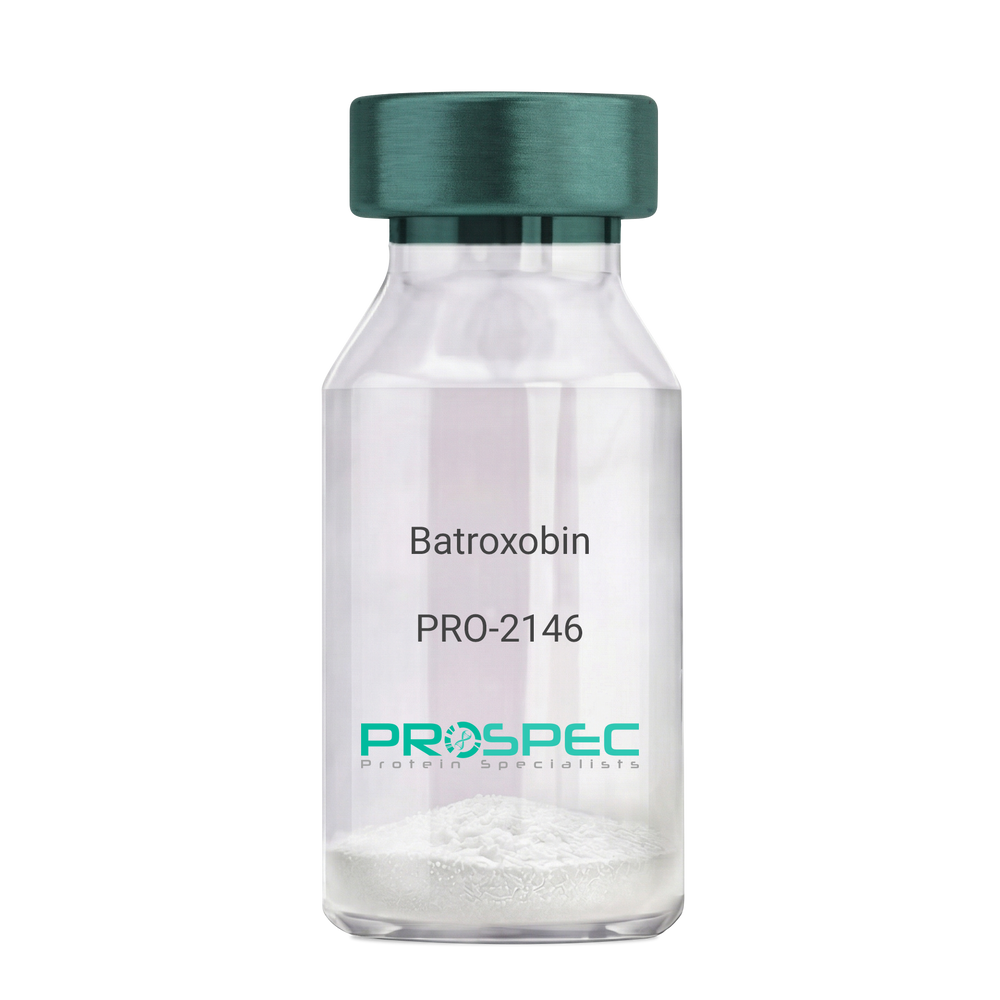
Name :
BatroxobinDescription:
Batroxobin
Thrombin-like enzyme batroxobin, EC 3.4.21.74, BX, Bothrops atrox serine proteinase, Venombin-A, Batroxobin.
Product # :
PRO-2146Price :
Quantity :
Shipping Method :
Shipped at Room temp
More Info
- description
- formulation
- More Info
Description
Batroxobin, isolated from Bothrops atrox snake venom, has an Mw of approximately 43kDa.
Formulation
The Batroxobin protein was lyophilized from a concentrated (1mg/ml) solution with no additives.
More Info
-
Introduction
Batroxobin is a serin protease that reduces fibronogen levels and is originally extracted from snake venom of Bothrops Atrox. Batroxobin is used in defibrinogenation and thrombolysis and also has an effect on c-fos gene and growth factor.
Batroxobin can efficiently restrain proliferation of VSMCs, by blocking the release and uptake of Ca2+, thus influencing [Ca2+]i.
Batroxobin converts fibrinogen to fibrin through the restricted release of fibrinopeptide-A from fibrinogen to promote blood to clot. Unlike thrombin, it is not affected by heparin and hirudin. -
Synonyms
Thrombin-like enzyme batroxobin, EC 3.4.21.74, BX, Bothrops atrox serine proteinase, Venombin-A, Batroxobin.
-
Physical Appearance
Sterile Filtered white lyophilized powder.
-
Stability
Store the lyophilized Batroxobin between 2-8°C. Do not freeze!
-
Solubility
It is recommended to reconstitute the lyophilized Batroxobin in sterile 18MΩ-cm H2O not less than 100µg/ml or more than 10mg/ml solutions.
-
Unit Definition
100BU [Batroxobin Units]=1mg.
ProSpec's products are furnished for LABORATORY RESEARCH USE ONLY. The product may not be used as drugs, agricultural or pesticidal products, food additives or household chemicals.
- View Data Sheet
Name :
EPHB4 HumanDescription:
EPH Receptor B4 Human Recombinant
Tyrosine-Protein Kinase TYRO11, Hepatoma Transmembrane Kinase, TYRO11, MYK1, HTK, Ephrin Type-B Receptor, Tyrosine-Protein Kinase Receptor HTK.
Product # :
PRO-2592Price :
Quantity :
Shipping Method :
Shipped with Ice Packs
More Info
- description
- source
- formulation
- purity
- More Info
Description
EPHB4 produced in Sf9 Baculovirus cells is a single, glycosylated polypeptide chain (16-539a.a.) and fused to an 8 aa His Tag at C-terminus containing a total of 532 amino acids and having a molecular mass of 58.1 kDa. EPHB4 shows multiple bands between 50-70kDa on SDS-PAGE, reducing conditions and purified by proprietary chromatographic techniques.
Source
Sf9, Baculovirus cells.
Formulation
EPHB4 protein solution (0.25mg/ml) contains Phosphate Buffered Saline (pH 7.4) & 10% glycerol.
Purity
Greater than 90.0% as determined by SDS-PAGE.
More Info
-
Introduction
EPHB4 or Ephrin type-B receptor 4 is encoded by the EPHB4 gene in humans. The receptor and its ligands (the ephrins) take part in different developmental stages, mainly in the nervous system. EPHB4 and other Ephrin receptors are the biggest subgroup of the RTK receptors. EPHB4 binds to ephrin B2 and has a crucial part in the development of the vascular system.
-
Synonyms
Tyrosine-Protein Kinase TYRO11, Hepatoma Transmembrane Kinase, TYRO11, MYK1, HTK, Ephrin Type-B Receptor, Tyrosine-Protein Kinase Receptor HTK.
-
Physical Appearance
Sterile Filtered clear solution.
-
Stability
Store at 4°C if entire vial will be used within 2-4 weeks. Store, frozen at -20°C for longer periods of time. For long term storage it is recommended to add a carrier protein (0.1% HSA or BSA).Avoid multiple freeze-thaw cycles.
-
Amino Acid Sequence
LEETLLNTKL ETADLKWVTF PQVDGQWEEL SGLDEEQHSV RTYEVCDVQR APGQAHWLRT GWVPRRGAVH VYATLRFTML ECLSLPRAGRSCKETFTVFY YESDADTATA LTPAWMENPY IKVDTVAAEH LTRKRPGAEA TGKVNVKTLR LGPLSKAGFY LAFQDQGACM ALLSLHLFYK KCAQLTVNLT RFPETVPREL VVPVAGSCVV DAVPAPGPSP SLYCREDGQW AEQPVTGCSC APGFEAAEGN TKCRACAQGT FKPLSGEGSC QPCPANSHSN TIGSAVCQCR VGYFRARTDP RGAPCTTPPS APRSVVSRLN GSSLHLEWSA PLESGGREDL TYALRCRECR PGGSCAPCGG DLTFDPGPRD LVEPWVVVRG LRPDFTYTFE VTALNGVSSL ATGPVPFEPV NVTTDREVPP AVSDIRVTRS SPSSLSLAWA VPRAPSGAVL DYEVKYHEKG AEGPSSVRFL KTSENRAELR GLKRGASYLV QVRARSEAGY GPFGQEHHSQ TQLDESEGWR EQLAVEHHHH HH.
ProSpec's products are furnished for LABORATORY RESEARCH USE ONLY. The product may not be used as drugs, agricultural or pesticidal products, food additives or household chemicals.
- View Data Sheet
Name :
KRT20 Human, HisDescription:
Cytokeratin 20 Human Recombinant, His Tag
Keratin, type I cytoskeletal 20, CD20, CK-20, CK20, K20, KRT21, Keratin, Cytokeratin-20, Keratin-20, Protein IT, KRT20.
Product # :
PRO-1358Price :
Quantity :
Shipping Method :
Shipped with Ice Packs
More Info
- description
- source
- formulation
- purity
- More Info
Description
KRT20 Human Recombinant produced in E.Coli is a single, non-glycosylated polypeptide chain containing 447 amino acids (1-424 a.a) and having a molecular mass of 50.9kDa. KRT20 is fused to a 23 amino acid His-tag at N-terminus & purified by proprietary chromatographic techniques.
Source
Escherichia Coli.
Formulation
KRT20 protein solution (0.5mg/ml) containing 20mM Tris-HCl buffer (pH8.0), 0.4M Urea and 10% glycerol.
Purity
Greater than 85.0% as determined by SDS-PAGE.
More Info
-
Introduction
Recombinant Human Cytokeratin 20 His Tag (KRT20) belongs to the keratin family. The keratins are intermediate filament proteins responsible for the structural integrity of epithelial cells and are subdivided into cytokeratins and hair keratins. The type I cytokeratins is comprised of acidic proteins that are organized in pairs of heterotypic keratin chains. KRT20 is a main cellular protein of mature enterocytes and goblet cells and is specifically expressed in the gastric and intestinal mucosa.
-
Synonyms
Keratin, type I cytoskeletal 20, CD20, CK-20, CK20, K20, KRT21, Keratin, Cytokeratin-20, Keratin-20, Protein IT, KRT20.
-
Physical Appearance
Sterile Filtered colorless solution.
-
Stability
Store at 4°C if entire vial will be used within 2-4 weeks. Store, frozen at -20°C for longer periods of time. For long term storage it is recommended to add a carrier protein (0.1% HSA or BSA).Avoid multiple freeze-thaw cycles.
-
Amino Acid Sequence
MGSSHHHHHH SSGLVPRGSH MGSMDFSRRS FHRSLSSSLQ APVVSTVGMQ RLGTTPSVYG GAGGRGIRIS NSRHTVNYGS DLTGGGDLFV GNEKMAMQNL NDRLASYLEK VRTLEQSNSK LEVQIKQWYE TNAPRAGRDY SAYYRQIEEL RSQIKDAQLQ NARCVLQIDN AKLAAEDFRL KYETERGIRL TVEADLQGLN KVFDDLTLHK TDLEIQIEEL NKDLALLKKE HQEEVDGLHK HLGNTVNVEV DAAPGLNLGV IMNEMRQKYE VMAQKNLQEA KEQFERQTAV LQQQVTVNTE ELKGTEVQLT ELRRTSQSLE IELQSHLSMK ESLEHTLEET KARYSSQLAN LQSLLSSLEA QLMQIRSNME RQNNEYHILL DIKTRLEQEI ATYRRLLEGE DVKTTEYQLS TLEERDIKKT RKIKTVVQEV VDGKVVSSEV KEVEENI.
ProSpec's products are furnished for LABORATORY RESEARCH USE ONLY. The product may not be used as drugs, agricultural or pesticidal products, food additives or household chemicals.
- View Data Sheet
Name :
CXCL3 Mouse, HisDescription:
GRO-Gamma Mouse Recombinant (CXCL3), His Tag
C-X-C motif chemokine 3, Dendritic cell inflammatory protein 1, Cxcl3, Dcip1, Gm1960, GRO-g.
Product # :
CHM-283Price :
Quantity :
Shipping Method :
Shipped with Ice Packs
More Info
- description
- source
- formulation
- purity
- More Info
Description
GRO-g Mouse Recombinant produced in E.Coli is a single, non-glycosylated polypeptide chain containing 98 amino acids (28-100 a.a.) and having a molecular mass of 10.6kDa.CXCL3 is fused to a 25 amino acid His-tag at N-terminus & purified by proprietary chromatographic techniques.
Source
Escherichia Coli.
Formulation
GRO-gamma protein solution (0.25mg/ml) containing 20mM Tris-HCl buffer (pH8.0), 50% glycerol, 0.15M NaCl and 5mM DTT.
Purity
Greater than 90.0% as determined by SDS-PAGE.
More Info
-
Introduction
Chemokine (C-X-C motif) ligand 3 (CXCL3) is a small cytokine belonging to the CXC chemokine family that is also known as GRO3 oncogene (GRO3), GRO protein gamma (GROg) and macrophage inflammatory protein-2-beta (MIP2b). CXCL3 controls migration and adhesion of monocytes and mediates it effects on its target cell by interacting with a cell surface chemokine receptor called CXCR2. The gene for CXCL3 is located on chromosome 4 in a cluster of other CXC chemokines.
-
Synonyms
C-X-C motif chemokine 3, Dendritic cell inflammatory protein 1, Cxcl3, Dcip1, Gm1960, GRO-g.
-
Physical Appearance
Sterile Filtered colorless solution.
-
Stability
Store at 4°C if entire vial will be used within 2-4 weeks.Store, frozen at -20°C for longer periods of time. For long term storage it is recommended to add a carrier protein (0.1% HSA or BSA).Avoid multiple freeze-thaw cycles.
-
Amino Acid Sequence
MGSSHHHHHH SSGLVPRGSH MGSHMAVVAS ELRCQCLNTL PRVDFETIQS LTVTPPGPHC TQTEVIATLK DGQEVCLNPQ GPRLQIIIKK ILKSGKSS.
-
Background
What is the molecular weight/Mw of CXCL3 MOUSE, HIS Protein?
CXCL3 MOUSE, HIS Protein has a total Mw of 10.6kDa.
What is the source or expression system of CXCL3 MOUSE, HIS Protein?
Escherichia Coli.
What is the Purity of CXCL3 MOUSE, HIS Protein?
CXCL3 MOUSE, HIS Protein is >90% pure as determined by SDS-PAGE.
What is the Biological Activity of CXCL3 MOUSE, HIS Protein?
The biological functionality of CXCL3 MOUSE, HIS Protein will be determined in the future.
What is the amino acid sequence of CXCL3 MOUSE, HIS Protein?
MGSSHHHHHH SSGLVPRGSH MGSHMAVVAS ELRCQCLNTL PRVDFETIQS LTVTPPGPHC TQTEVIATLK DGQEVCLNPQ GPRLQIIIKK ILKSGKSS.
What applications can CXCL3 MOUSE, HIS Protein be used in?
CXCL3 MOUSE, HIS Protein can probably be used in western blot, ELISA and Lateral Flow.
What is the endotoxin level for CXCL3 MOUSE, HIS Protein?
The endotoxin level is minimal, CXCL3 MOUSE, HIS Protein was purified using conventional chromatography techniques.
ProSpec's products are furnished for LABORATORY RESEARCH USE ONLY. The product may not be used as drugs, agricultural or pesticidal products, food additives or household chemicals.
- View Data Sheet
Name :
METRN MouseDescription:
Meteorin Mouse Recombinant
Meteorin, Hypoxia/reoxygenation regulatory factor, Metrn, 1810034B16Rik, Hyrac.
Product # :
PRO-2241Price :
Quantity :
Shipping Method :
Shipped with Ice Packs
More Info
- description
- source
- formulation
- purity
- More Info
Description
METRN produced in Sf9 Baculovirus cells is a single, glycosylated polypeptide chain containing 276 amino acids (22-291 a.a.) and having a molecular mass of 30.2kDa (Migrates at 28-40kDa on SDS-PAGE under reducing conditions). METRN is expressed with a 6 amino acid His tag at C-Terminus and purified by proprietary chromatographic techniques.
Source
Sf9, Baculovirus cells.
Formulation
METRN protein solution (0.25mg/ml) contains Phosphate Buffered Saline (pH 7.4) and 10% glycerol.
Purity
Greater than 90.0% as determined by SDS-PAGE.
More Info
-
Introduction
Meteorin (METRN) is involved in both glial cell differentiation and axonal network formation during neurogenesis. METRN promotes astrocyte differentiation and transforms cerebellar astrocytes into radial glia. Moreover, the METRN protein stimulates axonal extension in small and intermediate neurons of sensory ganglia by activating nearby satellite glia.
-
Synonyms
Meteorin, Hypoxia/reoxygenation regulatory factor, Metrn, 1810034B16Rik, Hyrac.
-
Physical Appearance
Sterile Filtered colorless solution.
-
Stability
Store at 4°C if entire vial will be used within 2-4 weeks. Store, frozen at -20°C for longer periods of time. For long term storage it is recommended to add a carrier protein (0.1% HSA or BSA). Avoid multiple freeze-thaw cycles.
-
Amino Acid Sequence
GYSEDRCSWR GSGLTQEPGS VGQLTLDCTE GAIEWLYPAG ALRLTLGGPD PGTRPSIVCL RPERPFAGAQ VFAERMTGNL ELLLAEGPDL AGGRCMRWGP RERRALFLQA TPHRDISRRV AAFRFELHED QRAEMSPQAQ GLGVDGACRP CSDAELLLAA CTSDFVIHGT IHGVAHDTEL QESVITVVVA RVIRQTLPLF KEGSSEGQGR ASIRTLLRCG VRPGPGSFLF MGWSRFGEAW LGCAPRFQEF SRVYSAALTT HLNPCEMALD HHHHHH.
ProSpec's products are furnished for LABORATORY RESEARCH USE ONLY. The product may not be used as drugs, agricultural or pesticidal products, food additives or household chemicals.
- View Data Sheet
Name :
AIDA HumanDescription:
Axin Interactor Dorsalization Associated Human Recombinant
C1orf80, RP11-378J18.7, Axin interactor, dorsalization-associated protein, Axin interaction partner and dorsalization antagonist, AIDA.
Product # :
PRO-1370Price :
Quantity :
Shipping Method :
Shipped with Ice Packs
More Info
- description
- source
- formulation
- purity
- More Info
Description
AIDA Human Recombinant produced in E.Coli is a single, non-glycosylated polypeptide chain containing 329 amino acids (1-306 a.a) and having a molecular mass of 37.4kDa. AIDA is fused to a 23 amino acid His-tag at N-terminus & purified by proprietary chromatographic techniques.
Source
E.coli.
Formulation
AIDA protein solution (0.25mg/ml) containing 20mM Tris-HCl buffer (pH8.0), 10% glycerol, 0.2M NaCl and 1mM DTT.
Purity
Greater than 90% as determined by SDS-PAGE.
More Info
-
Introduction
Axin interactor, dorsalization-associated (AIDA) operates as a ventralizing factor during embryogenesis. AIDA inhibits axin-mediated JNK activation by binding axin and disrupting axin homodimerization. That in turn antagonizes a Wnt/beta-catenin-independent dorsalization pathway activated by AXIN/JNK-signaling.
-
Synonyms
C1orf80, RP11-378J18.7, Axin interactor, dorsalization-associated protein, Axin interaction partner and dorsalization antagonist, AIDA.
-
Physical Appearance
Sterile Filtered colorless solution.
-
Stability
Store at 4°C if entire vial will be used within 2-4 weeks. Store, frozen at -20°C for longer periods of time. For long term storage it is recommended to add a carrier protein (0.1% HSA or BSA).Avoid multiple freeze-thaw cycles.
-
Amino Acid Sequence
MGSSHHHHHH SSGLVPRGSH MGSMSEVTRS LLQRWGASFR RGADFDSWGQ LVEAIDEYQI LARHLQKEAQ AQHNNSEFTE EQKKTIGKIA TCLELRSAAL QSTQSQEEFK LEDLKKLEPI LKNILTYNKE FPFDVQPVPL RRILAPGEEE NLEFEEDEEE GGAGAGSPDS FPARVPGTLL PRLPSEPGMT LLTIRIEKIG LKDAGQCIDP YITVSVKDLN GIDLTPVQDT PVASRKEDTY VHFNVDIELQ KHVEKLTKGA AIFFEFKHYK PKKRFTSTKC FAFMEMDEIK PGPIVIELYK KPTDFKRKKL QLLTKKPLYL HLHQTLHKE.
ProSpec's products are furnished for LABORATORY RESEARCH USE ONLY. The product may not be used as drugs, agricultural or pesticidal products, food additives or household chemicals.