Skip to content

High-quality research proteins.

  • 1-800-805-6531

  • Mon - Sat 8.00-18.00, Sun - Closed

  • info@prospecbio.com

  • PO Box 6591 East Brunswick NJ 08816

  • Products
    • Cytokines
    • Growth factors
    • Chemokines
    • Cd antigens
    • Neurotrophins
    • Hormones
    • Enzymes
    • Viral antigens
    • Recombinant proteins
    • Natural proteins
    • Monoclonal antibodies
    • Polyclonal antibodies
    • Thermal Packaging
  • About
    • Company
    • Founder
    • Contribution
  • Customers
    • Eastern Asia
    • Eastern Europe
    • North America
    • South America
    • South East Asia
    • Southern Asia
    • Western Europe
  • Ordering
    • Ordering Method
    • Ordering - Credit Card
    • Ordering - PO
    • Shipping Fees
    • FAQs
  • Services
    • DNA Cloning
    • Protein Expression
    • Monoclonal Antibody
    • Fermentation
    • Technology License
  • Contact us
Log in

Country/region

  • USD $ | Albania
  • USD $ | Andorra
  • USD $ | Argentina
  • USD $ | Armenia
  • USD $ | Australia
  • USD $ | Austria
  • USD $ | Azerbaijan
  • USD $ | Belarus
  • USD $ | Belgium
  • USD $ | Bolivia
  • USD $ | Brazil
  • USD $ | Bulgaria
  • USD $ | Cambodia
  • USD $ | Canada
  • USD $ | Chile
  • USD $ | China
  • USD $ | Colombia
  • USD $ | Costa Rica
  • USD $ | Croatia
  • USD $ | Cyprus
  • USD $ | Czechia
  • USD $ | Denmark
  • USD $ | Estonia
  • USD $ | Finland
  • USD $ | France
  • USD $ | Georgia
  • USD $ | Germany
  • USD $ | Greece
  • USD $ | Hong Kong SAR
  • USD $ | Hungary
  • USD $ | Iceland
  • USD $ | India
  • USD $ | Ireland
  • USD $ | Israel
  • USD $ | Italy
  • USD $ | Japan
  • USD $ | Kazakhstan
  • USD $ | Latvia
  • USD $ | Liechtenstein
  • USD $ | Lithuania
  • USD $ | Madagascar
  • USD $ | Malta
  • USD $ | Mexico
  • USD $ | Moldova
  • USD $ | Monaco
  • USD $ | Netherlands
  • USD $ | New Zealand
  • USD $ | North Macedonia
  • USD $ | Norway
  • USD $ | Panama
  • USD $ | Paraguay
  • USD $ | Peru
  • USD $ | Philippines
  • USD $ | Poland
  • USD $ | Portugal
  • USD $ | Romania
  • USD $ | Singapore
  • USD $ | Slovakia
  • USD $ | Slovenia
  • USD $ | South Africa
  • USD $ | South Korea
  • USD $ | Spain
  • USD $ | Sri Lanka
  • USD $ | Sweden
  • USD $ | Switzerland
  • USD $ | Taiwan
  • USD $ | Thailand
  • USD $ | Türkiye
  • USD $ | Ukraine
  • USD $ | United Kingdom
  • USD $ | United States
  • USD $ | Uruguay
  • USD $ | Vatican City
  • USD $ | Venezuela
  • USD $ | Vietnam
  • Facebook
  • Instagram
logoProSpec - Recombinant Protein Manufacturer for academic and R&D industry
Become a distributor
Account Log in
Wishlist
Cart Cart(0)
  • Products
    +
    • Cytokines
    • Growth factors
    • Chemokines
    • Cd antigens
    • Neurotrophins
    • Hormones
    • Enzymes
    • Viral antigens
    • Recombinant proteins
    • Natural proteins
    • Monoclonal antibodies
    • Polyclonal antibodies
    • Thermal Packaging
  • About
    +
    • Company
    • Founder
    • Contribution
  • Customers
    +
    • Eastern Asia
    • Eastern Europe
    • North America
    • South America
    • South East Asia
    • Southern Asia
    • Western Europe
  • Ordering
    +
    • Ordering Method
    • Ordering - Credit Card
    • Ordering - PO
    • Shipping Fees
    • FAQs
  • Services
    +
    • DNA Cloning
    • Protein Expression
    • Monoclonal Antibody
    • Fermentation
    • Technology License
  • Contact us

Item added to your cart

View cart
View All
  • Cytokines
  • Growth factors
  • Chemokines
  • Cd antigens
  • Neurotrophins
  • Hormones
  • Enzymes
  • Viral antigens
  • Recombinant proteins
  • Natural proteins
  • Monoclonal antibodies
  • Polyclonal antibodies
  • Thermal Packaging
  • Tumor Necrosis Factor

    Tumor Necrosis Factor

    View All
  • 4-1BB

    4-1BB

    View All
  • Adiponectin

    Adiponectin

    View All
  • AIF1

    AIF1

    View All
  • Other Cytokines

    Other Cytokines

    View All
  • AITRL

    AITRL

    View All
  • Angiopoietin

    Angiopoietin

    View All
  • Apolipoprotein

    Apolipoprotein

    View All
  • B-Cell Activating Factor

    B-Cell Activating Factor

    View All
  • Beta Defensin

    Beta Defensin

    View All
  • Bone Morphogenetic Protein

    Bone Morphogenetic Protein

    View All
  • B type Natriuretic Peptide

    B type Natriuretic Peptide

    View All
  • BST

    BST

    View All
  • Betacellulin

    Betacellulin

    View All
  • Cardiotrophin

    Cardiotrophin

    View All
  • Activin

    Activin

    View All
  • Fibroblast Growth Factor

    Fibroblast Growth Factor

    View All
  • Other Growth Factors

    Other Growth Factors

    View All
  • CSF

    CSF

    View All
  • CTGF

    CTGF

    View All
  • IGFBP

    IGFBP

    View All
  • VEGF Protein

    VEGF Protein

    View All
  • EGF

    EGF

    View All
  • Epigen

    Epigen

    View All
  • Erythropoietin

    Erythropoietin

    View All
  • Insulin-Like Growth Factor

    Insulin-Like Growth Factor

    View All
  • Growth Hormone

    Growth Hormone

    View All
  • HDGF

    HDGF

    View All
  • Hepatocyte Growth Factor

    Hepatocyte Growth Factor

    View All
  • Insulin

    Insulin

    View All
  • BCA-1/ BLC (CXCL13)

    BCA-1/ BLC (CXCL13)

    View All
  • BRAK (CXCL14)

    BRAK (CXCL14)

    View All
  • C-10 (CCL6)

    C-10 (CCL6)

    View All
  • Other Chemokines

    Other Chemokines

    View All
  • MEC (CCL28)

    MEC (CCL28)

    View All
  • LD78-beta (CCL3L1)

    LD78-beta (CCL3L1)

    View All
  • CTACK (CCL27)

    CTACK (CCL27)

    View All
  • CXCL16

    CXCL16

    View All
  • CXCL17

    CXCL17

    View All
  • Platelet Factor-4 (CXCL4)

    Platelet Factor-4 (CXCL4)

    View All
  • ENA-78 (CXCL5)

    ENA-78 (CXCL5)

    View All
  • Eotaxin (CCL11,24,26)

    Eotaxin (CCL11,24,26)

    View All
  • Exodus-2 (CCL21)

    Exodus-2 (CCL21)

    View All
  • Fractalkine (CX3CL1)

    Fractalkine (CX3CL1)

    View All
  • CXCL6

    CXCL6

    View All
  • Other CD Antigens

    Other CD Antigens

    View All
  • CD14

    CD14

    View All
  • CD164

    CD164

    View All
  • CD1

    CD1

    View All
  • CD2

    CD2

    View All
  • CD200

    CD200

    View All
  • CD207

    CD207

    View All
  • CD226

    CD226

    View All
  • CD23

    CD23

    View All
  • CD244

    CD244

    View All
  • CD247

    CD247

    View All
  • CD27

    CD27

    View All
  • CD274

    CD274

    View All
  • CD300

    CD300

    View All
  • CD33

    CD33

    View All
  • Other Neurotrophins

    Other Neurotrophins

    View All
  • Beta-NGF

    Beta-NGF

    View All
  • BDNF

    BDNF

    View All
  • CDNF

    CDNF

    View All
  • CNTF

    CNTF

    View All
  • GDNF

    GDNF

    View All
  • Glia Maturation Factor

    Glia Maturation Factor

    View All
  • MANF

    MANF

    View All
  • Midkine

    Midkine

    View All
  • Neuroglobin

    Neuroglobin

    View All
  • Neurotrophic factors

    Neurotrophic factors

    View All
  • Neuregulin

    Neuregulin

    View All
  • Neuropilin

    Neuropilin

    View All
  • Pigment Epithelium-Derived Factor

    Pigment Epithelium-Derived Factor

    View All
  • Pleiotrophin

    Pleiotrophin

    View All
  • Peptide Hormones

    Peptide Hormones

    View All
  • Other Hormones

    Other Hormones

    View All
  • HCG

    HCG

    View All
  • Endothelin

    Endothelin

    View All
  • Exendin

    Exendin

    View All
  • FSH

    FSH

    View All
  • Glucagon

    Glucagon

    View All
  • GHRP

    GHRP

    View All
  • GLP

    GLP

    View All
  • Thyrostimulin

    Thyrostimulin

    View All
  • Inhibin A

    Inhibin A

    View All
  • LHRH

    LHRH

    View All
  • Melanotan

    Melanotan

    View All
  • Procalcitonin

    Procalcitonin

    View All
  • PTH

    PTH

    View All
  • Peroxiredoxin

    Peroxiredoxin

    View All
  • Peptidase

    Peptidase

    View All
  • Synthetase

    Synthetase

    View All
  • Transferase

    Transferase

    View All
  • Hydrolase

    Hydrolase

    View All
  • Dehydrogenase

    Dehydrogenase

    View All
  • ACE2

    ACE2

    View All
  • Esterase

    Esterase

    View All
  • Protein Kinases

    Protein Kinases

    View All
  • Other Enzymes

    Other Enzymes

    View All
  • Phosphatase

    Phosphatase

    View All
  • Deaminase

    Deaminase

    View All
  • Oxygenase

    Oxygenase

    View All
  • Adenylate Kinase

    Adenylate Kinase

    View All
  • Lyase

    Lyase

    View All
  • Chagas

    Chagas

    View All
  • SARS

    SARS

    View All
  • Influenza

    Influenza

    View All
  • ASFV

    ASFV

    View All
  • Astrovirus

    Astrovirus

    View All
  • Borrelia

    Borrelia

    View All
  • Helicobacter Pylori

    Helicobacter Pylori

    View All
  • Chikungunya

    Chikungunya

    View All
  • Chlamydia

    Chlamydia

    View All
  • Cytomegalo

    Cytomegalo

    View All
  • Dengue

    Dengue

    View All
  • EBV

    EBV

    View All
  • Ebola

    Ebola

    View All
  • Feline Leukemia Virus

    Feline Leukemia Virus

    View All
  • Hepatitis A

    Hepatitis A

    View All
  • Other

    Other

    View All
  • Actin

    Actin

    View All
  • ADAM

    ADAM

    View All
  • Complement Component

    Complement Component

    View All
  • Ag85

    Ag85

    View All
  • Eukaryotic Translation Initiation Factor

    Eukaryotic Translation Initiation Factor

    View All
  • Anterior Gradient Protein

    Anterior Gradient Protein

    View All
  • Heat Shock Protein

    Heat Shock Protein

    View All
  • Alpha-2-HS-Glycoprotein

    Alpha-2-HS-Glycoprotein

    View All
  • Hemoglobin

    Hemoglobin

    View All
  • Allergy

    Allergy

    View All
  • Anaplasma

    Anaplasma

    View All
  • Angiogenin

    Angiogenin

    View All
  • Ankyrin Repeat Domain

    Ankyrin Repeat Domain

    View All
  • Annexin

    Annexin

    View All
  • Other Natural Proteins

    Other Natural Proteins

    View All
  • Aprotinin

    Aprotinin

    View All
  • Transferrin

    Transferrin

    View All
  • Avidin

    Avidin

    View All
  • Anti Coagulation Factors

    Anti Coagulation Factors

    View All
  • Natural Albumin

    Natural Albumin

    View All
  • Natural Coagulation Factors

    Natural Coagulation Factors

    View All
  • Fibronectin

    Fibronectin

    View All
  • Thrombin

    Thrombin

    View All
  • Anti Human Enzyme

    Anti Human Enzyme

    View All
  • Other Monoclonal Antibodies

    Other Monoclonal Antibodies

    View All
  • Anti Human Cytokine

    Anti Human Cytokine

    View All
  • Anti Human Heat Shock Protein

    Anti Human Heat Shock Protein

    View All
  • Anti Mouse Lymphocyte

    Anti Mouse Lymphocyte

    View All
  • Anti Human Chemokine

    Anti Human Chemokine

    View All
  • Anti Human Lymphocyte

    Anti Human Lymphocyte

    View All
  • Anti Viral Monoclonal

    Anti Viral Monoclonal

    View All
  • Anti Mouse Cytokine

    Anti Mouse Cytokine

    View All
  • Anti-GST Monoclonal

    Anti-GST Monoclonal

    View All
  • Other Polyclonal Antibodies

    Other Polyclonal Antibodies

    View All
  • Anti Viral

    Anti Viral

    View All
  • Anti-GST Monoclonal

    Anti-GST Monoclonal

    View All
Back

Search results

572 results found for “Leukocyte Cell Derived Chemotaxin”

Name

Description

Product #

Price

Quantity

Shipping Method

  • View Data Sheet

    Name :

    CX3CL1 Human

    Description:

    Fractalkine Human Recombinant (CX3CL1)

    Fractalkine, CX3CL1, Neurotactin, CX3C membrane-anchored chemokine, Small inducible cytokine D1, NTN, NTT, CXC3, CXC3C, SCYD1, ABCD-3, C3Xkine.

    Product # :

    CHM-235

    Price :

    Quantity :

    Shipping Method :

    Room Temp Icon

    Shipped at Room temp

    Add To Cart

    More Info

    • description
    • source
    • formulation
    • purity
    • biological activity
    • More Info

    Description

    Fractalkine Human Recombinant- produced in E.Coli is a single,non-glycosylated, polypeptide chain containing 76 amino acids and having a molecular mass of 8638 Dalton. The Fractalkine is purified by proprietary chromatographic techniques.

    Source

    Escherichia Coli.

    Formulation

    The CX3CL1 was lyophilized from a 0.2μm filtered concentrated (1.0 mg/ml) solution in 20mM Phosphate buffer, pH 7.4, 50mM NaCl.

    Purity

    Greater than 97.0% as determined by:
    (a) Analysis by RP-HPLC.
    (b) Analysis by SDS-PAGE.

    Biological Activity

    The Biological activity is calculated by its ability to chemoattract human T-Lymphocytes using a concentration range of 5.0-10.0 ng/ml corresponding to a Specific Activity of 100,000-200,000IU/mg.

    More Info

    • Introduction

      Fractalkine soluble form is chemotactic for t-cells and monocytes, but not for neutrophils. Fractalkine membrane-bound form promotes adhesion of those leukocytes to endothelial cells. Fractalkine regulates leukocyte adhesion and migration processes at the endothelium and binds to CX3CR1. Natural Human Fractalkine is produced as a long protein (373-amino acid) with an extended mucin-like stalk and a chemokine domain on top. The mucin-like stalk permits it to bind to the cell surface. Fractalkine gene is located on human chromosome 16 along with some CC chemokines known as CCL17 and CCL22.

    • Synonyms

      Fractalkine, CX3CL1, Neurotactin, CX3C membrane-anchored chemokine, Small inducible cytokine D1, NTN, NTT, CXC3, CXC3C, SCYD1, ABCD-3, C3Xkine.

    • Physical Appearance

      Sterile Filtered White lyophilized (freeze-dried) powder.

    • Stability

      Lyophilized CX3CL1 although stable at room temperature for 3 weeks, should be stored desiccated below -18°C. Upon reconstitution CX3CL1 should be stored at 4°C between 2-7 days and for future use below -18°C.For long term storage it is recommended to add a carrier protein (0.1% HSA or BSA).Please prevent freeze-thaw cycles.

    • Solubility

      It is recommended to reconstitute the lyophilized CX3CL1 in sterile 18MΩ-cm H2O not less than 100µg/ml, which can then be further diluted to other aqueous solutions.

    • Amino Acid Sequence

      QHHGVTKCNITCSKMTSKIPVALLIHYQQNQASCGKRAIILETRQHRLFCADPKEQW VKDAMQHLDRQAAALTRNG.

    • Background

      What is the molecular weight/Mw of CX3CL1 HUMAN Protein?
      CX3CL1 HUMAN Protein has a total Mw of 8.63kDa.

      What is the source or expression system of CX3CL1 HUMAN Protein?
      Escherichia Coli.

      What is the Purity of CX3CL1 HUMAN Protein?
      CX3CL1 HUMAN Protein is >97% pure as determined by SDS-PAGE.

      What is the Biological Activity of CX3CL1 HUMAN Protein?
      The Biological activity is calculated by its ability to chemoattract human T-Lymphocytes using a concentration range of 5.0-10.0 ng/ml corresponding to a Specific Activity of 100,000-200,000IU/mg.

      What is the amino acid sequence of CX3CL1 HUMAN Protein?
      QHHGVTKCNITCSKMTSKIPVALLIHYQQNQASCGKRAIILETRQHRLFCADPKEQW VKDAMQHLDRQAAALTRNG.

      What applications can CX3CL1 HUMAN Protein be used in?
      CX3CL1 HUMAN Protein can probably be used in western blot, ELISA and Lateral Flow.

      What is the endotoxin level for CX3CL1 HUMAN Protein?
      The endotoxin level is minimal, CX3CL1 HUMAN Protein was purified using conventional chromatography techniques.


    ProSpec's products are furnished for LABORATORY RESEARCH USE ONLY. The product may not be used as drugs, agricultural or pesticidal products, food additives or household chemicals.

    Fractalkine Human
  • View Data Sheet

    Name :

    CTACK Human

    Description:

    CTACK Human Recombinant (CCL27)

    ALP, CTACK, ESKINE, ILC, PESKY, SCYA27, CCL27, C-C motif chemokine 27, Small-inducible cytokine A27, IL-11 R-alpha-locus chemokine, Skinkine, ESkine, Cutaneous T-cell-attracting chemokine.

    Product # :

    CHM-373

    Price :

    Quantity :

    Shipping Method :

    Ice Icon

    Shipped with Ice Packs

    Add To Cart

    More Info

    • description
    • source
    • formulation
    • purity
    • More Info
    • SDS-PAGE

    Description

    CTACK Human Recombinant produced in E.Coli is a single, non-glycosylated, polypeptide chain containing 89 amino acids (25-112 a.a.) and having a molecular mass of 10.3kDa. CTACK protein is purified by standard chromatography.

    Source

    Escherichia Coli.

    Formulation

    CTACK Human solution containing 10mM sodium citrate pH-3.5 & 10% glycerol.

    Purity

    Greater than 95% as determined by SDS-PAGE.

    SDS-PAGE

    CTACK Human-SDS-PAGE - Product image 1

    More Info

    • Introduction

      CTACK is a chemotactic factor that attracts skin-associated memory T-lymphocytes. CTACK is involved in mediating homing of lymphocytes to cutaneous sites. CTACK Binds to CCR10.

    • Synonyms

      ALP, CTACK, ESKINE, ILC, PESKY, SCYA27, CCL27, C-C motif chemokine 27, Small-inducible cytokine A27, IL-11 R-alpha-locus chemokine, Skinkine, ESkine, Cutaneous T-cell-attracting chemokine.

    • Physical Appearance

      Sterile filtered colorless solution.

    • Stability

      Store at 4°C if entire vial will be used within 2-4 weeks. Store, frozen at -20°C for longer periods of time. For long term storage it is recommended to add a carrier protein (0.1% HSA or BSA).Avoid multiple freeze-thaw cycles.

    • Amino Acid Sequence

      MFLLPPSTAC CTQLYRKPLS DKLLRKVIQV ELQEADGDCH LQAFVLHLAQ RSICIHPQNP SLSQWFEHQE RKLHGTLPKL NFGMLRKMG.

    • Background

      What is the molecular weight/Mw of CTACK HUMAN Protein?
      CTACK HUMAN Protein has a total Mw of 10.3kDa.

      What is the source or expression system of CTACK HUMAN Protein?
      Escherichia Coli.

      What is the Purity of CTACK HUMAN Protein?
      CTACK HUMAN Protein is >95% pure as determined by SDS-PAGE.

      What is the Biological Activity of CTACK HUMAN Protein?
      The biological functionality of CTACK HUMAN Protein will be determined in the future.

      What is the amino acid sequence of CTACK HUMAN Protein?
      MFLLPPSTAC CTQLYRKPLS DKLLRKVIQV ELQEADGDCH LQAFVLHLAQ RSICIHPQNP SLSQWFEHQE RKLHGTLPKL NFGMLRKMG.

      What applications can CTACK HUMAN Protein be used in?
      CTACK HUMAN Protein can probably be used in western blot, ELISA and Lateral Flow.

      What is the endotoxin level for CTACK HUMAN Protein?
      The endotoxin level is minimal, CTACK HUMAN Protein was purified using conventional chromatography techniques.

    ProSpec's products are furnished for LABORATORY RESEARCH USE ONLY. The product may not be used as drugs, agricultural or pesticidal products, food additives or household chemicals.

    Ctack Human
  • View Data Sheet

    Name :

    I TAC Mouse

    Description:

    I-TAC (CXCL11) Mouse Recombinant

    C-X-C motif chemokine 11, I-TAC, Small-inducible cytokine B11, Cxcl11, Scyb11.

    Product # :

    CHM-026

    Price :

    Quantity :

    Shipping Method :

    Room Temp Icon

    Shipped at Room temp

    Add To Cart

    More Info

    • description
    • source
    • formulation
    • purity
    • biological activity
    • More Info

    Description

    I TAC Mouse Recombinant produced in E.Coli is a single, non-glycosylated, polypeptide chain containing 79 amino acids and having a molecular mass of 9.1kDa.

    Source

    Escherichia Coli.

    Formulation

    I TAC protein was lyophilized from a 0.2 µm filtered concentrated solution in 10 mM Sodium Citrate, pH 4.0, with 600 mM NaCl.

    Purity

    Greater than 98.0% as determined by:
    (a) Analysis by RP-HPLC.
    (b) Analysis by SDS-PAGE.

    Biological Activity

    Fully biologically active when compared to standard. The biological activity determined by a chemotaxis bioassay using murine CXCR3 transfected 293 cells is in a concentration of 10-100 ng/ml corresponding to a specific activity of 10,000-100,000 IU/mg.

    More Info

    • Introduction

      Chemokine (C-X-C motif) ligand 11 (CXCL11) is a small cytokine belonging to the CXC chemokinen family. I-TAC is highly expressed in peripheral blood leukocytes, pancreas and liver, with moderate levels in thymus, spleen and lung and low expression levels were in small intestine, placenta and prostate. Gene expression of CXCL11 is strongly induced by IFN-g and IFN-b, and weakly induced by IFN-a. The I-TACchemokine elicits its effects on its target cells by interacting with the cell surface chemokine receptor CXCR3, with a higher affinity than do the other ligands for this receptor, CXCL9 and CXCL10. I-TAC is chemotactic for activated T cells.The CXCL11 gene is located on human chromosome 4 along with many other members of the CXC chemokine family.

    • Synonyms

      C-X-C motif chemokine 11, I-TAC, Small-inducible cytokine B11, Cxcl11, Scyb11.

    • Physical Appearance

      Sterile Filtered White lyophilized (freeze-dried) powder.

    • Stability

      Lyophilized I TAC although stable at room temperature for 3 weeks, should be stored desiccated below -18°C. Upon reconstitution I TAC should be stored at 4°C between 2-7 days and for future use below -18°C. For long term storage it is recommended to add a carrier protein (0.1% HSA or BSA). Please prevent freeze-thaw cycles.

    • Solubility

      It is recommended to reconstitute the lyophilized I TAC in sterile 18M-cm H2O not less than 100µg/ml, which can then be further diluted to other aqueous solutions.

    • Amino Acid Sequence

      FLMFKQGRCL CIGPGMKAVK MAEIEKASVI YPSNGCDKVE VIVTMKAHKR QRCLDPRSKQ ARLIMQAIEK KNFLRRQNM.

    ProSpec's products are furnished for LABORATORY RESEARCH USE ONLY. The product may not be used as drugs, agricultural or pesticidal products, food additives or household chemicals.

    I Tac Mouse
  • View Data Sheet

    Name :

    TECK Human

    Description:

    Thymus Expressed Chemokine Human Recombinant (CCL25)

    C-C motif chemokine 25, Small-inducible cytokine A25, Thymus-expressed chemokine, Chemokine TECK, CCL25, SCYA25, TECK, Ckb15, MGC150327.

    Product # :

    CHM-364

    Price :

    Quantity :

    Shipping Method :

    Room Temp Icon

    Shipped at Room temp

    Add To Cart

    More Info

    • description
    • source
    • formulation
    • purity
    • biological activity
    • More Info

    Description

    TECK Human Recombinant produced in E.Coli is a single, non-glycosylated, polypeptide chain containing 127 amino acids and having a molecular mass of 14.2kDa. The TECK is purified by proprietary chromatographic techniques.

    Source

    Escherichia Coli.

    Formulation

    Filtered (0.2µm) and lyophilized from a concentrated (1mg/ml) solution in 20mM PB, pH 7.4, 150mM NaCl.

    Purity

    Greater than 97.0% as determined by:
    (a) Analysis by RP-HPLC.
    (b) Analysis by SDS-PAGE.

    Biological Activity

    Determined by its ability to chemoattract human monocytes using a concentration range of 1-10ng/ml corresponding to a Specific Activity of 100,000-1,000,000IU/mg.

    More Info

    • Introduction

      CCL25 (Teck) is a novel CC chemokine, which is distantly related (about 20% amino acid sequence identity) to other CC chemokines. The mouse CCL25 cDNA has also been cloned and shown to encode a 144 a.a. protein, which exhibits 49% a.a. sequence identity to the human CCL25. Human and mouse CCL25 expression was shown to be greatly restricted to the thymus and small intestine. While dendritic cells are identified as the source of CCL25 production in the thymus, dendritic cells derived from bone marrow do not express CCL25. CCL25 signals through the CCR9 receptor. Teck is possibly involved in T-cell development.
      Recombinant human and mouse Teck were shown to be chemotactic for activated macrophages, dendritic cells and thymocytes. The recombinant protein demonstrates chemotactic activity on thymocytes, macrophages, THP-1 cells, and dendritic cells but is inactive on peripheral blood lymphocytes and neutrophils.

    • Synonyms

      C-C motif chemokine 25, Small-inducible cytokine A25, Thymus-expressed chemokine, Chemokine TECK, CCL25, SCYA25, TECK, Ckb15, MGC150327.

    • Physical Appearance

      Sterile Filtered White lyophilized (freeze-dried) powder.

    • Stability

      Lyophilized TECK although stable at room temperature for 3 weeks, should be stored desiccated below -18°C. Upon reconstitution TECK should be stored at 4°C between 2-7 days and for future use below -18°C.For long term storage it is recommended to add a carrier protein (0.1% HSA or BSA).Please prevent freeze-thaw cycles.

    • Solubility

      It is recommended to reconstitute the lyophilized TECK in sterile 18MΩ-cm H2O not less than 100µg/ml, which can then be further diluted to other aqueous solutions.

    • Amino Acid Sequence

      QGVFEDCCLA YHYPIGWAVL RRAWTYRIQE VSGSCNLPAA IFYLPKRHRK VCGNPKSREV QRAMKLLDAR NKVFAKLHHN MQTFQAGPHA VKKLSSGNSK LSSSKFSNPI SSSRKNVSLL ISANSGL.

    ProSpec's products are furnished for LABORATORY RESEARCH USE ONLY. The product may not be used as drugs, agricultural or pesticidal products, food additives or household chemicals.

    Teck Human
  • View Data Sheet

    Name :

    LIX Mouse

    Description:

    LIX Mouse Recombinant (CXCL5)

    C-X-C motif chemokine 5, Small-inducible cytokine B5, Cytokine LIX, Cxcl5, Scyb5, LIX, GCP-2, Scyb6, ENA-78, AMCF-II.

    Product # :

    CHM-031

    Price :

    Quantity :

    Shipping Method :

    Room Temp Icon

    Shipped at Room temp

    Add To Cart

    More Info

    • description
    • source
    • formulation
    • purity
    • biological activity
    • More Info

    Description

    LIX Mouse (CXCL5) Recombinant (49-118) produced in E.Coli is a single, non-glycosylated, polypeptide chain containing 74 amino acids and having a molecular mass of 8kDa.The LIX Mouse is expressed with 4 additional amino acids [VIAA] at n-terminus and purified by proprietary chromatographic techniques.

    Source

    Escherichia Coli.

    Formulation

    LIX Mouse is lyophilized from a 0.2µm filtered solution in PBS.

    Purity

    Greater than 97.0% as determined by SDS-PAGE.

    Biological Activity

    The ED50, as measured by its ability to chemoattract human CXCR2-transfected mouse BaF3 cells, is less than 0.1µg/ml.

    More Info

    • Introduction

      Chemokine (C-X-C motif) ligand 5 (CXCL5) is a small cytokine belonging to the CXC chemokine family that is also known as epithelial-derived neutrophil-activating peptide 78 (ENA-78). It is produced following stimulation of cells with the inflammatory cytokines interleukin-1 or tumor necrosis factor-alpha. Expression of CXCL5 has also been observed in eosinophils, and can be inhibited with the type II IFN. This chemokine stimulates the chemotaxis of neutrophils possesses angiogenic properties. It elicits these effects by interacting with the cell surface chemokine receptor CXCR2. The gene for CXCL5 is encoded on four exons and is located on human chromosome 4 amongst several other CXC chemokine genes. CXCL5 has been implicated in connective tissue remodelling.

    • Synonyms

      C-X-C motif chemokine 5, Small-inducible cytokine B5, Cytokine LIX, Cxcl5, Scyb5, LIX, GCP-2, Scyb6, ENA-78, AMCF-II.

    • Physical Appearance

      Sterile Filtered White lyophilized (freeze-dried) powder.

    • Stability

      Lyophilized LIX Mouse although stable at room temperature for 3 weeks, should be stored desiccated below -18°C. Upon reconstitution CXCL5 should be stored at 4°C between 2-7 days and for future use below -18°C. For long term storage it is recommended to add a carrier protein (0.1% HSA or BSA). Please prevent freeze-thaw cycles.

    • Solubility

      It is recommended to reconstitute the lyophilized LIX Mouse in sterile 18M-cm H2O not less than 100µg/ml, which can then be further diluted to other aqueous solutions.

    • Amino Acid Sequence

      VIAATELRCV CLTVTPKINP KLIANLEVIP AGPQCPTVEV IAKLKNQKEV CLDPEAPVIK KIIQKILGSD KKKA.

    ProSpec's products are furnished for LABORATORY RESEARCH USE ONLY. The product may not be used as drugs, agricultural or pesticidal products, food additives or household chemicals.

    Lix Mouse
  • View Data Sheet

    Name :

    ITAC (63-87) Human

    Description:

    ITAC (63-87 a.a.) Human Recombinant

    ITAC, I-TAC, CXCL-11, CXCL11.

    Product # :

    CHM-049

    Price :

    Quantity :

    Shipping Method :

    Room Temp Icon

    Shipped at Room temp

    Add To Cart

    More Info

    • description
    • source
    • formulation
    • purity
    • More Info

    Description

    The I-TAC Human is created as a recombinant protein with a 4kda N-terminal fusion of His Tag. The I-TAC His-Tagged Fusion Protein, produced in E. coli, is a 9kDa protein containing 25 amino acid residues of the I-TACHuman, 63-87 amino acids.

    Source

    Escherichia Coli.

    Formulation

    Each mg was lyophilized with 1xPBS, 0.4% SDS and 4mM DTT.

    Purity

    Greater than 90% as determined by SDS-PAGE.

    More Info

    • Synonyms

      ITAC, I-TAC, CXCL-11, CXCL11.

    • Physical Appearance

      Filtered White lyophilized (freeze-dried) powder.

    • Stability

      Store lyophilized I-TAC at -20°C. Aliquot the product after reconstitution to avoid repeated freezing/thawing cycles. Reconstituted protein can be stored at 4°C for a limited period of time; it does not show any change after two weeks at 4°C.

    • Solubility

      It is recommended to add deionized water to prepare a working stock solution of approximately 0.5mg/ml and let the lyophilized pellet dissolve completely. Product is not sterile! Please filter the product by an appropriate sterile filter before using it on cell culture.

    • Background

      I-TAC is a small cytokine belongs to the CXC chemokinen family which also called inducible T-cell alpha chemoattractant and IP-9. I-TAC is expressed mainly in peripheral blood leukocytes, liver and pancreas with moderate levels in spleen, thymus and lung and low levels in small intestine, placenta and prostate. IFN-g and IFN-b induces strongly gene expression of I-TAC. The I-TAC chemokine elicits its effects on its target cells by interacting with the cell surface chemokine receptor CXCR3, with a higher affinity than do the other ligands for this receptor, CXCL9 and CXCL10.

    ProSpec's products are furnished for LABORATORY RESEARCH USE ONLY. The product may not be used as drugs, agricultural or pesticidal products, food additives or household chemicals.

    Cxcl11 Human
  • View Data Sheet

    Name :

    Frataxin Human

    Description:

    Frataxin Human Recombinant

    FXN, Friedreich ataxia protein, Frataxin mitochondrial, FRDA, X25, FA, CyaY, FARR, MGC57199, Frataxin.

    Product # :

    PRO-761

    Price :

    Quantity :

    Shipping Method :

    Ice Icon

    Shipped with Ice Packs

    Add To Cart

    More Info

    • description
    • source
    • formulation
    • purity
    • More Info

    Description

    Frataxin Human Recombinant produced in E.Coli is a single, non-glycosylated, polypeptide chain containing 190 amino acids (42-210 a.a.) and having a molecular mass of 21.1 kDa. The Frataxin is fused to a 20 amino acid His Tag at N-terminus and purified by proprietary chromatographic techniques.

    Source

    Escherichia Coli.

    Formulation

    The Frataxin solution (1mg/ml) contains 20mM Tris-HCl buffer (pH 8.5), 1mM DTT, 0.1M NaCl and 20% glycerol.

    Purity

    Greater than 95.0% as determined by SDS-PAGE.

    More Info

    • Introduction

      Frataxin is a mitochondrial iron binding protein that is part of the FRATAXIN family. Frataxin functions in regulating mitochondrial iron transport and respiration. The expansion of intronic trinucleotide repeat GAA results in Friedreich ataxia. Frataxin plays a role in iron homeostasis. Frataxin is an anti-apoptotic protein which prevents mitochondrial damage and reactive oxygen species (ROS) production.

    • Synonyms

      FXN, Friedreich ataxia protein, Frataxin mitochondrial, FRDA, X25, FA, CyaY, FARR, MGC57199, Frataxin.

    • Physical Appearance

      Sterile Filtered colorless solution.

    • Stability

      Store at 4°C if entire vial will be used within 2-4 weeks. Store, frozen at -20°C for longer periods of time. For long term storage it is recommended to add a carrier protein (0.1% HSA or BSA).Avoid multiple freeze-thaw cycles.

    • Amino Acid Sequence

      MGSSHHHHHH SSGLVPRGSH MLRTDIDATC TPRRASSNQR GLNQIWNVKK QSVYLMNLRK SGTLGHPGSL DETTYERLAE ETLDSLAEFF EDLADKPYTF EDYDVSFGSG VLTVKLGGDL GTYVINKQTP NKQIWLSSPS SGPKRYDWTG KNWVYSHDGV SLHELLAAEL TKALKTKLDL SSLAYSGKDA.

    ProSpec's products are furnished for LABORATORY RESEARCH USE ONLY. The product may not be used as drugs, agricultural or pesticidal products, food additives or household chemicals.

    Frataxin Human
  • View Data Sheet

    Name :

    CXCL8 Human (1-77)

    Description:

    Interleukin-8 (1-77 a.a) Human Recombinant (CXCL8)

    IL-8, CXCL8, Monocyte-derived neutrophil chemotactic factor, MDNCF, T-cell chemotactic factor, Neutrophil-activating protein 1, NAP-1, Protein 3-10C, Granulocyte chemotactic protein 1, GCP-1, Monocyte-derived neutrophil-activating peptide, MONAP, Emoctakin, K60, NAF, LECT, LUCT, 3-10C, LYNAP, SCYB8, TSG-1, AMCF-I, b-ENAP.

    Product # :

    CHM-327

    Price :

    Quantity :

    Shipping Method :

    Room Temp Icon

    Shipped at Room temp

    Add To Cart

    More Info

    • description
    • source
    • formulation
    • purity
    • biological activity
    • More Info
    • sds-page

    Description

    Interleukin-8 Human Recombinant produced in E.Coli is a single, non-glycosylated polypeptide chain containing 77 amino acids and having a molecular mass of 8904 Dalton. The IL-8 is purified by proprietary chromatographic techniques.

    Source

    Escherichia Coli.

    Formulation

    Lyophilized from a 0.2µm filtered concentrated (1mg/ml) solution in PBS, pH 7.4.

    Purity

    Greater than 95.0% as determined by:
    (a) Analysis by RP-HPLC.
    (b) Analysis by SDS-PAGE.

    Biological Activity

    Determined by its ability to chemoattract human peripheral blood neutrophils using a concentration range of 25-150 ng/ml.

    sds-page

    IL8 Human sds-page - Product image 1

    More Info

    • Introduction

      Interleukin-8 (IL-8) is a chemokine produced by macrophages and other cell types such as epithelial cells. It is also synthesized by endothelial cells, which store IL-8 in their storage vesicles, the Weibel-Palade bodies. When first encountering an antigen, the primary cells to encounter it are the macrophages who phagocytose the particle. Upon processing, they release chemokines to signal other immune cells to come in to the site of inflammation. IL-8 is one such chemokine. It serves as a chemical signal that attracts neutrophils at the site of inflammation, and therefore is also known as Neutrophil Chemotactic Factor.

    • Synonyms

      IL-8, CXCL8, Monocyte-derived neutrophil chemotactic factor, MDNCF, T-cell chemotactic factor, Neutrophil-activating protein 1, NAP-1, Protein 3-10C, Granulocyte chemotactic protein 1, GCP-1, Monocyte-derived neutrophil-activating peptide, MONAP, Emoctakin, K60, NAF, LECT, LUCT, 3-10C, LYNAP, SCYB8, TSG-1, AMCF-I, b-ENAP.

    • Physical Appearance

      Sterile Filtered White lyophilized (freeze-dried) powder.

    • Stability

      Lyophilized Interleukin-8 although stable at room temperature for 3 weeks, should be stored desiccated below -18°C. Upon reconstitution CXCL8 should be stored at 4°C between 2-7 days and for future use below -18°C. For long term storage it is recommended to add a carrier protein (0.1% HSA or BSA).Please prevent freeze-thaw cycles.

    • Solubility

      It is recommended to reconstitute the lyophilized Interleukin 8 in sterile 18MΩ-cm H2O not less than 100µg/ml, which can then be further diluted to other aqueous solutions.

    • Amino Acid Sequence

      AVLPRSAKEL RCQCIKTYSK PFHPKFIKEL RVIESGPHCA NTEIIVKLSD GRELCLDPKE NWVQRVVEKF LKRAENS.

    • Background

      What is the molecular weight/Mw of CXCL8 HUMAN (1-77) Protein?
      CXCL8 HUMAN (1-77) Protein has a total Mw of 8.9kDa.

      What is the source or expression system of CXCL8 HUMAN (1-77) Protein?
      Escherichia Coli.

      What is the Purity of CXCL8 HUMAN (1-77) Protein?
      CXCL8 HUMAN (1-77) Protein is >95% pure as determined by SDS-PAGE.

      What is the Biological Activity of CXCL8 HUMAN (1-77) Protein?
      Determined by its ability to chemoattract human peripheral blood neutrophils using a concentration range of 25-150 ng/ml.

      What is the amino acid sequence of CXCL8 HUMAN (1-77) Protein?
      AVLPRSAKEL RCQCIKTYSK PFHPKFIKEL RVIESGPHCA NTEIIVKLSD GRELCLDPKE NWVQRVVEKF LKRAENS.

      What applications can CXCL8 HUMAN (1-77) Protein be used in?
      CXCL8 HUMAN (1-77) Protein can probably be used in western blot, ELISA and Lateral Flow.

      What is the endotoxin level for CXCL8 HUMAN (1-77) Protein?
      The endotoxin level is minimal, CXCL8 HUMAN (1-77) Protein was purified using conventional chromatography techniques.


    ProSpec's products are furnished for LABORATORY RESEARCH USE ONLY. The product may not be used as drugs, agricultural or pesticidal products, food additives or household chemicals.

    Il 8 77 Human
  • View Data Sheet

    Name :

    CXCL7 Rat

    Description:

    Neutrophil Activating Protein-2 Rat Recombinant (CXCL7)

    Platelet basic protein, PBP, Small inducible cytokine B7, CXCL7, Leukocyte-derived growth factor, LDGF, Macrophage-derived growth factor, MDGF, pro-platelet basic protein (chemokine (C-X-C motif) ligand 7), TC1, TC2, TGB, TGB1, B-TG1, CTAP3, NAP-2, SCYB7, THBGB, LA-PF4, THBGB1, Beta-TG, CTAPIII, CTAP-III.

    Product # :

    CHM-269

    Price :

    Quantity :

    Shipping Method :

    Room Temp Icon

    Shipped at Room temp

    Add To Cart

    More Info

    • description
    • source
    • formulation
    • purity
    • biological activity
    • More Info

    Description

    NAP-2 Rat Recombinant produced in E.coli is a single, non-glycosylated polypeptide chain containing 62 amino acids and having a molecular mass of 6.8kDa.The NAP 2 is purified by proprietary chromatographic techniques.

    Source

    Escherichia Coli.

    Formulation

    NAP-2 protein was lyophilized from a 0.2µm filtered concentrated solution in 1×PBS, pH 7.4.

    Purity

    Greater than 97.0% as determined by:
    (a) Analysis by RP-HPLC.
    (b) Analysis by SDS-PAGE.

    Biological Activity

    Measured by its ability to chemoattract BaF3 mouse pro-B cells transfected with human CXCR2. The ED50 for this effect is less than 10ng/ml, corresponding to a specific activity of 100,000units/mg.

    More Info

    • Introduction

      Chemokine (C-X-C motif) ligand (CXCL7) is a small cytokine belonging to the CXC chemokine family. It is a protein that is released in large amounts from platelets following their activation. It stimulates various processes including mitogenesis, synthesis of extracellular matrix, glucose metabolism and synthesis of plasminogen activator.

    • Synonyms

      Platelet basic protein, PBP, Small inducible cytokine B7, CXCL7, Leukocyte-derived growth factor, LDGF, Macrophage-derived growth factor, MDGF, pro-platelet basic protein (chemokine (C-X-C motif) ligand 7), TC1, TC2, TGB, TGB1, B-TG1, CTAP3, NAP-2, SCYB7, THBGB, LA-PF4, THBGB1, Beta-TG, CTAPIII, CTAP-III.

    • Physical Appearance

      Sterile Filtered White lyophilized (freeze-dried) powder.

    • Stability

      Lyophilized NAP-2 although stable at room temperature for 3 weeks, should be stored desiccated below -18°C. Upon reconstitution CXCL7 should be stored at 4°C between 2-7 days and for future use below -18°C. For long term storage it is recommended to add a carrier protein (0.1% HSA or BSA). Please prevent freeze-thaw cycles.

    • Solubility

      It is recommended to reconstitute the lyophilized NAP-2 in sterile 18M-cm H2O not less than 100µg/ml, which can then be further diluted to other aqueous solutions.

    • Amino Acid Sequence

      IELRCRCTNT LSGIPLNSIS RVNVFRPGAH CDNVEVIATL KNGKEVCLDP TAPMIKKIVK KI.

    • Background

      What is the molecular weight/Mw of CXCL7 RAT Protein?
      CXCL7 RAT Protein has a total Mw of 6.8kDa.

      What is the source or expression system of CXCL7 RAT Protein?
      Escherichia Coli.

      What is the Purity of CXCL7 RAT Protein?
      CXCL7 RAT Protein is > 97% pure as determined by SDS-PAGE.

      What is the Biological Activity of CXCL7 RAT Protein?
      Measured by its ability to chemoattract BaF3 mouse pro-B cells transfected with human CXCR2. The ED50 for this effect is less than 10ng/ml, corresponding to a specific activity of 100,000units/mg.

      What is the amino acid sequence of CXCL7 RAT Protein?
      IELRCRCTNT LSGIPLNSIS RVNVFRPGAH CDNVEVIATL KNGKEVCLDP TAPMIKKIVK KI.

      What applications can CXCL7 RAT Protein be used in?
      CXCL7 RAT Protein can probably be used in western blot, ELISA and Lateral Flow.

      What is the endotoxin level for CXCL7 RAT Protein?
      The endotoxin level is minimal, CXCL7 RAT Protein was purified using conventional chromatography techniques.


    ProSpec's products are furnished for LABORATORY RESEARCH USE ONLY. The product may not be used as drugs, agricultural or pesticidal products, food additives or household chemicals.

    Nap 2 Rat
  • View Data Sheet

    Name :

    MCP1 Human, HEK

    Description:

    Monocyte Chemotactic Protein-1/MCAF (CCL2) Human Recombinant, HEK

    CCL2, C-C motif chemokine 2, GDCF-2, HSMCR30, JE, HC11, MCAF, MCP-1, MCP1, Scya2, Sigje, SMC-CF, Immediate-early serum-responsive protein JE, Monocyte chemoattractant protein 1, Small-inducible cytokine A2.

    Product # :

    CHM-048

    Price :

    Quantity :

    Shipping Method :

    Ice Icon

    Shipped with Ice Packs

    Add To Cart

    More Info

    • description
    • source
    • formulation
    • purity
    • biological activity
    • More Info

    Description

    MCP1 Human HEK Recombinant produced in HEK293 Cells is a single, glycosylated polypeptide chain containing 82 amino acids (24-99a.a) and having a molecular mass of 9.5 kDa.MCP1 is expressed with a 6 amino acid His tag at C-Terminus and purified by proprietary chromatographic techniques.

    Source

    HEK293 Cells.

    Formulation

    The MCP1 solution (0.25mg/1ml) contains phosphate buffered saline (pH7.4) and 10% glycerol.

    Purity

    Greater than 90.0% as determined by SDS-PAGE.

    Biological Activity

    Measured its ability to chemoattract using THP-1 human acute monocytic leukemia cells. The ED50 range ≤ 30 ng/ml.

    More Info

    • Introduction

      Chemokine (C-C motif) ligand 2 (CCL2) is a small cytokine belonging to the CC chemokine family that is also known as monocyte chemotactic protein-1 (MCP-1). It is found at the site of tooth eruption and bone degradation. In the bone, CCL2 is expressed by mature osteoclasts and osteoblasts and is under the control of nuclear factor ?B (NF?B).CCL2 recruits immune cells, such as monocytes, to sites of tissue injury and infection.This chemokine is produced as a protein precursor containing signal peptide of 23 amino acids and a mature peptide of 76 amino acids. It is a monomeric polypeptide, with a molecular weight of approximately 13kDa. As with many other CC chemokines, CCL2 is located on chromosome 17 in humans.The cell surface receptors that bind CCL2 are CCR2 and CCR5

    • Synonyms

      CCL2, C-C motif chemokine 2, GDCF-2, HSMCR30, JE, HC11, MCAF, MCP-1, MCP1, Scya2, Sigje, SMC-CF, Immediate-early serum-responsive protein JE, Monocyte chemoattractant protein 1, Small-inducible cytokine A2.

    • Physical Appearance

      Sterile filtered colorless solution.

    • Stability

      Store at 4°C if entire vial will be used within 2-4 weeks.Store, frozen at -20°C for longer periods of time. For long term storage it is recommended to add a carrier protein (0.1% HSA or BSA).Avoid multiple freeze-thaw cycles.

    • Amino Acid Sequence

      QPDAINAPVT CCYNFTNRKI SVQRLASYRR ITSSKCPKEA VIFKTIVAKE ICADPKQKWV QDSMDHLDKQ TQTPKTHHHH HH

    ProSpec's products are furnished for LABORATORY RESEARCH USE ONLY. The product may not be used as drugs, agricultural or pesticidal products, food additives or household chemicals.

    Ccl2 Human
  • View Data Sheet

    Name :

    Eotaxin 2 Antibody

    Description:

    Eotaxin-2, Mouse Anti Human

    C-C motif chemokine 24, Small-inducible cytokine A24, Myeloid progenitor inhibitory factor 2, CK-beta-6, Eosinophil chemotactic protein 2, Eotaxin-2, CCL24, Ckb-6, MPIF2, MPIF-2, SCYA24, Eotaxin2, CCL-24.

    Product # :

    ANT-127

    Price :

    Quantity :

    Shipping Method :

    Room Temp Icon

    Shipped at Room temp

    Add To Cart

    More Info

    • formulation
    • More Info

    Formulation

    1mg/ml in PBS (after reconstitution).

    More Info

    • Introduction

      Eotaxin-2, also called MPIF2 & Ck?6, is a novel CC chemokine produced by activated monocytes and T lymphocytes. Eotaxin-2 selectively chemoattracts cells expressing CCR3 including eosinophils, basophils, Th2 T cells, mast cells, and certain subsets of dendritic cells. Furthermore, Eotaxin-2 inhibits the proliferation of multipotential hematopoietic progenitor cells. The mature protein, which includes C-terminal truncation, contains 78 amino acids (92 amino acids for the mouse homolog, without C-terminal truncation).
      CCL24 functions as a chemotactic chemokine for resting t-lymphocytes, and eosinophils. CCL24 has lower chemotactic activity for neutrophils but none for monocytes and activated lymphocytes. CCL24 is a strong suppressor of colony formation by a multipotential hematopoietic progenitor cell line and binds to CCR3.

    • Synonyms

      C-C motif chemokine 24, Small-inducible cytokine A24, Myeloid progenitor inhibitory factor 2, CK-beta-6, Eosinophil chemotactic protein 2, Eotaxin-2, CCL24, Ckb-6, MPIF2, MPIF-2, SCYA24, Eotaxin2, CCL-24.

    • Solubility

      Reconstitute with sterile H20. Mix gently, wash the sides of the vial and wait 30-60 seconds before use.

    • Immunogen

      r.Human Eotaxin-2.

    • Ig Subclass

      Mouse IgG.

    • Clone

      NYRhEOT2.

    • Applications

      Direct ELISA, Western Blot, Immuneprecipitation.

    • Titer

      By direct ELISA, 1:10,000 dilution will yield 0.4 O.D using alkaline phosphatase conjugated rabbit anti-mouse Ig (Jackson Laboratories).

    • Shipping Conditions

      Antibody is shipped lyophilized at ambient temperature.

    • Type

      Mouse Anti Human Monoclonal.

    • Storage Procedures

      In lyophilized form, for long periods, store at 4oC in a dry environment. After reconstitution, if not intended for use within a month, aliquot and store at -20oC.

    • Purification Method

      Ion exchange.

    ProSpec's products are furnished for LABORATORY RESEARCH USE ONLY. The product may not be used as drugs, agricultural or pesticidal products, food additives or household chemicals.

    Eotaxin 2 Antibody
  • View Data Sheet

    Name :

    CCL22 Rat

    Description:

    Macrophage-Derived Chemokine (CCL22) Rat Recombinant

    C-C motif chemokine 22, Small-inducible cytokine A22, Macrophage-derived chemokine, MDC(1-69), Stimulated T-cell chemotactic protein 1, CC chemokine STCP-1, CCL22, MDC, SCYA22, ABCD-1, DC/B-CK, MGC34554, A-152E5.1, CC chemokine ABCD-1, Activated B and dendritic cell-derived, DCBCK.

    Product # :

    CHM-279

    Price :

    Quantity :

    Shipping Method :

    Room Temp Icon

    Shipped at Room temp

    Add To Cart

    More Info

    • description
    • source
    • formulation
    • purity
    • biological activity
    • More Info

    Description

    CCL22 Rat Recombinant produced in E.Coli is a non-glycosylated, Polypeptide chain containing 68 amino acids and having a molecular mass of 7.9kDa. The Rat CCL22 is purified by proprietary chromatographic techniques.

    Source

    Escherichia Coli.

    Formulation

    The protein was lyophilized from a 0.2µm filtered concentrated solution in 1×PBS, pH7.4.

    Purity

    Greater than 97.0% as determined by
    (a) Analysis by RP-HPLC.
    (b) Analysis by SDS-PAGE.

    Biological Activity

    Determined by its ability to chemoattract human activated lymphocytes using a concentration range of 10.0-100.0 ng/ml.

    More Info

    • Introduction

      MDC (CCL22) is a small cytokine that belongs to the CC chemokine family. CCL22 is one of several Cys-Cys (CC) cytokine genes clustered on the q arm of chromosome 16.
      MDC shows chemotactic activity for natural killer cells, chronically activated T lymphocytes, monocytes and dendritic cells. On the other hand, MDC shows a mild activity for primary activated T lymphocytes and has no chemoattractant activity for neutrophils, eosinophils and resting T lymphocytes. MDC may also have a role in the trafficking of activated T lymphocytes to inflammatory sites and other aspects of activated T lymphocyte physiology. MDC interacts with cell surface chemokine receptors CCR4.
      CCL22 is vastly expressed in macrophage and in monocyte-derived dendritic cells, and thymus. CCL22 is also found in the lymph node, appendix, activated monocytes, resting and activated macrophages. Lower expression of CCL22 can be seen in the lung and the spleen and very weak expression in the small intestine. In the lymph node CCL22 is expressed in a mature subset of Langerhans' cells (CD1a+ and CD83+).
      Furthermore, CCL22 is expressed in atopic dermatitis, allergic contact dermatitis skin, and psoriasis, in both the epidermis and dermis. In addition, MDC has a role in hindering progression of lung cancer. Moreover, significantly higher CCL22 expression is linked to gastric cancer.

    • Synonyms

      C-C motif chemokine 22, Small-inducible cytokine A22, Macrophage-derived chemokine, MDC(1-69), Stimulated T-cell chemotactic protein 1, CC chemokine STCP-1, CCL22, MDC, SCYA22, ABCD-1, DC/B-CK, MGC34554, A-152E5.1, CC chemokine ABCD-1, Activated B and dendritic cell-derived, DCBCK.

    • Physical Appearance

      Sterile Filtered White lyophilized (freeze-dried) powder.

    • Stability

      Lyophilized MDC although stable at room temperature for 3 weeks, should be stored desiccated below -18C. Upon reconstitution MDC should be stored at 4C between 2-7 days and for future use below -18C.For long term storage it is recommended to add a carrier protein (0.1% HSA or BSA).Please prevent freeze-thaw cycles.

    • Solubility

      It is recommended to reconstitute the lyophilized MDC in sterile 18M-cm H2O not less than 100µg/ml, which can then be further diluted to other aqueous solutions.

    • Amino Acid Sequence

      GPYGANVEDS ICCQDYIRHP LPPRFVKEFY WTSKSCRKPG VVLITIKNRD ICADPRMLWV KKILHKLA.

    • Background

      What is the molecular weight/Mw of CCL22 RAT Protein?
      CCL22 RAT Protein has a total Mw of 7.9kDa.

      What is the source or expression system of CCL22 RAT Protein?
      Escherichia Coli.

      What is the Purity of CCL22 RAT Protein?
      CCL22 RAT Protein is >97% pure as determined by SDS-PAGE.

      What is the Biological Activity of CCL22 RAT Protein?
      Determined by its ability to chemoattract human activated lymphocytes using a concentration range of 10.0-100.0 ng/ml.

      What is the amino acid sequence of CCL22 RAT Protein?
      GPYGANVEDS ICCQDYIRHP LPPRFVKEFY WTSKSCRKPG VVLITIKNRD ICADPRMLWV KKILHKLA

      What applications can CCL22 RAT Protein be used in?
      CCL22 RAT Protein can probably be used in western blot, ELISA and Lateral Flow.

      What is the endotoxin level for CCL22 RAT Protein?
      The endotoxin level is minimal, CCL22 RAT Protein was purified using conventional chromatography techniques.

    ProSpec's products are furnished for LABORATORY RESEARCH USE ONLY. The product may not be used as drugs, agricultural or pesticidal products, food additives or household chemicals.

    Mdc Rat
  • View Data Sheet

    Name :

    SDF 1a Mouse

    Description:

    Stromal Cell-Derived Factor-1 Alpha Mouse Recombinant (CXCL12)

    SDF-1, CXCL12, Pre-B cell growth-stimulating factor, PBSF, hIRH, chemokine (C-X-C motif) ligand 12, SDF1, SDF1A, TPAR1, SCYB12, SDF-1a, TLSF-a, 12-O-tetradecanoylphorbol 13-acetate repressed protein 1, Thymic lymphoma cell-stimulating factor, TLSF.

    Product # :

    CHM-324

    Price :

    Quantity :

    Shipping Method :

    Room Temp Icon

    Shipped at Room temp

    Add To Cart

    More Info

    • description
    • source
    • formulation
    • purity
    • biological activity
    • More Info

    Description

    Stromal Cell-Derived Factor-1 alpha Mouse Recombinant produced in E.Coli is a non-glycosylated, Polypeptide chain containing 68 amino acids and having a molecular mass of 8 kDa. The SDF-1a is purified by proprietary chromatographic techniques.

    Source

    Escherichia Coli.

    Formulation

    The protein was Lyophilized from a sterile filtered aqueous solution containing 0.1% Trifluoroacetic Acid (TFA).

    Purity

    Greater than 95% as determined by SDS-PAGE.

    Biological Activity

    The specific activity as determined by its ability to chemoattract human peripheral blood monocytes at 50-100 ng/ml corresponding to a Specific Activity of 10,000-20,000IU/mg.

    More Info

    • Introduction

      SDF-1 (stromal cell-derived factor-1) is small cytokine belonging to the chemokine family that is officially designated Chemokine (C-X-C motif) ligand 12 (CXCL12). It is produced in two forms, SDF-1?/CXCL12a and SDF-1?/CXCL12b, by alternate splicing of the same gene. Chemokines are characterized by the presence of four conserved cysteines, which form two disulfide bonds. The CXCL12 proteins belong to the group of CXC chemokines, whose initial pair of cysteines are separated by one intervening amino acid. CXCL12 is strongly chemotactic for lymphocytes and has been implicated as an important cell co-ordinator during development. During embryogenesis it directs the migration of hematopoietic cells from foetal liver to bone marrow. Mice which were knocked-out for CXCL12 gene were lethal before the birth or within just 1 hour of life. As another role, CXCL12a alters also the electrophysiology of neurons. CXCL12 was shown to be expressend in many tissues in mice (including brain, thymus, heart, lung, liver, kidney, spleen and bone marrow).
      The receptor for this chemokine is CXCR4, which was previously called fusin. This CXCL12-CXCR4 interaction used to be considered exclusive (unlike for other chemokines and their receptors), but recently it was suggested that CXCL12 is also bound by CXCR7 receptor.
      The gene for CXCL12 is located on human chromosome 10. In human and mouse both CXCL12 and CXCR4 show high identity of sequence: 99% and 90%, respectively.

    • Synonyms

      SDF-1, CXCL12, Pre-B cell growth-stimulating factor, PBSF, hIRH, chemokine (C-X-C motif) ligand 12, SDF1, SDF1A, TPAR1, SCYB12, SDF-1a, TLSF-a, 12-O-tetradecanoylphorbol 13-acetate repressed protein 1, Thymic lymphoma cell-stimulating factor, TLSF.

    • Physical Appearance

      Sterile Filtered White lyophilized (freeze-dried) powder.

    • Stability

      Lyophilized SDF-1a although stable at room temperature for 3 weeks, should be stored desiccated below -18°C. Upon reconstitution CXCL12 should be stored at 4°C between 2-7 days and for future use below -18°C. For long term storage it is recommended to add a carrier protein (0.1% HSA or BSA).Please prevent freeze-thaw cycles.

    • Solubility

      It is recommended to reconstitute the lyophilized Stromal Cell-Derived Factor-1a in sterile 18MΩ-cm H2O not less than 100µg/ml, which can then be further diluted to other aqueous solutions.

    • Amino Acid Sequence

      The sequence of the first five N-terminal amino acids was determined and was found to be Lys-Pro-Val-Ser-Leu.

    ProSpec's products are furnished for LABORATORY RESEARCH USE ONLY. The product may not be used as drugs, agricultural or pesticidal products, food additives or household chemicals.

    Sdf 1A Mouse
  • View Data Sheet

    Name :

    CXCL1 Human

    Description:

    GRO-Alpha Human Recombinant (CXCL1)

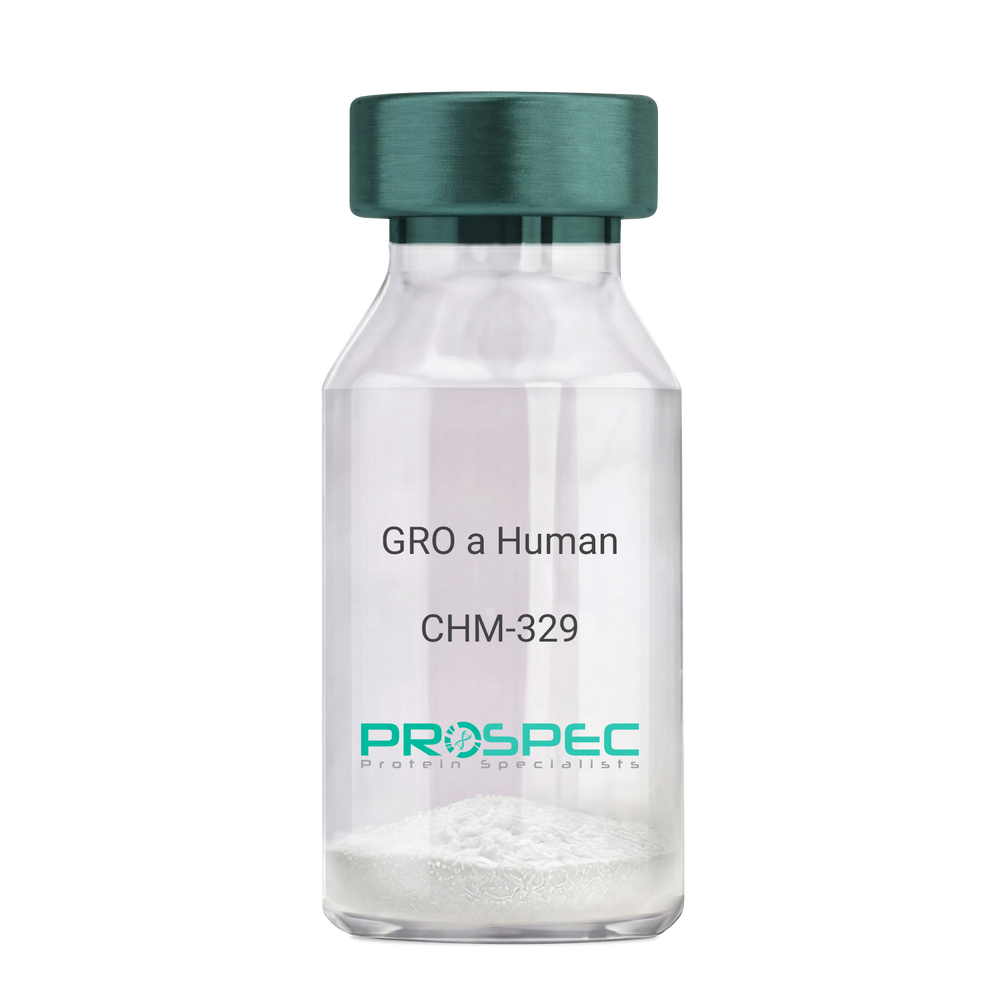
    Growth-regulated protein alpha, CXCL1, Melanoma growth stimulatory activity, MGSA, Neutrophil-activating protein 3, NAP-3, GRO-alpha (1-73), chemokine (C-X-C motif) ligand 1, GRO1, GROa, SCYB1, MGSA-a, MGSA alpha.

    Product # :

    CHM-329

    Price :

    Quantity :

    Shipping Method :

    Room Temp Icon

    Shipped at Room temp

    Add To Cart

    More Info

    • description
    • source
    • formulation
    • purity
    • biological activity
    • More Info

    Description

    GRO Alpha Human Recombinant produced in E.Coli is a single,non-glycosylated, polypeptide chain containing 73 amino acids and having a molecular mass of 7811 Dalton. The GRO-alpha is purified by proprietary chromatographic techniques.

    Source

    Escherichia Coli.

    Formulation

    Lyophilized from a 0.2µm filtered concentrated (1mg/ml) solution in 20mM PB, pH 7.4, 50mM NaCl.

    Purity

    Greater than 97.0% as determined by:
    (a) Analysis by RP-HPLC.
    (b) Analysis by SDS-PAGE.

    Biological Activity

    Determined by its ability to chemoattract human peripheral blood neutrophils using a concentration range of 10.0-100.0 ng/ml.

    More Info

    • Introduction

      Chemokine (C-X-C motif) ligand 1 (CXCL1) is a small cytokine belonging to the CXC chemokine family that was previously called GRO1 oncogene, Neutrophil-activating protein 3 (NAP-3) and melanoma growth stimulating activity, alpha (MSGA-a). It is secreted by human melanoma cells, has mitogenic properties and is implicated in melanoma pathogenesis. CXCL1 is expressed by macrophages, neutrophilsand epithelial cells, and has neutrophil chemoattractant activity. CXCL1 plays a role in spinal cord development by inhibiting the migration of oligodendrocyte precursors and is involved in the processes of angiogenesis, inflammation, wound healing, and tumorigenesis. This chemokine elicits its effects by signaling through the chemokine receptor CXCR2. The gene for CXCL1 is located on human chromosome 4 amongst genes for other CXC chemokines.

    • Synonyms

      Growth-regulated protein alpha, CXCL1, Melanoma growth stimulatory activity, MGSA, Neutrophil-activating protein 3, NAP-3, GRO-alpha (1-73), chemokine (C-X-C motif) ligand 1, GRO1, GROa, SCYB1, MGSA-a, MGSA alpha.

    • Physical Appearance

      Sterile Filtered White lyophilized (freeze-dried) powder.

    • Stability

      Lyophilized GRO-alpha although stable at room temperature for 3 weeks, should be stored desiccated below -18°C. Upon reconstitution CXCL1 should be stored at 4°C between 2-7 days and for future use below -18°C. For long term storage it is recommended to add a carrier protein (0.1% HSA or BSA).Please prevent freeze-thaw cycles.

    • Solubility

      It is recommended to reconstitute the lyophilized CXCL1 in sterile 18MΩ-cm H2O not less than 100µg/ml, which can then be further diluted to other aqueous solutions.

    • Amino Acid Sequence

      The sequence of the first five N-terminal amino acids was determined and was found to be Ala-Ser-Val-Ala-Thr.

    • Background

      What is the molecular weight/Mw of CXCL1 HUMAN Protein?
      CXCL1 HUMAN Protein has a total Mw of 7.81kDa.

      What is the source or expression system of CXCL1 HUMAN Protein?
      Escherichia Coli.

      What is the Purity of CXCL1 HUMAN Protein?
      CXCL1 HUMAN Protein is >97% pure as determined by SDS-PAGE.

      What is the Biological Activity of CXCL1 HUMAN Protein?
      Determined by its ability to chemoattract human peripheral blood neutrophils using a concentration range of 10.0-100.0 ng/ml.

      What is the amino acid sequence of CXCL1 HUMAN Protein?
      The sequence of the first five N-terminal amino acids was determined and was found to be Ala-Ser-Val-Ala-Thr.

      What applications can CXCL1 HUMAN Protein be used in?
      CXCL1 HUMAN Protein can probably be used in western blot, ELISA and Lateral Flow.

      What is the endotoxin level for CXCL1 HUMAN Protein?
      The endotoxin level is minimal, CXCL1 HUMAN Protein was purified using conventional chromatography techniques.


    ProSpec's products are furnished for LABORATORY RESEARCH USE ONLY. The product may not be used as drugs, agricultural or pesticidal products, food additives or household chemicals.

    Gro A Human
  • View Data Sheet

    Name :

    MCP 1 Mouse

    Description:

    Monocyte Chemotactic Protein-1 Mouse Recombinant (CCL2)

    Small inducible cytokine A2, CCL2, Monocyte chemotactic protein 1, MCP-1, Monocyte chemoattractant protein 1, Monocyte chemotactic and activating factor, MCAF, Monocyte secretory protein JE, HC11, chemokine (C-C motif) ligand 2, MCP1, SCYA2, GDCF-2, SMC-CF, HSMCR30, MGC9434, GDCF-2 HC11, Platelet-derived growth factor-inducible protein JE.

    Product # :

    CHM-313

    Price :

    Quantity :

    Shipping Method :

    Room Temp Icon

    Shipped at Room temp

    Add To Cart

    More Info

    • description
    • source
    • formulation
    • purity
    • biological activity
    • More Info

    Description

    Monocyte Chemotactic Protein-1 Mouse Recombinant produced in E.Coli is a single,non-glycosylated, polypeptide chain containing 125 amino acids and having a molecular mass of 14 kDa. The MCP-1 is purified by proprietary chromatographic techniques.

    Source

    Escherichia Coli.

    Formulation

    The protein was lyophilized with no additives.

    Purity

    Greater than 90.0% as determined by:
    (a) Analysis by RP-HPLC.
    (b) Analysis by SDS-PAGE.

    Biological Activity

    The biological activity was determined by calculating its ability to chemoattract Balb/C mouse spleen MNCs at 1.0-20.0 ng/ml.

    More Info

    • Introduction

      Chemokine (C-C motif) ligand 2 (CCL2) is a small cytokine belonging to the CC chemokine family that is also known as monocyte chemotactic protein-1 (MCP-1). It is found at the site of tooth eruption and bone degradation. In the bone, CCL2 is expressed by mature osteoclasts and osteoblasts and is under the control of nuclear factor ?B (NF?B). CCL2 recruits immune cells, such as monocytes, to sites of tissue injury and infection. This chemokine is produced as a protein precursor containing signal peptide of 23 amino acidsand a mature peptide of 76 amino acids. It is a monomeric polypeptide, with a molecular weight of approximately 13kDa. As with many other CC chemokines, CCL2 is located on chromosome 17 in humans. The cell surface receptors that bind CCL2 are CCR2 and CCR5.

    • Synonyms

      Small inducible cytokine A2, CCL2, Monocyte chemotactic protein 1, MCP-1, Monocyte chemoattractant protein 1, Monocyte chemotactic and activating factor, MCAF, Monocyte secretory protein JE, HC11, chemokine (C-C motif) ligand 2, MCP1, SCYA2, GDCF-2, SMC-CF, HSMCR30, MGC9434, GDCF-2 HC11, Platelet-derived growth factor-inducible protein JE.

    • Physical Appearance

      Sterile Filtered White lyophilized (freeze-dried) powder.

    • Stability

      Lyophilized MCP-1 although stable at room temperature for 3 weeks, should be stored desiccated below -18°C. Upon reconstitution CCL2 should be stored at 4°C between 2-7 days and for future use below -18°C. For long term storage it is recommended to add a carrier protein (0.1% HSA or BSA).Please prevent freeze-thaw cycles.

    • Solubility

      It is recommended to reconstitute the lyophilized Monocyte Chemotactic Protein-1 in sterile 18MΩ-cm H2O not less than 100µg/ml, which can then be further diluted to other aqueous solutions.

    • Amino Acid Sequence

      The sequence of the first five N-terminal amino acids was determined and was found to be Gln-Pro-Asp-Ala-Val.

    ProSpec's products are furnished for LABORATORY RESEARCH USE ONLY. The product may not be used as drugs, agricultural or pesticidal products, food additives or household chemicals.

    Mcp 1 Mouse
  • View Data Sheet

    Name :

    CX3CL1 Human, Sf9

    Description:

    Fractalkine (CX3CL1) Human Recombinant, Sf9

    Fractalkine, CX3CL1, Neurotactin, CX3C membrane-anchored chemokine, Small inducible cytokine D1, NTN, NTT, CXC3, CXC3C, SCYD1, ABCD-3, C3Xkine.

    Product # :

    CHM-042

    Price :

    Quantity :

    Shipping Method :

    Ice Icon

    Shipped with Ice Packs

    Add To Cart

    More Info

    • description
    • source
    • formulation
    • purity
    • More Info
    • SDS-PAGE

    Description

    Fractalkine Human Recombinant produced in Sf9 Baculovirus cells is a single, glycosylated polypeptide chain containing 323 amino acids (25-339aa) and having a molecular mass of 34.3kDa.Fractalkine is fused to a 8 amino acid His tag at C-terminus and purified by proprietary chromatographic techniques.

    Source

    Sf9, Baculovirus cells.

    Formulation

    The Fractalkine solution (1 mg/ml) contains 10% Glycerol and Phosphate Buffered Saline (pH 7.4).

    Purity

    Greater than 90.0% as determined by SDS-PAGE.

    SDS-PAGE

    CX3CL1 Human, Sf9-SDS-PAGE - Product image 1

    More Info

    • Introduction

      Fractalkine soluble form is chemotactic for t-cells and monocytes, but not for neutrophils. Fractalkine membrane-bound form promotes adhesion of those leukocytes to endothelial cells. Fractalkine regulates leukocyte adhesion and migration processes at the endothelium and binds to CX3CR1. Fractalkine gene is located on human chromosome 16 along with some CC chemokines known as CCL17 and CCL22.

    • Synonyms

      Fractalkine, CX3CL1, Neurotactin, CX3C membrane-anchored chemokine, Small inducible cytokine D1, NTN, NTT, CXC3, CXC3C, SCYD1, ABCD-3, C3Xkine.

    • Physical Appearance

      Sterile Filtered colorless solution.

    • Stability

      Store at 4°C if entire vial will be used within 2-4 weeks. Store, frozen at -20°C for longer periods of time. For long term storage it is recommended to add a carrier protein (0.1% HSA or BSA).Avoid multiple freeze-thaw cycles.

    • Amino Acid Sequence

      QHHGVTKCNI TCSKMTSKIP VALLIHYQQN QASCGKRAII LETRQHRLFC ADPKEQWVKD
      AMQHLDRQAA ALTRNGGTFE KQIGEVKPRT TPAAGGMDES VVLEPEATGE SSSLEPTPSS
      QEAQRALGTS PELPTGVTGS SGTRLPPTPK AQDGGPVGTE LFRVPPVSTA ATWQSSAPHQ
      PGPSLWAEAK TSEAPSTQDP STQASTASSP APEENAPSEG QRVWGQGQSP RPENSLEREE
      MGPVPAHTDA FQDWGPGSMA HVSVVPVSSE GTPSREPVAS GSWTPKAEEP IHATMDPQRL GVLITPVPDA QAATRLEHHH HHH

    • Background

      What is the molecular weight/Mw of CX3CL1 HUMAN, SF9 Protein?
      CX3CL1 HUMAN, SF9 Protein has a total Mw of 34.3kDa.

      What is the source or expression system of CX3CL1 HUMAN, SF9 Protein?
      Sf9, Baculovirus cells.

      What is the Purity of CX3CL1 HUMAN, SF9 Protein?
      CX3CL1 HUMAN, SF9 Protein is >90% pure as determined by SDS-PAGE.

      What is the Biological Activity of CX3CL1 HUMAN, SF9 Protein?
      The biological functionality of CX3CL1 HUMAN, SF9 Protein will be determined in the future.

      What is the amino acid sequence of CX3CL1 HUMAN, SF9 Protein?
      QHHGVTKCNI TCSKMTSKIP VALLIHYQQN QASCGKRAII LETRQHRLFC ADPKEQWVKD
      AMQHLDRQAA ALTRNGGTFE KQIGEVKPRT TPAAGGMDES VVLEPEATGE SSSLEPTPSS
      QEAQRALGTS PELPTGVTGS SGTRLPPTPK AQDGGPVGTE LFRVPPVSTA ATWQSSAPHQ
      PGPSLWAEAK TSEAPSTQDP STQASTASSP APEENAPSEG QRVWGQGQSP RPENSLEREE
      MGPVPAHTDA FQDWGPGSMA HVSVVPVSSE GTPSREPVAS GSWTPKAEEP IHATMDPQRL GVLITPVPDA QAATRLEHHH HHH

      What applications can CX3CL1 HUMAN, SF9 Protein be used in?
      CX3CL1 HUMAN, SF9 Protein can probably be used in western blot, ELISA and Lateral Flow.

      What is the endotoxin level for CX3CL1 HUMAN, SF9 Protein?
      The endotoxin level is minimal, CX3CL1 HUMAN, SF9 Protein was purified using conventional chromatography techniques.


    ProSpec's products are furnished for LABORATORY RESEARCH USE ONLY. The product may not be used as drugs, agricultural or pesticidal products, food additives or household chemicals.

    Cx3Cl1 Human
  • View Data Sheet

    Name :

    CCL28 Human

    Description:

    Mucosae-Associated Epithelial Chemokine Human Recombinant (CCL28)

    MEC, CCK1, SCYA28, MGC71902, CCL28, C-C motif chemokine 28, Small-inducible cytokine A28, Mucosae-associated epithelial chemokine, Protein CCK1.

    Product # :

    CHM-353

    Price :

    Quantity :

    Shipping Method :

    Room Temp Icon

    Shipped at Room temp

    Add To Cart

    More Info

    • description
    • source
    • formulation
    • purity
    • biological activity
    • More Info

    Description

    CCL28 Human Recombinant produced in E.Coli is a single, non-glycosylated, polypeptide chain containing 108 amino acids and having a molecular mass of 12.3 kDa. The CCL28 is purified by proprietary chromatographic techniques.

    Source

    Escherichia Coli.

    Formulation

    Lyophilized from a concentrated (1mg/ml) solution in water containing 20mM PBS and 150mM NaCl.

    Purity

    Greater than 97.0% as determined by:
    (a) Analysis by RP-HPLC.
    (b) Analysis by SDS-PAGE.

    Biological Activity

    Determined by its ability to chemoattract human lymphocytes using a concentration range of 1-10ng/ml corresponding to a Specific Activity of 100,000-1,000,000IU/mg.

    More Info

    • Introduction

      CCL28 is part of the subfamily of small cytokine CC genes. CCL28 shows chemotactic activity for resting CD4 or CD8 T cells and eosinophils. CCL28 binds to chemokine receptors CCR3 and CCR10. CCL28 is involved in the physiology of extracutaneous epithelial tissues, including diverse mucosal organs. CCL28 mediates mucosal immunity in HIV exposure and infection. CCL28 is involved in the pathogenesis of inflammatory skin diseases.
      Human CCL28 cDNA encodes a 127 amino acid residue precursor protein with a putative 22 amino acid residue signal peptide that is cleaved to produce the 105 amino acid residue mature protein. Human and mouse CCL28 are highly conserved, sharing 83% amino acid identity in their mature regions. CCL28 shares the most homology with CCL27/CTACK. Human and mouse CCL28 RNA expression was found to be highest in normal and pathologic colon with the protein being expressed by epithelial cells. Human CCL28 RNA was also present in normal and asthmatic lung tissues.

    • Synonyms

      MEC, CCK1, SCYA28, MGC71902, CCL28, C-C motif chemokine 28, Small-inducible cytokine A28, Mucosae-associated epithelial chemokine, Protein CCK1.

    • Physical Appearance

      Sterile Filtered White lyophilized (freeze-dried) powder.

    • Stability

      Lyophilized CCL28 although stable at room temperature for 3 weeks, should be stored desiccated below -18°C. Upon reconstitution CCL28 should be stored at 4°C between 2-7 days and for future use below -18°C.For long term storage it is recommended to add a carrier protein (0.1% HSA or BSA).Please prevent freeze-thaw cycles.

    • Solubility

      It is recommended to reconstitute the lyophilized CCL28 in sterile 18MΩ-cm H2O not less than 100µg/ml, which can then be further diluted to other aqueous solutions.

    • Amino Acid Sequence

      SEAILPIASS CCTEVSHHIS RRLLERVNMC RIQRADGDCD LAAVILHVKR RRICVSPHNH TVKQWMKVQA AKKNGKGNVC HRKKHHGKRN SNRAHQGKHE TYGHKTPY.

    • Background

      What is the molecular weight/Mw of CCL28 HUMAN Protein?
      CCL28 HUMAN Protein has a total Mw of 12.3kDa.

      What is the source or expression system of CCL28 HUMAN Protein?
      Escherichia Coli.

      What is the Purity of CCL28 HUMAN Protein?
      CCL28 HUMAN Protein is > 97% pure as determined by SDS-PAGE.

      What is the Biological Activity of CCL28 HUMAN Protein?
      Determined by its ability to chemoattract human lymphocytes using a concentration range of 1-10ng/ml corresponding to a Specific Activity of 100,000-1,000,000IU/mg.

      What is the amino acid sequence of CCL28 HUMAN Protein?
      SEAILPIASS CCTEVSHHIS RRLLERVNMC RIQRADGDCD LAAVILHVKR RRICVSPHNH TVKQWMKVQA AKKNGKGNVC HRKKHHGKRN SNRAHQGKHE TYGHKTPY.

      What applications can CCL28 HUMAN Protein be used in?
      CCL28 HUMAN Protein can probably be used in western blot, ELISA and Lateral Flow.

      What is the endotoxin level for CCL28 HUMAN Protein?
      The endotoxin level is minimal, CCL28 HUMAN Protein was purified using conventional chromatography techniques.

    ProSpec's products are furnished for LABORATORY RESEARCH USE ONLY. The product may not be used as drugs, agricultural or pesticidal products, food additives or household chemicals.

    Ccl28 Human
  • View Data Sheet

    Name :

    CCL12 Mouse

    Description:

    Monocyte Chemotactic Protein-5 Mouse Recombinant (CCL12)

    C-C motif chemokine 12, MCP-1-related chemokine, Monocyte chemoattractant protein 5, Monocyte chemotactic protein 5, MCP-5, Small-inducible cytokine A12, Ccl12, Mcp5, Scya12.

    Product # :

    CHM-266

    Price :

    Quantity :

    Shipping Method :

    Room Temp Icon

    Shipped at Room temp

    Add To Cart

    More Info

    • description
    • source
    • formulation
    • purity
    • biological activity
    • More Info

    Description

    MCP-5 Mouse Recombinant produced in E.Coli is a single, non-glycosylated, polypeptide chain containing 82 amino acids and having a molecular mass of 9.3kDa. The MCP5 is purified by proprietary chromatographic techniques.

    Source

    Escherichia Coli.

    Formulation

    Lyophilized from a 0.2µm filtered concentrated solution in 1×PBS, pH 7.4.

    Purity

    Greater than 97.0% as determined by:
    (a) Analysis by RP-HPLC.
    (b) Analysis by SDS-PAGE.

    Biological Activity

    Determined by its ability to chemoattract human peripheral blood monocytes using a concentration range of 10.0-50.0 ng/ml.

    More Info

    • Introduction

      MCP-5 (CCL12) is a cloned mouse CC chemokine most closely related to human MCP1 (66% amino acid sequence identity in the mature protein). MCP5 is expressed constitutively in the thymus and the lymph nodes. Under inflammatory conditions, moreover CCL12 expression is induced in activated macrophages and mast cells. The mouse MCP1 gene is mapped to the CC chemokine cluster on chromosome 11. Recombinant CCL12 is a potent chemoattractant for monocytes and lymphocytes but not neutrophils. At high concentrations, MCP-5 also chemoattracts eosinophils. CCL12 is a functional ligand for CCR2.

    • Synonyms

      C-C motif chemokine 12, MCP-1-related chemokine, Monocyte chemoattractant protein 5, Monocyte chemotactic protein 5, MCP-5, Small-inducible cytokine A12, Ccl12, Mcp5, Scya12.

    • Physical Appearance

      Sterile Filtered White lyophilized (freeze-dried) powder.

    • Stability

      Lyophilized CCL12 although stable at room temperature for 3 weeks, should be stored desiccated below -18°C. Upon reconstitution MCP5 should be stored at 4°C between 2-7 days and for future use below -18°C. For long term storage it is recommended to add a carrier protein (0.1% HSA or BSA). Please prevent freeze-thaw cycles.

    • Solubility

      It is recommended to reconstitute the lyophilized MCP5 in sterile 18M-cm H2O not less than 100µg/ml, which can then be further diluted to other aqueous solutions.

    • Amino Acid Sequence

      GPDAVSTPVT CCYNVVKQKI HVRKLKSYRR ITSSQCPREA VIFRTILDKE ICADPKEKWV KNSINHLDKT SQTFILEPSC LG.

    • Background

      What is the molecular weight/Mw of CCL12 MOUSE Protein?
      CCL12 MOUSE Protein has a total Mw of 9.3kDa.

      What is the source or expression system of CCL12 MOUSE Protein?
      Escherichia Coli.

      What is the Purity of CCL12 MOUSE Protein?
      CCL12 MOUSE Protein is > 97% pure as determined by SDS-PAGE.

      What is the Biological Activity of CCL12 MOUSE Protein?
      Determined by its ability to chemoattract human peripheral blood monocytes using a concentration range of 10.0-50.0 ng/ml.

      What is the amino acid sequence of CCL12 MOUSE Protein?
      GPDAVSTPVT CCYNVVKQKI HVRKLKSYRR ITSSQCPREA VIFRTILDKE ICADPKEKWV KNSINHLDKT SQTFILEPSC LG.

      What applications can CCL12 MOUSE Protein be used in?
      CCL12 MOUSE Protein can probably be used in western blot, ELISA and Lateral Flow.

      What is the endotoxin level for CCL12 MOUSE Protein?
      The endotoxin level is minimal, CCL12 MOUSE Protein was purified using conventional chromatography techniques.

    ProSpec's products are furnished for LABORATORY RESEARCH USE ONLY. The product may not be used as drugs, agricultural or pesticidal products, food additives or household chemicals.

    Mcp 5 Mouse
  • View Data Sheet

    Name :

    CCL14 Human

    Description:

    HCC-1 Human Recombinant (CCL14)

    Small inducible cytokine A14, CCL14, Chemokine CC-1/CC-3, HCC-1/HCC-3, HCC-1(1-74), NCC-2, chemokine (C-C motif) ligand 14, CC-1, CC-3, CKb1, MCIF, SY14, HCC-1, HCC-3, SCYL2, SCYA14.

    Product # :

    CHM-311

    Price :

    Quantity :

    Shipping Method :

    Room Temp Icon

    Shipped at Room temp

    Add To Cart

    More Info

    • description
    • source
    • formulation
    • purity
    • biological activity
    • More Info

    Description

    HCC-1 Human Recombinant produced in E.Coli is a single,non-glycosylated, polypeptide chain containing 72 amino acids and having a molecular mass of 8411 Dalton. The HCC-1 is purified by proprietary chromatographic techniques.

    Source

    Escherichia Coli.

    Formulation

    The CCL14 protein was lyophilized with 20mM PBS pH-7.4 and 150mM NaCl.

    Purity

    Greater than 97.0% as determined by:
    (a) Analysis by RP-HPLC.
    (b) Analysis by SDS-PAGE.

    Biological Activity

    The Biological activity is calculated by its ability to chemoattract Human monocytes at 5-20ng/ml corresponding to a Specific Activity of 50,000-200,000IU/mg.

    More Info

    • Introduction

      Chemokine (C-C motif) ligand 14 (CCL14) is a small cytokine belonging to the CC chemokine family. It is also commonly known as HCC-1. It is produced as a protein precursor that is procesed to generate a mature active protein containing 74 amino acids that and is 46% identical in amino acid composition to CCL3 and CCL4. This chemokine is expressed in various tissues including spleen, bone marrow, liver, muscle, and gut. CCL13 activates monocytes, but does not induce their chemotaxis. Human CCL13 is located on chromosome 17 within a cluster of other chemokines belonging to the CC family.

    • Synonyms

      Small inducible cytokine A14, CCL14, Chemokine CC-1/CC-3, HCC-1/HCC-3, HCC-1(1-74), NCC-2, chemokine (C-C motif) ligand 14, CC-1, CC-3, CKb1, MCIF, SY14, HCC-1, HCC-3, SCYL2, SCYA14.

    • Physical Appearance

      Sterile Filtered White lyophilized (freeze-dried) powder.

    • Stability

      Lyophilized HCC1 although stable at room temperature for 3 weeks, should be stored desiccated below -18°C. Upon reconstitution CCL14 should be stored at 4°C between 2-7 days and for future use below -18°C.For long term storage it is recommended to add a carrier protein (0.1% HSA or BSA).Please prevent freeze-thaw cycles.

    • Solubility

      It is recommended to reconstitute the lyophilized HCC-1 in sterile 18MΩ-cm H2O not less than 100µg/ml, which can then be further diluted to other aqueous solutions.

    • Amino Acid Sequence

      TESSSRGPYHPSECCFTYTTYKIPRQRIMDYYETNSQCSKPGIVFITKRGHS
      VCTNPSDKWVQDYIKDMKEN.

    • Background

      What is the molecular weight/Mw of CCL14 HUMAN Protein?
      CCL14 HUMAN Protein has a total Mw of 8.41kDa.

      What is the source or expression system of CCL14 HUMAN Protein?
      Escherichia Coli.

      What is the Purity of CCL14 HUMAN Protein?
      CCL14 HUMAN Protein is >97% pure as determined by SDS-PAGE.

      What is the Biological Activity of CCL14 HUMAN Protein?
      The Biological activity is calculated by its ability to chemoattract Human monocytes at 5-20ng/ml corresponding to a Specific Activity of 50,000-200,000IU/mg.

      What is the amino acid sequence of CCL14 HUMAN Protein?
      TESSSRGPYHPSECCFTYTTYKIPRQRIMDYYETNSQCSKPGIVFITKRGHS
      VCTNPSDKWVQDYIKDMKEN.

      What applications can CCL14 HUMAN Protein be used in?
      CCL14 HUMAN Protein can probably be used in western blot, ELISA and Lateral Flow.

      What is the endotoxin level for CCL14 HUMAN Protein?
      The endotoxin level is minimal, CCL14 HUMAN Protein was purified using conventional chromatography techniques.


    ProSpec's products are furnished for LABORATORY RESEARCH USE ONLY. The product may not be used as drugs, agricultural or pesticidal products, food additives or household chemicals.

    Hcc 1 Human
  • View Data Sheet

    Name :

    CXCL16 Human

    Description:

    CXCL16 Human Recombinant

    Chemokine (C-X-C Motif) Ligand 16, Scavenger Receptor For Phosphatidylserine And Oxidized Low Density Lipoprotein, Transmembrane Chemokine CXCL16, Small-Inducible Cytokine B16, CXC Chemokine Ligand 16, SR-PSOX, SRPSOX, C-X-C Motif Chemokine 16, CXCLG16, SCYB16, CXCL16.

    Product # :

    CHM-029

    Price :

    Quantity :

    Shipping Method :

    Room Temp Icon

    Shipped at Room temp

    Add To Cart

    More Info

    • description
    • source
    • formulation
    • purity
    • biological activity
    • More Info

    Description

    CXCL16 Human Recombinant (30-118 a.a.) produced in E.Coli is a single, non-glycosylated, polypeptide chain containing 89 amino acids and having a molecular mass of 10kDa.The CXCL16 is purified by proprietary chromatographic techniques.

    Source

    Escherichia Coli.

    Formulation

    CXCL16 protein was lyophilized from a 0.2µm filtered solution in PBS.

    Purity

    Greater than 97.0% as determined by SDS-PAGE.

    Biological Activity

    The ED50, as measured by its ability to chemoattract mouse CXCR6-transfected mouse BaF3 cells, is less than 12ng/ml.

    More Info

    • Introduction

      CXC chemokine ligand 16 (CXCL16) is a type I membrane protein, which contains a non-ELR motif-containing CXC chemokine domain in its extracellular region. Human and Mouse CXCL16 share a 70% a.a. sequence similarity within their chemokine domains and 49% overall a.a. sequence identity. Functional CXCL16 can be dropped from the cell surface as an approximately 35kDa soluble protein. CXCR6 is the functional receptor for CXCL16. CXCL16 functions as a scavenger receptor on macrophages, which specifically binds to OxLDL (oxidized low density lipoprotein), proposing that CXCL16 may be involved in pathophysiology such as atherogenesis. In addition, CXCL16 induces a strong chemotactic response and calcium mobilization. CXCL16 binds to CXCR6/Bonzo.

    • Synonyms

      Chemokine (C-X-C Motif) Ligand 16, Scavenger Receptor For Phosphatidylserine And Oxidized Low Density Lipoprotein, Transmembrane Chemokine CXCL16, Small-Inducible Cytokine B16, CXC Chemokine Ligand 16, SR-PSOX, SRPSOX, C-X-C Motif Chemokine 16, CXCLG16, SCYB16, CXCL16.

    • Physical Appearance

      Sterile Filtered White lyophilized (freeze-dried) powder.

    • Stability

      Lyophilized CXCL16 although stable at room temperature for 3 weeks, should be stored desiccated below -18°C. Upon reconstitution CXCL16 should be stored at 4°C between 2-7 days and for future use below -18°C.For long term storage it is recommended to add a carrier protein (0.1% HSA or BSA).Please prevent freeze-thaw cycles.

    • Solubility

      It is recommended to reconstitute the lyophilized CXCL16 in sterile 18M-cm H2O not less than 100µg/ml, which can then be further diluted to other aqueous solutions.

    • Amino Acid Sequence

      NEGSVTGSCY CGKRISSDSP PSVQFMNRLR KHLRAYHRCL YYTRFQLLSW SVCGGNKDPW VQELMSCLDL KECGHAYSGI VAHQKHLLP.

    • Background

      What is the molecular weight/Mw of CXCL16 HUMAN Protein?
      CXCL16 HUMAN Protein has a total Mw of 10kDa.

      What is the source or expression system of CXCL16 HUMAN Protein?
      Escherichia Coli.

      What is the Purity of CXCL16 HUMAN Protein?
      CXCL16 HUMAN Protein is >97% pure as determined by SDS-PAGE.

      What is the Biological Activity of CXCL16 HUMAN Protein?
      The ED50, as measured by its ability to chemoattract mouse CXCR6-transfected mouse BaF3 cells, is less than 12ng/ml.

      What is the amino acid sequence of CXCL16 HUMAN Protein?
      NEGSVTGSCY CGKRISSDSP PSVQFMNRLR KHLRAYHRCL YYTRFQLLSW SVCGGNKDPW VQELMSCLDL KECGHAYSGI VAHQKHLLP.

      What applications can CXCL16 HUMAN Protein be used in?
      CXCL16 HUMAN Protein can probably be used in western blot, ELISA and Lateral Flow.

      What is the endotoxin level for CXCL16 HUMAN Protein?
      The endotoxin level is minimal, CXCL16 HUMAN Protein was purified using conventional chromatography techniques.


    ProSpec's products are furnished for LABORATORY RESEARCH USE ONLY. The product may not be used as drugs, agricultural or pesticidal products, food additives or household chemicals.

    Cxcl16 Human
  • View Data Sheet

    Name :

    TECK Human, His

    Description:

    Thymus Expressed Chemokine (CCL25) Human Recombinant, His Tag

    C-C motif chemokine 25, Small-inducible cytokine A25, Thymus-expressed chemokine, Chemokine TECK, CCL25, SCYA25, TECK, Ckb15, MGC150327.

    Product # :

    CHM-032

    Price :

    Quantity :

    Shipping Method :

    Ice Icon

    Shipped with Ice Packs

    Add To Cart

    More Info

    • description
    • source
    • formulation
    • purity
    • More Info

    Description

    TECK Human Recombinant produced in E.Coli is a single, non-glycosylated polypeptide chain containing 152 amino acids (24-150 a.a.) and having a molecular mass of 16.8kDa.TECK is fused to a 25 amino acid His-tag at N-terminus & purified by proprietary chromatographic techniques.

    Source

    Escherichia Coli.

    Formulation

    TECK protein solution (1mg/ml) containing 20mM Tris-HCl buffer (pH 8.0) and 10% glycerol.

    Purity

    Greater than 90.0% as determined by SDS-PAGE.

    More Info

    • Introduction

      CCL25 (Teck) is a novel CC chemokine, which is distantly related (about 20% amino acid sequence identity) to other CC chemokines. The mouse CCL25 cDNA has also been cloned and shown to encode a 144 a.a. protein, which exhibits 49% a.a. sequence identity to the human CCL25. Human and mouse CCL25 expression was shown to be greatly restricted to the thymus and small intestine. While dendritic cells are identified as the source of CCL25 production in the thymus, dendritic cells derived from bone marrow do not express CCL25. CCL25 signals through the CCR9 receptor. Teck is possibly involved in T-cell development.
      Recombinant human and mouse Teck were shown to be chemotactic for activated macrophages, dendritic cells and thymocytes. The recombinant protein demonstrates chemotactic activity on thymocytes, macrophages, THP-1 cells, and dendritic cells but is inactive on peripheral blood lymphocytes and neutrophils.

    • Synonyms

      C-C motif chemokine 25, Small-inducible cytokine A25, Thymus-expressed chemokine, Chemokine TECK, CCL25, SCYA25, TECK, Ckb15, MGC150327.

    • Physical Appearance

      Filtered colorless solution.

    • Stability

      Store at 4°C if entire vial will be used within 2-4 weeks. Store, frozen at -20°C for longer periods of time. For long term storage it is recommended to add a carrier protein (0.1% HSA or BSA).Avoid multiple freeze-thaw cycles.

    • Amino Acid Sequence

      MGSSHHHHHH SSGLVPRGSH MGSHMQGVFE DCCLAYHYPI GWAVLRRAWT YRIQEVSGSC NLPAAIFYLP KRHRKVCGNP KSREVQRAMK LLDARNKVFA KLHHNTQTFQ AGPHAVKKLS SGNSKLSSSK FSNPISSSKR NVSLLISANS GL.

    ProSpec's products are furnished for LABORATORY RESEARCH USE ONLY. The product may not be used as drugs, agricultural or pesticidal products, food additives or household chemicals.

    Teck Human His
  • View Data Sheet

    Name :

    CX3CL1 Mouse

    Description:

    Fractalkine Mouse Recombinant (CX3CL1)

    Fractalkine, C-X3-C motif chemokine 1, CX3C membrane-anchored chemokine, Neurotactin, Small-inducible cytokine D1, Cx3cl1, Cx3c, Fkn, Scyd1, CX3C, ABCD-3, AB030188, AI848747, D8Bwg0439e.

    Product # :

    CHM-017

    Price :

    Quantity :

    Shipping Method :

    Room Temp Icon

    Shipped at Room temp

    Add To Cart

    More Info

    • description
    • source
    • formulation
    • purity
    • biological activity
    • More Info

    Description

    Fractalkine Mouse Recombinant produced in E.Coli is a single, non-glycosylated, polypeptide chain containing 76 amino acids and having a molecular mass of 8.7kDa. The CX3CL1 is purified by proprietary chromatographic techniques.

    Source

    Escherichia Coli.

    Formulation

    Lyophilized from a 0.2µm filtered concentrated solution in PBS, pH 7.4.

    Purity

    Greater than 97.0% as determined by:
    (a) Analysis by RP-HPLC.
    (b) Analysis by SDS-PAGE.

    Biological Activity

    The ED50as determined by a cell proliferation assay using human peripheral blood lymphocytes (PBL) is less than 0.5 µg/ml, corresponding to a specific activity of > 2000IU/mg.

    More Info

    • Introduction

      Fractalkine soluble form is chemotactic for t-cells and monocytes, but not for neutrophils. Fractalkine membrane-bound form promotes adhesion of those leukocytes to endothelial cells. Fractalkine regulates leukocyte adhesion and migration processes at the endothelium and binds to CX3CR1. Natural Human Fractalkine is produced as a long protein (373-amino acid) with an extended mucin-like stalk and a chemokine domain on top. The mucin-like stalk permits it to bind to the cell surface. Fractalkine gene is located on human chromosome 16 along with some CC chemokines known as CCL17 and CCL22.

    • Synonyms

      Fractalkine, C-X3-C motif chemokine 1, CX3C membrane-anchored chemokine, Neurotactin, Small-inducible cytokine D1, Cx3cl1, Cx3c, Fkn, Scyd1, CX3C, ABCD-3, AB030188, AI848747, D8Bwg0439e.

    • Physical Appearance

      Sterile Filtered White lyophilized (freeze-dried) powder.

    • Stability

      Lyophilized CX3CL1 although stable at room temperature for 3 weeks, should be stored desiccated below -18°C. Upon reconstitution CX3CL1 should be stored at 4°C between 2-7 days and for future use below -18°C.For long term storage it is recommended to add a carrier protein (0.1% HSA or BSA).Please prevent freeze-thaw cycles.

    • Solubility

      It is recommended to reconstitute the lyophilized CX3CL1 in sterile 18MΩ-cm H2O not less than 100µg/ml, which can then be further diluted to other aqueous solutions.

    • Amino Acid Sequence

      QHLGMTKCEI MCGKMTSRIP VALLIRYQLN QESCGKRAIV LETTQHRRFC ADPKEKWVQD AMKHLDHQAA ALTKNG.

    • Background

      What is the molecular weight/Mw of CX3CL1 MOUSE Protein?
      CX3CL1 MOUSE Protein has a total Mw of 8.7kDa.

      What is the source or expression system of CX3CL1 MOUSE Protein?
      Escherichia Coli.

      What is the Purity of CX3CL1 MOUSE Protein?
      CX3CL1 MOUSE Protein is >97% pure as determined by SDS-PAGE.

      What is the Biological Activity of CX3CL1 MOUSE Protein?
      The ED50as determined by a cell proliferation assay using human peripheral blood lymphocytes (PBL) is less than 0.5 µg/ml, corresponding to a specific activity of > 2000IU/mg.

      What is the amino acid sequence of CX3CL1 MOUSE Protein?
      QHLGMTKCEI MCGKMTSRIP VALLIRYQLN QESCGKRAIV LETTQHRRFC ADPKEKWVQD AMKHLDHQAA ALTKNG.

      What applications can CX3CL1 MOUSE Protein be used in?
      CX3CL1 MOUSE Protein can probably be used in western blot, ELISA and Lateral Flow.

      What is the endotoxin level for CX3CL1 MOUSE Protein?
      The endotoxin level is minimal, CX3CL1 MOUSE Protein was purified using conventional chromatography techniques.


    ProSpec's products are furnished for LABORATORY RESEARCH USE ONLY. The product may not be used as drugs, agricultural or pesticidal products, food additives or household chemicals.

    Fractalkine Mouse
  • View Data Sheet

    Name :

    CX3CL1 Human, His

    Description:

    Fractalkine Human Recombinant (CX3CL1), His Tag

    Fractalkine, CX3CL1, Neurotactin, CX3C membrane-anchored chemokine, Small inducible cytokine D1, NTN, NTT, CXC3, CXC3C, SCYD1, ABCD-3, C3Xkine.

    Product # :

    CHM-360

    Price :

    Quantity :

    Shipping Method :

    Ice Icon

    Shipped with Ice Packs

    Add To Cart

    More Info

    • description
    • source
    • formulation
    • purity
    • More Info
    • SDS-PAGE

    Description

    Fractalkine Human Recombinant fused with a 20 amino acid His tag at N-terminus produced in E.Coli is a single, non-glycosylated, polypeptide chain containing 97 amino acids (25-100 a.a.) and having a molecular mass of 10.9kDa. The Fractalkine is purified by proprietary chromatographic techniques.

    Source

    Escherichia Coli.

    Formulation

    The Fractalkine solution (0.5 mg/ml) contains Phosphate Buffered Saline pH7.4 and 10% glycerol.

    Purity

    Greater than 90.0% as determined by SDS-PAGE.

    SDS-PAGE

    CX3CL1 Human, His-SDS-PAGE - Product image 1

    More Info

    • Introduction

      Fractalkine soluble form is chemotactic for t-cells and monocytes, but not for neutrophils. Fractalkine membrane-bound form promotes adhesion of those leukocytes to endothelial cells. Fractalkine regulates leukocyte adhesion and migration processes at the endothelium and binds to CX3CR1. Natural Human Fractalkine is produced as a long protein (373-amino acid) with an extended mucin-like stalk and a chemokine domain on top. The mucin-like stalk permits it to bind to the cell surface. Fractalkine gene is located on human chromosome 16 along with some CC chemokines known as CCL17 and CCL22.

    • Synonyms

      Fractalkine, CX3CL1, Neurotactin, CX3C membrane-anchored chemokine, Small inducible cytokine D1, NTN, NTT, CXC3, CXC3C, SCYD1, ABCD-3, C3Xkine.

    • Physical Appearance

      Sterile Filtered clear solution.

    • Stability

      Store at 4°C if entire vial will be used within 2-4 weeks.Store, frozen at -20°C for longer periods of time.For long term storage it is recommended to add a carrier protein (0.1% HSA or BSA).Avoid multiple freeze-thaw cycles.

    • Amino Acid Sequence

      MGSSHHHHHH SSGLVPRGSH MQHHGVTKCN ITCSKMTSKI PVALLIHYQQ NQASCGKRAI ILETRQHRLF CADPKEQWVK DAMQHLDRQA AALTRNG.

    • Background

      What is the molecular weight/Mw of CX3CL1 HUMAN, HIS Protein?
      CX3CL1 HUMAN, HIS Protein has a total Mw of 10.9kDa.

      What is the source or expression system of CX3CL1 HUMAN, HIS Protein?
      Escherichia Coli.

      What is the Purity of CX3CL1 HUMAN, HIS Protein?
      CX3CL1 HUMAN, HIS Protein is >90% pure as determined by SDS-PAGE.

      What is the Biological Activity of CX3CL1 HUMAN, HIS Protein?
      The biological functionality of CX3CL1 HUMAN, HIS Protein will be determined in the future.

      What is the amino acid sequence of CX3CL1 HUMAN, HIS Protein?
      MGSSHHHHHH SSGLVPRGSH MQHHGVTKCN ITCSKMTSKI PVALLIHYQQ NQASCGKRAI ILETRQHRLF CADPKEQWVK DAMQHLDRQA AALTRNG.

      What applications can CX3CL1 HUMAN, HIS Protein be used in?
      CX3CL1 HUMAN, HIS Protein can probably be used in western blot, ELISA and Lateral Flow.

      What is the endotoxin level for CX3CL1 HUMAN, HIS Protein?
      The endotoxin level is minimal, CX3CL1 HUMAN, HIS Protein was purified using conventional chromatography techniques.


    ProSpec's products are furnished for LABORATORY RESEARCH USE ONLY. The product may not be used as drugs, agricultural or pesticidal products, food additives or household chemicals.

    Fractalkine Human His
  • View Data Sheet

    Name :

    CCL3L1 Human, His

    Description:

    LD78-beta (CCL3L1) Human Recombinant, His Tag

    C-C motif chemokine 3-like 1, G0/G1 switch regulatory protein 19-2, LD78-beta(1-70), PAT 464.2, Small-inducible cytokine A3-like 1, Tonsillar lymphocyte LD78 beta protein, CCL3L1, D17S1718, G0S19-2, SCYA3L1, LD78, 464.2, SCYA3L, LD78BETA, MGC12815.

    Product # :

    CHM-251

    Price :

    Quantity :

    Shipping Method :

    Ice Icon

    Shipped with Ice Packs

    Add To Cart

    More Info

    • description
    • source
    • formulation
    • purity
    • More Info

    Description

    CCL3L1 Human Recombinant fused with a 22 amino acid His tag at N-terminus produced in E.Coli is a single, non-glycosylated, polypeptide chain containing 90 amino acids (26-93 a.a.) and having a molecular mass of 10kDa. The CCL3L1 is purified by proprietary chromatographic techniques.

    Source

    Escherichia Coli.

    Formulation

    The CCL3L1 solution (0.25 mg/ml) contains Phosphate Buffered Saline pH7.4 containing 10% glycerol.

    Purity

    Greater than 90.0% as determined by SDS-PAGE.

    More Info

    • Introduction

      CCL3L1 is a small cytokine that belongs to the CC chemokines. The CCL3L1 gene is one of several cytokine genes clustered on the q-arm of chromosome 17. CCL3L1 is involved in immunoregulatory and inflammatory processes. CCL3L1 binds to several chemokine receptors including CCBP2 and CCR5. CCR5 is a co-receptor for HIV, and binding of the CCL3L1 protein to CCR5 inhibits HIV entry.

    • Synonyms

      C-C motif chemokine 3-like 1, G0/G1 switch regulatory protein 19-2, LD78-beta(1-70), PAT 464.2, Small-inducible cytokine A3-like 1, Tonsillar lymphocyte LD78 beta protein, CCL3L1, D17S1718, G0S19-2, SCYA3L1, LD78, 464.2, SCYA3L, LD78BETA, MGC12815.

    • Physical Appearance

      Sterile Filtered colorless solution.

    • Stability

      Store at 4°C if entire vial will be used within 2-4 weeks. Store, frozen at -20°C for longer periods of time. For long term storage it is recommended to add a carrier protein (0.1% HSA or BSA).Avoid multiple freeze-thaw cycles.

    • Amino Acid Sequence

      MGSSHHHHHH SSGLVPRGSH MSLAADTPTA CCFSYTSRQI PQNFIADYFE TSSQCSKPSV IFLTKRGRQV CADPSEEWVQ KYVSDLELSA.

    • Background

      What is the molecular weight/Mw of CCL3L1 HUMAN, HIS Protein?
      CCL3L1 HUMAN, HIS Protein has a total Mw of 10kDa.

      What is the source or expression system of CCL3L1 HUMAN, HIS Protein?
      Escherichia Coli.

      What is the Purity of CCL3L1 HUMAN, HIS Protein?
      CCL3L1 HUMAN, HIS Protein is >90% pure as determined by SDS-PAGE.

      What is the Biological Activity of CCL3L1 HUMAN, HIS Protein?
      The biological functionality of CCL3L1 HUMAN, HIS Protein will be determined in the future.

      What is the amino acid sequence of CCL3L1 HUMAN, HIS Protein?
      MGSSHHHHHH SSGLVPRGSH MSLAADTPTA CCFSYTSRQI PQNFIADYFE TSSQCSKPSV IFLTKRGRQV CADPSEEWVQ KYVSDLELSA.

      What applications can CCL3L1 HUMAN, HIS Protein be used in?
      CCL3L1 HUMAN, HIS Protein can probably be used in western blot, ELISA and Lateral Flow.

      What is the endotoxin level for CCL3L1 HUMAN, HIS Protein?
      The endotoxin level is minimal, CCL3L1 HUMAN, HIS Protein was purified using conventional chromatography techniques.


    ProSpec's products are furnished for LABORATORY RESEARCH USE ONLY. The product may not be used as drugs, agricultural or pesticidal products, food additives or household chemicals.

    Ccl3L1 Human His
  • 1
  • 2
  • 3
  • 4
  • …
  • 24
Your browser does not support the video tag.

Products

  • Cytokines
  • Growth Factors
  • Chemokines
  • CD Antigens
  • Neurotrophins
  • Hormones
  • Enzymes
  • Viral Antigens
  • Recombinant Proteins
  • Natural Proteins
  • Monoclonal Antibodies
  • Polyclonal Antibodies
  • Thermal Packaging

About

  • Company
  • Founder
  • Contribution
  • Contact Us
  • My Account

Ordering

  • Ordering Method
  • Ordering - Credit Card
  • Ordering PO
  • Shipping Fees
  • FAQ's

Legal

  • Terms & Conditions
  • Privacy
  • Site Map
  • info@prospecbio.com
  • Facebook
  • Instagram
  • Linkedin Profile

© 2026 ProSpec-Tany TechnoGene Ltd. All Rights Reserved.

  • Choosing a selection results in a full page refresh.
  • Opens in a new window.