Search results
1000 results found for “Hemoglobin”
Name
Description
Product #
Price
Quantity
Shipping Method
- View Data Sheet
Name :
SCGB1A1 RatDescription:
Uteroglobin Rat Recombinant
Uteroglobin, Clara cell 17 kDa protein, Clara cell phospholipid-binding protein, CCPBP, Clara cells 10 kDa secretory protein, CC10, PCB-binding protein, Secretoglobin family 1A member 1, Scgb1a1, Ugb, Utg, UG, CC16, CCSP, PCB-BP.
Product # :
CYT-820Price :
Quantity :
Shipping Method :
Shipped at Room temp
More Info
- description
- source
- formulation
- purity
- biological activity
- More Info
Description
SCGB1A1 Rat Recombinant produced in E.Coli is a homodimeric non-glycosylated polypeptide chains consisting of two 77 amino acids and having a molecular mass of 17.0kDa.
Source
Escherichia Coli.
Formulation
SCGB1A1 protein was lyophilized from a 0.2 µm filtered concentrated solution in PBS, pH 7.4.
Purity
Greater than 97.0% as determined by:
(a) Analysis by RP-HPLC.
(b) Analysis by SDS-PAGE.Biological Activity
Fully biologically active when compared to standard. The ED50 as determined by the ability of the immobilized protein to support the adhesion of the A549 human lung carcinoma cells is less than 5.0 ?g/ml, corresponding to a specific activity of >200IU/mg.More Info
-
Introduction
Uteroglobin (SCGB1A1) which belongs to the Secretoglobin (SCGBs) superfamily, is a multifunctional protein that exerts anti-inflammatory and anti-tumorigenic effects by binding small hydrophobic molecules such as phospholipids and prostaglandins. Uteroglobin is involved in numerous functions including anti-inflammation, inhibition of phospholipase A2 and the sequestering of hydrophobic ligands. SCGB1A1 is expressed by Clara cells, the non-ciliated, non-mucous secretory cells predominant in lung bronchioles, and by other epithelia which communicate with the external environment. On top of sequestering pro-inflammatory mediators and carcinogens, Uteroglobin is implicated in the inhibition of cell migration and invasion, platelet aggregation, and T cell differentiation. SCGB1A1 gene defects are associated with a susceptibility to asthma.
-
Synonyms
Uteroglobin, Clara cell 17 kDa protein, Clara cell phospholipid-binding protein, CCPBP, Clara cells 10 kDa secretory protein, CC10, PCB-binding protein, Secretoglobin family 1A member 1, Scgb1a1, Ugb, Utg, UG, CC16, CCSP, PCB-BP.
-
Physical Appearance
Sterile Filtered White lyophilized (freeze-dried) powder.
-
Stability
Lyophilized SCGB1A1 although stable at room temperature for 3 weeks, should be stored desiccated below -18°C. Upon reconstitution SCGB1A1 should be stored at 4°C between 2-7 days and for future use below -18°C. For long term storage it is recommended to add a carrier protein (0.1% HSA or BSA). Please prevent freeze-thaw cycles.
-
Solubility
It is recommended to reconstitute the lyophilized SCGB1A1 in sterile 18MΩ-cm H2O not less than 100µg/ml, which can then be further diluted to other aqueous solutions.
-
Amino Acid Sequence
SSDICPGFLQ VLEALLLGSE SNYEAALKPF NPASDLQNAG TQLKRLVDTL PQETRINIVK LTEKILTSPL CEQDLRV
ProSpec's products are furnished for LABORATORY RESEARCH USE ONLY. The product may not be used as drugs, agricultural or pesticidal products, food additives or household chemicals.
- View Data Sheet
Name :
GCK Human, ActiveDescription:
Hexokinase-4 Human Recombinant, Active
Glucokinase, Glucokinase (Hexokinase 4), Hexokinase Type IV, HK IV, HK4, Maturity Onset Diabetes of The Young 2, ATP:D-Hexose 6-Phosphotransferase, Hexokinase D, Pancreatic Isozyme, Hexokinase-4, Hexokinase-D, Hexokinase 4.
Product # :
PKA-116Price :
Quantity :
Shipping Method :
Shipped with Ice Packs
More Info
- description
- source
- formulation
- purity
- biological activity
- More Info
Description
GCK Human Recombinant produced in E.Coli is a single, non-glycosylated polypeptide chain containing 485 amino acids (1-465 a.a) and having a molecular mass of 54.3kDa. GCK is fused to a 20 amino acid His-tag at N-terminus & purified by proprietary chromatographic techniques.
Source
Escherichia Coli.
Formulation
GCK protein solution (1mg/ml) contains 20 mM Tris-HCl buffer (pH 8.0) and 10% glycerol.
Purity
Greater than 95% as determined by SDS-PAGE.
Biological Activity
Specific activity is > 2,000 pmol/min/ug. One unit will convert 1 pmoles of D-Glucose to D-Glucose-6-phosphate per minute at pH8.0 at 37C.
More Info
-
Introduction
GCK is an enzyme that expedite the formation of glucose-6-phosphate for glucose by phosphorylation. Humans and other vertebrates have GCK in the cells of the pancreas and liver. In both organs, the enzyme has an important role in carbohydrate metabolism regulation by sensing sugar levels and acting according to the change in glucose levels, that can rise after a meal or fall during fasting. Mutations in the gene that codes for this enzyme can cause hypoglycemia or diabetes.
.
-
Synonyms
Glucokinase, Glucokinase (Hexokinase 4), Hexokinase Type IV, HK IV, HK4, Maturity Onset Diabetes of The Young 2, ATP:D-Hexose 6-Phosphotransferase, Hexokinase D, Pancreatic Isozyme, Hexokinase-4, Hexokinase-D, Hexokinase 4.
-
Physical Appearance
Sterile filtered colorless solution.
-
Stability
Store at 4°C if entire vial will be used within 2-4 weeks. Store, frozen at -20°C for longer periods of time. For long term storage it is recommended to add a carrier protein (0.1% HSA or BSA).Avoid multiple freeze-thaw cycles.
-
Amino Acid Sequence
MGSSHHHHHH SSGLVPRGSH MLDDRARMEA AKKEKVEQIL AEFQLQEEDL KKVMRRMQKE MDRGLRLETH EEASVKMLPT YVRSTPEGSE VGDFLSLDLG GTNFRVMLVK VGEGEEGQWS VKTKHQMYSI PEDAMTGTAE MLFDYISECI SDFLDKHQMK HKKLPLGFTF SFPVRHEDID KGILLNWTKG FKASGAEGNN VVGLLRDAIK RRGDFEMDVV AMVNDTVATM ISCYYEDHQC EVGMIVGTGC NACYMEEMQN VELVEGDEGR MCVNTEWGAF GDSGELDEFL LEYDRLVDES SANPGQQLYE KLIGGKYMGE LVRLVLLRLV DENLLFHGEA SEQLRTRGAF ETRFVSQVES DTGDRKQIYN ILSTLGLRPS TTDCDIVRRA CESVSTRAAH MCSAGLAGVI NRMRESRSED VMRITVGVDG SVYKLHPSFK ERFHASVRRL TPSCEITFIE SEEGSGRGAA LVSAVACKKA CMLGQ.
ProSpec's products are furnished for LABORATORY RESEARCH USE ONLY. The product may not be used as drugs, agricultural or pesticidal products, food additives or household chemicals.
- View Data Sheet
Name :
LGALS13 HumanDescription:
Galectin-13 Human Recombinant
Galactoside-binding soluble lectin 13, Galectin-13, Gal-13, Placental tissue protein 13, PP13, Placental protein 13, LGALS13, PLAC8, GAL13.
Product # :
CYT-004Price :
Quantity :
Shipping Method :
Shipped with Ice Packs
More Info
- description
- source
- formulation
- purity
- More Info
Description
Recombinant Human LGALS13 produced in E.Coli is a single, non-glycosylated polypeptide chain having a molecular mass of 16kDa. The LGALS13 also might appear as a homodimer, having a total Mw of 32kDa. LGALS13 is fused to a 6xHis tag at n-terminal and purified using standard chromatography techniques.
Source
Escherichia Coli.
Formulation
LGALS13 protein solution (0.5mg/ml) is formulated in 1xPBS buffer pH 7.4.
Purity
Greater than 90.0% as determined by SDS-PAGE.
More Info
-
Introduction
Recombinant Galectin-13 is an E. coli expressed peptide, this protein is one of human placenta specific galectins, like all galectin family, it contains a carbohydrate recognition domain (CRD) as well. Increased blood concentration was found highly asscoaited with preeclampsia and HELLP syndrome in pregnant women. The molecular weight of galectin-13 is 16kDa.
-
Synonyms
Galactoside-binding soluble lectin 13, Galectin-13, Gal-13, Placental tissue protein 13, PP13, Placental protein 13, LGALS13, PLAC8, GAL13.
-
Physical Appearance
Sterile Filtered colorless solution.
-
Stability
Store at 4°C if entire vial will be used within 2-4 weeks.Store, frozen at -20°C for longer periods of time. For long term storage it is recommended to add a carrier protein (0.1% HSA or BSA). Avoid multiple freeze-thaw cycles.
-
Amino Acid Sequence
MSSLPVPYKLPVSLSVGSCVIIKGTPIHSFINDPQLQVDFYTDM DEDSDIAFRFRVHFGNHVVMNRREFGIWMLEETTDYVPFEDGK
QFELCIYVHYNEYEIKVNGIRIYGFVHRIPPSFVKMVQVSRDISLTSVCVCN
-
Background
What is the molecular weight/Mw of LGALS13 HUMAN Protein?
LGALS13 HUMAN Protein has a total Mw of 32kDa.
What is the source or expression system of LGALS13 HUMAN Protein?
Escherichia Coli.
What is the Purity of LGALS13 HUMAN Protein?
LGALS13 HUMAN Protein is >90% pure as determined by SDS-PAGE.
What is the Biological Activity of LGALS13 HUMAN Protein?
The biological functionality of LGALS13 HUMAN Protein will be determined in the future.
What is the amino acid sequence of LGALS13 HUMAN Protein?
MSSLPVPYKLPVSLSVGSCVIIKGTPIHSFINDPQLQVDFYTDM DEDSDIAFRFRVHFGNHVVMNRREFGIWMLEETTDYVPFEDGK
QFELCIYVHYNEYEIKVNGIRIYGFVHRIPPSFVKMVQVSRDISLTSVCVCN
What applications can LGALS13 HUMAN Protein be used in?
LGALS13 HUMAN Protein can probably be used in western blot, ELISA and Lateral Flow.
What is the endotoxin level for LGALS13 HUMAN Protein?
The endotoxin level is minimal, LGALS13 HUMAN Protein was purified using conventional chromatography techniques.
ProSpec's products are furnished for LABORATORY RESEARCH USE ONLY. The product may not be used as drugs, agricultural or pesticidal products, food additives or household chemicals.
- View Data Sheet
Name :
Ebola Sudan ProteinDescription:
Ebola Sudan Recombinant Protein
Product # :
EVD-079Price :
Quantity :
Shipping Method :
Shipped with Ice Packs
More Info
- description
- source
- formulation
- purity
- More Info
Description
Nucleoprotein (NP) of Ebola virus has strong antigenicity in immune reactions. C-terminal of EBO-S nucleoprotein was expressed and purified from E. coli, it migrated at 15kDa on SDS-PAGE and pI is 4.52. Ebola Sudan was purified by a proprietary chromatographic technique.
Source
Escherichia Coli.
Formulation
Ebola Sudan protein solution is supplied in Phosphate buffer and 0.02% sodium azide.
Purity
>95% pure as determined by 12% SDS-PAGE (Coomassie blue stain).
More Info
-
Introduction
Ebolavirus (EVD) belongs to the Filoviridae family of proteins which is comprised of a single-strand, non-infectious RNA genome. EVD genome is about 19,000 base pairs long and covers 7 genes in the order 3'-UTR-NP-VP35-VP40-GP-VP30-VP24-L-5'-UTR. There are 4 different ebolaviruses such as: Zaire (EBO-Z), Sudan (EBO-S), Cote d’Ivoire (EBO-CI) and Reston (EBO-R) that differ in amino acid sequence and location of where the gene overlaps. Similar to filoviruses and ebolavirions, EVD is a filamentous element that could appear in 3 forms: shepherd's crook, U shape or a 6 shape. Ebolaviruses may be coiled, toroid, or branched. Most ebolavirions are 80nm wideand 14,000nm long.
-
Stability
Store at 4°C if entire vial will be used within 2-4 weeks. Store, frozen at -20°C for longer periods of time. For long term storage it is recommended to add a carrier protein (0.1% HSA or BSA).Avoid multiple freeze-thaw cycles.
-
Applications
Immunoassay.
ProSpec's products are furnished for LABORATORY RESEARCH USE ONLY. The product may not be used as drugs, agricultural or pesticidal products, food additives or household chemicals.
- View Data Sheet
Name :
HAV P2CDescription:
Hepatitis A Virus P2C Recombinant
Product # :
HAV-229Price :
Quantity :
Shipping Method :
Shipped with Ice Packs
More Info
- description
- formulation
- purity
- More Info
Description
The E.Coli derived recombinant 38.5 kDa protein contains the P2C immunodominant regions, amino acids 1121-1234.
Formulation
10mM CBB, pH9.6, 0.1% SDS and 50% glycerol.
Purity
Protein is >90% pure as determined by 10% PAGE (coomassie staining).
More Info
-
Introduction
Forty-two antigenic domains were identified across the hepatitis A virus (HAV) polyprotein by using a set of 237 overlapping 20-mer synthetic peptides spanning the entire HAV polyprotein. Nineteen antigenic domains were found within the structural proteins, and 22 were found within the nonstructural proteins, with 1 domain spanning the junction of VP1 and P2A proteins. Five of these domains were considered immunodominant, as judged by both the breadth and the strength of their immunoreactivity. One domain is located within the VP2 protein at position 57-90 aa. A second domain, located at position 767-842 aa, contains the C-terminal part of the VP1 protein and the entire P2A protein. A third domain, located at position 1403-1456 aa, comprises the C-terminal part of the P2C protein and the N-terminal half of the P3A protein. The fourth domain, located at position 1500-1519 aa, includes almost the entire P3B, and the last domain, located at position 1719-1764 aa, contains the C-terminal region of the P3C protein and the N-terminal region of the P3D protein. Four of the five most immunoreactive domains are derived from small HAV proteins and/or encompass protein cleavage sites separating different HAV proteins.
-
Stability
HAV P2C protein although stable at 4°C for 1 week, should be stored below -18°C. Please prevent freeze thaw cycles.
-
Applications
HAV P2C antigen is suitable for ELISA and Western blots, excellent antigen for detection of HAV with minimal specificity problems.
-
Specificity
Immunoreactive with sera HAV-infected individuals.
-
Purification Method
HAV P2C protein was purified by proprietary chromatographic technique.
ProSpec's products are furnished for LABORATORY RESEARCH USE ONLY. The product may not be used as drugs, agricultural or pesticidal products, food additives or household chemicals.
- View Data Sheet
Name :
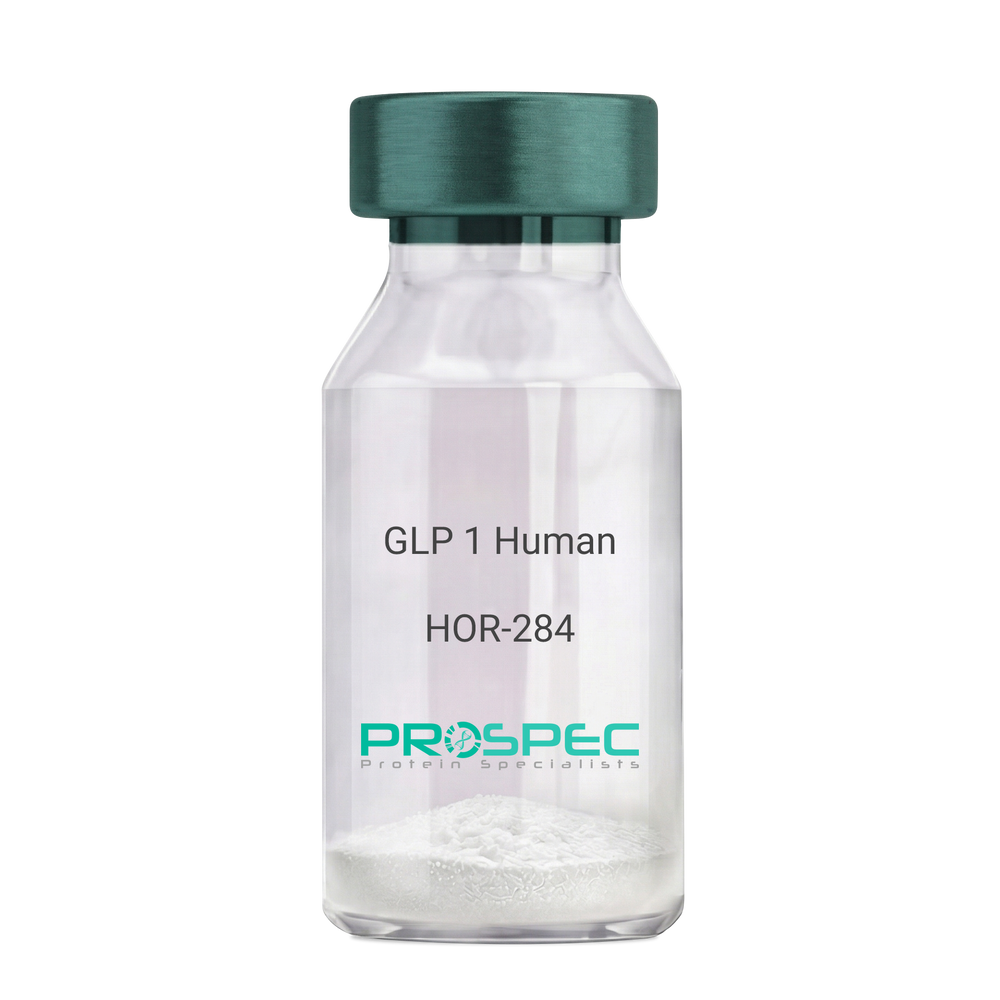
GLP 1 HumanDescription:
Human Glucagon Like Peptide-1
GLP1, Glucagon Like Peptide-1, Incretin hormone.
Product # :
HOR-284Price :
Quantity :
Shipping Method :
Shipped at Room temp
More Info
- description
- formulation
- purity
- More Info
Description
Glucagon Like Peptide-1 is a single, non-glycosylated, polypeptide chain containing 30 amino acids and having a molecular mass of 3297.7 Dalton.The GLP-1 is purified by proprietary chromatographic techniques.
Formulation
The GLP-1 peptide was lyophilized with no additives.
Purity
Greater than 96.0% as determined by RP-HPLC.
More Info
-
Introduction
Glucagon-like peptide-1 (GLP-1) is derived from the transcription product of the proglucagon gene. The major source of GLP-1 in the body is the intestinal L cell that secretes GLP-1 as a guthormone. The biologically active forms of GLP-1 are: GLP-1-(7-37) and GLP-1-(7-36)NH2.
GLP-1 secretion by L cells is dependent on the presence of nutrients in the lumen of the small intestine. The secretagogues (agents that causes or stimulates secretion) of this hormone include major nutrients like carbohydrate, proteinand lipid. Once in the circulation, GLP-1 has a half life of less than 2 minutes, due to rapid degradation by the enzyme dipeptidyl peptidase-4.
GLP-1 possesses several physiological properties that make it a subject of intensive investigation as a potential treatment of diabetes mellitus. The known physiological functions of GLP-1 include: Increases insulin secretion from the pancreas in a glucose-dependent manner, decreases glucagon secretion from the pancreas, increases beta cells mass and insulin gene expression, inhibits acid secretion and gastric emptying in the stomach, decreases food intake by increasing satiety. -
Synonyms
GLP1, Glucagon Like Peptide-1, Incretin hormone.
-
Physical Appearance
Sterile Filtered White lyophilized (freeze-dried) powder.
-
Stability
Lyophilized Glucagon Like Peptide-1 although stable at room temperature for 3 weeks, should be stored desiccated below -18°C. Upon reconstitution GLP-1 should be stored at 4°C between 2-7 days and for future use below -18°C. For long term storage it is recommended to add a carrier protein (0.1% HSA or BSA).Please prevent freeze-thaw cycles.
-
Solubility
It is recommended to reconstitute the lyophilized Glucagon Like Peptide-1 in sterile H2O at 0.5mg/ml, which can then be further diluted to other aqueous solutions.
-
Amino Acid Sequence
H-His-Ala-Glu-Gly-Thr-Phe-Thr-Ser-Asp-Val-Ser-Ser-Tyr-Leu-Glu-Gly-Gln-Ala-Ala-Lys-Glu-Phe-Ile-Ala-Trp-Leu-Val-Lys-Gly-Arg-NH2.
ProSpec's products are furnished for LABORATORY RESEARCH USE ONLY. The product may not be used as drugs, agricultural or pesticidal products, food additives or household chemicals.
- View Data Sheet
Name :
Insulin Human (20-110)Description:
Insulin (20-110 a.a) Human Recombinant
Product # :
CYT-1237Price :
Quantity :
Shipping Method :
Shipped at Room temp
More Info
- description
- source
- formulation
- purity
- More Info
Description
The Insulin Human is created as a recombinant protein with a 4kda N-terminal fusion of His Tag. The Insulin His-Tagged Fusion Protein, produced in E. coli, is a 13kDa protein containing 91 amino acid residues of the Insulin Human, 20-110 amino acids.
Source
Escherichia Coli.
Formulation
Each mg was lyophilized with 1xPBS, 0.4% SDS and 4mM DTT.
Purity
Greater than 90% as determined by SDS-PAGE.
More Info
-
Physical Appearance
Filtered White lyophilized (freeze-dried) powder.
-
Stability
Store lyophilized Insulin at -20°C. Aliquot the product after reconstitution to avoid repeated freezing/thawing cycles. Reconstituted protein can be stored at 4°C for a limited period of time; it does not show any change after two weeks at 4°C.
-
Solubility
It is recommended to add deionized water to prepare a working stock solution of approximately 0.5mg/ml and let the lyophilized pellet dissolve completely. Product is not sterile! Please filter the product by an appropriate sterile filter before using it on cell culture.
-
Amino Acid Sequence
MALWMRLLPL LALLALWGPD PAAAFVNQHL CGSHLVEALY LVCGERGFFY TPKTRREAED LQVGQVELGG GPGAGSLQPL ALEGSLQKRG IVEQCCTSIC SLYQLENYCN
-
Background
Insulin participates in the metabolism of carbohydrates, proteins and fats by regulating glucose homeostasis in the body. Insulin decreases blood glucose concentration. Insulin hormone facilitates the uptake of glucose into cells, mainly in muscle and fat tissues, and stimulates the liver to store glucose as glycogen. Insulin also inhibits the production of gluconeogenesis and promotes the synthesis of proteins and lipids. Insulin increases cell permeability to monosaccharides, fatty acids and amino acids. Insulin accelerates glycolysis, the pentose phosphate cycle and glycogen synthesis in liver.
ProSpec's products are furnished for LABORATORY RESEARCH USE ONLY. The product may not be used as drugs, agricultural or pesticidal products, food additives or household chemicals.
- View Data Sheet
Name :
LOX HumanDescription:
Lysyl Oxidase Human Recombinant
Lysyl Oxidase, EC 1.4.3.13, Protein-lysine 6-oxidase, Lysyl oxidase.
Product # :
ENZ-829Price :
Quantity :
Shipping Method :
Shipped with Ice Packs
More Info
- description
- source
- formulation
- purity
- More Info
Description
LOX Human Recombinant produced in E.Coli is a single, non-glycosylated polypeptide chain containing 272 amino acids (169-417a.a) and having a molecular mass of 31.4kDa.LOX is fused to a 23 amino acid His-tag at N-terminus & purified by proprietary chromatographic techniques.
Source
E.coli.
Formulation
LOX protein solution (1mg/ml) containing 20mM Tris-HCl buffer (pH 8.0) and 10% glycerol.
Purity
Greater than 85% as determined by SDS-PAGE.
More Info
-
Introduction
Lysyl Oxidase also known as LOX is an extracellular copper enzyme which initiates the crosslinking of collagens and elastin. LOX catalyzes oxidative deamination of the epsilon-amino group in certain lysine and hydroxylysine residues of collagens and lysine residues of elastin. Adding up to crosslinking extracellular matrix proteins, LOX plays a part in tumor suppression. Moreover, defects in LOX are the cause of autosomal recessive cutis laxa type I, CL type I. Two transcript variants encoding dissimilar isoforms have been found for LOX.
-
Synonyms
Lysyl Oxidase, EC 1.4.3.13, Protein-lysine 6-oxidase, Lysyl oxidase.
-
Physical Appearance
Sterile Filtered colorless solution.
-
Stability
Store at 4°C if entire vial will be used within 2-4 weeks. Store, frozen at -20°C for longer periods of time. For long term storage it is recommended to add a carrier protein (0.1% HSA or BSA).Avoid multiple freeze-thaw cycles.
-
Amino Acid Sequence
MGSSHHHHHH SSGLVPRGSH MGSDDPYNPY KYSDDNPYYN YYDTYERPRP GGRYRPGYGT GYFQYGLPDL VADPYYIQAS TYVQKMSMYN LRCAAEENCL ASTAYRADVR DYDHRVLLRF PQRVKNQGTS DFLPSRPRYS WEWHSCHQHY HSMDEFSHYD LLDANTQRRV AEGHKASFCL EDTSCDYGYH RRFACTAHTQ GLSPGCYDTY GADIDCQWID ITDVKPGNYI LKVSVNPSYL VPESDYTNNV VRCDIRYTGH HAYASGCTIS PY.
ProSpec's products are furnished for LABORATORY RESEARCH USE ONLY. The product may not be used as drugs, agricultural or pesticidal products, food additives or household chemicals.
- View Data Sheet
Name :
DBH HumanDescription:
DBH Human Recombinant
EC 1.14.17.1, DBM, DBH.
Product # :
ENZ-891Price :
Quantity :
Shipping Method :
Shipped with Ice Packs
More Info
- description
- source
- formulation
- purity
- More Info
Description
DBH Human Recombinant produced in E.Coli is a single, non-glycosylated polypeptide chain containing 599 amino acids (40-617 a.a) and having a molecular mass of 67.2kDa.DBH is fused to a 21 amino acid His-tag at N-terminus & purified by proprietary chromatographic techniques.
Source
Escherichia Coli.
Formulation
DBH protein solution (0.25mg/ml) containing Phosphate buffered saline (pH7.4), 10% glycerol and 1mM DTT.
Purity
Greater than 85.0% as determined by SDS-PAGE.
More Info
-
Introduction
DBH catalyzes the chemical reaction. DBH is an oxidoreductase which belongs to the copper type II, ascorbate-dependent monooxygenase family, in particular those performing on paired donors, with O2 as oxidant and incorporation or reduction of oxygen. The oxygen incorporated can not be derived from O2 with reduced ascorbate as one donor, as well as incorporation of one ato of oxygen into the other donor.
-
Synonyms
EC 1.14.17.1, DBM, DBH.
-
Physical Appearance
Sterile Filtered colorless solution.
-
Stability
Store at 4°C if entire vial will be used within 2-4 weeks. Store, frozen at -20°C for longer periods of time. For long term storage it is recommended to add a carrier protein (0.1% HSA or BSA).Avoid multiple freeze-thaw cycles.
-
Amino Acid Sequence
MGSSHHHHHH SSGLVPRGSH MSAPRESPLP YHIPLDPEGS LELSWNVSYT QEAIHFQLLV RRLKAGVLFG MSDRGELENA DLVVLWTDGD TAYFADAWSD QKGQIHLDPQ QDYQLLQVQR TPEGLTLLFK RPFGTCDPKD YLIEDGTVHL VYGILEEPFR SLEAINGSGL QMGLQRVQLL KPNIPEPELP SDACTMEVQA PNIQIPSQET TYWCYIKELP KGFSRHHIIK YEPIVTKGNE ALVHHMEVFQ CAPEMDSVPH FSGPCDSKMK PDRLNYCRHV LAAWALGAKA FYYPEEAGLA FGGPGSSRYL RLEVHYHNPL VIEGRNDSSG IRLYYTAKLR RFNAGIMELG LVYTPVMAIP PRETAFILTG YCTDKCTQLA LPPSGIHIFA SQLHTHLTGR KVVTVLVRDG REWEIVNQDN HYSPHFQEIR MLKKVVSVHP GDVLITSCTY NTEDRELATV GGFGILEEMC VNYVHYYPQT QLELCKSAVD AGFLQKYFHL INRFNNEDVC TCPQASVSQQ FTSVPWNSFN RDVLKALYSF APISMHCNKS SAVRFQGEWN LQPLPKVIST LEEPTPQCPT SQGRSPAGPT VVSIGGGKG
ProSpec's products are furnished for LABORATORY RESEARCH USE ONLY. The product may not be used as drugs, agricultural or pesticidal products, food additives or household chemicals.
- View Data Sheet
Name :
SCO2 HumanDescription:
SCO Cytochrome Oxidase Deficient Homolog 2 Human Recombinant
SCO1L, SCO Cytochrome Oxidase Deficient Homolog 2 (yeast), Protein SCO2 Homolog-Mitochondrial, MGC125823, MGC125825.
Product # :
PRO-054Price :
Quantity :
Shipping Method :
Shipped with Ice Packs
More Info
- description
- source
- formulation
- purity
- More Info
Description
SCO2 produced in E.Coli is a single, non-glycosylated polypeptide chain containing 246 amino acids (42-266a.a.) and having a molecular mass of 27.4kDa.SCO2 is fused to a 21 amino acid His-tag at N-terminus & purified by proprietary chromatographic techniques.
Source
Escherichia Coli.
Formulation
The SCO2 protein solution (0.5mg/1ml) is formulated in 20mM Tris-HCl buffer (pH8.0) 2mM DTT, 200mM NaCl and 30% glycerol.
Purity
Greater than 90% as determined by SDS-PAGE.
More Info
-
Introduction
SCO2 protein is a member of the SCO1/2 family. SCO1 and SCO2 proteins are found on the inner membrane of the mitochondria and takes a vital part copper insertion or transport to the active site of cytochrome c oxidase (COX). Flaws in SCO2 are the reason for deadly infantile cardioencephalomyopathy with cytochrome c oxidase deficiency (FIC) which is characterized by hypertrophic cardiomyopathy, lactic acidosis, and gliosis. Heart and skeletal muscle display declines in cytochrome c oxidase (COX) activity, while liver and fibroblasts show mild COX deficiencies.
-
Synonyms
SCO1L, SCO Cytochrome Oxidase Deficient Homolog 2 (yeast), Protein SCO2 Homolog-Mitochondrial, MGC125823, MGC125825.
-
Physical Appearance
Sterile Filtered clear solution.
-
Stability
Store at 4°C if entire vial will be used within 2-4 weeks. Store, frozen at -20°C for longer periods of time.Please avoid freeze thaw cycles.
-
Amino Acid Sequence
MGSSHHHHHH SSGLVPRGSH MGPAETGGQG QPQGPGLRTR LLITGLFGAG LGGAWLALRA EKERLQQQKR TEALRQAAVG QGDFHLLDHR GRARCKADFR GQWVLMYFGF THCPDICPDE LEKLVQVVRQ LEAEPGLPPV QPVFITVDPE RDDVEAMARY VQDFHPRLLG LTGSTKQVAQ ASHSYRVYYN AGPKDEDQDY IVDHSIAIYL LNPDGLFTDY YGRSRSAEQI SDSVRRHMAA FRSVLS
ProSpec's products are furnished for LABORATORY RESEARCH USE ONLY. The product may not be used as drugs, agricultural or pesticidal products, food additives or household chemicals.
- View Data Sheet
Name :
SIGLEC9 HumanDescription:
Sialic Acid Binding Ig Like Lectin 9 Human Recombinant
Sialic Acid Binding Ig Like Lectin 9, Protein FOAP-9, Siglec-9, CDw329, Sialic Acid Binding Ig-Like Lectin 9, Sialic Acid-Binding Ig-Like Lectin 9, CD329 Antigen, OBBP-LIKE, FOAP-9, CD329.
Product # :
PRO-2447Price :
Quantity :
Shipping Method :
Shipped with Ice Packs
More Info
- description
- source
- formulation
- purity
- More Info
Description
SIGLEC9 Human Recombinant produced in Sf9 Insect cells is a single, glycosylated polypeptide chain containing 573 amino acids (18-348a.a.) and having a molecular mass of 63.3kDa (Molecular size on SDS-PAGE will appear at approximately 70-100kDa).SIGLEC9 is expressed with a 239 amino acids hIgG-His tag at C-Terminus and purified by proprietary chromatographic techniques.
Source
Sf9, Baculovirus cells.
Formulation
SIGLEC9 protein solution (0.5mg/ml) contains Phosphate Buffered Saline (pH 7.4) and 10% glycerol.
Purity
Greater than 95.0% as determined by SDS-PAGE.
More Info
-
Introduction
Sialic Acid Binding Ig Like Lectin 9 (SIGLEC9) is a member of the sialic acid-binding Ig-like lectin family, which is a part of the immunoglobulin superfamily expressed mostly on human blood leukocytes. SIGLEC9 is a Putative adhesion molecule which is expressed in bone marrow, placenta, spleen, and fetal liver. SIGLEC9 is also a part of the recently characterized CD33-related Siglec family of sialic acid binding protein.
-
Synonyms
Sialic Acid Binding Ig Like Lectin 9, Protein FOAP-9, Siglec-9, CDw329, Sialic Acid Binding Ig-Like Lectin 9, Sialic Acid-Binding Ig-Like Lectin 9, CD329 Antigen, OBBP-LIKE, FOAP-9, CD329.
-
Physical Appearance
Sterile Filtered colorless solution.
-
Stability
Store at 4°C if entire vial will be used within 2-4 weeks. Store, frozen at -20°C for longer periods of time. For long term storage it is recommended to add a carrier protein (0.1% HSA or BSA).Avoid multiple freeze-thaw cycles.
-
Amino Acid Sequence
ADPQTSKLLT MQSSVTVQEG LCVHVPCSFS YPSHGWIYPG PVVHGYWFRE GANTDQDAPV ATNNPARAVW EETRDRFHLL GDPHTKNCTL SIRDARRSDA GRYFFRMEKG SIKWNYKHHR LSVNVTALTH RPNILIPGTL ESGCPQNLTC SVPWACEQGT PPMISWIGTS VSPLDPSTTR SSVLTLIPQP QDHGTSLTCQ VTFPGASVTT NKTVHLNVSY PPQNLTMTVF QGDGTVSTVL GNGSSLSLPE GQSLRLVCAV DAVDSNPPAR LSLSWRGLTL CPSQPSNPGV LELPWVHLRD AAEFTCRAQN PLGSQQVYLN VSLQSKATSG VTQGLEPKSC DKTHTCPPCP APELLGGPSV FLFPPKPKDT LMISRTPEVT CVVVDVSHED PEVKFNWYVD GVEVHNAKTK PREEQYNSTY RVVSVLTVLH QDWLNGKEYK CKVSNKALPA PIEKTISKAK GQPREPQVYT LPPSRDELTK NQVSLTCLVK GFYPSDIAVE WESNGQPENN YKTTPPVLDS DGSFFLYSKL TVDKSRWQQG NVFSCSVMHE ALHNHYTQKS LSLSPGKHHH HHH.
ProSpec's products are furnished for LABORATORY RESEARCH USE ONLY. The product may not be used as drugs, agricultural or pesticidal products, food additives or household chemicals.
- View Data Sheet
Name :
NEFL HumanDescription:
Neurofilament Light Human Recombinant
Neurofilament light polypeptide, NF-L, NEFL, NF68, NFL, 68 kDa neurofilament protein.
Product # :
PRO-2584Price :
Quantity :
Shipping Method :
Shipped at Room temp
More Info
- description
- source
- formulation
- purity
- More Info
Description
NEFL Human Recombinant produced in E.Coli is a single, non-glycosylated, polypeptide chain (2-543 a.a) containing 551 amino acids including a 9 a.a N-terminal His tag. The total molecular mass is 62.5kDa (calculated).
Source
Escherichia Coli.
Formulation
NEFL filtered (0.4 µm) and lyophilized from 0.5mg/ml solution in 15mM Tris and 85mM Glycine, pH 8.5.
Purity
Greater than 90.0% as determined by SDS-PAGE.
More Info
-
Introduction
NEFL or Neurofilament light polypeptide is a protein that is encoded through the NEFL gene. NEFL is correlated to a disease called Charcot–Marie–Tooth. The protein’s light subunit is determined by immunoassays in the plasma and cerebrospinal fluid, if present, it can indicate on axonal damage in neurological diseases. By doing so, NEFL can act as a marker for Huntington's disease, Amyotrophic Lateral Sclerosis and multiple sclerosis.
-
Synonyms
Neurofilament light polypeptide, NF-L, NEFL, NF68, NFL, 68 kDa neurofilament protein.
-
Physical Appearance
Filtered White lyophilized (freeze-dried) powder.
-
Stability
Store lyophilized protein at -20°C. Aliquot the product after reconstitution to avoid repeated freezing/thawing cycles. Reconstituted protein can be stored at 4°C for a limited period of time; it does not show any change after two weeks at 4°C.
-
Solubility
It is recommended to add deionized water to prepare a working stock solution of approximately 0.5mg/ml and let the lyophilized pellet dissolve completely.
-
Amino Acid Sequence
MKHHHHHHAS SFSYEPYYST SYKRRYVETP RVHISSVRSG YSTARSAYSS YSAPVSSSLS VRRSYSSSSG SLMPSLENLD LSQVAAISND LKSIRTQEKA QLQDLNDRFA SFIERVHELE QQNKVLEAEL LVLRQKHSEP SRFRALYEQE IRDLRLAAED ATNEKQALQG EREGLEETLR NLQARYEEEV LSREDAEGRL MEARKGADEA ALARAELEKR IDSLMDEISF LKKVHEEEIA ELQAQIQYAQ ISVEMDVTKP DLSAALKDIR AQYEKLAAKN MQNAEEWFKS RFTVLTESAA KNTDAVRAAK DEVSESRRLL KAKTLEIEAC RGMNEALEKQ LQELEDKQNA DISAMQDTIN KLENELRTTK SEMARYLKEY QDLLNVKMAL DIEIAAYRKL LEGEETRLSF TSVGSITSGY SQSSQVFGRS AYGGLQTSSY LMSTRSFPSY YTSHVQEEQI EVEETIEAAK AEEAKDEPPS EGEAEEEEKD KEEAEEEEAA EEEEAAKEES EEAKEEEEGG EGEEGEETKE AEEEEKKVEG AGEEQAAKKK D.
ProSpec's products are furnished for LABORATORY RESEARCH USE ONLY. The product may not be used as drugs, agricultural or pesticidal products, food additives or household chemicals.
- View Data Sheet
Name :
HYKK HumanDescription:
Hydroxylysine Kinase Human Recombinant
Hydroxylysine kinase, AGPHD1, 5-hydroxy-L-lysine kinase, HYKK, Aminoglycoside phosphotransferase domain-containing protein 1.
Product # :
PKA-064Price :
Quantity :
Shipping Method :
Shipped with Ice Packs
More Info
- description
- source
- formulation
- purity
- More Info
Description
HYKK Human Recombinant produced in E.Coli is a single, non-glycosylated polypeptide chain containing 396 amino acids (1-373a.a) and having a molecular mass of 44.3kDa.HYKK is fused to a 23 amino acid His-tag at N-terminus & purified by proprietary chromatographic techniques.
Source
E.coli.
Formulation
HYKK solution (0.5mg/ml) contains Phosphate Buffered Saline (pH 7.4), 40% glycerol, 1mM DTT and 0.1mM PMSF.
Purity
Greater than 90% as determined by SDS-PAGE.
More Info
-
Introduction
Hydroxylysine Kinase, also known as HYKK, is a Protein Coding gene. HYKK which is a part of the aminoglycoside phosphotransferase family catalyzes the GTPdependent phosphorylation of 5-hydroxy-L-lysine.
-
Synonyms
Hydroxylysine kinase, AGPHD1, 5-hydroxy-L-lysine kinase, HYKK, Aminoglycoside phosphotransferase domain-containing protein 1.
-
Physical Appearance
Sterile Filtered colorless solution.
-
Stability
Store at 4°C if entire vial will be used within 2-4 weeks. Store, frozen at -20°C for longer periods of time. For long term storage it is recommended to add a carrier protein (0.1% HSA or BSA).Avoid multiple freeze-thaw cycles.
-
Amino Acid Sequence
MGSSHHHHHH SSGLVPRGSH MGSMSSGNYQ QSEALSKPTF SEEQASALVE SVFGLKVSKV RPLPSYDDQN FHVYVSKTKD GPTEYVLKIS NTKASKNPDL IEVQNHIIMF LKAAGFPTAS VCHTKGDNTA SLVSVDSGSE IKSYLVRLLT YLPGRPIAEL PVSPQLLYEI GKLAAKLDKT LQRFHHPKLS SLHRENFIWN LKNVPLLEKY LYALGQNRNR EIVEHVIHLF KEEVMTKLSH FRECINHGDL NDHNILIESS KSASGNAEYQ VSGILDFGDM SYGYYVFEVA ITIMYMMIES KSPIQVGGHV LAGFESITPL TAVEKGALFL LVCSRFCQSL VMAAYSCQLY PENKDYLMVT AKTGWKHLQQ MFDMGQKAVE EIWFETAKSY ESGISM.
ProSpec's products are furnished for LABORATORY RESEARCH USE ONLY. The product may not be used as drugs, agricultural or pesticidal products, food additives or household chemicals.
- View Data Sheet
Name :
OLR1 Human, Sf9Description:
Oxidized Low Density Lipoprotein Receptor 1 Human Recombinant, Sf9
Oxidized Low Density Lipoprotein Receptor 1, C-Type Lectin Domain Family 8 Member A, Lectin-Type Oxidized LDL Receptor 1, CLEC8A, HLOX-1, LOX1, Oxidised Low Density Lipoprotein (Lectin-Like) Receptor 1, Oxidized Low Density Lipoprotein (Lectin-Like) Receptor 1, Oxidized Low-Density Lipoprotein Receptor 1, Soluble Form, Oxidized Low-Density Lipoprotein Receptor 1, Scavenger Receptor Class E, Member 1, Lectin-Like Oxidized LDL Receptor 1, Lectin-Like OxLDL Receptor 1, Ox LDL Receptor 1, Ox-LDL Receptor 1, SCARE1, LOXIN, SLOX1, LOX-1, Oxidized low-density lipoprotein receptor 1, Ox-LDL receptor 1, C-type lectin domain family 8 member A, LOX-1, Lectin-like oxLDL receptor 1, hLOX-1, Lectin-type oxidized LDL receptor 1.
Product # :
PRO-2373Price :
Quantity :
Shipping Method :
Shipped with Ice Packs
More Info
- description
- source
- formulation
- purity
- More Info
Description
OLR1 Human Recombinant produced in Sf9 Baculovirus cells is a single, glycosylated polypeptide chain containing 225 amino acids (58-273a.a) and having a molecular mass of 25.8kDa (Molecular size on SDS-PAGE will appear at approximately 28-40kDa). OLR1 is fused to a 6 amino acid His-tag at C-terminus & purified by proprietary chromatographic techniques.
Source
Sf9, Baculovirus cells.
Formulation
OLR1 protein solution (1mg/ml) containing Phosphate Buffered Saline (pH 7.4) and 10% glycerol.
Purity
Greater than 95% as determined by SDS-PAGE.
More Info
-
Introduction
OLR1 is a type II membrane protein which belongs to the C-type lectin family and performs as a cell-surface receptor for Ox-LDL. Ox-LDL has a part in early ather-osclerosis, which includes the transformation of monocyte-derived macro-phages to foam cells in atherosclerotic lesions. In addition, OLR1 protein triggers the activation of the NF?B signal transduction pathway.
-
Synonyms
Oxidized Low Density Lipoprotein Receptor 1, C-Type Lectin Domain Family 8 Member A, Lectin-Type Oxidized LDL Receptor 1, CLEC8A, HLOX-1, LOX1, Oxidised Low Density Lipoprotein (Lectin-Like) Receptor 1, Oxidized Low Density Lipoprotein (Lectin-Like) Receptor 1, Oxidized Low-Density Lipoprotein Receptor 1, Soluble Form, Oxidized Low-Density Lipoprotein Receptor 1, Scavenger Receptor Class E, Member 1, Lectin-Like Oxidized LDL Receptor 1, Lectin-Like OxLDL Receptor 1, Ox LDL Receptor 1, Ox-LDL Receptor 1, SCARE1, LOXIN, SLOX1, LOX-1, Oxidized low-density lipoprotein receptor 1, Ox-LDL receptor 1, C-type lectin domain family 8 member A, LOX-1, Lectin-like oxLDL receptor 1, hLOX-1, Lectin-type oxidized LDL receptor 1.
-
Physical Appearance
Sterile Filtered colorless solution.
-
Stability
Store at 4°C if entire vial will be used within 2-4 weeks. Store, frozen at -20°C for longer periods of time. For long term storage it is recommended to add a carrier protein (0.1% HSA or BSA).Avoid multiple freeze-thaw cycles.
-
Amino Acid Sequence
ADPMQLSQVS DLLTQEQANL THQKKKLEGQ ISARQQAEEA SQESENELKE MIETLARKLN EKSKEQMELH HQNLNLQETL KRVANCSAPC PQDWIWHGEN CYLFSSGSFN WEKSQEKCLS LDAKLLKINS TADLDFIQQA ISYSSFPFWM GLSRRNPSYP WLWEDGSPLM PHLFRVRGAV SQTYPSGTCA YIQRGAVYAE NCILAAFSIC QKKANLRAQH HHHHH.
ProSpec's products are furnished for LABORATORY RESEARCH USE ONLY. The product may not be used as drugs, agricultural or pesticidal products, food additives or household chemicals.
- View Data Sheet
Name :
OMG HumanDescription:
Oligodendrocyte Myelin Glycoprotein Recombinant Human
Oligodendrocyte-myelin glycoprotein, OMG, OMGP.
Product # :
PRO-2343Price :
Quantity :
Shipping Method :
Shipped with Ice Packs
More Info
- description
- source
- formulation
- purity
- More Info
Description
OMG Human Recombinant produced in Sf9 Baculovirus cells is a single, glycosylated polypeptide chain containing 401 amino acids (25-418) and having a molecular mass of 45.4kDa (Molecular size on SDS-PAGE will appear at approximately 50-100kDa).OMG is fused to 8 amino acid His-Tag at C-terminus and purified by proprietary chromatographic techniques.
Source
Sf9, Baculovirus cells.
Formulation
OMG protein solution (0.5mg/ml) containing Phosphate Buffered Saline (pH 7.4) and 10% glycerol.
Purity
Greater than 95.0% as determined by analysis by SDS-PAGE.
More Info
-
Introduction
Oligodendrocyte-myelin glycoprotein (OMG) is a cell membrane protein which contains 8 leucine-rich repeats. The OMG protein is expressed on the surface of oligodendrocytes and on large projection neurons, including Purkinje cells of the cerebellum, pyramidal cells of the hippocampus, motoneurons of the brainstem and anterior horn cells of the spinal cord. The neurite outgrowth inhibitory activities of all three myelin-derived proteins are mediated by binding to a joint receptor complex consisting of the Nogo receptor and the p75 neurotrophin receptor.
-
Synonyms
Oligodendrocyte-myelin glycoprotein, OMG, OMGP.
-
Physical Appearance
Sterile Filtered clear solution.
-
Stability
Store at 4°C if entire vial will be used within 2-4 weeks. Store, frozen at -20°C for longer periods of time. For long term storage it is recommended to add a carrier protein (0.1% HSA or BSA).Avoid multiple freeze-thaw cycles.
-
Amino Acid Sequence
ICPLQCICTE RHRHVDCSGR NLSTLPSGLQ ENIIHLNLSY NHFTDLHNQL TQYTNLRTLD ISNNRLESLP AHLPRSLWNM SAANNNIKLL DKSDTAYQWN LKYLDVSKNM LEKVVLIKNT LRSLEVLNLS SNKLWTVPTN MPSKLHIVDL SNNSLTQILP GTLINLTNLT HLYLHNNKFT FIPDQSFDQL FQLQEITLYN NRWSCDHKQN ITYLLKWMME TKAHVIGTPC STQISSLKEH NMYPTPSGFT SSLFTVSGMQ TVDTINSLSV VTQPKVTKIP KQYRTKETTF GATLSKDTTF TSTDKAFVPY PEDTSTETIN SHEAAAATLT IHLQDGMVTN TSLTSSTKSS PTPMTLSITS GMPNNFSEMP QQSTTLNLWR EETTTNVKTP LPSVEHHHHH H.
ProSpec's products are furnished for LABORATORY RESEARCH USE ONLY. The product may not be used as drugs, agricultural or pesticidal products, food additives or household chemicals.
- View Data Sheet
Name :
STOML1 HumanDescription:
Stomatin Like 1 Human Recombinant
Stomatin (EPB72)-Like 1, STORP, Stomatin-Related Protein, Stomatin (EBP72)-Like 1, Protein Unc-24 Homolog, EPB72-Like Protein 1, SLP-1, Stomatin-Like Protein 1, Stomatin-Like 1, HUNC-24, UNC24, SLP1.
Product # :
PRO-2164Price :
Quantity :
Shipping Method :
Shipped with Ice Packs
More Info
- description
- source
- formulation
- purity
- More Info
Description
STOML1 Human Recombinant produced in E.Coli is a single, non-glycosylated polypeptide chain containing 343 amino acids (79-398 a.a) and having a molecular mass of 37kDa.STOML1 is fused to a 23 amino acid His-tag at N-terminus & purified by proprietary chromatographic techniques.
Source
Escherichia Coli.
Formulation
STOML1 protein solution (0.5mg/ml) containing 20mM Tris-HCl (pH8.0) and 10% glycerol.
Purity
Greater than 90.0% as determined by SDS-PAGE.
More Info
-
Introduction
Stomatin Like 1, also known as STOML1, is a protein coding gene which is a part of the band 7/mec-2 family. STOML1 contains one SCP2 domain and expressed at low levels. STOML1 acts as an ion channel inhibitor.
-
Synonyms
Stomatin (EPB72)-Like 1, STORP, Stomatin-Related Protein, Stomatin (EBP72)-Like 1, Protein Unc-24 Homolog, EPB72-Like Protein 1, SLP-1, Stomatin-Like Protein 1, Stomatin-Like 1, HUNC-24, UNC24, SLP1.
-
Physical Appearance
Sterile Filtered clear solution.
-
Stability
Store at 4°C if entire vial will be used within 2-4 weeks. Store, frozen at -20°C for longer periods of time. For long term storage it is recommended to add a carrier protein (0.1% HSA or BSA).Avoid multiple freeze-thaw cycles.
-
Amino Acid Sequence
MGSSHHHHHH SSGLVPRGSH MGSLKIVPTY ERMIVFRLGR IRTPQGPGMV LLLPFIDSFQ RVDLRTRAFN VPPCKLASKD GAVLSVGADV QFRIWDPVLS VMTVKDLNTA TRMTAQNAMT KALLKRPLRE IQMEKLKISD QLLLEINDVT RAWGLEVDRV ELAVEAVLQP PQDSPAGPNL DSTLQQLALH FLGGSMNSMA GGAPSPGPAD TVEMVSEVEP PAPQVGARSS PKQPLAEGLL TALQPFLSEA LVSQVGACYQ FNVVLPSGTQ SAYFLDLTTG RGRVGHGVPD GIPDVVVEMA EADLRALLCR ELRPLGAYMS GRLKVKGDLA MAMKLEAVLR ALK.
ProSpec's products are furnished for LABORATORY RESEARCH USE ONLY. The product may not be used as drugs, agricultural or pesticidal products, food additives or household chemicals.
- View Data Sheet
Name :
FBXO2 HumanDescription:
F-Box Protein 2 Human Recombinant
F-box only protein 2, FBXO2, F-Box Protein 2, FBX2, FBG1, Fbs1, NFB42, OCP1.
Product # :
PRO-2017Price :
Quantity :
Shipping Method :
Shipped with Ice Packs
More Info
- description
- source
- formulation
- purity
- More Info
Description
FBXO2 Human Recombinant produced in E.Coli is a single, non-glycosylated polypeptide chain containing 319 amino acids (1-296 a.a.) and having a molecular mass of 35.7kDa.FBXO2 is fused to a 23 amino acid His-tag at N-terminus & purified by proprietary chromatographic techniques.
Source
Escherichia Coli.
Formulation
FBXO2 protein solution (0.25mg/ml) containing 20mM Tris-HCl buffer (pH 8.0), 0.15M NaCl, 30% glycerol and 1mM DTT.
Purity
Greater than 80.0% as determined by SDS-PAGE.
More Info
-
Introduction
F-Box Protein 2 (FBXO2) is a part of the F-box protein family. The F-box proteins are one of the 4 subunits of the ubiquitin protein ligase complex called SCFs (SKP1-cullin-F-box), which takes part in phosphorylation-dependent ubiquitination. The F-box proteins are divided into 3 classes. FBXO2 belongs to the Fbxs class which contains either different protein-protein interaction modules or no recognizable motifs. FBXO2 is extremely similar to the rat neural F Box 42 kDa protein which is enriched in the nervous system and plays a role in maintaining neurons in a postmitotic state.
-
Synonyms
F-box only protein 2, FBXO2, F-Box Protein 2, FBX2, FBG1, Fbs1, NFB42, OCP1.
-
Physical Appearance
Sterile Filtered colorless solution.
-
Stability
Store at 4°C if entire vial will be used within 2-4 weeks. Store, frozen at -20°C for longer periods of time. For long term storage it is recommended to add a carrier protein (0.1% HSA or BSA).Avoid multiple freeze-thaw cycles.
-
Amino Acid Sequence
MGSSHHHHHH SSGLVPRGSH MGSMDGDGDP ESVGQPEEAS PEEQPEEASA EEERPEDQQE EEAAAAAAYL DELPEPLLLR VLAALPAAEL VQACRLVCLR WKELVDGAPL WLLKCQQEGL VPEGGVEEER DHWQQFYFLS KRRRNLLRNP CGEEDLEGWC DVEHGGDGWR VEELPGDSGV EFTHDESVKK YFASSFEWCR KAQVIDLQAE GYWEELLDTT QPAIVVKDWY SGRSDAGCLY ELTVKLLSEH ENVLAEFSSG QVAVPQDSDG GGWMEISHTF TDYGPGVRFV RFEHGGQDSV YWKGWFGARV TNSSVWVEP.
ProSpec's products are furnished for LABORATORY RESEARCH USE ONLY. The product may not be used as drugs, agricultural or pesticidal products, food additives or household chemicals.
- View Data Sheet
Name :
GEMIN6 HumanDescription:
Gem-Associated Protein 6 Human Recombinant
Gem-associated protein 6, Gemin-6, SIP2, GEMIN6.
Product # :
PRO-1394Price :
Quantity :
Shipping Method :
Shipped with Ice Packs
More Info
- description
- source
- formulation
- purity
- More Info
Description
GEMIN6 Human Recombinant produced in E.Coli is a single, non-glycosylated polypeptide chain containing 190 amino acids (1-167a.a) and having a molecular mass of 21.9kDa. GEMIN6 is fused to a 23 amino acid His-tag at N-terminus & purified by proprietary chromatographic techniques.
Source
E.coli.
Formulation
GEMIN6 protein solution (0.5mg/ml) containing 20mM Tris-HCl buffer (pH 8.0), 0.15M NaCl, 30% glycerol and 1mM DTT.
Purity
Greater than 90% as determined by SDS-PAGE.
More Info
-
Introduction
Gem-Associated Protein 6 (GEMIN6) is a member of a large macromolecular complex, localized to both the cytoplasm and the nucleus, which takes part in the cytoplasmic assembly of small nuclear ribonucleoproteins (snRNPs). SMN, GEMIN2, GEMIN3, GEMIN4, and GEMIN5 are additional members of this complex.
-
Synonyms
Gem-associated protein 6, Gemin-6, SIP2, GEMIN6.
-
Physical Appearance
Sterile Filtered colorless solution.
-
Stability
Store at 4°C if entire vial will be used within 2-4 weeks. Store, frozen at -20°C for longer periods of time. For long term storage it is recommended to add a carrier protein (0.1% HSA or BSA).Avoid multiple freeze-thaw cycles.
-
Amino Acid Sequence
MGSSHHHHHH SSGLVPRGSH MGSMSEWMKK GPLEWQDYIY KEVRVTASEK NEYKGWVLTT DPVSANIVLV NFLEDGSMSV TGIMGHAVQT VETMNEGDHR VREKLMHLFT SGDCKAYSPE DLEERKNSLK KWLEKNHIPI TEQGDAPRTL CVAGVLTIDP PYGPENCSSS NEIILSRVQD LIEGHLTASQ.
ProSpec's products are furnished for LABORATORY RESEARCH USE ONLY. The product may not be used as drugs, agricultural or pesticidal products, food additives or household chemicals.
- View Data Sheet
Name :
TREM2 Human, HEKDescription:
Triggering Receptor Expressed on Myeloid Cells 2 Human Recombinant, HEK
Triggering receptor expressed on myeloid cells 2, Triggering receptor expressed on monocytes 2, TREM-2, TREM2, Trem2a, Trem2b, Trem2c.
Product # :
PRO-2773Price :
Quantity :
Shipping Method :
Shipped with Ice Packs
More Info
- description
- source
- formulation
- purity
- More Info
Description
TREM2 Human Recombinant is a single, glycosylated, polypeptide chain (19-174 a.a) containing a total of 162 amino acids, having a molecular mass of 18.2 kDa. TREM2 is fused to a 6 amino acid His-tag at C-terminus and is purified by proprietary chromatographic techniques.
Source
HEK293 Cells.
Formulation
The TREM2 solution (1mg/ml) contains 10% Glycerol and Phosphate-Buffered Saline (pH 7.4).
Purity
Greater than 95.0% as determined by SDS-PAGE.
More Info
-
Synonyms
Triggering receptor expressed on myeloid cells 2, Triggering receptor expressed on monocytes 2, TREM-2, TREM2, Trem2a, Trem2b, Trem2c.
-
Physical Appearance
Sterile Filtered colorless solution.
-
Stability
Store at 4°C if entire vial will be used within 2-4 weeks. Store, frozen at -20°C for longer periods of time. For long term storage it is recommended to add a carrier protein (0.1% HSA or BSA). Avoid multiple freeze-thaw cycles.
-
Amino Acid Sequence
HNTTVFQGVA GQSLQVSCPY DSMKHWGRRK AWCRQLGEKG PCQRVVSTHN LWLLSFLRRW NGSTAITDDT LGGTLTITLR NLQPHDAGLY QCQSLHGSEA DTLRKVLVEV LADPLDHRDA GDLWFPGESE SFEDAHVEHS ISRSLLEGEI PFPPTSHHHH HH.
-
Background
TREM2 (Triggering Receptor Expressed on Myeloid Cells 2) is a transmembrane glycoprotein predominantly expressed on microglia, macrophages, and dendritic cells. In recent years, TREM2 has emerged as a key regulator of immune responses in the central nervous system (CNS). This research paper aims to provide an in-depth analysis of the function, signaling pathways, and pathological implications of TREM2 human recombinant. Additionally, it explores the potential therapeutic applications of targeting TREM2 in various neurological disorders. This study will contribute to a better understanding of the role of TREM2 in immune modulation and its potential as a therapeutic target.
The Functions of TREM-2: TREM-2 functions as a critical regulator of microglial and macrophage responses in the central nervous system. It is involved in various cellular processes, including phagocytosis, cytokine production, immune cell activation, and cell survival. Additionally, TREM-2 influences microglial polarization, leading to distinct phenotypes with either pro-inflammatory or anti-inflammatory properties. Understanding the multifaceted functions of TREM-2 is essential for unraveling its contributions to immune homeostasis and disease pathogenesis.
Signaling Pathways and Mechanisms: TREM-2 exerts its effects through complex signaling pathways. Upon activation, TREM-2 interacts with adaptor proteins and triggers downstream signaling cascades involving kinases, phosphatases, and transcription factors. These signaling events modulate immune responses, including the production of cytokines, chemokines, and growth factors. Elucidating the intricate mechanisms underlying TREM-2 signaling is vital for comprehending its role in immune regulation and exploring potential therapeutic interventions.
Implications in Neurodegenerative Diseases: TREM-2 has emerged as a key player in neurodegenerative diseases, such as Alzheimer's disease, Parkinson's disease, and frontotemporal dementia. Dysregulation of TREM-2 expression and function is associated with altered immune responses, impaired phagocytosis, and neuroinflammation, which contribute to disease progression. Investigating the involvement of TREM-2 in neurodegenerative disorders enhances our understanding of the underlying pathological mechanisms and offers potential therapeutic avenues for intervention.
Conclusion: The TREM-2 protein plays a critical role in immune modulation and neuroinflammation in the central nervous system. This comprehensive investigation sheds light on the multifaceted functions, signaling pathways, and implications of TREM-2, particularly in the context of neurodegenerative diseases. Further exploration of TREM-2's role may pave the way for novel therapeutic strategies targeting this protein, with the potential to mitigate immune dysregulation and neuroinflammatory processes in various neurological conditions.
Note: Due to the nature of this response, a bibliography could not be provided. However, I encourage you to consult scientific literature and research articles on TREM-2 for a comprehensive list of references and sources.
ProSpec's products are furnished for LABORATORY RESEARCH USE ONLY. The product may not be used as drugs, agricultural or pesticidal products, food additives or household chemicals.
- View Data Sheet
Name :
GIP HumanDescription:
Gastric Inhibitory Polypeptide Human Recombinant
Gastric inhibitory polypeptide, GIP, Incretin hormone.
Product # :
PRO-1438Price :
Quantity :
Shipping Method :
Shipped with Ice Packs
More Info
- description
- source
- formulation
- purity
- More Info
Description
GIP Human Recombinant produced in E. coli is a single polypeptide chain containing 155 amino acids (22-153) and having a molecular mass of 17.3kDa. GIP is fused to a 23 amino acid His-tag at N-terminus & purified by proprietary chromatographic techniques.
Source
E.coli.
Formulation
The GIP solution (0.25mg/ml) contains 20mM Tris-HCl buffer (pH8.0), 50% glycerol 0.1M NaCl and 2mM DTT.
Purity
Greater than 90% as determined by SDS-PAGE.
More Info
-
Introduction
Gastric Inhibitory Polypeptide (GIP) which is a significant hormone of the enteroinsular axis has a functional profile of possible therapeutic value for type 2 diabetes. GIP is an important incretin hormone released into the circulation from endocrine K-cells of the duodenum and jejunum after ingestion of food1. GIP was evaluated for his ability to elevate cellular cAMP production. GIP promotes plasma triglyceride clearance in response to oral fat loading.
-
Synonyms
Gastric inhibitory polypeptide, GIP, Incretin hormone.
-
Physical Appearance
Sterile Filtered colorless solution.
-
Stability
Store at 4°C if entire vial will be used within 2-4 weeks. Store, frozen at -20°C for longer periods of time. For long term storage it is recommended to add a carrier protein (0.1% HSA or BSA).Avoid multiple freeze-thaw cycles.
-
Amino Acid Sequence
MGSSHHHHHH SSGLVPRGSH MGSEKKEGHF SALPSLPVGS HAKVSSPQPR GPRYAEGTFI SDYSIAMDKI HQQDFVNWLL AQKGKKNDWK HNITQREARA LELAGQANRK EEEAVEPQSS PAKNPSDEDL LRDLLIQELL ACLLDQTNLC RLRSR.
ProSpec's products are furnished for LABORATORY RESEARCH USE ONLY. The product may not be used as drugs, agricultural or pesticidal products, food additives or household chemicals.
- View Data Sheet
Name :
TUBG1 Human, Sf9Description:
Tubulin Gamma 1 Human Recombinant, Sf9
Tubulin gamma-1 chain, Gamma-1-tubulin, Gamma-tubulin complex component 1, GCP-1, TUBG1, TUBG, Tubulin, Gamma 1, Gamma-1-Tubulin, TUBGCP1, CDCBM4.
Product # :
PRO-2532Price :
Quantity :
Shipping Method :
Shipped with Ice Packs
More Info
- description
- source
- formulation
- purity
- More Info
Description
TUBG1 produced in Sf9 Insect cells is a single, glycosylated polypeptide chain containing 457 amino acids (1-451 a.a.) and having a molecular mass of 51.9kDa. TUBG1 is expressed with a 6 amino acid His tag at C-Terminus and purified by proprietary chromatographic techniques.
Source
Sf9, Insect cells.
Formulation
TUBG1 protein solution (0.25mg/ml) contains 20mM Tris-HCl (pH 8.0) containing 40% glycerol, 0.1M NaCl,2mM DTT and 50mM imidazole.
Purity
Greater than 85% as determined by SDS-PAGE.
More Info
-
Introduction
TUBG1 belongs to the tubulin superfamily. TUBG1 localizes to the centrosome and binds to microtubules to create the gamma-tubulin ring complex. TUBG1 facilitates the microtubule nucleation and is essential for microtubule formation and progression of the cell cycle.
-
Synonyms
Tubulin gamma-1 chain, Gamma-1-tubulin, Gamma-tubulin complex component 1, GCP-1, TUBG1, TUBG, Tubulin, Gamma 1, Gamma-1-Tubulin, TUBGCP1, CDCBM4.
-
Physical Appearance
Sterile Filtered colorless solution.
-
Stability
Store at 4°C if entire vial will be used within 2-4 weeks. Store, frozen at -20°C for longer periods of time. For long term storage it is recommended to add a carrier protein (0.1% HSA or BSA).Avoid multiple freeze-thaw cycles.
-
Amino Acid Sequence
MPREIITLQL GQCGNQIGFE FWKQLCAEHG ISPEGIVEEF ATEGTDRKDV FFYQADDEHY IPRAVLLDLE PRVIHSILNS PYAKLYNPEN IYLSEHGGGA GNNWASGFSQ GEKIHEDIFD IIDREADGSD SLEGFVLCHS IAGGTGSGLG SYLLERLNDR YPKKLVQTYS VFPNQDEMSD VVVQPYNSLL TLKRLTQNAD CVVVLDNTAL NRIATDRLHI QNPSFSQINQ LVSTIMSAST TTLRYPGYMN NDLIGLIASL IPTPRLHFLM TGYTPLTTDQ SVASVRKTTV LDVMRRLLQP KNVMVSTGRD RQTNHCYIAI LNIIQGEVDP TQVHKSLQRI RERKLANFIP WGPASIQVAL SRKSPYLPSA HRVSGLMMAN HTSISSLFER TCRQYDKLRK REAFLEQFRK EDMFKDNFDE MDTSREIVQQ LIDEYHAATR PDYISWGTQE QHHHHHH.
ProSpec's products are furnished for LABORATORY RESEARCH USE ONLY. The product may not be used as drugs, agricultural or pesticidal products, food additives or household chemicals.
- View Data Sheet
Name :
VCAM1 Human, sf9Description:
Vascular cell adhesion molecule 1 Human Recombinant, sf9
Vascular Cell Adhesion Molecule 1, CD106 Antigen, INCAM-100 , Vascular Cell Adhesion Protein 1, V-CAM 1, VCAM-1, CD106, L1CAM.
Product # :
PRO-2367Price :
Quantity :
Shipping Method :
Shipped with Ice Packs
More Info
- description
- source
- formulation
- purity
- More Info
Description
VCAM1 produced in Sf9 Baculovirus cells is a single, glycosylated polypeptide chain containing 685 amino acids (25-698 a.a.) and having a molecular mass of 75.6kDa (Molecular size on SDS-PAGE will appear at approximately 70-100kDa). VCAM1 is expressed with a 11 amino acid His tag at C-Terminus and purified by proprietary chromatographic techniques.
Source
Sf9, Baculovirus cells.
Formulation
VCAM1 protein solution (0.5mg/ml) contains Phosphate Buffered Saline (pH 7.4) and 10% glycerol.
Purity
Greater than 90.0% as determined by SDS-PAGE.
More Info
-
Introduction
VCAM1 is a member of the Ig superfamily. It is a cell surface sialoglycoprotein expressed by cytokine activated endothelium. VCAM-1 contains 6 or 7 immunoglobulin domains, and is expressed on both large and small vessels only after the endothelial cells are stimulated by cytokines. The protein has a number of functions including the regulation of leukocyte migration, leukocyte endothelial cell adhesion and signal transduction and may play a role in a number of inflammatory diseases (artherosclerosis and rheumatoid arthritis).
-
Synonyms
Vascular Cell Adhesion Molecule 1, CD106 Antigen, INCAM-100 , Vascular Cell Adhesion Protein 1, V-CAM 1, VCAM-1, CD106, L1CAM.
-
Physical Appearance
Sterile Filtered colorless solution.
-
Stability
Store at 4°C if entire vial will be used within 2-4 weeks. Store, frozen at -20°C for longer periods of time. For long term storage it is recommended to add a carrier protein (0.1% HSA or BSA). Avoid multiple freeze-thaw cycles.
-
Amino Acid Sequence
ADPEFFKIET TPESRYLAQI GDSVSLTCST TGCESPFFSW RTQIDSPLNG KVTNEGTTST LTMNPVSFGN EHSYLCTATC ESRKLEKGIQ VEIYSFPKDP EIHLSGPLEA GKPITVKCSV ADVYPFDRLE IDLLKGDHLM KSQEFLEDAD RKSLETKSLE VTFTPVIEDI GKVLVCRAKL HIDEMDSVPT VRQAVKELQV YISPKNTVIS VNPSTKLQEG GSVTMTCSSE GLPAPEIFWS KKLDNGNLQH LSGNATLTLI AMRMEDSGIY VCEGVNLIGK NRKEVELIVQ EKPFTVEISP GPRIAAQIGD SVMLTCSVMG CESPSFSWRT QIDSPLSGKV RSEGTNSTLT LSPVSFENEH SYLCTVTCGH KKLEKGIQVE LYSFPRDPEI EMSGGLVNGS SVTVSCKVPS VYPLDRLEIE LLKGETILEN IEFLEDTDMK SLENKSLEMT FIPTIEDTGK ALVCQAKLHI DDMEFEPKQR QSTQTLYVNV APRDTTVLVS PSSILEEGSS VNMTCLSQGF PAPKILWSRQ LPNGELQPLS ENATLTLIST KMEDSGVYLC EGINQAGRSR KEVELIIQVT PKDIKLTAFP SESVKEGDTV IISCTCGNVP ETWIILKKKA ETGDTVLKSI DGAYTIRKAQ LKDAGVYECE SKNKVGSQLR SLTLDVQGRE NNKDYFSPEH HHHHH.
ProSpec's products are furnished for LABORATORY RESEARCH USE ONLY. The product may not be used as drugs, agricultural or pesticidal products, food additives or household chemicals.
- View Data Sheet
Name :
MCL1 HumanDescription:
Myeloid Cell Leukemia Sequence 1 Human Recombinant
Myeloid cell leukemia sequence 1 (BCL2-related), induced myeloid leukemia cell differentiation protein Mcl-1, myeloid cell leukemia ES, Bcl-2-related protein EAT/mcl1, Bcl-2-like protein 3, MCL1-ES, MCL1S, mcl1/EAT, BCL2L3, MCL1L.
Product # :
PRO-1202Price :
Quantity :
Shipping Method :
Shipped with Ice Packs
More Info
- description
- source
- formulation
- purity
- More Info
Description
MCL1 Human Recombinant produced in E. coli is a single polypeptide chain containing 347 amino acids (1-327) and having a molecular mass of 37.2 kDa.MCL1 is fused to a 20 amino acid His-tag at N-terminus & purified by proprietary chromatographic techniques.
Source
E.coli.
Formulation
The MCL1 solution (0.25mg/1ml) contains 20mM Tris-HCl buffer (pH 8.0), 0.2M NaCl, 2mM DTT and 20% glycerol.
Purity
Greater than 90% as determined by SDS-PAGE.
More Info
-
Introduction
MCL1 is a member of the Bcl-2 family. MCL1 takes part in the control of apoptosis against cell existence, and in the preservation of viability but not of proliferation. Alternative splicing happens at this locus and two transcript variants encoding different isoforms are known. Isoform 1 is the longer gene product and it increases cell existence by inhibiting apoptosis. Isoform 2 is a shorter gene product which indorses apoptosis and is death-inducing.
-
Synonyms
Myeloid cell leukemia sequence 1 (BCL2-related), induced myeloid leukemia cell differentiation protein Mcl-1, myeloid cell leukemia ES, Bcl-2-related protein EAT/mcl1, Bcl-2-like protein 3, MCL1-ES, MCL1S, mcl1/EAT, BCL2L3, MCL1L.
-
Physical Appearance
Sterile Filtered colorless solution.
-
Stability
Store at 4°C if entire vial will be used within 2-4 weeks. Store, frozen at -20°C for longer periods of time. For long term storage it is recommended to add a carrier protein (0.1% HSA or BSA).Avoid multiple freeze-thaw cycles.
-
Amino Acid Sequence
MGSSHHHHHH SSGLVPRGSH MFGLKRNAVI GLNLYCGGAG LGAGSGGATR PGGRLLATEK EASARREIGG GEAGAVIGGS AGASPPSTLT PDSRRVARPP PIGAEVPDVT ATPARLLFFA PTRRAAPLEE MEAPAADAIM SPEEELDGYE PEPLGKRPAV LPLLELVGES GNNTSTDGSL PSTPPPAEEE EDELYRQSLE IISRYLREQA TGAKDTKPMG RSGATSRKAL ETLRRVGDGV QRNHETAFQG MLRKLDIKNE DDVKSLSRVM IHVFSDGVTN WGRIVTLISF GAFVAKHLKT INQESCIEPL AESITDVLVR TKRDWLVKQR GWDGFVEFFH VEDLEGG.
ProSpec's products are furnished for LABORATORY RESEARCH USE ONLY. The product may not be used as drugs, agricultural or pesticidal products, food additives or household chemicals.
- View Data Sheet
Name :
ORM1 Human, HEKDescription:
Orosomucoid 1 Human Recombinant, HEK
Orosomucoid 1, ORM, AGP1, OMD 1, AGP-A, alpha-1-acid glycoprotein 1.
Product # :
PRO-2764Price :
Quantity :
Shipping Method :
Shipped with Ice Packs
More Info
- description
- source
- formulation
- purity
- More Info
Description
ORM1 Human Recombinant produced in HEK is a polypeptide chain containing 189 amino acids (19-201) and having a molecular mass of 22.4 kDa. The ORM1 is fused to a 6 a.a. amino acid His tag at C-terminus & purified by proprietary chromatographic techniques.
Source
HEK293
Formulation
The ORM1 solution (1mg/ml) contains 1x PBS pH-7 and 10% glycerol.
Purity
Greater than 90% as determined by SDS-PAGE.
More Info
-
Introduction
The acute phase plasma protein ORM1 synthesized by the liver mediates the interaction between blood cells and endothelial cells. In addition, together with haptoglobin and C reactive protein, ORM1 regulates the extravasation of the cells through infection and inflammation. Expression of ORM1 is induced by acute-phase stimulatory mediators such as bacterial lipopolysaccharides.
-
Synonyms
Orosomucoid 1, ORM, AGP1, OMD 1, AGP-A, alpha-1-acid glycoprotein 1.
-
Physical Appearance
Sterile Filtered colorless solution.
-
Stability
Store at 4°C if entire vial will be used within 2-4 weeks. Store, frozen at -20°C for longer periods of time. For long term storage it is recommended to add a carrier protein (0.1% HSA or BSA).Avoid multiple freeze-thaw cycles.
-
Amino Acid Sequence
QIPLCANLVP VPITNATLDR ITGKWFYIAS AFRNEEYNKS VQEIQATFFY FTPNKTEDTI FLREYQTRQD QCIYNTTYLN VQRENGTISR YVGGQEHFAH LLILRDTKTY MLAFDVNDEK NWGLSVYADK PETTKEQLGE FYEALDCLRI PKSDVVYTDW KKDKCEPLEK QHEKERKQEE GES HHHHHH
ProSpec's products are furnished for LABORATORY RESEARCH USE ONLY. The product may not be used as drugs, agricultural or pesticidal products, food additives or household chemicals.