Skip to content

High-quality research proteins.

  • 1-800-805-6531

  • Mon - Sat 8.00-18.00, Sun - Closed

  • info@prospecbio.com

  • PO Box 6591 East Brunswick NJ 08816

  • Products
    • Cytokines
    • Growth factors
    • Chemokines
    • Cd antigens
    • Neurotrophins
    • Hormones
    • Enzymes
    • Viral antigens
    • Recombinant proteins
    • Natural proteins
    • Monoclonal antibodies
    • Polyclonal antibodies
    • Thermal Packaging
  • About
    • Company
    • Founder
    • Contribution
  • Customers
    • Eastern Asia
    • Eastern Europe
    • North America
    • South America
    • South East Asia
    • Southern Asia
    • Western Europe
  • Ordering
    • Ordering Method
    • Ordering - Credit Card
    • Ordering - PO
    • Shipping Fees
    • FAQs
  • Services
    • DNA Cloning
    • Protein Expression
    • Monoclonal Antibody
    • Fermentation
    • Technology License
  • Contact us
Log in

Country/region

  • USD $ | Albania
  • USD $ | Andorra
  • USD $ | Argentina
  • USD $ | Armenia
  • USD $ | Australia
  • USD $ | Austria
  • USD $ | Azerbaijan
  • USD $ | Belarus
  • USD $ | Belgium
  • USD $ | Bolivia
  • USD $ | Brazil
  • USD $ | Bulgaria
  • USD $ | Cambodia
  • USD $ | Canada
  • USD $ | Chile
  • USD $ | China
  • USD $ | Colombia
  • USD $ | Costa Rica
  • USD $ | Croatia
  • USD $ | Cyprus
  • USD $ | Czechia
  • USD $ | Denmark
  • USD $ | Estonia
  • USD $ | Finland
  • USD $ | France
  • USD $ | Georgia
  • USD $ | Germany
  • USD $ | Greece
  • USD $ | Hong Kong SAR
  • USD $ | Hungary
  • USD $ | Iceland
  • USD $ | India
  • USD $ | Ireland
  • USD $ | Israel
  • USD $ | Italy
  • USD $ | Japan
  • USD $ | Kazakhstan
  • USD $ | Latvia
  • USD $ | Liechtenstein
  • USD $ | Lithuania
  • USD $ | Madagascar
  • USD $ | Malta
  • USD $ | Mexico
  • USD $ | Moldova
  • USD $ | Monaco
  • USD $ | Netherlands
  • USD $ | New Zealand
  • USD $ | North Macedonia
  • USD $ | Norway
  • USD $ | Panama
  • USD $ | Paraguay
  • USD $ | Peru
  • USD $ | Philippines
  • USD $ | Poland
  • USD $ | Portugal
  • USD $ | Romania
  • USD $ | Singapore
  • USD $ | Slovakia
  • USD $ | Slovenia
  • USD $ | South Africa
  • USD $ | South Korea
  • USD $ | Spain
  • USD $ | Sri Lanka
  • USD $ | Sweden
  • USD $ | Switzerland
  • USD $ | Taiwan
  • USD $ | Thailand
  • USD $ | Türkiye
  • USD $ | Ukraine
  • USD $ | United Kingdom
  • USD $ | United States
  • USD $ | Uruguay
  • USD $ | Vatican City
  • USD $ | Venezuela
  • USD $ | Vietnam
  • Facebook
  • Instagram
logoProSpec - Recombinant Protein Manufacturer for academic and R&D industry
Become a distributor
Account Log in
Wishlist
Cart Cart(0)
  • Products
    +
    • Cytokines
    • Growth factors
    • Chemokines
    • Cd antigens
    • Neurotrophins
    • Hormones
    • Enzymes
    • Viral antigens
    • Recombinant proteins
    • Natural proteins
    • Monoclonal antibodies
    • Polyclonal antibodies
    • Thermal Packaging
  • About
    +
    • Company
    • Founder
    • Contribution
  • Customers
    +
    • Eastern Asia
    • Eastern Europe
    • North America
    • South America
    • South East Asia
    • Southern Asia
    • Western Europe
  • Ordering
    +
    • Ordering Method
    • Ordering - Credit Card
    • Ordering - PO
    • Shipping Fees
    • FAQs
  • Services
    +
    • DNA Cloning
    • Protein Expression
    • Monoclonal Antibody
    • Fermentation
    • Technology License
  • Contact us

Item added to your cart

View cart
View All
  • Cytokines
  • Growth factors
  • Chemokines
  • Cd antigens
  • Neurotrophins
  • Hormones
  • Enzymes
  • Viral antigens
  • Recombinant proteins
  • Natural proteins
  • Monoclonal antibodies
  • Polyclonal antibodies
  • Thermal Packaging
  • Tumor Necrosis Factor

    Tumor Necrosis Factor

    View All
  • 4-1BB

    4-1BB

    View All
  • Adiponectin

    Adiponectin

    View All
  • AIF1

    AIF1

    View All
  • Other Cytokines

    Other Cytokines

    View All
  • AITRL

    AITRL

    View All
  • Angiopoietin

    Angiopoietin

    View All
  • Apolipoprotein

    Apolipoprotein

    View All
  • B-Cell Activating Factor

    B-Cell Activating Factor

    View All
  • Beta Defensin

    Beta Defensin

    View All
  • Bone Morphogenetic Protein

    Bone Morphogenetic Protein

    View All
  • B type Natriuretic Peptide

    B type Natriuretic Peptide

    View All
  • BST

    BST

    View All
  • Betacellulin

    Betacellulin

    View All
  • Cardiotrophin

    Cardiotrophin

    View All
  • Activin

    Activin

    View All
  • Fibroblast Growth Factor

    Fibroblast Growth Factor

    View All
  • Other Growth Factors

    Other Growth Factors

    View All
  • CSF

    CSF

    View All
  • CTGF

    CTGF

    View All
  • IGFBP

    IGFBP

    View All
  • VEGF Protein

    VEGF Protein

    View All
  • EGF

    EGF

    View All
  • Epigen

    Epigen

    View All
  • Erythropoietin

    Erythropoietin

    View All
  • Insulin-Like Growth Factor

    Insulin-Like Growth Factor

    View All
  • Growth Hormone

    Growth Hormone

    View All
  • HDGF

    HDGF

    View All
  • Hepatocyte Growth Factor

    Hepatocyte Growth Factor

    View All
  • Insulin

    Insulin

    View All
  • BCA-1/ BLC (CXCL13)

    BCA-1/ BLC (CXCL13)

    View All
  • BRAK (CXCL14)

    BRAK (CXCL14)

    View All
  • C-10 (CCL6)

    C-10 (CCL6)

    View All
  • Other Chemokines

    Other Chemokines

    View All
  • MEC (CCL28)

    MEC (CCL28)

    View All
  • LD78-beta (CCL3L1)

    LD78-beta (CCL3L1)

    View All
  • CTACK (CCL27)

    CTACK (CCL27)

    View All
  • CXCL16

    CXCL16

    View All
  • CXCL17

    CXCL17

    View All
  • Platelet Factor-4 (CXCL4)

    Platelet Factor-4 (CXCL4)

    View All
  • ENA-78 (CXCL5)

    ENA-78 (CXCL5)

    View All
  • Eotaxin (CCL11,24,26)

    Eotaxin (CCL11,24,26)

    View All
  • Exodus-2 (CCL21)

    Exodus-2 (CCL21)

    View All
  • Fractalkine (CX3CL1)

    Fractalkine (CX3CL1)

    View All
  • CXCL6

    CXCL6

    View All
  • Other CD Antigens

    Other CD Antigens

    View All
  • CD14

    CD14

    View All
  • CD164

    CD164

    View All
  • CD1

    CD1

    View All
  • CD2

    CD2

    View All
  • CD200

    CD200

    View All
  • CD207

    CD207

    View All
  • CD226

    CD226

    View All
  • CD23

    CD23

    View All
  • CD244

    CD244

    View All
  • CD247

    CD247

    View All
  • CD27

    CD27

    View All
  • CD274

    CD274

    View All
  • CD300

    CD300

    View All
  • CD33

    CD33

    View All
  • Other Neurotrophins

    Other Neurotrophins

    View All
  • Beta-NGF

    Beta-NGF

    View All
  • BDNF

    BDNF

    View All
  • CDNF

    CDNF

    View All
  • CNTF

    CNTF

    View All
  • GDNF

    GDNF

    View All
  • Glia Maturation Factor

    Glia Maturation Factor

    View All
  • MANF

    MANF

    View All
  • Midkine

    Midkine

    View All
  • Neuroglobin

    Neuroglobin

    View All
  • Neurotrophic factors

    Neurotrophic factors

    View All
  • Neuregulin

    Neuregulin

    View All
  • Neuropilin

    Neuropilin

    View All
  • Pigment Epithelium-Derived Factor

    Pigment Epithelium-Derived Factor

    View All
  • Pleiotrophin

    Pleiotrophin

    View All
  • Peptide Hormones

    Peptide Hormones

    View All
  • Other Hormones

    Other Hormones

    View All
  • HCG

    HCG

    View All
  • Endothelin

    Endothelin

    View All
  • Exendin

    Exendin

    View All
  • FSH

    FSH

    View All
  • Glucagon

    Glucagon

    View All
  • GHRP

    GHRP

    View All
  • GLP

    GLP

    View All
  • Thyrostimulin

    Thyrostimulin

    View All
  • Inhibin A

    Inhibin A

    View All
  • LHRH

    LHRH

    View All
  • Melanotan

    Melanotan

    View All
  • Procalcitonin

    Procalcitonin

    View All
  • PTH

    PTH

    View All
  • Peroxiredoxin

    Peroxiredoxin

    View All
  • Peptidase

    Peptidase

    View All
  • Synthetase

    Synthetase

    View All
  • Transferase

    Transferase

    View All
  • Hydrolase

    Hydrolase

    View All
  • Dehydrogenase

    Dehydrogenase

    View All
  • ACE2

    ACE2

    View All
  • Esterase

    Esterase

    View All
  • Protein Kinases

    Protein Kinases

    View All
  • Other Enzymes

    Other Enzymes

    View All
  • Phosphatase

    Phosphatase

    View All
  • Deaminase

    Deaminase

    View All
  • Oxygenase

    Oxygenase

    View All
  • Adenylate Kinase

    Adenylate Kinase

    View All
  • Lyase

    Lyase

    View All
  • Chagas

    Chagas

    View All
  • SARS

    SARS

    View All
  • Influenza

    Influenza

    View All
  • ASFV

    ASFV

    View All
  • Astrovirus

    Astrovirus

    View All
  • Borrelia

    Borrelia

    View All
  • Helicobacter Pylori

    Helicobacter Pylori

    View All
  • Chikungunya

    Chikungunya

    View All
  • Chlamydia

    Chlamydia

    View All
  • Cytomegalo

    Cytomegalo

    View All
  • Dengue

    Dengue

    View All
  • EBV

    EBV

    View All
  • Ebola

    Ebola

    View All
  • Feline Leukemia Virus

    Feline Leukemia Virus

    View All
  • Hepatitis A

    Hepatitis A

    View All
  • Other

    Other

    View All
  • Actin

    Actin

    View All
  • ADAM

    ADAM

    View All
  • Complement Component

    Complement Component

    View All
  • Ag85

    Ag85

    View All
  • Eukaryotic Translation Initiation Factor

    Eukaryotic Translation Initiation Factor

    View All
  • Anterior Gradient Protein

    Anterior Gradient Protein

    View All
  • Heat Shock Protein

    Heat Shock Protein

    View All
  • Alpha-2-HS-Glycoprotein

    Alpha-2-HS-Glycoprotein

    View All
  • Hemoglobin

    Hemoglobin

    View All
  • Allergy

    Allergy

    View All
  • Anaplasma

    Anaplasma

    View All
  • Angiogenin

    Angiogenin

    View All
  • Ankyrin Repeat Domain

    Ankyrin Repeat Domain

    View All
  • Annexin

    Annexin

    View All
  • Other Natural Proteins

    Other Natural Proteins

    View All
  • Aprotinin

    Aprotinin

    View All
  • Transferrin

    Transferrin

    View All
  • Avidin

    Avidin

    View All
  • Anti Coagulation Factors

    Anti Coagulation Factors

    View All
  • Natural Albumin

    Natural Albumin

    View All
  • Natural Coagulation Factors

    Natural Coagulation Factors

    View All
  • Fibronectin

    Fibronectin

    View All
  • Thrombin

    Thrombin

    View All
  • Anti Human Enzyme

    Anti Human Enzyme

    View All
  • Other Monoclonal Antibodies

    Other Monoclonal Antibodies

    View All
  • Anti Human Cytokine

    Anti Human Cytokine

    View All
  • Anti Human Heat Shock Protein

    Anti Human Heat Shock Protein

    View All
  • Anti Mouse Lymphocyte

    Anti Mouse Lymphocyte

    View All
  • Anti Human Chemokine

    Anti Human Chemokine

    View All
  • Anti Human Lymphocyte

    Anti Human Lymphocyte

    View All
  • Anti Viral Monoclonal

    Anti Viral Monoclonal

    View All
  • Anti Mouse Cytokine

    Anti Mouse Cytokine

    View All
  • Anti-GST Monoclonal

    Anti-GST Monoclonal

    View All
  • Other Polyclonal Antibodies

    Other Polyclonal Antibodies

    View All
  • Anti Viral

    Anti Viral

    View All
  • Anti-GST Monoclonal

    Anti-GST Monoclonal

    View All
Back

Search results

1000 results found for “Glyoxalase”

Name

Description

Product #

Price

Quantity

Shipping Method

  • View Data Sheet

    Name :

    PCOLCE Human, Sf9

    Description:

    Procollagen C-Endopeptidase Enhancer Human Recombinant, Sf9

    Procollagen C-endopeptidase enhancer 1,  Procollagen COOH-terminal proteinase enhancer 1,  PCPE-1,  Procollagen C-proteinase enhancer 1,  Type 1 procollagen C-proteinase enhancer protein,  Type I procollagen COOH-terminal proteinase enhancer,  PCOLCE,  PCPE1,  Procollagen C-Endopeptidase Enhancer, Procollagen C-Proteinase, Enhancer 1, Procollagen, Type 1, COOH-Terminal Proteinase Enhancer, Type I Procollagen COOH-Terminal Proteinase Enhancer, Type 1 Procollagen C-Proteinase Enhancer Protein, Procollagen COOH-Terminal Proteinase Enhancer 1.

    Product # :

    ENZ-1075

    Price :

    Quantity :

    Shipping Method :

    Ice Icon

    Shipped with Ice Packs

    Add To Cart

    More Info

    • description
    • source
    • formulation
    • purity
    • More Info

    Description

    PCOLCE produced in Sf9 Insect cells is a single, glycosylated polypeptide chain containing 433 amino acids (26-449 a.a.) and having a molecular mass of 46.6kDa (Molecular size on SDS-PAGE will appear at approximately 40-57kDa). PCOLCE is expressed with an 9 amino acid His tag at C-Terminus and purified by proprietary chromatographic techniques.

    Source

    Sf9, Insect cells.

    Formulation

    PCOLCE protein solution (0.25mg/ml) contains 20mM Tris-HCl (pH 8.0), 10% glycerol and 0.1M NaCl.

    Purity

    Greater than 95.0% as determined by SDS-PAGE.

    More Info

    • Introduction

      Procollagen C-endopeptidase enhancer 1, also known as PCOLCE binds to the C-terminal propeptide of type I procollagen and enhances procollagen C-proteinase activity. In addition, C-terminal processed part of PCPE (CT-PCPE) has a metalloproteinase inhibitory activity. Among the diseases which are associated with PCOLCE: bone fracture & oculopharyngeal muscular dystrophy.

    • Synonyms

      Procollagen C-endopeptidase enhancer 1, Procollagen COOH-terminal proteinase enhancer 1, PCPE-1, Procollagen C-proteinase enhancer 1, Type 1 procollagen C-proteinase enhancer protein, Type I procollagen COOH-terminal proteinase enhancer, PCOLCE, PCPE1, Procollagen C-Endopeptidase Enhancer, Procollagen C-Proteinase, Enhancer 1, Procollagen, Type 1, COOH-Terminal Proteinase Enhancer, Type I Procollagen COOH-Terminal Proteinase Enhancer, Type 1 Procollagen C-Proteinase Enhancer Protein, Procollagen COOH-Terminal Proteinase Enhancer 1.

    • Physical Appearance

      Sterile filtered colorless solution.

    • Stability

      Store at 4°C if entire vial will be used within 2-4 weeks. Store, frozen at -20°C for longer periods of time. For long term storage it is recommended to add a carrier protein (0.1% HSA or BSA).Avoid multiple freeze-thaw cycles.

    • Amino Acid Sequence

      ADPQTPNYTR PVFLCGGDVK GESGYVASEG FPNLYPPNKE CIWTITVPEG QTVSLSFRVF DLELHPACRY DALEVFAGSG TSGQRLGRFC GTFRPAPLVA PGNQVTLRMT TDEGTGGRGF LLWYSGRATS GTEHQFCGGR LEKAQGTLTT PNWPESDYPP GISCSWHIIA PPDQVIALTF EKFDLEPDTY CRYDSVSVFN GAVSDDSRRL GKFCGDAVPG SISSEGNELL VQFVSDLSVT ADGFSASYKT LPRGTAKEGQ GPGPKRGTEP KVKLPPKSQP PEKTEESPSA PDAPTCPKQC RRTGTLQSNF CASSLVVTAT VKSMVREPGE GLAVTVSLIG AYKTGGLDLP SPPTGASLKF YVPCKQCPPM KKGVSYLLMG QVEENRGPVL PPESFVVLHR PNQDQILTNL SKRKCPSQPV RAAASQDHHH HHH.

    ProSpec's products are furnished for LABORATORY RESEARCH USE ONLY. The product may not be used as drugs, agricultural or pesticidal products, food additives or household chemicals.

    Pcolce Protein
  • View Data Sheet

    Name :

    DNase Bovine

    Description:

    Deoxyribonuclease I Bovine

    EC 3.1.21.1, Deoxyribonuclease I, DNase I, DNL1, DRNI, FLJ38093, DNASE1, Deoxyribonuclease-1.

    Product # :

    ENZ-417

    Price :

    Quantity :

    Shipping Method :

    Room Temp Icon

    Shipped at Room temp

    Add To Cart

    More Info

    • source
    • More Info

    Source

    Extracted from Pancreas.

    More Info

    • Introduction

      Deoxyribonuclease I Bovine (bDNase), an enzyme which selectively cleaves DNA. Bovine Dnase is an endonuclease enzyme which splits phosphodiester linkages within polynucleotides, acting primarely on single stranded DNA (ssDNA), double stranded DNA (ddDNA) and chromatin. Dnase is activated by bivalent metals such as Mg+2 and Ca+2 .
      Dnase enzymes are common reagents used in biochemical methods requiring diestion of DNA and recovery of RNA, or where DNA is to be removed without affecting structural proteins or enzymes. Dnase enzymes are also used in tissue culture to digest DNA from damaged cells, resulting in reduced viscosity, and for removal of membrane-bound DNA fragments.

    • Synonyms

      EC 3.1.21.1, Deoxyribonuclease I, DNase I, DNL1, DRNI, FLJ38093, DNASE1, Deoxyribonuclease-1.

    • Physical Appearance

      Sterile lyophilized freezed dried powder.

    • Unit Definition

      One unit will produce a A260 of 0.001/min/mL reaction mixture using calf thymus DNA at pH 5.0 and 25°C.

    • Specific Activity

      316IU/1mg.

    ProSpec's products are furnished for LABORATORY RESEARCH USE ONLY. The product may not be used as drugs, agricultural or pesticidal products, food additives or household chemicals.

    Dnase Bovine
  • View Data Sheet

    Name :

    ACOT7 Human

    Description:

    Acyl-CoA Thioesterase 7 Human Recombinant

    Cytosolic acyl coenzyme A thioester hydrolase, Acyl-CoA thioesterase 7, Brain acyl-CoA hydrolase, BACH, CTE-IIa, CTE-II, Long chain acyl-CoA thioester hydrolase, ACOT7, ACT, ACH1, LACH, LACH1, hBACH, RP1-120G22.10.

    Product # :

    ENZ-214

    Price :

    Quantity :

    Shipping Method :

    Ice Icon

    Shipped with Ice Packs

    Add To Cart

    More Info

    • description
    • source
    • formulation
    • purity
    • More Info

    Description

    ACOT7 Human Recombinant produced in E.coli is a single, non-glycosylated polypeptide chain containing 390 amino acids (1-370) and having a molecular mass of 42.6kDa.ACOT7 is fused to a 20 amino acid His-tag at N-terminus & purified by proprietary chromatographic techniques.

    Source

    Escherichia Coli.

    Formulation

    The ACOT7 solution (1mg/ml) contains 20mM Tris-HCl buffer (pH 8.0), 10% glycerol, 1mM DTT and 0.15M NaCl.

    Purity

    Greater than 95.0% as determined by SDS-PAGE.

    More Info

    • Introduction

      Acyl-CoA Thioesterase 7 (ACOT7) belongs to the acyl coenzyme family. ACOT7 hydrolyzes the CoA thioester of palmitoyl-CoA and other long-chain fatty acids. Decreased expression of the ACOT7 protein may be linked to mesial temporal lobe epilepsy.

    • Synonyms

      Cytosolic acyl coenzyme A thioester hydrolase, Acyl-CoA thioesterase 7, Brain acyl-CoA hydrolase, BACH, CTE-IIa, CTE-II, Long chain acyl-CoA thioester hydrolase, ACOT7, ACT, ACH1, LACH, LACH1, hBACH, RP1-120G22.10.

    • Physical Appearance

      Sterile Filtered colorless solution.

    • Stability

      Store at 4°C if entire vial will be used within 2-4 weeks. Store, frozen at -20°C for longer periods of time. For long term storage it is recommended to add a carrier protein (0.1% HSA or BSA).Avoid multiple freeze-thaw cycles.

    • Amino Acid Sequence

      MGSSHHHHHH SSGLVPRGSH MARPGLIHSA PGLPDTCALL QPPAASAAAA PSMSGPDVET PSAIQICRIM RPDDANVAGN VHGGTILKMI EEAGAIISTR HCNSQNGERC VAALARVERT DFLSPMCIGE VAHVSAEITY TSKHSVEVQV NVMSENILTG AKKLTNKATL WYVPLSLKNV DKVLEVPPVV YSRQEQEEEG RKRYEAQKLE RMETKWRNGD IVQPVLNPEP NTVSYSQSSL IHLVGPSDCT LHGFVHGGVT MKLMDEVAGI VAARHCKTNI VTASVDAINF HDKIRKGCVI TISGRMTFTS NKSMEIEVLV DADPVVDSSQ KRYRAASAFF TYVSLSQEGR SLPVPQLVPE TEDEKKRFEE GKGRYLQMKA KRQGHAEPQP.

    ProSpec's products are furnished for LABORATORY RESEARCH USE ONLY. The product may not be used as drugs, agricultural or pesticidal products, food additives or household chemicals.

    Acot7 Human
  • View Data Sheet

    Name :

    GAD1 Human

    Description:

    Glutamate Decarboxylase 1 Human Recombinant

    Glutamate Decarboxylase 1 (Brain, 67kDa), GAD, Glutamate Decarboxylase 67 KDa Isoform, 67 KDa Glutamic Acid Decarboxylase, GAD-67, EC 4.1.1.15, CPSQ1, SCP, Glutamate Decarboxylase 1 (Brain, 67kD), Glutamate Decarboxylase 1, GAD67, EC 4.1.1, GAD1.

    Product # :

    ENZ-789

    Price :

    Quantity :

    Shipping Method :

    Ice Icon

    Shipped with Ice Packs

    Add To Cart

    More Info

    • description
    • source
    • formulation
    • purity
    • More Info

    Description

    GAD1 Human Recombinant produced in E.coli is a single, non-glycosylated polypeptide chain containing 247 amino acids (1-224) and having a molecular mass of 27.7kDa.GAD1 is fused to a 23 amino acid His-tag at N-terminus & purified by proprietary chromatographic techniques.

    Source

    E.coli.

    Formulation

    The GAD1 solution (0.5mg/ml) contains 20mM Tris-HCl buffer (pH8.0), 10% glycerol and 0.4M Urea.

    Purity

    Greater than 85% as determined by SDS-PAGE.

    More Info

    • Introduction

      Glutamate Decarboxylase 1 (GAD1) is one of several forms of glutamic acid decarboxylase. GAD1 is responsible for catalyzing the production of gamma-aminobutyric acid from L-glutamic acid. A pathogenic role for the GAD1 enzyme has been identified in the human pancreas since it has been detected as an autoantigen and an autoreactive T cell target type II diabetes. The GAD1 protein may also have a role in the stiff man syndrome. GAD1 enzyme deficiency leads to pyridoxine dependency with seizures. GAD1 also catalyzes the production of GABA.

    • Synonyms

      Glutamate Decarboxylase 1 (Brain, 67kDa), GAD, Glutamate Decarboxylase 67 KDa Isoform, 67 KDa Glutamic Acid Decarboxylase, GAD-67, EC 4.1.1.15, CPSQ1, SCP, Glutamate Decarboxylase 1 (Brain, 67kD), Glutamate Decarboxylase 1, GAD67, EC 4.1.1, GAD1.

    • Physical Appearance

      Sterile Filtered colorless solution.

    • Stability

      Store at 4°C if entire vial will be used within 2-4 weeks. Store, frozen at -20°C for longer periods of time. For long term storage it is recommended to add a carrier protein (0.1% HSA or BSA).Avoid multiple freeze-thaw cycles.

    • Amino Acid Sequence

      MGSSHHHHHH SSGLVPRGSH MGSMASSTPS SSATSSNAGA DPNTTNLRPT TYDTWCGVAH GCTRKLGLKI CGFLQRTNSL EEKSRLVSAF KERQSSKNLL SCENSDRDAR FRRTETDFSN LFARDLLPAK NGEEQTVQFL LEVVDILLNY VRKTFDRSTK VLDFHHPHQL LEGMEGFNLE LSDHPESLEQ ILVDCRDTLK YGVRTGHPRF FNQLSTGLDI IGLAGEWLTS TANTNMPSDM RECWLLR.

    ProSpec's products are furnished for LABORATORY RESEARCH USE ONLY. The product may not be used as drugs, agricultural or pesticidal products, food additives or household chemicals.

    Gad1 Human
  • View Data Sheet

    Name :

    AASDHPPT Human

    Description:

    Aminoadipate-Semialdehyde Dehydrogenase-Phosphopantetheinyl Transferase Human Recombinant

    L-aminoadipate-semialdehyde dehydrogenase-phosphopantetheinyl transferase, 4'-phosphopantetheinyl transferase, Alpha-aminoadipic semialdehyde dehydrogenase-phosphopantetheinyl transferase, AASD-PPT, LYS5 ortholog, AASDHPPT, LYS2, LYS5, CGI-80, DKFZp566E2346.

    Product # :

    ENZ-008

    Price :

    Quantity :

    Shipping Method :

    Ice Icon

    Shipped with Ice Packs

    Add To Cart

    More Info

    • description
    • source
    • formulation
    • purity
    • More Info

    Description

    AASDHPPT Human Recombinant fused with a 21 amino acid His tag at N-terminus produced in E.Coli is a single, non-glycosylated, polypeptide chain containing 316 amino acids (14-309 a.a.) and having a molecular mass of 36.4kDa. The AASDHPPT is purified by proprietary chromatographic techniques.

    Source

    Escherichia Coli.

    Formulation

    The AASDHPPT solution (1mg/ml) contains 20mM Tris-HCl Buffer (pH 8.0), 1mM DTT and 10% Glycerol.

    Purity

    Greater than 95.0% as determined by SDS-PAGE.

    More Info

    • Introduction

      AASDHPPT is a member of the P-Pant transferase superfamily. AASDHPPT catalyzes the post-translational modification of target proteins by phosphopantetheine and can transfer the 4'-phosphopantetheine moiety from coenzyme A to a serine residue of a broad range of acceptors, such as the acyl carrier domain of FASN (in vitro). AASDHPPT is similar to Saccharomyces cerevisiae LYS5, which is required for the activation of the alpha-aminoadipate dehydrogenase in the biosynthetic pathway of lysine. AASDHPPT is found in the heart, skeletal muscle, placenta, testis, brain, pancreas, liver and kidney. It’s been suggested that defects in the human AASDHPPT gene result in pipecolic acidemia.

    • Synonyms

      L-aminoadipate-semialdehyde dehydrogenase-phosphopantetheinyl transferase, 4'-phosphopantetheinyl transferase, Alpha-aminoadipic semialdehyde dehydrogenase-phosphopantetheinyl transferase, AASD-PPT, LYS5 ortholog, AASDHPPT, LYS2, LYS5, CGI-80, DKFZp566E2346.

    • Physical Appearance

      Sterile Filtered colorless solution.

    • Stability

      Store at 4°C if entire vial will be used within 2-4 weeks. Store, frozen at -20°C for longer periods of time. For long term storage it is recommended to add a carrier protein (0.1% HSA or BSA).Avoid multiple freeze-thaw cycles.

    • Amino Acid Sequence

      MGSSHHHHHH SSGLVPRGSH MEGVRWAFSC GTWLPSRAEW LLAVRSIQPE EKERIGQFVF ARDAKAAMAG RLMIRKLVAE KLNIPWNHIR LQRTAKGKPV LAKDSSNPYP NFNFNISHQG DYAVLAAEPE LQVGIDIMKT SFPGRGSIPE FFHIMKRKFT NKEWETIRSF KDEWTQLDMF YRNWALKESF IKAIGVGLGF ELQRLEFDLS PLNLDIGQVY KETRLFLDGE EEKEWAFEES KIDEHHFVAV ALRKPDGSRH QDVPSQDDSK PTQRQFTILN FNDLMSSAVP MTPEDPSFWD CFCFTEEIPI RNGTKS.

    ProSpec's products are furnished for LABORATORY RESEARCH USE ONLY. The product may not be used as drugs, agricultural or pesticidal products, food additives or household chemicals.

    Aasdhppt Human
  • View Data Sheet

    Name :

    FUT3 Human

    Description:

    Fucosyltransferase 3 Human Recombinant

    Galactoside 3(4)-L-fucosyltransferase, Blood group Lewis alpha-4-fucosyltransferase, Lewis FT, Fucosyltransferase 3, Fucosyltransferase III, FucT-III, FUT3, FT3B, LE, CD174, Les.

    Product # :

    ENZ-745

    Price :

    Quantity :

    Shipping Method :

    Ice Icon

    Shipped with Ice Packs

    Add To Cart

    More Info

    • description
    • source
    • formulation
    • purity
    • More Info

    Description

    FUT3 Human Recombinant produced in E.coli is a single, non-glycosylated polypeptide chain containing 350 amino acids (35-361 a.a) and having a molecular mass of 40.6kDa.FUT3 is fused to a 23 amino acid His-tag at N-terminus & purified by proprietary chromatographic techniques.

    Source

    Escherichia Coli.

    Formulation

    The FUT3 solution (1mg/ml) contains 20mM Tris-HCl buffer (pH 8.0), 0.4M urea and 10% glycerol.

    Purity

    Greater than 80% as determined by SDS-PAGE.

    More Info

    • Introduction

      Fucosyltransferase 3 (FUT3) catalyzes alpha-1, 3 and alpha-1, 4 glycosidic linkages which take part in the expression of Vim-2, Lewis A, Lewis B, sialyl Lewis X and Lewis X/SSEA-1 antigens. FUT3 takes part in blood group Lewis determination; Lewis-positive (Le+) individuals have an active enzyme while Lewis-negative (Le-) individuals have an inactive enzyme. FUT3 also operates on the corresponding 1, 4-galactosyl derivative, creating1, 3-L-fucosyl links.

    • Synonyms

      Galactoside 3(4)-L-fucosyltransferase, Blood group Lewis alpha-4-fucosyltransferase, Lewis FT, Fucosyltransferase 3, Fucosyltransferase III, FucT-III, FUT3, FT3B, LE, CD174, Les.

    • Physical Appearance

      Sterile Filtered clear solution.

    • Stability

      Store at 4°C if entire vial will be used within 2-4 weeks. Store, frozen at -20°C for longer periods of time. For long term storage it is recommended to add a carrier protein (0.1% HSA or BSA).Avoid multiple freeze-thaw cycles.

    • Amino Acid Sequence

      MGSSHHHHHH SSGLVPRGSH MGSRVSRDDA TGSPRAPSGS SRQDTTPTRP TLLILLWTWP FHIPVALSRC SEMVPGTADC HITADRKVYP QADTVIVHHW DIMSNPKSRL PPSPRPQGQR WIWFNLEPPP NCQHLEALDR YFNLTMSYRS DSDIFTPYGW LEPWSGQPAH PPLNLSAKTE LVAWAVSNWK PDSARVRYYQ SLQAHLKVDV YGRSHKPLPK GTMMETLSRY KFYLAFENSL HPDYITEKLW RNALEAWAVP VVLGPSRSNY ERFLPPDAFI HVDDFQSPKD LARYLQELDK DHARYLSYFR WRETLRPRSF SWALDFCKAC WKLQQESRYQ TVRSIAAWFT.

    ProSpec's products are furnished for LABORATORY RESEARCH USE ONLY. The product may not be used as drugs, agricultural or pesticidal products, food additives or household chemicals.

    Fut3 Human
  • View Data Sheet

    Name :

    PCMT1 Human

    Description:

    Protein-L-Isoaspartate O-Methyltransferase Human Recombinant

    EC 2.1.1.77, PIMT, PCMT1, Protein-beta-aspartate methyltransferase, Protein L-isoaspartyl/D-aspartyl methyltransferase, L-isoaspartyl protein carboxyl methyltransferase.

    Product # :

    ENZ-522

    Price :

    Quantity :

    Shipping Method :

    Ice Icon

    Shipped with Ice Packs

    Add To Cart

    More Info

    • description
    • source
    • formulation
    • purity
    • More Info

    Description

    PCMT1 Recombinant Human produced in E.Coli is a single, non-glycosylated polypeptide chain containing 263 amino acids (1-227 a.a.) and having a molecular mass of 28.8 kDa. The PCMT1 is fused to a 36 amino acids His-Tag at N-terminus and purified by proprietary chromatographic techniques.

    Source

    Escherichia Coli.

    Formulation

    PCMT1 Human solution containing 20mM Tris-HCl pH-8, 0.1M NaCl, & 10% glycerol.

    Purity

    Greater than 95.0% as determined by SDS-PAGE.

    More Info

    • Introduction

      PCMT1 enzyme catalyses the methyl esterification of L-isoaspartyl and D-aspartyl residues in peptides and proteins that result from spontaneous decomposition of normal L-aspartyl and L-asparaginyl residues. PCMT1 is involved in the repair and/or degradation of damaged proteins.

    • Synonyms

      EC 2.1.1.77, PIMT, PCMT1, Protein-beta-aspartate methyltransferase, Protein L-isoaspartyl/D-aspartyl methyltransferase, L-isoaspartyl protein carboxyl methyltransferase.

    • Physical Appearance

      Sterile filtered colorless solution.

    • Stability

      Store at 4°C if entire vial will be used within 2-4 weeks. Store, frozen at -20°C for longer periods of time. For long term storage it is recommended to add a carrier protein (0.1% HSA or BSA).Avoid multiple freeze-thaw cycles.

    • Amino Acid Sequence

      RGSHHHHHH GMASMTGGQQ MGRDLYDDDD KDRWGSMAWK SGGASHSELI HNLRKNGIIK TDKVFEVMLA TDRSHYAKCN PYMDSPQSIG FQATISAPHM HAYALELLFD QLHEGAKALD VGSGSGILTA CFARMVGCTG KVIGIDHIKE LVDDSINNVR KDDPTLLSSG RVQLVVGDGR MGYAEEAPYD AIHVGAAAPV VPQALIDQLK PGGRLILPVG PAGGNQMLEQ YDKLQDGSIK MKPLMGVIYV PLTDKEKQWS RWK.

    ProSpec's products are furnished for LABORATORY RESEARCH USE ONLY. The product may not be used as drugs, agricultural or pesticidal products, food additives or household chemicals.

    Pcmt1 Human
  • View Data Sheet

    Name :

    PRSS28 Mouse

    Description:

    Protease Serine 28 Mouse Recombinant

    Serine protease 28, Implantation serine proteinase 1, ISP-1, Strypsin, Tryptase-like proteinase.

    Product # :

    ENZ-987

    Price :

    Quantity :

    Shipping Method :

    Ice Icon

    Shipped with Ice Packs

    Add To Cart

    More Info

    • description
    • source
    • formulation
    • purity
    • More Info

    Description

    PRSS28 Mouse Recombinant produced in Sf9 Baculovirus cells is a single, glycosylated polypeptide chain containing 256 amino acids (27-274a.a.) and having a molecular mass of 28.7kDa (Molecular size on SDS-PAGE will appear at approximately 28-40kDa). PRSS28 is expressed with an 8 amino acid His tag at C-Terminus and purified by proprietary chromatographic techniques.

    Source

    Sf9, Baculovirus cells.

    Formulation

    PRSS28 protein solution (0.25mg/ml) containing Phosphate Buffered Saline (pH 7.4) and 10% glycerol.

    Purity

    Greater than 90.0% as determined by SDS-PAGE.

    More Info

    • Introduction

      Serine protease 28, also known as Prss28, is a member of the S1 serine proteinase family with a conserved Histidine-Aspartic Acid-Serine catalytic triad. Prss28 shows mixed substrate specificity which silences signaling through proteinase-activated receptors. Furthermore, Prss28 is involved with embryo hatching and its activity is vital for successful implantation.

    • Synonyms

      Serine protease 28, Implantation serine proteinase 1, ISP-1, Strypsin, Tryptase-like proteinase.

    • Physical Appearance

      Sterile filtered colorless solution.

    • Stability

      Store at 4°C if entire vial will be used within 2-4 weeks.Store, frozen at -20°C for longer periods of time. For long term storage it is recommended to add a carrier protein (0.1% HSA or BSA).Avoid multiple freeze-thaw cycles.

    • Amino Acid Sequence

      KPVGIVGGQC TPPGKWPWQV SLRMYSYEVN SWVHICGGSI IHPQWILTAA HCIQSQDADP AVYRVQVGEV YLYKEQELLN ISRIIIHPDY NDVSKRFDLA LMQLTALLVT STNVSPVSLP KDSSTFDSTD QCWLVGWGNL LQRVPLQPPY QLHEVKIPIQ DNKSCKRAYR KKSSDEHKAV AIFDDMLCAG TSGRGPCFGD SGGPLVCWKS NKWIQVGVVS KGIDCSNNLP SIFSRVQSSL AWIHQHIQLE HHHHHH.

    ProSpec's products are furnished for LABORATORY RESEARCH USE ONLY. The product may not be used as drugs, agricultural or pesticidal products, food additives or household chemicals.

    Prss28 Mouse
  • View Data Sheet

    Name :

    ANSA E.coli

    Description:

    Cytoplasmic L-asparaginase I E.Coli Recombinant

    L-asparaginase 1, L-asparaginase I, L-ASNase I, L-asparagine amidohydrolase I, ansA, b1767, JW1756.

    Product # :

    ENZ-119

    Price :

    Quantity :

    Shipping Method :

    Ice Icon

    Shipped with Ice Packs

    Add To Cart

    More Info

    • description
    • source
    • formulation
    • purity
    • More Info

    Description

    ANSA produced in E.Coli is a single, non-glycosylated polypeptide chain containing 358 amino acids (1-338 a.a.) and having a molecular mass of 39.3kDa.ANSA is fused to a 20 amino acid His-tag at N-terminus & purified by proprietary chromatographic techniques.

    Source

    Escherichia Coli.

    Formulation

    The ANSA solution (1mg/ml) contains 20mM Tris-HCl buffer (pH 8.0), 10% glycerol and 2mM DTT.

    Purity

    Greater than 95.0% as determined by SDS-PAGE.

    More Info

    • Introduction

      AnsA is a cytoplasmic asparaginase from E.coli involved in intracellular asparagine utilization. E.coli has 2 L-asparaginases: the cytoplasmic type I form (ansA) and the periplasmic type II form (ansB). AnsA (Type L asparaginase) is constitutively expressed and is obligatory for the growth of the bacteria on asparagine as the sole nitrogen source.

    • Synonyms

      L-asparaginase 1, L-asparaginase I, L-ASNase I, L-asparagine amidohydrolase I, ansA, b1767, JW1756.

    • Physical Appearance

      Sterile Filtered colorless solution.

    • Stability

      Store at 4°C if entire vial will be used within 2-4 weeks. Store, frozen at -20°C for longer periods of time. For long term storage it is recommended to add a carrier protein (0.1% HSA or BSA).Avoid multiple freeze-thaw cycles.

    • Amino Acid Sequence

      MGSSHHHHHH SSGLVPRGSH MQKKSIYVAY TGGTIGMQRS EQGYIPVSGH LQRQLALMPE FHRPEMPDFT IHEYTPLMDS SDMTPEDWQH IAEDIKAHYD DYDGFVILHG TDTMAYTASA LSFMLENLGK PVIVTGSQIP LAELRSDGQI NLLNALYVAA NYPINEVTLF FNNRLYRGNR TTKAHADGFD AFASPNLPPL LEAGIHIRRL NTPPAPHGEG ELIVHPITPQ PIGVVTIYPG ISADVVRNFL RQPVKALILR SYGVGNAPQN KAFLQELQEA SDRGIVVVNL TQCMSGKVNM GGYATGNALA HAGVIGGADM TVEATLTKLH YLLSQELDTE TIRKAMSQNL RGELTPDD.

    ProSpec's products are furnished for LABORATORY RESEARCH USE ONLY. The product may not be used as drugs, agricultural or pesticidal products, food additives or household chemicals.

    Ansa Ecoli
  • View Data Sheet

    Name :

    CA8 Human

    Description:

    Carbonic Anhydrase 8 Human Recombinant

    Carbonic anhydrase VIII, CALS, CARP, CA-VIII, CAMRQ3, CA-related protein, carbonate dehydratase, carbonic anhydrase-like sequence, carbonic anhydrase-related protein.

    Product # :

    ENZ-235

    Price :

    Quantity :

    Shipping Method :

    Ice Icon

    Shipped with Ice Packs

    Add To Cart

    More Info

    • description
    • source
    • formulation
    • purity
    • More Info

    Description

    CA8 Human Recombinant produced in E.coli is a single, non-glycosylated polypeptide chain containing 314 amino acids (1-290) and having a molecular mass of 35.5kDa.CA8 is fused to a 24 amino acid His-tag at N-terminus & purified by proprietary chromatographic techniques.

    Source

    E.coli.

    Formulation

    The CA8 solution (1mg/ml) contains 20mM Tris-HCl buffer (pH 8.0), 1mM DTT and 20% glycerol.

    Purity

    Greater than 90% as determined by SDS-PAGE.

    More Info

    • Introduction

      CA8 was first called CA-related protein since there is a sequence similarity to other identified carbonic anhydrase genes. Still, this protein has no carbonic anhydrase activity - the reversible hydration of carbon dioxide. CA8 still holds a carbonic anhydrase designation due to obvious sequence similarity to other members of the carbonic anhydrase gene family. Mutations in CA8 result in cerebellar ataxia mental retardation and dysequilibrium syndrome type 3 (CMARQ3).

    • Synonyms

      Carbonic anhydrase VIII, CALS, CARP, CA-VIII, CAMRQ3, CA-related protein, carbonate dehydratase, carbonic anhydrase-like sequence, carbonic anhydrase-related protein.

    • Physical Appearance

      Sterile Filtered colorless solution.

    • Stability

      Store at 4°C if entire vial will be used within 2-4 weeks. Store, frozen at -20°C for longer periods of time. For long term storage it is recommended to add a carrier protein (0.1% HSA or BSA).Avoid multiple freeze-thaw cycles.

    • Amino Acid Sequence

      MGSSHHHHHH SSGLVPRGSH MGSHMADLSF IEDTVAFPEK EEDEEEEEEG VEWGYEEGVE WGLVFPDANG EYQSPINLNS REARYDPSLL DVRLSPNYVV CRDCEVTNDG HTIQVILKSK SVLSGGPLPQ GHEFELYEVR FHWGRENQRG SEHTVNFKAF PMELHLIHWN STLFGSIDEA VGKPHGIAII ALFVQIGKEH VGLKAVTEIL QDIQYKGKSK TIPCFNPNTL LPDPLLRDYW VYEGSLTIPP CSEGVTWILF RYPLTISQLQ IEEFRRLRTH VKGAELVEGC DGILGDNFRP TQPLSDRVIR AAFQ

    ProSpec's products are furnished for LABORATORY RESEARCH USE ONLY. The product may not be used as drugs, agricultural or pesticidal products, food additives or household chemicals.

    Ca8 Human
  • View Data Sheet

    Name :

    KLK2 Human, sf9

    Description:

    Kallikrein-2 Human Recombinant, sf9

    hK2, KLK2A2, Kallikrein-2, Glandular kallikrein-1, hGK-1, issue kallikrein-2, KLK2.

    Product # :

    ENZ-971

    Price :

    Quantity :

    Shipping Method :

    Ice Icon

    Shipped with Ice Packs

    Add To Cart

    More Info

    • description
    • source
    • formulation
    • purity
    • More Info

    Description

    KLK2 Human Recombinant produced in Sf9 Baculovirus cells is a single, glycosylated polypeptide chain containing 246 amino acids (25-261 aa) and having a molecular mass of 27.2kDa (Migrates at 28-40kDa on SDS-PAGE under reducing conditions).KLK2 is expressed with a 6 amino acid His tag at C-Terminus and purified by proprietary chromatographic techniques.

    Source

    Sf9, Baculovirus cells.

    Formulation

    KLK2 protein solution (0.25mg/ml) containing Phosphate Buffered Saline (pH 7.4) and 10% glycerol.

    Purity

    Greater than 90.0% as determined by SDS-PAGE.

    More Info

    • Introduction

      KLK2 is a part of the grandular kallikrein protein family whose Members are engaged in a diverse array of biological functions. Kallikreins are a subgroup of serine proteases which are clustered on chromosome 19. KLK2 is a highly active trypsin-like serine protease which selectively cleaves at arginine remains. KLK2 is mostly expressed in prostatic tissue and is accountable for cleaving pro-prostate-specific antigen into its enzymatically active form. KLK2 is greatly expressed in prostate tumor cells and may possibly be a prognostic maker for prostate cancer risk.

    • Synonyms

      hK2, KLK2A2, Kallikrein-2, Glandular kallikrein-1, hGK-1, issue kallikrein-2, KLK2.

    • Physical Appearance

      Sterile Filtered colorless solution.

    • Stability

      Store at 4°C if entire vial will be used within 2-4 weeks. Store, frozen at -20°C for longer periods of time. For long term storage it is recommended to add a carrier protein (0.1% HSA or BSA).Avoid multiple freeze-thaw cycles.

    • Amino Acid Sequence

      ADPIVGGWEC EKHSQPWQVA VYSHGWAHCG GVLVHPQWVL TAAHCLKKNS QVWLGRHNLF EPEDTGQRVP VSHSFPHPLY NMSLLKHQSL RPDEDSSHDL MLLRLSEPAK ITDVVKVLGL PTQEPALGTT CYASGWGSIE PEEFLRPRSL QCVSLHLLSN DMCARAYSEK VTEFMLCAGL WTGGKDTCGG DSGGPLVCNG VLQGITSWGP EPCALPEKPA VYTKVVHYRK WIKDTIAANP HHHHHH

    ProSpec's products are furnished for LABORATORY RESEARCH USE ONLY. The product may not be used as drugs, agricultural or pesticidal products, food additives or household chemicals.

    Klk2 Human Sf9
  • View Data Sheet

    Name :

    DARS Human

    Description:

    Aspartyl-tRNA Synthetase Human Recombinant

    Aspartyl-tRNA synthetase, Cell proliferation-inducing gene 40 protein, AspRS, aspartate tRNA ligase 1 cytoplasmic, EC 6.1.1.12.

    Product # :

    ENZ-591

    Price :

    Quantity :

    Shipping Method :

    Ice Icon

    Shipped with Ice Packs

    Add To Cart

    More Info

    • description
    • source
    • formulation
    • purity
    • More Info

    Description

    DARS Recombinant produced in E. coli is a single polypeptide chain containing 521 amino acids (1-501) and having a molecular mass of 59.3kDa.DARS is fused to a 20 amino acid His-tag at N-terminus & purified by proprietary chromatographic techniques.

    Source

    E.coli.

    Formulation

    The DARS solution (1mg/ml) contains 20mM Tris-HCl buffer (pH 8.0), 150mM Nacl, 1mM DTT and 40% glycerol.

    Purity

    Greater than 85% as determined by SDS-PAGE.

    More Info

    • Introduction

      DARS uses a 2 step reaction to catalyze the specific attachment of an amino acid to its cognate tRNA: the amino acid (AA) is first activated by ATP to form AA-AMP and then transferred to the acceptor end of the tRNA.

    • Synonyms

      Aspartyl-tRNA synthetase, Cell proliferation-inducing gene 40 protein, AspRS, aspartate tRNA ligase 1 cytoplasmic, EC 6.1.1.12.

    • Physical Appearance

      Sterile Filtered colorless solution.

    • Stability

      Store at 4°C if entire vial will be used within 2-4 weeks. Store, frozen at -20°C for longer periods of time. For long term storage it is recommended to add a carrier protein (0.1% HSA or BSA).Avoid multiple freeze-thaw cycles.

    • Amino Acid Sequence

      MGSSHHHHHH SSGLVPRGSH MPSASASRKS QEKPREIMDA AEDYAKERYG ISSMIQSQEK PDRVLVRVRD LTIQKADEVV WVRARVHTSR AKGKQCFLVL RQQQFNVQAL VAVGDHASKQ MVKFAANINK ESIVDVEGVV RKVNQKIGSC TQQDVELHVQ KIYVISLAEP RLPLQLDDAV RPEAEGEEEG RATVNQDTRL DNRVIDLRTS TSQAVFRLQS GICHLFRETL INKGFVEIQT PKIISAASEG GANVFTVSYF KNNAYLAQSP QLYKQMCICA DFEKVFSIGP VFRAEDSNTH RHLTEFVGLD IEMAFNYHYH EVMEEIADTM VQIFKGLQER FQTEIQTVNK QFPCEPFKFL EPTLRLEYCE ALAMLREAGV EMGDEDDLST PNEKLLGHLV KEKYDTDFYI LDKYPLAVRP FYTMPDPRNP KQSNSYDMFM RGEEILSGAQ RIHDPQLLTE RALHHGIDLE KIKAYIDSFR FGAPPHAGGG IGLERVTMLF LGLHNVRQTS MFPRDPKRLT P.

    ProSpec's products are furnished for LABORATORY RESEARCH USE ONLY. The product may not be used as drugs, agricultural or pesticidal products, food additives or household chemicals.

    Dars Human
  • View Data Sheet

    Name :

    AKR1B1 Human

    Description:

    Aldose Reductase Human Recombinant

    Aldehyde Reductase, EC 1.1.1.21, ALR2, ALDR1, MGC1804, Aldo-keto reductase family1 member B1, Aldose Reductase, AKR1B1, AR, ADR.

    Product # :

    ENZ-390

    Price :

    Quantity :

    Shipping Method :

    Ice Icon

    Shipped with Ice Packs

    Add To Cart

    More Info

    • description
    • source
    • formulation
    • purity
    • biological activity
    • More Info

    Description

    AKR1B1 Human Recombinant amino produced in E.Coli is a single, non-glycosylated polypeptide chain containing 316 amino acids having a molecular mass of 35.8 kDa.The AKR1B1 is purified by proprietary chromatographic techniques.

    Source

    Escherichia Coli.

    Formulation

    The 1mg/ml protein solution contains 20mM Tris-HCl buffer pH 8, 10% glycerol, and 1mM DTT.

    Purity

    Greater than 95.0% as determined by SDS-PAGE.

    Biological Activity

    Specific activity is > 800pmol/min/ug, and is defined as the amount of enzyme that catalyze the reduction of 1.0 pmole DL-glyceraldehyde in the presence of NADPH per minute at pH7.0 at 37°C.

    More Info

    • Introduction

      AKR1B1 is part of the aldo/keto reductase superfamily, which consists of more than 40 known enzymes and proteins. AKR1B1 catalyzes the reduction several aldehydes, including the aldehyde form of glucose, and thus involved in the development of diabetic complications by catalyzing the reduction of glucose to sorbitol. AKR1B1 catalyzes the NADPH-dependent reduction of a wide variety of carbonyl-containing compounds to their corresponding alcohols. Transgenic mice over expressing human aldose reductase show that AKR1B1 is a key player in ischemic injury and impairment of functional and metabolic recovery after ischemia. Aldose Reductase is an obligatory mediator of TNF-alpha signaling leading to an increase in the expression of adhesion molecules and increased binding of monocytes to the endothelium. AKR1B1 is a critical regulator of TNF-alpha-induced apoptotic signaling in endothelial cells.

    • Synonyms

      Aldehyde Reductase, EC 1.1.1.21, ALR2, ALDR1, MGC1804, Aldo-keto reductase family1 member B1, Aldose Reductase, AKR1B1, AR, ADR.

    • Physical Appearance

      Sterile filtered colorless solution.

    • Stability

      Store at 4°C if entire vial will be used within 2-4 weeks. Store, frozen at -20°C for longer periods of time. For long term storage it is recommended to add a carrier protein (0.1% HSA or BSA).Avoid multiple freeze-thaw cycles.

    • Amino Acid Sequence

      MASRLLLNNG AKMPILGLGT WKSPPGQVTE AVKVAIDVGY RHIDCAHVYQ NENEVGVAIQ EKLREQVVKR EELFIVSKLW CTYHEKGLVK GACQKTLSDL KLDYLDLYLI HWPTGFKPGK EFFPLDESGN VVPSDTNILD TWAAMEELVD EGLVKAIGIS NFNHLQVEMI LNKPGLKYKP AVNQIECHPY LTQEKLIQYC QSKGIVVTAY SPLGSPDRPW AKPEDPSLLE DPRIKAIAAK HNKTTAQVLI RFPMQRNLVV IPKSVTPERI AENFKVFDFE LSSQDMTTLL SYNRNWRVCA LLSCTSHKDY PFHEEF.

    ProSpec's products are furnished for LABORATORY RESEARCH USE ONLY. The product may not be used as drugs, agricultural or pesticidal products, food additives or household chemicals.

    Akr1B1 Human
  • View Data Sheet

    Name :

    ASPH Human

    Description:

    Aspartate Beta-Hydroxylase Human Recombinant

    AAH, BAH, CASQ2BP1, HAAH, JCTN, Junctin, EC 1.14.11.16, Aspartyl/asparaginyl beta-hydroxylase, Aspartate beta-hydroxylase, Peptide-aspartate beta-dioxygenase, ASP beta-hydroxylase, ASPH.

    Product # :

    ENZ-488

    Price :

    Quantity :

    Shipping Method :

    Ice Icon

    Shipped with Ice Packs

    Add To Cart

    More Info

    • description
    • source
    • formulation
    • purity
    • More Info

    Description

    ASPH Human Recombinant produced in E.Coli is a single, non-glycosylated polypeptide chain containing 217 amino acids (75-270 a.a.) and having a molecular mass of 24.5 kDa. The ASPH is fused to a 20 amino acid His Tag and purified by conventional chromatography.

    Source

    Escherichia Coli.

    Formulation

    The ASPH protein solution contains 20mM Tris-HCl pH-8, 1mM DTT and 10% glycerol.

    Purity

    Greater than 90.0% as determined by SDS-PAGE.

    More Info

    • Introduction

      ASPH hydroxylates an Asp or Asn residue in EGF domains. ASPH is involved in calcium homeostasis. ASPH is expressed from two promoters and goes through extensive alternative splicing. The encoded set of ASPH proteins share varying quantities of overlap near their N-termini although have considerable differences in their C-terminal domains resulting in distinct functional properties. The longest isoforms (a and f) include a C-terminal Aspartyl/Asparaginyl beta-hydroxylase domain that hydroxylates aspartic acid or asparagine residues in the EGF domain, including protein C, coagulation factors VII, IX, and X, and the complement factors C1R and C1S. Further isoforms diverge mainly in the C-terminal sequence and lack the hydroxylase domain, and some have been localized to the endoplasmic and sarcoplasmic reticulum.

    • Synonyms

      AAH, BAH, CASQ2BP1, HAAH, JCTN, Junctin, EC 1.14.11.16, Aspartyl/asparaginyl beta-hydroxylase, Aspartate beta-hydroxylase, Peptide-aspartate beta-dioxygenase, ASP beta-hydroxylase, ASPH.

    • Physical Appearance

      Sterile Filtered colorless solution.

    • Stability

      Store at 4°C if entire vial will be used within 2-4 weeks. Store, frozen at -20°C for longer periods of time. For long term storage it is recommended to add a carrier protein (0.1% HSA or BSA).Avoid multiple freeze-thaw cycles.

    • Amino Acid Sequence

      MGSSHHHHHH SSGLVPRGSH MFDLVDYEEV LGKLGIYDAD GDGDFDVDDA KVLLGLKERS TSEPAVPPEE AEPHTEPEEQ VPVEAEPQNI EDEAKEQIQS LLHEMVHAEH ETEHSYHVEE TVSQDCNQDM EEMMSEQENP DSSEPVVEDE RLHHDTDDVT YQVYEEQAVY EPLENEGIEI TEVTAPPEDN PVEDSQVIVE EVSIFPVEEQ QEVPPDT.

    ProSpec's products are furnished for LABORATORY RESEARCH USE ONLY. The product may not be used as drugs, agricultural or pesticidal products, food additives or household chemicals.

    Asph Human
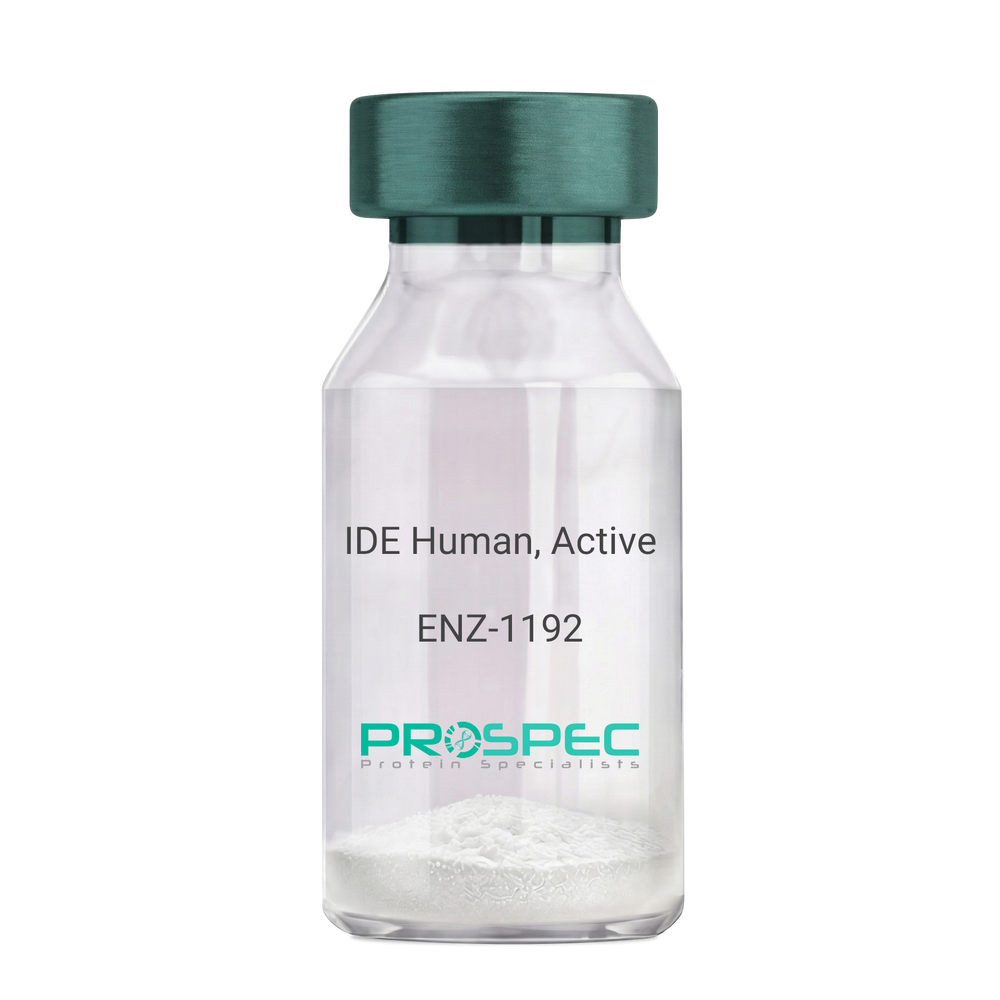
  • View Data Sheet

    Name :

    IDE Human, Active

    Description:

    Insulin-Degrading Enzyme Human Recombinant

    Insulin-Degrading Enzyme, Abeta-Degrading Protease, Insulysin, EC 3.4.24.56, Insulinase, Insulin Protease, INSULYSIN, EC 3.4.24, IDE, insulin-degrading enzyme isoform 1. 

    Product # :

    ENZ-1192

    Price :

    Quantity :

    Shipping Method :

    Ice Icon

    Shipped with Ice Packs

    Add To Cart

    More Info

    • description
    • source
    • formulation
    • purity
    • biological activity
    • More Info

    Description

    IDE Human, Active Human Recombinant produced in E.Coli is a single, non-glycosylated, polypeptide chain (42-1019 a.a) containing a total of 984 amino acids, having a molecular mass of 114 kDa. IDE is fused to a 6 amino acid His-tag at C-terminus and is purified by proprietary chromatographic techniques.

    Source

    Escherichia Coli.

    Formulation

    The IDE solution (0.5mg/ml) contains 10% Glycerol, 100mM NaCl, 0.05% Brij35 and 20mM Tris-HCl buffer (pH 7.5).

    Purity

    Greater than 90.0% as determined by SDS-PAGE.

    Biological Activity

    Specific activity is greater than 3,000 pmol/min/ug in which 1 unit will convert 1.0 pmole of Mca-RPPGFSAFK(Dnp)-OH to MCA-Pro-Leu-OH per minute at pH 7.5 at 25°C.

    More Info

    • Synonyms

      Insulin-Degrading Enzyme, Abeta-Degrading Protease, Insulysin, EC 3.4.24.56, Insulinase, Insulin Protease, INSULYSIN, EC 3.4.24, IDE, insulin-degrading enzyme isoform 1.

    • Physical Appearance

      Filtered colorless solution.

    • Stability

      Store at 4°C if entire vial will be used within 2-4 weeks. Store, frozen at -20°C for longer periods of time. For long term storage it is recommended to add a carrier protein (0.1% HSA or BSA). Avoid multiple freeze-thaw cycles.

    • Amino Acid Sequence

      MNNPAIKRIG NHITKSPEDK REYRGLELAN GIKVLLISDP TTDKSSAALD VHIGSLSDPP NIAGLSHFCE HMLFLGTKKY PKENEYSQFL SEHAGSSNAF TSGEHTNYYF DVSHEHLEGA LDRFAQFFLC PLFDESCKDR EVNAVDSEHE KNVMNDAWRL FQLEKATGNP KHPFSKFGTG NKYTLETRPN QEGIDVRQEL LKFHSAYYSS NLMAVCVLGR ESLDDLTNLV VKLFSEVENK NVPLPEFPEH PFQEEHLKQL YKIVPIKDIR NLYVTFPIPD LQKYYKSNPG HYLGHLIGHE GPGSLLSELK SKGWVNTLVG GQKEGARGFM FFIINVDLTE EGLLHVEDII LHMFQYIQKL RAEGPQEWVF QECKDLNAVA FRFKDKERPR GYTSKIAGIL HYYPLEEVLT AEYLLEEFRP DLIEMVLDKL RPENVRVAIV SKSFEGKTDR TEEWYGTQYK QEAIPDEVIK KWQNADLNGK FKLPTKNEFI PTNFEILPLE KEATPYPALI KDTAMSKLWF KQDDKFFLPK ACLNFEFFSP FAYVDPLHCN MAYLYLELLK DSLNEYAYAA ELAGLSYDLQ NTIYGMYLSV KGYNDKQPIL LKKIIEKMAT FEIDEKRFEI IKEAYMRSLN NFRAEQPHQH AMYYLRLLMT EVAWTKDELK EALDDVTLPR LKAFIPQLLS RLHIEALLHG NITKQAALGI MQMVEDTLIE HAHTKPLLPS
      QLVRYREVQL PDRGWFVYQQ RNEVHNNCGI EIYYQTDMQS TSENMFLELF CQIISEPCFN TLRTKEQLGY IVFSGPRRAN GIQGLRFIIQ SEKPPHYLES RVEAFLITME KSIEDMTEEA FQKHIQALAI RRLDKPKKLS AECAKYWGEI ISQQYNFDRD NTEVAYLKTL TKEDIIKFYK EMLAVDAPRR HKVSVHVLAR EMDSCPVVGE FPCQNDINLS QAPALPQPEV IQNMTEFKRG LPLFPLVKPH INFMAAKLHH HHHH.

    • Background

      Insulin-degrading enzyme (IDE) is a crucial protease that plays a significant role in maintaining glucose homeostasis by degrading insulin and other bioactive peptides. Dysregulation of IDE has been implicated in various metabolic disorders, particularly type 2 diabetes mellitus. IDE is also associated with the clearance of amyloid-beta peptides in the brain, making it relevant to Alzheimer's disease pathology. Studying the recombinant form of IDE is fundamental to understanding its functional mechanisms and exploring potential avenues for therapeutic interventions.

      The primary goal of this research is to express and purify recombinant IDE using diverse expression systems. Recombinant DNA techniques will be employed to construct expression vectors containing the IDE gene, followed by expression in bacterial, yeast, or mammalian cell-based systems. The recombinant IDE will be purified using affinity chromatography or other appropriate methods, facilitating subsequent biochemical and biophysical characterization.

      The second objective is to investigate the substrate specificity and catalytic activity of the purified IDE. In vitro enzymatic assays will be conducted to analyse the ability of the recombinant IDE to degrade insulin and other potential substrates. The effects of various factors, such as pH, temperature, and potential modulators, on IDE activity will be evaluated. Additionally, the interactions between IDE and its substrates will be explored using binding assays.

      The third objective is to elucidate the three-dimensional structure of the IDE recombinant using techniques like X-ray crystallography or nuclear magnetic resonance (NMR) spectroscopy. Structural insights into the active site and binding pockets of IDE will provide valuable information for understanding its substrate recognition and catalytic mechanisms. This knowledge could be instrumental in designing targeted therapeutic compounds.

      By characterizing the IDE recombinant, this research aims to contribute to our understanding of its role in insulin metabolism, glucose regulation, and potential therapeutic applications. The findings from this study may have implications for the development of novel treatments for diabetes and other related disorders.

    ProSpec's products are furnished for LABORATORY RESEARCH USE ONLY. The product may not be used as drugs, agricultural or pesticidal products, food additives or household chemicals.

    Ide Human Active
  • View Data Sheet

    Name :

    ADPRH Human

    Description:

    ADP-Ribosylarginine Hydrolase Human Recombinant

    [Protein ADP-ribosylarginine] hydrolase, ADP-ribosylarginine hydrolase, ADP-ribose-L-arginine cleaving enzyme, ADPRH, ARH1.

    Product # :

    ENZ-631

    Price :

    Quantity :

    Shipping Method :

    Ice Icon

    Shipped with Ice Packs

    Add To Cart

    More Info

    • description
    • source
    • formulation
    • purity
    • More Info

    Description

    ADPRH Human Recombinant produced in E.coli is a single, non-glycosylated polypeptide chain containing 381 amino acids (1-357) and having a molecular mass of 42.1kDa.ADPRH is fused to a 24 amino acid His-tag at N-terminus & purified by proprietary chromatographic techniques.

    Source

    E.coli.

    Formulation

    The ADPRH solution (0.5mg/ml) contains 20mM Tris-HCl buffer, pH8.0, 10% glycerol, 1mM DTT and 100mM NaCl.

    Purity

    Greater than 90% as determined by SDS-PAGE.

    More Info

    • Introduction

      ADP-ribosylarginine hydrolase (ADPRH) is a member of the ADP-ribosylglycohydrolase family. ADPRH catalyzes the removal of mono-ADP-ribose from arginine residues of proteins in the ADP-ribosylation cycle. The human ADPRH enzyme is DTT-independent as opposed to the rat and mouse enzymes, which require DTT for maximal activity.

    • Synonyms

      [Protein ADP-ribosylarginine] hydrolase, ADP-ribosylarginine hydrolase, ADP-ribose-L-arginine cleaving enzyme, ADPRH, ARH1.

    • Physical Appearance

      Sterile Filtered colorless solution.

    • Stability

      Store at 4°C if entire vial will be used within 2-4 weeks. Store, frozen at -20°C for longer periods of time. For long term storage it is recommended to add a carrier protein (0.1% HSA or BSA).Avoid multiple freeze-thaw cycles.

    • Amino Acid Sequence

      MGSSHHHHHH SSGLVPRGSH MGSHMEKYVA AMVLSAAGDA LGYYNGKWEF LQDGEKIHRQ LAQLGGLDAL DVGRWRVSDD TVMHLATAEA LVEAGKAPKL TQLYYLLAKH YQDCMEDMDG RAPGGASVHN AMQLKPGKPN GWRIPFNSHE GGCGAAMRAM CIGLRFPHHS QLDTLIQVSI ESGRMTHHHP TGYLGALASA LFTAYAVNSR PPLQWGKGLM ELLPEAKKYI VQSGYFVEEN LQHWSYFQTK WENYLKLRGI LDGESAPTFP ESFGVKERDQ FYTSLSYSGW GGSSGHDAPM IAYDAVLAAG DSWKELAHRA FFHGGDSDST AAIAGCWWGV MYGFKGVSPS NYEKLEYRNR
      LEETARALYS LGSKEDTVIS L.

    ProSpec's products are furnished for LABORATORY RESEARCH USE ONLY. The product may not be used as drugs, agricultural or pesticidal products, food additives or household chemicals.

    Adprh Human
  • View Data Sheet

    Name :

    NAPSA Human

    Description:

    Napsin A Aspartic Peptidase Human Recombinant

    Napsin A Aspartic Peptidase, NAP1, NAPA, Kidney-Derived Aspartic Protease-Like Protein, Aspartyl Protease 4, TA01/TA02, Napsin-1, SNAPA, Asp 4, ASP4, CTB-191K22.6, EC 3.4.23.15, Pronapsin A, EC 3.4.23.5, EC 3.4.23.3, EC 3.4.23.-, EC 3.4.23, Napsin-A, KDAP, KAP,Napsin-A.

    Product # :

    ENZ-841

    Price :

    Quantity :

    Shipping Method :

    Ice Icon

    Shipped with Ice Packs

    Add To Cart

    More Info

    • description
    • source
    • formulation
    • purity
    • More Info

    Description

    NAPSA Human Recombinant produced in E.Coli is a single, non-glycosylated polypeptide chain containing 380 amino acids (64-420 a.a) and having a molecular mass of 40.9kDa. NAPSA is fused to a 23 amino acid His-tag at N-terminus & purified by proprietary chromatographic techniques.

    Source

    Escherichia Coli.

    Formulation

    NAPSA protein solution (0.25mg/ml) containing 20mM Tris-HCl (pH8.0) and 10% glycerol.

    Purity

    Greater than 90.0% as determined by SDS-PAGE.

    More Info

    • Introduction

      Napsin A Aspartic Peptidase, also known as NAPSA is a member of the peptidase A1 family. NAPSA is involved in the processing of pneumocyte surfactant precursors. Furthermore the activation peptides of aspartic proteinases take part as inhibitors of the active site. These peptide segments/pro-parts are considered essential for correct folding, targeting, as well as control of the activation of aspartic proteinase zymogens. The pronapsin A gene is expressed mostly in lung and kidney. In addition, NAPSA translation product is expected to be a fully functional, glycosylated aspartic proteinase precursor which contains an RGD motif as well as an additional 18 residues at its C-terminus.

    • Synonyms

      Napsin A Aspartic Peptidase, NAP1, NAPA, Kidney-Derived Aspartic Protease-Like Protein, Aspartyl Protease 4, TA01/TA02, Napsin-1, SNAPA, Asp 4, ASP4, CTB-191K22.6, EC 3.4.23.15, Pronapsin A, EC 3.4.23.5, EC 3.4.23.3, EC 3.4.23.-, EC 3.4.23, Napsin-A, KDAP, KAP,Napsin-A.

    • Physical Appearance

      Sterile filtered colorless solution.

    • Stability

      Store at 4°C if entire vial will be used within 2-4 weeks. Store, frozen at -20°C for longer periods of time. For long term storage it is recommended to add a carrier protein (0.1% HSA or BSA).Avoid multiple freeze-thaw cycles.

    • Amino Acid Sequence

      MGSSHHHHHH SSGLVPRGSH MGSKPIFVPL SNYRDVQYFG EIGLGTPPQN FTVAFDTGSS NLWVPSRRCH FFSVPCWLHH RFDPKASSSF QANGTKFAIQ YGTGRVDGIL SEDKLTIGGI KGASVIFGEA LWEPSLVFAF AHFDGILGLG FPILSVEGVR PPMDVLVEQG LLDKPVFSFY LNRDPEEPDG GELVLGGSDP AHYIPPLTFV PVTVPAYWQI HMERVKVGPG LTLCAKGCAA ILDTGTSLIT GPTEEIRALH AAIGGIPLLA GEYIILCSEI PKLPAVSFLL GGVWFNLTAH DYVIQTTRNG VRLCLSGFQA LDVPPPAGPF WILGDVFLGT YVAVFDRGDM KSSARVGLAR ARTRGADLGW GETAQAQFPG.

    ProSpec's products are furnished for LABORATORY RESEARCH USE ONLY. The product may not be used as drugs, agricultural or pesticidal products, food additives or household chemicals.

    Napsa Human
  • View Data Sheet

    Name :

    TYMP Human

    Description:

    Thymidine Phosphorylase Human Recombinant

    Thymidine phosphorylase, Gliostatin, Platelet-derived endothelial cell growth factor, PD-ECGF, TdRPase, TYMP, ECGF1, TP, MNGIE, MEDPS1, MTDPS1, PDECGF, hPD-ECGF.

    Product # :

    ENZ-005

    Price :

    Quantity :

    Shipping Method :

    Ice Icon

    Shipped with Ice Packs

    Add To Cart

    More Info

    • description
    • source
    • formulation
    • purity
    • More Info

    Description

    TYMP Human Recombinant fused with a 21 amino acid His tag at N-terminus produced in E.Coli is a single, non-glycosylated, polypeptide chain containing 493 amino acids (11-482 a.a.) and having a molecular mass of 51.3kDa. The TYMP is purified by proprietary chromatographic techniques.

    Source

    Escherichia Coli.

    Formulation

    The TYMP solution (1mg/ml) contains 20mM Tris-HCl buffer (pH 8.0), 1mM DTT and 10% glycerol.

    Purity

    Greater than 90.0% as determined by SDS-PAGE.

    More Info

    • Introduction

      Thymidine phosphorylase precursor (TYMP) is a platelet-derived endothelial cell growth factor that catalyzes the formation of thymine and 2-deoxy-D-ribose-1-phosphate from thymidine and orthophosphate. TYMP is an angiogenic inducer that potently stimulates the growth of endothelial cells and induces chemotaxis. TYMP has a highly restricted target cell specificity acting only on endothelial cells. An increased expression of TYMP is found in a broad array of different solid tumors and inflammatory diseases and is frequently associated with poor prognosis. Mutations in the TYMP gene are linked to mitochondrial neurogastrointestinal encephalomyopathy.

    • Synonyms

      Thymidine phosphorylase, Gliostatin, Platelet-derived endothelial cell growth factor, PD-ECGF, TdRPase, TYMP, ECGF1, TP, MNGIE, MEDPS1, MTDPS1, PDECGF, hPD-ECGF.

    • Physical Appearance

      Sterile Filtered colorless solution.

    • Stability

      Store at 4°C if entire vial will be used within 2-4 weeks. Store, frozen at -20°C for longer periods of time. For long term storage it is recommended to add a carrier protein (0.1% HSA or BSA).Avoid multiple freeze-thaw cycles.

    • Amino Acid Sequence

      MGSSHHHHHH SSGLVPRGSH MAPPAPGDFS GEGSQGLPDP SPEPKQLPEL IRMKRDGGRL SEADIRGFVA AVVNGSAQGA QIGAMLMAIR LRGMDLEETS VLTQALAQSG QQLEWPEAWR QQLVDKHSTG GVGDKVSLVL APALAACGCK VPMISGRGLG HTGGTLDKLE SIPGFNVIQS PEQMQVLLDQ AGCCIVGQSE QLVPADGILY AARDVTATVD SLPLITASIL SKKLVEGLSA LVVDVKFGGA AVFPNQEQAR ELAKTLVGVG ASLGLRVAAA LTAMDKPLGR CVGHALEVEE ALLCMDGAGP PDLRDLVTTL GGALLWLSGH AGTQAQGAAR VAAALDDGSA LGRFERMLAA QGVDPGLARA LCSGSPAERR QLLPRAREQE ELLAPADGTV ELVRALPLAL VLHELGAGRS RAGEPLRLGV GAELLVDVGQ RLRRGTPWLR VHRDGPALSG PQSRALQEAL VLSDRAPFAA PSPFAELVLP PQQ.

    ProSpec's products are furnished for LABORATORY RESEARCH USE ONLY. The product may not be used as drugs, agricultural or pesticidal products, food additives or household chemicals.

    Tymp Human
  • View Data Sheet

    Name :

    ACOT8 Human

    Description:

    Acyl-CoA Thioesterase 8 Human Recombinant

    Acyl-coenzyme A thioesterase 8, hACTE-III, HNAACTE, the, PTE-1, PTE-2, PTE1, PTE2, Acyl-CoA thioesterase 8, Choloyl-coenzyme A thioesterase, HIV-Nef-associated acyl-CoA thioesterase, PTE-2, Peroxisomal acyl-coenzyme A thioester hydrolase 1, Peroxisomal long-chain acyl-CoA thioesterase 1 Thioesterase II, ACTEIII, hACTEIII, the, ACOT8.

    Product # :

    ENZ-712

    Price :

    Quantity :

    Shipping Method :

    Ice Icon

    Shipped with Ice Packs

    Add To Cart

    More Info

    • description
    • source
    • formulation
    • purity
    • More Info

    Description

    ACOT8 Human Recombinant produced in E.coli is a single, non-glycosylated polypeptide chain containing 342 amino acids (1-319) and having a molecular mass of 38.3kDa. ACOT8 is fused to a 23 amino acid His-tag at N-terminus & purified by proprietary chromatographic techniques.

    Source

    Escherichia Coli.

    Formulation

    The ACOT8 solution (0.5mg/ml) contains 20mM Tris-HCl buffer (pH 8.0), 0.2M NaCl, 40% glycerol and 2mM DTT.

    Purity

    Greater than 95.0% as determined by SDS-PAGE.

    More Info

    • Introduction

      Acyl-CoA Thioesterase 8 (ACOT8) is a group of enzymes which catalyze the hydrolysis of acyl-CoAs to the free fatty acid and coenzyme A (CoASH), granting the potential to regulate intracellular levels of acyl-CoAs, free fatty acids and CoASH. ACOT8 mediate Nef-induced down-regulation of CD4. ACOT8 contends with BAAT (Bile acid CoA: amino acid N-acyltransferase) for bile acid-CoA substrate (such as chenodeoxycholoyl-CoA). ACOT8 prefers medium-length fatty acyl-CoAs.

    • Synonyms

      Acyl-coenzyme A thioesterase 8, hACTE-III, HNAACTE, the, PTE-1, PTE-2, PTE1, PTE2, Acyl-CoA thioesterase 8, Choloyl-coenzyme A thioesterase, HIV-Nef-associated acyl-CoA thioesterase, PTE-2, Peroxisomal acyl-coenzyme A thioester hydrolase 1, Peroxisomal long-chain acyl-CoA thioesterase 1 Thioesterase II, ACTEIII, hACTEIII, the, ACOT8.

    • Physical Appearance

      Sterile Filtered colorless solution.

    • Stability

      Store at 4°C if entire vial will be used within 2-4 weeks. Store, frozen at -20°C for longer periods of time. For long term storage it is recommended to add a carrier protein (0.1% HSA or BSA).Avoid multiple freeze-thaw cycles.

    • Amino Acid Sequence

      MGSSHHHHHH SSGLVPRGSH MGSMSSPQAP EDGQGCGDRG DPPGDLRSVL VTTVLNLEPL DEDLFRGRHY WVPAKRLFGG QIVGQALVAA AKSVSEDVHV HSLHCYFVRA GDPKLPVLYQ VERTRTGSSF SVRSVKAVQH GKPIFICQAS FQQAQPSPMQ HQFSMPTVPP PEELLDCETL IDQYLRDPNL QKRYPLALNR IAAQEVPIEI KPVNPSPLSQ LQRMEPKQMF WVRARGYIGE GDMKMHCCVA AYISDYAFLG TALLPHQWQH KVHFMVSLDH SMWFHAPFRA DHWMLYECES PWAGGSRGLV HGRLWRQDGV LAVTCAQEGV IRVKPQVSES KL.

    ProSpec's products are furnished for LABORATORY RESEARCH USE ONLY. The product may not be used as drugs, agricultural or pesticidal products, food additives or household chemicals.

    Acot8 Human
  • View Data Sheet

    Name :

    ACY3 Human

    Description:

    AminoAcylase-3 Human Recombinant

    Aspartoacylase-2, Acylase III, Aminoacylase-3, ACY-3, Hepatitis C virus core-binding protein 1, HCBP1, ACY3, ASPA2.

    Product # :

    ENZ-153

    Price :

    Quantity :

    Shipping Method :

    Ice Icon

    Shipped with Ice Packs

    Add To Cart

    More Info

    • description
    • source
    • formulation
    • purity
    • More Info

    Description

    ACY3 Human Recombinant produced in E.Coli is a single, non-glycosylated polypeptide chain containing 342 amino acids (1-319 a.a.) and having a molecular mass of 37.6kDa.ACY3 is fused to a 23 amino acid His-tag at N-terminus & purified by proprietary chromatographic techniques.

    Source

    Escherichia Coli.

    Formulation

    ACY3 protein solution (0.5mg/ml) containing 20mM Tris-HCl buffer (pH 8.0), 1mM DTT, 10% glycerol and 0.1M NaCl.

    Purity

    Greater than 90% as determined by SDS-PAGE.

    More Info

    • Introduction

      Aspartoacylase 3 (ACY3) belongs to the Aspartoacylase subfamily. ACY3 has a vital role in deacetylating mercapturic acids in kidney proximal tubules. Aspartoacylase 3 localizes to the cytoplasm of S2 and S3 proximal tubules and also to the apical domain of S1 proximal tubules. In addition, ACY3 protein is expressed at low levels in the stomach, testis, heart, brain, lung and liver, and can function as an HCV (Hepatitis C virus) core binding protein.

    • Synonyms

      Aspartoacylase-2, Acylase III, Aminoacylase-3, ACY-3, Hepatitis C virus core-binding protein 1, HCBP1, ACY3, ASPA2.

    • Physical Appearance

      Sterile Filtered clear solution.

    • Stability

      Store at 4°C if entire vial will be used within 2-4 weeks. Store, frozen at -20°C for longer periods of time. For long term storage it is recommended to add a carrier protein (0.1% HSA or BSA).Avoid multiple freeze-thaw cycles.

    • Amino Acid Sequence

      MGSSHHHHHH SSGLVPRGSH MGSMCSLPVP REPLRRVAVT GGTHGNEMSG VYLARHWLHA PAELQRASFS AVPVLANPAA TSGCRRYVDHDLNRTFTSSF LNSRPTPDDP YEVTRARELN QLLGPKASGQ AFDFVLDLHN TTANMGTCLI AKSSHEVFAM HLCRHLQLQY PELSCQVFLY QRSGEESYNL DSVAKNGLGL ELGPQPQGVL RADIFSRMRT LVATVLDFIE LFNQGTAFPA FEMEAYRPVG VVDFPRTEAG HLAGTVHPQL QDRDFQPLQP GAPIFQMFSG EDLLYEGEST VYPVFINEAA YYEKGVAFVQ TEKFTFTVPA MPALTPAPSP AS.

    ProSpec's products are furnished for LABORATORY RESEARCH USE ONLY. The product may not be used as drugs, agricultural or pesticidal products, food additives or household chemicals.

    Acy3 Human
  • View Data Sheet

    Name :

    Fumarase Human

    Description:

    Fumarate Hydratase Human Recombinant

    MCL, LRCC, HLRCC, MCUL1, FH, Fumarate hydratase, Fumarase.

    Product # :

    ENZ-395

    Price :

    Quantity :

    Shipping Method :

    Ice Icon

    Shipped with Ice Packs

    Add To Cart

    More Info

    • description
    • source
    • formulation
    • purity
    • biological activity
    • More Info

    Description

    Fumarase Human Recombinant produced in E.Coli is a single, non-glycosylated polypeptide chain containing 467 amino acids (44-510) and having a molecular mass of 50.2 kDa. Fumarate Hydratase is purified by proprietary chromatographic techniques.

    Source

    Escherichia Coli.

    Formulation

    The Fumarase protein solution (1mg/ml) contains 20mM Tris-HCl, pH-8.

    Purity

    Greater than 95.0% as determined by SDS-PAGE.

    Biological Activity

    Specific activity is > 25 unit/mg, and is defined as the amount of enzyme that cleaves 1umole of L-Malate to Fumarate per minute at pH 7.5 at 37°C.

    More Info

    • Introduction

      Fumarase is an enzymatic factor of Krebs cycle, which catalyzes the formation of L-malate from fumarate. Fumarase exists in both a cytosolic form and an N-terminal extended form, differing only in the translation start site used. The N-terminal extended form is aimed to the mitochondrion, where the removal of the extension results in the same form as in the cytoplasm. Fumarase is similar to a number of thermostable Class-2 fumarases and functions as a homotetramer. Mutations in the Fumarase gene causes fumarase deficiency and leads to progressive encephalopathy, cerebral atrophy and developmental delay. Fumarase enzyme is also thought to act as a tumor suppressor. Leydig cell tumors are caused by Fumarase mutations and represents one of the first reports of germline mutations in any type of adult testicular tumor.

    • Synonyms

      MCL, LRCC, HLRCC, MCUL1, FH, Fumarate hydratase, Fumarase.

    • Physical Appearance

      Sterile filtered colorless solution.

    • Stability

      Store at 4°C if entire vial will be used within 2-4 weeks. Store, frozen at -20°C for longer periods of time. For long term storage it is recommended to add a carrier protein (0.1% HSA or BSA). Avoid multiple freeze-thaw cycles.

    • Amino Acid Sequence

      MASQNSFRIE YDTFGELKVP NDKYYGAQTV RSTMNFKIGG VTERMPTPVI KAFGILKRAA AEVNQDYGLD PKIANAIMKA ADEVAEGKLN DHFPLVVWQT GSGTQTNMNV NEVISNRAIE MLGGELGSKI PVHPNDHVNK SQSSNDTFPT AMHIAAAIEV HEVLLPGLQK LHDALDAKSK EFAQIIKIGR THTQDAVPLT LGQEFSGYVQ QVKYAMTRIK AAMPRIYELA AGGTAVGTGL NTRIGFAEKV AAKVAALTGL PFVTAPNKFE ALAAHDALVE LSGAMNTTAC SLMKIANDIR FLGSGPRSGL GELILPENEP GSSIMPGKVN PTQCEAMTMV AAQVMGNHVA VTVGGSNGHF ELNVFKPMMI KNVLHSARLL GDASVSFTEN CVVGIQANTE RINKLMNESL MLVTALNPHI GYDKAAKIAK TAHKNGSTLK ETAIELGYLT AEQFDEWVKP KDMLGPK.

    ProSpec's products are furnished for LABORATORY RESEARCH USE ONLY. The product may not be used as drugs, agricultural or pesticidal products, food additives or household chemicals.

    Fumarase Human
  • View Data Sheet

    Name :

    NDUFB4 Human

    Description:

    NADH Dehydrogenase 1 Beta Subcomplex 4 Human Recombinant

    B15, CI-B15, Complex I-B15, NADH dehydrogenase [ubiquinone] 1 beta subcomplex subunit 4, NADH-ubiquinone oxidoreductase B15 subunit.

    Product # :

    ENZ-699

    Price :

    Quantity :

    Shipping Method :

    Ice Icon

    Shipped with Ice Packs

    Add To Cart

    More Info

    • description
    • source
    • formulation
    • purity
    • More Info

    Description

    NDUFB4 Human Recombinant produced in E.coli is a single, non-glycosylated polypeptide chain containing 110 amino acids (1-87) and having a molecular mass of 12.6kDa.NDUFB4 is fused to a 23 amino acid His-tag at N-terminus & purified by proprietary chromatographic techniques.

    Source

    E.Coli

    Formulation

    The NDUFB4 solution (1mg/ml) contains 20mM Tris-HCl buffer, (pH 8.0), 0.4M Urea And 10% glycerol.

    Purity

    Greater than 90% as determined by SDS-PAGE.

    More Info

    • Introduction

      NADH Dehydrogenase 1 Beta Subcomplex 4 (NDUFB4) is a member of the complex I NDUFB4 subunit family. NDUFB4 is a non-catalytic subunit of the multisubunit NADH:ubiquinone oxidoreductase, which is the first enzyme complex in the mitochondrial electron transport chain (complex I). Mammalian complex I is comprised of 45 different subunits and transfers electrons from NADH to ubiquinone.

    • Synonyms

      B15, CI-B15, Complex I-B15, NADH dehydrogenase [ubiquinone] 1 beta subcomplex subunit 4, NADH-ubiquinone oxidoreductase B15 subunit.

    • Physical Appearance

      Sterile Filtered colorless solution.

    • Stability

      Store at 4°C if entire vial will be used within 2-4 weeks. Store, frozen at -20°C for longer periods of time. For long term storage it is recommended to add a carrier protein (0.1% HSA or BSA).Avoid multiple freeze-thaw cycles.

    • Amino Acid Sequence

      MGSSHHHHHH SSGLVPRGSH MGSMSFPKYK PSSLRTLPET LDPAEYNISP ETRRAQAERL AIRAQLKREY LLQYNDPNRR GLIENPALLR WAYARTINVY PNFRPTPKNS.

    ProSpec's products are furnished for LABORATORY RESEARCH USE ONLY. The product may not be used as drugs, agricultural or pesticidal products, food additives or household chemicals.

    Ndufb4 Human
  • View Data Sheet

    Name :

    MAT2B Human

    Description:

    Methionine Adenosyltransferase II Beta Human Recombinant

    MAT2-beta, MAT-2B, MAT2-B, DTDP-4-keto-6-deoxy-D-glucose 4-reductase, MAT-II, MATIIbeta, MAT II beta, Methionine adenosyltransferase 2 subunit beta, Methionine adenosyltransferase II beta, MGC12237, MSTP045, Nbla02999, SDR23E1, TGR, UNQ2435/PRO4995, MAT2B.

    Product # :

    ENZ-461

    Price :

    Quantity :

    Shipping Method :

    Ice Icon

    Shipped with Ice Packs

    Add To Cart

    More Info

    • description
    • source
    • formulation
    • purity
    • More Info

    Description

    Recombinant Human MAT2B produced in E.Coli is a single, non-glycosylated polypeptide chain containing 323 amino acids (1-323 a.a) and having a molecular mass of 36.4 kDa. MAT2B is is purified by conventional chromatography techniques.

    Source

    Escherichia Coli.

    Formulation

    The MAT2B protein solution contains 20mM Tris-HCl, pH-8, 1mM DTT, 1mM EDTA and 10% Glycerol.

    Purity

    Greater than 90.0% as determined by SDS-PAGE.

    More Info

    • Introduction

      MAT2B is part of the methionine adenosyltransferase family. MAT2B catalyzes the biosynthesis of S-adenosylmethionine from methionine and ATP. MAT2B is the regulatory beta subunit of MAT. MAT2B expression in hepatoma cell lines increases DNA synthesis and thus take part in cell proliferation.

    • Synonyms

      MAT2-beta, MAT-2B, MAT2-B, DTDP-4-keto-6-deoxy-D-glucose 4-reductase, MAT-II, MATIIbeta, MAT II beta, Methionine adenosyltransferase 2 subunit beta, Methionine adenosyltransferase II beta, MGC12237, MSTP045, Nbla02999, SDR23E1, TGR, UNQ2435/PRO4995, MAT2B.

    • Physical Appearance

      Sterile filtered colorless solution.

    • Stability

      Store at 4°C if entire vial will be used within 2-4 weeks. Store, frozen at -20°C for longer periods of time. For long term storage it is recommended to add a carrier protein (0.1% HSA or BSA). Avoid multiple freeze-thaw cycles.

    • Amino Acid Sequence

      MPEMPEDMEQ EEVNIPNRRV LVTGATGLLG RAVHKEFQQN NWHAVGCGFR RARPKFEQVN LLDSNAVHHI IHDFQPHVIV HCAAERRPDV VENQPDAASQ LNVDASGNLA KEAAAVGAFL IYISSDYVFD GTNPPYREED IPAPLNLYGK TKLDGEKAVL ENNLGAAVLR IPILYGEVEK LEESAVTVMF DKVQFSNKSA NMDHWQQRFP THVKDVATVC RQLAEKRMLD PSIKGTFHWS GNEQMTKYEM ACAIADAFNL PSSHLRPITD SPVLGAQRPR NTQLDCSKLE TLGIGQRTPF RIGIKESLWP FLIDKRWRQT VFH.

    ProSpec's products are furnished for LABORATORY RESEARCH USE ONLY. The product may not be used as drugs, agricultural or pesticidal products, food additives or household chemicals.

    Mat2B Human
  • View Data Sheet

    Name :

    phrB E.Coli

    Description:

    Deoxyribodipyrimidine photo-lyase E.Coli Recombinant

    800x600 ECK0697, JW0698, phrB, phr, Deoxyribodipyrimidine photo-lyase, DNA photolyase, Photoreactivating enzyme, EC=4.1.99.3, b0708. Normal 0 false false false EN-US X-NONE HE MicrosoftInternetExplorer4 /* Style Definitions */ table.MsoNormalTable {mso-style-name:"Table Normal"; mso-tstyle-rowband-size:0; mso-tstyle-colband-size:0; mso-style-noshow:yes; mso-style-priority:99; mso-style-parent:""; mso-padding-alt:0cm 5.4pt 0cm 5.4pt; mso-para-margin:0cm; mso-para-margin-bottom:.0001pt; mso-pagination:widow-orphan; font-size:10.0pt; font-family:"Calibri","sans-serif";}

    Product # :

    ENZ-362

    Price :

    Quantity :

    Shipping Method :

    Ice Icon

    Shipped with Ice Packs

    Add To Cart

    More Info

    • description
    • source
    • formulation
    • purity
    • More Info

    Description

    800x600 800x600 phrB E.Coli Recombinant produced in E.coli is a single, non-glycosylated polypeptide chain containing 495 amino acids (1-472) and having a molecular mass of 56.1kDa.phrB is fused to a 23 amino acid His-tag at N-terminus & purified by proprietary chromatographic techniques.

    Source

    Escherichia Coli.

    Formulation

    The phrB solution (0.25mg/ml) contains 20mM Tris-HCl buffer (pH 8.0), 0.2M NaCl, 50% glycerol and 1mM DTT.

    Purity

    Greater than 90% as determined by SDS-PAGE.

    More Info

    • Introduction

      Deoxyribodipyrimidine photo-lyase (phrB) is a member of the DNA photolyase class-1 family. phrB takes part in repair of UV radiation-inducedDNA damage. phrB catalyzes the light-dependent monomerization (300-600 nm) of cyclobutyl pyrimidinedimers (in cis-syn configuration), which are formed between closest bases on the same DNA strand uponexposure to ultraviolet radiation.

    • Synonyms

      ECK0697, JW0698, phrB, phr, Deoxyribodipyrimidine photo-lyase, DNA photolyase, Photoreactivating enzyme, EC=4.1.99.3, b0708.

    • Physical Appearance

      Sterile Filtered clear solution.

    • Stability

      Store at 4°C if entire vial will be used within 2-4 weeks. Store, frozen at -20°C for longer periods of time.For long term storage it is recommended to add a carrier protein (0.1% HSA or BSA).Please avoid freeze thaw cycles.

    • Amino Acid Sequence

      MGSSHHHHHH SSGLVPRGSH MGSMTTHLVW FRQDLRLHDN LALAAACRNS SARVLALYIA TPRQWATHNM SPRQAELINA QLNGLQIALA EKGIPLLFRE VDDFVASVEI VKQVCAENSV THLFYNYQYE VNERARDVEV ERALRNVVCE GFDDSVILPP GAVMTGNHEM YKVFTPFKNA WLKRLREGMP ECVAAPKVRS SGSIEPSPSI TLNYPRQSFD TAHFPVEEKA AIAQLRQFCQ NGAGEYEQQR DFPAVEGTSR LSASLATGGL SPRQCLHRLL AEQPQALDGG AGSVWLNELI WREFYRHLIT YHPSLCKHRP FIAWTDRVQW QSNPAHLQAW QEGKTGYPIV DAAMRQLNST GWMHNRLRMI TASFLVKDLL IDWREGERYF MSQLIDGDLA ANNGGWQWAA STGTDAAPYF RIFNPTTQGE KFDHEGEFIR QWLPELRDVP GKVVHEPWKW AQKAGVTLDY PQPIVEHKEA RVQTLAAYEA ARKGK.

    ProSpec's products are furnished for LABORATORY RESEARCH USE ONLY. The product may not be used as drugs, agricultural or pesticidal products, food additives or household chemicals.

    Phrb Ecoli
  • 1
  • …
  • 16
  • 17
  • 18
  • 19
  • 20
  • …
  • 42
Your browser does not support the video tag.

Products

  • Cytokines
  • Growth Factors
  • Chemokines
  • CD Antigens
  • Neurotrophins
  • Hormones
  • Enzymes
  • Viral Antigens
  • Recombinant Proteins
  • Natural Proteins
  • Monoclonal Antibodies
  • Polyclonal Antibodies
  • Thermal Packaging

About

  • Company
  • Founder
  • Contribution
  • Contact Us
  • My Account

Ordering

  • Ordering Method
  • Ordering - Credit Card
  • Ordering PO
  • Shipping Fees
  • FAQ's

Legal

  • Terms & Conditions
  • Privacy
  • Site Map
  • info@prospecbio.com
  • Facebook
  • Instagram
  • Linkedin Profile

© 2026 ProSpec-Tany TechnoGene Ltd. All Rights Reserved.

  • Choosing a selection results in a full page refresh.
  • Opens in a new window.