Search results
503 results found for “MAF”
Name
Description
Product #
Price
Quantity
Shipping Method
- View Data Sheet
Name :
GATC HumanDescription:
Glutamyl-TRNA Amidotransferase, Subunit C Human Recombinant
Glutamyl-TRNA(Gln) Amidotransferase Subunit C, Glu-AdT Subunit C, 15E1.2, Glutamyl-TRNA(Gln) Amidotransferase Subunit C Homolog (Bacterial), Glutamyl-TRNA(Gln) Amidotransferase Subunit C Mitochondrial, Glutamyl-TRNA(Gln) Amidotransferase Subunit C Homolog, EC 6.3.5, Protein 15E1.2.
Product # :
ENZ-722Price :
Quantity :
Shipping Method :
Shipped with Ice Packs
More Info
- description
- source
- formulation
- purity
- More Info
Description
GATC Human Recombinant produced in E.Coli is a single, non-glycosylated polypeptide chain containing 159 amino acids (1-136 a.a) and having a molecular mass of 17.5kDa (Molecular size on SDS-PAGE will appear higher).GATC is fused to a 23 amino acid His-tag at N-terminus & purified by proprietary chromatographic techniques.
Source
Escherichia Coli.
Formulation
GATC protein solution (0.25mg/ml) containing 20mM Tris-HCl buffer (pH 8.0), 0.15M NaCl, 30% glycerol and 1mM DTT.
Purity
Greater than 85.0% as determined by SDS-PAGE.
More Info
-
Introduction
Glutamyl-TRNA Amidotransferase, Subunit C also known as GATC allows the formation of properly charged Gln-tRNA(Gln) through the transamidation of misacylated Glu-tRNA(Gln) in the mitochondria. The reaction occurs in the attendance of glutamine and ATP through an activated gamma-phospho-Glu-tRNA(Gln). In addition, GATC is subunit of the heterotrimeric GatCAB amidotransferase (AdT) complex, composed of A (QRSL1), B (PET112) and C (GATC) subunits.
-
Synonyms
Glutamyl-TRNA(Gln) Amidotransferase Subunit C, Glu-AdT Subunit C, 15E1.2, Glutamyl-TRNA(Gln) Amidotransferase Subunit C Homolog (Bacterial), Glutamyl-TRNA(Gln) Amidotransferase Subunit C Mitochondrial, Glutamyl-TRNA(Gln) Amidotransferase Subunit C Homolog, EC 6.3.5, Protein 15E1.2.
-
Physical Appearance
Sterile Filtered clear solution.
-
Stability
Store at 4°C if entire vial will be used within 2-4 weeks. Store, frozen at -20°C for longer periods of time. For long term storage it is recommended to add a carrier protein (0.1% HSA or BSA).Avoid multiple freeze-thaw cycles.
-
Amino Acid Sequence
MGSSHHHHHH SSGLVPRGSH MGSMWSRLVW LGLRAPLGGR QGFTSKADPQ GSGRITAAVI EHLERLALVD FGSREAVARL EKAIAFADRL RAVDTDGVEP MESVLEDRCL YLRSDNVVEG NCADELLQNS HRVVEEYFVA PPGNISLPKL DEQEPFPHS
ProSpec's products are furnished for LABORATORY RESEARCH USE ONLY. The product may not be used as drugs, agricultural or pesticidal products, food additives or household chemicals.
- View Data Sheet
Name :
MAGEA8 HumanDescription:
Melanoma Antigen Family A, 8 Human Recombinant
Melanoma Antigen Family A8, MAGE-8 Antigen, MAGE8, Cancer/Testis Antigen 1.8, CT1.8, Cancer/Testis Antigen Family 1, Member 8, Cancer/Testis Antigen Family 1, Melanoma-Associated Antigen 8, Melanoma Antigen Family A, 8, Member 8, MAGEA8.
Product # :
PRO-2206Price :
Quantity :
Shipping Method :
Shipped with Ice Packs
More Info
- description
- source
- formulation
- purity
- More Info
Description
MAGEA8 Human Recombinant produced in E.Coli is a single, non-glycosylated polypeptide chain containing 341 amino acids (1-318 a.a) and having a molecular mass of 37.6kDa.MAGEA8 is fused to a 23 amino acid His-tag at N-terminus & purified by proprietary chromatographic techniques.
Source
Escherichia Coli.
Formulation
MAGEA8 protein solution (0.25mg/ml) containing Phosphate Buffered Saline, 10% glycerol and 1mM DTT.
Purity
Greater than 85% as determined by SDS-PAGE.
More Info
-
Introduction
Melanoma Antigen Family A 8, also known as MAGEA8 belongs to the MAGE gene family, which includes twelve known genes, of which six are expressed in tumors. Furthermore, the MAGE genes were at first isolated from different kinds of tumors, and according to their virtually exclusive tumor-specific expression in adult tissues, they have been used as targets for cancer immunotherapy.
-
Synonyms
Melanoma Antigen Family A8, MAGE-8 Antigen, MAGE8, Cancer/Testis Antigen 1.8, CT1.8, Cancer/Testis Antigen Family 1, Member 8, Cancer/Testis Antigen Family 1, Melanoma-Associated Antigen 8, Melanoma Antigen Family A, 8, Member 8, MAGEA8.
-
Physical Appearance
Sterile Filtered clear solution.
-
Stability
Store at 4°C if entire vial will be used within 2-4 weeks.Store, frozen at -20°C for longer periods of time. For long term storage it is recommended to add a carrier protein (0.1% HSA or BSA).Avoid multiple freeze-thaw cycles.
-
Amino Acid Sequence
MGSSHHHHHH SSGLVPRGSH MGSMLLGQKS QRYKAEEGLQ AQGEAPGLMD VQIPTAEEQK AASSSSTLIM GTLEEVTDSG SPSPPQSPEG ASSSLTVTDS TLWSQSDEGS SSNEEEGPST SPDPAHLESL FREALDEKVA ELVRFLLRKY QIKEPVTKAE MLESVIKNYK NHFPDIFSKA SECMQVIFGI DVKEVDPAGH SYILVTCLGL SYDGLLGDDQ STPKTGLLII VLGMILMEGS RAPEEAIWEA LSVMGLYDGR EHSVYWKLRK LLTQEWVQEN YLEYRQAPGS DPVRYEFLWG PRALAETSYV KVLEHVVRVN ARVRISYPSL HEEALGEEKG V.
ProSpec's products are furnished for LABORATORY RESEARCH USE ONLY. The product may not be used as drugs, agricultural or pesticidal products, food additives or household chemicals.
- View Data Sheet
Name :
MAP2K1 HumanDescription:
Mitogen-Activated Protein Kinase Kinase 1 Human Recombinant
MAP2K1, MEK1, PRKMK1, MKK1, MAPKK 1, MAP kinase kinase 1.
Product # :
PKA-112Price :
Quantity :
Shipping Method :
Shipped with Ice Packs
More Info
- description
- source
- formulation
- purity
- More Info
Description
MAP2K1 produced in Sf9 Baculovirus cells is a single, glycosylated polypeptide chain containing 402 amino acids (1-393a.a.) and having a molecular mass of 44.5kDa. (Molecular size on SDS-PAGE will appear at approximately 40-57kDa).MAP2K1 is expressed with a 6 amino acid His tag at C-Terminus and purified by proprietary chromatographic techniques.
Source
Sf9, Baculovirus cells.
Formulation
MAP2K1 protein solution (0.25mg/ml) contains 10% glycerol & Phosphate Buffered Saline (pH 7.4).
Purity
Greater than 90.0% as determined by SDS-PAGE.
More Info
-
Introduction
The MAP2K1 protein is encoded by the MAP2K1 gene. This enzyme serves as a MAP (mitogen activated protein) kinase, it is a part of the dual specificity protein kinase family. Extracellular signal-regulated kinases such as MAP kinases has an important role in assimilation of various biochemical signals. MAP2K1 is located upstream to the MAP kinases and activates them by multiple intra and extracellular signals. The enzyme serves as a key factor in the signal transduction pathway of MAP kinase, therefore it takes part in the cell development (transcription regulation, proliferation, differentiation etc.).
-
Synonyms
MAP2K1, MEK1, PRKMK1, MKK1, MAPKK 1, MAP kinase kinase 1.
-
Physical Appearance
Sterile filtered colorless solution.
-
Stability
Store at 4°C if entire vial will be used within 2-4 weeks. Store, frozen at -20°C for longer periods of time. For long term storage it is recommended to add a carrier protein (0.1% HSA or BSA).Avoid multiple freeze-thaw cycles.
-
Amino Acid Sequence
ADPMPKKKPT PIQLNPAPDG SAVNGTSSAE TNLEALQKKL EELELDEQQR KRLEAFLTQK QKVGELKDDD FEKISELGAG NGGVVFKVSH KPSGLVMARK LIHLEIKPAI RNQIIRELQV LHECNSPYIV GFYGAFYSDG EISICMEHMD GGSLDQVLKK AGRIPEQILG KVSIAVIKGL TYLREKHKIM HRDVKPSNIL VNSRGEIKLC DFGVSGQLID SMANSFVGTR SYMSPERLQG THYSVQSDIW SMGLSLVEMA VGRYPIPPPD AKELELMFGC QVEGDAAETP PRPRTPGRPL SSYGMDSRPP MAIFELLDYI VNEPPPKLPS GVFSLEFQDF VNKCLIKNPA ERADLKQLMV HAFIKRSDAE EVDFAGWLCS TIGLNQPSTP THAAGVHHHH HH.
ProSpec's products are furnished for LABORATORY RESEARCH USE ONLY. The product may not be used as drugs, agricultural or pesticidal products, food additives or household chemicals.
- View Data Sheet
Name :
MAP2K6 HumanDescription:
Mitogen-Activated Protein Kinase Kinase 6 Human Recombinant
Mitogen-Activated Protein Kinase Kinase 6, PRKMK6, MEK6, MKK6, Stress-Activated Protein Kinase Kinase 3,MAPK/ERK Kinase 6, SAPK Kinase 3, EC 2.7.12.2, MAPKK, SAPKK, SAPKK3, MEK 6, Protein Kinase, Mitogen-Activated, Kinase 6 (MAP Kinase Kinase 6), Dual Specificity Mitogen-Activated Protein Kinase Kinase 6, Kinase 6 (MAP Kinase Kinase 6), MAP Kinase Kinase 6,Mitogen-Activated, Protein Kinase, SKK3.
Product # :
PKA-073Price :
Quantity :
Shipping Method :
Shipped with Ice Packs
More Info
- description
- source
- formulation
- purity
- More Info
Description
MAP2K6 Human Recombinant produced in E.Coli is a single, non-glycosylated polypeptide chain containing 283 amino acids (53-314 a.a) and having a molecular mass of 32kDa.MAP2K6 is fused to a 21 amino acid His-tag at N-terminus & purified by proprietary chromatographic techniques.
Source
Escherichia Coli.
Formulation
MAP2K6 protein solution (0.25mg/ml) containing 20mM Tris-HCl (pH8.0) and 10% glycerol.
Purity
Greater than 85.0% as determined by SDS-PAGE.
More Info
-
Introduction
Mitogen-Activated Protein Kinase 6 (MAP2K6) is a part of the dual specificity protein kinase family. MAP2K6 phosphorylates and activates p38 MAP kinase in response to inflammatory cytokines or environmental stress. MAP2K6 is a vital component of the MAP kinase signal transduction pathway. MAP2K6 takes part in various cellular processes such as stress induced cell cycle arrest and apoptosis.
-
Synonyms
Mitogen-Activated Protein Kinase Kinase 6, PRKMK6, MEK6, MKK6, Stress-Activated Protein Kinase Kinase 3,MAPK/ERK Kinase 6, SAPK Kinase 3, EC 2.7.12.2, MAPKK, SAPKK, SAPKK3, MEK 6, Protein Kinase, Mitogen-Activated, Kinase 6 (MAP Kinase Kinase 6), Dual Specificity Mitogen-Activated Protein Kinase Kinase 6, Kinase 6 (MAP Kinase Kinase 6), MAP Kinase Kinase 6,Mitogen-Activated, Protein Kinase, SKK3.
-
Physical Appearance
Sterile Filtered clear solution.
-
Stability
Store at 4°C if entire vial will be used within 2-4 weeks. Store, frozen at -20°C for longer periods of time. For long term storage it is recommended to add a carrier protein (0.1% HSA or BSA).Avoid multiple freeze-thaw cycles.
-
Amino Acid Sequence
MGSSHHHHHH SSGLVPRGSH MLEPIMELGR GAYGVVEKMR HVPSGQIMAV KRIRATVNSQ EQKRLLMDLD ISMRTVDCPF TVTFYGALFR EGDVWICMEL MDTSLDKFYK QVIDKGQTIP EDILGKIAVS IVKALEHLHS KLSVIHRDVK PSNVLINALG QVKMCDFGIS GYLVDEVAKE IDAGCKPYMA PERINPELNQ KGYSVKSDIW SLGITMIELA ILRFPYDSWG TPFQQLKQVV EEPSPQLPAD KFSAEFVDFT SQCLKKNSKE RPTYPELMQH PFF.
ProSpec's products are furnished for LABORATORY RESEARCH USE ONLY. The product may not be used as drugs, agricultural or pesticidal products, food additives or household chemicals.
- View Data Sheet
Name :
MAD2L1 HumanDescription:
MAD2 Mitotic Arrest Deficient-Like 1 Human Recombinant
Mitotic spindle assembly checkpoint protein MAD2A, HsMAD2, Mitotic arrest deficient 2-like protein 1, MAD2-like protein 1, MAD2L1, MAD2.
Product # :
PRO-934Price :
Quantity :
Shipping Method :
Shipped with Ice Packs
More Info
- description
- source
- formulation
- purity
- More Info
Description
MAD2L1 Human Recombinant produced in E.Coli is a single, non-glycosylated polypeptide chain containing 225 amino acids (1-205 a.a.) and having a molecular mass of 25.7kDa.MAD2L1 is fused to a 20 amino acid His-tag at N-terminus & purified by proprietary chromatographic techniques.
Source
Escherichia Coli.
Formulation
MAD2L1 protein solution (0.5mg/ml) containing 20mM Tris-HCl buffer (pH8.0), 20% glycerol, 0.1M NaCl and 1mM DTT.
Purity
Greater than 95.0% as determined by SDS-PAGE.
More Info
-
Introduction
MAD2L1-binding protein (MAD2L1) is a component of the mitotic spindle assembly checkpoint that prevents the onset of anaphase until all chromosomes are properly aligned at the metaphase plate. MAD2L1 is vital for the execution of the mitotic checkpoint which monitors the process of kinetochore-spindle attachment and inhibits the activity of the anaphase promoting complex by sequestering CDC20 until all chromosomes are aligned at the metaphase plate.
-
Synonyms
Mitotic spindle assembly checkpoint protein MAD2A, HsMAD2, Mitotic arrest deficient 2-like protein 1, MAD2-like protein 1, MAD2L1, MAD2.
-
Physical Appearance
Sterile Filtered colorless solution.
-
Stability
Store at 4°C if entire vial will be used within 2-4 weeks. Store, frozen at -20°C for longer periods of time. For long term storage it is recommended to add a carrier protein (0.1% HSA or BSA).Avoid multiple freeze-thaw cycles.
-
Amino Acid Sequence
MGSSHHHHHH SSGLVPRGSH MALQLSREQG ITLRGSAEIV AEFFSFGINS ILYQRGIYPS ETFTRVQKYG LTLLVTTDLE LIKYLNNVVE QLKDWLYKCS VQKLVVVISN IESGEVLERW QFDIECDKTA KDDSAPREKS QKAIQDEIRS VIRQITATVT FLPLLEVSCS FDLLIYTDKD LVVPEKWEES GPQFITNSEE VRLRSFTTTI HKVNSMVAYK IPVND.
ProSpec's products are furnished for LABORATORY RESEARCH USE ONLY. The product may not be used as drugs, agricultural or pesticidal products, food additives or household chemicals.
- View Data Sheet
Name :
MDH1 ChickenDescription:
Malate Dehydrogenase Chicken Recombinant
Malate dehydrogenase cytoplasmic, EC 1.1.1.37, Cytosolic malate dehydrogenase, MDHA, MOR2, MDH-s, MGC:1375, MDH1.
Product # :
ENZ-273Price :
Quantity :
Shipping Method :
Shipped at Room temp
More Info
- description
- source
- formulation
- purity
- More Info
Description
The DNA encoding Malate (Malic) Dehydrogenase is cloned from cDNA library of chicken heart.The MDH1 is purified by proprietary chromatographic techniques.
Source
Escherichia Coli.
Formulation
Each mg of protein contains 0.59mg NaPO4.
Purity
Greater than 95.0% as determined by(a) Analysis by RP-HPLC.
(b) Analysis by SDS-PAGE.More Info
-
Introduction
Malate dehydrogenase (EC1.1.1.37) is an enzyme in the citric acid cycle that catalyzes the conversion of malate into oxaloacetate (using NAD+) and vice versa (this is a reversible reaction). Malate dehydrogenase is not to be confused with malic enzyme, which catalyzes the conversion of pyruvate using NADPH.
Malate dehydrogenase is also involved in gluconeogenesis, the synthesis of glucose from smaller molecules. Pyruvate in the mitochondria is acted upon by pyruvate carboxylase to form oxaloacetate, a citric acid cycle intermediate. In order to get the oxaloacetate out of the mitochondria, malate dehydrogenase reduces it to malate, and it then traverses the inner mitochondrial membrane. Once in the cytosol, the malate is oxidized back to oxaloacetate by cytosolic malate dehydrogenase. Finally, phosphoenol-pyruvate carboxy kinase (PEPCK) converts oxaloacetate to phosphoenol pyruvate. -
Synonyms
Malate dehydrogenase cytoplasmic, EC 1.1.1.37, Cytosolic malate dehydrogenase, MDHA, MOR2, MDH-s, MGC:1375, MDH1.
-
Physical Appearance
Sterile lyophilized powder.
-
Stability
Lyophilized Malate dehydrogenase although stable at room temperature for 3 weeks, should be stored desiccated below -18°C. Upon reconstitution MDH1 should be stored at 4°C between 2-7 days and for future use below -18°C.Please prevent freeze-thaw cycles.
-
Solubility
It is recommended to reconstitute the lyophilized Malate dehydrogenase in sterile 18MΩ-cm H2O.
-
Unit Definition
One unit is defined as 1 umol of NAD+ production per minute under the assay conditions (25°C, pH 7.5).
-
Specific Activity
Specific Activity Greater than 710U/mg protein.
ProSpec's products are furnished for LABORATORY RESEARCH USE ONLY. The product may not be used as drugs, agricultural or pesticidal products, food additives or household chemicals.
- View Data Sheet
Name :
ATXN3 HumanDescription:
Ataxin-3 Human Recombinant
Ataxin-3, Machado-Joseph disease protein 1, Spinocerebellar ataxia type 3 protein, ATXN3, ATX3, MJD, MJD1, SCA3, AT3, JOS.
Product # :
PRO-708Price :
Quantity :
Shipping Method :
Shipped with Ice Packs
More Info
- description
- source
- formulation
- purity
- More Info
Description
ATXN3 produced in E.Coli is a single, non-glycosylated polypeptide chain containing 370 amino acids (1-370 a.a.) and having a molecular mass of 42.4kDa.ATXN3 is purified by proprietary chromatographic techniques.
Source
Escherichia Coli.
Formulation
The ATXN3 protein solution contains 20mM Tris-HCl buffer (pH 7.5), 2mM DTT, 50mM NaCl and 10% glycerol.
Purity
Greater than 90.0% as determined by SDS-PAGE.
More Info
-
Introduction
Ataxin 3 is otherwise known as Machado-Joseph disease protein 1. Machado–Joseph disease is a hereditary autosomal dominant neurodegenerative disorder. ATXN3 contains trinucleotide CAG repeats in the coding region, and the expansion of these repeats from the normal 13-36 to 68-79 causes the Machado-Joseph disease. ATXN3 is a poly-ubiquitin-binding protein whose cellular turnover is regulated by its catalytic activity.
In addition, ATXN3 is a proteasome-associated factor which mediates the degradation of ubiquitinated proteins. ATXN3 folds reversibly using a single intermediate; partial destabilization of ATXN3 by chemical denaturation causes the formation of fibrillar aggregates by the non-pathological variant.
Ataxin-3 interacts with the major histone acetyltransferases cAMP-response-element binding protein (CREB)-binding protein, p300, and p300/CREB-binding protein-associated factor and hinders transcription by these coactivators. -
Synonyms
Ataxin-3, Machado-Joseph disease protein 1, Spinocerebellar ataxia type 3 protein, ATXN3, ATX3, MJD, MJD1, SCA3, AT3, JOS.
-
Physical Appearance
Sterile filtered colorless solution.
-
Stability
Store at 4°C if entire vial will be used within 2-4 weeks.Store, frozen at -20°C for longer periods of time. For long term storage it is recommended to add a carrier protein (0.1% HSA or BSA).Avoid multiple freeze-thaw cycles.
-
Amino Acid Sequence
MESIFHEKQE GSLCAQHCLN NLLQGEYFSP VELSSIAHQL DEEERMRMAE GGVTSEDYRT FLQQPSGNMD DSGFFSIQVI SNALKVWGLELILFNSPEYQ RLRIDPINER SFICNYKEHW FTVRKLGKQW FNLNSLLTGP ELISDTYLAL FLAQLQQEGY SIFVVKGDLP DCEADQLLQM IRVQQMHRPK LIGEELAQLK EQRVHKTDLE RVLEANDGSG MLDEDEEDLQ RALALSRQEI DMEDEEADLR RAIQLSMQGS SRNISQDMTQ TSGTNLTSEE LRKRREAYFE KQQQKQQQQQ QQQQQQQQQQ QQQQGDLSGQ SSHPCERPAT SSGALGSDLG DAMSEEDMLQ AAVTMSLETV RNDLKTEGKK.
ProSpec's products are furnished for LABORATORY RESEARCH USE ONLY. The product may not be used as drugs, agricultural or pesticidal products, food additives or household chemicals.
- View Data Sheet
Name :
EPCAM Human, sf9Description:
Epithelial Cell Adhesion Molecule Human Recombinant, Sf9
Epithelial Cell Adhesion Molecule , Tumor-Associated Calcium Signal Transducer 1, Major Gastrointestinal Tumor-Associated Protein GA733-2, Adenocarcinoma-Associated Antigen, Cell Surface Glycoprotein Trop-1, Epithelial Glycoprotein 314, TACSTD1, EGP314, MIC18, TROP1, M4S1, KSA, Membrane Component, Chromosome 4, Surface Marker (35kD Glycoprotein), Antigen Identified By Monoclonal Antibody AUA1, Human Epithelial Glycoprotein-2, Epithelial Cell Surface Antigen, Epithelial Glycoprotein, KS 1/4 Antigen, CD326 Antigen, GA733-2, HEGP314, HNPCC8, Ep-CAM, DIAR5, EGP-2, EGP40, KS1/4, MK-1, M1S2, ESA, EGP, EPCAM.
Product # :
PRO-2238Price :
Quantity :
Shipping Method :
Shipped with Ice Packs
More Info
- description
- source
- formulation
- purity
- More Info
Description
EPCAM produced in Sf9 Baculovirus cells is a single, glycosylated polypeptide chain (24-265 a.a.) and fused to a 6 aa His Tag at C-terminus containing a total of 248 amino acids and having a molecular mass of 28.2kDa.EPCAM shows multiple bands between 28-40kDa on SDS-PAGE, reducing conditions and purified by proprietary chromatographic techniques.
Source
Sf9, Baculovirus cells.
Formulation
EPCAM protein solution (1mg/ml) contains Phosphate buffered saline (pH7.4) and 10% glycerol.
Purity
Greater than 95.0% as determined by SDS-PAGE.
More Info
-
Introduction
EPCAM is a carcinoma-associated antigen and belongs to a family which includes at least 2 type I membrane proteins. The EPCAM protein has a role in embryonic stem cells proliferation and differentiation. EPCAM is used as a target for immunotherapy treatment of human carcinomas. EPCAM is expressed on most normal epithelial cells and gastrointestinal carcinomas and acts as a homotypic calcium-independent cell adhesion molecule. Epithelial cell adhesion molecules (EPCAM) can act as a physical homophilic interaction molecule between intestinal epithelial cells (IECs) and intraepithelial lymphocytes (IELs) at the mucosal epithelium for supplying immunological barrier as a first line of defense against mucosal infection. EPCAM gene mutations result in congenital tufting enteropathy.
-
Synonyms
Epithelial Cell Adhesion Molecule , Tumor-Associated Calcium Signal Transducer 1, Major Gastrointestinal Tumor-Associated Protein GA733-2, Adenocarcinoma-Associated Antigen, Cell Surface Glycoprotein Trop-1, Epithelial Glycoprotein 314, TACSTD1, EGP314, MIC18, TROP1, M4S1, KSA, Membrane Component, Chromosome 4, Surface Marker (35kD Glycoprotein), Antigen Identified By Monoclonal Antibody AUA1, Human Epithelial Glycoprotein-2, Epithelial Cell Surface Antigen, Epithelial Glycoprotein, KS 1/4 Antigen, CD326 Antigen, GA733-2, HEGP314, HNPCC8, Ep-CAM, DIAR5, EGP-2, EGP40, KS1/4, MK-1, M1S2, ESA, EGP, EPCAM.
-
Physical Appearance
Sterile filtered colorless solution.
-
Stability
Store at 4°C if entire vial will be used within 2-4 weeks. Store, frozen at -20°C for longer periods of time. For long term storage it is recommended to add a carrier protein (0.1% HSA or BSA).Avoid multiple freeze-thaw cycles.
-
Amino Acid Sequence
QEECVCENYK LAVNCFVNNN RQCQCTSVGA QNTVICSKLA AKCLVMKAEM NGSKLGRRAK PEGALQNNDG LYDPDCDESG LFKAKQCNGT STCWCVNTAG VRRTDKDTEI TCSERVRTYW IIIELKHKAR EKPYDSKSLR TALQKEITTR YQLDPKFITS ILYENNVITI DLVQNSSQKT QNDVDIADVA YYFEKDVKGE SLFHSKKMDL TVNGEQLDLD PGQTLIYYVD EKAPEFSMQG LKHHHHHH
ProSpec's products are furnished for LABORATORY RESEARCH USE ONLY. The product may not be used as drugs, agricultural or pesticidal products, food additives or household chemicals.
- View Data Sheet
Name :
PLAUR HumanDescription:
PLAUR Human Recombinant
PLAUR, Monocyte Activation Antigen Mo3, U-PAR, UPAR, U-Plasminogen Activator Receptor Form 2, CD87 Antigen , CD87, URKR, MO3.
Product # :
PRO-2340Price :
Quantity :
Shipping Method :
Shipped with Ice Packs
More Info
- description
- source
- formulation
- purity
- More Info
Description
PLAUR produced in Sf9 Baculovirus cells is a single, glycosylated polypeptide chain containing 291 amino acids (23-305 a.a.) and having a molecular mass of 32.5kDa (Molecular size on SDS-PAGE will appear at approximately 40-57 kDa).PLAUR is fused to a 8 amino acid His-tag at C-terminus & purified by proprietary chromatographic techniques.
Source
Sf9, Baculovirus cells.
Formulation
PLAUR protein solution (0.5mg/ml) contains Phosphate Buffered Saline (pH 7.4) and 10% glycerol.
Purity
Greater than 95.0% as determined by SDS-PAGE.
More Info
-
Introduction
PLAUR is one of 2 activators which convert the extracellular zymogen plasminogen to plasmin, a serine protease involved in a various normal and pathological processes that require cell migration and/or tissue destruction. PLAUR protein is synthesized and released from cells as a single-chain proenzyme with narrow enzymatic activity and is converted to an active two-chain disulfide-linked active enzyme by plasmin and other specific proteinases.
-
Synonyms
PLAUR, Monocyte Activation Antigen Mo3, U-PAR, UPAR, U-Plasminogen Activator Receptor Form 2, CD87 Antigen , CD87, URKR, MO3.
-
Physical Appearance
Sterile Filtered colorless solution.
-
Stability
Store at 4°C if entire vial will be used within 2-4 weeks. Store, frozen at -20°C for longer periods of time. For long term storage it is recommended to add a carrier protein (0.1% HSA or BSA). Avoid multiple freeze-thaw cycles.
-
Amino Acid Sequence
LRCMQCKTNG DCRVEECALG QDLCRTTIVR LWEEGEELEL VEKSCTHSEK TNRTLSYRTG LKITSLTEVV CGLDLCNQGN SGRAVTYSRS RYLECISCGS SDMSCERGRH QSLQCRSPEE QCLDVVTHWI QEGEEGRPKD DRHLRGCGYL PGCPGSNGFH NNDTFHFLKC CNTTKCNEGP ILELENLPQN GRQCYSCKGN STHGCSSEET FLIDCRGPMN QCLVATGTHE PKNQSYMVRG CATASMCQHA HLGDAFSMNH IDVSCCTKSG CNHPDLDVQY RSGLEHHHHH H.
ProSpec's products are furnished for LABORATORY RESEARCH USE ONLY. The product may not be used as drugs, agricultural or pesticidal products, food additives or household chemicals.
- View Data Sheet
Name :
TNFAIP8 HumanDescription:
Tumor Necrosis Factor, Alpha-Induced Protein 8 Human Recombinant
GG2-1; MDC-3.13, SCC-S2, SCCS2, Tumor necrosis factor alpha-induced protein 8, TNF alpha-induced protein 8, Head and neck tumor and metastasis-related protein, NF-kappa-B-inducible DED-containing protein, NDED, TNF-induced protein GG2-1, TNFAIP8.
Product # :
CYT-759Price :
Quantity :
Shipping Method :
Shipped with Ice Packs
More Info
- description
- source
- formulation
- purity
- More Info
Description
TNFAIP8 Human Recombinant produced in E.Coli is a single, non-glycosylated polypeptide chain containing 221 amino acids (1-198a.a.) and having a molecular mass of 25kDa. TNFAIP8 is fused to a 23 amino acid His-tag at N-terminus & purified by proprietary chromatographic techniques.
Source
Escherichia Coli.
Formulation
TNFAIP8 protein solution (0.25mg/ml) contains 20mM Tris-HCl buffer (pH 8.0), 0.15M NaCl, 10% glycerol and 1mM DTT.
Purity
Greater than 90% as determined by SDS-PAGE.
More Info
-
Introduction
TNFAIP8 which is a part of the TNFAIP8 family acts as a negative mediator of apoptosis and takes part in tumor progression. TNFAIP8 suppresses the TNF-mediated apoptosis by inhibiting caspase-8 activity but not the processing of procaspase-8, resulting in inhibition of BID cleavage and activation of caspase-3.
-
Synonyms
GG2-1; MDC-3.13, SCC-S2, SCCS2, Tumor necrosis factor alpha-induced protein 8, TNF alpha-induced protein 8, Head and neck tumor and metastasis-related protein, NF-kappa-B-inducible DED-containing protein, NDED, TNF-induced protein GG2-1, TNFAIP8.
-
Physical Appearance
Sterile filtered colorless solution.
-
Stability
Store at 4°C if entire vial will be used within 2-4 weeks. Store, frozen at -20°C for longer periods of time. For long term storage it is recommended to add a carrier protein (0.1% HSA or BSA).Avoid multiple freeze-thaw cycles.
-
Amino Acid Sequence
MGSSHHHHHH SSGLVPRGSH MGSMHSEAEE SKEVATDVFN SKNLAVQAQK KILGKMVSKS IATTLIDDTS SEVLDELYRV TREYTQNKKE AEKIIKNLIK TVIKLAILYR NNQFNQDELA LMEKFKKKVH QLAMTVVSFH QVDYTFDRNV LSRLLNECRE MLHQIIQRHL TAKSHGRVNN VFDHFSDCEF LAALYNPFGN FKPHLQKLCD GINKMLDEEN I.
ProSpec's products are furnished for LABORATORY RESEARCH USE ONLY. The product may not be used as drugs, agricultural or pesticidal products, food additives or household chemicals.
- View Data Sheet
Name :
TNFRSF17 HumanDescription:
B-Cell Maturation Antigen Human Recombinant
BCMA, CD269, Tumor Necrosis Factor Receptor Superfamily Member 17, BCM, TNFRSF17, B-cell maturation protein, CD269 antigen.
Product # :
CYT-598Price :
Quantity :
Shipping Method :
Shipped at Room temp
More Info
- description
- source
- formulation
- purity
- More Info
Description
TNFRSF17 Human Recombinant produced in E.Coli is a single, non-glycosylated, polypeptide chain containing 50 amino acids and having a molecular mass of 5.3 kDa. The TNFRSF17 is purified by standard chromatographic techniques.
Source
Escherichia Coli.
Formulation
1mg of TNFRSF17 Human contain 20mM sodium phosphate buffer, pH-7.4, and 130mM NaCl.
Purity
Greater than 98.0% as determined by:
(a) Analysis by RP-HPLC.
(b) Analysis by SDS-PAGE.More Info
-
Introduction
TNFRSF17 is a receptor for tnfsf13b/blys/baff and tnfsf13/april. TNFRSF17 promotes b-cell survival and plays a role in the regulation of humoral immunity. TNFRSF17 activates nf-kappa-b and jnk. TNFRSF17 is a member of the TNF-receptor superfamily. TNFRSF17 is expressed in mature B lymphocytes, and is invloved in B cell development and autoimmune response. TNFRSF17 specifically binds to the tumor TNFSF13B/TALL-1/BAFF, which causes NF-kappaB and MAPK8/JNK activation. TNFRSF17 binds to a variety of TRAF family members, and therefore transduces signals for cell survival and proliferation. TNFRSF17 is a type III membrane protein having 1 extracellular cysteine rich domain. Within the TNFRSF, it shares the highest homology with TACI. BCMA and TACI have both been shown to bind to APRIL and BAFF, members of the TNF ligand superfamily. BCMA expression has been found in immune organs. TNFRSF17 appears to be localized to the Golgi compartment. The binding of BCMA to APRIL or BAFF has been shown to stimulate IgM production in peripheral blood B cells and increase the survival of cultured B cells.
-
Synonyms
BCMA, CD269, Tumor Necrosis Factor Receptor Superfamily Member 17, BCM, TNFRSF17, B-cell maturation protein, CD269 antigen.
-
Physical Appearance
Sterile Filtered White lyophilized (freeze-dried) powder.
-
Stability
Lyophilized TNFRSF17 although stable at room temperature for 3 weeks, should be stored desiccated below -18°C. Upon reconstitution TNFRSF17 should be stored at 4°C between 2-7 days and for future use below -18°C.For long term storage it is recommended to add a carrier protein (0.1% HSA or BSA).Please prevent freeze-thaw cycles.
-
Solubility
It is recommended to reconstitute the lyophilized TNFRSF17 in sterile 18MΩ-cm H2O not less than 100µg/ml, which can then be further diluted to other aqueous solutions.
-
Amino Acid Sequence
AGQCSQNEYF DSLLHACIPC QLRCSSNTPP LTCQRYCNAS VTNSVKGTNA.
ProSpec's products are furnished for LABORATORY RESEARCH USE ONLY. The product may not be used as drugs, agricultural or pesticidal products, food additives or household chemicals.
- View Data Sheet
Name :
TACI Human, HisDescription:
Tumor Necrosis Factor Receptor 13B Human Recombinant, His Tag
CD267, CVID, CVID2, TACI, TNFRSF14B, Tumor necrosis factor receptor superfamily, member 13B, Tumor necrosis factor receptor superfamily, member 13B, isoform CRA_a, TNFRSF13B.
Product # :
CYT-032Price :
Quantity :
Shipping Method :
Shipped with Ice Packs
More Info
- description
- source
- formulation
- purity
- More Info
Description
TACI Human Recombinant fused with a 23 amino acid His tag at N-terminus produced in E.Coli is a single, non-glycosylated, polypeptide chain containing 188 amino acids (1- 165a.a.) and having a molecular mass of 20.9kDa. The TACI is purified by proprietary chromatographic techniques.
Source
E.coli.
Formulation
The TACI solution (1mg/1ml) contains 20mM Tris-HCl buffer (pH8.0), 10% glycerol and 0.4M Urea.
Purity
Greater than 90% as determined by SDS-PAGE.
More Info
-
Introduction
TNFRSF13B (TACI) is a transmembrane receptor protein found predominantly on the surface of B cells (a significant part of the immune system). TACI was at first discovered owing to its ability to interact with calcium-modulator and cyclophilin ligand (CAML). Later on, it was found that TACI plays a key role in humoral immunity by interacting with two members of the TNF family. Also, TACI controls T cell-independent B cell antibody responses, isotype switching, and B cell homeostasis.
-
Synonyms
CD267, CVID, CVID2, TACI, TNFRSF14B, Tumor necrosis factor receptor superfamily, member 13B, Tumor necrosis factor receptor superfamily, member 13B, isoform CRA_a, TNFRSF13B.
-
Physical Appearance
Sterile Filtered colorless solution.
-
Stability
Store at 4°C if entire vial will be used within 2-4 weeks. Store, frozen at -20°C for longer periods of time. For long term storage it is recommended to add a carrier protein (0.1% HSA or BSA).Avoid multiple freeze-thaw cycles.
-
Amino Acid Sequence
MGSSHHHHHH SSGLVPRGSH MGSMSGLGRS RRGGRSRVDQ EERFPQGLWT GVAMRSCPEE QYWDPLLGTC MSCKTICNHQ SQRTCAAFCR SLSCRKEQGK FYDHLLRDCI SCASICGQHP KQCAYFCENK LRSPVNLPPE LRRQRSGEVE NNSDNSGRYQ GLEHRGSEAS PALPGLKLSA DQVALVYS.
ProSpec's products are furnished for LABORATORY RESEARCH USE ONLY. The product may not be used as drugs, agricultural or pesticidal products, food additives or household chemicals.
- View Data Sheet
Name :
TNFSF12 HumanDescription:
TNF Ligand Superfamily Member 12 Human Recombinant
TWEAK, TNF-related weak inducer of apoptosis, TNFSF12, DR3LG, Apo3-Ligand, APO3L, TNFRSF12A, Tumor necrosis factor ligand superfamily member 12, MGC20669, MGC129581.
Product # :
CYT-699Price :
Quantity :
Shipping Method :
Shipped at Room temp
More Info
- description
- source
- formulation
- purity
- biological activity
- More Info
Description
TNFSF12 Human Recombinant (94-249 a.a.) produced in E.Coli is a single, non-glycosylated, polypeptide chain containing 156 amino acids and having a total molecular mass of 18kDa. The TNFSF12 is fused with an 8 amino acids his tag at N-terminal (M-HHHHHH-R, total 164 a.a.) and purified by proprietary chromatographic techniques.
Source
Escherichia coli.
Formulation
Lyophilized from a 0.2μm filtered solution in PBS.
Purity
Greater than 95% as determined by SDS-PAGE.
Biological Activity
The ED50, as measured in a proliferation assay using HUVECs, is less than 8ng/ml.
More Info
-
Introduction
TNFSF12 is a cytokine that is part of the TNF ligand family. TNFSF12 is a ligand for the FN14/TWEAKR receptor. TNFSF12 has overlapping signaling functions with TNF, but displays a much wider tissue distribution. TNFSF12 induces apoptosis through multiple pathways of cell death in a cell type-specific manner. TNFSF12 promotes proliferation and migration of endothelial cells, and therefore acts as a regulator of angiogenesis. TNFSF12 is expressed in adult heart, pancreas, skeletal muscle, small intestine, spleen and peripheral blood lymphocytes. TWEAK h induces NFkB and chemokine secretion. TNFSF12 exerts an apoptotic activity in HT-29 human adenocarcinoma cells whilst cultured in the presence of IFN-?. TNFSF12 promotes proliferation and migration of endothelial cells.
-
Synonyms
TWEAK, TNF-related weak inducer of apoptosis, TNFSF12, DR3LG, Apo3-Ligand, APO3L, TNFRSF12A, Tumor necrosis factor ligand superfamily member 12, MGC20669, MGC129581.
-
Physical Appearance
Filtered White lyophilized (freeze-dried) powder.
-
Stability
Lyophilized TNFSF12 although stable at room temperature for 3 weeks, should be stored desiccated below -18°C. Upon reconstitution TWEAK should be stored at 4°C between 2-7 days and for future use below -18°C. For long term storage it is recommended to add a carrier protein (0.1% HSA or BSA). Please prevent freeze-thaw cycles.
-
Solubility
It is recommended to reconstitute the lyophilized TNFSF12 in sterile 18MΩ-cm H2O not less than 100µg/ml, which can then be further diluted to other aqueous solutions.
-
Amino Acid Sequence
MHHHHHHRSA PKGRKTRARR AIAAHYEVHP RPGQDGAQAG VDGTVSGWEE ARINSSSPLR YNRQIGEFIV TRAGLYYLYC QVHFDEGKAV YLKLDLLVDG VLALRCLEEF SATAASSLGP QLRLCQVSGL LALRPGSSLR IRTLPWAHLK AAPFLTYFGL FQVH.
ProSpec's products are furnished for LABORATORY RESEARCH USE ONLY. The product may not be used as drugs, agricultural or pesticidal products, food additives or household chemicals.
- View Data Sheet
Name :
MMP 3 Human, HEKDescription:
Matrix Metalloproteinase-3 Human Recombinant, HEK
Stromelysin-1, EC 3.4.24.17, Matrix metalloproteinase-3, MMP-3, Transin-1, SL-1, STMY, STR1, STMY1, MGC126102, MGC126103, MGC126104.
Product # :
ENZ-284Price :
Quantity :
Shipping Method :
Shipped with Ice Packs
More Info
- description
- source
- formulation
- purity
- biological activity
- More Info
- sds-page
Description
MMP-3 Human Recombinant produced in HEK293 cells is a proform of the Human MMP3 [Tyr18-Cys477 (Lys45Glu)] and fused with a ployhistide tag at the C-terminus, having an Mw of 52kDa. MMP-3 is purified by proprietary chromatographic techniques.
Source
HEK293 cells.
Formulation
The MMP-3 is supplied as a 0.2µm filtered solution in 20mM Tris-HCl, 150mM NaCl and 0.05% Brij35, pH 7.5.
Purity
Greater than 95% as determined by SDS-PAGE.
Biological Activity
The activity was measured by its ability to cleave the fluorogenic peptide substrate, Mca-RPKPVE-Nval-WRK(Dnp)-NH2. The specific activity is > 150 pmoles/min/µg.
Recombinant Human MMP-3 protein pro form needs to be activated with Chymotrypsin.
Activation Protocol:
1. Dilute MMP3 to 20µg/ml in the Assay Buffer: 50mM Tris, 10mM CaCl2, 150mM NaCl, 0.05% (w/v) and Brij 35, pH 7.5.
2. Activate MMP3 by adding Chymotrypsin(Sigma, Catalog#C3142,1mg/ml stock in 1mM HCl) to a final concentration of 5ug/ml.
3. Incubate at 37°C for 30 minutes.
4. Stop activation with 2mM PMSF. Pre-warm the PMSF to 37°C prior to adding to sample.sds-page
More Info
-
Introduction
MMP-3 enzyme is also known as Stromelysin-1or as Transin-1 which hydrolyzes natural collagen at physiological pH and temperature. It dissolves the intervertebral nucleus pulposus and annulus fibrosus of Herniated Lumbar Intervertebral Disk . MMP-3 hydrolyzes components of the extracellular matrix like proteoglycan, laminin, fibronectin, gelatin and collagen types III, IV and IX. It also activates pro-MMP-9 and pro-MMP-8 and superactivates plasmin activated MMP-1. MMP-3 is secreted as a latent proenzyme and is activated by a variety of proteinases, e.g. plasmin, trypsin, chymotrypsin, cathepsin G or human neutrophil elastase. MMP-3 was found to be capable of activating the precursor of IL1-beta.
-
Synonyms
Stromelysin-1, EC 3.4.24.17, Matrix metalloproteinase-3, MMP-3, Transin-1, SL-1, STMY, STR1, STMY1, MGC126102, MGC126103, MGC126104.
-
Physical Appearance
Sterile Filtered colorless solution.
-
Stability
Store at 4°C if entire vial will be used within 2-4 weeks. Store, frozen at -20°C for longer periods of time.Avoid multiple freeze-thaw cycles.
ProSpec's products are furnished for LABORATORY RESEARCH USE ONLY. The product may not be used as drugs, agricultural or pesticidal products, food additives or household chemicals.
- View Data Sheet
Name :
NGFR HumanDescription:
Nerve Growth Factor Receptor Human Recombinant
Tumor necrosis factor receptor superfamily member 16, Gp80-LNGFR, Low affinity neurotrophin receptor p75NTR, Low-affinity nerve growth factor receptor, NGF receptor, p75 ICD, CD271.
Product # :
CYT-915Price :
Quantity :
Shipping Method :
Shipped with Ice Packs
More Info
- description
- source
- formulation
- purity
- More Info
Description
NGFR produced in Sf9 Baculovirus cells is a single, glycosylated polypeptide chain containing 230 amino acids (29-250 a.a.) and having a molecular mass of 24.6kDa (Migrates at 40-57kDa on SDS-PAGE under reducing conditions). NGFR is expressed with an 8 amino acid His tag at C-Terminus and purified by proprietary chromatographic techniques.
Source
Sf9, Baculovirus cells.
Formulation
NGFR protein solution (1mg/ml) contains Phosphate Buffered Saline (pH 7.4) and 10% glycerol.
Purity
Greater than 95.0% as determined by SDS-PAGE.
More Info
-
Introduction
Tumor necrosis factor receptor superfamily member 16 (NGFR) BELONGS TO the tumor necrosis factor receptor superfamily with an extensive pattern of expression in tissues such as the brain, liver, lung, and muscle. NGFR has a role in the regulation of the translocation of GLUT4 to the cell surface in adipocytes and skeletal muscle cells in response to insulin, possibly by regulating RAB31 activity, and thus contributes to the regulation of insulin-dependent glucose uptake. NGFRs are low affinity receptors which can bind to NGF, BDNF, NT-3, and NT-4. NGFR mediates cell survival as well as cell death of neural cells.
-
Synonyms
Tumor necrosis factor receptor superfamily member 16, Gp80-LNGFR, Low affinity neurotrophin receptor p75NTR, Low-affinity nerve growth factor receptor, NGF receptor, p75 ICD, CD271.
-
Physical Appearance
Sterile Filtered colorless solution.
-
Stability
Store at 4°C if entire vial will be used within 2-4 weeks. Store, frozen at -20°C for longer periods of time. For long term storage it is recommended to add a carrier protein (0.1% HSA or BSA). Avoid multiple freeze-thaw cycles.
-
Amino Acid Sequence
KEACPTGLYT HSGECCKACN LGEGVAQPCG ANQTVCEPCL DSVTFSDVVS ATEPCKPCTE CVGLQSMSAP CVEADDAVCR CAYGYYQDET TGRCEACRVC EAGSGLVFSC QDKQNTVCEE CPDGTYSDEA NHVDPCLPCT VCEDTERQLR ECTRWADAEC EEIPGRWITR STPPEGSDST APSTQEPEAP PEQDLIASTV AGVVTTVMGS SQPVVTRGTT DNLEHHHHHH.
ProSpec's products are furnished for LABORATORY RESEARCH USE ONLY. The product may not be used as drugs, agricultural or pesticidal products, food additives or household chemicals.
- View Data Sheet
Name :
C19ORF80 MouseDescription:
Chromosome 19 Open Reading Frame 80 Mouse Recombinant
Betatrophin, Angiopoietin-like protein 8, Lipasin, Refeeding-induced fat and liver protein, Gm6484, Angptl8, Rifl, EG624219.
Product # :
PRO-1576Price :
Quantity :
Shipping Method :
Shipped at Room temp
More Info
- description
- source
- formulation
- purity
- More Info
Description
C19ORF80 Mouse Recombinant produced in E.Coli is a single, non-glycosylated, polypeptide chain (a.a 16-198) containing 193 amino acids including a 10 a.a N-terminal His tag. The total molecular mass is 21.8kDa (calculated).
Source
Escherichia Coli.
Formulation
C19ORF80 filtered (0.4 µm) and lyophilized from 0.5mg/ml in 30mM acetate buffer, pH-4.
Purity
Greater than 95.0% as determined by SDS-PAGE.
More Info
-
Introduction
Chromosome 19 Open Reading Frame 80 (C19ORF80) is a significant new regulator of lipid metabolism which regulates serum triglyceride levels, possibly by promoting ANGPTL3 cleavage. C19ORF80 belongs to the ANGPTL protein family. C19ORF80 is a hormone which specifically promotes pancreatic beta cell proliferation and beta cell mass expansion, thus improving glucose tolerance. C19ORF80 is mainly expressed in the liver; it is also expressed in adipose tissues. C19ORF80 is expressed in response to food intake and stimulated by insulin.
-
Synonyms
Betatrophin, Angiopoietin-like protein 8, Lipasin, Refeeding-induced fat and liver protein, Gm6484, Angptl8, Rifl, EG624219.
-
Physical Appearance
Filtered White lyophilized (freeze-dried) powder.
-
Stability
Store lyophilized protein at -20°C. Aliquot the product after reconstitution to avoid repeated freezing/thawing cycles. Reconstituted protein can be stored at 4°C for a limited period of time; it does not show any change after two weeks at 4°C.
-
Solubility
It is recommended to add 0.1M Acetate buffer pH-4 to prepare a working stock solution of approximately 0.5mg/ml and let the lyophilized pellet dissolve completely. For conversion into higher pH value, we recommend intensive dilution by relevant buffer to a concentration of 10µg/ml. In higher concentrations the solubility of this antigen is limited. C19ORF80 is not sterile! Please filter the product by an appropriate sterile filter before using it in the cell culture.
-
Amino Acid Sequence
MKHHHHHHASVRPAPVAPLG GPEPAQYEEL TLLFHGALQL GQALNGVYRA TEARLTEAGH SLGLYDRALE FLGTEVRQGQ DATQELRTSL SEIQVEEDAL HLRAEATARS LGEVARAQQA LRDTVRRLQV QLRGAWLGQA HQEFETLKAR ADKQSHLLWA LTGHVQRQQR EMAEQQQWLR QIQQRLHTAA LPA.
ProSpec's products are furnished for LABORATORY RESEARCH USE ONLY. The product may not be used as drugs, agricultural or pesticidal products, food additives or household chemicals.
- View Data Sheet
Name :
TFB1M HumanDescription:
Transcription Factor B1, Mitochondrial Human Recombinant
Dimethyladenosine transferase 1 mitochondrial, Mitochondrial 12S rRNA dimethylase 1, Mitochondrial transcription factor B1, h-mtTFB, h-mtTFB1, hTFB1M, mtTFB1, S-adenosylmethionine-6-N'-N'-adenosyl(rRNA) dimethyltransferase 1, TFB1M, CGI-75, CGI75, mtTFB.
Product # :
PRO-903Price :
Quantity :
Shipping Method :
Shipped with Ice Packs
More Info
- description
- source
- formulation
- purity
- More Info
Description
TFB1M Human Recombinant produced in E.Coli is a single, non-glycosylated polypeptide chain containing 340 amino acids (28-346 a.a.) and having a molecular mass of 38.8kDa.TFB1M is fused to a 21 amino acid His-tag at N-terminus & purified by proprietary chromatographic techniques.
Source
Escherichia Coli.
Formulation
TFB1M protein solution (0.5mg/ml) containing 20mM Tris-HCl buffer (pH8.0), 20% glycerol, 0.1M NaCl and 1mM DTT.
Purity
Greater than 90.0% as determined by SDS-PAGE.
More Info
-
Introduction
TFB1M is a member of the methyltransferase superfamily. TFB1M is a dimethyltransferase which methylates mitochondrial 12S rRNA at the conserved stem loop. The TFB1M protein also is part of the basal mitochondrial transcription complex and is required for mitochondrial gene expression. TFB1M stimulates transcription independently of the methyltransferase activity.
-
Synonyms
Dimethyladenosine transferase 1 mitochondrial, Mitochondrial 12S rRNA dimethylase 1, Mitochondrial transcription factor B1, h-mtTFB, h-mtTFB1, hTFB1M, mtTFB1, S-adenosylmethionine-6-N'-N'-adenosyl(rRNA) dimethyltransferase 1, TFB1M, CGI-75, CGI75, mtTFB.
-
Physical Appearance
Sterile Filtered clear solution.
-
Stability
Store at 4°C if entire vial will be used within 2-4 weeks. Store, frozen at -20°C for longer periods of time. For long term storage it is recommended to add a carrier protein (0.1% HSA or BSA).Avoid multiple freeze-thaw cycles.
-
Amino Acid Sequence
MGSSHHHHHH SSGLVPRGSH MQAAKQLSQN FLLDLRLTDK IVRKAGNLTN AYVYEVGPGP GGITRSILNA DVAELLVVEK DTRFIPGLQM LSDAAPGKLR IVHGDVLTFK VEKAFSESLK RPWEDDPPNV HIIGNLPFSV STPLIIKWLE NISCRDGPFV YGRTQMTLTF QKEVAERLAA NTGSKQRSRL SVMAQYLCNV RHIFTIPGQA FVPKPEVDVG VVHFTPLIQP KIEQPFKLVE KVVQNVFQFR RKYCHRGLRM LFPEAQRLES TGRLLELADI DPTLRPRQLS ISHFKSLCDV YRKMCDEDPQ LFAYNFREEL KRRKSKNEEK EEDDAENYRL.
ProSpec's products are furnished for LABORATORY RESEARCH USE ONLY. The product may not be used as drugs, agricultural or pesticidal products, food additives or household chemicals.
- View Data Sheet
Name :
MAGEA3 HumanDescription:
Melanoma Antigen Family A, 3 Human Recombinant
CT1.3, MAGE3, HYPD, Melanoma Antigen family A, 3, MAGE-3 antigen, MAGEA6, Antigen MZ2-D, Melanoma-Associated antigen 3.
Product # :
PRO-502Price :
Quantity :
Shipping Method :
Shipped with Ice Packs
More Info
- description
- source
- formulation
- purity
- More Info
Description
MAGEA3 produced in E.Coli is a single, non-glycosylated polypeptide chain containing 337 amino acids (1-314 a.a.) and having a molecular mass of 37.1kDa.MAGEA3 is fused to a 23 amino acid His-tag at N-terminus & purified by proprietary chromatographic techniques.
Source
Escherichia Coli.
Formulation
The MAGEA3 protein solution (1mg/1ml) is formulated in 20mM Tris-HCl buffer (pH 8.0) 1mM DTT, 100mM NaCl and 10% glycerol.
Purity
Greater than 90% as determined by SDS-PAGE.
More Info
-
Introduction
MAGE belongs to the MAGE gene family, that comprises 12 known genes, of which 6 are expressed in tumors. The Melanoma-associated antigen 3 genes were originally isolated from different kinds of tumors, and based on their virtually limited tumor-specific expression in adult tissues, they were used as targets for cancer immunotherapy. MAGEA3 is a tumor-specific antigen extensively expressed in solid and hematologic malignancies, but not in normal tissues, with the exclusion of testis and placenta. Consequently, MAGEA3 is an outstanding candidate tumor antigen.
-
Synonyms
CT1.3, MAGE3, HYPD, Melanoma Antigen family A, 3, MAGE-3 antigen, MAGEA6, Antigen MZ2-D, Melanoma-Associated antigen 3.
-
Physical Appearance
Sterile Filtered clear solution.
-
Stability
Store at 4°C if entire vial will be used within 2-4 weeks.Store, frozen at -20°C for longer periods of time. For long term storage it is recommended to add a carrier protein (0.1% HSA or BSA).Avoid multiple freeze-thaw cycles.
-
Amino Acid Sequence
MGSSHHHHHH SSGLVPRGSH MGSMPLEQRS QHCKPEEGLE ARGEALGLVG AQAPATEEQE AASSSSTLVE VTLGEVPAAE SPDPPQSPQG ASSLPTTMNY PLWSQSYEDS SNQEEEGPST FPDLESEFQA ALSRKVAELV HFLLLKYRAR EPVTKAEMLG SVVGNWQYFF PVIFSKASSS LQLVFGIELM EVDPIGHLYI FATCLGLSYD GLLGDNQIMP KAGLLIIVLA IIAREGDCAP EEKIWEELSV LEVFEGREDS ILGDPKKLLT QHFVQENYLE YRQVPGSDPA CYEFLWGPRA LVETSYVKVL HHMVKISGGP HISYPPLHEW VLREGEE
ProSpec's products are furnished for LABORATORY RESEARCH USE ONLY. The product may not be used as drugs, agricultural or pesticidal products, food additives or household chemicals.
- View Data Sheet
Name :
GTF2A1 HumanDescription:
General Transcription Factor IIA, 1 Human Recombinant
General transcription factor IIA, 1, 19/37kDa, TF2A1, TFIIA, TFIIA-42, TFIIAL, Transcription initiation factor IIA subunit 1, Transcription initiation factor TFIIA 42 kDa subunit, GTF2A1.
Product # :
PRO-1808Price :
Quantity :
Shipping Method :
Shipped with Ice Packs
More Info
- description
- source
- formulation
- purity
- More Info
Description
GTF2A1 Human Recombinant produced in E. coli is. a single polypeptide chain containing 297 amino acids (1-274) and having a molecular mass of 32.2kDa. GTF2A1 is fused to a 23 amino acid His-tag at N-terminus & purified by proprietary chromatographic techniques.
Source
Escherichia Coli.
Formulation
The GTF2A1 solution (0.5mg/ml) contains 20mM Tris-HCl(pH8.0), 20% glycerol, 0.15M NaCl and 1mM DTT.
Purity
Greater than 90% as determined by SDS-PAGE.
More Info
-
Introduction
General Transcription Factor IIA, 1 (GTF2A1) in a complex along with TBP mediates transcriptional activity. GTF2A1 is a part of the transcription machinery of RNA polymerase II and is also participates in transcriptional activation.
-
Synonyms
General transcription factor IIA, 1, 19/37kDa, TF2A1, TFIIA, TFIIA-42, TFIIAL, Transcription initiation factor IIA subunit 1, Transcription initiation factor TFIIA 42 kDa subunit, GTF2A1.
-
Physical Appearance
Sterile Filtered clear solution.
-
Stability
Store at 4°C if entire vial will be used within 2-4 weeks. Store frozen at -20°C for longer periods of time. For long term storage it is recommended to add a carrier protein (0.1% HSA or BSA).Avoid multiple freeze-thaw cycles.
-
Amino Acid Sequence
MGSSHHHHHH SSGLVPRGSH MGSMANSANT NTVPKLYRSV IEDVINDVRD IFLDDGVDEQ VLMELKTLWE NKLMQSRAVD GFHSEEQQLL LQVQQQHQPQ QQQHHHHHHH QQAQPQQTVP QQAQTQQVLI PASQQATAPQ VIVPDSKLIQ HMNASNMSAA ATAATLALPA GVTPVQQILT NSGQLLQVVR AANGAQYIFQ PQQSVVLQQQ VIPQMQPGGV QAPVIQQVLA PLPGGISPQT GVIIQPQQIL FTGNKTQVIP TTVAAPTPAQ AQITATGQQQ PQAQPAQTQA PLVLQVD.
ProSpec's products are furnished for LABORATORY RESEARCH USE ONLY. The product may not be used as drugs, agricultural or pesticidal products, food additives or household chemicals.
- View Data Sheet
Name :
MIP 1a RatDescription:
Macrophage Inflammatory Protein-1 Alpha Rat Recombinant (CCL3)
Small inducible cytokine A3, CCL3, Macrophage inflammatory protein 1-alpha, MIP-1-alpha, Tonsillar lymphocyte LD78 alpha protein, G0/G1 switch regulatory protein 19-1, G0S19-1 protein, SIS-beta, PAT 464.1, chemokine (C-C motif) ligand 3, MIP1A, SCYA3, G0S19-1, LD78ALPHA.
Product # :
CHM-343Price :
Quantity :
Shipping Method :
Shipped at Room temp
More Info
- description
- source
- formulation
- purity
- biological activity
- More Info
Description
Macrophage Inflammatory Protein-1 alpha Rat Recombinant produced in E.Coli is a single, non-glycosylated, polypeptide chain containing 69 amino acids and having a molecular mass of 7853 Dalton. The MIP-1a is purified by proprietary chromatographic techniques.
Source
Escherichia Coli.
Formulation
The protein was lyophilized from 1 mg/ml solution containing no additives.
Purity
Greater than 97.0% as determined by:
(a) Analysis by RP-HPLC.
(b) Analysis by SDS-PAGE.Biological Activity
The Activity is calculated by the ability to chemoattract of rat peritoneal macrophages using a conc. of 60 ng/ml corresponding to a Specific Activity of 16,667IU/mg.More Info
-
Introduction
Macrophage Inflammatory Proteins (MIP) belong to the family of chemotactic cytokines known as chemokines. In humans, there are two major forms, MIP-1a and MIP-1b that are now officially named CCL3 and CCL4 respectively. Both are major factors produced by macrophages after they are stimulated with bacterial endotoxins. They activate human granulocytes (neutrophils, eosinophils and basophils) which can lead to acute neutrophilic inflammation. They also induce the synthesis and release of other pro-inflammatory cytokines such as interleukin 1 (IL-1), IL-6 and TNF-a from fibroblasts and macrophages. The genes for CCL3 and CCL4 are both located on human chromosome 17.
-
Synonyms
Small inducible cytokine A3, CCL3, Macrophage inflammatory protein 1-alpha, MIP-1-alpha, Tonsillar lymphocyte LD78 alpha protein, G0/G1 switch regulatory protein 19-1, G0S19-1 protein, SIS-beta, PAT 464.1, chemokine (C-C motif) ligand 3, MIP1A, SCYA3, G0S19-1, LD78ALPHA.
-
Physical Appearance
Sterile Filtered White lyophilized (freeze-dried) powder.
-
Stability
Lyophilized MIP-1a although stable at room temperature for 3 weeks, should be stored desiccated below -18°C. Upon reconstitution CCL3 should be stored at 4°C between 2-7 days and for future use below -18°C. For long term storage it is recommended to add a carrier protein (0.1% HSA or BSA).Please prevent freeze-thaw cycles.
-
Solubility
It is recommended to reconstitute the lyophilized Macrophage Inflammatory Protein-1a in sterile 18MΩ-cm H2O not less than 100µg/ml, which can then be further diluted to other aqueous solutions.
-
Amino Acid Sequence
The sequence of the first five N-terminal amino acids was determined and was found to be, Ala-Pro-Tyr-Gly-Ala.
-
Background
What is the molecular weight/Mw of MIP 1A RAT Protein?
MIP 1A RAT Protein has a total Mw of 7.85kDa.
What is the source or expression system of MIP 1A RAT Protein?
Escherichia Coli.
What is the Purity of MIP 1A RAT Protein?
MIP 1A RAT Protein is >97% pure as determined by SDS-PAGE.
What is the Biological Activity of MIP 1A RAT Protein?
The Activity is calculated by the ability to chemoattract of rat peritoneal macrophages using a conc. of 60 ng/ml corresponding to a Specific Activity of 16,667IU/mg.
What is the amino acid sequence of MIP 1A RAT Protein?
The sequence of the first five N-terminal amino acids was determined and was found to be, Ala-Pro-Tyr-Gly-Ala.
What applications can MIP 1A RAT Protein be used in?
MIP 1A RAT Protein can probably be used in western blot, ELISA and Lateral Flow.
What is the endotoxin level for MIP 1A RAT Protein?
The endotoxin level is minimal, MIP 1A RAT Protein was purified using conventional chromatography techniques.
ProSpec's products are furnished for LABORATORY RESEARCH USE ONLY. The product may not be used as drugs, agricultural or pesticidal products, food additives or household chemicals.
- View Data Sheet
Name :
MMP23B HumanDescription:
Matrix Metallopeptidase 23B Human Recombinant
Matrix Metallopeptidase 23B, MMP23B, MMP22, Matrix Metalloproteinase 23B, Matrix Metalloproteinase 22, Matrix Metalloproteinase In The Female Reproductive Tract, Matrix Metalloproteinase-21, Matrix Metalloproteinase-22, MIFR-1, MMP-21, MMP-22, MMP-23, MIFR, MMP23A, Matrix Metalloproteinase-23, EC 3.4.24.-, Femalysin, MMP21.
Product # :
ENZ-793Price :
Quantity :
Shipping Method :
Shipped with Ice Packs
More Info
- description
- source
- formulation
- purity
- More Info
Description
MMP23B Human Recombinant produced in E.coli is a single, non-glycosylated polypeptide chain containing 199 amino acids (79-254) and having a molecular mass of 22.6kDa.MMP23B is fused to a 23 amino acid His-tag at N-terminus & purified by proprietary chromatographic techniques.
Source
Escherichia Coli.
Formulation
The MMP23B solution (0.5mg/ml) contains 20mM Tris-HCl buffer (pH 8.0), 0.4M Urea and 10% glycerol.
Purity
Greater than 85% as determined by SDS-PAGE.
More Info
-
Introduction
Matrix Metallopeptidase 23B (MMP23B) belongs to the matrix metalloproteinase (MMP) family, and it is section of a duplicated region of chromosome 1p36.3. MMP23B is a protease. MMP23B regulates the surface expression of some potassium channels by holding them in the endoplasmic reticulum. Members of the matrix metalloproteinase (MMP) family are involved in the breakdown of extracellular matrix in normal physiological processes, such as embryonic development, reproduction, and tissue remodeling, as well as in disease processes, such as arthritis and metastasis.
-
Synonyms
Matrix Metallopeptidase 23B, MMP23B, MMP22, Matrix Metalloproteinase 23B, Matrix Metalloproteinase 22, Matrix Metalloproteinase In The Female Reproductive Tract, Matrix Metalloproteinase-21, Matrix Metalloproteinase-22, MIFR-1, MMP-21, MMP-22, MMP-23, MIFR, MMP23A, Matrix Metalloproteinase-23, EC 3.4.24.-, Femalysin, MMP21.
-
Physical Appearance
Sterile Filtered colorless solution.
-
Stability
Store at 4°C if entire vial will be used within 2-4 weeks. Store, frozen at -20°C for longer periods of time. For long term storage it is recommended to add a carrier protein (0.1% HSA or BSA). Avoid multiple freeze-thaw cycles.
-
Amino Acid Sequence
MGSSHHHHHH SSGLVPRGSH MGSYTLTPAR LRWDHFNLTY RILSFPRNLL SPRETRRALA AAFRMWSDVS PFSFREVAPE QPSDLRIGFY PINHTDCLVS ALHHCFDGPT GELAHAFFPP HGGIHFDDSE YWVLGPTRYS WKKGVWLTDL VHVAAHEIGH ALGLMHSQHG RALMHLNATL RGWKALSQDE LWGLHRLYG.
ProSpec's products are furnished for LABORATORY RESEARCH USE ONLY. The product may not be used as drugs, agricultural or pesticidal products, food additives or household chemicals.
- View Data Sheet
Name :
aFGF BovineDescription:
Fibroblast Growth Factor Acidic Bovine
HBGF-1, ECGF-beta, FIBP, FGFIBP, FIBP-1, ECGF, ECGFA, GLIO703, FGF1, FGF-a.
Product # :
CYT-613Price :
Quantity :
Shipping Method :
Shipped at Room temp
More Info
- description
- source
- formulation
- purity
- biological activity
- More Info
Description
Fibroblast Growth Factor-acidic Bovine (FGF-1) purified from Bovine Brain contains a 17 kDa and a 20 kDa polypeptide chain. The 17 kDa peptide is derived from the 20K peptide by restricted proteolysis. (See Jaye et al²). The FGF acidic is purified by proprietary chromatographic techniques.
Source
Bovine Brain.
Formulation
Each 5µg aFGF were lyophilized from 0.5ml solution containing 1mM sodium phosphate, pH 7 after filtration over a low binding membrane.
Purity
Greater than 90%.
Biological Activity
Stimulates growth of bovine capillary endothelial cells by 3-5 fold over 5% calf serum at 10-25ng/ml FGF.
More Info
-
Introduction
Acidic fibroblast growth factor is a member of the fibroblast growth factor (FGF) family. FGF family members possess broad mitogenic and cell survival activities, and are involved in a variety of biological processes, including embryonic development, cell growth, morphogenesis, tissue repair, tumor growth and invasion. This protein functions as a modifier of endothelial cell migration and proliferation, as well as an angiogenic factor. It acts as a mitogen for a variety of mesoderm- and neuroectoderm-derived cells in vitro, thus is thought to be involved in organogenesis. Three alternatively spliced variants encoding different isoforms have been described. The binding growth factors are angiogenic agents in vivo and are potent mitogens for a variety of cell types in vitro. There are differences in the tissue distribution and concentration of these 2 growth factors.
-
Synonyms
HBGF-1, ECGF-beta, FIBP, FGFIBP, FIBP-1, ECGF, ECGFA, GLIO703, FGF1, FGF-a.
-
Physical Appearance
Sterile Filtered White lyophilized (freeze-dried) powder.
-
Stability
Lyophilized aFGF although stable at room temperature for 2 weeks, should be stored desiccated below -18°C. Upon reconstitution aFGF should be stored at 4°C between 2-3 weeks and for future use below -18°C.Please prevent freeze-thaw cycles.
-
Solubility
It is recommended to reconstitute the lyophilized aFGF in sterile 50mM Na2HPO4 pH-7, and 0.5% albumin. The Recommended concentration in cell culture: 1-20ng/ml.
-
Background
What is the molecular weight/Mw of AFGF Protein?
AFGF Protein has a total Mw of 17kDa.
What is the source or expression system of AFGF Protein?
Bovine Brain.
What is the Purity of AFGF Protein?
AFGF Protein is >90% pure as determined by SDS-PAGE.
What is the Biological Activity of AFGF Protein?
Stimulates growth of bovine capillary endothelial cells by 3-5 fold over 5% calf serum at 10-25ng/ml FGF.
What applications can AFGF Protein be used in?
AFGF Protein can probably be used in western blot, ELISA and Lateral Flow.
What is the endotoxin level for AFGF Protein?
The endotoxin level is minimal, AFGF Protein was purified using conventional chromatography techniques.
ProSpec's products are furnished for LABORATORY RESEARCH USE ONLY. The product may not be used as drugs, agricultural or pesticidal products, food additives or household chemicals.
- View Data Sheet
Name :
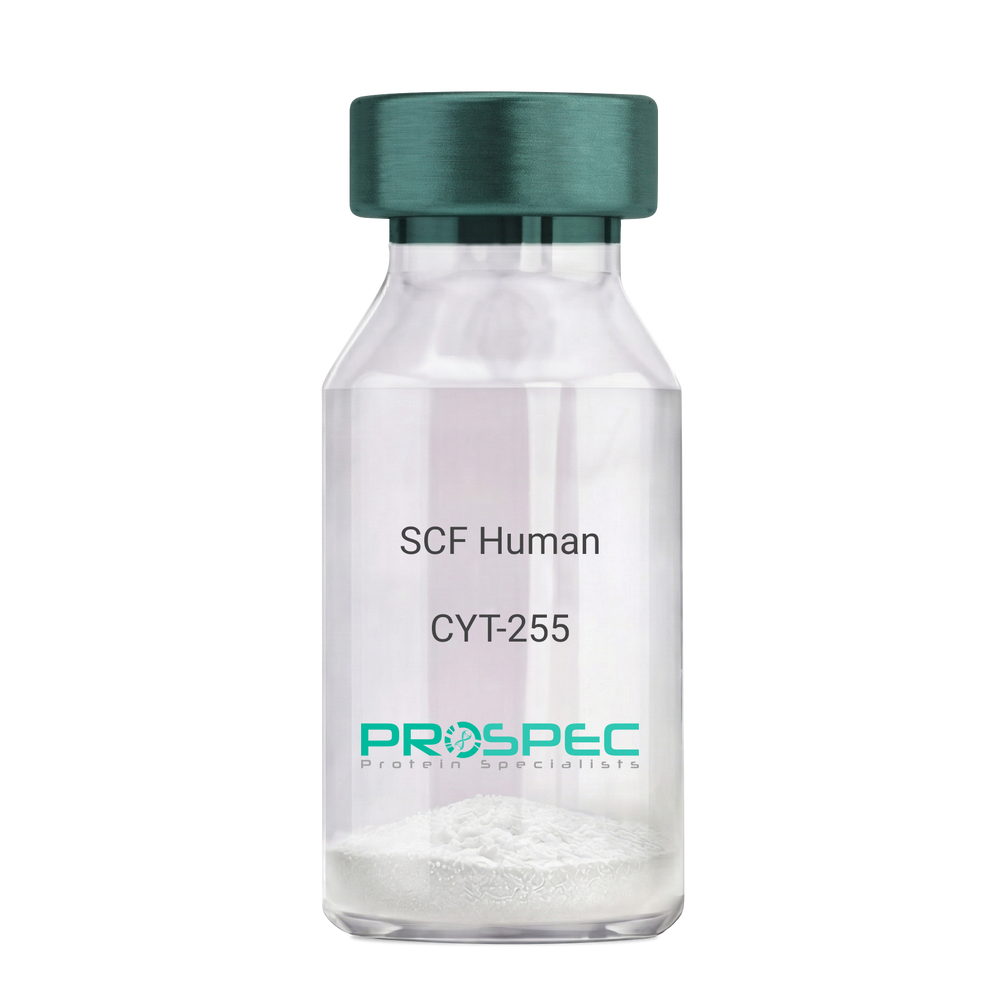
SCF HumanDescription:
Stem Cell Factor Human Recombinant
Kit ligand Precursor, C-kit ligand, SCF, Mast cell growth factor, MGF, SF, KL-1, Kitl, DKFZp686F2250.
Product # :
CYT-255Price :
Quantity :
Shipping Method :
Shipped at Room temp
More Info
- description
- source
- formulation
- purity
- biological activity
- More Info
Description
Stem Cell Factor Human Recombinant produced in E.Coli is a single, non-glycosylated polypeptide chain containing 165 amino acids and having a molecular mass of 18409 Dalton. The SCF is purified by proprietary chromatographic techniques.
Source
Escherichia Coli.
Formulation
Lyophilized from a concentrated (1mg/ml) solution in water containing 0.02% NaHCO3.
Purity
Greater than 98.0% as determined by:
(a) Analysis by SEC-HPLC.
(b) Analysis by SDS-PAGE.Biological Activity
The ED50 as determined by the dose-dependant stimulation of Human TF-1 cells is < 2 ng/ml, corresponding to a Specific Activity of 500,000 IU/mg.More Info
-
Introduction
Stem cell factor / KIT ligand (SCF) is a cytokine which binds CD117(c-Kit). SCF is also known as "steel factor" or "c-kit ligand". SCF exists in two forms, cell surface bound SCF and soluble (or free) SCF. Soluble SCF is produced by the cleavage of surface bound SCF by metalloproteases. SCF is a growth factor important for the survival, proliferation, and differentiation of hematopoietic stem cells and other hematopoietic progenitor cells. One of its roles is to change the BFU-E (burst-forming unit-erythroid) cells, which are the earliest erythrocyte precursors in the erythrocytic series, into the CFU-E (colony-forming unit-erythroid).
-
Synonyms
Kit ligand Precursor, C-kit ligand, SCF, Mast cell growth factor, MGF, SF, KL-1, Kitl, DKFZp686F2250.
-
Physical Appearance
Sterile Filtered White lyophilized (freeze-dried) powder.
-
Stability
Lyophilized KIT ligand although stable at room temperature for 3 weeks, should be stored desiccated below -18°C. Upon reconstitution SCF should be stored at 4°C between 2-7 days and for future use below -18°C.For long term storage it is recommended to add a carrier protein (0.1% HSA or BSA).Please prevent freeze-thaw cycles.
-
Solubility
It is recommended to reconstitute the lyophilized Stem Cell Factor in sterile 18MΩ-cm H2O not less than 100µg/ml, which can then be further diluted to other aqueous solutions.
-
Amino Acid Sequence
The sequence of the first five N-terminal amino acids was determined and was found to be Met-Glu-Gly-Ile-Cys.
-
Protein content
Protein quantitation was carried out by two independent methods1. UV spectroscopy at 280 nm using the absorbency value of 0.52 as the extinction coefficient for a 0.1% (1mg/ml) solution. This value is calculated by the PC GENE computer analysis program of protein sequences (IntelliGenetics). 2. Analysis by RP-HPLC, using a standard solution of Stem Cell Factor as a Reference Standard.
ProSpec's products are furnished for LABORATORY RESEARCH USE ONLY. The product may not be used as drugs, agricultural or pesticidal products, food additives or household chemicals.
- View Data Sheet
Name :
SDHAF2 HumanDescription:
Succinate Dehydrogenase Complex Assembly Factor 2 Human Recombinant
Succinate dehydrogenase assembly factor 2 mitochondrial, SDH assembly factor 2, Succinate dehydrogenase subunit 5, mitochondrial, hSDH5, SDHAF2, C11orf79, PGL2, SDH5.
Product # :
PRO-593Price :
Quantity :
Shipping Method :
Shipped with Ice Packs
More Info
- description
- source
- formulation
- purity
- More Info
Description
SDHAF2 Human Recombinant produced in E.Coli is a single, non-glycosylated polypeptide chain containing 160 amino acids (30-166 a.a) and having a molecular mass of 19kDa.SDHAF2 is fused to a 23 amino acid His-tag at N-terminus & purified by proprietary chromatographic techniques.
Source
Escherichia Coli.
Formulation
SDHAF2 protein solution (0.5mg/ml) containing 20mM Tris-HCl buffer (pH 8.0), 0.2M NaCl, 30% glycerol and 1mM DTT.
Purity
Greater than 90.0% as determined by SDS-PAGE.
More Info
-
Introduction
Succinate Dehydrogenase Complex Assembly Factor 2 (SDHAF2) is a mitochondrial protein required for the flavination of a succinate dehydrogenase complex subunit essential for activity of the complex. DHAF2 is necessary for insertion of FAD cofactor into SDHA, the catalytic subunit of succinate dehydrogenase (SDH). SDH is involved in complex II of the mitochondrial electron transport chain and is responsible for transferring electrons from succinate to ubiquinone (coenzyme Q). SDHAF2 gene defects are the cause of hereditary paragangliomas type 2 (PGL2), otherwise known as familial non-chromaffin paragangliomas type 2.
-
Synonyms
Succinate dehydrogenase assembly factor 2 mitochondrial, SDH assembly factor 2, Succinate dehydrogenase subunit 5, mitochondrial, hSDH5, SDHAF2, C11orf79, PGL2, SDH5.
-
Physical Appearance
Sterile Filtered colorless solution.
-
Stability
Store at 4°C if entire vial will be used within 2-4 weeks. Store, frozen at -20°C for longer periods of time. For long term storage it is recommended to add a carrier protein (0.1% HSA or BSA).Avoid multiple freeze-thaw cycles.
-
Amino Acid Sequence
MGSSHHHHHH SSGLVPRGSH MGSSFRRFYR GDSPTDSQKD MIEIPLPPWQ ERTDESIETK RARLLYESRK RGMLENCILL SLFAKEHLQH MTEKQLNLYD RLINEPSNDW DIYYWATEAK PAPEIFENEV MALLRDFAKN KNKEQRLRAP DLEYLFEKPR.
ProSpec's products are furnished for LABORATORY RESEARCH USE ONLY. The product may not be used as drugs, agricultural or pesticidal products, food additives or household chemicals.