Skip to content

High-quality research proteins.

  • 1-800-805-6531

  • Mon - Sat 8.00-18.00, Sun - Closed

  • info@prospecbio.com

  • PO Box 6591 East Brunswick NJ 08816

  • Products
    • Cytokines
    • Growth factors
    • Chemokines
    • Cd antigens
    • Neurotrophins
    • Hormones
    • Enzymes
    • Viral antigens
    • Recombinant proteins
    • Natural proteins
    • Monoclonal antibodies
    • Polyclonal antibodies
    • Thermal Packaging
  • About
    • Company
    • Founder
    • Contribution
  • Customers
    • Eastern Asia
    • Eastern Europe
    • North America
    • South America
    • South East Asia
    • Southern Asia
    • Western Europe
  • Ordering
    • Ordering Method
    • Ordering - Credit Card
    • Ordering - PO
    • Shipping Fees
    • FAQs
  • Services
    • DNA Cloning
    • Protein Expression
    • Monoclonal Antibody
    • Fermentation
    • Technology License
  • Contact us
Log in

Country/region

  • USD $ | Albania
  • USD $ | Andorra
  • USD $ | Argentina
  • USD $ | Armenia
  • USD $ | Australia
  • USD $ | Austria
  • USD $ | Azerbaijan
  • USD $ | Belarus
  • USD $ | Belgium
  • USD $ | Bolivia
  • USD $ | Brazil
  • USD $ | Bulgaria
  • USD $ | Cambodia
  • USD $ | Canada
  • USD $ | Chile
  • USD $ | China
  • USD $ | Colombia
  • USD $ | Costa Rica
  • USD $ | Croatia
  • USD $ | Cyprus
  • USD $ | Czechia
  • USD $ | Denmark
  • USD $ | Estonia
  • USD $ | Finland
  • USD $ | France
  • USD $ | Georgia
  • USD $ | Germany
  • USD $ | Greece
  • USD $ | Hong Kong SAR
  • USD $ | Hungary
  • USD $ | Iceland
  • USD $ | India
  • USD $ | Ireland
  • USD $ | Israel
  • USD $ | Italy
  • USD $ | Japan
  • USD $ | Kazakhstan
  • USD $ | Latvia
  • USD $ | Liechtenstein
  • USD $ | Lithuania
  • USD $ | Madagascar
  • USD $ | Malta
  • USD $ | Mexico
  • USD $ | Moldova
  • USD $ | Monaco
  • USD $ | Netherlands
  • USD $ | New Zealand
  • USD $ | North Macedonia
  • USD $ | Norway
  • USD $ | Panama
  • USD $ | Paraguay
  • USD $ | Peru
  • USD $ | Philippines
  • USD $ | Poland
  • USD $ | Portugal
  • USD $ | Romania
  • USD $ | Singapore
  • USD $ | Slovakia
  • USD $ | Slovenia
  • USD $ | South Africa
  • USD $ | South Korea
  • USD $ | Spain
  • USD $ | Sri Lanka
  • USD $ | Sweden
  • USD $ | Switzerland
  • USD $ | Taiwan
  • USD $ | Thailand
  • USD $ | Türkiye
  • USD $ | Ukraine
  • USD $ | United Kingdom
  • USD $ | United States
  • USD $ | Uruguay
  • USD $ | Vatican City
  • USD $ | Venezuela
  • USD $ | Vietnam
  • Facebook
  • Instagram
logoProSpec - Recombinant Protein Manufacturer for academic and R&D industry
Become a distributor
Account Log in
Wishlist
Cart Cart(0)
  • Products
    +
    • Cytokines
    • Growth factors
    • Chemokines
    • Cd antigens
    • Neurotrophins
    • Hormones
    • Enzymes
    • Viral antigens
    • Recombinant proteins
    • Natural proteins
    • Monoclonal antibodies
    • Polyclonal antibodies
    • Thermal Packaging
  • About
    +
    • Company
    • Founder
    • Contribution
  • Customers
    +
    • Eastern Asia
    • Eastern Europe
    • North America
    • South America
    • South East Asia
    • Southern Asia
    • Western Europe
  • Ordering
    +
    • Ordering Method
    • Ordering - Credit Card
    • Ordering - PO
    • Shipping Fees
    • FAQs
  • Services
    +
    • DNA Cloning
    • Protein Expression
    • Monoclonal Antibody
    • Fermentation
    • Technology License
  • Contact us

Item added to your cart

View cart
View All
  • Cytokines
  • Growth factors
  • Chemokines
  • Cd antigens
  • Neurotrophins
  • Hormones
  • Enzymes
  • Viral antigens
  • Recombinant proteins
  • Natural proteins
  • Monoclonal antibodies
  • Polyclonal antibodies
  • Thermal Packaging
  • Tumor Necrosis Factor

    Tumor Necrosis Factor

    View All
  • 4-1BB

    4-1BB

    View All
  • Adiponectin

    Adiponectin

    View All
  • AIF1

    AIF1

    View All
  • Other Cytokines

    Other Cytokines

    View All
  • AITRL

    AITRL

    View All
  • Angiopoietin

    Angiopoietin

    View All
  • Apolipoprotein

    Apolipoprotein

    View All
  • B-Cell Activating Factor

    B-Cell Activating Factor

    View All
  • Beta Defensin

    Beta Defensin

    View All
  • Bone Morphogenetic Protein

    Bone Morphogenetic Protein

    View All
  • B type Natriuretic Peptide

    B type Natriuretic Peptide

    View All
  • BST

    BST

    View All
  • Betacellulin

    Betacellulin

    View All
  • Cardiotrophin

    Cardiotrophin

    View All
  • Activin

    Activin

    View All
  • Fibroblast Growth Factor

    Fibroblast Growth Factor

    View All
  • Other Growth Factors

    Other Growth Factors

    View All
  • CSF

    CSF

    View All
  • CTGF

    CTGF

    View All
  • IGFBP

    IGFBP

    View All
  • VEGF Protein

    VEGF Protein

    View All
  • EGF

    EGF

    View All
  • Epigen

    Epigen

    View All
  • Erythropoietin

    Erythropoietin

    View All
  • Insulin-Like Growth Factor

    Insulin-Like Growth Factor

    View All
  • Growth Hormone

    Growth Hormone

    View All
  • HDGF

    HDGF

    View All
  • Hepatocyte Growth Factor

    Hepatocyte Growth Factor

    View All
  • Insulin

    Insulin

    View All
  • BCA-1/ BLC (CXCL13)

    BCA-1/ BLC (CXCL13)

    View All
  • BRAK (CXCL14)

    BRAK (CXCL14)

    View All
  • C-10 (CCL6)

    C-10 (CCL6)

    View All
  • Other Chemokines

    Other Chemokines

    View All
  • MEC (CCL28)

    MEC (CCL28)

    View All
  • LD78-beta (CCL3L1)

    LD78-beta (CCL3L1)

    View All
  • CTACK (CCL27)

    CTACK (CCL27)

    View All
  • CXCL16

    CXCL16

    View All
  • CXCL17

    CXCL17

    View All
  • Platelet Factor-4 (CXCL4)

    Platelet Factor-4 (CXCL4)

    View All
  • ENA-78 (CXCL5)

    ENA-78 (CXCL5)

    View All
  • Eotaxin (CCL11,24,26)

    Eotaxin (CCL11,24,26)

    View All
  • Exodus-2 (CCL21)

    Exodus-2 (CCL21)

    View All
  • Fractalkine (CX3CL1)

    Fractalkine (CX3CL1)

    View All
  • CXCL6

    CXCL6

    View All
  • Other CD Antigens

    Other CD Antigens

    View All
  • CD14

    CD14

    View All
  • CD164

    CD164

    View All
  • CD1

    CD1

    View All
  • CD2

    CD2

    View All
  • CD200

    CD200

    View All
  • CD207

    CD207

    View All
  • CD226

    CD226

    View All
  • CD23

    CD23

    View All
  • CD244

    CD244

    View All
  • CD247

    CD247

    View All
  • CD27

    CD27

    View All
  • CD274

    CD274

    View All
  • CD300

    CD300

    View All
  • CD33

    CD33

    View All
  • Other Neurotrophins

    Other Neurotrophins

    View All
  • Beta-NGF

    Beta-NGF

    View All
  • BDNF

    BDNF

    View All
  • CDNF

    CDNF

    View All
  • CNTF

    CNTF

    View All
  • GDNF

    GDNF

    View All
  • Glia Maturation Factor

    Glia Maturation Factor

    View All
  • MANF

    MANF

    View All
  • Midkine

    Midkine

    View All
  • Neuroglobin

    Neuroglobin

    View All
  • Neurotrophic factors

    Neurotrophic factors

    View All
  • Neuregulin

    Neuregulin

    View All
  • Neuropilin

    Neuropilin

    View All
  • Pigment Epithelium-Derived Factor

    Pigment Epithelium-Derived Factor

    View All
  • Pleiotrophin

    Pleiotrophin

    View All
  • Peptide Hormones

    Peptide Hormones

    View All
  • Other Hormones

    Other Hormones

    View All
  • HCG

    HCG

    View All
  • Endothelin

    Endothelin

    View All
  • Exendin

    Exendin

    View All
  • FSH

    FSH

    View All
  • Glucagon

    Glucagon

    View All
  • GHRP

    GHRP

    View All
  • GLP

    GLP

    View All
  • Thyrostimulin

    Thyrostimulin

    View All
  • Inhibin A

    Inhibin A

    View All
  • LHRH

    LHRH

    View All
  • Melanotan

    Melanotan

    View All
  • Procalcitonin

    Procalcitonin

    View All
  • PTH

    PTH

    View All
  • Peroxiredoxin

    Peroxiredoxin

    View All
  • Peptidase

    Peptidase

    View All
  • Synthetase

    Synthetase

    View All
  • Transferase

    Transferase

    View All
  • Hydrolase

    Hydrolase

    View All
  • Dehydrogenase

    Dehydrogenase

    View All
  • ACE2

    ACE2

    View All
  • Esterase

    Esterase

    View All
  • Protein Kinases

    Protein Kinases

    View All
  • Other Enzymes

    Other Enzymes

    View All
  • Phosphatase

    Phosphatase

    View All
  • Deaminase

    Deaminase

    View All
  • Oxygenase

    Oxygenase

    View All
  • Adenylate Kinase

    Adenylate Kinase

    View All
  • Lyase

    Lyase

    View All
  • Chagas

    Chagas

    View All
  • SARS

    SARS

    View All
  • Influenza

    Influenza

    View All
  • ASFV

    ASFV

    View All
  • Astrovirus

    Astrovirus

    View All
  • Borrelia

    Borrelia

    View All
  • Helicobacter Pylori

    Helicobacter Pylori

    View All
  • Chikungunya

    Chikungunya

    View All
  • Chlamydia

    Chlamydia

    View All
  • Cytomegalo

    Cytomegalo

    View All
  • Dengue

    Dengue

    View All
  • EBV

    EBV

    View All
  • Ebola

    Ebola

    View All
  • Feline Leukemia Virus

    Feline Leukemia Virus

    View All
  • Hepatitis A

    Hepatitis A

    View All
  • Other

    Other

    View All
  • Actin

    Actin

    View All
  • ADAM

    ADAM

    View All
  • Complement Component

    Complement Component

    View All
  • Ag85

    Ag85

    View All
  • Eukaryotic Translation Initiation Factor

    Eukaryotic Translation Initiation Factor

    View All
  • Anterior Gradient Protein

    Anterior Gradient Protein

    View All
  • Heat Shock Protein

    Heat Shock Protein

    View All
  • Alpha-2-HS-Glycoprotein

    Alpha-2-HS-Glycoprotein

    View All
  • Hemoglobin

    Hemoglobin

    View All
  • Allergy

    Allergy

    View All
  • Anaplasma

    Anaplasma

    View All
  • Angiogenin

    Angiogenin

    View All
  • Ankyrin Repeat Domain

    Ankyrin Repeat Domain

    View All
  • Annexin

    Annexin

    View All
  • Other Natural Proteins

    Other Natural Proteins

    View All
  • Aprotinin

    Aprotinin

    View All
  • Transferrin

    Transferrin

    View All
  • Avidin

    Avidin

    View All
  • Anti Coagulation Factors

    Anti Coagulation Factors

    View All
  • Natural Albumin

    Natural Albumin

    View All
  • Natural Coagulation Factors

    Natural Coagulation Factors

    View All
  • Fibronectin

    Fibronectin

    View All
  • Thrombin

    Thrombin

    View All
  • Anti Human Enzyme

    Anti Human Enzyme

    View All
  • Other Monoclonal Antibodies

    Other Monoclonal Antibodies

    View All
  • Anti Human Cytokine

    Anti Human Cytokine

    View All
  • Anti Human Heat Shock Protein

    Anti Human Heat Shock Protein

    View All
  • Anti Mouse Lymphocyte

    Anti Mouse Lymphocyte

    View All
  • Anti Human Chemokine

    Anti Human Chemokine

    View All
  • Anti Human Lymphocyte

    Anti Human Lymphocyte

    View All
  • Anti Viral Monoclonal

    Anti Viral Monoclonal

    View All
  • Anti Mouse Cytokine

    Anti Mouse Cytokine

    View All
  • Anti-GST Monoclonal

    Anti-GST Monoclonal

    View All
  • Other Polyclonal Antibodies

    Other Polyclonal Antibodies

    View All
  • Anti Viral

    Anti Viral

    View All
  • Anti-GST Monoclonal

    Anti-GST Monoclonal

    View All
Back

Search results

787 results found for “Alkaline Phosphatase”

Name

Description

Product #

Price

Quantity

Shipping Method

  • View Data Sheet

    Name :

    PFKM Human

    Description:

    Phosphofructokinase, Muscle Human Recombinant

    EC 2.7.1.11, GSD7, PFK-1, PFK1, PFKA, PFKX, Phosphofructokinase-M, Phosphofructokinase 1, Phosphohexokinase, Phosphofructo-1-kinase isozyme A, MGC8699, PFKM.

    Product # :

    PKA-365

    Price :

    Quantity :

    Shipping Method :

    Ice Icon

    Shipped with Ice Packs

    Add To Cart

    More Info

    • description
    • source
    • formulation
    • purity
    • More Info
    • Citations

    Description

    PFKM Human Recombinant produced in E.Coli is a single, non-glycosylated, polypeptide chain containing 800 amino acids (1-780 a.a.) and having a molecular mass of 87.3 kDa. PFKM protein is fused to a 20 amino acid His-Tag at N-terminus and purified by standard chromatography.

    Source

    Escherichia Coli.

    Formulation

    PFKM Human solution containing 20mM Trsi HCl pH-8, 5mM DTT, 0.2M NaCl and 20% glycerol.

    Purity

    Greater than 80% as determined by SDS-PAGE.

    Citations

    More Info

    • Introduction

      PFKM is a regulatory glycolytic enzyme that converts fructose 6-phosphate and ATP into fructose 1,6-bisphosphate (through PFK-1), fructose 2,6-bisphosphate (through PFK-2) and ADP. Three phosphofructokinase isozymes exist in humans: muscle, liver and platelet. Mutations in PFKM gene have been related with glycogen storage disease type VII, also identified as Tarui disease.

    • Synonyms

      EC 2.7.1.11, GSD7, PFK-1, PFK1, PFKA, PFKX, Phosphofructokinase-M, Phosphofructokinase 1, Phosphohexokinase, Phosphofructo-1-kinase isozyme A, MGC8699, PFKM.

    • Physical Appearance

      Sterile filtered colorless solution.

    • Stability

      Store at 4°C if entire vial will be used within 2-4 weeks. Store, frozen at -20°C for longer periods of time. For long term storage it is recommended to add a carrier protein (0.1% HSA or BSA). Please prevent freeze thaw cycles.

    • Amino Acid Sequence

      MGSSHHHHHH SSGLVPRGSH MTHEEHHAAK TLGIGKAIAV LTSGGDAQGM NAAVRAVVRV GIFTGARVFF VHEGYQGLVD GGDHIKEATW ESVSMMLQLG GTVIGSARCK DFREREGRLR AAYNLVKRGI TNLCVIGGDG SLTGADTFRS EWSDLLSDLQ KAGKITDEEA TKSSYLNIVG LVGSIDNDFC GTDMTIGTDS ALHRIMEIVD AITTTAQSHQ RTFVLEVMGR HCGYLALVTS LSCGADWVFI PECPPDDDWE EHLCRRLSET RTRGSRLNII IVAEGAIDKN GKPITSEDIK NLVVKRLGYD TRVTVLGHVQ RGGTPSAFDR ILGSRMGVEA VMALLEGTPD TPACVVSLSG NQAVRLPLME CVQVTKDVTK AMDEKKFDEA LKLRGRSFMN NWEVYKLLAH VRPPVSKSGS HTVAVMNVGA PAAGMNAAVR STVRIGLIQG NRVLVVHDGF EGLAKGQIEE AGWSYVGGWT GQGGSKLGTK RTLPKKSFEQ ISANITKFNI QGLVIIGGFE AYTGGLELME GRKQFDELCI PFVVIPATVS NNVPGSDFSV GADTALNTIC TTCDRIKQSA AGTKRRVFII ETMGGYCGYL ATMAGLAAGA DAAYIFEEPF TIRDLQANVE HLVQKMKTTV KRGLVLRNEK CNENYTTDFI FNLYSEEGKG IFDSRKNVLG HMQQGGSPTP FDRNFATKMG AKAMNWMSGK IKESYRNGRI FANTPDSGCV LGMRKRALVF QPVAELKDQT DFEHRIPKEQ WWLKLRPILK ILAKYEIDLD TSDHAHLEHI TRKRSGEAAV.

    ProSpec's products are furnished for LABORATORY RESEARCH USE ONLY. The product may not be used as drugs, agricultural or pesticidal products, food additives or household chemicals.

    Pfkm Human
  • View Data Sheet

    Name :

    PGM2 Human

    Description:

    Phosphoglucomutase 2 Human Recombinant

    Phosphoglucomutase 2, Glucose Phosphomutase 2, Phosphodeoxyribomutase, Phosphopentomutase, EC 5.4.2.2, PGM 2, Phosphoglucomutase-2, EC 5.4.2.7, EC 5.4.2, MSTP006.

    Product # :

    ENZ-930

    Price :

    Quantity :

    Shipping Method :

    Ice Icon

    Shipped with Ice Packs

    Add To Cart

    More Info

    • description
    • source
    • formulation
    • purity
    • More Info
    • Citations

    Description

    PGM2 Human Recombinant produced in E.Coli is a single, non-glycosylated polypeptide chain containing 635 amino acids (1-612 a.a) and having a molecular mass of 70.7kDa. PGM2 is fused to a 23 amino acid His-tag at N-terminus & purified by proprietary chromatographic techniques.

    Source

    Escherichia Coli.

    Formulation

    PGM2 protein solution (1mg/ml) containing Phosphate buffered saline (pH7.4) and 10% glycerol.

    Purity

    Greater than 85.0% as determined by SDS-PAGE.

    Citations

    More Info

    • Introduction

      PGM2 or Phosphoglucomutase-2 is a protein of the alpha-d-phosphohexomutase family that shares about 20% similarity with mammalian phosphoglucomutase 1. PGM2 Has low glucose 1,6-bisphosphate synthase activity. Furthermore, PGM2 catalyzes the conversion of the nucleoside breakdown products ribose-1-phosphate and deoxyribose-1-phosphate to the corresponding 5-phosphopentoses. In addition, PGM2 catalyzes the interconversion of glucose-1-phosphate and glucose-6-phosphate.

    • Synonyms

      Phosphoglucomutase 2, Glucose Phosphomutase 2, Phosphodeoxyribomutase, Phosphopentomutase, EC 5.4.2.2, PGM 2, Phosphoglucomutase-2, EC 5.4.2.7, EC 5.4.2, MSTP006.

    • Physical Appearance

      Sterile Filtered colorless solution.

    • Stability

      Store at 4°C if entire vial will be used within 2-4 weeks. Store, frozen at -20°C for longer periods of time. For long term storage it is recommended to add a carrier protein (0.1% HSA or BSA).Avoid multiple freeze-thaw cycles.

    • Amino Acid Sequence

      MGSSHHHHHH SSGLVPRGSH MGSMAAPEGS GLGEDARLDQ ETAQWLRWDK NSLTLEAVKR LIAEGNKEEL RKCFGARMEF GTAGLRAAMG PGISRMNDLT IIQTTQGFCR YLEKQFSDLK QKGIVISFDA RAHPSSGGSS RRFARLAATT FISQGIPVYL FSDITPTPFV PFTVSHLKLC AGIMITASHN PKQDNGYKVY WDNGAQIISP HDKGISQAIE ENLEPWPQAW DDSLIDSSPL LHNPSASINN DYFEDLKKYC FHRSVNRETK VKFVHTSVHG VGHSFVQSAF KAFDLVPPEA VPEQKDPDPE FPTVKYPNPE EGKGVLTLSF ALADKTKARI VLANDPDADR LAVAEKQDSG EWRVFSGNEL GALLGWWLFT SWKEKNQDRS ALKDTYMLSS TVSSKILRAI ALKEGFHFEE TLTGFKWMGN RAKQLIDQGK TVLFAFEEAI GYMCCPFVLD KDGVSAAVIS AELASFLATK NLSLSQQLKA IYVEYGYHIT KASYFICHDQ ETIKKLFENL RNYDGKNNYP KACGKFEISA IRDLTTGYDD SQPDKKAVLP TSKSSQMITF TFANGGVATM RTSGTEPKIK YYAELCAPPG NSDPEQLKKE LNELVSAIEE HFFQPQKYNL QPKAD.

    ProSpec's products are furnished for LABORATORY RESEARCH USE ONLY. The product may not be used as drugs, agricultural or pesticidal products, food additives or household chemicals.

    Pgm2 Human
  • View Data Sheet

    Name :

    GGPS1 Human

    Description:

    Geranylgeranyl Diphosphate Synthase 1 Human Recombinant

    GGPPS, GGPPS1, GGPP synthetase.

    Product # :

    ENZ-555

    Price :

    Quantity :

    Shipping Method :

    Ice Icon

    Shipped with Ice Packs

    Add To Cart

    More Info

    • description
    • source
    • formulation
    • purity
    • More Info
    • Citations

    Description

    GGPS1 Recombinant Human produced in E.Coli is a single, non-glycosylated polypeptide chain containing 320 amino acids (1-300 a.a.) and having a molecular mass of 37 kDa. The GGPS1 is fused to a 20 amino acids His-Tag at N-terminus and purified by proprietary chromatographic techniques.

    Source

    Escherichia Coli.

    Formulation

    GGPS1 Human recombinant (1mg/ml) protein solution contains 20mM Tris-HCl pH-8, 1mM DTT & 10% glycerol.

    Purity

    Greater than 90.0% as determined by SDS-PAGE.

    Citations

    More Info

    • Introduction

      GGPS1 is PART of the prenyltransferase family. GGPS1 is widely expressed in testis, heart and skeletal muscle, GGPS1 is localized in the cytoplasm and catalyzes the formation of geranylgeranyl pyrophosphate, a precursor of geranylgeranylated proteins and carotenoids. GGPS1 is a significant enzyme that is responsible for the C20-prenylation of proteins and for the regulation of a nuclear hormone receptor.

    • Synonyms

      GGPPS, GGPPS1, GGPP synthetase.

    • Physical Appearance

      Sterile filtered colorless solution.

    • Stability

      Store at 4°C if entire vial will be used within 2-4 weeks. Store, frozen at -20°C for longer periods of time. For long term storage it is recommended to add a carrier protein (0.1% HSA or BSA).Avoid multiple freeze-thaw cycles.

    • Amino Acid Sequence

      MGSSHHHHHH SSGLVPRGSH MEKTQETVQR ILLEPYKYLL QLPGKQVRTK LSQAFNHWLK VPEDKLQIII EVTEMLHNAS LLIDDIEDNS KLRRGFPVAH SIYGIPSVIN SANYVYFLGL EKVLTLDHPD AVKLFTRQLL ELHQGQGLDI YWRDNYTCPT EEEYKAMVLQ KTGGLFGLAV
      GLMQLFSDYK EDLKPLLNTL GLFFQIRDDY ANLHSKEYSE NKSFCEDLTE GKFSFPTIHA IWSRPESTQV QNILRQRTEN IDIKKYCVHY LEDVGSFEYT RNTLKELEAK AYKQIDARGG NPELVALVKH LSKMFKEENE.

    ProSpec's products are furnished for LABORATORY RESEARCH USE ONLY. The product may not be used as drugs, agricultural or pesticidal products, food additives or household chemicals.

    Ggps1 Human
  • View Data Sheet

    Name :

    IMPAD1 Human, Active

    Description:

    Inositol Monophosphatase Domain Containing 1 Human Recombinant, BioActive

    Inositol monophosphatase 3, IMP 3, IMPase 3, EC 3.1.3.25, EC 3.1.3.7, Golgi 3-prime phosphoadenosine 5-prime phosphate 3-prime phosphatase, Golgi-resident PAP phosphatase, gPAPP, Inositol monophosphatase domain-containing protein 1, Inositol-1(or 4)-monophosphatase 3, Myo-inositol monophosphatase A3, IMPAD1, IMPA3, GPAPP, IMP-3

    Product # :

    PRO-2638

    Price :

    Quantity :

    Shipping Method :

    Ice Icon

    Shipped with Ice Packs

    Add To Cart

    More Info

    • description
    • source
    • formulation
    • purity
    • biological activity
    • More Info
    • Citations

    Description

    IMPAD1 Human Recombinant produced in E.Coli is a single, non-glycosylated polypeptide chain containing 349 amino acids (34-359 a.a.) and having a molecular mass of 37.6kDa.IMPAD1 is fused to a 23 amino acid His-tag at N-terminus & purified by proprietary chromatographic techniques.

    Source

    Escherichia Coli.

    Formulation

    The IMPAD1 solution (0.25mg/ml) contains Phosphate-Buffered Saline (pH 7.4).

    Purity

    Greater than 90.0% as determined by SDS-PAGE.

    Biological Activity

    Specific activity is > 3300pmol/min/ug, and is defined as its ability to dephosphorylate adenosine 3'5'-diphosphate sodium slat at pH7.5, 25˚C.

    Citations

    More Info

    • Introduction

      Inositol Monophosphatase Domain Containing 1 or IMPAD1 is a protein, part of the inositol monophosphatase group of proteins. The protein is found in Golgi apparatus and enhances phosphoadenosine phosphate hydrolysis to adenosine monophosphate. When Mutation in the IMPAD1 gene occurs leads to GRAPP type chondrodysplasia and therefore joint dislocations. On long arm chromosome 1 a pseudogene can be found.

    • Synonyms

      Inositol monophosphatase 3, IMP 3, IMPase 3, EC 3.1.3.25, EC 3.1.3.7, Golgi 3-prime phosphoadenosine 5-prime phosphate 3-prime phosphatase, Golgi-resident PAP phosphatase, gPAPP, Inositol monophosphatase domain-containing protein 1, Inositol-1(or 4)-monophosphatase 3, Myo-inositol monophosphatase A3, IMPAD1, IMPA3, GPAPP, IMP-3

    • Physical Appearance

      Sterile Filtered colorless solution.

    • Stability

      Store at 4°C if entire vial will be used within 2-4 weeks. Store, frozen at -20°C for longer periods of time. For long term storage it is recommended to add a carrier protein (0.1% HSA or BSA).Avoid multiple freeze-thaw cycles.

    • Amino Acid Sequence

      MGSSHHHHHH SSGLVPRGSH MGSGRFSLFG LGGEPGGGAA GPAAAADGGT VDLREMLAVS VLAAVRGGDE VRRVRESNVL HEKSKGKTRE GAEDKMTSGD VLSNRKMFYL LKTAFPSVQI NTEEHVDAAD QEVILWDHKI PEDILKEVTT PKEVPAESVT VWIDPLDATQ EYTEDLRKYV TTMVCVAVNG KPMLGVIHKP FSEYTAWAMV DGGSNVKARS SYNEKTPRIV VSRSHSGMVK QVALQTFGNQ TTIIPAGGAG YKVLALLDVP DKSQEKADLY IHVTYIKKWD ICAGNAILKA LGGHMTTLSG EEISYTGSDG IEGGLLASIR MNHQALVRKL PDLEKTGHK

    ProSpec's products are furnished for LABORATORY RESEARCH USE ONLY. The product may not be used as drugs, agricultural or pesticidal products, food additives or household chemicals.

    Impad1 Protein
  • View Data Sheet

    Name :

    AK5 Human

    Description:

    Adenylate Kinase 5 Human Recombinant

    Adenylate kinase isoenzyme 5, AK 5, ATP-AMP transphosphorylase 5, AK5, AK6.

    Product # :

    PKA-011

    Price :

    Quantity :

    Shipping Method :

    Ice Icon

    Shipped with Ice Packs

    Add To Cart

    More Info

    • description
    • source
    • formulation
    • purity
    • More Info
    • Citations

    Description

    AK5 Human Recombinant produced in E.Coli is a single, non-glycosylated polypeptide chain containing 586 amino acids (1-562 a.a.) and having a molecular mass of 65.9kDa.AK5 is fused to a 24 amino acid His-tag at N-terminus & purified by proprietary chromatographic techniques.

    Source

    Escherichia Coli.

    Formulation

    AK5 protein solution (0.25mg/ml) containing 20mM Tris-HCl buffer (pH8.0), 20% glycerol and 1mM DTT.

    Purity

    Greater than 85% as determined by SDS-PAGE.

    Citations

    More Info

    • Introduction

      Adenylate kinase isoenzyme 5 (AK5) belongs to the adenylate kinase family, which is involved in regulating the adenine nucleotide composition within a cell by catalyzing the reversible transfer of phosphate groups among adenine nucleotides. AK5 is related to the UMP/CMP kinase of several species. AK5 is located in the cytosol and expressed exclusively in the brain.

    • Synonyms

      Adenylate kinase isoenzyme 5, AK 5, ATP-AMP transphosphorylase 5, AK5, AK6.

    • Physical Appearance

      Sterile filtered colorless solution.

    • Stability

      Store at 4°C if entire vial will be used within 2-4 weeks. Store, frozen at -20°C for longer periods of time. For long term storage it is recommended to add a carrier protein (0.1% HSA or BSA).Avoid multiple freeze-thaw cycles.

    • Amino Acid Sequence

      MGSSHHHHHH SSGLVPRGSH MGSHMNTNDA KEYMARREIP QLFESLLNGL MCSKPEDPVE YLESCLQKVK ELGGCDKVKW DTFVSQEKKT LPPLNGGQSR RSFLRNVMPG NSNFPYRRYD RLPPIHQFSI ESDTDLSETA ELIEEYEVFD PTRPRPKIIL VIGGPGSGKG TQSLKIAERY GFQYISVGEL LRKKIHSTSS NRKWSLIAKI ITTGELAPQE TTITEIKQKL MQIPDEEGIV IDGFPRDVAQ ALSFEDQICT PDLVVFLACA NQRLKERLLK RAEQQGRPDD NVKATQRRLM NFKQNAAPLV KYFQEKGLIM TFDADRDEDE VFYDISMAVD NKLFPNKEAA AGSSDLDPSM ILDTGEIIDT GSDYEDQGDD QLNVFGEDTM GGFMEDLRKC KIIFIIGGPG SGKGTQCEKL VEKYGFTHLS TGELLREELA SESERSKLIR DIMERGDLVP SGIVLELLKE AMVASLGDTR GFLIDGYPRE VKQGEEFGRR IGDPQLVICM DCSADTMTNR LLQRSRSSLP VDDTTKTIAK RLEAYYRASI PVIAYYETKT QLHKINAEGT PEDVFLQLCT AIDSIF.

    ProSpec's products are furnished for LABORATORY RESEARCH USE ONLY. The product may not be used as drugs, agricultural or pesticidal products, food additives or household chemicals.

    Ak5 Human
  • View Data Sheet

    Name :

    GLA Human

    Description:

    Alpha-Galactosidase Human Recombinant

    Alpha-galactosidase A, Alpha-D-galactosidase A, Alpha-D-galactoside galactohydrolase, Melibiase, GLA, GALA.

    Product # :

    ENZ-926

    Price :

    Quantity :

    Shipping Method :

    Ice Icon

    Shipped with Ice Packs

    Add To Cart

    More Info

    • description
    • source
    • formulation
    • purity
    • More Info
    • Citations

    Description

    GLA produced in Sf9 Baculovirus cells is a single, glycosylated polypeptide chain containing 406 amino acids (32-429 a.a.) and having a molecular mass of 46.4kDa GLA is expressed with an 8 amino acid His tag at C-Terminus and purified by proprietary chromatographic techniques.

    Source

    Sf9, Baculovirus cells.

    Formulation

    GLA protein solution (0.5mg/ml) contains Phosphate Buffered Saline (pH 7.4) and 10% glycerol.

    Purity

    Greater than 90.0% as determined by SDS-PAGE.

    Citations

    More Info

    • Introduction

      Alpha-galactosidase A (GLA) is a homodimeric glycoprotein which hydrolyses the terminal alpha-galactosyl moieties from glycolipids and glycoproteins. GLA catalyzes the hydrolysis of melibiose into galactose and glucose. Various mutations in the GLA gene affect the synthesis, processing, and stability of this enzyme, which causes Fabry disease (a rare lysosomal storage disorder which results from a failure to catabolize alpha-D-galactosyl glycolipid moieties).

    • Synonyms

      Alpha-galactosidase A, Alpha-D-galactosidase A, Alpha-D-galactoside galactohydrolase, Melibiase, GLA, GALA.

    • Physical Appearance

      Sterile Filtered colorless solution.

    • Stability

      Store at 4°C if entire vial will be used within 2-4 weeks. Store, frozen at -20°C for longer periods of time. For long term storage it is recommended to add a carrier protein (0.1% HSA or BSA). Avoid multiple freeze-thaw cycles.

    • Amino Acid Sequence

      LDNGLARTPT MGWLHWERFM CNLDCQEEPD SCISEKLFME MAELMVSEGW KDAGYEYLCI DDCWMAPQRD SEGRLQADPQ RFPHGIRQLA NYVHSKGLKL GIYADVGNKT CAGFPGSFGY YDIDAQTFAD WGVDLLKFDG CYCDSLENLA DGYKHMSLAL NRTGRSIVYS CEWPLYMWPF QKPNYTEIRQ YCNHWRNFAD IDDSWKSIKS ILDWTSFNQE RIVDVAGPGG WNDPDMLVIG NFGLSWNQQV TQMALWAIMA APLFMSNDLR HISPQAKALL QDKDVIAINQ DPLGKQGYQL RQGDNFEVWE RPLSGLAWAV AMINRQEIGG PRSYTIAVAS LGKGVACNPA CFITQLLPVK RKLGFYEWTS RLRSHINPTG TVLLQLENTM QMSLKDLLVE HHHHHH.

    ProSpec's products are furnished for LABORATORY RESEARCH USE ONLY. The product may not be used as drugs, agricultural or pesticidal products, food additives or household chemicals.

    Gla Human
  • View Data Sheet

    Name :

    GLO1 Human, Active

    Description:

    Glyoxalase-I Human Recombinant, Active

    GLYI, GLOD1, GLO1, Glyoxalase-1, Lactoylglutathione lyase, Methylglyoxalase, Aldoketomutase, Ketone-aldehyde mutase, Glyoxalase I, S-D-lactoylglutathione methylglyoxal lyase, Glx I.

    Product # :

    ENZ-999

    Price :

    Quantity :

    Shipping Method :

    Ice Icon

    Shipped with Ice Packs

    Add To Cart

    More Info

    • description
    • source
    • formulation
    • purity
    • biological activity
    • More Info
    • Citations

    Description

    Glyoxalase-I Human Recombinant produced in E.Coli is a single, non-glycosylated, polypeptide chain containing 184 amino acids and having a molecular mass of 20.7 kDa. Glyoxalase-1 is purified by proprietary chromatographic techniques.

    Source

    Escherichia Coli.

    Formulation

    Glyoxalase-1 solution containing 20mM Tris-HCl pH-8, 1mM DTT and 10% glycerol.

    Purity

    Greater than 90.0% as determined by SDS-PAGE.

    Biological Activity

    Specific activity: > 400 units/mg. One unit will form 1.0umol of S-lactoylgutathione from methylglyoxal and reduced glutathione per minute at pH6.5 at 25C

    Citations

    More Info

    • Introduction

      GLO1 is involved in the catalysis and formation of S-lactoyl-glutathione from methylglyoxal condensation and reduced glutatione. GLO1 is linked to HLA and is localized to 6p21.3-p21.1, between HLA and the centromere. GLO1 enzyme is ubundantly expressed and present in numerous tumor cell lines, in which its concentration is often upregulated ubiquitisly. GLO1 is a major susceptible gene for autism in an ethnic Chinese population from Taiwan. GLO1 might be involved in the pathophysiology of mood disorders. GLO1 plays a role in the pathophysiology of mood disorders. Overexpression of GLO1 is associated with kidney tumor.

    • Synonyms

      GLYI, GLOD1, GLO1, Glyoxalase-1, Lactoylglutathione lyase, Methylglyoxalase, Aldoketomutase, Ketone-aldehyde mutase, Glyoxalase I, S-D-lactoylglutathione methylglyoxal lyase, Glx I.

    • Physical Appearance

      Sterile filtered colorless solution.

    • Stability

      Store at 4°C if entire vial will be used within 2-4 weeks. Store, frozen at -20°C for longer periods of time. For long term storage it is recommended to add a carrier protein (0.1% HSA or BSA).Avoid multiple freeze-thaw cycles.

    • Amino Acid Sequence

      MAEPQPPSGG LTDEAALSCC SDADPSTKDF LLQQTMLRVK DPKKSLDFYT RVLGMTLIQK CDFPIMKFSL YFLAYEDKND IPKEKDEKIAWALSRKATLE LTHNWGTEDD ETQSYHNGNS DPRGFGHIGI AVPDVYSACK RFEELGVKFV KKPDDGKMKG LAFIQDPDGY WIEILNPNKM ATLM.

    ProSpec's products are furnished for LABORATORY RESEARCH USE ONLY. The product may not be used as drugs, agricultural or pesticidal products, food additives or household chemicals.

    Glo1 Human Active
  • View Data Sheet

    Name :

    GMPS Human

    Description:

    GMPS Human Recombinant

    GMP synthase [glutamine-hydrolyzing], GMP synthetase, Glutamine amidotransferase, GMPS, GMP synthase, guanosine 5'-monophosphate synthase, MLL/GMPS fusion protein.

    Product # :

    ENZ-244

    Price :

    Quantity :

    Shipping Method :

    Ice Icon

    Shipped with Ice Packs

    Add To Cart

    More Info

    • description
    • source
    • formulation
    • purity
    • More Info
    • Citations

    Description

    GMPS Human Recombinant produced in E.coli is a single, non-glycosylated polypeptide chain containing 717 amino acids (1-693) and having a molecular mass of 79.2kDa.GMPS is fused to a 24 amino acid His-tag at N-terminus & purified by proprietary chromatographic techniques.

    Source

    Escherichia Coli.

    Formulation

    The GMPS solution (0.5mg/ml) contains 20mM Tris-HCl buffer (pH 8.0), 1mM DTT, 30% glycerol and 0.1M NaCl.

    Purity

    Greater than 90.0% as determined by SDS-PAGE.

    Citations

    More Info

    • Introduction

      GMP synthase (GMPS) is involved in purine biosynthesis. GMPS, which is a homodimer, catalyzes the last step in the GMP synthesis pathway, specifically the ATP-dependent amination of XMP to GMP. GMPS is comprised of one GMP-binding domain and one glutamine amidotransferase type-1 domain through which it communicates its catalytic activity. GMPS is engaged in the de novo synthesis of nucleotides which are not only vital for DNA and RNA synthesis, but also supply GTP, which is involved in sevral cellular processes important for cell division. GMPS gene chromosomal translocations are linked with acute myeloid leukemias, suggesting a possible role for GMPS in carcinogenesis.

    • Synonyms

      GMP synthase [glutamine-hydrolyzing], GMP synthetase, Glutamine amidotransferase, GMPS, GMP synthase, guanosine 5'-monophosphate synthase, MLL/GMPS fusion protein.

    • Physical Appearance

      Sterile Filtered colorless solution.

    • Stability

      Store at 4°C if entire vial will be used within 2-4 weeks. Store, frozen at -20°C for longer periods of time. For long term storage it is recommended to add a carrier protein (0.1% HSA or BSA).Avoid multiple freeze-thaw cycles.

    • Amino Acid Sequence

      MGSSHHHHHH SSGLVPRGSH MGSHMALCNG DSKLENAGGD LKDGHHHYEG AVVILDAGAQ YGKVIDRRVR ELFVQSEIFP LETPAFAIKE QGFRAIIISG GPNSVYAEDA PWFDPAIFTI GKPVLGICYG MQMMNKVFGG TVHKKSVRED GVFNISVDNT CSLFRGLQKE EVVLLTHGDS
      VDKVADGFKV VARSGNIVAG IANESKKLYG AQFHPEVGLT ENGKVILKNF LYDIAGCSGT FTVQNRELEC IREIKERVGT SKVLVLLSGG VDSTVCTALL NRALNQEQVI AVHIDNGFMR KRESQSVEEA LKKLGIQVKV INAAHSFYNG TTTLPISDED RTPRKRISKT LNMTTSPEEK
      RKIIGDTFVK IANEVIGEMN LKPEEVFLAQ GTLRPDLIES ASLVASGKAE LIKTHHNDTE LIRKLREEGK VIEPLKDFHK DEVRILGREL GLPEELVSRH PFPGPGLAIR VICAEEPYIC KDFPETNNIL KIVADFSASV KKPHTLLQRV KACTTEEDQE KLMQITSLHS LNAFLLPIKT
      VGVQGDCRSY SYVCGISSKD EPDWESLIFL ARLIPRMCHN VNRVVYIFGP PVKEPPTDVT PTFLTTGVLS TLRQADFEAH NILRESGYAG KISQMPVILT PLHFDRDPLQ KQPSCQRSVV IRTFITSDFM TGIPATPGNE IPVEVVLKMV TEIKKIPGIS RIMYDLTSKP PGTTEWE.

    ProSpec's products are furnished for LABORATORY RESEARCH USE ONLY. The product may not be used as drugs, agricultural or pesticidal products, food additives or household chemicals.

    Gmps Human
  • View Data Sheet

    Name :

    GNPNAT1 Human

    Description:

    Glucosamine-Phosphate N-Acetyltransferase 1 Human Recombinant

    Gpnat1, GNPNAT, GNA1, EC 2.3.1.4, FLJ10607, Glucosamine-Phosphate N-Acetyltransferase 1, Phosphoglucosamine acetylase, Phosphoglucosamine transacetylase, Glucosamine 6-Phosphate N-Acetyltransferase.

    Product # :

    ENZ-037

    Price :

    Quantity :

    Shipping Method :

    Ice Icon

    Shipped with Ice Packs

    Add To Cart

    More Info

    • description
    • source
    • formulation
    • purity
    • More Info
    • Citations

    Description

    GNPNAT1 produced in E.Coli is a single, non-glycosylated polypeptide chain containing 207 amino acids (1-184a.a.) and having a molecular mass of 23.1KDa.GNPNAT1 is fused to a 23 amino acid His-tag at N-terminus & purified by proprietary chromatographic techniques.

    Source

    Escherichia Coli.

    Formulation

    The GNPNAT1 protein solution (0.5mg/1ml) is formulated in 20mM Tris-HCl buffer (pH 8.0), 1mM DTT, 0.1M NaCl and 30% glycerol.

    Purity

    Greater than 90% as determined by SDS-PAGE.

    Citations

    More Info

    • Introduction

      GNPNAT1 is a member of the GNA1 subfamily of the larger acetyltransferase family of proteins. GNPNAT1 is limited to the Golgi apparatus and the endosome. GNPNAT1 is vital for UDPGlcNAc biosynthesis pathway. GNPNAT1 catalyzes the synthesis of GlcNAc6P from AcCoA and GlcN6P, a step in the UDP-GlcNAc6P formation pathway.

    • Synonyms

      Gpnat1, GNPNAT, GNA1, EC 2.3.1.4, FLJ10607, Glucosamine-Phosphate N-Acetyltransferase 1, Phosphoglucosamine acetylase, Phosphoglucosamine transacetylase, Glucosamine 6-Phosphate N-Acetyltransferase.

    • Physical Appearance

      Sterile Filtered clear solution.

    • Stability

      Store at 4°C if entire vial will be used within 2-4 weeks. Store, frozen at -20°C for longer periods of time.Please avoid freeze thaw cycles.

    • Amino Acid Sequence

      MGSSHHHHHH SSGLVPRGSH MGSMKPDETP MFDPSLLKEV DWSQNTATFS PAISPTHPGE GLVLRPLCTA DLNRGFFKVL GQLTETGVVS PEQFMKSFEH MKKSGDYYVT VVEDVTLGQI VATATLIIEH KFIHSCAKRG RVEDVVVSDE CRGKQLGKLL LSTLTLLSKK LNCYKITLEC
      LPQNVGFYKK FGYTVSEENY MCRRFLK

    ProSpec's products are furnished for LABORATORY RESEARCH USE ONLY. The product may not be used as drugs, agricultural or pesticidal products, food additives or household chemicals.

    Gnpnat1 Human
  • View Data Sheet

    Name :

    GPT Human, His Active

    Description:

    Glutamic-Pyruvate Transaminase, His Tag Active Human Recombinant

    Glutamic-pyruvate transaminase (alanine aminotransferase), GPT1, ALT1, AAT1, Glutamic-alanine transaminase 1, EC 2.6.1.2.

    Product # :

    ENZ-1000

    Price :

    Quantity :

    Shipping Method :

    Ice Icon

    Shipped with Ice Packs

    Add To Cart

    More Info

    • description
    • source
    • formulation
    • purity
    • biological activity
    • More Info
    • Citations

    Description

    GPT Human Recombinant produced in E.coli is a single, non-glycosylated polypeptide chain containing 516 amino acids (1-496) and having a molecular mass of 56.8 kDa.GPT is fused to a 20 amino acid His-tag at N-terminus & purified by proprietary chromatographic techniques.

    Source

    E.coli.

    Formulation

    The GPT solution (0.5mg/ml) contains 20mM Tris-HCl buffer (pH 8.0), 2mM DTT and 20% glycerol.

    Purity

    Greater than 90% as determined by SDS-PAGE.

    Biological Activity

    Specific activity is > 100units/mg, and is defined as the amount of enzyme that cleaves 1umole of L-Alanine to L-Glutamate per minute at pH 7.5 at 37C.

    Citations

    More Info

    • Introduction

      GPT catalyzes the reversible transamination between alanine and 2-oxoglutarate to create pyruvate and glutamate. GPT has a crucial part in the intermediary metabolism of glucose and amino acids. GPT is broadly used as an indicator of liver reliability or hepatocellular destruction in clinical tests.

    • Synonyms

      Glutamic-pyruvate transaminase (alanine aminotransferase), GPT1, ALT1, AAT1, Glutamic-alanine transaminase 1, EC 2.6.1.2.

    • Physical Appearance

      Sterile Filtered colorless solution.

    • Stability

      Store at 4°C if entire vial will be used within 2-4 weeks. Store, frozen at -20°C for longer periods of time. For long term storage it is recommended to add a carrier protein (0.1% HSA or BSA).Avoid multiple freeze-thaw cycles.

    • Amino Acid Sequence

      MGSSHHHHHH SSGLVPRGSH MASSTGDRSQ AVRHGLRAKV LTLDGMNPRV RRVEYAVRGP IVQRALELEQ ELRQGVKKPF TEVIRANIGD AQAMGQRPIT FLRQVLALCV NPDLLSSPNF PDDAKKRAER ILQACGGHSL GAYSVSSGIQ LIREDVARYI ERRDGGIPAD PNNVFLSTGA SDAIVTVLKL LVAGEGHTRT GVLIPIPQYP LYSATLAELG AVQVDYYLDE ERAWALDVAE LHRALGQARD HCRPRALCVI NPGNPTGQVQ TRECIEAVIR FAFEERLFLL ADEVYQDNVY AAGSQFHSFK KVLMEMGPPY AGQQELASFH STSKGYMGEC GFRGGYVEVV NMDAAVQQQM LKLMSVRLCP PVPGQALLDL VVSPPAPTDP SFAQFQAEKQ AVLAELAAKA KLTEQVFNEA PGISCNPVQG AMYSFPRVQL PPRAVERAQE LGLAPDMFFC LRLLEETGIC VVPGSGFGQR EGTYHFRMTI LPPLEKLRLL LEKLSRFHAK FTLEYS

    ProSpec's products are furnished for LABORATORY RESEARCH USE ONLY. The product may not be used as drugs, agricultural or pesticidal products, food additives or household chemicals.

    Gpt Human His Active
  • View Data Sheet

    Name :

    GPT Mouse

    Description:

    Glutamic-Pyruvate Transaminase Mouse Recombinant

    Alanine aminotransferase 1, ALT1, Glutamate pyruvate transaminase 1, GPT 1, Glutamic--alanine transaminase 1, Glutamic--pyruvic transaminase 1.

    Product # :

    ENZ-1030

    Price :

    Quantity :

    Shipping Method :

    Ice Icon

    Shipped with Ice Packs

    Add To Cart

    More Info

    • description
    • source
    • formulation
    • purity
    • biological activity
    • More Info
    • Citations

    Description

    GPT Mouse Recombinant produced in E.Coli is a single, non-glycosylated polypeptide chain containing 519 amino acids (1-496 a.a) and having a molecular mass of 57.5kDa.GPT is fused to a 23 amino acid His-tag at N-terminus & purified by proprietary chromatographic techniques.

    Source

    Escherichia Coli.

    Formulation

    GPT protein solution (0.5mg/ml) containing Phosphate Buffered Saline (pH7.4), 1mM DTT and 10% glycerol.

    Purity

    Greater than 90.0% as determined by SDS-PAGE.

    Biological Activity

    Specific activity is > 40units/mg, and is defined as the amount of enzyme that convert 1umole of L-Alanine to L-Glutamate per minute at pH 7.5 at 37C. 

    Citations

    More Info

    • Introduction

      GPT catalyzes the reversible transamination between alanine and 2-oxoglutarate to create pyruvate and glutamate. GPT has a crucial part in the intermediary metabolism of glucose and amino acids. GPT is broadly used as an indicator of liver reliability or hepatocellular destruction in clinical tests.

    • Synonyms

      Alanine aminotransferase 1, ALT1, Glutamate pyruvate transaminase 1, GPT 1, Glutamic--alanine transaminase 1, Glutamic--pyruvic transaminase 1.

    • Physical Appearance

      Sterile filtered colorless solution.

    • Stability

      Store at 4°C if entire vial will be used within 2-4 weeks. Store, frozen at -20°C for longer periods of time. For long term storage it is recommended to add a carrier protein (0.1% HSA or BSA).Avoid multiple freeze-thaw cycles.

    • Amino Acid Sequence

      MGSSHHHHHH SSGLVPRGSH MGSMASQRND RIQASRNGLK GKVLTLDTMN PCVRRVEYAV RGPIVQRALE LEQELRQGVK KPFTEVIRAN IGDAQAMGQR PITFFRQVLA LCVYPNLLSS PDFPEDAKRR AERILQACGG HSLGAYSISS GIQPIREDVA QYIERRDGGI PADPNNIFLS TGASDAIVTM LKLLVAGEGR ARTGVLIPIP QYPLYSAALA ELDAVQVDYY LDEERAWALD IAELRRALCQ ARDRCCPRVL CVINPGNPTG QVQTRECIEA VIRFAFEEGL FLMADEVYQD NVYAEGSQFH SFKKVLTEMG PPYATQQELA SFHSVSKGYM GECGFRGGYV EVVNMDAEVQ KQMAKLMSVR LCPPVPGQAL MGMVVSPPTP SEPSFKQFQA ERQEVLAELA AKAKLTEQVF NEAPGIRCNP VQGAMYSFPQ IQLPLKAVQR AQDLGLAPDM FFCLCLLEET GICVVPGSGF GQQEGTYHFR MTILPPMEKL RVLLEKLRHF HAKFTHEYS.

    ProSpec's products are furnished for LABORATORY RESEARCH USE ONLY. The product may not be used as drugs, agricultural or pesticidal products, food additives or household chemicals.

    Gpt Mouse
  • View Data Sheet

    Name :

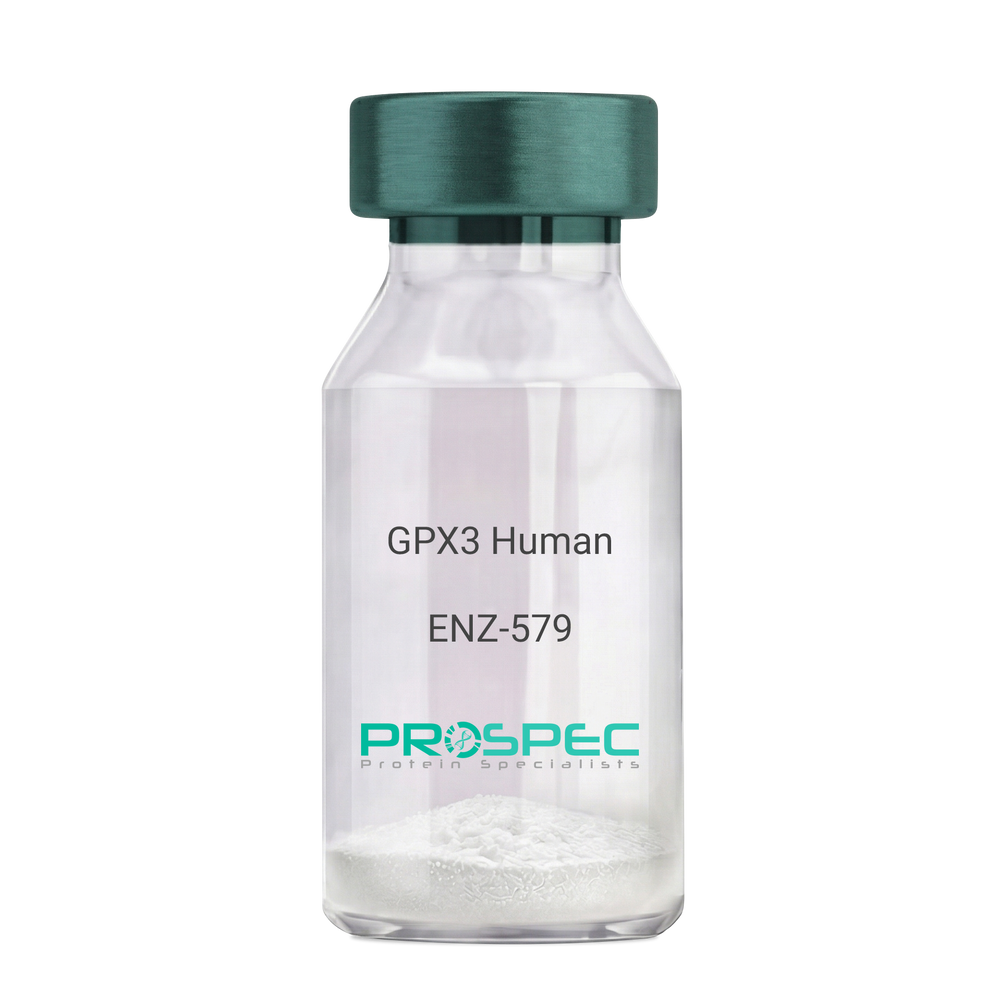
    GPX3 Human

    Description:

    Glutathione Peroxidase 3 Human Recombinant

    Glutathione peroxidase 3, GPx-3, GSHPx-3, Extracellular glutathione peroxidase, Plasma glutathione peroxidase, GPx-P, GSHPx-P, GPX3, GPXP.

    Product # :

    ENZ-579

    Price :

    Quantity :

    Shipping Method :

    Ice Icon

    Shipped with Ice Packs

    Add To Cart

    More Info

    • description
    • source
    • formulation
    • purity
    • More Info
    • Citations

    Description

    GPX3 Human Recombinant produced in E.coli is a single, non-glycosylated polypeptide chain containing 227 amino acids (21-226) and having a molecular mass of 25.7kDa.GPX3 is fused to a 21 amino acid His-tag at N-terminus & purified by proprietary chromatographic techniques.

    Source

    Escherichia Coli.

    Formulation

    The GPX3 solution contains 20mM Tris-HCl buffer (pH7.5), 40% glycerol, 0.15M NaCl and 1mM DTT.

    Purity

    Greater than 85% as determined by SDS-PAGE.

    Citations

    More Info

    • Introduction

      Glutathione peroxidase 3 (GPX3) is a member of the glutathione peroxidase family, which acts in the detoxification of hydrogen peroxide. GPX3 shields cells and enzymes from oxidative damage, by catalyzing the reduction of hydrogen peroxide, lipid peroxides and organic hydroperoxide, by glutathione. The GPX3 protein is one of only a few proteins known in higher vertebrates to contain selenocysteine, which occurs at the active site of glutathione peroxidase and is coded by the nonsense (stop) codon TGA.

    • Synonyms

      Glutathione peroxidase 3, GPx-3, GSHPx-3, Extracellular glutathione peroxidase, Plasma glutathione peroxidase, GPx-P, GSHPx-P, GPX3, GPXP.

    • Physical Appearance

      Sterile filtered colorless solution.

    • Stability

      Store at 4°C if entire vial will be used within 2-4 weeks. Store, frozen at -20°C for longer periods of time. For long term storage it is recommended to add a carrier protein (0.1% HSA or BSA).Avoid multiple freeze-thaw cycles.

    • Amino Acid Sequence

      MGSSHHHHHH SSGLVPRGSH MQSRGQEKSK MDCHGGISGT IYEYGALTID GEEYIPFKQY AGKYVLFVNV ASYCGLTGQY IELNALQEEL APFGLVILGF PCNQFGKQEP GENSEILPTL KYVRPGGGFV PNFQLFEKGD VNGEKEQKFY TFLKNSCPPT SELLGTSDRL FWEPMKVHDI RWNFEKFLVG PDGIPIMRWH HRTTVSNVKM DILSYMRRQA ALGVKRK.

    ProSpec's products are furnished for LABORATORY RESEARCH USE ONLY. The product may not be used as drugs, agricultural or pesticidal products, food additives or household chemicals.

    Gpx3 Human
  • View Data Sheet

    Name :

    MMP 7 Human

    Description:

    Matrix Metalloproteinase-7 Human Recombinant

    Matrilysin, EC 3.4.24.23, Pump-1 protease, Uterine metalloproteinase, Matrix metalloproteinase-7, MMP-7, Matrin, MPSL1, PUMP-1, MMP7.

    Product # :

    ENZ-867

    Price :

    Quantity :

    Shipping Method :

    Ice Icon

    Shipped with Ice Packs

    Add To Cart

    More Info

    • description
    • source
    • formulation
    • purity
    • More Info
    • Citations

    Description

    MMP-7 Human Recombinant produced in E.Coli is a single, non-glycosylated polypeptide chain containing 174 amino acids (95-267 a.a) and having a molecular mass of 19.2kDa.MMP7 is purified by proprietary chromatographic techniques.

    Source

    Escherichia Coli.

    Formulation

    MMP7 protein solution (1mg/ml) containing 20mM Tris 8.0 and 10% glycerol.

    Purity

    Greater than 90% as determined by SDS-PAGE.

    Citations

    More Info

    • Introduction

      Matrix metalloproteinase-7 (MMP-7) also known as matrilysin and PUMP (EC 3.4.24.23) cleaves a number of substrates including collagen types IV and X, elastin, fibronectin, gelatin, laminin and proteoglycans. MMP-7 is closely related to the stromelysin family members but is encoded by a different gene. MMP-7 is the smallest of all the MMPs consisting of a pro-peptide domain and a catalytic domain. It lacks the hemopexin-like domain common to other members of the MMPs. MMP-7 is secreted as a 28 kDa proenzyme and can be activated in vitro by organomercurials and trypsin and in vivo by MMP-3 to a 18 kDa active MMP-7 enzyme. Once activated, MMP-7 can activate pro-MMP-1 and pro-MMP-9 but not pro-MMP-2. MMP-7 is widely expressed having been reported in elevated levels in cycling endometrium as well as in colorectal cancers and adenomas, hepatocellular carcinomas, rectal carcinomas, and approximately 50% of gliomas.

    • Synonyms

      Matrilysin, EC 3.4.24.23, Pump-1 protease, Uterine metalloproteinase, Matrix metalloproteinase-7, MMP-7, Matrin, MPSL1, PUMP-1, MMP7.

    • Physical Appearance

      Sterile Filtered colorless solution.

    • Stability

      Store at 4°C if entire vial will be used within 2-4 weeks. Store, frozen at -20°C for longer periods of time. For long term storage it is recommended to add a carrier protein (0.1% HSA or BSA). Avoid multiple freeze-thaw cycles.

    • Amino Acid Sequence

      MYSLFPNSPK WTSKVVTYRI VSYTRDLPHI TVDRLVSKAL NMWGKEIPLH FRKVVWGTAD IMIGFARGAH GDSYPFDGPG NTLAHAFAPG TGLGGDAHFD EDERWTDGSS LGINFLYAAT HELGHSLGMG HSSDPNAVMY PTYGNGDPQN FKLSQDDIKG IQKLYGKRSN SRKK.

    ProSpec's products are furnished for LABORATORY RESEARCH USE ONLY. The product may not be used as drugs, agricultural or pesticidal products, food additives or household chemicals.

    Mmp 7 Human
  • View Data Sheet

    Name :

    NAGK Human

    Description:

    N-Acetylglucosamine Kinase Human Recombinant

    N-acetylglucosamine kinase, GNK, GlcNAc kinase, N-acetyl-D-glucosamine kinase, HSA242910, EC 2.7.1.59.

    Product # :

    PKA-027

    Price :

    Quantity :

    Shipping Method :

    Ice Icon

    Shipped with Ice Packs

    Add To Cart

    More Info

    • description
    • source
    • formulation
    • purity
    • More Info
    • Citations

    Description

    NAGK Human Recombinant produced in E. coli is a single polypeptide chain containing 367 amino acids (1-344) and having a molecular mass of 39.8kDa.NAGK is fused to a 23 amino acid His-tag at N-terminus & purified by proprietary chromatographic techniques.

    Source

    E.coli.

    Formulation

    The NAGK solution (1mg/ml) contains 20mM Tris-HCl buffer (pH 8.0), 200mM NaCl, 2mM DTT and 20% glycerol.

    Purity

    Greater than 95% as determined by SDS-PAGE.

    Citations

    More Info

    • Introduction

      NAGK is a member of the eukaryotic-type N-acetylglucosamine kinase family. NAGK converts endogenous N-acetylglucosamine (GlcNAc), a key component of complex carbohydrates, from lysosomal degradation or alimentary sources into GlcNAc 6-phosphate. NAGK is a prominent salvage enzyme of amino sugar metabolism in mammals. NAGK cooperates with STK16 and LNX1 and has ManNAc kinase activity.

    • Synonyms

      N-acetylglucosamine kinase, GNK, GlcNAc kinase, N-acetyl-D-glucosamine kinase, HSA242910, EC 2.7.1.59.

    • Physical Appearance

      Sterile Filtered colorless solution.

    • Stability

      Store at 4°C if entire vial will be used within 2-4 weeks. Store, frozen at -20°C for longer periods of time. For long term storage it is recommended to add a carrier protein (0.1% HSA or BSA).Avoid multiple freeze-thaw cycles.

    • Amino Acid Sequence

      MGSSHHHHHH SSGLVPRGSH MGSMAAIYGG VEGGGTRSEV LLVSEDGKIL AEADGLSTNH WLIGTDKCVE RINEMVNRAK RKAGVDPLVP LRSLGLSLSG GDQEDAGRIL IEELRDRFPY LSESYLITTD AAGSIATATP DGGVVLISGT GSNCRLINPD GSESGCGGWG HMMGDEGSAY WIAHQAVKIV FDSIDNLEAA PHDIGYVKQA MFHYFQVPDR LGILTHLYRD FDKCRFAGFC RKIAEGAQQG DPLSRYIFRK AGEMLGRHIV AVLPEIDPVL FQGKIGLPIL CVGSVWKSWE LLKEGFLLAL TQGREIQAQN FFSSFTLMKL RHSSALGGAS LGARHIGHLL PMDYSANAIA FYSYTFS

    ProSpec's products are furnished for LABORATORY RESEARCH USE ONLY. The product may not be used as drugs, agricultural or pesticidal products, food additives or household chemicals.

    Nagk Human
  • View Data Sheet

    Name :

    HRP

    Description:

    Horseradish Peroxidase

    Horseradish Peroxidase, HRP, EC 1.11.1.7.

    Product # :

    ENZ-321

    Price :

    Quantity :

    Shipping Method :

    Room Temp Icon

    Shipped at Room temp

    Add To Cart

    More Info

    • description
    • source
    • purity
    • biological activity
    • More Info
    • Citations

    Description

    HRP consists of the basic isoenzyme having a molecular weight of 44 kDa.The Horseradish Peroxidase is purified by affinity chromatography, which results in an enzyme of high specific activity and purity.

    Source

    Root extracts of horseradish.

    Purity

    (A403/A275) = RZ: 3.0.

    Biological Activity

    276 U/mg (25°C, guaiacol as the hydrogen donor, pH-7 and H2O2 as substrates).

    Citations

    More Info

    • Introduction

      The enzyme horseradish peroxidase, found in horseradish, is used extensively in molecular biologyand in antibody amplification and detection, among other things. For example, "In recent years the technique of marking neurons with the enzyme horseradish peroxidase (HRP) has become a major tool. In its brief history, this method has probably been used by more neurobiologists than have used the Golgi stainsince its discovery in 1870." Horseradish peroxidase is also highly used in techniques such as Western blottingand ELISAs.
      HRP is widely used as an enzymatic label in immunoassays. Usually, the enzyme is coupled to antibodies, lectins or haptens. Coupling to antibodies etc. may be performed through the carbohydrate side chains of the HRP.

    • Synonyms

      Horseradish Peroxidase, HRP, EC 1.11.1.7.

    • Physical Appearance

      Sterile Filtered red-brown lyophilized powder.

    • Stability

      Lyophilized HRP although stable at room temperature for 3 weeks, should be stored desiccated below -18°C. Upon reconstitution HRP should be stored at 4°C between 2-7 days and for future use below -18°C.Please prevent freeze-thaw cycles.

    • Solubility

      It is recommended to reconstitute the lyophilized HRP in sterile 18MΩ-cm H2O not less than 100 µg/ml.

    ProSpec's products are furnished for LABORATORY RESEARCH USE ONLY. The product may not be used as drugs, agricultural or pesticidal products, food additives or household chemicals.

    Horseradish Peroxidase
  • View Data Sheet

    Name :

    NDK E.Coli

    Description:

    Nucleoside Diphosphate Kinase E.Coli Recombinant

    Nucleoside diphosphate kinase, NDK, NDP kinase, Nucleoside-2-P kinase, b2518, JW2502.

    Product # :

    PKA-034

    Price :

    Quantity :

    Shipping Method :

    Ice Icon

    Shipped with Ice Packs

    Add To Cart

    More Info

    • description
    • source
    • formulation
    • purity
    • More Info
    • Citations

    Description

    NDK E.Coli Recombinant produced in E.Coli is a single, non-glycosylated polypeptide chain containing 167 amino acids (1-143 a.a.) and having a molecular mass of 18kDa.NDK is fused to a 24 amino acid His-tag at N-terminus & purified by proprietary chromatographic techniques.

    Source

    E.coli.

    Formulation

    NDK protein solution (1mg/ml) containing 20mM Tris-HCl buffer (pH8.0), 10% glycerol, 0.1M NaCl and 1mM DTT.

    Purity

    Greater than 95% as determined by SDS-PAGE.

    Citations

    More Info

    • Introduction

      Nucleoside diphosphate kinase (Ndk) is an enzyme which catalyzes the exchange of phosphate groups between different nucleoside diphosphates. Ndk’s activity sustains equilibrium between the concentrations of various nucleoside triphosphates for example, when GTP is produced in the citric acid (Krebs) cycle is converted to ATP. Ndk has a key role in the synthesis of nucleoside triphosphates other than ATP.

    • Synonyms

      Nucleoside diphosphate kinase, NDK, NDP kinase, Nucleoside-2-P kinase, b2518, JW2502.

    • Physical Appearance

      Sterile Filtered colorless solution.

    • Stability

      Store at 4°C if entire vial will be used within 2-4 weeks. Store, frozen at -20°C for longer periods of time. For long term storage it is recommended to add a carrier protein (0.1% HSA or BSA).Avoid multiple freeze-thaw cycles.

    • Amino Acid Sequence

      MGSSHHHHHH SSGLVPRGSH MGSHMAIERT FSIIKPNAVA KNVIGNIFAR FEAAGFKIVG TKMLHLTVEQ ARGFYAEHDG KPFFDGLVEF MTSGPIVVSV LEGENAVQRH RDLLGATNPA NALAGTLRAD YADSLTENGT HGSDSVESAA REIAYFFGEG EVCPRTR.

    ProSpec's products are furnished for LABORATORY RESEARCH USE ONLY. The product may not be used as drugs, agricultural or pesticidal products, food additives or household chemicals.

    Ndk Ecoli
  • View Data Sheet

    Name :

    NDUFS4 Human

    Description:

    Histidine NADH Dehydrogenase Fe-S Protein 4 Human Recombinant

    AQDQ, NDUFS4, NADH dehydrogenase [ubiquinone] iron-sulfur protein 4 mitochondrial, NADH-ubiquinone oxidoreductase 18 kDa subunit, Complex I-18 kDa, CI-18 kDa, Complex I-AQDQ, CI-AQDQ.

    Product # :

    ENZ-421

    Price :

    Quantity :

    Shipping Method :

    Ice Icon

    Shipped with Ice Packs

    Add To Cart

    More Info

    • description
    • source
    • formulation
    • purity
    • More Info
    • Citations

    Description

    NDUFS4 Human Recombinant produced in E.Coli is a single, non-glycosylated, polypeptide chain containing 134 amino acids (43-175 a.a.) and having a molecular mass of 15.5 kDa.The NDUFS4 is purified by proprietary chromatographic techniques.

    Source

    Escherichia Coli.

    Formulation

    The NDUFS4 solution contains 20mM Tris pH-8 & 30% glycerol.

    Purity

    Greater than 90.0% as determined by SDS-PAGE.

    Citations

    More Info

    • Introduction

      NDUFS4 is a subunit of the mitochondrial membrane respiratory chain NADH dehydrogenase (Complex I), the primary multi-subunit enzyme complex of the mitochondrial respiratory chain. Complex I is involved in cellular ATP production, the main source of energy for numerous vital processes in living cells. NDUFS4 removes electrons from NADH and passes them by a series of diverse protein-coupled redox centers to the electron acceptor ubiquinone. NDUFS4 presents a hotspot of mutations in the genetic apparatus of oxidative phosphorylation and the correct assembly of the subunit it encodes is essential for completion of the assembly of complex I.

    • Synonyms

      AQDQ, NDUFS4, NADH dehydrogenase [ubiquinone] iron-sulfur protein 4 mitochondrial, NADH-ubiquinone oxidoreductase 18 kDa subunit, Complex I-18 kDa, CI-18 kDa, Complex I-AQDQ, CI-AQDQ.

    • Physical Appearance

      Sterile Filtered colorless solution.

    • Stability

      Store at 4°C if entire vial will be used within 2-4 weeks. Store, frozen at -20°C for longer periods of time. For long term storage it is recommended to add a carrier protein (0.1% HSA or BSA).Please prevent freeze-thaw cycles.

    • Amino Acid Sequence

      MAQDQTQDTQ LITVDEKLDI TTLTGVPEEH IKTRKVRIFV PARNNMQSGV NNTKKWKMEF DTRERWENPL MGWASTADPL SNMVLTFSTK EDAVSFAEKN GWSYDIEERK VPKPKSKSYG ANFSWNKRTR VSTK.

    ProSpec's products are furnished for LABORATORY RESEARCH USE ONLY. The product may not be used as drugs, agricultural or pesticidal products, food additives or household chemicals.

    Ndufs4 Human
  • View Data Sheet

    Name :

    NDUFS5 Human

    Description:

    Histidine NADH Dehydrogenase Fe-S Protein 5 Human Recombinant

    CI-15k, CI15K, NADH dehydrogenase [ubiquinone] iron-sulfur protein 5, Complex I-15 kDa, NADH-ubiquinone oxidoreductase 15 kDa subunit, CI-15 kDa, NDUFS5.

    Product # :

    ENZ-771

    Price :

    Quantity :

    Shipping Method :

    Ice Icon

    Shipped with Ice Packs

    Add To Cart

    More Info

    • description
    • source
    • formulation
    • purity
    • More Info
    • Citations

    Description

    NDUFS5 Human Recombinant produced in E.coli is a single, non-glycosylated polypeptide chain containing 129 amino acids (1-106a.a) and having a molecular mass of 14.9kDa. NDUFS5 is fused to a 23 amino acid His-tag at N-terminus & purified by proprietary chromatographic techniques.

    Source

    Escherichia Coli.

    Formulation

    The NDUFS5 solution (1mg/ml) contains 20mM Tris-HCl buffer (pH8.0), 10% glycerol and 0.4M Urea.

    Purity

    Greater than 85% as determined by SDS-PAGE.

    Citations

    More Info

    • Introduction

      Histidine NADH Dehydrogenase Fe-S Protein 5 (NDUFS5) belongs to the NADH dehydrogenase (ubiquinone) iron-sulfur protein family. NDUFS5 is a subunit of the mitochondrial membrane respiratory chain NADH dehydrogenase (Complex I), which doesn’t take part in catalysis. Complex I is transferring the electrons from NADH to the respiratory chain.

    • Synonyms

      CI-15k, CI15K, NADH dehydrogenase [ubiquinone] iron-sulfur protein 5, Complex I-15 kDa, NADH-ubiquinone oxidoreductase 15 kDa subunit, CI-15 kDa, NDUFS5.

    • Physical Appearance

      Sterile Filtered colorless solution.

    • Stability

      Store at 4°C if entire vial will be used within 2-4 weeks. Store, frozen at -20°C for longer periods of time. For long term storage it is recommended to add a carrier protein (0.1% HSA or BSA). Avoid multiple freeze-thaw cycles.

    • Amino Acid Sequence

      MGSSHHHHHH SSGLVPRGSH MGSMPFLDIQ KRFGLNIDRW LTIQSGEQPY KMAGRCHAFE KEWIECAHGI GYTRAEKECK IEYDDFVECL LRQKTMRRAG TIRKQRDKLI KEGKYTPPPH HIGKGEPRP.

    ProSpec's products are furnished for LABORATORY RESEARCH USE ONLY. The product may not be used as drugs, agricultural or pesticidal products, food additives or household chemicals.

    Ndufs5 Human
  • View Data Sheet

    Name :

    ITPK1 Human

    Description:

    Inositol-Tetrakisphosphate 1-Kinase Human Recombinant

    Inositol-tetrakisphosphate 1-kinase, Inositol 1,3,4-trisphosphate 5/6-kinase, Inositol-triphosphate 5/6-kinase, Ins(1,3,4)P(3) 5/6-kinase, ITPK1, ITRPK1.

    Product # :

    PKA-040

    Price :

    Quantity :

    Shipping Method :

    Ice Icon

    Shipped with Ice Packs

    Add To Cart

    More Info

    • description
    • source
    • formulation
    • purity
    • More Info
    • Citations

    Description

    ITPK1 Human Recombinant produced in E.Coli is a single, non-glycosylated polypeptide chain containing 438 amino acids (1-414 a.a) and having a molecular mass of 48.1kDa.ITPK1 is fused to a 24 amino acid His-tag at N-terminus & purified by proprietary chromatographic techniques.

    Source

    E.coli.

    Formulation

    ITPK1 protein solution (1mg/ml) containing 20mM Tris-HCl buffer (pH 8.0), 0.1M NaCl, 10% glycerol and 1mM EDTA.

    Purity

    Greater than 95% as determined by SDS-PAGE.

    Citations

    More Info

    • Introduction

      Inositol-tetrakisphosphate 1-kinase (ITPK1) is a 414 amino acid monomer which is a member of the ITPK1 family and exists as 2 alternatively spliced isoforms. ITPK1 highest levels are found in the brain, followed by the heart, skeletal muscle, kidney, pancreas, liver, placenta and lung. ITPK1 is comprised of one ATP-grasp domain and has been shown to phosphorylate various inositol polyphosphates and modify TNFa induced apoptosis.

    • Synonyms

      Inositol-tetrakisphosphate 1-kinase, Inositol 1,3,4-trisphosphate 5/6-kinase, Inositol-triphosphate 5/6-kinase, Ins(1,3,4)P(3) 5/6-kinase, ITPK1, ITRPK1.

    • Physical Appearance

      Sterile Filtered colorless solution.

    • Stability

      Store at 4°C if entire vial will be used within 2-4 weeks. Store, frozen at -20°C for longer periods of time. For long term storage it is recommended to add a carrier protein (0.1% HSA or BSA).Avoid multiple freeze-thaw cycles.

    • Amino Acid Sequence

      MGSSHHHHHH SSGLVPRGSH MGSHMQTFLK GKRVGYWLSE KKIKKLNFQA FAELCRKRGM EVVQLNLSRP IEEQGPLDVI IHKLTDVILE ADQNDSQSLE LVHRFQEYID AHPETIVLDP LPAIRTLLDR SKSYELIRKI EAYMEDDRIC SPPFMELTSL CGDDTMRLLE KNGLTFPFIC KTRVAHGTNS HEMAIVFNQE GLNAIQPPCV VQNFINHNAV LYKVFVVGES YTVVQRPSLK NFSAGTSDRE SIFFNSHNVS KPESSSVLTE LDKIEGVFER PSDEVIRELS RALRQALGVS LFGIDIIINN QTGQHAVIDI NAFPGYEGVS EFFTDLLNHI ATVLQGQSTA MAATGDVALL RHSKLLAEPA GGLVGERTCS ASPGCCGSMM GQDAPWKAEA DAGGTAKLPH QRLGCNAGVS PSFQQHCVAS LATKASSQ.

    ProSpec's products are furnished for LABORATORY RESEARCH USE ONLY. The product may not be used as drugs, agricultural or pesticidal products, food additives or household chemicals.

    Itpk1 Human
  • View Data Sheet

    Name :

    PKACa2-RIIa2

    Description:

    Protein Kinase A holoenzyme type II alpha Recombinant

    Protein Kinase A holoenzyme type II alpha, PKACa2-RIIa2.

    Product # :

    PKA-205

    Price :

    Quantity :

    Shipping Method :

    Ice Icon

    Shipped with Ice Packs

    Add To Cart

    More Info

    • description
    • source
    • formulation
    • purity
    • biological activity
    • More Info
    • Citations

    Description

    Inactive holoenzyme consisting of one dimeric regulatory subunit type II alpha and two monomeric catalytic subunits (cAMP-free). Protein Kinase A is purified by proprietary chromatographic techniques.

    Source

    Escherichia Coli.

    Formulation

    PKA holoenzyme type-II alpha is supplied in 50% glycerol.

    Purity

    Greater than 95% as determined by SDS-PAGE.

    Biological Activity

    Holoenzyme can be activated by adding the second messenger cAMP (Activation constant about 100nM) releasing two monomeric catalytic subunits.

    Citations

    More Info

    • Introduction

      The protein kinase A holoenzyme is a heterotetramer composed of two types of subunits: Catalytic and Regulatory. The Catalyticsubunit contains the enzyme's active site. It also contains a domain that binds ATP and a domain that binds the regulatory subunit. The Regulatory subunit consists oftwo molecules which bind one another in an anti-parallel orientation to form a homodimer; for type I subunits- this binding is covalent via disulfide bonds. This subunit also has has two domains that bind cyclic AMP, a domain that interacts with a catalytic subunit, and an "auto-inhibitory" domain that serves as a substrate or pseudosubstrate for the catalytic subunit. Regulatory subunits may also have biologic activity distinct from their role in modulating catalytic subunit activity. Regulatory subunits exist in two major forms, RI and RII, with each form having two subtypes designated alpha and beta. Each of the four isotypes of the regulatory subunit is encoded by a different gene. In addition, three isotypes of the catalytic subunit have been identified (alpha, beta and gamma). The different isotypes tend to have different distributions within cells and among tissues. Type I enzymes inhabit cytoplasmic, soluble fractions of the cell, whereas type II enzymes tend to associate with cellular membranes.

    • Synonyms

      Protein Kinase A holoenzyme type II alpha, PKACa2-RIIa2.

    • Physical Appearance

      Sterile Filtered clear solution.

    • Stability

      PKA should be stored at 4°C if entire vial will be used within 2-4 weeks. For long term storage it is recommended to store at -20°C. Avoid multiple freeze-thaw cycles.

    • Applications

      The product is suitable for analysing PKA type II agonists (cAMP analogs) or antagonists.

    ProSpec's products are furnished for LABORATORY RESEARCH USE ONLY. The product may not be used as drugs, agricultural or pesticidal products, food additives or household chemicals.

    Pkaca2 Riia2
  • View Data Sheet

    Name :

    TPK1 Human

    Description:

    Thiamin Pyrophosphokinase 1 Human Recombinant

    Thiamin pyrophosphokinase 1, hTPK1, Placental protein 20, PP20, Thiamine pyrophosphokinase 1, TPK1, THMD5.

    Product # :

    PKA-023

    Price :

    Quantity :

    Shipping Method :

    Ice Icon

    Shipped with Ice Packs

    Add To Cart

    More Info

    • description
    • source
    • formulation
    • purity
    • More Info
    • Citations

    Description

    TPK1 Human Recombinant produced in E.Coli is a single, non-glycosylated polypeptide chain containing 267 amino acids (1-243 a.a.) and having a molecular mass of 29.8kDa.TPK1 is fused to a 24 amino acid His-tag at N-terminus & purified by proprietary chromatographic techniques.

    Source

    Escherichia Coli.

    Formulation

    TPK1 protein solution (1mg/ml) containing 20mM Tris-HCl buffer (pH8.0), 20% glycerol and 1mM DTT.

    Purity

    Greater than 90.0% as determined by SDS-PAGE.

    Citations

    More Info

    • Introduction

      Thiamin pyrophosphokinase 1 (TPK1) is a homodimer which catalyzes the phosphorylation of thiamine to thiamine pyrophosphate. TPK1 is found in the heart, kidney, testis, small intestine and peripheral blood leukocytes, and at very low levels in a variety of tissues. TPK1 gene defects cause the thiamine metabolism dysfunction syndrome type 5, episodic encephalopathy type (THMD5), which is an autosomal recessive metabolic disorder due to an inborn error of thiamine metabolism.

    • Synonyms

      Thiamin pyrophosphokinase 1, hTPK1, Placental protein 20, PP20, Thiamine pyrophosphokinase 1, TPK1, THMD5.

    • Physical Appearance

      Sterile filtered colorless solution.

    • Stability

      Store at 4°C if entire vial will be used within 2-4 weeks. Store, frozen at -20°C for longer periods of time. For long term storage it is recommended to add a carrier protein (0.1% HSA or BSA).Avoid multiple freeze-thaw cycles.

    • Amino Acid Sequence

      MGSSHHHHHH SSGLVPRGSH MGSHMEHAFT PLEPLLSTGN LKYCLVILNQ PLDNYFRHLW NKALLRACAD GGANRLYDIT EGERESFLPE FINGDFDSIR PEVREYYATK GCELISTPDQ DHTDFTKCLK MLQKKIEEKD LKVDVIVTLG GLAGRFDQIM ASVNTLFQAT HITPFPIIII
      QEESLIYLLQ PGKHRLHVDT GMEGDWCGLI PVGQPCMQVT TTGLKWNLTN DVLAFGTLVS TSNTYDGSGV VTVETDHPLL WTMAIKS.

    ProSpec's products are furnished for LABORATORY RESEARCH USE ONLY. The product may not be used as drugs, agricultural or pesticidal products, food additives or household chemicals.

    Tpk1 Human
  • View Data Sheet

    Name :

    GMDS Human

    Description:

    GDP-Mannose 4,6-Dehydratase Human Recombinant

    GDP-mannose 4,6-dehydratase, GMD, SDR3E1, short chain dehydrogenase/reductase family 3E member 1, GDP-D-mannose dehydratase, EC 4.2.1.47.

    Product # :

    ENZ-191

    Price :

    Quantity :

    Shipping Method :

    Ice Icon

    Shipped with Ice Packs

    Add To Cart

    More Info

    • description
    • source
    • formulation
    • purity
    • More Info
    • Citations

    Description

    GMDS Human Recombinant produced in E.coli is a single, non-glycosylated polypeptide chain containing 392 amino acids (1-372) and having a molecular mass of 44.1 kDa.GMDS is fused to a 20 amino acid His-tag at N-terminus & purified by proprietary chromatographic techniques.

    Source

    E.coli.

    Formulation

    The GMDS solution (0.5mg/ml) contains 20mM Tris-HCl buffer (pH 8.0), 1mM DTT, 0.1M NaCl, 0.1mM PMSF and 30% glycerol.

    Purity

    Greater than 95% as determined by SDS-PAGE.

    Citations

    More Info

    • Introduction

      GMDS is a member of the GDP-mannose 4,6-dehydratase family. GMDS uses NADP as a cofactor to catalyze the conversion of GDP-mannose to GDP-4-keto-6-deoxymannose. Defects in the gene encoding GMDS cause TRAIL (tumor necrosis factor-related apoptosis-inducing ligand)-induced apoptosis.

    • Synonyms

      GDP-mannose 4,6-dehydratase, GMD, SDR3E1, short chain dehydrogenase/reductase family 3E member 1, GDP-D-mannose dehydratase, EC 4.2.1.47.

    • Physical Appearance

      Sterile Filtered colorless solution.

    • Stability

      Store at 4°C if entire vial will be used within 2-4 weeks. Store, frozen at -20°C for longer periods of time. For long term storage it is recommended to add a carrier protein (0.1% HSA or BSA).Avoid multiple freeze-thaw cycles.

    • Amino Acid Sequence

      MGSSHHHHHH SSGLVPRGSH MAHAPARCPS ARGSGDGEMG KPRNVALITG ITGQDGSYLA EFLLEKGYEV HGIVRRSSSF NTGRIEHLYK NPQAHIEGNM KLHYGDLTDS TCLVKIINEV KPTEIYNLGA QSHVKISFDL AEYTADVDGV GTLRLLDAVK TCGLINSVKF YQASTSELYG KVQEIPQKET TPFYPRSPYG AAKLYAYWIV VNFREAYNLF AVNGILFNHE SPRRGANFVT RKISRSVAKI YLGQLECFSL GNLDAKRDWG HAKDYVEAMW LMLQNDEPED FVIATGEVHS VREFVEKSFL HIGKTIVWEG KNENEVGRCK ETGKVHVTVD LKYYRPTEVD FLQGDCTKAK QKLNWKPRVA FDELVREMVH ADVELMRTNP NA.

    ProSpec's products are furnished for LABORATORY RESEARCH USE ONLY. The product may not be used as drugs, agricultural or pesticidal products, food additives or household chemicals.

    Gmds Human
  • View Data Sheet

    Name :

    TYMP Human

    Description:

    Thymidine Phosphorylase Human Recombinant

    Thymidine phosphorylase, Gliostatin, Platelet-derived endothelial cell growth factor, PD-ECGF, TdRPase, TYMP, ECGF1, TP, MNGIE, MEDPS1, MTDPS1, PDECGF, hPD-ECGF.

    Product # :

    ENZ-005

    Price :

    Quantity :

    Shipping Method :

    Ice Icon

    Shipped with Ice Packs

    Add To Cart

    More Info

    • description
    • source
    • formulation
    • purity
    • More Info
    • Citations

    Description

    TYMP Human Recombinant fused with a 21 amino acid His tag at N-terminus produced in E.Coli is a single, non-glycosylated, polypeptide chain containing 493 amino acids (11-482 a.a.) and having a molecular mass of 51.3kDa. The TYMP is purified by proprietary chromatographic techniques.

    Source

    Escherichia Coli.

    Formulation

    The TYMP solution (1mg/ml) contains 20mM Tris-HCl buffer (pH 8.0), 1mM DTT and 10% glycerol.

    Purity

    Greater than 90.0% as determined by SDS-PAGE.

    Citations

    More Info

    • Introduction

      Thymidine phosphorylase precursor (TYMP) is a platelet-derived endothelial cell growth factor that catalyzes the formation of thymine and 2-deoxy-D-ribose-1-phosphate from thymidine and orthophosphate. TYMP is an angiogenic inducer that potently stimulates the growth of endothelial cells and induces chemotaxis. TYMP has a highly restricted target cell specificity acting only on endothelial cells. An increased expression of TYMP is found in a broad array of different solid tumors and inflammatory diseases and is frequently associated with poor prognosis. Mutations in the TYMP gene are linked to mitochondrial neurogastrointestinal encephalomyopathy.

    • Synonyms

      Thymidine phosphorylase, Gliostatin, Platelet-derived endothelial cell growth factor, PD-ECGF, TdRPase, TYMP, ECGF1, TP, MNGIE, MEDPS1, MTDPS1, PDECGF, hPD-ECGF.

    • Physical Appearance

      Sterile Filtered colorless solution.

    • Stability

      Store at 4°C if entire vial will be used within 2-4 weeks. Store, frozen at -20°C for longer periods of time. For long term storage it is recommended to add a carrier protein (0.1% HSA or BSA).Avoid multiple freeze-thaw cycles.

    • Amino Acid Sequence

      MGSSHHHHHH SSGLVPRGSH MAPPAPGDFS GEGSQGLPDP SPEPKQLPEL IRMKRDGGRL SEADIRGFVA AVVNGSAQGA QIGAMLMAIR LRGMDLEETS VLTQALAQSG QQLEWPEAWR QQLVDKHSTG GVGDKVSLVL APALAACGCK VPMISGRGLG HTGGTLDKLE SIPGFNVIQS PEQMQVLLDQ AGCCIVGQSE QLVPADGILY AARDVTATVD SLPLITASIL SKKLVEGLSA LVVDVKFGGA AVFPNQEQAR ELAKTLVGVG ASLGLRVAAA LTAMDKPLGR CVGHALEVEE ALLCMDGAGP PDLRDLVTTL GGALLWLSGH AGTQAQGAAR VAAALDDGSA LGRFERMLAA QGVDPGLARA LCSGSPAERR QLLPRAREQE ELLAPADGTV ELVRALPLAL VLHELGAGRS RAGEPLRLGV GAELLVDVGQ RLRRGTPWLR VHRDGPALSG PQSRALQEAL VLSDRAPFAA PSPFAELVLP PQQ.

    ProSpec's products are furnished for LABORATORY RESEARCH USE ONLY. The product may not be used as drugs, agricultural or pesticidal products, food additives or household chemicals.

    Tymp Human
  • View Data Sheet

    Name :

    GUK1 Human

    Description:

    Guanylate Kinase 1 Human Recombinant

    GMK, GMP kinase.

    Product # :

    PKA-266

    Price :

    Quantity :

    Shipping Method :

    Ice Icon

    Shipped with Ice Packs

    Add To Cart

    More Info

    • description
    • source
    • formulation
    • purity
    • More Info
    • Citations

    Description

    GUK1 Human Recombinant produced in E.Coli is a single, non-glycosylated, polypeptide chain containing 217 amino acids (1-197 a.a.)and having a total molecular mass of 23.9 kDa. GUK1 is fused to a 20 amino acid His Tag at N-terminus and is purified by proprietary chromatographic techniques.

    Source

    Escherichia Coli.

    Formulation

    The GUK1 1mg/ml protein solution contains 20mM Tris-HCl pH-8, 1mM DTT, 0.1M NaCl and 10% Glycerol.

    Purity

    Greater than 90.0% as determined by SDS-PAGE.

    Citations

    More Info

    • Introduction

      GUK1 is part of the guanylate kinase family. GUK1 occurs as a monomer that catalyzes the ATP-dependent conversion of GMP to GDP, thus takes an important part in the recycling of GMP. Through its catalytic activity, GUK1 functions in regulation of the supply of guanine nucleotides to signal transduction pathways. GUK1 overexpression is related with pituitary adenocarcinomas, implicating that GUK1 is has a role in tumorigenesis.

    • Synonyms

      GMK, GMP kinase.

    • Physical Appearance

      Sterile Filtered colorless clear solution.

    • Stability

      Store at 4°C if entire vial will be used within 2-4 weeks. Store, frozen at -20°C for longer periods of time. For long term storage it is recommended to add a carrier protein (0.1% HSA or BSA).Please avoid freeze thaw cycles.

    • Amino Acid Sequence

      MGSSHHHHHH SSGLVPRGSH MSGPRPVVLS GPSGAGKSTL LKRLLQEHSG IFGFSVSHTT RNPRPGEENG KDYYFVTREV MQRDIAAGDF IEHAEFSGNL YGTSKVAVQA VQAMNRICVL DVDLQGVRNI KATDLRPIYI SVQPPSLHVL EQRLRQRNTE TEESLVKRLA AAQADMESSK EPGLFDVVII NDSLDQAYAE LKEALSEEIK KAQRTGA.

    ProSpec's products are furnished for LABORATORY RESEARCH USE ONLY. The product may not be used as drugs, agricultural or pesticidal products, food additives or household chemicals.

    Guk1 Human
  • 1
  • …
  • 11
  • 12
  • 13
  • 14
  • 15
  • …
  • 33
Your browser does not support the video tag.

Products

  • Cytokines
  • Growth Factors
  • Chemokines
  • CD Antigens
  • Neurotrophins
  • Hormones
  • Enzymes
  • Viral Antigens
  • Recombinant Proteins
  • Natural Proteins
  • Monoclonal Antibodies
  • Polyclonal Antibodies
  • Thermal Packaging

About

  • Company
  • Founder
  • Contribution
  • Contact Us
  • My Account

Ordering

  • Ordering Method
  • Ordering - Credit Card
  • Ordering PO
  • Shipping Fees
  • FAQ's

Legal

  • Terms & Conditions
  • Privacy
  • Site Map
  • info@prospecbio.com
  • Facebook
  • Instagram
  • Linkedin Profile

© 2026 ProSpec-Tany TechnoGene Ltd. All Rights Reserved.

  • Choosing a selection results in a full page refresh.
  • Opens in a new window.