Skip to content

High-quality research proteins.

  • 1-800-805-6531

  • Mon - Sat 8.00-18.00, Sun - Closed

  • info@prospecbio.com

  • PO Box 6591 East Brunswick NJ 08816

  • Products
    • Cytokines
    • Growth factors
    • Chemokines
    • Cd antigens
    • Neurotrophins
    • Hormones
    • Enzymes
    • Viral antigens
    • Recombinant proteins
    • Natural proteins
    • Monoclonal antibodies
    • Polyclonal antibodies
    • Thermal Packaging
  • About
    • Company
    • Founder
    • Contribution
  • Customers
    • Eastern Asia
    • Eastern Europe
    • North America
    • South America
    • South East Asia
    • Southern Asia
    • Western Europe
  • Ordering
    • Ordering Method
    • Ordering - Credit Card
    • Ordering - PO
    • Shipping Fees
    • FAQs
  • Services
    • DNA Cloning
    • Protein Expression
    • Monoclonal Antibody
    • Fermentation
    • Technology License
  • Contact us
Log in

Country/region

  • USD $ | Albania
  • USD $ | Andorra
  • USD $ | Argentina
  • USD $ | Armenia
  • USD $ | Australia
  • USD $ | Austria
  • USD $ | Azerbaijan
  • USD $ | Belarus
  • USD $ | Belgium
  • USD $ | Bolivia
  • USD $ | Brazil
  • USD $ | Bulgaria
  • USD $ | Cambodia
  • USD $ | Canada
  • USD $ | Chile
  • USD $ | China
  • USD $ | Colombia
  • USD $ | Costa Rica
  • USD $ | Croatia
  • USD $ | Cyprus
  • USD $ | Czechia
  • USD $ | Denmark
  • USD $ | Estonia
  • USD $ | Finland
  • USD $ | France
  • USD $ | Georgia
  • USD $ | Germany
  • USD $ | Greece
  • USD $ | Hong Kong SAR
  • USD $ | Hungary
  • USD $ | Iceland
  • USD $ | India
  • USD $ | Ireland
  • USD $ | Israel
  • USD $ | Italy
  • USD $ | Japan
  • USD $ | Kazakhstan
  • USD $ | Latvia
  • USD $ | Liechtenstein
  • USD $ | Lithuania
  • USD $ | Madagascar
  • USD $ | Malta
  • USD $ | Mexico
  • USD $ | Moldova
  • USD $ | Monaco
  • USD $ | Netherlands
  • USD $ | New Zealand
  • USD $ | North Macedonia
  • USD $ | Norway
  • USD $ | Panama
  • USD $ | Paraguay
  • USD $ | Peru
  • USD $ | Philippines
  • USD $ | Poland
  • USD $ | Portugal
  • USD $ | Romania
  • USD $ | Singapore
  • USD $ | Slovakia
  • USD $ | Slovenia
  • USD $ | South Africa
  • USD $ | South Korea
  • USD $ | Spain
  • USD $ | Sri Lanka
  • USD $ | Sweden
  • USD $ | Switzerland
  • USD $ | Taiwan
  • USD $ | Thailand
  • USD $ | Türkiye
  • USD $ | Ukraine
  • USD $ | United Kingdom
  • USD $ | United States
  • USD $ | Uruguay
  • USD $ | Vatican City
  • USD $ | Venezuela
  • USD $ | Vietnam
  • Facebook
  • Instagram
logoProSpec - Recombinant Protein Manufacturer for academic and R&D industry
Become a distributor
Account Log in
Wishlist
Cart Cart(0)
  • Products
    +
    • Cytokines
    • Growth factors
    • Chemokines
    • Cd antigens
    • Neurotrophins
    • Hormones
    • Enzymes
    • Viral antigens
    • Recombinant proteins
    • Natural proteins
    • Monoclonal antibodies
    • Polyclonal antibodies
    • Thermal Packaging
  • About
    +
    • Company
    • Founder
    • Contribution
  • Customers
    +
    • Eastern Asia
    • Eastern Europe
    • North America
    • South America
    • South East Asia
    • Southern Asia
    • Western Europe
  • Ordering
    +
    • Ordering Method
    • Ordering - Credit Card
    • Ordering - PO
    • Shipping Fees
    • FAQs
  • Services
    +
    • DNA Cloning
    • Protein Expression
    • Monoclonal Antibody
    • Fermentation
    • Technology License
  • Contact us

Item added to your cart

View cart
View All
  • Cytokines
  • Growth factors
  • Chemokines
  • Cd antigens
  • Neurotrophins
  • Hormones
  • Enzymes
  • Viral antigens
  • Recombinant proteins
  • Natural proteins
  • Monoclonal antibodies
  • Polyclonal antibodies
  • Thermal Packaging
  • Tumor Necrosis Factor

    Tumor Necrosis Factor

    View All
  • 4-1BB

    4-1BB

    View All
  • Adiponectin

    Adiponectin

    View All
  • AIF1

    AIF1

    View All
  • Other Cytokines

    Other Cytokines

    View All
  • AITRL

    AITRL

    View All
  • Angiopoietin

    Angiopoietin

    View All
  • Apolipoprotein

    Apolipoprotein

    View All
  • B-Cell Activating Factor

    B-Cell Activating Factor

    View All
  • Beta Defensin

    Beta Defensin

    View All
  • Bone Morphogenetic Protein

    Bone Morphogenetic Protein

    View All
  • B type Natriuretic Peptide

    B type Natriuretic Peptide

    View All
  • BST

    BST

    View All
  • Betacellulin

    Betacellulin

    View All
  • Cardiotrophin

    Cardiotrophin

    View All
  • Activin

    Activin

    View All
  • Fibroblast Growth Factor

    Fibroblast Growth Factor

    View All
  • Other Growth Factors

    Other Growth Factors

    View All
  • CSF

    CSF

    View All
  • CTGF

    CTGF

    View All
  • IGFBP

    IGFBP

    View All
  • VEGF Protein

    VEGF Protein

    View All
  • EGF

    EGF

    View All
  • Epigen

    Epigen

    View All
  • Erythropoietin

    Erythropoietin

    View All
  • Insulin-Like Growth Factor

    Insulin-Like Growth Factor

    View All
  • Growth Hormone

    Growth Hormone

    View All
  • HDGF

    HDGF

    View All
  • Hepatocyte Growth Factor

    Hepatocyte Growth Factor

    View All
  • Insulin

    Insulin

    View All
  • BCA-1/ BLC (CXCL13)

    BCA-1/ BLC (CXCL13)

    View All
  • BRAK (CXCL14)

    BRAK (CXCL14)

    View All
  • C-10 (CCL6)

    C-10 (CCL6)

    View All
  • Other Chemokines

    Other Chemokines

    View All
  • MEC (CCL28)

    MEC (CCL28)

    View All
  • LD78-beta (CCL3L1)

    LD78-beta (CCL3L1)

    View All
  • CTACK (CCL27)

    CTACK (CCL27)

    View All
  • CXCL16

    CXCL16

    View All
  • CXCL17

    CXCL17

    View All
  • Platelet Factor-4 (CXCL4)

    Platelet Factor-4 (CXCL4)

    View All
  • ENA-78 (CXCL5)

    ENA-78 (CXCL5)

    View All
  • Eotaxin (CCL11,24,26)

    Eotaxin (CCL11,24,26)

    View All
  • Exodus-2 (CCL21)

    Exodus-2 (CCL21)

    View All
  • Fractalkine (CX3CL1)

    Fractalkine (CX3CL1)

    View All
  • CXCL6

    CXCL6

    View All
  • Other CD Antigens

    Other CD Antigens

    View All
  • CD14

    CD14

    View All
  • CD164

    CD164

    View All
  • CD1

    CD1

    View All
  • CD2

    CD2

    View All
  • CD200

    CD200

    View All
  • CD207

    CD207

    View All
  • CD226

    CD226

    View All
  • CD23

    CD23

    View All
  • CD244

    CD244

    View All
  • CD247

    CD247

    View All
  • CD27

    CD27

    View All
  • CD274

    CD274

    View All
  • CD300

    CD300

    View All
  • CD33

    CD33

    View All
  • Other Neurotrophins

    Other Neurotrophins

    View All
  • Beta-NGF

    Beta-NGF

    View All
  • BDNF

    BDNF

    View All
  • CDNF

    CDNF

    View All
  • CNTF

    CNTF

    View All
  • GDNF

    GDNF

    View All
  • Glia Maturation Factor

    Glia Maturation Factor

    View All
  • MANF

    MANF

    View All
  • Midkine

    Midkine

    View All
  • Neuroglobin

    Neuroglobin

    View All
  • Neurotrophic factors

    Neurotrophic factors

    View All
  • Neuregulin

    Neuregulin

    View All
  • Neuropilin

    Neuropilin

    View All
  • Pigment Epithelium-Derived Factor

    Pigment Epithelium-Derived Factor

    View All
  • Pleiotrophin

    Pleiotrophin

    View All
  • Peptide Hormones

    Peptide Hormones

    View All
  • Other Hormones

    Other Hormones

    View All
  • HCG

    HCG

    View All
  • Endothelin

    Endothelin

    View All
  • Exendin

    Exendin

    View All
  • FSH

    FSH

    View All
  • Glucagon

    Glucagon

    View All
  • GHRP

    GHRP

    View All
  • GLP

    GLP

    View All
  • Thyrostimulin

    Thyrostimulin

    View All
  • Inhibin A

    Inhibin A

    View All
  • LHRH

    LHRH

    View All
  • Melanotan

    Melanotan

    View All
  • Procalcitonin

    Procalcitonin

    View All
  • PTH

    PTH

    View All
  • Peroxiredoxin

    Peroxiredoxin

    View All
  • Peptidase

    Peptidase

    View All
  • Synthetase

    Synthetase

    View All
  • Transferase

    Transferase

    View All
  • Hydrolase

    Hydrolase

    View All
  • Dehydrogenase

    Dehydrogenase

    View All
  • ACE2

    ACE2

    View All
  • Esterase

    Esterase

    View All
  • Protein Kinases

    Protein Kinases

    View All
  • Other Enzymes

    Other Enzymes

    View All
  • Phosphatase

    Phosphatase

    View All
  • Deaminase

    Deaminase

    View All
  • Oxygenase

    Oxygenase

    View All
  • Adenylate Kinase

    Adenylate Kinase

    View All
  • Lyase

    Lyase

    View All
  • Chagas

    Chagas

    View All
  • SARS

    SARS

    View All
  • Influenza

    Influenza

    View All
  • ASFV

    ASFV

    View All
  • Astrovirus

    Astrovirus

    View All
  • Borrelia

    Borrelia

    View All
  • Helicobacter Pylori

    Helicobacter Pylori

    View All
  • Chikungunya

    Chikungunya

    View All
  • Chlamydia

    Chlamydia

    View All
  • Cytomegalo

    Cytomegalo

    View All
  • Dengue

    Dengue

    View All
  • EBV

    EBV

    View All
  • Ebola

    Ebola

    View All
  • Feline Leukemia Virus

    Feline Leukemia Virus

    View All
  • Hepatitis A

    Hepatitis A

    View All
  • Other

    Other

    View All
  • Actin

    Actin

    View All
  • ADAM

    ADAM

    View All
  • Complement Component

    Complement Component

    View All
  • Ag85

    Ag85

    View All
  • Eukaryotic Translation Initiation Factor

    Eukaryotic Translation Initiation Factor

    View All
  • Anterior Gradient Protein

    Anterior Gradient Protein

    View All
  • Heat Shock Protein

    Heat Shock Protein

    View All
  • Alpha-2-HS-Glycoprotein

    Alpha-2-HS-Glycoprotein

    View All
  • Hemoglobin

    Hemoglobin

    View All
  • Allergy

    Allergy

    View All
  • Anaplasma

    Anaplasma

    View All
  • Angiogenin

    Angiogenin

    View All
  • Ankyrin Repeat Domain

    Ankyrin Repeat Domain

    View All
  • Annexin

    Annexin

    View All
  • Other Natural Proteins

    Other Natural Proteins

    View All
  • Aprotinin

    Aprotinin

    View All
  • Transferrin

    Transferrin

    View All
  • Avidin

    Avidin

    View All
  • Anti Coagulation Factors

    Anti Coagulation Factors

    View All
  • Natural Albumin

    Natural Albumin

    View All
  • Natural Coagulation Factors

    Natural Coagulation Factors

    View All
  • Fibronectin

    Fibronectin

    View All
  • Thrombin

    Thrombin

    View All
  • Anti Human Enzyme

    Anti Human Enzyme

    View All
  • Other Monoclonal Antibodies

    Other Monoclonal Antibodies

    View All
  • Anti Human Cytokine

    Anti Human Cytokine

    View All
  • Anti Human Heat Shock Protein

    Anti Human Heat Shock Protein

    View All
  • Anti Mouse Lymphocyte

    Anti Mouse Lymphocyte

    View All
  • Anti Human Chemokine

    Anti Human Chemokine

    View All
  • Anti Human Lymphocyte

    Anti Human Lymphocyte

    View All
  • Anti Viral Monoclonal

    Anti Viral Monoclonal

    View All
  • Anti Mouse Cytokine

    Anti Mouse Cytokine

    View All
  • Anti-GST Monoclonal

    Anti-GST Monoclonal

    View All
  • Other Polyclonal Antibodies

    Other Polyclonal Antibodies

    View All
  • Anti Viral

    Anti Viral

    View All
  • Anti-GST Monoclonal

    Anti-GST Monoclonal

    View All
Back

Search results

1000 results found for “other enzymes”

Name

Description

Product #

Price

Quantity

Shipping Method

  • View Data Sheet

    Name :

    NQO2 Human

    Description:

    NAD(P)H Dehydrogenase Quinone 2 Human Recombinant

    DHQV, DIA6, QR2, EC 1.10.99.2, NMOR2, NQO2, NRH:quinone oxidoreductase 2, NRH dehydrogenase [quinone] 2, Ribosyldihydronicotinamide dehydrogenase [quinone].

    Product # :

    ENZ-515

    Price :

    Quantity :

    Shipping Method :

    Ice Icon

    Shipped with Ice Packs

    Add To Cart

    More Info

    • description
    • source
    • formulation
    • purity
    • More Info

    Description

    NQO2 Human Recombinant produced in E.Coli is a single, non-glycosylated, polypeptide chain containing 251amino acids (1-231 a.a.) and having a molecular mass of 28.1 kDa. NQO2 protein is fused to a 20 amino acid His-Tag at N-terminus and purified by standard chromatography.

    Source

    Escherichia Coli.

    Formulation

    NQO2 Human solution (1mg/ml) containing 20mM Tris-HCl pH-8, 1mM DTT & 10% glycerol.

    Purity

    Greater than 95% as determined by SDS-PAGE.

    More Info

    • Introduction

      NQO2 is a flavoprotein that catalyzes the 2-electron reduction of diverse quinones, redox dyes, and the vitamin K menadione. NQO2 mainly uses dihydronicotinamide riboside (NRH) as the electron donor. NQO2 catalyzes the metabolic detoxification of quinones and their derivatives to hydroquinones. This detoxification process protects cells against quinone-induced oxidative stress, cytotoxicity and mutagenicity.

    • Synonyms

      DHQV, DIA6, QR2, EC 1.10.99.2, NMOR2, NQO2, NRH:quinone oxidoreductase 2, NRH dehydrogenase [quinone] 2, Ribosyldihydronicotinamide dehydrogenase [quinone].

    • Physical Appearance

      Sterile filtered colorless solution.

    • Stability

      Store at 4°C if entire vial will be used within 2-4 weeks. Store, frozen at -20°C for longer periods of time. For long term storage it is recommended to add a carrier protein (0.1% HSA or BSA).Avoid multiple freeze-thaw cycles.

    • Amino Acid Sequence

      MGSSHHHHHH SSGLVPRGSH MAGKKVLIVY AHQEPKSFNG SLKNVAVDEL SRQGCTVTVS DLYAMNFEPR ATDKDITGTL SNPEVFNYGV ETHEAYKQRS LASDITDEQK KVREADLVIF QFPLYWFSVP AILKGWMDRV LCQGFAFDIP GFYDSGLLQG KLALLSVTTG GTAEMYTKTG VNGDSRYFLW PLQHGTLHFC GFKVLAPQIS FAPEIASEEE RKGMVAAWSQ RLQTIWKEEP IPCTAHWHFG Q.

    ProSpec's products are furnished for LABORATORY RESEARCH USE ONLY. The product may not be used as drugs, agricultural or pesticidal products, food additives or household chemicals.

    Nqo2 Human
  • View Data Sheet

    Name :

    CDA Human

    Description:

    Cytidine Deaminase Human Recombinant

    Cytidine deaminase, Cytidine aminohydrolase, CDA, CDD.

    Product # :

    ENZ-007

    Price :

    Quantity :

    Shipping Method :

    Ice Icon

    Shipped with Ice Packs

    Add To Cart

    More Info

    • description
    • source
    • formulation
    • purity
    • biological activity
    • More Info

    Description

    CDA Human Recombinant fused with a 20 amino acid His tag at N-terminus produced in E.Coli is a single, non-glycosylated, polypeptide chain containing 166 amino acids (1-146 a.a.) and having a molecular mass of 18.3kDa. The CDA is purified by proprietary chromatographic techniques.

    Source

    Escherichia Coli.

    Formulation

    The CDA solution (0.5mg/ml) contains 20mM Tris-HCl Buffer (pH 8.0), 1mM DTT, 2mM EDTA, 100mM NaCl and 40% Glycerol.

    Purity

    Greater than 90.0% as determined by SDS-PAGE.

    Biological Activity

    Specific activity is > 10,000pmol/min/ug, and is defined as the amount of required to deaminate 1.0pmole of cytidine per min at pH 7.5 at 25C.

    More Info

    • Introduction

      Cytidine deaminase (CDA) is an enzyme that scavenges exogenous and endogenous cytidine and 2'-deoxycytidine for UMP synthesis. CDA is one of several deaminases responsible for maintaining the cellular pyrimidine pool. CDA also catalyzes the deamination of chemotherapeutic cytosine nucleoside analogs such as Ara-C and 5-azacytidine, which results in the loss of their cytotoxic and antitumor function. CDA can form homotetramers and is generally expressed in granulocytes. Mutations in the CDA gene are linked to decreased sensitivity to the cytosine nucleoside analogue cytosine arabinoside used in the treatment of certain childhood leukemias.

    • Synonyms

      Cytidine deaminase, Cytidine aminohydrolase, CDA, CDD.

    • Physical Appearance

      Sterile Filtered colorless solution.

    • Stability

      Store at 4°C if entire vial will be used within 2-4 weeks.Store, frozen at -20°C for longer periods of time. For long term storage it is recommended to add a carrier protein (0.1% HSA or BSA).Avoid multiple freeze-thaw cycles.

    • Amino Acid Sequence

      MGSSHHHHHH SSGLVPRGSH MAQKRPACTL KPECVQQLLV CSQEAKQSAY CPYSHFPVGA ALLTQEGRIF KGCNIENACY PLGICAERTA IQKAVSEGYK DFRAIAIASD MQDDFISPCG ACRQVMREFG TNWPVYMTKP DGTYIVMTVQ ELLPSSFGPE DLQKTQ.

    ProSpec's products are furnished for LABORATORY RESEARCH USE ONLY. The product may not be used as drugs, agricultural or pesticidal products, food additives or household chemicals.

    Cda Human
  • View Data Sheet

    Name :

    GNMT Human

    Description:

    Glycine N-methyltransferase Human Recombinant

    Glycine N-methyltransferase, GNMT.

    Product # :

    ENZ-386

    Price :

    Quantity :

    Shipping Method :

    Ice Icon

    Shipped with Ice Packs

    Add To Cart

    More Info

    • description
    • source
    • formulation
    • purity
    • More Info

    Description

    GNMT Human Recombinant fused with 20 amino acid His-Tag tag at N-terminus produced in E.Coli is a single, non-glycosylated, polypeptide chain containing a total of 315 amino acids (1-295 a.a.) and having a molecular mass of 34.9 kDa.The GNMT is purified by proprietary chromatographic techniques.

    Source

    Escherichia Coli.

    Formulation

    The GNMT solution contains 20mM Tris pH 8.0 & 20% glycerol.

    Purity

    Greater than 95.0% as determined by SDS-PAGE.

    More Info

    • Introduction

      GNMT is an enzyme that catalyzes the conversion of S-adenosyl-L-methionine with glycine to S-adenosyl-L-homocysteine. GNMT is located in the cytoplasm and acts as a homotetramer. Defects in the GNMT gene causes of GNMT deficiency (hypermethioninemia). GNMT affects DNA methylation by regulating the ratio of S-adenosylmethionine to S-adenosylhomocystine and is involved in the detoxification pathway in liver cells. GNMT expression is diminished in human hepatocellular carcinoma (HCC). GNMT catalyzes the methylation of glycine by using s- adenosylmethionine (adomet) to form n-methylglycine with the concomitant production of s-adenosylhomocysteine (adohcy). GNMT plays an essential role in the regulation of tissue concentration of adomet and of metabolism of methionine.

    • Synonyms

      Glycine N-methyltransferase, GNMT.

    • Physical Appearance

      Sterile Filtered colorless solution.

    • Stability

      Store at 4°C if entire vial will be used within 2-4 weeks. Store, frozen at -20°C for longer periods of time. For long term storage it is recommended to add a carrier protein (0.1% HSA or BSA).Avoid multiple freeze-thaw cycles.

    • Amino Acid Sequence

      MGSSHHHHHH SSGLVPRGSH MVDSVYRTRS LGVAAEGLPD QYADGEAARV WQLYIGDTRS RTAEYKAWLL GLLRQHGCQR VLDVACGTGV DSIMLVEEGF SVTSVDASDK MLKYALKERW NRRHEPAFDK WVIEEANWMT LDKDVPQSAE GGFDAVICLG NSFAHLPDCK GDQSEHRLAL KNIASMVRAG GLLVIDHRNY DHILSTGCAP PGKNIYYKSD LTKDVTTSVL IVNNKAHMVT LDYTVQVPGA GQDGSPGLSK FRLSYYPHCL ASFTELLQAA FGGKCQHSVL GDFKPYKPGQ TYIPCYFIHV LKRTD.

    ProSpec's products are furnished for LABORATORY RESEARCH USE ONLY. The product may not be used as drugs, agricultural or pesticidal products, food additives or household chemicals.

    Gnmt Human
  • View Data Sheet

    Name :

    ACE2 Rat

    Description:

    Angiotensin Converting Enzyme 2 Rat Recombinant

    ACE2, 2010305L05Rik, Angiotensin I Converting Enzyme, Angiotensin I Converting, Enzyme (Peptidyl-Dipeptidase A), Angiotensin-Converting Enzyme Homolog, Angiotensin-Converting Enzyme, ACE-Related Carboxypeptidase, Metalloprotease MPROT15, Peptidyl-Dipeptidase A, ACEH, EC 3.4.17.23, EC 3.4.17.

    Product # :

    ENZ-1124

    Price :

    Quantity :

    Shipping Method :

    Ice Icon

    Shipped with Ice Packs

    Add To Cart

    More Info

    • description
    • source
    • formulation
    • purity
    • biological activity
    • More Info

    Description

    ACE2 Rat produced in Sf9 Baculovirus cells is a single, glycosylated polypeptide chain containing 731 amino acids (18-740 aa) and having a molecular mass of 84.7kDa. ACE2 is fused to an 8 amino acid His-Tag at C-terminus and purified by proprietary chromatographic techniques.

    Source

    Sf9, Baculovirus cells.

    Formulation

    The ACE2 solution contains 10% Glycerol and Phosphate-Buffered Saline (pH 7.4).

    Purity

    Greater than 95.0% as determined by SDS-PAGE.

    Biological Activity

    Specific activity is > 150 pmol/min/ug, and is defined as the amount of enzyme that hydrolysis 1.0 pmole of McaYVADAPK(Dnp)-OH per minute at pH 7.5, at 25C.

    More Info

    • Introduction

      Angiotensin converting enzyme 2 or ACE-2 is an enzyme that is located in the cell membranes in different organs such as kidney, intestines, lungs, heart & arteries. ACE2 acts as an entry receptor of SARS coronaviruses & SARS-CoV-2.The coronavirus spike (S) glycoprotein is a class I viral fusion antigen bound to the external envelope of the virion that has a role in a crucial part in viral infection by identifying host cell receptors and starting fusion of the viral and cellular membranes. Couple of main domains in coronavirus S1 have been identified, the N-terminal domain and C-terminal domain. One or the other and/or both S1 domains acts as a receptor-binding domain. SARS-CoV + MERS-CoV equally use C-domain to attach their receptors.ACE2 is a type I transmembrane antigen with an extracellular N-terminal domain having the catalytic site and an intracellular C-terminal tail. ACE2 has a signal peptide, a transmembrane domain & a single metalloproteinase active site holds an HEXXH zinc-binding domain. ACE-2 takes part as a mono-carboxypeptidase which degrades Ang I to produce the nonapeptide Ang 1–9 and Ang II to create the heptapeptide Ang 1–7.

    • Synonyms

      ACE2, 2010305L05Rik, Angiotensin I Converting Enzyme, Angiotensin I Converting, Enzyme (Peptidyl-Dipeptidase A), Angiotensin-Converting Enzyme Homolog, Angiotensin-Converting Enzyme, ACE-Related Carboxypeptidase, Metalloprotease MPROT15, Peptidyl-Dipeptidase A, ACEH, EC 3.4.17.23, EC 3.4.17.

    • Physical Appearance

      Sterile Filtered colorless solution.

    • Stability

      Store at 4°C if entire vial will be used within 2-4 weeks. Store, frozen at -20°C for longer periods of time. For long term storage it is recommended to add a carrier protein (0.1% HSA or BSA).Avoid multiple freeze-thaw cycles.

    • Amino Acid Sequence

      QSLIEEKAES FLNKFNQEAE DLSYQSSLAS WNYNTNITEE NAQKMNEAAA KWSAFYEEQS KIAQNFSLQE IQNATIKRQL KALQQSGSSA LSPDKNKQLN TILNTMSTIY STGKVCNSMN PQECFLLEPG LDEIMATSTD YNRRLWAWEG WRAEVGKQLR PLYEEYVVLK NEMARANNYE DYGDYWRGDY EAEGVEGYNY NRNQLIEDVE NTFKEIKPLY EQLHAYVRTK LMEVYPSYIS PTGCLPAHLL GDMWGRFWTN LYPLTTPFLQ KPNIDVTDAM VNQSWDAERI FKEAEKFFVS VGLPQMTPGF WTNSMLTEPG DDRKVVCHPT AWDLGHGDFR IKMCTKVTMD NFLTAHHEMG HIQYDMAYAK QPFLLRNGAN EGFHEAVGEI MSLSAATPKH LKSIGLLPSN FQEDNETEIN FLLKQALTIV GTLPFTYMLE KWRWMVFQDK IPREQWTKKW WEMKREIVGV VEPLPHDETY CDPASLFHVS NDYSFIRYYT RTIYQFQFQE ALCQAAKHDG PLHKCDISNS TEAGQKLLNM LSLGNSGPWT LALENVVGSR NMDVKPLLNY FQPLFVWLKE QNRNSTVGWS TDWSPYADQS IKVRISLKSA LGKNAYEWTD NEMYLFRSSV AYAMREYFSR EKNQTVPFGE ADVWVSDLKP RVSFNFFVTS PKNVSDIIPR SEVEEAIRMS RGRINDIFGL NDNSLEFLGI YPTLKPPYEP PVTLEHHHHH H.

    ProSpec's products are furnished for LABORATORY RESEARCH USE ONLY. The product may not be used as drugs, agricultural or pesticidal products, food additives or household chemicals.

    Ace2 Rat
  • View Data Sheet

    Name :

    GST, 218 a.a.

    Description:

    Glutathione S-Transferase, 218 a.a. Recombinant

    Glutathione S-Transferase, GST, Glutathione S-transferase class-mu 28 kDa isozyme, GST 28, EC 2.5.1.18, Sj28GST, Sj28 antigen, Sj26 antigen.

    Product # :

    ENZ-1079

    Price :

    Quantity :

    Shipping Method :

    Ice Icon

    Shipped with Ice Packs

    Add To Cart

    More Info

    • description
    • source
    • formulation
    • purity
    • biological activity
    • More Info

    Description

    GST Recombinant produced in E.Coli is a single, non-glycosylated polypeptide chain containing 218 amino acids (1-218 a.a) and having a molecular mass of 25.4kDa

    Source

    Escherichia Coli.

    Formulation

    GST protein solution (1mg/ml) containing PBS and 10% glycerol.

    Purity

    Greater than 90.0% as determined by SDS-PAGE.

    Biological Activity

    The Specific activity is > 30 units/mg, and is defined as the amount of enzyme that conjugate 1.0 umole of 1-chloro-2,4-dinitrobenzene (CDNB) with reduced glutathione per minute at pH 6.5 at 25C.

    More Info

    • Introduction

      Antioxidant enzyme Glutathione S- Transferase (GST) is thought to do the primary cellular defense mechanism against reactive oxygen species. GST reduces lipid hydroperoxides through its Se-independent glutathione peroxidase activity. The enzyme also detoxifies lipid peroxidation end products such as 4-hydroxynonenal (4-HNE).
      The soluble GST is a 26 kDa protein which occurs as a dimer in all aerobic organisms. Each monomer has two domains, one that binds GSH and is an /-structure similar to thioredoxin and the other, all helical, that binds the hydrophobic substrate. The GST -fusion protein expression system is a widely used recombinant protein expression system that allows a peptide or a regulatory protein domain to be expressed as a fusion to the C-terminus of Schistosoma japonicum GST. Fusion proteins also possess GST -enzymatic activity and can undergo dimerization similar to in vivo. The fusion protein can be purified via GST -affinity column chromatography. In most cases, the desired peptides or domains are removed from GST by applying a specific protease that recognizes and cleaves the linker between the protein domain and GST. The technique has been widely used to generate different kinds of proteins for crystallization, molecular immunology studies, the production of vaccines and studies involving protein-protein and protein-DNA interactions.

    • Synonyms

      Glutathione S-Transferase, GST, Glutathione S-transferase class-mu 28 kDa isozyme, GST 28, EC 2.5.1.18, Sj28GST, Sj28 antigen, Sj26 antigen.

    • Physical Appearance

      Sterile Filtered clear solution.

    • Stability

      Store at 4°C if entire vial will be used within 2-4 weeks. Store, frozen at -20°C for longer periods of time. For long term storage it is recommended to add a carrier protein (0.1% HSA or BSA).Avoid multiple freeze-thaw cycles.

    • Amino Acid Sequence

      MSPILGYWKI KGLVQPTRLL LEYLEEKYEE HLYERDEGDK WRNKKFELGL EFPNLPYYID GDVKLTQSMA IIRYIADKHN MLGGCPKERA EISMLEGAVL DIRYGVSRIA YSKDFETLKV DFLSKLPEML KMFEDRLCHK TYLNGDHVTH PDFMLYDALD VVLYMDPMCL DAFPKLVCFK KRIEAIPQID KYLKSSKYIA WPLQGWQATF GGGDHPPK.

    ProSpec's products are furnished for LABORATORY RESEARCH USE ONLY. The product may not be used as drugs, agricultural or pesticidal products, food additives or household chemicals.

    Gst Protein 3
  • View Data Sheet

    Name :

    MMP9 Mouse

    Description:

    Matrix Metalloproteinase-9 Mouse Recombinant

    AW743869, Matrix metalloproteinase-9, 92 kDa type IV collagenase, Gelatinase B, GELB, Mmp9, MANDP2, B/MMP, B/MMP9, Clg4, Clg4b, Gel B, MMP-9, pro-MMP-9, 92 kDa gelatinase.

    Product # :

    ENZ-1191

    Price :

    Quantity :

    Shipping Method :

    Ice Icon

    Shipped with Ice Packs

    Add To Cart

    More Info

    • description
    • source
    • formulation
    • purity
    • biological activity
    • More Info

    Description

    MMP9 Mouse Recombinant produced in HEK cells is a single, glycosylated, polypeptide chain (20-730 a.a) containing a total of 717 amino acids, having a molecular mass of 79.3kDa. MMP9 is fused to a 6 amino acid His-tag at C-terminus,and is purified by proprietary chromatographic techniques.

    Source

    HEK293 Cells.

    Formulation

    MMP9 protein solution (1mg/ml) containing 10% glycerol, 20mM Tris-HCl (pH 7.5), 1mM CaCl2 and 0.1M NaCl.

    Purity

    Greater than 90.0% as determined by SDS-PAGE.

    Biological Activity

    Specific activity is greater than 1,500 pmol/min/ug and is defined by the amount of enzyme that cleaves 1pmole of  Mca-PLGLDpa-AR-NH2 per minute at pH 7.5 at 37˚C.

    More Info

    • Synonyms

      AW743869, Matrix metalloproteinase-9, 92 kDa type IV collagenase, Gelatinase B, GELB, Mmp9, MANDP2, B/MMP, B/MMP9, Clg4, Clg4b, Gel B, MMP-9, pro-MMP-9, 92 kDa gelatinase.

    • Physical Appearance

      Sterile Filtered clear solution.

    • Stability

      Store at 4°C if entire vial will be used within 2-4 weeks. Store, frozen at -20°C for longer periods of time. For long term storage it is recommended to add a carrier protein (0.1% HSA or BSA).Avoid multiple freeze-thaw cycles.

    • Amino Acid Sequence

      APYQRQPTFV VFPKDLKTSN LTDTQLAEAY LYRYGYTRAA QMMGEKQSLR PALLMLQKQL SLPQTGELDS QTLKAIRTPR CGVPDVGRFQ TFKGLKWDHH NITYWIQNYS EDLPRDMIDD AFARAFAVWG EVAPLTFTRV YGPEADIVIQ FGVAEHGDGY PFDGKDGLLA HAFPPGAGVQ GDAHFDDDEL WSLGKGVVIP TYYGNSNGAP CHFPFTFEGR SYSACTTDGR NDGTPWCSTT ADYDKDGKFG FCPSERLYTE HGNGEGKPCV FPFIFEGRSY SACTTKGRSD GYRWCATTAN YDQDKLYGFC PTRVDATVVG GNSAGELCVF PFVFLGKQYS SCTSDGRRDG RLWCATTSNF DTDKKWGFCP DQGYSLFLVA AHEFGHALGL DHSSVPEALM YPLYSYLEGF PLNKDDIDGI QYLYGRGSKP DPRPPATTTT EPQPTAPPTM CPTIPPTAYP TVGPTVGPTG APSPGPTSSP SPGPTGAPSP GPTAPPTAGS SEASTESLSP ADNPCNVDVF DAIAEIQGAL HFFKDGWYWK FLNHRGSPLQ GPFLTARTWP ALPATLDSAF EDPQTKRVFF FSGRQMWVYT GKTVLGPRSL DKLGLGPEVT HVSGLLPRRL GKALLFSKGR VWRFDLKSQK VDPQSVIRVD KEFSGVPWNS HDIFQYQDKA YFCHGKFFWR VSFQNEVNKV DHEVNQVDDV GYVTYDLLQC PHHHHHH.

    • Background

      The MMP9 mouse recombinant, a variant of the matrix metalloproteinase 9 enzyme, has emerged as a crucial focus of biomedical research due to its diverse biological functions and potential implications in various physiological and pathological processes. Matrix metalloproteinase 9 (MMP9) is a key enzyme involved in extracellular matrix remodeling, cell migration, and tissue homeostasis. The MMP9 mouse recombinant, generated through recombinant DNA technology, offers a valuable tool for investigating the molecular characteristics and biological roles of this enzyme.

      Understanding the molecular characteristics of MMP9 is vital to unravel its functional significance. MMP9 belongs to the matrix metalloproteinase family, characterized by their ability to degrade various components of the extracellular matrix. MMP9 exhibits unique structural features, including a catalytic domain, a hemopexin-like domain, and a prodomain that regulates its activation. These characteristics contribute to the complexity of MMP9 and its involvement in multiple physiological and pathological processes.

      MMP9 plays diverse roles in different biological contexts. It is involved in tissue remodeling processes, such as embryogenesis, wound healing, and tissue repair. Additionally, MMP9 participates in inflammatory responses, immune cell recruitment, and angiogenesis. The precise mechanisms underlying these functions are still being elucidated, highlighting the need for further investigation.

      The MMP9 mouse recombinant offers exciting prospects for research and therapeutic applications. By utilizing this recombinant protein, scientists can investigate the role of MMP9 in disease progression, explore its interactions with other molecules, and potentially develop targeted therapies. MMP9 has been implicated in various diseases, including cancer metastasis, cardiovascular disorders, and neurodegenerative conditions, making it a promising candidate for therapeutic interventions.

      This research aims to provide a comprehensive analysis of the MMP9 mouse recombinant, focusing on its molecular characteristics, biological roles, and potential therapeutic implications. By shedding light on the intricate nature of MMP9, we aim to contribute to a deeper understanding of its functional significance and pave the way for future research and therapeutic advancements.

    ProSpec's products are furnished for LABORATORY RESEARCH USE ONLY. The product may not be used as drugs, agricultural or pesticidal products, food additives or household chemicals.

    Mmmp9 Mouse
  • View Data Sheet

    Name :

    MPI Human

    Description:

    Mannose Phosphate Isomerase Human Recombinant

    Mannose-6-phosphate isomerase, PMI1, CDG1B, Phosphohexomutase, Phosphomannose isomerase, EC 5.3.1.8, FLJ39201.

    Product # :

    ENZ-169

    Price :

    Quantity :

    Shipping Method :

    Ice Icon

    Shipped with Ice Packs

    Add To Cart

    More Info

    • description
    • source
    • formulation
    • purity
    • More Info

    Description

    MPI Human Recombinant produced in E.coli is a single, non-glycosylated polypeptide chain containing 382 amino acids (1-362) and having a molecular mass of 41.9 kDa.The MPI is fused to a 20 amino acid His-Tag at N-terminus and purified by proprietary chromatographic techniques.

    Source

    E.coli.

    Formulation

    The MPI solution (0.5mg/ml) contains 20mM Tris-HCl buffer (pH 8.0), 0.4M Urea and 5% glycerol.

    Purity

    Greater than 90% as determined by SDS-PAGE.

    More Info

    • Introduction

      MPI is a member of the mannose-6-phosphate isomerase type 1 family. Although MPI is expressed in all tissues, it can be found more abundantly in heart, brain and skeletal muscle. Localized to the cytoplasm, MPI exploits zinc as a cofactor and catalyzes the interconversion of fructose-6-phosphate and mannose-6-phosphate. Mutations in the MPI gene are the cause of carbohydrate-deficient glycoprotein syndrome, type Ib.

    • Synonyms

      Mannose-6-phosphate isomerase, PMI1, CDG1B, Phosphohexomutase, Phosphomannose isomerase, EC 5.3.1.8, FLJ39201.

    • Physical Appearance

      Sterile Filtered colorless solution.

    • Stability

      Store at 4°C if entire vial will be used within 2-4 weeks. Store, frozen at -20°C for longer periods of time. For long term storage it is recommended to add a carrier protein (0.1% HSA or BSA).Avoid multiple freeze-thaw cycles.

    • Amino Acid Sequence

      MGSSHHHHHH SSGLVPRGSH MAAPRVFPLS CAVQQYAWGK MGSNSEVARL LASSDPLAQI AEDKPYAELW MGTHPRGDAK ILDNRISQKT LSQWIAENQD SLGSKVKDTF NGNLPFLFKV LSVETPLSIQ AHPNKELAEK LHLQAPQHYP DANHKPEMAI ALTPFQGLCG FRPVEEIVTF LKTAAGNNME DIFGELLLQL HQQYPGDIGC FAIYFLNLLT LKPGEAMFLE ANVPHAYLKG DCVECMACSD NTVRAGLTPK FIDVPTLCEM LSYTPSSSKD RLFLPTRSQE DPYLSIYDPP VPDFTIMKTE VPGSVTEYKV LALDSASILL MVQGTVIAST PTTQTPIPLQ RGGVLFIGAN ESVSLKLTEP KDLLIFRACC LL

    ProSpec's products are furnished for LABORATORY RESEARCH USE ONLY. The product may not be used as drugs, agricultural or pesticidal products, food additives or household chemicals.

    Mpi Human
  • View Data Sheet

    Name :

    CTH Human

    Description:

    Cystathionase Human Recombinant

    Cystathionine gamma-lyase, Cysteine-protein sulfhydrase, Gamma-cystathionase, CTH.

    Product # :

    ENZ-212

    Price :

    Quantity :

    Shipping Method :

    Ice Icon

    Shipped with Ice Packs

    Add To Cart

    More Info

    • description
    • source
    • formulation
    • purity
    • More Info

    Description

    CTH Human Recombinant produced in E.coli is a single, non-glycosylated polypeptide chain containing 425 amino acids (1-405) and having a molecular mass of 46.7kDa.CTH is fused to a 20 amino acid His-tag at N-terminus & purified by proprietary chromatographic techniques.

    Source

    Escherichia Coli.

    Formulation

    The CTH solution (1mg/ml) contains 20mM Tris-HCl buffer (pH 8.0), 2mM DTT, 10% glycerol and 100mM NaCl.

    Purity

    Greater than 95.0% as determined by SDS-PAGE.

    More Info

    • Introduction

      Cystathionine gamma-lyase or cystathionase (CTH) is a member of the trans-sulfuration enzymes family. CTH is an enzyme which breaks down cystathionine into cysteine and alpha-ketobutyrate. The CTH catalyzes the last step in the transsulfuration pathway from methionine to cysteine. Glutathione synthesis in the liver is dependent upon the availability of cysteine. Mutations in the CTH gene cause cystathioninuria.

    • Synonyms

      Cystathionine gamma-lyase, Cysteine-protein sulfhydrase, Gamma-cystathionase, CTH.

    • Physical Appearance

      Sterile Filtered colorless solution.

    • Stability

      Store at 4°C if entire vial will be used within 2-4 weeks. Store, frozen at -20°C for longer periods of time. For long term storage it is recommended to add a carrier protein (0.1% HSA or BSA).Avoid multiple freeze-thaw cycles.

    • Amino Acid Sequence

      MGSSHHHHHH SSGLVPRGSH MQEKDASSQG FLPHFQHFAT QAIHVGQDPE QWTSRAVVPP ISLSTTFKQG APGQHSGFEY SRSGNPTRNC LEKAVAALDG AKYCLAFASG LAATVTITHL LKAGDQIICM DDVYGGTNRY FRQVASEFGL KISFVDCSKI KLLEAAITPE TKLVWIETPT NPTQKVIDIE GCAHIVHKHG DIILVVDNTF MSPYFQRPLA LGADISMYSA TKYMNGHSDV VMGLVSVNCE SLHNRLRFLQ NSLGAVPSPI DCYLCNRGLK TLHVRMEKHF KNGMAVAQFL ESNPWVEKVI YPGLPSHPQH ELVKRQCTGC TGMVTFYIKG TLQHAEIFLK NLKLFTLAES LGGFESLAEL PAIMTHASVL KNDRDVLGIS DTLIRLSVGL EDEEDLLEDL DQALKAAHPP SGSHS.

    ProSpec's products are furnished for LABORATORY RESEARCH USE ONLY. The product may not be used as drugs, agricultural or pesticidal products, food additives or household chemicals.

    Cth Human
  • View Data Sheet

    Name :

    SUMF1 Human

    Description:

    Sulfatase Modifying Factor 1 Human Recombinant

    Sulfatase modifying factor 1, FGE, C-alpha-formylglycine-generating enzyme 1, FGly-generating enzyme, UNQ3037, AAPA3037, EC 1.8.99.

    Product # :

    PRO-986

    Price :

    Quantity :

    Shipping Method :

    Ice Icon

    Shipped with Ice Packs

    Add To Cart

    More Info

    • description
    • source
    • formulation
    • purity
    • More Info

    Description

    SUMF1 Human Recombinant produced in E.Coli is a single, non-glycosylated polypeptide chain containing 304 amino acids (91-374 a.a.) and having a molecular mass of 34.1kDa.SUMF1 is fused to a 20 amino acid His-tag at N-terminus & purified by proprietary chromatographic techniques.

    Source

    E.coli.

    Formulation

    SUMF1 protein solution (0.5mg/ml) containing 20mM Tris-HCl buffer (pH8.0), 2M UREA, 2mM DTT and 20% glycerol.

    Purity

    Greater than 85% as determined by SDS-PAGE.

    More Info

    • Introduction

      SUMF1 is a member of the SUMF family. SUMF1 catalyzes the hydrolysis of sulfate esters by oxidizing a cysteine residue in the substrate sulfatase to an active site 3-oxoalanine residue called C-alpha-formylglycine. Alterations in this gene result in multiple sulfatase deficiency which is a lysosomal storage disorder.

    • Synonyms

      Sulfatase modifying factor 1, FGE, C-alpha-formylglycine-generating enzyme 1, FGly-generating enzyme, UNQ3037, AAPA3037, EC 1.8.99.

    • Physical Appearance

      Sterile Filtered colorless solution.

    • Stability

      Store at 4°C if entire vial will be used within 2-4 weeks. Store, frozen at -20°C for longer periods of time. For long term storage it is recommended to add a carrier protein (0.1% HSA or BSA).Avoid multiple freeze-thaw cycles.

    • Amino Acid Sequence

      MGSSHHHHHH SSGLVPRGSH MVPIPAGVFT MGTDDPQIKQ DGEAPARRVT IDAFYMDAYE VSNTEFEKFV NSTGYLTEAE KFGDSFVFEG MLSEQVKTNI QQAVAAAPWW LPVKGANWRH PEGPDSTILH RPDHPVLHVS WNDAVAYCTW AGKRLPTEAE WEYSCRGGLH NRLFPWGNKL QPKGQHYANI WQGEFPVTNT GEDGFQGTAP VDAFPPNGYG LYNIVGNAWE TSDWWTVHH SVEETLNPKG PPSGKDRVKK GGSYMCHRSY CYRYRCAARS QNTPDSSASN LGFRCAADRL PTMD

    ProSpec's products are furnished for LABORATORY RESEARCH USE ONLY. The product may not be used as drugs, agricultural or pesticidal products, food additives or household chemicals.

    Sumf1 Human
  • View Data Sheet

    Name :

    Dopa Decarboxylase Human

    Description:

    Dopa Decarboxylase Human Recombinant

    DDC, AADC, Aromatic-L-amino-acid decarboxylase, DOPA decarboxylase.

    Product # :

    ENZ-413

    Price :

    Quantity :

    Shipping Method :

    Ice Icon

    Shipped with Ice Packs

    Add To Cart

    More Info

    • description
    • source
    • formulation
    • purity
    • More Info

    Description

    Dopa decarboxylase human recombinant produced in E.Coli is a single, non-glycosylated, polypeptide chain containing 503 amino acids (1-480 a.a.) and having a molecular mass of 56.4 kDa. The Dopa decarboxylase is fused to a 23 amino acid His Tag at N-terminus and purified by conventional chromatpgraphy.

    Source

    Escherichia Coli.

    Formulation

    The Dopa decarboxylase protein solution (1mg/ml) contains 20mM Tris-HCl, pH-8, 2mM DTT and 10% glycerol.

    Purity

    Greater than 95.0% as determined by SDS-PAGE.

    More Info

    • Introduction

      Dopa decarboxylase is a homodimeric, pyridoxal phosphate dependent enzyme.
      Dopa decarboxylase is involved in 2 metabolic pathways, synthesizing 2 significant neurotransmitters the take part in numerous clinical disorders, including Parkinson’s disease. Dopa decarboxylase is located in different areas of the brain and is mostly found in basal ganglia. Dopa decarboxylase catalyzes the decarboxylation of L-3,4-dihydroxyphenylalanine (DOPA) to dopa, L-5-hydroxytryptophan to serotonin and L-tryptophan to tryptamine. Defects in Dopa decarboxylase leads to aromatic L-amino-acid decarboxylase deficiency (AADCD). AADCD deficiency is an inborn error in neurotransmitter metabolism that causes combined serotonin and catecholamine deficiency.

    • Synonyms

      DDC, AADC, Aromatic-L-amino-acid decarboxylase, DOPA decarboxylase.

    • Physical Appearance

      Sterile filtered colorless solution.

    • Stability

      Store at 4°C if entire vial will be used within 2-4 weeks. Store, frozen at -20°C for longer periods of time. For long term storage it is recommended to add a carrier protein (0.1% HSA or BSA).Avoid multiple freeze-thaw cycles.

    • Amino Acid Sequence

      MGSSHHHHHH SSGLVPRGSH TRSMNASEFR RRGKEMVDYV ANYMEGIEGR QVYPDVEPGY LRPLIPAAAP QEPDTFEDII NDVEKIIMPG VTHWHSPYFF AYFPTASSYP AMLADMLCGA IGCIGFSWAA SPACTELETV MMDWLGKMLE LPKAFLNEKA GEGGGVIQGS ASEATLVALL AARTKVIHRL QAASPELTQA AIMEKLVAYS SDQAHSSVER AGLIGGVKLK AIPSDGNFAM RASALQEALE RDKAAGLIPF FMVATLGTTT CCSFDNLLEV GPICNKEDIW LHVDAAYAGS AFICPEFRHL LNGVEFADSF NFNPHKWLLV NFDCSAMWVK KRTDLTGAFR LDPTYLKHSH QDSGLITDYR HWQIPLGRRF RSLKMWFVFR MYGVKGLQAY IRKHVQLSHE FESLVRQDPR FEICVEVILG LVCFRLKGSN KVNEALLQRI NSAKKIHLVP CHLRDKFVLR FAICSRTVES AHVQRAWEHI KELAADVLRA ERE.

    ProSpec's products are furnished for LABORATORY RESEARCH USE ONLY. The product may not be used as drugs, agricultural or pesticidal products, food additives or household chemicals.

    Dopa Decarboxylase Human
  • View Data Sheet

    Name :

    GPI Human

    Description:

    Glucose-6-Phosphate Isomerase Human Recombinant

    Glucose-6-phosphate isomerase, Phosphoglucose isomerase, Phosphohexose isomerase, Autocrine motility factor, Neuroleukin, Sperm antigen 36, GPI, PGI, PHI, AMF, NLK, SA-36, GNPI.

    Product # :

    ENZ-430

    Price :

    Quantity :

    Shipping Method :

    Ice Icon

    Shipped with Ice Packs

    Add To Cart

    More Info

    • description
    • source
    • formulation
    • purity
    • More Info

    Description

    GPI Human Recombinant fused with a 20 amino acid His tag at N-terminus produced in E.Coli is a single, non-glycosylated, polypeptide chain containing 578 amino acids (1-558 a.a.) and having a molecular mass of 65.3kDa.The GPI is purified by proprietary chromatographic techniques.

    Source

    Escherichia Coli.

    Formulation

    The GPI solution (1mg/ml) contains 20mM Tris-HCl buffer (pH8.0), 1mM DTT and 10% glycerol.

    Purity

    Greater than 95.0% as determined by SDS-PAGE.

    More Info

    • Introduction

      Glucose-6-phosphate isomerase (GPI) is a part of the GPI family whose members encode multifunctional phosphoglucose isomerase proteins involved in energy pathways. GPI is a dimeric enzyme which catalyzes the reversible isomerization of glucose-6-phosphate and fructose-6-phosphate. Mammalian GPI also functions as a tumor-secreted cytokine and an angiogenic factor (AMF) which stimulates endothelial cell motility. In addition, GPI is a neurotrophic factor (Neuroleukin) for spinal and sensory neurons. GPI performs in different capacities inside and outside the cell. In the cytoplasm, GPI is involved in glycolysis and gluconeogenesis, while outside the cell it acts as a neurotrophic factor for spinal and sensory neurons.
      Defects in the GPI gene cause the nonspherocytic hemolytic anemia and a severe enzyme deficiency can be linked to hydrops fetalis, immediate neonatal death and neurological impairment.

    • Synonyms

      Glucose-6-phosphate isomerase, Phosphoglucose isomerase, Phosphohexose isomerase, Autocrine motility factor, Neuroleukin, Sperm antigen 36, GPI, PGI, PHI, AMF, NLK, SA-36, GNPI.

    • Physical Appearance

      Sterile Filtered colorless solution.

    • Stability

      Store at 4°C if entire vial will be used within 2-4 weeks. Store, frozen at -20°C for longer periods of time. For long term storage it is recommended to add a carrier protein (0.1% HSA or BSA).Avoid multiple freeze-thaw cycles.

    • Amino Acid Sequence

      MGSSHHHHHH SSGLVPRGSH MAALTRDPQF QKLQQWYREH RSELNLRRLF DANKDRFNHF SLTLNTNHGH ILVDYSKNLV TEDVMRMLVD LAKSRGVEAA RERMFNGEKI NYTEGRAVLH VALRNRSNTP ILVDGKDVMP EVNKVLDKMK SFCQRVRSGD WKGYTGKTIT DVINIGIGGS DLGPLMVTEA LKPYSSGGPR VWYVSNIDGT HIAKTLAQLN PESSLFIIAS KTFTTQETIT NAETAKEWFL QAAKDPSAVA KHFVALSTNT TKVKEFGIDP QNMFEFWDWV GGRYSLWSAI GLSIALHVGF DNFEQLLSGA HWMDQHFRTT PLEKNAPVLL ALLGIWYINC FGCETHAMLP YDQYLHRFAA YFQQGDMESN GKYITKSGTR VDHQTGPIVW GEPGTNGQHA FYQLIHQGTK MIPCDFLIPV QTQHPIRKGL HHKILLANFL AQTEALMRGK STEEARKELQ AAGKSPEDLE RLLPHKVFEG NRPTNSIVFT KLTPFMLGAL VAMYEHKIFV QGIIWDINSF DQWGVELGKQ LAKKIEPELD GSAQVTSHDA STNGLINFIK QQREARVQ.

    ProSpec's products are furnished for LABORATORY RESEARCH USE ONLY. The product may not be used as drugs, agricultural or pesticidal products, food additives or household chemicals.

    Gpi Human
  • View Data Sheet

    Name :

    HARS Human

    Description:

    Histidyl-tRNA Synthetase Human Recombinant

    Histidyl-tRNA synthetase, EC 6.1.1.21, Histidine-tRNA ligase, HisRS, HRS, FLJ20491, JO-1, HARS.

    Product # :

    ENZ-268

    Price :

    Quantity :

    Shipping Method :

    Ice Icon

    Shipped with Ice Packs

    Add To Cart

    More Info

    • description
    • source
    • formulation
    • purity
    • More Info

    Description

    Histidyl-tRNA Synthetase Human Recombinant produced in E.Coli is a single, non-glycosylated, polypeptide chain having a molecular mass of 55 kDa.

    Source

    Escherichia Coli.

    Formulation

    The protein solution contains 500mM NaCl and 10mM Tris (pH 8.0) and 6M Urea.

    Purity

    Greater than 95.0% as determined by Analysis by SDS-PAGE.

    More Info

    • Introduction

      Aminoacyl-tRNA synthetases are a class of enzymes that charge tRNAs with their cognate amino acids. The protein encoded by this gene is a cytoplasmic enzyme which belongs to the class II family of aminoacyl-tRNA synthetases. The enzyme is responsible for the synthesis of histidyl-transfer RNA, which is essential for the incorporation of histidine into proteins. The gene is located in a head-to-head orientation with HARSL on chromosome five, where the homologous genes share a bidirectional promoter. The gene product is a frequent target of autoantibodies in the human autoimmune disease polymyositis/dermatomyositis.

    • Synonyms

      Histidyl-tRNA synthetase, EC 6.1.1.21, Histidine-tRNA ligase, HisRS, HRS, FLJ20491, JO-1, HARS.

    • Physical Appearance

      Sterile Filtered clear solution.

    • Stability

      Histidyl-tRNA Synthetase although stable at 4°C for 3 weeks, should be stored below -18°C.Please prevent freeze-thaw cycles.

    • Applications

      Western Blot: Strongly reactive with human anti Histidyl-tRNA Synthetase antisera.

    ProSpec's products are furnished for LABORATORY RESEARCH USE ONLY. The product may not be used as drugs, agricultural or pesticidal products, food additives or household chemicals.

    Jo 1 Human
  • View Data Sheet

    Name :

    NAPSA Human

    Description:

    Napsin A Aspartic Peptidase Human Recombinant

    Napsin A Aspartic Peptidase, NAP1, NAPA, Kidney-Derived Aspartic Protease-Like Protein, Aspartyl Protease 4, TA01/TA02, Napsin-1, SNAPA, Asp 4, ASP4, CTB-191K22.6, EC 3.4.23.15, Pronapsin A, EC 3.4.23.5, EC 3.4.23.3, EC 3.4.23.-, EC 3.4.23, Napsin-A, KDAP, KAP,Napsin-A.

    Product # :

    ENZ-841

    Price :

    Quantity :

    Shipping Method :

    Ice Icon

    Shipped with Ice Packs

    Add To Cart

    More Info

    • description
    • source
    • formulation
    • purity
    • More Info

    Description

    NAPSA Human Recombinant produced in E.Coli is a single, non-glycosylated polypeptide chain containing 380 amino acids (64-420 a.a) and having a molecular mass of 40.9kDa. NAPSA is fused to a 23 amino acid His-tag at N-terminus & purified by proprietary chromatographic techniques.

    Source

    Escherichia Coli.

    Formulation

    NAPSA protein solution (0.25mg/ml) containing 20mM Tris-HCl (pH8.0) and 10% glycerol.

    Purity

    Greater than 90.0% as determined by SDS-PAGE.

    More Info

    • Introduction

      Napsin A Aspartic Peptidase, also known as NAPSA is a member of the peptidase A1 family. NAPSA is involved in the processing of pneumocyte surfactant precursors. Furthermore the activation peptides of aspartic proteinases take part as inhibitors of the active site. These peptide segments/pro-parts are considered essential for correct folding, targeting, as well as control of the activation of aspartic proteinase zymogens. The pronapsin A gene is expressed mostly in lung and kidney. In addition, NAPSA translation product is expected to be a fully functional, glycosylated aspartic proteinase precursor which contains an RGD motif as well as an additional 18 residues at its C-terminus.

    • Synonyms

      Napsin A Aspartic Peptidase, NAP1, NAPA, Kidney-Derived Aspartic Protease-Like Protein, Aspartyl Protease 4, TA01/TA02, Napsin-1, SNAPA, Asp 4, ASP4, CTB-191K22.6, EC 3.4.23.15, Pronapsin A, EC 3.4.23.5, EC 3.4.23.3, EC 3.4.23.-, EC 3.4.23, Napsin-A, KDAP, KAP,Napsin-A.

    • Physical Appearance

      Sterile filtered colorless solution.

    • Stability

      Store at 4°C if entire vial will be used within 2-4 weeks. Store, frozen at -20°C for longer periods of time. For long term storage it is recommended to add a carrier protein (0.1% HSA or BSA).Avoid multiple freeze-thaw cycles.

    • Amino Acid Sequence

      MGSSHHHHHH SSGLVPRGSH MGSKPIFVPL SNYRDVQYFG EIGLGTPPQN FTVAFDTGSS NLWVPSRRCH FFSVPCWLHH RFDPKASSSF QANGTKFAIQ YGTGRVDGIL SEDKLTIGGI KGASVIFGEA LWEPSLVFAF AHFDGILGLG FPILSVEGVR PPMDVLVEQG LLDKPVFSFY LNRDPEEPDG GELVLGGSDP AHYIPPLTFV PVTVPAYWQI HMERVKVGPG LTLCAKGCAA ILDTGTSLIT GPTEEIRALH AAIGGIPLLA GEYIILCSEI PKLPAVSFLL GGVWFNLTAH DYVIQTTRNG VRLCLSGFQA LDVPPPAGPF WILGDVFLGT YVAVFDRGDM KSSARVGLAR ARTRGADLGW GETAQAQFPG.

    ProSpec's products are furnished for LABORATORY RESEARCH USE ONLY. The product may not be used as drugs, agricultural or pesticidal products, food additives or household chemicals.

    Napsa Human
  • View Data Sheet

    Name :

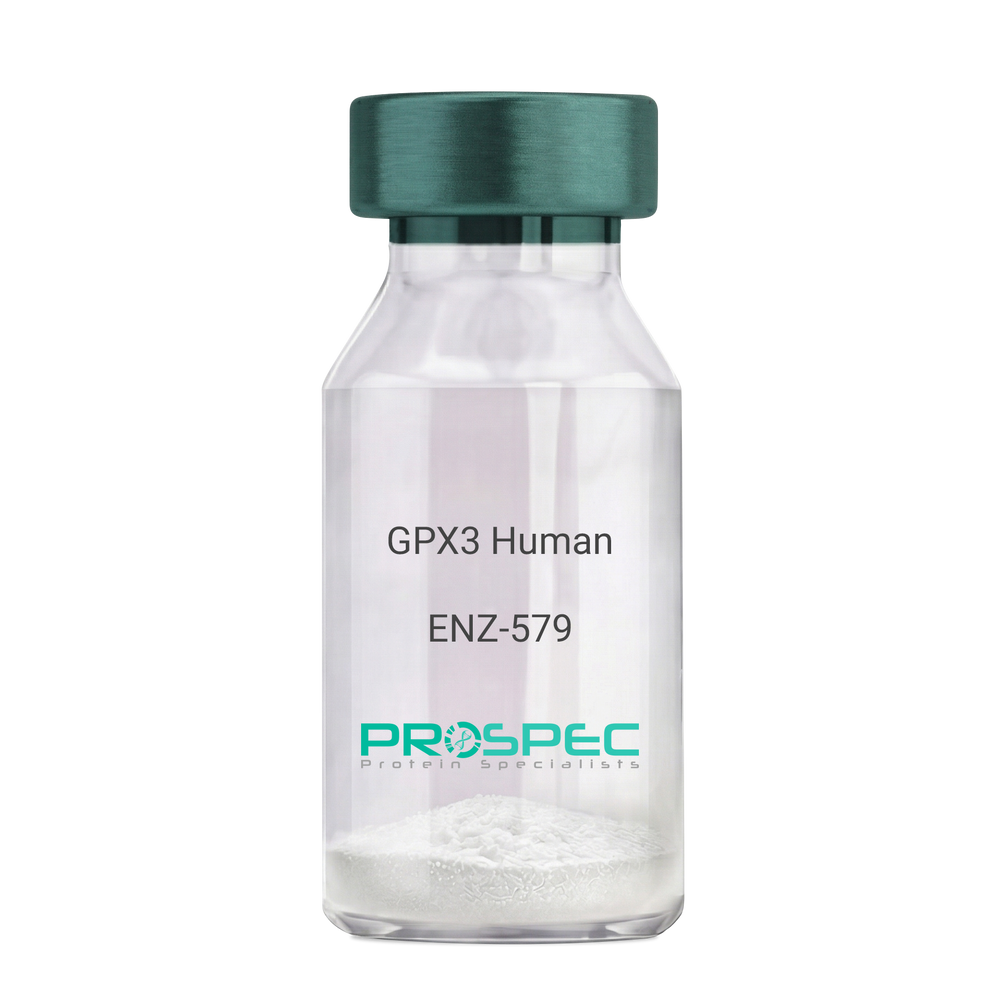
    GPX3 Human

    Description:

    Glutathione Peroxidase 3 Human Recombinant

    Glutathione peroxidase 3, GPx-3, GSHPx-3, Extracellular glutathione peroxidase, Plasma glutathione peroxidase, GPx-P, GSHPx-P, GPX3, GPXP.

    Product # :

    ENZ-579

    Price :

    Quantity :

    Shipping Method :

    Ice Icon

    Shipped with Ice Packs

    Add To Cart

    More Info

    • description
    • source
    • formulation
    • purity
    • More Info

    Description

    GPX3 Human Recombinant produced in E.coli is a single, non-glycosylated polypeptide chain containing 227 amino acids (21-226) and having a molecular mass of 25.7kDa.GPX3 is fused to a 21 amino acid His-tag at N-terminus & purified by proprietary chromatographic techniques.

    Source

    Escherichia Coli.

    Formulation

    The GPX3 solution contains 20mM Tris-HCl buffer (pH7.5), 40% glycerol, 0.15M NaCl and 1mM DTT.

    Purity

    Greater than 85% as determined by SDS-PAGE.

    More Info

    • Introduction

      Glutathione peroxidase 3 (GPX3) is a member of the glutathione peroxidase family, which acts in the detoxification of hydrogen peroxide. GPX3 shields cells and enzymes from oxidative damage, by catalyzing the reduction of hydrogen peroxide, lipid peroxides and organic hydroperoxide, by glutathione. The GPX3 protein is one of only a few proteins known in higher vertebrates to contain selenocysteine, which occurs at the active site of glutathione peroxidase and is coded by the nonsense (stop) codon TGA.

    • Synonyms

      Glutathione peroxidase 3, GPx-3, GSHPx-3, Extracellular glutathione peroxidase, Plasma glutathione peroxidase, GPx-P, GSHPx-P, GPX3, GPXP.

    • Physical Appearance

      Sterile filtered colorless solution.

    • Stability

      Store at 4°C if entire vial will be used within 2-4 weeks. Store, frozen at -20°C for longer periods of time. For long term storage it is recommended to add a carrier protein (0.1% HSA or BSA).Avoid multiple freeze-thaw cycles.

    • Amino Acid Sequence

      MGSSHHHHHH SSGLVPRGSH MQSRGQEKSK MDCHGGISGT IYEYGALTID GEEYIPFKQY AGKYVLFVNV ASYCGLTGQY IELNALQEEL APFGLVILGF PCNQFGKQEP GENSEILPTL KYVRPGGGFV PNFQLFEKGD VNGEKEQKFY TFLKNSCPPT SELLGTSDRL FWEPMKVHDI RWNFEKFLVG PDGIPIMRWH HRTTVSNVKM DILSYMRRQA ALGVKRK.

    ProSpec's products are furnished for LABORATORY RESEARCH USE ONLY. The product may not be used as drugs, agricultural or pesticidal products, food additives or household chemicals.

    Gpx3 Human
  • View Data Sheet

    Name :

    MGMT Human

    Description:

    O-6-Methylguanine-DNA Methyltransferase Human Recombinant

    Methylated-DNA--protein-cysteine methyltransferase, 6-O-methylguanine-DNA methyltransferase, O-6-methylguanine-DNA-alkyltransferase, MGMT.

    Product # :

    ENZ-389

    Price :

    Quantity :

    Shipping Method :

    Ice Icon

    Shipped with Ice Packs

    Add To Cart

    More Info

    • description
    • source
    • formulation
    • purity
    • More Info

    Description

    MGMT Human Recombinant fused to a 20 amino acid His Tag at N-terminal produced in E.Coli is a single, non-glycosylated, polypeptide chain containing 227 amino acids (1-207) and having a molecular mass of 23.8 kDa. The MGMT is purified by proprietary chromatographic techniques.

    Source

    Escherichia Coli.

    Formulation

    The MGMT solution contains 20mM Tris-HCl pH-7.5, 1mM DTT and 10% glycerol.

    Purity

    Greater than 95.0% as determined by SDS-PAGE.

    More Info

    • Introduction

      MGMT is an enzyme that repairs O-6-methylguanine, a mutagenic DNA base damaged by endogenous and environmental alkylating agents and takes part in the cellular defense against the biological effects of O-6-methylguanine in DNA. MGMT repairs alkylated guanine in DNA by stoichiometrically transferring the alkyl group at the O-6 position to a cysteine residue in the enzyme. abnormal MGMT expression correlates with the prognosis in human solid cancers. MGMT decrease of expression is correlated with methylation. The human MGMT is a negative regulator of estrogen receptor-mediated transcription upon alkylation DNA damage. MGMT promoter hypermethylation plays an important role in the early steps of colorectal carcinogenesis. Abnormal promoter hypermethylation of MGMT gene is associated with oral squamous cell carcinomas.

    • Synonyms

      Methylated-DNA--protein-cysteine methyltransferase, 6-O-methylguanine-DNA methyltransferase, O-6-methylguanine-DNA-alkyltransferase, MGMT.

    • Physical Appearance

      Sterile Filtered clear colorless solution.

    • Stability

      Store at 4°C if entire vial will be used within 2-4 weeks. Store, frozen at -20°C for longer periods of time. For long term storage it is recommended to add a carrier protein (0.1% HSA or BSA).Avoid multiple freeze-thaw cycles.

    • Amino Acid Sequence

      MGSSHHHHHH SSGLVPRGSH MDKDCEMKRT TLDSPLGKLE LSGCEQGLHE IKLLGKGTSA ADAVEVPAPA AVLGGPEPLM QCTAWLNAYF HQPEAIEEFP VPAFHHPVFQ QESFTRQVLW KLLKVVKFGE VISYQQLAAL AGNPKAARAV GGAMRGNPVP ILIPCHRVVC SSGAVGNYSG GLAVKEWLLA HEGHRLGKPG LGGSSGLAGA WLKGAGATSG SPPAGRN.

    ProSpec's products are furnished for LABORATORY RESEARCH USE ONLY. The product may not be used as drugs, agricultural or pesticidal products, food additives or household chemicals.

    Product Image
  • View Data Sheet

    Name :

    NDUFA2 Human

    Description:

    NADH Dehydrogenase 1 Alpha Subcomplex 2 Human Recombinant

    NADH dehydrogenase [ubiquinone] 1 alpha subcomplex subunit 2, Complex I-B8, CI-B8, NADH-ubiquinone oxidoreductase B8 subunit, NDUFA2, CD14, CIB8.

    Product # :

    ENZ-660

    Price :

    Quantity :

    Shipping Method :

    Ice Icon

    Shipped with Ice Packs

    Add To Cart

    More Info

    • description
    • source
    • formulation
    • purity
    • More Info

    Description

    NDUFA2 Human Recombinant produced in E.coli is a single, non-glycosylated polypeptide chain containing 122 amino acids (1-99) and having a molecular mass of 13.3kDa.NDUFA2 is fused to a 23 amino acid His-tag at N-terminus & purified by proprietary chromatographic techniques.

    Source

    Escherichia Coli.

    Formulation

    The NDUFA2 solution (1mg/ml) contains 20mM Tris-HCl buffer (pH 8.0), 0.15M NaCl, 10% glycerol and 1mM DTT.

    Purity

    Greater than 95.0% as determined by SDS-PAGE.

    More Info

    • Introduction

      NADH dehydrogenase [ubiquinone] 1 alpha subcomplex subunit 5 (NDUFA5) is a member of the complex I NDUFA5 subunit family. The human NDUFA5 gene codes for the B13 subunit of complex I of the respiratory chain that transfers electrons from NADH to ubiquinone. The NDUFA5 protein localizes to the inner mitochondrial membrane as part of the seven component-containing, water soluble 'iron-sulfur protein' (IP) fraction of complex I, even though its exact role is undetermined.

    • Synonyms

      NADH dehydrogenase [ubiquinone] 1 alpha subcomplex subunit 2, Complex I-B8, CI-B8, NADH-ubiquinone oxidoreductase B8 subunit, NDUFA2, CD14, CIB8.

    • Physical Appearance

      Sterile Filtered colorless solution.

    • Stability

      Store at 4°C if entire vial will be used within 2-4 weeks.Store, frozen at -20°C for longer periods of time. For long term storage it is recommended to add a carrier protein (0.1% HSA or BSA).Avoid multiple freeze-thaw cycles.

    • Amino Acid Sequence

      MGSSHHHHHH SSGLVPRGSH MGSMAAAAAS RGVGAKLGLR EIRIHLCQRS PGSQGVRDFI EKRYVELKKA NPDLPILIRE CSDVQPKLWA RYAFGQETNV PLNNFSADQV TRALENVLSG KA.

    ProSpec's products are furnished for LABORATORY RESEARCH USE ONLY. The product may not be used as drugs, agricultural or pesticidal products, food additives or household chemicals.

    Ndufa2 Human
  • View Data Sheet

    Name :

    GLUL Human

    Description:

    Glutamine Synthetase Human Recombinant

    GLNS, EC 6.3.1.2, EC 4.1.1.15, GLUL, Glutamine Synthetase, GS, Glutamate decarboxylase, Glutamate--ammonia ligase, PIG43, PIG59.

    Product # :

    ENZ-544

    Price :

    Quantity :

    Shipping Method :

    Ice Icon

    Shipped with Ice Packs

    Add To Cart

    More Info

    • description
    • source
    • formulation
    • purity
    • More Info

    Description

    GLUL Recombinant Human produced in E.Coli is a single, non-glycosylated polypeptide chain containing 393 amino acids (1-373 a.a.) and having a molecular mass of 44.2 kDa. The GLUL is fused to a 20 amino acid His-Tag at N-terminus and purified by proprietary chromatographic techniques.

    Source

    Escherichia Coli.

    Formulation

    GLUL Human solution containing 20mM Tris-HCl pH-8, 5mM DTT, 0.2M NaCl & 20% glycerol.

    Purity

    Greater than 90.0% as determined by SDS-PAGE.

    More Info

    • Introduction

      GLUL catalyzes the synthesis of glutamine from glutamate and ammonia. Glutamine is a major source of energy and that takes part in cell proliferation, inhibition of apoptosis, and cell signaling. GLUL is expressed during early fetal stages, and has a role in maintaining body pH by removing ammonia from circulation. Mutations in GLUL gene are related with congenital glutamine deficiency.

    • Synonyms

      GLNS, EC 6.3.1.2, EC 4.1.1.15, GLUL, Glutamine Synthetase, GS, Glutamate decarboxylase, Glutamate--ammonia ligase, PIG43, PIG59.

    • Physical Appearance

      Sterile filtered colorless solution.

    • Stability

      Store at 4°C if entire vial will be used within 2-4 weeks. Store, frozen at -20°C for longer periods of time. For long term storage it is recommended to add a carrier protein (0.1% HSA or BSA).Avoid multiple freeze-thaw cycles.

    • Amino Acid Sequence

      MGSSHHHHHH SSGLVPRGSH MTTSASSHLN KGIKQVYMSL PQGEKVQAMY IWIDGTGEGL RCKTRTLDSE PKCVEELPEW NFDGSSTLQS EGSNSDMYLV PAAMFRDPFR KDPNKLVLCE VFKYNRRPAE TNLRHTCKRI MDMVSNQHPW FGMEQEYTLM GTDGHPFGWP SNGFPGPQGP YYCGVGADRA YGRDIVEAHY RACLYAGVKI AGTNAEVMPA QWEFQIGPCE GISMGDHLWV ARFILHRVCE DFGVIATFDP KPIPGNWNGA GCHTNFSTKA MREENGLKYI EEAIEKLSKR HQYHIRAYDP KGGLDNARRL TGFHETSNIN DFSAGVANRS ASIRIPRTVG QEKKGYFEDR RPSANCDPFS VTEALIRTCL LNETGDEPFQ YKN.

    ProSpec's products are furnished for LABORATORY RESEARCH USE ONLY. The product may not be used as drugs, agricultural or pesticidal products, food additives or household chemicals.

    Glul Human
  • View Data Sheet

    Name :

    NMNAT1 Mouse

    Description:

    Nicotinamide Nucleotide Adenylyltransferase 1 Mouse Recombinant

    Nicotinamide/nicotinic acid mononucleotide adenylyltransferase 1, NMNAT1, NMN/NaMN adenylyltransferase 1, Nicotinamide mononucleotide adenylyltransferase 1, NMN adenylyltransferase, Nicotinate-nucleotide adenylyltransferase 1, NaMN adenylyltransferase 1, D4Cole1e, Nmnat.

    Product # :

    ENZ-1049

    Price :

    Quantity :

    Shipping Method :

    Ice Icon

    Shipped with Ice Packs

    Add To Cart

    More Info

    • description
    • source
    • formulation
    • purity
    • More Info

    Description

    NMNAT1 Mouse Recombinant produced in E.Coli is a single, non-glycosylated polypeptide chain containing 308 amino acids (1-285 a.a) and having a molecular mass of 34.7kDa. NMNAT1 is fused to a 23 amino acid His-tag at N-terminus & purified by proprietary chromatographic techniques.

    Source

    Escherichia Coli.

    Formulation

    NMNAT1 protein solution (1mg/ml) containing Phosphate Buffered Saline (pH7.4), 20% glycerol and 1mM EDTA.

    Purity

    Greater than 95.0% as determined by SDS-PAGE.

    More Info

    • Introduction

      NMNAT1 enzyme is vital for NAD biosynthesis, catalyzing the condensation of nicotinamide mononucleotide (NMN) or nicotinic acid mononucleotide (NaMN) with the AMP moiety of ATP to form NAD or NaAD. NMNAT1 is widely expressed with high levels in skeletal muscle, heart, liver and kidney. This protein appears to have the ability to protect against axonal degeneration following mechanical or toxic insults.

    • Synonyms

      Nicotinamide/nicotinic acid mononucleotide adenylyltransferase 1, NMNAT1, NMN/NaMN adenylyltransferase 1, Nicotinamide mononucleotide adenylyltransferase 1, NMN adenylyltransferase, Nicotinate-nucleotide adenylyltransferase 1, NaMN adenylyltransferase 1, D4Cole1e, Nmnat.

    • Physical Appearance

      Sterile filtered colourless solution.

    • Stability

      Store at 4°C if entire vial will be used within 2-4 weeks.Store, frozen at -20°C for longer periods of time. For long term storage it is recommended to add a carrier protein (0.1% HSA or BSA).Avoid multiple freeze-thaw cycles.

    • Amino Acid Sequence

      MGSSHHHHHH SSGLVPRGSH MGSMDSSKKT EVVLLACGSF NPITNMHLRL FELAKDYMHA TGKYSVIKGI ISPVGDAYKK KGLIPAHHRI IMAELATKNS HWVEVDTWES LQKEWVETVK VLRYHQEKLA TGSCSYPQSS PALEKPGRKR KWADQKQDSS PQKPQEPKPT GVPKVKLLCG ITNDISSTKI RRALRRGQSI RYLVPDLVQE YIEKHELYNT ESEGRNAGVT LAPLQRNAAE AKHNHSTL.

    ProSpec's products are furnished for LABORATORY RESEARCH USE ONLY. The product may not be used as drugs, agricultural or pesticidal products, food additives or household chemicals.

    Nmnat1 Mouse
  • View Data Sheet

    Name :

    UNG E.Coli

    Description:

    Uracil DNA Glycosylase E.Coli Recombinant

    UDG, b2580, JW2564, EC 3.2.2.27, DGU, UNG15, HIGM5, Uracil-DNA Glycosylase 1, EC 3.2.2, HIGM4, UNG2.

    Product # :

    ENZ-752

    Price :

    Quantity :

    Shipping Method :

    Ice Icon

    Shipped with Ice Packs

    Add To Cart

    More Info

    • description
    • source
    • formulation
    • purity
    • More Info

    Description

    UNG E.Coli Recombinant produced in E.Coli is a single, non-glycosylated polypeptide chain containing 252 amino acids (1-229 a.a) and having a molecular mass of 28.1kDa.UNG is fused to a 23 amino acid His-tag at N-terminus & purified by proprietary chromatographic techniques.

    Source

    Escherichia Coli.

    Formulation

    UNG protein solution (0.5mg/ml) containing 20mM Tris-HCl buffer (pH8.0) and 10% glycerol.

    Purity

    Greater than 90.0% as determined by SDS-PAGE.

    More Info

    • Introduction

      UNG is a member of the Uracil-DNA glycosylase family. One of his functions is to prevent mutagenesis by eliminating uracil from DNAmolecules by cleaving the N-glycosylic bond and initiating the base-excision repair (BER) pathway. Uracil basesare formed as a result of cytosine deamination or misincorporation of dUMP residues. After a mutation is formed, the mutagenicthreat of uracil propagates through any subsequent DNA replication steps. Among the diseases associated with UNG are: congenital rubella, and immunodeficiency with hyper igm type 4.

    • Synonyms

      UDG, b2580, JW2564, EC 3.2.2.27, DGU, UNG15, HIGM5, Uracil-DNA Glycosylase 1, EC 3.2.2, HIGM4, UNG2.

    • Physical Appearance

      Sterile Filtered clear solution.

    • Stability

      Store at 4°C if entire vial will be used within 2-4 weeks. Store, frozen at -20°C for longer periods of time. For long term storage it is recommended to add a carrier protein (0.1% HSA or BSA).Avoid multiple freeze-thaw cycles.

    • Amino Acid Sequence

      MGSSHHHHHH SSGLVPRGSH MGSMANELTW HDVLAEEKQQ PYFLNTLQTV ASERQSGVTI YPPQKDVFNA FRFTELGDVK VVILGQDPYH GPGQAHGLAF SVRPGIAIPP SLLNMYKELE NTIPGFTRPN HGYLESWARQ GVLLLNTVLT VRAGQAHSHA SLGWETFTDK VISLINQHRE GVVFLLWGSH AQKKGAIIDK QRHHVLKAPH PSPLSAHRGF FGCNHFVLAN QWLEQRGETP IDWMPVLPAE SE

    ProSpec's products are furnished for LABORATORY RESEARCH USE ONLY. The product may not be used as drugs, agricultural or pesticidal products, food additives or household chemicals.

    Ung Ecoli
  • View Data Sheet

    Name :

    ALDH5A1 Human

    Description:

    Aldehyde Dehydrogenase 5 A1 Human Recombinant

    Succinate-semialdehyde dehydrogenase mitochondrial, Aldehyde dehydrogenase family 5 member A1, NAD(+)-dependent succinic semialdehyde dehydrogenase, ALDH5A1, SSADH, SSDH.

    Product # :

    ENZ-567

    Price :

    Quantity :

    Shipping Method :

    Ice Icon

    Shipped with Ice Packs

    Add To Cart

    More Info

    • description
    • source
    • formulation
    • purity
    • More Info

    Description

    ALDH5A1 Human Recombinant fused with a 20 amino acid His tag at N-terminus produced in E.Coli is a single, non-glycosylated, polypeptide chain containing 509 amino acids (48-535 a.a.) and having a molecular mass of 54.6kDa. The ALDH5A1 is purified by proprietary chromatographic techniques.

    Source

    Escherichia Coli.

    Formulation

    The ALDH5A1 solution (0.5 mg/ml) contains 20mM Tris-HCl buffer(pH 8.0), 10% glycerol
    1mM DTT, 0.1M NaCl and 1mM EDTA.

    Purity

    Greater than 90.0% as determined by SDS-PAGE.

    More Info

    • Introduction

      ALDH5A1 is a mitochondrial NAD(+)-dependent succinic semialdehyde dehydrogenase, which is a member of the aldehyde dehydrogenase family of proteins. The ALDH5A1 protein functions as a mediator to the NADP+-dependent oxidation of aldehydes into acids and has an imperative role in the detoxification of alcohol-derived acetaldehyde, as well as in lipid peroxidation and in the metabolism of corticosteroids, biogenic amines and neurotransmitters. ALDH5A1 is expressed in various tissues, including the liver, heart, lung, brain, kidney and placenta. Deficiency in the ALDH5A1 enzyme, known as 4-hydroxybutyricaciduria, is a rare inborn error in the metabolism of the neurotransmitter 4-aminobutyric acid (GABA). In response to this defect, physiologic fluids from patients accumulate GHB, which is a compound with numerous neuromodulatory properties.

    • Synonyms

      Succinate-semialdehyde dehydrogenase mitochondrial, Aldehyde dehydrogenase family 5 member A1, NAD(+)-dependent succinic semialdehyde dehydrogenase, ALDH5A1, SSADH, SSDH.

    • Physical Appearance

      Sterile Filtered colorless solution.

    • Stability

      Store at 4°C if entire vial will be used within 2-4 weeks. Store, frozen at -20°C for longer periods of time. For long term storage it is recommended to add a carrier protein (0.1% HSA or BSA).Avoid multiple freeze-thaw cycles.

    • Amino Acid Sequence

      MGSSHHHHHH SSGLVPRGSH MAGRLAGLSA ALLRTDSFVG GRWLPAAATF PVQDPASGAA LGMVADCGVR EARAAVRAAY EAFCRWREVS AKERSSLLRK WYNLMIQNKD DLARIITAES GKPLKEAHGE ILYSAFFLEW FSEEARRVYG DIIHTPAKDR RALVLKQPIG VAAVITPWNF PSAMITRKVG AALAAGCTVV VKPAEDTPFS ALALAELASQ AGIPSGVYNV IPCSRKNAKE VGEAICTDPL VSKISFTGST TTGKILLHHA ANSVKRVSME LGGLAPFIVF DSANVDQAVA GAMASKFRNT GQTCVCSNQF LVQRGIHDAF VKAFAEAMKK NLRVGNGFEE GTTQGPLINE KAVEKVEKQV NDAVSKGATV VTGGKRHQLG KNFFEPTLLC NVTQDMLCTH EETFGPLAPV IKFDTEEEAI AIANAADVGL AGYFYSQDPA QIWRVAEQLE VGMVGVNEGL ISSVECPFGG VKQSGLGREG SKYGIDEYLE LKYVCYGGL.

    ProSpec's products are furnished for LABORATORY RESEARCH USE ONLY. The product may not be used as drugs, agricultural or pesticidal products, food additives or household chemicals.

    Aldh5A1 Human
  • View Data Sheet

    Name :

    CEL Mouse

    Description:

    Carboxyl Ester Lipase Mouse Recombinant

    Bile salt-activated lipase, BAL, EC 3.1.1.13, EC 3.1.1.3, Bile salt-stimulated lipase, BSSL, Bucelipase, Carboxyl ester lipase, Cholesterol esterase, Pancreatic lysophospholipase, Sterol esterase, CEL, FAP, BSDL, CELL, FAPP, LIPA, Cease, MODY8.

    Product # :

    ENZ-1115

    Price :

    Quantity :

    Shipping Method :

    Ice Icon

    Shipped with Ice Packs

    Add To Cart

    More Info

    • description
    • source
    • formulation
    • purity
    • biological activity
    • More Info

    Description

    CEL Mouse produced in Sf9 Baculovirus cells is a single, glycosylated polypeptide chain containing 585 amino acids (21-599 aa) and having a molecular mass of 64.5kDa.CEL is fused to a 6 amino acid His tag at C-terminus and purified by proprietary chromatographic techniques.

    Source

    Sf9, Baculovirus cells.

    Formulation

    The CEL solution (0.5 mg/ml) contains 10% Glycerol and Phosphate-Buffered Saline (pH 7.4).

    Purity

    Greater than 90.0% as determined by SDS-PAGE.

    Biological Activity

    Specific activity is > 100,000 pmol/min/ug. Measured by the amount of enzyme that hydrolyze 1.0 umole of p-nitrophenyl butyrate to p-nitrophenol per minute at pH7.5 at 25C˚.

    More Info

    • Introduction

      Carboxyl ester lipase also known as CEL, formely called cholesterol esterase or bile salt-stimulated lipase, is an enzyme with lipolytic capablity of hydrolyzing cholesteryl esters, tri-, di-, and mono- phospholipids, acylglycerol, ceramide and lysophospholipids. The carboxyl terminus of the enzyme controls enzymatic activity by creating hydrogen bonds with the surface loop to partlyshield the active site. The active catalytic site triad of serine-histidine-aspartate is centrally located in the enzyme structure and is partly covered by a surface loop. Bile salt binding to the loop domain set free the active site for accessibility by water-insoluble substrates. CEL is produced mainly in the pancreas and lactating mammary gland, thus the protein is also expressed in liver, macrophages, and in the vessel wall.

    • Synonyms

      Bile salt-activated lipase, BAL, EC 3.1.1.13, EC 3.1.1.3, Bile salt-stimulated lipase, BSSL, Bucelipase, Carboxyl ester lipase, Cholesterol esterase, Pancreatic lysophospholipase, Sterol esterase, CEL, FAP, BSDL, CELL, FAPP, LIPA, Cease, MODY8.

    • Physical Appearance

      Sterile Filtered colorless solution.

    • Stability

      Store at 4°C if entire vial will be used within 2-4 weeks. Store, frozen at -20°C for longer periods of time. For long term storage it is recommended to add a carrier protein (0.1% HSA or BSA).Avoid multiple freeze-thaw cycles.

    • Amino Acid Sequence

      AKLGAVYTEG GFVEGVNKKL SLLGGDSVDI FKGIPFATAK TLENPQRHPG WQGTLKATNF
      KKRCLQATIT QDNTYGQEDC LYLNIWVPQG RKQVSHNLPV MVWIYGGAFL MGSGQGANFL
      KNYLYDGEEI ATRGNVIVVT FNYRVGPLGF LSTGDANLPG NFGLRDQHMA IAWVKRNIAA
      FGGDPDNITI FGESAGAASV SLQTLSPYNK GLIRRAISQS GMALSPWAIQ KNPLFWAKTI
      AKKVGCPTED TGKMAACLKI TDPRALTLAY KLPVKKQEYP VVHYLAFIPV IDGDFIPDDP
      INLYNNTADI DYIAGINNMD GHLFATIDVP AVDKTKQTVT EEDFYRLVSG HTVAKGLKGA
      QATFDIYTES WAQDPSQENM KKTVVAFETD VLFLIPTEIA LAQHKAHAKS AKTYSYLFSH
      PSRMPIYPKW MGADHADDLQ YVFGKPFATP LGYRPQDRAV SKAMIAYWTN FARSGDPNMG
      NSPVPTHWYP YTLENGNYLD ITKTITSASM KEHLREKFLK FWAVTFEVLP TVTGDQDTLT
      PPEDDSEVAP DPPSDDSQVV PVPPTDDSVE AQMPATIGFH HHHHH

    ProSpec's products are furnished for LABORATORY RESEARCH USE ONLY. The product may not be used as drugs, agricultural or pesticidal products, food additives or household chemicals.

    Carboxyl Ester Lipase Mouse
  • View Data Sheet

    Name :

    PYGL Human

    Description:

    Phosphorylase, Glycogen, Liver Human Recombinant

    GSD6, Glycogen phosphorylase, liver form.

    Product # :

    ENZ-675

    Price :

    Quantity :

    Shipping Method :

    Ice Icon

    Shipped with Ice Packs

    Add To Cart

    More Info

    • description
    • source
    • formulation
    • purity
    • More Info

    Description

    PYGL Human Recombinant produced in E.Coli is a single, non-glycosylated polypeptide chain containing 879 amino acids (1-847 a.a) and having a molecular mass of 100.7kDa.PYGL is fused to a 32 amino acid His-tag at N-terminus & purified by proprietary chromatographic techniques.

    Source

    Escherichia Coli.

    Formulation

    PYGL protein solution (0.25mg/ml) in phosphate buffered saline (pH7.4), 30% glycerol and 1mM DTT.

    Purity

    Greater than 80.0% as determined by SDS-PAGE.

    More Info

    • Introduction

      Glycogen phosphorylase (PYGL) converts from inactive phosphorylase B to active phosphorylase A by phosphorylation of serine residue 15. Activity of the PYGL enzyme is further regulated by numerous allosteric effectors and hormonal controls. The liver isozyme supplies the glycemic demands of the body in general whereas the brain and muscle isozymes supply just those tissues.

    • Synonyms

      GSD6, Glycogen phosphorylase, liver form.

    • Physical Appearance

      Sterile Filtered colorless solution.

    • Stability

      Store at 4°C if entire vial will be used within 2-4 weeks. Store, frozen at -20°C for longer periods of time. For long term storage it is recommended to add a carrier protein (0.1% HSA or BSA).Avoid multiple freeze-thaw cycles.

    • Amino Acid Sequence

      MGSSHHHHHH SSGLVPRGSH MGSEFELRRQ ASMAKPLTDQ EKRRQISIRG IVGVENVAEL KKSFNRHLHF TLVKDRNVAT TRDYYFALAH TVRDHLVGRW IRTQQHYYDK CPKRVYYLSL EFYMGRTLQN TMINLGLQNA CDEAIYQLGL DIEELEEIEE DAGLGNGGLG RLAACFLDSM ATLGLAAYGY GIRYEYGIFN QKIRDGWQVE EADDWLRYGN PWEKSRPEFM LPVHFYGKVE HTNTGTKWID TQVVLALPYD TPVPGYMNNT VNTMRLWSAR APNDFNLRDF NVGDYIQAVL DRNLAENISR VLYPNDNFFE GKELRLKQEY FVVAATLQDI IRRFKASKFG STRGAGTVFD AFPDQVAIQL NDTHPALAIP ELMRIFVDIE KLPWSKAWEL TQKTFAYTNH TVLPEALERW PVDLVEKLLP RHLEIIYEIN QKHLDRIVAL FPKDVDRLRR MSLIEEEGSK RINMAHLCIV GSHAVNGVAK IHSDIVKTKV FKDFSELEPD KFQNKTNGIT PRRWLLLCNP GLAELIAEKI GEDYVKDLSQ LTKLHSFLGD DVFLRELAKV KQENKLKFSQ FLETEYKVKI NPSSMFDVQV KRIHEYKRQL LNCLHVITMY NRIKKDPKKL FVPRTVIIGG KAAPGYHMAK MIIKLITSVA DVVNNDPMVG SKLKVIFLEN YRVSLAEKVI PATDLSEQIS TAGTEASGTG NMKFMLNGAL TIGTMDGANV EMAEEAGEEN LFIFGMRIDD VAALDKKGYE AKEYYEALPE LKLVIDQIDN GFFSPKQPDL FKDIINMLFY HDRFKVFADY EAYVKCQDKV SQLYMNPKAW NTMVLKNIAA SGKFSSDRTI KEYAQNIWNV EPSDLKISLS NESNKVNGN.

    ProSpec's products are furnished for LABORATORY RESEARCH USE ONLY. The product may not be used as drugs, agricultural or pesticidal products, food additives or household chemicals.

    Pygl Human
  • View Data Sheet

    Name :

    Benzonase Nuclease, 99%

    Description:

    Benzonase Nuclease Serratia Marcescens Recombinant, 99%

    Product # :

    ENZ-1112

    Price :

    Quantity :

    Shipping Method :

    Ice Icon

    Shipped with Ice Packs

    Add To Cart

    More Info

    • description
    • source
    • formulation
    • purity
    • More Info

    Description

    Benzonase Nuclease Serratia Marcescens Recombinant produced in E.coli is a single, non-glycosylated polypeptide chain containing 245 amino acids and having a molecular mass of 30kDa with 2 essential disulfide bonds. Benzonase Nuclease is purified by proprietary chromatographic techniques.

    Source

    Escherichia Coli.

    Formulation

    The Benzonase Nuclease solution contains 50% glycerol, 50 mM Tris-HCl pH 8.0, 20 mM NaCl and 2 mM MgCl2.

    Purity

    Greater than 99.0% as determined by SDS-PAGE.

    More Info

    • Introduction

      Serratia marcescens secretes an endonuclease that has exceptionally high specific activity to the medium that surrounds it. The Benzonase Nuclease is mainly used for elimination of nucleic acid contamination from purified proteins, downstream processing, reduction of viscosity etc. Nucleic acid contaminants are caused by nuclease released to the medium. The DNA is being destroyed by the release of the S. marcescens nuclease and it acts as the killer gene for the auto destruction of microorganisms.

    • Physical Appearance

      Sterile Filtered colorless solution.

    • Stability

      Store at 4°C if entire vial will be used within 2-4 weeks. Store, frozen at -20°C for longer periods of time. For long term storage it is recommended to add a carrier protein (0.1% HSA or BSA).Avoid multiple freeze-thaw cycles.

    • Specificity

      Unspecific (DNA, RNA) attacks all nucleic acids (single strand, double strand, circular, supercoiled) with no apparent sequence preference. Final reaction product: 5’-mono-phosphate terminated oligonucleotides (3-5 bases). Protease Activity: Not detectable

    • Unit Definition

      1U Benzonase Nuclease is defined as the amount of enzyme that causes a ΔA260 of 1 in 30 min, which corresponds to complete digestion of 37μg DNA. Standard reaction conditions are 1mg/ml sonicated DNA substrate in 50mM Tris-HCl pH 8.0, 0.1mg/ml BSA, 1mM MgCl2, incubated at 37°C.

    ProSpec's products are furnished for LABORATORY RESEARCH USE ONLY. The product may not be used as drugs, agricultural or pesticidal products, food additives or household chemicals.

    Benzonase Nuclease
  • View Data Sheet

    Name :

    DBH Human

    Description:

    DBH Human Recombinant

    EC 1.14.17.1, DBM, DBH.

    Product # :

    ENZ-891

    Price :

    Quantity :

    Shipping Method :

    Ice Icon

    Shipped with Ice Packs

    Add To Cart

    More Info

    • description
    • source
    • formulation
    • purity
    • More Info

    Description

    DBH Human Recombinant produced in E.Coli is a single, non-glycosylated polypeptide chain containing 599 amino acids (40-617 a.a) and having a molecular mass of 67.2kDa.DBH is fused to a 21 amino acid His-tag at N-terminus & purified by proprietary chromatographic techniques.

    Source

    Escherichia Coli.

    Formulation

    DBH protein solution (0.25mg/ml) containing Phosphate buffered saline (pH7.4), 10% glycerol and 1mM DTT.

    Purity

    Greater than 85.0% as determined by SDS-PAGE.

    More Info

    • Introduction

      DBH catalyzes the chemical reaction. DBH is an oxidoreductase which belongs to the copper type II, ascorbate-dependent monooxygenase family, in particular those performing on paired donors, with O2 as oxidant and incorporation or reduction of oxygen. The oxygen incorporated can not be derived from O2 with reduced ascorbate as one donor, as well as incorporation of one ato of oxygen into the other donor.

    • Synonyms

      EC 1.14.17.1, DBM, DBH.

    • Physical Appearance

      Sterile Filtered colorless solution.

    • Stability

      Store at 4°C if entire vial will be used within 2-4 weeks. Store, frozen at -20°C for longer periods of time. For long term storage it is recommended to add a carrier protein (0.1% HSA or BSA).Avoid multiple freeze-thaw cycles.

    • Amino Acid Sequence

      MGSSHHHHHH SSGLVPRGSH MSAPRESPLP YHIPLDPEGS LELSWNVSYT QEAIHFQLLV RRLKAGVLFG MSDRGELENA DLVVLWTDGD TAYFADAWSD QKGQIHLDPQ QDYQLLQVQR TPEGLTLLFK RPFGTCDPKD YLIEDGTVHL VYGILEEPFR SLEAINGSGL QMGLQRVQLL KPNIPEPELP SDACTMEVQA PNIQIPSQET TYWCYIKELP KGFSRHHIIK YEPIVTKGNE ALVHHMEVFQ CAPEMDSVPH FSGPCDSKMK PDRLNYCRHV LAAWALGAKA FYYPEEAGLA FGGPGSSRYL RLEVHYHNPL VIEGRNDSSG IRLYYTAKLR RFNAGIMELG LVYTPVMAIP PRETAFILTG YCTDKCTQLA LPPSGIHIFA SQLHTHLTGR KVVTVLVRDG REWEIVNQDN HYSPHFQEIR MLKKVVSVHP GDVLITSCTY NTEDRELATV GGFGILEEMC VNYVHYYPQT QLELCKSAVD AGFLQKYFHL INRFNNEDVC TCPQASVSQQ FTSVPWNSFN RDVLKALYSF APISMHCNKS SAVRFQGEWN LQPLPKVIST LEEPTPQCPT SQGRSPAGPT VVSIGGGKG

    ProSpec's products are furnished for LABORATORY RESEARCH USE ONLY. The product may not be used as drugs, agricultural or pesticidal products, food additives or household chemicals.

    Dbh Human
  • 1
  • …
  • 10
  • 11
  • 12
  • 13
  • 14
  • …
  • 42
Your browser does not support the video tag.

Products

  • Cytokines
  • Growth Factors
  • Chemokines
  • CD Antigens
  • Neurotrophins
  • Hormones
  • Enzymes
  • Viral Antigens
  • Recombinant Proteins
  • Natural Proteins
  • Monoclonal Antibodies
  • Polyclonal Antibodies
  • Thermal Packaging

About

  • Company
  • Founder
  • Contribution
  • Contact Us
  • My Account

Ordering

  • Ordering Method
  • Ordering - Credit Card
  • Ordering PO
  • Shipping Fees
  • FAQ's

Legal

  • Terms & Conditions
  • Privacy
  • Site Map
  • info@prospecbio.com
  • Facebook
  • Instagram
  • Linkedin Profile

© 2026 ProSpec-Tany TechnoGene Ltd. All Rights Reserved.

  • Choosing a selection results in a full page refresh.
  • Opens in a new window.