Skip to content

High-quality research proteins.

  • 1-800-805-6531

  • Mon - Sat 8.00-18.00, Sun - Closed

  • info@prospecbio.com

  • PO Box 6591 East Brunswick NJ 08816

  • Products
    • Cytokines
    • Growth factors
    • Chemokines
    • Cd antigens
    • Neurotrophins
    • Hormones
    • Enzymes
    • Viral antigens
    • Recombinant proteins
    • Natural proteins
    • Monoclonal antibodies
    • Polyclonal antibodies
    • Thermal Packaging
  • About
    • Company
    • Founder
    • Contribution
  • Customers
    • Eastern Asia
    • Eastern Europe
    • North America
    • South America
    • South East Asia
    • Southern Asia
    • Western Europe
  • Ordering
    • Ordering Method
    • Ordering - Credit Card
    • Ordering - PO
    • Shipping Fees
    • FAQs
  • Services
    • DNA Cloning
    • Protein Expression
    • Monoclonal Antibody
    • Fermentation
    • Technology License
  • Contact us
Log in

Country/region

  • USD $ | Albania
  • USD $ | Andorra
  • USD $ | Argentina
  • USD $ | Armenia
  • USD $ | Australia
  • USD $ | Austria
  • USD $ | Azerbaijan
  • USD $ | Belarus
  • USD $ | Belgium
  • USD $ | Bolivia
  • USD $ | Brazil
  • USD $ | Bulgaria
  • USD $ | Cambodia
  • USD $ | Canada
  • USD $ | Chile
  • USD $ | China
  • USD $ | Colombia
  • USD $ | Costa Rica
  • USD $ | Croatia
  • USD $ | Cyprus
  • USD $ | Czechia
  • USD $ | Denmark
  • USD $ | Estonia
  • USD $ | Finland
  • USD $ | France
  • USD $ | Georgia
  • USD $ | Germany
  • USD $ | Greece
  • USD $ | Hong Kong SAR
  • USD $ | Hungary
  • USD $ | Iceland
  • USD $ | India
  • USD $ | Ireland
  • USD $ | Israel
  • USD $ | Italy
  • USD $ | Japan
  • USD $ | Kazakhstan
  • USD $ | Latvia
  • USD $ | Liechtenstein
  • USD $ | Lithuania
  • USD $ | Madagascar
  • USD $ | Malta
  • USD $ | Mexico
  • USD $ | Moldova
  • USD $ | Monaco
  • USD $ | Netherlands
  • USD $ | New Zealand
  • USD $ | North Macedonia
  • USD $ | Norway
  • USD $ | Panama
  • USD $ | Paraguay
  • USD $ | Peru
  • USD $ | Philippines
  • USD $ | Poland
  • USD $ | Portugal
  • USD $ | Romania
  • USD $ | Singapore
  • USD $ | Slovakia
  • USD $ | Slovenia
  • USD $ | South Africa
  • USD $ | South Korea
  • USD $ | Spain
  • USD $ | Sri Lanka
  • USD $ | Sweden
  • USD $ | Switzerland
  • USD $ | Taiwan
  • USD $ | Thailand
  • USD $ | Türkiye
  • USD $ | Ukraine
  • USD $ | United Kingdom
  • USD $ | United States
  • USD $ | Uruguay
  • USD $ | Vatican City
  • USD $ | Venezuela
  • USD $ | Vietnam
  • Facebook
  • Instagram
logoProSpec - Recombinant Protein Manufacturer for academic and R&D industry
Become a distributor
Account Log in
Wishlist
Cart Cart(0)
  • Products
    +
    • Cytokines
    • Growth factors
    • Chemokines
    • Cd antigens
    • Neurotrophins
    • Hormones
    • Enzymes
    • Viral antigens
    • Recombinant proteins
    • Natural proteins
    • Monoclonal antibodies
    • Polyclonal antibodies
    • Thermal Packaging
  • About
    +
    • Company
    • Founder
    • Contribution
  • Customers
    +
    • Eastern Asia
    • Eastern Europe
    • North America
    • South America
    • South East Asia
    • Southern Asia
    • Western Europe
  • Ordering
    +
    • Ordering Method
    • Ordering - Credit Card
    • Ordering - PO
    • Shipping Fees
    • FAQs
  • Services
    +
    • DNA Cloning
    • Protein Expression
    • Monoclonal Antibody
    • Fermentation
    • Technology License
  • Contact us

Item added to your cart

View cart
View All
  • Cytokines
  • Growth factors
  • Chemokines
  • Cd antigens
  • Neurotrophins
  • Hormones
  • Enzymes
  • Viral antigens
  • Recombinant proteins
  • Natural proteins
  • Monoclonal antibodies
  • Polyclonal antibodies
  • Thermal Packaging
  • Tumor Necrosis Factor

    Tumor Necrosis Factor

    View All
  • 4-1BB

    4-1BB

    View All
  • Adiponectin

    Adiponectin

    View All
  • AIF1

    AIF1

    View All
  • Other Cytokines

    Other Cytokines

    View All
  • AITRL

    AITRL

    View All
  • Angiopoietin

    Angiopoietin

    View All
  • Apolipoprotein

    Apolipoprotein

    View All
  • B-Cell Activating Factor

    B-Cell Activating Factor

    View All
  • Beta Defensin

    Beta Defensin

    View All
  • Bone Morphogenetic Protein

    Bone Morphogenetic Protein

    View All
  • B type Natriuretic Peptide

    B type Natriuretic Peptide

    View All
  • BST

    BST

    View All
  • Betacellulin

    Betacellulin

    View All
  • Cardiotrophin

    Cardiotrophin

    View All
  • Activin

    Activin

    View All
  • Fibroblast Growth Factor

    Fibroblast Growth Factor

    View All
  • Other Growth Factors

    Other Growth Factors

    View All
  • CSF

    CSF

    View All
  • CTGF

    CTGF

    View All
  • IGFBP

    IGFBP

    View All
  • VEGF Protein

    VEGF Protein

    View All
  • EGF

    EGF

    View All
  • Epigen

    Epigen

    View All
  • Erythropoietin

    Erythropoietin

    View All
  • Insulin-Like Growth Factor

    Insulin-Like Growth Factor

    View All
  • Growth Hormone

    Growth Hormone

    View All
  • HDGF

    HDGF

    View All
  • Hepatocyte Growth Factor

    Hepatocyte Growth Factor

    View All
  • Insulin

    Insulin

    View All
  • BCA-1/ BLC (CXCL13)

    BCA-1/ BLC (CXCL13)

    View All
  • BRAK (CXCL14)

    BRAK (CXCL14)

    View All
  • C-10 (CCL6)

    C-10 (CCL6)

    View All
  • Other Chemokines

    Other Chemokines

    View All
  • MEC (CCL28)

    MEC (CCL28)

    View All
  • LD78-beta (CCL3L1)

    LD78-beta (CCL3L1)

    View All
  • CTACK (CCL27)

    CTACK (CCL27)

    View All
  • CXCL16

    CXCL16

    View All
  • CXCL17

    CXCL17

    View All
  • Platelet Factor-4 (CXCL4)

    Platelet Factor-4 (CXCL4)

    View All
  • ENA-78 (CXCL5)

    ENA-78 (CXCL5)

    View All
  • Eotaxin (CCL11,24,26)

    Eotaxin (CCL11,24,26)

    View All
  • Exodus-2 (CCL21)

    Exodus-2 (CCL21)

    View All
  • Fractalkine (CX3CL1)

    Fractalkine (CX3CL1)

    View All
  • CXCL6

    CXCL6

    View All
  • Other CD Antigens

    Other CD Antigens

    View All
  • CD14

    CD14

    View All
  • CD164

    CD164

    View All
  • CD1

    CD1

    View All
  • CD2

    CD2

    View All
  • CD200

    CD200

    View All
  • CD207

    CD207

    View All
  • CD226

    CD226

    View All
  • CD23

    CD23

    View All
  • CD244

    CD244

    View All
  • CD247

    CD247

    View All
  • CD27

    CD27

    View All
  • CD274

    CD274

    View All
  • CD300

    CD300

    View All
  • CD33

    CD33

    View All
  • Other Neurotrophins

    Other Neurotrophins

    View All
  • Beta-NGF

    Beta-NGF

    View All
  • BDNF

    BDNF

    View All
  • CDNF

    CDNF

    View All
  • CNTF

    CNTF

    View All
  • GDNF

    GDNF

    View All
  • Glia Maturation Factor

    Glia Maturation Factor

    View All
  • MANF

    MANF

    View All
  • Midkine

    Midkine

    View All
  • Neuroglobin

    Neuroglobin

    View All
  • Neurotrophic factors

    Neurotrophic factors

    View All
  • Neuregulin

    Neuregulin

    View All
  • Neuropilin

    Neuropilin

    View All
  • Pigment Epithelium-Derived Factor

    Pigment Epithelium-Derived Factor

    View All
  • Pleiotrophin

    Pleiotrophin

    View All
  • Peptide Hormones

    Peptide Hormones

    View All
  • Other Hormones

    Other Hormones

    View All
  • HCG

    HCG

    View All
  • Endothelin

    Endothelin

    View All
  • Exendin

    Exendin

    View All
  • FSH

    FSH

    View All
  • Glucagon

    Glucagon

    View All
  • GHRP

    GHRP

    View All
  • GLP

    GLP

    View All
  • Thyrostimulin

    Thyrostimulin

    View All
  • Inhibin A

    Inhibin A

    View All
  • LHRH

    LHRH

    View All
  • Melanotan

    Melanotan

    View All
  • Procalcitonin

    Procalcitonin

    View All
  • PTH

    PTH

    View All
  • Peroxiredoxin

    Peroxiredoxin

    View All
  • Peptidase

    Peptidase

    View All
  • Synthetase

    Synthetase

    View All
  • Transferase

    Transferase

    View All
  • Hydrolase

    Hydrolase

    View All
  • Dehydrogenase

    Dehydrogenase

    View All
  • ACE2

    ACE2

    View All
  • Esterase

    Esterase

    View All
  • Protein Kinases

    Protein Kinases

    View All
  • Other Enzymes

    Other Enzymes

    View All
  • Phosphatase

    Phosphatase

    View All
  • Deaminase

    Deaminase

    View All
  • Oxygenase

    Oxygenase

    View All
  • Adenylate Kinase

    Adenylate Kinase

    View All
  • Lyase

    Lyase

    View All
  • Chagas

    Chagas

    View All
  • SARS

    SARS

    View All
  • Influenza

    Influenza

    View All
  • ASFV

    ASFV

    View All
  • Astrovirus

    Astrovirus

    View All
  • Borrelia

    Borrelia

    View All
  • Helicobacter Pylori

    Helicobacter Pylori

    View All
  • Chikungunya

    Chikungunya

    View All
  • Chlamydia

    Chlamydia

    View All
  • Cytomegalo

    Cytomegalo

    View All
  • Dengue

    Dengue

    View All
  • EBV

    EBV

    View All
  • Ebola

    Ebola

    View All
  • Feline Leukemia Virus

    Feline Leukemia Virus

    View All
  • Hepatitis A

    Hepatitis A

    View All
  • Other

    Other

    View All
  • Actin

    Actin

    View All
  • ADAM

    ADAM

    View All
  • Complement Component

    Complement Component

    View All
  • Ag85

    Ag85

    View All
  • Eukaryotic Translation Initiation Factor

    Eukaryotic Translation Initiation Factor

    View All
  • Anterior Gradient Protein

    Anterior Gradient Protein

    View All
  • Heat Shock Protein

    Heat Shock Protein

    View All
  • Alpha-2-HS-Glycoprotein

    Alpha-2-HS-Glycoprotein

    View All
  • Hemoglobin

    Hemoglobin

    View All
  • Allergy

    Allergy

    View All
  • Anaplasma

    Anaplasma

    View All
  • Angiogenin

    Angiogenin

    View All
  • Ankyrin Repeat Domain

    Ankyrin Repeat Domain

    View All
  • Annexin

    Annexin

    View All
  • Other Natural Proteins

    Other Natural Proteins

    View All
  • Aprotinin

    Aprotinin

    View All
  • Transferrin

    Transferrin

    View All
  • Avidin

    Avidin

    View All
  • Anti Coagulation Factors

    Anti Coagulation Factors

    View All
  • Natural Albumin

    Natural Albumin

    View All
  • Natural Coagulation Factors

    Natural Coagulation Factors

    View All
  • Fibronectin

    Fibronectin

    View All
  • Thrombin

    Thrombin

    View All
  • Anti Human Enzyme

    Anti Human Enzyme

    View All
  • Other Monoclonal Antibodies

    Other Monoclonal Antibodies

    View All
  • Anti Human Cytokine

    Anti Human Cytokine

    View All
  • Anti Human Heat Shock Protein

    Anti Human Heat Shock Protein

    View All
  • Anti Mouse Lymphocyte

    Anti Mouse Lymphocyte

    View All
  • Anti Human Chemokine

    Anti Human Chemokine

    View All
  • Anti Human Lymphocyte

    Anti Human Lymphocyte

    View All
  • Anti Viral Monoclonal

    Anti Viral Monoclonal

    View All
  • Anti Mouse Cytokine

    Anti Mouse Cytokine

    View All
  • Anti-GST Monoclonal

    Anti-GST Monoclonal

    View All
  • Other Polyclonal Antibodies

    Other Polyclonal Antibodies

    View All
  • Anti Viral

    Anti Viral

    View All
  • Anti-GST Monoclonal

    Anti-GST Monoclonal

    View All
Back

Search results

313 results found for “Platelet Factor-4 (CXCL4)”

Name

Description

Product #

Price

Quantity

Shipping Method

  • View Data Sheet

    Name :

    GM-CSF Porcine

    Description:

    Granulocyte Macrophage-Colony Stimulating Factor Porcine Recombinant

    CSF-2, MGI-1GM, GM-CSF, Pluripoietin-alpha, Molgramostin, Sargramostim.

    Product # :

    CYT-1095

    Price :

    Quantity :

    Shipping Method :

    Room Temp Icon

    Shipped at Room temp

    Add To Cart

    More Info

    • description
    • source
    • formulation
    • purity
    • biological activity
    • More Info
    • Citations

    Description

    Granulocyte Macrophage-Colony Stimulating Factor Porcine Recombinant produced in E. coli is a non-glycosylated monomer chain containing 128 amino acids and having a molecular mass of 14.5kDa. GMCSF is purified by proprietary chromatographic techniques.

    Source

    Escherichia Coli.

    Formulation

    The protein was lyophilized from a sterile (0.2µm) filtered solution containing 10mM sodium phosphate, pH 7.5.

    Purity

    Greater than 95.0% as determined by SDS-PAGE.

    Biological Activity

    The ED50, as determined by TF-1 cell proliferation is 4.52ng/ml corresponding to a specific activity which is 2.2 x 10^5 units/mg.

    Citations

    More Info

    • Introduction

      GMCSF is a cytokine that controls the production, differentiation, and function of granulocytes and macrophages. The active form of GMCSF is found extracellularly as a homodimer. GMCSF has been localized to a cluster of related genes at chromosome region 5q31, which is known to be associated with interstitial deletions in the 5q- syndrome and acute myelogenous leukemia. Other genes in the cluster include those encoding interleukins 4, 5, and 13.
      GM-CSF stimulates the growth and differentiation of hematopoietic precursor cells from various lineages, including granulocytes, macrophages, eosinophils and erythrocytes.

    • Synonyms

      CSF-2, MGI-1GM, GM-CSF, Pluripoietin-alpha, Molgramostin, Sargramostim.

    • Physical Appearance

      Sterile Filtered White lyophilized (freeze-dried) powder.

    • Stability

      Lyophilized GMCSF although stable at room temperature for 3 weeks, should be stored desiccated below -18°C. Upon reconstitution GMCSF should be stored at 4°C between 2-7 days and for future use below -18°C. Please prevent freeze-thaw cycles.

    • Solubility

      It is recommended to reconstitute the lyophilized GMCSF in sterile 18MΩ-cm H2O not less than 100µg/ml, which can then be further diluted to other aqueous solutions.

    • Amino Acid Sequence

      MAPTRPPSPV TRPWQHVDAI KEALSLLNNS NDTAAVMNET VDVVCEMFDP QEPTCVQTRL NLYKQGLRGS LTRLKSPLTL LAKHYEQHCP LTEETSCETQ SITFKSFKDS LNKFLFTIPF DCWGPVKK.

    • Background

      What is the molecular weight/Mw of GM-CSF PORCINE Protein?
      GM-CSF PORCINE Protein has a total Mw of 14.5kDa.

      What is the source or expression system of GM-CSF PORCINE Protein?
      Escherichia Coli.

      What is the Purity of GM-CSF PORCINE Protein?
      GM-CSF PORCINE Protein is >95% pure as determined by SDS-PAGE.

      What is the Biological Activity of GM-CSF PORCINE Protein?
      The ED50, as determined by TF-1 cell proliferation is 4.52ng/ml corresponding to a specific activity which is 2.2 x 10^5 units/mg.

      What is the amino acid sequence of GM-CSF PORCINE Protein?
      MAPTRPPSPV TRPWQHVDAI KEALSLLNNS NDTAAVMNET VDVVCEMFDP QEPTCVQTRL NLYKQGLRGS LTRLKSPLTL LAKHYEQHCP LTEETSCETQ SITFKSFKDS LNKFLFTIPF DCWGPVKK.

      What applications can GM-CSF PORCINE Protein be used in?
      GM-CSF PORCINE Protein can probably be used in western blot, ELISA and Lateral Flow.

      What is the endotoxin level for GM-CSF PORCINE Protein?
      The endotoxin level is minimal, GM-CSF PORCINE Protein was purified using conventional chromatography techniques.


    ProSpec's products are furnished for LABORATORY RESEARCH USE ONLY. The product may not be used as drugs, agricultural or pesticidal products, food additives or household chemicals.

    Gmcsf Porcine
  • View Data Sheet

    Name :

    BD 4 Rat

    Description:

    BD 4 Rat

    Beta-defensin 4, BD-4, BD-2, Defensin, beta 4, RBD-2, RBD-4, Defb4, Defb2, Defb3.

    Product # :

    CYT-066

    Price :

    Quantity :

    Shipping Method :

    Room Temp Icon

    Shipped at Room temp

    Add To Cart

    More Info

    • description
    • source
    • formulation
    • purity
    • biological activity
    • More Info
    • Citations

    Description

    BD-4 Rat Recombinant produced in E.coli is a single, non-glycosylated polypeptide chain containing 41 amino acids and having a molecular mass of 4.4kDa.The BD-4 is purified by proprietary chromatographic techniques.

    Source

    Escherichia Coli.

    Formulation

    BD-4 protein was lyophilized from a 0.2µm filtered concentrated solution in PBS, pH 7.4.

    Purity

    Greater than 97.0% as determined by SDS-PAGE.

    Biological Activity

    Measured by its antimicrobial activity against E. coli. The ED50 for this effect is typically 5-50µg/ml.

    Citations

    More Info

    • Introduction

      Defensins are cationic peptides with a large spectrum of antimicrobial activity that comprise an important arm of the innate immune system. The Alpha defensins are differentiated from the Beta-defensins by the pairing of their 3 disulfide bonds.
      4 human Beta-defensins have been identified to date; BD-1, BD-2, BD-3 and BD-4.
      Beta-defensins are expressed on some leukocytes and at epithelial surfaces.
      In addition to their direct antimicrobial activities, they are chemoattractant towards immature dendritic cells and memory T cells. The beta-defensin proteins are expressed as the C-terminal portion of precursors and are released by proteolytic cleavage of a signal sequence and, in the case of BD-1 (36 a.a.), a propeptide region. Beta-defensins contain a six-cysteine motif that forms three intra-molecular disulfide bonds. Beta-Defensins are 3-5 kDa peptides ranging in size from 33-47 amino acid residues.

    • Synonyms

      Beta-defensin 4, BD-4, BD-2, Defensin, beta 4, RBD-2, RBD-4, Defb4, Defb2, Defb3.

    • Physical Appearance

      Sterile Filtered White lyophilized (freeze-dried) powder.

    • Stability

      Lyophilized BD-4 although stable at room temperature for 3 weeks, should be stored desiccated below -18°C. Upon reconstitution BD-4 should be stored at 4°C between 2-7 days and for future use below -18°C. For long term storage it is recommended to add a carrier protein (0.1% HSA or BSA). Please prevent freeze-thaw cycles.

    • Solubility

      It is recommended to reconstitute the lyophilized BD-4 in sterile 18M-cm H2O not less than 100µg/ml, which can then be further diluted to other aqueous solutions.

    • Amino Acid Sequence

      QSINNPITCL TKGGVCWGPC TGGFRQIGTC GLPRVRCCKK K.

    • Background

      What is the molecular weight/Mw of BD4 Protein?
      BD4 Protein has a total Mw of 4.4kDa.

      What is the source or expression system of BD4 Protein?
      Escherichia Coli.

      What is the Purity of BD4 Protein?
      BD4 Protein is >97% pure as determined by SDS-PAGE.

      What is the Biological Activity of BD4 Protein?
      Measured by its antimicrobial activity against E. coli. The ED50 for this effect is typically 5-50µg/ml.

      What is the amino acid sequence of BD4 Protein?
      QSINNPITCL TKGGVCWGPC TGGFRQIGTC GLPRVRCCKK K.

      What applications can BD4 Protein be used in?
      BD4 Protein can probably be used in western blot, ELISA and Lateral Flow.

      What is the endotoxin level for BD4 Protein?
      The endotoxin level is minimal, BD4 Protein was purified using conventional chromatography techniques.

    ProSpec's products are furnished for LABORATORY RESEARCH USE ONLY. The product may not be used as drugs, agricultural or pesticidal products, food additives or household chemicals.

    Bd 4 Rat
  • View Data Sheet

    Name :

    PCC

    Description:

    Prothrombin Complex

    PCC, Prothrombin Complex.

    Product # :

    PRO-439

    Price :

    Quantity :

    Shipping Method :

    Room Temp Icon

    Shipped at Room temp

    Add To Cart

    More Info

    • description
    • formulation
    • More Info
    • Citations

    Description

    Prothrombin complex is a double virus–inactivated concentrate, containing equal concentrations of Factors II, VIII, IX, X and Heparin.

    Formulation

    Lyophilized Powder from 0.1M sodium chloride and 10mM sodium citrate buffer.

    Citations

    More Info

    • Introduction

      Prothrombin Complex Concentrate (PCC) is a combination of several blood clotting factors II, VII, IX and X. PCC is used in the treatment of the congenital bleeding disorders associated with Factors II, VII, IX, and X deficiencies. PCC reverses the effect of warfarin (a coumarin anti-coagulant) and is used in cases of significant bleeding in patients with a coagulopathy, for example, gastrointestinal haemorrhage or intracranial haemorrhage. The PCC is also extensively used in treating acquired coagulation abnormalities secondary to vitamin K deficiency, warfarin ingestion, and various types of liver disease.
      Hepatitis, anaphylaxis and thrombosis have been reported as complications of prothrombin complex concentrates administration.

    • Synonyms

      PCC, Prothrombin Complex.

    • Physical Appearance

      Sterile Filtered White lyophilized (freeze-dried) powder.

    • Stability

      Lyophilized Prothrombin-Complex although stable at room temperature for 3 weeks, should be stored desiccated below -18°C. Upon reconstitution Prothrombin-Complex should be stored at 4°C between 2-7 days and for future use below -18°C.For long term storage it is recommended to add a carrier protein (0.1% HSA or BSA).Please prevent freeze-thaw cycles.

    • Solubility

      It is recommended to reconstitute the lyophilized Prothrombin Complex in sterile 18MΩ-cm H2O.

    ProSpec's products are furnished for LABORATORY RESEARCH USE ONLY. The product may not be used as drugs, agricultural or pesticidal products, food additives or household chemicals.

    Prothrombin Complex
  • View Data Sheet

    Name :

    CD31 FITC Antibody

    Description:

    CD31-FITC, Mouse Anti Human

    Platelet endothelial cell adhesion molecule, PECAM-1, EndoCAM, GPIIA', CD31 antigen, PECAM1, CD31.

    Product # :

    ANT-052

    Price :

    Quantity :

    Shipping Method :

    Room Temp Icon

    Shipped at Room temp

    Add To Cart

    More Info

    • formulation
    • More Info
    • Citations

    Formulation

    1mg/ml in PBS (after reconstitution).

    Citations

    More Info

    • Introduction

      CD31 is a glycoprotein expressed on endothelial cells, platelets, macrophages and Kupffer cells, granulocytes, T / NK cells, lymphocytes, megakaryocytes, fibroblasts, osteoclasts, neutrophils. In humans, the gene encoding CD31 is found on chromosome 17.
      CD31 is a cluster of differentiation molecule. It is also called PECAM-1 for platelet endothelial cell adhesion molecule. It plays a key role in removing aged neutrophils from the body. Both the neutrophil and the macrophage express CD31 on their membranes, and during the testing process, these CD31 molecules bind the two cells together. If the neutrophil is healthy, it will send a signal to the macrophage, and the CD31 molecules will detach.
      CD31 is also expressed in certain tumors, including epithelioid hemangioendothelioma, epithelioid sarcoma-like hemangioendothelioma, other vascular tumors, histiocytic malignancies, and plasmacytomas. It is rarely found in some sarcomas and carcinomas.

    • Synonyms

      Platelet endothelial cell adhesion molecule, PECAM-1, EndoCAM, GPIIA', CD31 antigen, PECAM1, CD31.

    • Solubility

      Reconstitute with H20. Mix gently, wash the sides of the vial and wait 30-60 seconds before use.

    • Immunogen

      Enriched human platelets

    • Ig Subclass

      mouse IgG1

    • Clone

      hCD31

    • Applications

      Flow cytometry, immunohistochemistry. For staining, use 10µl/106 cells.

    • Note

      CD31 is expressed in high levels on endothelial cells and in lower levels on monocytes, granulocytes and platelets.

    • Shipping Conditions

      Antibody is shipped lyophilized at ambient temperature.

    • Available Conjugates

      This antibody is also available conjugated to FITC and biotin. For flow cytometry use 5-10µl/106 cells.

    • Type

      Mouse Anti Human Monoclonal.

    • Storage Procedures

      In lyophilized form, for long periods, store at 4°C in a dry environment. After reconstitution, if not intended for use within a month, aliquot and store at -20°C.

    • Purification Method

      Protein A.

    ProSpec's products are furnished for LABORATORY RESEARCH USE ONLY. The product may not be used as drugs, agricultural or pesticidal products, food additives or household chemicals.

    Cd31 Fitc Antibody
  • View Data Sheet

    Name :

    SEPT5 Human

    Description:

    Septin-5 Human Recombinant

    Septin 5, PNUTL1, H5, HCDCREL-1, CDCREL-1, cell division control related protein 1, Peanut-like protein 1 (Drosophila), platelet glycoprotein Ib beta chain.

    Product # :

    PRO-879

    Price :

    Quantity :

    Shipping Method :

    Ice Icon

    Shipped with Ice Packs

    Add To Cart

    More Info

    • description
    • source
    • formulation
    • purity
    • More Info
    • Citations

    Description

    SEPT5 Human Recombinant produced in E.coli is a single, non-glycosylated polypeptide chain containing 392 amino acids (1-369) and having a molecular mass of 45.2 kDa.The SEPT5 is fused to a 23 amino acid His-Tag at N-terminus and purified by proprietary chromatographic techniques.

    Source

    Escherichia Coli.

    Formulation

    SEPT5 protein (0.25mg/ml) is supplied in 20mM Tris-HCL, pH-8, 0.3M NaCl, 1mM DTT and 40% Glycerol.

    Purity

    Greater than 90.0% as determined by SDS-PAGE.

    Citations

    More Info

    • Introduction

      SEPT5 is a member of the septin gene family of nucleotide binding proteins which were initially defined in yeast as cell division cycle regulatory proteins. Septins are extremely conserved in yeast, Drosophila, and mouse and seem to regulate cytoskeletal organization. Interference of septin function disrupts cytokinesis and results in high multinucleate or polyploid cells.

    • Synonyms

      Septin 5, PNUTL1, H5, HCDCREL-1, CDCREL-1, cell division control related protein 1, Peanut-like protein 1 (Drosophila), platelet glycoprotein Ib beta chain.

    • Physical Appearance

      Sterile Filtered colorless solution.

    • Stability

      Store at 4°C if entire vial will be used within 2-4 weeks. Store, frozen at -20°C for longer periods of time. For long term storage it is recommended to add a carrier protein (0.1% HSA or BSA).Avoid multiple freeze-thaw cycles.

    • Amino Acid Sequence

      MGSSHHHHHH SSGLVPRGSH MGSMSTGLRY KSKLATPEDK QDIDKQYVGF ATLPNQVHRK SVKKGFDFTL MVAGESGLGK STLVHSLFLT DLYKDRKLLS AEERISQTVE ILKHTVDIEE KGVKLKLTIV DTPGFGDAVN NTECWKPITD YVDQQFEQYF RDESGLNRKN IQDNRVHCCL YFISPFGHGL RPVDVGFMKA LHEKVNIVPL IAKADCLVPS EIRKLKERIR EEIDKFGIHV YQFPECDSDE DEDFKQQDRE LKESAPFAVI GSNTVVEAKG QRVRGRLYPW GIVEVENQAH CDFVKLRNML IRTHMHDLKD VTCDVHYENY RAHCIQQMTS KLTQDSRMES PIPILPLPTP DAETEKLIRM KDEELRRMQE MLQRMKQQMQ DQ

    ProSpec's products are furnished for LABORATORY RESEARCH USE ONLY. The product may not be used as drugs, agricultural or pesticidal products, food additives or household chemicals.

    Sept5 Human
  • View Data Sheet

    Name :

    PDGF-BB Equine

    Description:

    Platelet Derived Growth Factor-BB Equine Recombinant

    Glioma-derived growth factor, GDGF, Osteosarcoma-derived Growth Factor, ODGF, SIS, SSV, PDGF2, c-sis, FLJ12858, PDGF-BB, PDGF B-chain, Platelet-derived growth factor beta polypeptide, Becaplermin.

    Product # :

    CYT-1199

    Price :

    Quantity :

    Shipping Method :

    Room Temp Icon

    Shipped at Room temp

    Add To Cart

    More Info

    • description
    • source
    • formulation
    • purity
    • biological activity
    • More Info
    • Citations

    Description

    PDGF-BB Equine Recombinant produced in E.Coli is a single, non-glycosylated, polypeptide dimer chain containing 2 x 110 amino acids and having a total molecular mass of 24.8kDa.The PDGF-BB is purified by proprietary chromatographic techniques.

    Source

    Escherichia Coli.

    Formulation

    Lyophilized from a sterile (0.2µ) filtered solution containing 10 mM sodium phosphate, pH 7.5.

    Purity

    Greater than 95.0% as determined by SDS-PAGE.

    Biological Activity

    The ED50 as determined by 3T3 proliferation is ≤ 30 ng/mL, corresponding to a specific activity of ≥ 3.3 x 10^4 units/mg.

    Citations

    More Info

    • Introduction

      PDGF-BB is a member of the platelet-derived growth factor family. The four members of this family are mitogenic factors for cells of mesenchymal origin and are characterized by a motif of eight cysteines. This gene product can exist either as a homodimer (PDGF-BB) or as a heterodimer with the platelet-derived growth factor alpha polypeptide (PDGF-AB), where the dimers are connected by disulfide bonds. Mutations in this gene are associated with meningioma. Reciprocal translocations between chromosomes 22 and 7, at sites where this gene and that for COL1A1 are located, are associated with a particular type of skin tumor called dermatofibrosarcoma protuberans resulting from unregulated expression of growth factor. Two splice variants have been identified for this gene.

    • Synonyms

      Glioma-derived growth factor, GDGF, Osteosarcoma-derived Growth Factor, ODGF, SIS, SSV, PDGF2, c-sis, FLJ12858, PDGF-BB, PDGF B-chain, Platelet-derived growth factor beta polypeptide, Becaplermin.

    • Physical Appearance

      Sterile Filtered White lyophilized (freeze-dried) powder.

    • Stability

      Lyophilized PDGF-BB although stable at room temperature for 3 weeks, should be stored desiccated below -18°C. Upon reconstitution PDGF-BB Human should be stored at 4°C between 2-7 days and for future use below -18°C.For long term storage it is recommended to add a carrier protein (0.1% HSA or BSA).Please prevent freeze-thaw cycles.

    • Solubility

      It is recommended to reconstitute the lyophilized PDGF-BB in sterile water at a concentration of 0.1 mg/ml, which can then be further diluted to other aqueous solutions.

    • Amino Acid Sequence

      MSLGSLAVAE PAMIAECKTR TEVFEISRRL IDRTNANFLV WPPCVEVQRC SGCCNNRHVQ CRPTQVQLRP VQVRKIEIVR KKPTFKKATV TLEDHLACKC ETVGAARPVT

    ProSpec's products are furnished for LABORATORY RESEARCH USE ONLY. The product may not be used as drugs, agricultural or pesticidal products, food additives or household chemicals.

    Pdgfbb Equine
  • View Data Sheet

    Name :

    M CSF Human, Baculovirus

    Description:

    Macrophage Colony Stimulating Factor Human Recombinant, Baculovirus

    CSF-1, Lanimostim, MCSF, MGC31930, M-CSF, Macrophage colony-stimulating factor 1, CSF1.

    Product # :

    CYT-637

    Price :

    Quantity :

    Shipping Method :

    Room Temp Icon

    Shipped at Room temp

    Add To Cart

    More Info

    • description
    • source
    • formulation
    • purity
    • biological activity
    • More Info
    • Citations

    Description

    Macrophage Colony Stimulating Factor Human Recombinant produced in Baculovirus is a disulfide linked homodimer, glycosylated, polypeptide chain containing 2 x 149 amino acids and having a total molecular mass of 42 kDa.MCSF is purified by proprietary chromatographic techniques.

    Source

    Baculovirus infected Silkworm.

    Formulation

    The lyophilized protein (1mg/ml) was lyophilized with 20mM phosphate buffer, 1% HSA and 3% manntiol.

    Purity

    Greater than 95.0% as determined by(a) Analysis by RP-HPLC.
    (b) Analysis by SDS-PAGE.

    Biological Activity

    The ED50, calculated by the dose-dependant stimulation of the proliferation of murine M-NFS-60 indicator cells was found < 3ng/ml, corresponding to a specific activity of less than 333,333.33units/mg.

    Citations

    More Info

    • Introduction

      Granulocyte/Macrophage Colony-Stimulating Factors are cytokines that act in hematopoiesis by controlling the production, differentiation, and function of 2 related white cell populations of the blood, the granulocytes and the monocytes-macrophages. CSF-1 induces cells of the monocyte/macrophage lineage. It plays a role in immunological defenses, bone metabolism, lipoproteins clearance, fertility and pregnancy.

    • Synonyms

      CSF-1, Lanimostim, MCSF, MGC31930, M-CSF, Macrophage colony-stimulating factor 1, CSF1.

    • Physical Appearance

      Sterile Filtered White lyophilized (freeze-dried) powder.

    • Stability

      Lyophilized Macrophage Colony Stimulating Factor although stable at room temperature for 3 weeks, should be stored desiccated below -18°C. Upon reconstitution MCSF should be stored at 4°C between 2-7 days and for future use below -18°C.Please prevent freeze-thaw cycles.

    • Solubility

      It is recommended to reconstitute the lyophilized M-CSF in sterile 18MΩ-cm H2O not less than 100µg/ml, which can then be further diluted to other aqueous solutions.

    • Amino Acid Sequence

      EEVSEYCSHM IGSGHLQSLQ RLIDSQMETS CQITFEFVDQ EQLKDPVCYL KKAFLLVQDI MEDTMRFRDN TPNAIAIVQL QELSLRLKSC FTKDYEEHDK ACVRTFYETP LQLLEKVKNV FNETKNLLDK DWNIFSKNCN NSFAECSSQ.

    ProSpec's products are furnished for LABORATORY RESEARCH USE ONLY. The product may not be used as drugs, agricultural or pesticidal products, food additives or household chemicals.

    Mcsf Human Baculovirus
  • View Data Sheet

    Name :

    Flt3-Ligand Rhesus Macaque

    Description:

    Flt3-Ligand Rhesus Macaque Recombinant

    Fms-related tyrosine kinase 3 ligand, FLK2, STK1, CD135, Stem Cell Tyrosine Kinase 1, FLT3LG, Flt3.

    Product # :

    CYT-157

    Price :

    Quantity :

    Shipping Method :

    Room Temp Icon

    Shipped at Room temp

    Add To Cart

    More Info

    • description
    • source
    • formulation
    • purity
    • biological activity
    • More Info
    • Citations

    Description

    Flt3 Ligand Rhesus Macaque Recombinant produced in E.Coli is a single, non-glycosylated, polypeptide chain containing 159 amino acids and having a molecular mass of 18.0kDa.The Flt3 Ligand Rhesus Macaque is purified by proprietary chromatographic techniques.

    Source

    Escherichia Coli.

    Formulation

    Lyophilized from a 0.2µm filtered concentrated solution in PBS, pH 7.4.

    Purity

    Greater than 97.0% as determined by SDS-PAGE.

    Biological Activity

    The ED50 as calculated by the dose-dependant stimulation of the proliferation of human AML5 cells is less than 1.0ng/ml, corresponding to a specific activity of 1,000,000IU/mg.

    Citations

    More Info

    • Introduction

      FLT3 ligand is a receptor for the fl cytokine has a tyrosine-protein kinase activity & a growth factor that regulates proliferation of early hematopoietic cells. Flt3-Ligand synergizes with other CSFs and interleukins to induce growth and differentiation.

    • Synonyms

      Fms-related tyrosine kinase 3 ligand, FLK2, STK1, CD135, Stem Cell Tyrosine Kinase 1, FLT3LG, Flt3.

    • Physical Appearance

      Sterile Filtered White lyophilized (freeze-dried) powder.

    • Stability

      Lyophilized Flt3 Ligand Rhesus Macaque although stable at room temperature for 3 weeks, should be stored desiccated below -18°C. Upon reconstitution Flt3 Ligand Rhesus Macaque should be stored at 4°C between 2-7 days and for future use below -18°C.Please prevent freeze-thaw cycles.

    • Solubility

      It is recommended to reconstitute the lyophilized Flt3 Ligand in sterile 18MΩ-cm H2O not less than 100µg/ml, which can then be further diluted to other aqueous solutions.

    • Amino Acid Sequence

      TQDCSFQHSP ISSDFAVKIR ELSDYLLQDY PVTVPSNLQD EELCGALWRL VLAQRWMERL KTVAGSKMQG LLERVNTEIH FVTKCAFQHP PSCLRFVQTN ISRLLQETSE QLVALKPWIT RQNFSRCLEL QCQPDSSTLP PPRSPGALEA TALTAPQRP

    • Background

      What is the molecular weight/Mw of FLT3-LIGAND RHESUS MACAQUE Protein?
      FLT3-LIGAND RHESUS MACAQUE Protein has a total Mw of 18kDa.

      What is the source or expression system of FLT3-LIGAND RHESUS MACAQUE Protein?
      Escherichia Coli.

      What is the Purity of FLT3-LIGAND RHESUS MACAQUE Protein?
      FLT3-LIGAND RHESUS MACAQUE Protein is >97% pure as determined by SDS-PAGE.

      What is the Biological Activity of FLT3-LIGAND RHESUS MACAQUE Protein?
      The ED50 as calculated by the dose-dependant stimulation of the proliferation of human AML5 cells is less than 1.0ng/ml, corresponding to a specific activity of 1,000,000IU/mg.

      What is the amino acid sequence of FLT3-LIGAND RHESUS MACAQUE Protein?
      TQDCSFQHSP ISSDFAVKIR ELSDYLLQDY PVTVPSNLQD EELCGALWRL VLAQRWMERL KTVAGSKMQG LLERVNTEIH FVTKCAFQHP PSCLRFVQTN ISRLLQETSE QLVALKPWIT RQNFSRCLEL QCQPDSSTLP PPRSPGALEA TALTAPQRP
      What applications can FLT3-LIGAND RHESUS MACAQUE Protein be used in?
      FLT3-LIGAND RHESUS MACAQUE Protein can probably be used in western blot, ELISA and Lateral Flow.

      What is the endotoxin level for FLT3-LIGAND RHESUS MACAQUE Protein?
      The endotoxin level is minimal, FLT3-LIGAND RHESUS MACAQUE Protein was purified using conventional chromatography techniques.

    ProSpec's products are furnished for LABORATORY RESEARCH USE ONLY. The product may not be used as drugs, agricultural or pesticidal products, food additives or household chemicals.

    Flt3 Ligand Rhesus Macaque
  • View Data Sheet

    Name :

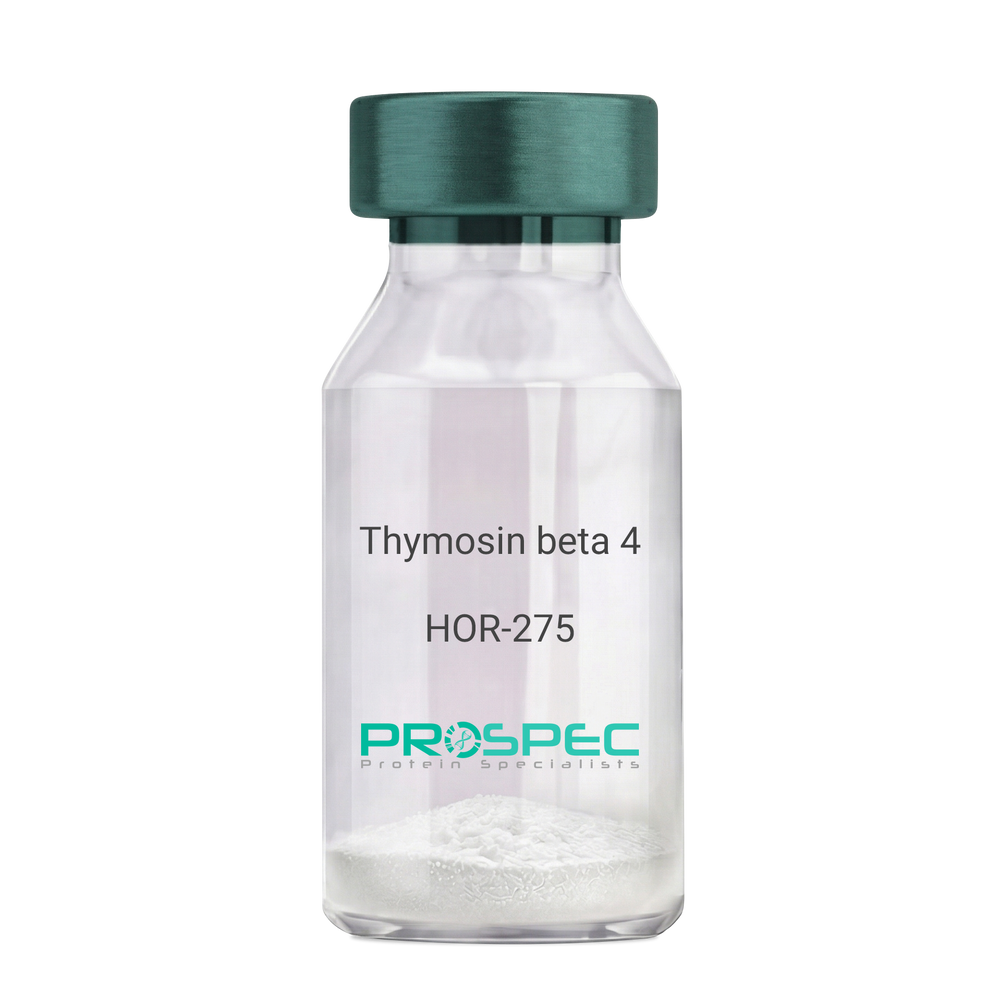
    Thymosin beta 4

    Description:

    Thymosin β4

    Thymosin beta-4. TB500, TB-500

    Product # :

    HOR-275

    Price :

    Quantity :

    Shipping Method :

    Room Temp Icon

    Shipped at Room temp

    Add To Cart

    More Info

    • description
    • formulation
    • purity
    • More Info
    • Citations

    Description

    Thymosin b4 is a 43 amino acid peptide which is regarded as the main intracellular G-actin sequestering peptide. It has a molecular weight of 4963.55 Da, and its molecular formula is: C212H350N56O78S1. Extracellular Thymosin b4 may contribute to physiological processes such as angiogenesis, wound healing, and regulation of inflammation.

    Formulation

    The protein (1mg/ml) was lyophilized with no additives.

    Purity

    Greater than 98.0% as determined by RP-HPLC.

    Citations

    More Info

    • Introduction

      Thymosin is a hormone secreted from the thymus. Its primary function is to stimulate the production of T cells, which are an important part of the immune system. Thymosin also assists in the development of B cells to plasma cells to produce antibodies. The predominant form of thymosin, thymosin b4, is a member of a highly conserved family of actin monomer-sequestering proteins. b-thymosins are the primary regulators of unpolymerized actin, and are essential for maintaining the small cytoplasmic pool of free G-actin monomers required for rapid filament elongation and allowing for the flux of monomers between the thymosin-bound pool and F-actin.

    • Synonyms

      Thymosin beta-4. TB500, TB-500

    • Physical Appearance

      Sterile Filtered White lyophilized (freeze-dried) powder.

    • Stability

      Lyophilized Thymosin b4 although stable at room temperature for 3 weeks, should be stored desiccated below -18°C. Upon reconstitution T beta 4 should be stored at 4°C between 2-7 days and for future use below -18°C.For long term storage it is recommended to add a carrier protein (0.1% HSA or BSA).Please prevent freeze-thaw cycles.

    • Solubility

      It is recommended to reconstitute the lyophilized Thymosin beta-4 in sterile 18MΩ-cm H2O not less than 100 µg/ml, which can then be further diluted to other aqueous solutions.

    • Amino Acid Sequence

      Thymosin b4 has an a.a. sequence of Ac-Ser-Asp-Lys-Pro-Asp-Met-Ala-Glu-Ile-Glu-Lys-Phe-Asp-Lys-Ser-Lys-Leu-Lys-Lys-Thr-Glu-Thr-Gln-Glu-Lys-Asn-Pro-Leu-Pro-Ser-Lys-Glu-Thr-Ile-Glu-Gln-Glu-Lys-Gln-Ala-Gly-Glu-Ser-OH.

    • Background

      What is the molecular weight/Mw of THYMOSIN BETA 4 Protein?
      THYMOSIN BETA 4 Protein has a total Mw of 4.96kDa.

      What is the Purity of THYMOSIN BETA 4 Protein?
      THYMOSIN BETA 4 Protein is >98% pure as determined by SDS-PAGE.

      What is the Biological Activity of THYMOSIN BETA 4 Protein?
      The biological functionality of THYMOSIN BETA 4 Protein will be determined in the future.

      What is the amino acid sequence of THYMOSIN BETA 4 Protein?
      Thymosin b4 has an a.a. sequence of Ac-Ser-Asp-Lys-Pro-Asp-Met-Ala-Glu-Ile-Glu-Lys-Phe-Asp-Lys-Ser-Lys-Leu-Lys-Lys-Thr-Glu-Thr-Gln-Glu-Lys-Asn-Pro-Leu-Pro-Ser-Lys-Glu-Thr-Ile-Glu-Gln-Glu-Lys-Gln-Ala-Gly-Glu-Ser-OH.
      What applications can THYMOSIN BETA 4 Protein be used in?
      THYMOSIN BETA 4 Protein can probably be used in western blot, ELISA and Lateral Flow.

      What is the endotoxin level for THYMOSIN BETA 4 Protein?
      The endotoxin level is minimal, THYMOSIN BETA 4 Protein was purified using conventional chromatography techniques.

      Who supplies THYMOSIN BETA 4 that is in stock and available to order?
      ProSpec has the protein in stock and available for immediate delivery.

      Where can I order bulk mg quantities of THYMOSIN BETA 4?
      ProSpec supplies bulk mg quantities at affordable prices that meets research and academic budgets.

    ProSpec's products are furnished for LABORATORY RESEARCH USE ONLY. The product may not be used as drugs, agricultural or pesticidal products, food additives or household chemicals.

    Thymosin Beta 4
  • View Data Sheet

    Name :

    PDGF A Human

    Description:

    Platelet-Derived Growth Factor A Human Recombinant

    Glioma-derived growth factor, GDGF, Osteosarcoma-derived Growth Factor, ODGF, PDGF-A, PDGF-1.

    Product # :

    CYT-491

    Price :

    Quantity :

    Shipping Method :

    Ice Icon

    Shipped with Ice Packs

    Add To Cart

    More Info

    • description
    • source
    • formulation
    • purity
    • More Info
    • Citations

    Description

    Platelet-Derived Growth Factor A Human Recombinant short chain produced in E.Coli is a non-glycosylated, polypeptide chain containing 110 amino acids fragment (87-196) and having a total Mw of 17.02kDa, with an amino-terminal hexahistidine tag. PDGF-A is purified by proprietary chromatographic techniques.

    Source

    Escherichia Coli.

    Formulation

    Platelet-derived Growth Factor A is supplied in 25mM Na-Acetate, pH-4.8, 1mM EDTA and 50% glycerol.

    Purity

    Greater than 95.0% as determined by SDS-PAGE.

    Citations

    More Info

    • Introduction

      The term ‘PDGF’ refers to a family of disulphide bond-linked dimeric isoforms that act as autocrine and paracrine growth factors and are produced by a variety of cell types other than platelets.
      They act as potent mitogens for almost all mesenchymally-derived cells. Aberrant expression is involved in certain cancers, fibroproliferative disorders and atherosclerosis. The protein also contributes to wound healing and neural regeneration. There are four members of the PDGF family – PDGF A, PDGF B, PDGF C and PDGF D. Two distinct types of PDGF-A exist – a short form that is soluble and a long form that is retained by the extracellular matrix.

    • Synonyms

      Glioma-derived growth factor, GDGF, Osteosarcoma-derived Growth Factor, ODGF, PDGF-A, PDGF-1.

    • Physical Appearance

      Sterile Filtered clear solution.

    • Stability

      Store at 4°C if entire vial will be used within 2-4 weeks. Store, frozen at -20°C for longer periods of time. Please avoid freeze thaw cycles.

    ProSpec's products are furnished for LABORATORY RESEARCH USE ONLY. The product may not be used as drugs, agricultural or pesticidal products, food additives or household chemicals.

    Pdgf A Human
  • View Data Sheet

    Name :

    PDGF B Human

    Description:

    Platelet-Derived Growth Factor B Human Recombinant

    Glioma-derived growth factor, GDGF, Osteosarcoma-derived Growth Factor, ODGF, SIS, SSV, PDGF2, c-sis, FLJ12858, PDGF-BB, PDGF B-chain, Platelet-derived growth factor beta polypeptide, Becaplermin.

    Product # :

    CYT-492

    Price :

    Quantity :

    Shipping Method :

    Ice Icon

    Shipped with Ice Packs

    Add To Cart

    More Info

    • description
    • source
    • formulation
    • purity
    • More Info
    • Citations

    Description

    PDGF-B Human Recombinant mature chain produced in E.Coli is a non-glycosylated, polypeptide chain containing 109 amino acids fragment (82-190) and having a molecular mass of 16.75 kDa. The PDGF-B is fused with an amino-terminal hexahistidine tag and purified by proprietary chromatographic techniques.

    Source

    Escherichia Coli.

    Formulation

    Platelet-Derived Growth Factor-B is supplied in 25mM Na-Acetate pH 4.8, 1mM EDTA and 50% glycerol.

    Purity

    Greater than 95.0% as determined by SDS-PAGE.

    Citations

    More Info

    • Introduction

      The term ‘PDGF’ refers to a family of disulphide bond-linked dimeric isoforms that act as autocrine and paracrine growth factors and are produced by a variety of cell types other than platelets.
      They act as potent mitogens for almost all mesenchymally-derived cells. Aberrant expression is involved in certain cancers, fibroproliferative disorders and atherosclerosis. The protein also contributes to wound healing and neural regeneration. There are four members of the PDGF family – PDGF A, PDGF B, PDGF C and PDGF D. Two distinct types of PDGF-A exist – a short form that is soluble and a long form that is retained by the extracellular matrix.

    • Synonyms

      Glioma-derived growth factor, GDGF, Osteosarcoma-derived Growth Factor, ODGF, SIS, SSV, PDGF2, c-sis, FLJ12858, PDGF-BB, PDGF B-chain, Platelet-derived growth factor beta polypeptide, Becaplermin.

    • Physical Appearance

      Sterile Filtered clear solution.

    • Stability

      Store at 4°C if entire vial will be used within 2-4 weeks. Store, frozen at -20°C for longer periods of time. Please avoid freeze thaw cycles.

    ProSpec's products are furnished for LABORATORY RESEARCH USE ONLY. The product may not be used as drugs, agricultural or pesticidal products, food additives or household chemicals.

    Pdgf B Human
  • View Data Sheet

    Name :

    NT 4 Human

    Description:

    Neurotrophin-4 Human Recombinant

    NT4, NT5, NTF5, NT-4/5, NTF4, Neurotrophin-4, Neutrophic factor 4, Neurotrophin-5, NT-5.

    Product # :

    CYT-626

    Price :

    Quantity :

    Shipping Method :

    Room Temp Icon

    Shipped at Room temp

    Add To Cart

    More Info

    • description
    • source
    • formulation
    • purity
    • biological activity
    • More Info
    • Citations

    Description

    Neurotrophin-4 Human Recombinant produced in E.Coli is a noncovalently linked homodimer, non-glycosylated polypeptide chain containing 2 x 130 amino acids (81-210 amino acids) and having a total molecular mass of 28 kDa. The NT-4 is purified by proprietary chromatographic techniques.

    Source

    Escherichia Coli.

    Formulation

    Lyophilized from a concentrated (1mg/ml) solution in water containing 20mM phosphate buffer pH-7.4 and 150mM NaCl.

    Purity

    Greater than 97.0% as determined by:
    (a) Analysis by RP-HPLC.
    (b) Analysis by SDS-PAGE.

    Biological Activity

    Determined by the dose-dependent induction of choline acetyl transferase activity in rat basal forebrain primary septal cell cultures was found to be in the range of 20-50 ng/ml.

    Citations

    More Info

    • Introduction

      NT-4 is part of the family of neurotrophic factors, neurotrophins, that are in charge for the survival and differentiation of mammalian neurons. NT-4 expression is dominant and less influenced by environmental signals. NT-4 deficient mice shows slight cellular deficits and develop normally to adulthood. NT-4 is a target-derived survival factor for peripheral sensory sympathetic neurons.NT-4 is involved in the proliferation and differentiation of periodontal ligament cells.

    • Synonyms

      NT4, NT5, NTF5, NT-4/5, NTF4, Neurotrophin-4, Neutrophic factor 4, Neurotrophin-5, NT-5.

    • Physical Appearance

      Sterile Filtered White lyophilized (freeze-dried) powder.

    • Stability

      Lyophilized NT-4 although stable at room temperature for 3 weeks, should be stored desiccated below -18°C. Upon reconstitution NT-4 should be stored at 4°C between 2-7 days and for future use below -18°C.For long term storage it is recommended to add a carrier protein (0.1% HSA or BSA).Please prevent freeze-thaw cycles.

    • Solubility

      It is recommended to reconstitute the lyophilized NT-4 in sterile 18MΩ-cm H2O not less than 100µg/ml, which can then be further diluted to other aqueous solutions.

    • Amino Acid Sequence

      GVSETAPASR RGELAVCDAV SGWVTDRRTA VDLRGREVEV LGEVPAAGGS PLRQYFFETR CKADNAEEGG PGAGGGGCRG VDRRHWVSEC KAKQSYVRAL TADAQGRVGW RWIRIDTACV CTLLSRTGRA.

    ProSpec's products are furnished for LABORATORY RESEARCH USE ONLY. The product may not be used as drugs, agricultural or pesticidal products, food additives or household chemicals.

    Nt 4 Human
  • View Data Sheet

    Name :

    VEGF (121 a.a.) Human

    Description:

    Vascular Endothelial Growth Factor (121 a.a.) Human Recombinant

    Vascular endothelial growth factor A, VEGF-A, Vascular permeability factor, VPF, VEGF, MGC70609.

    Product # :

    CYT-343

    Price :

    Quantity :

    Shipping Method :

    Room Temp Icon

    Shipped at Room temp

    Add To Cart

    More Info

    • description
    • source
    • formulation
    • purity
    • biological activity
    • More Info
    • Citations

    Description

    Vascular Endothelial Growth Factor-121 Human Recombinant produced in E.Coli is a non-glycosylated, polypeptide double chain containing 2x121 amino acids and having a molecular mass of 28.4kDa. VEGF121 circulates more freely than other VEGF forms, which bind more tightly with vascular heparin sulfates.

    Source

    Escherichia Coli.

    Formulation

    The protein was lyophilized from a concentrated (1mg/ml) solution with no additives.

    Purity

    Greater than 98.0% as determined by:
    (a) Analysis by RP-HPLC.
    (b) Analysis by SDS-PAGE.

    Biological Activity

    VEGF-121 has full biological activity when compared to standards. The activity is determined by the dose-dependent proliferation of HUVECs and is typically 1-6ng/ml corresponding to a specific activity of 166,667-1,000,000U/mg.

    Citations

    More Info

    • Introduction

      Vascular endothelial growth factor is an important signaling protein involved in both vasculogenesis and angiogenesis. As its name implies, VEGF activity has been mostly studied on cells of the vascular endothelium, although it does have effects on a number of other cell types (e.g. stimulation monocyte/ macrophagemigration, neurons, cancer cells, kidney epithelial cells ).VEGF mediates increased vascular permeability, induces angiogenesis, vasculogenesis and endothelial cell growth, promotes cell migration, and inhibits apoptosis. In vitro, VEGF has been shown to stimulate endothelial cell mitogenesisand cell migration. VEGF is also a vasodilator and increases microvascular permeability and was originally referred to as vascular permeability factor.
      Elevated levels of this protein are linked to POEMS syndrome, also known as Crow-Fukase syndrome. Mutations in this gene have been associated with proliferative and nonproliferative diabetic retinopathy.

    • Synonyms

      Vascular endothelial growth factor A, VEGF-A, Vascular permeability factor, VPF, VEGF, MGC70609.

    • Physical Appearance

      Sterile Filtered White lyophilized (freeze-dried) powder.

    • Stability

      Lyophilized Vascular Endothelial Growth Factor 121 although stable at room temperature for 3 weeks, should be stored desiccated below -18°C. Upon reconstitution VEGF-121 should be stored at 4°C between 2-7 days and for future use below -18°C.For long term storage it is recommended to add a carrier protein (0.1% HSA or BSA).Please prevent freeze-thaw cycles.

    • Solubility

      It is recommended to reconstitute the lyophilized Vascular Endothelial Growth Factor -121 in sterile 18MΩ-cm H2O not less than 100µg/ml, which can then be further diluted to other aqueous solutions.

    • Amino Acid Sequence

      APMAEGGGQN HHEVVKFMDV YQRSYCHPIE TLVDIFQEYP DEIEYIFKPS CVPLMRCGGC CNDEGLECVP TEESNITMQI MRIKPHQGQH IGEMSFLQHN KCECRPKKDR ARQENCDKPR R

    ProSpec's products are furnished for LABORATORY RESEARCH USE ONLY. The product may not be used as drugs, agricultural or pesticidal products, food additives or household chemicals.

    Vegf121 Human
  • View Data Sheet

    Name :

    EGF Antibody

    Description:

    Endothelial Growth Factor, Mouse Anti-Human

    Urogastrone, URG, EGF.

    Product # :

    ANT-169

    Price :

    Quantity :

    Shipping Method :

    Room Temp Icon

    Shipped at Room temp

    Add To Cart

    More Info

    • formulation
    • More Info
    • Citations

    Formulation

    1mg/ml in PBS (after reconstitution).

    Citations

    More Info

    • Introduction

      Epidermal growth factor has a profound effect on the differentiation of specific cells in vivo and is a potent mitogenic factor for a variety of cultured cells of both ectodermal and mesodermal origin. The EGF precursor is believed to exist as a membrane-bound molecule which is proteolytically cleaved to generate the 53-amino acid peptide hormone that stimulates cells to divide.
      EGF stimulates the growth of various epidermal and epithelial tissues in vivo and in vitro and of some fibroblasts in cell culture.

    • Synonyms

      Urogastrone, URG, EGF.

    • Solubility

      Reconstitute with sterile H20. Mix gently, wash the sides of the vial and wait 30-60 seconds before use.

    • Immunogen

      r.HumanEGF.

    • Ig Subclass

      Mouse IgG2b.

    • Clone

      NYRhEGF.

    • Applications

      Direct ELISA, Western Blot, Immuneprecipitation.

    • Titer

      By direct ELISA, 1:10,000 dilution will yield 0.3 O.D using alkaline phosphatase conjugated rabbit anti-mouse Ig (Jackson Laboratories).

    • Shipping Conditions

      Antibody is shipped lyophilized at ambient temperature.

    • Type

      Mouse Anti Human Monoclonal.

    • Storage Procedures

      In lyophilized form, for long periods, store at 4oC in a dry environment. After reconstitution, if not intended for use within a month, aliquot and store at -20oC.

    • Purification Method

      Ion exchange.

    ProSpec's products are furnished for LABORATORY RESEARCH USE ONLY. The product may not be used as drugs, agricultural or pesticidal products, food additives or household chemicals.

    Egf Antibody
  • View Data Sheet

    Name :

    MIF Human His C

    Description:

    Macrophage Migration Inhibitory Factor Human Recombinant, His Tag C-Terminus

    Phenylpyruvate tautomerase, Glycosylation-inhibiting factor, GIF, MMIF, MIF.

    Product # :

    CYT-521

    Price :

    Quantity :

    Shipping Method :

    Room Temp Icon

    Shipped at Room temp

    Add To Cart

    More Info

    • description
    • source
    • formulation
    • purity
    • biological activity
    • More Info
    • Citations

    Description

    MIF human Recombinant, fused to His-tag at C-terminus, was cloned into an E. coli expression vector and was purified to apparent homogeneity by using conventional column chromatography techniques.Macrophage Inducing Factor Human Recombinant is a single, non-glycosylated, polypeptide chaincontaining 123 amino acidsand having a molecular mass of 13.5 kDa.

    Source

    Escherichia Coli.

    Formulation

    Human MIF was lyophilized from a 1mg/ml solution containing PBS pH-7.4.

    Purity

    Greater than 95.0% as determined by:
    (a) Analysis by RP-HPLC.
    (b) Analysis by SDS-PAGE.

    Biological Activity

    Measured by its ability to bind rhCD74 in a functional ELISA.

    Citations

    More Info

    • Introduction

      The cytokine Macrophage migration inhibitory factor (MIF) has been identified to be secreted by the pituitary gland and the monocyte/macrophage and to play an important role in endotoxic shock. MIF has the unique property of being released from macrophages and T cells in response to physiological concentrations of glucocorticoids. The secretion of MIF is tightly regulated and decreases at high, anti-inflammatory steroid concentration.

    • Synonyms

      Phenylpyruvate tautomerase, Glycosylation-inhibiting factor, GIF, MMIF, MIF.

    • Physical Appearance

      Sterile Filtered lyophilized powder.

    • Stability

      Lyophilized MIF although stable at room temperature for 3 weeks, should be stored desiccated below -18°C. Upon reconstitution MIF should be stored at 4°C between 2-7 days and for future use below -18°C.For long term storage it is recommended to add a carrier protein (0.1% HSA or BSA).Please prevent freeze-thaw cycles.

    • Solubility

      It is recommended to reconstitute the lyophilized MIF in sterile 18MΩ-cm H2O not less than 100µg/ml, which can then be further diluted to other aqueous solutions.

    • Amino Acid Sequence

      MPMFIVNTNVPRASVPDGFLSELTQQLAQATGKPPQYIAVHVVPDQLMAFGGSSEPC
      ALCSLHSIGKIGGAQNRSYSKLLCGLLAERLRISPDRVYINYYDMNAANVGWNNSTF
      ALEHHHHHH.

    ProSpec's products are furnished for LABORATORY RESEARCH USE ONLY. The product may not be used as drugs, agricultural or pesticidal products, food additives or household chemicals.

    Mif Human His C
  • View Data Sheet

    Name :

    PDGF CC Human

    Description:

    Platelet Derived Growth Factor-CC Human Recombinant

    Platelet Derived Growth Factor C, Spinal Cord-Derived Growth Factor, FALLOTEIN, PDGF-C, VEGF-E, SCDGF, Secretory Growth Factor-Like Protein, Platelet-Derived Growth Factor C, PDGFC.

    Product # :

    CYT-872

    Price :

    Quantity :

    Shipping Method :

    Room Temp Icon

    Shipped at Room temp

    Add To Cart

    More Info

    • description
    • source
    • formulation
    • purity
    • biological activity
    • More Info
    • Citations

    Description

    PDGF-CC Human Recombinant (235-345) produced in E.Coli is a disulfide-linked homodimer containing 2x118 amino acids and having a total molecular mass of 26.8kDa.The PDGF-CC is fused to a 7 amino acid His tag [M-HHHHHH] at N-terminal and purified by proprietary chromatographic techniques.

    Source

    Escherichia Coli.

    Formulation

    Lyophilized from a 0.2µm filtered solution in Acetonitrile and TFA.

    Purity

    Greater than 97.0% as determined by SDS-PAGE.

    Biological Activity

    The ED50, as measured in a proliferation assay using mouse NR6R-3T3 cells, is less than 350ng/ml.

    Citations

    More Info

    • Introduction

      Platelet Derived Growth Factor-CC (PDGF-CC) belongs to the PGDF family of growth factors. PDGF-CC binds with high-affinity to PDGF R-a and activates PDGF R-ab heterodimers. During development, PDGF-CC is involved in ductal morphogenesis, cardiovascular smooth muscle cell proliferation; also PDGF-CC is an angiogenic factor. Furthermore, PDGF-CC is expressed in numerous tumors and tumor cell lines, and may be linked with tumorigenesis.

    • Synonyms

      Platelet Derived Growth Factor C, Spinal Cord-Derived Growth Factor, FALLOTEIN, PDGF-C, VEGF-E, SCDGF, Secretory Growth Factor-Like Protein, Platelet-Derived Growth Factor C, PDGFC.

    • Physical Appearance

      Sterile Filtered White lyophilized (freeze-dried) powder.

    • Stability

      Lyophilized PDGF-CC although stable at room temperature for 3 weeks, should be stored desiccated below -18°C. Upon reconstitution PDGF-CC should be stored at 4°C between 2-7 days and for future use below -18°C.For long term storage it is recommended to add a carrier protein (0.1% HSA or BSA).Please prevent freeze-thaw cycles.

    • Solubility

      It is recommended to reconstitute the lyophilized PDGF-CC in sterile 18M-cm H2O not less than 100µg/ml, which can then be further diluted to other aqueous solutions.

    • Amino Acid Sequence

      MHHHHHHVVD LNLLTEEVRL YSCTPRNFSV SIREELKRTD TIFWPGCLLV KRCGGNCACC LHNCNECQCV PSKVTKKYHE VLQLRPKTGV RGLHKSLTDV ALEHHEECDC VCRGSTGG.

    ProSpec's products are furnished for LABORATORY RESEARCH USE ONLY. The product may not be used as drugs, agricultural or pesticidal products, food additives or household chemicals.

    Pdgf Cc Human
  • View Data Sheet

    Name :

    CTGF Human, His

    Description:

    Connective Tissue Growth Factor Human Recombinant, His Tag

    CCN2, NOV2, HCS24, IGFBP8, MGC102839, CTGF, Connective Tissue Growth Factor.

    Product # :

    CYT-438

    Price :

    Quantity :

    Shipping Method :

    Ice Icon

    Shipped with Ice Packs

    Add To Cart

    More Info

    • description
    • source
    • formulation
    • purity
    • More Info
    • sds-page
    • Citations

    Description

    CTGF Human Recombinant produced in E.coli is a single, non-glycosylated polypeptide chain containing 344 amino acids (27-349) and having a molecular mass of 37.7kDa.The CTGF is fused to a 21 amino acid His-Tag at N-terminus and purified by proprietary chromatographic techniques.

    Source

    Escherichia Coli.

    Formulation

    CTGF protein (1mg/ml) is supplied in 20mM Tris-HCl, pH-8 and 10% Glycerol.

    Purity

    Greater than 85.0% as determined by Analysis by SDS-PAGE.

    sds-page

    CTGF-sds-page - Product image 1

    Citations

    More Info

    • Introduction

      Connective Tissue Growth Factor belongs to the CCN family of proteins. The CCN family presently consists of six members in human also known as: Cyr61 (Cystein rich 61), CTGF (Connective Tissue Growth Factor), Nov (Nephroblastoma Overexpressed gene), WISP-1, 2 and 3 (Wnt-1 Induced Secreted Proteins). The CCN genes encode secreted proteins associated with the Extracellular Matrix (ECM) and cell membrane. CCN proteins are matricellular proteins which are involved in the regulation of various cellular functions including: proliferation, differentiation, survival, adhesion and migration. They are expressed in derivatives of the three embryonic sheets and are implicated in the development of kidney, nervous system, muscle, bone marrow, cartilage and bone. During adulthood, they are implicated in wound healing, bone fracture repair, and pathologies such as: fibrosis, vascular ailments and tumorigenesis.
      Full length secreted CCN proteins can show an antiproliferative activity, whereas truncated isoforms are likely to stimulate proliferation and behave as oncogenes. The full length protein consists of four modulesModule I shares partial identity with the N-terminal part of the Insulin-like Growth Factor Binding Proteins (IGFBPs).
      Module II includes a stretch of 70amino acid residues – which shares sequence identity with the Von Willebrand Factor Type C repeat (VWC).
      Module III contains sequences sharing identity with the Thrombospondin type 1 repeat (TSP1) (WSXCSXXCG), which is thought to be implicated in the binding of sulfated glycoconjugates and to be important for cell adhesion. Module IV, also designated CT, is encoded by exon5. It is the leasts conserved one of the four domains at the level of nucleotide sequence, but it appears to be critical for several of the biological functions attributed to the CCN proteins. Module IV resembles the CT domain of several extracellular protein including, Von Willebrand's factor and mucins. Sequence similarities to heparin-binding motifs are also found within this domain.
      Proteolysis of the secreted full-length CCN proteins that has been reported in the case of CCN2 and CCN3 might result in the production of CCN-derived peptides with high affinity for ligands that full-length CNN proteins bind only poorly. Amino-truncated CCN2 isoforms were biologically active whereas no specific biological activity has been attributed to the truncated CCN3. Although the molecular processes underlying the production of these secreted isoforms is presently unknown, it is important to note that proteolysis occur at the same amino acid residues in both CCN2 and CCN3. An elevated expression of CCN2 has also been detected by Northern blotting in human invasive mammary ductal carcinomas, dermatofibromas, pyogenic granuloma, endothelial cells of angiolipomas and angioleiomyomas, and in pancreatic tumors. A study performed with chondrosarcomas representative of various histological grades established that CCN2 expression was closely correlated with increasing levels of malignancy. In agreement with CCN2 playing a role in brain tumor angiogenesis, immunocytochemistry studies indicated that both glioblastoma tumor cells and proliferating endothelial cells stained positive for CCN2. In astrocytomas, CCN2 expression was particularly elevated in high grade tumors, with a marked effect of CCN2 on cell proliferation. Downregulation of CCN2 expression in these cells was associated with a growth arrest at the G1/S transition while over-expression of CCN2 induced a two-fold increase of the number of cells in the G1 phase. Gene profiling analysis allowed to identify a set of about 50 genes whose expression might account for the proliferative activity of CCN2 in these cells. CCN2 was seen in a higher proportion of mononuclear cells of patients with acute lymphoblastic leukemia.

    • Synonyms

      CCN2, NOV2, HCS24, IGFBP8, MGC102839, CTGF, Connective Tissue Growth Factor.

    • Physical Appearance

      Sterile Filtered clear solution.

    • Stability

      Store at 4°C if entire vial will be used within 2-4 weeks. Store, frozen at -20°C for longer periods of time. For long term storage it is recommended to add a carrier protein (0.1% HSA or BSA).Avoid multiple freeze-thaw cycles.

    • Amino Acid Sequence

      MGSSHHHHHH SSGLVPRGSH MQNCSGPCRC PDEPAPRCPA GVSLVLDGCG CCRVCAKQLG ELCTERDPCD PHKGLFCDFG SPANRKIGVC TAKDGAPCIF GGTVYRSGES FQSSCKYQCT CLDGAVGCMP LCSMDVRLPS PDCPFPRRVK LPGKCCEEWV CDEPKDQTVV GPALAAYRLE DTFGPDPTMI RANCLVQTTE WSACSKTCGM GISTRVTNDN ASCRLEKQSR LCMVRPCEAD LEENIKKGKK CIRTPKISKP IKFELSGCTS MKTYRAKFCG VCTDGRCCTP HRTTTLPVEF KCPDGEVMKK NMMFIKTCAC HYNCPGDNDI FESLYYRKMY GDMA.

    • Background

      What is the molecular weight/Mw of CTGF Protein?
      CTGF Protein has a total Mw of 37.7kDa.

      What is the source or expression system of CTGF Protein?
      Escherichia Coli.

      What is the Purity of CTGF Protein?
      CTGF Protein is >85% pure as determined by SDS-PAGE.

      What is the Biological Activity of CTGF Protein?
      The biological functionality of CTGF Protein will be determined in the future.

      What is the amino acid sequence of CTGF Protein?
      MGSSHHHHHH SSGLVPRGSH MQNCSGPCRC PDEPAPRCPA GVSLVLDGCG CCRVCAKQLG ELCTERDPCD PHKGLFCDFG SPANRKIGVC TAKDGAPCIF GGTVYRSGES FQSSCKYQCT CLDGAVGCMP LCSMDVRLPS PDCPFPRRVK LPGKCCEEWV CDEPKDQTVV GPALAAYRLE DTFGPDPTMI RANCLVQTTE WSACSKTCGM GISTRVTNDN ASCRLEKQSR LCMVRPCEAD LEENIKKGKK CIRTPKISKP IKFELSGCTS MKTYRAKFCG VCTDGRCCTP HRTTTLPVEF KCPDGEVMKK NMMFIKTCAC HYNCPGDNDI FESLYYRKMY GDMA.

      What applications can CTGF Protein be used in?
      CTGF Protein can probably be used in western blot, ELISA and Lateral Flow.

      What is the endotoxin level for CTGF Protein?
      The endotoxin level is minimal, CTGF Protein was purified using conventional chromatography techniques.

    ProSpec's products are furnished for LABORATORY RESEARCH USE ONLY. The product may not be used as drugs, agricultural or pesticidal products, food additives or household chemicals.

    Ctgf Human His
  • View Data Sheet

    Name :

    VEGF Mouse, His

    Description:

    Vascular Endothelial Growth Factor Mouse Recombinant, His Tag

    Vascular endothelial growth factor A, VEGF-A, Vascular permeability factor, VPF, VEGF, Vegf120, Vegf164, Vegf188, Vegfa.

    Product # :

    CYT-680

    Price :

    Quantity :

    Shipping Method :

    Ice Icon

    Shipped with Ice Packs

    Add To Cart

    More Info

    • description
    • source
    • formulation
    • purity
    • biological activity
    • More Info
    • Citations

    Description

    VEGF Mouse Recombinant produced in E.Coli is a single, non-glycosylated, polypeptide chain containing 141 amino acids (205-324 a.a.) and having a total molecular mass of 16.3kDa. Mouse VEGF is fused to 20 amino acid His Tag at N-terminus and purified by proprietary chromatographic techniques.

    Source

    Escherichia Coli.

    Formulation

    The Mouse VEGF contains 20mM Tris-HCl buffer (pH8.0) and 10% glycerol.

    Purity

    Greater than 90.0% as determined by SDS-PAGE.

    Biological Activity

    Measured in a cell proliferation assay using NIH-3T3 mouse embryonic fibroblast. The ED50 for this effect is 0.5-1.5ng/ml.

    Citations

    More Info

    • Introduction

      Vascular endothelial growth factor is an important signaling protein involved in both vasculogenesis and angiogenesis. As its name implies, VEGF activity has been mostly studied on cells of the vascular endothelium, although it does have effects on a number of other cell types (e.g. stimulation monocyte/macrophage migration, neurons, cancer cells, kidney epithelial cells ).VEGF mediates increased vascular permeability, induces angiogenesis, vasculogenesis and endothelial cell growth, promotes cell migration, and inhibits apoptosis. In vitro, VEGF has been shown to stimulate endothelial cell mitogenesis and cell migration. VEGF is also a vasodilator and increases microvascular permeability and was originally referred to as vascular permeability factor.
      Elevated levels of this protein is linked to POEMS syndrome, also known as Crow-Fukase syndrome. Mutations in this gene have been associated with proliferative and nonproliferative diabetic retinopathy.

    • Synonyms

      Vascular endothelial growth factor A, VEGF-A, Vascular permeability factor, VPF, VEGF, Vegf120, Vegf164, Vegf188, Vegfa.

    • Physical Appearance

      Sterile Filtered colorless solution.

    • Stability

      Store at 4°C if entire vial will be used within 2-4 weeks. Store, frozen at -20°C for longer periods of time. For long term storage it is recommended to add a carrier protein (0.1% HSA or BSA).Avoid multiple freeze-thaw cycles.

    • Amino Acid Sequence

      MGSSHHHHHH SSGLVPRGSH MAPTTEGEQK SHEVIKFMDV YQRSYCRPIE TLVDIFQEYP DEIEYIFKPS CVPLMRCAGC CNDEALECVP TSESNITMQI MRIKPHQSQH IGEMSFLQHS RCECRPKKDR TKPEKCDKPR R.

    ProSpec's products are furnished for LABORATORY RESEARCH USE ONLY. The product may not be used as drugs, agricultural or pesticidal products, food additives or household chemicals.

    Vegf Mouse His
  • View Data Sheet

    Name :

    EGF Long Human

    Description:

    Epidermal Growth Factor Long Human Recombinant

    Urogastrone, URG, EGF.

    Product # :

    CYT-798

    Price :

    Quantity :

    Shipping Method :

    Room Temp Icon

    Shipped at Room temp

    Add To Cart

    More Info

    • description
    • source
    • formulation
    • purity
    • biological activity
    • More Info
    • Citations

    Description

    Recombinant Human EGF Long produced in E.coli cells is a single non-glycosylated, polypeptide chain containing 106 amino acids and having a molecular mass of 12.3kDa. The EGF Long is purified by proprietary chromatographic techniques.

    Source

    Escherichia Coli.

    Formulation

    The EGF Long was lyophilized from a 0.2µm filtered concentrated solution in 10mM HCl.

    Purity

    Greater than 95.0% as determined by:
    (a) Analysis by RP-HPLC.
    (b) Analysis by SDS-PAGE.

    Biological Activity

    The ED50 as determined by a cell proliferation assay using murine Balb/c 3T3 cells is less than 1.0 ng/ml, corresponding to a specific activity of > 1.0 × 10⁶ IU/mg.

    Citations

    More Info

    • Introduction

      Epidermal growth factor has a profound effect on the differentiation of specific cells in vivo and is a potent mitogenic factor for a variety of cultured cells of both ectodermal and mesodermal origin. The EGF precursor is believed to exist as a membrane-bound molecule which is proteolytically cleaved to generate the 53-amino acid peptide hormone that stimulates cells to divide. EGF stimulates the growth of various epidermal and epithelial tissues in vivo and in vitro and of some fibroblasts in cell culture. Long EGF is a recombinant analog of Human EGF developed as a replacement for use in therapeutic cell culture applications as a like-for-like supplement for Recombinant Human or native EGF. It includes the Human EGF amino acid sequence plus a 53 amino acid N-terminal extension peptide.

    • Synonyms

      Urogastrone, URG, EGF.

    • Physical Appearance

      Sterile Filtered White lyophilized (freeze-dried) powder.

    • Stability

      Lyophilized EGF Long although stable at room temperature for 3 weeks, should be stored desiccated below -18°C. Upon reconstitution EGF Long should be stored at 4°C between 2-7 days and for future use below -18°C.For long term storage it is recommended to add a carrier protein (0.1% HSA or BSA).Please prevent freeze-thaw cycles.

    • Solubility

      It is recommended to reconstitute the lyophilized EGF Long in sterile 100mM AcOH (acetic Acid) not less than 100µg/ml, which can then be further diluted to other aqueous solutions.

    • Amino Acid Sequence

      MFPAMPLSSL FANAVLRAQH LHQLAADTYK EFERAYIPEG QRYSIQVNFA HYGNSDSECP LSHDGYCLHD GVCMYIEALD KYACNCVVGY IGERCQYRDL KWWELR

    • Background

      What is the molecular weight/Mw of EGF Protein?
      EGF Protein has a total Mw of 12.3kDa.

      What is the source or expression system of EGF Protein?
      Escherichia Coli.

      What is the Purity of EGF Protein?
      EGF Protein is >95% pure as determined by SDS-PAGE.

      What is the Biological Activity of EGF Protein?
      The ED50 as determined by a cell proliferation assay using murine Balb/c 3T3 cells is less than 1.0 ng/ml, corresponding to a specific activity of > 1.0 × 10⁶ IU/mg.

      What is the amino acid sequence of EGF Protein?
      MFPAMPLSSL FANAVLRAQH LHQLAADTYK EFERAYIPEG QRYSIQVNFA HYGNSDSECP LSHDGYCLHD GVCMYIEALD KYACNCVVGY IGERCQYRDL KWWELR

      What applications can EGF Protein be used in?
      EGF Protein can probably be used in western blot, ELISA and Lateral Flow.

      What is the endotoxin level for EGF Protein?
      The endotoxin level is minimal, EGF Protein was purified using conventional chromatography techniques.

    ProSpec's products are furnished for LABORATORY RESEARCH USE ONLY. The product may not be used as drugs, agricultural or pesticidal products, food additives or household chemicals.

    Egf Long Human
  • View Data Sheet

    Name :

    F11R Human

    Description:

    F11 Receptor Human Recombinant

    Junctional adhesion molecule A, JAM-A, Junctional adhesion molecule 1, JAM-1, Platelet F11 receptor, Platelet adhesion molecule 1, PAM-1, CD321, F11R, JAM1, JCAM, JAM, KAT, JAMA.

    Product # :

    PRO-1112

    Price :

    Quantity :

    Shipping Method :

    Ice Icon

    Shipped with Ice Packs

    Add To Cart

    More Info

    • description
    • source
    • formulation
    • purity
    • More Info
    • Citations

    Description

    F11R Human Recombinant produced in E.Coli is a single, non-glycosylated polypeptide chain containing 238 amino acids (26-238 a.a) and having a molecular mass of 25.8kDa.F11R is fused to a 25 amino acid His-tag at N-terminus & purified by proprietary chromatographic techniques.

    Source

    Escherichia Coli.

    Formulation

    F11R protein solution (1mg/ml) containing 20mM Tris-HCl buffer (pH8.0), 10% glycerol, 0.15M NaCl and 1mM DTT.

    Purity

    Greater than 90.0% as determined by SDS-PAGE.

    Citations

    More Info

    • Introduction

      F11R (CD321) is a member of the immunoglobulin superfamily. F11R has a role in epithelial tight junction formation. Tight junctions exemplify one type of cell-to-cell adhesion in epithelial or endothelial cell sheets, establishing continuous seals around cells and acting as a physical barrier to thwart solutes and water from passing easily through the paracellular space. F11R protein can function as a receptor for reovirus, or as a ligand for the integrin LFA1, involved in leukocyte transmigration, or a platelet receptor.

    • Synonyms

      Junctional adhesion molecule A, JAM-A, Junctional adhesion molecule 1, JAM-1, Platelet F11 receptor, Platelet adhesion molecule 1, PAM-1, CD321, F11R, JAM1, JCAM, JAM, KAT, JAMA.

    • Physical Appearance

      Sterile Filtered colorless solution.

    • Stability

      Store at 4°C if entire vial will be used within 2-4 weeks. Store, frozen at -20°C for longer periods of time. For long term storage it is recommended to add a carrier protein (0.1% HSA or BSA).Avoid multiple freeze-thaw cycles.

    • Amino Acid Sequence

      MGSSHHHHHH SSGLVPRGSH MGSHMLGSVT VHSSEPEVRI PENNPVKLSC AYSGFSSPRV EWKFDQGDTT RLVCYNNKIT ASYEDRVTFL PTGITFKSVT REDTGTYTCM VSEEGGNSYG EVKVKLIVLV PPSKPTVNIP SSATIGNRAV LTCSEQDGSP PSEYTWFKDG IVMPTNPKST
      RAFSNSSYVL NPTTGELVFD PLSASDTGEY SCEARNGYGT PMTSNAVRME AVERNVGV.

    ProSpec's products are furnished for LABORATORY RESEARCH USE ONLY. The product may not be used as drugs, agricultural or pesticidal products, food additives or household chemicals.

    F11R Human
  • View Data Sheet

    Name :

    VEGF Rat

    Description:

    Vascular Endothelial Growth Factor Rat Recombinant

    Vascular endothelial growth factor A, VEGF-A, Vascular permeability factor, VPF, VEGF, MGC70609.

    Product # :

    CYT-392

    Price :

    Quantity :

    Shipping Method :

    Room Temp Icon

    Shipped at Room temp

    Add To Cart

    More Info

    • description
    • source
    • formulation
    • purity
    • biological activity
    • More Info
    • Citations

    Description

    Vascular Endothelial Growth Factor Rat Recombinant produced in E.Coli is a double, non-glycosylated, polypeptide chain containing 165 amino acids and having a molecular mass of 38,750 Dalton. The VEGF is purified by proprietary chromatographic techniques.

    Source

    Escherichia Coli.

    Formulation

    The protein was lyophilized from 10mM NaP, pH 7.5.

    Purity

    Greater than 97.0% as determined by:
    (a) Analysis by RP-HPLC.
    (b) Analysis by SDS-PAGE.

    Biological Activity

    Determined by the dose-dependent stimulation of the proliferation of human umbilical vein endothelial cells (HUVEC) using a concentration range of 4.0-8.0 ng/ml.

    Citations

    More Info

    • Introduction

      Vascular endothelial growth factor is an important signaling protein involved in both vasculogenesis and angiogenesis. As its name implies, VEGF activity has been mostly studied on cells of the vascular endothelium, although it does have effects on a number of other cell types (e.g. stimulation monocyte/ macrophagemigration, neurons, cancer cells, kidney epithelial cells ).VEGF mediates increased vascular permeability, induces angiogenesis, vasculogenesis and endothelial cell growth, promotes cell migration, and inhibits apoptosis. In vitro, VEGF has been shown to stimulate endothelial cell mitogenesisand cell migration. VEGF is also a vasodilator and increases microvascular permeability and was originally referred to as vascular permeability factor.
      Elevated levels of this protein are linked to POEMS syndrome, also known as Crow-Fukase syndrome. Mutations in this gene have been associated with proliferative and nonproliferative diabetic retinopathy.

    • Synonyms

      Vascular endothelial growth factor A, VEGF-A, Vascular permeability factor, VPF, VEGF, MGC70609.

    • Physical Appearance

      Sterile Filtered White lyophilized (freeze-dried) powder.

    • Stability

      Lyophilized Vascular Endothelial Growth Factor although stable at room temperature for 3 weeks, should be stored desiccated below -18°C. Upon reconstitution VEGF should be stored at 4°C between 2-7 days and for future use below -18°C.For long term storage it is recommended to add a carrier protein (0.1% HSA or BSA).Please prevent freeze-thaw cycles.

    • Solubility

      It is recommended to reconstitute the lyophilized Vascular Endothelial Growth Factor in sterile 18MΩ-cm H2O not less than 100µg/ml, which can then be further diluted to other aqueous solutions.

    • Amino Acid Sequence

      MAPTTEGEQK AHEVVKFMDV YQRSYCRPIE TLVDIFQEYP DEIEYIFKPS CVPLMRCAGC CNDEALECVP TSESNVTMQI MRIKPHQSQH IGEMSFLQHS RCECRPKKDR TKPEKHCEPC SERRKHLFVQ DPQTCKCSCK NTDSRCKARQ LELNERTCRC DKPRR.

    ProSpec's products are furnished for LABORATORY RESEARCH USE ONLY. The product may not be used as drugs, agricultural or pesticidal products, food additives or household chemicals.

    Vegf Rat
  • View Data Sheet

    Name :

    CCN1 Human

    Description:

    Cysteine-Rich Angiogenic Inducer 61 Human Recombinant

    CYR61, Protein CYR61, Cysteine-rich angiogenic inducer 61, IGF-binding protein 10, IGFBP-10, IBP-10, Protein GIG1, CCN family member 1, CCN1, GIG1, IGFBP10.

    Product # :

    CYT-164

    Price :

    Quantity :

    Shipping Method :

    Room Temp Icon

    Shipped at Room temp

    Add To Cart

    More Info

    • description
    • source
    • formulation
    • purity
    • biological activity
    • More Info
    • Citations

    Description

    CYR61 Human Recombinant produced in E.Coli is a single, non-glycosylated, polypeptide chain containing 357 amino acids and having a molecular mass of 39.5kDa.The CYR61 is purified by proprietary chromatographic techniques.

    Source

    Escherichia Coli.

    Formulation

    Lyophilized from a 0.2m filtered concentrated solution in PBS, pH 7.4.

    Purity

    Greater than 95.0% as determined by SDS-PAGE.

    Biological Activity

    The ED50 was determined by the proliferation of mouse 3T3 cells is < 2.0 ug/ml, corresponding to a specific activity of > 500 units/mg.

    Citations

    More Info

    • Introduction

      CYR61 is a growth factor-inducible, immediate-early gene that has multifaceted activities in various cancers. CYR61 is a secreted, cysteine-rich, binding protein which is encoded by a growth factor-inducible immediate-early gene. Acting as an extracellular, matrix-associated signaling molecule, CYR61 promotes the adhesion of endothelial cells through interaction with integrin and enhances growth factor-induced DNA synthesis in the same cell type.

    • Synonyms

      CYR61, Protein CYR61, Cysteine-rich angiogenic inducer 61, IGF-binding protein 10, IGFBP-10, IBP-10, Protein GIG1, CCN family member 1, CCN1, GIG1, IGFBP10.

    • Physical Appearance

      Sterile Filtered White lyophilized (freeze-dried) powder.

    • Stability

      Lyophilized CYR61 Human although stable at room temperature for 3 weeks, should be stored desiccated below -18°C. Upon reconstitution CYR61 should be stored at 4°C between 2-7 days and for future use below -18°C.Please prevent freeze-thaw cycles.

    • Solubility

      It is recommended to reconstitute the lyophilized CYR61 in sterile 18M-cm H2O not less than 100µg/ml, which can then be further diluted to other aqueous solutions.

    • Amino Acid Sequence

      TCPAACHCPL EAPKCAPGVG LVRDGCGCCK VCAKQLNEDC SKTQPCDHTK GLECNFGASS TALKGICRAQ SEGRPCEYNS RIYQNGESFQ PNCKHQCTCI DGAVGCIPLC PQELSLPNLG CPNPRLVKVT GQCCEEWVCD EDSIKDPMED QDGLLGKELG FDASEVELTR NNELIAVGKG SSLKRLPVFG MEPRILYNPL QGQKCIVQTT SWSQCSKTCG TGISTRVTND NPECRLVKET RICEVRPCGQ PVYSSLKKGK KCSKTKKSPE PVRFTYAGCL SVKKYRPKYC GSCVDGRCCT
      PQLTRTVKMR FRCEDGETFS KNVMMIQSCK CNYNCPHANE AAFPFYRLFN DIHKFRD

    • Background

      Title: Cysteine-Rich Angiogenic Inducer 61 Human Recombinant: A Potential Regulator of Angiogenesis

      Abstract:


      Cysteine-rich angiogenic inducer 61 (CYR61) is an important extracellular matrix-associated protein that plays a significant role in angiogenesis and cell adhesion. This research paper provides a comprehensive analysis of human recombinant CYR61, focusing on its production, characterization, and potential applications in regulating angiogenesis. The paper discusses the significance of CYR61 in physiological and pathological angiogenesis, including wound healing, tumor development, and cardiovascular diseases. Furthermore, it explores ongoing research and clinical trials investigating the therapeutic potential of recombinant CYR61 in various pathological conditions. The information presented in this paper aims to enhance our understanding of human recombinant CYR61 and its utility as a research tool and a potential regulator of angiogenesis.

      Introduction:


      Cysteine-rich angiogenic inducer 61 (CYR61) is an extracellular matrix-associated protein that plays a crucial role in angiogenesis, the formation of new blood vessels from pre-existing ones. Human recombinant CYR61, produced through genetic engineering techniques, provides researchers with a valuable tool to study its biological functions and explore its therapeutic potential.

      Production and Characterization:


      Recombinant CYR61 is typically generated using expression systems such as mammalian cells or bacteria. The protein is then purified and characterized to ensure its structural integrity and functional activity. Quality control measures are implemented to confirm the specificity and bioactivity of the recombinant CYR61.

      Role in Angiogenesis:


      CYR61 is involved in various aspects of angiogenesis, including endothelial cell proliferation, migration, and tube formation. It interacts with integrins and other cell surface receptors to modulate signaling pathways involved in angiogenic processes. Recombinant CYR61 serves as a valuable tool for studying the mechanisms underlying angiogenesis and exploring its potential as a therapeutic target.

      Therapeutic Implications:


      The dysregulation of angiogenesis is associated with several pathological conditions, including cancer, cardiovascular diseases, and chronic wounds. Recombinant CYR61 has shown promise as a potential regulator of angiogenesis and a therapeutic agent. It can be used to promote or inhibit angiogenesis, depending on the specific context. Ongoing research and clinical trials are investigating the therapeutic applications of recombinant CYR61 in various diseases, including cancer and ischemic disorders.

      Conclusion:


      Human recombinant CYR61 is a valuable research tool and a potential regulator of angiogenesis. Its production, characterization, and applications in modulating angiogenic processes contribute to our understanding of angiogenesis and the development of novel therapeutic interventions. Continued research and clinical trials exploring the therapeutic potential of recombinant CYR61 offer promising prospects for improving outcomes in cancer, cardiovascular diseases, and wound healing.

      What is the molecular weight/Mw of CCN1 Protein?
      CCN1 Protein has a total Mw of 39.5kDa.

      What is the source or expression system of CCN1 Protein?
      Escherichia Coli.

      What is the Purity of CCN1 Protein?
      CCN1 Protein is >95% pure as determined by SDS-PAGE.

      What is the Biological Activity of CCN1 Protein?
      The ED50 was determined by the proliferation of mouse 3T3 cells is < 2.0 ug/ml, corresponding to a specific activity of > 500 units/mg.

      What is the amino acid sequence of CCN1 Protein?
      TCPAACHCPL EAPKCAPGVG LVRDGCGCCK VCAKQLNEDC SKTQPCDHTK GLECNFGASS TALKGICRAQ SEGRPCEYNS RIYQNGESFQ PNCKHQCTCI DGAVGCIPLC PQELSLPNLG CPNPRLVKVT GQCCEEWVCD EDSIKDPMED QDGLLGKELG FDASEVELTR NNELIAVGKG SSLKRLPVFG MEPRILYNPL QGQKCIVQTT SWSQCSKTCG TGISTRVTND NPECRLVKET RICEVRPCGQ PVYSSLKKGK KCSKTKKSPE PVRFTYAGCL SVKKYRPKYC GSCVDGRCCT
      PQLTRTVKMR FRCEDGETFS KNVMMIQSCK CNYNCPHANE AAFPFYRLFN DIHKFRD

      What applications can CCN1 Protein be used in?
      CCN1 Protein can probably be used in western blot, ELISA and Lateral Flow.

      What is the endotoxin level for CCN1 Protein?
      The endotoxin level is minimal, CCN1 Protein was purified using conventional chromatography techniques.

    ProSpec's products are furnished for LABORATORY RESEARCH USE ONLY. The product may not be used as drugs, agricultural or pesticidal products, food additives or household chemicals.

    Cyr61 Human
  • View Data Sheet

    Name :

    TNF a Rabbit

    Description:

    Tumor Necrosis Factor-Alpha Rabbit Recombinant

    Tumor necrosis factor, Cachectin, TNF-alpha, Tumor necrosis factor ligand superfamily member 2, TNF-a, TNF, TNFA, TNFSF2. 

    Product # :

    CYT-008

    Price :

    Quantity :

    Shipping Method :

    Room Temp Icon

    Shipped at Room temp

    Add To Cart

    More Info

    • description
    • source
    • formulation
    • purity
    • biological activity
    • More Info
    • Citations

    Description

    Tumor Necrosis Factor-a Rabbit Recombinant consists of three identical polypeptide chains of 158 amino acids combined to form a compact, bell-shaped homotrimer. TNF-alpha was produced in E.Coli is a non-glycosylated, polypeptide chain having a molecular mass of 17.4 kDa for the individual subunit. The TNF-alpha is purified by standard chromatographic techniques.

    Source

    Escherichia Coli.

    Formulation

    TNF-alpha Rabbit was lyophilized after extensive dialysis against 20mM PB, pH7.4, 300mM NaCl.

    Purity

    Greater than 95% as determined by:
    (a) Analysis by RP-HPLC.
    (b) Analysis by SDS-PAGE.

    Biological Activity

    The ED50 as determined by the cytolysis of murine L929 cells in the presence of Actinomycin D is less than 0.03ng/ml, corresponding to a Specific Activity of 30,000,000 IU/mg.

    Citations

    More Info

    • Introduction

      Tumor necrosis factor is a cytokine involved in systemic inflammation and is a member of a group of cytokines that all stimulate the acute phase reaction. TNF is mainly secreted by macrophages.
      TNF causes apoptotic cell death, cellular proliferation, differentiation, inflammation, tumorigenesis and viral replication, TNF is also involved in lipid metabolism, and coagulation. TNF's primary role is in the regulation of immune cells.
      Dysregulation and, in particular, overproduction of TNF have been implicated in a variety of human diseases- autoimmune diseases, insulin resistance, and cancer.

    • Synonyms

      Tumor necrosis factor, Cachectin, TNF-alpha, Tumor necrosis factor ligand superfamily member 2, TNF-a, TNF, TNFA, TNFSF2.

    • Physical Appearance

      Sterile Filtered White lyophilized (freeze-dried) powder.

    • Stability

      Lyophilized Tumor Necrosis Factor-a although stable at room temperature for 3 weeks, should be stored desiccated below -18°C. Upon reconstitution TNF-a should be stored at 4°C between 2-7 days and for future use below -18°C.For long term storage it is recommended to add a carrier protein (0.1% HSA or BSA).Please prevent freeze-thaw cycles.

    • Solubility

      It is recommended to reconstitute the lyophilized Tumor Necrosis Factor-alpha in sterile 18MΩ-cm H2O not less than 100µg/ml, which can then be further diluted to other aqueous solutions.

    • Amino Acid Sequence

      The sequence of the first five N-terminal amino acids was determined and was found to be Met-Ser-Ala-Ser-Arg.

    ProSpec's products are furnished for LABORATORY RESEARCH USE ONLY. The product may not be used as drugs, agricultural or pesticidal products, food additives or household chemicals.

    Tnf A Rabbit
  • View Data Sheet

    Name :

    Recombinant TNF-a Antibody

    Description:

    Recombinant Anti Human Tumor Necrosis Factor-Alpha

    Product # :

    ANT-599

    Price :

    Quantity :

    Shipping Method :

    Ice Icon

    Shipped with Ice Packs

    Add To Cart

    More Info

    • description
    • source
    • formulation
    • purity
    • biological activity
    • More Info
    • Citations

    Description

    Recombinant TNF-a Antibody is a recombinant human IgG1 monoclonal antibody specific for human tumor necrosis factor (TNF). Recombinant TNF-a Antibody is produced by recombinant DNA technology in a Chinese Hamster Ovary mammalian cell expression system in a serum-free medium and has a molecular weight of approximately 148 kDa.

    Source

    CHO.

    Formulation

    The Recombinant TNF-a Antibody 53mg/ml solution contains 6.16 mg/ml of sodium chloride, 0.86 mg/ml of monobasic sodium phosphate dihydrate, 1.53 mg/ml of dibasic sodium phosphate dihydrate, 0.3 mg/ml of sodium citrate, 1.30 mg/ml of citric acidmonohydrate, 12 mg/ml of mannitol, 1mg/ml of polysorbate 80, pH-5.

    Purity

    Greater than 98.0% as determined by:
    (a) Analysis by SEC-HPLC.
    (b) Analysis by SDS-PAGE.

    Biological Activity

    The EC50 as determined by L929 cell proliferation assay for neutralization reaction between TNF-a Antibody and TNFA, Perform a comparison of a dilution series of the Sample solution with a dilution series of the Standard solution, measured potency was found to be 1.2 X 10⁴EU/mg.

    Citations

    More Info

    • Introduction

      Tumor necrosis factor is a cytokine involved in systemic inflammation and is a member of a group of cytokines that all stimulate the acute phase reaction. TNF is mainly secreted by macrophages.
      TNF causes apoptotic cell death, cellular proliferation, differentiation, inflammation, tumorigenesisand viral replication, TNF is also involved in lipid metabolism, and coagulation. TNF's primary role is in the regulation of immune cells.
      Dysregulation and, in particular, overproduction of TNF have been implicated in a variety of human diseases- autoimmune diseases, insulin resistance, and cancer.

    • Physical Appearance

      Clear and colorless solution.

    • Stability

      Recombinant TNF-a Antibody should be stored between 2-8°C and should be protected from light. DO NOT FREEZE. DO NOT SHAKE.

    • Amino Acid Sequence

      LIGHT CHAIN
      DIQMTQSPSSLSASVGDRVTITCRASQGIRNYLAWYQQKPGKAPKLLIYAASTLQSGVPSRFSGSGSGTDF
      TLTISSLQPEDVATYYCQRYNRAPYTFGQGTKVEIKRTVAAPSVFIFPPSDEQLKSGTASVVCLLNNFYPR
      EAKVQWKVDNALQSGNSQESVTEQDSKDSTYSLSSTLTLSKADYEKHKVYACEVTHQGLSSPVTKSFNRGEC

      HEAVY CHAIN
      EVQLVESGGGLVQPGRSLRLSCAASGFTFDDYAMHWVRQAPGKGLEWVSAITWNSGHIDYADSVEGRFTISR
      DNAKNSLYLQMNSLRAEDTAVYYCAKVSYLSTASSLDYWGQGTLVTVSSASTKGPSVFPLAPSSKSTSGGTA
      ALGCLVKDYFPEPVTVSWNSGALTSGVHTFPAVLQSSGLYSLSSVVTVPSSSLGTQTYICNVNHKPSNTKVD
      KKVEPKSCDKTHTCPPCPAPELLGGPSVFLFPPKPKDTLMISRTPEVTCVVVDVSHEDPEVKFNWYVDGVEV
      HNAKTKPREEQYNSTYRVVSVLTVLHQDWLNGKEYKCKVSNKALPAPIEKTISKAKGQPREPQVYTLPPSRD
      ELTKNQVSLTCLVKGFYPSDIAVEWESNGQPENNYKTTPPVLDSDGSFFLYSKLTVDKSRWQQGNVFSCSVM
      HEALHNHYTQKSLSLSPGK.

    ProSpec's products are furnished for LABORATORY RESEARCH USE ONLY. The product may not be used as drugs, agricultural or pesticidal products, food additives or household chemicals.

    Recombinant Tnf A Antibody
  • 1
  • …
  • 10
  • 11
  • 12
  • 13
  • 14
Your browser does not support the video tag.

Products

  • Cytokines
  • Growth Factors
  • Chemokines
  • CD Antigens
  • Neurotrophins
  • Hormones
  • Enzymes
  • Viral Antigens
  • Recombinant Proteins
  • Natural Proteins
  • Monoclonal Antibodies
  • Polyclonal Antibodies
  • Thermal Packaging

About

  • Company
  • Founder
  • Contribution
  • Contact Us
  • My Account

Ordering

  • Ordering Method
  • Ordering - Credit Card
  • Ordering PO
  • Shipping Fees
  • FAQ's

Legal

  • Terms & Conditions
  • Privacy
  • Site Map
  • info@prospecbio.com
  • Facebook
  • Instagram
  • Linkedin Profile

© 2026 ProSpec-Tany TechnoGene Ltd. All Rights Reserved.

  • Choosing a selection results in a full page refresh.
  • Opens in a new window.