Skip to content

High-quality research proteins.

  • 1-800-805-6531

  • Mon - Sat 8.00-18.00, Sun - Closed

  • info@prospecbio.com

  • PO Box 6591 East Brunswick NJ 08816

  • Products
    • Cytokines
    • Growth factors
    • Chemokines
    • Cd antigens
    • Neurotrophins
    • Hormones
    • Enzymes
    • Viral antigens
    • Recombinant proteins
    • Natural proteins
    • Monoclonal antibodies
    • Polyclonal antibodies
    • Thermal Packaging
  • About
    • Company
    • Founder
    • Contribution
  • Customers
    • Eastern Asia
    • Eastern Europe
    • North America
    • South America
    • South East Asia
    • Southern Asia
    • Western Europe
  • Ordering
    • Ordering Method
    • Ordering - Credit Card
    • Ordering - PO
    • Shipping Fees
    • FAQs
  • Services
    • DNA Cloning
    • Protein Expression
    • Monoclonal Antibody
    • Fermentation
    • Technology License
  • Contact us
Log in

Country/region

  • USD $ | Albania
  • USD $ | Andorra
  • USD $ | Argentina
  • USD $ | Armenia
  • USD $ | Australia
  • USD $ | Austria
  • USD $ | Azerbaijan
  • USD $ | Belarus
  • USD $ | Belgium
  • USD $ | Bolivia
  • USD $ | Brazil
  • USD $ | Bulgaria
  • USD $ | Cambodia
  • USD $ | Canada
  • USD $ | Chile
  • USD $ | China
  • USD $ | Colombia
  • USD $ | Costa Rica
  • USD $ | Croatia
  • USD $ | Cyprus
  • USD $ | Czechia
  • USD $ | Denmark
  • USD $ | Estonia
  • USD $ | Finland
  • USD $ | France
  • USD $ | Georgia
  • USD $ | Germany
  • USD $ | Greece
  • USD $ | Hong Kong SAR
  • USD $ | Hungary
  • USD $ | Iceland
  • USD $ | India
  • USD $ | Ireland
  • USD $ | Israel
  • USD $ | Italy
  • USD $ | Japan
  • USD $ | Kazakhstan
  • USD $ | Latvia
  • USD $ | Liechtenstein
  • USD $ | Lithuania
  • USD $ | Madagascar
  • USD $ | Malta
  • USD $ | Mexico
  • USD $ | Moldova
  • USD $ | Monaco
  • USD $ | Netherlands
  • USD $ | New Zealand
  • USD $ | North Macedonia
  • USD $ | Norway
  • USD $ | Panama
  • USD $ | Paraguay
  • USD $ | Peru
  • USD $ | Philippines
  • USD $ | Poland
  • USD $ | Portugal
  • USD $ | Romania
  • USD $ | Singapore
  • USD $ | Slovakia
  • USD $ | Slovenia
  • USD $ | South Africa
  • USD $ | South Korea
  • USD $ | Spain
  • USD $ | Sri Lanka
  • USD $ | Sweden
  • USD $ | Switzerland
  • USD $ | Taiwan
  • USD $ | Thailand
  • USD $ | Türkiye
  • USD $ | Ukraine
  • USD $ | United Kingdom
  • USD $ | United States
  • USD $ | Uruguay
  • USD $ | Vatican City
  • USD $ | Venezuela
  • USD $ | Vietnam
  • Facebook
  • Instagram
logoProSpec - Recombinant Protein Manufacturer for academic and R&D industry
Become a distributor
Account Log in
Wishlist
Cart Cart(0)
  • Products
    +
    • Cytokines
    • Growth factors
    • Chemokines
    • Cd antigens
    • Neurotrophins
    • Hormones
    • Enzymes
    • Viral antigens
    • Recombinant proteins
    • Natural proteins
    • Monoclonal antibodies
    • Polyclonal antibodies
    • Thermal Packaging
  • About
    +
    • Company
    • Founder
    • Contribution
  • Customers
    +
    • Eastern Asia
    • Eastern Europe
    • North America
    • South America
    • South East Asia
    • Southern Asia
    • Western Europe
  • Ordering
    +
    • Ordering Method
    • Ordering - Credit Card
    • Ordering - PO
    • Shipping Fees
    • FAQs
  • Services
    +
    • DNA Cloning
    • Protein Expression
    • Monoclonal Antibody
    • Fermentation
    • Technology License
  • Contact us

Item added to your cart

View cart
View All
  • Cytokines
  • Growth factors
  • Chemokines
  • Cd antigens
  • Neurotrophins
  • Hormones
  • Enzymes
  • Viral antigens
  • Recombinant proteins
  • Natural proteins
  • Monoclonal antibodies
  • Polyclonal antibodies
  • Thermal Packaging
  • Tumor Necrosis Factor

    Tumor Necrosis Factor

    View All
  • 4-1BB

    4-1BB

    View All
  • Adiponectin

    Adiponectin

    View All
  • AIF1

    AIF1

    View All
  • Other Cytokines

    Other Cytokines

    View All
  • AITRL

    AITRL

    View All
  • Angiopoietin

    Angiopoietin

    View All
  • Apolipoprotein

    Apolipoprotein

    View All
  • B-Cell Activating Factor

    B-Cell Activating Factor

    View All
  • Beta Defensin

    Beta Defensin

    View All
  • Bone Morphogenetic Protein

    Bone Morphogenetic Protein

    View All
  • B type Natriuretic Peptide

    B type Natriuretic Peptide

    View All
  • BST

    BST

    View All
  • Betacellulin

    Betacellulin

    View All
  • Cardiotrophin

    Cardiotrophin

    View All
  • Activin

    Activin

    View All
  • Fibroblast Growth Factor

    Fibroblast Growth Factor

    View All
  • Other Growth Factors

    Other Growth Factors

    View All
  • CSF

    CSF

    View All
  • CTGF

    CTGF

    View All
  • IGFBP

    IGFBP

    View All
  • VEGF Protein

    VEGF Protein

    View All
  • EGF

    EGF

    View All
  • Epigen

    Epigen

    View All
  • Erythropoietin

    Erythropoietin

    View All
  • Insulin-Like Growth Factor

    Insulin-Like Growth Factor

    View All
  • Growth Hormone

    Growth Hormone

    View All
  • HDGF

    HDGF

    View All
  • Hepatocyte Growth Factor

    Hepatocyte Growth Factor

    View All
  • Insulin

    Insulin

    View All
  • BCA-1/ BLC (CXCL13)

    BCA-1/ BLC (CXCL13)

    View All
  • BRAK (CXCL14)

    BRAK (CXCL14)

    View All
  • C-10 (CCL6)

    C-10 (CCL6)

    View All
  • Other Chemokines

    Other Chemokines

    View All
  • MEC (CCL28)

    MEC (CCL28)

    View All
  • LD78-beta (CCL3L1)

    LD78-beta (CCL3L1)

    View All
  • CTACK (CCL27)

    CTACK (CCL27)

    View All
  • CXCL16

    CXCL16

    View All
  • CXCL17

    CXCL17

    View All
  • Platelet Factor-4 (CXCL4)

    Platelet Factor-4 (CXCL4)

    View All
  • ENA-78 (CXCL5)

    ENA-78 (CXCL5)

    View All
  • Eotaxin (CCL11,24,26)

    Eotaxin (CCL11,24,26)

    View All
  • Exodus-2 (CCL21)

    Exodus-2 (CCL21)

    View All
  • Fractalkine (CX3CL1)

    Fractalkine (CX3CL1)

    View All
  • CXCL6

    CXCL6

    View All
  • Other CD Antigens

    Other CD Antigens

    View All
  • CD14

    CD14

    View All
  • CD164

    CD164

    View All
  • CD1

    CD1

    View All
  • CD2

    CD2

    View All
  • CD200

    CD200

    View All
  • CD207

    CD207

    View All
  • CD226

    CD226

    View All
  • CD23

    CD23

    View All
  • CD244

    CD244

    View All
  • CD247

    CD247

    View All
  • CD27

    CD27

    View All
  • CD274

    CD274

    View All
  • CD300

    CD300

    View All
  • CD33

    CD33

    View All
  • Other Neurotrophins

    Other Neurotrophins

    View All
  • Beta-NGF

    Beta-NGF

    View All
  • BDNF

    BDNF

    View All
  • CDNF

    CDNF

    View All
  • CNTF

    CNTF

    View All
  • GDNF

    GDNF

    View All
  • Glia Maturation Factor

    Glia Maturation Factor

    View All
  • MANF

    MANF

    View All
  • Midkine

    Midkine

    View All
  • Neuroglobin

    Neuroglobin

    View All
  • Neurotrophic factors

    Neurotrophic factors

    View All
  • Neuregulin

    Neuregulin

    View All
  • Neuropilin

    Neuropilin

    View All
  • Pigment Epithelium-Derived Factor

    Pigment Epithelium-Derived Factor

    View All
  • Pleiotrophin

    Pleiotrophin

    View All
  • Peptide Hormones

    Peptide Hormones

    View All
  • Other Hormones

    Other Hormones

    View All
  • HCG

    HCG

    View All
  • Endothelin

    Endothelin

    View All
  • Exendin

    Exendin

    View All
  • FSH

    FSH

    View All
  • Glucagon

    Glucagon

    View All
  • GHRP

    GHRP

    View All
  • GLP

    GLP

    View All
  • Thyrostimulin

    Thyrostimulin

    View All
  • Inhibin A

    Inhibin A

    View All
  • LHRH

    LHRH

    View All
  • Melanotan

    Melanotan

    View All
  • Procalcitonin

    Procalcitonin

    View All
  • PTH

    PTH

    View All
  • Peroxiredoxin

    Peroxiredoxin

    View All
  • Peptidase

    Peptidase

    View All
  • Synthetase

    Synthetase

    View All
  • Transferase

    Transferase

    View All
  • Hydrolase

    Hydrolase

    View All
  • Dehydrogenase

    Dehydrogenase

    View All
  • ACE2

    ACE2

    View All
  • Esterase

    Esterase

    View All
  • Protein Kinases

    Protein Kinases

    View All
  • Other Enzymes

    Other Enzymes

    View All
  • Phosphatase

    Phosphatase

    View All
  • Deaminase

    Deaminase

    View All
  • Oxygenase

    Oxygenase

    View All
  • Adenylate Kinase

    Adenylate Kinase

    View All
  • Lyase

    Lyase

    View All
  • Chagas

    Chagas

    View All
  • SARS

    SARS

    View All
  • Influenza

    Influenza

    View All
  • ASFV

    ASFV

    View All
  • Astrovirus

    Astrovirus

    View All
  • Borrelia

    Borrelia

    View All
  • Helicobacter Pylori

    Helicobacter Pylori

    View All
  • Chikungunya

    Chikungunya

    View All
  • Chlamydia

    Chlamydia

    View All
  • Cytomegalo

    Cytomegalo

    View All
  • Dengue

    Dengue

    View All
  • EBV

    EBV

    View All
  • Ebola

    Ebola

    View All
  • Feline Leukemia Virus

    Feline Leukemia Virus

    View All
  • Hepatitis A

    Hepatitis A

    View All
  • Other

    Other

    View All
  • Actin

    Actin

    View All
  • ADAM

    ADAM

    View All
  • Complement Component

    Complement Component

    View All
  • Ag85

    Ag85

    View All
  • Eukaryotic Translation Initiation Factor

    Eukaryotic Translation Initiation Factor

    View All
  • Anterior Gradient Protein

    Anterior Gradient Protein

    View All
  • Heat Shock Protein

    Heat Shock Protein

    View All
  • Alpha-2-HS-Glycoprotein

    Alpha-2-HS-Glycoprotein

    View All
  • Hemoglobin

    Hemoglobin

    View All
  • Allergy

    Allergy

    View All
  • Anaplasma

    Anaplasma

    View All
  • Angiogenin

    Angiogenin

    View All
  • Ankyrin Repeat Domain

    Ankyrin Repeat Domain

    View All
  • Annexin

    Annexin

    View All
  • Other Natural Proteins

    Other Natural Proteins

    View All
  • Aprotinin

    Aprotinin

    View All
  • Transferrin

    Transferrin

    View All
  • Avidin

    Avidin

    View All
  • Anti Coagulation Factors

    Anti Coagulation Factors

    View All
  • Natural Albumin

    Natural Albumin

    View All
  • Natural Coagulation Factors

    Natural Coagulation Factors

    View All
  • Fibronectin

    Fibronectin

    View All
  • Thrombin

    Thrombin

    View All
  • Anti Human Enzyme

    Anti Human Enzyme

    View All
  • Other Monoclonal Antibodies

    Other Monoclonal Antibodies

    View All
  • Anti Human Cytokine

    Anti Human Cytokine

    View All
  • Anti Human Heat Shock Protein

    Anti Human Heat Shock Protein

    View All
  • Anti Mouse Lymphocyte

    Anti Mouse Lymphocyte

    View All
  • Anti Human Chemokine

    Anti Human Chemokine

    View All
  • Anti Human Lymphocyte

    Anti Human Lymphocyte

    View All
  • Anti Viral Monoclonal

    Anti Viral Monoclonal

    View All
  • Anti Mouse Cytokine

    Anti Mouse Cytokine

    View All
  • Anti-GST Monoclonal

    Anti-GST Monoclonal

    View All
  • Other Polyclonal Antibodies

    Other Polyclonal Antibodies

    View All
  • Anti Viral

    Anti Viral

    View All
  • Anti-GST Monoclonal

    Anti-GST Monoclonal

    View All
Back

Search results

1000 results found for “ectodysplasin”

Name

Description

Product #

Price

Quantity

Shipping Method

  • View Data Sheet

    Name :

    EXOSC3 Human

    Description:

    Exosome Component 3 Human Recombinant

    bA3J10.7, CGI-102, hRrp-40, p10, PCH1B, RP11-3J10.8, RRP40, Rrp40p, Exosome complex component RRP40, Exosome component 3, Ribosomal RNA-processing protein 40, EXOSC3.

    Product # :

    PRO-1981

    Price :

    Quantity :

    Shipping Method :

    Ice Icon

    Shipped with Ice Packs

    Add To Cart

    More Info

    • description
    • source
    • formulation
    • purity
    • More Info

    Description

    EXOSC3 Human Recombinant produced in E.Coli is a single, non-glycosylated polypeptide chain containing 298 amino acids (1-275 a.a) and having a molecular mass of 32.0kDa. EXOSC3 is fused to a 23 amino acid His-tag at N-terminus & purified by proprietary chromatographic techniques.

    Source

    Escherichia Coli.

    Formulation

    EXOSC3 protein solution (0.5mg/ml) containing 20mM Tris-HCl buffer (pH 7.5), 0.15M NaCl, 30% glycerol and 1mM DTT.

    Purity

    Greater than 85.0% as determined by SDS-PAGE.

    More Info

    • Introduction

      Exosome Component 3 (EXOSC3) is a non-catalytic component of the human exosome, a complex with 3'-5' exoribonuclease activity. EXOSC3 takes part in various RNA processing and degradation activities including degradation of histone mRNA. Linked pseudogenes of EXOSC3 are located on chromosome 19 and 21.

    • Synonyms

      bA3J10.7, CGI-102, hRrp-40, p10, PCH1B, RP11-3J10.8, RRP40, Rrp40p, Exosome complex component RRP40, Exosome component 3, Ribosomal RNA-processing protein 40, EXOSC3.

    • Physical Appearance

      Sterile Filtered colorless solution.

    • Stability

      Store at 4°C if entire vial will be used within 2-4 weeks. Store, frozen at -20°C for longer periods of time. For long term storage it is recommended to add a carrier protein (0.1% HSA or BSA).Avoid multiple freeze-thaw cycles.

    • Amino Acid Sequence

      MGSSHHHHHH SSGLVPRGSH MGSMAEPASV AAESLAGSRA RAARTVLGQV VLPGEELLLP EQEDAEGPGG AVERPLSLNA RACSRVRVVC GPGLRRCGDR LLVTKCGRLR HKEPGSGSGG GVYWVDSQQK RYVPVKGDHV IGIVTAKSGD IFKVDVGGSE PASLSYLSFE GATKRNRPNV QVGDLIYGQF VVANKDMEPE MVCIDSCGRA NGMGVIGQDG LLFKVTLGLI RKLLAPDCEI IQEVGKLYPL EIVFGMNGRI WVKAKTIQQT LILANILEAC EHMTSDQRKQ IFSRLAES.

    ProSpec's products are furnished for LABORATORY RESEARCH USE ONLY. The product may not be used as drugs, agricultural or pesticidal products, food additives or household chemicals.

    Exosc3 Human
  • View Data Sheet

    Name :

    CDC25A Human

    Description:

    Cell Division Cycle 25A Human Recombinant

    M-phase inducer phosphatase 1, Dual specificity phosphatase Cdc25A, CDC25A, CDC25A2.

    Product # :

    ENZ-091

    Price :

    Quantity :

    Shipping Method :

    Ice Icon

    Shipped with Ice Packs

    Add To Cart

    More Info

    • description
    • source
    • formulation
    • purity
    • More Info

    Description

    CDC25A Human Recombinant fused with a 36 amino acid His tag at N-terminus produced in E.Coli is a single, non-glycosylated, polypeptide chain containing 560 amino acids (1-524 a.a.) and having a molecular mass of 63.2kDa. The CDC25A is purified by proprietary chromatographic techniques.

    Source

    Escherichia Coli.

    Formulation

    The CDC25A solution (0.25 mg/ml) contains 20mM Tris-HCl buffer (pH 8.0), 5mM DTT, 20% glycerol, 0.2M NaCl and 1mM EDTA.

    Purity

    Greater than 80.0% as determined by SDS-PAGE.

    More Info

    • Introduction

      M-phase inducer phosphatase 1 (CDC25A) belongs to the CDC25 family of phosphatases. CDC25A is essential for progression from G1 to the S phase of the cell cycle. CDC25A activates the cyclin-dependent kinase CDC2 by eliminating 2 phosphate groups. CDC25A is specifically degraded in reaction to DNA damage, which inhibits cells with chromosomal abnormalities from progressing in the course of cell division. CDC25A is an oncogene, though its exact function in oncogenesis has not been determined.

    • Synonyms

      M-phase inducer phosphatase 1, Dual specificity phosphatase Cdc25A, CDC25A, CDC25A2.

    • Physical Appearance

      Sterile Filtered colorless solution.

    • Stability

      Store at 4°C if entire vial will be used within 2-4 weeks. Store, frozen at -20°C for longer periods of time. For long term storage it is recommended to add a carrier protein (0.1% HSA or BSA).Avoid multiple freeze-thaw cycles.

    • Amino Acid Sequence

      MRGSHHHHHH GMASMTGGQQ MGRDLYDDDD KDRWGSMELG PEPPHRRRLL FACSPPPASQ PVVKALFGAS AAGGLSPVTN LTVTMDQLQG LGSDYEQPLE VKNNSNLQRM GSSESTDSGF CLDSPGPLDS KENLENPMRR IHSLPQKLLG CSPALKRSHS DSLDHDIFQL IDPDENKENE AFEFKKPVRP VSRGCLHSHG LQEGKDLFTQ RQNSAPARML SSNERDSSEP GNFIPLFTPQ SPVTATLSDE DDGFVDLLDG ENLKNEEETP SCMASLWTAP LVMRTTNLDN RCKLFDSPSL CSSSTRSVLK RPERSQEESP PGSTKRRKSM SGASPKESTN PEKAHETLHQ SLSLASSPKG TIENILDNDP RDLIGDFSKG YLFHTVAGKH QDLKYISPEI MASVLNGKFA NLIKEFVIID CRYPYEYEGG HIKGAVNLHM EEEVEDFLLK KPIVPTDGKR VIVVFHCEFS SERGPRMCRY VRERDRLGNE YPKLHYPELY VLKGGYKEFF MKCQSYCEPP SYRPMHHEDF KEDLKKFRTK SRTWAGEKSK REMYSRLKKL.

    ProSpec's products are furnished for LABORATORY RESEARCH USE ONLY. The product may not be used as drugs, agricultural or pesticidal products, food additives or household chemicals.

    Cdc25A Human
  • View Data Sheet

    Name :

    EGFR Human Sf9, Active

    Description:

    Epidermal Growth Factor Receptor Human Recombinant Sf9, Active

    Epidermal growth factor receptor, EC 2.7.10.1, Receptor tyrosine-protein kinase ErbB-1, ERBB, mENA, ERBB1, EGFR.

    Product # :

    PKA-335

    Price :

    Quantity :

    Shipping Method :

    Ice Icon

    Shipped with Ice Packs

    Add To Cart

    More Info

    • description
    • source
    • formulation
    • biological activity
    • More Info

    Description

    EGFR Human Recombinant encoding a.a. 672-1210 expressed in Baculovirus infected Sf9 cells, fused with a GST-tag at N-terminus with thrombin cleavage sites, having a molecular weight of 89,171 Dalton.EGFR is purified by proprietary chromatographic techniques.

    Source

    Baculovirus infected Sf9 cells.

    Formulation

    EGFR in 50mM HEPES pH 7.5, 100mM NaCl, 5mM DTT, 15mM reduced glutathione and 20% glycerol.

    Biological Activity

    Determination of Km value by Filter binding assay MAFC membrane.

    More Info

    • Introduction

      The epidermal growth factor receptor (EGF R) subfamily of receptor tyrosine kinases comprises four members: EGF R (also known as HER1, ErbB1 or ErbB), ErbB2 (Neu, HER-2), ErbB3 (HER-3), and ErbB4 (HER-4). All family members are type I transmembrane glycoprotein that has an extracellular domain which contains two cysteine-rich domains separated by a spacer region that is involved in ligand-binding, and a cytoplasmic domain which has a membrane-proximal tyrosine kinase domain and a C-terminal tail with multiple tyrosine autophosphorylation sites. The human EGF R gene encodes a 1210 amino acid (aa) residue precursor with a 24 aa putative signal peptide, a 621 aa extracellular domain, a 23 aa transmembrane domain, and a 542 aa cytoplasmic domain. EGF R has been shown to bind a subset of the EGF family ligands, including EGF, amphiregulin, TGF-a , betacellulin, epiregulin, heparin-binding EGF and neuregulin-2 in the absence of a co-receptor. Ligand binding induces EGF R homodimerization as well as heterdimerization with ErbB2, resulting in kinase activation, tyrosine phosphorylation and cell signaling. EGF R can also be recruited to form heterodimers with the ligand-activated ErbB3 or ErbB4. EGF R signaling has been shown to regulate multiple biological functions including cell proliferation, differentiation, motility and apoptosis. In addition, EGF R signaling has also been shown to play a role in carcinogenesis.

    • Synonyms

      Epidermal growth factor receptor, EC 2.7.10.1, Receptor tyrosine-protein kinase ErbB-1, ERBB, mENA, ERBB1, EGFR.

    • Physical Appearance

      Sterile filtered liquid.

    • Stability

      Store vial at -20°C to -80°C. When stored at the recommended temperature, this protein is stable for 12 months. Please avoid freeze-thaw cycles.

    • Specific Activity

      30 pmol/µgxmin.

    ProSpec's products are furnished for LABORATORY RESEARCH USE ONLY. The product may not be used as drugs, agricultural or pesticidal products, food additives or household chemicals.

    Egfr Sf9 Human
  • View Data Sheet

    Name :

    T.gondii p40

    Description:

    Toxoplasma Gondii p40 Recombinant

    Product # :

    TOX-268

    Price :

    Quantity :

    Shipping Method :

    Ice Icon

    Shipped with Ice Packs

    Add To Cart

    More Info

    • description
    • source
    • formulation
    • purity
    • More Info

    Description

    The E.Coli derived recombinant Toxoplasma Gondii p40 having a Mw of 35kDa and fused to a 6 His tag at C-terminus can be used to test the specific IgG and IgM antibody for the diagnosis of Toxoplasma gondii infection.

    Source

    Escherichia Coli.

    Formulation

    1x PBS and 25mM arginine.

    Purity

    Toxoplasma protein is >95% pure as determined by 10% PAGE (coomassie staining).

    More Info

    • Introduction

      The life cycle of Toxoplasma gondii has two phases. The coccidia like takes place only in members of the Felidae family which makes these animals the parasite's primary host. The asexual part of the life cycle can take place in any warm-blooded animal, like other mammals(including felines) and birds. T. gondii constructing daughter scaffolds within the mother cell. In the intermediate hosts (including felines), the parasite invades cells, forming intracellular so-called parasitophorous vacuoles containing bradyzoites, the slowly replicating form of the parasit. Vacuoles form tissue cysts mainly within the muscles and brain. Since they are within cells, the host's immune system does not detect these cysts. Resistance to antibiotics varies, but the cysts are very difficult to eradicate entirely. Within these vacuoles T. gondii propagates by a series of binary fissions until the infected cell eventually bursts and tachyzoites are released. Tachyzoites are the motile, asexually reproducing form of the parasite. Unlike the bradyzoites, the free tachyzoites are usually efficiently cleared by the host's immune response, although some manage to infect cells and form bradyzoites, thus maintaining the infection.

    • Physical Appearance

      Sterile Filtered clear solution.

    • Stability

      T.gondii p40 although stable at 4°C for 1 week, should be stored below -18°C. Please prevent freeze thaw cycles.

    • Purification Method

      Purified by proprietary chromatographic technique.

    ProSpec's products are furnished for LABORATORY RESEARCH USE ONLY. The product may not be used as drugs, agricultural or pesticidal products, food additives or household chemicals.

    Tgondii P40
  • View Data Sheet

    Name :

    EBV p23

    Description:

    Epstein-Barr Virus (HHV-4) p23 Recombinant

    Product # :

    EBV-274

    Price :

    Quantity :

    Shipping Method :

    Ice Icon

    Shipped with Ice Packs

    Add To Cart

    More Info

    • description
    • source
    • formulation
    • purity
    • More Info

    Description

    The E.Coli derived recombinant protein contains the HHV-4 p23 regions, 1-162 amino acids and fused to a GST-Tag at C-terminus.

    Source

    Escherichia Coli.

    Formulation

    25mM glycine pH-9.6 and 50% glycerol.

    Purity

    EBV- p23 protein is >95% pure as determined by 10% PAGE (coomassie staining).

    More Info

    • Introduction

      The Epstein-Barr virus (EBV), also called Human herpes virus 4 (HHV-4), is a virusof the herpes family(which includes Herpes simplex virusand Cytomegalovirus. On infecting the B-lymphocyte, the linear virus genome circularizes and the virus subsequently persists within the cell as an episome. The virus can execute several distinct programs of gene expressionwhich can be broadly categorized as being lytic cycle or latent cycle. The lytic cycleor productive infection results in staged expression of a host of viral proteinswith the ultimate objective of producing infectious virions. Formally, this phase of infection does not inevitably lead to lysis of the host cellas EBV virions are produced by budding from the infected cell. The latent cycle(lysogenic) programs are those that do not result in production of virions. A very limited, distinct set of viral proteins are produced during latent cycle infection. These include Epstein-Barr nuclear antigen(EBNA)-1, EBNA-2, EBNA-3A, EBNA-3B, EBNA-3C, EBNA-leader protein (EBNA-LP) and latent membrane proteins(LMP)-1, LMP-2A and LMP-2B and the Epstein-Barr encoded RNAs(EBERs).

    • Stability

      EBV-p23 protein although stable at 4°C for 1 week, should be stored below -18°C. Please prevent freeze thaw cycles.

    • Applications

      EBV-p23 antigen is suitable for ELISA and Western blots, excellent antigen for detection of HHV-4 (EBV) with minimal specificity problems.

    • Specificity

      Immunoreactive with sera of EBV-infected individuals.

    • Purification Method

      EBV-p23 was purified by proprietary chromatographic technique.

    ProSpec's products are furnished for LABORATORY RESEARCH USE ONLY. The product may not be used as drugs, agricultural or pesticidal products, food additives or household chemicals.

    Ebv P23
  • View Data Sheet

    Name :

    T.gondii p24

    Description:

    Toxoplasma Gondii p24 (GRA1) Recombinant

    Product # :

    TOX-262

    Price :

    Quantity :

    Shipping Method :

    Ice Icon

    Shipped with Ice Packs

    Add To Cart

    More Info

    • description
    • source
    • formulation
    • purity
    • More Info

    Description

    The E.Coli derived recombinant protein contains the p24 (GRA1) immunodominant regions, fused to six histidines at C-terminal.

    Source

    Escherichia Coli.

    Formulation

    (1mg/ml) 1XPBS, pH 7.2 and 50% glycerol.

    Purity

    Toxoplasma protein is >90% pure as determined by SDS-PAGE.

    More Info

    • Introduction

      The life cycle of Toxoplasma gondii has two phases. The coccidia like takes place only in members of the Felidae family which makes these animals the parasite's primary host. The asexual part of the life cycle can take place in any warm-blooded animal, like other mammals(including felines) and birds. T. gondii constructing daughter scaffolds within the mother cell. In the intermediate hosts (including felines), the parasite invades cells, forming intracellular so-called parasitophorous vacuoles containing bradyzoites, the slowly replicating form of the parasit. Vacuoles form tissue cysts mainly within the muscles and brain. Since they are within cells, the host's immune system does not detect these cysts. Resistance to antibiotics varies, but the cysts are very difficult to eradicate entirely. Within these vacuoles T. gondii propagates by a series of binary fissions until the infected cell eventually bursts and tachyzoites are released. Tachyzoites are the motile, asexually reproducing form of the parasite. Unlike the bradyzoites, the free tachyzoites are usually efficiently cleared by the host's immune response, although some manage to infect cells and form bradyzoites, thus maintaining the infection.

    • Stability

      Toxoplasma Protein although stable at 4°C for 1 week, should be stored below -18°C. Please prevent freeze thaw cycles.

    • Purification Method

      Purified by proprietary chromatographic technique.

    ProSpec's products are furnished for LABORATORY RESEARCH USE ONLY. The product may not be used as drugs, agricultural or pesticidal products, food additives or household chemicals.

    Tgondii P24
  • View Data Sheet

    Name :

    PDX-1 antibody

    Description:

    Pancreas Duodenum Homeobox-1, Polyclonal Rabbit Antibody

    IPF1, IUF1, IDX-1, MODY4, PDX1, STF-1, Insulin promoter factor 1, Pancreas Duodenum Homeobox-1.

    Product # :

    ANT-162

    Price :

    Quantity :

    Shipping Method :

    Room Temp Icon

    Shipped at Room temp

    Add To Cart

    More Info

    • More Info

    More Info

    • Introduction

      PDX1 activates insulin, somatostatin, glucokinase, islet amyloid polypeptide and glucose transporter type 2 gene transcription. IPF1 is particularly involved in glucose-dependent regulation of insulin gene transcription. Pancreas Duodenum Homeobox-1 binds preferentially the DNA motif 5'-[ct]taat[tg]-3'. During development, specifies the early pancreatic epithelium, permitting its proliferation, branching and subsequent differentiation. At adult stage, it is required for maintaining the hormone-producing phenotype of the beta-cell.

    • Synonyms

      IPF1, IUF1, IDX-1, MODY4, PDX1, STF-1, Insulin promoter factor 1, Pancreas Duodenum Homeobox-1.

    • Stability

      Stable for 2 yeas at -20°C. Avoid freeze/thaw cycles.

    • Immunogen

      Recombinant PDX1 E.Coli derived.

    • Applications

      Western Blot: 1:1,000
      Immunohistochemistry: 1:500
      Optimal working dilutions must be determined by end user.
      Routinely evaluated by western blot on lysates of rat pancreatic cell line INS-1

    • Molecular Weight

      35-40 kDa.

    • Specificity

      Human and Mouse PDX-1.

    • Type

      Polyclonal Rabbit Antibody.

    ProSpec's products are furnished for LABORATORY RESEARCH USE ONLY. The product may not be used as drugs, agricultural or pesticidal products, food additives or household chemicals.

    Pdx 1 Antibody
  • View Data Sheet

    Name :

    IDH1 Antibody

    Description:

    Isocitrate Dehydrogenase-1, Mouse Anti Human

    Isocitrate dehydrogenase [NADP] cytoplasmic, EC 1.1.1.42, Cytosolic NADP-isocitrate dehydrogenase, Oxalosuccinate decarboxylase, IDH, NADP(+)-specific ICDH, IDP, PICD.

    Product # :

    ANT-632

    Price :

    Quantity :

    Shipping Method :

    Ice Icon

    Shipped with Ice Packs

    Add To Cart

    More Info

    • formulation
    • More Info

    Formulation

    1mg/ml containing PBS, pH-7.4, 10% Glycerol and 0.02% Sodium Azide.

    More Info

    • Introduction

      Isocitrate Dehydrogenase is an enzyme of the oxidoreductase class that catalyzes the conversion of isocitrate and NAD+ to yield 2-ketoglutarate, carbon dioxide, and NADH. It occurs in cell mitochondria. The enzyme requires Mg2+, Mn2+; it is activated by ADP, citrate, and Ca2+, and inhibited by NADH, NADPH, and ATP. The reaction is the key rate-limiting step of the citric acid (tricarboxylic) cycle.

    • Synonyms

      Isocitrate dehydrogenase [NADP] cytoplasmic, EC 1.1.1.42, Cytosolic NADP-isocitrate dehydrogenase, Oxalosuccinate decarboxylase, IDH, NADP(+)-specific ICDH, IDP, PICD.

    • Physical Appearance

      Sterile filtered colorless solution.

    • Immunogen

      Anti-human IDH1 mAb, is derived from hybridization of mouse F0 myeloma cells with spleen cells from BALB/c mice immunized with a recombinant human IDH1 protein 1-414 amino acids purified from E. coli.

    • Ig Subclass

      Mouse IgG2a heavy chain and k light chain.

    • Clone

      PAT25H10AT.

    • Applications

      The antibody has been tested by ELISA, Western blot analysis, Flow cytometry and ICC/IF to assure specificity and reactivity. Since application varies, however, each investigation should be titrated by the reagent to obtain optimal results.

    • Type

      Mouse Anti Human Monoclonal.

    • Storage Procedures

      For periods up to 1 month store at 4°C, for longer periods of time, store at -20°C. Prevent freeze thaw cycles.

    • Purification Method

      IDH1 antibody was purified from mouse ascitic fluids by protein-A affinity chromatography.

    ProSpec's products are furnished for LABORATORY RESEARCH USE ONLY. The product may not be used as drugs, agricultural or pesticidal products, food additives or household chemicals.

    Idh1 Antibody
  • View Data Sheet

    Name :

    Eledoisin

    Description:

    Eledoisin

    Product # :

    PRO-281

    Price :

    Quantity :

    Shipping Method :

    Room Temp Icon

    Shipped at Room temp

    Add To Cart

    More Info

    • description
    • formulation
    • purity
    • More Info

    Description

    Eledoisin’s molecular weight is 1188.4 having an amino acid sequence of Glp-Pro-Ser-Lys-Asp-Ala-Phe-Ile-Gly-Leu-Met-NH2 and a molecular formula of C54H85N13O15S.

    Formulation

    The protein (1mg/ml) was lyophilized with no additives.

    Purity

    Greater than 98.0% as determined by:
    (a) Analysis by RP-HPLC.
    (b) Analysis by SDS-PAGE.

    More Info

    • Introduction

      Eledoisin is an undecapeptide formed in the venom gland of several species of octopuses and is used as a vasodilator and a contraction agent of extravascular smooth muscle.

    • Physical Appearance

      Sterile Filtered White lyophilized (freeze-dried) powder.

    • Stability

      Lyophilized Eledoisin although stable at room temperature for 3 weeks, should be stored desiccated below -18°C. Upon reconstitution Eledoisin should be stored at 4°C between 2-7 days and for future use below -18°C.For long term storage it is recommended to add a carrier protein (0.1% HSA or BSA).Please prevent freeze-thaw cycles.

    • Solubility

      It is recommended to reconstitute the lyophilized Eledoisin in sterile 18MΩ-cm H2O not less than 100µg/ml, which can then be further diluted to other aqueous solutions.

    ProSpec's products are furnished for LABORATORY RESEARCH USE ONLY. The product may not be used as drugs, agricultural or pesticidal products, food additives or household chemicals.

    Eledoisin
  • View Data Sheet

    Name :

    Streptavidin

    Description:

    Streptavidin Recombinant

    Product # :

    PRO-791

    Price :

    Quantity :

    Shipping Method :

    Room Temp Icon

    Shipped at Room temp

    Add To Cart

    More Info

    • description
    • source
    • formulation
    • purity
    • More Info

    Description

    Streptavidin Streptomyces Avidinii Recombinant produced in E.Coli. The molecular weight per tetramer is approximately 52kDa.

    Source

    Escherichia Coli.

    Formulation

    Lyophilized in 10mM potassium phosphate buffer pH 6.5.

    Purity

    Greater than 98.0% as determined by SDS-PAGE and HPLC.

    More Info

    • Introduction

      Streptavidin is a tetrameric protein secreted by Streptomyces avidinii which binds firmly to biotin. Streptavidin is widely used in molecular biology through its unique high affinity for the vitamin biotin. The dissociation constant (Kd) of the biotin-streptavidin complex is about ~10-15 mol/L. The strong affinity recognition of biotin and biotinylated molecules has made streptavidin one of the most important components in diagnostics and laboratory kits. The streptavidin/biotin system has one of the biggest free energies of association of yet observed for noncovalent binding of a protein and small ligand in aqueous solution (K_assoc = 10**14). The complexes are also extremely stable over a wide range of temperature and pH.

    • Physical Appearance

      Sterile Filtered White lyophilized (freeze-dried) powder.

    • Stability

      Streptavidin is shipped at ambient temperature, upon arrival store at -20°C.

    • Solubility

      It is recommended to reconstitute the lyophilized Streptavidin in sterile 18MΩ-cm H2O not less than 0.5mg/ml, which can then be further diluted to other aqueous solutions.

    • Amino Acid Sequence

      MAEAGITGTWYNQLGSTFIVTAGADGALTGTYESAVGNAESRYVLT
      GRYDSAPATDGSGTALGWTVAWKNNYRNAHSATTWSGQYVGGA
      EARINTQWLLTSGTTEANAWKSTLVGHDTFTKVKPSAAS.

    • Proteolytic Activity

      < 10-3 U/mg protein (Azocoll, 25 °C, 24 h, pH 8.0).

    • Specific Activity

      > 17U/mg (one unit binds 1 μg D-biotin).

    ProSpec's products are furnished for LABORATORY RESEARCH USE ONLY. The product may not be used as drugs, agricultural or pesticidal products, food additives or household chemicals.

    Streptavidin Recombinant
  • View Data Sheet

    Name :

    EIF4E Human

    Description:

    Eukaryotic Translation Initiation Factor 4E Human Recombinant

    CBP, EIF4E1, EIF4EL1, EIF4F.

    Product # :

    PRO-530

    Price :

    Quantity :

    Shipping Method :

    Ice Icon

    Shipped with Ice Packs

    Add To Cart

    More Info

    • description
    • source
    • formulation
    • purity
    • More Info

    Description

    EIF4E Human Recombinant produced in E.Coli is a single, non-glycosylated polypeptide chain containing 237 amino acids (1-217 a.a.) and having a molecular weight of 27.2kDa. The EIF4E is fused to a 20 aa His-Tag at N-terminus and purified by proprietary chromatographic techniques.

    Source

    Escherichia Coli.

    Formulation

    The EIF4E 0.5mg/ml protein solution contains 20mM Tris-HCl, pH-8, and 10% glycerol.

    Purity

    Greater than 85.0% as determined by SDS-PAGE.

    More Info

    • Introduction

      EIF4E is part of the eukaryotic initiation factor 4 families, controls translation of maternal mRNAs in early embryos before the onset of zygotic transcription. EIF4E identifies and binds to the 7 methyl GTP cap structure of eukaryotic mRNAs, thus modulates the initiation of translation. EIF4E enables ribosome binding by inducing the unwinding of the mRNAs secondary structures.

    • Synonyms

      CBP, EIF4E1, EIF4EL1, EIF4F.

    • Physical Appearance

      Sterile filtered colorless solution.

    • Stability

      Store at 4°C if entire vial will be used within 2-4 weeks. Store, frozen at -20°C for longer periods of time. For long term storage it is recommended to add a carrier protein (0.1% HSA or BSA). Avoid multiple freeze-thaw cycles.

    • Amino Acid Sequence

      MGSSHHHHHH SSGLVPRGSH MATVEPETTP TPNPPTTEEE KTESNQEVAN PEHYIKHPLQ NRWALWFFKN DKSKTWQANL RLISKFDTVE
      DFWALYNHIQ LSSNLMPGCD YSLFKDGIEP MWEDEKNKRG GRWLITLNKQ QRRSDLDRFW LETLLCLIGE SFDDYSDDVC GAVVNVRAKG
      DKIAIWTTEC ENREAVTHIG RVYKERLGLP PKIVIGYQSH ADTATKSGST TKNRFVV.

    ProSpec's products are furnished for LABORATORY RESEARCH USE ONLY. The product may not be used as drugs, agricultural or pesticidal products, food additives or household chemicals.

    Eif4E Human
  • View Data Sheet

    Name :

    MED7 Human

    Description:

    Mediator Complex Subunit 7 Human Recombinant

    Mediator complex subunit 7, cofactor required for Sp1 transcriptional activation subunit 9 33kDa, Activator-recruited cofactor 34 kDa component, Transcriptional coactivator CRSP33, RNA polymerase transcriptional regulation mediator subunit 7 homolog, mediator of RNA polymerase II transcription subunit 7, CRSP complex subunit 9, CRSP33, CRSP9, ARC34, hMED7.

    Product # :

    PRO-1319

    Price :

    Quantity :

    Shipping Method :

    Ice Icon

    Shipped with Ice Packs

    Add To Cart

    More Info

    • description
    • source
    • formulation
    • purity
    • More Info

    Description

    MED7 Human Recombinant produced in E. coli is a single polypeptide chain containing 256 amino acids (1-233) and having a molecular mass of 29.7 kDa.MED7 is fused to a 23 amino acid His-tag at N-terminus & purified by proprietary chromatographic techniques.

    Source

    E.coli.

    Formulation

    The MED7 solution (0.5mg/1ml) contains 20mM Tris-HCl buffer (pH 8.0), 0.1M NaCl, and 10% glycerol.

    Purity

    Greater than 85% as determined by SDS-PAGE.

    More Info

    • Introduction

      MED7 is a member of the Mediator complex subunit 7 family. The activation of gene transcription is a multistep course which is initiated by factors which identify transcriptional enhancer sites in DNA and collaborate with co-activators to direct transcriptional initiation by the RNA polymerase II apparatus. The gene encode a subunit of the CRSP (cofactor required for SP1 activation) complex, that, together with TFIID, is needed for effective activation by SP1. Additionally, MED7 is also an element of other multisubunit complexes e.g. thyroid hormone receptor-(TR-) associated proteins that cooperate with TR and enables TR function on DNA templates in conjunction with initiation factors and cofactors.

    • Synonyms

      Mediator complex subunit 7, cofactor required for Sp1 transcriptional activation subunit 9 33kDa, Activator-recruited cofactor 34 kDa component, Transcriptional coactivator CRSP33, RNA polymerase transcriptional regulation mediator subunit 7 homolog, mediator of RNA polymerase II transcription subunit 7, CRSP complex subunit 9, CRSP33, CRSP9, ARC34, hMED7.

    • Physical Appearance

      Sterile Filtered colorless solution.

    • Stability

      Store at 4°C if entire vial will be used within 2-4 weeks. Store, frozen at -20°C for longer periods of time. For long term storage it is recommended to add a carrier protein (0.1% HSA or BSA).Avoid multiple freeze-thaw cycles.

    • Amino Acid Sequence

      MGSSHHHHHH SSGLVPRGSH MGSMGEPQQV SALPPPPMQY IKEYTDENIQ EGLAPKPPPP IKDSYMMFGN QFQCDDLIIR PLESQGIERL HPMQFDHKKE LRKLNMSILI NFLDLLDILI RSPGSIKREE KLEDLKLLFV HVHHLINEYR PHQARETLRV MMEVQKRQRL ETAERFQKHL ERVIEMIQNC LASLPDDLPH SEAGMRVKTE PMDADDSNNC TGQNEHQREN SGHRRDQIIE KDAALCVLID EMNERP

    ProSpec's products are furnished for LABORATORY RESEARCH USE ONLY. The product may not be used as drugs, agricultural or pesticidal products, food additives or household chemicals.

    Med7 Human
  • View Data Sheet

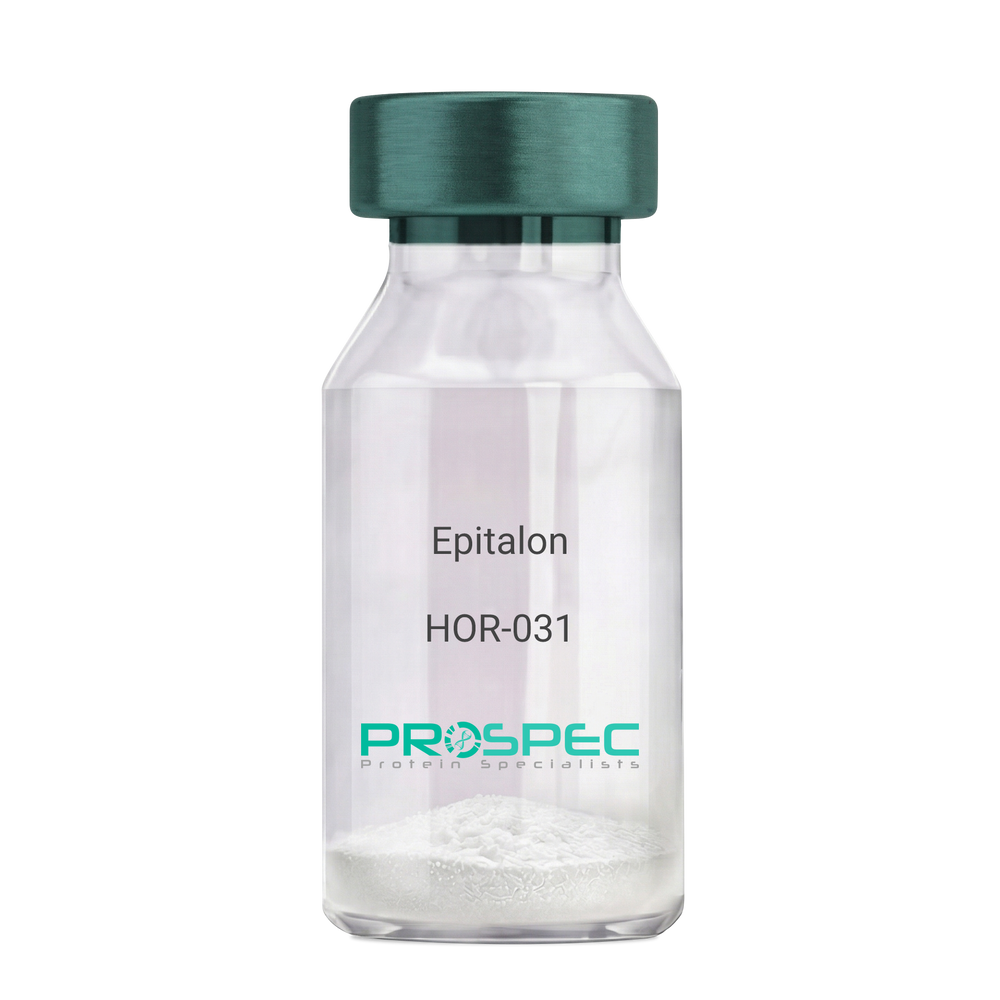
    Name :

    Epitalon

    Description:

    Epitalon

    Product # :

    HOR-031

    Price :

    Quantity :

    Shipping Method :

    Room Temp Icon

    Shipped at Room temp

    Add To Cart

    More Info

    • description
    • formulation
    • purity
    • More Info

    Description

    Epithalon Synthetic is a single, non-glycosylated polypeptide chain containing 4 amino acids, having a molecular mass of 390.35 Dalton and a Molecular formula of C14H22N4O9.

    Formulation

    The protein was lyophilized with no additives.

    Purity

    Greater than 97.0% as determined by analysis by RP-HPLC.

    More Info

    • Physical Appearance

      Sterile Filtered White lyophilized (freeze-dried) powder.

    • Stability

      Lyophilized Epithalon although stable at room temperature for 3 weeks, should be stored desiccated below -18°C. Upon reconstitution Epithalon should be stored at 4°C between 2-7 days and for future use below -18°C.For long term storage it is recommended to add a carrier protein (0.1% HSA or BSA). Please prevent freeze-thaw cycles.

    • Solubility

      It is recommended to reconstitute the lyophilized Epithalon in sterile 18MΩ-cm H2O not less than 100 µg/ml, which can then be further diluted to other aqueous solutions.

    • Amino Acid Sequence

      H-Ala-Glu-Asp-Gly-OH .

    • Background

      Epitalon, also known as Epithalon, is a synthetic tetrapeptide that has been a focal point in the field of aging and longevity research. This peptide, consisting of four amino acids, is derived from the pineal gland and has been associated with a variety of biological effects, most notably its potential role in extending the lifespan of cells.

      Epitalon's primary function is its interaction with telomeres, the protective caps at the ends of chromosomes that shorten as cells divide. By stimulating the production of telomerase, an enzyme that can repair and lengthen telomeres, Epitalon may slow down the aging process at a cellular level.

      Numerous studies have explored the potential of Epitalon in extending the lifespan of organisms. For instance, Khavinson and colleagues (2003) found that Epitalon increased the lifespan of fruit flies, while Anisimov et al. (2003) reported similar results in mice. These findings suggest that Epitalon could potentially have similar effects in humans.

      Epitalon has also been studied for its role in regulating circadian rhythms. Korkushko et al. (2011) found that Epitalon could restore disrupted circadian rhythms in elderly people, suggesting potential applications in sleep disorders and other conditions related to circadian rhythm disruption.

      Beyond its potential role in aging and longevity, Epitalon has been explored for its potential therapeutic applications. Anisimov et al. (2011) found that Epitalon could reduce the incidence of spontaneous tumors in mice, suggesting potential applications in cancer prevention.

      While research on Epitalon is promising, it is important to note that most studies have been conducted in animals or in vitro. More research is needed to fully understand the potential effects and applications of Epitalon in humans. However, the existing body of research suggests that Epitalon could be a promising tool in the fight against aging and age-related diseases.

    ProSpec's products are furnished for LABORATORY RESEARCH USE ONLY. The product may not be used as drugs, agricultural or pesticidal products, food additives or household chemicals.

    Epitalon
  • View Data Sheet

    Name :

    DKK3 Human

    Description:

    Dickkopf-Related Protein 3 Human Recombinant

    Dickkopf 3 homolog (Xenopus laevis), dickkopf-related protein 3, regulated in glioma, RIG, RIG-like 7-1, RIG-like 5-6, Dkk-3, REIC.

    Product # :

    PRO-1175

    Price :

    Quantity :

    Shipping Method :

    Ice Icon

    Shipped with Ice Packs

    Add To Cart

    More Info

    • description
    • source
    • formulation
    • purity
    • More Info

    Description

    DKK3 Human Recombinant produced in E. coli is a single polypeptide chain containing 353 amino acids (22-350) and having a molecular mass of 38.8 kDa.DKK3 is fused to a 24 amino acid His-tag at N-terminus & purified by proprietary chromatographic techniques.

    Source

    E.coli.

    Formulation

    The DKK3 solution (0.5mg/1ml) contains 20mM Tris-HCl buffer (pH 8.0), 1M Urea, 1mM DTT and 10% glycerol.

    Purity

    Greater than 85% as determined by SDS-PAGE.

    More Info

    • Introduction

      Dickkopf-related protein 3 (DKK3) belongs to the DKK protein family including Dkk-1, 2, 3 and -4. DKK3 is a 350 amino acid secreted glycoprotein which is comprised of an N-terminal signal peptide and 2 conserved cysteine-rich domains that are separated by a 12 amino acid linker region. DKK3 is involved in embryonic development through its inhibition of the WNT signaling pathway. DKK3 gene expression is decreased in a variety of cancer cell lines and it may act as a tumor suppressor gene.

    • Synonyms

      Dickkopf 3 homolog (Xenopus laevis), dickkopf-related protein 3, regulated in glioma, RIG, RIG-like 7-1, RIG-like 5-6, Dkk-3, REIC.

    • Physical Appearance

      Sterile Filtered colorless solution.

    • Stability

      Store at 4°C if entire vial will be used within 2-4 weeks. Store, frozen at -20°C for longer periods of time. For long term storage it is recommended to add a carrier protein (0.1% HSA or BSA).Avoid multiple freeze-thaw cycles.

    • Amino Acid Sequence

      MGSSHHHYHH SSGLVPRGSH MGSMAPAPTA TSAPVKPGPA LSYPQEEATL NEMFREVEEL MEDTQHKLRS AVEEMEAEEA AAKASSEVNL ANLPPSYHNE TNTDTKVGNN TIHVHREIHK ITNNQTGQMV FSETVITSVG DEEGRRSHEC IIDEDCGPSM YCQFASFQYT CQPCRGQRML CTRDSECCGD QLCVWGHCTK MATRGSNGTI CDNQRDCQPG LCCAFQRGLL FPVCTPLPVE GELCHDPASR LLDLITWELE PDGALDRCPC ASGLLCQPHS HSLVYVCKPT FVGSRDQDGE ILLPREVPDE YEVGSFMEEV RQELEDLERS LTEEMALREP AAAAAALLGG EEI

    ProSpec's products are furnished for LABORATORY RESEARCH USE ONLY. The product may not be used as drugs, agricultural or pesticidal products, food additives or household chemicals.

    Dkk3 Human
  • View Data Sheet

    Name :

    DTYMK Human

    Description:

    Deoxythymidylate Kinase Human Recombinant

    Deoxythymidylate Kinase (Thymidylate Kinase), DTMP Kinase, CDC8, TMPK, TYMK, Thymidylate (DTMP) Kinase, EC 2.7.4.9, PP3731, Thymidylate kinase.

    Product # :

    PKA-005

    Price :

    Quantity :

    Shipping Method :

    Ice Icon

    Shipped with Ice Packs

    Add To Cart

    More Info

    • description
    • source
    • formulation
    • purity
    • More Info

    Description

    DTYMK Human Recombinant produced in E.Coli is a single, non-glycosylated polypeptide chain containing 232 amino acids (1-212 a.a) and having a molecular mass of 26kDa. DTYMK is fused to a 20 amino acid His-tag at N-terminus & purified by proprietary chromatographic techniques.

    Source

    E.coli.

    Formulation

    DTYMK protein solution (1mg/ml) containing 20mM Tris-HCl buffer (pH 8.0), 20% glycerol, 2mM DTT and 0.1M NaCl.

    Purity

    Greater than 95% as determined by SDS-PAGE.

    More Info

    • Introduction

      Thymidylate kinase (DTYMK) is involved in pyrimidine metabolism. Specifically, DTYMK catalyzes the ATP-dependent conversion of dTMP (deoxythymidine monophosphate) to dTDP (deoxythymidine diphosphate), which then acts as one of the 4 nucleotides in DNA. Through its role in the catalytic creation of dTDP, DTYMK has an imperative role in the pathway of DNA synthesis and is assumed to be involved in cell cycle progression and cell growth.

    • Synonyms

      Deoxythymidylate Kinase (Thymidylate Kinase), DTMP Kinase, CDC8, TMPK, TYMK, Thymidylate (DTMP) Kinase, EC 2.7.4.9, PP3731, Thymidylate kinase.

    • Physical Appearance

      Sterile Filtered colorless solution.

    • Stability

      Store at 4°C if entire vial will be used within 2-4 weeks. Store, frozen at -20°C for longer periods of time. For long term storage it is recommended to add a carrier protein (0.1% HSA or BSA).Avoid multiple freeze-thaw cycles.

    • Amino Acid Sequence

      MGSSHHHHHH SSGLVPRGSH MAARRGALIV LEGVDRAGKS TQSRKLVEAL CAAGHRAELL RFPERSTEIG KLLSSYLQKK SDVEDHSVHL LFSANRWEQV PLIKEKLSQG VTLVVDRYAF SGVAFTGAKE NFSLDWCKQP DVGLPKPDLV LFLQLQLADA AKRGAFGHER YENGAFQERA LRCFHQLMKD TTLNWKMVDA SKSIEAVHED IRVLSEDAIR TATEKPLGEL WK.

    ProSpec's products are furnished for LABORATORY RESEARCH USE ONLY. The product may not be used as drugs, agricultural or pesticidal products, food additives or household chemicals.

    Dtymk Human
  • View Data Sheet

    Name :

    EIF4A3 Human

    Description:

    Eukaryotic Translation Initiation Factor 4A3 Human Recombinant

    Eukaryotic initiation factor 4A-III, eIF-4A-III, eIF4A-III, ATP-dependent RNA helicase DDX48, ATP-dependent RNA helicase eIF4A-3, DEAD box protein 48, Eukaryotic initiation factor 4A-like NUK-34, Eukaryotic translation initiation factor 4A isoform 3, Nuclear matrix protein 265, NMP 265, hNMP 265, EIF4A3, DDX48, KIAA0111, NUK34, NMP265, eIF4AIII.

    Product # :

    PRO-1007

    Price :

    Quantity :

    Shipping Method :

    Ice Icon

    Shipped with Ice Packs

    Add To Cart

    More Info

    • description
    • source
    • formulation
    • purity
    • More Info

    Description

    EIF4A3 Human Recombinant produced in E.Coli is a single, non-glycosylated polypeptide chain containing 435 amino acids (1-411 a.a.) and having a molecular mass of 49.4kDa. EIF4A3 is fused to a 24 amino acid His-tag at N-terminus & purified by proprietary chromatographic techniques.

    Source

    Escherichia Coli.

    Formulation

    EIF4A3 protein solution (0.5mg/ml) containing 20mM Tris-HCl buffer (pH 8.0), 2mM DTT, 30% glycerol and 200mM NaCl.

    Purity

    Greater than 95.0% as determined by SDS-PAGE.

    More Info

    • Introduction

      Eukaryotic initiation factor 4A-III (EIF4A3) is a member of the DEAD box helicase family and eIF4A subfamily. DEAD box proteins, distinguished by the conserved motif Asp-Glu-Ala-Asp (DEAD), are putative RNA helicases. These proteins are involved in several cellular processes including alteration of RNA secondary structure, such as translation initiation, nuclear and mitochondrial splicing, and ribosome and spliceosome assembly. EIF4A3 is a part of a splicing-dependent multiprotein exon junction complex (EJC) accumulated at splice junction on mRNAs. Based upon their distribution patterns, some members of the DEAD box helicase family are thought to be involved in embryogenesis, spermatogenesis, and cellular growth and division.

    • Synonyms

      Eukaryotic initiation factor 4A-III, eIF-4A-III, eIF4A-III, ATP-dependent RNA helicase DDX48, ATP-dependent RNA helicase eIF4A-3, DEAD box protein 48, Eukaryotic initiation factor 4A-like NUK-34, Eukaryotic translation initiation factor 4A isoform 3, Nuclear matrix protein 265, NMP 265, hNMP 265, EIF4A3, DDX48, KIAA0111, NUK34, NMP265, eIF4AIII.

    • Physical Appearance

      Sterile Filtered colorless solution.

    • Stability

      Store at 4°C if entire vial will be used within 2-4 weeks. Store, frozen at -20°C for longer periods of time. For long term storage it is recommended to add a carrier protein (0.1% HSA or BSA).Avoid multiple freeze-thaw cycles.

    • Amino Acid Sequence

      MGSSHHHHHH SSGLVPRGSH MGSHMATTAT MATSGSARKR LLKEEDMTKV EFETSEEVDV TPTFDTMGLR EDLLRGIYAY GFEKPSAIQQ RAIKQIIKGR DVIAQSQSGT GKTATFSISV LQCLDIQVRE TQALILAPTR ELAVQIQKGL LALGDYMNVQ CHACIGGTNV GEDIRKLDYG QHVVAGTPGR VFDMIRRRSL RTRAIKMLVL DEADEMLNKG FKEQIYDVYR YLPPATQVVL ISATLPHEIL EMTNKFMTDP IRILVKRDEL TLEGIKQFFV AVEREEWKFD TLCDLYDTLT ITQAVIFCNT KRKVDWLTEK MREANFTVSS MHGDMPQKER ESIMKEFRSG ASRVLISTDV WARGLDVPQV SLIINYDLPN NRELYIHRIG RSGRYGRKGV AINFVKNDDI RILRDIEQYY STQIDEMPMN VADLI.

    ProSpec's products are furnished for LABORATORY RESEARCH USE ONLY. The product may not be used as drugs, agricultural or pesticidal products, food additives or household chemicals.

    Eif4A3 Human
  • View Data Sheet

    Name :

    EIF4H Human

    Description:

    Eukaryotic Translation Initiation Factor 4H Human Recombinant

    Eukaryotic translation initiation factor 4H, eIF-4H, Williams-Beuren syndrome chromosomal region 1 protein, EIF4H, KIAA0038, WBSCR1, WSCR1.

    Product # :

    PRO-1114

    Price :

    Quantity :

    Shipping Method :

    Ice Icon

    Shipped with Ice Packs

    Add To Cart

    More Info

    • description
    • source
    • formulation
    • purity
    • More Info

    Description

    EIF4H Human Recombinant produced in E.Coli is a single, non-glycosylated polypeptide chain containing 272 amino acids (1-248 a.a) and having a molecular mass of 29.9kDa.EIF4H is fused to a 24 amino acid His-tag at N-terminus & purified by proprietary chromatographic techniques.

    Source

    Escherichia Coli.

    Formulation

    EIF4H protein solution (0.5mg/ml) containing 20mM Tris-HCl buffer (pH 8.0), 0.2M NaCl, 50% glycerol and 2mM DTT.

    Purity

    Greater than 90.0% as determined by SDS-PAGE.

    More Info

    • Introduction

      Eukaryotic translation initiation factor 4H (EIF4H) is a 248 amino acid protein which localizes to the perinuclear region of the cytoplasm and is expressed as 2 isoforms, termed short and long. EIF4H functions to stimulate the initiation of protein synthesis at the level of mRNA employment. EIF4H stimulates the RNA-dependent ATP hydrolysis catalyzed by EIF4A and EIF4B. EIF4H gene defects linked to Williams- Beuren syndrome (WBS), a rare developmental disorder characterized by cardiovascular and musculo-skeletal abnormalities and caused by the deletion of contiguous genes at 7q11.23.

    • Synonyms

      Eukaryotic translation initiation factor 4H, eIF-4H, Williams-Beuren syndrome chromosomal region 1 protein, EIF4H, KIAA0038, WBSCR1, WSCR1.

    • Physical Appearance

      Sterile Filtered colorless solution.

    • Stability

      Store at 4°C if entire vial will be used within 2-4 weeks. Store, frozen at -20°C for longer periods of time. For long term storage it is recommended to add a carrier protein (0.1% HSA or BSA).Avoid multiple freeze-thaw cycles.

    • Amino Acid Sequence

      MGSSHHHHHH SSGLVPRGSH MGSHMADFDT YDDRAYSSFG GGRGSRGSAG GHGSRSQKEL PTEPPYTAYV GNLPFNTVQG DIDAIFKDLS IRSVRLVRDK DTDKFKGFCY VEFDEVDSLK EALTYDGALL GDRSLRVDIA EGRKQDKGGF GFRKGGPDDR GMGSSRESRG GWDSRDDFNS
      GFRDDFLGGR GGSRPGDRRT GPPMGSRFRD GPPLRGSNMD FREPTEEERA QRPRLQLKPR TVATPLNQVA NPNSAIFGGA RPREEVVQKE QE.

    ProSpec's products are furnished for LABORATORY RESEARCH USE ONLY. The product may not be used as drugs, agricultural or pesticidal products, food additives or household chemicals.

    Eif4H Human
  • View Data Sheet

    Name :

    Epigen Human

    Description:

    Epigen Human Recombinant

    EPG, Epigen, PRO9904, ALGV3072, FLJ75542, EPGN, Epithelial mitogen.

    Product # :

    CYT-601

    Price :

    Quantity :

    Shipping Method :

    Room Temp Icon

    Shipped at Room temp

    Add To Cart

    More Info

    • description
    • source
    • formulation
    • purity
    • biological activity
    • More Info

    Description

    Epigen Recombinant Human produced in E.Coli is a single, non-glycosylated, polypeptide chain containing 72 amino acids and having a molecular mass of 7.9 kDa. Epigen is purified by proprietary chromatographic techniques.

    Source

    Escherichia Coli.

    Formulation

    EPGN was lyophilized from 20mM PBS buffer pH-7.4 .

    Purity

    Greater than 98.0% as determined by:
    (a) Analysis by RP-HPLC.
    (b) Analysis by SDS-PAGE.

    Biological Activity

    Determined by the dose-dependent stimulation of the proliferation of murine Balb/3T3 cells. The expected ED50 for this effect is less than 300 ng/ml, corresponding to a specific activity of > 3.3 ×10³ IU/mg.

    More Info

    • Introduction

      EPGN is an EGF-related polypeptide growth factor that signals through the ErbB receptor-1. EPGN is produced in numerous tissues, including the testis, liver, heart and in certain tumor cells. EPGN is mitogenic for fibroblasts and epithelial cells. Human EPGN is originally synthesized as a glycosylated 14.7 kDa transmembrane precursor protein, which is processed by proteolytic cleavage to produce a mature soluble sequence.

    • Synonyms

      EPG, Epigen, PRO9904, ALGV3072, FLJ75542, EPGN, Epithelial mitogen.

    • Physical Appearance

      Sterile Filtered White lyophilized (freeze-dried) powder.

    • Stability

      Lyophilized Epigen although stable at room temperature for 3 weeks, should be stored desiccated below -18°C. Upon reconstitution EPGN should be stored at 4°C between 2-7 days and for future use below -18°C.For long term storage it is recommended to add a carrier protein (0.1% HSA or BSA).Please prevent freeze-thaw cycles.

    • Solubility

      It is recommended to reconstitute the lyophilized Epigen in sterile 18MΩ-cm H2O not less than 100µg/ml, which can then be further diluted to other aqueous solutions.

    • Amino Acid Sequence

      AVTVTPPITA QQADNIEGPI ALKFSHLCLE DHNSYCINGA CAFHHELEKA ICRCFTGYTG ERCEHLTLTS YA

    • Background

      What is the molecular weight/Mw of EPIGEN Protein?
      EPIGEN Protein has a total Mw of 7.9kDa.

      What is the source or expression system of EPIGEN Protein?
      Escherichia Coli.

      What is the Purity of EPIGEN Protein?
      EPIGEN Protein is >98% pure as determined by SDS-PAGE.

      What is the Biological Activity of EPIGEN Protein?
      Determined by the dose-dependent stimulation of the proliferation of murine Balb/3T3 cells. The expected ED50 for this effect is less than 300 ng/ml, corresponding to a specific activity of > 3.3 ×10³ IU/mg.

      What is the amino acid sequence of EPIGEN Protein?
      AVTVTPPITA QQADNIEGPI ALKFSHLCLE DHNSYCINGA CAFHHELEKA ICRCFTGYTG ERCEHLTLTS YA

      What applications can EPIGEN Protein be used in?
      EPIGEN Protein can probably be used in western blot, ELISA and Lateral Flow.

      What is the endotoxin level for EPIGEN Protein?
      The endotoxin level is minimal, EPIGEN Protein was purified using conventional chromatography techniques.

    ProSpec's products are furnished for LABORATORY RESEARCH USE ONLY. The product may not be used as drugs, agricultural or pesticidal products, food additives or household chemicals.

    Epgn Human
  • View Data Sheet

    Name :

    PEDF Human, His

    Description:

    Pigment Epithelium-Derived Factor Human Recombinant, His Tag

    Pigment epithelium-derived factor, PEDF, Serpin-F1, SerpinF1, EPC-1, EPC1, PIG35.

    Product # :

    CYT-552

    Price :

    Quantity :

    Shipping Method :

    Ice Icon

    Shipped with Ice Packs

    Add To Cart

    More Info

    • description
    • source
    • formulation
    • purity
    • More Info

    Description

    PEDF Human Recombinant produced in E.Coli containing a natural variant M72T is a single, non-glycosylated, polypeptide chain containing 420 amino acids (20-418 a.a.) and having a total molecular mass of 46.7 kDa. PEDF is fused to a 20 amino acid His Tag at N-terminus and purified by proprietary chromatographic techniques.

    Source

    Escherichia Coli.

    Formulation

    The PEDF solution contains 20mM Tris-HCl buffer(pH 8.0), 0.1M NaCl , and 20% glycerol.

    Purity

    Greater than 90% as determined by SDS-PAGE.

    More Info

    • Introduction

      PEDF is a neurotrophic protein that induces extensive neuronal differentiation in retinoblastoma cells. SerpinF1 is a potent inhibitor of angiogenesis. EPC1 doesn’t undergo the stressed to relaxed conformation transition characteristic as of the active serpins since it exhibits no serine protease inhibitory activity.
      Aqueous humour level of asymmetric dimethylarginine is correlated with PEDF in humans. ADMA and PEDF levels are increased in response to inflammation in uveitis.
      Lack of PEDF expression is a potent factor for the enhancement of tumor growth and angiogenesis in breast cancer.
      PEDF & VEGF genes contribute to the development of diabetic retinopathy.
      PEDF and VEGF structural changes in blood vessel wall play an important role in the pathophysiology of PD patients.
      PEDF-overexpressing tumors exhibited reduced intratumoral angiogenesis.
      SerpinF1 is a new promising approach for the treatment of osteosarcoma.
      Levels of the natural ocular anti-angiogenic factor SentrinF1 (PEDF) is associated with proliferative retinopathy.
      VEGF secreted by retinal pigment epithelial cells upregulates PEDF expression via VEGFR-1 in an autocrine manner.
      Sentrin-F1 concentration in the aqueous humor of diabetic patients predicts who will develop progression of retinopathy.
      PEDF blocks angiogenic effects of leptin through its anti-oxidative properties.

    • Synonyms

      Pigment epithelium-derived factor, PEDF, Serpin-F1, SerpinF1, EPC-1, EPC1, PIG35.

    • Physical Appearance

      Sterile Filtered colorless solution.

    • Stability

      Store at 4°C if entire vial will be used within 2-4 weeks. Store, frozen at -20°C for longer periods of time. For long term storage it is recommended to add a carrier protein (0.1% HSA or BSA). Please prevent freeze-thaw cycles.

    • Amino Acid Sequence

      MGSSHHHHHH SSGLVPRGSH MQNPASPPEE GSPDPDSTGA LVEEEDPFFK VPVNKLAAAV SNFGYDLYRV RSSMSPTTNV LLSPLSVATA LSALSLGAEQ RTESIIHRAL YYDLISSPDI HGTYKELLDT VTAPQKNLKS ASRIVFEKKL RIKSSFVAPL EKSYGTRPRV LTGNPRLDLQ EINNWVQAQM KGKLARSTKE IPDEISILLL GVAHFKGQWV TKFDSRKTSL EDFYLDEERT VRVPMMSDPK AVLRYGLDSD LSCKIAQLPL TGSMSIIFFL PLKVTQNLTL IEESLTSEFI HDIDRELKTV QAVLTVPKLK LSYEGEVTKS LQEMKLQSLF DSPDFSKITG KPIKLTQVEH RAGFEWNEDG AGTTPSPGLQ PAHLTFPLDY HLNQPFIFVL RDTDTGALLF IGKILDPRGP.

    ProSpec's products are furnished for LABORATORY RESEARCH USE ONLY. The product may not be used as drugs, agricultural or pesticidal products, food additives or household chemicals.

    Serpinf1 Human His
  • View Data Sheet

    Name :

    PFN1 Rat

    Description:

    Profilin-1 Rat Recombinant

    Profilin-1, Profilin I.

    Product # :

    PRO-2231

    Price :

    Quantity :

    Shipping Method :

    Ice Icon

    Shipped with Ice Packs

    Add To Cart

    More Info

    • description
    • source
    • formulation
    • purity
    • More Info

    Description

    PFN1 Rat Recombinant produced in E.Coli is a single, non-glycosylated polypeptide chain containing 164 amino acids (1-140 a.a) and having a molecular mass of 17.5kDa. PFN1 is fused to a 24 amino acid His-tag at N-terminus & purified by proprietary chromatographic techniques.

    Source

    Escherichia Coli.

    Formulation

    PFN1 protein solution (1mg/ml) containing Phosphate Buffered Saline (pH 7.4) and 10% glycerol 1mM DTT.

    Purity

    Greater than 95.0% as determined by SDS-PAGE.

    More Info

    • Introduction

      Profilin-1 also known as Pfn1 is a ubiquitous actin monomer-binding protein which is a member of the profilin family. Pfn1 significantly enhances skin wound healing in-vitro as well as in-vivo which is mediated by purinergic receptors. Furthermore, Pfn1 is also active in endothelial cell migration and vessel sprouting. Pfn1 is considered to regulate actin polymerization in response to extracellular signals.

    • Synonyms

      Profilin-1, Profilin I.

    • Physical Appearance

      Sterile Filtered colorless solution.

    • Stability

      Store at 4°C if entire vial will be used within 2-4 weeks. Store, frozen at -20°C for longer periods of time. For long term storage it is recommended to add a carrier protein (0.1% HSA or BSA).Avoid multiple freeze-thaw cycles.

    • Amino Acid Sequence

      MGSSHHHHHH SSGLVPRGSH MGSHMAGWNA YIDSLMADGT CQDAAIVGYK DSPSVWAAVP GKTFVSITPA EVGVLVGKDR SSFFVNGLTL GGQKCSVIRD SLLQDGEFTM DLRTKSTGGA PTFNVTVTMT AKTLVLLMGK EGVHGGLINK KCYEMASHLR RSQY.

    ProSpec's products are furnished for LABORATORY RESEARCH USE ONLY. The product may not be used as drugs, agricultural or pesticidal products, food additives or household chemicals.

    Pfn1 Rat
  • View Data Sheet

    Name :

    CCL28 Rat

    Description:

    Mucosae-Associated Epithelial Chemokine (CCL28) Rat Recombinant

    MEC, CCK1, SCYA28, MGC71902, CCL28, C-C motif chemokine 28, Small-inducible cytokine A28, Mucosae-associated epithelial chemokine, Protein CCK1.

    Product # :

    CHM-278

    Price :

    Quantity :

    Shipping Method :

    Room Temp Icon

    Shipped at Room temp

    Add To Cart

    More Info

    • description
    • source
    • formulation
    • purity
    • biological activity
    • More Info

    Description

    MEC Rat Recombinant produced in E.Coli is a non-glycosylated, Polypeptide chain containing 116 amino acids and having a molecular mass of 13.1kDa. The Rat MEC is purified by proprietary chromatographic techniques.

    Source

    Escherichia Coli.

    Formulation

    The protein was lyophilized from a 0.2µm filtered concentrated solution in 20mM PB, pH 7.4 and150mM NaCl.

    Purity

    Greater than 95.0% as determined by
    (a) Analysis by RP-HPLC.
    (b) Analysis by SDS-PAGE.

    Biological Activity

    Determined by its ability to chemoattract murine lymphocytes using a concentration range of 1.0-10.0 ng/ml.

    More Info

    • Introduction

      CCL28 is part of the subfamily of small cytokine CC genes. CCL28 shows chemotactic activity for resting CD4 or CD8 T cells and eosinophils. CCL28 binds to chemokine receptors CCR3 and CCR10. CCL28 is involved in the physiology of extracutaneous epithelial tissues, including diverse mucosal organs. CCL28 mediates mucosal immunity in HIV exposure and infection. CCL28 is involved in the pathogenesis of inflammatory skin diseases.
      Human CCL28 cDNA encodes a 127 amino acid residue precursor protein with a putative 22 amino acid residue signal peptide that is cleaved to produce the 105 amino acid residue mature protein. Human and mouse CCL28 are highly conserved, sharing 83% amino acid identity in their mature regions. CCL28 shares the most homology with CCL27/CTACK. Human and mouse CCL28 RNA expression was found to be highest in normal and pathologic colon with the protein being expressed by epithelial cells. Human CCL28 RNA was also present in normal and asthmatic lung tissues.

    • Synonyms

      MEC, CCK1, SCYA28, MGC71902, CCL28, C-C motif chemokine 28, Small-inducible cytokine A28, Mucosae-associated epithelial chemokine, Protein CCK1.

    • Physical Appearance

      Sterile Filtered White lyophilized (freeze-dried) powder.

    • Stability

      Lyophilized MEC although stable at room temperature for 3 weeks, should be stored desiccated below -18C. Upon reconstitution MEC should be stored at 4C between 2-7 days and for future use below -18C.For long term storage it is recommended to add a carrier protein (0.1% HSA or BSA).Please prevent freeze-thaw cycles.

    • Solubility

      It is recommended to reconstitute the lyophilized MEC in sterile 18M-cm H2O not less than 100µg/ml, which can then be further diluted to other aqueous solutions.

    • Amino Acid Sequence

      SEAILPIASS CCTEVSHHIP RRLLERVNSC SIQRADGDCD LAAVILHVKR RRICVSPHNP TLKRWMSASE MKNGKENLCP RKKQDSGKDR KGHTPRKHGK HGTRRIHGTH DHEAPR.

    • Background

      What is the molecular weight/Mw of CCL28 RAT Protein?
      CCL28 RAT Protein has a total Mw of 13.1kDa.

      What is the source or expression system of CCL28 RAT Protein?
      Escherichia Coli.

      What is the Purity of CCL28 RAT Protein?
      CCL28 RAT Protein is > 95% pure as determined by SDS-PAGE.

      What is the Biological Activity of CCL28 RAT Protein?
      Determined by its ability to chemoattract murine lymphocytes using a concentration range of 1.0-10.0 ng/ml.

      What is the amino acid sequence of CCL28 RAT Protein?
      SEAILPIASS CCTEVSHHIP RRLLERVNSC SIQRADGDCD LAAVILHVKR RRICVSPHNP TLKRWMSASE MKNGKENLCP RKKQDSGKDR KGHTPRKHGK HGTRRIHGTH DHEAPR.

      What applications can CCL28 RAT Protein be used in?
      CCL28 RAT Protein can probably be used in western blot, ELISA and Lateral Flow.

      What is the endotoxin level for CCL28 RAT Protein?
      The endotoxin level is minimal, CCL28 RAT Protein was purified using conventional chromatography techniques.

    ProSpec's products are furnished for LABORATORY RESEARCH USE ONLY. The product may not be used as drugs, agricultural or pesticidal products, food additives or household chemicals.

    Ccl28 Rat
  • View Data Sheet

    Name :

    KRT5 Human

    Description:

    Cytokeratin 5 Human Recombinant

    Keratin 5, KRT5, EBS2, Epidermolysis Bullosa Simplex 2 Dowling-Meara/Kobner/Weber-Cockayne Types, Keratin 5 (Epidermolysis Bullosa Simplex,Dowling-Meara/Kobner/Weber-Cockayne Types), 58 KDa Cytokeratin, Type-II Keratin Kb5, CK-5, K5, DDD1, CK5, DDD, KRT5A, cytokeratin-5, Keratin, Type II Cytoskeletal 5, Cytokeratin-5, Keratin-5.

    Product # :

    PRO-1940

    Price :

    Quantity :

    Shipping Method :

    Ice Icon

    Shipped with Ice Packs

    Add To Cart

    More Info

    • description
    • source
    • formulation
    • purity
    • More Info

    Description

    KRT5 Human Recombinant produced in E.coli is a single, non-glycosylated polypeptide chain containing 613 amino acids (1-590) and having a molecular mass of 64.8 kDa.KRT5 is fused to a 23 amino acid His-tag at N-terminus.

    Source

    Escherichia Coli.

    Formulation

    The KRT5 solution (1mg/ml) contains 20mM Tris-HCl buffer (pH 8.0), 10% glycerol and 0.4M Urea.

    Purity

    Greater than 85% as determined by SDS-PAGE.

    More Info

    • Introduction

      Cytokeratin 5 (KRT5) belongs to the keratin gene family. The type II cytokeratins are comprised of basic or neutral proteins which are arranged in pairs of heterotypic keratin chains coexpressed throughout differentiation of simple and stratified epithelial tissues. The type II cytokeratins are clustered in a region of chromosome 12q12-q13. The KRT5 type II cytokeratin is specifically expressed in the basal layer of the epidermis with family member KRT14. Mutations in these genes are linked with a complex of diseases termed epidermolysis bullosa simplex.

    • Synonyms

      Keratin 5, KRT5, EBS2, Epidermolysis Bullosa Simplex 2 Dowling-Meara/Kobner/Weber-Cockayne Types, Keratin 5 (Epidermolysis Bullosa Simplex,Dowling-Meara/Kobner/Weber-Cockayne Types), 58 KDa Cytokeratin, Type-II Keratin Kb5, CK-5, K5, DDD1, CK5, DDD, KRT5A, cytokeratin-5, Keratin, Type II Cytoskeletal 5, Cytokeratin-5, Keratin-5.

    • Physical Appearance

      Sterile Filtered clear solution.

    • Stability

      Store at 4°C if entire vial will be used within 2-4 weeks. Store, frozen at -20°C for longer periods of time.For long term storage it is recommended to add a carrier protein (0.1% HSA or BSA).Please avoid freeze thaw cycles.

    • Amino Acid Sequence

      MGSSHHHHHH SSGLVPRGSH MGSMSRQSSV SFRSGGSRSF STASAITPSV SRTSFTSVSR SGGGGGGGFG RVSLAGACGV GGYGSRSLYN LGGSKRISIS TSGGSFRNRF GAGAGGGYGF GGGAGSGFGF GGGAGGGFGL GGGAGFGGGF GGPGFPVCPP GGIQEVTVNQ SLLTPLNLQI DPSIQRVRTE EREQIKTLNN KFASFIDKVR FLEQQNKVLD TKWTLLQEQG TKTVRQNLEP LFEQYINNLR RQLDSIVGER GRLDSELRNM QDLVEDFKNK YEDEINKRTT AENEFVMLKK DVDAAYMNKV ELEAKVDALM DEINFMKMFF DAELSQMQTH VSDTSVVLSM DNNRNLDLDS IIAEVKAQYE EIANRSRTEA ESWYQTKYEE LQQTAGRHGD DLRNTKHEIS EMNRMIQRLR AEIDNVKKQC ANLQNAIADA EQRGELALKD ARNKLAELEE ALQKAKQDMA RLLREYQELM NTKLALDVEI ATYRKLLEGE ECRLSGEGVG PVNISVVTSS VSSGYGSGSG YGGGLGGGLG GGLGGGLAGG GSGSYYSSSS GGVGLSGGLS VGGSGFSASS GRGLGVGFGS GGGSSSSVKF VSTTSSSRKS FKS.

    ProSpec's products are furnished for LABORATORY RESEARCH USE ONLY. The product may not be used as drugs, agricultural or pesticidal products, food additives or household chemicals.

    Krt5 Human
  • View Data Sheet

    Name :

    CDC34 Human, His

    Description:

    Cell Division Cycle 34 Human Recombinant, His Tag

    UB2R1, CDC-34, Ubiquitin-conjugating enzyme E2 R1, Ubiquitin-protein ligase R1, Ubiquitin-conjugating enzyme E2-32 kDa complementing, E2-CDC34, CDC34, EC 6.3.2.19, UBC3, UBE2R1.

    Product # :

    ENZ-355

    Price :

    Quantity :

    Shipping Method :

    Ice Icon

    Shipped with Ice Packs

    Add To Cart

    More Info

    • description
    • source
    • formulation
    • purity
    • More Info

    Description

    CDC34 Human Recombinant protein fused to a 20 amino acid N-terminal His-Tag produced in E.Coli is a single, non-glycosylated polypeptide chain containing 256 amino acids (1-236 a.a.) and having a molecular mass of 28.9 kDa. CDC34 is fused to a 20 amino acid His-tag at N-terminus & purified by proprietary chromatographic techniques.

    Source

    Escherichia Coli.

    Formulation

    The CDC34 (1mg/ml) protein solution contains 20mM Tris-Hcl pH-8, 10% glycerol, 50mM NaCl and 1mM DTT.

    Purity

    Greater than 95.0% as determined by SDS-PAGE.

    More Info

    • Introduction

      CDC34 is important in the control of cell cycle and DNA replication. Cdc34 in association with different E3 complexes, including SCF, has been shown to target many different substrates for ubiquitination and degradation during cell division, signal transduction, and development. Cdc34 substrates that have been characterized include I?B, B-Myb, Wee1, MyoD, ICERII?, ATF5, p27Xic1, and p27Kip1. Additionally, substrates such as ?-catenin, p21Cip1, E2F, cyclin E, and cyclin D are putative substrates of Cdc34 by virtue of their SCF requirement for proteolysis. Cdc34 has been demonstrated to self-associate through a domain in the C-terminus, and is phosphorylated and ubiquitinylated in vivo. This protein is useful for in vitro ubiquitinylation reactions.

    • Synonyms

      UB2R1, CDC-34, Ubiquitin-conjugating enzyme E2 R1, Ubiquitin-protein ligase R1, Ubiquitin-conjugating enzyme E2-32 kDa complementing, E2-CDC34, CDC34, EC 6.3.2.19, UBC3, UBE2R1.

    • Physical Appearance

      Sterile Filtered colorless solution.

    • Stability

      Store at 4°C if entire vial will be used within 2-4 weeks. Store, frozen at -20°C for longer periods of time. For long term storage it is recommended to add a carrier protein (0.1% HSA or BSA).Avoid multiple freeze-thaw cycles.

    • Amino Acid Sequence

      MGSSHHHHHH SSGLVPRGSH MARPLVPSSQ KALLLELKGL QEEPVEGFRV TLVDEGDLYN WEVAIFGPPN TYYEGGYFKA RLKFPIDYPY
      SPPAFRFLTK MWHPNIYETG DVCISILHPP VDDPQSGELP SERWNPTQNV RTILLSVISL LNEPNTFSPA NVDASVMYRK WKESKGKDRE
      YTDIIRKQVL GTKVDAERDG VKVPTTLAEY CVKTKAPAPD EGSDLFYDDY YEDGEVEEEA DSCFGDDEDD SGTEES.

    ProSpec's products are furnished for LABORATORY RESEARCH USE ONLY. The product may not be used as drugs, agricultural or pesticidal products, food additives or household chemicals.

    Cdc34 Human
  • View Data Sheet

    Name :

    CDK2AP2 Human

    Description:

    Cyclin-Dependent Kinase 2 Associated Protein 2 Human Recombinant

    Cyclin-dependent kinase 2-associated protein 2, CDK2-associated protein 2, DOC-1-related protein, DOC-1R, CDK2AP2, DOC1R, p14.

    Product # :

    PKA-048

    Price :

    Quantity :

    Shipping Method :

    Ice Icon

    Shipped with Ice Packs

    Add To Cart

    More Info

    • description
    • source
    • formulation
    • purity
    • More Info

    Description

    CDK2AP2 Human Recombinant produced in E.Coli is a single, non-glycosylated polypeptide chain containing 149 amino acids (1-126 a.a) and having a molecular mass of 15.5kDa.CDK2AP2 is fused to a 23 amino acid His-tag at N-terminus & purified by proprietary chromatographic techniques.

    Source

    Escherichia Coli.

    Formulation

    CDK2AP2 protein solution (1mg/ml) containing 20mM Tris-HCl buffer (pH 8.0), 0.2M NaCl, 50% glycerol and 2mM DTT.

    Purity

    Greater than 95.0% as determined by SDS-PAGE.

    More Info

    • Introduction

      Cyclin-Dependent Kinase 2 Associated Protein 2 (CDK2AP2) is a member of the CDK2AP family. CDK2-associated protein is assumed to negatively regulate CDK2 activity by sequestering monomeric CDK2, and targeting CDK2 for proteolysis. CDK2AP2 is implicated in the regulation of self-renewal of stem cells during early embryogenesis. CDK2AP2 is a regulator for self-renewal of mESCs (mouse embryonic stem cells) under permissive conditions, and cell survival during differentiation of the mESCs into terminally differentiated cell types.

    • Synonyms

      Cyclin-dependent kinase 2-associated protein 2, CDK2-associated protein 2, DOC-1-related protein, DOC-1R, CDK2AP2, DOC1R, p14.

    • Physical Appearance

      Sterile Filtered clear colorless solution.

    • Stability

      Store at 4°C if entire vial will be used within 2-4 weeks. Store, frozen at -20°C for longer periods of time. For long term storage it is recommended to add a carrier protein (0.1% HSA or BSA).Avoid multiple freeze-thaw cycles.

    • Amino Acid Sequence

      MGSSHHHHHH SSGLVPRGSH MGSMSYKPIA PAPSSTPGSS TPGPGTPVPT GSVPSPSGSV PGAGAPFRPL FNDFGPPSMG YVQAMKPPGA QGSQSTYTDL LSVIEEMGKE IRPTYAGSKS AMERLKRGII HARALVRECL AETERNART.

    ProSpec's products are furnished for LABORATORY RESEARCH USE ONLY. The product may not be used as drugs, agricultural or pesticidal products, food additives or household chemicals.

    Cdk2Ap2 Human
  • 1
  • …
  • 8
  • 9
  • 10
  • 11
  • 12
  • …
  • 42
Your browser does not support the video tag.

Products

  • Cytokines
  • Growth Factors
  • Chemokines
  • CD Antigens
  • Neurotrophins
  • Hormones
  • Enzymes
  • Viral Antigens
  • Recombinant Proteins
  • Natural Proteins
  • Monoclonal Antibodies
  • Polyclonal Antibodies
  • Thermal Packaging

About

  • Company
  • Founder
  • Contribution
  • Contact Us
  • My Account

Ordering

  • Ordering Method
  • Ordering - Credit Card
  • Ordering PO
  • Shipping Fees
  • FAQ's

Legal

  • Terms & Conditions
  • Privacy
  • Site Map
  • info@prospecbio.com
  • Facebook
  • Instagram
  • Linkedin Profile

© 2026 ProSpec-Tany TechnoGene Ltd. All Rights Reserved.

  • Choosing a selection results in a full page refresh.
  • Opens in a new window.