Skip to content

High-quality research proteins.

  • 1-800-805-6531

  • Mon - Sat 8.00-18.00, Sun - Closed

  • info@prospecbio.com

  • PO Box 6591 East Brunswick NJ 08816

  • Products
    • Cytokines
    • Growth factors
    • Chemokines
    • Cd antigens
    • Neurotrophins
    • Hormones
    • Enzymes
    • Viral antigens
    • Recombinant proteins
    • Natural proteins
    • Monoclonal antibodies
    • Polyclonal antibodies
    • Thermal Packaging
  • About
    • Company
    • Founder
    • Contribution
  • Customers
    • Eastern Asia
    • Eastern Europe
    • North America
    • South America
    • South East Asia
    • Southern Asia
    • Western Europe
  • Ordering
    • Ordering Method
    • Ordering - Credit Card
    • Ordering - PO
    • Shipping Fees
    • FAQs
  • Services
    • DNA Cloning
    • Protein Expression
    • Monoclonal Antibody
    • Fermentation
    • Technology License
  • Contact us
Log in

Country/region

  • USD $ | Albania
  • USD $ | Andorra
  • USD $ | Argentina
  • USD $ | Armenia
  • USD $ | Australia
  • USD $ | Austria
  • USD $ | Azerbaijan
  • USD $ | Belarus
  • USD $ | Belgium
  • USD $ | Bolivia
  • USD $ | Brazil
  • USD $ | Bulgaria
  • USD $ | Cambodia
  • USD $ | Canada
  • USD $ | Chile
  • USD $ | China
  • USD $ | Colombia
  • USD $ | Costa Rica
  • USD $ | Croatia
  • USD $ | Cyprus
  • USD $ | Czechia
  • USD $ | Denmark
  • USD $ | Estonia
  • USD $ | Finland
  • USD $ | France
  • USD $ | Georgia
  • USD $ | Germany
  • USD $ | Greece
  • USD $ | Hong Kong SAR
  • USD $ | Hungary
  • USD $ | Iceland
  • USD $ | India
  • USD $ | Ireland
  • USD $ | Israel
  • USD $ | Italy
  • USD $ | Japan
  • USD $ | Kazakhstan
  • USD $ | Latvia
  • USD $ | Liechtenstein
  • USD $ | Lithuania
  • USD $ | Madagascar
  • USD $ | Malta
  • USD $ | Mexico
  • USD $ | Moldova
  • USD $ | Monaco
  • USD $ | Netherlands
  • USD $ | New Zealand
  • USD $ | North Macedonia
  • USD $ | Norway
  • USD $ | Panama
  • USD $ | Paraguay
  • USD $ | Peru
  • USD $ | Philippines
  • USD $ | Poland
  • USD $ | Portugal
  • USD $ | Romania
  • USD $ | Singapore
  • USD $ | Slovakia
  • USD $ | Slovenia
  • USD $ | South Africa
  • USD $ | South Korea
  • USD $ | Spain
  • USD $ | Sri Lanka
  • USD $ | Sweden
  • USD $ | Switzerland
  • USD $ | Taiwan
  • USD $ | Thailand
  • USD $ | Türkiye
  • USD $ | Ukraine
  • USD $ | United Kingdom
  • USD $ | United States
  • USD $ | Uruguay
  • USD $ | Vatican City
  • USD $ | Venezuela
  • USD $ | Vietnam
  • Facebook
  • Instagram
logoProSpec - Recombinant Protein Manufacturer for academic and R&D industry
Become a distributor
Account Log in
Wishlist
Cart Cart(0)
  • Products
    +
    • Cytokines
    • Growth factors
    • Chemokines
    • Cd antigens
    • Neurotrophins
    • Hormones
    • Enzymes
    • Viral antigens
    • Recombinant proteins
    • Natural proteins
    • Monoclonal antibodies
    • Polyclonal antibodies
    • Thermal Packaging
  • About
    +
    • Company
    • Founder
    • Contribution
  • Customers
    +
    • Eastern Asia
    • Eastern Europe
    • North America
    • South America
    • South East Asia
    • Southern Asia
    • Western Europe
  • Ordering
    +
    • Ordering Method
    • Ordering - Credit Card
    • Ordering - PO
    • Shipping Fees
    • FAQs
  • Services
    +
    • DNA Cloning
    • Protein Expression
    • Monoclonal Antibody
    • Fermentation
    • Technology License
  • Contact us

Item added to your cart

View cart
View All
  • Cytokines
  • Growth factors
  • Chemokines
  • Cd antigens
  • Neurotrophins
  • Hormones
  • Enzymes
  • Viral antigens
  • Recombinant proteins
  • Natural proteins
  • Monoclonal antibodies
  • Polyclonal antibodies
  • Thermal Packaging
  • Tumor Necrosis Factor

    Tumor Necrosis Factor

    View All
  • 4-1BB

    4-1BB

    View All
  • Adiponectin

    Adiponectin

    View All
  • AIF1

    AIF1

    View All
  • Other Cytokines

    Other Cytokines

    View All
  • AITRL

    AITRL

    View All
  • Angiopoietin

    Angiopoietin

    View All
  • Apolipoprotein

    Apolipoprotein

    View All
  • B-Cell Activating Factor

    B-Cell Activating Factor

    View All
  • Beta Defensin

    Beta Defensin

    View All
  • Bone Morphogenetic Protein

    Bone Morphogenetic Protein

    View All
  • B type Natriuretic Peptide

    B type Natriuretic Peptide

    View All
  • BST

    BST

    View All
  • Betacellulin

    Betacellulin

    View All
  • Cardiotrophin

    Cardiotrophin

    View All
  • Activin

    Activin

    View All
  • Fibroblast Growth Factor

    Fibroblast Growth Factor

    View All
  • Other Growth Factors

    Other Growth Factors

    View All
  • CSF

    CSF

    View All
  • CTGF

    CTGF

    View All
  • IGFBP

    IGFBP

    View All
  • VEGF Protein

    VEGF Protein

    View All
  • EGF

    EGF

    View All
  • Epigen

    Epigen

    View All
  • Erythropoietin

    Erythropoietin

    View All
  • Insulin-Like Growth Factor

    Insulin-Like Growth Factor

    View All
  • Growth Hormone

    Growth Hormone

    View All
  • HDGF

    HDGF

    View All
  • Hepatocyte Growth Factor

    Hepatocyte Growth Factor

    View All
  • Insulin

    Insulin

    View All
  • BCA-1/ BLC (CXCL13)

    BCA-1/ BLC (CXCL13)

    View All
  • BRAK (CXCL14)

    BRAK (CXCL14)

    View All
  • C-10 (CCL6)

    C-10 (CCL6)

    View All
  • Other Chemokines

    Other Chemokines

    View All
  • MEC (CCL28)

    MEC (CCL28)

    View All
  • LD78-beta (CCL3L1)

    LD78-beta (CCL3L1)

    View All
  • CTACK (CCL27)

    CTACK (CCL27)

    View All
  • CXCL16

    CXCL16

    View All
  • CXCL17

    CXCL17

    View All
  • Platelet Factor-4 (CXCL4)

    Platelet Factor-4 (CXCL4)

    View All
  • ENA-78 (CXCL5)

    ENA-78 (CXCL5)

    View All
  • Eotaxin (CCL11,24,26)

    Eotaxin (CCL11,24,26)

    View All
  • Exodus-2 (CCL21)

    Exodus-2 (CCL21)

    View All
  • Fractalkine (CX3CL1)

    Fractalkine (CX3CL1)

    View All
  • CXCL6

    CXCL6

    View All
  • Other CD Antigens

    Other CD Antigens

    View All
  • CD14

    CD14

    View All
  • CD164

    CD164

    View All
  • CD1

    CD1

    View All
  • CD2

    CD2

    View All
  • CD200

    CD200

    View All
  • CD207

    CD207

    View All
  • CD226

    CD226

    View All
  • CD23

    CD23

    View All
  • CD244

    CD244

    View All
  • CD247

    CD247

    View All
  • CD27

    CD27

    View All
  • CD274

    CD274

    View All
  • CD300

    CD300

    View All
  • CD33

    CD33

    View All
  • Other Neurotrophins

    Other Neurotrophins

    View All
  • Beta-NGF

    Beta-NGF

    View All
  • BDNF

    BDNF

    View All
  • CDNF

    CDNF

    View All
  • CNTF

    CNTF

    View All
  • GDNF

    GDNF

    View All
  • Glia Maturation Factor

    Glia Maturation Factor

    View All
  • MANF

    MANF

    View All
  • Midkine

    Midkine

    View All
  • Neuroglobin

    Neuroglobin

    View All
  • Neurotrophic factors

    Neurotrophic factors

    View All
  • Neuregulin

    Neuregulin

    View All
  • Neuropilin

    Neuropilin

    View All
  • Pigment Epithelium-Derived Factor

    Pigment Epithelium-Derived Factor

    View All
  • Pleiotrophin

    Pleiotrophin

    View All
  • Peptide Hormones

    Peptide Hormones

    View All
  • Other Hormones

    Other Hormones

    View All
  • HCG

    HCG

    View All
  • Endothelin

    Endothelin

    View All
  • Exendin

    Exendin

    View All
  • FSH

    FSH

    View All
  • Glucagon

    Glucagon

    View All
  • GHRP

    GHRP

    View All
  • GLP

    GLP

    View All
  • Thyrostimulin

    Thyrostimulin

    View All
  • Inhibin A

    Inhibin A

    View All
  • LHRH

    LHRH

    View All
  • Melanotan

    Melanotan

    View All
  • Procalcitonin

    Procalcitonin

    View All
  • PTH

    PTH

    View All
  • Peroxiredoxin

    Peroxiredoxin

    View All
  • Peptidase

    Peptidase

    View All
  • Synthetase

    Synthetase

    View All
  • Transferase

    Transferase

    View All
  • Hydrolase

    Hydrolase

    View All
  • Dehydrogenase

    Dehydrogenase

    View All
  • ACE2

    ACE2

    View All
  • Esterase

    Esterase

    View All
  • Protein Kinases

    Protein Kinases

    View All
  • Other Enzymes

    Other Enzymes

    View All
  • Phosphatase

    Phosphatase

    View All
  • Deaminase

    Deaminase

    View All
  • Oxygenase

    Oxygenase

    View All
  • Adenylate Kinase

    Adenylate Kinase

    View All
  • Lyase

    Lyase

    View All
  • Chagas

    Chagas

    View All
  • SARS

    SARS

    View All
  • Influenza

    Influenza

    View All
  • ASFV

    ASFV

    View All
  • Astrovirus

    Astrovirus

    View All
  • Borrelia

    Borrelia

    View All
  • Helicobacter Pylori

    Helicobacter Pylori

    View All
  • Chikungunya

    Chikungunya

    View All
  • Chlamydia

    Chlamydia

    View All
  • Cytomegalo

    Cytomegalo

    View All
  • Dengue

    Dengue

    View All
  • EBV

    EBV

    View All
  • Ebola

    Ebola

    View All
  • Feline Leukemia Virus

    Feline Leukemia Virus

    View All
  • Hepatitis A

    Hepatitis A

    View All
  • Other

    Other

    View All
  • Actin

    Actin

    View All
  • ADAM

    ADAM

    View All
  • Complement Component

    Complement Component

    View All
  • Ag85

    Ag85

    View All
  • Eukaryotic Translation Initiation Factor

    Eukaryotic Translation Initiation Factor

    View All
  • Anterior Gradient Protein

    Anterior Gradient Protein

    View All
  • Heat Shock Protein

    Heat Shock Protein

    View All
  • Alpha-2-HS-Glycoprotein

    Alpha-2-HS-Glycoprotein

    View All
  • Hemoglobin

    Hemoglobin

    View All
  • Allergy

    Allergy

    View All
  • Anaplasma

    Anaplasma

    View All
  • Angiogenin

    Angiogenin

    View All
  • Ankyrin Repeat Domain

    Ankyrin Repeat Domain

    View All
  • Annexin

    Annexin

    View All
  • Other Natural Proteins

    Other Natural Proteins

    View All
  • Aprotinin

    Aprotinin

    View All
  • Transferrin

    Transferrin

    View All
  • Avidin

    Avidin

    View All
  • Anti Coagulation Factors

    Anti Coagulation Factors

    View All
  • Natural Albumin

    Natural Albumin

    View All
  • Natural Coagulation Factors

    Natural Coagulation Factors

    View All
  • Fibronectin

    Fibronectin

    View All
  • Thrombin

    Thrombin

    View All
  • Anti Human Enzyme

    Anti Human Enzyme

    View All
  • Other Monoclonal Antibodies

    Other Monoclonal Antibodies

    View All
  • Anti Human Cytokine

    Anti Human Cytokine

    View All
  • Anti Human Heat Shock Protein

    Anti Human Heat Shock Protein

    View All
  • Anti Mouse Lymphocyte

    Anti Mouse Lymphocyte

    View All
  • Anti Human Chemokine

    Anti Human Chemokine

    View All
  • Anti Human Lymphocyte

    Anti Human Lymphocyte

    View All
  • Anti Viral Monoclonal

    Anti Viral Monoclonal

    View All
  • Anti Mouse Cytokine

    Anti Mouse Cytokine

    View All
  • Anti-GST Monoclonal

    Anti-GST Monoclonal

    View All
  • Other Polyclonal Antibodies

    Other Polyclonal Antibodies

    View All
  • Anti Viral

    Anti Viral

    View All
  • Anti-GST Monoclonal

    Anti-GST Monoclonal

    View All
Back

Search results

661 results found for “Charged Multivesicular Body Protein”

Name

Description

Product #

Price

Quantity

Shipping Method

  • View Data Sheet

    Name :

    SGCB Human

    Description:

    Sarcoglycan Beta Human Recombinant

    Beta-sarcoglycan, Beta-SG, 43 kDa dystrophin-associated glycoprotein, 43DAG, A3b, LGMD2E, Sarcoglycan, Beta (43kDa Dystrophin-Associated Glycoprotein), Limb Girdle Muscular Dystrophy 2E (Non-Linked Families), SGC.

    Product # :

    PRO-2211

    Price :

    Quantity :

    Shipping Method :

    Ice Icon

    Shipped with Ice Packs

    Add To Cart

    More Info

    • description
    • source
    • formulation
    • purity
    • More Info

    Description

    SGCB Human Recombinant produced in E.Coli is a single, non-glycosylated polypeptide chain containing 255 amino acids (87-318 a.a) and having a molecular mass of 27.8kDa.SGCB is fused to a 23 amino acid His-tag at N-terminus & purified by proprietary chromatographic techniques.

    Source

    Escherichia Coli.

    Formulation

    SGCB protein solution (0.5mg/ml) containing 20mM Tris-HCl buffer(pH8.0) and 10% glycerol.

    Purity

    Greater than 90.0% as determined by SDS-PAGE.

    More Info

    • Introduction

      Sarcoglycan Beta, also known as SGCB, is a part of the sarcoglycan family. SGCB belongs to the sarcoglycan complex which is a subcomplex of the dystrophin-glycoprotein complex that connects between the F-actin cytoskeleton and the extracellular matrix.

    • Synonyms

      Beta-sarcoglycan, Beta-SG, 43 kDa dystrophin-associated glycoprotein, 43DAG, A3b, LGMD2E, Sarcoglycan, Beta (43kDa Dystrophin-Associated Glycoprotein), Limb Girdle Muscular Dystrophy 2E (Non-Linked Families), SGC.

    • Physical Appearance

      Sterile Filtered colorless solution.

    • Stability

      Store at 4°C if entire vial will be used within 2-4 weeks. Store, frozen at -20°C for longer periods of time. For long term storage it is recommended to add a carrier protein (0.1% HSA or BSA). Avoid multiple freeze-thaw cycles.

    • Amino Acid Sequence

      MGSSHHHHHH SSGLVPRGSH MGSWAVIRIG PNGCDSMEFH ESGLLRFKQV SDMGVIHPLY KSTVGGRRNE NLVITGNNQP IVFQQGTTKL SVENNKTSIT SDIGMQFFDP RTQNILFSTD YETHEFHLPS GVKSLNVQKA STERITSNAT SDLNIKVDGR AIVRGNEGVF IMGKTIEFHM GGNMELKAEN SIILNGSVMV STTRLPSSSS GDQLGSGDWV RYKLCMCADG TLFKVQVTSQ NMGCQISDNP CGNTH.

    ProSpec's products are furnished for LABORATORY RESEARCH USE ONLY. The product may not be used as drugs, agricultural or pesticidal products, food additives or household chemicals.

    Sgcb Human
  • View Data Sheet

    Name :

    HERPUD1 Human

    Description:

    HERPUD1 Human Recombinant

    Homocysteine-responsive endoplasmic reticulum-resident ubiquitin-like domain member 1 protein, HERPUD1, Methyl methanesulfonate (MMF)-inducible fragment protein 1, HERP, KIAA0025, MIF1, Mif1, SUP.

    Product # :

    PRO-2105

    Price :

    Quantity :

    Shipping Method :

    Ice Icon

    Shipped with Ice Packs

    Add To Cart

    More Info

    • description
    • source
    • formulation
    • purity
    • More Info

    Description

    HERPUD1 Human Recombinant produced in E. coli is a single polypeptide chain containing 286 amino acids (1-263) and having a molecular mass of 31.6kDa.HERPUD1 is fused to a 23 amino acid His-tag at N-terminus & purified by proprietary chromatographic techniques.

    Source

    Escherichia Coli.

    Formulation

    The HERPUD1 solution (0.5mg/1ml) contains Phosphate buffer saline (pH 7.4) and 10% glycerol.

    Purity

    Greater than 85.0% as determined by SDS-PAGE.

    More Info

    • Introduction

      HERPUD1 is a multi-pass membrane protein which is a part of the endoplasmic reticulum quality control system. HERPUD1 owns 1 N-terminal ubiquitin-like domain and is expressed highly in the brain. HERPUD1 is also known as ER-associated degradation (ERAD) which takes part in ubiquitin-dependent degradation of misfolded endoplasmic reticulum proteins.

    • Synonyms

      Homocysteine-responsive endoplasmic reticulum-resident ubiquitin-like domain member 1 protein, HERPUD1, Methyl methanesulfonate (MMF)-inducible fragment protein 1, HERP, KIAA0025, MIF1, Mif1, SUP.

    • Physical Appearance

      Sterile Filtered clear solution.

    • Stability

      Store at 4°C if entire vial will be used within 2-4 weeks. Store, frozen at -20°C for longer periods of time. For long term storage it is recommended to add a carrier protein (0.1% HSA or BSA).Avoid multiple freeze-thaw cycles.

    • Amino Acid Sequence

      MGSSHHHHHH SSGLVPRGSH MGSMESETEP EPVTLLVKSP NQRHRDLELS GDRGWSVGHL KAHLSRVYPE RPRPEDQRLI YSGKLLLDHQ CLRDLLPKQE KRHVLHLVCN VKSPSKMPEI NAKVAESTEE PAGSNRGQYP EDSSSDGLRQ REVLRNLSSP GWENISRPEA AQQAFQGLGP GFSGYTPYGW LQLSWFQQIY ARQYYMQYLA ATAASGAFVP PPSAQEIPVV SAPAPAPIHN QFPAENQPAN QNAAPQVVVN PGANQNLRMN AQGGPIVEED DEINRD.

    ProSpec's products are furnished for LABORATORY RESEARCH USE ONLY. The product may not be used as drugs, agricultural or pesticidal products, food additives or household chemicals.

    Herpud1 Human
  • View Data Sheet

    Name :

    MBP Mouse Antibody

    Description:

    Maltose-Binding protein, Antibody

    Product # :

    ANT-177

    Price :

    Quantity :

    Shipping Method :

    Room Temp Icon

    Shipped at Room temp

    Add To Cart

    More Info

    • More Info

    More Info

    • Introduction

      Maltose Binding Protein (MBP) is a part of the maltose/maltodextrin system of Eschericia coli bacteria, which is responsible for the uptake and efficient catabolism of maltodextrins. It is a complex regulatory and transport system involving many proteins and protein complexes.
      Maltose binding protein MalE,MBP, is part of the maltodextrin transport system in E. coli. The maltodextrins diffuse through the LamB pore located in the outer membrane into the periplasm. The sugar is bound to MalE which prevents it to diffuse back outside. MalE passes the sugar to a complex of MalF and MalG in the cytoplasmic membrane where active tranport is mediated by the ATPase MalK. MBP molecular weight is 40,622 dalton. There are two domains in the protein with similar secondary structure (central pleated sheets are surrounded by helices) . The domains are connected by three bridges, between the domains is a deep groove in which the sugar is bound. All hydroxyl groups of the sugar are fixed by sidechains of the protein by hydrogen bonds. Some water molecules are part of the hydrogen bridge network.

    • Stability

      Store unopened antibody at 4°C or lower. Under these conditions, there is no significant loss in product performance one year from the purchase date. The reconstituted antibody is stable for at least two months when stored at 4°C. For long term storage, it is recommended that aliquots of the antibody are frozen at -20°C (frost-free freezers are not recommended). Repeated freezing and thawing must be avoided. Prepare working dilutions on the day of use.

    • Immunogen

      The malE gene is inserted in a pMAL vector (Maina et al., 1988) and then expressed in E. coli JM109. The purified recombinant MBP protein was then used for mouse immunization.

    • Applications

      Immunofluorescence: Typical working dilution on frozen sections 1:200. 60 minutes primary antibody incubates at 25°C.

      Westren Blotting: working dilution on Western bloting 1:500. 60 minutes primary antibody incubates at 25°C.

    • Storage Buffer

      Theammonium sulfate-precipitated ascites fluid is in PBS + 1% BSA & then lyophilized.

    • Specificity

      Mouse monoclonal antibody against the amino acid stretch of KDPRIAA (the amino acid residue 339 to 345) of the periplasmic maltose-binding protein (MBP) [Escherichia coli] (Accession #: AAB59056).

    • Type

      Mouse Antibody Monoclonal.

    ProSpec's products are furnished for LABORATORY RESEARCH USE ONLY. The product may not be used as drugs, agricultural or pesticidal products, food additives or household chemicals.

    Mbp Antibody
  • View Data Sheet

    Name :

    NEFM

    Description:

    Neurofilament Medium Polypeptide Bovine

    Neurofilament medium polypeptide, NF-M, Neurofilament triplet M protein, 160 kDa neurofilament protein, Neurofilament 3, NEFM, NEF3, NFM.

    Product # :

    PRO-523

    Price :

    Quantity :

    Shipping Method :

    Room Temp Icon

    Shipped at Room temp

    Add To Cart

    More Info

    • description
    • source
    • formulation
    • purity
    • More Info

    Description

    Ultra Pure NeuroFilament Protein having a Molecular mass of 160 kDa produced from Bovine Spinal Cord.

    Source

    Bovine Spinal Cord.

    Formulation

    The protein was lyophilized from a 1mg/ml solution containing 10mM sodium phosphate, pH-7.5, 2mM DTT, 6M urea, 10mM methylammonium chloride and 1mM EDTA.

    Purity

    Greater than 95.0% as determined by SDS-PAGE.

    More Info

    • Introduction

      Neurofilaments are type IV intermediate filament heteropolymers that are composed of light, medium, and heavy chains. Neurofilaments comprise the axoskeleton and functionally maintain neuronal caliber and may also have a role in intracellular transport to axons and dendrites.
      NeuroFilament 160kDa is a medium neurofilament protein, which is commonly used as a biomarker of neuronal damage.

    • Synonyms

      Neurofilament medium polypeptide, NF-M, Neurofilament triplet M protein, 160 kDa neurofilament protein, Neurofilament 3, NEFM, NEF3, NFM.

    • Physical Appearance

      Sterile Filtered White lyophilized (freeze-dried) powder.

    • Stability

      Store the lyophilized NEFM between 2-8°C, do not freeze. Upon reconstitution NEFM should be stored below -18°C. Please prevent freeze-thaw cycles.

    • Solubility

      It is recommended to reconstitute the lyophilized NEFM in sterile 18MΩ-cm H2O.

    ProSpec's products are furnished for LABORATORY RESEARCH USE ONLY. The product may not be used as drugs, agricultural or pesticidal products, food additives or household chemicals.

    Nefm Bovine
  • View Data Sheet

    Name :

    CHGA Human, His

    Description:

    Chromogranin-A Human Recombinant, His Tag

    CGA, CHGA, Vasostatin-2, Pituitary secretory protein I, SP-I.

    Product # :

    PRO-699

    Price :

    Quantity :

    Shipping Method :

    Ice Icon

    Shipped with Ice Packs

    Add To Cart

    More Info

    • description
    • source
    • formulation
    • purity
    • More Info

    Description

    Recombinant Human CHGA produced in E.Coli is a single, non-glycosylated polypeptide chain containing 460 amino acids (19-457 a.a) and having a molecular mass of 51.2kDa (Molecular weight on SDS-PAGE will appear higher). Chromgranin-A is fused to 21 amino acid His Tag at N-terminus and purified by proprietary chromatographic techniques.

    Source

    Escherichia Coli.

    Formulation

    The CHGA protein (0.5mg/ml) contains 20mM Tris-HCl buffer pH-7.5, 2mM EDTA, 0.1mM PMSF and 10% glycerol.

    Purity

    Greater than 80.0% as determined by Analysis by SDS-PAGE.

    More Info

    • Introduction

      Chromgranin-A is part of the neuroendocrine secretory protein family. CHGA is located in secretory vesicles of neurons and endocrine cells. Chromgranin-A is a precursor to three biologically active peptides; vasostatin, pancreastatin, and parastatin. These peptides act as autocrine or paracrine negative modulators of the neuroendocrine system. Other peptides, including chromostatin, beta-granin, WE-14 and GE-25, are also derived from the full-length protein. Chromgranin-A has numerous biological activities on some tissues and organs and exerts a large spectrum of homeostatic actions, including antifungal and antimicrobial effect, modulation of cell adhesion, and inhibition of parathyroid hormone secretion.

    • Synonyms

      CGA, CHGA, Vasostatin-2, Pituitary secretory protein I, SP-I.

    • Physical Appearance

      Sterile filtered colorless solution.

    • Stability

      Store at 4°C if entire vial will be used within 2-4 weeks. Store, frozen at -20°C for longer periods of time. For long term storage it is recommended to add a carrier protein (0.1% HSA or BSA). Avoid multiple freeze-thaw cycles.

    • Amino Acid Sequence

      MGSSHHHHHH SSGLVPRGSH MLPVNSPMNK GDTEVMKCIV EVISDTLSKP SPMPVSQECF ETLRGDERIL SILRHQNLLK ELQDLALQGA KERAHQQKKH SGFEDELSEV LENQSSQAEL KEAVEEPSSK DVMEKREDSK EAEKSGEATD GARPQALPEP MQESKAEGNN QAPGEEEEEE EEATNTHPPA SLPSQKYPGP QAEGDSEGLS QGLVDREKGL SAEPGWQAKR EEEEEEEEEA EAGEEAVPEE EGPTVVLNPH PSLGYKEIRK GESRSEALAV DGAGKPGAEE AQDPEGKGEQ EHSQQKEEEE EMAVVPQGLF RGGKSGELEQ EEERLSKEWE DSKRWSKMDQ LAKELTAEKR LEGQEEEEDN RDSSMKLSFR ARAYGFRGPG PQLRRGWRPS SREDSLEAGL PLQVRGYPEE KKEEEGSANR RPEDQELESL SAIEAELEKV AHQLQALRRG.

    ProSpec's products are furnished for LABORATORY RESEARCH USE ONLY. The product may not be used as drugs, agricultural or pesticidal products, food additives or household chemicals.

    Chromogranin A Human His
  • View Data Sheet

    Name :

    VTCN1 Human

    Description:

    V-Set Domain Containing T Cell Activation Inhibitor 1 Human Recombinant

    V-set domain-containing T-cell activation inhibitor 1, B7 homolog 4, B7-H4, B7h.5, Immune costimulatory protein B7-H4, Protein B7S1, T-cell costimulatory molecule B7x, B7H4, VTCN1, B7S1, B7X, PRO1291, RP11-229A19.4.

    Product # :

    PRO-1812

    Price :

    Quantity :

    Shipping Method :

    Ice Icon

    Shipped with Ice Packs

    Add To Cart

    More Info

    • description
    • source
    • formulation
    • purity
    • More Info

    Description

    VTCN1 Human Recombinant produced in E.coli is a single, non-glycosylated polypeptide chain containing 258 amino acids (25-259) and having a molecular mass of 28.2 kDa.VTCN1 is fused to a 23 amino acid His-tag at N-terminus & purified by proprietary chromatographic techniques.

    Source

    Escherichia Coli.

    Formulation

    The VTCN1 solution (1mg/ml) contains 20mM Tris-HCl buffer (pH 8.0), 0.4M UREA and 10% glycerol.

    Purity

    Greater than 90.0% as determined by SDS-PAGE.

    More Info

    • Introduction

      V-Set Domain Containing T Cell Activation Inhibitor 1, also known as VCTN1, is part of the B7 costimulatory protein family. Proteins in this family are located on the surface of antigen-presenting cells and interact with ligand bound to receptors on the surface of T cells. High level of the encoded protein has been associated with tumor progression. VCTN1 also takes part in promoting epithelial cell transformation.

    • Synonyms

      V-set domain-containing T-cell activation inhibitor 1, B7 homolog 4, B7-H4, B7h.5, Immune costimulatory protein B7-H4, Protein B7S1, T-cell costimulatory molecule B7x, B7H4, VTCN1, B7S1, B7X, PRO1291, RP11-229A19.4.

    • Physical Appearance

      Sterile Filtered colorless solution.

    • Stability

      Store at 4°C if entire vial will be used within 2-4 weeks. Store, frozen at -20°C for longer periods of time. For long term storage it is recommended to add a carrier protein (0.1% HSA or BSA).Avoid multiple freeze-thaw cycles.

    • Amino Acid Sequence

      MGSSHHHHHH SSGLVPRGSH MGSLIIGFGI SGRHSITVTT VASAGNIGED GILSCTFEPD IKLSDIVIQW LKEGVLGLVH EFKEGKDELS EQDEMFRGRT AVFADQVIVG NASLRLKNVQ LTDAGTYKCY IITSKGKGNA NLEYKTGAFS MPEVNVDYNA SSETLRCEAP RWFPQPTVVW
      ASQVDQGANF SEVSNTSFEL NSENVTMKVV SVLYNVTINN TYSCMIENDI AKATGDIKVT ESEIKRRSHL QLLNSKAS.

    ProSpec's products are furnished for LABORATORY RESEARCH USE ONLY. The product may not be used as drugs, agricultural or pesticidal products, food additives or household chemicals.

    Vtcn1 Human
  • View Data Sheet

    Name :

    MYLPF Human

    Description:

    Myosin Light chain, Phosphorylatable, Fast Skeletal Muscle Human Recombinant

    Myosin regulatory light chain 2 skeletal muscle isoform, Fast skeletal myosin light chain 2, MLC2B, MYLPF, MRLC2, MYL11, HUMMLC2B.

    Product # :

    PRO-243

    Price :

    Quantity :

    Shipping Method :

    Ice Icon

    Shipped with Ice Packs

    Add To Cart

    More Info

    • description
    • source
    • formulation
    • purity
    • More Info

    Description

    MYLPF produced in E.Coli is a single, non-glycosylated polypeptide chain containing 189 amino acids (1-169 a.a) and having a molecular mass of 21.2kDa.MYLPF is fused to a 20 amino acid His-tag at N-terminus & purified by proprietary chromatographic techniques.

    Source

    Escherichia Coli.

    Formulation

    MYLPF protein solution (0.25mg/ml) containing 20mM Tris-HCl buffer (pH 8.0), 1mM DTT, 10% glycerol and 100mM NaCl.

    Purity

    Greater than 85.0% as determined by SDS-PAGE.

    More Info

    • Introduction

      Myosin regulatory light chains, including MRCL3, MYLPF and MYL9, regulate contraction in smooth muscle and non-muscle cells via phosphorylation by MLCK (myosin light chain kinase). Phosphorylation of myosin regulatory light chains, catalyzed by MLCK in the presence of calcium and calmodulin, increases the actin-activated myosin ATPase activity, thus regulating the contractile activity. MYLPF is vital for fast and slow skeletal muscle development.

    • Synonyms

      Myosin regulatory light chain 2 skeletal muscle isoform, Fast skeletal myosin light chain 2, MLC2B, MYLPF, MRLC2, MYL11, HUMMLC2B.

    • Physical Appearance

      Sterile Filtered colorless solution.

    • Stability

      Store at 4°C if entire vial will be used within 2-4 weeks. Store, frozen at -20°C for longer periods of time. For long term storage it is recommended to add a carrier protein (0.1% HSA or BSA).Avoid multiple freeze-thaw cycles.

    • Amino Acid Sequence

      MGSSHHHHHH SSGLVPRGSH MAPKRAKRRT VEGGSSSVFS MFDQTQIQEF KEAFTVIDQN RDGIIDKEDL RDTFAAMGRL NVKNEELDAM MKEASGPINF TVFLTMFGEK LKGADPEDVI TGAFKVLDPE GKGTIKKKFL EELLTTQCDR FSQEEIKNMW AAFPPDVGGN VDYKNICYVI THGDAKDQE.

    ProSpec's products are furnished for LABORATORY RESEARCH USE ONLY. The product may not be used as drugs, agricultural or pesticidal products, food additives or household chemicals.

    Mylpf Human
  • View Data Sheet

    Name :

    HPCAL1 Human

    Description:

    Hippocalcin-Like 1 Human Recombinant

    Hippocalcin-Like 1, HLP2, BDR1, Calcium-Binding protein BDR-1, Visinin-Like protein 3, VILIP-3

    Product # :

    PRO-254

    Price :

    Quantity :

    Shipping Method :

    Ice Icon

    Shipped with Ice Packs

    Add To Cart

    More Info

    • description
    • source
    • formulation
    • purity
    • More Info

    Description

    HPCAL1 Human Recombinant produced in E.Coli is a single, non-glycosylated polypeptide chain containing 213amino acids (1-193a.a.) and having a molecular wieght of 24.4kDa. The HPCAL1 is fused to 20a.a. His-Tag at N-terminus and purified by proprietary chromatographic techniques.

    Source

    Escherichia Coli.

    Formulation

    The HPCAL1 protein solution (1mg/1ml) contains 20mM Tris-HCl buffer (pH8.0) containing 1mM DTT 0.2M NaCl and 10% glycerol.

    Purity

    Greater than 95.0% as determined by SDS-PAGE.

    More Info

    • Introduction

      HPCAL1, participates in neuron-specific calcium-binding proteins family found in the retina and brain. HPCAL1 is extremely comparable to human hippocalcin protein and almost equal to the rat and mouse hippocalcin like-1 proteins. HPCAL1 takes part in the calcium-dependent regulation of rhodopsin phosphorylation and can have importance in neuronal signalling in the central nervous system.

    • Synonyms

      Hippocalcin-Like 1, HLP2, BDR1, Calcium-Binding protein BDR-1, Visinin-Like protein 3,
      VILIP-3

    • Physical Appearance

      Sterile filtered colorless solution.

    • Stability

      Store at 4°C if entire vial will be used within 2-4 weeks. Store, frozen at -20°C for longer periods of time. For long term storage it is recommended to add a carrier protein (0.1% HSA or BSA). Avoid multiple freeze-thaw cycles.

    • Amino Acid Sequence

      MGSSHHHHHH SSGLVPRGSH MGKQNSKLRP EVLQDLRENT EFTDHELQEW YKGFLKDCPT GHLTVDEFKK IYANFFPYGD ASKFAEHVFR TFDTNGDGTI DFREFIIALS VTSRGKLEQK LKWAFSMYDL DGNGYISRSE MLEIVQAIYK MVSSVMKMPE DESTPEKRTD KIFRQMDTNN DGKLSLEEFI RGAKSDPSIV RLLQCDPSSA SQF

    ProSpec's products are furnished for LABORATORY RESEARCH USE ONLY. The product may not be used as drugs, agricultural or pesticidal products, food additives or household chemicals.

    Hpcal1 Human
  • View Data Sheet

    Name :

    VAPA Human

    Description:

    VAMP Associated Protein A 33kDa Human Recombinant

    hVAP-33, VAP-33, VAP-A, VAP33, Vesicle-associated membrane protein-associated protein A, VAMP-associated protein A, VAMP-A, 33 kDa VAMP-associated protein, VAPA.

    Product # :

    PRO-779

    Price :

    Quantity :

    Shipping Method :

    Ice Icon

    Shipped with Ice Packs

    Add To Cart

    More Info

    • description
    • source
    • formulation
    • purity
    • More Info

    Description

    VAPA Human Recombinant produced in E.Coli is a single, non-glycosylated, polypeptide chain containing 264 amino acids (1-227 a.a.) and having a molecular mass of 29.8 kDa. VAPA is fused to 37 amino acid His Tag and purified by proprietary chromatographic techniques.

    Source

    Escherichia Coli.

    Formulation

    VAPA solution containing 20mM Tris pH-8, 1mM DTT and 10% glycerol.

    Purity

    Greater than 85% as determined by SDS-PAGE.

    More Info

    • Introduction

      VAPA is involved in vesicle traficking. VAPA is a type IV membrane protein. It is localized in the plasma membrane and intracellular vesicles. VAPA is related with the cytoskeleton. VAPA functions membrane fusion, protein complex assembly and cell motility. VAPA is an essential regulator both of the subcellular localization of protrudin and of its ability to stimulate neurite outgrowth.

    • Synonyms

      hVAP-33, VAP-33, VAP-A, VAP33, Vesicle-associated membrane protein-associated protein A, VAMP-associated protein A, VAMP-A, 33 kDa VAMP-associated protein, VAPA.

    • Physical Appearance

      Sterile filtered colorless solution.

    • Stability

      Store at 4°C if entire vial will be used within 2-4 weeks. Store, frozen at -20°C for longer periods of time. For long term storage it is recommended to add a carrier protein (0.1% HSA or BSA).Avoid multiple freeze-thaw cycles.

    • Amino Acid Sequence

      RGSHHHHHH GMASMTGGQQ MGRDLYDDDD KDRWGSHMAS ASGAMAKHEQ ILVLDPPTDL KFKGPFTDVV TTNLKLRNPS DRKVCFKVKT TAPRRYCVRP NSGIIDPGST VTVSVMLQPF DYDPNEKSKH KFMVQTIFAP PNTSDMEAVW KEAKPDELMD SKLRCVFEMP NENDKLNDME PSKAVPLNAS KQDGPMPKPH SVSLNDTETR KLMEECKRLQ GEMMKLSEEN RHLRDEGLRL RKVAHSDKPG STSTASFRDN VTSP.

    ProSpec's products are furnished for LABORATORY RESEARCH USE ONLY. The product may not be used as drugs, agricultural or pesticidal products, food additives or household chemicals.

    Vapa Human
  • View Data Sheet

    Name :

    CIB1 Human

    Description:

    Calcium and Integrin Binding 1 Human Recombinant

    Calcium and integrin-binding protein 1, Calmyrin, DNA-PKcs-interacting protein, Kinase-interacting protein, SNK-interacting protein 2-28, SIP2-28, CIB1, CIB, KIP, PRKDCIP.

    Product # :

    PKA-345

    Price :

    Quantity :

    Shipping Method :

    Ice Icon

    Shipped with Ice Packs

    Add To Cart

    More Info

    • description
    • source
    • formulation
    • purity
    • More Info

    Description

    CIB1 Human Recombinant is a single, non-glycosylated polypeptide chain (aa 1-191) containing a total of 211 amino acids and having a molecular mass of 23 kDa.CIB1 is fused to a 20 a.a His-tag and it was purified by conventional column chromatographic techniques.

    Source

    Escherichia Coli.

    Formulation

    The CIB1 protein solution (1mg/ml) contains 20mM Tris-HCl, pH-8 & 5mM DTT.

    Purity

    Greater than 95.0% as determined by SDS-PAGE.

    More Info

    • Introduction

      CIB1 (Calcium and integrin binding 1) is regulatory protein with 50% homology to calmodulin and calcineurin B, that encodes a member of the calcium-binding protein family. CIB1 interacts with DNA-dependent protein kinase and may play a role in kinase-phosphatase regulation of DNA end joining. Also CIB1 is widely expressed and binds to a number of effectors, such as integrin ?IIb, PAK1, and polo-like kinases, in different tissues.

    • Synonyms

      Calcium and integrin-binding protein 1, Calmyrin, DNA-PKcs-interacting protein, Kinase-interacting protein, SNK-interacting protein 2-28, SIP2-28, CIB1, CIB, KIP, PRKDCIP.

    • Physical Appearance

      Sterile filtered colorless solution.

    • Stability

      Store at 4°C if entire vial will be used within 2-4 weeks. Store, frozen at -20°C for longer periods of time.For long term storage it is recommended to add a 0.1% HSA or BSA. Avoid multiple freeze-thaw cycles.

    • Amino Acid Sequence

      MGSSHHHHHH SSGLVPRGSH MGGSGSRLSK ELLAEYQDLT FLTKQEILLA HRRFCELLPQ EQRTVESSLR AQVPFEQILS LPELKANPFK ERICRVFSTS PAKDSLSFED FLDLLSVFSD TATPDIKSHY AFRIFDFDDD GTLNREDLSR LVNCLTGEGE DTRLSASEMK QLIDNILEES DIDRDGTINL SEFQHVISRS PDFASSFKIV L.

    • Patent Protected Countries

      The Sale of recombinant Human CIB1 by ProSpec is prohibited in the United States of America.

    ProSpec's products are furnished for LABORATORY RESEARCH USE ONLY. The product may not be used as drugs, agricultural or pesticidal products, food additives or household chemicals.

    Cib1 Human
  • View Data Sheet

    Name :

    SARS MERS, Sf9

    Description:

    SARS MERS Spike Recombinant

    Middle East respiratory syndrome coronavirus, Human betacoronavirus 2c EMC/2012, MERS-CoV, MERS, MERSCoV SP, Spike glycoprotein, S glycoprotein, S, Spike protein, E2, Peplomer protein

    Product # :

    SARS-051

    Price :

    Quantity :

    Shipping Method :

    Ice Icon

    Shipped with Ice Packs

    Add To Cart

    More Info

    • description
    • source
    • formulation
    • purity
    • More Info

    Description

    SARS MERS Recombinant produced in Sf9 Baculovirus cells is a single, glycosylated polypeptide chain containing 1285 amino acids (18-1296aa) and having a molecular mass of 141.6kDa.SARS MERS is fused to a 6 amino acid His-tag at C-terminus & purified by proprietary chromatographic techniques.

    Source

    Sf9, Baculovirus cells.

    Formulation

    The SARS MERS solution (0.25mg/ml) contains 10% glycerol and Phosphate-Buffered Saline (pH 7.4).

    Purity

    Greater than 85.0% as determined by SDS-PAGE.

    More Info

    • Introduction

      Since April 2012, cases of the Middle East Respiratory Syndrome Coronavirus (MERS-CoV) have been identified in various countries. Coronaviruses are the cause of the common cold, SARS (severe acute respiratory syndrome) and other severe illnesses with high mortality rates, all are classified into coronavirus family. MERS-CoV is a new type of SARS found in the coronavirus family causing severe pneumonia with sudden and serious respiratory illness with high mortality rates as well. Since January 27th 2015, the WHO has reported 956 human cases, including 351 deaths. More cases of the new coronavirus strain are expected. Like in other coronaviruses, large surface spike glycoprotein is a central structural protein of this virus; it is located above the virion surface to bind and enter into the target cell. Spike protein has 2 domains- S1 and S2. The S1 domain is responsible for cellular tropism and interaction with target cell, while the S2 domain is responsible for membrane fusion. The C-terminal of S1 domain contains a receptor binding domain, and is also a potential target for vaccine development and an antigen for diagnosis.

    • Synonyms

      Middle East respiratory syndrome coronavirus, Human betacoronavirus 2c EMC/2012, MERS-CoV, MERS, MERSCoV SP, Spike glycoprotein, S glycoprotein, S, Spike protein, E2, Peplomer protein

    • Physical Appearance

      Sterile filtered colorless solution.

    • Stability

      Store at 4°C if entire vial will be used within 2-4 weeks.Store, frozen at -20°C for longer periods of time.For long term storage it is recommended to add a carrier protein (0.1% HSA or BSA).Avoid multiple freeze-thaw cycles.

    • Amino Acid Sequence

      YVDVGPDSVK SACIEVDIQQ TFFDKTWPRP IDVSKADGII YPQGRTYSNI TITYQGLFPY QGDHGDMYVY SAGHATGTTP QKLFVANYSQ DVKQFANGFV VRIGAAANST GTVIISPSTS ATIRKIYPAF MLGSSVGNFS DGKMGRFFNH TLVLLPDGCG TLLRAFYCIL EPRSGNHCPA GNSYTSFATY HTPATDCSDG NYNRNASLNS FKEYFNLRNC TFMYTYNITE DEILEWFGIT QTAQGVHLFS SRYVDLYGGN MFQFATLPVY DTIKYYSIIP HSIRSIQSDR KAWAAFYVYK LQPLTFLLDF SVDGYIRRAI DCGFNDLSQL HCSYESFDVE SGVYSVSSFE AKPSGSVVEQ AEGVECDFSP LLSGTPPQVY NFKRLVFTNC NYNLTKLLSL FSVNDFTCSQ ISPAAIASNC YSSLILDYFS YPLSMKSDLS VSSAGPISQF NYKQSFSNPT CLILATVPHN LTTITKPLKY SYINKCSRLL SDDRTEVPQL VNANQYSPCV SIVPSTVWED GDYYRKQLSP LEGGGWLVAS GSTVAMTEQL QMGFGITVQY GTDTNSVCPK LEFANDTKIA SQLGNCVEYS LYGVSGRGVF QNCTAVGVRQ QRFVYDAYQN LVGYYSDDGN YYCLRACVSV PVSVIYDKET KTHATLFGSV ACEHISSTMS QYSRSTRSML KRRDSTYGPL QTPVGCVLGL VNSSLFVEDC KLPLGQSLCA LPDTPSTLTP RSVRSVPGEM RLASIAFNHP IQVDQLNSSY FKLSIPTNFS FGVTQEYIQT TIQKVTVDCK QYVCNGFQKC EQLLREYGQF CSKINQALHG ANLRQDDSVR NLFASVKSSQ SSPIIPGFGG DFNLTLLEPV SISTGSRSAR SAIEDLLFDK VTIADPGYMQ GYDDCMQQGP ASARDLICAQ YVAGYKVLPP LMDVNMEAAY TSSLLGSIAG VGWTAGLSSF AAIPFAQSIF YRLNGVGITQ QVLSENQKLI ANKFNQALGA MQTGFTTTNE AFQKVQDAVN NNAQALSKLA SELSNTFGAI SASIGDIIQR LDVLEQDAQI DRLINGRLTT LNAFVAQQLV RSESAALSAQ LAKDKVNECV KAQSKRSGFC GQGTHIVSFV VNAPNGLYFM HVGYYPSNHI EVVSAYGLCD AANPTNCIAP VNGYFIKTNN TRIVDEWSYT GSSFYAPEPI TSLNTKYVAP QVTYQNISTN LPPPLLGNST GIDFQDELDE FFKNVSTSIP NFGSLTQINT TLLDLTYEML SLQQVVKALN ESYIDLKELG NYTYYNKWPH HHHHH

    ProSpec's products are furnished for LABORATORY RESEARCH USE ONLY. The product may not be used as drugs, agricultural or pesticidal products, food additives or household chemicals.

    product_image.jpg
  • View Data Sheet

    Name :

    SCP2D1 Human

    Description:

    SCP2 sterol-binding domain containing 1 Human Recombinant

    SCP2 Sterol-Binding Domain Containing 1, C20orf79, Sterol Carrier Protein 2-Like Protein, Chromosome 20 Open Reading Frame 79, HSD22, dJ1068E13.2, SCP2 Sterol-Binding Domain-Containing Protein 1.

    Product # :

    PRO-1915

    Price :

    Quantity :

    Shipping Method :

    Ice Icon

    Shipped with Ice Packs

    Add To Cart

    More Info

    • description
    • source
    • formulation
    • purity
    • More Info

    Description

    SCP2D1 Human Recombinant produced in E.Coli is a single, non-glycosylated polypeptide chain containing 179 amino acids (1-156 a.a) and having a molecular mass of 20.1kDa.SCP2D1 is fused to a 23 amino acid His-tag at N-terminus & purified by proprietary chromatographic techniques.

    Source

    Escherichia Coli.

    Formulation

    SCP2D1 protein solution (0.25mg/ml) containing 20mM Tris-HCl buffer (pH 8.0), 0.15M NaCl, 20% glycerol and 1mM DTT.

    Purity

    Greater than 85% as determined by SDS-PAGE.

    More Info

    • Introduction

      SCP2 sterol-binding domain containing 1 also known as SCP2D1 contains 1 SCP2 domain. One of the diseases associated with SCP2D1 is d-bifunctional protein deficiency.

    • Synonyms

      SCP2 Sterol-Binding Domain Containing 1, C20orf79, Sterol Carrier Protein 2-Like Protein, Chromosome 20 Open Reading Frame 79, HSD22, dJ1068E13.2, SCP2 Sterol-Binding Domain-Containing Protein 1.

    • Physical Appearance

      Sterile Filtered clear solution.

    • Stability

      Store at 4°C if entire vial will be used within 2-4 weeks. Store, frozen at -20°C for longer periods of time.For long term storage it is recommended to add a carrier protein (0.1% HSA or BSA).Please avoid freeze thaw cycles.

    • Amino Acid Sequence

      MGSSHHHHHH SSGLVPRGSH MGS MWKRSDH QPKIKAEDGP LVGQFEVLGS VPEPAMPHPL ELSEFESFPV FQDIRLHIRE VGAQLVKKVN AVFQLDITKN GKTILRWTID LKNGSGDMYP GPARLPADTV FTIPESVFME LVLGKMNPQK AFLAGKFKVS GKVLLSWKLE RVFKDWAKF

    ProSpec's products are furnished for LABORATORY RESEARCH USE ONLY. The product may not be used as drugs, agricultural or pesticidal products, food additives or household chemicals.

    Scp2D1 Human
  • View Data Sheet

    Name :

    C5a Protein

    Description:

    Complement C5a Human

    Complement Component 5, C3 and PZP-Like Alpha-2-Macroglobulin Domain-Containing Protein 4, C5a Anaphylatoxin, Prepro-C5, CPAMD4, Anaphylatoxin C5a Analog, ECLZB, C5A, C5D, C5b, C5.

    Product # :

    PRO-2692

    Price :

    Quantity :

    Shipping Method :

    Ice Icon

    Shipped with Ice Packs

    Add To Cart

    More Info

    • description
    • source
    • formulation
    • purity
    • More Info

    Description

    Human Complement C5a produced in Human plasma having a molecular mass of 10.4 kDa.

    Source

    Human Plasma.

    Formulation

    C5a protein solution contains 120 mM NaCl and 10mM HEPES, pH 7.2.

    Purity

    Greater than 95.0% as determined by SDS-PAGE.

    More Info

    • Introduction

      Complement Component C5a (C5a) is involved in the complement system and it is encoded by the C5 gene in human. Complement C5 is cleaved into C5a and C5b. C5a has an imperative role in chemotaxis and C5b forms the 1st part of the complement membrane attack complex. Complement C5 is the 5th component of complement, which plays a central role in inflammatory and cell killing processes. C5a protein is composed of alpha and beta polypeptide chains, which are linked by a disulfide bridge. An activation peptide, C5a, which is an anaphylatoxin, which has potent spasmogenic and chemotactic activity, is derivative from the alpha polypeptide via cleavage with a convertase. The C5b macromolecular cleavage product forms a complex with the C6 complement component, and this complex is the basis for creation of the membrane attack complex, which includes supplementary complement components.

    • Synonyms

      Complement Component 5, C3 and PZP-Like Alpha-2-Macroglobulin Domain-Containing Protein 4, C5a Anaphylatoxin, Prepro-C5, CPAMD4, Anaphylatoxin C5a Analog, ECLZB, C5A, C5D, C5b, C5.

    • Physical Appearance

      Sterile filtered solution.

    • Stability

      C5a Human is stable at 4°C if entire vial will be used within 2-4 weeks.Store, frozen below -20°C for longer periods of time.For long term storage it is recommended to add a carrier protein (0.1% HSA or BSA).Avoid multiple freeze-thaw cycles.

    • Human Virus Test

      Plasma from each donor has been tested and found negative for antibody to HIV-1, HIV-2, HCV, HTLV-I &II, STS and HBSAG.

    ProSpec's products are furnished for LABORATORY RESEARCH USE ONLY. The product may not be used as drugs, agricultural or pesticidal products, food additives or household chemicals.

    Complement C5A
  • View Data Sheet

    Name :

    MOG Human

    Description:

    Myelin Oligodendrocyte Glycoprotein Human Recombinant

    Myelin Oligodendrocyte Glycoprotein, MOG, MOGIG-2, MGC26137.

    Product # :

    PRO-466

    Price :

    Quantity :

    Shipping Method :

    Room Temp Icon

    Shipped at Room temp

    Add To Cart

    More Info

    • description
    • source
    • formulation
    • purity
    • More Info

    Description

    Myelin Oligodendrocyte Glycoprotein produced in E.Coli is a single, non-glycosylated polypeptide chain containing a total of 132 amino acids (Met + 30-154 a.a. + 6x His tag at C-terminus) and having a total molecular mass of 15.2 kDa.

    Source

    Escherichia Coli.

    Formulation

    The Myelin Oligodendrocyte Glycoprotein was lyophilized from a 0.2µm filtered solution in 20mM HAc-NaAc and 150mM NaCl pH-4.5

    Purity

    Greater than 95.0% as determined by SDS-PAGE.

    More Info

    • Introduction

      Myelin Oligodendrocyte Glycoprotein is a membrane protein expressed on the oligodendrocyte cell surface and the outermost surface of myelin sheaths. Due to this localization, it is a prime target antigen that plays a role in immune-mediated demyelination. Myelin Oligodendrocyte Glycoprotein is involved in completion and maintenance of the myelin sheath and in cell-cell communication. MOG protein was found to differentially expressed in the dorsolateral prefrontal cortex and in the temporal lobe from patients with schizophrenia. MOG-specific antibody is crucial to the initiation of MOG-induced murine experimental autoimmune encephalomyelitis.

    • Synonyms

      Myelin Oligodendrocyte Glycoprotein, MOG, MOGIG-2, MGC26137.

    • Physical Appearance

      Sterile Filtered White lyophilized (freeze-dried) powder.

    • Stability

      Lyophilized MOG although stable at room temperature for 3 weeks, should be stored desiccated below -18°C. Upon reconstitution MOG should be stored at 4°C between 2-7 days and for future use below -18°C.For long term storage it is recommended to add a carrier protein (0.1% HSA or BSA).Please prevent freeze-thaw cycles.

    • Solubility

      It is recommended to reconstitute the lyophilized MOG in sterile 50mM Acetic acid not less than 100µg/ml, which can then be further diluted to other aqueous solutions.

    • Amino Acid Sequence

      MGQFRVIGPRHPIRALVGDEVELPCRISPGKNATGMEVGWYRPPFSRVVHLYRN
      GKDQDGDQAPEYRGRTELLKDAIGEGKVTLRIRNVRFSDEGGFTCFFRDHSYQE
      EAAMELKVEDPFYWVSPGHHHHHH.

    ProSpec's products are furnished for LABORATORY RESEARCH USE ONLY. The product may not be used as drugs, agricultural or pesticidal products, food additives or household chemicals.

    Mog Human
  • View Data Sheet

    Name :

    CCL28 Mouse

    Description:

    Mucosae-Associated Epithelial Chemokine Mouse Recombinant (CCL28)

    MEC, CCK1, SCYA28, MGC71902, CCL28, C-C motif chemokine 28, Small-inducible cytokine A28, Mucosae-associated epithelial chemokine, Protein CCK1.

    Product # :

    CHM-369

    Price :

    Quantity :

    Shipping Method :

    Room Temp Icon

    Shipped at Room temp

    Add To Cart

    More Info

    • description
    • source
    • formulation
    • purity
    • biological activity
    • More Info

    Description

    CCL28 Mouse Recombinant produced in E.Coli is a single, non-glycosylated, polypeptide chain containing 111 amino acids and having a molecular mass of 12.6 kDa. The CCL28 is purified by proprietary chromatographic techniques.

    Source

    Escherichia Coli.

    Formulation

    Lyophilized from a concentrated (1mg/ml) solution in water containing 20mM Phosphate buffer pH-7.4 and 150mM NaCl.

    Purity

    Greater than 97.0% as determined by:
    (a) Analysis by RP-HPLC.
    (b) Analysis by SDS-PAGE.

    Biological Activity

    Determined by its ability to chemoattract mouse lymphocytes using a concentration range of 1-10ng/ml corresponding to a Specific Activity of 100,000-1,000,000IU/mg.

    More Info

    • Introduction

      CCL28 is part of the subfamily of small cytokine CC genes. CCL28 shows chemotactic activity for resting CD4 or CD8 T cells and eosinophils. CCL28 binds to chemokine receptors CCR3 and CCR10. CCL28 is involved in the physiology of extracutaneous epithelial tissues, including diverse mucosal organs. CCL28 mediates mucosal immunity in HIV exposure and infection. CCL28 is involved in the pathogenesis of inflammatory skin diseases.
      Human CCL28 cDNA encodes a 127 amino acid residue precursor protein with a putative 22 amino acid residue signal peptide that is cleaved to produce the 105 amino acid residue mature protein. Human and mouse CCL28 are highly conserved, sharing 83% amino acid identity in their mature regions. CCL28 shares the most homology with CCL27/CTACK. Human and mouse CCL28 RNA expression was found to be highest in normal and pathologic colon with the protein being expressed by epithelial cells. Human CCL28 RNA was also present in normal and asthmatic lung tissues.

    • Synonyms

      MEC, CCK1, SCYA28, MGC71902, CCL28, C-C motif chemokine 28, Small-inducible cytokine A28, Mucosae-associated epithelial chemokine, Protein CCK1.

    • Physical Appearance

      Sterile Filtered White lyophilized (freeze-dried) powder.

    • Stability

      Lyophilized CCL28 although stable at room temperature for 3 weeks, should be stored desiccated below -18°C. Upon reconstitution CCL28 should be stored at 4°C between 2-7 days and for future use below -18°C.For long term storage it is recommended to add a carrier protein (0.1% HSA or BSA).Please prevent freeze-thaw cycles.

    • Solubility

      It is recommended to reconstitute the lyophilized CCL28 in sterile 18MΩ-cm H2O not less than 100µg/ml, which can then be further diluted to other aqueous solutions.

    • Amino Acid Sequence

      SEAILPMASS CCTEVSHHVS GRLLERVSSC SIQRADGDCD LAAVILHVKR RRICISPHNR TLKQWMRASE VKKNGRENVC SGKKQPSRKD RKGHTTRKHR TRGTHRHEAS R.

    • Background

      What is the molecular weight/Mw of CCL28 MOUSE Protein?
      CCL28 MOUSE Protein has a total Mw of 12.6kDa.

      What is the source or expression system of CCL28 MOUSE Protein?
      Escherichia Coli.

      What is the Purity of CCL28 MOUSE Protein?
      CCL28 MOUSE Protein is > 97% pure as determined by SDS-PAGE.

      What is the Biological Activity of CCL28 MOUSE Protein?
      Determined by its ability to chemoattract mouse lymphocytes using a concentration range of 1-10ng/ml corresponding to a Specific Activity of 100,000-1,000,000IU/mg.

      What is the amino acid sequence of CCL28 MOUSE Protein?
      SEAILPMASS CCTEVSHHVS GRLLERVSSC SIQRADGDCD LAAVILHVKR RRICISPHNR TLKQWMRASE VKKNGRENVC SGKKQPSRKD RKGHTTRKHR TRGTHRHEAS R.

      What applications can CCL28 MOUSE Protein be used in?
      CCL28 MOUSE Protein can probably be used in western blot, ELISA and Lateral Flow.

      What is the endotoxin level for CCL28 MOUSE Protein?
      The endotoxin level is minimal, CCL28 MOUSE Protein was purified using conventional chromatography techniques.

    ProSpec's products are furnished for LABORATORY RESEARCH USE ONLY. The product may not be used as drugs, agricultural or pesticidal products, food additives or household chemicals.

    Ccl28 Mouse
  • View Data Sheet

    Name :

    CRYAB Human, His

    Description:

    Crystallin Alpha B Human Recombinant, His Tag

    CRYA2, CTPP2, HSPB5, Crystallin Alpha B, CRYAB.

    Product # :

    HSP-088

    Price :

    Quantity :

    Shipping Method :

    Ice Icon

    Shipped with Ice Packs

    Add To Cart

    More Info

    • description
    • source
    • formulation
    • purity
    • More Info

    Description

    CRYAB Human Recombinant produced in E.coli is a single, non-glycosylated polypeptide chain containing 183 amino acids (1-175) and having a molecular mass of 21.2kDa. CRYAB is fused to an 8 a.a his-Tag at C-terminus and is purified by proprietary chromatographic techniques.

    Source

    Escherichia Coli.

    Formulation

    The CRYAB solution (1mg/ml) contains 10% glycerol & Phosphate-Buffered Saline (pH 7.4).

    Purity

    Greater than 90% as determined by SDS-PAGE.

    More Info

    • Synonyms

      CRYA2, CTPP2, HSPB5, Crystallin Alpha B, CRYAB.

    • Physical Appearance

      Sterile filtered colorless solution.

    • Stability

      Store at 4°C if entire vial will be used within 2-4 weeks. Store, frozen at -20°C for longer periods of time. For long term storage it is recommended to add a carrier protein (0.1% HSA or BSA). Avoid multiple freeze-thaw cycles.

    • Amino Acid Sequence

      MDIAIHHPWI RRPFFPFHSP SRLFDQFFGE HLLESDLFPT STSLSPFYLR PPSFLRAPSW FDTGLSEMRL EKDRFSVNLD VKHFSPEELK VKVLGDVIEV HGKHEERQDE HGFISREFHR KYRIPADVDP LTITSSLSSD GVLTVNGPRK QVSGPERTIP ITREEKPAVT AAPKKLEHHH HHH.

    • Background

      Alpha-B crystallin (CRYAB), a small heat shock protein, stands as a multifaceted molecular chaperone integral to cellular homeostasis and stress response. In its human recombinant form, CRYAB becomes a focal point in biomedical research, offering a controlled platform to explore its structural intricacies, cellular functions, and potential therapeutic applications. This research embarks on a comprehensive journey to unveil the diverse roles of CRYAB Human Recombinant, shedding light on its structural attributes, cellular interactions, and its implications in health and disease. By delving into the properties of CRYAB, scientists aim to deepen our understanding of cellular proteostasis and explore novel avenues in the treatment of protein misfolding disorders.

      Structural Insights into CRYAB Human Recombinant:

      CRYAB, forming oligomeric complexes, possesses a dynamic structural configuration crucial for its chaperone function. The human recombinant form, designed for controlled study, provides a unique window into the three-dimensional intricacies of CRYAB. Understanding its structure is fundamental for deciphering how CRYAB engages with client proteins, preventing their aggregation and maintaining cellular proteostasis.

      Cellular Functions in Proteostasis:

      As a molecular chaperone, CRYAB plays a pivotal role in preserving cellular proteostasis by preventing the aggregation of misfolded proteins. Beyond its chaperone function, CRYAB is implicated in diverse cellular processes, including modulation of apoptosis, regulation of cytoskeletal dynamics, and participation in cell signaling pathways. Elucidating the multifaceted functions of CRYAB Human Recombinant provides insights into its roles in health and disease.

      Implications in Neurodegenerative Disorders:

      CRYAB has garnered attention in the context of neurodegenerative disorders, where protein misfolding and aggregation are central pathological features. Studies involving CRYAB Human Recombinant have revealed its neuroprotective properties, suggesting its potential as a therapeutic target for conditions like Alzheimer's and Parkinson's diseases. Understanding the mechanisms by which CRYAB mitigates protein aggregation in neuronal cells holds promise for developing targeted interventions.

      CRYAB in Cardiovascular Health:

      The chaperone function of CRYAB extends to the cardiovascular system, where it safeguards against protein aggregation in cardiomyocytes. CRYAB Human Recombinant studies have illuminated its protective role in cardiac tissues, positioning it as a potential therapeutic avenue for heart diseases characterized by protein misfolding.

      Challenges and Future Directions:

      While the potential of CRYAB Human Recombinant in therapeutics is evident, challenges persist. Fine-tuning its applications, understanding its interactions with diverse client proteins, and exploring the intricacies of its roles in different cellular contexts are critical for translational success. Additionally, deciphering the specific mechanisms by which CRYAB contributes to the alleviation of protein misfolding disorders remains an active area of investigation.

      CRYAB Human Recombinant emerges as a linchpin in the cellular orchestra, orchestrating a symphony of functions vital for proteostasis. Its structural insights, diverse cellular functions, and therapeutic implications position it at the forefront of biomedical research. As researchers continue to unravel the molecular nuances of CRYAB, they not only deepen our understanding of cellular proteostasis but also pave the way for innovative treatments in neurodegenerative and cardiovascular disorders, shaping the future of precision medicine and protein folding therapeutics.

    ProSpec's products are furnished for LABORATORY RESEARCH USE ONLY. The product may not be used as drugs, agricultural or pesticidal products, food additives or household chemicals.

    Cryab Human His
  • View Data Sheet

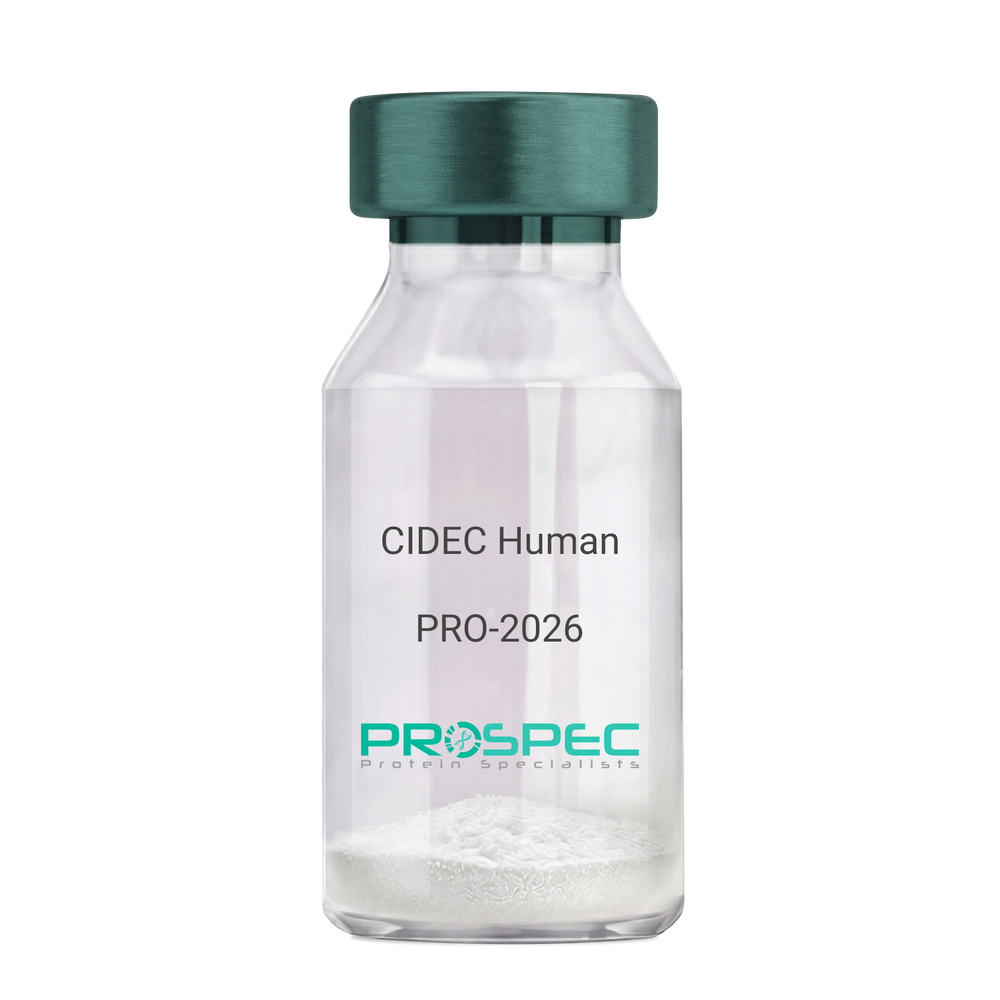
    Name :

    CIDEC Human

    Description:

    Cell Death-Inducing DFFA-Like Effector C Human Recombinant

    Cell Death-Inducing DFFA-Like Effector C, FSP27, CIDE3, FPLD5, Cell Death-Inducing DFFA-Like Effector Protein C, Fat-Specific Protein FSP27 Homolog, Cell Death Activator CIDE-3, Fat Specific Protein 27, CIDE-3, CIDEC.

    Product # :

    PRO-2026

    Price :

    Quantity :

    Shipping Method :

    Ice Icon

    Shipped with Ice Packs

    Add To Cart

    More Info

    • description
    • source
    • formulation
    • purity
    • More Info

    Description

    CIDEC Human Recombinant produced in E.Coli is a single, non-glycosylated, polypeptide chain (Glu2-Gln238) containing 247 amino acids including a 10 aa His tag at N-terminus. The total calculated molecular mass is 28kDa.

    Source

    Escherichia Coli.

    Formulation

    CIDEC filtered (0.4µm) solution at a concentration of 0.4mg/ml in 30mM acetate buffer and 10mM dithiothreitol, pH 4.

    Purity

    Greater than 95.0% as determined by SDS-PAGE.

    More Info

    • Introduction

      Cell Death-Inducing DFFA-Like Effector C (CIDEC) belongs to the cell death-inducing DNA fragmentation factor-like effector family, whose members have significant roles in apoptosis. CIDEC is expressed mainly in adipocytes, intestine, heart, stomach, and weakly in the brain, kidney and liver. CIDEC overexpression in preadipocytes induces apoptosis. CIDEC regulates enlargement of lipid droplets.

    • Synonyms

      Cell Death-Inducing DFFA-Like Effector C, FSP27, CIDE3, FPLD5, Cell Death-Inducing DFFA-Like Effector Protein C, Fat-Specific Protein FSP27 Homolog, Cell Death Activator CIDE-3, Fat Specific Protein 27, CIDE-3, CIDEC.

    • Physical Appearance

      Filtered colorless solution.

    • Stability

      Store at 4°C if entire vial will be used within 2-4 weeks. Store, frozen at -20°C for longer periods of time. For long term storage it is recommended to add a carrier protein (0.1% HSA or BSA).Avoid multiple freeze-thaw cycles.

    • Amino Acid Sequence

      MKHHHHHHASEYAMKSLSLL YPKSLSRHVS VRTSVVTQQL LSEPSPKAPR ARPCRVSTAD RSVRKGIMAY SLEDLLLKVR DTLMLADKPF FLVLEEDGTT VETEEYFQAL AGDTVFMVLQ KGQKWQPPSE QGTRHPLSLS HKPAKKIDVA RVTFDLYKLN PQDFIGCLNV KATFYDTYSL SYDLHCCGAK RIMKEAFRWA LFSMQATGHV LLGTSCYLQQ LLDATEEGQP PKGKASSLIP TCLKILQ.

    ProSpec's products are furnished for LABORATORY RESEARCH USE ONLY. The product may not be used as drugs, agricultural or pesticidal products, food additives or household chemicals.

    Cidec Human
  • View Data Sheet

    Name :

    POMC Human

    Description:

    Proopiomelanocortin Human Recombinant

    Pro-opiomelanocortin, POMC, LPH, MSH, NPP, POC, ACTH, CLIP.

    Product # :

    PRO-236

    Price :

    Quantity :

    Shipping Method :

    Ice Icon

    Shipped with Ice Packs

    Add To Cart

    More Info

    • description
    • source
    • formulation
    • purity
    • More Info

    Description

    POMC produced in E.Coli is a single, non-glycosylated polypeptide chain containing 262 amino acids (27-267 a.a) and having a molecular mass of 28.9kDa (molecular weight on SDS-PAGE will appear higher).POMC is fused to a 21 amino acid His-tag at N-terminus & purified by proprietary chromatographic techniques.

    Source

    Escherichia Coli.

    Formulation

    POMC protein solution (0.25mg/ml) containing 20mM Tris-HCl buffer (pH 8.5), 1mM DTT, 50% glycerol, 0.1mM PMSF, 0.1M Imidazole and 0.2M NaCl.

    Purity

    Greater than 85.0% as determined by SDS-PAGE.

    More Info

    • Introduction

      Pro-opiomelanocortin preproprotein (POMC) is a polypeptide hormone precursor which experiences extensive, tissue-specific, post-translational processing via cleavage by subtilisin-like enzymes known as prohormone convertases. POMC regulates the corticosteroid production in the adrenal cortex. Furthermore, POMC is cleaved into ten hormone chains named NPP, g-MSH, ACTH, a-MSH, CLIP, Lipotropin b, Lipotropin g, b-MSH,b endorphin and Met-enkephalin. POMC gene defects are the cause of POMC deficiency, which is characterized by red hair and adrenal insufficiency.

    • Synonyms

      Pro-opiomelanocortin, POMC, LPH, MSH, NPP, POC, ACTH, CLIP.

    • Physical Appearance

      Sterile Filtered colorless solution.

    • Stability

      Store at 4°C if entire vial will be used within 2-4 weeks. Store, frozen at -20°C for longer periods of time. For long term storage it is recommended to add a carrier protein (0.1% HSA or BSA).Avoid multiple freeze-thaw cycles.

    • Amino Acid Sequence

      MGSSHHHHHH SSGLVPRGSH MWCLESSQCQ DLTTESNLLE CIRACKPDLS AETPMFPGNG DEQPLTENPR KYVMGHFRWD RFGRRNSSSS GSSGAGQKRE DVSAGEDCGP LPEGGPEPRS DGAKPGPREG KRSYSMEHFR WGKPVGKKRR PVKVYPNGAE DESAEAFPLE FKRELTGQRL
      REGDGPDGPA DDGAGAQADL EHSLLVAAEK KDEGPYRMEH FRWGSPPKDK RYGGFMTSEK SQTPLVTLFK NAIIKNAYKK GE.

    ProSpec's products are furnished for LABORATORY RESEARCH USE ONLY. The product may not be used as drugs, agricultural or pesticidal products, food additives or household chemicals.

    Pomc Human
  • View Data Sheet

    Name :

    CRYBB1 Human

    Description:

    Crystallin Beta B1 Human Recombinant

    EC 1.17.4.1, RR2M, Beta-B1 crystallin, CATCN3.

    Product # :

    HSP-033

    Price :

    Quantity :

    Shipping Method :

    Ice Icon

    Shipped with Ice Packs

    Add To Cart

    More Info

    • description
    • source
    • formulation
    • purity
    • More Info

    Description

    CRYBB1 Recombinant Human produced in E.Coli is a single, non-glycosylated polypeptide chain containing 260 amino acids (1-252 a.a.) and having a molecular mass of 29.1 kDa. The CRYBB1 is fused to an 8 amino acid His-Tag at C-terminus and purified by proprietary chromatographic techniques.

    Source

    Escherichia Coli.

    Formulation

    The CRYBB1 solution (1mg/ml) contains 20mM Tris-HCl pH-8, 1mM DTT & 10% glycerol.

    Purity

    Greater than 90.0% as determined by SDS-PAGE.

    More Info

    • Introduction

      Crystallins are the main structural proteins of the vertebrate eye lens, where they maintain the transparency and refractive index of the lens. Crystallins are divided into 3 fprotein families, α, β, & γ families. Because lens central fiber cells lose their nuclei during development, these crystallins are prepared and then retained throughout life, making them extremely stable proteins. CRYBB1 is a beta basic group member and undergoes extensive cleavage at its N-terminal extension during lens maturation.

    • Synonyms

      EC 1.17.4.1, RR2M, Beta-B1 crystallin, CATCN3.

    • Physical Appearance

      Sterile filtered colorless solution.

    • Stability

      Store at 4°C if entire vial will be used within 2-4 weeks. Store, frozen at -20°C for longer periods of time.For long term storage it is recommended to add a carrier protein (0.1% HSA or BSA).Avoid multiple freeze-thaw cycles.

    • Amino Acid Sequence

      MSQAAKASAS ATVAVNPGPD TKGKGAPPAG TSPSPGTTLA PTTVPITSAK AAELPPGNYR LVVFELENFQ GRRAEFSGEC SNLADRGFDR VRSIIVSAGP WVAFEQSNFR GEMFILEKGE YPRWNTWSSS YRSDRLMSFR PIKMDAQEHK ISLFEGANFK GNTIEIQGDD APSLWVYGFS DRVGSVKVSS GTWVGYQYPG YRGYQYLLEP GDFRHWNEWG AFQPQMQSLR RLRDKQWHLE GSFPVLATEP PKRSHHHHHH.

    ProSpec's products are furnished for LABORATORY RESEARCH USE ONLY. The product may not be used as drugs, agricultural or pesticidal products, food additives or household chemicals.

    Crybb1 Human
  • View Data Sheet

    Name :

    STEAP4 Human

    Description:

    STEAP Family Member 4 Human Recombinant

    DKFZp666D049, FLJ23153, STAMP2, TIARP, TNFAIP9, Six-transmembrane epithelial antigen of prostate 4, SixTransMembrane protein of prostate 2, Tumor necrosis factor, alpha-induced protein 9.

    Product # :

    PRO-1893

    Price :

    Quantity :

    Shipping Method :

    Ice Icon

    Shipped with Ice Packs

    Add To Cart

    More Info

    • description
    • source
    • formulation
    • purity
    • More Info

    Description

    STEAP4 Human Recombinant produced in E.Coli is a single, non-glycosylated polypeptide chain containing 188 amino acids (1-152 a.a) and having a molecular mass of 20.6kDa.STEAP4 is fused to a 36 amino acid His-tag at N-terminus & purified by proprietary chromatographic techniques.

    Source

    Escherichia Coli.

    Formulation

    STEAP4 protein solution (1mg/ml) contains 20mM Tris-HCl buffer (pH 8.0), 0.4M UREA and 10% glycerol.

    Purity

    Greater than 90.0% as determined by SDS-PAGE.

    More Info

    • Introduction

      STEAP Family Member 4 (STEAP4) is a member of the STEAP (six transmembrane epithelial antigen of prostate) family, resides in the golgi apparatus. STEAP4 act as a metalloreductase which has the ability to reduce both Fe(3+) to Fe(2+) and Cu(2+) to Cu(1+),using NAD(+) as acceptor. According to studies in mice and human it is possible that STEAP4 may involve in adipocyte development and metabolism, and also contribute to the normal biology of the prostate cell.

    • Synonyms

      DKFZp666D049, FLJ23153, STAMP2, TIARP, TNFAIP9, Six-transmembrane epithelial antigen of prostate 4, SixTransMembrane protein of prostate 2, Tumor necrosis factor, alpha-induced protein 9.

    • Physical Appearance

      Sterile Filtered clear solution.

    • Stability

      Store at 4°C if entire vial will be used within 2-4 weeks. Store, frozen at -20°C for longer periods of time. For long term storage it is recommended to add a carrier protein (0.1% HSA or BSA).Avoid multiple freeze-thaw cycles.

    • Amino Acid Sequence

      MRGSHHHHHH GMASMTGGQQ MGRDLYDDDD KDRWGSMEKT CIDALPLTMN SSEKQETVCI FGTGDFGRSL GLKMLQCGYS VVFGSRNPQK TTLLPSGAEV LSYSEAAKKS GIIIIAIHRE HYDFLTELTE VLNGKILVDI SNNLKINQYP ESNAEYLAHL VPGAHVVKAF NTISAWALQS GALDASRQ.

    ProSpec's products are furnished for LABORATORY RESEARCH USE ONLY. The product may not be used as drugs, agricultural or pesticidal products, food additives or household chemicals.

    Steap4 Human
  • View Data Sheet

    Name :

    ARMS2 Human

    Description:

    Age-Related Maculopathy Susceptibility 2 Human Recombinant

    Age-related maculopathy susceptibility protein 2, ARMD8

    Product # :

    PRO-2628

    Price :

    Quantity :

    Shipping Method :

    Ice Icon

    Shipped with Ice Packs

    Add To Cart

    More Info

    • description
    • source
    • formulation
    • purity
    • More Info

    Description

    ARMS2 Human Recombinant produced in E.Coli is a single, non-glycosylated polypeptide chain containing 130 amino acids (1-107a.a.) and having a molecular mass of 13.8kDa.ARMS2 is fused to a 23 amino acid His tag at N-Terminus and purified by proprietary chromatographic techniques.

    Source

    E.coli.

    Formulation

    ARMS2 protein solution (0.25mg/ml) containing 20 mM Tris-HCl buffer (pH 8.0), 0.4M urea and 10% glycerol.

    Purity

    Greater than 85.0% as determined by SDS-PAGE.

    More Info

    • Introduction

      Age-Related Maculopathy Susceptibility 2 or ARMS2 is a protein that is is being researches for its ability to take part in diseases in old age. Mutations in Age-Related Maculopathy Susceptibility 2 is related to age-caused molecular degeneration.

    • Synonyms

      Age-related maculopathy susceptibility protein 2, ARMD8

    • Physical Appearance

      Sterile Filtered colorless solution.

    • Stability

      Store at 4°C if entire vial will be used within 2-4 weeks. Store, frozen at -20°C for longer periods of time. For long term storage it is recommended to add a carrier protein (0.1% HSA or BSA).Avoid multiple freeze-thaw cycles.

    • Amino Acid Sequence

      MGSSHHHHHH SSGLVPRGSH MGSMLRLYPG PMVTEAEGKG GPEMASLSSS VVPVSFISTL RESVLDPGVG GEGASDKQRS KLSLSHSMIP AAKIHTELCL PAFFSPAGTQ RRFQQPQHHL TLSIIHTAAR

    ProSpec's products are furnished for LABORATORY RESEARCH USE ONLY. The product may not be used as drugs, agricultural or pesticidal products, food additives or household chemicals.

    Arms2 Human
  • View Data Sheet

    Name :

    LAMTOR4 Human

    Description:

    LAMTOR4 Human Recombinant

    Late Endosomal/Lysosomal Adaptor, MAPK And MTOR Activator 4, C7orf59, Late Endosomal/Lysosomal Adaptor And MAPK And MTOR Activator 4, Chromosome 7 Open Reading Frame 59, Ragulator Complex Protein LAMTOR4, UPF0539 Protein C7orf59, LAMTOR4.

    Product # :

    PRO-2065

    Price :

    Quantity :

    Shipping Method :

    Ice Icon

    Shipped with Ice Packs

    Add To Cart

    More Info

    • description
    • source
    • formulation
    • purity
    • More Info

    Description

    LAMTOR4 Human Recombinant produced in E.Coli is a single, non-glycosylated polypeptide chain containing 122 amino acids (1-99 a.a) and having a molecular mass of 13.1kDa. LAMTOR4 is fused to a 23 amino acid His-tag at N-terminus & purified by proprietary chromatographic techniques.

    Source

    Escherichia Coli.

    Formulation

    LAMTOR4 protein solution (0.25mg/ml) containing 20mM Tris-HCl buffer (pH 8.0), 0.15M NaCl, 10% glycerol and 1mM DTT.

    Purity

    Greater than 85.0% as determined by SDS-PAGE.

    More Info

    • Introduction

      LAMTOR4 is implicated in amino acid sensing and activation of mTORC1, which is a signaling complex promoting cell growth in response to growth factors, energy levels, and amino acids. LAMTOR4 is activated by amino acids via a mechanism which involves the lysosomal V-ATPase, the Ragulator functions as a guanine nucleotide exchange factor activating the small GTPases Rag. Activated Ragulator and Rag GTPases both function as a scaffold recruiting mTORC1 to lysosomes where it is sequentially activated.

    • Synonyms

      Late Endosomal/Lysosomal Adaptor, MAPK And MTOR Activator 4, C7orf59, Late Endosomal/Lysosomal Adaptor And MAPK And MTOR Activator 4, Chromosome 7 Open Reading Frame 59, Ragulator Complex Protein LAMTOR4, UPF0539 Protein C7orf59, LAMTOR4.

    • Physical Appearance

      Sterile Filtered colorless solution.

    • Stability

      Store at 4°C if entire vial will be used within 2-4 weeks. Store, frozen at -20°C for longer periods of time. For long term storage it is recommended to add a carrier protein (0.1% HSA or BSA).Avoid multiple freeze-thaw cycles.

    • Amino Acid Sequence

      MGSSHHHHHH SSGLVPRGSH MGSMTSALTQ GLERIPDQLG YLVLSEGAVL ASSGDLENDE QAASAISELV STACGFRLHR GMNVPFKRLS VVFGEHTLLV TVSGQRVFVV KRQNRGREPI DV.

    ProSpec's products are furnished for LABORATORY RESEARCH USE ONLY. The product may not be used as drugs, agricultural or pesticidal products, food additives or household chemicals.

    Lamtor4 Human
  • View Data Sheet

    Name :

    TBEV Core

    Description:

    Tick-Borne Encephalitis Virus Core Protein Recombinant

    Product # :

    TBE-285

    Price :

    Quantity :

    Shipping Method :

    Ice Icon

    Shipped with Ice Packs

    Add To Cart

    More Info

    • description
    • source
    • formulation
    • purity
    • More Info

    Description

    The E.coli derived recombinant protein contains the Tick-borne Encephalitis Virus core protein epitopes.

    Source

    Escherichia Coli.

    Formulation

    20mM MES pH 6.5, 8M urea, 200mM NaCl & 0.05% Tween-20.

    Purity

    Encephalitis protein is >95% pure as determined by 10% PAGE (coomassie staining).

    More Info

    • Introduction

      TBE is caused by tick-borne encephalitis virus (TBEV), a member of the family Flaviviridae.
      A closely related virus in Far Eastern Eurasia, Russian spring-summer encephalitis virus (RSSEV).
      The family Flaviviridae includes other tick-borne viruses are closely related to TBEV and RSSEV, such as Omsk hemorrhagic fever virus & Kyasanur Forest virus.
      Louping ill virus is also a member of this family.

    • Stability

      Encephalitis protein although stable at 4°C for 1 week, should be stored below -18°C. Please prevent freeze thaw cycles.

    • Applications

      Encephalitis antigen is suitable for ELISA and Western blots, excellent antigen for detection of Tick-borne encephalitis virus with minimal specificity problems.

    • Specificity

      Immunoreactive with sera of encephalitis virus infected individuals.

    • Purification Method

      Encephalitis protein was purified by proprietary chromatographic technique.

    ProSpec's products are furnished for LABORATORY RESEARCH USE ONLY. The product may not be used as drugs, agricultural or pesticidal products, food additives or household chemicals.

    Tbev Core
  • View Data Sheet

    Name :

    a-Actinin

    Description:

    Actinin Alpha

    Alpha-actinin-1, Alpha-actinin cytoskeletal isoform, Non-muscle alpha-actinin-1, F-actin cross-linking protein, ACTN1.

    Product # :

    PRO-518

    Price :

    Quantity :

    Shipping Method :

    Room Temp Icon

    Shipped at Room temp

    Add To Cart

    More Info

    • description
    • source
    • formulation
    • purity
    • More Info

    Description

    Ultra pure Alpha Actinin having a Molecular mass of 95,000 Dalton.

    Source

    Chicken Gizzard.

    Formulation

    The protein was lyophilized from a 1mg/ml solution containing 10mM Tris acetate buffer pH 7.6, 0.1mM EDTA, 2mM DTT, and 20mM NaCl.

    Purity

    Greater than 95.0% as determined by analysis by SDS-PAGE.

    More Info

    • Introduction

      ACTN1 encodes a nonmuscle, cytoskeletal, alpha actinin isoform and maps to the same site as the structurally similar erythroid beta spectrin gene. Alpha actinins belong to the spectrin gene superfamily which represents a diverse group of cytoskeletal proteins, including the alpha and beta spectrins and dystrophins. Alpha actinin is an actin-binding protein with multiple roles in different cell types. In nonmuscle cells, the cytoskeletal isoform is found along microfilament bundles and adherens-type junctions, where it is involved in binding actin to the membrane. In contrast, skeletal, cardiac, and smooth muscle isoforms are localized to the Z-disc and analogous dense bodies, where they help anchor the myofibrillar actin filaments.

    • Synonyms

      Alpha-actinin-1, Alpha-actinin cytoskeletal isoform, Non-muscle alpha-actinin-1, F-actin cross-linking protein, ACTN1.

    • Physical Appearance

      Sterile Filtered White lyophilized (freeze-dried) powder.

    • Stability

      Lyophilized a-Actinin although stable at room temperature for 3 weeks, should be stored desiccated below -18°C. Upon reconstitution a-Actinin should be stored at 4°C between 2-7 days and for future use below -18°C. For long term storage it is recommended to add a carrier protein (0.1% HSA or BSA).Please prevent freeze-thaw cycles.

    • Solubility

      It is recommended to reconstitute the lyophilized a-Actinin in sterile 18MΩ-cm H2O not less than 100µg/ml, which can then be further diluted to other aqueous solutions.

    • Applications

      Protein standard in 1D and 2D SDS gelelectrophoresis
      Immunoassays
      Immunization.

    ProSpec's products are furnished for LABORATORY RESEARCH USE ONLY. The product may not be used as drugs, agricultural or pesticidal products, food additives or household chemicals.

    Alpha Actinin
  • 1
  • …
  • 8
  • 9
  • 10
  • 11
  • 12
  • …
  • 28
Your browser does not support the video tag.

Products

  • Cytokines
  • Growth Factors
  • Chemokines
  • CD Antigens
  • Neurotrophins
  • Hormones
  • Enzymes
  • Viral Antigens
  • Recombinant Proteins
  • Natural Proteins
  • Monoclonal Antibodies
  • Polyclonal Antibodies
  • Thermal Packaging

About

  • Company
  • Founder
  • Contribution
  • Contact Us
  • My Account

Ordering

  • Ordering Method
  • Ordering - Credit Card
  • Ordering PO
  • Shipping Fees
  • FAQ's

Legal

  • Terms & Conditions
  • Privacy
  • Site Map
  • info@prospecbio.com
  • Facebook
  • Instagram
  • Linkedin Profile

© 2026 ProSpec-Tany TechnoGene Ltd. All Rights Reserved.

  • Choosing a selection results in a full page refresh.
  • Opens in a new window.